Junior Taranis takes BC to court over permitting delays / 11
THE NORTHERN MINER | DECEMBER 2023
GLOBAL MINING NEWS
Geotech_Earlug_2016_Alt2.pdf 1 2016-06-24 4:27:20 PM
specialfocus Exploration projects to watch Promising gold, copper, lithium, and silver projects and more / 29–33
.com expert advice VTEM™ | ZTEM™ | Gravity | Magnetics 905 841 5004 | geotech.ca
from exploration to closure
DELIVERING QUALITY EXPERTISE GLOBALLY ACROSS THE ENTIRE MINING LIFE CYCLE WWW.SGS.COM/MINING
MINERALS@SGS.COM
DECEMBER 2023 / VOL. 109 ISSUE 21 / GLOBAL MINING NEWS • SINCE 1915 / $5.25 / WWW.NORTHERNMINER.COM
O3 Mining preps to be new node in Val-d’Or ‘circular economy’ SITE VISIT
| Marban project could become area’s fifth producing mine by 2027
BY BLAIR MCBRIDE — VAL-D’OR, QUE.
L
ook towards the horizon from the viewing tower at Parc Belvédère in Val-d’Or, Que., and it’s just visible where a new kid on the block wants to move in and open the golden valley’s next mine. Explorer and developer O3 Mining (TSXV: OIII; US-OTC: OIIIF) plans to turn its Marban Alliance project into a producing mine by 2027, CEO Jose Vizquerra said during a site visit in early November. Marban’s five northwest-trending targets are on sites of past-producing mines dating back to 1959. All are within several kilometres of four producing gold mines. Three of them can be seen looking west from the Belvédère tower, 520 km northwest of Montreal. “There has been more than 30 million ounces found in the area of Val-d’Or — 30 million ounces,” Vizquerra said. “And more importantly, the circular economy works there as well… That’s been part of the history of Val-d’Or. This finding of new mines.” If it enters production, Marban
would just be the latest new deposit found in one of Canada’s most prolific gold camps, with new deposits historically cycled back into production, as workers migrate from spent operations to new projects. Mining is the major regional employer and the industry is supported with abundant infrastructure, power, and an experienced workforce. O3 is fortunate in that 95% of its employees live in Vald’Or, Vizquerra says. Producing mines in the area include Agnico Eagle Mines’ (TSX: AEM) Goldex and Canadian Malartic mine, Wesdome Gold Mines’ (TSX: WDO) Kiena mine and Eldorado Gold’s (TSX: ELD) Lamaque mine. Adding ounces to study With a market value of $117.2 million, O3 is looking to put out a feasibility study for Marban next year, building on a prefeasibility published in September 2022. That study outlined a project that could produce 161,000 oz. of gold per year over a 10-year life. The prefeasibility outlined combined open pit and underground resources of 67.6 million indicated tonnes grading 1.09 grams gold
Registration Now Open January 22 - 25, 2024 Vancouver Convention Centre East roundup.amebc.ca
Exploring for Value
Agnico Eagle Mines’ Canadian Malartic mine in Quebec. BLAIR MCBRIDE
for 2.3 million oz., and 3.1 million inferred tonnes at 2.21 grams gold for 223,000 ounces. In a base case scenario of gold prices at US$1,700 per oz., the posttax net present value (at a 5% discount rate) comes to $463 million and the internal rate of return is 23.2% with a 3.5-year payback period. Capital costs are pegged at $435 million. O3 plans to drill 33,000 metres next year, mostly at Malartic H, the northwesternmost target in the Marban Alliance. It hopes to convert current inferred resources to indicated, potentially adding 200,000 oz. of gold to the mine plan. The first resource for Malartic H, published in June, reported 10.2 million inferred tonnes grading 1.04 grams gold per tonne for 342,000 oz. of gold, based on about 29,000 metres of drilling in 103 holes. The feasibility will also incorporate 3,500 metres drilled at the Norlartic Extension. That drilling was done just north of Marban Gold Mines’ namesake project that operated from 1961 until 1974 and produced 330,000 oz. of gold. Today the shaft is sealed
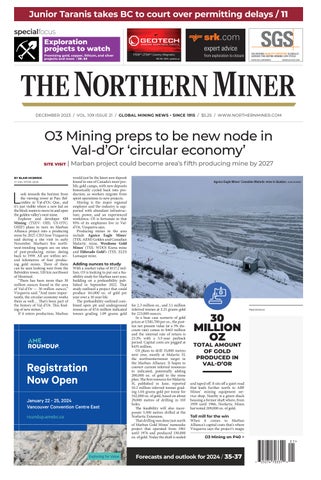
30 MILLION OZ
TOTAL AMOUNT OF GOLD PRODUCED IN VAL-D’OR
and taped off. It sits off a quiet road that leads further north to ABF Mines’ mining equipment service shop. Nearby is a green shack housing a former shaft where, from 1959 until 1966, Norlartic Mines harvested 209,000 oz. of gold. Toll mill for the win When it comes to Marban Alliance’s capital costs that’s where Vizquerra says the project’s magic O3 Mining on P40 >
Forecasts and outlook for 2024 / 35-37
PM40069240
1
2
DECEMBER 2023 | THE NORTHERN MINER
www.northernminer.com
AutoMine® Core, a comprehensive automation platform for mass mining applications with solutions to support customers in their journey of ramping up operations from manual to fully autonomous production. Built on Sandvik’s proven AutoMine® Fleet and Manual Production Monitoring (MPM) solutions, AutoMine® Core provides users with multiple levels of interoperability for Sandvik and third-party OEM fleets.
AutoMine® Core for mass mining applications
THE NORTHERN MINER | DECEMBER 2023
GLOBAL MINING NEWS
3
inbrief DEPA RT MENTS
3
In Brief
4
Opinion
7
10
Commentary & Analysis
12
In Depth
13
Done Deals
14
Project Updates
Awards & Accolades
19
Mining, Metals & Markets
42
Executive Q&A
42
Company Index
SPECIAL SECTIONS » Exploration Projects to watch 29 » Forecasts and Outlook 2024 35
Court nixes Vale’s appeal in Brazil disaster
n
A British court has rejected Vale’s appeal against being included in a lawsuit worth at least US$46 billion stemming from the 2015 Fundão tailings dam collapse in Brazil. Vale had sought to be excluded from the case by challenging the jurisdiction of a court in England to hear a case concerning BHP‘s liability for the disaster. The Court of Appeal decision on Nov. 24 upheld a lower court’s ruling. This means if the claimants are successful in holding BHP liable for their losses, BHP’s third-party claim against Vale will proceed in English court. BHP wants Vale to pay for half or more of any damages awarded because they’re joint owners of Samarco, the local company that ran the failed dam. The lawsuit is the largest group litigation in English legal history and involves more than 700,000 victims near Mariana in Minas Gerais state. Flooding devastated downstream villages and killed 19 people.
The Renova Foundation formed after the disaster has invested US$5.7 billion in reparation and compensation initiatives, Vale says.
Former BC mines minister says Fraser survey a ‘charade’
BY MINING.COM STAFF
When I was B.C. Minister of Mines between 2005 and 2017, we dramatically improved permitting and our overall relationship with operating mines and with the exploration industry. And although investment in B.C. mining increased over tenfold, the Fraser Institute consistently gave B.C. a low ranking.
China’s mineral control hurts US defence
n
China could potentially cut global rare earth oxide supplies by 40-50%, impacting suppliers of advanced components used in United States defence systems, according to the U.S.-China Economic and Security Review Commission. China is the U.S.’s primary source of rare earth elements along with 10 other critical minerals, the commission said in a recent report to Congress. On Aug. 1, China implemented export controls on gallium and germanium, as well as dozens of related products made with those metals. The Pentagon holds
Why? Because the Fraser Institute does not measure rational factors. It collects the personal opinions of a small group of executives, who are often uninformed, often biased, often out of date. I’ve been waiting for 20 years for someone to expose this charade of a “survey.” It is not a reliable source of investment advice. BILL BENNETT, FORMER MLA REPRESENTING KOOTENAY EAST, B.C. Website comment on “Fraser Institute ranks global mining with 9% of survey” — NOV. 20, 2023
SEE STORY ON PAGE 10
inbrief P40 >
JOINT VENTURE ARTICLE
Nine Mile Metals uses new tech to see deeper BY NORTHERN MINER STAFF
Using new technology to see deep into the Earth, Nine Mile Metals (CSE: NINE) is hoping to unlock the secrets of New Brunswick’s prolific Bathurst Mining Camp. Most times when exploration companies start drilling a new target, they are taking an educated guess. But as drilling begins at Nine Mile Metals’ California Lake project, the team is more confident than usual of their chances of success after not one, but two cuttingedge technologies highlighted the potential of its latest target. “When all this new technology lines up over the largest target that we already have, then we’re cautiously optimistic,” CEO Patrick Cruickshank says. Nine Mile has been active in the historic Bathurst Mining Camp in New Brunswick for the last six years, building up a 130-sq.-km land package covering four projects located close to Brunswick No. 12, which was one of the world’s largest underground zinc mines. For over a century, the Bathurst camp has been one of the world’s most prolific mining centres, with miners identifying 45 deposits so far, more than half of which contain more than a million tonnes of metals. Most are volcanogenic massive sulphide (VMS) deposits containing a mix of copper, zinc, lead, gold, and silver highly concentrated in a lens of dense metallic ore. They include the historic Restigouche, Murray Brook, and Caribou zinc-lead mines. The known VMS deposits can be up to 10 km apart, raising
Nine Mile Metals CEO Patrick Cruickshank, right, at a track-mounted drill rig at the company’s Brook site. NINE MILE METALS
questions and hopes about what lies between them. However, finding the missing mineralization can be tricky as they can lie several hundred metres below surface, and with the lens standing vertically and presenting a footprint just 500-1,000 metres across at surface. Existing technologies, including airborne electromagnetic surveys or electrophysics, can identify the possible presence of mineral deposits up to 400 metres deep. But usually geologists don’t know whether they have valuable base metals or worthless pyrite until they begin testing the targets with expensive diamond drilling. “You got to just kiss a lot of frogs till you hit a VMS deposit,”
Cruickshank notes. To overcome these challenges, Nine Mile has turned to two companies that have developed new ways to look deep below the Earth’s surface without drilling. Nine Mile was already working with Manitoba-based EarthEX Geophysical Solutions to use its proprietary technology to reprocess legacy MetaTEM data to identify a series of priority targets and target trends across its California Lake project. This year, the company was approached by Earth Science Services Corp. (ESSCO), another Canadian firm which uses airborne acoustic electromagnetic (EM) surveys to search for mineral targets over wide areas. The
technique has been developed from magnetotelluric methods, which are widely used by some of the world’s largest energy companies to find oil and gas deposits. After carrying out a fixed-wing survey over the Bathurst camp, ESSCO identified a handful of target regions which returned similar results to the Brunswick 12 mine. California Lake’s Number 10 target was the biggest. Moreover, ESSCO’s suggested targets lined up precisely with the priority areas identified by EarthEX and with known deposits such as Nine Mile’s Wedge mine and a never-before drilled potential extension of Brunswick 12. ESSCO then used acoustictransponder reference stations and a drone to fly a local acoustic EM survey to assess the density of the mineral targets. This can help geologists to more quickly discern between the very heavy metallic deposits and much lighter pyrites. Targets can then simply be tested with a single drill hole allowing worthless false flags to be quickly ruled out. ESSCO then used artificial intelligence to process existing and new data in a model combining both the probable lithology and density of the deposit. “What these guys are doing should speed the whole process up,” explains Cruickshank. This work allowed Nine Mile to identify five independent lenses within the Number 10 target, which the company is now drilling. The first is estimated to be more than 700 metres below surface, a challenging depth to hit such a
slender target. But the drilling is being carried out by New Brunswick specialists Les Forages Chapais, a company with decades of experience drilling VMS-style deposits in the Bathurst region. That means negotiating difficult terrain and keeping holes on track hundreds of metres into the ground. Cruickshank is cautiously optimistic about the technology’s potential. “The industry has been looking for a technology that can differentiate and filter out what it finds and that’s what this company believes they have, so it’s exciting to be the pilot,” the executive explains. The evidence from ESSCO does not end with target Number 10 but points the way to several other potential mineral deposits, providing Nine Mile with a roadmap for its exploration program for the next three to four years. The knowledge gives Nine Mile Metals a strategic advantage. ESSCO does not intend to make the technology commercially available for at least the next 18 months. By then, it hopes to hold up its success at the Bathurst camp as a billboard for the rest of the industry. “Whenever there’s new technology, there’s a rash of discoveries. And that’s where we are now,” Cruickshank explains. The preceding Joint Venture Article is PROMOTED CONTENT sponsored by Nine Mile Metals and produced in co-operation with The Northern Miner. Visit: www. ninemilemetals.com for more information.
4
DECEMBER 2023 | THE NORTHERN MINER
www.northernminer.com
opinion
GLOBAL MINING NEWS • SINCE 1915
www.northernminer.com
PRESIDENT THE NORTHERN MINER GROUP: Anthony Vaccaro, CFA, MBA avaccaro@northernminer.com EDITOR-IN-CHIEF: Alisha Hiyate ahiyate@northernminer.com WESTERN EDITOR: Henry Lazenby hlazenby@northernminer.com SENIOR STAFF WRITER: Colin McClelland cmcclelland@northernminer.com COPY EDITOR AND PRODUCTION EDITOR: Blair McBride bmcbride@northernminer.com PODCAST HOST: Adrian Pocobelli apocobelli@northernminer.com ADVERTISING: Robert Hertzman (416) 898-6654 rhertzman@northernminer.com Michael Winter (416) 510-6772 mwinter@northernminer.com SUBSCRIPTION SALES/ APPOINTMENT NOTICES/ CAREER ADS George Agelopoulos (416) 510-5104 (Toll free) 1-888-502-3456, ext. 43702 gagelopoulos@northernminer.com PRODUCTION MANAGER: Jessica Jubb (416) 510-5213 jjubb@northernminer.com CIRCULATION/CUSTOMER SERVICE: (416) 510-6789 | 1-888-502-3456 northernminer2@northernminer.com REPUBLISHING: (416) 510-6768 moliveira@northernminer.com ADDRESS: Toronto Head Office 225 Duncan Mill Road, Suite 320 Toronto, ON, M3B 3K9 (416) 510-6789 tnm@northernminer.com SUBSCRIPTION RATES: Canada: C$130.00 one year; 5% G.S.T. to CDN orders. 7% P.S.T. to BC orders 13% H.S.T. to ON, NL orders 14% H.S.T. to PEI orders 15% H.S.T. to NB, NS orders U.S.A.: C$172.00 one year Foreign: C$222.00 one year GST Registration # 809744071RT001 (ISSN 0029-3164) CANADA POST: Return undeliverable Canadian addresses to Circulation Dept. c/o The Northern Miner 225 Duncan Mill Road, Suite 320 Toronto, ON M3B 3K9 Publication Mail Agreement #40069240 Periodicals Postage Rates paid at Niagara Falls, NY, 14304. U.S. office of publication 2424 Niagara Falls Blvd, Niagara Falls, N.Y. 14304. U.S. POSTMASTER: send address corrections to: Northern Miner Box 1118 Niagara Falls, N.Y. 14304.-7118
THE NORTHERN MINER is published biweekly by Glacier Resource Innovation Group, a division of Glacier Media Inc., a leading Canadian media company with interests in business-to-business information services. From time to time we make our subscription list available to select companies and organizations whose products or services may interest you. If you do not wish your contact information to be made available, please contact us by one of the following methods: Phone: 1-888-502-3456; Fax: (416) 447-7658; Mail to: Privacy Officer, The Northern Miner, 225 Duncan Mill Road, Suite 320, Toronto, ON M3B 3K9.
EDITORIAL
COMMENTARY
2023’s key theme? Narrowed access to resources
Follow the money trail to critical metals
T
his year was notable for takeovers. Newmont paid US$21.2 billion for copper-rich gold miner Newcrest Mining; Glencore negotiated a US$8.9-billion deal for Teck’s coal business (see page 12); and a raft of lithium deals included the US$10.6-billion all-share merger between Allkem and Livent, expected to close in January. It was also a year in which uranium and lithium — two key metals required to meet global net zero B Y A L I S H A H I Y A T E ambitions — followed opposite trajectories. The uranium price reached 15-year highs of over US$80 per lb. in November on anticipated supply shortages (see page 35). However, as EV markets and the global economy have slowed this year, lithium carbonate prices have fallen a spectacular 75% to under US$20,000 per tonne in late November. At current prices, some mines could become unprofitable and mine closures may be necessary to bring the market into balance, BMO Capital Markets said in a recent note. But aside from big mergers and commodity price movements, another defining theme of 2023 was access to resources – whether mineral or cash. Resource nationalism This year, states with in-ground critical minerals (including Canada) have found themselves courted by just about everyone. With major economic powers and big companies alike seeking access to raw minerals, governments have responded by upping the cost. They are asking for money, yes, in the form of royalties and a slice of assets for the state, but also more downstream investment to jumpstart their own mineral processing and battery manufacturing industries. Mexico, Chile, and Mali are among the countries that have passed new laws this year imposing new restrictions on mining or handing the government more control and a direct stake in key critical resources — notably lithium. Meanwhile, Panama’s government banned any new mines or contract extensions in November in the face of widespread protests. That’s even though its October deal with First Quantum Minerals guaranteed the state US$375 million a year in royalties (see page 11). Global power shifts also add uncertainty. Both China (graphite, germanium and gallium) and the United States (semiconductor chips) restricted the movement of strategic minerals and industrial inputs. This after the U.S. unleashed hundreds of billions worth of spending through its Inflation Reduction Act last year toward breaking China’s grip on raw materials, manufacturing and supply chains that fuel green energy and advanced technologies. At the same time, Saudi Arabia has announced its entry into the global mining business, deploying some of its oil spoils into the sector. This year, it bought a 10% stake in Vale’s new base metals unit, partnered with Ivanhoe Electric and Barrick Gold on exploration in the kingdom, and formed a new company to invest in critical minerals abroad. Capital Access to that other critical resource, capital, rocketed up to the No. 2 risk in EY’s annual mining risks and opportunities survey of mining executives this year. It was No. 8 last year. While the need for capital is gaining attention, debt and equity raised for mining in the first seven months of the year barely budged compared to the same period in 2022 (US$196 billion vs. US$192 billion last, according to the report released in October). There is some money coming into the sector from new sources — automakers, battery manufacturers and governments. The competition for control of critical minerals and supply chains has begun to get serious, with governments showering industry with incentives for mining, technology and manufacturing development. But capital isn’t flooding into the mining space. Investments paled when compared with the as much as US$4 trillion analysts at McKinsey recently estimated is needed before the end of the decade in order to produce enough metals for the energy transition. Capital has become more dear since a succession of interest hikes began last spring, with muted prospects for capital raising and spending in the near term. North America’s economy looks ready to tip into a long-predicted recession. The U.S. Conference Board’s Leading Economic Index has now fallen 7.6% over the past year, Canaccord Genuity said in a research note in late November. “Over the past 60 years, a fall of this magnitude has always been associated with a recession,” Canaccord said. Exploration companies, tasked with discovering the future mines that will soon be needed, are suffering from near total investor indifference. The junior mining-heavy TSX Venture Index is hovering near lows last seen in late 2015/16 on weak metals prices and disillusionment with the mining sector. (It dipped lower only briefly at the start of the COVID-19 pandemic). Turnaround coming? Contrast the current period with the glory days of mining in the early 1990s. Many of the industry’s biggest names got their start then – at a time when the world was opening up to mining and cash flowed freely. Legendary mining financier Frank Giustra, who catapulted brokerage Yorkton Securities into a mining investment powerhouse at that time, anticipates a secular bull market for base, battery, and precious metals, driven by heightened competition for resources. “The world is changing all the time and there’s always opportunity,” Giustra told The Northern Miner’s Canadian Mining Symposium in London, U.K., in October. “It’s gonna get ugly out there, and this is going to be a time where the mining industry is going to be very, very active. There will be a lot of capital coming in when the sentiment changes.” TNM
BY JAMES COOPER
O
ne investing strategy in mining is to watch the insiders. By insiders, I mean the big players in the industry. That is, the directors of multibillion-dollar companies, mining magnates and executives from investment banks tied up in the mega-deals that shake the industry. It seems simple, follow an insider and invest accordingly. But few people actually do it. Why is that? Well, small time investors want instant returns, especially in the mining sector. They’re also quick to pull the sell trigger when stock prices decline. Week-to-week share price volatility matters little to big time investors. In fact, majors often get market timing wrong (over the medium term). What matters for the big wigs is positioning for long term growth: the mega trends. That’s the set-up we have in today’s commodity market. Limited supply thanks to a lack of investment in new discovery and record low inventories — precisely at a time when the world is looking to embark on a once-in-acentury energy transition. The investment road map is there, crystal clear for investors to follow. Yet short term volatility keeps them back. Without knowing when the market will turn, the majors are prepared to ride out today’s volatility to ensure they capture gains from this mega trend. That’s what insiders are doing. Take Gina Rinehart, Australia’s richest person. This billionaire mining magnate heads Hancock Prospecting, a privately owned mineral exploration and extraction company founded by her father, Lang Hancock. Her role in turning this company into the multi-billion-dollar iron ore giant it is today absolutely qualifies Rinehart as a successful business tycoon in her own right. In other words, Rinehart is an insider worth watching. In December 2022, she pumped Arafura Rare Earths (ASX: ARU) with $60 million in capital for a 10% stake in the company. Now, it looks like a poorly timed deal, as Arafura shares have fallen over 50% since. But I doubt Gina is overly concerned. Rinehart is positioning for major future upside as rare earths become entangled in trade disputes between China and the West. As an advanced developer, Arafura seeks to join an exclusive club of rare earth suppliers located outside China. Now, there’s no guarantee China will restrict rare earth trade exports, but my money’s on this multi-billion magnate getting this theme right. Rinehart has also invested heavily in Australian lithium companies in the second half of 2023. Given the hefty price falls, she looks to be capturing the steep discounts on offer. Earlier this year, Rinehart tried to block chemical giant
Albemarle’s (NYSE: ALB) attempt to acquire Liontown Resources (ASX: LTR) by buying a 20% stake in it. Recently, we’ve seen a showdown between Rinehart and Chilean giant SQM, as she again tries to halt a bid to take Australia’s Azure Minerals (ASX: AZS). Investors are absolutely confused…Does Rinehart know something that the rest of us don’t? You can count on it. See forest through the trees The world’s most powerful investors are intimately aware of longterm growth drivers. It’s the key element that separates billionaires from the average punter. Insiders are privy to the dealings between suppliers, buyers, and policy makers. This gives them superior insight into the direction of supply and demand. They usually have a team of analysts and high-level contacts. The rich get richer by using this information, not by luck or an intuitive punt on the stock market. Andrew Forrest is another insider worth your attention. He amassed a fortune by pivoting to iron ore in the early days of the China-led infrastructure boom. His family-owned business, Wyloo Metals, has steadily acquired projects across the globe as it looks to become a multi-commodity powerhouse tied to the critical metal theme. Earlier this year, Wyloo completed the acquisition of Australia’s Mincor Resources, a nickel sulphide producer based in Kambalda, Western Australia. Wyloo also picked up one of the largest undeveloped, high-grade nickel-copper-platinum-palladium deposits in the world. ‘Eagles Nest’ , in northern Ontario, is in a region aptly called The Ring of Fire by geologists thanks to its rich mineral endowment. But it’s the world’s largest miner, BHP (ASX: BHP), that you should really be watching. This company delivers more contracts, acquisitions, mining and exploration than any other entity. It’s a major stakeholder at high level meetings between suppliers, policy makers and buyers in every major mining hub across the globe. Follow BHP’s multi-billion-dollar money trail, and it’s clear what this mining giant is doing. Completion of a US$6.4-billion takeover of South Australia’s Oz Minerals earlier this year. With up to 14 full-time drill rigs spinning day-and-night, the company has devoted a huge support crew to advance its Oak Dam copper project in South Australia. It’s also dangling US$10 billion worth of investments into new copper projects in Chile. Watch the insiders and follow their lead. Right now, the biggest bread crumbs lead to critical metals. TNM James Cooper is a geologist and mining analyst. Based in Melbourne, he’s now the resident commodities analyst at Fat Tail Investment Research and editor for the Diggers & Drillers Publication. You can follow him on X (Twitter) @JCooperGeo.
THE NORTHERN MINER | DECEMBER 2023
GLOBAL MINING NEWS
5
inbrief PHOTO OF THE MONTH
Drillers make adjustments to the tower at Evergold’s DEM copper-goldsilver project, near Fort St. James, B.C. CREDIT: KEVIN KEOUGH, EVERGOLD CORP.
To submit your entry for Photo of the Month, please email bmcbride@northernminer.com.
a strategic stockpile of germanium but currently has no reserves of gallium. Global inventories of gallium and germanium may run out after a number of months, the commission said. Over 95% of the U.S.’s gallium consumption is in the form of gallium arsenide wafers, a type of semiconductor that outperforms more prevalent silicon wafers for sensitive electronic equipment, such as radar systems. Last month, China announced it will require export permits for some graphite products in another bid to control critical mineral supply in response to challenges over its global manufacturing dominance.
The Lundin Group’s Vicuña exploration team has been named the winner of the Thayer Lindsley Award. The team is being recognized for the discovery of the Vicuña district in the Central Andean copper province in Argentina and Chile. John McConnell, CEO of Victoria Gold and the Victoria Gold team are the winners of this year’s Viola R. MacMillan Award for innovative financing of the Eagle gold mine in Yukon. BY CANADIAN MINING JOURNAL STAFF
inbrief P40 >
BY MINING.COM STAFF
Milei victory brings change to Argentina
n
Javier Milei was expected to be inaugurated as Argentina’s new president on Dec. 10 after running on a platform to slash spending, improve business conditions and introduce the U.S. dollar as official currency. Companies Allkem, Lithium Americas, Galan Lithium, Argosy Minerals and Lake Resources would likely feel no immediate impact, BMO Capital Markets wrote in a note. “The impact of the result is uncertain, but we look at previous statements and historical precedent and take a positive tilt to the result,” the bank said. Milei said he was against nationalising lithium production or meddling with supply and prices through pacts with South American neighbours. He campaigned with a chainsaw, vowing to cut government expenses. Similar leaders have tried to help companies repatriate profits, remove U.S. currency restrictions and reduce the gap between the official exchange rate and the black market rate, BMO said. However, that would likely devalue the Argentine peso, and the country could default on its debt again, impacting the economy, it said. BY NORTHERN MINER STAFF
n
PDAC names 2024 award winners
The Prospectors and Developers Association of Canada (PDAC) have announced the winners of its 2024 awards, to be presented at the next PDAC convention March 3-6, 2024, in Toronto. John Burzynski, CEO of Osisko Mining, and the Osisko Mining exploration team have been chosen to receive the Bill Dennis Award recognizing a significant Canadian mineral discovery or contribution to the exploration industry. The team won the honour for the discovery and ongoing expansion of the Lynx gold zone at Osisko’s Windfall deposit in Quebec. The Wabun Tribal Council in Ontario has been named the winner of this year’s Skookum Jim Award. The council has developed a consistent process of engagement that enhances collaboration between companies and First Nations communities. O3 Mining has won the Sustainability Award for exceptional environmental, social and governance performance, including the achievement of Ecologo Certification. The company is advancing a portfolio of gold projects near Val-d’Or, Que.
Find full news articles at www.northernminer.com
FOR JV OR SALE • 50 contiguous 20 acre placer mining claims in Southern Arizona. • Grandfathered water rights to 1,600 foot commercial ground water well. • 103 acre-feet per annum non-exempt metered well. • 125 acre mineral patent private land (potential mill site). Exploration complete and satisfies us that we have an expected 50-year mine life with ore reserves grading 56% iron and 4% ilmenite (TiO2) based on a 25,000 tpd mining operation. Sample-Leonard Water Rights, LLC is actively seeking to joint venture with a mine operator that has the expertise and funding ability to develop this property to its maximum potential as a source of iron products for the domestic steel industry. The Sample/Leonard partners will also consider outright purchase offers for our greenfield project in Southern Arizona.
Managing Partner, David J. Leonard Sample-Leonard Water Rights, LLC, P.O. 19101, Tucson, AZ 85731 Direct line 323-359-0084 or email davidleonardlaw@gmail.com
6
DECEMBER 2023 | THE NORTHERN MINER
www.northernminer.com
inbrief
Mapped: LITHIUM FUNDING Car companies are forging new relationships with miners for lithium supply, and in some cases governments are also providing funds to advance these critical projects. Here’s a look at some of the recent offtake and other deals that have been signed with automakers, equipment makers and governments. BY BLAIR MCBRIDE AND NICHOLAS LEPAN
Canada
$848 US million
General Motors’ total announced investment in lithium offtake deals
U.S. government — Piedmont Lithium Department of Defense gave US$141.7 million to build US$600-million plant in Tennessee to process lithium mined at its projects in Quebec (NAL), and Ghana (Ewoyaa) 2026 production start
Ford — Nemaska Lithium 11-year deal for up to 13,000 tonnes of lithium hydroxide per year Nemaska’s Whabouchi mine in Quebec 2025-2036 Tesla — Piedmont Lithium Supply of 125,000 tonnes of spodumene concentrate North American Lithium mine, Quebec 2023-2026
NAL, Quebec’s only producing lithium mine is a supplier to world’s
#1 EV maker Tesla
United States U.S. government —Albemarle Department of Defense gave US$90M grant to reopen the Kings Mountain hard rock lithium mine in North Carolina Production could start in 2026 Ford — Compass Minerals 40% of 35,000 tonnes of LCE Ogden (brine), Utah 2025-2030 Ford — ioneer Annual supply of 5,000 tonnes of lithium carbonate over five years Rhyolite Ridge (clay), Nevada 2025-2030
Germany
General Motors— Lithium Americas US$650M equity investment for exclusive LCE supply Thacker Pass (clay), Nevada 2026-2036
Stellantis — Vulcan Energy €50M ($72.3M) equity investment for 81,000 to 99,000 tonnes lithium hydroxide Upper Rhine Valley brine field, Germany 2021-2031
General Motors– Controlled Thermal Resources Multi-million dollar investment and first rights to first-phase lithium production Hell’s Kitchen (geothermal brine), California 2024 production start Stellantis — Controlled Lithium Resources US$100M investment in Hell’s Kitchen project for annual supply of 65,000 tonnes of lithium hydroxide monohydrate Hell’s Kitchen (geothermal brine), California 2027-2028
2M tonnes
of spodumene concentrate to be sold to LG, Tesla and Ford from Liontown by 2030
Argentina BMW — Livent/Allkem €285M ($411.5M) deal for lithium hydroxide supply Livent’s lithium brine project in northern Argentina Deal lasts until 2028 Ford — Lake Resources Non-binding MOU for 25,000 tonnes of lithium annually Kachi (brine), Argentina Start date not announced
Ford — Rio Tinto Non-binding MOU for lithium supply Rincon (brine), Argentina Start date not announced General Motors — Livent $198M advance payment in 2022 for unspecified amount of battery-grade lithium hydroxide Argentina (brine) project 2025-2031
Stellantis — Argentina Lithium & Energy US$90M for under 20% of the company and offtake deal of up to 15,000 tonnes of lithium annually. Four projects (brine) in Argentina Seven-year deal after production starts Toyota Tsusho — Allkem Toyota has 25% stake in Olaroz project and is the exclusive sales agent Olaroz (brine) Argentina Started in 2014
Chile Ford — SQM Long-term supply of lithium hydroxide and carbonate Supply dates not disclosed
LG Energy Solution —SQM 100,000 tonnes of lithium carbonate and hydroxide from SQM’s Salar de Atacama 2023-2029
Johnson Matthey — SQM Deal includes enough lithium hydroxide from the Salar de Atacama to power about 500,000 EVs 2021-2028
Ford — Albemarle Supply of at least 100,000 tonnes of lithium hydroxide from Albemarle’s Nevada, Chile or Australia mines 2026-2030
Australia Ford — Liontown Resources A$300M ($267M) deal for 75,000-150,000 tonnes of spodumene annually Kathleen Valley, Western Australia 2024-2029 Tesla — Liontown Resources Supply of 100,000 to 150,000 tonnes of spodumene concentrate Kathleen Valley, Western Australia 2025-2030 LG Energy Solution — Liontown Resources 100,000 to 150,000 tonnes of spodumene concentrate over five years Kathleen Valley project in Western Australia 2025-2030
THE NORTHERN MINER | DECEMBER 2023
GLOBAL MINING NEWS
commentary&analysis
7
Good global citizenship is the future of mining IDEAS
| Miners need to become ambassadors for the sector and step up engagement with the public
BY INGRID HIBBARD
T
here’s no way around it: society needs minerals, and lots of them. But for the mining industry to survive and ideally, thrive, it needs to evolve. We need mining to get better — safer, cleaner, and with a reduced environmental impact. The future of mining also lies in being good global citizens — and being seen that way. So how do we get there? We start by working together to educate the public about the modern mining industry, amplify one another’s accomplishments through social media, and celebrate the good our sector is doing in the world The International Energy Agency reports the global market for minerals supporting the clean energy transition doubled between 2017 and 2022. And demand is expected to keep growing in the years ahead. We know these minerals power solar panels, wind turbines and electric cars, but many people take these technologies for granted and often forget that they ultimately depend on mining. We need to remind them that our industry enables innovation, and embraces it ourselves. And we need to go beyond high-level talking points to share real examples with the public. The answer is not to stop mining, it’s to keep getting better. Do you have a 30-second “elevator pitch” on how Canada’s own Kirkland Lake Gold (now part of Agnico Eagle Mines) became one of the first mining companies in the world using lithium-ion battery operated trucks and loaders? Are you prepared to share how your company is innovating to become a more sustainable operation? These days, I’m always ready with a quick story about how Pelangio trialled mineral predictive mapping software powered by artificial intelligence to target exploration at our Obuasi project in Ghana. Social media can help give a voice to mining companies and the people who work for them. Sharing stories about the mining industry and the communities they operate is a way to build trust, foster a better dialogue with the public and connect to the younger generation that will be future workers in the industry. After all, we’re going to need innovative solutions and problem-solving to keep evolving the mining industry. Some mining companies are still hesitant to move away from the traditional marketing and PR efforts that they have always used. Traditional marketing was like shouting from a soapbox; now, marketing is a conversation, and the public is creating their own stories in the absence of real substance and communications. An honest and transparent approach is needed, which means companies who say they are “doing good,” need to make sure they actually are. We help build and sustain communities that other sectors overlook. The Mining Association of Canada reports the average annual pay for a mining worker in 2021 was about $130,000; Statistics Canada calculated the average Canadian’s annual income that year at $54,000. Our industry creates well-paid jobs in mining communities. But the
Ingrid Hibbard. industry is still struggling to attract enough workers. Perceptions that the work is dirty, dangerous and environmentally destructive have led many well-educated tech and data specialists to other industries. So how do we address this as an industry? It comes back to telling the stories that matter. Getting into schools and talking to the younger generation about how new equipment technologies are keeping workers safe and revolutionizing the way mines operate. Geology should be taught to schoolchildren to reinforce the importance of minerals and metals. Other industry advancements like dry stack tailings (DST) technology are being implemented within different processes of the mine, and shown to save up to 15-20% of wastewater, which can then be recycled within the plant. And young people should be learning about mines like the Borden gold project near Chapleau in Ontario, which was one of the first all-electric underground mines in Canada. More than jobs Mining is changing and we need tech-savvy workers who aren’t afraid to commit to continuous skill upgrading. But we aren’t going to find these much-needed workers in the places we’ve hired from in the past. To fill the labour gap, we need to show a new generation of workers that our industry is cutting-edge, and tech jobs aren’t just in the big cities anymore. Proving to kids from mining communities that they can go to school, study a high-tech field, then return to their hometowns and put their skills to work in a well-paid job in their field, will be crucial for future success. We also need to recruit kids who have never spared a thought for mining but have a passion for coding, robotics, engineering, fluid dynamics and other skills our industry needs. They are going to be solving some of the hardest problems around technology, safety and environmental issues. As the tech giants announce round after round of layoffs, we have an opportunity to position mining as a booming modern industry where tech-minded workers can build stable careers doing meaningful work that makes a positive impact on the world. And we have a chance to help reinvigorate communities while we do it. We need to empower people to share how mining has a positive
impact in their lives. In Ghana, our team has started to rally their peers to restart the Ghana Institute of Geoscientists as a way to encourage the younger generation to pursue a career in the field. In Timmins, Ont. - the public can visit an open mine pit located directly in the city and companies like Porcupine Gold Mines have
been running educational tours of reclaimed sites and working with the local Indigenous community on the application of traditional knowledge and practices to modern rehabilitation techniques. Whether it’s drawing new residents to a Northern Ontario city, building a school or repairing a road in Ghana, stories like these serve to shift perception and show the positive impact mining can have on a community. Smartphones, social media platforms and the proliferation of reliable Internet connections have created opportunities for employees in Canada and abroad to share their experiences organically. Those lived experiences are more authentic than any corporate outreach campaign and have the potential to help shift public perceptions of mining for the better, and protect our social licence to operate. We can’t undo the past, but we must demonstrate that times have changed. We need to be part of the conversation when it comes to sustainability and regeneration efforts. It’s about actively building trust and participating in discussions with
environmental groups and stakeholders. As an industry, we need to move away from the old thinking of an “us vs. them” approach to a more collaborative mindset, building meaningful relationships with the public through social media, sharing and showing the importance of mining’s place in our future. Imagine how public perception would change if your cell phone or electric car was able to tell the story about where its wiring and power source came from and how (and even by who) its batteries were mined. It’s a commitment to the actions that matter — regenerating old mine sites, embracing new technologies to keep workers safe, reducing waste, partnering with local organizations and educating the next generation of workers. The future of mining lies in being good global citizens — and ensuring the public sees us that way. That can only happen if we embrace a new openness to communication. We’ve taken all the right steps. Let’s help our fellow citizens take notice. TNM — Ingrid Hibbard is the CEO of Pelangio Exploration.
Investing in the Canadian Resource Sector at Reduced Cost of Captial PearTree is a Canadian Securities Dealer and Investment Fund Manager advancing over (CAD) $500 million annually for resource exploration and mine development in a uniquely Canadian structure which results in as much as $2.00 of capital deployed for every $1.00 invested by global institutions and family offices.
Averaging $500M deployed through PearTree in 2021 and 2022 for the mineral exploration & development sector Watch our video in English, Français, Deutsch and Español on our website
Expanding the universe of exploration capital.
peartreecanada.com
8
DECEMBER 2023 | THE NORTHERN MINER
www.northernminer.com
commentary&analysis
The isolation of field work can be lonely — and sobering ODDS ‘N’ SODS BY RALPH RUSHTON
E
very geologist has experienced extreme isolation at some point. That crystalline moment when they realized that if anything happened to them right then and there, they may as well be on Mars because no help was coming. For most geos, isolation is a regular Saturday night thing when our one “friend” — the one who’ll still listen to our oh-no-please-notagain hilarious field stories — is unexpectedly busy. Soccer fans — like my mate Neil — experience regular isolation at away games when they stray into a bar full of the local team’s Ultras and end up faceto-face with 65 black-clad drunken lunatics itching for a fight; but I digress, that’s not where I’m going with this story. I was curious about the concept of loneliness and separation so I polled a few industry friends for their recollections of those peculiar flashes of intense isolation. Trudging around a recent mining conference, I ran into my friend Andrew who I’ve known since the mid-’80s. Andy’s career took a different path to mine — he was fairly successful — and was eventually appointed mine manager for a medium-sized gold mine in northern Canada. His loneliest moment was stepping off the plane to the mine for the first time in his new capacity as El Jefe. There was nowhere for him to hide if he screwed up as manager. No boss to cover for him or colleague to blame, it was his neck on the chopping block. My friend Mark had a different experience. He and I both worked on the same South African gold mine in the 1980s and we knew some of the same people and had many similar experiences during our time underground. Mark’s a well-travelled man; a globe-trotting man-of-the-world geologist with multiple projects under his management — a true James Bond of mineral exploration but not as debonair or well dressed. He flagged a moment in his mine geology career when he was mapping an unventilated tunnel face 6,000 ft. down at Vaal Reefs 8 shaft. At those depths unventilated faces can get very hot and you don’t stay there long because heat stroke can hit hard and fast. He remembers he was wearing an ice jacket; a jacket lined with pockets that hold blocks of dry ice which is supposed to allow the wearer to weather the heat for longer. But despite it he was starting to suffer from heat-induced confusion and switched off his head lamp. He was immediately plunged into complete and profound darkness. He told me it was like being on the bottom of a deep ocean. He could hear the rock face cracking and popping as the ambient rock pressure unloaded into the newly created tunnel space, and the distant sound of drilling in another tunnel sounded like the engine of a passing boat. I did the same once in a dead silent tunnel — no drilling or rock cracking to intrude on the stillness — and it’s a very bizarre experience which is hard to replicate at surface. Another friend’s experience was more geographic in nature. Rory
| Every field geo has had a close call while far from help supplies and camping gear to survive for a week if they had to. His boss would accompany him on each outing dressed in a nice pair of brogues, carrying a small game fishing bag over his shoulder. They were packing a shotgun and solid lead slugs to shoot any overly curious polar bears, but luckily never had to test the theory that the pop gun would protect them from becoming lunch. My own I’m screwed moment came during a prospecting trip to western Pakistan. After hunting porphyries around the giant Reko Diq project, me and my small crew headed west to Taftan — out where Iran, Pakistan and Afghanistan meet — and then up to the copper mine at Fort Saindak for a night. The next day we drove further northwest up to the pointy bit of western Pakistan where it says Maki on the map. Believe me when I tell you there’s nothing there, just small rocks and bigger rocks and a few nomads tending wiry goats. We did our job and found some vague evidence of alteration, possibly some VMS style mineralization, but aside from that nothing. That evening, our choice was to sleep in the trucks or drive through the night, which was risky because the area was infested with drug smugglers hauling opiates through from Afghanistan. So, I was very relieved when we came across a small group of people busily preparing their evening meal of goat and roti by an orange campfire ringed by traditional black, peaked tents. We did what we always did
i·so·la·tion /ˌīsəˈlāSHən/ noun 1. the process or fact of isolating or being isolated. “the isolation of older people”
“Opening my eyes, I couldn’t remember where the hell I was. I could see a black tent over me with seven or eight young goats clambering on the roof.”
Above: Ralph Rushton in Pakistan. Above right: Remote field camp near Minto Inlet in the Northwest Territories in 2005. RORY KUTLUOGLU Right: Ralph Rushton Baluchistan at Pakistan Afghanistan border RALPH RUSHTON
was working on Victoria Island in the Northwest Territories, as close to the middle of nowhere as you could hope to find, exploring for nickel, copper and PGE metals for a South African client. He had limited Arctic field experience which wasn’t ideal as he stepped out of the chopper in early April some 150 km from the nearest settlement. It took three attempts for the pilot to get the crew of 15 into the camp at Minto Inlet; a cluster of frame tents next to a small lake that doubled as a year-round runway. For six long weeks he was — as he describes it — trapped in a camp full of nutters, visited from time to time by assorted itinerant wildlife, some of which was dangerous (wolves, bears) and some edible (caribou). The camp cook was a
Bible-thumping Lutheran creationist who would ask grand and elaborate questions about big geology; topics like plate tectonics or radiometric age-dating. Rory would explain each big idea to him, and then the cook would blandly state that it was all nonsense because it was all created by God, before serving soup made from leftovers. It was extreme social and geographic isolation, and the barren landscape only served to remind him that he was a million miles from his base in Toronto. The single thread of sanity left to cling on to five weeks in was that their work was moderately successful. They found semi-massive pyrrhotite with neat little wisps of pentlandite that assayed up to 6% nickel and the project was eventually sold to a Russian group.
Steve, a fellow Brit with an identical earth science education to me (Portsmouth in the U.K., then the University of Alberta for an MSc) had his dose of extreme isolation prospecting in northwestern Greenland for Rio Tinto in the early ‘90s. He and another geo were helicopter prospecting north of the American airbase at Thule; an area so isolated and lacking in tasty game that even the Inuit avoided it. It was Arctic desert. This was well before the coming of GPS when geologists still knew how to read topo maps, although in this case the maps turned out to be incorrect; in many places there was land where the maps said there was ice and vice versa. He was dropped off each day by chopper, accompanied by enough
and bought a goat for dinner. We’d get the choice cuts of meat, and they’d get the rest of the carcass plus $15 for the goat to boot. They kindly cleared out a tent for us to sleep in; an open sided one which allowed through a breeze, and as the sun slid down over the rocky wasteland of southern Afghanistan, we bedded down on coarse wool carpets large scratchy pillows, our bellies full of goat curry (which ended up giving me a nasty parasite.) The next morning, I woke up completely disoriented. Opening my eyes, I couldn’t remember where the hell I was. I could see a black tent over me with seven or eight young goats clambering on the roof. Two of them, braver than Isolation P40 >
THE NORTHERN MINER | DECEMBER 2023
GLOBAL MINING NEWS
9
commentary&analysis
Canadian miners see modest pay raises LABOUR
| Wages rose 3%, Costmine data show
BY COLIN MCCLELLAND
H
ourly wages at mines in Canada climbed at less than half the rate of salaries at top jobs, a recent survey shows. The annual pay for a mine’s general manager rose 11% to $282,900 while the hourly wage for a mill control room operator, the costliest wage position, increased 4.3% to $46.96, according to surveys by Costmine Intelligence. Inflation in Canada hit a 40-year high last year of 6.8% on an annual average basis, according to Statistics Canada. This year it has eased, reaching 3.1% in October. However, higher prices continue to impact consumers and wage negotiations. In the Canadian auto sector, union Unifor and Ford agreed in September on a new contract increasing wages by as much as 25%. In mining, COVID-19 material supply chain snags have subsided while labour concerns are less about pay than availability. “It’s labour mobility and skills, not just costs,” Doug Groh, who manages and co-manages more than US$1 billion for Sprott Asset Management, said by phone from New York where he’s based. “It’s still a challenge to find the skill set out there that’s dependable and capable to do the jobs. “This has forced operators to become more reliant on outside contractors which adds another layer of cost and isn’t always the most efficient way to improve productivity over the longer term.” Salaries jump Of the 76 mines responding to this year’s survey between March and August, 59 were union and 17 were non-union. Of those, 62 mines increased wages by an average of 3%, ranging from 1.5% to 12.5%, in the 12 months before the survey. Wages were unchanged at 14 mines while no mines in the survey reduced wages. Of note among the hourly pay reported, one company is paying underground miners $100 an hour, far more than any others. The survey withholds names, but we can say it’s a gold mine. “Employee retention is a problem for some northern Canadian projects and this is causing salary inflation,” Michael Gray, a mining analyst at Agentis Capital in Vancouver, said by email. “CEOs have flagged this as an issue to me, citing several British Columbia projects heading toward construction that were recruiting and pay-
“It’s still a challenge to find the skill set out there that’s dependable and capable to do the jobs.” DOUG GROH, MANAGING PARTNER, SPROTT ASSET MANAGEMENT
ing 50% more than they expected in some cases to attract talent.” Perks offered This year’s survey found 43 mines using some form of incentive bonus plan while 30 had an employee retention plan. Companies cited
safety, profit, production and cost savings as reasons for implementing them. “Many mines pay cash bonuses for good safety performance,” Costmine business manager and cost estimator Krista Noyes wrote in the report. “The most common type is a fixed bonus for achieving an accident-free record for a specified period of time.” Some mines pay bonuses based on improvement over historical averages, or they may tie the bonus to production as a fixed award per tonne of ore produced if no losttime accidents occur, Noyes said. Workers, their department or an entire mine can be penalized when lost-time accidents occur. Standard benefits are sometimes expanded, she said. Perks include transportation to the mine, paid or subsidized daycare facilities, travel expenses, supplemental retirement plans, accident and life insurance, stock purchase plans, safety equip-
ment, tool allowances, scholarships for dependent children, education and training.
Efficiency hit “Among explorers, I expect we will see belt tightening on bonuses and salaries given the very difficult equity markets,” Gray said. “For overseas projects, I’ve heard experienced mining staff were being paid eye-popping figures to go and work in certain countries such as Pakistan.” This year’s survey showed some pay declined. The average salaries for mine engineers fell 3.1% to $105,800 from $109,200 and for environmental coordinators it stayed the same, at $93,400. Also, at milling operations, the hourly wage fell for a mill equipment operator by 8.8% to $40.60 from $44.50. Costmine says it believes declines in pay for these positions are not indicative of the wider rising trend in pay, and wouldn’t show in a multi-year analysis. Last year, 73 mines responded; 55 were union and 18 were nonunion. Of those, 63 increased wages by an average of 4.3%, ranging from 1% to 15%, in the 12 months before the survey. Wages were unchanged at 10 mines then and none cut wages. “Energy costs are always a concern, too, of course,” fund manager Groh says. “But that volatility appears to be more manageable because it is anticipated whereas labour roster changes and skill set requirements can present managements with longer-term challenges with planning and execution. “Becoming more reliant on outside contractors tends to increase costs and goes against the efficiency and margin improvement opportunity owner-operators are trying to achieve.” TNM
The 2024 Inductees
David Ross Bell Ross D. Lawrence William E. Roscoe & John T. Postle Eric Sprott CELEBRATE WITH US AT OUR 36TH ANNUAL DINNER & INDUCTION CEREMONY Thursday, January 11th Metro Toronto Convention Centre North Building, Constitution Hall
TO RESERVE TICKETS, PLEASE VISIT:
MININGHALLOFFAME.C OR CALL:
LEGACY SPONSOR
VISIONARY SPONSORS
T h e G O L D I n ve s t m e n t t h a t WO R K S
CHAMPION SPONSOR
10
DECEMBER 2023 | THE NORTHERN MINER
www.northernminer.com
indepth Fraser Institute ranks global mining with 9% of survey STUDY
| Swedish university criticizes survey that few answer
ADOBE IMAGES/ULADZIMIRZUYEU
BY COLIN MCCLELLAND
A
n annual report that may affect billions of dollars in investment decisions has a weak process to rank countries, provinces and states for mining projects, researchers say. The Vancouver-based Fraser Institute, a research group that also calculates when Canadians have paid off their taxes — Tax Freedom Day was June 19 this year – has published an annual list of mining jurisdictions in order of industry preference since 1997. It’s based on a survey sent to nearly 2,000 people at mining and exploration companies, the institute says. The survey is being criticized by researchers at the Luleå University of Technology in northern Sweden. The ranking is merely an opinion poll of less than 200 respondents, or 9%, whose answers are fed into a process without clear definitions of political stability, labour markets nor geology, they say in a new report. “The ranking outcomes do not constitute a meaningful scorecard that countries can employ to improve their mining-related policies,” Luleå researcher Magnus Ericsson said in a recent phone interview. “Neither do the results from the survey help investors make better decisions.” The institute says the industry appreciates the ranking, even if it’s only a rough guide. “The positive feedback we receive from various stakeholders—including miners, policymakers, and investors—reinforces our belief in our annual survey’s efficacy and usefulness,” Bryn Weese, the institute’s head spokesperson, said by email. “We believe that the survey broadly captures the percep-
“There is a substantial risk that the annual survey has become nothing more than an opinion poll from a small group of individuals that are not representative of the global mining industry.” LULEÅ UNIVERSITY OF TECHNOLOGY RESEARCHERS
tions of those involved.” The dispute over the annual ranking shows the desire for yardsticks to measure regional policies as the industry scours the globe to deliver mineral supplies for increasing demand. It also highlights the competition for mining investments among jurisdictions and companies as governments hike spending on critical minerals and wider society gradually clicks to the concept that green energy metals need to be mined. Ericsson, who co-founded a mining data company that’s now part of S&P Global, is chief editor of the journal Mineral Economics where the report, “The perils of ranking mining countries and regions: a critical look at the annual survey
of the Fraser Institute,” appeared in October. He said the institute’s small survey sample puts the reliability of the results in question while the grading system undermines its validity. Data vs perception It’s better to look at how some regions attract more investment than others based on figures from actual projects such as geology, government policies and spending as opposed to self-reported perceptions, Ericsson and his colleagues Patrik Söderholm and Frida Hellman concluded. The institute’s ranking is composed of two measures, the Investment Attractiveness Index and the Policy Perception Index. Most of the same countries dominate in each, whether at the top or bottom. “Certain jurisdictions consistently maintain their positions in the top or bottom-ten positions in our survey over multiple years,” Weese said. “This enduring pattern underscores the reliability and consistency of our survey data.” The investment index is determined from respondents’ assessments of regions’ geologic potential and their views of the government’s exploration investment policy. The policy index considers regulation uncertainty and duplication, legal and tax systems, environmental rules, land claims, infrastructure, community development, trade barriers, political stability, labour laws, the geological database, security, and labour and skills availability. “Regarding the survey’s broad policy categories, our survey is specifically designed to capture the perceptions of investors working across a diverse range of jurisdictions worldwide,” Weese said. The Swedish university research
cited Zambia as an example thwarted by the index. Mining investment has increased in the central African nation, but fewer than 10 respondents reflected on the country and its ranking fell to 58 out of 62 in last year’s table of investment attractiveness. “There is thus a substantial risk that the annual survey has become nothing more than an opinion poll from a small group of individuals that are not representative of the global mining industry,” the Luleå researchers said. “Exploration companies may have incentives to exaggerate the mining investment climate in jurisdictions in which they are currently pursuing exploration activities.” Taxes debate The institute, which has claimed climate change reflects natural weather events, may be avoiding debates over taxation and Indigenous rights when its assumptions are decided by a few people, the paper’s authors said. “While low mining taxes will help improve the economic prospects of mining investment, they also reduce the opportunities to introduce taxfunded benefit-sharing mechanisms that in turn could improve the mining industry’s relations to the local community,” the authors said. “The Fraser Institute, with its free-market-oriented agenda, therefore risks burying several vital political issues.” Some interviewees for the university report said the institute’s survey was biased and open to misuse, while others said it was reasonably useful and offered valid descriptions of what it’s like to operate in a certain area. Moves by several governments such as South Africa, Namibia, Papua New Guinea and even highranked Australia to discuss ways to
improve their processes after the institute’s 2022 list show its impact, the researchers said. But participation in the survey fell from 700 people or about 18% of those asked to respond in 2012 to 180 people or 9% last year, Ericsson said. The researchers questioned whether too much weight comes from executives of junior gold exploration companies to skew the results and noted financial investors aren’t asked to participate. Ranking fluctuation While some key jurisdictions such as Nevada, Western Australia, Saskatchewan and Quebec routinely find themselves atop the lists, about 10 areas in recent years have fluctuated wildly. They place near the top one year then around the bottom the next. Botswana ranked 45th in 2019, then 11th the next year and 66th in 2021, before 10th last year. “Regarding fluctuations for jurisdictions from year to year, it’s crucial to consider that new discoveries can quickly and dramatically alter investors’ perceptions,” Weese said. “The discoveries of deposits like Voisey Bay nickel and Lac De Gras diamond in Canada serve as evidence of how quickly and significantly investor sentiments can change.” The World Bank’s Ease of Doing Business Index, a list critiquing red tape; Transparency International’s Corruption Perceptions Index, which ranks government malfeasance; and cost-of-living comparisons are other examples companies use to weigh global conditions when investing. “Country performance indicators tend to simplify a complex regulatory reality,” the Luleå researchers said. But they also serve as benchmarks for policy reform that governments, companies and investors may seek to attain, they said. TNM
THE NORTHERN MINER | DECEMBER 2023
GLOBAL MINING NEWS
11
indepth
‘No is a valid outcome of consultation,’ say groups fighting Taranis’s Thor copper project LAWSUIT
| Junior petitions BC Supreme Court to address permitting delays
BY HENRY LAZENBY
A
dispute between Taranis Resources (TSXV: TRO; USOTC: TNREF), the British Columbia government and First Nations groups over the Thor polymetallic project is brewing over long drilling exploration permit delays. After waiting more than 14 months for the notice of work permit for the project in the Kootenay mountains to be processed — far longer than the usual 30-day turnaround time — Taranis escalated the battle to the B.C. Supreme Court on Oct. 16. The company filed a judicial review petition asking the court to order the province’s chief permitting officer to make a decision on the permit. The B.C. Ministry of Energy, Mines and Low Carbon Innovation (EMLI) “is unwilling to do its legal duty here because of First Nation pressure,” Taranis president and CEO John Gardiner told The Northern Miner in an interview. “It is regrettable that we have to apply to court to have our rights respected.” Gardiner said the legal action was a last resort. “We have tried everything else, including letters to Minister Josie Osborne and Premier David Eby, and we hope the government is asking itself what message this sends to international investors,” he said. However, yaqan nu kiy, also known as the Lower Kootenay Band, and the Ktunaxa Nation Council (KNC) said in a joint statement on Nov. 1 that Taranis was trying to “cut off [their] voice.” “No is a valid outcome of consultation,” the groups said in their statement. The Ktunaxa believe that as traditional landholders, their consent is paramount, as underscored by the United Nations Declaration on the Rights of Indigenous Peoples and Section 35 of the Canadian Constitution.
At left is Thor’s Ridge, part of Taranis Resources’ Thor polymetallic project in British Columbia. TARANIS RESOURCES
Who has the ultimate say? The belief that First Nations groups should have veto power over land use in B.C. has not been legally established but is deterring exploration investment in the province, Gardiner argues. “The government has taken the position that First Nations are the rightful owners of the land,” Gardiner said, suggesting a departure from legal precedent that the Crown holds rights over the vast majority of B.C.’s land. This contentious point is generating significant anxiety within the mining community. Taranis argues that while considering Indigenous rights is part of the Crown’s duty to consult, the Supreme Court of Canada has repeatedly said that First Nations do not have a veto. “So, the government has to follow the law here,” he said. The exploration permit application relates to Taranis’s Thor project south of Revelstoke, B.C. The project has been the subject of prior exploration for 16 years, including
more than 250 drill holes. Taranis has been actively prospecting and undertaking permitted shallow drilling activities at Thor for several years. A Nov. 6 press release reported grab samples grading as high as 14.55 grams gold and 1,705 grams silver per tonne. Still, the Indigenous concern arose with its application last year to conduct deep drilling to test its theory that an as-yet undiscovered porphyry intrusion underpins the epithermal Thor mineralization at surface. Robin Young, a lawyer at Calgary-based McMillan LLP, said the notion that First Nations hold ownership over the lands in question isn’t supported in law. “The contention, therefore, resides not in the letter of the law, but in its interpretation and the actions that stem from such readings,” he told The Northern Miner. As B.C. grapples with these complexities, the fate of junior miners like Taranis hangs in the balance, Gardiner argues. He suggests the province’s permit-
ting process appears to have been ensnared in a broader debate over Indigenous rights and environmental protection. He specifically refers to the early 2023 creation of the Incomappleux Nature Conservancy bordering Thor, which potentially clouds the project’s future development prospects. Gardiner alleges these nature reserves were rushed through in record time during the COVID-19 pandemic, with little to no industry or private landholder consultation, and suggests the government prefers conservation partnerships over mining interests. A spokesperson for EMLI said the ministry could not comment on a matter before the courts. This isn’t the first dispute Taranis has had with the province. The company ultimately won a previous battle regarding a bulk sample application submitted for Thor in 2018. The province was compelled by an independent B.C. Ombudsperson to issue the permit in 2021 and to ‘follow its own regulations.’
’Ktunaxa-led vision’ The First Nations’ concerns mainly centre around the potential impact on the region’s ecological and archaeological values, with implications for species at risk, water quality, and Indigenous rights. In January, yaqan nu kiy and the KNC first learned of Taranis’s intention, prompting immediate letters of opposition citing the need for a Ktunaxa-led vision and plan for the land’s future. The B.C. government’s subsequent commitment to further consultation did little to stall Taranis’s legal action. For their part, the yaqan nu kiy and Ktunaxa leaders stated their nations are open to mining, but on terms that respect their heritage and ecological concerns. They highlight a long-term perspective over short-term economic gains, seeking projects that can coexist with their vision for the land’s future health. As Taranis awaits its day in court, the situation underscores a broader national conversation about the rights of Indigenous peoples, the authority of traditional landholders, and the future of resource development within the framework of Canadian law and Indigenous reconciliation. Another recent B.C. Supreme Court decision bears on the issue. In September, the court ruled that the province must consult with Indigenous groups before granting mineral claims, upholding the Crown’s duty to consult. The province’s 5,000 member-strong B.C. Association for Mineral Exploration supported the ruling’s exemption of existing claims, and the decision to keep the current claims staking process in place for 18 months. It also said the ruling was an opportunity to modernize the Mineral Tenure Act, ensuring the mineral claim staking process remains competitive, efficient, and respectful of Indigenous peoples’ rights. TNM
First Quantum braces for Panama court ruling CENTRAL AMERICA BY CECILIA JAMASMIE
A
ruling by Panama’s Supreme Court on First Quantum Minerals’ (TSX: FM) giant Cobre Panama copper mine, expected in late November, will have vast financial implications — for the company and the country. The top court, which began deliberations on Nov. 24, is expected to rule on several constitutional challenges to the contract signed in October between the Canadian miner and Panama’s government that allows the operation to keep going for the next 20 years. A ruling against Panama’s sole mining operation could be devastating to First Quantum. Uncertainty around the mine has already wiped around $10 billion of the company’s market value, almost half of it, in about a month. It could also
| November mining law means government can’t make new deal
be a blow to the Central American nation as the mine accounts for about 5% of its economy and makes up three quarters of Panama’s export of goods, supporting at least 40,000 jobs, directly and indirectly. President Laurentino Cortizo could be in a tricky spot if the court rules the contract with First Quantum is unconstitutional. His government passed a bill on Nov. 2 banning all new mining concessions and extensions. That would prevent the two parties from negotiating a new deal. Canadian miner Franco-Nevada (TSX: FNV), which has a streaming deal with First Quantum, lowered its production outlook for the current year, due to reduced operations. Cobre Panama, in production since 2019, generated 112,734 tonnes of copper in this year’s third quarter, contributing US$930 million to First Quantum’s overall
quarterly revenue of US$2 billion. BMO Capital Markets said First Quantum is in a financial position allowing it to weather the storm in the short term. “Under our base-case scenario, which assumes Cobre Panama mine closure through 2023 year-end, First Quantum has sufficient liquidity,” BMO mining analyst Jackie Przybylowski wrote on Nov. 22. Challenges, she added, would arise if Cobre Panama remained halted for 80 days next year, as this would draw First Quantum’s cash down to zero at the bank’s current commodity and cash outflow assumptions. A closure for the first half of the year, beyond the May 2024 presidential election, would result in a $267 million cash shortfall, Przybylowski said. This estimation doesn’t include cash reserves required for working capital.
Panama has been paralyzed by widespread anti-mining protests since the new Cobre Panama contract became law in late October. The protests on land and boat blockades have prevented the delivery of crucial supplies to the mine, which forced First Quantum to halt operations twice. They’ve also affected farmers, schools, emergency services and a long list of businesses unable to function due to lack of staff and supplies stranded along the many blocked routes in and out of the capital city. Protesters claim the mining contract was fast-tracked with little public input or transparency. “It was published digitally, but its download was not allowed,” Panamanian journalist Mary Triny Sea wrote on Nov. 24. “We are talking about a country where 40%
of the population lacks internet.” Campaigners have also made corruption allegations against lawmakers and the company, which has denied any wrongdoing. “First Quantum has always been an advocate of Panama and its people and is committed to the rule of law with the objective to achieve benefits (for) the country,” the company has said. As the demonstrations against the contract turned into an anti-government, end-to-all-mining movement, public figures including Hollywood actor Leonardo DiCaprio and Climate activist Greta Thunberg have expressed their support of the cause. Opponents say the mine is located in a biodiversity area of global significance. TNM indepth continues on P14 >
12
DECEMBER 2023 | THE NORTHERN MINER
www.northernminer.com
donedeals Teck sells coal assets to Glencore, steelmakers for US$8.9B to focus on copper DEALS
| Now the buyer prepares to split off its coal properties, too
BY COLIN MCCLELLAND
T
eck Resources (TSX: TECK.A, TECK.B; NYSE: TECK) is selling its coal assets to Glencore (LSE: GLEN) and two Asian steelmakers for US$8.9 billion, Teck said on Nov. 14. Under the deal, which still must be approved by regulators in Ottawa, Glencore is to pay US$6.9 billion for 77% of Elk Valley Resources, Teck’s coal business, while Japan’s Nippon Steel will take 20% and Posco of South Korea gets 3%. The steelmakers are swapping their interests in specific coal producers for stakes in the wider company, it said. Nippon is also to pay US$1.7 billion to Teck. The deal caps negotiations that have been ongoing at least since April when Teck rejected a US$23billion offer from Glencore to buy all of Canada’s largest diversified miner. It also would seal Teck’s plans to sell off its coal operations to focus on its copper and zinc business. Industry and political debate has swirled around the plans as some concerns mounted that Switzerlandbased Glencore was buying up Canadian resources. Others noted Glencore actually employs more Canadians than Teck.
Teck Resources’ Coal Mountain mine in British Columbia. TECK RESOURCES
“This transaction will be a catalyst to re-focus Teck as a Canadianbased critical minerals champion with an extensive portfolio of copper growth projects, unlocking the full value potential of the company,” Teck president and CEO Jonathan Price said in a release. “This sale will ensure Teck is well-capitalized and able to realize value from our base metals business and deliver strong returns to our shareholders while maintaining a robust balance sheet.”
The deal is expected to close in next year’s third quarter. Teck will continue operating the coal business until then and may earn as much as US$1 billion during that time, it said. The Vancouver-based company had rejected an offer in June from Glencore to buy the coal unit. “I don’t think this is a second prize,” Glencore CEO Gary Nagle said on a conference call after the announcement. “We’ve done very well acquiring an excellent asset.”
Regulators in Ottawa must approve the foreign takeover. They would consider issues of national security and the transaction’s economic impact to determine if there’s an overall benefit to Canada. Nagle said Teck would work with governing bodies and stakeholders to ensure that’s the case, including commitments from Glencore regarding employment. Spin-off listing The Swiss miner and commodities
Calibre Mining, Marathon Gold tie-up to create Americas-focused gold mid-tier M&A
| Deal cuts Nicaragua risk for Calibre, financing risk for Marathon ing the company a market capitalization of $370.6 million. Calibre Mining’s shares traded at $1.29, with a market capitalization of $591.8 million.
BY JACKSON CHEN
C
alibre Mining (TSX: CXB; US-OTC: CXBMF) and Marathon Gold (TSX: MOZ) are combining to create an Americas-focused mid-tier producer with an estimated average annual gold production of about 500,000 oz. in 2025-26. In an all-stock deal made public on Nov. 13, Calibre will issue 0.6164 of a common share for each Marathon share acquired. This gives Marathon an implied value of 84¢ per share, or $345 million on a fully diluted in-the-money basis. For Calibre, the merger will nearly double production, as well as diversifying its near-term production away from Nicaragua, where the bulk of its producing assets are located. Of the 250,000 to 275,000 oz. gold guidance for 2023, its Pan heap-leach mine in Nevada will only contribute up to 45,000 oz. gold. Nicaragua’s government, led by President Daniel Ortega, has been criticized for repressing critics and dissent. For Marathon, which is building its Valentine gold mine in Newfoundland with first production expected in 2025, the deal will provide strong financial backing. “This merger offers our share-
Marathon Gold’s Valentine project in Newfoundland. MARATHON GOLD
holders diversification and exposure to high-quality, long-life production in a tier-1 jurisdiction,” Calibre chairman Blayne Johnson said in a release. According to Calibre, the combined company will have a strong balance sheet with a combined cash balance of US$148 million and significant free cash flow generated from Calibre’s existing mines, that will see Valentine through the final 50% of construction. “Through this transaction, Valentine will be fully funded to production without additional debt, royalties, or shareholder equity,” Marathon CEO Matt Manson said.In a note to clients, BMO Capital Markets mining
analyst Brian Quast noted the benefits to both companies. “On a valuation basis, we view the transaction as relatively neutral, however, we believe that Calibre will greatly benefit from the added diversification in a top tier jurisdiction,” he wrote. “Calibre is also purchasing $40 million in Marathon shares by way of private placement, in order to immediately add liquidity to Marathon’s Valentine gold project.” This consideration represents a premium of 32% based on the spot price of the companies’ shares, and a 61% premium over their 20-day volume-weighted average price. Shares of Marathon Gold traded at 79¢ at press time in Toronto, giv-
4-million-oz-plus reserves A December 2022 feasibility study for Valentine outlined an open pit mine and conventional milling operation with an average gold production profile of 195,000 oz. of per year for the first 12 years of a 14.3-year mine life. The combined company would have over 4 million oz. of reserves, 8.6 million oz. of measured and indicated resources (inclusive of reserves) and 4 million oz. of inferred resources. During 2024-2026, the company will also boast a peer-leading production growth of 80%, Calibre noted in the news release. “This transaction [adds] a high-quality gold asset in the final stages of construction with strong exploration upside in one of the top mining jurisdictions in the world,” Calibre CEO Darren Hall said. In connection with the merger, Calibre will invest $40 million in Marathon via a private placement of common shares priced at 60¢ each, giving it a 14.2% stake in Marathon. Proceeds will go toward development of Valentine, which is estimated to cost $403 million. TNM
trader said it would merge Teck’s steelmaking coal business with its own thermal and metallurgical coal assets in Australia, Colombia and South Africa. They would form a separate company that would be listed on the NYSE within two years. Like Teck, Glencore also wants to focus on metals such as copper, nickel and zinc. Rory Kutisker-Jacobson, a portfolio manager of Johannesburgbased Allan Gray, a top-30 shareholder in Glencore, told The Financial Times of London he had reservations about the planned spin-off. The trader’s thermal coal business could act counter-cyclically to its future-facing commodities businesses, he said. Teck class B shares rose 2% to $51.39 each in Toronto at the time the deal was announced, valuing the company at $26.8 billion. They were at $49.70 before press time and have traded in a range of $44.35 and $66.04 over the past 52 weeks. Shares in Glencore rose 5% to £4.51 ($7.72) apiece, valuing the company at £55.7 billion. They were at £4.48 near press time and have a 52-week trading window of £4.10 to £5.84. The sale allows Teck to pivot to greener metals than coal. Teck’s major new development in Chile, the phase two expansion of the Quebrada Blanca copper mine, known as QB2, is ramping up production after capital cost estimates inflated in October to as much as US$8.8 billion compared with US$5.2 billion before the pandemic, investment bank Canaccord Genuity wrote in a note just before the coal sale. QB2 is expected to hit its design of 143,000 tonnes throughput of ore per day by year-end, mining analyst Dalton Baretto wrote. The open pit mine is aiming for annual production of 300,000 tonnes of copper compared with 23,400 tonnes in 2017. Stewardship The miner had expressed concerns about Glencore’s tarnished past with regulators who had disciplined it for alleged bribery and market manipulation. But Teck expressed confidence in Glencore when announcing the sale. “Glencore has made strong commitments that will create new benefits for Canada and the Elk Valley and ensure responsible stewardship of the steelmaking coal operations for the long term,” Price said. Nagle said Glencore “looks forward to maintaining and enhancing its operational performance, environmental stewardship and social contribution.” Norman B. Keevil, Teck’s chairman emeritus, had opposed Glencore’s plan to purchase Teck. But on the big day he said he backed the sale, noting it will keep jobs. “This company was built on a foundation of sound geoscience and engineering excellence, with a record of successful mine-building second to none,” Keevil said in Teck’s statement. “That is the same foundation we see for Teck’s future. It’s time to get on with it.” TNM With reporting from Cecilia Jamasmie.
THE NORTHERN MINER | DECEMBER 2023
GLOBAL MINING NEWS
13
projectupdates Skeena feasibility ups mine life for Eskay Creek | Updated study puts capex at $713M; NPV at $2B
BHP to inject $4.9B in Jansen to double potash output SASKATCHEWAN
PRECIOUS METALS
BY CECILIA JAMASMIE
B
Skeena Resources’ Eskay Creek historic mine site in B.C. CREDIT: SKEENA RESOURCES
BY MARILYN SCALES
A
definitive feasibility study for Skeena Resources’ (TSX: SKE; NYSE: SKE) Eskay Creek gold-silver project in northwest British Columbia adds three years to the mine life but also raises capital costs by 20%. Building on a feasibility study released last year, mine life is now estimated at 12 years and capex at $713 million, while the after-tax internal rate of return is pegged at 43%, Skeena reported on Nov. 14. The study forecasts a net present value of $2 billion (at 5% discount rate), and a 1.2-year payback period. “With our base case after-tax NPV surpassing $2 billion, Eskay Creek stands out as a rare potential Tier 1 gold mining project, located in a politically stable jurisdiction,” said executive chairman Walter Cole in a release. “Excitingly, we see additional opportunities to increase reserves and mine life, while continuing to advance the project through permitting, project financing, construction and production in 2026.” Sustaining capital is estimated at $561 million and closure costs at $175 million. The feasibility used base case gold and silver prices of US$1,800 per oz. and US$23 per oz., respectively. In its first five years, Eskay Creek would produce 455,000 oz. of gold annually. Production during the first decade would average 370,000 oz. per year. All-in sustaining costs would average US$684 per gold-equivalent oz. sold. Since the previous study was released, Skeena has increased reserves at Eskay Creek by roughly 20%, remodelled the orebody based on a more selective mining approach, simplified the mill flowsheet, increased the grade and lowered the tonnage of concentrates produced. Skeena has started the B.C. environmental assessment process for Eskay Creek, with permitting expected in early 2025 and first production in late 2026. The project, located in the Golden Triangle, was a producer from 1994 to 2008. Its proven and probable reserves
“Eskay Creek stands out as a rare potential Tier-1 gold mining project, located in a politically stable jurisdiction [with] additional opportunities to increase reserves and mine life.” WALTER COLE, EXECUTIVE CHAIRMAN OF SKEENA RESOURCES
come to 39.8 million tonnes grading 2.6 grams gold per tonne and 68.7 grams silver. Contained ounces total 4.6 million oz. gold and 88 million oz. silver (4.6 million oz. gold-equivalent). Measured and indicated resources are estimated at 50.1 million tonnes at 2.6 grams gold and 63 grams silver for 4.1 million oz. gold and 101.4 million oz. silver (5.5 million oz. gold equivalent). Processing would start with a throughput capacity of 3 million tonnes per year, expanding to 3.5 million tonnes in year five. A combined gold-silver concentrate would be produced onsite for transport to third-party smelters. The company’s nearby Snip project, which hosts 823,000 oz. gold in indicated resources (2.7 million tonnes grading 9.35 grams gold per tonne) was not included in the study, however, the company expects to complete an initial engineering study next year that will explore the potential to supplement Eskay Creek ore with “clean” high-grade material from Snip. Skeena shares traded at $5.93 before press time in Toronto, valuing the company at $524.2 million. Its shares traded in a 52-week range of $4.20 and $10.38. TNM
HP (ASX: BHP) will invest US$4.9 billion in stage two of its giant Jansen potash project in Canada, as it aims to double capacity by the end of the decade. The investment adds to the US$5.7 billion the world’s largest miner is pouring into stage one of the potash project in Saskatchewan, and an investment of US$4.5 billion the company sunk into Jansen before its first phase was even approved. BHP considers potash, used in crop fertilizers, as one of its pillars of future growth. It expects potash demand to increase by 15 million tonnes to roughly 105 million tonnes by 2040, or 1.5% to 3% a year, along with the global population and pressure to improve farming yields given limited land supply. With the additional investment announced on Oct. 31, BHP expects Jansen to become one of
| First production slated for 2026
the world’s largest potash mines, doubling production capacity to roughly 8.5 million tonnes per year in late fiscal 2029. “This is an important milestone that underscores our confidence in potash and marks the next phase of the company’s growth in Canada,” CEO Mike Henry said in a statement. The first stage of the project is 32% complete and progressing as per schedule, BHP said. The second stage is expected to take six years and produce about 4.3 million tonnes per year at a capital intensity of about US$1,050 per tonne, which is in line with BHP’s strategy to invest in large deposits that have high barriers to entry and offer strong margins. The company’s move shouldn’t come “as too much of a surprise,” BMO analyst Alexander Pearce wrote in a note to investors. “A final investment decision in FY2024 [has been] well flagged and there has been increased focus on
the project in recent presentations. However, nearer term, the higher combined cash costs ($105-120/t, +5-20%), and a slightly lower run rate for Stage 1 is likely a slight negative,” Pearce said. BHP had tried to tap into the fertilizer market for some time. In 2010, it unsuccessfully bid $38.6 billion for Potash Corp. of Saskatchewan, which in 2018 merged with Agrium Inc. to form Nutrien (TSE: NTR; NYSE: NTR). Jansen had the potential to produce 16-17 million tonnes of potash a year under a four-phased development. This would account for about 25% of current global demand. BHP had originally planned to kick off production at Jansen in 2027. Market conditions, including Russia’s invasion of Ukraine and sanctions on Belarusian potash, prompted it to move forward first stage of production into 2026. TNM
Hudbay to release more realistic Copper Mountain plan BRITISH COLUMBIA
BY HENRY LAZENBY
H
udbay Minerals (TSX: HBM; NYSE: HB) plans to publish a new technical report and mine plan for its recently acquired Copper Mountain mine in British Columbia that will pull back overly optimistic plans drawn up by the operation’s previous owner. As the independent chair of KThe report, to be released by yearend, will address what Hudbay’s president and CEO Peter Kukielski described as “very optimistic assumptions on all aspects of the 2022 life of mine plan,” which he says the company never endorsed. Hudbay closed the US$439-million purchase of Copper Mountain and its namesake mine in June. The 2022 reserves update was prepared internally by former Copper Mountain senior vice-president for exploration and geoscience, Patrick Redmond. The update showed a 57% increase in the overall reserves, setting the stage for an expansion to 65,000 –tonnes –per day starting in 2028. The company intends to align the upcoming report with the more conservative 2019 model, focusing on operating at the current 45,000-tonne-per-day capacity. The miner is looking to boost efficiency as part of its strategy to stabilize and improve Copper Mountain’s performance ahead of approving a comprehensive turnaround strategy to follow later next year. This strategy includes enhanced maintenance management systems to increase mill availability and improve the mine’s economics.
| Miner to scrap proposed expansion Dalton Baretto, a Canaccord Genuity Capital Markets mining analyst, expects a significant downward revision in reserves, resources, and the overall mine plan detailed in the 2022 report. “We are not surprised, as we always expected this technical report to be a ‘kitchen-sink’ update, given the aggressive estimates by the previous owner,” he said. The analyst said in a note to clients that despite better-than-expected production in the mine’s first full quarter under Hudbay’s management, the company had recently started to temper expectations in anticipation of the updated report’s release. Expansion scrapped The new plan is expected to forego Copper Mountain’s proposed expansion, focusing instead on an aggressive short-term stripping campaign to reach higher-grade pit areas. This strategy points towards a more conservative operational plan for Copper Mountain, just three hours east of Vancouver. Addressing investor concerns during a company call, Kukielski clarified that Hudbay’s acquisition was grounded in an internally developed plan by Hudbay using the Copper Mountain data room that is more consistent with actual reserves and mill throughput data from reports predating 2020, rather than the 2022 mine plan. Andre Lauzon, Hudbay’s chief operating officer, said the company’s proven resource modelling techniques applied at their Peru operations at Constancia were also used to recalibrate Copper Mountain’s
model. “This rigorous approach has led to the development of a model that reconciles well with the mill output,” he said on the call. Kukielski also emphasized Hudbay’s strategic focus on exploration and development, particularly advancing the Copper World project in Arizona. The company delivered a prefeasibility study in September. Q3 performance Hudbay reported solid third-quarter results, with revenues reaching US$480.5 million, fuelled by its highest ever copper production at nearly 42,000 tonnes and a record gold output of over 101,000 ounces. The performance reflects strong production from Pampacancha in Peru and Lalor in Canada. It includes contributions from Copper Mountain, raising operating cash flow to US$182 million and lifting adjusted EBITDA to US$190.7 million, a 135% increase from the previous quarter. Headline earnings rose to 7¢ per share from 5¢ a year earlier. The company also strengthened its financial position, increasing liquidity to US$539.6 million and reducing net debt to US$1.1 billion, aided by renegotiated credit agreements. Kukielski confirmed Hudbay will meet its 2023 guidance of 100,000-128,000 tonnes copper, 258,000-313,000 oz. gold, 28,00036,000 tonnes zinc, 3-3.65 million oz. silver and 1,300-1,600 tonnes of molybdenum. Hudbay’s market cap at press time was $1.6 billion. TNM
14
DECEMBER 2023 | THE NORTHERN MINER
www.northernminer.com
awards&accolades YMP raises $210,000 for students SCHOLARHIPS
| Fund aims to raise $500,000 next year
BY NORM TOLLINSKY
T
he 2023 Young Mining Professionals Scholarship Fund has awarded a total of $210,000 to students pursuing mining-related programs at post-secondary institutions across Canada. While the scholarships are invaluable for students, the 25 mining companies contributing to the fund benefit just as much if not more, according to Anthony Moreau, director of the fund and CEO of American Eagle Gold (TSXV: AE). “This isn’t just a scholarship fund,” said Moreau. “It’s a way for mining companies to access the best and brightest young talent from the thousands of applications we receive. If you’re a mining company looking to hire summer interns and build relationships with students for eventual fulltime employment, participation in the scholarship fund is really a no brainer.” Moreau cited the example of Windsor Salt, a new sponsor this year that immediately offered internships to two scholarship winners. “Everyone benefits,” Moreau said. “Windsor Salt is able to recruit new talent while the students get valuable experience and help covering the cost of their education.” Individual scholarships range in value from $500 to $15,000. The growing awareness of the fund’s value has led Young Mining Professionals to aim at growing the fund from $210,000 to $500,000 or more next year by aggressively reaching out “to every mining company with a presence on the Canadian exchange or an asset in Canada,” Moreau pledged. Companies like Sherritt International (TSX: S) are stepping up with personal contributions. Leadership of the company recently approached the scholarship fund about donating portions of their bonuses for the scholarship fund, Moreau says.
Some of the winners of Young Mining Professionals’ scholarships in 2023. JONAH ODLOZINSKI
“That’s teamwork and speaks volumes about their company, our industry and the reputation of the scholarship fund,” he said. Ammar Al-Joundi, president of Agnico Eagle Mines (TSX: AEM; NYSE: AEM), another scholarship sponsor, said that investing in the fund means more than just supporting education.
The growing awareness of the fund’s value has led Young Mining Professionals to aim at growing the fund from $210,000 this year to $500,000 or more next year.
“It’s about fostering the next generation of industry leaders and promoting responsible and innovative practices,” he said. Agnico Eagle is particularly proud to help empower Inuit youth and unlock their full potential.” John McCluskey, CEO of Alamos Gold (TSX: AGI; NYSE: AGI), described the YMP Scholarship Fund as “an important initiative to attract young people to Canada’s exploration and mining industry.” A registered Canadian charity offering tax receipts to donors, the fund was established in 2018 by the Ore Group with a mere $12,000 awarded to students. Every dollar contributed by the participating mining companies goes to the scholarship winners as the program is administered entirely by volunteers. This year’s scholarships were funded by Agnico Eagle Mines (TSX: AEM; NYSE: AEM), Alamos Gold (TSX: AGI; NYSE: AGI), American Eagle Gold (TSXV: AE), Appian Capital Advisory, B2Gold (TSX: BTO; NYSE: BTG), Barrick Gold (TSX: ABX; NYSE: GOLD), Baselode Energy (TSXV: FIND), Equinox Gold (TSX: EQX; NYSE: EQX), Gold Royalty (NYSE: GROY), Iamgold (TSX: IMG; NYSE: IAG), Joan Margaret Stewart, Kinross Gold (TSX: K; NYSE: KGC), Mistango River Resources (CSE: MIS), Metal Energy (TSXV: MERG), The Northern Miner, Okane Consultants, OreCap Invest Corp. (TSXV: OCI; US-OTC: ORFDF), O3 Mining (TSXV: OIII; US-OTC: OIIIF), Pan American Silver (TSX: PAAS; NYSE: PAAS), QC Copper & Gold (TSXV: QCCU; US-OTC: QCCUF), Sprott Inc. (TSX: SII; NYSE: SII), TD Securities, Triple Flag Precious Metals (TSX: TFPM, NYSE: TFPM), Windsor Salt and YMP Toronto. A list of winners can be viewed on the Young Mining Professionals at www.ympscholarships.com. TNM
indepth [CONTINUED FROM P11] Canada uncorks $1.5B critical minerals fund INCENTIVES
BY COLIN MCCLELLAND
T
he Canadian government is looking for critical mineral projects to back with a $1.5-billion fund. The Critical Minerals Infrastructure Fund is organized to support clean energy and electrification projects as well as transportation and infrastructure construction that helps get the minerals to market. First off from a $300-million pool, applicants can seek up to $50 million per project, while provincial and territorial governments can apply for as much as $100 mil-
| Application deadline is end of February
lion for each project. Applications are being accepted until the end of February. Information on funding opportunities and the applicant guide are available online. More from the fund is to be distributed over its seven-year life, the Ministry of Energy and Natural Resources said in a Nov. 20 news release. Ottawa started a $3.8-billion critical minerals strategy last year to help develop copper, cobalt, nickel and other metals used in technologies like batteries, wind turbines and solar panels to fight climate change. Canada is among Western nations seeking less dependency on
China which controls the majority of critical mineral mining and processing. Governments also see sustainable mining as a means for rural development and employment. Ian Duncan, head of the Canadian Critical Minerals and Materials Alliance, a 15-member industry group, said government funding must be careful to choose projects with a chance to succeed and include processing, not just mine development. “How do you identify the most likely projects to proceed and by when?” Duncan said by phone. “And I would also ask the question ‘what about the midstream?’”
Duncan criticized the government for the situation in Ontario where the NextStar battery factory, a partnership between automaker Stellantis and LG Energy Solution, received about $15 billion in subsidies from the federal and provincial governments, but plans to bring in 1,600 workers from South Korea. “So now the Koreans are getting all the value-added jobs in the near term,” he said. “It doesn’t fit with an industrialization plan.” About half of mining projects identified in Canada’s Major Projects Inventory Report process or extract some form of critical minerals worth $60.9 billion in
potential investment, according to the ministry. “Demand for critical minerals is projected to rise exponentially as the global economy continues to shift toward low-carbon solutions,” Minister Jonathan Wilkinson said in the release. “Canada will make strategic investments in projects to help enable and grow the sustainable development of these minerals.” Pablo Rodriguez, Minister of Transport, said in the release that the Canada Infrastructure Bank will play a complementary role by supporting large-scale projects. TNM
GLOBAL MINING NEWS
THE NORTHERN MINER | DECEMBER 2023
15
Chairs’ Welcome On behalf of the AME Roundup Organizing Committee, we are excited to welcome you to AME Roundup 2024. Beyond connecting with colleagues within the exploration, development and mining industry, we know your AME Roundup experience will include discovering new ideas and opportunities at the engaging sessions and events, from high-calibre technical sessions, short courses, keynotes and meaningful discussions at The Gathering Place. In the Exhibit Hall, explore the latest and greatest discoveries on display in the Core Shack and Prospectors Tent, future discoveries showcased in the Project Generator Hub, and visit a wide range of vital suppliers and service providers. AME Roundup 2024’s theme is “Exploring for Value,” which is ever so crucial in the dynamic global markets of today. We believe value extends beyond just resource extraction of worldclass deposits and returns to shareholders but to employment and skills training, the economic prosperity of local Indigenous Groups and communities, CO-CHAIRS, AME ROUNDUP and social impacts that stretch ORGANIZING COMMITTEE beyond monetary wealth. Longterm value from our work today will feed local and global supply chains while building a valuable legacy for generations. We trust AME Roundup 2024 will be both motivating and educational, and we look forward Danielle Mountjoy Matt Turner SUN VALLEY GOLD ROCKHAVEN to seeing you at the conference. RESOURCES
ABOUT AME AME is the lead association for the mineral exploration and development industry based in British Columbia. Established in 1912, AME represents, advocates and promotes the interests of almost 5,000 members who are engaged in mineral exploration and development in BC and globally. AME encourages a safe, economically strong and environmentally responsible industry by providing clear initiatives, policies, events and tools to support its membership in delivering responsible projects that advance reconciliation and provide benefit to all British Columbians.
GENERAL INFORMATION LOCATION | Vancouver Convention Centre East DATES | January 22nd – 25th, 2024 REGISTRATION & CONFERENCE INFORMATION | roundup.amebc.ca ENQUIRIES | For registration questions, contact AME Roundup Registration at 604 630-3921 or email roundup@amebc.ca
AME ROUNDUP 2024:
Exploring for Value W
e need more minerals and metals for our clean energy transition. A sustainable supply of these valuable raw materials is only possible when we explore for value, develop efficiently and mine responsibly. A responsible mineral exploration and development industry means: • Uncovering the value of natural resources • Driving economic value for communities and regions • Building a values-based legacy for future generations • Realizing the value of British Columbia as a global centre of excellence in mining Each of us defines value differently. As explorers and developers, value is discovered at the drill bit and grown through geoscience. Through our mineral exploration work, we create shared, lasting prosperity at the intersection of our technical expertise, economic analysis and social behaviour. At AME Roundup 2024, we are exploring for value from technical, financial and social perspectives, to accelerate mineral exploration and project development in the province and cement BC as a global centre of excellence in mining.
16
DECEMBER 2023 | THE NORTHERN MINER
www.northernminer.com
THANK YOU TO THE INCREDIBLE SPONSORS WHO SUPPORT AME INITIATIVES AND EVENTS. The Association for Mineral Exploration sincerely thanks the sponsors of AME Roundup 2024 (as confirmed at the time of printing) for their support.
PATRON
PLATINUM
GOLD
SILVER
BRONZE
THE NORTHERN MINER | DECEMBER 2023
GLOBAL MINING NEWS
>Tuesday
TECHNICAL SESSIONS >Monday OPENING CEREMONY
Monday, January 22 | 8:30 AM – 10 AM
Tuesday, January 23 | 9 AM – 11:30 AM
Tuesday, January 23 | 1:30 PM – 4 PM
>Wednesday PRECIOUS METALS
Wednesday, January 24 | 9 AM – 11:30 AM
GEOSCIENCE INNOVATION
Wednesday, January 24 | 1:30 PM – 4 PM
THEME SESSION EXPLORING FOR VALUE
Monday, January 22 | 1:30 PM – 4 PM
>Monday GOVERNMENT-INDUSTRY FORUM
>Thursday BC, YUKON AND ALASKA
Thursday, January 25 | 9 AM – 11:30 AM
THE GATHERING PLACE Tuesday, January 23 and Wednesday January 24
Monday, January 22 | 1:30 PM–4 PM
>Tuesday COMMODITIES AND FINANCIAL MARKETS
Tuesday, January 23 | 9 AM–11.30 AM
REGIONAL OVERVIEWS
Monday, January 22 | 10 AM – 12 PM
TARGETED SESSIONS
ADVANCES IN GEOSCIENCE
CRITICAL AND BASE METALS
17
>Thursday ENVIRONMENTAL, SOCIAL AND GOVERNANCE SESSION
Thursday, January 25 | 9 AM–11:30 AM
The Gathering Place is a must-attend session exploring all aspects of Indigenous Relations and Reconciliation in mineral exploration and development that has become an AME Roundup staple. After a decade of hosting The Gathering Place, we step into a new generation as we look at the companies and communities who are taking exceptional steps along this path to work together and prosper.
EVENTS The Exhibit Hall
NETWORKING EVENTS DISCOVERY DAY
Engaging the next generation
FINANCE KEYNOTE LUNCH
Tuesday, January 23 | 12 PM–1:30 PM
Sunday, January 21 | 10 AM–2 PM
Featuring
Monday, January 22 – Thursday, January 25
The Exhibit Hall is a staple at AME Roundup and will feature the Core Shack, The Prospectors’ Tent and Project Generators’ Hub.
Peter Grosskopf
ICEBREAKER RECEPTION
Chief Executive Officer of SCP Resource Finance
Sunday, January 21 | 4 PM–6 PM
CHAIR’S WELCOME DINNER
Invitation only
Sunday, January 21 | 7:30 PM–10 PM
AME KEYNOTE LUNCH
Monday, January 22 | 12 PM–1:30 PM
EXHIBIT HALL HAPPY HOUR
Monday January 22 – Wednesday, January 24 | 4 PM–5 PM
RECONCILIATION KEYNOTE BREAKFAST Featuring
Dr. Amy Parent Associate Professor & Canada Research Chair, Faculty of Education at Simon Fraser University
Join keynote speaker Dr. Amy Parent, recipient of the BC Historical Federation Certificate of Merit for her work in the Ni’isjoohl rematriation research project with members of her House to bring the Ni’isjoohl Memorial Pole back to the Nisga’a Nation from Scotland. Dr. Parent will share the rematriation journey of the Ni’isjoohl Memorial Pole as the first Indigenous pole returned from the United Kingdom on September 29, 2023. Tuesday, January 23 7:30 AM–9 AM
BC NIGHT
Tuesday, January 24 | 7 PM–10 PM
AME ENVIRONMENT, HEALTH & SAFETY AWARDS BREAKFAST Wednesday, January 24 | 7:30 AM–9 AM Featuring
Steve Fraser Lead Trainer, Canadian Mental Health Association
OLD-TIMERS’ LUNCH Wednesday, January 24 | 11:30 AM–1:30 PM
EXHIBIT HALL THURSDAY LUNCH
Thursday, January 25 | 12 PM–1 PM
TSX LIVE MARKET CLOSE Thursday, January 25 | 12:15 PM–1:15 PM
AME AWARDS GALA:
CELEBRATION OF EXCELLENCE AME Awards pay tribute to the remarkable achievements, contributions and innovation of individuals and teams by showcasing the impact of their leadership on the mineral exploration and development industry. They will be celebrated at the prestigious AME Awards Gala: Celebration of Excellence to be held at the Vancouver Convention Centre West on Wednesday, January 24, 2024. Wednesday, January 24 | 5:30 PM–9 PM
18
DECEMBER 2023 | THE NORTHERN MINER
SEE YOU AT AME ROUNDUP
www.northernminer.com
THE NORTHERN MINER | DECEMBER 2023
GLOBAL MINING NEWS
IMAGE: ADOBE STOCK/PETERSCHREIBER.MEDIA
mining, metals & markets
contents 20
21
23
24
25
26
27
28
Global gold funds data
Capital raisings
ETF assets
Drill results
Warrants & shorts
Market data
Market news
Mining events
*Data may not be comprehensive and is provided on a best-efforts basis as of press time. Investors are responsible for their own due diligence.
Delivering fit-for-purpose solutions across the entire mining life cycle
Our fit-for-purpose solutions encompass the skills of qualified geologists, geostaticians, analytical chemists, mineralogists, metallurgists, process engineers and mining engineers brought together to provide accurate and timely mineral and process evaluation services across the entire project life cycle. WWW.SGS.COM/NATURALRESOURCES NAM.NATURALRESOURCES@SGS.COM
19
20
DECEMBER 2023 | THE NORTHERN MINER
www.northernminer.com
gold funddata TOP GOLD FUNDS BY DOMICILE OCT. 30, 2023 | SUM OF ASSETS IN $ USD
$10.62B UNITED STATES | TOP FUNDS (USD) Rank
Fund Name
1
First Eagle Gold Fund
7.76B
$2.43B $2.43B $0.82B $0.81B $1.55B
UNITED KINGDOM | TOP FUNDS (USD)
LUXEMBOURG | TOP FUNDS (USD)
Rank
Fund Name
Sum of Assets 2023-09-30
Sum of Assets 2023-09-30
Rank
Fund Name
$2.10B
1
BlackRock Global Funds World Gold Fund
$3.82B
1
BlackRock Gold & General Fund
$1.07B
2
LF Ruffer Gold Fund
$0.65B
Sum of Assets 2023-09-30
2
Invesco Gold and Special Minerals Fund (USA)
$1.98B 2
BAKERSTEEL Precious Metals Fund
$0.60B
3
Fidelity Select Gold Portfolio
$1.26B
3
Ninety One Global Gold Fund (UK)
$0.33B
3
CPR Invest – Global Gold Mines
$0.52B
4
Franklin Gold and Precious Metals Fund (USA)
$0.86B
4
$0.30B
4
Konwave Gold Equity Fund
$0.51B
Quilter Investors Precious Metals Equity Fund
5
Sprott Gold Equity Fund
$0.70B
5
Ninety One Global Gold Fund (Lux)
$0.50B
5
SVS Sanlam Global Gold & Resources Fund
$0.04B
CANADA | TOP FUNDS (USD) Rank
Fund Name
1 2
FRANCE | TOP FUNDS (USD) Sum of Assets 2023-09-30
Rank
Fund Name
Sum of Assets 2023-09-30
RBC Global Precious Metals Fund
$0.46B
1
Crédit Mutuel CIC Global Gold
$0.45B
Dynamic Precious Metals Fund
$0.36B
2
Ixios Gold Fund
$0.10B
3
CI Precious Metals Fund
$0.22B
3
Amundi Actions Or
$0.08B
4
Dynamic Strategic Gold Class
$0.14B
4
Tocqueville Gold
$0.06B
5
Mackenzie Precious Metals Fund
$0.13B
5
Edmond de Rothschild Goldsphere
$0.04B
IRELAND | TOP FUNDS (USD) Rank
Fund Name
1
Jupiter Gold & Silver Fund
CREDIT: JAMES ALAFRIZ
Sum of Assets 2023-09-30
$0.81B
Source: mineralfunds.com
WORLD’S LARGEST GOLD EQUITY FUNDS: ASSET ALLOCATION AVERAGE ASSET ALLOCATION OF THE TOP 10 GOLD EQUITY FUNDS GLOBALLY
57.4%
Canadian Equities
55.6%
14.4%
Australian Equities
13.7%
9.0%
USA Equities
8.4%
South African Equities
4.5%
UK Equities
4.2%
5.6%
5.3%
China Equities
0.8%
Mexican Equities
0.5%
Cash & Bullion CREDIT: JAMES ALAFRIZ
0.8%
0.1%
9.2%
Sept. 30, 2023
December 31, 2022
8.2%
Source: mineralfunds.com
THE NORTHERN MINER | DECEMBER 2023
GLOBAL MINING NEWS
capitalraisings $40.7M
$32.2M $30.0M
BOWEN COKING COAL LTD
URANIUM ROYALTY CORP.
NEW FOUND GOLD CORP.
$29.2M MARATHON GOLD CORP
$26.7M
$45.6M
ISOENERGY LTD.
DELTA LITHIUM LTD
$17.0M
HERCULES SILVER CORP.
$55.1M
DENISON MINES CORP.
$111.3M
ERO COPPER CORP.
Rank
CREDIT: NICHOLAS LEPAN/JAMES ALAFRIZ
1
Company
Ero Copper Corp.
Ticker
TSX: ERO
$15.9M
TALON METALS CORP.
TOP FINANCINGS
$160.8M
$564.5M RAISED
ALL OTHERS
OCT 16 – NOV 15, 2023
Final Amount (USD)
$111,273,500
Closed Date
Agents
Activites Grade
Nov 14
BMO Capital Markets|Canaccord Genuity Corp.| CIBC World Markets Inc.|PI Financial Corp.|Raymond James Ltd.| Scotia Capital Inc.|Stifel Nicolaus Canada Inc.
Exploration|Working Capital
Exploration | Working Capital
2
Denison Mines Corp.
TSX: DML
$55,130,000
Oct 16
BMO Nesbitt Burns|Canaccord Genuity Corp.| Cantor Fitzgerald Canada Corporation| Cormark Securities Inc.|Haywood Securities Inc.| Raymond James Ltd.|Scotia Capital Inc.| SCP Resource Finance LP
3
Delta Lithium Ltd
ASX: DLI
$45,575,392
Nov 15
Bell Potter Securities|Canaccord Genuity (Australia) Limited
Exploration
Exploration | Working Capital
Exploration | Working Capital
4
New Found Gold Corp.
TSX-V: NFG
$45,575,392
Nov 6
BMO Capital Markets|Canaccord Genuity Corp.| Desjardins Securities Inc.|Eight Capital|Laurentian Bank Securities Inc.| National Bank Financial Inc.|Paradigm Capital Inc.|Roth Canada Inc
5
Bowen Coking Coal Ltd
ASX: BCB
$32,184,974
Nov 3
Petra Capital Pty Ltd.|Shaw and Partners Limited
6
Uranium Royalty Corp.
TSX: URC
$30,002,700
Oct 17
BMO Capital Markets
Development|Working Capital
7
Marathon Gold Corp.
TSX: MOZ
$29,202,410
Nov 14
Non-brokered
Exploration Exploration | Working Capital
8
IsoEnergy Ltd.
TSX-V: ISO
$26,732,820
Oct 19
Canaccord Genuity Corp.|Cormark Securities Inc.| Eight Capital|Haywood Securities Inc.|Paradigm Capital Inc.| PI Financial Corp.|Raymond James Ltd.|Red Cloud Securities| SCP Resource Finance LP.|TD Securities Inc.
9
Hercules Silver Corp.
TSX-V: BIG
$16,965,410
Nov 7
Non-brokered
Exploration
10
Talon Metals Corp.
TSX: TLO
$15,913,575
Oct 17
Non-brokered
Exploration | Working Capital
TSX-V: LIT | OTC: PNXLF | FSE: 0AY2
ENERGY FROM EXPERIENCE Argentina Lithium Closes US$90 Million Investment by Stellantis in ARS$ Equivalent
Argentina Lithium & Energy Corp is focused on advancing high quality lithium projects towards production to meet the growing global battery sector demand. The management group has a long history of success in Argentina and has assembled a first rate team of experts to acquire and advance the best lithium properties in the world renowned “Lithium Triangle”.
www.argentinalithium.com
21
22
DECEMBER 2023 | THE NORTHERN MINER
www.northernminer.com
capitalraisings CAPITAL RASINGS | 2- ON H ROLLING AVERAGE a ita Rai
2023
D
$6.6B
$2,500M
$2,000M
$1,500M
23
. 2022
$1,000M
$500M
$0M
DEC
JAN
FEB
MAR
APR
MAY
JUN
JUL
AUG
SEPT
OCT
NOV
11/22–09/23
$792.63M
$567.86M
$545.17M
$756.93M
$598.43M
$771.78M
$698.64M
$276.05M
$526.97M
$1,176.96M
$281.18M
$360.15
11/21–09/22
$1,567.01M
$322.73M
$941.02M
$2,089.91M $695.66M
$570.18M
$657.29M
$380.66M
$362.09M
$377.51M
$1,573.53M
$530.82
Market Intelligence, Simplified.
2.0 AI Powered Search TNM Marco Polo’s integrated chatbot lets you quickly and easily search more than 2,600 global mining companies and 13,900+ properties by just asking a question.
5,000+ Site-level Contacts Search more than 13,900 global mining properties for the right contact and connect with them directly through a single click. Learn more at marcopolo.tnm.global
SCAN ME
THE NORTHERN MINER | DECEMBER 2023
GLOBAL MINING NEWS
23
ETFassets TOP TEN: MOST ACTIVE GOLD ETFs Nov. 15, 2023 56.75B SPDR Gold Shares
TOTAL GLOBAL GOLD ETFs
190.45B
Source: mineralfunds.com Note: These are consolidated volumnes for all exchanges on which the ETF trades. Data year-to-date ending Nov. 15, 2023
27.41B
iShares Gold Trust
15.14B
Invesco Physical Gold ETC
14.42B
iShares Physical Gold ETC
14.24B
Xetra-Gold
9.73B
Zurcher Kantonalbank Gold ETF
6.29B
Sprott Physical Gold Trust
6.09B 4.56B 4.32B
WisdomTree Physical Gold
31.51B
Remaining Gold ETF Market
SPDR Gold MiniShares Trust
Credit Agricole Amundi Physical Gold ETC
CREDIT: NICHOLAS LEPAN/JAMES ALAFRIZ
METALS & MINING SNAPSHOT Silver
Energy + Transition Metal Base Metals Platinum Group Metals Precious Metals
Gold
Miners Leveraged Silver Gold Base Metal Platinum Group Metals
Currency Hedged Metals
Energy & Transition Metal Miners
TOTAL ETFS
CREDIT: ADAM BEREZUK
199
$984,611,079
$282,840,484,138
9.2%
$258,932,569,404
Precious Metals Miners
Base Metals Miners
Source: mineralfunds.com
24
DECEMBER 2023 | THE NORTHERN MINER
www.northernminer.com
drillresults TNM DRILL DOWN: TOP ASSAYS OF THE MONTH Our TNM Drill Down features the top 10 gold, copper and lithium assays of the past month. Drill holes are ranked by grade x width, as identified by Mining Intelligence. Oct. 16 –Nov. 15, 2023
All data supplied by Mining Intelligence for the period of September 16 — October 25, 2023 for public companies from exploration stage to production. * indicates reverse circulation; otherwise all holes are diamond drill holes. Reported lengths are not necessarily true widths. Only the best hole per property is shown. Grade x widths calculations may differ slightly due to rounding.
THE NORTHERN MINER | NOVEMBER 2023
GLOBAL MINING NEWS
warrants&shorts TSX WARRANTS
Name
Symbol
Subsciption Terms
Expiry Date
Name
Symbol
Subsciption Terms
Expiry Date
Aris Gold Corporation
ARIS.WT.B
One Warrant to purchase of one Common Share of the Issuer at $2.21 until expiry.
04-30-2024
Novo Resources Corp.
NVO.WT.A
One Warrant to purchase one common share of the Issuer at $3.00 until expiry.
05-04-2024
Gran Colombia Gold
GCM.WT.B
One warrant to purchase one common share of the Issuer at $2.21 until expiry.
04-30-2024
Aris Gold Corporation
ARIS.WT
One Warrant to purchase one Common 07-29-2025 Share of the Issuer at $2.75 until expiry.
Novo Resources Corp.
NOVO.WT.A One Warrant to purchase one common share of the Issuer at $3.00 until expiry.
05-04-2024
Aris Gold Corporation
ARIS.WT.A
One Warrant to purchase 0.5 of one Common Share of the Issuer at $2.75 until expiry.
07-29-2025
TSX VENTURE WARRANTS
Name
Symbol
Subsciption Terms
Expiry Date
Name
Symbol
Subsciption Terms
Expiry Date
Osisko Development Corp.
ODV.WT
One warrant to purchase one common share at $10.00 per share.
12-01-2023
Total Helium Ltd.
TOH.WT.A
One warrant to purchase one common share at $0.75 per share.
05-01-2025
Giyani Metals Corp.
EMM.WT
One warrant to purchase one common share at $0.60 per share.
12-03-2023
Caldas Gold Corp.
CGC.WT
One warrant to purchase one common share at $2.75 per share.
07-29-2025
Hot Chili Limited
HCH.WT
One warrant to purchase one common share at $2.50 per share.
01-31-2024
Lion One Metals Limited LIO.WT
One warrant to purchase one common share at $1.25 per share.
11-11-2025
Silver Mountain Resources Inc.
AGMR.WT
One warrant to purchase one common share at $0.70 per share.
02-02-2024
Rock Tech Lithium Inc.
RCK.WT
One warrant to purchase one common share at $4.50 per share.
08-19-2025
Millennial Lithium Corp. ML.WT
One right to purchase one common share at $4.80 per share.
02-11-2024
Silver Mountain Resources Inc.
AGMR.WT.A One warrant to purchase one common share at $0.45 per share.
02-09-2026
Star Royalties Ltd.
One warrant to purchase one common share at $1.00 per share.
02-19-2024
Osisko Development Corp.
ODV.WT.B
One warrant to purchase one common share at $8.55 per share.
03-02-2026
American Lithium Corp. LI.WT
One warrant to purchase one common share at $0.30 per share.
05-11-2024
Denarius Silver Corp.
DSLV.WT
One warrant to purchase one common share at $0.80 per share.
03-17-2026
Aurania Resources Ltd. ARU.WT.A
One warrant to purchase one common share at $4.25 per share.
04-01-2024
Aurania Resources Ltd. ARU.WT.B
One warrant to purchase one common share at $2.20 per share.
10-21-2026
Giga Metals Corporation GIGA.WT
One warrant to purchase one common share at $0.60 per share.
04-23-2024
Freeman Gold Corp
FMAN.WT.U One warrant to purchase one common share at US$0.65 per share.
11-29-2026
Millennial Precious Metals Corp.
MPM.WT
One warrant to purchase one common share at $0.50 per share.
06-16-2024
Osisko Development Corp.
ODV.WT.A
One warrant to purchase one common share at $14.75 per share.
03-02-2027
Mexican Gold Corp.
MEX.WT
One warrant to purchase one common share at $0.12 per share.
07-15-2024
Elevation Gold Mining Corporation
ELVT.WT.A
One warrant to purchase one common share at $0.70 per share.
03-24-2027
Giga Metals Corporation GIGA.WT.A
One warrant to purchase one common share at $0.45 per share.
02-08-2025
Osisko Development Corp.
ODV.WT.U
One warrant to purchase one common share at US$10.70 per share.
05-27-2027
LithiumBank Resources LBNK.WT Corp.
One warrant to purchase one common share at $2.00 per share.
02-16-2025
Bear Creek Mining Corporation
BCM.WT
One warrant to purchase one common share at $0.42 per share.
10-05-2028
STRR.WT
www.northernminer.com
TSX SHORT POSITIONS
TSX VENTURE SHORT POSITIONS
Short positions outstanding as of Nov 15, 2023 (with changes from Oct 31, 2023)
Short positions outstanding as of Nov 15, 2023 (with changes from Oct 31, 2023)
Largest short positions
Largest short positions
Company
Ticker
Short position
Change
Company
Ticker
Short position
Change
Ivanhoe Mines Lundin Mng Suncor Energy Equinox Gold Denison Mines Kinross Gold i-80 Gold Calibre Mng B2Gold Corp Taseko Mines Barrick Gold HudBay Min Osisko Mng Inc Nexgen Energy IAMGOLD
IVN LUN SU EQX DML K IAU CXB BTO TKO ABX HBM OSK NXE IMG
23697428 13142640 11512965 11508000 10786794 10265007 9839603 9327366 9179175 8880312 8798952 8186762 7595449 6739636 6543139
2077004 -851139 -670458 465088 396360 -1796865 77924 2601103 -4697453 -265122 -2806157 1505058 -694328 942096 -257198
EnCore Energy GoviEx Uranium West Red Lake Surge Battery New Found Gold F3 Uranium NGEx Minerals Vision Lithium Giga Metals Artemis Gold Thunder Gold Hercules Sil Skyharbour Res Critical Elem Founders Metal
EU GXU WRLG NILI NFG FUU NGEX VLI GIGA ARTG TGOL BIG SYH CRE FDR
4095403 2886058 2125230 1758347 1592957 1500822 1389545 1371286 1085257 1024201 967471 765585 750346 684715 646603
420748 1156014 541988 662506 -5944 814264 205518 1343107 -13907 -164308 840524 -1842178 65423 53238 -71387
Largest increase in short position
Calibre Mng Ivanhoe Mines Endeavr Silver HudBay Min Sandstorm Gold
CXB IVN EDR HBM SSL
9327366 23697428 5510309 8186762 3968289
Largest increase in short position
2601103 2077004 2005234 1505058 1352854
Largest decrease in short position
Avino Silver B2Gold Corp Barrick Gold New Gold Kinross Gold
ASM BTO ABX NGD K
105925 9179175 8798952 3480161 10265007
Vision Lithium GoviEx Uranium Thunder Gold F3 Uranium Surge Battery
VLI GXU TGOL FUU NILI
1371286 2886058 967471 1500822 1758347
1343107 1156014 840524 814264 662506
Largest decrease in short position
-4719054 -4697453 -2806157 -2140104 -1796865
Hercules Sil Riverside Res Sienna Res Fokus Mining Santacruz Silv
BIG RRI SIE FKM SCZ
765585 16561 112005 10024 100640
-1842178 -1144397 -934780 -764000 -495324
25
26
DECEMBER 2023 | THE NORTHERN MINER
marketdata
$2,100 $2,050 $2,000 $1,950 $1,900 $1,850 $1,800 $1,750 $1,700 $1,650 $1,600
GOLD PRICE (US$ PER OZ.)
www.northernminer.com
Commodity Prices 12-Month Trend
$2,100 $2,050 $4.40 $2,000 $1,950 $4.20 $1,900 $4.00 $1,850
$1,959.37 US$/Lb. (+$185.45 vs. YA)
$1,800 $3.80 $1,750 $3.60 $1,700 $1,650 $3.40 $2,100 $1,600 $2,050 $3.20
$2,000 $1,950 $3.00 $1,900 $1,850 $2,100 $1,800 $1,750 $2,050 $1,700 $2,000 $1,650 $1,600 $1,950 $27
SILVER PRICE (US$ PER OZ.)
Oct.22
Nov.22
Dec. 22
Jan. 23
Feb. 23
Mar. 23
Apr. 23
May 23
Jun. 23
Jul. 23
Aug. 23
Sept. 23
Oct. 23
$4.40
$1,900 $25 $4.20 $1,850 $1,800 $23 $4.00 $1,750 $21 $3.80 $1,700
$23.44 US$/Lb. (+$1.98 vs. YA)
$1,650 $4.40 $19 $3.60 $1,600 $4.20 $17 $3.40 $4.00
$15 $3.20
$3.80
$3.00 $3.60
Oct.22
Nov.22
Dec. 22
Jan. 23
Feb. 23
Mar. 23
Apr. 23
May 23
Jun. 23
Jul. 23
Aug. 23
Sept. 23
Oct. 23
$3.40 $3.20
COPPER PRICE (US$ PER LB.)
$3.00
$4.40 $27 $15 $4.20 $25 $14 $4.00 $27 $23 $13
$3.71 US$/Lb. (-$0.07 vs. YA)
$25 $3.80 $21 $12 $23
$3.60 $11 $19 $21
$3.40 $10 $19 $17 $17 $9 $3.20 $15 $15
$8 $3.00 $7
Oct.22
Nov.22
Dec. 22
Jan. 23
Feb. 23
Mar. 23
Apr. 23
May 23
Jun. 23
Jul. 23
Aug. 23
Sept. 23
Oct. 23
$6
NICKEL PRICE (US$ PER LB.)
$27 $15
$15
$14
$25
$14 $13
$23 $12 $13
$7.78 US$/Lb. (-$5.65 vs. YA)
$11
$21 $12 $10
$11 $19 $9
$10 $8
$17 $7 $9
$6 $15
$8 $7
Oct.22
Nov.22
Dec. 22
Jan. 23
Feb. 23
Mar. 23
Apr. 23
May 23
Jun. 23
Jul. 23
Aug. 23
Sept. 23
Oct. 23
$6
COMMODITY PRICES | Prices current Oct. 15, 2023
$15 $14
$13 Aluminum: US$0.99/lb. $12 Cobalt: US$14.46/lb. $11 Gold: US$2,002.39/oz. $10 $9 Iron Ore 62% Fe CFR China-S: US$134.80 $8 Nickel: US$7.38/lb. $7 Silver: US$24.33 per oz. $6 Zinc: US$1.14 per lb.
Coal: Central Appalachia, 12,500 Btu, 1.2 S02-R,W: US$73.45 Copper: US$3.77/lb. Iridium: US$5,000/tr oz. Lead: US$1.00/lb. Rhodium: Mid-mkt US$4,350/tr. oz. Tin: US$10.97/lb.
NORTH AMERICAN STOCK EXCHANGE INDICES
CANADIAN GOLD MUTUAL FUNDS
52 weeks
Index Name S&P/TSX Composite S&P/TSXV Composite S&P/TSX 60 S&P/TSX Global Gold DJ Precious Metals
Nov. 24
High
Low
20103.11 532.33 1211.41 272.89 218.96
20843.21 644.49 1255.49 345.05 278.90
18692.06 506.65 1122.19 244.14 193.92
LEGEND A - ASX C - CSE L - LSE
N - NYSE O - US OTC Q - NASDAQ
Coal: Powder River Basin, 8,800 Btu, 0.8 S02-R, W: US$13.95 Copper: CME Group Futures Jan 2023: US$3.81/lb.; Feb 2023: US$3.82/lb. Lithium carbonate: US$19,600/tonne Ruthenium: Mid-mkt US$425 per oz. Uranium: U3O8, Trading Economics: US$80.25 per lb.
T - TSX V- TSXV X - NYSE-AM * Price in US$
Fund Name
Nov. 24 ($)
Nov. 17 ($)
Change ($)
Change (%)
YTDChange (%)
MER (%)
TotalAssets (M$)
BMO Prec Mtls Fd A BMO Prec Mtls Fd A BMO ZGD BMO ZJG CANL Prec Mtl Fd A CI Gld+ Gnts CovC A CI Pre Met Fd A CIBC Prec Metal Fd A Dyn Prec Metls Fd A Harvest HGGG Horizons GLCC iShares XGD MacGlbPrcMtlFdA NBI PrecMetFd Invt NP Silver Equ A NPT Go&PrMinFd A RBC GblPreMetFd A TD Prec Mtl Fd Inv
23.62 23.18 71.36 66.27 16.11
23.77 22.70 69.53 63.77 15.76 10.03 45.34 13.59 10.43 25.13 22.70 16.77 13.25 16.41 5.42 41.35 44.82 45.82
-0.14 0.48 1.84 2.50 0.35 0.01 0.91 0.28 0.42 0.30 0.52 0.33 0.29 0.19 0.13 0.43 1.10 0.88
-0.60 2.13 2.64 3.92 2.22 0.08 1.99 2.05 4.03 1.18 2.30 1.97 2.20 1.16 2.48 1.04 2.45 1.92
-6.81 -2.67 1.77 1.23 -5.31
2.40 2.40 0.62 0.62 2.60
-4.80 -2.74 -7.01 -1.41 0.83 -2.26 -5.47 -5.12 -23.45 -7.66 -9.07 -1.83
2.31 2.25 2.69 0.68 0.79 0.61 2.61 2.19 2.95 3.11 2.08 2.26
61.56 64.50 48.93 59.38 137.51 0.85 174.23 49.74 434.42 14.46
13.87 10.85 25.42 23.22 17.10 13.54 16.60 5.56 41.78 45.92 46.70
981.44 111.63 21.57 532.81 109.06
NEW 52-WEEK HIGHS AND LOWS NOV. 20-24, 2023
52 New Highs Abitibi Metals Abitibi Metals* Angold Res Benton Res Benton Res* Buenaventura* Cameco Corp Cameco Corp* Cosa Resources Denison Mines Denison Mines* Discovery Harb
Dynacor Gld Mn Dynacor Gld Mn* Eldorado Gold EnCore Energy EnCore Energy* Evergold Fission Uran Fission Uran* Forsys Metals Fortescue Met* Golden Horse Harmony Gold* Hochschild Mg*
Independence G Independence G* Infinico Mtls Kinross Gold* Kootenay Silvr Kootenay Silvr* Laramide Res Makara Mining MartinMarietta* Mega Uranium Mega Uranium* Nexgen Energy Nexgen Energy*
Nicola Mg Inc Pambili Nat Rs PJX Res Scorpio Gold Sierra Metals Skyharbour Res* Sulliden Mng Sulliden Mng* Trailbreaker Ur-Energy Ur-Energy* Uranium Energy* West Mining
West Mining* 42 New Lows Altius Mnrls Altius Mnrls * Americas Silvr Arbor Metals Arizona Metals Arizona Metals* Artemis Gold* Augusta Gold Big Tree Carb* Chevron Corp*
Critical Elem* Desert Mtn Egy FE Battery FE Battery* First Quantum Franco-Nevada Franco-Nevada* Freegold Vent Frontier Lith* IMPACT Silver* Ion Energy Lake Resources* Libero Copper*
Liberty Gold* Madoro Metals* Maple Gold* Meridian Mg Nevada King Omega Pac Oroco Res* Pacific Empire* Perseus Mng Sherritt Intl Sibanye-Stillw* Southern Silvr SSR Mining
SSR Mining* Talon Metals Trilogy Mtls* United States A* Verde AgriTech Vista Gold*
27
THE NORTHERN MINER | DECEMBER 2023
GLOBAL MINING NEWS
marketnews Nov. 20-24, 2023
Stocks rally on lower inflation
Markets rose as much as 7% in the first three weeks of November after enduring a correction of around 10% in October. Lower inflation, fewer interest rate increases from central banks and a Goldilocks economy neither too hot nor too cold propelled the rally. Trading was mixed during the week ending Nov. 24. The Dow Jones Industrial Average gained 442.87 points or 1.3% to 35,390.15. The S&P 500 fell 45.32 points or 1% to 4,559.34. The S&P/ TSX Composite Index fell 72.66 points or 0.4% to 20,103.1 1. The TSX Venture Index rose 1.83 points or 0.3% to 532.33. The price of gold rose US$32.15 or 1.6% to US$2,000.85 an oz.
Gold rises above US$2,000 per oz By Colin McClelland
TORONTO STOCK EXCHANGE
TORONTO VENTURE EXCHANGE
Most Active Issues (OOOs)
Suncor Energy Argonaut Gold First Quantum Barrick Gold Lundin Mng Marathon Gold Kinross Gold Denison Mines B2Gold Corp Fission Uran
SU AR FM ABX LUN MOZ K DML BTO FCU
NEW YORK STOCK EXCHANGE
Most Active Issues
VOLUME
WEEK
Most Active Issues
VOLUME
WEEK
VOLUME
HIGH
LOW
CLOSE
CHANGE
(OOOs)
HIGH
LOW
CLOSE
51993 46.74 16069 0.41 13493 15.66 10246 22.43 9661 9.72 9367 0.82 8846 7.68 6979 2.57 6975 4.21 6971 1.09
43.95 0.37 13.06 21.28 8.93 0.76 7.12 2.45 4.05 1.00
44.65 0.40 13.31 22.05 9.39 0.77 7.62 2.55 4.14 1.07
- 1.68 + 0.01 - 2.00 + 0.50 + 0.41 - 0.02 + 0.32 + 0.10 + 0.03 + 0.05
Benton Res BEX 11146 Hercules Sil BIG 7958 F3 Uranium FUU 7465 Bayhorse Silvr BHS 7353 A.I.S Res AIS 6497 Sarama Res SWA 6351 GoviEx Uranium GXU 5393 Jervois Mining JRV 4789 GR Silver GRSL 4370 Blue Sky Uran BSK 4003
0.23 1.59 0.43 0.07 0.01 0.01 0.20 0.05 0.08 0.08
0.16 1.22 0.39 0.05 0.00 0.00 0.18 0.04 0.06 0.06
0.22 + 0.07 1.26 - 0.20 0.41 + 0.01 0.06 - 0.01 0.01 unch 0.00 0.01 unch 0.00 0.19 unch 0.00 0.04 + 0.01 0.07 + 0.01 0.07 + 0.02
Greatest Percentage Change VOLUME (OOOs)
HIGH
CHANGE
VOLUME CHANGE
(OOOs)
HIGH
LOW
CLOSE
Sierra Metals SMT 802 0.80 0.51 Nickel Creek NCP 1876 0.02 0.02 Talisker Res TSK 295 0.35 0.27 Excelsior Mng MIN 217 0.16 0.13 RTG Mining RTG 5 0.03 0.00 Eastern Platin ELR 198 0.12 0.10 Sulliden Mng SMC 3064 0.08 0.07 Fortune Min FT 192 0.04 0.03 Western Potash WRX 113 0.19 0.16 Aris Mining ARIS 882 3.95 3.49 EurOmax Res EOX 194 0.05 0.00 Xanadu Mines XAM 413 0.06 0.05 Karnalyte Res KRN 23 0.21 0.00 First Quantum FM 13493 15.66 13.06 Verde AgriTech NPK 192 1.36 1.14 Euro Sun Mg ESM 1244 0.04 0.03 Nthn Dynasty NDM 660 0.56 0.48 Sherritt Intl S 1739 0.37 0.30 Talon Metals TLO 594 0.23 0.21 Sabre Gold SGLD 76 0.12 0.00
0.75 0.02 0.34 0.16 0.03 0.11 0.07 0.04 0.18 3.95 0.04 0.05 0.19 13.31 1.16 0.04 0.49 0.33 0.21 0.12
+ 38.9 + 33.3 + 25.9 + 23.1 + 20.0 + 16.7 + 16.7 + 16.7 + 16.1 + 13.5 - 20.0 - 16.7 - 15.9 - 13.1 - 12.8 - 12.5 - 10.2 - 9.6 - 8.7 - 8.0
Southstone Min SML 5 Adamera Min ADZ 1842 Lucky Min LKY 31 Running Fox Rs RUN.H 1 Kirkland Lake KLDC 292 Adyton Res ADY 5 Millennium Sil MSC 5 Cortus Metals CRTS 4 Tymbal Res TYMB 18 Evergold EVER 2983 Goldhills Hldg GHL 511 Pambili Nat Rs PNN 426 Adex Mining ADE 38 Quri-Mayu QURI 485 Cascadero Copp CCD 132 Comstock Mtls CSL.H 2 True North Gem TGX 15 Pac Bay Mnrls PBM 25 Hemlo Expl HMLO 64 Tombill Mines TBLL 1
0.02 0.06 0.01 0.01 0.15 0.01 0.01 0.01 0.01 0.11 0.04 0.05 0.01 0.02 0.01 0.02 0.03 0.03 0.06 0.01
0.00 0.03 0.00 0.00 0.00 0.00 0.00 0.00 0.00 0.06 0.00 0.01 0.00 0.00 0.00 0.00 0.00 0.00 0.00 0.00
0.02 + 200.0 0.06 + 140.0 0.01 + 100.0 0.01 + 100.0 0.15 + 100.0 0.01 + 100.0 0.01 + 100.0 0.01 + 100.0 0.01 + 100.0 0.11 + 83.3 0.02 - 62.5 0.05 - 50.0 0.01 - 50.0 0.01 - 50.0 0.01 - 50.0 0.02 - 40.0 0.03 - 37.5 0.02 - 33.3 0.04 - 33.3 0.01 - 33.3
Osisko Gold Newmont Corp Ero Copper Agnico Eagle Wheaton Prec Eldorado Gold Filo Corp Alamos Gold MAG Silver Skeena Res Franco-Nevada First Quantum Suncor Energy Nutrien SSR Mining Solaris Res McEwen Mng Global Atomic Verde AgriTech New Pac Metals
OR NGT ERO AEM WPM ELD FIL AGI MAG SKE FNV FM SU NTR SSRM SLS MUX GLO NPK NUAG
CLOSE
CHANGE
2549 753 1508 4079 2292 1292 579 2300 611 1487 1773 13493 51993 2536 1304 324 68 2455 192 163
19.16 51.39 17.28 67.65 63.98 16.40 18.39 18.64 15.03 6.08 159.74 13.31 44.65 76.28 15.33 4.95 9.94 2.52 1.16 2.25
+ 2.26 + 1.49 + 1.30 + 1.28 + 1.27 + 1.15 + 1.09 + 1.08 + 0.69 + 0.65 - 5.42 - 2.00 - 1.68 - 1.29 - 0.63 - 0.23 - 0.22 - 0.20 - 0.17 - 0.14
NGEx Minerals Highwood Asset Founders Metal Kootenay Silvr Lavras Gold Artemis Gold Cons Uranium Bravo Mining IsoEnergy Ltd ATEX Resources Sigma Lithium Los Andes Metalore Res Chesapeake Gld Hercules Sil Arbor Metals Alaska Energy E3 Lithium CopAur Min Gold Reserve
NGEX HAM FDR KTN LGC ARTG CUR BRVO ISO ATX SGML LA MET CKG BIG ABR AEMC ETL CPAU GRZ
LOW
Vale* VALE 163092 16.02 15.02 15.06 Sibanye-Stillw* SBSW 88101 5.26 4.00 4.37 Barrick Gold* GOLD 57061 16.38 15.47 16.23 Kinross Gold* KGC 47107 5.65 5.18 5.58 Newmont Corp* NEM 42677 37.86 35.78 37.59 Freeport McMoR* FCX 41556 37.53 36.08 36.84 Chevron Corp* CVX 32896 145.94 140.72 144.90 Cleveland-Clif* CLF 24796 17.45 16.64 16.78 Coeur Mng* CDE 23712 2.90 2.44 2.85 IAMGOLD* IAG 22909 2.48 2.27 2.44
- 0.08 - 0.87 + 0.52 + 0.26 + 1.24 + 0.84 + 0.44 - 0.21 + 0.33 + 0.11
(OOOs)
WEEK HIGH
LOW
CLOSE
Osisko Gold* OR 6962 14.32 12.20 14.15 Coeur Mng* CDE 23712 2.90 2.44 2.85 First Majestic* AG 22692 5.75 5.09 5.65 Ero Copper* ERO 2007 12.94 11.56 12.57 Eldorado Gold* EGO 7179 12.02 10.93 11.97 Alamos Gold* AGI 19243 13.97 12.68 13.69 Harmony Gold* HMY 19939 5.85 5.41 5.76 Natural Res* NRP 64 79.65 74.65 78.00 DRDGOLD* DRD 1082 8.96 8.15 8.68 Kinross Gold* KGC 47107 5.65 5.18 5.58 Sibanye-Stillw* SBSW 88101 5.26 4.00 4.37 Suncor Energy* SU 19496 34.15 31.97 32.72 Franco-Nevada* FNV 3668 120.33 116.38 117.56 McEwen Mng* MUX 2992 7.90 7.02 7.28 Lithium Amer* LAC 6607 7.46 6.82 7.08 Cleveland-Clif* CLF 24796 17.45 16.64 16.78 Nutrien* NTR 6527 57.00 55.05 55.99 CONSOL Energy* CNX 8480 21.73 20.95 21.21 Black Hills* BKH 1765 51.59 50.25 51.26 Southern Copp* SCCO 4569 77.21 73.95 74.21
CHANGE
+14.7 +13.1 + 8.0 + 7.8 + 7.5 + 6.7 + 5.9 + 5.8 + 5.3 + 4.9 -16.6 - 3.2 - 2.4 - 2.0 - 1.8 - 1.2 - 1.0 - 0.8 - 0.8 - 0.7
Greatest Value Change VOLUME
(OOOs)
CHANGE
CHANGE
Greatest Value Change WEEK
HIGH
VOLUME
CLOSE
VOLUME
WEEK CLOSE
WEEK
LOW
Greatest Value Change
(OOOs)
Greatest Percentage Change
Greatest Percentage Change WEEK
Coeur Mining rose 13% to US$2.85 after saying it would buy 28 sq. km next to its Palmarejo gold-silver complex in Mexico from Fresnillo for US$25 million and a future royalty. Sierra Metals improved 39% to 75¢ after reporting a third-quarter 62% increase in revenue to US$57 million vs. a year ago and plans to sell its Cusi silver mine in Mexico. NGEx Minerals rose the most by value on the TSXV, gaining 94¢ to $7. The company reported drill hole DPDH002 at the Lunahuasi project in Argentina cut 60 metres grading 7.52% copper equivalent. NGEx raised US$85.7 million in August.
WEEK
VOLUME
(OOOs)
CLOSE
CHANGE
1208 19 493 669 297 655 533 27 631 1695 31 15 2 16 7958 1242 1808 596 1837 4
7.00 5.00 1.15 1.18 1.25 5.96 2.02 2.93 4.12 0.76 39.89 11.20 3.02 1.45 1.26 1.14 0.42 2.60 0.39 3.05
+ + + + + + + + + + -
0.94 0.45 0.29 0.22 0.21 0.14 0.13 0.12 0.12 0.12 1.66 0.70 0.42 0.22 0.20 0.16 0.13 0.11 0.11 0.10
Arch Resources* Natural Res* CONSOL Energy* Osisko Gold* Wheaton Prec* Rio Tinto* Agnico Eagle* Newmont Corp* Ero Copper* Alamos Gold* Franco-Nevada* Suncor Energy* Sibanye-Stillw* Nutrien* Southern Copp* Black Hills* NACCO Ind* Cleveland-Clif* CONSOL Energy* McEwen Mng*
ARCH NRP CEIX OR WPM RIO AEM NEM ERO AGI FNV SU SBSW NTR SCCO BKH NC CLF CNX MUX
WEEK
(OOOs)
CLOSE
1103 64 1447 6962 6163 13220 9744 42677 2007 19243 3668 19496 88101 6527 4569 1765 19 24796 8480 2992
163.87 78.00 104.38 14.15 47.46 69.72 49.82 37.59 12.57 13.69 117.56 32.72 4.37 55.99 74.21 51.26 35.60 16.78 21.21 7.28
CHANGE
+ + + + + + + + + + -
4.51 4.25 3.24 1.81 1.73 1.53 1.44 1.24 0.91 0.86 2.86 1.07 0.87 0.55 0.54 0.41 0.23 0.21 0.18 0.15
28
DECEMBER 2023 | THE NORTHERN MINER
www.northernminer.com
miningevents n December December 3-8 American Exploration and Mining Association Annual Meeting VENUE: Nugget Casino Resort in Sparks, Nev. MORE INFORMATION: www.miningamerica.org/ annualmeeting/ December 6-7 Value Chain Gold Series webinar VENUE: Online MORE INFORMATION: metsoc.org/events-posts/ value-chain-series-gold/ December 11-12 Asia-Pacific Deep Sea Mining Summit 2023 — Singapore VENUE: Marina Bay Sands MORE INFORMATION: www.asia.deepsea-miningsummit.com/ December 11-12 Direct Lithium Extraction 2023 Exhibition and Conference— Los Angeles VENUE: Marriot Redondo Beach MORE INFORMATION: www.direct-lithiumextraction-show.com/ December 18-19 International Conference on Geotechnical and Geological Engineering — Istanbul, Turkey VENUE: Virtual MORE INFORMATION: waset.org/conferences-indecember-2023-in-istanbul
2024 n January January 9-11, 2024 Future Minerals Forum — Riyadh, Saudi Arabia VENUE: King Abdulaziz International Conference Center MORE INFORMATION: futuremineralsforum.com/ January 21-22, 2024 Vancouver Resource Investment Conference — Vancouver VENUE: Vancouver Convention Centre West Building MORE INFORMATION: cambridgehouse.com/ vancouver-resource-investment-conference January 22-25 AME Roundup — Vancouver VENUE: Vancouver Convention Centre East More information: roundup.amebc.ca January 23-25 Annual Canadian Mineral Processors Conference — Ottawa VENUE: Westin Hotel MORE INFORMATION: cmpsoc.ca/events/2024annual-canadian-mineral-processors-nationalconference/
n February February 5-2 Mining Indaba — Cape Town, South Africa VENUE: Cape Town International Convention Centre MORE INFORMATION: miningindaba.com/home
n June February 22-23 Mines and Money — Miami VENUE: James L. Knight Center MORE INFORMATION: minesandmoney.com/ americas/ February 25-28 Mine Exchange — Phoenix, Arizona VENUE: Phoenix Convention Center MORE INFORMATION: smeannualconference.org
June 5-6 Canadian Mining Expo 2024 — Timmins VENUE: McIntyre Complex in Timmins, Ont. MORE INFORMATION: virtex.canadianminingexpo. com
n March March 3-6 PDAC — Toronto VENUE: Metro Toronto Convention Centre and Fairmont Royal York Hotel MORE INFORMATION: pdac.ca/convention March 20-21 Arctic Energy and Resource Symposium — Calgary VENUE: Hotel Arts MORE INFORMATION: canadianinstitute.com/ arcticenergy/
n April April 10-13 Women In Mining USA National Conference 2024 — Elko, Nev. VENUE: Elko Convention and Conference Center MORE INFORMATION: wim-usa-2024-conference.org April 17-18 MMEC 2024 — Mozambique International Mining and Energy Conference and Exhibition VENUE: Joaquim Chissano International Conference Centre in Maputo MORE INFORMATION: mmec-moz.com April 29-30 Energy Transition Metals Summit — Washington, D.C. VENUE: TBA MORE INFORMATION: events.northernminer.com/ energy-transition-metals-summit-2024/
n May May 7-8 International Mining Geology Conference 2024 — Perth, Australia VENUE: Perth Convention and Exhibition Centre MORE INFORMATION: ausimm.com/conferencesand-events/mining-geology/ May 12-15 CIM Convention and Expo 2024 VENUE: TBA MORE INFORMATION: cim.org/events/ May 12-15 Minefill 2024 VENUE: TBA
MORE INFORMATION: minefill2024.cim.org
U.S. MINE SALARIES, WAGES AND BENEFITS REPORT Stay competitive by comparing your wages, benefits, and bonuses to those of other mining companies READ MORE
June 4-6 THE Mining Investment of the North — Quebec City VENUE: Quebec City Convention Centre MORE INFORMATION: themininginvestmentevent. com
n July July 8-12 12th International Kimberlite Conference — Yellowknife VENUE: Explorer Hotel and Chateau Nova Hotel MORE INFORMATION: 12ikc.ca
n August August 19-22 63rd Annual Conference of Metallurgists VENUE: Halifax Convention Centre, Halifax, Nova Scotia MORE INFORMATION: metsoc.org/2024 August 26-28 Critical Minerals Conference 2024 — Brisbane, Australia VENUE: Brisbane Convention and Exhibition Centre MORE INFORMATION: ausimm.com/conferencesand-events/critical-minerals-2024/
n September September 24-26 MINExpo International — Las Vegas VENUE: Las Vegas Convention Center MORE INFORMATION: minexpo.com September 24-26 International Conference on Deep and High Stress Mining — Montreal VENUE: Hotel Bonaventure MORE INFORMATION: acgdeepmining.com September 29-October 3 International Mineral Processing Congress — Washington, D.C. VENUE: TBA MORE INFORMATION: smeimpc.org
n October October 29-31 IMARC — Sydney, Australia VENUE: ICC Sydney MORE INFORMATION: imarcglobal.com
THE NORTHERN MINER | DECEMBER 2023
GLOBAL MINING NEWS
29
specialfocus
EXPLORATION PROJECTS TO WATCH Exclusive: Bristow eyes copper growth as Barrick invests in junior EXPLORATION
| Gold major takes 12% stake in Idaho-focused Hercules Silver
BY COLIN MCCLELLAND
B
arrick Gold (TSX: ABX; NYSE: GOLD) is investing in junior Hercules Silver (TSXV: BIG) as part of a plan to find porphyry copper deposits, Barrick CEO Mark Bristow says. Of particular interest was Hercules reporting 185.3 metres grading 0.84% copper at its selfnamed project in Idaho, Bristow said in a phone call to The Northern Miner on Nov. 6. “That makes sense for Barrick to invest in what appears to be a possible new discovery,” Bristow said. “It’s certainly a confirmation that it’s a geological opportunity opening up and that’s what Barrick is all about: investing in early-stage value-creating discoveries.” The HER-23-05 drill hole intercept from 246 metres depth also showed 111 parts per million molybdenum and included 45.3 metres of 1.94% copper, Hercules said Oct. 10. Toronto-based Barrick spent $23.4 million for a 12% stake in Hercules, up from 2.7%, the companies said. The small purchase by the world’s second-largest gold miner by market value fits into its strategy to increase annual copper production to 1 billion lb. by 2031 amid the growing demand for electrification and the copper wire it
Above: Hercules Silver’s Idaho project. Inset: Barrick CEO Mark Bristow at the Future Minerals Forum. NORTHERN MINER
needs. It comes after Barrick made overtures to buy copper producer First Quantum Minerals (TSX: FM) early this year and increased third-quarter copper output by 4.7% to 112 million lb., mainly at the Lumwana mine in Zambia. “We’ve grown our copper exposure,” Bristow said. “What we’re interested in is investing in tier one assets in both gold and copper, and porphyry generally comes with both gold and copper.” The Hercules investment deal
somewhat stalls a takeover as Barrick agreed not to buy more than 19.9% of the company over the next three years and to support its decisions. Keeping at least 5% of Hercules gives it right of first refusal to Hercules selling interests in the Idaho project. Reko Diq Besides Lumwana, Barrick also has two 50/50 copper operations: the Jabal Sayid project with Ma’aden in Saudi Arabia and Zaldívar with
Antofagasta (LSE: ANTO) in northern Chile. Barrick is developing the US$7 billion Reko Diq project in Pakistan, another copper-gold porphyry. “We’re making progress,” he said. “We’re due to complete the feasibility study at the end of next year, certainly on track to do that.” The Hercules project is a past-producing site last mined more than a century ago. It’s about 2.5 hours by highway northwest of state capital Boise and lies on 17 sq.
km of mostly state-owned land. But the company has rights for exploring mining and milling. “That whole region — the Butte mine in Montana is a very famous multi-element occurrence — and so that region is potentially prospective for porphyry copper gold deposits,” Bristow said. “This stepout hole that Hercules drilled is important in highlighting this part of the Midwest as being prospective for both copper and gold. “This is a traditional silverlead-zinc environment, and those multi-element base metal caps are often associated with big porphyry systems, so it’s quite technical.” The silver-lead-zinc-manganese Hercules deposit is a porphyry-style mineralization that’s had 28,000 metres of historical drilling and is undergoing 6,000 more metres of drilling, the junior says. It has found two zones of mineralization at shallow depth, which remain open in all directions, it said. “We’re very pleased with Barrick’s strategic investment into the company and the support and validation it brings to the Hercules property,” CEO Chris Paul said in a release. “We also look forward to leveraging Barrick’s U.S. experience and technical expertise in the continued drilling and advancement.” TNM With reporting from Cecilia Jamasmie.
New Found Gold may explore toll mill option for Queensway project EXPLORATION
| Concept might see ore trucked 250 km to idle processor
BY COLIN MCCLELLAND
N
ew Found Gold (TSXV: NFG; NYSE: NFGC) says it’s exploring the possibility of using an existing mill on the island of Newfoundland & Labrador for gold mineralization found at Queensway. If the Vancouver-based company goes ahead with the plan, it will need to prepare a preliminary economic assessment, CEO Collin Kettell said by phone on Nov. 7. The study would evaluate sending truckloads from the Queensway project in central Newfoundland to the idled Maritime Resources (TSXV: MAE) Pine Cove mill 250 km away, he said. “We’re in the very early stages of looking at ways in which we can advance Queensway,” Kettell said. “This may include looking at relying on existing infrastructure on the island.” Studies and filing for a permit for using the mill have not yet begun, Kettell said. New Found Gold has been reporting double-digit gold grams
Trenching at New Found Gold’s Keats West zone at the Queensway project in Newfoundland. NEW FOUND GOLD
per tonne in scores of news releases all year as it wraps up an initial 500,000-metre drilling program. Its Keats West and Iceberg zones at Queensway are the nexus of a gold surge along the Appleton fault in Newfoundland. The region has attracted explorers Labrador Gold (TSXV: LAB; US-OTC: NKOSF) and Exploits Discovery (TSXV:
NFLD), among others, while developer Marathon Gold (TSX: MOZ) is building its Valentine gold project with first gold expected in early 2025. Drill results In October alone, New Found Gold reported drill hole NFGC-22-931 intersected 17.1 grams gold per
tonne over 11.4 metres and 1.82 grams over 40 metres at its Keats West discovery, while drill hole NFGC-23-1690 cut 91.9 grams over 2 metres at the Monte Carlo discovery. Last month, drill hole NFGC23-1523 cut 6.8 metres grading 18.2 grams gold from 79.3 metres downhole in the Jackpot zone. The
area was discovered in June with drill hole NFGC-23-1292 returning 95.7 grams over 3.3 metres from a depth of 27.5 metres. New Found and Maritime signed a preliminary agreement in August. The mill handled gold about a year ago. Queensway’s high grades protect the trucking option, the CEO said. “A lot of toll milling operations don’t work because the grade doesn’t support it,” he said. New Found raised $56 million in a share offering last month. It has $71 million in cash on hand, it said. Shares in New Found Gold in Toronto near press time were at $4.96 apiece, valuing the company at about $887.8 million. It’s traded in a 52-week range of $4.41 and $7.60. The company says it plans to continue drilling next year with a focus on targets of prospective mineralization identified by this year’s 3-D seismic surveys. “The hope is that this is going to outline several targets, deeper down and potentially peripheral to the faults,” Kettell said. “We most certainly will not stop drilling.” TNM
30
EXPLORATION PROJECTS TO WATCH
DECEMBER 2023 | THE NORTHERN MINER
www.northernminer.com
Li-FT Power drills aim at first Yellowknife lithium resource in 2024 NORTHWEST TERRITORIES
| CEO draws comparisons with Sigma Lithium’s Grota do Cirilo
BY HENRY LAZENBY
L
i-FT Power (TSXV: LIFT; USOTC: LIFFF) plans to publish an initial resource by the third quarter next year for its Yellowknife hard rock lithium project in the Northwest Territories, CEO Francis MacDonald says. By then, based on historical data, modern geological modelling, and current drilling results, MacDonald suggests the company can calculate a resource that could match its back-of-envelope exploration target of roughly 95 million to 125 million tonnes at grades similar to what they’re finding at surface spodumene pegmatite outcrops. “While aggressive, we believe the target is realistic given the highgrade lithium present at surface and the project’s outcropping exposures,” he tells The Northern Miner in an interview. “I think there’s a resource here. We just have to get out there, drill it off, and see how big this is.” Since its formation in May 2021, Li-FT has intersected notable mineralization at the road-accessible Yellowknife project, as it and other explorers across Canada ramp up their pursuit of critical minerals needed for the green energy transition. The company has reported encouraging drill assay results, including intervals of 22 metres at 1.35% lithium oxide (Li2O), and 22 metres
Li-FT Power’s Yellowknife lithium project is accessible by road just east of the Northwest Territories’ capital city. LI-FT POWER
at 0.82% Li2O on Nov. 14. On Nov. 21, it reported even higher-grade intercepts at the Shorty pegmatite of 10 metres at 1.75% Li2O, and 14 metres at 1.5% Li2O at Ki. The results are from a 34,000metre drilling campaign that was completed this summer, despite challenges such as regional wildfires. Li-FT has traced 13 spodumene pegmatites, some measuring up to 1,800 metres in length, like the Fi Main deposit, and up to 35 metres in width, such as at Shorty. Over the total strike length of outcropping pegmatites stretching 10 km, the average width of each is 15 metres. Drilling shows that the pegmatites have similar widths and grades at depth.
Li-FT Power is gearing up for an aggressive exploration program in 2024. MacDonald says the company is planning up to 70,000 metres of drilling starting in the second quarter. An initial resource estimate is anticipated around August or September, followed by a preliminary economic assessment. MacDonald says the geological features of the Yellowknife project are very similar to Sigma Lithium’s (TSXV: SGML; NASDAQ: SGML) Grota do Cirilo mine in Brazil, which began production this year and is the basis for Sigma’s $4-billion market capitalization. Both projects cover multiple pegmatite showings within a district-scale area. MacDonald, who owns 2.5% of
Li-FT, is optimistic that the junior’s exploration will mirror Sigma’s successful trajectory. However, when MacDonald compares the surface area of Sigma’s pegmatite deposits against Yellowknife’s, he suggests that project’s footprint could be significantly larger, ultimately hinting at a greater resource base. Strong backing Li-FT also has other earlier-stage projects in the portfolio. The Cali project, also in the Northwest Territories and close to the Yukon border, encompasses a spodumene pegmatite district first discovered in the 1960s. Historical work by Canadian
Superior Exploration highlighted a 60-metre-wide spodumene pegmatite extending over 500 metres. With a new drill permit, Li-FT is ready for further exploration in this region known for high-grade lithium, pending further financing. In Quebec’s James Bay region, Li-FT holds a 2,300-sq.-km land package for greenfield lithium exploration. The project aims to discover buried lithium pegmatites under glacial sediments, leveraging systematic screening for lithium indicators. Li-FT has 41.2 million shares outstanding on a fully diluted basis. It enjoys strong financial backing from such sources as Commodity Capital AG, Fourth Sail Capital and 1832 Asset Management, who, among other institutions, own 19%. The company’s founders own 52%. Including a recent $12.4-million public offering, the company is well-positioned to carry out its exploration plans. “I think it’s pretty easy to see that there’s world-class potential here, especially in the Yellowknife district,” MacDonald said. “We’re well-financed, have that tight share structure, and the plan is to go out and put a couple of big drill programs together and come up with a resource estimate next year.” At $6.03 apiece, company shares are down 36% over the past 12 months, having touched $5.00 and $16.50. It has a market capitalization of $237.7 million. TNM
Minaurum’s ‘drill to kill’ plan expected to pay off at Alamos Silver in Mexico MEXICO BY HENRY LAZENBY
M
inaurum Gold (TSXV: MGG; US-OTC: MMRGF) is planning to put together a first resource next year at the Alamos Silver project in Mexico, the company said in an early November interview with The Northern Miner. Billing itself as a “discovery generator” armed with stacks of data and financial backing, the goal is to release a resource by the third quarter. It’s been involved with the project since 2016 and earned full ownership in September 2022. “We’re reaching that pivotal point where in the next year we’re going to be focusing on that first resource classification,” Sunny Pannu, Minaurum’s investor relations and corporate development manager, said. “The company’s founders, Peter Megaw and the late David Jones, laid the foundation for Minaurum’s drill-to-kill philosophy.” The project received a major endorsement when the Mexican Federal Environmental Authority (Semarnat) extended the environmental impact statement (known as the MIA) for 30 years in June, allowing Minaurum to develop Alamos Silver. With a permit to mine on a pre-resource asset in hand, Minaurum’s
| Alamos Silver maiden resource due in 2024
narrative is, in essence, a reverse take on the traditional junior’s journey from discovery and exploration, then outlining resources before applying for permits. Minaurum acquired the existing Alamos Silver operating permit as part of its strategic focus on Mexico’s district-scale, high-grade silver and gold projects. Given its historical mining activity and lack of modern exploration before Minaurum’s involvement, the Sonora-state project represents a significant opportunity to discover and develop silver resources. Discovery potential Underpinned by a storied mining history dating back to the 1600s, the Alamos Silver project blew up for Minaurum in 2017 with the discovery of the Europa Guadalupe vein, which yielded a bonanza-grade hit of 1.7 kilograms of silver over 8.2 metres. The Northern Miner visited the project in 2018. Since 2016, Minaurum has drilled 42,000 metres, identifying 26 veins, 19 of which it drilled, and 13 returned high-grade mineralization. While it’s taken time to make progress towards a resource, these results validate the district-scale potential and predictable nature of the vein system. The company plans to undertake focused infill drilling targeting the Europa Guadalupe, Promontorio
Underground at the Promontorio prospect at Minaurum Gold’s Alamos Silver project in Mexico. MINAURUM GOLD
with one notable surface dump boulder showing assays of 3,320 grams silver and 54.7 grams gold. As the team refurbishes historic shafts to reach lower and higher-grade levels of the mine, Minaurum’s focus on underground stabilization, dewatering, and detailed sampling will inform the 3-D-geological model underpinning the upcoming resource estimate. Minaurum adheres to a simple exploration philosophy, Pannu says. Prospects must demonstrate substantial resource potential or face divestment. Since 2011, this strategy has led to four significant discoveries.
and Minas Nuevas veins next year. This strategic drilling is slated to start in the first half of 2024 and the budget is yet to be finalized. In 2022, Minaurum shifted its exploration focus from the surface to the underground, undertaking a complete rehabilitation program at the Promontorio mine — one of the district’s largest historical silver producers. This shift allowed the team to access old workings that were previously out of reach, resulting in high-grade silver and gold samples. Some of the most impressive results from mine backfill sampling included grades up to 308 grams silver and 5.7 grams gold per tonne,
Legal advantage Pannu says the May revision of the Mexican mining law will not materially impact Minaurum’s operations but add to its pre-resource-but-permitted-in-Mexico advantage. “We have an MIA permit in hand already. It’s not in process; it’s already granted,” he stressed. Pannu implies that because Minaurum has secured a production permit, which has been extended under the restrictive mining policies of President Andres Manuel Lopez Obrador, the company is less likely to be affected by changes in the mining law. Minaurum has effectively grand-
fathered its project under the previous regulatory regime, giving them a more predictable operational framework. The Alamos project boasts a complete infrastructure package, benefiting from being close to one of Mexico’s largest copper-silver mines. The company has also enhanced the team by appointing Reuben Padilla, credited as part of the team that discovered the Escondida mine in Chile, to the board in November. “We want to add more depth to our technical expertise,” Pannu said. On the financial front, Minaurum has around $1.2 million cash in the bank after raising $800,000 in November. The company is backed by major shareholders such as US Global, CrestCat Capital, Sprott Asset Management, and European family offices. The next project in Minaurum’s pipeline is the Santa Marta copper project in Oaxaca, which awaits drilling permits. Pannu described it as “potentially the next major copper discovery.” Despite a recent uptick, at 19¢ per share before press time, the company’s Toronto-quoted equity is down 20% over the past 12 months, touching 11¢ and 29¢. It has a market capitalization of $71 million. TNM
EXPLORATION PROJECTS TO WATCH
GLOBAL MINING NEWS
Atlas Lithium raises US$20M from investors led by former Allkem chairman BRAZIL
| Explorer plans PEA for flagship Neves project in 2024
BY JACKSON CHEN
B
razil-focused Atlas Lithium (NASDAQ: ATLX) has landed US$20 million from a group of lithium investors led by Martin Rowley, the former chairman of lithium powerhouse Allkem (TSX: AKE; ASX: AKE), to advance its flagship Neves project in Minas Gerais state. Atlas, which has completed nearly 60,000 metres of drilling at Neves, plans to release an initial resource estimate and a preliminary economic assessment in next year’s first quarter. The company holds 240 sq. km in Brazil’s Lithium Valley area, near Sigma Lithium’s (TSXV: SGML) Grota do Cirilo mine, which began production earlier this year. The investment comes in the form of a three-year convertible note that carries a coupon of 6.5% per year. It is convertible to Atlas’s common stock at a price of US$28.225 per share, a 25% premium to the volume-weighted
average price for the three trading days prior to the deal. “In the current environment where U.S. Treasuries yield close to 5%, the fact that Atlas Lithium was able to raise new capital at 6.5% is a strong outcome and an indication of investor interest,” said Marc Fogassa, chairman and CEO of Atlas Lithium, in a release on Nov. 8. “In addition, the conversion price is at a substantial 25% upside to the current stock price.” However, the biggest benefit, Fogassa says, is to have the expertise of astute lithium investors including Rowley, which aligns with the company’s strategy. In 1996, Rowley co-founded First Quantum Minerals (TSX: FM), now one of the largest copper companies in the world. In 2009, he recognized the potential of lithium and became chairman of Lithium One, and later chairman of Galaxy Resources after the two companies merged. In the following years, Rowley led significant growth in Galaxy, ultimately resulting in its merger with Orocobre in 2021, creating
Allkem. He retired as chairman of Allkem last November. “Atlas Lithium has an excellent asset base and a dedicated and hard-working team complemented by a strong collaborative culture,” Rowley said in the release. Earlier this year, Atlas also raised US$20 million by selling a 3% gross overriding revenue (GOR) royalty on Das Neves, covering four of its mining claims, to Canada’s Lithium Royalty Corp. (TSX: LIRC). This was the biggest lithium royalty deal in Brazil to date. “The Das Neves project exhibits high-grade coarse-grain spodumene ore that should lend itself to simple processing. Brazil is quickly developing into an important and environmentally friendly lithium jurisdiction, and we are excited to support Atlas Lithium on its accelerated path to production,” Lithium Royalty’s president and CEO said at the time. Shares of Atlas Lithium traded at $23.61 before press time in Toronto, valuing the Florida-based company at US$253.3 million. TNM
THE NORTHERN MINER | DECEMBER 2023
31
Camino shares surge as Rio Tinto takes position next to its Peru copper project | Junior in exploration JV with Nittetsu Mining at Los Chapitos
COPPER
Drillers work at Camino’s Chapitos project in Peru. CAMINO MINERALS
Rio Tinto, Codelco partner up to find more copper in Chile SOUTH AMERICA |
Nuevo Cobre to explore Agua de la Falda property
The Nuevo Cobre JV will explore and potentially develop copper assets in Chile’s Atacama region. RIO TINTO CODELCO
BY CECILIA JAMASMIE
M
ining giant Rio Tinto (NYSE: RIO; LSE: RIO; ASX: RIO) and Chilean state copper miner Codelco have created the Nuevo Cobre (New Copper) joint venture to explore and potentially develop the company’s assets in the country’s northern Atacama region. The deal, inked in Tokyo by Rio Tinto CEO Jakob Stausholm and Codelco chairman Máximo Pacheco on Nov. 8, brings together the companies’ complementary experience and capabilities, they said. The new JV was also made possible through Rio Tinto’s purchase of Pan American Silver’s (TSX:
PAAS; NYSE: PAAS) stake in the Agua de la Falda (ADLF) property in Chile, which holds the historical Jeronimo project in the Atacama region and several adjoining concessions. Rio’s acquisition of a 57.74% stake in ADLF paves the way for the Nuevo Cobre JV to kick off their exploration work at the asset, as the Chilean miner holds the remaining 42.26%. Agua de la Falda has previously been explored for precious metals, with minimal modern exploration for copper. Rio Tinto’s studies indicate it is prospective for new copper discoveries, which will now be the focus of the joint venture with Codelco.
“Chile is one of the most important sources of the copper and other critical minerals the world needs to deliver the energy transition and achieve net zero,” Stausholm said. “With this partnership, we are bringing together Codelco’s second-to-none expertise and local knowledge and our global track record in exploration.” The partnership deal builds on a collaboration agreement between the two companies signed last year, which was aimed at encouraging further innovation and technological development to improve safety, productivity and environmental, social and governance (ESG) outcomes related to underground mining. TNM
BY JACKSON CHEN
J
unior copper explorer Camino Minerals Corp. (TSXV: COR) saw a surge in its stock trading volume on Nov. 8 after reporting that global miner Rio Tinto (NYSE: RIO; LSE: RIO; ASX: RIO) has staked copper claims next to the company’s Los Chapitos project in Peru. Los Chapitos is an IOCG (iron oxide-copper-gold) style of deposit. IOCG mineralization extends down the Peruvian coast into Chile, with notable deposits in the region including Mina Justa, found in southern Peru, and the Mantos Blancos and La Candelaria mines located on the Chilean side. Mina Justa — held in a joint venture of Peru’s Minsur and Chile’s Copec — represents one of the world’s newest copper mines, entering production in 2021 with a capital cost of US$1.6 billion. It is located in a copper mineralized region 100 km north of the Los Chapitos district. Camino optioned Los Chapitos in 2016 and now holds about 220 sq. km. Drilling in 2017-18 identified near-surface oxide copper manto and deeper high-grade sulphide mineralization. Earlier this year, the company partnered up with Japan’s Nittetsu Mining to explore Los Chapitos. Nittetsu currently operates the Atacama Kozan copper mine in northern Chile that was developed from an IOCG style deposit similar to Los Chapitos. “A major copper company like Rio Tinto entering the Los Chapitos district is another strong indicator that Camino’s geological research and exploration initiatives, in collaboration with our partner Nittetsu Mining, are significant,” Camino CEO Jay Chmelauskas said in a news release. Concurrent with Rio Tinto’s staking, Camino said it has also increased its claims at the Los
“A major copper company like Rio Tinto entering the Los Chapitos district is another strong indicator that Camino’s geological research and exploration initiatives, in collaboration with our partner Nittetsu Mining, are significant.” JAY CHMELAUSKAS, CAMINO CEO
Chapitos property by an additional 10 sq. km. The company recently identified the deep-seated La Estancia fault that extends for 12 km in a northwest direction. According to Camino, the new land position by Rio Tinto follows the extension of this fault towards the north. In addition, diversified miner South32 (ASX: S32) has an earn-in strategic alliance on the ground immediately north of Los Chapitos. “With the largest land position and our next drilling campaign planned to commence in December, Camino is currently the most active operator to make additional copper discoveries in the under-explored Los Chapitos district,” Chmelauskas added. Camino’s shares traded at 7¢ apiece before press time in Toronto, for a market capitalization of $12.9 million. The stock traded within a range of 2¢ and 12¢ over the past 52 weeks. TNM
32
EXPLORATION PROJECTS TO WATCH
DECEMBER 2023 | THE NORTHERN MINER
www.northernminer.com
GLOBAL EXPLORATION SNAPSHOT: Eight projects to watch BY NORTHERN MINER STAFF
From Alaska to South America, junior exploration companies are hunting for base metals, uranium and precious metals to power our future. Here’s an overview of eight companies advancing promising projects. n Alaska Energy
Metals
Alaska Energy Metals (TSXV: AEMC; US-OTC: AKEMF) is advancing its early-stage, 100%owned Nikolai sulphide nickel and battery metal project, about 200 km south of the city of Fairbanks in central Alaska. Nikolai consists of two separate and adjacent claim blocks: the Eureka Zone and Canwell. Assay results released in October from its 2023 drill program at Eureka included 296.6 metres grading 0.23% nickel, 0.09% copper, 0.02% cobalt, 0.12 gram palladium per tonne, 0.05 gram platinum, 0.01 gram gold, 0.3% chromium and 9.92% iron (0.35% nickel equivalent) from 7.5 metres in drill hole EZ-23-002. Another hole, EZ-23-003, returned 324.6 metres grading 0.23% nickel, 0.08% copper, 0.02% cobalt, 0.12 gram palladium, 0.05 gram platinum, 0.01 gram gold, 0.31% chromium and 9.79% iron (0.34% nickel equivalent) starting from 230.1 metres downhole. (The nickel and chromium were not included in the nickel-equivalent calculations). Inco made the initial discovery on the Eureka claim block in 1997, and between 2008 and 2013, drilling by Pure Nickel and Itochu discovered the Eureka Zone, a mineralized corridor more than 15 km long of disseminated nickel-copper-PGE mineralization associated with serpentinized mafic and ultramafic rocks. At Canwell, the company has undertaken rock and soil sampling and ground geophysical surveys to find drill targets for its 2024 drill program. The company is awaiting the results of an additional 16 line-km airborne electromagnetic survey. The best historic intercept at Canwell returned 5.2 metres of 0.71% nickel, 0.54% copper, 0.02% cobalt, 0.23 gram gold per tonne, 0.75 gram platinum per tonne and 0.85 gram palladium per tonne (1.59% nickel equivalent) in drill hole CAN-01. Alaska Energy Metals has a market cap of roughly $22 million. n Baselode Energy
Baselode Energy (TSXV: FIND; US-OTC: BSENF) has three 100%owned uranium projects in northern Saskatchewan. Its Hook uranium project is 40 km southeast of the McArthur River mine and 60 km northeast of the Key Lake uranium mill, jointly owned by Cameco (TSX: CCO; NYSE: CCJ) and Orano in a 70-30 split.
A drill rig at Torq Resources’ Santa Cecilia gold-copper-molybdenum project in Chile. TORQ RESOURCES
The Hook project, which includes the high-grade ACKIO target that it discovered in September 2021, is adjacent to the Athabasca Basin and is hosted within the basement rocks of the Wollaston domain, which hosts some of the highest-grade uranium deposits in the world. Mineralization at ACKIO starts as shallow as 25 metres beneath surface and down to about 300 metres depth, with the bulk of the mineralization in the upper 190 metres. A 7,500-metre drill program at ACKIO kicked off in June as part of a broader 10,000-metre program at Hook. Highlights from assays released in early November included 7.4 metres of 1.11% U3O8 within a broader 34.9-metre interval of 0.41% U3O8 that started at 43.5 metres depth in drillhole AK23-95. Hole AK23-96 returned 20 metres of 0.36% U3O8 starting from 54 metres. Highlights from last year’s 22,500-metre drill program at the target included 3.6 metres of 0.69% U3O8 from 145 metres in AK22011; and 13.2 metres of 0.55% U3O8 over from 136 metres in AK22-032, including 6.3 metres of 0.99% U3O8. Baselode’s other projects are Catharsis and Shadow. Shadow is 140 km west of the Key Lake uranium mill and 100 km southeast of Fission Uranium’s (TSX: FCU; USOTC: FCUUF) Triple R deposit. At Catharsis, between 60 and 100 km south of the Athabasca Basin margin, the company launched its first drill program in February, identifying elevated radioactivity and a structural alteration system. Baselode Energy has a market cap of about $38 million.
TDG Gold’s Greater Shasta Newberry target in central British Columbia. TDG GOLD
n Cartier Silver
Cartier Silver’s (CSE: CFE; USOTC: CRTIF) flagship asset is the Chorrillos silver project in southern Bolivia, about 15 km from Eloro Resources’ (TSX: ELO; US-OTC: ELRRF) Iska Iska silver-tin-polymetallic project. On Nov. 2, Cartier reported high-grade silver, lead and zinc results from channel sampling at underground artisanal sites at its Gonalbert property at Chorillos, one of two main properties at the project that lie about 5 km apart. A highlight came from the Mina Central Adit, with one sample returning 512.5 grams silver per tonne and 14% lead over 58 metres,
with an average width of 0.5 metre, from level -40. In September, Cartier reported discovery hole (DGL-01) at Gonalbert intersecting 49.19 grams silver, 1.35% zinc and 1.31% lead over 44.8 metres from 347.1 metres downhole. The intercept included a 5.6-metre section grading 137.42 grams silver, 7.91% zinc, and 5.65% lead. metres. Othe significant intersections in the discovery hole included 18.3 metres of 57.74 grams silver and 1.75% lead from 115.7 metres depth, including 79.90 grams silver and 2.53% lead over 6.6 metres, and 109.54 grams silver, 3.68% zinc and 4.44% lead over 11.1 metres from
418.9 metres. When Cartier Silver announced last December that it was acquiring the option on Chorillos for US$4.5 million over five years, neither of the two properties had ever been drilled. The company’s initial five-hole diamond drill program (3,300 metres) kicked off in June to test geophysical and geological targets in and around an artisanal silver mine on the project. Gonalbert is underlain by a dacitic intrusive dome about 1,300 metres by 600 metres, which hosts epithermal silver-lead-zinc mineralization along structures that are exposed in several historical and recent artisanal workings and trenches.
EXPLORATION PROJECTS TO WATCH
GLOBAL MINING NEWS
The exploration camp at Alaska Energy Metals’ Nikolai project in central Alaska. ALASKA ENERGY METALS
THE NORTHERN MINER | DECEMBER 2023
33
A helicopter delivers supplies to a drill pad at Baselode Energy’s Hook project. BASELODE ENERGY
Cartier Silver’s Chorrillos project in southern Bolivia. CARTIER SILVER
At Felicidad, the main structural feature is a conical hill that is highly leached and oxidized. Past artisanal mining excavated silver-rich galena veins and vein breccias with reported grades of about 230 grams silver. Cartier Silver, which changed its name from Cartier Iron last year, also has iron ore resources at its Gagnon Holdings in the southern Labrador Trough region in southeast Quebec and the Big Easy gold project in eastern Newfoundland and Labrador. The Toronto-based junior has a market cap of about $14.5 million. n Latin Resources
Latin Resources (ASX: LRS) is advancing its Colina lithium project in Brazil’s Minas Gerais state, about 10 km outside the town of Salinas and 600 km northeast of Belo Horizonte. The company says Colina has the potential to become the second-largest spodumene concentrate producer in the country. A preliminary economic assessment (PEA) in September evaluated a 3.6-million-tonne-per-year operation producing a 5.5% lithium oxide (Li2O) spodumene concentrate and a 3% Li2O spodumene concentrate over two phases. The study outlined an initial mine life of 11 years producing a total of 4.4 million tonnes of highergrade spodumene concentrate (55,068 tonnes per year of lithium carbonate equivalent per year) and 1.3 million tonnes of lower grade concentrate (9,125 tonnes per year of LCE). All-in sustaining costs were pegged at US$536 per tonne of spodumene. The PEA outlined an after-tax net present value, at an 8% discount rate of A$3.6 billion (US$2.5 billion), an internal rate of return of 132%, and average feed grades of 1.24% Li2O across both phases. Initial capex for the first phase, forecast at of US$253 million could be paid back in seven months from the start of production in 2026. The
Overlooking a valley from NorthIsle Copper and Gold’s Red Dog deposit on Vancouver Island. NORTHISLE COPPER AND GOLD
US$55 million expansion would be funded by first-phase production. The study used a weighted average 5.5% Li2O concentrate spodumene concentrate price of US$1,699 per tonne CIF and US$927 per tonne CIF for 3% Li2O concentrate. The Colina deposit remains open at depth and along strike to the southwest and contains a JORC compliant resource of 30.1 million measured and indicated tonnes grading 1.37% Li2O and inferred resources of about 15 million tonnes grading 1.22% Li2O. The company plans to update the resource estimate before the end of the year and complete a definitive feasibility study in mid-2024. Elsewhere in South America, the company has the Catamarca lithium project in Argentina and the MT-03 copper project in Peru. Latin Resources has a market cap of A$707 million. n Northlsle Copper
and Gold
NorthIsle Copper and Gold (TSXV: NCX) is advancing its flagship North Island project on Vancouver Island west of the town of Port Hardy in British Columbia. The project includes the Hushamu and Red dog deposits, the Northwest Expo target, and the early-stage Pemberton Hills target. The 330-sq.-km project is west-northwest of the now closed
Island copper mine. In late September, the company reported the highest grade and thickest result ever drilled at its Northwest Expo target, with hole NW23-13 intersecting 130 metres of 1.65 grams gold per tonne and 0.33% copper (2.13 grams gold equivalent or 1.58% copper equivalent) starting from 208 metres downhole. The intercept included 15 metres of 3.42 grams gold and 1.15% copper (5.08 grams gold equivalent or 3.71% copper equivalent). In late October, NorthIsle began a third phase of drilling at Northwest Expo, following up on 19 holes (8,491 metres) completed at that target plus the Goodspeed and Pemberton Hills targets. Assays from 14 holes were still pending at press time in mid-November. A PEA in February 2021 evaluated the joint development of the Red Dog and Hushamu deposits. The study outlined an open-pit mining operation incorporating a 75,000-tonne-per day concentrator producing a copper concentrate with a significant gold by-product and a molybdenum concentrate. The early-stage study forecast a mine life of 22 years with average annual production of 177 million lb. copper-equivalent over the first six years, including 112 million lb. copper, 112,000 oz. gold and 2.7 million lb. molybdenum. Over the initial six years, all-in sustain-
ing costs net of by-products were pegged at 77¢ per lb. copper and US$2.01 per lb. copper equivalent. Initial capex of $1.4 billion could be paid back in 3.9 years, with an after-tax net present value, at an 8% discount rate of $1.1 billion and an internal rate of return of 19%. Northlsle Copper and Gold has a market cap of about $50 million. n Strathmore Plus
Uranium
Strathmore Plus Uranium (TSXV: SUU; US-OTC: SUUFF) has three uranium projects in Wyoming’s Shirley Basin. That state is one of the largest producers of uranium historically in the U.S. Strathmore’s Agate and Beaver Rim properties contain uranium in typical Wyoming-type roll front deposits based on historic drill data. Its Night Owl property is a former producing surface mine that was in production in the early 1960s. Strathmore’s projects are within 160 km of Ur-Energy’s (TSX: URE; NYSE-AM: URG) insitu Lost Creek facility. On Nov. 16, Strathmore reported results from its completed first phase of drilling at Agate, where uranium mineralization was found in 93 out of 100 holes. The highlight intercepts were hole AG-10-23 which returned 8.5 feet grading 0.114% U3O8 and AG-16-23 that returned 14.5 feet
at 0.110% U3O8. Those results are higher-grade than intercepts reported by Strathmore on Oct. 30, which it said were its highest-grade drilled to date. AG-47-23, reported in October, intersected 3.9 metres of 0.082% U3O8 from 25 metres. In April, Strathmore signed a confidentiality and non-disclosure agreement with Ur-Energy to assess the feasibility of future processing at Ur-Energy’s nearby facilities. The initial drill program at Agate is targeting the Lower “A” sand of the Eocene Wind River Formation and is exploring an area where historic drilling by American energy company Kerr-McGee in the 1970s encountered uranium roll-front deposits, saturated with groundwater, from 24-46 metres deep. Kerr-McGee drilled 670 holes, 300 of which have available data. Strathmore’s Night Owl property produced 84 tonnes grading 0.24% U3O8 in the late 1950s to early 1960s. Production stopped due to low uranium prices of US$7 per pound. In September, Strathmore received a permit for a 30-hole drill program totaling 914 metres and started drilling in October. Earlier this year the company used airborne radiometric and magnetic surveys to identify drill targets. Dev Randhawa, Strathmore’s Snapshot on P34 >
34
EXPLORATION PROJECTS TO WATCH
DECEMBER 2023 | THE NORTHERN MINER
Terrence Osier, VP of Exploration of Strathmore Plus Uranium explores an outcrop at the company’s Night Owl property in central Wyoming. STRATHMORE PLUS URANIUM
> Snapshot from P33 chairman and CEO, is the former CEO and founder of Fission Energy, Fission Uranium (TSX: FCU; US-OTC: FCUUF) and Strathmore Minerals. He also founded Pacific Asia China Energy and is currently chairman and CEO of F3 Uranium (TSXV: FUU; US-OTC: FUUFF). Strathmore Plus Uranium has a market cap of roughly $23 million. n TDG Gold
TDG Gold (TSXV: TDG) is exploring in the historic Toodoggone production corridor of north-central B.C. It holds the former producing gold-silver Shasta and Baker mines, which are about 7.5 km apart and produced intermittently between 1981 and 2012; and the Mets gold prospect, about 23 km northwest of the Baker mine, mill and tailings storage facilities. On Nov. 14, the company reported results from geophysical surveys done in the summer, which
identified the known high-grade A-zone at Mets within an anomalous trend over 1,300 metres. TDG surveys also identified three new target areas on Mets where there has been no historical drilling. In September the junior reported its first diamond drill hole at Mets. The hole cut 20 metres of 11.1 grams gold per tonne and 1 gram silver per tonne MT23-001 intersecting over 20 metres starting from 19 metres downhole, including 7 metres of 21.3 grams gold and 1 gram silver. Results released for two other holes were also high-grade and near-surface. Drillhole MT23-002 cut 8.6 metres of 5.09 grams gold and 2 grams silver starting from 45 metres; and MT23-003 returned 9.2 metres grading 8.95 grams gold and 2 grams silver from 71 metres, including 4.8 metres of 14.85 grams gold and 3 grams silver . Late last year, the company received a 30-year extension to the Mets mining lease through to
Amex cuts 47.7 metres of nearly 17 grams gold at Perron QUEBEC |
First resource for High Grade zone expected in Q1
BY NORTHERN MINER STAFF
A
mex Exploration (TSXV: AMX) reported a highgrade intercept from its Perron project in western Quebec ahead of a first resource at its aptly named High Grade zone, expected in early 2024. On Nov. 14, the explorer reported that hole PE-23-710 at Perron cut 47.7 metres grading 16.97 grams gold per tonne from 160.3 metres depth for a width x grade value of 809. The intercept comes from resource-focused drilling of the High Grade zone, part of the Eastern Gold zone at Perron. The drilling direction from west to east was meant to outline the edges of an ancient diabase dyke from the Proterozoic era for resource modelling. The drilling, which was con-
ducted partially on strike of the High Grade zone, revealed considerable visible gold in an area that was previously thought to contain little mineralization. “Today’s results clearly demonstrate the continuity of the High Grade zone along strike in the near-surface portion of the system,” said Jacques Trottier, Amex’s executive chairman, in a release. “Equally significant is the discovery of ultra high-grade gold mineralization where we previously thought there was little to no gold and therefore should have a net positive impact on the resource calculation of this HGZ.” Amex is now drilling five more holes to map the dyke from the surface to depth. At press time, Amex shares traded at $1.19 in a 52-week range of 98¢ and $2.46. The company has a market cap of $122.9 million. TNM
www.northernminer.com
www.northernminer.com
Latin Resources’ projects in South America include the Catamarca lithium project in Argentina. LATIN RESOURCES
April 2053. In May, TDG released an updated resource for the Shasta deposit, which remains open at depth and along strike. Indicated resources total 12.6 million tonnes grading 0.99 gram gold and 35 grams silver (1.27 grams gold-equivalent) and inferred resources stand at 15.4 million tonnes grading 0.77 gram gold and 28.7 grams silver (1 gram gold-equivalent). The resource used a cut-off grade of 0.40 gram gold-equivalent. In January, the company defined a larger exploration target area adjacent to Shasta called Greater Shasta Newberry. At Baker, TDG is relogging, resampling and assaying historic core, and aims to select drill-ready targets for 2024. The company believes that Baker may represent a bulk-tonnage, porphyry-style copper-gold target that was later overprinted by epithermal gold mineralization. TDG has a market cap of about $21 million.
n Torq Resources
Torq Resources (TSXV: TORQ; US-OTC: TRBMF) is focused on its optioned Santa Cecilia and Margarita projects in Chile. The Santa Cecilia gold-coppermolybdenum project, 100 km east of the city of Copiapo, is adjacent to the Norte Abierto project’s Caspiche and Cerro Casale deposits held by Newmont Mining (TSX: NGT; NYSE: NEM) and Barrick Gold (TSX: ABX; NYSE: GOLD). It kicked off its first drill program at Santa Cecilia in March this year, with its second drill hole (23SCDDH-002) returning 557 metres grading 0.38 gram gold per tonne, 0.23% copper and 56 parts per million (ppm) molybdenum starting from 442 metres within wall rock. The first hole, collared 700 metres northeast of the second hole, cut 476.3 metres of 0.23 gram gold, 0.22% copper and 93 ppm molybdenum from 584 metres. Torq’s Margarita iron-oxidecopper-gold (IOCG) project is 65 km north of Copiapo. Torq
launched its third drill program there in August to focus on extension targets to its 2022 greenfields discovery Falla 13. Highlights of the initial drill program include 90 metres grading 0.94% copper and 0.84 gram gold at a depth of 50 metres (22MAR-013R), and 98 metres of 0.68% copper and 0.94 gram gold from 32 metres (22MAR-014R). The company released the first set of drill results from its third phase drill program in mid-October and announced it had identified a new parallel mineralized structure 200 metres west of the Falla 13 discovery. Drilling intersected 42 metres of 0.48% copper and 1.11 gram gold from 246 metres in hole 23MAR031R. Torq also reported a new zone of copper oxide mineralization at the Cototuda target near the southwest limit of the property, returning 132 metres of 0.48% copper from 24 metres (23MAR-035R). Gold Fields took a 15.1% stake in Torq in September 2022. Torq Resources has a market cap of about $26 million. TNM
Azimut posts first resource for Patwon GOLD |
Quebec project totals hosts over 800,000 oz, report says
BY MARILYN SCALES
A
zimut Exploration (TSXV: AZM; US-OTC: AZMTF) has released an initial resource for the Patwon gold zone at its Elmer property in Quebec totalling over 800,000 oz. contained gold. Indicated resources total 5 million tonnes grading 1.93 grams gold per tonne for 311,200 oz., the company said in November. Inferred resources come to 8.2 million tonnes grading 1.94 grams gold for 513,900 ounces. Azimut first sampled the Patwon zone in October 2018 and found gold mineralization at the surface. The discovery hole was drilled in January 2020, returning 102.5 metres grading 3.15 gram gold, including 10.1 grams gold over 20.5 metres. Visible gold has been noted in multiple holes. The bulk of the ounces (over 600,000) are from open pittable resources, calculated at a cutoff grade of 0.55 gram gold per tonne. Bulk underground resources used a cutoff of 1.05 gram gold, with a small portion of selective underground resources using a 1.9 gram gold cut-
An outcrop at Azimut’s Patwon gold zone at the Elmer project Inset: Azimut CEO Jean-Marc Lulin. AZIMUT EXPLORATION
off. The resource was estimated using a US$1,800 per oz. gold price. Patwon is located in the Eeyou Istchee James Bay region, 60 km from Eastmain, Que. The Patwon zone has now been traced over a strike length of nearly 600 metres to a vertical depth of 860 metres. The average true width is about 35 metres. The zone is part of the 35-km-long Elmer gold corridor. Elmer is located about 100 km west of Newmont’s (TSX: NGT; NYSE: NEM) Éléonore gold mine,
close to paved roads, power lines, and airports. Work to date has been focused on Patwon with drilling over an 8- by 3-km area. Knowing that greenstone orogenic gold deposits rarely occur in isolation, Azimut has defined 12 priority targets along strike and subparallel to Patwon. Follow-up drilling is planned at the Patwon East, Gabbro, Patwon West, and Wolf targets by the end of the year. At press time, Azimut shares traded at 73¢ per share for a market cap of $62.2 million. The stock has traded in a range between 56¢ and $1.80 over the last 12 months. TNM
THE NORTHERN MINER | DECEMBER 2023
GLOBAL MINING NEWS
35
specialfocus
OUTLOOK 2024 Uranium sector ‘scrambling’ to fill supply gap FORECAST
| Demand will continue to surpass output for years, Sprott says
Rising uptake of nuclear power is increasing demand for uranium worldwide. ADOBE IMAGES/PWMOTION BY COLIN MCCLELLAND
T
he price of uranium will hit triple-digits for the first time since 2007 as nations weaning off oil and seeking energy security deplete nuclear fuel supplies, the world’s largest investment fund in the physical metal says. The spot price for uranium should rise from US$80 per lb. in November to US$100 or more per lb. within a year to 18 months, John Ciampaglia, CEO of Sprott Asset Management, which runs the Sprott Physical Uranium Trust (TSX: U.U for $US; U.UN for $CAD), said in a phone interview near press time. The trust holds 62 million lb. of yellowcake uranium valued at US$4.9 billion. Global yellowcake supply might reach 145 million lb. this year or next, Ciampaglia said, citing the World Nuclear Association. But annual demand is already at 180 million lb. and the industry group expects it to nearly double to 300 million lb. by 2040. Some 60 nuclear plants are under construction globally and more are planned. Countries like Germany and Japan that considered phasing them out are reversing course. “You’ve got an industry that’s scrambling to meet the supply requirement that’s forming and the market today is already out of balance,” Ciampaglia said in Toronto, where he’s based. “Around 2030, there’s a very large supply deficit that could play out and that’s why the price of uranium is starting to move.” The price of yellowcake, also known as triuranium octoxide or U3O8, has increased more than 50% this year. The green energy tran-
“Around 2030, there’s a very large supply deficit that could play out and that’s why the price of uranium is starting to move.” JOHN CIAMPAGLIA CEO OF SPROTT ASSET MANAGEMENT
sition is gathering pace as governments from California to Europe ease aversion to nuclear power more than a decade after the Fukushima disaster. They also want reliable and independent backups to wind and solar energy grids after the war in Ukraine showed the pitfalls of relying on Russian natural gas. Stock surge The upshot is a surge in the stocks of uranium miners and developers. Canada’s largest producer Cameco (TSX: CCO; NYSE: CCJ), as well as NexGen Energy (TSX: NXE; NYSE: NXE; ASX: NXG) and Uranium Energy (NYSE: UEC) are at or approaching their all-time highs. Others such as Denison Mines (TSX: DML; NYSE: DNN) and Energy Fuels (TSX: EFR; NYSE: UUUU) are building momentum, if at less historic rates. “It’s really important because these equities, many of them are
previous producers so they need to raise capital to restart mines that have been on care and maintenance,” Ciampaglia said. “You’re starting to see the light at the end of the tunnel in terms of actually building some new mines in Canada and other places, so it’s an exciting time against a backdrop where some of the other more traditional mining sectors are not having the same kind of momentum.” Boss Energy (ASX: BOE; US-OTC: BQSSF) is planning to restart its Honeymoon operation in South Australia before yearend; and Paladin Energy (ASX: PDN) wants to reopen its Langer Heinrich mine in Namibia early next year. In Texas, EnCore Energy (TSXV: EU; NYSE-AM: EU) is on track to start output from its Rosita uranium processing plant this quarter and its Alta Mesa plant next quarter. Uranium hotspot Activity in northern Saskatchewan’s Athabasca uranium hotspot is intensifying. NexGen received environmental approval for its Rook I project in November, the province’s first OK for such a project in two decades. Denison Mines released a feasibility study for its Wheeler River project in June, before investing in junior explorer F3 Uranium’s (TSXV: FUU; US-OTC: FUUF) Patterson Lake North property in October. Also, IsoEnergy (TSXV: ISO; US-OTC: ISENF) took over Consolidated Uranium (TSXV: CUR; US-OTC: CURUF) in September. Uranium Energy spent $570 million over the past two years buying Uranium One, UEX Corp. and Rio Tinto’s (ASX: RIO)
Roughrider project. Cameco and Brookfield Renewable Partners in October closed their deal to buy Westinghouse’s nuclear plant construction unit for US$7.9 billion. BMO Capital Markets picks Cameco, which led the latest round of restarts with its McArthur River mine a year ago, as the go-to stock in the sector. “Cameco’s advantageous geographical production base, its position as the largest and most liquid uranium stock, as well as attractive earnings before interest, taxes, depreciation and amortization growth should support further upside to its stock price,” mining analyst Alexander Pearce wrote in a Nov. 8 note to clients. Cameco closed McArthur River in 2018 because of low uranium prices and even shuttered its Cigar Lake mine, world-beating in output, for a time in 2020 because of COVID-19. Now, the metal’s decade-high price while utilities and governments pursue low-carbon nuclear power and security of supply show the sector’s improved environment, Pearce said. 2017 entry Sanctions against Russia don’t play a large part in supply bottlenecks, Ciampaglia said. They skirt former Soviet republic Kazakhstan, which produces a world-leading 45% of all uranium, although Russia itself produces about 8% of world output. However, the country accounts for about 40% of global uranium enrichment plants needed to make fuel, which is forcing the West to rapidly invest and develop its own, he said. Goehring & Rozencwajg, a New York-based fund manager, began investing in the uranium sector
with about a fifth of its US$500 million in assets under management in late 2017. Cameco had stated its closure plans and state-owned Kazatomprom (LSE: KAP) of Kazakhstan said it would curb output. A coup in July in Niger, which produces 4% of the metal, has prevented its output from reaching the market. The lack of supply is exacerbated by funds like Sprott that buy the physical asset and take it off the market, Goehring & Rozencwajg said in a report. “Financial accumulation is likely to accelerate once speculators realize the small size of the market and the precarious commercial inventory situation,” the company said. “Fuel buyers feel insecure and under-covered for the first time in nearly 15 years. Although it is an opaque market, all signs point to uranium entering into a sustained and frenetic bull market.” Sprott says it’s considering a 5% part of its fund that could be bought by, say, a utility or government, at a discount to the spot market price and actually be used in a power plant. The concept must be approved by regulators, Ciampaglia said. The firm also offers two exchange-traded funds of uranium company equities. About 80% of the trust’s investors are large institutions, hedge funds or family offices, he said. “Our goal is to have as large a vehicle as possible, as liquid as possible so that more and more investors can participate in the sector, which is obviously going through a renewed level of interest,” the CEO said. “Most of the world is pivoting back to nuclear energy after largely ignoring it for 10 years.” TNM
36
OUTLOOK 2024
DECEMBER 2023 | THE NORTHERN MINER
www.northernminer.com
National security-driven policy decisions to recast critical minerals space in 2024 GEOPOLITICS
| US IRA reshapes the competitive landscape, expert says
BY HENRY LAZENBY
M
iners may struggle to benefit next year as states grasp the importance of critical minerals and battle for their control. An undue concentration of critical mineral markets, escalating geopolitical tensions over resources, and shifting global supply chains, all pose heightened risks for miners, according to Rebecca Campbell, a partner at international business law firm White & Case. “The battlegrounds of 2024 and beyond will be things like nickel and the extraterritorial effect policies such as the United States Inflation Reduction Act will potentially have on it,” the London, U.K.-based lawyer told The Northern Miner in an interview in November. “The industry is at a crossroads, where strategic decisions made by governments and corporations will have long-lasting effects on the global economy and security framework.” National security is reshaping competition and introducing new vulnerabilities, particularly in the context of energy transition and decarbonization efforts. Based on Campbell’s advisory and transactional work in the past year, she says anxieties over counterparty risks are rising as access to critical minerals has become synonymous with national security. Investments are now being channelled in a manner that is heavily influenced by policy imperatives, with a keen focus on ensuring a stable supply for future economic and security needs. “The Chinese have made some very clever investments in this (critical minerals) part of the sector, and then the U.S. is trying to
MP Materials’ Mountain Pass project in California, the only producing rare earths mine in North America has strategic value as Western countries seek to gain more control over criticial mineral supply chains outside of China’s influence. MP MATERIALS
“The control that countries with geographically fixed mineral wealth have over the market cannot be understated.” REBECCA CAMPBELL PARTNER AT WHITE & CASE
catch up in many cases,” she said. The IRA reshapes the competitive landscape by offering subsidies and tax credits, for example. Such policies create conditions to accelerate the formation of critical mineral supply chains in North America and Europe, as seen
through the active discussions of free trade agreements and the push for greenfield development. Jurisdictions are responding to those incentives by competing for investment and partnerships to facilitate and speed up critical minerals mining. The U.S. funding act is an example of using policy to reshape the competitive landscape. Differing development approaches Campbell points out that the prolonged U.S. permitting process is a deterrent to exploration investment in the country, comparing it unfavourably with jurisdictions like the Democratic Republic of Congo, where the development timeline from exploration to production is much shorter despite the operational challenges. As opposed to U.S. policy, Campbell notes that Europe focuses less on security of supply for national
defence and more on securing the commercial supply chain for critical minerals. Another major risk is market concentration, which poses challenges for both national security and decarbonization efforts. “The control that countries with geographically fixed mineral wealth have over the market cannot be understated,” Campbell said. Exporting countries like China, which holds most of the world’s rare earth deposits and controls their production, gain leverage from their large concentration of mineral wealth, Campbell said. That demands a strategic response from the West, which should be to diversify supply chains. Meanwhile, other countries with rich mining resources are increasingly looking to tighten their grip on these assets. Revising tax regimes and asserting more control, they aim to retain a larger
share of the value of their natural resources. This trend, once labelled as ‘resource nationalism,’ reflects a broader and more nuanced approach by host countries to ensure they reap fair benefits from mining activities within their borders. Governments are seeking to capture more value from lithium and other critical minerals, like nickel and copper. The recent example, of the dispute between Panama and First Quantum Minerals (TSX: FM), is less nuanced, she said. Meanwhile, the sector’s response by onshoring or “friend-shoring” supply chains is a drive to mitigate market concentration risks. Campbell cites the European Union and U.S.’s efforts to diversify sources, with the U.S. said to be pursuing a free trade agreement — spurred by the IRA — with Indonesia to secure nickel offtake. Indonesia is emerging as a significant nickel producer, thanks to substantial Chinese funding. Campbell says companies in Indonesia are already positioning to tap into the incentives the IRA offers once all aspects of their products meet the act’s strict supply chain criteria. It shows how the IRA already has foreign consequences. Yet, Campbell cautions about the unintended consequences, such as the possibility of creating new dependencies that could undermine the policies’ original intent. “It’s a common theme in discussions about friend-shoring supply chains that while these strategies aim to reduce reliance on potentially volatile foreign sources, they can also lead to new forms of dependence on alternative sources or technologies, which in turn could introduce fresh challenges to national security and economic stability,” Campbell said. TNM
Credit rater Fitch upbeat on gold majors’ resilience amid hazy markets PRECIOUS METALS
BY HENRY LAZENBY
F
itch Ratings of London has issued a stable credit outlook for global gold producers, citing their strong financial metrics and debt reduction despite higher inflation, interest rates and geopolitical risk. Gold prices have historically remained high due to geopolitical influences and big-investor demand despite rising interest rates over the past 18 months, the agency said in a Nov. 2 report. Fitch analysts expect gold prices to level yet stay above the base assumption of US$1,500 per oz. in 2024 and 2025. “Gold prices are expected to remain elevated, relative to Fitch’s midcycle expectations in 2024 and 2025, driving a profitable operating environment for miners,” wrote senior director and co-author of the report Monica Bonar. Newmont (TSX: NGT; NYSE: NEM), Agnico Eagle Mines (TSX:
| Elevated gold prices expected to support miners’ profitability
AEM; NYSE: AEM), Kinross Gold (TSX: K, NYSE: KGC), and AngloGold Ashanti (NYSE: AU) were listed by Fitch as the highest-rated gold producers. While miners’ margins face pressure from higher costs, the companies remain relatively strong for their ratings, supported by healthy balance sheets. Continued mergers and acquisitions activity, a demand for scale and growth, and cost-cutting are several key factors shaping the credit ratings of several notable industry players, the report says. M&A activity among gold companies over the past year was mainly aimed at expanding or optimizing their asset bases and growing their scales. Fitch says these moves have helped companies shore up their reserves and expand their footprints. For instance, Newmont acquired GT Gold Corp and assets from Yamana Gold (TSX: YRI; NYSE: AUY; LSE: AUY), while Kinross
purchased Great Bear Resources. Mergers and asset sales are expected to continue as gold miners aim to improve efficiencies based on asset location and mining expertise. While M&A is a viable avenue for growing depleting producer reserve bases, several companies are developing major projects. Eldorado Gold (TSX: ELD) and Iamgold (TSX: IMG; NYSE: IAG), for instance, are expecting a temporary uptick in debt, followed by a surge in earnings once their respective Skouries and Côté projects come online. Looking for scale Fitch also notes that miners have sought to scale strategically to increase their financial and operational flexibility. Large-scale mines such as those owned by Newmont and Agnico Eagle are thus in good positions. Notably, Newmont is projected to produce over 5.3 million oz. gold
per year for the foreseeable future. Fitch observes that most issuers are expected to sustain costs in the favourable second or low-third quartile of CRU Group’s global gold cost curves. Fitch notes the cost curve for gold companies is relatively flat, with roughly a US$370 per oz. difference between the top of the first quartile and the bottom of the fourth quartile. CRU has pegged the 90th percentile all-in sustaining cost for 2023 at US$1,563 per ounce. However, companies like AngloGold Ashanti have encountered challenges such as increased costs from inflation and operational inefficiencies that have knocked back their investment-grade ratings. Geopolitical risk can also hold down ratings. Endeavour Mining (TSX: EDV; LSE: EDV), for example, operates in Senegal, Burkina Faso, and Côte d’Ivoire. Its rating is constrained by Côte d’Ivoire’s ‘BB’ rating or so-called ‘country ceiling’
that caps the credit rating of companies operating there. Financial resilience Profitability is a moderately important factor for ratings, with Fitch emphasizing the importance of stable and sustainable earnings. The focus is on the ability of gold companies to generate free cash flow consistently. While investment-grade issuers are anticipated to generate positive free cash flow, high-yield equity issuers, such as Endeavour, may undergo periods where that metric turns negative as they fund growth projects. Fitch generally expects a more conservative financial profile from gold issuers due to the volatility in cash flows, with miners’ debt levels declining over the next three years. Despite its expectation that gold prices will level from cycle highs, it sees gold miners’ balance sheets remaining healthy. TNM
OUTLOOK 2024
GLOBAL MINING NEWS
THE NORTHERN MINER | DECEMBER 2023
37
Gold and silver set to rise as geopolitical and economic risks persist ANALYSIS
| Capitalight Research sees new record highs ahead
BY CHANTELLE SCHIEVEN
G
old and silver prices have been on a roller-coaster over the past two years as prices have responded to the changing political and economic environment. A key shift came in March 2022, when the U.S. Federal Reserve pivoted its stance that inflation was not as transitory as it previously thought. Since then, we’ve seen the central banks of advanced economies raising interest rates at the quickest pace in more than 50 years. Both gold and silver prices declined from April 2022 to September last year as interest rates began to climb. Gold and silver prices started to rally again in September on expectations that central banks would slow interest rate increases as the economic outlook weakened. This rally was interrupted by a single economic data point: the release of a much stronger U.S. employment report on Feb. 3, 2023. Then other economic data showed the U.S. economy was more robust than economists’ forecasts — putting a damper on the metals price rally as it appeared that central banks would continue raising rates at a fast pace. Along with the rise in central bank policy rates, the rising U.S. dollar and long-term yields have also worked against gold and silver prices over the past two years. Gold and silver prices are generally negatively correlated with the U.S. dollar and long-term yields, meaning that gold and silver prices move in the opposite direction of these two factors. With U.S. interest rates at (or close to) cyclical peak, we expect that the U.S. dollar and long-term bond yields will start to ease by mid-2024. The rapid rise in interest rates has dampened economic growth, which has also weighed on gold and silver prices. The IMF’s updated World Economic Outlook projects growth to decline somewhat further from 3.5% in 2022 to 3% this year, and 2.9% 2024. However, a recession taking hold as the rapid interest rate increases continue to dampen growth can’t be ruled out if central banks overshoot and raise rates too much or are too slow in lowering rates as economies cool. Historically, gold and silver prices generally decline as a recession starts, then rise as monetary and fiscal policies ease to offset the recession. Safe haven demand Although key fundamental drivers, such as a rising U.S. dollar and rising interest rates, have created resistance for gold and silver prices, they have remained more buoyant than key indicators would have suggested. Part of the reason for this is safe-haven demand for the metals driven by geopolitical and financial crises. Safe haven assets are investment alternatives that investors prefer during times of increased market turbulence, economic, financial or geopolitical risk. The expectation is that safe-haven assets will not decline as much or will even rise during times of risk. Traditionally, safe haven assets have comprised gold, silver, U.S. Treasuries, cash, and the Swiss franc. During financial crises, safe haven assets are chosen as they have little or no counterparty risk.
The Gold Price
The Silver Price
2100
27
2000
25
1900
Hamas Attacked Israel
1800
1700
1600
21
Bank Failures
Russia Invaded Ukraine
Apr—22
Russia Invaded Ukraine
Bank Failures
Hamas Attacked Israel
19
Gold $US/oz
Jan—22
23
Silver $US/oz
17 Jul—22
Oct—22
Jan—23
Apr—23
Jul—23
Oct—23
Jan—22
Source: LSEG, Capitalight Research
Apr—22
Jul—22
Oct—22
Jan—23
Apr—23
Jul—23
Oct—23
Source: LSEG, Capitalight Research
Gold Price Forecast Update 2500
quarterly average gold prices $US/oz
2250
C
2000
B
1750
ProbabilityWeighted
A
1500 1250 1000 750 500 250 00
02
04
06
08
10
12
14
16
18
20
22
24
Source: LSEG (historical), Capitalight Research (forecast)
ADOBE IMAGES
“Gold and silver prices will likely move even higher as two key factors become prominent in our outlook: the decline in the U.S. dollar and governments’ attempt to address massive global debt levels.” Safe haven demand for gold and silver tends to create a ‘bump’ in the price. As the event unfolds, the price increases as investors seek the assets. Then, as perception grows of a resolution or of reduced market risk, investor sentiment quickly reverts from safe haven buying to risk-seeking assets. Historically, geopolitical turmoil has, on average, increased the gold price about 10% and the silver price about 14%. Russia’s February 2022 invasion of Ukraine and the recent Hamas attack on Israel are two geopolitical events that have elevated gold and silver prices over the last two years. Gold and silver prices also rose sharply after the collapse of Silicon Valley Bank (SVB) in the U.S. created uncertainty around the financial system’s stability and how many other banks were insolvent.
2024 forecast Our baseline forecast is that gold and silver prices are likely to continue to trend sideways into 2024 as central banks continue the waitand-see approach at the next several meetings to monitor inflation versus slowing economic growth. But by mid-2024, we think central banks will start to ease interest rates to combat slowing growth, despite inflation remaining above their 2% targets. In addition, there are many geopolitical crises on the horizon and gold and silver prices are likely to continue to benefit from spurts of safe-haven demand. In other words, bullish factors will start to dominate again. We present forecast scenarios with the baseline highest probability outcome. Our baseline forecast shows gold prices rising to a quarter average of US$2,100 per oz. and silver prices to US$26 per oz. in the last quarter of 2024. (Spot prices in mid-November were US$1,985 per oz. of gold and US$23.85 per oz. of silver.) Gold and silver prices will likely move even higher as two key factors become prominent in our outlook: the decline in the U.S. dollar and governments’ attempt to address massive global debt levels. The U.S. dollar is chronically overvalued — the global trade imbalances attest to this. If the U.S. economy does fall into a recession next year, the high value of the dollar is sure to become a prime topic of debate during the 2024 presidential election. The last time the U.S. dollar rose this sharply during a Fed tightening cycle was in 1984, which resulted in the Plaza Accord — an international agreement to devalue the U.S.
Silver Price Outlook 40 quarterly average silver price $US/oz
35 C
30
B
25
ProbabilityWeighted
20 A
15 10 5 0 00
02
04
06
08
10
12
14
16
18
20
22
24
Source: LSEG (historical), Capitalight Research (forecast)
dollar. Today’s political environment would make an international agreement challenging as it would be difficult to get European Union countries to agree to a higher euro. Getting China, and the ASEAN (Association of Southeast Asian Nations) countries on board seems much less plausible. This suggests the most likely outcome is a continuation and expansion of Trump-era tariffs and currency wars. Governments had already amassed massive debt levels prior to the COVID-19 outbreak. But because of the fiscal largesse during the pandemic, government debtto-GDP levels have risen even further. Debt levels in excess of 90% tend to impair economic growth, which then starts to limit policy options. High debt levels also make it more likely that small changes in interest rates could trigger a recession and make it increasingly difficult for governments to service
their debts. U.S. debt servicing costs will exceed US$1 trillion per year in coming years, for example. One choice governments have to reduce their debt to GDP levels is by boosting nominal growth through inflation and expansive monetary/ fiscal policies. Since this method to reduce debt to GDP is much more popular with voters than alternatives such as higher taxes, cuts to entitlements, depression, default, etc., we are very bullish on gold and silver prices in the long-term. In our view, over the next few years gold will take out its inflation-adjusted high of US$3,300 per oz. (this is the January 1980 gold price high adjusted into today’s dollars). And silver will rise above its previous high of US$49 per ounce. TNM Chantelle Schieven is head of research at Capitalight Research (capitalightresearch.com).
38
DECEMBER 2023 | THE NORTHERN MINER
www.northernminer.com
donedeals [CONTINUED FROM P12] Adventus buys Beaty-backed Luminex for Ecuador focus M&A
| All-share deal expected to close in January
BY CECILIA JAMASMIE
C
anadian junior Adventus Mining (TSX-V: ADZN; USOTC: ADVZF) is acquiring cohort Luminex Resources (TSXV: LR; US-OTC: LUMIF) in an allstock deal to focus on copper and gold development in Ecuador. The transaction will see Luminex shareholders receive 67¢ of an Adventus share for each share held. The company will continue to trade under the Adventus name and ticker. No cash figure was given for the deal in a company news release on Nov. 21. Luminex shares traded at 24¢ apiece before press time in Toronto and Adventus shares were at 37¢. Adventus, whose shareholders now include Canadian Mining Hall of Fame member Ross Beaty as well as streaming company Wheaton Precious Metals (TSX: WPM, NYSE: WPM; LSE: WPM), says it will advance two main projects towards production and consolidate a large exploration portfolio in the South American country. One of these projects is the feasibility-stage El Domo-Curipamba copper-gold deposit. The other is the Condor gold project which completed a preliminary economic assessment (PEA) in 2021. “For Adventus shareholders, the new capital and acquisition of Luminex’s Condor project and other properties allows the creation of a stronger and more diver-
sified company with one of the largest copper-gold exploration portfolios in Ecuador,” Adventus president and CEO, Christian Kargl-Simard, said in a statement. Alongside the transaction, the company announced concurrent financing of US$17.1 million with participation by Beaty and the Randy Smallwood-led Wheaton Precious Metals. The financing is expected to close on Dec. 8, with the merger following in January. Two projects Adventus has a market capitalization of $67.3 million. It’s traded in a window of 22¢ to 62¢ over the last 52 weeks. The company touts the El Domo-Curipamba project as the next modern mine in Ecuador, leveraging one of highest copper-gold grades and lowest capital intensities globally. The project, which has attracted investment from the Ecuadorian government, is completing its environmental consultation with a construction decision expected in the first half of next year. The Condor project in southeast Ecuador is about 35 km south of Lundin Gold’s (TSX: LUG) Fruta del Norte mine. It’s also close to El Mirador copper mine, run by Ecuacorriente, a subsidiary of the Chinese consortium Tongling-China Rail. The PEA for Condor outlines a 12-year operation producing 187,000 oz. of gold per year. The company will also have one
of the largest exploration portfolios in Ecuador, made up of more than 1,350 sq. km across 13 projects. Besides Wheaton Precious Metals and Beaty’s Lumina Group, the acquisition has the support of local Ecuadorian investors and strategic equity investors including Altius Minerals (TSX: ALS; US-OTC: ATUSF), Adventus said. Before completion of the concurrent financing, Adventus shareholders will own 61% of the resulting company and Luminex shareholders 39%. Beaty is expected to be the only shareholder post-transaction to own more than 10% of the issued and outstanding shares. “This combination gives Luminex shareholders a more immediate re-rating and return potential from the advancement of the El Domo project,” Luminex CEO Marshall Koval said in the release. Mining was Ecuador’s fourthlargest source of income last year behind sales of oil, bananas and shrimp, bringing in US$2.8 billion to the state’s coffers. Growing opposition to extractive activities over the past two years is blocking nearly US$1 billion in potential investment and 100 projects for the next two years, the country’s Chamber of Mining says. An exception is SolGold’s (LSE: SOLG) Cascabel copper-gold project, which was granted a 25-year licence renewal in July. TNM
Wheaton Precious Metals beefs up streaming portfolio FINANCING
| Spends US$530M on existing, new streams
Ivanhoe Mines’ Platreef PGM-nickel project in South Africa. IVANHOE MINES BY BRUNO VENDITTI
W
heaton Precious Metals (TSX: WPM, NYSE: WPM; LSE: WPM) has inked agreements to acquire precious metals royalty streams on Ivanhoe Mines’ (TSX: IVN) Platreef project in South Africa and BMC Minerals’ Kudz Ze Kayah (KZK) project in the Yukon. Wheaton will pay US$450 million to Orion Mine Finance on closing for the Platreef and KZK streams, with an additional US$5 million contingency payment for KZK, it reported on Nov. 15. In addition, the company will
pay US$20 million to an affiliate of Dalradian Gold to acquire a gold stream on the company’s Curraghinalt copper-gold-silver project in Northern Ireland, with another US$55 million payable during construction of the project. “The acquisition of these diverse, high-quality streams fits seamlessly into our portfolio of high-margin, low-cost assets, with near-term production from Platreef significantly adding to our already robust growth profile,” Wheaton Precious Metals CEO Randy Smallwood said in a release. According to Ivanhoe, Platreef is the world’s largest undeveloped
precious metals project. Attributable production at Platreef is forecast to average over 13,000 oz. of gold and 8,500 oz. of each of palladium and platinum per year for the first 10 years of production. Output is forecast to increase to over 24,000 oz. of gold and 13,500 oz. of each palladium and platinum per year for the following 10 years of production. Commercial production is expected in the fourth quarter of 2024. Shares of Wheaton Precious Metals traded at $64.73 before press time in Toronto, valuing the company at $29.3 billion. TNM
Osisko Development, O3 Mining create lithium spinoff QUEBEC
| $4.1M raised for exploration
BY JACKSON CHEN
C
anadian gold developers Osisko Development (TSXV: ODV; NYSE: ODV) and O3 Mining (TSXV: OIII, USOTC: OIIIF) have linked up to create Electric Elements Mining Corp. focused on the James Bay region of Quebec. The new company will hold Osisko’s interests in its James Bay properties plus O3’s rights to the Éléonore Opinaca property, Osisko said in a Nov. 15 release. After its formation, Osisko and O3 respectively held 80% and 20% of Electric Elements’ shares. Both companies are part of the Osisko Group, started by the team that discovered Canada’s largest open pit gold mine, Canadian Malartic in Quebec, now owned by Agnico Eagle Mines (TSX: AEM; NYSE: AEM). The James Bay properties cover prospective grounds totalling 186,000 sq. km near Newmont’s (TSX: NGT; NYSE: NEM)
Éléonore mine. Osisko acquired the properties in 2015 through its takeover of Virginia Mines. To date, over $50 million has been invested with several drill-ready targets identified. The Éléonore Opinaca project is located about 320 km north of the town of Matagami, comprising 4,131 sq. km in two separated blocks. The property is also accessible by road to the Éléonore gold mine. By spinning out these assets to Electric Elements, both Osisko and O3 say they can continue to focus on their respective primary gold projects. Subsequent to the spinout, Electric Elements completed an equity financing of 50¢ per share to raise gross proceeds of just over $4.1 million, which will be used to fund exploration. After the financing, Osisko and O3’s shareholding will be diluted down to roughly 47% and 12%, respectively, with the remaining 41% to be held by new subscribers. TNM
Taseko raises US$100M for Florence | Arizona project could start production late next year
COPPER
BY MARILYN SCALES
T
aseko Mines (TSX: TKO; NYSE: TGB) has secured two additional financing deals together worth US$100 million for its Florence copper project south of Phoenix, Ariz. Tarus Mining Royalty Fund will contribute US$50 million towards a royalty, while Société Générale will provide a US$50-million senior secured debt facility, Taseko said on Nov. 6. Taseko president and CEO Stuart McDonald said the funds will allow the company to start construction, and complement financial commitments from Mitsui and Bank of America made last year. “A total of US$175 million from these four well-regarded industry participants is a strong endorsement of Florence Copper’s technical merits, attractive economics, and favourable environmental attributes,” he said. The financing came just days after Taseko said it had received the final underground injection control (UIC) permit for the project from the U.S. Environmental Protection Agency, giving Taseko a “clear line of vision to commercial production,” McDonald said. Previous owners spent US$135 million at Florence. Taseko has spent US$165 million since 2014. A March technical report detailed a 22-year mine life with an annual production capacity of 85 million lb. of copper. At the time, US$232 million in spending was left to reach commercial production. Life-of-mine operating costs are projected at US11¢
“The financing and permit give Taseko] a clear line of vision to commercial production.” STUART MCDONALD, CEO TASEKO MINES
per lb. of copper produced. First copper at the in-situ recovery mine is expected late next year or in early 2025. The royalty will consist of 1.95% of the gross revenue from the sale of all copper from Florence for the life of mine. The debt facility has a five-year term, with no scheduled principal repayments until the maturity date. The facility will have a first lien charge over the Florence assets and an unsecured guarantee from Taseko until completion. BMO Capital Markets metals and mining analyst Rene Cartier said in a note on Nov. 6 that the financing options sought by Taseko are generally in line with expectations, adding that the announcement is another de-risking event before construction begins and supports Taseko’s efforts to work towards producer status. Cartier gave Taseko shares an outperform rating and a target price of $2.75. Its shares traded at $1.64 before press time in Toronto, valuing the company at $473.5 million. Florence hosts total proven and probable reserves of 290.2 million tonnes grading 0.36% copper. TNM
THE NORTHERN MINER | DECEMBER 2023
GLOBAL MINING NEWS
39
projectupdates [CONTINUED FROM P13] NexGen’s Rook I wins Saskatchewan OK URANIUM
Kodal resource update sets it on fast path to cash flow: analyst
| Federal approval of $1.3B project still to come
LITHIUM
BY COLIN MCCLELLAND
S
askatchewan has granted NexGen Energy (TSX: NXE; NYSE: NXE; ASX: NXG) environmental approval for its Rook I uranium project in the province’s far north, the first such authorization in two decades, the company says. Now the project, forecast to cost $1.3 billion to build, awaits federal environmental consent as it conducts pre-construction site work, NexGen said in a release on Nov. 9. NexGen and BMO Capital Markets called the move a major milestone for Rook I, which is to produce 21.7 million lb. of uranium annually for nearly 11 years, a 2021 feasibility study said. “The update keeps it on track for a potential go-ahead decision next year,” BMO mining analyst Alexander Pearce wrote in a note to clients on Nov. 9. “NexGen is now focused on the federal environmental assessment approval process.” Uranium prices touched a 15-year high of US$80.25 per lb. at press time as the demand to replace fossil fuels increases. About 60 nuclear plants are under construction in countries such as China, Russia and India. Rook I is said to be Canada’s largest development-stage project for the nuclear fuel. The project in the southwest of the Athabasca Basin about 40 km east of the Alberta-Saskatchewan border would generate an after-tax net present value of $3.5 billion at an 8% discount rate, and an aftertax internal rate of return of 52.4%, according to the 2021 study. Global demand “The achievement of this major milestone of provincial environmental assessment approval for Rook I is key in meeting the surging global demand for ethically
BY HENRY LAZENBY
K
The exploration camp at NexGen Energy’s Rook 1 project in the southwestern portion of the Athabasca Basin in Saskatchewan. NEXGEN ENERGY
sourced uranium,” NexGen CEO Leigh Curyer said. He added that the company has submitted all responses to the federal technical review of project’s environmental impact statement. The project’s mineral reserves total 4.5 million tonnes grading 2.37% uranium oxide for 239.6 million pounds. Its measured and indicated resources total 3.7 million tonnes grading 3.1% uranium oxide for 256.7 million pounds. Shares in NexGen traded at $9.17 before press time, valuing the company at $4.7 billion. They’ve traded in a range of $4.75 to $9.05 over the past 52 weeks. The project is located within the
traditional territories of the Clearwater Dene Nation (CRDN), Birch Narrows Dene Nation and Buffalo River Dene Nation, as well as in the Métis homeland. All four communities confirmed their consent and support for the project. “Since as early as 2013, the Rook I project has been a platform for both NexGen and the CRDN, together with regulatory authorities, to set a new and elite standard on Indigenous engagement, participation, and partnerships,” CRDN Chief Teddy Clark said in the news release. “We stand collectively to maximize accommodation measures and business opportunities for our people.” TNM
| Court reinstates San Jose EIA in second win for miner
BY JACKSON CHEN
F
ortuna Silver Mines (TSX: FVI; NYSE: FSM) has chalked up another court win in Mexico against the nation’s environment ministry. In October, Mexico’s federal court reinstated the company’s 12-year environmental impact authorization (EIA) for its San Jose mine, ruling in favour of Fortuna in its legal dispute with SEMARNAT. In January, Fortuna received written notice of a resolution issued by SEMARNAT annulling the 12-year term of the EIA. The permit was granted as an extension of the previous EIA, which expired in late 2021. The resolution also says that SEMARNAT is required to re-assess the EIA extension. The San Jose gold-silver mine is located in Oaxaca state’s Taviche mining district. Fortuna launched legal proceedings to contest and revoke the EIA annulment earlier this year. It also sought to obtain a permanent injunction to protect its operations
pending the court’s decision, which was granted in late January. In its October ruling, the Federal Administrative Court dismissed the allegations contained in SEMARNAT’s decision. In November last year, Fortuna also won a favourable court decision against SEMARNAT after the ministry claimed that it had made a typographical error in the EIA extension, and that the correct term was instead two years. According to Fortuna, the San Jose mine is now in full compliance with all material environmental laws and continues to operate under the terms of the EIA. The court decision can be appealed by SEMARNAT, however, the permanent injunction granted to Fortuna earlier this year would remain in effect. The San Jose mine began commercial production in September 2011. Last year, the mine produced 5.8 million oz. of silver and 34,124 oz. of gold, both within Fortuna’s guidance. TNM
odal Minerals (LSE: KOD) has grown its Bougouni lithium resource in southern Mali by more than 40% over a 2019 estimate, gaining further momentum at the project slated for first production next year, it said on Nov. 14. The new resource adds 10.6 million tonnes (indicated and inferred) to 31.9 million tonnes grading 1.06% lithium oxide (Li2O) for 337,200 tonnes of metal, thanks to drilling this year at the Ngoualana and Boumou deposits. The resource totals 11.6 million indicated tonnes grading 1.12% Li2O for 129,900 tonnes of metal, plus 20.3 million inferred tonnes at 1.02% Li2O for 207,100 tonnes of metal. Kodal offers the clearest and fastest path to cash flow among London-listed lithium developers, said Canaccord Genuity mining analyst Alex Bedwany in a note. “The resource estimate now supports a significantly longer life than that outlined in the 2022 feasibility study, and we expect this to continue to grow,” he said. Bedwany maintained a ‘speculative buy’ rating on the equity and raised the target price to 1.85p from 1.65p. “The results of the drilling program confirm our positive view of the prospectivity within our project area, while the updated resource highlights the potential for further resource growth at the project through continued drilling of our priority targets,” CEO Bernard Aylward said in a release. Construction ready Bougouni is fully licenced, with Kodal gearing up for first lithium
“Kodal offers the clearest and fastest path to cash flow among Londonlisted lithium developers.” ALEX BEDWANY, MINING ANALYST, CANACCORD GENUITY
production by late next year, using a low-cost dense media separation plant (DMS). It aims to be Mali’s first lithium producer, competing with Australia’s Leo Lithium (ASX: LLL). Kodal expects a 12-month construction timeline for the DMS plant. This step is backed by US$117 million from Hainan Mining covering an offtake agreement for all output. The flotation plant, which will come later, will be funded with cash flow generated from the initial phases and located close to the Sogola-Baoulé and Boumou pits. Bougouni has a four-year mine life, with the potential to extend operations based on exploration results from nearby unexplored prospects within the mine lease. Bougouni won’t be unaffected by Mali’s new legislation that increases state shares in mining projects, Kodal said. The law, enacted by interim President Assimi Goïta in August, raises government stakes to up to 20% in new projects initially, with an additional 5% for local investors. Kodal at press time had a market capitalization of £97.1 million ($166.6 million). TNM
Nunavut nixes Agnico’s Meliadine expansion
Mexico court rules in favour of Fortuna Silver PERMITTING
| Company aims to open Mali mine next year
GOLD
| Effects on caribou, environment cited in rejection
BY MARILYN SCALES
N
Nunavut’s Impact Review Board has rejected Agnico Eagle Mines’ (TSX: AEM; NYSE: AEM) application to expand the Meliadine gold mine near the northwest shore of Hudson Bay. The board said the proposal can’t be accepted because of the potential for negative and lasting effects on caribou. It also mentioned the uncertainty of cumulative effects in its ruling released Nov. 17. The application would have extended the mine’s life by 11 years to 2043 from 2032. An 11-turbine wind farm was also proposed for the site, 25 km from Rankin Inlet, the territory’s largest community after the capital, Iqaluit. Concerns about the local caribou dominated discussions during a public hearing in September. The proposed wind farm’s location was also questioned. Agnico said on the last day of the hearing that it would work
with local Indigenous communities to find a new site for the turbines, farther from caribou calving grounds. In a statement to CBC, Agnico said it was “surprised and disappointed” by the decision. “We will take the time to fully review and understand the board’s recommendation report and assess our next steps before making any further comments,” Agnico spokesperson Natalie Frackleton told the broadcaster. The board did, however, encourage Agnico to submit a new proposal. The federal minister of northern affairs, Daniel Vandal, has up to 180 days from the date of the board’s decision to either accept or reject it. The Meliadine mine produced 372,874 oz. of gold last year at a total cash cost of US$863 per ounce. Proven and probable reserves total 3.6 million tonnes grading 6.5 grams gold per tonne for 3.8 million ounces. TNM
40
DECEMBER 2023 | THE NORTHERN MINER
www.northernminer.com
> O3 Mining from P1 could happen. If O3 can find a facility in the region to process 6 million tonnes per year, it could cut its capex in half. “That makes this project even more interesting,” Vizquerra said. “I’ve been very vocal in saying it is time for mining companies to work together. The message from a social standpoint of view and from an environmental standpoint of view will be exceptional.” O3’s focus on sustainability also helped it win the Prospectors and Developers Association of Canada’s 2024 Sustainable Development Award on Nov. 1. It also has Ecologo certification, meaning an independent third party has verified its responsible business practices. Vizquerra returns to his concept of a circular economy that he says exists in the mining-intensive region. He mentions that the Marban targets sit just 12 km east of Canadian Malartic mine, the second-largest operating gold mine in Canada by output. Agnico says that project will operate until 2029. “We will start production hopefully by 2027. Canadian Malartic will be running out of ore at that particular time as well. That’s something that everyone knows,” he says. “Those people who work in the open pit can go from there to work with us. We will maintain the economy of the area, which to me is extremely important.” $10M investment O3 had $10.1 million in the treasury as of early November, and owned $25.7 million worth of equities in other juniors — 20.4% of Moneta Gold (TSX: ME; US-OTC: MEAUF) and 14.2% of Cartier Resources (TSXV: ECR). The company received $10 million (most of its current cash) from a strategic investor in June. O3 plans to put those funds toward its feasibility study. “That clearly shows there’s interest for the quality of the project we have, although due to legalities we aren’t allowed to say who it is,” Vizquerra said.
O3 Mining CEO Jose Vizquerra examines cores in O3’s core warehouse in Val-d’Or. BLAIR MCBRIDE
“The circular economy works there. That’s been part of the history of Val-d’Or.” JOSE VIZQUERRA, CEO, O3 MINING
“But you might say that based on the different players in Val-d’Or, it could be Eldorado or Wesdome or Agnico. In my view, I don’t think someone from outside of Val-d’Or would come for less than 3 million ounces. Someone from outside Val-d’Or would come for something much bigger.” Smooth relations If O3’s project goes into produc-
inbrief [continued from p5]
tion, the entire area from the former Marban to the Norlartic shafts will become an open pit. ABF and some of the local homes would have to move. Vizquerra said O3 has started the consultation process with members of the community. “We’re working on a plan that will be the same for everyone so there are no discrepancies. They’ll give homeowners the same evaluation for their homes,” he said.
Sebastien Vigneau, left, principal geologist at O3 and Geneviève Tétreault, public affairs and communications manager with O3 at the outdoor core trays. BLAIR MCBRIDE
While O3 is still years away from production, it began its community engagement in 2021. It conducted hundreds of one-on-one meetings in 2022 with residents and Indigenous people, and met with three of the four main First Nations groups interested in the project. Provincial and federal agencies held public consultations on the Marban project starting last year. The company intends to file environmental impact studies next year. Court ruling confounds However, Ottawa’s approval has been put on hold after the Supreme Court ruled on Oct. 13 that the federal Impact Assessment Act is
unconstitutional. That puts O3’s permitting plans in an uncertain position, said Myrzah Bello, vice-president of sustainable development and human resources. “We’re kind of in a limbo now of not knowing what we will be doing,” she said. “We don’t know what’s going to happen federally, but we do know that we will have some federal jurisdiction obligations.” Vizquerra admits that bump in the road makes him a little nervous, despite his general optimism. “Not having clarity right now makes me a little uncomfortable, however I don’t have any doubts that the moment we’ll have to go through the actual permitting this will be resolved.” TNM
> Isolation from on P8
Silver production to fall this year
n
Global mined silver production will fall 2% in 2023 to 820 million oz. from 2022 totals due to lower output from operations in top producing countries Mexico and Peru, The Silver Institute said. Production from Mexico is expected to fall by 16 million oz. due to the impact of a labour strike at Newmont’s Peñasquito mine in the second and third quarter, the industry body said. The asset, which is also Mexico’s largest gold mine, was halted for four months. “Even so, overall production from primary silver mines will still rise this year, driven by the expected ramp-up at MAG Silver’s Juanicipio mine,” the Silver Institute said. Silver is used in many industries, including electronics and solar panels, and demand is expanding as the world moves away from fossil fuels. The report, prepared by precious metals research consultancy Metal Focus, still predicts that 2023 will see another sizeable physical silver shortfall, which would make it the third consecutive year of an annual deficit. “At 140 million ounces, this will be 45% lower than 2022’s all-time high, but this is still elevated by historical standards,” the authors said. The Silver Institute also highlighted that Metals Focus believes the deficit will persist for the foreseeable future. “Metals Focus expects the average silver price to increase by 6% year-on-year to US$23.10 [per ounce] this year.” The largest silver producing nations last year were Mexico, China, Peru, Poland and Russia. Fresnillo, KGHM, Newmont, Glencore and Hindustan Zinc took the top spots in the ranking of largest silver producing companies. BY MINING.COM STAFF
The field camp on Victoria Island, south of Minto, N.W.T in 2005. RORY KUTLUOGLU
the others, had come into the tent and were eyeing me warily from across the scabby carpet floor. Then it hit me. I was three days east of Quetta, the capital of Baluchistan along a wretchedly bad road. If I went west, I’d have to travel through to Tehran; a three-day drive even if I could get across the border without a visa. My third option was Afghanistan (ha ha ha etc.). I had no way of contacting my family or the office in London
and the nearest telephone was 50 miles away in a grubby post office. I was totally reliant on Naseem, my Baluchi guide. It was a worrying moment of clarity. Thankfully, I was at the end of my trip. That day we turned around and headed back along the anarchic N40 highway to the Quetta Serena hotel, a small oasis of local sanity a few days away. When I checked in, I got the welcome news that my apartment in Budapest had
been broken into and a bunch of stuff stolen but there was nothing I could do about it. TNM — Ralph Rushton is a geologist and has worked at mines and exploration projects around the world including stints in South Africa, Turkey, Bulgaria, Yemen, Iran and Pakistan. He is currently the president of Aftermath Silver and writes about mining and exploration for his popular blog, urbancrows.com.
e h
THE NORTHERN MINER | DECEMBER 2023
GLOBAL MINING NEWS
41
professionaldirectory ASSAYERS
GEOPHYSICS
C.F. Mineral Research Ltd.
Highest Precision Magnetometers in the World
INDEPENDENT SPECIALISTS IN HEAVY MINERAL GEOCHEMISTRY
1677 Powick Road Kelowna, B.C. Canada V1X 4L1 Tel: 250-860-8525 Fax: 250-862-9435 info@cfmresearch.com www.cfmresearch.com
INSTRUMENTATION
Offering the industry leading precision, absolute accuracy and sensitivity for Optically Pumped Potassium, Overhauser and Proton Precession Magnetometers/Gradiometers with new add-on or standalone VLF-EM systems for resistivity depth sections.
• Diamond Indicator Heavy Minerals Extraction • Precious and Base Metals Extraction • Electron Microprobe Precision Analyses • Best Diamond Indicator Mineral Classification • Microdiamond Recovery and Characterisation • High Quality / Low Cost / Quick Turnaround
UAV - Airborne – Ground Solutions
SERVING THE EXPLORATION SECTOR WORLDWIDE SINCE 1977
Visit the website or call for a QUOTE today DRONEMag™
CONCRETE SOLUTIONS
Leading the World of Magnetics since 1980
www.gemsystems.ca • info@gemsystems.ca • Tel: +1.905.752.2202 • +1.888.635.1829
Shotcrete - Concrete Paste Backfill
FOR MORE INFORMATION ABOUT RESERVING SPACE IN OUR PROFESSIONAL DIRECTORY, PLEASE CONTACT:
www.sika.com/mining
ROBERT HERTZMAN 416-898-6654 Toll free from North America: 1-888-502-3456 rhertzman@northernminer.com
CONSULTANTS 1,800+ CLIENTS | 10,000+ PROJECTS 40 YEARS’ EXPERIENCE Corporate Consultancy Geotechnical Engineering
Geology Mining Engineering
amcconsultants.com
SUBSCRIBE FOR FREE
WEEKLY REPORT SUBSCRIBE TO:
CANADA’S FIRST MINING PUBLICATION
Email Newsletter for Mining Professionals Join thousands of high-performing mining professionals already receiving The Northern Miner’s free Weekly Report update.
Mining and Mineral Processing news Since 1882. Print edition is FREE for Canadians involved in mining. Digital Edition and Daily News is FREE. www.canadianminingjournal.com
MAKE SENSE OF THE MINING INDUSTRY
Published by:
M
Mining Explained is a 164-page reference manual (written in layman’s language) that includes the following chapters:
Min
Basic Geology • Ore Deposits • High-Tech Prospecting Sampling & Drilling • Mining Methods • Processing Ore • Mining & the Environment • The Mining Team • The Business of Mining • Feasibility: Does it Pay? • Metal Markets • Making Sense of the Numbers • Investing in Mining • Glossary of Mining Terms
Order Your Copy Today!
Call 1-888-502-3456 or email info@northernminer.com
Bas the of t
Now Available in Spanish
42
DECEMBER 2023 | THE NORTHERN MINER
www.northernminer.com
Q&A Mining some tales with… Jody Kuzenko don’t need the leg room and get to see some of the beauty of mother nature doing her best work.
QUESTIONS BY COLIN MCCLELLAND
JODY KUZENKO
Every month, The Northern Miner gets to know a different
Q Favourite sports team? A Sudbury Lady Wolves — what
CEO, TOREX GOLD RESOURCES
executive in the mining industry by asking them about everything —
can I say, many years as a hockey mom.
SUDBURY, ONT.
except mining.
Q What’s your kryptonite? A My now young adult daugh-
This month, we feature
ters asking me for just about anything. That, and Baileys in my morning coffee — if you know, you know.
Jody Kuzenko, president and CEO of Torex Gold Resources.
Q What are you really into these days?
Q What was your first job? A I was an assistant dance
A Walking outside. Clears the mind. Heals the soul.
teacher. Growing up, I danced competitively — think every day of the week at the dance studio. Classes and costumes were expensive — well beyond what our family could afford. When I turned 12, if I wanted to keep doing it, I had to trade teaching hours for class hours.
Q What are you avoiding? A I tend not to avoid or procras-
tinate. If I don’t want to do something, I generally get straight at it so it doesn’t linger on spin cycle in my mind.
Q What’s your biggest fear? A After recently surviving Hur-
Q If you weren’t in mining, where would you be?
ricane Otis in Acapulco with 27 of my team, I would say being trapped in a hotel room with no escape in a category 5 hurricane ranks right up there.
A In the words of Luke Combs
(yes, I am a country music fan) — “I’d still be doin’ this if I weren’t doin’ this”. There is wisdom in the song — find what you love to do and that takes you where it takes you. For me, I would find a platform from which to make a positive difference in the lives of the people I touch and, hopefully, by extension, make a small contribution to a better world.
Q Who is your mentor, guide or guru?
A I have been blessed with sev-
“I am frequently on the receiving end of jokes at work because I live in pop culture oblivion.”
Q What is the most used app on your phone?
A Stocks and News — shows me
what I need to know on any given day.
Q What’s your favourite reading? A Two types of reading for me:
1 Plane reading where I am focused
on anything from self-development (ranges from cut-off grade theory to books about organizational safety to all matters of leadership); and
mindless reading late nights where I want to shut my brain off — six characters max, and the big question is whether they find the killer at the end of the book.
2
Q What do you drive? A Once our daughters were off
to university and we were done hockey runs, we traded in the old SUV for a Nissan Altima — still bought it used though — paying
the price for a new car offends my sensibilities.
Q Favourite band? A The Tragically Hip. Best Canadian band. Ever.
ing end of jokes at work because I live in pop culture oblivion. I have never seen a Marvel movie. One of my VP’s just the other day had to explain to me that it was Beyoncé in a picture she was showing me (yes, I have heard of Beyoncé — and no, I didn’t recognize her — it was an old picture!).
Q Marvel or Woody Allen? Q Window or aisle seat? A I don’t understand this question. I am frequently on the receiv- A Window. At a giant 5 ft. 1” I
eral outstanding mentors along my way. If I had to choose, I would say that (former Anglo American CEO) Mark Cutifani rises to the top of the heap. His leadership on all matters of mining is nothing short of inspiring.
Q What have you learned along the way?
A To listen more than I speak. Q What’s your next task? A Growth for Torex — deliver
our Media Luna project in Mexico to set us up for decades of mining in Morelos and acquire another asset.
COMPANY INDEX Adventus Mining............................................. 38 Agnico Eagle Mines ....................................... 39 Alaska Energy Metals ................................... 32 American Eagle Gold...................................... 14 Amex Exploration ........................................... 34 Atlas Lithium ..................................................... 31 Azimut Exploration ......................................... 34 Barrick Gold ..................................................... 29 Baselode Energy ............................................ 32 BHP ..................................................................... 13
Calibre Mining .................................................. 12 Camino Minerals ............................................. 31 Cartier Silver .................................................... 32 First Quantum Minerals................................... 11 Fortuna Silver Mines ..................................... 39 Glencore ............................................................ 12 Hercules Silver ................................................ 29 Hudbay Minerals.............................................. 13 Kodal Minerals................................................. 39 Latin Resources............................................... 33
Li-FT Power ...................................................... 30 Luminex Resources........................................ 38 Marathon Gold ................................................. 12 Minaurum Gold................................................ 30 NexGen Energy............................................... 39 New Found Gold ............................................ 29 Northlsle Copper and Gold.......................... 33 O3 Mining .....................................................1, 38 Osisko Mining .................................................. 14 Rio Tinto............................................................. 31
Skeena Resources .......................................... 13 Strathmore Plus Uranium ............................. 33 Taranis Resources ............................................ 11 Taseko Mines................................................... 38 TDG Gold.......................................................... 34 Teck Resources................................................ 12 Torq Resources ............................................... 34 Victoria Gold .................................................... 14 Wheaton Precious Metals ............................ 38
THE NORTHERN MINER | DECEMBER 2023
GLOBAL MINING NEWS
ELEVATE YOUR STRATEGY WITH MINING’S MOST TRUSTED SOURCE FOR NEWS AND DATA
Supercharge your industry knowledge, streamline opportunity discovery, and uncover valuable insights like never before with a TNM Membership Keep up to date and in the know with unlimited access to every story from
Uncover the right prospects with trusted market intelligence on thousands of companies, properties, and personnel from
+ Help clients discover your products and services and boost your SEO with a featured listing on
Start your 45-day free trial now.*
Looking for enterprise memberships? Contact support@northernminer.com for enterprise pricing. *Credit card required to begin free trial. Your card will be charged 45 days from signup. You will receive an email notification seven (7) days before the free trial period ends.
Learn more at LEARN MORE AT marcopolo.tnm.global membership-promo.tnm.global/
43
44
DECEMBER 2023 | THE NORTHERN MINER
www.northernminer.com
YOUNG MINING PROFESSIONALS SCHOLARSHIP FUND THANKS OUR SPONSORS FOR SUPPORTING CANADA’S NEXT GENERATION OF LEADERS
$210,000
IN SCHOLARSHIPS AWARDED FOR 2023
Intere s t e d i n s p o n s o r i n g a s c h o l a r s h i p with YMPSF? Email us a t s c h o l a r s h i p s @ y o u n g m i n i n g p rofessionals.com
www.ympscholarships.com