GLOBAL MINING NEWS
Thirsty mines in dry region | 29
THE NORTHERN MINER | SEPTEMBER 2026
Geotech_Earlug_2016_Alt2.pdf 1 2016-06-24 4:27:20 PM
specialfocus
.com
SOUTHWEST US Copper, lithium, uranium projects and more / 29-42
expert advice VTEM™ | ZTEM™ | Gravity | Magnetics 905 841 5004 | geotech.ca
from exploration to closure
DELIVERING QUALITY EXPERTISE GLOBALLY ACROSS THE ENTIRE MINING LIFE CYCLE WWW.SGS.COM/MINING
MINERALS@SGS.COM
SEPTEMBER 2026 / VOL. 112 ISSUE 9 / GLOBAL MINING NEWS • SINCE 1915 / $7.99 / WWW.NORTHERNMINER.COM
Hudbay builds copper giant CEO outlines funding plan for major buildout BY COLIN MCCLELLAND
H
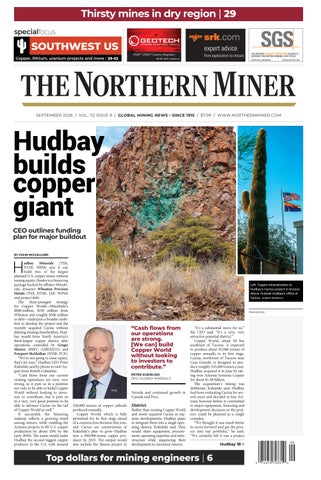
udbay Minerals (TSX, NYSE: HBM) says it can build two of the largest planned U.S. copper mines without issuing equity, thanks to a financing package backed by offtaker Mitsubishi, streamer Wheaton Precious Metals (TSX, NYSE, LSE: WPM) and project debt. The three-pronged strategy for Copper World—Mitsubishi’s $600-million, $230 million from Wheaton and roughly $500 million in debt—underpins a broader ambition to develop the project and the recently acquired Cactus without diluting existing shareholders. Hudbay would form North America’s third-largest copper district after operations controlled by Grupo México (BMV: GMEXICO) and Freeport-McMoRan (NYSE: FCX). “We’re not going to issue equity, that’s for sure,” Hudbay CEO Peter Kukielski said by phone in mid-August from British Columbia. “Cash flows from our current existing operations are very, very strong, so it puts us in a position not only to be able to build Copper World without looking to investors to contribute, but it puts us in a very, very good position to be able to advance Cactus on the tail of Copper World as well.” If successful, the financing makeup reflects a growing trend among miners, while enabling the Arizona projects to lift U.S. copper production by about 20% by the early 2030s. The assets would make Hudbay the second biggest copper producer in the U.S. with around
Left: Copper mineralization at Hudbay’s Cactus project in Arizona. Above: Outside Hudbay’s office at Cactus. HUDBAY MINERALS
PM44082538
“Cash flows from our operations are strong. [We can] build Copper World without looking to investors to contribute.” PETER KUKIELSKI CEO, HUDBAY MINERALS
Nevada and continued growth in Canada and Peru. 250,000 tonnes of copper cathode produced annually. Copper World, which is fully permitted for its first stage ahead of a construction decision this year, and Cactus are cornerstones of Kukielski’s plan to grow Hudbay into a 500,000-tonne copper producer by 2035. The output would also include the Mason project in
District Rather than treating Copper World and newly acquired Cactus as separate developments, Hudbay plans to integrate them into a single operating district, Kukielski said. They would share equipment, procurement, operating expertise and infrastructure while sequencing their development to maximize returns.
“It’s a substantial move for us,” the CEO said. “It’s a very, very attractive potential district.” Copper World, about 50 km southeast of Tucson, is expected to produce about 92,000 tonnes of copper annually in its first stage. Cactus, northwest of Tucson near Casa Grande, is designed to produce roughly 103,000 tonnes a year. Hudbay acquired it in June by taking over Arizona Sonoran Copper for about $1.48 billion. The acquisition’s timing was deliberate, Kukielski said. Hudbay had been evaluating Cactus for several years and decided to buy Arizona Sonoran before it committed to major equipment, financing and development decisions so the projects could be planned as a single complex. “We thought it was much better to move forward and get the project into our portfolio,” he said. “We certainly felt it was a project
Top dollars for mining engineers | 6
Hudbay 18 >
1
2
SEPTEMBER 2026 | THE NORTHERN MINER
www.northernminer.com
Sandvik DD423i Built on legacy. Driven by the future. This highly intelligent drill offers more versatility thanks to its new boom design increasing both the face coverage and crosscut drilling. It can drill face sizes from 4 to 7.8 meters.
THE NORTHERN MINER | SEPTEMBER 2026
GLOBAL MINING NEWS
3
inbrief PHOTO O F T HE MO NT H
The 870 Level Portal at Honey Badger Silver’s Prairie Creek silver-zinc project near the Nahanni National Park Reserve in the Northwest Territories. Along with most of the major infrastructure at the site, the portal was built in the early 1980s, and is the main access point to the underground workings at Prairie Creek. See site visit story on page 12. CREDIT: BLAIR MCBRIDE
DEPA RT MENTS
4
Editorial
5
In Depth
6
Infographic The engineer’s question
11
7
Scholarships
Project Updates
13
Site Visit
14
Done Deals
15
Eye on Australia
17
Treasure Hunt
19
Metals & Markets
42
Company Index
43
From the Archives
SPECIAL SECTION » Southwest US 29
inbrief n
Probe
Fortescue is keeping an unnamed senior executive at work while external lawyers investigate allegations of sexual harassment and bullying, according to an earnings call in August. Australia’s third-largest miner dismissed 11 workers for code-of-conduct breaches related to discrimination and sexual harassment this past fiscal year. It faces a separate class action alleging workplace misconduct. Fortescue is not alone. BHP said it fired 109 employees for sexual harassment and another 22 for racial harassment during the past year. Rio Tinto recorded 702 disrespectful or harmful workplace incidents, including harassment, a 24% increase. The WorkSafe regulator recorded 28 incidents related to sexual assault and harassment this year, compared with 113 for all of last year and a peak of 421 in 2022.
Copper growth
n New BHP CEO Brandon Craig favours developing the miner’s own projects over acquisitions, arguing that current valuations make organic growth cheaper, particularly in copper. The comments come amid reports that BHP has shown interest in uranium developer NexGen Energy. Copper remains BHP’s main investment focus, while the company continues to assess opportunities to expand its uranium business, Craig said Aug. 18. BHP already produces about 5% of the world’s uranium as a by-product of its Olympic Dam copper operation in Australia. BHP last month reported fiscal 2026 EBITDA of $32.9 bil-
lion, a 27% year-over-year increase. BHP expects to generate $35 billion in attributable cash flow over the next five years after investment and capital spending, allowing it to fund its growth internally.
n
Sherritt lifeline
A U.S.-based investor group including Glencore is proposing to recapitalize and take control of Sherritt International, offering a potential lifeline to the nickel and cobalt producer after it suspended its Cuban operations. The consortium has proposed new equity at 12¢ per share. The proposal would give the group at least 55% of Sherritt on a fully diluted basis, while eligible existing shareholders would have participation rights at the same price. Sherritt withdrew from Cuba earlier this year amid tightening U.S. sanctions, putting pressure on its finances and operations. The company will require fresh capital to restart its Alberta refinery and Cuban nickel-cobalt joint venture.
n
Seabed auction
Washington plans to auction deep-sea mining leases near the Northern Mariana Islands this year, expanding the Trump administration’s push to develop domestic sources of critical minerals from the ocean floor. The Bureau of Ocean Energy Management (BOEM) has issued a Proposed Leasing Notice covering about 271,000 sq. km of seabed around the U.S. Pacific territory. The area includes abyssal plains, seamounts and underwater volcanic mountains. BY NORTHERN MINER STAFF
BOEM has identified potential polymetallic nodules and ferromanganese crusts containing commercially valuable concentrations of cobalt, nickel, copper, manganese, zinc and rare earth elements. The proposed Dec. 16 sale would be a major step for an industry that has yet to begin commercial-scale deep-sea mining anywhere in the world. Leases would run for 20 years, although the proposed notice does not guarantee a sale. The move has drawn criticism from environmental groups, which warn that seabed mining could damage fragile marine ecosystems.
n
Lithium scrutiny
Lithium Chile and China Union Holdings face a potential Canadian national security review of their proposed $175-million sale of an Argentine lithium subsidiary, adding another regulatory hurdle to the transaction. Canada’s director of investments issued a notice last month saying there are reasonable grounds to believe the deal could be injurious to national security. Ottawa has not yet ordered a full review. China Union agreed in December to acquire Argentum Lithium, which owns Lithium Chile’s interest in the Salar de Arizaro project in Argentina. The deal also requires approval from Chinese regulators. Lithium Chile argues that Argentum is not Canadian and has no Canadian assets, employees or place of business. It plans to challenge the notice. The proposed sale follows a 2022 divestment order against Chinese investors in Lithium Chile and comes after changes to Canada’s foreign investment rules.
4
SEPTEMBER 2026 | THE NORTHERN MINER
www.northernminer.com
opinion
GLOBAL MINING NEWS • SINCE 1915
www.northernminer.com EDITORIAL
COMMENTARY
The money is already here PRESIDENT THE NORTHERN MINER GROUP: Anthony Vaccaro, CFA, MBA avaccaro@northernminer.com EDITOR-IN-CHIEF: Colin McClelland cmcclelland@northernminer.com COPY EDITOR AND PRODUCTION EDITOR: Blair McBride bmcbride@northernminer.com SENIOR STAFF WRITER: Frédéric Tomesco ftomesco@northernminer.com WESTERN EDITOR: Henry Lazenby hlazenby@northernminer.com PODCAST HOST: Adrian Pocobelli apocobelli@northernminer.com ADVERTISING: Robert Hertzman (416) 898-6654 rhertzman@northernminer.com Kathleen Plamondon (514) 917-5284 kplamondon@northernminer.com Michael Winter (416) 510-6772 mwinter@northernminer.com SUBSCRIPTION SALES/ APPOINTMENT NOTICES/ CAREER ADS George Agelopoulos (416) 510-5104 (Toll free) 1-888-502-3456, ext. 43702 gagelopoulos@northernminer.com PRODUCTION MANAGER: Jessica Jubb (416) 510-5213 jjubb@northernminer.com CIRCULATION/CUSTOMER SERVICE: (416) 510-6789 | 1-888-502-3456 northernminer2@northernminer.com REPUBLISHING: (416) 510-6768 jmonteiro@northernminergroup.com ADDRESS: Toronto Head Office 69 Yonge St, Toronto, ON M5E 1K3 (416) 510-6789 tnm@northernminer.com SUBSCRIPTION RATES: Canada: C$130.00 one year; 5% G.S.T. to CDN orders. 7% P.S.T. to BC orders 13% H.S.T. to ON, NL orders 14% H.S.T. to PEI orders 15% H.S.T. to NB, NS orders U.S.A.: C$172.00 one year Foreign: C$222.00 one year GST Registration # 809744071RT001 (ISSN 0029-3164) CANADA POST: Return undeliverable Canadian addresses to Circulation Dept. c/o The Northern Miner 69 Yonge St., Suite 200 Toronto, ON M5E 1K3 Publication Mail Agreement # 44082538 Periodicals Postage Rates paid at Niagara Falls, NY, 14304. U.S. office of publication 2424 Niagara Falls Blvd, Niagara Falls, N.Y. 14304. U.S. POSTMASTER: send address corrections to: Northern Miner Box 1118 Niagara Falls, N.Y. 14304.-7118 In addition to content produced by its staff, The Northern Miner also publishes content from its sister publications within EarthLabs Media Inc., Mining.com and Canadian Mining Journal.
THE NORTHERN MINER is published monthly by The Northern Miner Group, a division of EarthLabs Media Inc., a leading media and technology company serving the mining industry. From time to time we make our subscription list available to select companies and organizations whose products or services may interest you. If you do not wish your contact information to be made available, please contact us by one of the following methods: Phone: 1-888-5023456; Fax: (416) 447-7658; Mail to: Privacy Officer, The Northern Miner, 69 Yonge St., Suite 200, Toronto, ON M5E 1K3
D
espite a sharp escalation in the Canada-U.S. trade dispute, global investors are already voting with their wallets ahead of Prime Minister Mark Carney’s Sept. 14-15 investment summit in Toronto. Total equity capital raised on the TSX and TSXV climbed 50% year-over-year to $20.5 billion (US$14.6 billion) through July, from $13.7 billion, according to TSX reports. Mining companies raised $10.1 billion on the BY COLIN McCLELLAND TSX and TSXV through July, a 75% increase over the same period in 2025 and representing roughly half of every dollar of equity raised on Canada’s public markets this year. Canada has become a magnet for international capital, Bloomberg News Editor-in-Chief Emeritus Matthew Winkler argued in August, citing stock markets soaring 40% this year and outperforming exchanges in the U.S. and Europe. America’s northern neighbour has attracted US$183 billion ($256 billion) in foreign capital to stocks and bonds over the past 12 months, he said. Winkler credited “reasonable policies” by Carney, “somebody the world knows very well” after leading central banks in Canada and the U.K., and giving a historic speech in Switzerland. Carney’s Davos warning in January that the world was “in the midst of a rupture, not a transition,” echoed a broader reassessment by global investors about where capital can be deployed safely and predictably. “They look at Canada as a stable jurisdiction,” Lance Rishor, head of Macquarie Capital in Canada, whose boss will attend the summit, told The Northern Miner in an Aug. 20 interview. “They look at it as having a good endowment of resources. Generally speaking, there’s decent infrastructure. The fact that Canada has a reasonable amount of green energy is a positive, and everybody would like the permitting process to go quicker.” For mining, instability and taxation spikes in Africa, blockades in South America and Panama’s closure of First Quantum’s giant copper mine make Canada stand apart. “Parts of Africa have become more challenging from a security and a fiscal-regime standpoint,” Rishor said. “Companies prefer lower political risk, and equity markets reflect that in higher trading multiples.” Questions remain Canada’s success still begs a few questions. Is this money being raised because investors are bullish on commodities? Or because capital increasingly wants exposure to secure Western supply chains? There’s also a paradox linked to the surging TSX data: Many CEOs still complain capital is scarce. If that’s true, why has mining financing surged 75% and why have new mining listings nearly doubled? The answer may be that capital isn’t scarce; it is discriminating. The summit is meant to convince global capital that Canada is once again a predictable place to invest after years of complaints about permitting delays, regulatory uncertainty and slow project approvals. Invitations have gone out to some 250 of the world’s institutional investors, sovereign wealth funds, pension funds, major corporation CEOs and government officials. Mining will almost certainly be front and centre alongside energy and infrastructure, with discussions expected to focus on copper, lithium, uranium, nickel and rare earths. The country’s backbone of electricity transmission, nuclear power, liquid natural gas pipelines, AI data centres, ports, airports and railways are also bound to attract attention. While the government hasn’t said the summit itself will generate a specific dollar figure, officials have tied it to a broader ambition of catalyzing roughly $1 trillion of investment over the next five years into “nation-building projects.” One of the harder nuts to crack for mining will be the pension funds attending. Many tend to avoid mining because mines have finite lives while pension funds invest on multi-decade horizons. One aspect of the industry that certainly needs massive injections of long-term capital is in metal processing. With Western governments now consistently linking critical minerals to supply-chain security, defence, electrification and AI, pensions could have a role to play through inexpensive debt, although processing margins are typically narrow. The state can play a role, though government guarantees to projects for certain metal price levels are problematic, Rishor said. “A project has to have strong economics. You can’t make an uneconomic project economic simply through price floors,” he said. “There are more conventional ways to help projects, such as concessionary financing.” When the vast majority of lithium and rare earths are processed in China, we should be working to broaden capacity elsewhere, Rishor said. “Government support is needed where the playing field needs adjusting for security of supply reasons, particularly around processing. There’s no need to onshore copper processing, but there is an opportunity to level the playing field for lithium and rare earths so the West has more control over those supply chains.” Those 250 invitees won’t determine Canada’s future on their own, but they’ll help decide where hundreds of billions of dollars are invested. Rishor said one obstacle has already been removed. “The interaction we had with clients before Carney was that Canada had a leadership problem. Now, at least, there isn’t a problem in Canada from a leadership standpoint.” TNM
Canada must back critical minerals with buyers BY NOAH CHAIKIN
T
he federal government’s first move through the Canada Critical Minerals Accelerator didn’t go to a lithium developer or a nickel mine. It went to germanium, antimony and gallium at Teck Resources’ Trail smelter in British Columbia which has been running since the 1890s. The Canada Growth Fund agreed to a commercial framework for an equity-like investment of up to $400 million, alongside a potential $850-million commitment by Teck, and Ottawa secured the right to negotiate purchase rights over part of the output. That choice reveals more about how Ottawa is thinking than any policy document has. Natural Resources Canada is updating its 2022 Critical Minerals Strategy for the first time. It treats 34 minerals as a single policy category, which worked for an inventory but is a liability for a document now used to direct capital. Here are some ideas for the revision. Defence, chip metals Germanium, gallium, antimony and tungsten belong at the top. Beijing placed germanium and gallium under export control in 2023 and extended restrictions to antimony the following year, and few have practical substitutes in their key applications. Germanium goes into fibre optics and infrared optics, gallium into radar semiconductors, antimony into munitions and flame retardants, tungsten into armour and cutting tools. Volumes are small and pricing opaque, but the buyer today is increasingly a defence ministry working to a deadline rather than negotiating price. The Trail smelter anchors this category and is now funded, with the expansion set to double existing germanium and antimony capacity and potentially add gallium output that North America lacks. The strongest candidate behind it is Fireweed Metals’ Macmillan Pass district in the Yukon, where Macpass holds what the company calls the largest known accumulation of germanium and gallium. The adjacent Mactung project ranks among the largest high-grade tungsten resources on earth. Washington and Ottawa have already committed to the district, with Fireweed awarded up to $35.4 million in joint funding to plan road and transmission upgrades along the North Canol corridor. Access rather than geology is the binding constraint, making the corridor a candidate for the First and Last Mile Fund and its $1.5 billion through 2030. Rare earth processing In rare earths the chokepoint is not mining but separation and metal-
lization, the chemistry that turns concentrate into metal a magnet maker can use, and Canada holds an impressively advanced integrated rare earth processing position in North America. The Saskatchewan Research Council’s rare earth processing plant in Saskatoon became the first operation on the continent to produce rare earth metals at commercial scale in 2024, with integrated operations scheduled for 2027. Planned output is magnet-grade neodymium praseodymium metal alongside the heavy elements dysprosium and terbium, enough at capacity to supply magnets for roughly 500,000 electric vehicles annually. REalloys signed a five-year agreement in December to purchase the majority of that production, driven by U.S. defence supply chain requirements taking effect in January 2027, and has since committed about $20.6 million to expanding throughput while funding a heavy rare earth metallization plant. The customer arrived before the capacity was finished, and private capital followed. Federal priority should replicate that sequence, backing processing capacity with contracted output and the deposits able to supply it. Torngat Metals’ Strange Lake project on the Quebec-Labrador border is globally unusual for its share of heavy rare earths, while Defense Metals’ Wicheeda in British Columbia is the stronger light rare earth case. Support for either should require the material to feed a Canadian separation circuit, since concentrate exported is value exported. Electric-vehicle minerals Lithium, graphite, nickel and cobalt belong behind the defencelinked metals because their domestic customer base has receded. Honda indefinitely suspended its $15-billion Alliston, Ont. complex in May. Stellantis has likewise exited the NextStar Energy joint venture in Windsor. Ottawa committed more than $3.6 billion at PDAC in March, and the Critical Minerals Production Alliance launched during the 2025 G7 presidency has mobilized $18.5 billion across two rounds. What the sector lacks is a published order for deploying the remainder. The list of 34 was written to describe what Canada has; the update needs to establish what Canada intends to build. The distance between those two documents is worth several billion dollars in capital otherwise committed in the wrong places. TNM Noah Chaikin, a recent Harvard graduate in International Relations, is a consultant at Kearney’s Foresight practice in Toronto, where he advises on geopolitical disruption and long-term uncertainty.
Find full news articles at
www.northernminer.com
THE NORTHERN MINER | SEPTEMBER 2026
GLOBAL MINING NEWS
5
indepth Iamgold defers Côté expansion to consider bigger build ONTARIO
| Miner studies Gosselin next door
BY HENRY LAZENBY
I
amgold (TSX: IMG; NYSE: IAG) has deferred a planned expansion of Côté Gold while it studies a much larger build that could nearly double the Ontario mine’s processing rate to 70,000 tonnes a day. The stock soared. In May, Iamgold expected its year-end study to model an expansion from 36,000 tonnes a day to 50,000-55,000 tonnes. It now plans to push the existing plant toward 40,000 tonnes first and has shelved between $500 million and $750 million (C$700 million-C$1 billion) of spending tied to the 50,000-tonne option. Côté, about 500 km north of Toronto, is 70% owned by Iamgold with Sumitomo Metal Mining (TYO: 5713) holding 30%. “We have adjusted the scope of this work to reflect the significant size and opportunity at Côté,” CEO Renaud Adams said Aug. 7 during a conference call with financial analysts. The rethink comes as high gold prices swell cash flow across the sector, giving large producers more room to fund growth while returning more money to shareholders. Newmont (NYSE: NEM), Agnico Eagle Mines (TSX, NYSE: AEM) and Kinross Gold (TSX: K; NYSE: KGC) all reported stronger second-quarter free cash flow while keeping annual production guidance broadly intact. Adjacent Gosselin Côté is one of Canada’s newest large gold mines, having reached commercial production only two years ago. Combining Côté with the adjacent Gosselin deposit has given Iamgold scope to bring a much larger resource into the mine plan, but higher processing rates would force earlier development of Gosselin and require more tailings capacity. The year-end study is to show how aggressively the miner plans to pursue that growth. Toronto-listed shares of the company rose 14% to C$25.55 in Toronto on the day of the announcement before easing to $C25.29 near press time, giving Iamgold a market capitalization of about C$14.5 billion ($10.5 billion). The stock has more than doubled in the past
Iamgold’s Côté Gold mine in northeastern Ontario. IAMGOLD
year, trading between C$10.95 and C$34.09. Iamgold plans to release an updated mine plan by year-end that combines Côté and Gosselin for the first time. Management expects it to show a larger reserve base and longer mine life while setting out the upgrades needed to sustain about 40,000 tonnes a day. The report will separately examine larger expansion options. Earlier development A 70,000-tonne scenario would change how the two deposits are mined. At 36,000 to 40,000 tonnes a day, Iamgold can draw down Côté for longer before moving heavily into Gosselin, Adams told analysts. At about 70,000 tonnes, it would need to mine both pits much earlier. The larger expansion would not materially change work over the next two to three years. Iamgold plans to open more of the pit, add mining capacity, cut costs and lift plant throughput before committing to another major build. Management had previously expected the 50,000-tonne expansion to begin around 2029 or 2030.
Côté produced 96,200 oz. in the three months ended June 30, on a 100% basis, including 67,300 oz. attributable to Iamgold. The plant processed more than 1 million tonnes in June after Iamgold replaced a conveyor belt and commissioned a second cone crusher. The company expects Côté to produce 390,000 to 440,000 oz. this year on a 100% basis. Resource scale The March resource update outlined 838 million measured and indicated tonnes grading 0.75 gram gold per tonne for 20.3 million contained oz. for Côté, Gosselin and the zone connecting them. Another 177.1 million inferred tonnes graded 0.61 gram for 3.48 million ounces. Measured and indicated ounces rose 12% from the year-end estimate, though the increase did not come from drilling alone. Iamgold raised the gold price used to model the Côté resource to $2,500 an oz. from $2,100 and lowered the minimum resource grade to 0.25 gram from 0.3 gram. The
higher price assumption and combining the deposits into one model drove much of the increase, Iamgold said. Gosselin now contains 310.9 million indicated tonnes grading 0.74 gram gold for 7.43 million oz., plus 41.4 million inferred tonnes at 0.67 gram for 890,000 ounces. Iamgold expects the year-end work to convert part of that resource into reserves as it folds Gosselin into the operating plan. The larger mine would require more waste and tailings storage. Côté’s existing tailings facility can hold about 233 million tonnes, but adding Gosselin will require extra capacity, Chief Operating Officer Bruno Lemelin told analysts. Iamgold is studying an expansion of the storage area as well as placing tailings and mine waste in depleted parts of the Côté pit. Management plans to use the next few years to advance environmental studies and permitting while it settles on the larger mine design. Funding room Iamgold approaches that decision with a stronger balance sheet. It ended June with $501 million in cash, no borrowings under its revolving credit facility and about $1.35 billion of available liquidity. The company reported $369 million of mine-site free cash flow in the second quarter. That gives Iamgold more room to improve the existing Côté operation while delaying its biggest expansion cheque until management decides how large the Côté-Gosselin mine should become. Iamgold posted second-quarter adjusted net earnings of $241.6 million, or 42¢ a share, more than triple the $77.3 million, or 13¢ a share, a year earlier. The miner kept its fullyear production target at 720,000 to 820,000 attributable oz. of gold, with all-in sustaining costs of $2,000-$2,150 per oz. including royalties and total capital spending of about $500 million. Costs are running high so far this year. First-half all-in sustaining costs were $2,195 per oz., above the full-year range. Iamgold expects lower costs in the second half as Côté production rises. TNM
Junior funding model blamed for mine delays FINANCING
BY MINING.COM STAFF
T
he mining industry’s exploration financing model leaves junior companies ill-equipped to address environmental and social issues that later delay mine approvals, the Washington, D.C.-based Trust, Accountability and Inclusion (TAI) Collaborative argues in a new report. Many permitting disputes begin years before regulatory reviews, when explorers are rewarded for discoveries rather than community engagement and environmental planning, author Sefton Darby says in a report called “Mined The Gaps: Trusty and Critical Minerals,” issued Aug. 12. The industry’s focus on finding deposits leaves environmental and social risks unaddressed until projects reach permitting, when disputes become more difficult and expensive to resolve, Darby says. Drawing on global data, sentiment surveys and case studies, he says stronger regulation and earlier community engagement can identify risks before they escalate into legal challenges and project delays.
| Exploration reform needed: report
“The market for developing new mines is structurally broken,” Darby writes. “The exploration phase is dominated by small, under-capitalized junior mining companies whose technical focus is almost entirely geological.” Early engagement “Environmental and social risks are routinely created during this phase but go unaddressed because companies lack the resources, incentives, and regulatory obligations to consider them,” Darby said. “By the time a project reaches the mine permitting stage, those risks are deeply embedded.” The findings from TAI, a funder network, challenge the view that cutting regulation alone will accelerate critical minerals development. Instead, Darby argues projects move fastest when communities trust the permitting process and regulators have the confidence to resolve issues before they become entrenched. “When people have a meaningful voice, confidence in oversight and assurance that environmental and social concerns will be
“The fastest project is not necessarily the one with the fewest rules. It is the one that identifies risks early, gives communities a genuine role in decisions and creates confidence that commitments will be honoured throughout the life of the mine.” SEFTON DARBY, CONSULTANT, TAI COLLABORATIVE
addressed, problems can be identified earlier and resolved before they escalate,” he said. As a remedy, TAI proposes creating an adaptive governance partnership that would bring regulators, mining companies and community representatives together throughout a
project’s life to identify and resolve environmental, social and cultural concerns before they become major obstacles. “The fastest project is not necessarily the one with the fewest rules,” Darby said. “It is the one that identifies risks early, gives communities a genuine role in decisions and creates confidence that commitments will be honoured throughout the life of the mine. Fairness and speed are not competing objectives. Done properly, each makes the other possible.” Reforming exploration Mining’s financing model should change by linking exploration funding to environmental and social initiatives from the earliest stages of project development, rather than leaving those issues until permitting begins, TAI says. “It will require changing the way governments, companies and funders work with the people who live alongside mining operations,” TAI executive director Michael Jarvis said. “A transition that ignores community rights will not only be unjust; it will also be slower, more expensive and less sustainable.” TNM
6
SEPTEMBER 2026 | THE NORTHERN MINER
www.northernminer.com
infographic THE ENGINEER'S QUESTION By Northern Miner Staff
Pick your engineering field. Mining engineering ranks first by wage ceiling, with a top-end figure above every other discipline. At the median, it still sits second, just behind software. If you optimize for upside, mining leads.
1 2 3 4 5
$37.02
$52.88
$115.38
MINING ENGINEER
$33.46
$56.49
$84.62
SOFTWARE / COMPUTER ENGINEER
$30.00
$45.67
$72.49
$50.67
$32.00
$48.56
$84.62 $72.49
MECHANICAL ENGINEER
$33.65
$115.38
$79.23
ELECTRICAL ENGINEER
$72.12
$79.23 $72.12
CIVIL ENGINEER
SCALE $0 –$120 / HR LOW WAGE
MEDIAN
HIGH WAGE
MINING ENGINEER PAY SURGES WITH CRITICAL MINERALS BUILDOUT Between Dec 2024 and Nov 2025, Job Bank revised dozens of NOC wage bands. One revision dwarfs all the rest: the mining engineer ceiling. Below, the headline shift and a sample of every other meaningful change in the dataset.
MINING ENGINEER CEILING
$79.69
$115.38
Dec 2024
Nov 2025
+45%
A $35.69/hr swing, driven by Canada's critical-minerals build-out and a deepening shortage of senior mining engineering talent.
*All wage data: Job Bank Canada (jobbank.gc.ca) and Statistics Canada NOC-7. Reference period: 2022–2023 wage survey, revised 19 November 2025. NOC-7 benchmark = arithmetic mean of 93 national occupations in Major Group 7 (Trades, transport and equipment operators). Annual figures assume 40 hours × 52 weeks; actual mining-sector annual compensation typically exceeds the linear projection due to overtime, shift, and remote-site premiums not captured by Job Bank’s hourly medians. © 2026 The Northern Miner
THE NORTHERN MINER | SEPTEMBER 2026
GLOBAL MINING NEWS
7
projectupdates Equinox gains key federal OK for South Railroad GOLD
| Early works start in Nevada “The positive record of decision de-risks the South Railroad project and allows the company to begin construction.”
BY BLAIR MCBRIDE
E
quinox Gold (TSX, NYSE-A: EQX) is starting early works construction at its South Railroad project in Nevada after it completed an important stage of federal environmental permitting, putting it on track for first production in 2028. Shares rose. The Bureau of Land Management’s positive record of decision on the gold project marks the completion of permitting under the National Environmental Policy Act process, while the company has applied for other important state permits and water rights, Equinox said Aug. 17. South Railroad is about 700 km northeast of Las Vegas. “We view this as positive for Equinox shares as the positive record of decision de-risks the South Railroad project and allows the company to begin construction,” Scotia Capital analyst Ovais Habib said in an Aug. 17 note. “We look forward to hearing more about progress at site during the back half of 2026.” Equinox President Jason Simpson called the record of decision a “major milestone” for South Railroad that advances the company’s next stage of growth. Incremental production from South Railroad will be the first big step towards Equinox’ goal of adding 800,000 oz. of annual gold pro-
OVAIS HABIB, ANALYST, SCOTIA CAPITAL
among Nevada’s larger new gold developments, with production forecast at about 104,000 oz. annually over a 10-year life, according to an updated feasibility study released in January.
The South Railroad project in southeast Nevada. EQUINOX GOLD
duction from its organic development pipeline, Simpson added. Initial milestone The BLM decision for South Railroad, which gained Fast-41 “covered project” status in 2025, is the first major federal permitting milestone for Equinox since completing
its merger with Orla Mining in July. Equinox shares gained 1.9% to $16.41 apiece in Toronto after the announcement, for a market capitalization of about $19 billion (US$13.5 billion). The stock has traded in a 12-month range of $10.46 to $25.87. South Railroad would rank
Organic growth priority The project is positioned as the first of multiple organic growth projects within the Equinox portfolio, including the Valentine expansion in Newfoundland, the Castle Mountain gold project in California, and expansions at Los Filos and Camino Rojo in Mexico, BMO Capital Markets analyst Kevin O’Halloran said in a note on Aug. 17. The early works construction at South Railroad had already been approved by the board, and Equinox is now doing access road construction, which began earlier this summer, and site earthworks and civils. The company is also accelerating workforce hiring, advancing
detailed engineering—now 55% complete—and procurement, with contracts awarded for power, process plant equipment, concrete and structural steel $783M value The open-pit heap leach mine has a post-tax net present value (NPV) of US$783 million (C$1 billion) at a 5% discount rate and an internal rate of return (IRR) of 48%, assuming a gold price of US$3,100 per oz. and a silver price of $36.50 per ounce. At a gold price of US$4,500, the NPV rises to US$1.7 billion and the IRR to 95%. Initial capital costs are pegged at US$395 million. South Railroad hosts 66.6 million tonnes of proven and probable reserves grading 0.71 gram gold per tonne and 5.1 grams silver for contained metal of 1.52 million oz. gold and 6.2 million oz. silver. The project is situated inside a larger 25,000-hectare land package along Nevada’s Carlin Trend, a prolific gold belt that has hosted dozens of mines since the 1960s. The Pinion and Dark Star deposits that make up South Railroad were discovered by Newmont (NYSE, ASX: NEM; TSX: NGT) and Crown Resources in the 1980s and 1990s, respectively. Gold Standard Ventures acquired the deposits in 2014 and advanced them as South Railroad. Orla acquired Gold Standard in 2022. TNM
Blue Moon rejects short seller’s claims NORWAY
| Viceroy attacks Nussir project
BY COLIN MCCLELLAND
B
lue Moon Metals (TSXV: MOON; Nasdaq: BMM) defended its main Nussir copper project with the help of Haywood Securities after short-seller Viceroy Research questioned permits, financing and broader development strategy. Vancouver-based Haywood maintained its buy rating and $15 target price last month after management addressed the allegations during a conference call. The broker said Norway’s government publicly reaffirmed Nussir as a strategic project and that the company continues to target mill commissioning in the third quarter of 2027, with commercial production in the first quarter of 2028. “We maintain our constructive outlook for Blue Moon as Nussir issues are clarified and progress is made at the Springer and Apex projects,” lead Haywood mining analyst Pierre Vaillancourt said in an Aug. 14 note. “We recognize a recovery in the stock will take time, supported by tangible progress at Nussir as well as U.S. projects.” The allegations come at a pivotal time for Blue Moon as it tries to build a Western critical-minerals platform spanning copper, tungsten and antimony. The company is constructing Nussir in Norway, plans to restart the Springer tung-
The loading area at Blue Moon’s Nussir copper project in Norway. BLUE MOON METALS
sten project in Nevada in 2027, and in August added 33 tungsten and antimony properties across the western U.S. to expand its domestic supply chain. Shares slide Blue Moon’s stock fell 11% to close at $6.85 apiece on Aug. 13 after Viceroy’s report a day earlier. It questioned the legal standing of Nussir’s submarine tailings permit, its financing arrangements, the Springer tungsten acquisition and corporate governance.
Viceroy is an activist short seller that publishes reports on companies it says are overvalued, seeking to profit if their shares decline. Blue Moon said the concerns are unfounded and that no regulator has indicated Nussir faces a reassessment similar to one involving another Norwegian mining project. Management said any future application of updated EU water rules would likely require strengthening the permit’s justification rather than redesigning the mine. Haywood also rejected con-
cerns over Blue Moon’s balance sheet. The broker noted the company has drawn only half of its US$25-million (C$34.7-million) Hartree-Oaktree bridge facility and held C$159 million in cash at the end of the second quarter. Management said it could repay the drawn amount if necessary, while discussions continue on US$140 million of project financing for Nussir and US$150 million to US$200 million of financing for Springer and Apex, potentially including strategic investors.
Springer project The analysts also defended Blue Moon’s acquisition of the Springer tungsten project in Nevada, saying management carried out extensive technical work on the processing plant and infrastructure before buying the asset. Management said Springer remains on track for a fourth-quarter 2027 restart and that potential strategic partners have visited the site as they assess funding and commercialization opportunities. Springer has become central to Blue Moon’s plan to build a U.S.-focused critical-minerals platform. The company expanded that strategy by acquiring 33 tungsten and antimony properties across the western U.S., including several projects near the Springer processing complex. The company sees the portfolio as a way to secure feed for one of North America’s few tungsten processing facilities while broadening its exposure to metals the U.S. considers strategically important. Haywood acknowledged that investors are likely to adopt a “show-me” approach until Blue Moon delivers further operational progress, but said upcoming milestones at Springer and Apex should help refocus attention on the company’s longer-term cash flow potential. TNM
8
SEPTEMBER 2026 | THE NORTHERN MINER
www.northernminer.com
projectupdates AngloGold Ashanti hikes Thesis stake BC
Fortuna buys Barrick project in Senegal
| $58.5M deal advances Lawyers-Ranch
GOLD
BY FRÉDÉRIC TOMESCO
| $200M for Bambadji
A
ngloGold Ashanti (NYSE: AU) is investing $58.5 million (US$42 million) to double its stake in Thesis Gold & Silver (TSXV: TAU; US-OTC: THSGF) and help the Vancouver-based developer advance the Lawyers-Ranch project in British Columbia. AngloGold will buy 8.34 million common shares for $28.5 million, along with $30 million of flowthrough shares, Thesis said Aug. 17. The investment will lift AngloGold’s interest in Thesis to 9.7% from about 5%, following an initial $38.7-million investment in February. The financing comes as Thesis prepares a feasibility study for Lawyers-Ranch—due next year—while carrying out exploration and permitting work. Having begun the environmental assessment process in late 2025, the company expects a decision from provincial authorities in 2029. AngloGold’s investment is “a strong endorsement of LawyersRanch’s scale, exploration potential and development outlook,” National Bank Financial mining analyst Alex Terentiew said in a note. “The financing significantly improves funding visibility for ongoing exploration and technical work ahead of the expected 2027 feasibility study, while strengthening Thesis’s relationship with a globally significant gold producer.” Eligible spending Proceeds from the flow-through portion will fund eligible Canadian exploration expenditures at Lawyers-Ranch, while the hard-dollar proceeds will be used for working capital and general corporate
The Lawyers-Ranch project in northern British Columbia. ANGLOGOLD ASHANTI
purposes, including technical studies underway on the project, Thesis said. Located about 930 km north of Vancouver, Lawyers-Ranch is Thesis’ sole project, covering 495 sq. km in the Toodoggone mining district. The land package hosts the Lawyers and Ranch areas, which contain multiple gold-silver deposits as well as exploration targets. A 2025 prefeasibility study (PFS) outlined a staged open-pit and underground operation with a 15-year mine life. Lawyers-Ranch holds 117.5 million measured and indicated tonnes grading 0.88 gram gold per tonne and 25.9 grams silver for contained metal of about 3.3 million oz. gold and 97.9 million oz. silver, according to the study. Inferred resources were pegged at 16.2 million tonnes grading 1.05 grams gold and 14.7 grams silver for contained metal of 547,000 oz. gold and 7.7 million oz. silver. Truck and shovel At base-case prices of US$2,900 ($4,031) per oz. gold and US$35 per
oz. silver, the PFS estimated a posttax net present value—at a 5% discount rate—of $2.37 billion and an post-tax internal rate of return of 54%. Initial capital was estimated at $736.2 million, with a projected payback period of 1.1 years and average all-in sustaining costs of US$1,185 per gold-equivalent ounce. Conventional truck-and-shovel open-pit mining is planned for the Lawyers and Ranch areas, as well as underground mining at the Cliff Creek and Dukes Ridge deposits at Lawyers. A centralized processing facility is planned between the open pits at Lawyers. Thesis is also conducting exploration across the broader property. In March, crews identified two porphyry targets at Ranch and Ranch East, with the latter located about 15 km east of the Ranch resource area. Shares of Thesis in Toronto have gained 57% this year to C$3.46 apiece near press time, valuing the company at about C$962 billion. The stock has traded between $1 and $3.98 in the 12 months. TNM
The Bambadji project borders Fortuna’s Diamba Sud in Senegal. FORTUNA MINING BY CECILIA JAMASMIE
F
ortuna Mining (NYSE: FSM; TSX: FVI) is buying the Bambadji gold project in Senegal for $200 million (C$279 million) from Barrick Mining (NYSE: B; TSX: ABX) and Iamgold (TSX: IMG; NYSE: IAG), expanding its position in the West African nation. The 190-sq.-km Bambadji borders Fortuna’s Diamba Sud project, giving the Canadian miner control of about 60 km of prospective strike along the Senegal-Mali Shear zone, it said Aug. 11. Diamba Sud “is awaiting final permits and an investment decision following a feasibility study announced in June outlining 116,000 oz. annual [output] over 9.4 years, including 158,000 oz. annually in the first four years,” BMO Capital Markets mining
TSX.V: TUD FRA: H56.F OTC: TDRRF
Treaty Creek - One of the Largest Gold Discoveries in the Past 30 Years. 2026 Catalysts: • Upcoming PEA • Exploration Drilling of New Zones • Permitting of Underground Ramp
tudor-gold.com
SCAN FOR DETAILS
analyst Kevin O’Halloran said in a note. “We would expect Bambadji to provide expansion potential to Diamba Sud once in production, and management indicated that plant design at Diamba is proceeding with a potential expansion in mind.” Exploration Fortuna plans to spend $8 million exploring Bambadji through the end of 2026, with 51,000 metres drilling expected to begin in the third quarter. The company is targeting eight previously identified targets located within a 20-km radius of the Diamba Sud plant site after 214,000 metres of drilling. “Generative exploration will advance concurrently on site to explore mineralized trends,” BMO’s O’Halloran said. “Importantly, the company expects to fund its growth at Bambadji, Diamba Sud and [Côte d’Ivoire’s] Séguéla [gold mine] internally from ongoing cashflows and the treasury, which stood at $435 million at quarter end, with total liquidity of $757 million.” The drilling so far has shown wide intervals of relatively highgrade, shallow mineralization, the analyst said. Highlights include: 45 metres grading 2.34 grams gold per tonne from 5 metres depth at Kabewest; 47 metres at 3.76 grams from 55 metres downhole at Kabetea; 46 metres at 3.57 grams from 56 metres depth at the Bagata Corridor; and 15 metres grading 8.55 grams from 17 metres depth at Djenebou. Consolidation Bringing Bambadji together with Diamba Sud gives Fortuna a substantially larger exploration position in Senegal while allowing it to target prospective ground alongside a project already at the feasibility stage. “Bambadji represents a rare opportunity to consolidate a largescale, highly prospective exploration land package immediately adjacent to our feasibility-stage Diamba Sud gold project,” Fortuna CEO Jorge Ganoza said in a statement. The acquisition further concentrates Vancouver-based Fortuna’s West African portfolio in Senegal and Ivory Coast. The company sold its Yaramoko mine in Burkina Faso for about $130 million last year as part of that shift. TNM
THE NORTHERN MINER | SEPTEMBER 2026
GLOBAL MINING NEWS
HA JO
B ES NN UR
Serving the Global Metals Industries since 2004
G
|
TO
RO
NT O
|P
ER TH |
NEW
YORK | LONDON | LIM A | VIENNA
Physical Precious Metal Offtake Metals Financing Including Debt, Equity and Royalties / Streams Project Finance Advisory Supply and Risk Management
300 Frank W Burr Blvd Teaneck, NJ 07666 (201) 905-5000
INFO@AURAMET.COM | WWW.AURAMET.COM
9
10
SEPTEMBER 2026 | THE NORTHERN MINER
www.northernminer.com
projectupdates Rosebud project, like in ‘Citizen Kane,’ reveals another secret GOLD BY FRÉDÉRIC TOMESCO
N
ew drilling by Canadian explorer Blossom Gold (TSX: BGAU) at its Rosebud open-pit, heap-leach project in Nevada points to broad mineralized zones around areas of historical underground mining. Hole BG26-027 in the south zone cut 26 metres of 0.643 gram gold per tonne from 132.8 metres depth and 28 metres of 1.682 grams gold from 170.9 metres downhole, Blossom said Aug. 12. Hole BG26023 in the southwest zone cut 8.9 metres of 0.757 gram gold per tonne from 105.8 metres. Toronto-based Blossom is working to complete surface and underground drilling at Rosebud—a former gold producer that was jointly operated from 1997-2000 by Newmont (NYSE, ASX: NEM; TSX: NGT) and Hecla Mining (NYSE: HL)—in next year’s first quarter ahead of an updated resource. It has drilled almost 60% of the planned 24,000-metre campaign. “These results continue to demonstrate the scale of the mineralized system at Rosebud as well as what wasn’t mined underground,” CEO Rick Winters said in the company’s statement. “We are open and expanding in the northeast and southwest zones and have yet to drill the northwest zone.”
| Blossom targets 2027 resource update
New name Blossom’s predecessor company, Investmin Resources, acquired Rosebud for $35 million (C$49 million) upfront, a 1% net smelter royalty and deferred payment if a silver stream is used in project financing. Investmin changed its name to Blossom and began trading on the Toronto Stock Exchange in February. Rosebud holds 70.8 million inferred tonnes grading 0.62 gram gold per tonne and 6.49 grams silver for contained metal of 1.29 million oz. gold and 13.39 million oz. silver, according to a December resource. Other drilling highlights released last month include hole BG26-024 in the south zone, which cut 25.3 metres of 0.864 gram gold from about 160 metres depth, and hole BG26-030, which intersected 115 metres grading 0.553 grams gold from 1812 metres. That included about 53 metres of 0.860 gram gold from 197 metres downhole. Eight targets Located about 350 km east of Reno, Rosebud covers 7 sq. km and is accessible year-round along allweather roads from the town of Winnemucca. In its previous incarnation as an underground mine, Rosebud produced about 400,000 oz. gold and 2.3 million oz. silver. The mate-
Drilling at Blossom’s Rosebud project in western Nevada. BLOSSOM GOLD
rial was trucked about 200 km to a Newmont oxide mill. Blossom’s exploration work is focusing on eight identified targets to add ounces to the mine plan both near-surface and at depth on the Rosebud claims. Crews at Rosebud are now drilling with four rigs. They will be
shifting to more reverse circulation drilling to enhance productivity, Winters said. Blossom is seeing “continued evidence for extensive gold mineralization to the southwest of the underground workings, and early signs of near-surface mineralization in the northeast zone,” explo-
ration VP John DeDecker said. “Our most recent drilling targeting the east mined zone and the area between the south and east mined zones shows a broad zone of mineralization consistent with that intercepted in the south mined zone that we eagerly await assay results for.” TNM
PRECISION IN EVERY BLAST. PREDICTABLE OUTCOMES. BME’s AXXIS® range – Silver, Titanium, and CEBS – delivers world-class electronic initiation trusted by mines across five continents. Built for precision, safety, and sustainability, AXXIS® empowers engineers and blasters to achieve consistent, high-performance blasts – even in the most demanding conditions. • AXXIS® Silver – Proven reliability for quarries and mid-sized mines. • AXXIS® Titanium – Advanced control with best-inclass safety and data capabilities. • AXXIS® CEBS – Centralised blasting with unmatched scale and efficiency. With AXXIS®, you don’t just initiate blasts – you initiate progress.
Delivering Sustainable Future-Fit Solutions Discover the full range at www.bme.co.za
AXXIS® Silver
AXXIS® Titanium
AXXIS® CEBS
THE NORTHERN MINER | SEPTEMBER 2026
GLOBAL MINING NEWS
11
ympscholarship Young Mining Professionals bursary grows to $300,000 EDUCATION BY NORTHERN MINER STAFF
T
he Young Mining Professional’s Scholarship Fund has increased by a third to $300,000 (US$215,000) from last year as the industry’s leading companies reward strong students in mining disciplines across Canada. Now in its eighth year, the initiative has attracted 24 sponsors offering over 60 scholarships ranging between $5,000 and $60,000, including a $5,000 award from the Northern Miner Group to an exceptional mining student. “It is very rewarding to see the YMP Scholarship Fund continue to grow,” says Stephen Stewart, Chairman of the YMP Scholarship Fund and of Ore Group. “We are particularly pleased that Franco-Nevada (TSX, NYSE: FNV) and Agnico Eagle Mines (TSX, NYSE: AEM) have established significant multiyear scholarships that support students throughout their university education.” The diversity of the fund’s scholarships is a strength, which allows students from a wide range of backgrounds, disciplines and communities to qualify and apply, organizers say. Companies are invited to suggest ideas for scholarships, and the YMP team will design and administer them at no cost. It all helps
| Sponsors back 60 awards $5,000 from Eldorado Gold (TSX: ELD; NYSE: EGO), Gold Royalty (NYSE: GROY), Joan Margaret Stewart, and a $16,000 contribution from the Ore Group.
connect mining organizations with exceptional emerging talent. Registered charity Every cent of all donations go directly to students. Donors receive a charitable tax receipt because the YMP Scholarship Fund is a registered Canadian charity. “None of this would be possible without our outstanding YMP Scholarship team,” says Stewart. “Every member is a volunteer, and I am extremely grateful for the time, energy and care they contribute to supporting the next generation of Canada’s mining industry.” The YMP Scholarship Fund has increased from nearly $225,000 last year and just $12,000 in its first year, largely thanks to new scholarships from Agnico Eagle, Franco-Nevada and Iamgold (TSX: IMG; NYSE: IAG). The fund was started in 2017 by Stewart and Anthony Moreau of the Ore Group, with initial funding split between Iamgold and the Ore Group. This year’s YMP Scholarship application process is already open, with a closing date of October 15. After the deadline, volunteers review applications and winners are announced in early 2027. Over 3,000 students applied for the more than 50 scholarships offered last year.
Maxwell Brown, left, University of Calgary, 2028, BSc Mechanical Engineering, winner of the American Eagle Gold YMP Scholarship, with Andrea Ferris, University of Alberta, 2027, BSc Geology (Honours), winner of the Sprott Sustainability in Mining Scholarship. YMP
Competing for talent “There aren’t many industries where you get to travel the world, help the communities you work in, and face a new challenge every day. Mining is one of them,” says Moreau, CEO of American Eagle Gold (TSXV: AE; US-OTC: AMEGF). “It has given me so much over the years, and the scholarship fund was set up as a way to give back. Helping a student stay in the industry, and maybe opening the door to an internship and a career, is how the fund’s volunteers can make it a little better.”
Other top-tier opportunities with major miners are available, including a $60,000 award from Franco-Nevada, $60,000 from Agnico Eagle Mines, $30,000 from Kinross Gold (TSX: K; NYSE: KGC), $30,000 from Equinox Gold (TSX: EQX), and $20,000 from Iamgold. The fund boasts $10,000 each from Barrick Mining (TSX: ABX; NYSE: GOLD), B2Gold (TSX: BTO; NYSE-A: BTG), Pan American Silver (TSX: PAAS; NYSE: PAAS), Resource Talks, TD Securities, Triple Flag Precious Metals (TSX: TFPM; NYSE: TFPM) and Sprott Inc. There is also
Diverse range Many of the scholarships target students in mining programs, while others are available specifically to women, minorities, Indigenous students, new Canadians, or residents of a particular region or province. Applicants are selected based on a combination of academic achievement, extracurricular involvement, and submissions such as essays demonstrating innovative thinking and a commitment to the mining industry. Those who aren’t selected as scholarship recipients are automatically enrolled in a Mining Lottery sponsored by YMP Toronto, the Ore Group and Sprott, which will award 10 $500-prizes to students. TNM The YMP Scholarship Fund, a registered Canadian charity offering tax receipts to donors, is always open to new sponsors, both for this year’s program and for future years. Companies and individuals interested in sponsoring a scholarship are encouraged to email scholarships@ youngminingprofessionals.com.
Novel Metallurgical Processes for the Mining Industry Cyanide-free Gold Extraction Arsenic Stabilization
https://dundeetechnologies.com/home | info@dundeetechnologies.com
12
SEPTEMBER 2026 | THE NORTHERN MINER
www.northernminer.com
sitevisit Can Honey Badger finally crack long-troubled Prairie Creek? NWT
| Silver-zinc project being revived for 2027 start its plodding progression was characterized by the long 19 years it took to acquire an environmental approval for Prairie Creek, which NorZinc secured in 2011. Then RCF took NorZinc private in 2022 for $13.5 million. Now, Eric Sprott holds a 7.8% stake in Honey Badger. Company shares traded for 90¢ apiece before press time in Toronto, for a market capitalization of $147.5 million. The stock has traded in a 12-month range of 13¢ to $1.19.
BY BLAIR MCBRIDE NEAR NAHANNI NATIONAL PARK, N.W.T.
T
he Prairie Creek site, nestled in a peaceful mountain valley in the Northwest Territories, is the project that won’t die after facing numerous dead-ends, studies and false starts over the past 40 years. But new owner Honey Badger Silver (TSXV: TUF) is working to ensure this time is different. After acquiring the project for $12 million (US$8.64 million) in April from Denver-based private equity firm Resource Capital Funds (RCF), the Eric Sprottbacked junior miner is the latest in a string of owners that have tried to bring the silver-zinc-lead mine into production since construction was halted in 1982. Prairie Creek is about 550 km southwest of Yellowknife, near the remote Nahanni National Park Reserve. “When you look at this mine, you go ‘there’s a lot of broken dreams here.’ A lot of people have spent a lot of time and effort and energy,” Honey Badger CEO Chad Williams told The Northern Miner during an August site visit. “This time…the silver price has never been this high, there’s never been a focus on critical metals like there is today.” If Williams is right, Prairie Creek might not only help fill some of the economic hole opened by the territory’s closing diamond mines, but it could also help meet rising demand for critical metals required for the green energy transition. Vintage, not obsolete Even without knowing the historical details of the Prairie Creek
Honey Badger CEO Chad Williams stands at a lookout point over the Prairie Creek site in the Northwest Territories. BLAIR MCBRIDE
project, its age is suggested by the vintage yellow school bus used to transport visitors from the air strip to the camp and the lightly rusted machinery inside the cavernous mill. But the mill has a capacity of 1,000 tonnes per day (tpd) and is permitted for up to 2,400 tpd. “When we bought the mine, I had no idea that the mill was in such great shape,” Williams said. “I thought we were inheriting something that we’d have to scrap and start from scratch. There were quality people that spent a lot of money doing things properly, and then smart people that cared deeply about this mine and preserved it.” Fits and starts The deposit at Prairie Creek was originally discovered in the 1920s and drilling and underground
ASX: BGD OTC: BGDFF FRA / FSE: BGD3
DEVELOPING SOUTH AUSTRALIA’S LARGEST GOLD AND SILVER PRODUCER Dominant position in Gawler Craton with fully permitted mill — New Tolmer silver discovery with grades up to 17,600 g/t Ag — 150koz Au & 250koz Ag annual production target — 2.25Moz Au & 3.1Moz Ag JORC Resources
BARTONGOLD.COM.AU
development occurred throughout the 1960s and 1970s. The main mine infrastructure was built in the early 1980s by Cadillac Explorations, financed by Nelson Bunker Hunt and Herbert William Hunt, best known as the billionaire silver bull “Hunt brothers.” But when the silver price collapsed, the Hunts’ activities faced a U.S. government investigation and they pulled the plug on Prairie Creek in 1982, just three weeks before it was set to enter production. After Cadillac, San Andreas Resources, later renamed Canadian Zinc and then NorZinc acquired Prairie Creek for $3.2 million in 1993. The NorZinc logo remains above two mine portals that lead to about 5 km of underground development. As the project changed hands,
Unusual progression Four months after buying Prairie Creek, Honey Badger is keeping busy. It’s targeting an updated preliminary economic assessment (PEA) for Prairie Creek in the third quarter and a feasibility study after that, a surprising move for a project that has at least four economic studies going back more than a decade. “We debated about doing the study at all because there’s a lot of infrastructure there and it was an [issue] of let’s just go into production and rely on previous economic studies,” Williams said. “But the board felt that we needed to freshen it up with 2026 numbers.” The underground Prairie Creek mine could produce 2.55 million oz. silver, 122 million lb. zinc and 101 million lb. lead in annual output over a 20-year life, according to the 2021 PEA. Discounted at 8%, the post-tax net present value is pegged at about US$300 million, at initial costs of US$368 million. The after-tax internal rate of return is forecast at 18%, with a 4.8-year payback period.
It hosts 9.8 million measured and indicated tonnes grading 139 grams silver per tonne, 9.7% zinc, and 8.8% lead and 6.4 million inferred tonnes at 150 grams silver, 12.9% zinc and 6.7% lead. Metal prices in the PEA were set at US$20 per oz. silver, US$1.15 per lb. zinc and US$1.00 per lb lead. While Fireweed Metals’ (TSXV: FWZ) Macpass project in neighbouring Yukon has a much larger zinc resource, Prairie Creek’s zinc grades are more than double Macpass’ 5.5% zinc. Williams admits Honey Badger’s economic study progression is “very odd.” “I’ve never seen this in my career,” he said. “We’re doing two tracks—restarting it, refurbishing it while we’re doing these independent economic studies. No matter if we’re producing and generating revenue, banks and long-term financial partners need a feasibility study.” First production 2027 Honey Badger is targeting first production at Prairie Creek next summer to demonstrate that zinc and lead concentrate can be produced by the mill. The company plans to drill about 3,000 metres underground in the near term, Williams said. The last time the project was drilled was in 2022, which was mostly surface drilling. After the PEA, a future estimate will include a resource for germanium, a critical metal essential in fibre optics, semiconductors and defence applications. Historical assays at the project returned results of up to 316 parts per million germanium. The quoted germanium price of about US$8,000 per kg is understated, Williams said. “We have heard anecdotally from highly credible sources that the true market price for germanium today is multiples of that,” he said. “It will continue to get lots of attention from the Canadian and the U.S. government.” Road to success? But for all its promise, Prairie Creek currently lacks all-season road access. Previous operators relied on a winter road to bring in supplies. Construction of the 170km all-season route could begin next spring, assisted by $25 million from the National Trade Corridors Fund, with the potential support from regional First Nations, Williams said. “Another thing that’s changed for us” is Indigenous support, he said. Prairie Creek sits in the region of the Nahanni Butte Dene Band and the Liidlii Kue First Nation, with whom Honey Badger has impact benefit agreements. It also has a transportation corridor deal with the Acho Dene Koe First Nation. “They’re more supportive of this project than they’ve ever been,” Williams said. “We’re dealing with smart, business-oriented individuals who are amply qualified to provide services to us, including trucking and so on. It’s a meeting of many positive vectors that give us the best chance for this project to go into production ever.” TNM
THE NORTHERN MINER | SEPTEMBER 2026
GLOBAL MINING NEWS
13
sitevisit Inventus advances continent’s sole paleoplacer gold project ONTARIO
| Geologists overlooked site for decades other underground or open pit site in that ore is blasted, crushed and hauled to a mill. Inventus has already been sending crushed ore for bulk sampling to McEwen’s Stock mill in Matheson, about 200 km northwest of Pardo. Those samples were sourced from what Whymark calls the “main layer” at Pardo that’s about 2 metres thick grading about 2 to 3 grams gold per tonne and up to 8 grams gold.
BY BLAIR MCBRIDE NEAR SUDBURY, ONT
I
nventus Mining’s (TSXV: IVS) Pardo gold project might be the largest of its kind in North America and the latest surprise to come out of the Sudbury region geological hotspot. For the Eric Sprott and McEwen-backed (TSX, NYSE: MUX) explorer, Pardo stands out as a paleoplacer project, a type of alluvial deposit sitting relatively close to the surface, and costing potentially less to mine than most open pit or underground deposits. Pardo is a 90-minute drive from Sudbury, 65 km to its east. “The cost of mining is extremely cheap, and not only the cost of mining, but any reclamation of the land as well,” Inventus CEO Wesley Whymark told The Northern Miner during a late July site visit. “Even during the construction period… you can direct ship the ore to a third-party processing facility, and if you’re making money doing it then you’re not so reliant on capital markets to provide the necessary capital.” Success at Pardo would introduce a style of gold deposit that has produced some of the world’s largest gold mines but has never been developed in North America after Pardo was overlooked in the Sudbury region amid the rush to mine copper and nickel over more than a century. Paleoplacer promise Unlike the placer gold deposits in Yukon that fuelled the Klondike rush, paleoplacer deposits are slightly deeper and much older. Over billions of years, their yellow metal deposits were consolidated into hard rock rather than spread among gravel and stones of riverbeds. Pardo’s possible counterparts include Pan American Silver’s (TSX, NYSE: PAAS) Jacobina mine in Brazil, which has produced 2.8 million oz. of gold since 1983; and dozens of mines in South Africa’s Witwatersrand Basin that have produced more than 1.5 billion oz. of gold since the late 1880s. The Tarkwa mine in Ghana, now operated by Gold Fields’ (JSE, NYSE: GFI) has produced more than 10 million oz. since the 1870s. But the deposits at Jacobina and Tarkwa are angled and go deep, Whymark said, making them more challenging to mine. “We’re just fortunate here at Pardo that the deposit is still flat and wasn’t subject to any faulting or folding,” he said. Sudbury outshined Pardo While the Sudbury Igneous Complex has produced 30 million tonnes of nickel and copper since 1886, the neighbouring Huronian Supergroup package of sedimentary rocks was deemed uneconomic decades ago, Whymark said. The exception was the paleoplacer uranium discovered in Elliot Lake in the 1950s. “This led to a search for more uranium throughout the Huronian basin, and that exploration work was never assayed for gold,” he said. “The entire eastern part of the Huronian, where Pardo is located, was withdrawn from staking in the 70s until the late 90s.”
Inventus CEO Wesley Whymark points to the unique paleoplacer geology at Pardo, located just east of Sudbury. BLAIR MCBRIDE
Endurance Gold (TSXV: EDG; US-OTC: ENDGF) discovered the Pardo paleoplacer deposit in 2007 and advanced it through drilling before optioning it to Mount Logan Resources in 2009. Ginguro Exploration acquired Logan and eventually changed its name to Inventus Mining in 2015. Spying for gold Whymark led the site tour into the wide 007 pit bounded by two high walls of outcrop and the remains of blasted rock on the other sides.
Inventus gave the pit that name after the nephew of James Bond creator Ian Fleming bought company shares several years ago. Pardo’s main Trench 1 and 007 pits host very shallow mineralization for a gold project. “The grade control drill holes that define those pits were about eight meters deep, and the zone was about two metres thick,” Whymark said. “It was within six metres of surface.” Beyond its shallow depth, mining Pardo would be much like any
Narrow and shallow While results from the company’s stage two, 7,000-metre drill program have returned strong grades, they tend to occur in much narrower intervals than in hard rock orogenic gold deposits that represent most gold projects in Canada. An example is the results from hole PD-26-297 in early July, which cut 2.43 metres grading 2.82 grams gold from 20 metres depth in the Matinenda layer, including 4.27 grams gold over 1.43 metres and 10.51 grams gold over half a metre. “We’re drilling and expanding the footprint and determining how far and how thick these layers can be,” Whymark said. The current drill program is to also support an initial resource for Pardo, expected to be released in the fourth quarter. $2.3M from bulk sampling Meanwhile, the returns from Inventus’ ongoing bulk sampling program are already helping to recover costs. Bulk sampling from the 007 North target alone produced 427 oz. grading 3.04 grams gold, yielding $2.3 million and covering $1.2 million in costs. “The gold value from one bulk
sample actually helped pay for the entire next bulk sample, and a little bit of extra cash on top,” Whymark said. “Once we scale that, the margins will get even better and it’s essentially self-funding.” For the remainder of the bulk sampling program, Inventus plans to process 10,000 tonnes of stockpiled material and extract another 20,000 tonnes of permitted ore. Bulk sampling could also help finance a stage three drill program, planned to start later this year. Inventus might release a preliminary economic assessment (PEA) later next year, tithough Whymark said the bulk sampling program has already significantly de-risked Pardo. “It’s worth putting a PEA out just to state those realistic numbers,” he said. Looking underground It’s early days, but the company ultimately envisions building an underground mine and an on-site processing plant if mineralization at depth is proven. For now, Inventus is working to obtain permits to transition from bulk sampling to mine production as it drills to define a larger system that might host up to 2 million oz. of gold, Whymark said. “[Paleoplacer deposits] can be very big, and we’ve got the only one in North America, and it’s at a stage where we don’t really know how big it could be, and it’s going to take a lot more exploration, a lot more drilling to define how big this system is going to be.” Inventus shares traded for 29¢ apiece in Toronto before press time, valuing the company at $64.1 million. The stock has traded in a 12-month range of 18¢ to 38¢. TNM
PURSUING A REVIVAL IN GOLD
Learn more at revival-gold.com
14
SEPTEMBER 2026 | THE NORTHERN MINER
www.northernminer.com
donedeals Barrick, Newmont settle dispute with $1.9B deal GOLD
| Paves way for North American IPO
Operating cash flow rose 28% year over year to $1.7 billion. Barrick maintained its full-year production and cost guidance while reducing expected attributable capital expenditures to $3.8 billion-$4.2 billion.
BY CECILIA JAMASMIE
B
arrick Mining (TSX: ABX; NYSE: B) and Newmont (NYSE, ASX: NEM; TSX: NGT) have settled their Nevada Gold Mines disputes in a deal that folds key projects into the joint venture and requires Newmont to pay the Toronto-based miner $1.95 billion (C$2.7 billion). Under the agreement, disclosed Aug. 10, Barrick’s Fourmile and Newmont’s Fiberline and Mike projects will be part of Nevada Gold Mines. Newmont will make the payment within 30 days, while the partners have also agreed to revised governance provisions. Newmont also consented to Barrick’s planned initial public offering (IPO) of its North American gold assets, removing a potential complication as the major works towards completing the separation by year-end. The settlement removes uncertainty surrounding the relationship between the world’s two largest Western gold producers at Nevada Gold Mines, while allowing Barrick to move ahead with an IPO that has become increasingly important as investors scrutinize its performance and leadership. “While the price of the Fourmile buy-in from Newmont is disappointing, Fourmile remains very valuable, and now Barrick and the Nevada Gold Mines JV is better placed to advance it and possibly expand” the venture, BMO Capital Markets mining analyst Matthew Murphy said in a note. Barrick “now views Nevada Gold
Barrick plans to spin off its Nevada assets into a new company. BARRICK MINING
Mines as having the opportunity to add value quickly without getting into disputes over allocation of resources,” he added. Costs weigh News of the resolution came as Barrick reported second-quarter adjusted earnings that matched analysts’ estimates as higher production costs and retrospective tax penalties in Mali offset strongerthan-expected gold output. Adjusted profit was 82¢ per share for the three months ended June 30 . Gold production increased 11% from the first quarter to 796,000 oz., beating guidance of 730,000 to 770,000 ounces. Barrick attributed the increase to the ahead-of-schedule ramp-up at Loulo-Gounkoto in Mali, a faster-than-expected recovery at Pueblo Viejo in the Dominican Republic following planned first-quarter maintenance and
Exploration, Royalties and Spinouts
outs
• Riverside operates a project generator model, advancing exploration while building a portfolio of royalties on projects optioned or spun out to partners • In Mexico, the company is advancing the La Union goldcopper project in Sonora • In British Columbia, Riverside holds exploration ground prospective for rare earth elements, copper, and gold, including its Red Jacket and Revel projects • Riverside’s spinout model has a track record of creating standalone companies, including Capitan Silver and, most recently, Blue Jay Gold, with potential for further spinouts as projects advance
www.rivres.com
IPO pressure Barrick’s North American IPO remains on track for completion by year-end, with Mark Hill set to become CEO of the new company following the separation, the miner also said. Toronto-based Barrick first floated the IPO in December but did not name a CEO for the business until Aug. 10, adding to criticism and frustration among some investors over the company’s direction. Benoit Gervais, a portfolio manager at Power Corp. subsidiary Mackenzie Investments, has publicly called for chairman John Thornton to step down. Mackenzie is Barrick’s 10th-largest shareholder.
TSXV: RRI OTCQB: RVSDF FSE: 5YY0
record underground tonnes at Cortez in Nevada as Goldrush continued to ramp up. Gold cost of sales was $1,993 per oz., while all-in sustaining costs were $1,866 per ounce. Mining and processing cost discipline kept expenses within guidance despite pressure from fuel prices, Barrick said.
It would be good if someone else took over the chairman role, Gervais told Bloomberg News this year. The IPO could represent Thornton’s last opportunity to reverse Barrick’s fortunes after more than a decade in a key role. He has led Barrick since 2014, first as executive chairman and, since last year, as chairman. Under Thornton, Barrick shares have underperformed those of rivals Newmont and Agnico Eagle Mines (TSX, NYSE: AEM) while the company has struggled to fully capitalize on gold’s historic rally. Barrick slipped to third place among global gold producers last year after Agnico Eagle overtook it. Thornton subsequently pushed out longtime CEO Mark Bristow and installed Hill at the helm. Hill’s selection to lead the proposed North American company puts him at the centre of Barrick’s effort to unlock value from its premier assets and regain investor confidence. TNM
OceanaGold buys Ausgold GOLD
| $553M deal to enter Australia
BY CECILIA JAMASMIE
C
anadian gold and copper producer OceanaGold (TSX, NYSE: OGC) is buying Australia’s Ausgold (ASX: AUC) for A$776 million (US$553 million), giving the miner its first asset in Australia, the Katanning gold project. The offer values Ausgold at A$1.36 per share, a 28% premium to its Aug. 14 close, OceanaGold said Aug. 17. Ausgold shareholders will receive 0.03365 OceanaGold common shares for each share held, with an option to choose cash instead. While the transaction isn’t inexpensive, Katanning would help OceanaGold maintain annual production of about 500,000 oz. until its Waihi North project in New Zealand begins making a meaningful contribution in 2033, analysts at Jefferies said in a note. The bank expects Katanning to start production in 2029 and ramp up to more than 100,000 oz. a year, backed by 1.25 million oz. of reserves. “This marks our first acquisition in Australia, and we are excited to build on the great work done by the Ausgold team to further optimize the development of the
Katanning project for the benefit of both OceanaGold and Ausgold shareholders,” OceanaGold CEO Gerard Bond said in a release. Growth opportunity Shares in OceanaGold gained 3.3% to C$41.03 apiece in Toronto trading immediately after the announcement before easing to C$40.86 near press time, valuing the company at about C$9.1 billion (US$6.6 billion). Katanning lies about 275 km southeast of Perth in Western Australia, a major global mining jurisdiction with established infrastructure and access to skilled labour. Ausgold holds mining leases covering the planned development footprint and has advanced the project through the permitting process. The project requires A$355 million in initial capital, according to Jefferies. Ausgold shareholders are expected to own about 6% to 8% of OceanaGold after the transaction closes, due in December. Major Ausgold shareholder Dundee (TSX: DC.A), which holds a 7.7% stake, has confirmed it intends to vote in favour of the deal. Growth hunt The acquisition adds another
COPPER PROPERTY FOR SALE OR LEASE 27 patented lode claims and 6 patented millsites in the historic Pyramid mining district in the Walker Lane of Nevada. Last significant drilling of a porphyry copper center in the early 1980s. A substantial public database can be accessed on website https://nbmg.unr.edu Contact Kip at: (775) 750-3663
development project to OceanaGold’s pipeline. Bond said earlier this year that OceanaGold had plenty of opportunities to invest within its existing portfolio but, like its peers, was also scanning for assets outside the company. The company operates four mines across three countries: the Haile gold mine in South Carolina, the Didipio gold-copper mine in the Philippines, and the Macraes and Waihi gold operations in New Zealand. Its main near-term growth project is a new underground mine at Haile, which is expected to eventually account for about 45% of OceanaGold’s gold production. First ore from the Palomino underground expected in 2028 and the Ledbetter underground reaching steady-state production in 2030. The Waihi North project, anchored by the high-grade Wharekirauponga deposit, is another major growth asset. First gold is expected in 2032 and commercial production in 2033. The underground expansions at Haile are expected to lift annual gold production to about 210,000 oz. through the late 2020s, while the Waihi North project is expected to raise annual output at the Waihi operation to more than 200,000 ounces. The Ausgold bid comes amid heightened consolidation in the gold sector as record bullion prices strengthen producers’ balance sheets and increase their ability to pursue acquisitions. Gold, which has nearly doubled over the past two years, was trading near $4,399 an oz. as press time neared. OceanaGold also began trading on the New York Stock Exchange in June, a move intended to improve liquidity and broaden its access to larger institutional investors. TNM
THE NORTHERN MINER | SEPTEMBER 2026
GLOBAL MINING NEWS
15
eye on australia Bigger plants to drive next gains Down Under GOLD
| N-Star to expand ‘Super Pit’
Friedland’s New South Wales project wins $400M US backing SCANDIUM
| Market underestimating demand: CEO
BY KRISTIE BATTEN
A
Northern Star’s Super Pit in Western Australia. NORTHERN STAR RESOURCES BY HENRY LAZENBY
A
ustralian gold output is set to rise as producers expand existing mines before a new set of projects starts this decade, Melbourne-based mining consultants Surbiton Associates said last month. The country produced 303 tonnes valued at A$54 billion (C$53.2 billion) last year. Northern Star Resources’ (ASX: NST) Super Pit, about 600 km east of Perth, anchors the near-term gains, with commissioning underway on a plant that is to more than double annual processing capacity to 27 million tonnes from 13 million tonnes. “Late 2026 and during 2027 will see several substantial expansions of existing operations,” Surbiton Associates director Sandra Close said in a release last month prepared for the Diggers & Dealers conference. “Of these Super Pit will be the largest by far, with its treatment capacity doubling.” The build-out could push national production beyond the level it has held since 2017 and replace ounces lost as older mines close. Higher gold prices have made low-grade stockpiles and smaller deposits more profitable to process across Australia’s roughly 80 primary gold mines and 20 operations that recover gold as a by-product. Early gains Northern Star, the country’s largest gold miner, plans to feed the expanded Super Pit plant with large stockpiles of low-grade material that stronger gold prices have made economic. The company has started commissioning the new circuit. Newmont (NYSE, ASX: NEM; TSX: NGT), the world’s largest gold miner, has spent more than A$2.3 billion on a new shaft at its Tanami mine in the Northern Territory. The shaft is designed to hoist 3.8 million tonnes of ore a year, replacing a truck haulage system limited to 2.7 million tonnes. The major expects the project to cut costs and add about 150,000 oz. of annual production. Capricorn Metals (ASX: CMM) is expanding its Karlawinda plant in Western Australia to 6.5 million tonnes a year from 4 million tonnes. The company expects the upgrade to lift production to 150,000 oz. a year.
Vault Minerals (ASX: VAU) plans to raise processing capacity at King of the Hills by 50%, to 7.5 million tonnes annually, increasing gold output by an estimated 35%. Commissioning is scheduled for mid-2027, although Vault’s planned merger with Genesis Minerals (ASX: GMD) could change the scope or timing. Next wave Ora Banda Mining (ASX: OBM) expects to build a 3-milliontonne-per-year plant at Davyhurst in Western Australia for A$375 million. The company aims to start production in the second half of 2028. Capricorn Metals targets early 2028 commissioning at Mt Gibson, where it plans to build production to 260,000 oz. per year. The project holds 150.9 million indicated tonnes grading 1 gram gold per tonne for 4.7 million oz. and 38.1 million inferred tonnes at 0.8 gram for 969,000 ounces. Probable reserves total 119.3 million tonnes at 1 gram for 3.67 million ounces. Minerals 260 (ASX: MI6) plans first production from Bullabulling in late 2028. The Western Australian project holds 140 million indicated tonnes grading 0.98 gram goldfor 4.4 million oz. and 51 million inferred tonnes at 1 gram for 1.7 million ounces. Probable reserves total 90 million tonnes at 0.86 gram for 2.5 million oz., based on a December study. Longer term Northern Star’s Hemi project represents the largest later-stage addition in Surbiton’s forecast. The company plans to process 10 million tonnes of ore per year from 2030 and produce about 550,000 oz. annually. Vista Gold (TSX, NYSE-A: VGZ) aims to bring Mt Todd in the Northern Territory into production by 2030. The company targets about 150,000 oz. a year from 5 million tonnes of ore. Mt Todd carries execution risk. Hard ore, weak recoveries and high reagent use contributed to the failure of a previous development attempt, leaving Vista to prove it can operate the deposit at a profit. Regis Resources’ (ASX: RRL) McPhillamys project in New South Wales remains contingent on securing regulatory approvals before a planned final investment decision in 2028. TNM
fter more than two decades, billionaire Robert Friedland’s plans of developing a scandium mine in New South Wales (NSW) look to be finally coming to fruition. Sunrise Energy Metals (ASX: SRL), where the Ivanhoe Mines (TSX: IVN; US-OTC: IVPAF) founder is non-executive chairman, last month secured a $400-million (C$556-million) conditional loan commitment from the U.S. Department of Defense for the Syerston scandium project. Sunrise also wants to list on a U.S. securities exchange, it said Aug. 10. The project hosts one of the largest and highest-grade mineable scandium deposits within a Western jurisdiction, the company said. While Sunrise is planning to make a final investment decision by yearend, early works are already under way. An initial interest in nickel at the site, followed by a lack of demand for scandium beyond solid oxide fuel cells, delayed the project, CEO Sam Riggall told The Northern Miner. “Fast forward a decade, and suddenly scandium has found its way into a range of different applications, like semiconductors and 3-D printing for defence components” while fuel cells have moved beyond being a niche green technology, he said in an interview last month. “They’re now really at the heart and centre of how you deploy AI and data centres effectively across the U.S.,” he said. “When you are so heavily constrained by the lack of gas generation capacity at the moment, fuel cells are providing a really interesting filler for that niche, and that probably won’t go unnoticed by China either.” Nickel at first Sunrise first advanced the project’s large nickel-cobalt resource to shovel-ready status. But it pivoted back to scandium when Indonesian supply flooded the nickel market several years ago. New company estimates in August now peg capital expenditures for the project at A$450475 million (US$315-333 million). That’s almost four times the feasibility study estimate of US$120 million in March because the company is now considering a processing plant in the U.S. and the ability to triple output to 180 tonnes. Once in production, perhaps in 2028, the project will produce 60 tonnes a year of scandium for a global market the U.S. Geological Survey estimates at 40 to 70 tonnes a year. But annual demand could reach 300 tonnes by 2030 because of fuel cells, Riggall said. Scandium is essential for defence, advanced manufacturing, artificial intelligence infrastructure and wireless spectrum technologies. The U.S. has not actively mined scandium in decades, leaving the market heavily dependent on China. The metal “is already heavily embedded in our wireless technologies, Riggall said. “There is no 5G or 6G wireless without scandium,
“The world has entered an era in which access to critical minerals will shape industrial strength, technology leadership and national security. Scandium is one of the clearest examples.” ROBERT FRIEDLAND, FOUNDER, IVANHOE MINES
so the utility of the metal in industrial processes and technologies has come along in leaps and bounds, and it really sits at the heart of a lot of defence-centred technologies that are really critical, particularly in the United States, which is the largest manufacturer of them.” First output Syerston hosts 45.9 million measured and indicated tonnes grading 414 parts per million (ppm) scandium for 19,007 tonnes of contained scandium, according to a resource issued in September. It has 5.7 million inferred tonnes grading 364 ppm scandium for 2,082 tonnes of contained scandium. The Department of Defense financing provides it with a right of first offer on Sunrise’s output, which would support the demand of U.S. companies, including defence contractors. The financing could be a landmark moment for Sunrise, according to Friedland. “The world has entered an era in which access to critical minerals will shape industrial strength, technology leadership and national security. Scandium is one of the clearest examples, supporting the technologies, industries and
defence capabilities that will shape the coming decades,” he said in a statement dated Aug. 10. Sunrise “may become an American company,” Friedland told Bloomberg TV in an interview after the deal was announced. “Uncle Sam likes these companies to be domiciled in the United States.” Supply doubts Scandium made headlines earlier this year when activist investor Hunterbrook Capital released a report expressing doubts about U.S.-listed fuel cell company Bloom Energy’s growth plans due to a lack of scandium supply. On July 8, New York-based hedge fund Hunterbrook alleged that Chinese scandium oxide was still reaching Bloom through Thailand, Japan, and South Korea. Bloom subsequently described the report’s financial claims as false and misleading and rejected its conclusions about the company’s scandium sourcing. Hunterbrook’s report highlighted just how dependent scandium supply chains were on China, Sunrise’s CEO says. Friedland P18 >
16
SEPTEMBER 2026 | THE NORTHERN MINER
www.northernminer.com
THE NORTHERN MINER | SEPTEMBER 2026
GLOBAL MINING NEWS
Treasurehunt
17
MANITOBA
Storybook hero led Canada to great mining camp COIN SEARCH BY NORTHERN MINER STAFF
E
very great mining discovery begins with a question. Sometimes science provides the answer. Sometimes luck lends a helping hand. But first, someone has to be curious enough to look. Before there was Flin Flon, before there was Snow Lake, before giant ore bodies produced billions of dollars in copper, zinc, gold and silver, there were simply curious prospectors following rivers, paddling lakes and chasing stories across one of Canada’s last great wildernesses. Surprisingly to many, those early explorers weren’t traversing the northern reaches of the province, in the areas that would one day yield Manitoba’s most famous mines. No, they began just east of Winnipeg. Manitoba’s first gold rush Long before northern Manitoba became synonymous with base metals, prospectors searching the forests east of Winnipeg began uncovering quartz veins bearing visible gold. The province’s first commercial gold mine was the Star Lake Gold Mine, established in 1910 in what is now Whiteshell Provincial Park, just south of Star Lake. Though modest by later standards, the operation proved that Manitoba’s ancient Precambrian Shield held economic gold. Mining continued intermittently into the mid-20th century before the main shaft was sealed in the 1960s, leaving behind an important milestone in Manitoba’s mining history. The following year, an even bigger discovery was made farther north near Bissett. The San Antonio discovery, made in 1911, would become Manitoba’s first major gold mine and the province’s largest historic gold producer. Nearby operations, including the Penniac Reef, which poured Manitoba’s first gold bar in 1913, confirmed that the province possessed a mineral endowment far greater than anyone had imagined. Those early discoveries did something even more important than produce gold. They convinced investors of Manitoba’s mining potential. Winnipeg rapidly became the commercial gateway to Manitoba’s mining frontier. Banks, brokers, engineers, suppliers and railway companies helped finance exploration that stretched ever farther north. While prospectors searched the bush, much of the capital that made their work possible flowed through offices hundreds of kilometres away in Winnipeg. That relationship continues today. Although most of the mines are scattered across northern Manitoba, Winnipeg remains home to many of the engineers, geologists, service companies and financial professionals who continue supporting the province’s industry. Novel discovery Then came one of the most unusual discoveries in Canadian mining history. In 1914, prospector Tom Creighton noticed copper-bearing
| Province’s mines mostly in remote north
rock along the shore of a remote northern lake. The discovery would eventually become one of the world’s great volcanogenic massive sulphide (VMS) deposits—a rich concentration of copper, zinc, gold and silver. When it came time to name the claim, Creighton and his partners turned to an unlikely source: a 1905 adventure novel called The Sunless City. Its fictional hero was Josiah Flintabbatey Flonatin. Fortunately for future mapmakers, they shortened it, and Flin Flon was born. It remains one of the few cities in the world named after a fictional character.
one of the country’s premier mining centres. Over the decades, the Flin Flon camp produced enormous quantities of copper, zinc, gold and silver while supporting thousands of families across Manitoba and neighbouring Saskatchewan. The district ultimately hosted dozens of mines, making it one of Canada’s most prolific VMS mining camps. Generations of miners, engineers, mechanics, electricians, geologists and entrepreneurs built careers there, creating a community whose identity became inseparable from mining itself.
Building a mining city Discovering the ore body was only the beginning. Building a mine in northern Manitoba during the early 20th century required extraordinary determination. Railways had to be extended, roads carved through the wilderness, hydroelectric power brought north, smelters constructed and entire neighbourhoods built where none had existed before. The discovery attracted one of the era’s most ambitious mining ventures. Hudson Bay Mining and Smelting Co., formed in 1927 with backing from the family of Harry Payne Whitney, Newmont Mining founder William Boyce Thompson and the Mining Corporation of Canada transformed the discovery into one of the country’s great metals operations. By 1930, its concentrator, copper smelter and zinc plant were operating, helping establish Flin Flon as
Snow Lake expands Many mining camps enjoy just one great discovery. But Flin Flon became the centre of an entire mineral belt that kept delivering. About 200 km to the southeast, prospectors had already discovered gold around Herb (Wekusko) Lake before larger developments followed after the Second World War. Howe Sound Exploration developed the Nor-Acme Mine, which poured its first gold bar in 1949, while the town of Snow Lake grew alongside new discoveries. As exploration continued, Snow Lake evolved from a gold camp into one of Canada’s top base-metal districts. Major discoveries such as Chisel Lake, New Britannia and, more recently, Lalor demonstrated that Manitoba’s mineral wealth extended far beyond the original Flin Flon ore body. Today, Lalor stands among Canada’s leading polymetallic mines, producing gold, copper, zinc
and silver while carrying forward a mining tradition that spans more than a century. Built by people Every great mining camp is ultimately built by people. Prospectors like Tom Creighton who trusted their instincts. Entrepreneurs such as Harry Payne Whitney and William Boyce Thompson who were willing to invest huge sums developing a remote wilderness. Companies including Hudson Bay Mining and Smelting, Sherritt Gordon, Howe Sound and today’s Hudbay Minerals, which have invested billions of dollars developing Manitoba’s mineral resources over successive generations. And, above all, the families who chose to build communities in northern Manitoba—raising children, volunteering in local organizations and creating vibrant towns that became much more than company settlements. Their legacy reaches far beyond the mine gates. Mining story continues Mining in Manitoba has evolved enormously over the past century. Today’s exploration teams use airborne geophysics, artificial intelligence and sophisticated geological models unimaginable to those first canoe-travelling prospectors. Modern mines operate with far stronger commitments to worker safety, environmental stewardship and meaningful partnerships with Indigenous communities than
existed during the industry’s earliest decades. Yet the spirit remains remarkably familiar. Every drill hole still begins with the same question: What lies beneath? Manitoba has continued answering that question with discoveries that have strengthened communities, created careers, generated billions of dollars in economic activity and supplied the metals that build the modern world. It is a story that began in the forests east of Winnipeg, gained momentum through the city’s financiers, engineers and entrepreneurs, reached its greatest expression in the legendary Flin Flon–Snow Lake mining district, and continues to unfold across one of Canada’s most remarkable mining provinces. Today, those searching Manitoba for the next clue in The Great Canadian Treasure Hunt are following in the footsteps of those first prospectors. They may not be carrying rock hammers or staking mining claims, but they share the same curiosity that has always driven discovery. More than a century ago, that curiosity uncovered one of Canada’s greatest mining districts. Today, it invites a new generation of Canadians to explore the landscapes, history and communities that mining helped build. Because every great discovery, whether it be a world-class orebody or a hidden treasure, still begins with the same simple question: What can we find if we keep looking? TNM
5 1 ST TSX:CCM | OTC-QX: CRCUF EXPLO RATIO N, MINING AND PETRO LEUM CO NFERENCE
The mining industry meets in Fredericton, New Brunswick this October 25 – 27, 2026
DEVELOPING THE WORLD’S HIGHEST GRADE GOLD ANTIMONY MINE
Connect with industry experts shaping the future of the minerals sector, interact with supply chain companies and investors, and learn about New Brunswick’s exploration and development opportunities. CONNECT. INVEST. LEAD.
CANAGOLDRESOURCES.COM R E G I ST E R FO R E M P 2 0 2 6 TO DAY
GNB.CA/EMP
18
SEPTEMBER 2026 | THE NORTHERN MINER
> Hudbay P1 that would be desirable to many, many others. And so, yeah, of course, what we did was pre-emptive in a way.” Costs Copper World remains on track for a definitive feasibility study later this year and a board construction approval before yearend. Analysts at CIBC Capital Markets and Scotiabank expect construction costs of around $2 billion compared with $1.5 billion in the 2023 prefeasibility study because of inflation, tariffs and scope additions. “Despite higher capex, Copper World is an executable growth vehicle with attractive economics,” Scotiabank mining analyst Orest Wowkodaw said in a July 29 note. “We do not think investors should fear the impending Copper World update. With a fully de-levered balance sheet, the company is very well positioned to advance its next stage of growth.” Kukielski said the project’s economics remain compelling and the company has been able to hire without problems from Tuscon and Phoenix even as the wider industry grapples with a labour
> Friedland P15 “You’re starting now to see certainly an urgency within government to address this problem, though I think there’ll be somewhat of a lag effect for industry to jump on board and work out how they’re actually going to deliver this,” he said. “Within the defence sector, in particular, there’s an acute awareness of this issue, given they already
www.northernminer.com
shortage. “The project will be robust under any scenario,” he said, noting the company uses long-term copper prices in its economic models that are well below current spot levels. Spot copper recently traded as high as $6.80 per lb., a new record. “We know that steel has gone up 200% for example, or 100% at least. But in some cases, some of the equipment pricing has gone down. It’s fair to say, though, that the numbers that you’re quoting are not entirely out of the realm of imagination,” he said. “The definitive feasibility estimate is not going to be a blowout by any stretch of the imagination.” Copper World’s 2023 prefeasibility plan also includes a second growth stage. Hudbay intends to add a concentrate leach facility in the project’s fourth year at an estimated cost of about $400 million, producing 70,000 tonnes of copper cathode annually from year five— half of its ultimate 140,000tonne design capacity. Wheaton Precious Metals has agreed to contribute $70 million towards the expansion under last year’s amended streaming agreement.
Cactus Hudbay doesn’t currently expect to seek a partner for Cactus, which Kukielski described as a simpler, lower-capital-intensity project than Copper World. Instead, the company plans to advance it after Copper World using cash flow generated from existing operations. A key advantage of pairing the projects is that both ultimately aim to produce copper cathode in the U.S. rather than shipping concentrate overseas. Copper World’s cathode production comes after the planned concentrate leach expansion. The concentrate leaching circuit could generate sulphuric acid needed for Cactus’s heap-leach operation. Arizona offers advantages that go beyond geology, Kukielski said. Both projects sit close to Tucson and Phoenix, avoiding the fly-in, fly-out workforce challenges common in more remote mining camps. The current U.S. regulatory environment also has become more supportive of new domestic copper supply, he said—though Hudbay has not sought federal funding because Copper World is already fully permitted on private land. “We don’t think we need it,” he
said. “If we need help eventually for phase two of Copper World when we move on to federal land, that’s when we’ll look to the government to provide support.”
are required by law to try and address these issues around vulnerabilities in the supply chain. “What’s really interesting to us is where we’re seeing scandium start to be used, particularly in the alloy market and semiconductors,” Riggall said. “While fuel cells are still the largest volume driver, the chips are really strategic, and again, China produces 100% of the world’s scandium metal. There’s not one other
source of metal anywhere, so we know from our engagement with the industry, supplies have been extremely tight, and it’s very difficult at the moment.”
capacity in the U.S., and increased investments in power and water infrastructure. “Robert Friedland and I have done some of the largest copper projects in the world, like Oyu Tolgoi in Mongolia and the Ivanhoe developments in the Congo, Riggall said. “This is a tiny project.” Still, he says what’s taken China 20 years to build can be done in one mine in central New South Wales “without having to move
Revised scope As part of Sunrise’s engagement with Washington, Syerston’s scope has been broadened to cover not only the development of the mine and refinery, but also the construction of scandium metal refining
Gold Not to be overlooked, Hudbay also has the Copper Mountain mine in lower British Columbia where the New Ingerbelle expansion is targeting a more than doubling of output to 60,000 tonnes copper within a few years. In 2025, it produced 23,784 tonnes of copper, 20,000 oz. gold and nearly 253,000 oz. silver. Peru’s Constancia mine produced 85,155 tonnes of copper and 74,480 oz. gold in 2025, while the Snow Lake operations in Manitoba added 173,453 oz. gold and 9,249 tonnes of copper, with record precious metal prices this year helping fund the company’s U.S. expansion. “We truly enjoy that gold exposure because it brings us a lot of stability,” Kukielski said. “Well, it used to be countercyclical with copper; now it’s running in tandem. So it’s just a source of incredible cash flow as you build out this portfolio.” Hudbay would seem to have a
full project pipeline for the time being, but the CEO says buying opportunities could arise. The company prefers North and South America, has explored in Chile, but is less interested so far in Ecuador and Argentina. “We have always been very disciplined in how we approach acquisitions, and any acquisition we contemplate has to be accretive on a per share basis for our shareholders, and we’ll continue to exercise that discipline. But we would like to find something else, like another Copper Mountain, something we can sort of turn our unique skill sets to.” The company has met or exceeded its forecasts for copper output for 11 years and now five years for gold, the CEO said. In Peru, the July start of Keiko Fujimori’s pro-mining administration aims to quell past socio-political issues and allow the company to focus on building in Arizona. “People should look to Hudbay as being the next Canadian copper champion, apart from being the Southwest United States copper champion,” he said. “And we’re going to do it in a manner where we deliver exactly against what we say we will do.” TNM
too much dirt.” “The quicker we can bring this on, the better,” Riggall said. “There’s enormous potential, and for us, it’s just about making sure customers feel like there is a safe, secure, reliable supply that can be scaled as their as their demand grows, and that’s what we’re trying to build in New South Wales.” TNM —With files from Frédéric Tomesco and Colin McClelland
https://soundcloud.com/northern-miner http://www.northernminer.com/tag/podcast/
UNEARTH YOUR POTENTIAL TODAY.
JOBS MINE THE NEWS ON www.northernminer.com
THE NORTHERN MINER | SEPTEMBER 2026
GLOBAL MINING NEWS
19
IMAGE: ADOBE STOCK/PETERSCHREIBER.MEDIA
metals & markets
contents 20
21
22
23
24
26
28
Market News
Capital Raisings
Drill Results
Warrants + Shorts
Industry Charts
Critical Metals
Market Data + Mining events
*Data may not be comprehensive and is provided on a best-efforts basis as of press time. Investors are responsible for their own due diligence.
Delivering fit-for-purpose solutions Delivering fit-for-purpose solutions Delivering fit-for-purpose solutions Delivering fit-for-purpose solutions across the entire project life cycle across across the entire life cycle theproject entire project life cycle across the entire project life cycle
Our fit-for-purpose solutions encompass the skills of qualifiedthe geologists, geostaticians, Our fit-for-purpose solutions encompass skills of qualified geologists, geostaticians, Our fit-for-purpose solutions encompass the skills encompass of qualified geologists, geostaticians, Our fit-for-purpose solutions the skills of qualified geologists, geostaticians, analytical chemists, mineralogists, metallurgists, process engineers and mining analytical chemists, mineralogists, metallurgists, process engineers and mining analytical chemists,analytical mineralogists, process engineers and process mining engineers andmetallurgists, inspectors brought tobrought provide accurate and timely mineral engineers and together inspectors together to provide and timely mineral and chemists, mineralogists, metallurgists, engineers andaccurate miningand engineers and inspectors brought to provide accurate andtoproject timely mineral and project process evaluation services across the services entire life cycle. process evaluation across the entire life cycle. engineers andtogether inspectors brought together provide accurate and timely mineral and process evaluation process services across the entire project life cycle. evaluation services across the entire project life cycle. WWW.SGS.COM/NATURALRESOURCES WWW.SGS.COM/NATURALRESOURCES WWW.SGS.COM/NATURALRESOURCES NAM.NATURALRESOURCES@SGS.COM NAM.NATURALRESOURCES@SGS.COM WWW.SGS.COM/NATURALRESOURCES NAM.NATURALRESOURCES@SGS.COM
NAM.NATURALRESOURCES@SGS.COM
20
SEPTEMBER 2026 | THE NORTHERN MINER
www.northernminer.com
marketnews Week of August 10-14, 2026
Stocks mixed as inflation concerns ease
North American equity markets finished the week mixed as easing concerns about inflation and U.S. interest rates offset continued tension in the Strait of Hormuz. The Dow Jones Industrial Average fell 304.52 points, or 0.6% to 53,732.41, the S&P 500 gained 28.12 points, or 0.4%, to 7,785.76 and the Nasdaq Composite advanced 38.64 points, or 0.1%, to close at 26,729.16. In Canada, the S&P/TSX Composite Index climbed 349.04 points, or almost 1%, to an all-time high of 36,730.27, while the S&P/TSX Venture Composite Index rose 15.27 points, or 1.6%, to close at 954.90. The S&P/TSX Global Mining Index fell 3.51 points, or 1.4%, to 243.81, the S&P/ TSX Global Gold Index rose 2.97 points, or 0.3%, to 888.59, and the spot gold price increased $37.60, or 0.9%, to $4,437.30 per ounce.
S&P/TSX sets new record By Frédéric Tomesco
TORONTO STOCK EXCHANGE
TORONTO VENTURE EXCHANGE
Most Active Issues
Sherritt Intl Ivanhoe Mines Equinox Gold B2Gold Barrick Ming First Ming Gold Discovery Silv Orezone Gold Denison Mines Capstone Cop
S IVN EQX BTO ABX FF DSV ORE DML CS
WEEK
(OOOs)
HIGH
LOW
CLOSE
CHANGE
4217 2654 2639 2631 2348 2299 2222 2214 2090 2013
0.33 12.06 16.74 7.29 61.55 0.85 11.57 2.83 4.73 16.09
0.15 11.34 15.45 6.05 55.03 0.71 10.02 2.57 4.43 14.94
0.31 11.41 16.10 7.11 57.80 0.84 11.38 2.75 4.47 15.10
+ 0.10 - 0.12 - 0.06 + 0.08 - 3.16 + 0.10 + 0.43 - 0.01 - 0.02 - 0.33
VOLUME (OOOs)
VOLUME
(OOOs)
HIGH
LOW
CLOSE
CHANGE
4576 4006 3161 2848 1949 1910 1618 1473 1441 1414
1.01 0.07 1.38 0.09 0.23 0.08 0.08 1.25 1.36 0.21
0.74 0.04 0.85 0.07 0.17 0.05 0.05 0.89 0.75 0.14
0.77 0.07 1.35 0.08 0.22 0.06 0.07 1.19 0.84 0.15
- 0.14 + 0.03 + 0.47 + 0.00 + 0.03 - 0.01 + 0.01 + 0.29 - 0.44 - 0.05
VOLUME
LOW
CLOSE
CHANGE
S 4217 0.33 0.15 COPR 474 0.50 0.34 KRN 2 0.30 0.22 ITH 53 4.08 3.00 GENM 749 0.80 0.66 STLR 150 1.90 1.36 TI 116 4.00 3.24 FF 2299 0.85 0.71 AVL 16 5.75 4.92 EDR 593 15.30 12.88 CNT 7 0.05 0.04 RIO 1399 3.55 2.97 FMR 0 0.30 0.25 FDY 345 6.33 5.45 DNG 1050 6.75 5.53 NEXT 27 0.30 0.27 OM 716 1.93 1.70 ARG 420 8.48 7.54 PAAS 1046 74.62 65.30 FT 240 0.15 0.13
0.31 0.44 0.30 3.75 0.79 1.71 3.82 0.84 5.70 14.76 0.04 3.02 0.25 5.54 6.00 0.27 1.73 7.63 65.82 0.13
+ 47.6 + 31.3 + 20.0 + 19.8 + 17.9 + 14.8 + 14.0 + 13.5 + 11.8 + 11.1 - 20.0 - 14.7 - 10.7 - 10.4 - 10.2 - 10.0 - 9.9 - 8.7 - 7.9 - 7.1
Patterson Met Cascadero Cop Nv Gold Baru Gold Western Metalli Idex Met Bronco Res Bcm Res Goldbank Ming Carolina Rush Jade Leader Hawkeye Gold & Ridgestone Ming Prospector Met Ac/Dc Battery M St. James Gold Grounded Lith Stallion Uraniu Tinone Res Pacific Imperia
CLOSE
CHANGE
778 785 104 536 383 593 769 307 1311 636 192 1046 628 2348 1627 1395 138 431 195 954
258.85 94.70 46.47 55.09 26.11 14.76 20.94 17.66 26.75 31.60 325.26 65.82 88.17 57.80 35.32 35.95 43.67 32.54 90.40 36.99
+ 9.48 + 4.81 + 3.01 + 2.26 + 1.87 + 1.47 + 1.25 + 1.18 + 1.11 + 1.11 - 7.55 - 5.63 - 4.58 - 3.16 - 2.34 - 1.93 - 1.76 - 1.66 - 1.63 - 1.44
Patterson Met Metalla Roy & S Lavras Gold Founders Met Sigma Lith Mako Ming San Lorenzo Gol Sailfish Roy Santacruz Silv Orogen Roy Artemis Gold Blue Moon Met Prospector Met Gladiator Met Ucore Rare Met Kingfisher Met Gold Strategy Benz Ming Doubleview Gold Maple Gold Mine
LOW
CLOSE
PAT 2 CCD 30 NVX 32 BARU 4006 WMS 0 IDEX 582 BRON 338 B 1211 GLB 0 RUSH 30 JADE 0 HAWK 202 RMI 0 PPP 1441 ACDC 53 LORD 0 GRD 152 STUD 1414 TORC 0 PPM 0
2.77 0.02 0.60 0.07 0.20 0.55 0.07 0.70 0.33 0.13 0.02 0.05 0.18 1.36 0.05 0.10 0.07 0.21 0.09 0.02
1.00 0.01 0.32 0.04 0.12 0.31 0.04 0.33 0.21 0.07 0.01 0.03 0.12 0.75 0.03 0.07 0.05 0.14 0.07 0.01
2.55 + 155.0 0.02 + 100.0 0.60 + 87.5 0.07 + 75.0 0.20 + 66.7 0.54 + 63.6 0.06 + 62.5 0.66 + 57.1 0.33 + 57.1 0.11 + 57.1 0.01 - 50.0 0.03 - 40.0 0.12 - 36.1 0.84 - 34.4 0.03 - 33.3 0.07 - 30.0 0.05 - 28.6 0.15 - 26.8 0.07 - 26.3 0.01 - 25.0
PAT MTA LGC FDR SGML MKO SLG FISH SCZ OGN ARTG MOON PPP GLAD UCU KFR GST BZ DBG MGM
CLOSE
CHANGE
HL 41165 18.83 16.34 18.37 CDE 36566 19.35 16.65 18.81 VALE 20783 14.98 13.56 13.63 AG 9581 19.83 17.99 19.26 CLF 8818 12.84 11.83 11.90 B 8351 44.14 39.44 41.60 FCX 8200 71.22 65.57 66.49 NEM 5579 120.19 110.00 117.76 KGC 5173 28.04 26.54 27.31 PAAS 4418 53.50 46.92 47.42
+ 1.52 + 1.42 - 1.08 + 0.86 - 0.36 - 2.08 - 3.13 + 4.78 - 0.33 - 3.80
VOLUME
HIGH
LOW
CHANGE
(OOOs)
Hecla Mining Coeur Ming First Majestic Novagold Newmont Contango Silv & Osisko Roy Wheaton Prec Alcoa Kinross Gold Pan Am Vale Southern Cop Rio Tinto Barrick Ming Freeport McM Teck Bhp Cleveland-Clf Franco-Nevada
WEEK HIGH
LOW
CLOSE
CHANGE
HL 41165 18.83 16.34 18.37 CDE 36566 19.35 16.65 18.81 AG 9581 19.83 17.99 19.26 NG 3356 8.15 7.15 7.94 NEM 5579 120.19 110.00 117.76 CTGO 304 20.53 18.80 20.20 OR 766 34.71 32.54 33.36 WPM 1367 137.98 129.37 134.21 AA 2924 55.05 48.70 49.98 KGC 5173 28.04 26.54 27.31 PAAS 4418 53.50 46.92 47.42 VALE 20783 14.98 13.56 13.63 SCCO 896 201.33 184.08 184.61 RIO 2188 102.84 95.39 95.68 B 8351 44.14 39.44 41.60 FCX 8200 71.22 65.57 66.49 TECK 1413 68.10 63.22 63.53 BHP 2410 91.63 86.48 86.78 CLF 8818 12.84 11.83 11.90 FNV 478 245.79 228.76 234.21
+ 9.0 + 8.2 + 4.7 + 4.6 + 4.2 + 3.8 + 0.8 + 0.0 - 0.4 - 1.2 - 7.4 - 7.3 - 7.3 - 5.4 - 4.8 - 4.5 - 4.4 - 4.0 - 2.9 - 1.9
Greatest Value Change VOLUME
(OOOs)
Hecla Mining Coeur Ming Vale First Majestic Cleveland-Clf Barrick Ming Freeport McM Newmont Kinross Gold Pan Am
WEEK HIGH
Greatest Percentage Change
(OOOs)
WEEK
(OOOs)
WEEK
Greatest Value Change VOLUME
AEM NTR SEA ELD CDE EDR EFR SGD AG AAUC FNV PAAS TECK ABX LUN AYA TFPM WDO LUG HBM
WEEK
Greatest Percentage Change
Greatest Value Change
Agnico Eagle Mi Nutrien Seabridge Gold Eldorado Gold Coeur Ming Endeavour Silv Energy Fuels Snowline Gold First Majestic Allied Gold Franco-Nevada Pan Am Silver Teck Res Barrick Ming Lundin Ming Aya Gold & Silv Triple Flag Pre Wesdome Gold Mi Lundin Gold Hudbay Minls
Honey Badger Si TUF Baru Gold BARU Hercules Met BIG Abcourt Mines ABI Scandium Canada SCD Lodestar Met LSTR Clean Air Met AIR Copper Giant Re CGNT Prospector Met PPP Stallion Uraniu STUD
WEEK HIGH
Most Active Issues
VOLUME
Greatest Percentage Change
Sherritt Intl Coppernico Met Karnalyte Res International T Generation Ming Stllr Gold Titan Ming First Ming Gold Avalon Advanced Endeavour Silv Century Global Rio2 Future Minl Res Faraday Cop Dynacor Grp Nextsource Mate Osisko Met Amerigo Res Pan Am Silver Fortune Minls
NEW YORK STOCK EXCHANGE
Most Active Issues
VOLUME
The S&P/TSX Global Base Metals Index fell 11.66 points, or 3.2%, to close at 349.95, while COMEX copper futures for September delivery gained 2.2 cents, or 3.3%, to $6.613 per pound. Among NYSE-listed stocks, Newmont surged 4.2% to $117.76 after agreeing with Barrick Mining to settle a dispute by folding key projects into the Nevada Gold Mines JV. Sherritt International surged 48% to 31¢ after a U.S. investors and Glencore offered to recapitalize and acquire control of the Canadian minerthreatened by idled Cuban operations. On the S&P/TSX Venture Exchange, NV Gold surged 88% to 60¢ after the Nevada-focused explorer announced plans to raise up to $1.4 million via a non-brokered placement.
WEEK
VOLUME
(OOOs)
CLOSE
CHANGE
2 75 107 175 81 100 85 8 156 2 169 346 1441 203 370 323 3 45 517 11
2.55 13.62 3.13 5.63 16.85 14.05 6.67 6.30 12.26 4.15 39.34 6.71 0.84 2.85 2.94 1.32 1.50 3.77 1.95 2.80
+ + + + + + + + + + -
1.55 1.45 0.99 0.89 0.85 0.78 0.67 0.60 0.55 0.55 1.83 1.46 0.44 0.41 0.31 0.30 0.25 0.18 0.18 0.18
Newmont Hecla Mining Coeur Ming First Majestic Contango Silv & Novagold Osisko Roy Wheaton Prec Alcoa Kinross Gold Southern Cop Rio Tinto Franco-Nevada Pan Am Bhp Freeport McM Teck Barrick Ming Vale Buenaventura
NEM HL CDE AG CTGO NG OR WPM AA KGC SCCO RIO FNV PAAS BHP FCX TECK B VALE BVN
WEEK
(OOOs)
CLOSE
CHANGE
5579 41165 36566 9581 304 3356 766 1367 2924 5173 896 2188 478 4418 2410 8200 1413 8351 20783 544
117.76 18.37 18.81 19.26 20.20 7.94 33.36 134.21 49.98 27.31 184.61 95.68 234.21 47.42 86.78 66.49 63.53 41.60 13.63 33.74
+ 4.78 + 1.52 + 1.42 + 0.86 + 0.74 + 0.35 + 0.28 + 0.01 - 0.19 - 0.33 - 14.45 - 5.42 - 4.44 - 3.80 - 3.63 - 3.13 - 2.94 - 2.08 - 1.08 - 0.41
THE NORTHERN MINER | SEPTEMBER 2026
GLOBAL MINING NEWS
21
capitalraisings $250M $531.5M $205.5M ALTIUS MINERALS CADILLAC MINES
LITHIUM AMERICAS
$172.5M
SNOWLINE GOLD
$149.5M
$959M
TALAMORE MINING
$140M
AMG CRITICAL MATERIALS
AMAPÁ MINERALS
$52M
TOP FINANCINGS
$2.7B RAISED JULY 16 – AUGUST 14, 2026
ABRASILVER RESOURCE
$35.6M 1911 GOLD
$34.2M
ENDEAVOUR SILVER
$170.2M ALL OTHERS
Rank
Company
Ticker
Final Amount (C$Millions)
Closed Date
1
AMG Critical Materials
EURONEXT AMSTERDAM: AMG
$959
July 22, 2026
Citigroup
Refinancing | General corporate purposes
2
Altius Minerals
TSX: ALS
$531.5
July 24, 2026
Scotiabank and TD led syndicate; National Bank, ATB Financial, Desjardins Financial Security Life Assurance and EDC
General corporate purposes
3
Cadillac Mines
TSX: CADY
$250
Aug. 5, 2026
BMO Capital Markets, National Bank Capital Markets and Stifel Canada co-leads/joint bookrunners; Scotia, Barclays Canada, CIBC, Desjardins and Ventum
Project advancement | General corporate expenses
4
Lithium Americas
TSX, NYSE: LAC
$205.5
Aug. 13, 2026
YA II PN, Ltd., an affiliate of Yorkville Advisors Global
General corporate purposes | Project advancement
5
Snowline Gold
TSX: SGD
$172.5
Aug. 12, 2026
BMO Capital Markets lead; CIBC co-lead; Canaccord Genuity, ATB Capital Markets, National Bank Financial, Scotia Capital
General corporate purposes | Project advancement
6
Talamore Mining
TSX: TALA
$149.5
July 21, 2026
Stifel Canada and BMO Capital Markets co-leads/joint bookrunners; National Bank Financial, CIBC, Ventum and Desjardins
Working capital | Project development
7
Amapá Minerals
TSX: AMAP
$140
July 30, 2026
Canaccord Genuity and BMO Capital Markets joint lead bookrunners; BTG Pactual joint bookrunner; Bradesco BBI co-manager
Corporate and working capital purposes
8
AbraSilver Resource
TSX: ABRA
$52
July 31, 2026
National Bank Financial, Beacon Securities and Raymond James co-bookrunners; Scotia and TD; Kinross Gold strategic investor
Project advancement | General corporate expenses
9
1911 Gold
TSXV: AUMB
$35.6
July 29, 2026
Haywood Securities lead and sole bookrunner; BMO Capital Markets, Roth Canada and Velocity Trade Capital
Project development | Working capitalJAMES ALAFRIZ CREDIT:
10
Endeavour Silver
TSX: EDR
$34.2
Aug. 5, 2026
ING Capital LLC as administrative agent
General corporate and working capital purposess
Agents
Activites Grade
Note: Trended capital raising activity may differ from the previous months as we have switched data providers in order to expand our coverage of market activities.
Expanding the Universe of Exploration Capital PearTree’s Value to Issuers & Investors: • Enhanced exploration capital • Reduced share dilution • Premium subscription prices • Discounted investor prices • Supporting local communities
Looking to finance your mineral exploration project? Contact our team. Jesse Pearlstein
Scan to Learn More
Managing Director, Head of PearTree Securities 416.652.4767 jesse.pearlstein@peartreecanada.com
22
SEPTEMBER 2026 | THE NORTHERN MINER
www.northernminer.com
drillresults TNM DRILL DOWN: TOP ASSAYS OF THE MONTH Our TNM Drill Down features the top 10 gold, copper and silver assays of the past month. Drill holes are ranked by grade x width. July 16, 2026 to August 14, 2026
All data supplied for the period of July 16, 2026 — August 14, 2026 for public companies from exploration stage to production. * indicates reverse circulation; otherwise all holes are diamond drill holes. Reported lengths are not necessarily true widths. Only the best hole per property is shown. Grade x widths calculations may differ slightly due to rounding.
THE NORTHERN MINER | SEPTEMBER 2026
GLOBAL MINING NEWS
warrants&shorts TSX WARRANTS
Name
Symbol
Talisker Resources Ltd. SK.WT
Subsciption Terms
Expiry Date
Name
One Warrant to purchase one common share of the Issuer at 75¢ until expiry
5-05-2028
GoGold Resources Inc. GGD.WT
Symbol
Subsciption Terms
Expiry Date
One Warrant to purchase one common share of the Issuer at $3.50 until expiry
11-27-2028
Subsciption Terms
Expiry Date
TSX VENTURE WARRANTS
Name
Symbol
Subsciption Terms
Expiry Date
Name
Symbol
Aurania Resources Ltd. ARU.WT.B
One warrant to purchase one common share at $2.20 per share.
10-21-2026
West Red Lake Gold WRLG.WT.B One warrant to purchase one common Mines Ltd. share at 90¢ per share.
10-24-2027
Tuktu Resources Ltd. TUK.WT
One warrant to purchase one common share at 13¢ per share.
11-23-2026
i-80 Gold Corp. IAU.WT
One warrant to purchase one common share at 55¢ per share.
11-14-2027
Freeman Gold Corp FMAN.WT.U One warrant to purchase one common share at US65¢ per share.
11-29-2026
Nexmetals Mining Corp. NEXM.WT
One warrant to purchase one common share at $8.00 per share.
11-17-2027
Palisades Goldcorp Ltd. PALI.WT
One warrant to purchase 0.060538 common share at 50¢ per share.
12-06-2026
Lion One Metals Ltd. LIO.WT.A
One warrant to purchase one common share at 41¢ per share.
02-14-2028
Mogotes Metals Inc. MOG.WT
One warrant to purchase one common share at 30¢ per share.
01-31-2027
West Red Lake Gold WRLG.WT.C One warrant to purchase one common Mines Ltd. share at 90¢ per share.
02-25-2028
Osisko Development ODV.WT.A Corp.
One warrant to purchase one common share at $14.75 per share.
03-02-2027
Silver Mountain AGMR.WT.B One warrant to purchase one common Resources Inc. share at 13.5¢ per share.
04-24-2028
Integra Resources Corp. ITR.WT
One warrant to purchase one common share at $1.20 per share.
03-13-2027
Bear Creek Mining Corp. BCM.WT
One warrant to purchase one common share at 42¢ per share.
10-05-2028
Elevation Gold Mining ELVT.WT.A Corp.
One warrant to purchase one common share at 70¢ per share.
03-24-2027
E3 Lithium Ltd. ETL.WT
One warrant to purchase one common share at $1.50 per share.
10-14-2028
Anfield Energy Inc. AEC.WT
One warrant to purchase one common share at 18¢ per share.
05-12-2027
Oroco Resource Corp. OCO.WT
One warrant to purchase one common share at 53¢ per share.
01-15-2029
Osisko Development ODV.WT.U Corp.
One warrant to purchase one common share at US$10.70 per share.
05-27-2027
West Red Lake Gold WRLG.WT.A One warrant to purchase one common Mines Ltd. share at 95¢ per share.
03-19-2029
Sun Summit Minerals SMN.WT Corp.
One warrant to purchase one common share at 11¢ per share.
05-30-2027
Osisko Development ODV.WT.V Corp.
One warrant to purchase one common share at US$3.00 per share.
10-01-2029
Graphite One Inc. GPH.WT
One warrant to purchase one common share at $1.10 per share.
08-22-2027
Cat Strategic Metals CAT.WT
One warrant to purchase one common share at 5¢ per share.
11-21-2030
Find all the latest news on our website, www.northernminer.com
www.northernminer.com
TSX SHORT POSITIONS
TSX VENTURE SHORT POSITIONS
Short positions outstanding as of August 15, 2026 (with changes from July 31, 2026)
Short positions outstanding as of ugust 15, 2026 (with changes from July 31, 2026)
Largest short positions
Largest short positions
Company
Ticker
Short position
Change
Company
Denison Mines i-80 Gold Discovery Mining Ivanhoe Mines Equinox Gold B2Gold Barrick Mining Osisko Metals NexGen Energy Lithium Americas Ur-Energy Capstone Copper Kinross Gold Global Atomic Rio2
DML IAU DSV IVN EQX BTO ABX OM NXE LAC URE CS K GLO RIO
38,884,812 29,723,962 28,864,795 24,954,426 20,298,848 19,537,445 15,752,024 15,283,133 14,804,723 14,349,766 13,283,394 12,302,622 12,043,878 11,967,839 10,658,112
-733,684 1,367,909 -2,572,365 -406,037 5,195,008 -7,087,911 -453,925 -1,763,390 -1,626,089 522,760 -115,679 1,174,398 821,526 1,018,083 568,818
Miata Metals MMET Silver Storm Mining SVRS Metals Creek Resources MEK Osisko Gold Group OGG Honey Badger Silver TUF Cygnus Metals CYG Copper Giant Resources CGNT Silver X Mining AGX Canada Nickel Company CNC Omai Gold Mines OMG New Found Gold NFG Heliostar Metals HSTR enCore Energy EU NexGold Mining NEXG Scandium Canada SCD
Largest increase in short position
Equinox Gold i-80 Gold Capstone Copper Troilus Mining Global Atomic
EQX IAU CS TLG GLO
20,298,848 29,723,962 12,302,622 5,629,628 11,967,839
ORE BTO FF HBM DSV
7,838,127 19,537,445 7,671,000 8,781,107 28,864,795
Short position
Change
13,192,793 11,656,761 8,016,843 7,889,267 7,605,135 6,945,858 6,939,199 6,320,353 5,928,088 5,563,757 5,501,264 4,979,409 4,972,270 4,824,974 4,547,330
12,948,978 10,412,340 8,009,427 955,020 4,256,443 1,059,109 559,462 1,016,086 826,590 89,493 -525,478 336,711 184,303 -52,481 2,929,236
Largest increase in short position
5,195,008 1,367,909 1,174,398 1,159,980 1,018,083
Largest decrease in short position
Orezone Gold B2Gold First Mining Gold Hudbay Minerals Discovery Mining
Ticker
Miata Metals MMET Silver Storm Mining SVRS Metals Creek Resources MEK Honey Badger Silver TUF PTX Metals PTX
13,192,793 11,656,761 8,016,843 7,605,135 4,405,317
12,948,978 10,412,340 8,009,427 4,256,443 4,187,926
Largest decrease in short position
-8,559,327 -7,087,911 -4,462,798 -2,811,105 -2,572,36
Impact Silver West Red Lake Gold Cerro de Pasco Res Mogotes Metals Surge Battery Metals
IPT WRLG CDPR MOG NILI
650,568 18,641,546 1,285,824 2,329,119 838,824
-1,103,963 -962,610 -897,531 -752,909 -699,636
23
24
SEPTEMBER 2026 | THE NORTHERN MINER
industrycharts WORLD’S BIGGEST MINING COMPANIES ARE WORTH $2.17 TRILLION
Source: MINING.COM, stock exchange data, company reports. Share data from primary-listed exchange at the close trading July 31, 2026, converted to US$ where applicable. Percentage change based on US$ market cap difference, not share price change in local currency.
www.northernminer.com
THE NORTHERN MINER | SEPTEMBER 2026
GLOBAL MINING NEWS
25
industrycharts WORLD’S BIGGEST MINING COMPANIES $2.17 TRILLION BY HEADQUARTERS
WORLD’S BIGGEST MINING COMPANIES $2.17 TRILLION BY SECTOR
AT THE CLOSE TRADING JULY 31, 2026
AT THE CLOSE TRADING JULY 31, 2026
Source: MINING.COM, stock exchange data, company reports. Share data from primary-listed exchange at the close trading July 31, 2026, converted to US$
Source: MINING.COM, stock exchange data, company reports. Share data from primary-listed exchange at the close trading July 31, 2026, converted to US$
MINING’S $206 BILLION FORTNIGHT COMBINED MARKET CAPITALISATION OF THE MINING.COM TOP 50, 2026 YEAR TO DATE
+30%
FEB 27 PEAK $2,748bn
+25%
COMBINED MARKET CAP DEC 31 FEB 27 JUL 31 AUG 12
then $420bn gone in a month
+20% +15%
$2,143bn $2,748bn $2,169bn $2,375bn
$2.37
+10%
TRILLION
+5% 0%
MAGNIFICENT 7
$23.4
-5% MINING.COM TOP 50
-10%
TRILLION
MAGNIFICENT 7
-15% DEC 31
|
JAN
NVIDIA ALONE 2.3 Top 50s, or 24 BHPs
FEB
MAR
|
APR
AMAZON IN THE ZONE outweighs all fifty on its own
MAY
|
JUN
JUL
AUG 12
EVEN TESLA matches the 11 biggest miners combined
Source: MINING.COM,MOEX, exchange data. TOP 50 is the combined US$ market capitalization of the ranking, indexed to the December 31, 2025 close. Magnificent 7 is the combined market capitalization of Alphabet, Amazon, Apple, Meta, Microsoft, Nvidia and Telsa. Bubbles are market capitalization at August 12, 2026.
26
SEPTEMBER 2026 | THE NORTHERN MINER
www.northernminer.com
criticalmetals 16
LITHIUM CARBONATE FUTURES PRICE ($/LB)
$10.19
14 12
AUGUST 14, 2026
10 8 6 4 JAN 2026
FEB 2026
MAR 2026
APR 2026
MAY 2026
JUN 2026
JUL 2026
AUG 2026
URANIUM FUTURES-LINKED PRICE ($/LB)
120
$87.45
100
AUGUST 14, 2026
80
60 JAN 2026
FEB 2026
MAR 2026
APR 2026
MAY 2026
JUN 2026
JUL 2026
AUG 2026
COMEX COPPER FUTURES PRICE ($/LB)
8 7 6
$6.61
5
AUGUST 14 2026
4 JAN 2026
FEB 2026
MAR 2026
APR 2026
MAY 2026
JUN 2026
JUL 2026
AUG 2026
CRITICAL METALS TRENDS By Blair McBride The potential restart of Contemporary Amperex Technology’s huge Jianxiawo lithium mine in China has been a factor behind an almost 30% fall in lithium carbonate futures from their May high, Bloomberg reported on Aug. 14. The mine accounts for about 4% of global lithium supply. Yet lithium demand is stronger now than it was in past cycles, while new supply is expensive to bring online, Chris Berry, founder of consultancy House Mountain Partners said in a note In August. The market might tighten further if Zimbabwe moves ahead with an export ban on lithium concentrate on Jan. 1, CRU Group analyst Cameron Hughes said last month. Despite a higher uranium spot price, stable long-term pricing and intact fundamentals, uranium mining equities diverged from the metal in July, with senior miners falling by about 7.2% and juniors off 6.3%, Sprott Asset Management director of ETF product management Jacob White said in an Aug. 18 report. Miners rebounded in early August, reflecting renewed investor interest and better risk sentiment. Meanwhile, utility contracting in the U.S. and Europe is far below volumes needed to replace annual reactor consumption. Copper traded above $14,000 per tonne – equivalent to about $6.35 per lb. – and was close to its record high, while red metal shipments into the United States have sped up in advance of a potential tariff decision from the Trump administration, ING Think commodities strategist Ewa Manthey said in an Aug. 7 note. COMEX inventories were at a record high, and "copper imports exceeded 200,000 tonnes in July alone – the highest monthly level in at least 12 years," Manthey said. Mine supply growth remains tight, while demand from electrification, power grid investment and AI infrastructure is supportive. Source: Trading Economics. Design: James Alafriz.
THE NORTHERN MINER | SEPTEMBER 2026
GLOBAL MINING NEWS
Turning prospecting
into progress
Tomorrow belongs to the countries that have the courage to explore today. You can’t build a mine without exploration. You can’t advance a project without the technical studies that prove it’s real. Right now, Canada has 171 advanced critical mineral projects listed, yet since 2022, only one hasreached commercial production. That’s why the Association for Mineral Exploration (AME) is calling on the federal government to expand Canadian Exploration Expenses (CEE) eligibility to include the engineering, technical and feasibility work that bridges the gap between discovery and development. It’s a practical, targeted solution, and one the government already committed to. More than 100 companies, associations and the governments of Alberta, British Columbia and Saskatchewan have already signed on, and that number keeps growing, proof that this is the moment to act.Expanding the CEE unlocks the work that turns discoveries into the minerals for tomorrow.
It’s Canada’s time to lead. In an increasingly uncertain world, Canada is already a safe and responsible supplier of the minerals that will define the next century, the building blocks of the technologies, supply chains and defence systems our allies are counting on. Half the world’s publicly listed mining companies call this country home. Our mineral exploration ecosystem has global influence, but only if discoveries can become mines. Expanding the CEE strengthens our supply chains, our communities, and our economic sovereignty for generations to come. There are no mines without exploration — no strategic capacity, no allied supply chain, no madein-Canada advantage a decade from now without the work that happens today.
From discovery to development — securing Canada’s mineral future. LEARN HOW AME IS ADVOCATING FOR A STRONGER FUTURE:
27
28
SEPTEMBER 2026 | THE NORTHERN MINER
www.northernminer.com
marketdata Commodity Prices 12-Month Trend (All prices in USD as of August 14.) GOLD PRICE ($ PER OZ.)
$5,700 $5,200 $4,700 $4,200
$4,376.60 (+$1,039.42 vs. YA)
$3,700 $3,200 $2,700 $2,200
14-Aug-25
SILVER PRICE ($ PER OZ.)
14-Sep-25
14-Oct-25
14-Nov-25
14-Dec-25
14-Jan-26
14-Feb-26
14-Mar-26
14-Apr-26
14-May-26
14-June-26
14-July-26
14-Aug-26
$122 $108 $94
$64.68 (+$22.36 vs. YA)
$80 $66 $52 $38 $24
14-Aug-25
NICKEL PRICE ($ PER LB.)
14-Sep-25
14-Oct-25
14-Nov-25
14-Dec-25
14-Jan-26
14-Feb-26
14-Mar-26
14-Apr-26
14-May-26
14-June-26
14-July-26
14-Aug-26
$10 $9
$7.60 (+87¢ vs. YA)
$8 $7 $6
14-Aug-25
14-Sep-25
14-Oct-25
14-Nov-25
14-Dec-25
14-Jan-26
14-Feb-26
14-Mar-26
14-Apr-26
14-May-26
14-June-26
14-July-26
14-Aug-26
COMMODITY PRICES | Prices current as of August 20, 2026
Aluminum: $1.47/lb. Cobalt: $25.53/lb. Copper: CME Group Futures Nov. 2026: $6.51/lb. Iron Ore 62% Fe CFR China-S: $95.17/tonne Nickel: $7.76/lb. Silver: $65.72/oz. Zinc: $1.68/lb.
Coal: Central Appalachia, 12,500 Btu, 1.2 S02-R,W: $81/short ton Coal: Powder River Basin, 8,800 Btu, 0.8 S02-R, W: $14.55/ Copper: $6.48/lb. short ton Gold: $4,486.69/oz. Iridium: $7,900/oz. Lead: $0.86/lb. Lithium carbonate: $22,503/tonne Rhodium: $8,800/oz. Ruthenium: $1,675/oz. Tin: US$24.87/lb. Uranium (U3O8): $88.15/lb.
miningevents n September September 2-3 Digitalization & AI in Mining—Toronto
VENUE: The Westin Toronto Airport MORE INFORMATION: mininginnovationnetwork.swoogo. com/dmna26
September 7-11 Electra Mining Africa 2026—Johannesburg VENUE: Johannesburg Expo Centre, Nasrec MORE INFORMATION: www.electramining.co.za
September 9-10 Central Canada Resource Expo—Thunder Bay, Ont.
VENUE: Superior Inn Hotel and Conference Centre MORE INFORMATION: virtex.cencanexpo.ca
September 9-10 Critical Minerals Japan Conference and Exhibition—Tokyo
VENUE: Toranomon Alcea Tower Conference Center (TACC) MORE INFORMATION: criticalmineralsjapan.com
September 14-17 Nunavut Trade Show—Iqaluit
VENUE: Aqsarniit Hotel and Conference Centre MORE INFORMATION: nunavuttradeshow.ca
September 16-17 Mining & Critical Minerals Middle East Conference & Exhibition—Dubai VENUE: Sheraton Grand Hotel Dubai MORE INFORMATION: miningcriticalminerals.com
September 18-19 Metals Investor Forum—Vancouver
VENUE: JW Marriot Parq MORE INFORMATION: metalsinvestorforum.com/metalsinvestor-forum-2/
September 19 GCFF Annual Wealth Conference (AWC)— Vancouver
VENUE: Executive Hotel Vancouver Airport MORE INFORMATION: gcff.ca/gcff-awc-vancouverconference-2026/
September 21–23 Kivalliq Trade Show—Rankin Inlet, Nunavut VENUE: TBA MORE INFORMATION: kivalliqtradeshow.ca
September 22–24 ISSA Mine Safety Conference—Saskatoon, Sask. VENUE: TBA MORE INFORMATION: issasafety.cim.org
September 22-25 2026 Precious Metals Summit Beaver Creek
October 14-15 Latin Rocks — Santiago, Chile
September 23–24 Asia Gold Conference and Exhibition—Singapore
October 20-21 Mining and Critical Minerals Europe Conference and Exhibition—London
VENUE: Beaver Creek Resort MORE INFORMATION: precioussummit.com/events/2026precious-metals-summit-beaver-creek/
VENUE: Goodwood Park Hotel MORE INFORMATION: asiagoldconference.com
September 27-30 Mining Forum Americas 2026—Colorado Springs, Colo. VENUE: Broadmoor Hotel & Resort MORE INFORMATION: americas.miningforum.com
September 28-29 Battery Minerals Canada 2026—Toronto
VENUE: Hilton Toronto Airport Hotel & Suites MORE INFORMATION: www.canada.battery-mineralsshow.com
September 29-October 1 Tailings 2026—Santiago, Chile
VENUE: Sheraton Santiago Hotel MORE INFORMATION: gecamin.com/ tailings/?idioma=ingles
n October October 1-2 MiningTech South America Conference and Exhibition—São Paulo, Brazil
VENUE: TBA MORE INFORMATION: miningtechsouthamerica.com
October 5-6 Mining & Critical Minerals Latin America Conference & Exhibition—São Paulo, Brazil VENUE: DoubleTree by Hilton São Paulo Itaim MORE INFORMATION: mininglatinamerica.com
October 7-9 DRC Critical Minerals and Industrialization Forum —Kolwezi, DRC VENUE: TBA MORE INFORMATION: wearevuka.com/mining/criticalminerals-forum/
October 12-14 Nigeria Mining Week—Abuja, Nigeria
VENUE: Abuja Continental Hotel MORE INFORMATION: wearevuka.com/mining/nigeriamining-week/
VENUE: W Santiago Hotel MORE INFORMATION: latinrocks.cl
VENUE: Hilton London Metropole MORE INFORMATION: miningeuropeconvention.com
October 17 GCFF Annual Wealth Conference (AWC)—Toronto VENUE: Sheraton Parkway Toronto North Hotel & Suites MORE INFORMATION: gcff.ca/20026-gcff-annual-wealthconferencetoronto/
October 19-23 Mineral Mining Hall 2026—Seville, Spain VENUE: Fibes – Palacio de Congresos de Sevilla MORE INFORMATION: mmhevent.com
October 20-21 Mining and Critical Minerals Europe Conference and Exhibition—London VENUE: Hilton London Metropole MORE INFORMATION: miningeuropeconvention.com
October 28-30 MINEX Europe 2026 Mining & Exploration Forum —Trim, Ireland VENUE: Knightsbrook Hotel Spa and Golf Resort MORE INFORMATION: 2026.minexeurope.com
n November November 2-5 Xplor 2026 Quebec Mining Exploration Convention—Montreal VENUE: Le Westin Montreal MORE INFORMATION: xplor.aemq.org/en/
November 3-6 Mineral Resources and Mineral Reserves Conference 2026—Montreal VENUE: Bonaventure Hotel MORE INFORMATION: mrmr2026.cim.org
November 4-5 Mining and Critical Minerals America Conference and Exhibition—Houston, Texas VENUE: Hilton Houston Post Oak by the Galleria MORE INFORMATION: miningamericas.com
SOUTHWEST US
GLOBAL MINING NEWS
THE NORTHERN MINER | SEPTEMBER 2026
29
specialfocus
SOUTHWEST US
US mine rush tests regional water limits ENVIRONMENT
| Quenching demand a major challenge
BY HENRY LAZENBY
W
ashington’s push to mine more copper and lithium in the U.S. Southwest is running into a harder limit than permitting: whether projects can secure enough water to operate for decades in some of the continent’s driest basins. The pressure is uneven but growing. Nevada has basins where legal groundwater commitments exceed estimated long-term supply, while Arizona’s copper industry relies heavily on groundwater as Colorado River flows shrink. New projects include Lithium Americas’ (TSX, NYSE: LAC) Thacker Pass in Nevada and Ivanhoe Electric’s (TSX, NYSE-A: IE) Santa Cruz, about 64 km southeast of Phoenix. “The regulations for groundwater use are not what will inhibit the use of groundwater for mining,” said Sharon Megdal, director of the University of Arizona Water Resources Research Center. “What’s going to be an inhibiting factor might be how deep is the groundwater, how costly is it to pump it out, whether the quality is what you need for the mining operation.” That gap between a legal right and a secure physical supply is becoming more apparent as the U.S. accelerates domestic critical-mineral production. Some miners are buying or leasing existing water rights, others are redesigning projects to use less water and some are engineering around aquifers. The question is no longer simply whether a mine can win a permit, but whether its water plan still works 20 or 30 years later. Advancing projects Several Southwest projects that spent years stalled at regulatory gates are now advancing. Resolution Copper, the Rio Tinto (LSE, ASX, NYSE: RIO) and BHP (NYSE, LSE, ASX: BHP) joint venture in Arizona, completed its long-delayed federal land exchange and received a final record of decision in March. South32 (ASX, LSE, JSE: S32) secured the final federal decision for Hermosa in July; and Hudbay Minerals’ (TSX, NYSE: HBM) Copper World is fully permitted and brought in Mitsubishi for $600 million. In Nevada, a federal court upheld Ioneer’s (ASX: INR; Nasdaq: IONR) permit for Rhyolite Ridge in March while Thacker Pass has moved into peak construction. The breakthroughs are turning the Southwest’s water question from a permitting consideration into an operating test. Dry arithmetic Irrigated agriculture consumes about 72% of Arizona’s available water supply, according to state water authorities, and Arizona supplied more than 70% of U.S. copper in 2024, according to an April U.S. Geological Survey (USGS) report on copper mining and drought in the Southwest. Mining remains
Intake pipes at the Hoover dam along the Colorado River, on the border of Nevada and Arizona. IRYNA/ADOBE STOCK
“Perhaps it will become more expensive to produce copper in water-scarce regions.” JENNIFER DUNN, PROFESSOR, NORTHWESTERN UNIVERSITY
a much smaller statewide user, although its reliance on groundwater can create much larger pressures around individual projects. Those statewide numbers can obscure local effects. Hydrologic studies around a large operating mine found that groundwater drawdown extended about 0.4 to 6.4 km from the mine workings, USGS scientists Fred Tillman and William Andrews told The Northern Miner by email. They said wells beyond that zone should not be notably affected. Pumping, treatment and disposal also add substantial costs, giving operators an economic incentive to recycle water or reduce withdrawals. The Colorado River Basin endured its driest 21-year stretch in more than a century from 2000 through 2020, and one of its driest periods in 1,200 years, USGS data shows. Climate modelling for the Colorado River Basin projects rising temperatures and declining precipitation in the lower basin, reducing groundwater recharge from historical levels, USGS said. The USGS scientists also cautioned that pumping volumes can overstate a mine’s net water use because groundwater removed to keep workings dry is often discharged to nearby surface drainages. Over-pumping Nevada makes the mismatch between paper rights and physical supply more explicit. About half of its roughly 250 groundwater basins are over-appropriated, meaning rights exceed the state’s estimate of annual replenishment, and roughly 60 to 65 are also overpumped, according to Richard DeLong, a Nevada assemblyman and senior technical adviser at WestLand Engi-
neering & Environmental Services. Miners can still acquire water in stressed basins by buying or leasing existing rights, or in some cases securing time-limited permits, DeLong told The Miner by phone. “It generally comes down to money,” he said. “How much are you willing to pay for the water?” The Big Smoky Valley-Tonopah Flat basin illustrates the incongruity. Nevada water regulators put groundwater commitments in Basin 137A at about 21,940 acre-ft. (27.1 million cubic metres) a year, nearly 3.7 times its estimated perennial yield of 6,000 acre-ft. The basin hosts American Battery Technology’s (Nasdaq: ABAT) Tonopah Flats lithium project and West Vault Mining’s (TSXV: WVM; US-OTC: WVMDF) Three Hills gold deposit. West Vault leased existing rights after Nevada stopped issuing new ones in the basin and won approval to move water to its nearby Hasbrouck project. In an overappropriated basin, the State Engineer can limit new rights, require metering and deny applications when no unappropriated water remains, Nevada Division of Water Resources said in emailed responses. Farther north, Humboldt River farmers hold some of Nevada’s oldest surface-water rights, senior to mines’ groundwater rights. Hydrological modelling can now estimate how pumping reduces river flows, potentially forcing miners to cut pumping, move wells or buy senior rights. “That’s created a new kind of conflict that’s currently being addressed as projects move forward,” DeLong said. Nevada Gold Mines (NGM), the Barrick Mining (TSX: ABX; NYSE: B) majority-owned joint
venture with Newmont (NYSE, ASX: NEM; TSX: NGT), is the region’s biggest mining developer and has opposed proposed broad pumping restrictions. Lithium warning The same pressure extends beyond Nevada’s gold camps to a new generation of lithium projects. Northwestern University professor Jennifer Dunn tested water availability around one operating and 22 proposed U.S. lithium mines, including Albemarle’s (NYSE: ALB) Silver Peak operation, Thacker Pass, Rhyolite Ridge and the Tonopah Flats project. Across four economic and climate scenarios and five climate models, Dunn’s team found that most subbasins would probably lack enough water to meet new mine demand, or even demand from existing users, by mid-century. Agriculture remains the Southwest’s dominant water consumer, she stressed. Mining did not create the shortage, but new projects increase water demand where little spare capacity remains. Dunn said policymakers could no longer afford to ignore the problem. “It needs to be dealt with, like, now,” she told The Miner by phone. Her team is running a similar analysis for copper. Dunn expects some regions to hit the same physical barrier. Recycling could cut consumption, but treating and reusing water may raise costs. “If water becomes just a super scarce commodity, then it needs to be treated as such,” she said. “Perhaps it will become more expensive to produce copper in water-scarce regions.” Miners’ response The copper developers pushing towards construction are already treating water as a design input rather than an afterthought. Ivanhoe Electric acquired 3,600 acre-ft. of type one water rights with Santa Cruz’s roughly 24-sq.-km private land package near Casa
Grande, Ariz. It is seeking further rights and expects a detailed water balance assessment in September to show supply exceeds the project’s needs. CEO Taylor Melvin was in Washington Aug. 7 as President Donald Trump announced more than $2 billion in critical-mining and related investments during a mining-industry roundtable, underlining the federal push behind projects such as Santa Cruz. Ivanhoe is also in advanced talks with the U.S. Export-Import Bank over project debt that Melvin said could reach or exceed $1 billion. “We could be in a position to actually return excess water to other users in the area during the project’s life,” Melvin said. Trekor Metals (TSX, LSE: TKO; NYSE-A: TGB) has attacked the demand side at its Florence Copper operation in Arizona. Its in-situ copper recovery process circulates solution through naturally fractured ore instead of digging an open pit. Trekor says Florence consumes 78% less water per lb. of copper than a conventional Arizona open pit, while using 65% less energy. The operation harvested its first commercial cathodes in February and has capacity for 85 million lb. a year over 22 years. Faraday Copper (TSX: FDY; US-OTC: CPPKF) put water into the terms of its San Manuel acquisition from BHP (NYSE, LSE, ASX: BHP), whose share consideration was worth about $813 million (US$583 million) at Faraday’s Aug. 10 close. The agreement includes a water-supply contract, about 109 sq. km of private land and access to road, rail, gas and power. “Water is obviously critical to your processing and obviously Arizona being a desert environment, being able to have water rights is key,” CEO Paul Harbidge told The Miner. Faraday plans to stage the district, starting with San Manuel oxide material before adding openpit and underground sulphides. Harbidge sees potential for more than four decades of production at about 150,000 tonnes of copper a year, although that concept still needs drilling and detailed engineering. Hard limit So far, the evidence doesn’t show water will stop the Southwest’s mining buildout. It shows water will help sort which projects advance, how they are designed and what they cost. A permit or water right settles the legal question. It doesn’t determine how far the water table will fall, what pumping and treatment will cost or whose older claim takes priority when supply tightens. Technology can cut demand and money can buy rights, but neither changes the amount of water in a basin. As the old Western saying goes: “Whiskey is for drinking; water is for fighting over.” TNM
30
SOUTHWEST US
SEPTEMBER 2026 | THE NORTHERN MINER
www.northernminer.com
New U.S. lithium mines are coming BATTERY METALS
| Thacker Pass set to lead way
BY FRÉDÉRIC TOMESCO
A
lbemarle’s (NYSE: ALB) Silver Peak mine in Nevada —the only active lithium resource in the United States— could soon have company.. As many as nine new lithium mines could start producing in the U.S. between now and the end of 2030, London-based market research and business intelligence firm CRU says. The group includes Lithium Americas’ (TSX, NYSE: LAC) Thacker Pass project in Nevada, which is poised to become one the Western Hemisphere’s largest lithium sources, and a Standard Lithium (TSXV: SLI; NYSE-A: SLI) project in Arkansas. The upcoming building boom won’t quite manage to turn the U.S. into a global lithium powerhouse —but it’s a start. By 2030, CRU expects up to 95,000 tonnes of lithium carbonate equivalent (LCE) to be produced annually in the U.S., or less than 4% of primary global supply—assuming all existing projects pan out. On an adjusted basis, which factors in the probability that some projects will be delayed, CRU’s forecast calls for U.S. output of 55,000 tonnes by 2030, or 2% of global supply. That’s up from projected output of 5,000 tonnes this year, or 0.3% of world production. Global lithium supply is highly concentrated. The top three producing countries—Australia, China, and Chile—make up 77% of mined lithium output, according to a June report by investment research firm Alpine Macro. China alone accounts for nearly 70% of global refining capacity. “Realistically, the United States is never going to take much market share away from somebody like China that dominates the lithium market and the whole battery value chain,” Cameron Hughes, a lithium market analyst at CRU, told The Northern Miner in an interview. “The target for the U.S. is to become more self-reliant and build out their own battery supply chain. The lithium is there, and they will produce enough lithium to service their own demand.” Price recovery The U.S. lithium push comes as prices for the commodity gradually recover from a two-year slump amid rising demand from the electric vehicle and energy storage sectors. Western governments, eager to loosen China’s control of electricbattery supply chains, have been offering grants and price support to bolster mine construction. First out of the gate should be Thacker Pass, which sits near the Oregon border, roughly 835 km north-northwest of Las Vegas. Its initial stage, which is still scheduled for “mechanical completion” late next year, is designed to produce up to 40,000 tonnes of battery-quality lithium carbonate annually. Thacker Pass is on track for “energization” in this year’s fourth quarter, CEO Jonathan Evans said Aug. 13. Detailed engineering design surpassed 95% completion as of June 30, while procurement exceeded 80%, including the shipment of major plant materials and equipment, Lithium Americas said. The project has drawn strategic backing from General Motors (NYSE: GM), Orion Resource Part-
Bicarbonate reactors for the Lithium Carbonate Crystallization plant at Lithium Americas’ Thacker Pass project in northern Nevada. LITHIUM AMERICAS
ising project,” said CRU’s Hughes. “It’s high capex, which is an issue that is always going to be the case in North America. But it’s moving along and it’s definitely one that we expect to come online first.”
Legal proceedings Ioneer’s (ASX: INR) proposed Rhyolite Ridge mine in Nevada is another key source of future supply, though its timing is much less clear. Rhyolite Ridge hosts the continent’s only known lithium-boron reserve and is one of only two such deposits globally, according to the Australian company. Ioneer says it will work on making a final investment decision in the next few months, after which construction would take about 36 months. Legal proceedings have added to the uncertainty surrounding the project. Three non-governmental organizations are contesting a 2024 decision by the Bureau of Land Management (BLM) that authorized the company’s plan of operations for Rhyolite Ridge and completed the National Environmental Policy Act process. Ioneer is actively participating in an appeal of a U.S. District Court’s decision upholding BLM’s approval of the project. Although the timing of the process is outside of Ioneer’s control, it expects a decision in mid2027. The appeal isn’t expected to delay the start of construction, according to the company.
Hell’s Kitchen In Southern California, privately held Controlled Thermal Resources (CTR) is developing the Hell’s Kitchen project, which will convert geothermal brine into steam to generate electrical energy. Located about 200 km east of San Diego, Hell’s Kitchen is expected to produce 50 megawatts of power by 2028 and 25,000 tonnes of lithium annually by 2029. At full scale, it could produce up to 100,000 tonnes of lithium per year, CTR says. CTR already has lithium supply deals with General Motors and Stellantis. Hell’s Kitchen was added to a fast-track permitting list by the Trump administration last year when it was designated as a FAST41 Covered Project. CTR agreed in March to merge with special purpose acquisition company Plum Acquisition in a deal that values Controlled Thermal Resources at about $4.7 billion. CTR will go public on Nasdaq upon closing, which is expected by year-end.
Korean support In June, Ioneer secured support from two South Korean engineering and infrastructure groups for the project. One of the two, Korea Overseas Infrastructure & Urban Development, is considering making an equity investment in the project, Ioneer said July 8. Ioneer has been working on Rhyolite Ridge since 2016, having initially brought in Sibanye-Stillwater (JSE: SSW; NYSE: SBSW) as a partner in 2019. The South African miner walked away in February 2025 from a proposed $490-million investment for a 50% stake in the project. An October 2025 feasibility study for Rhyolite Ridge calculated an after-tax unlevered net present value of about $2.24 billion, an internal rate of return of 18% and a seven-year payback period. LCE production at Rhyolite Ridge is now estimated to be 24,500 tonnes for the first 25 years of operations. Boric acid production would average 135,500 tonnes a year.
Construction of the liquid sulphur tank at Thacker Pass. LITHIUM AMERICAS
“Realistically, the United States is never going to take much market share away from somebody like China that dominates the lithium market. The target for the U.S. is to become more self-reliant and build out their own battery supply chain.” CAMERON HUGHES, CRU LITHIUM MARKET ANALYST
ners and the U.S. government, underscoring the Trump administration’s drive to erode China’s dominance in critical metals. U.S. backing Financing for the project’s first stage includes a $2.23-billion loan from the U.S. Department of Energy. Yorkville Advisors Global —a New Jersey-based investment firm that has financed several media ventures of U.S. President Donald Trump—is another backer, having agreed last month to buy at least $150 million of Lithium Americas debentures. Thacker Pass’ first stage forecast is still budgeted to cost $1.3 billion to $1.6 billion this year, Lithium Americas said last month. Given the advanced level of detailed engineering achieved, Lithium Americas said it has started putting together a definitive capital estimate that should be completed by Sept. 30. U.S. steel tariffs and the Iran war will add $80 million to $120 million to this year’s construction expense for Thacker Pass, Lithium Americas said in May. Tariffs haven’t yet been included in the company’s total $2.93-billion capital cost estimate for Thacker Pass. Thacker Pass “is the most prom-
DLE prospects Oil-rich states further east could also see lithium mines sprouting up. Through their Smackover Lithium joint venture, Standard Lithium and Norway state oil company Equinor (NYSE: EQNR) are pursuing several projects in Arkansas and Texas. High on the list is their South West Arkansas (SWA) project, which would be one of the first large-scale commercial applications of direct lithium extraction (DLE) in the U.S. SWA remains on track for a final investment decision and a start of construction this year, CEO David Park said Aug. 10. The first commercial production of battery-quality lithium carbonate is targeted for 2029. Two key objectives, securing customer offtakes and completing the project financing process, remain for Smackover. “Advanced” discussions are under way with several prospective customers, with a goal of concluding all remaining offtake agreements by the end of the third quarter, Standard Lithium said last month. SWA, which is based on lithium-bearing brines in Arkansas’ Smackover Formation, has a reported reserve of about 447,000 tonnes LCE. The current plan calls for 22,500 tonnes per year of battery-quality lithium carbonate. Oil majors Up to 19 million tonnes of lithium could be present in the brines of the Smackover Formation, according to a December 2024 report from the U.S. Geological Survey. That endowment has attracted major oil producers such as Exxon Mobil, Occidental Petroleum and Chevron to the area. Privately-held T5 Smackover Partners, meanwhile, is developing an integrated geothermal energy and DLE “platform” in the region. In June, it signed a five-year offtake deal with Glencore (LSE: GLEN) that will see the Swiss commodities giant market all lithium carbonate to be produced at T5’s East Texas operations, or about 5,000 tonnes a year. Deliveries are expected to begin once commercial production is underway— though T5 hasn’t disclosed when that will be. “Outside of Nevada, the next most promising region is probably the southwest with Arkansas and Texas,” CRU’s Hughes said. Carolina dreaming Other non-traditional lithium hubs could also be about to emerge. Albemarle is seeking permitting approval to resume open pit mining and expand the past-producing Kings Mountain mine in North Carolina, which sits on one of the country’s few known hardrock lithium deposits. Kings Mountain operated from 1937 until it was idled in the 1990s to focus on cheaper brine deposits in Chile. The site is expected to feed sufficient material for 50,000 tonnes of lithium carbonate equivalent (LCE) of conversion capacity, Albemarle says on its website. It hasn’t published a resource for the property. TNM
SOUTHWEST US
GLOBAL MINING NEWS
THE NORTHERN MINER | SEPTEMBER 2026
Capstone devoted to Arizona mine for long haul CEO CHAT
| Modernization work underway
BY FRÉDÉRIC TOMESCO
C
apstone Copper (TSX: CS; ASX: CSC) is committed to modernizing its Pinto Valley open-pit operation in Arizona to lift production and potentially lengthen mine life, CEO Cashel Meagher says. Located in the Globe-Miami mining district, about 130 km east of Phoenix, Pinto Valley is responsible for about one-quarter of Capstone’s copper output. Its secondquarter cash costs of $4.17 per lb. were the highest of the company’s four operations—representing more than four times those of Chile’s Mantoverde facility, Capstone’s top producing mine. Capstone’s heightened focus on its Chile operations, which Meagher calls “our crown jewel,” doesn’t mean the Vancouver-based company has given up on Arizona. Starting this month, workers will be rebuilding Pinto Valley’s primary crusher and copper filtration plant. The planned shutdown “is expected to support improved performance thereafter,” Capstone says. “Pinto Valley offers a tremendous amount of opportunity,” Meagher, a former Inco and Hudbay Minerals (TSX, NYSE: HBM) executive, told The Northern Miner in an interview last month. “It’s an asset that was built in the early 70s, went through periods of austerity and didn’t necessarily have over the last 10 to 15 years the sustaining capex required to maintain steady production. We’ve embarked on what we’d call an asset management framework to be able to improve the reliability of the plant, such that we can produce the copper at its design nameplate capacity.” The upcoming work “will unlock a lot of the unplanned maintenance problems we were having with the asset,” added Meagher, who has run Capstone since May last year. Weak point While Pinto Valley was designed to process up to about 56,000 tonnes of ore a day, throughput in the last two years has declined to about 40,000 tonnes, Meagher said. “There’s been this sort of performance decline because of failure of the old components and the interconnectivity of various things like slurry pipelines and electrical cables that are continuously being replaced and repaired.” Copper’s recent price surge has created “a real opportunity” for Capstone to restore daily throughput to its original level, the CEO stressed. As press time neared, spot copper was trading at $6.58 per lb., about 47% higher than a year ago. An expanded mine “would be a very important cash contributor in the portfolio,” Meagher said. Copper production at Pinto Valley dropped less than 1% year-overyear to just over 10,000 tonnes in the second quarter as unplanned maintenance cut plant throughput and recoveries. Mantoverde and Mantos Blancos, the company’s second Chilean mine, accounted for almost two-thirds of Capstone’s sulphides output during the period. Pinto Valley “remained a weak point in the second quarter,” TD Securities mining analyst Craig Hutchison said in a note last month. Ex-BHP asset Since operations began in 1972, Pinto Valley has produced more
Above: The Pinto Valley site in Arizona. CAPSTONE COPPER
Right: A loader at Pinto Valley. CAPSTONE COPPER
“There’s a lot of work going on to polish up Pinto Valley. We see the way out for Pinto Valley to be a reliable producer. CASHEL MEAGHER, CEO, CAPSTONE COPPER
than 4 billion lb. copper, including 500 million lb. of copper cathode. Capstone acquired the mine from BHP (ASX, LSE, NYSE: BHP) in October 2013. In the longer term, technical studies are under way “to evaluate if there is a novel way without major capital costs to get [throughput] to maybe 70,000 tonnes a day,” Meagher said. “That would be like step two after these next few years.” Pinto Valley holds about 1.4 billion measured and indicated tonnes grading 0.29% copper for contained metal of 8.93 billion lb. copper, according to a March 2021 resource. Inferred resources were pegged at 170.6 million tonnes grading 0.26% copper for contained metal of 967.6 million pounds. Capstone says it’s looking at ways to include a portion of the 1 billion tonnes of resources into the mine plan, which could prolong operations until 2050. For now, Pinto Valley is fully permitted to operate until 2039. “If we permit a new tailings dam and we come up with some improvements there, we can easily see this asset going into the 2050s,” Meagher said. “Keep in mind that there’s still a billion tonnes of resource there. The trend in copper is it’s harder to get and harder to find, so really year over year Pinto Valley will become more and more valuable.” District consolidation Opportunities also exist to acquire nearby land outright or sign joint ventures to access additional mine feed, Meagher said. He declined to name potential partners, saying only that negotiations are under way. Neighbouring properties include BHP’s Copper Cities site, Free-
port-McMoRan’s (NYSE: FCX) Miami mine and KGHM Polska Miedź’ (WSE: KGH) Carlota operation. “We believe we have some runway for some district consolidation,” Meagher said. “We’re going to work with our neighbours around what we believe are sterilized, isolated deposits within the GlobeMiami area that don’t merit their own infrastructure but might benefit Pinto Valley by offering some higher-grade feed. There are several players with several different deposits around there, and we’re working with them to determine what might work.” “It’s not something we see in our immediate future, but it’s something we’re working towards.” U.S. copper The Trump Administration’s push to accelerate U.S. mining and boost critical metals production to cut reliance on Chinese imports can only benefit a facility such as Pinto Valley, Meagher added. “Obviously, what’s in vogue these days is U.S. copper. We produce U.S. copper and we see an avenue forward that Pinto Valley can be a very serious producer for a very long time,” he said. “So, while Chile is our crown jewel, there’s a lot of work going on to polish up Pinto Valley. What we say internally is that we see light at the end of the tunnel. We see the way out for Pinto Valley to be a reliable producer.” TNM
TSX: ABRA, OTCQX: ABBRF
DELIVERING THE NEXT MAJOR
SILVER PRODUCER WWW.ABRASILVER.COM
31
32
SOUTHWEST US
SEPTEMBER 2026 | THE NORTHERN MINER
www.northernminer.com
Cash, regulations key to copper smelter builds: Sprott ANALYSIS
| Local plants should be revived
defence and energy transition applications are expected to soak up 45% of copper demand by 2040, S&P Global said. That’s up from 32% in 2024. Rising copper demand from these new sectors adds to long-standing uses in construction, transportation, technology and electronics, where the metal is prized for its conductivity, corrosion resistance and ease of shaping.
BY FRÉDÉRIC TOMESCO
W
ashington will likely need to offer miners both financing and regulatory relief if it wants new copper smelters to be built in the United States to cut the country’s reliance on China, Sprott Asset Management says. China produced an estimated 48% of global refined copper in 2025, even though Asia’s biggest economy accounted for only about 8% of copper concentrate production, according to data compiled by the U.S. Geological Service (USGS). By contrast, U.S. smelters accounted for 2.9% of global refined copper production as the country’s 26 mines produced an estimated 1 million tonnes of concentrate, or 4.3% of global output, USGS figures show. U.S. refined copper only covers about half of domestic demand, the data also show. “One of the big drawbacks that we see coming out of the supply chain is that if you look at the smelting capacity, most of that resides in China,” Sprott managing partner Steve Schoffstall told The Northern Miner in an interview last month. “Depending on your jurisdiction, it can take 16 years or more to get up and running from a refining capacity. It’s an area we’d have to see some incentives, and perhaps some a coordinated effort among regulators, to really bring smelting capacity online quickly,” said Schoffstall, who looks after part of Sprott’s $55.6 billion (C$77.1 billion) in assets under management. “It’s one thing to get the ore out of the ground. It’s another thing to be able to have the whole supply chain here.” Domestic strength Like Ottawa and other western capitals, Washington has been seeking to reduce dependence on foreign sources of critical minerals and strengthen domestic supply chains. Copper, which the USGS added to its list of critical minerals last year, is at the forefront of these efforts – with the Trump administration slapping 50% import tariffs, advancing land exchanges for stalled mining projects and pushing for greater use of domestically sourced materials in defence over the past few months. Only two primary smelters operate in the U.S., both in the southwest: Freeport-McMoRan’s (NYSE: FCX) Miami facility in Arizona and Rio Tinto’s (LSE, NYSE, ASX: RIO) Garfield operation in Utah. Both are more than a century old. Building a new copper smelter in the U.S. could cost up to $5 billion, according to an April 2026 report by Columbia University’s Center on Global Energy Policy. A new smelter in China can be built up to five times cheaper, the report also says. Smelting economics have deteriorated globally as excess capacity and tight mine supply pushed treatment and refining charges to historic lows, authors Kevin Brunelli and Tom Moerenhout write in their report. That threatens the viability of U.S. and allied smelters. Despite record copper prices, the annual treatment charge benchmark recently settled to $0 per tonne for 2026—the lowest ever agreed—while spot fees have been negative since 2024 and keep plumbing new depths.
Freeport-McMoRan’s Bagdad open-pit copper-molybdenum mine, northwest of Phoenix, Ariz. FREEPORT-MCMORAN
“We have increasing demand and it’s much more difficult to bring supply online quickly. We expect to see a prolonged copper deficit.” STEVE SCHOFFSTALL, SPROTT, MANAGING PARTNER
The stack at Rio Tinto’s Garfield copper smelter in Utah. RIO TINTO
Rescue locals Rather than build new smelters or invest in overseas copper projects, the U.S. government should support domestic smelters that may otherwise soon shut down, Brunelli and Moran say. Key policy measures could include price floors for non-integrated, market-reliant smelters, targeted modernization grants and production tax credits, they say. Arizona is the leading copper-producing U.S. state, accounting for about 70% of 2024 domestic output, according to USGS data. It’s also home to several of the country’s biggest development projects —including Resolution Copper, the proposed mega-mine that Rio Tinto and BHP (LSE, NYSE, ASX: BHP) are developing, and Gunnison Copper’s (TSX:GCU) namesake project east of Tucson. Copper is also mined in Alaska, Michigan, Missouri, Montana, Nevada, New Mexico and Utah. In Canada, British Columbia is a
main copper producer with Teck Resources (TSX: TECK.A, TECK.B; NYSE: TECK) and its Trail smelter. “As B.C. is already producing large amounts of copper concentrate, that would be a natural first [for a new smelter],” Phillip Mackey, a renowned metallurgist and member of the Canadian Mining Hall of Fame, told Northern Miner Podcast host Adrian Pocobelli in late July. “The material to be treated is already there.” While B.C. is known as a progressive jurisdiction, a modern smelter wouldn’t be a polluting problem, Mackey said. “It needs some type of gas stack because there’s a lot of combustion gasses that need to be exhausted to the atmosphere—clean—but it would be completely different to what we know in the past,” he said. “However, there’s nothing on the drawing board. There’s no site selection.” Any projects will need provincial and federal support, he said.
“Because of the change in world order, government will have to contribute in part. I mean, just the way that, for example, Sudbury was opened up with a government-built railroad, and Timmins, the same thing, Rouyn-Noranda, the same thing. So there is a role for government, and that investment will be paid over many times. You know, one of these plants, a smelter refinery, it brings additional industries, products, manufacturing, support, maintenance. These are investments for the future.” The industry needs to attract investment by showing smelters are beneficial, he said. “It needs a little bit more promotion because refining is a different business to mining. It’s probably more stable, particularly if it’s more than one mine suppling material, it could be a stable income for an Ontario Teachers Pension Fund or other investment, and it needs investment. We have to show the international community that yes, this is a worthwhile business.” One area that’s needed is training after generations of experts have retired. Mackey, who codeveloped two revolutionary copper pyrometallurgical technologies that fundamentally changed how copper is processed globally, is now in his mid-80s. “They did a lot of research and development, enormous laboratories, lots and lots of engineers. We should kind of recreate the old Canada where we employ people to do this very work. That is something that we’ve lost,” he said. “There’s an opportunity for investment in research and development that is essential moving forward.” Copper demand Most forecasters expect appetite for copper to keep expanding around the globe. A rapid and exponential growth in artificial intelligence (AI), defence spending and robotics will lift global copper demand by 50% by 2040, leaving a supply shortfall of more than 10 million tonnes a year without major gains in mining and recycling, S&P Global predicted in a study this year. Combined, Al, data centres,
Price support Coupled with ever-lengthening construction timelines for new mines, the emerging demand trends should support copper prices over the coming decade, Sprott says. “We think we still are in the early stages here,” Schoffstall said. “The longer-term view is that we have increasing demand and it’s much more difficult to bring supply online quickly. As we go through the next five to 10 years, we expect to see a prolonged copper deficit take place there. From our standpoint, that hasn’t changed over the last six or eight months.” “We believe there is still a lot of room to run in the copper market.” It will take far more than this year’s 16% climb in copper prices – as press time neared – to dent longterm appetite for the red metal, Schofstall argues. “First, it’s not necessarily easy for manufacturers to flip from using copper to aluminum, for example,” he said. “Second, from talking to others in the industry and our own research, it seems that a lot of that easy substitution, that low hanging fruit, has already happened. To see a much more broad-based substitution, whether it’s for aluminum or other uses, would require some higher copper prices from where we’re at now, and sustained higher prices as well.” Output pauses Repeated production disruptions at some of the world’s largest mines could further tighten an already strained copper market, Schoffstall also said. He cited last month’s decision by Codelco to suspend development of the Andes Norte section at its main El Teniente operation—a halt that one Chilean union leader predicted could last as long as two years. “When you look at where we’re at from a supply and demand outlook, and when you consider the fact that ore grades are declining, we do see a lot of miners having issues expanding supply. Codelco, for example, seems like they’re continuously putting out information about that,” he said. “When you see that, in our view, it’s difficult to see the case for a very prolonged decrease in copper prices.” And as copper demand from U.S.-based AI and defence companies soars, China’s importance as an end-user drops, Schoffstall points out. “One of the things that we’ve really seen change over the last five or six years is that copper was typically tied to the expansion of the Chinese economy,” he said. “If you go back over the last 15 or 20 years, we’ve really seen that relationship now separated. The market’s acting differently, and that’s because of these structural changes that we’re seeing.” TNM
SOUTHWEST US
GLOBAL MINING NEWS
THE NORTHERN MINER | SEPTEMBER 2026
33
Energy Fuels pivots to rare earths CRITICAL METALS
| Uranium earnings to decline
BY BLAIR MCBRIDE
E
nergy Fuels (TSX: EFR; NYSE American: UUUU) is increasingly pinning its future on rare earths rather than uranium, with the Colorado-based miner now expecting most of its earnings to come from the rare earth value chain in about five years and uranium shrinking to a minority contributor. The pivot is being accelerated by up to $725 million in conditional U.S. government support to expand rare earth separation at Energy Fuels’ White Mesa mill in Utah and build downstream metals and allied production facilities. It is also buying Australian Strategic Materials (ASX: ASM) and plans a $1.9-billion acquisition of Germany-based magnet maker Vacuumschmelze (VAC) that would advance the company further into rare earth metals, alloys and applications. “Energy Fuels’ valuation is now substantially a rare earths and mine-to-magnet story, and the uranium division isn’t what will be driving the share price going forward,” Red Cloud Securities uranium analyst David Talbot said in an email to The Northern Miner in August. Looking ahead five years, the company forecasts uranium will account for just 10 to 15% of its earnings, Energy Fuels CEO Ross Bhappu told The Northern Miner in a video call. 60% rare earths “Probably 60% [of earnings] from rare earths, and the balance will come from heavy mineral sands such as titanium products, ilmenite and rutile,” Bhappu said. The trajectory would give the leading U.S. uranium producer an integrated rare earth business span-
Moving supersacks of rare earths at the White Mesa mill in Utah. ENERGY FUELS
ning mineral-sands feed and separation to metals, alloys and permanent magnets, placing Energy Fuels near the forefront of Washington’s critical minerals push. However, the strategy also depends on completing the $299-million ASM deal as well as VAC and satisfying the conditions attached to the federal loan. The $725-million loan from the Office of Strategic Capital, announced in June, has yet to be finalized and is subject to several conditions, such as Energy Fuels demonstrating it has enough feed for the mill, Bhappu said. The government also wants to see evidence of markets for the finished products, though Bhappu had few other details about the conditions. “The oxides that we’ll be producing will go to ASM for conversion to metals and alloys, and then hopefully in the next few months, we’ll close on our VAC acquisition,” he said. “The metals and alloys would then go to VAC for conversion into magnets, demonstrating that is important to the U.S. government and demonstrating we have sales contracts for the product.” Energy Fuels reached an agreement in January to acquire rare earth metals producer Australian Strategic Materials in an all-share
deal. ASM has the Korean Metals Plant in South Korea, among few non-China facilities producing rare earth metals and alloys. It will also receive ASM’s developing Dubbo rare earths mine and processing plant in New South Wales, Australia. The deal was expected to close by late August. ‘Holy grail’ processing Energy Fuels announced in July that it’s building an expansion at White Mesa that would enable commercial-scale capacity to separate dysprosium and terbium, heavy rare earths that help permanent magnets maintain their strength in extreme conditions. “Those are kind of the holy grail in the rare earth supply chain,” Bhappu said. “You don’t need very much of them but they’re incredibly important to make these magnets operate with a long life and at high temperatures and not change their magnet properties.” The expansion, estimated to cost about $104 million, would also see Energy Fuels overcome an operational constraint at the Utah plant. While it’s the only conventional uranium mill in the U.S. that also processes rare earths, it can’t yet process both simultaneously.
“We’re building a tremendous amount of optionality in the materials that we can process, and that that will only really benefit us in the long term,” Bhappu said. The company expects the expansion of the dysprosium and terbium circuits to be finished by the end of 2027. The samarium, europium and gadolinium circuits are to follow a year later. Another expansion in 2029 will raise capacity further and enable the processing of monazite from its Donald project in Australia, Vara Mada in Madagascar and the Bahia project in Brazil. For now, uranium remains Energy Fuels’ bread and butter and its Pinyon Plain underground mine in Arizona and La Sal complex in Utah are its main projects. It also holds several development-stage sites across the country. White Mesa has enough capacity to meet a significaly larger amount of uranium production, Bhappu said. It’s permitted for 8 million lb. a year and was designed for 6 million lb. but produces only about 2 million lb. annually.
potential uranium restart cycle in the Southwest, Red Cloud’s Talbot said. “We are missing ore, not licensed capacity,” he said. “Whether its Energy Fuels in the Southwest, enCore Energy (TSXV: EU; NASDAQ: EU) or Uranium Energy (NYSE-AM: UEC) in Texas, Ur-Energy (TSX: URE; NYSEMKT: URG) in Wyoming—no one is producing at capacity.” Pinyon Plain is Energy Fuels’ largest and lowest-cost producer and the company expects to mine out its upper Main zone over roughly the next year to 18 months before moving deeper into the Juniper zone. It estimates about another three to five years of production at Pinyon Plain, Bhappu said. Energy Fuels continues to permit the larger Roca Honda project in northern New Mexico. The CEO noted that a shortage of experienced underground miners is an issue, and the company is looking to recruit and train high school and university graduates instead of limiting itself to searching for experienced labourers.
Supply shortfall “We have plenty of excess capacity at the mill,” he said. “It’s really more a function of which mines we operate and which mines can feed profitably, and then it’s a function of uranium prices and for some of the mines we have, we’d like to see higher prices than they are today.” Bhappu pointed to the Nichols Ranch in-situ recovery project in Wyoming, which is permitted and ready to start but the company would like to wait for higher uranium prices before it’s brought into production. However, the supply gap isn’t unique to Energy Fuels and it’s an issue that’s the missing piece in any
Changing identity Looking forward, a challenge for Energy Fuels is convincing investors that the rare earth expansion adds a new business to the company rather than erasing the uranium producer they already knew. “’I thought you were a uranium miner, and now you’re telling me you’re producing magnets,’” he said, characterizing the reaction the company sometimes receives. “It’s a real transition.” Investors attracted by Energy Fuels’ uranium brand are now gaining exposure to “uranium and all this other stuff,” Bhappu said. “That’s the challenge. It’s an education process.” TNM
Anfield wants $50M for Utah mill CEO CHAT
| Uranium processor due in 2028
uranium and vanadium. In 2023, 99% of the uranium used by U.S. nuclear power plants was imported. Suppliers included Russia, Kazakhstan and Uzbekistan, though Canada was the largest. Almost half of the vanadium used in the U.S. in 2024 was imported.
BY FRÉDÉRIC TOMESCO
D
eveloper Anfield Energy (TSXV, Nasdaq: AEC) will seek to raise at least $50 million (C$69.3 million) in financing over the coming months to refurbish and reopen Utah’s Shootaring Canyon mill—one of only three licensed, permitted and constructed uranium mills in the U.S. Vancouver-based Anfield envisions Shootaring Canyon as the central processing hub for its portfolio of 25 uranium and vanadium mining claims and state leases in Utah, Colorado and Arizona, which target areas where past mining or prospecting occurred. It would initially process ore from two mines that Anfield is advancing: VelvetWood in Utah and Slick Rock in Colorado. The mill, which is scheduled to reopen by early 2028, would primarily convert uranium ore into uranium concentrate, helping to cut the U.S.’s reliance on imported uranium concentrate. To boost revenue, Shootaring Canyon could also process vanadium, a critical metal that can be used in batteries or to strengthen steel and other alloys.
Anfield’s Velvet Wood underground project in southeastern Utah. ANFIELD ENERGY
“We’ve had discussions, so probably we’d look to do something [on financing] this year, early next year,” Anfield CEO Corey Dias told The Northern Miner in an interview last month. He didn’t name potential lenders. Flexible model Including 20% contingency, mill-
related capital expenditures at Shootaring would probably amount to $80.1 million, Anfield said in June. The figure includes $31.1 million for general upgrades, $34.6 million to install a modern vanadium circuit and $14.4 million to update the tailings management facility. “We have flexibility within our model,” Dias said. “We could com-
partmentalize and focus strictly on uranium for $50 million, with a contingency baked in there, and then add the vanadium circuit in a year once cash flow starts, or we could do it all at once. The financing options we’ve looked at have covered both.” Imports supply a substantial share of the U.S. needs for both
Care and maintenance Built in 1980, Shootaring Canyon began operations in 1982 and was put on care and maintenance about six months later because of low uranium prices. Anfield acquired the facility—which produced and sold 27,825 lb. uranium oxide (U3O8) during its brief operating life—from Russia’s Uranium One in 2015. Anfield’s plans for Shootaring Canyon include expanding the mill’s throughput from 750 tonnes to 1,000 tonnes per day, Dias says. That would eventually allow Anfield to produce up to 3 million lb. uranium per year, he says. Before the mill can resume operations, Anfield will need to remove several key elements—including wooden leach tanks and electriAnfield P42 >
34
SOUTHWEST US
SEPTEMBER 2026 | THE NORTHERN MINER
www.northernminer.com
Gunnison Copper seeks government cash and partner ARIZONA
| $1B could speed up development
support packages. In addition to the current heap leach plan for Gunnison, Hallworth said the company is considering adding a concentrator for the deeper sulphide zones, which he said could lift copper recoveries from about 60% to 80–85%. A flotation circuit would also allow the company to produce zinc and silver concentrates from material that is not included in the present PEA, though any polymetallic flowsheet remains at the study stage. “With the concentrator process, this would become a polymetallic project because we’ve got over 800 million lb. of zinc and over 9 million oz. of silver that we know about,” Hallworth said. “That’s an enormous amount of value, maybe $2 billion on a revenue line in those two metals that are not in the current value.”
BY BLAIR MCBRIDE
G
unnison Copper’s (TSX: GCU; US-OTC: GCUMF) role in helping reduce U.S. dependence on imported red metal now turns more on how it’s financed than on the rocks in Arizona. Backed with an updated preliminary economic assessment (PEA) from February that gives the namesake Gunnison project an almost $2-billion ($C2.77-billion) net present value, and forecasts 3.2 billion lb. of copper cathode output over a 21-year life, the company says production could start by 2032. The site is 105 km east of Tucson. “If the government funded something like 50% or more of the total costs between now and first production, then we would be able to accelerate the timeline by two years,” Gunnison CEO Craig Hallworth told The Northern Miner in a phone interview in July. The revamped mine could become one of several tests of how far U.S. efforts to secure domestic supplies of critical metals—needed for AI data centres and other green energy technologies—will extend beyond lithium and rare earths and into copper. Gunnison’s predecessor Excelsior Mining pursued an in-situ recovery copper mine at the site, but the operation failed to perform as expected. In 2024, the company pivoted to an open-pit heap-leach plan and renamed itself Gunnison. The site hosts 846.1 million measured and indicated tons (767.6 million tonnes) grading 0.33% copper for about 5.2 billion lb. contained copper and 94 million inferred tons at 0.21% copper for 397 million lb. of metal, according to the updated PEA. Its post-tax internal rate of return is 23%. Big player At that global contained resource, Gunnison ranks among the largest undeveloped copper projects in the United States, below Hudbay Minerals’ (TSX, NYSE: HBM) Cactus project with 8 to 9 billion lb. and above Faraday’s (TSX: FDY; US-OTC: CPPKF) Copper Creek with 5 billion pounds. At its annual output in the mine’s first 15 years of about 80,000 tonnes, Hallworth said Gunnison could supply around 10% of the U.S.’s refined copper production from ore, excluding metal from recycling. His goal, through the company’s 42,000-metre drill program that launched in June, is to add another 1.2 billion lb. of copper to the resource. By keeping the mine life at about 20 years, throughput could be lifted to 100,000 tonnes annually. “That’s really going to show this project is nationally significant,” Hallworth said. The U.S. Geological Survey estimates the country relied on imports for 57% of its copper last year, according to its Mineral Commodity Summaries 2026 report, released in May. “This is a major project, and it can really move the needle on closing the [supply] deficit,” Hallworth said. “Fifty-seven percent is coming from foreign sources. That’s risky, and for something like copper—it’s used in just about everything.”
The open pit at Gunnison’s Johnson Camp Mine. BLAIR MCBRIDE
A drill rig at the Gunnison project. GUNNISON COPPER
government grants that can be used that could help us accelerate, probably [not by] two years, but it can definitely increase the probability of success that we can build this ourselves and not have to sell this project to a foreign company.”
Bundles of Gunnison’s copper cathode slabs ready for shipment from the Johnson Camp Mine. BLAIR MCBRIDE
$1.54B price Standing between now and 220 million lb. of annual production are a couple stages of economic studies, amended permitting and lots of cash. The updated PEA put Gunnison’s initial capital costs at $1.54 billion, an 18% rise from the initial study. “It’s $1.6 billion in construction capital, and there’s a number of dollars required to get to construction too. That’s a tough amount of money to raise when you’re sitting at US$150 million market cap,” Hallworth said.
Gunnison’s conservative development path would see the company release a prefeasibility study (PFS) in 2028, followed by a feasibility study and then a final investment decision by the middle of 2030 before first production in 2032. But if a government agency, such as the Department of Energy (DOE) or War offered $1 billion under a long-term debt facility, Gunnison could skip a PFS and go straight to a feasibility, Hallworth said. “That’s the type of number that we’re talking for us to accelerate it by two years,” he said. “There’s
Federal backing Support to the tune of $1 billion isn’t unprecedented in an era where governments recognize the need to build critical metal supply chains outside Beijing’s control. The DOE in 2024 announced a $2.26-billion loan to finance the first stage of Lithium Americas’ (TSX, NYSE: LAC) Thacker Pass mine in Nevada. It later amended the amount to $2.23 billion. In June, the Department of Defense (DoD) offered a conditional loan of $725 million to Energy Fuels (TSX: EFR: NYSE-A UUUU) to help it develop its rare earth processing capacity. And in July 2025, the department made a $400-million equity investment in rare earths miner MP Materials (NYSE: MP), as well as a $150-million loan. However, copper projects, despite their central role in electrification and infrastructure, have so far been left out of the largest U.S.
JV partner Gunnison’s alternate path to production is finding a joint venture partner. At the economics of its current PEA, a partner could be a mid-tier copper producer with a market capitalization around $10 billion, Hallworth said. “I won’t name names, but there’s several that have existing platforms in Arizona,” he said. Potential partners within that description that have the scale and technical expertise to develop a large U.S. copper project could include Capstone Copper (TSX: CS), which is advancing its Mantoverde-Santo Domingo copper district in Chile and weighing a final investment decision on Santo Domingo later this year. There is also Hudbay, which is expanding its U.S. copper platform through its Copper World project in Arizona and which acquired Arizona Sonoran Copper and its Cactus project; and KGHM Polska Miedź (WSE: KGH), the Polish copper producer that operates the Robinson mine in Nevada and has longstanding North American mining experience. If Gunnison can raise its production profile to 100,000 tonnes annually in a PFS, partnering with companies in the $10-$30-billion market cap range becomes possible, the CEO added. Data centres Meanwhile, just 2 km north of Gunnison and across the interstate 10 highway is the company’s Johnson Camp Mine (JCM). Though its resource is much smaller than Gunnison’s, the heap leach mine produced its first copper cathodes in August 2025, making it the country’s newest red metal producer. Last December, JCM was the first site to produce cathode using Rio Tinto (NYSE, LSE, ASX: RIO) venture partner Nuton’s sulphide bioleaching technology. Among the buyers of the 4,500lb. pure copper cathode bundles that come out of production at JCM is Amazon Web Services. “This is copper that would have had to been shipped overseas before, with all of the freight costs, the emissions, with penalties at the smelter, and then the country loses control of the copper at that point,” Hallworth said. “We just make the finished thing right here, and then it goes right into those Amazon data centres.” TNM
SOUTHWEST US
GLOBAL MINING NEWS
THE NORTHERN MINER | SEPTEMBER 2026
35
Trekor aims to triple Florence output CEO CHAT BY HENRY LAZENBY
T
rekor Metals (TSX, LSE: TKO; NYSE-A: TGB) insists production at its Florence copper mine in Arizona will accelerate threefold in the second half to allow the operation to meet a goal of producing at least 30 million lb. for the full year. The world’s first in-situ copper recovery (ISCR) operation, located just over 100 km southeast of Phoenix, produced 6.7 million lb. in the six months ended June 30. That included 5.2 million lb. in the second quarter, the operation’s first full three-month operating period. To reach this year’s target of 30 million to 35 million lb., Florence must deliver another 23.3 million to 28.3 million pounds. Trekor
| World’s first in-situ copper recovery
plans to bring about 26 new wells online, CEO Stuart McDonald told The Northern Miner during an Aug. 6 call. “We’re going to see a much faster ramp-up now in the second half of the year,” McDonald said. “Our goal is to be exiting 2026 essentially at that capacity run rate.” Florence is Trekor’s (formerly Taseko Mines) main growth engine and its only near-term route to an organic production increase. Reaching the 85-million-lb. annual design rate would cut the company’s reliance on its Gibraltar mine in British Columbia and test whether commercial-scale in-situ recovery can deliver the low costs Trekor forecasts. Trekor shares listed in Toronto had gained 52% this year to $11.65
“We’re going to see a much faster ramp-up now in the second half of the year. Our goal is to be exiting 2026 essentially at that capacity run rate.” STUART MCDONALD, CEO, TREKOR
apiece as press time neared, valuing the company at $4.26 billion. The stock has nearly trebled in value over the past 12 months as red metal’s price rose, testing a high of $12.47 and a low at $4.16 per share. Wellfield buildout Trekor began producing cathode in February with about 90 wells and had 110 operating at the end of June. Five rigs are drilling the next
Farday Copper is acquiring BHP’s former San Manual mine property in Arizona. FARADAY COPPER
well groups, with more additions planned each month for the rest of the year. Florence injects a weak sulphuric acid solution into the orebody and pumps the copper-bearing liquid to a surface plant. The method avoids an open pit, waste rock and tailings, but output depends on drilling, lining, permitting and connecting hundreds of wells. The wells typically extend 245 to 275 metres below surface, MacDonald said. Arizona regulators inspect each one before Trekor can start injection. Surface pipes and electrical systems then connect groups of wells to the processing plant. The wellfield averaged flows of about 12,000 litres per minute during the second quarter, while the recovered solution graded 1.6 grams copper per litre. McDonald said individual wells varied, but no part of the field had materially missed expectations. Trekor expects each block to produce for about five years. It plans to add 80 to 100 wells annually and could operate 600 to 700 at once during peak production, shifting the wellfield across the orebody over the mine’s 22-year life. Cost test Florence’s second-quarter cash cost reached US$4.72 (C$6.61) per lb. as the operation spread fixed expenses across limited production. McDon-
ald expects unit costs to fall later this year and through 2027 as more wells lift output. The company still targets a long-term operating cost of about US$1.30 per lb., including royalties, McDonald said. Higher sulphuric acid prices could pressure that forecast, although a fixed-price contract covers Florence’s needs this year. Trekor doesn’t expect supply shortages. Gibraltar support Gibraltar gives Trekor cash and operating cover during the Florence ramp. The mine produced 30.3 million lb. in the second quarter at a cash cost of US$2.41 per lb. and remains on track to produce 110 million to 115 million lb. this year. McDonald expects Gibraltar to hold near that range for the next few years. A planned pit pushback later this year will shift some feed to the Connector pit’s upper benches, where grades and recoveries may fall from second-quarter levels. Strong Gibraltar production and higher copper prices helped Trekor generate US$133 million in second-quarter operating cash flow. The company held US$186 million in cash and US$342 million in available liquidity at June 30. Future plans Beyond current operations, Trekor’s development pipeline centres on the Yellowhead copper project in British Columbia, now in environmental review. Permitting should take another three to four years, followed by two to twoand-a-half years of construction, McDonald said. The project could average 206 million lb. of copper annually in its first five years. TNM
Faraday targets 18B-lb Arizona copper district CEO CHAT BY HENRY LAZENBY
F
araday Copper (TSX: FDY; US-OTC: CPPKF) expects confirmation drilling at BHP’s (NYSE, LSE, ASX: BHP) former San Manuel mine to support a combined Arizona resource containing more than 18 billion lb. of copper. The San Manuel acquisition is set to close this month, handing Faraday control of a past-producing copper mine, about 109 sq. km of prospective private land, a water-supply agreement and established infrastructure beside the former flagship Copper Creek next door. The assets lie about two hours by road southeast of Phoenix. Faraday plans at least 23,000 metres of drilling at San Manual beginning in the fourth quarter before issuing a combined resource around mid-2027. “We think it will be north of 18 billion lb. of copper,” CEO Paul Harbidge told The Northern Miner on a call in August. “That’s going to be one of the largest undeveloped copper resources in the entire U.S.” The deal would turn Faraday from a single-project explorer into a district developer planning two open pits and two underground mines around shared infrastructure.
| Plans to drill 23,000 metres
New drilling It also leaves Faraday with work to do. San Manuel’s remaining copper estimate is historical, the old drill core was discarded and the combined mine plan hasn’t been studied yet. Faraday now has to confirm the resource with new drilling before it can fold San Manuel into a current technical study. Faraday’s Toronto-listed shares have more than quadrupled over the past 12 months to close at $5.50 apiece on Aug. 11 as copper prices have surged. Shares have tested a range between $1.15 and $6.69 over the past 12 months. The company has a market capitalization of $1.6 billion (US$1.15 billion). San Manuel started underground production in 1955 before adding open-pit and in-situ leaching. The operation processed about 800 million tonnes grading 0.66% copper and produced more than 4.5 million tonnes of the metal before low prices ended mining in 1999. BHP had rehabilitated the site by 2003. Faraday holds the historical drilling, assay and geological records, including information from about 440,000 metres of drilling. But BHP discarded the core, forcing Faraday to drill new holes before it can classify the old estimate under current disclosure
standards. Copper Creek already holds 421.9 million measured and indicated tonnes grading 0.45% copper for 4.2 billion lb. of contained metal, according to a preliminary economic assessment issued in May 2023. Inferred resources add 83.6 million tonnes at 0.34% copper for 628 million contained pounds. Faraday completed 88 holes totalling 22,510 metres in its latest Copper Creek program before pausing in June to account for the acquisition and Arizona’s summer storms. More assay results remain pending. Staged build The company plans to place shared facilities on the former San Manuel mine lands rather than duplicate infrastructure at Copper Creek. The acquisition is served by roads, rail, gas and power. Harbidge wants to start with oxide material at San Manuel, then develop Copper Creek’s open pits and use cash flow to help fund a mill for sulphide ore. Underground production would follow from Copper Creek and the San Manuel-Kalamazoo system. “It’s not like we’ve got to write a Faraday P42 >
ADVANCING A LARGE SCALE PRECIOUS AND CRITICAL METALS SYSTEM IN COLOMBIA Gold | Silver | Copper | Tungsten
collectivemining.com
36
SOUTHWEST US
SEPTEMBER 2026 | THE NORTHERN MINER
www.northernminer.com
US preps $1B loan for Ivanhoe’s Santa Cruz project COPPER
| Trump backs federal financing
The company plans to start driving the decline in mid-2027 and reach the copper reserve about a year later. It aims to place the first ore on its leach pads in the second half of 2028 and produce its first cathode in the first half of 2029, according to Melvin. Surface work on the crushing, leaching and cathode plants would proceed alongside underground development, the executive said. Ivanhoe has secured its mine-land reclamation, air-quality, dust-control, aquifer-protection and landuse permits for the initial work.
BY HENRY LAZENBY
I
vanhoe Electric (NYSE-A, TSX: IE) has inched towards receiving $1.1 billion (C$1.5 billion) in debt financing from the U.S. Export-Import Bank (EXIM) as it starts early construction at its Santa Cruz project in Arizona. The bank increased its potential loan for Santa Cruz by a third compared with a letter of interest from April last year. The underground project, about 65 km southeast of Phoenix, carried an initial cost of $1.24 billion in last year’s preliminary feasibility study. CEO Taylor Melvin said Ivanhoe is discussing a funding mix of about 70% debt and 30% equity. The company ended June with more than $250 million in cash and an undrawn $200-million bank credit line. “We’re in advanced discussions in our work with the U.S. Export-Import Bank on a project debt facility that could reach or even exceed a billion dollars for the Santa Cruz project,” Melvin told The Northern Miner in mid-August by phone. The EXIM letter comes just weeks after U.S. President Donald Trump publicly backed the financing effort at an Aug. 7 mining roundtable at the State Department, saying EXIM was working to provide more than $1 billion for Santa Cruz. Melvin, who attended the event, said Ivanhoe aims to secure project-financing commit-
Drilling at Ivanhoe’s Santa Cruz project in Arizona. IVANHOE ELECTRIC
ments through year-end and into early next year. The financing has become the main investor test for Santa Cruz. BMO Capital Markets analyst Andrew Mikitchook said Ivanhoe’s treasury should fund early works and the tunnel-boring machine well into 2027 without drawing its $200-million bridge facility, giving Ivanhoe time to close the broader package. Financing focus Securing financing should matter more to the company’s shares than further engineering or permitting milestones, the analyst said in an Aug. 12 note. Ivanhoe’s Toronto-quoted shares
have fallen by more than a third this year as investors focus on whether Santa Cruz can get built without excessive shareholder dilution and after an earlier timeline to start construction this year was delayed. The stock was trading at C$16.06 apiece near press time, giving it a market capitalization of C$1.86 billion. Shares have ranged between C$11.04 and C$28.81 each over the past 12 months. Crews have started clearing roads, building fences and preparing the portal excavation, known as a box cut, Melvin said. Box-cut construction could start soon, before receiving and assembling the tunnel-boring machine through the first half of next year.
Tunnel switch The revised design replaces two smaller declines with a single tunnel about 4 km long and 9.3 metres wide. The Robbins crossover machine can move through wet gravel and hard rock while installing a steel-reinforced concrete lining behind it. That lining would seal the decline as it crosses an aquifer above the dry orebody. Ivanhoe expects the machine to advance about 10 metres a day, roughly twice the earlier design rate. The change requires a smaller portal excavation, removes the need for silica-gel grouting and installs a conveyor large enough to move material throughout the mine life. Last year’s preliminary feasibility study outlined a 23-year mine producing an average of about 72,000 tonnes of copper annually during its first 15 years. At $4.25-per-lb.
copper, it estimated an after-tax net present value of $1.4 billion, a 20% internal rate of return and cash operating costs of $1.32 per pound. Funding path The EXIM bank gave Ivanhoe a preliminary letter of interest for as much as $825 million in April last year. Melvin’s comments after his Washington visit suggest EXIM could take on a larger share of Santa Cruz’s financing than previously indicated, with the final amount and terms still under negotiation. BMO considers Ivanhoe’s financing risk moderate, citing its cash position and management’s access to capital. The bank also views the tunnel-boring switch as a worthwhile trade-off: it delayed first production to 2029 but should reduce the risk of driving the decline through groundwater and changing ground conditions, while adding less than $20 million to capital after offsetting savings. Commercial banks have started due diligence, including an engineering review, while Ivanhoe is also speaking with investors at the company and project levels. “We’re going to have a lot more useful life to use this asset as we engineer the most efficient solutions to develop the tremendous growth opportunities that we have,” Melvin said, “in and around the current Santa Cruz project.” TNM —With files from Blair McBride.
South32 breaks decade-long permit curse CEO CHAT BY NORTHERN MINER STAFF
S
outh32’s (ASX: S32) Hermosa zinc-silver project in southern Arizona has secured final federal approval in just over two years, becoming the first mining project to complete the U.S. FAST-41 permitting process in a state where federal reviews have often stretched beyond a decade. Company president Pat Risner, a mining engineer who spent 26 years at BHP (NYSE, LSE, ASX: BHP) before moving to Tucson in 2019 to build the team, said the record of decision was the last approval the project needed. Arizona had already permitted the mine itself, allowing construction on private land to reach roughly the halfway mark. Federal approval covered infrastructure crossing public land, including a high-voltage transmission line, a second access road, tailings storage and water discharge points, Risner said. “Getting a large complex mining project done in two years is a big accomplishment,” he told The Northern Miner Podcast in late July. “It shows that FAST-41 is a very effective tool in getting these critical minerals projects permitted.” 70 years Hermosa hosts one of the world’s largest undeveloped zinc deposits, a battery-grade manganese deposit and the emerging Peak copper discovery. Together, they could sup-
| Hermosa gets federal OK in Arizona
port a 70-year operation producing five federally designated critical minerals. Risner said the manganese deposit alone could satisfy U.S. demand for battery-grade manganese, underscoring the strategic importance of a project that has become a test case for faster federal mine permitting. Hermosa entered the FAST41 program as a covered project in 2023, receiving support beyond a published permitting schedule through the Federal Permitting Improvement Steering Council. Risner said the process assigned a dedicated Forest Service project manager to coordinate agencies and keep decisions on schedule, reducing delays that often slow environmental reviews. South32 began engaging local Indigenous communities in 2019, several years before formal federal consultation was required. The company has worked individually with 12 tribes and expects to sign a community protection and benefits agreement before year-end that includes environmental commitments exceeding permit requirements. Hermosa has also been designed to reduce its environmental footprint. The underground operation will use dry-stack tailings and a filtration plant to recycle processing water, reducing consumption to about half a gallon per lb. of metal compared with seven to 30 gallons at many historical base metal mines. Over its projected life, the
Both production shafts are expected to reach their final depth before year-end, with underground mining scheduled to begin late next year and first production targeted for early 2028. “We’re estimating a 4-milliontonne gap between zinc supply and demand in less than 10 years,” Risner said. “To put that into context, you’d have to build three Hermosas every year between now and then to close that gap.”
Drill rigs at South32’s Hermosa project in southern Arizona. SOUTH32
mine is expected to disturb about 750 acres, including roughly 400 acres previously affected by historical mining. Costs rise The permitting success comes as inflation pushes construction costs well above the estimates used when South32 approved the project in February 2024. Risner said installed steel now costs about two-and-a-half times original estimates, while piping and concrete have more than doubled because of inflation, global conflicts, tariffs and competition for materials from Arizona’s expanding data centre and semiconductor industries. Labour shortages and contractor performance have also increased
“We estimate a 4-million-tonne gap between zinc supply and demand in less than 10 years. You’d have to build three Hermosas every year between now and then to close that gap.” PAT RISNER, CEO, SOUTH32
costs, pushing the construction program above $2 billion, though most remaining work is now under contract, Risner said.
Automation plans South32 is also betting on automation to support local hiring and long-term operations. The company is building a remote operating centre in nearby Nogales where primary underground mining processes will be automated, semi-autonomous or remotely controlled. The underground fleet will consist entirely of battery-electric equipment, which South32 says represents the mining industry’s largest such equipment order this year. The strategy supports South32’s commitment to fill at least 80% of the mine’s estimated 800 to 900 jobs locally. Santa Cruz County has one of Arizona’s lowest per-capita incomes and unemployment near double digits. Operating equipment remotely from Nogales will allow workers without mining experience to train for technical roles, with the first class of electrician trainees scheduled to graduate in August. TNM
SOUTHWEST US
GLOBAL MINING NEWS
THE NORTHERN MINER | SEPTEMBER 2026
Newmont backs explorer Headwater
Central Nevada Gold on hunt CEO CHAT
| Advancing Mule Canyon, IPO
GOLD
| Third Nevada project tie-up
BY HENRY LAZENBY
N Newmont started production at the Mule Canyon mine in 1996 and produced about 500,000 oz. of gold over five years, before it closed the site in 2000 due to low gold prices. BY FRÉDÉRIC TOMESCO
P
rivately held developer Central Nevada Gold will look at acquiring other precious metals assets in the state after buying the past-producing Mule Canyon mine from Newmont (NYSE, ASX: NEM; TSX: NGT) earlier this summer, CEO Simon Griffiths said. Having closed the $20-million (C$28-million) Mule Canyon acquisition in late June, Central Nevada is now working to advance the asset through prefeasibility and permitting in next year’s second half with the goal of delivering a construction decision in 2028. It expects to announce a new mineral resource estimate for the property in the coming months. An initial public offering is also in the works, possibly as early as the first half of 2027, Griffiths said. “Our priority is Mule Canyon, and that will attract 110% of our attention in the short term, but given the balance sheet, the pedigree of the project we have in our stable already and the shareholder base, we will most certainly be looking and keeping an eye out for other opportunities in Nevada,”
Simon Griffiths, CEO, Central Nevada Gold
Griffiths said in an interview. Discovered in 1986 by Gold Fields (JSE, NYSE: GFI), Mule Canyon was brought into production by Newmont in 1996, churning out about 500,000 oz. of the yellow metal over five years. Mining ended in 2000 due to low gold prices after only two of six zones had been mined and fewer than half of the pre-mining reserves had been extracted, leaving significant unexploited potential.
Non-core mines Major gold producers such as Newmont and Barrick Mining (TSX: ABX; NYSE: B) have been selling smaller or non-core mines to take advantage of elevated commodities prices and raise cash that can be ploughed back into to massive, low-cost assets in tier-one jurisdictions. That’s a trend Central Nevada Gold is keen to capitalize on, Griffiths said. “As larger companies such as Newmont and Barrick go through their restructuring and rationalize their portfolios, most definitely they could be looking to include us on their contact list,” the CEO said. “We have a very strong relationship with Newmont. We’ve demonstrated our ability to close on this transaction.” Griffiths’ past as a former CEO of silver producer Andean Precious Metals (TSX: APM) means he will also canvass Nevada for silver-rich properties. Another member of Central Nevada’s management team, executive director Fraser Buchan, also held senior leadership roles at Andean. Central Nevada Gold P42 >
37
ewmont (NYSE, ASX: NEM; TSX: NGT) has agreed to earn control of Headwater Gold’s (CSE: HWG; US-OTC: HWAUF) Jupiter gold project in Nevada by covering exploration costs and completing a prefeasibility study, just over three months after the junior staked the ground. Newmont committed to spend $30 million (C$42 million) for three quarters of the 28-sq.-km Jupiter in Nye County, roughly 370 km southeast of Nevada’s capital, Carson City. Headwater will manage the work, the companies said Aug. 13. “Headwater recognized the potential for Jupiter to represent one large contiguous district that had not been explored at the district-scale context by previous operators,” CEO Caleb Stroup said in a release. “The scale of the exploration commitment under this agreement provides an opportunity to systematically test that thesis.” For Headwater, the deal turns a newly staked prospect into its third Newmont-backed Nevada project without forcing the junior to fund most of the early exploration itself. That gives Headwater exposure to several gold targets while shifting much of the cost and risk of testing to the world’s largest listed gold miner. Price recovery Newmont already backs Headwater’s Spring Peak and Lodestar projects in Nevada. The state’s biggest gold miners are consolidating and expanding their holdings as the metal’s price recovers from a sixmonth downturn. Newmont and Barrick Mining (TSX: ABX; NYSE: B) last month agreed to fold Fourmile, Mike and Fiberline into Nevada Gold Mines, creating a nearly 100-million-oz. gold complex. At Jupiter, Newmont is planning to spend $2.5 million over the first two years. It can earn an initial 51% by spending $10 million within four years. Another $20
million over the following three years would lift its interest to 65%. Reaching 75% would require a prefeasibility study based on at least 1.5 million oz. gold or gold equivalent and granting Headwater a 2% net smelter return royalty. Headwater will collect a 10% management fee during the initial earn-in, while Newmont will reimburse $250,000 of the junior’s earlier spending. Headwater’s wider portfolio includes three Nevada projects funded by OceanaGold (TSX, ASX: OGC) and an Idaho project backed by Centerra Gold (TSX, NYSE: CG). The Spring Peak and Lodestar projects are early stage. At Spring Peak, hole SP22-13 reported in January 2023 cut 2.38 metres grading 15.92 grams gold per tonne from 275.3 metres downhole within a broader 34.7-metre zone averaging 2.73 grams gold. At Lodestar, about 2,950 metres of drilling outlined the 600-by-700-metre Meridian alteration zone, but has yet to produce a comparable gold intercept. Gold targets Headwater staked 352 unpatented claims at Jupiter on federal land in May. The property covers a roughly 5-by-8-km zone of altered volcanic rock that the company interprets as part of a large epithermal gold system. Previous operators explored the area intermittently from 1981 to 2020, generally with shallow drilling. Historical hole JURC0001 cut 9.1 metres at 1.1 grams gold per tonne from 112.8 metres downhole. Surface samples returned as much as 3.1 grams gold. Headwater has not independently verified the historical results. Headwater plans more mapping, surface sampling and geophysical work before an initial drill program late this year or early next year. Jupiter lies about 110 km northeast of AngloGold Ashanti’s (NYSE: AU; JSE: ANG) Arthur project, which includes the Silicon-Merlin gold deposits. TNM
Hercules hires team behind $2B Hudbay deal COPPER BY HENRY LAZENBY
H
ercules Metals (TSXV: BIG; US-OTC: BADEF) has recruited the management team behind Arizona Sonoran Copper’s $2-billion (US$1.4-billion) sale to Hudbay Minerals (TSX, NYSE: HBM) to push the Leviathan copper discovery in Idaho towards development. George Ogilvie became president and CEO this month, joined by six former Arizona Sonoran executives in finance, legal affairs, permitting, investor relations and resource geology. Founder Chris Paul will shift to senior vice-president of exploration and remain a director. Leviathan sits near Cambridge, about two hours by road from Boise, the state capital. “The project has now grown to a scale that requires a leadership team
| Proven execs tackle new project
with top-tier mining experience, deep technical and capital-markets expertise, and a proven ability to transform major discoveries into high-value companies,” Paul said in a July 30 release. “George and his team bring that combination of experience, execution and demonstrated success.” Hercules drew investor attention over the past year as broad copper intercepts expanded Leviathan and drilling identified a second porphyry centre at Southern Flats. Barrick Mining (TSX: ABX; NYSE: B) backed the company and helped consolidate more than 404.7 sq. km along a 73-km copper belt, strengthening the case for a district rather than a single deposit. Hercules hasn’t yet published a mineral resource or economic study for Leviathan, giving the new team a clean slate to work with.
Former Arizona Sonoran Copper CEO George Ogilvie (L), here in conversation with TNM’s Western Editor, Henry Lazenby, has agreed to lead Hercules Metals. THE NORTHERN MINER
Team record The incoming group took Arizona Sonoran from a private company with an implied value of about $125 million in 2021 to Hudbay’s takeover in June, a roughly 16-fold rise. It raised more than $300 million to
advance the Cactus project. Cactus hosts a Sept. 2025 resource estimate of 1.04 billion measured and indicated tonnes grading 0.48% copper for 11 billion lb. contained metal. It added 211.7 million inferred tonnes grading
0.37% copper for 1.7 billion contained pounds. Ogilvie, a mining engineer with 36 years of experience, previously led Battle North Gold through its 2021 sale to Evolution Mining (ASX: EVN). He also ran Kirkland Lake Gold and Rambler Metals and Mining. Nicholas Nikolakakis will become senior vice-president of finance and chief financial officer, while Nicholas Hayduk will oversee corporate development and legal affairs. Travis Snider will lead sustainability and external relations, Alison Dwoskin will handle investor relations, Kevin Canario will become vice-president of finance and Anthony Bottrill will serve as senior resource geologist. Keith Li stepped down as CFO Hercules P42 >
38
SEPTEMBER 2026 | THE NORTHERN MINER
SOUTHWEST US
www.northernminer.com
SPOTLIGHT:
SOUTHWESTERN UNITED STATES
Lion Copper’s Yerington project in northwest Nevada. LION COPPER & GOLD
BY NORTHERN MINER STAFF
The southwestern U.S. has been a fertile hunting ground for miners for hundreds of years. Here are eight juniors with company-making discovery potential today. n A2 GOLD
Cores from Metallic’s La Plata project in Colorado. METALLIC MINERALS
A2 Gold (TSXV: AUAU; US-OTC: AUXXF) nearly doubled its reverse circulation drill program to 30,000 metres in January and launched a 2,500-metre diamond drill program in April at its Eastside silver-gold project in Nevada. The company has delineated inferred resources for two deposits at Eastside so far and has another five or six targets on its radar at the 92-sq-km project, about 243 km southeast of Reno. The McIntosh target hosts 61.7 million inferred tonnes grading 0.55 gram gold per tonne and 4.4 grams silver for 1.1 million oz. of gold and 8.7 million oz. silver. The Castle target holds about 20 million inferred tonnes averaging 0.49 gram gold for 314,000 ounces. In March the company staked 2 sq. km adjacent to Eastside, following results of a geophysical survey late last year that identified several anomalies along the eastern and
southeastern margins of the known mineralized system. A2 recently expanded its foothold in Nevada with the acquisition of the 117-sq.-km Taylor silvergold-antimony project from private explorer White Pine Precious Metals. Taylor is fully permitted and drill-ready and the company kicked off a 5,000-metre reverse circulation (RC) drill program in July that will focus on expanding the historical silver resource, evaluate gold potential and test goldantimony targets. A historical resource for Taylor from 2018 outlines 3,437 measured and indicated tonnes grading 90.3 grams silver for 11 million oz. silver and another 163 inferred tonnes at 104.69 grams silver for 603,000 ounces. The estimate used a silver price of $17 per ounce. Exploration has identified significant oxide gold mineralization with drillhole SPT-66 intersecting 1.2 grams gold over 18.3 metres from surface. The company is backed by Kinross Gold (TSX: K; NYSE: KGC), which holds a 9.9% stake. A2 Gold has a market cap of $82.7 million (US$59.3 million). n Arizona Gold &
Silver
Arizona Gold & Silver (TSXV: AZS; US-OTC: AZASF) is preparing the initial resource estimate for its Philadelphia gold-silver project in northwestern Arizona. The Philadelphia property was
discovered in the 1890s and mined through the early 1930s, producing about 40,000 oz. gold. Production ceased in 1934 when a new highway cut through the site. Limited exploration by Meridian Gold in the 1980s tested areas above the highway, but development was constrained until the route was realigned in the late 1990s. Arizona Gold & Silver started exploring the property in 2019 and discovered the high-grade Perry vein and a broad stockwork zone in 2021. The company’s targets are vein systems, bulk tonnage stockwork zones, southern extensions to the vein system and an alteration system to the east. Exploration highlights include 60.4 metres grading 4.36 grams gold and 6.38 grams silver from 279 metres downhole in drillhole PC25-158, including 4.3 metres of 19.37 grams gold and 19.36 grams silver from 290.1 metres and 24.2 metres averaging 6.28 grams gold and 7.18 grams silver from 285.9 metres depth. Drillhole PC25-156 cut 20.4 metres grading 9.04 grams gold and 34 grams silver from 320.7 metres depth, including 38.7 metres at 5.61 grams gold and 29.2 grams silver starting from 312.5 metres. In June, the company reported that a bulk sample returned gold recoveries of 91-99% from agitation leach cyanidation tests and 84% from heap leach cyanide processing. In addition to Philadelphia, the
SOUTHWEST US
GLOBAL MINING NEWS
THE NORTHERN MINER | SEPTEMBER 2026
39
an updated resource report, subject to a 1.5% royalty with a partial buyback. It is assessing old tailings and infrastructure, including a 3,000-kilowatt substation, as a possible nearer-term source of tungsten. Guardian Metal Resources has a market cap in New York of $371 million. n Intrepid Metals
Drilling at A2’s Eastside project in western Nevada. A2GOLD
n Guardian Metal
Resources
An aerial view of Intrepid’s Corral copper project in southeast Arizona. INTREPID METALS
company is exploring its Silverton antimony-gold project in Nevada, a Carlin-type large tonnage gold system with overlying high-grade antimony-gold-silver veins exposed at surface. It kicked off a 27-hole RC drill program in June. Arizona Gold & Silver has a market cap in Toronto of $96.1 million. n Aztec Minerals
Aztec Minerals (TSXV: AZT; US-OTC: AZZTF) is advancing its 85%-owned Tombstone gold-silver project in southeastern Arizona, about 100 km southeast of Tucson. The 8.3-sq.-km property includes the Contention pit, a past-producing heap leach oxide silver-gold mine that operated in the 1980s, as well as several historic silver and gold sites mined to a depth of about 305 metres during the late 1800s and early 1900s. The main target of the current exploration program is expanding
the shallow, bulk tonnage oxide-sulphide mineralization below and around the Contention pit and to the west. Highlights include drillhole TR25-17, which returned 57.8 metres grading 5.16 grams gold and 39.12 grams silver starting from 9.1 metres, including 4.6 metres averaging 58.5 grams gold and 173.1 grams silver from 16.7 metres downhole in a previously untested area of the Contention target’s northern part. In July, drillhole TR26-30 in the central portion of the pit intersected 155.4 metres grading 1.08 grams gold and 30.23 grams silver from 61 metres depth. Step-out drill results in May returned about 67 metres of 1.05 grams gold and 23.21 grams silver from 13.7 metres depth in TR2619, including 27.4 metres of 2.31 grams gold and 43.23 grams silver from 30.4 metres. In January, drill-
hole TR25-31 cut 44.1 metres grading 1.16 grams gold and 77.7 grams silver from 94.2 metres depth. The company increased its RC drill program by 3,500 metres in May. The program, which began in June 2025, now totals 22,200 metres. In addition, historical drill results and anomalies suggest potential to discover deeper, sulphide silverlead-copper-zinc carbonate replacement deposits (CRD). Tombstone lies just 65 km to the north of South32’s (ASX, LSE: S32) massive Taylor zinc-lead-copper-silver CRD discovery at its Hermosa project. Historical drill data from Tombstone in the 1950s and late 1980s support deeper Taylor-style CRD potential, with drillhole T-8 intersecting 7.2 metres of 0.06 gram gold, 32 grams silver, 0.61% copper, 6.5% lead and 2.6% zinc from 657 metres depth. Aztec Minerals has a market cap in Toronto of $55.8 million.
Guardian Metal Resources (NYSE-A: GMTL; LSE-A: GMET; US-OTC: GMTLF) completed a new prefeasibility study in June on its Pilot Mountain tungsten project in Nevada, about 270 km southeast of state capital Carson City. The PFS was funded in part by a $6.2-million (C$8.65-million) Defense Production Act award, part of Washington’s push to rebuild metals supply for defence, aerospace and technology. The study puts the project’s posttax net present value (discounted at 8%) at $660.3 million and pegs the internal rate of return at 60%. Initial capital costs of $388.7 million could be repaid in one year. The study lays out an eight-year open-pit mine drawing from the Desert Scheelite and Garnet deposits, about 2 km apart. The pits would feed a 4,000-tonne-per-day mill and produce 15,916 tonnes of tungsten trioxide (WO3) in concentrate over the mine life, plus 2.1 million oz. silver. The mine could produce concentrate grading 60% WO3. Probable reserves stand at 11.8 million tonnes grading 0.171% WO3, 9.28 grams silver per tonne and 0.28% zinc for 20,275 tonnes WO3, 3.5 million oz. silver and 33,396 tonnes zinc. The base case uses a WO3 price of $197,300 per tonne, a 35% discount to the June 12 ammonium paratungstate spot price—the main quoted benchmark for tungsten pricing. At that spot price, Pilot Mountain’s after-tax value rises to $1.4 billion, its return climbs to 102% and payback falls to six months. Guardian also holds Tempiute, 290 km by road from Pilot Mountain and north of Las Vegas. The former Emerson tungsten mine operated intermittently for about a century, most recently under Union Carbide from 1977 to 1984. Guardian can earn all of the project by paying $1 million after
Intrepid Metals (TSXV: INTR; US-OTC: IMTCF) is exploring its pre-resource Corral copper property in southeast Arizona with the backing of Teck Resources (TSX: TECK.A/TECK.B; NYSE: TECK), which took a 9.9% equity stake in the junior late last year. The company is building on its identification of carbonate replacement (CRD) mineralization at Corral, and with input from Teck, is now focusing on defining high-priority copper-gold targets. Intrepid acquired the project in 2023 based on its potential to host both near-surface, high-grade CRD copper-gold-silver mineralization and a related porphyry copper-gold system. The company’s model is supported by geological similarities to Arizona’s historic Bisbee copper camp, about 100 km to the southeast of Corral, where the historic Copper Queen mine featured highgrade CRD mineralization in association with the Lavender Pit porphyry deposit. Intrepid identified a new porphyry target at Corral in July named Curly and plans to launch a 10,000metre drill program at Corral in September. Half of the drilling will focus on priority porphyry targets and the other half on previously identified CRD mineralization. Corral is made up of the Clanton, Ringo, Holliday and Earp zones. Highlights from drilling Clanton last year included drillhole CC25-040, which returned 71.7 metres of 0.8% copper, 0.1 parts per million (ppm) gold, 5.35 grams silver and 0.46% zinc starting from 47.2 metres depth. It included a 24.35-metre-interval grading 2.19% copper, 0.17 ppm gold, 11.59 grams silver and 1.05% zinc starting from 81.4 metres depth. Other significant intersections from hole CC25-040 included about 8 metres at 5.54% copper, 0.24 ppm gold, 16.19 grams silver and 1.5% zinc from 83.45 metres depth. Intrepid also has an option to acquire all of the Tombstone South property in Arizona from New Empire Exploration LLC. The project, about 113 km southeast of Tucson, is prospective for silver-lead-zinc veins and carbonate replacement deposits, such as South32’s massive Taylor deposit. In addition, Intrepid holds the Mesa Well copper property in Arizona’s Laramide Copper Porphyry belt northeast of Tucson, which contains structurally controlled copper oxide mineralization. Intrepid Metals has a market cap in Toronto of $97.6 million. n Lion Copper & Gold
Lion Copper & Gold (CSE: LEO; US-OTC: LCGMF) is focused on its Yerington copper project, which includes the previously operated Yerington and MacArthur mines, about 113 km southeast of Reno, Nev. Rio Tinto’s (NYSE, LSE, ASX: RIO) Nuton division is funding Yerington through its 65% earn-in option. Nuton has a portfolio of Snapshot P40 >
40
SOUTHWEST US
SEPTEMBER 2026 | THE NORTHERN MINER
www.northernminer.com
The past-producing open pit at NevGold’s Limousine Butte project in eastern Nevada. NEVGOLD
A rock sample at the Silverton gold-antimony site.
At Aztec’s Tombstone gold-silver project in Arizona.
Guardian Metal’s Tempiute tungsten project in Nevada.
ARIZONA GOLD & SILVER
AZTEC MINERALS
GUARDIAN METAL RESOURCES
> Snapshot from P39 proprietary copper leaching technologies that have potential to unlock copper from primary sulphide resources. Yerington is among Nevada’s largest undeveloped copper projects and the company is working on completing a definitive feasibility study in the first quarter of next year with an eye to first production in the first half of 2030. A PFS last year envisioned conventional open pit mines feeding a heap leach operation, producing LME Grade A copper cathode via solvent extraction and electrowinning (SX/EW), with Nuton’s technology enhancing sulphide recoveries. The study outlined average annual production of 120 million lb. of refined copper cathode over a 12-year life with a peak of 151 million lb. copper in years five to seven. All-in sustaining costs were estimated at $2.67 per pound. The study put the project’s posttax NPV, discounted at a rate of 7%, at $694 million (C$968 million). It pegged the IRR at 15% based on a base case copper price of $4.30 per pound. Initial capital costs of $724 million, which include mine development, heap leach pads, SX/EW plant, acid plant and related infrastructure, could be repaid in 6.7 years. Yerington contains proven and probable reserves of 459.5 million tonnes grading 0.21% total copper for 2.14 billion lb. of copper.
The company strengthened the project’s copper endowment in August with the initial resource for the Bear deposit, which is included in the option agreement with Nuton. The estimate outlines about 1 billion indicated tonnes grading 0.29% copper for 6.7 billion lb. contained metal, and 1.7 billion inferred tonnes at 0.22% copper for 8.7 billion lb. of copper, Lion reported last month. Bear sits in the larger Yerington project, about 34 km west of the state capital, Carson City. Lion Copper & Gold has a market cap of about C$116 million. n Metallic Minerals
Metallic Minerals (TSXV: MMG; US-OTC: MMNGF) is advancing its La Plata copper-silver-gold-PGE (platinum group elements) project in southwestern Colorado. The company completed an updated resource on La Plata’s central Allard copper-silver porphyry deposit this year. Allard has 181.4 million inferred tonnes grading 0.33% copper and 2.9 grams silver for 1.3 billion lb. copper and 17 million oz. silver. The resource also includes a subset of platinum, palladium and gold measuring 45.4 million tonnes grading 0.06 gram platinum, 0.08 gram palladium and 0.04 gram gold for 91,000 oz. platinum, 121,000 oz. palladium and 60,000 oz. gold. The resource consists of two continuous, adjoining mineralized shells: a copper-silver shell based largely on 1950 to 1970s-era drill holes and a copper-silver-platinum-
palladium-gold shell supported by Metallic’s drill core sampling. The company also has identified 16 untested potential porphyry centers on the 44-sq.-km property as well as potential target areas of epithermal silver, gold and telluride mineralization. The property sits at the southwest end of the prolific Colorado Mineral Belt, about 563 km from Denver. In July, La Plata was selected as one of two test systems for the development of next-generation AI-assisted exploration technologies for critical minerals exploration in a program funded by the U.S. Department of Energy and led by the Colorado School of Mines. The project was selected because of its district-scale alkalic polymetallic mineral system, extensive geological and geochemical database and diverse suite of critical minerals. In February, the company reported that initial results from research collaboration with Columbia University demonstrated electrochemical recoveries of 99.9% pure copper metal from La Plata’s sulphide mineralization. The university’s researchers applied an ambient-temperature electrochemical oxidative leaching process to La Plata’s chalcopyrite-dominant sulphide material without prior flotation. In addition to La Plata, Metallic owns the Keno silver project in Yukon, adjacent to Hecla Mining’s (NYSE: HL) Keno Hill silver operations, and is one of the Canadian territory’s largest holders of alluvial
gold claims. Metallic is also building a production royalty business through partnerships with mining operators. Newmont Mining (TSX: NGT; NYSE, ASX: NEM) has been a strategic shareholder since 2023 and owns 9.2% of the company’s shares. Metallic Minerals has a market cap in Toronto of $60.1 million. n NevGold
NevGold (TSXV: NAU; US-OTC: NAUFF) plans to become a domestic producer of antimony and gold at its Limousine Butte project in eastern Nevada. The 70-sq-km project, about 80 km north of the city of Ely, is a brownfield site hosting the Golden Butte open-pit heap-leach operation from the late 1980s. Drill highlights include LB25024, which cut 27.4 metres grading 0.67 gram gold and 1.09% antimony from 29 metres depth, including 7.7 metres of 1.17 grams gold and 2.64% antimony from 41 metres depth. The company completed the first resource at Limo Butte in more than 17 years in July, based on drilling to the end of last year. Limo Butte hosts 15.2 million measured and indicated tonnes grading 0.37 gram gold, 1.15 grams silver and 0.21% antimony for contained metal of 181,400 oz. gold, 562,200 oz. silver and 31,800 tonnes antimony. Inferred resources add 117.5 million tonnes averaging 0.32 gram gold, 0.61 gram silver and 0.09% antimony for 1.2 million oz. gold,
1.69 million oz. silver and 75,700 tonnes antimony. Importantly, the resource hosts a higher-grade antimony sub-domain of 11.3 million measured and indicated tonnes grading 0.26% antimony for contained metal of 29,600 tonnes antimony, and 26.9 million inferred tonnes grading 0.18% antimony for contained metal of 48,100 tonnes antimony. The company plans to drill 20,000 metres this year that will focus on resource conversion and expansion, expanding mineralization around the discoveries last year of the high-grade antimony-gold Bullet Zone and Armory Fault, and project-wide exploration. NevGold is considering various scenarios, including jumpstarting antimony production by building an antimony processing facility to process material from the historic leach pads as rapidly as possible, which would be followed by the next stage of commercial mining and processing development by 2029-2030. In addition to Limo Butte, Nevgold owns the Cedar Wash gold project in Nevada and the Nutmeg Mountain gold and Zeus copper projects in Idaho. Nutmeg, 80 km northwest of Boise, hosts 74.21 million indicated tonnes grading 0.5 gram gold for 1.18 million oz. gold and 49.75 million inferred tonnes grading 0.34 gram gold for another 548,000 gold ounces. NevGold has a market cap in Toronto of $322.8 million. TNM
THE NORTHERN MINER | SEPTEMBER 2026
GLOBAL MINING NEWS
professionaldirectory GEOPHYSICS
Market Intelligence, Simplified.
Find what and who you need TNM Marco Polo is the next generation of The Northern Miner Mines Handbook. This new online data platform will allow you to quickly uncover market data, financial information, personnel, reserves and resources, and more on over 8,000+ companies and 13,000+ properties around the world.
MINERAL PROCESSING
8,000+
C.F. Mineral Research Ltd.
13,000+
INDEPENDENT SPECIALISTS IN HEAVY MINERAL GEOCHEMISTRY
1677 Powick Road Kelowna, B.C. Canada V1X 4L1 Tel: 250-860-8525 Fax: 250-862-9435 info@cfmresearch.com www.cfmresearch.com
• Precious and Base Metals Extraction • Diamond Indicator Heavy Minerals Extraction • Electron Microprobe Precision Analyses • Best Diamond Indicator Mineral Classification • Microdiamond Recovery and Characterisation • High Quality / Low Cost / Quick Turnaround
Companies Properties
SCAN ME
20,000+
Executives + Personnel Learn more at marcopolo.tnm.global
SERVING THE EXPLORATION SECTOR WORLDWIDE SINCE 1977
For more information about reserving space in our Professional Directory, please contact: ROBERT HERTZMAN 416-898-6654 Toll free from North America: 1-888-502-3456 rhertzman@northernminer.com
SUBSCRIBE FOR FREE
WEEKLY REPORT Email Newsletter for Mining Professionals Join thousands of high-performing mining professionals already receiving The Northern Miner’s free Weekly Report update.
SUBSCRIBE TO:
CANADA’S FIRST MINING PUBLICATION Mining and Mineral Processing news Since 1882. Print edition is FREE for Canadians involved in mining. Digital Edition and Daily News is FREE.
www.canadianminingjournal.com
41
42
SEPTEMBER 2026 | THE NORTHERN MINER
> Anfield P33 cal generators—and replace them with the latest available technology. It will also need Utah to approve the company’s reactivation plan and upgrade the status of Shootaring Canyon’s radioactive materials license from care and maintenance to operational. “The generators have to be changed out, despite the fact that they’re essentially unused, because emissions standards have changed over the last 40 years,” Dias says. “There are a few big things which have to be changed out, but we can’t replace them until we have the licence in hand.” Financing bottleneck If all goes well, Anfield is hoping Utah will issue the licence by the end of this year or early in 2027, according to the CEO. “The state has received everything from us,” he said. “Hopefully we’ll see a draft licence in the next few weeks, with ultimately the aim having the application go up for public comment by the end of the year. “After that, we can start the refurbishment process, which we expect to take between nine to 12 months,” he says. “That should position us to be ready for production towards the end of 2027, early into 2028. In parallel, we’ll be working on advancing the mines.” A mill-licence amendment for Shootaring Canyon “is still the bottleneck that unlocks financing and construction,” Red Cloud Securities mining analyst David Talbot said in a June note. He called the licence grant “a needle-mover for the stock.” An updated preliminary economic assessment (PEA) for Shootaring Canyon, which was released in May and includes ore from Velvet-Wood, Slick Rock and six other Colorado mines, returned an aftertax net present value of $533 million and an internal rate of return of 97%. Payback was pegged at 1.3 years, with production forecast at 1.3 million lb. uranium oxide (U₃O₈) and 6.4 million lb. vanadium over 15 years. Ore sources Velvet-Wood, which is located about 322 km southwest of Salt Lake City, is the most advanced of the two proposed mines that would feed Shootaring Canyon. Anfield is targeting a start of production by the end of 2026. Last year, Velvet-Wood became the first uranium mine to be greenlit by the United States Department
of the Interior under a compressed 14-day environmental review timeline. The property includes the past-producing Velvet mine and the nearby Wood deposit. Anfield estimates Velvet and Wood together hold 630,000 tonnes grading 0.34% uranium oxide equivalent (eU₃O₈) for contained metal of 4.3 million lb. eU₃O₈, according to the May PEA. Inferred resources are estimated to be 80,000 tonnes containing 544,000 lb. eU₃O₈, at a grade of 0.34% U₃O₈, with a vanadium-to-uranium ratio of 1.4 to 1. Slick Rock, meanwhile, holds 800,000 indicated lb. of eU₃O₈, at a grade of 0.16% eU₃O₈ and 2.25 million inferred tonnes containing 9.1 million lb. at a grade of 0.2% U₃O₈. The vanadium-to-uranium-ratio is 6 to 1. “In our model, Velvet-Wood runs for about seven years and Slick Rock runs for close to 15,” Dias says. “Ultimately, we would slot in other mines behind Velvet-Wood to match the time frame that we have for Slick Rock.” Toll milling Shootaring Canyon’s location near several multi-million-pound uranium deposits in Utah means that the mill could one day earn additional revenue by processing ore from other miners. “It’s something that we’ve had many conversations about with miners in the area,” Dias said. “We certainly leave the door open for the potential of toll milling.” That opportunity probably won’t materialize for a few years, the CEO cautions. Velvet Wood “is probably more advanced than a number of other mines that could potentially serve as toll-milling opportunities for us,” he said. “But once we’re at a steady state, then we would probably look to consider third-party material.”
www.northernminer.com
> Faraday P35
> Central Nevada Gold P37
$5-billion cheque for initial capital,” Harbidge said. He sees potential for more than four decades of production at about 150,000 tonnes of copper a year. That concept still requires confirmation drilling, a current resource and detailed engineering.
“Gold dominates the resource at Mule Canyon, but we do have some silver there. And Fraser and I both did [Andean’s] San Bartolomé [mine in Bolivia], so silver is also of interest,” Griffiths said. “The opportunities are there.”
Funding runway Faraday held $94.2 million in cash and $32 million in term deposits at June 30. Harbidge said the funds should carry the company into early 2028, covering the acquisition, San Manuel drilling, the combined resource and the firststage study. BHP would own 30% of Faraday on a fully diluted basis after closing and gain the right to nominate a director. The Lundin family trusts hold about 18%. Both investors participated in Faraday’s $100-million financing in March. Haywood Securities has maintained its buy rating and $7 target, identifying the combined resource and mine study as Faraday’s main catalysts. The shares gained 34% during the second quarter, making Faraday one of the strongest developers in Haywood’s coverage as the broader group fell an average of 9%. Faraday has no immediate appetite for another acquisition, Harbidge said. Its challenge now is to prove the scale it has assembled. “We’ve caught the tiger by the tail in consolidating San Manuel with Copper Creek,” he said. TNM
Future IPO Central Nevada’s purchase price for Mule Canyon included a $10-million cash payment at closing. A second cash payment will be made next June or when Central Nevada goes public—whichever occurs first. An IPO will probably happen “early next year” after more drilling has been completed, Griffiths said. “Our first priority is metallurgical sampling,” he said. “That would be the first 20 holes. Those holes will also inform our geological resource model. The second priority will be infill drilling to confirm older [reverse circulation] holes and to upgrade the classification from inferred to indicated or measured, as the case may be. We would like to maximize the upgrade from inferred during this drill program. “We’d like to understand what the project looks like before we do the public listing,” he said. Prolific areas Located about 700 km northwest of Las Vegas, Mule Canyon sits in the Shoshone Mountain Range’s historic Argenta mining district, near the prolific Carlin, Battle Mountain and Getchell trends. A discovery drill intercept
Cost advantage In the meantime, Dias says he’s thankful Anfield doesn’t need to build a mill from scratch. “That’s a massive advantage for us from a cost perspective, from a time perspective,” he said. Building a new uranium mill in 2026 would probably cost as much as $300 million, “assuming you can find a place to put it and that you can get a licence,” Dias added. Obtaining a licence “is probably a five-to-eight-year undertaking. As a publicly traded company, it’s a long time for investors to stick around and wait for you to go through the licensing process.” TNM
> Hercules P37 early this month and is to stay during the handover. Hercules granted the incoming group 18.7 million five-year options at 59¢, equal to about 5.4% of its outstanding shares. The options vest in thirds through September 2028.
Hudbay Minerals............................1, 37 Iamgold............................................. 5, 8 Intrepid Metals.................................. 39 Inventus Mining.................................. 13 Ivanhoe Electric................................ 36 Ivanhoe Mines.................................... 15 Lion Copper & Gold......................... 39 Lithium Americas.............................. 30 Metallic Minerals............................... 40 NevGold.............................................. 40 Newmont.......................................14, 37 Northern Star Resources................. 15 OceanaGold........................................ 14 South32.............................................. 36 Standard Lithium............................... 30 Sunrise Energy Metals..................... 15 Thesis Gold&Silver..............................8 Trekor Metals..................................... 35
Big data Mule Canyon was initially designed and permitted to process about 7 to 10 million tons (6.4 to 9.1 million tonnes) of gold-bearing ore by processing 4.1 million tons of low-grade oxide ore by cyanide heap leaching, according to Nevada’s Division of Environmental Protection. “We bought this asset from the biggest gold mining company in the world. We’ve inherited a huge amount of data, which is a massive advantage to us,” Griffiths said. “We’re not looking for an ore body; we’ve already got one. We want to make sure we get through this huge data set and then identify as much information as we can, so that when we do come to the market, our story is more fulsome and we have de-risked many of the unknowns.” TNM
www.northerminer.com
COMPANY INDEX A2 Gold............................................... 38 Albemarle........................................... 30 Anfield Energy................................... 33 AngloGold Ashanti..............................8 Arizona Gold & Silver...................... 38 AusGold............................................... 14 Aztec Minerals................................... 39 Barrick Mining................................8, 14 BHP...................................................... 35 Blossom Gold..................................... 10 Blue Moon Metals...............................7 Capstone Copper.............................. 31 Energy Fuels...................................... 33 Equinox Gold........................................7 Faraday Copper......................... 29, 35 Fortuna Mining.....................................8 Guardian Metal Resources............. 39 Gunnison Copper............................. 34 Headwater Gold................................37 Hercules Metals.................................37 Honey Badger Silver........................ 12
returned 41.1 meters grading 24.8 grams gold per tonne from an undisclosed depth, Central Nevada says. The company’s database comprises 2,149 drill holes covering more than 335,000 metres. Historical operating data cited by Central Nevada Gold indicate an average head grade of 3.8 grams gold per tonne and metallurgical recoveries of roughly 94%. Subsequent exploration outlined six mineralized zones over 2.5 km, defining 8.2 million tonnes of open-pittable ore at an average grade of 3.81 grams gold per tonne, Central Nevada shareholder Giant Venture Capital says on its website.
SCAN FOR DETAILS
Project scale Hercules found Leviathan in 2023 beneath an epithermal silver system. Discovery hole HER-23-05 cut 185 metres grading 0.84% copper, 111 parts per million molybdenum and 2.6 grams silver per tonne, including 45 metres at 1.94% copper. The hole ended in mineralization. Later drilling traced the system for more than 1 km along strike, up to 750 metres wide and through 500 metres vertically. Hercules estimates it has tested about one-fifth of the target, which remains open in both directions. The company controls surface mining rights over Leviathan, while roads and three 260-kilovolt transmission lines cross the property. Next steps Hercules is splitting duties between discovery and development. Paul is to lead drilling to expand Leviathan and test other porphyry targets, while Ogilvie’s team will direct resource definition, technical studies, permitting and financing. The structure keeps exploration with the geologist who found Leviathan. It also puts project advancement in the hands of a proven team. TNM
THE NORTHERN MINER | SEPTEMBER 2026
GLOBAL MINING NEWS
43
FROM THE ARCHIVES
How Carlin deposits made mining majors Among the Southwest United States’ many claims to mining fame is the discovery of Carlin-type gold deposits, characterized by microscopic gold in arsenic-rich pyrite and named after the town of Carlin in northeast Nevada. Evidence of what were later recognized as Carlin deposits were observed as early as 1939. Then, in 1954, American geologist Ralph Roberts mapped out ore deposits in north-central Nevada. He published his observations in a six-page report in 1960 that later served as a reference for Newmont and Barrick Mining as they searched the Carlin trend for gold. Newmont accelerated staking and drilling in the early 1960s, leading to an initial reserve in 1963 and culminating in first production at the Carlin mine in May 1965. “Newmont has begun production at the largest gold mine opened in the United States in half a century,” The Northern Miner reported at the time, outlining open-pit production of 2,000 tons per day and 200,000 oz. annually over a life of more than a decade. “Plato Malozemoff, Newmont president, says the Carlin will be the second largest in the U.S., second to Homestake, and the fourth largest in North America.” Carlin produced 3.8 million oz. of gold until it was idled in 1987. Through the 1980s and into the 1990s, more high-grade discoveries along the trend led to more mines, such as Gold Quarry, Rain, Genesis and Eureka, laying the foundation for Newmont’s growth into the world’s largest gold producer. But the Carlin trend also helped transform Barrick, which acquired the Goldstrike project in 1987. It later developed the Betze, Screamer and Rodeo deposits, eventually producing 44.4 million oz. until 2018, when it became the Nevada Gold Mines joint venture with Newmont. Don’t miss an update on page 14. —B. MCBRIDE
44
SEPTEMBER 2026 | THE NORTHERN MINER
www.northernminer.com
45 offices worldwide and a global network of affiliates. No matter where you are in the world, chances are we’ve got your project covered.
.com