How Rick Rule invests | 5
GLOBAL MINING NEWS
THE NORTHERN MINER | JANUARY 2026
Geotech_Earlug_2016_Alt2.pdf 1 2016-06-24 4:27:20 PM
specialfocus
.com
GLOBAL GOLD EXPLORATION
expert advice VTEM™ | ZTEM™ | Gravity | Magnetics
Scouting the Americas, Europe and Africa / 25-28
905 841 5004 | geotech.ca
from exploration to closure
DELIVERING QUALITY EXPERTISE GLOBALLY ACROSS THE ENTIRE MINING LIFE CYCLE WWW.SGS.COM/MINING
MINERALS@SGS.COM
JANUARY 2026 / VOL. 112 ISSUE 1 / GLOBAL MINING NEWS • SINCE 1915 / $7.99 / WWW.NORTHERNMINER.COM
Ontario fast-track, refining win industry praise POLICY
| Focus on investments, power grids
BY COLIN MCCLELLAND
O
ntario’s push to OK major projects in less than two years and keep more mineral processing at home stunned industry heavyweights at The Northern Miner’s International Metals Symposium in London. “We’re moving with speed,” provincial Energy and Mines Minister Stephen Lecce told rapt conference delegates in early December. “One of the things that Ontario is determined to end is this propensity of the ripping and shipping of our raw materials to other industrialized economies, only for them to get the value-added jobs.” Lecce’s remarks helped introduce a panel discussion of the province’s first entry into its One Project, One Process program: Frontier Lithium’s (TSXV: FL; US-OTC: LITOF) PAK project, which plans processing in Thunder Bay. And panellist Mark Selby, CEO of Canada Nickel (TSXV: CNC: US-OTC: CNIKF), explained how the company’s $3.5-billion (C$4.8-billion) Crawford project also plans local refining. Ross Beaty, who founded Pan American Silver (TSX, Nasdaq: PAAS) and Equinox Gold (TSX, NYSE-A: EQX) before being named to the Canadian Mining Hall of Fame, appeared dumbfounded after hearing Lecce’s double-tracked fulltilt approach. “I’ve never, ever, ever heard a politician make such supportive comments as you made this morning about mining,” said panellist Beaty, who’s worked for decades in jurisdictions around the planet. “We’re used to battling the regulators and battling permitters and battling all kinds of people in all kinds of places. And it’s just so refreshing to hear this breath of fresh air.” Priority The political willingness to prioritize mining investment comes at a time when Western governments
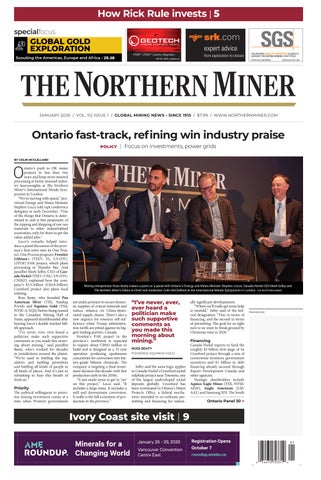
Mining entrepreneur Ross Beaty makes a point on a panel with Ontario’s Energy and Mines Minister Stephen Lecce, Canada Nickel CEO Mark Selby and The Northern Miner’s Editor-in-Chief and moderator Colin McClelland at the International Metals Symposium in London. THE NORTHERN MINER
are under pressure to secure domestic supplies of critical minerals and reduce reliance on China-dominated supply chains. There’s also a new urgency for resource self-sufficiency when Trump administration tariffs are pitted against its biggest trading partner, Canada. Frontier’s PAK project in the province’s northwest is expected to require about C$943 million to build and is designed as a 31-year operation producing spodumene concentrate for conversion into battery-grade lithium chemicals. The company is targeting a final investment decision this decade, with first production early in the 2030s. “It just made sense to get to ‘yes’ on this project,” Lecce said. “It includes a large mine. It includes a mill and downstream conversion. It really is the full ecosystem of production in the province.”
“I’ve never, ever, ever heard a politician make such supportive comments as you made this morning about mining.” ROSS BEATY FOUNDER, EQUINOX GOLD
Selby said the same logic applies to Canada Nickel’s Crawford nickel sulphide project near Timmins, one of the largest undeveloped nickel deposits globally. Crawford has been nominated to Ottawa’s Major Projects Office, a federal mechanism intended to co-ordinate permitting and financing for nation-
ally significant developments. “Where we’ll really get some help is twofold,” Selby said of the federal designation. “One in terms of financing, and the second in terms of permitting. The goal for us right now is we want to break ground by Christmas time in 2026.” Financing Canada Nickel expects to fund the roughly $2-billion first stage of its Crawford project through a mix of cornerstone investors, government incentives and $1 billion in debt financing already secured through Export Development Canada and other agencies. Strategic shareholders include Agnico Eagle Mines (TSX, NYSE: AEM), Anglo American (LSE: AAL) and Samsung SDI. The South Ontario Panel 30 >
Ivory Coast site visit | 9 Minerals for a Changing World
January 26 - 29, 2026 Vancouver Convention Centre East
Registration Opens October 7 roundup.amebc.ca
PM44082538
1
2
JANUARY 2026 | THE NORTHERN MINER
www.northernminer.com
Battery powered cable bolter Discover Sandvik DS422iE, the world’s first battery-electric cable bolter. Zero emissions tramming, drilling and grouting on battery power. Go Electric. Go Sandvik.
THE NORTHERN MINER | JANUARY 2026
GLOBAL MINING NEWS
3
inbrief PHOTO O F T HE MO NT H
Veteran mining entrepreneur Ross Beaty (R) presents Franco-Nevada co-founder Pierre Lassonde with The Northern Miner’s Lifetime Achievement Award for his work in pioneering the modern royalty model and good works over more than five decades in the industry. He received the award at TNM’s International Metals Symposium in London, U.K. on Nov. 30. CREDIT: THE NORTHERN MINER
DEPA RT MENTS
4
Op-Ed
5
London Symposium
9
Site Visit
10
AME/VRIC
11
In Depth
12
Project
Updates
14
Done Deals
15
Eye on Australia
16
Infographic The Gold Divide
17
Mining, Metals & Markets
30
Company Index
SPECIAL SECTIONS » Global Gold Exploration 25
n
Court ruling
British Columbia’s mining industry faces upheaval from a court ruling affirming Indigenous rights while in a separate move two Interior First Nations want to halt the province’s fast-tracked approval process for a major mine expansion by Hudbay Minerals. Hudbay said it remains committed to working with both communities on the provincial government’s accelerated timeline for the New Ingerbelle project at Copper Mountain. The Upper and Lower Similkameen Indian Bands have triggered the dispute-resolution process under B.C.’s Declaration on the Rights of Indigenous Peoples Act (DRIPA) to suspend the process. They contend key information is missing and consultation is being rushed. The dispute comes as the province’s mineral rights system is being reshaped by a precedent-setting B.C. Court of Appeal ruling last month that found DRIPA incorporates the United Nations Declaration on the Rights of Indigenous Peoples (UNDRIP) and creates legally enforceable obligations. Potentially affected companies include Teck Resources in the Elk Valley, Newmont at Brucejack and Skeena Resources as it seeks approvals for reopening Eskay Creek. There is also Artemis Gold at Blackwater, Ascot Resources at Premier and Taseko Mines at Gibraltar.
n
Metals soar
Copper and silver both hit record highs last month amid expectations of market deficits and continued economic support from the Chinese authorities. Three-month copper futures on the London Metal Exchange rose 2.7% on Dec. 12 to $11,872 per tonne, LME data show. J.P. Morgan Global Research recently forecast a global refined copper deficit of about 330,000 tonnes for 2026. Market sentiment towards industrial metals such as copper is also benefiting from recent comments by China’s Central Economic Work Conference, which reaffirmed its intention to offer broad economic support in 2026 during its annual economic planning meeting. A 25% rally in the four weeks to mid-December vaulted silver spot prices above $64 per oz. for the first time as investors piled into exchange traded funds that hold the metal. The
metal has now doubled in value this year, even surpassing the more than 60% gain seen in gold. Traders are weighing the potential for import tariffs on critical minerals as the United States conducts a Section 232 investigation that would give President Trump authority to adjust imports if they are found to threaten to impair national security, BMO commodities analysts Helen Amos and George Heppel said in a note.
n
U.S. Army
The U.S. Army is backing a new generation of small, mobile refineries to secure critical minerals for weapons production, beginning with antimony sourced from Perpetua Resources’ $1.3-billion Stibnite project in Idaho. The Army has spent about $30 million developing a refinery that fits into four shipping containers and can produce 7–10 tonnes per year of antimony trisulphide. Meantime, Idaho National Laboratory is preparing to host a separate pilot plant for Perpetua aimed at processing ore from the company’s Stibnite gold-antimony project about 150 km northeast of Boise. “While the volumes are not likely to be large, the smallscale approach will nonetheless contribute to refining intellectual property development in the U.S.,” BMO Capital Markets wrote in a note. “We flagged antimony as one of the U.S.’s ‘most critical’ minerals in our recent critical minerals report.” The combined initiatives mark a shift in U.S. defence strategy as the military moves to secure antimony – a unique munitions hardener that is almost totally imported – through modular refining technology and closer collaboration with industry.
n
Productivity
Mining productivity has fallen for more than a decade and has improved only 1% a year since 2018, a trend McKinsey & Co. warns could threaten the sector’s ability to meet rising demand for critical minerals. Innovation once delivered major gains but has lost momentum over the past 20 years, the firm says. Organi-
zation for Economic Co-operation and Development data show manufacturing productivity more than doubled from 1997 to 2023, while agriculture, forestry and fishing rose more than 1.5 times. Mining productivity dropped by half. The report links the stagnation to deeper pits, longer hauls, declining grades, and remote conditions that have pushed many mines below historical performance curves. However, new technologies in AI, automation, robotics, advanced chemistry, always-on connectivity at remote sites and electrification are creating openings for innovation.
n
Anglo-Teck OK
Canada approved the $53-billion (C$73.1-million) merger of Anglo American and Teck Resources on Dec. 16, clearing a major hurdle for the creation of one of the world’s largest copper producers as global demand for the metal accelerates. Although Minister of Industry Mélanie Joly greenlit the merger on national security grounds in November, lawmakers still needed to conclude that the deal would deliver a net economic benefit to Canada under tightened takeover rules. That sparked negotiations over legally binding commitments from Anglo American. Those include moving the company’s headquarters to Vancouver from London and investing at least $3.2 billion in Canada over five years, rising to a minimum of $7.3 billion over 15 years. The company has also committed at least C$100 million to initiatives such as a global Institute for Critical Minerals Research and Innovation and expanded mining-related skills training for Indigenous and Canadian post-secondary institutions. The undertakings will drive growth and job creation while strengthening Canada’s strategic interests, Joly said. While the merger has secured key approvals in Canada and Australia, regulatory reviews continue in Europe, Japan, South Korea, the U.S, Chile and China. Anglo American said the full approval process could take up to 18 months. Jefferies analysts warned that other jurisdictions could still object, citing copper’s status as a supply-constrained critical mineral. Shareholders of both companies approved the transaction earlier in December. BY NORTHERN MINER STAFF
4
JANUARY 2026 | THE NORTHERN MINER
www.northernminer.com
opinion
GLOBAL MINING NEWS • SINCE 1915
www.northernminer.com EDITORIAL
London calling
COMMENTARY
Ticking towards acquisition time
T
PRESIDENT THE NORTHERN MINER GROUP: Anthony Vaccaro, CFA, MBA avaccaro@northernminer.com EDITOR-IN-CHIEF: Colin McClelland cmcclelland@northernminer.com COPY EDITOR AND PRODUCTION EDITOR: Blair McBride bmcbride@northernminer.com SENIOR STAFF WRITER: Frédéric Tomesco ftomesco@northernminer.com WESTERN EDITOR: Henry Lazenby hlazenby@northernminer.com PODCAST HOST: Adrian Pocobelli apocobelli@northernminer.com ADVERTISING: Robert Hertzman (416) 898-6654 rhertzman@northernminer.com Kathleen Plamondon (514) 917-5284 kplamondon@northernminer.com Michael Winter (416) 510-6772 mwinter@northernminer.com SUBSCRIPTION SALES/ APPOINTMENT NOTICES/ CAREER ADS George Agelopoulos (416) 510-5104 (Toll free) 1-888-502-3456, ext. 43702 gagelopoulos@northernminer.com PRODUCTION MANAGER: Jessica Jubb (416) 510-5213 jjubb@northernminer.com CIRCULATION/CUSTOMER SERVICE: (416) 510-6789 | 1-888-502-3456 northernminer2@northernminer.com REPUBLISHING: (416) 510-6768 jmonteiro@northernminergroup.com ADDRESS: Toronto Head Office 69 Yonge St, Toronto, ON M5E 1K3 (416) 510-6789 tnm@northernminer.com SUBSCRIPTION RATES: Canada: C$130.00 one year; 5% G.S.T. to CDN orders. 7% P.S.T. to BC orders 13% H.S.T. to ON, NL orders 14% H.S.T. to PEI orders 15% H.S.T. to NB, NS orders U.S.A.: C$172.00 one year Foreign: C$222.00 one year GST Registration # 809744071RT001 (ISSN 0029-3164) CANADA POST: Return undeliverable Canadian addresses to Circulation Dept. c/o The Northern Miner 69 Yonge St., Suite 200 Toronto, ON M5E 1K3 Publication Mail Agreement # 44082538 Periodicals Postage Rates paid at Niagara Falls, NY, 14304. U.S. office of publication 2424 Niagara Falls Blvd, Niagara Falls, N.Y. 14304. U.S. POSTMASTER: send address corrections to: Northern Miner Box 1118 Niagara Falls, N.Y. 14304.-7118 In addition to content produced by its staff, The Northern Miner also publishes content from its sister publications within EarthLabs Media Inc., Mining.com and Canadian Mining Journal.
THE NORTHERN MINER is published monthly by The Northern Miner Group, a division of EarthLabs Media Inc., a leading media and technology company serving the mining industry. From time to time we make our subscription list available to select companies and organizations whose products or services may interest you. If you do not wish your contact information to be made available, please contact us by one of the following methods: Phone: 1-888-5023456; Fax: (416) 447-7658; Mail to: Privacy Officer, The Northern Miner, 69 Yonge St., Suite 200, Toronto, ON M5E 1K3
he title track of The Clash’s 1979 album borrows the urgency of a BBC global news broadcast, the ones that used to proclaim “this is London calling.” The song is a wake-up alarm: war, climate change and floods are closing in. How timely today. How metals-related. One of my takeaways from London, where The Northern Miner just held its most successful International Metals Symposium, is the city’s congestion, yet how sprawling it is at the same time. New BY COLIN McCLELLAND York has nothing on it; Toronto is an outpost. And at Christmas, you can nearly crowd-surf down Oxford Street. That intensity is a decent metaphor for the metals and mining industry looking back over the past year. The passion was evident at our symposium which attracted more than 650 registered delegates, squeezed them into standing room only for many of the sessions and sold out all sponsorships. Ontario Energy and Mines Minister Stephen Lecce set the tone: “I’m here really with a message that this province is re-orienting our regulatory regime so that we can be and we are emerging as one of the fastest jurisdictions to get a permit in the country,” Lecce said in a keynote speech at the event. “In a new world order, post the election of President Trump, we lit a fire under the behinds of every public servant, every agency, board and commission, everyone involved. The message to them and to you is that we’re going to re-imagine and do things better, smarter, faster, with the bias of action.” Government representatives from New Brunswick, Nova Scotia and Newfoundland and Labrador made similar promises at the symposium, if without the fire imagery and exact timetable talk. New Brunswick pointed to Northcliff Resources’ Sisson tungsten-molybdenum project making Ottawa’s Major Projects Office list, while Nova Scotia is preparing for construction at NexGold Mining’s fully permitted Goldboro project. Newfoundland and Labrador has had an active year with Equinox Gold buying Calibre and starting the Valentine mine while New Found Gold ramps up exploration at the nexus of a new yellow metal zone near Gander. (See page 8.) On another panel, we heard about scrambled South American politics – a new right-wing leader in Chile, confusion in Peru and tax breaks easing projects in Argentina. In the midst of it all, executives are trying to reel in illegal gold mining while making projects profitable for communities and companies. (See page 6.) The artisanal surge is, of course, driven by record bullion prices. We heard why the frenzy in gold is bound to continue during the year: central banks keep buying, while tariff and geopolitical uncertainty from Ukraine through the Middle East to Taiwan and beyond drive safe-haven buying. And now, new players are stepping in, like the token company Tether, which backs up each gold stablecoin with an ounce of stored physical gold. (See page 7.) Tether bought 26 tonnes of gold in the third quarter alone to hold 116 tonnes in total – that’s more than South Korea has and roughly the same as Qatar – to satisfy retail investor demand, helping sustain bullion’s run of record prices. The intensity has popped now because it’s been a quarter-century in the making, veteran investor Rick Rule told the symposium. Even so, he argued the commodity still has room to run because many institutional investors don’t treat gold as a core part of their portfolios. In equities, he recently sold a quarter of his junior miner shares in a de-risking move, rotating into streamers and Canada’s top gold producer. He’s evaluating companies on circumstances – and when exploration raises questions that lack answers, the alternative is divestment. (See page 5.) The leading banks and analysts are guesstimating whether gold will hit $5,000 an ounce. J.P. Morgan says it could reach that level by year-end because the current trends aren’t exhausted. What will be exhausted by this time next year may be something else, perhaps the patience of project developers after all the promises in 2025. This year could feature a crisis of expectations at some point. Right now in Canada, there appears to be an alignment among provincial and federal governments – Lecce called the feds “collaborative” and “on the same team in this moment” – but when choices have to be made about which projects get dollars and which don’t, cracks may show in the unity. The cover of The Clash’s “London Calling” looks back as well as forward, paying homage to Elvis Presley’s self-titled debut album in 1956 by using a nearly identical design and typography. The striking photo of Paul Simonon smashing his bass contrasts with the more conventional pose of Elvis strumming his guitar. Are we at a similar crossroads in mining – seeking similar groundbreaking content, but breaking the old rules to how we get there? TNM
Find full news articles at
www.northernminer.com
BY JAMES COOPER
A
s an investor, focusing on acquisition makes sense at certain times in the mining cycle. We’re on track to hit that in 2026. My suggestion: Use this recent weakness hitting global markets as an opportunity; the commodity cycle is still turning upward. If metal prices continue to rise into 2026, I expect we’ll start to see investor capital migrate into the junior mining space. Perhaps in volumes not seen since the last bull market in junior mining stocks, way back in 2005. But if you want to make the most of this opportunity, it’s essential to recognize that capital tends to flow into the best projects first. As momentum builds, sentiment naturally flows down the mining pecking order from the miners to the developers and explorers. So, how can I be so sure? Well, we’ve already seen Act I play out this year. Many producers have logged a record year in terms of profits and share price performance. I won’t distract you with a list of triple-digit gains being made across mining-focused exchanges like the TSX and ASX. But producers across gold, silver, platinum, copper and critical metals are performing well. As metal prices rise, underlying profits swell. The cycle is turning. What happens next? The critical point here is that mines are a depleting asset. That means producers must continually have their eye on the future, which means finding or acquiring new assets. Without future reserves coming into the portfolio, miners face extinction. It’s as simple as that. And many do, sooner than most investors anticipate. And the timeline for their extinction event tends to carry forward as producers ramp up production in response to rising commodity prices. A key reason why we’re approaching Act II of this cycle. Let’s look at this idea further. In late November, BHP,
the world’s biggest miner made a surprise attempt to gatecrash one of the industry’s biggest-ever mining deals. The major went all-in on a last-minute bid to buy Anglo American and prevent the $53-billion merger with Canada’s Teck Resources. That was after BHP spent the last 18 months insisting it had moved past trying to grab hold of Anglo’s copper assets. The entire ordeal lasted just three days. BHP walked away, again. Yet this rather desperate, last last-minute bid for Anglo does send an important message to the market: The majors are hungry for acquisition, and this has the potential to reach a higher level of anxiety at some point in 2026. Something real estate investors would dub FOMO. That’s because the list of genuine copper projects with lasting supply is diminishing across the globe. Acquisition options are limited for this important commodity. How should investors react? As resource investors, we’re primarily interested in the ‘A’ side of M&A, in other words, acquisitions. Most people probably know this involves a bigger fish hunting down a smaller fish, like BHP’s repeated attempts to buy out Anglo over the last two years. But why do these miners pursue smaller companies? Typically, it’s for growth. If a company sees greater value in growing its portfolio over share buybacks or dividend payments, it may turn to acquisitions to strategically increase its exposure to a particular commodity. In terms of the BHP example, the major hasn’t been shy about its desire to increase its leverage to copper mining. But as deals become more competitive, as we witnessed in November, the price tends to increase for the prospective buyer. That’s why it pays to look at the M&A opportunity just as commodities start to tick higher, like we’re seeing play out right now. TNM James Cooper is a geologist based in Australia who runs the commodities investment service Diggers and Drillers. You can also follow him on X @JCooperGeo.
THE NORTHERN MINER | JANUARY 2026
GLOBAL MINING NEWS
5
londonsymposium Gold’s rise was 25 years in the making, Rule says INVESTING
| Low-cost nickel carries high price sell it and use the proceeds to buy something intelligent. If I can’t bring myself to own the principal competitor for gold, why would I sell my gold?”
BY BLAIR MCBRIDE
T
he surging gold prices over the past two years marks a catch-up based on a bull market going back to 2000, but few recognized it as such, says Rick Rule, CEO of Rule Investment Media. The veteran investor spoke on Nov. 30 at the Northern Miner Group’s International Metals Symposium in London, U.K. where he touched on a range of issues facing mining including commodities, stocks, critical minerals, investing and young people. “It was fairly easy to forecast. It was a coiled spring,” Rule told The Northern Miner podcast host and moderator Adrian Pocobelli. “People were frustrated looking at the gold price not moving, when the whole circumstance that existed in the world was a circumstance that would cause gold to move. Gold has done its job for 25 years.” In the weeks following Rule’s chat, the gold price advanced to around $4,300 per oz. after the yellow metal touched an historic high of $4,379 per oz. in October. The spot price rose about 65% in 2025. Preaching to the choir But Rule cautioned that the min-
Moderater and TNM podcast host Adrian Pocobelli, left, speaks with Rick Rule at the London symposium. THE NORTHERN MINER
ing world’s perception that wider society is also excited about gold is unfounded. “For most of the world, including institutional investors, they can’t spell gold. It’s a four-letter word,” Rule said. “When you talk about gold’s popularity, you’re talking about the popularity of God in a Pentecostal church where they already believe, but the attendance in that church is still fairly small.” Backing that up, he cited a JPMorgan Chase study that sug-
gested the market share of precious metals investing in the U.S. market was 0.5 per cent. Meanwhile, for the job gold is meant to do, there isn’t a good alternative now for conservative investing, according to Rule. Gold’s closest competitor in that regard is US 10-year Treasuries, the debt securities issued by the U.S. government, he said. “Despite the fact I’m American, I wouldn’t own a US 10-year treasury. If it were given to me, I would
‘Selling risk’ Turning to stocks, Rule said that eight weeks previously he wanted to de-risk his portfolio by selling the risk that everyone else was buying. He took half the proceeds, bought a set of high-quality stocks that included gold, Wheaton Precious Metals (TSX, NYSE, LSE: WPM), Franco-Nevada (TSX, NYSE: FNV) and Agnico Eagle Mines (TSX, NYSE: AEM). “By selling 25% of my juniors, I recouped all the capital that I had invested in the sector since 2020,” he said. “The idea that I could give up a quarter of my downside and eliminate my downside, while at the same time going up the quality trail seemed like a good print for me.” At that time, Rule saw that the lower end of the “quality trail” was too hot and numerous financings were heavily over-subscribed. Assessing nickel costs Addressing issues around critical metals, Rule said he’s “pressed the button on nickel sulphide” and
done well with the metal. Most sulphide nickel is mined in Canada, Russia and South Africa. But Rule contrasts that with lateritic nickel deposits – mainly mined in Indonesia and the Philippines – and their high environmental and energy costs, though they have lower upfront mining costs than sulphide nickel. He recalled flying over southern Sulawesi in Indonesia and seeing the devastation left over from lateritic mining. “I don’t believe that the Indonesian government or people – or to a lesser extent the Filipinos – will allow that to go on for too much longer,” he said. “The costs associated with mining those lateritic deposits responsibly will raise the cost curve fairly substantially.” Lithium’s delicate balance With lithium, Rule was blunt: “I don’t think lithium is hated enough.” Previous assumptions about lithium – that there were shortages of the metal – were confused with the reality that the shortage was in processing capacity, he said. He pointed to a report from SQM (NYSE: SQM) which said it had Rule P30 >
JOINT VENTURE ARTICLE
Vista Gold de-risks Mt Todd ahead of engineering BY NORTHERN MINER STAFF
Vista Gold (TSX: VGZ; NYSE-AM: VGZ) expects to kick off detailed engineering and design work late next year on its fully permitted multi-million oz. Mt Todd open-pit gold project in Australia. In the meantime, the Colorado-based company is building up a core Australian development team and modifying its existing permits for a 50,000-tonne-per-day mine to a scalable 15,000-tonne-per-day operation that is more appealing to Australian gold producers. The smaller scale development envisioned in an updated July feasibility study slashed initial capex by 59% from $1.03 billion to $425 million (all figures in U.S. dollars or converted) by prioritizing grade over tonnes. “We have designed Mt Todd as an Australian project and adopted design and operating practices that reduce operating risk and make the project easier and less costly to construct,” says Frederick Earnest, Vista’s president and CEO. In addition to “right-sizing” the project, Earnest says, Vista “right-scoped” it by raising the reserve cut-off grade to 0.5 gram gold per tonne. That increased the average reserve gold grade from 0.77 gram gold to 0.97 gram gold at the project’s Batman deposit.
Permitting underway
The company has started the permit modification process and expects to have approvals in hand by the end of next year. “The permits require only minor modifications,” he says. “The agencies have been apprised of what’s going on and modifications are relatively small. In some areas we are speaking about 50 metres outside the previous designs and in areas of new drilling the planned changes are more
An aerial view of the Mt Todd project in Australia’s Northern Territory. VISTA GOLD
significant, but cover an area that has been previously disturbed.” Mt Todd would generate a post-tax net present value (NPV) at a 5% discount rate of $1.1 billion and internal rate of return (IRR) of 28% at a base case gold price of $2,500 per ounce. At $3,300 per oz. gold the NPV jumps to $2.2 billion and the IRR to 45%. The payback period in the base case is 2.7 years, falling to 1.7 years at the higher gold price. Average annual production in Mt Todd’s first 15 years is estimated at 153,000 oz. grading 1.04 grams gold per tonne (146,000 oz. grading 0.97 gram gold per tonne over its 30-year mine life). All-in sustaining costs in the first 15 years are pegged at $1,449 per oz. and $1,499 per oz. over the life-of-mine. Management plans to have greater clarity over Mt Todd’s future development path over
the next six months. Options include jointventuring the project, building it themselves, or selling it outright. “We continue to entertain enquiries from companies who might be potential partners,” he says.
Joint ventures
The joint-venture model is a good one, Earnest says, pointing to Gold Road Resources’ joint venture with Gold Fields (NYSE, JSE: GFI) at its Gruyere gold deposit in Western Australia as an example. Gold Road Resources discovered Gruyere in 2013 and developed a multi-million oz. gold deposit. It then entered into a joint venture agreement on the project with Gold Fields in 2016. The mine commenced production in 2019 with Gold Fields as the operator. Earlier this year Gold Fields
acquired Gold Road in an all-cash A$3.7 billion (US$2.4 billion) takeover. Vista says Mt Todd is undervalued, with a net asset value per share of $8.41 at $2,500 per oz. gold and $17.14 per share at $3,300 per ounce. That is nearly 10 times Vista’s early December share price of C$2.63 (US$1.90) on the Toronto Stock Exchange. Vista acquired Mt Todd, 250 km southeast of Darwin, out of receivership in 2006. It then spent about a decade drilling to triple the resource, permitting, engineering and designing a large project that it said would be attractive to senior producers. “We tried to find a partner for the larger 50,000-tonne-per-day project for years, but we found that producers are more willing to take on operational risk than development risk,” Earnest says. “They’d rather acquire a company with producing assets and optimize them rather than acquiring a company that is building a project.” Mt Todd hosts proven and probable reserves of 171.9 million tonnes grading 0.94 gram gold for 5.2 million contained ounces. The reserves include ore that was left on the historic heap leach pad (13.4 million tonnes grading 0.54 gram gold for 230,000 contained oz.), which will be re-processed at the end of the mine’s lifespan. Measured and indicated resources stand at 340.4 million tonnes grading 0.83 gram gold for 9.1 million oz. contained gold and another 57.1 million inferred tonnes grading 0.78 gram gold per tonne for 1.43 million ounces. Vista Gold has a market cap of about C$333 million. The preceding Joint Venture Article is PROMOTED CONTENT sponsored by Vista Gold and produced in co-operation with The Northern Miner. Visit: www.vistagold.com for more information.
6
JANUARY 2026 | THE NORTHERN MINER
www.northernminer.com
londonsymposium Firms try to co-opt illegal miners SOUTH AMERICA
| Rising prices fuel artisanal trend
BY FRÉDÉRIC TOMESCO
P
an American Silver (TSX, NYSE: PAAS) is working with small-scale miners in Peru to help them raise production standards and sell their gold to central banks – an effort that isn’t without its challenges. Record-high gold prices have contributed to a surge in illegal mining across the globe. Artisanal and small-scale miners now account for about 20% of global gold supply – about five times the level that was seen in the 1990s – and 80% of employment in the industry, according to World Gold Council (WGC) data. The trend is even more pronounced in Peru, where more than 300,000 artisanal and scall-scale mining operators generate about a quarter of the country’s gold exports, WGC figures show. Peru’s informally produced gold is worth about $8 billion a year, according to Brent Bergeron, Pan American Silver’s senior vice president of corporate affairs and sustainability. Artisanal and informal mining “is growing throughout Latin America,” Bergeron said in London at The Northern Miner’s International Metals Symposium in early December. Bergeron spoke on a panel about the challenges and opportunities in Latin American mining. Formalization efforts “What we did as a company when there were informal miners working on our concession is that we helped them formalize themselves first, in terms of their partnership, to create a cooperative of their own so that there was a management structure in place to be able to bring in all of their partners, their co-op partners, and formalize them with the national government,”
Former Anglo American CEO Mark Cutifani, Orla Mining’s Silvana Costa and Pan American Silver’s Brent Bergeron at the International Metals Symposium in London. THE NORTHERN MINER
Bergeron said. “We’re in the process of doing that right now.” Vancouver-based Pan American Silver has two active operations in Peru – the Huaron polymetallic mine and the Shahuindo gold mine – in addition to having mines in Argentina, Bolivia, Brazil and Chile. Together with the WGC, Pan American Silver is also working to connect Peru’s informal miners with gold buyers such as central banks, Bergeron said. “There’s a really good project that has been started by the World Gold Council, where they’re actually partnering with the central banks in different countries,” he said. “We’re trying to establish this in Peru. I know they’re doing it in Ecuador, they’re doing it in Brazil right now, whereby the central banks will buy the gold from these informal miners that have become formalized by the government – which, to me, is an important part because it’s the full length of the supply chain.” Finding sales outlets While informal miners “are increasing their standards in terms of how they’re operating, their environ-
mental standards, also their labour standards,” they need help connecting with gold buyers, Bergeron said. “If they don’t have a place to actually sell (gold), then they’ll just go back into the organized crime supply chain, which is not where we want it to go,” he added. “So these types of projects, looking at them from beginning to end, are extremely important. That’s an example of what we’ve been doing because it is an issue.” Mining’s benefits While new political leaders in countries such as Argentina have shown a greater openness toward mining projects, foreign miners must do a better job of demonstrating the industry’s benefits to local communities across Latin America, Mark Cutifani, a former Anglo American (LSE: AAL) CEO, said during the same event. “There is a movement of the conversations to the centre,” Cutifani said. “Over time, that’s positive, that’s encouraging, and maybe to encourage that, we have to find our voice in terms of helping people understand mining’s role in society. I don’t think we do that well. And
if we can be a constructive voice in that convergence to the centre, as more people are aware of how people are achieving growth and improvement from poverty and other circumstances, I think we can make a real positive difference. So I’m optimistic, but there are areas where that still looks pretty tough.” Colonial perception Mining’s main problem in Latin America is that the industry is often associated with colonization, said Orla Mining’s (TSX: OLA; NYSE: ORLA) chief sustainability officer, Silvana Costa. “Mining came in as a colonizer,” Costa, a native of Brazil, told conference participants. “The colonizers came in and removed our resources. They took our wealth, our resources, to other countries, to benefit other people’s lives. That is a difficult kind of narrative to get over. Mining can be a source of pride, a source of economic development. It’s a little bit of a longer journey depending on which country you’re in.” “Don’t underestimate the impact of that colonial history,” added Cutifani. “It manifests in different ways in different countries.”
Elections In the modern era, countries such as Chile are headed to the right [with a runoff election confirming that as The Northern Miner went to press] while Peru is trying to sort out itself ahead of elections in 2026, Bergeron said. “What we’re seeing in Peru is a government that is very unorganized in terms of popularity, in terms of what it’s doing, but then you you’ve got a bureaucracy that has been managing mining for the longest time,” he said. “We expect [politics] to move a little bit more to the centre in in Peru.” It’s difficult to describe the entire region in one trend when countries have different approaches, Costa said. She cited difficulty getting a permit to expand a mine in Mexico. “I see the places like Brazil and Chile, are built on more of that narrative where big state-owned companies have created a path for pride,” she said. “In Brazil, Vale (NYSE: VALE) was a significant reason for pride in the industry, or state-owned oil in Mexico has been in the past, and Chile the same [with copper’s Codelco]. I can see that for Mexico [it’s] a very big gap there. So, it really varies.” Mexican President Claudia Sheinbaum seems more pragmatic than her predecessor, noted panel moderator Anthony Vaccaro, president of the Northern Miner Group. “There is a conversation, so that’s a positive step. We didn’t really have a conversation before,” Costa said. “In the beginning of the year, we expected things to move much faster and to see companies get their permits and start operating. And now, currently, we still haven’t seen the amount the support that we were hoping for, but I feel positive that this is coming.” TNM
Miners must connect with young, Cutifani says MENTORS BY FRÉDÉRIC TOMESCO
M
ining companies must do a better job of connecting with young employees to ensure that the next generation of miners is able to run ever deeper and more complex operations, former Anglo American (LSE: AAL) CEO Mark Cutifani says. Significant job cuts over the years have deprived mine operators of many experienced staffers who could have helped to train industry newcomers, Cutifani said in early December during a wide-ranging discussion with Ana Gabriela Juárez, president of CTA Environmental Consultants at The Northern Miner’s International Metals Symposium in London. “As mines become deeper, more complex, and with a lot of redundancies in many areas where we’ve lost a lot of experience in the industry, it’s a great weakness at the moment – that ability to share with experience,
with young people coming through. I just don’t think we’ve got the mix right,” Cutifani said. “We’ve got to do a lot more in helping younger people coming through.” Communities As global demand for critical minerals and metals such as copper surges amid increased electrification and heightened national security concerns, it’s essential that mining companies better demonstrate the importance of their work to neighbouring communities, the longtime executive also said. “When I talk to First Nations or indigenous groups, we talk about their use of the earth in terms of the way they live their lives,” he said. “It’s no different in terms of what we do, but the scale is different. How we go about our work is different, and there’s a hell of a lot we can learn from them in terms of being smart about the way we do things. At the same time, we’re using the earth. The ancient Greeks
| Ex-exec lauds new technology understood it, and I think we probably understand less of that today.” Developing credible recycling strategies should become another industry priority, Cutifani said. While circularity doesn’t eliminate the need to extract resources, it does reduce it. “If you’re in a conversation about primary mining, you also need to be the conversation about the circular economy. Then it’s a conversation that’s got a bit more credibility,” he said. Lustrous career Having relinquished executive roles after a distinguished four-decade career that also saw him turn around the fortunes of AngloGold Ashanti (NYSE: AU), Cutifani now serves as a director of French energy giant TotalEnergies and U.K.-based construction firm Laing O’Rourke. He stepped down as chair of Brazilian miner Vale’s (NYSE: VALE) base metals unit in July. As CEO of Anglo American,
Cutifani spearheaded a nine-year transformation that reduced material safety and environmental incidents by 90%, while doubling employee productivity, cutting unit costs by 40% and delivering average annual shareholder returns of 22%. Cutifani credits former Anglo technical director Tony O’Neill with kickstarting the efforts that set the stage for a more efficient operation. O’Neill eventually retired in 2022. “At Anglo, we were lagging Rio, BHP, Glencore and Vale by a large margin, and we didn’t have the same ore bodies, so we had to think differently,” Cutifani said. “And so we talked about literally changing, turning the whole thinking process around the business upside down, introducing longer-term technologies and short-term improvements.” New tech Artificial intelligence played “a really important part” in Anglo’s transformation “because of the data processing and how that could
change front end understanding of geology,” Cutifani said. “We had been users of data in different ways. I remember the old neural networks when we used to forecast weather patterns. But AI takes it to another level.” None of those achievements would have been possible without reciprocal trust, Cutifani insists. The other key for a leader, says Cutifani, is accessibility. He tells the story of asking staff to remove the door from his office when he arrived in Sudbury about 20 years ago to run the former Inco operations. “We said: ‘Anybody’s welcome to come. Just please be polite if I’m on the phone, give me a minute.’ Very few people took that option, but the fact [was] that you could, and some did,” he said. “It was messaging to everybody that we needed to connect differently across the organization. That accessibility, and the modelling of the behaviour we expect from everybody in the organization, is absolutely key.” TNM
THE NORTHERN MINER | JANUARY 2026
GLOBAL MINING NEWS
7
londonsymposium Stablecoin buys seen adding to demand GOLD
| Price surge likely to continue, execs say
BY FRÉDÉRIC TOMESCO
A
ccelerating bullion purchases by new players such as stablecoins mean that gold’s impressive run is unlikely to end anytime soon, conference participants heard. Blockchain company Tether acquired 26 tonnes of gold in the third quarter, more than any central bank during the same period, according to a recent analysis by the U.S. investment bank Jefferies. Tether’s gold reserves stood at $12.9 billion as of Sept. 30, part of a “diversified, forward-looking reserve strategy,” the company said in late October. “When the stablecoins are getting real assets behind them, that could fuel the commodity market and the gold market. It changes the perception of gold,” McEwen (TSX, NYSE: MUX) chairman and chief owner Rob McEwen said last month during a panel discussion at The Northern Miner’s International Metals Symposium in London. Other cryptocurrencies will probably follow in Tether’s footsteps in a bid to “bolster their value proposition by putting real assets behind it,” predicted McEwen, an industry veteran who previously ran Goldcorp and was named The Northern Miner’s Person of the Year in 2002. “So that’s a new source of demand. You think of all the money that’s gone into cryptos, and you could see a new wave of money coming in that we haven’t seen people that trade on their phone. That could alter the situation dramatically and push the price up.” Sustained demand Besides investing in gold royalty firms, streaming companies and other mining stocks, Tether intends to buy about 100 tonnes of physical gold in 2025, Jefferies mining analyst Fahad Tariq said in a Nov. 21 note, citing unidentified investors. There is potential for Tether “to drive sustained gold demand going forward,” he added. The two gold panels at the Symposium featured mining executives and veteran investor Rick Rule, all with few motives to talk down a continued run for the yellow metal. But they were emphatic that sustained central bank buying,
Alamos Gold CEO John McCluskey (2nd L) makes a point on gold with moderator Adrian Pocobelli, investor Rick Rule and McEwen chair Rob McEwen at the London symposium. THE NORTHERN MINER
“Once individuals see $4,000 is again a base, and we’re going to continue to work off of it, then it’s going to be good for us in the industry because it’s going to bring more players back into it.” ROBERT QUARTERMAIN, EXECUTIVE CHAIR, DAKOTA GOLD
de-dollarization, stock-market volatility and ever-rising U.S. federal government deficits will keep fuelling demand. They said they expect more highs even though gold set more than 50 records in 2025, outperforming virtually every major asset class. With a year-to-date gain of about 65% to about $4,334 per oz. as of mid-December, gold was on course for its third-straight year of double-digits jumps. It broke through the $4,000 mark for the first time in October. Inflation worries Gold could also get a bump from heightened investor concerns about inflation potentially reaccelerating,
said Rule, a longtime buyer of the yellow metal. “I would suggest that the period 1982 to 2022 was the most benign investing climate and human history. For 40 years, the world demonstrated no need for gold,” Rule told conference attendees. “There was lots of sin brewing into the surface, but the sin didn’t impact the people in this room or their ilk very much. Sin will become, sadly, much more manifest.” Added McEwen: “I think we’re at another inflection point in the market where confidence in the dollar is being severely questioned, and we could have a similar run,” McEwen said. “Gold’s going up.” Retail buyers Gold’s ability to hold at current pricing levels could draw a new wave of retail investors, some of whom have put their money in cryptocurrencies such as bitcoin, according to Dakota Gold (NYSE-A: DC) executive chairman and Canadian Mining Hall of Fame inductee Robert Quartermain. “Once individuals see that this $4,000 is again a base, and we’re going to continue to work off of it, then it’s just going to be good for us in the industry because it’s going to bring more players back into it,” he said. “I remain bullish on the commodity.” In fact, despite gold’s recent run, retail investors have been relatively slow to flock to the sector, Alamos
—LEARNINGS— Alamos Gold CEO John McCluskey and veteran investor Rick Rule related a couple of learning experiences: McCluskey: “One of the key things that we spotted was an asset in Mali or in Chile or Mexico – they were all valued at the same level. Nobody John McCluskey was putting a premium on Canada. We thought, you mean, it’s the same thing to buy an asset in Canada as it is in Peru? I want to own something in Canada all day long. Now 90% of our value is in Canada.” With countries like Mali, which focus on gold for tax revenues much more than in a diversified economy like Canada, the trend will be to drive more and more investment into the safer jurisdictions, he said. “We took advantage of that by getting in a decade ahead of the pack.”
Rule explained how he now trusts financial markets, like rattlesnakes, to sound an alarm before biting. “I used to be hyper paranoid, as opposed to merely paranoid, and so I tried to store the gold that I had in my physical possession outside the reach of [the U.S.] government. Rick Rule I’d walk down Georgia Street [in Vancouver] with a briefcase, one arm much longer than the other, fooling probably nobody who would care, and taking it to the Hong Kong Shanghai Bank, which had the best storage facility. And I got to be thinking, you know, at age 60, you are the dumbest son of a bitch on the planet taking physical gold, which is heavy. I decided to do what was easiest. So, yes, I still have some physical metal, but I have much, much more paper gold inside the system.”
Gold (TSX, NYSE: AGI) CEO John McCluskey told attendees of the London event. “If you talk to fund managers, and we talk to quite a few of them, they’re really not seeing – except in exceptional cases – the inflows that would typically be seen in a big run up in the gold market,” McCluskey said. “In other words, retail investors are still very much focused on the S&P500 – you know, those Top 10 tech stocks that have been driving value creation for 10 or 15 years now. That’s continued to be the story. That wave is still to come. And from that perspective, I would say we’re still in the very, very early days of this gold market. And as dramatic as it is to say, for gold it’s not a top by any stretch. I think we’ve got a long, long way to go.”
Drum beats As a result, McCluskey added, “there’s tremendous money to be made investing in this sector, not trading in and out and speculating. The gold sector is a great place to invest in right now.” Rising geopolitical tensions – as the U.S. changes course on foreign policy to pursue an “America First” agenda – are another reason why demand for gold will likely remain strong, argued McCluskey. “Look what’s happened since the election of [U.S. President] Donald Trump and this new American administration in nine months. It’s dramatic,” he said. “It’s as if this [global] security that had been provided by U.S. hegemony has essentially been withdrawn. Where does that leave the world? I’m not quite sure, but I know that militaries, you know, whether it’s German or Italian or whatever, they can’t react fast enough. “It’s not heading in a really good direction,” he added. “Are we hearing sort of the distant drum beats of war right now? I think we are. And if the world moves in that direction, I would definitely want to be holding on to some gold if I was an investor.” Liquid asset In an increasingly volatile world, one of gold’s most attractive features remains intact – liquidity. “Most assets don’t give you that chance to have that much liquidity quickly,” McEwen said. “Gold preserves purchasing power, and that’s the big appeal of it. I just took a chunk of my change and just dumped it into bullion. I feel that is a comfortable place to be.” TNM
TSX.V: SIG | OTCQB: SITKF | FSE: 1RF
FOCUSED ON DISCOVERY TURNING VISION INTO VALUE >> ROAD ACCESSIBLE 431 SQ KM LAND PACKAGE WITH 11 KNOWN GOLD BEARING INTRUSIONS - 2 HOUR DRIVE FROM DAWSON CITY, YUKON
>> 3 GOLD DEPOSITS FOUND TO DATE >> 60,000 METRE DIAMOND DRILL PROGRAM PLANNED FOR 2026
www.sitkagoldcorp.com
8
JANUARY 2026 | THE NORTHERN MINER
www.northernminer.com
londonsymposium Eastern provinces prep for green energy transition ATLANTIC CANADA
| Policy changes afoot, projects growing Gold in November and it’s advancing the Hammerdown project. “We’re all pretty excited about that,” he said.
BY BLAIR MCBRIDE
C
anada’s Atlantic provinces are gearing up for the critical minerals push by aligning policies with the speed of industry and tapping into green energy. Due to their relatively small populations, governments in the Atlantic mining provinces can engage with the public and companies faster than peers. New Brunswick, for its part, plans a Mining Act overhaul, those attending the Atlantic Canada panel at the London Metals Symposium heard Dec 1. “Our permitting services need to be predictable,” Neil Jacobson, Assistant Deputy Minister with the New Brunswick Department of Natural Resources, told the conference. “Investors and companies coming to our jurisdiction need to know exactly when they walk in, what they’re going to get, what to expect and when.” New Brunswick’s policy changes are happening alongside a co-operation agreement with Ottawa to streamline environmental approvals, while Nova Scotia, and Newfoundland and Labrador are also cutting timelines by improving co-ordination. The latter province leads the region in petroleum and metals output as well as in a ranking for mining jurisdictions. Nation building projects New Brunswick’s Jacobson spoke just weeks after the federal government included Northcliff Resources’ (TSX: NCF; US-OTC: NCFFF) Sisson tungsten project on its shortlist of nation-building projects, underscoring the province’s place in the wider critical minerals landscape. Sisson hosts proven and probable reserves of 334 million tonnes grading 0.06% tungsten trioxide (WO3) for 22 million tonnes of contained tungsten, according to a 2013 feasibility study. The compay
TNM’s Colin McClelland, left; Diane Webber, Paul Carter and Neil Jacobson, each from the Nova Scotia, Newfoundland and New Brunswick governments’ natural resource and mining departments speak on the panel. THE NORTHERN MINER
is forecasting a 27-year mine life. “The opportunity from one of the world’s largest deposits of tungsten is right there in New Brunswick and [it’s] centrally located, 45 minutes to an hour away from Fredericton,” Jacobson said. Faster permitting Nova Scotia’s Department of Natural Resources has created “faster, smarter permitting” through service standards to chop permit timelines in half, department director Diane Webber told the conference. The new NovaMINE portal allows proponents to check the status of their permits in one place. “We have our One Window process, which is when all the regulators are in one room, so that proponents are able to have all their questions answered,” Webber said. “They’re not running from department to department.” Webber touted how NexGold Mining’s (TSXV: NEXG; US-OTC: NXGCF) GoldBoro project is fully permitted and construction ready with community benefits agreements in place.
Its combined open pit and underground development is 1.15 million proven and probable oz. of gold, 2.58 million oz. measured and indicated with a projected 11-year life. Annual output would be 100,000 ounces. It has an after-tax net present value of $320.8 million, and an internal rate of return near 26%. Newfoundland ranks high Newfoundland and Labrador, by contrast, is more advanced in its interaction with the mining industry. Last year the province was ranked sixth globally in the Fraser Institute’s Annual Survey of Mining Companies by investment attractiveness, far ahead of New Brunswick, in 25th place, and Nova Scotia, in 83rd. “We are a…small population, but our government is accessible [and] industry can reach out at any time and within 24 hours somebody will be back in touch with you,” said panellist Paul Carter, Newfoundland and Labrador’s Assistant Deputy Minister of Mining and Mineral Development. Newfoundland and Labrador’s
government is keen to smooth the way for environmental processes and is developing guidelines with the federal government when projects have to go through both levels of assessment. “Our priority will be to remain as a top 10 mining jurisdiction for the world and do what’s necessary to ensure that we are an attractive jurisdiction for investment,” Carter said. He outlined how exploration expenditures in the province have tripled since before the pandemic to about $260 million per year. “The exploration side of the province is very busy across many of the critical minerals identified by various jurisdictions around the world,” he said. Carter cited recent gold activity in the province, such as Equinox Gold’s (TSX, NYSE-A: EQX) acquisition of Calibre Mining and its Valentine mine in Newfoundland last June, as well as the development of New Found Gold’s (TSXV: NFG; NYSE-A: NFGC) Queensway project near Gander. New Found acquired Maritime
Green, clean energy On the critical metals front, New Brunswick hosts two of Canada’s few manganese projects: Manganese X Energy’s (TSXV: MN) Battery Hill and private explorer Canadian Manganese’s Woodstock. Manganese X received a $2-million investment from Eric Sprott last January to support the development of Battery Hill. The project could produce about 68,000 tonnes of high-purity manganese sulphate over a 47-year mine life, according to a preliminary economic assessment from 2022. Woodstock, located about 100 km west of Fredericton, hosts 56.7 million measured and indicated tonnes grading 10% manganese for 5.7 million contained tonnes, according to a 2023 resource. Inferred resources total 17.7 million tonnes at 10% manganese for 1.7 million tonnes. “We meet with them on a monthly basis for updates. It has real tight relations with the local Woodstock First Nation. They’re heavily involved as a partner,” Jacobson said. Canada’s Atlantic provinces are also working to align with the green energy transition by adopting more forms of renewable energy. As with mining, Newfoundland and Labrador leads the region in clean energy production. More than 90% of the province’s electricity output comes from renewable hydropower, and the huge Churchill Falls plant could be expanded in the coming years. “Whoever has clean power also has a very competitive advantage, and particularly if you couple that with mineral resources,” Carter said. “Some of these are the key pillars of our approach to mineral development and critical minerals.” TNM
Japan Gold seeks new partners EXPLORATION
BY FRÉDÉRIC TOMESCO
J
apan Gold (TSXV: JG; US-OTC: JGLDF) has begun talks with various investors looking to jointly explore for gold and develop mines in the Asian country after an alliance with Barrick Mining (TSX: ABX; NYSE: B) ended this year, a key adviser to the company said. Vancouver-based Japan Gold and Barrick ended their exploration and development partnership at the end of October after more than five years and C$23 million ($17 million) in spending. “We’re looking for a new strategic partner to come in,” Cailey Barker, managing director of London-based Xcelsior Capital and adviser to Japan Gold, said in early December at The Northern Miner’s International Metals Symposium in London. “We’ve got a range of parties in our data room looking.” Japan Gold is among a small
| Talks underway
number of Western exploration companies working in the East Asian country, where the government in 2012 amended its mining law to kick start gold mining, an industry that was mostly dormant since the 1940s when gold mines were closed during World War II. “Japan had a 500-year-long mining history that closed down after the war,” Barker said. “There were 76 producing gold mines in the country – 76, and they all closed. There was a moratorium across the country up until 1980.” Then Hishikari – a world-class 14-million-oz. mine on the island of Kyushu – was discovered. “So, it’s an amazing opportunity.”
sive geochemical and geophysical database covering most of Japan Gold’s mineral rights. The database ultimately resulted in Barrick selecting three projects – Hakuryu, Togi and Ebino – that it considered to hold significant potential. “What we want to do is get in there and drill, drill, drill, drill,” Barker said. “Barrick didn’t really want to commit to that next round of financing, so we have finished the alliance.”
Colin McClelland, left, speaks with Japan Gold’s Cailey Barker. THE NORTHERN MINER
Multiple partners Japan Gold could end up signing with more than one partner, and several Japanese and North American would-be investors have expressed interest, Barker said. The company controls about 3,000 sq.
km of properties on Japan’s three main islands – including around Hishikari, which has been producing gold since 1985. “We can continue doing what we do, keep drilling right up until getting even maybe two or three strate-
gic partners that can come in to fund each one of these districts, and then we can really get the exploration results flowing,” Barker said. He didn’t identify potential partners. Barrick’s investment in the alliance helped to create a comprehen-
New frontier Japan represents an “underexplored new frontier” with some of the highest-grade gold mines in the world, Barker said. As a first mover, Japan Gold is “still very much in the early stages of exploration,” and its drill rigs are “ready to go,” he added. Hishikari, the country’s only operating gold mine, produces about 200,000 oz. gold a year at Japan Gold P30 >
THE NORTHERN MINER | JANUARY 2026
GLOBAL MINING NEWS
9
sitevisit Fortuna’s Séguéla mine poised for growth GOLD
| 200,000 oz output targeted A view of the valley at the Séguéla mine. FREDERIC TOMESCO
BY FRÉDÉRIC TOMESCO Séguéla, Côte d’Ivoire
F
ortuna Mining’s (TSX: FVI; NYSE: FSM) success in expanding its flagship Séguéla mine in Côte d’Ivoire has surprised even some of its own employees. Vancouver-based Fortuna in November doubled indicated resources at the mine compared with a December 2024 estimate as it disclosed increases in both contained reserve ounces and inferred ounces. Séguéla now hosts proven and probable mineral reserves of 13 million tonnes grading 2.81 grams gold per tonne for 1.2 million oz. contained metal, the company says. A 7.5-year mine life – based on Séguéla’s largest mineral resource to date – is just the start. Fortuna has begun “aggressive” infill drilling and studies on the construction of an underground mine for its Sunbird deposit, the property’s richest, with first production envisioned for 2028. Another study, meanwhile, will look at possibly expanding Séguéla’s mill capacity by about 25% to as many as 2.5 million tonnes a year. “I will be the first one to put my hand up: I was skeptical. I thought we wouldn’t find enough ore [at Sunbird] to make an underground mine viable,” mine general manager Peter McLean, a native of Australia, chuckled during a Séguéla site visit by financial analysts, investors and reporters. “This deposit has grown and grown. It’s added an enormous potential to our operation here, and we’re very confident we can turn it into a mine.” Rising output Séguéla’s methodical expansion is a crucial building block in Fortuna’s strategy of boosting annual output to at least 500,000 oz. of gold by the start of the 2030s. The mine, whose three active deposits – Antenna, Ancien and Koula – could soon rise to eight, is projected to produce up to 147,000 oz. gold in 2025, climbing to as many as 200,000 oz. annually within a few years. Sunbird is the first deposit to crack the 1-million-oz. mark at Séguéla, said fellow Australian Pat Manouge, Fortuna’s exploration manager for West Africa. “It’s a fantastic deposit right from surface,” he told The Northern Miner during the late November site visit. “We have drilled more than 1 km of plunge length, and it’s still going with high grades. Now that we have critical mass here, it gives us the opportunity to mine some of the other underground deposits.” Crews at Séguéla have drilled more than 200,000 metres so far, and about 60% of the exploration licence has been covered by auger drilling programs, meant for shallow exploration, “that are unearthing very attractive targets” such as the Kingfisher deposit, National Bank Financial mining analyst Mohamed Sidibé, who attended the site visit, said in a recent report. Antenna deposit Exploration at the Séguéla site began under Australia’s Newcrest Mining in 2015 with the discov-
ery of Antenna – named for the large telecommunications antenna that sits atop a nearby hill. Fortuna plans to dismantle it when the Sunbird open pit has been dug, and has already installed three replacement towers. Newcrest didn’t stick around long enough to experience the fruits of its labour: by 2019, it had sold its portfolio of 11 Côte d’Ivoire exploration permits, including Séguéla, to Canadian miner Roxgold for about $30 million. Fortuna inherited the properties when it acquired Roxgold two years later for about C$1 billion ($714 million) and poured first gold at Séguéla in May 2023.
We were hoping it would grow but did we expect to reach 2 million ounces? Probably not.”
Séguéla mine general manager Peter McLean. FREDERIC TOMESCO
“This project is my baby. I started work with the discovery hole at Antenna,” exploration manager Franck Gboko, an Ivorian native, told The Northern Miner. “Back then, we only had an inferred resource of 400,000 oz. at Antenna.
Hard to reach Fortuna’s biggest mine isn’t easy to reach: It takes almost two full days to reach the site from North America. With no direct flights available from either Canada or the United States, visitors must fly for about 15 hours, connecting via Brussels or Paris, before hitting the road from Abidjan, the country’s bustling metropolis, for a 480-km trek northwest. Most of the drive takes place on a four-lane toll highway, save for a final 25-km stretch on an unsealed road made to feel longer by regular
police roadblocks. Along the way, travellers will pass myriad minibuses – some painted with designs in honour of soccer stars such as Argentina’s Lionel Messi, Portugal’s Cristiano Ronaldo or Ivorian national team stalwart Franck Kessié – carrying passengers, assorted luggage, dogs and sometimes even chickens or goats. When traversing villages on regional roads, drivers must steer clear of rice grain heaps drying on the roadside. The adjacent city of Séguéla – with a population of about 67,000 – boasts a small airport, a hospital, a prison and a military garrison. Outside of mining, crops such as cocoa, cotton and cashew nuts dominate the region’s economic output. Côte d’Ivoire is the world’s biggest producer of both cocoa beans and cashews. Modern compound Fortuna has spared no expense to ensure Séguéla’s roughly 1,600 employees and contractors feel at home on the remote site. Staffers are lodged in a modern compound that features individual rooms with private bathrooms, a cafeteria, a bar and even a miniature soccer field. On the week of the visit, the Séguéla soccer team was holding tryouts in Site Visit P30 >
Fortuna betting on West Africa Côte d’Ivoire, Senegal to drive output jump
W
est Africa is poised to play a pivotal role in Fortuna Mining’s (TSX: FVI; NYSE: FSM) drive to boost annual gold output past the 500,000 oz. mark across all operations by 2030. Vancouver-based Fortuna is ramping up exploration efforts at the Séguéla mine in Côte d’Ivoire – the largest of its four operations – in a bid to expand the resource. In November, the company reported an 11% increase in contained reserve ounces for Séguéla, a doubling of indicated resources and a 15% rise in inferred ounces compared with a December 2024 resource. Fortuna is counting on Séguéla and the Diamba Sud project in Senegal to help it reverse a drop in output triggered by the sale of mines in Mexico and Burkina Faso last year. It expected it would produce up to 339,000 oz. gold last year, down 25% from a record 456,000 oz. in 2024. “Continued exploration success in the last two years has created a pathway for growth here at Séguéla and Diamba Sud,” CEO Jorge Ganoza told journalists during a site visit of the Ivorian operation in late November. “It’s in our control to meet or exceed our 500,000 oz. ambition. We have a solid geological foundation and the experienced teams in place and the balancesheet strength to make this growth low risk.” ASSET SALES Séguéla’s estimated 2025 output of 134,000– 147,000 oz. gives it small to mid-tier status among West African peers, in league with Orezone Gold’s (TSX: ORE; US-OTC: ORZCF) Bomboré Mine in Burkina Faso. Fortuna would likely become a mid-tier player in the region by reaching the 500,000 oz. threshold. Selling the San Jose mine in Mexico and Burkina Faso’s Yaramoko operation cost the company up to 120,000 oz. of annual output, the
CEO said. The move “created some noise” with investors, he acknowledged. “The two assets were not meeting our criteria to be in the portfolio. We couldn’t project a decade in life of mine assets,” Ganoza said. Still, he stressed, “we want to be playing offence. We want to be opening mines, not closing mines.” Séguéla could soon account for about 40%, or 200,000 oz., of Fortuna’s 500,000 oz. target, National Bank Financial mining analyst Mohamed Sidibé wrote in a recent note. Diamba Sud would generate about 150,000 oz., compared with 90,000 oz. for Argentina’s Lindero and about 30,000 oz. for the Caylloma project in Peru. The 500,000 oz. annual target is achievable by the end of the decade, Sidibé said. UNDERGROUND MINE Fortuna currently has five drill rigs turning at Séguéla. It’s working to upgrade the site’s Sunbird deposit’s inferred resources to indicated, and a study on building a possible underground mine is ongoing. Sunbird underground holds 3.6 million indicated tonnes grading 4.34 grams gold per tonne for 502,000 contained oz. that could eventually be converted to reserves. Open-pit mining at Sunbird, the biggest of eight deposits on the property, is scheduled to start this year. “Once in production, we see Sunbird acting as a cornerstone for the remaining life of mine, to be supplemented by other smaller, high-grade deposits processed at the central mill,” Scotia Capital mining analyst Eric Winmill said in a note after visiting the property. GROWTH OPPORTUNITIES Fortuna is pursuing expansion opportunities 0across its 620-sq.-km Séguéla land package.
Crews have identified more than 30 targets still untested by significant bedrock drilling. “We want to continue to build the pipeline so that we don’t get to a point where in five years we have completely run out of mineable deposits,” Séguéla’s general manager, Peter McLean, told reporters during the site visit. “Our program has been very successful to date.” Management is also bullish on Diamba Sud’s potential. Less than a year would be needed for Fortuna to recoup its projected $283.2-million investment if the Senegalese mine goes ahead, according to a preliminary economic assessment released in October. Using a gold price of $2,750 per oz. and a discount rate of 5%, Diamba Sud would have an after tax net present value of $563 million, an internal rate of return of 72% and a payback period of about 0.8 years, Fortuna said. Fortuna is looking to secure environmental certification for the mine in next year’s first quarter, Ganoza said. “Diamba Sud is an important part of the portfolio,” he said. AFRICAN INVESTMENTS Fortuna’s efforts to grow its footprint in Côte d’Ivoire and Senegal build on other recent West Africa investments. In June, the company spent $6 million to buy a minority stake in Canadian miner Awalé Resources (TSX-V: ARIC), which is advancing the Odienné project in Côte d’Ivoire. Four months later, it signed a deal with Australia’s Desoto Resources (ASX: DES) to jointly explore the Siguiri basin in northeastern Guinea. “These are not disconnected deals,” Ganoza said. “We are positioning ourselves in the Siguiri Basin for exploration. Along with Latin America, West Africa is a region of choice for us.”
10
JANUARY 2026 | THE NORTHERN MINER
www.northernminer.com
AME/VRIC BC support great but too much new policy, AME warns REGULATORY
| Overload throttles explorers blown well past 30% already.” He tallied wildlife zones, environmental land-use orders, Indigenous-led conservation areas and potential heritage management zones shrink the map open to low-impact exploration. The implication, he says, is fewer shots on goal for discoveries. Labour remains a constraint, too. Despite robust activity, juniors report difficulty hiring geologists and field technologists. AME has relaunched its mentorship program, and Stone is pressing schools and industry to restore hands-on career pathways that fell away during the last downturn from 2012 until about 2019 in the case of juniors.
BY HENRY LAZENBY
C
anada’s mineral sector is enjoying a rare moment of unity among governments, First Nations and industry, but a rapid policy blitz in British Columbia is throttling prospectors and juniors and could hobble the next wave of mine builds, Association for Mineral Exploration (AME) president and CEO Todd Stone says. With exploration underpinning every mine, Stone argues the real test isn’t today’s handful of likely project approvals, but whether B.C.’s policy makes the province competitive for tomorrow’s discoveries. Allies count on Canada for secure mineral supply and rules impact credibility, he says. “There is an unprecedented alignment across the country on the importance of minerals,” Stone told The Northern Miner. “But it might be time to just take a pause and step back a bit because the unintended consequences of this cumulative impact are posing a significant challenge to mineral exploration.” Overlapping land-use initiatives, pending changes to the Heritage Conservation Act, the Mineral Claims Consultation Framework (MCCF) and long notice-of-work (NoW) approval times all count as a cumulative shock that “disproportionately” lands on prospectors and juniors, Stone said. Industry veterans tell him they’ve “never” seen so much change, so fast. ‘Fix-it’ underway On the MCCF – created after the B.C. Supreme Court’s Gitxaała decision – AME warned early that the design could chill activity. “Our concerns have been realized,” Stone said, citing a “very dramatic drop-off” in claim filings and smaller claim sizes. Permit decisions are routinely exceeding the
Seabridge Gold’s KSM pictured here is one ot the province’s leading gold projects, which the AME says are subject to an onslaught of new rules. HENRY LAZENBY
province’s 120-day service target, leaving juniors unable to plan drill campaigns. He added that NoW approvals for drilling and trenching have grown steadily longer and less predictable. After a recent meeting with Premier David Eby, AME and senior provincial officials formed a working table with five AME members to pinpoint choke points and co-design fixes to both the MCCF and NoW regime. “Government is listening now,” Stone said. “They’re changing aspects of the MCCF and NoW based on AME’s feedback,” with measurable improvements expected to show in the next field season. Stone drew a distinction between mine-level approvals and exploration-stage bottlenecks. The province has highlighted faster timelines for some operating-mine permits
and major-project decisions this year; Stone welcomes that progress but says early-stage permitting – the seed corn of future mines – has lagged. Ottawa’s tailwinds Federally, Stone welcomed Budget 2025 as “really good news” for explorers: an extension of the Mineral Exploration Tax Credit to 2027; a broadened Critical Mineral Exploration Tax Credit that adds 12 minerals essential to defence, semiconductors and clean tech; a $372-million First & Last Mile fund for energy and transport links starting in 2026-27; and a $2-billion Critical Minerals Sovereign Fund for equity, guarantees and offtakes. Those carrots, he stresses, only translate into metres drilled if provinces deliver predictable, timely permits. “Capital follows cer-
tainty,” Stone underlined. “Right now, that certainty is what juniors are missing.” Capacity, land access Stone is urging Victoria to “put more cash on the table” so First Nations can process a growing volume of referrals on tighter timelines – a request he says he hears “from chiefs across the province.” As a practical step, AME in November launched an Indigenous engagement toolkit to help field crews identify the right nation and contacts early and engage well before a drill is mobilized. Land access is the other fault line. The government targets protected areas of around “30 by 30” – protecting 30% of land and waters by 2030 under national and global biodiversity commitments. But Stone contends “the province has
Momentum in the field Even with headwinds, B.C. remains busy, Stone said. Exploration spending in 2024 was about $550 million, with about 90% of that money staying in nearby communities. About 1,100 exploration companies have offices in the province and about 300 projects saw work. Last year could set new marks for metres drilled, he added, with some programs running later than usual and deep into November. The paradox, as Stone frames it, is a sector enjoying unprecedented political alignment – from climate competitiveness to supply-chain security – while the day-to-day rules for staking, permitting and access risk are starving the pipeline of the discoveries Canada needs. “The projects getting approved today were mostly on track already,” he said. “The real question is whether B.C. can set the conditions now for the next wave. That’s how we’ll know if we’re serious about being a global leader.” Those issues are among many that will be covered at AME’s Roundup conference in Vancouver, on Jan. 26-29. TNM
Gold fever calls for sober tactics, Martin says VRIC
| Event to probe funding, permitting, M&A
BY HENRY LAZENBY
R
esource investors are set to take profits in frothy companies amid the metals rally while keeping their core exposure to precious metals, Vancouver Resource Investment Conference (VRIC) organizer Jay Martin says. The retail investor-focused conference returns to the Vancouver Convention Centre on Jan. 25–26 with a pragmatic message: enjoy the bull market and protect gains. “Stay in the game, but de‑risk,” Martin said in a recent interview. He urged investors to make paper gains real without abandoning the cycle. The two-day event brings about 100 keynote speakers, 300 junior miners and thousands of investors to Vancouver’s waterfront. Sessions span gold, silver, copper and uranium, plus the metals powering artificial intelligence (AI) and
VRIC organizer and Cambridge House International president and CEO Jay Martin. CAMBRIDGE HOUSE INTERNATIONAL
grid build‑outs. Past headliners included veteran financiers such as Frank Giustra and Ross Beaty and market strategists like Rick Rule and Adrian Day alongside geologists, policy voices and company builders.
Metals rally Martin’s advice and the conference are timely. Gold is trading at record highs after years of steady central‑bank buying and renewed retail interest. Developers and producers have tapped the market as risk capital returns, while governments seek security of supply in critical minerals. VRIC aims to connect that backdrop with practical tactics – how to size positions, where to find torque and when to trim. The conference organizer’s simple playbook resonates with veterans of past cycles: hold gold as the sure money; look to silver and select developers or royalties for torque; and keep an eye on copper as data centres and transmission build‑outs scale. That theme threads through panels on macro drivers, capital flows and how geology meets balance sheets. Expect discussions on the spread between bullion and
miners, whether the rally widens beyond majors and how to avoid the “round trip” that turns gains into regrets. Speakers are set to tackle the capital shift now shaping projects, from sovereign purchasing and state‑backed loans to permitting and environment, social and governance expectations. For exploration and development companies, access to patient capital may determine who advances as this cycle matures, according to Martin. For investors, diligence on management quality, treasury and jurisdiction matters as much as grade or headline metres. Risky endeavour But euphoria cuts both ways. Despite strong metals, policy shifts, financing windows and timelines can surprise. Volatility is a feature, not a bug, in mining equities. Position sizing, staged profit‑taking and a clear
thesis for each holding remain the best hedge against giving back wins when the momentum turns. Beyond the main stage, the floor offers what VRIC is best known for: direct access to CEOs, geologists and fund managers. That hallway intelligence – how teams think about dilution, where they plan to drill next quarter, who’s anchoring the next raise – often matters as much as slide decks on show. Attendees will also find sessions on energy transition minerals, mergers and acquisitions and the practicalities of advancing discoveries into mines. For investors drawn by the rally but focused on staying in control, VRIC aims to pair opportunity with discipline. Registration and the evolving speaker list are available via the organizer’s site at www.cambridgehouse.com/vancouver-resource-investment-conference. TNM
THE NORTHERN MINER | JANUARY 2026
GLOBAL MINING NEWS
11
indepth Founders Metals boosts land holding, drilling SURINAME
| Gold Fields injects $50M
BY BLAIR MCBRIDE
F
ounders Metals, (TSXV: FDR; US-OTC: FDMIF) one of the most advanced gold explorers in Suriname, heads into the new year backed by Gold Fields (NYSE, JSE: GFI) and with more exploration planned at its Antino project on a land package that has almost tripled in size. Founders plans to use the $50 million (US$68.9 million) Gold Fields invested last November for a 12% stake in the explorer to drill more than 60,000 metres at Antino this year. “For 2026 [the] focus is on exploration and this collaborative effort with Gold Fields,” Founders CEO Colin Padget told The Northern Miner in a December interview. “We have a secondment agreement to identify technical people that would be of help to us, to move this forward as efficiently as we can and really look to find more of these multi-million-ounce size gold deposits.” Founders’ plans in the coming months further set Antino apart as one of the most advanced, extensively drilled and geologically prospective projects in Suriname, itself under-explored compared with neighbouring Guyana. In addition to the support from Gold Fields, Founders is emerging from a year when B2Gold (TSX: BTO) raised its stake in Founders to 6%, with the option of gaining up to 9.9%. Located 275 km south of the Suriname capital, Paramaribo, Antino sits across the Lawa River from French Guiana. The property has produced 500,000 oz. of artisanal gold historically. The project also sits on the Guiana Shield, which extends to neighbouring South American countries and hosts Newmont’s (TSX: NGT) Merian and Zijin Mining’s Rosebel gold mines in Suriname. Founders’ shares traded for $4.76 apiece as press time neared in Toronto, for a market capitalization of $543.4 million. The stock has traded in a 12-month range of $2.53 to $6.25. New, large land plot A key goal for this year is folding a new 360-sq.-km land package west of Antino into the project, after Founders in November acquired it and a geological data set from a private local company for $5 million. The deal nearly tripled Founders’ concession from the initial 200-sq.-km that comprised Antino. “We’re taking the geophysics and the geochemistry studies, work that we have ongoing on the original land package and we’re expanding that to all of it,” Padget said. “That gives us that foundation for building targets or building a target pipeline. We’re going to be very aggressive in the new year on expanding into that to the northwest of Upper Antino.” The accompanying data in the new property includes high-grade results from auger drilling – used for shallow targets – and other impressive anomalies, Padget said. The project comprises several targets including, Buese, Lower Antino and Upper Antino, its key
Workers operate machinery at the Antino project. FOUNDERS METALS
Founders Metals’ camp at the Antino project in southeast Suriname as the sun sets. FOUNDERS METALS
“We’ll put a lot of dollars into the surface exploration piece, and being as aggressive as we possibly can be over the next 12 months.” COLIN PADGET, CEO, FOUNDERS METALS
target where Founders has drilled more than 50,000 metres since 2023. Last year the company discovered the new targets Maria Geralda and Van Gogh. $50M for exploration Founders has already been running regional-scale geophysical surveys across the entire property and will layer geochemistry work on top of that. The financing from Gold Fields is aimed at exploration based on those surveys, Padget said. “They have the potential to generate a lot of new targets,” he said. “[We’ll] put a lot of dollars into the surface exploration piece, and then following up and being as aggressive as we possibly can be over the next 12 months, in particular with the drilling of those targets that come out of that program.” The deal with Gold Fields, which in 2024 acquired Osisko Mining and its Windfall project in Quebec, marks the South African miner’s first foray into the Guiana Shield. Leading gold explorer A strong tailwind that’s pushing Founders along is its advancement in a country that has little mining and development relative to its size. Most of its 164,000 sq. km landmass is covered in forest and Suriname’s population is only 633,000. There are only two producing gold mines in the country: Rosebel and Merian, and among the handful of exploration companies,
Founders leads the pack by metres drilled, depth, thickness of intervals and grades, and institutional support by larger companies. Its closest peer companies are Sranan Gold (CSE: SRAN) and its Tapanahony project, Miata Metals’ (CSE: MMET) Sela Creek project and Greenheart Gold’s (TSXV: GHRT; US-OTC: GHRTF) Majorodam. But Founders has drilled tens of thousands more metres at Antino than its associates, and Founders has drawn large investments from senior producers while its peers have mostly done private and public placements. “We have first-mover advantage relative to those guys,” Padget said. “We had some excellent success from early days, and then continuing from there. We are substantially further along the exploration curve when it comes to at least the original 20,000-hectare concession.” However, none of those exploration companies have yet published initial resources or economic studies. For Founders, such studies aren’t quite on the horizon yet and in the coming months exploration will target the expanded concession area. “We’re first going to focus quite strongly at the beginning of the year on seeing what that potential is for northwest expansion,” Padget said. “Once we understand that, then we put a timeline in place around a potential resource for Upper Antino. Continually looking for more Upper Antinos is really the message at the moment.” Mining reforms Meanwhile, the Surinamese government is in the midst of revising its mining laws, which haven’t been amended in decades. The reforms are aimed at clarifying environmental regulations, community and Indigenous rights and artisanal mining. Similar mining law revision efforts elsewhere in the world –
such as the Sahel region of Africa – have given headaches to miners, particularly Barrick Mining (TSX: ABX; NYSE: B) in Mali and Endeavour Mining (LSE, TSX: EDV; US-OTC: EDVMF) in Burkina Faso. But Padget regards Paramaribo’s legal reforms as a positive move. For one thing, mineral and mining rights agreements will be set into laws, instead of writing up deals as
one-offs with miners. “This is for new explorers, new people who want to come into the country as an investor, they can understand ahead of time [and] know exactly what those royalty regimes, what the tax regime is going to look like.” Padget also noted the relative speed at which G Mining Ventures’ (TSX: GMIN; US-OTC: GMINF) permits proceeded for its Oko West project in Guyana. “That’s all moved very quickly. Suriname is looking to advance things in a very similar pace.” TNM
INVESTOR WANTED
FOR BIG PLACER MINE OPERATION Lots of ground 20 plus years of mining Exstensive Drill program on the ground Class 4 water license good till 2034 To big for me to purchase Investor pay back principal plus royalty Some equipment with ground Infrastructure in place roads, settling ponds, shop Some ground already stripped, mostly thawed ground From move in to washing pay dirt 1 month We have a camp, 125 yard per hour wash plant, Excavators, Loader, Tools, Gold cleaning Equipment
Contact:
Michael Scriba
587-877-4982 michaelscriba@hotmail.com
12
JANUARY 2026 | THE NORTHERN MINER
www.northernminer.com
projectupdates Guardian bets on tungsten revival NEVADA
| Pentagon backs economic study
BY HENRY LAZENBY
G
uardian Metal Resources (LSE-A: GMET; US-OTC: GMTLF) is betting two tungsten projects in Nevada can help to revive United States mined supply of the critical metal as China tightens exports and Washington scrambles for alternative sources. Helped by a $6.2-million (C$8.7-million) award from the U.S. Department of Defense under the Defense Production Act Title III program, Guardian is carrying out a pre-feasibility study at its Pilot Mountain project that’s slated for completion in the first half next year. Pilot Mountain, located about 270 km southeast of state capital Carson City, hosts a historical resource. The past-producing Tempiute mine comes with a standing mill building, 3,000-kilowatt substation and six stockpiles that Guardian aims to reprocess for early cash flow. “We took a contrarian view five years ago that the world wouldn’t always be comfortable relying on China for such a key defence metal,” CEO Oliver Friesen told The Northern Miner in an interview. “For years, nobody paid much attention. That has changed dramatically in the last six months.” Demand for tungsten is climbing globally, driven by munitions, industrial tooling and new technologies such as nuclear fusion, while global supply hovers around 115,000 tonnes a year, according to the executive. That’s about a 10,000 tonne a year deficit, according to Dublin-based Research and Mar-
The open pit at Guardian Metal Resources’ Pilot Mountain tungsten project in western Nevada. GUARDIAN METAL RESOURCES
kets as the U.S. hasn’t mined tungsten domestically in nearly a decade and depends entirely on imports and recycling. Canadia projects This has spurred efforts to secure new supply in Nevada and north of the border – such as at Fireweed Metals’ (TSXV: FWZ; US-OTC: FWEDF) Mactung deposit in Yukon and the Northwest Territories. Canadian authorities named Northcliff Resources’ (TSX: NCF; US-OTC: NCFFF) Sisson tungsten–molybdenum project in New Brunswick to a new Major Projects Office in November for quicker permitting. This year Ottawa and Washington together committed about $29
million to Sisson through a mix of C$8.2-million Canadian grants and $15-million Defense Production Act funding to help move it toward construction. Still, Pilot Mountain’s resource remains historical, while Tempiute has yet to publish a modern estimate and both projects face the usual gauntlet of mine-level permitting, consultation and financing. Tungsten prices, which have more than doubled since China’s February export restrictions, have also swung violently in past cycles, including in the early 1980s when low prices shut the Emerson mine. “It’s fast, but it’s doable,” Friesen said of the goal to have at least one Nevada mine in production by 2028. “For investors looking for
direct exposure to tungsten in the United States, we think we’re in the right place, focused on the right metal at the right time.” Chinese squeeze China controls more than fourfifths of global tungsten mine output and introduced export restrictions in early 2025 on tungsten to the U.S., pushing benchmark ammonium paratungstate prices to more than double their preban levels. Guardian estimates the tungsten market was worth roughly $5 billion in 2023, with defence accounting for about 10% but growing faster than other sectors as munitions production ramps up. Tungsten’s appeal is in its physics: it has the highest melting point
PURSUING A REVIVAL IN GOLD
Learn more at revival-gold.com
of any metal and one of the highest densities, making it hard to substitute in armour-piercing ammunition, tank and personal armour, drill bits, turbine blades and other high-temperature components. The same properties are drawing interest from nuclear fusion developers, who see tungsten as a key material for reactor walls and divertors. Because downstream processing capacity for tungsten powder and products already exists in the U.S. – much of it underused since the heyday of tungsten light bulbs – new mines in Nevada could plug directly into a largely intact domestic supply chain, Friesen said. Shares in Guardian Metal Resources traded at £1.04 apiece in London near press time, for a market capitalization of £175 million. The stock more than tripled in 2025. Pilot Mountain Located in the Walker Lane mineral belt, Pilot Mountain is a skarn-type tungsten–copper–silver–zinc system centred on the Desert Scheelite and Garnet deposits. It hosts a historical 2018 resource of 12.5 million tonnes grading 0.27% tungsten trioxide (WO3), with copper, silver and zinc credits, amounting to about 34,290 tonnes of metal. Drilling in 2024 and 2025 targeted both resource growth and higher grades. Drill hole PM24012 cut 39.3 metres grading 0.74% WO3, 0.44% copper, 0.3% zinc and 39.7 grams silver per tonne from 66 metres downhole. Hole PM24-001 returned three mineralized intervals totalling 38.7 metres, including 27.9 metres grading 0.42% WO3, 1.3% zinc, 0.12% copper and 23.1 grams silver per tonne. Guardian aims to complete an updated resource and mine plan next month, then finish the pre-feasibility study by mid-2026, using higher tungsten price assumptions than earlier scoping work. The project already has water rights, yearround road access and completed baseline environmental studies that found no major hurdles to development, the company said. Guardian has signed a letter of intent with U.S.-based Global Tungsten & Powders for potential offtake from Pilot Mountain. The two companies are to collaborate on Western supply-chain strategy, including possible sales into any future U.S. government stockpile. Pilot Mountain also hosts gallium values averaging about 27 grams per tonne. Guardian is working with researchers to determine whether the critical metal can be recovered as a co-product from the tungsten circuit. Tempiute If Pilot Mountain is about scale, Tempiute is about speed, Friesen said. The past-producing Emerson mine, about 240 km north of Las Vegas and 290 km by road from Pilot Mountain, was once the largest tungsten mine in the U.S. before closing in the 1980s when China flooded the market with cheap supply. Guardian holds an option to acquire all of Tempiute by paying Guardian P30 >
THE NORTHERN MINER | JANUARY 2026
GLOBAL MINING NEWS
13
projectupdates
Lifezone’s Kabanga nears funding NICKEL
| Majors withdrew from Tanzania project amid weak prices
discount, of $1.6 billion and a 23% internal rate of return using consensus prices.
BY HENRY LAZENBY
L
ifezone Metals (NYSE: LZM) says its $942 million (C$1.3 billion) Kabanga nickel project is on track for a 2026 investment decision as Washington and Tanzania deepen talks on project finance. The U.S. International Development Finance Corp. has completed environmental and social due diligence, and early works – including geotechnical programs, camp upgrades and power and rail logistics – are advancing, CEO Chris Showalter told The Northern Miner. “Kabanga is a high-grade nickel sulphide project and we sit in the first quartile of the global cost curve,” Showalter said in a mid-December interview. “Because of the superior grade – and because we’re a non-Russian, non-Indonesian new source of high-grade nickel – we’re right in the lens of Western supply-chain policy.” After Tanzanian President Samia Suluhu Hassan met acting U.S. ambassador Andrew Lentz, the government said in early December the two sides are “moving to finalize major investment agreements.” Lifezone’s Kabanga project is one of three key investments Tanzania says it’s pursuing. The others are a $42-billion liquefied natural gas project and the
Exploration activity at Lifezone Metals’ Kabanga nickel project in northwest Tanzania. LIFEZONE METALS
$300-million Mahenge graphite project. Weak prices Past investors haven’t been convinced of the case for Kabanga. Former owners Glencore (LSE: GLEN) and Barrick Mining (NYSE: B; TSX: ABX) halted the project in 2014 after completing a bankable study amid weak prices as Indonesia began ramping up exports of significant amounts of low-cost, refined nickel.
Showalter links the majors’ pullback to Indonesia’s rapid laterite build-out that swamped the market and left Western assets like BHP’s (NYSE, LSE, ASX: BHP) Nickel West/Kwinana “at the very highest end of the cost curve.” “Indonesia just had their lunch,” he said. The executive estimated BHP’s break-even near $23,000 per tonne, while Indonesia loses money when it sells nickel for $15,000 per tonne, yet controls a majority of the market. Kaban-
ga’s all-in sustaining costs may be $3.36 per lb. of payable nickel (about $7,408 per tonne) on strong by-product credits and recoveries, according to a feasibility study released in July. Kabanga hosts proven and probable reserves of 52.2 million tonnes grading about 2% nickel, 0.27% copper and 0.15% cobalt. The feasibility study outlines a 3.4-million-tonne-per-year mine and concentrator, delivering an after-tax net present value, at 8%
Underground Kabanga is an underground nickel sulphide deposit – higher grade and less energy-intensive to process than Indonesia’s surface laterites, which typically require high-pressure acid leach processing methods. That ore-type difference underpins Kabanga’s cost profile. Lifezone is looking for a new equity partner for Kabanga after buying back BHP’s stake in July. It now owns 84% of the project, while the Government of Tanzania has the rest. The company holds a special mining licence and is amending its framework agreement with Tanzania to reflect a staged build – mine and concentrator first, with a Tanzanian refinery to follow. The company still must close a multi-source financing and finalize the amended agreement. The planned refinery would target sulphate or powder end products to cut upfront capital and align with market demand. Lifezone shares are feeling the impact of a volatile nickel market. They lost about 43% last year to mid-December at $3.91 apiece in New York for a market capitalization of $328 million. TNM
Novel Metallurgical Processes for the Mining Industry Cyanide-free Gold Extraction Arsenic Stabilization
https://dundeetechnologies.com/home | info@dundeetechnologies.com
14
JANUARY 2026 | THE NORTHERN MINER
www.northernminer.com
donedeals Equinox exits Brazil in $1B China deal GOLD
| Firm to focus on North America
Contango Ore buys Dolly Varden for $812M SILVER
BY MINING.COM STAFF
E
quinox Gold (TSX, NYSE-A: EQX) has sold its Brazilian operations to China’s CMOC Group in a deal worth over $1 billion (C$1.38 billion) to focus on North America. The assets include the Aurizona mine in Maranhão, the RDM mine in Minas Gerais, and the Bahia complex, consisting of the Fazenda and Santa Luz mines, Equinox said Dec. 14. Together, their annual gold output is forecast at 250,000– 270,000 ounces. The total consideration comprises upfront payment of $900 million due on closing, plus a contingent cash payment of up to $115 million linked to the mines’ production, due one year after closing. The sale marks another example of M&A activity in the precious metal sector where metals prices have rocketed. The sale is a logical capital allocation decision, according to Hayward Securities mining analyst Jamie Spratt. “The transaction repositions Equinox as a North America focused gold producer and, in our view, upgrades the overall asset quality through the exit of higher cost, shorter life Brazilian assets while also de-levering the balance sheet,” Spratt said in a note. “The combination of higher asset quality, lower costs, and improved balance sheet strength should outweigh the lost production and asset value from our model.” North America The Valentine mine in Newfoundland and the Greenstone mine in Ontario, both of which were brought into commercial produc-
| High-grade Kitsault Valley project
BY FRÉDÉRIC TOMESCO
C
Equinoxes Aurizona mine in northeastern Brazil’s Maranhao state. EQUINOX GOLD
tion over the past 13 months, now form the crux of Equinox’s operations, along with the older Mesquite mine in California that’s been active since the late 1980s. “Monetizing our Brazil operations simplifies the portfolio and enables the company to deploy capital toward higher-return, lower-risk, organic-growth opportunities in Canada and the United States,” CEO Darren Hall said in a release. The “pivotal step” is “underpinned by robust cash flow and a tier-one growth profile,” he said. Equinox said it intends to use the Brazil sale to repay debt, such as a $500-million term loan and a $300-million facility with Sprott, and fund organic growth. That includes planned expansions at the Valentine mine as well as the Castle Mountain project in California, and a new development plan at the Los Filos project in Mexico. The future growth of Equinox, which is chaired by Canadian Mining Hall of Fame member Ross
Beaty, also includes the El Limón and Libertad mines in Nicaragua. The company acquired them through its $1.8-billion takeover of Calibre Mining in 2025. Canada The Greenstone mine was expected to contribute 220,000 – 260,000 oz. of gold in 2025, nearly matching the total combined output of the Brazilian assets. The Valentine mine, which hit commercial production in November, is expected to add 175,000–200,000 oz. a year once in full operations. The Mesquite mine was forecast to produce 85,000–95,000 oz. last year. The company estimates total output between 700,000–800,000 oz. in 2026. A formal production and cost guidance is due early this year. Equinox shares closed at C$20.23 apiece in Toronto before the deal, valuing the company at C$15.9 billion. Like most gold producers, the stock has more than doubled in 2025 on record bullion prices. TNM
Li-FT Power expands in Quebec LITHIUM
| $131M for Winsome
BY MINING.COM STAFF
C
anadian lithium developer Li-FT Power (TSXV: LIFT) agreed to buy Australia’s Winsome Resources (ASX: WR1) and add a majority stake in an Azimut Exploration (TSXV: AZM) project to boost its presence in Quebec. Li-FT signed a “binding scheme implementation deed” to acquire all issued shares of Winsome, offering 0.107 of a common share for each Winsome share acquired, according to a statement issued Dec. 15. The deal values the Australian miner at nearly A$131 million (C$120 million) on a fully diluted, in-the-money basis. The acquisition would significantly bolster Li-FT’s footprint in Quebec with the addition of Winsome’s lithium portfolio, led by its Adina project in the Eeyou Istchee James Bay region. With an indicated resource of 1.4 million tonnes at 1.14% lithium oxide (Li2O) and an inferred resource of 16.5 million tonnes at 1.19% Li2O, the Adina project is considered to be one of the top five largest lithium resources in North America. In addition to Winsome, Li-FT also said it would acquire a 75% interest in the Galinée property in Quebec from owners Azimut and provincial mining fund SOQUEM. The project lies next to Adina and hosts multiple well-defined prospects. Good deal? Adamas Intelligence analyst Christopher Williams said the deal undervalues Winsome, adding that Galinee “could’ve been acquired alone without Li-FT’s projects.” “I understand the balance sheet rationale, but this is
a bad deal for Winsome,” he wrote in a post on X. The exchange ratio implies a share value of A50.1¢ for Winsome, using a five-day volume-weighted average price for Li-FT shares on the TSX Venture Exchange. The per-share consideration represents a 62% premium to Winsome’s closing price on Dec. 12. Expanded footprint Winsome jumped 8% to A40¢ in Australian trading Dec. 15, giving the company a market capitalization of A$97.5 million. Li-FT plunged 14% to C$4.31 by the close of trading in Toronto for a market capitalization of about C$204 million (A$223 million). For Galinée, Li-FT is paying Azimut 2 million shares upfront and C$1.5 million in deferred payments for its 50% stake. It’s also paying SOQUEM 1 million shares for a 25% stake. SOQUEM will keep a 25% interest. ‘Transformative’ deals The transactions announced Dec. 15 are “transformative” moves that could create one of the largest hardrock lithium developers in Canada, Li-FT CEO Francis MacDonald said in the statement. The Winsome transaction places Adina “on an exciting path to potentially enhance its scale, resource profile and project economics in the near term,” he added. Li-FT, which is developing the Yellowknife project in the Northwest Territories, holds three lithium exploration projects in Quebec. The Adina deal adds a potential two-decade hard-rock lithium operation with Li-FT Power P30 >
ontango Ore (NYSE-A: CTGO) agreed to buy Canada’s Dolly Varden Silver (TSX-V: DV; NYSE-A: DVS) to create a mid-tier silver and gold producer by adding one of the largest high-grade undeveloped precious metals assets in British Columbia’s Golden Triangle. Shares of both companies fell. Stockholders of the Vancouverbased company will receive 0.1652 of a Contango share for each Dolly Varden share that they own, according to a joint statement issued Dec. 8. The transaction, which is expected to close in late February or early March, implies an equity value of $812 million (C$1.1 billion) for the resulting entity. Called Contango Silver & Gold, the company will have $100 million in combined cash on hand, $15 million in debt and annual cash flow from the producing Manh Choh gold mine in Alaska, a joint venture with Kinross Gold (TSX: K; NYSE: KGC). The deal will give Contango increased exposure to silver through assets such as Dolly Varden’s Kitsault Valley project. “The arrangement makes sense from a strategic perspective, offering non-dilutive capital from cash flow generated from Manh Choh to fund exploration and the eventual development of Kitsault Valley,” Haywood Securities mining analyst Marcus Giannini said in a note to clients. Cornerstone position Given Dolly Varden’s “cornerstone land position in the Golden Triangle, one of the most exciting and prospective mining districts in the world, we see great potential to expand resources and advance Kitsault Valley to production,” Contango CEO Rick Van Nieuwenhuyse said in the statement. “The combined company will be well financed for growth that is expected to continue to deliver long-term value for its shareholders.” Dolly Varden shares fell about 6% to C$6.09 on Dec. 8 in Toronto before climbing to C$6.26 near press time for a company market value of about C$575 million ($418 million). The stock has traded between C$3.21 and C$7.46 in the past year. Contango shares fell 0.8% to $26.02 in New York trading before regaining to $26.81 near press time, valuing the company at about $401 million. Shareholder vote The combination is conditional on Dolly Varden winning approval from two-thirds of the votes cast by its shareholders at a special meeting expected to be held in February. A majority of the Contango shareholders entitled to vote must also back the deal.
More than 20 million oz. of silver was historically produced in the Kitsault Valley. This includes the Dolly Varden mine, which was regarded as the richest silver mine in the British Empire. Stockholders controlling 22% of the outstanding Contango shares and the same proportion of Dolly Varden shares have signed voting support agreements in favour of the transaction. They include all directors and officers of both companies. Van Nieuwenhuyse will lead the company after the transaction closes. Shawn Khunkhun, Dolly Varden’s CEO, will serve as president, while Contango’s chief financial officer, Mike Clark, will oversee finances. The corporate office will be based in Fairbanks, Alaska, with a secondary office located in Vancouver. Once the deal closes, existing Contango and Dolly Varden shareholders will each own about half of the company’s outstanding shares on a fully diluted in-the-money basis. Termination fee The transaction includes clauses such as a reciprocal termination fee of $15 million payable by either party in certain circumstances. Kitsault Valley hosts 3.4 million indicated tonnes at 299.8 grams silver per tonne for 32.9 million oz. silver, and 1.2 million inferred tonnes grading 277 grams silver for 11.4 million oz. at the Dolly Varden area, according to a report from 2022. A resource update is expected to be released next year. More than 20 million oz. of silver was historically produced in the Kitsault Valley. This includes the Dolly Varden mine, which was regarded as the richest silver mine in the British Empire, and the Torbit Mine, which was once Canada’s third-largest primary silver producer. Another Dolly Varden property in B.C., Homestake Ridge, holds 736,000 indicated tonnes grading 74.8 grams silver and 7.02 grams gold for contained metal of 1.8 million oz. silver and 165,993 oz. gold. Inferred resources are estimated to be 5.55 million tonnes grading 100 grams silver and 4.58 grams gold for contained metal of 17.83 million oz. silver and 816,719 oz. gold. Manh Choh, meanwhile, is one of the highest-grade open pit mines in the world. Contango owns 30% of the venture, while Kinross owns 70% and operates the mine. TNM
www.northernminer.com
THE NORTHERN MINER | JANUARY 2026
GLOBAL MINING NEWS
15
eye on australia Westgold to spin out non-core assets STOCKS
Fortescue ends dispute with former execs COURTS
| Miner accused staff of data theft
| New firm Valiant to list on ASX BY CECILIA JAMASMIE
A
Westgold’s Fortnum mine in Western Australia. WESTGOLD RESOURCES BY MINING.COM STAFF
W
estgold Resources (ASX, TSX: WGX) plans to spin off its non-core gold exploration assets in the Murchison region of Western Australia into a new company that will be listed on the Australian Stock Exchange. The move will allow Westgold to focus on its larger and higher-grade operating assets while creating a team to advance early-stage projects through funds raised in a future initial public offering, the miner said on Dec. 15. The new company will be named Valiant Gold. Included in the spinout are Reedy’s and Comet — two brownfield assets with a combined mineral resource of 15.6 million tonnes grading 2.4 grams per tonne gold, for 1.2 million oz. of contained gold. Both projects were previously in production, churning out 820,000 oz. at 3.8 grams gold per tonne and 257,000 oz. at 2.77 grams gold, respectively. They were placed under care and maintenance in fiscal 2023. “We see value in Comet and Reedy’s, but as they are not assets of scale, they are unlikely to be redeveloped by our team in the next three years,” Westgold managing director and CEO Wayne Bramwell said in a release. Spinning out Comet and Reedy’s would be a “capital efficient model” allowing Valiant to fast-track these projects, according to the Westgold executive. Shares of Westgold, one of Australia’s biggest gold miners, fell 4.8% to C$5.33 on Dec. 15 in Toronto Stock Exchange trading. That cut the company’s market capitalization to about C$5 billion (US$3.6 billion). Demerger details Under the proposed IPO, Valiant intends to raise between A$65 million (US$43 million) and A$75 million at an issue price of A25¢ per share. Following completion, Westgold will keep a 48% stake in Valiant at the minimum subscription, and about 44% at the maximum. Westgold will provide Valiant with an interest-free loan of A$3 million to support early works on the demerged assets. This will give
Valiant the “flexibility to progress quickly on key projects, setting the stage for future development and success,” Westgold said. The spinout is expected to be completed by late March. Reedy’s and Comet don’t contribute any production included in Westgold’s three-year outlook. Westgold holds a tenure of more than 3,200 sq. km across the Murchison and Southern Goldfields regions, operating six underground mines and four processing plants with an installed processing capacity of more than 6 million tonnes a year. TNM
ustralia’s Fortescue (ASX: FMG) has agreed to settle its high-stakes lawsuit accusing former executives of stealing company data to build their green iron start-up Element Zero. The iron ore miner had claimed that former chief scientist Bart Kolodziejczyk and former technology development lead Bjorn Winther-Jensen used green iron technology they helped develop while at Fortescue to form Element Zero. CEO Michael Masterman, also a former Fortescue employee, was named in the case as well. “We are delighted to put this episode behind us,” Masterman said in a statement. “We can now focus all of our deep and capable technical resources on rapidly advancing our iron-ore-to-iron technology and developing our manufacturing sites in the Pilbara heartland of Port Hedland and in the U.S.” The private company Element Zero said each side would cover its own expenses in a case that saw warrants to raid houses and seize nine million documents while Fortescue used private eyes to rifle through mail and spy on families and children. The miner hit a setback in October when Federal Court Justice Brigitte Markovic rejected its push to access all of Element Zero’s work, a step the miner’s counsel had argued in September was needed to run the case.
Element Zero CEO Michael Masterman, right. ELEMENT ZERO
Fortescue’s Iron Bridge mine in the northern part of Western Australia. FORTESCUE
Costs The start-up’s $10 million in funding has been heavily depleted by its legal defence, leaving the company in need of far more capital to prove commercial viability and build its planned manufacturing sites. The outcome raises the question of whether Fortescue would have
been better off taking a stake in the venture instead of dragging its former executives through court. Fortescue’s lawyers argued Element Zero’s work was tied to the miner’s broader push for hydrogen-based solutions in its pursuit of what it called the green ore holy grail. TNM
JOINT VENTURE ARTICLE
Novo targets standalone million-oz deposits BY NORTHERN MINER STAFF
Novo Resources (ASX, TSX: NVO) is sharpening its focus on large-scale gold and copper discoveries across Australia, targeting standalone deposits with million-ounce potential. Backed by A$10 million (C$9.2 million) in cash and A$23 million in liquid investments, the company is advancing greenfield programs across the Pilbara in Western Australia, New South Wales and Victoria, while also seeking advanced projects with the potential to move to a mine decision within five years to add to its portfolio. “We have a very clear two-pronged strategy,” Novo Resources CEO Mike Spreadborough said. “We’re looking for the next big things through exploration, and we’re looking for opportunities to bring projects into development.” Pilbara potential “In the Pilbara, we have some super greenfield projects where people have never been before, other than historical prospectors,” Spreadborough said. In November, Novo reported new mapping and sampling results from the Teichman target at its Egina Gold Camp. The work outlined multiple prospects across a roughly 3-sq.-km zone, with rock-chip assays returning peak grades of 77.5 grams and 51.4 grams gold per tonne. The results showed 11 of 87 samples grading above 10 grams gold per tonne. Drilling at the Sherlock Crossing prospect returned a significant gold–antimony intercept, pointing to a larger mineralized system and the complexity of the high-grade vein network. “Assuming we can get access [from
Novo drills at the Becher target, near Port Hedland, Western Australia
landowners], we’ll drill those all the way through next year,” Spreadborough said. Teichman sits directly south of Novo’s Egina farm-in and joint venture with Northern Star Resources (ASX: NST). “The Egina joint venture is only 30 km south of the 11-million-oz [indicated and inferred] Hemi mine,” Spreadborough said. Tibooburra advancement In New South Wales, Novo is advancing earlystage work at the Tibooburra gold project. “We’ve seen some really good high-grade results with our maiden drilling program,” Spreadborough said. “The plan there will be to slowly build up the geology and knowledge of the system to see if there’s something economic.”
Early sampling outlined new targets, including Pioneer North, which returned a peak rock-chip grade of 39.9 grams gold, and Pioneer South, where seven of 20 samples assayed above 4 grams gold, topping out at 19.8 grams gold. At the John Bull project near Grafton, NSW, Novo is preparing for follow-up drilling. Previous operators identified zones of high-grade gold on the property, and the company has since secured approval to proceed with its planned drilling to test four priority targets. “We are just trying to get access from the landowners to do more drilling programs,” Spreadborough said. Belltopper exploration In Victoria, Novo is exploring a high-grade gold system 60 km south of Agnico Eagle Mines’ (TSX, NYSE: AEM) world-class Fosterville gold mine. “We like the high-grade gold reef systems that we’re finding there,” Spreadborough said. “We put out an exploration target of 300,000 to 600,000 oz. 18 months ago, and the next stage of that project is to fund more drilling to firm up the exploration target.” Going forward, Novo plans to stay focused on exploration while looking for investment opportunities. “We’ve got a really globally experienced team,” Spreadborough said. “We’re focusing on those greenfield projects that have the potential to make a big difference.” The preceding Joint Venture Article is PROMOTED CONTENT sponsored by Novo Resources and produced in co-operation with The Northern Miner. Visit: www. novoresources.com for more information.
16
JANUARY 2026 | THE NORTHERN MINER
www.northernminer.com
infographic
By Anthony Vaccaro (with files from Ali Ravaghi)
As geopolitical realignments accelerate, BRICS nations are rapidly expanding their gold positions as part of a broad move away from U.S. dollar–denominated reserves. Since 2020, BRICS have increased gold’s share of their total reserves by 102%, driven by both aggressive central-bank buying and rising gold prices. In contrast, Western countries have seen only a 12% increase—almost entirely attributable to price appreciation rather than new tonnage. This widening divergence underscores the momentum behind global de-dollarization and highlights a powerful structural catalyst for sustained gold demand in the years ahead.
AGGREGATE RESERVES
TOTAL RESERVES VS GOLD BRICS COUNTRIES
WESTERN COUNTRIES PERCENTAGE OF TOTAL RESERVES
PERCENTAGE OF TOTAL RESERVES Total reserves
Q3 2020
Q3 2025
4.8B
$
$
Gold
Total reserves
Gold
5.5B
Q3 2020
Q3 2025
1.6B
$
$
102%
2.9B
12%
Increase in gold share
6.4%
12.9%
62.7%
Q3 2020 FX Reserves
China India Brazil South Africa
Increase in gold share
Total Reserves
70.2%
Q3 2025 Gold Reserves (Tonnes)
Q3 2020
Gold Holdings
Q3 2025
FX Reserves
Total Reserves
Gold Reserves
39,218
44,063
80
10.99%
58,024
67,847
80
14.48%
(Tonnes)
Gold Holdings
3,163,405
3,281,601
1,948
3.60%
3,405,648
3,688,950
2,304
7.68%
508,527
549,067
668
7.38%
United States
127,920
621,343
8,133
79.41%
605,219
713,470
880
15.17%
of America
244,450
1,244,762
8,133
80.36%
Australia
352,501
356,587
67
1.15%
United
150,461
169,285
310
11.12%
338,658
356,508
145
5.01%
Kingdom
170,406
208,567
310
18.30%
Canada
90,157
90,157
-
0.00%
124,428
124,428
-
0.00%
46,824
54,426
125
13.97%
54,356
69,787
125
22.11%
Russian
444,307
583,757
2,299
23.89%
Federation
418,407
704,922
2,330
40.64%
Germany Italy France
62,254
266,239
3,362
76.62%
100,625
512,663
3,350
80.37%
60,409
209,152
2,452
71.12%
90,231
391,775
2,452
76.97%
73,846
221,634
2,436
66.68%
85,996
385,716
2,437
77.70%
Sources: World Gold Council. Sora, Dall-E, Adobe Stock. Design by James Alafriz | © 2025 MINING.COM & The Northern Miner
THE NORTHERN MINER | JANUARY 2026
GLOBAL MINING NEWS
17
IMAGE: ADOBE STOCK/PETERSCHREIBER.MEDIA
mining, metals & markets
contents 18
19
20
21
22
24
Market News
Capital Raisings
Infographic
Drill Results
EV Metals
Market Data + Mining events
GLOBAL URANIUM DEMAND
*Data may not be comprehensive and is provided on a best-efforts basis as of press time. Investors are responsible for their own due diligence.
Delivering fit-for-purpose solutions Delivering fit-for-purpose solutions Delivering fit-for-purpose solutions Delivering fit-for-purpose solutions across the entire project life cycle across across the entire life cycle theproject entire project life cycle across the entire project life cycle
Our fit-for-purpose solutions encompass the skills of qualifiedthe geologists, geostaticians, Our fit-for-purpose solutions encompass skills of qualified geologists, geostaticians, Our fit-for-purpose solutions encompass the skills encompass of qualified geologists, geostaticians, Our fit-for-purpose solutions the skills of qualified geologists, geostaticians, analytical chemists, mineralogists, metallurgists, process engineers and mining analytical chemists, mineralogists, metallurgists, process engineers and mining analytical chemists,analytical mineralogists, process engineers and process mining engineers andmetallurgists, inspectors brought tobrought provide accurate and timely mineral engineers and together inspectors together to provide and timely mineral and chemists, mineralogists, metallurgists, engineers andaccurate miningand engineers and inspectors brought to provide accurate andtoproject timely mineral and project process evaluation services across the services entire life cycle. process evaluation across the entire life cycle. engineers andtogether inspectors brought together provide accurate and timely mineral and process evaluation process services across the entire project life cycle. evaluation services across the entire project life cycle. WWW.SGS.COM/NATURALRESOURCES WWW.SGS.COM/NATURALRESOURCES WWW.SGS.COM/NATURALRESOURCES NAM.NATURALRESOURCES@SGS.COM NAM.NATURALRESOURCES@SGS.COM WWW.SGS.COM/NATURALRESOURCES NAM.NATURALRESOURCES@SGS.COM
NAM.NATURALRESOURCES@SGS.COM
18
JANUARY 2026 | THE NORTHERN MINER
www.northernminer.com
marketnews Week of December 8-12, 2025
Stocks mixed after Fed cuts benchmark rate
Major North American stock indexes were mixed during the week of Dec. 8 as the U.S. Federal Reserve lowered its benchmark rate by 25 basis points for a third straight meeting to a range of 3.5%3.75% while the Bank of Canada stood pat. The Dow Jones Industrial Average rose 503.06 points, or 1%, to 48,458.05 points, the S&P 500 fell 42.99 points, or 0.6%, to 6,827.41 and the Nasdaq Composite Index dropped 382.96 points, or 1.6%, to 23,195.17. In Canada, the S&P/TSX Composite Index rose 215.98 points, or about 0.7%, to 31,527.39 while the S&P/TSX Venture Composite Index advanced 14.85 points, or 1.6%, to 954.61. The S&P/TSX Global Mining Index rose 6.51 points, or 3.3%, to 205.78 and
Gold’s increase, M&A buoy miners By Frédéric Tomesco
TORONTO STOCK EXCHANGE
TORONTO VENTURE EXCHANGE
Most Active Issues
Suncor Energy First Mg Fin Barrick Gold B2Gold Corp Capstone Mng Ivanhoe Mines Kinross Gold Lundin Mng Denison Mines Global Atomic
SU FF ABX BTO CS IVN K LUN DML GLO
WEEK
Most Active Issues
VOLUME
WEEK
VOLUME
(OOOs)
HIGH
LOW
CLOSE
CHANGE
(OOOs)
HIGH
LOW
CLOSE
53109 40374 30916 23071 21463 19155 19020 15036 14422 14320
61.77 0.57 60.50 6.63 13.75 14.54 40.25 28.32 3.88 0.67
60.36 0.47 55.45 6.12 12.50 13.25 36.43 24.81 3.52 0.50
61.01 0.54 59.26 6.35 13.22 13.57 38.46 27.21 3.60 0.63
- 0.18 + 0.04 + 2.47 + 0.06 + 0.15 - 1.15 + 0.73 + 1.44 - 0.20 + 0.09
Emerita Res EMO 33072 Sirios Res SOI 22488 GR Silver GRSL 17382 Silver Storm SVRS 16377 Guanajuato Sil GSVR 15183 Minaurum Gold MGG 15055 Southern Silvr SSV 13381 Silver Tiger SLVR 11737 1911 Gold AUMB 10382 Galway Mtls GWM 9355
0.63 0.19 0.41 0.45 0.61 0.43 0.72 0.85 1.24 0.72
0.39 0.07 0.28 0.32 0.47 0.35 0.47 0.70 0.85 0.53
0.51 - 0.85 0.17 + 0.09 0.39 + 0.10 0.40 + 0.07 0.57 + 0.09 0.40 + 0.04 0.64 + 0.14 0.81 + 0.08 1.10 + 0.20 0.70 + 0.09
Greatest Percentage Change VOLUME (OOOs)
HIGH
VOLUME
CLOSE
CHANGE
Karnalyte Res KRN 559 0.30 0.15 Starcore Intl SAM 1631 0.91 0.65 Americas Silvr USA 8914 8.09 6.16 Vista Gold VGZ 825 3.40 2.51 New Pac Metals NUAG 1856 5.07 3.68 G Mining Vent GMIN 2428 41.09 33.17 Eastern Platin ELR 1388 0.36 0.28 Intl Tower Hil ITH 318 3.06 2.30 Global Atomic GLO 14320 0.67 0.50 Aya Gold AYA 8442 21.15 17.42 Northcliff Res NCF 1748 0.30 0.24 Star Diamond DIAM 813 0.04 0.03 Talon Metals TLO 12966 0.50 0.42 Saturn Mnrls SOIL 1255 2.96 2.54 NextSource Mat NEXT 370 0.46 0.38 Century Global CNT 10 0.05 0.00 Belo Sun Mng BSX 773 0.53 0.47 Avalon Advance AVL 3175 0.07 0.06 Mountain Prov MPVD 822 0.07 0.06 Arizona Metals AMC 1323 0.64 0.56
0.27 0.87 7.96 3.31 4.80 40.39 0.34 2.86 0.63 20.97 0.25 0.03 0.42 2.60 0.39 0.05 0.49 0.06 0.06 0.57
+ 65.6 + 29.9 + 25.8 + 23.5 + 22.1 + 20.6 + 19.3 + 18.7 + 16.7 + 15.9 - 18.3 - 14.3 - 14.3 - 10.7 - 10.3 - 10.0 - 9.3 - 8.3 - 8.3 - 8.1
Greatest Value Change
Monarca Mnrls Sirios Res Vendetta Mng PJX Res Triumph Gold Norse Gold Aton Resources GGX Gold Full Metal Mnl Southern Emp Emerita Res Fjordland Exp Big Tree Carb Volcanic Gold QcX Gold ZEB Nickel Metalex Vent Pac Imperial Dios Expl VVC Expl
CLOSE
CHANGE
1384 3530 6281 2428 2557 2019 2385 3543 2252 3103 36 5363 5998 4033 19155 581 7715 2462 337 1203
295.69 161.74 68.41 40.39 47.69 39.68 63.95 111.41 33.61 52.99 59.47 59.40 231.62 20.08 13.57 12.17 12.29 9.32 28.88 5.06
+14.55 +12.17 + 7.05 + 6.91 + 4.68 + 3.82 + 3.46 + 3.25 + 3.10 + 3.10 - 3.15 - 2.96 - 1.95 - 1.49 - 1.15 - 1.06 - 0.71 - 0.67 - 0.58 - 0.35
Santacruz Silv Artemis Gold Sigma Lithium Integra Res Li-FT Power Bravo Mining Mako Mining Regulus Res Comet Inds Black Mammoth Ucore Rare Mtl Anfield Energy Emerita Res Highwood Asset New Found Gold Capitan Mining Aldebaran Res Magna Mining Apollo Silver K9 Gold
LOW
CLOSE
MMN 2027 SOI 22488 VTT 369 PJX 1654 TIG 2007 VKG.H 27 AAN 222 GGX 280 FMM 178 SMP 88 EMO 33072 FEX 85 BIGT 3809 VG 1034 QCX 24 ZBNI 4 MTX 235 PPM 28 DOS 148 VVC 121
0.02 0.19 0.01 0.18 0.71 0.04 0.59 0.09 0.09 0.07 0.63 0.02 0.01 0.12 0.27 0.16 0.02 0.02 0.03 0.02
0.00 0.07 0.00 0.09 0.39 0.00 0.29 0.00 0.00 0.00 0.39 0.00 0.00 0.09 0.00 0.00 0.00 0.00 0.02 0.00
0.02 + 200.0 0.17 + 120.0 0.01 + 100.0 0.14 + 64.7 0.65 + 64.6 0.04 + 60.0 0.49 + 53.1 0.09 + 50.0 0.07 + 44.4 0.07 + 44.4 0.51 - 62.5 0.01 - 50.0 0.01 - 50.0 0.09 - 39.3 0.19 - 36.7 0.11 - 34.4 0.01 - 33.3 0.01 - 33.3 0.02 - 33.3 0.01 - 33.3
SCZ ARTG SGML ITR LIFT BRVO MKO REG CMU BMM UCU AEC EMO HAM NFG CAPT ALDE NICU APGO AMCO
LOW
CLOSE
CHANGE
Vale* VALE 162705 13.40 Hecla Mining* HL 108947 20.19 First Majestic* AG 108310 17.37 Coeur Mng* CDE 93105 18.18 Endeavr Silver* EXK 80366 9.76 Freeport McMoR* FCX 79344 49.00 Cleveland-Clif* CLF 67911 13.55 Lithium Amer* LAC 51130 5.57 Newmont Corp* NEM 51007 102.13 Mosaic* MOS 47105 26.28
12.51 15.84 14.32 15.24 8.30 43.93 12.14 4.98 88.90 23.32
12.69 18.81 15.94 17.25 8.98 47.38 12.71 5.12 98.14 26.21
- 0.21 + 1.84 + 0.88 + 1.39 + 0.31 + 2.18 + 0.42 - 0.21 + 8.38 + 2.60
VOLUME
HIGH
CHANGE
(OOOs)
WEEK HIGH
LOW
CLOSE
CHANGE
Pan Am Silver* PAAS 45050 52.24 43.42 49.73 Buenaventura* BVN 8596 28.80 24.63 28.16 Eldorado Gold* EGO 11499 36.00 30.80 34.66 Mosaic* MOS 47105 26.28 23.32 26.21 Hecla Mining* HL 108947 20.19 15.84 18.81 Newmont Corp* NEM 51007 102.13 88.90 98.14 Nexa Resources* NEXA 3039 8.44 7.19 7.97 Coeur Mng* CDE 93105 18.18 15.24 17.25 Wheaton Prec* WPM 10082 120.55 104.75 117.53 DRDGOLD* DRD 2362 33.31 28.98 31.40 CONSOL Energy* CNX 10566 41.49 38.35 38.49 Nexgen Energy* NXE 39003 9.60 8.69 8.91 Nouveau Monde* NMG 2282 3.18 2.80 2.92 Teck Res* TECK 22376 45.54 42.57 43.18 Lithium Amer* LAC 51130 5.57 4.98 5.12 Vale* VALE 162705 13.40 12.51 12.69 Agnico Eagle* AEM 12933 174.85 160.20 168.27 Natural Res* NRP 69 106.01 103.25 104.37 Seabridge Gld* SA 5115 31.19 27.78 29.87 Chevron Corp* CVX 43700 151.94 147.66 149.99
+ 12.0 + 11.5 + 11.4 + 11.0 + 10.8 + 9.3 + 9.2 + 8.8 + 8.7 + 7.9 - 5.9 - 5.3 - 5.2 - 4.2 - 3.9 - 1.6 - 0.3 - 0.3 - 0.2 - 0.0
Greatest Value Change VOLUME
(OOOs)
WEEK HIGH
Greatest Percentage Change
(OOOs)
WEEK
(OOOs)
WEEK
Greatest Value Change VOLUME
FNV WPM PAAS GMIN ELD PPTA TXG LUG SKE AGI TECK.A TECK.B AEM EFR IVN ISO NXE AII CGG URC
CHANGE
Greatest Percentage Change WEEK LOW
Franco-Nevada Wheaton Prec Pan Am Silver G Mining Vent Eldorado Gold Perpetua Res Torex Gold Lundin Gold Skeena Res Alamos Gold Teck Res Teck Res Agnico Eagle Energy Fuels Ivanhoe Mines IsoEnergy Ltd Nexgen Energy Almonty Ind China Gold Int Uranium Roylty
NEW YORK STOCK EXCHANGE
Most Active Issues
VOLUME
the S&P/TSX Global Gold Index added 37.89 points, or 4.9%, to 812.07 as gold rose about 2.4% to $4,300.34 per ounce. The S&P/TSX Global Base Metals Index rose 1.41 points, or 0.5% to 269.38, while copper futures fell about 1.9% to $5.3590 per pound. Among NYSE-listed stocks, Vancouver-based Pan American Silver surged 12% to $49.73 after buying 15% of Galleon Gold. In Toronto, G Mining Ventures soared almost 21% to $40.39 after receiving a licence for the Oko West gold project in Guyana to start pre-production. On the S&P/TSX Venture Exchange, Sirios Resources more than doubled to 16.5¢ after agreeing to buy private explorer OVI Mining in a $23-million deal backed by Sean Roosen.
WEEK
VOLUME
(OOOs)
CLOSE
CHANGE
6575 1689 436 2327 529 408 424 158 4 217 1379 117 33072 11 5392 2016 267 1150 987 698
14.01 37.25 15.20 5.94 5.02 4.31 8.20 3.90 4.00 5.29 6.15 7.95 0.51 4.10 3.93 2.04 3.69 2.61 4.37 0.47
+ + + + + + + + + + -
2.49 2.20 2.06 0.82 0.57 0.50 0.42 0.40 0.39 0.35 1.29 1.09 0.85 0.43 0.38 0.34 0.29 0.23 0.22 0.22
Franco-Nevada* Wheaton Prec* Newmont Corp* Pan Am Silver* MartinMarietta* Eldorado Gold* Buenaventura* Black Hills* Mosaic* Rio Tinto* CONSOL Energy* Teck Res* Agnico Eagle* Nexgen Energy* Natural Res* Vale* Lithium Amer* Nouveau Monde* Seabridge Gld* Chevron Corp*
FNV WPM NEM PAAS MLM EGO BVN BKH MOS RIO CNX TECK AEM NXE NRP VALE LAC NMG SA CVX
WEEK
(OOOs)
CLOSE
CHANGE
3221 10082 51007 45050 1899 11499 8596 4694 47105 20898 10566 22376 12933 39003 69 162705 51130 2282 5115 43700
215.15 117.53 98.14 49.73 628.25 34.66 28.16 72.63 26.21 75.66 38.49 43.18 168.27 8.91 104.37 12.69 5.12 2.92 29.87 149.99
+ 11.98 + 9.44 + 8.38 + 5.34 + 3.88 + 3.56 + 2.91 + 2.69 + 2.60 + 2.60 - 2.41 - 1.89 - 0.56 - 0.50 - 0.32 - 0.21 - 0.21 - 0.16 - 0.07 - 0.01
THE NORTHERN MINER | JANUARY 2026
GLOBAL MINING NEWS
19
capitalraisings $91.9M
$137.9M
BMC MINERALS LIMITED
$86.3M
ARIZONA SONORAN COPPER COMPANY INC.
ELEMENTAL ROYALTY CORPORATION
$78.5M
FIREFLY METALS LTD
$60M
$142.6M
ROX RESOURCES LIMITED
GOLD ROYALTY CORP.
$143.8M
GOGOLD RESOURCES INC.
$179M
$1.5M
ALMONTY INDUSTRIES INC.
$323M ARAFURA RARE
ALL OTHERS
TOP FINANCINGS
EARTHS LIMITED
$652.7M
$3.4B RAISED
VULCAN ENERGY RESOURCES LIMITED
NOVEMBER 13 – DECEMBER 11, 2025
Rank
Company
Ticker
Final Amount (US$)
Closed Date
1
Vulcan Energy Resources Ltd.
ASX: VUL
$652.66
Dec. 3, 2025
ABN AMRO BANK N.V.
Project construction
2
Arafura Rare Earths Ltd.
ASX: ARU
$322.99
Dec. 11, 2025
Barrenjoey Markets Pty Ltd. | Canaccord Genuity (Australia) Ltd.
Project development
3
Almonty Industries Inc.
TSX: AII
$178.95
Dec. 9, 2025
BofA Securities, Inc. | Cantor Fitzgerald & Co. | D.A. Davidson & Co. | A.G.P. / Alliance Global Partners, LLC
Exploration | Development | General corporate purposes
4
GoGold Resources Inc.
TSX: GGD
$143.75
Nov. 28, 2025
BMO Capital Markets Corp.
Exploration | Development | General corporate purposes
5
Gold Royalty Corp.
NYSEAM: GROY
$142.62
Dec. 11, 2025
National Bank Financial, Inc. |BMO Capital Markets Corp. | RBC Dominion Securities Inc. | Scotia Capital Inc. | Canaccord Genuity Corp. | H.C. Wainwright & Co., LLC
Project development
6
Elemental Royalty Corp.
TSXV: ELE
$137.90
Nov. 13, 2025
Not disclosed
Royalty acquisitions
7
BMC Minerals Ltd.
ASX: BMC
$91.91
Dec. 10, 2025
Argonaut Securities Pty Ltd. | Morgans Corporate Ltd.
Project advancement
8
Arizona Sonoran Copper Company Inc.
TSX: ASCU
$86.25
Dec. 2, 2025
Canaccord Genuity Corp.
Project development | Working capital
9
FireFly Metals Ltd.
ASX: FFM
$78.47
Dec. 4, 2025
Non-disclosed
Project development
10
Rox Resources Ltd.
ASX: RXL
$60.02
Nov. 21, 2025
Non-disclosed
General corporate purposes
Agents
Activites Grade
Note: Trended capital raising activity may differ from the previous months as we have switched data providers in order to expand our coverage of market activities.
Expanding the Universe of Exploration Capital Looking to finance your mineral exploration project? Contact our team. PearTreeCanada peartreecanada.com
Gary J. Baschuk, B.Sc.
Co-head, Mining & Senior Geologist 416.322.2297 gary.baschuk@peartreecanada.com
Ricky Chan, CPA, CA, CFA
Co-head, Mining 416.322.2298 ricky.chan@peartreecanada.com
CREDIT: JAMES ALAFRIZ
20
JANUARY 2026 | THE NORTHERN MINER
www.northernminer.com
infographic
GLOBAL URANIUM DEMAND By Anthony Vaccaro (with files from Ali Ravaghi)
NUCLEAR REACTORS
While nations need reliable, low-carbon energy to meet rising demand and reach climate goals, nuclear power is staging a powerful comeback. This infographic surveys the global nuclear energy landscape—identifying which regions host the most reactors in operation and under construction, and how much uranium is required to keep them running.
TOTAL NUMBER BY REGION | 2022
Operational reactors
Reactors under construction
It then looks ahead 25 years, forecasting planned nuclear electricity generation capacity by region and the corresponding uranium demand—providing a clear picture of how the nuclear sector's resurgence will shape the world's energy mix and resource needs for decades to come.
HISTORICAL NUCLEAR DATA Country
Uranium Requirement (tU)
Operational reactors
Reactors under construction
France
8,389
57
0
Spain
1,218
7
0
Belgium
276
3
0
Czechia
707
6
0
Sweden
968
6
0
Finland
609
5
0
Hungary
320
4
0
Slovak Republic
443
5
1
Germany
-
0
0
Bulgaria
338
2
0
Romania
183
2
0
Netherlands
72
1
0
Slovenia
128
1
0
United States
19,011
94
0
Mexico
237
2
0
Canada
1,455
17
0
Japan
2,135
33
2
Korea
4,703
26
3
China
13,872
58
33
Ukraine
890
15
2
United Kingdom
896
9
2
Switzerland
412
4
0
Russia
6,251
36
7
Belarus
348
2
0
Armenia
56
1
0
Argentina
132
3
1
Brazil
335
2
1
India
1,884
24
6
United Arab Emirates
902
4
0
Türkiye
-
0
4
Pakistan
521
6
1
Iran
149
1
1
Bangladesh
-
0
2
South Africa
281
2
0
Egypt
-
0
4
INSTALLED NUCLEAR GENERATING CAPACITY VS. ANNUAL REACTOR-RELATED URANIUM REQUIREMENTS Installed nuclear generating capacity
Annual reactor-related uranium requirements
(Gwe net)
(tonnes U / year)
2030
2040
2050 253.9 40,624
157.8 25,448
East Asia
353.9 56,624
North America
122.0 19,308
139.2 21,711
154.3 24,644
European Union
95.9 16,303
120.5 20,016
133.7 21,900
102.8 15,704
124.0 17,532
85.9 13,870
101.5 16,366
61.9 10,362
Europe (Non-EU) Middle East, Central Asia, South Asia
34.2 5,565
Central America, South America
5.4 961
12.3 2,240
17.4 3,238
Africa
4.0 646
18.3 2,928
20.3 3,248
–
4.0 640
7.0 1,120
South Eastern Asia
–
* This forecast includes an additional ≈ 10‐15 GWe (net) to account for the October 2025 U.S.‐Westinghouse Electric Company strategic partnership announcement. This range reflects the potential construction of 8‐10 AP1000 reactors, each generating about 1.15 GWe (net). The addition has been made to the forecast previously reported by the NEA and IAEA to reflect the impact of this recent project announcement. Sources: Source: Nuclear Energy Agency and the International Atomic Energy Agency, Dall-E, Adobe Stock. Design by James Alafriz © 2025 mining.com & The Northern Miner.
THE NORTHERN MINER | JANUARY 2026
GLOBAL MINING NEWS
drillresults TNM DRILL DOWN: TOP ASSAYS OF THE MONTH Our TNM Drill Down features the top 10 gold, copper and silver assays of the past month. Drill holes are ranked by grade x width. November 13, 2025 to December 11, 2025
All data supplied for the period of November 13, 2025 — December 11, 2025 for public companies from exploration stage to production. * indicates reverse circulation; otherwise all holes are diamond drill holes. Reported lengths are not necessarily true widths. Only the best hole per property is shown. Grade x widths calculations may differ slightly due to rounding.
21
22
JANUARY 2026 | THE NORTHERN MINER
www.northernminer.com
evmetals
GLOBAL MINING NEWS
THE NORTHERN MINER | JANUARY 2026
23
24
JANUARY 2026 | THE NORTHERN MINER
www.northernminer.com
marketdata Commodity Prices 12-Month Trend GOLD PRICE (US$ PER OZ.)
$4,700 $4,200 $3,700
$4,256.00 US$/oz. (+$1657.71 vs. YA)
$3,200 $2,700 $2,200
12-Nov-24
SILVER PRICE (US$ PER OZ.)
12-Dec-24
12-Jan-25
12-Feb-25
12-Mar-25
12-Apr-25
12-May-25
12-June-25
12-July-25
12-Aug-25
12-Sep-25
12-Oct-25
12-Nov-25
$66 $60 $50
$62.12 US$/oz. (+$31.40 vs. YA)
$40 $30 $20
12-Nov-24
12-Dec-24
12-Jan-25
12-Feb-25
12-Mar-25
12-Apr-25
12-May-25
12-June-25
12-July-25
12-Aug-25
12-Sep-25
12-Oct-25
12-Nov-25
COMMODITY PRICES | Prices current as of December 15, 2025
Aluminum: $1.3036/lb. Cobalt: $23.95/lb. Gold: $4,312.46/oz. Iron Ore 62% Fe CFR China-S: $106.10/tonne Nickel: $6.4841/lb. Silver: $63.769/oz. Zinc: $1.4010 per lb.
Coal: Central Appalachia, 12,500 Btu, 1.2 S02-R,W: $81 Copper: $5.3409/lb. Iridium: $4,500/ oz. Lead: $0.8829/lb. Rhodium: $7,950/oz. Tin: $18.75/lb.
Coal: Powder River Basin, 8,800 Btu, 0.8 S02-R, W: $15 Copper: CME Group Futures March 2026: US$5.4215/lb.; April 2026: $5.4380/lb. Lithium carbonate: $13,502.28/tonne Ruthenium: $910/oz. Uranium (U3O8): $77.90 per lb.
miningevents 2026
n March
n January
March 1-4 Prospectors and Developers Association of Canada Conference — Toronto
January 2-4 Resourcing Tomorrow — London
VENUE: Business Design Centre MORE INFORMATION: resourcingtomorrow.com
January 8 Canadian Mining Hall of Fame Gala 2026 — Toronto VENUE: Metro Toronto Convention Centre MORE INFORMATION: mininghalloffame.ca
January 8-9 4th Odisha Mining and Infrastructure International Expo — Bhubaneswar, India VENUE: Baramunda Ground MORE INFORMATION: odishaminingexpo.com
January 13-15 Future Minerals Forum — Riyadh, Saudi Arabia
VENUE: King Abdulaziz International Conference Center MORE INFORMATION: futuremineralsforum.com
January 25-26 Vancouver Resource Investment Conference — Vancouver VENUE: Vancouver Convention Centre MORE INFORMATION: cambridgehouse.com/ vancouver-resource-investment-conference
January 26-29 AME Roundup 2026 – Vancouver
VENUE: Vancouver Convention Centre, East Building MORE INFORMATION: roundup.amebc.ca
n February February 9-12 Mining Indaba 2026 — Cape Town, South Africa VENUE: Cape Town International Convention Center MORE INFORMATION: miningindaba.com/home
February 22-25 MINEXCHANGE 2026 — Salt Lake City, Utah VENUE: Salt Palace Convention Center MORE INFORMATION: smeannualconference.org
February 26-27 Red Cloud’s Pre-PDAC Mining Showcase — Toronto
VENUE: The OMNI King Edward Hotel MORE INFORMATION: redcloudfs.com/prepdac2026/
VENUE: Metro Toronto Convention Centre MORE INFORMATION: pdac.ca/convention-2026/
May 24-26 Canadian Diamond Drilling Association: 81st Annual General Meeting & Convention — Victoria VENUE: Delta Hotels Victoria Ocean Pointe Resort MORE INFORMATION: cdda.ca/convention/
March 8-10 Mines and Money — Miami, Fla.
May 25-27 Mining Transformed — Sudbury, Ont.
March 18–19 Swiss Mining Institute — Zurich, Switzerland
May 26-28 Discoveries 2026 Mining Conference — Mazatlán, Mexico
VENUE: James L. Knight Center MORE INFORMATION: minesandmoney.com
VENUE: The Dolder Grand MORE INFORMATION: www.swissmininginstitute.ch
VENUE: Norcat MORE INFORMATION: miningtransformed.norcat.org
VENUE: Mazatlán International Center MORE INFORMATION: www.discoveriesconference.com
n April
n June
April 15–16 Swiss Mining Institute — Panama City, Panama
June 2-4 The Mining Investment of the North — Quebec City, Que.
VENUE: TBA MORE INFORMATION: www.swissmininginstitute.ch
April 21-22 Water in Mining Global Summit — Vancouver VENUE: Vancouver Convention Center MORE INFORMATION: www.waterinmining.net/2026
April 21-22 International Mining Geology Conference 2026 — Brisbane, Australia
VENUE: Brisbane Convention and Exhibition Centre MORE INFORMATION: ausimm.com/conferences-andevents/mining-geology/
April 29-May 1 9th Annual First Nations Major Project Coalition — Toronto
VENUE: Centre des congrès de Québec MORE INFORMATION: www. themininginvestmentevent.com
June 23-24 Mining Asia Conference & Exhibition 2026 — Singapore
VENUE: Marina Bay Sands Expo & Convention Centre MORE INFORMATION: www.miningasiaconvention.com
n August August 17-20 The 65th Annual Conference of Metallurgy and Materials — Calgary, Alta. VENUE: Calgary TELUS Convention Centre MORE INFORMATION: com.metsoc.org
VENUE: Sheraton Centre MORE INFORMATION: fnmpc.ca/conference/
n September
n May
September 22–24 ISSA Mine Safety Conference — Saskatoon, Sask.
May 3-6 CIM CONNECT 2026 — Vancouver
VENUE: TBA MORE INFORMATION: issasafety.cim.org
VENUE: Vancouver Convention Centre MORE INFORMATION: cimconnect.ca
n November
May 13-14 Critical Minerals Institute Summit V — Toronto
November 3-6 Mineral Resources and Mineral Reserves Conference 2026 — Montreal
VENUE: TBA MORE INFORMATION: criticalmineralsummit.com
VENUE: Bonaventure Hotel MORE INFORMATION: mrmr2026.cim.org
GLOBAL GOLD EXPLORATION
GLOBAL MINING NEWS
THE NORTHERN MINER | JANUARY 2026
25
specialfocus
GLOBAL GOLD EXPLORATION
SPOTLIGHT: Gold players around the world BY NORTHERN MINER STAFF
With gold prices at record highs, it’s never been a better time to explore and develop gold projects. Here’s a look at eight exciting companies to watch. n Amex Exploration
In September Amex Exploration (TSXV: AMX; US-OTC: AMXEF) announced a new two-stage development strategy for its Perron gold project in the Abitibi region of Quebec, about 8 km from the town of Normetal and 585 km northwest of Montreal. The staged production plan outlined in an updated preliminary economic assessment (PEA) will de-risk the project, simplify permitting and accelerate time to revenue, the company says. The first stage envisions contract mining and toll milling at 1,000 tonnes per day over a four-year period with average annual production of 102,000 oz. gold at an all-in sustaining cost (AISC) of $1,165 (C$1,629) per ounce. The first stage bears initial capital costs of C$146.1 million, which Amex says will be partially offset by pre-production revenues of C$68.6 million for a net initial capex of C$77.5 million. Pre-production is expected to last 21 months. The second, 13-year stage, considers a fleet of owner-operated equipment operating at 2,000 tonnes-per-day with an on-site processing facility. Production will average 93,000 oz. gold per year at an AISC of $1,027 per ounce. Growth capital to bring stage 2 into operation is pegged at C$191.6 million. The PEA used a base case gold price of $2,500 per oz. and forecast an after-tax net present value (at a 5% discount rate) of C$1.09 billion and an internal rate of return (IRR) of 70.1%. Capital could be repaid after tax in 1.4 years. The mine will be operated as an underground operation that will be complemented with openpit production. The plan includes sequenced mining of seven open pits that will be mined out by year 13 and can be used to manage tailings generated by the mill during stage 2. Tests in 2020 and 2024 on Perron ore achieved gold recoveries exceeding 95% using a gravity/ cyanidation process. Perron’s measured and indicated resource for open pit and underground totals 8.18 million tonnes grading 6.14 grams gold per tonne for 1.62 million oz. contained gold and another 5.04 million inferred tonnes averaging 4.31 grams gold for 698,000 gold ounces. The 45.2-sq.-km project hosts bulk-tonnage and high-grade mineralization styles. In March the company acquired
Above: Osisko’s Cariboo gold project in central British Columbia. Left: A gold pour at the Cariboo mine. OSISKO DEVELOPMENT
the adjacent Perron West property, quadrupling the company’s land holdings along the Normetal-Burntbrush greenstone belt. The Perron project is accessible year-round and is about 20 minutes from an airport. Amex Exploration has a market cap of about $445 million. n Liberty Gold
Liberty Gold (TSX: LGD; US-OTC: LGDTF) owns two past-producing oxide gold projects in the United States – Black Pine in southeastern Idaho and Goldstrike in southwestern Utah. In September Centerra Gold (TSX: CG; NYSE: CGAU) acquired a 9.9% stake in the junior for C$28 million. Last year Liberty identified a high-grade antimony system outcropping along the eastern extension of the Goldstrike deposit and in February this year announced plans to spin out Goldstrike and its Antimony Ridge target into a company to be named Specialty American Metals. Goldstrike produced about
209,000 oz. gold and 197,000 oz. silver from 12 shallow pits between 1988 and 1994. The oxide, heap leach mine was closed due to low gold prices and lack of space on the leach pads. The project hosts 57.85 million indicated tonnes grading 0.5 gram gold for 925,000 oz. gold at a cutoff grade of 0.2 gram gold. Inferred resources add 19.6 million tonnes grading 0.47 gram gold for 296,000 oz. gold. After the spin-out, Liberty Gold will focus on advancing the Black Pine project. In May, the company kicked off a 40,000-metre feasibility drill program and bulk metallurgical sampling. The work program is focused on resource upgrades and extensions to mineralization in the Discovery, Rangefront, CD and M Zone areas. Liberty aims to complete the feasibility study in the second half of 2026. A preliminary feasibility study of Black Pine in October 2024 envisioned an open-pit mine producing an average of 135,000 oz. gold a year over a 17-year life at an AISC of $1,381 per ounce.
The study estimated an after-tax NPV at a 5% discount rate of $550 million and an IRR of 32% at a base case gold price of $2,000 per ounce. Initial capital of $327 million could be repaid in 3.3 years. Black Pine, about a two-hour drive from Salt Lake City, hosts a large, Carlin-style, sedimentary-hosted oxide gold system. Indicated resources total 402.6 million tonnes grading 0.32 gram gold for 4.16 million oz. gold. Inferred resources add 97.7 million tonnes averaging 0.23 gram gold for 712,000 gold ounces. Under previous owners, Black Pine produced 435,000 oz. gold from 1991-1997. Liberty Gold acquired the project in 2016. Liberty Gold has a market cap of about $418 million. n Montage Gold
Construction of Montage Gold’s (TSXV: MAU; US-OTC: MAUTF) Koné gold project in Côte d’Ivoire is well underway and on schedule for first gold pour in the second quarter of 2027.
Koné, 350 northwest of the political capital of Yamoussoukro, is positioned to become the West African nation’s largest gold mine, producing 3.57 million oz. gold over 16 years. Annual gold production over the life-of-mine is expected to average 223,000 oz. a year at an AISC of $998 per ounce. During the first eight years the mine will produce an average of 301,000 oz. annually, with peak production of 378,000 oz. in year three. An updated feasibility study in January 2024 forecast an after-tax NPV of $1.1 billion at a 5% discount rate with a 31% IRR based on a gold price of $1,850 per ounce. Pre-production capital of $712 million can be repaid in 2.6 years. The study benefited from including a satellite deposit, Gbongogo Main, which hosts 12 million indicated tonnes grading 1.45 grams gold for 560,000 oz. gold, or about 12% of the project’s 4.01 million oz. of probable reserves. As of early October, six carbonin-leach tanks were erected and mill foundations and water supply infrastructure finished. The resettlement program was also nearing completion, the company said. Construction of the oxide circuit is underway and the ball mill is to be delivered in the first quarter of 2026. In the meantime, the company is executing a 120,000-metre exploration drill program to focus on delineating higher-grade satellite resources. Recent drill results from its Petit Yao target, about 7 km from Koné’s processing plant, included 6 metres grading 7.26 grams gold from 55 metres and 5 metres of 5.12 grams gold from 43 metres. At the end of November MonSpotlight P26 >
26
JANUARY 2026 | THE NORTHERN MINER
GLOBAL GOLD EXPLORATION
www.northernminer.com
> Spotlight from P25 tage Gold announced it was adding to its portfolio in the country with the acquisition of African Gold (ASX: A1G) and its flagship Didievi project. The project’s main target hosts an inferred resource of 12.4 million tonnes grading 2.5 grams gold for 989,000 oz. of gold. Didievi is in central Côte d’Ivoire, about 35 km from Yamoussoukro, and located in the same greenstone belt as Allied Gold’s (TSX, NYSE: AAUC) Bonikro and Agbaou mines, about 70 km away. Montage Gold has a market cap of 2.85 billion. n New Found Gold
New Found Gold (TSXV: NFG; NYSE-AM: NFGC) completed its acquisition in November of Maritime Resources in an all-share deal valued at C$292 million. At close, New Found and Maritime shareholders owned about 69% and 31%, respectively, of the company on a fully diluted in-the-money basis. Maritime’s Hammerdown openpit gold project, about 180 km northwest of New Found’s Queensway gold project in central Newfoundland, is anticipated to ramp up to full production in early 2026. Mineralized stockpiles are currently being processed at Maritime’s Pine Cove mill, where first gold was poured in November. The Queensway project is targeting stage 1 production in 2027. Once in full production, cash flow from Hammerdown will support Queensway’s development. Queensway is also expected to ben-
Above: At Rupert Resources’ Ikkari gold project in northern Finland. Right: Inside the mill at Rupert’s Pahtavaara mine. RUPERT RESOURCES
efit from Maritime’s existing infrastructure, including Pine Cove and the Nugget Pond hydrometallurgical plant. Hammerdown hosts proven and probable reserves of 1.9 million tonnes grading 4.46 grams gold for 272,000 oz. contained gold. Hammerdown can produce 50,000 oz. annually at an AISC of $912 per oz., according to a 2022 feasibility study. The study outlined an after-tax NPV of $251 million at a 5% discount rate using a basecase gold price of $2,500 per ounce. Between 2000 and 2004, Rich-
mont Mines operated Hammerdown as an underground site, churning out 143,000 oz. at an average grade of 15.7 grams gold. The Queensway open-pit project, 15 km west of Gander, is forecast to produce 1.5 million oz. gold over a 15-year mine life at an AISC of $1,256 per ounce. A PEA in July envisaged a staged mine plan. In Stage 1, the mine would produce 69,300 oz. a year at an AISC of $1,282 per oz. in years one through four. Initial capital costs were pegged at $155 million. In Stage 2, production would reach 172,200 oz. per year at AISCs of $1,090 per oz. in years five to nine. Capital for the second stage was set at $442 million. Construction of an underground mine with a series of five ramp systems is scheduled to start in a third stage in year five. The PEA outlined an after-tax NPV at a 5% discount rate of $743 million and an IRR of 56.3% at a base case gold price of $2,500 per ounce. Financier Eric Sprott owns about 18% of the company and Dundee Corp. 11% as of Nov. 13. New Found Gold has a market cap of about $1.19 billion. n Osisko
Development
Osisko Development (TSXV, NYSE: ODV) is focused on developing its fully permitted, Cariboo gold project in central British Columbia.
The company secured a $450 million project loan facility for Cariboo’s development and construction in July from leading investment fund Appian Capital Advisory. An initial draw of $100 million is being used for a 13,000-metre infill drilling campaign, detailed engineering, procurement, underground development and other early works activities. The funds were also used to repay a $25 million term loan with National Bank of Canada that matured in October. Since July, Osisko has raised additional capital for construction through private placements. In August it closed a $203 million financing and raised another C$82.5 million in October. Cariboo is expected to produce an average of 190,000 oz. gold each year over a 10-year mine life at an AISC of $1,157 per oz., according to an optimized feasibility study released in April. The underground operation offers an after-tax NPV (at a 5%
Left: Core samples at Montage Gold’s Koné project in Cote d’Ivoire. Below: An aerial view of the main Koné site. MONTAGE GOLD
discount rate) of C$943 million and an unlevered IRR of 22.1% at a base case gold price of $2,400 per ounce. The study outlined a single-stage build over 24 months and direct ramp-up to 4,900 tonnes per day. Total initial capital costs of C$881 million could be repaid in 2.8 years. The feasibility was based on measured and indicated resources of 17.38 million tonnes grading 2.88 grams gold and 18.77 inferred tonnes grading 3.09 grams gold. Osisko also owns 100% of the Tintic underground project in Utah, 95 km south of Salt Lake City. Tintic contains 23 past-producing mines and includes the Trixie gold deposit, one of several gold and base metal targets at the project. About 10% of the main Trixie area has been explored. A 2024 estimate for a deposit with a small footprint (380 metres long by 85 metres wide by 140 metres deep ) returned 245,000 measured and indicated tonnes grading 19.11 grams gold and 60.80 grams silver. Inferred resources added 202,000 tonnes averaging 7.8 grams gold and 48.55 grams silver. In order to focus on its development assets, Osisko in November divested its San Antonio gold project in Sonora, Mexico. Osisko Development has a market cap of $1.22 billion. n Rupert Resources
Rupert Resources (TSX RUP; US-OTC: RUPRF) is focused on the Rupert Lapland project in northern Finland’s Central Lapland Greenstone Belt. The project, which the company acquired in 2016, consists of the multi-million-oz. Ikkari discovery and the permitted Pahtavaara mine and mill. Ikkari, about 810 km north of Helsinki, was a blind discovery under glacial till. The first drill hole in April 2020 returned 54 metres grading 1.54 grams gold starting from 25 metres.
GLOBAL GOLD EXPLORATION
GLOBAL MINING NEWS
THE NORTHERN MINER | JANUARY 2026
27
Above: SolGold’s Cascabel project in northern Ecuador. SOLGOLD
A prefeasibility study released in February envisioned a 20-year mine life consisting of an open-pit operation for the first 10 years and an underground operation for the remaining 10 years. Average production over the total life-of-mine is 167,000 oz. per year at an AISC of $918 per ounce. During the first decade, the open pit mine would produce an average of 227,000 oz. gold annually at AISCs of $717 per oz., primarily due to a high open-pit grade and low strip ratio of 3.7:1. The pit would extend to a depth of 300 metres below surface. At a gold price of $2,150 per oz., Ikkari would yield an after-tax NPV (at a 5% discount rate) of $1.7 billion and an unlevered IRR of 38%. Initial capital costs of $575 million could be repaid in 2.2 years. A 220 kilovolt (kV) power transformer substation is 9 km from Ikkari that can be used as a connection point to the national grid for a 110kV power line to the Ikkari minesite. Ikkari hosts a total of 58.43 million indicated tonnes grading 2.18 grams gold for 4.19 million oz. contained gold and 3.58 million inferred tonnes grading 1.18 grams gold for 136,000 gold ounces. The company plans to submit an environmental impact assessment for the project by the end of 2025. Based on an estimated 24-month environmental permitting period and a 30-month construction period, Rupert Resources forecasts the first gold pour could be as early as 2030. The Pahtavaara mine is currently on care and maintenance. It produced almost 450,000 oz. gold over 16 years under different ownership. Boliden’s Kevitsa copper-nickel mine and Anglo American’s (LSE: AAL) Sakatti project are within 30 km of Pahtavaara. The project has a working mill with a capacity of more than 1,400 tonnes per day. And roughly 35 km of underground roads and tunnelling developed since operations began. Rupert Resources has a market cap of $1.40 billion.
Above: New Found’s Queensway project in Newfoundland. BLAIR MCBRIDE Left: Bars from a gold pour at New Found’s Hammerdown mine. NEW FOUND GOLD
n Skeena Gold and
Silver
Skeena Gold and Silver (TSX, NYSE: SKE) is in the environmental assessment and permitting stages at its main Eskay Creek project in northwestern B.C.s Golden Triangle. The company was working to secure an Environmental Assessment Certificate by the end of 2025.
Construction of the open pit mine could start in 2026, with initial production targeted for the first half of 2027. The past-producing mine could become one of the highest-grade and lowest cost open-pit precious metals mines in the world, with substantial silver by-product production. A 2023 definitive feasibility study
outlined a 12-year mine life producing about 2.8 million oz. of gold and 81 million oz. of silver over its life. Life-of-mine cash costs were pegged at $130 per gold oz., net of silver credits and AISCs at $296 per oz. gold both on a co-product basis per payable ounce. At $1,800 per oz. gold and $23 per oz. silver, Eskay Creek generates an after-tax NPV at a 5% discount rate of C$2 billion and an IRR of 43%. Payback of the C$713 million initial capital cost is 1.2 years. Eskay Creek has proven and probable reserves of 39.8 million tonnes grading 2.6 grams gold and 68.7 grams silver for 3.3 million oz. gold and 88 million oz. silver. In October the company closed
a C$143.8 million bought deal financing. Skeena Gold and Silver has a market cap of about $3.51 billion. n SolGold
Ecuador-focused SolGold (LSE: SOLG) holds its main Cascabel copper-gold project, which the company says could rank among South America’s 20 largest copper-gold mines. The company rebuffed a preliminary and conditional takeover offer from Jiangxi Copper, its largest shareholder with a 12% stake, at the end of November. SolGold’s board said it remained confident in the Spotlight P29 >
28
JANUARY 2026 | THE NORTHERN MINER
www.northernminer.com
professionaldirectory GEOPHYSICS
Market Intelligence, Simplified.
Find what and who you need TNM Marco Polo is the next generation of The Northern Miner Mines Handbook. This new online data platform will allow you to quickly uncover market data, financial information, personnel, reserves and resources, and more on over 8,000+ companies and 13,000+ properties around the world.
MINERAL PROCESSING
8,000+
C.F. Mineral Research Ltd.
13,000+
INDEPENDENT SPECIALISTS IN HEAVY MINERAL GEOCHEMISTRY
1677 Powick Road Kelowna, B.C. Canada V1X 4L1 Tel: 250-860-8525 Fax: 250-862-9435 info@cfmresearch.com www.cfmresearch.com
• Precious and Base Metals Extraction • Diamond Indicator Heavy Minerals Extraction • Electron Microprobe Precision Analyses • Best Diamond Indicator Mineral Classification • Microdiamond Recovery and Characterisation • High Quality / Low Cost / Quick Turnaround
Companies Properties
SCAN ME
20,000+
Executives + Personnel Learn more at marcopolo.tnm.global
SERVING THE EXPLORATION SECTOR WORLDWIDE SINCE 1977
For more information about reserving space in our Professional Directory, please contact: ROBERT HERTZMAN 416-898-6654 Toll free from North America: 1-888-502-3456 rhertzman@northernminer.com
SUBSCRIBE FOR FREE
WEEKLY REPORT Email Newsletter for Mining Professionals Join thousands of high-performing mining professionals already receiving The Northern Miner’s free Weekly Report update.
SUBSCRIBE TO:
CANADA’S FIRST MINING PUBLICATION Mining and Mineral Processing news Since 1882. Print edition is FREE for Canadians involved in mining. Digital Edition and Daily News is FREE.
www.canadianminingjournal.com
GLOBAL GOLD EXPLORATION
GLOBAL MINING NEWS
A drill rig at Liberty Gold’s Black Pine project in southern Idaho. HENRY LAZENBY
A piezometer installed in a brownfield pit at Liberty Gold’s Black Pine project in Idaho. HENRY LAZENBY
> Spotlight from P27 company’s “standalone prospects”. After restructuring earlier this year, SolGold is fast-tracking Cascabel into production in 2028, three to four years earlier than expected. The plan is to combine open-pit and underground development to reduce timelines. Open-pit mining at the Tandayama-America (TAM) deposit would start in January 2028, followed by underground extraction at Alpala by year-end. Early work at Alpala is expected to allow underground access by the end of 2027, several months ahead of the original plan. The 50-sq.-km Cascabel project in Imbabura province is a threehour drive from the capital of Quito, 180 km from the Esmeraldas deep water port and 30 km from a hydropower network. In late November, the company reported “significant progress” in evaluating a potential near-surface starter pit at Tandayama-America, with internal studies defining a 60.2 million tonne open pit grading of 0.23% copper and 0.23 gram gold. The scenario complements the longer-term ramp up of the Alpala underground mine by providing earlier production and cash flow. A prefeasibility study in 2024 outlined a 28-year mine life with average annual production of 123,000 tonnes of copper, 277,000 oz. of gold and 794,000 oz. of silver. The study forecast an after-tax NPV (at an 8% discount rate) of $3.2 billion, an IRR of 24% and a four-year payback period from the start of processing. Pre-production capital was pegged at $1.6 billion for the initial mine development, first process plant module and infrastructure. The study was based on proven and probable reserves of 539.7 million tonnes grading 0.60% copper, 0.54 gram gold and 1.6 grams silver for contained metal of 3.2 million tonnes copper, 9.4 million oz. gold and 28.0 million oz. silver. In June SolGold delisted from the Toronto Stock Exchange and in August moved its tax domicile to Switzerland. The company has also set up two subsidiaries to manage exploration, with one overseeing Cascabel and its northern tenements and the other overseeing the southern portfolio, which includes the Porvenir project. Porvenir lies about 100 km south of Lundin Gold’s (TSX: LUG) Fruta del Norte mine. In May the government of Ecuador granted the project an environmental licence and a PEA is underway. Major shareholders at the end
Above: Skeena Gold and Silver’s Eskay Creek project in northern British Columbia. Right: Drill cores at Eskay. SKEENA GOLD AND SILVER
of October included BHP (NYSE, LSE, ASX: BHP) (10%), Newmont (TSX: NGT; NYSE: NEM) (10%) and Jiangxi Copper. The company has a life-of-mine stream with Franco-Nevada and
THE NORTHERN MINER | JANUARY 2026
OR Royalties for 20% of gold production for the first decade and 12% thereafter. SolGold has a market capitalization of £630.58 million ($829 million). TNM
Below: A drill shack at Amex’s Perron project in Quebec. AMEX EXPLORATION
29
30
JANUARY 2026 | THE NORTHERN MINER
> Ontario Panel from P1 Korean company would receive up to 30% of offtake in exchange for 10% project-level equity, while federal investment tax credits may reduce the equity burden by as much as US$600 million, Selby said. The remaining equity requirement is relatively modest at US$300 million, he said. A mix of other government funding programs may provide a further $US100 million to US$200 million in support. The government programs include Canada’s 30% critical minerals refundable tax credit and a separate carbon-capture incentive worth up to 50% of eligible spending, reflecting Crawford’s proposal to permanently store as much as 1.5 million tonnes of carbon dioxide annually. Indonesia That contrasts with how much of today’s supply comes from the world’s top nickel producer Indonesia, where coal-powered laterite processing backed by Chinese capital has allowed rapid growth but at a steep environmental cost. Beaty broadened the discussion, arguing that the issue extends far beyond nickel. China, he said, dominates production or processing of most industrial metals, from copper and aluminium to lithium, cobalt and manganese, largely because of low-cost energy and decades of state-backed investment. “How are our smelters and refiners going to beat China on cost?” Beaty said. “It’s a real tough, tough issue without a pile of government support, which, quite frankly, is usually not very sus-
tainable” if elections change policy, he said. Power grid Lecce said Ontario is trying to address those structural issues through an integrated approach that links mining, energy and infrastructure planning. The province has committed to 1,500 km of new transmission lines in northern Ontario and is advancing plans for additional hydroelectric and nuclear power generation to support future mines and processing facilities. He also pointed to growing interest from allied governments, including the United States, in securing supplies of high-grade nickel for industrial and defence applications, a dynamic that could further strengthen the case for projects like Crawford. Selby said the nickel market is already showing early signs of differentiation, particularly in North America, where premiums reflect a mix of local supply, product form and sustainability attributes. In Europe, he added, carbon border mechanisms tied to steel production are likely to reinforce demand for lower-emissions nickel over time. While industry challenges remain, particularly around global pricing and competition from state-backed producers, Selby said government “talking is stopping” in favour of working. Beaty mentioned Ontario’s new approach is “music to his ears” even after the recent smooth start of Equinox’s Greenstone mine north of Lake Superior. “I kind of wish I was developing a new mine in Ontario right now,” Beaty said. “We’ve had a great experience there.” TNM
> Guardian from P12 $1 million on delivery of an updated compliant resource, subject to a 1.5% net smelter return royalty, half of which can be bought back. Most of the mine site sits on patented mining claims, giving the company control of both surface and mineral rights and helping shorten the permitting path. A 2003 appraisal valued Tempiute’s in-place infrastructure – the mill building, concentrate load-out bays, ore loading and conveyor foundations, 3,000-kilowatt substation, maintained access road and a water pipeline from the valley floor – at $17.9 million. Six high-grade stockpiles and a tailings facility are being assessed for early reprocessing, while drilling and metallurgical testing are under way to confirm historical data and evaluate gallium as a co-product. Catalysts Guardian, which has about $15 million in cash and access to the $6.2-million Pentagon grant, is working towards a U.S. primary listing next year to broaden its investor base. The company is already listed in London and on the U.S. over-the-counter market. Operations manager Marc Leduc, a mining engineer and geologist based in Denver, leads engineering across both Nevada projects. Executive chair Jason Starzecki and strategic adviser R. Michael Jones bring experience building mines and companies in North America and abroad. TNM
COMPANY INDEX Amex Exploration............................. 25
Liberty Gold....................................... 25
American Eagle Gold........................ 13
Lifezone Metals.................................. 13
Anglo American...................................6
Li-FT Power......................................... 14
Azimut Exploration............................ 14
Japan Gold............................................8
BMC Minerals..................................... 15 Barrick Mining......................................8 Contango Ore.................................... 14 Dolly Varden Silver............................ 14 Equinox Gold...................................... 14 Fortescue............................................. 15
Montage Gold................................... 25 New Found Gold.............................. 26 Osisko Development....................... 26 Pan American Silver............................6 Rupert Resources............................. 26
Fortuna Mining.....................................9
Skeena Resources........................... 27
Founders Metals................................. 11
SolGold............................................... 27
Gold Fields........................................... 11
Westgold Resources......................... 15
Guardian Metal Resources.............. 12
Winsome Resources......................... 14
www.northernminer.com
www.northernminer.com
> Rule from P5 85 years worth of proven lithium reserves at current demand levels. “We’ve now addressed that shortage of processing capacity,” he said. “We raised hundreds of millions, if not billions of dollars to look for lithium. Surprise, surprise, we found some, probably 150 deposits…five of [them will] probably make it to production.” He outlined further fragile characteristics of the lithium space. Most lithium projects have slowed down due to lithium carbonate prices losing about 85% of their value since 2022. But Rule suggested that if major oil and gas companies, who often encounter lithium brines in their wells, can cheaply recover lithium as a by-product they could undermine the investment case for primary lithium operations. “There’s not enough hate in lithium for me yet,” he said. “I’m afraid, not from humanity’s point of view, but from the industry’s point of view, that Exxon and Chevron and Occidental will learn how to recover lithium from waste products, in which case it’s over.” Disciplined investment memo With stock investing, it’s more important to think about holding company shares based on circumstances than about focusing on a certain time period, Rule said. He uses a disciplined set of guidelines for his investment choices. He gave the example of invest-
> Li-FT from P14 annual output of 280,000 tonnes in spodumene concentrates to its production pipeline.. Existing Winsome shareholders would own about 35% of the combined company on a fully diluted in-the-money basis once the deal closes. The transactions are supported by Li-FT’s strategic shareholder, Avenir Minerals, as well as Winsome’s largest shareholder, Waratah Capital Advisors, which intends to vote in favour of the deal. “The combined company is expected to have a market-leading
> Site Visit from P9 preparation for a miners’ tournament in Yamoussoukro, the Ivorian capital. Excluding reserves, Séguéla’s measured and indicated resources now total 6 million tonnes grading 4.12 grams gold for 794,000 oz., according to the company. Inferred resources stand at 8.8 million tonnes averaging 2.52 grams for 712,000 ounces. “It’s been a significant growth story and we continue to find one, sometimes two deposits a year or every two years,” McLean said. “There are still an awful lot of untested areas. We have a strong pathway to extending the mine life and continuing to grow the resources and reserves.” Resource base Fortuna’s 620-sq.-km land package for Séguéla includes more than 30 targets. The company is spending an estimated $13.5 million in exploration in 2025 to expand the resource base. Mineralization on the property is characterized by high-grade, coarse gold, quartz vein hosted systems. Côte d’Ivoire “has the same geol-
ing in a company exploring for gold in British Columbia’s Golden Triangle region. Too many investors don’t hold on to the stock long enough to see through the strong drill results they seek, which could be 18 months or longer for at least one drilling season. “I adapt to circumstances,” Rule said. “Whenever I buy a stock, I do a one-page handwritten memo to myself about why I bought it, what will cause me to sell it and I refer to it repeatedly every time that the reason to own a stock goes away. Irrespective of price, I sell my stock. I believe that exploration in particular is the process of answering the series of unanswered questions, and if I’m approaching a ‘no’ answer, then there’s no reason to own the stock.” Millennials carry mining Towards the end of his talk, Rule said that in the mining industry today, what really turns his head is seeing how the younger generation is picking up the torch from the generation that came up in the 1970s. “Looking at a business that is increasingly not white, not for ESG reasons, but simply because the non-white people have chosen to come into the mining business when white people didn’t,” he said. “Young female technologists are extremely competitive with their male counterparts. Watching the reins change to a younger generation that is in my experience in every regard more competent than we were.” TNM
position in the James Bay region of Quebec,” said Winsome managing director Chris Evans. The proposed combination remains subject to various conditions. They include a favourable vote by Winsome shareholders at a meeting that’s expected to take place in early April. If the deal closes, Li-FT said it plans to conduct a private placement of C$30 million to fund the “aggressive” exploration and development of Adina-Galinée, and another C$10 million financing for its Yellowknife project. It also plans to apply for a listing on the Australian Securities Exchange. TNM
ogy as Ghana,” Manouge said. “It’s the same package of rocks that goes straight across the border into Ghana and stretches from Guinea to Burkina Faso, into Niger, Mali and the very eastern part of Senegal,” where Fortuna is advancing the Diamba Sud gold project, located in the prospective Kenienba-Koudougou Inlier. “Deposits here are like pencils. They are very high grade but they are narrow and vertical,” adds Neil Colbourne, the company’s vice president of operations for West Africa. Mill expansion Part of Séguéla’s growth potential hinges on a planned increase in the processing mill’s capacity. Expanding the plant could add 60,000 oz. in annual production and cost less than $200 million, Sidibé estimates. A final decision will be taken by mid-2026, process manager Michael Burns said. Thanks to optimization measures such as increased automation of machinery, the installation of a more efficient reactor and a bigger oxygen tank, the mill is already running above its original design capacity of 1.25 million tonnes per year. “It’s stretched to the max, hence
> Japan Gold from P8 grades of about 20 grams per tonne, Barker said. All-in sustaining costs are about $500 an oz., he added. While the mine itself is owned by Sumitomo Metal Mining, Japan Gold owns land around the property. “We picked up all the ground around that mine, there’s a whole district,” he said. “We’ve got another district in Kyushu. And we’ve also got a district up in the north, in Hokkaido.” “We know we’ve hit gold around Hishikari,” Barker added. “We put in some holes, some shallow holes. We hit 10 to 15 metres of two to four grams. So we know the gold’s there. We’ve already hit it. What we want to do, and what we’ve just done, is put in a few deeper holes. Those results should be coming out before the year end.” ‘Easy win’ Japanese authorities are “very keen” to develop mining, Barker insists. “Obviously, the country has been well known for processing downstream technology, but they don’t have that upstream” component, he said. “The country’s been picked over geologically, for these historic workings. What they haven’t done is applied a lot of the modern exploration techniques.” Barker likens Japan’s situation to that of Western Australia at the start of the millennium. “Ten, 15, 20 years ago, there was no underground mining industry in Australia, particularly in gold,” he said. “It was very much all open pits. Now it’s hugely developed, and that’s what I see the way Japan will be like. There’s a slightly deeper search space. It’s under-explored by modern techniques. It’s sort of like an easy win. You’ve just got to do the drilling, be systematic and hopefully the answers will come.” TNM
UNEARTH YOUR POTENTIAL TODAY.
JOBS the announcement that we are investigating a possible upgrade,” Burns told The Northern Miner. Lead time Expanding the mill would probably take 18 months to two years, depending on the scope of the capacity increase, he said. “The biggest lead time is for the manufacturing equipment,” Burns said. “It takes almost 12 months to get a pump these days. The gold mining industry is really heating up. Supply chains are stretched and they seem not to have recovered from Covid. That’s the challenge for any new project.” If the expansion work does proceed, Manouge has no doubt that enough new deposits will be found to keep the mill busy for several years. Fortuna’s 22-person exploration team – which consists entirely of Ivorian nationals – will play a key role in driving the mine’s growth, he says. “They do a fantastic job. They’ve learned a lot and they know the deposits well,” said Manouge. “They’ve been very successful at continuing to find gold, and I could see Séguéla going for 20 years at least. It has a ton of potential.” TNM
THE NORTHERN MINER | JANUARY 2026
GLOBAL MINING NEWS
HA JO
B ES NN UR
Serving the Global Metals Industries since 2004
G
|
TO
RO
NT O
|P
ER TH |
NEW
YORK | LONDON | LIM A | VIENNA
Physical Precious Metal Offtake Metals Financing Including Debt, Equity and Royalties / Streams Project Finance Advisory Supply and Risk Management
300 Frank W Burr Blvd Teaneck, NJ 07666 (201) 905-5000
INFO@AURAMET.COM | WWW.AURAMET.COM
31
32
JANUARY 2026 | THE NORTHERN MINER
www.northernminer.com
How focused are your reviews? .com
Due diligence