LATIN AMERICA
Exploration and development of gold, lithium, copper, rare earths and more / 25-29

Exploration and development of gold, lithium, copper, rare earths and more / 25-29
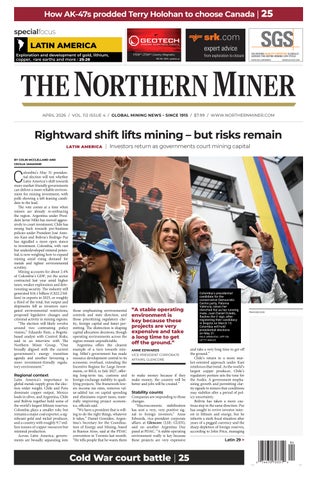
LATIN AMERICA | Investors return as governments court mining capital
BY COLIN MCCLELLAND AND CECILIA JAMASMIE
Colombia’s May 31 presidential election will test whether Latin America’s shift towards more market-friendly governments can deliver a more reliable environment for mining investment, with polls showing a left-leaning candidate in the lead.
The vote comes at a time when miners are already re-embracing the region. Argentina under President Javier Milei has moved aggressively to court investment, Chile has swung back towards pro-business policies under President José Antonio Kast and Bolivia’s Rodrigo Paz has signalled a more open stance to investment. Colombia, with vast but underdeveloped mineral potential, is now weighing how to expand mining amid rising demand for metals and tighter environmental scrutiny.
Mining accounts for about 2.4% of Colombia’s GDP, yet the sector contracted last year amid higher taxes, weaker exploration and deteriorating security. The industry still generated $16.1 billion (C$22.2 billion) in exports in 2025, or roughly a third of the total, but output and shipments fell as investors navigated environmental restrictions, proposed legislative changes and criminal activity in mining regions.
“The election will likely revolve around two contrasting policy visions,” Eduardo Ruiz, a Bogotábased analyst with Control Risks, said in an interview with The Northern Miner Group. “One broadly aligned with the current government’s energy transition agenda and another favouring a more investment-friendly regulatory environment.”
Latin America’s importance to global metals supply gives the election wider weight. Chile and Peru dominate copper output, Mexico leads in silver, and Argentina, Chile and Bolivia together hold some of the world’s largest lithium reserves. Colombia plays a smaller role, but remains a major coal exporter, a significant gold and nickel producer, and a country with roughly 9.7 million tonnes of copper resources but minimal production.
Across Latin America, governments are broadly separating into

those emphasizing environmental controls and state direction, and those prioritizing regulatory clarity, foreign capital and faster permitting. The distinction is shaping capital allocation decisions, though operating environments across the region remain unpredictable.
Argentina offers the clearest example of a turn towards mining. Milei’s government has made resource development central to its economic overhaul, extending the Incentive Regime for Large Investments, or RIGI, to July 2027, offering long-term tax, customs and foreign-exchange stability to qualifying projects. The framework lowers income tax rates, removes value-added tax on capital spending and eliminates export taxes, materially improving project economics, officials said.
“We have a president that is willing to do the right things, whatever it takes,” Daniel González, Argentina’s Secretary for the Coordination of Energy and Mining, based in Buenos Aires, said at the PDAC convention in Toronto last month.
“He tells people that he wants them
“A stable operating environment is key because these projects are very expensive and take a long time to get off the ground.”
ANNE EDWARDS VICE-PRESIDENT CORPORATE AFFAIRS, GLENCORE
to make money because if they make money, the country will be better and jobs will be created.”
Stability counts Companies are responding to those changes.
“Macroeconomic stabilization has sent a very, very positive signal to foreign investors,” Anne Edwards, vice-president corporate affairs at Glencore (LSE: GLEN), said on another Argentina Day panel at PDAC. “A stable operating environment really is key because these projects are very expensive
Colombia’s presidential candidate for the conservative Democratic Centre party, Paloma Valencia, raises her clenched fist as her running mate, Juan Daniel Oviedo, flashes the V sign, after registering their candidacy in Bogota on March 13. Colombia will hold presidential elections on May 31.
RAUL ARBOLEDA / AFP VIA GETTY IMAGES
and take a very long time to get off the ground.”
Chile’s return to a more market-oriented approach under Kast reinforces that trend. As the world’s largest copper producer, Chile’s regulatory posture sets the tone for the Andes. A government emphasizing growth and permitting clarity signals to miners that conditions may stabilize after a period of policy uncertainty.
Bolivia has taken a more cautious step in the same direction. Paz has sought to revive investor interest in lithium and energy, but he inherits a stark fiscal situation after years of a pegged currency and the sharp depletion of foreign reserves, according to John Price, managing
Latin 29 >
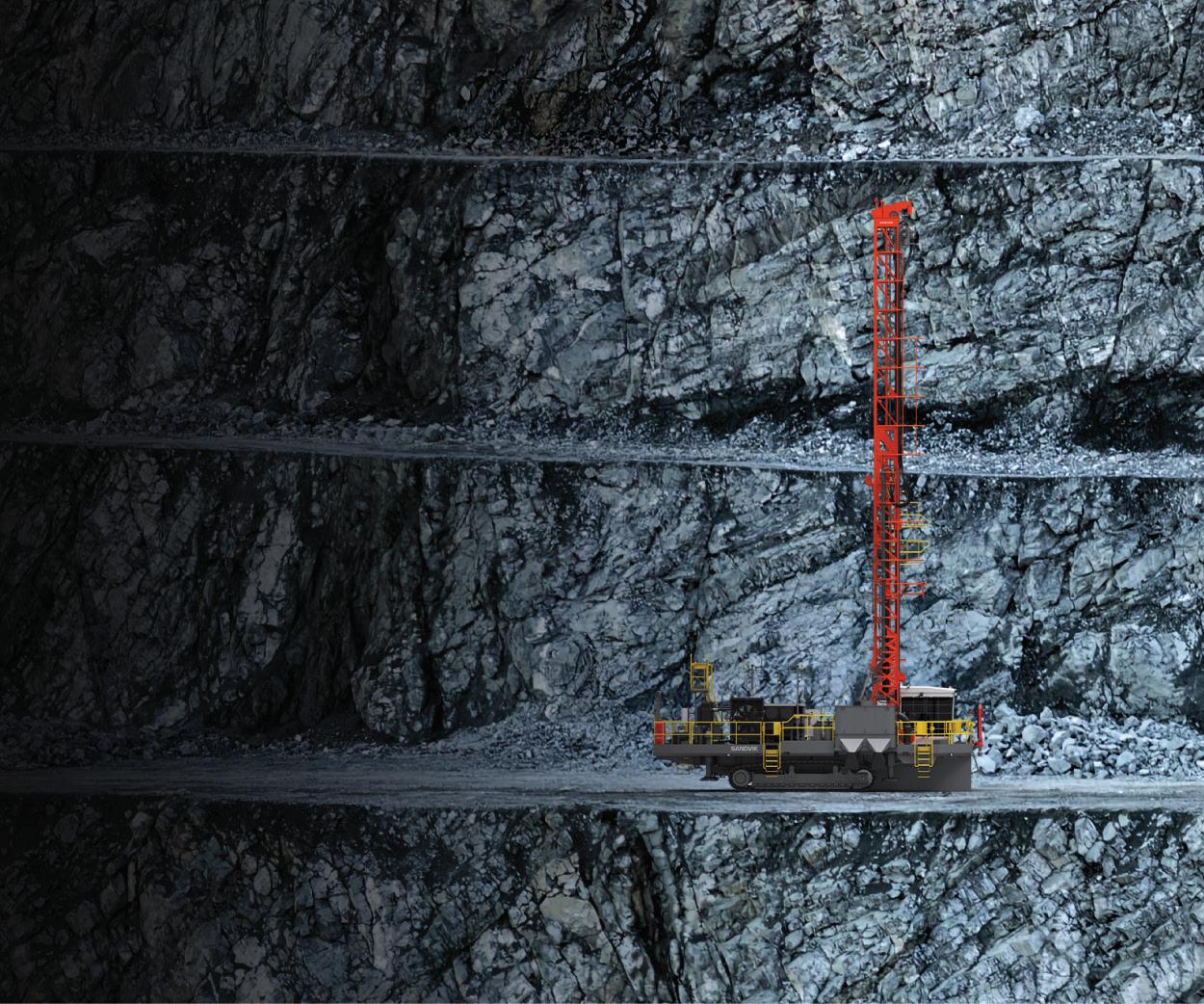



The new DR411i combines exceptional productivity with innovative iSeries technology.



With Sandvik’s new DR411i, you’ll reap the benefits from a compact drill that’s powerful, precise and productive. Paired with the innovative, data-driven technology the iSeries is known for, it’s as intelligent as it is capable. Making anyone adding it to their operation look pretty smart. Discover how the new DR411i drill from Sandvik can increase your productivity, visit rocktechnology.sandvik
SPONSOR
PLATINUM SPONSORS




PATRON SPONSORS


PREMIER SPONSORS




HOST COUNTRY SPONSOR GOLD SPONSORS



GLOBAL MINING NEWS • SINCE 1915 www.northernminer.com
PRESIDENT THE NORTHERN MINER GROUP: Anthony Vaccaro, CFA, MBA avaccaro@northernminer.com
EDITOR-IN-CHIEF: Colin McClelland cmcclelland@northernminer.com
COPY EDITOR AND PRODUCTION EDITOR: Blair McBride bmcbride@northernminer.com
SENIOR STAFF WRITER: Frédéric Tomesco ftomesco@northernminer.com
WESTERN EDITOR: Henry Lazenby hlazenby@northernminer.com
PODCAST HOST: Adrian Pocobelli apocobelli@northernminer.com
ADVERTISING: Robert Hertzman (416) 898-6654 rhertzman@northernminer.com
Kathleen Plamondon (514) 917-5284 kplamondon@northernminer.com
Michael Winter (416) 510-6772 mwinter@northernminer.com
SUBSCRIPTION SALES/ APPOINTMENT NOTICES/ CAREER ADS George Agelopoulos (416) 510-5104 (Toll free) 1-888-502-3456, ext. 43702 gagelopoulos@northernminer.com
PRODUCTION MANAGER: Jessica Jubb (416) 510-5213 jjubb@northernminer.com
CIRCULATION/CUSTOMER SERVICE: (416) 510-6789 | 1-888-502-3456 northernminer2@northernminer.com
REPUBLISHING: (416) 510-6768 jmonteiro@northernminergroup.com
ADDRESS: Toronto Head Office
69 Yonge St, Toronto, ON M5E 1K3 (416) 510-6789 tnm@northernminer.com
SUBSCRIPTION RATES: Canada:
C$130.00

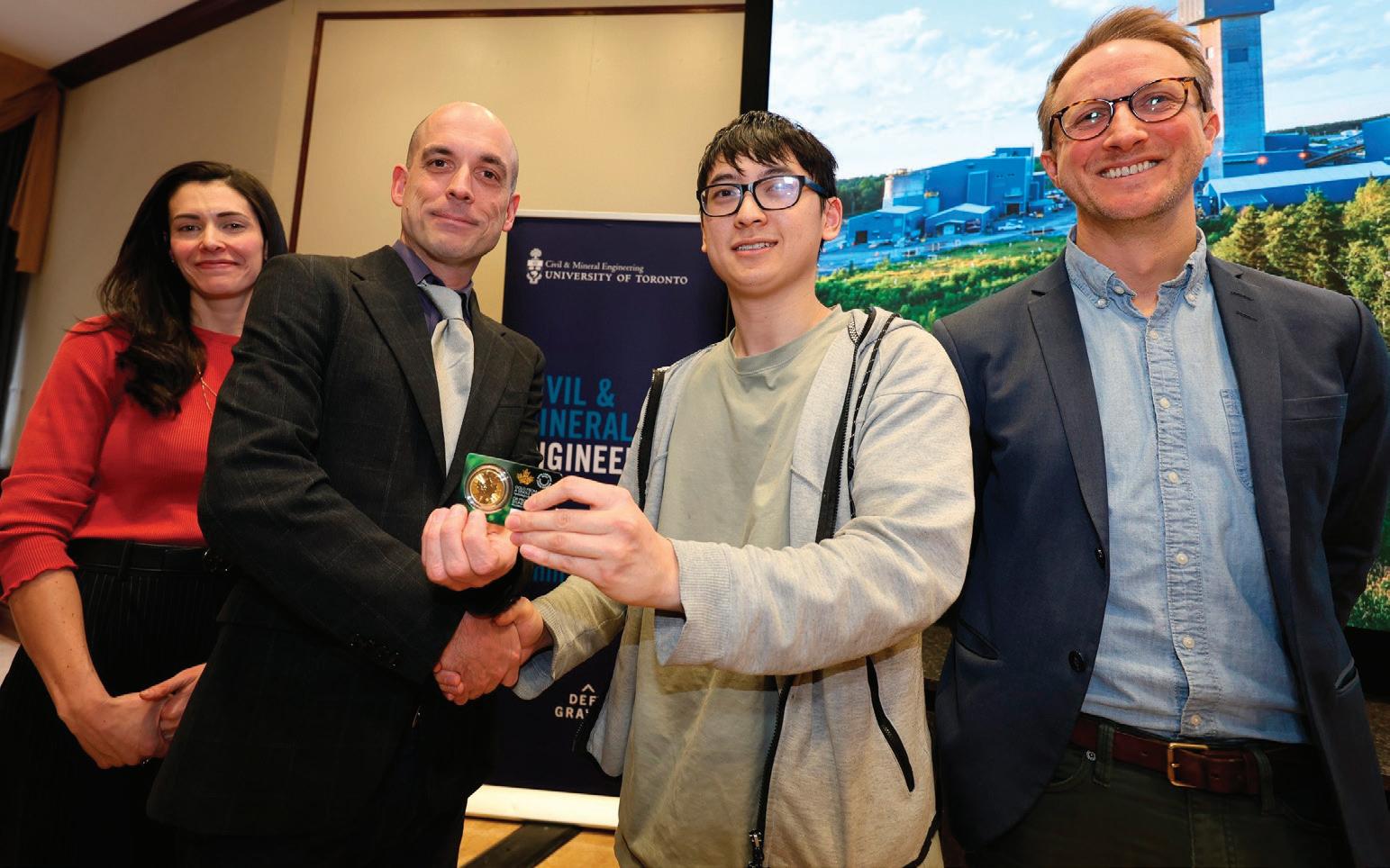
The team probing the “oddball” geology of a site 200 km from Las Vegas – which evokes the gambling nature of mining itself – first met at the Prospectors and Developers Association of Canada convention.
A decade later, the AngloGold Ashanti team’s chief geologist, Paul Bartos, collected the PDAC Thayer Lindsley Discovery of the Year award last month in Toronto. (See page 9.) Whether that’s serendipity, or just working as it’s supposed to, the world’s largest mining event again shows its relevance in connecting industry people and projects, cachet and capital.
More visitors than ever before agreed: attendance topped 32,000, more than 1,300 exhibitors took part, and our editorial team gathered from afar. Adrian Pocobelli flew in from Paris to start our first daily podcasts at the event. Henry Lazenby travelled from Vancouver and Frédéric Tomesco from Montreal to join Blair McBride and me in Toronto.
A highlight was Blair’s surprise, in-person exclusive interview with former Resolute Mining CEO Terry Holohan. “Terry shared some of the nerve-wracking details of his 13-day detention by soldiers in Mali,” Blair said. “Despite his difficult time, he was friendly and upbeat, eager to get busy on his next adventure leading BG Gold in Canada’s Arctic.” (See page 9.)
Frédéric heard the urgency behind industry favourite copper from the CEO of giant Vale, and the push from panellists to get the red metal refined in the West, even from a group suggesting former paper mills could play a part. (See pages 10 and 8.)
Podcast first
We didn’t have room in this print issue for all the PDAC coverage that appeared online. There, you can find Adrian’s podcasts with guests such as Audrey Robertson, the Assistant Secretary in charge of the U.S. Department of Energy’s Office of Critical Minerals and Energy Innovation; David Prodger, the UK Deputy High Commissioner to Canada; and Abdulrahman Al Belushi, Saudi Arabia’s Deputy Minister for Mineral Resources Management.
There are also nearly 50 videos online after guests sat down with Henry and Northern Miner Group video anchor Devan Murugan. “There was a noticeable sense that The Northern Miner had become one of the places to be seen and heard during PDAC,” Devan said.
That social angle drove great events throughout the week, including Gold & Silver Night at Ripley’s Aquarium, where the Miner team did its version of Hunter Thompson’s The Great Shark Hunt See photo

Positive vibe
There was a general sense of optimism at PDAC, if tempered somewhat since the backdrop is always the anxiety of trying to score deals. The positivity was widespread because governments around the world are latching onto mining as the way forward.
Miners were upbeat at announcements by Ontario Premier Doug Ford, Minister Stephen Lecce and federal Minister Tim Hodgson. Counterparts at an Argentina panel I moderated, Daniel González, Secretary for the Coordination of Natural Resources, and Luis E. Lucero, Secretary of Mining, drew a standing-room-only crowd.
Latin America is this month’s theme, and we were able to tuck some stories on that around the edges of PDAC, starting with the political trend sweeping across the region that’s likely to lift projects. Elections seem to have brought in a swath of potentially the right players for the industry. Balancing ambition with the environmental concerns that dominate these nations will be a key to success.
What the Nevada discovery shows is that mining still works the way it always has, through people meeting, testing ideas and finding capital. The odds often look long at the outset, and the timelines even longer, but the system still produces results, whether in Nevada or across emerging opportunities in Latin America.
PDAC is a showcase, but it’s even stronger as a starting point. A future Thayer Lindsley winner was likely discussed in a hallway or over coffee.
This year’s was. TNM
The world of cheap oil is gone

Are we living in the 1970s? I can’t tell you, I wasn’t there, but it’s an interesting analogy.
Then, as today, we have the fear of inflation, the eroding value of cash and now spiking oil prices.
Of course, nothing can repeat exactly. The event that’s said to have launched hyperinflation in the 1970s, the Yom Kippur War, only lasted 20 days. As we go to press, we’re now past the 30th day in this Iranian conflict with the U.S. and Israel.
So, maybe we’re not living in the 70s at all, but something far worse? But it’s not so much the war that’s important here; it’s the flow of oil.
For now, the Strait of Hormuz remains shut except for a few renegade exceptions, like Japan. The Japanese government was reportedly in talks with Iran to ensure the safe passage of its oil vessels moving through the strait.
As a long-term ally of the U.S., it’s a meaningful development that highlights that when push comes to shove, energy matters more than friends. Japan funnels about 90% of its oil shipments through this strait. No doubt, it’s keen to make a deal.
As I said, oil flow matters more than the war itself. And gradually, ships are leaking through the strait. There were also reports that Iran was charging vessels a $2-million “toll fee” to pass through. That’s assurance for tankers that they won’t be sunk if they pay up.
Could those who pay the toll secure lower insurance premiums? It’s another unknown that could free up the bottleneck. But it could also provide Iran with a critical source of additional war revenue. Capitalism is alive and well in the Iranian regime.
Pre-war, up to 140 ships passed through the strait daily, including roughly 60 oil/gas tankers. It seems Iran now has an opportunity to finally monetize its geographical advantage.
Let’s assume the daily count lifts to just a fraction of these pre-war numbers in the coming weeks; it could help sustain Iran’s war effort against the U.S. and Israel.
And that’s potentially putting into motion a war that goes into deadlock rather than resolution.
Lesson of 1973
While the Yom Kippur War lasted just 20 days, oil flows to the West remained closed for much longer than that. Arab producers continued a strict oil embargo against the West for around five months as retaliation for their support of Israel in the Middle East.
And once oil began to flow (post-embargo), oil prices remained stubbornly high. But the consequences went far beyond that.
Six months after the Yom Kippur War began, the US Dow Jones Industrial Average fell 17% from its 1973 peak.
But the real stock market crash didn’t take place until July 1974, about eight months after the start of the conflict. And that’s the timeline that should be on investors’ radar.
From the 1973 pre-war peak to the 1974 stock market bottom, the DJI fell 45%. It’s not unreasonable to assume that today’s richly valued tech-heavy Nasdaq would have fared much worse back then.
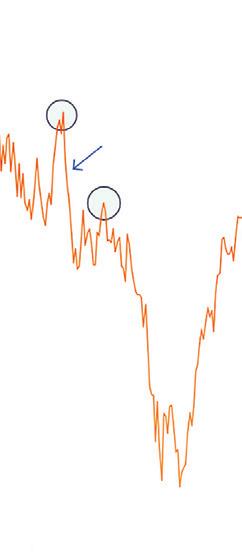
Source: Trading View
It’s conceivable, too, that oil flows could remain constricted for a similar duration, like in the 70s, where embargoes remained in place for five months. And when those embargoes were finally lifted, rather than easing pressure on financial markets, markets revolted. The damage was already baked in.
By July 1974, U.S. interest rates were breaching double figures. And markets entered a cyclical bear market. But despite broad weakness across financial markets, the outlier remained commodities, particularly energy.
Oil futures traded for a measly $3.50 per barrel prior to the Yom Kippur War in 1973. Postwar, they climbed above $10 per barrel. And by the end of the 1970’s, oil was trading above $30 per barrel. About 750% higher from the start of the decade!
Could that happen again? Let’s hope not. Before events in Iran, oil traded at about $72 per barrel. The shock came as oil tipped past $100 per barrel, delivering a mere 40% increase. That was well below the 1970’s oil price shock.
So, clearly, there are differences, and you can’t take the 1970s as a one-for-one blueprint on what will happen next.
And while it does have its limitations, for investors, using historical analogies like this could prove far more useful than the hyperbolic news cycle.
The 1970s is a helpful yardstick; follow it wisely. TNM
James Cooper is a geologist based in Australia who runs the commodities investment service Diggers and Drillers. You can also follow him on X @JCooperGeo.
Barrick Mining has delayed development of its Reko Diq copper-gold project in Pakistan, citing worsening security conditions in the region and broader Middle East tensions.
The Canadian miner said last month it would extend an ongoing project review by 12 months from July and slow on-the-ground work while reassessing risks, capital allocation and execution plans. Barrick emphasized it remains committed to the project for the long term.
Located in Balochistan, Reko Diq is one of the world’s largest undeveloped deposits. It’s projected to generate tens of billions of dollars in cash flow over decades.
A lawyer representing Sibanye-Stillwater was shot dead in central Johannesburg in what police believe was a targeted attack.
Chinette Gallichan, a 35-year-old litigation attorney, was killed March 23 while en route to represent the South African miner at a retrenchment hearing. The two gunmen fled on foot.
No arrests had been made as press time neared and the motive remained under investigation. The killing, which follows recent job cuts at the company, drew condemnation from unions, legal groups and industry officials.
Rio Tinto has ended production at the Diavik diamond mine in the Northwest Territories, closing a key asset of Canada’s diamond industry after more than two decades.
While the mine has produced over 150 million carats since 2003, its reserves are now depleted.
The shutdown highlights the decline of Canada’s once-booming diamond sector amid heightened global competition from synthetic stones and depressed prices.
Final diamond sales will continue through 2026, while site reclamation is expected to run to 2029.
Gold swung wildly last month as markets grappled with fresh trade chaos and inflation fears after the United States and Israel attacked Iran.
Prices topped $5,300 an oz. in early March as the escalating Middle East conflict snarled ship traffic in the Strait of Hormuz, triggering concerns of supply-shock inflation that reinforced gold’s traditional haven appeal.
The gains proved volatile, however. Rising U.S. Treasury yields and a stronger dollar undercut bullion’s appeal, pushing the metal below $4,500 an ounce.
Gold’s fall from grace reflects a global liquidity squeeze as
BY NORTHERN MINER STAFF
financial conditions tighten rather than a breakdown in the metal’s role as a hedge, Sprott Asset Management strategist Paul Wong said in a March 25 note.
The Canadian Mining Hall of Fame is accepting nominations for its 2026 inductee class.
Nominations must be made through partner organizations, including industry associations and The Northern Miner. Submissions are due by May 29.
Guidelines, selection criteria and the nomination form can be found on the Hall’s website.
The Hall recognizes individuals who have made enduring contributions to Canada’s mining sector in exploration, development and leadership. Founded in 1989, it has inducted more than 210 members.
A selection committee will review submissions over the summer. The new class will be announced later this year and honoured at a Jan. 14 induction ceremony in Toronto.
By Blair McBride
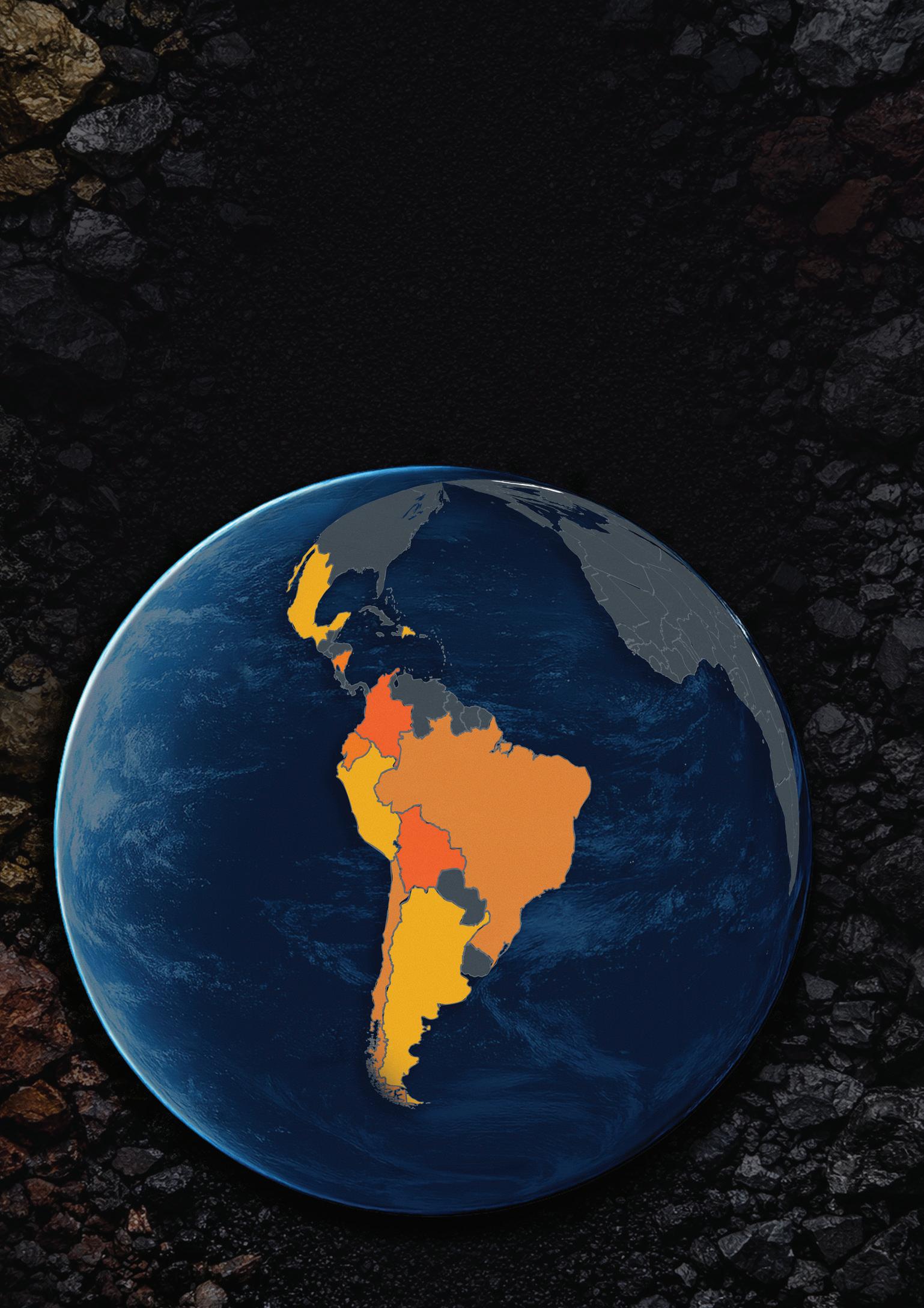
Latin America has some of the most geographically-concentrated clusters of major mining countries in the world. The region supplies some of the globe's most significant shares of precious and critical metals and hosts vast reserves still to be developed. The Northern Miner takes a peek at the region through top 10 rankings of countries by mining as a percentage of exports and by value, along with their top metal exports.*





BY COLIN MCCLELLAND
Canada will lead Group of 20 nations with the fastest permits as the government’s Major Projects Office (MPO) advances projects to production within two years, Energy and Natural Resources Minister Tim Hodgson said in an interview.
The government is pushing five projects valued in the billions of dollars, from copper in British Columbia to tungsten in New Brunswick, as part of the special office announced last year to co-ordinate provincial and federal permits.
“From the time the project is referred to the MPO, you’ll get a conditions document within two years,” Hodgson told The Northern Miner on March 3 as the Prospectors and Developers Association of Canada convention in Toronto wound down. “That’ll be the best in the G20.”
Canada is accelerating permit times by limiting provincial and federal duplication as countries in the West attempt to reduce their dependence on China’s mining and metals processing. After the largest amount of spending for mining in a federal budget in decades – issued last November – and further details issued during PDAC on financing other projects, Hodgson said there’s ample proof the government is doing more than saying the right things.
“Like 26 deals in October and 30 deals today, like [projects valued at] $18 billion, at what point is that not walking the talk?” he said. “We just saved Thompson [nickel mine] with a new Canadian owner who’s dedicated to expanding the mine instead of shutting it. I mean, at what point?”
Manitoba nickel When Vale’s (NYSE: VALE) base metals unit agreed Feb. 19 to bring in partners to keep the Thompson nickel mine complex in Manitoba operating, the deal included funding from the Canada Growth Fund, a federal investment fund created to attract private capital into strategic sectors such as critical minerals.
In the MPO, Foran Mining’s (TSX: FOM; US-OTC: FMCXF) McIlvenna Bay copper mine project in Saskatchewan is due to start producing next year while Canada Nickel (TSXV: CNC: US-OTC: CNIKF) in Ontario may take two years to build after a construction decision expected this year.
The office is also advancing Northcliff Resources’ (TSX: NCF; US-OTC: NCFFF) tungsten proposal in New Brunswick, Nouveau Monde Graphite’s (NYSE: NMG; TSX.V: NOU) project in Quebec; and the Red Chris copper and gold mine expansion, owned 70-30% by Newmont (NYSE: NEM; TSX: NGT) and Imperial Metals (TSX: III), in B.C.
“We are clearly focused on having a best-in-class, predictable permitting process,” Hodgson said. “We de-pancaked our regulatory provincial, territorial, federal relationship, where we’ve got one project, one review.”
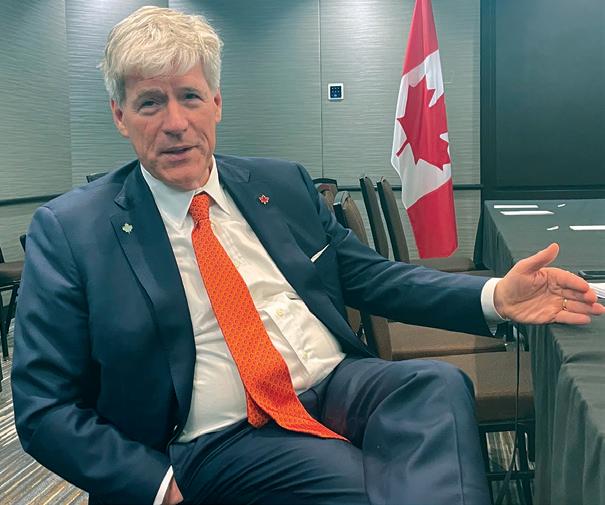
The minister officially launched a $1.5-billion First and Last Mile infrastructure fund on March 3 that had been outlined in November’s federal budget. Hodgson listed five projects marked for $115 million of the fund to get metals from mines to markets. They include new hydro power in B.C. and transmission lines in Saskatchewan.
A day earlier, Hodgson also granted small-scale funding to 30 projects, including $16.7 million for First Phosphate’s (CSE: PHOS; US-OTC: FRSPF) Bégin-Lamarche project in Quebec to produce lithium iron phosphate cathode active material.
There was also $2.3 million for Frontier Lithium’s (TSXV: FL; US-OTC: LITOF) proposed lithium processing plant in northern Ontario, and $7 million for Greenland Resources’ (TSX: MOLY) Malmbjerg molybdenum project on the Arctic island.
Ottawa signed agreements with 10 allied countries and the European Union to add to 26 deals announced last fall at a G7 ministe-
rial meeting for a total of $18.5 billion in projects – (not the amount of funding).
Website tracking Hodgson also mentioned the new Mine Permit Navigator, an online tool to improve transparency and coordination in federal permitting: https://mpn-tool-outil-npm. nrcan-rncan.cloud-nuage.canada. ca/en/nrcan-map.
The timing for the formal launch of a $2-billion sovereign fund –which was also mentioned in the budget – depends on legislation that is being blocked by the Conservative opposition in Parliament, Hodgson said.
One of the fund’s platforms, to include government equity ownership in projects, will require an investment policy, and there are plans for several frameworks to ensure some flexibility, he said.
“What we’re going to be focused on is, how do we address key constraints in our critical mineral supply chains? We’re going to help do that by catalyzing projects, probably in partnership with our allies.” TNM
BY HENRY LAZENBY
Canada’s flow-through share financing system underpins the country’s status as a dominant mine finance hub by supporting the efforts of some 670 listed explorers, Canadian Mining Hall of Fame member Douglas Silver said.
Flow-through investors supply roughly three-quarters of the equity raised annually by eligible exploration companies in Canada, said Silver, partner and senior adviser of Sydney-based Benwerrin Investment Partners.
Those issuers raised about $2.2 million (US$1.6 million) each on average in 2024, including about $1.7 million in flow-through shares, leaving roughly $500,000 from other equity, he added, citing his review of thousands of public filings.
“If [Canada] terminated flowthrough financing, [Australia’s] ASX could become the premier mining stock exchange in the world,” Silver said March 3 at the Prospectors and Developers Association of Canada’s annual convention in Toronto. The financing mechanism is “absolutely critical” to Canada’s public exploration ecosystem, he added.
Lifestyle trap
Flow-through shares allow companies to pass exploration expenses to investors, who receive a 100% tax deduction. The system is backed by Ottawa’s 15% Mineral Exploration Tax Credit, extended for two years in 2025, while some companies can also qualify for enhanced credits of up to 30% on eligible exploration work such as drilling.
Turning to how the money is used, Silver said so-called lifestyle companies give the junior exploration industry a bad rap. Those companies spend about $215,000
SOCIAL MEDIA | Creating digital trust is key
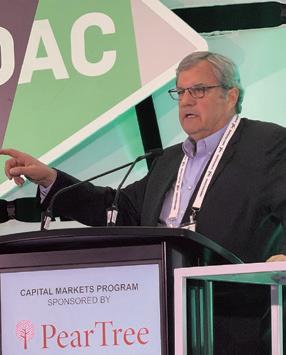
a year in overhead, he said.
“That means a junior raising only $300,000–$400,000 can end up funding more general and administrative costs than drilling,” he said.
Existential tool
Silver’s breakdown of gold equity financings over five years finds that the amount supporting producers has climbed sharply as investors chased near-term revenue and liquidity. The share devoted to explorers peaked in 2022 before sliding.
“That’s where flow-through becomes existential,” Silver argued.
Grassroots explorers have no revenue and rely on equity. Flowthrough funding, he said, pays for fieldwork while other equity keeps the lights on. Without it, many early-stage Canadian explorers would struggle to survive long enough to make a discovery.
Based on his research, Silver expects market forces to keep culling weak companies without a broad collapse in issuer counts.
BY HENRY LAZENBY
Mining companies should start measur-
ing digital trust online the way they track costs and safety, treating social media sentiment and responsiveness as early-warning signals for community risk, social media experts suggest.
Miners should fold digital trust into social and key performance indicators, Elizabeth Freele managing partner at sustainability consultancy Sympact, said March 2 on a panel. Social media could help sentiment monitoring, response-time tracking and measuring whether affected communities are part of the online conversation.
“It’s not gold or copper. It’s trust,” Haydon Mort, CEO of mining communications firm Geologize, told the session. “Let’s face it – most people hate the mining industry outside this convention centre.”
The panellists argued that projects now face a faster feedback loop. A local grievance, activist campaign or perceived misstep can spread
virally online in hours, hardening opposition and raising the reputational stakes for investors, lenders and boards long before permitting decisions are made.
Access youth
Cate Larsen, a geology educator known online as the Groovy Geologist, said her young audience gives her leverage to amplify issues and connect people who might otherwise be ignored, a responsibility she’s trying to use deliberately.
“I have the power to bring things to the attention of the right parties that a lot of people can’t,” Larsen told the panel. “I want to use that power in a really good way.”
Miners often judge online engagement using “vanity metrics” such as views, likes and follower counts, even though those numbers say little about whether communities believe what they’re seeing, said Freele, who co-founded the Vancouver-based Responsible Mining Academy.
The better test is whether online engagement leads to offline outcomes such as meetings,
questions answered, design changes and clearer accountability. Companies should also rethink how they tell community stories. Co-creating content can mean sharing control and letting local partners shape the message, rather than lifting a quote, polishing it and posting it on a corporate channel, Freele said.
But that approach runs headlong into another reality: legal limits. Disclosure rules and confidentiality agreements can keep companies from sharing the most compelling details of exploration work in real time, Justin Daley, vice-president of exploration at Nevada King Gold (TSX-V: NKG; US-OTC: NKGFF), said on the same panel.
The industry’s communications often fall flat because “we’re not able to say everything that we think is interesting,” he said. The dilemma is that social platforms often reward heat, not nuance – a trap he said miners should avoid.
“Generally, you have to be controversial to get a lot of views,” he said. “And in this space, that is the one thing that I feel I cannot do and you should not be doing.” TNM
BY FRÉDÉRIC TOMESCO
Canadian property developer
BMI Group says the clutch of industrial buildings it’s amassed in Ontario and Quebec could help strengthen Canada’s role in the battery supply chain by linking mines with processing hubs and customers.
Dubbed the “Critical Minerals Corridor,” BMI’s asset portfolio includes five former industrial sites such as pulp and paper mills that have been repurposed into “deployment-ready” hubs with existing power, water and access to roads, ports or rail lines. BMI has invested more than C$200 million ($146 million) in acquisitions and modernization since 2014, said CEO Paul Veldman, one of three brothers working for the familycontrolled company.
“We’re not a miner, we’re not a processor, we’re the infrastructure, the support,” Veldman told The Northern Miner in Toronto last month during the Prospectors and Developers Association of Canada annual conference. “Reinvigorating and reactivating idled infrastructure and idled assets, that’s our core business.”
BMI’s shared infrastructure concept comes as federal and provincial authorities in Canada pursue a longstanding goal of boosting metals processing activities on home soil as global demand for critical minerals booms.
Early converts to the concept include Canadian miners Rock Tech Lithium (TSXV: RCK) and Northern Graphite (TSXV: NGC; US-OTC: NGPHF). Both companies are making plans to move into BMI-owned facilities – instead of building their own plants – to cut costs and shrink development times
compared with greenfield projects.
‘Rip and ship’
Canada holds significant mineral resources and produces hydroelectricity, but its domestic supply chains pale in comparison with those of foreign rivals such as China.
The sale over recent decades of large-scale Canadian miners that had their own smelters, such as Inco, Falconbridge and Rio Algom, leaves Canada operating mostly as a mine-and-export jurisdiction –a model that Ontario Energy and Mines Minister Stephen Lecce calls “ripping and shipping.”
Canada has only one active copper smelter, Glencore’s (LSE: GLEN) Horne facility in RouynNoranda, Que., along with an associated refinery in Montreal.
While Canada has two lithium
mines, Beijing-based Sinomine’s Tanco operation in Manitoba, and Elevra Lithium’s (Nasdaq: ELVR; ASX: ELV) North American Lithium mine in Quebec, it has no plants to process the metal into lithium hydroxide or carbonate. A Rio Tinto (ASX, LSE, NYSE: RIO) facility to make lithium hydroxide is under construction in Bécancour, Que., though the company said in March it would slow work for the time being.
Ring of Fire
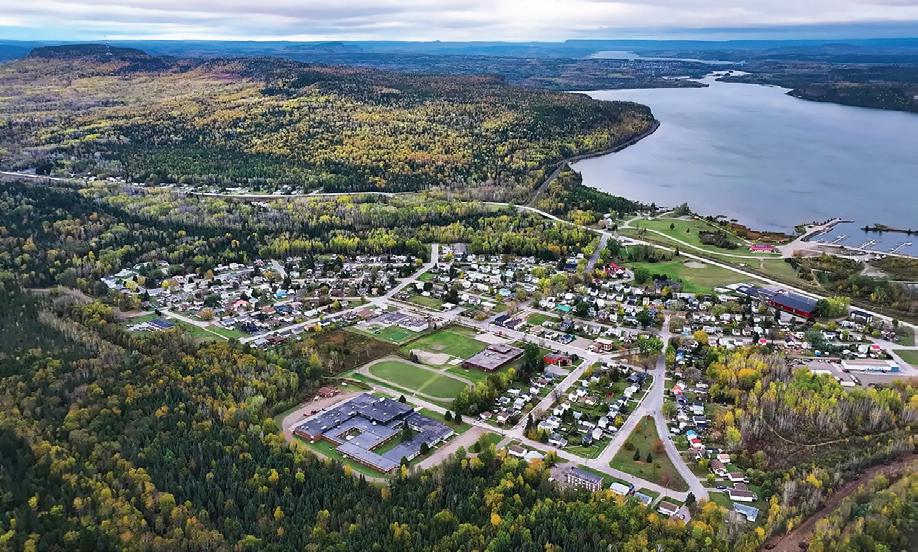
BMI’s Red Rock facility in northern Ontario – a former Norampac cardboard plant – sits about 10 km from Nipigon, a town that will serve as a road gateway to the resourcerich Ring of Fire region whose underground potential Ottawa and the province are looking to unlock. Nipigon is about 1,050 km north-
west of Toronto.
Rock Tech Lithium’s planned hydroxide facility will anchor the Red Rock site, which has 120 megawatts of installed power capacity and direct access to CPKC Rail’s transcontinental mainline.
“The Ring of Fire has been a known commodity for decades,” Veldman said. “We were zeroed in on the Ring of Fire and the understanding that there’s a vast amount of minerals of all kinds that are available in that region. That really brought us to think about the logistical aspect.”
Baie-Comeau
Northern Graphite CEO Hugues Jacquemin, whose company runs North America’s only commercially producing graphite mine, is a big believer in BMI’s corridor. Northern and BMI agreed last year
to jointly evaluate building a battery-anode material plant at a former Resolute newsprint mill in Baie-Comeau being redeveloped as the Norderra multimodal hub.
BMI also bought a minority stake in Northern to cement the partnership, serving as the lead investor in the company’s $1.4-million private placement in October.
Setting up a battery material plant at the Baie-Comeau site – which shut its doors in 2020 – would probably take about 24 months following a final investment decision, Jacquemin said. Since a decision could come as soon as the end of 2026, this means that production could conceivably start by the end of 2028.
Located on a deepwater port with access to global markets, Baie-Comeau would process graphite concentrates from Northern’s Lac-desIles mine in Quebec. If subsequently expanded, it could also process output from the company’s Bissett Creek project in Ontario and its Okanjande mine in Namibia, the CEO says.
“For us, Baie-Comeau is the perfect location. There’s a lot of space there, and all the infrastructure is in place. It’s really a no brainer,” Jacquemin said in an interview.
“The connection to the corridor, to and from Europe – that’s important for us, as is the ability to ship the material up there by train and the ability to use the Great Lakes and the waterways to service the North American seaboard, the East Coast of the U.S., because we have quite a few customers there,” he added.
“And from a permitting standpoint, it’s much easier to permit a brownfield than a greenfield site.” TNM
BY FRÉDÉRIC TOMESCO
Canada has a historic opportunity to build new processing facilities as modern mines get developed amid a global resource boom, convention attendees heard.
Although the country is a leading hub of mining finance with the Toronto Stock Exchange hosting around 1,100 industry issuers valued at a combined $600 billion (US$438 million), Canada counts few mining behemoths and smelters these days. Foreign takeovers of large-scale Canadian miners such as Inco, Falconbridge, Rio Algom – and lately Teck Resources (TSX: TECK.A, TECK.B; NYSE: TECK) – have turned Canada into an economy that’s more focused on extracting and exporting raw materials than building value-added processing activities at home, Canada Nickel (TSXV: CNC; US-OTC: CNIKF) CEO Mark Selby said on a panel March 2. That’s a model that Ontario Energy and Mines Minister Stephen Lecce refers to as “ripping and shipping.”
“One of the big mistakes this country made was 25 years ago, letting the gutting of the major mining companies that used to be headquartered here,” Selby said.
“Not only did they build the mines in Canada, but a large number of the base metals operations in Canada were built by one or more of those companies.”
Fresh momentum
Attitudes in Ottawa and several provincial capitals appear to be changing. Under Prime Minister Mark Carney, Canada last year created a new Major Projects Office that aims to accelerate critical minerals projects. The federally backed Canada Growth Fund has also begun co-investing in projects including those of Nouveau Monde Graphite (NYSE: NMG; TSX-V: NOU) in Quebec, Foran Mining (TSX: FOM; US-OTC: FMCXF) in Saskatchewan and the Thompson nickel mine complex in Manitoba, signalling federal back-
ing to private investors.
Canada already has the infrastructure it needs to handle higher materials exports over the coming decade, Patrice Boulanger, vice president of marketing at Nouveau Monde, told the convention.
“We have the infrastructure to do a lot of exports,” Boulanger said. “We have deep-sea ports on both the Atlantic Ocean and the Pacific Ocean. We have a beautiful railway system and trucking system. These are all assets on which we are counting to position Canada for the next 10 years.”
Major projects
Canada’s willingness to prioritize mining investment comes at a time when Western governments are under pressure to secure domestic supplies of critical minerals and reduce reliance on China-dominated supply chains. There’s also a new urgency for resource self-sufficiency when the Trump administration levies tariffs against its biggest trading partner – Canada.
“We’ve forgotten how to process materials downstream. Once it leaves the country, all that value is gone.”
MARK SELBY, CEO, CANADA NICKEL
Even so, Anglo American’s (LSE: AAL) decision to move its headquarters to Vancouver from London if its combination with Teck closes is a positive sign, Selby said.
“I’m very happy that Anglo Teck is talking about being headquartered in Vancouver because that’s what we need,” he said. “We need a new round of Canadian champions. We need domestic champions that want to put Canadian assets at the top of the list to make sure that they go first.”
Shorter timelines
Building mines more quickly will be key to ensuring that Canada can start adding processing facilities, Foran’s head of government relations, Carter Zazula, told the panel.
“If Foran can build a copper mine in under five years, so can others,” he said. “More mines will come. Midstream and downstream facilities will come as we build more mines. Don’t miss out. The world is watching. The critical minerals that the world needs are in Canada. Don’t be the one to miss out on the opportunity.” There’s no time to waste, added Canada Nickel’s Selby.
“We’ve forgotten how to process materials downstream,” he said. “Once it leaves the country, all that value is gone. I would really encourage everybody listening here that this is a once-ina-lifetime opportunity to become a world a leader again in downstream processing, which Canada used to be.” TNM
NUNAVUT | Holohan leads BG Gold towards listing
BY BLAIR MCBRIDE
When Terry Holohan was confined for 13 days in Mali by junta officials seeking millions from the company he led, Resolute Mining (ASX, LSE: RSG), he had reason to wonder if he would ever make it home safely.
Held in the basement of a rundown office building in the capital, Bamako, the CEO found himself at the centre of a high-stakes standoff in one of the world’s most volatile mining regions. AK-47-toting soldiers patrolled outside his cell with bricked-over windows and only simple mattresses, one water tap and a bucket. The military government freed him and two colleagues in late 2024 after a $160-million (C$220-million) settlement.
“I was never really worried about our personal security,” Holohan told The Northern Miner in an interview at the convention. “There were a lot of psychological games, like, ‘If we don’t get the money, then we’ll have to take you to the open prison where there are 30 people per cell’ and all that gamesmanship. When you’re in that situation, you’re more worried about your family because they don’t know what’s going on.”
Now, he has resurfaced on the other side of the world – in the Arctic – in one of the planet’s safest jurisdictions.
The former Resolute boss is managing director of Nunavut-focused BG Gold, swapping the heat and political tension of Mali for the cold isolation of Canada’s Far North, where the company is preparing a preliminary economic assessment (PEA) and a public listing.
Holohan, whose resume includes top executive roles with PT Archi and Paramount Mining in Indonesia and Platmin in South Africa, brings decades of geological and management skills easily suitable to a new project in the frozen expanses of Nunavut.
For BG, having someone with Holohan’s history of building and running large mines is a “big step” to drive the company forward, BG Gold Executive Chairman Peter Bacchus said in a separate interview.
“Terry is completely head-inthe-game and was looking for his next opportunity,” Bacchus said. “It’s a big hire for us.”
BG plans to list on the TSX in the second or third-quarter, which would make it the newest publicly-listed gold explorer in the Arctic territory. It’s also one with a history of backing from major mining figures.
Two years ago, just before BG began its first exploration season, it raised $30 million from, among others, Glencore (LSE: GLEN) founder Pinkie Green, Harmony Gold (NYSE: HMY) founder Ted Grobicki, former Gold Fields (NYSE: GFI) executives Brett Mattison and Tommy McKeith, and Andre Liebenberg, the CEO of physical uranium holder Yellow Cake (LSE: YCA).
“If a mine gets going here, there’s going to be mining for decades.”
TERRY HOLOHAN, MANAGING DIRECTOR, BG GOLD
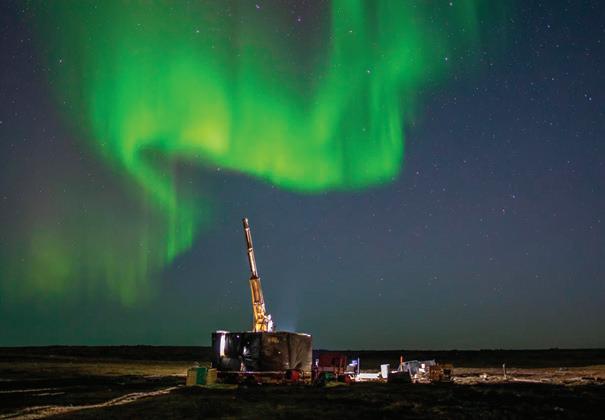
Hudson Bay, Whale Cove is 20 km west of the namesake hamlet and 1,225 km west of the capital Iqaluit. It’s also about 80 km south of Agnico Eagle Mines’ (TSX, NYSE: AEM) Meliadine. The territory’s other producing mine is B2Gold’s (TSX: BTO; NYSE-A: BTG) Goose, near Bathurst Inlet.
“The two gold mines in Nunavut have proven to us all that they can be profitable in such environments and they are in more remote places than Whale Cove in terms of access via ports and airports,” Holohan said. “They have people who understand mining and are very enthusiastic and want us to get going.”
The explorer’s near-term focus is completing a PEA for Whale Cove’s main Vickers deposit, which has grown significantly since BG acquired the project from Russian miner Nordgold in 2022.
Vickers expanded from an inferred-only resource in 2020 to 23.7 million measured and indicated tonnes grading 2 grams gold per tonne for 1.5 million oz., according to an update from February 2025. Inferred resources now total 16 million tonnes at 1.8 grams gold for 900,000 ounces. The update is based on more than 12,730 metres drilled since 2024.
“We’ve done a lot of economic work over the last year in terms of what Vickers would look like,” Bacchus said. “We plan to have a PEA ready ahead of the listing. It would give investors an opportunity to wrap their heads around what the mine would look like.”
Expanding land package
BG also more than doubled its land package to about 2,000 sq. km, mainly by acquiring exploration rights this year to the 1,174-sq.-km Tavani property south of Vickers.
Last year’s drilling at Vickers featured hole 25PB112B that cut 67 metres grading 3.6 grams gold from 204 metres depth, including 35 metres at 6 grams gold, 24
metres grading 4.9 grams gold and 14 metres at 7.9 grams gold.
Reconnaissance drilling also unveiled a new gold-bearing shear system at the CZ target, west of Vickers. Highlight hole 25PB115 returned 64 metres grading 3.1 grams gold from 5 metres depth, including 8 metres at 18.9 grams gold.
The company has more than C$10 million for exploration this year. BG plans to complete about 6,000 metres of drilling at Whale Cove using two rigs and two helicopters for broader regional exploration.
Potential C$450M value
The executives declined to specu-
‘Boots’ on big
BY BLAIR MCBRIDE AND HENRY LAZENBY
One of the largest U.S. gold discoveries and a First Nations alliance were celebrated at this year’s convention, with AngloGold Ashanti (NYSE: AU) and Blue Lagoon Resources (CSE: BLLG; US-OTC: BLAGF) taking home honours.
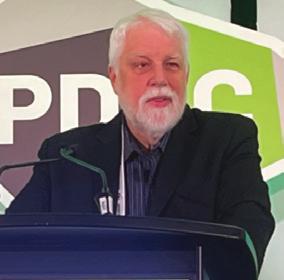
Geologist Paul Bartos, who delivered the PDAC Thayer Lindsley Discovery of the Year Award keynote address, had already been involved in big finds over his career when he confronted the “oddball” geology of Silicon, 200 km from Las Vegas.
“How we actually found it? Boots on the ground, detailed old school field mapping of structure and alteration,” he told the audience. “Many of these people are core loggers, and to me, core loggers are the hidden heroes of our business.”
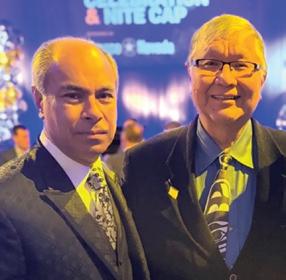
Blue Lagoon won PDAC’s 2026 Sustainability Award for its partnership with the Lake Babine Nation at the Dome Mountain gold-silver project near Smithers, B.C. The award comes as Blue Lagoon starts making money from Dome by mining underground and hauling ore to a third-party mill owned by Nicola Mining (TSXV: NIM).
“Our partnership with Blue Lagoon Resources is built on respect for our Yintah and a shared commitment to protecting the land while creating meaningful opportunities for our people,” Lake Babine Nation Chief Wilfred Adam said in a release.
‘Over-explored’ Nevada AngloGold’s Bartos met with Renaissance Gold staff in 2016 at PDAC, eventually leading to one of the biggest gold finds in the
May 1, 2026
Deadline for contacting a Member or Associate Member Organization about submitting a nomination.
May 29, 2026
Deadline for nomination material to be submitted to the Member or Associate Member Organization.
Further information & the nomination form can be found at www.mininghalloffame.ca/nominate
ECUADOR | Mining security zones created
BY HENRY LAZENBY
Ecuador‘s new mining law revamps environmental permitting, creates protected mineral zones with security forces and reshapes how royalties flow to local governments as Quito tries to pull in new investment and push back on illegal mining.
The law, approved in late February by the National Assembly and President Daniel Noboa, replaces Ecuador’s environmental licence with a broader regime and adds measures to streamline approvals, formalize artisanal miners and open parts of the power sector to private investment.
“Legal certainty under the new rules means clear, upfront rights and obligations tied to the mining concession and fewer midstream rule changes,” Environment and Energy Minister Inés Manzano said at the convention in response to a question from The Northern Miner “Remaining investor concerns are to be addressed in forthcoming regulations.”
Ecuador is trying to boost output beyond its two operating largescale mines – Lundin Gold’s (TSX: LUG) Fruta del Norte and the Chinese-backed Mirador copper mine – in a country where new projects have faced court challenges, community opposition and shifting rules.
Under the new framework, the environmental authorization can
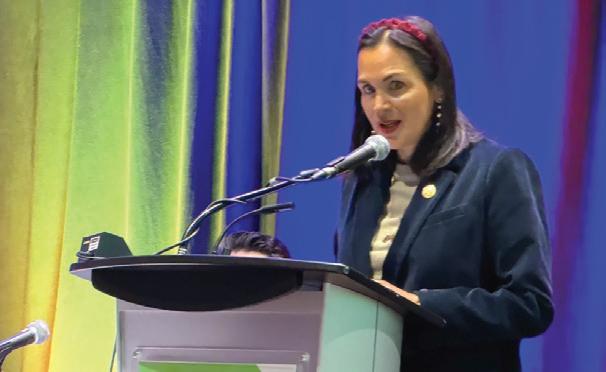
“Legal certainty means clear rights tied to the mining concession.”
INES MANZANO, ENVIRONMENT MINISTER
take one of three forms based on risk, including a full licence for higher-impact projects and streamlined pathways for lower-impact projects.
The changes aim to cut the long wait for approvals without loosening standards, Manzano told the audience.
“We know that we have a lot of waiting time, more or less two years,” Manzano said March 2 during PDAC’s Ecuador Day.
“Government’s aim is to reduce administrative delays.”
Public summaries of the sanctioned law show the government also revamped the royalty framework. Royalties remain set at 3% to 8% of sales, with 60% of those revenues directed to local governments for social projects. The reforms don’t change the amounts but instead tighten how those funds are allocated and overseen.
Ecuador is reviewing mining fees introduced in 2025 that in some cases reached about $2 million a month for operators, drawing industry backlash as disproportionate to project revenues.
“We are aware of the impact,” the minister said.
New development PDAC attendees heard updates on Lundin Gold’s Fruta del Norte
expansion work, Silvercorp Metals’ (TSX, NYSE: SVM) El Domo project at Curipamba, SolGold’s (LSE: SOLG) Cascabel copper-gold discovery in Imbabura province, Sunstone Metals’ (ASX: STM) Bramaderos and El Palmar exploration projects and Solaris Resources’ (TSX: SLS; NYSE: SLSR) Warintza copper project in Morona Santiago province.
The government’s political bet is that a tighter permitting framework, clearer royalty flows and a harder line on illegal mining can increase investment in Ecuador.
“What’s not acceptable for Ecuador is the expansion of illegal mining that operates outside the law, destroys ecosystems and finances organized crime,” Vice President María José Pinto told the gathering.
Security
Security is the other pillar of the government’s message. Reforms create a protected mining zone with troops stationed in areas threatened by illegal mining and criminal gangs, while also formalizing artisanal mining.
Ecuador had identified about 400 illegal mining sites nationwide, Manzano said, casting illegal gold as both an environmental issue and a public-safety threat.
The industry’s challenge will be proving the new rules can speed projects while easing, not inflaming, the conflicts that have slowed the sector’s growth since large-scale mining began in 2019.
The government’s push to pair
mining reforms with security measures follows the May 2025 Alto Punino ambush, when 11 Ecuadorian soldiers were killed during an operation against illegal gold mining – a flashpoint that showed how illicit mining has become entangled with organized armed groups.
Investors want predictable rules and faster, clearer decisions, Canada’s ambassador to Ecuador, Craig Kowalik, told the room.
“What I’m hearing is that investors are seeking a predictable environment underpinned by the respect for rule of law, contract, security, transparency and efficiency,” he said. He welcomed efforts to streamline approvals and improve the royalty model.
Still, the overhaul is landing in a polarized environment. Environmental and Indigenous groups have argued the shift away from the current environmental licence could weaken oversight and erode communities’ rights around prior consultation.
The social-licence risk was demonstrated in October, when Ecuador revoked the environmental licence for Dundee Precious Metals’ (TSX, ASX: DPM) Loma Larga project after large protests in Cuenca over water and páramo impacts.
For companies, the near-term test will be how regulators apply the new authorization system in practice – and whether timelines shrink without triggering a new wave of legal challenges. TNM
BY FRÉDÉRIC TOMESCO
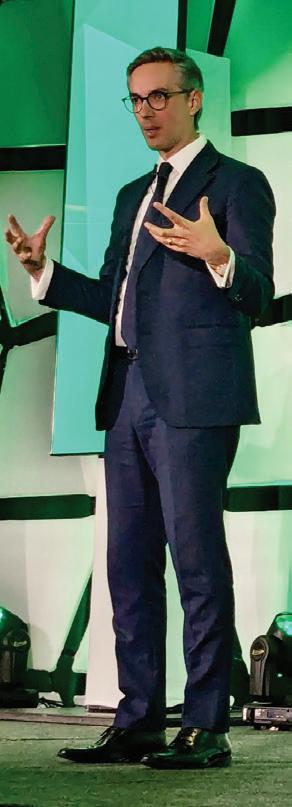
Brazilian iron ore giant Vale (NYSE: VALE) is targeting a doubling of copper output over the next decade as part of a plan to expand its footprint in three main commodities, CEO Gustavo Pimenta said.
Vale produced 382,000 tonnes of copper last year, its highest level since 2018, and the company has the potential to double that amount, Pimenta said March 1 at the convention. Record fourth-quarter production at the Salobo mine in Brazil’s northern Para state helped overall copper output rise 6% in the fourth quarter, Vale said in January.
“In copper we have an enormous opportunity to grow,” Pimenta said during a keynote address. “We can double – if not more [last year’s production] – because we have the endowment, the infrastructure and the capital intensity of Vale to bring projects online, [which] is very competitive.”
Central to Vale’s strategy is the $12 billion Novo Carajas program, which aims to accelerate copper production at its Brazilian operations and optimize iron ore output. The program includes investments in technology, safety and maintenance in the country’s mineral-rich Carajas region.
“If I can double the size the copper business in Carajas with 20% capital intensity, that’s where my money should be,” said Pimenta, who joined Vale in 2021 as chief financial officer before being promoted to his current position.
Historical mistake
Vale plans to stick to its three main commodities – iron ore, copper and nickel – because previous efforts to diversify proved disappointing, Pimenta said. In addition to being the world’s biggest iron ore miner, Vale is the Western hemisphere’s largest producer of nickel.
“We are a big company so I’m not shutting the door [on expanding into other commodities] but I’m really focused on what we’re good at,” he said. “One of our mistakes historically was to go into commodities where we just didn’t know how to operate, in places that we didn’t know how to operate.”
“Today we have the ideal portfolio.”
This means that adding operations in new countries is probably off the table, Pimenta said.
“Today I would rather focus on the markets where we have operations – Canada, Indonesia and Brazil. That’s probably where we are going to be more successful,” he said. “In Brazil we have the regu-
latory framework, the endowment which makes the chances of not succeeding small. We can grow the investments in a better way.”
Miners such as Vale are riding the wave of a global demand boom that’s expected to stretch well into the next decade. Iron ore demand is projected to rise 35% to 302 million tonnes a year by 2035 while copper demand climbs 26% to 33.7 million tonnes annually, data compiled by Vale show.
Other metals should do even better. Lithium demand is projected to surge 168% to 3.19 million tonnes a year by 2035 while graphite demand is to jump 162% to 14.3 million tonnes and rare earths demand by 56% to 153,000 tonnes, the figures show.
“When we look into the future, the need for what we do is going to be substantially bigger. We have to increase the supply of minerals in general by a factor of five or six times,” Pimenta said. “There is no energy transition without mining.”
Iron ore, Vale‘s oldest business line, is central to the company’s future, Pimenta insisted. After producing 336 million tonnes of the metal in 2025, Vale is targeting 360 million
tonnes by 2030, the CEO said.
“We think iron has immense potential. Iron ore will continue to grow as the population grows.”
While Chinese demand has probably peaked, other countries are ready to pick up the slack, Pimenta said. During a trip to India last month, the CEO said he was struck by the amount of new infrastructure that will need to be built in the country.
“We’re not as negative in the iron ore market as many analysts. Iron ore is the foundation of what we do in infrastructure and manufacturing,” Pimenta said.
“Yes, China has probably plateaued, but Taiwan is growing 10% year over year, as is India. So in general, the demand for iron ore continues to be very solid.”
Supply constraints should also support prices. Rio Tinto’s (ASX, LSE, NYSE: RIO) new Simandou mine in Guinea won’t be enough to make up for resource depletion at older operations, Pimenta argues.
“Yes, Simandou is there but the depletion is immense,” he said. “The mines are getting older. It’s more expensive to develop. When we model, we continue to be a long-term believer in the long-term fundamentals of the iron ore market.” TNM
BY NORTHERN MINER STAFF
Gold miners are facing mounting pressure to improve recoveries and reduce processing risk, yet many projects still rely on methods that can take days to extract metal and leave arsenic and other contaminants in tailings streams.
Dundee Sustainable Technologies (CSE: DST) is offering an alternative. The Thetford Mines, Que.-based company has developed two cyanide-free hydrometallurgical processes: the Chlorination Leach in a Vat Reactor (CLEVR) process for gold extraction and GlassLock for arsenic stabilization.
The technologies shorten leach times to under an hour and reduce contaminant discharge to tailings. “I’m always amazed that in our industry we have the patience to wait 36 or 48 hours for the gold leaching reaction to occur,” said Jean-Philippe Mai, CEO of DST.
Operational complexity has overtaken environmental, social and governance concerns as the mining sector’s top risk heading into 2026, according to an EY survey of 500 senior executives, a shift that puts pressure squarely on processing efficiency. A Barclays analysis of 250 mines found that nature-related risks could cut earnings by 25% over five years, underscoring the financial consequence of getting processing decisions wrong.
In February, Glencore (LSE: GLEN) suspended all investments at its Horne smelter in Rouyn-Noranda after failing to reach a regulatory agreement with Quebec over arsenic emissions, a concrete illustration of what unresolved contaminant management can cost an operation. Mai said the pressures facing the industry have created an opening for processing alternatives that can deliver faster recoveries and cleaner contaminant management alongside existing methods.
Novel approach
Rather than cyanide, CLEVR uses a sodium hypochlorite and hypobromite solution to dissolve gold, recovering it in about two hours compared with 36 to 48 hours for conventional leaching, and far shorter than heap leaching operations that can run for months. The process operates in a closed loop, recycling all reagents within the circuit and eliminating the need for tailings ponds and reducing environmental liability. Gold extraction yields exceed 95%, and solid residues are inert, stable and non-acid generating.
Because the process works faster, a smaller plant is needed to handle the same tonnage, which Mai said translates directly into lower construction and capital costs.
“Being efficient, utilizing a short contact time to achieve excellent gold recoveries — that’s very important to us,” Mai said. “Smaller processing means reduced footprint, reduced costs.”
GlassLock addresses a separate but related challenge. The process stabilizes arsenic by incorporating it into a glass matrix using commonly available reagents, producing a dense, stable glass solid that can contain up to 20% arsenic and won’t break down or leach into surrounding soil and water over time. The technology meets U.S. Environmental Protection Agency toxicity leaching standards and can stabilize arsenic for under $1,000 (C$1,370) per tonne.
In testing on Revival Gold’s (TSXV: RVG) Beartrack-Arnett project in Idaho, GlassLock boosted concentrate gold grade by 31% and cut arsenic content by 99% with minimal gold loss, results Mai said demonstrate the process’s ability to unlock value from deposits that conventional processing struggles to handle cleanly.
“No two projects are the same,” Mai said. “It’s always important to have these discussions with project owners and developers to see how and where we can
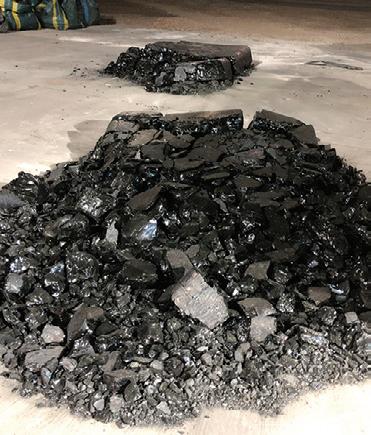
Stabilized arsenical glass using DST’s GlassLock Process. DUNDEE SUSTAINABLE TECHNOLOGIES
add value to their operation and to their flowsheet.”
Built for scale
Both processes are designed to handle a wide range of material types. CLEVR has been tested on oxide ores and sulphide concentrates from projects in Eastern Europe and South America, while GlassLock can treat arsenic in solid concentrates, pregnant leach solutions and legacy waste streams, giving operators flexibility to apply the technology at different stages of a project’s life.
Scale is equally flexible, Mai said. DST has designed CLEVR circuits capable of processing more than 10,000 tonnes per day for large open pit operations, while the modular nature of the system means it can be scaled down for smaller projects without losing efficiency. “There’s really no limit to the scale as to how the process can apply,” Mai said.
The company operates an industrial demonstration plant in Thetford Mines that gives clients and partners a chance to see the technology running on commercialscale equipment before committing to implementation.
“When people come here, they see the scale,” Mai said. “This is not something that is operated with equipment that is not utilized in the industry at a commercial scale.”
Site-specific variables, including power costs, labour availability and reagent delivery, ultimately determine where the economics work best. DST works with project developers to model those
“We’ve done the heavy lifting. We’ve gone through a lot of the troubleshooting and have accumulated a lot of operational data on how our processes apply to different types of ore.”
— JEAN-PHILIPPE MAI , CEO, DUNDEE SUSTAINABLE TECHNOLOGIES
parameters before recommending a flowsheet, and Mai notes that those variables shift considerably depending on whether a project is in central Africa, South America or North America.
Mining companies have a responsibility to integrate efficiently with the communities surrounding their operations, Mai said, and smaller processing facilities make that easier.
DST has spent more than a decade moving its processes from laboratory concept to industrial demonstration, accumulating operational data across a range of ore types and geographies. That body of work, Mai said, is what separates DST from earlierstage technology developers and gives the company the technical credibility to compete for a place in project flowsheets.
“Bringing new metallurgical processes to the industry is a very difficult task,” Mai said. “Mining is a capital-intensive business with long lead times.”
A growing base of repeat customers, some on their second, third or fourth implementation with DST, points to deepening commercial relationships across the company’s client base. Where developers once came to DST after encountering permitting or metallurgical hurdles, Mai said early-stage engagement has increased significantly, with more projects seeking process data before committing to a flowsheet.
DST is advancing implementation with a tier-one gold producer, with several other projects moving into detailed engineering.
Mai said the pipeline reflects growing industry recognition that early processing decisions can determine whether a project gets permitted, financed and built. “We’ve done the heavy lifting,” Mai said. “We’ve gone through a lot of the troubleshooting and have accumulated a lot of operational data on how our processes apply to different types of ore.”
Doing the homework
For Mai, the bigger challenge is not proving that the technology works. It is getting project developers to look beyond the processing routes that have defined gold metallurgy for decades. Cyanide leaching accounts for roughly 80 per cent of global gold production, a dominance built on decades of reliable performance but one that leaves little room for the faster kinetics and contaminant management that regulators and communities increasingly demand.
Boutique firms like DST sit outside the default circuit of commercial laboratories and established engineering consultants, which means developers need to actively seek them out.
“People spend a lot of time and money exploring, promoting and developing, and when it comes to processing, sometimes it’s a bit of a given,” Mai said. “You send it to SGS, you do a bottle roll test, and you do cyanide because that’s the only test offered at any commercial lab.”
Mai said that the dynamic is slowly changing as more project results become public and engineers increasingly become familiar with DST’s processes, but the onus remains on developers to look beyond the standard toolkit.
“If your engineering firm doesn’t know about us, they might not recommend it,” Mai said. “It’s important for project owners to do their due diligence — be curious and look at what is available.”
The company encourages developers to submit ore samples for testing at its Thetford Mines demonstration plant, where DST can generate the process data needed to evaluate whether CLEVR or GlassLock fits a given project’s flowsheet.
“It’s important to note, we are miners. We come from the mining sector, and we side with miners. We’re not trying to confront traditional routes, we’re just trying to be a tool, an option — to be supportive of a change towards efficiency.”
The preceding Joint Venture Article is PROMOTED CONTENT sponsored by Dundee Sustainable Technolgoies and produced in co-operation with The Northern Miner. Visit: www.dundeetechnologies. com for more information.
BY BLAIR MCBRIDE
Ontario plans to start building all-season roads to the hyped Ring of Fire critical metals hotspot in June for a late 2030 opening target, though it’s not clear that local mines would open any sooner.
The plan for the 451 km of roads and associated infrastructure, estimated several years ago to cost at least $2 billion, speeds up the timeline by as much as five years. The province has been playing up the Ring of Fire’s potential in government advertising over the past year although the remote region has few advanced projects and little if any infrastructure.
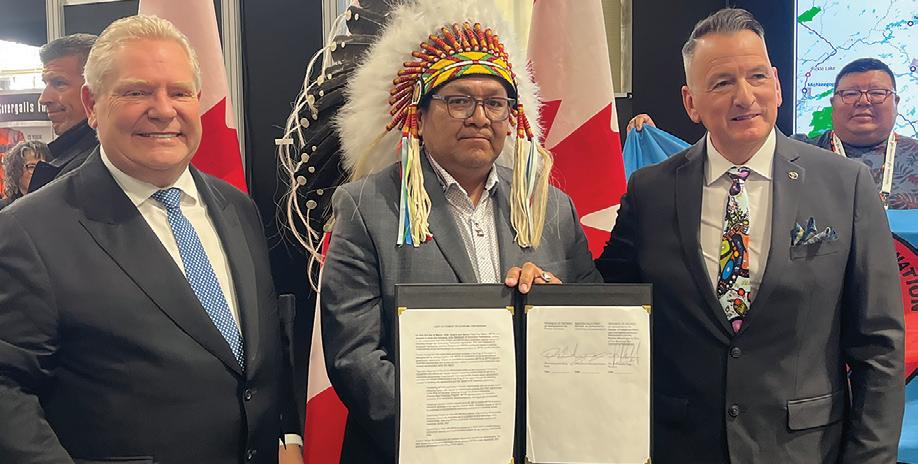
“Let’s even accelerate it more,” Premier Doug Ford told reporters on March 2 at the convention, as two hecklers querying unrelated water issues at the Grassy Narrows First Nation tried to interrupt his speech, before security hustled them away.
“The quicker we do it, the more opportunities that come, and more economic development for our friends in the First Nations and everyone else in the province. Seizing this opportunity would not be possible without our Indigenous partners.”
The announcement comes as the province pivots its mining strategy by 2027 to defence industries instead of electric vehicles after several battery plant projects stalled. Mining projects closer to completion than anything in the Ring of Fire area include Frontier Lithium’s (TSXV: FL; US-OTC: LITOF)
$943-million capex PAK, Canada
Nickel’s (TSXV: CNC; US-OTC: CNIKF) Crawford, and Kinross Gold’s (TSX: K; NYSE: KGC)
Great Bear as part of the province’s one project, one approval process to streamline permitting.
Roads gain momentum
While Ford didn’t directly address the Ring of Fire roads cost, Ontario is urging the federal government to match or exceed the province’s $1-billion investment in the region’s infrastructure and help speed up permits for roads in the region, it said in a separate news release.
“We haven’t had an official signing yet, but I’m very, very confident that they’re going to be there with us hopefully sooner than later, hopefully over the next month or so,”
BY BLAIR MCBRIDE AND HENRY LAZENBY
Western countries must focus on developing more secure sources of uranium as the market heads towards a supply crunch in a decade, while trade restrictions could swing uranium prices sharper, experts said at PDAC.
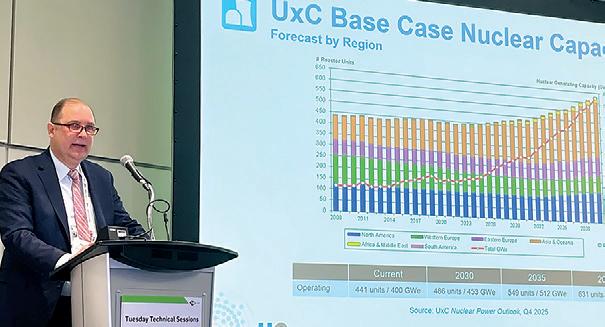
The uranium market should remain broadly balanced through 2030 before shifting into deficit, with global utilities facing more than 2 billion lb. of uncovered requirements by 2040 as new reactor builds lift demand, according to UxC, a U.S.-based nuclear fuel research firm.
“There’s a pretty big supply gap certainly in the mid 2030s,” UxC Executive Vice-President Nicolas Carter said March 3 on the Reviving the Uranium Life Cycle panel. “What’s going to fill that gap?” Carter outlined several headwinds expected to constrain supply by 2040, including a lack of new mines, geopolitical risk, and tightening regulations and trade barriers. Those factors, along with fragmenting supply chains and AI-driven power demand tightening electricity markets, will push uranium into shorter price cycles with greater volatility, according to TradeTech, a Denver, Colo.-based
Ford said.
The Ring of Fire, about 540 km north of Thunder Bay, holds vast reserves of chromite, nickel and copper, for which several companies have been exploring. But only Wyloo Metals’ Eagle’s Nest project is considered advanced, and the remote swampy region lacks roads and power links. Wyloo is owned by Australian tycoon and former Fortescue Metals Group (ASX: FMG) CEO Andrew Forrest.
Marten Falls is about 140 km southeast of the Ring of Fire while Webequie is about 70 km west of the proposed mines area. A road from the Webequie community would run east towards the Ring of Fire and connect with the Northern Road Link, which is meant to join southern roads with the Mar-
ten Falls Community Access Road.
Road timelines
Under the new timelines, construction of the Webequie Supply Road is to start in June and be open to traffic by November 2030, four years ahead of schedule, while the Marten Falls road is targeted to start construction this August and open by November 2031, four years ahead of schedule. The Northern Road Link build is scheduled to start in the spring of 2028 and open by November 2031, five years ahead of schedule.
The premier outlined economic agreements with the Marten Falls and Webequie First Nations valued at $2.5 million and equity opportunities for an airstrip and aggregate businesses.
“[The agreement comprises] community infrastructure, environment, the economy – areas where we need to move forward and improve the quality of life for our communities,” Marten Falls Chief Bruce Achneepineskum said. “Our people can’t wait. Eighty per cent of our people are on Ontario Works [social assistance]. That’s unacceptable.”
Mine timelines uncertain
Asked by The Northern Miner how the accelerated road timeline would impact schedules for constructing mines in the Ring of Fire, Ontario Energy and Mines Minister Stephen Lecce said “the gamechanger of the deal” is the infrastructure advancement, though he said he can’t speak for companies or investors in the Ring of Fire.
“We have a plan to build the roads ahead of schedule,” he said. “We have a plan that has already reduced the permit timelines for large-scale investors within the Ring of Fire and across Ontario. No longer is this a pipe dream. This is literally the infrastructure, the vision that’s coming to life as we speak.” Marten Falls, Webequie and the Aroland First Nation at the south end of the region are the only Indigenous communities that have signed formal agreements on infrastructure related to the Ring of Fire. About a dozen other First Nations have reached partnership agreements on assessments with the federal government for the Ring of Fire, while several other First Nations are firmly opposed to developing mines in the region. TNM
nuclear fuel consultant.
“Our market is going to experience accelerated price cycles going forward,” TradeTech President Treva Klingbiel said March 1 during a separate commodities session at PDAC. “We need capital to develop new production in order to bridge the supply deficit.”
Permitting times TradeTech’s uranium spot price touched $100 per lb. in March, before easing to $85, one of only a handful of times the benchmark has reached triple digits since the firm began publishing uranium prices in the late 1960s. The longterm price stands at $90, after rising more than fivefold from a $17.75 low in 2016.
But higher prices alone won’t fix a widening supply-demand gap because new mines take years to permit, finance and build, Klingbiel said. Utilities and governments are also shifting procurement to favour “friendly” supply, adding a policy premium to contracting decisions and putting a tighter focus on where future pounds will come from.
To be sure, some new mines anticipated to begin production in the coming years – such as Denison Mines’ (TSX: DML) Phoenix project in Saskatchewan and Bannerman Energy’s (ASX:BMN; US-OTC: BNNLF) Etango project in Namibia – could bring more supply onto the market, Carter said.
And leading suppliers are enjoying good trade. Kazakhstan’s Kaza-
tomprom (LSE: KAP), the world’s top uranium producer, announced plans in February to sell a large amount to India. Canada’s biggest producer, Cameco (TSX: CCO; NYSE: CCJ), signed a C$2.6-billion supply deal with the Asian country in early March.
Geopolitical headwinds
The geopolitical risks Carter identified include the Niger military government’s seizure in 2024 of Orano’s Somaïr mine and uncertainty over Orano’s Zuuvch Ovoo project in Mongolia.
Zuuvch Ovoo, which the French miner says could produce 2,500 tonnes of uranium annually over a 30-year life, “could be a really good project,” Carter said. “But they’ve got the political risk there of Mongolia, a lot of instability within that country.”
New regulations include Kazakhstan’s subsoil use code amendments, which the government introduced in December. They could tighten control of foreign interests in uranium exploration and production, posing another risk for global output.
“It’s really about developing projects in more friendly nations, whether it be Canada or the U.S.,” he said in response to questions from The Northern Miner. “Perhaps more development in some
of the South American countries. I think Namibia is still a big bright spot in terms of development.”
Investment needed
Identified recoverable uranium resources are about 7.9 million tonnes as of Jan. 1, 2023, according to the latest “Red Book” uranium report by the Organization for Economic Co-operation and Development’s Nuclear Energy Agency and the International Atomic Energy Agency.
Sustained investment is needed to support higher-growth nuclear scenarios, Klingbiel said. Exploration spending has started to rise again after years of stagnation, but not fast enough to erase a structural deficit.
On supply, Klingbiel said the key trends are industry concentration –a small group of miners dominating global output – and geopolitical moves that limit access to certain sources of uranium and enrichment services. Dozens of emerging producers are advancing projects towards final investment decisions, but timelines remain the market’s weak link, Klingbiel said.
“It takes a long time to bring a uranium mine into production,” she said. “Those capital requirements and long lead times require a level of certainty that only long-term contracting and targeted investment can provide.” TNM
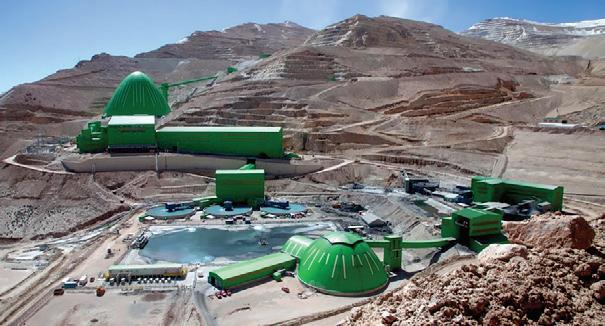
BY FRÉDÉRIC TOMESCO
Lundin Mining (TSX: LUN)
agreed to pay $215 million (C$292 million) to boost its majority stake in Chile’s Caserones copper mine and acquire a piece of the nearby Los Helados copper-gold project, strengthening its foothold in the emerging Vicuña mining district.
Vancouver-based Lundin will buy an additional 5% interest in SCM Minera Lumina Copper Chile, which owns Caserones, as well as a 31% stake in the Los Helados copper-gold deposit and a 0.62% net smelter return royalty on the project from JX Advanced Metals, according to a March 10 statement. Completion of the deal is expected in April.
The acquisition reinforces Lundin’s copper-focused growth strategy and expands its position in a district emerging as one of the largest new copper camps in the Andes. It will also boost the company’s 2026 attributable copper production by up to 7,000 tonnes, generating immediate free cash flow, Lundin said.
“Overall, we view the announcement as slightly positive given the attractive acquisition price and potential synergies,” TD Cowen mining analyst Craig Hutchison said in a note after the announcement.
Located in Chile’s Atacama region, Caserones is an open-pit operation producing copper and molybdenum concentrates, along with copper cathode. The mine produced 132,881 tonnes of copper in 2025 at a cash cost of $2.17 per lb.
Following completion of the deal, Lundin’s ownership of Caserones will rise to 75%. The company first bought a 51% stake in the operation in 2023 and raised it to 70% in 2024.
TD Cowen values Lundin’s 70% ownership of Caserones at about C$2.5 billion ($1.8 billion). This implies a valuation of about C$180 million for the incremental 5% stake.
Possible synergies include scenarios to potentially truck higher-grade Los Helados ore to the Caserones plant, offsetting lower-grade ore, Lundin said.
High-grade breccia
Los Helados sits about 17 km south of Caserones and about 10 km north of the Vicuna district. It’s majority owned and operated by NGEx Minerals (TSX: NGEX; US-OTC: NGXXF), which has a 69% stake.
The property is separate from the Vicuña copper-gold-silver joint venture between Lundin and BHP (ASX, LSE, NYSE: BHP), which straddles the ArgentinaChile border.
Los Helados contains a highgrade breccia core with multiple mineralized zones. It hosts 2.1 billion indicated tonnes grading 0.4% copper, 0.15 grams gold per tonne and 1.5 grams silver for contained metal of 8.3 million tonnes of copper, 10.2 million oz. of gold and 97.5 million oz. of silver, according to a 2023 resource.
Inferred resources stand at 1.1 billion tonnes grading 0.34% copper, 0.1 gram gold and 1.4 grams silver for contained metal of 3.7 million tonnes of copper, 3.6 million oz. of gold and 50.2 million oz. of silver. TNM
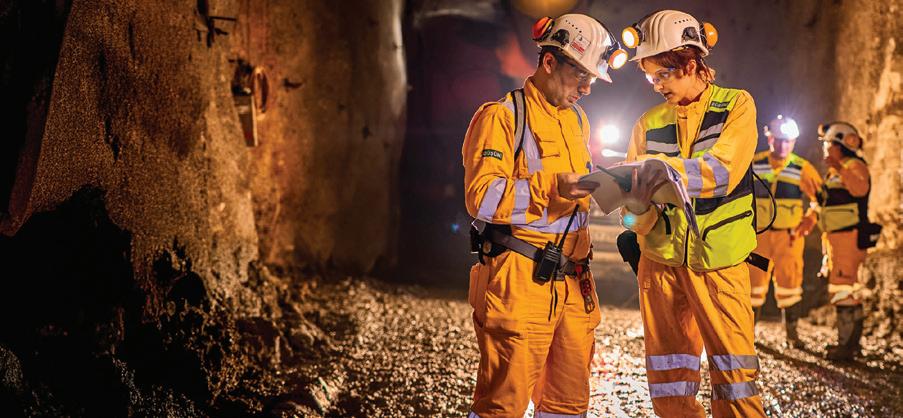
BY MINING.COM STAFF
First Quantum Minerals (TSX: FM) is selling its Çayeli mine in Turkey to a company controlled by Cengiz Holding as the Canadian miner raises additional capital for its priority assets. Istanbul-based Cengiz Insaat will buy the copper-zinc underground mine for $340 million (C$462 million) cash, including an advance payment of $50 million, First Quantum said March 12. The deal is expected to close during this year’s second or third quarter.
The transaction reflects “the company’s disciplined approach to portfolio management” as it
focuses on core strategic priorities such as a restart of the Cobre Panama operation, CEO Tristan Pascall said in a statement.
Cengiz Holding, one of Turkey’s largest industrial conglomerates, has been aggressively expanding its mining portfolio. Earlier in March, the group made its biggest move to date with the $1.5 billion acquisition of the Copler gold mine from SSR Mining (TSX, Nasdaq: SSRM).
Black Sea Situated on the Black Sea coast of northeastern Turkey, Çayeli has been in operation since 1994. It produces copper and zinc concentrates from a volcanic hosted massive sulphide deposit, with a
reserve base that is expected to last until 2036.
Çayeli represents First Quantum’s second recent asset sale. In December, it sold the past-producing Cobre Las Cruces mine in Spain for $190 million.
In a note after the March 12 deal, UBS mining analyst Myles Allsop upgraded the stock to a ‘Buy’ from ‘Neutral’ with a price target of C$50, up from C$38.
First Quantum shares initially rose after the Çayeli sale, but they’ve fallen 20% this year to C$29.79 near press time as the Iran war pummelled metal prices and mining stocks. The company has a market capitalization of C$24.9 billion. TNM
GOLD | Low cost but local opposition
BY COLIN MCCLELLAND
Mineros (TSX: MSA) is buying AngloGold Ashanti’s (NYSE: AU) shelved La Colosa gold project in Colombia, taking control of one of the country’s largest undeveloped deposits for an upfront payment of just $10 million (C$13.6 million).
The Medellín-based miner will pay up to another $60 million in milestone payments tied largely to environmental permitting, Mineros said March 9. The deal transfers ownership of AngloGold Ashanti Colombia, which holds the concession over the exploration-stage project in Cajamarca, about 150 km west of Bogotá.
La Colosa hosts 833 million indicated tonnes grading 0.87 gram gold per tonne for 23.4 million oz. contained metal and 218 million inferred tonnes grading 0.71 gram gold for 5 million oz., based on AngloGold Ashanti’s most recent estimate in December 2024.
The project has been largely dormant since 2017, when community opposition led to a Cajamarca referendum rejecting large-scale mining and forcing AngloGold to halt exploration. But Red Cloud Securities mining analyst Alina Islam called the acquisition “a modestly positive step,” noting Mineros is gaining exposure to a
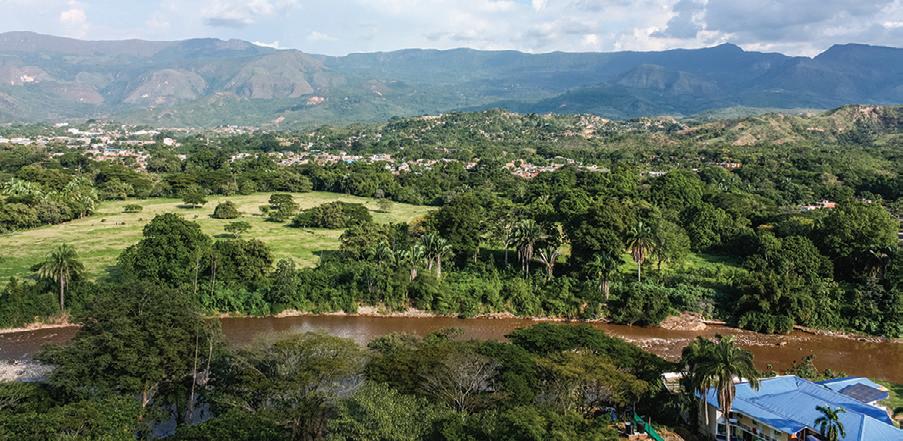
giant gold system while limiting risk because most of the purchase price depends on future permits.
Beats other deals
“The company is already a large and respected operator in the country and is well-positioned to navigate social and environmental challenges, given the relationships it has already established,” Islam said in a note on March 10.
“We see this as an efficient way to deploy capital, as the company has acquired one of the largest undeveloped gold projects in Colombia for just $2.50 per ounce.”
That’s far below the roughly
$19-per-oz. average for recent Latin American gold project transactions, according to Red Cloud. Those include Mineros’ 2025 acquisition of the La Pepa project in Chile, the 2023 consolidation of the Soto Norte project by Aris Mining (TSX: ARIS; NYSE: ARMN) and Barrick Mining’s (TSX: ABX; NYSE: B) 2024 sale of the Alturas project in Chile.
Mineros said it plans to rebuild trust with local communities and authorities before advancing the asset. The company is considering a new name to distance the project from the controversial original proposal of a large open pit mine
using cyanide processing. Environmental concerns saw 98% of locals oppose the development in a municipal vote nine years ago. AngloGold discovered the La Colosa porphyry-style system in 2006 within Colombia’s Middle Cauca metallogenic belt.
Re-domiciling?
Shares in Mineros gained 2.2% in Toronto to C$6.04 apiece on the deal. But near press time they showed a 16% fall this year to C$4.60 for a market capitalization of C$1.36 billion, which could be
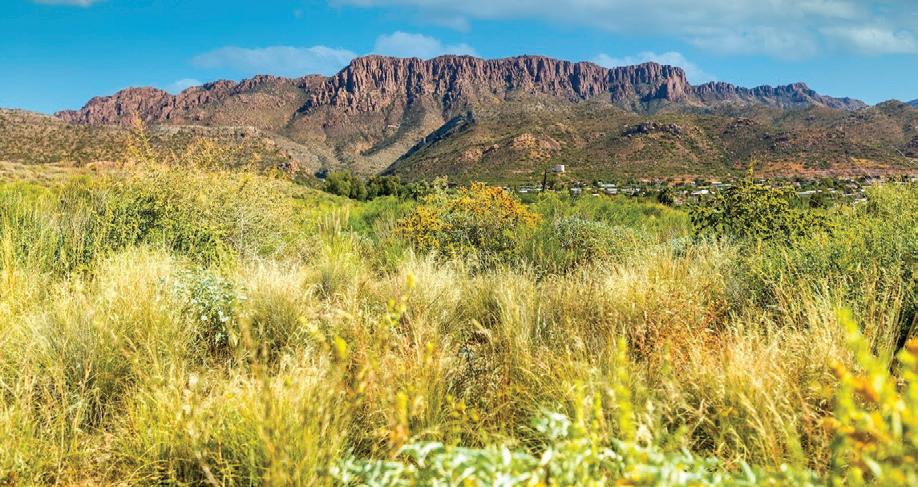
BY COLIN MCCLELLAND
Rio Tinto (LSE, NYSE, ASX: RIO) has secured control of land in Arizona needed to advance its Resolution Copper project after U.S. authorities completed a long-contested land exchange, marking a turning point in one of the country’s most closely watched mining disputes.
The U.S. Forest Service finalized the swap, transferring about 2,400 acres (970 hectares) the miner says may hold more than 18 million tonnes of copper to the Rio Tinto–BHP (LSE, NYSE, ASX: BHP) 55-45% joint venture, according to federal and company statements in mid-March. The Forest Service gets roughly 5,400 acres elsewhere in the state in the trade.
The move follows repeated court rulings rejecting efforts by the San Carlos Apache and advocacy groups to block the transfer on religious grounds tied to Oak Flat, a site considered sacred for generations. The project aligns with Washington’s efforts to secure domestic supplies of critical minerals for energy and defence.
“Completing this land exchange unlocks a major domestic source of copper, essential for defence, grid modernization, and next-gen-
eration energy,” U.S. Agriculture
Secretary Brooke Rollins, who oversees the Forest Service, said in a statement. “This responsible mining project fulfills President Trump’s vision of American mineral independence.”
Significant share
Resolution is among the largest undeveloped copper deposits globally and could supply a significant share of U.S. demand for decades. The partners have already spent more than $2 billion on exploration, engineering and permitting, but have yet to produce metal.
Rio Tinto said it will now begin a $500-million drilling program to further define the orebody and support future development decisions.
The dispute has become a flashpoint for how miners, governments and Indigenous groups navigate competing priorities as demand for critical minerals accelerates. Legal experts said the case could reshape how future projects are negotiated on contested lands in the U.S. Southwest and beyond.
The land exchange traces back to legislation passed by Congress in 2014, but has been delayed for years by legal challenges from Apache Stronghold and others, who argue
the mine would destroy a sacred site used for ceremonies.
Lower courts, including the Ninth Circuit Court of Appeals, have consistently sided with the federal government and the companies, narrowing the scope for religious protections to halt development on federal land.
Supreme Court Opponents have said the project would irreparably damage Oak Flat, known as Chi’chil Biłdagoteel, where Apache communities hold comingof-age ceremonies. Multiple appeals failed to stop the transfer, and the U.S. Supreme Court declined to intervene, effectively clearing the way for the exchange to proceed.
BHP said the mine could generate thousands of jobs and billions of dollars in economic activity across the United States, while Rio noted how the land swap helps advance a key development.
“Completing the land exchange is a significant milestone and another positive step forward for the Resolution Copper project,” Rio Tinto’s copper chief Katie Jackson said in a company release. “As demand for copper continues to grow, projects like Resolution can play an important role in strengthening domestic supply chains.” TNM
BY FRÉDÉRIC TOMESCO
Royal Road Minerals (TSXV: RYR) said recent drilling at its Guintar-Aleman-Margaritas gold-silver-copper project in Colombia suggests the deposit could support a bulk-tonnage underground mine.
Hole GUI-DD-028 cut 76 metres of 2.1 grams gold per tonne, 0.4% copper and 7.9 grams silver from 45 metres depth, Royal Road said last month. The hole is one of four that the company is drilling this year as part of a 2,500-metre exploration campaign, its first since 2022.
“These drill results, combined with the reprocessing of historical data using mining-constrained cut-offs and a reinterpretation of the geology, have significantly improved our understanding of the scale and geometry of mineralization at Guintar,” CEO Tim Coughlin said in a statement.
Drilling is defining a porphyry-skarn system extending from surface over an area larger than 2 sq. km and down to more than 500 metres, with steeply dipping, high-grade quartz-carbonate veins that enhance the overall grade profile, Coughlin added.
“This combination of broad, continuous mineralization and higher-grade overprinting structures is consistent with a bulk-tonnage underground mining scenario of meaningful scale.”
In addition to Colombia, Royal Road is advancing development projects in Morocco and Saudi Arabia. It acquired Guintar and Margaritas from AngloGold Ashanti (NYSE: AU) in 2019 as part of a country-wide licence package.
Antioquia region
Located about 50 km east of Medellin, Guintar hosts gold-copper-silver porphyry-skarn and sheeted-vein gold systems with a combined surface footprint of more than 8 sq. km. The surround-
GOLD | Allows Camino Rojo underground
Orla Mining (TSX: OLA; NYSE: ORLA) said last month it’s received the environmental impact assessment (EIA) from Mexico’s Secretariat of Environment and Natural Resources for its Camino Rojo goldsilver-zinc mine in Zacatecas state.
The decision means Orla now has all the permits necessary, including the Change of Land Use approval, to mine the remainder of the oxide open pit, including the layback area, and to begin construction of an underground exploration decline to advance the Camino Rojo underground project.
Receipt of the EIA represents
a “major milestone” for Orla, TD Securities analyst Wayne Lam said March 19 in a note.
“We view this as a significant, long-awaited catalyst that had impacted operations over the past few years, and now de-risks any prior potential for an impending shutdown beyond 2027,” he said.
The award also heralds “signs of positive change on the permitting front for mining operations in Mexico following significant regulatory delays” under the administration of former president Andres Manuel Lopez Obrador, Lam added.
Pit-wall slide
Building an underground operation below the existing Camino
Rojo open pit would generate a net present value (NPV) of $1.3 billion (C$1.8 billion) and a 30% internal rate of return (IRR) at $3,100 per oz. gold over 17 years, Orla said in February.
If a $5,000-per-oz. gold assumption were used, the NPV would jump to $3.3 billion and the IRR to 61%. Initial capital required for this project is pegged at $608 million, while sustaining capital over the life of mine is estimated at $489 million, the company said.
Average annual gold production over the first 10 years is projected to be 215,000 oz., with an expected average all-in sustaining cost of $1,304 per payable oz. of gold. The underground mining operation would be supported by
In addition to Colombia, Royal Road is advancing development projects in Morocco and Saudi Arabia.
ing Antioquia region hosts several producing gold operations and advanced-stage exploration projects.
Other results released last month included hole GUI-DD-031, which hit skarn-style mineralization and cut 15 metres of 1 gram gold, 0.6% copper and 11.3 grams silver from 130 metres depth. Mineralization, which was continuous from surface to end-of-hole over 193.7 metres, remains open at depth.
Royal Road began drilling at Guintar in 2021 before halting work to focus on advancing regulatory and permitting processes. Drilling resumed two months ago. AngloGold and Royal Road had previously drilled 43 diamond holes totalling 13,700 metres, with more than half of holes ending in grade, the company says. Royal Road says it’s the largest title holder in Colombia, with over 1,800 sq. km of combined mining concessions and applications. TNM
its own crushing, grinding, and flotation circuits producing saleable concentrates.
Camino Rojo produced 96,764 oz. of gold in 2025 – despite a July pit-wall slide that occurred along the temporary north wall of the mine’s open pit. Camino Rojo is located about 620 km northwest of Mexico City.
Orla also said it has filed an updated technical report for the property, and that the EIA grants it full authorization to complete the oxide open pit as outlined in the newly filed technical report. This includes the layback to the north and the east-west expansion, as well as extensions to the waste
rock and low-grade stockpiles and associated infrastructure, it said.
The EIA also authorizes the development of underground access works, including an exploration portal and decline, with work expected to begin as early as the second half of 2026.
This will enable further resource definition and technical evaluation of the sulphide mineralization beneath the current open pit, a next step toward a potential transition to underground mining at Camino Rojo.
Orla shares traded for C$19.13 apiece near press time in Toronto, up 3% this year to date, for a market capitalization of C$6.6 billion. The stock has traded in a 12-month range of C$10.43 to C$29.99. TNM
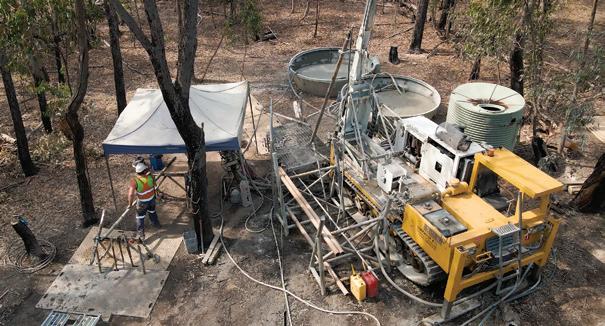
BY BLAIR MCBRIDE
Drilling at Southern Cross Gold’s (TSX: SXGC; ASX: SX2; US-OTC: SXGCF) Sunday Creek project in Australia returned the strongest gold-antimony result yet at the Apollo target. Shares rose.
Highlight hole SDDSC200 cut 17.3 metres grading 15.3 grams gold per tonne and 3.2% stibnite –which hosts antimony – from 251.1 metres depth, including 6.3 metres at 32.3 grams gold and 7% stibnite. Sunday Creek is about 60 km north of Melbourne.
“The [result] in SDDSC200 is the best composite we’ve ever recorded in the top portion of Apollo and is in an area we had not previously drilled. That’s not infill – that’s discovery,” Southern Cross CEO Michael Hudson said in a release on March 16.
“The antimony story here is equally compelling. Multiple intervals exceeded 20% antimony – very high concentrations that reflect the epizonal character of Sunday Creek
and the natural enrichment of antimony in the upper portions of the system.”
Southern Cross shares gained 8% to $9.49 apiece on March 16 in Toronto, before easing to $9.21 as press time approached, valuing the company at $2.38 billion. The stock has traded in a 12-month range of $4.61 to $11.75.
Leading Australian project Sunday Creek, among just a handful of antimony projects in Australia, stands out for its high grades of the critical metal. Antimony is essential for applications in alloys and defence technologies but global production and processing is mostly controlled by China. Sunday Creek is about 55 km southeast of Alkane Resources’ (ASX, TSX: ALK) Costerfield mine, the largest antimony-producing site in the Western world.
Washington is spending millions to help advance projects such as Perpetua Resources (Nasdaq: PPTA) Stibnite in Idaho, while
Southern Cross P29 >
BY HENRY LAZENBY
Benz Mining (ASX: BNZ) has made an ultra-high-grade gold discovery beneath the historical Hibernian mine at Mt Egerton in Western Australia, returning 7 metres grading 223 grams gold per tonne from the new Kilkenny zone.
The highlight is part of a wider intercept in hole 26EGN013 that assayed 11 metres at 144.2 grams gold from 270 metres downhole, Benz said March 17. The core marks a repeat of the historical Hibernian ore position at depth with scope for more stacked shoots along the same structural corridor, the company said.
“Drilling has confirmed mineralization in the predicted dilatational trap, materially derisking the company’s thesis,” SCP Resource Finance mining analysts said in a note the same day. “This is proofof-concept, not yet proof-of-scale.”
Mt Egerton, about 800 km north of Perth, marks another brownfield gold project seeking new ounces linked to an old mine, now amped up by record metal prices. Benz sees Mt Egerton as a potential high-grade satellite to its early-stage Glenburgh project, about 170 km away. Hibernian produced about 7,000 oz. between 1912 to 1924, then operated again as Pegasus from 1937 to 1953, but an exact historical production total remains unclear.
Glenburgh
Next at Glenburgh, Benz’s A $94million (C$90-million) treasury should fund more than 250,000 metres in drilling this year across
BY BLAIR MCBRIDE
Australian gold production rose 2% last year to reach 303 tonnes in 2025, the second time it has hit that milestone since 2023, according to Melbourne-based Surbiton Associates.
The 12-month total, valued at A$71 billion ($50.3 billion) was the highest in the last few years but below the 1999–2000 record of 328 tonnes. Output in the fourth quarter rose 1% quarter-over-quarter to 77 tonnes as gold prices touched historic levels, the resource analysis firm said in an early March release.
“The December quarter 2025 was one of the most memorable ever for gold, given the price rises seen in just a three-month period,” Surbiton director Sandra Close said. The gold price averaged $4,154 in the quarter and peaked at $4,549 in late December.
The latest gold data from Down Under further cements the country’s status as the third-largest yellow metal producer in the world, according to the World Gold Council. China and Russia lead all other nations, producing 380 tonnes and
330 tonnes in 2024, respectively. Australia has ranked among the top three producers of gold for at least a decade.
As geopolitical events, such as the ongoing war in the Middle East, trigger increased commodity price swings, gold producers can benefit from price protections such as put options, Close said.
Those options give producers the right to sell gold at a defined price so that if the price falls, producers can sell the gold at the exercise price in the put option. If it rises above that price, the producer can allow the options to expire and sell the yellow metal at the higher price.
“On the local scene, the gold industry is showing no signs of slowing down,” Close said. “Exploration companies seeking further funds for drilling seem to have little trouble raising money and companies seeking much larger amounts for new treatment plants or expansions to existing facilities, are also well supported.”
Gold honour roll
Several mines in Australia produced more gold in the fourth quarter than in the third. Those include AngloGold Ashanti’s (JSE: ANG;
three main camps – Hurricane, Icon and Thunderbolt, SCP Resource Finance says. Thunderbolt offers the strongest discovery potential because historical drilling there stopped at less than 100 metres depth. Drills are to push the Zone 126 deeper and step out across the Icon trend.
Glenburgh hosts a Joint Ore Reserves Committee-compliant resource from 2024 of 16.3 million tonnes grading 1 gram gold per tonne for 510,100 ounces. Mt Egerton’s initial resource stands at 280,000 tonnes grading 3.1 grams gold for 27,000 oz. of metal, according to a 2024 report.
Benz shares trading in Toronto have gained 22% this year despite falling 30% from opening at C$2.75 apiece on March 17 to C$1.92 near press time. It has a market capitalization of $626 million (A$654 million).
Historical camp
The Kilkenny discovery came from a rethink of the field’s structure rather than a simple step-out program, the company said.
“From a strategic perspective, we view Mt Egerton as a complementary high-grade satellite opportunity to Glenburgh,” CEO Mark Lynch-Staunton said in the release. “Importantly, large parts of the Mt Egerton Goldfield remain effectively untested, with more than 20 km of prospective strike identified across the district, which means the discovery potential across the district remains significant.”
Reverse circulation drilling last year and early this year targeted the geometry around Hibernian, where Benz concluded the
best mineralization formed where oblique shear zones opened space in mafic rocks within a folded gabbro sill.
That model pointed to drilling below the old mine and farther east, where mapped shears intersect the gabbro. The hit in 26EGN013, associated with quartz veining and pyrite, backed the interpretation and strengthened the case for more repeat positions along the belt.
Historical drilling, mainly from pre-Benz campaigns at Mt Egerton and re-reported by Benz in November 2024, had already shown how rich the system can run. Hibernian returned 9 metres at 107.2 grams gold, and 5 metres at 96.7 grams in earlier work.
Step out potential
Benz also sees room to grow the resource along the trend beyond Hibernian. It has outlined the Galway deposit as another repeat target on the same corridor and a second cluster about 2 km east at Mako, Gift and Trading Post.
Earlier drilling at Gift returned 17 metres at 6.8 grams gold and the company says soils, rock chips and shallow drilling it had taken point to a broader gold and basemetal system there.
Mt Egerton covers nearly 180 sq. km in the Gascoyne region and includes two granted mining leases. Benz says more than 20 km of prospective strike across the goldfield remains effectively untested and plans to drill Kilkenny extensions, test the eastern targets and continue mapping along the project’s Hibernian corridor. TNM
“The December quarter 2025 was one of the most memorable ever for gold.”
SANDRA CLOSE DIRECTOR, SURBITON
NYSE: AU) and Regis Resources’ (ASX: RRL) Tropicana mine, which booked 28,600 more oz. in the quarter, Newmont’s (NYSE, ASX: NEM) Tanami, up 23,000 oz. and New Murchison Gold’s (ASX: NMG) Crown Prince that logged 19,100 more ounces.
The country’s top producer of by-product gold was BHP’s (ASX, LSE, NYSE: BHP) Olympic Dam in South Australia. Gold output rose by 11,000 oz. in the fourth quarter, for a total of 216,000 oz. for the full year.
Australia’s top five gold mines by output last year were Newmont’s Boddington, with 565,000 oz. produced; Northern Star Resources’ (ASX: NST) Super Pit, which produced 437,894 oz.; Tropicana, with 435,977 oz.; Tanami, with 391,000 oz. and Newmont’s Cadia mine with 385,000 ounces. TNM

BY NORTHERN MINER STAFF
As the silver rush faded in the hard-rock boomtown of Cobalt, Ont., a different kind of mining story was beginning to take shape farther south.
In 1929, The Northern Miner packed up from Cobalt, where it was established in 1915, and moved its headquarters to Toronto, setting up shop at 122 Richmond St. W. – right as the city was emerging as Canada’s mining finance nerve centre .
Nearly a century later, Toronto remains the place where prospectors’ dreams meet investors’ dollars, where global mining deals are born in downtown boardrooms, and where Canada’s resource legacy continues to shape the modern world.
In the anatomy of the mining world, Toronto is the heart that pumps capital and confidence through the arteries of global exploration and development. It is here that deals are struck, juniors are born and the pulse of the sector is monitored.
From the trading floors of Bay Street to the boardrooms of global majors, the city channels billions of dollars across the globe, bringing some of the world’s most exciting mine projects to life – from gold projects in Ghana to lithium ventures in Chile, and even copper drilling right in the province of Ontario.
Because of the geographic diversity of this industry, it’s sometimes easy to overlook just how a city with a third of New York’s population can run the show far away from where actual mining takes place. In truth, no other city in the world comes close to Toronto’s blend of institutional depth, capital access and mining know-how. Every year, thousands make the journey to downtown Toronto –where the world’s largest mining conventions are held – to share insights, strike deals and shape the industry’s future.
That allure is powered by a rich financial ecosystem, drawn by its deep pools of mining capital, experienced bankers, legal and technical advisers, and a two-tier system that nurtures growth. The TSX Venture Exchange (TSXV), in particular, serves as a launchpad for junior explorers, with more than 300 companies having graduated to the larger Toronto Stock Exchange (TSX) since 2000. This structure supports miners at every stage –from greenfield drillers to full-scale producers.
Toronto’s claim to global leadership isn’t just symbolic – it’s backed by numbers. Today, nearly 40% of the world’s publicly listed mining companies trade on its two exchanges. In 2021, they raised more than C$10 billion, according to official exchange data. While the following two years were rocked by market turbulence, the two exchanges still saw roughly C$7.7 billion in capital raising, representing almost half of the global total.
In 2024, as investor appetite returned, that number once again returned to the early-decade levels – cementing Toronto’s dominance in the sector, in the present and future.
Just as Rome wasn’t built in a day,
Toronto’s rise did not just happen overnight; it was built across generations of booms, busts, and market reinvention. To understand how this city became the global capital of mining finance, we must trace its origins – back to a time when gold rushes shaped markets and a Depression-era crash shifted the country’s financial centre forever.
Toronto’s rise to prominence
Toronto’s emergence as the world’s mining capital is a story etched in speculation, ambition, and the relentless pursuit of resource wealth. In the mid-19th century, Ontario was still a young colony searching for an economic identity. When the original TSX (then known as TSE) was formally incorporated in 1861, the city had barely 45,000 residents – yet it was already brimming with ambition. Mining quickly became its most speculative and alluring sector, often fuelled more by rumour than reality. By the turn of the century, Toronto had gained a reputation as a place where fortunes could be made overnight – or vanish just as quickly. Rumoured strikes would send markets surging, only to crash in the absence of results. Promoters armed with grand claims drew eager investors to Bay Street, and as one historian noted, Toronto soon became “the focus for speculative trading in mining stocks” not only for Canadians, but also for Britons and Americans. The wealth generated from this extractive frenzy financed not only companies but also the city’s skyline, as early skyscrapers rose on the back of mining capital.
The industry’s fortunes accelerated in 1903, when silver was discovered in Cobalt, Ont. The boom transformed the town into one of the world’s richest silver sources, with its own stock exchange, its own professional hockey team and the birthplace of both Agnico Eagle Mines and The Northern Miner. Another important find in 1914, was the Croesus min, near Matheson, in Northern Ontario. At almost 6,000 ounces per ton, it was the richest mine, by grade, in Canada’s history. But feeding the boom was Toronto serving as its financial hub.
The Ontario Mines Act of 1906 – a landmark piece legislation that granted sweeping rights to stake claims on public, private, and Indigenous lands – cemented Toronto’s role as the centre of mining finance, drawing global capital into the province.
From there, cycles of boom and bust defined Toronto’s mining scene. The Standard Stock and Mining Exchange, founded in 1896 to handle the riskiest junior mining shares, thrived on these waves of excitement before merging into the TSX in 1934. That same year, U.S. President Franklin Roosevelt raised the price of gold through the Gold Reserve Act, sparking a new boom
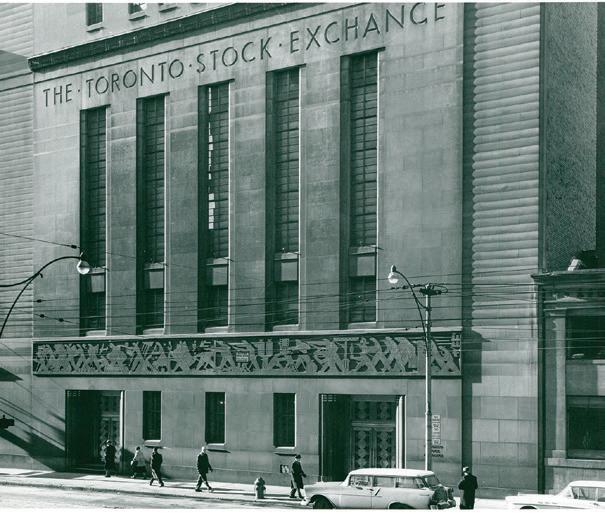
“From the trading floors of Bay Street to the boardrooms of global majors, the city channels billions of dollars across the globe, bringing some of the world’s most exciting mine projects to life.”
in Northern Ontario’s Porcupine and Kirkland Lake camps. Toronto, already home to Canada’s principal mining exchanges, overtook Montreal in trading volumes for good.
Through the 20th century, mining finance shaped not only Toronto’s economy but also its business culture. Successive governments alternated between efforts to regulate or tax the industry and resistance from mining leaders, who pushed for minimal interference and maximum speculation. This culture persisted, reinforced by innovations like tax-exempt “flow-through shares” in the 1980s that kept Toronto at the forefront of global exploration capital.
It was this mix of speculation, policy, and resource wealth that propelled Toronto from a provincial outpost into the undisputed heart of global mining finance.
Global hub
Fast-forward to modern times, Toronto is not just Canada’s mining finance hub – it’s the global epicentre.
Toronto’s financial infrastructure is uniquely built for mining. Specialized banks, law firms, and teams of analysts, , geologists and consultants all operate in a tightly interconnected ecosystem. The city’s dual-exchange structure allows junior companies to list on the TSXV and, upon reaching key milestones, graduate to the TSX – a transition more than 300 companies have made in the past two decades.
But beyond capital, Toronto is also where the world’s miners physically gather. Each spring, the city hosts the Prospectors & Developers Association of Canada (PDAC) convention – the largest mining investment conference in the world.
At its peak, PDAC draws over 30,000 delegates across 130 countries – from mining CEOs, Indigenous leaders and government ministers to financiers, geologists
regulatory burdens, and regionally focused investor bases – especially for projects in Africa and the AsiaPacific.
A recurring critique from departing companies is that Toronto’s investment landscape has grown risk-averse. Explorers with assets in frontier or emerging jurisdictions report difficulty attracting attention from Bay Street financiers unless their projects are in “safe” regions like Ontario or Quebec. Others point to Canada’s evolving disclosure standards and listing compliance costs, which can deter smaller companies operating abroad.
But 2024 brought a small yet symbolic reversal. In June, Toronto welcomed Brazil’s Bravo Mining Corp. to the TSX – the first new foreign mining listing in two years. The company’s palladium-platinum-nickel project in northern Brazil struck a chord with investors, allowing the company to successfully dual-list after its TSXV debut. The move was hailed as a “win” by TMX Group, signaling that international appetite for Torontobased financing hasn’t vanished – it just needs the right story.
and students. It is the conference halls around Front Street and the Metro Toronto Convention Centre where some of the biggest deals are brokered and the industry’s future is mapped out.
In a world increasingly driven by the energy transition and artificial intelligence, this annual pilgrimage has grown more consequential to the future economy. The 2025 PDAC drew 27,353 people from 126 countries across the globe – its largest audience in over a decade. Significant deals and announcements were delivered across the four-day gathering, with the Canadian government’s $500 million infrastructure funding serving as an exclamation point.
This all shows PDAC is more than a trade show; it is a barometer for the industry’s mood and direction. One year might focus on ESG reform and Indigenous partnerships; another might buzz with excitement over critical minerals and a gold rally – themes that would most definitely be talked about in the upcoming convention.
Not for granted
Toronto may still reign as the capital of global mining finance, but its crown has begun to tilt in recent years. As markets shift and investor appetites evolve, the city’s twotiered exchange system – long the launchpad for junior explorers and a magnet for global capital –is facing increasing competition from financial centers like Sydney, London and emerging hubs in Asia.
The pressure is particularly evident in the drop in foreign listings. According to TMX data, international mining companies are leaving the TSX and TSX-V at a steady pace. In 2023, Toronto didn’t attract a single new international mining listing – the first time that’s happened in over a decade.
Many juniors are instead flocking to the Australian Securities Exchange (ASX), drawn by strong retail investor engagement, lighter
The financings that year also tell a story. First Quantum Minerals raised a record-setting C$1.6 billion, including a C$1 billion bought deal – the largest mining equity raise in Canadian history.
On the junior side, Montage Gold pulled in C$180 million in one of the biggest early-stage financings. Meanwhile, homegrown titans like Barrick Mining and Kinross continue to anchor their operations in Toronto’s financial hub despite their major mines being offshore, underscoring the city’s role as a centre not just of capital, but of decision-making.
Still, the broader message is clear: Toronto’s supremacy can no longer be taken for granted. The ASX – seeking to “capitalize” on weaker market conditions in Canada – continues to welcome an influx of critical minerals players, kick-started by the listing of Capstone Copper and several other red metal developers. Elsewhere, London remains strong for mid-tier producers and gold explorers, though the AIM is also conceding its lustre to Sydney.
To remain competitive, the TSX is pushing regulatory modernization and aiming to sharpen its appeal to international juniors – particularly those aligned with the demands of a clean energy economy.
The mining world is entering a new era defined by critical minerals, geopolitical realignments, and ESG responsibility. Whether Toronto can continue to lead will depend not only on its storied infrastructure, but also on its ability to adapt, attract, and outpace its global rivals – just as it did more than a century ago. TNM
28-35, 25-9, 29-2, 34-1, 25-1, 30-4, 35-2, 37-12, 29-35, 24-4, 25-4, 35-29, 31-3, 29-10, 26-7, 27-3, 37-12, 29-13, 25-5, 30-7, 34-8, 32-31, 37-5, 31-2, 24-4, 29-8, 31-27, 25-1, 33-14, 35-38, 27-9, 34-29, 30-20, 26-12, 24-2, 33-8, 27-2, 32-21, 37-2, 29-24, 25-1, 27-4, 26-50, 31-14, 33-2, 34-29, 25-5, 35-10, 30-1, 37-13, 25-1, 28-5, 25-14, 33-3, 36-3, 24-5, 27-1, 25-8, 37-12, 28-1

18 Market News contents
19 Capital Raisings
20 Drill Results
21 Warrants + Shorts
22 EV Metals
24 Market Data + Mining events
*Data may not be comprehensive and is provided on a best-efforts basis as of press time. Investors are responsible for their own due diligence.
Delivering fit-for-purpose solutions across the entire project life cycle
Delivering fit-for-purpose solutions across the entire project life cycle
Delivering fit-for-purpose solutions across the entire project life cycle
Delivering fit-for-purpose solutions across the entire project life cycle
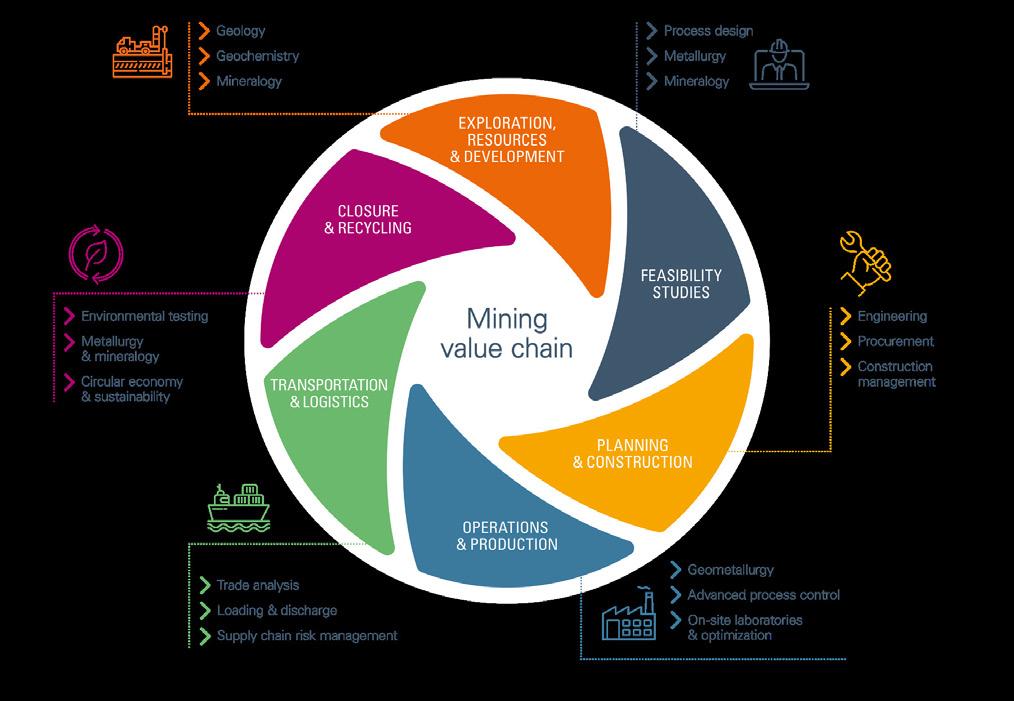
Our fit-for-purpose solutions encompass the skills of qualified geologists, geostaticians, analytical chemists, mineralogists, metallurgists, process engineers and mining engineers and inspectors brought together to provide accurate and timely mineral and process evaluation services across the entire project life cycle.
Our fit-for-purpose solutions encompass the skills of qualified geologists, geostaticians, analytical chemists, mineralogists, metallurgists, process engineers and mining engineers and inspectors brought together to provide accurate and timely mineral and process evaluation services across the entire project life cycle.
Our fit-for-purpose solutions encompass the skills of qualified geologists, geostaticians, analytical chemists, mineralogists, metallurgists, process engineers and mining engineers and inspectors brought together to provide accurate and timely mineral and process evaluation services across the entire project life cycle.
Our fit-for-purpose solutions encompass the skills of qualified geologists, geostaticians, analytical chemists, mineralogists, metallurgists, process engineers and mining engineers and inspectors brought together to provide accurate and timely mineral and process evaluation services across the entire project life cycle.
WWW.SGS.COM/NATURALRESOURCES NAM.NATURALRESOURCES@SGS.COM
WWW.SGS.COM/NATURALRESOURCES NAM.NATURALRESOURCES@SGS.COM
WWW.SGS.COM/NATURALRESOURCES NAM.NATURALRESOURCES@SGS.COM
WWW.SGS.COM/NATURALRESOURCES NAM.NATURALRESOURCES@SGS.COM

Week of March 13-20, 2026
By Henry Lazenby
Markets grappled with Iran-driven oil and inflation fears during the March 13-20 trading week as investors weighed tougher central-bank policy against a still-resilient growth outlook.
U.S. markets closed lower. The Dow Jones Industrial Average fell 981 points or 2.1% to 45,577.47 and the S&P 500 dropped 125.71 points or 1.9% over the week to 6,506.48.
Exchanges north of the border did not fare much better. The S&P/TSX Composite Index fell 1,224.52 points or 3.8% to 31,317.41, and the S&P/TSX Venture Composite Index slid 106.6 points or 11% to 911.5.
The S&P/TSX Global Mining Index was down 26.6 points or 11% to 207.12, and the S&P/TSX Global Gold Index lost 130.2 points or 14% to 782.72.
Gold traded at $4,564.40 per oz., down
$524.20 or 10%.
The S&P/TSX Global Base Metals Index fell 31.26 points or 10% to 277.38, as copper fell 37¢ or 6.5% to $5.34 per lb. on March 20.
Some base and precious metals companies posted gains despite broad declines in the sector. Among NYSE-listed stocks, Brazil’s Vale closed 53¢ or 4.3% higher at $14.05 and iron-ore focused Cleveland-Cliffs added 64¢ to close at $7.82 per share.
In Toronto, Allied Gold added the most value, gaining 5¢ at $42.70 and Brazil fertilizer company Verde Agritech rising 3¢ to $1.14.
On the S&P/TSX Venture Exchange Los Andes Copper gained 69¢ to $12.89 and Lincoln Gold Mining closed 23¢ higher at 72¢ per share.
8

Our TNM Drill Down features the top 10 gold, copper and silver assays of the past month. Drill holes are ranked by grade x width.
February 16, 2026 to March 16, 2026
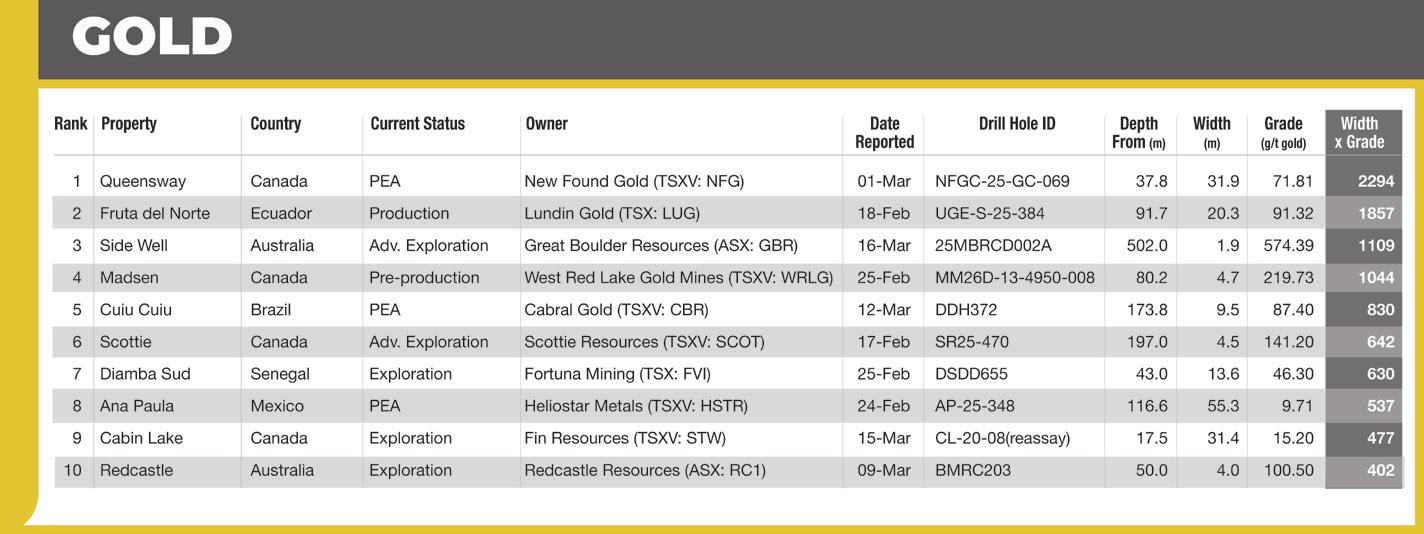
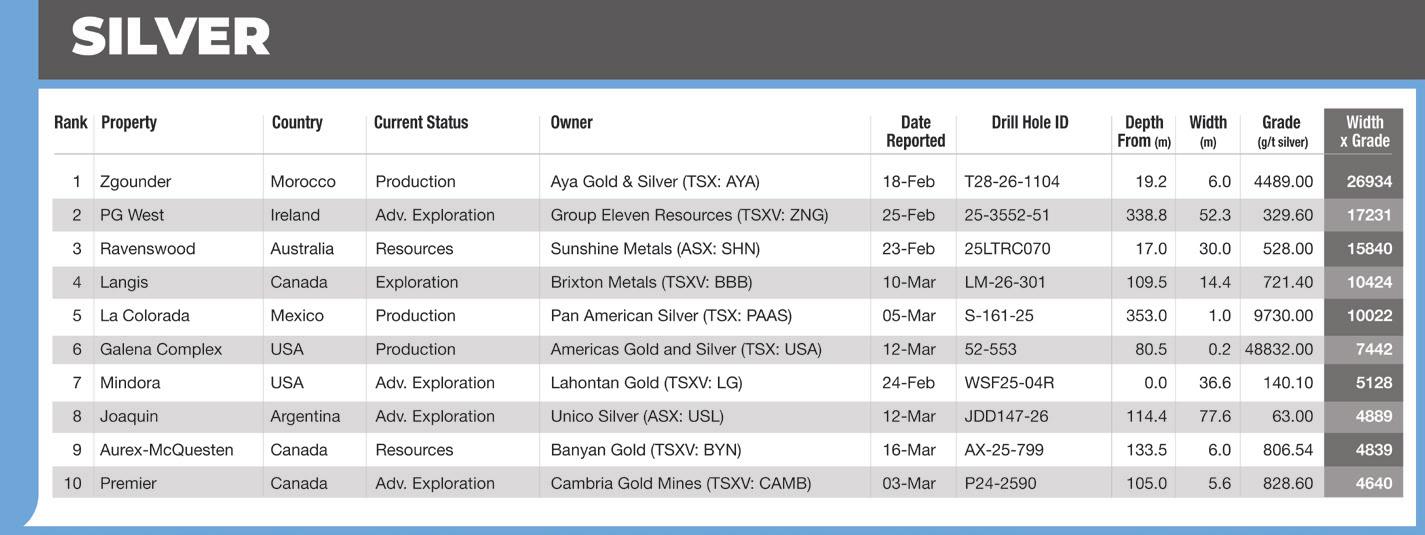
Name Symbol Subsciption Terms Expiry Date
Talisker Resources Ltd. SK.WT One Warrant to purchase one common 5-05-2028 share of the Issuer at $0.75 until expiry
West Red Lake Gold WRLG.WT One warrant to purchase one common 05-16-2026 Mines Ltd share at $1.00 per share.
Aurania Resources Ltd. ARU.WT.B One warrant to purchase one common 10-21-2026 share at $2.20 per share.
Tuktu Resources Ltd. TUK.WT One warrant to purchase one common 11-23-2026 share at $0.13 per share.
Freeman Gold Corp FMAN.WT.U One warrant to purchase one common 11-29-2026 share at US$0.65 per share.
Palisades Goldcorp Ltd. PALI.WT One warrant to purchase 0.060538 12-06-2026 common share at $0.50 per share.
Mogotes Metals Inc MOG.WT One warrant to purchase one common 01-31-2027 share at $0.30 per share.
Osisko Development ODV.WT.A One warrant to purchase one common 03-02-2027 Corp. share at $14.75 per share.
Integra Resources Corp. ITR.WT One warrant to purchase one common 03-13-2027 share at $1.20 per share.
Elevation Gold Mining ELVT.WT.A One warrant to purchase one common 03-24-2027 Corp. share at $0.70 per share.
Anfield Energy Inc. AEC.WT One warrant to purchase one common 05-12-2027 share at $0.18 per share.
Osisko Development ODV.WT.U One warrant to purchase one common 05-27-2027 Corp. share at US$10.70 per share.
Robex Resources Inc RBX.WT One warrant to purchase one common 06-27-2027 share at $2.55 per share.
Graphite
West
WRLG.WT.B One warrant to purchase one common 10-24-2027
Mines Ltd share at $0.90 per share.
i-80 Gold Corp. IAU.WT One warrant to purchase one common 11-14-2027 share at $0.55 per share.
Nexmetals Mining Corp.
Lion One Metals Ltd LIO.WT.A One warrant to purchase one common 02-14-2028 share at $0.41 per share.
West Red Lake
Short positions outstanding as of March 15, 2026 (with changes from February 28, 2026)
Largest
Americas LAC 11608415 1982005
Osisko
Short positions outstanding as of March 15, 2026 (with changes from February 28, 2026 Largest
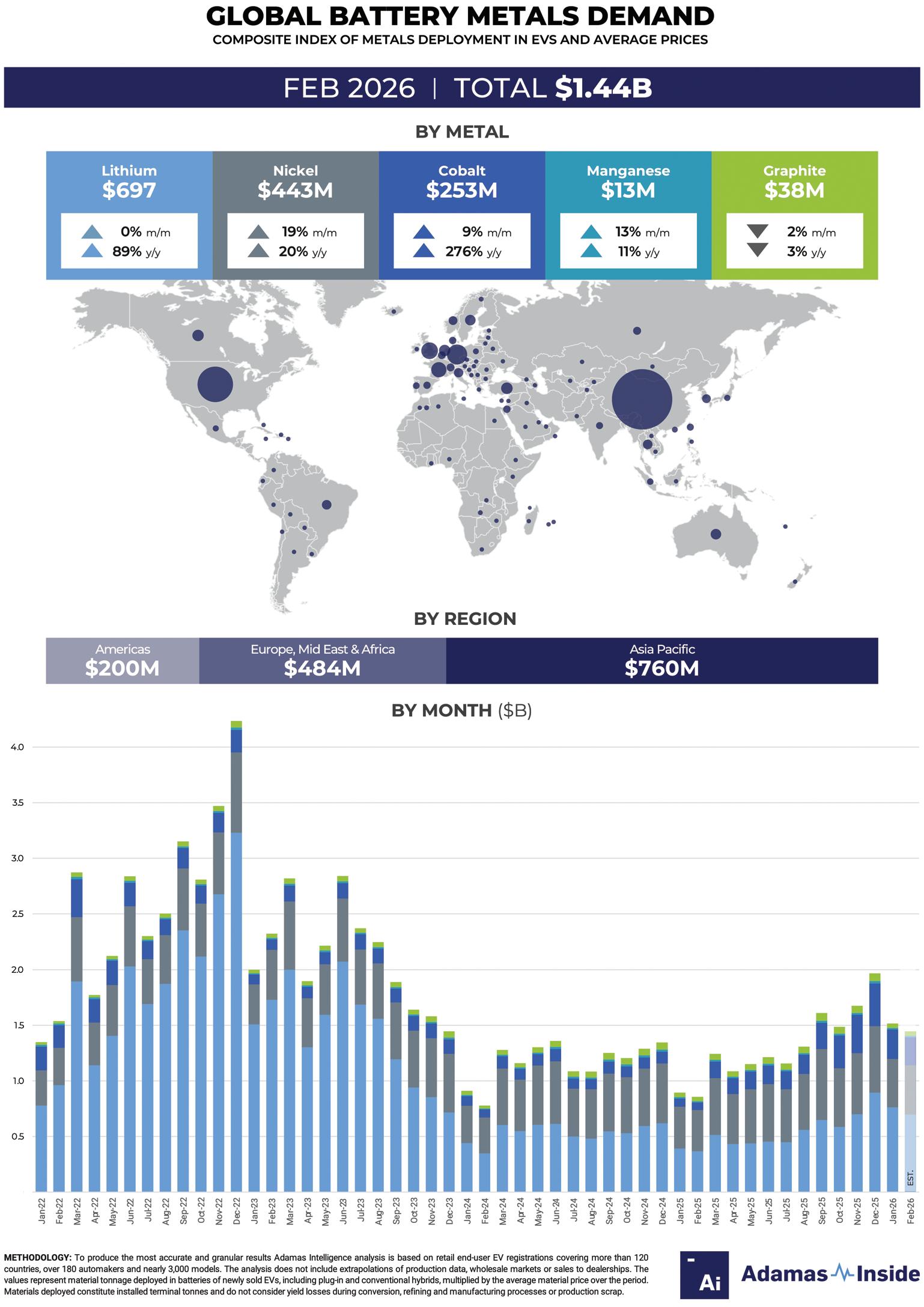
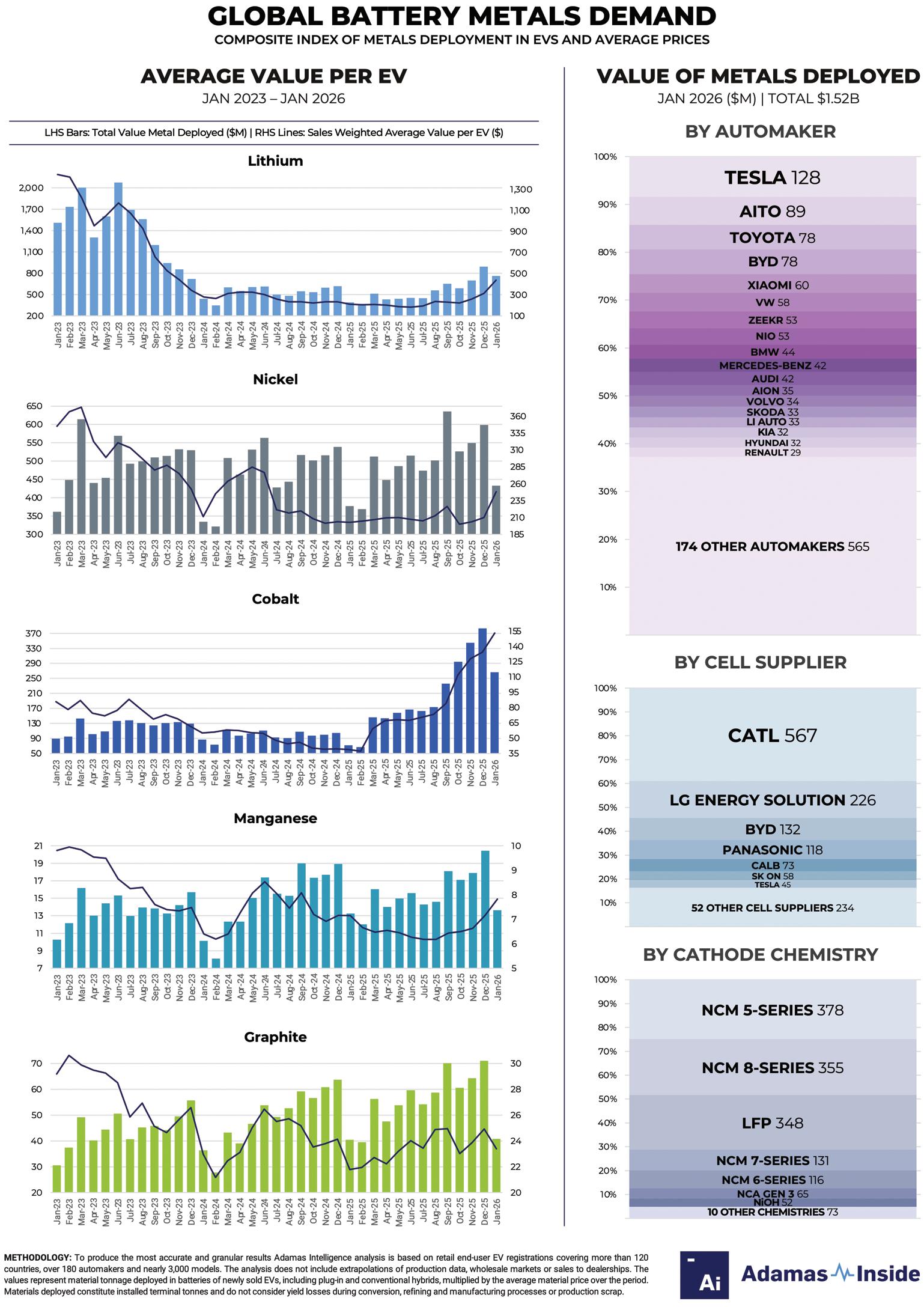
COPPER PRICE ($ PER LB.)
NICKEL PRICE ($ PER LB.)
Aluminum: $1.28/lb.
Cobalt: $25.31/lb.
Gold: $4,522.00/oz.
Iron Ore 62% Fe CFR China-S: $108.50
Nickel: $7.80/lb.
Silver: $70.53 per oz.
Zinc: $1.40 per lb.
2026 n April
April 8-9
Ontario Mineral Exploration Showcase 2026 — Thunder Bay, Ont.
VENUE: Valhalla Inn
MORE INFORMATION: nwopa.net
April 13-14
Mining & Critical Minerals Middle East Conference & Exhibition — Dubai, United Arab Emirates
VENUE: DoubleTree by Hilton Dubai M Square Hotel & Residences
MORE INFORMATION: miningcriticalminerals.com
April 14-15
The BC Critical Minerals Forum — Vancouver VENUE: Sheraton Vancouver Wall Centre
MORE INFORMATION: bc.energyandmines.com
April 15–16
Swiss Mining Institute — Panama City, Panama VENUE: TBA
MORE INFORMATION: www.swissmininginstitute.ch
April 16-17
Resourcing Tomorrow — Hongkong
VENUE: Four Seasons Hotel
MORE INFORMATION: resourcingtomorrow.com/ hongkong/
April 20-22
Nunavut Mining Symposium 2026 — Iqaluit
VENUE: Aqsarniit Hotel
MORE INFORMATION: events.outcrop.com/ nms26/9809425
April 20-23
Central MinEx 2026 — Gander, N.L.
VENUE: Steele Community Centre
MORE INFORMATION: ganderandareachamberof commerce.ticketspice.com/central-minex-2026
COMMODITY PRICES | Prices current as of March 30, 2026
Coal: Central Appalachia, 12,500 Btu, 1.2 S02-R,W: $87.50 Coal: Powder River
Copper: $5.48/lb.
Iridium: $8,000.00/tr oz.
Lead: $0.85/lb.
Rhodium: $10,400.00/tr. oz.
Tin: $20.18/lb.
April 20-23
Women in Mining National Conference — Tucson, Ariz.
VENUE: Tucson Convention Center
MORE INFORMATION: wimusa2026.eventify.io/px/welcome
April 21-22
International Mining Geology Conference 2026Brisbane, Australia
VENUE: Brisbane Convention and Exhibition Centre
MORE INFORMATION: usimm.com/conferences-andevents/mining-geology/
April 23-24
Critical Minerals North America Conference & Exhibition — New York City
VENUE: TBA
MORE INFORMATION: criticalmineralsnorthamerica.com
April 27-29
Expo Cobre 2026 — Lima, Peru
VENUE: Jockey Exhibition Center
MORE INFORMATION: expocobre.com/en/presentacioncobre-2026/
April 29-May 1
9th Annual First Nations Major Project Coalition — Toronto
VENUE: Sheraton Centre
MORE INFORMATION: fnmpc.ca/conference/
n May
May 3-6
CIM CONNECT 2026 — Vancouver
VENUE: Vancouver Convention Centre
MORE INFORMATION: cimconnect.ca
May 8-9
Metals Investor Forum — Vancouver
VENUE: JW Marriot Parq
MORE INFORMATION: metalsinvestorforum.com/metalsinvestor-forum/
$5,006.47
Copper: CME Group Futures April 2026: $5.48/lb.;
May 2026: $5.51/lb.
Lithium carbonate: $21,650/tonne
Ruthenium: $1,750 per oz.
Uranium: U3O8, Trading Economics: $84.05 per lb.
May 13-14
Critical Minerals Institute Summit V — Toronto
VENUE: TBA
MORE INFORMATION: criticalmineralsummit.com
May 15-16
Deutsche Goldmesse — Frankfurt, Germany
VENUE: Westin Grand Frankfurt
MORE INFORMATION: deutschegoldmesse.online
May 19-21
Canaccord Genuity’s 5th Annual Global Metals and Mining Conference — Henderson, Nev.
VENUE: The Westin Lake Las Vegas
MORE INFORMATION: canaccordgenuity.com/capitalmarkets/events-and-conferences/2026-metals-andmining/
May 20-21
Critical Minerals Australia Conference & Exhibition — Perth
VENUE: Novotel Perth Langley
MORE INFORMATION: criticalmineralsaustralia.com
May 20-22
Western Mining Summit — Denver, Colo.
VENUE: Gaylord Rockies Resort
MORE INFORMATION: westernminingsummit.com
May 24-26
Canadian Diamond Drilling Association: 81st Annual General Meeting & Convention —
Victoria
VENUE: Delta Hotels Victoria Ocean Pointe Resort
MORE INFORMATION: cdda.ca/convention/
May 25-27
Mining Transformed — Sudbury, Ont.
VENUE: Norcat
MORE INFORMATION: miningtransformed.norcat.org
May 26-28
Discoveries 2026 Mining Conference — Mazatlán, Mexico
VENUE: Mazatlán International Center
MORE INFORMATION: www.discoveriesconference.com
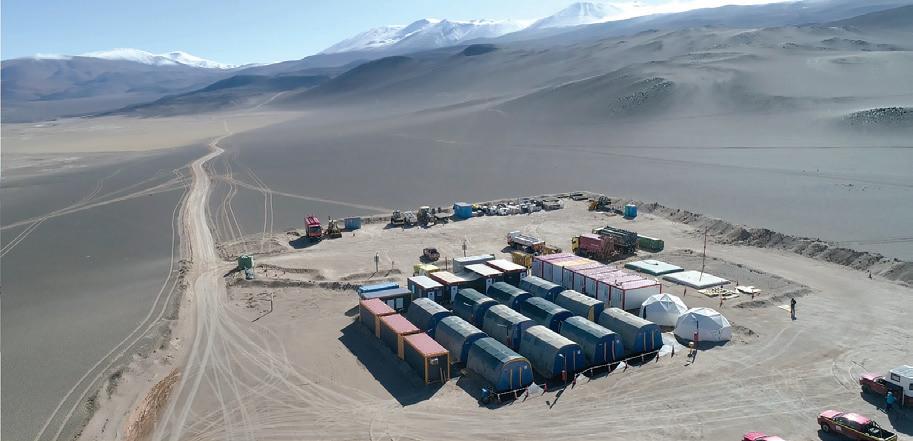
BY TOM AZZOPARDI
France’s Eramet (Euronext: ERA) and Chile’s state mining company Empresa Nacional de Minería (ENAMI) are headed to court in a dispute that could delay development of one of the world’s largest lithium deposits.
ENAMI plans to invest more than $3 billion with mining giant Rio Tinto (LSE, NYSE, ASX: RIO) to develop the Salares Altoandinos project. It is estimated to host about a quarter of Chile’s lithium resource, could produce enough of the battery metal for about 1.5 million electric vehicles a year, and is expected to become a cornerstone of new President Jose Antonio Kast’s development agenda.
Complicating matters, Eramet acquired all the area’s mining rights in 2023 in a bid to secure the special licence required to produce lithium under Chile’s Cold War-era legislation, drafted when the metal was considered vital for nuclear arms. The French company doesn’t hold the licence but is seeking to leverage its land position for a stake in the development.
“Eramet has begun a series of abusive administrative and court actions,” ENAMI’s lawyers wrote in a pretrial document that became public in March. “[They] seek to hinder or block the development causing compensable damages to our clients.”
The French company filed appeals against Chile’s selection of Rio Tinto’s $415-million bid in last year’s competitive process. Eramet has publicly called on ENAMI to open negotiations on the award, due to close this year, while filing multiple applications for easements and water extraction sites at the site.
“As the holder of mining concessions, we remain open to constructive solutions that allow Altoandinos to move forward on a solid footing,” Eramet Chile Chairman Hubert Porte said in a March 16 column in the Santiagobased Diario Financiero newspa-
per. “But we continue to defend our rights as a mining concessionaire.”
If neither side is willing to cede, the dispute could take at least two years to work through the courts and potentially proceed to international arbitration. Some mining lawyers in Chile are concerned that ENAMI’s respect for mining claims borders on expropriation.
“ENAMI has taken somewhat of a risk by not requiring that its strategic partner holds mining claims over the area,” Ignacio Errazquin of Santiago law firm CMS Carey & Allende told The Northern Miner
Atacama region
Eramet holds 1,200 sq. km of claims covering 99% of the La Isla and Aguilar salt flats in northern Chile’s Atacama region as part of a longplanned shift towards energy metals. It wants to capture synergies with its $900-million Centenario facility across the Andes in northwest Argentina, which entered production in late 2024.
Chile has estimated Salares Altoandinos to host about 4.5 million tonnes of lithium following 2025 exploration, though no formal resource statement has been released.
“Today we can say with certainty that this is a world-class project,” ENAMI’s then-CEO Ivan Mlynarz said in March following the latest exploration results.
The project is the latest tie-up between the Chilean state and private investors as the country seeks to double lithium output to about 500,000 tonnes annually by 2035.
“After an exhaustive analysis, we concluded that Rio Tinto’s was the proposal that provided most value to ENAMI,” Mlynarz said at the time.
Rio Tinto’s offer includes cash as well as its direct lithium extraction process and access to the pilot plant at its Rincon operation in Argentina. It was Rio Tinto’s second win in less than two months after signing a similar deal with state copper giant Codelco for Maricunga.
Court wrangling
The risk now is that the legal dis-
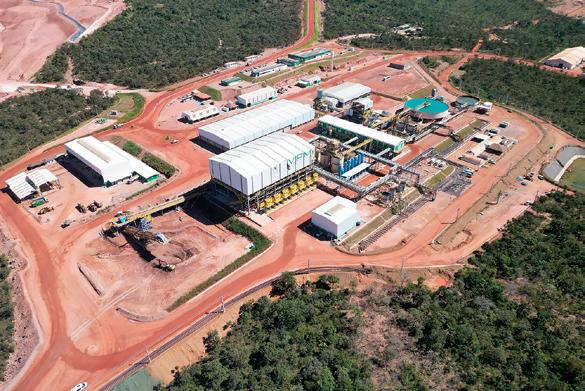
BY CECILIA JAMASMIE
Tpute with Eramet could tie up the Altoandinos project in years of court wrangling.
“Having participated in a process where it was not selected, Eramet is now questioning its whole basis,” ENAMI said in the court filing. “The mining properties which it thought to use as an advantage to be selected, it now plans to use to obstruct the project.”
And having focused solely on lithium, Eramet has now raised the possibility of extracting other elements present in the brines such as boron, iodine and potassium.
ENAMI has called on judges to force Eramet to hand over internal emails and other documents that would show when management shifted its focus to non-metallic minerals, among other issues.
Regardless of the intentions when claims were staked or acquired, they give the holder the right to exploit any minerals in the ground, except lithium, which needs that special permit, known as a CEOL from its initials in Spanish. In 2023, holding mining claims over the production area became a requirement.
This month, the Chilean government granted the first CEOL to a private company – CleanTech Lithium (LSE-A: CLT) – largely on the strength of its extensive holdings at its Laguna Verde project.
“We own almost 100% of the claims . . . which was a requirement under this process,” CleanTech CEO Ignacio Mehech told The Northern Miner
A prolonged dispute over Altoandinos would represent a major setback for President Kast who took office March 11. He’s looking to the mining industry to attract foreign investment and support the economy.
“We want companies to have the certainty to carry out their investments and reach production in the short term,” Economy and Mining Minister Daniel Mas told journalists March 13. “So we will see how to make this strategy coincide with our aims.” TNM
he United States has pumped more than $1 billion into critical minerals investments across Latin America since January 2025, signalling assertive efforts by Washington to secure supplies of lithium, copper and rare earths vital to energy, defence and advanced technology. U.S. agencies and multilateral lenders are taking direct interest in projects in Brazil and Argentina through loans, equity stakes and structured offtake agreements designed to channel output into U.S.-aligned supply chains, according to law firm White & Case.
“Development of rare earth and critical minerals projects is no longer just a matter of energy transition, but rather, energy security,” Tiago Abreu, chief development officer of Brazilian Rare Earths (ASX: BRE; US-OTC: BRELY), told delegates at a mining summit in Belo Horizonte in June 2025.
Recent financing underscores the trend. The Inter-American Development Bank approved a $100 million loan for a $2.5 billion lithium project in Argentina, while the U.S. Development Finance Corp. invested $565 million to expand Serra Verde’s rare earths mine in Brazil’s Goiás state.
Critical momentum
Latin America holds roughly 60% of the world’s lithium reserves with Argentina hosting the region’s largest number of lithium projects, and seven operations. National lithium output capacity rose to about 186,000 tonnes in 2025 from 75,500 tonnes per year in 2023, and the government expects it to reach 658,000 tonnes by 2035.
“Development of rare earth and critical minerals projects is a matter of energy security.”
TIAGO ABREU CHIEF DEVELOPMENT OFFICER, BRAZILIAN RARE EARTHS
The country’s Incentive Regime for Large Investments, or RIGI, launched in July 2024, has been an aggressive offering to attract business. It provides tax, customs and foreign exchange stability for projects worth more than $200 million. Rio Tinto (ASX, NYSE, LSE: RIO) became the first company approved under the framework in May 2025 for a $2.5-billion lithium project in Salta.
Brazil hosts the world’s second-largest rare earth reserves after China, holding about 23% of global reserves. However, it accounts for only about 0.02% of rare earths production, highlighting its potential growth.
Geopolitical balancing
While U.S. investment is accelerating project development, Latin American governments continue to balance geopolitical interests between Washington and Beijing.
Governments across the region remain pragmatic, welcoming investment from both sides as they seek capital and technical expertise to develop mineral resources, White and Case says.
Geopolitics is increasingly influencing mining transactions and regulatory approvals. The law firm points to MMG’s proposed acquisition of Anglo American’s (LSE: AAL) nickel assets in Brazil, now undergoing a Stage Two merger review by European regulators, as an example of how decisions in Brussels or Washington can shape mining deals thousands of kilometres away.
Copper
The red metal is expected to remain the primary driver of mining investment across Latin America. Chile and Argentina are advancing major projects as global demand for the metal – essential for electrification and power grids – is projected to nearly double by 2035.
Several copper projects in Chile alone are expected to begin operating next year with combined investment exceeding $7 billion, reinforcing the metal’s central role in regional mining strategies. TNM
BY NORTHERN MINER STAFF
In addition to precious metals, Latin America is rich in critical minerals, such as copper, and lithium. Beyond these minerals, the continent has potential in graphite, nickel, manganese and rare earth elements. It is proving to be a rich hunting ground for the following eight companies.
Bravo Mining (TSXV: BRVO; US-OTC: BRVMF) is focused on its Luanga palladium-platinum-rhodium-gold-nickel project in northern Brazil, about 2,700 km north of Rio de Janeiro.
The company expects to complete a feasibility study in the third quarter of this year. In February, it started a 28,000-metre drill program. Three rigs will drill 22,000 metres of infill and extensional drilling at Luanga and the fourth rig is to drill 6,000 metres at new regional targets, including deep zones beneath Luanga’s current resource.
The 2026 exploration program also includes geophysics to further refine targets.
In January, Bravo closed a $86million (US$63.5-million) oversubscribed public offering. The total included a $34.5-million non-brokered private placement with Orion Mine Finance, under which it expects to enter a participation agreement and to provide up to $300 million in funding.
A preliminary economic assessment (PEA) completed last year envisioned two scenarios for the open-pit project. In the base case, processing would take place via a conventional froth flotation plant with a nameplate processing capacity of 27,700 tonnes per day or 10 million tonnes per year, producing a single saleable concentrate that would be sold to a third-party smelter.
The alternate case evaluated adding onsite downstream processing to produce a highly concentrated metal matte for sale to a refinery.
The PEA outlined an after-tax net present value (at an 8% discount rate) of $1.25 billion and an internal rate of return (IRR) of 50% for the base case, and a $1.86 billion NPV and 50% IRR for the alternate case.
Initial capital costs for the base case were pegged at $496 million and $677.6 million for the vertically integrated case. The payback period for both scenarios is 2.4 years. The study was based on metal prices of $1,271 per oz. palladium, $1,500 per oz. platinum, $6,000 per oz. rhodium, $3,251 per oz. gold and $8 per lb. nickel.
Luanga is forecast to produce annual payable metal averaging 255,000 oz. palladium, 158,000 oz. platinum, 15,000 oz. rhodium, 8,500 oz. gold and 8,549 tonnes of nickel over a mine life of 17 years.
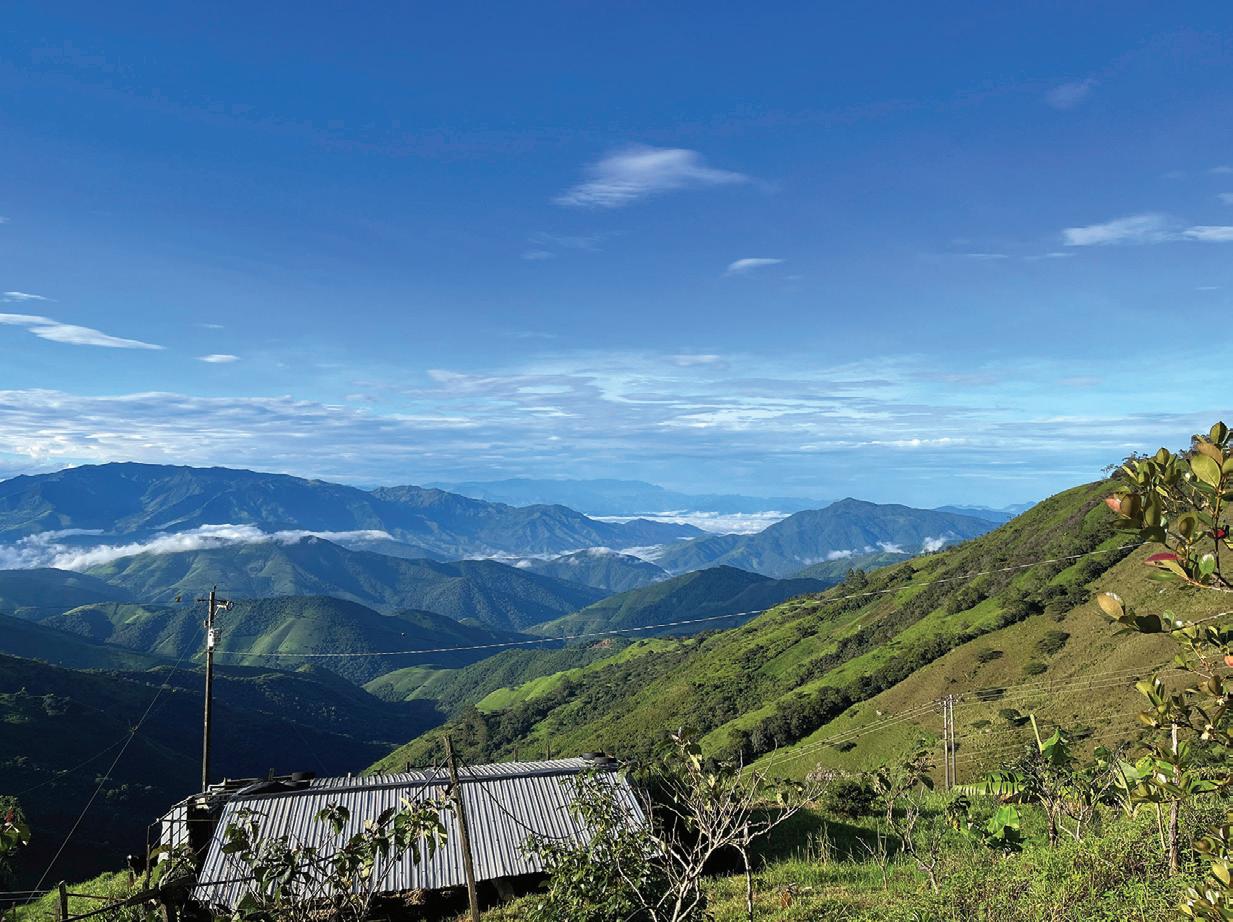
The project has measured and indicated resources of 158 million tonnes grading 0.98 gram palladium per tonne, 0.62 gram platinum, 0.09 gram rhodium, 0.05 gram gold and 0.12% nickel for 4.9 million oz. of contained palladium, 3.1 million oz. platinum, 450,000 oz. rhodium, 262,000 oz. gold and 194,848 tonnes nickel.
Inferred resources add 78 million tonnes averaging 0.97 gram palladium, 0.59 gram platinum, 0.08 gram rhodium, 0.05 gram gold and 0.13% nickel for 2.4 million oz. contained palladium, 1.4 million oz. platinum, 202,000 oz. rhodium, 128,000 oz. gold and 97,719 tonnes nickel.
Bravo Mining has a market cap of about $507 million.
n Hannan Metals
Hannan Metals (TSXV: HAN) is exploring for copper, gold and silver in Peru at its main Valiente project, where the company has identified 18 intrusion-related porphyry, epithermal and skarn-style targets. Teck Resources (TSX: TECK.A/B; NYSE: TECK) owns 8.2% of the company.
The most advanced targets are in the central and northern parts of the project – Previsto and Belen. Previsto, a 5-km by 5-km footprint in soil geochemistry and radiometrics is the priority target. The headline discovery, Previsto Central, is an alkaline epithermal vein system where channel samples have returned 69.1 metres grading 2.4 grams gold and 13 grams silver, including 26 metres of 5.4 grams gold and 27 grams silver.
Hannan started its first drill program of 2,600-metres at Belen in January, though results returned low grades.
The company says Previsto shares similarities with alka-
line gold deposits like SSR Mining’s (TSX, Nasdaq: SSRM) Cripple Creek gold mine in Colorado and Barrick Mining’s (TSX: ABX; NYSE: B) 49%-owned Porgera gold mine in Papua New Guinea.
In February, Hannan reported a new high-grade zone 1 km south of Previsto with rock chip assays of 6.7 grams gold, 34 grams silver and 40 parts per million (ppm) copper.
Belen, 23 km southwest of Previsto, is a 12-km belt with three targets: Sortilegio, Vista Alegre and Ricardo Herrera. Sortilegio is an alkaline copper-gold target with grab samples from gossanous boulders assaying up to 4.4 grams gold and 16% copper. At Vista Alegre, an epithermal gold target, assays have included 2.7 grams gold and 44 grams silver. Ricardo Herrera is an outcropping calc-alkaline copper-gold-molybdenum porphyry system with strong soil anomalism and multiple induced polarization (IP) targets.
The company kicked off its first drill program at Belen last May.
The company has also staked the San Martin project, about 300 km from Valiente. In November 2020 it signed an earn-in and joint-venture agreement with Japan Oil, Gas and Metals National Corp. (JOGMEC). JOGMEC has the option to earn up to a 75% stake in the project by spending up to $35 million (C$47.9 million) and delivering a feasibility study for the JV.
The project covers a new, basinscale sediment-hosted copper-silver system that extends over 200 km by 100 km along the foreland region of the eastern Andes Mountains in Peru’s Huallaga Basin. The company notes that mineralization in the area is geologically similar to the Kupferschiefer deposits in Eastern Europe.
Key channel samples at San
Martin include 2 metres grading 4.9% copper and 62 grams silver; 1.8 metres of 3.7% copper and 42 grams silver, including 1.2 metres of 5.4% copper and 62 grams silver.
Hannan Metals has a market cap of C$104.3 million.
n New Pacific Metals
New Pacific Metals (TSX: NUAG; NYSE-AM: NEWP) is advancing two silver projects in Bolivia: Carangas and Silver Sand.
Carangas is located about 540 km southwest of La Paz in southwestern Bolivia and Silver Sand sits about 600 km southwest of La Paz.
This year the company plans to drill up to 30,000 metres of infill and exploration drilling at Carangas, kick off a feasibility study and continue to work on converting its exploration licence to an administrative mining contract.
A PEA on Carangas in October 2024 outlined a starter pit with a 16-year mine life producing about 106 million oz. of payable silver, 620 million lb. of payable zinc and 382 million lb. of payable lead at an average life-of-mine all-in sustaining cost (AISC) of $7.60 per lb. silver net of by-product credits.
At a base case price of $24 per lb. silver, $1.25 per lb. zinc and 95¢ per lb. lead, the PEA estimated an aftertax NPV (at a 5% discount rate) of $501 million and a 26% IRR. Initial capital of $324 million could be repaid back after tax in 3.2 years.
Carangas has a conceptual pit-constrained resource of about 215 million indicated tonnes grading 30 grams silver, 0.3 gram gold, 0.3% lead and 0.6% zinc for 205.3 million oz. of contained silver, 1.6 million oz. gold, 1.4 billion lb. lead, 2.7 million lb. zinc and 112.6 million lb. copper.
Inferred resources total 44 million tonnes averaging 33 grams sil-
ver, 0.2 gram gold, 0.3% lead and 0.5% zinc for 47.7 million oz. of contained silver, 217,700 oz. gold, 297.9 million lb. lead, 533.7 million lb. zinc and 16.8 million lb. copper.
New Pacific has also intersected gold below the conceptual pit. Drill hole DCAR0044 returned 88 metres grading 1.67 grams gold, including 18 metres of 3.6 grams gold; and DCAR0094 cut 156 metres of 2.44 grams gold, including 41 metres of 5.4 grams gold.
At Silver Sand this year, New Pacific is working on community agreements and permitting and undertaking geotechnical and hydrological drilling for the feasibility study.
A prefeasibility in June 2024 outlined a mine life of 13 years producing 12 million oz. silver a year for a total of 157 million oz. silver, at an AISC of $10.69 per ounce. At a base case silver price of $24 per oz., the post-tax NPV (at a 5% discount rate) came to $740 million and the IRR 37%. Initial capital was pegged at $358 million and the post-tax payback at 1.9 years.
Silver Sand has 54.3 million measured and indicated tonnes grading 116 grams silver for 201.8 million contained oz. silver and another 5 million inferred tonnes averaging 88 grams silver for 13 million oz. of contained metal.
New Pacific Metals has a market cap of about C$1.1 billion.
n NGEx Minerals
NGEx Minerals (TSX: NGEX; US-OTC: NGXXF) – part of the Lundin Group of Companies – is focused on exploring its flagship Lunahuasi copper-gold-silver project in Argentina’s San Juan province.
In March, the Mining Authority of San Juan approved Lunahuasi’s Environmental Impact Statement
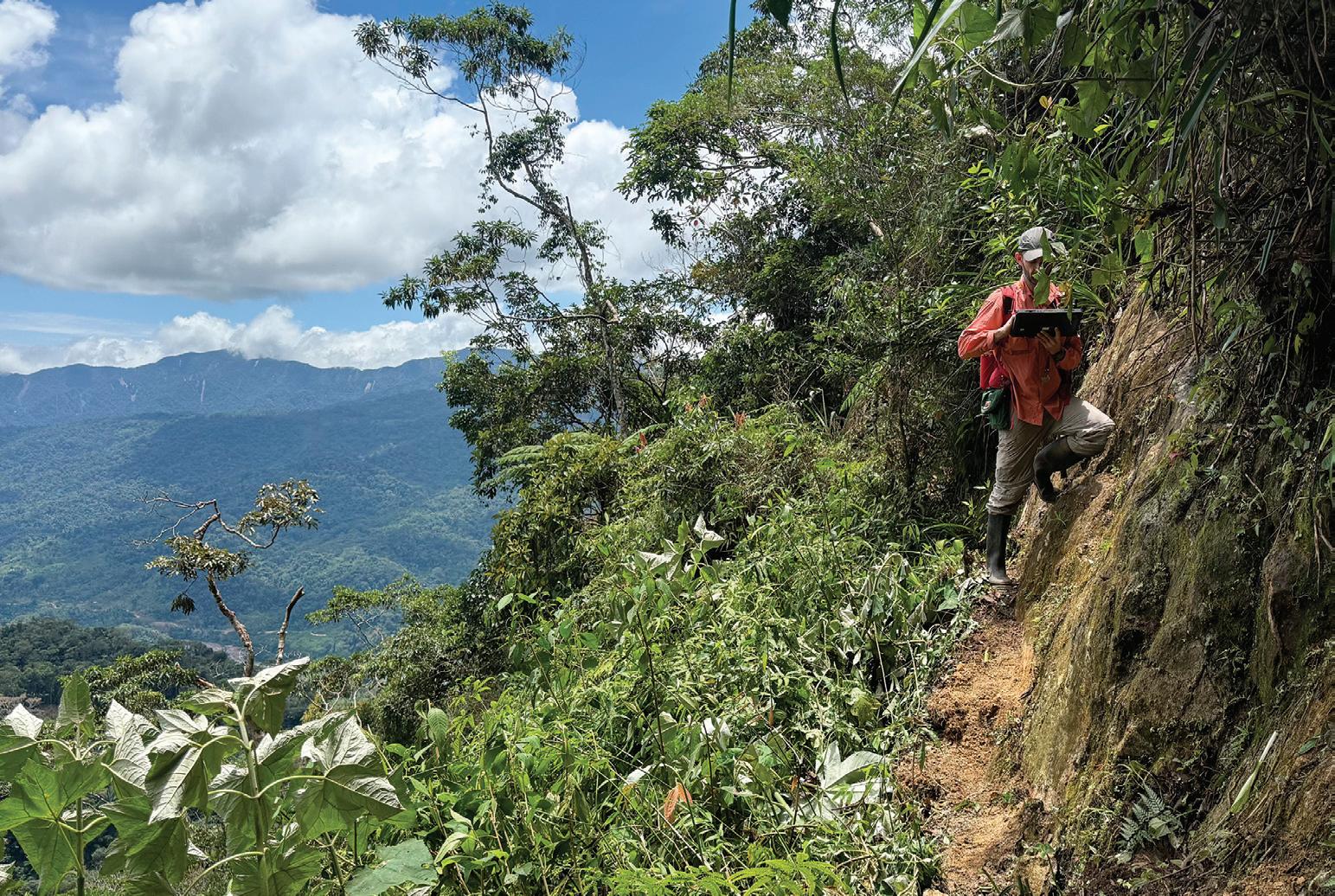
for the development of an exploration adit. The adit will give direct access to extract a bulk sample for metallurgical and engineering studies, provide year-round access for underground drilling, and improve the company’s geological understanding of the deposit.
The company launched its stage four drill program last October, which will feature up to eight rigs and target 25,000 metres of drilling. Highlight results in February included 1,246.5 metres grading 0.6% copper, 0.23 gram gold and 9.9 grams silver in DPDH049 starting from 116.5 metres downhole, including 13.61 metres of 4.68% copper, 1.67 grams gold and 28.8 grams silver from 725 metres, and 7.45 metres grading 13.38% copper, 1.62 grams gold and 52.8 grams silver from 942 metres downhole.
Drillhole DPDH057 intersected 131 metres grading 3.1% copper, 2.03 grams gold and 58.2 grams silver from 424 metres depth, including 30 metres of 4% copper, 4.58 grams gold and 64.5 grams silver from 468 metres. Drill hole DPDH060 cut 32.3 metres averaging 3.13% copper, 2.18 grams gold and 26.5 grams silver from 223 metres, including 2.7 metres of 13.89% copper, 6.64 grams gold and 127.3 grams silver from 245.30 metres.
NGEx is also involved in the Los Helados copper project, 9 km to the northeast of Lunahuasi, in Chile’s Atacama Region. NGEx is the major partner and operator at Los Helados, subject to a joint exploration agreement with Nippon Caserones Resources, which is the indirect 30% owner of the operating Caserones open-pit copper mine about 17 km to the north of Los Helados. (Lunding Mining (TSX: LUN) owns the remaining 70% of Caserones.)
Los Helados hosts about 2.1 billion indicated tonnes grading
0.4% copper, 0.15 gram gold and 1.5 grams silver for 18.4 billion lb. copper, 102. million oz. gold and 97.5 million oz. silver. Inferred resources total 1.08 billion tonnes grading 0.34% copper, 0.1 gram gold, and 1.4 grams silver for 8.2 billion lb. copper, 3.6 million oz. gold and 50.2 million oz. silver.
Recently the company spun out its net smelter return royalties on Lunahuasi and Los Helados to LunR Royalties (TSXV: LUNR).
NGEx Minerals has a market cap of about C$5.8 billion.
n Solaris Resources
Solaris Resources (TSX: SLS; NYSE: SLSR) kicked off a feasibility study earlier this year for its flagship Warintza copper project in southeastern Ecuador.
A prefeasibility study last November envisioned a 22-year open-pit mine producing 183,000 tonnes copper, 8,600 tonnes molybdenum, 57,000 oz. gold and 1.3 million oz. silver per year. Over the first five years of operations, it would also include 230,000 tonnes of copper, 10,800 tonnes molybdenum, 71,000 oz. gold and 1.8 million oz. silver. AISCs were pegged at 85¢ per lb. of payable copper for the first five years and $1.07 per lb. of payable copper over the first 15 years.
Based on a copper price of $4.50 per lb., the study forecast Warintza would generate an after-tax NPV (at an 8% discount rate) of $4.6 billion and a post-tax IRR of 26%.
Initial capital costs of $3.7 billion, including a 16% contingency, could be repaid post-tax in 2.6 years.
The project in Morona Santiago province, about 500 km south of Quito, hosts proven and probable reserves of 1.3 billion tonnes grading 0.31% copper, 0.02% molybdenum, 0.04 gram gold and 1.3 grams silver for about 4.1 million con-
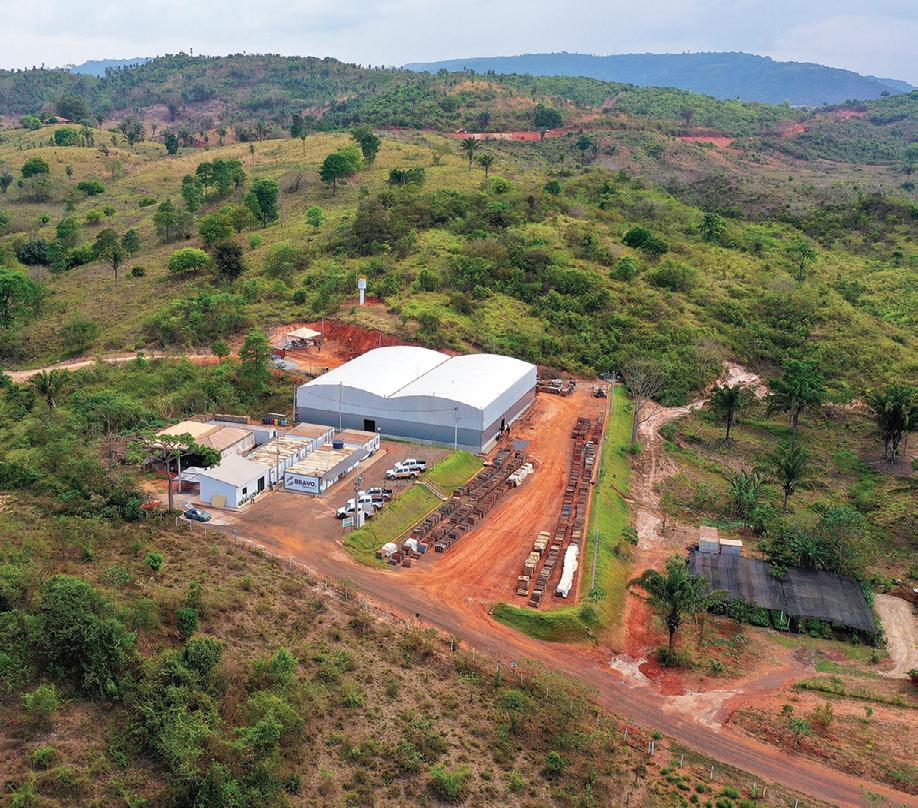
tained tonnes of copper, 214,000 tonnes molybdenum, 1.8 million oz. gold and 54.1 million oz. silver. Warintza is planned to be developed through two main pits and to produce copper and molybdenum concentrates.
The project is fully funded through to a construction decision, following a $200-million non-dilutive financing last May from Royal Gold (Nasdaq: RGLD).
Solaris has also recently optioned exploration concessions adjacent
to Warintza from Ecuador’s stateowned mining company, Empresa Nacional Minera. The award expands the company’s footprint around Warintza by about 400 sq. km.
In addition to Warintza, Solaris has an option to earn 75% in two copper-gold exploration projects in Peru (Capricho and Paco Orco); and owns the Tamarugo discovery in Chile’s copper belt, 5 km northeast of Copiapo.
Solaris Resources has a market cap of about C$2.1 billion.
n Tinka Resources
Tinka Resources (TSXV: TK; US-OTC: TKRFF) is exploring in the central Andes of Peru and is focused on its main Ayawilca zinctin-silver project, about 200 km northeast of Lima. Buenaventura Mining (NYSE: BVN) and Nexa Resources (NYSE: NEXA), which owns the Cajamarquilla zinc refinery near Lima, each hold a 12% stake in the junior.
Ayawilca hosts 28.3 million indicated tonnes grading 5.82% zinc, 16.4 grams silver and 91 grams indium for 3.64 billion lb. zinc, 14.9 million oz. silver and 2,582 tonnes of indium.
Inferred resources total 31.2 million tonnes averaging 4.21% zinc, 14.5 grams silver and 45 grams indium for 2.9 billion lb. zinc, 14.6 million oz. silver and 1,414 tonnes indium. Additionally, Ayawilca hosts a tin zone, with 1.4 million indicated tonnes grading 0.72% tin for 22 million lb. of contained tin and 12.7 million inferred tonnes averaging 0.76% tin for 213 million lb. of tin.
This year the company plans to drill 5,000 metres to extend highgrade silver, zinc and tin areas. Drill hole A22-195 is a previous highlight from Ayawilca with 6 metres grading 18.8% zinc; A22-199 cut 42.4 metres at 9.4% zinc, including 9.1 metres of 20.8% zinc; and A22200 returned 44.9 metres grading 12% zinc, including 16.1 metres of 22.2% zinc.
A PEA in 2024 outlined an underground mine with two separate circuits producing 2 million tonnes of zinc-silver-lead a year over 21 years and 300,000 tonnes of tin a year over 15 years.
The study estimated an aftertax NPV (at an 8% discount rate) of $434 million and an IRR of 26% based on metal prices of $1.30 per lb. zinc, $22 per oz. silver, $11 per lb. tin and $1 per lb. lead. Initial capital of $382 million could be repaid in 2.9 years post-tax.
Tinka is also exploring 1.5 km north of the Ayawilca zinc zone at its Colquipucro property, which it says is a potential starter pit for a future project. Colquipucro is a disseminated sandstone-hosted silver deposit at surface with a 2016 resource estimate of 7.4 million indicated tonnes grading 60 grams silver for 14.3 million oz. silver and another 8.5 million inferred tonnes grading 48 grams silver for 13.2 million oz. silver.
In addition, Tinka owns the Silvia gold-copper project adjacent to Ayawilca and about 80 km south of the Antamina copper-zinc mine, owned by BHP (NYSE, LSE, ASX: BHP), Glencore (LSE: GLEN), Teck and Mitsubishi. It kicked off its first drill program in October.
Tinka Resources has a market cap of C$60.2 million.
n Titan Minerals
Titan Minerals (ASX: TTM) has exploration projects in southern Ecuador’s Loja province. Its main 139-sq.-km Dynasty epithermal and porphyry gold project is
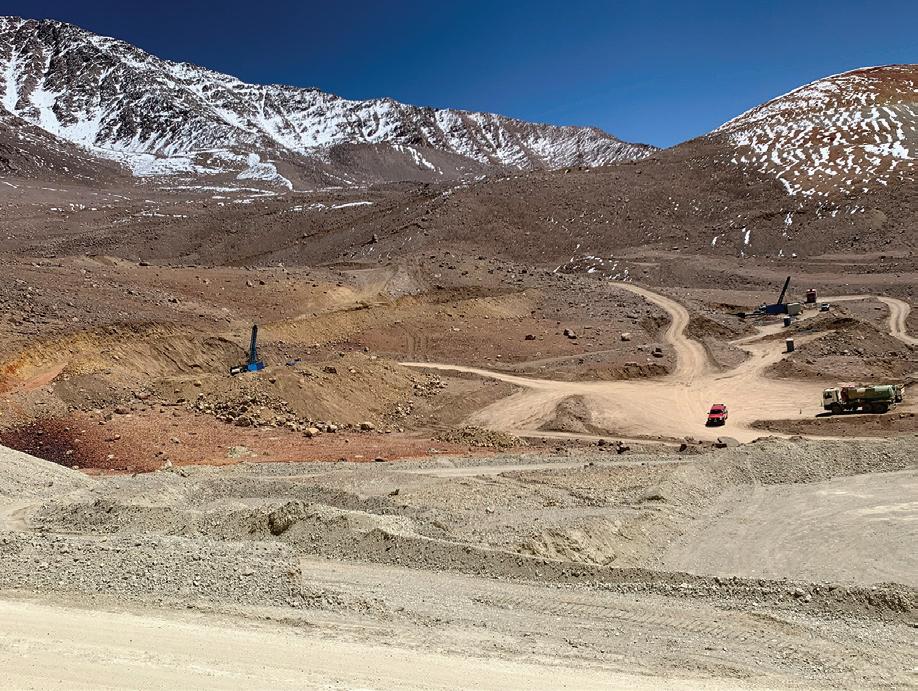
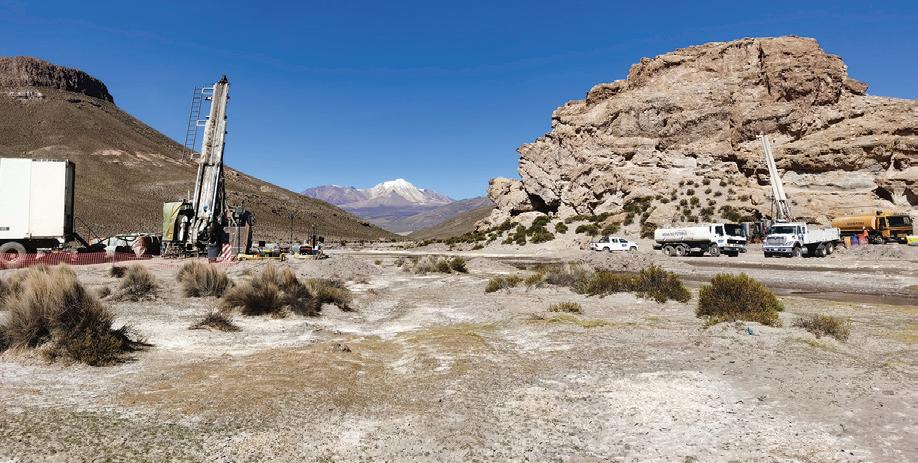
fully permitted for exploration and small-scale mining.
Titan completed a 25,000-metre drill program last year. Drill results released in January included 38.5 metres grading 3 grams gold and 5.6 grams silver from 169 metres downhole, including 7.5 metres at 11 grams gold and 12.7 grams silver in CVDD25-173. Hole CVDD25177 cut 8.6 metres grading 5.9 grams gold and 9.5 grams silver from 65 metres; And hole CVDD25-171 returned 9.5 metres at 4.2 grams gold and 12.1 grams silver from 151 metres, including 5.3 metres of 7.4 grams gold and 19.4 grams silver from 152 metres.
Dynasty hosts a JORC-compliant (Australian rules) open-pit
resource of about 18.1 million indicated tonnes grading 2.09 grams gold and 14.73 grams silver for 1.21 million oz. of contained gold and 8.57 million oz. silver. It has 25.44 million inferred tonnes grading 2.33 grams gold and 16.4 grams silver for 1.9 million oz. gold and 13.41 million silver.
The 2023 resource was defined from surface to a depth of about 250 metres and remains open. The resource was based on 394 diamond drill holes (63,342 metres), 85 channel samples (2,089 metres) and 1,599 trenches (6,743 metres).
At Titan’s 143-sq.-km Linderos copper project, 20 km west of Dynasty, surface mapping, geochemistry and diamond drilling have identified porphyry copper
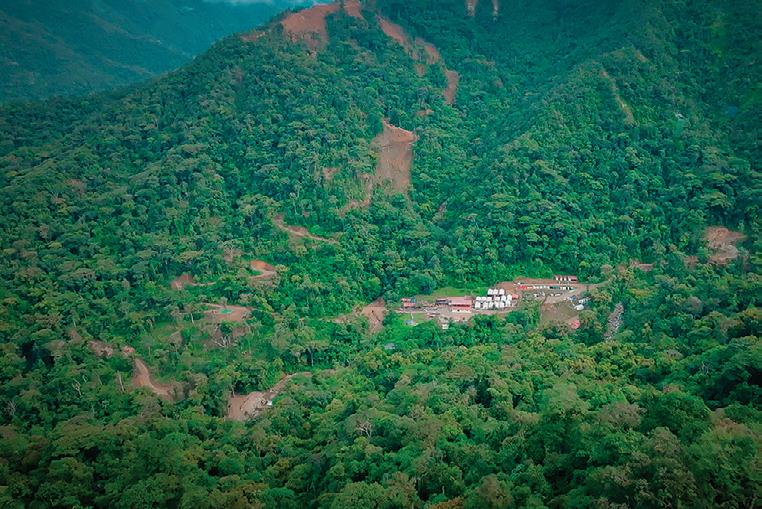
and epithermal gold mineralization. Hancock Prospecting is earning up to an 80% stake in the project by spending $120 million.
A 25,000-metre drill program is underway. Recent results include drill hole DHCR-09 which cut 694 metres grading 0.21% copper, 0.04 gram gold, 1.14 grams silver and 18 million ppm molybdenum from 325 metres, including 164 metres of 0.28% copper, 0.06 gram gold, 1.21 grams silver and 21 ppm molybdenum.
Data from that program were due to be incorporated into a resource update for Dynasty expected in this year’s first quarter.
The company is also exploring 24 km east of Dynasty at its 130-sq.-km Copper Duke project.
Magnetics, soil geochemistry and trenching and surface mapping have outlined a 7-km porphyry alteration footprint.
Titan’s earliest-stage project is Copper Field, about 42 km northeast of Dynasty. The 65-sq.- km project has seen limited modern exploration.
China’s Lingbao Gold holds a 9% stake in the company.
Titan Minerals has a market cap of about A$276 million ($195 million).
Unigold (TSXV: UGD; US-OTC: UGDIF) has been active in the Dominican Republic since 2002 and has identified over 20 areas on its Neita concessions in the northwestern province of Dajabón that host surface expressions of gold systems.
The company is focused on the Candelones gold project, completing a feasibility study on the oxide portion of the deposit in late 2022. The study envisions a 5,000-tonneper-day heap-leach operation with a mine life of 3.3 years. It estimates average annual payable gold at 31,400 oz. and AISCs at $829 per ounce.
The study forecast average annual after-tax free cash flow of $23.8 million. At $1,650 per oz. gold, the after-tax NPV (at a 5% discount rate) was pegged at $30.6 million, with an IRR of 44%. Initial capital was set at $36 million.
As part of the feasibility study, Unigold completed baseline environmental work and now has over five years of baseline data available to use in its consultation and design work. The company says it can table an initial environmental and social impact assessment study by this year’s third quarter.
On its Niete North concession, Unigold completed a deal with Barrick Mining in 2024 to earn up to a 60% stake. Barrick must spend a minimum of C$12 million over an eight-year period and deliver a prefeasibility study on an unidentified deposit. It can then earn another 20% by paying for a feasibility within the following four years.
Unigold completed a new outreach program in February to provide information before starting the full environmental study. The preliminary results showed “overwhelming support (greater than 70%)” to accelerate studies and community consultations.
The Candelones oxide project hosts 3.4 million measured and indicated tonnes grading 0.82 gram gold for 91,000 oz. and another 1.6 million inferred tonnes averaging 0.68 gram gold for 36,000 oz. gold.
Unigold has a market cap of C$125.2 million. TNM
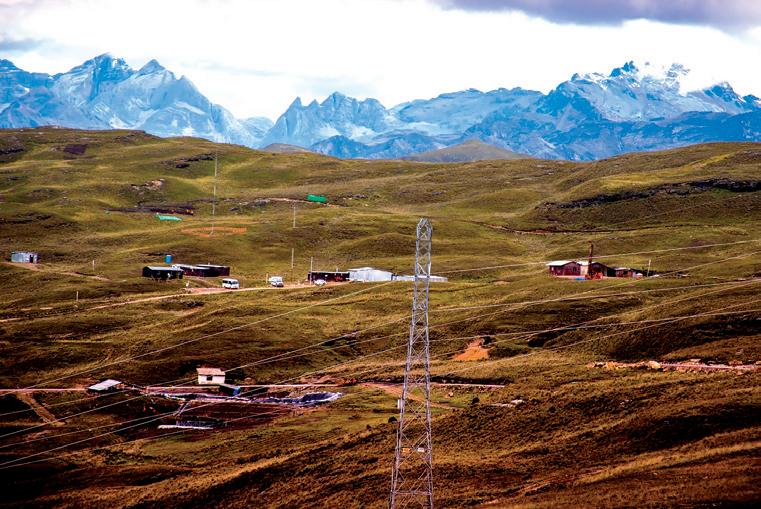
director of Miami-based Americas Market Intelligence. With debt-servicing costs up and hard currency scarce, the government faces pressure to find new revenue, raising the risk of higher mining taxes even under a pro-investment policy stance.
Policy shifts and limits
Mexico under President Claudia Sheinbaum illustrates the limits of a simple regional narrative. While more measured in tone than her predecessor, her government has revoked more than 1,000 mining concessions. The country remains engaged in critical minerals discussions with the United States, but continues to tighten state oversight of the sector.
Peru’s political volatility adds another layer of uncertainty. The removal of right-leaning President José Jerí in February and the installation of interim leader José Balcázar, a leftist, ahead of an April 12 election have opened the door to a potential policy recalibration. For miners, Peru remains indispensable,
> Awards from P9
United States in recent decades. A resource last year outlined 88 million tonnes grading 1.75 grams gold per tonne and 2.75 grams silver for about 5 million oz. gold and 7.8 million oz. silver in probable reserves.
Callinan Royalties, which helped fund Renaissance’s early exploration, also shared in the award.
When AngloGold first considered Silicon, management regarded Nevada as a jurisdiction that was very mature but over explored, Bartos said.
“But I was allowed to pursue opportunities, albeit with no budget, no staff, no field vehicle,” he said. “One could reasonably infer expectations were perhaps not excessive.”
> BG Gold from P9
late what its market capitalization could be when it completes the IPO. However, an estimate values BG at about C$450 million based on its aim to release a PEA before going public, its 2.4-million-oz. global resource and Whale Cove’s tier-1 jurisdiction. That estimate also assumes a gold price range of $3,300 to $3,500 per ounce.
And in addition to Holohan, BG hired industry heavyweights including former Gold Fields (NYSE, JSE: GFI) CEO and Chief Operating Officer Martin Preece,
but its repeated political resets complicate any attempt to map ideology cleanly onto investment conditions.
Colombia’s own mining outlook underscores what is at stake. The country launched tenders in late 2025 for 14 strategic copper regions and hosts a pipeline that includes AngloGold Ashanti (NYSE: AU) at Quebradona, Cordoba Minerals (TSXV: CDB; Nasdaq: CDM) at Alacrán, Libero Copper (TSXV: LBC) at Mocoa and Royal Road Minerals (TSXV: RYR) at Guintar-Aleman-Margaritas.
Iván Cepeda, the left-wing candidate aligned with President Gustavo Petro’s coalition, is leading ahead of the May vote, which will likely narrow a crowded field of 14 candidates to two for a June 21 runoff. Surveys suggest Cepeda would face the top right-leaning contender, Paloma Valencia, in a very tight race.
“From an investor standpoint, the key is not only who wins,”
Juan Ignacio Guzman, the CEO and founder of Chilean consultancy GEM, said in an interview with the Northern Miner Group. “It is whether the next president
Blue Lagoon CEO Rana Vig accepted the sustainability award with chief geologist and project manager Bill Cronk. Chief Adam and Deputy Chief Bessie West travelled to Toronto for the ceremony.
Blue Lagoon set initial production at 55,000 tonnes a year and forecast about 15,000 oz. gold recovered in the first year, with a goal of moving to 20,000 oz. in the next year.
The company has shipped 1,300 tonnes under the toll-milling and profit-share deal and collected about $1 million (US$734,000) from its first gold and silver sales on Dec. 30. It extended the agreement in September for 10 years. The deal covers up to 75,000 tonnes a year of mill feed. TNM
who will chair the company’s advisory board, and John Munro, former head of international operations with Gold Fields. Munro played a leading role in constructing the Khoemacau copper mine in Botswana. He’s also a non-executive director with Endeavour Mining (TSX, LSE: EDV).
“With the fundamentals on the gold price right now – and this project is high-grade – it’s a great opportunity, not only for us, but all stakeholders, especially for Whale Cove,” Holohan said. “If a mine gets going here, there’s going to be mining for decades. TNM
Hill project nearby.
United States Antimony (NYSE: UAMY) operates processing facilities in Montana and Mexico.
China Minmetals has idled Canada’s sole antimony mine, the Beaver Brook site in Newfoundland, despite the metal’s rising importance and concerns Beijing uses dormant mines like Beaver Brook to control access to antimony and prices. In the same region, New Brunswick is preparing to grant rights this year to restart the Lake George antimony mine which Hecla Mining (NYSE: HL) closed in 1996 while Antimony Resources (CSE: ATMY; US-OTC: ATMYF) drills the company’s Bald
can build a governing coalition that delivers regulatory stability.”
Even with a favourable election outcome, deeper risks remain. A report by London-based MS Risk notes that mining in Latin America is increasingly shaped by organized crime, weak governance and social conflict.
“It doesn’t matter how pro-business they are,” AMI’s Price said during a webinar in Vancouver last month. “If gold prices are high, silver prices are high and copper prices are high, you are vulnerable to renegotiation and to higher taxes.”
Several governments in the region are also facing widening deficits and limited access to capital, increasing the risk that mining becomes a source of short-term revenue through higher royalties or contract revisions, even where policy frameworks appear supportive. Operators say policy gains must be matched by execution on the ground for projects to advance.
“It is more than just fiscal terms,” Geoff Streeton, chief development officer at Paris-based Eramet (EPA:
>
attributed to the Iran War’s impact on gold producers and uncertainty around the company’s potential re-domiciliation.
For now, Mineros’ production remains anchored by its operating assets: the Nechí alluvial operation in Colombia and the Hemco mine in Nicaragua. The Nechí district has produced gold for nearly a century from sand and gravel deposits along the Nechí River
ERA), said on the PDAC panel with Glencore, Goldman Sachs and Vicuña Corp., a joint venture of Lundin Mining (TSX: LUN) and BHP (LSE, NYSE, ASX: BHP). “You have to have the enablers across infrastructure, energy supply and access to skills and capabilities.”
Even governments elected on pro-mining platforms can face competing pressures once in office. Fiscal shortfalls, local opposition and political deal-making can quickly dilute reform agendas, while campaign rhetoric often gives way to more pragmatic and sometimes interventionist policies. In several countries, leaders have shifted tone after elections, balancing investor outreach with measures aimed at securing public support or boosting state revenues.
Political alignment alone is therefore not enough. Governments across the ideological spectrum have intervened in mining when it suited domestic priorities, while local opposition, Indigenous consultation requirements and environmental constraints continue to shape timelines regardless of national policy direction.
floodplain using gravity recovery methods.
In Nicaragua, the Hemco property near Bonanza hosts underground mines and processing plants that recently expanded throughput to about 2,000 tonnes per day as part of a broader plant upgrade the company reported this month. Together the operations are expected to produce 213,000 to 233,000 oz. gold in 2026, with roughly 60% coming from Hemco. TNM
Colombia as a signal Colombia’s election will be watched as a signal of whether political rhetoric can be translated into durable change, while Chile’s new government is also under scrutiny for whether it can convert its vast copper and lithium resources into sustained supply in an increasingly geopolitical minerals market.
Governments that combine a more supportive stance towards mining with tangible progress on security, permitting and institutional capacity would reinforce the view that the region is becoming more investable.
The challenges are structural for Colombia, and investors will be looking for evidence that any new administration can address them beyond campaign messaging.
“Colombia could become a meaningful copper producer, but it will not happen on potential alone,” Guzman said. “It requires at least one, preferably two, largescale mines reaching construction and steady-state.” TNM
Carrying capacity
The broader question is whether Canada has too many mineral companies chasing too little money, Silver argued. Borrowing a concept from his background studying zoology at the University of Vermont, he referred to an ecosystem’s “carrying capacity.” Silver argued that capital markets, like ecosystems, can only sustain so many “members” before the weaker ones starve.
Canada, he said, makes a useful proxy because it hosts the world’s largest concentration of public mineral companies and offers unusually rich disclosure. In his count, the number of Canadian-listed mineral issuers averaged about 700 in earlier decades, surged to a peak in the early 2010s and sat around 1,600 recently.
The pandemic didn’t trigger a
The metal has been in a persistent deficit for several years due to falling ore grades, slowing Chinese mine investment and high demand from the solar sector, BMO Capital Markets analysts Helen Amos and George Heppel wrote in a note on March 16.
The antimony price, currently at about $50 per kg in North America, spiked fourfold after China set export controls in 2024, leading to a western shortage of the metal. Multiple veins intersected Other noteworthy intersections in Apollo included hole SDDSC195 that cut across five vein sets and its
best intercept was 10.3 metres at 7.9 grams gold and 0.4% stibnite from 137 metres depth.
Hole SDDSC199 pierced eight vein sets, with the best booking 17.9 metres grading 5 grams gold and 1.4% stibnite from 210.4 metres depth, including 4.4 metres at 18.2 grams gold and 5.3% stibnite from 213.2 metres downhole.
The results are from 114,806 metres drilled across 247 holes at Sunday Creek since 2020, the company said. Results from another 46 holes are pending, with nine drill rigs active. Southern Cross’s 200,000-metre program is expected to continue until the first quarter of 2027. TNM
mass die-off in listed companies. Instead, his research shows issuer counts bottomed during Covid19 and have risen since 2020, a rebound he said he didn’t expect when he started the work.
Gold explorers
Gold dominates the herd. About 42% of Canada’s mineral companies focused on gold in 2024, with copper at about 17% and lithium, silver and uranium next. Those weightings matter, Silver argues, because gold explorers drive investor psychology and can make financing conditions look worse than they are across the rest of the sector.
Public listings rose fastest in commodities that caught investor imagination after 2020, Silver’s data show. The number of copper issuers rose about 58% over five years, while lithium, uranium and nickel names more than doubled at their
peaks before lithium cooled with prices, Silver said.
Crypto threat
Beyond policy, juniors face rising competition for speculative dollars from cryptocurrencies, sports betting and passive investing. Exchange-traded funds don’t solve the junior financing gap because they can buy stock in the market but can’t take part in private placements that often fund exploration, he said.
Mining is heading into a labour crunch just as governments are demanding new mines, Silver also warned. He cited research suggesting the industry’s average age sits in the high 60s, setting up a wave of retirements just as demand for metals rises.
“I wish I was 40 right now,” he said. “I could be making a killing in this business if I was working today.” TNM




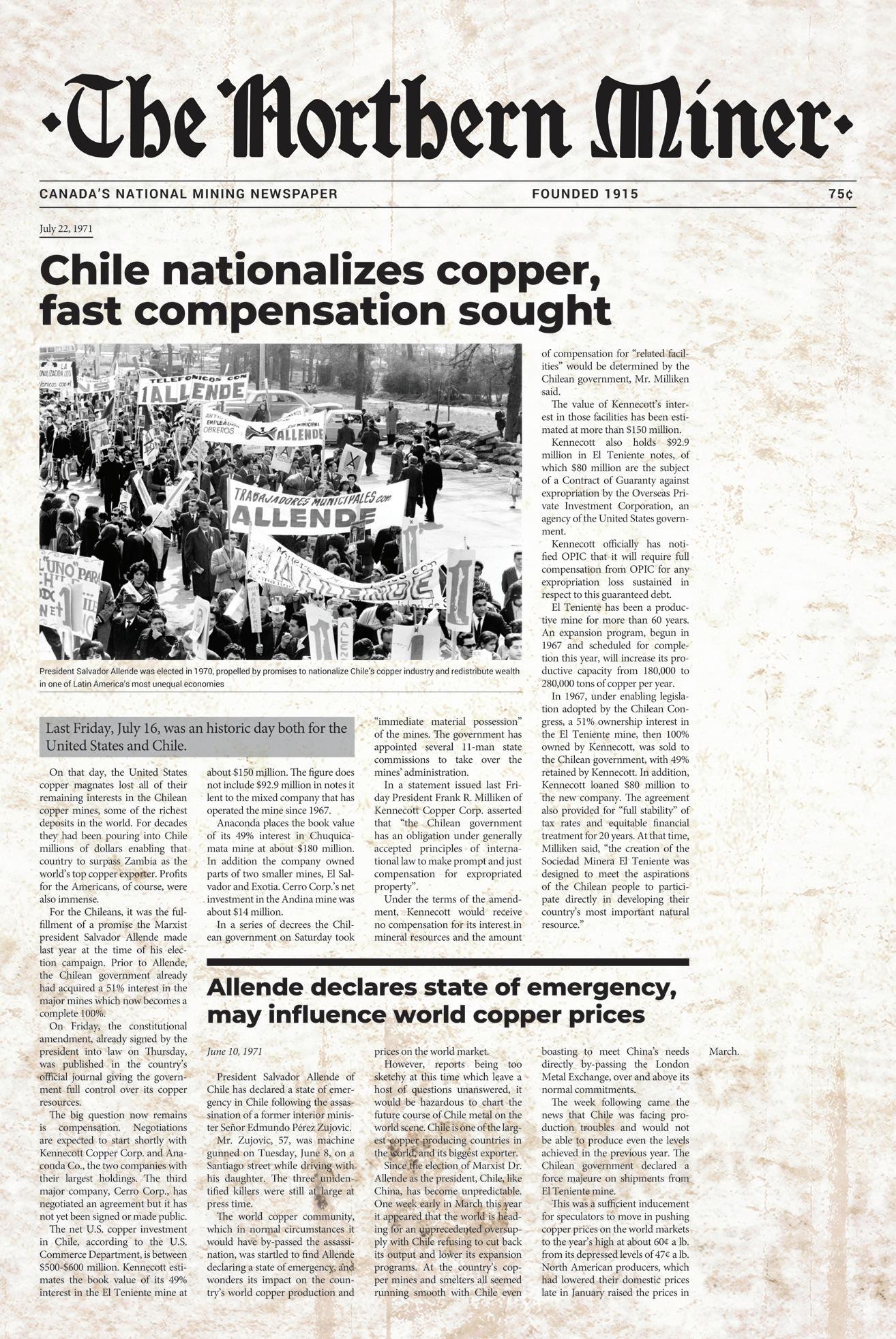
One of the most consequential mining events in Latin America over the last five decades was Chile’s nationalization of its copper industry in 1971, and The Northern Miner covered the developments.
Led by the socialist government under president Salvador Allende, the state control spurred immediate reactions from major American producers such as Kennecott Copper (now part of Rio Tinto (LSE, NYSE, ASX: RIO)) and Anaconda, who demanded compensation for their expropriated assets, worth many billions in today’s dollars.
While the takeover, which included other industries such as banking, utilities and manufacturing, was initially popular among Chileans, it also led to compensation disputes, a slowdown in copper exports and international isolation. The push worsened economic and political conditions in Chile, culminating in general Augusto Pinochet’s military coup in 1973.
Some compensation issues with major foreign miners were settled under Pinochet’s more market-oriented regime, but his government retained ownership of copper assets and in 1976 formed the Codelco state copper mining company. Today, Codelco still runs major mines in Chile, shapes state mining policy and anchors global copper supply.
—BLAIR MCBRIDE
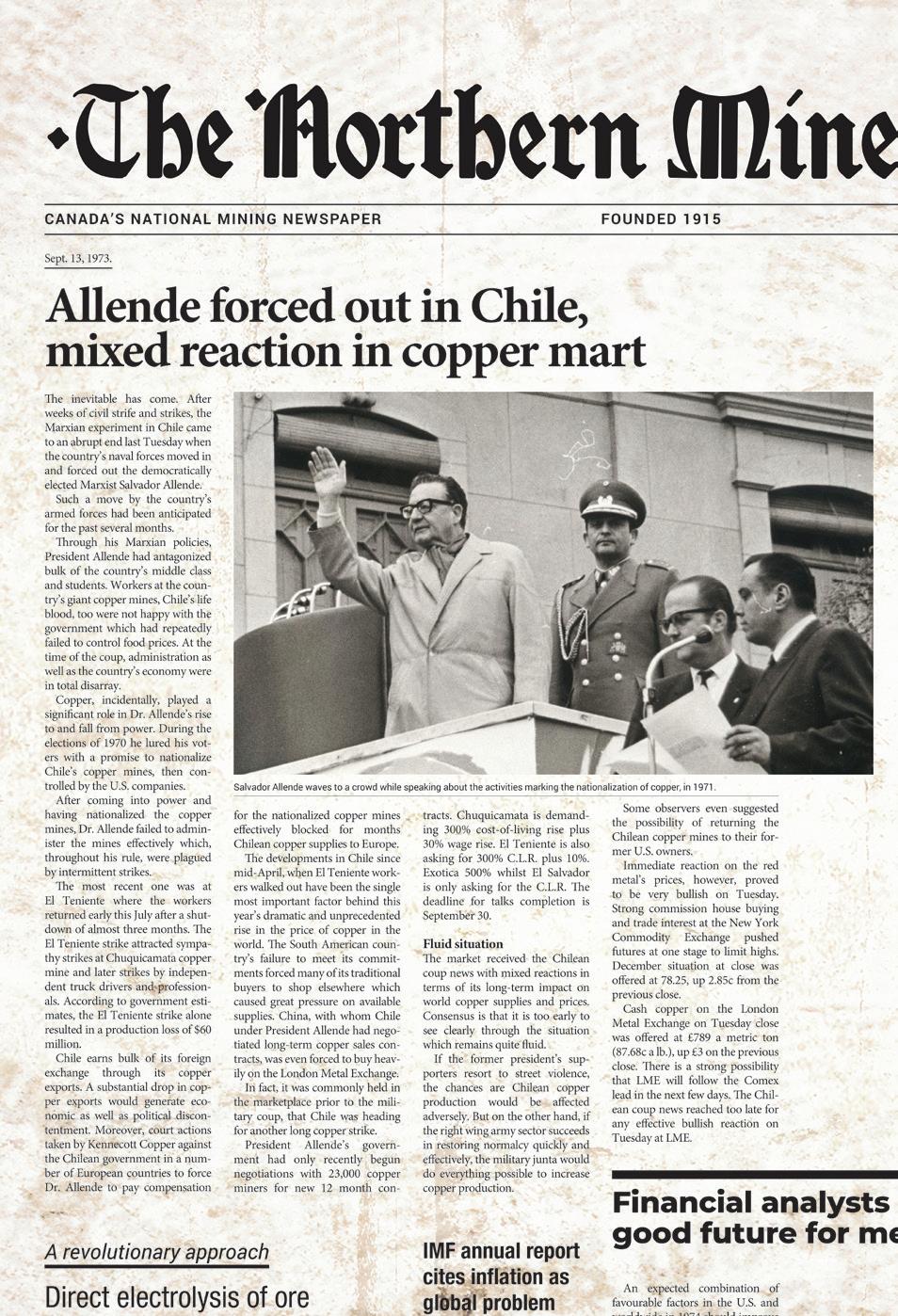
TNM Marco Polo is the next generation of The Northern Miner Mines Handbook. This new online data platform will allow you to quickly uncover market data, financial information, personnel, reserves and resources, and more on over 8,000+ companies and 13,000+ properties around the world.
8,000+ Companies
13,000+ Properties
20,000+ Executives + Personnel
Learn more at marcopolo.tnm.global