Blast from the Past, the Miner reports on US-Can. trade in 1915 /

BY COLIN MCCLELLAND
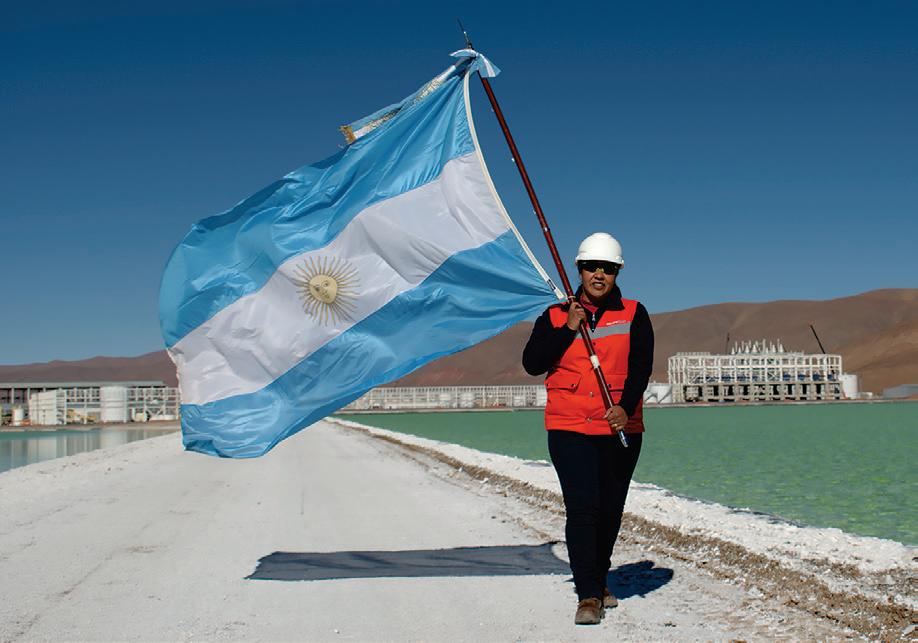
Argentine President Javier Milei, who took office two years ago in a chainsaw-wielding campaign against big government, has slashed inflation by nearly two-thirds after gutting public spending and halting money printing to finance the deficit.
His Incentive Regime for Large Investments of more than $200 million (C$285 million), known by its Spanish acronym RIGI, offers 25% corporate income tax instead of 35%, plans regulatory stability for 30 years and, in a major shift, allows external arbitration over disputes.
“He’s changed the ground rules significantly,” Rob McEwen, founder and executive chairman of McEwen Mining (TSX, NYSE: MUX), which is advancing the roughly $3-billion capex Los Azules copper project in the country, said by phone. “He’s going to cut out the bureaucracy, get permitting faster, get the money invested and attract the capital.”
Not since the free-market revolutions of 1990s Eastern Europe has a leader attempted to rewrite the investment playbook so completely — and so quickly — as Milei. Already, he’s witnessed the $4.1-bil-
lion BHP (NYSE, LSE, ASX: BHP) and Lundin Mining (TSX: LUN) tie up over Filo Corp. in the country as well as Rio Tinto’s (NYSE, LSE, ASX: RIO) $6.7-billion purchase of Arcadium, which has two of its three lithium mining projects in Argentina.
RIGI draws $15B value So far, 11 companies have applied under RIGI. Six of them are mining projects, which could hit 10 by the end of the year for a ballpark value of $15 billion, National Mining Secretary Luis Lucero said in an interview.
“The companies have expressed that this RIGI system has been very, very fundamental in their decision to select Argentina as a place where to invest,” Lucero said on March 20 by video phone. “Probably we would have seen, I wouldn’t say nothing, but certainly not the large investment we will see in copper.”
Two projects by Glencore (LSE: GLEN), El Pachón and MARA, plus First Quantum Minerals’ (TSX: FM) $3.6-billion capex Taca Taca, Lundin’s Josemaría and McEwen’s Los Azules are all due to start output by around the end of the decade. Together they could contribute some $47 billion

“He’s changed the ground rules. He’s going to cut out the bureaucracy, get


ROB
FOUNDER, MCEWEN MINING
to Argentina’s economy by 2040, according to London-based analysis firm CRU. Only Los Azules has applied under RIGI, which McEwen confirmed, while the names of the program’s other applicants are confidential, Lucero said.
Large investment forum Applications for RIGI, besides details of who, what, where and how the project plans to operate, must be new projects and explain the business plan, the cash flow expected and how it’s intended to be financed. One project, for an energy initiative has been approved. Two more projects should be approved very soon, Lucero said.
“Sometimes we’re talking about projects that were well known for a long time,” the secretary said. “But as an economic investment, they’re new because before, the conditions for a large investor to commit the hundreds of millions (or billions) dollars were simply not there.”
After three years, RIGI relaxes limits on U.S. dollar buying and repatriating profit. Coupled with the other incentives, the program is a way to boost the country’s low foreign reserves of around $28 billion and to encourage investment even as capital controls remain, Thiago Amâncio, a senior consultant with Control Risks based in Sao Paulo, Brazil, said by email.
Thin on results
“However, the program has yet to yield concrete results in attracting foreign investment,” Amâncio said. “So far, only two projects have been approved: one for solar energy by YPF Luz and another for an oil pipeline in Vaca Muerta. As a result, it remains uncertain whether the country will meet the government’s optimistic projections of $22 billion in mining investments between 2026 and 2029.”
Annual inflation has dropped
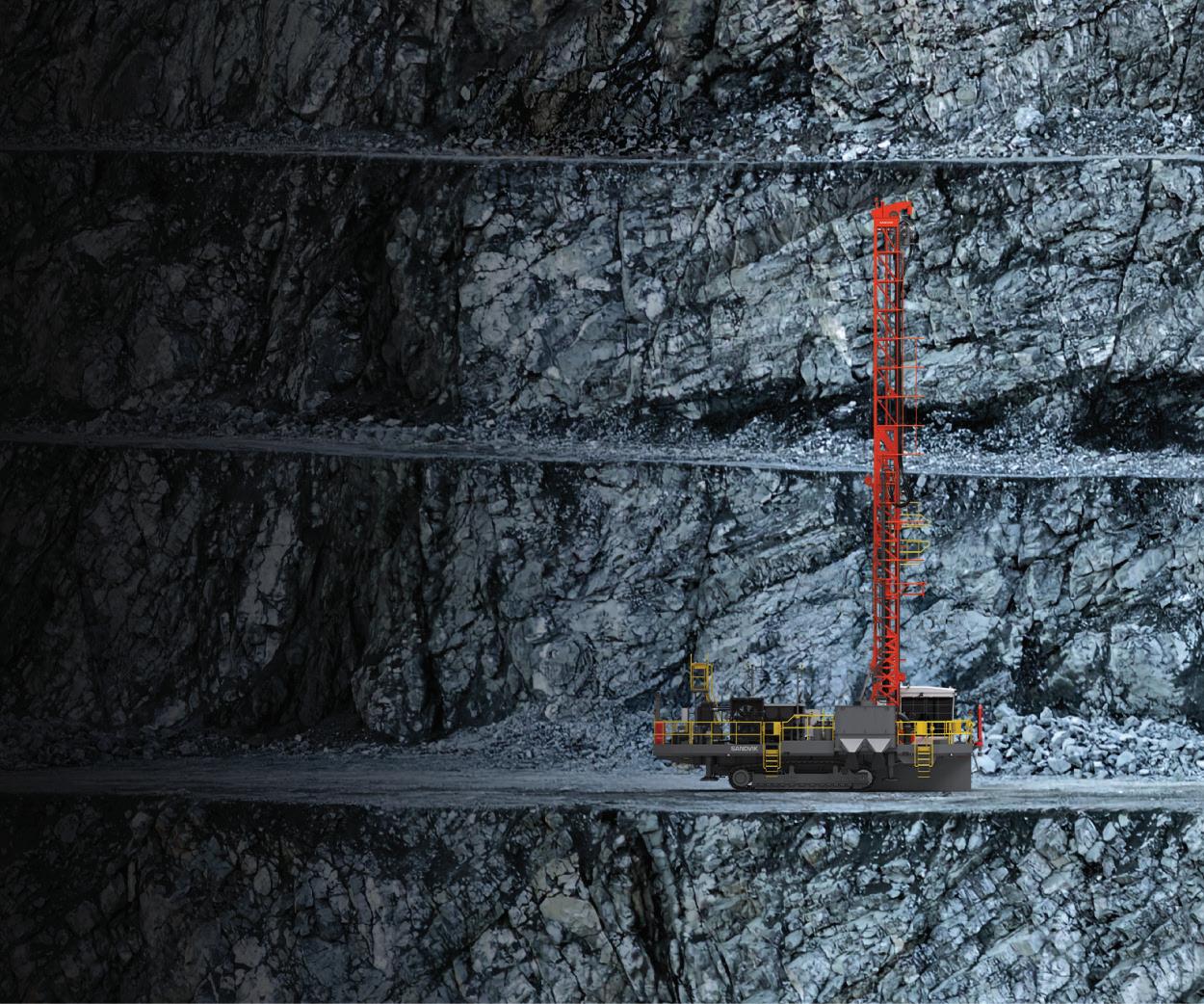



The new DR411i combines exceptional productivity with innovative iSeries technology.



With Sandvik’s new DR411i, you’ll reap the benefits from a compact drill that’s powerful, precise and productive. Paired with the innovative, data-driven technology the iSeries is known for, it’s as intelligent as it is capable. Making anyone adding it to their operation look pretty smart. Discover how the new DR411i drill from Sandvik can increase your productivity, visit rocktechnology.sandvik

DIAMOND SPONSOR



PLATINUM SPONSORS



HOST COUNTRY SPONSORS
PATRON SPONSORS

PREMIER SPONSORS GOLD SPONSORS
GLOBAL MINING NEWS • SINCE 1915 www.northernminer.com
PRESIDENT THE NORTHERN MINER GROUP: Anthony Vaccaro, CFA, MBA avaccaro@northernminer.com
INTERIM EDITOR-IN-CHIEF: Colin McClelland cmcclelland@northernminer.com
COPY EDITOR AND PRODUCTION EDITOR: Blair McBride bmcbride@northernminer.com
SENIOR STAFF WRITER: Frédéric Tomesco ftomesco@northernminer.com
WESTERN EDITOR: Henry Lazenby hlazenby@northernminer.com
PODCAST HOST: Adrian Pocobelli apocobelli@northernminer.com
ADVERTISING: Robert Hertzman (416) 898-6654 rhertzman@northernminer.com
Kathleen Plamondon (514) 917-5284 kplamondon@northernminer.com
Michael Winter (416) 510-6772 mwinter@northernminer.com
SUBSCRIPTION SALES/ APPOINTMENT NOTICES/ CAREER ADS
George Agelopoulos (416) 510-5104 (Toll free) 1-888-502-3456, ext. 43702 gagelopoulos@northernminer.com
PRODUCTION MANAGER: Jessica Jubb (416) 510-5213 jjubb@northernminer.com
CIRCULATION/CUSTOMER SERVICE: (416) 510-6789 | 1-888-502-3456 northernminer2@northernminer.com
REPUBLISHING: (416) 510-6768 jmonteiro@northernminergroup.com
ADDRESS: Toronto Head Office
69 Yonge St, Toronto, ON M5E 1K3 (416) 510-6789 tnm@northernminer.com
SUBSCRIPTION RATES: Canada:
C$130.00 one year;
5% G.S.T. to CDN orders.
7% P.S.T. to BC orders
13% H.S.T. to ON, NL
The price of metal, the value of elections

BY COLIN McCLELLAND
To help mark 110 years at The Northern Miner, we’ve started a feature each month to include some Blasts from the Past. Take a look at page 39 in this issue and you’ll see the Miner in 1915. The lead story that week in October shows the United States taking all of Ontario’s gold ore from the new Porcupine mine near Timmins, Ont. because Canada lacks its own metal refining.
Here’s the Miner in 1915:
“It is true that the government must expend a considerable sum before they can refine at Ottawa, but the gold industry in Ontario is growing so fast that it is surely folly to allow our gold to be refined in the United States. The officials at the Mint may have good reason for their lethargy; but to the outsider it appears bad business and worse patriotism.”
Some things never change. Substitute in critical minerals and China, and cross-border issues are even more profound these days. The Asian giant controls most metals refining and the West is scrambling to build its own.
Of course, the more immediate comparison for Canadians is the tariff war. It’s driving the discourse in a federal election campaign riddled with trade threats from the Oval Office. Unless you’re reading this on the first day of April, you’ll already know what level of reciprocal tariffs President Donald Trump has flung around the planet on his so-called Liberation Day, April 2.
But you may not. Things are reliably unpredictable, which is why gold surpassed the $3,000-an-oz. milestone in March, months or a year ahead of what most analysts were saying as recently as January.
How many tariffs?
To recap, Trump delayed 25% tariffs across all Mexican and Canadian goods — with oil and minerals at 10% — until April 2, the same day as the global reciprocal tariffs were to take effect. Separately, he imposed 25% tariffs on aluminum and steel imports when Canada supplied nearly twothirds of U.S. aluminum demand last year.
Canada replied with $30 billion in retaliatory tariffs against the 25% move on general goods (even though Trump paused the measure) plus $29.8 billion targeted on U.S. steel and aluminum. A third wave of up to $125 billion in retaliation was prepared but has been postponed until at least April 2.
Then before the end of March, Trump slapped 25% tariffs on all foreign-made vehicles. Again, it wasn’t clear so gold rose and stocks sank.
The Dow Jones Industrial Average had fallen 1,033 points or 2.4% by press time since the inauguration in January. March 10 saw the biggest one-day drop at 890 points so Trump is still safe from his decade-old tweet: “If the Dow Joans [sic] ever falls more than 1000 “points” in a single day the sitting president should be “loaded” into a very big cannon and shot into the sun at tremendous speed. No excuses!”
These days in Canada there’s a new patriotism. The rallying cry is “elbows up!” — Scarborough’s Mike Myers even slipped the Gordie Howe reference into the closing credits of a recent “Saturday Night Live” episode. It was a like a coded transmission behind enemy lines, from a bunker still manned by Canadian Lorne Michaels.
54-40
Elbows up is somewhat like the campaign slogan that backed president James Polk, whose manifest destiny goals were mentioned before in this space. Polk was running for election in 1844 when supporters chanted “5440 or fight!” But elbows up is definitely Canadian in its defensive posture, a bit more polite anyway.
Long before there was a solidly good Canadian rock band named 54-40 from Tsawwassen, B.C., the issue concerned the Oregon Territory that American expansionists wanted to secure all the way up to then-Russia owned Alaska at 54°40' north latitude. The dispute ended with an agreement in 1846 setting the 49th parallel as the border there.
Trump, of course, has called the line arbitrary and wants to erase it. Canadian sovereignty and tariffs also dominated the 1988 Canadian election when prime minister Brian Mulroney championed his free trade deal with U.S. president Ronald Reagan. Even my libertarian father was concerned then for the Canuck economy and jobs.
Like now, many resource-rich provinces, especially in the West, supported the deal for its promise of stable access to U.S. markets, including for mining exports. Critics, including Liberal John Turner and the NDP’s Ed Broadbent, feared it would undermine Canadian sovereignty over natural resources.
Policy shift
Despite Turner’s impassioned opposition during the televised leaders’ debates — including a widely praised performance — the Progressive Conservatives won a majority, and the agreement moved forward. Later, Liberal Jean Chretien shifted policy to accept free trade as a reality and the NDP came to do likewise, though ever supportive of workers’ rights.
So now most Canadians support continental free trade and don’t want to lose it, even though Trump has given his neighbours a wake-up call on being self-sufficient in everything from autos to defence.
Many Canadians outside of mining are also understanding the industry’s heightened role in modern applications. When a comic at a Rotary Club benefit the other night joked that her boyfriend stole her IUD for the copper in it, it was clear the battle for minerals is percolating through the public domain.
Talking about elevated metal prices, think back to the gold being produced in that 1915 article – C$800,000 for a month back then. Given inflation and a spot gold price around $3,030 per oz. as the Miner went to press, it would be worth a staggering C$158 million today. TNM
Are junior gold stocks safer than bullion?

BY JAMES COOPER
Acouple of weeks back, I wrote to my paid readership group at Diggers & Drillers, cautioning them about the gold market as it approached $3,000 per ounce.
Was that warranted? Well, let’s wait and see.
But when sentiment shifts in one direction, becoming unanimously upbeat, it does pay to be at least a little cautious. That’s why I shifted our gold recommendations from a BUY to a HOLD in March.
We’ve had a terrific run with these stocks, but the time has come to pause and perhaps take some profits.
Gold overcooked?
Perhaps over the short term.
It’s important to remember that every bull market faces pullbacks, retraces and corrections. The gold market is perhaps getting close to one of these events.
But selling out entirely may not be the wisest decision; there are still plenty of reasons to hold gold stocks over the long term. We’ll look at those reasons in a future update.
So, what does an investor do today?
Buying at these elevated levels carries more risk than 12 months ago when gold stocks traded at a much lower price point.
This is where you need to be strategic, rather than blindly following the herd and pouring your capital into an established miner that’s already surged.
Why not look at a segment of the gold market that is still beckoning in value?
Gold producers have been tearing higher for months, yet many juniors still trade close to multiyear lows. It’s a strategy that could offer more upside and less risk.
Pivot to ‘safer’ juniors
Traditionally, junior mining stocks were considered the riskiest companies to own. But look at it this way: Unlike producers, these small caps are not trading at a premium. This means a future pullback in gold could impact producers more.
On the other hand, if gold continues its record run, small-cap gold stocks have far more open runway to rise.
That’s not to say that these stocks don’t carry any risks — there are always risks when it comes to investing. But as counterintuitive as it seems, I believe juniors are a much safer way to play the gold market right now.
That’s the rationale behind my latest buy alert to members at Mining: Phase One, an advisory service focused on junior miners.
I recommended a gold junior hitting initial production in the Eastern Goldfields of Western Australia. Since gold is trading at record levels, the timing couldn’t be better for a stock like this. In
It’s
important to remember that every bull market faces pullbacks, retraces and corrections. The gold market is perhaps getting close to one of those events.
fairness to my paid readership group, I won’t share the company’s name here.
Higher value
But the point is that gold juniors offer far more value in this market. And that’s also what our resident gold expert, Brian Chu, believes. Over the last few months, Brian has told his readers to bank profits on some of his gold mining recommendations and redeploy that capital into the junior gold sector. And he was right on the money by telling readers to get into one particular junior, Spartan Resources. Last month, Spartan confirmed a buyout offer from gold producer Ramelius Resources. Like many of its peers, Ramelius wants to replace its aging deposits with new supply. Spartan’s undeveloped gold deposits were the perfect fit for Ramelius’s portfolio, giving the producer “instant ounces”.
And that’s another reason why you should focus on juniors. Mines are depleting assets, and gold producers must continually look ahead so they can resupply their shrinking deposits.
As the Spartan deal shows, acquiring a gold junior brings immediate ounces into the portfolio. There is no need to spend years exploring for a new deposit.
Why now?
With gold trading at record levels, producers are swimming in free cash. That’s why I believe the miners’ deep pockets and the need to replace aging deposits should drive a flurry of gold acquisitions in 2025.
So, what type of junior gold stock will be at the top of their shopping list, and yours as well?
It could be the juniors already holding large, untapped deposits. If gold moves higher from here, we could see FOMO (fear of missing out) spreading among the miners looking to grab a junior. After all, their future depends on it.
If the Spartan deal shows anything, we’re nearing a new phase in the precious metal market — a period of speculation and attention on junior gold stocks.
As an investor, I would be looking to move ahead of that action and add these juniors before the bigger players do!
James Cooper is a geologist based in Australia who runs the commodities investment service Diggers and Drillers. You can also follow him on X @JCooperGeo.
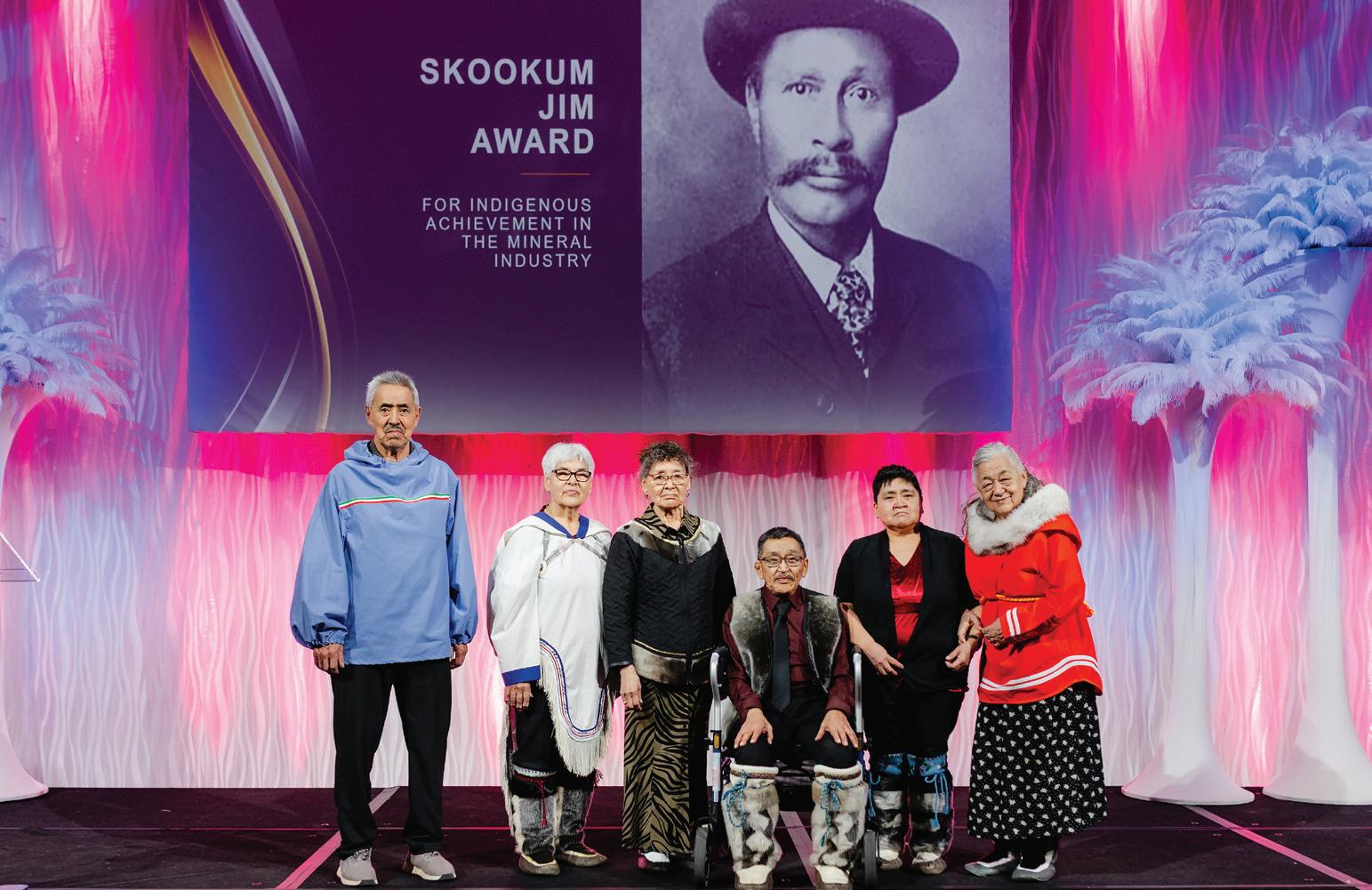
David Owingayak, left, Rosie Oolooyuk, Susie Kritterdlik, David Kritterdlik, Sharon Qiyuk, Levinia Brown at the Prospectors and Developers Association of Canada conference in March. David Kritterdlik, from Whale Cove, NU, (seated) received the 2025 Skookum Jim Award. As Agnico Eagle Mines’ wildlife and traditional Inuit knowledge adviser, Kritterdlik was chosen for his leadership in integrating that knowledge into mining.
CREDIT: PROSPECTORS AND DEVELOPERS ASSOCIATION OF CANADA (PDAC)
The United States is open to talks with Democratic Republic of Congo (DRC) over a deal that would give it access to the African nation’s critical minerals in exchange for military support, according to the Financial Times and Reuters.
President Felix Tshisekedi gave an interview to The New York Times in late February stating that the Trump administration has shown interest in DRC’s mineral wealth. The country is contending with Rwanda-backed rebel group M23 controlling major parts of DRC’s east while smuggling minerals across borders.
Tshisekedi hasn’t publicly stated a proposal, instead urging countries to buy minerals directly from it instead of from others profiting from the conflict, such as Rwanda.
DRC accounts for 76% of cobalt’s global output. It also holds significant reserves of gold, copper, tin, lithium and tantalum, essential for manufacturing high-tech devices and electric vehicle batteries.
While it’s unlikely the U.S. would become involved directly in the regional quagmire that is eastern Congo, it could conceivably boost DRC forces with military equipment.
A Feb. 21 letter to U.S. Secretary of State Marco Rubio from a lobbyist representing Congolese Senator Pierre Kandi Kalambayi, proposed granting American companies mining rights in exchange for U.S. support in training and equipping the Congolese military. But Tshisekedi didn’t approve the suggestion, Reuters said.
China currently enjoys greater access to Congo’s mineral wealth than the U.S.
Meanwhile, DRC plans to place export quotas on cobalt
after setting a four-month ban in February, Reuters reported in mid-March.
BY NORTHERN MINER GROUP STAFF
Canada’s federal government will permit major infrastructure and mining projects with provincial and territorial approvals alone, Prime Minister Mark Carney said after meeting with the country’s 13 premiers.
“One project, one review, Carney told reporters in Ottawa March 21. “We will work with the provinces and other stakeholders, Indigenous groups, to identify projects of national significance and accelerate the time frame to build them.”
Carney said a leading project for the speedy permitting process would be the Cedar LNG project, a proposed Indigenous-led liquefied natural gas export facility estimated to cost $5.8 billion and located near Kitimat, British Columbia.
Developing the Ring of Fire critical minerals region in northwestern Ontario would one of several potential future projects that could get a quick OK. Conservative Party leader Pierre Poilievre made the same case to approve it within six months of an election win.
Another potential future major project could be the Grays Bay Road and Port project in western Nunavut, which aims to connect the mineral-rich Slave Geological Province to a deepwater port at Grays Bay via an all-season road.
The Liberal leader also outlined a new First Mile fund to provide capital for building transmission and transportation networks to link mining projects to existing rail and road networks.
Carney said the government was cancelling plans to
increase the capital gains tax to 66% from 50%. In his first move at a cabinet meeting, he cancelled the consumer carbon tax, echoing calls by other leaders such as Poilievre.
BY CECILIA JAMASMIE
Gold made history on March 14 by reaching the $3,000 per oz. level for the first time, as investors continue to pile onto the safe-haven metal to seek cover from economic uncertainty sparked by U.S. President Donald Trump’s tariffs.
The spot gold price hit a record of $3,004.71 per oz. during morning trading that day, before pulling back to $2,984.50 by the bell. It first closed higher than the milestone on March 17 at $3,001.13 per ounce. The yellow metal was trading at $3,019 per oz. near press time.
Gold futures predict prices will continue to rise, according to the World Gold Council. Also driving the rally are global central banks that have been building up gold inventories to unburden themselves from relying on the greenback.
Gold’s new milestone highlights the metal’s centuries-old role as a store of value in turbulent times and as a gauge of fear in markets. It breached the $1,000 mark in the aftermath of the financial crisis and passed $2,000 an oz. during the Covid-19 pandemic.
In the last 25 years, bullion has risen 10-fold, outperforming even the S&P 500, which quadrupled over the same period.
BY COLIN MCCLELLAND
By Anthony Vaccaro, with files from Ali Ravaghi
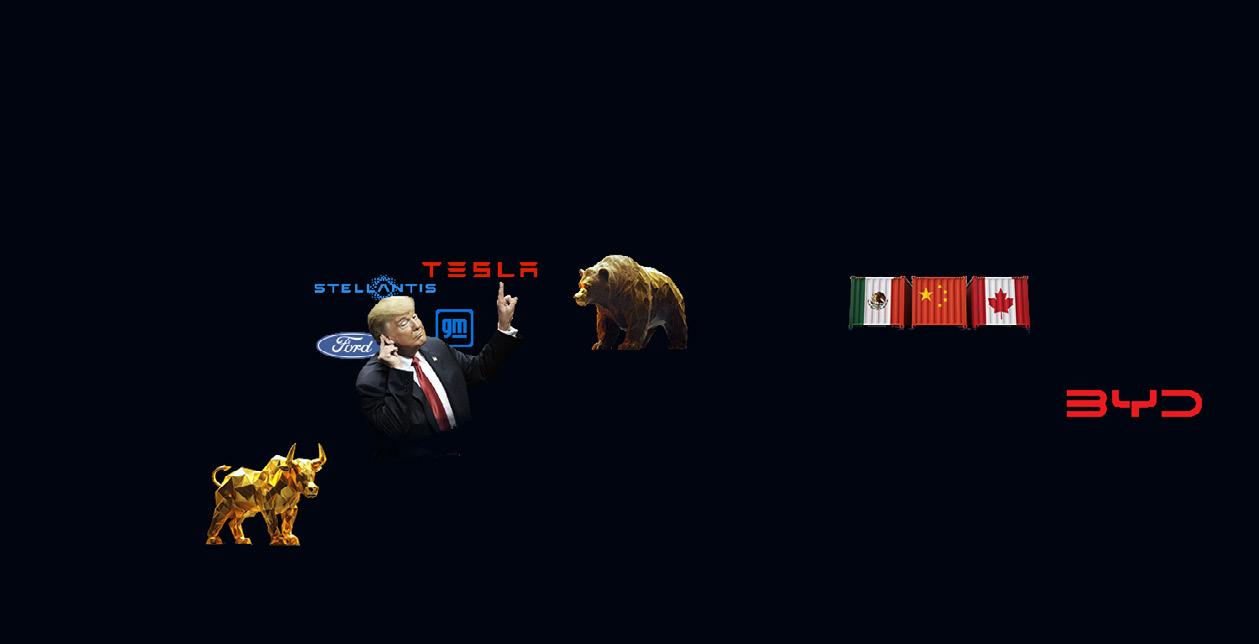
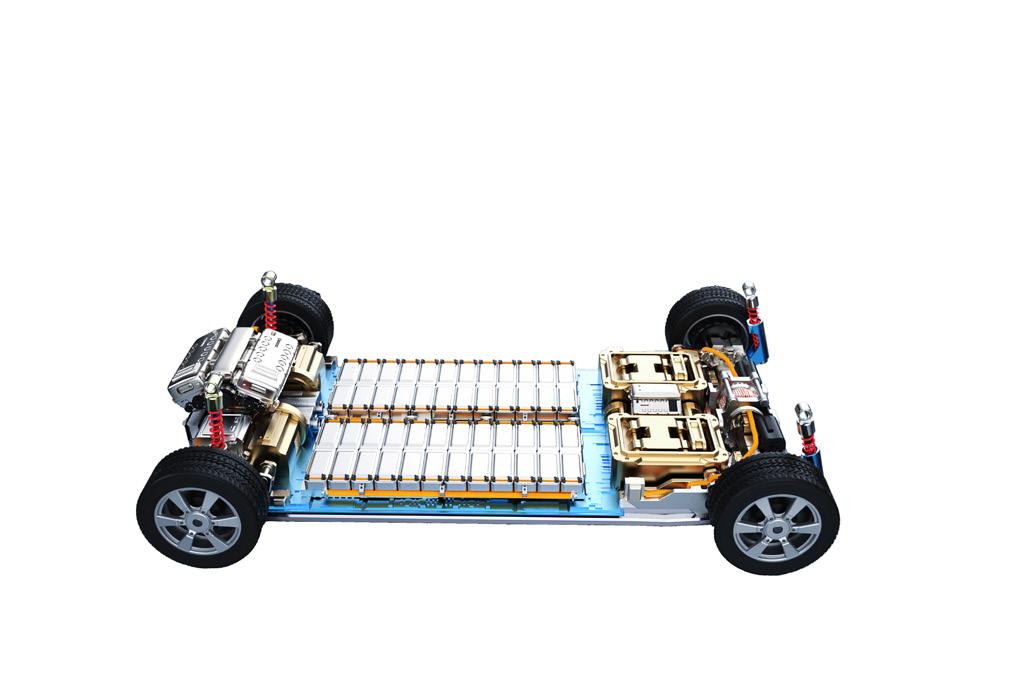
Tesla’s whirlwind EV growth fuelled demand for lithium, cobalt, and graphite in 2024, but sliding sales—especially in Europe—are shaking up the battery metals sector. China’s BYD and other rising players are filling the gaps, driving adoption with high-tech features in budget models.
Meanwhile, geopolitical risks are mounting fast. Indonesia now controls 61% of global nickel supply, while the DRC’s cobalt export halt adds volatility. U.S. tariffs on Canadian and Mexican EVs could further dent North American demand.
New competition could sustain battery metals consumption, but trade wars and supply shocks are threatening momentum in an already turbulent market.


BY NORTHERN MINER STAFF
Aris Mining (TSX: ARIS; NYSE: ARMN) says expansion of its two Colombian mines will start delivering increased output as soon as this year.
Consolidated gold production is projected to rise to between 230,000 and 275,000 oz. in 2025, Vancouver- and Bogota-based Aris said in its fourth-quarter earnings report in March. This compares with 210,955 oz. last year.
“Aris Mining is on track to more than double annual production to 500,000 oz. and we have the means and the team to deliver that growth,” CEO Neil Woodyer told analysts on a conference call March 13.
Organic growth
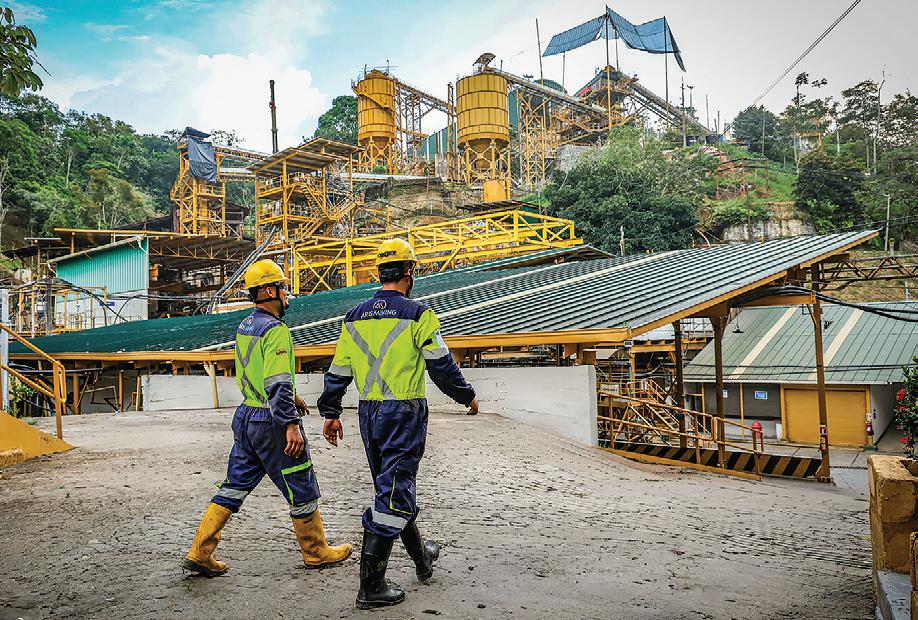
The company is increasing the throughput capacity by 50% of its processing plant at Segovia, its biggest mine and one of the highest-grade mines in the world, with an average reserve grade of 10.8 grams per tonne. Commissioning of the expanded processing facility is scheduled for this year’s second quarter, with the installation of the second ball mill underway, Woodyer added.
According to Aris, production at Segovia is expected to rise to between 210,000 and 250,000 oz. this year compared to 188,000 oz. last year. Annual output will be in the range of 300,000 oz. starting in 2026, the company added. This growth profile is a function of a gradual ramp-up from 2,000 tonnes per day (tpd) to 3,000 tpd for the remainder of this year once the expansion has been completed.
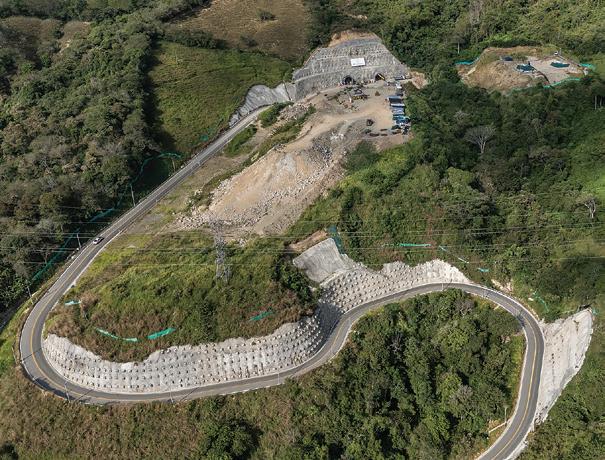
Last year, the Marmato Upper Mine produced about 23,000 ounces. To raise Marmato’s production capacity to more than 200,000 oz. of gold a year requires the completion of the Marmato Lower Mine, which will have a throughput capacity of 5,000 tonnes per day; as well as expanding the Contract Mining Partner business to work with local small-scale mining groups at the Upper Mine. Output at Marmato Lower Mine is expected to start ramping up in the second half of 2026, Aris said.
“With new Marmato and the expansion at Segovia, Aris is targeting an annual production greater than 500,000 oz. a year,”
Don DeMarco, an analyst at National Bank Financial, said in a note to investors last month. The average target price based on estimates from National Bank, BMO, Canaccord and Cormark is C$10.63.
Aris shares were at C$6.63 apiece in Toronto as press time neared, giving the company a market capitalization of C$1.1 billion. The stock has traded in a 52-week range of C$4.54 to C$6.97.
Contract Mining Partners
Colombia’s gold mining industry is hundreds of years old and to this
day largely informal. Local miners have been mining at Segovia for about 300 years and about 450 years at Marmato, Woodyer told The Northern Miner Podcast in an interview.
As one of the few industrial scale mine operators in the country and with its assets located in mining districts, Aris has designed and fine tuned a mutually beneficial business model over many years to not just coexist but collaborate with small-scale mining groups, known as Contract Mining Partners (CMPs).
This business model helps CMPs establish formal, well equipped contract mining companies and enter into longterm contracts with Aris to purchase their mill feed and process it at the company’s facilities.
“We purchase the mill feed based on a formula linked to gold contained, grade and the prevailing gold price at the time of delivery, thus helping CMPs avoid the black markets, formalize, and access international trading channels,” Woodyer added.
Production from the Segovia operations in 2025 will be sourced about 50% to 55% from owner mining, Aris said last month. Millfeed purchased from CMP will make up 45% to 50%.
Segovia’s processing plant can
produce materially more gold if it processes the mill feed from the CMPs compared to what the CMPs could achieve on their own. Segovia has a recovery rate of 95%, compared to a 45% to 50% recovery rate the informal sector can achieve, according to the company. That incremental production allows the CMPs to be better off while also being an attractive business for Aris.
At a gold price of $3,000 per oz., Aris generates an all-in sustaining cost (AISC) sales margin of about $1,125 per oz. from the CMP business. And that incremental production also allows Aris to spread Segovia’s fixed cost over more ounces, making every ounce more profitable.
But not only the CMPs and Aris are better off, the Colombian government benefits by way of increased tax revenues as does the environment given that processing at Segovia results in environmental damage mitigation, compared to the alternative of informal processing, Woodyer said.
“There’s a lot of environmental damage [from informal processing]. They’re using mercury,” he said. “They’re not cleaning the tailings up, [and] they’re being dumped into rivers. They’re moving on when an area has been fouled because of the lack of investment in processing.”
in 2009 and Leagold in 2016, Aris is the third gold mining company led by Woodyer. The three companies share how Woodyer pursued a buy-andbuild strategy to scale them. But when he compares Aris to his prior two companies at the same point in time about four years into building the company, Aris has the strongest asset base. Woodyer points to the scale: 7 million oz. in proven and probable reserves and 19.9 million oz. in measured and indicated resources plus an incremental 10 million oz. in the inferred category, as well as the grade of its properties.
Aside from Segovia and Marmato, Aris controls 51% of the Soto Norte development project in Santander, Colombia and all of the Toroparu gold-copper project in Guyana. Aris initially acquired a 20% stake in Soto Norte from Mubadala Investment, an Abu Dhabi sovereign wealth fund, in 2022 and an additional 31% last year.
“Soto Norte is probably the best undeveloped gold development project in Latin America, with 8.5 million oz. of gold resources measured and indicated at 5.5 grams per tonne,” he said.
This asset portfolio is the base to build a leading gold mining company in Latin America, “the Endeavour Mining of Latin America” according to Woodyer.
Strong financial foundation
Small business generator
Aris says its partnership program empowers local miners to build their own mining businesses by sharing geological, technical, and mine planning knowledge. Aris staffers also offer training on proper procedures and sometimes provide working capital financing.
“We have contracted with 40 groups of mining partners to formalize, and we help them on health and safety,” Woodyer said in the podcast interview. These CMPs range in size between 50 to 500 employees.
“We have an education program with a university where 2,500 small miners are on the web to learn their trade better. They have a lot of skills that we don’t have. Putting their strengths with our strengths of industrial mining, our processing, our access to capital, our health and safety, our compliance, if you can put those two sides together, you have a very, very strong partnership.”
And since Colombia’s government is looking to formalize mining, “we’ve totally aligned with their objectives,” Woodyer added. “This has become an integral part of our business in Colombia because the potential is so huge.”
Third gold mining company
Having founded Endeavor Mining (LSE, TSX: EDV; US-OTC: EDVMF)
At the end of 2024, Aris had $253 million of cash and cash equivalents compared with $195 million a year earlier. Growing cash flow generation from Segovia and refinancing of the company’s senior notes in October contributed to the increased cash balance, Woodyer said.
AISC margins at Segovia hit a three-year high of $58.3 million in the fourth quarter. That’s a 32% improvement over the third quarter due to improved efficiency, cost control and higher realized gold prices, which gained about 28% last year. For the full year 2024, Segovia generated an AISC margin of $163 million.
Higher output this year should drive a significant increase in Segovia’s AISC margin to more than $230 million (assuming a gold price of $2,600/oz), Aris said. That guidance appears conservative as the yellow metal has been trading at much higher levels, as press time neared gold was quoted at $3,018.90 per oz.Also, under the Marmato streaming agreement with Wheaton Precious Metals, $82 million remains to be funded to support development work at Marmato. Considering all this, Aris has the means to more than double annual production to 500,000 oz., Woodyer said.
The preceding Joint Venture Article is PROMOTED CONTENT sponsored by Aris Mining and produced in co-operation with The Northern Miner Group. Visit: https://www.aris-mining. com for more information.
BY EMILIA SALTOS
Is it just me, or when you see that a new Free Trade Agreement (FTA) is signed, do you immediately look for the fine print?
The recently signed free trade agreement (FTA) between Canada and Ecuador has been advertised as a gateway to economic growth and prosperity for the South American country. As Ecuador seeks to diversify its economy and attract foreign investment, large-scale mining offers job creation and infrastructure development.
But how good is too good to be true? Representatives of CONAIE (Ecuador’s largest Indigenous organization) have expressed concern that this agreement primarily serves the interests of Canadian mining companies at the expense of Ecuador’s environment and communities.
Ecuador is rich in valuable minerals such as gold, copper and silver, yet much of this wealth remains unexploited. Large-scale mining projects bring muchneeded employment opportunities not only in extraction but also in engineering, logistics and local businesses.
The FTA provides a framework for sustainable economic expansion, emphasizing fair labour practices, local job creation and community participation. When done responsibly, mining can create thousands of jobs.
ESG gains
This agreement facilitates investment by Canadian companies by removing trade barriers and simplifying investment procedures, making Ecuador attractive to investors. Canada is known for its strong environmental, social, and governance (ESG) regulations, which Ecuador
“Investorstate dispute mechanisms should not bypass environmental safeguards but rather promote fair and transparent practices.”
can leverage to ensure that mining companies comply with best practices in sustainability and social responsibility.
Canada is a global leader in mining. Its abundant mineral deposits have led to advances in research and technology, positioning it at the forefront of a highly competitive market. Canadian companies offer not only capital but expertise and cutting-edge technology, enabling safer operations, efficient exploration and environmentally responsible management.
Most of the agreement includes a state-to-state dispute settlement (SSDS) mechanism, which is widely accepted. However, there are a “few specific exceptions,” according to the Canadian government.
One of these exceptions is in the investment chapter, where parties
have agreed on an investor-state dispute settlement (ISDS). This mechanism allows Canadian companies to sue the Ecuadorian government in international courts instead of domestic courts if they feel that policies negatively impact their business. This could limit Ecuador’s ability to tighten environmental, investment and revenue regulations on the mining industry.
Ecuador banned international arbitration in its constitution in 2009, a statement ratified again in the 2024 referendum for future treaties. This creates legal and political contradictions when signing this treaty.
Resource sovereignty
Opponents argue that large-scale mining by Canadian companies under this FTA could lead to losing sovereignty over natural resources, environmental destruction, exploitation of local communities, and social conflict.
Without efficient prior consultation and successful collaboration mechanisms, social problems
British Columbia’s grassroots exploration sector faces a structural shift as projects mature and early-stage exploration funding dries up, a new survey found.
Exploration spending dropped 14% to $552 million last year, and from $643 million in 2023, the consulting firm EY said in a late February report. Per-project spending by junior companies fell 35% to $1.4 million as their overall funding plunged 65% to just $25 million.
The challenge in funding is one of the reasons placing $38 billion in opportunities for mining at risk, according to a 2024 study by the Mining Association of British Columbia that EY cites.
“The gradual decrease in expenditure in B.C. from the record highs set in 2022 are indicative of the cyclical nature of the exploration industry,” Iain Thompson at EY Canada Mining and Metals Consulting, told The Northern Miner Assets that previously received significant funding are maturing out of the exploration stage, Thompson said. They’re moving along the lifecycle and approaching operational readiness.
B.C. captures about 12% of national exploration spend, but it’s been struggling to attract new early-stage investment.
If B.C. is to remain competitive, it must expand its funding framework beyond the current provincial tax credit, streamline permitting and reform land access and tenure policies, EY said.
Failure to do so risks not only stifling new exploration but also squandering billions in potential economic development.
BY HENRY LAZENBY
largely dependent on crude oil exports, a sector that is currently eroded and unstable amid the global shift toward clean energy. Mining has become a key component of government plans worldwide, especially focused on critical minerals. It may represent a unique opportunity to secure income to support essential sectors such as education and health.
Canadian mining companies operate under rigorous environmental regulations that mandate responsible waste management, land rehabilitation and pollution prevention. Integrating these international standards into Ecuador’s regulatory policies can mitigate ecological and social risks.
can escalate into violent confrontations and legal battles. A clear example is the La Plata mining project, operated by Vancouver-based Atico Mining in Palo Quemado. On March 18, 2024, the Ecuadorian government attempted to carry out a prior consultation process, resulting in confrontations between the community, anti-mining groups, and security forces.
I would find it strange, or somewhat naive, to argue that mining today won’t cause any environmental or social impact. The concerns of ecological and human rights NGOs are valid. They should be addressed with the attention they deserve, especially now that the Ecuadorian government’s portfolio is focused on increasing support for large-scale formal mining.
Despite these reservations, Ecuador cannot overlook the opportunity to introduce this growing sector into its economy. Outright rejection of large-scale mining is not and should not be the approach.
Oil dependence Ecuador’s fragile economy remains
Investor-state dispute mechanisms should not bypass environmental safeguards but rather promote fair and transparent practices. With strict government oversight and corporate accountability, Ecuador can ensure that mining activities align with its long-term interests.
If implemented responsibly, large-scale mining under the FTA can strengthen Ecuador’s economy while upholding international environmental and human rights commitments.
The conversation should not be about whether mining should happen but how it should happen. TNM
Emilia Saltos is a first-year master’s degree student in geological sciences studying mineral exploration at the University of British Columbia in Vancouver. She is an Ecuadorian geologist and has worked on exploration for copper in Ecuador for five years before moving to Canada. She plans to return to Ecuador, advocate for better industry practices and help forge stronger relationships between government, community and industry.
Shares in New Found Gold plunged nearly a third after the explorer posted a long-awaited initial resource for its Queensway project in Newfoundland that missed expectations.
The project has 18 million indicated tonnes grading 2.4 grams gold per tonne for 1.39 million oz. gold, plus 10.7 million inferred tonnes at 1.77 grams for 610,000 oz. contained metal, the company reported March 24.
“Queensway’s initial resource of 2 million oz. in all categories resets the market expectation of grade and scale,” BMO Capital Markets said in a note. “We were previously assuming about 2 million oz. of high grade at Keats and Iceberg augmented by at least 1 million oz. from other zones.”
The Queensway project near Gander was heralded as the centre of a Newfoundland exploration resurgence that included Labrador Gold and Exploits Discovery among others. But an investigation by short-seller Iceberg Research last year accused New Found Gold of massive drilling and irresponsible reporting of assays to hide a nuggety but inconsistent deposit.
The Vancouver-based junior’s stock dropped 29% in Toronto to close at $1.59 apiece near press time, valuing the company at $318.7 million.
New Found created waves in 2019 when a drill hole at the Keats target cut 19 metres grading 92.9 grams from 96 metres downhole. The company collected more than 720,000 metres of drilling history, a huge amount before a resource, and it raised eyebrows in the industry.
BY COLIN MCCLELLAND
United States President Donald Trump and his Ukraine counterpart Volodymyr Zelenskyy were said to be close to a deal on the war-torn country’s minerals near press time.
The U.S. offered Kyiv a new version of the minerals deal on March 26. It extends beyond the framework agreed in February after the initial meeting between the presidents disintegrated into a rare spectacle of raised voices and accusations at the White House.
Zelenskyy said the new proposal is a large comprehensive agreement that doesn’t include U.S. involvement in Ukraine’s nuclear power sector. American officials had suggested the U.S. should control the Zaporizhzhia power plant, Europe’s largest.
The proposed resource deal with Ukraine would see the country contribute half of future mining revenues into a reconstruction investment fund jointly owned by the U.S. and Ukraine.
While some U.S. estimates have put Ukraine’s mineral wealth at $12 trillion, little recent prospecting has been done and any projects would take years to develop. Ukraine produces some titanium and gallium, and holds zirconium, graphite, rare earths, lithium and uranium. Ukrainian data show it has deposits of 22 of the 34 minerals the European Union calls critical.
BY MINING.COM STAFF
PERMITS | Speeding up approvals is critical, experts say
BY FRÉDÉRIC TOMESCO
Time is of the essence if miners are to deliver the minerals needed to power the energy transition.
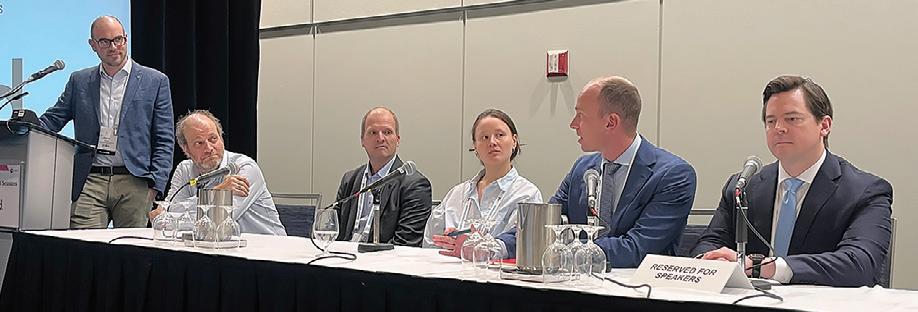
That sense of urgency was front and centre last month as Toronto hosted the world’s biggest mining convention against the backdrop of a nascent U.S.-Canada trade war.
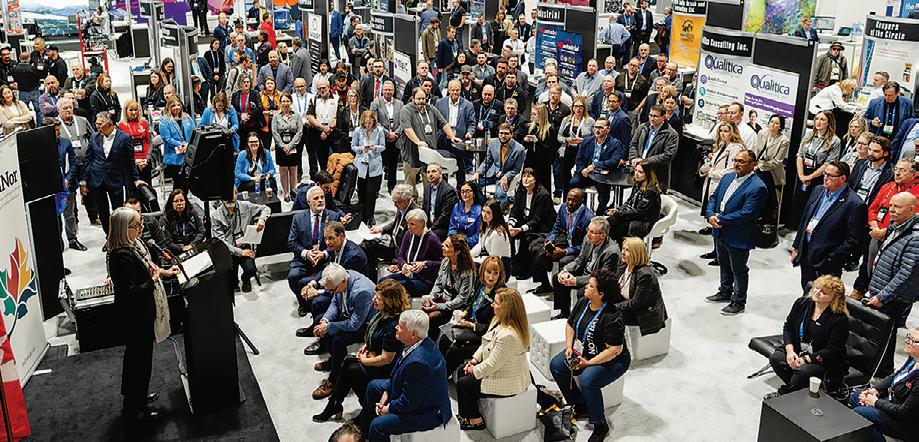
More than 27,000 people attended the Prospectors & Developers Association of Canada’s annual conference from March 2-5. Some 1,100 exhibitors, including government officials, company executives and technical specialists from around the world also took part.
While government officials acknowledged more must be done to speed up permitting and close the extraction and processing gap with China, company executives said they’re looking for ways to find efficiencies through automation and artificial intelligence. Both sides underlined the urgent need to attract the next generation of workers to mining careers and close a widening talent gap.
Demographics, urbanization and increased electrification are major reasons why the world needs mineral production to quickly ramp up. By 2050, Earth will be home to almost 10 billion people — about 25% more than today. Many more people will be living in bigger cities — which will mean more cars, more high rises, more phones and more data centres.
“All of this is going to require more steel, more iron ore, more potash, more copper and other metals and minerals,” BHP (LSE: BHP) CEO Mike Henry said in his keynote address March 2.
In copper alone, demand is expected to jump 70% by the middle of the century, he added.
Transition lagging Tom Hunt, vice president of technology at KoBold Metals, a U.S. mining startup backed by Amazon founder Jeff Bezos and former Microsoft CEO Bill Gates, put things more bluntly.
“We’re not on track for the energy transition,” he said during a panel discussion. “We need to discover hundreds of new resources and bring them into production over the next several years, and that’s simply not happening.”
Henry, who was attending the event for the first time, noted “almost unprecedented interest” in mining and the critical minerals supply chain.
“It’s certainly the most (interest I’ve seen) in my 35 years in this industry,” he said. “More people have woken up to the fact that the development of our world and the well-being of billions of people depend on the materials that we extract from the ground. We have become the centre of a global conversation.”
On an anecdotal level, The Northern Miner’s video production team was overwhelmed with interview requests during the conference. Our crew recorded 52 videos over the four days, producing interviews with analysts, bankers, executives and ministers as well as paid-for joint venture content.
“There has to be way more investment quickly. If we want to achieve our goals on electrification and AI, we need more minerals and metals”
TED MCGURK, TD SECURITIES
Scarcity headwinds To boost production and meet long-term demand, miners will seek to overcome a long list of challenges — starting with resource scarcity.
“Big deposits are becoming harder to find,” Henry said. “They are deeper, they’re more remote, they come with new technical challenges and they’re often in riskier jurisdictions. This means rethinking where and how we invest in exploration.”
Growing resource nationalism is also an issue. Guy de Selliers, a partner at the London-based investment bank Hannam & Partners who focuses on mining, said he worked on three investment projects over the last three years that were scrapped because of political instability of some sort — including a coup.
“I’m worried because resource nationalism is on the rise, as is instability,” de Selliers said March 3. “Of course, what’s happening in Washington doesn’t help. Nationalism is a lose-lose. If there is one industry that is going to be affected by resource nationalism and growing instability, it’s mining. Because these are 20-, 30-, 40-year projects. Investors know that, and they worry.”
The past few months have seen Western miners initiate arbitration proceedings amid disputes with host governments in West African countries, including Barrick Gold (TSX: ABX; NYSE: GOLD) in Mali, French uranium miner Orano in Niger and Sarama Resources (TSXV: SWA) in Burkina Faso. In some cases, authorities arrested employees, revoked permits and cancelled projects.
Solid agreements
Not only is this surge in resource nationalism hiking costs for miners, it shows how companies need solid agreements and recourse avenues.
“There’s this evolving scope of what the protections are for, not only full protection and security, but for equitable and fair treatment and protection against illegal expropriation without just compensation,” Tom Villalon, associate at Three Crowns law firm, said on a panel. “And it may rise to a new chapter of interesting and very complicated investor-state work.”
Other areas of concern for miners include rapidly falling grades on new projects and ever-lengthening permitting delays. Bringing a new mine into production in Canada
can take up to 25 years, the federal government said in its 2022 critical minerals strategy.
“There has to be way more investment quickly,” Ted McGurk, head of investment banking at TD Securities in Vancouver, told attendees March 4. “If we want to achieve any of our goals on electrification and AI, we need more and more minerals and metals. Strong commodity prices definitely help, but we have to get risk out of the business, and the permitting timelines have gotten ridiculous. Our governments have to do more.”
Taking heed Government officials who spoke at PDAC seem to have heard the message.
Federal Energy and Natural Resources Minister Jonathan Wilkinson used his time at the conference to announce a twoyear extension of the tax credit on mineral exploration to boost investment in junior mining companies. The measure, a capital market tool that offers investors a 15% tax credit to invest in flow-through shares of small project holders, was due to expire on March 31.
Ontario Premier Doug Ford, fresh off his election win, reiterated plans to expedite development of the Ring of Fire region. He also scolded the federal government for time-consuming environmental approvals and vowed to fight potential U.S. tariffs dollar for dollar.
Early results from this shift in attitude are encouraging. Companies with plans to mine critical minerals in British Columbia have received calls from the provincial government saying their project would be fast-tracked, John Turner, co-leader of law firm Fasken’s global mining group, told The Northern Miner Ontario, Quebec and Nova Scotia are also being aggressive in pushing projects, he said.
“That part is encouraging,” Turner said. “You know, it’s long overdue, and it’s unfortunate that it took something like [the U.S. tariffs on Canada] to be the impetus, but it is very good to see. It’s refreshing.” TNM
With files from Colin McClelland and Blair McBride
May 1, 2025
Deadline for contacting a Member or Associate Member Organization about submitting a nomination.
May 31, 2025
Deadline for nomination material to be submitted to the Member or Associate Member Organization.
Further information & the nomination form can be found at www.mininghalloffame.ca/nominate
BY FRÉDÉRIC TOMESCO
Massive investment flows into metals exchange-traded funds (ETFs) over the past two decades are the main reason miners are struggling to raise capital, an analyst told the world’s biggest mining conference.
Global metal and mining ETF assets rose about 6% in the first two months of 2025 to US$352 billion, new data from the Mineral Fund Advisory research firm show. This follows a 13% jump in assets in 2024 as investors poured money into gold metal ETFs. Physical gold ETFs make up about 70% of metal and mining ETF assets globally.
Funding shortfalls for mineral exploration have become a major issue just as demand for commodities tied to the energy transition is soaring. Data from the Toronto Stock Exchange and the TSX Venture Exchange, which are home to about 40% of the world’s publicly traded miners, show that new equity investment in Canadian mining stocks has fallen significantly since before the pandemic.
“ETFs have sucked a ton of
| Data show links between inflows and project shortfalls
money out of every other part of the business,” Mineral Fund President Christopher Berlet said in a presentation in Toronto. “Billions of dollars have gone to ETFs at the expense of managed funds and exploration companies. What does that mean? Less exploration, less investment in the equity markets and undervaluation of mining equities.”
Since mining and metals ETFs first appeared in 2004, an average of one new fund has been created globally every month, Mineral Fund data show.
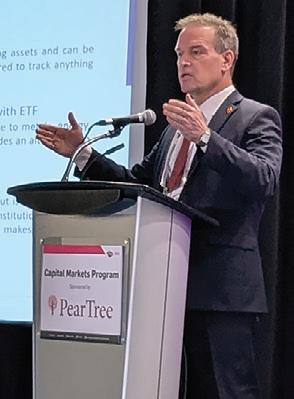
An ETF is an investment fund that owns multiple assets and can be bought and sold on an exchange like an individual stock. ETFs can track the price of a commodity or a collection of shares.
Metal ETFs dominate
Most physical metal ETFs posted gains in 2024, Mineral Fund data show. Silver ETFs led the way, rising 43%, while platinum funds added 40% and gold ETFs climbed 20%. Base metals ETFs fell 8%.
With combined assets of $296 billion, physical metal ETFs now represent about 84% of the mining
and metal ETF investment pool, the data show. This compares with $43 billion for mining equity funds and about $12.5 billion for hedged and leveraged metals funds.
Physical metal ETF assets now dwarf even the world’s largest mining firms. Gold ETFs hold combined assets of $260 billion, more than five times the $49 billion market capitalization of Newmont (TSX: NEM), the biggest gold miner.
“Up until 2004, Newmont was the game,” said Berlet, who’s been studying funds for more than a decade. “Then ETFs came and now all the money has gone into ETFs.”
Juniors bear the brunt
The shift toward ETFs has been particularly detrimental to junior miners, which have historically counted on mutual funds for financing via private placements.
“It’s so easy to buy an ETF,” Berlet said. “It’s way easier than doing the due diligence on a company and doing a private placement. This has had a dramatic impact on the market.”
Investor appetite for ETFs also hugely affects the broader economy
BY FRÉDÉRIC TOMESCO
Could the escalating trade war with the United States unwittingly spur Canadian authorities to cut approval times for much needed mines and natural-resource projects? Some investment bankers think so.
Citing “national emergency” reasons, U.S. President Donald Trump in early March slapped 25% import tariffs on most Canadian goods and 10% on energy and minerals. That prompted Canada to retaliate with $30 billion worth of duties against its biggest trading partner. And as press time approached, more reciprocal levies were in the offing.
“Maybe the one good thing about Trump is the slap in the face we need to build pipelines and build mines in this country,” Ted McGurk, head of investment banking at TD Securities in Vancouver, said during a panel discussion at the PDAC annual conference in Toronto. “We’re a resource country, and government needs to get out of the miners’ way. They are the biggest impediment to the industry, and they need to realize that.”
Drawn-out permitting timelines have been a long-standing irritant for miners in Canada. As a result, governments nationwide have been pledging to cut red tape to bring mines into production faster.
‘Build them faster’
The current trade tensions are serving as a new push for governments to rethink their regulatory processes around mines, said Joshua Goldfarb, a Toronto-based managing director in BMO Capital Markets’ metals
and mining group.
“The impact of everything that’s happening is rethinking the regulatory framework,” he said. “Is there a way to move quicker in a responsible way?”
McGurk cited the case of an unidentified Canadian company that started working on a permitting application for a mine in 2012. If all goes well, it’s now expecting to get the permit in two years.
Canadian miners are hardly alone in facing higher regulatory hurdles. It now takes about 17.9 years to build a gold, copper, nickel or lithium mine, up from 12.7 years for projects that started 15 years ago, according to S&P Global data released last year.
While rising commodity prices have boosted mining’s appeal, permitting delays represent a major stumbling block for Canadian miners seeking to raise capital on public markets, panellists said.
“There has to be way more investment quickly,” McGurk said. “If we want to achieve any of our goals on electrification and AI, we need more and more minerals and metals. Strong commodity prices definitely help, but we have to get risk out of the business, and the permitting timelines have gotten ridiculous. Our governments have to do more.”
Tap Canadian riches
Although it’s too early to say whether the tariffs will remain for the long term, Canada should do everything it can now to crank up mining output regardless of how the trade
through inflationary pressures.
“If you buy nickel in an ETF, it goes into a warehouse,” Berlet said. “You’re adding to demand. You’re competing for that metal with a battery company that needs nickel for its batteries. You’re driving prices up.”
Cheap explorer shares
A silver lining in the surging popularity of metal ETFs is the possi-
bility it creates for investors to pick up shares of explorers on the cheap, Berlet said.
Exploration “is where the market opportunity is today,” Berlet said. “The undervaluation of companies against the price of gold is as dramatic today as it has been in the history of the ETF market.”
This valuation gap is one of the reasons Toronto-based asset manager Sprott launched its Active Gold & Silver Miners ETF in February.
With gold and silver mining stocks having lagged the recent run-up in commodity prices, miners offer significant return potential because they have historically outperformed physical metal prices, Sprott says.
“Our expectation over the longer term is that we will see a reversion to the mean and that equities will outperform gold,” Steve Schoffstall, director of ETF product management at Sprott, said in a recent interview. “Earnings of gold (miners) have been projected to increase, and we haven’t seen the equity prices keep up with that.
“There’s the potential for a catch-up trade.” TNM
‘Act like a startup to speed projects’
BY FRÉDÉRIC TOMESCO
Mineral projects need to enter production much faster if the world is to find the metals necessary to power the upcoming energy transition, attendees of the world’s largest mining conference heard.
Miners were urged to use artificial intelligence more extensively and even make their geological data public to spur discoveries, panellists said. To compress development timelines and avoid “decision paralysis,” it’s also critical that miners start adopting a “startup mindset.”
“We’re not on track for the energy transition,” Tom Hunt, vice president of technology at KoBold Metals, a U.S. mining startup backed by Amazon founder Jeff Bezos and former Microsoft CEO Bill Gates, told attendees.
“We need to discover hundreds of new resources and bring them into production over the next several years, and that’s simply not happening.”
Decarbonization and urbanization are two of the long-term trends that are driving an unprecedented demand boom for minerals. Mining companies across the globe will probably need to invest at least US$2.1 tril-
lion in new supply by 2050, according to an October forecast released by Bloomberg NEF, a U.S.-based research firm. Aluminum, copper and lithium are among the energy transition metals that could face deficits in primary supply this decade, the firm said.
Problem is, delays are multiplying. It now takes about 17.9 years on average to build a gold, copper, nickel or lithium mine, up from 12.7 years for projects that started 15 years ago, according to S&P Global data released last year.
AI could help miners cut exploration timelines, but it’s essential that humans remain involved in the process, Hunt said. Every project at KoBold is co-led by a geologist and a data scientist, which has allowed the company to extrapolate data it would previously have been unable to use, he said. Access to data
Making geological data public is essential to pave the way for the next wave of mineral discoveries, Hunt insisted.
“We can’t work if you keep your data close to your chest,” he said. “It takes five minutes to post your data, and that data will be there for the entire industry to learn from. This will
BY FRÉDÉRIC TOMESCO
Canada and Australia could end up trailing emerging mining nations such as Argentina if their governments don’t speed up permitting and lower costs, BHP (NYSE, LSE, ASX: BHP) CEO Mike Henry warned.
Countries such as the United States, Argentina and Saudi Arabia are making “sizeable” efforts to reform their mining sector and attract capital, Henry said at one of the Toronto conference’s early sessions. At the same time, established natural-resource powerhouses such as Canada and Australia have seen their global attractiveness erode.
Henry’s comments come as the U.S. administration of President Donald Trump looks to spur domestic production of critical minerals in part by overhauling permitting requirements. According to a June 2024 report by S&P Global, the U.S. has the second-longest average development times in the world of the 23 countries they evaluated.
“Just as is the case for business, nations need to remain competitive on the global stage or they will be left behind in the race for metals and minerals investment programs,” Henry said in a speech and subsequent question and answer exchange. “The competitive landscape isn’t static.”
Benchmarking
If a country isn’t constantly benchmarking, “it runs the risk of falling behind,” added Henry. “Once capital mobilizes in one direction, sometimes it can be quite hard to
mobilize in the other direction.”
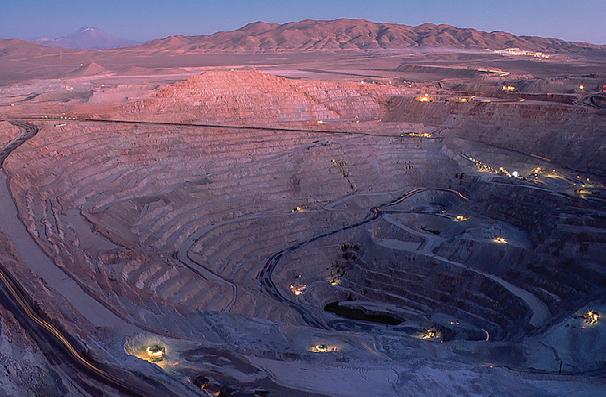
Permitting delays are a key irritant for miners. New mines in Australia and Canada typically take from 10 to 15 years to get built, compared with as few as five years in a country like Chile, Henry said.
Although Canada possesses many advantages, including plentiful natural resources and a strong ecosystem that includes engineering firms with mining experience, the country is no longer as attractive to foreign investment as it once was, the Canadian-born Henry said.
Canada’s competitiveness has dropped from eighth to 19th in the past four years in the World Competitiveness Yearbook published by the Switzerland-based International Institute for Management Development, and the country needs a renewed reform agenda to bolster mining competitiveness, he said.
Issues in Australia include elec-
tricity prices that are about 50% higher than in the U.S. and combined tax and royalty levels that are “simply uncompetitive for capital,” Henry said. To make matters worse, the country has limited reserves of “future-facing commodities” like copper, nickel or lithium, he added.
“Australia can no longer rely as heavily on its geological advantages but instead must exercise its policy muscles to improve competitiveness,” he said. “It needs to confront the fact that productivity growth is sluggish across the broader economy and has fallen in the mining sector across the past two decades.”
‘Can-do’
As a result, policymakers “need to examine the entire set of policy and regulatory settings and ask whether they are making the country more or less competitive globally,” the BHP CEO added.
It’s a different story in the U.S., where multiple initiatives are under way to expand mining output. Henry spent the last week of February in Washington, D.C. to meet with U.S. lawmakers and says he came away encouraged by the “can-do, make-it-happen attitude” in his meetings.
Compared with Canada and Australia, “other countries are mobilizing a more urgent effort and have higher ambitions around this. That includes the U.S., who’s currently behind the curve but could very well end up being far ahead of the curve if they carry through with some of their current intent,” he said.
Henry is also optimistic about Argentina, given its reserves of copper, gold and lithium. In copper alone, projects representing about 1.2 million tonnes of annual output are in the pipeline, with “much more to come,” he said.
BHP and Canada’s Lundin Mining (TSX: LUN) recently closed the US$4.1-billion acquisition of Argentina-focused Filo Corp as part of an increased emphasis on copper. BHP’s contribution was about US$2 billion, Henry said.
“Argentina could very well become a top 5 copper producer,” Henry said. “Argentina is serious about competing globally,” he said. “They know they need to attract capital to make it happen and they are focused on unlocking the opportunity. Our sector is taking notice.”
Since taking office in December 2023, Argentinian President Javier
FINANCING | Two more years for
BY COLIN MCCLELLAND
Canada’s federal government extended a tax credit on mineral exploration by two years to boost investment in junior mining companies, Energy and Natural Resources Minister Jonathan Wilkinson said.
The mineral exploration tax credit, a capital market tool that offers investors a 15% tax credit to invest in flow-through shares of small project holders, was due to expire on March 31.
“This is a crucial piece to ensure capital is directed into early-stage mine development,” Wilkinson said March 3 in Toronto during a session at the annual convention.
“As you folks will know very well, there is a need to incent risk capital. There is presently not enough capital flowing into this space.”
The tax credit should create $700 million in flow-through share investment to support mineral exploration, the minister said. He also declared the $500-million second round of the government’s critical minerals infrastructure fund open for project applications, and that a critical minerals development fund is getting another $50 million.
New Prime Minister Mark Carney subsequently confirmed Wilkinson as energy and natural resources minister when he unveiled his cabinet March 14.
Industry demand Renewing the tax credit for more than a year — and potentially making it permanent — was one of the key demands of the PDAC. Failing to do so would have weakened the Canadian mining industry because the credit is a critical part of the country’s fiscal landscape, according to Jeff Killeen, PDAC’s director of policy and programs. Wilkinson told The Northern Miner that the Canada Revenue Agency would treat the measure as continuing even though Parlia-
ment wasn’t able to formally pass the legislation. The body was prorogued pending an election call as the Miner went to press.
The infrastructure fund has so far backed improvements to the northwest British Columbia highway in the Golden Triangle area, Wilkinson said. The development fund has earmarked $38.5 million for eight projects preparing for construction. There is also $6.5 million for innovation in technologies and to increase economic participation of Indigenous communities
Milei has taken various steps to make the country more attractive for mining investment, primarily by pursuing deregulation, reducing inflation, and improving economic stability.
Last year, the Milei administration introduced the Incentive Regime for Large Investments, offering 30-year tax, trade, and foreign-exchange benefits for projects investing at least $200 million in sectors such as mining.
The reforms have attracted some large investments: In December, Rio Tinto (NYSE, LSE, RIO, ASX: RIO) announced a $2.5-billion investment to expand its Rincon lithium project. This development is expected to position the country as a leading lithium producer.
Canada’s First Quantum Minerals (TSX: FM) plans to invest $3.6 billion in the Taca Taca copper project in Salta province. If realized, this could elevate Argentina into the top 10 global copper producers.
Having abandoned its attempts to acquire Anglo American (LSE: AAL), BHP is busy pivoting to organic growth. Up to $10 billion is being spent on Chile’s Escondida, the world’s largest copper mine, in which Rio Tinto has a 30% stake. Urbanization and growing electrification are two of the reasons the use of critical minerals is projected to soar in the coming decades. Copper, for one, is facing a 70% increase in demand by the middle of the century, Henry said. Some $250 billion will be needed over the next five to 10 years to keep pace with the surging appetite for metals, BHP forecasts. TNM
in mining, he said. Some projects gaining from the funding are E3 Lithium’s (TSXV: ETL; US-OTC: EEMMF) brineto-battery metal project in Alberta, which is receiving $5 million, Wilkinson said.
Canada Nickel’s (TSXV: CNC; US-OTC: CNIKF) Crawford project, which aims to tap the world’s second-largest nickel reserve, is being funded with an unspecified amount by the critical minerals infrastructure fund to connect to Ontario’s grid. Another federal
fund, the energy innovation program, is to transform the company’s nickel mining tailings into permanent carbon storage.
Crawford’s regulatory approvals are expected this year, the minister said. Once in production, the mine is expected to create 1,500 jobs. Last year, South Korea’s electric battery car manufacturer Samsung invested US$18 million in Canada Nickel.
Wilkinson said the federal government is working with provincial and territorial counterparts to streamline project approvals and environmental assessments. Elsewhere at PDAC on March 3, Ontario Premier Doug Ford called for Ottawa to abolish all federal level assessments to speed up projects.
The federal critical minerals strategy, which began in 2022, has seen a 15% increase in the production of key minerals after investments of $305 million from the infrastructure fund across 31 projects, Wilkinson said.
Ottawa has spent about $500 million through the Strategic Innovation Fund in critical minerals projects to build processing capacity. Export Development Canada is taking steps to formalize investments of about $1.3 billion to support three critical minerals projects, the minister said. TNM
BY FRÉDÉRIC TOMESCO
Copper and gold prices are poised to soar over the next decade as usage continues to climb, the world’s largest mining conference heard.
After modest copper surpluses this year and next, global demand will likely start exceeding supply in 2027, according to a forecast shared by CRU Consulting vice president Frank Nikolic. Gold should benefit from inflationary pressures, strong central bank buying and massive U.S. deficits for the foreseeable future, Osisko Gold Royalties (TSX, NYSE: OR) CEO Jason Attew said.
“Copper is in crisis,” Ero Copper (TSX, NYSE: ERO) CEO David Strang said during a panel discussion. “If the world is going to continue to where it needs to be, we need to find more copper. Two things are going to affect that — one is technology, and the other is the metal price. It has to go up.”
Double-digits
Copper has gained about 21% in the past year, rising to about $4.88 per lb. as of mid-March, according to Trading Economics data. Gold has done even better, gaining about 37% in 12 months to about $2,972 per ounce. It has set several all-time highs along the way.
Annual supply deficits, ranging from 6 million to 8 million tonnes of copper, could become commonplace over the next 10 years as artificial intelligence usage skyrockets, Nikolic said. As copper’s electrical and thermal conductivity makes it a key material in the design of AI systems, the metal is used in building computers, servers and data centres.
“Copper is tied to our civilization
BY BLAIR MCBRIDE
C“Copper is tied to our civilization and human advancement. The world wants to catch up with our standard of living.”
FRANK NIKOLIC, VICE PRESIDENT, CRU CONSULTING
and human advancement,” Nikolic said. “The world wants to catch up with our standard of living.”
Some $100 billion in capacity increases will be needed in the next decade just to keep up with copper demand, CRU estimates. Unfortunately, copper mines are becoming costlier to build and operate just as grades are declining.
A new copper mine costs about $25,000 per tonne of capacity to bring online, Strang said. Together, mining companies would need to invest some $450 billion in new capacity over the next 25 years — far exceeding the $250 billion combined revenue of global copper producers, he said.
Inflation
Gold’s case, meanwhile, is underpinned by inflation, growing fears over the state of government finances in the U.S. and the possibility of the world’s biggest economy slipping into recession.
Sustained gold purchases by global central banks and retail buyers in India and China also offer support, said Bank of America Securities
analyst Lawson Winder.
U.S. federal government debt has soared 80% since the Covid19 pandemic to reach about $36.5 trillion as of early March — dwarfing the country’s $29.1 trillion gross domestic product. The 125% debt-to-GDP ratio is the highest since the end of World War Two, Attew said.
Attempts to curb federal spending through a new entity called the Department of Government Efficiency, or DOGE — headed by Tesla CEO Elon Musk — may not even be enough to avoid U.S. bankruptcy, he said.
Money printing
“No amount of DOGE can fix this debt-to-GDP disparity,” Attew said. “These are facts. The obvious solution to the problem is to print more money, which everyone knows will lead to a devaluation of the U.S. dollar. U.S. dollar strength has an inverse correlation with the price of gold — all of which is very constructive for gold.”
Demand for gold is also benefiting from strong institutional interest. Central banks have been buying gold in the last three years at higher levels than at any point in the previous 50 years, “and we think that this will continue,” Winder said.
And if Western investors start turning to gold the way Indian and Chinese customers have, prices should keep climbing, he added. A 10% increase in physical gold purchases and exchange-traded fund assets could push the metal to $3,500 per oz., he said.
“We’re going to be in a highly inflationary environment,” Attew said. “Guess what commodity does the best in an inflationary environment over the long term? It’s gold.” TNM
INVESTING | Funds assess strategies
BY COLIN MCCLELLAND
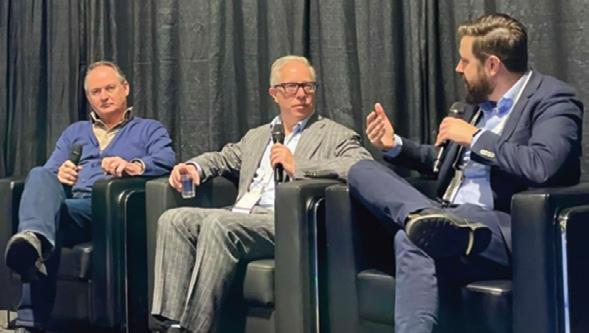
Big discoveries trump jurisdictional issues but sometimes case-by-case analysis turns that on its head, Scotiabank’s mining and metals investment team leader told a session at the annual convention.
“When we sort of think we’ve got a tiger by the tail with a new world-class discovery, we have no problem pretty quickly buying up to 10% of the company,” said Robert Cohen, who manages $1.1 billion for the Canadian bank. “As we get more comfortable with the investment, over time, we could increase that to as much as 20%.”
How does he cope with mitigating risk? “You just have to have a stomach of steel.”
Cohen, a vice-president and portfolio manager with Scotia Global Asset Management, manages the $700-million Dynamic Precious Metals fund and some $400 million across several other mining-focused funds. He joined Willem Middelkoop, manager of the $150-million Commodity Discovery fund based in Amsterdam, on a small stage in a
corner of the vast exhibition auditorium.
Uranium, copper Middelkoop cited how NexGen Energy (TSX, NYSE: NXE; ASX: NXG) attracted his interest with uranium project discoveries in Saskatchewan and Ivanhoe Mines (TSX: IVN; US-OTC: IVPAF) did likewise with the Kamoa-Kakula copper deposit in the Democratic Republic of Congo in 2013. Lately, he’s been looking at the United States.
“We have, like, the second American Revolution. It is the most significant regime change in history,” he said. “It’s also changing the world of commodities, because the red tape will be cut very drastically now for U.S. projects.”
On the other side of the coin, there are places that should give investors pause, according to Cohen.
“Given the problems that, for example, Barrick Gold (TSX: ABX; NYSE: GOLD) has had in Mali, that would be a no-go country,” Cohen said. “There’s also some worries of problems spill-
Size vs location P40 >
ENVIRONMENT | Panel questions ‘acceptable costs’
ommercial production of undersea mining could become a reality in less than five years, but at a potentially high cost to seafloor ecosystems, panellists told the conference.
Driving the momentum for seafloor mining is a nervousness among United States government officials that China could dominate undersea mining like it has dominated critical minerals, Craig Shesky, chief financial officer of undersea explorer The Metals Company (Nasdaq: TMC), said on March 3.
“You’re going to see pre-cash flow positivity, you’re going to see an investable industry,” Shesky said. “This feels like offshore oil and gas in the early 1960s and people don’t realize yet that it’s already happening. It’s going to become a very material part of the market, because the technology is there, the resource is there, and now the political appetite is there.”
Vancouver-based TMC is exploring at the Nori Clarion-Clipperton Zone (CCZ) polymetallic project, located 4,000 metres deep in the
northeast Pacific Ocean between Hawaii and Mexico. The area hosts 345 million measured and indicated wet tonnes grading 1.4% nickel, 1.14% copper, 0.14% cobalt and 31.2% manganese, according to a technical report from 2021. Inferred resources total 11 million wet tonnes at 1.38% nickel, 1.14% copper, 0.12% cobalt and 31% manganese.
Feasibility study
TMC is conducting an 18-month feasibility program aimed at processing a 2,000-tonne sample of deep-seafloor polymetallic nodules at its partner PAMCO’s Rotary
Electric-Arc Furnace operating facility in northern Japan. Projects like TMC’s are likely to face greater demand in the coming years as the green energy transition prompts countries to seek more sources of critical minerals needed for zero-emissions technologies.
Mining nickel from the seafloor nodules comes with fewer environmental costs than conventional land-based mines, Shesky emphasized.
Asked by fellow panellist and senior ocean scientist Matthias Haeckel “what is the acceptable cost of deepsea mining?”, Shesky responded: “Relative to what?”
“When we’re talking about biodiversity, one estimates in the CCZ we’re talking about a species count nearing 10,000 unique species,” he said. “Let’s put that in perspective to the island of Sulawesi (in Indonesia), where a majority of nickel exploration is ongoing, where 300,000 unique species (live).”
TMC’s planned approach to nodule mining is to start small with one vessel, guided by large amounts of data on environmental impacts, Shesky said.
Eco-system threat
While it might appear that land mining’s cost is larger than that of
undersea mining, it still has a high environmental impact, according to Haeckel, who works for the GEOMAR Helmholtz Institute of Ocean Research in Kiel, Germany. Haeckel’s research conducted over the last 10 years in the CCZ has revealed that not only is there diversity of coral-like fauna on the seafloor, but some fauna are specifically adapted to living on the polymetallic nodules.
“This fauna actually needs the nodules as a hard substrate to live on. (This) sponge sits rooted on a deepsea polymetallic nodule,” he said, pointing to a photo on a slide. Mining the nodules would permanently destroy the creatures’ ecosystem, he said. And even if only five centimetres were removed from the sea floor, thousands of years would be required to redeposit nutrient supply there for seafloor life.
“This ecosystem is lost forever for polymetallic nodules,” Haeckel said. “We are talking about 200 to 300 sq. km being mined per year and operations to get 2 million to 3 million tonnes of nodules that the industry typically says (is what) they would need for economic purposes.”
BY COLIN MCCLELLAND
Canada’s Minister of Energy and Natural Resources says he’s open to discussing ways to boost funding in junior mining stocks and that he’s concerned infrastructure financing will disappear under potential Conservative Party leadership.
Jonathan Wilkinson also said in an interview with The Northern Miner he’s in communication with U.S. Secretary of the Interior Doug Burgum as tariff threats simmer. The government is considering export taxes and new markets, the minister said.
“One of the options that we have is to make critical minerals even more expensive, or potentially, in some cases, to decide we’re going to sell them to other people,” he said in a phone interview as PDAC wound down. “We haven’t made that decision yet, but it is a tool in the toolbox, if, in fact, we cannot get the American president to see reason here.”
In spite of the trade war with the U.S., Wilkinson expressed optimism for Canada’s mining industry as he extended the mineral exploration tax credit for two years.
“We are also going to try to have some thought about how we create incentives to drive more private capital into that space,” the minister said. “A lot of them focus on tax measures, whether that’s enhancements to flow-through shares or capital gains. What I would like to hear from the sector is a bit more precision about some of the things that could be done.”
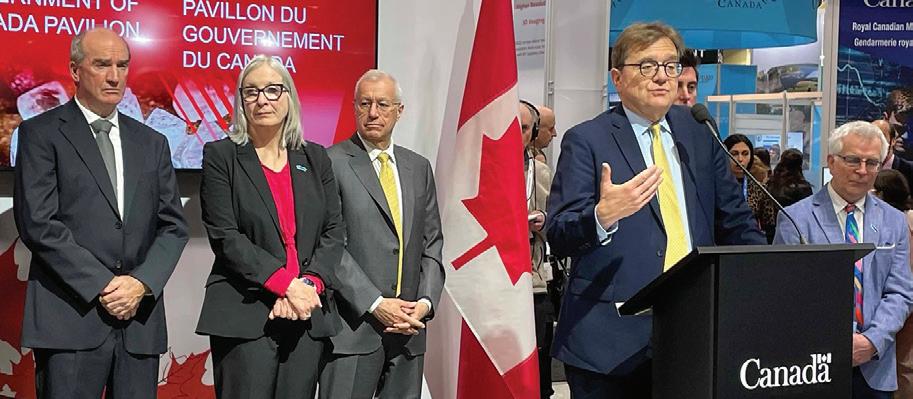
Many mining explorers are increasingly seeing their fund-raising efforts hampered as majors reduce exploration and choose to back only a few high-quality juniors. Even as Canada’s unique flowthrough shares have surged, there are limited numbers of primarily high-net worth investors attracted to the mining space. Also, many retail investors are excluded from private placements with high minimum investment requirements.
Global metal and mining exchange-traded fund assets rose about 6% in this year’s first two months to US$352 billion, according to Mineral Fund Advisory. This follows a 13% jump in assets in 2024, further draining the retail investor pool from the junior miner sector.
The mineral exploration tax credit, which was due to expire March 31, will be administered by the Canada Revenue Agency as if
the measure had been passed, the minister said. Although Parliament has been prorogued, the agency will treat the credit as existing legislation that’s likely to continue, he added.
The Liberal government’s $3.8-billion critical minerals strategy and $1.5-billion mining infrastructure fund could be undone if Conservative Party leader Pierre Poilievre becomes prime minister, Wilkinson said. Prime Minister Mark Carney called an election for April 28 just days before the Miner went to press.
“Mr. Poilievre has not made himself clear with respect to things like the investment tax credits, which are really important, especially for the processing part of the sector where the federal government essentially will pay 30% of the capital costs,” the minister said.
“That’s an economic initiative, but it’s also a national security initiative, because we have to get away
BY COLIN MCCLELLAND
Ontario Premier Doug Ford repeated funding pledges for mining, scolded the federal government for time-consuming environmental OKs and vowed to fight U.S. tariffs dollar for dollar and “to the death.” Ford, who gained nationwide prominence as Prime Minister Justin Trudeau resigned, capitalized on his provincial re-election win Feb. 27 to declare at PDAC that he has a mandate to push for changes in mining rules as well as fight any U.S. tariffs.
“We also propose designating regions where critical minerals are present or likely to be present, including the Ring of Fire, as regions of strategic importance for our economy and security,” he told the annual convention in Toronto.
“This would trigger accelerated approvals, including automatic approvals for trusted project proponents on early works. It would increase certainty around timelines and help First Nations participate in the process.”
A $500-million Ontario critical minerals processing fund, first announced Feb. 23, aims to accelerate development projects for turning ore into metals by attracting large investors. It’s part of the West’s strategy to reduce China’s control of most refining such as
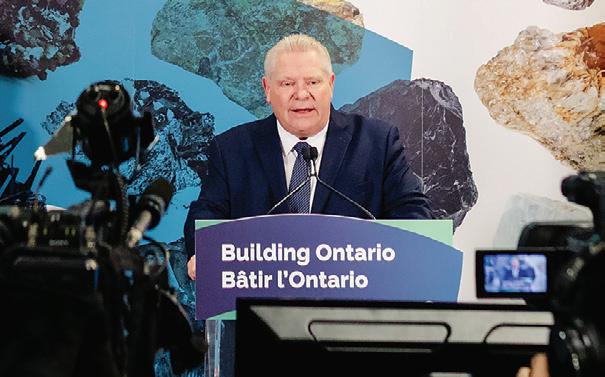
copper, nickel and lithium where it has more than half the market as well near total dominance in lithium and rare earth elements used in electric vehicles, according to Wood Mackenzie.
‘Ripped and shipped’
“We have the critical minerals the world needs and the world-class workforce to get them out of the ground, but we don’t want to see those minerals ripped and shipped overseas or south of the border to be processed,” the premier said.
“We want Ontario’s critical minerals to be processed and refined right here by Ontario workers in Ontario.”
Ford’s Progressive Conservative
party also said in February it would triple loan guarantees for First Nations to $3 billion and add $70 million to an Aboriginal skills program. He urged Ottawa to “get out of the way” when it comes to approving mining projects.
“I’ll be making it clear to the federal government that the time for the redundant, wrongheaded impact assessment requirements is over,” Ford said. “They’re done. We cannot afford to add years and years of delays, massive costs to critical mental projects so that the federal government can waste time repeating and replicating assessments that Ontario has already done.”
P40
The funds are slated for a new road and bridge to access the project in the province’s northwest. It comes after the federal government at the conference opened $500 million in infrastructure spending for new applications concerning mining and minerals.
“I was pleasantly surprised at how positive people are about the momentum in the sector, the prospects for the sector,” he said. “There’s obviously some concern about the United States, but in general, a lot of optimism and momentum.
from relying on processed critical minerals from China. So, I’m worried about that for sure. That’s at risk.
“I am worried that he will not understand why things like the critical minerals infrastructure fund, which helps with roads and transmission to get projects moving, is important.”
Election due Poilievre had been 20 percentage points ahead in polls in January but was trailing Carney by five to six points as press time neared.
“Perhaps three or four months ago, people thought maybe it was time, that there would be a change. But I don’t think that’s the mood anymore,” Wilkinson said. “You may be surprised at the outcome of the next election.”
Wilkinson said he was also upbeat coming out of PDAC where he announced $120 million in federal support — to be matched by a similar amount from Ontario –for Frontier Lithium’s (TSXV: FL; US-OTC: LITOF) PAK project.
“While everybody is concerned about the tariffs, it has brought everyone together to appreciate how much we are proud of being Canadian. And you certainly got a sense of that from people in the conference.”
Wilkinson also turned to his energy portfolio, providing a $300-million loan to Montreal-based Atkins Realis, the makers of CANDU nuclear reactors. One of their design advantages is not requiring enriched uranium as fuel, which Canada would otherwise have to buy from the U.S. or Russia to get done.
It also benefits Canadian suppliers like Cameco (TSX: CCO; NYSE: CCJ) by using uranium from Saskatchewan, a useful example of self-sufficiency when Canada’s oldest ally appears bent on economic dominance through threats, chaos and tariffs.
Wilkinson relayed impressions from abroad:
“I’ve met with a number of other representatives, a number of other governments, and they are just shocked that the United States would treat Canada this way. And of course, they are a little afraid about what comes next for them.” TNM

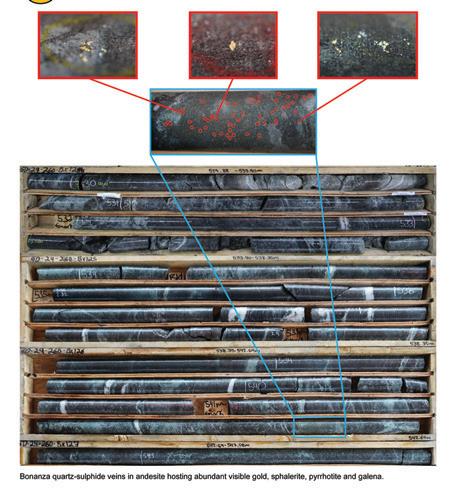
BY BLAIR MCBRIDE
Resource nationalism abroad is hiking costs for miners and showing how they need solid agreements and recourse avenues, lawyers said at the conference.
The past few months have seen Western miners initiate arbitration proceedings amid disputes with host governments in West African countries, including Barrick Gold (TSX: ABX; NYSE: GOLD) in Mali, French uranium miner Orano in Niger and Sarama Resources (TSXV: SWA) in Burkina Faso. In some cases, authorities arrested employees, revoked permits and cancelled projects.
“There’s this evolving scope of what the protections are for, not only full protection and security, but for equitable and fair treatment (and) protection against illegal expropriation without just compensation,” Tom Villalon, associate at Three Crowns law firm, said March 4 on a PDAC panel. “And it may rise to a new chapter of interesting and very complicated investor-state work.”
Seeking $120M redress
Vancouver-headquartered Sarama had been exploring at the Sanutura gold project in Burkina Faso’s southern Houndé Belt but the post-coup government of Ibrahim Traoré cancelled the permit for the multi-million-ounce Tankoro project in 2022.
The following year, Sarama
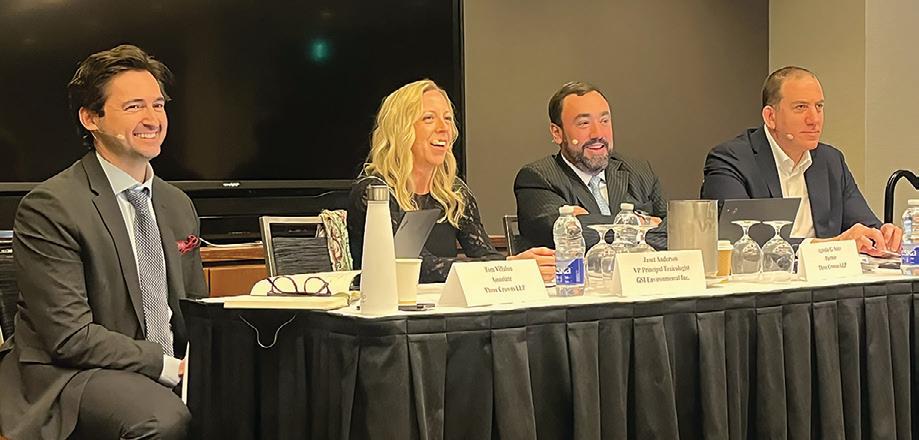
heard from then-mines minister Simon-Pierre Boussim that the permit could be bought. It was later given to a local company, according to law firm Boies Schiller Flexner (BSF), which has taken on Sarama’s case in international arbitration.
The company is seeking $120 million (C$170 million) in compensation.
“Sarama’s claim under the Canada-Burkina Faso Bilateral Investment Treaty (BIT) is reflective of the unfortunate resurgence of resource nationalism that has accompanied the wave of coups d’état across West Africa in recent years, including in Burkina Faso,” BSF partner Kristen Young told The Northern Miner by email.
“The Centre for Settlement of Investment Disputes (ICSID) registered Sarama’s claim on Dec. 23, and we look forward to vindicating Sarama’s rights in full under the treaty.”
State miner takes licence New York-based BSF is also representing Emmerson (LSE: EML), which is developing the Khemisset potash project in northern Morocco. Emmerson held a mining licence for Khemisset through its Moroccan subsidiary, Potasse de Khemisset. But after a dispute over the company’s environmental and social impact assessment over 2023 and 2024, a regional Englishlanguage newspaper reported
in January 2024 that Morocco state miner OCP Group had won rights to develop an adjacent potash project. The move annulled Emmerson’s licence, BSF said.
Last November, Emmerson’s U.K. and Moroccan subsidiaries served a notice of dispute under the 1990 U.K.-Morocco treaty. The company is seeking the full compensation of the loss of Khemisset. Though that amount is yet to be quantified, the project’s post-tax net present value (at an 8% discount rate) is estimated at $2.2 billion, according to Emmerson’s latest corporate presentation.
“Emmerson’s claim under the U.K.-Morocco BIT arises out of arbitrary and discriminatory treat-
ment of a mining investor in favour of a state-owned company, similar to Poland’s breaches in the GreenX Metals (ASX, LSE: GRX) arbitration,” Young said, citing the Australian coal miner’s case from 2020.
The United Nations Commission on International Trade Law ruled in GreenX’s favour last October and awarded it about $325 million in damages, though Poland is continuing to challenge the award through courts in the United Kingdom and Singapore. A final resolution is pending.
‘Adaptability, innovation’ In all such cases, mining companies must do more than just comply with local agreements, Young said.
“Mitigation of risks such as political changes demands adaptability and innovative strategies,” she said. “Where companies have a direct agreement with the state, they should negotiate robust contractual protections. These include stabilization clauses, which protect investors from adverse changes in law or policy after the agreement has been signed, and arbitration clauses, which allow companies to bypass the local courts, which may not be impartial or reliable.”
Young also recommends companies ensure from the start that their investments are covered by the protections of one or more bilateral investment treaties, which give
Foreign seizures P40>
TECHNOLOGY | ‘Fourth industrial revolution’
BY BLAIR MCBRIDE
The path to the fourth industrial revolution and the green energy transition is best paved by integrating more technology into mining, industry experts said.
Organized on the sidelines of the annual convention by mining software company Seequent, a three-person panel discussed the enormous need for critical metals in the data centres that will power artificial intelligence. Northern Miner Group President Anthony Vaccaro moderated the discussion.
“Fast innovation is key to the geoscience community, because we have been tasked to make the fourth industrial revolution a reality,” Janina Elliott, Seequent’s segment director of mining said, referring to the society-wide integration of artificial intelligence (AI), automation and renewable energy. “With that comes the onset of a new commodity super cycle that’s focused on critical minerals.”
Huge copper needs Elliott pointed to data centres, whose power cables, cooling system pipes and microchips are manufactured using large amounts of copper. A large-scale data centre using 500 megawatts of power — currently beyond the capacity of most data centres — would require 1,000 to 2,500 tonnes of copper.
By 2030, global electricity
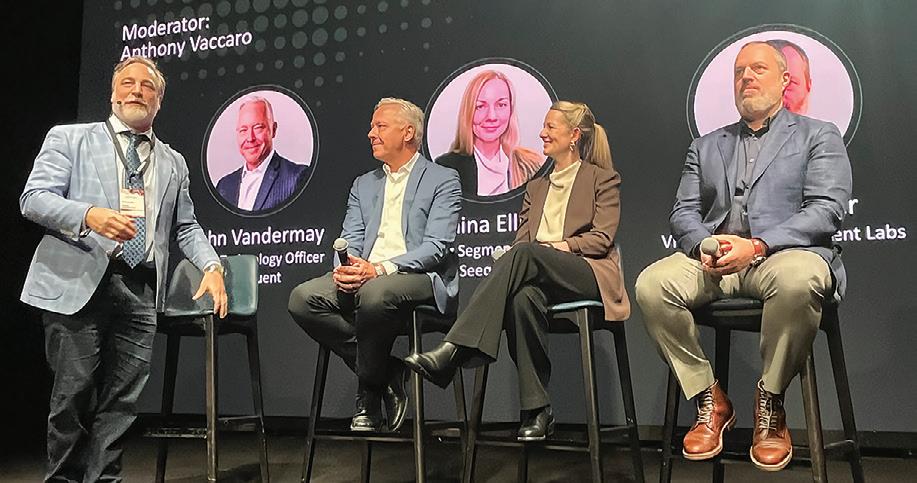
“Fast innovation is key because we have been tasked to make the fourth industrial revolution a reality.”
JANINA ELLIOT, SEEQUENT
for Energy Studies. That significantly raises the amount of critical metals needed for the centres.
“So the trillion-dollar question is, how can you operate more efficiently to make more out of the reserves that we already have?”
Elliott asked. “How do we (find more deposits when) the shallow ones have already been picked off and it’s harder and harder to find big ones?”
Stronger tech, better exploration
The answer today, Elliott suggested, is better technology through more
integration and cloud computing.
Seequent, which launched its first software in 2003, has had more than 20 years to build up its geoscience data and technology programs, she said.
One innovation is its Evo platform, which integrates geoscience and mining software from other platforms and allows data sharing.
Chief technology officer John Vandermay told the panel that Seequent has approached the geoscience and mining sectors for data and enabled hybrid computing between desktops and clouds.
“Our customers have told us that
they are frustrated by the software vendors who lock them into their walled gardens, and the agonizing complexities of file-based point to point integrations,” he said.
In the near future, Seequent plans to further connect its Leapfrog 3-D geological modeling software with Evo through cloud computing.
“(That will) enable online collaboration between geoscientists and extend the geoscientists desktop by connecting with the unlimited power of cloud computing,” he said.
Bring geoscience to youth In a video played after the panel, Seequent chief customer officer Angela Harvey explained that by 2029, the industry will need 130,000 geoscientists in the United States alone. But with geoscientists now retiring and enrolment falling in mining-related post-secondary programs, it’s unclear how that demand will be met.
The company has teamed up with video game producer CerebralFix to reach out to younger generations. Together, the partners have built a free, online 3-D program called Visible Geology to pique interest in geoscience.
Users can build sub-surface models based on actual maps to better visualize how geological formations look and behave underground.
“We want to really inspire the next generation of geoscientists,” Harvey said. TNM
BY MINING.COM STAFF
Allied Gold (TSX: AAUC; USOTC: AAUCF) is creating a joint venture in Mali with a United Arab Emirates-based investment group that’s also covering the expansion of its main mine Sadiola.
Ambrosia Investment Holdings, run by UAE businessman Ahmed Amer Al Amry with interests in construction, hotels and energy, said on Feb. 25 it’s paying $375 million (C$536 million) for the asset stake including 80% of Sadiola. Of this amount, $145 million is to be paid to Allied on closing with the remaining $230 million paid later.
Al Amry’s company is also taking a 12% stake in Allied for about $110 million that the miner plans to use on expanding Sadiola.
“This is an impressively unique transaction in that it brings together a Canadian company whose management has significant experience and engagement in the country and whose operational competence and experience is tier one,” Allied chairman and CEO Peter Marrone said in a statement.
“This collaboration is the first of its kind, with a Canadian company partnering with Emirati entrepreneurs and business persons investing in Mali.”
The deal comes as Allied finalizes plans to more than double output from Sadiola by late 2028 and amid attempts by the country’s junta to squeeze more out of Western miners through a new mining code. The political unrest put some operations like Barrick Gold (TSX: ABX; NYSE: GOLD) in limbo for a time while others such as Robex Resources (TSX-V: RBX) opted to put its operation up for sale.
This transaction bolsters a project with the Muslim-led government by getting support from the UAE, an Islamic country which happens to be Africa’s most prominent backer of new business, surpassing China. Between 2019 and 2023, Emirati companies have
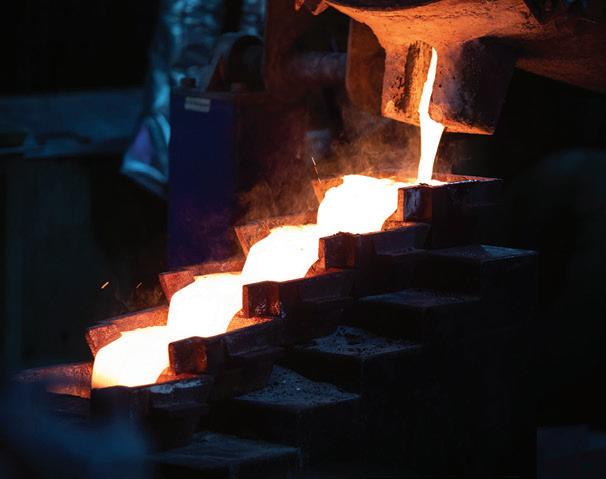
committed more than $110 billion to African projects, the Financial Times said last May.
Allied championed Ambrosia as holding key regional expertise, broader market support and renewable energy knowhow. The company is getting its stake in Allied by buying 46 million shares at C$3.40 apiece, a discount to the opening price of C$4.70 on Feb. 25.
Allied Gold’s shares traded for C$4.65 apiece in Toronto before press time, for a market capitalization of C$1.5 billion.
Allied said this transaction will improve the company’s financial flexibility as it pursues its growth plans, including the expansion of Sadiola and the development of its Kurmuk project in Ethiopia.
According to the Canadian miner, its staged expansion approach at Sadiola is driving production increases from about 170,000 oz. in 2023 to a mid-term range between 200,000-230,000 oz. per year as a result of oxide ore feed and the implementation of the first expansion later this year.
The second expansion, anticipated to be completed in late 2028, will target annual production of 400,000 oz. over the first four years
and 300,000 oz. per year over a 19-year mine life based on 7.2 million oz. in mineral reserves.
The estimated costs of the two expansions are $65 million and $400 million, respectively.
The partnership with Ambrosia will also see a new photovoltaic power generation system deployed at Sadiola, as part of a 12-year supply agreement with UAE-based power company ATGC. This, Allied says, is expected to improve the asset’s costs and environmental footprint.
Kurmuk
In Ethiopia, the Kurmuk project is expected to enter production in mid-2026, targeting about 290,000 oz. per year over the first four years and 240,000 oz. per year over the mine life. With mineral reserves of 2.7 million oz. and further exploration potential, the company is targeting a mine life greater than 15 years at Kurmuk.
To support the project’s development, in late 2024, Allied signed a C$175-million gold streaming deal with Wheaton Precious Metals (TSX, NYSE, LSM: WPM).
Meanwhile, Allied wants to join the NYSE in addition to its TSX listing. It’s started the process and expects word by mid-year, CEO Marrone told Bloomberg TNM
NEVADA | Funds for building project’s first stage
Lithium Americas (TSX, NYSE: LAC) says Orion Resource Partners is investing $250 million (C$357 million) to help develop and build the Thacker Pass lithium project’s first stage in Nevada.
Following the March 6 announcement, Lithium Americas’ shares surged 5.6% in New York. Company shares traded for $4.32 apiece in Toronto before press time, giving the company a market capitalization of $944.5 million. Thacker Pass, home to the largest known measured and indicated lithium resource in North America, was approved by the Trump administration in January 2021, just
days before president Joe Biden took office. The project is slated to begin production later this decade as a critical supplier to General Motors (NYSE: GM), which invested $625 million last year to acquire a 38% stake in the venture.
To develop the site, Lithium Americas and GM established a joint venture, Lithium Nevada Ventures, which is expected to generate nearly 2,000 direct jobs. Once operational, stage one of Thacker Pass is projected to produce 40,000 tonnes of battery-quality lithium carbonate annually, enough to power up to 800,000 electric vehicles. Completion of the first stage is targeted for late 2027.
COLOMBIA | Drill results add tailwinds
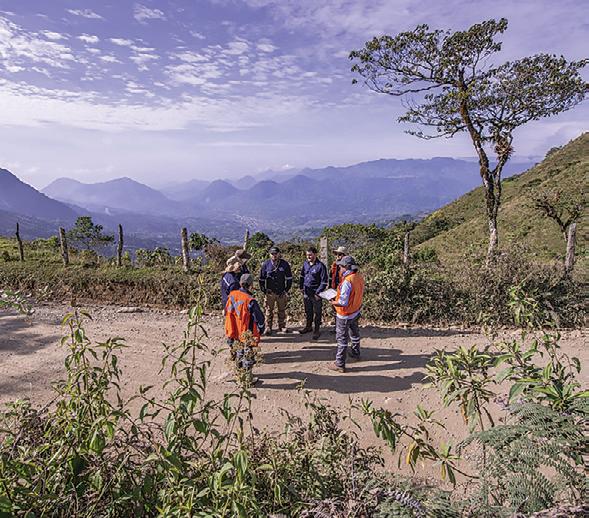
Collective Mining (TSX, NYSE: CNL) hit a fresh oneyear high after the company secured a $63.4 million investment from Agnico Eagle Mines (TSX, NYSE: AEM) in a share offering and warrants deal. Collective shares traded for $12.62 apiece in Toronto before press time, marking a 219% gain over the past year. That gave the company a market capitalization of $1.05 billion.
Agnico agreed to buy 4,741,984 common shares of Collective at $11 apiece, the company said on March 14. Closing of the offering will depend on Agnico exercising the purchase warrants it holds to buy another 2.25 million shares at $5.01 each. In that case, Agnico would own 14.99% of Collective.
“I would like to thank Agnico Eagle for its additional support as we continue to advance our Guayabales project,” Collective’s executive chair Ari Sussman said in a release. The proceeds are to be used on the company’s planned drill program in western Colombia, he said.
The deal came just two days after Toronto-based Collective reported its best assays yet from the Ramp zone, inside the Apollo system at its main project, Guayabales. Located in the Caldas Department, about 275 km west of Bogota, Guayabales includes the Plutus, Box, Tower and X targets, as well as the Trap and Apollo systems.
New York-based Orion’s investment includes multiple funding components: $195 million in senior unsecured convertible notes and $30 million in convertible notes, which Orion has committed to purchasing within two years. There’s also a $25-million production payment agreement, under which Orion will receive payments based on minerals processed and gross revenue generated by Thacker Pass. The investment was expected to close the week of March 10.
Orion has also tentatively agreed to evaluate financing of up to $500 million to develop and build stage two of Thacker Pass. TNM
Highlight hole APC105-D1 cut 75.8 metres grading 8.06 grams gold per tonne and 15 grams silver from 469.6 metres depth, including 21 metres at 24.42 grams gold and 37 grams silver, Collective said. The hole represents the longest and best intercept so far on a grade-by-metre basis at Ramp.
“We continue to be pleasantly surprised by the high-grade Ramp zone discovery,” Sussman said. “We now have an internal 3-D model for Ramp and a working hypothesis explaining why the zone formed, [implying] that Ramp style mineralization can occur over a very large area as it won’t be relegated only to the breccia body at Apollo.” Ramp, discovered in October,
“This expands the potential scale of mineralization and could represent a turning point for Collective.”
ANDREW MIKITCHOOK, ANALYST, BMO CAPITAL MARKETS
sits 1,150 metres deep inside Apollo and was so named because it’s near in elevation to a conceptual underground haulage tunnel for a future mine at Guayabales.
‘Potential game changer’ Investors will be drawn to Collective’s new internal model, which suggests that the high-grade Ramp zone-style mineralization isn’t limited to the Apollo breccia, BMO Capital Markets analyst Andrew Mikitchook said in a note on March 13.
“[This is] a potential game changer, in our opinion,” he said. “This new interpretation expands the potential scale of mineralization and could represent a turning point for Collective — the company is planning large step-out drilling to test this theory.”
Another hole, APC103-D3, cut 13.25 metres at 3.13 grams gold and 7 grams silver from 128 metres in the Upper zone. In the Ramp zone, 20.3 metres cut 6.62 grams gold and 20 grams silver. Both holes have expanded the Ramp zone to the west and southwest, Collective said. Ramp remains open in all directions. Collective has six rigs drilling in its fully funded 60,000-metre program for this year. Four rigs are at Apollo, one is drilling at the Tower target and the sixth is at the San Antonio project, 4 km east of Guayabales. Two more rigs were expected to start turning in March and early in the second quarter. The company has completed about 110,000 metres of diamond drilling at Guayabales, including 74,000 metres in 163 holes at Apollo. TNM
BRAZIL | Update raises tonnage by 50%
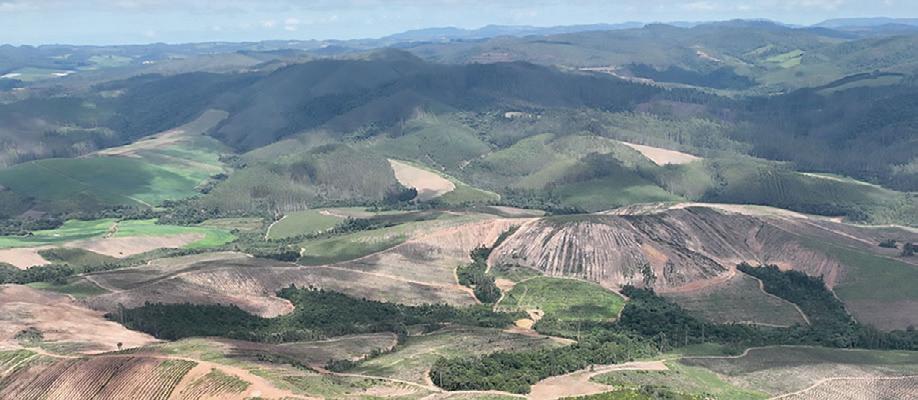
BY BLAIR MCBRIDE
Meteoric Resources’ (ASX: MEI) update of its Caldeira rare earths project in Brazil makes its 1.1 billion-tonne resource the largest ionic adsorption clay deposit in the world by tonnage and grade.
The update boosts by 50% the total rare earths oxides (TREO) by global tonnage at Caldeira, and grades it at 2,413 parts per million (ppm), including 559 ppm magnetic rare earth oxides (MREO). Caldeira is located in southwestern Minas Gerais state, about 480 km west of Rio de Janeiro.
“[The update] reinforces the tier one status of our Caldeira project inclusive of its significant scale and the optionality which it brings to global rare earth markets,” managing director Stuart Gale said in a release on March 11. “While the project’s scale is crucial, the flexibility it provides to target specific areas enriched with magnetic light and heavy rare earths adds substantial long-term value as we aim to deliver this critical commodity.”
Measured and indicated resources rose by 91% to 589 million tonnes at 2,655 ppm TREO and 613 ppm MREO over the previous resource from last year. Inferred tonnage increased 31% to 519 million tonnes grading 2,138 ppm TREO and 498 ppm MREO.
‘Strategic asset’
The resource update “further highlights that MEI has a strategic asset and the best undeveloped rare earth
elements asset with significantly higher grade, tonnes and metallurgical recovery than their ionic clay peers,” SCP Resource Finance analyst Justin Chan wrote in note on March 12.
The project’s value also comes from the optionality and ability to target higher grade zones, Chan said. They include subsets at the Dona Maria target of 43 million tonnes at 3,753 ppm TREO, and 49 million tonnes grading 3,917 ppm TREO at the Cupim Vermelho Norte target, he said.
In a model mine plan, Chan estimates a life of more than a century (110 years) at a run rate of 10 million tonnes per year, noting it was rare to find such a large and highgrade deposit outside of China.
Largest official resource
Most rare earths deposits are of the ionic adsorption clay (IAC)-hosted variety. This is also true for China, which possesses most of the globe’s rare earths and dominates their processing.
Most other projects in Brazil also fall under the IAC rare earths category. They include Serra Verde’s Pela Ema mine and Aclara Resources’ (TSX: ARA) Carina Module, both in Goias state. By contrast, the rare earths at Vital Metals’ (ASX: VML; US-OTC: VTMXF) Nechalacho project in the Northwest Territories are hosted in solid rock. That site was briefly Canada’s sole producing rare earths mine, though on a demonstration-scale basis.
The closest comparable deposit
“MEI has a strategic asset and the best undeveloped rare earth elements asset with significantly higher grade, tonnes and metallurgical recovery than their ionic clay peers.”
JUSTIN CHAN, ANALYST, SCP RESOURCE FINANCE
to Meteoric’s by global resource and grade is Viridis Mining and Minerals’ (ASX: VMM) Colossus project, also in Minas Gerais. It hosts a global resource of 493 million tonnes grading 2,508 ppm TREO.
The high-grade Barra do Pacu area at Caldeira’s southern end is to be added to the resource in the second quarter, Meteoric said. The company plans to release a pre-feasibility study for Caldeira later in the year.
Meteoric shares traded for at A7¢ apiece before press time in Sydney, valuing the company at A$175.1 million ($159.7 million). The stock has traded in a 52-week range of A5¢ to A26¢. TNM
BY MINING.COM STAFF
TeckResources ( TSX:TECK.A/ TECK.B, NYSE: TECK) says it’s investing $40 million (C$57 million) in Bunker Hill Mining (TSXV: BNKR, US-OTC: BHLL) as part of a strategy to improve efficiency at its Trail refining operation in British Columbia.
The investment is part of $70 million being raised to sustain the Bunker Hill mine restart in Idaho. It combines with debt restructuring to lift Teck’s ownership of Bunker Hill to 36% from 6.6%.
The deal secures high-quality, cost-competitive shipments of zinc and lead concentrates for Trail which are also fed from Teck’s Red Dog in Alaska. The Bunker Hill mine is due to restart in this year’s second half.
Teck’s investment dilutes existing shareholders to below 40% of the company, executive chairman Richard Williams confirmed to The Northern Miner in an interview on March 6. Management had tough choices: to sell at a complete loss or dilute and keep stakes. The bailout financing was needed to restructure crushing debt following rising costs and delays.
“We’re not disrespecting our shareholders — the greatest dilutive event is to sell the thing for zero, right?” Williams said by phone from Toronto. “So the fact that we have secured a strategic partner like Teck and we have changed the structure of our non-equity finance is a painful pill to take right now, but there’ll be much more value for shareholders over the long term than the alternative, which is to not build the thing.”
Supply chain focus
Williams pointed out that Teck’s move amid trade war tensions secures a strategic North American supply chain. The Trail smelter is critical to the United States defence machine — it supplies half the germanium and gallium it consumes.
Teck’s investment is expected to ensure that refurbishment, now 65% done, remains on track for the mine, which operated for a century after a discovery in 1885. It accounted for nearly half of the base metals production from the Coeur d’Alene mining district.
The mine was initially slated
for an earlier restart after Toronto-based Bunker Hill took over the project in 2020. But management delayed its commissioning after determining costs were much higher than estimated.
“This Teck-led investment helps to further strengthen and de-risk American metal supply chains, while creating new American mining jobs in the Silver Valley, Idaho at a critical time,” Bunker Hill CEO and president Sam Ash said in a release.
Shares of Bunker Hill Mining fell 18% in Toronto to 16¢ apiece on March 6, as wider markets plunged on tariff fears, and traded at 15¢ each before press time, for a market capitalization of $55.7 million.
Project financing
Teck’s $40 million investment in Bunker Hill will take the form of a private placement of units priced at 10.5¢ each. Separately, Bunker Hill has also arranged a placement of units at the same price, with BMO, CIBC and Red Cloud Securities acting as lead syndicates, to raise another $20 million.
The company is to also sign a standby deal with Teck that provides a $10-million prepayment to “further improve asset resilience” and reduce risk during the critical first three years of operation.
Additionally, the company plans to restructure its debt with creditors including Teck, Sprott Streaming and Monetary Metal, including the conversion of some debt into equity. This, Bunker Hill says, would “significantly reduce risk and increase the capital available for investment in exploration and expansion.”
Upon closing, it is expected that Sprott will own greater than 20% of Bunker Hill’s shares and therefore become a control person under takeover rules.
According to a prefeasibility study published in 2022, the Bunker Hill mine project has an initial capital cost of $55 million, but the revised mine plan shows a cost of $103 million. Its post-tax net present value is estimated at $52 million (at an 8% discount), with an internal rate of return of 36% and 2.1-year payback. TNM
With files by Henry Lazenby in Vancouver.
COLOMBIA | Veins match historical mines
BY BLAIR MCBRIDE
Outcrop Silver & Gold (TSXV:
OCG; US-OTC: OCGSF)
booked hits as high as 1,913 grams silver per tonne from stepout drilling south of the main resource at its Santa Ana project in west-central Colombia.
Highlight hole DH442 cut 2 metres grading 38 grams silver per tonne and 1.94 grams gold from 123.2 metres depth, Outcrop reported on March 12. That hole also cut 2.4 metres at 357 grams silver and 0.63 gram gold, and 0.4
metre grading 1,913 grams silver and 0.26 gram gold. The project is located near Falan, Tolima Department, about 200 km west of the capital, Bogota.
“The results from Los Mangos are a major breakthrough for the Santa Ana project, confirming high-grade silver-gold mineralization in yet another significant stepout,” Outcrop’s vice-president of exploration Guillermo Hernandez said in a release. “Hitting strong grades more than 8 km south of the closest resource vein proves the great potential of this system and
validates our exploration strategy.”
Silver prices, driven by industrial demand for the metal in green energy technology, have gained more than 40% in the past year to $34.17 per oz. before press time. Its price has over most of the past year touched highs last seen in 2013. Outcrop shares were down 4.5% to 26¢ apiece before press time, for a market capitalization of $88.56 million. The stock has traded in a 52-week range of 16¢ to 35¢. Historical mining The broader vein widths in hole
DH442 align with observations from the historic El 20 underground workings in the area, Outcrop said. That reinforces the presence of a strong and continuous vein system at the site, part of an area known as Colombia’s largest and highest grade primary silver district where mining dates back to 1585.
Other noteworthy drill results were logged from the Mangos SE vein, where hole DH444 cut 1.92 metres grading 486 grams silver and 1.33 grams gold from 143.9 metres depth, including 0.8 metre at 1,164 grams silver and 2.6 grams gold.
Hole DH436 in the Los Mangos vein intersected 0.42 metre at 874 grams silver and 0.03 gram gold from 161.8 metres depth. Santa Ana hosts 1.22 million indicated tonnes grading 446 grams silver and 2.3 grams gold for 17.5 million contained silver oz. and 88,800 oz. gold, according to a 2023 initial resource. Inferred resources total 966,000 tonnes at 312 grams silver and 1.6 grams gold, for 9.6 million oz. silver and 50,900 oz. gold. TNM
CHILE | Agnico-backed miner expects resource update this year
BY BLAIR MCBRIDE
Drilling at Atex Resources’ (TSXV: ATX) Valeriano copper-gold project in northern Chile returned results as high as 2.21% copper - the company’s highest-grade intersection yet in mineralized porphyry at the site. Shares rose 7.8%.
Hole ATXD25A cut 30 metres grading 2.21% copper, 3.17 grams gold per tonne, 15.1 grams silver and 3 grams molybdenum from 1,892 metres depth, the company reported on March 18. The hole also pierced 16 metres at 3.04% copper, 4.82 grams gold, 21.1 grams silver and 5 grams molybdenum from 1,896 metres depth.
“Valeriano keeps getting better with every hole in the (stage five) program to date intersecting significant high-grade mineralization and setting new records for the project,” Atex president and CEO Ben Pullinger said in a release.
Hole ATXD25A extended the high-grade porphyry trend by about 1,000 metres, where it remains open, Pullinger added.
Upcoming resource
BMO Capital Markets analyst Rene Cartier wrote in a note on March 18 that Atex’ stage five program continues to deliver, and supports the company’s upcoming resource estimate, expected to be released in the second half of the year. That update is to convert inferred resources to indicated, Atex said.
Valeriano hosts 1.4 billion inferred tonnes grading 0.49% copper, 0.21 gram gold, 0.99 gram silver and 62.4 grams molybdenum, according to a resource released in 2023. Contained metals total about 7 million tonnes copper, 9.5 million oz. gold, 46.1 million oz. silver and
90,100 tonnes molybdenum.
Atex shares traded for $2.47 apiece before press time in Toronto, giving the company a market capitalization of about $683 million. In the past year, the stock has traded between $1.13 and $2.63.
$55M from Agnico
The explorer’s stage five drill program was boosted by Agnico Eagle Mines’ (TSX, NYSE: AEM) $55 million investment last October, which also gave the major a 13% stake in Atex.
The highest-grade portion of ATXD25A was 1,000 metres below the B2B zone at Valeriano, which represents a new target that’s to be tested in hole ATXD25B. Two rigs are currently drilling in the B2B zone to further define it.
Another significant intersection at Valeriano, hole ATXD16B, cut 780 metres grading 0.56% copper, 0.23 gram gold, 0.9 gram silver and 90 grams molybdenum from 1,044 metres depth. It included 232 metres at 0.75% copper, 0.31 gram gold, 1.2 gram silver and 88 grams molybdenum. The hole also extended the high-grade porphyry trend by about 120 metres to the southeast, where it remains open, Atex said.
Hole ATXD23A intersected 1,220 metres grading 0.66% copper, 0.28 gram gold, 1.9 grams silver and 130 grams molybdenum from 822 metres depth; including 22 metres at 2.35% copper, 1.31 grams gold, 8.6 grams silver and 29 grams molybdenum.
So far, 9,675 metres across five holes have been drilled in the stage five program, while another five are ongoing. The 61.3-sq-km Valeriano project is located about 200 km southeast of Huasco port, and near the border with Argentina. TNM
| Resource update due by mid-year
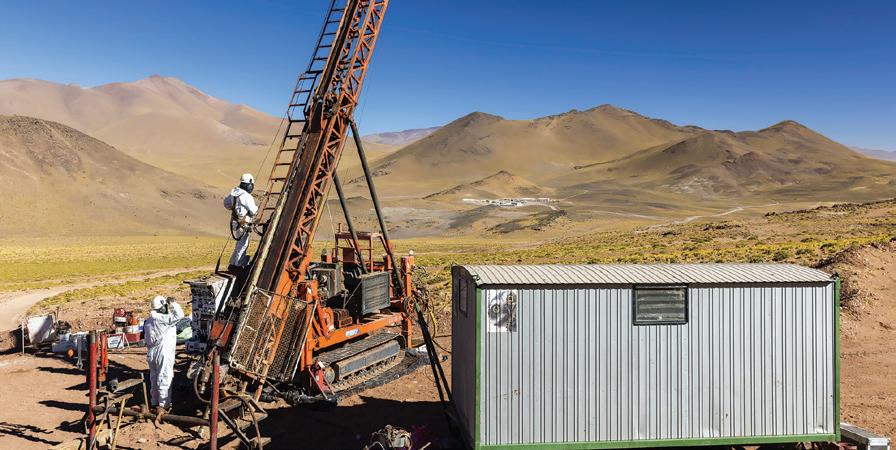
BY BLAIR MCBRIDE
AbraSilver Resource (TSX: ABRA; US-OTC: ABBRF)
cut intervals grading higher than 205 grams silver per tonne in the completed stage four drilling at its Diablillos project in northwest Argentina. Shares gained 8%.
Highlights from the JAC Extension target, in the southwest part of Diablillos, are 30 metres at 237 grams silver from 125.5 metres depth in hole DDH 24-075, including 11.5 metres at 417 grams silver, the company reported on March 11. That hole was drilled 25 metres beyond the JAC open pit boundary, and mineralization remains open south of JAC.
“The continued success of our exploration program highlights the significant remaining upside potential at Diablillos,” AbraSilver president and CEO John Miniotis said in a release. “These latest results confirm that high-grade silver and gold mineralization remains open for expansion across multiple target areas, reinforc-
BY BLAIR MCBRIDE
Silver X Mining (TSXV: AGX; US-OTC: AGXPF) has nearly doubled the indicated category of contained metal at the Plata site on its Nueva Recuperada property in southwest Peru compared with a preliminary economic assessment in 2022.
Contained silver in the indicated category at Plata, formerly known as Esperanza, rose by 92% to 5.81 million ounces, the company said in a release on Feb. 26. Measured and indicated resources at Plata rose about a fifth to 4.26 million tonnes grading 3.28 oz. silver per tonne, 0.56 gram gold, 1.88% lead and 2.22% zinc.
“Our Nueva Recuperada property continues to position itself as one of the most relevant silver projects in South America,” Silver X CEO Jose M. Garcia said in a release. “We are developing an outstanding asset, a district-scale property that will see mining activities for several decades.”
Exploration has identified 6.35 million tonnes of resources on 19 out of 171 veins that have been mapped in the area, Garcia added. Plata consists of a 38.3-sq.-km concession package.
Silver X shares traded in Toronto for 18¢ apiece before press time, giving the company a market capitalization of $37.9 million. Its shares have traded in a 52-week range of 14¢ to 38¢.
45% inferred increase
Inferred tonnage at La Plata has been boosted by 45% since the 2022 assessment to 17.2 million tonnes at 5.12 oz. per tonne, 0.04 gram gold, 2.05% lead and 2.05% zinc, for contained silver of 26 million oz., a 51% increase.
The updated estimate for Plata is based on re-evaluated historical data using more enhanced interpretations of geological structures, Silver X said.
The Vancouver-headquartered company holds several operations in Peru. They include Nueva Recuperada, where its producing Tangana mining unit is located, about 480 km southeast of the capital, Lima.
Silver X started production at Tangana in 2022 and is ramping up to nameplate capacity of 720 tonnes per day at the Nueva Recuperada processing plant. Historical production within a 30-km radius of the area totaled about 200 million oz. of silver. TNM
ing our confidence in the project’s long-term growth and value.”
Silver’s rise to highs last seen in 2013 has been driven by industrial demand for the metal in green energy technology. Silver has gained 42% in the past year to $33.81 per oz. before press time.
AbraSilver shares traded in Toronto for $3.50 apiece before press time, giving the company a market capitalization of $534 million. The stock has traded in a 52-week range of $1.42 to $3.64.
JAC grades soar
Drilling at JAC Extension also returned 22 metres grading 168 grams silver from 102 metres depth in hole DDH 24-072, including 7.5 metres at 163 grams silver. Hole DDH 24-073 cut 35.5 metres at 56 grams silver from 105 metres depth, and 13.4 metres grading 72.7 grams silver.
At the Sombra target, east of JAC, drilling intersected 17 metres grading 101 grams silver from 38 metres depth in hole DDH 24-069, including another interval of 7
metres at 205 grams silver.
Drilling at the Oculto Northeast target, located on the edge of the Oculto open pit and north of Sombra, pierced 17 metres at 1.80 grams gold and 39 grams silver from 151 metres depth in hole DDH 24-070. It included an interval grading 4.4 metres at 3.3 grams gold and 28 grams silver.
Oculto Northeast is a gold dominant trend and extends for several hundred metres northeast, AbraSilver said.
Resource update in months
With 21,172 metres of drilling completed across 106 holes in the program, results are to be incorporated into an updated resource scheduled for release in the middle of the year. Stage five is to comprise an additional 20,000 metres of drilling.
Diablillos hosts proven and probable reserves of about 42.3 million tonnes grading 91 grams silver and 0.81 gram gold for 123.5 million contained oz. silver and 1.1 million oz. contained gold. TNM
INDONESIA | US$35M dropped
BY MINING.COM STAFF
Shares of Baru Gold (TSXV: BARU, OTCQB: BARUF) plunged on March 17 after the junior miner announced that both of its previously agreed investments would not go through, leaving it once again in search of funding for its flagship project in Indonesia.
Baru Gold fell 23% to 5¢ by the close of Canadian trading on March 17, and sat at 4¢ apiece before press time, giving the miner a market capitalization of $13.1 million.
The first deal, signed in November 2024, would have seen Pt Arsari Tambang — part of Indonesia’s Arsari Group — become a stakeholder in the Sangihe gold project, which is held 70% by Baru and the rest by other Indonesian groups. Under the agreement, Arsari Tambang could take up to a 25% interest in the project.
However, Baru Gold said in a news release that Arsari Tambang has now decided not to proceed with a definitive agreement.
A letter of intent (LOI) signed in February with a “distinguished” family office in Singapore — which would have seen Baru Gold raise $35 million (C$50 million) through
a private placement - will also be scrapped. The Singaporean family office, which holds a portfolio of gold mines in Indonesia, had proposed to take up 60% of Baru Gold’s shares with this investment.
Management felt the investment proposal “was not in accordance with the original LOI, as there were issues between the timing of payments and the terms regarding changes in control,” Baru Gold said.
As a result, the Vancouver-based miner will seek talks with other entities interested in a potential partnership.
Delayed gold project
Baru Gold has been looking to bring the Sangihe gold project, situated on the Indonesian island of the same name, into production for years.
The property has a gold-bearing area of approximately 250 sq. km, of which only 10% has been explored. A small zone of 0.65 sq. km is being targeted for initial production, within which an NI 43-101-compliant resource of 200,000 oz. of gold and 3 million oz. of silver was recently estimated.
BY KRISTIE BATTEN
Canadian mining compa-
nies are exploring dual listings on the Australian Stock Exchange amid weak domestic liquidity, according to analysts and companies.
Since 2018, there have been a few dual listings on the ASX but the trend renewed after NexGen Energy (TSX: NXE) added an Australian listing in 2021. Capstone Copper’s (TSX: CS) ASX listing in February last year seems to have opened the door for Marimaca Copper (TSX: MARI), Pampa Metals (CSE: PM), Robex Resources (TSX: RBX) and Orezone Gold (TSX: ORE) to start the listing process.
“Resources companies have really been struggling to attract capital in Canada,” BDO deal advisory partner Adam Myers told the February RIU Explorers Conference in Perth. “The ASX is certainly a great place to be exposed to this market.”
At the end of last year, the total market capitalization of mining and metals companies listed on the ASX was larger than the TSX and TSXV, with about $616 billion vs $606 billion, according to figures from TSX parent TMX Group. However, Toronto raised $10.4 billion during the year compared with $7.2 billion in Sydney, and had nearly double the number of new mining listings at 41.
The ASX is taking advantage of tough market conditions in Canada and holding roadshows to draw in new companies, according to Sasha Conoplia, ASX senior manager for listings. He told sister publication
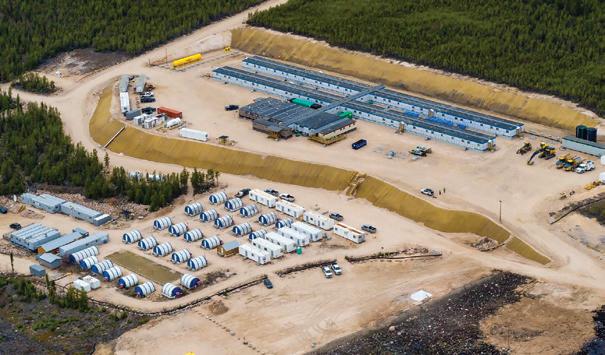
Mining.com that Canadian interest in dual listings is on the rise.
“The resources sector is the largest on ASX by number of listings and that brings a sophisticated Australian and global institutional and retail investor base that can provide capital and liquidity,” Conoplia said.
Top two Investors may be attracted to heavyweights such as BHP (NYSE, LSE, ASX: BHP), the world’s largest miner by market capitalization with about A$200 billion (C$180 billion) Sydney. Second place Rio Tinto (NYSE, LSE, ASX: RIO) at A$170 billion has said it will let its Australian shareholders vote on an independent review of its dual-listing status.
“The Australian capital markets ecosystem for resources is deep and well developed with strong research coverage and global capital support,” BDO’s Myers said. “For companies listing on ASX the market offers competitive valuations across sectors, earlier index inclusion than
Dedicated strategy focused on discovering standalone gold projects with > 1 Moz development potential
Get the latest news
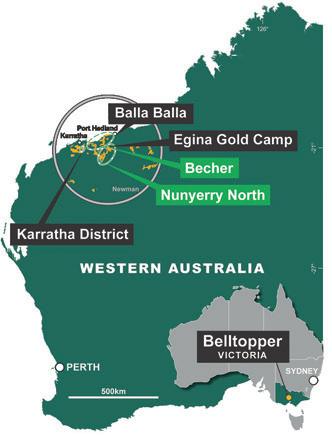
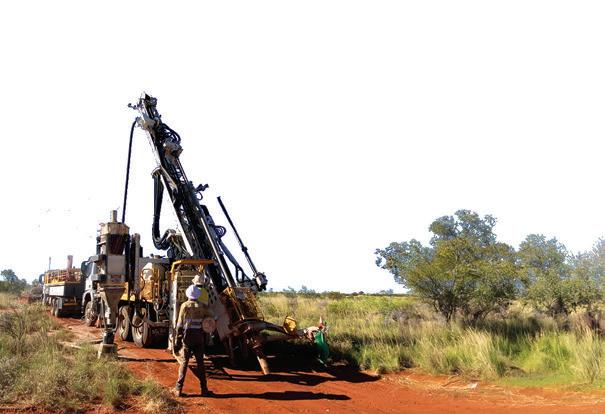
other global peers and access to global institutional capital.”
The London Stock Exchange (LSE) has also suffered an exodus, with Glencore (LSE: GLEN) CEO Gary Nagle suggesting the company may leave the LSE — though not necessarily for Australia. Glencore — the LSE’s second-largest mining company with a market value of about £45 billion (C$83.5 billion) — is one of the 171 metals and mining companies listed on the exchange. LSE-listed miners collectively account for about 17% of the industry’s global market capitalization, or about £121 billion.
Ecuador-focused SolGold (LSE: SOLG) is considering an ASX listing while Greatland Gold (LSE: GGP) is targeting a cross-listing in the second quarter.
“As a significant Australian goldcopper producer,” Greatland CEO Shaun Day said, “the ASX listing is intended to provide benefits including an enhanced capital markets profile and increased institutional ownership and index participation.”
Between 2020 and 2024, some 15 mining companies delisted from the LSE or moved their primary listings to other exchanges, such as those in Australia, the U.S. or Canada, seeking higher valuations and more favourable regulatory environments.
Copper opportunity
Capstone began trading in Sydney last year. It launched with
two million Clearing House Electronic Subregister System (CHESS) depositary interests (CDIs). These instruments give investors the same benefits as owning shares. Since then, the number of CDIs has grown to 185.1 million by the end of February, bolstered by an April 2024 block trade by New Yorkbased private equity firm Orion Resource Partners.
Michael Slifirski, the director of investor relations for Capstone in Asia Pacific, told Mining. com that the lack of strong copper companies on the ASX is a chance for growth. This situation follows BHP’s purchase of OZ Minerals in 2023.
Unlike SSR Mining (TSX: SSR), which said in March that it was delisting from the ASX due to low liquidity, Capstone has been increasing the proportion of trading in Australia. Slifirski says that a successful listing requires commitment.
“It’s not a case of list and investors will buy — far from it,” he said. “The investment case has to be compelling and relevant in quality and scale relative to existing ASX investment opportunities and then needs to be well supported by a committed and credible team that wants it to work.”
In late January, Marimaca Copper filed a prospectus for an ASX listing and were due to join the exchange in March as the Miner went to press. Marimaca CEO Hayden Locke, from Australia, stressed the need for a larger capital pool. This is crucial as the company approaches a construction decision in Chile.
“As we move closer to a construction decision for the Marimaca oxide deposit, and continue our aggressive exploration plans, a broader pool of capital will become increasingly important to our company,” Locke said.
In February, Vancouver-based Pampa Metals said it would buy Rugby Resources (TSXV: RUG). The plan is to list the new company on the ASX. Pampa investor relations advisor Jordan Webster noted that its Australian CEO, Joseph van
den Elsen, knows the local capital market well.
“Since he took over the company, we believe liquidity in Canada hasn’t been great, while the Australian market has remained much stronger,” Webster said.
“We also believe Pampa can stand out on the ASX as a unique story — two discovered high-grade porphyries in South America, which is rare for a junior explorer. Canada is already saturated with South American copper explorers, so we’re confident we will see better visibility and investor engagement in Australia.”
The ASX, already home to West Africa-focused gold producers Perseus Mining (ASX: PRU) and West African Resources (ASX: WAF), may soon welcome two more. Orezone Gold is planning a secondary listing on the ASX. This move aims to support the growth of its Bomboré mine in Burkina Faso. The company hopes the listing will enhance liquidity and attract mining-focused funds restricted to ASX-listed issuers.
Smaller gold company Robex Resources is planning to delist from the TSX entirely and migrate to the ASX. The company plans to leave Mali and aims to get its first gold from the Kiniero project in Guinea by year’s end. It likely wants to take advantage of the success of Predictive Discovery (ASX: PDI), which has the nearby Bankan deposit. Robert Friedland’s Ivanhoe Atlantic, an iron ore developer focused on Guinea, has chosen the ASX for its IPO. The company aims to raise up to A$300 million. Ivanhoe Atlantic CEO Bronwyn Barnes said the company considered various bourses.
“Given the strong knowledge of the iron ore market on the ASX and the familiarity of Australia with African mining projects generally and Guinea in particular,” she said, “a listing on the ASX made sense for us.” TNM
With files from Colin McClelland
BY BLAIR MCBRIDE
An update to Laramide Resources’ (TSX, ASX: LAM; US-OTC: LMRXF) Westmoreland uranium project in northern Australia increases indicated tonnage by 34% and inferred tonnage by 11% over the previous resource from 2009.
Indicated resources now amount to 27.8 million tonnes grading 770 parts per million (ppm) for 48.1 million contained lb. uranium oxide (U3O8), the company reported on Feb. 28. Inferred tonnage totals 11.8 million tonnes at 680 ppm for 17.7 million contained lb. U3O8. The update also brings to 70% the indicated portion of the total resource, and to 30% for the
inferred at the project, located in northwestern Queensland.
“This updated (resource) reiterates our long-held view that Westmoreland is a genuinely world class deposit,” Laramide president and CEO Marc Henderson said in a release. “At 65-plus million pounds it ranks as one of the largest undeveloped uranium deposits in the world and has the potential to be a top 10 global uranium mine.”
The company is betting on the Liberal National Party government of Queensland, elected last October, to move Westmoreland towards development as nuclear energy enjoys a resurgence. The uranium spot price, at $63.80 per lb. U3O8, sits well below last year’s high of $106 per lb. but it’s still higher
than it was in the decade after the Fukushima disaster. Demand for the metal is rising among countries seeking zero-emissions energy alternatives and sources for powerhungry artificial intelligence servers.
‘Sweet spot for size, life’ Westmoreland is “one of the larger open pittable projects in Australia” that hits a sweet spot for size and mine life, SCP Resource Finance analyst Justin Chan said in a note on Feb. 28.
Laramide said in a 2016 preliminary economic assessment (PEA) the project could produce about 3.5 million lb. U3O8 over 13 years. The PEA gives Westmoreland a Laramide P40 >

ETF assets 20 Global gold funds data
Warrants & shorts 21 Capital raisings
24 EV metals
30 Mining events contents
Drill results
28 Market data
29 Market news
*Data may not be comprehensive and is provided on a best-efforts basis as of press time. Investors are responsible for their own due diligence.
Delivering fit-for-purpose solutions across the entire project life cycle
Delivering fit-for-purpose solutions across the entire project life cycle
Delivering fit-for-purpose solutions across the entire project life cycle
Delivering fit-for-purpose solutions across the entire project life cycle
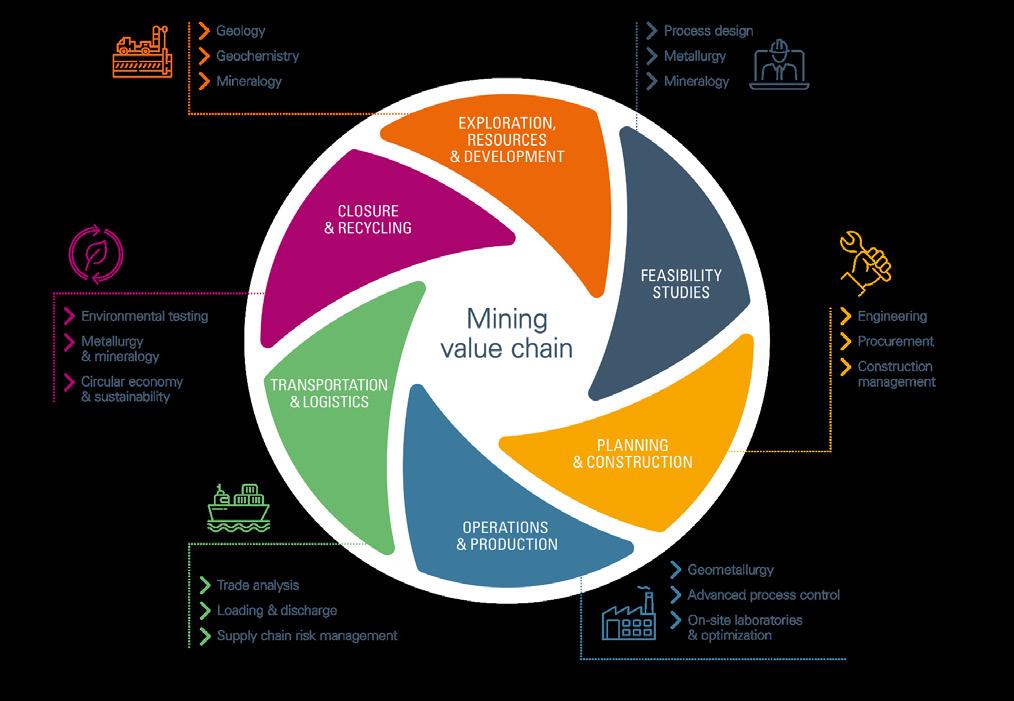
Our fit-for-purpose solutions encompass the skills of qualified geologists, geostaticians, analytical chemists, mineralogists, metallurgists, process engineers and mining engineers and inspectors brought together to provide accurate and timely mineral and process evaluation services across the entire project life cycle.
Our fit-for-purpose solutions encompass the skills of qualified geologists, geostaticians, analytical chemists, mineralogists, metallurgists, process engineers and mining engineers and inspectors brought together to provide accurate and timely mineral and process evaluation services across the entire project life cycle.
Our fit-for-purpose solutions encompass the skills of qualified geologists, geostaticians, analytical chemists, mineralogists, metallurgists, process engineers and mining engineers and inspectors brought together to provide accurate and timely mineral and process evaluation services across the entire project life cycle.
Our fit-for-purpose solutions encompass the skills of qualified geologists, geostaticians, analytical chemists, mineralogists, metallurgists, process engineers and mining engineers and inspectors brought together to provide accurate and timely mineral and process evaluation services across the entire project life cycle.
WWW.SGS.COM/NATURALRESOURCES NAM.NATURALRESOURCES@SGS.COM
WWW.SGS.COM/NATURALRESOURCES NAM.NATURALRESOURCES@SGS.COM
WWW.SGS.COM/NATURALRESOURCES NAM.NATURALRESOURCES@SGS.COM
WWW.SGS.COM/NATURALRESOURCES NAM.NATURALRESOURCES@SGS.COM

The Northern Miner charts the share price movements of Canada's top five gold producers by market capitalization this year to date.

$4,000
$3,500
$#,000
$2,500
$2,000
$1,500
$1,000
$500
$0
4
8
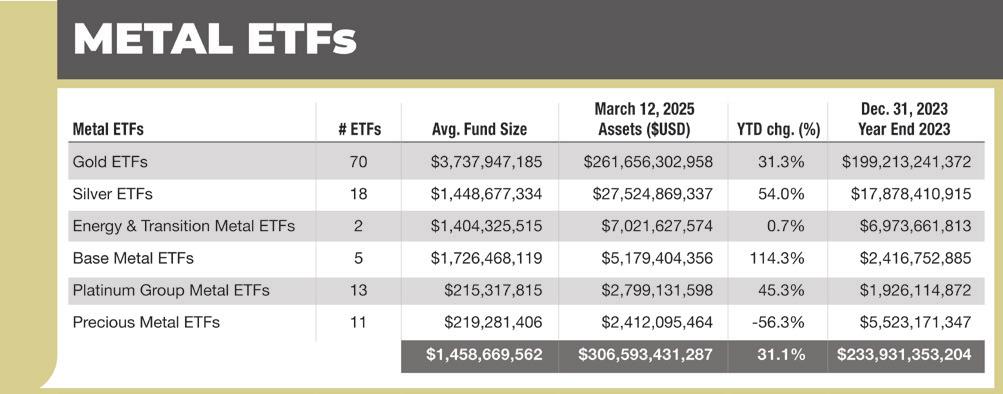
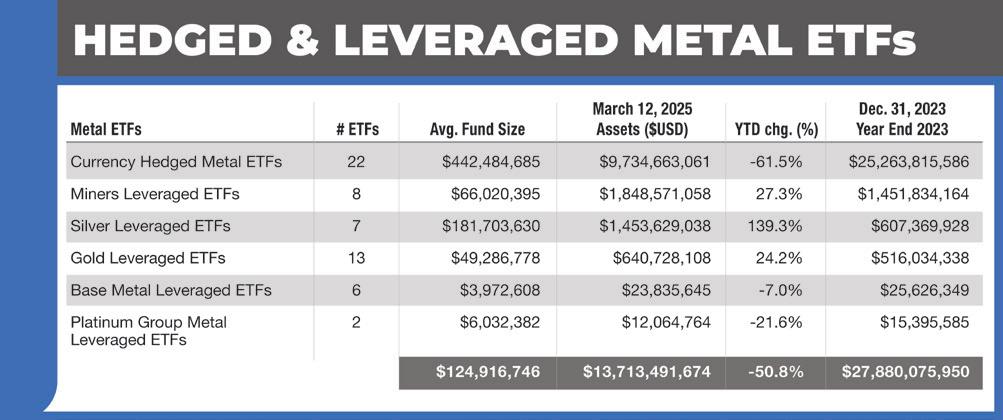
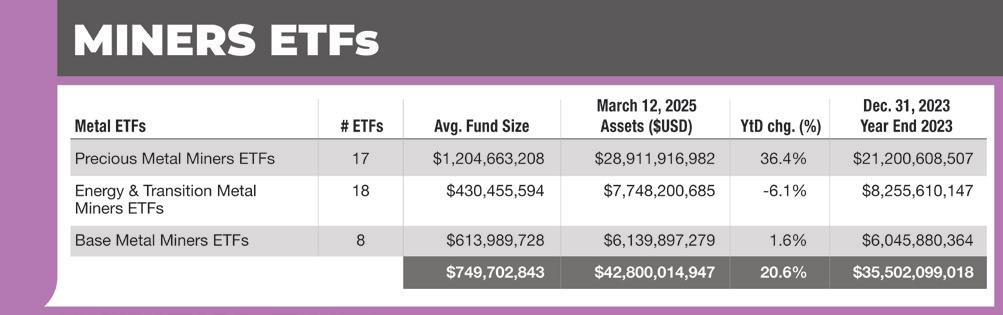
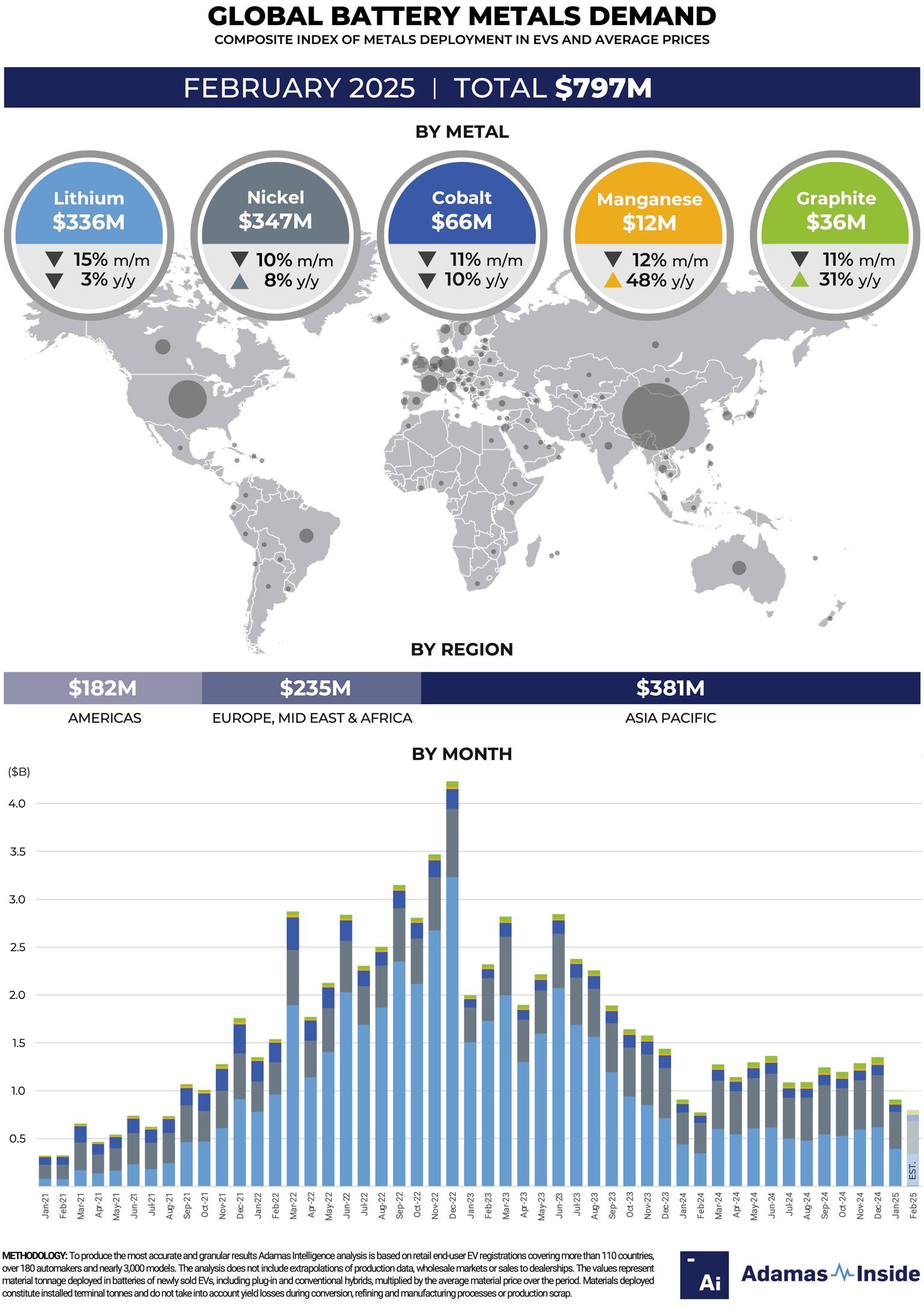
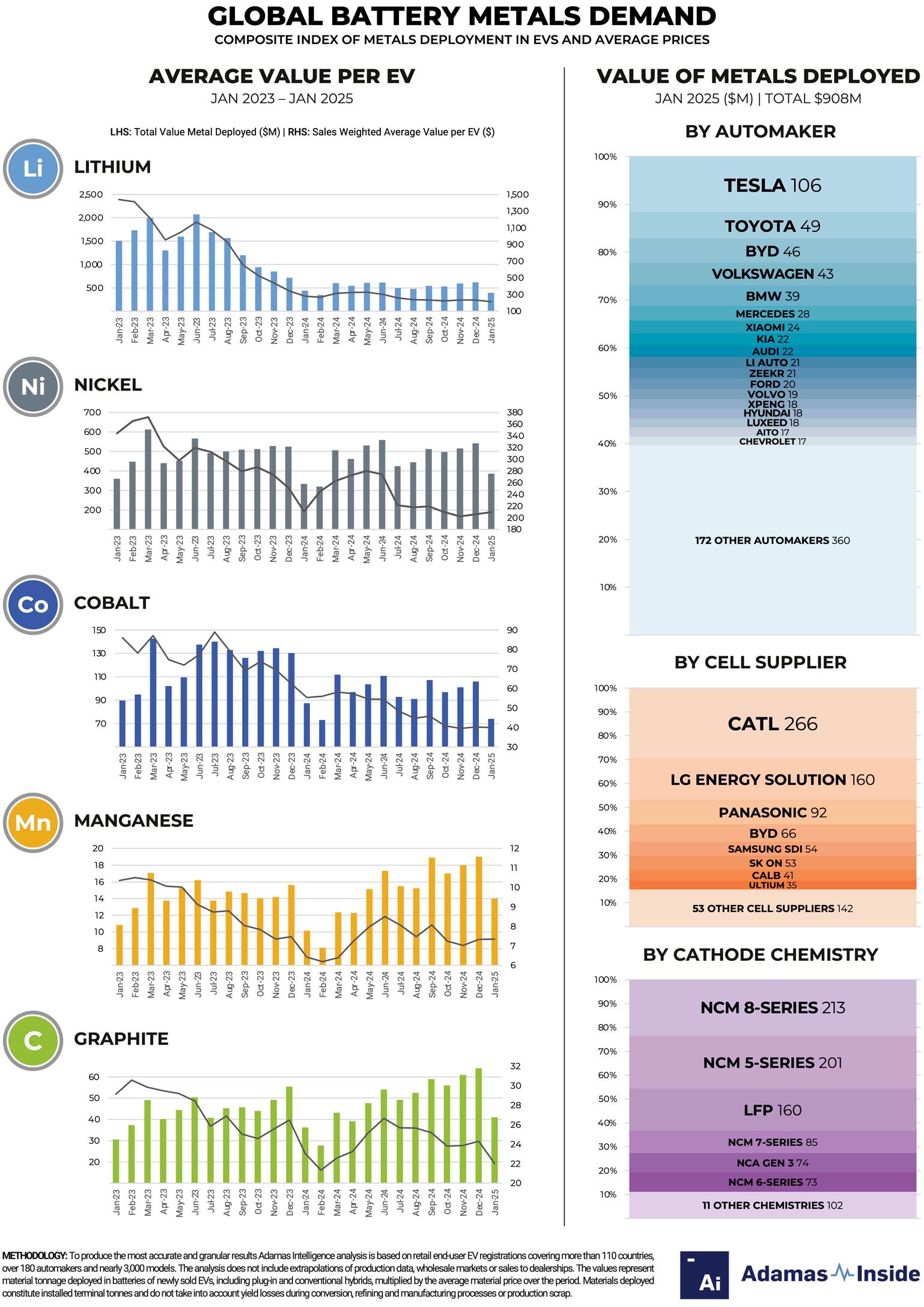
Our TNM Drill Down features the top 10 gold, copper and silver assays of the past month. Drill holes are ranked by grade x width.
February 16, 2025 — March 15, 2025
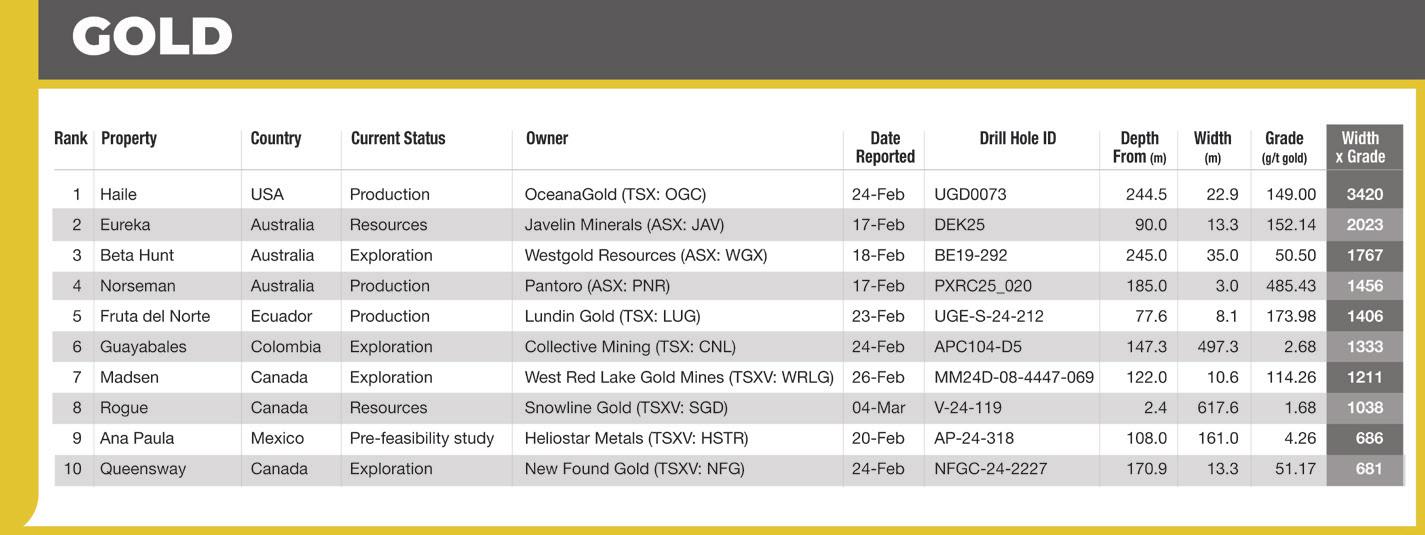
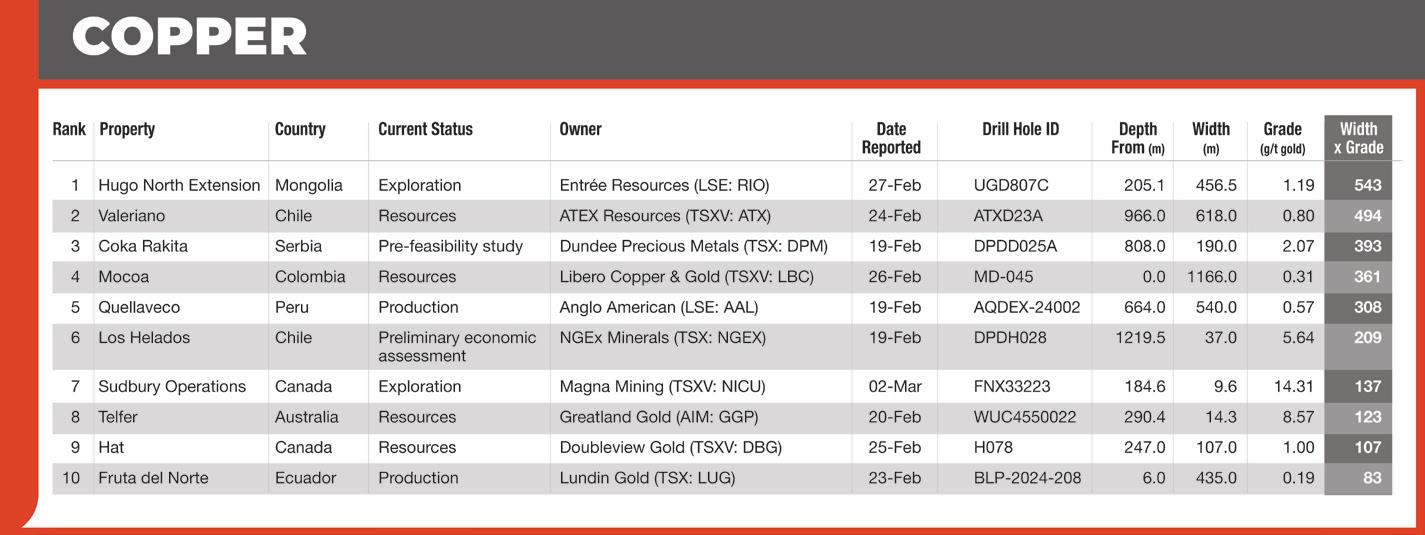
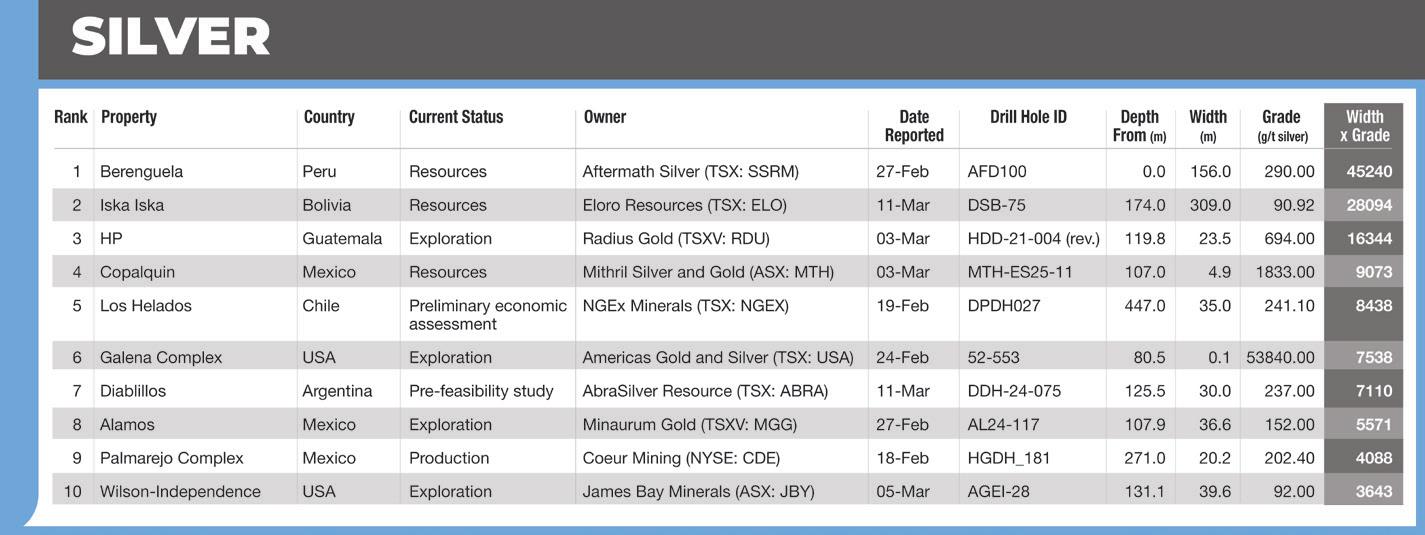
Name Symbol Subsciption Terms Expiry Date
Aris Gold Corporation ARIS.WT One Warrant to purchase one Common 07-29-2025 Share of the Issuer at $2.75 until expiry.
Aris Gold Corporation ARIS.WT.A One Warrant to purchase 0.5 of
at $2.75 until expiry
Total Helium Ltd. TOH.WT.A One warrant to purchase one common 05-01-2025 share at $0.75 per share.
Caldas Gold Corp. CGC.WT One warrant to purchase one common 07-29-2025 share at $2.75 per share.
Rock Tech Lithium Inc. RCK.WT One warrant to purchase one common 08-19-2025 share at $4.50 per share.
Lion One Metals Ltd. LIO.WT One warrant to purchase one common 11-11-2025 share at $1.25 per share.
Vizsla Royalties Corp. VROY.WT One warrant to purchase one common 12-31-2025 share at $0.50 per share.
Silver Mountain AGMR.WT.A One warrant to purchase one common 02-09-2026 Resources Inc. share at $0.45 per share.
Osisko Development ODV.WT.B One warrant to purchase one common 03-02-2026 Corp. share at $8.55 per share.
Denarius Silver Corp. DSLV.WT One warrant to purchase one common 03-17-2026 share at $0.80 per share.
West Red Lake Gold WRLG.WT One warrant to purchase one common 05-16-2026 Mines Ltd share at $1.00 per share.
Aurania Resources Ltd. ARU.WT.B One warrant to purchase one common 10-21-2026 share at $2.20 per share.
Tuktu Resources Ltd. TUK.WT One warrant to purchase one common 11-23-2026 share at $0.13 per share.
Freeman Gold Corp FMAN.WT.U One warrant to purchase one common 11-29-2026 share at US$0.65 per share.
Palisades Goldcorp Ltd. PALI.WT One warrant to purchase 0.060538 12-06-2026 common share at $0.50 per share.
Mogotes Metals Inc. MOG.WT One warrant to purchase one common 01-31-2027 share at $0.30 per share.
Osisko Development ODV.WT.A One warrant to purchase one common 03-02-2027 Corp. share at $14.75 per share.
Integra Resources Corp. ITR.WT One warrant to purchase one common 03-13-2027 share at $1.20 per share.
Elevation Gold Mining ELVT.WT.A One warrant to purchase one common 03-24-2027 Corp. share at $0.70 per share.
Osisko Development ODV.WT.U One warrant to purchase one common 05-27-2027 Corp. share at US$10.70 per share.
Robex Resources Inc RBX.WT One warrant to purchase one common 06-27-2027 share at $2.55 per share.
West Red Lake Gold WRLG.WT.B One warrant to purchase one common 10-24-2027 Mines Ltd share at $0.90 per share.
Lion One Metals Ltd. LIO.WT.A One warrant to purchase one common 02-14-2028 share at $0.41 per share.
West Red Lake Gold WRLG.WT.C One warrant to purchase one common 02-25-2028 Mines Ltd. share at $0.90 per share.
Silver Mountain AGMR.WT.B One warrant to purchase one common 04-24-2028 Resources Inc. share at $0.135 per share.
Bear Creek Mining BCM.WT One warrant to purchase one common 10-05-2028 Corp. share at $0.42 per share.
West Red Lake Gold WRLG.WT.A One warrant to purchase one common 03-19-2029 Mines Ltd. share at $0.95 per share
Short positions outstanding as of March 15, 2025 (with changes from February 28, 2025)
short positions
Metals OM 4887664 4700401
Found Gold NFG 3496946 1368508 F3 Uranium FUU 3390499 666022
Nickel CNC 2221065 1499417
Silvr
2115931 -95159
Energy EU 2036045 -393203
S&G OCG 1548568 1446622
Mining NICU 1468622 -2996
Met HSTR 1459122 1167980
Mining LUCA 1383458 -62756
Silvr KTN 1278223 876263
Sil BIG 1186622
Aluminum: US$1.18/lb.
Cobalt: US$15.25/lb.
Gold: US$3,022.71/oz.
Iron Ore 62% Fe CFR China-S: US$101.05
Nickel: US$7.358/lb.
Silver: US$33.62 per oz.
Zinc: US$1.3482 per lb.
COMMODITY PRICES | Prices current March 25, 2025
Coal: Central Appalachia, 12,500 Btu, 1.2 S02-R,W: US$78
Copper: US$5.18/lb.
Iridium: US$4,250/tr oz.
Lead: US$0.9456/lb.
Rhodium: US$5,575/tr. oz.
Tin: US$15,644/lb.
Coal: Powder River Basin, 8,800 Btu, 0.8 S02-R, W: US$14.20
Copper: CME Group Futures May 2025: US$5.208/lb.;
June 2025: US$5.231/lb.
Lithium carbonate: US$10,209/tonne
Ruthenium: US$630 per oz.
Uranium: U3O8, Trading Economics: US$64.55 per lb.
March 17 - 21
By Henry Lazenby
North American markets gained during March 17-21 as investors processed the Fed’s decision to hold the benchmark interest rate at 4.25% to 4.5% amid evidence that growth slowed.
The Dow Jones Industrial Average gained 497.1 points or about 1.2% in the week to 41,985.35. The S&P 500 added 28.62 points or about 0.5% to 5,667.56. In Canada, the S&P/TSX Composite Index increased 415.09 points or 1.7% to 24,968.49, while the S&P/TSX Venture Composite Index rose16.66 points or 2.7%% to 637.79.
The S&P/TSX Global Mining Index fell 1.96 points or about 1.5% to 130.59, and the S&P/TSX Global Gold Index gained 10.66 points or 2.5% to 442.85. Gold dropped $35.65 per oz. or 1.2% to $3,013.70 per ounce. The S&P/TSX
Global Base Metals Index added 2.47 points or about 1.3% to 196.16, with copper up 21¢ at $5.10 per pound.
On the NYSE mainboard, the week’s biggest value gainer was Southern Copper. It closed at $100.41 adding $4.28 on continued copper price strength.
In Toronto, Franco-Nevada was the top TSX value grower, adding $3.27 to close at $223.53. The Canadian royalty and metals streaming company boosted revenue and profit last year thanks to record gold prices.
On the S&P/TSX Venture Exchange, Bravo Mining gained 60¢ to $2.75 after it received a preliminary licence for its Luanga palladium, platinum, rhodium, gold and nickel project in Pará state, Brazil.
2025
n April April 8-10
Discoveries 2025 Mining Conference – Mazatlan, Mexico
VENUE: Mazatlán International Center
MORE INFORMATION: www.discoveriesconference. com
April 11-13
Scottsdale Capital Event — Scottsdale, Ariz.
VENUE: JW Marriott Phoenix Desert Ridge Resort
MORE INFORMATION: www.cem.ca/conference/ scottsdale-capital-event-2025/
April 22-25
ExpoMin — Santiago, Chile
VENUE: Espacio Riesco
MORE INFORMATION: www.expomin.cl/en/
April 24
Inflection 2025 — Toronto
VENUE: Ritz Carlton
MORE INFORMATION: www.lithiumroyaltycorp. com/investor-relations/events-and-presentations/ events/event-details/2025/Cormark-5th-AnnualBattery-Materials-and-Industrial-TechnologyConference--2025-YN2dz-5cEU/default.aspx
n May May 4-7
CIM Convention — Montreal
VENUE: Palais des congrès de Montréal
MORE INFORMATION: convention.cim.org
May 11-13
Commodities Global Expo 2025 — Ft Lauderdale, Fla.
VENUE: Four Seasons Fort Lauderdale
MORE INFORMATION: topshelf-partners.com/ florida-2025/
May 12-13
Mining & Critical Minerals Middle East Conference and Exhibition — Dubai
VENUE: TBA
MORE INFORMATION: www.miningcriticalminerals. com
May 14-16
Natural Resources Stock Expo 2025 — Atlanta, Ga.
VENUE: The Whitley
MORE INFORMATION: topshelf-partners.com/ georgia-2025/
May 20-22
Canaccord Genuity Global Metals and Mining Conference — Henderson, Nev.
VENUE: TBA
MORE INFORMATION: www.canaccordgenuity.com/ capital-markets/events-and-conferences/2025global-metals--mining-conference/
May 20-22
Arminera 2025 — Buenos Aires, Argentina
VENUE: La Rural Trade Center
MORE INFORMATION: mstacanada.ca/events/ arminera-2025/
May 20-22
GRX25 Global Resources Innovation Expo — Brisbane
VENUE: Brisbane Convention and Exhibition
Building
MORE INFORMATION: www.grx.au
May 21-22
Mining Investment Asia — Singapore
VENUE: Marriott Tang Plaza Hotel
MORE INFORMATION: www.mininginvestmentasia. com
June 2-4
Mining In Motion 2025 — Accra, Ghana
VENUE: Kempinski Hotel Gold Coast City
MORE INFORMATION: www. mininginmotionsummit.com
June 3-5
THE Mining Investment Event of the North — Quebec City
VENUE: Centre des congrès de Québec
MORE INFORMATION: www. themininginvestmentevent.com
June 4-5
15th International Astana Mining & Metallurgy Congress — Astana, Kazakhstan
VENUE: Hotel Hilton Astana
MORE INFORMATION: www.amm.kz/en/
June 4-5
Canadian Mining Expo — Timmins, Ont. VENUE: McIntyre Complex
MORE INFORMATION: virtex.canadianminingexpo. com
June 9-10
121 Mining Investment — New York City
VENUE: Convene 360 Madison Ave
MORE INFORMATION: www.weare121. com/121mininginvestment-new-york/
June 11-12
Mining & Critical Minerals Investment Latin America — São Paulo, Brazil
VENUE: TBA
MORE INFORMATION: www. criticalmineralslatinamerica.com
June 11-12
UK Mining Conference — Cornwall
VENUE: Princess Pavillion
MORE INFORMATION: www.ukminingconference. co.uk
n July
July 7-11
Rule Symposium 2025 — Boca Raton, Fla.
VENUE: Mizner Center
MORE INFORMATION: allintheloop.info/App/rickrule/ rickrule2025
July 29-30
Life of Mine | Mine Waste and Tailings Conference 2025 — Brisbane
VENUE: Brisbane Convention and Exhibition Centre
MORE INFORMATION: www. ausimm.com/ conferences-and-events/life-of-mine-and-minewaste-and-tailings-conference-2025/
n September
Sept. 8-11
The Uranium, Potash, and Lithium Conference — Saskatoon
VENUE: TBA
MORE INFORMATION: uraniumpotashlithium.org
Sept. 17-19
30th Central Asian International Mining Exploration Exhibition — Astana, Kazakhstan
VENUE: Atakent International Exhibition Centre
MORE INFORMATION: mining-metals.kz/en/
Sept. 22-26
Extemin 2025 — Arequipa, Peru
VENUE: TBA
MORE INFORMATION: mstacanada.ca/events/ extemin-2025/
n October
Oct. 1-3
African Mining Week — Cape Town, South Africa
VENUE: Cape Town International Convention Centre
MORE INFORMATION: african-miningweek.com
Oct. 3-4
Munich Mining Conference — Munich, Germany
VENUE: Olympic Hall Munich
MORE INFORMATION: munich-mining-conference. com

BY BLAIR MCBRIDE
exico’s image as a tough place for mining may show little sign of abating under the Claudia Sheinbaum administration as it increases taxes and faces $1.5 billion in arbitration claims, but project OKs are proceeding again, industry veteran Peter Megaw says.
Almaden Minerals (TSX: AMM; NYSE-AM: AAU) filed a legal claim for US$1.06 billion in damages against the government in late March while Silver Bull Resources (TSX: SVB) is seeking $408 million in a separate case. Mexico raised its special mining duty on Jan. 1 to 8.5% from 7.5% and the extraordinary mining duty to 1% from 0.5%.
The country is important for mining as the world’s largest silver producer and any efforts to rebound from the policies of previous president Andrés Manuel López Obrador’s (Amlo) are notable. The country’s mining chamber, Camimex, says the government could deter more than $6.9 billion in investments over the next two years. But Megaw sees some progress.
“The biggest change is we’re seeing permits being granted. They were taking a long time under Amlo and now they’re moving ahead,” said Megaw, co-founder of MAG Silver (TSX, NYSE: MAG) and
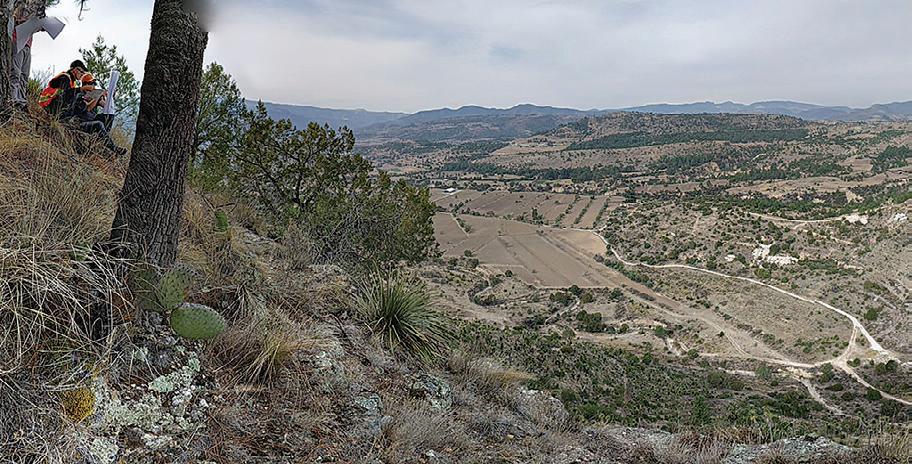
Minaurum Gold (TSXV: MGG; US-OTC: MMRGF). “Sheinbaum is simply quietly doing the things that are supposed to be done instead of noisily doing the things that shouldn’t be done.”
Megaw pointed to Alamos Gold’s (TSX, NYSE: AGI) receipt in January of an environmental permit at its Mulatos project in Sonora state. The 40-year veteran of exploration in Mexico said Camimexes alarming figures are “logical extensions of declining trends that developed over the last three to four years
under Amlo,” adding that it will take six to 10 months to get a feel for Sheinbaum’s trajectory.
Almaden case
Part of the government’s path now is to arbitration hearings. Almaden’s action comes after the government canceled the concession rights at its Ixtaca gold-silver project in Mexico’s east-central Puebla state in 2023. Silver Bull seeks damages for the government’s alleged expropriation of its Sierra Mojada project.
Law firm Boies, Schiller, Flexner (BSF) in New York City filed both cases with the World Bank’s International Centre for Settlement of Investment Disputes in Washington, D.C. Silver Bull’s first hearing is scheduled for October next year.
“We haven’t observed any differences in approach by Sheinbaum’s administration towards the mining industry or towards Canadian investment in the mining industry,” BSF lawyer Kristen Young told The Northern Miner. “What we have observed thus far is a continu-
ation of Amlo’s prior policies that in essence were anti-mining.”
Almaden’s case is the latest example of foreign miners running afoul of the Mexican government’s restrictive approach to mining. Amlo, the former populist president whose tenure ran from 2018 until last October, oversaw mining law reforms that blocked new concessions and added tougher regulations. He also proposed an open-pit mining ban, though Sheinbaum has pledged to review it.
No new concessions
Camimex already projects that mining investment will decline by US$1.2 billion this year, from last year’s expected investment of US$5 billion, according to reporting by El Economista. That drop, marking the sector’s lowest investment level in a decade, is mainly because no new mining concessions have been granted under the Amlo and Sheinbaum governments, chamber president Pedro Rivero said last October.
However, acquisitions and investments over the past six months are positive developments, Megaw said, “even if not yet at anything approaching desired levels.” They include Coeur Mining’s (NYSE: CDE) $1.7-billion deal to
BY FRÉDÉRIC TOMESCO
Canadian gold producer G Mining Ventures (TSX: GMIN; US-OTC: GMINF) will consider tapping the debt markets if it moves ahead with its $936 million (C$1.34 billion) Oko West gold project in Guyana this year, CEO Louis-Pierre Gignac said.
G Mining will need to raise at least $300 million to fund Oko West, Gignac said in a late March interview. The company expects to publish a feasibility study for the project this month and receive full environmental permits sometime in the second quarter, with a formal construction decision to be made in this year’s second half.
Oko West is one of two projects that G Mining is counting on to anchor future output. The other, Brazil’s Tocantinzinho, started producing gold in September and has already allowed the company to start generating cash flow.
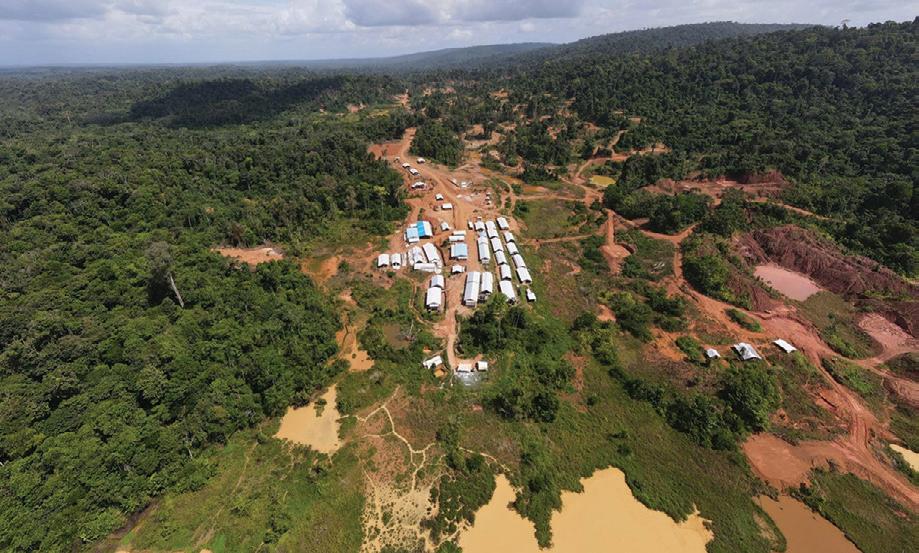
“We do need to secure some external financing to fully fund Oko West,” Gignac told The Northern Miner by telephone. “We’re looking at $300 million to $400 million of external financing that will complement our cash flow from Tocantinzinho and our existing cash balance.” G Mining shares traded for $17.40 apiece before press time in Toronto, for a market
probably
“We
what the mix will be, but there are many options in front of us,” he said.
“The key point is that we’re looking to minimize equity dilution at this point, given our ability to use debt.”
The high-yield debt would probably carry an interest rate of 8%, “which is quite attractive,” the CEO said.
Before it can issue debt, G Mining will need to obtain a credit rating.
“Typically, you need to show a couple quarters of financial statements so that credit rating agencies can do their assessment,” Gignac said. Once G Mining has reported its first quarter results this spring, “we will have the ability to do that process.”
Path to production
After receiving its interim environmental permit by Guyana last year, G Mining has started infrastructure work such as building a barge landing that will help to bring in
social media.
BY FRÉDÉRIC TOMESCO
First Quantum Minerals’
(TSX: FM) Panamanian unit says it’s asked its lawyers to halt legal proceedings against Panama in a bid to end a 16-monthold feud with the Central American country’s government.
The announcement came after Panama asked First Quantum to immediately suspend arbitration efforts against the government if the company was serious about negotiating a restart of its shuttered Cobre Panama mine.
Panama President Jose Raul Mulino on March 13 authorized the export of stockpiled copper concentrate from Cobre Panama while approving a restart of the mine’s power plant. First Quantum will need to reimburse Panama because the raw materials will be processed abroad, he said.
“We have listened carefully to the statements of the President of the Republic, Jose Raul Mulino, regarding the authorization to restart the power plant and export copper concentrate,” Cobre Panama general manager Manuel Aizpurua said March 14 in a letter to employees that was posted on
“These actions provide immediate stability for the well-being of the country: They preserve jobs, ensure responsible site management and safeguard the environment. With these measures in place, we now move to the next step. We have instructed our lawyers to meet with the government’s legal team to work on suspending the arbitrations.”
Solution
Such a move “is part of a transparent and constructive process leading to a solution for the benefit of workers, communities, suppliers and all Panamanians,” Aizpurua added.
A First Quantum spokesman confirmed the letter’s authenticity and said the company would have no further comment on the matter.
Mulino’s predecessor ordered First Quantum to shut down Cobre Panama in 2023 following a Supreme Court ruling that declared the operation’s mining contract unconstitutional. At the time, Cobre Panama accounted for about 5% of the country’s gross domestic product and 75% of its exports. First Quantum has kept the copper
concentrate stockpiled at the site since the closure.
The concentrate “is being wasted, and Panama has invested a ton of money in it,” Mulino said March 13 at a press conference in Panama City. “The issue of the mine will be handled with great responsibility and by taking into consideration the national interest we need to protect.”
Franco-Nevada (TSX, NYSE: FNV), which had a gold-copper steaming agreement with First Quantum, said earlier last month that arbitration proceedings in its dispute with Panama over the mine’s reopening are moving forward after a tribunal formed in December said it will hear the case in October 2026.
Cobre Panama’s closure in 2023 forced Franco-Nevada to take a $1-billion impairment charge.
Open pits
Cobre Panama holds about 3 billion tonnes of proven and probable copper reserves. Located about 120 km west of Panama City, the site includes two open pits, a processing plant, a 300-megawatt power station and an international port.
“Since the beginning of the
administration, we have stated that no progress will be made or constructive dialogue established with the mining company as long as the arbitrations against the Panamanian state are ongoing,” Panama’s Commerce and Industry Ministry said in a statement. “Any possible rapprochement will depend on the immediate suspension of these proceedings. Panama will not accept pressure or imposed conditions that compromise its sovereignty.”
“Once this action required by the government is completed, we will be able to move forward in authorizing, in an open and public manner, the fate of the copper concentrate mined” at Cobre Panama, the ministry added. “We will consider the environmental aspects and the best benefit for the country. Any decision will be taken with responsibility, transparency and in compliance with the law.”
First Quantum has been seeking billions of dollars in damages from Panama due to the mine’s closure. A final hearing for the case was recently postponed until 2026 to leave room for negotiations with the government. The company says
it has invested more than US$10 billion to build Cobre Panama, the port and the power station.
Panama is analyzing options to authorize the eventual use of the power plant “for the benefit of the national electrical system, with the guarantee that this decision does not imply a reactivation of the mining activity,” the ministry said March 13. “The sole purpose is to increase the supply to guarantee the provision of electricity service at a competitive price for residential and commercial users throughout the country.”
All future decisions related to Cobre Panama “will be rigorously evaluated, ensuring that any measure taken responds exclusively to the interests of the country and its people,” the Commerce Ministry’s statement concluded.
CEO Tristan Pascall said in February that the company was looking forward to “constructive discussions with the government and people of Panama for resolution of the situation” at Cobre Panama. “Arbitration is not the preferred outcome for the situation in Panama,” First Quantum said in its fourth-quarter report to shareholders. TNM
BY NORTHERN MINER STAFF
An Ottawa-based company has developed a new fire prevention technology for mines and exploration camps susceptible to the increasing prevalence of forest fires.
The patented fire prevention technology, described by Wall of Water (WOW) president David McKeen “as a sprinkler system on steroids,” is designed to propel a wall of water toward buildings and equipment to protect them from a raging wildfire.
“If a building in the path of a forest fire remains dry, there’s little chance of saving it from flying embers unless it’s soaking wet and that’s what my equipment does,” McKeen said.
The WOW product family consists of portable trailers that can be stored when not in use and moved into place at will; fixed mount tripods; roof mount guns; and ancillary support equipment such as self-priming electric start pumps, hoses, manifolds, fittings and gun tips.
Trailers, tripods and roof top units can be daisy-chained and powered by pumps of up to 650 horsepower to protect the desired real estate.
McKeen describes the trailers as being equivalent to “mini firepumper trucks.” Trailers are equipped with a pump, fuel tank, 4.3-metre-high sprayer mast, water intake/supply hoses and a gun. The sprayer will throw a wall of water up to 137 metres in diameter and up to 15.2 metres high, soaking the roof and sides of a building along with surrounding vulnerable fuel sources.
Water deluge Sprayer towers have a fully adjustable gun pitch angle and rotation sweep. Once deployed, the deluge of water will rotate autonomously for as long as fuel and the water supply are available.
Standard fully equipped trailers include either a 20 or 35 horsepower pump, complete with suction line, floating intake filter and supply hoses with a manual attack nozzle for extinguishing established fires. The complete system can be deployed within 15-20 minutes by two men, taken to any remote location by means of a pickup truck, off-road utility task vehicle, helicopter or watercraft.
Water can be sourced from a hydrant system, lake, river, ocean or other bodies of water using the suction line equipped with a floating filter that avoids the intake of debris.
The pumps can be fuelled by gas, diesel or propane. To protect an unmanned exploration camp, systems can be started remotely via satellite or cellular connectivity. Fuel tanks are sized to operate for a minimum of 24 hours.
Permanent fixed mount tripods are anchored in the ground with one leg consisting of a water supply pipe and the attached water gun, which is fully adjustable for pitch angle and rotation sweep.
McKeen came up with the idea while watching TV and witnessing the devastation of entire communities levelled to the ground and people losing their homes, businesses and livelihoods.
“It really bothered me seeing so many people suffering from these disasters and losing absolutely everything,” he said.
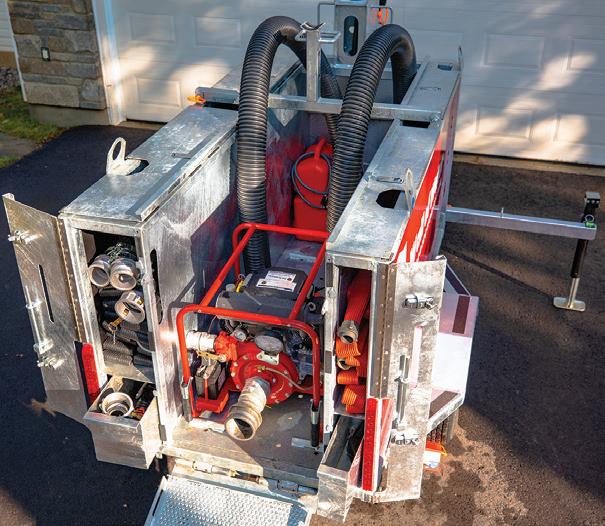
A technically savvy entrepreneur with no background in firefighting, McKeen worked with Ontario fire truck manufacturer Battleshield Industries to help design the initial system. Further refinements along with extensive testing continued with his current manufacturer, Cadman Power Equipment in southern Ontario, until performance goals were achieved and proven.
To succeed at bringing WOW to the masses, McKeen’s team has implemented a marketing strategy to introduce WOW to municipal first responders, private home and cottage owners, businesses, Indigenous communities and resorts located in forested areas.
A chance meeting with an employee from a large northern
Ontario mining company at a Cottage Life trade show in Toronto introduced McKeen to the vulnerability of Canada’s mining operations, many of which are located in remote areas.
Canada’s 2023 wildfire season was the most destructive ever recorded with more than 6,000 fires torching a staggering 150,000 sq. km of forest. That’s an area larger than England and more than double the 1989 record, according to Natural Resources Canada.
Hecla Mining (NYSE: HL), Agnico Eagle Mines (TSX: AEM; NYSE: AEM), Eldorado Gold (TSX:ELD; NYSE: EGO) and Wesdome Gold Mines (TSX: WDO; US-OTC: WDOFF) were among more than a dozen Canadian mining operations that either shut down
and evacuated their staff or forced the cancellation of some shifts in June 2023.
Wildfire season
In 2024’s wildfire season, according to Natural Resources Canada, there were more than 5,000 fires affecting more than five million sq. km. In July, Champion Iron Mines (TSX, ASX: CIA; US-OTC: CIAFF) suspended operations at its Bloom Lake site in northeastern Que.
In August, SSR Mining (TSX, NASDAQ: SSRM; ASX: SSR) evacuated its employees and shut down its Seabee gold mine 125 km northeast of La Ronge, Sask., resuming operations only in mid-October. While the mine itself wasn’t materially impacted by the fire, the company reported damage to power poles, piping and exploration equipment.
According to McKeen, WOW products have been delivered to a large remote mine in Ontario. The site has opted to sole-source several products to measure their effectiveness with a group of stationary fixed mount tripods to protect an essential building area using its own pumps and water supply infrastructure.
Once the coverage area and optimum positioning of the tripods are verified, additional tripod units along with custom designed roof top sprayers will be added for further thorough encampment and work zone equipment protection.
The preceding Joint Venture Article is PROMOTED CONTENT sponsored by Wall of Water and produced in co-operation with The Northern Miner. Visit: www.wallofwater.ca for more information..
BY TOM AZZOPARDI
Two years after President Gabriel Boric pushed to develop Chile’s lithium potential, the initiative could soon start to bear fruit.
The government is expected to announce four deals this year with private companies to develop lithium projects. France’s Eramet (EURO: ERA) and Chinese electric vehicle maker BYD are among those reportedly in the running, while state copper giant Codelco and government miner Enami seek partners of their own like mining giant Rio Tinto (ASX: RIO) for Chile’s two largest battery metal projects.
The initiatives could really change perceptions about Chile which, despite holding the world’s largest lithium reserves, has been seen as a closed shop due to a law reserving production for the state. The potential deals, also expected for another eight projects, could see lithium pro-
duction double over the next decade to almost 500,000 tonnes a year, recapturing Chile’s position as the world’s leading producer.
“They can really send a message to the world that private companies are up and running with projects in Chile,” Gordon Stein, chief financial officer of Cleantech Lithium (AIM: CLT), told The Northern Miner “We’re at a really interesting point where it’s all coming together.”
A prefeasibility study for the company’s $450-million (C$644-million) capex Laguna Verde project is due imminently. It has an industrial-scale test plant up and running and the support of local Indigenous communities. A government licence could see the company start operating by the end of the decade.
Licences due Eramet, which last year bought the Siete Salares project for $95 million, and Canada’s Lithium Chile (TSXV: LITH), are also in the run-
ning. The first batch of licences were to arrive as the Miner went to press.
“We are going to end the year for at least four permits awarded to produce lithium,” Cristian Quinzio, a mining lawyer in Santiago, said in an interview. “And with that the government will have met its aims.”
The announcements are due as Codelco takes 50%-plus-one-share control of the country´s largest lithium operation run by SQM (NYSE: SQM). Codelco is also seeking a partner to develop the Maricunga salt flat into what could be Chile’s second-largest lithium operation after buying Australia’s Lithium Power International last year for $244 million. Empresa Nacional de Minería, or Enami, is seeking a partner for its Altos Andinos project.
While increasing state participation in world-class assets like the Atacama salt flat, the world’s largest lithium reserve, the government intends to provide the legal certainty necessary for private inves-
tors to develop new projects. It’s a strategy that has worked in its giant copper industry where multinationals have invested billions of dollars alongside the powerful state mining firm.
“Given the political realities, this was really the best outcome available,” Daniel Jimenez, a Santiago-based consultant to the lithium industry, said by phone.
Obstacles?
Challenges include Indigenous groups who view the salt flats as their ancestral property, and the country’s permitting process, especially given the fragile ecosystems.
But consultations on the new projects have advanced as isolated communities see the benefits of projects on their doorstep. And legislation in Congress to slash red tape and cut permitting times should facilitate that process, says Cristobal Sarmiento, a lithium specialist at the Diego Portales Univer-
MEXICO | Near-term cashflow seen
sity in Santiago. The development of new, cleaner and faster methods of extracting lithium from the brine should boost the process as well.
New contracts to produce lithium are expected to require investors to adopt direct lithium extraction (DLE) technologies which can produce the mineral without the huge evaporation pools currently employed by Albemarle (NYSE: ALB) and SQM.
These could significantly reduce the industry’s environmental footprint and water consumption, advocates say. But it is not clear the technology can be successfully applied in all conditions.
“By obliging the new projects to use DLE, we could be creating further delays,” Jimenez said.
If they can be developed swiftly, Chile’s new projects could come at just the right time for the depressed lithium market. After two years in
BY BLAIR MCBRIDE
Aresource update for Silver Storm Mining’s (TSXV, USOTC: SVRS) La Parrilla project in east-central Mexico almost doubled its indicated tonnage, spurring Red Cloud Securities to start coverage.
Indicated resources now total 1.19 million tonnes, a 94% increase from the 2023 initial report. They grade at 187 grams silver per tonne, 0.1 gram gold, 1.56% lead and 1.7% zinc, Silver Storm reported in February. Contained metal totals 7.2 million silver oz., 3,900 oz. gold, 18,600 tonnes lead and 20,300 tonnes zinc.
The estimate boosted inferred tonnage by 58% to 1.98 million tonnes grading 175 grams silver, 0.12 gram gold, 1.27% lead and 1.42% zinc, equating to 11.2 million oz. contained silver, 7,700 oz. gold, 25,300 tonnes lead and 28,200 tonnes zinc.
Silver Storm’s La Parrilla and San Diego mines are located in Durango state about 800 km northwest of Mexico City.
‘Value storm’
“The prospect of near-term operating cashflow in combination with the longer-term growth potential of resources and reserves at both La Parrilla and San Diego…suggest a value storm brewing on the horizon,” Red Cloud Securities managing director and analyst Ron Stewart said in a March 25 note.
Red Cloud gives Silver Storm a buy rating and a 27¢ share price target, almost double the 16¢ it traded for before press time in Toronto. It has a market capitalization of $70.2 million.
Further exploration at Parrilla would likely lead to more resource category conversion, Silver Storm president and CEO Greg McKenzie said.
“The company is now very well positioned, having a fully permitted silver mine complex, with a sizable mineral resource endowment that could potentially feed the La Parrilla
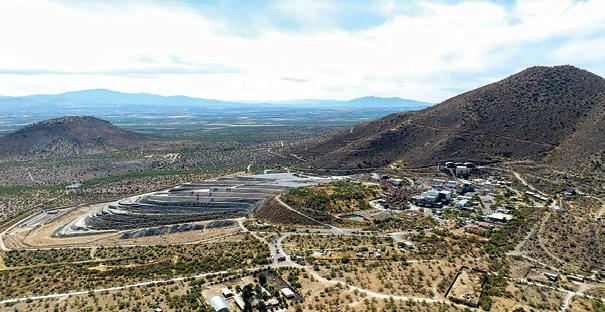
processing plant for several years,” he said in a release in February. Drilling last year showed that previously mined areas are open at depth and appear to be wider and
higher grade, Stewart said.
Precious metals tailwinds
Noting that the company plans to resume production at La Parrilla
in the fourth quarter, Stewart said it comes as precious metals ride an “unprecedented price surge.”
Gold touched a historic high of $3,000 per oz. on March 14 and sat at $3,021.60 before press time. Silver, at $33.57 per oz. is in highs last seen in 2013, driven by industrial demand for the metal in green energy technologies.
Other tailwinds for La Parrilla, located about 75 km southeast of Durango City, include it being fully permitted, with $150 million (C$215 million) worth of infrastructure. It has a 2,000-tonne-perday oxide and sulphide processing plant, a partial vehicle fleet and tailings storage facility.
The mine produced 34 million silver-equivalent oz. between 2006 and 2019.
Undeveloped potential San Diego, located in eastern Durango, hosts 16.5 million indicated tonnes grading 57 grams silver, 0.07 gram gold, 0.7% lead and 1.23% zinc for 31.6 million contained silver ounces, according to an estimate from 2013. Inferred tonnes total 42.1 million tonnes at 61 grams silver, 0.07 gram gold, 0.9% lead and 1.32% zinc for 81.6 million oz. silver.
“(It) represents one of the largest undeveloped silver projects in Mexico,” Stewart said.
Pending additional funding, the company plans to conduct 5,000 to 10,000 metres of drilling at San Diego, update the resource and do a preliminary economic assessment, according to a corporate presentation. TNM

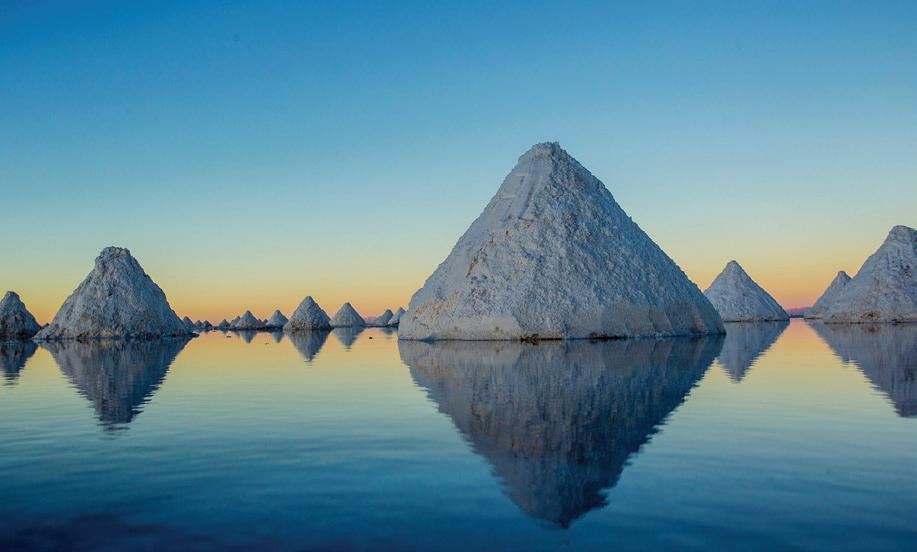
BY CECILIA JAMASMIE
Bolivia faces mounting public backlash over contracts signed with Chinese and Russian companies late last year seeking to exploit its vast lithium reserves, with community groups arguing the agreements offer locals few real benefits.
The controversy led the Bolivian Chamber of Deputies to suspend parliamentary discussions on the deals in February, pending “a thorough information-sharing process with civil society is completed.”
warned that if the deals are not approved this year, Bolivia could face a decade-long delay in lithium production. If the country waits too long — until 2035 or 2040 — lithium “will be history,” replaced by other clean energy sources like green hydrogen, he told Russian state media Sputnik in early March. Omar Alarcón, president of state-owned company Yacimientos de Litio Bolivianos (YLB), echoed those concerns. He has said failure to approve the contracts could delay industrial-scale production by up to 15 years.
lack transparency and could lead to severe environmental damage and economic losses.
A key point of contention is the stark cost disparity between the two contracts. The Russian project’s cost per tonne of lithium carbonate production is reportedly 2.4 times higher than the Chinese equivalent, with no clear justification for the difference.
Critics also question the feasibility of the UOG deal, which gives the company just 18 months to build a plant before the contract expires — an unusually short time-
BY FRÉDÉRIC TOMESCO
The odds of Latin America’s three lithium powers banding together to form a production cartel have almost evaporated due to contrasting economic models, a leading geopolitical analyst says.
Argentina, Chile and Bolivia have previously held discussions with Brazil about the creation of a group — inspired by the Organization of Petroleum Exporting countries, or OPEC — tasked with boosting lithium processing capacity and turning more of their mined metal into batteries.
Together, Argentina, Bolivia and Chile — dubbed the Lithium Triangle — hold an estimated 60% of global lithium resources.
While Chile and Argentina have made strides in luring foreign investors to boost output of the white metal, Bolivia — referred to by some observers as the Saudi Arabia of lithium thanks to its abundant reserves — remains a fringe producer due in part to wide-ranging state involvement in the industry. Even a possible change of government following the upcoming August election might not suffice to spur lithium output, according to Diego von Vacano, a political science professor at Texas A&M University’s Bush School of Government.
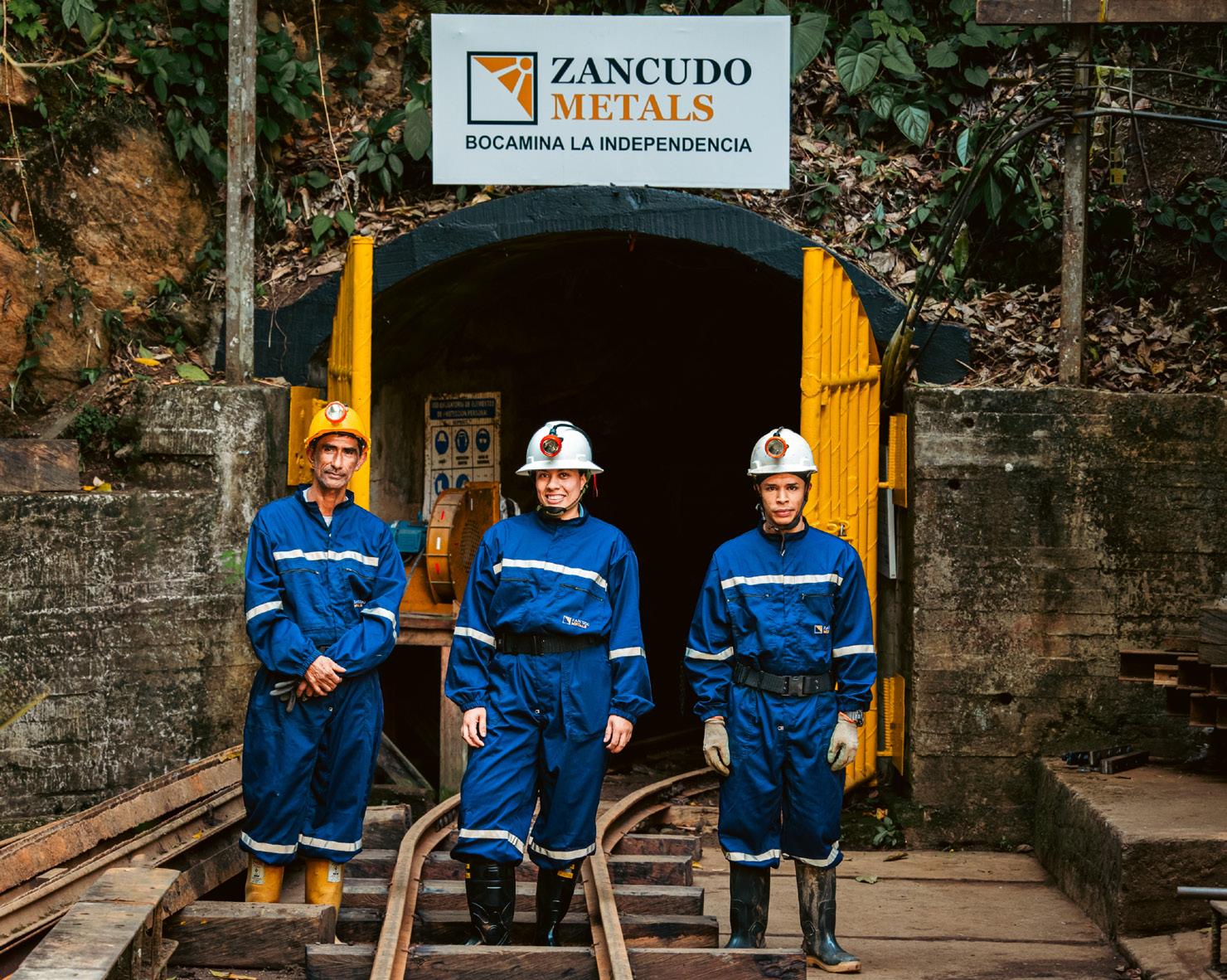

“The Lithium Triangle is very important because about 60% of the world’s resources are con-
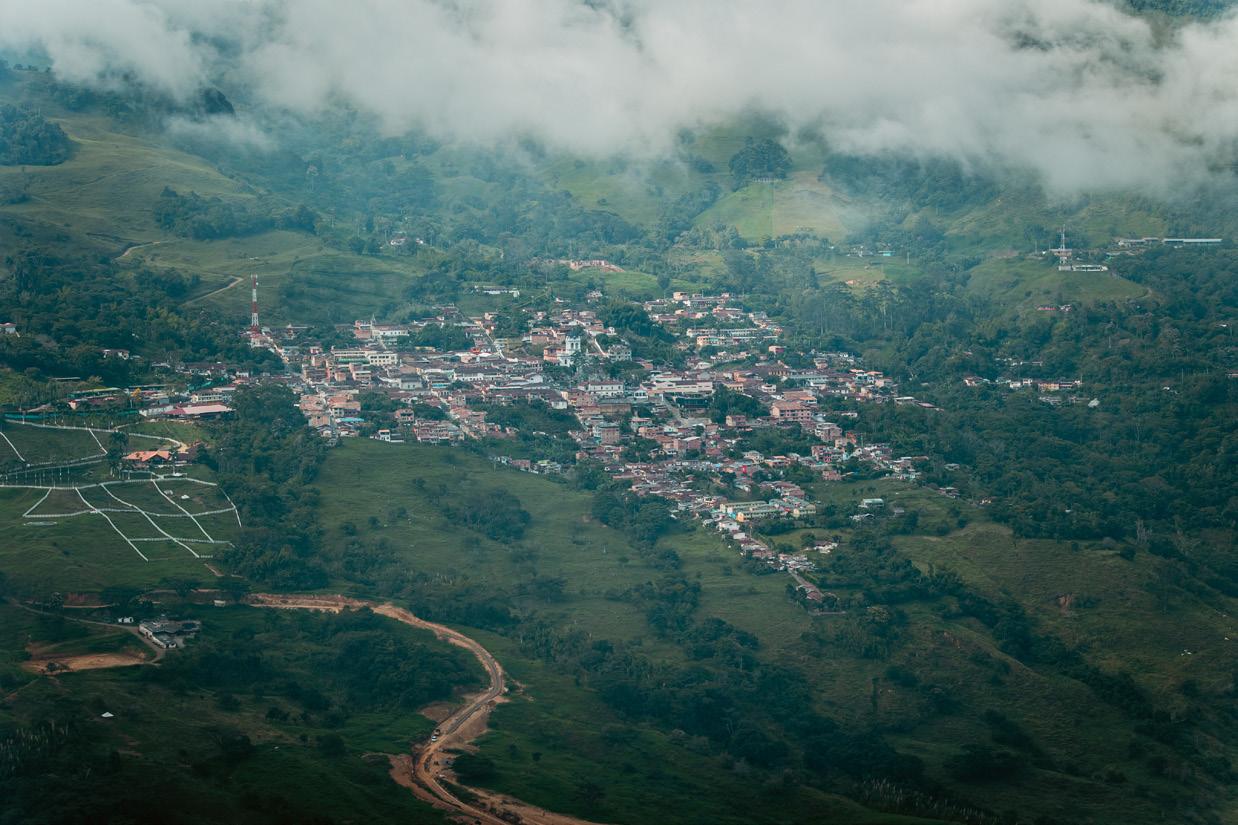

centrated there, but the countries have very different models,” von Vacano said in an interview. “People thought the triangle countries could create some type of OPEC situation, but now they are just too different. Coordinating between the three countries is going to be very difficult.”
A Bolivian native and former adviser to President Luis Arce, von Vacano is writing a book on the country’s lithium sector for Oxford University Press. He is currently a fellow at the Woodrow Wilson International Center for Scholars in Washington.
Although Bolivia holds reserves estimated at 23 million tonnes, the country has struggled to develop a viable lithium industry. In addition to the state-controlled resource extraction model, political instability and high magnesium levels in lithium deposits have made large-scale production a challenge.
Bolivia’s stumbles contrast with the success of Chile, which has risen to No. 2 globally by attracting foreign miners such as U.S.based Albemarle (NYSE: ALB). A new national lithium strategy, which relies on public-private partnerships and gives stateowned copper giant Codelco a central role in signing up partners, is unlikely to halt momentum, von Vacano said.
“Chile is the gold standard for South America mining, even though it has neglected the social aspects to some extent,” he said. “Chile offers stability and a solid legal system, and it has a longstanding free market system. Even though Codelco is state-owned, it’s a successful enterprise.”
While Bolivia has signed deals with Chinese and Russian companies to build lithium carbonate production facilities, depressed prices for the metal mean that the landlocked country may have missed its best chance of using mineral resources to curb poverty, von Vacano says. Lithium carbonate prices have plunged by more than three-quarters since hitting about $80,000 a tonne in 2022.
The author criticized President Arce’s effort in developing lithium after the 2020 election.
“Things have stalled. They could have done something like Chile with a 51%-49% ownership structure between the state and private enterprise when Luis Arce came to power, but that did not happen,” von Vacano said. “The political capital that he had initially was very high, and he could have used that to generate support for lithium mining. That time is gone.
BY FRÉDÉRIC TOMESCO
Canadian gold producer Torex
Gold Resources (TSX: TXG) is almost ready to start commercial production this spring at its $950-million (C$1.36-billion) underground Media Luna project in Mexico’s Guerrero gold belt.
Media Luna sits on the Morelos complex, where the company has been operating the ELG mine for almost a decade. Output from ELG has allowed Torex to become Mexico’s biggest gold producer.
Torex CEO Jody Kuzenko sat down with Anthony Vaccaro, president of The Northern Miner Group, during the Prospectors & Developers Association of Canada conference in Toronto last month to discuss prospects for the company and reflect on the opportunities and challenges of mining in Mexico.
Questions and comments in this interview were condensed and edited for clarity.
Anthony Vaccaro: What are the main advantages of operating in Mexico?
Jody Kuzenko: There are two things: one is the rocks, and the other one is the people.
When I think about mining in Mexico, the geology is spectacular. Where we mine in the Guerrero gold belt, we have 290 sq. km. To date we have produced about 3.5 million ounces. We still have 10 million oz. in the resource base, and the property remains 75% unexplored. So the geology of the area is one big tailwind for us.
The other thing you need to run an excellent mining company is the people. You can have all the rocks in the world and the best geology, but you need a team to run a mine effectively and manage community relations and all the externalities effectively.
We have 1,500 direct employees in Mexico. We are finishing our major project here, and we have another 2,000 contractors working on Media Luna.
I don’t think I could build a mine like that in Canada in the timeframe and for the cost that we have. A large reason for that is the availability of trades, particularly for underground mining. All the trades that you need to make a mine run are pretty widely available in Mexico and pretty widely experienced. The labour market in Mexico is nowhere near as tight as what some of my Canadian peers are experiencing.
AV: How confident are you about investing in Mexico now?
JK: It’s no secret that the previous administration wasn’t a good friend to mining.
Claudia Sheinbaum was elected president in June. Her inauguration was in October, and I believe we are going to have some tailwinds with this administration.
President Sheinbaum has demonstrated herself to be more policy oriented, less short-termist, less reactionary and much more thoughtful. She’s willing to enter into a dialogue with the mining industry. That’s very constructive.
She wants to eradicate poverty — or at least work hard to make a dent in that. The communities
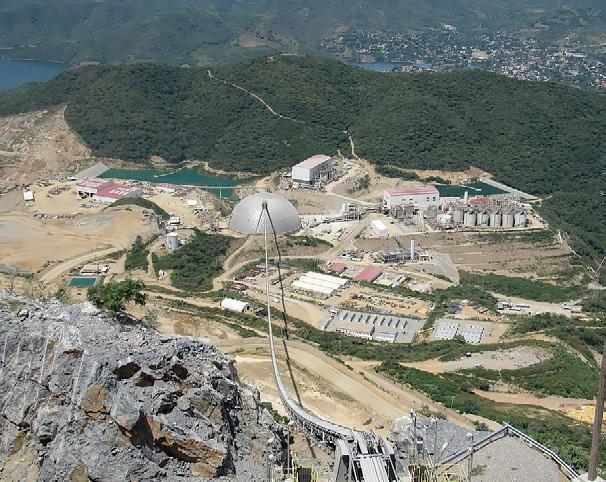

around us are very poor. About 45% of our workforce is from the local communities. They were subsistence farmers or fishermen, and now they are miners.
She has a big infrastructure agenda, she has a renewables agenda, and as she’s coming to terms with the needs of that agenda, she’s starting to warm up to the idea of mining.
The other thing that’s happening is that permits are starting to move. It does the industry no good in a country when permits aren’t moving. Just recently, one of our peers in Mexico was granted a permit, and our information is that more permits are coming.
Those things taken together leave us in a place of cautious optimism with regards to mining in Mexico. I think we’ve turned a corner politically a little bit in Mexico.
AV: How have your operations in the country evolved?
JK: We started commercial production in 2016. We started in the open pit and in 2017 we transitioned to having underground operations at ELG, on the north side. But the really big transformation is coming for us now. We’re moving from high-volume, lower-grade open pit production — our pits will sunset in the middle of the year — to being a fully underground operator, so lower-volume, higher-grade production.
To date we have been exclusively a gold producer. We are moving into a world where we will be a gold and copper producer. We will produce 45 million lb. of copper per year. About 30% of the value of that deposit sits in copper.
People are bullish on the gold market. I remain bullish on the copper market. Over the long term there is no supply scenario that meets demand. Copper will continue to increase as the world starts to wrap its head around the need for energy transition minerals.
AV: How will Media Luna change things for you?
JK: It’s a massive milestone. We get to have 10 years of mine life ahead of us.
We’ve been free cash flow negative for the past couple of years. The
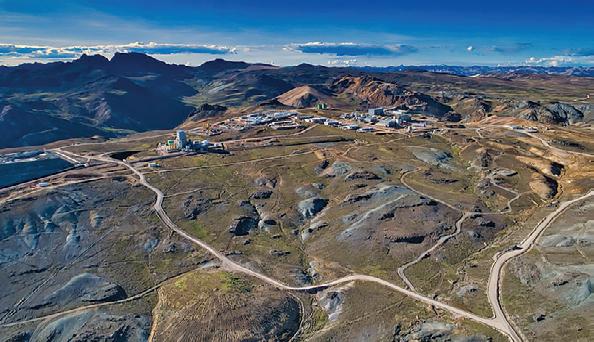
BY CECILIA JAMASMIE
Precious metals producer
Hochschild Mining (LSE: HOC) reported its strongest financial performance since 2012 in its yearly results and restored its dividend thanks to record gold and silver prices in 2024.
market is terribly preoccupied with free cash flowing assets. When we get the asset up and running, the free cash flow on that asset is $400 million a year. That’s free cash.
The vision when we struck this strategy five years ago was to get our cornerstone asset, our flagship asset done, get free cash flow again and then the world opens up for us. We can invest more in exploration, we can return cash to shareholders and we can grow responsibly through M&A.
AV: Why do M&A?
JK: I think more consolidation is needed in the materials space. It derisks assets and it derisks companies. As scale is gained in mining, companies can attract these elusive generalist investors. One of the things I hear over and over from mining investors is that they want the really good management teams running bigger companies. Mining is a risky business. TNM
The South America-focused company posted a pretax profit of $177.2 million (C$254.7 million) on March 12, a sharp turnaround from its $43.5-million loss in 2023, when restructuring charges and impairments weighed on results.
The London-based miner declared a final dividend of 1.94¢ per share, amounting to at least $10 million for shareholders. The last time the company rewarded its shareholders was in 2022, with a 1.95¢ interim payout.
“We are pleased to announce our best financial performance for 13 years, a testament to our exceptional team and high-quality assets,” CEO Eduardo Landin said.
Hochschild’s growth strategy delivered a record 2.8 million gold-equivalent oz. of mineable resources, extending the life of all current operations, Landin added.
Cash flow
U.K. investment bank Peel Hunt said the resumption of dividends signalled financial discipline and, coupled with increased exploration,
“We are pleased to announce our best financial performance for 13 years.”
EDUARDO LANDIN CEO, HOCHSCHILD MINING
would extend cash flow duration. Shares traded at 257 pence apiece before press time in London, giving Hochschild a market cap of £1.3 billion (C$2.4 billion). Attributable production in 2024 totalled 347,374 gold-equivalent oz. comprising 245,000 oz. of gold, up 32% from 186,000 in 2023, and 8.5 million oz. of silver, down 11% from 9.5 million.
Hochschild expects to produce between 350,000 and 378,000 gold-equivalent oz. this year, with its new Mara Rosa gold mine in Brazil increasing output further. Mara Rosa, located in Goiás state, is Hochschild’s first operation in Brazil, where the company is expanding its footprint. Last year, the miner acquired the Monte Do Carmo project for $60 million, with $45 million already paid.
Other than in Brazil, Hochschild has mines in Peru and Argentina as well as development projects in Chile and Peru. TNM
MEXICO | ‘$230M cash flow this year’
BY CECILIA JAMASMIE
Canadian bullion producer Torex Gold Resources (TSX: TXG) has achieved first production of precious metal-rich copper concentrate at its Media Luna mine, part of the company’s Morelos Complex in Mexico’s southwestern Guerrero state. Shares gained 3.1% on March 25.
The achievement follows the completion of a four-week process to connect and integrate the processing plant at its $950-million (C$1.36-billion) project, which is expected to sustain annual production of at least 450,000 gold-equivalent oz. through 2030.
“Following almost three years to the day of the release of our feasibility study for the Media Luna project, we have achieved first production of copper concentrate,” president and CEO Jody Kuzenko
said in a March 24 release. “This milestone represents substantial completion of the project and the beginning of the next chapter in the evolution and growth of Torex as we become a gold and copper producer.”
Torex shares traded in Toronto at $37 apiece before press time for a market capitalization of $3.18 billion. Its shares traded in a 52-week range of $17.96 to $38.25.
The milestone marks the substantial completion of Media Luna, with Torex ready to return to positive free cash flow mid-year, BMO Capital Markets analyst Kevin O’Halloran said.
“Commercial production is expected in the coming weeks, and the company continues to ramp up underground mining rates,” he said in a note on March 25.
With capital spending at Media Luna mostly complete, O’Halloran said he forecasts full-year free cash flow of $230 million, including $169 million in the second half of the year.
Trucking of the copper concentrate at the mine is to begin shortly, with sales and logistics contracts already in place, Torex said.
The Media Luna underground project contains significant gold, copper, and silver mineralization. Located just 7 km from the company’s El Limón Guajes Mine Complex on the south side of the Balsas River, Media Luna is expected to ramp up underground mining rates to 7,500 tonnes per day by next year. The mine is projected to produce 45 million lb. of copper annually, strengthening Torex’s long-term production outlook.
— with files from Blair McBride
BY NORTHERN MINER STAFF
Latin America is well-known for its long mining history and rich mineral endowment. Here are eight companies with exciting assets to watch.
In Brazil, Appia Rare Earths & Uranium (CSE/CNX: API; US-OTC: APAAF) is focused on the PCH rare earths project in the central state of Goiás, about 216 km from state capital Goiânia. The company plans to earn a 70% stake in the 410-sq.-km ionic adsorption clay project by 2028.
PCH hosts two distinct styles of mineralization — ionic adsorption clay (IAC) and hard rock carbonatitic breccia. In March, the company released drill results including 150 metres grading 1.34% total rare earth oxide (TREO) and 0.13% niobium pentoxide (Nb2O5) from surface in hole PCH-DDH-002, including 10 metres of 4.11% TREO and 0.23% Nb2O5 from 37 metres and 6 metres of 3.94% TREO and 0.22% Nb2O5 from 144 metres. Hole PCH-DDH-003 cut 147 metres grading 2.00% TREO and 0.23% Nb2O5 from surface, including 31 metres of 3.60% TREO and 0.52% Nb2O5 from 3 metres.
Appia completed the first resource estimate for the project in March 2024, outlining 6.6 million indicated tonnes grading 2,513 parts per million (ppm) TREOs and 46.2 million inferred tonnes at 2,888 ppm TREOs.
The deposit contains significant concentrations of neodymium, praseodymium, dysprosium and terbium, which are the rare earth elements used in the production of permanent magnets. In addition, scandium and cobalt have been identified in the deposit’s Burita zone.
Last month, Appia joined the newly created strategic research consortium dedicated to developing a Canadian rare earth supply chain. The initiative, also consisting of rare earths explorers Commerce Resources (TSXV: CCE; US-OTC: CMRZF), Defense Metals (TSXV: DEFN), and Vital Metals (ASX: VML; US-OTC: VTMXF), along with March Consulting Associates, is aimed at speeding up the formation of a Canadian rare earth elements industry.
And last November, Appia joined the Senai Magbras initiative, a project that aims to establish a complete and permanent rare earth production chain in Brazil. The pilot facility is in Lagoa Santa in the southeastern state of Minas Gerais.
The project is backed by private and public sector companies as well as the Federations of Industries of Santa Catarina, Minas Gerais, and the National Bank for Economic and Social Development.
Appia Rare Earths & Uranium has a market cap of about $16 million.
n Atlas Lithium
Last October, Atlas Lithium (NASDAQ: ATLX) received the operational permit for its main Neves project in Brazil’s Minas Gerais state.
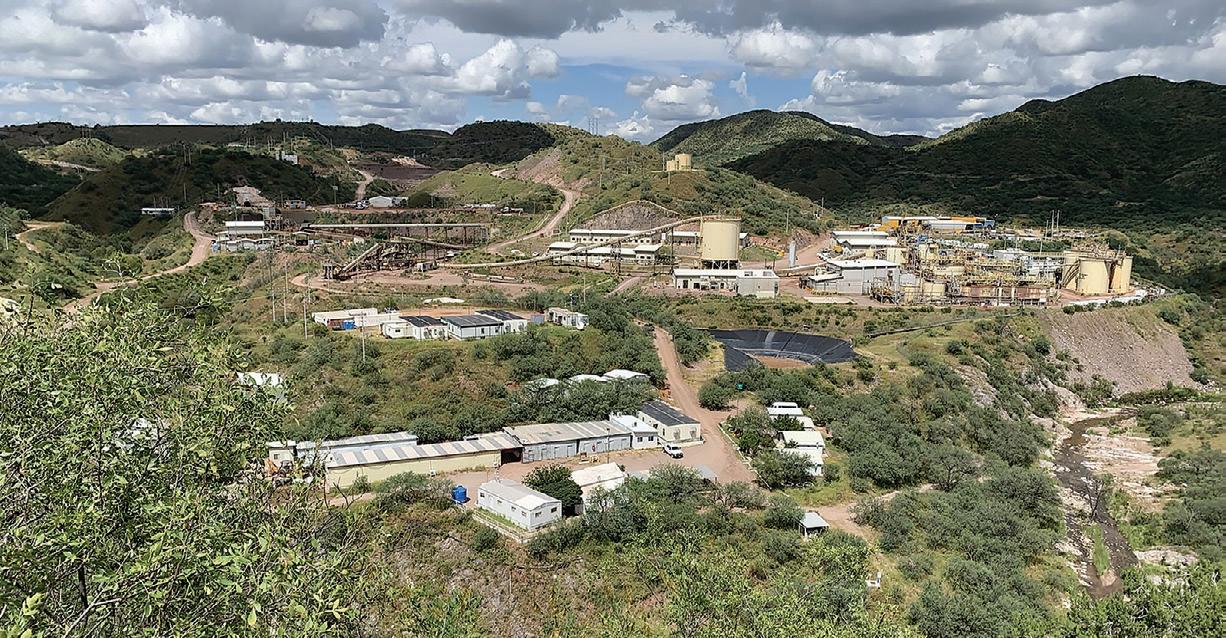
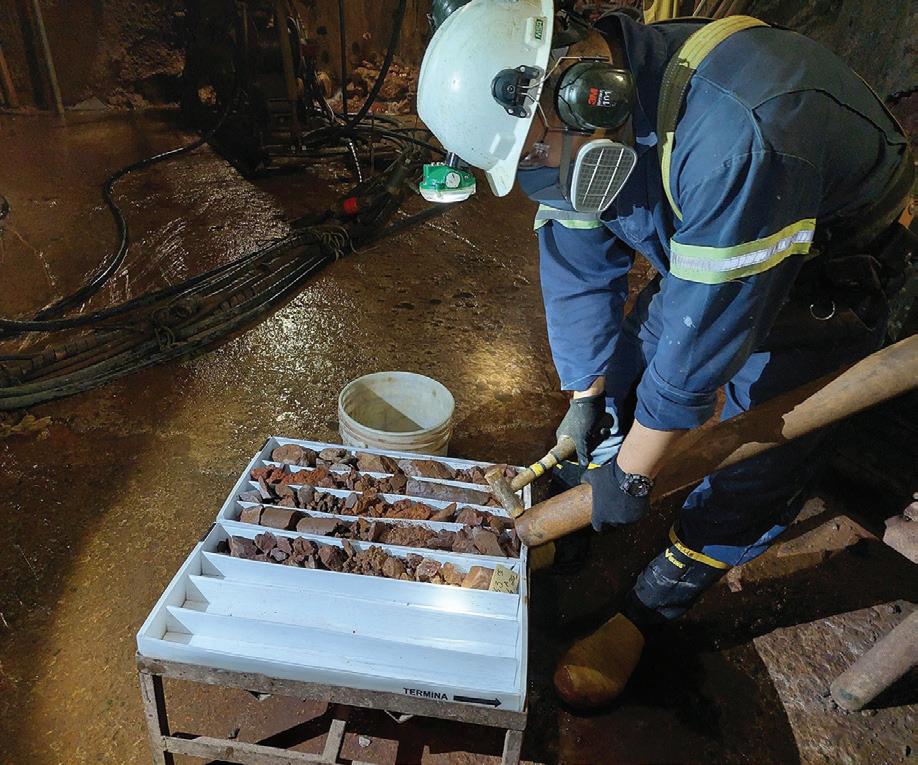
The project, situated in the Jequitinhonha River Valley, also known as Lithium Valley, is expected to initially produce up to 150,000 tonnes per year of battery-grade spodumene concentrate. It’s to be used in the manufacture of lithium-ion batteries.
The company hit another milestone last month when a cargo ship from Durban, South Africa docked at the Port of Santos, Brazil, bringing with it the company’s modular dense media separation (DMS) lithium processing plant.
The company has an offtake agreement with Japan’s Mitsui & Co. for 15,000 tons of lithium concentrate per year during the project’s first stage and 60,000 tons per year in the second. Mitsui acquired $30 million (C$43 million) of Atlas Lithium’s common shares in March 2024.
Atlas has also discovered spodumene-rich pegmatites at its Salinas project, about 97 km north of Neves and 8 km east of Pilbara Minerals’ (ASX: PLS) Colina lithium project.
The company has completed soil geochemistry and LiDAR geological mapping and is undertaking further geophysical studies before kicking off a drill campaign.
In addition, geological mapping at Atlas’ Clear project has also discovered pegmatites. The project is about 6 km from Sigma Lithium’s (TSXV, NASDAQ: SGML) Grota do Cirilo hard rock mine.
Atlas also owns a 32% stake in Atlas Critical Minerals, a diversified mining company with rights in rare earths, copper, graphite, nickel, iron ore, gold and quartzite. Altas Lithium has a market cap of about $85 million.
In early March, Bear Creek Mining (TSXV: BCM; US-OTC: BCEKF) initiated a strategic review that will look at options including a sale of all or some of its assets. That followed a working capital deficit (current assets minus current liabilities) of $93.2 million (C$133
million) that Bear Creek posted at the end of September.
Shareholders Sandstorm Gold Royalties (TSX: SSL; NYSE: SAND) and Equinox Gold (TSX, NYSE-A: EQX) support the review process, and Bear Creek’s board has set up a special committee of independent directors to manage the process. Bear Creek has appointed Christian Milau as a strategic adviser for the review. Milau was CEO of Equinox Gold (TSX, NYSE-A: EQX) from 2016 to 2022, leading that company through five mergers and acquisitions and growing it from a single-asset developer to one with eight operating mines.
Last year, the company’s Mercedes underground mine in Mexico’s Sonora state produced 40,220 oz. gold and 217,675 oz. silver. Bear Creek acquired Mercedes, about 250 km northeast of Hermosillo and 300 km south of Tucson, Ariz., in April 2022.
Mercedes hosts proven and probable reserves of 430,000 tonnes grading 3.95 grams gold per tonne and
22.7 grams silver for 54,300 oz. contained gold and 312,500 oz. silver.
This year the company plans to test near-mine brownfield targets identified late last year.
In southern Peru, Bear Creek is working on a preliminary economic assessment (PEA) for its Corani silver-lead-zinc project, about 30 km from the town of Macusani. Corani is one of the world’s largest fully permitted development-stage silver deposits. The PEA will leverage work included in a 2019 feasibility study and will evaluate a 5,000-tonne-per-day oxide plant.
Bear Creek Mining has a market cap of about C$47 million.
In January Firetail Resources (ASX: FTL) was one of eight early-stage exploration companies selected from hundreds of applicants to participate in BHP Xplor’s 2025 program. BHP Explor, a unit of BHP (NYSE, LSE, ASX: BHP), helps promising explorers accelerate their critical minerals projects to further advance the energy transition.
BHP Xplor’s one-off, non-dilutive grant of up to $500,000 (C$715,000), along with strong technical support over a six-month period, will enhance Firetail’s exploration model for its Picha copper-silver project in southern Peru.
“Successful applicants for BHP Explor had to demonstrate not only that their critical minerals projects were highly prospective but also that they were committed to pushing industry boundaries in their geological concepts and data-gathering, testing and processing to realize the project,” Marley Palin, head of BHP Explor, stated in a release.
Firetail holds a 70% stake (and can earn an additional 10%) in Picha, a 222-sq.-km greenfield project that has seen little modern exploration. Firetail is generating multiple drill-ready targets at Picha through ground-based mapping and soil sampling.
Drill highlights at Picha include 5.12 metres grading 5.4% copper and 44.9 grams silver starting from 1.8 metres downhole in 24PCMD002 and 9.35 metres of 0.94% copper and 58.6 grams silver from 6.25 metres in drillhole 24PCCD0005.
Picha, about 17 km east of Compania de Minas Buenaventura’s
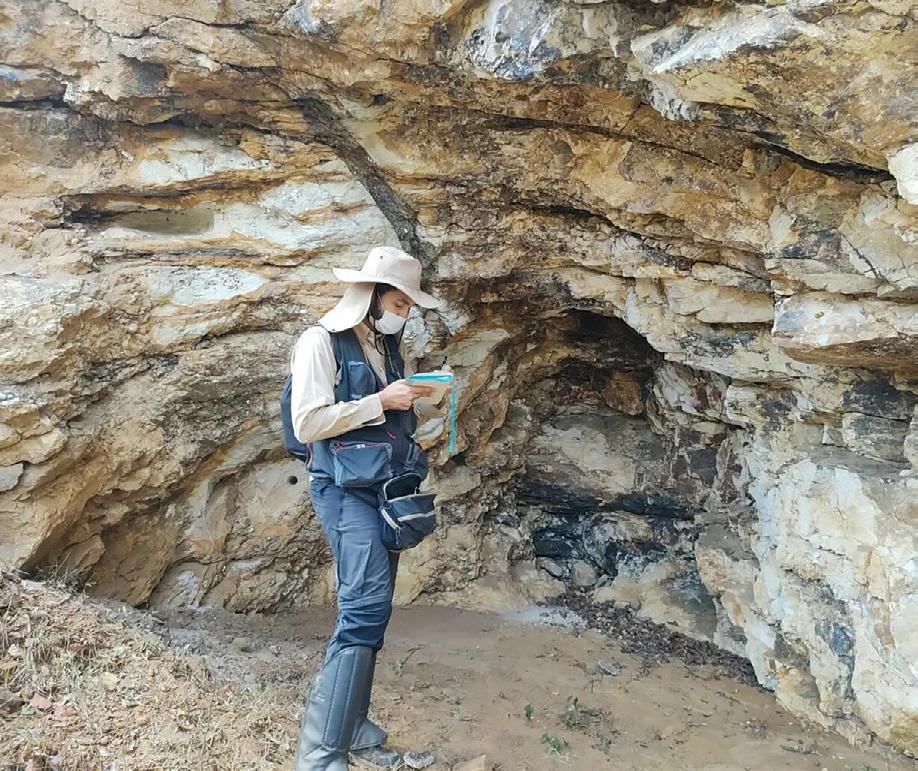
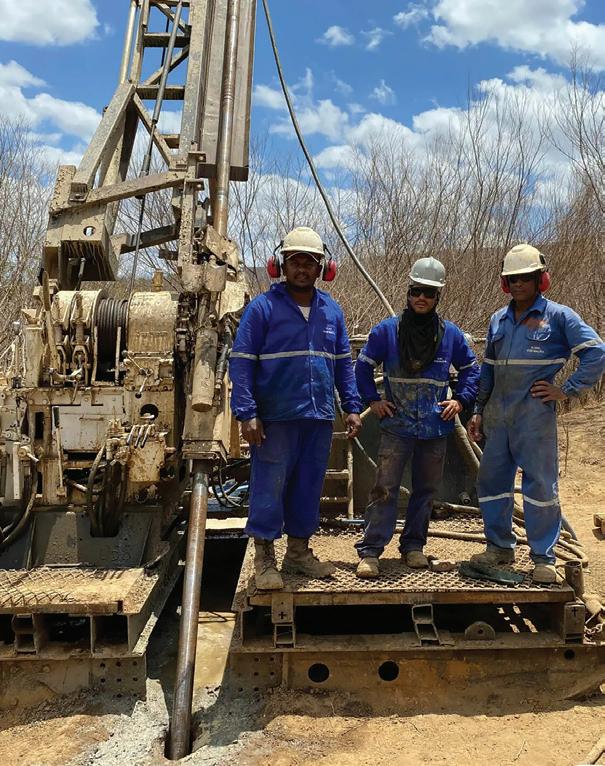
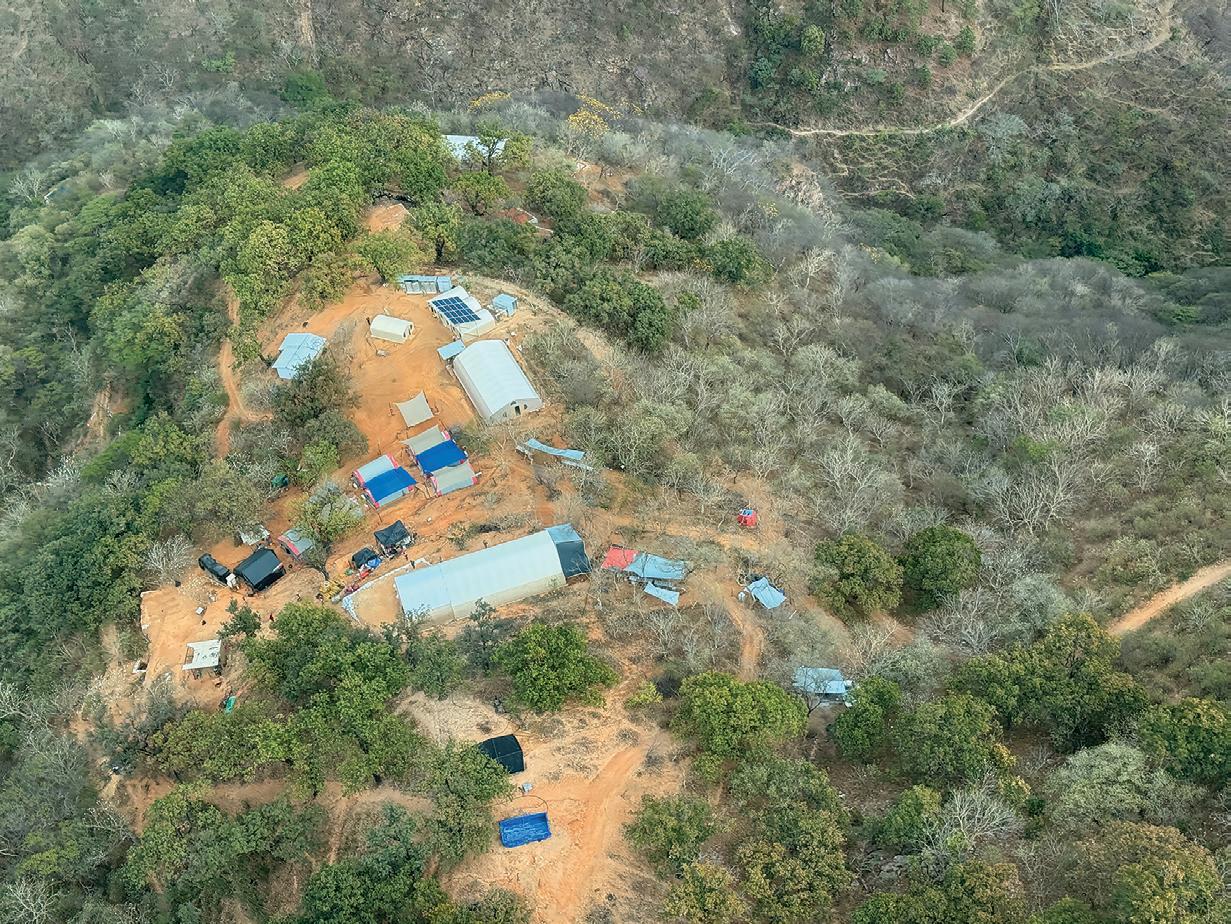
(NYSE: BVN) San Gabriel gold-copper-silver project, is prospective for epithermal, stratabound, polymetallic carbonate replacement (CRD) and porphyry style copper mineralization with several untested significant surface geochemical and geophysical anomalies.
The company is also exploring its 60-sq.-km Charaque copper project, about 30 km northeast of Picha, where it is earning in with a Peruvian subsidiary of Barrick Gold (TSX: ABX; NYSE: GOLD).
Firetail Resources has a market cap of A$19.56 million (C$17.7 million).
Latin Metals (TSXV: LMS; US-OTC: LMSQF) is a prospect
generator focused on Peru and Argentina. The company acquires prospective exploration properties at low cost, establishing drill targets and securing joint-venture partners to fund drilling and advanced exploration. It retains an interest in each partnered project.
The company holds 13 projects in Argentina and six in Peru, along with two royalties. All six projects in Peru are copper while its projects in Argentina include copper, gold and lithium.
In terms of asset classes, royalties make up 11%; exploration projects 37%; projects available for joint venture 26%; and partnered projects 26%.
In Argentina, Latin Metals has option agreements on five assets with AngloGold Ashanti
(NYSE: AU; JSE: ANG) and Moxico Resources, an unlisted copper miner in the U.K. with development projects in Zambia and Saudi Arabia.
AngloGold is earning into Latin Minerals’ Organullo project, where it completed a high-resolution magnetic survey in 2023, and where the company plans to drill about 7,000 metres in the first stage this year. The property has seen significant historical exploration and has over 10,000 metres of drill data. Latin Metals has also optioned its Trigal and Ana Maria gold projects to the major.
Moxico Resources is earning into the Esperanza and Huachi copper-gold projects, where it plans to start exploration and drilling as soon as it secures permits. The best intersection at Esperanza returned 387 metres grading 0.57% copper
and 0.27 gram gold per tonne and a porphyry system has been exposed over an area of 1,400 by 850 metres.
In March, Latin Metals identified significant geophysical anomalies at the Cerro Bayo exploration project in Argentina from historical exploration data collected by a previous operator at the project, including a 130-line-km induced polarization geophysical survey. It has an option to earn up to 100% of the gold project.
Executives and board members own half of the company’s common shares.
Latin Metals has a market cap of about C$10 million.
n Mako Mining
Mako Mining (TSXV: MKO; US-OTC: MAKOF) operates the San Albino mine in Nicaragua,
about 173 km north of the capital, Managua, and the Eagle Mountain gold project in Guyana, 230 km southwest of Georgetown.
Mako acquired Eagle Mountain from Goldsource Mines (TSXV: GSX; US-OTC: GXSFF) in July 2024. A PEA completed in January 2024 outlined production of 66,500 oz. gold per year for 15 years. At a gold price of $1,850 per oz., Eagle Mountain would generate an aftertax net present value (at a 5% discount rate) of $292 million (C$418 million) and an internal rate of return of 57%. Initial capex was estimated at $296 million.
Mako Mining reported drill results from the Eagle Mountain and Salbora deposits at the project in February. A geotechnical drill hole in the northeastern zone at Eagle Mountain returned 16 metres grading 2.93 grams gold per tonne starting 45.5 metres down hole in EMD24-pitgeotech015.
At Salbora, a geoechnical drill hole cut 31.5 metres grading 3.73 grams gold starting from 22.5 metres downhole in EMD24-pitgeotech011, and a continuous horizontal channel sample of outcrop returned 21 metres of 8.42 grams gold with a sub-interval of 12 metres grading 13.51 grams gold in the mineralized breccia.
Eagle Mountain contains indicated resources of 31.1 million tonnes grading 1.18 grams gold for 1.2 million oz. contained gold. Inferred resources add 18.4 million tonnes grading 0.98 gram gold for 582,000 oz. gold.
The San Albino mine, one of the world’s highest grade open pit gold mines, about 15 km southeast of Nicaragua’s border with Honduras, produced 14,616 oz. gold during the fourth quarter of last year at an average grade of 9.73 grams gold and 13,147 oz. silver at 8.75 grams silver.
Mako Mining has a market cap of about C$314 million.
n Meridian Mining
Meridian Mining’s (TSX: MNO; US-OTC: MRRDF) Cabaçal goldcopper-silver deposit in Brazil is expected to produce 141,000 gold-equivalent oz. per year over 10.6 years at all-in sustaining costs of $742 per silver-equivalent oz.,
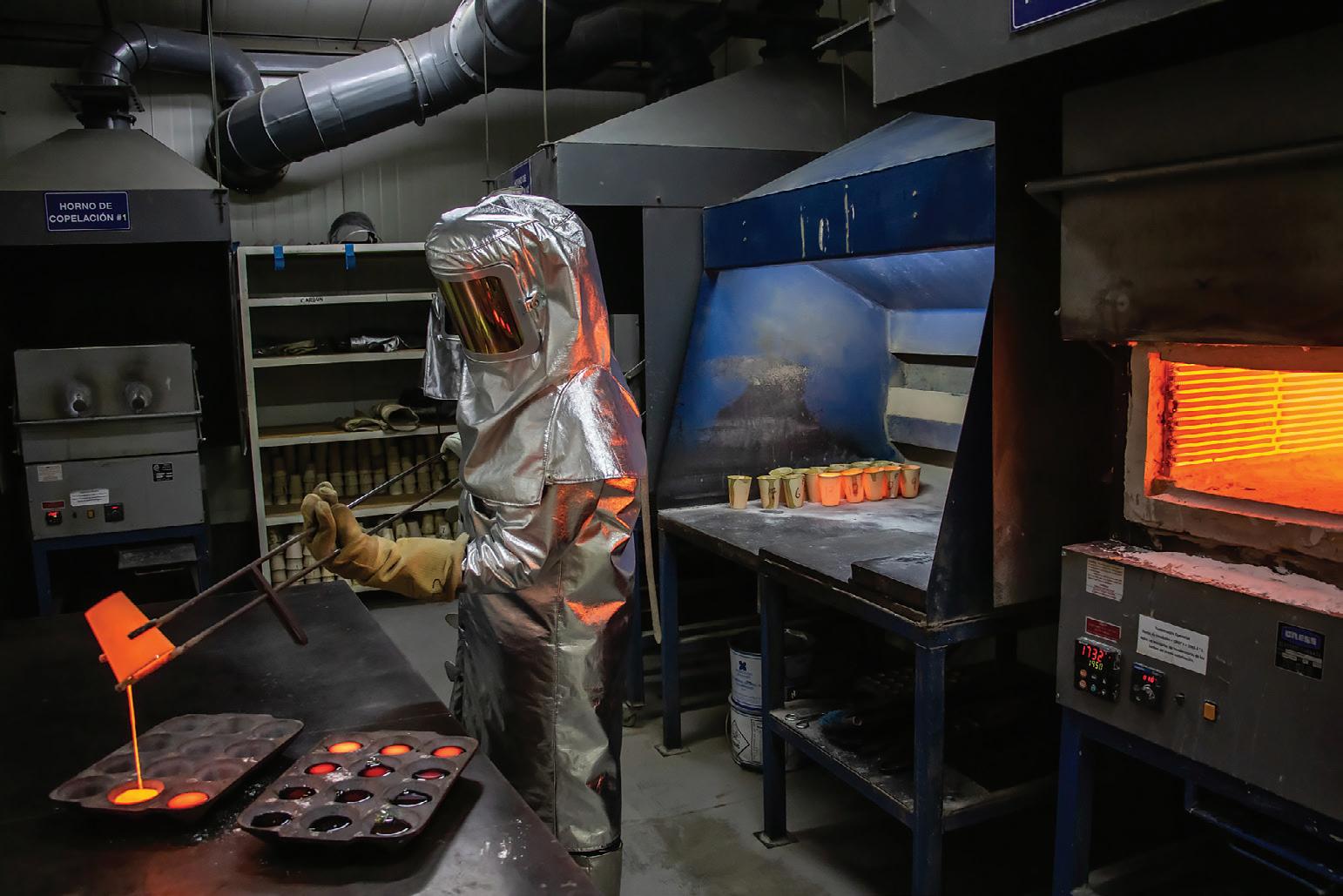
according to a pre-feasibility study released on March 10. During the first five years, Cabaçal’s open pit would produce 178,000 gold-equivalent oz. annually.
At metal prices of $2,119 per oz. gold, $4.16 per lb. copper and $26.89 per oz. silver, the project would deliver a post-tax NPV (at a 5% discount rate) of $984 million (C$1.4 billion) and an IRR of 61%.
The study boosted Cabaçal’s NPV by more than two-thirds over a previous report from 2023. Initial capital of $248 million could be repaid in 17 months.
The company expects to release a feasibility study for Cabaçal in the first half of next year.
Cabaçal would produce two products: gold and silver in doré bars and copper and gold concentrate. The flow sheet envisions a plant processing 2.5 million tonnes per year of run-of-mine feed from the pit in the first three years, followed by an expansion in year three to 4.5 million tonnes per year from the fourth year. About 30% of the mill feed will be sent to a gravity separation circuit to recover free gold.
Cabaçal hosts 41.7 million tonnes in proven and probable reserves grading 0.63 gram gold, 1.64 grams silver and 0.44% copper for contained metal of 849,880 oz. gold, 2.19 million oz. silver and 405.4 million lb. copper.
The project in Mato Grosso state is about 320 km northwest of the state capital, Cuiabá.
Highlights from drill results released in February included 21 metres grading 3.8 grams gold, 1.9% copper and 5.8 grams silver (6.5 grams gold-equivalent/4.4% copper-equivalent) starting from 95.3 metres downhole in CD-639. It included 7.1 metres averaging 6.9 grams gold, 1.6% copper and 5 grams silver (9.2 grams gold-equivalent/6.2% copper-equivalent) from
104 metres.
Meridian Mining has a market cap of about C$216 million.
n Mithril Silver and Gold
Mithril Silver and Gold (TSXV:
MSG; ASX: MTH) reported highgrade drill results in early March from the La Soledad target at its Copalquin gold-silver project in Mexico’s Durango state.
Highlights are 4.95 metres grading 20.5 grams gold and 1,833 grams silver starting from 107 metres, including 0.55 metre of 110 grams gold and 7,530 grams silver from 110 metres in drillhole MTH-ES25-11.
Drillhole MTH-ES25-10 returned 2.55 metres grading about 10 grams gold and 571.8 grams silver from 112 metres, and MTH-ES25-09 cut 0.25 metre grading 15.2 grams gold and 786 grams silver from 98.25 metres.
The La Soledad structure is open at depth and to the northwest.
The company says it intends to drill 35,000 metres this year to expand the resource footprint and define the 10-km-wide epithermal silver-gold system.
The project hosts a JORC-compliant resource of 691,000 indicated tonnes grading 5.43 grams gold and 114.2 grams silver for 121,000 oz. contained gold and 2.54 million oz. silver. Inferred resources add 1.73 million tonnes grading 4.55 grams gold and 151.7 grams silver (6.72 grams gold-equivalent) for 252,000 oz. contained gold and 8.41 million oz. silver.
Mithril notes that there are 100 historic underground gold-silver mines and workings and another 198 surface workings and pits across its 70-sq.-km. concession. The project is about 20
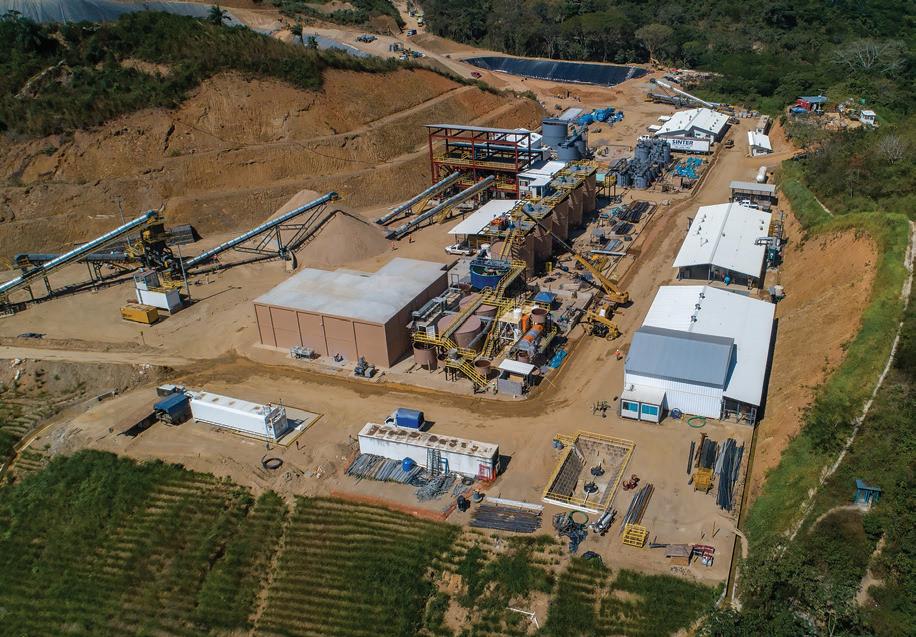
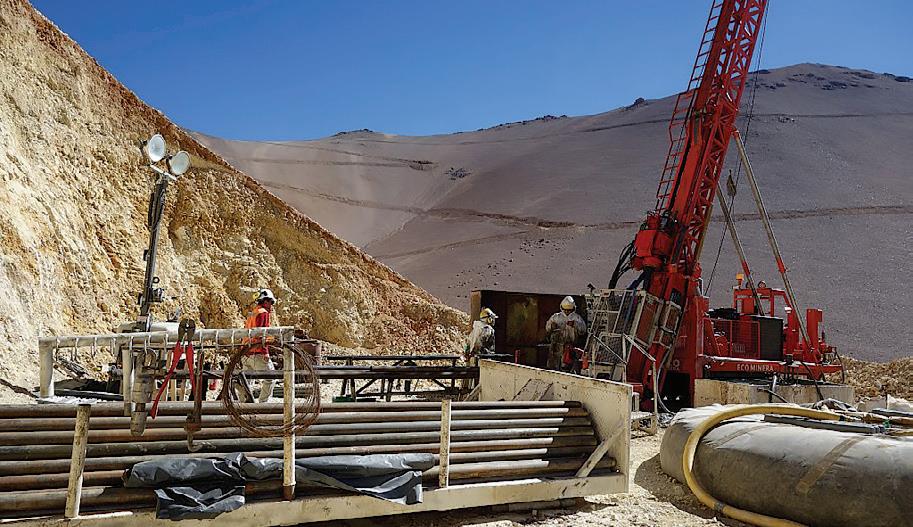
“The industrygold in Ontario is growing so fast that it is surely folly to allow our gold to be refined in the United States...to the outsider it appears bad business and worse patriotism.”
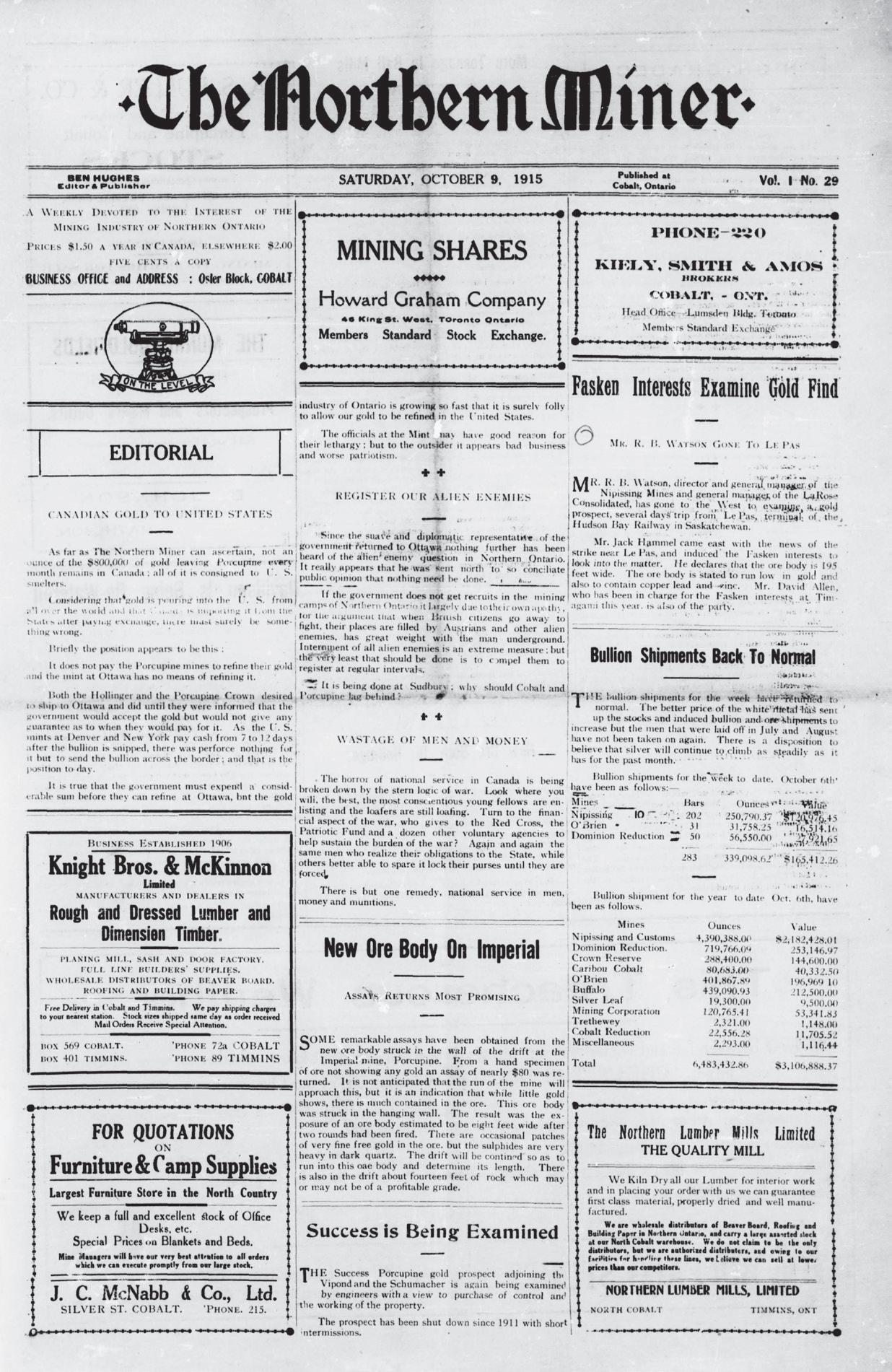
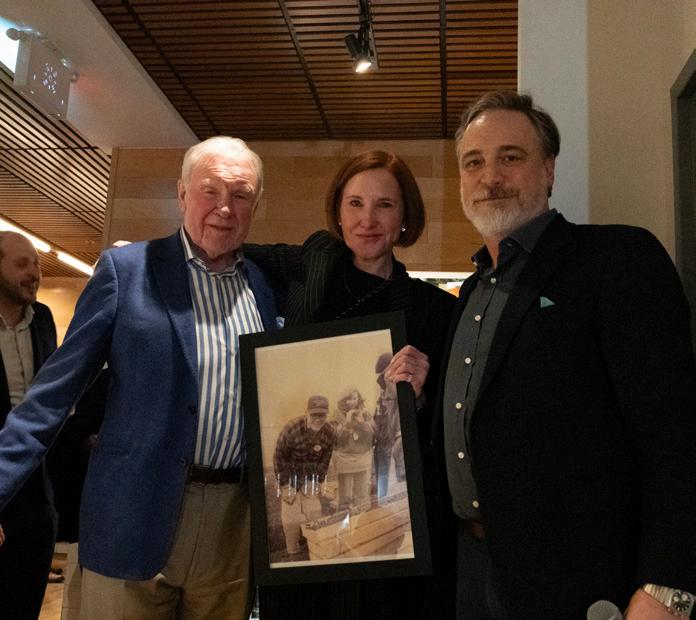
At the Miner’s 110th anniversary party March 3, Canadian Mining Hall of Fame member Gren Thomas and legendary mining exec Eira Thomas receive a photo, from TNM Group President Anthony Vaccaro, taken from the paper’s archives. It shows the father-daughter duo at their team’s diamond discovery at Diavik in the Northwest Territories in 1994.
> Argentina from P1
from around 211%, the highest in 32 years when Milei took office, to around 67% in February. The country’s peso has strengthened 47% over that period, more than any other currency, allowing Argentinians to buy imports and holiday abroad.
However, wages, services and supplies priced in pesos become more expensive when converted to U.S. dollars — making projects less competitive internationally. Mining exports bring in fewer pesos per dollar earned, squeezing revenue margins for companies that sell in dollars but pay some costs locally. That adds currency risk to longterm projects.
“Despite notable advancements, such as reducing inflation,” Amâncio said, “the continuation of capital controls for projects not benefit-
> Trade war from P10
war unfolds, said Steven Reid, head of CIBC Capital Markets’ global mining group in Toronto.
“We’re in a very volatile time,” he said. “Canada is incredibly rich in mineral resources. All this uncertainty still sets Canada up very well. They’re going to need all this stuff and we have it.”
Coupled with strong demand dynamics, the current geopolitical uncertainty should make Canadian miners even more attractive to investors, Reid said.
“The investment case for commodities is very strong,” he said. “There’s not enough deposits out there. We’re seeing growth in demand in the medium to long term. Precious metals prices are up and companies are generating more cash flow than before. It takes time but you will see more and more capital coming into the space.”
Miners “are making money,” said Elian Terner, head of global mining and metals investment banking at National Bank Financial. “The sector is investable.” TNM
ing from RIGI (even with Milei’s pledge to remove them in 2026), along with lingering economic uncertainties, will continue to pose significant risks for foreign companies operating in Argentina.”
Flexible regional player
Despite the strong peso, Lucero sees the country positioned as the most attractive option in the region.
“Bolivia has closed itself to investment. Chile has a different approach. So, if you look at the Lithium Triangle, Argentina is the place to be and we are driving to make it as business friendly as we can,” he said. “The whole energy transition and the interest for critical minerals is another factor, which, of course, goes hand in hand with the fact that we are, thanks to nature, rich in two of those, which are lithium and copper.”
Lucero, who’s been coming to
> Startup from P10 drive discoveries.”
Miners shouldn’t be afraid to use AI, said Rajesh Swaminathan, a partner at U.S.-based venture capital firm Khosla Ventures.
“Take those baby steps but take them quickly because this industry will move very quickly,” he said.
Streamlining internal policies could help to speed up decisionmaking. Mining companies often lose six months to a year picking suppliers as part of a project’s procurement cycle, said Hatch Vice Chairman Joe Lombard, whose four-decade career includes the design of several aluminum smelters.
the Prospectors and Developers Association of Canada conference in Toronto for 20 years, said one way to measure his country’s new stature in the mining investment space was a jammed Argentina Day during the event. The federal delegation was joined by reps from eight of the country’s 23 provinces and four governors.
Miners can expect RIGI applications to take several months for assessment. Meantime, they would be seeking provincial permits where the environmental licence is the most important. Timing would depend on project details, like the type of power proposed: buildyour-own thermal power plant vs the grid; build-your-own transmission line in the province; or perhaps across two provinces.
“So, it varies project to project, and in that sense, it’s not different to the issues that mining companies
Miners and suppliers would do well to study sectors such as energy or aerospace to pick up the best practices that could be adapted to the industry, said Mark Podlasly, Vancouver-based CEO of the First Nations Major Projects Coalition. His non-profit organization, which includes more than 170 Indigenous communities across Canada, partners with companies on energy and mining projects.
“To learn, you have to go to other places,” Podlasly said. “Go to China. Not to copy but for inspiration, to see what they have done. Go to other sectors. Look at how they are bringing in contractors across the value chain.” TNM
> Foreign seizures from P14
access to international arbitration in the event of unlawful expropriation or interference by states.
Finally, Young said companies should think carefully before putting all their resources into one region, especially if there is political instability.
“Diversification of assets across different countries reduces the impact of political risks in any one region,” she said.
The Sangihe project area was first discovered and primitively explored in 1986. PT Mears Soputan Mining and its JV partner Muswellbrook conducted work on the project up until 1993, including a 5,000-metre drill program on the Binebase and Bawone prospects that exposed gold mineralization on surface.
Baru Gold — which was then known as East Asia - and its local partners received approvals and exploration permits from the Indonesian government in 2007. They were granted the contract for work on 420 sq. km covering Sangihe.
The company initially had targeted first production by 2022, but the project was delayed by both legal and logistics challenges. TNM
Notable international disputes include First Quantum Minerals (TSE: FM) in Panama after the government shut its Cobre Panama copper mine in November 2023, as well as Barrick in Mali, according to John Turner, co-head of global mining at Canadian law firm Fasken.
“Even the government of Panama is signalling that that mine will get back into production, so that will be a big signal when that happens,” Turner told The Northern Miner by phone on March 6.
“With Barrick and Mali, that’s obviously a bit of a special circumstance. Those mines are very important to Barrick, but it sounds like they’re making progress,
which is good. The government was taking executives hostage, which you know is never good for business.”
Disputes on the horizon Villalon, who spoke on a PDAC panel about emerging trends in mining disputes, drew a correlation between commercial tensions due to China’s critical mineral export bans and the Vattenfall case in Germany.
Swedish nuclear power plant operator Vattenfall was forced to close its facilities in 2011 in Germany after that country opted to phase out nuclear power following the Fukushima disaster. Vattenfall launched arbitration through the ICSID against Germany under the Energy Charter Treaty, arguing unlawful expropriation of its assets.
Germany eventually awarded the company €1.42 billion (C$2.2 billion) in a 2021 settlement. “That’s an interesting example of what could come, Villalon said, “as we start to see more sort of retaliatory measures coming from the U.S. White House, but also from Beijing.” TNM
face in other countries,” he said. “The good news is that we are undergoing a unique or unprecedented time in our country in which, regardless of political colours, the provinces that are rich in resources have understood the potential of mining to produce growth.”
Welcoming big partners
First Quantum is awaiting approval of its environmental impact assessment before building the Taca Taca open-pit copper, molybdenum and gold project in Salta province near the Chilean border. The mine could deliver 250,000 tonnes of copper a year and make a “significant” contribution to the country’s economy,
CEO Tristan Pascall said by email.
“Argentina seems to be opening up for the right partners to also potentially come on board, as we develop the financing strategy for the project,” Pascall said.
> Size vs location from P12
ing into Burkina Faso, so we’re not invested there either, but we favour South America, the Americas, Australia, Canada in general, as the right places to be.”
Liquidity
Cohen’s main fund holds 20-odd companies led by major producers to help provide liquidity before he considers exploration and development investments.
“We’re perennial copper bulls,” he said. “In the last number of years, we’ve been very positive on uranium, and just for a bit of sizzle, we have some investments in the antimony space, all in Australian companies, actually, because of the grades that they can give.”
The mineral used in military applications is produced predom-
> Ford from P13
Trump tanks markets
Minutes after Ford spoke, U.S. President Donald Trump repeated his threat to impose wide-ranging tariffs on Canada, sending stock markets sharply lower. Canada’s S&P/TSX Composite Index fell 1.54% or 391.88 points to close at 25,001.57 on March 3, while the Dow Jones Industrial Average dropped 1.47% or 649.67 points to 43,191.24.
Ford had already promised to cancel a $100-million con-
“The intent of where the government wants to take the investment climate is clear, with a reassuring focus on fiscal discipline and market access.”
Lucero’s goal is to see mining become the main source of wealth for provinces in the country’s west, northwest and Patagonia. He urges protesters to consider how mining is part of human existence, from early tools to smartphones. And economic policy critics should ponder words often ascribed incorrectly to Albert Einstein: Insanity is doing the same thing over and over again and expecting different results. (It was novelist Rita Mae Brown.)
“We have tried other policies for 100 years and we failed,” the secretary said. “It is time to realize that if we continue doing the same things we were doing before President Milei came, we will continue to fail.” TNM
inantly by Tajikistan and China, which imposed an export ban in September.
“It’s an important metal for defence, for bomb-making,” Cohen said. “The U.S. Department of Defense, this is truly a critical metal for them, so, there’s a very interesting scenario here where you can have a lot of legs on that market for a long time.”
Middelkoop’s fund, which began in 2008, focuses on the top 50 discoveries globally with 60-70% in precious metals companies. The top 40 holdings represent 80% of the fund, with maximum exposure of around 3-4% per company.
“I started the fund during the last top of the last cycle, and we made so many mistakes, so many mistakes, and still we haven’t lost money,” he said. “So, the great discoveries always work.” TNM
tract with Elon Musk-owned Starlink and sweep all Americanproduced alcohol of the shelves of the province-run liquor stores, the world’s largest wine and spirits buyer.
“You know, for the president, I’m a different type of cat,” Ford said earlier in the day. “I’ll fight tooth and nail. I’m not going to roll over and get annihilated. I’ll fight right to the death. Not that there’s going to be any deaths, but, you know, the economy, I will go out there. He has no idea. He has absolutely no idea.” TNM
post-tax net present value of $400 million (C$575 million) and an internal rate of return of 36% at capital costs of $316 million.
However, uranium mining is banned or restricted in four of Australia’s seven states and territories, including in Queensland. Nuclear energy is illegal nationwide.
Permitting is the main obstacle for the project but with the new pro-business Queensland government and a federal election approaching in May, Chan said Westmoreland has compelling potential.
“If there is movement on the permitting front, we would expect Westmoreland to be in high demand from ASX-listed producers,” he said. “It offers good operational diversification for in-situ recovery assets and/or geographical diversification.”
Laramide shares traded in Toronto at 71¢ apiece before press time, giving the company a market capitalization of $175.8 million. The stock has traded in a 52-week range of 40¢ to 89¢. Chan maintained his buy rating and $1.35 per share price target.
Laramide’s updated resource involved re-estimations of the Redtree, Huarabagoo and Junnagunna deposits as well as an initial resource for the Long Pocket deposit.
Despite Queensland’s uranium mining ban, re-introduced in 2015, key members of Premier David Crisafulli’s government have shown interest in considering small modular reactors (SMRs), according to the Australian Energy Council.
Federal Opposition leader Peter Dutton has also promoted the use of SMRs as a green energy option.



buy Silvercrest Metals (TSX: SIL; NYSE: SILV) and its Las Chispas mine in Mexico, First Majestic Silver’s (TSX: AG) $970-million acquisition of Gatos Silver (NYSE: GATO) and Vizsla Silver’s (TSXV, NYSE: VZLA) $65-million investment for exploration at its Panuco project.
He also noted the optimism expressed by Torex Gold Resources (TSX: TXG) CEO Jody Kuzenko about Sheinbaum in March as the company prepared to start production at its Media Luna project in Guerrero state.
Ixtaca
Almaden is pursuing its case with Almadex Minerals (TSXV: DEX), which holds a 2% net smelter return royalty at Ixtaca. They claim Mexico unlawfully expropriated their protected investments without compensation, failed to treat
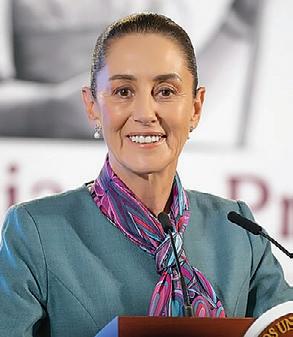
the investments fairly and unlawfully discriminated against them.
At issue is a Mexican Supreme Court ruling in 2022 which found the country’s mining authority Economia improperly issued Almaden’s mineral titles because it hadn’t sufficiently consulted with a local Indigenous Ejido group.
“Given the nature of Mexico’s actions I think it will continue to face losses in arbitration.”
KRISTEN YOUNG LAWYER WITH BOIES, SCHILLER, FLEXNER
The court suspended the titles, first granted in 2003 and 2009, so that Economia could reissue them after consultations took place.
Almaden started working with Economia on the consultations, but in 2023 the authority sought through the court to deny the title applications retroactively due to alleged technical issues.
“Amlo at the time had directed his administration to do two things: not to approve any new mining
concessions and not to permit any new mining projects,” Young said.
“Our position is that the decision of (Economia) was reflective of that political instruction such that when the Supreme Court asked Economia ‘please reassess these concessions before you do Indigenous consultations,’ it was an opportunity for Economia to then cancel and fold those concessions consistent with Amlo’s policy.”
The Indigenous consultations didn’t happen even though Young said the local community was supportive and Almaden was confident the consultations would succeed.
“Economia, rather than permitting the local communities a voice, actually denied them a voice and canceled these concessions in full before doing any consultation,” she said.
No amicable resolution
Almaden opted to take its case to arbitration after the government
indicated in a meeting last May that it wasn’t willing to consider an amicable resolution, Young said. The company decided that arbitration was its last resort.
Silver Bull claims that a local mining cooperative erected an illegal blockade in 2019 to force the company to pay an undeserved royalty payment. The government failed to take any action against the blockaders, who prevented access to Sierra Mojada, located in Coahuila state, Silver Bull says.
The Almaden and Silver Bull cases show the Mexican government’s approach to foreign miners will lead to more arbitration claims, Young said.
“Given the nature of Mexico’s actions I think it will continue to face losses in arbitration,” she said. “That, coupled with its policies could lead to less investment in the extractives sector and in turn lead to economic losses and a lack of growth in this sector in Mexico.” TNM
equipment and workers by boat. Oko West is located about 100 km southwest of the capital Georgetown.
If all goes well, commercial production at Oko West would begin in 2028 with about 1,500 employees. Annual output is projected to average 353,000 oz. over an expected mine life of 13 years.
“That will make it one of South America’s largest gold mines,” the CEO said. “We have an open pit that we will be putting in production first. Once the plant is commissioned and operating, we’re going to start the development of the underground mine. Three years later, underground activity will be starting to feed the plant.”
Gignac spent several days in Guyana last month to review developments at Oko West. He also met with government officials such as the ministers for natural resources, energy, home affairs and finance.
“That’s the type of access you
don’t get in many other jurisdictions,” he said. “Guyana is a pro-business country. They’ve been very supportive of our project and the mining industry at large. People make themselves accessible.”
Jewel in Brazil Gignac and his management team are also keeping an eye on Tocantinzinho, which the company acquired for about $115 million in 2021. More than 1,000 company employees and contractors work at Brazil’s third-largest gold mine.
Tocantinzinho, nicknamed TZ, produced 63,556 oz. last year. Annual output is expected to average 175,000 oz. over 10.5 years.
“TZ is obviously very important because that’s our source of cash flow generation,” Gignac said.
“Since we commissioned the plant, we’ve been generating positive cash flow.”
As a result, G Mining finished 2024 with about $141 million in cash. That’s up from $104.6 million at the end of the third quarter.
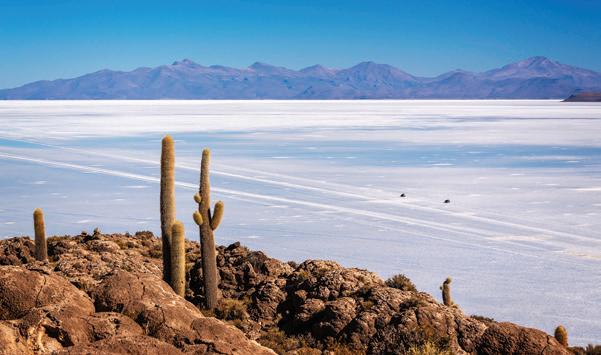
can move forward. The agreements must then be approved by the country’s legislature.
With public consultations at fulltilt, government representatives have said at these meetings that Potosí alone would receive estimated royalties of $800 million to $900 million over 30 years, equivalent to $30 milliin to $35 million annually.
Despite Bolivia’s massive lithium reserves — estimated at 23 million tonnes — the country has struggled for decades to develop a viable lithium industry. Political instability, a state-controlled resource extraction model and high magnesium levels present in its lithium deposits have made large-scale production chal-
lenging. Unlike neighbouring Chile and Argentina, Bolivia’s lithium reserves remain largely untapped, and contributing little to the global supply.
YLB opened Bolivia’s first industrial-scale lithium plant in late 2023, but it operated at only 17% capacity last year and is expected to reach just 23% in 2025.
Meanwhile, government officials, including Vice-Minister of Energy Resources Exploitation Raúl Mayta, insist the contracts “are not written in stone” and that they will continue to hold technical meetings with various sectors to address concerns.
Despite the criticism, the Bolivian government maintains that these partnerships will fast-track lithium industry development, promising the country will retain 51% of profits. TNM
Soaring gold prices have also helped.
“Our first gold sale was done at 2,450 an oz., which is pretty remarkable given that the highest sensitivity in our feasibility study was $2,000 an oz.,” Gignac said. “Every gold sale that we’ve done since has been at higher prices. It’s nice to hit the market right. It’s a strong gold market.”
Although Gignac says Tocantinzinho has been performing well, there have been occasional hiccups — such as the faster-than-expected wear and tear of the semi-autonomous grinding mill’s liner system.
“The rubber is degrading, and that was not expected. This has caused us to have many shutdowns to repair liners,” he said. “We’re going to be transitioning to metallic liners in April and once that change is complete, the problem will basically disappear.”
Exploration push G Mining’s rising cash balance is allowing the company to ramp
up exploration efforts. About $22 million will be spent on exploration this year, to be split between Tocantinzinho, Oko West and the company’s other Brazilian property, Gurupi.
G Mining acquired Gurupi from BHP (NYSE, LSE, ASX:: BHP) last year in exchange for a 1% net smelter royalty. The property, located in Maranhao state, covers about 2,100 sq. km. Developing Gurupi will be a multi-year process as it focuses on Oko West, the CEO said.
“This is a project that had received permits in the past, but there were gaps in the permitting process. We’re really going back to the exploration stage,” Gignac said.
“It’s all about building a pipeline. If everything goes well it could be project No. 3 for us, once we get Oko West built,” he said.
“Our goal is to always have an idea of what could be next,” Gignac concluded. “We like to think of ourselves as an Americas-focused company. We think there are lots of opportunities in South America.” TNM
the doldrums due to a build-up of inventory, SQM says prices are expected to begin recovering next year as demand for electric vehicles continues to rise.
“This is the time to be developing projects,” Quinzio said.
National strategy
It would be a big change from two years ago. When left-leaning President Boric launched his national lithium strategy, many industry analysts accused him of seeking to expropriate the country’s natural resources.
Although Boric has shelved plans for a state lithium company due to a lack of congressional support, the Codelco deal has advanced with minimal opposition. Attempts by China’s Tianqi Lithium, which owns 20% of SQM, to force a shareholder vote have been blocked in the courts while Boric has intervened personally to soothe concerns among local Indigenous communities.
Also, the demand for lithium today is much smaller.”
Social acceptability
Compounding Bolivia’s situation is a lack of social acceptability for large-scale mining. Some communities argue that contracts signed with Chinese and Russian firms last year to exploit lithium reserves offer no real benefits to locals.
“There’s a number of people in Bolivia who think that it might be better not to do anything with lithium,” von Vacano said. “Some of the Indigenous communities are saying it’s better to remain poor because exploiting the resources would mean more pollution and inequality. In the last two years, I’ve been hearing more and more examples of that from some communities in the Uyuni area.”
“It’s near the massive lithium-rich salt flats of the same name. Even the possible election of a more mining-friendly government might not move the needle.
“It’s possible that even if a centre-right party wins in August, a lot of Bolivians are going to resist the more free-market policies,” von Vacano said. “That’s especially true if the new government doesn’t show the clear benefits of a royalties scheme. So even if a conservative government takes power, there’s going to be a lot of friction and resistance.”
Bolivia’s economic plight “is dire,” he added. “There’s a lack of
fuel, a lack of dollars, and inflation has gone up significantly. Almost every economic indicator is negative, and the natural gas resources have declined. Bolivia should really have taken action on lithium about four years ago.”
Sleeping giant
As Bolivia stalls, another South American country is preparing to move up in the lithium ranking– Brazil. The continent’s biggest economy is home to several explorers and emerging producers such as Sigma Lithium (TSXV, NASDAQ: SGML), run by CEO Ana Cabral-Gardner, the Miner’s 2022 Mining Person of the Year.
Brazil’s lithium carbonate equivalent output could jump fivefold by 2028 from its 2023 level, according to a 2024 S&P Global forecast. Competitive production costs are one of the country’s key attributes, S&P said.
“Brazil is a little bit like a sleeping giant that could wake up and drive the South American critical minerals sector, and especially lithium,” von Vacano said. “Its resources are not as large as those of the Triangle countries, but Brazil’s experience with infrastructure and mining is a strength.”
Sigma and Vale (NYSE: VALE) “are good examples of companies that could work in other Latin American countries to drive their critical minerals sector,” he added.
“Paraguay, Peru and Mexico have some lithium, so this could become a much bigger regional project.” TNM
“We have not encountered any significant obstacles in this process, and we’re currently expecting that the conditions will be met in the second half of this year,” SQM chief financial officer Gerardo Illanes told analysts on a March conference call.
In October, Chileans will head to the polls to choose a new president in what is turning into a wide-open race among several candidates across the political spectrum.
Whatever the result, the new government is likely to keep focusing on growth and creating jobs after social unrest in 2019, the pandemic and then a four-year debate on a new constitution.
Along with copper mining and clean energy, authorities are expecting lithium to be a key driver of foreign investment over the next decade. Given the progress under Boric, a new government is unlikely to tear up the rulebook and start again. Quinzio said.
“Whoever wins is going to follow the same path, but go faster.” TNM


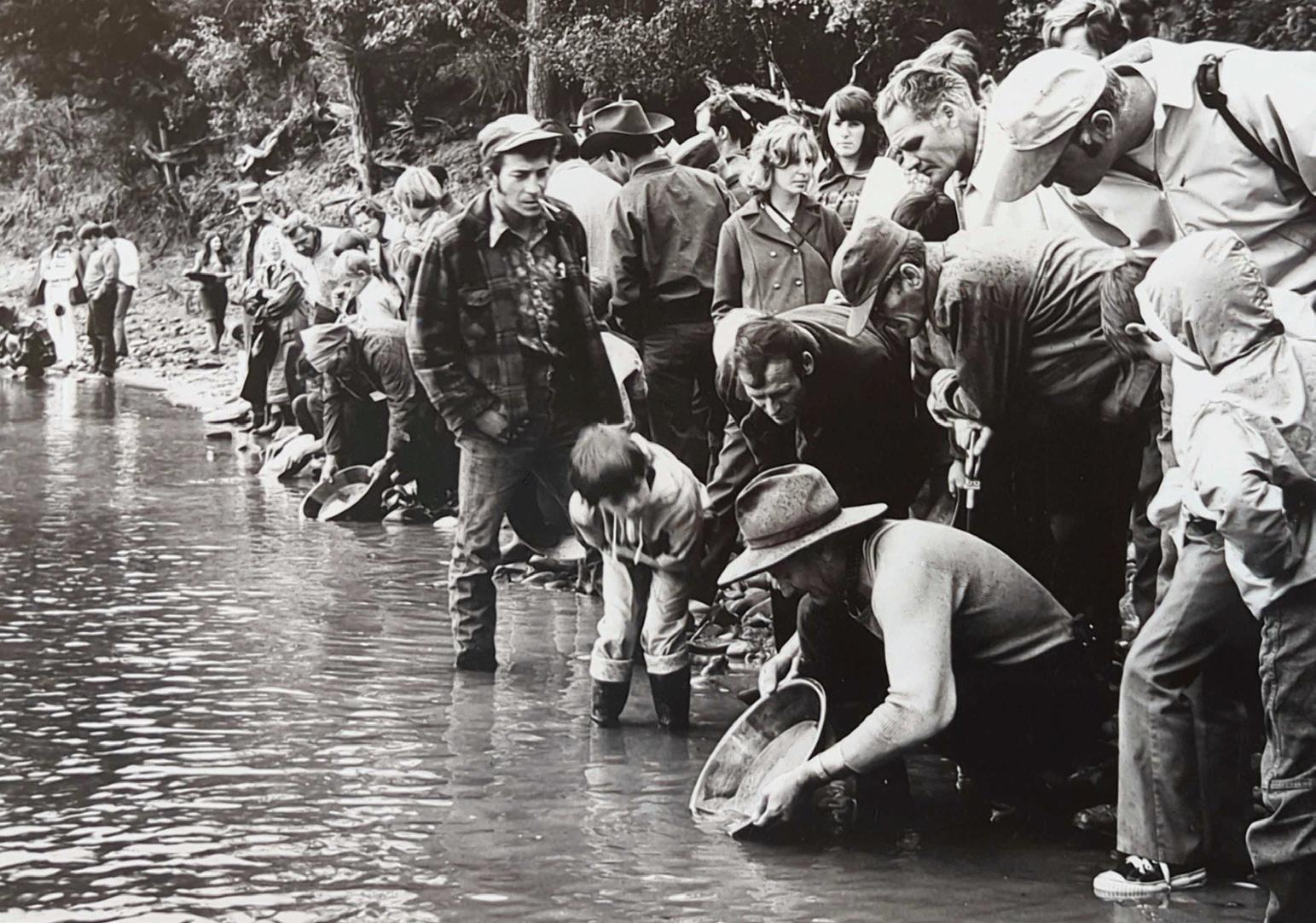

110 YEARS OF MINING. 110 YEARS OF CANADA’S STORY.
For over a century, The Northern Miner has been more than a newspaper— it’s been the chronicle of Canada’s growth, resilience, and resourcefulness. From frontier boomtowns to worldclass mining hubs, we’ve told the stories that built a nation.


Thank you for being part of our history. Here’s to the next 110 years.




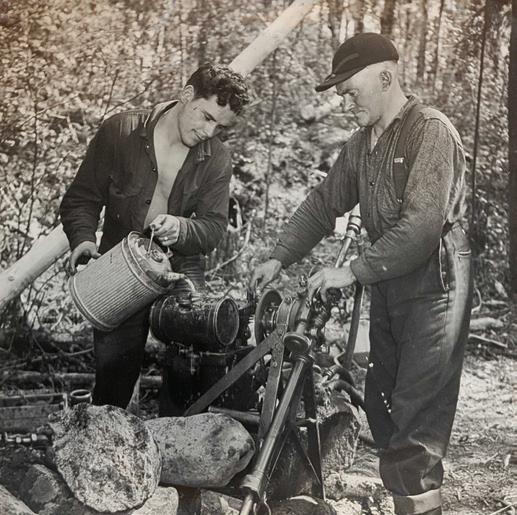
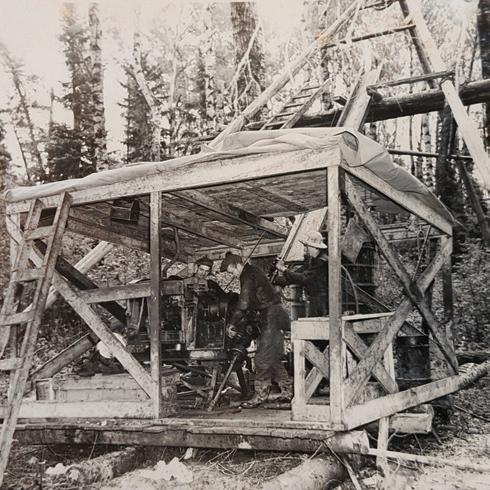

The Northern Miner – The Story of Mining in Canada Since 1915.
www.northernminer.com