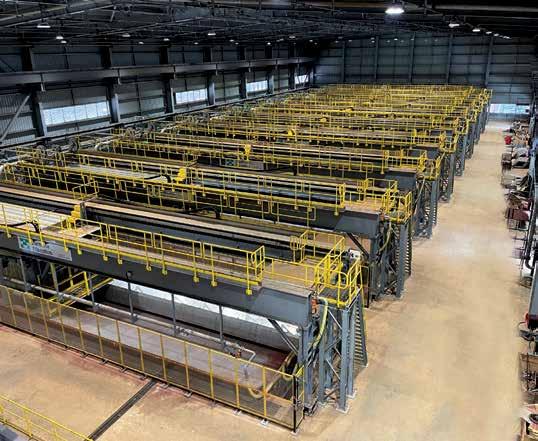
> The processing play: Building Canada’s next mineral hub
INSIDE THE DIGITAL AGE OF MINING
> Smarter exploration: AI cuts discovery time and unlocks hidden deposits
> From data to decisions: The rise of real-time mining intelligence
THE SPRINGHILL BUMP
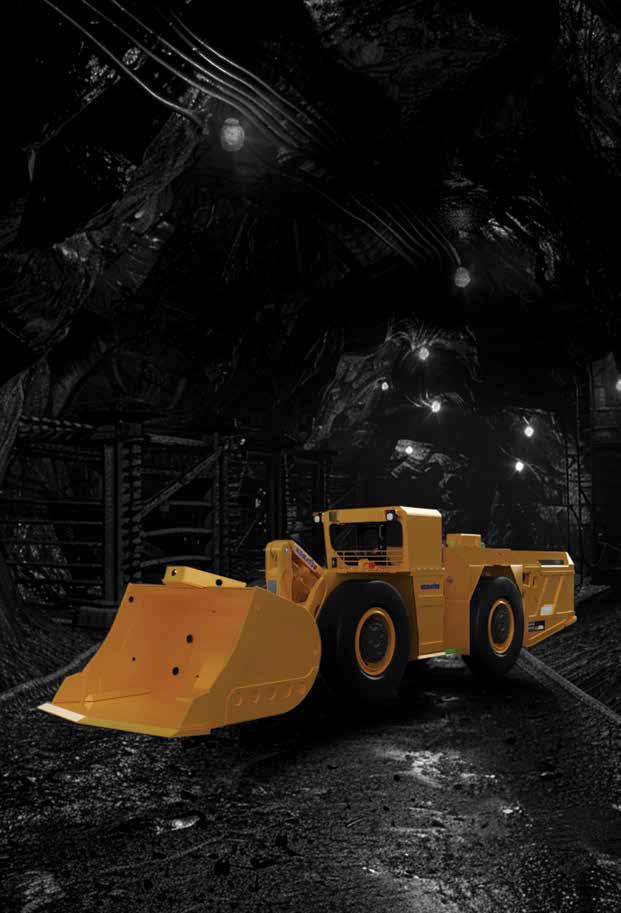
Komatsu’s groundbreaking 4‑tonne battery‑electric LHD sets a new standard in narrow‑vein hard rock applications. With ground‑level battery change, zero underground diesel emissions, and up to 6 hours run time on a single charge, the WX04B is engineered to help you move ore efficiently and sustainably. Breaking up hard rock. komatsu.com/hardrock
FEATURES
MINING IN THE DIGITAL AGE
08 The rise of the autonomous mine.
18 Decoding the planet: The future of the subsurface.
23 The electric fleet is here: But the mine must change with it.
25 How laser sorting improves recovery and promotes sustainability in mining.
27 Operations research: Turning complexity into value.
29 Mining’s blind spot: Why tire management is still treated as an afterthought.
33 Turning visibility into operational intelligence.
39 CEO interview: AI-driven core scanning aims to speed exploration decisions.
45 Beyond the map: How AI-driven automation is refining mine site intelligence.
46 Remote monitoring in principle and in practice.
49 From data silos to decision systems: An interview with Graham Grant, CEO of Seequent.
55 Canada’s mining advantage has an IP problem.
MINING IN CANADA
14 What have you done today that did not involve a mineral? Part 8: The sacred story of minerals.
16 Power is the missing link in Canada’s critical minerals strategy.
20 A potential critical strategic minerals hub in Alberta.
35 Critical minerals are Canada’s 21st century gold rush.
51 Policy momentum meets structural reality in British Columbia mining.
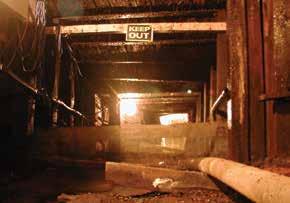
57 History of mining in Canada: The Springhill bump.
TAILINGS MANAGEMENT, CLOSURE, AND RECLAMATION
41 New model for recovering critical minerals from legacy mine waste.
INTERNATIONAL MINING
53 Pig iron production in the United States: Meet Jim Bougalis, founder and CEO of North American Iron.
The mining industry is often described in terms of scale: larger deposits, deeper mines, or bigger equipment. But the reality suggests a more important shift is underway. Mining is not just getting bigger. It is getting smarter, more connected, and, in some cases, more constrained.
Across the sector, digital technologies are reshaping how decisions are made. From AI-assisted exploration to real-time operational monitoring, companies are moving away from intuition and toward data-driven systems that improve speed, accuracy, and confidence. What once took weeks to months — analyzing drill core, interpreting geological models, planning operations — can now happen in near real time, fundamentally changing the pace of development and the nature of risk (see stories on pages 8 and 18 of this edition).
At the same time, innovation is not limited to software. Advances in sensor-based sorting, remote monitoring, and operations research are helping operators extract more value from existing assets while reducing cost and environmental impact. Electrification, particularly through battery electric vehicles, is emerging not only as a productivity tool, but also as a strategy to reduce diesel dependence and improve underground conditions. Other innovations — from digital geological modelling to smarter maintenance systems — reflect a broader industry push to make operations more precise, more predictable, and more resilient (for more information, flip to pages 23 to 28 of this edition).
Yet, even as technology accelerates progress, structural challenges remain. Chief among them is infrastructure. In Canada, the issue is not a lack of resources — the country is rich in the critical minerals much needed for the global energy transition — but the systems required to develop them. Power availability, particularly in remote regions, is increasingly shaping what projects move forward and when. In that sense, the sector’s future will depend not only on what can be found underground, but also on what can be built above it (read Isaac Ashton’s editorial on page 16 and the article on page 35).
This tension between capability and constraint is defining the current moment. Companies are being asked to move faster, operate more efficiently, and meet rising environmental and social expectations, all while navigating permitting complexity, infrastructure gaps, and capital discipline. The result is an industry that is simultaneously advancing and recalibrating, balancing ambition with practical limits.
The mining industry is at an inflection point. The tools to transform mining are here, and their impact is measurable. The question is no longer whether the industry can change, but whether the broader systems around it can keep pace.
If you are planning to be in Vancouver to attend CIM CONNECT 2026, please remember to collect a copy of this issue and visit the Canadian Mining Journal’s booth #1949.
Finally, our June/July 2026 issue will report on surface (open pit) mining, including reports on drilling and blasting and mining in Saskatchewan. Editorial contributions can be sent directly to the Editor in Chief before May 11.
President, The Northern Miner Group Anthony Vaccaro
Established 1882
Canadian Mining Journal provides articles and information of practical use to those who work in the technical, administrative and supervisory aspects of exploration, mining and processing in the Canadian mineral exploration and mining industry. Canadian Mining Journal (ISSN 0008-4492) is published nine times a year by The Northern Miner Group. TNM is located at 69 Yonge St., Ste. 200, Toronto, ON M5E 1K3. Phone (416) 510-6891.
Legal deposit: National Library, Ottawa. Printed in Canada. All rights reserved. The contents of this magazine are protected by copyright and may be used only for your personal non-commercial purposes. All other rights are reserved and commercial use is prohibited. To make use of any of this material you must first obtain the permission of the owner of the copyright. For further information please contact Robert Seagraves at 416-510-6891.
Subscriptions – Canada: $51.95 per year; $81.50 for two years. USA: US$64.95 per year. Foreign: US$77.95 per year. Single copies: Canada $10; USA and foreign: US$10. Canadian subscribers must add HST and Provincial tax where necessary. HST registration # 809744071RT001.
From time to time we make our subscription list available to select companies and organizations whose product or service may interest you. If you do not wish your contact information to be made available, please contact us via one of the following methods: Phone: 1-888-502-3456 ext 3; E-mail: amein@northernminergroup.com
Mail to: Allison Mein, 69 Yonge St., Ste. 200, Toronto, ON M5E 1K3
We acknowledge the financial support of the Government of Canada.
Tamer Elbokl, PhD
“ACCURATE
Mine Reader.
Predict ventilation equipment maintenance requirements for uninterrupted operation.
Duetto Analytics™
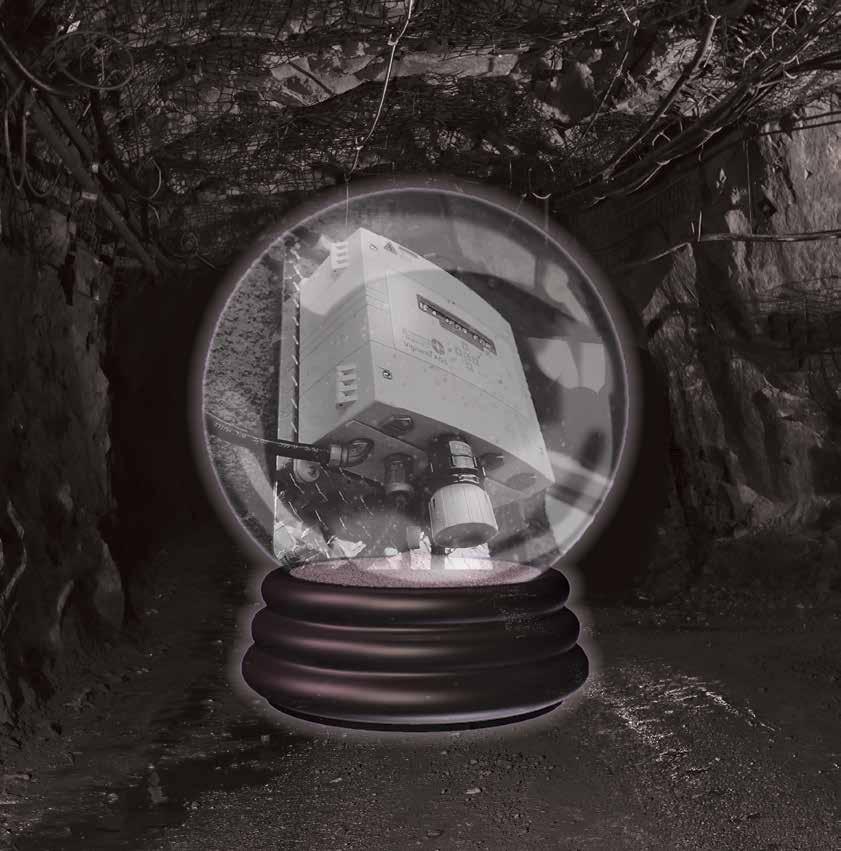
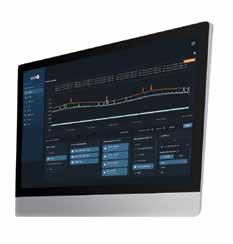
Duetto Analytics™ is an intelligent diagnostics and analytics platform, built to unify your IIoT data into one actionable interface. Operating securely within your process control network, Duetto delivers real-time visibility, advanced trending, and predictive maintenance tools – giving operations teams greater control and fewer surprises.
FAST NEWS
Updates from across the mining ecosystem
• Ottawa’s $3.5B mining gambit
The federal government outlined its plans for a new era in the country’s mining sector defined by speed, scale, and ambition as the industry plays a central role in Canada’s build agenda, serving as a foundation for economic prosperity, national defence and security, and low-carbon aspirations.
Tim Hodgson, the federal minister of energy and natural resources, and Parliamentary Secretary Claude Guay led a Canadian delegation at the 2026 Prospectors and Developers Association of Canada (PDAC) Convention in Toronto. The world’s largest mining conference reinforced the government’s declared plans to build and strengthen full critical minerals value chains to supply customers at home and in allied nations.
• Report suggests Alberta could sit on $1 trillion lithium goldmine
Ontario announced funding for 68 early-stage exploration projects through the Ontario Junior Exploration Program (OJEP) to strengthen the province’s critical minerals and mining sectors.
The province said the funding will cover up to 50% of eligible exploration and development
costs, support about 71 jobs in northern and rural communities, and generate roughly $18 million in economic output. Junior companies can receive up to $215,000 per project and licensed prospectors up to $65,000, including enhanced Indigenous participation support.
• Tech firm secures $4M to expand Vancouver platinum group metals (PGMs) facility
The Canadian Energy Centre reports that Alberta could emerge as a major lithium supplier as global demand for electric vehicle batteries surges, with the province pursuing an innovative extraction method that promises significant environmental advantages.
A comprehensive assessment by the Alberta Geological Survey and Alberta Energy Regulator reveals Alberta sits atop one of the world’s largest lithium deposits — an estimated 82.5 million tonnes of lithium carbonate equivalent buried deep underground.
• Mining accelerator targets $148M to fast-track Canadian tech innovation
pH7 Technologies is expanding its Vancouver metals processing facility to increase recovery of platinum group metals (PGMs), supported by up to $4 million in funding from the National Research Council of Canada Industrial Research Assistance Program (NRC IRAP). The Vancouver-based critical metals processing company will use the funding to advance its proprietary metallurgical processing technologies and accelerate development of organo-electrochemical processes for recovering platinum, palladium, and rhodium from secondary materials.
The Mining Innovation Commercialization Accelerator (MICA) wants Ottawa to fund a second five-year program that would help Canadian mining technology companies reach global markets faster.
MICA, based in Sudbury and operated by the Centre for Excellence in Mining Innovation (CEMI), presented its $148-million funding proposal to 273 participants during a March 26 webinar. The organization argues that Canadian small and medium enterprises lead global mining innovation but struggle to commercialize their breakthrough technologies quickly enough.
• Correction (April 2026 digital and print editions, page 19)
The text “Collaborating with Anglo American, Ausenco has successfully piloted Hydraulic Dewatering Stacking (HDS) technology, during which coarse sand is used to facilitate water drainage which is then reused in processing to reduce overall water consumption” is replaced by “Collaboration between Anglo American and Ausenco has considered potential Hydraulic Dewatered Stacking (HDS) applications and investigated different sand placement approaches, but the HDS pilot, built at El Soldado in Chile, was executed by Anglo American without direct input from Ausenco.”
Stephen Lecce, Ontario’s minister of energy and mines.
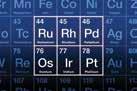
Platinum group metals in the periodic table. CREDIT:
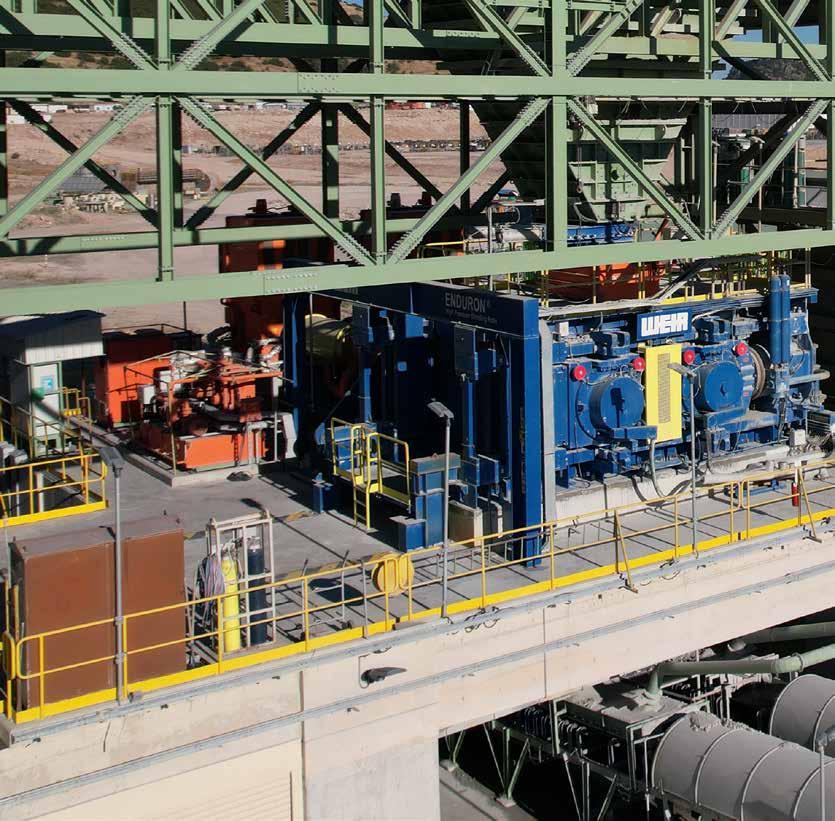
ENDURON® HPGR
Only ENDURON® HPGR comes with a 10-year bearing warranty. Not that you’ll need it. After all, there hasn’t been one premature bearing failure to date.
ENDURON® HPGR delivers unmatched grinding efficiency, even when processing the hardest rocks, boosting mineral recovery. Expect ≥95% equipment availability, so operators can rest assured production targets will be achieved whilst using the lowest possible resources.
With lowest energy consumption and no water or grinding media required, typical operating costs for HPGR based circuits are over 20% lower compared to conventional SABC circuits whilst reducing comminution CO2 emissions by 30%.
It’s no wonder we say ENDURON® on and on and on.
Find out why. www.global.weir/ENDURON
MINING IN THE DIGITAL AGE
said Liam Labistour, vice-president of marketing at VRIFY.
This is already influencing drilling decisions. At Equinox Gold’s Valentine project in Newfoundland and Labrador, VRIFY’s AI identified a target outside the main shear zone. Follow-up drilling returned 32 metres grading 2.68 g/t gold and 39 metres grading 1.78 g/t gold, confirming a new area of mineralization.
Across the industry, companies are using AI to revisit old data, find missed targets, and improve drill planning. This is helping reduce doubt and improve results.
The hidden bottleneck: Data
While AI gets most of the attention, a bigger issue remains: data. Before it can be used, geological data needs to be cleaned and organized which takes time.
“Exploration teams often spend 60% to 80% of their time cleaning, validating, and organizing data before any meaningful analysis can begin,” said MinersAI CEO and co-founder Mason Dykstra.
Data is often spread across old systems, different formats, and includes years of reports. This makes it hard to use and slows decision-making.
“Poorly structured data leads to incomplete interpretations, overlooked signals, and lower confidence in targeting, ultimately increasing exploration risk and cost. Structured data enables faster synthesis of information, revealing patterns that improve target generation and prioritization,” said Dykstra.
The takeaway: AI works but only if the data behind it is usable. “AI is ready, but its impact is limited by poor data foundations. Data structuring remains the primary barrier,” said Dykstra.
Real-time decisions at the mine
At the mine site, data is now being used to make faster decisions. One example is ore sorting, where operators can determine earlier whether material should be processed or treated as waste.
Technologies from companies such as MineSense Technologies allow for real-time ore and waste decisions. This reduces the amount of waste sent to the plant, lowering costs and energy use. In simple terms, the most valuable tonne is the one that never needs to be processed.
Mines are also becoming more connected. Sensors, monitoring systems, and software now allow operators to track equipment and production in real time. This helps prevent downtime, improve planning, and increase safety.
The path to autonomous mining
These changes are leading toward more automated operations. Autonomous trucks, drills, and equipment are already being used at some sites.
Fully autonomous mines are still developing but many operations are using semi-autonomous systems today. Semi-autonomous mining means that equipment can operate on its own for certain tasks but still requires human oversight.
The shift toward automation is happening gradually. Mines are adding new technologies step-by-step, rather than changing everything at once.
Canada is playing a key role in this transition. Organizations
such as NORCAT provide a place where companies can test new technologies before using them at operating mines.
“We do not just talk about innovation, we validate and accelerate it in an operating mine environment,” said NORCAT’s marketing communications manager Cynthia Furlotte.
Testing underground is important because conditions are different from controlled environments. Companies need to know how technology performs in real situations, including connectivity, safety, and daily operations.
“AI is only as effective as the data and context behind it, and underground environments are complex,” said Furlotte.
Initiatives such as “Mining Transformed,” held at the NORCAT Underground Centre, allow companies to test technology in a working mine. This helps move ideas from development to real use.
“We are seeing strong momentum in AI-driven analytics, real-time data platforms, and autonomous equipment,” said Furlotte.
Adoption remains the challenge
Even with these advances, adoption is not always straightforward. “Adoption is often less about the technology itself and more about integration and implementation,” Furlotte said.
Older systems, workforce training, and proving value at scale can slow progress. The challenge is no longer getting data but using it effectively to make decisions. At the same time, mines are becoming more connected and data driven. “We are moving toward increasingly connected, data-driven, and semi-autonomous operations,” she said.
The future of connected mining
AI is not a one-size-fits-all solution. Its success depends on the quality of data and how it is used. What is clear is that mining will not be shaped by one technology alone, but by how different systems work together.
“Ultimately, the future of mining innovation is not only about technology, but it is also about how it is integrated with people, training, and operations,” said Furlotte.
As digital tools continue to develop, mining is moving toward faster, more informed decision-making. The result is not only more data, but also better decisions at every stage of a project.
Salima Virani is a freelance mining writer.
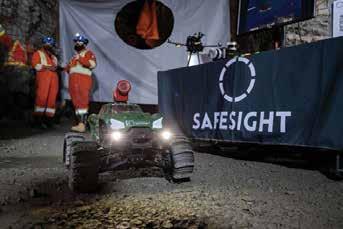
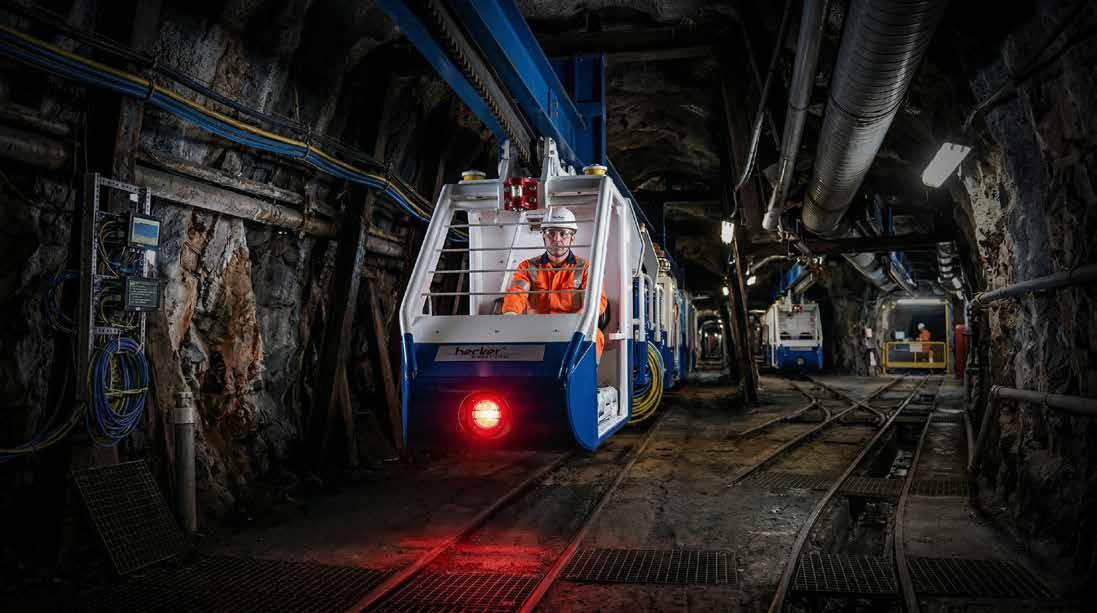
A remote-operated vehicle is tested underground at the NORCAT Underground Centre, demonstrating how semi-autonomous technologies are being developed and validated in real mining conditions. CREDIT: NORCAT
Better solutions for the mining industry
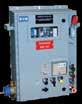
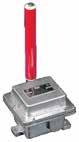
Dewatering pump panel
Our Dewatering Pump Panel provides a safe and reliable solution to control, protect and isolate dewatering submersible pumps connected via trailing cable to an electrical power source.
• Horsepower-rated
• VISA Breaker - visible isolation windows for improved safety
• Combination starter with visible break disconnect and Flex Shaft™ handle mechanism
• Type 12 or 4X enclosures
• NEMA/IEC/vacuum contactor with C440 electronic overload relay (C445 Smart Overload option available) or soft starter
• START/STOP pushbuttons and MANUAL/OFF/ AUTO selector switch
• Communication modules available for remote control & monitoring
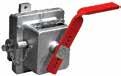
Power take-off panel
Our Power Take Off Panel provides a safe and reliable solution to control, protect and isolate Portable Mining Equipment connected to an electrical power source via a Trailing Cable.
• Startco RK-105 ground-fault remote indication and reset
Ventilation panel
Our Ventilation Panel provides a safe and reliable solution to control, protect and isolate ventilation equipment.
• NEMA/IEC contactor with C440 electronic overload relay (C445 Smart Overload option available) or soft starter
Communication modules available for remote control & monitoring for all three panels.
Learn more about Eaton’s Mining Solutions
Canada’s critical minerals export advantage: From strategy to execution
Canada is sitting on an abundance of critical minerals essential to the global energy transition and the technologies powering it, from electric vehicles and renewable power to battery storage and semiconductors. As demand accelerates, Canada has a timely opportunity to strengthen its role as a trusted supplier of responsibly produced critical minerals.
Export Development Canada (EDC) is helping advance that opportunity by supporting Canadian companies and projects across the critical minerals value chain.
With one of the world’s largest and most diverse geological footprints, Canada has access to many of the minerals required for clean technologies, including lithium, nickel, cobalt, copper and rare earth elements. Combined with strong regulatory oversight and a long-standing commitment to environmental, social and governance (ESG) standards, Canada is increasingly viewed as a reliable partner for countries seeking secure and diversified supply chains.
This opportunity is reflected in the federal government’s Critical Minerals Strategy, first launched in 2022 with a $3.8 billion program and subsequently reinforced through additional investments including the $2 billion Critical Minerals Sovereign Fund in late 2025. These programs are aimed at strengthening the full value chain, from exploration and extraction to processing, manufacturing, and recycling.
EDC plays an important role in translating these objectives into action by mobilizing capital, partnerships and trade expertise to support strategically important projects.
Expanding beyond extraction
While Canada’s upstream mining capabilities are well established, expanding domestic processing and downstream capacity remains a critical priority. Mineral processing and refining are capital-intensive and complex, yet essential to capturing greater economic value and strengthening supply chain resilience.
Globally, processing capacity remains highly concentrated, prompting governments and industry to seek alternative sources aligned with strong ESG standards. Canada is well positioned to help address this gap, supported by institutions such as EDC that advance processing, manufacturing and related infrastructure through financing and global partnerships.
According to Natural Resources Canada, the mining and metals sector already plays a significant role in the Canadian economy, contributing $156 billion to gross domestic product (GDP) in 2024, or 5% of the national total, including $112 billion in direct output and $44 billion from indirect activity. Further investment in midstream and downstream capabilities would strengthen this contribution while supporting regional development, skilled jobs and Indigenous participation.
Financing and global collaboration
Access to capital remains a key challenge for critical minerals projects,
particularly early-stage developments, projects deploying new technologies or those operating in complex environments. Drawing on decades of mine finance experience, EDC supports eligible projects through project and corporate financing solutions, applying expertise developed through years of minerals industry support to the evolving critical minerals sector.
One example is Torngat Metals’ Strange Lake Project, one of the largest heavy rare earth deposits outside China, located in northern Quebec. EDC provided a $110 million bridge loan, alongside $55 million from the Canada Infrastructure Bank, helping advance development critical to diversifying global rare earth supply. Once operational, the project is expected to create hundreds of jobs, with a strong focus on Indigenous participation in Quebec and Labrador —illustrating how capital, ESG leadership and strategic alignment can come together in practice.
EDC also supports Canadian suppliers, service providers and technology firms serving global mining operations. Canadian innovations that improve efficiency, lower emissions and support responsible mining are increasingly in demand worldwide, and EDC helps connect these companies with international buyers that share high ESG expectations.
As competition for critical minerals intensifies, Canada’s success will depend on aligning geological advantage, ESG leadership and access to capital. With institutions like EDC helping move strategy into execution,
Canada can strengthen its position across the critical minerals value chain, supporting the energy transition while driving long-term economic growth.
To learn more about financing and global opportunities in Canada’s critical minerals sector, visit edc.ca.
By Bruce Downing and Donna Beneteau
The sacred story of minerals Whathaveyoudone t lveamineral?Part8
T“What have you done today that did not involve a mineral?” Minerals form over immense spans of time, because Earth does not follow our daily clock. Its history is written in rock layers that record a story stretching back four billion years. Geologic time is organized into eons, eras, periods, and epochs, each marked by major shifts such as the formation of the first crust, the rise of oxygen, mass extinctions, and the appearance of complex life. Understanding this deep timeline helps us appreciate the order of Earth’s evolution. It also sets the stage for considering how minerals connect to broader human perspectives, including the roles of scientists, people of faith, and stewards of the planet.
From a mineral perspective, Earth’s story is not linear. Minerals follow life cycles that moves from formation to alteration to reintegration within the Earth system. This progression reflects the staged evolution described by Downing and Beneteau (Canadian Mining Journal, 2025, several articles in this series), where human understandings of minerals develop from denial to integration. Extending this idea, similar progressions can be traced in religious traditions and cultural interpretations of minerals.
Across world cultures, minerals have long carried spiritual, symbolic, and practical roles. Gemstones, crystals, and ores have been used for trade, pigments, ritual objects, adornment, healing practices, spiritual connection, tools, and weapons. By the time the Bible was written more than 2000 years ago, extensive trade networks were already well-established, and minerals played active roles in daily life, ritual practice, and symbolism. The concept of birthstones, associated with each month of the year, further illustrates how minerals accumulated layers of personal and cultural meaning over time. Many scholars trace the idea of birthstones back to the Breastplate of Aaron, described in Exodus 28, which held 12 gemstones representing the tribes of Israel.
The Bible reflects the importance of elements, minerals, and rock. According to the article “Minerals & Metals in the Bible” from Rockngem.com, minerals and metals appear more than 1,700 times. Gold alone is referenced more than 400 times, along with mentions of elements such as silver, lead, copper, iron, and tin. Mineral references include alabaster, soapstone, brimstone (sulfur), limestone, salt, pitch, natron, clay, salt, and and a wide
Peter (translated into French as Pierre, meaning “stone”), and Jesus states, “and on this rock I will build my church.” In a Youtube video by Got Questions Ministries that explains Matthew 16:18, it is stated that Christ is the life-giving rock. In 1 Peter 2:67, Christ is referred to as the chief cornerstone.
Another well-known mineral reference is the story of Lot’s wife in Genesis 19:26, who was turned into a pillar of salt after looking back at the destruction of Sodom. Salt, the mineral halite, already carried strong symbolic meaning in the ancient world, representing preservation, purity, and covenant, but in this narrative, it also becomes a symbol of judgment and consequence. The larger account, described in Genesis 19:23–25, explains that Sodom and Gomorrah were destroyed together by fire and brimstone, meaning burning sulfur. This account of salt and sulfur shows how earth materials appeared in scripture to communicate themes of warning and moral responsibility. It further shows how minerals were used in scripture to convey cultural values and connect human experience to earth materials.
Biblical explanations for the presence of minerals often point to divine provision: God created minerals and metals as resources for human life. The creation story itself reinforces this connection, describing how God formed Adam from the dust or clay of the ground, linking human origin directly to Earth materials. Minerals also appear in narratives of worship and celebration. The gifts presented to Jesus at his birth, including gold and frankincense, were Earth-derived materials that had both symbolic and monetary value. These early references show how minerals have long served both practical and spiritual purposes in Judeo-Christian traditions.
Building on this idea of spiritual meaning, the Quran also highlights metals and minerals, not only as materials but as signs of Allah’s power and generosity. Iron, gold, silver, copper, pearls, and rubies are highlighted for their utility, beauty, and symbolic significance. They serve as reminders of provision and gratitude. This parallel reinforces how minerals function across faiths as markers of divine care and human dependence.
Moving beyond written scripture, Indigenous traditions, often transmitted through oral histories rather than written
texts, also show strong relationships with minerals. Minerals and hence rocks appear in ceremonies, tools, pigments, clothing, and cultural objects, reflecting both practical and spiritual identity. These examples illustrate that mineral symbolism is not limited to major world religions but is woven throughout human culture. In many Indigenous cultures, rocks are revered as living, animate beings, often called “Grandfathers” or ancestors as they are considered the oldest, wisest, and most enduring elements of the Earth, holding memories, stories, and the spirits of those who came before. Rocks tell stories.
These cultural connections lead naturally to a comparison between theology and geology. The word theology comes from the Greek theos, meaning God, and logos, meaning word or rational thought. Geology comes from geo, meaning Earth, combined with the same root. Both fields explore origins, meaning, and creation, one through spiritual narrative and the other through physical evidence. Recognizing this shared interest in beginnings helps bridge scientific and religious ways of understanding minerals.
Theology is traditionally defined as the study of religious belief, divinity, and the history of religion. By analogy, a theology of the Earth can be seen as the study of geological concepts from the perspective of minerals, their formation, and their histories. A theology of minerals, therefore, involves examining their formation, identification, alteration, and processing, as well as the rules for naming and recognizing new mineral species. This analogy provides a structured way to link geological processes with theological categories.
This framework can be organized into the following four types of mineral theology that parallel classic categories of biblical theology:
1. Biblical Theology The study of minerals and rocks as they appear in sacred texts and the roles they hold in religious contexts.
2. Historical Theology The examination of how minerals formed and evolved through time, and how humans have used and interpreted them.
3. Systematic Theology The naming and classification of minerals follow conventions like the naming of religious orders. Mineral names often use Greek or Latin roots or descriptive terms, and are based on chemical composition, crystal structure, and physical properties, such as hardness and color. Rock naming conventions also reflect mineralogy and chemistry. No known minerals are named after biblical figures.
4. Practical Theology The processing of minerals and refining of minerals to extract elements essential for humanitarian, technological, and sustainable uses.
Viewed together, these forms of mineral theology show how minerals and rocks carry different meanings depending on cultural or religious tradition. In the Bible, rock imagery symbolizes refuge and stability. Psalm 62:7 states, “My salvation and my honour depend on God; he is my mighty rock, my refuge.” Many world religions and cultures use minerals in similar symbolic ways. Hindu traditions associate gemstones with deities such as Kubera. Christianity and Judaism use minerals symbolically while cautioning against using crystals for superstition. Islam values gemstones like carnelian for their protective symbolism. Buddhism uses gemstones in prayer beads and sacred relics. Ancient civilizations, such as the Mayans, Egyptians, Greeks, and Romans incorporated crystals in rituals, amulets, and burials. Mining communities around the world have developed belief systems centered
on underground spirits and Earth deities. Stone monuments such as Stonehenge, the Easter Island statues, and the pyramids reflect deep spiritual and cultural connections to rock. Even the Ten Commandments are described as carved on stone tablets.
Although geology and religion operate on very different timescales, they have influenced one another. Many early geologists, including William Buckland and Adam Sedgwick, were clergy members who sought to reconcile observations preserved in rock with spiritual understandings of creation. Their work highlights how scientific inquiry and religious interpretation have often developed in dialogue rather than in conflict.
Minerals originate from the arrangement of elements in magma as well as through metamorphism, evaporation, biological activity, and other Earth processes. These origins can be compared, metaphorically, to doctrines of creation found in many faith traditions. Laboratory-created minerals such as synthetic diamonds add a modern parallel to secular or non-theological interpretations of creation. Together, these perspectives show how the concept of creation, whether sacred or scientific, is deeply tied to the materials of the Earth.
Together, these ideas build the foundation for a religion and theology of minerals, grounded in the continuing question: What have you done today that did not involve a mineral?
Bruce Downing is a geoscientist based in Langley, B.C. Donna Beneteau is an associate professor in geological engineering at the University of Saskatchewan. The authors thank Carmen Huggins, a retired chaplain, for generously providing guidance and perspective.
Power is the missing link in Canada’s critical minerals strategy
In some northern grids, developers say utilities must occasionally curtail industrial power use during peak demand periods to maintain reliability for local communities.
Conversations with developers, infrastructure planners, and utilities at the Prospectors and Developers Association of Canada (PDAC) 2026 conference this year repeatedly reached the same conclusion: geology is not the bottleneck — power is.
Canada has spent the past several years identifying the minerals that will underpin the global energy transition. Copper, lithium, nickel, cobalt, and rare earth elements (REEs) are now firmly embedded in federal strategy and international partnerships. But identifying minerals is only the first step. The real constraint lies elsewhere: power infrastructure.
As Prime Minister Mark Carney recently stated when outlining Canada’s strategic partnerships, “By working closely together in energy, critical minerals, investment, defence, and AI to move faster in these endeavours, we will create more opportunities for our people.”
The challenge is that many of Canada’s most strategically important mineral deposits sit in regions where electricity systems were never designed to support industrial development. In Canada’s North and remote regions, the power grid often does not exist in the way developers in more populated areas expect.
According to federal energy analysis, approximately 280 remote communities and commercial sites in Canada are not connected to the North American electricity grid, relying instead on isolated diesel micro-grids for electricity. These systems were built to power small populations — not large industrial operations.
Consider Yukon. The territory’s entire electricity system generated 559.2 GWh of power in 2023, with 104 MW of installed renewable capacity. That is roughly the output of a single medium-sized hydro station.
Large copper or nickel operations typically require 50 to 200 MW of continuous power, depending on the scale of mining and processing. In systems such as the one in the Yukon, a single new project could consume a substantial share of the entire territorial grid.
Even within this limited system, reliability remains fragile. While hydro provides most of Yukon’s electricity, diesel and natural gas generation are still required to meet winter demand and support isolated communities. This creates a structural constraint for northern mining development.
The issue is not theoretical. Major northern projects such as the Ring of Fire in northern Ontario, as well as Arctic operations in Nunavut, must often plan energy infrastructure alongside the mine itself, adding years to development timelines and significantly increasing capital requirements. The result is a fundamental mismatch between Canada’s mineral ambitions and its energy infrastructure.
Renewable integration can help, but it does not eliminate the challenge. Solar and wind projects can reduce diesel consumption in remote systems, but reliability requirements still mean conventional generation must remain available. Even where renewable capacity is added, diesel generators must remain in place to meet peak demand or seasonal variability.
In northern environments, this seasonal imbalance becomes even more pronounced. Solar generation, for example, varies dramatically across seasons. In Arctic regions such as Resolute, Nunavut, solar output in December can fall to effectively zero, while summer production peaks months later. Energy storage and hybrid systems are improving system flexibility, but they do not yet remove the need for dispatchable generation in isolated grids.
Other jurisdictions have approached this challenge differently. In Brazil, mining regions in states such as Bahia have developed integrated infrastructure models where energy development and mineral development advance together. Mining companies anchor electricity demand, allowing governments and utilities to justify largescale grid expansion and energy investment.
Canada faces a similar opportunity. Northern mineral deposits represent not only a mining opportunity, but also an infrastructure opportunity. Strategic transmission corridors, hydro expansion, and grid interconnections could unlock entire regions of mineral potential while simultaneously improving energy security for northern communities.
Some early steps are already underway. Studies are examining potential grid interconnections between Yukon and B.C., aimed at improving reliability and expanding electricity access in the territory. But if Canada wants to live up to its immense potential and compete globally in critical minerals, these projects cannot remain isolated studies. That likely means treating northern transmission corridors, hydro expansion, and interprovincial grid connections as strategic infrastructure — on the same level as ports, railways, and pipelines.
The global race for critical minerals will not be won solely by those with the richest deposits. It will be won by those who can build the energy systems required to extract them. And in Canada, that race is only beginning.
Isaac Ashton is a political science and communications student at the University of Ottawa.
Decoding the planet: The future of the subsurface
For centuries, humanity has looked to the stars with wonder, mapping distant galaxies and sending probes to the edge of our solar system. Yet, beneath our very feet lies a world that remains largely a mystery. The Earth’s subsurface — vast, complex layers of rock and soil that store our water, energy, and the critical minerals needed for a green future — is surprisingly difficult to navigate.
Traditionally, finding these resources has been a game of highstakes hide-and-seek. Geologists rely on “sparse data” — bits and pieces of information gathered from expensive drill holes, satellite images, and historical records. But as the world’s demand for critical minerals like copper, lithium, and nickel skyrockets, the “old way” of discovery is not enough. The success rate for finding new mineral deposits hovers around 1% or even lower.
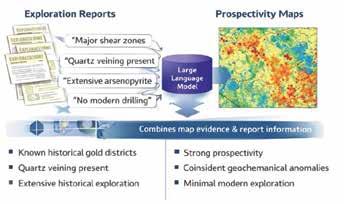
This is where artificial intelligence (AI) comes in. By merging the centuries-old science of geology with the innovative power of generative AI, Earth Dynamics has created the world’s first “Geologic Intelligence” platform. This technology is not just an incremental improvement; it is a fundamental shift in how we understand and interact with our planet. We are reimagining the earth to decode it better.
The challenge of the “black box”
To understand why this technology is so revolutionary, we first must understand the problem. The Earth is a messy, unpredictable place. Unlike a factory where every part is accounted for, the subsurface is a “black box.” Geologists use diverse methods of reasoning/logic to understand what they see in one drill hole and then predict what might be happening a mile away. Furthermore, the industry is drowning in data that it cannot easily use. Over the last century, exploration companies have produced millions of pages of paper reports, hand-drawn maps, and chemical assays. Much of this reality is dealing with “unstructured data;” in other words, mountains of information
not organized efficiently. For human teams to manually process and digitize this mountain of historical knowledge would take many years.
“Geoscience Foundation Models” can be used to close the loop between unstructured geoscience data and geological understanding. These are AI systems trained specifically on the “language” of the Earth. By teaching the AI agent to understand rocks, magnetic fields, and geological structures, it can process information at a scale and speed that was previously impossible.
The
four pillars of geologic intelligence
The platform is built on four core technological principles, each designed to solve a specific piece of the geological puzzle: GeoSim, GeoReasoning, GeoVision, and GeoIntegration.
1. GeoSim: The generative simulator
One of the most impressive features of Earth Dynamics’ platform is GeoSim. In many ways, it acts like a “3D Time Machine” for the subsurface. Because it cannot see through miles of solid rock, GeoSim uses generative modeling to create high-fidelity 3D simulations of what the ground looks like.
Crucially, these are not just random drawings. They are geologically and physically plausible models. By simulating different geological scenarios, GeoSim helps exploration teams visualize the “space between the holes,” reducing the guesswork involved in where to drill next.
2. GeoReasoning: The digital archivist
GeoReasoning is the “brain” that tackles the problem of messy, historical data. It uses agentic AI to function as a virtual geoscience assistant. These AI agents can read through decades of old exploration reports, understand the context of the minerals mentioned, and automatically extract the important data points. This process turns “dead data” sitting in dusty archives into “living assets.” GeoReasoning can find patterns across thousands of documents that no human could ever read in a single lifetime, identifying clues that may have been overlooked 60 or 70 years ago.
3. GeoVision: seeing the invisible
Geophysics, the study of the Earth’s physical properties, often involves looking at complex signals generated by geophysics, geochemistry, remote sensing, and other modalities. These signals are frequently “noisy” and difficult to interpret accurately. GeoVision uses advanced computer vision to “see” through this noise. It identifies subtle structural relationships and mineral targets directly from the data.
4. GeoIntegration: The master weaver
The final pillar is GeoIntegration. Geology is a multidisciplinary field; you might have chemical data, magnetic data, satellite imagery, and drill logs all for the same piece of land. Historically, these different “data silos” rarely talked to each other.
GeoIntegration is the glue that binds all these elements together. It provides a unified framework where all data types — from a high-resolution satellite photo to a chemical analysis of a rock chip — are combined into a single, cohesive “digital twin” of the subsurface. This ensures that every decision made by an exploration team is based on the full picture, rather than just one piece of the puzzle.
A tool for global challenges
While technology itself is fascinating, the real-world application is even more critical. The world is currently in a race to transition to a more sustainable energy future. Building electric vehicles, wind turbines, and solar panels requires an unprecedented number of metals.
The “easy” mineral deposits, those close to the surface and easy to find, have largely been discovered. The future of mining lies in finding the “blind” or “under discovered” deposits located deep beneath the surface of the earth. Earth Dynamics’ ability to compress the exploration timeline — potentially turning a multi-year search into a project within a few months — is essential if we are to meet the global demand for critical minerals.
Collaboration, not replacement
A common fear when discussing AI is that it will replace hu-
man workers. However, the philosophy behind this technology is one of “Expert Intelligence.” The platform is designed to be a collaborator, not a replacement.
By taking over the heavy lifting of data processing, 3D modeling, and archival research, the AI allows geologists to focus on what they do best: applying their deep experience and intuition to high-level decision-making. The AI provides the map and the insights, but the geologist remains the explorer.
A new era of discovery
The technology represents a bridge between two worlds. It takes the physical, tactile science of geology and enhances it with the digital power of generative AI. By decoding the “black box” of the Earth’s subsurface, we are not just finding rocks; we are finding the building blocks of a modern, sustainable society.
As we move forward into an era where resources are harder to find and more essential than ever, “Geologic Intelligence” is positioned to become the standard for how we interact with our planet. To build a better future on the surface, we first have to master the secrets of the world below.
A potential critical strategic minerals hub in Alberta
Canada is ramping up its mineral processing hubs to strengthen North America’s critical strategic minerals (CSM) supply chain, which is of great importance for the energy transition, new technologies including battery electric vehicles (BEVs), aerospace, and defence industries.
With an existing CSM hub in the East in Sudbury, Ont., the West is building up its CSM hub in Alberta’s Industrial Heartland (AIH), which is a region measured at 582 km2, that has existed since the 1950s and is home to chemical, petrochemical, oil, gas, and emerging low-carbon industrial projects. Sherritt International, Umicore Canada, and most recently, Fortune Minerals have sites in AIH.
AIH is well-positioned to become a CSM hub. The Government of Alberta, the AIH Association, and mining companies are working together to help build a CSM hub within the AIH. Existing infrastructure and resources as well as generous government incentives make the region an attractive option for mineral processing companies.
Alberta’s Industrial Heartland Association
Alberta’s Industrial Heartland Association, founded in 1999, is comprised of five municipal members and three associate municipal members.
Mark Plamondon, executive director of AIH Association, says, “AIH offers developers a rare combination of abundant low-cost energy, world-class infrastructure, integrated logistics, and a stable, pro-investment regulatory environment, making it one of the most competitive locations in North America to build and scale mineral processing projects.”
There are more than 40 companies that have operations in AIH, three of which are mining companies. Since 1954, Sherritt has been refining nickel and cobalt using hydrometallurgical processes at its refinery. Sherritt’s refinery is recognized as the only significant cobalt refinery and one of just three nickel refineries in North America. Since 2009, Umicore has processed battery-grade cobalt sulfate and nickel sulfate at its refinery, which is used to make nickel cobalt aluminum (NCA) oxides and nickel manganese cobalt (NMC) oxides. The most recent mining company to enter the region is Fortune Minerals, which has plans to start construction on its NICO project which will process cobalt, bismuth, and copper.
“AIH is currently Canada’s largest hydrocarbon processing region, with over $50 billion in operating assets that produce chemicals, fuels, and fertilizers that the world needs. It is this globally recognized industrial cluster that provides the competitive advantages that underpin new mineral processing facilities,” says Plamondon.
Key advantages of mineral processing in AIH include pre-zoning for heavy industrial use; access to hard rock and oil and gas by-product feedstocks for processing and available chemical reagents; and access to North American and global product markets.
Plamondon says, “Western provinces and northern territories in Canada have partnered to accelerate the development of minerals which opens up the potential for new supply sources for processing with the potential to building a CSM hub in AIH.”
Government of Alberta support
Announced in Jan. 2026, the “Western Canadian Critical Minerals Strategy” is a memorandum of understanding (MoU) between B.C., Alberta, Saskatchewan, Manitoba, the Yukon, and the Northwest Territories, whereby they have jointly agreed to work together to accelerate development, enhance supply-chain resilience, diversify export markets, and strengthen the position of Canada’s West as a preferred global supplier of responsibly sourced critical strategic minerals.
Jagrup Brar, B.C.’s Minister of Mining and Critical Minerals, says, “Western Canada is rich in critical minerals like lithium, cobalt, nickel, copper, and rare earth elements (REEs), which are crucial for clean energy, advanced technology, and defence applications. Together, we can advance a robust critical mineral value chain in Western and Northern Canada that ac-
Aerial view of Fortune Minerals’ NICO cobalt-gold-bismuth-copper project in the Northwest Territories in 2019. CREDIT: FORTUNE MINERALS
cesses new export markets, increases trade opportunities, creates jobs, and brings in investment across the region.”
The framework for co-operation toward a “Western Canadian Critical Minerals Strategy” will promote Western Canada as a global hub for critical minerals innovation and sustainable development; prioritize regional critical mineral hubs; and identify the infrastructure planning and investment needed to maximize mineral extraction, processing, and export capacity. The final strategy is expected to be published in line with the “2026 Energy and Mining Ministers Conference” in June.
Brian Jean, Alberta Minister of Energy and Minerals, says, “Alberta is ready to lead. With our world-class geology, our strength in processing and refining, and our commitment to responsible resource development, we are well-positioned to help build secure and resilient critical minerals supply chains for Western Canada. This MoU builds on the western premiers’ work to advance economic corridors, and it sets a clear direction for how we will work together to strengthen Canada’s role as a reliable global partner in critical minerals.”
At The Prospectors and Developers Association of Canada (PDAC) Convention held in March 2026, during his remarks at the “Powering the Future: SMRs, Critical Minerals, and Energy Security session,” Minister Jean announced the development of a new critical minerals’ incentive program.
Targeted for launch in 2027, the new incentive program is a key part of the Government of Alberta’s “Minerals Strategy and Action Plan.” The plan is designed to unlock the province’s mineral potential, support job creation, and strengthen Alberta’s position as a destination for mineral development and processing.
Minister Jean says, “Minerals are essential to our economic future, energy security, and global competitiveness. Alberta has an important role to play as a leading North American processor and refiner of critical minerals. These incentives will attract the needed jobs and investment to meet this demand.”
Fortune Minerals
Fortune Minerals, a Canadian mining and mineral processing company headquartered in London, Ont., is advancing its vertically integrated NICO cobalt-gold-bismuth-copper project in Canada to a construction decision. The NICO project is comprised of a planned open pit and underground mine and concentrator in the Northwest Territories and a hydrometallurgical refinery in AIH.
Fortune Minerals recently completed the purchase of its brownfield industrial site in Lamont County, located within AIH, to construct its metal refinery. Consisting of 0.31 km2 of land and 3902 m2 of serviced shops and buildings, the site is within a 30-minute drive northeast of Edmonton, in an existing world-class petrochemicals cluster, with the requisite infrastructure and the human resources, reagents, and services needed for metal refining.
The NICO project is an advanced development-stage project that has received environmental assessment approval and the major mine permits for the Northwest Territories facilities and has been assessed in positive feasibility and front-end engineering and design studies. Fortune Minerals plans to reach its final investment decision in 2027. Subject to the arrangement of project financing, construction can commence, with commercial production anticipated in early to mid-2029.
The NICO project is projected to have an average annual production of 1,800 tonnes of cobalt (in ~8,780 tonnes of cobalt sulfate), 1,700 tonnes of bismuth (in ingots), 500 tonnes of copper, and 47,000 oz. of gold. While the NICO project was historically primarily a cobalt-gold asset by projected revenues, it is also the largest bismuth deposit in the world with 12% of global reserves. The 1.1 million oz. of in-situ gold provides a countercyclical highly liquid hedge to mitigate critical mineral price volatility, and copper will be a minor by-product.
The Alberta refinery’s cobalt production is targeting the rapidly expanding lithium-ion rechargeable battery industry to store energy in electric vehicles, portable electronics, and sta-
Sherritt’s Fort Saskatchewan facilities in Alberta’s Industrial Heartland.
MINING IN THE DIGITAL AGE/MINING IN CANADA
tionary storage cells.
Traditional bismuth use includes automotive glass and anti-corrosion coatings, paints and pigments, low temperature and dimensionally stable alloys for castings, and pharmaceuticals. Bismuth has growing consumption as an “eco-metal” and environmentally safe and non-toxic replacement for lead in solders, brass, steel, and ammunition.
Also, there is a growing demand for bismuth in decommissioning and remediating abandoned oil and gas wells as an environmentally safe, permanent plug that prevents greenhouse gas leakage, blowouts, and groundwater migration that can contaminate aquifers. Manganese-bismuth magnets are a superior, lower cost, and environmentally safer alternative to REEs.
Geopolitical mineral landscape
Robin Goad, president and CEO of Fortune Minerals, says, “The inclusion of midstream processing for the NICO Project development was initially considered to be a risk that would result in higher capital costs. However, recent trade conflicts have exposed vulnerabilities with the globalization of critical minerals supply. Domestic processing is now recognized as essential to supply chain security for the key materials needed for the energy transition, new technologies, and defence.”
China controls 90% of global bismuth supply and is restricting its export to Western countries as a counter to recent trade con-
flicts. Difficulties sourcing bismuth metal exposed other important bismuth uses in high speed-low heat electrical connects for artificial intelligence data centres, fuses, and weapons systems, including rocket propellants and nuclear industry applications.
The Democratic Republic of Congo produces approximately 70% of cobalt; 66% of platinum reserves are from South Africa; 50% of lithium reserves are found in the “lithium triangle” of Chile, Argentina, and Bolivia; and China controls approximately 70% of REEs’ mining — such as neodymium and dysprosium — and 90% of processing.
Because of the current unstable geopolitical mineral landscape, Western governments recognize that they need to reduce their dependence on foreign entities of concern and strengthen North America’s critical mineral supply chain to ensure that it is safe, secure, and reliable.
The recently announced “Western Canadian Critical Minerals Strategy,” Alberta’s as-yet-to-be-announced new CSM incentive program, and the addition of Fortune Minerals in AIH, will all contribute to a potential CSM hub in Alberta.
Diane L.M. Cook is a freelance mining writer.
Fortune Minerals’ Nico cobalt-gold-bismuth-copper project in the Northwest Territories. CREDIT:
By Olga Makoyeva and Karen D’Andrea
The electric fleet is here: But the mine must change with it
Battery electric vehicles (BEVs) are no longer a fringe technology in Canada’s mining sector, but the way we talk about them often misses the point. The most important question is not whether BEVs can haul and load; it is whether mine sites can absorb a new set of constraints — power, ventilation, dust compliance, charging logistics, maintenance models, and workforce readiness — without trading away reliability.
A recent mine electrification benchmarking snapshot, conducted by EY Canada, reflects this shift: companies were evenly distributed across “assess, plan, and deploy” stages of their electrification journey, suggesting this has become a practical operational topic rather than a distant ambition.
What is driving electrification (and what is not)
One of the most revealing benchmarking findings is what operators are not chasing. When asked why they prioritized specific equipment, tonnage was not selected at all (0%). Instead, respondents pointed to diesel consumption reduction (57%) and emissions/diesel particulate matter reduction (43%) as the primary rationale for electrification priorities. That should reframe the discussion: for many Canadian operators, electrification is fundamentally a risk and exposure strategy (reducing diesel dependency, improving underground environments, and meeting sustainability expectations) rather than a pure productivity play.
This also helps explain why haul trucks sit at the top of respondents’ electrification priority list (50%), ahead of loaders (25%) and drills (13%). Haulage is where diesel use is most visible and where emissions reductions can be most material (espe-
cially at scale). But it is also where electrification becomes most system dependent: the “vehicle decision” quickly turns into a “site power and operating model decision.” Our benchmarking results reinforce this reality in another way: only 40% of respondents report having an official electrification program, 40% do not, and 20% are still developing one. In other words, ambition is rising faster than governance and execution discipline.
Underground reality check: ventilation savings depend on dust, not hope Ventilation is often presented as electrification’s cleanest financial win. In principle, removing diesel exhaust should reduce airflow requirements. But field evidence shows why this cannot be assumed.
A field study, conducted at a Canadian mid-tier gold operation, tested diesel and battery electric load-haul-dump vehicles (LHDs) to compare performance and understand environmental factors driving ventilation requirements. The results were strikingly practical: in the scenarios tested, the BEV and diesel LHDs moved equivalent amounts of material in a similar time under representative duty cycles: BEVs can do the work.
The more important finding, however, is what constrained ventilation reductions. In the production environment tested, respirable crystalline silica concentrations became the driver for determining airflow requirements for the batterypowered LHD. The study evaluated a scenario with approximately 50% reduced airflow versus the diesel baseline. While there was potential for reduction, contaminant levels exceeded limits under the reducedairflow scenario at that site, meaning achievable savings were materially less than 50%.
Electric rope shovel loading a haul truck in an open-pit mining operation.
MINING IN THE DIGITAL AGE: BATTERY ELECTRIC
VEHICLES
This is the key message for any operator building a BEV business case underground: electrification does not eliminate ventilation design risk. It shifts it. The limiting factor may become dust and silica rather than diesel particulate and exhaust gases. If dust suppression and material handling controls are not strong, electrification alone will not deliver the ventilation dividend many plans quietly assume.
The fleet of the future is an operating system: energy, uptime, and people Importantly, BEVs change the “physics” of uptime. Diesel fleets are constrained by fuel logistics and mechanical maintenance; electric fleets add constraints around energy balance, charging strategy, and dutycycle planning. Results from the aforementioned gold operation field study make this tangible. Energy demand varied meaningfully by grade and duty cycle, and regenerative braking materially affected energy captured on downhill segments. To maintain availability, the site relied on battery swapping (charging one battery while the LHD operated on another) highlighting that infrastructure design is inseparable from equipment productivity.
At the industry level, operators already anticipate that people’s systems must adapt. EY Canada’s benchmarking respondents
simplified narratives. Open responses also reinforce uneven readiness: some sites have operator and maintenance teams trained by OEMs, while others report no specific workforce training plan yet. This is where the future of electrified fleets will be won or lost. Not in the procurement cycle, but in the program layer: how companies standardize training, redesign maintenance routines, update emergency response for high voltage systems, and build the data capability to manage charging, downtime, and performance.
Execution will decide the electric mine
The future of electrified vehicle fleets in Canadian mining will not be determined by whether BEVs work in principle. They already do. It will be determined by whether mines can convert electrification into a reliable operating model: ventilation plans that reflect dust and silica realities, energy systems designed around real duty cycles, and workforce programs that make high voltage equipment safe and maintainable at scale.
The most successful operators will treat fleet electrification not as a vehicle swap but as a site transformation program, because that is what it is.
Olga Makoyeva is the EY Americas Metals & Mining Center of
Keeping mines
Unlocking ore potential:
How laser sorting improves recovery and promotes sustainability in mining
From exploration projects to operating mines, preconcentration — and specifically sensor-based sorting (SBS) of ore — is becoming a critical step in improving both project economics and sustainability. Mining companies face constant pressure to improve recovery, performance, lower processing costs, and reduce environmental impacts.
Laser sorting is one of the latest technologies being implemented in the mining industry to help separate valuable ore from waste early in the process. By upgrading ore prior to transport or before it reaches the mill, laser technology reduces the volume of material processed downstream, leading to lower energy use, cleaner tailings, and more efficient operations overall
The concept of laser scattering is built on the principles of light-matter interaction and has several applications, from scientific research to industrial processes. Laser scattering involves the interaction of lasers with particles or surfaces, resulting in light dispersion. By analyzing the intensity, wavelength, and direction of scattered light, insight into particle size, shape, and composition can be collected.
The Saskatchewan Research Council (SRC) applies these scientific principles directly to mining challenges, using a standardized approach developed in-house, to turn bench-scale
SRC’s
test work into practical, economic solutions for industry. With decades of experience in sensor-based technologies for commodities such as diamonds, SRC has developed significant expertise and capacity to help industry navigate sorting technologies and test and implement them into their processes.
Why SBS matters, and how SRC supports industry
SBS has grown significantly in the mining industry over the past decade, driven by the need for efficiency, cost reduction, and sustainable practices. Laser-based particle sorting systems are a subset of SBS that use laser technology to differentiate and separate valuable mineral ores from waste rock based on their optical properties. The technology has been successfully implemented in both greenfield exploration and brownfield mining operations.
At SRC’s Minerals Liberation Sorting Centre, we operate an X-ray transmission (XRT) sorter with an additional electro-magnetic (EM) sensor bar, a final recovery XRT sorter and a full-scale multi-channel ore sorter capable of laser, visible, near infrared (NIR), and EM detection, or a combination thereof. In practice, the laser, visible, and NIR sensors measure how particles reflect and absorb light across different wavelengths. This allows the sorter to distinguish between materials based on colour, brightness, and mineral-specific spectral signatures, such as separating quartz-rich rock from carbonate or clay-bearing material.
Used after the primary stage, the multi-channel laser sorter performs finer, more selective separation to improve product quality and recovery, giving industry access to one of the most advanced sorter testing platforms available in Canada. Our team can take projects from initial ore characterization, analyzing just a few kilograms of rocks, through bench-scale trials and pilot testing, processing up to hundreds of tonnes of material.
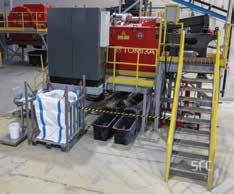
All this work, including preparation such as crushing and sieving, happens within a single facility. This integrated workflow saves clients time and ensures consistent results from start to finish
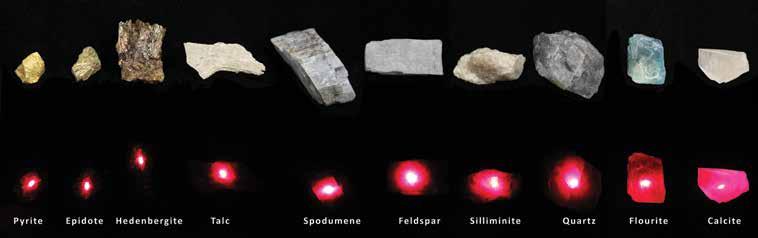
The scattering effect of a laser on different minerals and rock types. CREDIT: SRC
MINING IN THE DIGITAL AGE: TECHNOLOGY
The science behind laser sorting
Laser sorting exploits the scattering properties of light in minerals. When a laser beam interacts with a particle, the light is scattered to varying degrees depending on the mineral’s structure and composition, creating a measurable glow. Translucent minerals, such as quartz, scatter light throughout their crystals, while opaque minerals show little to no measurable scattering. Detectors capture these differences in pattern and intensity, allowing the system to identify and separate valuable minerals from waste based on their unique optical responses.
At SRC, we utilize a multi-channel laser ore sorter equipped with four available channels, red, green, blue, and infrared (IR), configured and paired with its own photomultiplier tube. This configuration allows us to measure how each wavelength of light diffracts and reflects as it interacts with a particle.
The system can filter responses to measure both scatter and anti-scatter, capturing the light that is transmitted through a particle, as well as the light that is reflected. This dual view provides a more complete optical profile of each particle, increasing accuracy.
By combining multiple laser wavelengths, the sorter can evaluate particle brightness, colour, transparency, and surface features, providing a precise basis for differentiation. This multi-channel approach is particularly effective for separating materials that may appear similar to the naked eye. To achieve consistent results, material must be clean and presented in a single layer.
Typical laser sorters, such as those used at SRC, are chutefed systems that use air-actuated valves to separate ore from waste. Precise coordination between sensors and valves is critical to maintain accurate particle separation. During the third testing stage at SRC, equipment is operated at production speeds of up to 100 t/h, allowing our team to assess the sorter’s full-scale capabilities and refine parameters for commercial applications.
CASE STUDY: Quartz-hosted gold
Laser sorting has proven highly effective for quartz-hosted gold deposits. Gold itself is not directly detectable with current sensors, so separation relies on identifiable proxies, like quartz. These deposits typically feature gold-bearing quartz veins within various host rocks. They form from silica-rich hydrothermal fluids, which may contain gold, migrating upward through fractures and faults and precipitating as they reach lower pressures.
This process forms gold-hosted or barren veins, depending on the fluid’s gold content. Gold within these systems is often associated with minerals such as sulfides (e.g., pyrite and arsenopyrite) and may exhibit multiple stages of mineralization and remobilization.
At SRC, through discussions with the client and internal analysis, we begin by characterizing the ore to determine the proportion of quartz, its association with sulfides and the variety of lithologies present.
Ore characterization studies can include detailed mineral analysis to determine overall composition of both the mineralized and barren fractions. This can also highlight penalty elements, which may be beneficial to remove early in the process. Understanding the ore upfront is critical to optimizing a sorter’s performance and ensuring calibration for the best results.
These deposits can prove challenging to mine, as the gold is typically finely disseminated within the quartz matrix, and the ore itself is usually complex. Traditional sorting methods, such as manual sorting and gravity separation, often fail to effectively distinguish between quartz with high gold content and barren quartz.
Quartz is a hard mineral that requires significant energy to crush, and without efficient separation of gold-hosted from barren quartz, processing costs rise and recovery falls. A properly calibrated laser sorter can upgrade feed before milling, reducing downstream energy use and improving recovery.
Once the mineralogy is determined, the scattering response of the different minerals can be compared to determine the optimal sorter configuration. By assessing the relationship between light scattering behaviour and grade (e.g., gold content), our operators fine-tune the laser’s settings to maximize recovery and minimize mass pull.
This optimization work is included in SRC’s test programs and is scalable, providing clients with real performance data before committing to commercial installations.
Laser technology detects subtle differences in the mineralogical composition of ore-bearing and barren host rock. Gold-bearing quartz often has minor variations in texture, colour, and surface characteristics compared to barren quartz, while the surrounding host rock has a distinctly different optical signature. Differences in light-scattering properties between these materials enable effective separation of gold-bearing quartz from waste, improving both recovery and process efficiency.
The value of laser sorting
Laser sorting can significantly improve both the economics and sustainability of mining operations. By selectively isolating and concentrating higher-grade material, the technology upgrades low- or marginal-grade deposits and increases the overall grade of the ore. This improved selectivity can enhance the economic viability of deposits that might otherwise be uneconomic to mine.
The environmental benefits are also significant, although they can differ for greenfield and brownfield applications. In general, by efficiently separating waste rock from ore, laser sorting reduces the volume of material that needs to be processed downstream, lowering energy consumption and decreasing emissions.
In addition, the process is dry and chemical-free, which minimizes water use and eliminates reagents, further reducing environmental impact at this stage of the process.
Early removal of penalty elements and deleterious minerals improves downstream processing efficiency and results in cleaner tailings. For many clients, this can mean moving projects forward that might otherwise remain stalled because of economic or sustainability constraints.
By combining detailed ore characterization, multi-channel laser dual-sorter detection, and a rigorous stepwise testing approach, SRC provides the mining industry with the insights needed to make confident decisions about full-scale sorter deployment.
Lucy Hunt is the sorting and separation team supervisor at Saskatchewan Research Council. Learn more about SRC’s sensor-based sorting and mineral separation services at src.sk.ca/services/sensor-based-sorting.
The case for operations
Turning complexity into value
What is the most efficient way to extract maximum value from a finite mineral resource while balancing cost, safety, and operational constraints? This is the central question at the heart of every profitable mining operation. Yet, the answer is rarely found in financial reports alone.
Operations research (OR) provides a structured way forward. At its core, OR is a scientific discipline of applying mathematics and advanced analytical methods to improve decision-making in business. It transforms overwhelming operational complexity into structured, solvable problems using mathematical modeling, statistical analysis, and optimization techniques.
In mining, this translates into measurable improvements across mine planning, equipment allocation, haulage scheduling, and supply chain coordination, delivering gains in productivity, cost efficiency, and operational performance.
The core toolkit: Methods that power mining decisions
Fundamentally, OR is prescriptive: it focuses on what should be done. At the same time, many of its tools also serve a predictive role, helping engineers understand what “could” happen before determining what to optimize. Prediction and prescription are not sequential steps; they are interdependent.
Operations research has evolved from manual calculations to sophisticated, data-driven approaches powered by modern computing, but foundational methods have not been replaced. Many remain central to mining practice because they continue to deliver scale, reliability, and practical value.
Linear programming
Linear programming (LP) is the backbone of life-of-mine production scheduling, allowing engineers to determine extraction sequences that maximize “net present value.” Network flow methods extend this to max-closure problems, with direct application to optimal open pit design. Methods such as Bienstock-Zuckerberg have further expanded LP’s reach, enabling very large, complex scheduling problems to be solved at scale. LP’s limitations are equally important: it performs well for deterministic problems but does not directly address geological uncertainty, stochastic variability, or non-linear system complexity.
Discrete event simulation
Discrete event simulation (DES) models how operations are likely to unfold, capturing variability such as equipment breakdowns, queuing delays, and weather disruptions. It can be applied before a system exists and before any historical data is available, making it valuable for planning future facilities or haulage networks. However, its primary challenge is logical accuracy; if system logic is flawed, it will undermine the model regardless of data quality.
Stochastic optimization
Stochastic optimization tackles geological uncertainty by evaluating mine plans across multiple orebody realizations, seeking solutions that remain profitable under varying conditions. Adoption is constrained by computational complexity and specialized expertise. Its inherent focus on robustness can also produce conservative plans that leave value unextracted.
The gap between theory and the pit
A persistent challenge in OR is the disconnect between mathematical optimality and operational feasibility. Models may identify theoretically optimal solutions that are unworkable in practice — failing to account for equipment mobility, machinery relocation costs, or sequencing dependencies that exist on the ground but not in the model.
Emerging methods such as heuristic optimization and reinforcement learning aim to bridge this divide by aligning advanced algorithms with the physical realities of mining operations.
The deeper challenge, however, is that mining rarely presents a single clean optimization problem. In some cases, deterministic LP methods are entirely appropriate. In others, uncertainty must first be understood before any meaningful optimization can occur. The future of mining OR is therefore not about choosing one technique over another, but rather about combining them more intelligently, applying each where it adds the most value and allowing outputs from one to inform inputs to another.
Simulation as a strategic lever
Advances in computing have made powerful simulation techniques increasingly accessible, giving mining engineers deeper insight into uncertainty and system behaviour than traditional models allow.
Monte Carlo simulation: Quantifying uncertainty
Traditional models rely on average values, masking the variability inherent in mining systems. Monte Carlo simulation addresses this by running thousands of iterations across a range of possible inputs, producing a distribution of outcomes rather than a single projection. This allows engineers to evaluate not only whether a plan is optimal, but also how robust it is under fluctuating geological and market conditions.
MINING IN THE DIGITAL AGE
Design of experiments: Finding what truly matters
Design of experiments (DoE) is an analytical method frequently used alongside simulation to identify how multiple variables interact and which combinations drive the best overall performance. In mining, for example, aligning blasting parameters with downstream processing requirements can meaningfully reduce energy consumption and improve throughput, supporting a more integrated mine-to-mill strategy.
Simulation-based optimization: From insight to action
Simulation-based optimization combines the realism of simulation with the power of optimization algorithms, moving beyond analysis to actively search for better solutions. In haulage systems, it can test and refine dispatching strategies within a simulated environment, identifying approaches that maximize throughput while minimizing delays.
The missing link: Advanced knowledge systems
Operations research tools cannot function in isolation. Many limitations in mining OR stem not from the methods themselves, but from fragmented data systems that prevent models from reflecting operational reality.
Using an advanced knowledge system to build a unified knowledge framework ensures that changes in one part of
the operation, such as geological updates, are immediately reflected in scheduling and maintenance decisions. It serves as a platform where simulation, optimization, and operational data converge, enabling more responsive decision-making.
Beyond structured data, advanced knowledge systems can capture experiential insights from operators and translate them into actionable inputs for optimization models. This allows human expertise to be embedded within analytical frameworks.
From insights to realized value
As operational demands intensify, the true value of OR lies in its ability to simplify complicated data and link decisions to measurable outcomes.
Advanced knowledge systems, such as SourceOne from Eclipse Data Innovations, play a critical role in this transition by unifying data, models, and domain knowledge into a single operational framework.
SourceOne breaks down data silos and enables real-time interaction between planning, scheduling, and execution layers. It provides the foundation for truly prescriptive and adaptive decision-making, ensuring that optimized solutions are not only mathematically sound but also practically implementable at the mine site.
Kush Chawda is a client engineer at Eclipse Data Innovations.
Mining’s blind spot:
Why tire management is still treated as an afterthought
For an industry built on precision engineering and largescale innovation, mining has a persistent — and costly — blind spot. It is not in electrification, automation, or artificial intelligence. It is in something far more ordinary: tires.
A recent white paper from Kal Tire, developed with Michelin, makes a clear case that better tire management can reduce both operating costs and emissions. The conclusion is not surprising. What is notable is that the opportunity remains underutilized across many operations.
The white paper outlines practical, data-driven approaches to tire management that can help mines reduce Scope 1 and 3 emissions while lowering operating costs through longer tire life and improved fuel efficiency — without requiring major capital investment. Rather than introducing new technologies, it highlights a familiar industry pattern: the tendency to overlook operational fundamentals in favour of more visible, capital-intensive initiatives. This imbalance affects not only cost performance, but also how effectively mining companies meet their environmental targets.
If tire management is as impactful as the available data suggests, then its continued underperformance is more than an operational issue. It reflects a broader gap in how priorities are set and executed across mining operations.
A focus on the visible
Canadian mining companies, like their global peers, continue to invest heavily in transformation. Electrified fleets, autonomous haulage systems, and digital platforms now dominate boardroom discussions and industry conferences. These initiatives are significant and, in many cases, necessary. They are also complex, capital-intensive, and long-term.
Effective tire management, by contrast, yields results in a relatively shorter term. It does not require fleet replacement or largescale infrastructure changes. In many cases, it involves improving how existing assets are monitored, maintained, and selected. Despite that, it is rarely treated with the same level of urgency.
Part of the explanation lies in visibility. Tire management does not carry the same profile as zero-emission haul trucks or automation programs. It is often viewed as a maintenance function rather than a strategic lever.
The Kal Tire/Michelin white paper challenges that perception. It positions tire management as an area where relatively modest operational improvements can deliver measurable gains across cost, productivity, and emissions.
According to Miles Rigney, senior vice-president of Kal Tire’s Mining Tire Group, “Tire performance is a leading indicator of mine management performance. Strong tire performance shows that maintenance teams follow best practices, operations use tires within their design limits, mine planning con-
siders tires in haul cycle decisions, and management is actively engaged in tire performance. Conversely, poor tire performance is often linked to reduced chassis and component life and more production disruptions. Strong tire performance is an indication of a safe and profitable mining operation.”
The cost structure
In surface mining, loading and haulage typically account for a significant share of operating costs. After fuel, tires are one of the largest consumable expenses. A large operation can use hundreds of tires each year, representing millions of dollars in expenditure. The white paper suggests that a portion of this spend is avoidable. Practices such as underinflation, incorrect tire selection, and inconsistent maintenance contribute to premature wear and failure. These issues do not occur in isolation. They affect fuel consumption, equipment performance, and downtime, creating a chain of inefficiencies that extends beyond the tire itself
Rigney summarizes the point directly: “Smart tire management offers dual benefits: it lowers operational costs while advancing emissions and sustainability goals. Mines do not need to choose between the two — they can have both.”
The question is why more operations are not consistently achieving those outcomes.
Cost and emissions
Mining often treats sustainability as a cost centre. Reducing emissions is frequently associated with higher spending or lower productivity. Tire performance complicates that assumption.
The relationship between tire condition and fuel consumption is well-established. Underinflated or degraded tires increase rolling resistance, requiring more energy to move haul trucks. The result is higher fuel consumption and higher direct (Scope 1) emissions.
Even relatively small deviations can have measurable effects. Field data cited in the paper indicates that underinflation of less than 10% can increase fuel consumption per haul cycle. Across a fleet, this translates into significant additional diesel use over the course of a year. In practical terms, inefficiency is reflected in both fuel costs and emissions reporting. Despite this, many operations still overlook opportunities to drive improvements.
Scope 3 considerations
The environmental implications extend beyond fuel use. Tires also contribute to indirect (Scope 3) emissions through their production, transportation, and disposal. Every tire carries an embedded carbon cost. When tires are replaced earlier than necessary, that cost increases.
The paper highlights that a large share of a tire’s overall environmental impact occurs during its use phase, largely owing to fuel consumption.
Kal Tire team members conducting tire inspection.
SANDVIK DR411i COMPACT DESIGN. MAXIMUM POWER.
Sandvik DR411i rotary blast hole drill, the latest addition to the intelligent iSeries lineup is designed to bridge the gap between performance and footprint. The DR411i is engineered to deliver maximum productivity for both rotary and down-the-hole (DTH) applications. Built on a modular platform shared with the flagship DR410i, this rig offers mining operations a familiar, yet highly optimized, solution for soft to medium rock conditions, including gold, coal, and copper applications.
At the heart of the DR411i’s efficiency is its extended mast design. By eliminating the need to add drill pipes during the drilling process, the rig can achieve an average 25% increase in productivity. This streamlined approach extends component life, saving time, while simultaneously reducing energy consumption by utilizing less fuel to finish a hole.
The rig also features a heavy-duty dual stage rotary head, a design evolved from the DR410i that eliminates the need for a planetary gearbox. By reducing the number of internal components, Sandvik has minimized wear and maintenance requirements while simultaneously increasing torque and RPM efficiency.
A unique feature of the DR411i is Sandvik’s proprietary traveling centralizer. Working in tandem with a chain-drive feed system, the centralizer centers the drill pipe throughout the entire length of the hole. This minimizes pipe flex, ensuring straighter holes with less deviation and allowing operators to exert maximum weight on the bit to
increase penetration rates.
The DR411i is capable of drilling holes up to 270 millimeters (10 5/8 inches) in rotary applications and can handle DTH drilling with an eight-inch hammer. To support these operations across diverse environments, Sandvik offers configurable power packs featuring Caterpillar or Cummins engines that meet various global emission standards.
Sustainability is a core pillar of the DR411i’s design. The rig is equipped with a patented compressor management system that ensures air is only produced when needed. By minimizing the energy required to drive the compressor during nondrilling tasks—such as tramming or leveling—the system significantly reduces fuel consumption and carbon emissions.
The DR411i is built for longevity. Its chassis utilizes wide flange heavy-duty I-beams for maximum structural strength. Additionally, the rig’s modular power pack allows for an easy transition to electric power. Customers can retrofit existing diesel units with an electric motor and
control cabinet in the field without the need for welding or major structural rework, effectively future-proofing their investment.
The new iCab offers a sophisticated, safe environment designed for long-shift comfort. With floor-to-ceiling glass for superior visibility and an ergonomically designed seat with integrated controls, the cab minimizes operator fatigue and eliminates many blind spots.
The rig runs on the Sandvik Intelligent Control System Architecture (SICA), which provides a scalable platform for automation. This includes the iDrill suite, which automates functions like leveling, mast positioning, and drilling. By allowing the control system to operate within design limits, the DR411i ensures consistent performance and reduces the risk of human error or machine abuse.
With its blend of compact maneuverability, modular flexibility, and advanced automation, the Sandvik DR411i is a benchmark for efficiency in modern surface mining.
WANT TO LEARN MORE
about how Sandvik is supporting the future of mining?
Visit us at booth #1207 during CIM CONNECT 2026 - our team will be there to connect, answer your questions, and showcase the latest innovations firsthand.
MINING IN THE DIGITAL AGE: MINING TIRE
However, lifecycle emissions associated with manufacturing and disposal remain significant.
This creates a compounding effect. Poor tire management increases fuel use while also accelerating replacement cycles, amplifying both Scope 1 and Scope 3 emissions. As Canadian mining companies face increasing scrutiny over full lifecycle emissions, this becomes a material consideration rather than a secondary issue.
Available tools
One of the more notable aspects of the paper is that these opportunities do not rely on emerging or experimental technologies. Many of the tools required to improve tire performance are already in place.
Tire pressure monitoring systems (TPMS) provide continuous data on pressure and temperature. Thermal imaging and automated inspection systems can identify issues without interrupting operations. Haul road analytics and fleet diagnostics offer insights into how operating conditions affect tire wear and fuel use.
At one copper mining operation in Chile, for example, Kal Tire’s TireSight autonomous inspections have reduced inspection downtime (by 20%) by allowing trucks to be monitored without stopping, while improving maintenance accuracy.
Adam Murphy, senior vice-president of Michelin’s Mining Tire Business Line, points to the cumulative effect of these measures: “Ultimately, small operational changes — selecting the right tire compounds for site conditions, maintaining correct inflation pressure, and optimizing haul road designs — can translate into significant environmental and financial gains. Energy efficient rubber compounds can enable tires to run at a cooler temperature, decreasing their rolling resistance and increasing the truck’s fuel efficiency.” The tools exist. The remaining question is how consistently they are applied.
Prioritization
Mining companies are not short of technical capability. However, priorities are not always aligned across functions.
Fuel consumption is typically tracked at a high level and reported as a key performance metric. Emissions are increasingly subject to detailed disclosure requirements. Tire performance, by contrast, is often managed at the site level and may not receive the same level of attention. This presents an opportunity to better align strategic objectives with day-to-day tire management practices.
Where tire management is treated primarily as a maintenance issue, its broader impact on cost and emissions can be overlooked. Where it is integrated into performance management, the benefits become more visible.
Matching design to conditions
Another factor highlighted in the paper is the importance of selecting tires that match site conditions. Different operating environments require different tire characteristics. Heat-resistant compounds may be more suitable for long-distance hauls in high-temperature conditions. Cut-resistant compounds are better suited to abrasive, rocky environments. Other designs prioritize traction or energy efficiency. When tire selection does not align with operating conditions, performance can decline.
A recent technical analysis by Michelin cited in the paper de-
scribes a North American iron-ore mine that experienced a significant drop in productivity after switching to a different tire. Analysis identified mismatched specifications, reduced cycle speeds, and increased downtime. Adjustments to tire selection and maintenance practices resulted in measurable operational improvements. This suggests there is still an opportunity to strengthen decision-making processes to fully leverage the technologies already available.
Extending tire life
Extending tire life represents another area of opportunity. A significant proportion of mining tires do not reach their intended lifespan. Factors such as improper inflation, operational damage and inconsistent maintenance contribute to early replacement.
Repair and retreading programs offer a way to address this. By restoring damaged tires or extending their usable life, operations can reduce procurement costs and lower the demand for new tires. The environmental benefits are also clear. Fewer new tires mean lower upstream emissions and reduced waste. These practices align with broader industry interest in circular economy principles. However, adoption remains uneven, reflecting operational and organizational factors rather than technical limitations.
Safety considerations
Improved tire management also has implications for safety. Better monitoring and maintenance reduce the likelihood of unexpected failures. Fewer failures mean fewer interventions, which can reduce exposure to high-risk activities.
In this context, tire management contributes not only to cost and environmental performance, but also to overall operational safety.
Leadership considerations
Ultimately, the effectiveness of tire management comes down to how it is prioritized. Senior leaders set targets for cost reduction, productivity, and emissions. Achieving those targets requires attention to both large-scale initiatives and incremental improvements.
Tire management falls into the latter category. It may not attract the same level of attention as major capital projects, but its impact is measurable and immediate. As Rigney notes, tire strategies represent “a high impact yet underutilized opportunity.” That observation reflects both the potential and the current gap.
Conclusion
The Kal Tire/Michelin white paper is measured in tone and grounded in operational data. Its message to mining operations is practical: existing tools and practices can deliver meaningful improvements in cost, emissions, and performance.
The broader implication is that progress in mining does not depend solely on new technologies. It also depends on how effectively existing systems are managed. Tires are not only consumables. They are part of a larger operational system that influences fuel use, equipment performance, and environmental impact. The opportunity to improve that system is clear. How widely it is acted upon remains to be seen.
Link to the Kal Tire/Michelin white paper is here https://www.kaltiremining.com/en/unlocking-hidden-synergies/
Turning visibility into operational intelligence
Mining has always been an industry defined by physical challenges like distance, danger, and demanding environments. What has changing today is not the nature of those challenges, but how mines respond to them.
Throughout the industry, digital tools are reshaping how operations are monitored, managed, and improved. Autonomous equipment, remote operations centres, predictive maintenance systems, and integrated data platforms are becoming standard parts of modern mining strategies. At the center of many of these initiatives is a simple but powerful capability: the ability to see what is happening in real time from anywhere.
In this digital age, visibility has become a tool that, when used correctly, provides operational awareness, faster decision-making, and safer, more efficient production.
Historically, video systems in mines were used primarily for surveillance — watching entrances, monitoring restricted areas, and having a recording of incidents when they occurred. Today, these video systems are increasingly being used as operational tools. When operators can identify issues early, they can intervene to reduce downtime, risk, and cost.
Remote operations are becoming the norm
Remote and distributed operations are becoming standard
practice, driven by workforce constraints, safety priorities, and the need to operate in increasingly distant locations.
Digital connectivity makes it possible for supervisors, engineers, and maintenance teams to monitor equipment and processes from centralized control rooms — or from other regions entirely. Remote monitoring systems allow teams to review live or recorded footage, analyze performance, and make operational adjustments without traveling to the site.
The operational impact is significant as follows:
• Fewer personnel are exposed to hazardous environments.
• Faster response to equipment or safety issues.
• Reduced travel time and associated costs.
• More consistent oversight across multiple sites.
For mining companies that manage geographically dispersed sites, this level of visibility can move them from reactive responses to proactive, data-driven operations management.
A reliable video monitoring system helps to identify issues early and keep operations up and running.
Opticom Tech mining video monitoring. CREDIT: OPTICOM/STOCK PHOTO
Opticom Tech CC04 Camera. CREDIT: OPTICOM
CHECK YOUR PULSE
IMAGINE KNOWING EXACTLY WHAT YOUR EQUIPMENT NEEDS BEFORE IT NEEDS IT.
MINING IN THE DIGITAL AGE
Reliability still determines success
While digital technologies offer new capabilities, they also introduce new expectations. Systems must work continuously, often in environments that push equipment to its limits.
Mining sites are among the harshest industrial settings in the world. Equipment must withstand vibration from blasting and drilling, exposure to dust and debris, extreme temperatures, and constant mechanical stress. These conditions can quickly degrade standard commercial hardware and lead to failures, downtime, and lost visibility.
Avoid unnecessary slowdowns and unexpected repairs with Haver & Boecker Niagara’s Pulse Diagnostics suite. Our complete set of monitoring tools provides you with the proactive edge your mining operation needs.
As mines adopt more connected and automated systems — for example, autonomous drilling, self-driving vehicles, automated haulage, and more — uninterrupted performance becomes critical. Downtime disrupts operations and creates safety risks. A reliable video monitoring system helps keep an eye on these technologies to identify issues early and keep op-
Scaling visibility across complex operations
Mining operations are becoming larger, more complex, and more interconnected. Processing plants, haul roads, stockpiles, and underground workings must all be monitored simultaneously, often across large geographic areas.
To support this complexity, modern video monitoring systems must be designed to integrate and scale. Working with an experienced partner to build flexible monitoring infrastructure from the start allows operations to adapt to changing requirements without incurring unnecessary costs or disruption.
It also enables a more unified approach to operations where decision makers can have insight across an entire organization, not just a single location.
Practical innovation over hype
The future of mining will undoubtedly include more automation, more connectivity, and more data. During this shift into the digital age, the camera system that keeps an eye on it all cannot be overlooked.
That means
Designing video systems that deliver reliable performance in harsh environments.
Choosing tools that improve safety without adding complexity.
Configuring infrastructure that can scale as operations grow.
Striving for visibility that supports faster, more informed decisions.
Digital transformation in mining is an ongoing process of improving how operations are performed, managed, and optimized. An important part of that process is also implementing monitoring systems to stay informed on what is happening at every site.
Heidi Schmidt is global sales manager at Opticom Tech. Heidi has worked in the video technology space for more than 20 years, building expertise in CCTV, industrial video applications, new product development, video network solutions, and more. As a sales leader at Opticom Tech, she helps customers implement robust video monitoring solutions for unique and harsh industrial environments.
Canada’s bid for global leadership and what it means for the mining industry
Critical minerals are Canada’s 21st century gold rush
Last January, during a speech heard around the world at the World Economic Forum in Davos, Switzerland, Prime Minister Mark Carney laid out the strength of middle powers such as Canada. Three times in his 16-minute speech Carney referenced critical minerals — as one of the key areas where he is hoping other nations will invest in Canada.
“Canada has what the world wants,” Carney said, adding, “we are an energy superpower. We hold vast reserves of critical minerals.”
Carney went on to tell government and business leaders from around the world gathered there that Canada is forming a buyers’ club for critical minerals anchored in the G7. He told them the abundance of these key minerals is one of the reasons his government is fast tracking more than a trillion dollars of investment in these minerals along with energy and other resources.
Critical mineral projects from coast to coast to coast
If you look at a map of Canada, you will see major critical minerals projects all over. In Quebec: rare earth elements (REEs), lithium, and graphite; in the Ring of Fire in Ontario: nickel, cobalt, chromium, and REEs; in British Columbia: copper, nickel, and REEs; in Saskatchewan: uranium, potash, and REEs; in Alberta: lithium; in the Yukon: copper, zinc, and REEs; in the Northwest Territories: REEs and cobalt; in Nunavut: nickel, copper, graphite, and REEs; and finally in Newfoundland and Labrador: REEs, nickel, and cobalt.
With both federal and provincial governments looking to develop these minerals and a whole new industry around them over the next decade, Stephen Mackie, senior director of metallurgy and consulting at SGS Lakefield, says, “Critical minerals including REEs are Canada’s 21st century gold rush.”
SGS is the world’s largest testing, inspection, and certification company, based in Switzerland. It has labs all over the globe with several in Canada, including the one in Lakefield near Peterborough, Ont., where Mackie is located.
SGS Lakefield, celebrating its 85th year of operation in 2026, has been at the forefront of the mining industry providing technical innovation, independent verification, and full life-cycle project support so clients can make the best business decisions. From pioneering flowsheet development and scale-up methodologies to playing a critical role in exposing the Bre-X scandal, the lab has consistently aimed to strengthen industry standards and investor confidence. SGS has also evolved over time to meet changing commodity demand and client needs as demonstrated by its work on technologies such as cyanide recovery (SART), advanced refractory gold processing, and modern hydrometallurgical solutions for critical minerals and battery materials. As ore bodies grow more complex and capital
discipline intensifies, SGS Lakefield’s role as an independent, objective technical partner — providing rigorous testing, interpretation, and consulting — has positioned it not just as a laboratory, but as a global centre of excellence helping shape the future of mining.
“We basically touch the majority of the critical mineral projects that are being developed globally,” says Mackie, who has been an industry insider for years and witnessed more than one client take a lithium project from the beaker to a working mine, a process that can take up to two decades.
SGS Lakefield in action
By helping demonstrate a viable pathway from Quebec spodumene to high-purity lithium chemicals, SGS has played a role in advancing one of Canada’s most ambitious efforts to date to build an integrated, domestic battery materials supply chain.
SGS supported Nemaska Lithium’s Whabouchi project and downstream Shawinigan hydromet plant through metallurgical testing, process development, and analytical services aimed at producing battery-grade lithium chemicals from spodumene ore.
This project, based in James Bay, is one of the largest high-purity lithium deposits in North America. Work conducted at SGS Lakefield helped characterize ore mineralogy; optimized spodumene concentration through crushing, dense media sep-
A metallurgist analyzing a sample. CREDIT: SGS
MINING IN CANADA: CRITICAL MINERALS
aration, and flotation; and supported the development and validation of the hydrometallurgical conversion process used to produce lithium hydroxide and carbonate. The company’s independent testing and flowsheet verification contributed to de-risking scale-up decisions, confirmed product quality requirements for battery markets, and supported engineering design and feasibility work.
Mackie says, “This experience demonstrates that there is something fundamentally different taking place now in the industry. The federal and provincial governments have realized we cannot just dig it up and ship it out to upgraders based in China and other global centres as we have done until now. The focus now is building up our own processing capacity which really requires disruptive change and creating the right strategy so Canada can become a global leader.”
He adds, “because of the work we do, we are being consulted by government and a number of agencies now who are looking to develop a critical mineral strategy and the best projects where Canada should invest.”
Before we learn more about that, it is good to go back and look at why critical minerals including REEs have become all the rage.
Critical minerals history
The world’s first critical minerals list dates to WWI when the U.S. military created a list of strategic minerals that were re-
quired to support the war effort. In more recent times, critical minerals have become essential with the world transitioning to renewable energy and because these minerals are the foundation on which modern technology is built. In 2021, Canada highlighted 31 critical minerals as part of its first ever critical minerals’ strategy and added three more (high-purity iron, phosphorus, and silicon metal) in 2024.
“It touches everything Canadians use daily. These minerals are essential ingredients for everything from your mobile phones to your EV car batteries, solar panels, and medical devices. There are multiple applications as well for military use, for defence and aerospace,” Mackie says.
In fact, it seems not a day goes by now without critical minerals being in the news. That started about a year ago when the U.S. government linked critical minerals, including REEs to defence, economic, and national security.
What are rare earth elements
There are 17 REEs in all, consisting of the 15 lanthanides (lanthanum through lutetium) plus scandium and yttrium. These REEs are key ingredients for green energy, consumer electronics, medical diagnostic equipment, and the defence and aerospace industries.
Large REEs deposits are not easy to find. Normally, if we are talking about a mine, it is 1% copper or nickel in the ground. Rare earth elements are much less than that. Often, they are in what the industry calls “parts per million.”
David Anonychuk is the global vice-president of metallurgy and consulting at SGS and is one of the leading experts in Canada when it comes to critical minerals strategy. He was part of an advisory group invited to the White House in 2024 to help the U.S. government strengthen its domestic EV battery supply chain.
“The reason rare earths are so important now is that they are the most vulnerable minerals to supply chain disruptions. China does 90% of REEs’ refining and they have been putting export controls on them. Any major consuming countries like the European Union and the U.S. are very vulnerable to supply chain shocks, and that is a huge issue right now for Canada and its allies too,” Anonychuk said.
Client and SGS staff member. CREDIT: SGS
“Being
It is not just issues with supply chains, but also geopolitical risks and NATO commitments that are leading to big changes.
Defence driving policy
Anonychuk says, “There is a long-term shift taking place in Canada and other G7 nations where critical mineral strategy is now centered around defence, industrial security, and military readiness. From all the conversations I have been part of, defence is a key driver for policy, capital, and procurement for the Canadian government when it comes to rare earths.”
He points to the fact that in the federal budget last November, critical minerals fell under the “Canadian Defence Production Act.” The federal government laid out an ambitious plan that aligns with what they call their critical minerals sovereign fund — investing in projects that they see as key to nation building.
“The use of the word sovereign is very telling —- they see critical minerals including REEs playing a huge role over the next decade for Canadian sovereignty,” Anonychuk adds.
Stephen Mackie confirms that when it comes to critical minerals, the race is on and that is why most of the work SGS is seeing on the metallurgy side now revolves around critical minerals. This shift signals a structural realignment of mineral supply chains, where Canadian miners and processors are no longer competing solely on cost, but on security, traceability, and alignment with allied defence priorities.
•
•
•
technically viable REEs’ supply chains in North America while helping developers de-risk processing, validate product quality, and move toward commercial production.
SGS Lakefield also played a central role in advancing Scandium Canada’s Crater Lake project in Quebec through flowsheet optimization, pilot-scale processing, and hydrometallurgical testwork aimed at recovering scandium and other REEs. Using bulk samples, SGS validated a processing route capable of producing scandium oxide at a purity of ~99.5% and rare earth oxides exceeding 99% purity while improving recovery and reducing logistics and processing costs. The work confirmed a viable pathway toward commercial production and supported pre-feasibility planning, helping de-risk one of the world’s few potential primary scandium sources — it is an example of how to enhance REEs recovery while strengthening Canada’s critical minerals supply chain.
New trends in the industry
James Brown, director of consulting at SGS, says, “With some of the new trends in the mining industry, the company has recognized the need to evolve beyond being a laboratory that simply runs tests and now consults and works side by side with clients who lack in-house technical expertise. A lot of these people who are investing and own these companies are not the tradi-
BRAKE SYSTEMS
Projects that can demonstrate transparent ESG performance, domestic or allied processing pathways, and compliance with critical minerals security frameworks will be best positioned to attract capital and secure long-term offtake agreements. For investors, this creates a premium opportunity to back assets that meet allied supply chain requirements, as strategic demand and government support increasingly converge.
MANUFACTURER • REMANUFACTURER
WAREHOUSE DISTRIBUTOR
Niels Verbaan is the senior technical director at SGS Lakefield and one of the leading REEs experts. He says, “If you want to make a product out of these types of minerals, you need to understand what these minerals are. We have a multidisciplinary team that focus on these minerals; our experts have probably looked at most of the REEs’ projects globally. We have got experts focused on separating these minerals away from the stuff that we do not want. It is neat how many aspects of the REEs supply chain we touch.”
SGS Lakefield in action: REEs
A prominent REEs’ project that SGS Lakefield has been involved in is the Defense Metals’ Wicheeda REEs’ project in British Columbia, where SGS conducted pilot-scale mineral processing and hydrometallurgical testing and flowsheet development to demonstrate the recovery and production of magnet REEs.
The hydrometallurgical work included acid bake processing, impurity removal, and rare earth precipitation, that generated a mixed rare earth carbonate suitable for downstream separation and operational data to support feasibility study design. This program illustrates SGS Lakefield’s role in advancing
MINING IN CANADA: CRITICAL MINERALS
tional majors. A lot of them are hedge funds or entrepreneurs and they need help. So, they call people like Niels to come in to review their plans to see if they make sense.”
Mackie says, “Another new area tied to critical minerals is around recycling and the circular economy. We are getting a new type of client. They are not miners. They bring scrap and end of life material and want processes to recover the metals. That is a growing sector for us that speaks to ESG and one of our pillars within our Strategy 27.”
Verbaan adds, “We see quite a few projects come in the door that are related to generating carbon credits. These are tech start-up companies that have an idea on a certain processing technology. We have seen interesting ideas like one that was trying to produce a carbon negative cement.”
Disruptive change needed
Any strategy to build up Canada’s critical minerals must go well beyond innovation and the initial phase of mining the raw materials. The bigger challenge comes from developing a downstream processing industry. Commodity expertise does not always transfer. For instance, somebody with a background in gold may not have the skills needed to develop lithium or REEs. The goals may be the same but the steps to get there are different. Not to mention, people in the industry are aging out and retiring which comes back to the disruptive change Mackie referenced earlier.
“We cannot have multiple REEs’ plants all doing the same
thing. We simply do not have the materials to build them or the people to run them,” Mackie says. “What is needed is a coordinated, cooperative strategy that makes the best use of our limited resources and ensures the value created from critical minerals remains in Canada. That strategy still needs to be clearly defined, and we are actively part of that conversation with the government. Being able to not only mine critical minerals but also process them into viable products within Canada is what will ultimately move the country across the finish line,” Mackie says.
He adds, “All this is not going to be easy and will take time. It may also mean some of the many junior companies may have to join forces and become bigger entities to tackle the problems together. We need to get a place where commercialization makes sense. I am optimistic that there will be a radical change in terms of what a commercial operation looks like. At SGS, we have been making investments in the critical minerals space for years and are planning on continuing to invest to help our clients. We are expanding our Quebec City footprint with capital investment that will support business continuity and accelerate growth across the entire project life cycle including downstream requirements.”
By working alongside industry, investors, and policymakers, SGS is supporting Canada’s ambitious plan to become a global leader in critical minerals and helping shape the technical foundation that will make that international leadership possible now and for decades to come.
AI-driven core scanning aims to speed exploration decisions
Artificial intelligence and high-resolution data can transform mineral exploration
Mining companies have long relied on laboratory assays that can take weeks to return results, delaying key exploration and development decisions. New technologies combining advanced sensors and artificial intelligence (AI) aim to shorten that timeline dramatically.
Grant Sanden, CEO of GeologicAI
The Canadian Mining Journal, spoke with Grant Sanden (GS), CEO of GeologicAI, about how AI-powered core scanning and digital geological analysis could accelerate exploration, improve resource modelling, and help miners better understand risk earlier in a project’s life cycle.
Sanden explains how GeologicAI’s technology can scan drill core using multiple sensors to capture information on elements, molecules, structure, and texture. The data is then processed by AI algorithms to generate high-resolution insights in near real time — potentially reducing turnaround times from weeks to hours. Recently, GeologicAI announced a strategic partnership and investment in Edge Copper, formerly known as Plata Latina. The collaboration focuses on advancing Edge Copper’s recently acquired Zonia copper project in Arizona.
This conversation covers the following topics:
• How AI-driven core scanning can speed exploration decisions.
• Why faster geological data improves project economics and reduces risk.
• How digital core logging enables remote geological analysis.
• The role of AI in improving sustainability and reducing waste in mining.
• How advanced geological modelling could reshape the future of mining and critical mineral development.
With growing global demand for critical minerals and increasing pressure to accelerate project timelines, technologies like AI-assisted geological analysis may play a key role in the next generation of mining projects.
Below are edited excerpts from the interview.
CMJ: MINING DECISIONS OFTEN RELY ON LAB RESULTS THAT CAN TAKE SIX TO 10 WEEKS. HOW DOES GEOLOGICAI’S AI-POWERED CORE SCANNING CHANGE DECISION-MAKING WHEN CAPITAL RISK IS HIGHEST?
GS: The value of secondary information in core and rock scan-
ning is very high because we now have systems that can consume it. We scan rocks using a comprehensive suite of sensors that collect elements, molecules, structure, and texture.
That information feeds into artificially intelligent algorithms that predict the properties of the rock in near real time. We aim to turn around results within about 24 hours with compute on site.
The information goes into a decision engine that integrates site data, helping companies optimize mapping, resource acceleration and deposit simulation while quantifying uncertainty.
CMJ: GEOLOGICAI SAYS ITS TECHNOLOGY ALLOWS MINING COMPANIES TO LOG CORE UP TO FOUR TIMES FASTER AND RECEIVE RESULTS WITHIN 48 HOURS. WHAT PRACTICAL IMPACT DOES THAT SPEED HAVE?
GS: There are two main advantages — speed and digital access. Because the data is digital, core can be logged remotely. We operate a remote logging operation in Santiago and benchmark the people doing the work.
Faster logging also means more consistent logging. It is standardized, easy to review, and centralized. Companies can analyze digital data first and then focus their field visits on areas where additional testing or expert interpretation is required.
CMJ: WITH RISING DEMAND FOR CRITICAL MINERALS AND PRESSURE TO MEET SUSTAINABILITY STANDARDS, HOW CAN GEOLOGICAI HELP MINERS UNLOCK MORE METAL WHILE GENERATING LESS WASTE?
GS: It is about operating in a new world of speed and high-res-
Zonia copper project in Arizona. CREDIT: GEOLOGICAI.
MINING IN THE DIGITAL AGE: CEO INTERVIEW
olution information. Faster decisions improve capital efficiency and accelerate project timelines.
For example, the average copper deposit takes about 17 years to move from discovery to mine. Our technology helps accelerate early-stage work by scanning rocks, computing resources, and automating geoscience steps so companies can reach pre-feasibility faster.
It also helps identify contaminants or deleterious elements earlier, which allows companies to make decisions that reduce environmental impacts and energy use in processing.
CMJ: MINING HAS TRADITIONALLY BEEN CAUTIOUS ABOUT ADOPTING NEW TECHNOLOGIES. ARE ATTITUDES TOWARD AI-DRIVEN APPROACHES CHANGING?
GS: Like any new technology, there is a hype cycle. But we are entering the value phase of AI now. We have scanned more than two million metres of core and currently scan more than a million metres a year — about three kilometres a day across
CMJ: GOVERNMENTS ARE PROMOTING CRITICAL MINERAL DEVELOPMENT. COULD THAT HELP ACCELERATE ADOPTION OF TECHNOLOGIES LIKE THIS?
GS: Ultimately, the mines make the decisions, but the world is increasingly focused on critical minerals because of the clean energy transition and the growth of AI infrastructure, both of which require large amounts of metals and energy.
Governments are working to secure supply and improve efficiency. AI tools can help with early-stage resource assessment, so companies understand their resources earlier and focus development on the highest-quality deposits.
CMJ: LOOKING AHEAD, HOW WILL AI AND ADVANCED GEOLOGICAL MODELLING RESHAPE THE FUTURE OF MINING?
GS: AI will empower people to make much better assessments of their resources much earlier. The experts will still be the geo-
BLASTING SOLUTIONS
MINIMIZING NITRATE RISK, OPTIMIZING ENERGY DELIVERY
New model for recovering critical minerals from legacy mine waste
Thousands of legacy mine sites across Canada and the U.S. pre-date modern environmental regulations. Many contain historic sulfide-bearing waste rock left exposed at the surface — material that now represents both environmental liability and potential sources of critical minerals.
The scale of legacy mine waste
Canadian mineral exploration firm Sasquatch Resources is advancing a remediation-focused proposal at one such site in B.C. that could serve as a proof-of-concept for linking legacy mine cleanup with mineral recovery.
According to Geoscience BC, there are up to 2,000 legacy
Project site at Mount Sicker.
mine sites in B.C. alone. Many pre-date modern reclamation standards, leaving sulfide-rich waste rock exposed at the surface along with physical hazards from past mining activity.
The site: Mount Sicker
The site of this study, Mount Sicker, is a former copper-gold mining district near Duncan on Vancouver Island.
Mining between roughly 1895 and 1915 left an estimated more than 300,000 tonnes of sulfide-bearing waste rock exposed on the mountainside, without reclamation or long-term oversight. Independent testing shows raw waste rock scored 0.2 on the neutralization scale, indicating strong acid-generation potential.
At the same time, the waste rock contains residual copper, gold, silver, and zinc. Recent sampling confirms mineralized material remains within the existing surface piles.
The
remediation-focused
approach
With environmental risk and public safety as the priority, Sasquatch Resources has advanced a remediation-focused proposal designed to remove sulfide-bearing waste while exploring whether remaining mineral value can help offset cleanup costs.
The project is structured around the physical removal and separation of the historic waste rock. The proposal was to remove the waste rock from the site, separate the material causing acid generation from more stable rock, and restore disturbed areas, including securing or closing open mine shafts and addressing other long-standing physical hazards. Waste-rock recovery is not new, but the combination of largescale surface remediation, mechanical sorting without chemical additives, and reclamation embedded in project approvals distinguishes this proposal.
Technical validation
The proposed process is limited to crushing and mechanical sorting — no chemical additives, no new waste streams, and water is recycled on site. Controlled independent ore-sorting trials on representative samples indicate the following:
• Potential removal of more than 95% of sulfide-related contaminants, including arsenic, mercury, lead, and sulfur.
• Post-sorting material scoring between 5.3 and 6.3 on the neutralization scale.
• pH improving from 6.3 to approximately 7.2, suggesting a
Historic Lenora Mine, Mount Sicker.
Right: Ore sheds and dumb.
Left: Miner with ore car leaving Tunnel #1.
substantial reduction in acid-generation risk.
Beyond reducing acid-generation potential, the proposed model would remove substantial volumes of historic waste rock, address physical hazards associated with unstable material and open shafts, and create conditions for land stabilization and nat-
Mining companies across five continents rely on our mining tire expertise, independent supply and our KalPROTM innovation tools and technology solutions.
We’re pushing the boundaries of what’s possible for tire performance and fleet use—all while protecting technicians and promoting sustainability at every stage of tire life.
ural regrowth at a site that remains publicly accessible.
Under the plan, mobile ore sorting would separate metal-rich material from lower-grade rock. Concentrate would be transported to existing licensed facilities, with revenue helping offset the cost of waste removal and site rehabilitation — without introducing land disturbances or new mining infrastructure.
Why it matters
Across North America, thousands of legacy mine sites pre-date modern environmental regulations and remain either abandoned or partially addressed, reflecting complex challenges related to ownership, permitting, liability, scale, and cost. If approved, Mount Sicker could become one of the first modern examples in Canada of linking large-scale legacy site remediation directly with mineral recovery.
At a time when Canada and the U.S. are prioritizing domestic supply chains for critical minerals, the model offers a way to address historic environmental liabilities at legacy mines while recovering minerals that have already been disturbed, without expanding new mining footprints.
Oversight and engagement
University researchers from B.C., in partnership with Sasquatch Resources, are conducting on-site water sampling and metals analysis to support ongoing environmental assess-
Project site at Mount Sicker.
ment. Nationally recognized mine-closure specialists at Okane Consultants are advising on environmental oversight and reclamation planning. Sustainability advisory firm Synergy Enterprises is supporting lifecycle and carbon analysis. Consultations are progressing with locally impacted First Nations, with broader Indigenous engagement and input being sought on an ongoing basis.
Permitting materials have been submitted, and Sasquatch is working with regulators to determine a path forward. Members of the surrounding community, including local elected officials, have publicly expressed interest in and support efforts
to address the historic waste at Mount Sicker.
If the technical results continue to hold and regulatory approvals are secured, the project could establish a practical precedent for remediation-linked mineral recovery at legacy sites across North America.
OUR CULTURE OF SAFETY, INTEGRITY & INNOVATION
Mount Sicker hazards.
BEYOND THE MAP: How AI-driven automation is refining mine site intelligence
The shifting terrain of modern mining
The modern mine site is an ecosystem of high stakes and high complexity. As pits grow and operations scale, the volume of spatial data generated daily has surpassed what traditional survey methods used to be able to capture. This is largely because technology has improved to the point where capturing and processing high-precision data is significantly easier and more accessible than it was even five years ago, with drones becoming more capable, flying for longer, and shifting to fully autonomous operations. There is a growing shift across the industry with 3D maps becoming the source of truth of a mine’s status and acting as the digital platform where the field and the office can stay on the same page. This transition is being accelerated by a leap in AI-driven automation designed to offload repetitive and manual work that often bogs down technical teams. By automating key workflows, mine sites run more efficiently and free up experts to focus on the performance and safety of the mine.
A strategic leap forward
In early 2026, Propeller announced a milestone in their journey with the acquisition of Spacesium, a specialist in advanced geospatial algorithms. This move was a direct response to years of collaboration with their mining customers. They heard a consistent message from the field: their users wanted more mining-specific tools built directly into the Propeller ecosystem. Not only from the surveyors but also from the other teams using the platform. By integrating Spacesium’s GIS expertise, Propeller has stated that they are accelerating their ability to turn 3D data into immediate operational insights. The feedback made it obvious that joining forces would allow to solve the industry’s most complex challenges much faster.
Accelerating the workflow
For years, Propeller has powered critical mining workflows, from photogrammetry processing and volume reconciliation to validating site conditions against design. The platform is evolving from a place where a user performs measurements to a tool that actively validates the site against design specifications. Aiming to take the heavy lifting out of the data so the answers are ready the moment a map is processed.
Safety and efficiency: The evolution of haul road compliance
One of the most immediate applications of this AI-powered evolution is in haul road management. Haul roads are the arteries of the site. When they fall out of specification, the ripple effects are felt in safety, fuel consumption, and cycle times.
While many sites already use software to monitor their roads, the current tools are often slow and manual to use. Alternatively, traditional inspections often involve tedious point-to-point measurements that take hours to turn into a usable report. The new AI-driven Haul Road Analysis tool changes this by automating that detection.
The tool automatically identifies road centerlines and provides instant feedback on the following critical safety and efficiency parameters:
1. Berm height: This feature automatically checks that safety
barriers meet regulatory height requirements to prevent over-the-edge incidents.
2. Road width: This ensures roads maintain the necessary width for the safe passage of trucks. This is critical for preventing bottlenecks and avoiding near-miss incidents.
3. Road grades: This identifies steep sections that can cause vehicle runaway or generate unnecessary engine strain and excessive fuel burn.
4. Cross-fall and superelevation: This ensures proper drainage and stability for heavy equipment, particularly in high-speed turns.
Empowering the entire site
The tool is an example of how automating a necessary task can provide value across every level of a mining operation as follows:
1. Survey teams: By replacing manual centerline detection and compliance checks with automated analysis, surveyors are freed from the data grind. They can move from being data processors to data advisors. Focusing on high-level engineering tasks, site calibration, and complex design work that require their expertise.
2. Operational teams: By providing a self-service way to check road health, you can eliminate the traditional back-and-forth between departments. This gives foremen and superintendents the immediate answers they need to keep the site optimized for the best possible cycle times and machine efficiency.
3. Safety managers: By using AI to automatically flag hazards like low berms or narrowing roads, safety managers can address risks before they lead to an incident, ensuring every route is optimized for both safety and throughput.
One map to connect it all
The goal of AI-driven automation is to ensure that the data on the map remains the single source of truth. When everyone from the field crew to the office is looking at the same high-precision data, decisions are made with confidence rather than guesswork.
This “One Map” philosophy ensures that progress is documented, margins are optimized, and safety is never compromised. In an industry where a small increase in efficiency can significantly impact the bottom line, having these insights delivered automatically is becoming a competitive necessity in running a modern mine.
The road ahead
The future of mining is not only about collecting more data, but it is also about making that data work for the people on the ground. Automating the complex workflows of today will clear the way for a safer and more productive tomorrow.
David Topham is the strategic projects director at Propeller Aero.
Propeller Haul Road tool. CREDIT: PROPELLER
Remote monitoring in principle and in practice
The potential of remote monitoring and machine learning to enhance performance in the mining industry is exciting, with promises of impressive time and cost savings. However, practical implementation of such technology often reveals a more complex picture. While remote monitoring systems can address significant challenges for production managers and maintenance teams, they can also introduce new issues. Based on real-world experience, this article provides a candid exploration of the benefits and the unintended consequences of adopting advanced technologies in bulk materials handling.
Over the past 10 years, remote monitoring solutions that use sensors to provide data on the condition and performance of wear parts without maintenance teams having to physically go to the equipment to inspect it in person have been developed. There are several benefits to this approach. Traditional inspection regimes not only introduce unnecessary operating costs but also needless exposure to safety risks. That is why remote monitoring is especially effective, particularly in the following cases:
• Equipment is so far away that inspection time is a fraction of the time to get there.
• Inspection involves complex procedures and supervision to organize safe access.
• The operation needs to shut down just to inspect one area or piece of equipment.
• Inspecting every conveyor takes days but no maintenance is needed.
The challenge of preventive maintenance
The drive for production in the short-term makes it more likely
that preventive maintenance inspections go to the bottom of the “to do” list, and maintenance only becomes a priority when there is a problem that needs fixing. Short-term targets frequently mean that systems “run to failure” rather than being run to maximize long-term, cost-effective productivity.
Components like belt cleaners, which may not be seen as critical to productivity compared with other parts of the operation, are among the first to be overlooked. That means maintenance technicians are often called upon to react to a problem rather than prevent one. Ignoring maintenance for too long is known to result in higher costs and more downtime in the long-term.
Remote monitoring systems not only reduce labour but also limit unsafe behaviours such as taking shortcuts to access equipment to save time, ignoring inspection schedules and risk assessments, or engaging in quick fixes with inadequate tools and access, rather than planning safe maintenance during designated downtime.
By using cloud-based technology, operators can do real-time, condition-based monitoring and preventive maintenance of components like belt cleaners or air cannons. The data collected from sensors can help to predict when servicing may be required, giving operators enough time to arrange an inspection, order the required parts, and book contractors to carry out maintenance during scheduled downtime.
The development of viable remote monitoring
Martin Engineering’s Center for Innovation, located at its headquarters in Neponset, Ill., designed and developed the first N2 Position Indicator (PI) for monitoring polyurethane conveyor belt cleaners (the first of many sensors compatible in the Martin OnSite infrastructure or ecosystem or platform). With the goal of making the device affordable, accessible, reliable and easy to install, the conveyor belt cleaners’ performance and condition information is transmitted via a central “gateway” to the cloud. Data is then clearly presented and easily accessed via a dedicated mobile app or desktop platform.
This technology is the ideal solution for drastically cutting down on inspection time, and the more difficult and time-consuming the belt cleaners are to inspect, the greater the potential for time saving. Essentially, if you know the condition of a belt cleaner blade by using the app, there is no need to go and visually inspect it. Live installations show that such devices can reduce inspection time by as much as 90%, which also means reduced exposure to the safety risks associated with access-
Installing remote monitoring for belt cleaners significantly reduces physical visits to each conveyor.
ing conveyors. Additionally, remote monitoring eliminates the guesswork around belt cleaner servicing — the condition of the blade is based on data-driven facts rather than human observation and perception. That opens the prospect of true preventive maintenance and, over time, predictive maintenance. As a result, since the introduction of the N2 PI, there are now thousands of units installed at more than 40 mineral processing operations worldwide. Crucially, this has provided invaluable insight not only into the performance of the belt cleaners in keeping conveyors clean, but also some of the issues associated with remote monitoring systems. One major lesson, for example, was that remote monitoring of wear parts might not be the right solution for some operators. And just like the personal “smart tech” many people use at home every day, remote monitoring can also be the source of some frustrations. Working closely with customers, engineers identified the following four key areas to consider with the implementation of a remote monitoring system:
1) Does it address your pain points?
Pain points are the everyday problems that cause hassle, create risk, slow productivity, waste time, and cost money. Our core mission of “cleaner, safer, and more productive” operations is intended to address those pain points, driving the design and engineering of its extensive catalog of products, including the N2 PI.
During the company’s initial research, it was clear that many tech solutions falter because they do not address real pain points. In other cases, developers fail to clearly explain to operators how their innovative solution addresses their problems. And perhaps worst of all are those examples where technology introduces new pain points that were overlooked during development and testing.
It is vital to identify key performance indicators (KPIs) to ensure the right pain points are being addressed. Unique to each mine and mine operator, KPIs must focus on specific production efficiencies and potential operational discrepancies between individual belt conveyors.
For example, N2 PI system is designed to show if there is a problem with a belt cleaner blade on each conveyor. For some maintenance managers, that is useful data that triggers prompt action. For others, it is just another notification about another task on an already too long list of jobs (one that they are not going to get round to anytime soon). So, remote monitoring is only useful if a team has the bandwidth to keep up.
In one site where belt cleaners were relatively accessible, and the production team continually conducted regular walkrounds of the whole operation, remote monitoring was not valued to the same extent as a site where physical visits to each conveyor are rare.
2) Does it deliver useful, actionable data?
In a major bulk handling operation, there is a risk that remote monitoring solutions may lead to data overload. All of us are already inundated with information from innumerable sources, and additional data coming from remote monitoring systems competes with endless messages and notifications. Yet it is easy to fall into the trap of thinking that having access to lots more data is where the value lies, rather than the decisions and actions to be taken based on that information.
No matter how impressive any technology may be, or how interesting remote monitoring metrics may be, data collection alone does not achieve better productivity. The information therefore needs to be helpful, accurate, and presented concisely that helps decision-making. Equally, having the wrong KPIs can switch focus away from the desired outcome and skew decision making in a way that is ultimately detrimental to productivity.
Martin’s N2 Position Indicator provides data on the condition and performance of each belt cleaner. CREDIT: MARTIN ENGINEERING
3) Are you willing and able to change?
One of the biggest barriers to tech advancement is the difficulty or unwillingness to change. This comes in two main forms: business processes and people. Firstly, long-established business processes that are rigid can be responsible for engendering ways of working that become ingrained over decades. Secondly, people are often resistant to change in their daily routines, regardless of inefficiency or safety: “we have always done it this way” is a popular mantra, especially in traditional industries.
So, introducing any technology requires change management. The installation and integration of the system must ensure the benefits of the change are well-anticipated and understood by all stakeholders, and new workflows need to be less onerous than the existing regime. Further, workers in mining operations often push back against new technology, believing that it could make their jobs redundant. This is not wholly unfounded, after all, because on a large-scale mining operation, the use of N2 PIs could replace what a typical maintenance technician does for up to a day each week.
In some cases, maintenance contractors who are not made aware that sensors are fitted, or are not trained on how they function, have failed to reset them correctly, with negative consequences for monitoring. Elsewhere there has been deliberate tampering of monitoring devices, and in one case, the workers believed the new tech installations would be used to “spy” on their behaviour, damaging workforce morale.
So, like all new systems, those involved must be prepared and trained in the right way, including explaining the rationale for installing remote monitoring systems, as well as reassuring motives.
4) Does it integrate with existing systems?
Successful technology must be designed to be retrofitted without any other upgrades to the whole system. Even better if, like with N2 PI, it is also scalable across operations of all sizes, types, and ages without incurring additional cost.
If an operation already has centralized monitoring for other components, it is important that data from new devices can integrate with existing systems although additional work to en-
sure compatibility is likely.
Besides integration with existing IT, which itself needs to be as seamless as possible, introducing new tech devices often means addressing physical obstacles too. That ranges from difficult access and limited space to legacy equipment and structures that may need moving or refabricating.
“Listening to understand” is the key to success
After spending around five years developing its first remote system for conveyor belt cleaners, N2 was launched in 2020. Working hand-in-glove with customers’ production and maintenance teams, service technicians resolved early teething problems and reported technical issues to the central development team who have continued to adapt the system accordingly. As a result, further N2 conveyor products sensors were developed to work with the same Gateway and is expected to launch a game-changing new flow aid sensor in the coming months.
As with all things in life, a balanced perspective is required when embracing technological advancement. Remote monitoring can be a route to help mining companies to accomplish safety and efficiency goals, but to decide whether it is the right solution for a particular mine depends on effective consultation with operators, detailed inspection of the production plant, and a well-planned and phased integration of the new system.
And to agree with a realistic sense of productivity improvement, it is imperative to understand the potential pitfalls that accompany change. Most importantly, having the right conversations, listening to understand the true pain points, embracing the challenges, and working together are critical to transforming this huge technological opportunity into action and results.
Robert Whetstone is area vice-president, EMEAI Region, at Martin Engineering.
Remote monitoring is only useful if users are provided with useable, actionable data. : CREDIT: MARTIN ENGINEERING
Once the central Gateway is installed and powered, each N2 PI can be fitted and paired in just a few minutes. CREDIT: MARTIN ENGINEERING
From data silos to decision systems: What digital integration really means for mining
Mining’s digital transformation is often framed in terms of software adoption, cloud migration, or artificial intelligence (AI). But the more immediate shift, as recent industry developments suggest, is structural: how data is connected, shared, and ultimately used to make decisions.
That shift is no longer theoretical. Recent applications of Seequent’s AI-driven technology platform Evo platform — combined with its machine learning structural intelligence tool Driver — have demonstrated measurable outcomes in operating environments. At OceanaGold’s Waihi operation in New Zealand, integrating geological and mine planning workflows enabled the identification of more than 2,000 additional ounces of gold, recovered from a previously unmodelled vein splay.
In parallel, a collaboration with SRK Consulting showed how AI-assisted reinterpretation of a legacy gold deposit revealed structural complexities — including folds and local variations in grade continuity — that had not been captured in earlier models, opening the door to improved resource understanding and future drilling strategies. The hybrid AI and implicit modelling workflow delivered by Evo, Driver, and the 3D modelling and visualization tool Leapfrog Geo offered a practical way to enhance the structural relevance of models with little manual effort while remaining fast, objective, and fully dynamic.
Taken together, these examples point to a consistent theme: the next phase of digital transformation in mining is less about generating new data and more about unlocking the value of existing datasets. That also points to a broader industry question: if value already exists within datasets, what is preventing it from being realized consistently?
Platforms that enable connectivity, standardization, and collaboration are central to that process, but their impact will depend on how effectively organizations adapt workflows and integrate new approaches into decision-making.
During the annual conference of the Prospectors and Developers Association of Canada (PDAC 2026), the Canadian Mining Journal spoke with Graham Grant (GG), CEO of Seequent, about how platforms like Evo are attempting to address that gap — and what it means for exploration, development, and workforce dynamics.
CMJ: SEEQUENT RECENTLY INTRODUCED SEEQUENT EVO, A CLOUD-BASED GEOSCIENCE PLATFORM DESIGNED TO UNITE DATA AND WORKFLOWS AND HELP MINING COMPANIES MAKE FASTER, BETTER DECISIONS. CAN YOU EXPLAIN HOW EVO IS TRANSFORMING THE WAY MINING ORGANIZATIONS WORK WITH SUBSURFACE DATA AND WHAT IMPACT THAT COULD HAVE ON EXPLORATION AND PROJECT DEVELOPMENT?
GG: Evo is helping connect data that was traditionally boxed up, siloed, and inaccessible.
If we are going to embrace the challenges we face in the world today, we need far greater levels of innovation and agility. To do that, we need access to information — and new ways of working with that information — that traditional methods have not allowed. What Evo is really doing is providing that connectivity. It is enabling people to access and use data in ways that support faster, more informed decisions across exploration and development.
CMJ: MINING TODAY IS DEEPLY INFLUENCED BY GLOBAL DEMAND FOR CRITICAL MINERALS AND THE NEED FOR EFFICIENT, COST-EFFECTIVE DISCOVERY. IN YOUR VIEW, HOW DOES MODERN DIGITAL SUBSURFACE DATA AND MODELLING — ENABLED BY SEEQUENT TECHNOLOGY — GIVE MINING COMPANIES AN EDGE IN IDENTIFYING AND DEVELOPING HIGH-VALUE DEPOSITS?
GG: We must take a different approach. We cannot keep doing things the way we have always done them. Mines are getting deeper, grades are declining, and it is becoming harder to find Tier 1 discoveries. At the same time, demand is increasing. So, we need new approaches. We need to unlock innovation and new ways of working. Connectivity and cloud are really the infrastructure that enable that. They allow us to bring data together and create new workflows that support better discovery and development decisions.
CMJ: DO THESE DIGITAL CAPABILITIES ALSO HELP COMPANIES RESPOND TO INVESTOR AND STAKEHOLDER EXPECTATIONS ABOUT SUSTAINABILITY AND TRANSPARENCY?
GG:: Absolutely. The mining industry is at the intersection of multiple pressures right now. These are capital availability, geopolitical trade dynamics, commodity price volatility, and very high expectations from communities and stakeholders. To navigate that, professionals in the industry need to be information-rich and insight-rich. They cannot operate with limited or fragmented data. Technology becomes a force multiplier in that context. It helps people access the information they need to make better decisions and respond to those combined pressures more effectively.
CMJ: SEEQUENT HAS HIGHLIGHTED THAT SUCCESSFUL DIGITAL ADOPTION IN MINING ALSO DEPENDS ON PEOPLE —
Graham Grant, CEO of Seequent
MINING IN THE DIGITAL AGE: CEO INTERVIEW
TALENT, SKILLS, AND WORKFLOWS. WHAT DO YOU SEE AS THE BIGGEST TALENT OR SKILLS CHALLENGES FOR MINING COMPANIES TODAY? AND HOW CAN TECHNOLOGY, ALONGSIDE TRAINING AND UPSKILLING, HELP ADDRESS THOSE NEEDS?
GG: We are facing three human capital pressures at the same time. First, we have a retiring workforce. When people leave, they do not just take a role with them —
they take knowledge. That creates a gap.
The figure on the left shows where Driver ellipsoids have highlighted an unmodelled mineralized structural trend in the drillhole data set. The figure on the right shows the splay wireframed after identifying with Driver ellipsoids.
CREDIT: OCEANAGOLD/SEEQUENT
Second, the number of students entering geoscience professions is declining. So, the replacement rate is not keeping up. And third, we have low levels of female participation in the industry. Even in leading jurisdictions, participation rates are still relatively low compared to where they need to be. So, we must address
all three of those issues.
Technology can help by lowering the barrier to entry. It can make the industry more accessible and allow different types of talent to contribute. It also supports knowledge capture and sharing, which is critical as experienced professionals retire.
CMJ: ARE MINERS NOW THINKING DIFFERENTLY ABOUT THE BALANCE BETWEEN GEOSCIENTISTS AND DATA SCIENCE PROFESSIONALS?
GG:: I think it is still early days. Mining is an industry that generates a huge amount of data, but much of that data is locked up and not easily accessible.
If I use an analogy, it is like trying to cook a meal in a kitchen where you cannot clearly see the ingredients. You do not know what is in each container, whether it is still usable, or whether it has been properly labelled.
In mining, we face similar questions about data — where it comes from, how reliable it is, whether definitions are consistent, and whether different teams are interpreting it the same way.
There is a lack of standardization and connectivity, which makes it difficult to fully leverage that data. What we are trying to do is build an infrastructure layer that allows data to flow more freely and consistently. Once that is in place, it becomes much easier to bring together geoscience expertise and data science capabilities in a meaningful way.
Final words
This discussion reflects a broader shift in mining toward integrated, data-driven decision-making. While the industry generates vast amounts of subsurface data, much of its value remains unrealized owing to fragmentation, inconsistent workflows and limited accessibility. The transition is underway, but as Grant suggests, it remains in its early stages.
Watch a video of the full interview here https://youtu.be/ TxyVHGCIFsc?si=0Ab5MwXcZVJ--MpU
Policy momentum meets structural reality in British Columbia mining
British Columbia’s mining policy environment is at a pivotal moment. Industry policy and competitiveness were the focus of a recent Canadian Mining Journal interview at PDAC 2026 with Michael Goehring, president and CEO of the Mining Association of British Columbia (MABC).
Michael Goehring, president and CEO of the Mining Association of British Columbia (MABC)
Goehring pointed to a growing sense of momentum in the province, driven by recent permitting decisions, new federal incentives, and the work of B.C.’s Critical Minerals Office (CMO). At the same time, he emphasized that unlocking the province’s full geological potential — particularly in critical minerals essential for clean energy technologies — will depend on more than policy announcements. It will require sustained improvements in regulatory efficiency, stronger alignment between federal and provincial frameworks, and deeper collaboration with Indigenous communities.
The conversation reflects a broader tension facing Canadian mining: progress is visible, but systemic challenges remain. What follows is a closer narrative look at that discussion — what is changing, what is working, and where gaps persist.
Q: THERE IS A SENSE OF RENEWED MOMENTUM IN BRITISH COLUMBIA’S MINING SECTOR. HOW REAL IS THAT PROGRESS?
A: According to Goehring, the momentum is real — but still early. After what he describes as a prolonged period of “stasis,” recent permitting activity signals a shift. In a short span, multiple permits have been issued for new or expanded mining projects, including a recent approval tied to Hudbay’s Copper Mountain operation.
That activity matters. In a jurisdiction where permitting timelines have often been cited as a barrier to investment, even incremental improvements can influence how projects are perceived by investors and operators.
At the same time, Goehring is careful not to overstate the change. The recent approvals represent progress, but not yet systemic reform. The permitting system, in his view, still re-
quires durable improvements that can consistently support new project development.
This distinction is important. Momentum, in this context, is not defined by isolated approvals but by whether those approvals signal a sustained shift in how the system operates.
Q: WHAT WOULD MEANINGFUL REGULATORY IMPROVEMENT LOOK LIKE IN PRACTICE?
A: Goehring’s answer centres on consistency and predictability. He points to the need for “systemic change” in the permitting regime — changes that go beyond individual project approvals to reshape timelines and processes across the board.
In practical terms, this means reducing uncertainty. For mining companies making long-term capital decisions, timelines are as critical as outcomes. Delays or unclear processes can affect not only project economics, but also whether projects proceed at all.
There is also an implicit recognition that regulatory efficiency does not mean reducing environmental oversight. Instead, the objective is to improve how that oversight is delivered — making it more coordinated, transparent, and timely.
The challenge, as reflected in the discussion, is that such improvements are incremental. They require coordination across ministries, alignment with federal processes, and ongoing engagement with project proponents and Indigenous communities.
Q: HOW ARE FEDERAL CRITICAL MINERALS POLICIES INFLUENCING INVESTMENT DECISIONS?
A: Federal policy is beginning to shape the investment landscape, but its impact will depend on implementation.
Goehring highlights the “Clean Technology Manufacturing Tax Credit” introduced in the latest federal budget as a key development. The credit is particularly relevant in B.C., where copper and polymetallic deposits play a central role in the province’s mining profile.
From an industry perspective, the importance of such incentives lies in their influence on final investment decisions. Mining projects typically require significant upfront capital, and fiscal measures can help improve project economics at a critical stage.
However, the effectiveness of these incentives is tied to timing and certainty. As Goehring notes, the tax credit had not yet
The landscape of central B.C. near the Wicheeda project.
MINING IN CANADA: BRITISH COLUMBIA
been fully operationalized at the time of the discussion. Until measures are finalized and implemented, their full impact remains prospective. This highlights a broader dynamic in Canadian mining policy: announcements can signal intent, but execution determines outcomes.
Q: HOW DOES PROVINCIAL POLICY INTERACT WITH FEDERAL INITIATIVES?
A: Provincial permitting remains the determining factor. While federal incentives can improve the financial case for projects, Goehring underscores that what happens “on the ground” in B.C. ultimately shapes project timelines and viability. Even with strong federal support, delays or uncertainty at the provincial level can offset potential gains.
At the same time, there are signs of increased coordination. The establishment and expansion of the Critical Minerals Office (CMO) reflect an effort to streamline processes and support project development before formal permitting begins.
The CMO’s approach — working with proponents and First Nations to “de-risk” projects — represents a shift toward earlier intervention. Rather than addressing issues during formal review processes, the model aims to resolve them in advance, potentially shortening timelines later.
CMO works with industry, unions, stakeholders, and First Nations to develop and implement a capital markets and investment attraction strategy that identifies opportunities for mineral exploration and the critical minerals sector.
Q: WHAT ROLE IS THE CMO PLAYING?
A: The office is positioned as a bridge between policy and project execution. Goehring identifies three critical mineral projects, focused on copper and rare earth elements, recently added by B.C. to the CMO to help speed up assessment and permitting. The projects are Northisle Copper and Gold Inc.’s North Island project, Surge Copper Corp.’s Berg project, and Defense Metals Corp.’s Wicheeda project. These projects are considered strategically important within the broader context of critical minerals supply.
The CMO’s role is not to replace regulatory processes, but to prepare projects for them. By coordinating engagement with
government agencies and Indigenous communities early, the office aims to reduce risk and improve readiness.
Q: WHAT ARE THE TOP PRIORITIES OF MABC FOR SUPPORTING MINING GROWTH IN 2026?
A: The association’s priorities focus on three areas: permitting, Indigenous capacity, and workforce development.
The first is accelerating permitting through systemic improvements. This aligns with the broader industry focus on regulatory efficiency and predictability. The second priority centres on Indigenous participation. Goehring emphasizes the importance of ensuring that First Nations have the administrative and technical capacity to engage effectively in project development. This is framed not only as a matter of reconciliation, but as a practical requirement for advancing projects. The association has called for increased government support in this area, including funding and resources to strengthen governance and technical capabilities.
The third priority is workforce development. According to industry estimates cited in the discussion, the sector will require approximately 10,000 new workers by 2030 to support growth and replace retiring employees.
This includes a range of roles, from skilled trades to technical and professional positions. Addressing this need will require coordinated efforts across government, industry, and educational institutions.
The projected need for new entrants reflects not only anticipated project growth, but also demographic trends within the existing workforce. As experienced workers retire, new talent must be trained and integrated.
This creates a dual challenge: expanding capacity while maintaining institutional knowledge.
Goehring points to the need for a “whole-of-government” approach, suggesting that workforce development cannot be addressed by industry alone. Training programs, education pathways, and immigration policies all play a role.
Finally, although progress is evident, but it is not yet decisive. British Columbia holds significant geological potential, particularly in minerals tied to the energy transition, and recent federal and provincial policy developments signal growing recognition of that opportunity. Permitting activity, fiscal incentives and initiatives such as the CMO suggest a more supportive environment. However, structural challenges remain. Regulatory processes are improving but not fully optimized, Indigenous capacity is essential yet uneven, and workforce gaps are still emerging. Competitiveness will depend not on any single factor, but on how effectively these elements align.
Watch a video of the interview here https://youtu.be/Kb9wE_Jn8Yg?si=rQU5GaB4wAVct8iR
The North Island copper-gold project.
Drilling at the Wicheeda rare earth elements project in B.C. CREDIT: DEFENSE METALS.
The Berg deposit is in the northwestern portion of Surge’s contiguous mineral claim package in B.C.
Pig iron production in the United States:
ambition, execution, and the realities of reshoring heavy industry
For more than 140 years, Minnesota’s Iron Range has fueled American industry. Across the Mesabi, Vermilion, and Cuyuna Ranges, billions of tonnes of iron ore have been mined, leaving behind proven, high-value resources ready for reclamation.
CREDIT: NORTH AMERICAN IRON
The push to reshore industrial capacity in the U.S. is no longer theoretical. It is being tested in real time through large-scale projects aimed at rebuilding domestic supply chains in sectors long dominated by imports.
North American Iron, led by founder and CEO Jim Bougalis (JB), is one such effort. The company is advancing plans for a largescale pig iron production facility designed to supply the U.S. steel industry — an industry that currently relies almost entirely on imported merchant pig iron.
This interview with Mr. Bougalis provides a detailed look at the rationale behind the project, from resource strategy and cost competitiveness to execution risk, sustainability, and long-term impact.
Q: NORTH AMERICAN IRON IS PURSUING A MAJOR INVESTMENT IN DOMESTIC PIG IRON PRODUCTION. WHAT IS THE LONG-TERM VISION FOR THE COMPANY, AND WHY IS NOW THE RIGHT TIME TO BUILD THIS IN THE U.S.?
JB: Our long-term vision is about utilizing the iron ore resource in Minnesota. There is a misconception that Minnesota is exhausted of iron resources, and that is not accurate. There is iron ore that has not been looked at for close to 100 years. What we are doing is tapping into that resource and using it to feed iron directly into the U.S. steel industry. That is the core of our strategy — linking domestic resources to domestic manufacturing. In terms of timing, there is a growing recognition that the U.S. needs stronger domestic supply chains, especially for critical industrial inputs. At the same time, we have an opportunity
WHAT IS PIG IRON?
to revisit existing resources with a new approach. That combination makes now the right time to build.
Q: WHAT PROBLEM IN THE U.S. STEEL SUPPLY CHAIN ARE YOU MOST FOCUSED ON SOLVING?
JB: The biggest issue is that merchant pig iron is a 100% imported product into the U.S. What that means is U.S. steel producers are relying on other countries to supply iron. And those countries only produce pig iron after they meet their own steel production needs. So, the U.S. is essentially getting what is left over.
Our project is focused on changing that dynamic by producing about two million tonnes of pig iron per year domestically and supplying it directly into the U.S. steel industry. It is about reducing dependence on imports and improving supply certainty.
Q: YOU ARE DEVELOPING A LARGE-SCALE PIG IRON FACILITY IN NORTH DAKOTA. WHAT MAKES THIS PROJECT STRUCTURALLY DIFFERENT FROM TRADITIONAL IRON-MAKING OPERATIONS?
JB: The key difference is that we are a dedicated iron production facility. Currently, most pig iron that comes into the U.S. is produced by steel mills globally. Those mills produce steel first, and then if they have capacity left, they cast iron and sell it.
We are different because our entire operation is focused on producing iron. We are not tied to steel production cycles in other countries. That allows us to provide a consistent, reliable supply of pig iron.
Q: WHAT GIVES YOU CONFIDENCE IN YOUR COST COMPETITIVENESS GLOBALLY?
JB: It really comes down to logistics. We have a significant advantage because we are sourcing iron ore from Minnesota and
• Pig iron is a raw form of iron made by extracting oxygen and impurities from iron ore.
• Merchant pig iron is the purest iron feedstock, vital for U.S. electric arc furnace (EAF) steelmaking, which now produces about 75% of American steel.
• Pig iron provides chemistry and consistency that scrap metal alone cannot achieve, allowing steelmakers to balance scrap variability and meet the standards required for advanced production.
Jim Bougalis, founder and CEO of North American Iron
INTERNATIONAL MINING: CEO INTERVIEW
moving it to North Dakota — about 805 km. That is a very short supply chain compared to international operations. Other countries must ship material across oceans and handle multiple stages of transloading. We can move material directly and then ship finished product to customers by rail. That direct shipping model gives us a strong cost advantage.
Q: HOW DOES LOCATION FACTOR INTO YOUR STRATEGY?
JB: Location is critical to everything we are doing. We have built the project around a vertically integrated supply chain within the U.S. We are sourcing raw materials locally, processing them regionally, and delivering finished product directly to customers. That reduces exposure to international shipping volatility and makes our operations more predictable and efficient. It is both a cost advantage and a way to reduce risk.
Q: U.S. STEEL PRODUCERS STILL RELY HEAVILY ON IMPORTED PIG IRON. HOW STRONG IS DOMESTIC DEMAND RIGHT NOW FOR A RELIABLE U.S.-BASED SUPPLIER?
JB: Demand is very strong. Recent studies from “World Steel Dynamics” show demand of up to 13 million t/y in the U.S. So, there is a significant market for pig iron. Our planned production of two million tonnes is a portion of that demand. The opportunity is clearly there.
Q: WHAT ARE CUSTOMERS TELLING YOU ABOUT SUPPLY SECURITY?
JB: The main issue is reliability. Currently, supply is dependent on global markets and foreign production priorities. That introduces uncertainty. What we are offering is a domestic source of pig iron that provides consistency and proximity. That is a different value proposition compared to imported supply.
Q: LARGE INDUSTRIAL PROJECTS OFTEN FACE COST OVERRUNS AND DELAYS. WHAT ARE THE BIGGEST EXECUTION RISKS YOU ARE MANAGING RIGHT NOW?
JB: We have approached execution by focusing on proven processes. From the beginning — starting with handling the iron ore all the way through to delivering the finished product — we are using established technologies, engineering firms, and contractors. We are not trying to reinvent the process. We are using what works and what has been proven in the industry. That is how we are de-risking the project from start to finish.
Q: HOW ARE YOU APPROACHING CAPITAL RAISING IN TODAY’S ENVIRONMENT?
JB: We are currently in our third round of investment. We are looking for equity partners and financing to move into construction and commissioning. It is a critical phase because it determines when we can move from planning into execution.
Q: WHAT MILESTONES SHOULD STAKEHOLDERS BE WATCHING NEXT?
JB: The next major milestone is starting construction. Our goal is to begin construction and commissioning in the third quarter of this year, assuming financing comes together as planned. That transition from development to construction is the key step for the project.
Q: ENVIRONMENTAL PERFORMANCE IS BECOMING CENTRAL IN STEEL AND MATERIALS MARKETS. HOW ARE YOU THINKING ABOUT EMISSIONS, EFFICIENCY, AND LONG-TERM SUSTAINABILITY IN YOUR PROCESS DESIGN?
JB: Sustainability is a major part of our design. Our process is designed to produce over 60% less carbon emissions compared to other iron-making processes globally. That is a significant reduction, and it is built into how we operate from the ground up. Our CO₂ output per tonne of pig iron is lower than anywhere else in the world. That is something that matters to customers and to communities. Environmental performance is not only about compliance, but it is also about being competitive and building support for the project.
Q: WHAT DOES THIS PROJECT MEAN FOR THE LOCAL WORKFORCE AND THE BROADER REGIONAL ECONOMY?
JB: The project will have a meaningful regional impact. We are expecting to create about 150 jobs in Minnesota and 650 jobs in North Dakota. That is direct employment, but there is also broader economic activity that comes with a project like this. It will benefit both states and the smaller communities connected to the project.
Q: HOW ARE YOU ENGAGING WITH THE COMMUNITY AND POLICYMAKERS?
JB: We are engaging at multiple levels. We are working with federal and state governments, including Minnesota and North Dakota. We are also working with economic development agencies, environmental agencies, and local communities. So far, we have received a very positive response to the project. There is recognition of the benefits it can bring.
Q: BUILDING HEAVY INDUSTRY IN THE U.S. IS NOT EASY. WHAT HAS BEEN THE MOST CHALLENGING PART OF THIS JOURNEY SO FAR?
JB: The biggest challenge has been regulation. Regulatory processes are the main sticking point — not only for our project, but also for industrial development in general in the U.S. It is something that every large-scale project must navigate.
Q: IF WE ARE SITTING HERE FIVE YEARS FROM NOW, WHAT DOES SUCCESS LOOK LIKE FOR NORTH AMERICAN IRON?
JB: Success means we are producing two million tonnes of pig iron annually and supplying it directly into the U.S. steel industry. It also means we are contributing to national security, to GDP, and to strengthening the U.S. steel sector.
On the Minnesota side, we are reclaiming legacy iron ore stockpiles. We are not triggering emissions or discharging water, and we are freeing up thousands of acres of land for future use. That land is currently locked because of mineral stockpiles, so removing that material opens it up, which is a real benefit for the region.
Watch a full video of the interview here https://youtu.be/ dw8qGvU2ulU?si=_3ci4aEAlMdw_YCl
Canada’s mining advantage has an IP problem
Canada likes to think of itself as a mining superpower. It finances projects around the world, hosts the industry’s biggest gathering, and sits on vast reserves of lithium, nickel, cobalt, and other critical minerals that are indispensable to the global energy transition. All of that is true.
What is less often said — at least not plainly — is that Canada is falling behind where it matters most in a modern mining economy: owning the technologies that make those resources valuable.
“More than half of industry-directed IP that Canadian universities generate is assigned to foreign companies,” a study from the Centre for International Governance Innovation noted, pointing to a steady erosion of Canadian-owned innovation. Taken together, research from government, legal analysts, and policy institutes suggests a pattern that is becoming difficult to ignore. Canada risks settling into a familiar role: extracting resources while others control the intellectual property that drives long-term value.
A global leader without global IP share
There is no question about the scale of Canada’s mining sector. The “IP Canada Report 2025” from the Canadian Intellectual Property Office still places the country among the world’s key jurisdictions for intellectual property filings and a central hub for mining investment.
But the industry itself is changing. Automation, artificial intelligence, and the race for critical minerals are reshaping how mining works and, more importantly, where value is created. On that front, the numbers are sobering.
The “Ontario Mining Technology Patents Report 2024,” analyzed by Cassels Brock and Blackwell LLP, shows that mining-related patent filings have surged globally since 2018. Canada’s share, however, remains small — about 2.1%. China, by contrast, accounts for roughly 72% of published patents in the field.
The rest — just over a quarter — is spread across other countries. The imbalance is stark and, increasingly, consequential.
That gap is not simply a statistical curiosity. It reflects a deeper structural issue identified in “Building Canada’s Capacity to Use Intellectual Property for Innovation 2025” by the Centre for International Governance Innovation. Canada produces ideas. It just does not consistently hold onto them.
Foreign ownership dominates at home
The problem becomes more pronounced when you look at what happens inside Canada.
According to the same federal reporting, most patent filings in Canada come from non-residents. In other words, Canada is a place where intellectual property is protected, but not necessarily created and owned.
In mining, that translates into a quiet dependency. Core technologies — everything from processing techniques to digital mine systems — are often developed and patented elsewhere, then deployed here.
IP law experts noted that the issue is the intellectual property typically remains with the parent company and not the country where the IP is employed. It is a simple observation, but it captures the essence of the problem.
Researchers have a name for it: “IP leakage.” Work done in Canada ends up owned somewhere else, often through licensing arrangements or acquisitions that shift control abroad.
The commercialization problem
If there is a single point where Canada consistently falters, it is in the transition from research to real-world application.
Innovation, Science, and Economic Development Canada flagged this repeatedly. Mining technologies are not easy to commercialize. They require scale, capital, and the ability to
MINING IN THE DIGITAL AGE
integrate into complex, high-risk operations.
Myra J. Tawfik, writing in “Addressing a Gap in Canada’s Global Innovation Strategy,” puts it more bluntly. Weak IP strategy, she argues, leads to underdeveloped — or entirely absent — commercialization plans. The result is predictable: promising ideas that never translate into durable business advantages.
Universities, mining research, and intellectual property
Canadian universities sit at the front end of this story. Institutions like the University of British Columbia, Queen’s, McGill, and the University of Toronto have built global reputations in mining engineering, earth sciences, and materials research. Their work feeds directly into advances in mineral processing, exploration technologies, and data-driven mining systems. In that sense, Canada’s academic base is not the problem. If anything, it is one of the country’s strengths.
The difficulty arises when that research moves beyond the lab. Studies from the Centre for International Governance Innovation show that a significant share of university-generated IP — particularly when tied to industry partnerships — ends up in foreign hands. The reasons are not mysterious. Multinational firms often bring funding, infrastructure, and a path to market. In return, they secure ownership.
Bern Klein, a professor of mining engineering and a mining innovator at UBC, has said in the past that mining IP needs to stop being seen solely as purely academic output and he cautions that mining technologies are designed to be used by mining firms quickly.
That tension — between collaboration and control — runs through much of Canada’s innovation system. Universities excel at early-stage discovery. They are less consistent when it comes to translating that work into domestically owned companies or technologies.
There are ways to improve. Technology transfer offices can take a more strategic approach, particularly in sectors like mining where long-term value is tied to IP ownership. Licensing agreements can be structured to retain equity or shared rights. Researchers can be supported in navigating patent systems, not just publishing results.
A widening global gap
Elsewhere, countries are not standing still. China has made a deliberate push to dominate mining-related intellectual property, linking resource extraction with manufacturing and patent development. The U.S. and Australia have tightened connections between mining firms, equipment manufacturers, and technology developers, making it easier to move innovations from concept to deployment.
Canada, by comparison, looks fragmented. Its strengths — geology, capital markets, and regulatory frameworks — remain intact. But its intellectual property strategy has not kept pace with its resource ambitions. The result is a gap that is becoming harder to explain away. Canada extracts. Others innovate — and, crucially, own.
CASE STUDY: Sandvik and the IP reality
If there is a single company that captures how this dynamic plays out, it is Sandvik.
Sandvik is deeply embedded in modern mining. Its technologies — automated drilling systems, digital platforms, advanced equipment — are widely used in Canadian operations. Behind those technologies sits an extensive portfolio of patents.
It is not alone. Firms such as Komatsu, Vale, Epiroc, Joy Global, and Sumitomo Metal Mining also hold significant IP positions, alongside a broader set of players that includes Caterpillar, Rio Tinto, Anglo American, Boart Longyear, Wenco, Newtrax Technology, Honeywell, and Hexagon Mining.
Kim Simelius leads a specialized team of patent professionals spanning eight countries at Sandvik Mining and Rock Solutions, where each patent tells a story of innovation shaping the mining industry’s future.
Canada’s recent and ongoing IP policy reform
There are signs that policymakers have begun to take the issue more seriously. The Canadian Intellectual Property Office, in its “2024–2025 Annual Report,” highlighted the rollout of a new Next Generation Patents system designed to modernize and streamline the application process. Commissioner Konstantinos Georgaras framed it as part of a broader effort to make the system easier to navigate for innovators.
The 2025 federal budget pushed further in that direction, with new funding for programmes aimed at helping firms build and manage IP portfolios. That includes support for initiatives like Elevate IP, the Innovation Asset Collective, and the National Research Council’s advisory services.
At the same time, the government has taken a firmer stance on critical minerals. Industry Minister François-Philippe Champagne signalled that foreign investment in the sector would face tighter scrutiny, noting that major transactions would be approved only in “the most exceptional of circumstances.”
These measures point to a broader shift. Intellectual property is no longer being treated as a niche legal issue. It is increasingly tied to questions of economic security, industrial policy, and long-term competitiveness.
The bottom line
Canada’s position in global mining is not in doubt. What is less certain is whether it will capture the full value of that position.
Too much of the intellectual property tied to mining — whether developed in universities, firms, or partnerships — ends up owned elsewhere. If that continues, Canada will keep supplying the materials the world needs. But the technologies that define how those materials are extracted, processed, and used will increasingly belong to others. That is not just an economic issue. It is a strategic one.
By John Sandlos
OThe Springhill bump
n Oct. 23, 1958, a bump at the Springhill coal mines in N.S. caused one of the worst seismic coal mining disasters in Canadian history, killing 74 miners. Springhill was no stranger to disaster: a major coal mine explosion in 1891 killed 125 miners while a dust explosion in 1956 killed 39 workers. The bump of 1958 has stood out, however, capturing public attention through unprecedented media coverage (including the first live television news coverage from the CBC), and later a large collection of retrospective media, including three historical books, a National Film Board documentary, a TV movie, and a famous folk song by Peggy Seeger. The ongoing fascination stems in part from the awe at the bump’s sheer destructive force. It was, however, the extraordinary rescue of 12 miners trapped for six days and seven more for nine days, at depths of more than 3,962 metre, that most thoroughly captured the public imagination.
Journalist Ken Cuthbertson’s recent book, “Blood on the Coal,” provides one of the most painstaking reconstructions actions and experiences of the imprisoned survivors. By his account, the surviving miners were disoriented and afraid in the immediate aftermath of the disaster, but some had the wherewithal to search the remaining cramped spaces for survivors. Among the group at the 4,084-metre level, Harold Brine, an experienced draegerman, clicked on his head lamp, shocked to discover the bodies of his friends and co-workers. The cries of the living roused him action. Brine soon freed Joe Holloway from a pile of rubble; the two men then found what they thought was a severed head, but in fact it was the buried, very much alive body of Hugh Guthro. By the time they freed Guthro and searched for other survivors, just twelve men had gathered in a 4.6 by 6.1 metre chamber. Two of them had sustained serious injuries: Joe McDonald had broken his leg in three places, his suffering compounded by his fear of the un-
derground; and Ted Michniak had suffered a broken shoulder and wrist. Realizing they could not escape on their own, the miners had little to do but hope for the arrival of a rescue crew, fearful of the moment their safety lamps would die out, leaving them confined to pure darkness.
A mere 122 metre above, the smaller group of miners faced a much more agonizing predicament. Among them was an eighth survivor, Percy Rector, whose arm had been crushed and pinned beneath unmovable timbers. Through unimaginable pain, Rector begged the other men to amputate his arm. Though the trapped miners had found a saw, they could not bring themselves to do the deed, afraid they might kill Rector only to be rescued by those with proper medical equipment a short time later. Although they fed Rector the few aspirins they possessed, his cries for mercy permeated the five days until he tragically succumbed to his injuries.
Both groups of miners survived on carefully divided scraps of
Inside a mine shaft in Springhill, N.S. CREDIT: ROBNS/WIKIPEDIA/PUBLIC DOMAIN
Miner museum entrance in Springhill, N.S. CREDIT: ROBNS/WIKIPEDIA/PUBLIC DOMAIN
MINING IN CANADA: HISTORY OF MINING
sandwiches and water they found in the lunch buckets and flasks that had belonged to the dead. When that meagre supply ran out, some resorted to eating remnants of tree bark harvested from the mine timbers, while others drank their own urine, unaware that consuming salty liquid waste only compounds the problem of dehydration. They slept in cramped spaces on bare rock, unable to see even the man who was next to them but forced to endure the pervasive smell of human waste and decaying bodies. While mostly cool heads prevailed, any expression of doubt about an eventual rescue could provoke a heated exchange. In general, the men passed the time by singing or quietly contemplating the joys and regrets of lives they quietly knew could be coming to an end.
The salvation of the larger group of 12 miners came when Blair Philips, the chief surveyor, tested a broken air pipe for noxious gas. At the other end of the pipe, Harold Brine and Gorley Kempt saw a flash of light from Philips’ lamp, prompting a chorus of yelling that travelled toward the astonished rescue team. It took 10 hours to break through the rock surrounding the pipe, but the shock and joy in the town at finding unexpected survivors was broadcast globally as the assembled media declared a miracle had occurred at Springhill.
Three days later, a rescue crew heard a sound they initially thought was rats but soon realized it was of human origin; as it turned out, the desperate sound of the nearly deceased miner Barney Martin trying desperately to scratch his way through the rock. The crew only needed to dig for another hour to find Martin, and a little further on, the rest of the seven missing miners — another miracle for the town of Springhill.
In the wake of the rescue, some miners achieved minor celebrity through media stories and appearances. Prince Phillip visited the rescued men in their hospital beds. Gorley Kempt and Caleb Rushton appeared on “The Ed Sullivan Show,” with the host issuing a successful pitch for donations to the Springhill disaster relief fund. In news articles, Maurice Ruddick was portrayed as leader among the group of seven miners, singing to them to lift
spirits and generally coaxing them to grit their way through their ordeal. As discussed in a previous article (Canadian Mining Journal, volume 144, issue no. 8), a scandal ensued when Marvin Griffin, the Governor of Georgia, invited survivors for a gratis vacation at a seaside resort, but excluded Ruddick on racial grounds as a Black man. Ruddick travelled to Georgia but was forced to stay with his family in a nearby Black community, his heroic actions not enough to transcend the state’s segregation laws.
In the aftermath of the disaster, the Dominion Steel and Coal Corporation (DOSCO) closed the Springhill mines, leaving over 200 men without jobs and a declining population in the town of Springhill. In 1959, the Royal Commission, unable to isolate the cause of the Springhill bump, recommended further research on rock mechanics. Citing a retrospective doctoral thesis from Queen’s University, Cuthbertson suggests that the decision to mine at depths below 3,048 metre, combined with the relatively weak rock of the mine, was the likely cause of the disaster. In the years since the Springhill disaster, safety practices at Canadian mines (combined with the dominance of less risky surface coal mining) have greatly reduced the dangers facing coal miners. But the Springhill coal disaster is one of the most powerful historical reminders of dangers miners have faced underground and the need for ongoing vigilance on the safety front.
John Sandlos is a professor in the History Department at Memorial University of Newfoundland. His new book, “The Price of Gold: Mining, Pollution and Resistance in Yellowknife” (co-authored with Arn Keeling and published by McGill Queen’s University Press), was recently short-listed for the Canadian Historical Association’s prize for best English-language scholarly book in Canadian history.
ADVERTISERS INDEX
Control dust and spillage.
Control dust and spillage.
For over 40 years, the largest mining companies in the world have put their confidence in Richwood’s innovative material handling solutions.
For over 40 years, the largest mining companies in the world have put their confidence in Richwood’s innovative material handling solutions.
When it comes to solving problems with dust and material containment, Richwood achieves success with engineered passive dust containment systems. Application-specific solutions optimize efficiency through sealed and protected load zones without the need for vacuums, filters or other additional equipment. The reduced wear and tear on equipment and controlled dust and spillage create a safer and more productive work environment. Worry free load zones are designed and built by Richwood every day.
When it comes to solving problems with dust and material containment, Richwood achieves success with engineered passive dust containment systems. Application-specific solutions optimize efficiency through sealed and protected load zones without the need for vacuums, filters or other additional equipment. The reduced wear and tear on equipment and controlled dust and spillage create a safer and more productive work environment. Worry free load zones are designed and built by Richwood every day.
What would it mean for your productivity if dust and spillage issues were eliminated? Contact Richwood today for a review of your application.
What would it mean for your productivity if dust and spillage issues were eliminated? Contact Richwood today for a review of your application.