VOL. II, NO. 3
S ART THE AND WS NE OF N IO AT IC BL PU E IV AT RN TE AL DETROIT’S
NOV.
12-26, 1981
Swing Low, Swing Back As the battle over extension of the Voting Rights Act continues in Washington, one man remembers . .
Photo: Barbara Weinberg
by Chuck Fager
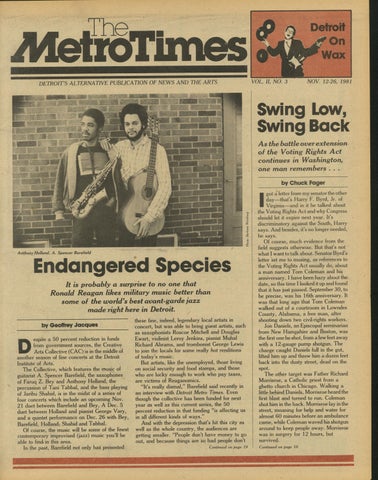
Anthony Holland , A. Spencer Barefield
Endangered Species It is probably a surprise to no one that Ronald Reagan likes military music better than some of the world’s best avant-garde jazz made right here in Detroit. by Geoffrey Jacques
espite a 50 percent reduction in funds D
from government
sources, the Creative
Arts Collective (CAC) is in the middle of another season of fine concerts at the Detroit Institute of Arts. The Collective, which features the music of
guitarist A. Spencer Barefield, the saxophones _ of Faruq Z. Bey and Anthony Holland, the percussion of Tani Tabbal, and the bass playing
of Jaribu Shahid, is in the midst of a series of four concerts which include an upcoming Nov. 21 duet between Barefield and Bey, A Dec. 5 duet between Holland and pianist George Vary, and a quintet performance on Dec. 26 with Bey, Barefield, Holland; Shahid and Tabbal. Of course, the music will be some of the finest contemporary improvised (jazz) music you'll be able to find in this area. In the past, Barefield not only has presented
these fine, indeed, legendary local artists in concert, but was able to bring guest artists, such as saxophonists Roscoe Mitchell and Douglas Ewart, violinist Leroy Jenkins, pianist Muhal Richard Abrams, and trombonist George Lewis to join the locals for some really hot renditions of today’s music. But artists, like the unemployed, those living — on social security and food stamps, and those who are lucky enough to work who pay taxes, are victims of Reaganomics. “It’s really dismal,” Barefield said recently in an interview with Detroit Metro Times. Even though the collective has been funded for next year as well as this current series, the 50 percent reduction in that funding “is affecting us in all different kinds of ways.” And with the depression that’s hit this city as well as the whole country, the audiences are getting smaller. “People don’t have money to go out, and because things are so bad people don’t Continued on page 19
: got a letter from my senator the other day—that’s Harry F. Byrd, Jr. of Virginia—and in it he talked about the Voting Rights Act and why Congress should let it expire next year. It’s discriminatory against the South, Harry says. And besides, it’s no longer needed, he says. Of course, much evidence from the field suggests otherwise. But that’s not
what I want to talk about. Senator Byrd’s
letter set me to musing, as references to the Voting Rights Act usually do, about a man named Tom Coleman and his anniversary. I have been hazy about the date, so this time I looked it up and found that it has just passed. September 30, to be precise, was his 16th anniversary. It was that long ago that Tom Coleman walked out of a courtroom in Lowndes County; Alabama, a free man, after shooting down two civil-rights workers. Jon Daniels, an Episcopal seminarian from New Hampshire and Boston, was the first one he shot, from a few feet away with a 12-gauge pump shotgun. The charge caught Daniels full in the gut, lifted him up and threw him a dozen feet back into the dusty street, dead on the spot.
The other target was Father Richard Morrisroe, a Catholic priest from a ghetto church in Chicago. Walking a little behind Daniels, Morrisroe heard the first blast and turned to run. Coleman shot him in the back. Morrisroe lay in the street, moaning for help and water for almost 60 minutes before an ambulance came, while Coleman waved his shotgun around to keep people away. Morrisroe was in surgery for 12 hours, but survived. Continued on page 10
—