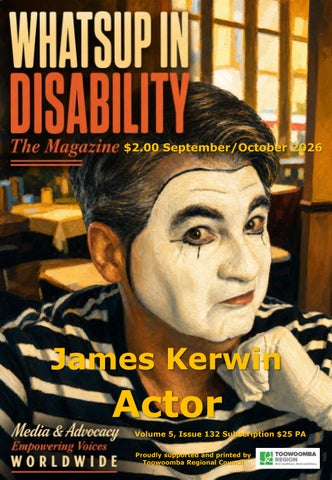
$2.00 September/October 2026
James Kerwin
Actor
Volume 5, Issue 132 Subscription $25 PA Proudly supported and printed by Toowoomba Regional Council
1
Highlights September/October 2026
Page 4
Page 6
Page 15
Page 16
Page 18
Page 20
Page 21
Page 24
Page 28
WhatsUp in Disability
Page 2
New Framework Planning The Department of Health, Disability and Ageing wants your feedback on new framework planning and NDIS supports. In the 2026-27 Budget the Australian Government announced changes to protect the National Disability Insurance Scheme (NDIS) for people with permanent and significant disability now and into the future. On 14 May 2026 the NDIS Amendment (Securing the NDIS for Future Generations) Bill was introduced to Parliament.
Welcome to this issue of WhatsUp in Disability Magazine, a publication by and for people with disabilities that continues to grow from strong local roots. A couple of things happened that effect current Magazine.
have this
Firstly after using M icrosoft Publisher for 20 years to create this publication, it has been announced that Publisher will no longer operate from October 2026, so I have been trying a number of different software for my desktop publishing. Secondly, I ’ve taken this opportunity to experiment and make some changes to the look of the Magazine.
The Government is committed to consulting with the community on a range of measures, including new framework planning and NDIS supports. This public consultation focuses on four new NDIS rules for new framework planning. These rules are about: how a participant’s disability support needs will be assessed how reasonable and necessary budgets will be developed how a participant their plan
can
use
how a new framework can be changed
plan
This consultation also seeks feedback on updates to the NDIS Supports Transitional Rule.
The same great stories will be told and the champions in our sector will be acknowledged.
WhatsUp in Disability
Page 3
Early Debut Discovered physical theatre early, performing his first eisteddfod mime show at age 8. He later appeared as a contestant on Network 10’s Young Talent Time. James holds a Bachelor of Arts (Theatre), a Diploma of Auslan, and a Graduate Diploma in Learn & Teach (Primary).
James Kerwin is a profoundly deaf Australian mime artist, actor, educator, and author based in Toowoomba, Queensland. He is recognised as one of the first Deaf individuals in Australia to graduate from university with a Bachelor of Arts in Theatre. James dedicates his career to modern mime techniques— specifically slapstick, satire, and visual storytelling—to bridge the gap between deaf and hearing audiences. Born profoundly deaf in the 1960s during a rubella epidemic, he originally communicated via cued speech. He began learning Auslan (Australian Sign Language) at age 16 through peers.
WhatsUp in Disability
Page 4
James Kerwin a story By Steven Paull
WhatsUp in Disability
Silently, the world arrived for James. While the historic Empire Theatre in Toowoomba buzzed with the ambient chatter of an assembling crowd, James stood in the wings, cocooned in a familiar, comforting quiet. He adjusted the vest of his costume, took a breath, and smiled. Where others required words to build worlds, James needed only the tilt of his head, the sharp extensions of his fingers, and the infinite canvas of the air around him. Growing up profoundly deaf, James had spent his life decoding a hearing world. He had spent his youth translating spoken rhythms into visual landscapes, mastering Auslan, and eventually becoming one of Australia’s first Deaf university graduates in theatre. On stage, that lifetime of observation became his ultimate superpower. Tonight, he was performing SHOOSH!, his physical comedy about a whimsical librarian discovering the magic hidden within books. He stepped into the spotlight. The stage lights were warm, cutting through the darkness to illuminate the precise geometry of his movements. James didn’t see a silent room; he saw a symphony of faces. He extended an arm, his fingers
WhatsUp in Disability
wrapping around the imaginary handle of a massive, heavy door. With a slow, straining pull of his shoulder, the audience could practically hear the ancient hinges groan. He pulled an invisible book from a shelf, opening it with theatrical awe . Suddenly, his expressions shifted like a rapidfire flipbook—wonder, terror, delight, and mischief chasing each other across his face. A flick of his wrist conjured a playful butterfly; a sudden duck of his head shielded him from an imaginary storm. This was the magic James worked so hard to cultivate. By blending modern mime with classic slapstick and satire, he erased the invisible barrier between languages. When the final invisible book was closed and James took his bow, the theatre erupted. He couldn' t hear the thunderous applause, but he felt it—a beautiful, rhythmic vibration rolling across the floorboards and rising through the soles of his shoes. He looked out at the sea of hands raised high in the air, twisting back and forth in the universal sign for applause. It was a visual ovation, a wave of silent energy that matched the quiet joy in his own heart. James bowed again, completely at home in a world defined not by sound, but by connection.
Page 5
On Monday 20th July 2026 A Disaster Recovery and Resilience – Disability Service Providers Emergency Preparedness Forum organised by TRC representative Cate Cool, was conducted at the Toowoomba Anex where over 150 attendees listened to a number of key agency, advocacy and emergency representatives on strengthening disaster preparedness, response and recovery across the sector.
WhatsUp in Disability
Page 6
The NDIS is the national scheme that funds supports/ services for eligible Australians with significant or permanent disability.
(PEPS) Personalised Emergency Management Plans Required for all participants managed provider.
NDIS by a
Must include contacts, health information, communication preferences, behaviour support and mental health strategies, and participantspecific assistive technology details.
NDIS Quality and Safeguards Commission The Commission is an independent Australian Government body and the national regulator for NDIS providers. It is not the NDIS or the NDIA. Its core role is to keep participants safe by ensuring quality supports/services through setting and enforcing rules (e.g., NDIS Code of Conduct and NDIS Practice Standards), registering and guiding providers, overseeing worker screening and its database, and addressing concerns via complaints, reportable incidents, and safeguarding processes. The NDIS Commission regulates providers; it does not manage participant plans or eligibility. WhatsUp in Disability
Plans must address scenarios such as evacuation, shelterin-place, and power loss. Plans must be in accessible formats tailored to participants and families (e.g., easy reads, social stories). Providers should know emergency authorities alert systems.
local and
Practice evacuation scenarios with participants and staff, especially where routinedependence or behaviours of concern exist; drills help reduce distress in real emergencies
Important Note Emergency management is a core obligation for NDIS providers. Planning must be risk-based and tailored to participants. Page 7
By Steven Paull WhatsUp in Disability
Equipment Readiness and Maintenance Ensure backup power (e.g., lithium batteries) , first aid kits, extinguishers, fire blankets, and smoke alarms are working and in good order. Implement regular audits and checklist-based inspections, mirroring aviation/automotive pre-flight/ start checks. Use automated and manual checks; respond promptly to indicators of issues.
Legislative and Regulatory Alignment in Disaster Planning for Disability Services Organisations must align disaster plans with NDIS Commission requirements and the Code of Conduct. Consider the interplay with the Workplace Health and Safety Act; complementary and conflicting areas exist. Include organisational vision and policies within disaster management plans. Equipment standards (e.g., smoke alarms) are changing; as of October this year, interconnected alarms are required in each bedroom and major living area.
WhatsUp in Disability
Staff Training Train staff on stepwise protocols (e.g., DRSABCD for first aid; PASS for fire extinguishers) . Use simple and memorable sequences to guide actions and reduce panic. Practice procedures with clients and staff to build familiarity.
Person-Centred Planning Review plans with clients; incorporate personal essentials (medication, comfort items). Personalise plans for non-verbal clients or those with physical impairments and tailor communication methods. Balance practice frequency to avoid complacency and ensure drills feel meaningful.
Page 8
Safety in Client Homes and Navigating Consent Client homes become workplaces when staff provide support; work cover applies if staff are injured. Legislative constraints differ from organizational premises; clients may refuse visible safety equipment. Seek middle-ground solutions (e.g., portable emergency kits).
Preparing for Diverse and Rare Disasters Do not dismiss low-probability events; consider impacts beyond direct damage (e.g., supply chain disruptions). Historical and hypothetical examples ( floods, pandemics, meteor near-passes) illustrate a broad risk range.
Priorities for Small and Emerging Disability Organisations Small providers must meet the same legislative compliance as large ones. Seek professional advice early for best practice (examples: consulting experts). Early compliance accelerates growth and stability.
Resources and Templates for Planning
Important Notes Keep plans current with legislation and organizational policies; ensure compliant safety equipment. Maintain a robust audit regimen and standardised checklists to ensure equipment readiness. Structured training and repetition lower panic risk and improve response quality. Integrate individual needs and preferences to enhance effectiveness and client comfort. Use respectful discussions to negotiate safety measures; adapt with portable equipment when needed. Adopt an all-hazards mindset; acknowledge and plan for unlikely but impactful scenarios. Invest early in compliance and expert guidance; operate as if a “big business.” Leverage shared templates, legal readiness materials, and AI tools to strengthen planning. Strengthen networks information-sharing improve service quality client outcomes.
and to and
A template for emergency and disaster plans is available via Cate Cool; contact through TRC.
Collaboration and Networking Across Providers WhatsUp in Disability
Page 9
Command Structure Local Level Local governments hold legislative responsibility for disaster management. Each of the seventy-seven local governments has a LDMG. District Level Based on police districts. In the Toowoomba district, this includes the Toowoomba Regional Council and Lockyer Valley. Police lead at the district level, wit h the highestranking police officer chairing the DDMG. State Level
(LDMG) Queensland’s Disaster Management Framework Disaster management in Queensland is governed by the Disaster Management Act, which is unique in Australia. The framework comprehensive, scalable, locally led.
is and
It uses an “all hazards” approach, covering meteorological events ( floods, cyclones, severe weather) and human- caused issues ( including counter-terrorism) .
Important Note While the LDMG and partner agencies work to provide solutions, the core message is to promote self- sufficiency and resilience. WhatsUp in Disability
The district level operates under state disaster management plans with delegated roles. Activation and Coordination “Activate” means escalating the response level. Status indicators such as “alert” or “lean forward” are shorthand to inform partner agencies about imminent risk or preparatory actions. When a local disaster coordination centre is activated, agencies are requested to send an Agency Liaison Officer. The Toowoomba coordination centre is located on the mezzanine level above the Annex. Lead agency depends on the hazard: Local government for “wet or dirt” events ( floods, cyclones, earthquakes), Queensland Fire Department for fires, and Department of Agriculture and Fisheries for biosecurity. Page 10
Partner Agencies Queensland Police Service Police are essential for their local knowledge and resource coordination. Their routine roles—preserving peace, traffic management, and state search and rescue—translate directly to disaster response. They also manage disaster victim identification. A key role is assisting with and, when necessary, directing evacuations for public safety. Department of Housing and Public Works Provides temporary emergency accommodation for people whose homes are destroyed or too damaged to return to. Darling Downs Health Coordinates specialised medical needs, assists with evacuating vulnerable patients, and ensures ongoing care, including access to medications. West Moreton Darling Downs Primary Health Network Engages community health services and primary care providers, pre- informing local GPs and medical centres. Department of Families Seniors, Disability Services and Child Safety (DSSD) Provides grants and hardship payments through the Personal Hardship Assistance Scheme. (e.g., septic systems, power). They also deploy community recovery reserves for physical, emotional, and psychological support. WhatsUp in Disability
Evacuation Procedures and Warnings The LDMG decides to evacuate based on intelligence, planning, risk assessment, and hazard severity. In serious situations, the District Disaster Coordinator (police lead) can direct an evacuation under the Disaster Management Act, sometimes without direct liaison with the local level. Once evacuation is decided, a warning period begins and emergency warnings are issued. Messages escalate with threat level: “avoid smoke” ( low level) , “prepare to evacuate,” “evacuate now,” and the worstcase: “seek shelter immediately” (unsafe to leave). Post-event messages “return with caution” safe to return.”
include or “not
An evacuation centre is a “life raft,” not a “cruise ship.” I t provides basics—stretcher, blankets, pillow—in a communal setting (e .g., a showgrounds pavilion) . Centres can be established with as little as five minutes’ notice. The council works with partners such as the Red Cross. People are strongly advised to go to friends and family first, as it is more comfortable and allows pets and personal belongings. The council manages flood warnings
its
own
Page 11
By Christy Lambert TRACC
Person-Centred Disaster Preparedness The core of preparedness is ensuring that person-centred plans include emergency contacts. Each individual should have a personalised pack, similar to the packs given out at the event, containing everything needed for an emergency. These plans and packs should detail communication needs, medication information (even a few days’ worth) , equipment requirements, and support preferences. Include arrangements displacement.
in
alternative case of
Learning from peers about what works and what doesn’ t is valuable, given the breadth of expertise in the room. Ensuring In clusion Relationships
an d
Inclusion should extend to consumers, not just service providers. Forming relationships, like those built at the event, is a key component of a strong support network. Accessible Information Each council has a disaster tab on its website, a “well of information.” This applies to Downs councils.
all
Darling
Key Principles for Support and Resilience
Community participation and ensuring people feel valued and heard are also important.
Building Resilience
Unique Ch allen ges for People with Disabilities
Resilience is crucial and develops over time through repeated experience in disasterrelated situations. Support workers should share the concept of resilience with their consumers. Fostering Connection Service providers need to connect for mutual support; the event itself is a strong networking opportunity.
WhatsUp in Disability
People with disabilities may face unique and significant challenges during and after a disaster. They may struggle for considerable time afterward.
a
Important Note Maintaining client routines is an important part of recovery support.
Page 12
Business Continuity By Jess Riley Queensland Health
Business Continuity Planning (BCP) Jess Riley works in emergency and disaster management for Darling Downs Health, Queensland Health, overseeing their business continuity program. The program began to address varied and often minimal understanding of business continuity across facilities. Objectives included educating managers and standardizing BCP templates. Previously, some plans were limited to ICT downtime procedures; now, all rural and hospital facilities have comprehensive plans. A BCP is a backup plan to keep essential services and critical functions operating when the unexpected occurs. Colloquially described by a hospital facility manager as “the plan we refer to when all shit hits the fan.” It outlines the steps needed to ensure essential services and critical functions continue during a disruption. A BCP plans for the disruptions arising from events (e.g., storms, bushfires), not the events themselves. Examples of disruptions include WhatsUp in Disability
impacts on staff, loss of facility, no telephone network, power failure, cut roads, and loss of ICT systems. A recommended starting list includes staffing and accommodation, power, water, food, communications (comms), and supply chain. A useful resource is “RACF planning for emergency resources” ( available online), with a detailed chapter on business continuity and disruptions; the “disability inclusive emergency plan” may also offer valuable insights. Include a list or essential resources.
table
of
Essential Staff Minimum staffing to operate (e.g., one admin officer, one team leader, four support workers). Essential Equipment Resources and consumables like PPE, mobility equipment, computers, mobile phones, laptops—critical if displaced. ICT Systems List dependent systems and applications, plus downtime forms or alternative applications.
Important Note Review BCPs regularly (e.g., annually or every 2 years). Conduct a mandatory review after any activation to incorporate lessons learned. Page 13
By David Boden TASC National
David’ s presentation highlights TASC’s long-standing, personcentred advocacy work in Queensland, focusing on empowering individuals with disabilities, especially in rural and remote communities. TASC prioritises individual rights, practical navigation of complex systems like the NDIS, and sustained support after disasters through programs such as Community Connected, QSTARS, and seniors’ legal services. While systemic advocacy exists, TASC’s primary mission is enabling individuals to be heard and regain stabilit y and support networks post-crisis. David underscores the importance of physical presence in communities for effective advocacy, as remote-only support is insufficient for many disability- related needs.
Disaster Context and Post-Disaster Needs Advocacy continues immediate disaster
after
David clarifies T ASC is not a crisis responder, but disasters extend beyond the event. People with disabilities may be displaced longer and lose support networks. Advocacy helps restart services, expedite processes, and facilitate returns to home and support networks. WhatsUp in Disability
Leveragin g TASC legal an d tenancy services postdisaster TASC’s QSTARS ( tenancy advice) supports issues like landlord conflicts, bonds, and repairs. Seniors Legal Advice and Support (social worker + lawyer) addresses financial and elder abuse risks heightened for older Queenslanders during emergencies.
Human Rights Human r ights persist in emergencies; vulnerabilities increase David emphasizes that human rights remain regardless of disasters. The Disability Royal Commission found people with disabilities are often excluded from disaster planning, leading to increased domestic violence, abuse, and neglect during emergencies. Example of righ ts violations during COVID-19 David cites a case where a woman was confined under the pretext of social distancing, with curtailed freedoms and basic needs controlled. Proper plans should identify genuine social networks (not solely paid supports) and include them in disaster preparedness.
Page 14
By Michael Burge Mental Health Advocate
Anyone can create a WRAP— not just individuals with lived experience, carers, or family members. Michael believes everyone should have one. Proactive Mental Management
Health
Preparing mentally for emergencies starts by talking about them before they happen.
Michael discusses the Wellness Recovery Action Plan (WRAP) , a tool he taught in Toowoomba about since 2011. WRAP is described as an evidence-based tool developed by Mary Ellen Copeland in the USA over 40 years ago ( before the late 1980s). The plan’ s purpose is to help individuals and their support networks prepare for emergencies, disasters, and illnesses. The central theme of WRAP is preparation, based on the military “six P’s”: “prior preparation prevents piss poor performance.” Michael emphasises preparing before an emergency rather than reacting to it.
WhatsUp in Disability
Key actions include staying connected with people, creating a plan with family and friends ( like a WRAP) , and checking on vulnerable neighbours. Identify who you can turn to for emotional support. Don’t be afraid to reach out when struggling. A simple phrase like, “You don’ t have to face this alone,” can make a significant difference. Ask, “Who will I call, and who will I check on?”
Important Note He concludes with an adaptation of a Maya Angelou quote: “People with a liv ed experience of mental illness may forget exactly what you said to them; they may even forget exactly what you did to them; but they will never forget how you made them feel.” Page 15
By Amber Hills AI Automation Australia
This lecture series, sponsored in Toowoomba by Breakaway as part of their Community of Practice events, provides a comprehensive overview of how to safely and effectively integrate Artificial Intelligence (AI) into business operations, with a particular focus on the Australian NDIS sector. With a combined experience of over 40 years the speakers focus on growing a business with AI without losing control, using it safely as a “co-pilot” for heavy-lifting tasks. T his allows humans to focus on interpersonal roles and prevents burnout, a key motivation drawn from the speakers’ personal experiences with the immense and unsustainable administrative burden in the care sector.
WhatsUp in Disability
and Dr Anup Shrestha PhD SFHEA UniSQ
Risks of improper AI implementation Misusing AI can lead to business loss, significant frustration, and substantial fines (up to $3.64 million per breach) , and potential banning orders. The NDIS screens for use.
agency actively inappropriate AI
Page 16
Defining and Understanding Artificial Intelligence Core Characteristics of AI A system is considered AI if it learns from experience, engages in reasoning/ abstraction, adapts to context, and is goal-oriented. Unlike pre-programmed tools, AI is based on mathematics (“maths, not magic”) and adapts its responses by learning from user interactions. AI Evolution AI dates to the 1950s and mimics human brain processes. Modern AI is unpredictable, as not even its programmers can be certain of its outputs. I ts evolution has shifted the human- computer interaction focus from conquering distance (internet) and scale (smartphones) to the nature of intelligence itself. AI as an “Umbrella Term” It’s crucial to clarify the kind of AI (chatbot, classifier) , its data source, the process/activity it’ s used for, and its level of autonomy. Levels of AI Engagement AI use ranges from a simple Tool to a Co-pilot (recommended) , an Agent, a Planner, and fully Autonomous systems, with each level requiring greater governance. Rapid Adoption AI adoption is unprecedented. ChatGPT reached 50 million users in a few months.
WhatsUp in Disability
Safe AI Use in an NDIS Regulated Environment The “Dos” of AI Use Keep a human reviewing every single AI output. If you lack expertise, consult a team leader or director. Use tools specifically built for regulated care, trained on NDIS knowledge to prevent fabrication and ensure relevance. Keep participant data secure in Australia-hosted, encrypted systems. Disclose AI assistance where appropriate and train your team on safe usage. The “Don’ts” of AI Use Do not put participant into public chatbots.
data
Do not let AI write final clinician or incident reports without human oversight and sign-off. Do not treat AI as the final decision- maker or assume its information is correct. Do not use “black box” systems where the decisionmaking process is unauditable.
Page 17
By Steven Paull WhatsUp in Disability
Lindy cites an impressive 83.5% employment rate across Australia post-completion, evidencing strong outcomes. Russell (Job Coach) emphasised that Project SEARCH’s strong support system boosts confidence, helping interns sustain their workload and put their best foot forward. This encouragement is central to interns’ ability to progress and engage effectively in their roles.
I recently had the opportunity to interview coaches and interns of Project SEARCH operating at St Vincent’s Hospital, Toowoomba, sharing their experiences. Lindy (Job Coach) explains that the program is a 12-month pre-employment initiative for people with disabilities, hosted by the hospital, providing internships across varied departments. T he hospital has been very welcoming and inclusive, opening opportunities and fostering acceptance. Lindy outlined three internship rotations of 11 weeks each, preceded by orientation to build soft skills and confidence. T he program includes resume building, interview practice, and an intensive job phase aimed at securing paid, equitable employment. WhatsUp in Disability
Daily job coach support includes morning check-ins, afternoon curriculum reinforcing jobrelated learning, and integration between interns and hospital staff. He notes powerful mutual integration— interns are embedded in hospital teams, and the hospital actively supports Project SEARCH.
Intern Feedback Rosie values getting out into the community through the program, which expands her knowledge and broader understanding. She expresses enjoyment of the course, highlighting personal growth and community exposure as key benefits. Brandon greatly appreciates experiences in specific medical fields within the hospital.
Page 18
He believes this exposure will contribute to securing longterm employment in the future, showing the program’s practical pathway to jobs. Tom shares that his main challenge in the job market has been interviews and understanding industry expectations. Project SEARCH provides clarity on what employers expect and how to present himself, making the path to employment more navigable. He credits the program’ s structured process for teaching the ins and outs of getting and keeping a job. The framework offers practical steps and continuous guidance, improving employability through systematic practice and learning.
WhatsUp in Disability
Shayna values gaining workplace experience, meeting new people and patients, and having conversations. These interactions enhance her communication skills and confidence, contributing to meaningful engagement in hospital settings. Ethan praises St Vincent’ s staff for welcoming interns and providing adaptive training. He notes that trainers recognize when interns are overloaded and adjust methods to suit individual learning styles, ensuring knowledge is absorbed effectively. The group expresses excitement about continuing to the very end of the program, signalling strong morale and commitment to completion.
Page 19
Commission began in March 2026 after the NDIA identified unauthorised access to protected records of NDIS participants. An Adelaide woman, 48, was the first person to be charged after the FFT investigation alleged she used her position as a NDIA employee to access more than 40 NDIS participant records. I t is alleged the woman then unlawfully provided the NDIS participant records to a local NDIS provider owned by the man for financial benefit.
The AFP has charged an Adelaide man over an alleged multi- million- dollar dishonesty plot against the NDIS. The Adelaide man, 38, a director of a registered NDIS provider, was preparing to leave the country when he was arrested by the AFP on Friday night (14 August 2025) at Adelaide Airport. He was taken to The Adelaide City Watchhouse and charged with dealing with the proceeds of crime and soliciting protected NDIS participant information from a National Disability Insurance Agency (NDIA) staff member. An investigation by the Australian Government Fraud Fusion Taskforce (FFT) comprising the AFP, NDIA Australian Criminal Intelligence Commission (ACIC) and NDIS Quality and Safeguards
WhatsUp in Disability
It is further alleged the woman received more than $53,000 from the local NDIA provider as part of a total alleged $5 million plot. She was charged on 10 June 2026 and is scheduled to next appear in the Adelaide Magistrates Court. The man, 38, allegedly used the NDIS participant information received from the woman to make thousands of NDIS funding claims.
QUEENSLAND NEWS Queenslan d C hild Safety Minister Aman da Camm said that the Albanese government had failed to confirm what constituted “mild to moderate autism”, which was required to establish and design Thr ivin g Kids. “Minister Butler can make comments all he wants, but we are not rushing the signing of the bilateral agreement because there is important information still outstanding.
Page 20
Sister Elizabeth Kenny On a remote property on the Darling Downs in Queensland, an untrained bush nurse was called out to treat a child suffering from a mysterious paralysis. It was 1911, and polio was crippling thousands of children across the world. The standard medical practice at the time was to lock small limbs into rigid splints and heavy iron braces. Sister Elizabeth K enny believed immobilisation was doing more harm than good. She began wrapping limbs in hot moist woollen cloths and gently moving the joints to keep muscles alive. Her young patients began recover movement, but the WhatsUp in Disability
to
established medical fraternity fiercely rejected her work, dismissing her methods as dangerous and unorthodox. Refusing to give up, Kenny took her methods across rural clinics, to England, and eventually to America, where she opened the Sister Kenny Institute in Minneapolis. Her rehabilitation techniques became the foundation of modern physical therapy, helping thousands of children walk again before a vaccine was ever invented. She died quietly in Toowoomba in 1952, remembered as a woman who trusted common sense over medical rigidity. Do you think Australia does enough to remember everyday pioneers like Sister Kenny?
Page 21
By Melinda Everett Assist Industries
The series takes subjects that can quickly become overwhelming — compliance responsibilities, evidence, service risks, complaints and quality systems — and break them into practical, manageable learning that works for even the smallest NDIS providers.
Final Weeks for Queensland NDIS Providers to Access Fully Funded Short Courses A project to support Queensland NDIS services navigate their changing world is available free - but time is running out. Eligible Queenslanders have until October 31st to take advantage of the free series that breaks NDIS- related topics into learning and tools designed for the real world. The free micro-credentialling project has been proudly funded and supported by the Queensland Government and is being delivered by regionallybased enterprise Assistance Industry Resourcing (AIR).
WhatsUp in Disability
According to AIR Project Coordinator Melinda Everett, the courses take a sea of heavy compliance information and retells it in the language of everyday people and situations. “Our aim was to make micro courses that were low on time and jargon, but big on tools and practical help.” “Each title aims to go one step further and help people actually tick something off their to-do list – rather than leaving them with another one added” she said. With compliance and registration expectations continuing to evolve, building practical understanding of quality systems is increasingly important for NDIS services of every size.
Page 22
Building Skills
Training Titles
“People frequently enter the disability sector because they are good at working with people — not because they have a burning ambition to write policies, interpret regulations or prepare for audits,”
Titles include Mapping your compliance landscape, NDIS Practice Standards & Code of Conduct, Options for evidence, Risks to self, others and service, Getting complaint systems right and Applying to be a registered NDIS provider.
“We know having a strong choice of good local providers matters, yet we also know that the regulatory system is becoming harder for services of all sizes to navigate. Building these skills is critical to ensure people who are great at support stay in the sector, doing what they do best”. The six micro courses each award a micro credential on completion and are packed with tools, templates and links.
WhatsUp in Disability
With funded access ending on 31 October, providers interested in taking part are encouraged not to leave enrolment until the last minute. People can check eligibility and complete the micro courses online at their own pace at www.communityresourcepool.co m.au or can attend face-to-face workshop sessions being held offered in a variety of locations. Anyone wanting to request a workshop in their region, or with questions about the project, is encouraged to reach out to the Project Coordinator at melinda@assistindustries.com.a u
Page 23
By Clifford Gouldson Lawyers
The Legal Framework The Fair Work Act gives certain employees the right to request flexible working arrangements, including employees who are pregnant, have caring responsibilities, live with a disability, or are aged 55 years or older. A request must be made in writing and explain both the changes sought and the reasons for those changes. Employers must respond within 21 days and may only refuse a request on reasonable business grounds.
What Does "Because Age" Really Mean?
of
Employees aged 55 and over have a statutory right to request flexible working arrangements under the Fair Work Act. However, simply meeting the age requirement is not enough. T here must also be a connection between the employee's age and the flexibility being sought. A recent Fair Work Commission decision has e xplored that connection in detail, finding that a 67-year-old employee's desire to transition towards retirement and pursue personal creative projects was sufficient to establish the required link. The decision provides useful guidance for both employers and employees when navigating flexible work requests. WhatsUp in Disability
Importantly, it is not enough for an employee to simply fall within an eligible category. There must be an objective connection between the relevant circumstance and the flexibility being requested.
The Bestseller Case In Paul Murray v Watpac Construction Pty Ltd, a 67-yearold construction manager sought to compress his five-day working week into four days. His intention was to create more time for retirement planning and to pursue his ambition of writing novels that could provide income during retirement. Watpac refused the request, arguing that the arrangement would negatively affect the project he managed and create difficulties in redistributing his duties. T he employer also argued that the request was not
Page 24
truly connected to Mr Murray' s age, but rather to his desire to pursue a separate commercial venture.
The Commission disagreed While Commissioner Simpson accepted that simply being over 55 is not enough on its own, the Commission found there was a sufficient connection between Mr Murray's age and the arrangement sought. His desire to transition towards retirement, improve work- life balance and create time for personal projects associated with that transition established the required nexus. The decision confirms that the connection between age and a flexible work request can be broader than a direct reduction in hours or an immediate retirement plan.
A Practical Example
For employers Carefully assess whether the required connection exists between the employee's circumstances and the flexibility sought. Avoid assuming a request falls outside the legislation simply because the employee's motivations are broader than the obvious purpose of the provision. Ensure any refusal is genuinely supported by reasonable business grounds.
For employees Clearly explain why the requested arrangement relates to your qualifying circumstance. Provide sufficient detail to demonstrate the connection between your circumstances and the flexibility sought.
The Commission has also demonstrated a willingness to balance competing interests in family responsibility cases. In Laura K liffen v Reapit Employment Services Pty Ltd, a part-time employee with two young children, including a child with special needs, sought to continue her flexibility to work from home post a transfer of business. T he Commission ultimately ordered a compromise arrangement that largely accommodated the employee's request while preserving regular workplace attendance.
WhatsUp in Disability
Page 25
WhatsUp in Disability
Page 26
Movie Review The Odyssey
Christopher Nolan’s “The Odyssey” is one heck of a film. And in a world where the only films that seem to make money in Hollywood are adaptations of other stories, it only makes sense that The Odyssey – adapted from one of the oldest stories in human history – is one of the most successful films of the year! There’s a lot to like about it – the filmmaking is absolutely immaculate. I f you’ re a fan of the art of cinema, you won’ t be disappointed by what Christopher Nolan, and his team have managed to do. T he cinematography is brilliant, the sound mix is stellar, and the musical score is simply astounding. And the effects are second to none, everything looks and feels so real, from the digital effects right down to the mesmerising practical effects.
By Rob Morgan Media Podcaster
Nolan’ s Odyssey forgoes the glory of the original story; for his Odysseus, there was no glory to be found in war, only suffering and despair. Some critics have decried this interpretation of the story, but in our world, there’s no better way to tell such an epic tale, other than with the harsh truth. The Odyssey is still currently playing at cinemas, if you can make it, you should check it out as soon as you can, it’ s one of the best cinematic experiences you’ll have this decade! 10/10
By Rob Morgan
And the performances are excellent, too. Matt Damon leads the pack as Odysseus, and we spend the majority of the film with him. He gives a charismatic, yet haunted performance, as a brilliant tactician, worn down by the treacherous journey home, and the trauma of what he did in the service of war. And the supporting cast, Robert Pattinson, Anne Hathaway, John Leguizamo, and more, were at the top of their game, too. WhatsUp in Disability
Page 27
young people, her leadership with Toowoomba Regional Council, and her work cofounding the Maryam Foundation, an organisation dedicated to supporting vulnerable families and refugee communities. It is recognition not just for one achievement, but of a wide-ranging commitment to empowering others and using her voice to drive positive change.
Mariam Nabizada We are very proud here at 102.7 FM to have Mariam as one of our announcers and to feature on the cover of our August edition of LiveWire Newsletter.
Mariam currently serves as a youth leader with Toowoomba Regional Council and is a YMCA Queensland Youth Parliament member for Toowoomba North, where she advocates for issues affecting young people and contributes to discussions around policy and social change.
A Year 12 student at Fairholme, Mariam Nabizada, is a young woman whose leadership, compassion and commitment to advocacy are already creating meaningful change. In recognition of her outstanding contribution to the communit y, Mariam Nabizada was named the 2026 Toowoomba Young Citizen of the Year, an honour presented at the Australia Day Awards ceremony held at Picnic Point. This award acknowledges Mariam’s tireless advocacy for WhatsUp in Disability
Page 28
Centre The Paul Myatt Community Centre is a welcoming hub where people with disability, their families, carers and the wider community come together to connect, learn and participate in inclusive activities. Managed by WhatsUp in Disabilit y since 2011, the Centre is dedicated to creating opportunities for social inclusion, education and community engagement. Unfortunately, every time it rains, our car park becomes flooded, muddy and difficult to navigate. For many visitors this is inconvenient, but for people who use wheelchairs, walking aids or have limited mobility, it can make accessing the Centre unsafe—or even impossible. Families with young children, older Australians and transport providers also face significant challenges entering and leaving the Centre. We are raising funds to transform the car park by installing a sealed bitumen surface together with kerb and channel infrastructure to divert stormwater away from the entrance. These improvements will provide a safe, all-weather accessible parking area that can be used year-round, regardless of the weather. Every contribution, no matter how large or small, will help us remove a significant barrier to participation. By supporting this project, you are investing in a more accessible, inclusive and welcoming community where everyone can participate with dignity and independence.
www.givenow.com.au/carpark Click on the GiveNow logo to go to the fundraise page
WhatsUp in Disability
Page 29
September
WhatsUp in Disability
Page 30
October
WhatsUp in Disability
Page 31
New to Disability? Centrelink Payments and Services
132 468
Disability Support Pension 132 717 Health Care Card
132 490
Family Assistance
136 150
Indigenous Call Centre
1800 136 380
Emergency Crisis Payment 132 850 NDIS General Enquiries
1800 800 110
Medicare General Enquiries
132 011
Pharmaceutical Benefits
132 290
MyID Help Desk
132 307
Queensland Government Child Safety
4699 4255
Toowoomba Hospital
4616 6000
Department Housing
4699 4400
Community Groups Carer Gateway
1800 422 737
Lifeline Darling Downs
1300 991 443
Relationships Australia
1300 364 277
There are a number of support groups for most disabiliti es available in this region. Contact WhatsUp in Disability Phone: Email:
WhatsUp in Disability
0427 987 654 steven@bigdog.au
Page 32
Town Crier
Temporary Homes
The Toowoomba Region’ s Ambassador and Town Crier Kevin Howarth will return to international competition when he lines up at the Chester World Town Crier Tournament in north-west England later this month.
TRC will review regulations covering temporary homes, caravans, tiny homes and alternative forms of housing in response to growing community interest in alternative housing solutions and ongoing housing affordability challenges.
The highly decorated Mr Howarth will compete against more than 25 Town Criers from the United K ingdom, other countries across Europe, the United States, Canada and fellow Australians.
“Council appreciates how current housing affordability and availability issues have heightened community interest and calls for more flexibility around accessing alternative forms of housing,” Cr Cahill said.
Mr Howarth last year won four categories at the 36th National Town Crier Championships in Canberra. In 2024, he competed at numerous competitions across England, including the prestigious Armada Cup at Plymouth, K ingsbridge and Dartmouth in southern England. Toowoomba Regional Council Mayor Cr Geoff McDonald said he and fellow Councillors wished Mr Howarth every success at his looming Chester competition from 20 to 26 September 2026. “The Town Criers take the competition seriously, but we enjoy encouraging each othe r and swapping experiences about our roles.” WhatsUp in Disability
“While Council sets some of these parameters, many of the issues raised by community members relate to state legislation and regulations, especially conditions around building and plumbing requirements. This also includes matters relating to safety, health and amenity”. “Requirements exist to protect the community and ensure minimum standards for safety and liveability are maintained.” A report outlining findings, options and recommended next steps will be presented for Council’s consideration at the December 2026 Ordinary Meeting.
Page 33
Details PUBLISHER Disability Media Association Inc
(Australia)
TELEPHONE (07) 4632 9559 MOBILE 0427 987 654 OFFICE:
Paul Myatt Community Centre 11-15 Alexander Street Toowoomba
(open Monday to Friday 9:00am-3:00 pm) E-MAIL:
steven@bigdog.au
MANAGEMENT BOARD: Steven Paull (Editor) (Committee) Ann Paull (Committee)
Courtney Carroll (Committee) Jess Wright
PUBLISHED January/March/May/July/September/November ABN 72 821 350 911 DISCLAIMER/INDEMNITY Articles and adverts reproduced on these pages are accepted and published in good faith. It is a condition of acceptance that sponsors and article writers accept full responsibility for their sponsorship and articles, and will fully indemnify the producers in the event of any claims or legal proceedings against them. Articles published are not necessarily the view of the publishers. Sponsorships are also accepted on the basis that they do not conflict with any discrimination laws or other laws currently in force. SPONSORSHIP WhatsUp is a nonprofit and charity organisation, we are not funded in any way, and have to cover costs of this publication by charging for sponsorship. WhatsUp reserves the right to adjust, resize or move sponsorship posts when necessary to allow for editing WhatsUp IS AVAILABLE FROM: 1) SUBSCRIPTION
(In advance) $25 per year (includes delivery/postage).
2) A single edition of WhatsUp can be purchased at the Paul Myatt Community Centre and selected outlets. You may also subscribe by using the form on the outside cover. 3) Reference copies are held in the Toowoomba Visitor Centre and Regional Libraries. COPYRIGHT Copyright Protected. All pages are subject to copyright law and may be copied only with the permission of WhatsUp. Copies are not to be used commercially or for profit or for personal financial gain. Permission may be granted to copy only if the purpose is to give it away to others for their personal interest but not to any other organisation or service. DISCLAIMER All articles are accepted in good faith and are not necessarily the view of the Editorial team or Management. Articles are accepted on the understanding that in the event of any claims against WhatsUp, the writer of the article will take full responsibility and indemnify WhatsUp in the event of legislation against it. Articles are also accepted on the understanding that the contents do not breach any Disability laws or other legislation currently in use. ENVIRONMENTAL FRIENDLY/ COPYING WhatsUp In Disability is provided as a Master Copy to individuals and organisations or to view online at our website. We are environmentally friendly; we do not print any more copies than are necessary. We prefer and encourage the practice of passing the magazine from person to person or copying the whole magazine to pass on to others. Permission is needed to copy (see Copyright above) When copying the magazine, we require that the pages be marked ‘copy’.
WhatsUp in Disability
34
WhatsUp in Disability
35
11-15 Alexander Street Toowoomba 4350 Phone: 0427 987 654 Email: steven@bigdog.au
www.givenow.com.au/carpark
WhatsUp in Disability
36