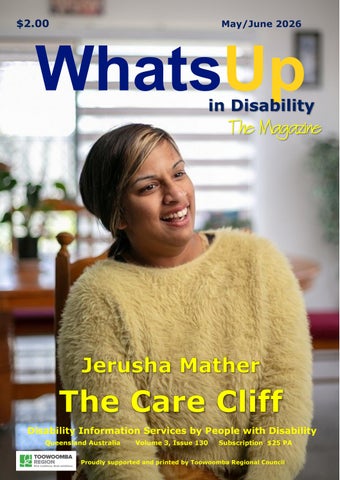
WID MAG 03 May Jun 2026

Page 1


The Editors Desk

This edition of WhatsUp in Disability comes at a moment of both tension and possibility for our sector.

Across these pages are stories that sit side by side in productive discomfort: stories of innovation and inclusion, and stories that ask difficult questions about integrity, access, and what happens when systems fail the very people they are meant to support.

We begin with lived experience leading change. Jerusha Mather’s story reminds us that disability does not end at 18 even if support systems often do. Her work, grounded in research, advocacy and daily reality, sets the tone for this issue: that meaningful change happens when people with disability are not just consulted, but are researchers, leaders and decision makers shaping the future.

That same theme runs through our coverage of community based responses across regional Queensland, where connection, trust and consistency matter more than polished programs or one off visits. From Community Connectors to neighbourhood level support, these stories highlight that solutions work best when they are embedded in place and relationship.

At a national level, we explore the growing scrutiny facing the NDIS. Budget pressures, integrity debates, and alleged rorting are no longer abstract policy conversations they have real consequences for participants, families and ethical providers. Several pieces in this edition confront those realities head on, while also reinforcing a vital truth: reform must be done with the disability

community, not to it. Inclusion, when done well, is not symbolic. You will see this in stories about accessible adventure spaces, evolving national sporting pathways, and practical safeguards responding to rising digital and financial risks. These examples show what is possible when inclusion is designed from the outset not added as an afterthought.

We also turn our attention to awareness itself. Autism awareness, we are reminded, opened doors but awareness alone will not build housing, create jobs, or sustain support. The real work happens quietly, persistently, and often without headlines, in the other 11 months of the year.

Together, the stories in this issue paint a clear picture: the disability sector is at a crossroads. There is no shortage of passion, creativity or commitment. What is required now is accountability, codesign, and the courage to confront uncomfortable truths while continuing to build what works.

Worldly matters such as the war in Iran, fuel shortages and extreme prices are also effecting us in ways that confuse and astound us.

As always, WhatsUp in Disability exists to amplify voices, share knowledge, and keep the conversation grounded in real lives. I hope this edition challenges you, informs you, and reminds you why this work matters.

WhatsUp in Disability

Most Cerebral Palsy Care Stops at 18. This Activist Is Working to Change That.

On her 18th birthday, Jerusha Mather didn’t feel like she was stepping into adulthood.

She felt like she had been pushed off a cliff.

Growing up with cerebral palsy (CP), Australia’s most common physical childhood disability, her care had always been structured. There were multidisciplinary teams, coordinated appointments and clinicians who understood the condition.

Then she turned eighteen

“Suddenly I was told adult services were limited,” she says. “It felt like the system expected my development to just stop.”

Jerusha quickly realised her experience wasn’t unusual. Today, adults make up 58% Australians living with CP, yet much of the healthcare system remains designed around paediatric care. When young people age out of those services, many encounter fragmented support, long waitlists and a shortage of clinicians trained in managing CP in adulthood.

“Adulthood with CP is dynamic,” she says. “We’re pursuing higher education, careers and independence. The healthcare system should reflect that.”

"Suddenly I was told adult services were limited"

Jerusha

Now a PhD researcher at Monash University, she is investigating neuromodulation in adults with cerebral palsy. Neuromodulation is a specialised field of medicine and bioengineering that alters nerve activity by delivering targeted electrical stimulation or chemical agents directly to specific neural sites.

Her work, and her leadership, has already been widely recognised. Jerusha is a recipient of the Bridge Create Change Award and part of the L’Oreal-UNESCO For Women in Science Program mentoring program. The Australian Academy of Science has recognised her as a STEM changemaker, and her portrait hangs in Questacon – National Science and Technology Centre, celebrating female role models in medicine.

But Jerusha’s research is shaped by something many scientists don’t bring to the lab: lived experience.

“In research, participants can sometimes be treated like data points,” she says.

“But they’re people managing work, study, fatigue and complex systems.”

In a field historically dominated by clinicians studying disability from the outside, Jerusha represents something different, disabled leadership within research itself.

The hidden “admin tax” of disability

Becoming a researcher didn’t exempt her from the same structural barriers she studies.

Rather than accepting those gaps, Jerusha decided to study them.

During postgraduate study, Jerusha found herself navigating the bureaucratic maze familiar to many disabled university students: separate departments for academic adjustments, disability services and funding support, each operating independently.

The Care Cliff

The administrative burden of coordinating them all nearly pushed her to burnout.

“There were moments where the fragmentation felt overwhelming,” she says. What helped was finding a clearer starting point. Through the Disability Gateway, an Australian Government initiative designed to act as a central point for information, services, and practical support for people with disability, their families and carers, Jerusha was able to access consolidated information about available supports, rather than navigating multiple disconnected systems.

“It didn’t remove every barrier,” she says. “But it reduced the overwhelm and gave me direction.”

A life the system didn’t plan for

With that support, Jerusha has carved out space for something the healthcare system rarely anticipates for disabled people: a full, multidimensional adult life.

Outside the lab, she trains at the gym to manage her CP, writes poetry and stays closely connected to her faith. She is also a fashion model signed with inclusive modelling agency Zebedee Talent.

Her poetry collection, Burnt Bones and Beautiful Butterflies, explores identity, resilience and disability.

“For me, modelling isn’t just about imagery,” she says. “It’s about representation and expanding the narrative of what strength and beauty look like.”

Jerusha has also become a vocal advocate for accessibility, including campaigning for more accessible packaging. Her petition calling for change attracted more than 13,000 signatures, highlighting how everyday design often excludes people with disabilities.

But her long-term goal remains firmly focused on healthcare and helping create a system that grows alongside the people it serves.

Labor will make slowing growth in the $50 billion National Disability Insurance Scheme a centrepiece of its budget savings as the war in the Middle East continues to heap pressure on households and the government’s bottom line.

Australia’s peak body for disability services has started priming NDIS providers to expect significant changes next month, but it is encouraging the sector to embrace public debate over the future of a scheme it says has enough funding but is riddled with integrity failures.

Savings delivered from driving down NDIS forecasts over the 4-year forward estimates have become more important as the war in Iran has created uncertainty.

Their argument will help bolster Health Minister Mark Butler’s case as he mulls structural overhauls of NDIS eligibility or how the scheme funds services in his efforts to significantly curtail the scheme’s growth trajectory within the next few years.

Savings delivered from driving down NDIS forecasts over the four-year forward estimates – which this masthead revealed last month would be baked into the budget – have become more important as the war in Iran has created uncertainty and thrown off some of the government’s other plans.

The NDIS has become the federal government’s second-fastest growing budget expense, next to the growing interest bill for national debt, and senior Labor

ministers fear the scheme will lose its social licence if it isn’t significantly reworked.

A stricter registration regime and more disciplined pricing are among other options being developed to restore integrity in the program, where most providers are not registered as the scheme has swelled to serve more than 760,000 participants.

While the scheme’s annual growth rate has come down from about 22% when Labor came into power to 10.3 per cent in the most recent quarter, it remains far steeper than any other social program. The NDIS is on track to cost $100 billion by next decade.

The new Thriving Kids scheme will start diverting children with mild or moderate needs from the NDIS in 2028, but further changes will be needed to achieve the lower targets.

In remarks that emphasise the significance of the coming reforms, the head of National Disability Services has told its 1000 member organisations, who service more than 300,000 people, to expect that consequential decisions about the NDIS will be made in May and that “this moment should be embraced”.

Senior Labor ministers fear the NDIS will lose its social licence and cripple the budget if it isn’t significantly reworked.

“For providers, this debate is long overdue. Members see integrity failures every day,” the peak body’s chief executive, Michael Perusco, wrote.

Budget Centrepiece

“You have raised these issues for years while operating in a system with weak guardrails, uneven oversight and blunt pricing settings that do not reward quality or accountability. There is sufficient money in the scheme. The central question is how to get value for money from this investment while safeguarding participants, providers and the scheme itself. Inaction is not cost neutral.”

Butler last week told a healthcare summit hosted by the Australian Financial Review that the government was working through its options ahead of next month’s budget.

“The scheme is off track. It lacks those disciplined design features of a good social program, and we’re determined to get it back on track,” he said.

Health Minister Mark Butler said the NDIS was off track and the government was working out how to lower its growth curve. Oscar Colman

“You can have fewer people on the scheme; you can have relatively the same number of people on the scheme with lower cost growth. And I think our job now is to work through all of those different permutations and assess the pros and cons of each of them. State, territory and the federal government agree that we need further moderation of growth to get it down to 6% or lower, and that is the work that obviously we’re considering in the budget now.”

Butler said it was important the government worked in tandem with the disability community. “This scheme is very

much founded on the idea of nothing about us without us. It will have to be that process of co-design,” he said.

“But getting the thing back on track is not just important from an overall budget perspective. It’s really important ... for the social licence for this program.”

A Labor-led parliamentary committee is also preparing to hear fresh evidence of fraud and non-compliance in the scheme. It will make recommendations that build the government’s case for an integrity crackdown.

Perusco said the government’s messaging made it clear that changes were under way, while “fraud, misuse and ‘dodgy providers’ have become a central feature of the public debate in recent weeks”.

“Budget pressures, exacerbated by geopolitical uncertainty, inflation risks and the need to constrain government expenditure, make it likely that this year’s budget will include consequential decisions about the future of the NDIS,” he told members.

But he said it was vital the government embarked on structural reform rather than short-term cuts that undermined the scheme’s quality.

“The integrity challenges in the scheme are not accidental,” he said. “They are the predictable result of a market where only around 6% of providers are registered and subject to meaningful safeguarding obligations, while large and growing parts of the market operate with minimal oversight.”

Neighbourhood

Kim Barnsley is the coordinator of the Harlaxton Neighbourhood Centre Inc.

Kim explains the Centre’s biggest challenge is securing enough funding to serve as many people as possible. Administrative funding from Neighbourhood Centre Queensland via the Queensland State Government has improved now quadrupled and guaranteed for about 5 years—but it still doesn’t cover all needs. The Centre must continually seek additional funds to sustain services.

Kim states about 80% of his time is spent searching for and applying for grants online.

Grants have funded key assets such as refrigerators, freezers, cooking appliances (including a bain-marie), a small commercial kitchen setup, a car, a trailer, and a storage shed. These assets support food storage, meal preparation, and logistics, reducing reliance on volunteers’ personal vehicles and improving operational reliability.

The Centre aims to provide food, clothing, and general assistance, but often receives items that are not useful to clients. Staff try to repurpose or convert donations into something beneficial, but there remains a gap between what is donated and what is actually needed.

Kim emphasizes the Centre is “one spoke in a very, very big wheel.” While they do not provide housing directly, they guide clients to appropriate services, assist with forms, and help with applications for funding or housing. The Centre’s role includes advising and connecting people to the right agencies.

Located in the far northwestern corner of Toowoomba (Harlaxton area), the Cen-

tre is “unseen” and “unknown” due to low drive-by traffic.

The Centre relies on Facebook to promote activities and maintain engagement, citing success such as a fully attended Japanese cultural event organized by another charity but hosted at the Centre. The homepage exists but remains basic because of budget constraints.

The Centre holds at least one event per month, often on a Tuesday “community cooking day,” inviting anyone to attend for a meal. Past events include an International Women’s event with guest speakers. Upcoming Anzac Day activities are expected to fill the hall, with $5 meals and free meals for those unable to pay, emphasising inclusion and community bonding.

Kim reports a surge in calls from people requesting cash or voucher equivalents, noting that many hang up when offered in-kind support like OzHarvest food or items from freezers. What used to be one or two calls per week has become several per day, with staff sometimes facing abuse. The centre aims not to turn anyone away but prioritizes those willing to engage and accept available support rather than cash.

Recruiting volunteers is difficult due to competing life priorities and basic survival needs (e.g., transport costs). Some individuals volunteer for social connection and access to refreshments, highlighting the Centre’s role in combating isolation. While dedicated volunteers contribute significant time, sustaining and expanding the pool remains a challenge.

“Our Clients struggle with housing, utilities, and food.”

The Wobbles

Grandall and Peter wear bright shirts (orange, blue, green) aligned with their DCM logo, originally to bring brightness into people’s lives. At a Brisbane Expo, a person with a disability jokingly suggested “The Wobbles” instead of “The Wiggles,” which they had been using. They embraced the self-deprecating humour as a memorable, human way to connect.

As DCM’s sole partners, they broadened their shirt colours beyond the logo: “African yellow” (international colour for invisible disabilities), lime green, emerald green, orange, blue, purple, and a Christmas red. The colours spark conversations and convey a friendly, approachable image.

“We’re not coloured Mormons, we’re here to help.” Peter added.

The Information Booth

Peter noted DCM avoids traditional expo booths since their work (mentoring and support coordination, not direct service delivery) doesn’t suit sales-focused formats. They were, however sponsored by the host to have an “Information Hub” which fits DCA perfectly.

Post-event promotion labelled them “NDIS Experts,” which they firmly reject. They believe no one is a singular NDIS expert; they’re only as smart as those around them. At the hub, they acted as connectors referring people to services and individuals with the right answers rather than claiming comprehensive expertise.

DCA

The Rural and Remote Community Project

In partnership with TASC Legal Centre, DCM is creating “Community Connectors” in rural and remote areas such as Tara, Miles, and Charleville. They aim to find trusted locals who can be mentored to help their communities navigate the NDIS and disability-related issues, responding to feedback that embedded community members are more effective than outsiders. They seek passionate people deeply engaged in their town. Connectors will start as TAC volunteers, gaining access to TAC/DCM networks, legal contacts, and mentorship “skilling up” to become their town’s go-to resource on disability issues.

Challenges

Rural towns face barriers like poor infrastructure (e.g., uneven pathways) and limited services, so people “just get by.” This affects disability, general health, and aged care.

Despite challenges, community support is strong people know and help each other. Grandall recounted a woman in Tara whose difficult journey home was possible only through others’ help, including a shopkeeper who pushed her wheelchair across a busy road showcasing collaborative care.

They found low digital literacy, even among younger people. Peter and Grandal taught phone basics like scanning QR codes for digital licenses and resources, viewing digital skills as crucial to capacity-building and reducing tech anxiety.

Community Connectors

At a Charleville community event, they interviewed Australian of the Year Catherine Creedon, asking about leadership and persistence rather than space. Her message: never give up, despite repeated “no’s” a lesson resonating with their disability sector work.

The Importance of Returning

It was highlighted that there is a rural scepticism toward one-off visits people assume outsiders “won’t be back.”

Peter affirmed their commitment: despite rising fuel costs, returning is essential to build trust and prove they’re not “liars.” Consistent presence is central to their approach.

Community Connector Project

The TASC Community Connector Project is an initiative operated by TASC National Legal Centre in partnership with DCA Mentoring Supports to provide outreach, advocacy, and information services to regional and rural communities in South-West Queensland.

The project connects rural and remote communities including Goondiwindi, Roma, Charleville, Kingaroy, Stanthorpe, and Ipswich with free legal, advocacy, and social justice services.

The program provides specialised assistance for NDIS access, disability advocacy, and elder abuse, particularly through its Seniors Legal and Support Services (SLASS).

For further information about becoming a Community Connector in your region go to: https://dcams.com.au/wp/

Peter and Grandall

Back in 2007, when I started Autism Awareness Australia, I thought “awareness” was the most important thing we needed. I believed that if more Australians understood autism, life would improve for my son Jack and for the thousands of Jacks (and Jills) across the country who shared his diagnosis.

ther.

I don’t think I was wrong. But I did overestimate just how much heavy lifting awareness could do.

So, 19 years later… are we there yet?

Well, we certainly have more awareness. We can tick that box. Autism is understood, talked about, and visible in a way it simply wasn’t back then. But is life actually better for autistic Australians?

The honest answer is, sort of.

And I know some people will disagree with me, but when I look back, real change has happened. We have the National Disability Insurance Scheme. Yes, it’s a basket case. But it’s our basket case. And despite its flaws, it has brought dignity and agency to hundreds of thousands of Australians with disability. That matters. It can be fixed, improved, and reshaped. That work is ongoing, and it’s worth doing.

Our education system now at least recognises that autistic children need something different at school. Many schools still do a shocking job of it, but it’s no longer invisible. It’s on the radar. And that’s a step forward.

But here’s the problem. Awareness got us this far. It won’t take us much fur-

Pathways to employment are still deeply broken. For autistic people with high support needs, housing options are inconsistent at best, non-existent at worst. Families are still left to navigate systems that are fragmented, confusing, and often failing the very people they’re meant to support.

This is where the narrative gets uncomfortable. Because we’ve become very good at talking about autism. We’ve created months, campaigns, and labels. April is now Autism Awareness Month, Autism Acceptance Month, Autism Understanding Month.

And yet, for many families, not much changes when the month ends.

The truth is, none of these labels really make sense. Autistic people are not one thing. Their needs, their strengths, and their challenges are vastly different. A single word or a single campaign was never going to capture that. So maybe we stop trying to label April altogether.

Because just as awareness was never enough, a month will never be enough either.

What actually matters is what happens the other 11 months of the year. The policies we build. The services we fund. The housing we create. The jobs we open up.

Awareness opened the door. But it’s not the solution.

The next phase is harder. It’s slower. And it requires real commitment. And whether we like it or not, that work is on all of us.

So we keep going.

Autism Statistics

As of early 2025, nearly 300,000 Australians (roughly 1.1% of the population) are recognized as autistic, with prevalence rising. The National Autism Strategy (released Jan 2025) aims to support this population, with recent data showing 37% of NDIS participants have autism, 3.5 times higher prevalence in males, and a 41.8% increase in diagnoses since 2018.

• At least 1 in 40 individuals are esti-

mated to be on the autism spectrum.

• As of 2022, 290,000 Australians are diagnosed, with 83% aged under 25, though adult diagnoses are rising.

• 69% of autistic students (aged 5–20) experience difficulties at school or in educational settings.

• Autistic people are 6 times more likely to be unemployed than people without disability.

• Autism is the primary disability for 37% of all NDIS participants, the highest proportion of any disability.

• Autistic people are 2–3 times more likely to die prematurely than the general population.

• Only 5% of autistic adults have a bachelor's degree or higher.

Accessible Rope Courses

developed and accredited soft harness will also soon be available for sale.

All children, regardless of ability, should be able to fully participate and belong in all aspects of community life, including play environments. A new development is enabling just that - breaking down barriers and opening up new opportunities for all.

The publication of two updated standards from Standards Australia means the blueprint for creating accessible artificial climbing structures, challenge rope courses and flying foxes is available for both new and existing courses.

This means that universal design principles have been applied to inclusive equipment including specialist harnesses, lifting systems and wheelchairs. This ensures that people with disabilities can safely participate in adventure activities, and experience fun and joy just like their peers do and feel a sense of belonging.

The development of the standards has come through close collaboration with The Y’s Camp Manyung on Victoria’s Mornington Peninsula, where many children visit and enjoy the Camp’s rope courses and flying fox, which feature a wheelchair accessible challenge course, a lifting system for the flying fox and a universal soft harness.

Whilst pioneering facilities like Camp Manyung have been early adopters of such innovations and prototypes, the new technical information is now available to all adventure operators. A newly

“We're trying to create an environment where every participant can participate equally, no matter their age, their ability, or their cultural background. Everyone should have the same experience whilst coming to camp and enjoy the experience like each of their colleagues and friends.”

Jim Boyle, Camp Manager.

Our Flying Fox access was via a quite a large ladder, um, which obviously is a massive physical barrier for a lot of, the clients that we have to camp Mania to alter that to make it easier for more people to access. We've implemented a hoist system, which is comprised by a mechanical hoist and a few extra ropes that lifts the participant up to where the flying fox begins. A few minor adjustments are made once that participant is up where they need to go from. Um, and then just like that we can send them down just like everyone else.

“Going to camp and school was very difficult for me. Um, it would give me anxiety because I couldn't do all the activities everyone else was doing coming to camp. The fact that we can give someone a brand-new experience that they've never been able to do anywhere else is really rewarding for us. It just means that, you know, we can get more out of it, and they can get more out of it.”

Standards Australia

The publication of updated standards from Standards Australia regarding artificial climbing structures and challenge courses means the blueprint for creating these structures now heavily emphasizes safety, inclusion, and the integration of Universal Design principles.

The revised standards, specifically targeting flying foxes and challenge ropes courses (AS 2316.2), aim to ensure that outdoor adventure activities are accessible to people of all ages and abilities from the initial design phase.

Key aspects of this updated blueprint include:

Universal

Design

Integration:

The standards promote designing experiences that are inclusive from the outset, rather than adding accessibility features as an afterthought. This includes testing prototypes for harnesses, lifting systems, and wheelchairs to allow people

with different abilities to move through courses independently or with support.

Benefit-Risk Assessment: Instead of focusing solely on risk elimination, the updated standards introduce methods to balance safety with the positive outcomes of participation, such as personal growth and learning.

Improved Technical Specifications:

The standards bring national consistency to the construction, operation, inspection, and maintenance of artificial climbing structures and challenge courses.

Enhanced Safety Protocols: The revisions include strengthened guidance on rescue planning, material requirements, and routine inspections to better protect participants, staff, and organisations.

These updates, completed by the SF047 Artificial Climbing Structures committee, provide a modern framework for operators to create safer, more inclusive, and engaging adventure activities.

The AFL has shifted from providing basic access to creating elite national pathways for athletes with disabilities. Today, over 18,000 people participate in disability-specific AFL programs across Australia.

Key Historical Milestones

1992 FIDA Founded The Football Integration Development Association (FIDA) was established in Victoria to provide a competitive environment for players with intellectual disabilities.

2008–2009 Integrated Football Origins Community clubs in Perth began "Integrated Football" for players with intellectual disabilities, eventually evolving into a yearly league.

2015 First National Wheelchair Games The first competitive AFL Wheelchair game took place in Adelaide between wounded Australian Defence Force (ADF) personnel and a Disability Sports Australia (DSA) team.

2018 AFL Blind Launch The Victorian Blind Football League (VBFL) was founded, introducing a specialised audible ball and high-contrast visuals for low-vision players.

2024 Launch of Toyota AFL Open The AFL unified the National Inclusion Carnival (intellectual disability) and the Wheelchair AFL National Championships into a single flagship event.

2026 Inclusion Footy for Juniors AFL Victoria, in partnership with Leisure Networks, AFL Barwon, and Football Integration Development Association (FIDA), is proud to announce a groundbreaking

collaboration to develop a junior-toyouth Australian Rules football pathway for boys and girls aged 10–17 with an intellectual disability.

This initiative addresses a long-standing gap in the football landscape providing opportunities beyond mainstream competitions for young players with intellectual disabilities to participate, grow, and thrive in the sport they love.

In 2026, Leisure Networks lead the delivery of specialised programs within Special Development Schools across Victoria. These programs will culminate in inter-school gala days, offering students the chance to compete, connect, and showcase their skills. These events will also provide valuable insights into participation trends and community interest.

Informed by these insights, AFL Barwon and FIDA will launch community-based inclusion competitions in 2027, ensuring they are built on genuine demand and supported by existing senior clubs. These existing senior clubs will receive education and resources to integrate junior inclusion competitions into their structures creating a seamless and supported pathway.

Together, these organisations are taking meaningful steps to create a clear and supported pathway from Auskick to inclusive junior and youth competitions ensuring that all young people, regardless of ability, have the chance to participate and belong in Australian football.

Leisure Networks CEO David Meade said:

“Leisure Networks is proud to partner with AFL Victoria in leading this exciting

AFL Inclusion in Sport

initiative to grow junior pathways for boys and girls. We are committed to creating positive community impact through sport and developing pathways that help juniors and young people connect, grow, and thrive.”

This partnership began with FREE school activity in Term 1, 2026 at select Special Development Schools across Victoria.

Accessibility Innovations for Fans

Recent technology has improved the game-day experience for fans with vision impairments. The Telstra Touch and Track system, deployed at Marvel Stadium, uses handheld tablets to translate ball movements into real-time vibrations and audio descriptions.

AFL in Toowoomba

Aussie Rules Football was played in Toowoomba in the 1870s and 1880s. At the time it was often called Victorian Football or Melbourne Rules.

The Darling Downs Gazette printed ‘Victorian Football Rules’ in 1876. The rules were virtually the same as those used today.

Toowoomba hosted other teams and played against clubs and rep teams in Ipswich and Brisbane. Toowoomba hosted a touring NSW team in 1884. The team from Sydney won 3 goals 7 behinds to 2 goals 6 behinds.

Toowoomba Grammar had an Australian Football team. In the match against Toowoomba Football Club played at Grammar, in September 1883 the home team won 1 goal 5 behinds to 10 behinds.

The Toowoomba Showgrounds oval, now the home of Cobb+Co Museum and Toowoomba TAFE, was the venue for some games. The oval hosted Australian Football matches a decade before the ‘Gabba’ was even established. A game between the Toowoomba Club and a combined Grammar National Schools team was held in 1884 at the Show Grounds. The Toowoomba team colours were yellow and black uniforms, and Grammar wore blue and white. (Darling Downs Gazette 24 May 1884)

‘Melbourne Rules’ was very popular here in Toowoomba. Playing against Victoria was an ‘International’.

Rugby didn’t really get going until a few years later up here.

The Queensland Gateway to Industry Schools program (GISP) is a state government initiative partnering schools with key industries to help students transition from school to work. It provides students with industryaligned, hands-on experiences such as tours, workshops, and school-based traineeships across sectors like manufacturing, health, and tourism. The program aims to address skills shortages while fostering career opportunities.

Key Aspects of the Program

Schools connect directly with businesses, allowing teachers to gain up-to-date, real-world industry knowledge. Students gain firsthand experience via site tours, industry-led workshops, and career mentoring.

Projects span various industries, including Manufacturing, Health, Tourism and Hospitality, Community Services, and Renewable Energy.

The program provides a pathway for students into apprenticeships and training, supporting Queensland's workforce needs.

For 2025–2028, the program received $8.48 million in funding to expand, aiming to connect more students with industries like Agribusiness and Advanced Manufacturing.

Ways Your Business Can Engage

The program is flexible, allowing businesses to choose their level of involvement. Common activities include:

• Direct Student Interaction: Giving career talks, hosting site tours, and participating in workshops or Q&A sessions to inspire the future workforce.

• Practical Training: Offering shortterm work experience placements, workplace trials, or school-based apprenticeships and traineeships.

• Educator Support: Mentoring teachers and hosting "Gateway Days" for professional development to ensure classroom learning remains industryrelevant.

• Resource Contribution: Providing inkind support such as venue space, equipment, or scholarships, and collaborating on curriculum development.

Key Benefits for Businesses

Common benefits include:

• Build a Talent Pipeline: Directly influence the skills and awareness of prospective employees in your local community.

• Tender Support: Partners often receive a Certificate of Investment, which can be used as evidence of community contribution in tenders and submissions.

• Strategic Influence: Opportunities to join Industry Reference Groups to provide insights on evolving workforce development solutions.

Through WhatsUp in Disability and BigDog Support Services I have been involved in this program, specifically around the Community Services Sector, since National Disability Services (NDS) have been involved, and that has been several years now.

For more information about the program email Julie Anderson on: Julie.anderson@nds.org.au

Latest School Leaver Employment Report

The report looks at the employment supports provided to 8,531 school leavers, how they progressed, and the outcomes they achieved.

The report provides insights into provider practices and highlights the factors that contribute to successful employment outcomes.

Key findings from the data show:

• Participation remains highest in NSW (33%), VIC (23%) and QLD (18%).

• Engagement from First Nations (6%) and CALD participants (7%) has remained steady.

• 47% of training time focused on developing core work readiness skills.

• 614 participants moved into paid employment (open and supported), mostly working up to 21 hours per week in retail, hospitality, trades and manufacturing.

Checking one-time codes

You might now be asked to check a onetime code when you contact the NDIS. The one-time code will be sent to your email address or mobile phone number. You'll be asked to repeat it back to us. This will only happen when you’re asking to talk about personal and sensitive information, like contact details or claims and payments.

You might also be asked to check a onetime code if you contact an NDIS partner.

This change helps make sure only you and your nominees can access your personal information and plan details.

NDIS

NDIS MediaReleases

How to identify NDIS emails

NDIS have made some changes to help people recognise genuine emails from them.

Depending on what type of email address and device you have, you might now see the NDIS logo next to emails from them.

This makes it harder for a scammer to pretend to be sending emails from the NDIS.

Not every email service provider or device will support this change. You can check if yours will be on the supporting service's website.

The NDIS logo is one way to know an email is from them, but not the only way. Take a moment to check emails carefully.

For more information on how to spot a scam, visit the Australian Government’s ScamWatch website.

The new way of planning

You may have heard there is a new way of planning being introduced in the future.

You don’t need to do anything right now. The NDIS will share more information as it rolls out.

To prepare, they’re testing parts of the new way of planning. Some NDIS participants from diverse backgrounds are helping the NDIS test the support needs assessment. What participants tell the NDIS will help improve the process before the new way of planning begins to roll out.

You can find the latest updates on the NDIS website.

Romance Scams

InterviewwithDavidWallisbyStevenPaull

What’s this program you’re involved in, “Romance Scams: A Growing Safeguarding Challenge in the Disability Sector,” all about?

David Wallace: It started with a university project where I discussed cybersecurity challenges with students. I highlighted that many people with disabilities are vulnerable to scams, with one client losing $40,000.

This led to the idea of creating a userfriendly resource. I connected with a cybersecurity doctorate student who developed a “traffic light” model (green, amber, red) to identify email phishing for seniors. We are now adapting this model to create an AI-powered app specifically for identifying romance scams by analysing the emotional language scammers use. The app is a few weeks away from being ready.

You’ve mentioned the importance of support workers identifying these scams. What sort of changes do you think come into play?

David Wallace: Support workers are usually the first to see behavioural changes. A key one is how a person budgets their money. For example, one client on a tight budget was suddenly spending $50 a week on vouchers for a “girlfriend” he’d never met, which led to him running out of money for essentials. I’ve set up a website with a survey to gather more real-world feedback on these scenarios from support workers, allied health professionals, and families to help build the app.

This would also be relevant for organisations managing funds for people with disabilities and for parents or grandparents involved financially.

David Wallace: Absolutely, it’s for everyone. The app will be subscription-based, around $50 a year, because there’s nothing else like it available. Written warnings are not enough when people are lonely and emotionally manipulated.

In the email you sent me, you highlighted some early intervention triggers. Can you elaborate on those?

David Wallace: Yes, a big red flag is a request for secrecy to not tell support workers or family. Another is pressure to send money or gifts. I’ve also seen rapid emotional attachment, where scammers use manipulative words to exploit a person’s insecurities. They also create false emergencies or claim to be overseas to pressure for an immediate response.

Another serious issue is identity theft. One person sent a photo of their driver’s license to a scammer, who then hacked their MyGov account, changed their bank details, and removed their mother as their guardian. The issue was only discovered when the rent payment was missed.

That’s a really important message, David. I’ll be pleased to put this in the magazine and encourage our readers to get involved.

Inside an undercover sting exposing alleged NDIS rorts

In a bold move to highlight alleged abuses within Australia’s National Disability Insurance Scheme (NDIS), two independent investigative journalists have uncovered what they claim is blatant overcharging by service providers.

Social media commentator Drew Pavlou and YouTube investigator Pete Zogoulas conducted an undercover operation targeting a Sydney-based cleaning company registered with the NDIS. Their findings have sparked renewed debate about the integrity of the multi-billiondollar scheme designed to support people with disabilities.

Pavlou and Zogoulas, who have been probing NDIS-related issues for several months, began their investigation after speaking with a whistleblower from the cleaning sector. The insider revealed how easy it was to exploit the system, including charging double rates when cleaning for multiple NDIS participants sharing a space. “I know I’m ripping them off,” the whistleblower admitted in a recorded conversation. They also explained that providers often imposed a minimum two-hour charge, even for jobs lasting just 30 minutes.

To test these claims, the journalists set up a sting operation. Zogoulas booked an Airbnb unit in a Sydney suburb, deliberately leaving it mostly tidy with only a few towels on the floor. Posing as the carer for an NDIS participant, he hired the cleaning service for what was described as a quick job. “The time starts

now. Let’s see how long they take to actually clean that room,” Zogoulas said as he observed from his car.

According to the pair, two cleaners arrived without any professional equipment, such as mops, cloths, or sprays. Instead, they reportedly used tissues found in the unit for wiping surfaces. The journalists timed the visit at around 25 minutes, noting that little actual cleaning was done; fingerprints remained on the fridge, mirrors were untouched, and used tissues were left in the bathroom bin. “They’ve taken 25 minutes… and now they’re leaving,” Zogoulas commented in real time.

The shock came with the invoice: $236.06 for two hours of work, including $116 for labour and $120 for non-labour costs like transport. “That’s 25 minutes… $236 for a 25 minute clean,” Pavlou reacted in disbelief. Zogoulas echoed the sentiment, calling the practice “beyond a joke” and highlighting how vulnerable NDIS participants might not challenge such charges. The company justified the bill by citing a supposed governmentmandated two-hour minimum for NDIS jobs.

When confronted, the company director initially insisted on the minimum. “For cleaning it needs to be minimum 2 hours,” she said, claiming it was under NDIS rules.

However, after the journalists pointed out that NDIS guidelines require accurate reporting with no such minimum, she backtracked. In a recorded exchange, she denied previously stating it

Caught on Camera

was a rule, but the pair played back evidence: “I think for NDIS minimum 2 hours… that’s the rules, minimum 2 hours.” Faced with this, the director revised the invoice to $24.18, reflecting the actual time spent and scrapping the extra charges. “They took 90% of the bill away, which means they inflated my invoice by 10 times the amount,” Zogoulas noted.

The company disputes the account, stating that the caller refused to provide an NDIS number and agreed to the twohour minimum during the booking on Australia Day.

The owner acknowledged the lack of equipment due to the short notice but maintained the initial terms were accepted.

This incident is part of a broader pattern of concerns plaguing the NDIS. In early 2025, official figures showed that only 0.22% of over 7,000 fraud reports led to

prosecutions, with authorities citing overwhelmed legal systems. The federal government has pledged to intensify crackdowns on misuse, amid estimates that billions of dollars could be lost annually to fraudulent claims and overservicing.

Pavlou and Zogoulas have extended their investigations beyond this case. They visited an NDIS provider in Fairfield that had been shut down for fraud, only to find it reopened days later under a new name. Their YouTube footage captured tense confrontations, including one staff member derogatorily referring to an investigator as “retarded” – a shocking remark from someone in the disability services sector.

To amplify their efforts, the duo launched a website called NDIS Exposed (ndisexposed.com), featuring video evidence from their probes and a petition urging action.

The petition calls on Australian leaders to direct the National Anti-Corruption Commission (NACC) to launch an immediate investigation into NDIS abuses. It emphasises that such rorts not only drain taxpayer funds but also deprive those with disabilities of the support they deserve.

Pavlou summed up the urgency: “I’m just in disbelief that they wanted to charge almost $250 for barely 25 minutes of cleaning with no proper supplies. It’s alarming to think how many billions might be wasted through the scheme if this is typical practice.”

Pavlou and Zogoulas

Drew Pavlou and Pete Zogoulas are Australian political activists and filmmakers who, as of early 2026, have been conducting investigations into alleged fraud within the NDIS.

The duo has been probing NDIS providers, particularly in Western Sydney, capturing footage of what they claim to be significant fraud and overcharging. They have uncovered instances where NDIS providers operate out of the same addresses and use the same phone numbers as businesses previously shut down for fraud.

Pavlou and Zogoulas have documented confrontations with these providers, with reports indicating they were physically assaulted and yelled at while investigating a Sydney-based NDIS provider.

Their work has received coverage from Sky News Australia and resulted in police raids on some businesses they investigated.

They have promoted their findings through YouTube (Pete Z) and social media channels like Facebook

Sky News host Andrew Bolt praises the activists for the ‘astonishing’ footage.

Western Sydney Market

Recent data indicates that certain suburbs in Western Sydney have an exceptionally high density of NDIS businesses compared to their local population:

Reports from January 2026 indicate more than 1,300 listed NDIS provid-

ers within a 5-kilometre radius, which equates to roughly 1 provider for every 13 residents.

Lakemba

More recent fact-checks suggest that "active" providers (those who have submitted an invoice recently) in the immediate Lakemba and Wiley Park area number around 227 (22 registered and 205 unregistered).

Blacktown

Has approximately 244 active providers, one of the highest counts in the region.

Parramatta

236 active providers.

Bankstown

Approximately 215 active providers.

Participant Density

While provider numbers are high, participant growth in Western Sydney is also significant.

Participation Rates

In some parts more than 1 in 25 people are active NDIS participants.

High Growth Areas

Regions in Sydney's west and southwest have autism diagnosis participation rates up to six times higher than more affluent northern or eastern suburbs.

Spending

The average annualised plan budget for a participant in Western Sydney is approximately $49,700 (as of June 2025).

Drew Pavlou

ISO Revisions

NDIS Registered Organisations should now begin preparing their ISO Management Systems for major international standard revisions – particularly ISO 9001 (Quality), ISO 14001 (Environment), and ISO 45001 (WHS). These revisions place a strong emphasis on digitalisation, climate change, governance, and risk maturity, and will require structured transition planning across the 2026 transition period.

Across ISO 9001, ISO 14001 and ISO 45001, several common themes are clearly taking shape:

• Integration of climate change considerations into strategic planning

• Digital transformation and strengthened data governance

• Increased focus on ethical leadership and organisational culture

• Greater emphasis on resilience, business continuity, and risk maturity

• Enhanced supply chain transparency and due diligence

• Stronger stakeholder centric and governance driven thinking

To position your organisation for a smooth transition and to remain auditready preparatory actions should begin now:

• Update risk registers to explicitly address digital, climate, and governance risks

• Strengthen evidence of leadership engagement and decision-making transparency

• Review data integrity and control measures across digital systems and processes

• Refresh competence, training, and capability frameworks

• Re-map process interactions to reflect digitised and automated workflows

• Develop clear internal transition communication plans to support awareness and change

Early planning will reduce disruption, support compliance continuity, and place organisations in a stronger position as these revised standards come into effect.

Global-Mark

Global-Mark is one of Australia’s leading Conformity Assessment Bodies (CABs), currently working with over 8,000 clients and has approximately 15,000 current certificates issued.

Global-Mark was founded in early 2004, and specialises in the delivery of various forms of certification. ASI, ISQua and JAS-ANZ have accredited the company to local and international standards, and industry codes of practice. GlobalMark has an extensive team of specialists to support its diverse range of clients and each individual team member is selected for their knowledge, competence and expertise.

40 Years Breakaway

Celebrating 40 Years of Breakaway Toowoomba

Last month, WhatsUp was delighted to attend Breakaway Toowoomba’s 40th birthday celebrations, marking 4 decades of unwavering commitment to dignity, inclusion and opportunity for people with disability in our region.

Founded by local families in 1986, Breakaway has grown into a cornerstone of support across Toowoomba and the Darling Downs always staying true to its purpose of putting people, families and community first.

Congratulations to the Breakaway team, clients and supporters on an incredible milestone. Here’s to celebrating the impact of the last 40 years and shaping an even more inclusive future together.

(07) 4659 5662

Marcus Osborne is a well-known and respected member of the Toowoomba community, with a diverse career spanning media, youth development, disability support, and equestrian pursuits. Beginning his professional journey in the media industry, Marcus held a leadership role as Manager at Channel 7 Toowoomba, where he developed strong skills in communication, team management, and community engagement.

Driven by a passion for supporting young people, he later worked as a Project Officer with PCYC, contributing to programs such as “work for the Dole” and “Breaking the Cycle” that positively impacted youth and strengthened community connections. Marcus has also built a reputation as a dedicated horseman and member of the 11th Light Horse Darling Downs, reflecting his deep connection to history, the rural life and the equestrian community.

More recently, Marcus has brought his experience and compassion to his role as a Support Worker with BigDog Support Services, where he is committed to empowering people with disability to live fulfilling and independent lives. His varied career highlights a strong commitment to community, leadership, and making a meaningful difference in the lives of others.

I have had the pleasure of working in a number of projects with Marcus for over 25 years.

Welcome to Veiola who will host our ethnic program for our residents from the Philippines every Thursday at 6pm.

LiveWire Cover Story

Broadcasting live from Vinnies (corner of Ruthven and Long Street) as part of our continued support for them.

The idea is to promote our station and make people aware of who we are and what we are all about here at 102.7 FM.

We broadcast from 9am to midday and it was fabulous to see so many members from 102.7 FM in attendance wearing their branded shirts.

First Sounds Volume 13

Out now for broadcasters

CBAA and Gadigal Information Service/ Koori Radio (GIS) proudly present First Sounds Volume 13, another volume of exciting new music from First Nations artists across the country.

Produced by GIS/Koori Radio and distributed to community radio by CBAA via its amrap.org.au initiative, First Sounds Volume 13 showcases a dynamic range of artistry including folk, pop, R&B, hip hop, electronica, and roots.

First Sounds has delivered thousands of radio spins for First Nations artists, often for the first time in their career.

Community broadcasters can find the full selection of tracks available for free on amrap.org.au

In June

With Darryl Bates

The Council cab service provides affordable transport for seniors and people with a disability. Eligible users can travel from their home to their nearest supermarket or major shopping centre one day a week as detailed in the service areas below. The cab service has been offered to allow residents to enjoy greater independence and convenience without relying on friends and family to get out and about, whether for shopping or socialising.

The Council cab service is unable to pro-

vide transport to medical centres, specialist appointments, hospitals, sporting venues, residential addresses, or for private errands.

If you have specific issues or concerns with the services provided, contact Black & White Cabs directly on 1300 811 394.

To use the service you must be:

• aged 60 or over or have a disability

• a resident of Toowoomba Region and live within a Council cab service area. You will be required to provide proof of their eligibility.

Please note that persons in possession of a Seniors Card only, are not eligible to use this service.

The service runs on a Tuesday, Wednesday or Thursday after 9:00am, as most Black and White Cabs vehicles are allocated to school runs at that time.

Return trips from your destination will be scheduled between 11:00am and 11:30am, or between 1:00pm and 1:30pm.

Cost to use service

The service costs $2.50 per trip ($5 for a return trip). Carers (and dependents under 10-years old) can travel free of charge if travelling with you, and if advised at the time of booking.

PUBLISHER Disability Media Association Inc (Australia)

TELEPHONE (07) 4632 9559

MOBILE 0427 987 654

OFFICE: Paul Myatt Community Centre 11-15 Alexander Street Toowoomba (open Monday to Friday 9:00am-3:00 pm)

E-MAIL:steven@bigdog.au

MANAGEMENT BOARD: Steven Paull (Editor) Courtney Carroll (Committee) Jess Wright (Committee) Ann Paull (Committee)

CONTRIBUTORS: Bronwyn Herbertson, Sharon Boyce, Aidan Wilcock, Dean Gill, Jess Wright, Steven Paull and many others.

PUBLISHED

January/March/May/July/September/November

ABN 72 821 350 911

DISCLAIMER/INDEMNITY

Articles and adverts reproduced on these pages are accepted and published in good faith. It is a condition of acceptance that sponsors and article writers accept full responsibility for their sponsorship and articles, and will fully indemnify the producers in the event of any claims or legal proceedings against them. Articles published are not necessarily the view of the publishers. Sponsorships are also accepted on the basis that they do not conflict with any discrimination laws or other laws currently in force.

SPONSORSHIP

WhatsUp is a non profit and charity organisation, we are not funded in any way, and have to cover costs of this publication by charging for sponsorship. WhatsUp reserves the right to adjust, resize or move sponsorship posts when necessary to allow for editing

WhatsUp IS AVAILABLE FROM:

1) SUBSCRIPTION (In advance) $25 per year (includes delivery/postage).

2) A single edition of WhatsUp can be purchased at the Paul Myatt Community Centre and selected outlets. You may also subscribe by using the form on the outside cover.

3) Reference copies are held in the Toowoomba Visitor Centre and Regional Libraries.

COPYRIGHT

Copyright Protected. All pages are subject to copyright law and may be copied only with the permission of WhatsUp. Copies are not to be used commercially or for profit or for personal financial gain. Permission may be granted to copy only if the purpose is to give it away to others for their personal interest but not to any other organisation or service.

DISCLAIMER

All articles are accepted in good faith and are not necessarily the view of the Editorial team or Management. Articles are accepted on the understanding that in the event of any claims against WhatsUp, the writer of the article will take full responsibility and indemnify WhatsUp in the event of legislation against it. Articles are also accepted on the understanding that the contents do not breach any Disability laws or other legislation currently in use.

ENVIRONMENTAL FRIENDLY/ COPYING

WhatsUp In Disability is provided as a Master Copy to individuals and organisations or to view online at our website. We are environmental friendly, we do not print any more copies than is absolutely necessary. We prefer and encourage the practice of passing the magazine from person to person or copying the whole magazine to pass on to others. Permission is needed to copy (see Copyright above) When copying the magazine we require that the pages be marked ‘copy’.

Turn static files into dynamic content formats.

Create a flipbook