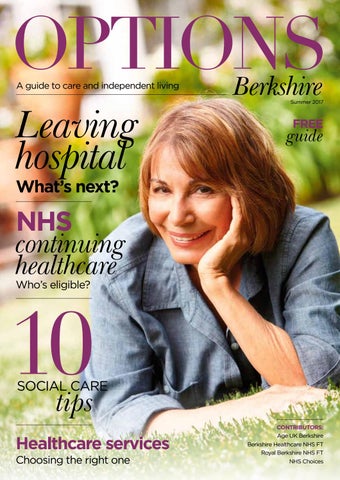
OPTIONS A guide to care and independent living
Leaving hospital
Berkshire
Summer 2017
FREE
guide
What’s next?
NHS continuing healthcare Who’s eligible?
10
SOCIAL CARE
tips
Healthcare services Choosing the right one
CONTRIBUTORS: Age UK Berkshire Berkshire Healthcare NHS FT Royal Berkshire NHS FT NHS Choices
NHS hospitals and services in Berkshire Contact information and where to find them
Berkshire
Royal Berkshire
Age UK Berkshire Huntley House 119 London St Reading RG1 4QA 0118 959 4242 www.ageuk.org.uk/berkshire
NHS Foundation Trust
Royal Berkshire NHS Foundation Trust Craven Road Reading RG1 5AN 0118 322 5111 www.royalberkshire.nhs.uk
Windsor & Maidenhead West Berkshire
Reading Bracknell Forest Wokingham
Berkshire Healthcare NHS Foundation Trust
Berkshire Healthcare NHS Foundation Trust Fitzwilliam House, Skimped Hill Ln, Bracknell RG12 1JX 01344 415600 www.berkshirehealthcare.nhs.uk
Slough
Contents Inside this guide n Going home.......................................................4 n Need Orthopaedic Surgery?...............................5 n Think PharmacyFirst..........................................6 n Anyone can have a fall.......................................7 n Community based mental health care for older people............................................. 8-9 n NHS continuing healthcare..............................10 n Assessment for NHS continuing healthcare......11 n What is NHS-funded nursing care?..................12 n Paying for permanent residential care..............14 n Paying for temporary care in a care home........15 n Personal budgets and direct payments - more control over your care..........................15 n Care services in your home....................... 16-17 n Age UK Berkshire Services......................... 18-19 n Care Quality Commission.................................20 n Useful contacts.......................................... 21-22
WORKING IN PARTNERSHIP
Berkshire
Berkshire Healthcare NHS Foundation Trust
Royal Berkshire NHS Foundation Trust
OCTAGON DES IG N & M A R K E T ING LT D
Going home
Royal Berkshire NHS Foundation Trust
When can I go home?
Opening hours The Discharge Lounge is open Monday to Friday 9.00am – 6.00pm and staffed by a professional health care team who will assist you where necessary and answer questions about your transport arrangements and medication requirements.
Parking for the Discharge Lounge One of the most common questions patients ask when they first come into the Royal Berkshire Hospital is “when can I go home?” Coming into hospital can be an anxious time for anyone, and knowing when you are due to go home can be comforting. It means you can let friends and family know what is happening so they can plan visiting, or how long they may need to keep an eye on your home, help out with other family members, and take care of a pet. Members of the health care team looking after you will discuss your discharge plans soon after you are admitted. Before you are discharged they will provide information on followup appointments, medication regimes and other instructions necessary to follow at home. On the day of your discharge, if you are unable to leave the hospital by 10am, but are due to leave later in the day, you may be transferred to our Discharge Lounge on the ground floor by the Craven Road entrance. You will be transferred by wheelchair or on foot and be accompanied by a porter or a nurse. You will cared for in the Discharge Lounge while you wait to be collected by your family, friend or by hospital transport. Some patients may also be sent to the lounge whilst they wait for medication to be dispensed. There are refreshments available in the Discharge Lounge and, depending on the time of day, you might be offered a hot meal.
The Discharge Lounge offers • comfortable chairs • refreshments • toilets • a selection of newspapers and magazines • radio and television 4 | Options Berkshire
If you are being collected from the Discharge Lounge, your escort can park on levels 0-3 of the multi-storey car park. (Discharge Lounge is on Level 1) or there are a small number of spaces in the ‘pick up zone’ next to the Discharge Lounge on the access road to the Emergency Department (A&E).
Home Early - Settled and Safe: how families can help It’s better for our patients to travel home early in the day when they are less tired, when it is warmer and when there is daylight. This means the earlier in the day we can discharge our patients and have them sent home, the safer and better it is for them. The additional benefit of earlier discharge, is that patients who are being admitted via our Emergency Department are not waiting for long periods to get to a hospital bed. At the Royal Berkshire Hospital, we aim to complete patient discharge medications and paperwork in good time to allow for an early discharge or transfer to the Discharge Lounge early in the day.
Royal Berkshire NHS Foundation Trust
Need Orthopaedic Surgery? Choose Redlands
Royal Berkshire NHS Foundation Trust
The Royal Berkshire NHS Foundation Trust’s Redlands Elective Orthopaedic Unit is a stand alone facility with its own dedicated theatres and 30 bedded elective orthopaedic ward, separate from the rest of the Royal Berkshire Hospital. It has one of the most envious rates of infection control in the region. This is because all patients are tested prior to admission, and we will not admit a patient who has an infection. This means that we continue to provide a safe environment which is infection free for all patients undergoing orthopaedic surgery at the Royal Berkshire Hospital. ‘Redlands’ has two side rooms and seven bays which have just four beds in each. All bays and side rooms have en-suite shower and toilet, so there are plenty of facilities for everyone to use, and, with its own lift, there is just a short journey from theatre to ward. The team on Redlands is made up of Consultants, Nurses, Physiotherapists, and Occupational Therapists, all supported by a Ward Doctor. Procedures carried out at the unit include: • joint surgery, including replacements for hip, knee and shoulder • spinal surgery • foot and ankle surgery. For more information about having your orthopaedic surgery at Redlands, talk to your GP or call 0118 322 7415 - 8am to 6pm to speak to the orthopaedic clinical administration team.
• great modern facilities • high quality • lowest infection rates • low waiting times from referral to surgery.
Waiting times There are very low waiting times for operations at Redlands which compare favourably with the private sector. However, Redlands has the added comfort and reassurance of having a standby emergency team in place, in the unlikely event that it is needed, which the majority of private providers do not have. From referral to operation, our waiting times can be as low as 3-6 weeks for spinal surgery, 4-6 weeks for foot and ankle, and hands, 6-8 weeks for hip and knee surgery and 8-12 weeks for shoulder. Orthopaedic operations on children can be carried out within 8 weeks.
Options Berkshire | 5
Think PharmacyFirst
Royal Berkshire NHS Foundation Trust
Try your local Pharmacy Every year, millions of us visit healthcare providers with minor health problems that our local pharmacist could resolve. All pharmacists can recognise many common health complaints. They can give advice or, where appropriate, medicines that will help clear up the problem. If your problem is more serious and needs further attention, your pharmacist will recognise this and advise you of the best action to take. What's more, many pharmacies are open in the evenings and on the weekends. So, if you have a common health problem, a trip to your local pharmacy is a good and time efficient option.
All pharmacies provide the following services: • dispensing • repeat dispensing • disposal of unwanted or out-of-date medicines • advice on treatment of minor conditions and healthy living.
Other services your pharmacy may provide include: • medicines reviews • new medicine service • flu vaccination service • advice on alcohol consumption • carer support • emergency supply of prescription medicines • independent prescribing by pharmacists – some pharmacists can now prescribe prescription-only medicines for certain medical conditions • minor ailment service • needle and syringe exchange service • NHS Health Check (blood pressure, cholesterol or blood glucose testing) • stop smoking service • stop smoking voucher service • supervised consumption of prescribed medicines • weight management service. You can talk to your pharmacist in confidence, even about the most personal symptoms, and you don't need to make an appointment. It is possible to walk into any community pharmacy and ask to speak with the pharmacist. Most pharmacies now have a private consultation area where you can discuss issues with pharmacy staff without being overheard.
Minor ailment services Some pharmacies run a minor ailment scheme, which means they can supply medicines for certain conditions on the NHS. If your pharmacy runs a minor ailment scheme that includes eczema, for example, it means your pharmacist can supply medicines for this condition and you'll only pay the standard prescription charge. If you're exempt from paying prescription charges – because you're under 16 or over 60, for example, or you have a prescription prepayment certificate (PPC) – you won't pay for the medicine. Just ask at your local pharmacy.
6 | Options Berkshire
Anyone can have a fall
Royal Berkshire NHS Foundation Trust
Prevention tips Anyone can have a fall, but older people are more vulnerable and likely to fall, especially if they have a long-term health condition. Falls are a common, but often overlooked, cause of injury. Around one in three adults over 65 who live at home will have at least one fall a year, and about half of these will have more frequent falls.
What causes a fall? Older people are more likely to have a fall because they may have: • balance problems and muscle weakness • poor vision • a long-term health condition, such as heart disease, dementia or low blood pressure (hypotension), which can lead to dizziness and a brief loss of consciousness.
Avoiding falls at home Tips for preventing falls in the home include: • immediately mopping up spillages • removing clutter, trailing wires and frayed carpet • using non-slip mats and rugs • using high-wattage light bulbs in lamps and torches, so you can see clearly • organising your home so that climbing, stretching and bending are kept to a minimum, and to avoid bumping into things • getting help to do things that you're unable to do safely on your own • not walking on slippery floors in socks or tights • not wearing loose-fitting, trailing clothes that might trip you up • wearing well-fitting shoes that are in good condition and support the ankle • taking care of your feet by trimming your toenails regularly and seeing a GP or chiropodist about any foot problems.
A fall is also more likely to happen when: • the floor is wet or recently polished, such as in the bathroom or kitchen • the lighting in the room is dim or there is poor/low light • rugs or carpets aren't properly secured • the person is reaching for storage areas, such as a cupboard, or going down stairs • the person is rushing to get to the toilet during the day or at night. Another common cause of falls, particularly among older men, is falling from a ladder while carrying out home maintenance work. In older people, falls can be particularly problematic because of osteoporosis – a weakening of the bones which makes them more fragile and likely to break.
Options Berkshire | 7
Community based mental health care for older people 'Outstanding' service Berkshire Healthcare NHS Foundation Trust is the leading provider of community and mental health services in Berkshire, and our mental health care for older people service was rated as ‘Outstanding’ by the Care Quality Commission this year. You can find out more about this award-winning service, and how to access it, below.
What can we do to help? There are a number of ways we can help you should you, or someone you know, have a mental health condition, including dementia. This might include: • Assessing and diagnosing your condition • Providing medical care • Psychological therapies • Group and one-on-one therapy • Occupational therapy • Providing support and information for your carers • Inpatient services (for 24 hour care). Our care can be provided at a variety of locations, including: • Your home, including residential and nursing homes • outpatient clinics • community hospitals • GP surgeries. We also work with external services such as social services, and support your carers and family members with education, practical support and therapy.
Why were we rated outstanding? The Care Quality Commission rated this service as Outstanding because: • Dealings between staff and patients were respectful, kind and considerate • Patients told the CQC that they felt supported by staff and that staff involved patients in their care • The service offers a six week ‘Understanding Dementia’ education course to relatives and carers • A range of information is available to both patients and their families • Feedback received from patients shows that the service is centred around them and provides personalised and holistic care.
8 | Options Berkshire
Berkshire Healthcare NHS Foundation Trust
Memory clinics We have one memory clinic in each area of Berkshire which can help you if on-going changes in your thinking skills are making it harder for you to manage daily tasks at home. These are based in: Bracknell, Reading, Slough, West Berkshire, WAM (Windsor, Ascot and Maidenhead) and Wokingham. We can provide you with an assessment of your memory and other skills if you think you might have dementia. If you are subsequently diagnosed with dementia, we can then offer treatment and support for you and your family and carers. We will also offer you a follow up appointment in a year’s time if no diagnosis is made but you are showing signs of difficulties. We can also support you if your dementia diagnosis was made elsewhere.
Our dementia charity Our service has also setup a charity called Young People with Dementia (YPWD) to try and plug the gap for those diagnosed with dementia who are under 65. It is a common misconception that dementia only affects older people, but we work with adults who are as young as 41. This often causes a bigger impact for the family as it affects work, children who are quite young, active lifestyles and more. Activities run by the charity include gardening, water sports and a running club.
How can I get help? During the first session we will start the assessment process and discuss an appropriate care plan to meet your specific needs. This initial session is also an opportunity for you to talk about your thoughts, worries and expectations, and for us to be able to answer any questions you may have. You can refer yourself to our service or you can be referred by a healthcare professional to our Common Point Entry (CPE) team: Phone: 0300 365 0300 Fax: 0300 365 0200 Email: Bks-tr.referralhub@nhs.net
Options Berkshire | 9
NHS continuing healthcare Free care package NHS continuing healthcare is a free package of care for people who have significant ongoing healthcare needs. It is arranged and funded by the NHS. You can receive NHS continuing healthcare in any setting outside hospital, including in your own home or in a care home. If you receive care in your own home, the NHS will cover the cost of the support you need from health professionals and the cost of personal care which can include help with washing and getting dressed. If you receive NHS continuing healthcare in a care home, the NHS will also pay your care home fees.
Eligibility for NHS continuing healthcare When assessing your eligibility for NHS continuing healthcare, staff must follow certain processes. You must be assessed by a team of healthcare professionals as having a ‘primary health need’ for care. This means that you need care primarily because of your health needs. This is assessed by looking at: • the type and particular characteristics of your needs • how intense and severe they are • the complexity of your needs • how unpredictable your needs are; including any risks to you and others if adequate and timely care is not provided Eligibility is always based on these needs, rather than any particular diagnosis or condition.
10 | Options Berkshire
When should I be considered for NHS continuing healthcare? If you have ongoing health needs, there are times when staff should consider whether you may be eligible. These include: • when you are ready to be discharged from hospital and your long-term needs are clear • once a period of intermediate care or rehabilitation following a hospital stay have finished and it’s agreed your condition is unlikely to improve • whenever your health or social care needs are being reviewed as part of a community care assessment • if your physical or mental health deteriorates significantly and your current level of care seems inadequate • when your nursing needs are being reviewed. This should happen annually if you live in a nursing home • if you have a rapidly deteriorating condition and may be approaching the end of your life In these circumstances, your discharge staff, staff co-ordinating your intermediate care, GP or a member of the social work team should raise the issue of NHS continuing healthcare and assess your eligibility. If they don’t, make sure you ask for an assessment.
Assessment for NHS continuing healthcare Are you eligible? You should be fully involved in the assessment and have your views taken into account. You can ask a relative or carer to help and support you throughout the process. Most people will start by completing a checklist. This assesses your needs and indicates whether or not you should have a full assessment. If you’re referred for a full assessment, evidence will be collected from all relevant health and social care professionals to give a full picture of your physical, mental health and social care needs. Then a team of health and social care professionals involved in your care will look at this evidence and recommend whether or not you’re eligible. You and / or your representative can attend and participate at this meeting.
If you are eligible The team will forward their recommendation to the Clinical Commissioning Group (CCG) that is responsible for funding your care. The CCG will then discuss and agree a care and support package with you. This care and support package will be reviewed after 3 months and then at least every year. If your care needs change, your funding arrangements may also change.
Personal Health Budgets If you’re eligible for NHS continuing healthcare, you have the right to a Personal Health Budget. Personal Health Budgets allow more choice and control over the services and care you receive and can be used to pay for a wider range of items and services, including therapies, personal care and equipment.
If you’re not eligible If you’re not eligible for NHS continuing healthcare, you’ll be referred to your local authority to decide whether you’re eligible for help to arrange or pay for care. However, you may be eligible for NHS-funded nursing care.
If you’re not happy with the decision If you’re turned down, you should be sent a letter telling you why. It should also tell you what steps to take and who to contact if you’re unhappy with the decision. • If you weren’t given a full assessment, you can ask the CCG to reconsider your case. If you are still dissatisfied you can use the NHS complaints system to pursue your case. • If you’re not happy after a full assessment, you can ask for the CCG to reconsider its decision. If you are still dissatisfied, you can ask for an independent review of your case. • If you’re not happy with any help you receive from the NHS, you have a right to complain. Details of the complaints procedure are available from the relevant organisation.
Fast Track If you are approaching the end of your life, you may be eligible for ‘fast tracking’ which allows you to bypass the full assessment process mentioned above. You must have a rapidly deteriorating condition that may be entering a terminal phase. If you’re eligible, a care package should be put in place as soon as possible, preferably within 48 hours.
If you choose this, you will develop a care plan with your NHS team that will meet your personal health and wellbeing needs. See NHS Choices for more information about Personal Health Budgets.
Content supplied by:
Age UK has not vetted the advertisers in this publication and accepts no liability for work done or goods supplied by any advertiser. Nor does Age UK endorse any of the products or services. All information correct at the time of going to print.
Options Berkshire | 11
What is NHS-funded nursing care? The facts NHS-funded nursing care is care provided by a registered nurse for people who live in a care home. The NHS will pay a flat rate contribution directly to the care home towards the cost of this registered nursing care.
Who is eligible for NHS-funded nursing care? You may be eligible for NHS-funded nursing care if: • you are not eligible for NHS continuing healthcare but have been assessed as needing care from a registered nurse • you live in a care home registered to provide nursing care
How will my needs be assessed? You should be assessed for NHS continuing healthcare before a decision is made about whether you are eligible for NHS-funded nursing care. Most people don’t need a separate assessment for NHS-funded nursing care. However, if you do need an assessment or you haven’t already had one, your clinical commissioning group (CCG) can arrange an assessment for you.
Outcome of the assessment If you’re eligible for NHS-funded nursing care, the NHS will arrange and fund nursing care provided by registered nurses employed by the care home. Services provided by a registered nurse can include planning, supervising and monitoring nursing and healthcare tasks, as well as direct nursing care. If you’re not eligible for NHS-funded nursing care and you don’t agree with the decision about your eligibility, you can ask your CCG to review the decision.
What is the rate of payment for NHSfunded nursing care? NHS-funded nursing care is paid at the same rate across
Content supplied by: NHS Choices has not vetted the advertisers in this publication and accepts no liability for work done or goods supplied by any advertiser. Nor does NHS Choices endorse any of the products or services. All information and figures correct at the time of going to print.
12 | Options Berkshire
England. For 2016/17, the rate is £156.25 a week (standard rate). The increase will be backdated to April 1, 2016 for people who are getting NHS-funded nursing care from that time. This new rate is under review and may change on the January 1, 2017. Before October 1, 2007, there were three different levels or bands of payment for NHS-funded nursing care – low, medium and high. If you moved into a care home before October 1, 2007, and you were on the low or medium bands, you would have been transferred to the standard rate from that date. If you moved into a care home before October 1, 2007, and you were on the high band, NHS-funded nursing care is paid at a higher rate. For 2016/17, the higher rate is £215.04 a week. You’re entitled to continue on this rate unless: • you no longer have nursing needs • you no longer live in a care home that provides nursing • your nursing needs have reduced and you’re no longer eligible for the high band, when you would change to the standard rate of £156.25 a week, or • you become entitled to NHS continuing healthcare instead.
With prudent planning care fees do not need to be a problem We look to provide you with: • A guaranteed income for life • The ability to live in the home of your choice • No fear that your money will run out
Planning For Long Term Care Fees? Speak to a specialist who can guide you through the maze of red tape
• The provision for rising care costs • Peace of mind for you and your family
PROTECTION &
Please call 01344 636374 or INVESTMENT Ltd Please call 01344 636374 or 0118 9821710 to speak to 0118 9821710 to speak to our specialistadvisor advisor our specialist Protection & Investment Ltd Daniel Kasaskaororvisit visit Daniel Kasaska ourour Please send me information about an Independent Financial Adviser that Protection & Investment Ltd and the website:www.pil.uk.com www.pil.uk.com for website understands the needs of elderly people services it provides for Long Term Care for more information. IfIfyou more information. you Planning Authorised and Regulated by the Financial Conduct Authority prefer you prefer youcan canemail email Registered address Chandlers House, Ganders Business Daniel@pil.uk.com Name........................................................ daniel@pil.uk.com, or simply Park, Kingsley, GU35 9LU cut out and return the attached Address..................................................... coupon. Daniel Kasaska is a Master Practitioner of Symponia and Accredited Member of The Society of Later Life Advisers (SOLLA) ..................................................................
Options Berkshire ..................................................................
| 13
Paying for permanent residential care The facts Lots of people worry about paying for care for themselves or for a loved one. Most people will be expected to pay something towards the costs.
What are the main steps of the process? If your care is being organised by the local authority, then the main steps of the process are: 1. Your local authority does a care needs assessment to identify what help you need. 2. They make recommendations about your needs and whether or not you need residential care – this is called a Care Plan. 3. They work out a budget to ensure you get what care you need – this is called a Personal Budget. 4. They do a means test, also called a financial assessment, to work out how much you should pay towards your care home fees and how much they will cover.
What does the means test look at? The means test will look at your income and capital, such as your savings and property. Whether you have to pay, and if so, how much, depends on how much income or capital you have. In certain situations, the local authority may assume that your capital generates an income which can be used towards pay your care home fees. If you and someone else jointly hold capital, such as a savings account, it’ll be treated as divided equally between the two of you. In some circumstances your home won’t be included in the means test, for example, if your partner still lives there.
What if I give away some of my money? You may think about giving away some of your savings, income or property to avoid higher care costs, and to give something to your relatives or charity, for example. If the council thinks that you have done this to avoid paying care fees they may still assess you as if you still had the money or property that you have given away. This is referred to as deprivation of assets.
How will my capital be treated in the means test? You capital is the phrase used to describe the total amount of your savings, any property you own and any shares you might have. 14 | Options Berkshire
It does NOT include your pension and benefits you might be getting. Amount of your capital Over £23,250 Between £14,250 and £23,250
Less than £14,250
How much you have to pay You must pay full fees (selffunding) The local authority will assume that this generates an income and this will be taken into account for your care home fee contributions. This will be ignored and won’t be included in the means test
How will my income be treated in the means test? Certain types of income, such as money from certain disability benefits and pensions, may not be counted in the means test. All other income can be taken into account. As noted above, in some cases, the local authority may also assume that your capital generates an income, which will also be taken into account for your care home fees.
How much will I have to pay? After the means test the local authority should give you a written record of their decision of what you will have to pay and what they will pay, and how they calculated it. You should not be left with less than £24.90 a week after any contribution to your fees. This is known as your Personal Expenses Allowance.
What if I prefer a more expensive care home than the local authority will pay for? If you’d prefer to live in a care home that costs more than the local authority would usually expect to pay, it can arrange this, provided that someone else is willing to meet the difference in cost. This is usually known as a top-up or third-party payment. You could also choose a care home in another area to be closer to family or friends.
How do I pay my part of the fees? Generally the local authority pay the full amount to the home and collect from you the amount you need to pay. This may be different if you are paying a ‘top-up’ fee.
Paying for temporary care in a care home The facts
What if I run out of money?
whether they want to live permanently in that home.
If you are paying fees yourself (called self-funding) and your capital goes down to less than £23,250, the local authority may assist with funding. You should request an assessment a few months before that happens. They should arrange one as soon as possible so you don’t have to use up your capital below that amount.
A more detailed account of the charging rules can be found in our factsheet Paying for temporary care in a care home. This factsheet is aimed at individuals who are aged 60 and over.
Paying for care if you have a partner
Paying for temporary care in a care home
Being part of a couple can affect a care home resident’s eligibility for local authority assistance with care home fees and both partners’ eligibility for social security benefits during the period in care.
Local authority charging rules differ when a stay in a care home is temporary, rather than permanent. Some people go into a care home on a temporary basis to give themselves or their carers a break‚ or while they are recuperating from an illness. Others enter a home temporarily for a ‘trial’ period to decide
We have produced a factsheet that addresses this issue and includes sections on the valuation of jointly owned capital, temporary admissions and where both members of a couple go into a care home. This factsheet should be read alongside Age UK’s other factsheets on care home charging and benefits.
Personal budgets and direct payments - more control over your care Direct payments When your personal budget is paid directly to you this is called a Direct Payment. Direct Payments allow you to arrange your care as you wish. There are rules about what you can and can’t use direct payments for. The money must be used to meet the eligible needs identified in your assessment. You can use direct payments for anything that meets those needs, for example: • employ your own care workers • buy services from a voluntary or private agency • buy equipment or pay for home adaptations • purchase other types of support to meet your assessed needs • get to a café to meet your friends, a place of worship, or other places that are important to you. You can be personal and creative with your budget. For example, if one of your assessed needs is help with shopping, you could pay for someone to help you go shopping yourself rather than just pay someone to do it for you.
You can’t use direct payments to: • pay a spouse, civil-partner, live-in partner, or a close relative who lives in the same household as you to care for you (although there may be exceptions to this) • buy services from your local council • pay for permanent care in a care home. You can, however, pay for a short stay of up to four consecutive weeks within any 12-month period if that meets an assessed need. Not everyone will feel comfortable or capable of managing their direct payments themselves, and you don’t have to if you don’t want to. You can always choose the option for the council to arrange care for you, and you can still have a say in what will best meet your needs.
Content supplied by: Age UK has not vetted the advertisers in this publication and accepts no liability for work done or goods supplied by any advertiser. Nor does Age UK endorse any of the products or services. All information and figures correct at the time of going to print.
Options Berkshire | 15
Care services in your home The facts If you need help around the home, a good option is to have a care worker come in to your home to help you.
Types of care and support
privately, you can arrange it in several different ways.
Care and support comes in many forms and has many names used to describe it, including home help, care attendants and “carers” (not to be confused with unpaid family or friends who care for you).
Independent care and support agencies
Care and support can suit you if you need: • personal care, such as washing or dressing • housekeeping or domestic work, such as vacuuming • cooking or preparing meals • nursing and health care • companionship Care and support can be very flexible, in order to meet your needs, and the same person or agency may be able to provide some or all of these options for the duration of your care: • long-term 24-hour care • short breaks for an unpaid family carer • emergency care • day care • sessions ranging from 15-minute visits to 24-hour assistance and everything in between If you already know what you want, you can search NHS Choices directories for: • local care and support services and agencies • a list of national care and support organisations • services that can help you stay safe and well in your home on a long-term basis; these services, often known as “supported living services”, can include financial, help with medication, advocacy, social and practical support • a place to live in a family who will care for you, known as “shared lives services” or adult placement services If you believe that you might benefit from some help at home, the first thing to do is to contact your social services department to ask for an assessment of your care and support needs. To contact social services, go to GOV.UK: find your local authority. If you are eligible for care and support services, the local authority may provide or arrange the help themselves. Alternatively, you can arrange your own care, funded by the local authority, through direct payments or a personal budget. If you have chosen direct payments or a personal budget, or you aren’t eligible for local authority help and want to get care
16 | Options Berkshire
If you use an independent care and support agency, you or the person you’re looking after has to find the care agency and pay them. The agency will provide a service through a trained team of care workers, which means you may not always have the same person visiting your home, although the agency will do its best to take your choices into account. Independent care and support providers are regulated by the Care Quality Commission (CQC). Care and support agencies must meet CQC’s national minimum standards and regulations in areas such as training and record-keeping. The CQC has the power to inspect agencies and enforce standards. Care and support agencies must vet care and support workers before engaging them by taking up references and carrying out Disclosure and Barring Service (DBS) checks on potential employees. Care and support agencies can also: • take over the burden of being an employer – for example, payroll, training, disciplinary issues and insurance • train their care and support workers through national qualifications and service-specific training • replace workers when they are ill, on holiday or resign • put things right when they go wrong An agency will want to see you and the person you’re looking after so that they can assess your needs. This also means that a joint decision can be made about the most appropriate type of care and support. You can find out more from the UK Homecare Association.
What are the disadvantages of using a care and support agency? The main disadvantage is the cost of using an agency. The agency will charge a fee on top of the payment made to the care worker to cover their running costs and profit. You normally have to make a regular payment to the agency, which includes both the worker’s earnings and the agency’s fee.
Questions to ask when using a care and support agency The fees some agencies charge can be quite high. Before deciding to go ahead with an agency, you should ask questions about the fee and what it covers, including: • Does the agency check references? • What training and supervision do they provide? • What is their complaints policy? • Who will be responsible for insurance? • Is there any out-of-hours or emergency contact if needed? • Will they be able to provide staff if your own care worker is ill or away? (If an agency contracts to provide care every day, it must ensure that it does.)
Hiring a personal assistant You can hire a “personal assistant” to act as a care and support worker for you.
The service decides who is unsuitable to work or volunteer with vulnerable adults or children. If someone who is barred from working with children or vulnerable adults is working, volunteering or trying to work or volunteer with these groups, they are breaking the law. They could face a fine and up to five years in prison. Employers must apply for an enhanced DBS check (formerly known as a CRB check) when taking on new employees or volunteers to work with vulnerable adults or children. This includes a check of the barred lists. If an organisation fails to make the relevant checks, they can be penalised. If an organisation dismisses an employee or volunteer for harming a child or vulnerable adult, they must tell the DBS. The DBS must also be notified if any employee or volunteer harms a child or vulnerable adult, but isn’t dismissed because they leave voluntarily. If their organisation does not tell DBS, they will be acting illegally.
Personal assistants can offer you all that you’ll get from an agency worker, but you’ll also get the continuity, familiarity and ongoing relationship with your assistant.
Questions can be answered by the DBS call centre on 0870 909 0811, or by email.
However, if you employ a personal assistant, you will then have the legal responsibility of an employer. This will include arranging cover for their illness and holidays.
Employing a care worker on a private basis
GOV.UK has more information on becoming an employer, while Which? Elderly Care also has advice on employing private individuals.
If you employ a care worker privately, you will not be obliged to use the DBS scheme, but you can use it if you choose to. You need to ask social services or the police to make the checks on your behalf. The care worker must have already applied to be vetted, and must consent to the check.
Care and support from charities Charities such as Age UK and Carers Trust can provide home help and domestic assistance services. The Carers Trust supports carers by giving them a break from their caring responsibilities through care and support services.
If you have concerns about the suitability of someone you employ privately to work with a vulnerable adult or child, you can ask social services to investigate the matter. They can refer the worker to the ISA on your behalf.
Marie Curie Nurses can provide practical and emotional support for people near the end of their lives in their own homes.
Safeguarding vulnerable groups The DBS makes decisions about who is unsuitable to work or volunteer with vulnerable adults or children. It makes this decision based on information held by various agencies and government departments. Content supplied by: NHS Choices has not vetted the advertisers in this publication and accepts no liability for work done or goods supplied by any advertiser. Nor does NHS Choices endorse any of the products or services. All information correct at the time of going to print.
Options Berkshire | 17
Age UK Berkshire Services Independence, wellbeing and enjoyment are the keys to help you love later life Age UK Berkshire is your trusted local charity to help you continue to live independently at home for as long as you want. We can also assist when you're out of the house, providing information, services and products to fit your needs.
Memory Loss Support
Information & Advice
Active Living
We’re your first contact for a complete range of confidential, free information and advice, face-to-face, by phone or email. Age UK Berkshire helps with benefits, staying independent at home, housing enquiries and information about groups and activities in your locality. Age UK also provides many free useful guides and factsheets on a range of issues that are relevant to older people. We cover the whole of Berkshire, as well as providing information to friends and families anywhere in the world.
Keeping mentally and physically fit improves your quality of life and makes older age a much more enjoyable time. Qualified instructors run a wide range of popular activity sessions which promote well-being and give participants health and social benefits, as well as a chance to meet other like-minded people.
Handyperson For when you need small jobs completed around your house, such as tap washers, fitting curtain rails, handrails or replacing light bulbs. We also fit security devices, for example, keysafes, smoke detectors and CO detectors.
Easy Shop We offer a regular shopping service over the telephone. We will call you at a prearranged time, take your order and place it with the supermarket of your choice. We arrange for the shopping to be delivered at a convenient time for you.
Home Help Plus Our home help plus service is to help with keeping you independent at home and covers cleaning, shopping and going with you to appointments, for example, hairdressers, hospital or the library.
Companionship If you’re feeling a bit lonely or isolated, we offer long-term friendship and support from our dedicated volunteers who visit regularly or make regular contact by telephone. If you’re new to the area or you’ve lost touch with your local community we offer introduction and support, accompanying you if you need, for a short time. 18 | Options Berkshire
We can support you or your family member that is living with memory loss or dementia. We provide a wide range of specialist, tailored stimulating support and encouragement, for example, cookery, gardening, accompanied trips, music and games.
Silver Surfers Our one-to-one booked sessions cover what you need to know about the internet, social media, digital photography and even the basics of modern computers, smartphones and internet tablets. The sessions are individually-tailored and planned to the correct pace and you can use your own computer/laptop/tablet.
Money Management When handling your financial affairs becomes a worry Age UK Berkshire is able to help. With your permission we will sort out and take over managing your day-to-day finances, keeping you informed and alleviating any stresses or strains. Please note there is a charge for some of our services. We can only provide these quality services through the efforts and dedication of our many volunteers. If you’d like to give something back or learn new skills, try volunteering with Age UK Berkshire. To find out more about any of our services contact us: Huntley House 119 London Street Reading Berkshire RG1 4QA 0118 959 4242 Info@ageukberkshire.org.uk www.ageukberkshire.org.uk
No one should have no one, in Berkshire
Berkshire
Age UK Berkshire is your trusted local charity to help you continue to live independently
Options Berkshire | 19
The Care Quality Commission is here to make sure health and adult social care services including hospitals, home and residential care as well as GPs in England provide people with safe, effective, high-quality care. We publish independent inspection reports and ratings about services – information you can use when you’re choosing care for yourself, or a loved one. You can use our website to search for services you might be interested in by geographical area, or by specialism. For example, a care home that might offer specialist care for someone who has dementia. We also welcome your feedback on the care you have received – good or bad. We use this information to help inform our inspections and can alert authorities including local social services, if there are safeguarding concerns about care being provided. You can visit our website at www.cqc.org.uk to find our inspection reports, or share an experience of care. You can also call us to share an experience of care on 03000 61 61 61. Here are some tips to help you choose your care.
Social care Top tips 1
2
3
4
5
6
The Care Quality Commission (CQC) registers all care homes and home care agencies. You can find out which ones support specific groups of people, such as people with a learning disability or those living with dementia. CQC’s Chief Inspector for Adult Social Care, Andrea Sutcliffe always uses ‘The Mum Test’: is a care home safe, caring, effective, responsive to people’s needs and well-led? In other words, is it good enough for my Mum (or anyone else I love and care for)? Look for care homes and home care agencies where the staff involve people who use services and their families and carers, and treat individuals with compassion, kindness, dignity and respect.
7
8
9
Whether you are being cared for in your own home or in a residential setting, the staff looking after you need to be skilled, kind and supportive. They should also be capable and confident in dealing with your particular needs. You should always feel that their support is helping you to live the life you want to. A care home will be a home for you or your loved one. Residents should be treated as individuals with their likes and dislikes taken into account. Think about whether a home is close enough to family, friends, and community facilities. Look at how well-led and managed a home is. What does it have in place to ensure that it delivers high quality care? Does it promote meaningful activity and connect the home with the community?
If you or a loved one needs help with day-today care, you can contact your local council’s social services department. They will ‘make an assessment of your needs’ and depending on circumstances, may be able to help you access financial help. For more advice visit Age UK’s website www.ageuk.org.uk /homeand-care. If you would like to organise your care yourself, you can find a care worker or personal assistant through an agency. Your local social services department should be able to provide details of approved agencies. CQC’s ratings will identify services as:
Outstanding Good ● Requires improvement ● Inadequate ● This will help you make informed choices around your care. There’s also useful advice on the Social Care Institute for Excellence’s Find me good care website www.scie.org.uk/findmegoodcare/
10
Safeguarding adults who receive social care is everybody’s business. If you are concerned about the safety of a loved one receiving care, contact the service provider in the first instance. You can also contact social services at your local council. If you feel a crime has been committed, contact the police. You can share your safeguarding concerns with us on our website or contact our National Customer Services on 03000 616161.
The Care Quality Commission has not vetted the advertisers in this publication and accepts no liability for work done or goods supplied by any advertiser. Nor does the Care Quality Commission endorse any of the products or services.
20 | Options Berkshire
Useful contacts Important numbers A Action on Elder Abuse 020 8835 9280 We work to protect, and prevent the abuse of, vulnerable older adults Action on Elder Abuse, PO Box 60001, Streatham SW16 9BY I www.elderabuse.org.uk I enquiries@elderabuse.org.uk Admiral Nursing DIRECT 0845 257 9406 This helpline has been set up to provide people with an opportunity to talk through their worries and concerns about themselves, friends or relatives with dementia. The lines are open on Tuesdays and Thursdays between 11am and 9pm. Callers can leave messages any time and request a call back I direct@fordementia.org.uk Age UK Berkshire 0118 959 4242 Providing practical services and support to make later lifer better. Huntley House, 119 London St, Reading, RG1 4QA I www.ageuk.org.uk/berkshire Alzheimer's Society 0118 959 6482 The UK's leading support and research charity for people with dementia, their families and carers. I www.alzheimers.org.uk I berkshire@alzheimers.org.uk Arthritis Care 020 7380 6500 Working with and for all people with arthritis to put them in control of their arthritis and their lives. Arthritis Care, Floor 4, Linen Court, 10 East Road, London N1 6AD. I info@arthritiscare.org.uk C CareAware 0161 707 1107 A one stop shop for free advice on care fee funding for older people. I www.careaware.co.uk I enquiries@careaware.co.uk Care Quality Commission (CQC) 03000 616161 National Correspondence, Citygate, Gallowgate, Newcastle upon Tyne NE1 4PA I www.cqc.org.uk I enquiries@cqc.org.uk Carers UK 0808 808 7777 Prevents carers from becoming emotionally drained, and from forgetting to take care of themselves. 20 Great Dover Street, London SE1 4LX I General enquiries: 0207 378 4999 I Advice line: 0808 808 7777 www.carersuk.org I info@carersuk.org
Cruse Bereavement Care 0844 477 9400 Cruse Bereavement Care is here to support you after the death of someone close. I www.cruse.org.uk I helpline@cruse.org.uk D Disability Benefits Helpline – 0845 712 3456 for Disability Living Allowance and Attendance Allowance I Textphone: 0845 722 4433 I w ww.direct.gov.uk/en/Dl1/Directories DG_10011169 E Elderly Accommodation Counsel 020 7820 1343 The Counsel's aim is to help older people make informed choices about meeting their housing and care needs. It was founded in 1984 and became registered as a charity in 1985. It is now more commonly known as EAC. I www.eac.org.uk ENRYCH Berkshire 0844 412 7501 At ENRYCH Berkshire we believe that someone with a disability should not be prevented from living the life they want to live. Room G1 TOB1, Earley Gate, University of Reading, Whiteknights, Reading RG6 6AT I http://www.enrychberkshire.org.uk I Integrated Care Council 01379 678243 (Formerly the National Homecare Council) The Integrated Care Council is a body which brings together British public and independent sector organisations who commission or directly provide support for people living at home. M Mind (National Association 020 8519 2122 for Mental Health) The leading mental health charity in England and Wales. We work to create a better life for everyone with experience of mental distress. www.mind.org.uk I contact@mind.org.uk N National Osteoporosis Society 0845 450 0230 Advice, information and support group for people with osteoporosis. I www.nos.org.uk NHS 111
111
Options Berkshire | 21
Useful contacts Important numbers N NHS Choices I www.nhs.uk P Parkinson's Disease Society I www.parkinsons.org.uk
0800 800 0303
Physiotherapy (Boathouse) 0118 984 2234 I www.boathousephysiotherapy.co.uk R Royal Voluntary Service 0845 608 0122 A volunteer organisation that enriches the lives of older people and their families across Britain. We support older people by giving time and practical help to help them get the best from life. Royal Voluntary Service, Cardiff Gate, Beck Court, Cardiff Gate Business Park, Cardiff CF23 8RP I www.royalvoluntaryservice.org.uk
OCTAGON
DESIGN PRINT SUPPORT
DE S IGN & M A R K E T ING LT D
Working in partnership with the NHS
Hawks Nest Cottage, Great North Road, Bawtry, Doncaster, South Yorkshire DN10 6AB 01302 714528 | www.octagon.org.uk info@octagon.org.uk
Every possible care has been taken to ensure that the information given in this publication is accurate. Whilst the publisher would be grateful to learn of any errors, it cannot accept any liability over and above the cost of the advertisement for loss there by caused. No reproduction by any method whatsoever of any part of this publication is permitted without prior written consent of the copyright owners. Octagon Design & Marketing Ltd. Š2017. Hawks Nest Cottage, Great North Road, Bawtry, Doncaster, South Yorkshire, DN10 6AB. Telephone: 01302 714528 Options Berkshire is published by Octagon Design & Marketing Ltd with editorial contributions from the Berkshire Healthcare FT, Royal Berkshire NHS FT, the CQC, Age UK Berkshire, and NHS Choices. The editorial contributors have not vetted the advertisers in this publication and accepts no liability for work done or goods supplied by any advertiser. Nor do the editorial contributors endorse any of the products or services.
22 | Options Berkshire
Stroke Association 0845 3033 100 Advice and information for stroke patients and their families. I www.stroke.org.uk T The Department of Work and Pensions I w ww.dwp.gov.uk The Pension Service 0845 606 0265 I w ww.dwp.gov.uk/about-dwp/customerdelivery/ the-pension-service W West Berkshire Citizens Advice Bureau 0300 222 5941 2nd Floor, Broadway House, 4-8 The Broadway, Northbrook Street, Newbury, Berkshire RG14 1BA I www.citizensadvicewestberkshire.org.uk
The Boathouse Surgery Whitchurch Road Pangbourne RG8 7DP
www.boathousephysiotherapy.co.uk
0118 976 7189
boathouse physiotherapy
NO REFERRAL REQUIRED
WHAT CAN WE TREAT? • • • • • • • • • • • • • •
Massage (Sports & Deep Tissue) Sport injuries Falls Reduced mobility Post fractures Musculoskeletal injuries Arthritis Pre and post operation Pre and post natal Desk assessments Paediatrics Acupuncture Pilates/core stability Home visits available
Options Berkshire | 23
Northcourt Lodge Nursing Home
Wild Acres Care Home
65 Northcourt Avenue, Reading, RG2 7HF Tel: 0118 9875062 Fax: 0118 9755007 Email: revathy.northcourt@ btconnect.com www.northcourtlodge nursinghome.co.uk
440 Finchampstead Road, Wokingham RG40 3RB Tel: 0118 9733670 Fax: 0118 9734581 Email: wildacres@ btconnect.com www.wildacrescare home.co.uk
Northcourt Lodge Nursing home provides residential care to 22 service users over the age of 65 years old who require 24 hrs care. Our goal is to promote and protect physical, mental, spiritual and social well being of service users through assuring that quality services are provided by trained and responsible health care professional whereby service user’s dignity, respect, freedom of choice, privacy, confidentiality and equality are maintained at all times. There are two communal lounges in the home. One is a large lounge for those who enjoy sitting and chatting or watching television, the sun lounge is for those who prefer quiet recreation and reading. There is a separate dinning room where we encourage all service users to have their meals together and use this opportunity for socializing but those who prefer having their meals in their rooms are given the choice to do so. At the rear of the home there is a spacious garden, where service users usually do planting and have their coffee in the summer months. We plan and implement occupational therapy involving service users that enable them to continue hobbies, develop new interests, and participate in events and outings as desired. These activities are run indoors as well as outdoors. The following are examples of some of the activities that we run: • Quizzes, puzzles & bingo • Story telling & music • Playing cards, board games such as reminiscence • Knitting, gardening, nail painting • Physical exercise Specialist Dementia Care
Wild Acres is a spacious detached bungalow set in 1 acre of grounds, in a secluded semirural setting, with superb views of the surrounding countryside. Established for over 28 years, we provide a high standard of personalised care for 26 residents. We value each and every individual that comes to live at Wild Acres. All residents can be assured that they will be treated with respect and dignity according to their individual needs and wishes. We welcome applications from all cultures and religions and are able to cater for those with physical, sensory and cognitive impairments. Our aim is to provide a family atmosphere whilst endeavouring to maintain privacy and quality of life. All of the rooms are on ground level. Wild Acres currently has 26 single rooms. 13 rooms have a wash basin with an adjacent bathroom, the remaining 13 rooms have en-suite facilities. We are able to offer long-term care and respite care if we have a room available. Monitoring of all aspects of the care is the responsibility of the Homes Manager, and the team of qualified staff, who adhere to very rigorous standards of care. Our standards are monitored by internal audits and checks. A designated G.P. from the local practice visits weekly or on request. We employ two cooks to provide varied and nutritious meals for the residents, reflecting their individual dietary needs. Each person’s plan includes a description of their preferred daily routine, their likes and dislikes in relation to food and any specific dietary requirements. Most of the residents choose to eat their meals in the dining room but meals may be served in the resident’s room if preferred. Specialist Dementia Care
Applegarth Care Home
Winterbrook Nursing Home
24 Huntercombe Lane North, Maidenhead SL6 0LG Tel: 01628 663287 Fax: 01628 663987 Email: applegarth.care@ btconnect.com www.applegarthcare home.co.uk Applegarth care home is a small friendly 20 bed care home situated between the boroughs of Maidenhead/Windsor and Slough. A fully trained and dedicated care team provide 24 hour care allowing the home to provide a high quality standard of care and a real sense of security to its residents & families. Our focus is on caring for the individual - always treating them with dignity, and promoting independence. With this in mind, individual care plans are in place ensuring that all care provided is very much person centred. We also understand the importance of keeping hold of pets - and so Applegarth care home is a pet friendly home; a member of the Cinnamon Trust with a five star rating. We also provide long term care, and respite care is available for those in need. The accommodation includes 20 rooms, all with ensuite facilities. The building has a TV lounge, a light and airy dining room, and a communal shower and bathroom, as well as a beautiful enclosed garden. The home also has a sun lounge, which provides access out into the homes garden. We also have a key-worker system in place, allowing each resident their own dedicated Key-worker. With this, personalised care plans are in place which are reviewed monthly by the allocated Key-worker. This ensures a continuing high level of care for each individual. Two fully trained cooks prepare lovely home cooked meals to cater for all tastes & dietary needs. Menus are monitored regularly with residents & families completing feedback sheets into what meals they would like to see on the menus. Specialist Dementia Care
18 Winterbrook, Cholsey, Wallingford OX10 9EF Tel: 01491 833922 Fax: 01491 836166 Email: winterbrookhome@ btconnect.com www.winterbrooknursinghome.co.uk Providing nursing and social care for the elderly including those suffering from dementia, situated in a small market town of Wallingford with easy access to public transport. We believe that all our residents have a right to be treated with dignity and should be given the respect by all those who support them. They have a right to a full active life given the fundamental right to self-determination and individuality. Care is based around each client’s individual need, whatever the level of assistance. Single and double rooms, which offer en suite facilities, are available. Winterbrook has several communal areas, TV lounges, quiet sitting rooms, and a library and computer room. Personal care plans are reviewed monthly to ensure the client’s needs are continuing to be met; the reviews are undertaken with the client or where appropriate their families. Monitoring of all aspects of the care is the responsibility of the Homes Manager, and the team of qualified staff, who adhere to very rigorous standards of care. Our standards are monitored by internal audits and checks. The Home has a GP from the local practice who visits weekly or by individual appointment. Our client may retain their own GP if they wish, providing the GP is happy to visit them at the home. At Winterbrook we ensure that we provide nutritious, well-presented food that meet all our clients’ preferences with a selection of home cooked food based upon traditional cooking using fresh produce. Reviews of our menus are undertaken monthly to ensure that they are nutritionally balanced and that special diets are catered for. Specialist Dementia Care
ADMIN OFFICE FOR BOTH ABOVE HOMES, 1 THE DRIVE, EARLEY, READING. RG6 1EG TEL: 0118 9698870 FAX: 0118 9698824
Designed & Compiled by Octagon Design & Marketing Ltd., Hawks Nest Cottage, Great North Road, Bawtry, Doncaster DN10 6AB. Tel: 01302 714528
www.excellentcarehomes.co.uk