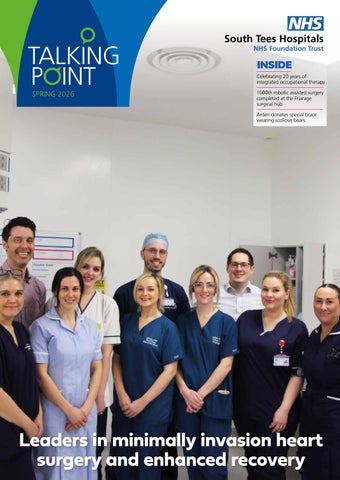

Leaders in minimally invasive heart surgery

Dear reader,
Welcome to the latest edition of Talking Point.
As we head into spring let me take this opportunity to thank our staff for their continued hard work and dedication over the busy winter months. The passion, commitment and enthusiasm I see across all our teams never ceases to amaze me.
Like all NHS trusts across the country, we know we are facing real challenges – from reducing waiting lists to balancing the books. But we also know there are lots of fantastic things going on across all our services and departments that we want to shout about from the roof tops.
This edition shines the spotlight on our award-winning cardiac remote monitoring service which supports patients with heart failure to manage their condition in the comfort of their own home. To find out more, jump to page 10 where Janice Oliver invites us into her home and shares the benefits of this fantastic remote monitoring service.
We also celebrate the impact of digital technology, having been nominated for no less than five national Health Service Journal (HSJ) digital awards. From electronic patient records to virtual wards, these technologies enable patients to receive high quality care in more flexible and convenient ways.
The key to success has been the shared vision and the collaborative working between our clinical and digital teams right across University Hospitals Tees and it’s great to see this is now starting to free up more time for clinicians to focus on what matters most – caring for our patients. Turn to page 8 to discover more.
Another great success story is our emergency department testing programme which has detected hundreds of
The key to success has been the shared vision and the collaborative working between our clinical and digital teams.
sexually transmitted infections (STIs) which would have otherwise gone untreated. The James Cook University Hospital was the first in England to launch syphilis screening for adults aged between 19 and 70 who are already having their blood sampled at A&E. The scheme has been so successful that we have now extended it to the University Hospital of North Tees as well. You can read more on page 11.
Please do share your stories with us via our communication and engagement hub and we will look to include as many as we can in future issues and across our wide range of communication channels.
We’d especially love to hear from teams who have found innovative ways to improve efficiency, productivity and collaborative working so we can share successful ideas across the group.
Thanks for reading.
Stacey Hunter CHIEF EXECUTIVE OFFICER
Keep up-to-date with University Hospitals Tees
From career stories to innovations in patient care and more, follow University Hospitals Tees on social media to keep up with the latest news.
LinkedIn: University Hospitals Tees
TikTok: @UniversityHospitalsTees
Instagram: @NorthTeesAndHartlepoolNHSFT
Leaders in minimally invasive heart surgery
University Hospitals Tees is proud to announce its accreditation as a national leader in minimally invasive cardiac surgery and enhanced recovery after cardiac surgery.
James Cook is only one of five sites to receive the elite accreditation from the Society for Cardiothoracic Surgery and The Association of Cardiothoracic Anaesthetists and Critical Care.
The achievement cements the hospital’s status as the regional heart specialist site and identifies it as a UKleading centre for surgical innovation.
For patients, this will allow more access to ‘keyhole’ heart procedures in the future. Minimally invasive surgery offers significant benefits over traditional heart surgery. This includes fewer complications, reduced hospital stays, less pain, faster recovery and improved outcomes.
Enhanced recovery work aims is to optimise patients prior to their surgery and improve their experience and outcomes leading to
improved results for them and the hospital.
It works on the principle of providing a standardised bundle of evidencebased interventions starting from the moment patients are accepted for surgery, all the way through their operative period including intensive care and their time on the ward until their discharge.
“We are proud to be the only accredited site in the north of England, with all other centres being in the South of England.”
Luke Rogers, consultant cardiac surgeon, said: “Being one of only five national cardiac surgery departments to be selected recognises the quality of our existing service and our commitment to innovation demonstrably benefiting our patients. We are proud to be the only accredited site in the north of England, with all other centres being in the South of England.”
Prior to the recent accreditation, James Cook was already well established in several minimally invasive heart procedures, such as minimally invasive mitral and aortic surgery and minimally invasive direct coronary artery bypass (MIDCAB).
Alongside excellence in patient care and education, the hospital’s Academic Cardiovascular Unit (ACU) is a national leader in cardiovascular research with an international reputation.
Consultant cardiac surgeon professor Enoch Akowuah said: “This was an extremely competitive process with several cardiac units in the UK applying for the prestigious accreditation. We are delighted that our long history of innovation in this field has been recognised nationally. We look forward to transforming the patient experience and improving outcomes even further after cardiac surgery.”
The hospital’s successful bid was made possible thanks to support from South Cleveland Heart Fund. Luke added: “I would like to personally thank Dr Adrian Davies and the South Cleveland Heart Fund for their ongoing and invaluable support.”

Some of the James Cook cardiac team
New radiotherapy machines to speed up cancer treatment
People with cancer are set to receive faster and safer treatment as work continues to upgrade radiotherapy machines at James Cook.
The Elekta linear accelerator (LINAC) machines carefully aim beams of radiation at cancerous areas to kill cancer cells. With better imaging quality than their predecessors, patients are receiving targeted radiotherapy treatment with greater precision than ever before.
As part of a project to replace three older LINACs in the hospital’s Endeavour Unit, two of the new machines are now in use and work has begun to replace the third and final older model. It’s expected to be up and running for patient use in summer 2026.
Rachel Murray, clinical lead specialist radiographer, explains: “These new machines mean we can see imaging more clearly, delivering more reliable radiotherapy treatment for our patients with pinpoint accuracy.
“When the third LINAC is up and running in summer, we’ll be able to get even more patients through our doors to start their cancer treatment early.
“The advanced imaging will be enormously helpful and lays the foundation for the next generation of radiotherapy technology.”
“A lot of hard work has gone into this from all our staff, it’s lovely seeing it come to fruition.”
The hospital’s radiotherapy team provides around 40,000 treatments a year to
patients across Teesside and beyond. As work continues to upgrade the LINAC machines, the team hopes to see these numbers increase, helping to cut waiting lists for cancer treatments on Teesside.
Kevin Burke, head of radiography physics, continued: “I’m very pleased that we’re bringing Elekta’s advanced imaging into clinical use.
“We’re the second department in England to use this technology clinically. As Rachel highlights, the advanced imaging will be enormously helpful and lays the foundations for the next generation of radiotherapy treatment. This is a very exciting new technology that could bring major benefits for our patients.”
Funding to upgrade the final LINAC machine comes as part of a national £70million programme launched by the Department of Health and Social Care.

Members of the radiotherapy team with the latest LINAC machine.
Coach trip drives funds for neonatal unit
A mum who gave birth to her son almost nine weeks early has raised £900 for the James Cook’s neonatal unit.
In July, Amber Webster from Middlesbrough went into labour unexpectedly, believing she was experiencing Braxton Hicks contractions.
After attending the hospital’s maternity triage at 6am and being sent home at midday, just hours later the 30-year-old suddenly felt the urge to push.
Her husband Josh immediately phoned 111, who talked him through what to do while an ambulance was dispatched.
After 15 minutes their son Jude arrived two minutes before paramedics reached the house.
Born weighing just 3lb 6oz, he was immediately taken to the neonatal unit where he stayed for 22 days.
During that time Jude was supported with a feeding tube, steadily gained weight and breathed well throughout.
Amber praised the neonatal team for the care and compassion they showed the whole family.
She said: “I can’t thank the neonatal team enough; it was like a little family.


“We’d be there from early morning and sometimes until 2am, depending on if Jude was having a good day. I never once felt like I was intruding.
“Leaving him was the hardest, but every single person in the unit went above and beyond and made us and Jude feel special.”
Reflecting on when they were finally able to take Jude home, Amber said: “It was so special. Jude, like the other babies, was given a little graduation hat and his name went on the unit’s graduate’s wall.”
Now thriving and described as a “happy baby”, Amber never imagined, in those early days, that they would be able to bring Jude home.
She added: “Every single person went above and beyond; Jude is where his is today because of them.”
Inspired to give back, Amber and her colleagues, at Hays Travel Redcar, organised a charity coach trip to York for the neonatal unit via Our Hospitals Charity.
Louise Dixon, branch manager for Hays Travel Redcar, said: “The care Amber, our assistant manager, and her family received was exceptional. We’re delighted they’re doing so well. We will always be grateful for the compassion, expertise and support provided during such a critical time.”
Amber, Josh and Jude webster
Jude Webster
Celebrating 20 years of integrated occupational therapy
South Tees integrated occupational therapy service (IOTS) launched its 20th anniversary celebrations with a visit from Paralympic athlete Baroness Tanni Grey-Thompson.
South Tees Hospitals, Middlesbrough Council and Redcar and Cleveland Council have been working in partnership to provide a seamless, joined up occupational therapy service for local communities. Together they have helped people of all ages to overcome challenges and move forward with their lives.
Tanni met several occupational therapy leads who proudly showcased examples of outstanding integrated care. This includes falls and frailty, postural management, children and young people’s services and palliative care. She also talked about her own experiences and presented a plaque to mark 20 years of IOTS, which was accepted by Christina Hartley, head of occupational therapy.
Christina said: “The event recognised the vital role of integrated occupational therapy in reducing barriers, preventing duplication and supporting prevention, independence and wellbeing. It also celebrated the dedication of frontline occupational therapy staff working across health and social care and highlighted innovative practice aligned with national priorities for integrated care, prevention and ageing well.”

Cara Nimmo, assistant director adult social care, Redcar and Cleveland Borough Council, said: “From a council perspective, prevention and reablement remain high priorities.


“We view the occupational therapy, and the partnership working across the South Tees health and social care system, as an essential cornerstone in enabling people to remain independent in the place they call home.”
Suzanne Hodge, head of service for prevention, provider and support services, Middlesbrough Council, said: “The event recognised the dedication, compassion and professionalism of our teams, who work seamlessly together to provide person-centred support that enables people to live safely, independently and with dignity in their own homes.”
Odeth Richardson, chair of Council for the Royal College of Occupational Therapists, added: “This integrated service demonstrates how early, proactive occupational therapy support reduces pressure on systems and transforms outcomes.”

The IOTS management team
Tanni meeting staff at the celebration event
Baroness Tanni Grey-Thompson tries out the virtual reality headset
Fiona feels connected to the world again
Fiona Klimczak was moved to tears when clinicians switched on her new hearing implant.
Fiona, 60, was the first patient at James Cook to receive a transcutaneous bone conduction implant (BCI) and she says it has changed her life.
The Hartlepool grandmother has suffered with severe hearing loss for 13 years after reoccurring infections caused damage to both of her ears.
She said: “Losing my hearing had a big impact on me. I lost confidence and felt I couldn’t contribute when in group situations.”
promising results, but her body rejected it shortly afterwards leaving her devastated.
After much discussion the team decided Fiona was a good candidate to try a new transcutaneous device –the Sentio Ti Implant and Mr Banerjee carried out the surgery in August 2025.
“To be able to hear my granddaughters talking to me, without me second guessing what they have said, is absolutely priceless. It’s changed my life.”
Fiona tried traditional hearing aids, but the sound quality was not great. Then in 2016 she met ENT (ear, nose and throat) surgeon Anirvan Banerjee who explained that her left ear needed surgery to replace the ear drum.
She underwent ear surgery in 2017, 2018 and 2023 but continued to have issues with infections from her hearing aids. Further surgery saw her have a bone anchored hearing aid fitted in 2024 which produced
A small titanium implant was secured under the skin behind and above Fiona’s ear which connects to an external processor that is discreetly worn on the head. The device uses a
magnetic connection to transmit sound, bypassing the damaged middle ear by vibrating the skull and sending sound vibrations directly to the inner ear.
Fiona said it was an emotional moment when the sound processor was switched on for the first time.
She added: “I was amazed when I was driving home. A song came on the radio that I recognised from years ago, I heard different riffs and bars in the music which I had never heard before.
“When walking outside it was wonderful when I heard all different bird songs. I feel connected to the world again.
“And to be able to hear my granddaughters talking to me, without me second guessing what they have said, is absolutely priceless. It’s changed my life.”

Mr Banerjee said: “Fiona has lived with hearing loss for many years and seeing her hear clearly again, and the emotion that came with that moment, was incredibly moving. Helping her reconnect with her family, her confidence and the world around her is a powerful reminder of why this work matters so much.”
Fiona Klimczak
University Hospitals Tees shortlisted for five national digital awards

The impact of digital technology on the patient care we provide has been recognised by a prestigious awards body.
University Hospitals Tees has been shortlisted for five Health Service Journal (HSJ) digital awards – an annual celebration of excellence in digital projects.
Clinically led digital innovation has become central to the way the organisation delivers care, both inside hospitals and out in the community.
Lindsay Garcia, deputy chief nurse, said: “We’re thrilled with these nominations.


“The key to success has been the shared vision and the collaborative working between our clinical and digital teams. This is reflected by the number of categories we have been named in.”
University Hospitals Tees has been recognised in the following categories:
• Digital transformation organisation of the year
• Driving prevention and early intervention through digital
• Outstanding achievement in EPR (electronic patient records) implementation and optimisation
• Improving medicines and pharmacy through digital
• Driving virtual wards and hospitals through digital
The shortlisted projects are helping clinicians make faster, safer decisions through improved data, digital pathways and diagnostics. Patients are also experiencing better communication and more personalised care thanks to these innovations.
Neil Dobinson, deputy chief information officer, commented: “To be nominated for five HSJ digital awards is incredible.
“The digital team works hand-in-hand with our clinical colleagues at every stage of a project to make sure that improving patient care is at the centre of every project.
“It’s a true partnership and I am so proud of everyone for this achievement.”


The digital projects team and clinical colleagues at the University Hospital of North Tees.


Nominations
Digital transformation organisation of the year
Project: ‘Transforming care at South Tees: A journey from paper to digital excellence’
This clinically led programme of work has seen South Tees Hospitals move from paper-based records to electronic, resulting in increased patient safety benefits, including more time for care and significant cost savings.
Driving prevention and early intervention through digital
Project: ‘Providing a pathway of support for the most vulnerable patients’.
This work has assisted the implementation of Martha’s Rule – a national initiative aimed at ensuring that patients and families can easily request a clinical review if they are worried about deterioration.
The project introduced a digital patient wellness questionnaire which combines patient, relative and clinical input to create a structured “early concern” assessment.
Outstanding achievement in EPR (electronic patient records) implementation and optimisation
Project: ‘Clinical excellence in the digital revolution: The role of MIYA in safer, smarter care’


This work saw the digital team extend the use of the MIYA electronic patient records system to be used in inpatient services. The system now extends into outpatient services and has helped improve patient safety, medicines management, documentation quality and operational flow.
Improving medicines and pharmacy through digital Project: ‘TrakCare electronic prescribing and administration (ePMA2) optimisation’.
The project has modernised prescribing and medicines administration. Complex medicine workflows including infusions, injectables, epidurals, and enteral feeding have been digitised – removing the need for paper charts, reducing spend on stationery, and improving the quality of discharge information for patients.
Driving virtual wards and hospitals through digital Project: This nomination highlights ‘Transforming POSDU with a virtual ward: Accelerating safe patient discharge’
The virtual ward in Friarage’s post operative surgical day unit (POSDU) allows patients to be discharged home earlier while still being safely monitored remotely.
The winners will be revealed in May 2026.


The digital projects team and clinical colleagues at James Cook.
Lindsay Garcia, deputy chief nurse. Neil Dobinson, deputy chief information and technology officer.

Healing Janice’s heart from her own living room

For two years nurse practitioner Janice Oliver lived with a breathlessness she couldn't shake.
She blamed the after-effects of COVID-19 and lifestyle changes after moving into a bungalow, but it didn’t cross her mind that her heart was weaker than it should be.
Overtime her symptoms worsened, leading to dizziness and a near collapse.
She said: “Not once did I think it was my heart. I always had a high pulse, but it wasn’t bad enough to have caused concern or make me go to a doctor about it.”

Now, as she navigates the road to recovery, the 61-year-old from Stockton-on-Tees has shared her story to champion the hospital service that became her lifeline.
After treatment for vertigo failed to improve her symptoms in November 2025, Janice was referred by her GP for a blood test, which in turn led to an echocardiogram.
The following day, she received the shock diagnosis of severe heart failure.
She said: “The doctors were just as surprised as I was.”
Just before Christmas, Janice was quickly referred to North Tees and Hartlepool’s award-winning cardiac remote monitoring service.
The service supports patients with heart failure, like Janice, manage their condition at home.
Using a special app and a monitoring kit given to her by the team, Janice has been recording details including her blood pressure, heart rate, oxygen saturation and weight.
These recordings are reviewed by the specialist heart failure team, allowing them to closely monitor her condition and respond quickly if any concerns are flagged.
She said: “Knowing someone is constantly keeping an eye on you is incredibly reassuring.”
Janice’s medication is adjusted, using the data she uploads via the specialist app, and when her doses are stable (optimised) she will have another echo to determine future interventions.

Although Janice still has challenging days, she is starting to see progress thanks to the cardiac team.
She said: “The team have been a huge help, both physically and mentally.
“If I had to travel to hospital every week, I would have struggled because of my breathlessness. The service has saved me a lot of stress and anxiety.”
Since North Tees and Hartlepool was selected as a pilot scheme for ‘managing heart failure @home’ in 2022, the service has gone from strength to strength.
It has led to the development of a virtual heart failure ward, and it has been rolled out across the cardiac rehabilitation service as well as to heart patients cared for by South Tees Hospitals.
Trudy Hunt, heart failure specialist nurse, said: “We are extremely proud to be flying the flag for remote community cardiac care.”
“If I had to travel to hospital every week, I would have struggled because of my breathlessness.


(Left to right) Trudy Hunt, heart failure specialist nurse, Janice Oliver and Bev Fox, clinical support workers/digital champions.
Hospital celebrates second anniversary of pioneering STI programme


James Cook’s emergency department is celebrating the two-year anniversary of a programme that has detected hundreds of sexually transmitted infections (STIs) on Teesside – which would have otherwise gone untreated.

In January 2024, the emergency department was the first in England to launch syphilis screening for adults aged between 19 and 70 who are already having their blood sampled.
The pilot programme, which also included routine testing for HIV, and hepatitis B and C, ran for eight weeks. It was made permanent following its successful record of detecting bloodborne viruses.
The initiative routinely tests anyone attending the emergency department for blood-borne diseases, unless a patient chooses to opt out.
This has helped identify infections early, many of which show no symptoms but could cause long-term health problems if left untreated.
Emergency department consultant Catriona Lane said: “The programme has been a huge success in helping us identify STIs that would have otherwise been left untreated.


“We’d like to thank both the emergency departments and the virology lab for doing a great job to ensure so many people with infections have been identified and treated via this programme.”
Following the success, the screening programme was also replicated in the emergency department at the University Hospital of North Tees in October 2025.

The medical teams have performed more than 8,000 tests on people attending the two emergency departments.
This has helped detect:
• HIV: 42 positive tests
• Syphilis: 162 positive tests
• Hepatitis C: 245 positive tests
George Simpson, consultant in emergency medicine at University Hospital of North Tees, said: “The introduction of the programme has been a positive step for our community.
“Thanks to the simple and confidential test, many people who were living with an infection without realising it have received the right support and treatment.”
If not treated early, some STIs can cause permanent and serious damage to one’s health.

If a patient receives a positive result, they will be contacted to arrange an appointment to discuss the next steps. If they do not hear anything within 28 days, they can assume their tests are negative.
The emergency department team at James Cook.
The University Hospital of North Tees emergency department team.

Spotlight on cancer support

Cancer affects all of us, directly or through our friends and families.
Across University Hospitals Tees, we have a wide range of services across our sites to offer personalised support to those we are treating for cancer and their loved ones.
Meet some of our cancer clinical nurse specialists
Cancer clinical nurse specialists play a crucial role in coordinating and delivering personalised care interventions, addressing both physical and emotional needs. They each work in a different cancer speciality and act as a point of contact for patients under our care. Meet some of the team...


Michelle Mitchell, colorectal specialist nurse
With a 40 year career beginning in bowel cancer nursing, Michelle acts as a designated point of contact for the many patients she cares for at the University Hospital of North Tees. For her, the role is all about making patients’ journey as seamless as possible and as safe as it can be.
Michelle explains: “You really get to know the patient, their relatives and you become part of their family in a way. You form a really close relationship with them and it’s really a privilege to walk with people in their shoes.
“You’re invited into someone’s world and you’re trying to make that world the best you possibly can for them at that time.”


Claire Beevis, haematology nurse specialist
Claire is a haematology nurse specialist at James Cook. Her 30-year career has seen her dedicated to supporting patients across the North East with blood and bone marrow cancers.

She said: “My role enables me to support patients with care closer to home. I feel it’s an important role gaining a trusted rapport with our patients and being able to assess them in their own surroundings.
“I work in a supportive and friendly team, who all strive to work together to streamline patient care and enable our often scared, frail and unwell patients to spend as much time at home as possible.”

Michelle Mitchell.
Claire Beevis.
Support at our sites
HOPE (Help Overcoming Problems Effectively)
HOPE is a six-week programme which supports people to overcome obstacles or issues following treatment for cancer. It combines practical information, psychology and group therapy to allow patients to explore and adapt to their ‘new normal’.
69-year-old Anne Jones, from Norton, joined the University Hospital of North Tees’ HOPE cancer course in November 2025 following breast cancer treatment.
Anne said: “The group is very supportive, I’ve made some good friends and it’s decreased my worry about my cancer coming back. It’s felt a very safe group for me and I’ve never felt like I shouldn’t speak up. I would recommend it to anyone going through their cancer journey.”

Read more about Anne’s story on page 18.

Cancer prehabilitation
Our cancer prehabilitation programme supports people with cancer to get as fit as possible to help them cope with the physical and emotional demands of treatment. Patients are referred into the programme as soon as possible after a cancer diagnosis. They receive personalised support around nutrition, mental wellbeing, smoking and alcohol and substance use, as well as access to exercise classes in community gyms across Middlesbrough, Billingham and Hartlepool.
53-year-old Sam Wilks took part in the classes at Bede Sixth Form College’s sport centre and gym ahead of treatment for breast cancer. She said: “I didn’t know what to expect from the sessions, but I thought I would give it a go and it’s been great. The team is wonderful and made me feel at ease."
If you would like to learn more, please ask your clinical nurse specialist for more information.
Further support


Maggie’s

In October 2025, Maggie's came to Middlesbrough. The centre is located on the James Cook site in place of the former Trinity Holistic Centre.

Maggie’s offers practical, emotional and psychological care to everyone affected by a cancer diagnosis. This includes support with managing emotions, money worries, coping with day-today activities, dealing with side effects and much more.
Maggie’s expert support benefits people like Colin McLurg who is currently undergoing treatment for prostate cancer. He said: “Upon entering I received a very warm welcome; smiling faces and the offer of a coffee or tea. I was given an overview of how Maggie’s can assist all cancer patients and indeed their families as well.
“From my personal experience I am confident that this Maggie’s facility will prove to be a great asset to all who are on the cancer journey.”

As well as drop-in support, our Macmillan cancer information centres also host several support groups and events for those impacted by cancer.
For more information, please contact our dedicated centres: • Middlesbrough: 01642 835674 • Stockton/Hartlepool: 01642 383041 • Northallerton: 01609 764033


Friends and family raise thousands of pounds in memory of Tim
A community has raised thousands of pounds as a tribute to a local businessman known for his hard work, integrity and kindness.
Friends and family rallied to fundraise for a hospital unit that made the last days of Hutton Rudby resident, Tim Lomas as comfortable as possible.
In 2021, shortly after retiring after more than four decades of working in the motor industry, Tim was diagnosed with oesophageal cancer with just three months to live.
But Tim, who was known for his positivity and determination to succeed despite the odds, drew strength from his indomitable spirit and the love of his family and friends to fight on for three more years.
Tim, who was the founder of garage firm Vasstech, faced every challenge thrown at him with courage and grace and never complained despite the immense pain he endured.
In October 2024, he was introduced to the palliative team at the Friarage to receive ongoing support.
Here, he was commended for embracing each day with gratitude and resilience and for inspiring everyone around him.
Throughout his time at Friarage, Tim recognised the lengths gone to by the medical team to make his treatment as comfortable as possible.
In November 2024, Tim sadly passed away.
In a bid to honour his memory and to thank the teams that looked after him, Tim’s friends and family decided to fundraise for the Friarage unit.
Tim’s long-time friend, Stuart Clemmet, joined Tim’s family in organising a fundraising track day at Croft Circuit in Darlington, a fitting tribute to Tim’s career in the motor industry. The charity event raised more than £2,300.
Stuart said: “Fundraising was an idea I had to remember Tim in a way that many of us had the most special times with him, various motorsport events including the Le Mans 24 hour, which we attended together numerous times.
“It was also fitting for the funds to go to the palliative care team as gratitude for the care Tim received.”

Cancer care coordinator Kimberley Almond, cancer care coordinator, said: “We are extremely grateful for this incredible donation.
“It will enable us to continue providing equipment such as stair lifts to our patients and will help us to create memories for loved ones. Without donations this work would be impossible to continue. Tim was a lovely man who will be remembered fondly by our team.”

(left to right) Stuart Clemmet, Pauline Lomas (Tim’s wife), Kimberley Almond, Hayley Hadfield, Heather McNicol
Tim Lomas
Royal recognition
Our leadership development team has achieved a Princess Royal Training Award for driving cultural transformation through inclusive, embedded leadership at all levels.
The Princess Royal Training Awards recognises organisations that show exceptional commitment to learning and development, delivering measurable benefits for both individuals and businesses.
The leadership development team was praised for supporting staff to engage in flexible, evidence-based training through their leadership development programme.
They launched the bespoke training programme trust-wide in 2020 to help drive change and improve staff confidence.
It consists of three full standalone days of training, making it easy for staff to fit training around their shift patterns.
Accepting the honour on behalf of the trust were leadership development practitioner, Alison Wilson, senior leadership and organisational development consultant, Kate Harrison and strategy project manager, Praj Basu.


Alison said: “At South Tees we hold the philosophy of a leader in every seat and we built the programme to ensure maximum accessibility and inclusion for all staff.
“The assessors noted our flexible and unique approach to ensuring as many staff as possible, regardless of whether they were in a formal leadership role, could quickly access quality training in leadership.
“Since the launch, we have received consistently positive feedback from staff who have
commended the courses for being ‘engaging, lively and fun’ and for inspiring innovation and confidence within individuals and wider teams and departments.
“Staff have been motivated and keen to put their learning into practice and many have recommended the course to their colleagues, which helps us to embed a positive culture.
“It was such an honour to collect the award on behalf of South Tees Hospitals and is an experience I will never forget.”
Alison Wilson receiving the Princess Royal Training Award
Praj Basu, Kate Harrison and Alison Wilson
Access all areas – spotlight on pharmacy services
Ever wondered what goes on beyond the reception desk at main pharmacy? Join Talking Point as we take a look behind the scenes…
Every month the South Tees pharmacy team supplies around 80,000 medications to patients across our hospitals.
Whether patients are in a hospital bed or getting discharged home, the team has to work together to ensure the right dose of the right drug is ready on time, while also prioritising urgent requests.
It’s a role that is becoming more patient focussed with pharmacy staff now linked to every ward and the homecare team supplying medicines to people’s homes.
The pharmacy team makes over 300 clinical interventions every day. This helps keep patients safe, speeds up discharge and reduces waste - saving the trust more than £11million annually.
Annie Garmston is a clinical pharmacy technician based on the neurology ward at James Cook. She says pharmacy can have a huge impact on patient experience:
“I really like being patient facing and taking the time to make sure patients to understand how to take their medication correctly.

“There will always be someone from pharmacy around on the ward so just talk to us if you have any concerns.”
Vicky Houston, ward assistant technician officer, ensures patients come in with their own medication, attends ward handovers and helps fast track to take out (TTO) prescriptions. She also checks supply requests before they go to pharmacy to avoid duplication or delays.
She said: “It’s important to get the TTO and discharge letter early. We have a 4.30pm cut off but ideally we’d like them by lunchtime.
“If someone needs to go home early

I can come down to pharmacy and dispense their prescription myself.”
Every prescription goes through a checking process with a pharmacist before it is dispensed by the pharmacy robot.
Pharmacy assistants such as Rachel Grundy operate the robot and then check everything is correct before bagging the items up. It’s another vital role as one wrong dose or wrong drug could have serious consequences.
She said: “The thing I enjoy most about this job is just knowing I’m making a difference to patients’ time in hospital as well as helping get them get their prescription quicker so they can get home quicker,” said Rachel.

Kate Rees storing clinical trials drugs
Pharmacy stores at James Cook
Lynda Marozwa (left) and Jo Wilson from pharmacy procurement

Hasna Javid qualified as a clinical pharmacist in August. She is based on the elderly care wards. Her role involves making sure medicines are correct as well as deprescribing drugs that are no longer required and returning unused controlled drugs to the main pharmacy.
She said: “It’s very supportive working here. It’s great to always have someone you can go to for help.”
Hasna also actively encourages ward colleagues to check stocks in ward medicine cupboards before submitting supply requests.
Anything that can’t be made on the wards is made in the pharmacy’s aseptic unit – a bacteria free, controlled environment that has an extremely powerful air filter and strict PPE rules.
Pauline Keen, senior pharmacy technician, is part of the team making very specialist medication such as chemotherapy, pain syringes and parental nutrition, which enables essential nutrients to be provided directly into the bloodstream.
She said: “I love it, especially the making bit. We produce up to 1,600 kilos of chemotherapy each week. You have to remember there’s a patient at the end of it and it has to be tailored to their individual needs and be ready for their appointment.”
Further down the corridor is the clinical trials team whose role includes monitoring the life cycle of trials drugs and ensuring they are stored properly.

Kate Rees, clinical trials pharmacy technician, said: “It’s a nice feeling when you have done everything and a new trial is up and running.
“Anyone of any age can take part in a clinical trial, just remember to ask.”
Pharmacy also has its own stores and procurement teams. Jo Wilson, pharmacy procurement manager, looks after everything from liaising with drug companies to arranging urgent couriers.
She said: “Every day is different. You never know who will come through the door.”
Tracy Percival, medicines optimisation and homecare pharmacist, is based at

the Friarage but her team looks after homecare for all South Tees patients. The process 700 prescriptions each month for more than 4,000 people.
She said: “This medication is normally long-term treatment that needs to be prescribed by hospital specialists. We work with specialist external pharmacy companies, who supply and deliver the medications direct to the patient.
“When these patients come to hospital please make sure their specialist medication leaves the ward or department with them as these drugs are not often kept as stock and they are expensive.
“Some specialties have patients who live far away, so saving journeys to James Cook helps the patient, the trust and the planet.”

Annie Garmston (left) with Rachel Grundy
Hasna Javid with the Omnicell automated dispensing cabinet
Senior pharmacy technician
Pauline Keen
1000th robotic assisted surgery completed at the Friarage
The Stryker MAKO robotic arm has helped 1000 patients undergo hip and knee replacement surgery at the Friarage.
Consultant orthopaedic surgeon, Andrew Port carried out the 1000th procedure at the Friarage surgical hub.
Using 3D technology, the robotic system allows surgeons to create bespoke virtual models for each individual patient before their operation.
During the operation, the robotic arm is controlled by the surgeon in the operating theatre, giving them precise control of their instruments. For patients it enables quicker recovery following their surgery.
“We
Andrew said: “The investment in the surgical robot has transformed NHS care for the better.
“We can now create a plan that is bespoke for every patient and their
individual requirements and plan exactly where we want to place the hip or knee while considering the size, shape and rotation, which just wasn’t possible before.
“Following surgery, we have found that most patients don’t require as much physiotherapy or rehabilitation and are back to doing the things they love, much sooner than expected, with many even forgetting they’ve even had surgery within six months.
“Because our patients are spending less time in hospital, we have been able to carry out more operations and significantly reduce our waiting times, which demonstrates just how effective the surgical robot is.
“As we celebrate our 1000th surgical procedure, we are delighted to have been recognised on the Stryker database as the most productive and efficient NHS robot in the UK.”
1000th patient
After experiencing problems with her knee for years, Edwina Fogg from North Yorkshire, had got to the stage in her life where the pain was so unbearable she was finding it difficult to complete everyday activities like walking and sleeping.
She was ‘honoured’ to be the 1000th patient to undergo robotic assisted surgery for a partial knee replacement.
She said: “My experience at the Friarage has been fantastic.
“I am delighted that I am now on my journey to recovery so I can start getting back to doing the things I love without being in constant pain. The surgery has had such a positive impact on my life.”

Andrew Port (pictured far right) and wider team with the Mako robotic arm.
are delighted to have been recognised on the Stryker database as the most productive and efficient NHS robot in the UK.”
Arden donates special brace wearing scoliosis bears
Children receiving a scoliosis diagnosis at James Cook will now be given a special teddy bear thanks to a seven-year-old from School Aycliffe.
Like many children facing a scoliosis diagnosis, Arden Borsberry found it difficult to picture what life with a brace would look like.
Determined to turn her own experience into something positive, Arden dedicated herself to fundraise for other children starting the same journey.
Her efforts raised over £760, allowing her to purchase 85 Higgy Bears.
Each of the bears proudly wears its own back brace, just like the one Arden and other children with scoliosis wear.
Scoliosis is a condition where the spine twists and curves.
For Arden, the discovery was accidental.
At four years old, she had an x-ray for a suspected chest infection, which revealed the curvature in her spine.


To try to prevent the curve getting worse as Arden grows, she must wear a brace for up to 20 hours a day to try to prevent the need for surgery.
Her mother Celine said: “Arden had her first brace fitted just before her sixth birthday in August 2024.
“When we were told that she needed a brace, it was very emotional. No parent wants to see their children facing any sort of hardship.
“The thought of Arden having to wear a rigid brace every single day and not knowing what this will mean for her later in life is tough. But this was quickly replaced with immense pride at how she is facing her daily life with scoliosis.”
The bears are intended to show children in a simple
way what a brace looks like as well as offering support during their diagnosis.
Specialist nurse Cheryl Honeyman said: “We are extremely grateful to Arden and her family. We’ve never received anything like this before. It will be lovely to be able to give other young patients a teddy to give them some comfort when they are told they need to wear a brace.”
The hospital’s paediatric spinal unit has performed more than 350 scoliosis surgeries since its launch in 2010.
Consultant spinal surgeon Zak Choudhury added: “Arden has worked so hard to put this all together at only seven years old. It’s truly humbling and an inspiration to us grown-ups too. Her dedication and kindness will help a lot of young children understand and navigate what can be a difficult time.”
Consultant spinal surgeon Zak Choudhury and Arden Borsberry
Higgy bear
Dave follows achieves his dream job thanks to nurse degree apprenticeship
Dave Martin began his NHS career in 1996, undertaking agency work before securing a full-time position as a health care assistant on ward 11 at James Cook.
Over the years, Dave has gained clinical experience across multiple hospital wards and sites.
But it was a move to a cardiothoracic ward which marked a pivotal step in Dave’s career.
Working in the cardiothoracic high dependency unit and later the cardiothoracic intensive care unit (CICU), Dave has supported patients through many stages of recovery.
Dave said: “I was initially drawn to caring for others following my mother’s footsteps.
clinical responsibilities and developing skills in the care of patients who have undergone major heart surgery.
When the opportunity arose in September 2023 to undertake the registered nurse degree apprenticeship (RNDA), he embraced the challenge.
“I feel privileged to be part of the process of caring for individuals and their families during what can be a worrying and stressful time during their lives.”
“Cardio is a unique area. My sister has worked in cardiology, and I was fascinated by the way the heart works from a young age.
“Being part of the team who deliver cardiac care has been rewarding. Observing the differences made to patients’ quality of life drew me to this field.”
Dave progressed into the role of associate practitioner, expanding his
Balancing personal, work life and his studies, with grit, determination and commitment, the 57-year-old has recently achieved registration with
the Nursing and Midwifery Council as a fully-fledged registered adult nurse (RNA).
Dave added: “The degree apprenticeship route gave me the chance to follow my heart and achieve my goal of becoming a nurse while continuing to work in the team I love.
“I feel privileged to be part of the process of caring for individuals and their families during what can be a worrying and stressful time during their lives.”
Dave’s journey doesn’t stop there. He is currently undertaking a preceptorship programme alongside a foundation level for critical care nursing.
Jo Iceton, senior clinical educator in cardiothoracic critical care, said: “Dave

Dave Martin


health visitor and
council foster carer, Sharon shares her story:
“I started in the NHS in 1985 as a student nurse. It feels like a long time ago now, and all of my nursing career, I’ve tended to work with children and babies, and I’ve worked in intensive care. I’ve worked in the community and latterly, at the end of my career, I was a health visitor. It was amazing, because I could foster as well, and I went part time and it was flexible working hours, so I got to do two things in my life that I loved to do.
Because I was a health visitor, learning about childhood abuse, learning about neglect, being empathetic and having that understanding and love and care and being really caring really helped. But having an insight into health also helps
Advertising opportunities available in our staff magazines, care directories, and independent living guides From nursing to
CARE DIRECTORIES
County, City and Borough Council care directories are comprehensive guides to nursing care, residential care and independent living support. Created for individuals and their families exploring the possibility of moving to nursing/ residential care or seeking advice and support to continue living independently at home.
care for children as well and looking at the growth and development, having that skillset has really helped. If anybody is really wanting to think about fostering, they’re on the verge of retirement, or wanting to change their career, or do both… I would say you won’t regret it. It is fabulous, and I’m a really strong advocate for fostering.” Sharon, retired health visitor and local council foster carer Explore how you can be someone’s rock alongside your NHS role or as your next step, visit fosterwithnortheast.org.uk/ healthcare or call 0800 917 771


NHS STAFF MAGAZINES
NHS publications are circulated throughout hospitals to staff, patients and visitors on a regular basis. Advertising within the publications enables companies to promote their services to NHS employees and are an excellent way to Increase their customer base within this very targeted audience.
OPTIONS CARE AND INDEPENDENT LIVING GUIDES
Options provides older people with important information from health organisations such as CQC, ICB and the NHS. Circulated through various healthcare professionals including Council social work teams, NHS hospital discharge, community nurses, and various age related charities.
