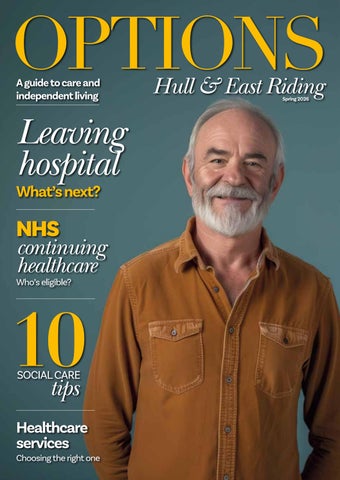
What’s next?

NHS continuing healthcare
Who’s eligible?
Healthcare services
Choosing the right one
![]()
What’s next?

NHS continuing healthcare
Who’s eligible?
Healthcare services
Choosing the right one


We are a residential home providing care and accommodation for up to 46 older people with a range of abilities, located in the seaside town of Withernsea close to the town centre and sea front.

We pride ourselves in offering a homely atmosphere, our open door approach encourages openness and transparency.
We have a highly dedicated care team which includes a full time activities coordinator who’s key responsibility is ensuring the social needs of our service users are being met in a person centred way.


For anyone who struggles to leave their home without support, at-home health services can be a lifeline.
This is something that Derek Brown, who cares for his wife Margaret, knows only too well.
Specsavers is committed to ensuring that everyone has access to essential eye-health and hearing care – but also understands that it’s not always easy for people like Margaret, who suffers from Alzheimer’s disease, to attend in-store appointments.
That’s why, for the past ten years, Specsavers Home Visits has provided comprehensive NHS-funded eye tests to anyone who’s unable to visit a store unaccompanied. It’s also started to provide free at-home hearing services in selected locations in the UK.
Derek called on the Specsavers Home Visits service when Margaret needed a routine eye test and it was too challenging to get to a store. He was blown away by the expert care that was delivered during the visit and the difference the new glasses made to his wife.
Although Margaret wasn’t able to respond to the questions of the optician and their assistant, during the visit, they adapted their approach so they could prescribe the reading glasses that have expanded her world.
“If I was to say I was amazed, that would be an understatement,” says Derek. “What was so significant for me as a full-time carer was that the Specsavers experts were punctual, quiet-speaking and patient, reassuring Margaret with everything they did. The level of care expressed towards her was incredible.”
Derek, from Northallerton in North Yorkshire, has been the primary carer for Margaret, since her diagnosis with
• Convenience: Our experts come directly to you.
• Personalised Care: Visits are tailored to the individual’s needs, with specialist equipment to ensure comfort and accuracy.
• Peace of Mind: Your loved one will receive the same kind of highquality care as they would expect in-store.

Alzheimer’s in early 2018. After she spent four weeks in hospital in 2022, Margaret’s condition deteriorated, and she has since been confined to a hospital bed in the couple’s living room, and a hoist to access a wheelchair. With multiple other health challenges, caring for Margaret is complex – but after 25 years of love and marriage Derek has risen to the challenge. As well as taking care of her everyday needs, he’s been able to improve her quality of life thanks to Specsavers at-home service.
Following her at-home eye test, the optician suggested Margaret tried some reading glasses to help her enjoy looking at family photos.
Derek was unsure how she would adapt to wearing glasses but seeing her smile while looking at old family pictures told him everything he needed to know.
“If anyone is in any doubt about inviting Specsavers into their home, all I can say is: simply try it,” Derek says. “You won’t regret it for a second.”
Derek now fights for better support and recognition for carers nationwide, and has launched a website (www.dementiaguidance.co.uk) dedicated to helping carers like him across the UK. He’s keen to ensure they have all the information they need – including the option of getting a comprehensive at-home eye test from Specsavers.

For those eligible, our mobile experts will provide a comprehensive NHSfunded eye test from the comfort of your own home, with all the same care and thoroughness as you would receive in-store. Specsavers has now also started to roll out free at-home hearing services across the UK. To find out what locations this service is available in visit our website.
Our eye care and hearing services are tailored to each person and their needs. They are designed to provide eye care and hearing services that are as individual as they are and can be adapted to meet their changing circumstances and comfort levels.

To see if you or your loved one are eligible, call 0800 0890144 or visit specsavers.co.uk/home-visits
Some people with long-term complex health needs qualify for free social care arranged and funded solely by the NHS. This is known as NHS continuing healthcare.
Where can NHS continuing healthcare be provided?
NHS continuing healthcare can be provided in a variety of settings outside hospital, such as in your own home or in a care home.
Am I eligible for NHS continuing healthcare?
NHS continuing healthcare is for adults. Children and young people may receive a “continuing care package” if they have needs arising from disability, accident or illness that cannot be met by existing universal or specialist services alone.
Find out more about the children and young people’s continuing care national framework on GOV.UK
You should be fully involved in the assessment process and kept informed, and have your views about your needs and support taken into account. Carers and family members should also be consulted where appropriate.
A decision about eligibility for a full assessment for NHS continuing healthcare should usually be made within 28 days of an initial assessment or request for a full assessment.
If you are not eligible for NHS continuing healthcare, you can be referred to your local council who can discuss with you whether you may be eligible for support from them.
If you still have some health needs then the NHS may pay for part of the package of support. This is sometimes known as a “joint package” of care.
Your eligibility for NHS continuing healthcare depends on your assessed needs, and not on any particular diagnosis or condition.
To be eligible for NHS continuing healthcare, you must be assessed by a team of healthcare professionals (a multidisciplinary team). The team will look at all your care needs and relate them to:
• what help you need
• how complex your needs are
• how intense your needs can be
• how unpredictable they are, including any risks to your health if the right care is not provided at the right time
Your eligibility for NHS continuing healthcare depends on your assessed needs, and not on any particular diagnosis or condition. If your needs change then your eligibility for NHS continuing healthcare may change.

The process involved in NHS continuing healthcare assessments can be complex. An organisation called Beacon gives free independent advice on NHS continuing healthcare.
Visit the Beacon website or call the free helpline on 0345 548 0300.

Integrated care boards, known as ICBs (the NHS organisations that commission local health services), must assess you for NHS continuing healthcare if it seems that you may need it.
For most people, there’s an initial checklist assessment, which is used to decide if you need a full assessment. However, if you need care urgently – for example, if you’re terminally ill – your assessment may be fast-tracked.
Being referred for a full assessment does not necessarily mean you’ll be eligible for NHS continuing healthcare. The purpose of the checklist is to enable anyone who might be eligible to have the opportunity for a full assessment.
The professional(s) completing the checklist should record in writing the reasons for their decision, and sign and date it. You should be given a copy of the completed checklist.
For most people, there’s an initial checklist assessment, which is used to decide if you need a full assessment.
The initial checklist assessment can be completed by a nurse, doctor, other healthcare professional or social worker. You should be told that you’re being assessed, and what the assessment involves.
Depending on the outcome of the checklist, you’ll either be told that you do not meet the criteria for a full assessment of NHS continuing healthcare and are therefore not eligible, or you’ll be referred for a full assessment of eligibility.
You can download a blank copy of the NHS continuing healthcare checklist from GOV.UK
Full assessments for NHS continuing healthcare are undertaken by a multidisciplinary team (MDT) made up of a minimum of 2 professionals from different healthcare professions. The MDT should usually include both health and social care professionals who are already involved in your care.
You should be informed who is co-ordinating the NHS continuing healthcare assessment.

The team’s assessment will consider your needs under the following headings:
• breathing
• nutrition (food and drink)
• continence
• skin (including wounds and ulcers)
• mobility
• communication
• psychological and emotional needs
• cognition (understanding)
• behaviour
• drug therapies and medicine
If you’re eligible for NHS continuing healthcare, the next stage is to arrange a care and support package that meets your assessed needs.
• altered states of consciousness
• other significant care needs
These needs are given a weighting marked “priority”, “severe”, “high”, “moderate”, “low” or “no needs”.
If you have at least 1 priority need, or severe needs in at least 2 areas, you can usually expect to be eligible for NHS continuing healthcare.
You may also be eligible if you have a severe need in 1 area plus a number of other needs, or a number of high or moderate needs, depending on their nature, intensity, complexity or unpredictability.
In all cases, the overall need, and interactions between needs, will be taken into account, together with evidence from risk assessments, in deciding whether NHS continuing healthcare should be provided.
The assessment should take into account your views and the views of any carers you have. You should be given a copy of the decision documents, along with clear reasons for the decision.
You can download a blank copy of the NHS continuing healthcare decision support tool from GOV.UK
If your health is deteriorating quickly and you’re nearing the end of your life, you should be considered for the NHS continuing healthcare fast-track pathway, so that an appropriate care and support package can be put in place as soon as possible – usually within 48 hours.
If you’re eligible for NHS continuing healthcare, the next stage is to arrange a care and support package that meets your assessed needs.
Depending on your situation, different options could be suitable, including support in your own home and the option of a personal health budget.
If it’s agreed that a care home is the best option for you, there could be more than 1 local care home that’s suitable.
Your ICB should work collaboratively with you and consider your views when agreeing your care and support package and the setting where it will be provided. However, they can also take other factors into account, such as the cost and value for money of different options.

If your needs have changed, the review will also consider whether you’re still eligible for NHS continuing healthcare.
If you’re eligible for NHS continuing healthcare, your needs and support package will normally be reviewed within 3 months and thereafter at least annually. This review will consider whether your existing care and support package meets your assessed needs. If your needs have changed, the review will also consider whether you’re still eligible for NHS continuing healthcare.
ICBs will normally make a decision about eligibility for NHS continuing healthcare within 28 days of getting a completed checklist or request for a full assessment, unless there are circumstances beyond its control.
If the ICB decides you’re eligible, but takes longer than 28 days to decide this and the delay is unjustifiable,
they should refund any care costs from the 29th day until the date of their decision.
If you’re not eligible for NHS continuing healthcare, but you’re assessed as requiring nursing care in a care home (in other words, a care home that’s registered to provide nursing care) you’ll be eligible for NHS-funded nursing care.
This means that the NHS will pay a contribution towards the cost of your registered nursing care. NHS-funded nursing care is available irrespective of who is funding the rest of the care home fees.
Find out more about NHS continuing healthcare from NHS England.
Q I have a local authority support package that works well. I’m now eligible for NHS continuing healthcare – will my support package change?
If you’re concerned about changes to your care package because of a move to NHS continuing healthcare, your ICB should talk to you about ways that it can give you as much choice and control as possible. This could include the use of a personal health budget, with 1 option being a “direct payment for healthcare”.
Q
Can I refuse an assessment for NHS continuing healthcare? If I refuse, will I be able to get services from my local authority?
Consent is not needed for completion of assessments (CHC Checklists, Decision Support Tools (inclusive of FNC by default) and Fast Track), or collation and sharing of information with:
• Care Teams
• Health and Social Care Staff
But consent is needed to share personal information collected for, and as part of, assessments (Checklist, Decision Support Tool (inclusive of FNC by default) and Fast Track) with third parties, such as family, friends or representatives, at the beginning of the process.
There is a legal limit to the types of services that a Local Authority can provide. If you have any concerns about being assessed for NHS continuing healthcare, the ICB should explore your reasons for this, and try to address your concerns.
If someone lacks the mental capacity to consent to sharing of information with third parties (other than Care Teams or Health and Social Care Staff), the principles of the Mental Capacity Act will apply and a best interests decision may be needed.
Q
My relative is in a care home and has become eligible for NHS continuing healthcare. The ICB says the fees charged by this care home are more than they would usually pay, and has proposed a move to a different care home. I think a move will have a negative effect on my relative. What can we do?
If there’s evidence that a move is likely to have a detrimental effect on your relative’s health or wellbeing, discuss this with the ICB. It will take your concerns into account when considering the most appropriate arrangements.
If the ICB decides to arrange an alternative placement, they should provide a reasonable choice of homes.
Q Is it possible to pay top-up fees for NHS continuing healthcare?
No, it is not possible to top up NHS continuing healthcare packages, like you can with local authority care packages.
The only way that NHS continuing healthcare packages can be topped up privately is if you pay for additional private services on top of the services you’re assessed as needing from the NHS. These private services should be provided by different staff and preferably in a different setting.
You’ll be given a personal budget to spend if your local council decide you’re eligible for help with any social care and support you need. You can request an assessment from the council to establish your needs.
The money in your personal budget can be paid to you, to help you make more decisions about how it’s spent. This is known as a direct payment. What is a personal budget?
Your personal budget is the amount of money your local council will pay towards any social care and support you need.
The amount of money in your personal budget is decided by your local council after a needs assessment to work out:
• what kind of care and support you need
• how much it will cost
• how much you’re able to afford yourself
If you’re a carer, you may be entitled to receive a personal budget after having a carer’s assessment to see what might help make your life easier.
Carers and personal budgets
If you’re a carer, you may be entitled to receive a personal budget after having a carer’s assessment to see what might help make your life easier.
A carer’s assessment is free and anyone over 18 can ask for one.
You can ask the council to either:
• manage your personal budget for you
• pay the money to another organisation – such as a care provider
• pay the money directly to you or someone you choose – this is known as a direct payment
You can also choose a combination of these options. For example, the council could arrange some of your care but send you the rest of the money. This is often called a mixed package or “mix and match”.
The money in your personal budget will be spent for you by the council. They will arrange all your care and support based on your agreed care plan.
They still need to check you’re happy with the care they’re arranging for you.
If your money is paid to another organisation
The organisation you choose, such as your care provider, will speak to the council and arrange the payments.
Sometimes other organisations charge you extra money to arrange payments from the council.
Direct payments give you more flexibility over how your care and support is arranged and provided.
For example, you could choose to hire care workers or personal assistants who:
• are always the same people and available when you need them
• speak the same language as you
• have experience working with your care needs
• are a specific person that has been recommended to you
• can help you get to shops or social events

There are many ways you could choose to use the money. It’s your choice as long as you’re spending your personal budget on things that meet your agreed care plan.
Most councils will ask for evidence of how you’ve spent your money every 3 months.
You may decide direct payments are not helpful if:
You should be offered direct payments as an option after your needs assessment.
You can also ask your local council’s social services department about direct payments.
You could also consider having someone else manage your direct payments, for example a friend or family member.
• you’re worried about managing money or the people you employ
• you spend a lot of time in hospital
• you would rather the council arranged your care
If you’re not confident about keeping records or managing the people who care for you, your local council should be able to provide support.
You could also consider having someone else manage your direct payments, for example a friend or family member. You’ll need to set up a trust for payments that are managed by someone else.
The Money Advice Service has information about setting up a trust.
If you choose direct payments, the council will send you the money in your personal budget by either:
• paying it directly into a bank, Post Office, building society or National Savings and Investments account
• sending you a pre-paid card
You can then choose how you spend the money on your own care and support, as long as it matches the care plan you’ve agreed with the council.
Signing
The council might ask you to sign a document called a direct payment agreement. This says:
• how the council want you to record your spending –for example, keeping receipts

• your responsibilities as an employer - if you’re paying for a care worker
If you spend direct payments on something that isn’t agreed in your care plan, the council could take the money back or end the direct payments.
If you’re struggling to manage your money
Ask your local council for advice or call the Money Advice Service on 0800 138 7777.
If you want someone else to receive the direct payment
You could speak to the council and agree for the money to be sent to someone who will spend it for you. For example:
• a carer
When choosing an agency, decide what sort of service you’re looking for and the tasks you need help with.
• a friend or family member
• someone else who speaks up for you (an advocate)
You may need to write down how they will spend the money and which decisions they can make for you. This is known as a decision-making agreement.
If you decide to hire a carer or personal assistant yourself, it’s important to know the responsibilities you’ll have as an employer.
Although support from the council should be available, you may need to arrange:
• background checks or references
• tax
• National Insurance
• pension contributions
Read more about employing someone to work in your home on GOV.UK.
Disability Rights UK also have more information on getting a personal assistant.
You could choose to hire care workers through an agency instead. This removes the legal obligations of being an employer, but could:
• cost you more money
• remove some of the benefits - such as having the same person provide your care
When choosing an agency, decide what sort of service you’re looking for and the tasks you need help with. It’s a good idea to contact more than one agency, as they may offer different types of services.
You can find out about local home care agencies by:
• speaking to your local council’s social services department
• contacting the UK Homecare Association
If you’re eligible for NHS-funded nursing care, the NHS will arrange and fund nursing care provided by registered nurses employed by the care home.
There are also organisations that inspect care agencies to see how well they are doing. The Care Quality Commission (CQC) regulates all health and adult social care in England.
You might see a CQC inspection rating when you search online for care home agencies. Their 4 ratings are:
• Outstanding
• Good
• Requires improvement
• Inadequate
You could also search for care home agencies on the CQC website to see their full reports.
If you would like support to help you manage your personal budget or direct payments, speak to your council or call:
• the Disability Rights UK personal budgets helpline on 0330 995 0404
• the Age UK advice line on 0800 055 6112 (for older people)
NHS-funded nursing care is when the NHS pays for the nursing care component of nursing home fees. The NHS pays a flat rate directly to the care home towards the cost of this nursing care.
Who is eligible for NHS-funded nursing care?
You may be eligible for NHS-funded nursing care if:
• you’re not eligible for NHS continuing healthcare but have been assessed as needing care from a registered nurse
• you live in a nursing home
You should be assessed for NHS continuing healthcare before a decision is made about whether you are eligible for NHS-funded nursing care. Most people don’t need a separate assessment for NHS-funded nursing care. However, if you do need an assessment or you haven’t already had one, your integrated care board (ICB) can arrange an assessment for you.
Outcome of the assessment
If you’re eligible for NHS-funded nursing care, the NHS will arrange and fund nursing care provided
It’s worth speaking to your council’s social services before making an official complaint to see if they can help.
You still have to the right to complain if you:
• have been told you’re not eligible to receive money towards your care and support
• don’t agree with the amount of money in your personal budget
You could either:
• speak to your social worker about being re-assessed
• call your local council social services and request a complaints form
Your council should also have a formal complaints procedure on its website.
If you’re not happy with the council’s response
Contact your Local Government Ombudsman. They investigate all adult social care complaints.
• Age UK have a detailed fact sheet on personal budgets and direct payments in social care
• The Money Advice Service has a guide to direct payments
by registered nurses employed by the care home. Services provided by a registered nurse can include planning, supervising and monitoring nursing and healthcare tasks, as well as direct nursing care.
If you’re not eligible for NHS-funded nursing care and you don’t agree with the decision about your eligibility, ask your ICB to review the decision.
NHS-funded nursing care is paid at the same rate across England. In May 2022, the rate was set at £209.19 a week (standard rate) and will be backdated to 1 April 2022.
If you moved into a care home before 1 October 2007, and you were on the previous high band, NHS-funded nursing care is paid at a higher rate. In May 2022, the higher rate was set at £287.78 a week and will be backdated to 1 April 2022. You’re entitled to continue on this rate unless:
• you no longer have nursing needs
• you no longer live in a care home that provides nursing
• your nursing needs have reduced and you’re no longer eligible for the high band, when you would change to the standard rate of £209.19 a week, or
• you become entitled to NHS continuing healthcare instead
You will not be entitled to help with the cost of care from your local council if:
• you have savings worth more than £23,250 – this is called the upper capital limit, or UCL
• you own your own property (this only applies if you’re moving into a care home)
You can ask your council for a financial assessment (means test) to check if you qualify for any help with costs.
You can choose to pay for care yourself if you don’t want a financial assessment.
You can:
• arrange and pay for care yourself without involving the council
• ask the council to arrange and pay for your care (the council will then bill you, but not all councils offer this service and they may charge a fee)
Having a carer who lives with you costs from around £800 a week. But it can cost as much as £1,600 a week if you need a lot of care.
There are 2 types of care home:
• residential homes have staff that help with everyday tasks such as getting dressed and supply all your meals
• nursing homes also offer 24-hour nursing care
A room in a care home costs:
• around £700 a week in a residential home
• over £850 a week in a nursing home
The price will vary according to where you live and the type of care you need.
For example, serious health problems like dementia and chronic obstructive pulmonary disease (COPD) can increase the cost.
Even if you choose to pay for your care, your council can do an assessment to check what care you might need. This is called a needs assessment.
For example, it’ll tell you whether you need home help from a paid carer for 2 hours a day or 2 hours a week and precisely what they should help you with.
The needs assessment is free and anyone can ask for one.
How much will care cost?
Social care can be expensive. Knowing how much you’ll have to pay will help you budget.
A typical hourly rate for a carer to come to your home is around £20, but this will vary depending on where you live.
You may be eligible for benefits, like Attendance Allowance and Personal Independence Payment (PIP), which aren’t means-tested.
You can use them to pay towards the cost of your care.
You won’t have to sell your home to pay for help in your own home.
But you may have to sell your home to pay for a care home, unless your partner carries on living in it.
Sometimes selling your home to pay care home fees is the best option.
But there may be other ways to pay care home fees if you don’t want to sell your home straight away.
Contact your local council about 3 months before you think your savings will drop to below the limit and ask them to reassess your finances.
Equity release lets you take money that’s tied up in your home without selling it. It’s available if you’re over 55.
But you have to pay interest on the money you take out, which can be expensive.
MoneyHelper has more information on equity release.
You can rent out your home and use the income to help pay your care home fees.
A deferred payment scheme can be useful if you have savings less than the upper capital limit of £23,250 and all your money is tied up in your property
The council pays for your care home and you repay it later when you choose to sell your home, or after your death.
Ask your council if you’re eligible for a deferred payment scheme.
You can get more information from:
• MoneyHelper: deferred payment schemes
• Independent Age: do I have to sell my home to pay for residential care?
You can get unbiased expert advice from a specialist care fees adviser.
They’ll help you compare all your options before you decide what’s right for you.
Find a specialist care fees adviser in your area with:
• PayingForCare, a free information service for older people
• Society of Later Life Advisers (SOLLA) on 0333 2020 454
Get advice on paying for care from:
• Age UK on freephone 0800 055 6112
• Independent Age on freephone 0800 319 6789
• MoneyHelper on freephone 0800 011 3797
If your savings fall below the upper capital limit of £23,250, your council might be able to help with the cost of care.
Contact your local council about 3 months before you think your savings will drop to below the limit and ask them to reassess your finances.
Councils provide funding from the date you contact them. You won’t be reimbursed if your savings are below the limit before you contact them.
You might be able to get some free help regardless of your income or if you’re paying for your care.
This can include:
• small bits of equipment or home adaptations that each cost less than £1,000
• NHS care, such as NHS continuing healthcare, NHSfunded nursing care and care after illness or hospital discharge (reablement)


Feeling down or less confident?
Struggling to enjoy the things you used to?
Feeling worried or anxious?
Avoiding people, even those close to you?
Low mood, depression and anxiety are not things you just need to put up with. If you’ve had some of these symptoms often, speaking to someone about it may help.
If you have a Hull GP, fill in a self-referral form:

The Care Quality Commission is here to make sure health and adult social care services including hospitals, home and residential care as well as GPs in England provide people with safe, effective, high-quality care. We publish independent inspection reports and ratings about services – information you can use when you’re choosing care for yourself, or a loved one.
You can use our website to search for services you might be interested in by geographical area, or by specialism. For example, a care home that might offer specialist care for someone who has dementia.
We also welcome your feedback on the care you have received – good or bad. We use this information to help inform our inspections and can alert authorities including local social services, if there are safeguarding concerns about care being provided.
You can visit our website at www.cqc.org.uk to find our inspection reports, or share an experience of care. You can also call us to share an experience of care on 03000 61 61 61.
Here are some tips to help you choose your care.
1 The Care Quality Commission (CQC) registers all care homes and home care agencies. You can find out which ones support specific groups of people, such as people with a learning disability or those living with dementia.
2 CQC’s Chief Inspector for Adult Social Care, always uses ‘The Mum Test’: is a care home safe, caring, effective, responsive to people’s needs and well-led? In other words, is it good enough for my Mum (or anyone else I love and care for)?
Look for care homes and home care agencies where the staff involve people who use services and their families and carers, and treat individuals with compassion, kindness, dignity and respect
Whether you are being cared for in your own home or in a residential setting, the staff looking after you need to be skilled, kind and supportive They should also be capable and confident in dealing with your particular needs. You should always feel that their support is helping you to live the life you want to.
5 A care home will be a home for you or your loved one. Residents should be treated as individuals with their likes and dislikes taken into account. Think about whether a home is close enough to family, friends, and community facilities
Look at how well-led and managed a home is. What does it have in place to ensure that it delivers high quality care? Does it
If you or a loved one needs help with day-today care, you can contact your local council’s social services department. They will ‘make an assessment of your needs’ and depending on circumstances, may be able to help you access financial help. For more advice visit Age UK’s website www.ageuk.org.uk/home-and-care.
Your local social services department should be able to provide details of approved agencies.
Safeguarding adults who receive social care is everybody’s business. If you are concerned about the safety of a loved one receiving care, contact the service provider in the first instance. You can also contact social services at your local council. If you feel a crime has been committed, contact the police. You can share your safeguarding concerns with us on our website or contact our National Customer Services on 03000 616161.
Ferriby House, 5 High Street, North Ferriby HU14 3JZ

Providing nursing, residential and respite care for the elderly and disabled

Please give us a ring to chat about your needs on Telephone (01482) 634782 or 631301 www.northferribynursinghome.co.uk
Options Hull & East Riding is published by Octagon Design & Marketing Ltd with editorial contributions from the CQC, Hull and East Yorkshire Mind, City Health Care Partnership CIC, Alzheimer’s Society, Age UK Hull and East Yorkshire and the NHS. The editorial contributors have not vetted the advertisers in this publication and accepts no liability for work done or goods supplied by any advertiser. Nor do the editorial contributors endorse any of the products or services.
Every possible care has been taken to ensure that the information given in this publication is correct at the time of going to print. Whilst the publisher would be grateful to learn of any errors, it cannot accept any liability over and above the cost of the advertisement for loss there by caused. No reproduction by any method whatsoever of any part of this publication is permitted without prior written consent of the copyright owners.
Octagon Design & Marketing Ltd. Tel: 01302 714528

The services we provide can be discussed in your home, or at our welcoming office in Goole. We’re here for you every step of the way when it comes to our services, which include:
• Personal Services Available 24 Hours a Day, 365 Days a Year
• Private Chapels of Rest
• Pre-paid Funeral Plans On Request
• Fleet of Mercedes™ Funeral Cars
• Horse-Drawn Carriages Available on Request
As a team, we work hard to help you to say goodbye to your loved ones in a way that is befitting to their memory. For more details, or to discuss your individual requirements, please call us today.
A Fletcher & Sons, 31 Edinburgh Street, Goole, DN14 5EH Tel: 01405 763130


We appreciate how daunting and stressful arranging a funeral can be, especially if you have never had the heartbreaking experience of losing a loved one. We are able to provide a complete funeral service individually tailored to your family’s specific needs. Below are some of the services that we provide:
• Estimates and Professional Advice without Obligation
• Complete Guidance on Every Aspect of Planning the Funeral
• Supply of a Wide Range of Traditional, Willow, Bamboo, and Individually Designed Coffins
• Supplying of Floral Tributes
• Designing and Printing of Order of Service Sheets
• Placing of Newspaper Bereavement Notices
• Catering Requirements
• Monumental Masons’ Work for Headstones
• Pre-Paid Funeral Plans (Golden Charter)
78 Main Street, Willerby, Hull HU10 6BZ Phone: 01482 656537 Email: robertadrew@robertadrew.karoo.co.uk www.robertadrew.com


Age UK Hull and East Yorkshire operates across Hull and East Yorkshire – our aim is to ensure that older people get the services they need where and when they need them.
Through our work we ensure that older people, their families and their carers, are supported in 4 keyways:
• How can we help – assess needs and understand what support is needed
• Make a plan – who is going to do what, where and when so needs are met
• Independence Matters – Supporting people to live sustainably in the community
• Friendship Matters – Ensuring older people can enjoy gratifying later lives
Age UK Hull and East Yorkshire services
We are constantly developing our range of support for older people and their carers - current details are outlined below. If you would like to enquire about any of the services, would like to go to a session or have any queries at all regarding support for older people and their carers then please contact us - we are available for you to contact us 9.00am to 3.45pm, Monday to Friday.
• Email Hello@ageukhey.org.uk
• Tel: 01482 324644
• Web www.ageuk.org.uk/hulleastyorkshire
Please note that due to funding availability across Hull and East Yorkshire, we deliver some services directly ourselves, and others we may need to refer you to others for support.
Information and advice
Help and support on a variety of topics including activities, utilities, housing, health and social issues, personal and care problems and many other issues that may affect you or the lives of the other members of your family.
Our Benefits Advice service provides a range of support and
advice to ensure that older people, and their carers, are getting access to the range of benefits and other support they are entitled to. Receiving the right benefits ensures that older people have both the finances and other areas of support in place so that they live independently in the community e.g. finances to pay for care/support in the home, help with household living expenses, carers financial support.
Our befriending service aims to reduce loneliness for people aged 50 and over. Our befrienders provide a regular, friendly phone call and/ or visit to help reduce feelings of isolation and rebuild confidence.
Our Falls Prevention and Awareness Service helps older, vulnerable adults who may be at risk of falling. Our Falls Prevention Officer can provide a falls assessment to enable people to live independently and safely. We also work closely with other organisations to help source the support people need.
The aim of the service is to reduce loneliness and isolation amongst older people by helping them to reconnect with their local communities, their friends, and family. We will help older people address the barriers they face in leaving their homes, such as anxiety or a lack of confidence and support and encourage people to overcome these barriers.
Our Home Support service delivers a range of charged for services to ensure that older people can live independently in their own homes. Services include cleaning, shopping, social calls/outings, sitting visits for companionship and conversation. Many carers also use this support to provide respite/cover and breaks for themselves.
We provide Positive Activities via our range of day opportunities and services, based in venues across the communities of Hull and East Yorkshire. These groups provide a positive activity and social/mental stimulation, along with social opportunities, companionship and a place to meet others.
• Monday PM – Bee Social group- Springhead Golf Club
• Tuesday AM – Brough Social – Blackburn Social Club
• Tuesday AM – Streetlife Group – Wilberforce Learning Centre / Streetlife Museum
• Wednesday AM – Village People – Garden Village Club
• Thursday AM – Brunch Bunch – Anlaby Library
• Thursday AM and PM – Feel Good Thursdays –Barrington Avenue
Walking Football programme for all people aged 50 and over regardless of ability or previous experience. £4 per session
• Haltemprice Leisure Centre (Tuesday AM)
• Costello Stadium (Thursday AM)
Volunteering can be a very rewarding way to give something back to the community, whilst also gaining valuable skills, and ensuring your spare time makes a positive impact for older people and their carers. We have a range of volunteering opportunities available across Hull and East Yorkshire, some of which can be done from the comfort of your own home. Comprehensive training and support available. Please contact us for a no obligation discussion and to explore how you could assist us with our vital work.
Age UK Hull and East Yorkshire is an independent local charity and a brand partner of Age UK national charity. All monies raised are spent locally for the older people of Hull and East Yorkshire. Age UK Hull and East Yorkshire work with people aged fifty plus across Hull and East Yorkshire with a view to engaging them in our activities both as supporters of and participants in the provision of our services and development of our resources. We have over 200 volunteers within the organisation and we will continue to provide support for the most vulnerable members of the community, taking into account the needs of older people and campaign on their behalf. Age UK Hull and East Yorkshire will continue to campaign and influence policy makers across the city to ensure the needs and desires of the older population are met to help them remain living independently.
Our Vision:
That older people can live happy and sustainable later lives.
Our Mission:
Ensuring that local older people get the services and support they need.
As a local independent charity working throughout Hull and East Yorkshire, we are committed to delivering support and services and working in partnership with other organisations to support older people, their families and their carers.

We rely on the generous support of the community through fundraising and donations to ensure we can continue to provide our vital services.
If you feel you can provide a monthly or a one-off donation you can visit https://www.ageuk.org.uk/hulleastyorkshire/get-involved/ donate/ or give us a call to make a donation.
If you have any enquires about our work then please contact us:
• Email Hello@ageukhey.org.uk
• Tel: 01482 324644
• Web www.ageuk.org.uk/hulleastyorkshire
• Age UK Hull and East Yorkshire, Axida House, 350 Preston Road, Hull HU9 5HH


East Riding Care Services is an intimate, family-run care provider with homes across the East Riding of Yorkshire, Hull. Our journey began with a simple idea: to create homes where people feel genuinely looked after — physically, emotionally, and personally.
Providing residential, rehabilitation, dementia, respite and day care focussing on consistent and personcentered care. Long and short term care available to everyone, private, local authority or partial funded, whatever your life path, stories are shared and welcomed together as part of our family tree.
Our homes are welcoming, calm and comfortable to live in. Each resident has their own deluxe bedroom most with en-suite. We serve fresh seasonal home cooked food every day. We also offer a varied programme of activities from creative hobbies, quizzes, film nights and live performances.