
Healthier Together
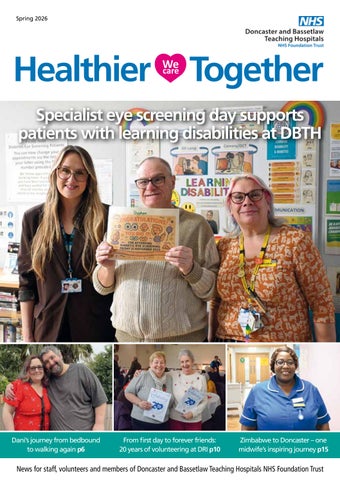
Specialist eye screening day supports patients with learning disabilities at DBTH


Zimbabwe to Doncaster – one midwife’s inspiring journey p15
From first day to forever friends: 20 years of volunteering at DRI p10
Dani’s journey from bedbound to walking again p6

DBTH plans major investment to strengthen nursing workforce and improve
Doncaster and Bassetlaw Teaching Hospitals (DBTH) is moving forward with plans to strengthen its nursing workforce, helping to further improve care for patients and support colleagues.
The Trust has set out proposals to increase the number of registered nurses on adult inpatient wards, in line with national best practice. The first phase of the plans focuses on strengthening the mix of skills within teams by increasing registered nurse roles.
The investment would cost around £534,000 a year and is expected to be partly offset by savings through reduced reliance on temporary workers, who help cover short-term gaps in staffing.
In late 2025, DBTH also welcomed around 100 newly qualified nurses and midwives, showing its commitment to building and developing its own permanent workforce. Nurses and midwives make up around a quarter of the Trust’s workforce, and the organisation expects the plans to help reduce pressure on wards, improve patient flow, and support colleagues in their roles.
The proposals also reflect the Trust’s five-year strategy, Healthier Together, which focuses on putting people first and creating a positive and supportive working environment.
Karen Jessop, Chief Nurse, said: “Having well-supported, skilled nursing teams makes a real difference on our wards. It means colleagues have more time for patients, can support each other better, and feel confident in the care they are providing.
“This investment recognises the safety critical role of registered nurses. International evidence shows that higher registered nurse staffing is consistently linked to lower mortality, fewer adverse events and a better experience for patients. Ensuring we have the right number of skilled registered nurses is fundamental to delivering safe, high quality care.
“By strengthening our permanent workforce in a planned and sustainable way, we are building stronger services for the future.” New roles will be filled in stages, in line with service need and graduate nurse availability.
The Trust says it will continue to invest in recruitment, training, and development to make DBTH a supportive and welcoming place to work. Current opportunities at DBTH can be found at: dbth.nhs.uk/jointheteam

DBTH welcomes Sally Jameson MP to Doncaster Royal Infirmary to see progress on new Department of Critical Care
On Friday 23 January, Doncaster and Bassetlaw Teaching Hospitals (DBTH) welcomed Sally Jameson MP, Member of Parliament for Doncaster Central, to Doncaster Royal Infirmary (DRI) to see how work is progressing on the new Department of Critical Care, meet colleagues and patients, and collect signatures in support of her campaign to highlight the need for continued investment at the site.
Sally was shown around the development by Zara Jones, Acting Chief Executive, and Dr Kirsty Edmondson-Jones, Director of Infrastructure, who talked her through how the new department is taking shape and what it will mean for patients.
The Department of Critical Care is being delivered through a £19.8 million investment and will provide a modern 22-bed unit for some of the hospital’s most seriously ill patients. The building is due to be completed early 2027.
Once complete, the new facility will care for people who need constant monitoring and specialist treatment. This includes patients recovering from major surgery, serious infections, severe injuries, breathing problems, and other life-threatening conditions. Care is provided around the clock by highly trained teams using specialist equipment.
This is one of the biggest recent investments at DRI and forms part of a long-term programme to refurbish and modernise the site to ensure it is fit to meet the needs of future generations of patients and colleagues.
Much of the hospital was built in the 1930s and 1960s, to meet the needs of a very different era of healthcare. Many areas, despite adaptations over time, are now poorly suited to the needs of modern medicine, new technology, and today’s patient expectations, placing ongoing pressure on services.
In response, DBTH previously bid for national funding to support a major rebuild of the

site. Although the bid was unsuccessful, work has continued to strengthen and renew the hospital through phased, long-term redevelopment and targeted investment.
Recent projects, including the new Discharge Lounge and Surgical Same Day Emergency Care unit, have already helped improve patient flow and create space for the new Department of Critical Care. These developments have been delivered on schedule and are now supporting day-to-day services, reflecting DBTH’s strong track record of making effective use of capital investment.
Subject to national funding approvals, the next major planned step is the refurbishment of the East Ward Block, the main tower block dating back to the 1960s, which would modernise one of the site’s busiest buildings.
Zara Jones, Acting Chief Executive at DBTH, said: “We were pleased to welcome Sally to
Doncaster Royal Infirmary and to show her the progress being made. The new Department of Critical Care will make a real difference for patients and colleagues. We value the strong and constructive support we receive from our local MPs. While we have invested record amounts in recent years, the age of many of our buildings means continued investment remains essential.”
Sally Jameson MP said: “It was great to see the progress being made and to hear directly from colleagues and patients. I will continue to work with the Trust, local partners and Government, using my voice in Parliament to support continued investment and improvements for the people of Doncaster.”
Each year, Doncaster and Bassetlaw Teaching Hospitals cares for around 800,000 patients, with around 600,000 treated at Doncaster Royal Infirmary, making it one of the busiest hospitals in the region.
Specialist eye screening day supports patients with learning disabilities at DBTH
Last month, the Diabetic Eye Screening Team at Doncaster and Bassetlaw Teaching Hospitals (DBTH) delivered a dedicated screening day designed specifically for patients with learning disabilities, helping to remove barriers to care and create a calmer, more personalised experience for those attending.
Throughout the morning, nine patients attended the clinic and each received a fully accessible experience, with the team adapting the clinic environment and tailoring appointments to meet their individual needs.
Routine diabetic eye screening is a vital part of diabetes care, helping to detect early signs of eye damage before symptoms develop and prevent the risk of sight loss. The screening is quick and painless, involving eye drops to widen the pupils followed by photographs of the retina, the part of the eye that can be affected by diabetic retinopathy.
However, whilst people with learning disabilities are ten times more likely to develop eye conditions such as diabetic retinopathy, they are less likely to take up their screening appointments.
To provide the best possible support, the team ensured the department remained quiet, calm and welcoming. Patients were offered longer appointment times and a space that felt more relaxed than a standard clinical setting. Low lighting was used in the waiting and examination rooms to reduce sensory overwhelm, while a sensory table offered items such as fidget toys and twiddle muffs for patients who benefit from tactile reassurance. A sensory light projector and gentle music in the waiting room created a soothing atmosphere, which was praised by both patients and carers.
Accessible communication played a vital role in the success of the day. Easy-read letters and printed information were developed specifically for the session, alongside communication cards to ensure each patient understood what was happening and could express their express emotions, preferences and decisions. Many patients said they found the

appointment letter easier to read and understand, showing how small changes to communication can make a meaningful difference to their healthcare experience.
The clinic was also supported by Rebecca Knapton, Acute Learning Disability Liaison Nurse at the Trust, whose familiarity with many of the patients helped put them at ease. Her presence contributed to the positive, friendly atmosphere that patients and carers repeatedly fed back on during the session.
Every patient also left with a certificate, which proved extremely popular, with many eager to show theirs to friends and family once they returned home.
Jemima Beaumont, Failsafe and Engagement Lead for the Diabetic Eye Screening Programme at DBTH, said: “It was really easy to implement

such small changes that make a huge impact for our patients with learning disabilities.
“As clinicians, it’s easy to just focus on keeping clinics running smoothly and on time for all patients, but by creating these dedicated sessions and adapting them to support individuals, we can see just how much of a positive impact we can make.
“We know that access, confidence and awareness all play a role in whether someone attends screening – and we’re trying to tackle those challenges head-on.”
Earlier this year, the team hosted a pop-up diabetic eye screening clinic at Bentley Pavilion to support people who may be less likely to attend their routine appointments. Building on this success, the team hopes to expand their work within the local community further and reach more patients who face barriers to accessing their screening.
Zara Jones, Deputy Chief Executive at DBTH, said: “It is fantastic to see such a positive response from patients and carers and it reflects our commitment as a Trust to tackle health inequalities by providing fairer access to care and more inclusive support for those who need it.”
Dani’s journey from bedbound to walking again
For years, illness took almost everything from Dani Hughes – her independence, her career, and her confidence. Today, after specialist care at Doncaster and Bassetlaw Teaching Hospitals (DBTH), she is learning to walk again and rebuilding a life she once feared was lost forever.
Dani was just 26 when she first became unwell. At the time, she was working as a community nurse in Doncaster. After developing a limp, her health quickly declined. Within a year, she was wheelchair-bound.
Following extensive tests, Dani was diagnosed with a neurological disorder – a condition that affects how the nervous system works. As her symptoms worsened, she was forced to give up the career she loved and move from the home she shared with her husband, Gareth, into a bungalow that could better meet her needs.
The physical changes soon began to affect her mental health.
“I lost my independence, and it made me feel so low mentally,” Dani said. “My friends became estranged, and I felt alone in an uphill battle.”
Dani was later referred to Vivek Kumar, Urology Consultant at DBTH, who diagnosed her with a neurogenic bladder –a condition caused by nerve damage that affects bladder control.
“Mr Kumar did everything he could to try to save my bladder,” Dani explained “I had regular Botox injections for years to try to ease the symptoms, but eventually the pain became unbearable.”
In February 2025, doctors agreed that Dani would undergo major surgery to remove her bladder and form a urostomy. When


the operation took place three months later, a hysterectomy was also recommended to reduce the risk of future complications.
While the surgery marked a turning point, recovery was not easy.
“What I struggled with the most after the operation was my emotions,” Dani said. “The hysterectomy sent me into early menopause, and I was also learning how to live with a stoma.
“I’ve had to learn how to walk again too – the last time I walked was 13 years ago. It’s surreal. I never thought I’d have the chance.”
Now discharged from Mr Kumar’s care after 15 years, Dani is continuing her recovery with physiotherapy support at Doncaster Royal Infirmary.
“The physio team are helping me get to a place where I can start driving and even look at getting a job again,” she said. “People who knew me before the operation don’t recognise me. I don’t even have carers anymore – it’s back to just me and my
husband in our home.”
Mr Kumar added: “When Dani came to us, she was at one of the lowest points in her life. Our focus was on understanding the full impact her condition was having on her dayto-day life and doing what was right for her as a person, not just treating individual symptoms.
“The progress she has made since surgery has been remarkable and shows the difference that personalised NHS care, delivered by many teams working together, can make.”
Dani also paid tribute to the wider DBTH teams who supported her throughout her journey.
“I really wouldn’t be where I am today without everyone who has looked after me, including the stoma nurses, who have given me so much information and support following my operation.”
Dani’s story highlights the life-changing impact of safe, compassionate, person-centred care, supporting patients to regain independence and improve their quality of life.
Boost to diagnostic services with new CT suite and advanced SPECT-CT at DBTH
Patients across the region are set to benefit from major investment in diagnostic imaging services, with Doncaster and Bassetlaw Teaching Hospitals (DBTH) unveiling a brand-new CT suite at Bassetlaw Hospital and an advanced SPECT-CT facility at Doncaster Royal Infirmary (DRI).
At Bassetlaw Hospital, the CT scanning service has been enhanced with the opening of a new suite, including a second scanner. This upgrade will provide greater continuity of service for patients in the Bassetlaw area, with two scanners on site, patients will no longer need to travel to DRI during routine maintenance periods.
The new suite has been designed with patient comfort in mind, featuring modern equipment and calming wall murals to create a welcoming environment.
Sara Elliott, Head of Medical Imaging at DBTH, said: “The Medical Imaging service has seen significant investment this year, enhancing both capacity and capability across our diagnostic

services. These developments mean we can offer more appointments within modern and comfortable surroundings.”
At DRI, the installation of a new SPECT-CT machine marks a major step forward for nuclear medicine services. Unlike a standard CT scanner, which captures detailed images of the body’s structure, a SPECT-CT (Single Photon Emission Computed Tomography –Computed Tomography) combines structural and functional imaging, allowing clinicians to
observe how organs and tissues are working. This provides a more complete picture of a patient’s health and supports early detection and diagnosis of a wide range of conditions.
The upgraded SPECT-CT suite also includes new clinical preparation spaces, enabling patients to get ready for their scans in a comfortable and private area.
Dr Kirsty Edmondson Jones, Director of Infrastructure at DBTH, said: “This investment in medical imaging has modernised our facilities, ensuring we provide the best possible care environments and improved outcomes for our patients and communities as outlined within our ‘Healthier Together’ strategy.”
Earlier this year, Montagu Hospital saw the completion of a new Imaging Suite as part of the Montagu Community Diagnostic Centre, providing capacity for 60,000 appointments across ultrasound, CT, and MRI services. The site has also benefitted from the refurbishment of X-ray and DEXA rooms, enhancing the patient experience through bright, accessible spaces.


DBTH achieves bronze status in national anti-racism framework
Doncaster and Bassetlaw Teaching Hospitals (DBTH) has become the first NHS trust in South Yorkshire to be awarded Bronze status in the North West BAME Assembly Anti-Racist Framework, recognising its progress in tackling racism and promoting fairness across the organisation.
The award follows a detailed assessment of how DBTH supports colleagues, listens to concerns, challenges discrimination and takes a proactive approach to tackling racism. The assessment also covered the Trust’s work with a patient safety engagement group in maternity services.
Bronze status is the first level in the framework and reflects important foundations being put in place, rather than a finished piece of work. Anti-racism means actively working to prevent discrimination, challenge unfair treatment and make sure people are treated with dignity and respect. It goes beyond simply “not being racist” and focuses on building fair systems, positive behaviours and inclusive cultures.
Around 80% of DBTH colleagues identify as White British, with around 20% from other ethnic backgrounds. This diversity brings different skills, experiences and perspectives, and makes it even more important that everyone feels respected, supported and able to progress in their chosen field.
DBTH’s Bronze award reflects strong leadership at Board level, ongoing cultural awareness work, support for colleagues’ career development, and good practice through partnerships such as The Changing Lives project with the midwifery team.
The organisation has also been involved in wider community work, including the Doncaster Anti-Racism Partnership, which was previously shortlisted for a national award for its collaborative approach.
Zoe Lintin, Chief People Officer at DBTH, said: “We are proud to be the first Trust locally to achieve this recognition, and we are clear that this is only the beginning. Bronze status shows that we have built strong foundations, not that the job is done. Tackling racism takes long-
term commitment, honest conversations and a willingness to listen and learn.
“Around one in five of our colleagues come from ethnic minority backgrounds, and it is vital that everyone feels valued, heard and supported to succeed here.
“This recognition is not an end point. It is a starting point for continued improvement, learning and accountability, and we are determined to keep raising our standards for our colleagues and our communities.”
The achievement supports the organisation’s People Plan, which focuses on looking after colleagues, helping them develop and making DBTH a great place to work. It also reflects the DBTH Way and its We Care values, which emphasise kindness, respect, teamwork and doing the right thing.
Over the coming years, DBTH plans to continue working towards higher levels in the framework by strengthening its approach, listening carefully to colleagues’ experiences and embedding inclusive practice into everyday work.
World Prematurity Day: How a multidisciplinary team helped shape the rest of a child’s life
Every year, thousands of babies in the UK are born prematurely – and for families like Rhys Gardner’s, the journey begins long before they ever leave the hospital.
Rhys was born at just 26 weeks, weighing one pound and 10 ounces, nearly six pounds below the average birthweight for boys in England. His mum, Vicky, described the fear and uncertainty she felt in those moments: “I knew nothing about premature birth let alone the complications, going into labour at 26 weeks was terrifying – particularly not knowing if my baby would survive.”
Vicky gave birth at Doncaster Royal Infirmary (DRI) before Rhys was transferred to Leeds General Hospital for the specialist care he urgently needed.
He was soon back at DRI but developed Necrotising Entercolitis (NEC), a serious intestinal disease which mainly affects premature babies. Rhys was transferred again to the Jessop Wing at Sheffield Teaching Hospital to receive critical care treatment and emergency surgical intervention.
There, he had a third of his bowel removed and a stoma fitted, at which point, Vicky was told his chances of survival were low.
Against the odds, Rhys fought through and spent the first five months of his life in hospital. Following his discharge from hospital, Rhys was cared for by the Paediatric Team at DRI –one of the first of many healthcare teams at the Trust that Rhys would meet over the years. Vicky said, “Rhys has been seen by consultants, dietitians, occupational therapists, speech and


language therapists, to name a few, who have all been absolutely fantastic supporting him.
“The medical professionals involved in Rhys’ care have provided continued support in advocating for Rhys to ensure he gets the right support in school and key in getting him on the SEN register and an Education, Health and Care Plan put in place.”
Now 13, Rhys is thriving, thanks to the continued support he receives at DRI.
Reflecting on her own experience and the advice she would give to parents facing a premature birth today, Vicky said, “The shock of a premature birth is traumatic for everyone in your support system. It ripples through the parents, family and friends.
“There are many services and groups out there now that can provide support – it’s so easy to feel isolated when you have a premature baby because your whole world becomes focused on your baby, and you
forget to look after yourself. Remember to take time for yourself and don’t be afraid to ask questions. Specialists are very busy people, but they are also very caring.”
Would you like to support the neonatal services at our hospitals? The ‘Mini Marvels’ appeal is a fundraiser by Doncaster and Bassetlaw Teaching Hospitals Charity to support families and carers with babies born too soon, or unwell, at Doncaster Royal Infirmary and Bassetlaw Hospital.

Volunteering at DBTH
From first day to forever friends: 20 years of volunteering at Doncaster Royal Infirmary
Two volunteers at Doncaster and Bassetlaw Teaching Hospitals (DBTH) are celebrating a unique milestone – 20 years of volunteering at Doncaster Royal Infirmary, having started on the same day and remained friends ever since.
For nearly two decades, Margo Ram and Yvonne Barnes have been a familiar and friendly face at the main reception of Doncaster Royal Infirmary, providing voluntary services to the Trust.
In June 2005, their volunteering journey began and on one thing the pair agreed: “We gelled straight away!”
Their first three weeks of volunteer training was led by John Cassidy, a witty, well-liked, mentor at the Trust and former police officer from Scotland. Margo, a Scot herself, fondly remembers his banter, which reminded her of her late father.
Those early days set the tone for what volunteering would become for them both: full of connection and support. The duo makes a complementary pair – both with a warmth and calmness but unmistakable cheeky humour and quick wit, especially together.
Yvonne said: “The thing that makes working together so fulfilling is having a sense of humour. We know instinctively what each other is thinking.”
During their time, Margo and Yvonne said they have encountered their fair share of ‘dramas and characters’ sat at the front desk, as well as witnessing key events in the Trusts’ history. Margo and Yvonne were volunteers during the coronavirus pandemic, though for their protection and the safety of others, they stayed at home for several weeks.
The pair were also in position during a visit in December 2008 from Her Royal Highness The Princess Royal, Anne, to Doncaster Royal Infirmary.
When asked how they support one another during difficult moments on the job, Margo said: “You just give a shoulder to cry on and a listening ear.”
Margo and Yvonne’s time as volunteers is nearly as long as their previous careers, with Yvonne working as a school secretary for 26 years, while Margo was a dinner lady. Despite coming from different professional backgrounds, they both brought with them a shared love of people and community.
Margo and Yvonne play a vital role in helping patients and visitors find their way, often at moments when reassurance matters most.

They pride themselves on being able to read the room, knowing when someone needs a smile or a joke, and when they simply need calm, clear directions.
Margo said: “We love having banter with visitors. We’ve got a good eye for who is up for a joke.”
Despite many things being the same, a lot has changed during their two decades of service, Yvonne explained. She said: “We’ve noticed maybe more people need help finding places or departments, or phoning for taxis. Even just having a word with them. We still enjoy coming to the desk, meeting people, helping others and working with other staff.”
Outside of volunteering, their friendship continues. 20 years on, Margo, Yvonne and other volunteers still meet up weekly to socialise. One such volunteer is Sue, who also has 20 years of volunteering service with the Trust and joined the team a few months after Margo and Yvonne in 2005. Sue first stepped in to temporarily cover for Yvonne at the reception desk. When Yvonne
returned, the connection between the three was immediate, and the group quickly became inseparable, Margo explained.
Margo said: “Sue is the third member of our team – the three degrees!”
In December 2025, the Trust celebrated its incredible volunteers with a Christmas brunch, funded by Doncaster and Bassetlaw Teaching Hospitals Charity – a small thank you for the enormous contribution volunteers like Margo, Yvonne and Sue make every single week and an opportunity to recognise those who have reached long service milestones.
Karen Jessop, Chief Nurse at DBTH, said: “Margo and Yvonne have made an important contribution to Doncaster Royal Infirmary over the past 20 years. As volunteers at the main reception, they support patients and visitors at what can often be a stressful time, offering clear guidance, reassurance and a welcoming presence.
“Their service and friendship highlight the positive role volunteering plays for individuals and the wider hospital community.”
Volunteering at DBTH

Volunteers celebrated at festive Trust brunch
Volunteers who support services across Doncaster and Bassetlaw Teaching Hospitals (DBTH) came together in December for a special festive brunch in recognition of their time and compassion.
Hosted by Suzy Brain England OBE, Chair of the Board at the time of the event, the brunch took place at the Holiday Inn in Warmsworth and welcomed volunteers from Doncaster Royal Infirmary, Bassetlaw Hospital and Montagu Hospital.
The room was filled with festive cheer as volunteers enjoyed seasonal treats, caught up with friends, and heard heartfelt thanks for the difference they make every single day.
There are around 120 volunteers who generously support the Trust in a wide variety of roles. From welcoming people at help desks and escorting patients and visitors around hospital sites, to supporting busy clinics, acting as ward companions, helping in relatives’ rooms, coffee shops and patient libraries, and
distributing flowers and magazines, volunteers play a vital part in the day-to-day life of the Trust’s three hospital sites.
The volunteer’s brunch is funded by Doncaster and Bassetlaw Teaching Hospital’s Charity. This year it will be hosted by Mark Bailey, Interim Chair of the Board at Doncaster and Bassetlaw Teaching Hospitals.
Those interested in becoming a volunteer at DBTH can find out more on the Trust’s website or by contacting the Voluntary Services Team.
Could you give a little time to make a big difference? Your local hospital is looking for volunteers
Doncaster and Bassetlaw Teaching Hospitals (DBTH) is currently recruiting volunteers at Doncaster Royal Infirmary (DRI), offering local people the chance to make a meaningful difference to patients, staff and visitors.
A range of volunteer roles are available across DRI for those who want to help support some of the most vulnerable people in the community.
The Trust is looking for caring and compassionate individuals with good communication skills and a willingness to help
make patients feel welcomed and supported. Volunteer opportunities are available in several areas, including the Emergency Department, the Discharge Lounge, Pharmacy as well as meeting and greeting patients and visitors.
Karen Jessop, Chief Nurse at DBTH, said: “Our volunteers are the heart of the Trust. They play a vital role in helping our services run smoothly and ensuring care is always delivered in a patient-first way.
“So many of our volunteers have been with us for years, for example, Margo and
Yvonne, who have been the first friendly faces for many of our patients coming through our doors for over twenty years. Their commitment to our community is truly inspiring.”
Volunteers across the Trust are also recognised and celebrated each year at a festive volunteer brunch, giving them the chance to enjoy a special thank you and catch up with fellow volunteers.
For more information about becoming a volunteer at Doncaster Royal Infirmary, or to apply, visit: dbth.nhs.uk/jointheteam/
Abseil for the NHS: abseiling event returns for second year at Doncaster Royal Infirmary
Brave supporters of Doncaster and Bassetlaw Teaching Hospitals (DBTH) Charity are invited to take part in the charity’s sponsored abseil, returning for its second year on Saturday 25 April 2026.
Participants will descend the side of the Women & Children’s Hospital at Doncaster Royal Infirmary. Following last year’s success — raising nearly £12,000 — the event is once again being delivered in-house.
Adrian Petts, Head of DBTH Charity, said: “We’re thrilled to host the abseil for a second year. It’s an exciting challenge that pushes people beyond their comfort zones while raising crucial funds to support patients and colleagues across our hospitals. Everyone who steps over the edge helps make a real difference.”

Participants will abseil several storeys down the hospital (fancy dress optional). Registration costs £35, with a minimum sponsorship target of £200. Funds raised help enhance patient care and wellbeing by funding innovative equipment, compassionate environments, and vital staff support — bridging the gap where NHS funding ends across Doncaster and Bassetlaw.
Last year, Andrea Butcher raised over £1,000 for the Chatsfield Suite at Doncaster Royal Infirmary following her own cancer journey at the Trust.
She said: “It felt incredibly meaningful to take on this challenge at the hospital that played such a huge role in my recovery. The abseil was more than a fundraiser — it was a tribute to survival and a reminder of the NHS’s impact.” Registration includes the abseil experience (delivered by Big Bang Promotions) and a charity T-shirt. Funds support projects across the Trust, including VIP bags for adult patients with learning disabilities and ‘Robi’, the surgical robot supporting cancer surgery. Spaces are limited and expected to fill quickly, with sign-ups closing in late April. To secure a place, visit: https://fundraise.dbthcharity.co.uk/ event/big-dri-abseil
Cancer worker donates over 400 bags to post-surgery patients
A cancer worker at Doncaster and Bassetlaw Teaching Hospitals (DBTH) Trust has donated more than 400 handmade drain bags to post-surgery patients — and inspired the community to make hundreds more.
Becky Pettigrew, a Colorectal Cancer Assistant Practitioner at Doncaster Royal Infirmary, began making the bags two years ago during a difficult period in her life. “Making the drain bags was like therapy to me,” she said. Self-funding the project, Becky has spent countless hours sewing the material bags, which help patients carry postsurgery drains more comfortably, securely and with greater dignity. “I stopped counting at 400,” she added.
The bags support independence and ease of movement during recovery, often after cancer treatment. Beverley, treated for kidney cancer and later a rare thyroid tumour, said: “The bag is especially handy when going to the toilet because it has a strap — otherwise you’d have to hold the drain or put it on the sink which is less hygienic. It’s also useful when washing because you can put it on your shoulder without stretching the tube.” She added: “My bag has whales on it and I’m a Pisces. I

love the calming designs.”
Becky, who has worked at the Trust for 14 years starting in the laundry department, partnered with Doncaster Hack and Makerspace as demand from wards grew.
On 28 January, 13 volunteers made 116 bags and around 100 part-completed ones.
“The numbers we made would have taken me a couple of months,” Becky said. The Makerspace described it as “community making at its best”.
The simple design is now used in introductory sewing workshops and made from upcycled materials, including unwanted bedding and
disused hospital curtains.
Though past the challenging time that inspired the idea, Becky continues sewing because of its impact. “I get a warm fuzzy feeling when I see a patient wearing one of my — and now our — bags,” she said. Many patients later reuse them at home or pass them on.
Becky hopes to secure funding to grow the initiative and offer a bag to every patient with a drain or similar device. “I’ve seen drains held up with bandages or safety pins — adequate, but not as dignified as a bag,” she said.

Local community raises £21,900 during festive star campaign
Schools, businesses and the local community pledged an incredible £21,900 as part of Doncaster and Bassetlaw Teaching Hospitals (DBTH) Charity’s annual festive campaign.
‘Our Shining Stars’ sees large, illuminated stars displayed across DBTH, with 2025 marking the first year the campaign has extended into the local community on Bawtry high street and local Bawtry restaurant, Ziniz.
This year, 26 sponsors generously supported the campaign, dedicating stars in honour of loved ones, colleagues and hospital teams, and helping to shine a light on the incredible care provided across the Trust.
Adrian Petts, Head of Charity, said: “Our Shining Stars continues to show just how generous and supportive our local community is. We are incredibly grateful to every individual, school and business who sponsored a star this year, whether in celebration, in thanks, or in memory of a loved one.
“The funds raised will make a real difference across our hospitals, helping us to enhance patient care, improve environments and support our hardworking staff. Seeing the campaign grow beyond our hospital sites and into the wider community this year has been particularly special, and it’s been heart-warming to see so many people come together to support local NHS services.”
The festive spirit was brought to life at special switch-on events at both Doncaster Royal Infirmary and Bassetlaw Hospital, where patients, teams and visitors gathered to celebrate.
The events at Bassetlaw and Doncaster also featured performances by school choirs from Norbridge Academy and St Wilfrid’s School. They performed seasonal favourites and helped create a warm and uplifting atmosphere for everyone attending.
DBTH Charity would like to thank every sponsor, supporter and member of the community who helped make this year’s campaign such a success. Thank you to:
• Retford Oaks
• GXO Logistics
• The End of Life Team
• Visit Bawtry
• Ziniz

The stars were sponsored by a wide range of local businesses, organisations, schools and individuals, including S.Y.S Scaffolding, OLS Limited and Doncaster College.
Several stars were also dedicated in memory of loved ones, including those sponsored by the Neonatal team in memory of Donna, Mason’s family in memory of Mason, and in memory of Karen Cross.
Each star represents a heartfelt tribute and a powerful symbol of the community’s support for local NHS services, helping the charity to fund projects that enhance patient care, improve hospital environments and support staff across the Trust.
The 2025 campaign builds on the continued success of Our Shining Stars, which has raised tens of thousands of pounds since its launch in 2020, while also reaching new audiences
• Albemarle Homes
• RJ Electrical
• Amazon
• Jessica Edwards
• S.Y.S Scaffolding
• St Wilfrids Primary
• OLS Limited
• Doncaster College
• Clemence Rogers Home Care
• P+HS Architects
• Bermar Building
• Vinci
• NG Bailey
• Harrison College
• Hollies Bar
• Next
• Holmewood Lane
Caravan Site
• Bawtry Freemasons
• Bassetlaw Labour Group
through its expansion beyond hospital grounds to Bawtry.
Ross Jarvie, Chair of Visit Bawtry (Bawtry Retail Association), said: “We have been delighted to be involved with Our Shining Star campaign this year. The stars looked fantastic on Zinizs and our partnership with the charity included a pop up Santas grotto in The Courtyard.
“We are already planning December 2026 to be even better!”
Would you like to sponsor a star in 2026? Get in touch with our charity team by emailing: dbth.charity@nhs.net.
About DBTH Charity:
Doncaster & Bassetlaw Teaching Hospitals’ Charity is the official charity which supports Doncaster and Bassetlaw Teaching Hospitals Trust to go above and beyond by providing additional equipment, services and amenities for our patients, visitors and staff which cannot be funded by the NHS alone. These additional extras would not be possible without the support of our community. With your help, we can continue to work with our Trust to fund innovative and exciting projects that make a difference to our patients, their families and our colleagues who care for them. Visit the charity website to find out more: dbthcharity.co.uk

From copy-pads to PCs – Celebrating 50 years of dedication with Dorothy Rogers
Over the festive period, Doncaster and Bassetlaw Teaching Hospitals (DBTH) had the honour of celebrating one of its longest-serving colleagues, Dorothy Rogers, as she reached the extraordinary milestone of 50 years’ service to the NHS.
Dorothy first stepped into the pharmacy department in 1975, not knowing that this would become her lifelong professional home. Starting as an assistant, she quickly proved herself to be reliable, knowledgeable, and committed to patient care behind the scenes.
In the early days of her career, Dorothy briefly explored becoming a pharmacy technician, completing a period of training on a technicians course. While she gained valuable experience, her true passion soon became clear – pharmacy purchasing.
For the past 47 years, Dorothy has been at the heart of pharmacy operations. Her role is pivotal in ensuring that essential medicines are available across all three hospital sites, supporting everything from emergency care to specialist treatments.
Dorothy’s work underpins the smooth running of the Trust’s clinical services. She has developed an encyclopaedic knowledge of medication supply chains, procurement systems, and the ever-changing pharmaceutical landscape. Her colleagues often describe her as the “walking bible” of pharmacy purchasing –a source of expertise, calm, and consistency in a field that is ever-changing.
Dorothy’s five decades in the pharmacy department have given her a unique perspective on how dramatically the service has evolved. She recalls a time when pharmacy operated its own sterilisation centre, producing sterile water antiseptic solutions and IV fluids on-site and inspecting instruments under a large microscope – tasks now handled by specialist external facilities.
Pharmacy teams also previously prepared their own creams and ointments, including products similar to today’s branded Drapolene cream. These were mixed, labelled, and dispensed in-house; now, such items arrive pre-packed and ready to use from wholesale suppliers. These changes reflect just how much the profession has modernised, and Dorothy has adapted to each development with remarkable ease and resilience.
Dorothy said: “It’s a very exciting but intense job, you have to be really on the ball and it can be quite demanding, especially in those days when we had to keep on top of all the details involved without computers. When I first started, all orders were written on duplicated copy pads.”
It’s not just changes in technology and pharmacy that Dorothy has witnessed over her five decades in the service, she also spoke with us about how working conditions were very different in 1975. Dorothy said: “My first salary in this job worked out at £22 a week and we had to work a full year before we were entitled to any holiday days.”
Throughout all of the changes she has witnessed, Dorothy has never been one to get left behind and is a firm believer in changing with the times.
At the age of 60, Dorothy decided to semiretire. But her break from work lasted a grand total of 24 hours before she returned to her role full time. Far from slowing down, she credits the intensity and challenge of her role with keeping her mind sharp and her memory strong.
“I think that’s why I’ve been able to stay so long,” she reflected in her interview. “The job keeps me switched on.”
Dorothy marked the occasion with an afternoon tea at Mount Pleasant in Doncaster, alongside her colleagues also celebrating service milestones at DBTH. Coincidentally, the celebration was held on 5 December, just one day before Dorothy’s 76th birthday.
The event is an annual celebration for DBTH when it recognises colleagues like Dorothy who stand as a testament to the power of commitment, adaptability, and passion for patient care. Dorothy’s journey is a reminder that the NHS is built on people like her –individuals who dedicate their working lives to supporting others.
Fifty years on, Dorothy remains an integral part of the pharmacy team, often affectionately referred to as ‘Aunty Dorothy’ by her teammates, and still ensuring that patients receive the treatments they need, when they need them.
Zimbabwe to Doncaster – one midwife’s inspiring journey
When Natsai (known to friends and family as Happiness) Mushaninga arrived in the UK in January 2023, she couldn’t have imagined that less than two years later, she would be leading a team as Deputy Ward Manager on the Antenatal and Postnatal Ward at Doncaster Royal Infirmary (DRI).
Happiness’ journey began in her home country of Zimbabwe, where she originally trained to become a Midwife.
“I really wanted to learn about the populations that I was serving and how to reduce maternal and neonatal deaths, which is why I completed an additional degree in Geography and Environmental Studies, as well as a Monitoring and Evaluation Special Honours Postgraduate,” she explained.
In January 2023, she moved to Doncaster to put her skills into practice and gain a deeper understanding of how maternal and neonatal healthcare operates within a
developed health system.
“I’ve been supported by the Trust every step of the way – from finding accommodation and completing bootcamp to register with the Nursing and Midwifery Council, to helping me reunite with my family five months later. Their support has been incredible, and having my family here has made all the difference.”
Less than a year after becoming a Rotational Midwife, Happiness was successfully appointed Deputy Ward Manager on the Antenatal and Postnatal Ward at DRI.
However, her learning didn’t stop there: “I embarked on the leadership course offered by the Florence Nightingale Foundation and also completed the Elevate programme, which is for ethnic minorities.”
To top off her impressive list of achievements, Happiness now serves as a Cultural Safety Support Champion at DBTH and contributes to both the Decision Making Council
for internationally educated healthcare professionals and the PROMPT faculty, helping to support colleague and student education across maternity services.
Reflecting on her journey so far, Happiness said: “When I came here, I didn’t see myself being where I am today, but there are so many opportunities in the NHS. My Trust made us aware of them, and I just grabbed every one that came my way. I had to be uncomfortable to become comfortable.”
Zoe Lintin, Chief People Officer at DBTH, added: “We are incredibly proud to support colleagues like Happiness as they build rewarding and meaningful careers here at DBTH. Her journey reflects the talent, dedication and potential within our workforce, and the difference that the right support and opportunities can make.”
Happiness’ journey is nothing short of inspiring – proving that with passion, perseverance, and the right support, anything is possible.

Helen Best appointed as Non-Executive Director at DBTH
Doncaster and Bassetlaw Teaching Hospitals has appointed Helen Best as a Non-Executive Director following a robust selection process over the summer, led by the Council of Governors. Non-Executive Directors (NEDs) play an important role in NHS organisations. They provide independent oversight, support and constructive challenge to executive decision-making, and help ensure organisations remain focused on delivering safe, high-quality care for patients. NEDs also contribute to good governance, financial oversight and accountability to local communities.
Helen brings a strong local connection to the role, having trained as a student diagnostic radiographer at Doncaster Royal Infirmary earlier in her career.
She has also worked closely with Education and Research colleagues at the Trust over many years and supported the launch of Doncaster and Bassetlaw’s transition to Teaching Hospitals through her work with Sheffield Hallam University.
With a background spanning healthcare, higher education and governance, Helen began her career as a diagnostic radiographer in the NHS before moving into higher education. She spent more than 30 years at Sheffield Hallam University, where she held senior leadership roles including Deputy Dean and Dean of Academic Strategy. During this time, she led strategic change programmes, course portfolio development and complex organisational transformation. Helen also brings significant experience in corporate governance,


having served on university boards and as a long-standing Trustee of Sheffield City Trust, where she chaired the Charitable Purposes Committee. At a national level, she works as a Lead Partner Visitor for the Health and Care Professions Council and as an assessor for the College of Radiographers, supporting quality assurance and regulatory compliance. She holds a Master’s degree in Further and Higher Education and a postgraduate award in Health and Social Care Leadership.
Mark Bailey, Interim Chair of the Board at Doncaster and Bassetlaw Teaching Hospitals, said: “I am pleased to welcome Helen to the Board. She brings a breadth of experience across a range of sectors that will be valuable as we
work together on the things that matter most to patients and the people who care for them. I look forward to her contribution and the positive impact she will have.”
Speaking about her appointment, Helen said: “I am delighted to be joining Doncaster and Bassetlaw Teaching Hospitals as a NonExecutive Director. Having trained at Doncaster Royal Infirmary and worked closely with the Trust over many years, this feels like a meaningful opportunity to give something back. I am looking forward to supporting the Board and contributing to the continued delivery of safe, highquality care for patients and local communities.”
Helen took up her role on 1 January 2026.
“Impressed would be an understatement”
For anyone who struggles to leave their home without support, at-home health services can be a lifeline.
This is something that Derek Brown, who cares for his wife Margaret, knows only too well.
Specsavers is committed to ensuring that everyone has access to essential eye-health and hearing care – but also understands that it’s not always easy for people like Margaret, who suffers from Alzheimer’s disease, to attend in-store appointments.
That’s why, for the past ten years, Specsavers Home Visits has provided comprehensive NHS-funded eye tests to anyone who’s unable to visit a store unaccompanied. It’s also started to provide free at-home hearing services in selected locations in the UK.
Derek called on the Specsavers Home Visits service when Margaret needed a routine eye test and it was too challenging to get to a store. He was blown away by the expert care that was delivered during the visit and the difference the new glasses made to his wife.
Although Margaret wasn’t able to respond to the questions of the optician and their assistant, during the visit, they adapted their approach so they could prescribe the reading glasses that have expanded her world.
“If I was to say I was amazed, that would be an understatement,” says Derek. “What was so significant for me as a full-time carer was that the Specsavers experts were punctual, quiet-speaking and patient, reassuring Margaret with everything they did. The level of care expressed towards her was incredible.”
Derek, from Northallerton in North Yorkshire, has been the primary carer for Margaret, since her diagnosis with
Why Choose Specsavers Home Visits?
• Convenience: Our experts come directly to you.
• Personalised Care: Visits are tailored to the individual’s needs, with specialist equipment to ensure comfort and accuracy.
• Peace of Mind: Your loved one will receive the same kind of highquality care as they would expect in-store.

Alzheimer’s in early 2018. After she spent four weeks in hospital in 2022, Margaret’s condition deteriorated, and she has since been confined to a hospital bed in the couple’s living room, and a hoist to access a wheelchair. With multiple other health challenges, caring for Margaret is complex – but after 25 years of love and marriage Derek has risen to the challenge. As well as taking care of her everyday needs, he’s been able to improve her quality of life thanks to Specsavers at-home service.
Following her at-home eye test, the optician suggested Margaret tried some reading glasses to help her enjoy looking at family photos.
Derek was unsure how she would adapt to wearing glasses but seeing her smile while looking at old family pictures told him everything he needed to know.
“If anyone is in any doubt about inviting Specsavers into their home, all I can say is: simply try it,” Derek says. “You won’t regret it for a second.”
Derek now fights for better support and recognition for carers nationwide, and has launched a website (www.dementiaguidance.co.uk) dedicated to helping carers like him across the UK. He’s keen to ensure they have all the information they need – including the option of getting a comprehensive at-home eye test from Specsavers.

Expert eye and hearing care tailored to your needs
For those eligible, our mobile experts will provide a comprehensive NHSfunded eye test from the comfort of your own home, with all the same care and thoroughness as you would receive in-store. Specsavers has now also started to roll out free at-home hearing services across the UK. To find out what locations this service is available in visit our website.
Our eye care and hearing services are tailored to each person and their needs. They are designed to provide eye care and hearing services that are as individual as they are and can be adapted to meet their changing circumstances and comfort levels.

To see if you or your loved one are eligible, call 0800 0890144 or visit specsavers.co.uk/home-visits


