what’s inside:
FALL 2 013
2
| ?
3
| ?
4–5 | ? 6
| ?
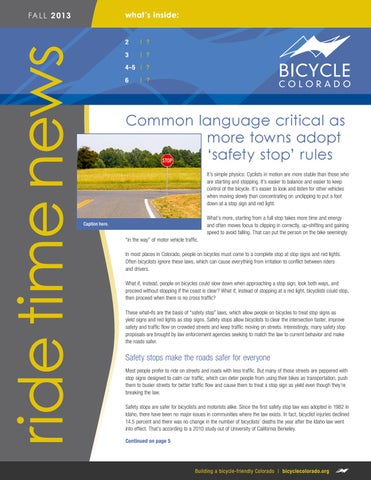
Common language critical as more towns adopt ‘safety stop’ rules It’s simple physics: Cyclists in motion are more stable than those who are starting and stopping. It’s easier to balance and easier to keep control of the bicycle. It’s easier to look and listen for other vehicles when moving slowly than concentrating on unclipping to put a foot down at a stop sign and red light. What’s more, starting from a full stop takes more time and energy and often moves focus to clipping in correctly, up-shifting and gaining speed to avoid falling. That can put the person on the bike seemingly
Caption here.
“in the way” of motor vehicle traffic. In most places in Colorado, people on bicycles must come to a complete stop at stop signs and red lights. Often bicyclists ignore these laws, which can cause everything from irritation to conflict between riders and drivers. What if, instead, people on bicycles could slow down when approaching a stop sign, look both ways, and proceed without stopping if the coast is clear? What if, instead of stopping at a red light, bicyclists could stop, then proceed when there is no cross traffic? These what-ifs are the basis of “safety stop” laws, which allow people on bicycles to treat stop signs as yield signs and red lights as stop signs. Safety stops allow bicyclists to clear the intersection faster, improve safety and traffic flow on crowded streets and keep traffic moving on streets. Interestingly, many safety stop proposals are brought by law enforcement agencies seeking to match the law to current behavior and make the roads safer.
Safety stops make the roads safer for everyone Most people prefer to ride on streets and roads with less traffic. But many of those streets are peppered with stop signs designed to calm car traffic, which can deter people from using their bikes as transportation, push them to busier streets for better traffic flow and cause them to treat a stop sign as yield even though they’re breaking the law. Safety stops are safer for bicyclists and motorists alike. Since the first safety stop law was adopted in 1982 in Idaho, there have been no major issues in communities where the law exists. In fact, bicyclist injuries declined 14.5 percent and there was no change in the number of bicyclists’ deaths the year after the Idaho law went into effect. That’s according to a 2010 study out of University of California Berkeley. Continued on page 5
Building a bicycle-friendly Colorado | bicyclecolorado.org
Bicycle Colorado’s mission is to encourage and promote bicycling, increase safety, improve conditions and provide a voice for cyclists in Colorado.
Copyright 2013 Bicycle Colorado, Inc. All rights reserved.
1525 Market Street, Suite 100 Denver, CO 80202-1661 303.417.1544 P info@bicyclecolorado.org PUBLISHER Bicycle Colorado EDITOR Lynn Clark
BOARD OF DIRECTORS PRESIDENT Ella Lyons VP Brad Tucker SECRETARY Michele Ames TREASURER Erik Esborg Bill & Sheri Barr Amber Blake Karl Friedman Scot Harris Lee Herndon Mike Lee Terry Malouf Greg & Mary Seebart Bill Shenkin Rudy Verner
ADVISORY BOARD Bob Moore Ned Overend Andy Pruitt Bill Ritter
STAFF EXECUTIVE DIRECTOR Dan Grunig DEPUTY DIRECTOR Amy Morfas BOOKKEEPER Justin Millar COMMUNICATIONS SPECIALIST Lynn Clark DEVELOPMENT & OUTREACH DIRECTOR Scott Christopher EDUCATION DIRECTOR Jenna Berman EDUCATION PROGRAM MANAGER Julia Davenport MEMBERSHIP MANAGER Mark Erickson REGIONAL POLICY DIRECTOR Ted Heyd 2 ride time news Fall 2013
Letter from the President Repaired roads must open to bikes to bolster post-flood recovery It’s been just over two months since the September floods devastated many parts of Boulder, Weld, Larimer and El Paso Counties. With 486 miles of state highway and 120 bridges damaged or closed, the impact of floods on the economy and daily life of people in these areas is unprecedented. State and local officials have made tremendous progress toward the goal of reopening all roads and bridges to motor vehicles by Dec. 1. This first phase aims at simply getting all the roads open before winter hits, and includes temporary bridges, gravel roads and other fixes. Safe access to Colorado towns is critical to restoring the economy in affected places. It is important for construction crews and materials to be able to get to the thousands of homes and businesses, water systems and dams that were damaged and destroyed. And it’s equally important that the roads are open so tourists can help these areas recover economically. We believe that Colorado will have a quicker recovery by giving commuting workers more transportation options and regaining important tourist visits. That means getting roads and trails open for bicycles and pedestrians as quickly as possible. State, county and local officials will begin critical planning work over the winter for phase two of the recovery project, which will include bringing some “legacy roads” up to current standards, giving safe access to all users. Those projects will start in April and may take several years to complete. By law, new state roadway projects must accommodate bicycles and pedestrians, but the law doesn’t extend to county and local roads. One hundred local jurisdictions are involved in recovery planning, and it’s critical that people stand up for bicycling in that process. We’re hearing that community members are already speaking up for ways to modernize roads, including adding shoulders and bike lanes where they didn’t exist before the floods. If you live or work in an affected area affected, please let us know about planning meetings and surveys so we can share them with our constituents. Send information to info@bicyclecolorado.org. Most importantly, we encourage you to participate in the process so that the roads you ride on are safe and accessible for all. Dan Grunig Executive Director Ella Lyons Board President
eNews
Keep current on Colorado bicycling news by signing up for eNews at bicyclecolorado.org/enews
Bike
shorts Grant will help close gaps in biking and walking network
Ella Lyons
Gov. Bill Ritter
Lyons elected board president Ella Lyons was elected president of the Bicycle Colorado board of directors. She brings her perspective as research director for Kaiser Permanente and as an avid cyclist to the position. Ella replaces Terry Malouf, who was board president for two years. We’re so grateful for Terry’s service, especially her talent for inspiring the board to a collective vision. Longtime board member Brad Tucker was elected board vice president. Brad is an attorney with significant knowledge of the legal aspects of bicycling. Bill Shenkin, who has a background in nonprofits and finance, was elected to the board. Bill was a board member a decade ago, and we welcome him back into the fold. Five other members were also re-elected: Greg and Mary Seebart, Amber Blake, Lee Herndon, Erik Esborg and Mike Lee. Finally, we’re honored to announce that former Colorado Gov. Bill Ritter was elected to our advisory board. During his tenure as Governor, Colorado bicycling grew and thrived. We’re excited to have him provide energy and momentum to our work.
Thanks for an exciting year of events In 2013, 28 Event Members supported Bicycle Colorado through per-rider donations to the tune of $40,000. We are so grateful for the support of these bicycling events, which not only showcase our state but also help us keep the roads open and safe for all people who ride in Colorado. Watch our website (bicyclecolorado.org) for the 2014 Event Member Calendar launch in January. And if your event would like to support better bicycling in Colorado, please contact Scott Christopher, scott@bicyclecolorado.org, 303-417-1544 x17.
Bicycle Colorado has been awarded a three-year grant from Ted Heyd the Kaiser Permanente Fund of The Denver Foundation, totaling $165,000. We’re grateful to Kaiser Permanente for its support of active transportation in Colorado. Most of the roads and paths people bike and walk on every day are governed by cities and counties. This grant will help close gaps in the network for biking and walking and help create uniform traffic laws to improve safety and build better communities. With the grant funding, we hired Ted Heyd as Regional Policy Director to work with local advocacy groups and regional leaders to improve biking and walking. Ted brings more than a dozen years of experience in urban and regional planning—including transportation planning—to the table, plus his conviction that active transportation has benefits for the environment, the economy and health at local and regional levels.
Colorado boasts 19 bicycle-friendly communities Fort Collins was named a Platinum-level Bicycle-Friendly Community by the League of American Bicyclists, joining Boulder, which makes Colorado the only state with two platinum-level cities. Crested Butte debuted at the Gold level and Greeley debuted at the Bronze level. Colorado now has 19 Bicycle-Friendly Communities, and our state is ranked second on the Bicycle-Friendly States list, which we think says amazing things about riding bicycles for fun, transportation, health and competition.
CDOT reports on the state of bicycling Betsy Jacobsen, who runs the Colorado Department of Transportation’s bicycle, pedestrian and byways section, recently presented details on the state of bicycling in Colorado. Some interesting points: •M ore than 600 transportation engineers and planners have taken CDOT’s bicycle/pedestrian infrastructure training, and there’s a waiting list each year. •C DOT (with the help of Bicycle Colorado) distributes 40,000 state bicycling maps annually. •G ov. John Hickenlooper’s goal: Colorado will be #1 on the list of bicycle-friendly states by 2015. •C DOT’s “bike counting” project shows bike paths have rushhour peaks similar to roads as people are biking to work.
Coloradans are driving less and biking more, plans need to adjust
Colorado National Monument
A new eye-opening report highlights an important trend in the nation: People are driving less. The study’s author, CoPIRG, says Colorado is among pacesetters in the slowdown with the sixth largest drop among states. Colorado ranks 14th lowest in terms of miles traveled per person.
Building a bicycle-friendly Colorado | bicyclecolorado.org
3
Bike Law Q&A
Safety Quiz
Q: I plan to continue bike commuting through the winter, and with
1. W hen passing a cyclist, Colorado drivers must stay in their
the shorter days, I will often be riding in the dark. What are the Colorado laws with respect to the requirements for bike lights and/or reflectors at night?
A: I ’m glad to hear that you plan to continue bike commuting through the winter! Two Colorado statutes* specifically address bike lights and reflectors. The first requires certain lights and reflectors on bicycles between sunset and sunrise. The second provides the specifics as to what is required. In summary, the requirements are as follows:
lane without crossing a double yellow center line. A. True B. False Answer: False. According to the 2009 Bicycle Safety Act, drivers can enjoy more freedom to safely pass a bicyclist by crossing the centerline only when safe to do so. If not clear, simply ease up and wait for the next safe opportunity. By keeping three feet passing distance, you create a safer environment on the road.
2. W hen stopped at a signal, two bicyclists riding together should: A. D ouble up, taking the lane behind waiting cars, then form single file line once through the intersection. B. Ride single file up the right side of the waiting vehicles so more cars can get through when the light changes. C. Stay single file aligned behind the cars’ right tire. D. Get on the sidewalk to cross in the crosswalk when the light changes.
• A white headlight on the front of your bike that is visible for at least 500 feet • A red reflector on the back of your bike that is visible to low-beam car headlights from at least 600 feet away • Either reflectors on both sides of your bike that are visible to low-beam car headlights from a distance of 600 feet, or a lighted lamp visible from both sides from a distance of 500 feet These laws apply between the official sunset and sunrise times at all times of the year.
Q: I enjoy listening to news programming or music when driving my car. I’d like to do the same when I’m riding my bicycle. Is it legal for me to wear earbuds while riding my bike?
A: W hile Colorado law** prohibits the operator of a motor vehicle from wearing earphones while driving, the law does not apply to bicyclists. That’s because the statute specifically refers to “motor vehicle” rather than “vehicle.” That said, I don’t recommend it. I have represented cyclists who were wearing earbuds at the time they were involved in a crash with a car, and the cyclist was accused of being distracted while riding and therefore completely at fault. The defense might argue that a reasonable and careful bicyclist would listen to his or her surroundings when riding on a roadway rather than to whatever is playing through earbuds. You might be able to overcome that argument, but you’d be facing it only because you were wearing earbuds. Many cyclists are passionate on both sides of this issue. Ultimately, it comes down to a personal safety decision not unlike wearing a helmet. Brad Tucker is an avid cyclist, member of Bicycle Colorado’s board of directors and an attorney with a specialty in bicycle liability and insurance issues with ColoBikeLaw.com. If you have questions concerning legal issues affecting cyclists, you can contact him by email at law@bicyclecolorado.org. Certain questions will be selected for publication in future issues. *C.R.S. § 42-4-204 and C.R.S. § 42-4-221 ** C.R.S. § 42-4-1411 4 ride time news Fall 2013
Answer: A. It’s easier to see people on bikes in this situation when they’re taking up a full lane. If you’re riding alone, lining up in the traffic queue in the right “wheel well” puts you in the best position to be seen. As much as we like to get ahead by riding to the front, you’re putting yourself in to a precarious position because motorists aren’t likely looking for you, especially when turning right. Never assume that drivers see you or that you have the right of way.
3. When can you ride in the left traffic lane? A. B. C. D.
On one-way streets when there’s enough room to safely share the lane. When you’re turning left within a block. When you are passing cars in the right lane. When you’re taking a reasonable precaution to avoid hazards and road conditions. E. All of the above. Answer: D. Colorado traffic law states that bicyclist can ride in the left lane in all of these circumstances when they judge it safe to do so. One one-way streets, follow the same safety rules for riding on the right—giving parked cars a three-foot berth, riding straight without weaving in and out of parked cars, and taking the lane behind motor vehicles when necessary. You need to ride as close to the side of the street as is safe, but you don’t have to ride in the gutter.
4. W hen riding at less than the speed of traffic where there is no bike lane, shoulder, sharrow or other bike-sharing facility, cyclists must ride at the edge of the pavement. A. True B. False Answer: False. Colorado law states that bicyclists should ride as far to the right as you judge to be safe to avoid hazards—including parked cars, animals, other bicycles, and narrow lanes. Keep three feet from parked cars so you’re not surprised by a suddenly opened door, and don’t weave in and out. Take the lane when you need to and it’s safe to do so.
Safety Stop Q&A: Q: What is a safety stop? A: A safety stop allows bicyclists to yield, rather than stop, at a stop sign when there is no cross traffic or it is their turn to cross an intersection. It also may allow bicyclists to treat red lights as stop signs.
Q: How do safety stops make the roads safer? A: T hey allow people on bicycles to slow down, but not fully stop, at stop signs, then proceed when the coast is clear. That helps them keep control of their bicycles, focus on their surroundings rather than unclipping, and clear the intersection faster.
Caption here.
Continued from page 1
Q: Can bicyclists treat stop signs as yields now in Colorado? A: I t depends on where you are. Three Colorado towns—Dillon, Breckenridge and Aspen—as well as unincorporated Summit County, allow safety stops. But other places in Colorado that strictly follow Colorado state traffic code do not.
Q: Why aren’t traffic rules uniform across the state? A: C olorado law allows municipalities to pass traffic laws that make sense for their communities. That’s why people can ride their bikes on the sidewalk in Aurora, but not in Denver. And that’s why safety stop rules are different in each place that’s adopted them so far.
Q: What is Bicycle Colorado proposing to fix this? A: W e think it’s a good idea that every city that adopts safety stop laws uses the exact same language. That way everyone will know the rules regardless of where they are riding. We plan to work with state lawmakers in the 2014 Colorado legislative session to create this common language.
Q: W ill the change require the state or municipalities to adopt a safety stop law?
A: N o. We are not proposing a state law. We’re simply providing consistent language for communities that decide to adopt a safety stop law.
Q: D oes the language allow people on bikes to take the right of way?
A: T he language does not change right-of-way laws. Q: How can I help? A: Y ou can stay informed about this topic and ways to help out through our bimonthly eNews. Subscribe at bicyclecolorado.org/eNews.
Common language critical as more towns adopt ‘safety stop’ rules Rules are inconsistent in Colorado The idea of implementing a statewide “safety stop” law has been circulating for several years. Three Colorado towns and one county have already adopted safety stop laws: Dillon, Breckenridge, Aspen, and unincorporated Summit County. Denver and Fort Collins have also been considering implementation. When riding across our state, regulations may change depending on who owns the road and what city or county you are in. Regardless of where you stand on safety stops in general, having different rules is a problem. For example: • In unincorporated Summit County, bicyclists may choose to treat both stop
signs and red lights as yield signs. • In Breckenridge, cyclists may choose to yield at stop signs, but must stop
at red lights. • In Dillon, cyclists may choose to yield at stop signs, but the traffic code
does not address red lights. • In Frisco and Silverthorne, cyclists must come to a full stop at stop signs and red lights—state law is in effect. So, unless you know the exact boundaries of towns and the unincorporated county, it’s tricky to know the rules where you are riding.
Let’s create common language and rules In the 2014 Colorado legislative session, Bicycle Colorado plans to work with lawmakers to help create consistent safety stop language so that bicyclists and drivers know the rules are the same in every town, city and county that chooses to adopt a safety stop law. The change does not require a statewide safety stop law or require that any municipality or county adopts safety stops. The language will not change right-of-way laws, so rules for yielding stay the same. And it does not require that people on bicycles—and especially children—treat a stop sign as a yield. People can opt in if they choose. We think that uniform traffic laws across Colorado make the roads safer for everyone who uses them.
Building a bicycle-friendly Colorado | bicyclecolorado.org
5
Primal promotes progression of cycling through advocacy Since 2006, Primal Wear, the Denver, Colo.-based bicycle clothing manufacturer, has invested in Bicycle Colorado’s mission through sponsorships, partnerships and donations. Primal sponsors the Bicycle Colorado Gala, is the presenting sponsor of the Colorado Bicycle Summit and has been our partner in producing the Bicycle Colorado jersey since 2010. We sat down with Primal CEO Dave Edwards and Marketing Director Tim Baker to learn more about why the company continues to be one of Bicycle Colorado’s strongest business supporters.
Tim Baker: Simply, we are cyclists. We live in Colorado. By supporting Bicycle Colorado, we help create a better cycling community where we live, work, ride and play. RTN: Why has Primal focused on the Colorado Bicycle Summit, the Gala and the jersey program as means of support? Dave Edwards: They all have the ability to substantially increase an awareness of Bicycle Colorado and how important it is to the growth of cycling in Colorado and beyond. We have sponsored the Summit and the Gala to help grow the events and make them more successful. Both are incredibly important to furthering Bicycle Colorado’s mission. Our partnership on the Bicycle Colorado jersey program has also made a difference by increasing bike shop and consumer awareness of and participation in the organization.
RTN: Why does investing in Bicycle Colorado make sense for Primal? Dave Edwards: Bicycle Colorado helps us be more successful by ensuring that everything possible is being done to get more people on bikes through its programs, outreach, education and services. Colorado is an amazing state to ride in, and Bicycle Colorado’s support and resources make a world of difference in the past, present and future accomplishments for Colorado cycling. We firmly believe that our support of Bicycle Colorado and other important cycling advocacy groups is crucial to our success as their work brings more customers to market. Ultimately, our hope is that our investment inspires other Colorado companies to understand the importance of the organization and make it an important part of their commitment to Colorado cycling. Tim Baker: One of the most critical aspects of our mission is to promote the progression of cycling through advocacy. We know that the future of cycling will not be determined by the advancement of racing, grand tours and events alone. It takes a commitment to set up a lasting infrastructure to help establish cycling as a part of daily life that will allow our industry to grow well beyond the gains made by individual athletic accomplishments. RTN: How does supporting Bicycle Colorado play as part of the Primal culture?
Caption here.
6 ride time news Fall 2013
Dave Edwards, CEO, Primal
RTN: Why is Bicycle Colorado an important community asset, especially for bicycling businesses? Dave Edwards: The programs supported by and driven by Bicycle Colorado are an incredibly important part of Colorado communities statewide. Safe Routes to School and Share the Road are just two of the many ways Bicycle Colorado integrates with communities to further cycling and make it more accessible and safer for everyone. More assets provided to communities equate to increases in cycling for both transportation and recreation. Every bicycling business knows that the more people we get on bikes means more business as a direct result. The overall impact that cycling can make and in what it represents for health, family, lifestyle direction, purpose and bringing people together directly correlates with the success of bicycling businesses in communities everywhere. Tim Baker: Any and all businesses looking to enrich their employees’ lives through cycling should consider supporting Bicycle Colorado. Sure, the day-to-day tasks and objectives have to take precedence, but if the bicycle industry along with businesses in other industries dedicated a small portion of their time to advocacy, we would see lasting change. An investment in Bicycle Colorado is an investment in the future. Take the step and be counted among the businesses that are moving the culture of cycling forward.
Helping Bicycle Colorado ‘move the needle’ When Russ Shaw was a kid in Texas, he rode his bike to school almost every day. As a University of Texas student, he mastered the hilly Austin landscape on a Longhorns-orange steel bicycle. He’s an avid road cyclist who confesses he “only” owns five bikes. A Colorado resident for nearly two decades, Shaw has seen most of our state from the saddle. He’s a regular on the big tours and can be frequently found riding around Chatfield, Deer Creek and High Grade in the southwest Denver suburbs. He’s also an avid Bicycle Colorado supporter. Not only is he a member, he makes an annual donation, has put our organization in his will through a planned gift and donates his expertise as an experienced fundraiser.
“I believe fully in the work that Bicycle Colorado does,” Shaw says. “I’ve always appreciated that someone out there is looking out for cyclists and pedestrians.” He learned about Bicycle Colorado in 2002 when he was vice president of the National MS Society Colorado Chapter, and the MS 150 fundraising ride’s staff reported to him. In the post-9/11 world, charities were hurting. The ride was one of the society’s major revenue sources, and it became threatened by a rider cap proposed by the Colorado State Patrol. MS 150 participation was already beyond the proposed cap. Shaw met Dan Grunig, Bicycle Colorado’s executive director, who explained the work Bicycle Colorado was doing to overcome the proposed rider cap.
“I knew immediately we needed to help,” Shaw says. “I saw it as a calculated risk and worthwhile investment, and it paid off. I knew we needed to do it for the sake of our bike tour.”
capitol to make sure the roads are safe and accommodate all road users.” Shaw says he decided to donate his entire estate to charity through planned gifts. Adding Bicycle Colorado to his will was as straightforward as having a conversation with his attorney He decided to parcel his contributions to several charities by a percentage of assets. “In a lot of cases, people want to help but don’t have the cash to make a ‘move the needle’ kind of gift,” he says. “Organizations that have future revenue streams can thrive.” In January 2013, Shaw ran into Grunig at the Ride The Rockies kickoff. With some free time on his hands, he asked how he could help Bicycle Colorado.
“I told Dan I could stuff envelopes—do whatever they needed,” Shaw says. “Dan said he had something better in mind.” Since then, Shaw, a seasoned fundraising leader, has worked with Scott Christopher, Bicycle Colorado’s outreach and development director, to build a major gifts and planned gifts fundraising platform. “Bicycle Colorado has relied on membership and grants for its annual funding, and it’s done quite well,” he says. “Bicycle Colorado’s growing initiatives require a different type of funding that need people to enroll in and invest in their mission and good work. It’s going to take individuals, family foundations and corporate investments, people who appreciate cycling in Colorado who are willing and able to step up beyond a $50 membership. When Scott Reaches out to you, invest the time to meet with him so you, too, can move the needle for bicycling in Colorado.”
With the support of bicycling event directors, members and others, Bicycle Colorado was able to stop the cap proposal. The MS 150 became one of our first Event Members, making a per-rider donation to support the organization’s work. The rebranded Bike MS Colorado continues this support. Shaw also became a supporter himself. He says that Bicycle Colorado initiatives such as the Share the Road campaign and the 3 Feet to Pass law have made him feel safer on some of his favorite rides. In 2013, Shaw decided to make a planned gift to Bicycle Colorado—he put the organization in his will to receive a percentage of his assets. “I’m 61. I’m healthy, and I’m going to ride for a long time,” he says. “Colorado will continue to grow, and some roads will continue to become more congested. There will be a need for someone to be at the state
Russ Shaw
Building a bicycle-friendly Colorado | bicyclecolorado.org
7
Kaiser Permanente’s focus on active transportation Kaiser Permanente is an organization that aims to improve the health of communities. (‘Everywhere’ is too broad). They support health initiatives through grant funding in the areas of healthy food access, schools, the “built environment” and active transportation.
“We view active transportation as one of the prime ways to be healthy,” says Tristan Sanders, MPH, Kaiser Permanente project manager. (need title. His title is Project Manager). “People can make it part of their daily routine, not something extra like going to the gym.”
Mile High Cycling Society On Sunday mornings nearly year-round, you might find a group of bicyclists heading from Campus Cycles near the University of Denver to Morrison, or Chatfield, or Cherry Creek State Park. On Wednesday evenings, you’ll find them on a hill climb in the metro area. In 2010, Michael Bowers and Paul Dodson decided to create a recreational cycling club. The pair had been active in the Colorado bicycle racing circuit, and wanted to keep riding with like-minded cyclists without the need to compete. At the same time, they wanted to promote bicycling for recreation, transportation, fitness and sport while helping non-cyclists see people on bikes more positively. They also wanted to raise money for charity. To that end, the club stages the Racing for Hope Classic, a fundraiser for Craig Hospital, with members working the event. Club members have been known to ride most every big charity tour in the state.
In May 2013, Bicycle Colorado received a three-year, $165,000 grant that allowed us to hire a regional policy director, Ted Heyd (see page 3), and begin work with local advocacy groups and regional leaders to improve biking and walking.. This grant will help close existing gaps in bicycle and pedestrian networks throughout the region,, create uniform traffic laws to improve safety, and build better communities. “The broader discussion in this grant is community health initiatives,” Sanders says. “That’s why taking a regional approach and activating regional networks interests us. We see Bicycle Colorado as the feet on the ground. They have a strong understanding of the nuances they may encounter, and they also understand where the opportunities are that help us align partners with overall goals around active transportation.” This fall, Kaiser Permanente will launch the Walk and Wheel initiative, which will include grants to local governments and employers. “Where the grant to Bicycle Colorado looks at active transportation globally, these grants will bring in a cohort of folks who are working on it directly,” he says. “We believe that changes to the built environment—the actual facilities people use for getting around actively—and policy changes equal more long-term health changes for those communities.” The initiative also includes grants to businesses to help them implement active transportation programs for their employees. “We simply want to show that folks can incorporate walking and biking into their everyday lives,” Sanders says. “To make that happen, we need better infrastructure and we need employers in the game who have effective programs that entice employees to participate.”
Today, the Mile High Cycling Society has about 40 members, almost equally divided between men and women. A few hold racing licenses, most have ridden a metric century (or aspire to), and every single one of them is a member of Bicycle Colorado. “It was important to us that a $50 Bicycle Colorado membership is included in the annual club dues,” Bowers says. “Bicycle Colorado has made the roads safer for us and kept bicycling accessible for us as a group and as individuals. We couldn’t think of a better way to give back.” Mile High Cycling Society member Natalia Ptas calls the included Bicycle Colorado membership “a nice perk.” “I think the two organizations complement each other very nicely,” she says. ”Bicycle Colorado is a great resource for anything related to biking from routes, safety and events to bike laws. It is very important to perform any sport at any level in a safe and fun environment. Bicycle Colorado is a great resource.” Bowers says he often reminds members of what Bicycle Colorado has done to help improve cycling in our state. “Bicycle Colorado is something we couldn’t do without,” he says. “We wouldn’t have 3 Feet to Pass, or the flexibility in how we do hand signals. We also have them as a resource to learn the rules of the road. “And personally, because of Bicycle Colorado I feel safer in traffic than I did even five years ago.”
8 ride time news Fall 2013
Learn more about the Mile High Cycling Society on Facebook and milehighcycling.org.
GIFTS FOR EVERY CYCLIST IN THE BICYCLE COLORADO STORE
Why I support Bicycle Colorado “My wife and I have been members of Bicycle Colorado since 1998 because we believe strongly that the organization is effective at making cycling safer in Colorado. My wife is a lifelong educator, and both of us have worked to increase bike riding among local students. Creating safe routes to school, which Bicycle Colorado works hard to achieve, is a necessity for children to ride to school and to ultimately become cyclists in adulthood.” – Lennard Zinn
“We support Bicycle Colorado because the advocacy work they do has proven to be a strong and effective means in making Colorado one of the best places for cyclists to live.” – Jason and Patty Heinhorst
“We’ve been supporters and members of Bicycle Colorado for several years, simply because we love to ride our bikes and wanted to support an organization that can be advocates for us on both a local and national level, through programs like their Share the Road campaign. Their recent efforts to support bicycle-friendly options during major road reconstruction, especially in Boulder County canyons after this summer’s floods, are exactly the kinds of things that lead to our support of Bicycle Colorado.” – Russell and Diane
As professional athletes, cycling in Colorado is more than a spectacularly beautiful form of recreation for us. It is also the location of our office! We have been proud supporters of Bicycle Colorado since 2007 because we believe that all residents of our state— whether they be avid commuters, recreational athletes or full-time pros—deserve sanctuary on roads, bike paths and trails. We feel so fortunate to have such an extraordinary group of people lobbying for the safety of our children, parents, grandparents, aunts, uncles and friends. Cycling in Colorado goes far beyond physical recreation - it is a form of transportation, freedom, and flexibility for everyone and we support Bicycle Colorado’s mission to maintain and increase safe access for bikes. – Heather Irminger and Jeremy Horgan-Kobelski
SHARE THE ROAD LICENSE PLATES MAKE A GREAT GIFT Shirts • Jerseys • Bike Wallet • Necklace • Maps • Memberships •
SHOP NOW! bicyclecolorado.com/store
All proceeds benefit Bicycle Colorado Share the Road education activities. More information and online orders: bicyclecolorado.org/plates
Thank you for your continued support. Please renew, donate and tell a friend about the benefits of becoming a Bicycle Colorado member today. Building a bicycle-friendly Colorado | bicyclecolorado.org
9
Education Bicycle Colorado, Children’s partner to help kids love Bikes for Life Hundreds of children across the Denver-metro area have learned about bicycle safety—and taken home a new bike—as part of Bikes for Life, a program run by Children’s Hospital Colorado and United Healthcare that teaches kids about healthy living through riding bicycles. A research study runs alongside the program to study whether bicycling can impact childhood obesity. The program launched in 2011 with the goal of distributing bikes and educating 1000 children from across metro Denver. So far, 282 children have enrolled in the program, and 235 bikes have been distributed. That includes 30 kids from four Boys and Girls Clubs, who logged more than 918 miles this summer. “Bicycles were a great choice to increase kids’ physical activity because Colorado provides so many beautiful trails and opportunities to get outside and ride,” says Laura Retzer, program assistant for the Children’s Hospital Colorados Healthy Kids Program, which coordinates Bikes for Life. “Bikes are a lifelong form of physical activity.”
their new, shiny bikes home,” Berman says. “Kids often can’t believe that the bicycle and helmet are theirs to keep.” Before they leave, they brainstorm all the places they can ride in and around their neighborhoods, with the aim of connecting the dots with this new mode of transit. Bikes for Life has also organized community bike rodeos and other events that get kids and parents familiar with safety practices. Retzer shared three of her favorite stories about how kids have incorporated their new bikes into their lives.
• Two brothers from a Boys and Girls Club and their older sister are on their own to get to school and to the club. Their new bicycles give them a new way to get around.
• When his daughter received a bicycle, a dad was motivated to fix his bike. They go on long bike rides together and have picnics, and she logged more than 50 miles the first month she had her bike.
• A child with mild autism received his first bike through the program to the delight of his occupational therapist and his mom. He was determined to learn to ride at the clinic, and pumped his fist in the air when he got going. His mom shed tears when talking about how proud she is that he learned to ride. Berman says that while improved safety and health are core goals of the program, she has a more personal goal. “To me, riding my bike is as much about fun and joy as it is about health,” she says. “I want all of our students to fall in love with their new bikes and to ride for the rest of their lives just because it’s fun.” Caption here.
Bicycle Colorado was contracted to run the bike safety education program and help distribute the bicycles, which are purchased from Specialized and include a computer to help children track their rides. Two to three times a month, our educators meet students and parents at BikeSource in south Denver to teach them about helmet fit, rules of the road, safety checks and more.
The program is supported by Bicycle Colorado, BikeSource, Specialized Bicycle Components, Boys and Girls Clubs of Denver Metro, Bike Depot and the USA Pro Challenge.
“I love that parents attend the education clinics,” says Jenna Berman, Bicycle Colorado’s education director. “We can teach them about safe driving around cyclists and how to encourage their kids to ride. We usually teach in schools and ask the kids to go home and teach their parents.” Kids then ride their new bikes on a skills course to put their new safety knowledge into practice. “When students don’t know how to ride, we teach them one-on-one using the new glider technique—without training wheels—before taking 10 ride time news Fall 2013
Caption here.
There are many good reasons for kids to walk or bike to school: physical exercise to battle obesity trends, decreasing automobile congestion— and air pollution—and increasing safety around schools at pick-up and drop-off times, and improving academic performance. And it can create a lifelong love for getting around by foot and two wheels. We know Safe Routes to School programs “work.” From 2005 to 2012, Colorado’s Safe Routes to School programs reached more than Caption here. 500 schools and 200,000 students. As a contracted educator, Bicycle Colorado alone has taught more than 60,000 students to date.The programs replaced vehicle trips and increased the number of Colorado children walking and biking to school by as much as 31 percent. Since its inception, the program has received dedicated federal transportation dollars. Colorado has allocated those funds via grant application. After 2015, though, states can choose to pay for the program—or not. “With the end of dedicated funding, we are working to find new ways to continue bicycling and walking safety education in schools,” says Dan Grunig, Bicycle Colorado executive director. “Districts don’t necessarily have funds to do these programs on their own.”
Adams 12 invests in a bike fleet
Grand Valley Bikes In 2011, Bicycle Colorado worked with Grand Valley Bikes), a nonprofit bicycle advocacy group, to create a Safe Routes program with Mesa Valley School District 51. To launch the program, Bicycle Colorado trained the advocates, PE teachers and community members to teach the safety curriculum and run bicycle rodeos. We also facilitated the purchase of a “mobile classroom”—a bike fleet, trailer and all bike course supplies. Grand Valley Bikes has reached 10 more schools on their own—about 4,500 students. Their program is in high demand with nine schools asking to be included in 2014-15. They also worked with Mesa County’s regional transportation office to provide matching cash funds. “The program has raised the priority of school infrastructure throughout our district, the valley’s cities and in Mesa County,” says Grand Valley Bikes’ Elizabeth Collins. “It is a long-overdue move, and we are glad to connect frustrated parents to decision makers to affect a culture change that will benefit this and future generations.”
Euclid Middle School starts a bike club Sue Lloyd wanted start a bike club for years at Littleton’s Euclid Middle School, where she teaches. Last year, Euclid participated in a Safe Routes to School program taught by Bicycle Colorado, and that inspired 18 students to join Lloyd’s first-ever student bike club in spring 2013. Lloyd, a bicycling enthusiast, led students on group rides, taught basic mechanics and bicycling safety. She secured a sponsorship from Pedal, a Littleton bike shop, which gave incentive prizes for students to ride to school on International Bike to School Day and provided club members with custom jerseys. This summer, the bike club members rode the 25-mile Elephant Rock course together. And this fall, the club grew to 20 members. Participation in international bike and walk to school days is way up since the club started last spring.
Bicycle Colorado has worked with Adams 12 Five Star Schools since 2009, bringing Safe Routes to School to 18 elementary schools over four school years.
“Many of the kids have ridden further, with more comfort than they’ve ever ridden, deepening their confidence on and off the bike,” says Lloyd.
Matt Schaefer, Adams 12 planning manager, says that the district aims to bring it to all of its elementary schools. Last fall, the school district invested in a bike fleet and trailer so that PE teachers, now trained by Bicycle Colorado educators on their curriculum, can “check out” the fleet.
“The grandfather of one club member credits cycling club with helping his grandson gain maturity and higher achievement in school.”
Schaefer has seen the excitement the program brings to students. He remembers encountering two boys who were riding their bikes home. “They were so excited to be riding their bikes home from school,” he says. “One of the boys told me he had always wanted to ride his bike to school, but his mother would not let him until she learned about the bicycle and pedestrian skill training he was receiving in his PE class. Small victories like these make the program worthwhile.”
Caption here.
Building a bicycle-friendly Colorado | bicyclecolorado.org
11
N1A0912CML???
Safe Routes to School programs work
Bicycle Colorado 1701 Wynkoop Bicycle Colorado Street SuiteMarket 236 Street, Suite 100 1525 Denver, CO 80202-5924 Denver, CO 80202-1661
Keep up with Bicycle Colorado via eNews, Facebook and Twitter. Sign up for twice-monthly eNews at bicyclecolorado.org/get/enews.
Follow us! facebook.com/bicyclecolorado
@bicyclecolo
bicyclecolo
Bicycle Colorado 1701 Wynkoop Street Suite 236 Denver, CO 80202-5924
24 hours to give where you live
Support us on Colorado Gives Day! Tuesday, December 10 online at ColoradoGives.org 100% goes to charity
#COGivesDay
Learn more at ColoradoGivesDay.org
Save the Date: February 10 & 11, 2014 - Denver, Colorado Building a bicycle-friendly Colorado | bicyclecolorado.org