Text from “Why the Bible?” by


Text from “Why the Bible?” by
with permission from the United Bible Societies,2014
No other book in the world is as widely available, as frequently read, or translated into as many languages as the Bible.
The complete Bible is available in about 520 languages. Portions are available in over 2,500 languages.
Nevertheless for many people it remains a book that is misunderstood or even unknown. Many opinions about the Bible are not accurate: it is said to be no different than other historical books, difficult to read or understand, to teach harmful things, or to be so heavily altered by history that we can no longer trust it.
o other book in the world is widely available, as equently read, or translated to as many languages as e Bible.
This booklet hopes to help by offering brief introductions to five of the biggest questions about the Bible:
1.What’s in it? When and where was it written? How is it usually organized?
2. What makes it special? What do Christians mean when they say it is “inspired” or call it “the Word of God”?
e complete Bible is available in out 520 languages. Portions are ailable in over 2,500 languages.
3. How can we understand it? With so many authors, genres, and settings, what guidelines can we use to interpret it today?
4. Could the text have been corrupted? Can we trust the texts we have? How were the contents selected?
5. What does it say? Since the Bible is one coherent narrative, what is its overarching message? What does it mean for my life?
The word Bible comes from a Greek word which means “the books.” These books are in fact a collection of books divided into two major sections: the Old Testament (O.T.), also known as the Hebrew Scriptures, written before the life of Jesus Christ on earth (early 1 century ); and the New Testament (N.T.), written within a century after the death and resurrection of Jesus. st C.E.
The Old Testament (O.T.) is the Bible of the Jewish people, their Holy Scriptures.
Traditionally Jewish people divide these books into three sections: the Law (Torah in Hebrew), the Prophets (Nevi’im), and the Writings (Ketuvim). The Law consists of the first five books of the Bible, and contains many of the foundation stories of Israel, as well as ritual and social practice. The Prophets spoke on behalf of God, calling Israel in very practical ways back to faithful worship of God. The Writings contain a variety of texts including poetry, wisdom literature, and narrative.
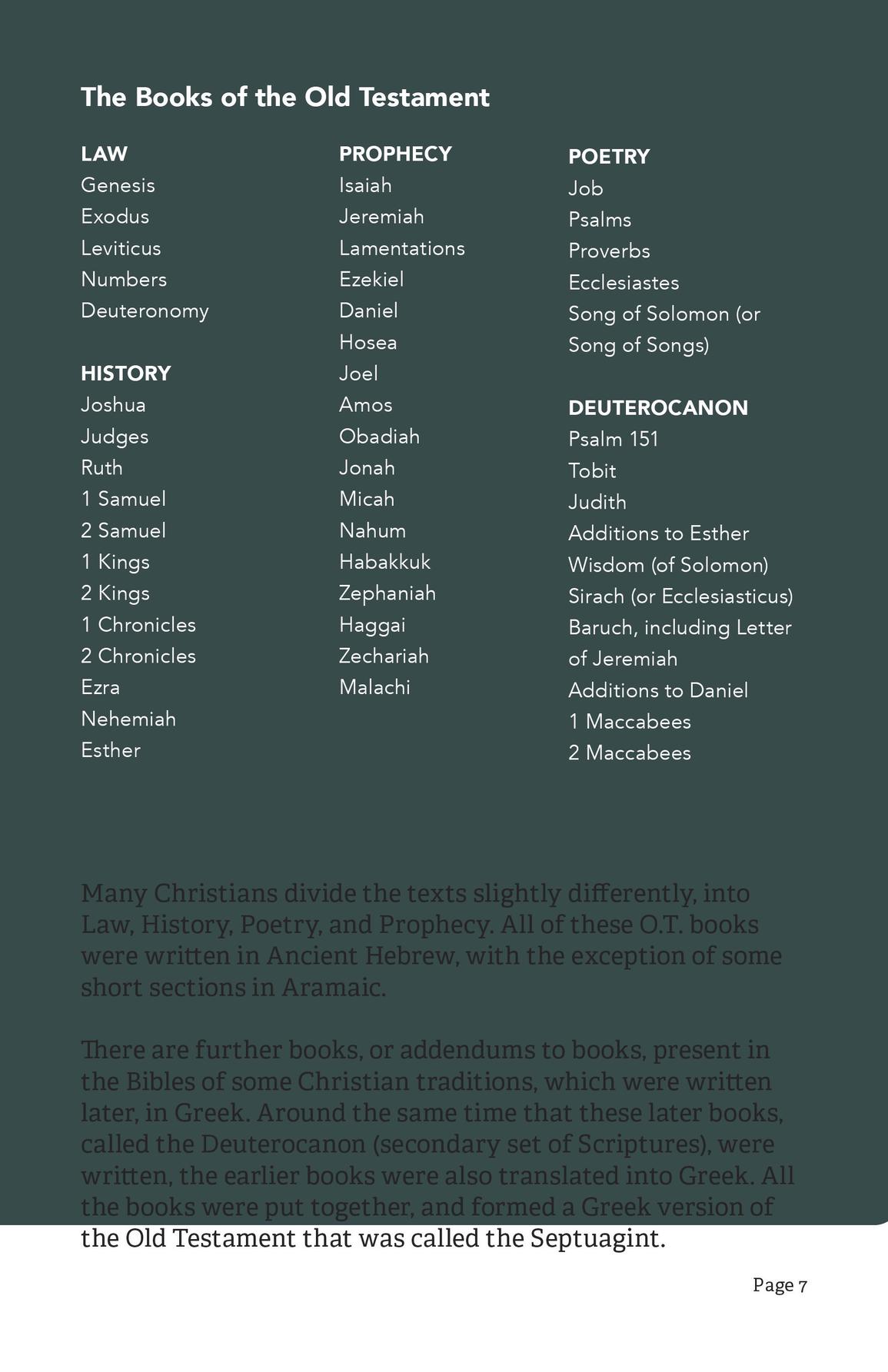
Many Christians divide the texts slightly differently, into Law, History, Poetry, and Prophecy. All of these O.T. books were written in Ancient Hebrew, with the exception of some short sections in Aramaic.
There are further books, or addendums to books, present in the Bibles of some Christian traditions, which were written later, in Greek. Around the same time that these later books, called the Deuterocanon (secondary set of Scriptures), were written, the earlier books were also translated into Greek. All the books were put together, and formed a Greek version of the Old Testament that was called the Septuagint.
The New Testament (N.T.) is added to the O.T. to make up the Holy Scriptures, or Bible, of Christians.
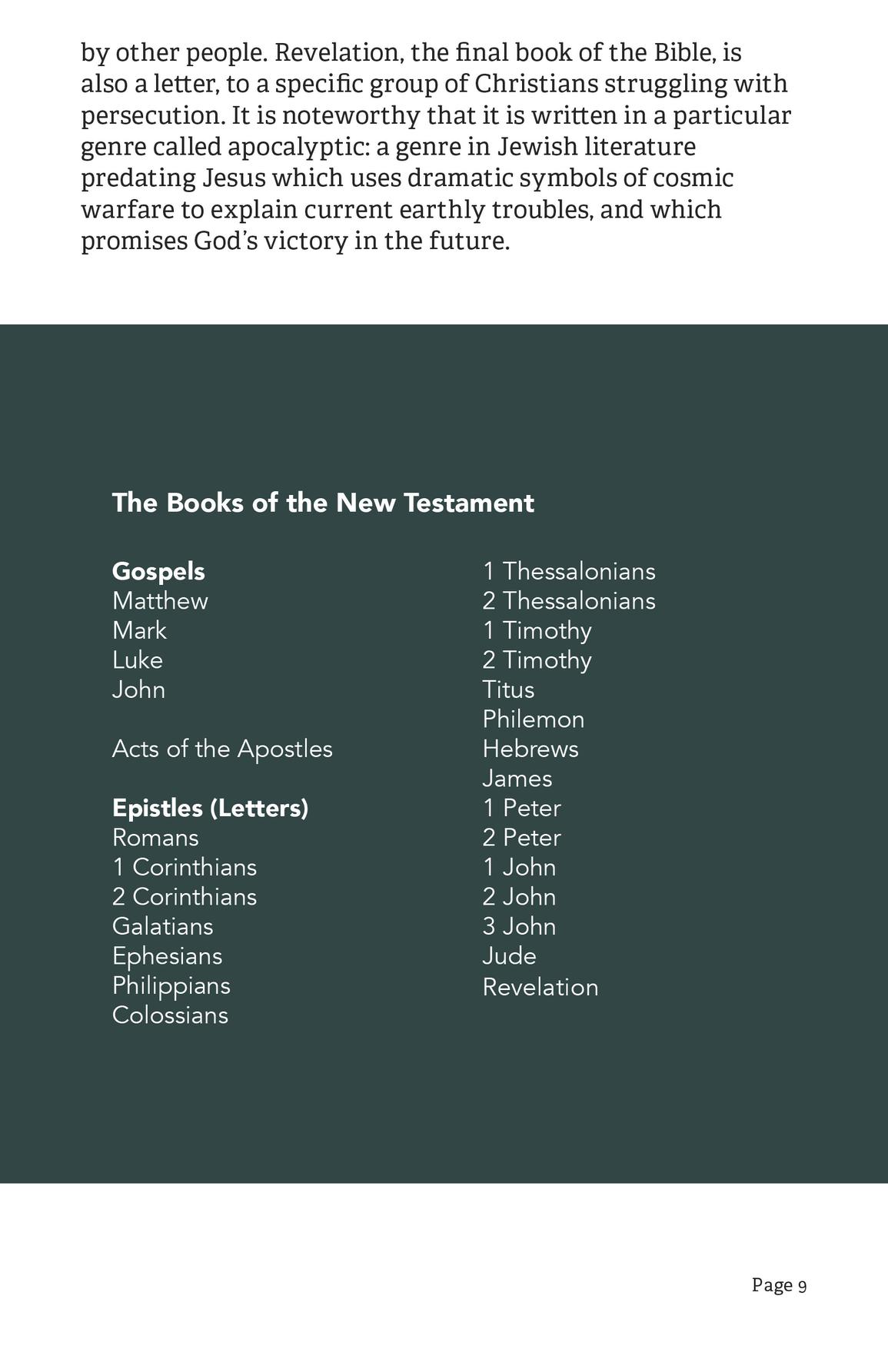
The four Gospels – more precisely, the Gospel According to Matthew, the Gospel According to Mark, the Gospel According to Luke, and the Gospel According to John – tell the story of Jesus’ life, death, and resurrection. The word ‘Gospel’ is an Old English word meaning ‘Good News.’ Christians affirm the entire life, death, and resurrection of Jesus as being Good News for the whole world.
he New Testament (N.T.) is
dded to the O.T. to make
p
the Holy Scriptures, or
ble,
of Christians.
Besides the Gospels, the N.T. contains the Acts of the Apostles – a history of the early Church written as a continuation to the Gospel According to Luke – and a variety of letters. Paul was the most prolific author of the letters, but some were written by the apostles Peter and John, and some by other people. Revelation, the final book of the Bible, is also a letter, to a specific group of Christians struggling with persecution. It is noteworthy that it is written in a particular genre called apocalyptic: a genre in Jewish literature predating Jesus which uses dramatic symbols of cosmic warfare to explain current earthly troubles, and which promises God’s victory in the future.
The first chapter of the Bible tells us that God created humanity – male and female –in his own image (Genesis 1:26). In bestowing such dignity on us, God showed his desire to communicate with us and to reveal himself to us.
This revelation comes in what is called general revelation present in every person (i.e. nature and conscience), as well as in special revelation (i.e. Jesus and the Bible). Christians affirm that “all Scripture is inspired by God” (2 Timothy 3:16), a process begun by God, causing people through his Spirit to set down his Word in written form.
Inspiration does not mean that God dictated every word of the Bible.
The authors were not robots controlled by their Creator. Indeed the biblical authors played an active role in giving expression to God’s message, using their intellectual abilities and making the most of the materials at their disposal. Each wrote with a focus on their own area of interest and from their own perspective.
Consequently, each book of the Bible bears the distinctive mark of its human author(s). Far from being a handicap, this variety in the Biblical writings makes reading or studying them all the more profitable.
The Gospels provide a particularly eloquent example of this. Matthew emphasizes that Jesus is the promised Messiah, Mark portrays him as the perfect servant, Luke underlines his humanity and compassion for suffering people, and John highlights Jesus’ divine glory as well as his love for his disciples. Obviously these four sketches of Jesus are not mutually exclusive; on the contrary, they help us to learn more about Jesus.
spiration does not mean at God dictated every word the Bible.
The Bible was written over a period of about thirteen centuries. From Genesis to Revelation there are approximately forty authors. Such a great variety makes the unity of the Bible’s message all the more amazing. This unity is evident through its witness to Jesus, which runs like a thread throughout the whole Bible. The O.T. prepares us for his coming (John 5:39); the N.T. proclaims the fulfilment of that preparation.
The interpretation of the Bible is a very important subject. We believe that God has spoken to us in his Word, but if we want to hear his voice, we have to read the Word with care.
It is quite possible, and even dangerous, to be mistaken about the Bible’s meaning or to give false interpretations of it. The danger doesn’t come from the Bible being difficult to understand, but from our prejudices which sometimes prevent us from reading it correctly. It was, after all, in the name of the Torah that Jesus was condemned to death. So it is very helpful in reading the Bible to follow certain guidelines of interpretation. Here are five which can help us to make the most of our reading of the Word of God.
Knowing the literary style helps us understand the text
We have stressed that the Bible is a collection of extremely varied writings. Each biblical text can be classified into a specific literary genre.
For example, the Gospels belong to a “narrative” genre, the Acts of the Apostles to a “historical” genre, the Epistles to a “didactic” genre (aiming to teach), Revelation to an ‘apocalyptic’ genre (characterized by visions, symbols, and numbers), Leviticus to a “legal” genre, the Prophets to “prophecy”, the Song of Songs to “poetry”, Proverbs to ‘wisdom’, and so on.
Regardless of genre, Christians believe there is spiritual instruction to be found. The priority of the text is to offer us a place to encounter God, not to provide literal precision. Indeed the Bible does not present itself as a history or science textbook, in the modern sense, since that did not even exist when the Bible was written, and it would be wrong to read it as such.
The Bible often speaks in imagery, and we must avoid understanding such texts literally. By respecting the literary genre of a biblical text, we can interpret it according to the type of literature it represents.
Understanding Scripture in the time it was written
While it is eternal, the Word of God nevertheless was written in a certain time and place.
In order to establish the meaning of a biblical text, we must read it in light of its particular circumstances. It was through the people of Israel, throughout their long history, that God revealed his Word.
God took pains, as any good teacher must, to adapt the communication of his Word to each successive stage of this history. Therefore we must take into account the historical context in interpreting a biblical text.
the time it was written
Jesus’ mission provides us with a good example of this principle. Born into a Jewish home, Jesus is recorded saying things like: “I have been sent only to the lost sheep of the people of Israel” (Matthew 15:24).
Taken out of its context, it could lead us to think that Jesus’ mission was intended exclusively for the people of Israel. Instead, we should place it in the perspective of history.
It was through the people of Israel, throughout their long history, that God revealed his Word.
Given that Jesus was the Messiah promised from ancient times to Israel, he naturally addressed himself first of all to them. However, soon after his resurrection, he sent out his disciples on a mission “to all nations” (Matthew 28:19-20).
Then, and only then, the Gospel could go –indeed had to go – throughout the world so that Jesus Christ might be known and proclaimed as the “Saviour of the world”.
As God revealed his Word by inspiring the authors of Scripture, God has continued to use people all through Church history – including today – to help us understand and apply that Word. We live in an individualistic world, but the Bible was written to communities of believers and, prior to the invention of the printing press, was always read and interpreted in communities. While there is value in individual devotional study, we learn best when we gather around Scripture together.
Of course, we must admit that the Church has made mistakes in how we have interpreted Scripture – sometimes incredibly harmful ones – and will inevitably make more.
Nonetheless, we should treat with utmost seriousness the interpretation given by the “people of the Bible” to this book throughout the ages. This will protect us from the twin dangers of being too subjective (by interpreting the Bible according to our own ideas), and of believing ourselves to be the only enlightened ones, having no regard for 2000 years of church tradition or of the wide diversity of Christians all over the world today.
Interpreting Scripture by Scripture
The Scriptures, while being very diverse, retain a fundamental unity. This unity stems from the fact that they are first and foremost the Word of a God who is One. So there is in the Scripture an inner cohesiveness which must be respected if we want to grasp the biblical message. This implies that we must interpret each text of the Bible in light of others.
Interpreting Scripture by Scripture means that we should avoid basing a given doctrine on one isolated text. We should attempt to harmonize the message of the texts with one another – not to set them up against each other. On a particular subject, obscure or difficult texts must be interpreted in light of those that are clear.
HOW CAN WE UNDERSTAND IT?
While the Bible is the Word of God in the form of writing, Jesus Christ is the Word of God in human form (John 1:1-14).
The written word – the Bible – bears witness to the living Word. In reading the Bible, it is important to remember that it points to Christ. As we look through the Scriptures we should do so seeking to encounter Christ there, who is “the visible likeness of the invisible God” (Colossians 1:15). This is why Christians are not first and foremost a “people of the Book”, but a “community of the Word of God”, that is, the very same Word which became flesh in the person of Jesus Christ.
The fact that Jesus is at the centre of the Bible’s message has a great impact on our interpretation of the Bible. The Old Testament should be read in light of preparing the way for Jesus. The New Testament epistles should be read in light of the fact that they were written by the earliest followers reflecting on the life and teachings of Jesus.
For example, we see in the New Testament that the Kingdom of God can no longer be identified with the country of Israel as it was in the Old Testament, nor can it be advanced by force.
In Jesus, the Kingdom has been opened to all the peoples of the earth and is advanced by the free decision of individuals drawn in by God’s radical love and grace.
In recent decades many have questioned the historical reliability of the Bible. The reasons for this mistrust are usually misguided.
A number of typical criticisms stem from a misunderstanding of the Bible’s concept of revelation. Other objections are a result of equating false interpretations of the Bible to the Bible itself. Some people disregard the Bible because they presuppose that its claims cannot be possible. Finally, others misunderstand the nature of ancient manuscripts and the copying process, which we will make the subject of this section.
COULD THE TEXT HAVE BEEN CORRUPTED?
CENTURY ND
In 1947, a large number of manuscripts were found in caves at Qumran on the shores of the Dead Sea. They date at the latest from the 1 Century and contain at least fragments of every O.T. book except Esther (including all of Isaiah).
C.E.
C.E.
C.E.
We have fragments of the Gospels dating back to the early 2 Century , most of the New Testament dating from as early the 3 Century , and three manuscripts of the whole Bible by the end of the 5 Century . Today, thousands of ancient manuscripts of the N.T. books are available to us, along with quotations in other early Church writings and translations into other languages.
C.E.
For both the Old and New Testaments, experts have been able to study a wide diversity of manuscripts copied over time and in different places. All the experts who examine the texts judge that the copying was done with remarkable accuracy.
While there are many insignificant variations, nothing remotely calls into question the integrity of the texts. No comparable work of Antiquity has stood up as well to the test of time. And yet no serious historian debates the authenticity of any of these ancient works (see Table on next page).
Author Book When Written
*Liberal dating given. Many scholars date all texts within the 1st Century from 50-100 C.E.
**This number as of 1980, so it is likely significantly larger by now.
(most of NT) 325 C.E. (complete NT)
TH
This was not some political process three centuries removed picking arbitrarily what suited the Church leaders’ agenda. The Old Testament had long been set within Jewish tradition. Compilers of the New Testament also used specific criteria: books that were included were all written within a century of Jesus’ death and were believed to have direct ties to an apostle.
Furthermore, as with Jewish tradition and the O.T. books, the books chosen to be included in the N.T. had already been accepted in practice by the churches from the beginning; there just had not been an official proclamation about their agreement. There was very little debate on any of the books included and no debate on any of the Gospels.
The Bible is a complex collection of books spanning approximately 1,300 years, with about 40 authors, spread throughout a wide geographic area, and written in a range of genres.
Yet, Christians believe that it maintains a fundamental unity in its message. What is this message? We’re invited to join in the Kingdom of God, which is characterized by radical love and forgiveness to all.
Some biblical scholars speak of the Bible’s narrative as a great drama consisting of 5 acts that together convey this message. This approach helps us avoid seeing individual texts on their own and missing the overarching story.
To start the biblical story we see the defining characteristics of God, the creation, and humanity.
At the centre of God’s character is relational love, as in 1 John 4:8’s simple but profound claim that “God is love.” The creation is good and it is the responsibility of humanity to care for it. Humanity, both male and female, is the pinnacle of that creation, made in God’s image.
Humanity eats the forbidden fruit of the Tree of Knowledge of Good and Evil, putting ourselves in the place of God as ruler and judge of the world. The outcome of that disobedience is human brokenness: violence and other injustices resulting from this attitude. In subsequent stories, God responds to Cain murdering Abel with exile, to some extreme atrocities with a great flood, and to a grand Empire-building project by scattering humanity.
God chooses Abraham to be the father of a nation that will be blessed in order to bless the world. Generations after Abraham, his descendants, the people of Israel, are in slavery to the oppressive Egyptian Empire, but God rescues them through miraculous acts. God then gives them a Law to guide them as they establish themselves in the land of Canaan. They stray from the Law, but more importantly, they stray from faithfully following God. God sends prophets to try to get them back on track but they continually reject this guidance. This results in many issues for Israel and ultimately leads to being conquered by the Assyrian and Babylonian Empires and exiled. Years later, some are allowed to return home and rebuild Israel as a vassal state under the Persians.
Oppression continues under the Greek and Roman Empires. This history illustrates a general principle: we humans continue to act in unjust ways and experience the consequences of those actions, but God never gives up on us, always working to free us from every kind of oppression.
Jesus is the climax of the story and in some ways the surprise twist. As discussed earlier, Jesus is the lens through which we now read the rest of the Bible. His life is characterized by sharing the message of the Kingdom of God and teaching what it looks like. He summarizes this message with the commands to love God with all we have and to love everybody –neighbour and even enemy – as ourselves. All are invited into this Kingdom of love, peace, and justice which restores the world to be as it should be.
This act culminates with Jesus’ death on a cross as the ultimate loving sacrifice for all people, and with his resurrection which defeats death and all that is evil. This is truly Good News!
After Jesus ascends to Heaven, his followers are left to carry on the mission of God’s Kingdom that is both “now but not yet,” living lives characterized by love and inviting others to join in, with the help of the Holy Spirit. Some of this story is told in Acts and the Epistles. There are many principles we can draw from these stories and letters, although we must remember that the authors were dealing with particular problems at a particular time. Even though they have a much clearer vision of God through Jesus, their writings are no less context-free than the Old Testament books. Scripture does not go into details on how or when this act of the story will conclude, but in the meantime we seek to follow Jesus’ teaching about God’s Kingdom, trusting that God will ultimately restore all of creation.