
2026 January/February Building Insight

Page 1


Janelle

Lena Anderson

FEATURED

18 Home builders urge legislators to reduce housing barriers

BIAW leaders met with Gov. Bob Ferguson and Lt. Gov. Denny Heck in early January to urge support for home building industry priorities.

EXECUTIVE

Greg

Al Audette

Janelle

VP - BUSINESS DEVELOPMENT

Bart Hansen

Jan Himebaugh

Stephen Hyer

Jenn Kavanaugh

Ashli Penner

Andrea Smiley VP - GENERAL COUNSEL

IN THIS ISSUE

22 Celebrating CTE Month

The Jefferson County Home Builders Association’s Skilled Trades Tours offers an innovative way to introduce local high school students to careers in the trades.

editorial inquiries, contact hannahc@biaw.com

With the 2026 legislative session on the horizon, BIAW leaders met with Gov. Bob Ferguson and Lt. Gov. Denny Heck in early January to urge support for home building industry priorities. “Home builders need access to more buildable land, expedited permitting and clear, consistent development standards across Washington if we’re going to meet that goal,” said BIAW 2026 President Aaron Marvin, a Vancouver home builder and father of three. Read more on page 18.

As always, we want to hear from you! We invite you to take a quick survey about your thoughts on Building Insight. Happy reading!

President’s message

Building the future by investing in people

After more than 75 years of advocacy, leadership and service, BIAW stands as a reflection of the builders, trades and professionals who make housing possible across our state.

Stepping into a leadership role within BIAW is both an honor and a responsibility that I don’t take lightly. It is grounded in respect for those who built this association before us and a commitment to strengthening it for the future.

2026 is not about maintaining the status quo. It’s about ensuring our industry remains viable, respected and capable of meeting Washington’s growing housing needs in the years ahead.

Decisions today affect opportunities tomorrow

My wife and our three sons remind me daily that the decisions we make today will directly impact the opportunities available tomorrow.

I strongly believe builders should be able to live and work in the communities they help create. If our industry cannot deliver housing that is attainable for working families, we risk undermining the very foundation of our state’s future.

Affordability is not abstract

Housing affordability is not an abstract policy discussion. It is personal. It affects our workforce, our communities, and our ability to retain future generations of builders here in Washington.

That reality is what drives my commitment to BIAW and to advocating for practical, effective solutions.

Construction is in my blood

Growing up in this industry, construction has been part of my life for as long as I can remember. Like many family-run businesses represented within BIAW, my parents built a small construction

company from the ground up. They started first in Southern California, then in 2004, my parents and I started A.C.T. Builders in the Northwest.

Those early years were challenging, but they taught lessons that still matter today.

Determination, adaptability and relationships

Determination, adaptability and the importance of relationships are all things my business relies on each and every day.

We have weathered some rough times over the past 20 years but have managed to grow through those difficult experiences.

These experiences, combined with decades of building through changing markets and regulations, have shaped how I view the challenges facing our industry today.

Building is more complex than ever

There has never been a more complex time to build than right now. Washington consistently ranks among the most challenging states for builders. Compliance requirements continue to grow, often layering unnecessary complexity and cost onto projects without delivering any benefit.

Builders have solutions

What makes this especially concerning is that we have the knowledge, technology and expertise to build more efficiently than ever before. Our industry is full of people that are problem solvers by nature.

We should be recognized as the experts in housing and a resource the government needs to listen to and not as an obstacle for the legislature to avoid.

It’s up to us to lead

That means offering solutions, engaging early and taking responsibility for helping shape regulations that are

effective, practical and achievable. Progress will take time, but it begins with credibility and collaboration.

The long-term success of our industry depends on the next generation of leaders stepping up.

Those who have built through multiple cycles understand the importance of mentorship and perspective. Tomorrow’s leaders are entering the industry during an unprecedented period of regulatory change and economic pressure.

The future is ready now

We cannot afford to tell future leaders to wait their turn. Instead, we should be saying, “You’re ready now.” Then we should support them with education, mentorship and opportunities to engage at the local, state and national levels.

BIAW’s strength has always been its members. Our success moving forward

will depend on expanding that leadership base, not concentrating it.

Young professionals and small businesses represent one of the greatest opportunities for growth within our association and our industry. They need access to support, training, strong contracts and mentorship.

BIAW and its local associations should continue to serve as a resource, helping members navigate the complexity of running a business in Washington while maintaining high professional standards. Supporting these businesses is not just good policy; it’s essential for the future capacity of our industry.

Looking forward

Succession planning matters. Not only within individual companies, but across our association. Encouraging engagement from second-, third-, and

fourth-generation builders, employees and future leaders strengthens our association and preserves institutional knowledge.

The year ahead will focus on relationships, leadership development and bringing new voices into the conversation.

I have never been content with simply maintaining the status quo, and I believe our industry benefits when we ask thoughtful questions and seek to work together better tomorrow than we did yesterday.

BIAW has a critical role to play in shaping the future of housing in Washington. By investing in people, supporting innovation and advocating for practical solutions, we can ensure this industry remains strong for generations to come. I look forward to doing that work— together.

BIAW President Aaron Marvin, left, Third Vice President Dan Garber, center, and First Vice President and Treasurer Matt Willard, right, ahead of a meeting with Gov. Bob Ferguson and Lt. Gov. Denny Heck at the Washington State Capitol.

Executive Vice President’s message

As we welcomed the start of 2026, BIAW hit the ground running with a new 60-day legislative session, and our government affairs team has been working tirelessly to help state lawmakers understand what’s needed to improve housing supply in Washington state. While we are mostly playing defense against legislation that harms that goal, our team is working hard to pass our legislative priorities for 2026.

I want to thank all of you who have been involved during session so far, whether by signing in pro or con on important legislation, tuning in to our weekly Legislative Briefing Zoom meetings, or testifying on legislation during public hearings. While we do face a daunting task, your voice makes a difference in accomplishing our association’s goals.

BIAW’s new liability insurance program

An exciting new member benefit and non-dues revenue program we have been preparing to roll out this year is the Builder’s Edge Insurance Program. This program will offer a complete and comprehensive package of insurance products exclusively for BIAW member companies.

This service will offer insurance coverage of all types: liability, property, casualty, vehicle, equipment, excess, builders’ risk, and additional enhancements to any BIAW member involved in residential construction in the state of Washington. BIAW will partner with local insurance brokers to deliver the program, with the local home builder associations to market the program to members.

We are excited to build this new service for our members, adding another amazing incentive for potential members and member retention, as well as bringing a new non-dues revenue stream to BIAW and our local associations.

If you have questions about this new program, please don’t hesitate to reach out to Special Project Manager David LaRiviere at davidl@biaw.com.

Join us for the Washington Home Builders Foundation Premier Gala & Auction

I’d also like to encourage you all to attend a new event for 2026 to be held during the BIAW Winter Board Meeting: the Washington Home Builders Foundation (WHBF) Premier Gala & Auction.

Taking place on the evening of Tuesday, March 24, at the Airport Hilton in SeaTac, this event will be an unforgettable evening celebrating the future of our industry’s workforce. Guests will enjoy a delicious dinner, exciting raffles and a live auction full of unique experiences, all while listening to inspiring stories from students whose lives are being transformed by the Foundation’s trades academy.

All proceeds from the event will support hands-on training and career pathways for the next generation of homebuilders in Washington – something our industry critically needs to continue thriving. We look forward to making this event a wonderful success, and your participation is key to that success.

For more information about the Gala and to register, visit www.biaw.com/ events/whbf-gala. If you’re unable to attend but wish to contribute to the Foundation in other ways, please visit www.biaw.com/donate or contact WHBF Strategic Partnership Manager Megan Fiess at meganf@biaw.com.

I look forward to seeing many of you in SeaTac in late March for the Winter Board Meeting as we continue the important work we do together – being the voice of Washington’s home building industry.

UPCOMING CLASSES

Certified Lead Renovator - Initial

March 6 | Bellingham

Certified Lead Renovator - Refresher

March 6 | Bellingham

Project Management

March 9 | Vancouver

CAPS I - Marketing & Communicating with Aging-In-Place Clients

March 11 | Tumwater

CAPS II - Design Concepts for Livable Homes and Aging-In-Place

March 12 | Tumwater

CAPS III - Details & Solutions for Livable Homes and Aging-In-Place

March 13 | Tumwater

CAPS I - Marketing & Communicating with Aging-In-Place Clients

March 18 | Shoreline

CAPS II - Design Concepts for Livable Homes and Aging-In-Place

March 19 | Shoreline

CAPS III - Details & Solutions for Livable Homes and Aging-In-Place

March 20 | Shoreline

CESCL Recertification

March 20 | Online

Certified Lead Renovator - Initial

March 27 | Kennewick

Certified Lead Renovator - Refresher

March 27 | Kennewick

CAPS I - Marketing & Communicating with Aging-In-Place Clients

April 1 | Vancouver

CAPS II - Design Concepts for Livable Homes and Aging-In-Place

April 2 | Vancouver

CAPS III - Details & Solutions for Livable Homes and Aging-In-Place

April 3 | Vancouver

Project Management

April 13 | Bellingham

Scan the QR code to learn more and register.

James Howsley of Jordan Ramis Law & Madeleine Pelson of Traditional Designs Inc.

JAMES HOWSLEY, JORDAN RAMIS LAW

Building Industry Association of Clark County

Associate members are a vital part of our industry, making up 66% of the National Association of Home Builders (NAHB) membership. They include dedicated suppliers, service professionals and manufacturers, and they are fundamental to the strength of both our industry and our association.

BIAW’s Associate Advisory Council proudly hosts the annual Associate Star Awards each year at the BIAW Fall Board Meeting. Join us in honoring two 2025 recipients of these awards: James Howsley of the Building Industry Association of Clark County (BIACC) and Madeleine Pelson of the Central Washington Home Builders Association (CWHBA).

Growing up with a father who was a respected planner and land use attorney gave Jamie Howsley an understanding of the evolution of the regulatory environment surrounding land development. Following in his father’s footsteps, today Howsley represents companies, developers and builders throughout the Pacific Northwest.

Widely recognized for his depth of knowledge of real estate development law, Howsley has successfully represented clients in a range of complex land use and development projects. His work includes advocacy for large-scale master planned developments throughout Washington and Oregon, getting new land into urban growth areas, and working with local governments on complex and creative financing tools to build necessary infrastructure.

Committed to collaboration, Howsley is actively involved with the BIACC’s and BIAW’s legal committees and contributes to legal initiatives through the Portland Home Builders Association and the Oregon Home Builders Association.

Jordan Ramis is a full-service Pacific Northwest law firm that helps businesses, developers, organizations, and individuals navigate complex legal challenges across areas including business and real estate law, construction and land use, employment and labor, environmental and water law, estate planning, and litigation. Learn more at www.jordanramis.com.

MADELEINE PELSON, TRADITIONAL DESIGNS INC.

Central Washington Home Builders Association

Born in Yakima but shaped by a decade spent in cities such as Seattle, Portland, and the island of Malta, Madeleine Pelson brings a broad perspective to her role as Vice President of Operations at Traditional Designs Inc. With a background in web development, graphic design, and business management, she keeps the company running smoothly—overseeing everything from branding and bookkeeping to daily operations.

An inspiring and emerging leader at CWHBA, Pelson has served as chair of the Young Professionals Council and co-chair of the Government Affairs Committee. Her dedication and passion have motivated other members to get involved and make their own contributions, following her outstanding example.

Located in Yakima, Traditional Designs Inc. offers designs ranging from residential buildings and additions to commercial. Their mission is to provide quality, timely and cost-effective services while guiding clients through the challenges that can occur during the process of designing a home. Learn more at www.tdi-yakima.com

Meet your 2026 lobbyists

BIAW’s dedicated team of lobbyists is a powerful voice for the homebuilding industry in Olympia. Working yearround, they tackle critical issues that matter to home builders, from healthcare and labor laws to regulations and taxes. With their expertise, commitment and strong industry reputation, they set the standard for advocacy across the state.

ANDREA SMILEY, MPA, joined the BIAW team as Policy and Research Manager in Government Affairs before being promoted to Legislative Director in June 2024. Former Communications & Education Manager for the Building Industry Association of Clark County, Smiley has spent her career representing the construction industry in one capacity or another. From advocating for increased aggregate supply in Clark County to coordinating volunteers for Dozer Day Vancouver, she is passionate about protecting and promoting the construction industry. Aside from her work in our industry, Andrea has also worked for various initiative campaigns in Oregon and Washington, the Washington State Legislature and the City of Vancouver.

JAN HIMEBAUGH is the Managing Director of External Affairs for BIAW. She joined BIAW in 2011 after working for the Washington Lodging Association and US Rep. Cathy McMorris Rodgers’ campaign. Himebaugh graduated with a Bachelor of Arts (BA) in political economy from Hillsdale College.

BRENT LUDEMAN owns Ludeman Public Affairs, specializing in government affairs in Washington state. Ludeman is also a partner in Northwest Initiatives, a political consulting firm specializing in ballot measures and initiatives for business clients. An expert in campaign politics, Brent graduated from the University of Washington with a BA in Business Administration - Finance with full college honors.

BILL STAUFFACHER has 35 years of experience working at the Capitol, cultivating trusted relationships on both sides of the aisle that lead to successful outcomes for BIAW and his other clients. Before becoming a risk-taking entrepreneur by starting his own business in 1994, Stauffacher was a top aide on the state House Democrats’ leadership team and oversaw swing district legislative campaigns. A 1989 graduate of WSU’s Edward R. Murrow College of Communication, Stauffacher was elected student body president during his undergraduate years. He has served as a board member on numerous education-focused non-profit organizations, most recently on the WSU Foundation.

FUN FACT: On numerous occasions, Stauffacher has had the privilege of playing the grand piano at the Governor’s Mansion for three chief executives.

MIKE ENNIS is a contract lobbyist representing employers and various industry associations in Olympia. He has worked in government affairs for the last 25 years and specializes in a variety of public policy issues including general business, transportation, aviation, trucking, supply chain, agriculture, environment, land use, telecommunications and infrastructure. Prior to opening his own firm, Ennis worked at the Association of Washington Business (AWB), the state’s largest and oldest business association, representing employers before the state legislature. Before joining AWB, Ennis was the director of transportation policy at the Washington Policy Center. He earned his Bachelor’s in Political Science and his Master of Public Administration degrees from the University of Washington.

FUN FACT: Ennis co-founded the WALEG garden club (along with Jan Himebaugh) and is proud to start about 1,000 flower seeds every year for his collection of hanging baskets around his house.

Welcome BIAW’s newest Certified Builders!

BIAW’s Certified Builder designation is like no other, one that will propel your business to a new level of recognition and reward. A Certified Builder is proven, accountable and vetted by one of the largest home building associations in the country.

Working with a Certified Builder ensures clients they are partnering with a professional who has committed to performing at the highest level possible in our industry. Join us in recognizing BIAW’s newest Certified Builders.

Dan Garber of Redline Services Group

Dan Garber of Redline Services Group has been an active member of the Master Builders Association of Pierce County for over 20 years. He served as 2022 President of Master Builders Pierce and currently serves as a Lifetime Director. He currently serves as BIAW’s Third Vice President.

An active participant in workforce development efforts, Garber is chair of Master Builders Pierce’s workforce development foundation, Building Opportunities for Learning the Trades (BOLT), working to bring new talent into the building trades through scholarships, internships and mentoring. He also serves on BIAW’s Bylaws & Nominations Committee.

Redline Services Group is a general contractor servicing the greater Seattle and Tacoma area. They specialize in projects ranging from simple remodels to wholehome renovations and new construction. Learn more at redlineservicesgroup.com

Brian & Jen Schneider of Schneider Custom Homes

Tri-Cities natives, Brian and Jen Schneider have spent their careers cultivating the experience, leadership and attention to detail that define their work today. Their combined expertise provides a strong foundation for every project they take on at Schneider Custom Homes.

Jen brings 15 years of experience with a respected general contractor, where she developed a deep understanding of delivering a seamless building process. Brian built his career as a hands-on craftsman, earning a reputation for quality workmanship, detailed project management and accountability.

Together, they founded their company with a shared commitment to integrity, collaboration and client care. Over the past eight years, the business has grown almost entirely through client referrals—reflecting the trust they work hard to earn and their focus on transforming each client’s vision into a thoughtfully designed, beautifully built home.

Community involvement is a priority, with Jen serving on the Home Builders Association of Tri-Cities Board of Directors as the 2026 President, as well as on multiple industry committees and as a BIAW state director. Their work has earned regional recognition, including the 2025 BIAW Excellence in Remodeling Award and Tri-Cities Best™ Remodeler honors in 2024 and 2025.

Learn more about Schneider Custom Homes at buildwithschneider.com.

BIAW awaits state Supreme Court ruling on natural gas initiative

The Washington Supreme Court heard oral arguments Jan. 22 in a closely watched case challenging the constitutionality of Initiative 2066, the voter-approved measure that protects natural gas as an energy choice statewide.

The court’s decision is not expected for several months.

“Our hope is the Court will recognize the urgency of this case and provide a ruling as quickly as possible,” said BIAW Executive Vice President Greg Lane. “The 546,000 citizens who signed the initiative and the nearly 2 million voters who supported its passage deserve a resolution soon – and a decision that upholds the strong public support of the initiative.”

Approved in November 2024, I-2066 preserves consumer choice and energy reliability for Washington’s energy future by ensuring continued access to natural gas for every home, business and community currently being served by natural gas.

Case background

The Washington Supreme Court accepted direct review of the case on Sept. 3, 2025, and is considering the challenge “de novo,” meaning the justices are reviewing

the case on its merits without deference to a King County Superior Court ruling.

“I-2066 was carefully drafted to preserve energy choice for homeowners and businesses,” Lane said. “It clearly complies with the state constitution’s single-subject rule. Any ruling otherwise

“It

filed supporting the Attorney General’s Office and BIAW’s position defending the constitutionality of I-2066. Supporting organizations and groups emphasized economic stability, energy reliability, housing affordability and respect for voter intent.

clearly complies with the state constitution’s single-subject rule. Any ruling otherwise would have enormous consequences not just for the citizens’ right to initiatives, but also for many past and future laws approved by the State Legislature.

— Greg Lane, BIAW Executive Vice President

would have enormous consequences not just for the citizens’ right to initiatives, but also for many past and future laws approved by the State Legislature. We encourage swift action affirming the constitutionality of our initiative so builders and homeowners can have certainty and energy security as soon as possible.”

Broad statewide support

Seven amicus memoranda or briefs were

The briefs came from business, construction, housing, manufacturing, hospitality and labor interests, as well as local government, highlighting the realworld impacts of uncertainty around Washington’s energy policy.

What’s next

BIAW encourages the Court to issue its ruling in the coming months, but the exact timeline of a decision is the sole discretion of the Court.

Pulling back the curtain on the Washington State Building Code Council

What is it and why should you care?

If you’ve ever spent any time on a construction site or tried to get a permit to remodel your kitchen, then you’ve likely heard of “building codes.” Perhaps you’ve wondered why you had to stuff such a high level of insulation into a wall cavity? Or why the only exterior door for a home can’t be less than 32 inches wide? Spoiler: it has something to do with “means of egress.”

In the past, if you asked any experts on

the matter, they would most likely direct you to a massive tome and tell you, “The code requires it.” However, if you asked the question in the past decade, they’d direct you to an online wall of words accessible on a smartphone or laptop. Either way, you’ll find a curiously written piece of text with weird grammar, written by someone who’s never actually built anything, directing you on how a building can or cannot be constructed.

Where do the building codes come from?

Do storks fly from some faraway place and deliver behemoth-sized books to code officials? Is there a factory filled with sleep-deprived writers plugging away to create extensive lists of construction requirements with tables, formulas, sections, subsections, and more footnotes than you can shake a stick at?

Sadly, the answer isn’t as cool as those scenarios.

Generally speaking, there are national (or international, if we’re being generous) organizations that develop model codes. States can then adopt these model codes with or without amendments.

Local jurisdictions, such as cities and counties, can then further amend the state code. With some variation from state to state, that is how the codes come to be: Model codes, state adoption, local amendments, viola! No easy kitchen remodel for you!

A long time ago in Olympia far, far away

To better understand how building codes are adopted in Washington, let’s rewind the clock to a time that I’ve only heard about, but perhaps some of you experienced in real life. Think bellbottoms, tie-die and feathered hair. The year is 1974. The NFL announces a franchise expansion in Seattle, a little indie filmmaker named George Lucas is writing a script about space wizards and evil empires, the World’s Fair is held in Spokane, and the Washington State Legislature creates the State Building Code Council (SBCC) to advise on building safety.

It’s presumably a smart move because legislators already struggle with having basic knowledge about lots of different things: healthcare, taxes, economics, transportation. Trying to meticulously regulate highly specialized industries at a technical level would be even more challenging.

By 1977, that script about space wizards releases in theaters as Star Wars and becomes a cultural sensation. And that same year, the Legislature creates the first Washington State Energy Code.

The rest they say is history, but then there are sequels, prequels, more sequels, spin-offs and enough merchandise sales to make the ghost of J.P. Morgan blush. That’s just Star Wars, but I guess there is more to the state building codes as well.

Fast-forward to 1985, and we can now think of acid-wash jeans, Sony Walkmans, and Robert Zemeckis’ classic Back to the Future, which was released in theaters and became the year’s highestgrossing movie.

The Washington State Legislature makes major changes to the State Building Code Act and creates the Energy Code Act. The SBCC is granted expanded rulemaking authority to adopt and amend state building codes and the energy code.

There has been a lot of change since then, but some things, like Back to the Future, are timeless.

The layers of the SBCC

The purpose of the SBCC today is virtually unchanged from when it was first created. Its duty is sixfold:

1. Require minimum performance standards and requirements for construction and materials, consistent with accepted standards of engineering, fire and life safety.

2. Require standards and requirements in terms of performance and nationally accepted standards.

3. Permit the use of modern technical methods, devices, and improvements.

4. Eliminate restrictive, obsolete, conflicting, duplicating and unnecessary regulations and

requirements which could unnecessarily increase construction costs or retard the use of new materials and methods of installation or provide unwarranted preferential treatment to types or classes of materials or products or methods of construction.

5. Provide for standards and specifications for making buildings and facilities accessible to and usable by physically disabled persons.

6. To consolidate within each authorized enforcement jurisdiction, the administration and enforcement of building codes.

Over time, much like the Star Wars backstory and lore, more and more layers were added to the SBCC and the building codes, increasing requirements and complexity.

A new millennium brought changes to the model codes and a shift to using those published by the new International Code Council (ICC). (Remember, we’re being generous with the international part).

The ICC’s model codes are better known by their street name: the I-Codes. I say primarily because, for some reason, we still use the Uniform Plumbing Code, though I don’t know why. Maybe because it’s uniform and the ICC is too international for our pipes and drains.

Back to the layers and layers. No, not cake, silly.

In 1990 (we are getting closer to times I actually experienced myself), the legislature mandated the SBCC update the energy code for residential buildings.

I like to imagine this was necessary because in older iterations, the SBCC chose to update rules as little as possible.

The “Who” of the SBCC

Now that we know what the SBCC is, you may be asking the next big “W” question… Who is the SBCC? Or more accurately, who is on the SBCC?

The SBCC is comprised of 15 voting members who are appointed by the Governor for three-year terms to represent segments of the building industry, architects, engineers, supply and manufacturing, labor, code

enforcement, fire services, and local government.

There are also five other members who are non-voting or ex officio (Latin for “you’re a member of this club because you’re a member of another club”). They consist of four legislators (two from each the House and Senate, and two from each major party), and one representative from the Department of Labor and Industries (who handles the electrical code).

Council members form committees to oversee the various codes they adopt and amend. To assist them, they have volunteer Technical Advisory Groups (TAGs) led by council members and comprised of representatives from the building industry, code enforcement, fire services, and so on.

There is some irony that the SBCC originally served as technical advisors to the legislature, and now they require their own technical advisors. We’ll circle back to TAGs and their involvement with the SBCC later on.

The confusing “code years”

The state adoption and amendment process mirrors the model code process, which runs on three-year cycles. The “code year” is the year a model code is published. This creates the first area of confusion with building codes.

Because our state adoption starts after the model code is released, there is a discrepancy in the model code year and the actual year it goes into effect. For example, the current building codes in effect are the 2021 codes, and they went into effect in 2024. But they were published by the ICC in 2021. It’s like buying a 2023 Toyota Corolla in 2026 (a very good car and model year, if I do say so myself).

Now, like a fun Star Wars LEGO set, let’s start putting all the pieces together.

Every three years, a new model code comes out. The SBCC takes that new model code and passes it down to its respective committee and TAG. Staff, council members and volunteers look for significant changes from the prior model code and existing state amendments. They decide which parts of the model

code to keep, which to change, and whether to keep or change existing state amendments.

They also allow code change proposals to come from the public. The TAG reviews all the proposals, makes changes if necessary, and decides whether to approve or reject them.

All changes approved by the TAG are moved up to the committee level, where they are then approved or rejected again. Committee-approved changes are then moved to the council level where the SBCC decides to approve or reject those changes.

The result is the “proposed” rules that go out for public comment, public hearings, and the like. After receiving public comments, the SBCC can then vote on final adoption.

At last, we have our finalized amended state building codes that go into effect after the end of the next legislative session–a requirement that has been in the State Building Code Act since 1985!

Depending on how smoothly things go, it can take two to three years from the release of a model code to the new state code taking effect. For example, the 2018 codes went into effect in Washington in 2021.

Energy code elephant in the room

Let’s address the elephant in the room, or perhaps the mini-split heat pump on the wall… the energy code. I know I said before that the codes start with the model codes. But the energy code is a bit different.

Our state energy code predates other model energy codes, so it has historically been a state-specific code. The ICC has a model energy code called the International Energy Conservation Code (IECC). In the last decade, the state energy code was restructured to align more closely with the IECC, but it still contains many differences, and from a rulemaking standpoint, it is not an amended version of the IECC.

This adds unnecessary complexity and issues when it comes to updating the energy code each cycle. It’s like if you built a custom car from a chassis, engine, frame, and mostly the same parts as an

F-150, but legally it wasn’t an F-150.

Furthermore, in 2009, the legislature created a new requirement that by 2031, the energy code must reduce energy use by 70% compared to the 2006 code. I won’t go into detail, but this has given people the opportunity to use the energy code as a vehicle to enact their environmental policy goals statewide.

So, what can you do about it?

We’ve covered a lot in a short time. Star Wars, bellbottoms, Sony Walkmans, LEGOs and even Ford F-150s! And, hopefully you have a better understanding of what the SBCC is and how building codes are adopted in Washington state.

But what should you do with this information?

Allow me to state the obvious: Building codes are incredibly influential on construction. On one hand, they help prevent loss of life and property damage and help save owners and tenants money by lowering energy bills and operational costs.

On the other hand, poorly crafted building codes can control which types of buildings are viable to build and can increase the cost of construction, negatively affecting housing affordability. Especially the energy code.

It’s my job to represent the industry in all SBCC matters and be a voice for housing affordability, and I’m honored to be able to do it. But I am just one man.

SBCC meetings are open to the public, and there are many membership spots on their TAGs that BIAW members and associates can qualify for. This is where you come in.

Builder involvement is critical I know it’s a little counterintuitive. If you’re a successful builder, why would you want to sacrifice valuable business hours to sit through long, boring government meetings where seemingly very little is accomplished?

Because we can often win just by showing up and providing input at the right time. The next two code cycles will be extremely important as we near the deadline for 70% energy savings. It’s vital we have plenty of builders, remodelers, HVAC

experts, engineers, residential architects and others on TAGs who are concerned with how codes can increase costs and knowledgeable about alternatives.

We saw some key victories in the 2024 code thanks to BIAW members serving on TAGs and our work on code development. But I see many more opportunities for far greater success on the horizon.

Future codes will affect buildings that will last for the next 50+ years. It’s a perfect time for younger generations to help carry the torch.

As the SBCC finishes up the 2024 code cycle this year, they will begin preparing for the 2027 cycle. You can keep an eye out for opportunities to get involved, but don’t wait.

Start talking with builders you know about the issues you see with the codes now. Think of solutions and ways to improve them. Bring those ideas, and with some creativity and elbow grease, we can have codes that don’t just restrict builders but empower them.

About Patrick Hanks

BIAW Codes

& Policy Manager Patrick Hanks was born and raised in Washington state and holds a Bachelor of Arts in communication studies from the University of Washington and Bellevue College.

Before joining BIAW, Patrick worked as a project coordinator at the Washington Policy Center, focusing on energy and environmental policy, and later served as a policy analyst for Senator Lynn Findley in the Oregon State Senate, where he worked on finance, revenue, tax, and budget issues.

Today, he spends his time knee-deep in building codes and spreadsheets, helping BIAW members and others understand how our state’s policy decisions affect their lives and businesses.

For more information on how you can get involved and have your voice heard by those writing our state’s building and energy codes, please reach out to Patrick at patrickh@biaw.com or (360) 352-7800 ext. 163.

Homebuilding’s economic impact in Washington state

Residential construction is often discussed in terms of housing supply and affordability, yet far less attention is given to its broader economic role. A two-part report prepared by the National Association of Home Builders (NAHB) Housing Policy Department for BIAW’s Washington Center for Housing Studies provides a comprehensive analysis of how homebuilding affects employment, income, government revenue and longterm fiscal stability across Washington state.

The reports, “The Economic Impact of Home Building in Washington: Comparing Costs to Revenue for State and Local Governments and Income, Jobs and Taxes Generated,” evaluate the economic and fiscal effects of building approximately 14,348 single-family homes and 32,368 multifamily units annually. These figures are based on housing production estimates from the Washington State Office of Financial Management for April 2024 through April 2025.

Taken together, the findings make clear that residential construction is not only a response to housing demand, but a major economic engine that supports jobs, generates billions in income and produces long-term public revenue that exceeds the cost of government services.

Major

job creator across the state

New residential construction supports a vast network of workers well beyond the construction site. Construction of 14,348 new single-family homes supports the equivalent of 44,686 full-time jobs for one year in Washington, generating $5.16 billion in income for state residents. Multifamily construction supports 92,916 jobs and generates $10.81 billion in income.

For every single-family home built, Washington communities gain the equivalent of approximately three full-time jobs for one year.

Combined with multifamily construction, one year of homebuilding activity supports 137,602 jobs and $15.91 billion in income across Washington state.

These figures reflect direct construction employment as well as indirect and induced jobs created through supplier industries and household spending. Construction workers purchase goods and services in their communities. Manufacturers ramp up production to meet material demand. Transportation, professional services, retail and

value of $440,103 for multifamily units constructed in Washington.

When construction activity slows, the impact is immediate and widespread. Reduced homebuilding means fewer job-years, lower household income and diminished economic activity across multiple sectors. Over time, this reduction contributes to slower economic growth, fewer opportunities for workers statewide and reduced tax revenue for state and local governments.

healthcare sectors all experience increased activity as a result of residential construction.

For every single-family home built, Washington communities gain the equivalent of approximately three fulltime jobs for one year. This multiplier effect underscores how deeply homebuilding is woven into the broader state economy.

The report’s modeling assumes an average sales price of $621,326 for new single-family homes and an average

Continued government revenue after homes are built

Beyond construction, newly built homes continue to generate recurring state and local government revenue once occupied. Property taxes, sales taxes from household spending and other recurring revenue sources contribute to long-term fiscal stability.

The report estimates that new singlefamily homes generate $1.25 billion in state and local government revenue annually, while multifamily units

generate $2.18 billion. Combined, newly constructed homes produce $3.43 billion in recurring annual government revenue.

These figures reflect recurring revenue generated after homes are constructed and occupied. They do not include one-time development fees or broader construction-phase tax impacts.

This ongoing revenue supports essential public services, including schools, transportation infrastructure, public safety and health services. As communities grow, this expanding tax base strengthens local and state budgets.

Comparing costs to revenue

The report directly addresses the debate of whether new development pays for itself by comparing the cost of providing public services to new homes with the revenue those homes generate.

The findings show that over a 15-year period, every $1 spent to serve new single-family homes returns nearly $2 in government revenue. In the first year alone, each new single-family home generates more than $74,000 in surplus public revenue. After accounting for ongoing service costs, each home continues to generate approximately $7,800 in net surplus revenue per year.

This means the fiscal benefits are not limited to initial construction. After the first-year boost driven in part by development-related fees and construction activity, the surplus continues year after year once homes are occupied.

Rather than straining public resources, new residential construction expands the tax base and generates long-term fiscal returns that exceed service costs.

(Figure 2 from: Cost of Public Service Provision)

The cost of stalling homebuilding

The economic and fiscal benefits outlined in the report highlight what is at stake when housing production slows.

If one year of residential construction supports nearly 138,000 jobs and generates almost $16 billion in income, a reduction in housing starts proportionally reduces those jobs and wages. The economic ripple effects extend to suppliers, service providers and small businesses across the state.

Builders pay more than $1 billion annually in permit, impact and utility fees.

The fiscal consequences are equally significant. Newly constructed homes generate $3.43 billion annually in recurring government revenue. Fewer homes built today mean a smaller tax base tomorrow. In addition, builders pay more than $1 billion annually in permit, impact and utility fees — funding that supports infrastructure improvements, school capacity, transportation systems and public safety facilities.

When housing development is delayed or restricted, communities forgo not only construction activity but also long-term fiscal surpluses. The report demonstrates that each single-family home produces substantial first-year and ongoing net revenue. Slowing production reduces those surpluses and limits future budget flexibility.

High housing costs and constrained supply can also suppress household formation and workforce mobility. When workers cannot find homes they can afford, employers face recruitment

challenges and economic expansion slows. Over time, reduced housing production contributes to broader economic stagnation.

The high price of restricting housing

The two-part NAHB report underscores the widespread economic impact of residential construction in Washington. Delaying homebuilding doesn’t just slow housing supply, it effectively cuts funding for schools, roads, police, fire, and health services that depend on this revenue. Slowing housing development is bad for American Federation of State, County and Municipal Employees (AFSCME), Washington Association of Building Officials (WABO), and other local government employees who depend on housing development

At a time when Washington faces housing shortages, affordability pressures and revenue uncertainty, the data provides a clear conclusion: residential construction is not only essential to meeting housing demand, but also central to economic growth, job creation and long-term fiscal stability across the state.

Read the full report and more at housingstudies.biaw.com.

ABOUT THE WASHINGTON CENTER FOR HOUSING STUDIES

BIAW’s Washington Center for Housing Studies delivers in-depth research and data-driven policy analysis on the high costs of homebuilding in Washington State. The Center empowers policymakers, industry leaders, and the public with trusted insights—from impact fee analyses to affordability indexes—on what drives housing prices upward and how regulatory reforms can make homeownership more attainable.

Its mission is to spark actionable solutions—streamlining regulations, reforming impact fees, expanding financing for workforce housing, and improving planning frameworks— so more Washington families and workers can access quality housing at fair prices.

Home builders urge legislators to increase access to buildable lands, speed permitting and reduce barriers

With the 2026 legislative session on the horizon, BIAW leaders met with Gov. Bob Ferguson and Lt. Gov. Denny Heck in early January to urge support for home building industry priorities.

The group came forward with a list of bills to consider.

HB 1164 requires local governments to expand their urban growth area boundaries to include parcels that are adjacent to urban infrastructure and have adequate capacity to connect to service.

HB 1345 would allow detached ADUs to be constructed outside of Urban Growth Areas, if certain conditions (such as water adequacy) are met.

SB 5613 directs local governments to adopt non-subjective development regulations by 2029.

SB 5729 seeks to limit the number of third-party reviews requested during the determination of completeness check of a permit application.

So far this session, two have stalled but HB 1345 and SB 5729 are still alive and moving.

Playing defense

Already this session, BIAW has been successful in blocking several  proposals that would have slowed housing production and increased costs across Washington’s building sector. Here are two examples.

SB 5609 - Categorical exemptions in SEPA and cultural resources

We want Washington to be a place where our children and grandchildren can own homes.
— Aaron Marvin, BIAW 2026 President

“We want Washington to be a place where our children and grandchildren can own homes,” said BIAW 2026

President Aaron Marvin, a Vancouver home builder and father of three. “Home builders need access to more buildable land, expedited permitting and clear, consistent development standards across Washington if we’re going to meet that goal.”

In an attempt to remove recently enacted exemptions to the State Environmental and Policy Act (SEPA), SB 5609 would ensure every new residential project would go through a project-by-project review. These exemptions were authorized by the legislature in recent history to speed up planning and permitting for housing by removing redundant environmental reviews. Conditioning these exemptions on

adoption of new local ordinances, no matter the reason, means slower progress on delivering new housing units.

BIAW supports the creation of a taskforce that forces development, tribes, state and local governments to find consensus toward a long-term solution. It’s our view we can protect cultural resources without stopping housing production; whether through a map or alternative tribal consultation process, we believe there’s much to explore that the bill currently doesn’t allow.

HB 2191 - Direct contractor liability

This bill would expand wage liability in Washington’s construction industry by making owners and general contractors jointly responsible for unpaid wages or benefits owed by subcontractors, presuming workers are employees rather than independent contractors and increasing compliance burdens across separate companies, ultimately blurring the lines between separate companies. While small projects and primary residences are largely exempt, large residential and multifamily developments would face higher administrative costs, tighter subcontractor oversight, increased insurance exposure, and ultimately slow housing production.

Though messaged as important for accountability, direct contractor liability laws often target registered contractors (the deepest pockets with insurance and bonds) while unregistered contractors can evade consequences. The result is not stronger consumer protection, but higher costs, fewer local builders, and fewer homes built, as policy shifts liability onto those already following the rules.

How a local bus tour shaped a bill

One bill introduced this session, SB 6096, concerning delayed utility connection fees for residential construction, came from concerns highlighted during Central Washington Home Builders Association’s Builders (CWHBA) Blueprint Bus Tour last summer.

SB 6096, concerning delayed utility connection fees for residential construction, would require cities and towns to adopt a system allowing residential developers to defer payment of water and sewer utility connection charges until later in the building process, such as at final inspection or certificate of occupancy, rather than at the time of permit. The policy would apply to

single-family detached, single-family attached and multifamily construction, with the condition that final approval or occupancy may not be granted until the fees are paid.

The idea for the bill was introduced to Sen. Keith Goehner, District 12, during CWHBA’s bus tour last August, which offered city and county staff, elected officials, and industry professionals a close-up look at the development process—from planning to completion. While the bill did not pass this session, it shows the effectiveness of local association advocacy efforts such as bus tours highlighting builders’ barriers and regulatory hurdles, while offering opportunities to streamline collaboration between agencies and builders.

Updates to Washington’s Paid Family and Medical Leave Program

Several key changes to Washington’s Paid Family and Medical Leave Program (PFML) took effect at the beginning of 2026, with additional expansions planned for the coming years that will ultimately apply to nearly all employers.

About Washington’s PFML

Washington state’s Paid Family and Medical Leave Program (PFML) is a state-run program administered by the Washington State Employment Security Department (ESD).

For employees, the process is similar to applying for unemployment benefits. In many ways, PFML mirrors the protections and benefits of the federal Family and Medical Leave Act (FMLA) administered by the U.S. Department of Labor.

While the two programs are often conflated, they are distinct. The state-run PFML provides more employee benefits, most notably paid leave for those experiencing a qualifying life event, such as birth, adoption, foster placement, caring for a family member with a serious health condition, or recovering from a serious personal health issue.

PFML benefits are funded through payroll tax premiums collected from employers with 50 or more employees and from all Washington state employees.

In 2025, the Legislature passed several amendments to the PFML Act, further expanding the program. Employers should be aware of several key changes to the PFML that went into effect on Jan. 1, 2026.

Expanded job protection requirements

Job protection requirements now apply to employers with 25 or more employees

and to employees who have worked at least 180 days, with no minimum hour requirement. Prior to 2026, job protection applied only to employers with 50 or more employees, consistent with FMLA requirements.

Beginning in 2027, this threshold will drop to employers with 15 or more employees, and in 2028 to employers with eight or more employees. The PFML job-protected leave mandate requires employers to restore employees to the same or a substantially equivalent position upon their return from leave.

To offset the expansion of job protection to smaller employers, eligible employers may now receive up to $3,000 in state grants to help cover costs associated with hiring temporary employees to perform the duties of workers on PFML.

Shorter leave increments allowed

Employees who qualify for paid leave under PFML may now take leave in increments of at least four consecutive hours, down from the previously required eight-hour minimum. This change allows employees to extend their leave to multiple weeks, given that they can use the 480 hours (12 weeks) intermittently in four-hour increments.

Healthcare continuation required

Employers with 25 or more employees are now required to continue existing healthcare coverage for employees taking PFML. Previously, this requirement applied only when PFML overlapped with FMLA leave for at least one day, limiting the obligation to employers with 50 or more employees.

This requirement will expand further in 2027 to employers with 15 or more employees and in 2028 to employers with

eight or more employees. While many employers have voluntarily continued healthcare coverage during PFML leave, this practice is now mandatory for many smaller employers and will apply to most employers by 2028.

Limits on leave stacking

Employers with 50 or more employees can now limit the stacking of FMLA and PFML leave, one beneficial change to come from the 2025 amendments. Previously, employees could “stack” 12 weeks of PFML leave with 12 weeks of FMLA leave to give a combined 24 weeks, or six months, of job-protected leave.

Under the new law, if employers provide the required statutory notices to the employee, then job protection would be limited to the duration of PFML leave only.

If you have questions about these recent changes to PFML, please contact BIAW’s legal team at legal@biaw.com

The contents of this article are provided for informational purposes only and should not be construed as legal advice. Nothing in this article is intended to create an attorneyclient relationship. BIAW encourages employers to seek specific legal advice from an independent attorney.

Quilcene students chart a course for the trades

In recognition of Careers and Technical Education Month, the Building Insight spotlights Jefferson County Home Builders Association’s skilled trades tours – an innovative way to introduce the trades to local high school students.

In Spring 2025, 17 students from Quilcene High School set out on a unique educational journey, stepping far beyond the classroom walls to explore the skilled trades, high-tech facilities and historic maritime industries that shape their region.

On two days in April and May, students visited industrial parks, woodworking shops, shipyards and boatbuilding businesses, where they met professionals and observed a variety of careers. The experience offered more than just insight: it sparked curiosity, inspiration and real-world connections.

From fiber optics to fine woodwork

To kick off the April tour, students started their journey into the future of construction and design during an immersive tour of G. Little Construction’s design Center in Port Townsend. As part

of the school’s expanding Career and Technical Education (CTE) program, the visit aimed to expose students to realworld career paths in construction and other skilled trades—all rooted in local industry.

Gage Little, Owner of G. Little Construction and 2025 Vice President of the Jefferson County Home Builders Association (JCHBA), introduced the students to the company’s history and values then shared the wide range of services they offer—from high-end residential buildings to commercial renovations. But the real excitement began when the students stepped into the newly opened design center, a space that blends cutting-edge technology with hands-on craftsmanship.

A hands-on look at innovation

Inside the bright, modern facility, Little guided students through each phase of the building process, beginning with the design studio, where designers work side by side using 3D modeling software and Building Information Modeling (BIM) tools. Students watched as blueprints came to life on highresolution screens, revealing how a concept becomes a fully detailed, buildable plan.

From there, the group explored material libraries, where samples of hardwoods, tiles, countertops, and exterior finishes gave students a tactile feel for the decision-making process that goes into custom homebuilding. They were invited to try their hand at basic design mockups, combining materials and styles to create their own virtual space layouts.

Powering a rural community

Next, students headed to the Jefferson County Industrial Park, where they explored a variety of businesses operating behind the scenes to support the local economy. Walking through warehouses and production spaces, they saw the complex logistics and infrastructure that power small manufacturing in rural Washington.

The group then visited the Jefferson County PUD server rooms, where Digital Communications Specialist Jameson Hawn introduced them to the county’s digital infrastructure. Students learned about data centers, fiber-optic internet, cybersecurity, and reliable power systems. For many, it was their first exposure to how technology supports public service careers.

Students received a first-hand look at the backbone of Jefferson PUD’s state-ofthe-art broadband fiber network. Then they met with PUD broadband staff to learn how the county has built a cuttingedge fiber network from the ground up. Later they toured the climate-controlled network room filled with the equipment connecting customers to the internet. Students learned about fiber-related

work opportunities both in Jefferson County and around the world.

High-quality hardwoods, Victorianera home repair and solar From there, the students visited JCHBA member Edensaw Woods, where highquality hardwoods meet high-precision tools. The highlight was the Computer Numerical Control (CNC) shop, where they learned how craftsmanship and digital fabrication come together in modern woodworking and how those skills can lead to careers in boatbuilding, cabinetry and design. Each student left with a CNC-created Edensaw coaster.

Next, owner of Rainshadow Woodworks, Sebastian Eggerts, guided them through a cabinetry workshop. In an environment filled with hardwood and crafted panels, students learned about repairing Victorian homes. The workshop demonstrated the techniques required for building functional pieces for Victorian buildings.

Andy Cochrane, another JCHBA member and owner of Power Trip Energy, closed out the day by explaining the impact of solar energy on modern home building, showing off the solar panel system that powers his entire office.

Boats, sails and the working waterfront

In May, the students continued their exploration—this time, diving deep into the maritime industries that define Port Townsend’s working waterfront.

Beginning at Port Townsend Shipwrights Co-op, a storied hub of traditional boat repair and restoration and JCHBA member, students walked through active

projects, including wooden schooners being restored plank by plank. Skilled tradespeople explained techniques like caulking, scarfing, and joinery, reminding students that these historic trades are still thriving today.

Next up was a visit inside the state-of-the-art ACI Boats where students watched welding crews and engineers build custom aluminum boats used in a wide array of commercial and recreational applications including fishing, law enforcement, and researchers. ACI Training and Development Specialist Ariela Marshall, showed students how high-end aluminum fabrication contributes to the future of boatbuilding.

She shared her own career journey and encouraged students to consider how their skills and passions could fit into the maritime world—whether through welding, electrical work, environmental science, or management.

The third stop was the PT Sails Loft, where students discovered the artistry and science behind sailmaking. The crew demonstrated how sails are measured, cut, and stitched for performance, while sharing how their work supports both traditional boats and high-tech racing vessels.

A personal tour with Commissioner Pam Petranek

The day ended with a special behindthe-scenes tour of the Port of Port Townsend Boatyard, led personally by Port Commissioner Pam Petranek. As the students walked among dry-docked vessels, cranes, and travel lifts, Petranek explained how the port supports local businesses, recreational boaters and marine trades through infrastructure and advocacy.

“This is your waterfront,” Petranek told the group. “These are your opportunities. We need the next generation to keep these industries alive.”

Looking ahead

Organized through Quilcene’s CTE program, the tours were more than just field trips. They were a hands-on introduction to meaningful careers available right in their own community.

One student summed it up as, “I didn’t realize how much was happening so close to home. Now I can really see myself doing something like this.”

As the students returned home, their minds were full of new ideas thanks to the support of their school, local businesses and leaders.

CTE Month

Every February, the National Association of Home Builders (NAHB) and local home building associations across the country celebrate Career and Technical Education (CTE) Month to bring awareness to the opportunities provided to students through CTE programs.

CTE directly prepares students for high-wage, high-demand careers and covers many different fields including information technology, construction, advanced manufacturing and more. CTE encompasses many different types of education, from classroom learning to certification programs to work-based learning opportunities outside the classroom.

a l a a n d A u c t i o n R e g i s t e r

Be part of an unforgettable, black-tie evening celebrating the future of our workforce! Enjoy a delicious dinner, exciting raffles, a live auction full of unique experiences, and inspiring stories from students whose lives have been transformed by our programs. All proceeds will support hands-on training and career pathways for the next generation of homebuilders in Washington.

6 PM - 10 PM | MARCH 24 2026 | SEATAC WA $150 PER PERSON Dinner $1,200 PER TABLE , ,

2026 Scholarship & Grant Applications are open!

Deadline: April 6, 2026

Who can apply for scholarships?

n Washington state residents only

n Students who will be applying to any Washington state accredited community, vocational/technical college, or university

n Students who demonstrate a need for additional funding to complete their programs in a construction industry-related field of study

Who can apply for grants? Apply now!

Organizations requesting funding in a construction industry-related field of study (including but not limited to construction career training, continuing education, apprenticeship programs, and skills assessment programs).

Welcome new BIAW staff

Keri Wishon

Office Assistant

Keri Wishon joins us from Olympic College, where she previously served as a Program Coordinator for Workforce and Development. She holds associate degrees in human services and leadership & business management, and is currently pursuing a bachelor’s degree in organizational leadership & technical management at Olympic College.

A mom of five and Gammie to one, Keri enjoys volunteering in the recovery community in her free time.

Bekah Reber

ROII Claim Representative

Bekah Reber joins ROII after working for the Washington Department of Labor and Industries (L&I) for the past seven years. At L&I, she worked as a Workers Compensation Adjudicator 2 and Pension Benefits Specialist. She also worked in a developmental job assignment in the investigations department.

Bekah has a Bachelor’s Degree in Information Technology Administrative Management from Central Washington University. She enjoys hiking and skiing, has one son and lives with her significant other in Tumwater.

Zoie Brown

ROII Claim Representative

Zoie Brown joins ROII after previously working at the Washington State Department of Labor and Industries (L&I) for seven years.

A self-proclaimed “crazy cat lady” with four cats (fat Hailey, Boi, Gelato and Lucy), she’s also a proud mom to a beautiful little girl named Amelia. She loves tiny objects like tiny spoons and figurines.

Carys Maitland

Member Services Manager

Carys Maitland joins BIAW as our new Member Services Manager after previously serving as Events and Marketing Coordinator at the Master Builders Association of Pierce County. Carys joins the BIAW Communications Department.

Carys will lead the planning and execution of events that bring our members together, strengthen connections across the state, and deliver meaningful experiences that support the home building industry.

Megan Fiess

WHBF Strategic Partnership Manager

Megan Fiess is a strategic development leader with more than fifteen years of experience advancing workforce, housing, and community impact initiatives across Washington state. She specializes in securing and managing public and private investments, cultivating donor and sponsor relationships, and building partnerships that strengthen industries and uplift communities.

Through her previous roles, Megan has led major workforce and economic development efforts, expanded regional training programs, and designed sustainable funding strategies rooted in measurable impact. She lives in Olympia with her husband of almost 25 years.

2026Excellence in Remodeling

It’s time to showcase the very best remodeling projects on a statewide stage!

Are you a remodeler? Do you know a remodeler who deserves recognition? BIAW’s Excellence in Remodeling (EIR) awards recognize Washington’s outstanding remodeling projects, showcasing quality craftsmanship in a variety of categories and price ranges.

A panel of expert judges reviews and scores every project, ensuring each winning project meets strict criteria.

BIAW will celebrate its Excellence in Remodeling award winners during an exclusive awards ceremony and reception on June 22 at the BIAW summer board meeting at Skamania Lodge in Stevenson.

Entries Open: Feb. 23, 2026

Deadline: April 17, 2026

Eligibility

n You must be a current BIAW member

n Projects must be completed after Jan. 1 of the previous year

n Photos, floor plans, and descriptions should not be marked with any form of company identification

n Applicants may submit their own homes as an entry

n A company may submit only one project per category

n A project may only be entered in one category, i.e., an ‘entire house’ project may not be submitted as a project in the kitchen category, bath category, etc.

[1] The Skagit/Island Counties Builders Association (SICBA) installed its 2026 Officers and Board of Directors during its annual Christmas Party in late December. Hugo Prado of PNW Construction and Energy Services LLC was installed as the association’s 2026 president. Past SICBA President and 2024 BIAW President Jay Roberts of Cascade Custom Home Design led the installations.

[2] In mid-November, more than 50 volunteers rolled up their sleeves for the Master Builders Association of King and Snohomish Counties’ (MBAKS) Painting a Better Tomorrow event, one of MBAKS’ longstanding community stewardship events. Together, they painted 15,000 square feet at the Domestic Violence Services of Snohomish County, refreshing critical spaces that serve survivors and their families each day. The effort was made possible by the dedication of the volunteers and a generous donation of 67 gallons of paint from Sherwin-Williams.

[3] The Kitsap Building Association (KBA) installed its 2026 leadership on Nov. 7, during its annual installation brunch at the Gold Mountain Golf Club. KBA welcomed Ian Laughlin of Laughlin Development as its 2026 president.

[4] The Master Builders Association of Pierce County hosted its President’s Gala on Dec. 18, at Farm 12 in Puyallup. NAHB First Vice Chairman Bill Owens installed the association’s 2026 officers, including their 2026 President Tony Laer of Laer Enterprises.

[5] Members of the Lower Columbia Contractors Association gathered for an evening of family fun on Feb. 11 for its Strike Up Some Fun bowling event in Longview. Members enjoyed pizza and a nacho bar while some hit the lanes and others took the opportunity to socialize and network. 2026 BIAW President Aaron Marvin and VP of Business Development Bart Hansen joined in on the fun.

[6] The Building Industry Association of Clark County hosted a Denim and Diamonds Casino Night on Feb. 6 at Royal Oaks in Vancouver. Benefiting the Building Futures Foundation, the event offered a vibrant gaming experience featuring classic casino tables, professional dealers and friendly competition. Proceeds from the event went to the Foundation’s efforts in helping fund tool grants and workforce development programs that open pathways into the homebuilding and construction industry.

[7] The Spokane Home Builders Association (SHBA) hosted its 2026 Board Installation & Launch Luncheon on Jan. 15 at the Ruby River Hotel, installing its 2026 President Titus Hug of Hug Construction. SHBA’s Future of Housing Panel also featured an insightful discussion on what’s next for Spokane’s building industry.

[8] Central Washington Home Builders Association’s (CWHBA) Powerhouse Party: 2026 Board Installation & Awards Celebration kicked off Jan. 22, at the Elks Lodge in Selah. 2026 BIAW First Vice President/Treasurer Matt Willard installed the new officers. The event was an electrifying night of celebration and camaraderie, honoring those who have helped transform CWHBA into a true powerhouse in the homebuilding industry.

[9] The Home Builders Association of Tri-Cities officially installed its 2026 board officers and directors during its January General Membership Meeting. 2026 BIAW President Aaron Marvin performed the honors of installing the new officers.

[10] Olympia Master Builders (OMB) hosted its 2025 Christmas Party, Dec. 12, at Indian Summer Golf & Country Club. The event was a memorable night of celebration, connection and appreciation. During the event, OMB honored its 2025 Membership Award winners.

Winter ladder work: A little extra stability goes a long way

Winter has a way of making routine work more complicated. Surfaces that are usually solid become slick from rain, frost, or morning dew, and ladder work — which already carries risk — can feel less predictable this time of year.

Even when you’re doing everything right, a ladder that shifts unexpectedly can lead to a close call or worse. That’s why it’s worth paying extra attention to how ladders are set up during the winter months.

One tool that can help add stability is the Stop-A-Ladder

It’s a ladder stopper designed to reduce movement at the base of an extension ladder when working on smooth or wet surfaces like concrete, wood, or composite decking. Instead of relying only on ladder feet for traction, the foam base helps create more contact with the ground, which can be especially helpful when surfaces are damp or slick.

The Stop-A-Ladder attaches to the bottom rung of most extension ladders using an adjustable strap. Once it’s on, it stays in place while you reposition the ladder, so you’re not constantly taking it on and off throughout the day. At about six pounds, it’s light enough to carry without being another bulky piece of gear.

Another winter consideration is the condition of the surfaces you’re working on. Finished decks, patios and walkways are easier to scuff or damage when they’re wet or cold. The foam base helps protect those surfaces while also improving stability — a practical benefit when you’re working on occupied homes or completed projects.

No single product replaces proper ladder setup, footing and awareness. But small tools like this can help reduce risk when conditions aren’t ideal, which, in winter, is more often than not.

To see how the Stop-A-Ladder works in real life, check out the product and a short demo video at roii.com/Product/ stop-a-ladder.

If you’re not a participant, you can find out how to get rewarded for safety by joining the state’s largest, longest-operating Retro (Retrospective Rating) safety incentive program: ROII.

ROII helps eliminate injuries through improvements in workplace safety and preventative strategies. If an employee suffers an injury, ROII helps companies help the employee get better quicker with a successful return-to-work experience.

To get started and find out if ROII is a good fit for your company, visit roii.com/inquiry or contact us at (360) 352-7800 or enroll@roii.com.

Turn safety into savings with ROII

We’ve been part of ROII since 1994, and it’s been one of the best decisions we’ve made for our company. The refunds are great, but it’s the support that really sets ROII apart. Their claims team is incredible — they help you take care of everything and make sure you know they’re there to support you through the entire process. It’s made a big difference in keeping our team safe and our costs down.

You could be leaving money on the table. Scan the QR code to find out how much your business could get back through ROII.

New hires: Helping coworkers stay safe in 2026

Each year, ROII reviews injury claims to identify patterns and better support our members in reducing costly workers’ compensation claims. One trend appears consistently: a disproportionate number of injuries occur within an employee’s first 30 days on the job.

First-year employees face high risk

This local data aligns with national findings. According to the 2025 Travelers Injury Impact Report, construction workers’ compensation claims were nearly twice as expensive as the allindustry average. Slips, trips and falls accounted for 48 percent of injuries, including falls from ladders or scaffolding and incidents occurring on the same level.

The report also found that 44 percent of all construction injuries involved firstyear workers, who accounted for 47 percent of total workers’ compensation claim costs. These numbers highlight the increased risk new employees face and the importance of early, intentional safety efforts.

Mentorship and visibility help reduce risk

To address this risk, many employers are placing greater emphasis on new hires through mentorship programs and visual identifiers, such as safety vests or hard hats in distinct colors. These tools help experienced workers easily identify new employees and keep a closer watch as they become familiar with the jobsite, equipment and surroundings.

Looking out for a coworker’s safety also improves individual awareness. When employees actively watch for hazards that others may overlook, the entire jobsite becomes safer.

Building safety habits from day one New hire orientations play a critical role in setting expectations and building a strong safety culture from day one. Effective orientations should include:

n Understanding experience levels Take time to learn about each new hire’s background and skill set. Showing genuine interest helps build trust and encourages employees to speak up about questions, concerns or unsafe conditions.

n Job and safety overview

Clearly explain the scope of the job or project and the safety rules that apply. Demonstrate these rules and model the proper use of tools and equipment.

n Hazard awareness

Review the specific hazards new hires are likely to encounter and introduce them to coworkers and supervisors.

n Proper equipment

Ensure new hires receive all required safety equipment and can demonstrate proper use before beginning work.

n Verification of understanding

Have employees demonstrate that they understand how to safely operate the tools and equipment they will use on the job.

Investing in your employees and reinforcing a strong safety mindset benefits everyone. Safety programs are most effective when they are embraced, consistently practiced and woven into the daily experience of the company. When safety becomes part of the culture, everyone goes home safer at the end of the day.

If you are an ROII participant and would like to receive my regular safety updates, including ideas for safety topics, please contact me at (360) 352-7800 ext. 109 or bobw@biaw.com.

Not an ROII participant? Visit roii.com to learn more.

FREE SAFETY TRAINING FOR ROII PARTICIPANTS Upcoming Classes

Sign

DOSH Inspections: Don’t Be Caught Unprepared

In this two-hour seminar, learn what to expect from an L&I safety inspection/investigation and how you can help prepare your employees to deal with inspectors when they come to the jobsite or your place of business.

Heat Stress Training

Washington state requires employers to protect their workers during high temperatures. This class will teach you how to prevent heat-related illness and comply with Washington's rules.

CPR, AED, and Basic First Aid Training

This first aid/CPR/AED course is taught based on the Health and Safety Institute guidelines for adults, children, and infants to meet or exceed occupational first aid certification. Learn or improve your skill proficiency in first aid, conventional Cardiopulmonary Resuscitation (CPR) and Automated External Defibrillator (AED).

Sponsor

Legacy
Tri-Cities
Kevin Russell Construction

DESIGN BUILD INSTALLATIONS SINCE 1992

CUSTOM WINE CELLARS & COOLING SYSTEMS

• Traditional Wood Contemporary Metal Racking Systems

• Cabinetry/Tabletops/Lighting

• Climate Control Equipment

• Expert BTU Analysis for sizing eq.

• Cooling Installation & Service

CUSTOM SAUNAS & COLD PLUNGE TUBS

• Traditional and infrared Saunas

• Modular Indoor or Outdoor Saunas

• Sauna Heaters/Doors/Accessories

• Locally Made for Quick Lead Times

• Cold Plunge Tubs

Building Industry Association of Washington

300 Deschutes Way SW, Ste. 300 | Tumwater, WA 98501

(360) 352-7800 | BIAW.com

Event Highlights

Monday, March 23 | 5 PM

New Director Orientation

Tuesday, March 24 | 6-11 PM

Washington Home Builders Foundation

Premiere Gala & Auction

Be part of an unforgettable evening raising money and celebrating the future of our workforce!

Fundraiser tickets: $150/each or $1,200 for a table of 8

Buy Gala Tickets at biaw.com/events/whbf-gala

Wednesday, March 25 | 9-11:30 AM BIAW Board of Directors Meeting

Top Spikes

Builder Star Awards

Turn static files into dynamic content formats.
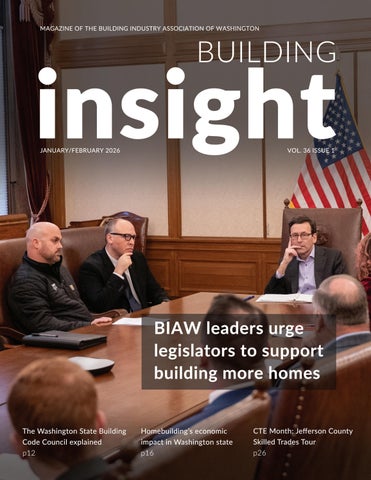
Create a flipbook