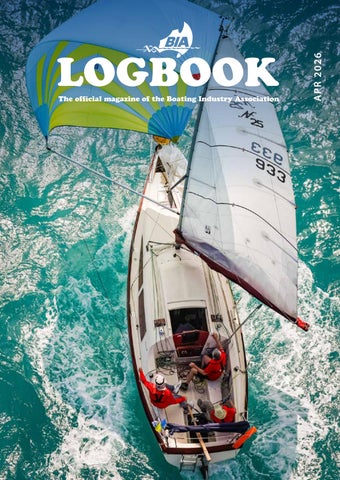
Logbook April 2026

Page 1


General

General

Marine

Membership

From the President

There is quiet strength in an industry association that aligns on its priorities. It does not exist to generate headlines. It exists to create stability, direction and deliver its strategic key priorities where it matters most.

The Boating Industry Association was formed in 1960 and operates under the stewardship of a Board of Directors comprising representatives from each participating State. This structure ensures national cohesion while preserving regional nuance. It allows the Association to speak with one voice on priority matters including policy and promotion, while remaining attentive to the distinct commercial realities faced by members in different jurisdictions.

Beneath the Board sits the engine room of the organisation - our State Councils. Each State Council has a pivotal role which includes identifying local priorities, emerging risks and new opportunities. They consider the issues that matter to the membership on the ground. They offer guidance to issues. Their counsel informs Board deliberations and the strategic direction of the Association.

In February and March, we convened the first round of State Council meetings and Annual General Meetings for 2026. The discussions reflected a sector that is evolving, ambitious and determined to remain competitive. The intelligence gathered from these meetings strengthens our advocacy and sharpens our focus.

To further support members, Divisions operate across key sectors of the industry, delivering opportunities for more targeted representation and commercial insight. These Divisions allow members to raise sector specific matters with precision rather than generalisation.

If you are passionate about advancing the marine industry, about shaping policy rather than reacting to it, I strongly encourage you to consider nominating for a State Council position or becoming involved in a Division. Associations are more effective with constructive collaboration and commitment of their members.

Beyond governance and advocacy, the BIA carries a deeper responsibility: to promote a safe, professional and rewarding marine industry for Australians. Every member makes a formal commitment to uphold the BIA Code of Practice. This Code is more than an administrative requirement; it is a declaration of standards that support quality outcomes. It establishes clear expectations of conduct between members, customers and stakeholders.

The Code of Practice reinforces transparency, professionalism and accountability. It demonstrates to the boating community that BIA members operate to consistently high standards - standards that inspire trust and build long-term confidence in our industry.

Consumer confidence underpins participation. Participation underpins growth. Growth sustains jobs, investment and innovation.

As we move ahead, the Association remains focused on strengthening representation, supporting members through complex regulatory and commercial environments, and ensuring that boating in Australia continues to thrive - safely, sustainably and inclusively.

The BIA exists for its members. It exists because collective action is more effective than isolated effort. And it continues to evolve because of the commitment, expertise and engagement of the businesses it represents.

Thank you for your continued support and involvement.

From the CEO

Over the past year, we welcomed 84 new members to the Boating Industry Association. Growth which reflects confidence in the direction of the Association and a testament to the dedication of our team who between them represent more than 250 years of industry experience and expertise. The influx of new members also demonstrates the willingness of businesses across the country to stand together in advancing shared priorities.

The past six months have been filled with engagements, meetings, initiatives, advocacy, boat shows and events spanning all member States and Territories. Behind each of these activities sits a common objective: to strengthen the operating environment for our members and to ensure the boating industry remains vibrant, competitive and respected.

One of the Association’s core functions is government advocacy - delivered both proactively and reactively.

Proactively, we engage with Ministers, Department Executives and policymakers to shape legislation before it is enacted. Reactively, we intervene when regulatory decisions threaten to disadvantage members, disrupt commercial activity or create barries to public participation.

A recent example involved the proposed trial of Powered Vessel Exclusion Zones in Port Stephens. The Government announcement was made via social media without consultation or evidence shared with key impacted stakeholders. BIA acted, calling on the NSW State Government to ensure the consultation process was fair, transparent and evidence based. BIA delivered a 5 point plan in person to the responsible Minister and key Councils in NSW to address concerns real and perceived about PWC behaviour on the waterways. BIA also worked with the leading PWC brands to deliver a targeted media campaign promoting safe, responsible and enjoyable PWC. Advocacy of this nature supports not just individual businesses but the integrity of the broader boating sector.

Through our multi-State initiative and in partnership with BIA Victoria’s Boating Careers, we deliver the only nationwide, industry-owned jobs and skills program

dedicated entirely to the marine sector.

The program exists to showcase the breadth of career pathways available - from trades and manufacturing to marine electronics, design, marina management and business ownership, and more.

Engaging young people and career changers is not a short-term exercise. It is an investment in generational renewal. Our Marine Jobs program is also a continuation of a key priority for the BIA which began in the 1960s.

I also want to highlight our current promotion of boating - now the largest multi campaign program in the BIA’s history. The national Discover Boating Summer Campaign, the Responsible Boat Owner – PWC campaign in NSW, the Go Boating SA campaign in South Australia, leadership of the Responsible Boat Owner national campaign project and the Discover Boating Drystack campaign in Southeast Queensland are together reaching tens of millions of Australians. It is part of our vision of seeing participation in boating across Australia to exceed the 6 million figure by 2030.

The feedback from stakeholders, sponsors and participating members has been exceptionally positive, reinforcing the relevance and impact of a coordinated industry-led approach. These efforts are all designed to keep boating as one of Australia’s favourite outdoor activities and to drive customers into our members’ businesses to purchase products, services and boats.

Thank you for your continued engagement.

THE FUTURE OF SAILING

Australians are proud of our sailing history, the achievements and victories in every sphere of competition. Our island nation has welcomed mariners to its shores since the wayfinders and traders preceding the First Fleet, and the waves of migrants thereafter.

Thanks to a mild, favourable climate and a population who clings to the coast, sailing has earned its place in the Australian identity as a sport, lifestyle activity and means to adventure.

Today, sailing faces the impacts of rising costs and consumers with more choice than ever.

In February, Australian Sailing released its “Participation Plan”, which it describes as “a whole-of-sport roadmap designed to make sailing more accessible, welcoming and flexible, and to grow participation through to 2032 and beyond”.

Aligned with “SAILING 2032”, the sport’s 10-year Strategic Plan, the Participation Plan responds to changing participation trends and community expectations. It aims to ensure more Australians can discover sailing, enjoy positive first experiences and find clear, connected pathways to stay involved for life.

Australian Sailing President, Shevaun Bruland asserted that participation trends in Australian sport are changing fast. “Sailing in particular is limited by two key challenge types: structural issues in how programs and pathways are designed and delivered, and experiential barriers that impact visibility, accessibility and inclusiveness.

“Australians are choosing experiences that fit their time, budget, location, culture and lifestyle needs. This plan provides a roadmap to address those issues.”

The Plan outlines how Australian Sailing, Clubs, Class Associations and Discover Sailing Centres will work together to grow participation by getting more people on the water, in more ways, more often.

Beyond Clubs, the dealers and charter operators report a resurgence in interest in sailing, possibly driven by a reassessment of post-pandemic priorities.

Brent Vaughan Director at Multihull Central, representing sailing multihull brands Seawind, Corsair, Garcia and Outremer, says while consumer confidence has been impacted by recent global events, their aspirations of travel and living life to the full continues.

“Cruising by sailing catamaran is very much front and centre in that plan and we attract new people every year wanting to go cruising and eager to learn,” he reported.

“This is why we offer a full ecosystem of services including Sailing School, Cruz Club membership, syndicate ownership, charter boat ownership through to private ownership.”

Charter ownership is enjoying particular interest, Vaughan revealed.

“We manage a fleet of eight charter boats in Sydney and supply boats into the Whitsundays. Our Cruz Club program converts charter boat subscribers into new and used boats owners once they gain sufficient experience to venture out on their own.”

Aspiring sailors subscribe to a Cruz Club boat for a year to gain experience locally with full support and coaching. They then progress to their own charter boat or private boat. “It allows a

comparatively low cost means of getting time on the water and also introducing family members to the experience in a supported environment.”

Sarah Joyce, Director at Mariner Boating Holidays agreed: charter and syndication are on the up.

“We’re seeing solid interest in experiential sailing, particularly charter holidays, skippered trips and fractional ownership models,” she stated. “People are still very drawn to being on the water. What’s shifted is the way they want to access it. Full ownership isn’t the default ambition it once was. Flexibility, efficient use of time and shared access are increasingly important.”

“People are still very drawn to being on the water. What’s shifted is the way they want to access it. “

The strongest interest is coming from mid-career professionals (roughly 40 to 55 years old) with disposable income but limited time, empty nesters looking for purposeful travel, former boat owners who no longer want the maintenance commitment and charter guests who love the experience but prefer structured access over sole ownership.

“Fractional ownership resonates particularly well with people who value time on the water and a sense of community, but don’t want significant capital tied up in an asset they’ll only use occasionally,” Joyce continued.

“There’s also curiosity from younger professionals, though they typically enter through experiences first, charters or skippered holidays, rather than moving straight into ownership.

“The demand for meaningful leisure experiences is strong. I think the biggest opportunity is to frame sailing less around ‘boat ownership’ and more around ‘lifestyle access’.”

“Sailing is booming!” commented Matt Hayes, speaking from a unique vantage point as Olympian, Admiral’s Cup and Sydney Hobart veteran, founder of charter business, Sydney by Sail and Director of Performance Cruising Yachts, dealer for Italia and ICE, and since January 2026, representing the entire Hanse Yachts Group: Hanse, Dehler, Moody sailing yachts, and Fjord and Sealine motor yachts.

One of the country’s most accomplished sailors, Hayes undertook a global circumnavigation on SV Influencer from 2018 to 2020 and believes sailing as an industry needs to be more proactive and more flexible to flourish.

“Sailing is in our DNA, and there’s a real fascination with events like the Sydney Hobart, the feats of Jessica Watson and Kay Cottee, for example. Now, we need to convert that innate curiosity into making it accessible and helping people make it happen.”

Based at Darling Harbour, Hayes’ Sydney By Sail charter business welcomes between 10,000 to 12,000 people per year, both corporate and private – impressive numbers that the other facets of the business focus on retaining.

“Our charter and sail training courses act as a large funnel for people to move into buying a yacht or shares in a yacht,” he explained.

“We have an ongoing relationship with our customers, which aims at retention and repeat business. In terms of yacht sales, we don’t just sell them and wave goodbye! Our sail training gives owners confidence and increases their commitment.”

But among those thousands of customers, whether they’ve sailed before or owned boats, most of them are not members of yacht clubs or associations, Hayes reported, adding that the traditional approach to promoting sailing as a sport no longer works.

“There’s the perceived expense, particularly with the current cost of living pressures, and people simply can’t commit to sailing every weekend. That’s where Twilight sailing and crewing are great options for people wanting to learn to sail.

“Young people are the future, especially in this social media era. With Facebook groups generating interest in crewing and YouTube sailing identities off exploring, sailing is well-placed to capture their imagination and desire to ‘live the dream’ of travel, freedom and adventure.”

Yacht Clubs and Associations must tap into that energy, to inspire and instruct, Hayes stated. “Beyond pathways to racing and competition, the objective should be to make it easy to experience sailing and show them how for having fun, camaraderie and connection.”

Connection and inclusion are sailing’s real appeal, according to Sailability NSW President, John Price.

“Sailing offers something many other activities don’t, which is real connection. Connection to nature, skill development, teamwork, and to each other,” he explained, adding that family-friendly programs are key to attracting more people to the pastime.

“Accessible sailing is one of the most positive stories globally,” Price asserted. “Inclusion is no longer a side program; it’s core to the future of the sport.

“Programs like Sailability strengthen community connections, attract volunteers, and broaden the image of who sailing is for. Where there’s strong leadership and partnerships, accessible sailing is genuinely thriving.”

Over his 55 years, Price has seen the ebb and flow. “I’ve seen sailing go through cycles but what’s clearer now is that sustainability – financial, volunteer and participation – is front and centre.”

Specialising in online boating and safety training, Neil Driscoll Managing Director and founder of Above and Beyond Sailing, said from his experience, interest and participation in sailing are growing.

“Expectations have shifted. People now expect modern, relevant training that reflects real-world boating and can be completed at their own pace from anywhere. Over the past seven or eight years, e-learning has proven it can deliver strong outcomes when properly designed and delivered.

“We meet many people completing their SROCP (Short Range Operator Certificate of Proficiency) as part of a new boathandover process, which suggests they are entering the space with a focus on doing things properly from the outset. We’re also seeing more people transition from power to sail than the other way around.

“Powerboats will always be popular, particularly in Australia, with its strong fishing culture and access to offshore reefs, but from where we sit, interest in sailing appears to be building in a structured and intentional way.”

According to Driscoll, “Engagement has also broadened.

“People are connecting with sailing through major events like Sydney-Hobart and SailGP, through digital media, YouTube channels and free educational resources such as podcasts. They are beginning their learning journey before booking an on-water course, building a foundation in navigation, safety, seamanship and terminology while shopping for a boat or planning a charter.”

From the custom manufacturing segment, Phil Bate at Riggtech has seen a decline in racing, yet steady business from other boating and architectural clients.

“The cost of living is having an effect on keeping young people in the sport as they have to prioritise the most important things like housing, education and essentials. I also think other sports are having an impact as sailing usually takes up the whole day, a bit like golf. Young people can’t commit to a full day for sport.”

Bate suggested investment in local manufacturing and building boats in Australia could provide a solution. “The lack of building boats in Australia has had a dramatic effect on both the employment and skills as well as participation, as both go hand in hand.”

Events, Rallies and Race Weeks have proven a successful means of broadcasting sailing to a wider audience and encouraging newcomers to add it to their “Bucket List” adventures.

“Events absolutely do attract people to the sport,” said Matt Hayes. “Hamilton Island Race Week and two or three day sailing events have a place in attracting people to the sport and pastime. ARC, East West, the Oyster owners’ rallies inspire people to take the leap.”

Each August Hamilton Island hosts Race Week fills its 600-berth marina and overflows to marinas at Airlie Beach. Organisers confirmed the annual event “acts as a catalyst for activity across the sailing ecosystem”.

Along with yacht preparation which drives significant business for sailmakers, marine engineers, boat builders and specialist trades, the regatta’s inclusive format encourages both grassroots sailors and established campaigners to compete.

The integration with the Gold Coast Mackay Yacht Race in 2026 further strengthens this dynamic by encouraging offshore fleets to extend their season north, increasing preparation cycles and fleet movement along the east coast.

Race Week and other international sailing events position the Whitsundays as one of Australia’s premier sailing destinations, offering equally compelling experiences on and off the water. This is only predicted to gain momentum as Townsville and the Whitsundays prepare to host Olympic sailing during the Brisbane 2032 Olympic Games.

In a similar way, the iconic Rolex Sydney Hobart Yacht Race, hosted by Cruising Yacht Club of Australia (CYCA) and Royal Yacht Club of Tasmania (RYCT) is etched into the Australian psyche.

As outlined in the 2024 Rolex Sydney Hobart Yacht Race Fulfilment Report, media coverage reached an all-time high. Global editorial mentions increased by seven percent, rising from 10,760 to 11,500. Advertising Value Equivalency saw a significant jump, nearly quadrupling to more than an impressive $262 million.

According to the CYCA Sailing Office, a spike in sailing enquiries often occurs around Rolex Sydney Hobart Yacht Race time, spurred on by the warmer weather and holiday period which lends people more time and motivation to go sailing.

In 2025, the 142 entries in the 80th Rolex Sydney Hobart Yacht Race was the second-highest number of starters this century. The Rolex Sydney Hobart Yacht Race, combined with the summer season, creates a peak business period for the sailing industry, as suppliers operate at full capacity to prepare yachts and crew for the Great Race South.

Jiang Lin captured global headlines and became a role model for women around the world after her Overall victory in the 2025 Rolex Sydney Hobart aboard her 10.3-metre Min River –the first time a woman owner-skipper has won the race.

Added to the benefits of the RSHYR, the CYCA has a welldeveloped program aiming to attract and retain members, appealing to people of all walks of life and levels of experience.

Their Concierge Program connects sailors who seek crewing opportunities with boat owners and skippers who need crew.

The Youth Sailing Academy (YSA), now sponsored by Mark Richards’ Palm Beach Motor Yachts, runs various courses for beginners and sailing squads to build skills across multiple disciplines and classes.

Then there’s Crew Connect, which the CYCA introduced in 2025. Held in a social setting, it brings together yacht owners/ skippers who require crew with sailors keen to get on a boat. Crew Connect covers inshore, offshore and coastal races, as well as deliveries.

As Australian Sailing’s Participation Plan identifies, compelling stories will be key to attracting more people to sailing. The dreamers, adventurers, achievers, those who overcome adversity to enjoy cruising under sail.

“We must modernise how we tell the sailing story,” John Price urged. “If we make sailing feel accessible, social and familycentred again – not just competitive – we give ourselves a strong foundation for both participation and employment growth.”

Far from being out of reach, getting on board should be as easy as finding the closest body of water.

“The beauty of sailing is that you can start as a kid, at five-yearsold, and sail in your 90s!” Matt Hayes stated.

“The beauty of sailing is that you can start as a kid, at five-yearsold, and sail in your 90s!”

“Sailing gives people insight into adapting to the wind and conditions, tactics, teamwork, logistics, determination, survival, learning to rise to challenges and know your limits, how to be gracious in defeat – all kinds of life lessons – as well as just slowing down to enjoy the water and the views, which is proven to be beneficial for your health.

“And we can enjoy sailing all over the world – rivers, lakes, ocean, harbours. The world is one big sailing venue!”

SERVICE & REPAIR

THE ENGINE ROOM OF THE MARINE INDUSTRY

As Australia’s recreational boating fleet continues to expand, the businesses that keep these boats running represent far more than a support function. Marine service and repair sits at the operational heart of the industry, increasingly driving customer retention, safety outcomes and long-term participation in boating.

But beneath the surface, these businesses face mounting pressures. An aging workforce, rapid technological change and evolving customer expectations are reshaping what it means to maintain vessels in 2026.

The Technology Paradox

Technology is transforming marine service operations in uneven ways. Michael Sojevic from Mariner Engineering notes that diagnostic tools are now standard for every Volvo Penta service visit, while other engines may rarely require them. This variance across brands highlights how inconsistently technology has penetrated the sector.

For some operations, modern systems have simplified repairs. Larry Phillips with In & Outboard Marine, observes a stark contrast with earlier decades. Where technicians once repaired and serviced distributors for example, they now may swap entire Engine Control Units. Four-stroke outboards are now sometimes lasting 4,000 to

7,000 hours compared to 1,500 hours previously, building customer confidence even as they reduce rebuild work.

Yet this evolution brings challenges. Brian Gatt, whose company Logix Group specialises in marine electrical systems and corrosion management, sees dangerous blind spots emerging. He recounts commissioning a brand-new vessel that subsequently underwent third-party electrical upgrades (larger alternators, bigger battery systems, expanded solar). Within six months, the boat suffered major corrosion damage. The upgrades worked perfectly from a performance standpoint but created systemic problems the installer had not anticipated.

“Everyone only looks at the benefits, not the risk,” Gatt warns. His observation extends to boat owners, who often prioritise cosmetic improvements over preventative maintenance. “People will put a new stereo on a boat before they do the necessities to maintain their boat.”

This systemic risk has driven Logix Group to develop IoT (Internet of Things) monitoring systems providing real-time data on electrical and corrosion issues, catching problems before they become catastrophic. It is an approach that points toward the industry’s future but one requiring significant expertise to implement properly.

The Skills Crisis that Won’t Wait

If technology represents opportunity, workforce shortages represent an existential threat. Larry Phillips puts it bluntly: “Trying to get mechanics, well people don’t want to do that anymore. It’s not sexy enough.” Where he once received 35 to 40 apprentice applications per advertisement, he now gets one or two. Apprentices who complete training often leave immediately

for higher pay. In the Northern Territory, as an example, he says apprentices must be sent interstate due to lack of local training capacity.

The situation has driven many operators overseas. Larry’s business now employs some mechanics from the Philippines, joining other dealers doing the same. Yet this is only a part solution to the challenge of recruitment of skilled labour.

Kevin Robinson at Fenquin Boating Services sees the knowledge transfer problem looming. “As our industry may start to see longterm staff retiring in the next five-plus years, if the transfer of skills is not carried forward, we may struggle to supply service to older vessels that are going to still be on the water.” His business still services vessels more than 20 years old, which require a specialised knowledge challenge as the technicians who understand them retire.

The industry’s response has been urgent. Michael Sojevic has built apprenticeship programs into his business model from the start. Kevin Robinson’s business participated in piloting Volvo Penta’s global competency framework, establishing standardised skill levels for technicians, creating portability and clarity as staff move between employers.

Yet challenges persist. The marine industry remains a fallback choice for too many young people. Workplace environments do not always help. Larry Phillips contrasts modern car dealerships where “you can eat your dinner off the floor” with many marine operations that remain “little backyard operations.”

National data confirms the problem, with technicians and trades workers experiencing some of the most persistent shortages across Australian industries, particularly acute in regional areas where much marine work occurs.

Customer Expectations in a Digital Age

While businesses grapple with technology and staffing, customer expectations continue evolving. Kevin Robinson identifies communication as being increasingly critical, particularly as newcomers enter the market without understanding maintenance requirements or booking lead times. Slipways book out six months in advance during peak season, yet customers increasingly expect car-service levels of speed and precision. Which is a key reason the BIA is currently advocating for governments across the nation to support marine service, repair, maintenance and survey needs. BIA’s current work to encourage government support and investment in slipways for the River Murray is just one example.

“Customers in these modern times expect good communication,” Larry Phillips confirms. “They expect a lot quicker turnaround times. Now they want to know exactly what time, what day, and they want you to stand by that time.”

His strategy has been to limit their scope, “stick to our knitting,” only taking on technology his team can service well. “We do very well in our lane, so we’re happy in our lane.”

Michael Sojevic has approached this differently, leveraging his digital background to build systems improving efficiency and customer experience. Both approaches work, illustrating how service businesses must actively choose their positioning.

The compliance burden adds complexity. Kevin Robinson notes rising business input costs, such as site inductions, security requirements, and police checks for waterfront access, remain “difficult to pass forward” to customers.

What Success Looks Like

Despite challenges, optimism persists among service operators who see their role as increasingly strategic. Success metrics have evolved beyond profitability to include workforce retention, customer loyalty and industry contributions.

“Success is having a satisfied customer base, enough skilled mechanics to meet demand and a great team,” Michael Sojevic says. His business already employs AI tools for efficiency and has added an electric vehicle to his technician fleet, positioning for gradual electrification.

For Kevin Robinson, success lies in demonstrating value through skilled support systems, making quality investment visible to customers willing to pay for it. Larry Phillips’ definition centres on sustainability: staying busy while maintaining transparency and avoiding reputational damage from cutting corners.

Brian Gatt’s vision is perhaps most systemic: vessel owners understanding full lifecycle risks, regular health checks becoming standard and proactive maintenance replacing reactive repairs. He advocates for regulatory frameworks similar to New Zealand’s Electrical Warrant of Fitness system, which mandates electrical safety inspections, contrasting with our inconsistent State requirements.

Navigating Foward

In this regard, the marine service sector stands at a point of change. The fleet is growing with Australia expected to have more than 1 million registered vessels by 2030, technology is advancing rapidly, and customer expectations continue rising. Yet the workforce needed to meet these demands remains stubbornly difficult to develop and retain.

Solutions require industry-wide coordination. More manufacturers need scholarship programs and training academies. Businesses must continue investing in apprenticeships despite attrition. And BIA needs to continue its efforts under the Marine Jobs program in articulating the compelling value proposition for young people considering trade careers.

For BIA members operating service businesses, the path forward requires strategic choices: which technologies to embrace, how to invest in workforce development and where to position in an increasingly segmented market. Those who navigate these decisions well will not just survive; they will define what professional marine service looks like for the next generation. Much of the industry has already evolved from simple mechanical repairs toward comprehensive vessel health management. Service providers who can integrate technical expertise, customer communication and risk management will find themselves not just maintaining boats, but sustaining the entire boating ecosystem that depends on them.

New South Wales

I hope the year has started well for our members for what promises to be an exciting 2026.

There’s no doubt 2025 was a year of transformation and opportunity. With the new show model in NSW, our members’ dedication to delivering exceptional service to industry and our future boating clients has been outstanding. The relationships you’ve built, the challenges you’ve navigated and the innovations you’ve shared have positioned us strongly for continued success.

Looking ahead, we have significant opportunities on the horizon in NSW. While the economy continues to evolve, our ability to marshal resources and harness potential, innovation and expertise sets us apart from the broader industry.

This year in NSW, we’ll be focusing on Government Advocacy with key priorities including access to NSW waterways, funding, zoning, Sydney foreshore development, safety, regulations, marinas and marine infrastructure. Our membership’s local industry knowledge and operational excellence will be critical to delivering on these initiatives.

In early March, industry leaders came together for our Annual General Meeting which was an opportunity to engage with members and plan for 2026 and beyond. This meeting included

a comprehensive debrief on 2025 achievements and learnings. Members were encouraged to attend and provide feedback on what we did well in 2025 and what we can improve moving forward.

On the international stage, the economy is moving favourably ahead. Although 2025 fell short of expectations, the Australian economy remains resilient. Australia performs best during adversity and while market uncertainty keeps consumer confidence conservative, our industry is well-positioned to benefit from the continuing shift in consumer preferences toward experiences rather than products. With Australian households being more selective about discretionary spending, we must remain forward-looking and visionary to drive industry growth.

As an industry, we sell a lifestyle- leisure time, connection, and family experiences. That fundamental value proposition gives me confidence we’ll see significant wins in 2026.

MARINAS: OUR WATERFRONT POWERHOUSES

More

than mere facilities for boat storage, marinas are part of the fabric of Australian cities and towns and thriving ecosystems supporting our rich and diverse coastal lifestyles.

Along the country’s 60,000 kilometres of coastline and within its rivers, lakes and estuaries, there are almost 300 marinas located in safe and sheltered enclaves, many of them on the edge of the idyllic cruising grounds Australia is famous for.

Marinas are the vital hubs of recreational boating. What makes them unique is that they connect boat owners, marine services, tourism, culture, waterfront development, marine industry capability, events and community access to waterways. Marinas and boatyards are important destinations with social, economic and environmental benefits.

They are also economic engines. The 2023 Health of the Australian Marina Industry Survey (HAMIS), conducted by Michigan State University for the Marina Industries Association (MIA), asserts that marinas provide employment for more than 22,000 people and contribute over $2.4 billion to the Australian economy.

Like every ecosystem, various dynamic factors impact their prosperity. As the population grows, habits change and customer expectations shift, marinas are under increasing pressure to evolve their infrastructure, service models and commercial strategies.

Australia’s largest marina network, d’Albora Marinas comprises 16 marina locations across Queensland, New South Wales and Victoria, with a total of 4,000 berths (wet berthing, dry storage, moorings, limited superyachts berths), 10 full-service boatyards and maintenance facilities, five dry storage stackers and more than 200+ commercial leasing tenants.

Its four-brand pillars focus on berthing, boatyard, boats sales and hospitality to drive their integrated offering to customers.

Here, we speak with Daniel Hargraves, Managing Director Asset Management at MA Financial Group (owners of d’Albora Marinas) about changing and diversifying to adapt to the current climate, shedding light on the challenges and opportunities through their experience and unique insight.

In the “big-picture” scheme of things, how are marinas performing in terms of profitability, embracing technology, investment?

The sector continues to exhibit steady growth and has been underpinned by structural tailwinds such as increasing boat ownership, lifestyle demand and coastal migration. Performance varies by location and asset type but marinas with quality facilities that are in metro or high-demand regional areas have maintained solid occupancy and earnings resilience through the recent variations in economic conditions.

Investment focus is on well-located, full-service facilities with diversified revenue streams. Technology adoption remains selective with operators prioritising upgrades that enhance efficiency and customer experience (such as digital bookings, fuel management, and automated systems) rather than speculative tech investment.

We have our own d’Albora App which provides direct ability for customers to make bookings for berthing, boatyards quotes, request berthing and fuel assistance, see live fuel pricing and weather updates, boat sales as well as offers and promotions. It also gives direct information on each site with berth maps and tenants onsite.

This enhances and personalises the customer experience further, driving engagement further into the brand and helping with the customer’s lifestyle.

Where are the growth regions that marinas are being built or expanded in response to demand?

Development activity is focused in areas where demand consistently exceeds berth supply and where marine infrastructure can be expanded efficiently. Areas such as South-East Queensland offer strong population growth, a favourable climate and a concentration of high-use recreational boating corridors.

Marinas around Moreton Bay, Gold Coast and the Sunshine Coast are undergoing investment and expansion. Greater Sydney remains capacity-constrained, particularly for berths over 15 metres. There are opportunities to add capacity within existing footprints or reconfiguring berth layouts to accommodate larger or multihull vessels. Select regional centres such as Coffs Harbour, Port Macquarie, Nelson Bay and Batemans Bay are benefitted from strong local usage and tourism-driven demand.

Across the sector, new marinas require long lead times to develop, therefore short-term growth tends to be incremental, with operators using targeted capex to improve asset yield and functionality. Greenfield development remains challenging from a regulatory and cost standpoint.

How are marinas across Australia preparing for the next decade – infrastructure, personnel, training, smart technology and AI?

There is a growing emphasis on aligning marinas with changing user preferences which impacts how marinas manage facilities, access, power, servicing and customer relationships.

Renewal of infrastructure through investment in updated amenities, improved berth layouts and sizes, dry stack storage, modern boatyards and improved access and circulation. These projects target capacity optimisation and ageing infrastructure improvement.

Digital tools are being integrated for berth management, customer communications, and performance analytics. AI-powered enquiry handling and cloud-based CRM systems are being introduced.

The industry is moving to reduced environmental impacts, including fuel spill management, EV and electric boat charging infrastructure and integration with local planning frameworks. Developing and scaling marinas to be very lifestyle driven and focused for more than just the customers who have vessels in berths. Creating these locations as centralised “hubs” for lifestyle opportunity, where people can come together and enjoy themselves through various offerings including food and beverage, retail, parks/ kids zones/ experience; tourism; marine services.

How do marinas interact with customers and visitors to keep pace with changes in their usage, new technology, sustainability, urban development pressures and alternative boating models (electric, boat clubs)?

The business is gradually adapting to alternative boating models. Initiatives like the recent acquisition of GoBoat Australia (electric boat hire) have introduced non-boat owners to on-water activity, helping diversify customer segments and increase foot traffic without increasing berthing demand.

GoBoat provides access for the broader public to experience boating, as well as our marinas and their offering, via electric powered sustainable green vessels in Queensland, NSW, Canberra and Victoria.

Digital engagement, improved service delivery and community events help to build relationships with customers and local communities.

Then there’s localised and network wide sponsorship and community support across events: sailing events such as Sail Port

d_Albora Boatyard Martha Cove

Stephens; fishing and game fishing events; car shows; Christmas and mid-year events; food and beverage events; activations/ sponsorships; NYE fireworks such as at Nelson Bay; kids’ daily fish feeding and school holiday programs; local sporting teams and community groups.

Do we have the facilities – specifically in Queensland – to meet demand in the lead up to and during the Brisbane 2032 Olympic Games?

Probably not. We see some opportunity here. While there is an overall focus on short term superyacht activity, we think there should be a strategy for long-term visitation and recreational uses. While marina supply in some parts of Queensland is relatively healthy, demand is expected to grow in the lead-up to 2032, particularly for full-service berths and event-related visitation.

A number of marinas are already undertaking site upgrades, new berthing and amenity improvements in anticipation. However, delivering additional capacity at scale will require continued collaboration between operators, local councils and State authorities to streamline approvals and infrastructure planning.

What

are the barriers to marina development in this country, and how will industry overcome or address them?

There are a number of barriers, including planning and regulatory complexity, especially around approvals for in-water development, high upfront capital costs and long payback horizons, limited waterfront land in urban areas, and community and environmental sensitivities, such as visual impact and waterway access.

The industry is addressing these by working more closely with councils and government through the BIA and Maritime Advisory Council (NSW), and advocating the case for the economic and recreational value marinas contribute.

There are US and European behemoth brands making headlines with expansionist plans. Are they eyeing properties in Australia?

The sector has attracted interest from global capital particularly in the US and Europe. Australia’s coastline, strong boating culture and stable economic environment are expected to draw their attention in due course. While some groups are watching the market closely, existing networks with scale, like d’Albora, are well positioned to maintain local leadership through investment in the existing portfolio and appropriate acquisition strategies.

dalbora.com.au

BIA and d’Albora Marinas, working towards better commercial marina lease outcomes

BIA along with d’Albora and other industry stakeholders attended a meeting with Crown Lands earlier this year with the ongoing aim of improving commercial marina lease outcomes in NSW.

This workshop hosted by Crown Lands was part of BIA’s work over many years to advocate for lease outcomes in NSW that incentivise private sector investment. The focus of the workshop was part of the development of a new template lease and guidelines prepared by Crown Lands.

As BIA’s NSW Marina Division Chair Ned O’Neil explains, “NSW marinas have two main landlords: Transport for NSW and Crown Lands, who function independently.

“A first body of work was formulated in the mid-2000s which included a full economic study by Pitcher Partners, and then that report was refreshed in 2018.

“From that, with Transport for NSW, industry formulated the Sydney Harbour Destinations Plan – a strategic initiative designed to increase and promote public access with dedicated locations for recreational boaters on Sydney Harbour. It incentivises commercial marinas to offer shortterm ‘destination berths’ and services for visitors.”

The BIA developed a template head lease with Transport for NSW that can be tailored to each location so marinas can achieve a sustainable rental framework to be sustainable and give them the confidence to invest in the assets and keep them at a high standard to deliver excellent service.

The next step was to undertake a similar exercise over the past year with Crown Lands. This involved a workshop in late 2025 for marina industry stakeholders, followed by a second workshop in February 2026.

The working group, which involved leading figures such as Darren Vaux from Empire Marinas, d’Albora Marinas, Michael Jarvin from AMM and Ned O’Neil from Addenbrooke Marinas Group, focused on reviewing Crown Lands Policies to draft a Head Lease Template, approved by Crown Lands, for industry comment.

“We brought all the information together including rental guidelines to align with the Crown Lands’ framework called the Public Value Contribution Plan for Crown Lands, covering public access and use at marinas, rental considerations and discounts – very similar to Transport for NSW on Sydney Harbour Destinations.”

Over the next couple of months, the BIA will finalise the framework and commentary on the guidelines, and devise a series of documents that include maintenance and environmental plans and lease requirements. These generic documents will be pre-approved templates signed off by Crown Lands that marinas can use as a resource free of charge through the BIA.

“Once the lawyers have reviewed it and believe it to be a

template that works and is fair, we will present it to all BIA members in NSW and recommend they adopt it,” said O’Neil, adding praise for Michael Callanan, Partner at Rankin Ellison Lawyers who he said has been crucial to the process.

“The idea is to take the burden off everybody, particularly smaller operators, and do it as a collective. It will save time, money and headaches, delivering a new head lease that works and gives them a pathway forward.”

The format will be word documents that allow individual marinas to overlay their site-specific information. There will also be a list of recommended consultants for independent audit and legal advice.

“From this process, it’s clear that the relationship between industry and the NSW government is the best it’s ever been, and we thank the government for being open, engaging and transparent with us,” O’Neil stated.

Daniel Hargraves, Managing Director – Asset Management, MA Financial (owners of d’Albora) worked closely with the BIA working group to convey to Crown Lands the complexities of marina operations, and the unique requirements of the sector with the objective of ensuring sustainable growth and ongoing investment.

“The marina industry plays a meaningful role in the NSW economy, supporting around 7,800 full-time jobs across more than 2,000 kilometres of coastline and contributing nearly $1 billion in additional economic value,” Hargraves observed.

“Importantly, it is estimated every $10 million invested in marina construction supports 50 direct and indirect full-time equivalent jobs.”

He continued, “Providing greater certainty through this process is critical to underpinning long-term sustainability and encouraging continued investment in the sector. We are grateful to the BIA and Crown Lands for the collaborative approach taken, and for the opportunity to contribute to this process that we believe will result in a practical and adaptable outcome for the industry.”

Growing Participation. Strengthening Industry.

Growing participation in boating remains one of the Boating Industry Association’s defining key strategic priorities. It is a sustained program of action designed to broaden appeal, deepen engagement and future-proof the sector.

Over the past six months, a coordinated suite of initiatives has been delivered to ignite interest and promote accessible pathways for first-time participants, all whilst fostering an enduring emotional connection to life on the water.

Boating is not exclusive, it is inclusive, across paddle, power and sail.

The industry has the opportunity, and responsibility, to communicate that clearly.

Discover Boating: ‘See You Out There’

From 1 November to 15 February, the national Discover Boating campaign, See You Out There, reached Australian audiences at scale. The campaign celebrated the intrinsic wellbeing, connection and vitality that time on the water brings. It invited

Australians to rediscover freedom. To disconnect from screens. To reconnect with people and place.

The creative narrative was simple yet resonant: Adventure Awaits. See You Out There.

The media strategy blended high-frequency television placements with targeted digital advertising, amplified through owned social and electronic digital marketing channels. The results were emphatic:

• 21,393,800 impressions across a total of 6,406 spots in Metro areas (regional figures not available at time of publishing)

• 10 million digital impressions

• 5 million online video views

• 39,000 website visits following video views

• 2.5 million viewers watched 100% of the online video

The campaign reinforced the fact boating is both attainable and aspirational, and demonstrated the power of unified industry messaging.

The Discover Boating campaign was supported by Century Batteries, GMSV, Club Marine and BIA Victoria, and was delivered across NSW, Queensland, South Australia, Victoria and Tasmania.

Dry Stack: Convenience as a Catalyst for Participation

Discover Boating Australia’s Dry Stack Campaign is now well underway, representing a significant six-month collaborative initiative across Southeast Queensland’s leading marinas. Running from December 2025 to May 2026, the integrated campaign unites six prominent facilities under one shared objective: to educate boaters on the benefits of Dry Stack storage and generate qualified enquiries for participating marinas.

The campaign rollout has been a fully collaborative effort, with marketing agency Allies Management, Zeal Marinas and the Boating Industry Association working collectively across every touchpoint. Together, this collaboration developed and delivered a dedicated campaign landing page, supported by a suite of digital resources designed to inform, engage and convert prospective boat owners.

A key feature of the campaign is an interactive one-minute quiz, matching users to the Dry Stack facility best suited to their boating lifestyle, location and vessel size. The strategy also extends to lead generation Meta Ads and targeted organic social media content – all strategically crafted and executed to ensure a cohesive message across channels. The result is a unified campaign blending strategic media placement with educational storytelling, resonating with both seasoned boaters and those new to life on the water.

Uniting Gold Coast City Marina, Pelican Waters Marina, Redland City Marina, Runaway Bay Marina, Scarborough Marina, and D’albora’s East Coast and Pacific Point Marinas – the SEQ Dry Stack Campaign represents a collaborative regional effort rarely seen within the marine industry. By pooling resources and aligning messaging, the participating marinas have

strengthened awareness of Dry Stack as a premium storage solution while elevating Southeast Queensland as a leading boating destination.

At the heart of this campaign is the shared goal of removing barriers to boat ownership and simplifying the boating experience. Dry Stack storage is a secure, convenient and low-maintenance alternative to traditional mooring – offering boaters fast launch times, protection from the elements, and reduced ongoing maintenance.

As demand for smarter storage solutions continues to grow, the success of Discover Boating Australia’s Dry Stack Campaign has laid the foundation for broader national awareness, with ambitions to spotlight Dry Stack facilities across Australia and champion a more accessible, stress-free way to get out on the water.

The BIA would like to make special mention of Luke McCaul of Zeal Marinas, Kayla Malss of Allies Management and our own Alyssa Carnell (BIA Marketing and Communications) for the extensive collaboration behind the scenes to make this campaign a reality.

Go Boating SA: Confidence, Clarity and Community

In South Australia, BIA launched Go Boating SA, a campaign designed to promote safe, responsible and enjoyable boating across the State.

At a time when temporary algal bloom-related fishing restrictions created uncertainty, the campaign delivered clarity. Over 70 per cent of SA’s coastline remained unaffected. Freshwater fishing areas remained open and safe. The message was measured and factual.

The campaign aimed to:

• Encourage continued safe and responsible boating

• Increase awareness of SA Government temporary support measures, including registration discounts and free ramp access

• Support marine sector jobs

• Reinforce that most waterways remain open and ready to be enjoyed responsibly

Supported by a grant from the Government of South Australia and delivered across television and digital channels through to April 2026, the campaign provided reassurance while sustaining economic momentum for marine businesses.

PWC Behaviour Campaign and 5-Point Plan

Participation growth must be accompanied by responsibility. The majority of personal watercraft users do the right thing. A minority do not and put the majority at risk of more rules and restrictions by regulators.

In collaboration with PWC manufacturers, including Seadoo, Jet Ski and WaveRunner, BIA delivered a targeted media campaign in New South Wales promoting safe and responsible PWC operation.

The initiative formed part of a broader strategy to address unsafe behaviour and protect the enjoyment of the wider boating community. It reinforced rider responsibilities and called for strengthened education and compliance measures.

Simultaneously, a 5-Point Plan was submitted to the NSW Government, advocating for:

• Compliance camera models in waterway hot spots

• Mechanisms to suspend licences and seize vessels for serious repeat offences

• Sustained and funded behaviour change campaigns

• Consideration of hoon-style legislation models for waterways

• Consideration of a demerit points framework for marine licences

Leading PWC brands publicly supported both the campaign and the policy proposals.

Participation must be safe; and safety protects the industry’s social licence.

Responsible Boat Owner Campaign

BIA also led a national working group which included regulators to develop the Responsible Boat Owner campaign. This was phase one of this campaign which had a focus on helping people make informed decisions when it comes to buying a boat. The campaign has a deliberately positive approach which boils down to the promotion of safe, responsible and enjoyable boating.

The RBO campaign is currently underway across the nation largely through digital channels by members of the Australia New Zealand Safe Boating Education Group.

The campaign creative was funded through the national body representing all maritime regulators, the Australian Recreational Boating Safety Committee.

A Coordinated, Multi-Layered Strategy

The last six months have demonstrated what coordinated advocacy and promotion can achieve when industry aligns behind a common purpose.

Boating in Australia is not static. It is evolving. It is broadening. It is becoming more accessible and more visible.

Participation is growing. Perceptions are shifting. And the industry’s collective voice has been amplified. The work continues.

The Great Northern Tradewind: Driving the Marine Industry Forward

Hamilton Island Race Week (HIRW) has evolved far beyond its status as a premier offshore regatta; it is now a powerhouse for the Australian marine industry. As it celebrates over four decades of history, the event stands as a global benchmark for sailing excellence, attracting elite crews and passionate cruisers to the turquoise waters of the Whitsundays.

The scale of the most recent regatta was nothing short of spectacular, featuring a fleet of 170 boats and approximately 2,000 sailors. For the marine sector, these figures represent more than just a race; they signal a massive annual surge in demand for high-level technical expertise and specialised equipment.

A Catalyst for Skills and Trades

The economic “halo effect” begins months before the first starting gun. The rigorous demands of tropical passage racing drive a significant cycle of investment:

• Vessel Preparation & Upgrades: Owners invest heavily in performance optimisations, from hull fairing to advanced electronics and honourary refits.

• Specialised Services: The influx of vessels creates a peak period for riggers, sailmakers, and marine engineers, sustaining jobs across the country’s premier boatyards.

• Retail & Equipment: The event acts as a primary showroom for the latest in deck hardware, spars, and safety gear.

For BIA members, HIRW is a vital showcase of Australian marine trades. The meticulous maintenance and world-class labour required to keep a fleet of this size racing at peak performance

underscores the health of our local industry. As we look toward the next regatta, it remains clear: Hamilton Island Race Week is not just a jewel in the sporting calendar—it is a critical driver of innovation and maritime skill within the Australian marine landscape.

THE FLIGHT PATH:

HOW FOILING IS REDEFINING THE BOATING HORIZON

The sight of F50 catamarans “flying” across Sydney Harbour during the recent KPMG Sydney Sail Grand Prix was more than just a sporting spectacle—it was a glimpse into the future of the boating sector. As these 50-knot machines drew record crowds to the shoreline, they signalled a paradigm shift: foiling technology has officially moved from the experimental fringes to the heart of global boating culture.

The economic and social impact of such events is profound. By transforming a traditional sailing regatta into a high-octane “stadium” experience, SailGP successfully courts a broader, nonboating audience, injecting millions into the local economy while positioning Sydney as a premier global boating destination. The massive media reach acts as a high-definition commercial for the boating lifestyle, showcasing the water as a space for cutting-edge innovation.

This innovation is rapidly trickling down to the consumer market. No longer reserved for elite athletes, hydrofoiling is revolutionising recreational craft. We see this in the viral success of Fliteboard, the Australian-born eFoil that has redefined personal watercraft. On a larger scale, the Candela C-8—a full-electric foiling cruiser—is proving that “flight” is the key to sustainable boating, reducing energy consumption by 80 per cent compared to traditional hulls while offering a silent, wake-free ride.

The “foiling revolution” is now a fixture of the sport’s pinnacle, with five foiling classes (including the iQFOiL and Formula Kite) featured in the Olympic sailing competition. As technology continues to mature, the BIA and its members are at the dawn of a new era where the goal isn’t just to move through the water, but to soar above it.

AMI GROUP:

40 YEARS SUPPORTING THE MARINE INDUSTRY

From a single marine equipment distributor in Western Australia to a multi-discipline marine group operating across Australasia and Southeast Asia, AMI Group marks four decades of growth, capability and commitment to the marine industry.

Established in 1986, the AMI Group has evolved into one of the region’s most comprehensive marine service and supply organisations, supporting leisure, commercial, defence and offshore sectors through an integrated network of sales, service, manufacturing and specialist businesses.

With branch operations across Australia and international offices in Singapore and Vietnam, AMI Group’s footprint reflects both the scale of its operations and the diversity of markets it serves.

A Foundation Built on Service and People

Managing Director Vince Tranchita credits AMI’s enduring success to consistency, accountability and its dedicated team.

“The success of AMI is all about the people,” Tranchita says. “Our longevity comes from a shared commitment to delivering reliable products and professional service, while taking full responsibility for every project from concept through to completion. That philosophy has remained at the heart of AMI for more than 40 years.”

Originally established as AMI Sales in Perth, the business expanded steadily through the 1990s, opening branches in New South Wales and Queensland before entering the service sector. This early focus on combining product supply with technical expertise laid the foundation for the Group’s future growth.

Strategic expansion

The early 2000s marked a period of significant expansion, including the establishment of Navionics Australia and the opening of operations in South Australia and Singapore. A permanent presence in Vietnam followed, enabling closer support for regional shipyards, commercial operators and defence projects.

Over time, the Group broadened its capabilities through the acquisition of specialist businesses including TMQ International, MARSAFE Marine Survival Solutions, Smartsat, Nautical Supplies, i.Power Solutions and WETSS (Water & Environmental Treatment Systems/Solutions).

“These businesses brought specialist knowledge and manufacturing capability into the Group,” says Director Rob Flintoff. “It allowed AMI to support customers across a much wider range of technical and operational requirements.”

Serving diverse markets

Today, AMI Group operates across defence, commercial marine, leisure marine, offshore oil and gas, mining and industrial sectors. The Group supplies and services navigation and communications systems, energy management solutions, water treatment systems, satellite communications, safety

and survival equipment, and Australian-designed proprietary technologies.

A key strength is AMI’s integrated service network, with engineers and technicians positioned near major ports throughout Australia, Singapore and Vietnam. This allows the Group to deliver installation, commissioning, survey, refit and high-seas service support.

“Many of the assets we support are mission-critical,” explains TMQ Managing Director – AMI Australasian BDM Aaron Smith. “Whether it’s a naval vessel or a commercial operator, reliability and response time are essential.”

AMI’s service operations are supported by ISO 9001-certified processes and approvals with major classification societies including DNV, ABS, Lloyd’s and AMSA.

Australian design and manufacturing

Alongside distribution and service, AMI Group continues to invest in Australian design and manufacturing. Proprietary products such as the i@nchor, Emergency Escape Light, BridgeLink Alarm Monitoring Systems and TMQ autopilots are developed locally to meet the demands of commercial and defence marine environments.

“These products are designed by people who understand how vessels operate in real conditions,” Tranchita says. “They’re practical, purpose-built solutions.”

Looking forward

As AMI Group marks its 40th year, the focus remains on future growth, industry collaboration and capability development. Continued investment in people, technology and partnerships is central to the Group’s long-term strategy.

“We’re proud of the history but the priority is ensuring AMI continues to support the marine industry as it evolves,” Tranchita says. “That means maintaining strong relationships, investing in capability and supporting the next generation of marine professionals.”

A long-standing member of the Boating Industry Association, AMI Group continues to support the BIA’s advocacy and industry development initiatives, recognising the importance of a strong, connected marine sector.

amisales.com.au

Whitworths: A Legacy Built on the Water A Brand Created by Boaters, for Boaters

Founded in 1962, Whitworths has grown into Australia’s largest boating retailer, proudly family owned and operated with deep roots in sailmaking, yacht racing and design. The company was founded by Craig Whitworth, who partnered with Bob Miller (later known as Ben Lexcen) under the renowned Miller & Whitworth sailmaking operation, a collaboration that played a pivotal role in shaping Australia’s high-performance sailing scene. Until 1978, the duo worked together at the forefront of sailmaking and yacht development before each pursuing separate paths: Craig Whitworth into chandlery and marine retail, and Bob Miller into yacht design. From these beginnings in sail lofts and race yachts, Whitworths evolved into a national marine retail leader, trusted by generations of boaters for its expertise, range and value.

Craig Whitworth’s career in yacht racing, including championship success across multiple classes and involvement in innovative yacht design, laid the foundation for a business built on performance, precision, and credibility within the boating community. That spirit continues today, with more than six decades of trusted service. Whitworths has expanded its footprint to 16 stores across Australia, employs hundreds of staff nationwide, and remains strongly connected to its heritage as a brand created by boaters, for boaters.

One of Whitworths’ most enduring achievements is its iconic free boating product catalogue, which has been published for more than 40 years. Often described as the “boating bible,” the catalogue has become a trusted reference point for boaters, showcasing thousands of products while helping educate and empower customers to make confident, informed decisions for life on the water. Like the catalogue, innovation remains a cornerstone of Whitworths’ focus. In 2023, the business moved to fully plastic-free eCommerce packaging, setting a new

An early 1977 Catalogue next to the 2026 Summer Catalogue

benchmark for environmental responsibility in marine retail demonstrating forward thinking leadership. At the same time, a complete website redesign has created a faster, more intuitive online experience, connecting boaters in even the most remote parts of Australia with the gear they rely on.

Beyond retail, Whitworths has made significant contributions to the development of youth sailing in Australia. For more than 30 years, Whitworths has supported grassroots participation in the sport through partnerships with Australian Sailing, Tackers, Sailability, and the BIA, among others. By working closely with local sailing clubs across the country, Whitworths has helped inspire the next generation of sailors, strengthen participation pathways, and foster lifelong connections to boating and the water.

Looking ahead, Whitworths remains focused on expanding youth sailing initiatives, supporting a broader range of boat classes, and working more closely with local clubs to deepen community engagement. These efforts aim to broaden access to sailing, encourage skill development, and nurture the next wave of Australian boaters.

At the same time, Whitworths continues to broaden its offering beyond sailing, expanding deeper into power boating, fishing, cruising, watersports and leisure boating. The company is focused on ensuring boaters of every type, from offshore anglers and weekend cruisers to families enjoying time on the water, have access to the widest possible range of boating essentials. By continuing to expand its product range, store presence, and online reach, Whitworths is delivering quality marine supplies to more communities across Australia, making time on the water more affordable, accessible, and enjoyable.

With a proud history, strong heritage in performance boating, and a clear vision for the future, Whitworths continues to play a defining role in Australia’s marine industry, supporting boaters, strengthening communities, and inspiring more Australians to embrace the outdoors and life on the water.

whitworths.com.au

Craig Whitworth & Bob Miller - 1972
Whitworths Online Orders Team During Electronics Training
Miller & Whitworth Sail Loft - Brookvale NSW 1962
Whitworths Tackers Optimist Dinghy
Modern Whitworths Store

FIXTECH MARKS 25 YEARS OF INNOVATION IN ADVANCED ADHESIVE TECHNOLOGY

Fixtech’s origins can be traced back to a very real problem faced by boat builders in the late 1990s - a challenge that ultimately helped shape a new generation of marine adhesive technology.

In 1998, while purchasing a boat in Thailand, a boat builder described how traditional white polyurethane (PU) adhesive sealants were turning yellow under UV exposure, with no effective solution available at the time. Recognising the industry-wide implications of this issue, development commenced that same year in collaboration with an experienced polymer chemist. This led to the first successful trials of an MS Polyurethane formulation.

Throughout 1999, extensive real-world trials were conducted with boat builders, delivering strong performance results. By September 2000, the project returned to Australia, and Fixtech Pty Ltd was officially registered in Brisbane on 2 April 2001, laying the foundation for what would become a long-term innovation-led business.

From Market Disruption to Chemistry Redesign

Later in 2001, Fixtech formally launched its MS Polyurethane into the Queensland boat-building market, delivering outstanding non-yellowing white performance, a major

improvement on traditional sealants. However, as further UV performance challenges emerged in 2002, the company made a strategic decision to move away from polyurethane chemistry altogether.

By 2003, the base chemistry was fully re-engineered, removing PU entirely and replacing it with advanced polymer technology. This pivotal move reinforced Fixtech’s long-term commitment to performance, durability and innovation, and set the technical direction for the company’s future product development.

From Gold Coast Shed to Global Industry Supplier

Since opening its doors in 2001, Fixtech has grown from a small Australian business operating out of a modest shed on the Gold Coast into a trusted international supplier of high-performance bonding solutions.

The company was built on a clear mission: to deliver safer, stronger and longer-lasting adhesive, and sealant systems for industries where durability and reliability are critical. Fixtech quickly established a reputation for products that outperformed traditional sealants and adhesives, particularly in harsh marine environments.

With a strong focus on advanced polymer science, user-friendly chemistry, and industry-specific formulation, Fixtech developed a comprehensive portfolio that now includes: marine-grade sealants and adhesives, construction adhesives and coatings, coating systems and specialty products for demanding applications.

These solutions are engineered to perform in extreme UV exposure, high-moisture environments and heavy-duty commercial use - making them well suited to marine, transport, RV, construction, industrial and specialised commercial sectors.

Global Reach, Local Support

Over the past two decades, Fixtech’s commitment to technical excellence, hands-on customer support and consistent product quality has enabled the company to expand well beyond its local market. Today, Fixtech supplies customers across Australia, New Zealand, Asia, Europe and North America.

This growth has been underpinned by strong partnerships with professional users, along with a practical, solutions-driven approach to product support - helping customers select, apply and maintain products correctly for optimal long-term performance.

Looking Ahead: The Next 25 Years

As Fixtech approaches its 25-year milestone this April, the company reflects on a journey defined by innovation, integrity, and a relentless focus on delivering high-performance solutions.

Looking ahead, Fixtech remains focused on:

• Introducing advanced adhesives, coatings, and specialty solutions for modern materials and emerging technologies

• Expanding training programs, technical resources, and onsite guidance for professional users

• Improving online tools, documentation, and customer accessibility

From its beginnings in 2001 to its 25-year anniversary in 2026, Fixtech’s story is one of continuous improvement, technical leadership and raising industry standards.

As the company moves into its next chapter, one thing remains unchanged: Fixtech’s commitment to delivering superior bonding solutions backed by genuine expertise and exceptional service.

Here’s to 25 years and many more to come.

fixtech.com

Unforgettable Houseboats Capture Murray River Serenity

Mark and Lee-Anne Flanagan have owned Unforgettable Houseboats since 2004, purchasing the business from the original owners who started the company in 1992.

Mark, a qualified Motive Engineer who specialises in engine powered solutions, joined the business in 1998 with a background in mechanics and engine power.

“That was our original connection,” Mark explains. “I helped develop the systems onboard the houseboats that make them more like a domestic set-up.”

When the Flanagans took over, the fleet comprised 10 boats and 16 staff, and over the next decade, the couple grew the business to 19 boats and 54 staff, comprising full-time and casual members to cope with the busy peak summer and holiday seasons. At its peak, they worked with 12 local suppliers, offering tours along the River, private Chef-onboard dining experiences, plus activities and tours in Adelaide to complement the River component.

“We took guests to food, produce markets and wineries to help with provisioning, meeting local suppliers and specialty products and designed some fun local tours like the Aussie pub crawl, nighttime wildlife spotlighting tours and a bushtucker breakfast tour at stop off spots along the River.”

Then, in 2020, the pandemic had tremendous impact not only on the houseboat industry but its suppliers and allied businesses.

Mark elaborates, “Covid was devastating for our suppliers. Many who provided tours and transfers had to move on, sell assets and relocate. It has taken since then to rebuild our network and get momentum going again.”

Once borders opened and tourism resumed, Mark and LeeAnne spearheaded the development of a new homebase for their fleet and operations.

“For 20 years we had occupied an historic homestead on River Lane, Mannum, which was an iconic waterfront landmark, built in 1883. But it didn’t serve as a fully-functioning business headquarters. So, we invested in a purpose-built base at Mannum Waters Marina, which included the workshops, office space, laundry and guest relations area that we needed.”

Adjacent to their commercial operations, Mannum Waters Marina is a large development consisting of 650 homes and 150 marina berths.

Just six weeks after relocating to their new premises in October 2022, the second largest flood in South Australia’s history engulfed the region.

“Our entire infrastructure was destroyed, which was heart breaking,” Mark recalls. “When floodwaters eventually receded, we had to rebuild from scratch.”

Surmounting those setbacks, the business now employs a team of 18 people and is running six boats with another four in their fleet that are not active.

Their houseboats range from 22-metre, three-storey, 60 tonne vessels with a jacuzzi on the sundeck, accommodating up to 12 people, to 16-metre, two-berth, 20 tonne houseboats ideal for a family of four or two couples or honeymooners.

According to Mark, who is semi-retired and looking forward to more time boating on the east and west coasts, Unforgettable Houseboats is differentiated from its competitors by its extensive support and service.

“We have a full-time team to support the boats and back them up with a 24/7 service on River, no matter what happens during a hire experience,” he states.

“A lot of people who hire a houseboat holiday haven’t done it before and this assistance is vital to providing a quality tourism experience.”

As he phases himself out of the business, Mark is confident that all aspects of operations are in good hands.

“Many of our team members have been with us a long time. They’re much younger and want to progress the growth of the business. Business Managers Barry Merritt and Charlotte Looyestyn are running it now and focusing on rebuilding it to the level we aspire to.”

Mark and Lee-Anne have their own boating to take care of. “We are very keen boaters,” he enthuses.

“Our motor yacht is located in Adelaide and will soon return to the east coast, based in Sydney. We fly our friends over to share our boating, cruising the coastline and inlets, up and down the coast. Then we have a custom-equipped 27-foot Haines Hunter expedition boat that we use to enjoy west coast adventures out of Exmouth and Broome. The west coast is totally different. The Kimberley region is amazing – totally unique.”

Back on the River Murray between trips, Mark is just as passionate about the appeal of river cruising.

“Houseboating is so easy and provides the perfect boating introduction to people that have little or no boating experience,” he says.

“People love the soft adventure of houseboating. There’s plenty to see and it’s like camping in total comfort. Every day’s different and you’re spending quality time with friends and family. We

think waking up on the water is the only way to experience the River. Winter and summer are so different, and every day is a changing face.

“Compared with coastal cruising, the Murray is different. There are quiet parts where you can experience the outback, and you feel like you’re the only person in the country. The serenity can’t be matched.”

houseboats.com.au

JOHN CRAWFORD MARINE

QUEENSLAND’S USED BOAT SPECIALISTS FOR OVER 60 YEARS

Matthew Hodson has been at the helm of the landmark boat dealership John Crawford Marine for 26 years, navigating through the ebb and flow of industry fortunes to commemorate 60 years in business in 2024.

Here, Matthew – an indisputable industry elder (despite his relative youth!) – reflects on the challenges and highlights of his career to date and shares his unique insight into the industry and how he and his team have adapted to change.

John Crawford Marine began trading in 1964, founded by John Crawford in the bayside suburb of Wynnum, Brisbane. In 1987, John Crawford’s then son-in-law John Russell (JR) took over and made the decision to sell only late model pre-owned trailer boats. Hemmed in by the urban sprawl of a growing capital city, the dealership moved to larger, purpose-built premises on Manly Road, Tingalpa, its current site.

In 1999, after the purchase of his own boat, Matthew was offered a sales role in the expanding dealership.

“I’ll never forget JR’s words,” Matthew recounts.

“He said: ‘You’re not a salesman, you’re a facilitator, sharing your boating knowledge and experience to ensure our customers purchase the right style and model’. To this day, this still is the underlying principle to help new boaters into boating.”

Matthew eventually took ownership in 2004, focusing on positioning the dealership as Queensland’s specialists in buying, consigning and selling late model trailer boats.

“In 2014 we celebrated our 50-year milestone with our founder John Crawford,” he recounts. “Sadly our 60th anniversary in 2024 was marked without our founder.”

60 continuous years is an incredible achievement, particularly in the boating industry. Matthew credits their longevity to unwavering customer care.

“I believe it simply comes down to making a purposeful and respectful relationship with the customer and industry colleagues, as well as never compromising our integrity or lowering our standards.”

With respect and integrity have come customer loyalty, repeat business and referrals.

“Nothing is more humbling than a referral or a family’s repeat business,” Matthew says. “This isn’t the product of deep pockets spending on marketing or the ambition to be the biggest. It only comes with a laser like focus on building fundamental respectful relationships and being true to your word.”

Family has always played an important role in the business, starting with Anita, whose support and belief have been paramount.

“In 2004, Anita and I purchased the business, then a year later, we married. In 2007, our first born, Ryan arrived and I remember some three weeks after he was born, we put all our savings into three new Arvor boats for the Brisbane Boat Show.

“There were many sleepless nights as new parents – it was fun and frantic – and despite the challenges (even the ash tray in the car had been robbed of its coins!), our optimism didn’t waiver.”

They did yearn for a larger family, and while one baby was

pretty portable, they both agreed that three cribs in the office and changing nappies in the storeroom was probably not beneficial for the kids nor the customers!

So, Anita raised their three children at home and Matthew’s day job revolved around JCM.

“The children now are in their late to mid-teens and throughout these years have always enjoyed teaching them the skills involved in running the business, appreciating that detail matters in a retail landscape and increasing their understanding of our diverse industry, but I can’t keep them at JCM.

“Our eldest has commenced his apprenticeship in Heavy Diesel Mechanical, our daughter is completing Year 12 and yearns to study and work somewhere within the marine environment and our youngest to be a pilot and fish the world! We are proud and excited for their future aspirations.”

Time has flown, and most remarkably, technology has evolved, trends have come and gone, and the internet has transformed the exchange of information.

“For me, the biggest change has been around affordability for the majority. Boating was something most people on a modest income could enjoy, especially when houses cost a lot less and came with the space to store a boat.

“Since around 2019, it’s apparent that we’re losing a big part of the younger market. A lot of them just can’t afford a trailer boat anymore, or they don’t have the room to keep one. There’s no quick fix for this. The industry is definitely adapting and shifting with the times, but along the way, we’re also seeing some great manufacturers and retailers unable to adapt and closing their doors because they just can’t make it work in this new landscape.”

After so many years in the one company, what keeps boat sales fresh and compelling, according to Matthew are the relationships he’s made along the way.

“The common interest of boating offers me joy. I genuinely have a love of the aquatic environment, whether it be a social day afloat, fishing, exploring a new waterway, as such I enjoy sharing this ‘world on the water’ with families new to boating.

“Their feedback is always, ‘we should have done this sooner’! Children seeing their first dugong, snorkelling over a starfish,

catching their first fish or enjoying the thrill of being towed on a tube. That keeps it fresh!”

Boats and their propulsion have changed in myriad ways in the past 30 years, as Matthew explains.

“In the early days, we consigned most boat brands and types – everything from petrol and diesel-powered to sailboats – because buyers genuinely understood and appreciated the value of second-hand vessels. We also took pride in our marketing approach, always staying honest about a boat’s condition, highlighting any issues and never overselling.

“Over the years, though, we’ve noticed a shift,” he continued. “The market has grown increasingly sceptical, often fuelled by misinformation and assumptions shared across social media. This has been further complicated by the ambiguity of Australian Consumer Law, which can be vague and open to interpretation.”

To adapt to this ever-changing consumer and online behaviour, JCM has had to evolve.

“Our strategy has been to define and focus exclusively on the quality end of the pre-owned trailer boat market,” Matthew asserts.

“We offer only thoroughly workshop tested, warranted, and carefully refurbished listings. This sets us apart from private online classifieds and traditional brokerage models, where buyers are left without warranties or assurance.

“This shift has become a defining part of our business, helping establish JCM as a market leader in the sale of quality, pretested, refurbished trailer boats, sold as JCM Certified.”

With this guiding ethos, JCM aligns only with quality brands that have a genuine market following, that are built to standards and backed with a dealership network.

“We avoid one-offs, and the home-made models. We are looking to on-sell boats that we would also genuinely love to use ourselves, to feel safe in, knowing they are seaworthy, adequality powered and built by manufacturers who also share our values.”

JCM has been aligned with Arvor boats since 2001 and enjoy being Queensland’s distributer for the brand.

“I don’t know of many brands that have had the same importer to Australia for over 25 years through the highs and lows our industry has faced, which is testament to the Arvor team and hence our proud and prolonged friendship and business dealings for this extended time.”

Stability is a core attribute of JCM. Many of the team have been with them for a decade or more, and senior workshop mechanic, Eric Jones, holds the record at 35 years!

Building on a solid and admirable past, Matthew’s vision is fixed on the future.

“Looking at the used trailer boat segment of the industry, I’m not sure if the challenges are issues or opportunities?” he explains.

“20 years ago, there were numerous dominant players, retailing and manufacturing. Today, this is being challenged, numerous industry big names are gone. US dollar parity in the late noughties had a plethora of backyard importers/opportunists bring in used stock, now we see the rise of ‘influencers’ on social media – many with very limited industry knowledge and expertise rebuilding old boats and overpowering them.

“Other factors are the demise of many print magazines where solid information could be used as a resource and the monopoly of a boat sales platform, all sharing opinions and self-promoting.

“I believe that in our sector of the market, I would support the introduction of a certificate of seaworthiness. We also need to have boats be included in the National WOVR system (Written Off Vehicle Register) like cars and caravans. So, a dealer and a consumer (if buying privately), can then check title on the PPSR and further check if the hull/motor or trailer have been involved in an accident on the WOVR – ultimately raising the standards covering all aspects of safety/responsibility and liability which in turn would dove tail industry/governing agencies and our boating families.”

Matthew’s forecast for the rest of 2026, is crystal ball stuff. “Who knows what the implications of fuel will have on our boating community and or the effects of a cycle of higher interest

rates. It all seems a little negative, however being the optimist, remaining focused on our customers’ needs, I always allow JCM to ride the uncontrollable variables we face in our retail world.”

He continues, “Those with money will always have money, and we will see some trailer boats in the 6 to 8-metre space flourish when they tailor to the desires of the discerning buyer. JCM’s bespoke used market will continue to focus on what we can control: price and presentation.”

Referring to Matthew as “an elder” within in the boating industry is not hyperbole. He has held Board Member positions in both the former Marine Queensland and the BIA.

“It was a privilege to hold such roles,” he shares. “Working alongside fellow industry leaders in a voluntary role sharing knowledge in an impartial, non-biased way was incredibly rewarding – not only valuable in the context of professional development but collaborating with industry leaders with a shared passion and desire to promote the industry. What keeps me motivated is the many wonderful industry colleagues who support each other’s businesses and enjoy deep friendships with the ability to talk openly about the challenges we face, share advice and provide support for one another. If they are reading this, they know who they are.”

He praises the BIA for its efforts in promoting the industry for work and skill recruitment, ‘War on Wrecks’, the brave decision to separate the Sydney Boat show, to name just a few projects on the go.

“The number of meetings the BIA staff, Directors and Councillors attend is mind blowing, and so much of this work goes unnoticed. The industry knowledge they impart with government agencies, the public and industry is immeasurable yet is always in the best interests of member prosperity.

“If I had one wish, it would be the unification of one BIA body to represent all states and territories of Australia.”

As for the future, Matthew adds a positive observation: “Our industry is diverse, yet one common factor is we all share a love of our waterways, and I don’t think this will ever change.”

johncrawfordmarine.com.au

STATE OF THE INDUSTRY

Queensland

I hope you all managed to enjoy some time on the water over the summer season. Personally, I’ve been fortunate to share a few great days afloat with family and friends - and there’s still nothing quite like it. Time on the water reminds us why we do what we do.

In speaking with businesses across Queensland, the mood is steady but measured. Many are reporting slightly softer enquiry levels as consumers remain cautious. At the same time, there’s been a noticeable increase in quoting activity, with customers carefully assessing the cost of required works before committing. Boat dealers and brokerages are seeing mixed conditions: the high-end market remains relatively stable, while mid-range and entry-level segments are more inconsistent.

The positive is that during times of heavy news cycles and economic uncertainty, people often turn to boating and fishing as an escape. That presents an opportunity for all of us in the industry to be strong advocates for the lifestyle we believe in and to encourage more people to experience the benefits of time on the water.

Importantly, core maintenance demand remains. Engines still need servicing, antifoul still needs to be applied and essential repairs

can’t be deferred indefinitely.

Across Queensland waterways, we’re closely watching the impact of the Noosa River 28-day-per-year anchoring limit. It will be interesting to see the net outcome and how effectively it improves this valuable waterway. There are certainly other locations around the State that could benefit from similar initiatives.

Looking ahead, the 2032 Brisbane Olympic Games present a significant opportunity to showcase our State and its waterways. The Boating Industry Association continues to work with key stakeholders to ensure event planning delivers meaningful, longterm legacy infrastructure for the boating community.

26 Years of Matrix Marine

Specialising in wake and ski boats, Matrix Boats was founded in 2000 by Neil Boyd, who has skiing in his veins and a passion for boat building.

For 25 years, Matrix has built a brand based on high-quality, Australian designed and built tow boats. In that time, they have occupied three locations, moving each time to accommodate expansion. Their current location is in Edwardstown, a manufacturing precinct not far from the CBD and airport.

Along with a display at the factory, Matrix has a national network of dealers in Queensland, WA, NSW and Victoria, and six months ago, welcomed a New Zealand dealer to represent the brand.

Neil and the Matrix team frequently use their riverside location for R&D testing, model changes and for the testing of new products, improving their boats performance and durability.

Matrix currently offers three models: the 20-foot Supersport, which is compact, fast and sleek the MXV, a 21-foot, mid-sized, true cross over boat that suits barefoot to surf and is the brand’s biggest selling boat, and the MX22, their latest release, which at 22-feet is a versatile wake/surf boat with a big bow and plenty of locker space for all your on water equipment. The MX22 has the latest tech with a fully integrated 12” touchscreen with touch and go settings for ballast / tab / surf and speed control.

A proud proponent of Australian manufacturing, Neil has been in the boating industry since he was 17, when in the late-80s, he took a part-time job at a ski-boat manufacturing business in Adelaide.

“I’m still in it,” he says. “And many, many years on, my son, Mitch has just started in the business. We both love boats and getting behind them any opportunity we can.”

Neil grew up tournament slalom skiing and progressed from there into wakeboarding. His sport took him across the globe, competing and coaching at ski schools between 1993 and 1996.

In 1996, Neil founded the Wakeboard Club of South Australia paving the pathway for years of tournament events, boat driving and wake testing.

“My background sets the scene for Ski/Wake boat building,” he explains. “The sport is in my blood.”

Matrix boats are Australian-made, designed by the experts who use them, with 40 years’ experience and high-tech composite construction. Compared to US imports, Matrix boats are affordable, most of their parts manufactured and sourced within Australia, with a loyal dealer support network and Mercury support for engines.

“Our products are the most updated in the local scene, and they go head-to-head with the tech on board US imported boats. What sets us apart is using the latest fibre composites, HDPE and fibre boards instead of plywood.

“We invest a lot of money and time in our R&D to keep up with the US imports, so we are a viable and compelling package for local owners.”

In 2025, Matrix was awarded the Towsport OEM of the Year at the Mercruiser annual Mercury awards.

“With our latest model, the MX22, we are breaking into the big wake boat scene,” Neil states.

“We apply our expertise to hull design, in-dash digital screens to monitor and use the functionality of ballast for modifying the weight of the vessel, tabs for surf shaping and zero off for speed control – without the US price tag.

“Another aspect that our customers like is that most of our dealers have been with us for 20 years. We have a strong network and we’re part of the community, so we’re engaged and involved, and we know what works.”

Matrix Boats has been a member of the BIA since they started in 2000. “We have worked closely with the BIA over the years with apprenticeship training, boat shows and events, industry information and advice. The BIA have been a beneficial asset to the business during this time,” Neil stated. matrixmarine.com.au

MARINE JOBS ENGAGEMENT VIA CAREER EVENTS

The marine industry is a vital part of Australia’s economy and lifestyle and ensuring its future means engaging with the next generation.

Throughout the year, BIA runs an extensive program of career events under the Marine Jobs initiative. By connecting schools with industry, our series of careers day helps:

• Bridge the gap between education and employment

• Showcase career pathways in training, apprenticeships, and marine services

• Encourage local talent to stay engaged with opportunities close to home

NSW

BIA and Sydney based member business Marina Bayside teamed up to play host to a successful Careers Day, bringing together industry leaders, educators and local students to shine a spotlight on the diverse opportunities within the marine industry.

The event welcomed 20 students from four local schools, offering them a unique chance to connect directly with professionals and gain insights into the career pathways available in our industry.

Events like this highlight the importance of BIA and Marine Jobs collaboration between Government, schools and industry to

inspire students and ensure the sector continues to thrive. It’s an essential part of students gaining an understanding of the careers pathways by hearing relatable career stories directly from those working in industry.

Working with stakeholders and partners such as NSW Department of Education and TAFE NSW, BIA is working towards delivering a long-term pipeline in marine trades for young people and adults considering the marine industry as a future career.

Shane Wilson said, “The BIA Careers Day was more than just an event - it was a step toward building stronger connections between schools, students and the marine sector.”

QLD

Throughout 2025 Marine Jobs hosted approximately 200 students from local schools to the Coomera Marine Precinct. Students were offered the opportunity to meet with local businesses from across the marine trades and services. These precinct tours provide students with a valuable insight into the huge scope for jobs and skills in our industry and importantly assist in informing decision making when it comes to career and education pathway choices.

In 2026 the Marine Jobs program has kicked off with a Careers Pathway Information Session for local Industry Liaison Officers (ILO’s) from local school around the Gold Coast and Brisbane region. Attendees toured the TAFE QLD Coomera Marine

Marine Bayside Careers Day, NSW

Campus and visited Riviera. The session finished with a tour of the Boat Works including a Q&A session and industry overview. The event also included the launch of two new VETiS courses, Cert II in Marine Engineering (Marine) and Cert II in Automotive Vocational Preparation (Marine). For the first time, these courses are delivered by TAFE QLD and supported by BIA /Marine Jobs. During their Cert II studies, students have the opportunity to complete their BIA Marine Card, participate in marine precinct tours meeting local employers. At the successful completion of the studies, students will receive an award from BIA partners REPCO Commercial.

Marine Jobs is actively working to roll out this Cert II program to other regions. It enables students to get a taste of our industry while completing high school education.

Marine Careers Pathway Information Session February 2026

Marine Jobs Facebook Jobs Board Nears 9,000 Members - A Growing Hub for Industry Careers

The Marine Jobs Facebook based jobs board - Marine Jobs: Find Your Next Career - is rapidly becoming one of the industry’s most active talent matching platforms. The group is now on track to surpass 9,000 members, reflecting the strong interest in marine careers across Australia and New Zealand.

Each week, the jobs board features up to 10 new opportunities spanning the full spectrum of the industry, including marine trades, marina and boatyard management, maritime operations, marine tourism, and specialised technical roles. This consistent flow of postings highlights both the vibrancy of the sector and the increasing demand for skilled professionals.

What makes this jobs board truly unique is that it is industryowned and industry-focused, with all roles sourced exclusively from Australia and New Zealand. Job seekers are encouraged to request access based on their location, ensuring that listings remain relevant and region-specific.

The platform is completely free for both employers and job seekers. In addition, all activity is tightly moderated by the Marine Jobs team, who ensure posts are legitimate, relevant, and of

high quality. This careful oversight maintains the integrity of the group and supports better outcomes for both employers and applicants.

Employers looking to reach engaged, industry-ready candidates - and job seekers exploring their next marine career step - are invited to join the community at facebook.com/groups/marinejobsfindyournextcareer

TAFE Queensland Coomera Marine Jobs Campus Launches Cert II in Maritime Operations

TAFE Queensland is expanding marine and maritime training on the Gold Coast with the introduction of Coxswain Grade 1 Near Coastal, commencing in April.

The launch event, held Friday at the Coomera Marine Precinct, brought together key stakeholders including Michael Crandon MP, local member for Coomera and BIA CEO Andrew Fielding.

The initiative was warmly welcomed by BIA, local businesses, and marine/maritime operators - marking a major step forward in building skills for the region’s growing marine sector. Importantly, it gives students and young people a direct pathway to join our fast growing industry.

Coomera Marine Precinct Schools Tour

Marine Careers Profiled A Conversation with Talent in the Marine Industry

Service and Repair of inboard/outboard petrol engines

Mona Vale Marine - EPROPULSION Dealer

What inspired you to pursue a career in the marine industry?

I grew up on the water, enjoyed it, and loved boating. When I was 14, I started a part time job at The Quays Marina on Pittwater, where my own business “Mona Vale Marine” is now proudly based.

How did you get started in the industry, and what was your first job?

My first job was a ‘Junior Dockmaster,’ operating the Tender Service, fuelling vessels, keeping everything clean and tidy, as well as assisting boat owners around The Quays Marina.

I left school at the end of Year 10 and, after completing some work experience, started my apprenticeship. Studying at TAFE Ultimo for 3 years to complete a Cert III in Marine Mechanical and Technology.

Can you tell us about your current role and what it involves?

I run my own business, Mona Vale Marine PTY LTD, and I’m a servicing and repair specialist for inboard and outboard marine petrol engines. I started my business just over 12 months ago, 2 years after completing my apprenticeship.

Starting my own business has been challenging to say the least; it’s a steep learning curve. There are many aspects to the business that you don’t see as an employee.

I’ve found the industry very supportive, especially the other businesses and the marina team here at The Quays Marina in Pittwater.

What key skills or qualifications have helped you succeed in your role?

My apprenticeship in Cert III Marine Mechanical and Technology, as well as honing my people skills.

What has been the most rewarding moment in your career so far?

I guess to be able to do what I’m doing at a young age, I’m 24 years old and running my own business.

What advice would you give to someone considering a career in the marine industry?

The industry is vast. An apprenticeship in one trade can lead to other opportunities, for example, working on superyachts or driving passenger ferries. An apprenticeship can provide a good base to discover what you really like about the marine industry.

The marine industry has really helped me as I struggled with dyslexia at school, but I was always open to learning. The Cert III gave me a chance to excel.

Where do you see the industry heading, and what excites you about the future?

Technology is constantly changing, which is both challenging and exciting. And I feel like lithium batteries will have their place, therefore providing me with new skills.

Can you share a personal or career goal that you would like to achieve in the next 3-5 years?

To grow my business and develop a team of mechanics. I’d like to take on apprentices and give back the opportunity I have been given.

What inspired you to pursue a career in the marine industry?

My career in the marine industry wasn’t something I mapped out from day one. It evolved. I originally worked as a travel agent and realised I was looking for a role that offered greater challenge, growth and long-term opportunity. When I joined Geoff Lovett International at 25 as a charter manager, I quickly recognised the depth and diversity within the marine sector.

Over the past two decades, the industry and particularly my mentors Perry James (GLI Owner and Managing Director) and Industry Icons such as Col McPherson have given me continuous opportunities to learn, take on responsibility and broaden my skillset. GLI having been instrumental in that journey. Perry, Geoff and the team fostered an environment where development was encouraged, not limited. I was exposed to accounts, sales, marketing and operations, and that cross-department experience built a strong foundation that still underpins my role today. What inspired me to stay was the culture : a team that genuinely supports each other and a company that invests in its people.

How did you get started in the industry, and what was your first job?

My first role was as a private yacht charter broker. It was a fast-paced introduction to the industry and required a high level of coordination between vessel owners, captains and clients. Matching client expectations with the right vessels and destinations demanded attention to detail, communication skills and strong organisational ability.

That role gave me a practical understanding of how the industry functions at an operational level and provided a strong grounding in client service, something that has remained central to every position I’ve held since.

Can you tell us about your current role and what it involves?

As General Manager at GLI Yachts (Geoff Lovett International), my role spans the overall operation of the business. That includes team leadership, office management, marketing direction, boat show coordination, broker support and ensuring a consistent client experience across all touchpoints.

It’s a role that has developed progressively over 20 years rather than appearing overnight. Each stage of my career at GLI added another layer of responsibility, and the trust placed in me by Geoff and then by Perry when he bought the business from Geoff in 2015 allowed the position to evolve alongside the company’s growth. My focus is on maintaining standards, supporting our team and ensuring the business continues to operate efficiently and professionally.

What key skills or qualifications have helped you succeed in your role?

Consistency, organisation and a commitment to continual improvement have been key. The marine industry is relationship-driven and detail-oriented, so the ability to manage moving parts while maintaining strong communication is essential.

I’ve also benefited from working in multiple areas of the business over the years, which has provided practical knowledge rather than just theoretical understanding. Above all, I take pride in maintaining high standards and being open to learning, even after two decades, there is always something new to understand or refine.

What has been the most rewarding moment in your career so far?

Relocating the GLI office to The Boat Works stands out as a particularly rewarding milestone. It was an opportunity to help shape not only the physical space but also the client experience and team environment. Seeing that transition come together successfully was very satisfying.

Equally rewarding has been the longevity of relationships: both with clients and colleagues. Being trusted by long-term clients and acknowledged for consistency and reliability within the industry is something I value highly.

What advice would you give to someone considering a career in the marine industry?

Be prepared to learn broadly and stay adaptable. The marine industry is diverse, it combines technical knowledge, client service, logistics, finance and marketing. If you are willing to develop across multiple areas and commit to doing things properly, it can be an incredibly rewarding sector.

The opportunities are there for those who are prepared to put in the effort.

Where do you see the industry heading, and what excites you about the future?

The marine sector continues to grow, particularly on the Gold Coast where ongoing development and infrastructure investment are strengthening the ecosystem for businesses and clients alike.

What excites me most is the increasing level of professionalism and innovation within the industry. As facilities like our amazing Boat Works home, the technology available and client expectations evolve, so do the opportunities for businesses that are prepared to adapt and maintain strong standards.

Can you share a personal or career goal that you would like to achieve in the next 3–5 years?

My primary goal is to see GLI continue to build on its reputation for professionalism and integrity while expanding opportunities within the premium yacht sector.

Supporting our incredible brands, Baglietto Yachts, Selene Yachts, Castoldi Tenders, Fairway Yachts and Deep V to continue their development in the Australian market is an exciting prospect.

On a personal level, my focus remains on continual improvement. Refining processes, strengthening our team capability and ensuring that GLI Yachts remains well-positioned for long-term success.

AIE Expands Its Program Across Australia with Strong Focus on Hands On Training

The Australian Institute of Engineering (AIE) continues to strengthen its reputation as a leader in practical, industry focused trade training, delivering a dynamic apprentice program across South Australia, New South Wales, Victoria, and - new in 2025 - Tasmania. With a strong emphasis on hands on learning, workplace engagement, and flexible delivery, AIE ensures apprentices gain real world skills that align with the needs of the marine and composites industries.

AIE’s apprentice program blends online learning, face to face workshops, and structured workplace training. Trainers regularly travel across SA, Victoria, NSW, and Tasmania to meet apprentices on site, conduct assessments, and support employers directly. This flexible model has been especially valuable in regions where formal training options have been limited, ensuring apprentices receive consistent, high quality support regardless of location.

AIE’s commitment to practical learning is showcased through the workshops it delivers at key locations nationwide. These sessions give apprentices the opportunity to refine their skills under the guidance of experienced trainers and work with industry standard materials and equipment.

In February 2026, AIE delivered a series of hands on training sessions in South Australia, including activities at the Dockyard facility. Apprentices gained exposure to laminating techniques using a range of materials to understand how different fibres and resins influence strength and performance. They also progressed their scaled boat projects - an essential component of their training that develops skills in plug and mould construction.

AIE extends a sincere thankyou to the Dockyard team for their ongoing support of apprentice training in South Australia.

AIE’s Broadmeadows campus remains a major hub for apprentice and industry training. The campus features a fully equipped composites workshop, providing apprentices with access to industry standard tools, equipment, and materials.

In 2026, AIE will expand its short course offerings to include:

• Workplace Safety – Composite Storage and Handling

• Basic Composites

• Composite Repairs

• Advanced Composites

• Plug and Mould Making

• 2D & 3D Design

These programs are designed to support both apprentices and industry professionals seeking to upskill in specialised areas of composites manufacturing and repair.

AIE’s national apprentice program continues to grow, driven by strong industry partnerships and a commitment to delivering training that reflects real workplace needs. Whether on campus, on site, or at specialised facilities like the Dockyard, AIE ensures apprentices gain the practical skills and confidence required to succeed in their trade.

For more information about AIE’s training programs, or if your business has a training need, contact the AIE team today.

The Industry School Visit Riviera

The Industry School, Gold Coast, visited Riviera early this year with 40 of their enthusiastic Year 10 students, some of which have already signed up to the bespoke school-based Marine Academy.

The Marine Academy gives young people a head start in the industry, with exposure to the vast array of trades and career pathways on the water.

As part of The Industry School ‘Rookies Program’ new recruits get a personalised behind-the-scenes tour of Riviera, to see world-class luxury boats being built only 30 minutes’ drive from the school. Students gained insight into every stage of the build process - from mould plugs to installation of powerplants, from fibreglassing to fit-out, and engineering to electrical, even stepping aboard recently completed vessels ready for delivery.

For many, the visit was a revelation. They discovered the sheer scale of expertise required to bring such quality vessels to life.

The breadth of trades involved, from shipwrights and electricians to cabinetmakers and marine engineers, highlighted the depth of opportunity within the marine industry.

The Industry School Robina’s Industry Engagement Manager, Travis Templar said “Keira Badke Riviera’s Apprentice and Training Manager, and the entire Riviera team always inspire our young people and have unwavering support for The Industry School. Experiences like this ignite curiosity and connect young

people with real pathways into advanced manufacturing and maritime careers. Riviera’s commitment to nurturing future talent is evident, and we are deeply grateful for their continued partnership”.

The Industry School has six campuses across South East Queensland with a deliberately different education program that focuses on practical skills and hands-on learning.

The Strength of our Partnerships

The Boating Industry Association’s impact is amplified through strategic partnerships - commercial alliances and sector collaborations that extend capability, broaden influence and deliver tangible value to members.

Our commercial partners provide more than financial support. They bring expertise, reach and credibility to initiatives that would otherwise be difficult to scale.

Relationships with organisations such as GMSV, Century Yuasa Battery and Club Marine help underpin national promotional campaigns, boat shows, education initiatives and member engagement programs. These collaborations are essential in enabling the Association to deliver these activities.

Commercial partnerships, such as with Repco Commercial and Quality Marine Clothing, also translate into direct member benefits - preferential offers, co-branded promotions, increased marketing exposure and access to broader business networks. It is a virtuous cycle: strong industry participation attracts strong commercial backing, which in turn supports member growth.

The Association’s partnership with regulators such as the Australian Maritime Safety Authority State marine safety agencies, reflects the importance of practical collaboration between industry and regulators.

Governing authorities are responsible for safety and compliance. Industry brings operational insight. When these perspectives align, policy outcomes are more balanced, workable and effective. Ongoing engagement ensures that boating regulation evolves with both public safety and commercial viability in mind.

Such relationships require consistency and credibility. They are built over time. And they protect the industry’s ability to operate confidently within changing regulatory landscapes.

BIA’s partnerships also extends into workforce development and education.

Collaboration with organisations such as TAFE, Australian Institute of Engineering, and The Industry School strengthens pathways into marine trades, technical disciplines and maritime careers. These alliances help align training delivery with realworld industry needs, ensuring that qualifications are relevant and that emerging professionals are job ready.

As skills shortages continue to challenge multiple sectors, these partnerships are not optional. They are foundational. They help secure the future capability of the marine industry and ensure that growth is supported by competence.

At its core, partnership strengthens influence. When the BIA engages alongside credible commercial brands, respected educational institutions and government agencies, the industry’s voice carries greater authority.

For members, the benefit is both direct and indirect:

• Greater visibility for boating as a national pastime

• Stronger advocacy outcomes

• Access to industry-leading services and expertise

• Improved workforce pathways

• Enhanced consumer confidence

The breadth of BIA’s partnerships continues to grow, with MitchCap and Podium joining the Association as formal partners in 2025. Together, these relationships fortify the marine sector and ensure that boating in Australia continues to thrive.

Upcoming Workplace Law Changes in Australia: What Employers Need to Know

Significant reforms are on the horizon for Australian workplaces. From the inquiry into the National Employment Standards (NES) to upcoming bans on non-compete clauses, new payday super requirements, and restrictions on non-disclosure agreements in sexual harassment cases, these changes will impact employment contracts, payroll processes, and workplace policies.

This BIA Member update outlines what is happening regarding the NES and payday super; when changes take effect, and

practical steps your business can take to stay compliant and prepared. Issues concerning non-compete causes and NDAs in sexual harassment cases will be covered in upcoming BIA eNews alerts.

Inquiry into National Employments Standards (NES)

On 27 November 2025, the House of Representatives Standing Committee on Employment, Workplace Relations, Skills and Training commenced an inquiry into the operation and adequacy of the National Employment Standards under the Fair Work Act 2009 (Cth).

The inquiry will consider a number of the provisions of the NES, including the objective and purpose of the NES and its entitlements, and whether it is fit for purpose, having regard to the changing nature of work in Australia.

Some provisions will be excluded from the scope of the review, such as

• Flexible Working Arrangements

• Casual Employment

• Parental Leave

• Family and Domestic Violence Leave.

What employers should do now

• Monitor developments: you can subscribe to receive alerts from ABLA.

• Review current compliance and prepare for potential changes: identify areas within your employment policies and contracts where additional entitlements may be introduced.

A good starting point for this is to consider the support available via the myBusiness platform, available to BIA members via the Member Portal.

Payday Superannuation from July 2026

From 1 July 2026, employers will be required to pay their employee’s superannuation guarantee (SG) at the same time as their salary and wages, instead of the current regime that allows employers to pay this amount quarterly.

New law will require employees to ensure super contributions are received by the employee’s fund within seven business days of payday, or they will be liable for the superannuation guarantee charge.

Compliance tips for payroll teams

• Update payroll systems. This will ensure capability to process super contributions at the same time as wages.

• Train payroll staff. Ensure that the appropriate teams are educated on new compliance requirements and deadlines.

• Engage with super funds. Confirm processing timelines to meet the new requirements

BIA thanks the team at ABLA for their support with this article, made possible via BIA’s membership of Business NSW, providing business representation and guidance for small businesses across Australia.

STATE OF THE INDUSTRY

Victoria

Since the last edition of Logbook, a great deal has gone on for the boating industry in Victoria however the focus has no doubt been the boat show area.

October saw delivery of a very successful Melbourne Boat Show. The 63rd overall, and the fourth at Docklands. Successes included the brilliant 1km of CBD waterfront display, the near 40,000 visitation, the extensive media and public interest in the event and into boats and boating lifestyle, and, most importantly, high exhibitor satisfaction levels. The revised waterfront format has now entrenched itself in Docklands and is planned for the same 15-18 October timeslot in 2026.

Melbourne’s completion led straight into planning for the inaugural Gippsland Lakes Boat Show. By the time of Logbook publication, this 27 Feb – 1 March event will have taken place. Approximately 50 BIAV member exhibitors have signed up for the event, which will be happening at Paynesville, along with the Classic Boat Rally. BIAV has also tipped its toe into fishing tournaments and as part of this boat show will deliver the Bream Cup. An elite level fishing tournament with a significant prize pool and many high level fishos.

The much-needed industry resilience continued into late spring and through the summer, as things picked up a little in the market, however remained slower than at other times. The Victorian economy and current business mindset is currently

challenging, however BIAV members mostly remain busy and positive.

2026 has kicked off strongly and BIAV has launched an extensive calendar of Industry Information Sessions (Webinars). These will cover strategy, AI, finance, insurance, business development, PWC advocacy and many other areas. At the same time extensive calendars have been launched in relation to Boating Careers at expos and career days, as well as at BIAV run Industry Immersion sessions.

From an advocacy perspective, excellent relations are in place with the Minister for Recreation and the various State government departments, with the regulator STV, with Parks Victoria, and with several councils. BIAV’s voice is being heard, and the best interests of boaters and industry are always considered. 2026 is an election year in Victoria and BIAV will liaise extensively and push for big promises that will make boating better and industry stronger.

It’s a very big year with plenty more going on and I look forward to sharing that next time.

myBusinessWorkplace Advice for BIA Members

The Boating Industry Association, in partnership with Business NSW, now provides members with access to Australia’ leading workplace advice platform, mybusiness.

Managing employment matters in the modern workplace legislative environment is becoming ever more complex and this new member benefit program will provide much-needed support.

BIA’s mybusiness is tailored to support the unique needs of the boating and marine sector: from HR and WHS resources to expert advice and cyber protection, the mybusiness team is here to help your business thrive.

BIA has negotiated exclusive BIA member-only rates for the many tools available via mybusiness, with the platform providing access to a wide suite of essential business tools and expert advice, including:

• The Workplace Advice Line for one-on-one expert guidance

• A portfolio of 180+ HR documents, policies and contracts

• Fortnightly HR insights and monthly webinars

• Cybersecurity tools

Workplace Advice Lince calls

Get expert guidance on HR, workplace law, and industrial relations. Delivered by the workplace advice team at Australian Business Lawyers & Advisors, the Workplace Advice Line offers tailored support on key workplace matters including award

interpretation, wage rates, leave entitlements, terminations, employment contracts, workplace policies, and more, helping you navigate complex issues with confidence.

Call packages are available from $105 per call, providing excellent value for reliable advice on some of the most important issues and decisions smaller businesses may face with workplace regulations.

HR and WHS template documentation

Access a Workplace Relations Management Platform that helps you stay compliant. Create, assign, and sign off on employment documents using 180+ legally reviewed templates, securely stored in a compliant digital system. Stay up to date with fortnightly HR insights and join monthly webinars from Australian Business Lawyers & Advisors covering key topics in HR, workplace relations, and employment law.

Special BIA member-only packages and rates are available to reflect BIA membership tiers, with Tier 1 members having access to this valuable resource for only $872 per year – which also includes 6 Workplace Advice Line calls valued at over $600. For Tier 2 & 3 members, the rate is $1282.50 (with 12 calls included) and for Tier 4 & 5 members, $2047 with a very generous allows of 24 Workplace Advice Line calls available for the largest of marine industry employers.

Full information is available on the BIA Member Portal under Member Resource, or please contact membership@bia.org.au as required.

Lithium Batteries, Electrical Systems and WHS Due Diligence in the Marine Industry

Battery and electrical fires are becoming one of the most significant emerging risks in the recreational marine industry as vessels and marinas adopt lithium battery systems, electric propulsion and highercapacity electrical infrastructure.

With the growth of lithium battery systems, electric propulsion and higher-capacity onboard electrical infrastructure, many marine businesses are now operating with energy systems that were not common in vessels or marina environments even a decade ago.

From a Work Health and Safety perspective, the issue is not simply technical. It sits squarely within the concept of due diligence.

Under Australian WHS legislation, officers of a business must exercise due diligence to ensure the organisation understands the hazards associated with its operations and that appropriate resources and processes are in place to manage those risks. In practical terms, leaders need to be able to demonstrate that they are aware of emerging hazards and are taking reasonable steps to address them.

Electrical systems and lithium batteries are a good example of how these expectations are evolving.

Marine environments were traditionally designed around fuel systems, mechanical propulsion and relatively modest electrical loads. Today, vessels and marinas are increasingly accommodating large lithium battery banks, electric propulsion systems, portable power equipment, and charging infrastructure. At the same time, items such as e-bikes, scooters and other battery-powered equipment are appearing more frequently within marina environments.

The result is a changing fire risk profile.

Lithium battery fires behave very differently from conventional electrical fires. Thermal runaway can develop rapidly, and once established the fire can be difficult to control. In confined marine environments, such as vessels, pontoons and marina sheds, this creates particular challenges for detection, containment and response.

For marine businesses, exercising due diligence means asking practical questions about how these systems are being introduced and managed. Where are batteries being charged? What detection systems exist within enclosed marina areas? Are emergency response procedures appropriate for lithium battery fires? Do workers understand the hazards associated with damaged or compromised battery systems?

Importantly, these questions should not be confined to vessel design alone. Many incidents globally have occurred during charging, storage or maintenance activities rather than during normal vessel operation.

A number of technical standards address these risks through requirements covering the design, installation, operation and maintenance of electrical systems. These include AS/NZS 3004.1 covering electrical installations in marinas and recreational boats, AS/NZS 3004.2 covering electrical systems on boats, ISO 23625 addressing lithium battery installations, and ISO 16315 relating to electric propulsion systems.In some cases, elements of these standards may also be referenced or mandated through state or federal legislation.

Another important element of due diligence is ensuring workers and contractors understand the unique risks of operating in marine environments. Training initiatives such as BIA’s Marine Card play a valuable role in establishing a baseline understanding of safety expectations for people working around vessels, marinas and associated infrastructure.

Ultimately, the goal is not to slow innovation. Electric propulsion and advanced energy systems will continue to expand across the recreational marine sector. The challenge for organisations is ensuring that safety systems evolve at the same pace as the technology being introduced. On this, BIA is actively involved with the Federal Government, Standards Australia and International Standards Organisation committees tasked with drafting standards to support this innovation and provides industry insight and practical operational feedback to these groups, drawing on the experience of marine electrical “practitioners” across the sector.

For marine businesses, WHS due diligence is about maintaining visibility of how work is actually performed, staying informed about emerging risks, and ensuring the organisation has the capability to manage those risks effectively.

Battery and electrical fire risks provide a timely reminder that as technology changes, our systems of safety must evolve with it.

Industry Technical Standards

Small Craft Standards

International standards work

BIA represents members and the wider marine industry in a range of standards development work, including as the lead for Australian participation in the International Standards ISO/TC188 Small Craft work program. The annual ISO Small Craft standards week 2026 will be held in Sweden in early June, with Nik Parker attending the meetings as Chair of SA Committee CS114 Small Craft.

ISO/TC188 maintains a portfolio of more than 150 small craft standards, covering vessels up to 24m hull lengh, aimed at boating safety, supporting industry innovation and helping to reduce barriers to international trade, a key driver for Australian interests, particularly boat manufacturers supplying vessels into European, US and other overseas markets.

Work to be addressed at the 2026 meetings will cover:

• the ISO 12217 series for stability of vessels up to and over 6 metres, which provides the basis of assessment of suitability of vessels in terms of buoyancy, loading and performance in varying levels of environmental conditions, ie wind speed and wave height, referenced in the Australian domestic standard AS1799.1

• ISO 25429 EMC - Electromagnetic Compatibility, a test method standard propulsion systems and electronic subassemblies, an increasingly important topic in the growing electrification of recreational vessels.

• ISO 13297-3 – lithium-ion charging, concerning the design, installation and testing of interfaces of onboard AC/DC charging circuits and systems for lithium-ion batteries using shore-power supply, including charging and safety system design, sequence and communication design, monitoring and control design; and charging circuit installation and testing.

• ISO 13297-2 – marine DC electrical installations, addressing low voltage DC installation from 60v-1500v.

A full report on the meeting outcomes will be made available to the BIA Manufacturing Division following the meeting and in the next edition of Logbook. Any member requiring information on ISO standards or related matters such as the EU RCD regulations should contact Nik Parker at nik@bia.org.au

Australian standards

AS 1799.1 General requirements for power boats

Following an extensive review of a number of topics, including stability assessment and testing methodologies for vessels under 6 metres, Standards Australia has now published a new edition of AS 1799.1 General requirements for power boats

The major changes in this new 2025 edition are as follows:

• Apart from fire protection requirements, those requirements that are not related to the use of this document as the technical standard under the National Standard for the

Australian Builders Plate have been removed. They are planned to be moved into another Australian Standard that is proposed for development. Basic safety requirements that need to be met for a boat to be considered seaworthy have been retained.

• Requirements for the stability of boats 6 m or more in length have been updated and are now more closely aligned to those in ISO 12217-1, especially in terms of calculating wind heeling.

• Some summary tables have been included to make the difference between requirement pathways more easily understood.

While AS 1799.1 is sometimes referenced in standards for commercial vessels, this document is intended to address the minimum safety requirements that apply when a boat is used recreationally, taking into account factors like typical patterns of usage and the anticipated competency of those on board a recreational boat.

Accessing the standard

As the go-to domestic standard for small craft designers and manufacturers, AS 1799 should be a key part of the standards library of any manufacturer building smaller boats for the Australian market.

The standard may be purchased via the Standards Australia online store – store.standards.org.au, searching on AS1799.1:2025. The standard is priced at $213.50 for a single electronic copy, or for $237 in hardcopy. BIA members wishing to discuss/validate specific details of the standard may email to nik@bia.org.au, noting that BIA is unable to direct access to the document under copyright of Standards Australia.

AS3004 Electrical systems marinas and boats

A complete revision of the AS3004 standards series for electrical systems on marinas and boats is underway at Standards Australia Electrical committee, with BIA represented at the committee and working group meetings by two BIA members and a liaison representative for the Small Craft and Marina committees supported by Nik Parker. The committee has undertaken a comprehensive review of the AS3004 series, updating requirements to accommodate the significant increase in typical vessel size, on-board electrical systems and power demand, and, importantly the emergence of electric vessels.

The public consultation of both parts of the standard - AS 3004.1 Marinas and AS3004.2 Boats – was undertaken in late 2025, with a high level of interest among industry members. In all, more than 150 comments were received, an unprecedented number for a revision of an existing standard; the standards committee, EL057 is now meeting every fortnight for comments resolution, with work expected to continue until mid-2026. A new edition of this standard is now not expected until later in the year.

For further information on these standards, please contact membership@bia.org.au

AS 4997 Maritime Structures

A long-awaited revision of the 2005 edition of AS 4997 Maritime Structures, covering requirements for the design of structures in a marine environment, has recently been completed by Standards Australia committee CE030.

The standard applies to the design and maintenance of near-shore coastal and estuarine structures, with an objective to provide the minimum design requirements for designers, operators and regulatory authorities of structures located in the marine environment. These structures may include fixed moorings for the berthing of vessels, piles and other parts of a substructure, wharf and jetty decks, building substructures over waters, and floating structures.

The 2026 edition has been comprehensively revised, with the most significant change being its transition from an informative to a normative document. Publication is expected in the coming months and BIA members will be advised when then the new document is available.

As with other standards committees, BIA members are represented on the committee, with BIA staff providing support additionally in a liaison capacity; members seeking guidance on the document should contact membership@bia.org.au for more information and referral to a specialist BIA member as may be required.

Boating safety equipment

BIA holds key roles including Chair in the work of several Standards Australia work streams in boating safety equipment under the CS 060 committee. This work included revision of AS 2092 Marine distress flares and signals for pleasure craft. A key part of this project was development of a Part 2: Electronic Visual Distress Signals (EVDS) where a new Australian standard was developed for such product. This revised AS 2092.1 and a new AS 2092.2 (for Part 2) was published in November 2025 following public consultation.

Another project for CS060 was the review of Standard: AS12401 Safety deck harnesses with the focus on improving safety hook performance following an offshore sailing fatality where a hook bent under load resulting in a person going overboard. This project included public consultation and was finalised and published in November 2025.

BIA also initiated a review of AS4758 (Lifejackets/ personal flotation devices) with the aim of including buoyancy devices that can be deployed, thrown or worn that require active participation to use as intended. The work strives to ensure such buoyancy devices are able to be referred to via an approved standard and thereby add to the options available in drowning prevention..

BIA helped to develop these standards with the aim of improving safety outcomes in boating.

Marine Broker Accreditation

An important role of the BIA is to support members with credentials to promote their business and demonstrate to the boating community that they meet industry standards of professional conduct and expertise in their sector. Marine brokers are a key sector that has a direct interaction with boaters, assisting in the process of selling and buying boats, often a very involved and emotive transaction.

BIA launched a new Marine Broker Accreditation program in January with more than 75 broker member businesses invited to join the program. Participating members have completed a declaration to confirm compliance with a set of industry standards, including use of BIA documentation, use of client fund accounts, appropriate workplace and insurance practices, and participation in continuing professional development. Members who have confirmed participation are supporting the program with a division levy of $1155 to provide for maintenance of legal-drafted documentation, education events and an accredited marine broker promotional campaign.

The promotional campaign is to launch ahead of the start of the 2026 boat show season, and will be featured in a wide range of boating community-consumed media, including online listing platforms. The campaign will demonstrate the credentials of accredited marine broker businesses, and will enhance the broader message of promoting BIA members as good businesses to do business with.

The CPD program has commenced with a first Marine Broker Division meeting for 2026 and the first in a new series of Division-only education webinars. The program will provide for three meetings and three webinars throughout the year, with broker member businesses required to attend three of the combined six events to achieve CPD requirements, with attendance at at least one meeting and one webinar. The first webinar focused on the legal aspects of the brokerage transaction, with BIA’s legal partner, Suzie Leask of Hall & Wilcox presenting a very well received overview of ACL requirements, use of documentation and risk mitigation strategies for

managing at times complex transactions and high consumer expectations.

The BIA Marine Broker Accreditation program was developed following the Beeby Coronial Inquiry where the NSW Deputy State Coroner made a number of recommendations in September 2023 which included the implementation of an industry wide code of practice and accreditation for boat brokers by an appropriate industry body.

Any BIA member with a business interest in marine brokerage – the assisted sale of a second-hand vessel where the broker does not have ownership or control of the vessel – is invited to consider participation in the accreditation program. Full information is available from the BIA membership team.

SustainabilityEnvironmentally Responsible Products

BIA has sustainability as one of its guiding principles for its Strategic Business Plan. This also goes some way to explaining the BIA role as Vice Chair of the ICOMIA Sustainability Committee and the establishment in 2024 of the BIA’s annual Sustainability Award for industry.

So in keeping with the sustainability focus we thought it appropriate to put a spotlight on the relevance of MARPOL Annex V which is the international convention governing the prevention of pollution from ships. Under these regulations, cleaning products discharged into the sea must be classified as Non-Harmful to the Marine Environment (Non-HME).

According to Peter Wallbank of the August Race Group and ICOMIA Sustainability Committee member, MARPOL, the International Convention for the Prevention of Pollution from Ships, has applied to all vessels (commercial and leisure) since the 1970s.

He says increasingly, MARPOL is being viewed not as a distant regulation but as a practical method for managing marine environments particularly in areas such as vessel cleaning, maintenance and yard work.

“Operational pollution is a daily challenge, but one that can be managed effectively through clarity, education and consistency,” he says. “In that context, MARPOL is not a constraint but a long established framework supporting good environmental stewardship and long term risk management.”

August Race has been producing industry-leading marine valeting and maintenance products for over a decade. Two years ago the company took the strategic decision to completely reformulate its entire product range and develop a new generation of operational maintenance products aligned with the requirements of MARPOL Annex V.

The result is the Oceans Assured range - a new generation of vessel care and operational maintenance products designed specifically for use in the marine environment. The range has been developed to support marinas, boatyards and vessel owners seeking practical solutions that align everyday operational activity with international environmental legislation.

Some of the products in the range include:

• Deck Wash - A powerful cleaner designed to remove salt, grime and carbon deposits from decks and external surfaces

• Liquid RIB - A specialist cleaner formulated for the safe restoration of inflatable tubes and RIB collars

• Fender Clean - A targeted cleaning solution designed to remove staining and contamination from marine fenders and plastics

• Bright Coat - A fast-acting treatment designed to remove staining from fibreglass hulls and restore surface brightness

• Bilge Renovator - A concentrated formulation designed to break down oil residues, fuel contamination and organic matter in bilge areas.

BIA plans to further develop awareness of sustainable products as part of its public-facing Discover Boating campaign to support responsible vessel maintenance without compromising environmental protection.

Ask for the special discount for BIA Logbook readers.

MEMBERSHIP AND GOVERNANCE

Membership profile March 2026

Membership numbers at end-February 2026 were 697 consisting of 614 full financial members, 21 group memberships, 24 industry supporters, 17 trade members and 21 Life Members.

There continues to be a very encouraging pick-up in new members, with 32 joining since September 2025, of which 12 have been since January, with a number of further applications being progressed.

The BIA membership year is now based on anniversary of joining (since July 2024), however the principal BIA membership renewal program runs from January to December, with the invitation to renew sent to members in late November. The January 2026 renewal has seen more than 75% of memberships renewed by end-February. With a number of businesses closing, various retirements, mergers and similar, to date eight members did not renew this year, a welcome reduction on trends of recent years.

Welcome new members

During the last six months, BIA welcomed 32 new and returning members from across Australia. These new members demonstrate the continuing growth and success of the boating industry in Australia and the appreciation of the importance of being a member of the national industry association.

New Members welcomed September 2025 to March 2026

Boat Sales

Boat Sales

Coast Marine

Navigate

Blue

Boat Sales

Find You Boat

Zego Sports Boats Australasia

Z-Gyro Aus & NZ

Membership by state

The state-by-state profile of financial members shows 301 located in NSW, 202 in Queensland, 76 in SA, 19 in Victoria and 16 reporting a head office based in another state/overseas.

Membership by Tier

The profile of members by Tier (based on number of engaged employees and contractors) shows 381, or around 62%, in Tier 1, 129 in Tier 2, 67 in Tier 3, 23 in Tier 4 and 13 members with a large workforce listed as Tier 5.

New Members Profiled

Actisense

With over 28 years experience in marine electronics, Actisense is a trusted name in data interfacing and sensor technology. Their award-winning products are built tough to withstand harsh marine environments, helping boaters and installers manage and share onboard data with confidence.

From NMEA converters and PC interfaces to engine gateways and transducer digitisers, Actisense has consistently delivered first-to-market solutions that solve real-world connectivity challenges. Their partnerships with Airmar, Raymarine, and Furuno speak to their reputation for reliability and innovation.

Designed and engineered in-house, Actisense products give greater control over vessel networks - backed by an industryleading guarantee and supported by free software tools that add even more value.

Float Haven is an Australian-owned marine lifestyle brand based in Port Macquarie, specialising in premium Floating Islands - large, stable floating water platforms designed for family relaxation on the water.

Their Floating Islands are customised to suit Australian boating conditions and are supported locally with customer service and warranty.

They are also the creators of the Shade Haven shade system (patent pending), providing shade along with added comfort and protection while enjoying time on the water.

Located on a floating pontoon at Shellharbour Marina, Leisure Coast Boat Sales was founded by Goran Georgievski and Grant Hewlett, bringing together a wealth of experience in boating, automotive and finance. Supported by marine specialist Nick Moulas and marketing expert Jamie Georgievski, the team is passionate about helping clients enjoy life on the water.

With decades of expertise in automotive sales and finance brokerage, Goran and Grant built Leisure Coast Finance into a trusted name with access to over 55 lenders. Their leadership and industry knowledge have driven growth across finance, automotive and now marine sales. Both lifelong boating enthusiasts, they share a deep understanding of what makes the boating lifestyle so rewarding.

Float Haven
Leisure Coast Boat Sales

PicoSense Marine Electronics

PicoSense Marine Electronics is an Australian marineelectronics specialist based in Brisbane, supplying advanced connectivity and safety solutions for recreational and commercial vessels.

They are the Australian distributor for Em-trak AIS products and stock a range of Yacht Devices marine products, helping boaters monitor and integrate onboard systems. In addition to product sales, PicoSense offers connectivity solutions, system integration advice, and consulting services for vessel electronics and networking.

Sleek Websites

Sleek Websites is an Australian web design and digital marketing agency dedicated exclusively to the marine industry, combining deep sector expertise with over 20 years of experience from founder Adam Tripodi.

Driven by a genuine passion for boating and fishing, the agency delivers focused, high-performing solutions. From custom websites and social ads to Google Ads and SEO, designed to attract more customers, generate quality leads and grow marine businesses sustainably.

Acting as a true digital partner, Sleek Websites builds data driven strategies tailored to the unique marine market, helping brands thrive both online and on the water.

Suncity Boat Sales, based in Geraldton, WA, is proudly owned and operated by Brad Aylmore.

With a strong focus on transparency and customer service, Brad and his team help clients buy and sell used vessels across Australia.

Suncity also offers outboard servicing, finance options and boat relocation support, working closely with trusted brokers to deliver tailored marine solutions.

Tax Navigate Australia

Tax Navigate is a specialist tax advisory firm supporting the marine, superyacht and luxury expedition sectors as they deal with increasingly complex tax and compliance environments. They help owners understand the implications of operating commercially, including structure, flagging and tax efficiency. Their approach combines deep technical capability with a practical, on the water understanding of how the industry works.

A feature of their work is to translate complex legislation into clear, actionable guidance that supports commercial decision-making, reduces compliance risk, and strengthens relationships with regulators and industry partners. From one-off vessel movements to long-term operational planning, Tax Navigate provides trusted tax expertise for the marine sector’s most dynamic operators.

Suncity Boat Sales

STATE OF THE INDUSTRY South Australia

There are many challenges facing the boating industry in both inland waters and coastal waters. Infrastructure cost, increasing compliance costs, a lack of skilled workers, increased overheads, insurance issues, the aging fleet, aging owners, and competition with other recreational sectors, to name a few. Now we add the SA Algal Bloom to this list, as a major environmental and economic issue.

Since April 2025, South Australia has faced an unprecedented harmful algal bloom affecting Gulf St Vincent, Spencer Gulf and surrounding coastal waters. The event — linked to unusually warm gulf temperatures and sediment deposits from the flood were favourable conditions for microalgae growth — this has caused widespread fish kills, marine ecosystem damage and temporary fishing and harvesting restrictions, with some areas described as experiencing complete ecosystem failure. The bloom expanded and spread along major coastlines, leaving beaches littered with dead marine life and disrupting tourism, aquaculture and commercial fisheries.

While conditions have improved in some locations, authorities consider it an ongoing and dynamic situation requiring continued monitoring, industry support and long-term mitigation strategies. The State Government has responded with increased environmental monitoring, research funding, and inter-agency taskforces, but industry stakeholders continue to advocate for clearer communication, compensation pathways, and resilience planning to safeguard South Australia’s marine economy against future events. The State Government also introduced a voucher system to stimulate tourism to the marine environs. An additional measure, announced on the eve of the October 2025 SA Boat Show, to reduce recreational fishers’ bag limits, made industry conditions more challenging. The fine line between utilising the media to help fight the cause and awareness while still trying to keep the public positive, has been well and truly tested here in SA.

The inland waters are still recovering from the 2022-23 floods. In particular, the removal of two key slipway infrastructures, and the subsequent costs and compliance requirements of replacement or reinstatement, have left the recreational and commercial houseboating industry with a serious dilemma, as they struggle to find slipways for maintenance and repairs,

emergency situations, mandatory insurance inspections, and AMSA surveys. We have visited the Riverina regions to undertake further research, and the BIA team has been engaged with local government and state government with a recent submission to the Premier, detailing the plight of the industry and requesting assistance.

The Go Boating SA campaign was delivered over the summer months by the BIA team with a grant provided via its advocacy efforts by the South Australian Government. The campaign aimed to support the promotion of safe, responsible and enjoyable boating in the many areas of SA waterway not impacted by the bloom.

In October 2025, the Adelaide 4WD and Adventure Show and the Club Marine SA Boat and Fishing Show was held at the Wayville Showgrounds. Boating was well represented by local businesses and several interstate exhibitors, however with the government announcing new fishing bag limit restrictions on the eve of the show, it put a dampener on the event.

The challenge to rejuvenate the industry’s depleted pool of resources of skilled labour and diversity of marine-based industries and services in continuous. The BIA’s work in SA with the Australian Institute of Engineering (AIE) in delivering Cert III in Marine Craft Construction, continues with the challenge of maintaining a critical mass to keep the apprenticeship program viable. I am pleased to report that we are sustaining the numbers, but cannot relax on promoting the industry to schools and career forums. I would like to take this opportunity to congratulate and thank the employers who have taken on apprentices. Your contribution to the industry is vital

Finally, I have to comment on the talent, diversity, experience, and passion for the industry that our BIA SA State Council contributes. Their relentless fight for advocacy here in SA for our members is commendable. Thank you for your ongoing support.

Celebrating Membership Milestone

Membership of an industry association can mean a lot to different people and different businesses, whether it is for the strength of being connected with peers to work on industry development, or collective representation on key issues, or, in the case of the Boating Industry Association, the promotion of the boating lifestyle and participation in boat shows. However, no matter the reason for membership, the commitment of members is demonstrated clearly in their time as a member; just as with any association, the strength of the BIA itself is its committed members.

To celebrate this commitment, BIA wishes to recognise, congratulate and thank those members with a significant milestone of membership in 2026, a new feature of Logbook which complements the member profile stories in Logbook and more frequently in eNews. More milestones will feature in future editions of the member journal.

In this April 2026 edition, BIA is celebrating those members with more than 50 years of continuous membership; an outstanding achievement for all. We also have recorded those members with 25 years of continuous membership in 2026.

50 years plus of continuous membership

Austral Propeller Co. John Crawford Marine

Binks Marine Lakeside Marine

Bukh Diesel Australia Lifestyle Marine

Castlecrag Boatshed Mercury Marine

Clontarf Marina Northside Marine

Cohoe Marine Products Port Lincoln Boat Supplies

d’Albora Marinas Steber International

David Rose Yachts Terrace Boating & Leisure Centre

EJ Milde & Co Pty Ltd

Whitworths Marine & Leisure

Fenwicks Marina Wynnum Marine

Hunts Marine Yamaha Pitmans Marine

JN Taylor

25 years of membership in 2026

Blackwattle Bay Marine Matrix Marine

Boeing Trailers

McConaghy Boats

Brooklyn Marina Newcastle Cruising Yacht Club

Burraneer Bay Marina Newcastle Jet Ski Centre

Charter Yachts Australia

Northside Shipwrights

Darling Harbour Marina R Marine Sydney

East Sail Rib Force Inflatables

Hallett Ski Boats Steyr Motors Australia

ITIM Systems

Twin Disc Pacific

Lightwave Yachts Voyager Catamarans

BIA Governance

Member Networking & divisional meetings

BOARD OF DIRECTORS

The governance structure of the BIA consists of a Board of Directors elected by their peers in each of the states declared under the BIA Ltd Constitution. The current Board of nine consists of three representatives from each of NSW, Qld and SA. The Board is permitted to appoint up to two additional directors to provide specialist input to deliberations.

The Board meets regularly throughout the year, usually with three in-person meetings and a further three online meetings, to review delivery against the BIA Business Plan.

The Chairman of the Board of Directors is Adam Smith of ABC Sydney; Adam stands also President of the BIA. Supporting Adam as Vice President is Nic Kitchen of Seatech Marine in Coomera, Treasurer Richard Hopkins of EJ Milde in Adelaide, and directors Karen Baldwin (Qld), Miriam Griffen (SA), Andrew Hayes (SA), Jon Hunt (NSW), Tracy Souris (NSW) and Steve Williams (Qld).

The next BIA Ltd AGM, will be held on 12 May 2026, at which time the re-appointment of directors representing the states will be confirmed; annually one from each state is required to be re-elected for a three-year term, serving then for a maximum of three terms. The Chair of the Board and President is then appointed by the Board at its first meeting immediately following the BIA Ltd AGM, with the appointment for a oneyear term, and again, a maximum of three terms.

Details of directors eligible for re-appointment in 2026 will be communicated as part of the BIA Ltd AGM Notice of Meeting papers, however, any BIA Ltd Member wishing to consider the opportunity to serve on the Board of Directors should contact either the President or CEO to discuss their interest.

A list of current directors is available on the BIA Member Portal.

STATE COUNCILS

Supporting and reporting to the Board are three state councils, which consist of up to 11 councillors elected by their peers in the local state membership, each serving a three- year position representing members’ interests on state related matters. State councils meet in the fortnight ahead of a formal BIA Board meeting, or as required, depending on local issues being considered. The role of a state council is to provide guidance to the Board and be a source of directors for the Board.

The 2025-26 State Council meeting programme has seen Councillors meeting twice since September, plus one informal member event in each state in late October/November. The 2026 State Council AGMs are due to be held at the time of publication of Logbook in late March; a report of the outcomes of these meetings, including changes to the Councillor lists. Will be communicated via eNews and Logbook September 2026.

The three State Councils are chaired by Tracy Souris of Sydney Boathouse, Jason Day of Dockyard and Nic Kitchen of Seatech Marine in NSW, SA and Qld respectively.

A full list of State Councillors is available on the BIA Member Portal.

Marina Matters

Strengthening the Backbone of Boating: BIA Support for Marinas and Boatyards

The Boating Industry Association continues to champion the marina and boatyard sector as the vital infrastructure that keeps Australia on the water. In our latest industry report, key initiatives across several States highlight our commitment to ensuring these facilities remain both commercially viable and increasingly accessible to the public.

Optimising Capacity: The Dry Stack Revolution

A standout feature of our recent work is the Discover Boating Dry Stack promotion campaign. With more than 85 per cent of Australians living within 50km of the coast, the demand for storage is at an all-time high. However, with the majority of registered vessels being under six metres, traditional berthing isn’t always the most efficient solution.

The Discover Boating campaign has been designed to educate the public on the benefits of dry stack storage—highlighting the convenience, reduced maintenance, and enhanced security it offers. By driving consumer awareness toward these services, the campaign is helping members maximise their facility footprints and unlock new revenue streams, ensuring the transition from “shed to sea” remains seamless for the boating public.

Advocacy and Planning: NSW & Queensland

Infrastructure requires investment, and investment requires certainty. In New South Wales, the BIA has been working with Transport for NSW for decades and with Crown Lands over more than 5 years up to this moment on reform to leasing models. This collaboration focuses on securing more equitable outcomes, including the push for governments to deliver longer lease terms and a more transparent and a sustainable rent-calculation framework, whilst incentivising operators to invest with confidence.

Similarly, in Queensland, the BIA is a leading stakeholder in the Masterplanning for State Boat Harbours which are home to numerous marinas and boatyards. BIA had strong influence on the positive outcomes at Scarborough and has welcomed the Qld Government moves to get the Masterplanning progressed this year for Urangan, Rosslyn Bay and Manly. By engaging directly with the Masterplanning process, BIA is helping to ensure these State-owned assets are revitalised as worldclass maritime precincts that support local jobs, tourism and essential service capacity for the long term for the benefit of the boating sector.

The Discover Boating Dry Stack campaign is a collaboration between Zeal Marinas, Allies Management and BIA.

BIA DIRECTOR PROFILE Nic Kitchen

Nicholas Kitchen (Nic) is a highly experienced marine industry professional with over 15 years of leadership and technical expertise. He has held senior roles with both Yamaha Motor Australia and Mercury Marine and now is the owner of Seatech Marine Services which is based on the Gold Coast and has been in operation since 1988.

Nic and his family are active boaters and can be spotted regularly out and about in the Broadwater or Southern Moreton Bay enjoying the boating lifestyle.

Currently the Vice President of the BIA and the Chairman of the Qld Council and he has been an active board member for nine years.

We spoke with Nic to explore his insights on the marine industry, his experiences within the association and his vision for the future of boating in Australia.

As a Director of the BIA, you have insight into a wide range of the association’s initiatives. Which of these do you consider most valuable, and which ones are you most excited about?

One of the most valuable initiatives of the Boating Industry Association is its advocacy work. Representing our industry at local, state and federal levels ensures marine businesses have a strong, unified voice when it comes to regulation, compliance, safety standards, and access to waterways. That representation is critical to protecting and growing our sector.

I am particularly excited about workforce development initiatives. Addressing skills shortages through training pathways, apprenticeships, and industry promotion is essential for long-term sustainability. Programs that attract young people into marine careers and elevate professional standards will shape the future strength of our industry.

What do you see as the biggest challenges facing the marine industry over the next 5–10 years, and what steps can businesses take now to prepare for them?

The biggest challenges will likely include workforce shortages, increasing regulatory complexity, economic cycles, and rapid technological change. We also have an ageing fleet of vessels in Australia and how these continue to be managed and maintained my present some issues

Businesses can prepare by investing in staff development, succession planning, and continuous training. Embracing new technologies early, strengthening customer relationships, and maintaining sound financial management will also be critical. Companies that build adaptable teams and focus on operational efficiency will be best positioned to navigate uncertainty.

How important is the BIA’s role in supporting member businesses across the country?

The BIA plays a vital national role. It provides advocacy, compliance guidance, industry standards, market insights, and professional development opportunities that individual businesses would struggle to access independently.

Equally important is the sense of unity it creates. By bringing members together, the BIA fosters collaboration, shared knowledge, and a stronger collective voice. This support framework strengthens businesses of all sizes across the country.

Why do you believe the BIA is so crucial to the success of the marine industry, and what motivated you to join the Board?

The BIA is crucial because it safeguards the long-term health of our industry. It ensures we are represented, informed, and prepared for change. Without strong industry leadership, we risk fragmented standards and reduced influence in policy discussions.

My motivation to join the Board stems from a desire to give back to an industry that has given me so much over the past 15 years. Having held senior positions with Yamaha Motor Australia and Mercury Marine, I have seen firsthand the value of collaboration and strategic advocacy. Serving on the Board allows me to contribute experience, perspective, and leadership to help ensure a strong future for our marine sector.

CELEBRATING SAILABILITY:

BREAKING BARRIERS ON THE WATER

For over 30 years, Sailability NSW has championed a simple yet profound mission: ensuring the joy of being on the water is accessible to everyone, regardless of their ability. Since its formal incorporation in 1995, the organisation has grown from a single program at Gosford into a powerhouse of inclusion. Today, there are 24 Sailability hubs across NSW, forming part of a wider national network of over 80 hubs across Australia.

The impact of this commitment is staggering. Each year, thousands of participants—ranging from those seeking a gentle social sail to competitive athletes—take to the water.

This provides immense social and economic benefits; it fosters community connection, improves mental and physical wellbeing and reduces the isolation often faced by people with disabilities. Economically, it supports the broader marine industry and creates pathways for volunteer engagement that strengthen the local social fabric.

However, operating as a volunteer-based organisation brings unique challenges. Sailability relies on the tireless dedication of volunteers to maintain specialised equipment, manage safety, and coordinate complex schedules. To support these efforts, the Boating Industry Association (BIA) - of which Sailability is a valued member - stepped up in 2025 with a significant contribution.

Following the BIA’s transition from the historic Pilot Station at Watsons Bay, the association donated a substantial range of boats and equipment to Sailability. This gifted “fleet” included several BIC Open sailboats, Access Dinghies, various paddle craft, and a large stock of lifejackets. These resources are now directly empowering hubs to get even more people on the water, ensuring that “freedom on the water” remains a reality for all. sailabilitynsw.com.au

MEMBER REPORT CARD

DECEMBER 2025

Supporting members to build thriving marine businesses

The BIA connects over 700 member companies to grow the boating industry, forming a united voice representing boating in Australia.

As a member organisation led by industry for industry, our purpose is to deliver value to members. A team of experienced boating sector specialists, business managers and professionals provide invaluable knowledge and capability.

We deliver advocacy to government, industry-focused programs, products and support services for our members, as well as promoting education, skills and jobs, and participation in boating.

This Report Card is a high-level summary of priority activities over the past 12 months.

Whether you’re a sole trader or an international business – the BIA is here to support you.

Membership in Numbers

NATIONAL GOV’T PARTNERSHIP

Responsible Boat Ownership

A program delivery partnership with the national maritime regulators

BIA led a national working group representing all maritime regulators to develop and launch this campaign in time for Safe Boating Week 2025. It will run well into 2026.

STANDARDS AND TECHNICAL SUPPORT

8 Standards Australia committee representations

3 Committee chair positions

NATIONAL STATEMENT

BIA produced a milestone document capturing the social and economic benefit of boating in the first National Recreational Boating Statement. The projection is Australia will by 2030 have: 1M+ registered boats

1M craft not required to be registered 6M+ people participating in boating

$20B in expenditure on boating and boating related activities

8 new Standard texts published 70+ Standards under review

Deliver Industry-Focused Programs, Products and Services

TECHNICAL STANDARDS IN DEVELOPMENT

3 boating safety

3 boat design and systems

3 marina infrastructure

18 ISO covering boat construction and operations

3 electrical systems, propulsion and batteries

MARINE CARD

USE OF INDUSTRY STANDARD CONTRACTS

71 consignment agreement

48 berthing agreement 103 new vessel sale contract (since Aug) 192 brokerage agreement

329 used vessel contract

1,100+ inductions and renewals

500 due for renewal before year-end

5000 active Marine Card holders

Promote Education, Skills and Jobs

INDUSTRY FORUMS AT SYDEY BOAT SHOW

Standards15+ attendees

Diversity50+ attendees

Sustainability50+ attendees

Opening Function (including Minister for Transport) 320+

MARINE INSURANCE

HOUSEBOAT BOOKINGS

WEBSITE

55 houseboat listings in SA 1200+ enquiries 2000+ houseboat experiences

112 members supported with marine business insurance

109 members covered for international travel

MARINE JOBS 2025 INITIATIVES AND ACTIVATIONS:

Careers Expos: Gold Coast, Mackay, Townsville, Adelaide, Cairns

18 in-school careers events (NSW & Qld)

Inaugural Brisbane Maritime Careers Expo ( 165 attendees)

Two “Float Your Boat” programs (Newcastle & Illawarra)

First Marine Taster Program with TAFE QLD ( 14 students)

400+ students at Sydney Boat Show careers panel

70 TAFE NSW Excellence Awards at SIBS

40+ schools at Coomera briefings; 13 schools toured precinct

Sponsored TAFE QLD, Industry School & QLD Training Awards

20 students enrolled in Marine Industry Academy

Active at careers panels, expos & industry forums

“Find Your Next Career” Facebook group: 7,400+ members, 8–10 jobs weekly

ADVOCACY

Advocacy in Support of Boating

Navigating the Future: The Power of a Unified Voice

As we welcome this April issue of Logbook, the Australian boating industry stands at a record-breaking threshold. According to the December 2025 BIA Member Report Card, our association continues to serve as the united voice for almost 700 member companies, representing the interests of a sector that is a vital engine of the national economy.

A Strategic Pillar of Our Future

Central to our mission is the BIA Strategic Business Plan, which identifies Advocacy as one of its four key priorities. This commitment ensures that the “voice of industry” is heard in every hall of government, translating member needs into tangible policy influence. Over the past 12 months, our advocacy team has been tireless, participating in 39 State or National external committees and 13 international committees to protect and promote your interests.

Real Results through Representation

Our advocacy isn’t just about presence; it’s about impact. In 2025 alone, the BIA delivered 53 formal submissions to heads of departments and Ministers. Key achievements from the latest report card include:

• National Recreational Boating Statement: A milestone document capturing the social and economic benefits of boating, with a bold vision for 2030—including over 1 million registered boats and 6 million active participants.

• Standards and Technical Support: Maintaining a seat at the table with 8 Standards Australia committee representations and holding 3 Committee chair positions to shape the rules that govern our craft.

• National Government Partnerships: Leading a national working group of maritime regulators to launch the Responsible Boat Ownership campaign, ensuring safety remains a shared priority through 2026.

By delivering on our Strategic Business Plan, we aren’t just reacting to change—we are shaping it. Whether you are a sole trader or an international business, the BIA’s advocacy ensures the industry remains a priority for investment and growth.

BIA Gets Industry Familiarisation Tour of the New Sydney Fish Market

The BIA was recently provided with a dedicated Industry Familiarisation tour of the new Sydney Fish Market, a precinct that has seen the NSW Government invest more than $800 million in construction costs.

The BIA delegation, led by NSW Council Chair Tracy Souris, aimed to gain a better appreciation of the facility positioned on the edge of Blackwattle Bay. While the building is impressive, the BIA noted that sections of the wharf are yet to be completed, leaving uncertainty regarding the final water access facilities.

The NSW Government has declared the project a “world-class destination,” emphasizing its significant social and economic value. Official statements highlight that the market is expected to double annual visitor numbers to six million and inject over $600 million annually into the NSW economy. Beyond retail, the government views the project as a vital piece of social infrastructure that revitalizes 18,500 square meters of previously inaccessible public space.

The BIA maintains that Blackwattle Bay provides a unique opportunity to connect the community with the water—not just by land, but via the harbour itself. The site holds immense potential as a premier maritime destination, and the BIA will continue to advocate to the State Government for the appropriate infrastructure needed to support the boating sector.

Putting the Customer First: A Better Path for Port Stephens

The BIA has raised a red flag over Transport for NSW’s (TfNSW) Maritime agency move late last year to impose trial exclusion zones for powered vessels at Port Stephens. Announced in late 2025 without prior consultation with impacted stakeholders or

transparent evidence, these ‘bans’ are blunt tools that typically on they own do not solve problem behaviour, rather they move the problem, usually caused by a minority, to other areas whilst punishing the majority.

Transport for NSW has substantial precedents of better solutions to such problems with a multi-faceted approach combining education, compliance, enforcement and behaviour change campaigns. BIA supports such an approach which is more in line with the intent and customer focus of the State Maritime Safety Plan.

TfNSW Maritime started consultation once the trial was in place and that work is now complete.

BIA maintains that the Port Stephens zones should not reintroduced until TfNSW Maritime has delivered:

• Proper consultation with appropriate key stakeholders and the boating public.

• Long-term, robust evidence of incidents and unacceptable behaviour by ‘powered vessels’ in the areas.

• Evidence of education, compliance, and enforcement activity over the past 5 to 10 years.

• Evidence of alternatives considered and investigations into the social and economic impact of these zones.

Meanwhile, BIA has briefed the Minister, Local Council Mayors and the Department on a 5 Point Plan for education, compliance, enforcement and behaviour change. This is to

address dangerous and persistent antisocial behaviour who put at risk the enjoyment of the majority of people who enjoy getting out on NSW waters in boats and watercraft.

1. Adopting infringement-issuing compliance cameras from the Centre for Road Safety (CRS) at ‘hot spots;’

2. Adopting an effective mechanism to suspend or cancel a licence, and seize vessels for the most serious offences;

3. Collaborating with industry to develop and deliver an appropriate, sustained and funded behaviour change campaign aimed at Responsible Boat Ownership starting with personal watercraft and evolving to other boating categories as appropriate;

3.1 A dedicated component should be a PWC rider behaviour change campaign, sustained and funded by 20% of the additional revenue received from the fee increases on PWC in 2024;

4. Consider adopting Hoon legislation for roads from CRS for NSW waters; and

5. Consider adopting a points demerit system for licences from CRS.

Meanwhile, BIA has led a digital campaign to promote Responsible Boat Ownership by PWC riders. That campaign was supported by Seadoo, Kawasaki and Yamaha.

Boating is a great experience and buying a boat should be the same. When buying, look for the Boating Industry Association logo. It is a sign you are dealing with a trusted BIA member who abides by an industry Code of Practice. Giving you peace of mind you are buying from a reputable marine business. Visit bia.org.au to search members

Distribution Finance Explained: Powering Marine Manufacturer-to-Dealer Growth

Provided by MitchCap

In capital-intensive industries like marine, growth is rarely constrained by demand alone. More often, it is limited by working capital across the distribution chain.

For OEMs, importers, distributors and investors in Australia’s marine sector, distribution finance is a strategic enabler of scalable, predictable expansion. When structured correctly, it strengthens dealer networks, accelerates cash conversion, and enhances balance sheet efficiency while preserving channel stability.

What Is Distribution Finance?

Distribution finance is a wholesale funding solution that supports inventory flow from manufacturer to dealer.

Under this model, a financier pays the manufacturer or distributor upon shipment. The dealer carries the funded inventory under agreed terms, with repayment occurring as units are retailed.

This allows marine OEMs and distributors to receive payment at dispatch rather than waiting for downstream sales. The result is improved liquidity, stronger receivables management, and enhanced capital efficiency.

Why It Matters in Marine

The Australian marine industry is characterised by high unit values, seasonal demand cycles, extended lead times, import exposure and significant showroom requirements.

Without structured dealer funding, retailers are often constrained in stocking depth and model range, directly impacting retail conversion and brand presence.

A well-designed distribution finance facility enables greater inventory breadth across dealerships, improved availability of premium and seasonal models, and faster dealer network expansion across regional and coastal markets. For OEMs, this

reduces reliance on discounting while supporting revenue stability.

Institutional Benefits for OEMs and Investors

Accelerated Cash Conversion

Immediate payment on shipment reduces days sales outstanding (DSO) and strengthens operating cash flow.

Scalable Network Growth

Enhanced dealer purchasing capacity supports expansion without increasing OEM balance sheet exposure.

Risk Mitigation

Credit assessment and monitoring shift to a specialist financier, reducing counterparty risk.

Revenue Predictability

Adequate dealer stock through peak periods improves production planning and revenue visibility.

Capital Allocation Efficiency

Growth is supported without tying up internal capital in extended trade terms.

Strategic Advantage

Marine retail performance depends heavily on model availability and showroom presence. Constrained dealer floors weaken brand positioning, particularly in premium segments.

Structured wholesale funding enables stronger retail performance, dealer loyalty, and long-term channel stability.

At MitchCap, we provide tailored distribution finance solutions designed for capital-intensive industries such as marine.

Book a 30-minute discovery call with our

Distribution Finance team to explore how a structured facility can support your marine growth strategy. Email bill.hurley@mitchcap.com.au

Century Marine Pro Cruiser MF Batteries: Built for Bigger Vessels

Century Batteries has expanded its Marine Pro Cruiser range with two new Maintenance Free models designed for larger vessels and demanding marine applications. The N150M MF and N200M MF strengthen the existing lineup, offering reliable starting power and durability suited to Australia’s harsh marine environment.

Developed for high-capacity engines and extended time on the water, the Marine Pro Cruiser MF range is engineered to meet the expectations of larger recreational and commercial vessels. Whether starting engines over 350hp or supporting long-distance cruising, the range is built to deliver dependable performance when reliability matters most.

Both models provide strong starting power to ensure confident engine starts across a range of conditions. The N150M MF delivers 1000 CCA and 1200 MCA, while the N200M MF provides 1200 CCA and 1440 MCA, making them well suited to larger displacement engines and demanding starting applications. This cranking performance supports vessels operating with multiple electrical loads or requiring reliable performance during peak usage.

Internally, the batteries feature heavy-duty construction with thicker plates and denser active material to withstand marine starting stresses such as frequent engine starts, vibration and prolonged operation in challenging conditions. For marine technicians and service professionals, this provides a dependable solution suited to the realities of on-water use.

Dependable Power for Demanding Marine Applications

A fully sealed, maintenance-free design delivers further benefits for installers and vessel owners. Spill-proof construction and low self-discharge characteristics eliminate the need for electrolyte topping up while maintaining reliable performance over extended periods. This is particularly useful for vessels that may sit idle between uses or have batteries installed in less accessible locations.

Durability is further enhanced through Century’s Platelock technology, which helps minimise internal plate movement. This increases resistance to wave pounding, vibration and engine harmonics, helping protect against premature failure in demanding marine environments and supporting longer service life.

With the addition of the N150M MF and N200M MF, Century Batteries continues to provide tailored solutions for Australia’s marine industry. Designed for performance, durability, and ease of ownership, the Marine Pro Cruiser Maintenance Free range offers BIA members a dependable option for customers operating larger vessels in challenging marine conditions.

For more information on the Century Marine Pro Cruiser range, contact your local Century Batteries representative on 1300 362 287 or visit centurybatteries.com.au.

Whether powering high capacity engines or enduring long journeys, the Marine Pro Cruiser Maintenance Free range is purpose-built to withstand the unforgiving conditions faced on the water. Designed to deliver superior starting power and extended service life, offering proven resistance to Australia’s harsh marine environments.

Repco: Committed to servicing marine industries

For over a century, Repco has been a trusted partner in automotive parts and servicing across Australia, supporting industries that keep the nation moving. The company also proudly supports the marine industry by providing solutions for both commercial and recreational marine vessels.

The marine sector demands specialised parts and services designed to withstand harsh maritime environments, including saltwater exposure, corrosion, heavy workloads and strict safety requirements. Repco delivers products suited to these conditions, supported by a team with extensive industry experience and technical knowledge to help customers identify the right solutions for fleets of boats, ships and marine equipment.

Repco’s product range supports ongoing maintenance and emergency repairs and includes marine-grade additives and adhesives, heavy-duty batteries, bulk oils and lubricants for marine engines, filtration systems, electrical components and lighting, fuel and storage solutions, hoists and lifting gear, workshop equipment and tools, cleaning products, consumables and communication devices designed for marine use. This range ensures operators have access to reliable parts that help maximise uptime and minimise costly downtime both at sea and in port.

With more than 300 stores operating nationwide and dedicated team members in every state and territory, Repco maintains a strong local presence backed by national scale. This network allows the company to respond quickly to customer needs, whether sourcing a hard-to-find part or providing expert product recommendations. Repco’s focus is on supporting the vessel lifecycle by simplifying parts procurement, ensuring stock

availability and delivering assistance when it is needed most.

In today’s competitive marine industry, efficiency and vessel uptime are critical. To support this, Repco offers Digital Workshop Solutions designed to help improve productivity and profitability in marine maintenance and repair.

Its flagship digital platform, Navigator Pro, is used by thousands of Australians each day and has become a widely adopted tool for locating parts and accessing technical information. The realtime, user-friendly system allows teams to process jobs more efficiently by providing quick access to product data, technical guidance and ordering capabilities around the clock.

Repco understands that downtime can delay operations, impact safety and increase costs. For this reason, the company remains committed to delivering responsive service across Australia. Dedicated customer development managers provide personalised support and expert advice, helping customers identify the right products or troubleshoot operational issues wherever they operate.

By partnering with Repco, marine operators gain access to more than 100 years of industry experience, an extensive product range, advanced digital tools and a nationwide support network focused on supporting commercial industries.

For more information on how Repco can provide tailored solutions and expert advice, contact a Commercial Customer Development Manager or email commercialenquiries@repco.com.au

Quality Marine Clothing Expands their Australian Footprint with a Gold Coast Showroom

Quality Marine Clothing (QMC) announced the opening of its new office on the Gold Coast in March 2026. This strategic expansion marks a significant milestone in the company’s continued growth across the Asia-Pacific region.

With showrooms in Sydney, Hong Kong and Auckland, QMC has built a reputation for delivering high levels of service, combined with high-quality, functional and stylish marine apparel tailored to the needs of the marine industry, superyacht professionals and lifestyle consumers. The Gold Coast showroom will strengthen the company’s presence in Australia’s marine industry and enhance its ability to service customers and partners across Queensland and beyond.

The office will be in the heart of the marine precinct of

Podium: Get more leads. Make more money.

For the past year, BIA Ltd has proudly partnered with Podium, Australia’s leading all-inone lead management and communication platform, supporting marine businesses to attract more leads, respond faster with AI, and rank higher on Google - all through the power of text messaging.

Podium powers 100,000+ businesses worldwide to communicate smarter, capture more leads, and grow revenue. BIA Members use Podium to streamline enquiries, convert more website visitors, and never miss an opportunity, even after hours.

As a BIA Member, you’ll access exclusive offers, tailored onboarding, and marine-specific webinars.

Ready to learn more? Get a sneak peak and book a demo with the Podium team

Thank You to our Key Industry Partners

The BIA would like to acknowledge and thank our key industry partners who support the association and its members.

Turn static files into dynamic content formats.

Create a flipbook