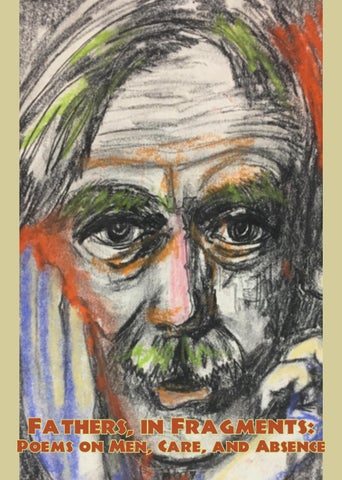
Fathers, in Fragments: Poems on Men, Care, and Absence A Beyond Words Anthology Editor: Gal Slonim Editorial Board: Kelly Sargent, K.D. Zwierz, Colby Flade, Noah Evan Wilson, Candi Martin, Brian "Brie" Sheridan, Roberta Laurie Cover art: Julie Christensen, Vieux Sage. Born and raised in Los Angeles, Julie attended Notre Dame Academy and Loyola Marymount University, majoring in French. Her studies in Paris at the Sorbonne were the foundation to her career of teaching the language and after a detour into interior design studies at UCLA, she returned to teaching with her focus on art, while working as a muralist and ceramic tile artist. Julie is married and currently lives in what she likes to think is the country (Thousand Oaks) with her devoted husband and two dogs. In her free time, Julie enjoys mindlessly scrolling through senseless reels online, reading French existential literature and napping. ISBN 978-3-948977-65-8
© Beyond Words Press, Berlin, Germany. Contributors retain all rights to their work. First printing, January 2026
Fathers, in Fragments
Table of Contents I. ORIGINS …….…………………………………………..……….… 1 Image — Lina Buividavičiūtė ………………………………...…...… 2 What Makes a Man — Livia Mangialardi ………..…………………4 My Father Never Said Too Much — Jane Saginaw ………...…...… 6 Fatherhood — Louise Ells ………………………………...……,…… 8 Mechanic — Jenna Rindo ………………………………...………… 10 Trains and Wagons — Lillie Morris …………………...……..…… 12 Sole to Soul — Sophie Richardson ………………..…………….… 17 Unnamed Moment — Thomas Williams ………..………………... 20 Roots — Joanne Harris Allred …………………..……………….… 22 Father — Jean Setrakian …...…...………………..……………….… 24 Genetics — Theta Pavis …………………………..…………...….… 27 Not a Hat Like That! — Carol Schoder ………..…….………….… 30 My Dad, the Rodeoist — Richard Stokes ……….……..……….… 34 A Lesson in Fractions — Yiskah Rosenfeld ……….……..………. 36 Sound Sleep — Nicola Geddes …………………………………….. 39 II. SHADOWS …………………..…………………..……….……… 41 Teach a Lesson — Deborah R. Majors ……...……………...……… 42 Portrait of a Tired Father — Lee Erickson ………...……………… 44 Father’s Day at the Dollar Tree — Kaycee Painter ………….....… 48 Boys Will Be Boys — Samantha Russell …………………...…...… 51 Visiting the Oracle at Palm Springs — Jessalyn Maguire ………. 54 Coinage — W. Tracy Dillon …...………………………...………… 56 How It Begins I — Kat Schmidt …….………………...…………… 58 Father Fled North — Nicholas Selig ……………………………… 60 The Last Time My Father Saw His Mother — Lores Denison ….. 62 My Dad Is Bald — Mingzi Yan …………………………….……… 64 Shorn and Prone — Valyntina Grenier …………………………… 68
Fatherless — Julia Gordon-Bramer …………………..…………… 70 Finding Orion — Hetta Jones ……………………………………… 72 Aspirin — Catherine Wald ………………………………………… 76 Snapshot — Abigail Diaz ……………...…………………………… 78 Murmuration — Brendan Straubel ………………………………… 80 The Day You Died — Anastasia DiFonzo ……………….………… 82 My Father’s Four Wives — Fran Abrams ………………….……… 84 My Dad Comes Back as a Sparrow — Jean C. Howard ……….… 87 III. GRACE ………………………………...………………………… 90 A Last Metamorphosis — Patrick ten Brink ………………………91 Epistle to a Dead Man — Gary Keenan ……………….…………… 94 My Father Lights a Candle… — Nate Hirschtick ………...… 96 A List of Things Passed On — Paloma Pierce …………………… 98 Father, Floating — Minghan Zou ………………………………….100 Of Modesty & Melody / The Reveal — Dick Altman …………. 103 My Father’s Light — Christine Rikkers ………………………… 108 Last Night My Father — Jeanne C Wilkinson …………………… 112 Father, I Dance Like You Renewed — George Naranjo ………… 114 A Visit to the Statue — Gloria Nixon-John ……………………..… 116 The Dead Bodies of 2012 — Tanya Moldovan …………………… 118 Melanzane — Elizabeth Walton ………………………………… 123 My dad’s dad regifted him…. — Kennedy Lorraine…………….. 125 Homecoming — Hayley Gronenthal …………………………… 128 When My Mood Deepens — Spencer Davis …………………...… 131 Thumbs Up — Marsha Howland …………………………………. 134 Seeing My Father After Three Years — Julia Smuts Louw ……. 137 The Lighthouse & The Rock — Michael Brain …………………. 140 Learning the Essentials — Yiskah Rosenfeld …………………..… 142 Copacetic — James Mulhern ……………………………………… 146
Introduction Fatherhood is at once intimate and distant, embodied and symbolic, deeply personal and culturally overdetermined. For some, a father is a daily presence. A voice in the next room, a steady hand, a model of care. For others, he exists as absence, silence, or memory. Even when fathers are loving and attentive, they are rarely simple. Even when they are gone, they remain. We learn early that a father is supposed to stand for something: protection, authority, provision, guidance. These expectations are often inherited rather than chosen, and shape how we see the men who raise us and how we understand ourselves in relation to them. When fathers meet these ideals, they may still feel unknowable. When they fall short, the disappointment can echo for years. Fatherhood, then, becomes less a role fulfilled than a tension lived with: between closeness and distance, strength and vulnerability, care and failure. This tension is why fathers so often appear in fragments. We remember them in gestures rather than speeches, in work rather than words, in moments that resist easy narration. A father may be recalled through the sound of keys at the door, the weight of a shared silence, the way love was shown indirectly or withheld. For many, the emotional vocabulary needed to speak of fathers arrives late, if at all. The poems in this collection approach fatherhood without sentimentality or judgment. They make room for fathers who stayed and fathers who left, for those who tried and those
who could not, for men who offered a stable emotional ground and those who did not know how. They also acknowledge that fatherhood is not only about fathers themselves, but about the lives shaped in relation to them. To write about fathers is to touch a sensitive place because it asks us to confront origin, authority, inheritance, and loss all at once. These poems do not seek to resolve those tensions. Instead, they dwell within them, listening closely, speaking carefully, and allowing complexity to remain intact. What emerges is not a single story of fatherhood, but many distinct voices, each offering a fragment toward understanding. Gal Slonim Editor
I. Origins
1
Image Lina Buividavičiūtė
Lina Buividavičiūtė was born on May 14, 1986. She is a poet and literary critic. Lina is author of two poetry books in the Lithuanian language. Her poetry is published in Matter, Masters and Proverse Poetry Prize anthologies, and the magazines: Drunk Monkeys, Beyond Words, The Dewdrop, The Limit Experience, Beyond Queer Words, Maudlin House, Cathexis Northwest Press, Poetry Online, Red Noise Collective, Sad Girls Diaries, as well as the Versopolis poetry platform. Upcoming publications include New Millennium Writings, Cathexis Northwest Press, Red Noise Collective, The Stardust Review and Beyond Words. 2
for my Father I am your image, the only one not deceived, though when we look in the mirrors, we see two tired people; identical smiles, identical curved feet and sometimes it seems we were equally wrong. How could it be otherwise, when, thanks to you, I was fed not only on mixtures — forest air, pine needle tea, snow sugar on my lips, and the celebration of the plum tree’s flowering. How could it be otherwise if I grew up with longing. Your imagination taught me to create the strangest creatures which welcomed me into a tribe of sad-faced forest people. It was my faith — our Kleboniškis forest, the wind and the smoke from the hare's huts, the sledge tracks, the summer heat, the softness of the moss. Hills as bald as your head. I am your image, the only one not fooled. My son is already looking in the mirror too — identical smiles, identical curved feet, the same forest — our only way to be reborn.
3
What Makes a Man Livia Mangialardi
Livia Mangialardi is a multimedia artist who lives and works in New Mexico. Her narratives somehow always link back to family. 4
Circa 1917
Circa 1974
Salvatore Fratesi was an alcoholic. In elementary school my father had a paper route. He made rounds before dawn, pedaling hard, leaving just enough time to shower before school. Every other Friday his wife, Mary, rode to town to pick up his check from the miller. On Saturdays he carried a small coin purse—those who couldn’t afford the paper traded household goods: a tin of biscuits, a worn out baseball mitt, a grocery sack of snap peas, a few spare tools. If she arrived after noon, Salvatore would cash the check at the bar. Once Mr. Harrison gave him a duck. Steering one-handed, bird tucked under his arm, he pedaled to the hardware store, spent all his money on chicken wire and zip ties. The Fratesi children wore holes in their Sunday shoes. With some spare wood and a kiddy pool, he erected an aviary in the front yard. He was so giddy watching the duck—didn’t hear the neighbor dog until it had already broken through the chicken wire. Mary saved up, paid the cobbler to mend their soles, shined the leather with bacon grease.
He beat the beast with a baseball bat, swinging with all his might. The dog didn’t let go until the bird’s neck went limp in its jaws.
5
My Father Never Said Too Much Jane Saginaw
Jane Saginaw earned a PhD in Literature from The University of Texas at Dallas in 2025. She is the author of a memoir, Because the World is Round (Deep Vellum Publications, 2022), that recounts a family trip around the world in 1970 with her mother who used a wheel-chair because of polio paralysis. Before returning to graduate school, Jane was a trial lawyer in Dallas with Baron & Budd. She served in the Clinton Administration as the Regional Administrator of the U.S. Environmental Protection Agency, Region Six. In 2006, she was awarded Trail Lawyer of the Year by Trial Lawyers for Public Justice for her environmental work. Jane’s undergraduate degree is in cultural geography from the University of California, Berkeley. Her law degree is from the University of Texas, Austin. In 2023 she earned a Masters in Humanities from the University of Texas, Dallas. Her essays and poetry have appeared in Athenaeum Review, Image Journal, D Magazine, and PB Daily.
6
His grin began in his blue eyes, delighting anyone who paid attention. But my father never said too much. He’d stand behind my mother and grip the handlebars, smiling as if her wheelchair were his crown and his words, superfluous. One time I almost asked him—outside the Blue Train’s window: a dazzle of zebras, some rare birds I couldn’t name. A landscape smooth and unobtrusive. But instead, I flipped open the paperback on my lap. I had not realized then, how like him I was: content to be contained.
7
Fatherhood Louise Ells
Louise Ells was born and raised in Northeastern Ontario, Canada, by parents who were both voracious readers. Two of her father’s cousins were writers, so she grew up believing “author” was an entirely reasonable career choice. Ha! After a circuitous path which included jobs as a Cordon Bleu chef and submarine co-pilot amongst others, she earned her PhD in Creative Writing and became a university teacher. Her short story collection, Notes Towards Recovery, was published in 2019, and her novel, Lies I Told My Sister, in 2024, both by Latitude 46 Publishing. She continues to be passionate about teaching, reading, writing, and travelling, and knows how very lucky she is to be able to call herself an author. 8
Mapped with thick blue rivers, and the contours of your life, your hands milked twelve cows twice daily and ploughed behind oxen. In winter you gave your gloves to your brother when he lost his. Did your lifeline predict survival? At seventeen, you left the farm for Imphal and Kohima. Eroded, you returned but shared few stories. (A single snapshot: holding rifle and cigarette in long, calloused fingers.) Then, with precise pencilled notes, you designed a fuel-channel, flawless still. Were your hands surprised at fifty to discover fatherhood? You taught me to hold a paddle, ski poles, and read my opponent’s cards. Together we navigated mountains, hand in hand. But you were alone that last day when, to save the fawn, you gripped the steering wheel, swerved.
9
Mechanic Jenna Rindo
Jenna Rindo worked for years as a pediatric RN at hospitals in Virginia, Florida and Wisconsin. She writes to better understand the complications of the human body, mind and spirit. A former ESL teacher, she now tutors and mentors refugee students. Her poems have been published in AJN, Calyx, Rhino, Tampa Review, JAMA, Third Wednesday, Natural Bridge and other journals. 10
To my father who could fix any engine No one knew better than you the sound of an out-of-tune engine — slightly sharp for insufficient friction — the low stuttering rise and fall of pistons — how much speed three working cylinders could render when the accelerator was lead-footed to the vinyl floor mat. No one, in any of our family’s generations, had ever purchased a vehicle brand new — ours were rebuilt from the junkyard’s collection of treasures, side mirrors unshattered and carburetors from a graveyard of cars abandoned, you haggling down the asking price of unshattered mirrors and shiny chrome pieces. In one graceful push you would slide under — the sharp blades of your shoulders cushioned on a stack of flattened cardboard — I spent hours holding the light at just the right angle — scrambling to find the wrench or Phillips or flathead, never fast enough for your schedule— still I could hold the dishpan to your satisfaction — stare as gritty oil dripped in, then later I’d find a beautiful blob left in the puddle’s prism, like reading the tea leaves looking for hearts and stars in our rented future.
11
Trains and Wagons Lillie Morris
Lillie Morris is a visual artist based in Georgia whose abstract paintings inspire her emerging work as a poet. Approaching language with a painter’s sensitivity to rhythm, tone, and texture, she explores the intersections of place, memory, and perception. Her poems, like her paintings, seek the quiet harmonies between the seen and the felt. 12
Oh, I was a daddy’s girl— no doubt about it. His “little chickadee.” He’d come home from work, bone-tired, but still lift me into his arms and waltz me around the den. He was a railroad man, willing to wear any hat— Brakeman, Conductor, Flagman, Fireman, Baggage Master. Hardy and hardworking, he lived up to his name. Some weekends and holidays, I’d go to work with him— a little shadow by his side on overnight runs between Augusta and Atlanta. No one questioned it back then. It was pure joy. I rode in whatever car he worked in — Passenger Car, Baggage Car, or Caboose. And I learned the names of every town in order, going there and coming back.
13
He taught me how to lean out of the Baggage Car to snag mail from a Y-stick as we passed through small, rural towns. Once, in the Baggage Car I was sitting on a gray metal box when Daddy gently told me to move. Those were the Vietnam years. “A soldier,” he said quietly. A somber silence followed. We stayed at the Georgia Hotel— no frills, no pool, made just for the railroad men. But to me, it was magic. What child doesn’t love staying in a hotel? There was a Chinese restaurant next door. I don’t remember the name, but it’s where I had my first taste of Chicken Chow Mein— steaming hot, served in shiny, lidded stainless steel dishes made just for Chinese food. At night, we’d walk the streets of Atlanta from dusk to well past dark, 14
side by side, sometimes holding hands. One Christmas, he lifted me onto his shoulders to watch the Rich’s Great Tree lighting. on the Crystal Bridge over Forsyth Street, as the tree burst into light, there was a collective gasp, then shrieks of delight. For a shining moment, perched high above a crowd of strangers, I felt like an angel. In the mornings, we were up before dawn. Breakfast at a mom-and-pop diner near the hotel, then a brisk walk to the station for the train ride back east. Somehow, going home was never quite as exciting. I must’ve been a pretty good kid. I don’t ever remember him saying no. I think he liked my company as much as I liked his. When I was nine, my daddy decided alcohol had become a stumbling block. So he gave it up— 15
just like that. He never looked back. I was the baby of the family, too young to understand the weight of his drinking. I felt the unease in our home. But stronger than that— I felt his love. I came to understand, many railroad workers carry a quiet burden—addiction. Long hours, nights spent far from home— it’s fertile ground for temptation to take root and slowly creep in. Those train rides were priceless— a quiet symbiosis I wouldn’t recognize until years later. They gave me childhood memories I still treasure, and, I believe, they gave my dad something too: a sense of fatherly pride, and a resolve he knew he needed. He took me on the train and I kept him on the wagon. 16
Sole to Soul Sophie Richardson
Sophie Richardson hails from a small town on the fringe of the Lake District, England. She is currently based in Fitzroy, Melbourne. A writer of all things lovey dovey, her poems somehow always end up leaning towards the romantic, regardless of intent. A recent graduate of The University of Edinburgh, Sophie works as a bartender to sustain her writing endeavours as she wanders somewhat aimlessly through her early twenties. 17
I used to perch my soles on the tongues of my father's shoes. Standing on his feet was, for that little girl, like standing on the shoulders of giants. We spun somehow clunky and graceful all at the same time, my sparkly pumps scratching the polish off his leather loafers. I don’t think he minded. I like to think he didn’t mind; but, in all honesty, I doubt he noticed. I’d clutch at his thick fingers, my small pink hands slipping as they warmed with his sweat. The room tilted and turned around us. These are the fondest memories of my father: music blaring as I was floating. All the while he stood solid beneath me. Now I’m taller than him and we sit across the table. I catch myself searching for the giant I used to know. He leans towards me when he speaks, his voice softened by time. His back curves, not by choice; I no longer need to look up.
18
Sometimes I wonder if it’s my turn to hold him up now. To let him rest his soles on me. To take his hands and spin us both around. The thought makes my chest tighten. I’m not ready to lead — not as he did. But his soles are tired, and maybe mine are strong enough. So perhaps we must swap, still holding one another: sole to soul.
19
Unnamed Moment, 8 May 2010, Saturday Morning Thomas Williams
Thomas Williams is a father of three who occasionally finds time to write things on paper instead of in his mind. His work has been published in Gleam and decades ago in The Torch. His day job is software engineering. 20
We stack the wooden blocks atop the hardwood, then each other, an archway over columns, flattened cuboids over tall, thin prisms. My son’s Vienna appendages extend from baby-fat palms, posed on pudgy forearms, to clutch and lift a square larger than his little hands but not too big to hold (tiny hands such a marvel), placing it atop the tower quivering with the crooked weight of being our biggest build yet. When it falls again he will ask again Can we bid it higher, Daddy? I don’t know if I could ever bid something this high again. Of course, we’ll try.
21
Roots Joanne Harris Allred
Joanne Harris Allred is the author of three full-length poetry collections: Particulate (Bear Star Press), The Evolutionary Purpose of Heartbreak (Turning Point Press), and Outside Paradise (Word Poetry). She taught for many years in the English Department at California State University, Chico. She lives in northern California. Roots is part of a collection forthcoming from Moon Path Press, Friends You Drank the Darkness. 22
My father faced down the windchill of Mother’s moods by going underground. Not coiling into his own winter, but into the crawlspace beneath the house. With pick and shovel he put himself in harness, hauling out buckets of earth he dug. Years later — concrete and wall studs. Masonry for a livable basement. Finally, my own room emerged from his humble design. At night I’d descend and, with pen and notebook, begin to dig out the darkness.
23
Father Jean Setrakian
Jean Setrakian is a Canadian physician and academic of Armenian descent. Influenced by the Véhicule Poets of 1970s Montréal, he seeks clarity and accessibility in his writing, favoring plain language over obscurity. He lives with his family, spaniel, and cats in the Quebec countryside. His bilingual poetry collection, self-published with Librinova in Paris, includes this poem about his father, whom he lost at the age of seven.
24
I. We stood on the edge of the night, you, pointing out stars and I, gazing for the first time. You said truths such as I haven't heard ever since, though I have stared at the skies again and again. II. You spoke of the marching heavens, the greatness of the sun, of how small we were and how we should not mind, you said dawn doesn't fade the stars but merely lights up the sky around them. III. I listened, gazed at the glistening air and listened again; I've forgotten now what else you spoke that summer, night after night
25
that I followed your faraway flights on the wings of truth, till the stars shone in my sleep and the glow of the dark blazed through my dreams. IV. It was only after you died that I found out the stars’ other names, long, twisted ones which I could not embrace, and I still live through long summer nights leaning against the dark, with all the questions I never asked.
From Apopoèmes/Apopoems, éd. Librinova, Paris
26
Genetics Theta Pavis
Theta Pavis is a poet and editor. Her writing has appeared in The Journal of New Jersey Poets, The Red Wheelbarrow, Mom Egg Review, Spillwords Press, Why to These Rocks: 50 Years of Poetry from the Community of Writers (HeyDay Books) and many others. Her chapbook The Red Strobe was published in 2025 by Finishing Line Press. She's received residencies from Arts By The People in New Jersey and the Bethany Arts Center in New York. 27
When father did the dead-man’s float, I often worried it was turning true. That’s how genetics work. I could manage the muck at the bottom of the lake, that slipping ooze between the toes, and those mean fish who nipped without warning – but the bobbing body of my father in the cool water made me fearful. Here he was, finally letting go, buoyant in the green, delicious fathom, and here I was swimming over, tapping on his rounded shoulders, checking to see if he was still alive. He'd raise his head, black hair curtained down his face, usually so full of revolutionary dismay, now soft and wet, and he’d laugh at me, and all my anxious, floating foibles – the same ones he had. I was so desperate to be claimed, I welcomed every inherited affliction, large and small, before I knew better. Even hay fever could be celebrated, if sneezing at the tiger lilies we passed made him say I’d inherited his allergies. But sometimes walking back from the lake, my father would sing John Brown’s Body, his mournful, lyric baritone guiding us home. The idea of resistance was something he taught me to treasure, to hold on to. The sun would hit the tall
28
grass and I would listen to his voice in the tender, full afternoon, the cattails brown and plush at the water’s edge, gently waving us on.
29
Not a Hat Like That! Carol Schoder
Carol Schoder is a Chicago area writer and visual artist whose poetry has been featured in Poetry Superhighway and Streetcake Magazine. Her images and poetry can be seen in Beyond Words. Carol’s collage, “Self-Portrait with Pear” was included in Sonic Boom’s 2025 World Collage Day collection and her visual poetry was featured in Sonic Boom’s Vispo 2025. Her flash fiction story, “Day Old Cabbage Roll on a Plate in the Fridge” was shortlisted in the 2025 Bridport Prize competition. In addition to gathering words, she enjoys painting, photography and creating one-of-akind artist books. 30
To My Dad who taught me everything, wittingly or un-. I watch as you put your life in order. Sitting up in bed, arms waving in the air; in a parallel universe, cleaning out closets, I’m not going to need this anymore. Until after a while you stop, explaining, I can’t think of anything else out... or in. You check off items from an invisible list: Spade with a glove on it; Cowboy hat (not a hat like that!); Golf balls. Something else, I’m not going to worry about. You greet long-lost relatives and friends Oh, I remember you! You smile, blow kisses and complain as you wait. I’m goin’ to see the Big Boss, you announce, and wonder Am I the last guy in line? You stare intensely into the corner of the ceiling, in a way, they say, “People do.” And once in a while you nap And once in a while you ask for your notebook for some chocolate for a flask, and you ask me, How are you doing? And I reply, “Just… fine.” Holy Mackerel! I just want to get the down-payment. I’ve been through this about six times.
31
Too long on the cement floor. Lock it back up. Lock it back up. We’ll have to make it right, my statement. … Sorry about the footprints. I check your feet as I’ve been told and I see that death has begun its march Starting low and moving slowly through all the parts that make you You. And I hold your hand, by now which is colder than the coldest-cold I have ever felt. I pull my face close to yours and say, “It’s okay. We’ll be fine.” So now with your intellect and handsome youth love of music and Lake Michigan swims, trolley rides, bus rides, disappointment and doubt, with cheese sandwich lunches and falls off high ladders and Kodak moments, love of logic and slides, with movies and dancing and math and hot summers, stray animal friends, and rickety rail stairs, with smoking cold winters, white bread toast and Pall Mall, cream three-sugar hot coffee and parakeet freeing, with long-legged dedication and guy-next-door profile, with uniform truth and exhaust fan quick wit, with work-bench vacations, sly humor and strong hands, with straight razor shaving and swing-shift day-dreaming, with potato chip trust and city kid hunches, awards and accolades, and cleft-chin delusion, with your green lawn pride bursting and your blind faith spaghetti, with French dressing on salad and
32
birthday candle blowing, with both brown eyes closed and your heart wide open I say, “Go ahead, Dad. It’s okay to pass through.” And after one long-final-exhale-good-bye, you do.
33
My Dad, The Rodeoist Richard Stokes
Richard Stokes, a retired teacher, has lived in several regions of the United States, West Africa, and China, and presently lives in Boise, Idaho with his wife Lei, three dogs (Pepper, Duo Duo, and Maximus Minimus) and his flower gardens. 34
He wanted to be Someone on the professional poetry circuit, ride with the seasoned rodeoists — if he could, he would ride bareback, that being the least sophisticated way to write, but he couldn’t even find a horse or barn — no corral, not even a circus kiddie pony ride, no saddle for his keester, no pommel for his poems, no stirrups for the feet of his rhymes — it seems all the good poems had already been lassoed. While the good poets paraded their worthy verse around the ring, the ticket he held was not for the rodeo, but for the merry-go-round in town, so he gave up and sauntered into a bar, where, to his pleasant surprise, there was a mechanical bucking bronco to ride. Sidling up to the beast in fervent expectation, he read the following poem: Out of Order — In the depths of despair, he mounted a stool at the bar, passed on the Moscow Mule, wrapped his arms around a Horse’s Neck, and hung on for dear, poetic life.
35
A Lesson in Fractions Yiskah Rosenfeld
Yiskah Rosenfeld is the author of Tasting Flight (2024), runnerup for the Arthur Smith Prize, and Naked Beside Fish (2024) an ekphrastic chapbook. Twice a Pushcart nominee, honors include the Anna Davidson Rosenberg Award, Reuben Rose Memorial Prize, and 2025 Prism Review Prize. Poems appear in Lilith Magazine, Midway, The Bitter Oleander, December Magazine, Rattle, Wild Gods: An Anthology of Ectastic Poetry, Slippery Elm, and elsewhere. A single mother by choice, Yiskah holds an MFA in creative writing from Mills College and lives in the San Francisco Bay Area. A Lesson in Fractions is winner of the Anna Davidson Rosenberg Prize and appears in Tasting Flight (Madville Publishing, 2024). Learn more at yiskahrosenfeld.com 36
My father cuts the last square of casserole in half and eats. He cuts the half in half and eats again, repeating this compulsive act like a school teacher demonstrating an immutable mathematical truth. Master of division, of less-than, he moves in measured bites in the infinite direction of small, while my mother wishes the meal would go on and on, table expanding leaf after leaf into the cosmos, large enough for children and grandchildren, dead parents and grandparents, her sweet, overflowing kugel of a heart. Meanwhile, my father has now whittled the square to a crumb which he flattens with his knife into two halves, one of which he lifts on his finger and eats. “There are starving children in Europe,” his mother said and my father, ever obedient, can’t let leftovers alone; to this day can’t stop until he’s licked the table clean. Still, he never takes the last piece, small rebellion against an equation stunning in its inevitable conclusion: a starving child in Europe will have one less Brussels sprout because a 10 year old boy in Oregon did not eat his. And so he halves and halves, dutifully eating, seditiously bequeathing a crumb of solidarity
37
to all other children of children of immigrants, meticulously, unconsciously, sacrificing the remains to the god of waste. My father, wearing the same jeans he wore in high school, still that thin and that frugal, sits quietly at the dinner table and in sly, precisely-executed strokes of the butterknife, commits his one selfish act.
38
Sound Sleep (A childhood between two pianos) Nicola Geddes
Nicola Geddes is a cellist and music teacher based in the West of Ireland, whose poetry has been published widely. Sound Sleep was first published in The Irish Times (2019).
39
A school night, homework done Mum in the front room her freckled arms glide above the keys her fingers dance Preludes and Fugues Follow me through the kitchen Bach will recede but the centuries are fluid We can time travel, our slippers on the geometric patterns of lino and tile The future approaches as we brush our teeth Next to our bedroom the sculptor of sound in his egg-box lined garage turns motifs around in his hands plays with colour, finding keys to other worlds Snug in our bunks, we are lulled by the harmonies of the next century Certain of our place in this story we glide through galaxies in our sleep.
40
II. Shadows
41
Teach a Lesson Deborah R. Majors
Deborah R. Majors lives in the countryside of Northwest Florida's Panhandle where she or members of her family have encountered an alligator, bobcat, bear and many rattlesnakes on their property — no casualties, thankfully. She writes, swims, pastors a church, and enjoys family gatherings. Through the years, Deborah has had poems and short stories published in various journals and anthologies and is presently working on a full poetry collection and a chapbook or two. 42
Daddy taught me How to Bait a hook handily, Pitch a fast-ball furiously, Land a lay-up lazily. How to Drink muddy black Maxwell House, Spit watermelon seeds accurately, Shoot a .22 even more accurately. How to Shave under my arms with his razor without nicking, Drive his old Rambler 3-in-the-column without grinding, Lean with him on his motorcycle without overcompensating. How to Protect my mother from his fists by getting between them, Transport myself from listening to his fits of rage by only Remembering the fishing trips and smooth arm pits, baseballs and backboards, Yamahas and manuals, melon seeds and cups-of-joe, Straining to hear mother's safety,
Straining to forget about the .22.
43
Portrait of a Tired Father Lee Erickson
Lee Erickson, MA, LPCC, is a writer, poet and grief therapist whose work explores themes of loss, identity, and transformation. His writing is deeply informed by personal experiences of grief, including the loss of two brothers and his father. He holds a Master’s degree in counseling and psychology and provides therapy at Erickson Counseling Services, Inc. His poetry seeks to illuminate the intersections of loss, grief, memory, healing, and self-discovery. 44
I got the old dad. My brothers had the new one. When it was my turn to learn football or ride a bike, old dad was already tired. I imagine him crouched over homework, steadying handlebars, feet jogging alongside their wobbly freedom. I learned to balance alone, legs covered in bruises, pushing off, again and again in silence. In his mid-30s when I was born, old dad didn’t have the energy, after a long, stressful day to shoot hoops, help with homework or engage at all with the leftover children still at home. Old dad needed dinner, cigarettes, and inane TV to smoke, read the paper, and disappear. I got the old dad, whose dreams had already been lost, replaced
45
by desperate thoughts of survival, wondering how in the hell he got there— and if escape was ever possible. My old dad was left to care for his even older parents in a small town where kindness depended on someone else’s shame. I got the old dad. Old dad, slouched in his recliner, smoke curling from his fingers, staring at a television he barely watched. I can still hear the hollow basketball bouncing against the frozen cement, the swish of the net, sound of pins crashing from the bowling alley backing up our basketball hoop as he and my older brothers shot baskets in the November evening, laughing— the kind of laughter children often mistake for love. I came of age to the sounds of silence— not even a creak from his bones or recliner— 46
to remind me what really mattered— and what didn’t.
47
Father’s Day at the Dollar Tree Kaycee Painter
Kaycee Painter is a disabled poet from Dalton, Georgia. Her work explores the body, survival, and the quiet ways resilience takes root. She has been published in Mouthful of Salt, TrashLight Press, and NonBinary Review. 48
The card aisle is a chorus of lies. Rows of men in flannel, fishing poles in hand, smiling from embossed fronts with “#1 Dad” trophies raised like they earned them. Cards that say: You taught me everything I know. You’re the reason I am who I am. I owe it all to you. I flip them open just to scoff at the insides. There isn’t a card for the dad you had to raise. The dad who was more houseplant than parent— low-maintenance, light-sensitive, might die if you moved him. No card for the dad who showed up for birthdays but always brought the wrong thing— a collectible knife, a BB gun, something he thought was cool. Never what I asked for. Never what I needed. No aisle space for: A+ effort for a C- childhood. No pastel messages for the men who didn’t abuse, but didn’t quite protect either. Who didn’t leave, 49
but didn’t arrive. Who loved you, probably, but only ever halfway. I settle for a card with a fart joke on the front and “Happy Father’s Day” inside. Sign it With love, And he’ll probably say thank you. And I’ll probably say you’re welcome.
50
Boys Will Be Boys Samantha Russell
Samantha Russell is an emerging poet, born and raised in the Bay Area of California, now residing in Salem, Oregon. Her work received an honorable mention from the Telluride Institute's Fischer Prize Poetry Contest and has been published in the Fjords Review. When she's not writing, Samantha can be found reading on her balcony with her dogs, Georgia and Clementine. 51
My grandmother blasted The Beatles on her scuffed phonograph, scrubbing bowls, flipping side-a to side-b, twisting, and shouting. She smokes long cigarettes in my imagination; a babe coos on her hip. Her husband wears an American uniform of lawlessness, learning from his father and grandfather that a woman is a thing to keep— polished and in place. Together, they moved on freight planes. Pitch black night, fast, heavy. Germany, Italy, Greece. My father’s boy-body clenched atop Vietnam soldiers, fatally at rest in flag-draped caskets below. He hadn’t known what death smelled like until he inhaled it. The rot of metal and men, sterile sting of military polish. My father didn’t know the kind of man he was watching grow old, the trail of feral things he’d left behind. Young girls with half-moons of his face, children taught early that boys will be boys. Ruin is passed down, a personal history book,
52
each father scribbling in the margins his version of manhood.
53
Visiting the Oracle at Palm Springs to Learn What I Inherited from My Father Jessalyn Maguire
Jessalyn Maguire (they/she) is a poet, writer, and traumainformed psychedelic facilitator based in Venice Beach, California. Their work lives at the intersection of creative expression, body-based wisdom, and collective liberation. With a background in theatre and film, as well as social work and training in psychodynamic, somatic, and transpersonal modalities, Jessalyn brings a creative, non-pathologizing, queeraffirming lens to both their art and healing spaces. Their poetry has appeared in The Offing, december, Crack the Spine, and the HBO Inspiration Room, among others, and their academic work in Studies in Clinical Social Work and the forthcoming journal Psychedelics. They also write @betweensystemsandskin, a Substack newsletter exploring embodiment, queerness, and personal reckoning through essays, poetry, and cultural critique. 54
I’m not here to talk about my mother— Identical nails, temples, the same tuft of eyebrow that prognosticates, soothes, controls —both our bodies traps. I come to the desert for the half obscured by ancient tempers: the brandished chair, broad shoulders, loneliness that creeps up like a ghost, why I hide in the bathroom at parties, why I toss compliments in the garbage disposal instead of the compost. Parade me in ribbons, shear the fat that shadows where my mother is lean. Unzip the helix, Oracle. Stare into the entrails— I want to know the restless in me, the corners I pace, the edges I carry, the weight I inherited but can’t name. Slice down my spine that barely gets me out of bed, cut open my fickle belly and when I am cleaved: Sacrifice all of him.
55
Coinage W. Tracy Dillon
W. Tracy Dillon is a former educator in Portland, Oregon. He lives on a permaculture farm with his family about two hours southwest depending on the time and season, city traffic, and country jams. His work has appeared in Fiction Southeast, Louisiana Literature, Rawhead, Windfall, and academic journals that he would rather not think about. In his freed time, he hits the beach, takes walks, stargazes, and doesn’t play the guitar very well. 56
My father had beautiful feet. They reminded me of Grecian marble; of the throbbing vein in a Madonna’s breast; of Diamond Dogs cover art. Those feet walked on. The Ferryman prepared his retort and burned their beauty away like there was nothing special about them. He plucked a coin from the pulverized pile of ashes and bone, then boxed it up. I could scatter my father in soil, in wind, or at sea, it didn’t matter where, at a time most convenient for me. My ingrown, dropsical flat ugly feet left that to the Ferryman who fetched a coin and moved along.
57
How it Begins I Kat Schmidt
Kat Schmidt is a queer author and artist from Michigan. They have an MFA in Creative Writing from The New School. Their work can be found in Orion, The Inquisitive Eater, Wingless Dreamer’s Echoes of Midnight anthology, Nat 1 Publishing's Audience Askew 4|2, and more, and is forthcoming in the 2025 One Page Poetry anthology. 58
Shrouded in night in cobwebs of dreams prophecy is revealed (see: prophecy | read: history) (see: history | read: myth) the hollow eyes of the boys three of them huddled bare sad beige bodies hunched on beige cushions in the middle of a beige room He paces through pauses, wild, bright, and red [it’s finally perfect they’re finally perfect] He gestures yet the boys do not move they were once soft rainbows they were once kind words they were once honey tongues they were once pink they have learned pink is not the path for them: their future is wild their future is bright their future is red
59
Father Fled North Nicholas Selig
Nicholas Selig’s poetry has appeared in Contemporary Verse 2, the League of Canadian Poets, and EVENT magazine. He was awarded Nova Scotia’s Rita Joe Poetry prize in 2023. He is currently the Editor-in-Chief of The Miramichi Reader. 60
Father fled north, farther & farther, fled his foes, further he’s come & gone, his blank eyes scanning the thinning forests, farther, my father rather than face his son, fled, even farther north, until the last tree & farther still, fled these poems, each poem a pin in his soft spine. Way up north, he’s still fleeing & dying as he always has been but now alone, dying, broke & lonely under the North’s great, cold alien moon. Previously published in EVENT Magazine
61
The Last Time My Father Saw His Mother Lores Denison
Lores Denison is a queer writer and nomad from Kentucky. She wrote her first book about a family of kittens when she was eight. Since then, she has published with Pensworth, Deep Overstock, Kelp Journal, Soup Can Magazine, and Viewless Wings Poetry Podcast. When she's not writing in a café, she can usually be found traipsing about the woods somewhere. 62
The springy creak and smack of a screen door. The crunch of drought-baked gravel under the Pinto's tires. The crinkly feel of a Piggly Wiggly bag under my face. I looked back on the house, behind the raised dust and saw you framed in the doorway: uncombed hair, arms hanging dumb at your sides, your fish eyes. I waved. You shrank with the house.
First published in Pensworth
63
My Dad is Bald Mingzi Yan
Mingzi Yan is a double-degree student at Oberlin College studying Creative Writing and Piano Performance. Mingzi’s work explores the intersections of culture, language, and personal identity, with published pieces in Half and One and awards from international writing competitions. Mingzi has conducted anthropological fieldwork with the Mosuo people in Yunnan, China, producing interviews and a documentary on their arts and traditions. Outside of academics, Mingzi is a varsity cross-country runner and loves cats.
64
My dad is bald. That’s all Mom said about him. Bald before marriage, bald after marriage. My dad has always been bald. My dad is bald. That’s all I know about him. On my fifth birthday, he sent home a pack of chocolate. It was the middle of July. The box was wrapped in red and green, like it was cut off from a flag. I asked if South Sudan celebrates Christmas in July. He said no. He just likes wrapping things in red and green. Then Mom took away the phone, and I ate that box of chocolate. I didn’t have a stomachache the next day. My dad is bald. He likes wrapping things in red and green. That’s all I know about him. On my tenth birthday, he called me at eleven at night. I asked him why. He said there’d been an emergency at work. I asked if South Sudan was safe. He said no, but he knows how to escape. I asked how. Do you have a gun? He said yes, but he hopes he’ll never use it in his life. Then Mom took away the phone, and I stared at my map on the wall. South Sudan looks like a bat. My dad is bald. He likes wrapping things in red and green. He has a gun, but he hopes he’ll never use it in his life. 65
That’s all I know about him. On my fifteenth birthday, he called me at seven at night. I said a boy sent me roses after making me cry. He said that’s not very nice. I said I know, but they’re roses. He said I should make the boy cry. I said oh, but that boy gave me roses. He said he doesn’t like roses. Then Mom took away the phone, and I stared at the roses. The next day I threw them away. The next day I made the boy cry. My dad doesn’t like roses. So, at his funeral, I prepared some tulips, and some orchids, and lilies, and even picked some dandelions. Several women came and cried. Several men came and cried. Some with uniforms, some without. Some with crutches, some without. One had one eye, one had none. Some came with family, others without. Some held my mother’s hand, some did not. But all said that without him they wouldn’t be alive. Some held my hands, some did not. Some walked over and came to talk. “You must know how much he did. You must know how great he is. Not a local, but he loved us all — he is a hero to us all. He is a legend to us all.” 66
I said, no, I don’t know him at all. I only know that he is bald, and likes to wrap in green and red. Dislikes roses — that is all. I don’t really know him at all.
67
Shorn and Prone Valyntina Grenier
Valyntina Grenier is an LGBTQIA multi-genre eco artist living in Eugene, Oregon, USA. She is the author of four poetry chapbooks and one full length collection. You can find those books at Bottlecap Press, Finishing Line Press, Cathexis Northwest Press and various places where books are sold. You can find her, her visual art and links to individual poems around the web at valyntinagrenier.com 68
A swinging sign. Red puddle of flash. No sign of my ride post-yoga flow. Before the last bus home, my fellow artists. This development, literally in lotus, this divine literatus has me stalled. Not riding wild, thrown by buckshot, sunstroke, knees buckling a throne. For the meanest beast among us rasping malevolent laughter, bleeding, a trickle blinding, a trite bit of cackle, cracking bone with bone. Some mellow mask as a marker. This utter a marker makes. A willow branch to light a flame. I inhale your father’s chilled kerchief like my father breathed through a slice of wheat bread. Through the bite hole, an eye, a bullseye, a shaft of light, an arrow, a frond radiating sun. Sleep under the gun. Don’t revive me. Don’t run. A grave loan—our time. Another mask placed as a patriarch’s face. His horn in my eye. The utter ignorance and complicity unaliveing us. “We’re here till we’re gone.” Make cake. Celebrate. Check the fermentation. Weigh the germ, the sweetest sheep shorn, the expert weaver prone.
69
Fatherless Julia Gordon-Bramer
Julia Gordon-Bramer received her MFA in Creative Writing (Poetry and Fiction) from the University of Missouri—St. Louis and in 2013 was voted St. Louis' Best Local Poet by the Riverfront Times. A former professor of Creative Writing and Humanities at Lindenwood University, today she is a professional tarot card reader, Sylvia Plath scholar, and author of five books on Plath. 70
“And shining morning face, creeping like snail” –William Shakespeare, “As You Like It” The daughter you don’t know lives on the dark, slippery side of the rock. She moves slow and sips color off shadowy photographs leaving everything about you black and white, and overexposed. The daughter you don’t know creeps quiet as a snail, sliding through varying histories, careful in her mixing memories. She wears a hard shell, always slugging a smile, confident of grand times ahead. The daughter you don’t know learned to speak in metaphor, set her breakfast table with all the tools for illusion, the tedious food fate uses to spin its sad infinity. The daughter you don’t know stands straight, and alone. Knows that as above, so it is below. She pretends God does not know your name.
71
Finding Orion Hetta Jones
Hetta Jones is a poet at the beginning of her writing career (though is quite a distance into a professional one!). She has been published in the Hare's Paw Literary Journal and the Ballads Of Medieval Devotion anthology. She lives in Lincolnshire with a mismatched menagerie of children and animals. Her work is influenced both by the big skies of the landscape of the former and the irrepressible personalities of the latter. 72
I couldn’t make a cup of tea or throw a rope to save a life. So I chose, instead, to look at the sky. A stargazer’s badge. A millennium and more ago the smell of the church hall, old ladies with blue rinses, itchy brown bobble hats, skirts with leather pouches. This was not me. So I decided to become a stargazer (Failure as a lifesaver had been a brutal blow). My father infinitely patient, as he could sometimes be, with binoculars, his big glasses sparkling behind clouds of cold breath. He pointed to the sky as I gazed into those binoculars, that I was not allowed to hold without the strap around my neck. 73
That same glimmer on my spectacle lenses, squinting and squinting. Orion’s belt he would say, and I would agree. So desperate was I to find Orion. To this day I cannot find him through a lens, only with the naked eye. Unable to comprehend the intricacies of him close by. Not many years later my father betrayed us. Stare and stare, I could not find the granularity to understand him. To elide the distant guise of a perfect man and the craters marring his surface observed scientifically. We all battled on
74
the best — and worst — of times, reaching to each other, groping to understand the minutiae wrought large, telescopically, but only really grasping with the naked eye, fallible biology, observing fallible humanity. And still my eyes turn to the sky, seeking, searching, sifting. Finding Orion, not finding him, by and by.
75
Aspirin Catherine Wald
Catherine Wald is a poet, teacher and tour guide based in a Manhattan apartment the size of her laptop. Poems have appeared in American Journal of Nursing, Gravel, Minerva Rising, J Journal, The New York Times, and Snapdragon Journal, among others. She has published a chapbook, Distant, burned-out stars (Finishing Line) and a nonfiction book, The Resilient Writer (Persea Books). 76
When the cops picked up my sister for hitchhiking, they let her off with a warning, because of my father. It was like this everywhere, for all of us. Dr. Wald's daughter, Dr. Wald's son... mothers and teachers would coo. Dad ran down the street when a neighbor needed an insulin injection. He stopped for an hour to make sure the ambulance came after a car crash. He answered the phone in the middle of the night for anyone on any side of the family. When I was sick, I got a glance and an aspirin. Sometimes I wished I could contract a fatal dangerous disease, or at least break a bone.
77
Snapshot Abigail Diaz
Abigail Diaz is a Pushcart-Prize-nominated author of poetry and fiction. She has been published in the Blue Marble Review, the San Antonio Public Library 2019 Young Pegasus Anthology, and HauntedMTL's 101 Proof Horror Anthology, among others. She recently earned her B.A. from Texas State University and is applying for an MFA, with hopes of someday writing full-time. 78
the first time my father's fist, miniature meteor, armageddon, rains down from the sky, i'm ten. it's an occasion, a red-carpet premiere. the reporter on tv stops talking to watch the house, a tick fat on fear, swell. somewhere, in a different house, other-we share dinner, read bedtime stories, laugh at the versions of ourselves who are less than lucky. i bet they don't even exist, other-me says. i bet they're fake like santa. in this universe, his fist, cute clamshell, unlucky dice roll, advances. my father's face is a mirror i want to break. our dog barks as my mom's cheek kisses his knuckles, fearsome firework. the sunlit silence suspends itself in the air, one perfect precious pane of glass.
79
Murmuration Brendan Straubel
Brendan Straubel lives in Northern Michigan. His work has appeared in Big Muddy: A Journal of The Mississippi River, Dunes Review, Sun Spot Lit, and elsewhere.
80
Turkeys rile and rise clumsily before me. One by one, they clamber into the high branches of the hardwoods. I press the Mason jar against my hip and navigate the steep drop to the river’s edge. Gravel scrapes my Sunday shoes as I wade the deepest eddy there to the roots of a fallen cedar. I tip the makeshift urn until my father’s silver ash finds the current, cut by the last light, as starlings rise in constellation and scream, thrown as one from November’s naked trees to violate the gunmetal sky in adonic, pulsing braids of black like chaos funneled into form.
81
The Day You Died Anastasia DiFonzo
Anastasia DiFonzo (she/her) is a poet and author currently living in Oakland, California with her fiancé and two cats. She is a three-time Best of the Net nominee, and her most recent chapbook, Girl., was published in 2024 by Gnashing Teeth Publishing. When she's not writing, she can be found sipping coffee with her cats. You can find her on IG @anastasia.difonzo 82
The day you decided you could no longer hide yourself beneath a boisterous laugh and a personality larger than your stature, when you considered my wellbeing even less than you had before, when the cops banging down our door for the third and final time became too much for your already distended life, when you decided to end it— a part of me was born. I wished you had stayed, yes. The day you died, a hole was carved into my chest that hasn’t closed since. As a child, I watched my friends live ordinary lives. They still had fathers. I paid no attention to the quality of fatherhood; merely the fact that their parental unit was intact was enough for me to dream of stepping into their shoes, their clothes, their houses, their very hearts. I wanted a place to put this excess love I thought was reserved for you. Later, I found you in the bad boys. I clung to each like a toddler, and one by one, they left, killing you again. I could not save you back then, and they, in turn, could not save me. I peered into the cavern you left inside me and found a well of wisdom. Your death taught me lessons I should not have had to learn, but now learned, where do they leave me? Slowly, I have grown to seek, independent of you. I am no longer defined by where I find your pieces. I will tell you this: I have found a love so unique, so wholly separate from the pain you left me with, that I can see you now more clearly: you were not my world. You were not my god and you were not my devil. You were as infinitely complex as anyone. You were, and always will be, human.
83
My Father’s Four Wives Fran Abrams
Fran Abrams (she/her), a resident of Rockville, MD, began writing poetry in 2017 after retiring from her day job as a nonprofit arts administrator. Her poems have been published in numerous journals and in more than twenty anthologies. Her books include the full-length collection, I Rode the Second Wave: A Feminist Memoir (2022), two chapbooks, The Poet Who Loves Pythagoras (2023), Arranging Words (2023), and a collection of Nonet poems, titled Traveling on the Number Nine Bus, published in August 2025. One of her poems was nominated in 2023 by Gargoyle for a Pushcart Prize. 84
My father outlived three wives. Each had a name starting with C. Each died of a different disease. Each cooked and cleaned for him, and arranged activities for them both. He was married to my mother, Carolyn, for 25 years when she died of complications from breast cancer. He wanted me to live at home and take care of him. I lectured him on how to take care of himself, telling him, among other things, that I would not iron his shirts, but a laundry service would. His next wife was Connie—the answer to his prayers and mine. Her children were about the same ages as me and my sister. Family occasions were fun again, and she was a marvelous cook. She kept him busy with theater outings and sightseeing nearby. After 24 years of marriage, Connie died from heart disease. I mourned her loss. Dad promptly went hunting for a third wife. He asked his widowed next-door neighbor to marry him (much too soon), and she wisely declined. He met his third wife, Charlotte, through mutual friends. She had a daughter and a grandson who never bonded with Dad's and Connie's children. We saw less of Dad, but Charlotte appeared to take good care of him. After six years of marriage, she died following a stroke. Her daughter rushed to collect the pseudo-Louis XIV furniture Charlotte had brought to the marriage and never contacted us again. Dad's health was failing, and we made the tough decision to place him in a nursing home (the name of which strangely did not start with C). 85
There he had all the support his wives had offered—meals, laundry, entertainment, and people to talk with. My sisters and I had found his fourth “wife” without attending another wedding.
86
My Dad Comes Back as a Sparrow (On the anniversary of his death) Jean C. Howard
Award-winning performance/video/original slam poet Jean C. Howard’s work has appeared in Harper’s Magazine, The Chicago Tribune, Spoken Work Revolution, among 100+ other publications, as well as her book, Dancing In Your Mother’s Skin (Tia Chucha Press). Featured performances/videos include Sundance, PBS, and hundreds of venues from the Guggenheim to biker bars. www.jeanchoward.com 87
On this day with sky, not sky, but more like soil pressing into lungs, You decide to visit as a sparrow, dark earthen stripes shooting lightning, shrill across your head, then racing, as summer, along your wings. Not content to sit and peer into the window's mirror, you chat small bird news to those beyond And tilt your beady eyes into my room, throat opening up to tell of ice and hard rich pellets ant-sealed within the feeder's varnish, Of how one box elder bug stops to lure with fiery wings, propped safe inside, within a flowerpot.
88
You stop and lift a ray of snow into your throat and dip, small curtsy, into its minute puddle, Then hop toward me, as if glass can be broken between night and day, between light and dread, between drifts and soothing water, Between me and you, this year-old day, to be together, father.
89
III. Grace
90
A Last Metamorphosis Patrick ten Brink
Patrick ten Brink lives and works in Brussels. His day job is dedicated to protecting the environment, his spare time to writing poetry, fiction and art reviews. His poetry has appeared in the US, Canada, and Germany. Urban Enigmas, his poetry chapbook, was published in the US by Dipity Press. Linktree: https://linktr.ee/Patrick_ten_Brink 91
It had been a long few years. This week was longer still. He lay, breathing, barely perceptible, stubble on a waxen face, skin withdrawing inwards, hands cold and dry. It was an eternity of any-moment-now. I talked of barbeques in the Japanese mountains, of the sound Mahjong tiles made on wooden tabletops, of frying vegetable tempura on the round pan, of the giant toad under the roof downspout, of the banjo hoppers waiting in the outside toilet — half spider, half grasshopper, double the terror of the card games and sumo wrestling, of lemon trees in Australia, Afghan hounds and fleeing rabbits and breaking tables while watching Dr. Who, Christmas boxing matches and chess. As these words spilt from my mouth, silver, red, blue threads rose from his lips into the air, a silent firework of joint memory, together forming a helix, another, my brother’s words added a third wave, our mother’s a fourth, threading together up, forming a growing web, that filled the room until we could only see the threads, barely each other’s bodies, we were three cocoons, connected to a long-lived, eclipsing, chrysalis, sharing echoes from over the years.
92
He will wear his new skin soon, elsewhere in the land of silver and white threads, and our skins hum with memories. Tonight, I hold my hand close to my ear and listen to the whispering stories threaded in my skin, and whisper, thank you.
93
Epistle to a Dead Man Gary Keenan
Gary Keenan is a poet and musician living in Tunia, Cauca, a village of 1800 in the Colombian Andes. His poems have appeared in journals in the US, England, Ireland, Australia and India since 1979. His book Rotary Devotion won the 2016 Poets Out Loud Award and is available from Fordham University Press. 94
My shoes remember you better than I do, Because I shine them how you taught me, Spit, elbow grease, Kiwi black polish So deep I see your reflection where mine should be. How you loved the mundane weekend tasks! Potato salad became a memento of famine, A breaded filet of flounder the echo of beatitudes. Because of you, I know the taste of Spam. Every dish deserved a breath of grace, A recitation of names now lost to earth. I still don’t understand how death worked On the living, the sobs after the phone call That told you your father had passed. You seemed Ready for a heaven beyond death’s power, In perfect sorrow, crying on no one’s shoulder As I never learned to do on yours. I’m a monster Made by the hand of faith and wrath, Supreme in my solitary knowledge, mute In my confession, breathlessly stalking The dawn, letting the light inscribe me. Know that, however you might, and be calm Where you lie beside our kin, the droning hymn Of the bees above you keening our names To no one except the dead in an eternal now.
95
My Father Lights a Candle for His Father Nate Hirschtick
Nate Hirschtick is a fiction and poetry writer from Boston. He studied English, math, and computer science at Santa Clara University. You can read his most recent work in Trampset, Does it Have Pockets, and The Santa Clara Review. He currently lives in Santa Barbara, CA. 96
My father and I were alike we both loved math and mom our winter coats the autumn trees He drank his coffee it lingered on his breath with skim milk no sugar I remember sandpaper his silver cheek on mine hugging in the evening his aftershave in the holy morning light Before each meal bowing his head quietly, and to himself he thanked God for the bread of the Earth his hands at his side My father still prays at synagogue his navy Siddur open reading reciting chanting in Hebrew his Talis draped over his neck blue and gold a gift to himself on his second wedding day Lighting a candle he speaks to his father
97
A List of Things Passed On Paloma Pierce
Paloma Pierce is a multiracial mother, creative, and seeker of buried histories. Her interest lives where the Alabama River meets ancestral memory, folklore breathes through mushroom rings and lullabies, and motherhood becomes mythmaking. In addition to researching family histories in the American South, she writes songs, builds rituals, and resides in the Pacific Northwest, treading the line between everyday life and the unseen world.
98
Two sneezes, one hiccup. No sugar, cream until partly cloudy. Extra molars, no needles. Know. Everybody. I love you means I’m leaving. I love you means sofa sleeping. I love you means I’m sorry. Plant peppers in March, squash in June. When they don’t get it, then give it. Mayonnaise in fried rice, potatoes in ground beef. Hashbrowns extra crispy, now I mean burnt. I love you means I’m alive. I love you means we’re alone. I love you means I’ve passed on. I love you means — I love you means
99
Father, Floating Minghan Zou
Minghan Zou is a junior studying at Phillips Exeter Academy. He is an emerging poet with poetry focused on identity, culture, isolation, and reflection. He is published in different schoolwide magazines and publications, such as The Asian Magazine. 100
Known to Others
Known to 爸爸1
Not Known to 爸爸
I stand, elbow touching elbow, cramped in the stuffy base level of this boat of metropolitan dreams, people bobbing up and down in waters rich with hopefulness, finding soil to plant themselves in a city of iron pipes and wispy, black smoke. Even though there are no windows in the boat, they can see.
In another 跳房子2
10 yuan is all I have left. But it’s enough for the calculus textbook I grasp tightly to my chest like my life depends on it. It does. On either side of this river, a hundred thousand souls scream to be seen.
game, he counts the labelled boxes: 11, 12, 15, 17, 18. They call him back, but he keeps jumping.
In this way, 爸爸 jumped through his years.
Everyone knew the boy who lived with five cousins and an old uncle didn’t belong. Secretly, though, he made his own light.
1 爸爸, ba ba, father. 2 跳房子, tiao fang zi, a traditional Shanghainese Jumping Game, often
played by children in alleys.
101
Not Known to Others
Because I’ve learned to keep it to myself. Because hope is colliding with loneliness.
The boat is just a courier; it’s the river that manufactures dreams.
Because the moon looks different on this side of the sky. Because Shanghai is no Anhui. On the bed I share with four other boys I have never felt so alone. That’s why old letters pile up in my cramped cabinet like scrap paper. That’s why I cry snow and ice. The yellowed family photo sits in the corner of my backpack, under the heavy textbooks. I dig it out sometimes, to see what home looks like.
Form after A. Van Jordan
102
Life recycles itself while the river keeps flowing. Upstream or downstream, everyone is headed somewhere.
Of Modesty & Melody / The Reveal Dick Altman
Dick Altman writes in the thin, magical air of Old West’s high desert plains, where, at 7,000 feet, reality and imagination often blur. He is published in the American Journal of Poetry, Santa Fe Literary Review, Fredericksburg Literary Review, Foliate Oak, Landing Zone, Cathexis Northwest Press, Humana Obscura, Haunted Waters Press, Split Rock Review, The Ravens Perch, Beyond Words, New Verse News, Wingless Dreamer, Blueline, Sky Island Journal and others here and abroad. His work also appears in the first edition of The New Mexico Anthology of Poetry, published by the New Mexico Museum Press. Pushcart Prize nominee and poetry winner of Santa Fe New Mexico’s annual literary competition, he has authored over 280 poems, published on four continents. 103
He didn’t raise corn. He didn’t raise wheat. He planted fields with rows of notes that blossomed into a life’s work of music. Yet of his melodic prowess, he rarely said a word. I have no idea what he did, until age four, when we move from New York to North Hollywood, where he wrote songs for movies, and we rented a house with a piano, and the word “composer” entered my vocabulary for the first time. Slowly, slowly his life came to life for me. I learned he was 104
something of a violin prodigy, who played, at a very early age, with the CBS Radio Orchestra. Every time I open the closet today, where the instrument lies secreted, I can still hear the duets he and I played, as I joined him on piano. But of his skills, he rarely said a word. I didn’t realize, until much later, he wrote the music to All or Nothing at All, a romantic ballad said to have ignited Frank Sinatra’s career. Only recently, with the help of YouTube, did I discover that scores of other singers and musicians 105
recorded the song since. Of them, dad never said a word. Never lived to see TV’s two-night special on Sinatra’s life, called— what else?— All or Nothing at All. He didn’t live long enough to read a single line of mine. Or for that matter, hear the classical lite, so I call it, I began writing for piano. I like to think each word, each note, seeks to echo his quest for the right melodic phrasing, the right pitch, and tempo, 106
the inevitable— as Leonard Bernstein called it— next note. And, not least, the joy of seeing my syllables, tuneful refrains, hour after hour, fill space’s emptiness, recalling how dad sat at the piano, scribbling, erasing, trying, as I am here, to teach a blank page to sing.
Note: Arthur Altman, the author’s father, wrote over 400 songs for stage, screen, radio and TV. In the early ‘60s, he collaborated on I Will Follow Him and All Alone Am I, both of which reached the top of the charts. Though The New York Times obituary called him a hit songwriter, he’d often say, “It’s not about how many hits you write, but how many hearts you hit.”
107
My Father’s Light Christine Rikkers
Christine Rikkers lives in Montreal where she is busy raising two amazing children and teaching English at Vanier College. She is a graduate of San Diego State University’s MFA Program, where she worked with Ilya Kaminsky as her mentor and thesis chair. In 2010, she was chosen for the Quebec Writers Federation (QWF) Mentorship Program, where she was privileged to work with the Canadian poet Anita Lahey as her mentor. Her work has been published in a number of literary journals, including Louisville Review, Portland Review, Contemporary Verse 2, Cold Mountain Review, Tidal Basin Review, DMQ Review, Raw Art Review, and Ghost City Press. 108
My son and I stand at the light switch, delighted by a game simple as his bright soul. On. Off. Your world. Your valves slammed shut. It is never enough, this game, my son’s hot cheek pressed to mine, snapping the switch up and down as he rambles through a thicket of barely-there words. I want to decode his chatter, and make something more of it, something ridiculous and sentimental that I’ve been warned against leaving in poems, like Across his tongue a score of angels drag their knees. On. Off. His mouth. Your conduction system sent its last signal a few weeks ago; now a tiny ball of anguish rests in my lap.
109
Your name, suddenly spoken out loud sparks the rhythm in my ventricles, flooding my breast with life, where my son now nurses, plump limbs tangled in cotton, I see you in him — it is surely you, in some way, contented there with my milk, my embrace. On. Off. The light. This simple game, the world at once swallowed and reborn. Each time, a bright surge of power in his eyes, where pale oceans swallow fading forests. He kills the switch again — small trees snap and sink. Kissing my son now, I find it hard to pull back: my teeth press into his cheek; I am ravenous, greedy for his riot of milky skin, slopes of his shoulders. I look down and see you again, as a child running with the Navajo, pale arms slicing desert air, dark legs racing 110
to the winged rock, the ghost ship rising in the distance; your every gleam of giggle, flame of breath, every flick, glimmer, glow and shine gone in a single click.
111
Last Night My Father Jeanne C Wilkinson
Jeanne C Wilkinson is a writer, artist, and educator who embraced a back-to-the-land lifestyle in the 1970s and subsequently returned to academia as a “non-traditional” student. After earning an MFA at Pratt Institute in Brooklyn, she taught art history and studio art at Pratt and Kingsborough, CUNY. Her writing has appeared in many venues, including Columbia Journal, New Millennium Writings, Beyond Words, and on NPR and WNYC. She’s written a memoir, 1969: My Year with a San Francisco Drug Dealer, and her video artwork has been showcased at BAM and the Greenpoint and New York Independent Film Festivals, and at the Georges Berges Gallery in SoHo, NYC. 112
Last night my father held me in my dreams, Which he never did in life. A whole day might go by Before he’d look up from his book. Oh, hi, you’re here, he’d say. Last night my father scraped me with his cheek. I felt the large mole on his chin. Should I brush my teeth he asked. I shook my head against his ear, My own breath sour with wine. Last night we read the business page together With his eyes: insurance, or pension plans, Three line drawings: one a bridge; a diving board; The third I can’t remember... A dock maybe, but underwater, gone. Last night my father’s arm began to fall asleep Lying under mine, as mine did under Him, uncomfortable until there Was a shift, a twisting shoulder, Then a shallow sigh, which woke me up.
113
Father, I Dance Like You Renewed George Naranjo
George Naranjo is a poet, writing tutor, and student of the craft. Born in the Bronx, he developed an early love for storytelling and lyricism. Now based in Central Florida, he has grown alongside a diverse community of writers, continuing to hone his voice with the hope that his work might make even just one person feel understood.
114
Father, I lounge in your torn leather loafers, those worn-sole shoes— and I loosen up to the same swollen, crackling cipher of those sonic, vibrational blues. The ballroom’s gone quiet, and the conscious weight of my sneakers plays notes on the marble floor— a chime to me like deception. I’ve been careless with my steps, like an inverse Beethoven, shaving the hammers of an inherited piano, playing bastard notes— tuned exclusively to distortion, anti-music to untrained ears, but provocative for the young swingers, maturing, as they christen this music the first coming of a new neurotic jazz. But them shoes are squeaking spirits out— conjured steppers at mass, and I dance, to sweep the soundwave of the movement that arrived, for us, at last.
115
A Visit to the Statue Gloria Nixon-John
Gloria Nixon-John's published novel is The Killing Jar, a story about one of the youngest Americans to serve on death row. She has also published essays, poems and pedagogical chapters and articles for educators.
116
I am holding the torch for you, Father. can you see me? There are clouds. then rain, but the shroud protects her. Were you surprised to find her wearing shoes when you had none? Will my child’s child know you as more than a flickering newsreel, faded sepia image, a name in a smudged ledger, the symbol of a lost generation? No matter. You live in the pulse and echo of me.
117
The Dead Bodies of 2012 Tanya Moldovan
Tanya Moldovan began writing poetry as a way to cope with grief after her mother’s passing. She hopes her work resonates with those who have known loss and moves those who have not. 118
BREAKING NEWS, BREAKING NEWS, BREAKING N The end of the world is approaching! All the planets align like soldiers during a march! Football kills: 74 people died in the Port Said Stadium riot! Putin won, Barack won, China has a new leader. The Queen is alive and well, 60 years of reign. Yet you are dead at 55. The Greeks lose money, the financial crisis starts: You don’t care about that, your cancer started to eat you up. BREAKING NEWS: Whitney Houston found dead! I guess now it’s my responsibility to sing I will always love you to you. A 43-year-old Australian broke the skydiving record, Yet, he didn’t fall underground like you did. Twitter breaks the record for the volume of tweets. We didn't even have smartphones then. You died before we could take thousands of useless pictures no one revisits anymore. BREAKING NEWS, BREAKING NEWS, BREAK A school bus crashes in Switzerland, killing 28! Flight 213 crashes in Pakistan, killing 127! 119
Solar eclipse in Asia and North America: You didn’t get to see it from Europe in your last year of life. BREAKING: Flight 0992 smashes — 153 dead! I pass by the hospital you used to work at, tears invade my face, drowning my lungs in sorrow. The Pinta Island tortoise is officially extinct! We killed it, we were successful in playing God and deciding who gets to live and who doesn’t. FOOTBALL AGAIN: Spain beats Italy, 4-0! What is this obsession with football anyway? Did you even like it? I don’t recall. Did I know you at all? The Summer Olympics in London! We never cared much about it, we never watched it together. BREAKING: Costa Concordia cruise ship — WRECKED 32 dead! BREAKING SPACE: Curiosity lands on Mars, We achieve a technological wonder!
120
Voyager 1 exits the Solar System, Interstellar exploration begins! Yet here, back on Earth, they are unable to stop your cancer from devouring you from inside. BREAKING NEWS, BREAKING NEWS, B Terrorist attacks worldwide! But it’s over now, you’re lying dead now. Sound barrier BROKEN! What’s the use? The only sound you make now is silence. Jorge Lorenzo wins the Grand Prix motorcycle season. I look at the picture of you and Mom on that old, rusty, three-wheeled motorcycle — it’s ancient, did Lenin himself ride it? BREAKING NEWS! Civil war in the Central African Republic! Sandy Hook school shooting! The world is getting mad, but you’re not here to see it. BREAKING BREAKING BREAKING NEWS! The end of an era, the end of the Mayan calendar, the end of you, the first Christmas without you. Well, look at that! The world didn’t end! It didn’t even stop to lay you to rest.
121
BREAKING, NOT WORTHY OF PUBLIC NEWS: I am fatherless now, you’re gone now, your death didn’t make the news, it got lost in the volumeless sea of the dead bodies of 2012.
122
Melanzane Elizabeth Walton
Elizabeth Walton is an Australian writer who received Second Prize in the June Shenfield Poetry Prize 2025, and long listing in the Tom Collins poetry prize 2024. Elizabeth is a creative writing PhD candidate at Macquarie University who holds a Master of Creative Writing and a Macquarie University Award for Excellence. Anthologised in Oystercatcher I 2025 (Five Islands Press), Poetry D'Amour 2024, she is published in Brushstrokes, the 2023 Ros Spencer Poetry Prize Anthology, Meniscus 2024 and Overland 2023. Elizabeth received the 2022 Anne Edgeworth fellowship, second place in the AAWP 2022 emerging writers, and 2023 Woollahra Digital Literary awards for her short fiction which was originally published in The London Reader. 123
After Peter Balakian’s "Eggplant" So much wrapped in the leaves of stuffed cabbage, the sweetness of late-season love apples, and slow-roasted romas. My laptop played "Eggplant" in my homeland, my kitchen, while I sliced mad fruit— listening to the mussel stock brew— listening to Balakian’s voice journey through his purpled mood. I cried at the white dishes on his table— how the moon looked in that part of the world. Sunday, I travelled the state to homelands of old, for Dad's birthday. I carefully refrigerated the stock for the soup. There were no platters at his house anymore, they've been given to neighbours, and grandchildren, who threw them away before they went overseas. No plans to return. I arranged the prawns and mirin-drenched peaches for the guests on a plate from next door. Dad did not wait for me to ladle his lunch. He used his nonagenarian hands.
124
My dad’s dad regifted him a San Diego Padres bomber jacket Kennedy Lorraine
Kennedy Lorraine is an MFA Creative Writing (Poetry) candidate at Emerson College. She works as a first year college writing instructor at Emerson, a poetry reader at Redivider Magazine, and a bookseller at Lovestruck Books. She was born and raised in Southern California but currently lives in Boston with her partner, Jackson, and their three cats: Kiwi, Nezzie, and Zemo. 125
My dad’s dad regifted him a San Diego Padres bomber jacket still dusted with debris from some friend’s attic, wrapped in an old gear bag—but still, he smiled and said thank you, Dad. Still, he wore it to every baseball game before the weather got warm. Every boy on my big brother’s team looked to that logo between his broad iron shoulders—waiting for his signal to appear before the Padres jacket of infinite wisdom, as I used to call it. The only jacket that could protect from the unpredictability of the high desert’s gale-force winds, which made these games so unbearable. He’d always let me steal it when I needed the warmth. I’d hide in shaded patches of grass in the outfield when games got too loud, pull little legs to my chest, and tuck them in, extra fabric pooling around me. I fill it out now more than he could in the end—drowning in the jacket draping over his bony shoulders like a lamp shade. When he was barely able to coach my baby brother’s team, I’d go help my mom survive those baseball weekends. We’d yank his pants over his diaper, take turns lifting his shoulders to get the jacket on, figure out how to feed tubes through clothes and attach all his machines to the wheelchair. We propped his arm up with a pillow so the boys could see his dry, cracked fingers signaling in front of that faded Padres logo. There is still a hole
126
just behind the right pocket, a tear I’d made for tubes. I can feel the frozen Boston breeze blow through the inner lining. I had a broken heater my first winter here; this jacket was the thickest I owned before moving from California. I stole it that night after we left him at the hospital, knowing I’d need his warmth here. When I get home from work, I keep it on. All layers still required in this lonely apartment as I crawl into bed, into cold sheets—pulling my larger legs to my chest and tucking them in. The hole tears wider. The room, colder. And time continues to steal, steal, steal.
127
Homecoming Hayley Gronenthal
Hayley Gronenthal is a fat, queer writer from New Jersey. She received her MFA from Cedar Crest College in 2025. In honor of her father, she’d like to wish the Mets good luck next season.
128
You’re sixteen when she goes from fleeting to solid, from faraway to right here, right now. She gets her braces off, but keeps the chip in her front tooth, the slant of her smile, the scar on her lip. You don’t notice these things until she’s coming towards you, and it’s too early to say you love her but God. Mom knows as soon as it happens — Straightened hair gone frizzy, lip gloss long since lost, back drenched in summer sweat. It tumbles from your lips, a decade-old secret spilling onto the kitchen counter. She kissed me. She kissed me. Dad takes another six months. One hundred and eighty-two days of shifting hands and shiftier eyes and kisses cut short. Almost two hundred days of just tell him already. But with the two of you love has always been a quiet thing — Broad shoulders to hang off, a clap to the shoulder, the hairy knee to which you used to cling. One day he put you down and never picked you back up; too old, too heavy, too grown up. you’re the most grown up you’ve ever been — the blush of first love stinging your still-round cheeks. He won’t care. He won’t care. But one day he could put down that love for you and never pick it back up; too different, too warped, too queer.
129
It’s strange, you think, to walk into a conversation you know you will never forget, tears stinging your eyes and a stammer you’ve never had slowing your words. It stumbles into the space between you, this plea, this confession — This is who I am. Keep me, or don’t, but please let me know. I know, he says. I’m not stupid, he says. I love you, he says. In ten years the thrill of your first kiss will be nothing but a fond memory. In ten years that girl will be long gone, and you’ll be fine with it. But in ten years, in twenty, in thirty — You’ll still have him.
130
When My Mood Deepens Spencer Davis
Spencer Davis is an emerging Western Australian poet who works as a gifted and talented coordinator and literature teacher. His poems have been published in several print and online publications, including Wingless Dreamer, TROVE and Meniscus. He is currently interested in the intersection of mental health, fatherhood, and teaching. 131
When my mood deepens it more or less happens this way. Watching my son at play, hurling some poor Cancerian, excitedly belting out cwaaabbbie and then, whenever he sees anything fall, whether crustacean or a person’s face, following up with an earnest oh…noooooooooo! A good pause in between the two words has me smiling a little more than usual at toddler logic. Unknowing, though — and it always is — the very very small, very very black spider descends on an invisible string that’s taut like a đàn bầu from my vaulted ceilings. Proportionality, it has dropped seventy faces to just hang out behind me darkly.
132
For a moment, its revolve is muted windchimes, only ’til my son sees it, sounding in my eyes. Down goes cwaaabbbie. Oh no.
133
Thumbs Up Marsha Howland
After a career in writing, editing and communications management, Marsha Howland returned to her first love, poetry. Her poems have been published in The Gramercy Review, The Bluebird Word, The RavensPerch, The Moon issue of The Black and White poetry series, the American Journal of Nursing, and Waves, the online anthology of A Room Of Her Own (AROHO). As a senior at Wellesley College, Marsha won the college's Academy of American Poets prize. Also at Wellesley, she had the privilege and joy of studying with award-winning poets David Ferry and Frank Bidart. 134
Living with ALS, which took his life too soon, my father taught me to use this simple gesture for magical moments. Months before the end, he could neither speak nor move his right arm. Gestures from his other side became precious; often fun, sometimes bringing soft tears for a loving spirit on his last Earthbound journey. He could swell and break my heart when he touched his hand and extended the palm toward me. I love you. He would tease a young granddaughter who came to the hospital with streaks of bright pink hair: his good hand on the side of his face, affectionately rolling eyes and a grand smile. Ooh, how chic!
135
And thumbs up. I’m proud of you. I thank you. I love you. Always.
136
Seeing My Father After Three Years Julia Smuts Louw
Julia Smuts Louw is a screenwriter working primarily in animation. Recent projects include the Annie-Award winning Star Wars short film Aau’s Song and the Emmy-winning BBC One Christmas Day special The Smeds and the Smoos, which also won the Prix Jeunesse and The Japan Prize. Her prose fiction has been published by Random House/Struik and Catalyst Press, and has been shortlisted for the Short Story Day Africa Award. Poetry remains a side hustle for now, but she has been published in New Contrast, Stanzas, AVBOB and Literary Mama (USA). She lives in Cape Town with her husband, two children, a cat and two rabbits. Nature conservation is her passion. 137
The change was less obvious over Zoom: He struggles to get around — just a little. And he struggles, just a little, to get around his mind. Across his youth and even mine he strides, contentedly kicking foundation stones— here is a barefoot boy staring up at a telephone wire against a blank Karoo sky; here is a girl telling ghost stories on the bank of the Orange River. The present, also, suits him fine— He is re-reading Herodotus. But, the recent past, he is unsteady there. He uses it carefully, like a trick knee. He repeats questions, if not yet much else, and when I say, but we spoke of this, remember? he is benign: Yes, of course, as if he was just testing me. As we paddle in the canonical anecdotes like children in familiar rock-pools, I realise that what I took for fury at some imagined slight when he stormed out of a game of Thirty Seconds the last time we visited, well, that was simply fear; already fear. Fear of missing names, missing nouns, the missing pieces to come. Father, You who once kept the catalogues of my faults in your mind, the vaults in your mind, the steel trap of your mind, 138
my ingratitudes and ineptitudes filed away, written in the great ledger of your mind, I thought indelibly— Would you ever have guessed that it would be me who would feel the greater dread and think I am not ready, not ready yet, when I realise the hurts are going missing too— when I try to resolve an old argument, and all you say is, l’ll take your word for it? I find I don’t begrudge him his crackling carpet of rosy fallen leaves. Truly, I wish I had that skill, of pruning dead thorns; of remembering only the pretty bits. Me, I make a habit of seething and regretting. Perhaps I will discard them over time: my own weapons, my own wounds, or they will simply be confiscated, like his. Perhaps I’ll realise, before it is too late, that there never was a difference worth speaking of between forgiving and forgetting.
139
The Lighthouse & The Rock Michael Brain
Michael Brain is a poet exploring the relationship between memory, masculinity, and parenthood. His work reflects on generational trauma and grief, the unspoken emotional legacies passed down through families and the quiet bonds that continue to shape who we become. 140
On my visit today, I find your mind adrift, a missing ship at sea. I sit at your starboard side and sense your battle with the current. Waves of confusion and fright wash over your face in tides. Your eyes shift from black depths to a grey fog with each change of wind. Your lips, chapped and sore, like sea-blasted, sun-scorched rope. You search the room for a beacon. I hold your gaze a moment, murmur something meek— my words scatter off you like a timid breeze against a bow. So many perils ahead, and I long to be your beacon. But as you lie here lost, I cannot help but wonder: am I the lighthouse— or just another rock?
141
Learning the Essentials Yiskah Rosenfeld
Yiskah Rosenfeld is the author of Tasting Flight (2024), runnerup for the Arthur Smith Prize, and Naked Beside Fish (2024) an ekphrastic chapbook. Twice a Pushcart nominee, honors include the Anna Davidson Rosenberg Award, Reuben Rose Memorial Prize, and 2025 Prism Review Prize. Poems appear in Lilith Magazine, Midway, The Bitter Oleander, December Magazine, Rattle, Wild Gods: An Anthology of Ectastic Poetry, Slippery Elm, and elsewhere. A single mother by choice, Yiskah holds an MFA in creative writing from Mills College and lives in the San Francisco Bay Area. Learning the Essentials was awarded Hippocrates Poetry and Medicine Commendation. It appears in their anthology and in Tasting Flight (Madville Publishing, 2024) Learn more at yiskahrosenfeld.com 142
(עצםetzem): bone; thing, object; essence, the very -Oxford Hebrew-English Dictionary My father’s body is teaching him how to die. That’s what bodies do. They instruct. It wants to lie down. It is practicing. Thinner and thinner, it begins to let go of muscle and memory all but the essentials. It is forgetting taste, forgetting how to walk. Forgetting what it means to forget. He knows us. He loves us. But his body teaches him how not to want, how not to need. When he was a teacher, my father investigated how language begins, how babies learn to talk, the precise moment they recognize their mother’s voice. Now he is learning how language ends, how it unravels its way back to an ocean of groans and harsh breathing. The body is the teacher now. My father assumes the role of student.
143
But he is not always a good student. Like today, when tears river his papery cheeks and he won’t let go the little grandchild in his arms. Or when he puts on his twenty-year-old Birkenstocks and shuffles the hall with a nurse and a walker singing the same marching songs he taught us hiking to Green Lake summers in Oregon the ones he learned as a boyscout. Other days, he is a star pupil. We talk as if he isn’t there, he is so still. And what about the living? What do our bodies teach us? We bustle around, restless bedpan messes of need and want. Fear rattles our bones so loud my father can’t sleep for the grinding noise of it. We commandeer the cafeteria, hold long discussions about what’s for lunch, nurse the disappointment of little plums that taste like stones.
144
My child sits on the floor sorting puzzles from the hospital gift shop, farm animals and trains. Sometimes she stomps around in my father’s shoes, making everyone laugh. My father completes his schooling, lays down in the earth to rest. In the small Jewish cemetery surrounded by cornfields and church crosses, I listen to how each cascade of dirt over the casket forms a soft jazz rhythm like the scratch of brushes on drums. I recite the prayers of mourning. Add my own fist of dirt to fulfill the mitzvah of burying the dead. My child runs wild between the gravestones. I don’t stop her. Her body is teaching her, teaching us, how to live.
145
Copacetic James Mulhern
James Mulhern is a Philadelphia-based author, poet, and educator whose work bridges literary craft and classroom practice. Over a decades-long career, he has published widely in journals and magazines and authored books, including Molly Bonamici and Give Them Unquiet Dreams. His fiction and poetry often explore family, memory, and Irish-American heritage through accessible, emotionally resonant narratives. He has received many awards, including a Kirkus Reviews Best Book of the Year selection, a Kirkus Star, and a fully funded Creative Writing Fellowship to the University of Oxford in the United Kingdom. Copacetic first appeared in Better Than Starbucks Poetry Magazine. 146
The word of the day is copacetic. My brother and I are packing for a trip. My father stands in the doorway. "Everything copacetic?" he says. Once, I asked him where he learned that word. "As a Marine." He told me. "Korea. It was tough." Years later in the hospital, I held a spoon with a wobble of red Jell-O. "Don't want it." "You've got to eat, Dad." "I'm not hungry." He pushed it away. I sat by him until shadows crossed his face. Mostly he slept. Sometimes he asked the time. I left at nine. Soon the nurse called. "Your father's agitated. He wants to leave— something about a trip." When I returned, he stood at the window, wearing the robe my sister said, "brought out the blue in his eyes." "Everything copacetic?" I asked. He turned. Looked at me. "It was tough," he said. I guided him to the bed and slept in the chair beside him. At dawn, he was gone. 147