Editorial Board: Kelly Sargent, K.D. Zwierz, Colby Flade, Noah Evan Wilson, Candi Martin, Brian "Brie" Sheridan, Roberta Laurie
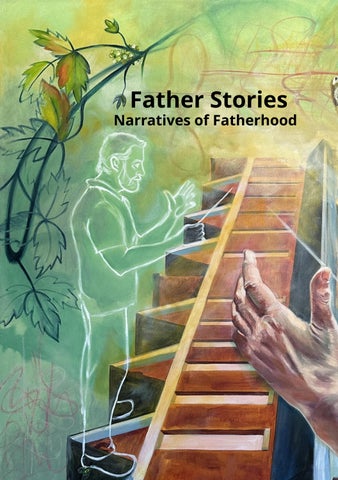
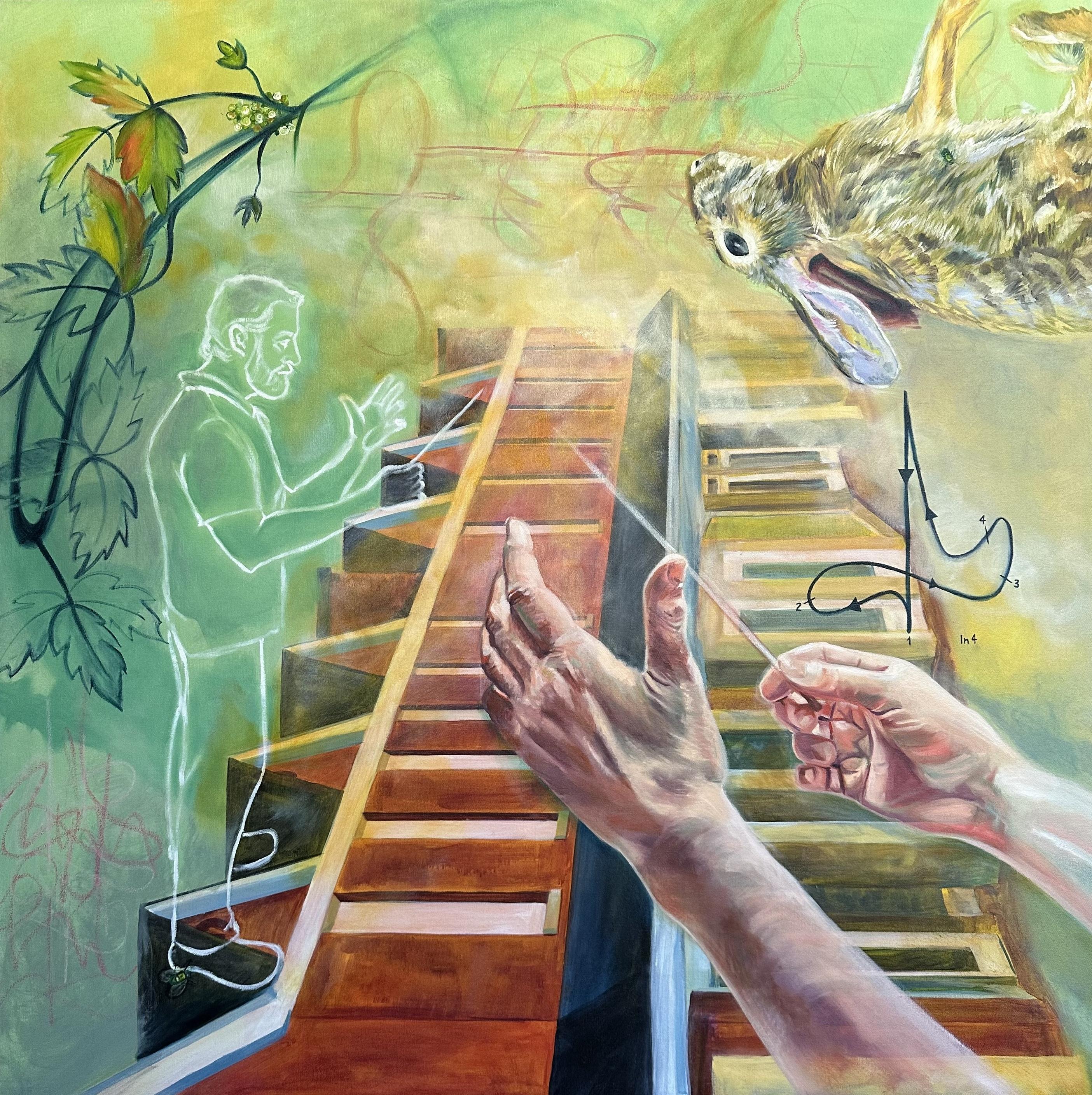
Cover art: Elizabeth Bizianes, Where Do We Go From Here. Elizabeth is a painter raised in Louisville, Kentucky, where she currently lives and works. Her work explores themes of time, family, and memory through figuration and the use of a high chroma color palette. She is an award-winning artist who has exhibited work in local and regional galleries and was awarded anHonorableMentionat the2025 AXAArt Prizeexhibitionheld at the New York Academy of Art in New York, NY.
Fatherhood is a story. We come to know our fathers not through a single moment, but through routines repeated across years, conversations well-remembered, and gestures whose meaning only becomes clear with time. Our relationships with father are shaped not only by what happens, but by what is remembered, misunderstood, or left unsaid.
The works in this collection reflect the many ways fatherhood is lived. For some people, a father is a constant presence, a voice that shapes daily life. For others, a father exists in memory or in his absence. Even when fathers are attentive and loving, they can remain partially unknowable. Even when they are gone, their influence continues to shape the emotional landscape of those who remain. Fatherhood rarely exists as a fixed role. Instead, it unfolds across time, across shifting expectations, and across the distance between intention and impact.
Cultural narratives often position fathers as providers, protectors, and authorities. They are perceived as figures meant to embody stability and certainty. Yet reality sometimes challenges these expectations. Many fathers move through the world carrying pressures they cannot articulate and vulnerabilities they were never taught to name. Fatherhood is many times an ongoing negotiation between strength and uncertainty, presence and emotional distance, love and limitation. Because of this complexity, fathers are often remembered through stories that begin in small, specific moments: a phrase repeated across decades, the sound of laughter from another room, the rituals that shaped ordinary days. The language needed to speak openly about fathers often arrives long after the relationships themselves have changed.
The pieces gathered here do not present a single version of fatherhood. They are about fathers who were present and fathers who were absent, those who tried and those who could not, relationships marked by stability, conflict, tenderness, or silence. Together, these narratives suggest that fatherhood is not only about fathers themselves, but about the lives shaped in response to them through imitation, resistance, longing, and memory.
Gal Slonim Editor
I. Presence
West Texas Rain
J. D. Watson
J. D. Watson is an emerging author with a BS in Liberal Studies from Abilene Christian University. Watson was born in Charlotte, North Carolina and moved to Texas when he was eleven, but holds closely the wonder of tall trees and distant mountains and constantly features them in his writings.
James was driving slowly, carefully, not because of the heavy rain but because little Hope sat next to him. She was pushing herself up against the passenger door, trying to get a better view out the window. The view was obscured by a blur of water constantly moving across the glass; she turned to face the front and made a funny face at the wipers. They were making a strange, jumping rubber squawk with each movement.
“Daddy, where do the birds go when it rains?”
“Well, they have a few options. Some of them will go into birdhouses, like the ones that Mommy has at her house, sometimes they’ll hide under a car to stay dry, and sometimes they just have to hide in their trees.”
“We should get a birdhouse. I want to help them stay safe.”
“Yeah? Maybe we should build one when it stops raining.”
“No! It’ll be too late, they won't need it then!”
“Sweetie, it’s going to rain again, and besides, if we try to build it now, you’ll get soaked.”
She scrunched her face up and looked up at the dark clouds, unsatisfied with that answer. James smiled and shook his head, “They’ll be okay, they’re used to the rain.”
“That doesn’t mean they like it.”
“What do you think birds like?”
“Oh! They like big, green trees and bright, blue skies and fluffy, white clouds and gummy bears!”
“Gummy bears!”
“Of course, everyone likes gummy bears!”
“Should we go get some gummy bears?”
“Yeah!”
Convenience stores dotted the highway, lonely in the flat expanse. Rains like this were never good for them. The construction of the highway always elevated it above the surrounding land, and the rain poured off into whatever was below. The tiny store was built on an elevated concrete base, keeping it from the standing water, though a close look would reveal too many cracks for it to last much longer. James pulled into the empty parking lot and slowed the truck to a stop in half a foot of water.
“You got your jacket on? Good, hang tight, I’ll come get you.”
He opened the door and stepped down, feet immediately soaked, water pouring through the holes in his old boots. He moved around to the passenger side and opened the door. Hope laughed. “It’s so much rain!”
James chuckled, reached up and took his cap off, setting it down on Hope’s head. She lifted her arms up and James picked her up and brought her close to his chest, protecting her from the sky. She was getting too big for this, but the water was cold and only one of them needed to get soaked.
Inside was dry and warm and they were greeted by a kind-faced old man. He laughed as he rang up a bag of gummy bears, a bottle of apple juice, and a bottled coffee, “This is a dinner of champions.”
James smiled, handed over a couple bills, and thanked him. He handed the items to Hope before picking her up again. When he sat her down in the passenger seat, she hugged the snacks with one arm and reached up with the other to hand the cap back. She tried to set it on his head as he had hers, but could not reach. James brought it the rest of the way and placed it over his dripping hair, “Thanks, honey.”
When he got in on the other side, Hope had already set the bottles in the center cup holders and opened the bag of gummy bears. She handed a green one to James and he popped it in his mouth as he got back onto the highway.
An hour later, they pulled onto their inclined driveway and Hope jumped out quickly, holding the half-full bag of gummy bears. Grabbing both
empty bottles in one hand, James got out as well and waited for Hope to come around the front before they headed inside.
“I know it’s late, but I’m going to get dinner ready. Give me about thirty minutes.”
Hope nodded and turned back towards the window in the front of the house, still holding the gummy bears. When James finished cooking, she was still watching intently through the window.
“Dinner’s ready!”
Hope turned excitedly and ran to wash her hands. James walked over to the window, curious what Hope had been so interested in. Underneath the truck, a bird was pecking at a small pile of colorful gummy bears.
West Texas rain often turns into heavy storms. Pounding rain, bright lightning, and rolling thunder moved in with the darkness of the night. It was a night of flooding, cracking trees, and sudden fires.
James was reading on the couch, under a blanket, when he heard light footsteps coming from Hope’s room.
“The storm is really loud.”
“It’s alright, come here.”
Hope walked over quickly and climbed up into James’s lap; he wrapped the blanket around her and hugged her close.
“Do you think the birds are scared, Dad?”
“No, I think they are enjoying a feast of gummy bears.”
Hope giggled at that.
Three Strangers to Thank as a Stay-Home Dad
Brian Goedde
Brian Goedde has an MFA in Nonfiction Writing from the University of Iowa and is an Associate Professor of English at the Community College of Philadelphia. His personal essays have appeared in The New York Times, The Los Angeles Review of Books, and the Seattle Review, among other publications.
Our exchanges were so brief I can hardly recall their faces, but thinking of them is like re-opening the Father’s Day cards I have kept over the years: These moments nourished my stay-at-home fatherhood. I really should thank the strangers who made them.
1. That One Grocery Store Checkout Clerk
“It’s nice to see the dad with the kids,” she said, handing me my sack of groceries. It was a weekday morning when my daughter was a few months old and my son had just turned three. Clearly, I was at home with them or, more to the point, I was out with them, running errands for the home.
“Oh,” I said. “Right.” I wasn’t sure how to respond. She didn’t say, “it’s nice to see that you are with your kids” this wasn’t a personal comment. It was a social one.
It’s true that there aren’t many fathers who, like me, spend most of their daytime hours with their children, though this is changing. A report from the Pew Research Center in 2023 shows that 18% of stay-at-home parents are dads not a huge percentage, but up from 11% in 1989. We’re still far from gender equality when it comes to childcare, but it appears that we are moving in this direction.
“I agree,” I should have said, as I hung my bag of groceries on the stroller handle. “And thanks. It’s nice to be the dad with the kids.”
2. The Mom with Sliced Red Peppers at the Playground
It’s nice, but it hasn’t been easy—personally and socially. As an anomaly, I often feel isolated. One sunny day, for example, as I pushed my toddler son on the swings, I said something to the moms next to me about the weather, or naptime—some such topics of typical parenting conversation. They responded with polite affirmations, but the conversation stopped there. After I took my son over to the sandbox, however, another mom and child took our place at the swings, and soon they all erupted in joyous chatter.
I try to keep it in perspective: there is far worse exclusion in the world than what I’ve felt at the swings, especially exclusion of women by groups of men. That said, in my community of caregivers I find that I’m kept at a distance.
Except on this one day: I was sitting on the bench at the sandbox, occasionally getting up at my son’s request to help load a dump truck, when a mom and her daughter sat down at the other end. I smiled at them—briefly. I wanted to convey friendliness without being forward.
“Finally, a nice day.” She said it to her daughter, or to herself, but it was announced in my proximity in such a way that seemed to convey friendliness in return. It wasn’t said to me, exactly, so I only nodded—to myself, mostly.
“Want a snack?” she continued. “Red peppers, your favorite. I think you like these because I ate them so much when you were in my tummy.”
What’s this? I thought. Something about her pregnancy? Is this an invitation for mommy-small-talk?
I tried to think of something to say in return. I could have mentioned my wife’s cravings when she was pregnant, but that’s a story about a vegetarian suddenly craving steak. Too weird? I could try to keep her comment going oh really, what else did you eat? but that seemed awkward. I thought of just saying, “I like red peppers too,” but I didn’t want her to feel like she should offer me some. By now I was overthinking it. I just gave them both another smile, and the smile was again returned.
What I face as a male caregiver, I believe, is not a prejudice, nor is it an unwillingness. It’s a lack of protocol—on the part of both women and men. How do we joke around at the swings? How do we chit-chat at the sandbox? How do moms and dads who are strangers become friends?
I want to thank this mom with the sliced red peppers for teaching me some protocol: talk to other parents by talking to your kids.
My misstep at the swings, in retrospect, was saying something directly to the moms next to me. Now, I don’t even look at the moms. I only talk to kids, and one day the unimaginable happened. My son and another boy in the YMCA Creative Movement class got along famously, we shared snack time in the lobby, and when it was time to go, his mom and I exchanged phone numbers. Our kids became fast friends, and so did we.
3. That One Dad in the Library Playroom
I was in the kids’ room at the downtown public library, on another midmorning of staring blankly into the middle-distance with my daughter in view. She was about six months old and sitting up confidently. Another dad was with his son, who was a little older and crawling like a wind-up toy in any direction, at top speed and climbing whatever he crawled into. My daughter and I both watched in amazement.
“He keeps you busy,” I said, as he pulled his son off of a chair. (I said it directly to him; with dads I don’t have to be so artful.)
“All day long,” he said. He added that his wife worked full-time and he stayed at home. “It’s really isolating,” he said.
“Let me give you my phone number,” I said.
“That would be great,” he said.
We got out our phones and the moment got awkward. I think we surprised each other—and ourselves—at being so forward in our first minute of conversation. We were still strangers.
“OK,” he said, looking up, “What’s your name?”
I gratefully hold this moment in my memory as an example of two things: 1) it is brave to admit isolation, struggle, and vulnerability, and 2) strangers offer a special opportunity to do so. A stranger can put you “on guard” because you don’t know whom you’re dealing with or what you’re getting yourself into. By virtue of this, however, you can also say what’s on your mind and in your heart; you can be unusually honest with strangers—and also tremendously kind, and expertly helpful. A stranger can also, instantly, become a friend and ally.
That One Dad in the Library Playroom, then—the stranger who decided not to be a stranger—is also me. It’s also brave to say, “You’re not alone.” So let me give myself a little pat on the back. Hey, I’m working hard here. I’m allowed.
Cinnarolls
John Dennis
John Dennis, husband to Anna, father of Julia and grandfather of Noah, had a stroke ten years ago and lost the use of his right side. Once over the initial shock, he took writing courses at Malmö University. He was born in New York but has lived in Europe after being stationed there in the US Navy.
He took off the glasses so he could see.
“I never learn,” he mumbled.
The street was a river, a glassy black surface. Squinting out over the afternoon hustle and bustle, he thought, wet weather divides people. Drivers sprayed street-water on whatever got in the way and pedestrians avoided eye contact.
The rain sounded like sizzling bacon despite the winter chill. That, and the steady stream of traffic, made it difficult to hear the voice coming from the left and three feet below.
Not really listening, he heard, “...It ...cool …too.”
Then, “Pappa!?”
Looking down, he said, “Sorry, Pumpkin. What?”
“Cursivey. It’s curvy. I learned to write my name… all curvy. Today.”
She held out a paper with writing on it and then tilted her chin up while opening her mouth to catch raindrops.
“Your name is Curvy? Show me at home. Let’s hurry. I’m about soaked.”
“To the bone?”
Grabbing her damp, mittened hand, he said, “Wet as a noodle, inside and out. I never learn. I keep my coat on while you get yours on and I start to sweat. Every time. Come on, Curvy!”
They dashed along the sidewalk as quickly as her six-year-old legs allowed.
The rain didn’t bother her. It never did. More than once, she and her BFF had taken street-showers in summer rain with shampoo. He thought about the ready-to-bake cinnamon-rolls in the oven. Her favorite. The apartment should already smell like a bakery.
Home: a first floor (bars on windows), one bedroom (hers), a kitchenette/ living room with a bed sofa. It wasn’t much. But, it was theirs. It was home. And, it was in the city plus close to her school.
He drew a sigh of relief as they turned onto their street. Almost there. It felt a bit like an alley with only four buildings on either side. A dead end.
He had left a lit candle in the window that faced the street. The CinnaSignal.
He said, “Look up at the kitchen, Jules.” She stopped, looked across the street and shouted, “Cinnarolls!”
She was a happy kid. He didn’t know why he’d gotten so lucky. He didn’t even like kids. He loved her. He had stopped missing her mother. She would never have let him leave a candle lit in the window like that or leave the oven on. He heard an echo of her voice, “Will you never learn? Grow up! Think. Think! Think of the consequences.”
He then felt a hand launch towards the street. He held the empty mitten and then came a giggly, “Last one to the stoop is a rotten egg!”
It happened so fast. She had been right there beside him. Then she was running across the street.
There was a dull thud. The thud of a six-year-old’s body bouncing off the grille of a pickup. He saw her turn mid-air towards the asphalt. Her red and white, polka dot beanie flew off her dirty blonde curls. She made no sound when she landed face up. The back of her head bounced off the concrete, twice. He ran to her, slipped and fell, then scrambled to her side. The truck rolled a little closer, then stopped.
Scared to move her, he desperately tried to find a pulse or breath. Anything. His own breathing was so heavy it formed a white cloud above her body. Then he saw a dark shadow spreading from under her head and heard wailing. It was loud and seemed distant. It wasn’t.
In disbelief, he looked up at the grill of the car. Its lights blinded him. From his knees, he stared towards the dark windshield but could see no
driver. He did see a rusty hood and water being thrown from the passenger side wiper into the darkness.
He cried, “Help! Help me!”
The engine revved.
Then he bent over and used his body to shield hers. The car lurched forward once, twice. Then stopped. He could have kissed the bumper.
In frustration he urged his daughter, “Julia, honey, it’s OK. Julia, honey, wake up.”
The headlights, like spotlights at the theater, bathed the two bodies creating long shadows. He didn’t see but felt the truck jerk back. He glanced up quickly, license plate, he thought, and before being blinded, his eyes fastened on a worn bumper sticker: We Aim to Please.
Then, the light began to dissipate as the truck backed slowly away from the scene. Its speed increased. The faster it moved, the more it swerved. It scraped and tore at the sides of the parked cars in its way. Rolling back and into the T-shaped intersection and miraculously missed hitting any of the rush hour traffic. Fortunately, for an elderly woman with a toy poodle, the pick-up missed the pair when it rolled up onto the sidewalk. The tiny woman frowned and then comforted her frightened dog. All traffic stopped briefly. Then, the pick-up signaled right and disappeared into the oncoming night.
He sat there, drenched in the street, rocking her small frame as if movement might undo something. Anything. A siren sounded faintly in the distance, not louder than his thought but softer than her silence.
A man’s voice shouted, “Don’t move her! I called 911! I saw the whole thing”.
But he didn’t hear the man, he heard that echoing voice, screaming now, “You never learn! You never learn! You never learn!”
“I.. never…learn,” he whispered and pressed his forehead to hers. Time stood still.
The street filled with lights, the siren stopped, boots splashed. A paramedic knelt, gentle hands replacing his. When they lifted her, the paper she was holding slipped from her one mittened hand and landed in a puddle. Her name, written with careful loops, began to blur and run.
The Honorable Dad
Steven Culhane
Steven Culhane is a freelance writer usually focusing on sports topics. Married with 3 kids.
Bills were piled up on the kitchen table. The mortgage was behind and I was doing my best to stay positive after being out of work for nearly a year. Only three weeks back on the job and suddenly, a perfect storm of opportunity that would ease all my financial pains presented itself. I was approached by a General Contractor to overlook the charges for several expensive electrical tasks that were not part of my boss’s contract with him. It was a juicy offer at a vulnerable time, as I was offered a handsome amount of cash and an endless ticket to continue lining my pockets for any future dirty deeds I was willing to provide.
But I knew better because of one man—My Dad. For some reason, before I was about to collect my fortune, I mustered up enough courage to call him. He was by far the most honorable person I knew and although I could never come close to matching his nobility, any modicum of decency I may have is a direct result of his tutelage as a father. I fought through the embarrassment of telling him I was contemplating taking a bribe and reluctantly explained my situation to him. My words were followed by an awkward pause of silence. Then he calmly stated in his gruff voice, “So they give you some money and you give them your integrity? That’s a pretty big price to pay in my world. All I’ll say is if you do it once you’ll always do it. By the way, it's also called stealing.” Then he abruptly hung up the phone. It’s the way he rolled.
Any thoughts I may have had of straying from a proper place soon evaporated. Somehow his words always infused me with confidence and power, and this situation was no different from the countless times in my life where he was the beacon of light that guided me away from a dark hole I was about to jump into. He was always there for me to rely on, no matter what the circumstances were. Since his passing nearly 7 months ago, I have noticed a kink in my armor, a once strong sense of conviction dealing with issues, reduced to confusion and doubt and it feels as if guardrails have been forever removed from my life. The delivery of his advice was never accompanied by a condescending tone. It was more like tidbits of nourishing suggestions that served as mental awareness tools. You either used them or felt the consequences for not heeding such wisdom. He was never articulate and his words always lacked social
grace but his messages always sunk in like novocaine because they came from a place that was pure and wholesome.
My father’s influence extended well past my childhood, even though in my adolescent years I tried to dismiss him as an out-of-touch martyr who missed opportunities in life because too often he put others ahead of himself. As I grew older, I realized how wrong I was. A self-made man, who came from a family of alcoholism where love was rarely expressed and feelings were abolished, my dad broke all of those chains to become a cherished jewel in the lives of so many. A winner in every possible way. Oftentimes I would seek out his company when I was struggling with a problem where most of the time we never even touched on the topic, but somehow I always walked away feeling better. It was one of the many gifts he had that he wasn’t even aware of. Always unassuming, nothing was ever pretentious or phony about him, and dodging the truth or dancing around responsibility was never an option in his universe. It was a no retreat, no surrender approach towards keeping our values undamaged. There were countless lessons dropped along the way. Most of them were not intentional. Just him conducting himself in his normal manner was enough of a teaching to witness. He never sought the world’s applause for all the good he did either, always acting anonymously and quietly. According to my dad, doing the right thing shouldn't be viewed as a sacrifice. It's what we are all supposed to do and it came remarkably easy for him. I recall him telling me when I was young, “You know when you do something good for someone and you get that nice feeling in your gut? If you were able to put that feeling in a bottle, it would be priceless. Some people never get to understand that. It’s the equalizer in life and you can make it happen as many times as you want in a day. Now go mow the lawn.” The points were never belabored, life went on but he was profound without trying to be, which made him more endearing and harder to deny. He made me think deeper, gave me an understanding that there are things more important in life than ourselves. No amount of money or prestige could pierce his internal guide. An anomaly in a day and age when people routinely kick dirt on their moral compass for personal gain, my dad refused to compromise. I could never rival his level
of morality, not even close. It was probably what I admired about him the most.
His fatherly attributes came in many ways. His hearty laugh wasn’t just infectious, it was warming to the soul and I loved evoking it out of him whenever I could. His sense of humor, full of self-deprecation and witty lines, created great theater where we all laughed so hard our bellies hurt. Sometimes in public the ruckus he created from his funny antics would go overboard but no one cared, we just wanted more. I loved being around him. We all did.
I am grateful we checked many of the boxes in the living years. We watched ballgames together, went on trips, talked about life, hugged, and most importantly, told each other how much we loved one another. What I would do for one more conversation, one more look into his eyes, one more robust laugh together. I wish there was more time. The cycle of life is beautiful as much as it is painful, especially when there is such a tremendous bond established between a father and son. He was there to escort me into this world and I was with him when he left it. As hard as that is to endure, the strength of our relationship fortifies my faith that I will see him again in the afterworld. I have to. There was too much built between us for it to end. A cousin of mine offered me the perfect phrase in a moment of consoling. “They are not gone, they are just in another room until we meet again.” He was always a giant in my eyes and without him here to guide me, any improvements to myself as a person will now need to be developed on my own. I have no excuse: I learned from the best.
The Tape Recorder
Lynn Lipinski
Lynn Lipinski holds an M.F.A. degree from Mount St. Mary's University. Her professional writing has been featured in The Los Angeles Times, UCLA Magazine, Trojan Family Magazine, as well as multiple literary publications such as Woven Tale Review, Red Earth Review, and Conclave. In 2021, she received the Rilla Askew Prize for Short Fiction from Balkan Press.
In the spring of 2006, the grey brick house I grew up in sold faster than my parents expected. I had flown from Los Angeles to help them pack, thinking we had weeks. The realtor called Tuesday morning—preapproved loan, thirty-day close, no contingencies.
"Well," Mom said, hanging up the phone. "That's that. They want to move in fast."
Dad stood in the kitchen doorway, still in the T-shirt and sweatpants he’d slept in, watching Mom and I talk with a slack-jawed expression. His hands had that tremor I'd been trying not to notice.
The obstacle was Mom's breast cancer treatment. Six more weeks of radiation at St. John's. The oncologist had been clear she couldn't interrupt the schedule, couldn't transfer to Houston mid-course. They needed somewhere temporary to live in Tulsa.
"Put your stuff in storage with the moving company and let’s find a furnished apartment somewhere. Then you don’t have to do all the unpacking twice,” I said.
Mom pinched her face like she does when shoes at Kohl’s cost more than fifty dollars. "Those places cost a fortune." This was their marriage dynamic: my mother hunting for bargains at discount stores, my father impulse buying new cars. What they had worked well. They were both good savers and Dad’s job as an airplane maintenance supervisor earned him a good living. She just preferred money in the bank where he liked to live a little.
I started pulling items out of the top kitchen shelves: trays, bud vases, floral-rimmed china teacups. Dad wandered over to help. He picked up a pewter pitcher, studied it like he'd never seen one before, then set it in the box loose on top of a crystal vase.
“Dad, can you bubble wrap the vase and the pitcher?” He looked around the kitchen with a lost expression.
“The bubble wrap is right there,” I said, pointing to a gigantic roll on the counter.
The tape around the new roll of bubble wrap was still affixed and Dad had a hard time figuring out how to open it. My eyes went wide when I saw him pull out his pocketknife and slice into the roll because I thought he would cut himself. He didn’t, and even though his hands trembled slightly, he cut the tape swiftly and surely. He caught me watching him and pursed his lips at me in a disapproving way. I didn’t know what to do with this version of my father, who seemed helpless at times and then humiliated by my concern.
Thursday I fired up their ancient computer and looked at Craigslist for apartments, then we drove around. The first place cost $800 a month, furnished but tiny one bedroom in Utica Ridge near the hospital in a new building. Mom took one look and shook her head. "Highway robbery just because it’s in a rich neighborhood."
The second sat in east Tulsa, near a Mexican bakery and a Thai restaurant. It was $850, two-bedroom/two-bath, but the sofa smelled like cigarettes and the refrigerator made a grinding noise. "Absolutely not."
Sheridan Pond, out by Southern Hills Country Club, was $1,200. Furnished two-bedroom with a living room, clean and bright, overlooking the water. A walking path around the pond. Pet-friendly.
"It's beautiful," I said. "Look, you can walk Skaddle around the pond every morning."
Mom sat on the couch and crossed her arms. "Twelve hundred dollars a month for two months? That's "
"It's what you need," I said. "You're going through cancer treatment. Dad needs " I stopped myself. Dad needs familiar routines, I wanted to say. Dad needs simple, predictable days. Dad needs to not get lost walking to the mailbox.
"We'll take it," Dad announced from the window where he'd been watching a woman walk a small dog around the water.
Mom started to protest, but something in his voice stopped her. It was the first decisive thing he'd said all week.
Saturday morning, Dad and I took Skaddle on a walk down Admiral. We stopped inside the flea market Dad liked to frequent. A few of the vendors waved hello at him as we walked in, Skaddle waddling between us. I stopped to look at old Fisher-Price toys and enjoy my own nostalgia. I lost Dad for about twenty minutes then found him enjoying his own nostalgia, standing at a card table covered with old flight instruments and engine gauges.
"Got you something," he said, grinning like he used to when he'd bring me airplane models from the American Airlines employee store. He held up a reel-to-reel tape recorder, the kind that used magnetic tape wound between two reels. About the size of my hand, it nestled in a battered metal case and came with a box of three blank tapes. "For your writing. You can say your story ideas out loud and then get them down later. Like reporters do.”
The thing probably hadn't worked in twenty years. The cord was frayed, the battery compartment corroded green. But Dad was so pleased with himself, counting out crumpled bills to the vendor like he'd found buried treasure.
"Thanks, Dad. What a blast from the past."
He carried it to the car carefully, like it was made of glass. "They used to pick me to crawl into the fuel tank to do repairs," he said as we drove home. "’Cause I was short. They’d say I could fix anything and I guess I could."
I wondered if breathing all those fumes gave him Parkinson’s and what the doctors were calling Lewy body dementia. I wanted to say something about how much his work had meant, how proud I was of everything
he'd accomplished. But the words stuck in my throat. Instead I just nodded and kept driving, that old tape recorder sitting between us on the seat like some kind of talisman against all the things we couldn't fix.
When we returned to the house, the rental agreement was spread on the table like evidence. Mom was staring at the signature page. Her handwriting was the same as always; old-fashioned, curvy loops. Dad’s handwriting was chicken-scratch, barely recognizable from his usual block-print, precise as a stencil. A symptom of Parkinson’s Disease.
"Sheridan Pond it is," she said without looking up. "Two months. Then Houston."
Dad announced he was going to work on the tape recorder in his workshop. For the first time since I’d come home he seemed like his old self as he disappeared out the back door, his wide shoulders pulled back as straight as they could go.
Mom and I set to finish sorting out her sewing room, stacks of plastic boxes full of things she’d been saving, nothing among which seemed likely she’d make use of. Remnants of Christmas taffeta, cabbage-rose upholstery, red-and-white gingham, faded blue ribbon, mismatched buttons, an assortment of zippers. We argued about this and that as we sorted the items into piles for donations, trash or keep. My parents drooped as much as this house seemed to, these worn-out possessions once full of promise. I dried sudden tears on my sleeve before Mom could see them but I was too late.
“Don’t worry about us,” she said. “This move is good for us. We’ll be close to Laura and the grandkids. We can help her and Ron. There’s nothing left for us in Tulsa now that you and your sister moved away.”
“After your treatment is done at St. John’s, you can get your aftercare at M.D. Anderson. It’s the best cancer treatment center in the country.”
“They’ve got this drug, L-Dopa, that can help with your dad’s Parkinson’s symptoms.”
I couldn’t bring myself to say anything about his confusion, how he seemed so lost. How he seemed to have a longing for purpose or at least a few words of praise from us. Sickness was breaking Dad.
A few hours later, Dad came back in with the tape recorder, unusually talkative. “You’ll use it, won’t you? This thing was cheap, guy didn’t know what he had. These magnetic tapes really revolutionized recording. You could cleanly erase them, reuse them, over and over. No quality loss.”
He hit record. “Say anything you want, now, testing check one two. Try it.”
I managed to quip “Can you hear me? Can you hear me now?” imitating the wireless service television commercial that you couldn’t escape on TV. I thought for sure I was going to cry and was afraid to say anything else.
“That’s good, Lynn, that’s good. Peter Piper picked a peck of pickled peppers. Peter Piper picked a peck of pickled peppers,” he said.
Dad replayed our words back. My voice was clear but I heard the fat sound of unspilled tears in my throat. Dad’s voice had a little shake in it.
“Then when you want to erase it, you just record over it.”
I hit record. “Tell me a story, Dad.”
“I don’t know any stories any more.”
“Sure you do. How did you fix this recorder? Tell me what you did.”
“It was nothing. Rubber belts get hard and cracked. I had to glue two together to get one of the right length. Then it’s just a matter of cleaning it up, removing the hard grease. Nothing wrong with these old components. Just need a little TLC.”
I was seized with love for my father. I wrapped my arms around him. “I love you, Dad.”
“I love you too, honey,” he said.
I took that recorder back to Los Angeles with me when I returned, vowing to never erase that tape. I still listen to it, to that ordinary, everyday conversation, now that he’s gone.
First to Go
Brandon McNeice
Brandon McNeice is a Philadelphia-based writer of fiction, poetry, and essays. His work appears or is forthcoming in SmokeLong Quarterly, Flash Frog, Plough, Front Porch Republic, and The Philadelphia Citizen.
On her sixteenth birthday we argue about last year. Was it thunder that startled her into laughing, or fireworks from the park?
“Thunder,” I say.
“Fireworks,” she says, calm as someone who lived both.
After cake, when the neighbor’s porch light clicks off, I bring down the shoebox. The spines are my careful print: Fifteen, Fourteen, Thirteen. The first has a pediatrician’s bear sticker half-peeled. I slide Fifteen into the machine and press play. The room gives what I need: the inhale before candles, a whoop flashing off braces, her sound lifting as the table becomes one body. Thunder, then. She shrugs. I should let it go.
Alone, I reach for One. The counter blinks. Hiss. I press my thumb to the window as if warmth could coax a shape back. Blank.
In the morning she eats at the counter, the spoon resting on the rim. I almost tell her. Instead: “You were right about last year.” She smiles without triumph. The room keeps its quiet.
I start checking the box like people check doors, just to know what the world is doing when I am not looking. On Tuesdays she tucks receipts in a rinsed glass, ink feathering. “Proof,” she says once. Of what, I don’t ask.
I avoid the word itself. I set small traps: coin behind the ear, a grape that drops and returns, the voice of a cartoon raccoon she loved at seven. The room withholds.
On her seventeenth birthday the candles gutter and smoke threads upward. After, I slide One again, though I know, and get only air. I take out Two, more to steady the animal in my chest than to test a theory. Blank. Last year One. This year Two. Next year Three.
I keep it to myself and make a ritual. A few days after each birthday I take the box down, check the year the age demands, and watch another square of plastic turn to weather. At eighteen, Three will be gone. At nineteen, Four. The future lines up neat as teeth.
Between birthdays, life records itself without me. On a wet morning she lifts a wolf spider from the sink with an index card and a glass. “Bad luck to drown a helper,” she says. I cannot tell if I taught her that or only hoped I had.
I put things back where they belong. The player on the shelf. The shoebox above eye level, bear sticker turned to the wall. Not thrown away. Not at hand.
When she turns eighteen, Three is gone. Four still holds a smear: a cough, a chair leg, the gathering hush before tiny flames are extinguished, or aren’t. I play it twice and stop before the fragment learns to lie.
That evening she finds me in the garage, labels curled on the bench. A receipt is tucked into her sleeve; her habits rhyme with mine.
“Were you saving them because you thought I’d forget,” she asks, no accusation in it, “or because you thought you might?”
I mean to say the tapes are a handrail in a dark stairwell, a thread when the bulb goes out. I lift Four, lower it. Plastic clicks wood. It is the only answer I have.
She waits like people at a pool’s lip, neither cruel nor in a hurry. “Maybe you can’t have both,” she says.
She stands on her toes and kisses my hair, the way I used to kiss hers when a stepstool was a ship, and the counter, an ocean. “Ice cream?”
We walk. At the shop she tells me about a woman who comes every Tuesday for the flavor named after a dead dog. She does the woman too sharp, then mends it. My body makes a sound, small and honest. “You’re impossible,” she says, smiling.
After that I try stepping off the calendar. Light on the counter at five. Shoes by the door pointing home. I learn the quiet that means: I’m folding a sentence to hand you when it fits.
At nineteen, Four vanishes. I do not test Five. I know how numbers march. On her birthday I stand in the doorway. Faces lean toward a small sun. She breathes, blows, and the air lifts and settles the way it does when a room remembers together. My hand rises in reflex, palm ready for a weight that never weighed anything.
I let it fall.
That night, when the house is dark, I step into the kitchen and feel the room holding a shape: the circle of faces, the wick of smoke, the chair pushed back by a knee. I listen like people listen to the ocean with eyes shut, not to learn the tide, but to believe in its returning.
Morning. She comes in with sleep on her cheek and a blue smear of frosting on her thumb.
“It stained my tongue,” she says.
“Let me see,” I say.
She sticks her tongue out, blue as summer candy, and a small true sound arrives and leaves in the same breath, a bird recognizing the yard. No tape could have kept it.
I open the back door to mild air. In the pear tree, webs are strung between what holds and what moves.
I do not reach for anything.
Enough.
Recital
Joseph Heiland
Joseph Heiland is a writer from upstate New York. He has stories published at Eastern Iowa Review, Lumina Journal, and Reed Magazine. He received an MFA in fiction from Sarah Lawrence College and is currently earning his PhD in English at Binghamton University.
He face-planted on the stairs, bounced on the tile and rose weepy. You willed your son to breathe. Don’t muck this up, you thought. Above him was a crucifix draped in garland. There were orchids and roses, string lights twinkling. You counted three nativity scenes: one by the altar, another in the atrium, and a third collecting snow beneath the grotto. Parents, child, wisemen. While you and Bee cowered in the pews.
“Should’ve signed him up for tee ball.”
“He’s alright,” said Brianna. “Get the camcorder.”
The instructor, Miss Judy, dabbed his lip with a tissue, then pushed him toward the organ and clipped his music. How lucky you were. Apparently those nights in the rectory while you napped, or played solitaire—had meant something, offered something you couldn’t. She rubbed his arm lovingly and again flattened the pages. You could feel the hurt leave his cheeks.
“Quite the healer,” said Brianna.
You shifted to frame the organ. Around you, heads wavered like buoys. Even Jesus looked bored.
Then he reached for the keys.
The piece was longer than you remembered. Never had he finished in one go. Not in his bedroom, not in rehearsal. Sections, maybe. One part or the other. Yet there he was, stomping out chords, rolling his chin. Deep, guttural music, the kind that rings in your scalp and conjures the dead. Music that makes you wonder if God isn’t real, because you dreamed of playing, dreamed of hammering out love with your fingers. Here was a boy with your nose, your clumsiness. Greater than you’d ever be. The organ droned. And you, steadied against your wife, unsure how something of yours could ever gleam so brightly, fought to soak it in.
The Gift of Time
Michele Colletti
In 2010, Michele Colletti self-published The Backwards S, Mikayla’s Story, a book aimed at helping teenagers navigate idiopathic scoliosis surgery. Over the years, her community articles have been featured in various HIBU hometown magazines, particularly in Simsbury, Avon, and Manchester, Connecticut. Most recently, she co-authored an article on a Title III Strengthening Institutions Retention Grant, which was published in the National Organization for Student Success, Practitioner to Practitioner publication. Over the past 2 years, Michele has been a national presenter on student success and retention at education conferences, specifically, at the National Organization for Student Success, American Association of Community Colleges, and First Year Experience conferences.
It all started with one of those homemade coupon books. You know the kind. Each coupon let the receiver cash in on something you’d promised to do: one car wash, one loaded dishwasher, five free hugs. My stepmother, who was my ailing father’s full-time caregiver, suggested that this particular year, instead of buying him clothes or books, I would consider giving my dad the gift of time. So, I made him a Father’s Day coupon book. Each carefully designed and decorated coupon read, “good for one lunch,” and then playfully suggested, “have your people call my people.” I was 47.
After settling on a day, our first two get-togethers were simple meals at one of his favorite restaurants. I quickly realized that I loved my one-onone time with him, so I asked if we could make it a weekly date. My stepmother was thrilled. She could use the break: time to herself, time to shop, time with friends. So, Dad’s coupon book evolved into me being his caregiver each Friday.
I wasn’t prepared for what this job would require. I was promptly given a special cushion for my car, which allowed him to get into the passenger seat first and swivel his legs in after. I loaded a collapsible cane and a walker into my backseat. In case of an emergency, I tucked a laminated sheet that listed his medical conditions and medications into my visor. Finally, a bottle of pills lived in my glovebox, resting on my state-issued handicapped parking pass.
I decided to go big for our first regularly scheduled Friday. My father was a Hartford, Connecticut, police officer for many years, and the city had a beautiful, refurbished carousel that he had never ridden. It was housed in a decorative octagon pavilion located in a park in the center of the city.
After a painstakingly long, slow walk from the parking lot and getting our tickets, it took me, Dad, the attendant, a small footstool, and a lot of perseverance to get him onto his ornamental, hand-carved, wooden horse. I thought he would choose the bench. We smiled and giggled, going round and round and up and down, as the smell of freshly popped corn and lighthearted organ music filled the air. When we emerged to make our way back to the car, we noticed two Hartford Policemen mounted on the city’s newly acquired horses. My father looked like a
wide-eyed little boy who, without hesitation, wanted to spring over to them, but we were forced to proceed with a slow shuffle and the use of his cane. We said hello, and I quickly informed them that he was a retired officer from this very city. They respectfully told him how honored they were to meet him and shared that their horses were named after fallen officers.
Over the next few years, our Fridays consisted of fishing at the local pond for hours with no luck, betting on the ponies at a local off-track betting facility, and sneaking in all his favorite foods: Reubens, hot dogs, and clams on the half shell. Each time, he made me promise not to tell his wife. We drove my kids to and from their after-school activities, through the countryside at dusk to count deer in a misty field, and to the shore for seafood. One time, we just sat in a gas station parking lot after dark to watch the thousands of dancing Christmas lights that decorated the local frozen yogurt place across the street. Each outing took longer than it should have, slowed by the routines that came with caring for a frail, aging parent. But each outing brought me precious time with him that I would not trade.
One memory that still makes me smile is a trip to get his most requested Friday treat, a milkshake. He wanted to try a new ice cream shop. In the drive-through line, he scanned the flavors on the big billboard beside the car. Although strawberry was not a choice on the milkshake menu, I made a special request for one, and they obliged. After getting my change from the clerk, I started to drive away and noticed Dad was turning bright red, sucking on his straw. I said, “What’s wrong?” and he replied, “It’s stuck!”. I snatched the cup out of his hands, opened the lid, and found his milkshake was filled with frozen chunks of strawberries, which were also stuck in his straw! I promptly pulled back around to the window and asked for a spoon. We laughed the whole way home about how I would explain to his wife that he passed out while sucking on a straw, in the milkshake that he was not supposed to have.
Our Fridays came to an end in the lobby of an IHOP, while we waited for a table. Dad passed out cold in my arms. I was praying I could keep him from hitting the ground while loudly pleading for help. Someone brought
over a chair that I was able to get my father into just before he regained consciousness. As soon as I was sure he was stable enough, I told him not to move while I went to bring the car around.
He looked up at me and said, “But what about my pancake?”
Fragments
David Pizzurro
David Pizzurro is a longtime blogger whose candid, real-life writing built a devoted readership. His work has appeared in Neon Origami and in the WILDsound Festival’s audio series. He lives in Detroit, where he continues to write flash nonfiction with unfiltered honesty.
Raising three boys is hard when your time with them comes in bursts— weekends, weeknights, scattered holidays. In those brief windows, we built a rhythm, often awkward and messy.
It was Halloween. I left work early, but traffic was worse than I expected. Two unreturned calls had left me with no idea what the kids were doing—or when they were going out. I turned into my ex’s driveway just as a group of kids spilled out of her house.
Max was dressed as a Stormtrooper, but without his mask. He turned back when he spotted me pulling in. “Dad, what are you doing here?” he asked.
“I just wanted to get a picture, buddy. Where are your brothers?”
“They’re at Jeremiah’s house.”
“Where’s your mask and the blaster I got you?”
“He doesn’t want to carry it,” my ex interjected.
Max glanced back toward his friends, impatient. “Dad, the group is leaving.”
“Hurry, Max,” she said, addressing him but meaning me.
I took two quick photos. In the second, Max was turned. He raced off to rejoin the group.
I paused in the driveway, wondering why I came. Then I drove off in the opposite direction just to avoid passing them.
I was no longer part of my family—not like before. Yet I did my best to stay present in my kids’ lives during the time I was given. It was difficult. It felt like I was wedging myself into a space where I was no longer wanted.
"You really are childish," said Alex, as if confirming someone else’s opinion.
"Where did you hear that—your mom?"
"Yes."
Max had lined up his stuffed animals Jeffrey, Steve, Snowy, Garfield, and Squidward—all in a row. He was hiding under a blanket draped between the sofa and the coffee table. He was the trapdoor spider. He’d been learning about spiders in school.
It was my job to walk each animal past the blanket and provide commentary as the spider pulled each one under.
Alex was bent over his homework. It was late, and he was too tired to focus. Andrew was watching the hockey game.
I bounced little blue Jeffrey across the blanket. The tune Walking on Sunshine played briefly before the spider yanked him under. Giggles erupted immediately.
Next, it was Snowy’s turn. Snowy was contemplating a name change maybe Rainy or Wet-head. More giggles, and Snowy joined Jeffrey.
Andrew couldn’t resist the allure. He crawled under the blanket, and the youngest and I took turns bouncing the stuffed victims toward him.
We could pretend nothing had changed, but these moments were less frequent. They carried an urgency, as if I had to condense a week’s worth of being their dad into an evening.
It was past midnight. I sat on the floor in my kids’ room, reading The Historian by the glow of the bathroom light a Da Vinci Code–style search for Dracula. Max had a stomachache and had already thrown up once. I split my time between comforting him and trying to let him sleep. There
was nothing more I could do. I’d already given him the proper medications.
“When will it stop hurting?” he moaned.
“I don’t know, honey.”
“I think I have to throw up again.”
He scrambled out of bed and knelt before the toilet. The retching turned my stomach and squeezed my heart. When he finished, I handed him a glass of water to rinse his mouth. His smooth face was pale. His lips bright red like the vampires in my book, I absently thought.
“Does your stomach feel better?” I asked.
His blue eyes peered up from beneath long brown bangs large eyes with thick lashes that stood out against his pale skin. He swallowed hard and shook his head no. At six, he straddled the gap between being the baby of the family and a young boy. He didn’t whine. He handled the stomachache with calm maturity.
I called him to me and held him in my lap. We waited out the pain together. Later, I laid him in his bed and retreated to mine, finishing the last few pages of my book.
In the morning, I found Max beside me, his stomachache gone. I felt his forehead. He had a slight fever but was cheerful. I gave him some Motrin, fought with him to take it, and we slept a little more aware these times wouldn’t last.
They were growing, and our old life was slipping into memory. Their new life these fragmented visits were becoming the norm. We all struggled to adjust.
The boys were in Florida for spring break. My ex had taken them to visit her boyfriend. I hadn’t seen them in over a week. Max called to update me. “We were at the beach, Dad.”
Laughter and chatter buzzed in the background—the hum of a road trip in motion. “We’re heading to Orlando now.”
On Tuesday, Max called again.
“Were you in a movie, Dad? Mom says you were.”
I smiled. “Are you at MGM Studios, buddy?”
He said yes, and a memory flashed me in my twenties, a skinny kid from Detroit volunteering for one of their shows.
“You should do it too if you get the chance. It’s a lot of fun.”
The next day, while at work, I got another call this time an update from Animal Kingdom.
“Dad, we’re about to go on Safari. The line winds back and forth forever.”
He was hard to hear over the noise from the park in the background. I tried to ask questions. “Are you taking a lot of pictures?”
Max went on and on about the rides and the places they still had to visit. I couldn’t catch every word, but it was good to hear him.
“Dad can I come over this weekend?”
It wasn’t my weekend, but sometimes my ex didn’t stop them if they asked.
“Sure, buddy. We can pick out the rollerblades you want for your birthday.”
Taking the kids to Disney had always felt like a rite of passage. We took the twins when they were six. I wanted to take Max at this age—he was turning eight. But my finances wouldn’t allow it. One more reminder of what I couldn’t provide.
I was glad he got to go, but I felt like I should have been there.
Another thing that was taken from me.
And I was left feeling bitter.
When I looked at the lives of the ex and my kids, the only thing that had really changed was I wasn’t there and it didn’t seem fair.
My role as dad was diminished to the absent provider, a shoehorned extra at events. They were moving on. I was trying to do the same. But I couldn’t just replace them with a stand-in I had to find different ways.
Breakfast Routine
J B Nicholson Hunt
J B Nicholson Hunt has been writing since being appointed 4H Club Reporter. That childhood experience, and regular pen pals, encouraged her and led to boxes of yellowed, fragile newspaper clippings from her years as a journalist. Today, she is a freelance writer living in Tulsa, OK and is converting her journals and family lore into historical fiction.
Everything changed for him that morning.
The restaurant was his usual place. He ordered his usual eggs and toast, with bacon.
“Crispy, please,” he said to his usual waitress. But he was late and only had me to talk to that day. My Dad’s regular breakfast companions had already been and gone.
They were not the typical wobbly, old retired guys with nothing better to do. These were younger men who ran large plumbing and commercial real estate businesses. One was a golf professional at the private course down the street. My Dad was the oldest, by a decade or more. They gravitated to him. In his starched long-sleeved dress shirt, he looked like he was on his way to an important financial meeting, and he frequently was. He had retired from the Air Force twenty-five years earlier. But he still wore a tie, shined his shoes, and carried a handkerchief with his suit. He sold life insurance to the local John Deere dealer and other corporations, and drove all over the state of Oklahoma. He kept his hair short and neat, though occasionally the color was a little too black in the sunshine.
Men began to join him at his table shortly after he moved to the neighborhood and staked his claim. The entrepreneurs who gathered around him told stories of their glory days on athletic fields, while learning they needed thick skin for his sense of humor. They dragged metal chairs over to his table and laughed loudly.
He met these new friends at the restaurant, probably one at a time, over a few years. He met his last ex-wife this way at a different diner in a different town, twenty years earlier.
Thinking about the smell of bacon this morning was enough to get us out of the house. That may have been the first thing that drew him into this diner. It was not the overly greasy smell of his previous favorite country café. And this place did not try to be something it wasn’t, which appealed
to him. There were no fancy low-fat bran muffins or bowls of granola. He chose the eggs, toast, and bacon from the laminated menu with four kinds of omelets and slightly too-high prices. He was eating the same meal he could have had at home.
Looking back after thirteen years, I describe this as his socialization. There was always another table full of retired men laughing together over their coffee and cinnamon rolls. They told their same fish-that-got-away stories every day. From across the room, they seemed to be enjoying their banter, even as they also seemed to be a cliché.
My Dad’s breakfast group never looked like that, at least not to me.
Though it began in a rush each morning, while I silently resisted, it soon became an enjoyable outing. I came to find comfort in the predictability even though I never quite understood why we had to rush around and get out the door just as if we had someplace to be. The routine gave him something to look forward to, and something to share with me. As his only daughter, I often thought that he did not quite know what to do with me, especially as we got older. He was a former athlete, with a coach for a father. He had to learn how to be a girl dad before anyone called them that.
More than just a pleasant way to avoid cooking, this was his main social activity. It slowly became mine too, even as we began scheduling his radiation treatments.
To me, going to restaurants for three meals a day felt expensive, extravagant, and time-consuming. Slowly I learned it was also a way to notice how others saw him. With his big smile and ready laugh, he charmed the waitresses, even though he left skimpy tips.
He had been single again for ten years and quickly reverted to his bachelor schedule. He was a regular at the Italian bistro across the street on Thursday nights. On Fridays, he showed up wherever his favorite Sinatra-style crooner performed. The casino bartender on the other side
of town called him by name. Sunday brunch at the golf course rounded out the week.
One day I realized I had been enabling this. This pattern had begun when he would visit me at college. His alma mater brought many happy memories. He always ran into someone he knew at football games and would retell stories of embarrassing episodes from his years playing baseball there. My friends thought he was handsome and suave. He drank Rum and Coke, always the life of the party, telling funny stories and picking up the check.
In the early years after he and my mother divorced, I tried to cook for him and my brothers, when we had our weekly visits. He never forgot about the undercooked fried chicken, and cornbread I made with baking soda instead of baking powder.
These became like mini vacations. I had outgrown the custody arrangement and made a choice to live with him one summer after college. Dinner out every night was an uncomplicated way for him to feel like he was entertaining me, when he was really watching baseball on the sports bar television. Different cuisines and explorations of new parts of Fort Worth alternated with our favorite Mexican restaurant and greasy burger joints.
It was just the two of us in those days, and we both worked to overcome the damage caused by his divorce. During childhood, meals were brief, before they became shouting matches. He moved out and then moved out of state. Most of what I knew about him came from my mother’s tirades.
During those difficult teenage years, I needed him to prove her wrong and be the father we needed. Instead, he moved farther away.
Finally, as an adult, I wanted to test the truth of her words. He was willing to find out who I was becoming. He encouraged my photography hobby with a new camera. Never gentle in his opinions, he taught us the ability to hear criticism. He was proudest of us when we made smart, funny
observations. He and I had the same chin, and I began to see that we had the same sarcasm and exuberance. When my mother angrily accused me of being just like him, years later, I silently agreed. And I was glad.
That did not change. Over the years, I could see he wasn’t perfect. Through his two marriages and mine, we practiced listening to each other and encouraging each other. We could see that we were damaged, though we never said that. We simply went about rebuilding ourselves and each other. Reflecting our sameness to each other, we repaired the parts that were broken.
He never thought I worked hard enough, and I thought he worked too hard. He drank too much, and I stopped drinking, in a failed attempt to set an example. He competed in charity golf tournaments and was always the picture of health.
The travel planning was difficult when the whole family gathered from three states and two countries, but we made regular attempts for the holidays. As a grandfather, he sometimes became too rowdy, just as he had been with us as children. Occasionally he noticed.
One Christmas, he startled us by being the first to leave after dinner, barely stifling a groan of pain.
My brothers and I took turns flying in to stay with him that long terrible winter. We learned to love his meal routine because it was his. What began as fatigue and stomach pain in December became a cancer eating away at him by spring. One at a time, we swooped in and drove him to doctors, cleaned the cabinets and picked up the dry cleaning. We created a group calendar and tracked his blood tests online and through conference calls.
That April morning he and I barely noticed the uniformed waitresses clattering silverware as they efficiently reset the tables when the diners left. We were later than usual. He had fallen in the bathroom. He refused my help.
On these cold mornings we could have turned up the furnace, wrapped ourselves in blankets and sipped hot coffee in front of the television. He lost so much weight that his clothes were noticeably loose, yet we continued to get up and go. We bundled ourselves into our jackets and went out the door, sometimes just as the winter sun was finally rising. This routine had become part of his self-image.
But on this day, he simply could not power through. His friends had left by the time we arrived. He picked at his meal. When his fork slipped and he spilled scrambled eggs on his pressed jeans, it was as if a door slammed shut. He looked up at the waitress but did not ask her for help. He tried to wipe it off. He didn’t look at me. I blinked away tears.
This 78-year-old who lifted weights in his home gym every day just three months earlier was dying. And he could no longer hide it.
There was no time for bucket list travel, and we stopped touring “old folks’ homes.”
To the end, he taught us dignity and perseverance. Maybe stubbornness.
The stories we tell his grandchildren, and now their children, are always full of charm and humor, especially when we gather at his favorite diner for breakfast.
II. Strain
baba // father
Samira Ali
Samira Ali's work gathers fragments of East African island myth, Midwestern girlhood, and the tender hauntings of migration. She writes to remember what tries to disappear, and to name what was never meant to be said aloud. She is currently at work on Of Clove & Ocean, her debut book.
The most vivid recollection I have of my father was in a Boston apartment at the age of 5. There was the smell of Chinese fried rice and chicken.
Another memory I have comes from a photo he took of my mother, brothers and I. We were standing in front of a motel sign, dressed in oversized thrift store coats. It was by the Boston shore. Is it a real memory though, if it came from a picture?
He left us there. I don’t know for how long, but we didn’t have a car or any money. There wasn’t a kitchen. We had a small burner which mama cooked canned foods on in the bathroom. The motel manager told us we couldn’t have a fire there or anywhere on the property, so we had to be on the lookout as mama cooked in the bathroom.
I never missed him because there was nothing to miss. I did not wonder where Baba was. I was so used to him not being there. That’s what I thought all the Baba’s did. I thought only white people got to keep their Baba’s that’s what I saw on TV.
At the time I was not aware of many things. That my father was unfaithful. That we were poor as dirt with nothing to our name. Not even our own name, at that (a story for another time). The blissful ignorance of being a child, I think, is what I miss most.
I dig deep in my mind sometimes for the taste and warmth that rice and chicken brought to us. We would sit on the janvi, eating together, in the tiny apartment. Aflah would wiggle in his plastic toy swing, his cheeks red and ruddy, gnawing on a chicken bone. He was a happy baby and liked to eat a lot. We would call him mtoto wa kichina because of his crescent-like eye shape.
The kitchen was narrow, with green pastel walls and a cream tile floor. I would often squeeze myself in with mama and slosh my hands in the dirty dish water, asking if I could help.
Mama would laugh heartily. Her skin and body were small and firm back then. Even after 5 of us. She was so beautiful that I imagined the writer of Arabian Nights would say she resembled the moon.
She would laugh and say in Swahili,
You won’t want to help when you are older. When I call you to do the dishes you will shoot like a spark and run the other way!
No I would not. I would never. I will always want to do the dishes. I promise.
I do not recall the first day that I had to do the dishes. But I do know that when it was time to have to help, I had already lost my naive interest in suds and sponges.
My father has a mustache. When I forget what he looks like, I remember the mustache first, his lips second and then his eyebrows and hairline. Never his eyes.
His favorite food is spiced boiled fish and steamed cassava. He had a way of eating that intrigued me. I would watch him suck off the flesh around the bones with his teeth. His hand dripped with fish sauce and his mouth and tongue made a hissing noise.
Sometimes he would eat whole pieces of fat from the bone of a cow or goat. We kids would make disgusted faces at each other, and he would smile.
Ah yes, he has a gap between his teeth.
I still do not remember his eyes.
Disappearing
Eamon Murphy
Eamon Murphy is from Wexford, Ireland, and has lived previously in Lincolnshire, Milan, Idaho, Yorkshire and Saudi Arabia. His short stories have been short listed for the Fish Publishing Short Story Prize, Colm Tobin Short Story Award, the Cambridge Short Story Prize and broadcast on Irish radio. He has recently completed his first novel, Every Living Thing.
Reardons started coalmining in a sullen field outside Ballywell in 1921. They later built rows of small, quiescent houses that stretched from the mine back to Ballywell and filled them with the country poor and labourers. The people of no property. My grandfather had worked on the nearby Watson Estate all his life before deciding, in middle age, to try his hand at coalmining. The story in our family was that he spent one day at the mine before choosing to put his sheep-shearing skills to better use by opening a barber shop halfway between the mine and the town. They say that his barber’s pole was a rail stolen from the banisters of the Watson manor.
On the morning of my seventeenth birthday in 1950, I was standing in the June sunshine under that painted banister rail, by that time owned by my Uncle Tom. Later that night I was due to take the night boat and make a new start in the Liverpool shipyard.
Uncle Tom arrived in his navy suit and a cloud of Sweet Afton.
‘There you are, Tony. Another day, another dollar.’
I followed him into the shop. Inside it smelled of soap and hair oil, and of that pervasive earthy smell that seemed to linger around Ballywell like a guilty conscience.
‘Here, make yourself useful there,’ and he handed me the brush to sweep the tiled floor.
Tom removed his jacket, put on his barber’s apron and pulled back the white sheets that covered the two sleeping red leather chairs and matching couch. He folded the sheets and returned them to the store cupboard. As usual, his greying hair was loaded with Brylcreem and combed back from his flat forehead.
‘You all set then?’
‘Think so. I’m getting the train at six and then the night boat. Pat’s sorted it all out over there for me. He’s goin’ to put me up for a while.’
‘Least he could do for you. Tell that fat waster I’ll be over after him if he doesn’t look after you.’
He checked over his shoulder, reached into his pocket and handed me a sealed brown envelope with my name on the front in four straight-lined capital letters.
‘Here’s a few quid to get you started.’
‘Thanks, Uncle Tom. I’ll send it back when I get settled.’
‘There’s no hurry, Tony. And listen.’ He looked over his shoulder again. ‘Say nothin’ to your Da about it.’
He placed the large enamel ashtray on the counter and started to arrange his scissors and combs in order of size. He finished by selecting a scissors and comb for the breast pocket of his apron and was ready for anything Ballywell could offer.
‘Do us a favour, Tony, and go up and get us The Herald. They’re gettin’ later every day with that blasted paper. It’d be a start if they could get that so-called editor out of the pub every night. I swear to God it must be the only paper in the world where the news has to wait for the newspaperman.’
I walked up Ballywell’s main street, past the old women and young mothers pushing prams. The working men were either at the mine or sleeping off the night shift. The unemployed, like my father, tended to avoid the main street during daylight hours and instead preferred long hikes out into the countryside in search of casual farm work or anonymity.
John Martin, my former classmate, was unwrapping the Herald newspapers in his father’s newsagents tall and scrawny in his ill-fitting brown shop overalls.
‘I hear you’re leavin’ us, Tony.’
‘Yes, off on the boat this evening.’
‘You lucky bastard. Getting out of this dump.’
‘John,’ his father shouted from the back of the shop. ‘When you’re finished that, I want you to go up and collect an order for me.’
John walked with me to the door. He was by far the dumbest boy in our class at school and was two years into an indeterminate apprenticeship in his father’s shop a borderline illiterate with a crooked fringe and yellowed smile, who strolled his way around Ballywell in a perpetual daydream. The whole country was emptying out like a leaky bucket — but John was staying. Him and the handful of others in our class who had found a bit of work. Everyone else was either going or gone on the emigrant crusade.
‘Here,’ he whispered — the future of Ballywell. ‘Bring us back some of them rubber johnnies when you’re back next. I’m on a bit of a promise, if you know what I mean.’ He tapped his nose with his nicotine-stained finger. ‘Adios, amigo.’
When I got back to Tom’s, old Frankie was sitting in the barber’s chair and my father was on the red leather couch. Frankie’s three-legged Jack Russell terrier was tied to the chair.
‘Ah, here he comes now Christopher Columbus,’ said Frankie.
Tom’s was a staging post to the men of Ballywell. It was the place they convened for the bit of news and free opinion the latest sports results, medical reports, gossip from overseas. Tom welcomed everybody and everything into his enclave except women and politics. He used to say that he would have been a wealthy man if he had been paid for every word spoken in that shop.
‘Headin’ for Liverpool, I hear,’ said Frankie. ‘I nearly went that way meself once, but then Mammy got sick. I think she did it to spite me. The Lord have mercy on her.’
My father nodded at me and I sat down beside him on the leather couch. I could sense an interrupted story in his grey eyes.
‘Anyway,’ said my father, ‘I heard it the other day. You know Tombo who does the maintenance around the mine? Well, with all these lay-offs, he decides that he needs to look busy. So he takes to carryin’ a ladder around everywhere. Not doin’ any work or anythin’, but just carryin’ a ladder.’
‘Smart — very smart,’ said Tom. ‘A man with a ladder is on a mission.’
‘Don’t mention those missions to me,’ said Frankie. ‘That big missionary priest broke up the pitch-and-toss game the other night. Hunted us up to the church like he was herdin’ cattle. Telt us our mortal souls were in danger. The big bollix.’
‘And did ye all go then?’ I asked.
‘Every single one of us except Jonesey. He refused to go said he’d have a few questions of his own for God and St Peter when it came to his time.’
The story I had heard was that the big priest, hurl in hand, had led them all up the hill singing Faith of Our Fathers and then into the church in single, shameful file. Frankie never mentioned that part. The little terrier looked up at his master and yawned.
‘Tell us about this ladder anyway,’ said Tom.
He didn’t like to turn around when he was working but would instead talk to the mirror, as though turning around was a breach of some solemn barber code the penalty for which was to be turned, like Lot’s wife, into a pillar of salt. He resumed cutting Frankie’s lank, greasy hair and glanced at my father in the mirror. Tom liked to cut in snips of three.
Snip. Snip. Snip.
‘Well,’ said my father, ‘he was up the ladder anyway when the Angelus bell rang. Twelve o’clock. Tombo looks down and sees Reardon himself comin’ out of the main office, so down goes our man. Not just to the bottom of the ladder, mind. No. Kneels down, joins his hands and starts sayin’ the prayers out loud. Eyes closed, like. He’s thinkin’ Reardon’s after turnin’ religious since donatin’ all that money to the church.’
‘Guilt money,’ said Frankie. ‘They should have thrown it back in his face. But them priests always know who’s butterin’ their bread. It was always the same. They say that it’s easier for a camel to get through the eye of a needle than for a rich man to get into heaven.’
‘They do, Frankie,’ replied Tom. ‘Aye. In that case, we’re all certs.’
We all laughed.
Snip. Snip. Snip.
My father looked at me, nodding and laughing at the same time. He loved stories telling them and listening to them, circulating and recirculating them all around Ballywell, among the living and the dying, the young and the old, like they were the blood of life. He looked around at each of us before deciding that we were ready to hear the rest of the story.
‘Tombo goes, “Hail Mary, full of grace.” Eyes closed, kneelin’ in the yard. Yer man Reardon just stops and looks down at him.
“What’s your name?”
“Oh, I didn’t see you there, Mr Reardon, sir. It’s Mooney, sir.”
“Where are you working?”
“Maintenance department. Doin’ a bit of a job on the roof. Just got down to say a few prayers.”
“Did you now? Does this look like a church to you?”
“No, sir.”
“Are you being paid to pray here?”
“No, sir.”
“No, you’re not. Go in to the office and collect your cards. You’re sacked. Next time you want to pray, go and do it on your own time.”’
‘Christ,’ said Tom. ‘I was wonderin’ why Tombo was walkin’ the streets yesterday mornin’, and all his youngsters following him.’
‘Holy Jaysus,’ said Frankie. ‘Hey, I bet he didn’t have the ladder.’
And we all laughed again.
Snip. Snip. Snip.
‘So, Tony, what about you?’ asked Frankie.
‘Train this evening from the station and then the night boat.’
‘Best of luck with it. You stayin’ with Pat then?’
‘Yeah. For a while at least.’
‘Tell him I said hello, won’t you? Oh, it’d be great to be young again. Isn’t that right, Tom?’
‘Better than bein’ old, Frankie. That’s for sure.’
John Reardon opened the door and paused. I could see the bulbous bonnet of his black car parked outside. He removed his hat and stepped into the shop a small grey presence in the new silence. He looked at each of us in turn and finally at Frankie’s three-legged dog tied to the chair. He stroked the grey stubble on his chin and asked Tom, in a voice that belonged to a much bigger man, if he could do him a wet shave.
‘Certainly, Mr Reardon. Sit yourself down there in the other chair. I’ll just finish this gentleman.’
Reardon nodded and placed his hat and jacket on the stand. He was a man in his fifties and seemed much smaller than he appeared in the photographs in the local paper. He had the perfect wiry frame for a plumber, or maybe a chimney sweep. I wondered whether he paid someone to carry around a step to stand on for those photos.
‘Morning, men,’ he said to the floor.
‘Morning, Mr Reardon, sir,’ replied my father.
Reardon sat down in the unraised chair and checked the time on a silverchained watch he kept in his waistcoat pocket. He put on his narrow-
framed glasses and started to read the national paper. If he had an opinion on anything he was reading, then he didn’t share it with us.
‘That’s better, Tom,’ said Frankie, looking at the mirror, and he covered his bald crown and newly cut hair with his peaked cap.
‘Sure, it’ll keep you goin’ for another little while.’
I don’t know what arrangement Frankie had with my uncle, but no money changed hands. Frankie untied the dog and sat down on the couch beside my father and me.
‘Now, Mr Reardon. Wet shave, is it?’ said Tom as he raised and tilted back the chair in a single swift motion. ‘We don’t see you around this way much.’
He started to prepare the towels and lather.
‘No, I’m normally up at Lennon’s, but he’s closed for the day. Some family bereavement up the country, apparently.’
‘Yes, I heard that. His wife’s uncle. Nice day today, thank God. It’s been a while though since we saw a drop of rain.’
‘Indeed it is.’
‘Although the farmers say there’s goin’ to be a drought soon if we don’t get some decent rain.’
Tom kept mixing the lather. Reardon tilted his head back in the chair, closed his eyes and joined his hands across his chest.
‘The farmers say many things.’
‘Will you be going up to the retreat tonight, Mr Reardon?’
‘Certainly.’
‘They’re fierce men, those priests, aren’t they, though?’ said Frankie beside me.
Reardon didn’t seem to hear Frankie at first, as though he couldn’t figure out whether the voice he heard was from inside his own head or outside. He remained eyes closed, his papery hands joined together.
‘I’d say we should all be grateful to them — in this world and the next,’ replied Reardon to the ceiling.
The grey bristles on Reardon’s thin face disappeared under the white lather. Tom adjusted the long straight razor and started to sing in soft tenor tremolo.
‘The last rose of summer, Dee dee dee da, de da and gone.’
In the mirror I could see the three of us on the long red couch and a new hole emerging in the sole of my shoe. The dog was licking the palms of Frankie’s hands. My father was sitting upright, arms folded like he was at Mass, trying to make himself appear bigger, more substantial than he really was. He leaned in and whispered:
‘Did you go up and see your Aunt Kate?’
‘I did, Da. She says she’ll be over later for the tea before I go.’
‘That’s fine, so. Your mother has got in some cold meat for you.’
Tom continued to hum and shave Reardon left-handed. He told me once how the teachers had tried to beat the habit out of him at school. When that didn’t work, they tied his left hand behind his back. When that failed, the teacher sent for my grandfather. He arrived at the school, cranky and inconvenienced, saw Tom at the desk with his arm tied behind his back, and asked the teacher to step outside the classroom. The boys inside heard one crack, which they said sounded like a branch breaking. Tom had no more problems at school after that.
Reardon rubbed his hand along his smooth jaw.
‘That’s much better. You do a good shave. I may come back again.’
He handed over a coin and stood up — a diminutive presence beside Tom. He put on his jacket and held his hat in his long, narrow fingers. He considered the three of us on the red leather couch, then pointed his hat at my father.
‘Dempsey, isn’t it? From the workshop?’
‘Yes, Mr Reardon.’
He checked the time on his pocket watch. ‘What are you doing here? Why aren’t you at work?’
‘I haven’t worked there this past three months, Mr Reardon.’
‘Why not?’
My father stood up and attempted a respectful smile.
‘You sacked me, Mr Reardon.’
Reardon rubbed his freshly shaved cheek.
‘Did I now? Well, I’m sure I had good reason at the time. Report for work in the morning. We’re short a few at the mine.’
‘I will. Thank you very much, Mr Reardon, sir.’
He extended his hand in the direction of Reardon but stopped part-way on that journey and instead joined his hands behind his back.
‘Thank you very much.’
‘This your son?’
‘Yes, Mr Reardon. This is Tony. Finished school now. He’s takin’ the boat to Liverpool tonight. Not much around here for young lads like him.’
Reardon focused on me with his narrow eyes.
‘Well, you can start tomorrow as well, then. Report to the foreman at eight o’clock sharp with your father.’
He put his hat on and left.
My father was up shaking hands with Tom and Frankie.
‘Did you hear that? Back tomorrow morning. Thanks be to God. I always told ye Reardon’s not as bad as they all say.’
Frankie told my father that he was delighted that he had got his job back, but as far as Reardon was concerned, it was impossible to unbollix a bollix.
‘I’m not going, Da,’ I said.
‘I know. Don’t worry about Liverpool, we’ll send word over to Pat. You’ll be startin’ at the bottom at the mine, but if you work hard you could learn a trade. Set you up for life. Run up ahead and tell your mother. I’ll be up after you.’
*
Reardon didn’t realise when he left us that day that the world was changing that somewhere else, in a different country, there were more efficient enterprises, and they were coming for him and his Ballywell mine. He didn’t realise that the tide of good fortune and opportunity that had swept in the Reardons and my grandfather was starting to go out on Ballywell and washing up instead in Liverpool and Coventry and Boston and other places we had never heard of. Ballywell would soon become a curiosity left behind after the tide, an eccentricity. Visitors would later marvel at the magnificent abandoned mine with its twenty-foot statue of the Virgin Mary at the entrance and the rows of deserted cottages, and ask how such things could ever have been in the middle of nowhere.
I never did go to work in the mine with my father. Instead, that evening I had a combined farewell and birthday tea with my family the last time we would all be together. It was a warm, generous summer’s evening, with clear blue skies and the hint of treacherous optimism that even Ballywell could offer in those post-war days. My two sisters danced to the tunes my father played on his tin whistle. Tom sang I Hear You Calling Me.
The Bottom of the Escalator
Tim Sullivan
Tim Sullivan is a high school Drama teacher with work published in Cultural Daily and BroadwayWorld. A member of the San Francisco Writers Workshop, he holds a B.A. in Theatre from USC and an upcoming M.A. in Equity and Social Justice in Education from SF State. He previously worked as a toll collector on the Massachusetts Turnpike.
My father met me at the bottom of the escalator at Logan, as he had done dozens of times, always in the same spot with the same expression. He looked like a retired fisherman waiting at the sea’s edge after the latest hurricane, reining in his excitement that his son returned at all. My father didn’t tell us he loved us, but his face always betrayed him. It was the same grin I saw as I walked onstage in a tuxedo to play The Entertainer at the third-grade talent show—the one he wore again when Danny Jr. shook George W.’s hand at the Naval Academy commencement.
I grabbed the heavy winter coat he had draped over one arm. Once I had it on, he handed me a Styrofoam Dunkie’s cup. He pointed at the navy duffel over my shoulder. “Want me to take that?” I looked down at my father. Nearly a foot shorter than me, he moved slower each time I reached the bottom of the escalator.
“I’ve got it, Dad.”
“You made good time.” He would have been up at 4:30 am checking my flight details before scrolling through the weather forecast for the four places his children lived, in case one of us happened to call and ask if we should wear a sweater.
We grabbed my bags from a slow-moving carousel. I’d managed to pack everything I had left into two large suitcases. A weekend of purging led me to give up the skinny clothes I’d been holding on to. Extra-tall Ralph Lauren polos in twenty-two distinct colors were going to delight some other gay giant browsing at the charity shop.
Dad struggled to remember if he’d parked on the Faneuil Hall or U.S.S.
Constitution level of the parking garage. He began reprimanding the automated teller who asked him to insert his ticket in the opposite direction. I grabbed it from him to save us all some time.
“You used to be able to talk to an actual person,” he said. “All these computers and not a one of them knows what the hell’s going on.”
“All right, Dad. Okay,” I said, already sliding into my latent Boston accent. I handed the machine the last of my cash and resolved the matter in two button punches.
The wind whipped through the garage, flash-freezing every crevice I’d left uncovered. My outstretched ears and cheeks were fair game, but it even chilled the gaps where my jeans failed to overlap my ankle socks and the inch of belly overhanging my belt. I packed my suitcases into the back of his Suburban and hopped into the passenger seat.
We took Dad’s shortcut through Southie. It took at least fifteen minutes longer than staying on the Pike, but it enabled him to point out the boarding house where his grandparents lived for their first twenty married years. He asked if I’d heard this story before and didn’t blink an eye when I told him I’d heard it at least a thousand times. Away he went—Nana crossing the mighty ocean with nothing but the clothes on her back and the address of a distant relation in Boston sewn into the hem of her dress. Did I know they had saved for years and could only send one child over? Nana scrimped and saved to bring the others, but then her first child came, and then the second, and soon she had eleven mouths to feed herself. The story always ended the same way: “she never saw them again” and a wistful stare at a red light. And then, unsatisfied with one downbeat when two were available, Dad reminded me that Nana held me, I wasn’t even three days old, the week before she died, her eyes white with cataracts, blind as a bat, and how she wept when she learned I would bear her baby brother’s name.
“Thought we’d get some breakfast,” Dad said, as if it were a surprise that we’d head to the same place we did after every red-eye I’d ever taken.
Mul’s Diner in Southie had been serving breakfast to union workers since 1947 and to my Dad and me since I left for college. A metallic rectangle, its waitresses seemed to have a fifteen-second limit on interactions that they kept according to an internalized clock. The walls were covered booth to ceiling in sports memorabilia. The Globe cover after the 2004 Red Sox victory was in the center with an overhead light fixture assuring it would glow eternally.
I ordered some hodgepodge of fried meats, eggs, and potatoes that might make up for the fact I hadn’t slept in twenty hours. Dad ordered the blueberry pancakes, making the usual comment that they wouldn’t be as
good as the ones he made at the cabin in Maine. We settled into our comfortable routine. I listed off my high school friends’ current professions, romantic entanglements, and offspring. He noted which restaurants we once ate at had gone out of business, which busy streets might get goddamned bike lanes, which old friends and relatives were still alive and which were dead. Dad didn’t mention his recent skin cancer diagnosis that Mary Pat discovered for us when trying to organize his bills. He didn’t tell me about his law firm dissolving, the increasing frequency of Ma’s ice clinking, the tub they had to replace with a walk-in shower after multiple falls. I did not say a word about my debilitating debt, the unsuccessful job interviews (fourteen and counting), or the hole cratering at my center that grew wider each day despite my efforts to fill it with sex and the sauce. From my father, I inherited an ability to talk all day without ever saying a thing.
The middle-aged waitress dumped our meals in front of us. She used her spare thirteen seconds to corner a cop she clearly wanted to bang, wedding ring on his pudgy finger be damned. We ate in silence for a while until Dad turned his eyes upward to Larry Bird and said, “I’m sorry about you and François.”
It was the first and last time I remember hearing my Dad speak that name. I had never come out to my father directly. The coward in me had won out when I’d told my mother I was seeing François and asked her to relay the news to him. “Your father and I both love you very much” had been the emailed response, entirely in the subject line with a blank message underneath. I’d been relieved never to have to bring up the topic with my father who reveled in my creative accomplishments yet wondered how in God’s name I batted a consistent .000 during my one season of Little League.
“It’s okay,” I replied, turning my attention to the suddenly phallic sausage in front of me. I covered it with some eggs.
Dad scraped the butter off the top of his pancakes. “I know it’s not what you might’ve had in mind, but I called your cousin, Kevin.”
“Oh, yeah?”
“He can get you a job down the tolls. It might get you back on your feet until you can find something better.”
“They still have toll booths here?”
The Commonwealth had a way of resisting modernity. Its liquor stores were closed on Sundays until only a decade prior, and happy hours were still banned. Some days it felt like the Puritans were still running things.
Dad blew on his coffee. “They’re still there. Haven’t gotten rid of our Kevin yet. Something you should consider.”
I championed the working class as a liberal cause, but I thought that my college degree and decade of corporate drudgery entitled me to avoid blue-collar jobs for life. I sipped my coffee and thought of Nana collecting the week’s pay in cash every Friday before Pa Fitz could hand it over to the bartender at Armrhein’s. She’d split it into envelopes hidden around the house: rent, electricity, maybe a few pennies toward new shoes for one of the kids. How she’d sacrificed for her son to get through high school and become a policeman, the fifty-one weeks a year he’d worked until he dropped dead at fifty-two, so he could send his son to college to become a lawyer, all those drunk drivers Dad had grudgingly kept out of jail so that I could go to drama school and become a toll collector on the Massachusetts Turnpike.
“How much does it pay?” I asked, grabbing the last insulin pen I had and injecting what I could spare.
“You’d start around forty-five grand,” Dad said. “But with all the overtime, you could get up near ninety. I know it’s not a San Franciscotype salary, but it’s got good insurance, and you could save a little until you find the right thing.”
I certainly could. My parents were going to charge me twelve hundred a month, so carry the one, minus the gin, this should work out in my favor, and I’d be back in the Bay in no time.
He waved his fork in the air. “And who knows, you might make a play out of it.”
“The tolls it is, I guess.”
“And never mind that,” he said, referencing my dour expression. “It’s just for the time being. Someone will snap you up quick. They’d be lucky to have you.”
Was that about the job or François?
Another waitress who must have been pushing eighty came over to refill our coffee cups. “Now, Danny, which one is this?”
“This is Sean, the theatre director.”
“Your dad’s told me all about you,” she said. “You’re the one in London?”
“Yes,” I said. “I was, yes.”
“He’s told me all about your plays and what a big success you are over there. Across the pond? Is that what they say?”
“That’s what they say.”
She totaled our bill. “How long you in town for?”
“Indefinitely, I guess.”
“Good for you. Your parents will be so happy to have you home.” She ripped our check off the pad and tossed it on the table face-down. “Good luck with everything. Don’t forget us when you get to Hollywood.”
Dad paid cash and left a solid tip. After I got my coat on, he put his hand on my shoulder.
“It’s raining in London anyway, pal.”
PlayPlaces
Sarah Padgett
Sarah Padgett is a native Texan currently living in Saginaw, MI. Her writing focuses on her life growing up in Central Texas by exploring memory, place and nostalgia. Some of her works can be found at Pink Disco, The Manifest Station, Beyond Words, and Across the Margin.
My father never slept, or if he did, it wasn’t at normal times. Riddled with insomnia, he would scoop me out of bed in the middle of the night to get something to eat or check on a work site he was developing. He always liked Denny’s, but it didn’t have a playground, only impossible claw machines, so I usually protested. If I had the energy, I would beg him to take us to McDonald’s. After sundown, the PlayPlace reminded me of some sort of post-apocalyptic respite, and I was the weary traveller. The children’s screeching laughter still meandered in the air from earlier in the day, leaving shrill echoes trapped in the enclosed plastic slides. He would take a table by the window to watch me while he drank coffee from a Styrofoam cup. I was nine years old.
On a Tuesday night in April of ’93, I convinced him to go to McDonald’s after he roused me from bed, quietly, as my mother’s snores reverberated down the hallway.
Soon after, I found myself observing my father from the view of Constable Cheeseburger at 11 p.m. on a school night, watching him mutter to himself and scribble things into a memo pad. A moment like this always felt melancholy—watching him in secret. My heart rattled with love and uncertainty in those moments. There was a TV mounted in the top corner of the dining room playing C-SPAN’s coverage of the fire at the Branch Davidian compound from earlier that day.
Then she appeared. The girl nervously twisted her McDonald’s apron in her hands as she approached my father like a timid fan approaching a celebrity. There was an eternity until he looked up. She looked like Jessie Spano from Saved by the Bell all that kinky hair with a toothy smile. Whatever she said to my dad made him smile, and he leaned in closer. Then my father nodded in a way that made the back of my neck run hot.
He gestured for her to sit with him while I watched from the mouth of the ten-foot-tall cheeseburger. He eventually waved me inside to eat. The whole time in the Formica booth, something was running through me besides the pouting. It was a sensation I couldn’t put a name to, as if something were trying to pry its way out of me. As I stared down at my dad, I saw his face register something like guilt but then it was gone.
She sat nervously next to me while I ate my Happy Meal, and I did my best to ignore their conversation. Instead, I focused on the TV, but the chaos from C-SPAN just made me dizzy. In my bones, I knew she was leaving with us, and it felt like a betrayal, and I tried to telepathically convey to him that the situation was breaking my heart.
There’s a thing he does with his hands when he’s explaining something. As he wrung his hands, he explained she had just gotten off work and we were giving her a ride home. There must have been a look of hurt on my face.
“It’s OK, sweetie,” he said playfully. “She doesn’t live far.” I stole a look at her profile—it was swan-like. I suddenly felt sick and ran to the bathroom. Nothing would come up as I dry-heaved over the toilet. The last time this happened, we were at a steakhouse on the coast and he called the waitress sweetie.
She followed us to our baby-blue Oldsmobile quietly and unsure. Still overcome with that funny feeling of jealousy and nausea, I lay down. As we drove, I watched the lampposts tick by in uniformity. Gazing at him as he drove made me feel that thing again—the thing opening up—while I could see him clench his jaw rhythmically. It didn’t feel like something I should tell him either, because it wasn’t unpleasant. I let it stir in me while I lay there listening to them talk in grown-up voices.
It was now 1 a.m. and pitch-black; we were easing down some old gravel road. I realized it was so dark I felt like they couldn’t see me or had forgotten about me. The only light that penetrated the void was our headlights teetering along with the gravel rhythm. She was telling him which turns to take, all leading to other gravel roads. Then she pointed at a mobile home up ahead as a lone dog dashed in front of the car. “Here,” she said bashfully.
It seemed appropriate to ask the dog’s name, but I refrained and waited in the darkness. With the car stopped, he told me to wait there, that he'd only be a minute. The radio was quietly crackling a Frankie Avalon song that sounded like it was being played through a tin can. I laid my head back and fell asleep, surrounded by crickets ricocheting off the windows.
In some sort of fever-like dream, I saw her in the front seat again, like she had never gotten out. There was the smell of her hair, the smell of L.A. Looks or Salon Selectives. I reached out to touch a strand of her hair, but she leaned forward and it slipped out of my fingers. The sound of the car door opening ransacked me out of the dream. How long had we been there? I was so tired everything seemed just out of reach. Unable to fight it, I drifted deeper into a void-like sleep and let my cheek graze over the soft fabric of the back seat.
The stark lights of the garage seared through my eyelids, and I knew we were home. Nights like these, my mother never stirred or even asked where we had been. He turned the car off, and my eyes flitted open. His gaze was unfocused while his jaw was still pulsating as we both remained in our thoughts. The ticking of the car's engine was the only sound for seconds; then he spoke, still staring straight ahead.
“I know you felt left out tonight. Daddy’s sorry.”
Hoisting myself out of the back seat, I lumbered over the center console and sat next to him.
“Will you see her again?” I asked, without any concern for the sheer infidelity surrounding the situation.
“No. Come on, let's get inside.”
“It’s just that I had this pain I didn’t know how to tell you about. I felt it the whole time she was there. I never felt it before tonight. It was like there was something that was trying to get out of me but couldn’t. There were waves of it, and it scared me but it didn’t hurt.”
My father sighed, a deep, sorrowful sound, and placed his palm on my cheek.
“It’s OK,” he whispered. “Next time, just tell me, and I’ll make sure to make it go away.”
“Promise?” I asked.
“Promise, sweetheart.”
Later, I wondered how exactly he could make it go away—if there was a medicine or a shot I would get—but I didn’t ask this. If it happened again, I would just have to trust him.
Tyrants
Jonathan Daniel Gardner
Jonathan Daniel Gardner is originally from Asheville, North Carolina and currently lives and writes in Brooklyn, New York. His work has appeared in Change Seven Magazine and Maudlin House. He recently finished a degree from The New School’s undergraduate Creative Writing program and works at a cocktail bar.
The e-mail went like this:
Hey,
It’s Daddy. It’s been a while, how are you? I’m going to be in town on Wednesday. Want to get dinner? I’ll be staying in Midtown. Do you know a good place?
Love, Daddy
What does he want? I thought.
I was thirty-five and the last time I saw him was seven years prior. Just once over the last ten years. It wasn’t that we were at odds or estranged, we just had different lives. If anything, I got my familial aloofness from him. He was always in his own world. In the back of my mind I figured I’d see him eventually. Apparently, it was time.
“It’s Daddy,” I thought while showering for an afternoon bar event I was going to. Still made me cringe just thinking it. People from the South wouldn’t bat an eye at my paternal term. I discovered as an adult that it was uncommon anywhere else. My friends used the more common and less emasculating “dad,” or “pops.” I wondered if they switched midway through growing up or if it was always the same. I felt shame every time I referred to him, but I couldn’t imagine calling him anything else.
I stood naked and air-drying in front of the half-length mirror in the foyer of my one-bedroom apartment in Brooklyn. I am the spitting image of Daddy when he was my age. Except I’m gaunter, an inch shorter at sixfoot-one, but have most of my hair. I think my skin is better than his was too. I remembered his face was subtly indented like the smallpox vaccine scar on his upper arm blemishes that marked a harsh life.
The event I was attending was for an alcohol brand rep. It basically meant free food and drinks at an upscale restaurant with mostly strangers to mingle with, and then sitting through a short lecture about the solera process for aging alcohol. My friend was the bar manager at the
establishment and invited me to make up the numbers. I wasn’t in the industry anymore but welcomed the invite.
It was warmer than usual for a winter morning, but still brisk, so I browsed through my outerwear. The only item I have of my father’s is a black and white sweater that he often wore when we lived off-base in West Germany during the eighties. I chose a medium length ruby cardigan to go underneath a denim jacket.
My partner, Pia, watched me dress while lazing on the bed. She had short blue hair shaved at the sides. Back in college she had been president of the juggling club without being able to juggle. She had an apartment in Harlem but had somehow both clandestinely and openly maneuvered into my place. When I showed up the first day of my lease and unpacked, she arrived with toothbrush and suitcase in hand, and then she never left. I loved her for it.
“He probably just wants to catch up,” she said.
“He could call,” I said. “We used to talk on the phone a lot when he and my mom were breaking up a few years ago.”
“Seems totally normal to me.” She paused. “I mean, relative to not seeing each other for so long.”
I buttoned my shirt three fifths of the way and turned my palms up. “Eh?”
She looked me up and down. “It works.”
“Does it look like I’m trying too hard?”
“You’re always trying too hard.”
I buttoned one more button just to be safe.
The Manhattan bound train in Brooklyn was a mob at rush hour. Instead of going to my closest stop, I walked down to the stop before. I managed to get a seat between two women who were both dressed in white shirts and black pants but didn’t seem to be together. I imagined the lives of the fellow commuters who looked like men in their sixties.
There was the white-haired ponytail man sitting across from me. He was socked, sandaled, and completed with requisite breathable, moisturewicking travel clothing. He retired from a corporate gig in the past five years and has been reveling in a less stuffy life. The ponytail is new, as is his penchant for listening to jam bands on the train. His grown children probably found his new set of seemingly liberal aesthetics endearing but tried to discourage his desire to buy an RV because he’s a tentative driver, despite growing up in the city.
The short, grey-suited man sitting in between two tall women with rolling suitcases was marking up a paper. He used green ink instead of red to lessen the trauma when the recipient receives the feedback. His leather briefcase with an overlapping flap was tucked between his legs which were politely closed. He was still an associate professor after all this time, not possessing the ambition to really push for tenure. Having taken this commute for twenty-odd years, he’s seen it all and fits seamlessly into the background, other than when giving his coffee change to an affecting homeless person.
I wasn’t even sure what Daddy looked like or if he was still working. He could have retired to Wilmington, North Carolina and taken up wearing a shell necklace for all I knew. Could be he moved to Montana to take nature photographs like he always threatened. My hunch was that he was going to be in town on business. Last I heard, he was a suit and travelled a lot for a healthcare tech company. He was never good with money, so I had my doubts about his retirement plans.
When I was in my early twenties, I went with him to interview a subject matter expert at a soda can manufacturing plant. He had gotten me a job as an instructional designer with the ex-military guys he worked with and was showing me the ropes. We were writing seven lessons on how to be an effective chief maintainer. I remembered the mechanically competent fellow we interviewed lamented how it wasn’t like the old days when he could “kick them straight up their ass when they fucked up.” Daddy skillfully maneuvered the conversation in a more productive direction. I wondered why I had never seen that talent for communication at home.
I was just the regular amount of anxious for the booze event. I didn’t have to bartend myself or do any public speaking—I was a guest. I put pressure on myself to not be a wallflower so some amount of hobnobbing was obligatory. I was prepared. My mixture for social situations was: 15 mg amphetamines to combat melancholy and add pep, .5 mg alprazolam to allow speaking with strangers, and 5 mg aripiprazole to bring it all together. The side effects were all positive things, like an over exuberance for the topic of conversation, or a lack of tiredness throughout the day. It felt like I radiated positivity but wasn’t overly enthusiastic. That was the kind of person I wanted to be.
I told the hostess I was there for the event, and she whisked me away to a medium-sized, lavish dining room with windows spanning the length of one side. They looked out into a winter-barren garden with no benches or walkways. There were round tables with garish flower arrangements throughout the room. The tables all had a water glass, a rocks glass, and a Glencairn whisky glass at each of the eight place settings. It was a brandy tasting event.
My friend, Winn, was flitting about with two servers. He was wearing a tailored navy suit and gestured to the men in a delegating manner. It appeared I was the first guest to arrive. I stood alone near the back of the room alongside the wall which was not covered in windows. I focused on keeping my hands out of my pockets and appearing comfortable in solitude when Winn worked his way over.
“Hey, dude,” he said.
“I’m early,” I said.
As one of the servers walked by with a tray of drinks Winn grabbed one and handed it to me.
“It’s cool, have a brandy old fashioned.”
“Thanks. Am I taking up your time?”
“I’ve got to do a few more things but then it should run itself.”
He left me sipping the cocktail as the other attendees began arriving— one of whom was dressed in a tracksuit and white sneakers. I felt much better about my outfit.
“Hi, friend,” a voice said.
I turned and saw Serge, a friend and bartender at a tiki joint in Midtown. He was a big teddy bear of a man with a crooked-tooth smile that charmed everyone he aimed it at.
“Oh, thank god,” I said. “I thought I was going to have to talk to strangers.”
“I guess you’re off the hook,” he said.
“Here for the booze?”
“And the food.”
He gently plucked a meatball from the tray of a passing server.
“I see you found each other,” Winn said.
The three of us sat at a nearby table and talked booze for a while. The topic of Winn’s sister coming into town came up as well, which reminded me.
“I got a weird e-mail from my dad this morning,” I said.
“Weird how?” Winn asked.
“Weird that he e-mailed me, I guess. We haven’t spoken in a few years.”
“What’d it say?” Serge asked.
“He’s going to be in town and wants to meet up.”
“Sounds great,” Winn said.
“Maybe.”
“You’re good with your dad,” Winn said. “Aren’t you?”
“Yeah, we just don’t keep in touch.”
“Mine was a hard ass,” Serge said.
“Huh,” I said. “I wouldn’t have guessed that.”
“One time, when I was like, ten, I got some kind of award at school for good grades. I went home and told my dad, and you know what he said?”
“What?” I asked.
“’In the land of the blind, the one-eyed man is king.’”
“Ouch,” Winn said.
“Yikes,” I said. “Did you ever make him laugh?”
“No,” Serge said. “But one time he walked in on me masturbating he laughed then.”
“Oh, boy,” I said. “Mine is a cryer.”
“What does that mean?” Winn asked.
“He cries easily. At emotional moments in songs, or getting a thoughtful gift, or like, kid’s movies when the dog gets to live with the family at the end.”
“And you haven’t spoken in years?” Winn asked.
“It’s both of our faults,” I said.
“By the way,” Serge said. “Matt’s last night managing the oyster bar is tonight. Want to come drink whatever he pours us and eat seafood after this?”
Winn and I agreed.
As the day progressed, I took more amphetamines to stay cognizant and that stifled my hunger. I had some oysters and then Oloroso sherry was put in front of me. It became a blur as more drinks were rolled out. After
the bar closed, we left with the team and went to an industry dive in Williamsburg. Shots of equal parts Fernet and Campari were lined up and a beer was put in front of me. I did the shot with the group, shook it off, and concentrated on getting the beer down to a respectable level. I didn’t finish it.
I found myself in a conversation with a woman I didn’t know. She wore the all black of the service industry and was short. The music was loud. She stood very close and shouted upwards at me.
“Tell me something real!” she said.
“What do you mean?” I asked.
“Something that you wouldn’t normally share with a stranger!”
I thought about it for a second.
“My mom hates it when I smile, and she sees him coming through me.”
“Who?”
“Never mind.”
After what seemed like enough time to not be rude, I called a car to meet me out front. I was joined by my original compatriots, and we swayed in a line as we waited for our separate rides. Winn lived in Harlem, Serge in Park Slope, and I was in Cobble Hill. Serge woke me from my daze and guided me to my driver.
Daddy had never drunk a drop of alcohol when I was growing up. I wondered if he had changed in that regard since he and my mom divorced. The Financial District was in view as the car took the Brooklyn Queens Expressway toward my apartment. I was entranced by the lights when suddenly I was covered in my own vomit. It had come out of me like a demon, or an unfiltered thought that ended up being a faux pas. I didn’t have time to fight it.
“Hey!” the driver said.
I saw his exasperated eyes in the rear-view mirror.
“Sorry,” I mumbled.
He tsked me and we were in front of my apartment within a minute. I prepaid, so I bounded out of the car and into my door without looking back.
I was ashamed.
Once inside, I took my pants off in the middle of the foyer, shed the rest of my clothes next to the bed and got in with Pia.
Is vomit only called vomit when it’s outside of the body? I thought. What’s it called otherwise? Bile?
I fell asleep quickly.
*
“You know what really bothers me?”
I was pacing my apartment while on the phone. It never added up to much, but I liked getting the extra walking in.
“What?” Frank said.
“No matter how good a shape I’m in, walking up the one flight of stairs to my apartment makes me out of breath.”
“Maybe you should add running stairs to your workout routine.”
Frank was my wife—she lived upstate. We were separated, but still family.
“Probably,” I said. “How’re your parents?”
“Good,” she said. “They’re in Holland. Dad said he’s almost eaten too much bitterballen even for him.”
“They rent a boat again?”
“Yep, apparently they had a close call with a very low bridge.”
Frank’s dad was a salt of the earth guy who owned a lumber mill. I admired the worldly qualities he had picked up and the easy nature with which he negotiated his life. I learned a lot about being a person from him.
I paused for a moment as I looked out the window. The vegetable bodega across the street bustled. I saw two dogs waiting patiently outside for their humans.
“So, what do you think I should do about my dad?” I asked.
“Go to dinner and try not to overthink it,” she said. “I always liked your dad.”
Daddy was eccentric and lovable. He could build a fence from scratch or do a brake job on a car. He got into carving caricatures out of wood once and then gave it up for playing the mandolin a few months later. His excitement was childlike and infectious. He was a terrible driver and a thoughtful father. After they divorced, my mom had all but outright said that he had been abusive during the entire marriage. She spared me the details. I never saw it, but I believed her.
“I looked up who died the day before I was born,” I said.
“Reincarnate into anyone interesting?” she asked.
“Not really.”
*
The F train screeched and rumbled as it pulled into Jay St. Metrotech, the first stop on my trip to meet Daddy. I looked out the window to see the people on the platform as we stopped.
When I was a teenager, I had trouble leaving my room. After a couple of years without leaving my parents’ apartment, I tried to get out in public to start living my life. The first attempt ended in me fainting in a church. The second in vomiting at a movie theater. It wasn’t going well. Daddy suggested we go for a drive one day. We drove for an hour or so and I
just looked out the window. We took these drives every other day for a few months. After that I was able to rejoin the living in public.
The train bypassed York St. as it was under construction and zoomed under the East River toward Manhattan. The next stop was East Broadway and then it was Delancey. A large group of twenty-somethings got on there. They were festive and all in sparkly clothing. It had been silent and now there was excited chatter throughout. A man with a speaker playing some laid-back electronic music got on. The subway car turned into a dance party through 2nd Ave and Broadway Lafayette. At West 4th St. the car emptied except for me and a few construction workers.
It was silent again except for the screeching of the train as it rounded corners. Only a few got on at 14th St, 23rd St, and Herald Square. I continued looking out the window as we got to Bryant Park. The next stop was mine.
A man in his sixties got on wearing a black and white cardigan with a fuzzy fishing hat that had a lure stuck in it. He had a patchy white beard and sat across from me. He glanced at me and caught me staring. I held the glance and then we both looked away. I looked out the window as we pulled into Rockefeller Ctr., people’s faces zooming past. The doors opened and I stayed sitting. The man had pulled out an embroidery hoop and was stitching a large strawberry onto the fabric.
I stayed sitting as the doors closed and we pulled out of the station.
Outside the Bar
Kimble Luu
Kimble Luu is a writer and mother of four whose life has been shaped by resilience, fractures, and reinvention. A former White House staffer turned tech executive, she is currently at work on Little Earthquakes, a memoir-in-progress that explores power, silence, and survival. Through her writing, she seeks to give voice to those who are too often unheard - stories of fractured families, survival, and the quiet tremors that shape our lives. Substack: https://littleearthquakes.substack.com/
My father left me in the truck outside a bar when I was eight years old. By the time he came back, I had soiled myself — too humiliated to cry, too young to understand it wasn’t my shame to carry.
*
That afternoon had started with promise. My mother was away for training, and my father, for once, was responsible for picking me up from school. His white Chevy stood out in the car line, oversized and loud against the other parents’ tidy sedans. Riding with him meant NPR humming on the radio, or, if I was lucky, Billy Joel on cassette.
He was restless that day; his voice clipped. “I need to pick something up,” he muttered, eyes on the road.
“Will it be quick?” I asked. “I need the bathroom.”
If he answered, I don’t remember.
We pulled into a strip mall, one of the many beige stretches along Foothill Boulevard, all cracked asphalt and tired palm trees. He parked in front of “Brew Haven.”
“Stay here,” he said. And then he was gone.
I shifted on the bench seat, staring out the window. Fluorescent light spilled from the grocery store next door. Shoppers pushed carts over broken pavement. A neon martini glass blinked above the bar’s darkened windows.
Bar. Bar. Bar.
I pressed my nose to the glass, making faces at strangers passing by. An older woman chuckled the first time. When she returned with a bag of dog food, she looked longer. Not with amusement with something else.
The sky turned pink and orange, the foothills glowing the way they always did at sunset. My bladder ached. Ten minutes from home, I thought. I could wait.
I couldn’t.
I slid off the seat and walked to the bar. The sign on the glass said “No one under 21 allowed.”
I pushed the door open anyway.
Smoke slapped me in the face. Heads turned. The jukebox played low. My father’s voice cut through the haze.
“Get back in the car!”
“I need the bathroom,” I managed. Then I backed out, the door swinging closed behind me.
I climbed into the truck, holding myself in a half-bridge over the seat, trying to fight off the inevitable.
Moments later, the bar door opened again. My father emerged, steady on his feet, as if nothing had happened. He slid behind the wheel. “Let’s get you home.”
Relief came too soon. My body gave way. Warmth spread through my clothes. Shame pooled in the seat beneath me. I held myself arched up, suspended, as if an inch of space could separate me from the filth.
The drive home blurred. I don’t remember headlights or canyon roadsonly the panic tightening around me, the silence beside me.
At the house, he went straight to his office. I stumbled inside, clothes clinging, my legs shaking.
In the bathroom, I peeled everything off, the fabric sticky against my skin. I wrapped it all in a towel and dropped it on the floor. I started the bath. The water rose, warm against me, briefly soothing — until the dirt lifted and spread through the tub, surrounding me.
The door opened. My father stood there. His eyes moved across the scene: the towel, the murky water, me sobbing.
“I’m sorry,” I said. “I’ll figure out how to clean it up.”
The rest is fragments. Maybe he helped me; maybe I rinsed off in the shower down the hall; maybe the night simply ended.
What stayed is the shame. Humiliation etched into memory, deeper than any bruise.
That night taught me what it meant to be abandoned, even when someone is sitting just beside you; that fathers can leave their children without moving an inch; that silence can cause deep wounds.
My father came out of that bar still on his feet.
I came out marked forever.
Family Matters
Elizabeth Sundstrom
Elizabeth Sundstrom earned a Post-Baccalaureate Writing
Certificate from UC Berkeley and studied creative writing at Oxford University. Her work has been published in Half and One, Lunch Ticket, Blood+Honey, and Beyond Words Magazine. She lives in the San Francisco Bay Area with her husband and two Labradoodles.
“You have to live with the consequences of your actions,” she says. “But I don’t have to live with you.”
She sits slumped at the breakfast table across from me, looking much older than the middle-aged, patrician wife and mother she’d been before this happened. Why argue? I’m to blame in ways she can’t imagine.
“We need to go,” I say, rising to leave.
“I’m ready,” she says. "We’ll present a united front for the cameras and my son, but you’ll be living elsewhere for the foreseeable future.” I nod my understanding.
When we arrive at the courthouse, the press throngs to catch a glimpse or get a quote from us, the newly infamous couple: a billionaire magnate and his brilliant bioengineer-turned-politician wife. My wealth will insulate me. I'll see to that. But she'll be memorialized as the diabolical scientist whose ambition destroyed her own son. No one will be shocked by the divorce.
Microphones thrust toward our faces. Cameras record our every move. Like falsely humble celebrities, we lower our heads and push through the crowd as quickly as possible. I hold her close, clutching her elbow to guide her along. Talking heads gush about what a loving husband I am, but later she will angrily point out the bruises I left on her arm. We sit together, mutely watching the look of disbelief on her only child’s face as the charges are summarized and the sentence pronounced. Her precious boy, now a man in his mid-twenties whose mother I married when he was five. Forever branded a murderer. Not a huge stretch for a trust fund baby from whom nothing has ever been asked, much less demanded. Constantly in trouble with the law; assuming the family name would cover his sins.
Now he stands convicted of a young woman’s death; a photogenic lobbyist with a bright future in D.C. Often spotted in the company of elite power brokers. Mostly men old enough to be her father. She was always
smiling, deferential, eager. After she failed to show up for work, her body was discovered strangled and fully clothed in her small but expensively appointed apartment. No signs of forced entry, robbery, or sexual assault. A professional scrub of the crime scene. All that remained were two partially empty whiskey glasses on the kitchen counter and a few fingerprints.
My stepson swore he’d never met the victim. His DNA confirmed otherwise. To the end, I thought he would be exonerated due to circumstantial evidence. If I was wrong about this, then what else? He will be sentenced under a law engineered by his own mother mere months before the alleged crime occurred. His fate will unfold in a nearby high-security psychiatric facility. The punishment is designed to last only a few hours; its impact, a lifetime.
At the time she wrote the bill, she needed an edge for her re-election. Only she and I know the idea was mine. Crime rates were soaring, and the public was frustrated by empty promises and growing fear. This was weaponized technology at its worst but a fitting punishment for those who committed the vilest crimes. Appealing to public hysteria and intended to set her apart from the pack of jackals posturing for her position.
Voters loved the initial concept. It was an audacious measure to be sure. Even I, who usually remained quietly in the background, publicly declared the legislation “a brilliant innovative response to lawless behavior.” She never envisioned the public’s gladiator-like glee or her son as the first guinea pig.
Following the initial punishment, the microchip is programmed to neutralize the perpetrator immediately if thought patterns or body chemistry indicate the potential for violence, automatically eliminating repeat offenders. Maximum-security prisons have already begun closing in anticipation of fewer inmates; the empty buildings converted into low cost buildings.
Our bodies tense as the judge describes the process now familiar to everyone. The microchip will force my stepson to relive his crimes, this time with himself as the victim.
Only he won't die as his victim did; he will experience all the pain and fear inflicted on her and then, at the precise moment of death, regain consciousness with full memory of his own actions. This was never intended as reform. It was meant to satisfy the public lust for revenge. As we leave the courtroom, I lower my head and reveal my despair for the cameras to capture. But I am lost in thought imagining a different scene. An alluring woman too confident for her own good. A scarf pulled tight, then tighter. The look of stunned acceptance as life ebbs. A single call to an unlisted number.
Safely ensconced in the limo, I rub my temples and think of the falsified DNA evidence, the fake news stories planted in media outlets. Perjury. Additional crimes that will be added to the murder charges if discovered. I'm not concerned with my weeping wife. Or worried about my pathetic stepson. He can't relive a murder he didn’t commit, right? Just as I can't stop reliving the one I did.
What He Gave in Pieces
Sophie Baryalai
Sophie Baryalai is a writer and editor from Austin, Texas. Her work appears in Lemonwood Quarterly, World Inane, Flash Fiction Magazine, Eunoia Review, Qafiyah Review, and elsewhere. She serves as an editor for Cathartic Lit and Mockingbird and Wire.
I don’t remember what I said at the funeral, but I remember the fruit.
That year, he left the tangerines on the passenger seat. One had rolled beneath the gearshift, already bruised. The rest sat in a paper bag: peeled and arranged, their skins folded like offerings no one had asked for.
I was still crying from the parking lot. I hadn’t parked straight, one wheel over the white line, and he sighed like I’d read the Qur’an with my shoes on. “You think they’ll forgive you because you’re cute?” he asked, his voice clipped. “Because you bat your eyes at the instructor?”
I said I was sorry. I always was. He turned the wheel hard and reversed out himself. My learner’s permit lay in my lap. Heat pooled beneath it like guilt.
By the time we got home, he was quiet. Too quiet. I knew the rhythm. I'd learned it young, the way silence became fruit instead of apology. Tangerines. The apology he never said. I opened the bag. Still warm. Peeled clean.
I didn’t eat them.
When I was twelve, I always ate the fruit. He peeled them in the kitchen, arranging the slices like prayer offerings on the chipped blue dish. He didn’t yell on those days. Just smiled. Called me jaan and said I looked like his mother when she was young.
He took me to the father-daughter dinner at the masjid once. Bought me a new scarf. Told me not to wear perfume, even though I hadn’t. That night, he let me order dessert. But days later, his voice split the ceiling above Mama’s silence. Said she was careless. That she didn’t respect the roof over her head. Afterward, he brought us both tangerines.
By thirteen, I’d stopped eating them. I started throwing them out. Not in front of him, of course, that would’ve made it worse. I waited until he left for work. Slid the slices into a paper towel and buried them under eggshells. I stopped wearing lip balm. Wore sweaters even in the heat. My friends called it modesty. I didn’t correct them. He still brought fruit. Still peeled it. Still placed it beside my laptop. My homework. My hunger.
Once, I asked him why. He smiled like it was obvious. “They’re good for you,” he said. “They clean the blood.” I didn’t say it: some things don’t clean. Not like that.
Once, I found him in the garage. The door open. The engine already cooled. The air still smelled faintly of exhaust. He sat in the driver’s seat holding a tangerine the way some men hold grief: quiet, with both hands. His knuckles were pale, wrapped around it like prayer beads. A single fly buzzed near the rearview mirror, unbothered by either of us.
The skin was unbroken. Still perfect. Still whole. But the orange looked wrong in the dark, like it had learned sorrow and couldn’t forget it.
He wasn’t crying. Not praying. Just still, like staying alive was a favor not yet granted. He didn’t look at me. Didn’t say my name. Just stared at the fruit like it might speak first.
I walked past. And for once, there was no door to close between us. Only heat. And quiet, tentative at first, then heavy in that place where a father might mean what he says.
Once, I watched him pray.
It was past midnight. The kind of hour that softens a man, makes his voice loosen from the bone. I was supposed to be asleep, but I heard the sink. The hush of his hands under water. The door creaked open an inch, and I let it.
He’d laid the rug in the center of the room like an apology no one had asked for. His back was to me. Barefoot, still. He raised his hands the way you might lift something broken and light at the same time. His lips moved. Not fast. Not performative. As if speaking to someone who already knew the answers.
And then he bowed. Slow. Pressed his forehead to the fabric, like he was asking the floor to remember him. When he sat back, he didn’t move. Just stayed kneeling. Eyes closed. Hands still raised. As if waiting to be touched by something that never came.
I don’t know what he said. But it was the only time I saw him look like a son.
When I was fourteen, I screamed back. We were in the car again, driving practice, and I missed the left turn signal. He slammed the dashboard, made me pull over, yelled that I’d never survive in the real world if I couldn’t follow “basic instruction.”
“I’m not stupid,” I snapped. He stared at me, stunned, as if no one had told him daughters were allowed to bite back. The silence that followed wasn’t victory. It was something colder. Like I’d opened a door I couldn’t close.
He didn’t speak to me for three days. Then he made dinner reservations. Called it a second chance. Let me order soda and dessert. When we got home, the tangerines were already peeled on the table. The slices were shaped into a heart. It felt like mockery. I didn’t touch them.
At fifteen, I stopped trying to be good. I became mean. Really mean. I mocked his accent once. I watched him flinch. Watched him try to calm down. To harness his anger. I told him he didn’t know anything about America. That he only liked me when I was quiet. That he was nicer to strangers than to his own family. He didn’t speak. Just stared at the prayer rug, like salvation might be stitched into the threads. I wanted to say something. I didn’t. I just stood there, burning with something that wasn’t quite shame. It scared me how easy it had become to hurt him back. How power tasted like protection.
That week, no fruit appeared. No plate. No apology. Just silence, long and wide and hard to walk around. Mama whispered, “He’s under a lot of pressure. Maybe be softer with him.”
I laughed. Softer? After a childhood spent shrinking to fit? After memorizing which footsteps meant get small and which meant run? I used to keep a glass of water by my bed. If I heard his keys drop hard, I’d drink just to give my hands something to do.
I peeled a tangerine myself and ate it in front of him, juice bled down my wrist, sticky as regret. The sharp sweetness brought back a flicker of a
childhood afternoon, sunlight filtering through the kitchen window. I didn’t offer him a piece.
When I was sixteen, he died. I didn’t mean it. The last thing I said to him: That he only loved what he could control. That he liked strangers more than his own daughter. That I hated the way he made me feel: small, stupid, scared. That Mama flinched at closed doors because of him. That I did too.
He didn’t yell. He just blinked, like I’d spat blood on him. He nodded once. Then walked out, like I hadn’t just cracked something inside him. Three days later, he was dead. They found him in the garage. Carbon monoxide. The car still running. The windows were fogged like breath had once begged to be let out and lost.
No note. Not even a voicemail. Just a bag of tangerines on the passenger seat. Unpeeled.
I wish I’d known. But all I saw was quiet, and quiet had always meant: safe. I didn’t know it could also mean: finished. I thought only girls like me broke like fruit. I thought men like him, who prayed in whispers and peeled citrus like apology, knew how to hold.
I didn’t know silence could rot. That love, left untouched too long, softens. Sours. Caves in.
I didn’t plan to cry. Not in front of the men who said suicide was a shame. Not beneath the Texas sun that clung to my scarf like guilt. Not while they lowered him into the earth, his body swaddled in white: barefoot, silent, still in a way that felt permanent. But when the rope slipped from the last hand, and the grave received him, like a father receiving his daughter’s apology, I fell.
My knees hit dirt. My throat made sounds I didn’t recognize as mine. My sobs cracked the silence like porcelain dropped in a quiet house. All I could think was: Come back. I didn’t mean it. Come back. But he didn’t. He never would. And the worst part wasn’t the yelling. It was that he loved me. So much.
He tied my shoes before prayer. He drove an hour to bring me the books I wanted from the library across town. He said I’d be the first Afghan girl at Harvard one day. He peeled fruit. Prayed for me. Saved the softest parts of himself for when he thought I wasn’t watching.
And I told him I hated him. Maybe he ruined things. But I did, too. Mama touched my back, gently, like prayer. I think she was crying too. But I couldn’t look. Couldn’t breathe around the truth of it. He was dead. And I missed him. And I was still angry.
They found the bag in the garage. Sunk into their skins. Waiting. Brown paper, sagging. One corner was torn. The smell met us first, sweetness curdled into something that clung to the air, like grief fermenting in sunlight. Inside: tangerines. Unpeeled. Unoffered. Unfinished.
He must have bought them the day before. Maybe he meant to leave them on the table but changed his mind. One was already rotting. Another had caved in on itself, as if it, too, had given up. I stared at them until the ache behind my eyes blurred the world. I wanted to pick one up. I didn’t. My fingers twitched, useless and still. I just stood there, as if touching them would make it true.
I didn’t touch them. Not yet. I just stood there and thought: I should’ve known how badly he was breaking. But I didn’t. I only knew how to flinch. How to fold. How to say sorry before I knew what I’d done. But I never had.
The slices fell apart in my hands, tender and wet, like a promise that rotted before it ripened. I couldn’t eat them. I walked outside barefoot, the ground cold against my heels, and buried them in the backyard. The earth gave too easily. Dirt clung under my fingernails. Maybe grief is what love becomes when there’s no one left to give it to. Each slice vanished into the soil like a whispered name. Like breath.
Mama stood in the doorway, arms crossed over her ribs like armor. She didn’t speak. She didn’t need to. Spring came late that year. Too much rain. Not enough light. But one morning, just before the heat returned, I saw it: A shoot. Small. Trembling. Reaching for something it hadn’t been
promised. Some losses don’t take. They keep growing back, in shapes you almost recognize.
I didn’t know if tangerines could grow in soil like ours. Didn’t know if anything could grow from a man like him. Didn’t know if anything born from grief could bloom. Didn’t know if forgiveness could root itself in a body like mine.
But I sat beside it anyway. Every day. Every dawn. And I cried. Not for the silence. Not for the yelling. But for the man who peeled fruit for me like love could be made from something so simple.
He was cruel. He was kind. He was my father. Not a good father. Not always. But still, he was mine. And I told him I hated him. And maybe that’s why he left. Maybe that’s why I stayed long after he didn’t. For the girl who believed it. For the girl who doesn’t anymore. I don’t know what kind of daughter that makes me.
One month after the burial, I went to the masjid alone.
The carpet was still sun-warmed near the windows. In the women’s section, someone had left a tissue tucked into the Qur’an stand. I didn’t move it.
I bowed with the others, slower than I should have. My scarf slipped forward, and I let it.
When my forehead touched the floor, I stayed. The wool smelled like rosewater and dust. Somewhere behind me, a child hiccupped through a cry. The room emptied. I didn’t rise.
I stayed kneeling until my knees went numb. Until the breath caught in my chest settled. Until the floor no longer reminded me of him, only the silence he left behind. I thought grief would end when the missing did. I didn’t know it keeps living: quiet, stubborn, as the love left behind.
I still peel tangerines slowly. Not to eat, just to remember sweetness before it bruised. They say fruit cleans the blood.
No one warned me:
Grief lives behind the ribs.
Thick.
Sour.
Unforgiving. He died before I could hand him back the love he gave in pieces. Now I carry it: bruised, warm, like fruit I never learned to eat.
The Hoarder
J.M.C. Kane
J.M.C.Kane is the author of Quiet Brilliance: What Employers Miss About Neurodivergent Talent and How to See It (CollectiveInk, BusinessBooks, U.K.), a celebrated nonfiction work on cognitive patterning and inclusion in the workplace. He writes with his learned experience as an ASD-Level 1. He lives in New Orleans with his wife and sons—one of whom sits alongside him on the Spectrum in a house filled with paintings, dogs, and stories that unfold slowly.
Father Time kept his minutes in Mason jars, the kind used for preserving fruit. The shelves in his cellar went back farther than anyone could walk, rows of glass catching what little light made it down the stairs. Some jars held the thick, amber minutes of summer afternoons. Others, the thin blue minutes before dawn that nobody asks for, the kind people later wished they’d used. He labeled everything in a hand so small you needed to squint: Girl, First Bicycle, April 1947. Man, Waiting for Surgeon, November 2003.
He did not give generously.
When the young came to him and they always came, brash with their wants he made them state their business at the threshold. He would not invite them in. A girl once asked for an extra hour to finish her thesis. He showed her the jar: sixty dense minutes, dark as motor oil, already spoken for by a mother in a hospice in Cincinnati. "She's using them to say goodbye," he said. "What are you using yours for?"
The girl left without the hour. Her thesis remained undone. He had a trick he did with coins. If you tried to bribe him some brought heirlooms, others brought promises he'd flip a nickel in the air and catch it so fast you couldn't see it land. Then he'd peel back his palm and there'd be nothing but his wrist. "That's what you're trading for," he'd say. "Best to keep what you already own."
Each night, after the last supplicant left, he flipped one final coin. It rose and hung in the sky bright, patient and he adjusted the angle like a game. Sometimes low enough to touch the treetops. Sometimes so high it looked like a puncture in the dark. He’d tilt it until it slivered, a crescent of his choosing. He watched from the cellar door to see if anyone noticed. They didn't. They slept through it, drove beneath it checking phones, closed their blinds against the beauty. At dawn, he'd slide it back into his pocket, cool and unregarded. This is why he hoarded: they wasted what they were given.
His wife left him in 1682. She took one jar with her, unmarked. She blotted the parchment record until the ink bled, keeping its contents secret. After
she was gone he stopped winding the clock in the kitchen. It sat at seventeen minutes past three for centuries until the house forgot what it was for.
People said he could have saved the son. The boy was eight, maybe nine, and fell through the ice on a pond behind the house. Father Time was in the cellar when it happened, counting. He had the minutes—he always had the minutes—but he did not spend them. By the time he came upstairs, the boy's lips were blue, and the pond had smoothed itself over like it never broke. The skates still reflected back the coin.
The jar was still on the worktable where he'd set it down. The label read: Boy, Learning to Swim, June. He'd hold it from time to time, as if he could infuse it with hope or return to the day. His fingerprints were still warm on the glass. Never opened.
Now he counts alone. He runs his thumb over the glass and feels the minutes hum, each one a small furnace of what-could-have-been. The shelves go back and back, longer than the sums of life, and he knows where everything is. He knows the exact jar that holds the afternoon his wife looked at him and decided to stop.
He has never opened it.
At night, when no one comes to beg, he sits at the top of the cellar stairs and listens to the jars tick. Not loudly. Just enough to remind him they are his, that he has kept them all, that no one can say he was careless.
It is the only sound in the house. The only one he allows.
He looks up as the moon falls, catching it in his hands, grasping it tightly, shoving it into his pocket with everything else unspent.
Capital G
Drea Murphy
Drea Murphy is a civil servant and has been in the military for 20 years. Drea lives in North Carolina with her husband, two daughters, and cats.
The thick, unmistakable smell of smoke filled the air and stung his eyes. The guards in front wore dark uniforms, earpieces, and oversized sunglasses. He shifted in his seat to glance through the rear window as the car pulled towards the gated entrance of the facility.
A flash from ahead caught his eye. The faint thud of an explosion rang from behind them. He flinched in his seat. His father did not. Seconds later, gunshots rang out, echoing in his ears.
“They’re getting closer to GLO?” he nervously asked, realizing it was not so much a question as a statement.
His father adjusted his tie and cleared his throat, completely unbothered, as if it was just another Tuesday, “Protesters. Radicals.” His father opened a tin and offered him a mint. “Take this, it’s your favorite, remember?” He took the mint from his father and quickly put it in his mouth; it left a metallic aftertaste. His father continued, “Son, all those people? Insignificant. Do not forget fear always makes noise on its way out.”
As the car moved closer to the building, it slowed to another checkpoint, this time revealing a biometric gate. All windows were rolled down as a metal box made its way out of the ground, with a slow and screeching noise as it rose. Once the car was enclosed within the containment box, the occupants turned to their opened windows as a blue light swept across their faces, verifying each identity.
The metal gates started their noisy descent back into the ground as the car moved forward, turning towards a ramp leading down to the building. The garage doors opened as they approached, clearly anticipating their arrival.
He thought about the drive to GLO. He could still hear the crowds that had surrounded their car as they exited the highway, muffled but full of rage. The dirty face of a woman pushed against his window. His father tells him to study her face: she is the enemy. The woman did not look like an enemy to him; she looked scared and was not much older than him. He knew there was no reason to point this out to his father. All he could see as he heard gunfire suddenly ringing out was the woman as she was
pulled away from their car, leaving a dirty halo residue of her face on their window. He knew things got worse in the years following the Reset; however, the proximity of the rebels reminded him how real the danger was.
He was quickly brought back from his thoughts when his car door opened. Inside the facility, bright fluorescent lights burned his eyes at first.
The air was cold and clean.
Like everything his father touches.
They walked in silence through the glass corridors that overlooked the vast underground rooms holding the containment pods. He tried not to gawk, it was difficult, he had only seen the training center and public side of GLO.
But this? This felt like the brainstem of the entire world.
The deeper they went into the complex, the more undeniable it became, this is real, no going back. He hoped his father would finally be proud of him working for the family business, which excited him.
“You won’t feel it,” his father whispered as they approached a room with an open door. “Everyone always asks. There is no pain, it is similar to falling asleep.”
He does not acknowledge his father; he heard that line in the training modules. His eyes remained focused on the containment pod, he had never seen one in person.
The room was dark except for the blue light that glowed from the workstations and around the exterior of the pod. The pod was a long oval shape, placed in an upright position, large cables extended from the pod to the surrounding workstations. As they entered the room, the lights came on, the pod door opened silently, and a light mist that smelled like lilies wafted out of the pod. He had not expected the familiar smell; it reminded him of home and of his mother.
The room came to life as the triage team entered, murmured voices moved around him; the glass doors closed with a beep, and quickly darkened – he could no longer see out. He suddenly stopped, his pulse quickened as he turned towards his father; the triage team had begun running through checklists, setting up the pod.
“I–I thought I’d be in the monitoring center. Assisting with stabilization teams for those who resist. Why are we here with them?”
“Son, you’re going to be helping… in a more vital way.” His father responded coldly as he ushered the triage team towards his only son.
Swallowing hard as the triage team approached, he started to panic, he always knew his father was not on the good side. “What is this? Is this full immersion?”
His father patted him on the shoulder, “partial awareness. Enough to monitor key subjects to identify instability within Eden. You will be activated in Eden, as needed for those subjects; you are the first line of defense to keep Eden safe.”
Feeling like he was moving in slow motion, he struggled against his father’s grip, unsuccessfully. His voice trembled as he asked, “why…why me?”
“Because I trust you.”
“How will I know where to go or who to look for?”
“The system will assign you where you are assessed to be most effective in Eden. It’s safer for everyone that way. You will be embedded with prior backstories and memories for each case you are assigned.”
His stomach dropped as his vision blurred, embedded memories? What about his memories? Not that many were worth remembering. Overcome with emotion, in a slur, he asked, “I-I don’t…will I remember who I am?”
“You’ll remember your purpose.”
With that, the triage team shaved his dark hair and stubble on his face, assisted him in the shower, and finally into the gray uniform. He could not think straight–things were moving in slow motion; he wanted to struggle but was unable to lift his arms. The triage team moved around him working, moments later the team placed him in the pod.
He felt warm tears forming in his eyes, as a worker inserted an IV, realizing there was no way to escape. From childhood to this moment, he had chased the mirage of parental affection. The lack of it did not just leave him empty, it reshaped him. Any glimmer of approval from his father, however faint, was enough to bend him, to make him chase harder, do more, be more. He had spent his life contorting himself into whatever shape his father might love, it never mattered. He squeezed his eyes tightly shut, willing the tears to stop.
His father approached for the final goodbye. “We have built you a good world, all you need to do is live inside it. I will be watching, do not let me down.”
His father stopped, opened his coat pocket to remove the tin of mints, throwing them away in the nearby trash, saying to no one in particular, “sedatives, don’t want these getting mixed up.”
Before he could even reply to his father, he felt warmth flowing through his body. His father will be proud.
III. Rupture
The Night Santa Killed My Father
Alex Flores
Alex Flores lives in North Texas. When he isn’t working his fulltime job or coaching his children, he is writing.
I have a problem with Santa Claus. I was ten years old the December that the fat round fuck put a .45 slug into my father's chest and Christmas just has not been the same since.
"What do you want from Santa this year?" my father asked. He didn’t ask me what I wanted very often, but my heart always leapt at this annual tradition.
“I want a Super Nintendo.” I blurted out.
"Show me." So, we loaded up and went to Wally-World.
We stood in one of the fluorescent-lit aisles looking through glass and I pointed. He looked at it, taking note.
“We will have to see what Santa says,” he said, and I smiled. When he would say that it was almost always certain Santa would bring it.
The sliding doors opened, the cold mist of the night spraying my cheeks. As we walked through the parking lot, a man popped out from between two cars beside us.
Who could it be but Jolly Old Saint Nick himself. His infamous coat hung over thin gaunt shoulders, the red was smudged and oily, the white was the sickly color of pus, and he had a faint sour smell. He was shaking. My eyes grew wide and a smile spread across my young face. My father stopped. I tugged at his sleeves.
“Dad, look, it's him." I said, my heart thumping with excitement.
"We can ask him now." I said, thinking of the Nintendo.
My father put his large hand on my shoulder and pulled me behind him, stepping between me and Santa.
"Can I help you?" he asked.
Santa pulled his shaking hand from his coat pocket and produced a gun. It was much larger than the toy versions I had at home.
"Wallet," said Santa, gesturing with the barrel. "Keys." My brow furrowed.
"Okay, stay calm," my father said, pumping his flattened palms toward the pavement.
He pulled his thick wallet from his Levi's, and I noticed the corner of the picture he kept tucked in there. It was of my brother and me. He stuck the wallet out and Santa snatched it.
“Keys." Santa repeated.
My father dug his hands into his front pocket, and as he did, a car behind Santa backfired. He jumped and there was an impossibly loud crack. Santa’s wide eyes were momentarily bathed in orange muzzle flash. A casing tinkled across the pavement reminding me of the bells on his reindeer.
I watched, not understanding what was happening, as my father slumped and fell onto his back. He looked up at me with an expression I hadn’t seen before fear. I knelt beside him my eyes growing heavy with tears.
Santa looked down at us, his own eyes wide. My father was spurting and spitting crimson. Santa didn’t ask what I wanted for Christmas instead, he ran and my father weakly put an arm around me.
The look in my father’s eyes that night has changed in my memory over the years. For a long time, the grotesque fear was all I could remember. After I became a father myself, the perspective shifted, and sometimes when I think of that night, I imagine my son kneeling where I once did, and I am the one looking up from the asphalt. However, when December rolls around, all I can remember is looking from my father just in time to see Santa disappear through the bushes at the parking lot's perimeter. And sickeningly, all I could think was, merry Christmas to all, and to all a good night.
Wretched Ecstasy
Jackson D. Smith
Jackson D Smith is queer, has 13 different disabilities, wants to save the world, and believes that starts with the little everyday acts of kindness. A graduate of Columbia College's MFA program, he is also a recovering addict and former trafficked sex worker. Because he's been vulnerable and reviled in his time, he values kindness above all things.
It’s been a very “week” week. My dad is in the hospital. He has dead bones. In his foot. I think it’s from shooting up. In his foot. The big toe is getting amputated. Maybe more. Maybe up to the arch. I think it’s from shooting up. In his foot.
The last time I saw my dad do heroin, I was already in my thirties. Thirty exactly. We were staying in this little condo in Myrtle Beach. It was a timeshare. My aunt and uncle lent it to us.
I knock on the door of the master bedroom. Dad says, "Come in." I go in. He is sitting on the edge of the bed. He has a needle in his hand and a short length of beige rubber tubing wrapped around his forearm. The needle is moving toward the crook of his elbow. "Giving my toe a rest," he says.
Is that where you usually do it?
He doesn’t answer. Instead, he finishes what he’s doing and gets this faraway look in his eyes. His whole expression changes. A knot in his forehead, a tension that has been so very much a part of the man that I had never noticed before this moment, smooths away. It was like a clenched fist vaguely opening. His whole expression changes. He lays slowly back. He is no longer the unhappy man I have always known. The man crucified on the altar of an everyday life for my sister and me. He is peaceful, almost at bliss.
At the same time, I perceive something else. There is a pinching guilt in his vacant eyes and the unavoidable knowledge that this relief can never last. There is something wretched about him that makes me feel vaguely sick.
Is that how you usually do it?
He’s gone, Mom says. He’ll be back.
Try later.
He’ll be back.
He always comes back.
A Familiar Storm
Christine Nohealani Walsh
Christine Nohealani Walsh is a Native Hawaiian writer based in Portland, Oregon. Her work blends myth, lineage, and emotional excavation to explore the long shadows cast by family systems and the ways women reclaim themselves from them. She is currently completing a hybrid novel that weaves memoir and mythic allegory.
My dad, Michael John Conrad. Handsome in a movie-star kind of way. Turning heads his entire life, women desired him, men envied him. His black wavy hair eventually turning white against his dark skin crowned him with his Silver Fox title—Black Irish with a German jawline. A real stunner. But it all came with a price. If you looked deep into those hypnotic light-green eyes, you might catch a glimpse if the timing was right and his guard was down. A charmer, a grifter, a gigolo, a con man. More chilling—and deeper even—the chaos of a mind riddled with trauma, illness, anger, hatred.
As a child, I knew I had to stay on his good side. His bad side was unpredictable, both in timing and intensity. Would his wrath be taken out on me or my brother? I hoped it would be my brother. Sometimes, when it was, I stood by helpless, wanting to reach out and save him. Mostly I stood by and felt relief that he was the sacrificial lamb this time around. I never felt guilty because I knew Mike to be what he claimed—a true Libra, balancing the scales at some point. My turn would come again.
One moment, his attention felt warm like summer sun. I felt special, seen, important. I craved those moments; I basked in them. Then he would unleash. I would cower emotionally and sometimes physically, curling into myself, my body remembering the safety of the womb. In those moments I was worthless, stupid, clumsy, exposed, and terrified. It could be something obvious, like accidentally spilling something, but it could also be something unforeseen if he looked at me and saw my mother in my face: his ex, the bitch that lied to him, the cunt that left him. He would shake his head with disgust and spit the words, “You look just like her.” Those were the scariest because they could get physical: a push, a hard squeeze of the arm, a kick.
I became a master at smoothing, performing, reading his moods, and even, as I got older and more in tune, directing his moods. Keeping him calm at all costs was the best idea my five-, six-, seven-year-old brain could manage. And it was generally a good one. It kept me and my brother safe from the physical beatings and lessened the length of the emotional ones. Unfortunately, my brother never learned to hone that skill the soothe-just-enough-to-fly-under-the-radar superpower. I’m
sure that played a part in his decision, at twenty-two, to climb up that tree with the belt I gave him for Christmas.
Abuse wasn’t a word I used to describe my dad until my twenties, and mental illness wasn’t a word I used until my fifties. I just thought Mike was my dad. He had his moments, but he was the devil I knew. In fact, I thought I had a pretty normal childhood. After my third failed marriage, I began to raise an eyebrow. That’s when I realized he was, is, and has always been undiagnosed but most definitely mentally ill. To be precise, I didn’t just realize—that’s an understatement. It felt more like being struck on the top of my head with a lightning bolt that left me stunned and frozen in place, a sickening pit opening in my stomach, crystal-cold clarity flooding in.
Actually, my mother would say that all the time, in different words of course. Your dad is fucking crazy. He is out of his goddamn mind. But my father was forever reminding us what a cunt, whore, and bitch she was, so at some point I stopped taking either of them seriously when it came to character descriptions of the other.
I didn’t just learn to hide from him. I learned to hide him—and everything that came after. The smoothing, the reading, the soothing it didn’t stop when I ran far away after high school. In fact, it imprinted deeply and permanently for decades as my love language. I could sense a man’s mood shift before he felt it himself, could adjust my tone, my face, my pulse to keep the peace. I thought that was love; harmony was safety. My ability to manage and smooth emotions became fucking fine art.
By the time I met Roman, I had already spent two marriages refining my skills. So when I saw him those mesmerizing baby-blue eyes that same instinct hummed silky smooth: my siren song, my jam. I didn’t see him clearly at first; I felt the promise of calm and believed I was breaking the cycle. It’s only now I understand that calm for what it truly was the eye of a familiar storm.
Dad, After Death
Ivy Holgate Fife
Ivy Holgate Fife is a writer, designer, and gardener living in the Pacific Northwest. After a long career in marketing, she is now enjoying her grandchildren and writing memoirs, fiction, and poetry.
He didn’t live a special life. He never went to college. He never saw the ocean. He drank too much and watched too much television. He worked in lumber yards his whole life. He could calculate the lumber needed for a house in his head. He never used the internet. He liked winners, especially Mickey Mantle, John Elway, and Michael Jordan. He loved Angie Dickinson and Mariah Carey. Even when he was nearing 80, frail, his kidneys failing, and toothless, he thought he had a way with the ladies. He flirted with every nurse and waitress he met. He took many wildlife photos and few of his family. His humor was sharp, off-color, sarcastic, and could be cruel. His house was never clean, and his favorite foods were chili, prime rib, liver and onions, and pie.
He was typical of western Colorado men of his generation: outdoorsmen, drinkers, and self-described rugged individualists. Opinionated and confident, he was not interested in politics or current events and suspicious of educated people. He wasn’t ambitious and lost several jobs over the years because he refused to bow to authority, his drinking, or both. He never had money, and we lived in a double-wide trailer on a dirt road. There were ragged-looking shacks for outbuildings. He started many projects, finished few.
He lived alone from 1978 until he died in 2017. While married, he flirted with many women: his neighbor, his sister-in-law, his coworkers. He claimed he never cheated on his wife, but several times our mother piled us kids in the car and drove around trying to catch him in the act of cheating. I’m not sure if this was her jealousy, his infidelity, or both. She left him for another man after 20 years, and the messy divorce broke his heart. For several years, he cried every time I saw him. He never remarried and never lived with another woman.
In his last years, he was sick. Years of high blood pressure and heavy drinking ruined his kidneys. He needed dialysis three times a week, which kept him alive but made him feel like crap. His vision was failing from macular degeneration. Despite finding it hard to see the television, he still thought he should be allowed to drive. He wanted to fish and walk the river trail, but he didn’t have the strength to do either. One of his last purchases was a collection of power tools that never made it out of the
box. I visited him several times a week and thanked the universe for home health care workers who made sure he took his meds and had a ride to dialysis. My contributions were small, bringing him pudding, grapes, and flavored water. I sometimes watched TV with him, tried to talk about his memories instead of his ailments, and held his hand for a while before going home to my life.
When his heart began beating irregularly, he spent two nights in a nursing home. It became clear that he could no longer live alone. When he was released, he decided to end dialysis. The final days, he sat in his recliner and talked to his neighbors and family about the weather, the Broncos, and going out for prime rib in a few weeks. We never discussed that he was dying. The final two days, he was mostly asleep or unconscious in a bed. My sister and I sat with him on his final evening, playing his favorite music: Glen Campbell, Merle Haggard, Elvis, Eddie Arnold. “Make the World Go Away” looped around the second time, and my sister went home. I was alone with him, waiting for the hospice aide to arrive. He woke up once, his eyes frightened, reaching for my hands. He begged me to pull him up out of the bed. I tried to stay calm. I held his hands, spoke softly to him. I told him to relax, explained that he was too heavy for me to lift, assured him it was okay. I stroked the back of his hands as he drifted back to unconsciousness. He died that night after I had gone home to my family. The next morning, I flipped on the local country radio as Eddie Arnold’s “Make the World Go Away” played.
We had prearranged cremation at the most popular funeral home in the area, owned by a locally well-known woman and her parents. We shopped for a bargain. Hers was the least expensive cremation in town. He didn’t want a casket, didn’t want a service, didn’t care about what happened to his body. Least expensive seemed a sensible criterion for selecting a funeral home and crematorium.
The owner was a large, broad-shouldered woman with very complicated, teased-out hair, and heavy makeup that attempted to cover her uneven skin. She was the kind of woman my dad would have flirted with and made off-color jokes to. Not subtle, classy, or feminine, but with a presence he would have admired. She was also a product of Western
Colorado. Like my dad, she wasn’t educated or sophisticated. Most people describe her as odd, pushy, and attention-seeking.
Her funeral home was decorated as if it were 1985 — mauves, light blues, artificial flowers, and angel figurines. Outside, there were concrete benches next to a “memory garden” where families could pay extra to have their loved one represented. She also had a business called Donor Services in the same building as the funeral home.
She didn’t have a degree, and Colorado law didn’t require one for funeral directors. There was a framed diploma on the wall of her office, claiming a Doctorate of Funeral Services from the University of Mortuary Science. No such degree or university exists.
The day after Dad died, we met in her fake-flower-filled conference room, where I signed some papers and finalized his cremation. It was a short meeting, unmemorable. Several days went by, and her assistant called to say it was time to pick up the cremains. I got a small container of ashes, which puzzled me at the time. I couldn’t believe a man who was over 6’ tall could be reduced to the quantity of ashes from a small campfire. I didn’t know what to expect. I’d never had someone cremated before. I made a small papier-mâché vessel, filled it with the ashes, and threw it in the river as he requested.
A few months later, Reuters did an investigative series on funeral homes selling body parts to the plastination industry. She was interviewed extensively for the piece and bragged about her “multimillion-dollar” business. One segment in the series focused solely on her business. The series prompted the state of Colorado to investigate. They shut down the funeral home and Donor Services, and she surrendered her license.
Simultaneously, the FBI started an investigation. Local stories emerged of body parts sold from old people, young people, and babies. Families got concrete mix in urns instead of cremains. Entire bodies were sold overseas. Head, hands, and legs were sold to plastination companies. She and her mother cut up bodies using Home Depot power tools, then packaged them and shipped them.
I read the stories, followed the news, but I thought: He was so old and sick, no one would want his body or its parts. He was so frail. So thin.
Then the FBI called. She had sold his head, his torso, his arms, and his legs below the knees. The only part of him that she didn’t sell was his thighs. She cut his frail old body to pieces and pocketed the money.
FBI identified hundreds of victims. Almost three years later, she and her mother were arrested on St. Patrick’s Day and charged with multiple counts of mail fraud and illegal transportation of hazardous materials, with maximum possible sentences of 135 years. They were held for less than twenty-four hours, then lived in our small town until their plea agreement and sentencing more than two years later. They received the maximum possible sentences and were sent to prison in Minnesota. One appeal upheld the sentences, but they have filed again.
I’ve since moved over a thousand miles from western Colorado, where I am no longer reminded of the crimes every time I drive past her former business or see her friends in the grocery store. Now I try to remember my dad — a flawed man who lived a less-than-extraordinary life. He loved his family, the outdoors, sports, off-color jokes, and women with big hair and too much makeup.
A Daughter’s Vigil
Isa A. Nyembo
Isa A. Nyembo is the pen name of the author. She is a Congolese poet and lyrical essayist currently pursuing an MFA in Creative Writing at Minnesota State University, Mankato. Her works have been previously published in print and online publications such as River Whale Review, Unsettled Selves, and Pulse Literary Magazines. A Daughter's Vigil has been previously published in River Whale Review.
Dear Dad,
The weight of that day still presses against my chest, like it never left. Which is why I am here once again, crafting this letter to you—a letter that I can only post in my heart while trying to make room in my mind.
It was May, Dad. Do you still remember? When the gloomy air of spring began giving way to the relentless heat of summer. A text arrived while my mind was lost in dreams and fairytales, still hoping this year would be different. That I would make it out of my clinical depression. That I, too, would not make the bed my home anymore that summer.
The text read: “The results are back, an operation needs to be done on the spine. There is a mass trapping the nerves.”
The weight of this simple text was heavier than the nineteen words that it carried.
My mind, usually a swarm of thoughts love, life, suicide shattered into silence. Your words, a knife, wiped clean my mind. You always had a way to say the unspeakable with a laugh. You hid behind tittering as I took refuge in metaphor. Here we were, facing a truth that neither of us was ever equipped to accept. And yet, with those few words, my world cracked open. I stared at the message, my fingers hesitating over the keyboard, grasping for certainty in the face of an unraveling reality.
Whose tests?
Tests of what?
Mass as in tumor?
Operate when? Where?
It took more questions, and more digital breadcrumbs of panic before you told me you were traveling to Morocco in the months that followed. But Dad, where do I lay what lingers when even the metaphors have fallen silent?
What do we do from here?
Where do I go from here?
No, I can’t be back here again.
Not again, please…
For seven years, 7,374 miles stretched between us, softened only by the fragile illusion of technology. That morning, the quiet distance between us grew slowly, unnoticed, like the tumor on your spine, until it became unbearable. I was reminded again that it would take 2,458 days of walking for me to reach you. I was trapped, bound by international laws that did not care about the sentence that the doctor had handed down to you. Here I was trying to understand. Here I was searching for the words that could stretch across 7,374 miles and wrap you in comfort and warmth. Here I was trying to stitch the fabric of space between us into bridges.
On the eve of your birthday, September 1st, you met the cold light of the operating room. Before that, we spoke over video, filling the space with everything but what mattered most.
We talked about the weather.
My classes and deadlines.
My job and money.
Even about the hospital food.
You joked that I was gaining the weight you were losing.
But we never spoke of how I am to live without you.
Fear filled our eyes. We prayed. We held each other in words sent to Heaven, hoping that the bridge between us would hold just for a moment, long enough to cling to you, long enough to wait for dawn’s light to shine on us. Praying just to be near you through the night, to let tomorrow claim us before the Grim Reaper calls out your name.
For the next 25,210 seconds, I clutched my phone as if I were your soul. During that time, my mind, a restless playwright, created every possible
narrative for this night. I had been here before — with Mother, Cedric, Uncle Jack. Faith and hope were crimes my soul could no longer commit. I knew all too well what lay beneath the sterile sheets, a hungry mouth, swallowing breath like a beast. I have seen the souls it dragged in its abyss. Their echoes still haunt my night, teetering on the edge of my depression.
It was insatiable.
Here, faith and hope were lullabies for the deluded. I had sung the dirge too often to believe that you could be Hercules, emerging from the underworld unscathed. From the moment I heard the news until now, I have spent every hour pleading with God to pull you back from the shadows of death creeping ever closer. If not Hercules, perhaps Theseus – and I would be Ariadne. I would weave you a thread of prayers to bring you home.
For the first 14,400 seconds, I clung to promises — the doctors had sworn that you would be out by then. But as time unraveled, so did my hope. I mourned you before I even knew if I had lost you. I was convinced that you had lost the battle.
Aunt Nenette, perhaps, had planned to keep it from me, just as you had taken 86,400 minutes to tell me of your diagnosis. Perhaps she had hoped to make it a silent walk to the grave, believing mercy lay in preparing me for your absence. As if silence could shield me. As if grief was a kindness best delivered in whispers. As if time could soften the anguish.
For 10,810 seconds, I grieved the only parent that I had left. I thought of all the things I wished to do for you and sometimes even I bargained for your existence. “Just this once,” I lamented as I prayed to the heavens for mercy. I went back to our conversations, still lingering on my WhatsApp screen. I replayed videos of you and analyzed your tone at each syllable. I smiled when you smiled a velvet lie, I failed to grasp.
I sent message after message, demanding news, and clawing for updates. Sleep had left me stranded in the wilderness of my anxiety and worry.
And then, at 8:01 AM, salvation arrived in the form of a single message:
“They just told me that they finished the surgery and moved him to the recovery room. But we need to wait another two hours to see him.”
Hope, which had crumbled as a sandcastle, returned whole, as if my worry had never laid siege to it. And with a sigh deep enough to empty my bones, I fell into slumber.
In the year that followed, I clung to you through pixels and phone calls, through the artificial closeness of the screens, you were part of my world once again. Your face, frozen on my watch and tablet, was a stillness that reminded me how fleeting time truly is.
I knew, always, how easily you could vanish. You, too, were not immune to the shadow of life.
So I held on to you the only way I knew how.
One Final Pleasure
D’Anne Pientka
D’Anne Pientka is a business systems analyst who writes short stories, flash, memoirs, and poems. Her writing has appeared in Sandcutters and Beyond Boundaries anthologies. When D’Anne isn’t writing, you might find her competing in a duplicate bridge tournament.
"Your father's not eating." Chuck, Dad's hospice attendant, texted me from the memory care unit. "I bought the chocolate-flavored nutrient drink, Ensure. He refused it! He loves chocolate."
I called Mom, his wife of sixty-nine years, who lived on the assisted living floor above him. "Yes, I know," she replied softly. "Chuck keeps me updated. I talked with the aides. They say Kent won't get out of bed." She sighed, "Yesterday, he didn't eat breakfast or lunch. I brought my latest murder mystery paperback and sat with him for hours while he lay in bed, his eyes closed. We didn't speak. I silently read. I don't know if he knew I was there."
She paused a moment, then continued, "I almost called you last night, so depressed. You know what his not eating signals, right?"
Unfortunately, I did. Years of nurturing my furry friends educated me about the final signs of nearing death not eating is a key marker. From that point, death could arrive any time, from hours to a couple of weeks. A familiar stress knot clenched in my stomach, appearing over the last two years of my dealing with my parents' health crises.
"I couldn't stop crying this morning, although the nurse later told me he ate a big breakfast today." She sounded relieved, but we both knew that relief was temporary.
"Mom, tell me, and I'll take the next flight." I lived in Phoenix, they in Cincinnati.
"I expect you to, but I'll let you know. When Kent passes, you must escort me to Houston." They shared a family plot with Dad's deceased parents in Forest Park Westheimer in Houston.
"Of course I will."
We finished our conversation and hung up.
I stared blankly at my living room wall. No tears filled my eyes, not yet, only in my heart. I learned to store tears two years earlier when I worked as my parents’ primary caregiver before we admitted Dad to memory
care and Mom to assisted living. Otherwise, my reddened eyes and sniffling, swollen nose betrayed me and upset them.
A couple of days passed, my tensions high, then Mom made that call to come, quickly.
On the flight, I decided to give Dad something I denied him for the last two years, hoping I wasn't too late. I stopped by his favorite store and bought him his pleasure.
As I arrived at the care center's parking lot, eleven adult geese slowly swaggered in single file across the lot to the grassy lawn and pond beyond, obstructing me. I waited for them to cross so I could park, my fingers nervously strumming the steering wheel.
After I parked, I collected Mom, and we walked into Dad's room. As we entered, I loudly called out, "Hi Dad." His deafness stemmed from his training military recruits to fire tanks in France during the 1950s, with no one wearing hearing protection. He stayed unresponsive atop his bed covers. Mom shot me a worried glance.
"I don't
know if this will work. Let's see," I quietly muttered.
I removed the cellophane wrapper and waved the exposed pleasure slowly under Dad's nose. After a few moments, his nostrils twitched; his eyes gradually opened. A little bleary, he stared at me and what I held in my hand.
"Hi Dad." I asked loudly, "Would you like to join me for a smoke outside?"
Confused at first, my offer slowly dawned on him. He nodded, then groaned as he rose off the bed, his muscles stiff from atrophy. We helped him into his coat to ward off the cool fall temperature outside. The three of us passed through the care center's front doors, Dad nearly prancing like a happy puppy, rejuvenated. Mom looked pleased.
We sat in the sun on the white-painted wood benches, Dad intently watching my every move. I handed him the unwrapped cigar, which he took in shaking, eager hands. Dad rubbed his fingers up and down its
sides and inhaled its scent. He started his ritual, honed by decades of smoking, clipping the cigar's tip off with the single-blade guillotine provided by the shop and exposing the dried tobacco underneath the rolled tobacco leaf. The tip lay discarded on the pavers.
I sparked the plastic neon green lighter purchased at the store. I held the lighter under the cigar's cut edge as Dad leaned in. Dad repeated short, quick puffs to light the cigar, slowly swirling it for an even exposure. Once he saw a glowing red ring around the blackened cut edge, Dad pulled from the flame, drew in with a deep breath, waited a few seconds, and then blew a cloud of smoke into the air. The light grey smoke swirled in the slight breeze and dissipated. He inhaled and exhaled noisily, sighing with contentment as he watched the smoke drift away.
"Hello, old friend. I've missed you," he fondly confessed to the cigar.
The smoke's scent sparked a lifetime of memories: Dad skiing across the Kentucky lakes wearing his sunglasses and straw hat, smoking his cigar, waving it as he skied past other boaters; summer afternoons grilling Tbone steaks, lighting his cigar from the burning charcoal; smoking in the stands during my high school softball games as my parents rooted for me. The joyful memories eased my heavy state of mind.
A memory care nurse's aide walked outside and stopped in shock at the sight, smoking forbidden on the grounds, the reason I halted Dad's smoking so he could be admitted to memory care. I disapproved of smoking but now refused to deny Dad his one final pleasure. As she started towards us, I thrust my palm out in an adamant stop-sign gesture. The breeze slowly increased, little gusts chilling my exposed skin and encircling its smoky scent around me like a protective cocoon. The aide knew of Dad's condition and acknowledged my silent command. She paused, gave a curt nod in our direction, turned, and headed back inside.
Relieved, I leaned back on the bench, its thin cotton cushions offering meager relief from its hard edges, and closed my eyes, the sun's warmth soaking my face. I listened to the geese honking from the nearby pond in chorus with Dad's smoking in harmony.
His voice broke, "I know what you're doing for us, Denis. You're a good daughter."
I opened my eyes to see Dad staring at me intently, aware, his eyes meeting mine, my pre-Alzheimer's dad, my real dad. My real dad appeared two years ago, briefly, shortly before we admitted him to the Alzheimer's care center. He'd aged by now, of course, as I, but we reconnected in that moment.
My eyes watered with the gift of his recognition. "I love you, Dad."
Nodding appreciation, he shared, "I love you too," including Mom in his affectionate gaze. He smiled, then took another puff. His smile always drew people in; he knew no strangers, flooding me with more memories, laughter, and joy, growing up in a home filled with light, warmth, and friends.
I closed my eyes again, tension releasing as I stayed with my mom and dad together, finding moments of peace.
A short time later, my tears fell.
I only heard the geese.
After the Funeral: A Guide to Friends
Maria Odessky Rosen
Maria Odessky Rosen’s poems, short stories and essays have appeared in The Raven’s Perch, Literary Veganism, Still Points Arts Quarterly, Gordon Square Review, Neon Origami, Soul Poetry, Prose & Arts Magazine, Literary Mama and New York City newspapers. Her awards include a competitive mentorship at the Gordon Square Review and Honorable Mentions for Writers Weekly 24Hour Short Story Contest and L. Ron Hubbard Writers of the Future Contest.
The morning after my father died, everything seemed quieter when I woke up. The phone didn’t ring. The angry winds that gusted over 70 mph the day before had died down. The early spring crickets hadn’t yet started their chirpy love songs. Even the branches of the willows outside the windows, that looked like sails yesterday, had gone back to weeping. Nature paused. The world was at half-staff in salute to my father.
The question became how to go on. My father’s death wasn’t a surprise. I had already been grieving him for the last year and a half when we got the diagnosis and prognosis: stage IV bone cancer and less than two years left. He had battled throat cancer several years prior. After a couple of years of clean PET scans, the Sloan Kettering doctors in Manhattan pronounced my dad cured. Or so we all thought. We didn’t know that the cancer hid traces of itself in his blood, settling stealthily in his hips and lower back and reinventing itself as metastatic bone cancer.
There was no more discussion of a cure. There was only treatment to prolong life for as long as he could tolerate it. My dad didn’t know or understand the full extent of his illness. He was a Russian immigrant and since English was not his first language, I played the role of translator/ doctor-patient liaison/agent and health care proxy—an awesome responsibility that came with a certain discretion. Since my father was one of those rare optimists, I determined not to tell him the full truth. I didn’t see the benefit. Our doctors tacitly agreed with me. None of us were going to lie if he asked about his prognosis, but we weren’t going to volunteer it either. I couldn’t protect my dad’s body from cancer. But maybe I could protect his cheerful disposition and leave intact a bit of hope.
I remember learning at a retreat years ago how we are all preprogrammed for certain thresholds of happiness and resilience. We can work to try to be happier or more resilient, but to a large extent, just like most other aspects of our personalities, these thresholds are built-in. So if you’ve ever read those self-help articles claiming that if you would only “Choose Happiness!” you would be happier, but no matter how many times you forced the naturally downward-pointing corners of your mouth up, you still maintained your same baseline, don’t fret. It is not your fault and you are not alone.
If you are like me, you did not inherit my father’s optimism. And that is okay. I am not saying that I’m a downright pessimist—I prefer Russian fatalist—but I do tend to lean toward that idiomatic waiting-for-theother-shoe-to-drop. Which may explain why I took my father’s impending death so hard. While I held it together at his appointments— making calm decisions about treatment and relaying information to my father dispassionately—I dissolved into a weeping, slobbering mess when I got home. Especially when I would recite for my husband how the doctors could go after only some but not all of my father’s tumors. “I can’t put your father in a microwave,” our beloved oncologist told me. The cancer was in my dad’s spine and hips and legs and liver and pancreas, and it was spreading. Every new scan revealed more metastases. My husband would try to comfort me in those early days. He would remind me that my father was still alive and that I shouldn’t bury him prematurely. He would remind me of Justice Ginsberg’s multiple, successful bouts with cancer.
Yet all of my husband’s attempts to comfort me inevitably failed. Because there is no comforting someone grieving. There is nothing anyone can say or do to make the pain of slowly losing someone so dear less acute. The griever needs time with her grief. She needs to embrace it and lean into it. Surrender to the pain. There is no way out of it.
To my husband and to all of my friends, thank you. Thank you for trying so hard to help me feel better. But please don’t ask me what I need. I won’t tell you. Mainly because I don’t know and also because there is nothing that will make me feel better other than time. If you really want to do something, send me something. Chocolate-covered pineapple slices are a revelation - the perfect edible reminder of the sweet-tartness of life. Or if you prefer to give me something more personal, cook me a meal. I’ll never forget Alex showing up one day on my doorstep with lasagna. I cried when she left, from happiness and relief that I wouldn’t have to think about at least nine dinners for my family.
Don’t expect me to ask for a meal. Not because I don’t want to. Because I know I’m not supposed to. My perfectly American husband has finally drilled into me that when people ask what they can bring, they don’t
expect you to answer. You’re supposed to say "nothing" and if they insist then you’re supposed to say “whatever you want.” It took me decades of living here to understand this custom. I finally learned my lesson after once telling a friend to bring his famous strawberry pie to a BBQ when he asked what he could bring. My friend was shocked and dismayed by my boldness. He had no intention of bringing what I asked for. It’s like when people ask how you are but don’t expect you to launch into how you actually are.
One day many years ago my dad and I were driving somewhere in Brooklyn. I don’t remember where, but I remember Whitney Houston’s One Moment in Time was playing on the radio. Although my dad and I didn’t agree on all of our music choices, we had many genres and singers in common and Whitney was definitely one of them. As I hummed quietly the chorus: I want one moment in time when I’m more than I thought I could be, my dad turned his head briefly away from the steering wheel to look at me and out of nowhere said that he always dreamed of having a daughter just like me. I was blown away. Although my parents and I loved each other very much, we didn’t say it. It’s not the Russian way. And praise, praise is also not the Russian way. You’re expected to do well, and when you do, it’s not praiseworthy. It’s your responsibility.
He always dreamed of having a daughter just like me. It made me feel so good to hear my father say that. I remember melting into Whitney’s pure, beautiful voice. But I also remember feeling a little bit like a fraud. I am reactive and can be unkind and jealous at times. Someone even described me as pathologically insecure. How could my father, the eternally good and optimistic man, ever dream of having someone as fallible as me? Did he not know me? Was he so blinded by parental love that he didn’t see that I wasn’t worthy?
And so, dear friends, I am in the throes of a life-altering, monumental loss. A loss the likes of which I have never experienced before in my fortysix years. I am not okay right now and there is nothing you can do to make me feel better. Thank you for wanting to help. I appreciate it. But I need time. And if you really insist, I love lasagna.
IV. Continuance
Glass Alliums
Christine Choi
Christine Choi passes time considering implicit narratives and dreaming of mountains. She has an MFA from California College of the Arts, and her writing has appeared in Encyclopedia Vol. 3 L-Z, The Pacific Review, Nerve Lantern, In Posse Review, Bay Area Poetry Marathon, POW! Action Art Festival, Small Press
Traffic’s Poets Theater, and Boog City Poets Theater. She currently nests in Brooklyn.
Somewhere deep in the folds of the brain are the oldest, strongest feelings we have, hushed into silence.
My father was a chestnut tree. My mother is a circular saw.
In dreams we go on long road trips. Our parents are young again. Our ancestors laugh and make fun of each other’s outdated clothes.
If grief had a chrysalis, would it hatch in the larynx?
A child draws circles around dots on an otherwise blank map.
Oh no, wait, they’re frozen whiskers.
*
Do you remember visiting an aquarium for the first time?
This was before we learned the word “compassion” means “suffer with.”
Before we knew that violence is a kind of unmetabolized grief.
Before I poured my father’s ashes into a hole in the forest floor dug by my brother, in a spot my mother had marked with a white brick when Dad was still here.
I got in trouble by my manager for “looking frustrated” on Zoom. How my face looks, she explained roundaboutly into the video camera, impedes collaboration.
Do I mention the phone calls I received on Easter Sunday?
First from my mother, having just shaved the face of my father’s corpse, telling him to get up or he’ll be late for work.
My insides feel like a landscape being carved by melting glaciers.
Next from an investigator with the county medical examiner’s office who picked at fragments of my mother’s crystalline menagerie of speech, who sounded a bit exasperated.
That we could decide where wilderness begins and ends is a very human idea.
Mum sang songs at full volume for months, sometimes out the window for animals.
*
A bird sings beautifully loud, clear, deep-throated calls then stops. A human awkwardly whistles, trying to get the bird to sing again.
Somewhere along the old carriage road of life, my mother lost function of a piece of her brain. When I learned this, it was spring and wild onions were sprouting. I started reading clinical articles but stopped when I realized I wouldn’t find what I felt I’d lost this way.
If you were born a boy I would’ve called you James, she says. But I wasn’t, so where does that leave us?
We are rivers, my father’s ghost says, in not quite those exact words.
We can’t help her without getting cut, bleeding out all over the unkempt yard littered with yogurt cups licked by raccoons.
I remember mum taking me to the Baltimore aquarium as a child. We watched stingrays swim. We saw small translucent eels moving in and out of their sandy burrow.
*
I dreamt that two young siblings traveled with an antique piano to heaven to deliver it to their mother.
I remember ancient redwoods, drinking fog.
Dopaminergic. Doh-pah-min-uhr-jik.
The shimmering rattle of late summer katydids reminds me that I’m looking for warmth in the coldest places—pixel by pixel, scroll by scroll.
One summer, five years ago, we drove to Sea Isle City; I remember paella and sandcastles, dazzling a baby with ceiling fans.
Was that the time mum thought she saw helicopters carrying a drowned body across the sky? She woke my father, who was napping on the sand. He sat up, looked around and laughed. *
I’d pray, but I’m not sure which deity to address. Is there one you prefer?
On Korean American Day, my Korean American manager told me my role was eliminated, and that next Friday would be my last day.
A ghost, a lineage, a metaphor. Choirs of lies, loud as katydids. What does it mean to have a voice and a body?
We were never meant to stay.
Is all poetry “about” humanity? What if the real experiment is an attempt to be honest?
Iridescent bits of insect wings lodged in my chest begin to smolder and ignite.
My earliest memories of language are caught in the net of its inadequacy.
I thought the Korean word for cicada was a type of songbird.
My grandmother used to sing me a song about a cicada that sits in a pear tree crying. A few years later, after she had a stroke and forgot all of us, my father found the shell of a cicada in the yard. He was so excited to give it to me that I remember trying to hide my shock that it looked like a big
fly. I made a little paper bed for my dead cicada and tucked it in with neatly folded clean tissue.
My earliest memories of language taught me that it can be unstable. Or a kind of electricity between people, invented or sung, recombined over and over like ever-rearranging flocks of sparrows.
When’s your father coming home? Mum asks.
Our skies, lit by the rage of wildfires, turn orange.
*
She calls out to her father, who died 46 years ago, because she needs him to order food from that restaurant she liked in South Korea in the 50s.
Meanwhile, NASA launches a satellite into space that will measure our rising seas.
Sperm whales sleep vertically suspended, carried by currents. Terns hatch in a scrape in soil lined with dried plants.
Before seconds were invented to measure time, we had our heartbeats. Before we had internet, we had stars.
Get up off your knees it’s time to uncap our pens. One day, I’ll be a ziptied plastic bag of ash just like my father, who was the wisest and most compassionate person I know.
We sat still on the stairs lovingly watching deer eat unmowed grass in silence.
The Weight of Quiet
Augustus Greenslade
Augustus Greenslade is a writer from Aotearoa, New Zealand, where he lives with his wife, Carley, and their children, Finley and Skyelar. He has recently completed a memoir, The Enduring Hum, a father’s account of walking through child loss and the oncology ward, which is currently being prepared for publication. He is also studying toward a Graduate Diploma in Psychology, focusing on how fathers navigate trauma, grief, and advocacy within paediatric health systems.
The Still Room
The room teaches you how to breathe. Not the way you were taught as a child, in through the nose and out through the mouth, but the way fluorescent light suggests–slowly, thinly, with the patience of a tube that must not kink. The monitor ticks the seconds into a syntax you never agreed to. The line on the screen rises and falls like a small thought trying to continue.
He sleeps. The cannula trembles with each breath, the dressing shining where it catches the light. There is a smell that belongs to this ward and nowhere else: antiseptic braided with warmed plastic and something faintly metallic, as if the air itself had learned clinical speech. You learn the grammar quickly. A glance at the IV bag. A count you do without counting. The way a nurse says, “All right,” when it isn’t.
I have slept here before. Not in this chair, not with my body angled in the shape of a promise, but under this light. The blue of the curtains is the same blue that once held me; the drip remembers my name. Memory arrives without knocking. I look at his wristband, at the barcodes that organise everything, and feel the old ache of being inventoried. Somewhere a printer hums and a label is cut to size. This is what the body becomes in a hospital: a set of fields to be populated, a surface for decisions.
He stirs and I place a hand on his back, light as a note, careful not to slip the wire from its route. My hand is a map of the last few months–lines from where he clutched, tiny crescents from the times he did not want to be held. In the corner a family whispers; they have the hush of people who have learned that sound is expensive. The night nurse walks past with the brisk grace of someone who knows the names of the machines better than the names of her plants at home. We live inside her competence.
There is a version of me in a drawer somewhere down this corridor, thin and grey, wrapped in the paper of old consent. He still smells of
chlorhexidine. He still takes the pill he hates. Sometimes I think I hear him cough in the stairwell. When my son vomits, I hold the bowl with the instinct of someone remembering rather than learning. Love is not a gentle thing in a room like this; it is specific, timed, measured to the millilitre. You draw the syringe. You ease the air bubble out. You tell him it will be quick.
At two in the morning the ward becomes a different animal. The lights dim but do not darken; sleep here is a kind of truce. The beeps stack into a pattern only the sleepless can hear. Cafés that never see daylight make their money from men like me, who stand with a paper cup cooling in our hands while the machine knocks at the portafilter like a neighbour. The coffee tastes of persistence. I drink it as if it knows my son.
Between four and five, time comes loose. Night is almost over but refuses to leave. The body tries to fold itself into a sitting kind of sleep, which the spine rejects with a small moral speech. I watch him dream. His face is speckled with the powder of anti-nausea tablets he refused to swallow until we tricked the taste with jam. The trick worked only once. He is a serious child even when he sleeps; the mouth sets like he’s reading.
A registrar appears, too awake for the hour, glances at the chart, the line, the bag, the child, the father, the chair. He nods, which in this country is more than a greeting; it is a covenant of ordinary care. We are seen. Noted. Continued. When he leaves I listen to the sound of the corridor absorb him, the way a beach absorbs a step. Here, even absence has a texture. I am learning to name it without speaking.
Morning will come with toast that tastes of the hospital’s idea of bread and a tiny foil of marmalade that resists. He will wake and ask a question that is never the same and always the same: Are we going home today? I will say what fathers say. I will tell the truth in a way that does not frighten it. And the day will stand up and begin.
The House Divided
Home is a room that remembers other rooms. You open the door and the hallway gives you that look only houses give–Oh, it’s you again, thinner. Someone has moved a chair no one remembers moving. The cat behaves as though you have been away for a week, which, strictly speaking, is true in the time of hospitals where a single day divides into eight.
Bottles dry upside down in a rack. Medicine labels instruct: take at night, with food, avoid citrus, call if fever. The kettle boils and quiets; appliances mark time. The washing machine hums, and I fold towels still warm a sign of time just passed.
The lounge holds three things that weren’t there before: a blanket that knows which chair is mine, the book I have pretended to read for weeks, and the kind of silence you can only carry back from a ward. It sits in the corners like luggage you’re not yet ready to unpack. On the floor, a toy car waits where it was abandoned mid-story, a cliff of carpet under one wheel that looks, at a glance, like a hill. The boy who left it there walks in circles around conversations, patient as a moon.
In the bathroom, there is a second toothbrush for someone who can’t quite reach the basin. The cup beside it has dinosaurs on it, which is funny and not funny at the same time. The mirror shows you as you stand: a man who has learned to count by beeps. I wash my hands and the smell of the hospital doesn’t leave; you carry it into the day the way some men carry aftershave. My son curls into me on the couch and asks if I want to play the game where we find all the things that are green. I say yes. The game is good for the eyes and the mind, which forgets to wander when given a task this simple.
We eat together at the table, enjoying a moment of normalcy. He asks for more peas and checks if I'm still the same. My joke doesn't work until I try again; his laughter is what I wanted. I clear the dishes while he organizes his cars by colour, making sure red comes before orange. I honour his routine.
The bedroom we do not talk about smells faintly of clean sheets. In the half-light the cot looks like a sentence stopped by a careful hand. We do not put things in there we cannot bear to see. We do not close the door. The air belongs to the house. It travels as it pleases, and sometimes it pleases it to move through that room and into the hallway and into us, as if to say: I am not finished being your air.
At night, dark leaves press against the window while streetlights cast halos on the pavement. I drink city-flavoured water at the sink; my wife quietly folds a shirt and returns it to the drawer. We remain silent—words would change the room, but silence preserves its truth.
We sleep in shifts the way people with newborns do, except our infant is an absence and our newborn is a schedule of appointments printed on good paper. I wake to a bird negotiating with dawn. For a minute I am in a different life. Then the body that knows before the mind knows reports: today is one of the days we go back to the ward.
The Body Remembers
In films the past arrives like weather–storm front, sunlight, the sudden theatricality of a door blown open. In the body it is less polite. The past arrives as an instruction to the hands: hold the bowl here, not there; pulse the syringe slowly; turn the line to face the skin’s logic. People ask how you know and you say you read the leaflet, but that is not how you know. You know because once your veins learned the alphabet of this place and have not forgotten a single letter.
He looks like me in the way that sons often do when they are asleep and nothing is demanded of their faces. Awake, he is more himself than anyone I know. The nurses like him. He knows their names. He knows which ones smell of soap and which smell of rain that got in their hair walking from the carpark. He trusts the ones who do not rush their kindness.
When I was his size a doctor taught me how to pretend the taste of a pill was a different taste. “Crush it into a spoonful of yoghurt,” she said, as if yoghurt were a solvent for burden. This is the arithmetic of care: take
away from this to add to that; divide a day into tolerable minutes; multiply what is bearable by the number of hands willing to hold it. When it is him instead of me, the arithmetic breaks in a new place. I am the sum now, and the sum includes a signature. My name on the line. My name where my father’s hand once sat steady.
Drawing medicine for my child is a precise, necessary process. The brown bottle, the childproof cap, careful measurement, tapping out bubbles— this is love made procedural. Hospital love isn’t gentle; it’s efficient. I tell him it will be quick, that I’m here, though it isn’t enough. He swallows with effort. I smooth his hair, an instinctive gesture, as his eyes regain their calm.
The citrus scent of cleaner in the lift triggers memories before I realise it. Touching the handrail recalls past moments; memory is a circuit that completes itself. Sometimes my reflection reminds me of the boy I was, braver than he knew, forced to adapt by adults unprepared for his fear. I can't advise him now, but I comfort my son, speaking gently as if poetry were ordinary conversation.
He asks questions children have when they realise pain follows rules: How long is an hour? Does red mean stop everywhere? Where does the line go when I’m asleep? I answer carefully, step by step, not hiding our circumstances. I mention the birds that sing quietly under the canopy, and he gives me a look that says my answer is right but lacking often the honest truth in a hospital.
When we leave for the day the security guard nods us through with the benevolence of someone who has seen the same faces enter and exit so often that the movement itself has become a friendship. We step into the carpark light and the sky does its huge blue thing, indifferent and encompassing. He squints. I squint back. The air out here smells like the world and petrol and the chance of chips. We get chips. Salt tastes like permission.
The Glass Child
At home he counts the cars again, not because the number matters but because the order does. I watch him arrange red, orange, yellow, green, blue, the spectrum completing itself like an argument concluding in good faith. He is five and has the patience of someone much older, which is not a sentence anyone should have to say about someone five. He hands me the blue car. I pretend it can fly, because this is still the law in our house: some things fly if you believe in them correctly.
He stands by the hospital bed, near the metal foot and the chair occupied by adults. He presses his hand to the fish tank in the hall, watching fish move through his reflected image. Quietly, he says his brother’s name into the room as if reminding the air who they are.
The nurses speak to him in the bright voice adults reserve for children who have been told too many resonant things. He nods. He has learned to receive praise like a parcel that may or may not be for him. “You’re a good helper,” they say, and he is. He helps by not asking for too much when the room is trying to hold a lot. He helps by drawing bees on the back of old consent forms, by finding all the circles on a page and colouring them in with the concentration of a clerk. He helps by existing with a kindness that scares me.
I offer him jobs that look like jobs and are actually invitations to presence. Hold the cup. Pass the straw. Count how many blue things are in the room. Tell me when the line on the monitor makes a mountain. He completes each task like a boy entrusted with a small country. He asks if his brother is better yet. I say today is a good day. He repeats the sentence into his sleeve as if making a note.
At home, he wants to play our usual game: we draw a city in chalk, sit on the floor, and push cars to an intersection where the choices are hospital, beach, or an unknown destination. He always picks the beach first, and I follow, letting his decisions guide us.
When he falls asleep his mouth opens in the soft astonishment of the just. I listen to a small snore escape him, and it feels like a bad thing leaving gently. I stay in his room longer than I need to, learning the shape of his breathing so that later, when the house forgets itself and the hallway stretches into a thin and not entirely trustworthy road, I will have this memory to lead me back.
People say he is coping well. They mean he is not causing trouble with his sadness. I want to tell them that not causing trouble is not the same as not being troubled. Instead, I fold his sweatshirt and place it on the chair where he will see it in the morning. Small courtesies are the only part of the day that does not need consent.
The Garden Returns
No one decided to save the garden. It endured while we were busy saving something else. Weeds threaded themselves through the places where we would have planted order. A marigold flowered with the panic of a creature refusing extinction. The hose lay where I left it–a green question mark on the brown of summer.
On the first morning I could face it, I knelt by the tap and turned the handle. The water came out stuttering, then sure of itself. I cupped my hand and learnt again that water is a lesson you don’t so much master as revisit. It pooled in my palm like a small future. I poured it onto the roots of a plant I didn’t remember buying. My shadow drowned and reformed. Bees wrote their messages in the air, gold punctuation against a sentence of blue.
All I did was water what survived no ritual, just the hose looping around and the soil soaking in silence. A bee buzzed near, reminding me of my son helping one with a drop of water, believing every small act mattered. He'd say the garden was thirsty, urging kindness over routine.
I pulled three weeds in a row and called it a start. The body reported its objections–the hip, the back, the old complaint of a knee that had carried
too many vigils–then fell into the rhythm of work. Sun on the neck. Dirt under the nail. The kind of fatigue that honours itself. In the corner, a lemon tree made of thorns and fruit offered both as if the choice were mine. I picked one lemon and placed it on the step outside the kitchen door. Domestic altar. Proof of citric continuation.
Gardens don't heal; they absorb and transform, recording neglect and renewal in their growth. I'm unsure of our future—how many nights under makeshift skies or which departure will be the last—but I know how to turn a tap, listen to the needs of plants, and stop watering at the right time. These are practical instructions, not metaphors.
A neighbour leaned over the fence and said, “Good to see you back out here,” and I realised my body had been a weather report other people read. I waved the way men wave when they want to cry later and dug a shallow hole where something hopeful might go. I did not name the hope. Naming makes things official. I am not ready for officials in the garden.
When the light shifted and the air cooled, I coiled the hose into a loose green sleep and stood with my hands on my hips the way my father did when he had achieved exactly enough. The house behind me glowed with the domestic religiousness of evening–lamp, kettle, the soft clang of a pan. Somewhere a child opened a cupboard he was not supposed to open and closed it again without taking anything. Somewhere a woman pressed her palm into the centre of a folded stack and felt the entire weight of the day move.
I washed my hands at the outside tap–the water shocking and honest–and watched the dirt leave in small brown truths. The garden did not thank me. Thank goodness. It is not my job to be thanked. It is my job to keep watering what refuses to die.
Memories of Wood and Stone
Bonnie Day
Bonnie Day is a high school English and history teacher in Ottawa, Canada. She has participated in a 12-week MFA course and been published in Press Pause Press, Avalon Literary Review and Beyond Words Magazine. Despite living in a fragile world so often rocked by loss and regret, she has found happiness and hope through the little things in life: the feeling of wind against cheeks, singing together, or holding a hand through the tears.
Light fragmented into rainbows as it hit the dust which floated in the sunroom air. I brushed my fingers along the twisted sticks of the rattan couch. Long ago, somewhere far away and exotic, this was woody vines, twining themselves round palm trees. Now it was just a memory of life, weighed down by boxes and dust and neglect. It felt tragically metaphorical.
“Are you coming?” Mike yelled from the front hall. I could hear the bump of shoes and the squeak of the front door. It needed to be oiled.
“I’m coming.”
There was a regular route; tradition wouldn’t change, even though Dad wasn’t here. When Mom made supper, she would kick Dad and me out of the kitchen, with a flick of a tea towel. We were in the way, she said. We tried not to take it personally.
I had only been here once since last Christmas back when we thought that everything was fine. Dad was lonely, but he was OK. He was managing on his own. At least we had thought so. And then, he wasn’t. He had gone to Spain, just like they had done for years. They would sit on the beach and call over their vacation friends for dinner in their rented condo. He didn’t manage quite so well on his own. His friends called us from Spain and then put him on a plane to come back home. We met him at the airport, but he was in a wheelchair. Skin leathery with sun, marked by age spots, hands with fingerbones barely covered. A skeleton in faded jeans and a loose plaid shirt, the fuzz of the fabric long rubbed away.
He had waved at us and put on a good front. I had believed him, when he told us that he was just tired, just needed a bit of a rest. No one reminded him that he had been on vacation, resting.
“Maybe you should come stay with us for a while?” I had asked instead of telling. I should have forced him to come, but we were busy. John and I both work full time, and the kids had a packed schedule with school and music lessons and badminton practice.
“I’m good, really…” he had told us. He had patted the arm of the
wheelchair and pretended. “They’re treating me like royalty!” He had turned around to wink at the airport official who pushed the chair. Then he had cocked his head at Mike. “You want a ride, kid?”
They had ridden to the main doors, doubled up on that wheelchair; they both put their arms out to the side as if they were flying. I’m ashamed to say that I was embarrassed.
“Come on, guys! Put your arms down. We’re in a busy airport and you might hit someone.” Maybe if I’d known there was so little time, I would have let them fly. But I didn’t.
When we got him back home, we had decided to take a walk, like always. I looked at him then, and I wasn’t sure. The snow had melted, but it was still cold, and the daffodils were only bulbs, cradled in their beds. We went anyway.
“Just pass me that stick.” There was an old wooden walking stick which lived beside the door. It had been my grandfather’s, or maybe my greatgrandfather’s? I’m not sure, and now there’s no one left to ask.
We had walked down the driveway and onto the gravel road and along the shoreline of Lake Huron. The white-capped little waves had lapped up against the sand. Not enough for a beach here. Barely a meter before the smooth stones and last year’s dried reeds and grasses took its place.
“Maybe we should stop for a bit?” Dad had looked too pale, but he had waved me off.
“Ooh, Grandpa! Look at me!” Mike had climbed up a waist-high rock and was tight-rope walking along a fissure. “There’s a spot like a chair, there.” Mike had pointed down to the place where he had climbed up. I almost intervened, but Mike could be wiser than you would think sometimes. “You should sit in it,” he said.
And so, Dad had sat. He eased himself down onto that March-cold rock and leaned the cane beside him. He was breathing heavily, and his neck strained with the effort he had made, but he smiled. Mike had settled cross-legged on the top of the rock, Dad on his seat at the bottom. John
and I sat on the sand and pebbles at the base. Ginny lay down on the sand and tried to make an angel. There was only the sound of the water and the gulls.
He was gone that night. Breath fading into the moonlight. Off to find Mom. I hope he got there.
“Are you sure you want to do this?” John had finished putting his shoes on, but both Mike and Ginny had gone outside. I could hear them arguing over who could climb highest in the maple tree in the front yard.
“I’m sure.” I tied my shoes and grabbed a sweater from the closet. As I pulled it out, I noticed the cane. I guess no one had made it to this closet yet. There were still old coats and hats from decades ago, and the mahogany cane with a brass tip at the bottom and a lighter patch on the handle, where the varnish had long since been rubbed away. How many hands had leaned on its strength? The last would have been Dad’s. On that afternoon in March when the wind blew with the hint of spring, grass showing from a winter thaw.
John didn’t say anything when I came out with the cane, but he squeezed my other hand before he let it go.
“Come on!” Ginny was already dashing down the driveway.
The cane made crunching sounds on the gravel, brass-capped wood on stone. It pulled me down instead of lifting me up as if it were a forestcovered mountain on my back. I almost dropped it, there in the middle of the road.
“I can feel him, you know,” John said. He looked up at the pine trees that edged the path to the lake and then he put his hand over mine on the cane.
And suddenly, the cane was lighter. As if my hand was suffused in warmth: John’s hand above, and the years of my father’s hand below.
I was past tears by now. They had flowed at the funeral and when we had spread the ashes up at the cottage, in amongst the reeds and waterlilies.
They had flowed when I listened to his favourite song and every time anyone mentioned Spain. I had been a river of tears, sputtering over rocks and slipping between trees, on to the ocean where the salt water was endless. But last week, I had found that the ocean was dry at last. All that water had seeped away and left me empty. Light-headed.
John and I didn’t talk, but he kept his hand on mine, the cane an odd bridge between us and the past.
Ginny and Mike were already at the beach, but there was no rush. Mike had climbed that same rock, but he scrambled down the back side.
“Be careful! Why don’t you just climb up the easier side?”
Mike was already off, picking up shells and stones, driftwood and yarrow. “I couldn’t step on Grandpa’s seat!” he called over his shoulder. I had to breathe for a moment. My temples throbbed and I could feel the pulse of my heartbeat. Ginny sat on the ground and placed her hand on the rock seat. “I miss him…”
We watched the clouds slowly drift across the sky as the sun dropped toward the horizon. It wasn’t sunset yet, but I could see the gradual spread of hints of pink and orange just enough to know that the afternoon would fade before long, that supper should be made, chores completed.
John reached out to take my hand. He turned it palm-side up and unclenched my fingers. “Wait…”
He and Ginny whispered together for a minute and then they both walked along the pebbles where the sand met the grasses and flowers. They were almost bent double as they paused to pick up several things. I just stood there, with my palm to the sky, breeze teasing my hair into my eyes. I let it be.
“Here, Mom,” Ginny said. “Do you remember?”
How could I forget. I rubbed my thumb along the smooth, flat stone. It was plain grey, eroded as smooth as the handle of Dad’s cane.
“Of course, I remember! I bet I can get four skips this time…” I positioned the stone just the way Dad had taught me and flicked my wrist, letting it go, out over the water, under the summer sky.
The Silent Compass
David Horn
David Horn is a speculative and literary fiction writer whose work explores memory, identity, and the quiet spaces where the past lingers. His story, Room 303, appeared in Do Not Disturb: Hotel Stories, a Beyond Words Press Anthology. He has also been published in Neon Origami, and has upcoming stories that will appear in The Pomona Valley Review, AntipodeanSF, Free Spirit's A Place Of Oligarchy anthology, and Yay! all queer Free and Queer anthology, by Inkd Publishing. David is the author of the short fiction collection Signals from the Edge and the forthcoming novels, The Glass Child and Ironwood Falls. He lives in Colorado and works in cybersecurity by day, fiction by night.
The porch groaned under Jeremy's boots, as if it was warning him to turn back. The morning fog beyond the lake flickered silver. What was hidden beneath, he did not know. He clutched the railing for support and steadied himself. He wondered, not for the first time, why he had come.
The air inside was thick with dust motes that danced through shafts of light, hazy and expectant. Jeremy moved through the rooms without feeling, taking stock. This was his father’s cabin, but now it was his. The detritus of a life already lived out was scattered around him like a clean crime scene.
Jeremy had spent the last decade in clean lines and code—corporate offices. Corporate offices, coffee long since cold, conversations that skimmed the surface. He was good at his job. Precise. But lately, even his victories had felt like echoes.
A cracked lens. A stack of Polaroids, the faces faded with time. A drawer full of film canisters neatly labeled: North Ridge. 1987. Cedar Hollow. 1992. Jeremy. Age 6.
He had always told himself he didn’t need his father. That he had built a life without him. But now, fingers curled around the film canister, Jeremy felt the weight of every unasked question, of every silence, of every time he had chosen not to ask why.
The last one stopped him. The photo was grainy, but Jeremy recognized himself immediately, small and shirtless, kneeling next to a moss-covered boulder, his father’s long shadow falling over them both. He didn’t remember that day, only the way he had felt: cold, small, forgotten when his father had left on one of his “absences.” Jeremy counted them, the days. Forty. Ninety-two. Six hundred.
The maps were in the attic, under a moth-riddled tarp.
They weren’t maps. Not really. Certainly not by any standard definition. No longitude or latitude. No scale. Just tangled lines, scattered symbols, and shorthand annotations in his father’s looping script half cursive, half sketch.
One map had a tree drawn in charcoal, the trunk hollowed out and shaded with crosshatching, labeled “The Listening Place.” Another had a looping trail that petered out at a jagged bluff, labeled “Where the Sky Breaks” and marked with a tiny, inked figure crouching at the precipice, arms raised.
There were symbols Jeremy didn’t recognize—spirals, triangles, a sun with a crack running through it. Some looked childlike, others almost architectural. One corner of one map had a series of dots connected by thread-like lines, like constellations. Another had a single word scrawled in red ink across the page: “Stay.”
Nestled between, he found a compass, unmarked save for a shallow groove along its circumference, its needle quivering slightly even when he held it perfectly still.
Jeremy turned the compass in his hand, aligning it with the maps subconsciously, expecting it to point north. It didn’t. The needle twitched, spinning like it was unsure of itself. He frowned, twisted it in the other direction. Nothing.
“What good is a compass that doesn’t know where it’s going?” Jeremy said.
But even as he said it, Jeremy felt the prick of recognition. He hadn’t known where he was going for a long time just moving forward, chasing clarity, avoiding the mess of feeling. Maybe this compass wasn’t broken. Maybe it was just honest.
That night, he sat in front of the fire with the maps splayed around him. He ran his finger along the inked lines, mind cataloging clues, trying to piece together what had happened. They were fragments of things, pieces of memory from childhood that he’d set aside long ago: a hike with his father. A storm. The long, heavy silence when his father would disappear for days or even weeks and return with stories that Jeremy would refuse to hear. They were stories he didn’t believe. Jeremy had always thought his father had chased ghosts; that he had devoted himself more to trees and light and silence and less to his own son.
But these maps did not fit with that version of his father. They were the opposite of cryptic. They were intimate. Careful. And Jeremy had the sense that they were made for his eyes alone.
The next morning, he packed a bag.
The first site was a stand of birch trees, just past the ranger station that had shuttered nearly two decades before. He followed the compass, which trembled like a drunk until Jeremy reached the grove. It settled, then, settling at a tree with a hollow trunk. Inside, Jeremy found a single, pressed flower, and a note, wrapped in wax paper:
“You cried here, when the thunder scared you. I stayed until you slept.”
Jeremy dropped down in the grass next to the tree. He had no memory of that night, of the crack of lightning or the silence after the storm had passed. All he remembered was feeling small, cold, and alone. But this. This was evidence of his father. It was evidence of the fact that he had been there. Quiet. Waiting. Patient.
The next site was harder to find. It was farther, rockier, with fewer trees to obscure its distance. Jeremy lost the path twice, tangled in brush and marked trunks, cursing himself as he scrambled back on the right path. He didn’t even know what this site was for, this “Where the Sky Breaks.”
But when he arrived, winded and red-cheeked, he found a small cairn, and beneath it a photograph. His father, younger, but smiling, next to a woman Jeremy did not recognize. On the back, in ink grown faint with years of handling:
“She wanted to stay. I couldn’t ask her to.”
Jeremy stared at the photograph for a long time. The wind pulled at his jacket, making him shiver despite the sun. He had always assumed his father was alone after his mother died. He had assumed his father loved no one. Knew no one.
The next location, near a site his father had labeled “The Listening Place,” yielded a small tape recorder, which Jeremy pressed to his ear.
“I never knew how to talk to you,” the voice said. “So I tried to show you instead.”
Jeremy closed his eyes, and a memory came — one he hadn’t thought about in years.
He was sixteen, sitting in the passenger seat of his father’s truck, the silence between them thick as fog. His father had cleared his throat once, twice, then said, “You ever think about photography?”
Jeremy had shrugged. “Not really.”
His father had nodded, gripping the wheel tighter. “It helps you see things. Things you might miss.”
Jeremy had stared out the window, watching the trees blur past. “I see fine.”
They hadn’t spoken the rest of the drive.
Now, with the recorder still warm in his hand, Jeremy realized it hadn’t been about photography. It had been about connection. And Jeremy had missed it.
He remembered calling once, years ago, after a breakup unsure of what he needed, only that he didn’t want to be alone. His father had paused, then said, “I’m heading out tomorrow. Rain’s coming.” Jeremy had hung up before replying.
Jeremy rewound it. Listened to it again. And again. It was a low voice; unsteady and…vulnerable. It reminded Jeremy of the time he’d called after a breakup, unsure of what he needed, only that he didn’t want to be alone. His father had paused, then said, “I’m heading out tomorrow. Rain’s coming.” Jeremy had hung up before replying.
On the last day, he arrived at the site marked “A Light in the Dark.” By then, the compass needle had stopped trembling. It sat still and true even in Jeremy’s pocket. Jeremy thought it might know where it was going after all.
The cove was at the end of a rocky peninsula, hidden by tall grasses, easy to overlook. Jeremy pulled his bag out of the lake, drying it off on his jeans as he walked. He found his father’s box buried beneath a driftwood cairn that had served as a shelter, or at least as a marker on the landscape, for longer than Jeremy could have imagined.
Inside the box was a letter.
Jeremy, if you’re reading this, then you found the maps. I never thought you would. I hoped you would. I know I wasn’t the father you wanted me to be. I was scared of failing you, of being found out. So, I hid in the only ways I knew how. Behind the lens, in the woods, behind silence.
But I saw you, Jeremy. Saw you grow. Saw you precise and sure, with your own gifts. Your own hunger for light and clarity. I wanted to give you something honest, even if I couldn’t speak it.
This compass doesn’t point north. It points to memory. To meaning. To you.
I loved you, Jeremy. Always. I just didn’t know how to show it.
—Dad
He folded the letter back into the box, the paper soft from years of waiting.
Jeremy sat on the shore of the lake until the sun went low, gold on the water. He didn’t feel alone for the first time in his life.
Jeremy didn’t cry. Not exactly. But something in him unraveled. Map redrawn. Compass understood.
He had spent years chasing clarity, avoiding the mess of emotion. But now, with the compass still in his hand, Jeremy wondered if meaning was never meant to be clean. Maybe it was meant to be felt.
butter sugar toast (eulogy)
Christie Chiu
Christie Chiu (she/her) is a Singaporean writer and performance-maker. Drawn to the vibrancy of non/human entanglements, she feels a quiet kinship with overgrown roots and seaweed washed ashore. Her writing has appeared in PR&TA Journal and the Singapore Art Museum’s In Conversation programme. A Yale-NUS College graduate, Christie co-wrote and performed in May the Land (2025).
I gave a eulogy at your funeral. Is it sadistic to admit I imagined it untold times before living it?
A pastime almost exclusively reserved for long commutes, when the mind loosens its grip against rumination. The daydreams started sometime before my 13th birthday, I think. Usually as part of a saunter somewhere cold — not in temperature, but character, like an unnecessarily long underground tunnel or empty bus ride. And every so often, as a cheap method acting trick while studying theatre. A persistent, sporadic tide of anticipation.
I’d see how long it’d take before my eyes stung and the warmth soaked through my cheeks. Ephemeral, always. At that point, the game became a matter of how fast I could pull the brakes and force my brain to pivot.
I play it now. It is not that you were always a sickly man. You were, in fact, in most of my memories, sturdy. Like a truck could hit you and it would split in half. The tree I perched on, exasperated, in need of quiet rest. But I am not here to rationalise why twisted comfort was found in the macabre fantasy of someone so dear.
The morning you died I scribbled a list of things I would miss:
cai fan after school. dashing across still road. reiki. tomatoes for breakfast. instant coffee with condensed milk. bottles of water lining the shelves. father’s day crafts. sofa beds. egg rice. your hand on my shoulder. vests. $10 notes slipped into my pocket before school. 9234fire. watching the news. vitamin c. 10pm spot checks making sure i’m home. magnifying glasses. the difference between he and i and he and me. morning meditation. blue trays. birthday songs x3. supplements. reading letters aloud. daily announcements to make sure we know you’re home. radios. talking clocks. your hand on my tummy when i’m scared. the raised side of the bed. earphones. sitting by the porch. armchairs. piano. consultation room. tin cups. aloe vera. eunos clinics. bus 966. every bus stop on the way to parkway parade. roosters. wanton mee. hickory dickory dock. polo shirts. canes. banana peels. green spoons. keys. bolsters. knowing you never miss a call. teresa teng. weekends at langsat. 西遊記 . forgetting my keys. windchimes.
butter sugar toast.
Butter sugar toast. Perhaps my infant foray into the salty-sweet, served before me in a candidly translucent plastic bag. Its top edge scrunched, folded over itself again and again, ripe for collecting beads of condensation. Rising from the bread’s craters, the steam swells within puffed plastic and leaks out into your blind man’s palms.
The bread arrives soggy, crusts uncut. Melted sugar swirls in uneven mounds of pockmarked butter. Coating my tongue in saccharine grease as I crunch on the surviving crystals.
It is the best thing I’ve ever tasted.
And so you deliver me a crumbled bag of butter sugar toast each morning: habit made ritual. On the walk home, it resides in your pocket, your grip, a red polythene bag strung over your walking stick before this ravenous child stretches it open, unleashing the delicious updraft of your journey to be devoured. I lick the droplets gathered on the plastic’s rim, my legs flung across the sofa’s arm.
The day I finally tag along to the coffee shop, the bread is dry. It scratches as it crawls down my throat. The sugar is coarse so granular each bite is sandpaper against my brain.
Half a year on, I now know the list of things to miss was really a list of things not to forget. The eulogy I sent you off with begins with a disclaimer: that I don’t know what to say.
I stopped imagining your death when you actually fell sick. Futile resistance.
I recited your life in feel-good cadence. Your blindness; your rituals; your legacy. It, of course, ended with clichés of looking forward and meeting again, in spite of my long-held hope that an afterlife does not exist.
After they cremated your body in the clinical Mandai halls, I was asked whether I changed my mind about heaven. I had not, but confessed I toy with the idea of seeing you again.
If only, to tell you that eulogy was an admission of guilt. That in carving out my own rituals I had left ours behind. That I ventured into a new world of avocado toast, pains au chocolat, and shio pans — before deciding I didn’t like bread altogether.
You died, alone, about an hour and a half into the 22nd day of December, 2024. I was at an annual Christmas party with friends.
(I lose the game, here)
The day before, I leaned into my usual post-work wind-down instead of following an impulse not to bail on our weekly visits. I was on a family trip to Hong Kong a month earlier, downplaying the doctor’s warning that you really might not make it this time (you had come out stronger every round before).
I am getting better at the game, mostly, though I resist playing at all. I won while excavating stories of you from newspaper archives. Every day, your memorial portrait hovers on my work monitor – thanks to a tab of bluetack flanked by cutesy figurines and prints littered across my desk.
Recent times I’ve lost the game include: While eating a bowl of bubur cha cha. Watching a play put up by seniors. After my first Hakka class.
Now, in place of the void left by your once-imagined departure, I ponder what makes toast, toast. Maybe it is the shape of the bread. Its density. The crumb, crust or make-up. Can it be formed on a grill? An oiled skillet? The back of an oven, surely.
Or perhaps toast is forged through the sweltering heat of the Joo Chiat sun, beating down on a grandfather clutching a bag of soggy bread, butter and sugar.
Acceptance
Etya Vaserman Krichmar
Etya Vaserman Krichmar is a Jewish-American writer and memoirist whose work explores resilience, exile, and the transformative power of love. Born in the Soviet Union and now living in Florida, she writes with a lyrical voice shaped by memory, faith, and survival. Her stories have appeared in SpillWords Press, The Orlando Sentinel, MasticadoresUSA, The Sky Island Journal, The Write Launch, The White Rose, and various literary anthologies. She is a member of Florida Writers Association, The Deadlines for Writers, Writing Away Refuge, Life Writers, and Pitch to Published communities.
Even fifty years after losing Papa, I still carry the scent of his tobacco and the echo of his laughter. His absence created a void I’ve never been able to fill. There’s a cruelty in finality, in how a life can vanish in a blink, leaving silence where there once was steady love. How does one go on by accepting the silence left behind? I’ve struggled with these questions for decades, yet Papa’s unspoken lessons have continued to be my guiding light.
With his quiet strength and unwavering resolve, my father taught me to endure life’s harshest trials without succumbing to bitterness. Even as he faced the relentless discrimination that shaped our life in the Soviet Union, he refused to let hatred take root in his heart. Instead, he focused on protecting us. He shielded me from a world that constantly tried to diminish our worth. His resilience became my foundation. Though I struggled to accept his death, I carried forward the strength he showed, using it to face the challenges he could no longer help me handle.
The USSR, a land marked by scarcity and oppression, revealed countless realities I found hard to accept. Antisemitism wasn’t merely whispered in the country where I was born; it roared openly, a heavy weight that shadowed every opportunity and crushed every dream.
When I walked into the admissions office with my honors diploma, I was reminded that my Jewish identity mattered more than my scholarly accomplishments. One glance at my Jewish surname was enough. The disdain in the official’s eyes said more than words ever could: You do not belong. That moment cracked something inside me. The rejection was no longer mine alone.
It was a warning of what awaited my future children. I could not bear to watch them grow up in a world that denied their potential before they’d had a chance to imagine it. From that moment on, every closed door, every insult, every humiliation ignited something fiercer in me: resolve.
When our daughter was born, my focus shifted from myself to her future. The quotas, restrictions, and unspoken limits painted a bleak picture. I couldn’t bear to see her grow up in a world that would stifle her before she could even dream. Each rejection and insult became fuel for our
resolve. In 1977, we stopped clinging to the illusion that things might improve.
Leaving was wrenching — like tearing away from the only life we knew, the one that connected us to friends who shared our struggles, the fragile sense of belonging we had created, and the memories of a home that, despite its hardships, was ours. But when I looked at my daughter’s innocent face, I realized that accepting this life would mean condemning her to the same silent endurance I had gone through. That was something I couldn't accept.
Staying would mean condemning our child to the same system that had silenced us, where her name rather than her abilities would determine her potential. Leaving, though frightening, promised dignity and a chance to live without fear. Every step in the process felt irreversible, like burning bridges to a life we could never return to.
We took a chance, and in November of the same year, on Thanksgiving Day, the American Embassy granted us refugee status based on religious discrimination, and we received our exit visas. That day, antisemitism and I signed our divorce papers, shedding the decades of inherited fear. I accepted that.
I walked the streets of Moscow without looking over my shoulder. I talked without fear and didn't care whether or not someone could overhear what I had to say. That Thanksgiving Day, I found my voice and embraced its sound.
A day later, my small family was on a plane to Italy. For three months, we waited in Ladispoli, clutching our dreams and waiting to receive our entry visas.
On March 7, 1978, at age twenty-three, I took my first step into the land of the free and the home of the brave. We had reached a point of no return, and I accepted this truth.
The weight of our decision to come to America was immense. It meant trading the familiar oppression of our lives for the unknowns of an uncertain future, and holding our entire existence in our hands, unsure
whether to cling to it or let it go. But as I balanced the fear of starting over against the crushing injustice I lived with in the Soviet Union, I realized there was no real choice.
I had to accept that there were no guarantees about what lay ahead. There was no promise of success, no certainty that freedom would come without struggle. I had to admit that uncertainty was a small price to pay for the chance to build a life of freedom, no matter how daunting it seemed.
Forty-five years later, I have become wiser and realize that some things are beyond my control. I cannot accept hatred, antisemitism, tyranny, or the propaganda that divides people for political ends. Still, there isn't much I can do to change it. It's hard to face the reality of today, but I have accepted that.
The seeds of hatred and greed, handed down through generations, still plague humanity, fueling cycles of division and despair. I saw how this legacy thrived in the USSR, where prejudice and fear dominated lives, including my own. But I chose to break that cycle intentionally. When my daughter was born, I promised to raise her not with fear, but with hope; not with silence, but with strength.
I wanted her to grow up in a world where she could confidently embrace her identity and walk proudly in her skin. I taught her to see the humanity in others, regardless of their differences, and to value kindness and dignity over hate and suspicion. In doing so, I planted different seeds of resilience, compassion, and courage, hoping they would take root in her life and bear fruit for future generations.
I refused to be the kind of parent who taught her child to despise others for being different. Like Papa, I didn’t want my daughter to grow up fueled by hate or to measure worth by money and power. I wouldn’t raise her to be ruthless or to believe that control was worth any cost.
With time comes clarity. At our core, we are more alike than different. People bleed the same blood and are made of the same flesh. They laugh, cry, breathe, and love just the same. These are the things I accept. As for
everything else, I trust God to handle the issues beyond my control. That quiet surrender fuels my hope for a gentler, kinder, and braver world.
The Stranger in My Car
Lisa Braxton
Lisa Braxton is the author of the memoir Dancing Between the Raindrops: A Daughter’s Reflections on Love and Loss published by Sea Crow Press, winner of a silver Living Now Book Award, a bronze Bookfest Award, a Literary Titan Award and a Shelf Unbound Notable Indie Award. She is a grief activist instructing classes on writing about grief, gives presentations on caregiver empowerment and is a facilitator for Grief Share, a support group for people navigating their grief. She is also the author of the novel The Talking Drum, winner of a 2021 Independent Publisher (IPPY) Book Awards Gold Medal, overall winner of Shelf Unbound book review magazine’s 2020 Independently Published Book Award, and winner of a 2020 Outstanding Literary Award from the National Association of Black Journalists.
I’m in the driveway at Mom and Dad’s house in Connecticut, waiting for the windshield to defrost, when an elderly man approaches my car. He looks to be in his late 80s and has thin, gray hair. Wobbly on his cane, he slowly shuffles around the front of my car to the passenger-side door and tosses his cane in. He drops himself onto the seat.
He reminds me a lot of my dad, but he can’t be my dad. My dad has thick black hair, an Afro that he combs every morning and pats into shape with his palms before leaving for work. My dad has biceps straining his shortsleeve shirts, an athletic build from years in the military and being a furniture mover. My dad doesn’t shuffle; he strides, holding the back passenger door open for my little sister and me to get in. Then he makes a quick sprint to the front passenger side to open the door for Mom.
“What do you want?” I say to this stranger in my car. He doesn’t respond. He is grimacing. He has one frail arm over his head, tugging on the metal buckle of the cross-body seatbelt, which only moves a few inches before stopping.
“Can you help me with this?” he pleads.
“Sure,” I say. I wriggle the buckle out of his hand and let the seatbelt retract and then pull it across him and click it into place.
“What do you want?” I ask the stranger again, this time, speaking louder and directly into his hearing aid.
“The newsstand up on Main Street. I want to get today’s papers.”
As I back the car out of the driveway with this stranger, I am reminded of all the times my dad backed the family car out of the driveway. Dad was THE DRIVER, at the wheel for short rides to Dairy Queen or the beach at the edge of town. Then there were road trips to visit our cousins in Queens, New York, or Virginia for homecoming at Mom and Dad’s respective churches in the communities where they grew up.
“How often do you get this car washed?” The stranger asks as we reach Main Street, his eyes twinkling, a slight smile forming on his face.
I laugh out loud but don’t tell him I’ve never gotten my car washed in the five years that I’ve owned it. The stranger’s question takes me back to weekend afternoons when my dad would ask me, “Honey, do you want to go to the car wash?”
My 4-year-old self would jump up and down with excitement and gleefully say yes.
Dad would put the car in neutral and let the car wash machinery guide it along. I’d watch the gallons of water and soap suds douse the car and the thick, floppy brushes slap the windshield and windows. It was like being on a water park ride without the part where you get wet.
“Do you need help getting out?” I say to the stranger as I pull up to the newsstand.
“No. I’ll be fine.”
His voice is gruff. He leans forward as if to leave the car, but apparently forgets he’s buckled in. I unbuckle the seatbelt for him. He’s got his door open and on shaky legs, struggles to push himself up to a standing position. Then he slips back onto the seat. My heart is pounding. I am fearful that the next time he stands up, he’ll fall over on his face onto the concrete. I want to honor his wishes to leave the car without assistance, but I also want to rush to his side to escort him in.
That’s when a young father with his daughter appears. He apparently saw the stranger struggling.
“Sir, can I help you?” he asks.
“Yes, please help him!” I yell.
The man reaches into the car, grabs the stranger’s cane, takes him by the elbow and helps him into the newsstand. I say a quiet “thank you” to the man’s back as he leaves the stranger in the newsstand and walks with his daughter to the end of the strip mall to the tire store.
When the stranger, who bears some resemblance to my dad, returns to my car, he tosses two newspapers onto the dashboard.
“Paper’s so thin, it’s not even worth reading,” he says.
I agree. Unlike this stranger, my dad wouldn’t waste time on newspapers only a few pages long. Reading the local newspaper and the New York Times is an all-day enterprise for my dad, done at his clothing store in between waiting on customers and completing alterations. We exchange sections of the newspapers on Saturdays after Mom drops me at the store. I am his helper and am old enough to understand most of the words printed in the paper.
“Let’s go to Dunkin’ Donuts,” the stranger commands. This is odd since he doesn’t know me and assumes I’ll continue to taxi him around. My dad would never go to Dunkin’. He likes his coffee freshly brewed at Frankie’s Diner, along with a meal of scrambled eggs, home fries and toast. The waitresses continuously refresh his coffee. They treat him like a celebrity because he’s a business owner and a member of city council.
As we pull out of the Dunkin’ Donuts parking lot, on our way back to Mom and Dad’s driveway, I can’t help but reminisce with the stranger about how on Sunday afternoons after church, my dad would take “his girls,” Mom, my sister and me, on rides out of the city into suburban Fairfield County to see the beautiful sprawling ranch homes and colonials, expansive manicured lawns, circular drives and low stone fences. The kinds of places we could choose to live in when we grew up if we did well in school, Mom and Dad would say.
“I miss those days,” I say to my dad.
Daddy looks at me and smiles. My frail dad with the wisps of gray hair who will always be my young, vibrant, fun dad in my eyes.
“Yes, honey. I miss those days too,” he says.
I smile back at dad. We can still enjoy car rides. He’s still THE DRIVER. I’m just at the wheel.
I Thought I Saw You Today
Robert Porter
Robert Porter is from California but now lives in Kansas with his wife, two young boys, and two cats. He has an MFA in creative writing from Pacific University.
I thought I saw you today. Only a profile silhouetted against the bright grey of an overcast day through a coffee shop window in Kansas. Your baseball cap didn’t fit, slightly too small, always too small. The type of hat they give away to the first 20,000 fans at a baseball game or at Human Resources conferences. I dug one up in your closet after you died. It was buried under lost socks, a broken belt, and a box of sentimental stuff that had never been opened but could never be thrown out.
Your hair stuck out of the hat in the way that told us kids you needed a haircut, dark with streaks of gray, wavy at the tips. You turned away and stepped out of the coffee shop before I could be sure it was you. Of course it wasn’t you; your hair would be completely gray by now, if not missing entirely, and your broad shoulders and strong posture would bend with the downward pull of time.
I see it in your brother’s aching body (not the one who shot himself), and in people I’ve met in my life who are around the age you were and would have been. You turned away from me in that coffee shop wearing that stupid too-small hat. You were there, but you couldn’t have been because you’ve never been to Kansas.
From the land of earthquakes and coastline and mountains spotted with pines, to the sweeping plains and endless horizon of a land so central, any direction will take you somewhere else. Why would you be in a coffee shop in Kansas buying an orange and ginger scone and a 16-ounce coffee?
I don’t know if you drank coffee because those are details I didn’t pay attention to. I wish I had paid attention. I wish I had asked questions, like: Did you cry thinking about factory farms while enjoying scrambled eggs? Did you get nervous around strangers? Did you think about your children dying? Did you ever do things you knew were bad for you? Did you have faith in anything? Did you want faith in anything? Did you want to do more with your life? Did you ever see your dad’s silhouette in a coffee shop?
Okay, these aren’t small details, not like how you used to shave with an electric razor while driving us to school, but they are things I would ask you now.
You died before I graduated high school, so I can’t really be blamed for not noticing. I cared about what girls thought of me, how fast I could throw a baseball, the way my hair looked when I’d take off a hat (one that fit), how many CDs I could burn for free, how I could get out of doing homework (later in life I became interested in education and I’m ashamed you didn’t get to see my curiosity with the world develop).
Let me try again with the small details: Did you drink coffee?
I remember you drank a lot of Diet Coke. Probably too much Diet Coke. Those silver cans used to rattle around the floor in the white minivan and when you’d throw them out, they’d magically reappear by sunset the next day. Your brother’s wife (not the brother who shot himself) thinks the artificial sweeteners in Diet Coke contributed to your death. I don’t. I think you got a great life with an early expiration date. They say the good die young, but I think we notice when the good die young because when the bad die young we simply say good riddance
Is 56 young? I guess that depends on perspective. If you were diagnosed with a malignant, inoperable brain tumor when you were 30, then making it to 56 would have been a praise-Jesus-convert-me-now miracle. But you didn’t have a brain tumor.
Would it have been better to know our time with you was on a tight schedule? I would have paid attention to the details, I can promise you that. But I also would have lived knowing you weren’t going to see me graduate high school, graduate college, marry, give you and mom two grandkids. The oldest is named after you, by the way, and he thinks his dad is the funniest person in the world. Just like your son thought you were the funniest person in the world. Everyone says our youngest looks like me, which means he looks like you. He got our eyes. Too early to tell if he got our caterpillar eyebrows. Had I known you would die before these life events, I wouldn’t have been able to live.
I wanted to stop you in the coffee shop to show you pictures of your grandkids. Don’t you just hate it when people show you pictures of their kids? People you hardly know asking if you want to see kids you certainly
don’t know. This happened to me on a plane a couple weeks ago. The woman next to me rifled through dozens of pictures of her four daughters, their families, and their children. Not just a couple big family photos, either. These were individual photos of each kid and grandkid. Why, again I say why would I want to see pictures of these people? Maybe she just wanted to connect to a stranger.
You would have cared and asked questions and made her feel like the luckiest grandmother in the world. And who knows, you might have been the grandfather on a plane showing off your grandkids. I’ll never know.
I didn’t show you pictures of your grandkids in the coffee shop because it wasn’t really you. I know this. But if I can’t see your face in the crowd, that means you can’t see mine.
Do you think that’s why your brother Rob killed himself? Because his father (your dad) died when he was young and Rob, no matter how hard he tried, couldn’t see his face anymore?
I don’t think you would have named me after Rob if you knew what he was going to do. I don’t blame him for your death but it’s hard to miss the parallel: Rob intentionally ripping his brain open with a .38 and the blood vessels in your brain bursting open only six months later. You always were empathetic but come on.
It’s more likely we all have something in our bodies hiding in wait, a defect or mutation or built-in self-destruct button. If the conditions are met, that button is pushed. Rob’s conditions were chemical and they overwhelmed him.
Your conditions were met on a warm day in August. Stress from a dead brother, stress from a dead father, stress from a demented mother, stress from raising kids, stress from work, stress from running out of Diet Coke, stress from wearing small hats on your huge head. Your son got your huge head, by the way (not the one writing this, the other one).
That’s all life is, isn’t it a lot of small details we rarely pay attention to
until it’s too late? I think if Rob had been inclined to the beauty surrounding him instead of prone to the limits inside of him, he may have spared himself the misery he caused to everyone else. If we could only look outward instead of inward.
I remember the details of your hospital room at UCSF. I remember my sister (your daughter) saying she couldn’t handle it if you had brain damage. I remember thinking I couldn’t handle it if you died. The good news is, you didn’t have brain damage; the bad news is, the aneurysm was so large it rendered you completely brain dead. The difference between an earthquake cracking the foundation and a tornado ripping the entire building to pieces.
Did you ever see your friends playing golf with their fathers and feel a pang of longing? Did you wish you’d noticed things about him, small details, like the way he spoke to strangers or his body language when he was looking forward to something or the radio stations he listened to?
Did you ever play tricks on him or wind him up? Did you ever tell him you loved him? Did you ever see his face in a crowd or on a bus or in a car during rush hour? Did you ever see his silhouette in front of a coffee shop window, outlined against the bright grey of an overcast day? Did you take in the smells of fresh-ground beans, the chatter of the strangers around you, the jingle of the bell above the door? Did you see your dead father turning to leave the coffee shop and consider, just for a moment, tapping him on the shoulder to ask if he wanted to see pictures of the grandchildren he never got a chance to meet?
Blue Exposure
Janine A. Willis
Janine A. Willis is a writer and painter based in Northern California. Her work explores personal narrative, memory, and human experience through creative nonfiction, literary fiction, and poetry. A recent Pushcart Prize nominee, her writing has appeared in West Trade Review and Chicago Story Press. She is working on her first collection of stories.
You live in a city long enough, you begin to understand its silences. The silence of the morning fog, thick and absolute, swallowing streets before the city comes alive. The silence she used to photograph with her father, both of them up before dawn, waiting for that particular blue light. The silence of neon signs in the early hours, their glow blurred on wet pavement. The silence that taught her patience.
And then there are the other silences. That moment before a car alarm rips through it—the kind of moment her father called "the breath between notes." The half-second before the crosswalk blinks green—when everything pauses, just long enough to notice. The man at the lamppost, cigarette burning, eyes fixed on nothing—the kind of subject that kept drawing her father's lens, year after year.
She wakes to this silence, lying in bed just long enough to hear the radiator click itself into reluctant life. Outside, the city exhales—a bus hissing to a stop, the distant clang of a cable car somewhere uphill, the heavy slosh of wheels slicing through rain-soaked asphalt. Sounds her father taught her to listen for. The city's heartbeat, he called it.
She's lived in this apartment long enough to recognize its sounds, its smells, its weight. The upstairs neighbor, always moving furniture at odd hours. The pipes knocking when no water is running. The windowpanes rattling when the wind shifts west. The walls are pale, the kind of white that is never really white. Dulled by years of cigarettes from tenants before, the kind of white that has absorbed lives.
She covers it with her own kind of blue prints taped to the wall in the corner, curling at the edges, some slipping loose. Faces half-lit. Streets slick with rain. Shadows stretching longer than the bodies that cast them. Her father's way of seeing, now hers. The prints remain unframed, unarranged. Just pinned up, allowed to stay as long as they hold.
The camera waits on the table, where she left it. She picks it up, holds it in both hands like she once held the back of her father's neck. The same weight. The same rough warmth. It was his before it was hers.
A Pentax K1000, solid, scuffed, the leather strap worn soft by years of sweat and skin. In places, she can still see the oils from his hands, preserved like memories in the grain. She has newer cameras now— lighter, faster, mirrorless—but she never reaches for them.
He had given it to her when she turned sixteen, wrapped in butcher paper, twine tied so tight she had to cut it with a knife. He had said something about looking and seeing, about finding the pause between the two. “Most people look right through,” he'd told her, adjusting her grip on the camera. “But you—you wait for the moment to show itself.” She had barely listened then. She understands now.
From her fourteenth-floor window, she looks down at the street. Twentynine years old and still drinking coffee from his cracked mug. The coffee shop across the way hasn't changed in thirty years—vinyl booths faded to forgotten blue, a broken jukebox that still takes quarters. She focuses on details her father taught her to see the way light catches on the worn countertop, how shadows collect in the corners.
A woman leans against the weathered glass, watching her own reflection, turning her head slightly from side to side. She is striking in a way that is easy to overlook hair loose, dark and curly, catching the dim morning light. She wears a blue-and-white striped oxford button-down over blue jeans worn soft at the knees, with red as punctuation lips, nails, the sharp stiletto heel catching against the sidewalk's uneven cracks. She reminds her of someone in an old photograph her father once took—same hesitant posture, same suspended moment.
Outside, a man lights a cigarette, cups it against the wind, blue smoke curling through his fingers. His eyes scan the sidewalk for something that never appears. He wears an outdated, well-worn hat, the kind her father might have photographed not for its style but for the story it told about the person beneath it.
Then, the ember flares bright orange, pulsing as he draws in a drag of his cigarette. A car rolls over a pothole, the jolt followed by the muffled bass of a song playing behind rolled-up windows. Someone yells brief, sharp but the words are lost in the sound of a passing garbage truck.
She watches them both for a long time before picking up the camera. She has learned, as her father once told her, that people give themselves away when they think no one is looking. Her lens finds the shift in weight from one foot to the other. The small, nearly imperceptible exhale before a sigh. The way someone holds their cup—fingers gripping too tightly, or not at all. She photographs the space between these things.
On the street, the sky is shifting again. The fog has lifted, but the light remains hesitant, caught somewhere between silver and slate. She walks east—away from the water, toward the market where the light is always sharper. Where he used to take her on Sunday mornings, teaching her about composition while she pretended not to care.
The camera strap presses into the side of her neck, familiar, grounding. The same way his hand once did, guiding her to see what others missed. She moves through the city like she is cataloging it. Because she is.
The same woman from the coffee shop window, now at the bus stop with the red nails. The red mouth. The red heel of her left shoe. She does not move like a woman in red. She moves like someone who would rather be invisible.
Click.
The old man at the market, turning an orange over like it holds an answer.
Click.
The child with one shoelace untied, staring up at a mural of a woman's face, frozen, reverent. As if he understands something she has spent her whole life trying to name. A look her father would have caught. The kind he was always waiting for.
Click.
She does not think about her father until she does. Memory arrives without warning: standing in front of a flower stall on Grant, inhaling jasmine and crushed stems, and then he is there. Or the absence of him is there, which is the same thing.
She remembers the last thing he said to her, months before his heart gave out. "I want you to see me."
She had not understood then. Had hesitated, adjusted the focus, lowered the camera. She had looked at him instead. Really looked at him. And she had understood only this: that he had been waiting for her to see him for a long, long time.
Later, after he was gone, she had developed the last roll of film. There was no portrait of him. No image to hold onto. But there was his shadow, long and stretched thin across the pavement. His reflection in the window of the house, the light cutting him in half. The chair he always sat in, empty, the imprint of his weight still visible in the cushion.
She has spent years collecting these fragments. Negative spaces. The shape of absence. Photographs of everything but him, somehow still about him.
She climbs the stairs. The elevator is dead again. The radiator is silent now. Her room is cold.
She sets the camera down. Opens the drawer where she keeps her father's photographs. The ones he took, not the ones of him. Street corners. Strangers. Shadows caught mid-stretch. His way of seeing, preserved.
She stares at herself in the mirror. Her skin is blue in the shadows. She lifts the Pentax. Focuses.
For the first time, she sees herself the way he might have not just looking, but seeing. Click.
In the space between the shutter's opening and closing, she understands what he meant all those years ago. To be seen is to be known. To see is to know.
Through his camera, she finally sees herself. And in seeing herself, she sees him too. She has always seen. But now she knows what she's looking for.
Is There Baseball in Heaven?
Susan P. Epstein
Susan P. Epstein is a writer and therapist whose work traces the quiet threads between memory, grief, and love. Her essays explore the ways we hold loss—through ritual, language, and the small, enduring acts that bind us. She draws on a lifelong practice of listening, both in her therapy room and on the page. She lives in Connecticut, where poetry, old cookbooks, and her father’s voice still keep her company.
My father loved poetry, punchlines, and the kind of stories that could light up a room with laughter and warmth. Among his many records— Broadway musicals, Harry Belafonte—one stood out during our living room concerts: Favorite Songs of College Days by the Mary Gold Chorus & Orchestra.
That album had it all—“Clementine,” “The Whiffenpoof Song,” “Scarlet Ribbons,” “Streets of Laredo”—and my absolute favorite, “Abdul Abulbul Amir.”
Only recently did I learn that “Abdul Abulbul Amir” was originally a humorous 19th-century poem about a duel between a Russian and a Turkish soldier that ends in mutual destruction. No wonder my father loved it he had a lifelong love affair with poetry, especially the kind that made you laugh.
When he put the record on, we sang and danced around the living room. My brother took the part of Abdul in his deep baritone; I played Ivan in my highest soprano. In my mind, Abdul was a broad-shouldered giant and Ivan a wiry, sharp-eyed underdog.
Those songs are stitched into the fabric of my happiest memories of laughter, silliness, and my dad completely in his element.
But beneath that joy ran a quieter story. His own father died suddenly of a heart attack when my dad was just eleven. It was the Depression. Within days, he, his mother, and his sister left their home and moved in with extended family in another city. A new school. A new life. The loss was never spoken of.
Now, decades later, in my own work as a therapist, I see how early grief especially unspoken can shape a life in quiet, enduring ways. My father never found the words for his grief. There was no language for it, no container. So he built one of his own through stories, humor, and ritual.
He went to school by day and worked in the family store at night alone in his grief, without a mentor or guide. But he found solace in books. Stories became a refuge. So did poetry its rhythms steadied him when life felt uncertain.
That fear of uncertainty showed up in other ways too. He worried about his health, especially after what happened to his father. At forty-two, he quit smoking and started running—just one mile after work, but every day, faithfully. Humor became another kind of medicine. He could stretch a dinner by two hours, captivating us with one joke after another. We had our favorites—begging him to tell them again and again, even when we knew the punchlines by heart.
Like the one about the grandmother at the beach whose grandchild gets swept out to sea. She prays desperately, “Please, God, bring him back!” And just like that, the child is washed safely to shore. She looks up to the sky and says, “He had a hat!”
Or the one about Joe and Frank wondering if there’s baseball in heaven. They make a pact—whoever dies first will come back and tell the other. Months after Joe passes, Frank hears a voice: “Frank, it’s Joe. Good news there is baseball in heaven!” Frank exclaims, “That’s wonderful!” And Joe replies, “It is—and you’re pitching on Friday.”
His stories and jokes lived side by side with his books. He had many poetry books, but his favorite was a 1936 edition of The Book of Humorous Verse, compiled by Carolyn Wells. I can still picture us on weekend afternoons, side by side on the sofa, as he read aloud to me—his voice full of character and delight. Later, as I got older, I read them to him. We memorized so many poems we could recite them to each other anytime, anywhere.
One of our favorites: Ogden Nash’s cheeky twist on Carl Sandburg’s “The fog comes on little cat feet” “The frog comes on little flat feet.” We’d giggle every time. That was my dad: always sneaking humor into the serious and turning poetry into a playground
I didn’t fully understand the power of those rituals until much later.
Over time, I realized his jokes weren’t just for fun they were protective. They softened the sharp edges of life. Now, I see that same impulse in my clients. Humor as shield. Laughter as a lifeline.
Toward the end of his life, he spent a few weeks in a skilled nursing facility. I brought The Book of Humorous Verse and snuggled up beside him in bed. We read to each other, just like we always had. One afternoon, I walked in and found him reading aloud to his roommate—his voice still rich, still playful, reciting Edward Lear with gusto while the other man closed his eyes and smiled.
I sometimes wonder how he managed it—how a boy who lost so much so young could grow into a man who made other people feel safe, entertained, and loved. Maybe reading gave him that. Maybe humor did. I think of him when I work with clients, or when I make someone laugh on stage. He never talked about his grief. But somehow, he taught me how to carry mine.
Over the years, I’ve come to see how differently people carry pain. My father’s was quiet. But every way it’s carried—loud or soft, spoken or silent is an expression of love.
In April 2019, my dad passed away at the age of ninety-seven. Just a few weeks later, I was scheduled to speak at a live event with more than eighty coaches in attendance. I was still grieving, still raw, but I went onstage anyway.
I could feel the tightness in my chest as I stood at the mic, the weight of his absence heavier than my notes. When I read the first poem, the room was silent at first, then laughter erupted familiar and warm. A few people wiped away tears. One woman came up to me afterward and said, “That was my dad, too.” For the first time since his passing, I didn’t feel quite so alone.
He used to come to my events, sitting proudly in the back row with my mom, smiling and waving sometimes in his cardigan and worn leather cap. I could always feel his pride. And that day, poetry in hand, I knew somehow he was still there, still smiling, still waving from the back.
As a therapist, I’ve held space for so many I wish I hads, I should haves, if onlys, and if I could tell thems. I’ve seen people buried under the weight of
shame and blame, consumed by regret. And I’ve sat with others who say, “I have no regrets. I was there. I showed up.”
Grief is rarely clean. But presence matters. And sometimes, the smallest rituals—reading a poem, telling a joke, sitting close—become the most enduring acts of love.
The book is on my shelf now, its spine worn from years of shared laughter and rhyme. What he gave me wasn’t just poems or playful lines—it was a way to stay close, even when he was gone. I turn the pages, and I’m with him again.
Glorious Mysteries
Edward Thomas-Herrera
Edward Thomas-Herrera is a native of Houston, Texas, where he attended Rice University and discovered boys, alcohol, and Expressionism – not necessarily in that order. Later, he moved to Chicago, Illinois where he discovered poetry and playwriting. Edward has a very long resumé of stage credits with which he refuses to bore you, but he’s happy to inform you that his poetry has appeared in Compressed, Tofu Ink Arts Press, Beaver Magazine, and The Account.
My father’s last words to me were “I just went poo-poo and I feel like I’m in Heaven.” He may have been hopped up on painkillers, but he was never a man given to potty humor, so I can only assume he was serious. Heaven for him wasn’t just some expression of delight over a refreshing breeze or a good brand of pipe tobacco. My father possessed all the seriousness of a convert. Mass twice a week. Rosaries every day. Heaven was a real destination, a real place my late mother was eagerly awaiting his arrival. Heaven was angelic choirs. Heaven was the face of God. The Church asks us to contemplate three sets of Marian Mysteries while praying the Rosary: five Joyful, five Sorrowful, and five Glorious. I used to rattle off all fifteen from memory as a young boy because I could. Which quintet did my father offer up that last day of chit-chat? His voice rang proud over the phone. He sounded robust. I’m guessing Glorious. I’m guessing he was meditating on the penultimate one: Mary’s corporeal assumption into Paradise, leaving this shitty world behind. Quite literally. While concern over his triple bypass buzzed a thousand wasps in my head, my father was painkiller-dreaming of white, puffy clouds cleaving in two, winged baby heads flutter-guiding the Blessed Mother into golden rays of light. The Eastern Orthodox celebrate the Dormition of the Theotokos every August or September depending upon which branch of Orthodoxy they practice. They believe the Mother of God never actually died – like died dead. She was having a little lie-down and she just never got up again. Sensing her time had come, the apostles, scattered across the ancient world spreading the Gospel, were miraculously transported back to Jerusalem to bid their farewells – all except for St. Thomas, who was preaching in India. Miracles must not work in India. Maybe that’s why Christians currently make up only 2% of the Indian population. The nurse who phoned me from the hospital never said my father actually died dead. She only said his heart stopped and they couldn’t resuscitate him. It took me a solid five minutes before I realized why she was calling. I like to think my father was having a little lie-down and he just never got up again. Thomas couldn’t make it for the Blessed Virgin’s funeral, or whatever ceremony you perform when someone
never wakes up from a nap. But according to one legend, Thomas did show up three days later, just in time to catch Our Lady’s incorruptible body bound for heavenly glory. Spotting Thomas from on high, she removed her belt, the Sacra Cintola, and handed it to him. The Sacra Cintola is sometimes referred to as the Holy Zunoro or the Girdle of Thomas, but these days, you can’t say the word girdle without provoking giggles or being wildly misunderstood. I could probably write a whole poem about the Sacra Cintola, the fact that it’s considered one of the most important relics in all of Christendom, the fact that at least ten different churches claim to possess it, but that’s not the poem I want to birth. I want to birth a poem about my father’s last words to me. Three days after my father passed, I arrived in Texas to bid my farewell. Miracles must not work in Illinois either. It wasn’t until I viewed his embalmed remains lying in a casket that I realized his last words to me were about a successful bowel movement. So pleased with himself that he informed me twice. So pleased that his heart attack was a thing of the past, his priorities a thing of the past. It was a sign he had stumbled upon some incredible insight into the human condition, a sign I shouldn’t worry about him, a sign that maybe I was looking for Heaven in the wrong place, a sign grief could make just about anything into a sign. Even a productive encounter with a bedpan.
Slingshot
Diane R. Wiener
Neuroqueer writer, editor, and artist Diane R. Wiener (she/they) is the author of The Golem Verses (Nine Mile Press, 2018), Flashes & Specks (Finishing Line Press, 2021), and The Golem Returns (swallow::tale press, 2022). Her poetry, creative nonfiction, flash fiction, essays, visual art, and other work appear in a variety of publications. Diane served as the Guest Editor for Nine Mile Literary Magazine’s Fall 2019 Special Double Issue on Neurodivergent, Disability, Deaf, Mad, and Crip poetics. She is the Editor-in-Chief of Wordgathering: A Journal of Disability Poetry and Literature, housed at Syracuse University. Diane lives in Upstate New York with two rapscallion cats. “Slingshot” appeared originally in eMerge Literary Magazine.
At first I think I know a story and its timing, but then I don’t. I can only conjecture. There’s much I cannot recall with certainty about my father’s carved wooden slingshot: when and why he made it, how I inherited it. As happens when I look at photographs of him, particularly the one of him smiling, around age eight, sitting on a high-back chair with his arms way up in the air — I can usually hold the slingshot for only a few seconds before the emotions rush in and sweep me away.
Except for its artfulness, it never made sense that my father would make a slingshot. Until a friend offered a suggestion, it hadn’t occurred to me that the pristinely carved object had been made not for animal-seeking, but for use on targets unable to be harmed. Another friend suggested not long ago that boys of my father’s generation who took wood shop might have made slingshots as a matter of course. These explanations make far more sense to me than others, thinking about a man who abhorred violence in any form, and taught me to do the same.
*
My father told me a story about pinning a butterfly when he was a boy. At the time of the telling, I was about the same age as he had been when the event happened. All the other boys taunted him the only one who refused to kill. He used this story to instruct me about the dangers of peer pressure, to urge me to be my own person and not live with regret as he had. His description of carefully pushing the pin into the body and watching the wings stop slowly chills me still. My father died by suicide decades before Neurodivergent was what he might have understood himself to have been, and well before his only offspring grew up to claim a Neuroqueer identity.
Around the same time he taught me about animal cruelty and the importance of thinking for oneself, my father offered kid-friendly examples of civil liberties and human rights. From a young age he had friends from many backgrounds; he knew the children from the Little Red Schoolhouse and the neighborhood. One afternoon after school he brought a friend home to play at the apartment. For reasons my father didn’t understand in elementary school, the doorman wouldn’t let the
boy use the elevator, insisting the rules required him to use the back entrance instead. My father asked his friend to wait in the lobby so he could fetch David, my grandfather. Grandma Frances — the breadwinner — may have been teaching or working at a library when this occurred, but she likely would have handled the situation the same way her husband did.
My grandfather spoke politely yet firmly to the doorman, then accompanied the boys to the apartment in the elevator; the operator pulled the inner gate shut in silence. In telling me what he and his friend had experienced that day in the late 1930s, my father didn’t use the word racism, but I knew what he meant me to understand. I also knew what my mother intended when she showed me a photograph from her elementary school in Brooklyn. Taken more than a decade after my father had been that age, the photo of my mother with her classmates was a sea of white faces except for one thin boy she befriended after most of the other kids refused to pay him any mind.
Those stories informed my actions when, as a teenager, I sought quiet revenge against the cops who kept targeting my friends a few blocks away in Coney Island. One family had lost their brother to a swing and a wall. As a younger kid, I rode on the backs of those boys’ bicycles. A bit older, we played basketball and board games, shot pool, and drank chocolate egg creams in my basement. During neighborhood fires we gathered in the street, nervous and curious. On many summer nights we sat under lampposts listening to cicadas or lay on lawns waiting for lightning bugs.
When I was in college, a few of the boys from my friendship circle drove late at night from Brooklyn in a cramped car to pick me up in New Jersey. Squished in further, we headed south on the highway to surprise a mutual friend who was attending school in Maryland. Amy’s grandmother lived across the street from my parents; a regular visitor with her little sister and even littler brother, Amy was a central part of our group. After we jumped the fence to go to the beach, the boys were
the ones with whom she and I got into trouble, along with some of the other girls. (Back then, I did not know what it meant to call myself genderqueer, and could not have had access to or used that language, because it did not yet exist.) Angry and worried, Amy’s grandmother and my mother showed up with dangling flashlights. These friends were my people, well before I really got what was meant by privilege, inequity, oppression, or institutionalized violence.
* My confusion about my father’s slingshot mirrors his departing behavior and presumed choice—the self-imposed toss and smash after a lifetime as a pacifist, a man who taught me about social justice long before folx called it that. I often think about the adult conversations we might have had and the interactions that could have transpired during my adolescence.
* Today I wonder again what he would have thought when my mother, after she remarried, asked me to pay the cemetery staff an annual fee to tend the yews in front of the grave he hadn’t wanted. I once typed a poem, “Exhumed,” on the back of the bill. One Yom Kippur I took the subway to the cemetery and used Grandpa David’s Balda camera to make double exposures of the two Wiener gravestones several rows apart. While in traditional terms I might have undermined or defied the holy day, I believed my action was in keeping with the reflective spirit of the day as much as it displayed grief-stricken rebelliousness. There are many stories, including these, that I wish I could tell my father stories he may somehow already know.
*
Some assume my near-obsession with Walter Benjamin’s life and writings stems from his taking his own life rather than being taken by the Nazis in 1940. Benjamin’s arguably self-protective suicide, parallel in some ways to the mass deaths at Masada in 73 CE, is less interesting to me than his bricolage. My father’s violent death, long the fulcrum of my emotional
attention, is now less intriguing than imagining the lives we didn’t get to share.
* When I went through my first serious breakup, I told my ex-lover they would likely be the one to understand my unhappiness best — but they were the very last person with whom I should have discussed my pain in any real depth, so I didn’t. In an odd parallel, it would have helped if I could have talked with my father (other than in my head) about what it was like to lose him, how I felt about his leaving, and the circumstances altogether. I believed he knew better than anyone how his death affected me.
* My father’s last morning might have been the only one when he didn’t say good-bye before going to work. Or so ran the dramatic story that lived in me for most of my young life the echoing torment about whether he knew, when he woke up, what he would do that afternoon: whether the plan had been set in motion or whether he acted impulsively after bad news. He certainly knew he had a meeting with administrators that day. My mother was none too pleased when two of them showed up at our house to pay their respects during shiva. They were probably the last people to see him alive, and they had delivered to him the devastating news my mother later called the straw that broke the camel’s back. For a long time I couldn’t endure that idiom without feeling bilious any more than I could watch an animated Spider-Man dive off a skyscraper.
*
As an adult and perhaps even earlier I imagined my father might have had some inkling as he dressed that Thursday morning of the bad update he was about to receive from the pencil-pushers: he was being transferred to a school in a new role beneath his rank, expertise, and talent a move necessitated by his obvious sinking and general unavailability. It wasn’t a full layoff but a severe ego blow to someone already far below sea level.
In therapy at the time of his death, he had not been given pharmaceuticals, but my mother wondered later if that might have helped or even preserved him. My father had what would now be called a nervous breakdown long before my parents met. My mother’s father warned her about marrying and having children with a man fourteen years her senior — someone who had never been married before and had been diagnosed with neurasthenia.
*
My father taught me how to shoot. I don’t think I’m inventing the wish that we’d played together with the slingshot. I feel my tapered hands — smaller versions of his — looping then tightening the rubber band around the indentations carved about a centimeter beneath each of the two tops of the split V. Gripping the base of the Y, mimicking his every move, I knew he was proud of my good aim.
He had taken me to the shooting gallery in Astroland. For a quarter you got ten shots with the air rifle. I liked when we shared a gun as much as when he stood behind or beside me watching me shoot solo. He and my mother — or he alone — sometimes shot while seated next to me. At first my feet didn’t reach the ground from my spinning place beside theirs. It’s odd to think now how accurate a shot I was as a kid, given my not-great vision even with eyeglasses.
*
The first real gun I held was pink and silver. In my twenties I thought my herbal-medicine teacher’s LadySmith (a Smith & Wesson revolver) resembled its owner: fierce and more than a little queer. Her Greenwich Village storefront and school had a sign high on the wall behind the register: “Forget the dog; beware the owner.” Much later, in Tucson, a friend took me out to an unofficial range to try his registered gun. He warned me about the kickback, explained the safety earmuffs, and ran through sight placement. Aiming at a graffiti “N” on a trashed horizontal water tank about fifty feet away, I hit exactly where I planned on the first try. That was the only time I shot a real gun. I’ve handled others,
including what I think was a .38 with a silencer my grad-school colleague called his “KGB special” — no joke.
*
My parents were both great shots (who, if anyone, taught or encouraged them is nobody’s guess). At the shooting gallery in Coney Island, hitting the owl’s perch resulted in a quick vertical climb and descent sequence accompanied by a hoot. There were many options, including a smaller bird that spun in its cage, a furry creature (I think it was a skunk) that tilted, and my favorite: the piano player. Both of my parents played the piano; so did I. So many stories can be told about the music.
Hunched over his upright with hands splayed on the damaged keys, the dummy musician and his piano were immense compared with their mostly animal and a few object companions. I knew I was hurting no one; even symbolically we weren’t shooting at creatures and things but at their targets. We certainly weren’t killing any piano players, just making a temporarily stuck one move. The bull’s-eye was in the middle of the back of his bench; when struck, he lurched upward and slammed his hands on the keys, music churning briefly. Often—even if I’d hit his target earlier I saved my last shot for him.
Ashes of the Big Man
Mari Prieto
Mari Prieto is a Hispanic writer based in New Mexico. It is her passion to write stories of social issues from the perspective of women and children, as she believes their voices are valuable to the collective narrative. Her work has been featured in Lunch Ticket, NMSU Shooters, and HerCampus.
I always thought he would die somewhere out on the road, where I wouldn’t hear about it until days later—if at all. I wondered if that was what he always wanted. But that’s not how it happened. Instead, his body went cold in a hospital bed with a liver that gave up on him.
Watching him slip out of this world, all I thought of were the puddles. He used to dangle me over them after a hard rain. I giggled hysterically as my bare feet grazed over the muddy water. Just as my heart leaped into my throat, thinking he would let go, he’d laugh and swing me around. He made the world spin just for me. As he wheezed out of existence, I silently wished he would roll over in that hospital bed and start laughing again. Make the world spin, I whispered. But all the beeping and blinking machines were turned off, and I was asked to walk away. What was left of the Big Man fit in the palm of my hand.
His buddies chose the long boulevard out by the beach. They claimed he loved riding out there at sunset. He never took me to the beach, but I’d often find him passed out there at sunrise. I’d walk over the lumpy, cold sand dunes and scream at the seagulls that landed on his enormous belly. Sticking my little fingers under his nostrils, a wave of relief would wash over me as his hot breath warmed my skin. I’d shake him awake and he’d just smile at me, reeking of salt and Miller. “Attagirl,” he’d say as he wrapped me in his bear hug. Well, this final time I’d get to drag him to the beach rather than from it.
There must have been thousands of sunburned tourists that evening. As I watched them all from a bench with the Big Man’s remains in my lap, Billy rode up on his cruiser with thirteen other burly riders following close behind. Each looked like a mean Santa in leather. They hugged each other, but I kept my distance. Then someone passed around crisp white prayer cards with gold font. I glanced at the Big Man’s red, rough features, thinking the memorial photo clashed with the delicate card. It was hard to imagine any of these barrel-chested men walking into some printing place and picking between cream and eggshell. I also wondered where the hell they got that picture from—it was the only one I ever saw him smiling in.
The men gathered around Billy as he began to speak. He stroked his white goatee as he reminisced about his adventures on the road with the Big Man, but I had heard these stories before. Of all the bikers, I knew Billy the most because he crashed on the Big Man’s couch. The two of them would come stumbling in from playing pool, and I’d fetch them cold beers. After guzzling down a few bottles, the two bikers rehashed the same old stories of bar fights in random cities and places I would never see. I hated those stories but hung on every word just so I could hear the Big Man’s voice. Billy treated me as if I were his own daughter, but he was a thief in my eyes.
After he finished his tired story about the Arizona blondes, Billy called for a moment of silence while fat tears rolled over bearded cheeks. When Billy asked if I had anything I wanted to add, all the men looked at me as if I’d appeared out of thin air. I wasn’t hurt by this. The last time some of them saw me, I was a scrawny fourth grader with bad bangs and tight braces. Some of them would sooner remember the Big Man’s dog—and that mutt died ages ago.
The buddies patiently waited for me to speak, but what could I say? That I was the Big Man’s second choice? That these men were given the privilege to know my father in a way I constantly begged for? Out loud, I said the Big Man would be missed, but I kept my anger to myself. That seemed to satisfy them. They all said a quivery amen and dried their eyes. Each man slipped his prayer card into a pocket close to his heart and mounted his bike solo. Not having a pocket, I slipped my prayer into the waistband of my pants and sat behind Billy on his cruiser. It was decided he should be the leader of their V-formation.
The rumble of the bike made my backside numb, and it was like no time had passed since the Big Man risked our lives for the thrill. I used to bounce on the back of the Big Man’s bike without so much as a baseball cap to keep my head from touching the ground. He’d take us around the backroads and downtown, but never out on the boulevard and certainly never on the highway. But that never stopped me from imagining what it would’ve been like together on the long stretch of road, white dash after white dash flying by. Yet the more I thought of it, the more my little heart
grew jealous, knowing how free he must’ve felt on his own. But whenever the Big Man was happy, so was I. So I tried never to complain.
The speed blurred the tourists and lovers on the shoreline into my peripheral, but the sunset was steady on the water. The waves rolled in and out, and over the sound of growling bikes, I could hear little girls giggling hysterically. What would it have been like to hold the Big Man’s hands as he spun me over the waves, both of us laughing?
Ten minutes out, Billy nodded—it was time. I took a deep breath, opened the little pine box, and tossed the Big Man to the wind. That wild, adventurous life was now no more than a gray mist being pulled out to the great wide ocean. The pack following behind Billy and me howled for their lost brother. The people watching us drive by thought the bikers were cheering, and so the people cheered right back. Billy reached back to pat my arm, shouting, “Attagirl!”
Like a skilled hand striking an ivory key, his touch hit a nerve in the pit of my stomach. And as I leaned against him, Billy’s familiar Marlboro scent overcame me. In my mind’s eye, there was the Big Man who wrapped me in beer-soaked bear hugs. He’d ride out on the wind, fast and far, breaking my heart every time he left me alone on the sidewalk. But he was also the Big Man who made the world spin and saved me from the puddles. I would forever cling to him, waiting to hear his laugh. And as we sped down the boulevard at sunset, I watched the Big Man ride out on the wind, fast and far—and break my heart all over again.
Mutt
Candi Sary
Candi Sary is the author of Magdalena, winner of the 2024 Eric Hoffer Book Award for Fiction, a 2024 Storytrade Book Award, and a 2024 Pencraft Book Award. Her previous novel Black Crow White Lie was First Runner-Up in the 2013 Eric Hoffer Book Award. She lives in Southern California with her husband, a dog and several ducks.
Monday. I’m at my parents’ house. I live forty-five minutes away, so I came into town and plan to stay the whole day. My dad sits in his recliner. A cordless landline in hand (because he never figured out that flip phone), he takes calls throughout the day from his friends, his grandkids, his daughters. He talks softer and slower than he used to. His old temper lacks bite—even when the news channel manages to flare it up. But on his phone calls, he’s still sharp, funny, kind, and has plenty to say. Parkinson’s has taken a lot away, but not the gift he’s always had of drawing people close to him. In sixth grade he picked up the nickname “Mutt.” Wherever he goes in the small town of San Pedro, where he’s lived all his life, someone calls his name. When I was little, I thought he was a celebrity. As an adult, I realize in his small world, he kind of is. Especially to our family. He and my mom have four daughters, ten grandkids, and fifteen great-grandkids. When the kids look up at him, Papa Mutt shines like a star.
Last night the paramedics took him to the hospital, and with the way he’s been growing increasingly weaker, I came to the house expecting he’d sleep all day. Instead, he’s taking calls—always on speakerphone so I hear it all. Conversations with lifelong friends flow easily and mellow like old, familiar songs. Not much new to say since yesterday—except for that hospital visit—but just hearing each other gives comfort. They talk about gold prices going up, a friend’s triple bypass surgery. Sometimes they reminisce. Almost always they joke, and their laughter, the finest of all medicines, gives my dad a little boost in his day.
After a nap, more calls come from his grandkids. Three of his grandsons played in a golf tournament over the weekend, and each one calls to tell him how it went. My dad’s an old guy, but he’s cool, and the kids love to connect with him. He used to play in those golf tournaments until a few years ago. Parkinson’s slowed him down but couldn’t take away his straight shot or the fun he always brought no matter where he went. No one tells a dirty joke quite like my dad. Well, except for my mom.
While my dad talks on the phone and takes naps, my eighty-four-yearold mom who on any given day could be found repainting bathroom cupboards, giving herself a perm, doing yardwork, hemming clothes for
one of her kids or grandkids, or remaking drapes to give the room a new look—has not sat down once. With my dad’s limited movement, my mom does enough for them both.
She takes incredible care of my dad, and while some women of her generation might pride themselves in doing all that hard work quietly, my mom speaks her mind. She adores my dad. Their love story and sixtysix years of marriage are beautiful and inspiring. It is also authentic, and so she vents a bit when it gets to be a lot for her. She tells her daughters what she’s feeling. We listen. And then she goes right back to doing all she can to take care of him. My sisters and I recognize that she is the unsung hero of this story.
Each of my sisters, who all live close by, stops in today. My oldest sister has become the rock of the family. She’s here every day and even sleeps over sometimes. When she’s around, my parents are more at ease, and so am I. A few grandkids come by after work to say hi. My parents rarely have a day without visitors. Grandma feeds everyone. Papa chats with them. It’s the kind of house that just feels good to be in.
By five o’clock, my three sisters and I gather together in the living room to meet with someone about in-home care. My parents love their independence, but they finally agreed to get some help after a 4 a.m. fall a couple nights ago, when their son-in-law had to come help my dad up. Waiting for the woman to arrive, my sisters and I enjoy our time with our mom and dad. Even in the most difficult situations, we lean on laughter. Whatever imperfections my parents might have brought into raising us, they overachieved in teaching us how to be joyful.
The laughter comes to a halt when Dad has an unexpected episode. Walking out of the bathroom, his legs give out. My sister calls for help and there we are, the four of us and my mom holding him up. He loses consciousness. We’re afraid, heartbroken, confused yet mixed in with the pain and uncertainty of this tense situation, I am struck by something unexpectedly beautiful. In that messy huddle with all ten of our arms reaching for my dad to keep him up, I see love at its deepest. I remember falling asleep on the couch when I was little, and my dad carrying me to
bed. He did that for all of us. He’d nurtured us so much throughout our lives, and here we are doing our best to carry him through this challenging time. He worries he is a burden. I wish he knew how grateful, even honored, we are to have this opportunity to give something back.
By the time the paramedics arrive, my dad sits in his recliner, alert and himself again. They gauge the situation with questions like, “What’s your name?” “Where are you right now?” And when they ask, “What’s your birthday?” he sings out, “Cinco de Mayo!” Within minutes, he is telling them stories, making them laugh, and asking if they know a local fireman he knows. They do. As often happens in a small town, they end up knowing a few people in common, including my cousin. Conversation comes easy to my dad, even when everything else is hard. The two men who walked in as strangers leave as new friends. My dad has a way of doing that. In fact, the next day, one of the paramedics calls my cousin to check in and see how Mutt is doing.
The woman who’d come to discuss in-home care waits patiently as the paramedics pack up and leave. We tell her about my dad’s needs, and she says she has someone who might be a good fit. “His name is JoJo,” she tells us. My dad asks, “Do they call him Jo for short?” We all laugh, knowing his humor. The woman looks confused. “But ‘JoJo’ is not that long,” she says. More laughter as we explain that he’s kidding.
Lightness in a moment that could have turned somber. My dad and mom gracefully accept the help they’ve been avoiding. JoJo ends up having a good sense of humor, and they take to the new arrangement with more ease than expected.
The sun has set, and darkness fills in the final hours of the day. We say goodbye to Monday, wishing we could hang on to time. But we can’t. Tomorrow, we’ll come together again as a family, hoping to help carry Dad through whatever challenges come up. One day at a time, we’ll remind ourselves as we embrace the new gift before us the twenty-four precious hours of Tuesday.