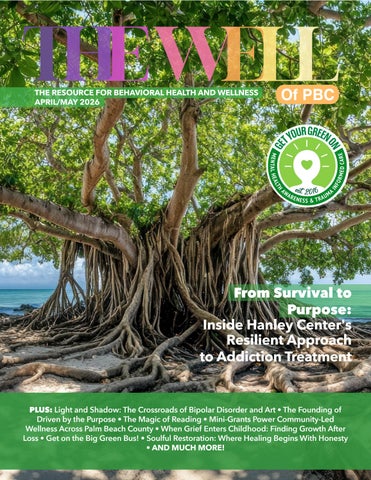
The Well of PBC - April/May 2026

Page 1


THE RESOURCE FOR BEHAVIORAL HEALTH AND WELLNESS APRIL/MAY 2026

PLUS: Light and Shadow: The Crossroads of Bipolar Disorder and Art • The Founding of Driven by the Purpose • The Magic of Reading • Mini-Grants Power Community-Led Wellness Across Palm Beach County • When Grief Enters Childhood: Finding Growth After Loss • Get on the Big Green Bus! • Soulful Restoration: Where Healing Begins With Honesty • AND MUCH MORE!

BEWELLPBC

Mini-Grants Power Community-Led Wellness Across Palm Beach County

THE WORD

When Grief Enters Childhood: Finding Growth After Loss

THE RESERVOIR

Get on the Big Green Bus!

THE DEPTH

Soulful Restoration: Where Healing Begins With Honesty

CORNER TALK "What does resilience look like in this season of your life?"

BEYOND THE COUCH

Get Your Green On: A Community Movement for Mental Health

ACORNS

THE

The Well of PBC would like to thank our distribution partners:

3 Demetrie’s Eatery - Montre G Bennett

Amyzing Spaces - Amy Bergman

Author Camisha Hollifield - Camisha Hollifield

Black Chamber of Commerce of Palm Beach County - Tracy Thomas

Center for Child Counseling - Hannah DeMarco

Children's Services Council of Palm Beach County - Shana Cooper

Community Partners of South Florida - Kelly Powell

District's Wellness Promotion Task Force - Megan Rimpel

Flawless Foundation - Janine Francolini

"Gelena Mental Health" Psychotherapist - Joycelean Baker

Hanley Foundation - Lindsey White

Kalimba Love - Kalimba Love

LaFrance Project - Lisa LaFrance

Nonprofit Nest - Jenell Harris

Palm Health Foundation - Vanessa Moss

People of Purpose - William Freeman

Rhonda’s Promise - Rhonda Rogers

The HUB Community Recovery of Palm Beach County - Faith Batt

Total Body Fitness with Rosa LLC - Rosa White

Khanna House Studios - Julie Khanna

Unity3 Palm Beach - Katrina Blackmon

Distribution partners are colleagues, neighbors and community members who commit to sharing The Well of PBC in their communication channels so that we can continue to make greater footprints together.

With a readership of thousands that covers Belle Glade to Lake Worth Beach to Jupiter to Boca Raton, The Well of PBC is a comprehensive, community-directed resource, dedicated to elevating the voices and concerns of all who call Palm Beach County home. Please join us as we advocate for mental health and work together to transform the behavioral health landscape. Your commitment helps us do exactly that.

To commit, please email thewellads@bewellpbc.org and let us know you’re interested in becoming a distribution partner.

/ LETTER FROM THE EDITOR

O“The concept of resilience is misunderstood. It isn’t about ignoring or pushing through the pain; it’s about sitting with it, learning from it and the understanding that you don’t have to go through it alone.”

ther than an appreciation for the Morikami Museum and a love of sushi, I don’t know all that much about Japanese culture but recently, I read a Japanese proverb and it’s been resonating in my brain ever since—a low, clear chime which dissipates the chaos and brings clarity.

Nana korobi ya oki which translates to fall down seven times, stand up eight.

If there is one certainty of which I am sure, it is that in life — you will fall.

A lot.

You will fall as a partner and as a parent. You will fall as a student and a teacher. You will fall as an entrepreneur and an artist. You will fall when it comes to things you love and the things you can barely stand.

And through it all, it’s vital to remember one thing—it’s not about the fall, it’s about the climb back up.

When I first opened my studio, I hosted a public event and spent the entire evening anxiously peeking at the door willing for someone, anyone, to come in. No one did that night and it was a worrying and humbling experience.

Can I do this? Should I do this? What if I can’t do this?

But it’s not about the fall, it’s about the climb back up.

Five years later, I am hosting that very same event but this time, I have a co-host excited to be there with me and a list of RSVPs who are already sharing their enthusiasm for what’s to come.

The climb back up wasn’t easy—it took time, patience and humility but during this ascent, I learned one incredibly powerful lesson—I might fall and end up in the dust, craning my neck back up at the mountain, but like dust—I rise.

The concept of resilience is misunderstood. It isn’t about ignoring or pushing through the pain; it’s about sitting with it, learning from it and the understanding that you don’t have to go through it alone.

We will fall—that is inevitable—but we are not stuck where we land.

We can rise and in doing so, learn, adapt, evolve and carve out the version of ourselves that we know we can be and were always meant to be.

Building a strong community is imperative to building resilience and my hope as the editor-in-chief of The Well of PBC is that we’re doing exactly that—uniting people, curating resources and encouraging friends and neighbors to reach out so we can all soar together.

As always, thank you for being part of the mission:

"To be the primary resource for behavioral health and wellness for Palm Beach County; a safe exchange space for community and an outlet for our neighbors and stakeholders to transform the behavioral health landscape."

With deep appreciation,

Our mission is to be the primary resource for behavioral health and wellness for Palm Beach County; a safe exchange space for community and an outlet for our neighbors and stakeholders to transform the behavioral health landscape.

To share feedback, obtain advertising information, or contribute, please reach us at thewell@bewellpbc.org.

The largest behavioral health publication in Palm Beach County, The Well of PBC is a non-profit magazine which aims to be a community-directed resource for Palm Beach County residents. Advocating for mental health accessibility is central to our mission and we believe in “walking the walk” when it comes to ensuring every Palm Beach County resident has the opportunity to have their voices heard. We are proud to use our platform to highlight both national and global concerns while remaining focused on local mental health and wellness issues that matter the most to our audience.

DISCLAIMER

The Well of PBC is proud to be the premier behavioral health and mental wellness publication in Palm Beach County and we are honored to elevate the voices and concerns of Palm Beach County residents. The opinions, beliefs and viewpoints expressed by the various authors and forum participants on this website do not necessarily reflect the opinions, beliefs and viewpoints of The Well of PBC. The author of each article published in The Well of PBC owns their own words. Portions of the articles on this web site may be freely redistributed in other media and non-commercial publications as long as the following conditions are met:

1) The redistributed article should should be linked back to the original link on https:// www.bewellpbc.org/media/the-well-of-pbc/ including the words “Read in full, visit https:// www.bewellpbc.org/media/the-well-of-pbc/”

2) The redistributed article may not be abridged, edited or altered in any way without the express consent of the author.

3) The redistributed article may not be sold for a profit or included in another media or publication that is sold for a profit wit vhout the express consent of The Well of PBC.

4) The articles on this web site may be included in a commercial publication or other media only if prior consent for republication is received from The Well of PBC. The Well of PBC may request compensation for republication for commercial uses.

5) All content including the original files, published digital or in-print material of The Well of PBC is the property of BeWell PBC. You may not copy, reproduce, distribute, transmit, modify, create derivative works, or in any other way exploit any part of our material without the prior written permission from BeWellPBC.

Call to Action: We are looking for people to contribute to our art, ask the experts, students, self-care, cultural, spiritual, and provider columns. Email us for our contributor guidelines, editorial calendar, or if you’d like to share an event or position you’re hiring for. E: thewell@bewellpbc.org | Follow along at @thewellofpbc

/ THE TEAM

EDITOR-IN-CHIEF

Julie, CEO of Khanna Connections, enjoys using her creativity to help health and wellness industries communicate with their audiences.

ADVISOR

Lauren is a licensed clinical social worker and Palm Beach County resident and professional with commitment to advance health and wellness for every person across the county. The Well of PBC is a passion project for Lauren to increase behavioral health awareness, engage diverse perspectives across the county, and promote solutions to address our county’s most complex challenges.

MARKETING MANAGER

Katrina, CEO of Unity3 Palm Beach and Community Action & Communications Administrator at BeWellPBC, brings over 25 years of executive advertising experience to The Well of PBC. Her passion for faith, family, and Palm Beach County’s diverse community drives her commitment to uplifting voices and advancing wellness through media and engagement.

CONTRIBUTOR

Melanie, president of Otero Communications, provides consulting services for some of Palm Beach County’s leading nonprofit organizations. With a special interest in behavioral health, she has assisted with the launch of The Well of PBC and serves as a contributing writer.

CONTRIBUTOR

Jaime, founder of Rosewood Media, is a West Palm Beach resident, creative and contributing writer to The Well of PBC. With a decade of experience in non-profit communications and a lifetime of experience as a writer, Jaime’s work focuses on behavioral health, diversity, equity and inclusion, travel, music, food and parenthood through a pop culture lens.

EDITORIAL SPECIALIST

Alita, BeWellPBC Coordinator, wishes to help make the behavioral health field more equitable and accessible for all in Palm Beach County, including those seeking services and those looking to work in the field.

CREATIVE DIRECTOR

Jessie is a creative director and brand strategist with fifteen years of experience at the intersection of publishing, marketing, and design. She serves as VP of Creative Strategy for a portfolio of real estate and development companies led by Arterra Realty, guiding brand, marketing, and creative initiatives across the organization.

JULIE KHANNA
JESSIE PRUGH
KATRINA BLACKMON
MELANIE OTERO
JAIME JOSHI ELDER
ALITA FABER
LAUREN ZUCHMAN

From Survival to Purpose: Inside Hanley Center’s Resilient Approach to Addiction Treatment

There is a space at Hanley Center’s Casa Flores that holds deep meaning for alumna Niki T. When she visits what was her bedroom ten years ago, now a room for pregnant mothers, she feels a sense of pride and connection. The calming features of the room—the comfortable bed, colorful artwork, soft lighting—are as she remembers them. Now there is the addition of a bedside crib, neatly folded baby clothes, and a stuffed puppy dog with floppy ears that brings a smile to her face.

“It feels very fitting,” she said.

When Niki arrived at Hanley Center in 2016, she had just been released from jail and was two months postpartum. Her newborn was in Department of Children and Families (DCF) custody in New Jersey. She had no insurance, no home, and no idea if she'd ever get her daughter back.

She was given a scholarship to Hanley for a new chance, with new motivation. Her newborn, Adley.

During the ten years prior, Niki had not maintained any period of sobriety. She had tried detox, experienced homelessness, and by her own account, “had plenty of consequences.”

Niki found at Hanley the understanding that addiction does not occur because of moral weakness, a lack of willpower, or an unwillingness to stop—even when the stakes for quitting are high.

“When I got to Hanley, it was broken down to me that that’s what substance use is—we can’t stop using in spite of the consequences or in spite of the people we may be hurting,” she said. “That’s just what this does.”

At Hanley, Niki began to understand addiction differently— as the brain doing exactly what brains are supposed to do, finding a way to manage pain, stress, or difficult circumstances. Drugs and alcohol can change moods, make people feel better, but as dependence grows, what started as relief becomes the source of greater damage.

About Casa Flores

Casa Flores offers a holistic and trauma-informed approach that includes a wide range of addiction treatment services aimed at empowering mothers and supporting babies from birth. Core components include:

Replacing those harmful patterns wasn’t just about stopping. It was about building the resilience to grow. Hanley’s holistic approach helped her address her needs across all aspects—physical, psychological, relational, and spiritual—to help her connect to the person and mother she wanted to be.

“I finally understood the importance of not just getting and staying sober,” Niki said. “There’s just so much more to life than that. I finally understood what it felt like to be a mother. And because of everything that I had gone through, I really wanted to go forward and do work that was meaningful to help people.”

A Life Built on Recovery

Niki is almost 10 years sober. She is now a mother of three—Adley, now nine, James, five, and Effie, just one year old. In 2020, she was hired by a state legal office based on her lived experience, representing mothers in the same dependency system she once navigated to get Adley back. With the support of a Garwood Foundation scholarship through Hanley Center, she earned both her bachelor’s and master’s degrees debt-free, and now serves as a forensic social worker on a multidisciplinary team working alongside attorneys for parents whose children have been removed by DCF.

Niki stays close to Hanley. She helped design services and support the launch of Casa Flores in October 2024, drawing on her own experience as an addicted pregnant woman, and continues to serve as a peer there — often bringing Effie along, pointing out her old room, and sharing the connection between then and now and her story of hope.

“I have seen people who, against all odds, despite what everybody else thinks around them, get sober and become functional members of society and regain relationships with their family and their children,” she said. “I was one of those people.”

• Trauma-Informed Care and Therapeutic Framework

• Parenting and Early Childhood Development Support

• Therapeutic Group Sessions

• Family and Child Services

• Postpartum and Birth Preparation Support

• Holistic and Alternative Therapies

• Case Management and Family Reunification

• Education and Life Skills Training

A Philosophy Built on Compassion, Not Judgement

Niki’s experience reflects a treatment philosophy that runs through everything at Hanley Center, one that Chief Clinical Officer Dr. John Dyben has spent 22 years building from the ground up—starting not as an executive, but as Hanley’s chaplain.

“We do not look at patients as bad people who need to learn how to get good, but as people with illnesses who are trying to get well,” Dr. Dyben said.

His approach is born of personal as much as professional experience. When he was called to serve as Hanley’s chaplain in 2004, Dr. Dyben was in the middle of his own struggles—newly divorced, with young children.

“I came here at a time of brokenness,” he said. “While I was working in the context of helping patients here heal, I was going through a healing process of my own that I didn’t even realize. The opportunity to serve at Hanley has been a game changer for me.”

Dr. Dyben says a significant part of healing is connection—and it’s what makes the Twelve Step program, in his view, so remarkable.

“It recognizes that part of what drives addiction is that people have become disconnected from life,” he explains. “To be healthy, human beings need to be connected to life. The Twelve Steps teach people how to connect to themselves, connect to other people, and then connect to life. For some people that means God. For some that means nature or the transcendent—the things that are bigger than you.”

Resilience is about recognizing the reality of life on life’s terms right here and right now, and learning how to deal with the reality of your life, your relationships, your conditions, in a way that will help you be healthy and continue to grow," Dr.Dyben said.

Healing Takes Time—and a Roadmap

Healing is not a quick process.

“To treat a chronic condition that affects body, mind, and spirit, and that is influenced by the environment and influences the environment—it takes tremendous time,” Dr. Dyben said. “It’s like you’ve been hit by a bus and broke every bone in your body.”

For Dr. Dyben and his team, the goal is to have a one-year roadmap for each patient—the time most people need to return their brains to normal functioning. Patients begin with Hanley’s residential program for a minimum of 45 days, engaging their entire mental, physical, spiritual, and family systems. Intensive outpatient care follows, with continuing support stepped down over time.

“Resilience is about recognizing the reality of life on life’s terms right here and right now, and learning how to deal with the reality of your life, your relationships, your conditions, in a way that will help you be healthy and continue to grow.”

A Rare Standard for Mental Health Care

Hanley’s approach recognizes that for most people, addiction rarely arrives alone.

“We’ve known for a long time that mental health and addiction—which is itself a mental health condition—are intertwined, and you must address them at the same time,” Dr. Dyben said.

Hanley Center’s Mental Health Program offers a rare approach for both co-occurring disorders and people living with chronic mental health conditions. The origin came from Hanley Center’s caring staff.

For years, patients whose mental health conditions became too acute during treatment had to be transferred out to other facilities. They would stabilize and sometimes return.

But again and again, the staff watched that happen and said the same thing: nobody treats patients like we do.

So they recommended a solution—a dedicated mental health unit that keeps patients within the Hanley environment when their needs escalate, with the same philosophy, the same standard of dignity and care. It also opened the door to treating patients with no substance use disorder at all and a deepening of trauma-informed care.

“Trauma-informed care recognizes that every patient who walks in the door has unresolved wounds,” Dr. Dyben explained.

Every staff member at Hanley Center—from the CEO to the kitchen staff—takes annual training to understand their part in creating a trauma-informed environment. Something as simple as inviting someone into a room and asking permission to close the door becomes an intentional act of care.

“When patients start receiving the level of care and compassion and acceptance that they get here—something just changes,” Dr. Dyben said. “And it’s this amazing thing.”

Chief Clinical Officer, Dr. John Dyben

Hanley Center’s Mental Health Program

Adult treatment for a range of diagnoses, including:

• Mood disorders

• Anxiety disorders

• Post-traumatic stress disorder

• Obsessive-compulsive disorder

• Personality disorders

The Rewards of Resilience

Niki has seen that change happen—in herself, and now in the mothers at Casa Flores. As she enters back through its familiar front door with Effie in her arms, she is grateful for the connections she’s made through Hanley to herself, her family, and her spirituality.

“I think so much of this just boils down to living a life with purpose and living a life that I feel good about today,” she said. “The amount of people and systems that are impacted by one person getting sober—it can be somebody’s entire world.”

Light and Shadow: The Crossroads of Bipolar Disorder and Art

As is the case with many young people, my symptoms for bipolar disorder began in early adolescence and went untreated.

In my early twenties, I was in talk therapy but the therapist wasn't practiced enough to recognize that I had a serious condition that wasn't amenable to talk therapy.

At one point, I had to take a leave of absence from my employment and seriously considered suicide.

Once I became more stable, the rest of our life proceeded joyfully and productively right up until the age of 50 when I was considering retiring at 55.

This depression was the worst of all in a number of ways.

Luckily, this time I was able to find a very caring psychiatrist and although the condition itself and the experimenting with various medications was truly brutal and horrific, I was able to be almost completely stable by the time my retirement date arrived.

I have been in maintenance ever since with very low doses of medication.

If this doesn't say resilience to you, I don't know what would.

laura at northport painting

"My artwork gets me out of my own head - what Buddhists call "monkey mind" - and allows me to totally focus on the task at hand. In a very real sense, it places me in an altered state of being where hours pass as if they were just minutes. The fact that something beautiful or thought provoking is created as a result is an added bonus!"

The Draw is a space for creatives to share their art, poetry, spoken word, etc. and/or how their art helps themselves and others.

To contribute, send your article ideas to thewell@ bewellpbc.org with "The Draw" in the subject line.

Annie with apple
young man with sleeping puppy
Catch of the day

May is Mental Health Awareness and Trauma Informed Care Month! for more visit: GetYourgreenon.org

thE SOurce thE SOurce

Resilience is often misinterpreted as the ability to withstand hardship. It is misunderstood as pushing through with a stiff upper lip - strong, silent and stoic.

While this mentality has permeated society for eons, especially when it comes to men and boys, we now understand that this can have a seriously detrimental effect on mental health.

True resilience is the ability to acknowledge the adversity and then endure, adapt and persevere through being buoyed by your loved ones and your community.

The Well of PBC is committed to serving as a comprehensive resource of mental health and community services in Palm Beach County. Acknowledging that people absorb and interpret information in a litany of ways, we are proud to offer resources in various mediums ranging from books and podcasts to videos and websites as well as various languages.

Our commitment to the residents of Palm Beach County starts with those very residents so if you have something you’d like to share, we encourage you to email us at: thewell@ bewellpbc.org and tell us about it so we might highlight it in a future issue.

Addressing Mental Health Challenges with Alpert Jewish Family Service (video)

The events of October 7, 2025 affected Palm Beach County’s Jewish community deeply and this video from the Jewish Federation of Palm Beach County explores how antisemitism, threats to Israel, and the trauma of October 7 impacted people and how Alpert Jewish Family Service’s Mental Health Fund is working to ensure residents have the access to services they need.

Being Well Podcast: Understanding and Managing Stress: Causes, Biological Basis, and Increasing Resilience (video)

Psychologist and Senior Fellow at UC Berkeley’s Greater Good Science Center, Dr. Rick Hanson, and cohost and author Forrest Hanson take a deep dive into understanding and managing stress, how it functions, how it impacts our lives and bodies, and what we can do to repair from its effects.

Black Joy: Stories of Resistance, Resilience, and Restoration by Tracey M. Lewis-Giggetts (book)

A collection of lyrical essays which speak about the evolution of joy despite trauma, Lewis-Giggetts identifies Black joy as a resource which can be drawn upon and counter the narrative that Black stories are solely about struggle and trauma.

Resilience and Mental Health Among LGBTQ YouthThe Trevor Project (website)

The Trevor Project is the world's largest suicide prevention and crisis intervention organization for LGBTQ (lesbian, gay, bisexual, transgender, queer & questioning) young people under 25 and in 2022, they released a research brief which explored how personal resilience— defined as the ability to "bounce back" from adversity—impacts the mental health and suicide risk of LGBTQ youth.

They found that high resilience is strongly associated with better mental health outcomes and that LGBTQ youth who have supportive families and are in supportive environments have higher resilience. Compared to those with low resilience, LGBTQ youth with high resilience reported:

• 81% lower odds of anxiety symptoms.

• 79% lower odds of recent depression.

• 69% lower odds of considering suicide in the past year.

• 59% lower odds of attempting suicide in the past year.

While this information is important, the authors call for systemic changes to address the root causes of marginalization—such as racism, sexism, and anti-LGBTQ bias—to create a world where LGBTQ youth can thrive rather than just survive.

The Founding of Driven by The Promise

I founded Driven by The Promise in 2024 as a youth initiative inspired by both personal loss and a deep commitment to advancing the mission of The Promise Fund.

Before I was born, my paternal grandmother passed away from breast cancer at the age of 40. Although I never had the chance to meet her, her absence has always been felt within my family. Growing up knowing her story instilled in me a deep awareness of how devastating the loss of a mother or grandmother can be, and no family should have to experience that kind of absence.

As I learned more about the extraordinary work of the Honorable Ambassador Nancy Brinker and The Promise Fund, I felt a powerful connection to her and her mission of preventing deaths from breast and cervical cancer through early detection, access to care, and education. The cause hit home for me personally, and I felt an inner calling to become more actively involved.

Motivated by this connection, I designated Driven by The Promise as the official youth chapter of The Promise Fund with Ambassador Brinker and Donna Dobson and Julie Thayer at the Promise Fund organization. My goal was to bring together students who share a commitment to

advocacy, service, and raising awareness among younger generations.

Following its founding, I began inviting fellow students to join the movement by taking a pledge to support the mission of The Promise Fund. Members of Driven by The Promise commit to advocating for women’s health, volunteering their time, and helping raise awareness and resources for lifesaving screening and prevention programs.

Through youth leadership, community engagement, and a shared commitment to honoring those lost to cancer, Driven by The Promise ignites the next generation to stand behind a promise that no woman should lose her life to preventable cancer.

The Fountain is the space for youth contributors and youth-related topics.

To contribute, send your article ideas to thewell@bewellpbc.org with "The Fountain" in the subject line.

Get Your Green On Campaign Talking Points

Why the Get Your Green On campaign?

• The campaign is in honor of national Mental Health Awareness Month (May).

• Palm Beach County also honors trauma-informed care as part of the campaign.

• Green is the national color for mental health awareness

• The Get Your Green On campaign aims to raise awareness by creating visible support (by wearing green on the 3rd Thursday of May) and fostering safe spaces to talk openly about behavioral health and trauma.

What is the story of the Get Your Green On campaign?

• Began in May 2016 – Healthier Delray Beach and students at Atlantic High School wanted to encourage the community to give attention to their mental health and wellness. Everyone was encouraged to wear green and post pictures on social media.

• In 2017, 2018 and 2019:

o Birth to 22: United for Brighter Futures (an alliance of Palm Beach County community providers) partnered with Healthier Delray Beach to take the campaign countywide.

o More than 100 providers, government agencies, schools, media outlets and businesses participated each year and over 6000 individuals wore green and posted pictures.

o The Palm Beach County Board of County Commissioners, 15 additional cities, and multiple agency Boards of Directors adopted Mental Health Awareness and Trauma-Informed Care Proclamations in the month of May.

• In 2020 and 2021, the community celebrated the annual Get Your Green On campaigns virtually due to COVID-19. Recognizing the toll the pandemic was taking on resident mental health, the campaign was more important than ever to encourage self-care.

• Now during May every year, Palm Beach County honors behavioral health again, encouraging everyone to care for themselves and the people around them. The month of May includes Mental Health Awareness Proclamations, trainings and awareness events across the county, and the social media campaign on the third Thursday of the month to get everyone wearing green.

• We are excited to celebrate 11 years of the campaign in May 2026!

Why is mental health awareness and trauma-informed care important?

• 1 in 4 adults and 1 in 5 youth (ages 13 to 18) experience serious mental health concerns.

• 26% of children experience a traumatic event before the age of 4.

• 60% of adults and 50% of youth in need of treatment do not receive help due to limited/no knowledge of their mental health needs, barriers to receiving care, or fear and shame.

• Communities can change these statistics by promoting awareness about behavioral health and offering trauma-informed care.

Where to find more information about the campaign, how to get involved, resources, and a social media toolkit?

• www.GetYourGreenOn.org

• The Well of PBC April/May 2026 edition coming soon! https://www.bewellpbc.org/media/thewell-of-pbc/

The Magic of Reading

What if a simple, enjoyable habit could profoundly improve your life?

Imagine if it could sharpen your mind, boost your mood and even enrich your relationships?

It sounds like magic, but it’s the remarkable reality of recreational reading.

Books are powerful, accessible tools for lifelong growth. The benefits of reading for pleasure are extensive, far beyond the joy of a good story. From enhanced brain function to increased empathy, reading has the potential to transform your world.

Here are six powerful ways recreational reading can improve your mental health and wellness:

• Experiencing Brain-Boosting Magic—Cognitive Benefits: Reading acts as a powerful workout for your brain, improving memory, focus and general knowledge.

• Providing Doses of Self-Care—How Reading Boosts Mental & Emotional Well-being: Getting lost in a book can reduce stress, improve sleep and foster emotional resilience.

• Building Bridges—The Social Benefits of Reading for Pleasure: Even though reading is often a solo activity, it builds empathy, improves communication and combats loneliness. It helps you engage with diverse characters and their experiences in fiction, allowing you to step into different perspectives. It opens the door to understanding the thoughts and emotions of people whose lives are different from your own. This directly translates to real-life emotional intelligence, making you a more compassionate individual.

• Expanding Language—Improves Communication Skills: By absorbing an extensive vocabulary and observing how authors structure dialogue, reading helps in articulating thoughts more effectively. This boost in communication skills can increase confidence in both personal and professional settings.

• Fostering Interpersonal Growth—Offers Opportunities for Connection & Belonging: Reading can combat loneliness by creating shared experiences. Discussing favorite books in book clubs, sharing recommendations with friends or relating to characters' struggles can grow deep connections and build a sense of community.

• Boosting Social Mobility—Driving Life-long Success: Studies suggest that whether a child reads for pleasure can be a stronger predictor of their academic success and social mobility later in life. Reading helps reduce educational inequalities and offers a pathway to a better future.

The Palm Beach County Library System offers a transformative path through its dedicated Rediscover Reading initiative. This community hub makes it easy for members to set personal goals and reconnect with stories. Book Club in a Bag Kits and BookSquad recommendations jump-start reading, while Beanstack challenges and social events turn a solitary hobby into a community experience. To discover more about Library offerings visit www.pbclibrary.org.

From community events to county-wide campaigns, The Real shows us what’s really going on in the county. Submit your event photos or news to thewell@bewellpbc.org.

Mini-Grants Power Community-Led Wellness Across Palm Beach County

The 2025 Be Well Do Well Mini-Grant recipients are turning compassion into action across Palm Beach County. These 15 awardees reflect the heart of BeWellPBC’s mission: empowering residents to lead locally inspired solutions that strengthen mental wellness, belonging, and resilience in the communities they know best.

This year’s recipients are meeting people where they are, through food, movement, storytelling, culture, and care. Montre Bennett’s Mindfulness & Food Gathering Series creates monthly spaces where neighbors can learn healthy cultural recipes, practice mindful eating, and build leadership through reflection and connection. William Freeman’s Pickleball with a Purpose uses sport to bring returning citizens and families together through teamwork, healing, and second chances.

Several projects focus on closing care gaps and improving access to support. National Coalition of 100 Black Women, Inc. West Palm Beach Chapter is addressing Maternal Morbidity in the Black Community by advocating

for Black mothers and families through education, telehealth partnerships, and expanded prenatal and postpartum care. Christian Sanon’s PEARL on the Go brings behavioral health tools, caregiver coaching, and early childhood support directly into neighborhoods through a mobile twogeneration approach. Myriam Pierre’s Project Wellness makes self-care joyful and accessible through bilingual Wellness Saturdays that include mental health workshops and family outings.

Youth and families are also at the center of many awardwinning ideas. C. Ron Allen’s Lift & Lead blends aviation and equine-assisted wellness to build resilience and behavioral health among youth. Samantha Cyprian’s Soul Movement offers monthly wellness sessions that combine rhythm, reflection, and expressive arts to help young people grow in confidence and emotional awareness. In the Glades, Shanique Scott’s Ascension 33’s FitHub uses dance and fitness to nurture youth mental, social, and emotional wellness while uplifting entire families.

“The 2025 Be Well Do Well Mini-Grant recipients are turning compassion into action across Palm Beach County.”

Other projects are creating spaces for healing, restoration, and shared understanding. The Pink Queen Foundation’s Hope Basket Program supports cancer survivors and their families with personalized wellness baskets and holistic healing activities. C. Veree’ Jenkins’ Wellness Wednesdays provides mini-retreats for staff and volunteers with mindfulness, meditation, and journaling to prevent burnout. Lolita Jackson’s Compassion Fatigue Masterclass equips grassroots nonprofit leaders with practical self-care tools to sustain their service.

Storytelling and culture also shine through this year’s awardees. Gemima Kerren Cadet’s Alo Vwazin (Hello Neighbor) connects Haitian and English-speaking families through a bilingual podcast and listening series focused on wellness and mental health. Olen Whitely’s Motivated by the Lens uplifts emotional well-being through authentic video stories of resilience and joy. Susana Rivero’s P’alante offers a confidential multilingual healing space for immigrant domestic workers. Zeta Phi Beta Sorority, Inc., Omicron Delta Zeta Chapter ODZ Legacy & Resilience Circles brings generations together through storytelling, history, and healing, culminating in a community anthology.

Together, these changemakers are creating a stronger, more compassionate Palm Beach County, one mindful meal, dance step, conversation, and story at a time.

Get to know these amazing awardees visit www.bewellpbc.org/mini-grants/

Follow our social media @bewellpbc

When Grief Enters Childhood: Finding Growth After Loss

One in 12 children will experience the death of a parent or sibling by the age of 18. An estimated six million children will be affected in the United States alone. The amount grows exponentially once other deaths in their lives are factored in. These statistics can feel overwhelming. Many worry that these children will be irreparably harmed from their loss. While the death of a loved one is often traumatic, that is not the end of their story.

I know this from experience. My story begins when I was 16 and my friend John died by suicide. While this was not the first death I faced, it was the one that helped set me on my journey. As a Gen X teen, I felt the impact of stigma surrounding mental health, suicide and death. Statements like, “aren’t you over that?” or “you’re still talking about that?” resounded. While I had a supportive family, I had no peers to process my loss with, no therapist and few supports. I poured my heartache out into drawings, dancing and singing. These experiences shaped who I would become – a therapist who uses art, play, sandtray and working with horses to process the unimaginable.

For years I have served children, tweens and teens after a death. What I have seen over the course of time is resiliency in the face of stigma, loneliness and grief. The ability for children to grow through loss is rooted in a few basic principles. The better that the adults in their life are doing, the better the child will do. Ensuring that their caregivers get support will have enormous benefits for the children in their lives. Children crave structure and routine. Not the stifling schedules we often see with every minute of the day booked with activities, sports and tutoring; rather, the rituals and routines of time spent together, walks, game night, bedtime and family dinners. This helps ground them when the world feels like it’s spinning out of control. Families and supports who share about the person who died easily allow for memory making. A casual mention of a favorite activity, like, or shared story about their person who died allows children to build a relationship with their memory. Sharing and resharing pictures, videos and stories, helps the process of memory keeping.

“Childhood grief and loss is ever present. Believing that children will be forever victims of these circumstances hinders their grief journey.”

Children, tweens and teens need the support of their peers to help normalize their loss. Being surrounded by others who have experienced similar events allows them to feel accepted and typical. Children also need facts, age-appropriate explanations about death. I have been privileged to be able to explain everything from heart attack to suicide to murder to children. By providing facts, not euphemisms, they can embark on their grief journey with fewer obstacles. While it may seem odd or cruel to our adult minds, children cannot grasp metaphors often used. Passed away, in a better place, with the angels is understood by children in a completely different way than intended. Their brains cannot understand the concept of death until at least seven, which means that they will believe their person is coming back despite being able to use the words dead correctly in a sentence. The gap between saying and knowing is vast.

Childhood grief and loss is ever present. Believing that children will be forever victims of these circumstances hinders their grief journey. I have been grateful to be a witness to what is called Post Traumatic Growth –finding a new path, becoming a new version of self after grief, loss or trauma. It took me many years to realize that was my journey as well.

Marla Berger, LMHC, ART, RPT-S™, RST C/T, EMDR Trained, Certified AutPlay Therapy Provider®, Eagala Advanced Certified, Natural Lifemanship Intensive Trained Clinician

Marla is a Licensed Mental Health Counselor, Registered Art Therapist, Registered Play Therapist - Supervisor™, Registered Sandtray Therapist Consultant/Trainer, Certified AutPlay Therapy Provider®, EMDR Trained, Qualified Supervisor, Natural Lifemanship Intensive Trained and an Eagala Advanced Certified Professional. In other words, she loves experiential therapies! Marla founded Berger Counseling Services in 2009 and has presented locally and nationally on experiential services, trauma and bereavement. Her practice is located in Parkland and Coral Springs. She hosts a monthly networking group called Creative Coffee Hour with a new topics each month and free CEU’s.

The Word is a broad topic space for contributing writers (a.k.a the community) to share your stories of behavioral health or anything self-care related i.e. fitness, health, educational, parenting, hobbies, wellness, etc. To contribute, send your article ideas to thewell@bewellpbc. org with "The Word" in the subject line.

Get on the Big Green Bus!

Adam S. Davis, Assistant Director Palm Beach County Youth Services Department | https://discover.pbc.gov/youthservices/Pages/default.aspx | @pbcysd

As the Get Your Green On (GYGO) campaign grinds into full gear, I think about all of the amazing places in Palm Beach County that serve as support for its residents to experience mental wellness.

At the time that this article is written, GYGO organizers are mapping a guided bus tour that will introduce members of the public to locations spanning Palm Beach County that highlight the vast ecosystem of mental health resources at each and every person’s fingertips.

Consider this your curated travel guide of sorts around our beloved county to explore just a fraction of what it offers in the way of mental wellness:

The Journey Begins: We start off with the Sanctuary® Model’s community meeting – a daily ritual, asking: “How are you feeling?”, “What is your goal?”, and “Who can you ask for help?” to build emotional safety and intelligence.

Our first stop is at the Grey Team in Boca Raton. This program’s mission is to prevent veteran suicide through cutting-edge research and individualized wellness programs that transform veteran care. It is a true marvel to be witnessed.

Onward towards the Morikami Museum and Japanese Gardens! This lush gem fosters mental wellness through serene, meditative paths that encourage mindfulness and a restorative connection with nature.

We’re staying in Delray Beach to visit Palm Beach County Fire Rescue Station 42 on Hagen Ranch Road to learn more about their Mobile Integrated Health Unit, a model of support known throughout the nation! This team’s social workers provide crisis intervention and care coordination for frequent 911 callers, connecting them to vital mental health, addiction, and safety resources.

How are you feeling?

What

is your goal?

Who can you ask for help?

Eastbound we go to Recovery Community HUB of Delray Beach, a non-clinical, peer-led resource center that supports individuals and families impacted by substance misuse through recovery coaching, advocacy, and connection to essential community services. This is one of three HUBs in the County – others are located in Lake Worth and Belle Glade.

We keep heading north until we get to the Boynton Beach City Library, where we are greeted by Healthier Boynton Beach, a community-driven initiative with programs like “Caregivers Club” (in partnership with BeWellPBC) that gives a safe space for caregivers to care for one another.

Behavioral Health and Substance Use Disorder Steering Committee member Pastor Rae Whitely joins us and describes his role in strengthening county-wide behavioral health and recovery policies.

One of the most prolific organizations in Boynton Beach and a backbone support for Birth to 22 is Children’s Services Council of Palm Beach County, where we receive a tour of their green facility that hosts the staff that uplift so many non-profits and services that Palm Beach County residents rely on.

As we near the end of the tour, we head into West Palm Beach to visit the Palm Beach County Library System’s

Main Library, one of 18 branches offering free library cards to access vast mental health resources and diverse collections. Everyone can also register for free wellness classes, including singing bowl sessions, yoga, and tai chi.

By now, the tour is winding down, but not without visiting one of the most unique services Palm Beach County has to offer – Highridge Family Center.

Here, youth ages 11-16 and their families receive a vital, cost-free lifeline through trauma-informed, residential services where supports are offered for healing, learning, and growth through a collaborative blend of professional therapy and on-site education.

I hope you enjoyed this mental wellness tour through Palm Beach County. This was just the tip of the iceberg! In order to find out more about the services we didn’t visit, please join me in partaking in all that Get Your Green On month has to offer throughout May!

The Reservoir is the cultural space for contributors to highlight customs, celebrations, holidays, rituals, and more. To contribute, send your article ideas to thewell@ bewellpbc.org with "The Reservoir" in the subject line.

Soulful Restoration: Where Healing Begins With Honesty

In West Palm Beach, a different kind of church gathering is taking shape.

At Soulful Restoration, people hear something many have never heard inside a church before.

It is okay to not be okay. But it is not okay to stay that way.

Soulful Restoration is a recovery church built on a simple belief.

Jesus meets people in the middle of their struggle, not after they have cleaned up their lives. The ministry operates less like a sanctuary for the perfect and more like a hospital for the wounded. It is a place for people battling addiction, facing grief, carrying trauma, or trying to rebuild their lives one day at a time.

The ministry is rooted in the outreach of Friendship Missionary Baptist Church in West Palm Beach and was cofounded by Senior Pastor Dr. Jamian Lovett and community leader Pastor Rae Whitely.

The vision grew from a need leaders saw in the community.

Decades after the crack epidemic devastated families and neighborhoods, many people still live with its aftershocks. Addiction, incarceration, broken relationships, and untreated trauma continue to shape lives long after the headlines fade.

Soulful Restoration was created to offer a place where those still carrying those wounds can begin healing.

Soulful Restoration meets every Thursday from 6 PM to 8 PM at 718 3rd Street in West Palm Beach, Florida. The gatherings draw people from across Palm Beach County who are seeking recovery while reconnecting with faith and community.

Each evening blends worship, testimony, honest conversation, and practical support. Before the service begins, guests can meet community partners who connect people to mental health services, substance use recovery programs, housing resources, and other forms of support.

The ministry also receives coaching and guidance from the Recovery Church Movement, a national network helping churches build faith-based recovery communities. The goal is simple, build a bridge between the recovery community and the local church so that faith and healing move forward together.

Inside the gatherings there are no polished stories or perfect testimonies.

There are real people and real journeys.

A man who once lost everything to addiction now celebrates another year sober.

A woman rebuilding her life after prison shares how faith helped her begin again.

At Soulful Restoration, nobody has to pretend. The message is simple.

Real people. Real recovery. Real God.

The Depth digs deep into faith and fellowship at the neighborhood level. Email thewell@ bewellpbc.org with "The Depth" in the subject line for a chance to be featured.

"What does resilience look like in this season of your life?"

Jazmine Luna Flores

“My resilience is currently defined by expansion in the face of adversity. While I’m scaling my business to serve more celebrity clients, I’m also navigating the complexities of living with endometriosis. I’ve discovered that I don’t have to choose between my health and my hustle; instead, I’m building a life where my passion for makeup artistry far outweighs any physical pain.”

Cassy Romelus

“Resilience for me right now looks like showing up even on the days I feel unsure or stretched thin. It’s learning to pause instead of pushing, practicing boundaries even when it’s uncomfortable, and reminding myself that progress doesn’t have to be perfect to be meaningful. Some days resilience is strength, and some days it’s simply not giving up on who I know I’m becoming.”

Tiffany Joi Lanier

“My resilience is directly correlated to how much I am willing to deepen my capacity for change. From starting a new business to moving to processing all that is shifting in our society, I have to be extra intentional about how I show up and take care of myself every day because it's easy to get lost in the chaos of it all. So each morning, I ask myself: "What do I need today?" and this simple morning question allows me to be present with what I'm feeling, to listen and be honest about those needs. It's tuning in and taking the necessary action each day (and of course giving myself grace along the way when it just feels too much), is how I strengthen my resiliency in His season.”

Eliscart Ovilma

“In this season of my life, resilience looks like choosing discipline over reaction, discernment over noise, and rootedness over performance. As everything around me shifts, discomfort no longer defines; it sharpens my vision. What once distracted me now develops me, strengthening both my focus and my foresight. The transformation may be quiet, but it is intentionally shaping how I lead, how I build, and how I serve.”

Selena Buongiorno

“Resilience in this season of my life looks like learning to adjust without losing momentum. It is honoring my energy, focusing on what truly matters, and releasing the pressure to do everything perfectly. I have come to see that resilience can be quiet, found in showing up for your family, your work, and yourself in meaningful ways. To me, resilience is choosing to move forward with intention, gratitude, and purpose each day.”

Satya Nauth

“Resilience right now looks like choosing myself without apology. It’s no longer proving my strength through exhaustion or self-abandonment. It’s building a life where my value isn’t negotiable and my dreams aren’t deferred. My worth and my work are finally allowed to coexist.”

Mary Marde

“Resilience in this season of my life looks like rising at 75 years young with wings fully open. It looks like trusting my vision, building community, and choosing courage over comfort. I’ve learned that reinvention isn’t a one-time event—it’s a way of life. Here in Wellington, resilience means I soar.”

Elizabeth Quinones

At this season of my life, I’m learning what it’s like to be still and calm during thunderstorms and not cry every day.

In 2019, my sister was murdered and five years later, while I was opening a restaurant, I was diagnosed with cancer for the fourth time. My grandmother passed away that same week and my significant other cheated on me a few months later.

Unfortunately, the restaurant closed the following year and I’ve been trying to get back on my feet. I have been in healthcare for 20 years and do have a lot of connections in the industry. I’m currently working with some friends on a project and finding my way back to myself.”

GET YOUR GREEN ON: A Community Movement for Mental Health

Get Your Green On is not just a campaign, it’s an all-year long movement building from Mental Health Awareness and Trauma-Informed Care Month in May.

The Well of PBC asked the three co-chairs of the countywide campaign to tell us more about the history of Get Your Green On this year's focus on resilience, and how you can join the movement!

Q. The simplicity of wearing green on a specific day creates a powerful, low-barrier entry point for mental health advocacy. For a young person or a resident who might be intimidated by traditional therapy, how does this act of 'visible support' serve as a bridge to deeper self-care and community connection that traditional systems might miss?

A. Wearing green on the third Thursday in May may seem like a small gesture, but within the Get Your Green On campaign, it becomes a powerful first step for people who may feel intimidated by traditional mental health systems. This simple, visible act offers a low-pressure way for young people and residents to show support for mental health and trauma-informed care without needing to share personal experiences or navigate clinical settings. In a county where 1 in 4 adults and 1 in 5 youth experience serious mental health concerns—and more than half never receive help due to fear, shame, or limited understanding— visible community support matters. Wearing green helps normalize conversations, reduce stigma, and signal that mental health is a shared priority.

What began in 2016 as a grassroots effort by Healthier Delray Beach and local students at Atlantic Community High School has grown into an 11-year, countywide movement led by Birth to 22: United for Brighter Futures. Today, cities, schools, providers, and thousands of residents participate through proclamations, events, and social media campaigning.

By showing up in green together, Palm Beach County creates approachable entry points to deeper self-care and community connection—reminding everyone that healing is something we can step into collectively.

Q. By integrating mental health awareness into everyday activities like Zumba, jazz nights, and social media contests, GYGO effectively meets people where they already feel comfortable. As leaders of this movement, how do you see this model of 'mental health without the walls' evolving to ensure that wellness becomes a permanent, celebrated part of our cultural lifestyle rather than just a month-long observance?

A. Over the past decade, Get Your Green On has shown us something powerful: when mental health conversations move outside of clinical spaces and into everyday life, people respond. They show up. They participate. And most importantly, they begin to see wellness as something they can actively practice rather than something they only seek when they are in crisis.

From the beginning, the campaign amplified community spaces like barbershops, parks, schools, faith communities, fitness classes, and social events to normalize conversations about emotional wellbeing. When someone encounters mental health messaging while dancing at a Zumba class, attending a jazz night, or participating in a community scavenger hunt, the conversation becomes less intimidating and far more human.

But over time we recognized something important: while awareness in May was powerful, emotional wellbeing does not operate on a seasonal calendar. People experience joy, stress, grief, healing, and resilience every single day of the year.

That realization led to the expansion of the campaign into #GYGO365, which represents the idea that “getting your green on” is not just a once-a-year moment, it’s a daily practice of caring for our emotional health, supporting one another, and reducing

stigma in our communities. Through #GYGO365, we invite people year-round to check in with themselves, reach out to someone who may be struggling, and celebrate the everyday practices that sustain wellness through laughter, connection, movement, creativity, and community.

As we launched, we also introduced the color orange alongside green to represent unity and partnership. The playful phrase “Orange You Glad You Got Your Green On?” reminds us that mental health awareness grows strongest when communities work together. This campaign was never built by one organization alone, it grew through youth leaders, residents, nonprofits, local governments, schools, and behavioral health providers all choosing to move in the same direction.

Looking ahead, the model of “mental health without walls” will continue to evolve by embedding wellness into the rhythm of daily life through community events, creative expression, youth leadership, environmental connection, and digital storytelling that reaches people wherever they are.

Our goal is simple but transformative: to ensure that caring for our mental health becomes as normal and visible as caring for our physical health. When that happens, wellness stops being a once-a-year observance and becomes part of our culture.

Q. Get Your Green On famously moved the conversation from clinical offices into the vibrant fabric of the community—barbershops, fashion shows, and scavenger hunts. Looking back on the decade since this began as a student-led spark, how has this 'non-traditional' approach shifted the community’s identity from one of 'coping with trauma' to one of 'active, visible healing'?

A. When Get Your Green On began, it was a bold idea driven by students who understood something instinctively: talking about mental health doesn’t have to happen behind closed doors. Those early student leaders brought the conversation into the school courtyard and made it fun, visible, and accessible. Over the past decade, that non-traditional approach has reshaped how our community understands and communicates about mental health. What began as an awareness activity evolved into a countywide culture shift, one that moved mental health from the private and clinical into the shared, human, and everyday. Meeting people in the community, on runways, in parks, and through playful activities like our scavenger hunt has created a variety of safe spaces for discussion, connection, and meaningful engagement.

As a result, we’ve witnessed a powerful transformation: our community is moving beyond merely coping and instead embracing healing in ways you can see, participate in, and experience together. The founding students chose the name Get Your Green On because green is the national color for mental health awareness. From there, the campaign has naturally gravitated toward deeper engagement with the healing power of the outdoors. That evolution reflects a growing body of evidence showing that time in nature reduces stress, anxiety, and depression and supports emotional balance and overall wellbeing. Research from national nature-prescription programs demonstrates that spending even two hours a week outdoors can improve mental and physical health by reducing stress and supporting healthier habits.

Our 2026 theme, Rooted in Resilience, builds on this science and reflects our commitment to nature-based healing. This year, community members can deepen their resilience through nature in countless ways, whether

participating in our Goose Chase app’s outdoor challenges, attending the annual butterfly release hosted by the Faulk Center for Counseling, joining special events offered by Palm Beach County Parks & Recreation and Environmental Resources Management, and completing challenges presented in the PBC Park Rx booklet (https://discover.pbc. gov/parks/Pages/ParkRx).

This year’s nature focus is a natural evolution of the founding vision. Nature reminds us that growth is ongoing, connected, and within our reach. By grounding mental health awareness in open, accessible, and vibrant outdoor spaces, Get Your Green On continues to move us from awareness to action, toward a community identity where healing is visible, shared, and deeply rooted in resilience.

More at GetYourGreenOn.org

Beyond The Couch highlights non-traditional mental health outlets and resources in Palm Beach County. To contribute, send your article ideas to thewell@bewellpbc.org with "Beyond the Couch" in the subject line.

May is Mental Health Awareness and Trauma-Informed Care Month

Mental health and school success are closely linked, with untreated mental health challenges creating barriers to success. School-based mental health is becoming a vital part of student support systems. Mentally healthy students are more likely to go to school ready to learn, actively engage in school activities, and have supportive and caring connections with adults and young people. Positive relationships and environments, opportunities for community engagement, and supporting emotional growth can help youth to become healthy, resilient adults.

The Get Your Green On campaign increases awareness of mental health and trauma-informed practices. Supporting the emotional growth of young people, creating positive environments and relationships, and offering avenues for community involvement are key strategies. These actions can mitigate stressors and equip youth to mature into healthy, resilient adults.

The Get Your Green On campaign is dedicated to increasing knowledge about mental health and promoting trauma-informed approaches.When schools, families,

students, and communities work together and provide trauma-informed mental health care, students receive the support and resources needed to excel in school and throughout their lives. The Department of Behavioral and Mental Health in the School District of Palm Beach County provides services to school staff, families, and students throughout the District.

It’s OK to be OK. It’s OK to not be OK. It’s OK to ask for help.

If your child needs help, please contact your school and ask for their school counselor or school behavioral health professional.

SUPPORTING THE EDUCATORS

WHO SUPPORT PALM BEACH COUNTY’S YOUNGEST LEARNERS

Through the CSC STAR Award, Palm Beach County is investing in the early learning educators who help build the foundation for school readiness and lifelong success.

Across Palm Beach County, early learning educators play a pivotal role in helping children birth-to-five grow, learn, and thrive during their most important developmental years. Research shows that 90% of brain development occurs by the time a child is five years old. From a child’s first words to early literacy, math, and critical thinking skills, early learning educators help build foundational skills during this important window.

Early learning is also now recognized not just for the role it plays in children’s lives during their first five years, but also for the pivotal place it holds in shaping our business, community, and economic infrastructure. Families of young children can reach their professional goals knowing their child is thriving in a quality early learning program. Investing in early learning also has long-term benefits. Children who attend quality early learning are more likely to graduate high school, attend college, reach their professional goals, and have better overall health outcomes.

To recognize and support this essential workforce, the Children’s Services Council of Palm Beach County (CSC), in partnership with the Early Learning Coalition of Palm Beach County (ELC), offers the CSC STAR Award, a salary supplement program designed to reward educators who are committed to the field of early learning.

Through the CSC STAR Award, educators are recognized for their longevity in the early learning field and their continuing education. Applying for the CSC STAR Award is streamlined through the Florida Early Childhood Professional Development Registry, ensuring that educator experience, as well as credentials and degrees are reflected in the award process.

By investing in early learning educators, CSC and ELC are investing in its future. Programs like the CSC STAR Award ensure that the talented early learning professionals who support our county’s youngest learners can continue to grow in their careers while helping children develop the confidence, curiosity, and skills they need to succeed in school and the future.

For more about the CSC Star Award visit CSC Star Award| Early Learning Coalition of Palm Beach County.

The Providers is a space for providers, practitioners, thought leaders, and systems change leaders to share. To contribute, send your article ideas to thewell@bewellpbc.org with "For The Providers" in the subject line.

Turn static files into dynamic content formats.

Create a flipbook
The Well of PBC - April/May 2026 by BeWellPBC - Issuu