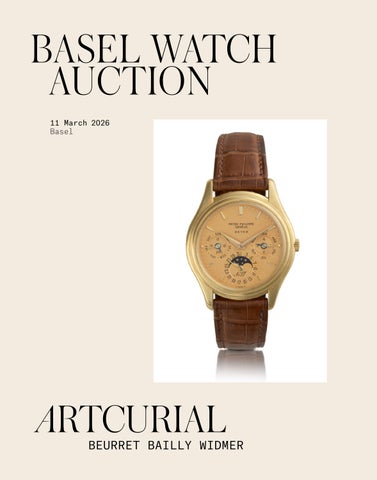
BASEL WATCH AUCTION
11 March 2026
Basel


![]()
11 March 2026
Basel


11 March 2026 - 5pm
Schwarzwaldallee 171
4058 Basel

Nicolas Beurret Director Associate

Nadja Scribante Amstutz Managing Director Romandy

Monticelli Auctioneer & Client Services


Bailly Director Associate

Sonderer Managing Director Eastern Switzerland


Geoffroy
Auction No. 38
Basel
from Thursday, 5 March until Sunday, 8 March daily from 10 am to 5 pm
11 March 2026 – 5pm
Basel Watch Auction Lot no. 400–428
Special conditions for watch auctions: page 51
11 March 2026 – 11am
International Art before 1900 Lot no. 1–125
11 March 2026 – 2pm
Swiss Art Lot no. 200–314
The auction will be streamed live at: bbw-auktionen.com
Discover our catalogues
Artcurial Beurret Bailly Widmer is a partner of the Art Loss Register. All items in this catalog, provided they are clearly identifiable and have an estimated price of at least CHF 2 500, were checked by the Art Loss Register prior to the auction.

Information & Online catalogue bbw-auktionen.com
Basel
Schwarzwaldallee 171, 4058 Basel +41 61 312 32 00 info@bbw-auktionen.com
St. Gallen
Unterstrasse 11, 9001 St. Gallen +41 71 227 68 68 info@bbw-auktionen.com
Zurich
Kirchgasse 33, 8001 Zurich +41 43 343 90 33 info@bbw-auktionen.com
Geneva
28 rue de Saint-Léger, 1204 Geneva +41 22 310 32 57 n.scribante@bbw-auktionen.com
Lots 400 to 428


Ref. 49529, No. 45, circa 2014
A 18k rose gold chronograph wristwatch with tachymeter scale and date indication
Case: round shape, snap-on transparent case back, signed
Dial: slate grey with baton applied hour markers, 2 subsidiary dials for constant seconds and 30 minutes registers, window for the date indication, chapter ring with outer minute track, tachymeter scale, signed
Movement: mechanical with manual winding, nickel finished, signed Buckle/Clasp: 18k rose gold deployant clasp, signed
Dimensions: 40 mm
Weight: 90 g
Accessories: international guarantee dated 31.12.2014, presentation box and outer packaging, Girard-Perregaux booklet
6 000 – 8 000 CHF

“1966
of Time”, Ref. 49538, No. 528
Circa 2014
A 18k rose gold automatic wristwatch with annual calendar, equation of time, and power reserve
Case: round shape, snap-on transparent case back, signed Dial: slate grey with baton applied hour markers, subsidiary dials for date indication and constant seconds, window aperture for months indication, third hand with an arrow, sector for equation of time display
Movement: automatic, 18k gold rotor engraved Manufacture Girard-Perregaux, caliber GP033MO, signed Buckle/Clasp: 18k rose gold buckle branded
Dimensions: 40 mm
Weight: 78 g
Accessories: international guarantee dated August 2014, presentation box and outer packaging
The Girard-Perregaux 1966 Annual Calendar with Equation of Time, Ref. 49538, is a distinguished timepiece that marries practical functionality with astronomical sophistication. While it doesn’t feature a traditional time zone or GMT complication, its unique combination of an annual calendar and an equation of time display offers both utility and horological intrigue.
6 000 – 8 000 CHF
“El Toro”, Ref. 329-00, No. 402
Limited edition to 500 pieces
Circa 2013
A platinum automatic perpetual calendar dual-time wristwatch
Case: round shape, bezel with 24h indication, transparent case back set with screws, signed Dial: grey, applied Arabic numerals at 12h and 6h, luminous dots hour markers, twin apertures for date at 1h and year at 6h, single apertures for months at 3h and days of the week at 9h (English) combined with subsidiary seconds, luminous hands and outer minute track, signed
Movement: automatic caliber UN32, chronometer certified, rotor engraved Perpetual Movement Patent No. 680 630-2, signed
Buckle/Clasp: 18k white gold deployant clasp, signed
Dimensions: 43 mm
Weight: 203 g

Accessories: certificate confirming limited edition dated 15.08.2013, guarantee card dated 15.08.2013, presentation box and outer packaging, Ulysse Nardin leather cardholder
The Ulysse Nardin El Toro is a distinguished timepiece that masterfully combines advanced horological complications with userfriendly functionality. Introduced in 2010 as part of a limited edition of 500 pieces, the El Toro stands out for its innovative features and bold design. The Dual Time Zone (GMT ±) allows instant forward and backward adjustment of the local time hour hand via pushers, without affecting the minutes or seconds. A reference time is simultaneously displayed, making it ideal for frequent travelers.
6 000 – 8 000 CHF

403
Model 4301, No. 453132/298190
Circa 1946
A 18k yellow gold wristwatch with indirect sweep centre seconds
Case: round with screw down case back, case numbers inside, metal protective cap covering the movement, signed Dial: service black dial with applied indexes, indirect sweep centre seconds, outer minute tack with 1/5th second division, signed
Movement: mechanical with manual winding, nickel finished, adjusted to temperatures, 17 jewels, caliber 454/5 c, signed
Dimensions: 35 mm
Weight: 47 g
With our special thanks to Vacheron Constantin indicating that the black dial does not correspond to the original one mentioned in their archives.
2 000 – 3 000 CHF
So called “Tank Cintrée”, circa 1970
A gold-plated manual winding wristwatch with gold-plated deployant clasp
Case: rectangular with screws, winding crown with cabochon, unsigned Dial: off-white with Roman numerals and minute track in the centre, signed and scratched underneath the dial with the numbers “28201”
Movement: manual winding Swiss Made, 17 jewels, caliber “34-21” stamped under the balance spring, unsigned Buckle/Clasp: gold-plated deployant clasp with leather straps, stamped “must de Cartier”, unsigned
Dimensions: 21 × 43 mm
Weight: 38,9 g
Provenance: from the original owner

This watch design is a variant of the late 1960s and early 1970s, when Cartier introduced a gold-plated version of the Elongated Tank exclusively for Cartier New York. Our example follows the original design invented by Cartier in the early 1920s. It’s also a variant of the famous “Steve McQueen” model, worn by the actor in the 1968 movie Thomas Crown Affair. This model is equipped with the manual winding Swiss manufacturer movement FHF 34-21, produced in the mid-1960s. According to scholars it is believed that just a few examples were made and this one is another discovery coming directly from the original owner’s family.
8 000 – 12 000 CHF

Retrograde Perpetual Calendar
Ref. 5159 R – 001
No. 7295671/6313587, circa 2020
A 18k pink gold automatic retrograde perpetual calendar with moon phases, pink deployant clasp
Case: round shape, hinged vase back, signed
Dial: grey silvered, black Roman numerals, centre seconds, retrograde date indication, aperture for days of the week and months (English), bissextile year indication, outer minute track, signed
Movement: automatic, stamped PP, Côtes de Genève decoration, 30 jewels, calibre 324, rotor stamped with the Calatrava cross, signed
Buckle/Clasp: 18k pink gold deployant clasp, signed
Dimensions: 38 mm
Weight: 109,1 g
Accessories: certificate of origin dated October 1st, 2020, presentation box and outer packaging, Patek Philippe leather cardholder including leaflet for retrograde perpetual calendar caliber 324 S QR and product literature
Provenance: from the original owner
The Patek Philippe Reference 5159R represents one of the most sophisticated expressions of Haute Horlogerie, combining the perpetual calendar complication with a retrograde date display in a rose gold case.
Technical Specifications:
Movement: Caliber 324 S QR, self-winding mechanical movement
Complications: Perpetual calendar with retrograde date, moon phases, leap year indicator
Case: rose gold with sapphire crystal caseback
Display: The retrograde date hand sweeps across a 180-degree arc before instantly jumping back to the beginning of the month
Power Reserve: Approximately 45 hours

Notable Features:
The retrograde mechanism adds exceptional visual appeal to the perpetual calendar function. Unlike traditional date displays that advance incrementally, the retrograde hand creates a graceful arc across the dial before its dramatic return to position one. The perpetual calendar automatically accounts for varying month lengths and leap years until the year 2100, requiring no manual adjustment during this period. The moon phase indication maintains accuracy for 122 years before requiring a one-day correction.
Historical Context:

This reference exemplifies Patek Philippe’s mastery of complex complications, representing decades of horological refinement. The combination of perpetual calendar and retrograde display demonstrates the manufacture’s ability to merge technical prowess with aesthetic sophistication.
30 000 – 40 000 CHF


No. 302 – Limited Edition No. 49/50
A black ceramic tourbillon wristwatch with 5 days power reserve
Case: round, bezel and case back with screws, transparent case back, signed Dial: black with applied indexes, double window aperture for the date indication, power reserve sector indicator, skeleton hands, visible tourbillon, signed
Movement: mechanical with manual winding, signed
Buckle/Clasp: black deployant clasp on a rubber strap, signed
Dimensions: 43 mm
Weight: 120 g
Accessories: presentation box and outer packaging with original tag with serial numbers and reference 694452 and 302.
CI.134.RX
Provenance: from the original owner
The Hublot Big Bang Classic Fusion Tourbillon in black ceramic represents a compelling fusion of contemporary materials and traditional Haute Horlogerie complications.
Technical Specifications:
Movement: manual winding tourbillon caliber, typically the HUB6016 or similar manufacture movement
Case: black ceramic with titanium elements
Complication: one-minute tourbillon visible at 6h position
Power Reserve: approximately 115-120 hours (5 days)
Water Resistance: 50 meters
Crystal: Sapphire with anti-reflective coating
Material Innovation:
The black ceramic case demonstrates Hublot’s expertise in advanced materials. Ceramic offers exceptional scratch resistance, hypoallergenic properties, and maintains its deep black finish indefinitely. The material requires specialized machining techniques due to its hardness, making each case a technical achievement.
20 000 – 30 000 CHF

Patek Philippe’s inaugural thematic auction in 1989 had a profound impact on the collectors’ market. It shaped the way watches are presented and valued, and two of the watches that followed were part of this selection, which holds immense significance for collectors today.
In April 1989, Habsburg & Feldman/Antiquorum staged The Art of Patek Philippe in Geneva to celebrate Patek Philippe’s 150th anniversary. The sale featured some of the most legendary Patek Philippe timepieces, including the then-new Calibre 89, the most complicated pocket watch ever produced since the Graves Supercomplication becoming the most expensive timepiece in 1999 at the Time Museum sale at Sotheby’s ten years later. It is still widely regarded as the first major monothematic (brand-only) auction focused on a single manufacturer. The immediate effects of the 1989 sale were significant. It demonstrated that watches could be presented and valued like art. Curated thematic cataloguing, scholarly essays, and glossy catalogs elevated provenance, scholarship, and storytelling as key price drivers. The sale also helped establish Antiquorum and the thematic sales format as a template, inspiring other auction houses and specialists to create more focused and high-profile events that attracted international collectors.
Over the years, thematic auctions became a market standard.
After 1989, monothematic or single-maker sales, such as brand retrospectives and single-collection dispersals, proliferated. These sales create narratives that collectors buy into and simplify provenance tracking. Provenance and cataloguing became increasingly important, with detailed catalogs from 1989 showcasing how scholarship and museum-grade documentation add significant premium, a concept now integrated into auction practice and dealer sales.
A mature secondary market for historically important Pateks and other makers emerged. Key lots from the 1989 sale, including Calibre 89 example and rare references, reappeared later at major houses, helping to establish benchmark prices for rare complication Pateks. The auctioneer/curator personality of Osvaldo Patrizzi played a crucial role in shaping the market value of watches. Figures like Osvaldo Patrizzi and now Aurel Bacs transformed presentation and storytelling into market value, enabling watches to reach artmarket prices and gain cultural cachet.
The provenance of these two rare watches, lot 228 and 28 in the auction The Art of Philippe, perfectly illustrates the importance of provenance in today’s collecting world. Since then, both watches have been kept carefully in a vault with their auction certificate. After 37 years, they are now presented for auction, like a sleeping beauty. Their
reappearance was by coincidence. The owner noticed that a similar reference to his watch, reference 3940 Beyer No. 12, had been sold for a record price of CHF 330,265 at Artcurial Beurret Bailly Widmer in Basel on June 25th, 2025.
Concrete examples of the enduring impact of the 1989 sale include the reappearance of key lots at major houses, the establishment of benchmark prices for rare complication Pateks, and the rise of thematic auctions as a market standard.

In 1989, several rare Pateks sold in the sale re-entered the market decades later as marquee lots at Phillips, Sotheby’s, and Christie’s. This demonstrated how the 1989 sale seeded later trophy-watch market activity.
In 1989 The Art of Patek Philippe sale helped transform watches from functional objects into collectible art through thematic curation, scholarship, and high-profile auction presentation. This change is a major reason why provenance, condition, original documentation, and catalog history now command such large price premiums.

Patek Philippe “Beyer No. 17”, Ref.
Ref. 3940, No. 770 017, circa 1985
A 18k yellow gold automatic perpetual calendar wristwatch with moon phases made for the 225th anniversary of Beyer in Zurich
Case: tonneau shape, snap-on case back, engraved on the back Patek Philippe No. 770 017 Fabriquée pour le 225ème anniversaire de Beyer à Zürich 1760–1985, signed
Dial: champagne with applied baton indexes, 3 subsidiary dials for the indication of months and leap year, aperture for the moon phases with date and days of the week with 24h display, numbered No. 17 and double signed Patek Philippe and Beyer
Movement: automatic with micro-rotor, nickel finished, caliber 240Q, 27 jewels, signed
Buckle/Clasp: 18k yellow gold buckle, signed
Dimensions: 36 mm
Weight: 62,9 g
Accessories: a presentation service box and a certificate for lot 228 from the Patek Philippe 150th Anniversary thematic auction, The Art of Patek Philippe, organized by Habsburg Feldman & Antiquorum, April 9th, 1989, signed by Osvaldo Patrizzi
Beyer Certificate: stating that it was entered in the register on August 6, 1985 and sold the same year a few days later on August 13, 1985
Provenance: acquired by the current owner from the thematic auction The Art of Patek Philippe celebrating the 150th anniversary of Patek Philippe in 1989
(The Art of Patek Philippe, Habsburg Feldman, April 9, 1989)
The Patek Philippe Reference 3940 stands as one of the most revered perpetual calendar wristwatches in horological history, representing a pinnacle of classical complications in an elegantly proportioned case.
Technical Specifications:
Movement: Caliber 240 Q, ultra-thin self-winding perpetual calendar movement
Case: 36 mm in yellow gold, white gold, rose gold, or platinum
Thickness: remarkably slim at approximately 8,2 mm total case thickness
Complications: perpetual calendar with day, date, month, moon phases, leap year indicator
Power Reserve: approximately 48 hours
Production Period: 1985–2006 (21 years of continuous production)

Movement Excellence:
The Caliber 240 Q represents extraordinary miniaturization, measuring only 3,88 mm thick while incorporating the perpetual calendar mechanism. This ultra-thin construction required innovative engineering solutions, with the micro-rotor positioned off-center to minimize thickness while maintaining winding efficiency.
Design Philosophy:
The 3940 exemplifies Patek Philippe’s philosophy of understated elegance. The clean, symmetrical dial layout presents all calendar indications with perfect clarity, avoiding visual complexity despite the movement’s sophisticated mechanics. The applied gold hour markers and dauphine hands maintain classical proportions.
Historical Significance:
This reference succeeded the legendary 3450 and established the template for modern perpetual calendar wristwatches. Its 21-year production run demonstrates exceptional design longevity, with only subtle dial variations throughout its history.
Collector Perspective:
The 3940 model marks the final generation of Patek Philippe perpetual calendars preceding the release of the current 5140 series. Beyer-signed examples from the initial production batch, especially those featuring English calendar displays like our present example, are among the rarest variants and consistently command substantial premiums within the collector community. The reference 3940 is considered today by many collectors
as a key development in the history of complicated wristwatches at Patek Philippe and largely contributed to the revival of the Swiss Watch Industry. In 1985, the first 25 watches from that reference were produced to celebrate the 225th anniversary of Chronometrie Beyer in Zürich. Our present example is from the second, and rarer batch with only 10 examples made with the English calendar. It bears on the dial No. 17 and was featured in the selection of watches presented at the historic thematic auction organized in 1989 to celebrate the 150th anniversary of Patek Philippe in Geneva. Philippe Stern released the reference 3940 to coincide with the 225th anniversary of the eponymous retailer and show support for his close friend Theodore Beyer. The first 25 models were made with customized and numbered dials for Beyer. Numbers 1 to 15 had a German calendar display, while numbers 16 to 25 were in English, like our example.
All watches were delivered to Beyer in May 1985. Appropriately, the first model with 770.001 movement was given to Theodore Beyer, the No. 2 to the famous collector from Basel Eugen Gschwindt on July 9 1985, and is now on display at the Patek Philippe Museum.
The Patek Philippe Reference 3940, particularly the limited edition retailed by Beyer in 1985, holds a distinguished place in horological history due to its technical innovation, rarity, and the significant collaboration between Patek Philippe and Chronometrie Beyer.
Beyer Limited Series - Unique Features
Limited Production: Only 25 pieces were produced, with numbers 1–15 featuring German calendars and numbers 16–25 featuring English calendars.
Distinctive Dial: Each watch bore a champagne-colored dial with the Beyer signature and an individual number, a rarity for Patek Philippe timepieces. Caseback Engraving: The solid caseback was engraved to mark the special occasion, adding to its uniqueness and collectibility.
Legacy and Collectibility
Collectors highly prize the reference 3940 Beyer edition for its main historical importance, limited availability, and the exemplary craftsmanship it represents. Its creation during a time when mechanical watchmaking faced challenges after the quartz crisis in the 1970’s in the Swiss Watch Industry further cements its status as a testament to enduring quality and innovation in horology. In summary, our present example Patek Philippe Reference 3940 Beyer No. 17 is not just a timepiece but a symbol of collaboration, innovation, and the rich heritage of Swiss watchmaking.
200 000 – 400 000 CHF

Ref. 2496, No. 749058/516612
Sold on October 5th, 1959
A platinum manual winding and diamond wristwatch
Case: rectangular, snap-on case back, signed
Dial: sigma dial, silvered with applied baton numerals and subsidiary seconds, signed
Movement: manual winding, decoration
Côtes de Genève, stamped with Geneva hallmark, 18 jewels, adjusted 5 positions, signed Buckle/Clasp: 18k white gold buckle, signed
Dimensions: 26 × 26 mm
Weight: 42,6 g
Accessories: a certificate for lot 28 from the Patek Philippe 150th Anniversary thematic auction, The Art of Patek Philippe, organized by Habsburg Feldman & Antiquorum, April 9th, 1989, signed by Osvaldo Patrizzi
Provenance: acquired by the current owner from the thematic auction The Art of Patek Philippe celebrating the 150th anniversary of Patek Philippe in 1989 (The Art of Patek Philippe, Habsburg Feldman, April 9, 1989)
Platinum cases in Patek Philippe timeonly watches represent a fascinating paradox in Haute Horlogerie: the application of the most precious metal to the purest expression of timekeeping.
Historical Significance:
Patek Philippe’s use of platinum for simple time-only pieces demonstrates the manufacture’s commitment to material excellence regardless of complication complexity. These watches elevate the fundamental act of timekeeping to an art form through material choice alone.
Technical Considerations:
Platinum’s density (21,45 g/cm³) creates a substantial wrist presence that distinguishes these pieces immediately. The metal’s working properties require specialized techniques – it’s harder to machine than gold, demands different polishing methods, and requires expert case-making skills that few manufacturers possess.
Collector Perspective:
Time-only platinum Patek Philippe watches occupy a unique position in collecting. References such as the Calatrava in platinum, particularly vintage examples, demonstrate how material choice can transform a simple three-hand watch into an object of extraordinary desirability.
Rarity Factor:
Production numbers for platinum time-only pieces remain deliberately limited. The metal’s cost, combined with specialized manufacturing requirements, naturally restricts quantities. This scarcity, paired with platinum’s prestige, creates exceptional long-term value retention.
Aesthetic Impact:
Platinum’s natural white color and subtle luster provide a different visual character than white gold. The metal ages gracefully, developing a patina that enhances rather than diminishes its appeal over decades.
These timepieces exemplify how the finest manufactures can elevate fundamental horological functions through exceptional material choices and craftsmanship.
40 000 – 80 000 CHF


“World Time”, Ref. 5230P-001 No. 7496476/6549030
Sold on December 30th, 2022
A platinum automatic wristwatch with world time indication
Case: round, transparent case back, push-button on the edge, signed Dial: dark blue with guilloché in the center, double 24 hours indication in Arabic numerals, outer ring with capitals of the world, signed Movement: automatic, micro-rotor, caliber 240 HU, stamped with PP seal, 33 jewels, adjusted to heat, cold and six positions, signed
Buckle/Clasp: platinum deployant clasp, signed
Dimensions: 38,5 mm
Weight: 114,5 g
Accessories: certificate of origin dated December 30th, 2022, presentation box and outer packaging, Patek Philippe leather cardholder including leaflet for world time caliber 240 HU and product literature, VIP pass for the Patek Philippe museum, copy of original invoice from les ateliers du temps SA
Provenance: from the original owner
The Patek Philippe Reference 5230P-001 represents a sophisticated world time complication housed in the manufacture’s prestigious platinum case, combining global functionality with exceptional material craftsmanship.
Technical Specifications:
Movement: caliber 240 HU, ultra-thin self-winding world time movement
Case: 38,5 mm platinum with stepped bezel design
Thickness: approximately 10,2 mm, remarkably slim for a world time complication
Complications: World time indication for 24 time zones with day/night indicator
Power Reserve: approximately 48 hours
Crystal: sapphire with anti-reflective coating on both sides


World Time Mechanism:
The 240 HU caliber features an ingenious world time system where the outer ring displays 24 city names representing global time zones. The inner 24-hour disc rotates once daily, allowing instant reading of time in any selected city. The day/night indicator uses contrasting colors to distinguish AM/PM periods across time zones.
Platinum Case Excellence:
The 5230P-001’s platinum construction demonstrates Patek Philippe’s mastery of precious metal working. The stepped bezel creates visual depth while maintaining the case’s elegant proportions. Platinum’s density provides substantial wrist presence while its natural white color complements the sophisticated dial design.
Dial Architecture:
The guilloché center dial features hand-engraved patterns that create subtle light play. The world time rings are precisely calibrated, with the city disc and 24-hour indicator operating in perfect synchronization through the movement’s gear train.
Collector Significance:
Platinum world time pieces from Patek Philippe represent exceptional rarity within the manufacture’s production. The combination of useful complication, precious metal case, and limited availability creates strong collector appeal.
30 000 – 50 000 CHF
Calatrava, Ref. 96
No. 964524/302016, circa 1950
A 18k yellow gold manual winding wristwatch with subsidiary seconds Case: round, snap-on case back, case key maker “4”, signed Dial: silvered with applied indexes, outer minute track subsidiary seconds, signed Movement: manual winding, Côtes de Genève decoration, cut bimettalic balance spring, micrometer regulator on the balance bridge, signed Buckle/Clasp: 18k yellow gold bracelet with adjustable and extendable clasp with two initals “HF”, unsigned
Dimensions: 30 mm
Weight: 78 g
The Calatrava represents the very essence of Patek Philippe’s philosophy and stands as one of the most influential dress watch designs in horological history.
The story begins in 1932 with reference 96, created during the depths of the Great Depression. This watch emerged from a bold vision: to create the perfect dress watch through absolute purity of design. The reference 96 established what would become known as the “Calatrava style” – clean lines, perfect proportions, and an almost mathematical harmony between all elements.
What makes the Calatrava so remarkable is its adherence to the Bauhaus principle that “form follows function”.
The original reference 96 featured a 30 mm case, considered ideal proportions for the era, with a dial of extraordinary clarity. No unnecessary elements, no superfluous decoration –just pure horological elegance. The influence of this design philosophy extends far beyond Patek Philippe itself. The Calatrava established the template for what a luxury dress watch should be, influencing countless manufactures over the decades. Its clean aesthetic became the gold standard for formal timepieces.
The collection takes its name from the Calatrava Cross, symbol of a Spanish military order, which Patek Philippe adopted as their emblem in 1887. This cross represents the values of excellence and tradition that the manufacture has maintained since 1839. Several great houses have drawn inspiration from this approach to pure, elegant design, each interpreting these principles through their own lens.
6 000 – 8 000 CHF
Circa 2016
A 18k white gold automatic wristwatch with perpetual calendar and moon phases, 7 days power reserve
Case: round, transparent case back with screws, signed and numbered Dial: dark blue with applied Arabic numerals, outer minute track, three registers for the date indication, power reserve 7 days at 3, months indication at 6, and subsidiary seconds and days of the week at 9, aperture for the moon phases at 12, four digit disc for the year indication, signed Movement: automatic, open rotor with logo and brand signature, 7 days power reserve, 54 jewels, signed Buckle/Clasp: 18k white gold deployant clasp, signed
Dimensions: 44 mm
Weight: 166 g
Provenance: from the original owner Accessories: warranty card dated 16.04.2016, presentation box and outer card box, Portugieser perpetual calendar operating instructions leaflet, warranty service leaflet and goodies like cloth to clean the watch, red sealed capsule for year indications
IWC Schaffhausen represents one of the most fascinating chapters in Swiss watchmaking, founded in 1868 by American engineer Florentine Ariosto Jones. What makes IWC particularly distinctive is its unique position as an American-founded manufacture in the heart of Switzerland, bringing together Anglo-Saxon precision with Swiss craftsmanship.
The Portugieser collection emerged from a remarkable story in 1938–1939. Two Portuguese businessmen, Rodrigues and Teixeira, approached IWC with an unusual request: they wanted wristwatches with the precision of marine chronometers. IWC responded by adapting their pocket
watch caliber 74 into a wristwatch case, creating timepieces of exceptional size for that era – 41,5 mm when most watches measured around 32 mm.
This bold approach resulted in watches of extraordinary precision and legibility. The Portugieser collection quickly became legendary for its clean, uncluttered dial design and its remarkable accuracy. The collection disappeared for several decades before being revived in the 1990s, when it became one of IWC’s most celebrated lines.
Several houses illustrate this type of horological heritage beautifully. The Portugieser collection demonstrates how technical innovation can create timeless aesthetic codes that endure across generations.
15 000 – 20 000 CHF


Ref. 2551, No. 762315/690660
Circa 1955
A 18k yellow gold automatic wristwatch with subsidiary seconds
Case: round, screw-down case back, case key maker “1”, stepped bezel, special crown with logo “PP”, signed Dial: off-white with applied indexes, subsidiary seconds, outer minute track, signed
Movement: automatic, caliber 12-600 AT, Côtes de Genève decoration, 18k gold rotor with guilloché decoration, stamped with Geneva Hallmark, signed Buckle/Clasp: 18k yellow gold buckle, stamped “PP& Co”
Dimensions: 36 mm
Weight: 51,2 g
Accessories: service presentation box from Beyer
The reference 2551 was produced by Patek Philippe during the 1950s, representing an important period in the manufacture’s history when they were perfecting their approach to automatic movements. The caliber 12-600 AT represents a fascinating chapter in Patek Philippe’s horological heritage, particularly through its association with the reference 2551, which stands as one of the manufacture’s most significant vintage timepieces. This automatic movement marked an important evolution in Patek Philippe’s approach to self-winding mechanisms during the 1950s. The caliber 12-600 AT was notable for its robust construction and reliable performance, embodying the technical excellence that has always characterized the Geneva manufacture.
The reference 2551, equipped with this movement, became particularly celebrated among collectors for several reasons. First, it represented
Patek Philippe’s mastery of automatic complications during a pivotal period in watchmaking history. The watch typically featured elegant proportions and the refined aesthetic codes that define the house’s style.
What makes this reference particularly interesting from a horological perspective is how it demonstrates Patek Philippe’s ability to combine technical innovation with timeless design. The caliber 12-600 AT provided reliable automatic winding while maintaining the thin profile essential for elegant dress watches.
This type of vintage Patek Philippe has gained considerable recognition among serious collectors, who appreciate both the historical significance and the exceptional craftsmanship of these pieces. The reference 2551 exemplifies how certain timepieces become benchmarks in horological history.
20 000 – 30 000 CHF
Ref. 2526, No. 760 031/674 989
Circa 1953
A 18k yellow gold wristwatch with enamel dial
Case: round, screw-down case back, special crown with logo “PP”, case back with still the inscription “18K”, signed Dial: enamel, applied indexes, outer minute track, subsidiary seconds, signed Movement: automatic, caliber 12-600 AT, Côtes de Genève decoration, 18k gold rotor with guilloché decoration, stamped with Geneva Hallmark, also stamped “HOX” on the balance bridge, signed Buckle/Clasp: 18k yellow gold buckle, stamped “PP& Co”
Dimensions: 36 mm
Weight: 51,2 g
Accessories: extract from the archives mentioning date of manufacture in 1953 and sold on September 7th, 1953
The reference 2526 holds an absolutely pivotal place in Patek Philippe’s history and represents a watershed moment in luxury watchmaking. It is still today one of the most significant references in the manufacture’s entire catalog.
Introduced in 1953, the reference 2526 was indeed Patek Philippe’s first series-produced automatic wristwatch, marking the Geneva house’s entry into the self-winding era. This was a bold step for a manufacture that had built its reputation on manual winding complications and dress watches of extraordinary refinement. What makes the reference 2526 truly exceptional is precisely what we have highlighted – the combination of automatic movement with enamel dials. These fired enamel dials represent the pinnacle of dial-making artistry, requiring extraordinary skill to achieve their perfect, lustrous finish.
The enamel work on these pieces demonstrates Patek Philippe’s commitment to maintaining the highest decorative arts even as they embraced new technical innovations.
The reference 2526 was powered by the caliber 12-600 AT, Patek Philippe’s first automatic movement, crafted to the manufacture’s exacting standards. This movement featured a distinctive rotor design and represented a significant technical achievement for the house.
The historical importance of this reference cannot be overstated – it bridged Patek Philippe’s traditional craftsmanship with modern horological innovation. The enamel dial variants are particularly sought after by collectors today, as they represent the convergence of technical progress with artisanal excellence.
40 000 – 60 000 CHF


Beyer Chronométrie is widely regarded as Patek Philippe’s most historic and arguably most prestigious retail partner, with an unbroken relationship dating back to the 1840s. This longevity, combined with deep technical expertise and a dedicated Patek Philippe boutique, underpins its reputation for excellence as a retailer of the brand.
• Beyer Chronométrie was founded in 1760 and is considered the world’s oldest continuously operating watch retailer.
• It began selling Patek Philippe around 1842, just a few years after the manufacture’s founding in 1839, making it Patek’s oldest retail partner worldwide.
• The relationship became highly personal over generations, with members of the Beyer and Stern families interning at each other’s companies and maintaining close ties.
• Beyer has been an authorized Patek Philippe retailer in Zurich for more than 180 years, continuously representing the brand on Bahnhofstrasse.
• In 2011, Beyer opened the first and still only dealer-run Patek Philippe Boutique in Switzerland, located directly next to its main store.
• The boutique offers a broad selection of current Patek Philippe collections along with expert guidance on purchasing and longterm care.
• Patek Philippe has repeatedly chosen Beyer for highly significant launches, such as creating a pre-series of 25 ref. 3940 perpetual calendars in 1985 exclusively for Beyer’s 225th anniversary—a key step in Patek’s mechanical renaissance during the quartz crisis.
• The two firms have collaborated on multiple limited editions, including the “Beyer 2016” annual calendar in white gold for the 5th anniversary of the Patek Philippe Boutique by Beyer.
• Numerous “double-signed” dials bearing both Patek Philippe and Beyer names are highly sought after by collectors, reflecting the retailer’s status.
• Beyer operates an important horological museum beneath its Bahnhofstrasse store, displaying historic Patek Philippe pieces among other masterpieces and marking 50 years in 2021.
• It has run a dedicated vintage/“pre-loved” department for many years, allowing collectors to find both new and vintage Patek Philippe under one roof, which reinforces trust in authenticity and after-sales support.
• A large in-house workshop with multiple watchmakers underpins Beyer’s reputation for reliability in service and restoration, a key factor for high-end Patek Philippe clients.

All of the watches featured in this section were originally sold by Beyer Chronométrie to the owner. Their provenance not only underlines Beyer’s central role in the history of Patek Philippe retailing but also highlights the enduring trust that
collectors and enthusiasts have placed in this legendary Zurich retailer. Each timepiece serves as a testament to the longstanding partnership and shared heritage between Beyer and Patek Philippe.

Retailed by “Gübelin”, Ref. 1579 No. 868528/679665, circa 1953
A 18k yellow gold manual winding chronograph wristwatch with tachometer scale
Case: round with so called “spider lugs”, snap-on case back, case key maker “1”, signed
Dial: silvered with applied pyramidal indexes, feuille hands, two registers for the contant seconds and 30 minutes indication, outer 1/5th minute track, outer tachometer scale, signed Movement: manual winding, cal. 13-130, Côtes de Genève decoration, cut bimetalic balance spring, 23 jewels, 8 adjustments, micrometer regulator on the balance bridge, signed Buckle/Clasp: 18k yellow gold buckle, stamped “PP & Co”
Dimensions: 36 mm
Weight: 51,4 g
Accessories: original invoice from Beyer Chronometrie and Patek Philippe service presentation box
The reference 1579 represents one of the most extraordinary achievements in Patek Philippe’s chronograph heritage and stands as a true grail among vintage chronograph watches.
The “spider lugs” – this distinctive case design feature gives the reference 1579 its unmistakable character. These elongated, curved lugs extend gracefully from the case, creating an almost sculptural quality that earned the watch its arachnid nickname. The lugs’ elegant sweep perfectly complements the watch’s proportions and creates a distinctive silhouette that’s instantly recognizable to collectors.
Produced in the 1940s and early 1950s, the reference 1579 was equipped with the legendary caliber 13 lines, one of the finest chronograph movements ever created. This movement, based on a Valjoux ebauche but finished to Patek Philippe’s exacting standards, delivered exceptional precision and reliability while maintaining the thin profile essential for elegant chronographs.
What makes the 1579 particularly significant is how it embodies Patek Philippe’s mastery of sports complications during an era when such pieces were relatively rare. The watch typically featured a clean, legible dial design with applied markers and elegant hands, creating perfect harmony between sporting functionality and dress watch refinement.
The reference 1579 has achieved legendary status among collectors, representing the pinnacle of vintage chronograph design. Its combination of distinctive case architecture, exceptional movement, and historical significance makes it one of the most coveted timepieces in the vintage market.
According to the Patek Philippe scholar John Reardon, Collectability, today only 5 examples of a reference 1579 are known back to the market with Gübelin double signature on the dial. It makes the present example rarer and even more desirable for avid collectors of Patek Philippe vintage wristwatches.
100 000 – 150 000 CHF


Ref. 6000 G-012
No. 5884158/6068809, circa 2016
A 18k white gold automatic wristwatch with date indication
Case: round, screw-down transparent case back, signed
Dial: blue with Arabic white numerals, minute track in the center, date indication with an extra hand, subsidiary seconds, signed
Movement: automatic, Côtes de Genève decoration, stamped with the “PP” hallmark, caliber 240 PS C, 27 jewels, micro rotor, signed
Buckle/Clasp: 18k white gold deployant clasp, signed
Dimensions: 37 mm
Weight: 86,5 g
Accessories: certificate of origin dated July 16th, 2016, Beyer Chronometrie AG, presentation box and outer packaging, Patek Philippe leather cardholder including leaflet for self winding movement caliber 240, 240 PS C, 240 SQU, 324 SC and product literature, ticket for the Beyer museum
Provenance: from the original owner
18 000 – 25 000 CHF


Ref. 5960 1A-OO1 No. 5845988/6007928, circa 2015
A stainless steel annual calendar with chronograph
Case: round, screw-down transparent case back, signed
Dial: white opalin with black obus applied indexes, three aperture for the days of the week, date and month indication, power reserve indicator, bull eye chronograph register with hours and minutes indication, center seconds, outer 1/5th minute track, luminous markers, signed
Movement: automatic, Côtes de Genève decoration, stamped with the “PP” hallmark, caliber CH 28-520 IRM QA 24H, 40 jewels, central rotor with Calatrava cross engraved, signed
Buckle/Clasp: stainless steel bracelet with deployant clasp, signed
Dimensions: 40 mm
Weight: 129 g
Bracelet length: 17,5 cm
Provenance: from the original owner Accessories: certificate of origin dated August 4th, 2015, Beyer Chronometrie AG, presentation box and outer packaging, setting pin and extra links, Patek Philippe leather cardholder including leaflet for the annual calendar chronograph caliber CH-520 IRM 24H and product literature, ticket for the Beyer museum
The reference 5960 represents a remarkable achievement in Patek Philippe’s modern collection, combining two of the manufacture’s most sophisticated complications in a single timepiece. This reference features the exceptional pairing of a chronograph with an annual calendar, creating what horologists call a “watch première”. The annual calendar automatically accounts for months with 30 and 31 days, requiring manual adjustment only once per year, while the chronograph provides precise
timing capabilities for sporting or professional use.
The stainless steel execution of the reference 5960 is particularly significant, as Patek Philippe rarely produces their most complex timepieces in steel. Initially launched in gold in 2006, the reference was then introduced in 2014 in its stainless steel version. This choice makes the watch more accessible while maintaining the technical excellence expected from Geneva’s finest manufacture. The steel case also provides a more contemporary, sporty aesthetic that complements the chronograph function.
The movement powering this reference represents extraordinary horological engineering. Combining chronograph and calendar mechanisms requires exceptional skill in layout and coordination of multiple gear trains.

The caliber must manage the chronograph’s start, stop, and reset functions while simultaneously tracking the varying lengths of months through its calendar programming.
The dial design demonstrates Patek Philippe’s mastery of complex display integration. Multiple subdials and apertures show the chronograph registers, day, date, month, and moon phases in a harmonious composition that maintains excellent legibility despite the wealth of information presented.
This reference exemplifies how modern Patek Philippe continues to push horological boundaries while maintaining their classical design principles.
40 000 – 60 000 CHF

Made for Beyer Chronometrie
Limited series of 25 pieces
Ref. 5205G-011
No. 5980119/6146902,
A 18k white gold center seconds wristwatch with annual calendar, 24 hour indication and moon phases
Case: round, specific lugs, transparent case back with an inscription in black BEYER – 2016, signed Dial: blue with applied indexes, three apertures for the days of the week, date and month indication, center seconds, 24 hour indication with moon phases in a register, outer minute track, signed Movement: automatic, Côtes de Genève decoration, stamped with the “PP” hallmark, caliber 324 S QA LU 24H, 34 jewels, central rotor with Calatrava cross engraved, signed
Buckle/Clasp: 18k white gold buckle, signed
Dimensions: 40 mm
Weight: 94,1 g
Provenance: from the original owner
Accessories: special certificate of origin with picture of the watch in a protective card box dated 28.07.2017, Beyer Chronometrie AG, presentation box and outer packaging, setting pin
Provenance: from the original owner
The reference 5205G-011 created for the Beyer anniversary in 2016 represents an extraordinary piece of horological history – a limited edition that combines Patek Philippe’s technical mastery with the celebration of one of Switzerland’s most prestigious watch retailers.
This special edition, limited to only 25 examples, makes it exceptionally rare in the world of Patek Philippe collecting. The reference 5205 itself is already a remarkable timepiece, featuring an annual calendar complication that displays day, date, month, and moon phases while automatically adjusting for months of varying lengths, along with 24 hour indicator and moon phases. What makes this edition particularly significant is its connection to Beyer, the renowned Zurich-based watch house founded in 1760. Beyer’s relationship with Patek Philippe spans generations, and special editions created for such partnerships represent the highest level of horological collaboration. These pieces often feature unique dial signatures or subtle design elements that distinguish them from regular production models.
The 2016 production date places this piece in Patek Philippe’s contemporary era, benefiting from modern manufacturing precision while maintaining traditional finishing techniques. With only 25 examples produced, this represents one of the most exclusive Patek Philippe pieces of recent years.
Such limited editions, like the present one sold in 2017, typically appreciate significantly in value due to their extreme rarity and historical significance.
40 000 – 60 000 CHF


Reverso, Ref. 140 021 8
No. 1 553 660, circa 1988
A stainless steel quartz wristwatch
Case: rectangular, plain case back with no inscriptions, signed
Dial: black with painted indexes, outer minute track, signed Movement: quartz, signed Buckle/Clasp: a stainless steel clasp, signed
Dimensions: 23 × 38 mm
Weight: 27 g
Accessories: a presentation box and outer packaging, papers and original warranty dated 28.10.1988
1 500 – 2 000 CHF


“Prince”, Chronometer, Ref. 971 No. 02899, circa 1932
A silver manual winding Art Deco wristwatch with subsidiary seconds
Case: rectangular curved, snap-on case back, numbered and signed Dial: silvered, two-tone, Arabic numerals for the hour and minutes subsidiary dial, outer minute track, subsidiary seconds, signed
Movement: manual winding, chronometer certified, signed Buckle/Clasp: steel buckle signed with the Rolex logo
Dimensions: 22 × 42 mm
Weight: 37,6 g
Accessories: original Rolex presentation box, Beyer certificate signed by René Beyer, official bulletin for the rating of watches movement at the Contrôle Officiel de la Marche des Montres, Bienne, Suisse dated 12.11.1930.
The Rolex Prince represents one of the most distinctive and historically significant chapters in Rolex’s early heritage, embodying the Art Deco movement’s geometric elegance and technical precision.
Introduced in 1928, the Prince was revolutionary for its time with its distinctive rectangular case and unique dual-dial configuration. The watch featured two separate subdials – one for hours and minutes, another for running seconds – creating a striking asymmetrical composition that perfectly captured the Art Deco aesthetic of the era. What makes the Prince particularly remarkable is its technical achievement. These timepieces were equipped with chronometer-certified movements, a significant accomplishment for wristwatch movements in the 1920s and 1930s. The chronometer certification represented exceptional precision and reliability, establishing Rolex’s reputation for technical excellence that continues today.

The Prince’s design philosophy reflected the era’s fascination with geometric forms and functional beauty. The elongated rectangular case, often crafted in precious metals, created an elegant silhouette that was both modern and sophisticated. The dual-dial layout wasn’t merely aesthetic – it enhanced legibility and represented a thoughtful approach to horological design. This model demonstrates how certain timepieces become cultural artifacts, capturing the spirit of their era while advancing horological technique. The Prince influenced rectangular watch design for decades and remains highly sought after by collectors who appreciate both its historical significance and its distinctive aesthetic.
8 000 – 12 000 CHF

“Reine de Naples”, Ref. 8908 No. 2372U, circa 2010
A 18k yellow gold automatic ladies wristwatch
Case: oval shape, bezel set with diamonds, transparent case back, signed Dial: white with off-center silver guilloché dial with subsidiary seconds, Roman numerals, power reserve inflation and moon phase, signed
Movement: automatic, Cal 537DRl1, 22 jewels, adjusted 5 positions, signed Buckle/Clasp: 18k yellow gold and diamond set deployant clasp, signed
Dimensions: 29 × 36 mm
Weight: 72,4 g
Accessories: service presentation box with an extra strap
The Reine de Naples collection launched by Breguet in 2002 represents a fascinating return to the manufacture’s historical roots and celebrates one of the most significant chapters in horological history.
The collection’s origin traces back to an extraordinary commission from 1810, when Abraham-Louis Breguet created the world’s first known wristwatch for Caroline Murat, Queen of Naples and sister of Napoleon Bonaparte. This original timepiece, delivered in 1812, was an oval-shaped watch designed to be worn on the wrist – a revolutionary concept at the time when pocket watches dominated.
When Breguet revived this heritage in 2002 with the modern Reine de Naples collection, they drew inspiration from this historical masterpiece while adapting it for contemporary tastes. The collection features the distinctive oval case shape that echoes the original 1810 commission, creating an unmistakable silhouette that sets it apart from traditional round watches.
The modern Reine de Naples timepieces incorporate Breguet’s signature design elements: the guilloché dials, Breguet hands, and the refined case proportions that characterize the manufacture’s aesthetic. These watches are typically crafted in precious metals and often feature complications such as moon phases, power reserve indicators, or even minute repeaters in the most sophisticated versions.
What makes this collection particularly remarkable is how it bridges two centuries of horological evolution while maintaining the elegance and innovation that defined the original commission.
The Reine de Naples represents both historical homage and contemporary luxury watchmaking excellence.
15 000 – 20 000 CHF
Ref. 105.23 61, Case No. 13
Movement No. 19459009, circa 1962
A 18k yellow manual winding ladies wristwatch with sapphire and diamonds
Case: rectangular in an integrated bracelet, snap-on case back, signed Dial: gilt with applied indexes, signed Movement: manual winding, caliber 483, signed
Dimensions: 23 mm
Bracelet length: 17 cm
Weight: 95 g
4 000 – 6 000 CHF
No. 128, circa 1996
A 18k yellow gold manual winding ladies wristwatch
Case: round, transparent case back, signed Dial: white with applies Roman numerals, signed Movement: manual winding, 18 jewels, adjusted 5 positions, signed Buckle/Clasp: 18k yellow gold buckle, signed
Dimensions: 27 mm
Weight: 27,8 g
Provenance: from the original owner Accessories: a presentation box and outer packaging, papers and original invoice from Les Ambassadeurs dated 03.06.1996
2 000 – 3 000 CHF

Model “Étrier”, No. 11492
A stainless steel and gold-plated ladies wristwatch
Case: rectangular, elongated lugs, numbered Dial: gilt with baton numerals, signed Movement: mechanical with manual winding, signed
Dimensions: 14 × 34 mm
Weight: 14,47 g
1 000 – 1 500 CHF


No. 253, circa 1820
A gold and enamel key winding quarter repeating pocket watch
Case: hinged circular case, gold cuvette with inscriptions, the case fully enamelled and decorated with floral patterns, repeating mechanism activated by the pendant
Dial: silvered with guilloché pattern, black painted Roman numerals, subsidiary seconds, window aperture of the top with black painted Arabic numerals
Movement: mechanical with manual winding, gilt finished, quarter repeating with two hammers on gongs
Dimensions: 44 mm
Weight: 47 g
2 000 – 3 000 CHF *


No. 4342, circa 1910
A 18k yellow gold skeletonized minute repeating open face keyless pocket watch with red presentation box
Case: hinged circular case with snap-on gold plain cuvette, case back with polychrome enamel family crest, numbered Dial: annular enamel dial with Roman numerals, subsidiary seconds, outer minute track, open in the center to see the mechanism wheelworks, signed Movement: mechanical with manual winding, lever escapement, nickel highly finished movement, minute repeating with two hammers on gongs

Dimensions: 54 mm
Weight: 109,2 g
Accessories: a red presentation box
This complicated pocket watch comes from the direct family heirs of Jules Grossmann, also known as Julius Grossmann, 1829–1907, who was a pivotal figure in the evolution of horological education and theory, particularly within Switzerland.
Born on July 28, 1829, in Eberswalde, Germany, Grossmann began his career apprenticing with a pendulum clockmaker in his hometown. Seeking to deepen his expertise, he moved to Berlin to work under a master watchmaker. His quest for knowledge led him to London in 1851 and subsequently to Neuchâtel, Switzerland, where he recognized the importance of theoretical knowledge in watchmaking alongside practical skills.
Contributions to Horological Education In 1868, Grossmann was appointed as the director and sole instructor of the watchmaking school in Le Locle, Switzerland. Under his leadership, the institution became a cornerstone for horological education, emphasizing both practical craftsmanship and theoretical understanding. His dedication to teaching and curriculum development significantly influenced the standards of watchmaking education in Switzerland.
Collaborative Works and Publications
Grossmann’s commitment to horological education extended beyond the classroom. Collaborating with his son, Hermann Grossmann—who became the director of the watchmaking school in Neuchâtel in 1888— they authored several influential texts.
Notably:
– “Lessons in Horology” (1905):
A comprehensive guide covering the principles of time measurement, mechanics, and watchmaking techniques.
– “Horlogerie Théorique” (1911–1912): A two-volume work delving into the theoretical aspects of chronometry and applied mechanics.
These publications have been instrumental in shaping modern horological education and are still referenced by watchmakers and scholars today.
Legacy
Jules Grossmann passed away on February 27, 1907, in Le Locle, leaving behind a rich legacy in horology. His emphasis on integrating theoretical knowledge with practical skills set new standards in watchmaking education. The methodologies and curricula he developed continue to influence contemporary horological training programs. While not as widely known as some of his contemporaries, Grossmann’s contributions have had a lasting impact on the field of watchmaking, particularly in fostering a comprehensive approach to horological education that balances theory and practice.
6 000 – 8 000 CHF
No. 345291/201705, circa 1912
A silver (900) keyless pocket watch with chronograph. Outer presentation box signed
Case: circular with hinged case back and cuvette, signed
Dial: white enamel with Arabic numerals, two registers for subsidiary seconds and minutes, outer minute track
Movement: mechanical with manual winding, nickel finished, balance spring with lever escapement, signed
Dimensions: 53 mm
Weight: 122,7 g
Accompanied by its Extrait des Archives Ulysse Nardin dated from 02.10.1996.
Rue Saint Honoré, mid 19th century
A 18k gold key winding pocket watch
Case: circular with hinged case back and gold cuvette, signed
Dial: silvered with guilloché in the centre, Roman numerals, blued steel Breguet hands, outer minute track, signed
Movement: mechanical with manual winding, three arm balance spring with cylinder escapement
Dimensions: 53 mm
Weight: 72,1 g

Mid 19th century
A 18k gold jump hour key winding pocket watch
Case: circular with hinged case back and gilt cuvette, non original signature
“Breguet à Paris”
Dial: silvered and guilloché, Arabic numerals, aperture for the jump hour, off centered minute track with inner subsidiary seconds, non original signature with the name “Breguet”
Movement: mechanical with manual winding, three arm balance spring with cylinder escapement
Dimensions: 51 mm
Weight: 77,4 g
1 200 – 1 800 CHF


427
A group of three american pocket watches from late 19th and early 20th century
No. 1526290
A gold-filled open face keyless pocket watch. Outer presentation box signed
Case: circular screw down bezel, numbered
Dial: white enamel Arabic numerals for hours and outer minutes, subsidiary seconds, signed
Movement: mechanical with manual winding, balance spring with lever escapement, regulator, signed
Dimensions: 53 mm
Weight: 100,4 g
Accessories: a presentation box

“Special”, No. 862041
A gold-filled open face keyless pocket watch
Case: circular screw down bezel and case back, with inscription inside “Nelson Reel 1911”, numbered
Dial: white enamel with Arabic numerals and subsidiary seconds, signed Movement: mechanical with manual winding, balance spring with full plate, nickel and gilt finished, 17 jewels, regulator, signed
Dimensions: 54,5 mm
Weight: 125,8 g
“Safety Pinion from CA KEENE
New York”, No. I2603509
A gold-filled open face keyless pocket watch
Case: circular screw down bezel and case back, floral decoration, numbered and signed
Dial: white enamel with Arabic numerals and subsidiary seconds, signed
Movement: mechanical with manual winding, balance spring on full plate, signed
Dimensions: 55 mm
Weight: 112,5 g
250 – 400 CHF
428
A group of five american pocket watches from late 19th and early 20th century
428-1
No. 16948831
A gold-plated open face keyless dress pocket watch
Case: circular hinged snap-on case back, guilloché on the back and front around the dial
Dial: white enamel with Roman numerals and subsidiary second, outer minute track, signed
Movement: mechanical with manual winding, nickel finished, 15 jewels, balance spring, lever escapement, micrometric regulator, signed
Dimensions: 46,5 mm
Weight: 49,3 g

428-2
“Royal”, No. 14076785
A gold-filled open face keyless pocket watch
Case: circular hinged snap-on case back with cuvette
Dial: white enamel with Roman numerals and subsidiary second, outer minute track, signed
Movement: mechanical with manual winding, nickel finished, 15 jewels, balance spring, lever escapement, micrometric regulator, signed
Dimensions: 45 mm
Weight: 70,1 g
428-4
No. 171919243
A gold-filled open face keyless pocket watch
Case: circular screw down bezel and case back, floral decoration engraved on the back, numbered inside with inscriptions “W Jennings”
Dial: white enamel with Arabic numerals and subsidiary seconds, signed
Movement: mechanical with manual winding, balance spring with lever escapement, signed
Dimensions: 51 mm
Weight: 99,2 g


428-3
No. 20815539
A gold-plated open face keyless pocket watch
Case: circular hinged snap-on case back with cuvette, numbered
Dial: white enamel with Arabic numerals and subsidiary seconds, signed
Movement: mechanical with manual winding, 17 jewels, balance spring on full plate, signed
Dimensions: 54,5 mm
Weight: 120,9 g
428-5
“Safety Pinion”, No. I7559001
A gold-filled open face keyless pocket watch
Case: circular screw down bezel and case back, floral decoration, numbered and signed
Dial: white enamel with Arabic numerals and subsidiary seconds, signed
Movement: mechanical with manual winding, balance spring on full plate, signed
Dimensions: 54 mm
Weight: 122,4 g
300 – 600 CHF


Gold and diamond elephant bangle, Italy Designed as a repeating series of sculpted elephants, each decorated with a circular-cut diamond eye.
Estimate: 5.000 – 7.000 CHF
Online-Catalogue: from 4 March 2026
Auction Online: Wednesday, 4 to Thursday, 19 March 2026
Contact: +41 61 312 32 00 info@bbw-auktionen.com www.bbw-auktionen.com
4 – 19 March 2026

An Art Deco diamond and sapphire dress clip, circa 1920
Of stepped cartouche form, set with two old-cut diamond highlights within a pavé-set diamond panel surround, to a pear-shaped sapphire
700 – 900 CHF

our
Online catalogue: from 4 March 2026
Of belt design, the large braided suspending tassels, the radiant motifs enhanced by circular-cut diamonds
4 000 – 6 000 CHF
Gold coin bracelet
The five octagonal links setting five Historic Sovereigns gold coins: three Queen Victoria Sovereign, two Victoria Jubilee Head Sovereign
4 000 – 6 000 CHF


Emerald, diamond and yellow sapphire ring
Featuring a bezel-set emerald-cut emerald, flanked by a pair of triangleshaped diamonds accented by tapered baguette yellow sapphires
2 500 – 3 000 CHF
Gold necklace
Designed as a series of articulated stepped plaques in textured 18k yellow gold
4 000 – 6 000 CHF


Gold bracelet, TRUDEL (Co.)
Zurich (Swiss, est. 1967–2008)
Composed of semi-flexible threedimensional pyramid-shaped openwork links with concealed cube-shaped clasp
5 000 – 7 000 CHF

Gold bracelet, SWISS
A wide sculptural band composed of five rows of openwork square links
6 000 – 8 000 CHF
BLANCPAIN – 422
BREGUET – 420
C
CARTIER – 404
G
GIRARD-PERREGAUX – 400, 401
H
HOWARD – 427
HUBLOT – 406 I
IWC – 411
J
JAEGER-LECOULTRE – 418, 423 O
OMEGA – 421
PPATEK PHILIPPE – 405, 407, 408, 409, 410, 412, 413, 414, 415, 416, 417
RROCKFORD – 427
ROLEX – 419
SCHEFER, PARIS – 426
SWISS – 424, 425, 426
ULYSSE NARDIN – 402, 426
V
VACHERON CONSTANTIN – 403 W
WALTHAM – 427, 428

Corneille DE LA HAYE, called Corneille DE LYON (ca. 1500-1575) Portrait of a Prelate – ca. 1550 oil on thinned and lined wood panel 16,5 × 13,3 cm (sight size)
Estimate: 80.000 – 120.000 CHF
Auction in Basel: Wednesday, 11 March 2026 – 11 am
Schwarzwaldallee 171 4058 Basel
Contact: +41 61 312 32 00 info@bbw-auktionen.com www.bbw-auktionen.com


Auctions: July 2026 Hôtel Hermitage Monte-Carlo Square Beaumarchais 98000 Monaco Deadline for consignments: June 2026
rmarsot@artcurial.com
www.artcurial.com
1.) The items are sold on behalf and for the account of third parties. The sale will prepared, conducted and processed by Beurret Bailly Widmer Auktionen AG (hereafter referred to as Artcurial Beurret Bailly Widmer).
2.) The buyer shall pay a premium of 25 % on the hammer price per lot. For successful internet live bidders using the external bidding platforms Drouot and Interencheres there is an additional fee of 1,5% (plus VAT) applicable.
3.) In each case, value-added tax amounting to 8,1 % shall be payable on the buyer’s premium. In the case of items which are indicated with “*” in the catalogue or on a supplementary sheet (or which are referred to accordingly during the auction), VAT shall also be charged on the hammer price. If these items are exported abroad, the buyer shall be refunded the VAT, if he produces a legally valid export declaration bearing the original stamp of the Swiss customs office for the relevant object of purchase.
4.) Each lot is sold with all the faults and imperfections set out in the description and the auction house declines any responsibility, both for itself and for the seller, for authenticity, age, origin, condition and quality. Catalogue descriptions and written or verbal statements are deemed to be statements of opinion and not a statement of facts. It is assumed that buyers shall satisfy themselves of the authenticity, condition, etc, of the items prior to the auction, when they are on display.
5.) It is solely up to the auctioneer’s discretion to offer items separately or to offer two or more items together, to withdraw items, to reject bids, and to basically determine the course of the auction. The auctioneer reserves the right to bid himself, in order to preserve buying orders, his own buying intentions and/or selling limits.
6.) The lot shall be won by the highest bidder. In the event of disputes, the auctioneer shall immediately offer the item or items again.
7.) If the reserve price is not reached, the lot shall not be knocked down to anybody on the fall of the hammer, and the item shall be passed over.
8.) The payment is to be made to the auction house’s bank account.
9.) Bids from customers who are not personally known to the auction house may be rejected, if the customer has not previously provided the auction house with an adequate deposit or a bank reference. The auction house is entitled to reject such bids.
10.) The auction house insists that all bidders use a number instead of their name when bidding.
11.) Bidders who do not attend the auction in person may leave their bids in writing with the auction house. The prices indicated on the relevant auction forms do not include the buyer’s premium and other charges. Amendments can only be submitted in writing and no later than the day before the auction.
12.) Bids are usually made during the auction in person and directly by means of a clear announcement to the auctioneer. Bidding is also possible in writing (absentee bid by postal letter, e-mail or fax) or live on the phone. Registration for such must be submitted at the latest 24 hours before the auction starts ad
is subject to the acceptance of the auction house. Any conditions added by the bidder shall be invalid. Live bdding / bidding in the internet is possible via the website of the auction house, via the corresponding app or via the external bidding platforms accepted by the auction house. Bidding via an external bidding platform will result in a 3 % increase of the buyer’s premium. Telephone bidders, only a limited number of which are permitted at the discretion of the auction house, shall also notify the auction house of all details in writing (personal particulars, accessibility by telephone, numbers of interest, etc.) no later than 24 hours prior to the start of the auction. The telephone bidders agree to the auction house being allowed to record the bid submitted by telephone and/ or the corresponding telephone call. Any liability of the auction house for both written bids as well as telephone bids and online bids is excluded.
13.) The title and the risk shall pass to the buyer on the fall of the hammer. The items bought at auction cannot either be disposed of, nor can they be collected or taken away, prior to the end of the auction. Payment and collection shall be effected within seven days at the buyer’s risk. If payment is not effected within seven days of the purchase, default interest of 1 % per month shall be payable. The buyer shall assume the entire risk for all items which are not collected, and shall pay a storage fee of at least CHF 10 per lot and day after two weeks. If the goods are not collected by the buyer in person, written authority shall be required. On request, the auction house shall also instruct a carrier and arrange delivery of the items. All of the associated costs for packaging, transportation, customs and insurance shall be borne by the buyer.
14.) If payment is not made or is not made on time, the auctioneer may either demand the fulfilment of the contract of sale or cancel the winning bid at any time without setting a further deadline. It is agreed that the auction house shall have a right of retention and pledge regarding all of the assets in the possession of the auction house or of a company affiliated with the latter, until payment of all the amounts due (arising from any transaction whatsoever, in particular the hammer price, buyer’s premium, VAT, costs and any default interest) has been made in full. Payment by cheque shall only be deemed to have been made when the payment has been credited to the auction house’s bank account.
15.) Everyone entering the showrooms and auction rooms does so at their own risk. The auction house cannot be held liable for any injuries or accidents.
16.) Each visitor is liable for any damage caused by him to the lots.
17.) These terms and conditions are part of each individual bid and the contract of sale concluded by the auction house. Amendments shall only be valid in writing.
18.) The seller accepts the applicability of Swiss law and the selection of jurisdiction in Basel-Stadt.
19.) Only the German version of these auction terms and conditions shall prevail.
20.) The auctioneers in charge are: Reto Monticelli (Basel and St. Gallen), Nicolas Beurret (Basel), Emmanuel Bailly (Basel) and Markus Schoeb (St. Gallen).
21.) Auction management: Gantbeamtung Base-Stadt (only for sales taking place in Basel-Stadt)
22.) The online auction will be conducted through the online platform and app of Artcurial Beurret Bailly Widmer as well as through www.invaluable. com. The buyer shall pay a premium of 25% on the hammer price per lot. By using this website or the Internet-based participation in auctions via the online auction platform and app of Artcurial Beurret Bailly Widmer the bidder confirms that they are aware of and accept the general terms and conditions of Artcurial Beurret Bailly Widmer.
23.) The same terms and conditions of live auctions also apply to online auctions, see paragraphs 1–21, with the following special features.
24.) For payments made by credit card, an additional fee of between 3 % and 4 % shall be charged to the total amount of the invoice (and will also be debited to the credit card). Crecit card payments are only accepted for purchases at online auctions.
25.) For online auctions, bids can only be submitted via the online auction platform after prior registration at www.bbw-auktionen.com, the corresponding app or externally via invaluable.com. Bidders may submit their bids for objects in the online auction catalogue during the entire bidding period providing they have a valid registration with any of the accpeted online auction platforms. Auction bids submitted in any other form (i.e. by e-mail, fax or postal service) cannot be considered.
26.) It is at the sole discretion of Artcurial Beurret Bailly Widmer to refuse an application or registration or to exclude a bidder from participation in an online auction.
27.) The highest bid in the online auction will be accepted, resulting in a binding contract of purchase between the seller and the buyer.
28.) Neither the bidder nor the buyer have any right of revocation, not towards the seller and not towards Artcurial Beurret Bailly Widmer.
29.) The server for online and live auctions of Artcurial Beurret Bailly Widmer is hosted in the USA. In case of bidding limits being set and in the event of a dispute being opened, the data will again be transmitted to the external server, separately from the registration proces.
30.) The privacy policy on the website is a binding part of these terms and conditions.
31.) Artcurial Beurret Bailly Widmer is not liable for the failure or malfunctions of it’s website or any of the involved online auction platforms. In particular, Artcurial Beurret Bailly Widmer shall not be liable for any technical problems resulting in the failure of transmissions, bids being transmitted incorrectly or bids being registered late.
1.) All watches, wristwatches and pocket watches are sold on the basis of their decorative and historic value and should not be assumed to be operative. They are sold as viewed and cannot be returned on the grounds that repairs have been carried out or parts supplied by anyone other than the named makers. Clients are advised that they should arrange for a qualified watchmaker to inspect all potential watch purchases prior to the auction or an Artcurial Watches expert may be contacted with a view to arranging an inspection.
2.) Watches may not be taken apart whilst on view. Prospective buyers or their agents wishing to do so should make an appointment with the Watch Expert for a private view the week before the sale. Although condition reports may be given on request, such reports are statements of opinion only and may not specify all mechanical replacements or imperfections in the movement, case, and dial. All dimensions are approximate.
3.) Watches in water-resistant cases have been opened to examine movements but no warranties are made that the watches are currently water-resistant.
4.) Please be advised that straps made of material derived from endangered or otherwise protected species (i.e. alligator and crocodile) are not sold with
the watches and are for display purposes only. We reserve the right to remove these straps prior to shipping. Furthermore, in reference to watch bands, we do not guarantee the material of manufacture. Please be advised that the purchaser will be responsible for complying with any applicable export and import matters.
5.) We make no representation or warranty as to the condition of any lot sold.
6.) In response to your inquiry, we are pleased to provide you with a general report of the condition of the property described above. All dimensions in catalogue descriptions are approximate.
7.) Condition reports may not specify mechanical replacements or imperfections to the movement, case, dial, pendulum, separate base(s) or dome.
8.) Please note that we do not guarantee the authenticity of any individual component parts, such as wheels, hands, crowns, crystals, screws, bracelets, and leather bands, since subsequent repairs and restoration work may have resulted in the replacement of original parts. Since we are not professional conservators or restorers, we urge you to consult with a restorer or conservator of your choice who will be better able to provide a detailed, professional report.
9.) Prospective buyers should inspect each lot to satisfy themselves as to condition and must understand that any statement made by Artcurial Beurret Bailly Widmer is merely a subjective, qualified opinion.
10.) Prospective buyers should also refer to any Important Notices regarding this sale, which are printed in the Sale Catalogue. In particular, please note it is the purchaser's responsibility to comply with any applicable import and export matters, particularly in relation to lots incorporating materials from endangered species.
11.) Notwithstanding this report or any discussions concerning a lot, all lots are offered and sold "as is" in accordance with the conditions of business printed in the sale catalogue.
Basel Watch Auction Wednesday 11 March 2026 – 5pm Basel — Schwarzwaldallee 171
Gebot in Abwesenheit / Ordre d’achat / Absentee bid
Telefongebot / Ligne téléphonique / Telephone
Telefon während der Auktion / Téléphone pendant la vente / Phone at the time of the sale:
Name / Nom / Last name:
Vorname / Prénom / First name:
Firma / Société / Company:
Adresse / Address:
Telefon / Téléphone / Phone:
E-mail:
Los Nr. / Lot N°
Beschreibung / Description du lot / Lot description
Der Auftraggeber erklärt sich mit den Auktionsbedingungen, wie sie im Katalog abgedruckt sind, einverstanden. Gebote von Kunden, die dem Auktionshaus nicht persönlich bekannt sind, können abgelehnt werden, wenn der Kunde nicht zuvor eine ausreichende Kaution oder eine Bankreferenz beim Auktionshaus hinterlegt hat. Gerichtstand ist Basel-Stadt.
Le signataire déclare avoir lu et accepté les conditions de vente imprimées dans le catalogue. Les ordres d’achat émanant de personnes qui ne sont pas connues de la maison de vente pourront être refusés si le client n’a pas préalablement fourni une garantie bancaire suffisante. Le for juridique est Bâle-Ville.
The bidder agrees to be bound by the conditions of sale as published in the catalogue. Bids from customers who are not known to the auction house can be rejected if the customer did not deposit an adequate security or a bank reference with the auction house prior to the auction. The place of jurisdiction is Basel.
Gebot in CHF * / Limite en CHF / Bid in CHF
Nr.
Nr.
Nr.
Nr.
Nr.
Nr.
* exkl. Aufgeld und Abgaben / hors commission et TVA / excluding premium and tax
Datum und Unterschift / Date et signature obligatoires / Required dated signature
Bitte senden an / À renvoyer / Please mail to:
Artcurial Beurret Bailly Widmer Schwarzwaldallee 171, 4058 Basel info@bbw-auktionen.com

11 March 2026 - 5pm bbw-auktionen.com