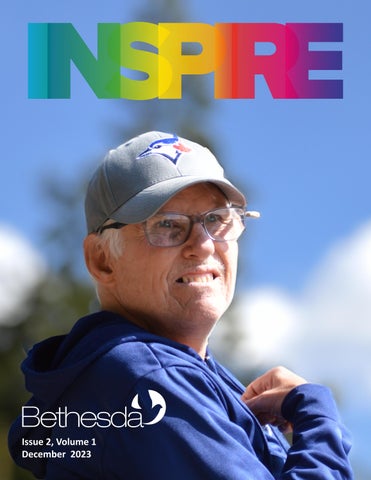
Issue 2, Volume 1 December 2023
Paul McGowan Chief Executive Officer
In December, we celebrate the International Day of Persons with Disabilities. This is an incredible day to celebrate and promote the inclusion of people of all abilities within our community. Henry and Maria Wiebe founded Bethesda in 1937 to support those with developmental disabilities to ensure that people with these abilities were not lost. To this day, it is Bethesda’s mission to promote the achievements of people with intellectual and/or developmental disabilities and their inclusion within our community. Bethesda’s success is our community’s success. Many of the individuals we support work or volunteer in the community, study in the community, and live their best lives because of their inclusion. Bethesda supports a group of keen gardeners, and this past summer they cultivated and donated vegetables to give back to the community. You will read of Bethesda’s partnership
2
with Brock University. We are thankful for our ongoing partnership with Brock University where we support experiential learning programs that mutually assist the students learning and our organization, the invaluable training Brock has provided to us, and working alongside them as part of an innovative research collaborative – PECSperts. As with us all, challenges are inevitable, and we understand that there are challenges adults and their families face as they transition out of children oriented services to adult services and supports. Bethesda can provide strategies for teaching independence, provide guidance for transition planning, and, uniquely, we assist people of all ages – children, youth, and adults. There are also so many successes. I hope through this issue you will be inspired by Dorothy’s faith and determination to become a Special Olympic Medalist and Sheldon’s musical talents.n
Many of the individuals we support work or volunteer in the community, study in the community, and live their best lives because of their inclusion.
3
4
Real Inspirational Stories 6
Dorothy Swift: Special Olympic Medalist
28
What is Supported Independent Living? (SIL)
10
What is Familyhome?
30 Horticulture Therapy
12
Transition to Adulthood
34 Finding Harmony Beyond Sight
14
Teaching Skills to Promote Independence
36 Bethesda Culture | Testimonials
16
Board Spotlight: William Jackson
40
Community Partner Spotlight: Brock University
18
Board Spotlight: Sharron Haberfield
42
Chaplain’s Corner | Bereavement and Chaplaincy Support
20
Financial Planning | Legacy Giving
44 Foundation
26
Trauma Informed Care
43 Supporting Bethesda
5
Dorothy Swift
Special Olympic Medalist
Featured
“Disciplined, competitive and responsible.” Dorothy Swift, driven by a desire to be among the greats, found her inspiration during the 1976 World Olympic Games in Montreal, witnessed from the comfort of her home. Fueled by a passion for swimming and a competitive spirit, she embarked on a journey that saw her clinch numerous awards in Ontario Special Olympics events from 1984 to 1994. The opportunity to join the Ontario Special Olympics called, and Dorothy took the plunge in 2008 at the age of 28. Now at 60, she reflects on her adventures with joy, relishing the sensation of being in the water and the thrill of travelling for competitions. Her travels took her across the province for regional and provincial Special Olympics and she even ventured to the West Coast, East Coast, and Central Canada for national games. Dorothy showcased her skills in backstroke, breaststroke, freestyle, and butterfly swims, excelling in 100-meter, 50-meter, and 25-meter races. Despite the multitude of experiences,
6
she finds it challenging to pinpoint specific highlights, as each moment in her swimming career has been enjoyable. Diagnosed with a developmental disability, Dorothy has been a part of Bethesda for most her life, starting in the Familyhome program at 18. She now resides with Cassandra and
She has strong faith and determination that she can accomplish what ever she wants.
7
James, whose family is engaged in church-related activities, which Dorothy said she appreciates. She was raised by her Aunt, who always supported and encouraged her. Cassandra and Sherry Leslie, Manager, Community Supports and Day Activities, attest to Dorothy’s disciplined, competitive, and responsible nature. They emphasize her determination when pursuing goals and attribute her unwavering faith and determination to her Aunt’s influence. Beyond swimming, Dorothy recently embraced bowling as a dry alternative. The social aspect of bowling appeals to her, providing an avenue for interaction with coaches and friends. Her newfound passion in bowling has already earned
Dorothy is inspired by the scripture Philippians 4 vs 13 Featured
“I can do all things through Christ who strengthens me.” 8
her a trophy, showcasing her adaptability and skill. Previously employed at Perkins Family Restaurant for six years, where she provided janitorial services and served coffee, Dorothy now participates in Bethesda’s Day Program where she engages in activities like bowling. She has also been a member of Momentum Choir for 14 years, where one of her favourite songs to sing is Leonard Cohen’s “Hallelujah.” Sherry Leslie admires Dorothy not just for her accomplishments but for her humility. During recognition discussions, Dorothy redirected the spotlight, urging recognition for Bethesda staff Jessie and Rose. Jessie for her cycling accomplishments and Rose for fearlessly wearing “men’s skates” and playing hockey. Sherry commends Dorothy for her impressive ability to uplift and celebrate other women while being recognized herself— “She truly is an impressive woman!”n
9
What is Familyhome?
Familyhome
Established in 1984 under the Ministry of Children, Community, and Social Services, the Familyhome program (LifeShare) creates a homelike environment for adults with intellectual and/ or developmental disabilities. It aims to provide a sense of family, safety, continuity, and security. Despite changes in its name, the program has consistently focused on improving the lives of individuals with disabilities. Familyhome is a unique initiative allowing Ontario families, known as home providers, to welcome adults with intellectual and/or
10
developmental disabilities into their homes. Being a home provider is more than offering physical shelter; it involves providing a place in one’s heart and home, supporting individuals to live and contribute as valued members of a caring family. At the core of the program’s philosophy is the promotion of personal choice, decisionmaking, independence, and active community participation. Prospective Familyhome Providers go through a thorough screening process, including
references, police checks, health and fire home inspections, and extensive interviews. This ensures a safe and nurturing environment for individuals with special needs. Familyhome Providers receive 24-hour on-call support from dedicated Community Support Managers, offering assistance whenever needed. The program also provides additional support through a structured Day Program from Monday to Friday, allowing individuals to
participate in meaningful activities. Familyhome Providers are granted monthly respite and vacation time each year, recognizing the importance of self-care and rejuvenation. The Familyhome program goes beyond being a housing initiative; it represents a holistic approach to building lives, promoting inclusivity, and creating supportive environments where individuals with special needs can thrive as active and valued members of a caring community.n
11
Transition
to Adulthood What is Transition Planning? Transition planning is a process that helps youth aged 14 -18 years and their families develop a planned and coordinated transition from childhood to adulthood. It is a dynamic and ongoing process; plans change as the person and their circumstances grow and change. Most families will start looking into transition planning around ages 14-16 years.
Developmental Services Ontario (DSO) • Application process begins at age 16. • To be eligible, youth must have a developmental disability.
To begin: • Contact Niagara can complete a referral on your behalf (905.684.3407) • Start the process on your own through the online portal for DSO: https://www.dsontario.ca/ • Documents required to apply: birth certificate or a document to show age, proof you reside in Ontario (typically Ontario Health Insurance Plan (OHIP) card), psychological assessment. • If a psychological assessment has not been completed, DSO can add youth to the list for a funded assessment at the age of 18.
12
Ontario Disability Support Program (ODSP) • Application process begins at age 17.5. • To be eligible, youth needs to be a resident of Ontario, prove they are in financial need, and meet the program’s definition of a person with a disability. • ODSP application involves a medical and financial assessment. • Those already deemed eligible for DSO do not require medical assessment. • Caseworker is assigned at beginning of application process to provide support throughout.
Ensure you have: • Valid Ontario photo ID (driver’s licence or photo ID card) • Social Insurance Number (SIN) Card
Helpful Resources: • Contact Niagara: https://www.contactniagara.org/ • Partners for Planning: https://www.planningnetwork.ca/ • Community Living: https://communitylivingontario.ca/get-involved/ • Disability and Estate Planning: https://kpopelaw.com/ken-pope-ottawa-lawyer-disability-estate-planning-videos/
• Transition Aged Youth Planning: http://www.portcolbornecommunityliving.com/docs/Transition%20Planning%20Toolkit3.pdf
• Registered Disability Savings Plan (RDSP) www.canada.ca • Capacity Assessment: https://www.ontario.ca/page/mental-capacity.
If you have any questions specifically about transition planning, please reach out to our service coordination line at: 905.684.6918 ext. 170 or at serviceinfo@bethesdaservices.com 13
Teaching Skills to
Promote
Independence Independence and autonomy lead to better • Begin teaching skills that are motivating quality of life and increased mental health. It for the learner. For example, if your learner is important to begin teaching independence loves juice, begin by teaching them how to from a young age, especially for children who pour their own juice. may need extra practice. • Take large tasks and break them down into When teaching independence there are a few small manageable parts. For example, you key things to keep in mind: can start by teaching the learner to get their own cup from the cupboard. You can then • Meet your learner where they are, every work towards pouring the juice and then learner is unique and independence is putting the cup in the dishwasher going to look different for everyone. When selecting skills to teach, select skills that • Build autonomy by giving the learner will empower the person to fulfill their own choices; for example type of cup, type of wants and needs and complete daily living juice etc. tasks, with minimal support from others. • Independence can include the use of lists, visuals and verbal reminder. Use things like technology, pictures and cues in the environment to support learning.
14
• When you are first teaching a new skill, provide extra support so that the learner feels successful and does not make mistakes. For example, guide their hand to pour the juice.
• Watch your pace; take things slow and steady. Create a strong foundation by building on each small task. • Celebrate successes to give your learner the confidence to continue learning. Make sure to finish each teaching session on a positive note, as this will help your learner feel successful in their efforts.
The road to independence can be long and winding, remember to stop and enjoy the journey.n
15
Board Spotlight
William Jackson Board President In 1966, Bill Jackson joined the Board of the Interlake Association for the Mentally Retarded. He knew very little about people with special needs, but he soon learned that there were several such people in his community and that they were too often ignored. In 1970 Bill and others, along with a local Kinsmen Club, built one of the first sheltered workshops in Manitoba, and they were soon providing meaningful assistance to several adults with special needs. Bill realized that people with special needs needed advocates, and he became a passionate advocate. In 1995, Bill joined the Bethesda Boards and since then has made many meaningful contributions on behalf of the people and families that Bethesda supports. Over the years, Bill played a pivotal role in Bethesda’s growth, overseeing its expansion to support more than 3,000 individuals with intellectual and/or developmental disabilities.
16
Bill participated in many Bethesda milestones such as welcoming children to Bethesda’s services, welcoming adults into new Bethesda programs, and he is especially proud that Bethesda raised the funds to build the Niagara Family Centre. As the President of Bethesda’s Boards for two decades, Bill’s dedication remains unwavering. Bill is enthusiastic about the upcoming release of a book chronicling Bethesda’s 80-year history, a testament to the collective efforts that have shaped the organization. Bill appreciates the work of Bethesda staff and volunteers, especially the dedication of the members of the four Bethesda Boards as they support children, youth, adults, and their families on their journey with Bethesda and throughout their lives.n
17
Board Spotlight
Sharron Haberfield Board Member Sharron Haberfield is a compassionate advocate and dedicated board member at Bethesda. Sharron’s journey with Bethesda began in 2014 when she faced the challenges of caring for her twin sons, Connor and Matthew, who have intellectual disabilities. After losing her husband, Sharron turned to Bethesda for support, specifically through Linda Moroz and Children’s Behaviour Services. The impact was transformative, offering life-changing strategies to cope with behaviours and navigate the complexities of care. In 2014, Sharron joined the board of directors, inspired by the desire to be a voice for a community often overlooked. Her personal values aligned with the opportunity to serve others as a volunteer board member, making a meaningful contribution to Bethesda’s mission.
18
As an active board member, Sharron contributes by reviewing materials, voting on major proposals, and serving on the community outreach committee. Her role involves working towards fundraising initiatives to enhance services and elevate Bethesda’s presence in the region. Having been on the board for seven years, Sharron’s most prominent memory revolves around the compassion and care she received during a challenging moment. Linda Moroz’s support and the understanding that Bethesda cares not only for individuals with special needs but also for entire families have left a lasting impression. Looking ahead, Sharron’s hope for Bethesda is clear—to empower every individual supported by Bethesda to live their best life. Sharron emphasizes that Bethesda creates opportunities for families, allowing caregivers to be parents and relieving the burden of constant caregiving. Sharron hopes Bethesda will continue to touch as many families as possible in the community, making a positive impact on their lives and helping them through their journeys.n
19
Financial Planning Financial planning for a child with special needs in involves navigating a range of government programs, legal frameworks, and financial instruments to ensure comprehensive care and support. Here are some key considerations to keep in mind as you plan for yours and your family’s future, specific to Ontario: Registered Disability Savings Plan (RDSP): This savings plan is designed for individuals with disabilities and allows for long-term savings with contributions made by family members. The government provides grants and bonds to supplement savings.
providing supplemental resources for their needs. Consulting a lawyer specializing in disability law is crucial to set up these trusts properly. Tax Benefits: Ontario provides certain tax credits and deductions for families with children with special needs, such as the Disability Tax Credit and the Child Disability Benefit. Leveraging these can significantly ease financial burdens.
Ontario Disability Support Program (ODSP): This program offers financial assistance and benefits to individuals with disabilities. It’s essential to understand the eligibility criteria and application process for your child to Review and Update: Similar to financial receive support. planning elsewhere, it’s essential to review and Special Needs Trusts: Establishing trusts, like update your financial plan regularly, especially the Henson Trust, can safeguard your child’s considering changes in your child’s needs and eligibility for government benefits while alterations in government policies.
Financial Planning
Seeking guidance from financial advisors, disability advocates, and legal professionals well-versed in Ontario’s specific programs and regulations is highly recommended for creating a robust financial plan tailored to your child’s unique circumstances in the province.
20
Leave a LEGACY Leaving a legacy through charitable donations is a powerful way to make a lasting impact that extends far beyond one’s lifetime. By including charitable bequests or donations in your estate plan, you can support causes that align with your values and create a meaningful legacy. Gifting to Bethesda ensures that your generosity will have a direct impact on the children, youth and adults that are supported each year.
Donations can take various forms, such as designating a percentage of your estate, creating a charitable gift annuity, gifts of securities, gifts of registered retirement funds, gifts of life insurance, establishing a bequest in your will and more. The impact of such contributions is profound. They can support getting families into service faster, launching new programming, subsidising programming, Bethesda’s Chaplaincy and Bereavement programs, fostering positive change in communities and addressing pressing needs.
Moreover, leaving a legacy to Bethesda can have personal significance, reflecting your passions and beliefs while inspiring others to continue the legacy of giving. It also provides potential tax benefits, reducing estate taxes while supporting a cause close to your heart. Careful planning in consultation with legal and financial professionals, ensures your charitable contributions align with your overall estate plan and philanthropic goals, allowing your legacy to contribute to a brighter future long after you’re gone.n
21
There is no greater disability in society, than the inability to see a person as more. -Robert M. Hensel
22
23
24
Events like this one at Balls Falls are a time for individuals like Angelo Rea from Bethesda’s Familyhome program (pictured here) to connect with their friends, enjoy great food, activities, music and dancing. 25
Trauma Informed Care Individuals with Intellectual and/or Developmental Disabilities are at much higher risk of experiencing abuse and neglect.
Trauma Informed Care
People with intellectual and/or developmental disabilities (IDD) are more likely, about 3-10 times, to face violent victimization, sexual assault, and repeated abuse or neglect in their lives compared to the general population. Recognizing trauma in individuals with IDD can be hard for doctors and caregivers. Trauma might show up as things like going back in development, losing communication skills, or having sudden behavior issues. But often, caregivers don’t realize these could be signs of a traumatic event. Caregivers themselves are also at a higher risk of going through trauma-related mental and physical symptoms when helping or understanding others who have experienced traumatic events. This could lead to burnout, compassion fatigue, or experiencing trauma indirectly. Trauma Informed Care (TIC) has become a well-known way of creating safe spaces for everyone involved, including clients, families,
26
staff, and others. It understands the big impact of trauma and knows the potential paths for recovery. TIC recognizes, understands, and reacts to the effects of all kinds of trauma, reducing the chance of causing retraumatization when accessing services. It focuses on the strengths of the individual and encourages them to take part in developing, delivering, and evaluating TIC services. It also includes knowledge about trauma fully into policies, procedures, and practices.
Bethesda is dedicated and committed to providing Trauma Informed Care services and supports.
“Individual trauma results from an EVENT, series of events, or set of circumstances that is EXPERIENCED by an individual as physically or emotionally harmful or threatening and that has lasting adverse EFFECTS on the individual’s functioning and physical, social, emotional, or spiritual well-being.” Substance Abuse and Mental Health Services Administration, SAMSHA, 2014
Benefits of Trauma Informed Care include the following and many more! • reduced trauma symptoms • reduced substance use • reduction in mental health symptoms • improved housing stability • decreased in use of crisis services • cost effectiveness • increased collaboration with consumers and other services • greater self-efficacy • improved staff morale • reduction of restrictive practices such as restraint and seclusion • consumers reporting increased sense of safety and a more significant voice Bethesda is dedicated to providing Trauma Informed Care services and support. We aim to include TIC in all services to give compassionate care to everyone we serve. We offer various services to help others understand trauma better and its impact through training and consultation and we work with agencies and caregivers to create personalized services that meet their organizations specific needs.n
27
What is Supported Independent Living? (SIL)
Supported Independent Living
Bethesda’s Supported Independent Living (SIL) program is like a beacon of empowerment for adults with intellectual and/or developmental disabilities who want to live independently in the community. SIL focuses on helping individuals become more independent and selfsufficient, showing Bethesda’s commitment to helping each person grow and make choices for themselves. The SIL program is all about making the daily lives of the people Bethesda supports better. Whether it’s getting help with daily routines, cooking, or personal care, SIL makes sure individuals get the support they need to live on their own successfully. A big part of SIL is teaching important life skills. This includes things like managing money, using the bank, and using public transportation. SIL gives individuals the tools they need to confidently navigate the world. This training not only teaches practical skills but also makes individuals feel empowered, so they can actively be a part of the community in their own way.
28
Importantly, the SIL program follows a philosophy that values personal choice and decision-making. Individuals are encouraged to shape their lives based on their preferences, creating a sense of independence that goes beyond just living alone. This empowerment is shown through being actively involved in the community. Bethesda understands how important it is for people to connect with others and be part of the community to have a fulfilling and well-rounded life. SIL acts as a bridge, helping adults supported by Bethesda take charge of their lives and engage with the community on their own terms.n
The SIL program is all about making the daily lives of the people Bethesda supports better.
29
Horticulture
Therapy
Gardening therapy methods are used to help participants learn new skills or get back ones they’ve lost. This type of therapy can boost memory, thinking abilities, starting tasks, language skills, and socializing. In physical rehab, gardening therapy can make muscles stronger and enhance coordination, balance, and stamina. In job training for gardening, individuals learn to work on their A horticultural therapy program own, solve problems, and follow includes: instructions. • Getting participants involved (American Horticulture Therapy Association, https://ahta. in gardening activities. memberclicks.net/ ) • Participants having a recognized need for help due People who join the gardening program at Bethesda talked about to a disability, illness, or life how much they enjoyed it and how situation. it made them feel good. • A registered horticultural therapist guiding the activity. One individual said they liked doing gardening tasks because • The participation being part of it made them feel independent. a planned treatment, rehab, or They also enjoyed being on the job training. gardening team and working with friends. Studies show that
Horticulture Therapy
In the early 1800s, Dr. Benjamin Rush noticed that gardening could make people feel happier and healthier (Richmond & Dunn, 2023). Gardening programs, known as horticultural therapy, are available in many places like hospitals, rehab centers, and homes. These programs keep track of how individuals or groups benefit.
30
gardening helps people connect with others and feel accomplished (Siu, Kam & Mok, 2020). Another individual said the gardening program lets them be creative and gives them new ideas. Both people said being outside helps them relax, and watching plants grow inspires them. A recent study looked at how gardening
helps people with mental illness. It found that gardening improved mental wellbeing, and participants felt less stressed and anxious. Besides making people happier and more creative, and taking care of themselves, the Bethesda gardeners have donated hundreds of pounds of vegetables to the community.
Great job, Bethesda gardeners!n
31
32
A hero is an ordinary individual who finds the strength to persevere and endure in spite of overwhelming obstacles. -Christopher Reeve
33
Finding Harmony
Featured
Beyond Sight
In a world where sight seems to be everything, there are people like Sheldon who show that true vision goes beyond what you can see. Sheldon, who is 73 years old, was born without sight. But that didn’t stop him from learning to play music when he was only nine years old. He started with the accordion and found he was really good at music by playing an old organ he had to pump with his feet. Sheldon has been at Bethesda’s Developmental Centre for 16 years, and he loves playing his piano whenever he gets the chance. Bethesda has given him opportunities to share his musical talent by encouraging him to perform at
34
Christmas concerts, Dinner Auction fundraisers, and the Superheroes of Autism Talent Showcase in Niagara Falls last summer. “I brought my keyboard, and I used to play at different events. I used to play for the Christmas concert and different kinds of events. They used to have these dinner theaters here; I played for that. I play for some of the clients sometimes,” he says. He spends hours playing his piano every week, for his own enjoyment and for anyone lucky enough to listen. Music has become one of Sheldon’s favorite hobbies, and he likes exploring different types of music. He especially
likes Polka music and music from the 1950s. He has a big collection of vintage LP records. “I like (records) better than CDs. They certainly sound better to me,” Sheldon says. At Bethesda, Sheldon found companionship with his girlfriend, Edith, who has been a constant source of love and support for the past decade. Sheldon also loves animals and had a strong bond with his service dogs, Toby and Sasha. Even though they passed away 20 years ago, he still remembers them vividly. They weren’t just pets; they were cherished members of his family. Their loyalty and protective nature
gave him confidence and companionship that few experiences can match. Even though their absence makes him a little sad, the memories they created are treasured in Sheldon’s journey. Despite the challenges he faced, Sheldon finds inspiration in the small joys of life. He loves playing cards, especially Rummy and Euchre, and enjoys playing with the staff at DC whenever he can. Through his time with Bethesda, Sheldon has made a positive impact, showing that with determination and a love for life, you can achieve great things.n
35
Bethesda Culture “...he showed up to every session with a strong sense of commitment and enthusiasm...” In my role as a social worker I provide short term counselling to individuals who are struggling with their mental health – this is how I met “Frank”. Frank is a 54-year-old male with a diagnosis of autism who was referred to our clinical services to learn how to manage symptoms of Post Traumatic Stress Disorder (PTSD), a result of trauma he experienced from childhood into early adulthood. Frank recently attended his last session of Cognitive Processing Therapy (CPT) with me. Throughout our time together Frank showed great dedication and perseverance; he showed up to every session with a strong sense of commitment and enthusiasm and worked diligently to complete assigned work between sessions. Frank was able to process and resolve past trauma by learning how to recognize unhelpful beliefs about himself and his role in the traumatic events. Frank can now manage his emotions more effectively, he has noticed an overall improvement in his mood and self esteem, he has resolved feelings of self blame, shame and guilt, and he has noticed an improvement in his relationships with others. Mandy Lutczyn, MSW, RSW Social Worker Adult Clinical Services
Testimonials
“The support helps give me something to hope and lean on when my life is hard. They help me solve the problems I encounter in my life. They help teach me life skills and help me become more independent. They help me become a responsible, independent adult.” S. Brown
36
“Bethesda helps me stay busy, I like playing Bingo and doing crafts with my friends online. The staff help me learn to be more independent so I can live on my own.” K.Filipchuk
“I am grateful for the kind and caring support given to me, it makes me very feel supported and happy.” Y.Shonias
“Bethesda staff help me feel happy, they do things with me. They always know what they are doing to help me. They are the only people I have to talk to, I enjoy spending time with the staff. Thank you!” B.Richards
“We strive to provide person-centered service...” Through the Community Response Program (CRP), we support adults who have had a breakdown of services within the community and are at-risk of losing their placement. We strive to provide person-centered service where the individuals we support identify feeling proud of the skills they have learned and the improvements they have made. The adults in our program have expressed a sense of empowerment to make meaningful improvements in their quality of life by being actively involved in their learning through choice, self-advocacy and personalized goals. In addition to individualized services, we have also created Fun Nights where adults with Autism Spectrum Disorder (ASD) who are unable to attend other community programming are provided a safe space to express who they are through a variety of activities and are welcomed back every time. Katrina Frausel, M.ADS Behaviour Consultant Adult Clinical Services
37
Bethesda Culture “Becoming a Bethesda family was the best decision we made to support our daughter. The benefits were immediate. Our Service Coordinator established an action plan that included programming for our entire family and assistance completing the Ontario Autism registration, federal tax credit forms, registered disability savings plan set-up and applying for additional support services. We received valuable direction on booking a psychological educational assessment and how to best navigate the Identification, Placement and Review Committees (IPRC) education plan within the local school board. We frequently make use of the professional resources available and have booked consultation appointments with the Occupational Therapist and the Social Worker. One of the most rewarding aspects of the organization has been connecting with the community of Bethesda families at seasonal events, on virtual sessions or in-person programs. The PEERS social communication course was a standout program. Over the course of the multi-week course we developed supportive relationships with other parents - sometimes we cried, but mostly we laughed. We left every session feeling positive and energized about our ability to help our daughter navigate the world. Bethesda is a compassionate organization, achieving amazing results.” Joy Janzen Parent of teenage daughter with Autism
Testimonials
Our daughter Eden has been involved with many services at Bethesda! She has been in Applied Behaviour Analysis (ABA) for a couple of years now, 2 days a week! She has come so far! We are so thankful for all of the staff that have worked with Eden. They have made such an impact in her life! She enters Bethesda disregulated, but always comes out regulated and able to have a successful day!!! Bethesda has changed our lives and we are forever thankful!” Liz Smith-Arbour
38
“Our family was in the first round of the PECS study. It was peak COVID. Bethesda did everything they could to circumvent the barriers of online learning. More than anything, our son Troy finally had a way to communicate with people outside of me and my wife. I had been worrying a lot as kindergarten was approaching and no one was going to understand him without us there to interpret. I didn’t want him to feel isolated and alone, but when it came to Augmentative and Alternative Communication (AAC) and PECS I had no idea how to do it. While my wife did, she knew we needed to be a team. So I signed up for the PECSperts study. Melissa and the whole team gave me the tools to support Troy’s new way of communicating. I even attended more PECS training months later. It has been years and Troy now uses the PECS IV+ App and he’s so creative and funny with his sentences. Thank you Bethesda!” Jason Participant in PECSperts study
“Whenever you feel desperate and you’ve crossed paths with Bethesda, rest assured that they will touch your life somehow. Sometimes you think that the situation you are experiencing is unsolvable and the situation or behaviours of your child with special needs will not change regardless. That’s where Bethesda comes in and shows you that most things have a solution, different ways have to be tried, and how you can do it. As a parent, you’re happy to see the change, sometimes the change can be more or less, but it’s not the point, it’s about someone who makes you feel that you’re not alone and what you’re going through isn’t just unique to you. This both facilitates the acceptance process and gives you the perfect feeling, like feeling a hand on your shoulder that you’re not alone. Since the first days of receiving support from Bethesda, I have seen how there is a cause and effect of each behaviour, I have learned how to approach my child as a mother, how to not worry too much if I’ve tried everything, and how I am important too, and if I want to support my child, first I must be healthy and in good condition. Bethesda and its wonderful therapists, staff and the entire team are very special in the world of families with special needs. Thank you.” Zehra
39
Community Partner Spotlight
Bethesda has always had a meaningful relationship with Brock University and over the last year, this relationship has continued to grow and flourish.
Community Partner
The incorporation of leadership training, experiential learning, and working closely with specialized programs speaks volumes about the depth and diversity of this collaboration and the many disciplines that Bethesda can impact. The fact that students get to engage in hands-on experiences with a local non-profit through Bethesda is a winwin situation. It not only enriches their academic journey but also fosters a deeper understanding of the practical
40
aspects of their studies. For Bethesda, this partnership presents an opportunity to connect with a talented pool of students who bring fresh perspectives and energy to the table. It’s an excellent way to build awareness about the organization while also nurturing potential future professionals who might be aligned with Bethesda’s values and missions when they join the workforce.
Some collaborations include; • Developing Professional Development Strategy for Bethesda’s Leadership • Establishing evaluation strategies with staff in the Applied Health Sciences department • Working on developing student placements, with the Forensic Psychology and Criminal Justice Program • Developed Indigenous Training for Bethesda staff
• Invitations to participate in research for Autistic Advocates on their Family members of adults on the spectrum • PECSperts partnership with Children’s Services, Dr. July Koudys and Pyramid Educational Consultants of Canada
We thank Brock staff and students for their continued support and involvement and look forward to more collaboration into 2024.n
41
Chaplain’s Corner
Mike Gilmore Chaplain
42
I have the daily privilege of coming along side God’s people, bringing a message of hope that impacts and brings change to lives, both now and for eternity. It is such a privilege for me to see the joy on their faces as they worship through music in weekly chapel services and bible studies. This past year I personally have found great joy in watching the spiritual growth and hunger to learn and memorize the scriptures in many of our individuals and staff, as I was able to teach through a new spiritual formation curriculum. This renewed commitment to faith and trusting in Jesus has overflowed into the blessing of celebrating the Baptism of ten individuals. I also have the privilege of visiting our supported group living and day activity programs, building relationships and growing community. Following Jesus’ example, we often share a meal together; over this past summer many of the group homes and day programs came to my home for a summer barbeque, hayride and fellowship time. Coming along side God’s people also means bringing support, hope, love and comfort through times of loss. As hard as this journey can be, sharing the promises of scripture and watching the power of the Holy Spirit begin to bring peace and healing to broken and wounded hearts is so rewarding and meaningful. I have learned in my role as Chaplain to hold my plans for each day lightly as each day has its blessings, challenges and surprises. However, one thing always remains the same. God never changes: his plan and purpose for my life, to serve and love His people, never changes. Names and roles change, but God continues to faithfully bring so many wonderful, gifted people into my life who come along side me and are a greater blessing than they will ever know.n
Bereavement and Chaplaincy Support • Bethesda’s Chaplaincy program offers support to individuals throughout the Niagara and Hamilton areas to encourage and support each individual’s faith or spiritual needs. *Hamilton services are faith focused.
• Trauma, Grief, and Bereavement Services in the Niagara and Hamilton Regions – The focus on the Christian faith is the differentiator to other similar services. • Spiritual Life Coaching and Formation – Providing support and working with people oneon-one to enable them to lead their best lives from a spiritual perspective. • Building Community – Groups offered to people that are supported at Bethesda.
43
Foundation There are many ways you can contribute to Bethesda and support those we serve. From one-time donations, to monthly giving, legacy gifts, and community partnerships, there are countless ways you can make a difference in someone’s life today.
Ways to Donate To discuss the options available or to get your questions answered, call 905.684.6918 ext. 378 or email merb@bethesdaservices.com. The Bethesda Home Foundation, a registered charity in Ontario, Canada, reflects the Board of Directors’ passion for supporting children, youth, and adults with intellectual and/or developmental disabilities. The foundation raises funds to fulfill the community’s unmet needs and promotes the programs developed by Bethesda. Bethesda has operated as a charitable organization since 1937. We greatly appreciate the contributions of our many supporters, without whom we could not carry out our mission.
The support helps give me something to hope and lean on when my life is hard. - S. Brown 44
Tim Horton’s NEW Holiday Smile Cookie Campaign This year, Bethesda was selected as a beneficiary of Tim Hortons first National Holiday Smile Cookie Campaign for the St. Catharines, Thorold, and Niagara-on-the-Lake areas. We are thrilled to announce that a total of $38,419.89 was raised for Bethesda’s Foundation! We are currently developing plans to utilize these funds for the people and families we support. Thank you Tim Hortons! And thank you to our Bethesda community for your overwhelming support during this campaign!
Niagara Region Andy Koschok Golf Tournament Since 2016, Bethesda has been fortunate to be the beneficiary of many of the Niagara Region’s Andy Koschok Memorial Niagara Region Golf Tournaments. This year’s tournament, which took place in July, raised nearly $60,000 that was split between Bethesda and Community Crew Thank you to the tournament organizers for your continued support and helping us to move our vision forward.
Bethesda Summer Breeze Social 2023 Thanks to the generosity of our sponsors, donors and attendees, we raised more than $42,000 at the 2023 Summer Breeze Social. Funds at this year’s event were designated to enhance clinical services for children, youth and adults. With your generosity, an additional 28 psychological assessments will take place for families waiting on service. Fourteen will be provided within Children and Youth Services and the other 14 in Adult Clinical Services.
45
Support Bethesda
Donate Now Visit bethesdaservices.com/en/ foundation/donate or phone 905.684.6918 ext. 356 info@bethesdaservices.com
Regular Giving Empower Bethesda’s impactful mission by considering a commitment to regular donations, ensuring sustained support for children, youth and adults with intellectual and/or developmental disabilities within our community.
Donate now
46
Choose your desired donation frequency from the dropdown menu to set up automated contributions.
CONTACT Bethesda is a supportive community that motivates and empowers individuals of all ages with intellectual and/ or developmental disabilities, along with their families, to embrace their fullest potential. Reach out to discover how we can support you and your family in living your best lives.
Contact us bethesdaservices.com info@bethesdaservices.com 905.684.6918
47
bethesdaservices.com