Why Crane Rail Clips Matter
More Than You Think
Heavy industry relies on movement. Massive gantry cranes shifting containers at a port, overhead cranes moving molten steel in a foundry, or automated stacking cranes in a logistics warehouse— they all depend on smooth, precise motion along a track.
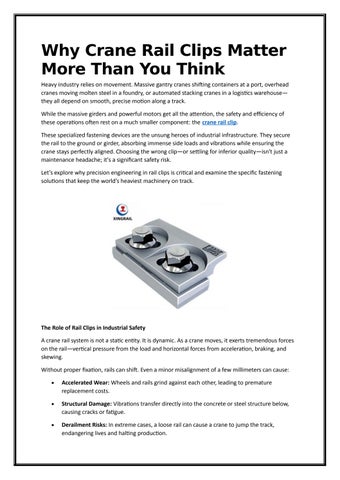
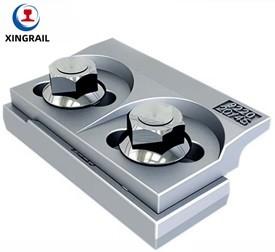
While the massive girders and powerful motors get all the attention, the safety and efficiency of these operations often rest on a much smaller component: the crane rail clip
These specialized fastening devices are the unsung heroes of industrial infrastructure. They secure the rail to the ground or girder, absorbing immense side loads and vibrations while ensuring the crane stays perfectly aligned. Choosing the wrong clip—or settling for inferior quality—isn't just a maintenance headache; it's a significant safety risk.
Let’s explore why precision engineering in rail clips is critical and examine the specific fastening solutions that keep the world’s heaviest machinery on track.
The Role of Rail Clips in Industrial Safety
A crane rail system is not a static entity. It is dynamic. As a crane moves, it exerts tremendous forces on the rail—vertical pressure from the load and horizontal forces from acceleration, braking, and skewing.
Without proper fixation, rails can shift. Even a minor misalignment of a few millimeters can cause:
Accelerated Wear: Wheels and rails grind against each other, leading to premature replacement costs.
Structural Damage: Vibrations transfer directly into the concrete or steel structure below, causing cracks or fatigue.
Derailment Risks: In extreme cases, a loose rail can cause a crane to jump the track, endangering lives and halting production.
High-quality rail clips are designed to handle these specific stresses. They often feature an adjustable design that allows for precise lateral alignment during installation, ensuring the rail sits exactly where it needs to be.
Welded vs. Bolted: Choosing the Right Fixation
When securing crane rails, engineers typically choose between two primary methods: welded fixing clips and bolted fixing clips. The choice depends on the installation environment, the type of support structure (steel girder vs. concrete), and the load requirements.
Welded Rail Fixing Clips: Maximum Durability
Welded clips are typically used when the rail is installed on a steel girder. The base of the clip is welded directly to the support, providing a robust, permanent bond. This method is excellent for heavy-duty applications where vibration is constant.
The 9 Series Welded Rail Clips
The 9 Series represents a standard of excellence for heavy-load environments. These clips are engineered with a flexible "nose" that applies downward force on the rail foot while allowing for necessary longitudinal movement (rail expansion and contraction).
Popular models in this series include:
9220/20/45: A heavy-hitter designed for significant side loads.
9216/08/40 & 9120/15/38: Versatile options for mid-range industrial cranes.
9116/08/3: A compact solution for lighter applications.
The 7 Series Welded Rail Clips
For slightly different rail profiles or load cases, the 7 Series offers reliable stability.
The 7216/20/39 model, for example, is a staple in many industrial setups, known for its strong weldable base and durable rubber nose that dampens vibration effectively.
Bolted Rail Fixing Clips: Versatility and Maintenance
Bolted clips are fastened through holes drilled into the support structure. This makes them ideal for concrete foundations or situations where welding isn't feasible. They also offer the advantage of being easier to replace or adjust without cutting welds.
32 Series Reinforced Bolted Rail Clips
These are the heavyweights of the bolted world. They are "reinforced" to handle higher lateral forces, making them suitable for ports and heavy manufacturing.
3224/20/44: Designed for the toughest environments.
3222/17/44 & 3220/17/38: Provide a balance of high holding power and adjustability.
31 Series Reinforced Bolted Rail Clips
For standard industrial applications, the 31 Series offers a cost-effective yet highly secure solution.
3120/17/38 & 3116/13/36: These models are widely used in factories and warehouses where reliability is paramount but the extreme loads of a shipping port might not be present.
What to Look for in a Manufacturer
Not all steel is created equal. When sourcing rail clips for railway and cranes, procurement managers and engineers need to look beyond the spec sheet.
1. Material Quality: The steel used in the clip base and the forging process determines the component's fatigue life.
2. The "Nose" Design: Most modern clips use a rubber-bonded nose. This isn't just for grip; it creates a "soft" interface that reduces noise and vibration, protecting the clip bolt from loosening over time.
3. Adjustability: A good clip design allows for lateral adjustment (often 10mm to 20mm). This is crucial because steel rails are rarely perfectly straight, and installation tolerances on site are never perfect.
Securing the Future of Operations
Investing in the right rail fixing system is investing in uptime. Whether you are upgrading an existing gantry crane with 9220/20/45 welded clips or laying a new track for an automated warehouse using 3116/13/36 bolted clips, the goal remains the same: stability.
As industries push for faster turnaround times and heavier loads, the demands on infrastructure increase. By prioritizing high-quality, professional manufacturing in these critical small components, you ensure that the big machinery can keep moving safely, day in and day out.