

Teaching Participant Resource Pack


Teaching Participant Resource Pack
Please come to the event having undertaken the following:
▪ Bring a copy of your reflective task from the ‘Leading Culture and ethos’ online course.
▪ Bring a copy of your completed leadership development record (LDR) cycle 2.
▪ Bring a copy of your leadership development record (LDR) cycle 3.
▪ Complete the pre-event task and resource below.
▪ Familiarise yourself with Rosenshine, Principles of Instruction, and bring a copy with you (paper or virtual). Rosenshine, B. (2012). Principles of Instruction: Research-Based Strategies That All Teachers Should Know. American Educator, 36, 12–20. https://www.aft.org/sites/default/files/periodicals/Rosenshine.pdf.
Complete the SWOT table below for your school and practice. You may wish to focus on one curriculum area that you have specific across school responsibility for.
For each section think about:
▪ Teaching
▪ Curriculum and assessment
▪ Additional and special educational needs and disabilities
Rosenshine, B. (2012) Principles of Instruction: Research-Based Strategies That All Teachers Should Know. American Educator, 36, 12–20. https://www.aft.org/sites/default/files/periodicals/Rosenshine.pdf
Education Endowment Foundation (2018) Metacognition and Self-Regulated Learning Guidance Report. [Online] Accessible from: https://educationendowmentfoundation.org.uk/education-evidence/guidancereports/metacognition
Deans for Impact (2015). The Science of Learning. [Online] Accessible from: https://deansforimpact.org/resources/the-science-of-learning/
Education Endowment Foundation (2018). Toolkit: Feedback. [Online] Accessible from: https://educationendowmentfoundation.org.uk/evidence-summaries/teaching-learning-toolkit/feedback/
Education Endowment Foundation (2021). Teacher Feedback to Improve Pupil Learning. [Online] Accessible from: https://educationendowmentfoundation.org.uk/education-evidence/guidance-reports/feedback
Education Endowment Foundation (2020). Special Educational Needs in Mainstream School: Guidance Report. [Online] Accessible from: https://educationendowmentfoundation.org.uk/education-evidence/guidancereports/send
Education Endowment Foundation (2018). Making Best Use of Teaching Assistants. [Online] Accessible from: https://educationendowmentfoundation.org.uk/education-evidence/guidance-reports/teaching-assistants
‘Learn that’ ‘Learn how to’
2.11. Regular purposeful practice of what has previously been taught can help consolidate material and help pupils remember what they have learned.
2.14. Effective teachers introduce new material in steps, explicitly linking new ideas to what has been previously studied and learned.
2.15. Modelling helps pupils understand new processes and ideas; good models make abstract ideas concrete and accessible.
2.16. Guides, scaffolds and worked examples can help pupils apply new ideas, but should be gradually removed as pupil expertise increases.
2.17. Explicitly teaching pupils metacognitive strategies linked to subject knowledge, including how to plan, monitor and evaluate, supports independence and academic success.
2.18. Questioning is an essential tool for teachers; questions can be used for many purposes, including to check pupils’ prior knowledge, assess understanding and break down problems.
3.6. Anticipating common misconceptions within particular subjects is also an important aspect of curricular knowledge; working closely with colleagues to develop an understanding of likely misconceptions is valuable.
3.17. High-quality feedback can be written or verbal; it is likely to be accurate and clear, encourage
Support colleagues to design a carefully sequenced, broad and coherent curricula, including by:
3.b. Identifying examples of common misconceptions pupils may develop and promoting strategies for identifying and correcting misconceptions.
Support colleagues to provide high-quality feedback, including by:
further effort, and provide specific guidance on how to improve.
3.18. Over time, feedback should support pupils to monitor and regulate their own learning.
3.j. Sharing examples of best practice in feedback that are likely to increase its effectiveness, (e.g. by sharing model work with pupils, and highlighting important details).
5.4. Adapting teaching in a responsive way, including by providing targeted support to pupils who are struggling, is likely to increase pupil success.
5.5. Pupils are likely to learn at different rates and to require different levels and types of support from teachers to succeed.
5.6. Seeking to understand pupils’ differences, including their different levels of prior knowledge and potential barriers to learning, is an essential part of teaching.
5.7. Adaptive teaching is less likely to be valuable if it causes the teacher to artificially create distinct tasks for different groups of pupils or to set lower expectations for particular pupils.
8.4. Effective implementation begins by accurately diagnosing the problem and making evidenceinformed decisions on what to implement.
Ensure all pupils experience success, including by:
5.b. Ensuring interventions and support from teaching assistants and other professionals are targeted and never used as a replacement for high-quality teaching.
Make the right choices on what to implement by:
8.d. Identifying a specific area for improvement using a robust diagnostic process, focusing on the problem that needs solving, rather than starting with a solution.
8.f. Examining current approaches, how they need to change and the support required to do so.
8.g. Adopting new approaches based on evidence of what has (and has not) worked before, using both internal and external evidence (e.g. pupil outcome data and research-based guidance).
Use this sheet to capture your thoughts and comments to support your feedback to colleagues.
Your leadership learning:
Specify which content areas and ‘learn that’ and/or ‘learn how to’ statements have moved your understanding on.
Which research has had the most impact on your learning and leadership, and why?
(Use your understanding identified at the end of the ‘culture and ethos’ short course.)
How have you applied your understanding and what impact has it had on:
a) your leadership?
b) school practice?
What behaviours have you demonstrated and how have these had an impact on your leadership?
Refer to your leadership development record review, where you have considered two or three behaviours.
What areas from ‘culture and ethos’ do you need to continue to work on and develop? How will you address these?
Revisit your leadership development record review of the ‘culture and ethos’ cycle 2 to support this.
Area
Rationale
Source: https://d2tic4wvo1iusb.cloudfront.net/eef-guidance-reports/metacognition/7-SchoolAuditTool_2021-10-27-150642_ztrf_2021-10-29074724_zdeo.pdf?v=1635493644
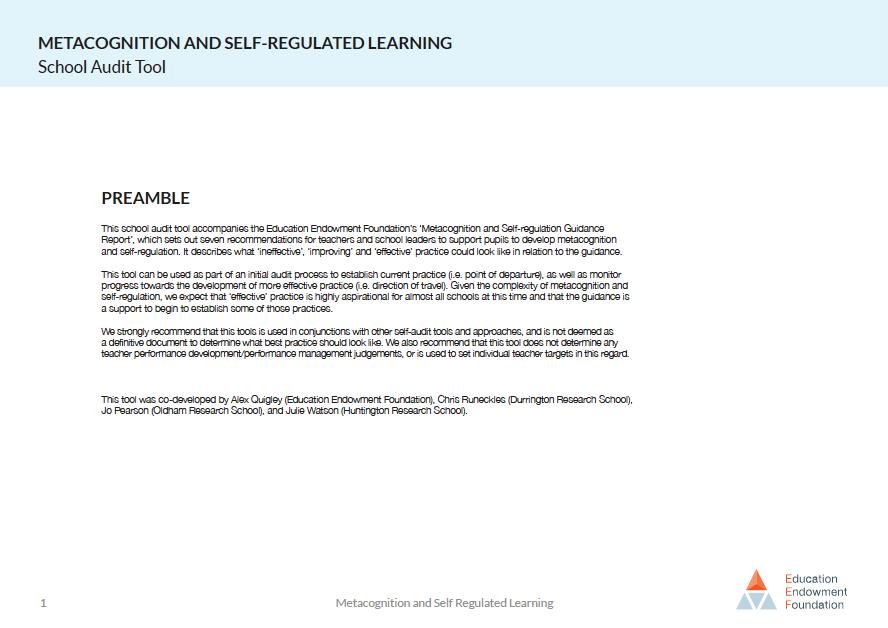
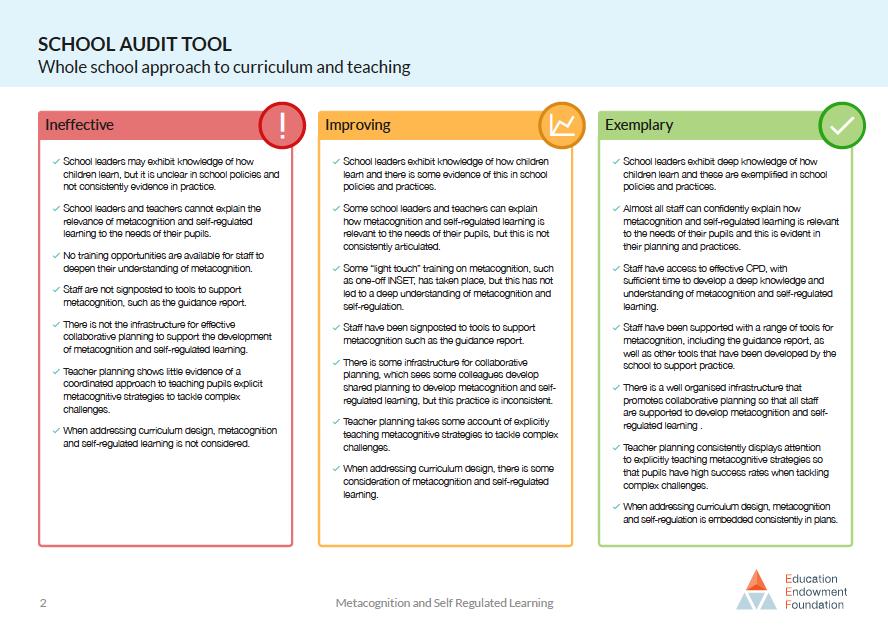
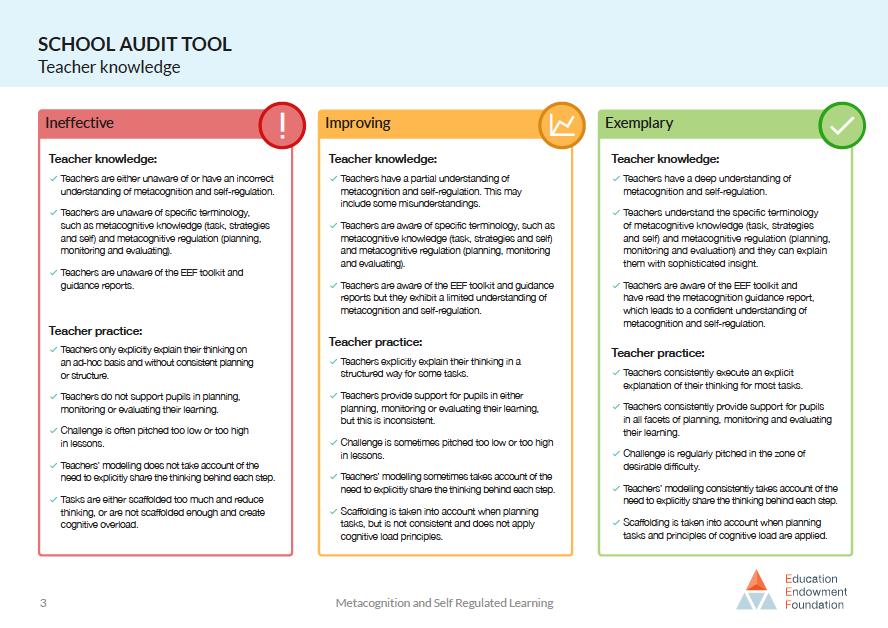
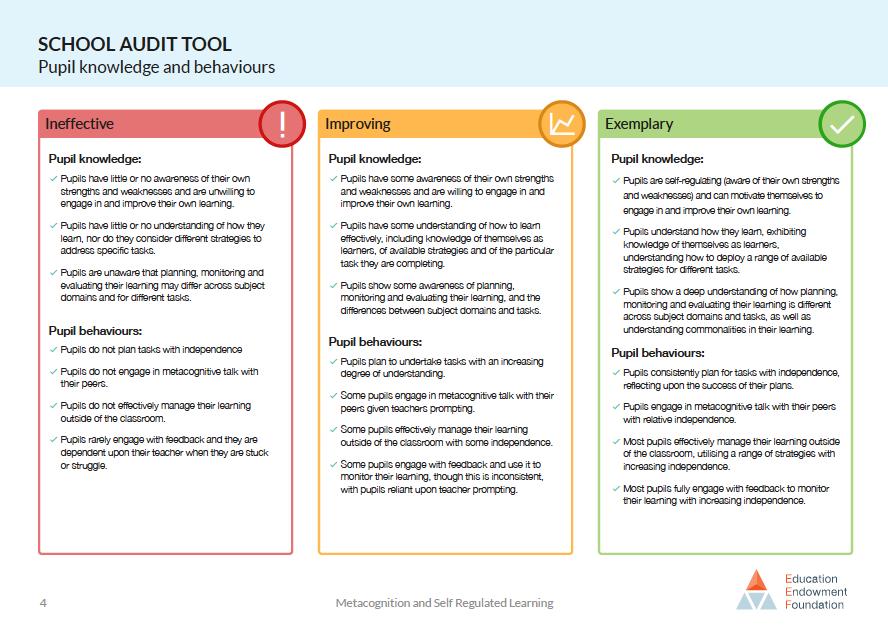
Source: https://d2tic4wvo1iusb.cloudfront.net/eef-guidance-reports/maths-ks-2-3/REACT_to_misconceptions_-_example_2021-08-18142856_kuhv.pdf?v=1635355220
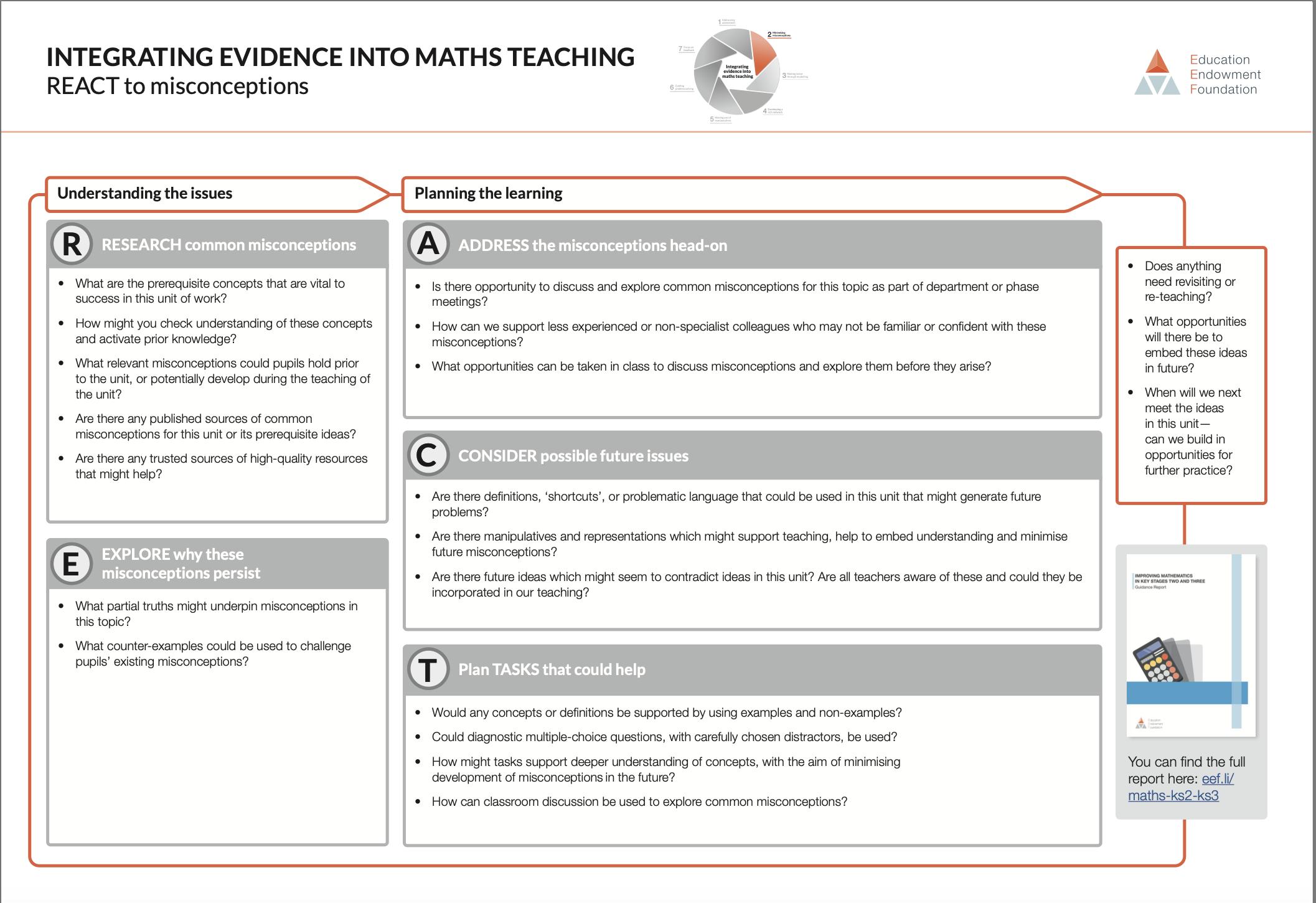
Understanding the issues Planning the learning




R RESEARCH common misconceptions ADDRESS the misconceptions head-on
Enter text here
• Bullet point
Enter text here
• Bullet point
C CONSIDER possible future issues
Enter text here
• Bullet point
EXPLORE why these misconceptions persist
Enter text here
• Bullet point
T Plan TASKS that could help
Enter text here
• Bullet point


• Does anything need revisiting orreteaching?
• What opportunities will there be to embed these ideas in future?
• When will we next meet the ideas in this unit can we build in opportunities for further practice?

You can find the full report here: eef.li/ mathsks2-ks3
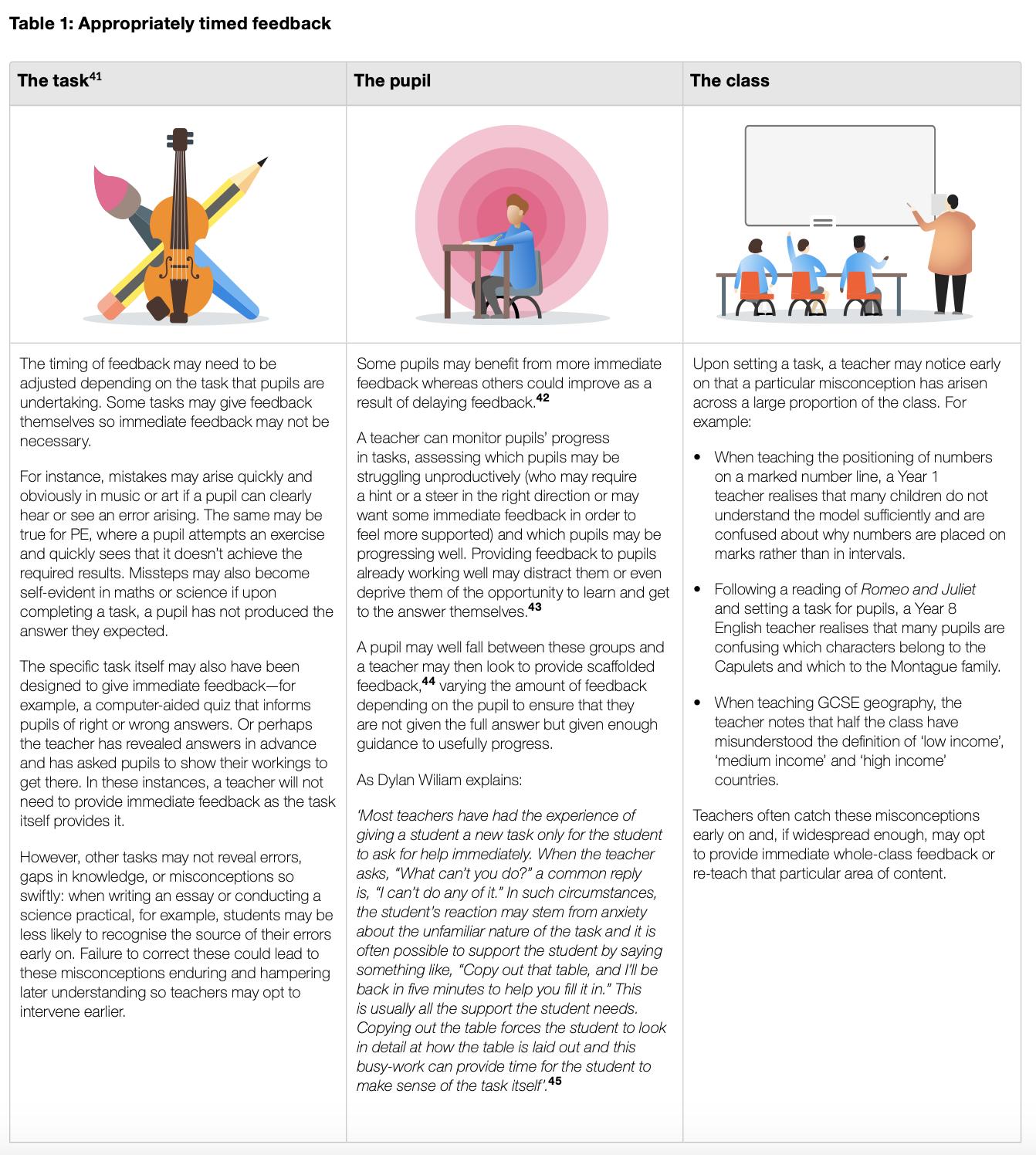
Source: https://d2tic4wvo1iusb.cloudfront.net/eef-guidancereports/feedback/Teacher_Feedback_to_Improve_Pupil_Learning.pdf
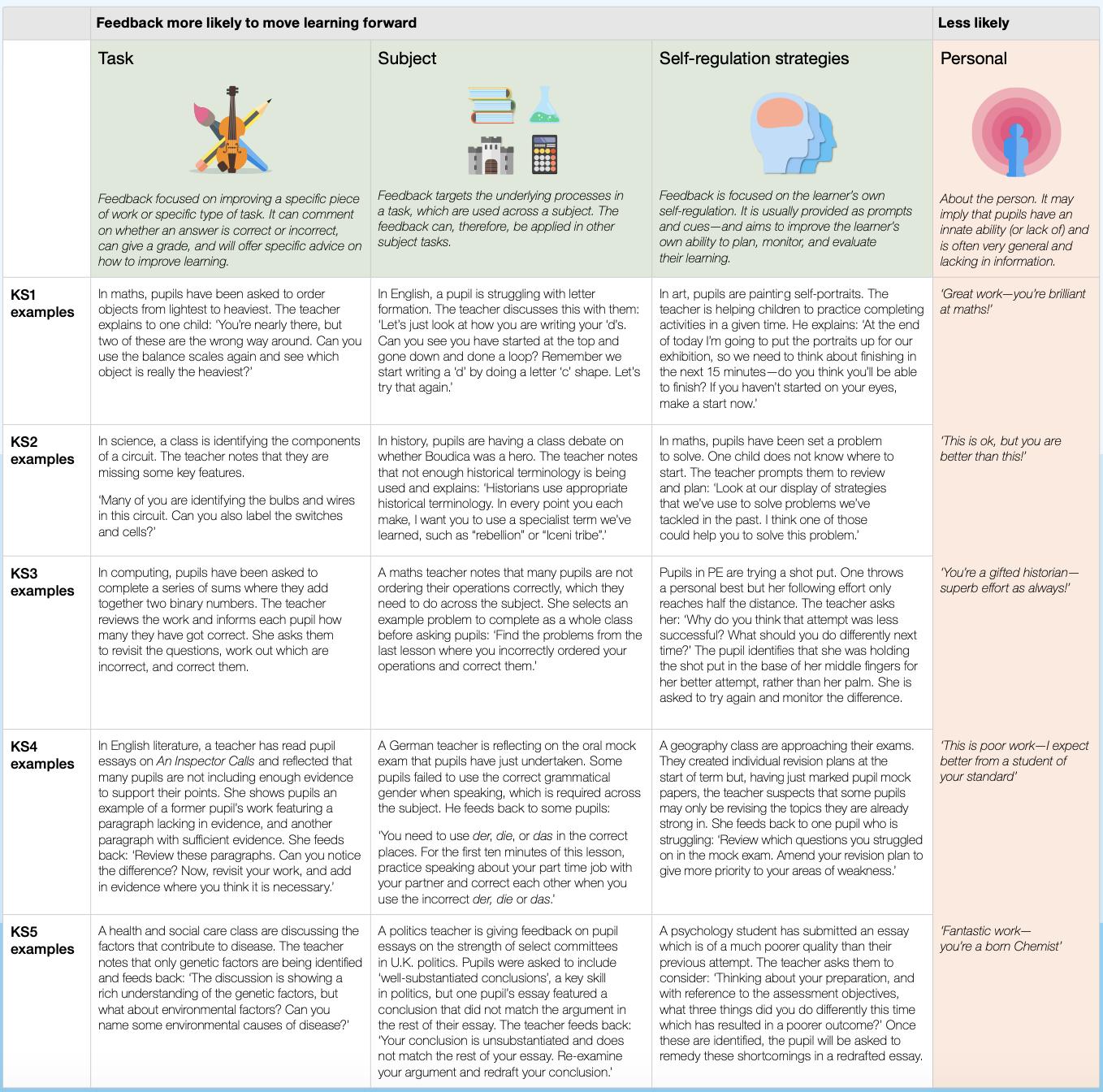
Source: https://d2tic4wvo1iusb.cloudfront.net/eef-guidance-reports/teachingassistants/Effective_Feedback_Task__Subject_and_Self-regulation_Strategies.pdf
Source:https://d2tic4wvo1iusb.cloudfront.net/production/eef-guidancereports/send/SEND_key_questions_tool.pdf?v=1699443470
https://educationendowmentfoundation.org.uk/education-evidence/guidance-reports/send
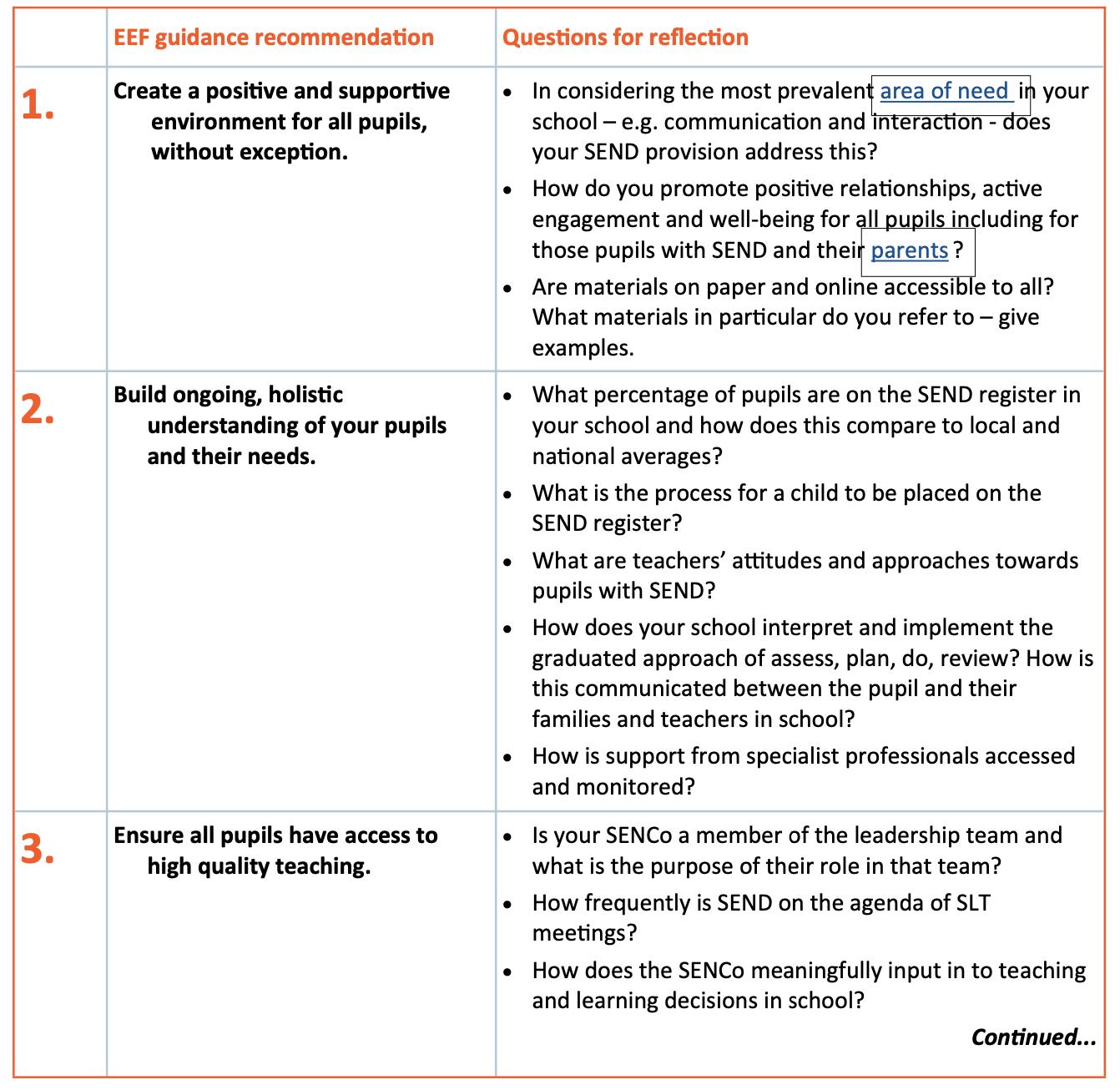
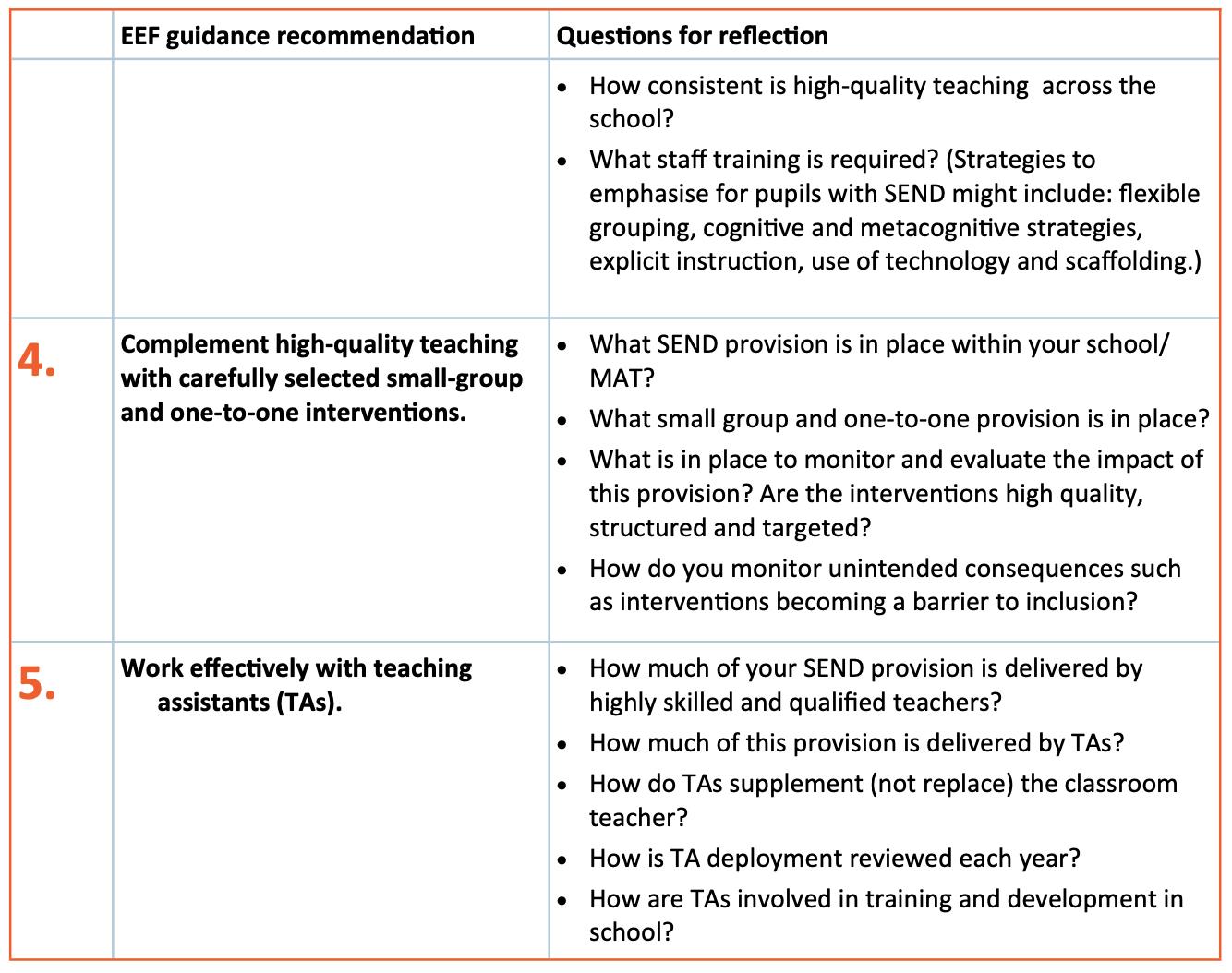
Source: https://d2tic4wvo1iusb.cloudfront.net/eef-guidancereports/send/EEF_Special_Educational_Needs_in_Mainstream_Schools_Recommendations_Poster.pdf?v=1635355222
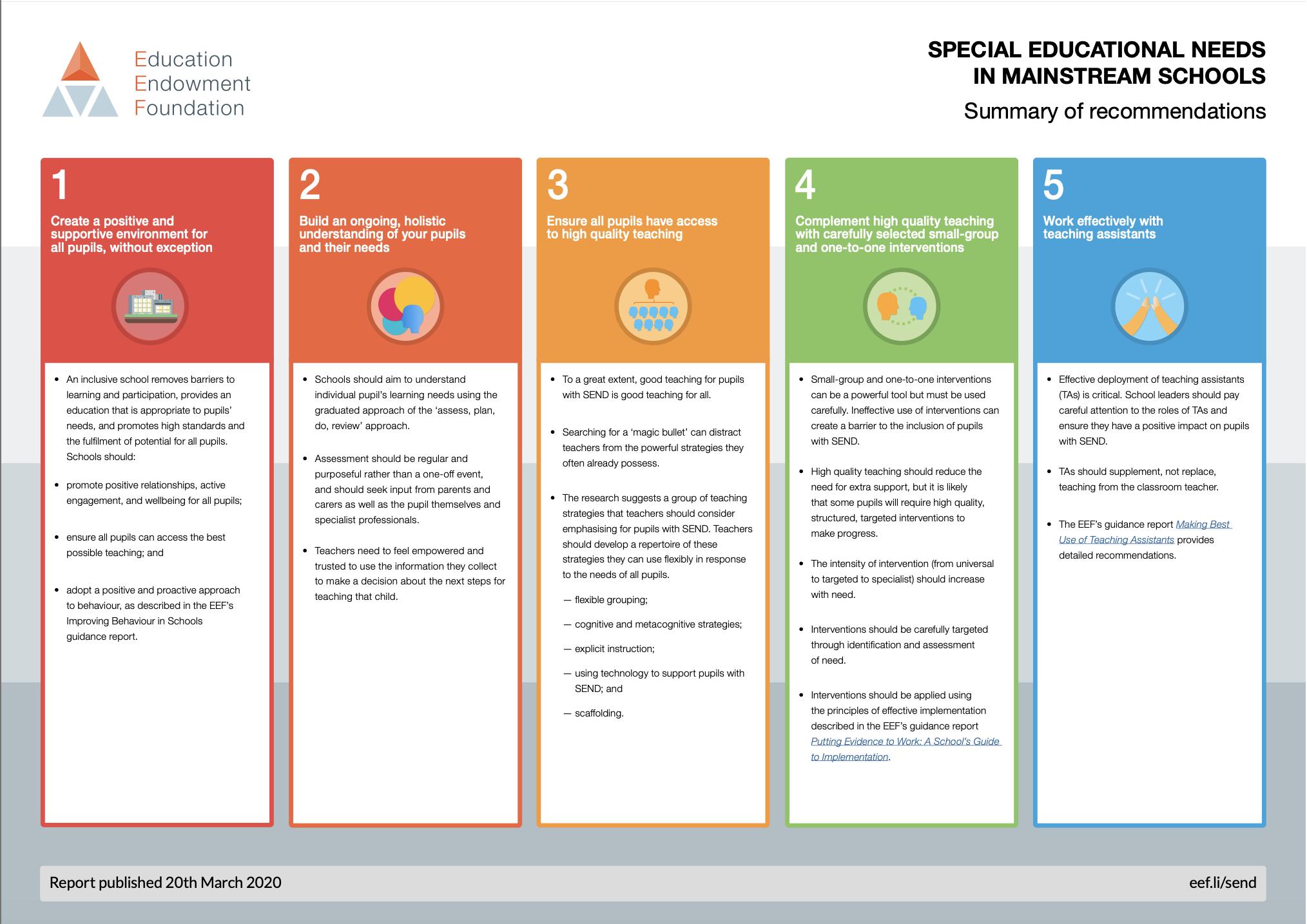
Source: https://d2tic4wvo1iusb.cloudfront.net/documents/guidance/TA_RAG_self-assessment_1.pdf?v=1629283605
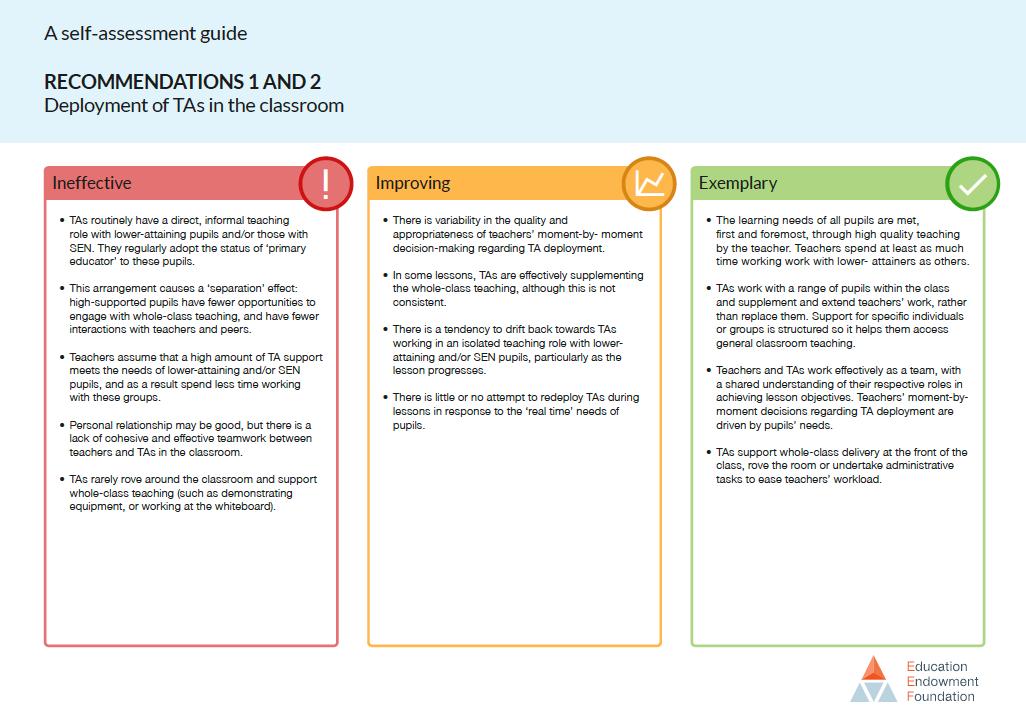
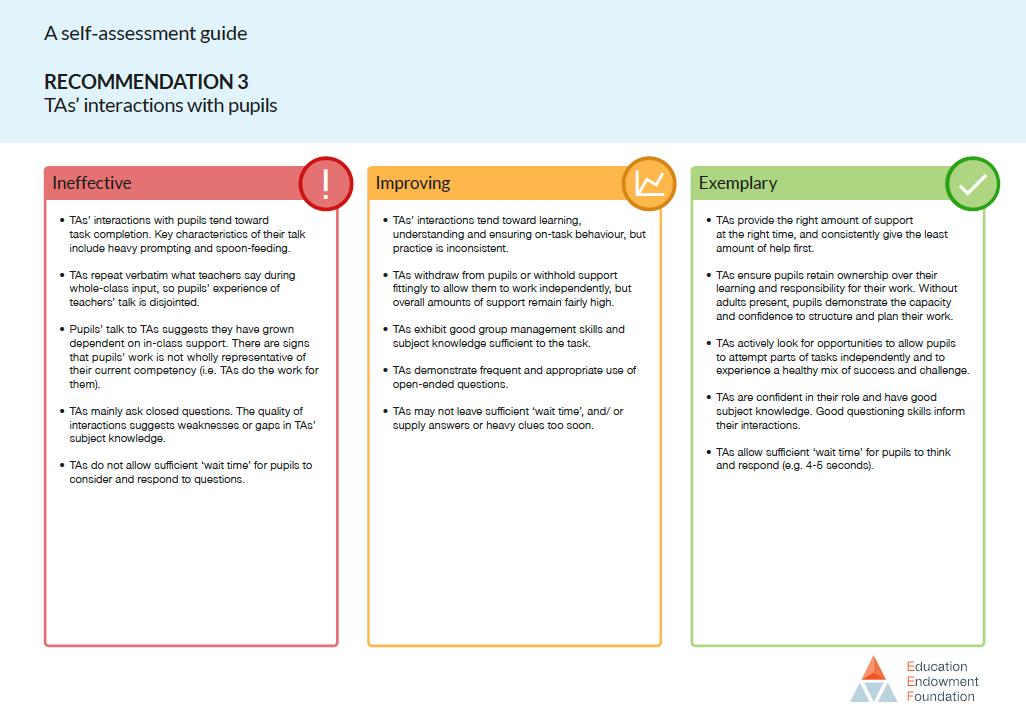
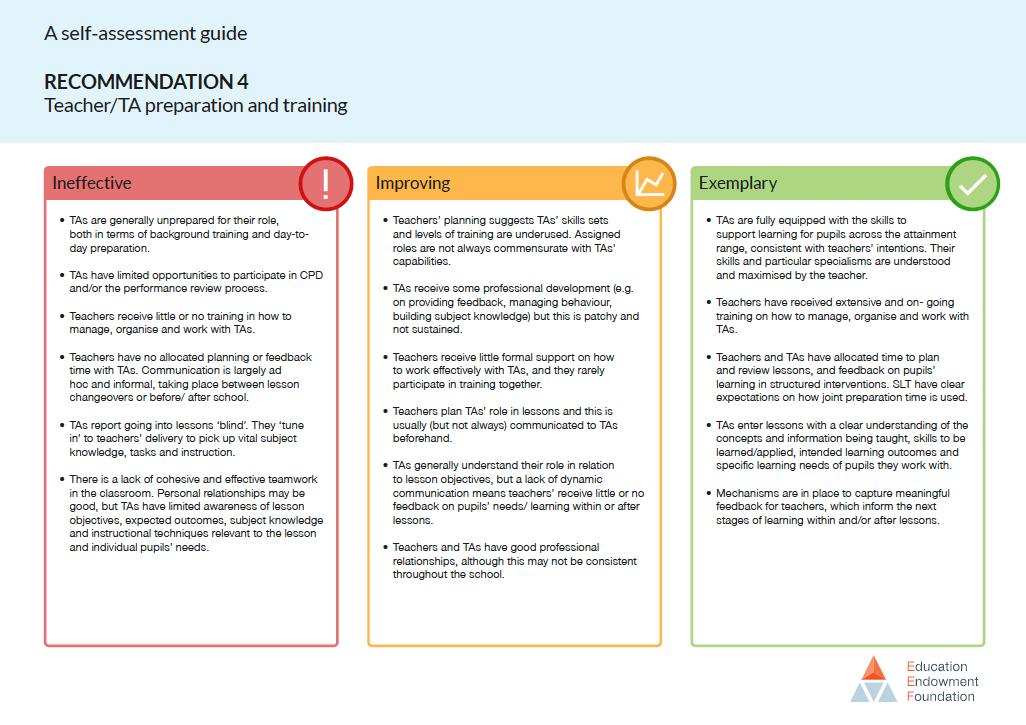
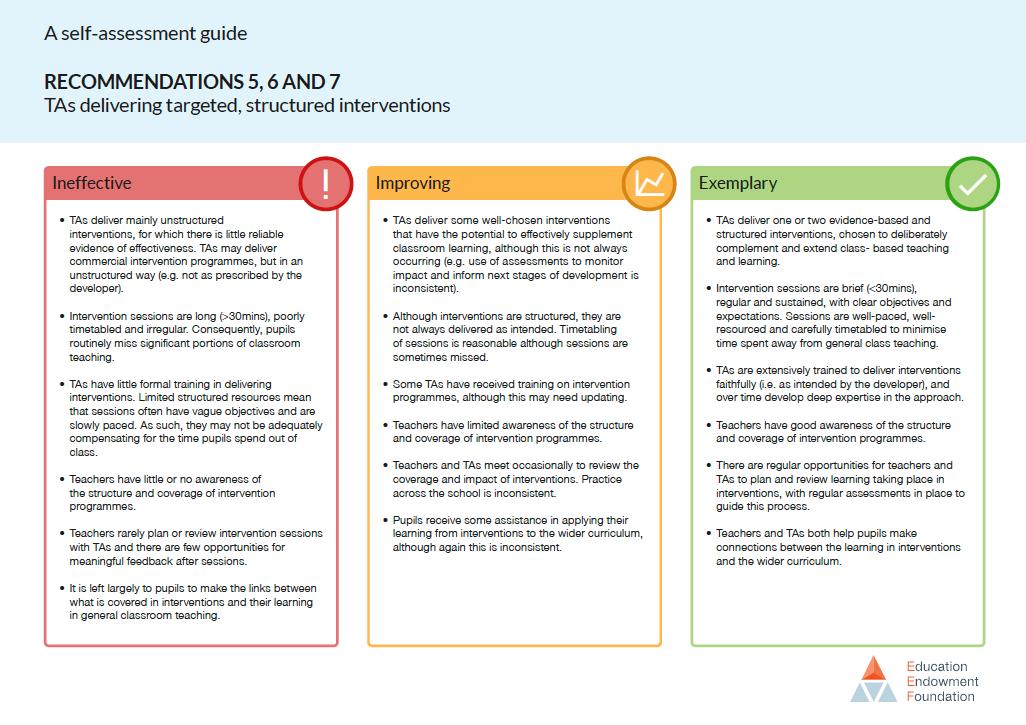
Instruction
Metacognition
Misconceptions
Feedback
Additional and special educational needs
Use of teaching assistants
Teaching
Effective pedagogy
Effective planning and preparation
Effective explanations and modelling
Stimulate thinking and understanding
Curriculum and assessment
Curriculum design
Literacy development
High-quality feedback
High-quality assessment
Additional and special educational needs and disabilities
Supporting special educational needs and disabilities in schools
Ensure all pupils experience success
Meet individual needs without creating unnecessary workload
Effective grouping