


Please come to the event having undertaken the following:
1. Engage with the case studies and accompanying documentation in Resource 6, making notes about the differences between the case study leaders’ practices and practice in your own setting ahead of a task in Session 3 of this event.
2. Bring completed Cycle One section of your LDR (previously uploaded to Canvas for feedback from the online leadership mentors).
3. Bring your own setting’s Teacher Development Policy (title and approach will vary at each setting/MAT) or similar documentation.
4. Bring additional teacher development documentation appropriate to your own context (handbooks, guidance documents, etc.).
5. Bring a device to work from so you can access the following (please download these in advance of the event):
• this participant resource pack
• the slide deck
• a word processing/planning tool such as MS Word, MS Excel, MS Project
6. Complete all of Cycle One as outlined in Canvas modules (if not already complete).
2.1. Teaching quality is a crucial factor in raising pupil attainment.
2.3. Effective professional development is likely to involve a lasting transformation in teachers’ capabilities and understanding so that their teaching changes.
2.4. Professional development should be developed using a clear theory of change, where facilitators understand what the intended educational outcomes for teachers are, and how these will affect pupil outcomes. Ideally, they should check whether teachers learn what was intended.
2.6. More effective professional development is likely to be designed to build on the existing knowledge, skills and understanding of participants.
2.7. The content of professional development programmes should be based on the best available evidence on effective pedagogies and classroom interventions, and aim to enhance capabilities and understanding in order to improve pupil outcomes.
Select evidence-based approaches and design effective professional development by:
2g. Breaking down complex CPD objectives into constituent components and scaffolding tasks around them, whilst ensuring that teachers can reconstruct the components back into a whole through their understanding of the underlying principles behind a particular approach.
Avoid creating unnecessary workload by:
2k. Making use of well-designed frameworks and resources instead of creating new resources (e.g. sources of subject knowledge, the Early Career Framework and associated core induction programme for early career teachers, ITT Core Content Framework, suite of National Professional Qualifications).
Your leadership learning and practice – individual activity
Using the completed sections of your LDR and Practice Activity feedback, answer the questions below, to review your learning so far.
1. Which were the most influential content areas and statements you learnt about during Cycle One? Reflect on the FTF event, online study, practice activities, FAT and in-school performance coach session in your thinking
2. How have you begun to apply your Cycle One learning to impact your:
a) setting practice?
b) leadership practice?
3. Which statements in the Cycle One section of your LDR do you need to further develop your knowledge and understanding about?
4. How has your Vision and Implementation Plan for leading teacher development from FTF Event 1 developed as a result of your learning in the rest of Cycle One?
5. Which areas of the Implementation content area (Cycle One section of LDR) are most relevant to your setting?
Your leadership learning and practice – group activity
Draw up a group list of themes arising about your learning during Cycle One.
Identify individual group members’ leadership behaviours and skills strengths using Resource 4, and add these below.
Themes Leadership behaviours – strengths
Behaviour Explanation
Self-awareness
Integrity
Resilience
Impact and influence
Effective leaders will know themselves and their teams, continually reflect on their own and others’ practices, and understand how best to approach difficult or sensitive issues. They are aware of their personal strengths and areas for future growth and understand how their own behaviour impacts on others.
Effective leaders act with honesty, transparency and always in the interests of the school and its pupils. They are able to gain the respect of others by acting in line with their own values, as well as making decisions or choices with the best interests of education and pupils in mind.
Effective leaders remain courageous and positive in challenging, adverse or uncertain circumstances. They are able to respond appropriately, manage uncertainty and bounce back even in the most trying of situations.
Effective leaders have a positive impact on students, colleagues and the wider community through persuading, convincing and bringing others round to their perspective. They understand others’ perspectives and priorities and tailor their communication to suit their audience.
Delivering continuous improvement
Learning focus
Developing others
Effective leaders secure and maintain positive improvement through articulating a clear vision, setting high expectations and leading a cycle of research, planning, monitoring, analysis and change. They demonstrate the ability to combine operational action with strategic planning, securing short-term improvements whilst building sustainable change.
Effective leaders keep learning and pedagogy at the core of the whole school curriculum and at the heart of their leadership practice. Their strong knowledge and understanding of learning theories (both adult and children) and pedagogies allows them to use their leadership to influence and improve effective teaching and learning. They encourage a culture of dialogue – formal and informal – about pedagogy, learning, curriculum design and development (assessment)
Effective leaders develop and empower colleagues. They proactively look for ways to develop others, seeking opportunities to develop colleagues through activities such as mentoring, supporting, championing and guiding, in order to bring out the very best in them.
Respect Effective leaders respect the rights, views, beliefs and faiths of pupils, colleagues and stakeholders
Commitment
Effective leaders are committed to their pupils and understand the power of worldclass teaching to improve social mobility, wellbeing and productivity
Skill Explanation
Critical knowledge and understanding of research techniques and self-management
Critical enquiry, review, analysis and evaluation
The best leaders undertake and use research, drawn from a range of sources, to support decision making and strategy development – using their time effectively within disciplined and well-organised systems and methodologies.
Challenge
Dealing systematically and creatively with complex issues
The best leaders use critical thinking, statistical and data analysis tools, techniques and concepts to identify strengths and areas for development. They design effective leadership plans to support intervention, direction and development. They analyse the implications of change, deploying well-evidenced research to frame school self-evaluation and improvement.
The best leaders use challenge effectively and adopt a range of strategies in the best interests of achieving progress – demanding ambitious standards for all pupils and a strong sense of accountability in staff for the impact of their work on pupils’ outcomes.
Priority identification
The best leaders have clear systems and protocols in place that enable them to consider and find solutions to issues, as they arise, in a way which deals most effectively with the barriers and challenges they face. The systems in place do not constrain but create a firm foundation for taking positive action.
The best leaders scan the horizon to anticipate change, taking a long-term view of the implications of change and improvement needed to identify short- and long-term priorities and goals, with specified milestones to ensure effective leadership and management.
Clear articulation and application of knowledge
The best leaders take time to reflect and learn from their leadership activity and apply this knowledge to bring about improvements in themselves and their work.
Self-direction and originality
The best leaders have clear and ambitious targets for themselves as leaders, for their pupils and for their schools. They take a unique strategic view of situations and their implications for long-term impact and outcomes – sometimes using unexpected actions to get the best for those concerned.
Current insights into professional practice The best leaders take time to reflect and evaluate their practice and effectiveness in their leadership and as leaders. They are aware of the education landscape, understand the context of their school and its needs, and direct professional practice and intervention appropriately.
Individual activity (20 minutes)
1. Read your allocated research source extract, highlighting aspects relating to the event’s ‘learn that’ statements about:
a. involvement of professional development in creating a lasting transformation in teachers’ capabilities and understanding
b. the place of professional development in raising pupil attainment
c. utilising a theory of change to develop professional development
d. utilising the evidence base (internal and external)
e. avoiding unnecessary workload
f. breaking down complex CPD objectives into constituent parts
2. ‘Put a pin’ against the points raised that could impact your leadership or context in particular.
3. If you have spare time, read another of the extracts.
Group activity (20 minutes)
▪ Sharing your individual responses, discuss the key themes arising from the research:
▪ How does it look and feel in different places, phases and settings?
▪ What does the research demonstrate works and does not work in terms of the practice for designing teaching development highlighted above?
▪ What are the critical research messages you want to take back to your context?
Extract 1
Early career framework (2021)
https://assets.publishing.service.gov.uk/government/uploads/system/uploads/attachment_data/file/97835 8/Early-Career_Framework_April_2021.pdf
Introduction (pages 4–6), Standard 8 (pages 24–25)
Extract 2
ITT core content framework
https://assets.publishing.service.gov.uk/government/uploads/system/uploads/attachment_data/file/97430 7/ITT_core_content_framework_.pdf
Introduction (pages 3–7), Standard 8 (pages 29–31)
Extract 3
Department for Education (2016). Standard for teachers’ professional development
https://assets.publishing.service.gov.uk/government/uploads/system/uploads/attachment_data/file/53703 0/160712_-_PD_standard.pdf
Whole document (one page only)
Extract 4
Kraft and Papay (2014) Can professional environments in schools promote teacher development? Explaining heterogeneity in returns to teaching experience
https://scholar.harvard.edu/files/mkraft/files/kraft_papay__prof_env_teacher_development_eepa_full.pdf
Conclusion and Policy Implications (pages 28–31)
Extract 5
Standard for teachers’ professional development: Implementation guidance for school leaders, teachers, and organisations that offer professional development for teachers (2016)
https://assets.publishing.service.gov.uk/government/uploads/system/uploads/attachment_data/file/53703 1/160712_-_PD_Expert_Group_Guidance.pdf
Introduction (pages 3–6), Part 1 (page 7) and Part 2 (page 8)
Extract 6
Darling-Hammond, Hyler, Gardner and Espinoza (2017). Effective teacher professional development
https://learningpolicyinstitute.org/sites/default/files/productfiles/Effective_Teacher_Professional_Development_REPORT.pdf
Introduction (page 1), pages 4–8, 9–12, 12–16
https://youtu.be/m1PEYovpo_k
Leader 1
Name Caroline Piotrowski Emma Forrest
Role Assistant Headteacher – Director of Professional Learning Year Leader (Year 6), Reading subject champion
Setting (and website)
Biddenham International School, www.biddenham.beds.sch.uk
Chepping View Primary Academy, https://www.cheppingviewprimarya cademy.org/
Phase Secondary Primary – Key Stage 2
Length of time as a teacher 20 years 5 years
Length of time as a leader 6 years 3 years
Biggest leadership learning in career so far
Holding other people to account and also making sure what I did had real impact.
Managing a team when remote learning was our focus – having to think of innovative ways to communicate, to assign work and manage when we were not all together in the same place at the same time.
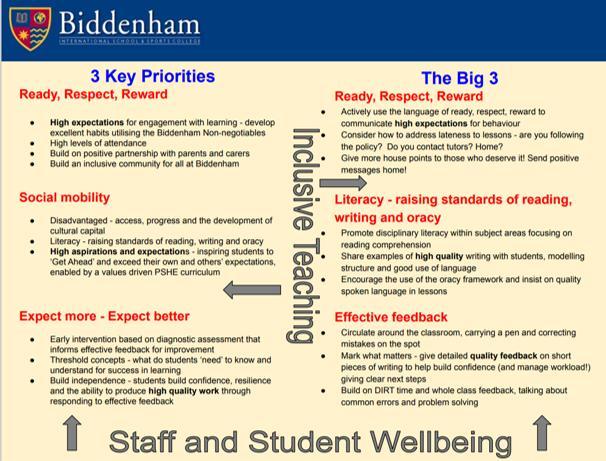
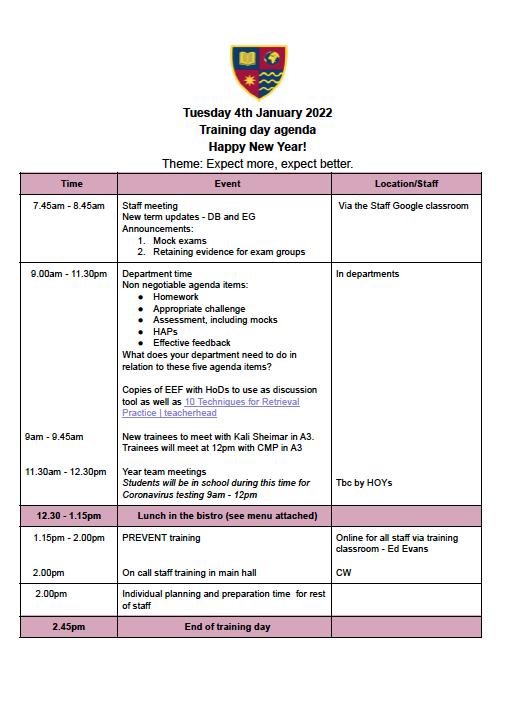
Biddenham International School, Caroline Piotrowski


Name Andy Mirkovic
Role
Setting (and website)
Deputy Headteacher
Chessbrook Education Support Centre, www.chessbrook.herts.sch.uk
Phase Secondary, Special, Pupil Referral Unit
Length of time as a teacher 27 years
Length of time as a leader 12 years
Question 1: Professional development should be developed using a clear theory of change, where its facilitators understand what the intended educational outcomes for teachers are, and how these will subsequently impact pupil outcomes (2.1, 2.3, 2.4)
We know that teaching quality is a crucial factor in raising pupil attainment (2.1), and that this is partially achieved through effective PD, which likely involves a lasting change in teachers’ capabilities or understanding so that their teaching changes (2.3). So, the way we design PD is crucial and the research tells us that PD should be developed using a clear theory of change, where its facilitators understand what the intended educational outcomes for teachers are, and how these will subsequently impact pupil outcomes (2.4). How do you do this in your school?
Answer 1: Teaching is an ever-changing business and as pedagogical research continues, new teaching strategies and initiatives become available for ways to improve classroom teaching along with developing how students learn and understand. It can be tempting to run development sessions on every new initiative or classroom practice, but as a facilitator you must take a holistic approach to developing teaching and have a clear plan of what it is you want to achieve. It is not just about teacher delivery in the classroom, although that is vitally important. To improve teaching quality you must have the understanding that you have to work on all aspects of the job. Behaviour management, teacher language, effective questioning, delivery, planning, teacher feedback, student responses, etc., are all worthy foci for professional development. A key factor in gaining the full impact on student outcomes from training is to make the professional development intrinsic. If a teacher wants to learn, has an interest in and can see how the training will impact positively on themselves and the students, then it is likely to be more effective and become embedded in their practice.
Question 2: Making use of well-designed frameworks and resources to avoid unnecessary workload (2k)
How do you, as a leader of professional development, avoid creating unnecessary workload by making use of well-designed frameworks and resources instead of creating new ones (2k)?
Answer 2: In every educational establishment there is a wealth of talent, knowledge and expertise within the staff body. For professional development, this is often a school’s most valuable resource. Sharing good practice is a term frequently used within education and we embrace it. We have a small but highly skilled staff body whose knowledge covers a wide range of skills. When staff have carried out some research, attended INSET or a course, we ensure that any relevant information or practice is disseminated to all staff. We avoid doing things for the sake of doing them and you need to resist the temptation to jump on board with every new initiative when it comes to light. The smart way to plan professional development is not to try and reinvent new practices all the time, but to identify the need, look at what is in place and potentially how it can be adjusted to fit the needs of the school, staff and ultimately the students.
Question 3: Breaking down complex CPD objectives into constituent components and scaffolding tasks around them for teachers to reconstruct into the whole (2.6, 2.7, 2g)
The evidence tells us that the design of effective PD is likely to build on the existing knowledge, skills and understanding of participants (2.6), and that the content of professional development programmes should be based on the best available evidence on effective pedagogies and classroom interventions, aiming to enhance capabilities and understanding in order to then improve pupil outcomes (2.7). So, how do you break down complex CPD objectives into constituent components and scaffold tasks around them, whilst ensuring that teachers can reconstruct the components back into the whole through their understanding of their underlying principles behind the particular approach being used (2g)?
Answer 3: Effective professional development needs to be based around an identified need and it needs to be thoroughly planned. Clear links need to be made between each delivered component and how they fit together. It must be clear from the start as to what the expected outcomes will be, the benefit it will provide for the school and the staff, and the impact that it will have on the students. This helps those on the training to engage more fully, as they are able to see the ‘bigger picture’, along with the purpose of the training, and it moves away from training that is being ‘done’ to them. Everyone has been on training where they are talked to for hours on end and bombarded with information that, during the training, is never fully explained, linked up or given practical relevance. We find successful professional development involves adopting a ‘bitesize’ approach, where appropriate, and then giving the staff the time to practice. This could be within the session if appropriate and if time permits, but we believe that trialling new practices, and then having the opportunity to review the impact, allows the particular approach to be better implemented and understood. It is much like the ‘plan, do, review’ model, which provides links and relevance to subsequent training.
It’s going to be vital then for others to understand how you do this as a leader, and what key behaviours you have developed as you have become the leader you are today, as well as what else you feel you are working on in terms of your leadership. Could I ask you to highlight the leadership behaviours you have utilised to lead teacher development in your school, as well as a leadership behaviour that you’re developing, with some brief examples of those in practice please?
Answer 4: To plan and deliver effective professional development to colleagues you must be respected, have integrity and be trusted. Time is very precious for those working in education and the thought of attending training can sometimes be seen as an unwelcome distraction from getting your job done. Staff are far more likely to engage and take on board what you are delivering if they believe in you and can see that you ‘practice what you preach’. Understanding your audience and adjusting your delivery, where necessary, is skilful and it is an area that I continue to develop. Remember that not everyone will share your expectations or see the same relevance in what you are trying to achieve, therefore it is your job to bring them on board, making influence and impact another key leadership behaviour.
Leader practice questions
What are the case study leaders doing?
What are you doing currently?
1. What are the effective characteristics of practice being modelled by these leaders?
2. How do the leaders break down complex CPD objectives into constituent components and scaffold tasks around them?
3. How do the leaders make use of well-designed frameworks and resources when designing professional development?
4. Which leadership behaviours and skills (Resource 4) are the leaders demonstrating in their practice?
5. How does this practice contribute to improving pupil outcomes?
What are the important issues you have identified during this gap analysis?
What key potential solutions are arising for you from the case study leaders?
What challenges might arise in the process of solving these important issues?
What are the gaps or overlaps between columns 2 and 3?
Designing effective professional development
The purpose and focus of professional development
Select evidence-based approaches and design effective professional development
Workload and wellbeing
Create impact with professional development

Select three of the following nine activities to submit to your leadership mentor.
Choose an activity based on your areas of interest and the results of the initial needs analysis undertaken at the start of the course.
Read Part 1 of the ‘Standard for teachers’ professional development’, Professional development should have a clear focus on improving and evaluating pupil outcomes, and Rob Sears’ practice piece in the self-study pack.
Rob worked with both senior leaders and staff to establish professional development priorities at his school, using teachers’ self-evaluations, subject knowledge audits, book looks, learning walks and pupil conferences, while ensuring priorities were informed by the school development plan.
Meet with senior leaders in your school to discuss the current approach to selecting professional development priorities: for example, diagnosis of need through teaching evaluations, teacher self-evaluation, pupil assessment data, statutory requirements.
▪ How does this approach ensure alignment with wider school improvement priorities?
▪ How could the process be refined to ensure alignment is secured more effectively?
▪ How does the approach ensure staff and senior leaders are able to contribute to the selection of priorities?
▪ How could the process be refined to include staff input more effectively?
Draft a plan to refine the current process for involving colleagues (particularly school leaders) in the selection of professional development priorities and ensuring alignment with wider school improvement priorities.
Write a 250-word (maximum) summary of your actions and learning from this task and submit to your leadership mentor in Canvas.
Resources
Practice piece: Rob Sear (Maths specialist teacher)
Department for Education (2015) Standard for teachers’ professional development
Identify one or more experienced colleagues teaching a particular subject within a particular phase/domain.
Meet with them to discuss the essential knowledge, skills and concepts for that subject and phase/domain.
▪ How have they identified these essential areas of knowledge or skills? How are these prioritised?
Use their expertise to identify subject-, phase- and domain-specific curriculum materials.
▪ Why were these materials selected?
Work with your colleague or colleagues to identify a specific area of knowledge or skill to develop and plan a PD activity or programme ensuring it is aligned to subject-, phase- and domain-specific curriculum materials.
Write a 250-word (maximum) summary of your actions and learning from this task and submit to your mentor in Canvas.
Read page 20 of the EEF’s (2021) effective professional development report, Develop teaching techniques
Meet with an experienced colleague to identify a specific teaching technique for development informed by the school improvement plan, pupil data or evidence from teaching evaluations. The EEF gives the example of instructing teachers how to use manipulatives and representations, how to teach strategies for solving problems or how to use assessment to build on understanding.
Identify the constituent components of your chosen teaching technique, for example the individual skills or knowledge required for teachers to master the technique.
Plan an activity or sequence of PD that includes the five mechanisms proven to support the development of teaching techniques:
▪ instructing teachers on how to perform a technique
▪ arranging practical social support
▪ modelling the technique
▪ providing feedback
▪ rehearsing the technique
How will you scaffold tasks around the constituent components of your chosen teaching technique?
How will you ensure your sequence or activity develops a thorough understanding of the underlying principles of the teaching technique?
Submission
Write a 250-word (maximum) summary of your actions and learning from this task and submit to your leadership mentor in Canvas.
Resources
Education Endowment Foundation (2021) Effective professional development: Guidance report
Assistant Headteacher Zara Peskett drew on external expertise for her oracy project in a large comprehensive secondary school, connecting with an expert team in another school.
▪ Meet with subject leaders in your school.
▪ What links do subject specialists and subject leaders in your school have with external subject experts?
▪ How is collaboration with external subject experts managed and monitored in your school?
▪ How could you support the exploitation of these links to improve subject knowledge in your school?
▪ What do you need from senior leadership to support the use of external expertise in your school?
Submission
Write a 250-word (maximum) summary of your actions and learning from this task and submit to your leadership mentor in Canvas.
Resources
Practice piece: James Marsh: Headteacher of Leigh St Thomas’ Primary School
Katie Jennings made use of existing frameworks and resources to support professional development at Mission Grove Primary School, drawing on free services of external providers including the Open University’s FutureLearn digital education platform as well as purchasing commercial training provided by The Key.
Meet with other senior leaders at your school to discuss the use of existing frameworks and resources for professional development currently used at your school (e.g., ITT Core Content Framework, National Professional Qualifications, Early Career Framework, commercial training, MOOCs like Coursera or FutureLearn).
▪ Identify an example of the effective use of existing resources and frameworks at your school. Why was this successful and how could you tell (e.g., impact on pupils and staff, improved pupil outcomes, changes in teacher practice)?
▪ What action would you need to take to ensure the use of other frameworks and resources were as effective (e.g., refining your strategy for diagnosing development needs, identifying and selecting resources and frameworks, evaluating quality, highlighting relevance to teaching practice, providing time and support from leaders)?
Submission
Write a 250-word (maximum) summary of your actions and learning from this task and submit to your leadership mentor in Canvas.
Resources
Practice piece: Katie Jennings, Headteacher, Mission Grove Primary School
“Developers need to provide sufficient clear guidance about the purpose, goals and principles of the intervention, while maintaining the flexibility needed to ensure teachers can fit the intervention into their working patterns.” (Sims et al., 2021)
Read page 35 of the EEF’s (2021) effective professional development report, Time constraints and adapting accordingly.
Meet with colleagues to discuss the use of professional development time at your school.
Identify a recent professional development programme or activity in your school.
▪ How did the design of the PD activity fit in with the school routine?
▪ How were the benefits and relevance of the PD activity or programme communicated to teachers?
▪ What action was taken to balance the desire to promote lasting and meaningful learning with the imperative to minimise the pressure placed on teacher time?
▪ How could the design be adapted to make more productive use of development time?
Submission
Write a 250-word (maximum) summary of your actions and learning from this task and submit to your leadership mentor in Canvas.
Resources
Education Endowment Foundation (2021) Effective professional development: Guidance report
“Adaptation can ensure that professional development better suits the context it is delivered in … an adaptation is more likely to have positive effects where it makes small tweaks to tailor the programme to teachers’ and students’ needs or extends the programme. Where an adaptation omits crucial elements of the programme, and particularly where it fails to incorporate the mechanisms, it is less likely to succeed.”
Read Section 3 of the EEF’s (2021) effective professional development report, which provides guidance on designing activities for your school context.
The guidance recommends that, given the varied dynamics and challenges faced across schools and settings, those who develop PD should expect variation in delivery and should, therefore, identify and clearly signpost the type of adaptations that can be permitted and encouraged.
Meet with a colleague to discuss a development programme used in your school.
▪ What components of the programme are essential to creating impact? Why?
▪ What aspects of the programme could be adapted to suit different contexts and needs?
▪ Draft guidance for trainers indicating how and where adaptations could be made (e.g., alternative resources, changes to delivery, frequency or length).
Submission
Write a 250-word (maximum) summary of your actions and learning from this task and submit to your leadership mentor in Canvas.
Resources
Education Endowment Foundation (2021) Effective professional development: Guidance report
Read Section 2 of the EEF’s (2021) effective professional development report, Ensure that professional development effectively builds knowledge, motivates, develops techniques, and embeds practice. This explains how to balance the design of PD programmes by including 14 key mechanisms required to improve pupil attainment.
Meet with a colleague to critically review the design of a professional development activity offered in your school.
▪ What is its purpose?
o build knowledge
o motivate teachers
o develop teaching techniques
o embed practice
▪ How effectively does the design incorporate relevant mechanisms?
▪ What is the impact of including and implementing the mechanisms identified?
▪ How could the design be refined to create better balance?
Submission
Write a 250-word (maximum) summary of your actions and learning from this task and submit to your leadership mentor in Canvas.
Resources
Education Endowment Foundation (2021) Effective professional development: Guidance report
In Phil Paul’s practice piece, he explained that for teachers to have a complete understanding of their pupils’ progress, there needs to be a triangulation between data, samples of work and interactions in class dialogue. He emphasised the benefits of deep discussion, collaborative planning, triad discussions and peer reflections to support the planning of professional development activities and effective impact measurement.
Plan and conduct a triad discussion in your school, identifying two of your colleagues to work with you to gather and evaluate evidence from:
▪ classroom observations of class dialogue and pupil/teacher interactions
▪ samples of work
▪ pupil assessment data
Use the evidence to evaluate the quality of teaching for a specific sequence of learning.
In your triad, review the evidence, discussing what it reveals about the quality of teaching for that sequence of learning.
Reflect on your findings and what you have learned from working in a triad.
Submission
Write a 250-word (maximum) summary of your actions and learning from this task and submit to your leadership mentor in Canvas.