



Only three things happen naturally in organisations: friction, confusion and underperformance. Everything else requires leadership.
Peter Drucker

One Welcome, programme, process and check-in



Culture, ethos and teaching
Partnerships and collaboration
Organisational effectiveness
Performance management and accountability
Financial management and accountability
Feedback/ review
Organisational management
Managing performance Governance and accountability
Review learning/feed forward Working in partnership
Session
Session
To analyse information to decide on the best allocation of resources; financial, human and educational
To understand the core functions of governance, especially financial performance
To use a structure to support the management of performance
To evaluate the most effective forms of partnership and collaboration
Use your leadership development record review cycle 3, reflective task and formative assessment task feedback as a prompt to focus individual feedback:
In which areas and for which statements has your understanding developed the most?
How have you applied your understanding and what impact has it had on:
a) your leadership?
b) school practice?
What behaviours have you demonstrated?
What areas do you need to continue to work on and develop? How will you address these?
Use Resource 3 to make notes against these headings.
expert practitioner view
Feedback/ review
Organisational management
Managing performance Governance and accountability
Review learning/feed forward Working in partnership

Financial management
Role of governors and accountability arrangements
Managing performance
Team effectiveness
Value of partnerships and collaboration
Feedback/ review
Organisational management
Managing performance Governance and accountability
Review learning/feed forward Working in partnership
Organisational management
7.4. Good financial, human and educational resource management, strategic planning, employee relations and risk management are the foundations of a good school.
7.5. Schools are public bodies and so have a duty to use all public money in the public interest.
7.8. A headteacher’s professional responsibilities include leading, managing, deploying, and developing staff, including appraising and managing performance.
Prioritise, allocate and manage resources (including financial, human and educational) appropriately, effectively and efficiently to ensure sustainability, including by:
7.i. Understanding the financial mechanisms (and associated regulations) through which the school is funded.
7.j. Recognising that there is a strong connection between strategic decisions and the associated resource implications (e.g. using Integrated Curriculum and Financial Planning to ensure that the timetable delivers the school’s curriculum priorities within the available budget) and using this knowledge to inform decision making.
7.l. Proposing a prudent budget to those responsible for governance and overseeing and enabling clear, effective financial policies, processes and systems within the school (e.g. procurement, audit, expenses).
7.n. Understanding how to read accounts, statements and forecasts and using this to plan finances and appropriately monitor the budget.
7.o. Considering a range of appropriate income generation activities to maximise funding streams.
Implementation
8.3 Implementation should involve repurposing existing processes and resources (e.g. governance, data collection) rather than creating a separate set of procedures.
‘Cost: the key factor is whole life cost, not lowest purchase price. Whole life cost takes into account the cost over time, including capital, maintenance, management, operating and disposal costs. For complex procurements, whole-life cost can be very different from initial price.
Quality: paying more for higher quality may be justified if the whole life cost is better, for example, taking into account maintenance costs, useful life and residual value. The purchaser should determine whether increased benefits justify higher costs. Perspective: each public sector organisation’s procurement strategy should seek to achieve the best value outcome for the Exchequer as a whole, not just for the organisation itself. Collaborative procurement: in the vast majority of cases, standardising and aggregating procurement requirements will deliver better value for money.’
HM Treasury (2013). Managing Public Money
Minimising the costs of resources used by the school but having regard to quality.
Achieving greater economy in the delivery of services; for instance, reducing prices paid for inputs and achieving the same outputs is an example of a cashable saving, as the money saved can be released to other areas of school expenditure.
Economy measures can be used to indicate whether the right price was paid to acquire the necessary inputs.
The relationship between output, in terms of goods, services or other results, and the resources used to produce them.
Efficiency measures can be used to demonstrate how well the school uses inputs to produce its outputs. This relates to judgements about the optimal way of aligning resources to achieve desired outputs.
The extent to which objectives have been achieved. The relationship between the intended impacts and actual impacts of an activity.
Effectiveness measures would examine the extent to which outputs achieved the desired outcomes in pupils’ learning that the school wanted, as indicated in its school development plan.
The review identified the following seven key characteristics of the most efficient schools. These schools:
1. Deploy the workforce effectively, with a focus on developing high quality teachers.
2. Make use of evidence to determine the right mix of teaching and education support staff.
3. Employ or have access to a skilled school business manager who takes on a leadership role.
4. Make good use of financial benchmarking information to inform the school’s own spending decisions.
5. Make use of school clusters, sharing expertise, experience and data, as well as accessing economies of scale when making shared purchases.
6. Manage down back office and running costs.
7. Have in place a strong governing body and leadership team that challenges the school’s spending.
Department for Education (2013). Review of efficiency in the schools system
Step 1: Commit to educational success and financial security.
Step 2: Tame the uncertainty.
Step 3: Understand the knowns and the “as is”.
Step 4: Do the planning.
Step 5: Review and reflect.
Step 6: Agree the plan.
Step 7: Communicate clearly and implement with purpose.

Curriculum and teachers
• Teacher deployment and staffing structure
• Roles and responsibilities
• Curriculum development and priorities
Support staff and resources
• Balance of support staff
• Roles and responsibilities
• Efficient and effective use of resources e.g. technology
Overheads and operational costs
• Costs of services
• Service level agreements
• Economies of scale – using clusters
‘The headteacher’s role in financial planning is to know but not to do.’
Task: Produce a report for governors that:
identifies the main financial challenges the school will face over the next 3 years
makes recommendations to be adopted by the governors
(Resource 4)



Feedback/ review
Organisational management
Managing performance Governance and accountability
Review learning/feed forward Working in partnership
10.3. School leaders are accountable for their decisions and actions and must submit themselves to the scrutiny necessary to ensure this. Appropriately participate in governance, and fulfil obligations to give account, be challenged, and accept responsibility, including by:
10.c. Ensuring that formal papers that are prepared and presented are clear, concise and accurate.
10.d. Establishing and sustaining professional working relationships with those in governance roles (including the chair and the clerk).
Appropriately participate in and fulfil obligations to external organisations including the Department for Education, Ofsted, the Education and Skills Funding Agency, Local Authority and auditors, including by:
10.e. Adhering to the Principles of Public Life at all times.
10.f. Applying a good understanding of the law, statutory guidance and regulatory frameworks to decisions, processes and systems.
10.g. Ensuring reports that are submitted are timely and accurate, and participating in inspections or reviews as required.
10.h. Building professional working relationships with those in external accountability organisations.
Effective governance is based on six key features:
Strategic leadership – strategic leadership sets strategy and champions the school’s culture, vision and ethos
Accountability - strategic decisions that aim to improve educational standards and financial performance
People - effective governance should involve people with the right skills, experience, behaviours and capacity
Governance structures - clearly defined governance roles, responsibilities and accountabilities reinforced
Compliance - governing bodies comply with statutory and contractual requirements
Evaluation - regular evaluation to monitor and improve the quality and impact of governance
Department for Education 2024 Maintained schools governance guide
The core functions of the governing body are as set out in (regulation 6) and include, but are not limited to ensuring:
that the vision, ethos and strategic direction of the school are clearly defined
that the headteacher performs their responsibilities for the educational performance of the school
the sound, proper and effective use of the school’s financial resources
The governing body must oversee financial performance and ensure public money is well spent (as outlined in The School governance (Roles, Procedures and Allowances) Regs 2013).
It will have at least one individual with relevant financial skills and experience, who can interrogate detailed financial data and who:
builds a relationship with the school business professional (SBP) responsible for finance, such as the finance manager or school business manager
acts as the link between the SBP and the governing body
ensures the governing body has a correct understanding of the school’s finances and financial performance
It is important that everyone on the governing body has:
a basic understanding of their school’s financial cycle and legal requirements on accountability and spend
an oversight of school spending
an understanding of the school’s financial position
Department for Education 2024 Maintained schools governance guide
Asking the right questions is equally important in relation to money as it is to educational performance.
Appropriate questions might include:
Are resources allocated in line with the organisation’s strategic priorities?
Is the organisation making best use of its budget (e.g. by integrating its curriculum planning with its financial planning and using efficiency data to inform decision making)?
Does the organisation plan its budgets on a bottom-up basis driven by curriculum planning (i.e., is the school spending its money in accordance with its priorities), or is the budget set by simply making minor adjustments to last year’s budget to ensure there is a surplus?
What sources of financial data and tools are used to ensure the assets and financial resources are being used efficiently?
How can better value for money be achieved from the budget?
Is the organisation complying with basic procurement rules and ensuring it gets the best deal available when buying goods and services in order to reinvest savings into teaching and learning priorities?
Is the organisation taking advantage of opportunities to collaborate with other schools to generate efficiencies through pooling funding where permitted, purchasing services jointly and sharing staff, functions, facilities and technology across sites?
Briefly present your financial report and recommendations to the governing board (10 minutes)
No more than 5 minutes for questions
In what way will effective financial management support creation of a positive culture and ethos?
In what way will effective financial management contribute to effective and efficient school improvement, resource capability and accountability?

Feedback/ review
Organisational management
Managing performance Governance and accountability
Review learning/feed forward Working in partnership
7.8. A headteacher’s professional responsibilities include leading, managing, deploying, and developing staff, including appraising and managing performance.
Recruit, develop, support and appropriately manage all colleagues (including non-teaching colleagues), including by:
7.t. Having high expectations, communicating regularly and clearly, considering staff motivations and workload, prioritising staff professional development, and holding colleagues to account for their performance.
7.u. Ensuring appraisal processes are aligned to the core aim of improving teaching quality and pupil attainment.
An empowered organisation is one in which individuals have the knowledge, skill, desire and opportunity to personally succeed in a way that leads to collective organisational success.
Stephen Covey

‘Good performance management is essential to get the best outcome for organisations and the workforce. If performance is not managed well, staff are unlikely to perform at their best.
Good performance management arrangements can help an organisation:
• motivate staff
• check that all staff are making valuable contributions towards organisational goals
• develop staff
• recognise and acknowledge the good work of employees
• deliver tasks and projects quickly and to required standards
• spot and improve poor performance.’
ACAS How to manage performance
are secure in their individual capabilities and roles
are able to receive and give feedback
are committed to the task and team activity direction
plan in order to complete activities and address issues
enjoy quality interaction within the team
Individually reflect on the teams you are involved with and individuals within them.
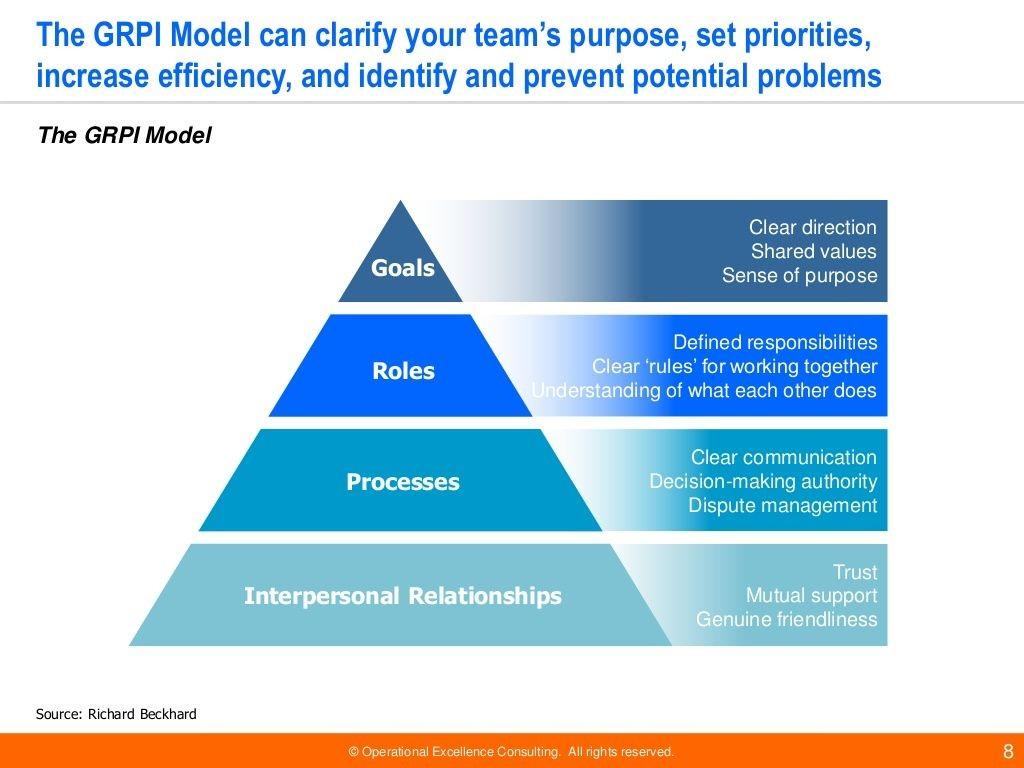
Beckhard states that if all the component parts of clear goals (Why we are doing what we do?); roles and responsibilities (Who does what?); processes (How does the work get done?) and relationships (How do members interact?) are balanced and led well, team and individual performance will be effective.
Identify someone in one of your teams who is not stepping up and would not gain a high score in each of the 5 characteristics on the earlier slide. What is the critical factor impacting upon their team performance?
A fierce conversation is one in which we come out from behind ourselves into the conversation and make it real.
(Susan Scott, Fierce Conversations, p. 7)
Scott suggests that:
our lives succeed, or fail, ‘one conversation at a time’
the conversation is the relationship
all conversations are with, and sometimes involve, other people
A ‘fierce conversation’ is the sort of conversation you probably don't look forward to holding! It is the type of conversation you know you need to have with a team member(s), which you know is likely to be difficult for both you and them.
You are likely to feel quite strongly about the issue and your emotions will have been stirred.
It is almost certain that what you are going to have to say will result in an emotional response from the receiver.
1. Master the courage to interrogate reality.
2. Come out from behind yourself into the conversation and make it real.
3. Be here, prepared to be nowhere else.
4. Tackle your toughest challenge today.
5. Obey your instincts.
6. Take responsibility for your emotional wake.
7. Let silence do the heavy lifting.
Scott argues that the first 60 seconds are crucial. She provides a seven-step model to take you through the first 60 seconds of your conversation:
Step One: Name the issue. If you have more than one issue, there has been a significant failure on your part.
Step Two: Give one specific example to illustrate the issue.
Step Three: Confess your emotion – this shows that you are involved/affected by the issue and want to see it resolved quickly.
Step Four: Say what you feel is at stake – honestly, no matter how difficult. This will get the individual’s or team’s attention.
Step Five: Admit any involvement you may have had – what contribution you have made to the problem. This is a very important step.
Step Six: Say ‘I want to resolve this with you’ – show you want to move forward together and not to point the blame.
Step Seven: Invite the person to put forward their position – shut up, listen without interruption.
Feedback/ review
Organisational management
Review learning/feed forward Working in partnership Managing performance Governance and accountability
9.1. Good relationships and partnerships are a foundation of a good school.
9.6. Sharing effective practice between schools, and building capacity and effective mechanisms for doing so, is key to closing the attainment gap. To improve performance school leaders need to collaborate and work with colleagues and other relevant professionals within and beyond the school, including relevant external agencies and bodies.
Work in partnership with other schools and school trusts alongside the community and other organisations including professional associations and local authorities, including by:
9.g. Clarifying, in writing where appropriate, the purpose of the partnership and the commitments and/or duties each partner has to it.
9.h. Understanding the full range of organisations around a school, how they interact with the school and each other, and any statutory relationships or duties that exist between organisations.
9.i. Establishing clear, open communications between organisations with nominated ‘relationship holders’ and clear escalation points where appropriate.
9.j. Contributing expertise to existing networks and partnerships (e.g. working with partner schools).
Claim 2: There are eight key dimensions of successful leadership.
Our study identifies eight key dimensions of successful leadership, which all centre on student learning, wellbeing and achievement.
Successful leaders:
define their values and vision to raise expectations, set direction and build trust
reshape the conditions for teaching and learning
restructure parts of the organisation and redesign leadership roles and responsibilities
enrich the curriculum
enhance teacher quality
enhance the quality of teaching and learning
build collaboration internally
build strong relationships outside the school community
‘School partnerships can be defined as: an ongoing collaborative relationship between schools, aligning their interests around a common vision and combining their complementary resources and competencies, to deliver benefit to each of the partners. This document focuses in particular on cross-sector partnerships, that is partnerships between state schools or trusts and independent schools. School partnerships can also include other types of organisations, such as universities, business or local authorities.’
Schools Partnership Alliance (2023) School Partnerships for Impact Guide
Using Resource 9 as a group analyse the benefits of partnerships.
In what ways do those identified by the Schools Partnership Alliance align with the partnerships you have in your school?
Are there any potential benefits which are missing and could be added to the list? If so, what are they and what is the rationale for these?
What are the challenges associated with the benefits and how might leaders overcome these?
Use examples from your own experience to support your answers.
15 minutes
The Department for Education says ‘We strongly encourage partner schools to formalise their arrangements in order to clarify the activities and benefits for all involved. Evidence suggests that partnerships that enter into a formal agreement tend to be better formed and more sustainable.’
‘Everyone involved should agree their objectives and how they’ll work together to achieve them. A clearly defined set of objectives should reflect the strengths and needs of everyone involved.’

Guide to Setting up Partnerships (October 2022)
Using the information on Resource 10, individually identify the aims of a partnership you are involved in and how they align with your school’s vision and strategic direction.
Share these with a partner.
You may also want to think about:
who will be the project lead from each institution
what specific activities, year groups and subjects the partnership will cover
what measures will be used to monitor performance
how you’ll measure the outcomes and impact of the partnership
how you’ll evaluate the partnership – what data you’ll use, and how it will be shared and analysed
the form of your partnership agreement, such as through a memorandum of understanding (MOU
As a group, reflect on what you have learned from the day.
How will what you have learned be applied in your own settings?
What further research will you undertake and in what areas?
What behaviours have you demonstrated during the day?
Agree your top three take-aways as a group.
Review of learning, pathway for online study, practice activities and formative assessment tasks
Feedback/ review
Organisational management
Governance and accountability
Managing performance
Review learning/feed forward Working in partnership
Individually, consider what your focus and target statement areas for learning will be for the Organisational Effectiveness online course. Which practice activities and formative assessment task will you need to complete?
10 minutes
Use your leadership development record cycle 4 and the information in your participant packs
Resource 13 – online course summary
Practice activities pack
Formative assessment tasks pack
In pairs (7 minutes each) have a coaching conversation about your proposed pathway.
Outline your rationale for choosing the module units to be studied, practice activity and formative assessment task.
Partner to challenge rationale, seek clarification and support confirmation and/or realignment of study and practice pathway targets.

Canvas \ log in \ Grades \ Assignment Group
1. Log in to Canvas
2. Go to ‘Grades’ and select ‘Assignment Group’
3. Check that you have completed the tasks at the top of the gradebook (tick or 1 in score column)
4. Scroll down until you reach today’s date and check that all tasks to that point have a tick or 1 next to them
5. If there are any incomplete/missing, make a note of them and prioritise for completion after the event

Review your pathway choices (content for online course, practice activities and formative assessment task) with your in-school sponsor.
Complete the Organisational Effectiveness online course, three practice activities and one reflective task.
Complete your formative assessment task.
Upload the response to the formative assessment task and your review of the leadership development record to your performance coach by the date specified on the syllabus page on Canvas.
Confirm performance coaching appointments.

Office hours: Monday to Friday 9am to 5pm (excluding bank holidays)