

Please come to the event having undertaken the following.
1. Bring a copy of your reflective task from the Leading Teaching online course.
2. Bring a copy of your completed leadership development record (LDR) cycle 3.
3. Bring a copy of your leadership development record (LDR) cycle 4.
4. Listen to the expert practitioner recording. https://www.youtube.com/watch?v=4_RoS7VReFw
5. Read: the executive summary of the Review of efficiency in the schools system: https://assets.publishing.service.gov.uk/government/uploads/system/uploads/attachment_data/ file/209114/Review_of_efficiency_in_the_schools_system.pdf
6. Familiarise yourself with the Brook Lodge information. (Bring an A3 copy of the resource 6 budget sheet with you.)
7. Read the Partnership Models Guide https://www.gov.uk/government/publications/setting-up-school-partnerships/partnership-modelsguide
HM Treasury (2025). Managing Public Money https://www.gov.uk/government/publications/managing-publicmoney
Department for Education (2013). Review of efficiency in the schools system https://assets.publishing.service.gov.uk/government/uploads/system/uploads/attachment_data/file/ 209114/Review_of_efficiency_in_the_schools_system.pdf
NASBM (2016) Guidance for improving school financial outcomes https://schoolsweek.co.uk/wp-content/uploads/2016/05/NASBM-Guidance-for-improving-school-financialoutcomes.pdf
Department for Education (2024). Staffing and employment advice for schools https://assets.publishing.service.gov.uk/government/uploads/system/uploads/attachment_data/file/ 750826/Staff_Advice_Handbook_October-2018-edit.pdf
Department for Education checklist guidance April 2024 https://www.gov.uk/government/publications/schoolsfinancial-value-standard/schools-financial-value-standard-sfvs-checklist-guidance (Schools financial value standard (SFVS) and assurance statement)
Department for Education (2019). A 7-step guide to Integrated Curriculum and Financial Planning (ICFP): A simple approach for education leaders
https://assets.publishing.service.gov.uk/government/uploads/system/uploads/attachment_data/file/ 828603/7_steps_for_clearance_logo.pdf
Integrated curriculum and financial planning (ICFP)
https://www.gov.uk/guidance/integrated-curriculum-and-financial-planning-icfp
Department for Education (2025). https://www.gov.uk/guidance/governance-in-maintained-schools
Guidance on the strategic leadership and governance of local-authority-maintained schools. This non-statutory guidance replaces the governance handbook 2019.
This is a reference document for those involved in local-authority-maintained school governance. It brings together essential information from a range of sources on the governing body’s roles and legal responsibilities.
Department for Education (2025) https://www.gov.uk/guidance/-governance-in-academy-trusts
Guidance on strategic leadership and the governance of academy trusts.
This non-statutory guidance replaces the governance handbook 2019.
This is a reference document for those involved in trust governance. It provides essential information from a range of sources on the trust board’s roles and legal responsibilities.
Day, C., Sammons, P., Leithwood, K., Hopkins, D., Harris, A., Gu, Q., & Brown, E. (2010). 10 strong claims about successful school leadership https://assets.publishing.service.gov.uk/government/uploads/system/uploads/ attachment_data/file/327938/10-strong-claims-about-successful-school-leadership.pdf
Department for Education (2015). Effective school partnerships and collaboration for school improvement: a review of the evidence research report
https://assets.publishing.service.gov.uk/government/uploads/system/uploads/attachment_data/file/ 467855/DFE-RR466_-_School_improvement_effective_school_partnerships.pdf
Department for Education (2022) Setting up School Partnerships
https://www.gov.uk/government/publications/setting-up-school-partnerships
School Partnership Alliance (2023) School Partnerships for Impact Guide
https://schoolpartnershipsalliance.org.uk/wp-content/uploads/2023/01/SPA_GUIDE-2023.pdf
Organisational effectiveness ‘Learn that’
how to’ Organisational management
7.4. Good financial, human and educational resource management, strategic planning, employee relations and risk management are the foundations of a good school.
7.5. Schools are public bodies and so have a duty to use all public money in the public interest.
7.8. A headteacher’s professional responsibilities include leading, managing, deploying, and developing staff, including appraising and managing performance.
Prioritise, allocate and manage resources (including financial, human and educational) appropriately, effectively and efficiently to ensure sustainability, including by:
7.i. Understanding the financial mechanisms (and associated regulations) through which the school is funded.
7.j. Recognising that there is a strong connection between strategic decisions and the associated resource implications (e.g. using Integrated Curriculum and Financial Planning to ensure that the timetable delivers the school’s curriculum priorities within the available budget) and using this knowledge to inform decision making.
7.l. Proposing a prudent budget to those responsible for governance and overseeing and enabling clear, effective financial policies, processes and systems within the school (e.g. procurement, audit, expenses).
7.n. Understanding how to read accounts, statements and forecasts and using this to plan finances and appropriately monitor the budget.
7.o. Considering a range of appropriate income generation activities to maximise funding streams.
Recruit, develop, support and appropriately manage all colleagues (including non-teaching
colleagues), including by:
7.t. Having high expectations, communicating regularly and clearly, considering staff motivations and workload, prioritising staff professional development, and holding colleagues to account for their performance.
7.u. Ensuring appraisal processes are aligned to the core aim of improving teaching quality and pupil attainment.
10.3. School leaders are accountable for their decisions and actions and must submit themselves to the scrutiny necessary to ensure this.
Appropriately participate in governance, and fulfil obligations to give account, be challenged, and accept responsibility, including by:
10.c. Ensuring that formal papers that are prepared and presented are clear, concise and accurate.
10.d. Establishing and sustaining professional working relationships with those in governance roles (including the chair and the clerk).
Appropriately participate in and fulfil obligations to external organisations including the Department for Education, Ofsted, the Education and Skills Funding Agency, Local Authority and auditors, including by:
10.e. Adhering to the Principles of Public Life at all times.
10.f. Applying a good understanding of the law, statutory guidance and regulatory frameworks to decisions, processes and systems.
10.g. Ensuring reports that are submitted are timely and accurate, and participating in inspections or reviews as required.
10.h. Building professional working relationships with those in external accountability organisations.
9.1. Good relationships and partnerships are a foundation of a good school.
9.6. Sharing effective practice between schools, and building capacity and effective mechanisms for doing so, is key to closing the attainment gap. To improve performance school leaders need to collaborate and work with colleagues and other relevant professionals within and beyond the school, including relevant external agencies and bodies.
Work in partnership with other schools and school trusts alongside the community and other organisations including professional associations and local authorities, including by:
9.g. Clarifying, in writing where appropriate, the purpose of the partnership and the commitments and/or duties each partner has to it.
9.h. Understanding the full range of organisations around a school, how they interact with the school and each other, and any statutory relationships or duties that exist between organisations.
9.i. Establishing clear, open communications between organisations with nominated ‘relationship holders’ and clear escalation points where appropriate.
9.j. Contributing expertise to existing networks and partnerships (e.g. working with partner schools).
8.3. Implementation should involve repurposing existing processes and resources (e.g. governance, data collection) rather than creating a separate set of procedures.
Use this sheet to capture your thoughts and comments to support your feedback to colleagues.
Your leadership learning:
Specify which content areas and ‘learn that’ and/or ‘learn how to’ statements have moved your understanding on.
Which research has had the most impact on your learning and leadership, and why?
(Use your understanding identified at the end of the Leading Teaching short course.)
How have you applied your understanding and what impact has it had on:
a) your leadership?
b) school practice?
What behaviours have you demonstrated and how have these had an impact on your leadership?
Refer to your leadership development record review, where you have considered two or three behaviours.
What areas from Leading Teaching do you need to continue to work on and develop? How will you address these?
Revisit your leadership development record review of the Leading Teaching cycle 3 to support this.
It is your first term as the newly appointed headteacher of Brook Lodge, and the governors have asked you to provide them with your analysis of the school’s ‘long term financial health’. Your predecessor’s approach had been to provide governors with two annual budget statements – one at the start of the year which outlined spending plans for the coming year, and one at the end of the year to show how the school’s income had been spent. SFVS has raised governors’ awareness that this is not sufficient, but they decided to wait for the appointment of a new headteacher before tackling the matter.
One of the first things you have done is to ask the school business manager to prepare a 3-year budget forecast for the school which you can present to governors.
Working in groups, prepare a report for oral presentation to a panel of governors. The report should be in an appropriate format and language.
Resources
School’s income and expenditure accounts
Staffing structure – teaching and support – including allowances, etc.
Asset/site survey
Demographics of local area
Below are some suggestions for the types of things you may wish to consider.
N.B The inflationary figures in the budget, though not representative of current inflation should be assumed as accurate for the purposes of the task.
Analyse the budget
Expenditure
What trends can you detect?
What is happening to the salaries bill?
Has the school overspent in any areas, etc.?
Income
What are the demographic trends? How are these likely to impact upon the school’s income?
Does the school rely upon ‘other sources’ of income? What is happening to these? What opportunities are there for income generation?
In what way are current government policies likely to impact the school?
You may wish to consider:
curriculum design and change
changes to SEN funding and pupil premium
staff recruitment, retention, performance and appraisal
education goods inflation
professional development costs
You may wish to consider:
What changes to the curriculum are planned?
Are there any plans to change class/group sizes?
What is the staffing profile? What impact will this have on the future salaries bill?
Will any major items need replacing over the next 3 years?
What building maintenance must be carried out over the next 3 years?
Brook Lodge (NOR: 347) is situated on the outskirts of a large northern town in an area popular with young professionals and blue-collar workers. The birth rate in the immediate area of the school is static but it is increasing in surrounding wards and aspirational parents are willing for their children to travel to a ‘good’ school. There are three other schools with which Brook Lodge’s natural catchment overlaps; two of these were graded outstanding in their most recent Ofsted reports.
The school is a solidly built red brick building constructed in the mid-1930s. The governors have recently had a site survey carried out by a firm of building surveyors. The surveyors reported that in general the building is structurally sound but drew attention to the following:
‘The decision to cease the annual planned re-painting programme 5 years ago is beginning to have an effect. Paintwork is peeling in a number of areas; there is a significant risk that window frames will begin to suffer and eventually rot unless action is taken. We recommend that £5,000 is spent this summer on a painting programme and that a rolling programme of re-painting the school at an annual cost of £3,000 is put in place.’
‘The boiler is 20 years old and has an estimated life of a further 5 years – the replacement cost is estimated to be £25,000. The local authority is keen to encourage schools to use bio-mass fuels in order to reduce fuel costs and improve schools’ carbon footprint. They have introduced a scheme in which they will support schools wishing to convert to the new technology. If Brook Lodge switches it will produce an estimated annual saving on electricity and gas of £7,000.’
‘To participate in the scheme Brook Lodge must make an initial payment of £5,000 plus it must give the local authority the savings it makes on energy costs for the next 5 years. Thereafter all savings are retained by the school (i.e., £7,000 per annum). The scheme will finish at the end of the financial year. We recommend the school takes advantage of this unique opportunity.’
In their report last year, Ofsted were positive about the quality of education but felt that pupils weren’t able to demonstrate subject-specific skill application in geography and history. Subject teachers have begun to review their curriculum subject’s intent and implementation with senior leaders. Link governors feel this is a priority to address. The costs are estimated at approximately £8,400, as subject leaders and staff require support and development to ensure the higher level of knowledge required to implement a new curriculum pathway.
2. Leadership
Headteacher
Deputy headteacher
Acting deputy headteacher / TLR
Senior leadership
L21 (scale L15 – 21)
L12 (Scale L8 – 12) 6-month maternity leave
L8 (for 6 months) / UPS3 + TLR2a (for 6 months) (was Y5 teacher replaced by M1)
Middle leadership
EYFS leader / Reception teacher (UPS3 + TLR2a)
Key stage 1 leader / Year 2 teacher (UPS3 + TLR2a)
Key stage 2 leader / Year 3 teacher (3 days a week) (UPS3 + TLR2a) x 0.6
Key stage 2 leader / Year 3 teacher (3 days a week) (UPS1/2 + TLR2a) x 0.6
ICT leader (M3 + TLR2a)
SENCO (UPS3 + TLR2a)
3. Classes
EYFS / Key stage 1
Key stage 2 Reception (UPS3) Reception (UPS3 + TLR2a)
Year 1 (M3/4)
Year 1 (UPS3)
Year 2 (M6/UPS1)
Year 2 (4 days a week) (UPS2 + TLR2a) /
Year 2 (1 day a week) (UPS3)
Year 3 (M1/M2)
Year 3 (3 days a week) (UPS3 + TLR2a)
Year 3 (3 days a week) (UPS1/2 + TLR2a)
Year 4 (UPS3)
Year 4 (M1/M2)
Year 5 (M1 for 6 months in place of acting DH)
Year 5/6 (M3 + TLR2a)
Year 6 (UPS3 + TLR2a)
Teaching assistants: The school employs 24 teaching assistants on a mixture of full- and part-time contracts. This represents 16 f.t.e. staff.
Listed below are areas that have been identified as priorities for the coming years.
1. Further develop effectiveness of KS1 teaching teams with the introduction of smaller, straight age classes – 24/25 pupils
2. Teaching staff to develop individual skills, knowledge and confidence to improve quality of education
All staff
£24,000 teaching staff is included in budget
SLT/Ofsted £6,000 CPD budget additional not yet in budget
3. Effective provision to cater for pupil premium pupils to reduce attainment gap SLT/Governors
4. Further develop strong partnerships with other schools within the locality
5. Further develop and integrate new technology across the curriculum to enhance teaching and learning
SLT/Ofsted £10,000 technology budget is included in the budget
6. Effective systems for staff deployment in place HT/Governors
7. A relevant curriculum enabling pupils to develop subject-specific knowledge and skills
Ofsted/Subject leaders
£8,400 curriculum not yet in budget
See separate resource.
Step one: Name the issue. If you have more than one issue, there has been a significant failure on your part.
Step two: Give one specific example to illustrate the issue.
Step three: Confess your emotion – this shows you are involved/affected by the issue and want to see it resolved quickly.
Step four: Say what you feel is at stake – honestly, no matter how difficult. This will get the individual’s or team’s attention.
Step five: Admit any involvement you may have had – what contribution you have made to the problem. This is a very important step.
Step six: Say ‘I want to resolve this with you’ – show you want to move forward together and not to point the blame.
Step seven: Invite the person to put forward their position – shut up, listen without interruption. It should be possible to summarise the steps in a single sentence.
Step one Step two Step three Step four Step five Step six Step seven
Construct the opening sentence of your conversation. The sentence should cover all 7 steps.
Describe to your partner the fierce conversation that you need to have with the colleague from one of your teams. Explain the scenario and then work together to review your opening ‘7 step sentence’.
Scott says that ‘while no single conversation is guaranteed to change the trajectory of a business, a career, marriage, or a life, any single conversation can’.
What is a fierce conversation?
Susan Scott says that ‘a fierce conversation is one in which we come out from behind ourselves into the conversation and make it real’.
Seven principles of a fierce conversation
Master the courage to interrogate reality.
Come out from behind yourself into the conversation and make it real.
Be here, prepared to be nowhere else.
Tackle your toughest challenge today.
Obey your instincts.
Take responsibility for your emotional wake.
‘No plan survives its collision with reality and reality has a habit of shifting at work and at home’.
‘Unreal conversations are expensive, for the individual and the organisation’.
‘When the conversation is real, the change occurs. … You will accomplish your goals in large part by making every conversation you have as real as possible’.
‘Speak and listen as if this is the most important conversation you will ever have with this person. It could be. Participate as if it matters. It does’.
‘Burnout doesn’t occur because we’re solving problems; it occurs because we’ve been trying to solve the same problem over and over’.
‘Don’t just trust them. … Your radar screen works perfectly. It’s the operator who is in question’.
‘For a leader there is no trivial comment’.
‘Something you don’t remember saying may have had a devastating impact on someone who looked to you for guidance and approval. The conversation is not about the relationship; it is the relationship. Learning to deliver the message without the load allows you to speak with clarity, conviction, and compassion.’ (also consistency)
Let silence do the heavy lifting.
‘Memorable conversations include breathing space. Slow down the conversation so that insight can occur in the space between words and you can
discover what the conversation really wants and needs to be about’.
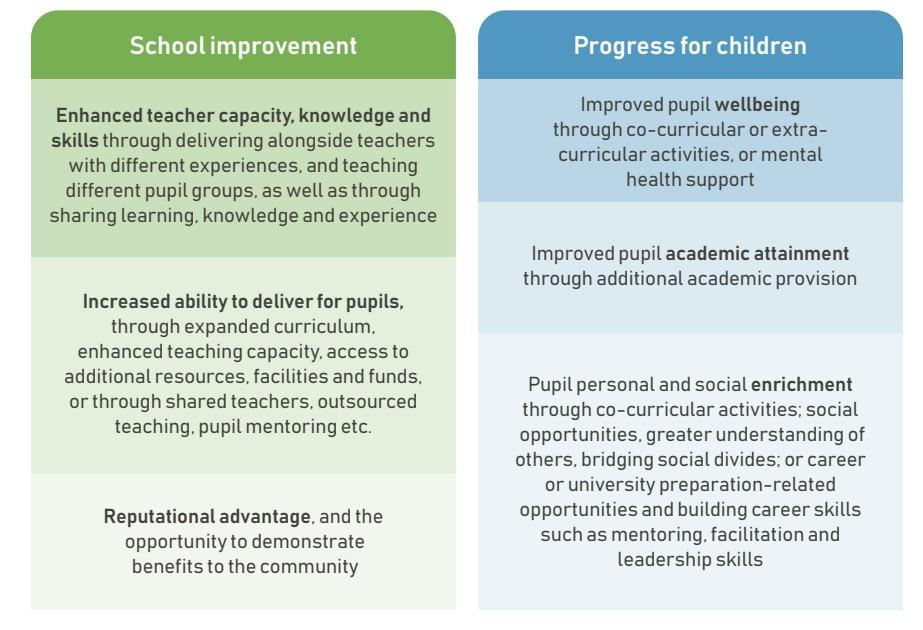
Benefit of partnership
Relationship building:
Connecting with other schools, building relationships
Community impact:
Amplifying impact of schools in the community and building reputation
What is it, how it is created, why is it useful?
Created when schools begin to partner, this is about building trust, relationships and social capital. It lays the foundations for contributions to all aims, by building the potential for future collaborative action, and for co-created solutions to emerge.
Schools play a vital role in the communities they serve, not just as educators but as local employers, by providing support and guidance for families, and through sharing their resources and facilities, amongst many other aspects of community life. By working together, local schools can amplify their impact in community development, strengthen the connection which comes from being part of a community, and clearly evidence the role they play.
Notes
Complementarity:
Bringing together essential complementary resources
Diversity:
Creating more representative and inclusive solutions, and breaking down social barriers
Partnerships can bring together diverse and complementary resources that are each essential pieces of the solution jigsaw puzzle. This is key to cross-sector school partnerships. Resources may be tangible - facilities or funding for example - or they may be intangible, in the form of knowledge, skills and experience.
School partnerships can help every school be better equipped to create true and lasting benefit for all pupils, across geographies, social, ethnic or religious backgrounds, inclusive of neurological diversity and the full range of abilities, educational needs, gender and sexual identities. This happens through bringing together the widest range of pupils, teachers and schools, with different types of experience serving different pupil groups, to study together, work together, and design activities and partnerships together. This helps to break down stereotypes and create greater awareness and understanding - as well as drawing on the richness of perspectives, needs and experience in diverse groups, to generate inclusive solutions. Diversity in the
Innovation:
Combining diverse thinking and approaches
partnership is key to generating innovative solutions, as seen in the next benefit type.
Partnerships offer an opportunity for jointly creating new, more effective approaches that deliver greater benefit and impact. The stronger and more equitable the relationship, and the greater the diversity of experience and knowledge represented within the partnership, the more space there is for innovative solutions and ideas to be co-created. Some innovative solutions to issues around geography and isolation might come in the form of digital projects and networks that can connect pupils and teachers across geographies and help efficiently disseminate knowledge and new ideas.
Shared learning:
Collective learning and capability building
Synergy and economies of scale:
Aligning resources or activities and exploiting synergies
Exchange of knowledge and experience allows partners to learn from each other, as well as collectively develop good practice to share more widely. Shared learning and knowledge are key benefits of partnering, for pupils, teachers and schools, contributing to pupil attainment and enrichment, to teacher capacity building, and to schools’ ability to deliver more for their pupils in future, all supporting school improvement.
For partnerships between schools, this applies at three levels:
• Extended learning opportunities for pupils
• Learning and knowledge sharing between teachers and at schools’ level
• Sharing learning with the outside world
Working in partnership - particularly in more complex partnerships with a shared strategy and aims, pooled funds and combined resources - allows schools to increase the degree of benefit and impact from the resources available (or achieve the desired impact with fewer resources). Partnerships create efficiencies and economies of scale through coordinated action, sharing common resources or services, avoiding duplication of tasks, creating common financial funds, and speeding up knowledge sharing and exchange of ideas. This allows schools to do more, create more sustainable benefit for their pupils, and reach more pupils than they could otherwise. It also enables schools to better support specific groups, or types of activities, that might not
be possible for a smaller number of pupils (for example mental health support, SEND provision, LGBTQ+ groups, environmental projects or specific music or theatre activities).
Use the information in this resource to help you to write or clarify the aims of a partnership you are involved in.
The information comes from different sources and not all of this will be applicable to your context.
We want to harness the resources and expertise of independent schools, universities and selective schools to form partnerships with state schools that:
are sustainable
have impact
are mutually beneficial to all partners
We encourage a range of activities within these partnerships around our 4 priority areas – teaching, curriculum, leadership, and school improvement – to deliver high impact outcomes for the benefit of pupils.
We know that many institutions are already involved in partnerships to support these objectives, and are working closely with other schools. We want to see this good practice adopted more widely and raise the ambition for what can be achieved.
Department for Education (October 2022) Guide to writing a memorandum of understanding (MOU)
https://www.gov.uk/government/publications/setting-up-school-partnerships/guide-to-writing-amemorandum-of-understanding-mou
https://www.gov.uk/government/publications/setting-up-school-partnerships/guide-to-setting-uppartnerships
We believe that school partnerships should:
Support learner aspirations, academic outcomes, social enrichment and wellbeing
Be focused on the sharing of resources and foster professional learning for staff
Become a force of improvement in the whole system
Most partnerships are designed to meet one or more of the following aims:
SPA 2023 School Partnerships for Impact Guide
https://schoolpartnershipsalliance.org.uk/wp-content/uploads/2023/01/SPA_GUIDE-2023.pdf
The overarching purpose of our partnerships is to contribute to closing the attainment gap for disadvantaged pupils. To achieve this, we have the following aims which seek to make an impact at different levels, from the classroom to the local education system:
Support evidence-informed improvement in classroom practice through meaningful and sustained behaviour change
Build the capacity of schools, settings and systems to be self-sustaining in their engagement with research evidence
Develop coherence and co-ordination in the use of evidence, to support and complement local and regional school improvement approaches
Exemplify evidence in action through deep, embedded partnerships that enable us to increase our understanding of evidence mobilisation, and share this learning
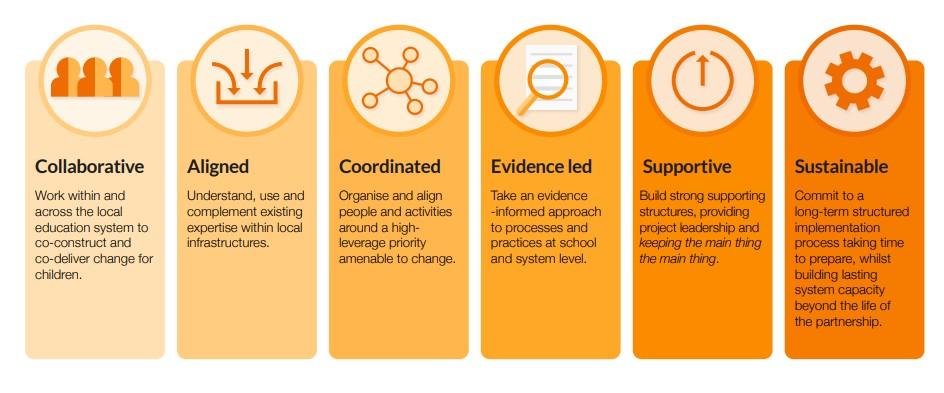
To achieve these aims our partnerships approach is underpinned by six Partnership Foundations. The Foundations are distilled from research evidence and the collective learning and expertise gained through extensive experience of supporting schools through partnerships.
EEF Guide to regional partnerships
https://d2tic4wvo1iusb.cloudfront.net/production/documents/Guide-to-regional-partnerships-V1-Digital.pdf? v=1693390279
They aimed to increase collaboration, share expertise and good practice, widen educational opportunities and raise standards in key subjects such as modern languages, science and maths. All had a shared commitment to raise the standards of teaching and learning and have a positive impact on the education of the children in their schools.
In addition to the generic aims noted above, each partnership had its own unique aims around the following broad categories:
Preparing pupils for new science curriculum
Supporting pupils in learning a new language
Improving engagement with maths
Building coding skills
Expanding existing partnership activities (where they existed)
Department for Education Independent State School Partnerships (ISSP) – impact of and lessons learnt Research report August 2017
https://assets.publishing.service.gov.uk/government/uploads/system/uploads/attachment_data/file/ 636291/RR682_-ISSP_evaluation.pdf
Behaviour
Self-awareness
Integrity
Resilience
Impact and influence
Explanation
Effective leaders will know themselves and their teams, continually reflect on their own and others’ practices, and understand how best to approach difficult or sensitive issues. They are aware of their personal strengths and areas for future growth and understand how their own behaviour impacts on others.
Effective leaders act with honesty, transparency and always in the interests of the school and its pupils. They are able to gain the respect of others by acting in line with their own values, as well as making decisions or choices with the best interests of education and pupils in mind.
Effective leaders remain courageous and positive in challenging, adverse, or uncertain circumstances. They are able to respond appropriately, manage uncertainty and bounce back even in the most trying of situations.
Effective leaders have a positive impact on students, colleagues and the wider community through persuading, convincing and bringing others round to their perspective. They understand others’ perspectives and priorities and tailor their communication to suit their audience.
Delivering continuous improvement
Future focus
Holding others to account
Effective leaders secure and maintain positive improvement through articulating a clear vision, setting high expectations and leading a cycle of research, planning, monitoring, analysis and change. They demonstrate the ability to combine operational action with strategic planning, securing short-term improvements whilst building sustainable change.
Effective leaders recognise issues and opportunities and take action to resolve these. Leaders need to look ahead to identify and resolve potential issues and capitalise on opportunities as well as manage day-to-day problems.
Effective school leaders will hold others to account including creating levels of accountability within the school – ensuring all understand their roles, responsibilities, standards required and accountabilities. They distribute leadership and delegate effectively, demanding high performance through making expectations clear, with the best interests of pupils and schools in mind.
Respect
Effective leaders respect the rights, views, beliefs and faiths of pupils, colleagues and stakeholders.
Partnership working and collaboration
Effective leaders are able to work with a range of people in schools and the wider community to build a culture of cooperation and achievement. They engage with, and invest responsibility in, those who are best placed to improve outcomes, being open
Leading by example
to different perspectives and viewpoints as well as sharing expertise, achieving common objectives.
Effective leaders consistently demonstrate and communicate their vision, passion and commitment. They lead by example, have high levels of professional credibility and demonstrate total commitment to school improvement through their own leadership behaviours.
Critical knowledge and understanding of research techniques and selfmanagement
The best leaders are able to undertake and use research, drawn from a range of sources, to support decision making and strategy development – using their time effectively within disciplined and well organised systems and methodology.
Critical enquiry, review, analysis and evaluation
The best leaders use critical thinking, statistical and data analysis tools, techniques and concepts to identify strengths, areas for development. They design effective leadership plans to support intervention, direction and development. They analyse the implications of change, deploying well evidenced research to frame school self-evaluation and improvement.
Challenge
The best leaders use challenge effectively and adopt a range of strategies in the best interests of achieving progress –demanding ambitious standards for all pupils and a strong sense of accountability in staff for the impact of their work on pupils’ outcomes.
Dealing systematically and creatively with complex issues
The best leaders have clear systems and protocols in place that enable them to consider and find solutions to issues, as they arise, in a way which deals most effectively with the barriers and challenge they face. The systems in place do not constrain but create a firm foundation for taking positive action.
Priority identification
The best leaders scan the horizon to anticipate change, taking a longer-term view and implications of change, improvement need and identify short and long-term priorities/goals with specified milestones in to ensure effective leadership and management.
Clear articulation and application of knowledge
The best leaders take time to reflect and learn from their leadership activity and are able to apply this knowledge to bring about improvement in them and their work.
Self-direction and originality
The best leaders have clear and ambitious targets for themselves as leaders and pupils and for their schools. They take a unique strategic view of situations and their implications on longer-term impact and outcomes – not always using expected action to get the best for those concerned.
Current insights into professional practice
The best leaders take time to reflect and evaluate their practice and effectiveness in their leadership and as leaders. They are aware of education landscape, understand the context of their school and its needs and direct professional practice and intervention appropriately.
Organisational management
Protection and safety
Systems, policies and processes
Managing resources
Managing people
Managing risk
Governance and accountability
High-quality, ethical governance
Accountability arrangements
Fulfilling obligations to external organisations
Working in partnership
Working with parents
Working with other organisations