

Ethical leadership

School Senior Leader Level 7 Apprenticeship

School Senior Leader Level 7 Apprenticeship
(PowerPoint will be shared & a Podcast will be available for each session)




Aim
To strengthen your ability to exercise ethical judgement under strategic and regulatory pressure, ensuring that values, financial sustainability and governance responsibilities are critically aligned rather than treated as competing priorities.
Objectives
•Interpret ethics and values-based leadership principles in order to challenge strategic and financial proposals under conditions of ambiguity (K6, S7)
•Critically evaluate financial and operational strategies by identifying assumptions, trade-offs and sustainability implications (S7, S10, K8)
•Analyse the external regulatory and stakeholder environment when shaping and justifying board-level decisions (K13, S21)
•Justify strategic judgements in a way that demonstrates personal accountability aligned to clear organisational values (B2)
fading (Tenbrunsel & Messick, 2004)
muteness (Bird & Waters, 1989)
ethicality (Chugh, Banaji & Bazerman, 2005)
Messick, 2004)
When the moral dimension of a decision becomes ‘backgrounded’
When leaders avoid explicitly naming the ethical
a decision Does the language ‘dilute’ the ethical case?
(Chugh, Banaji & Bazerman, 2005)
• Introductions, as appropriate
• Discuss the following prompts and prepare to give feedback
In your group, your task is to:
• Identify the core ethical tension
• Surface embedded assumptions
• Notice where language reframes values
• Identify what might be missing
You are not being asked to solve the issue or recommend an option, yet
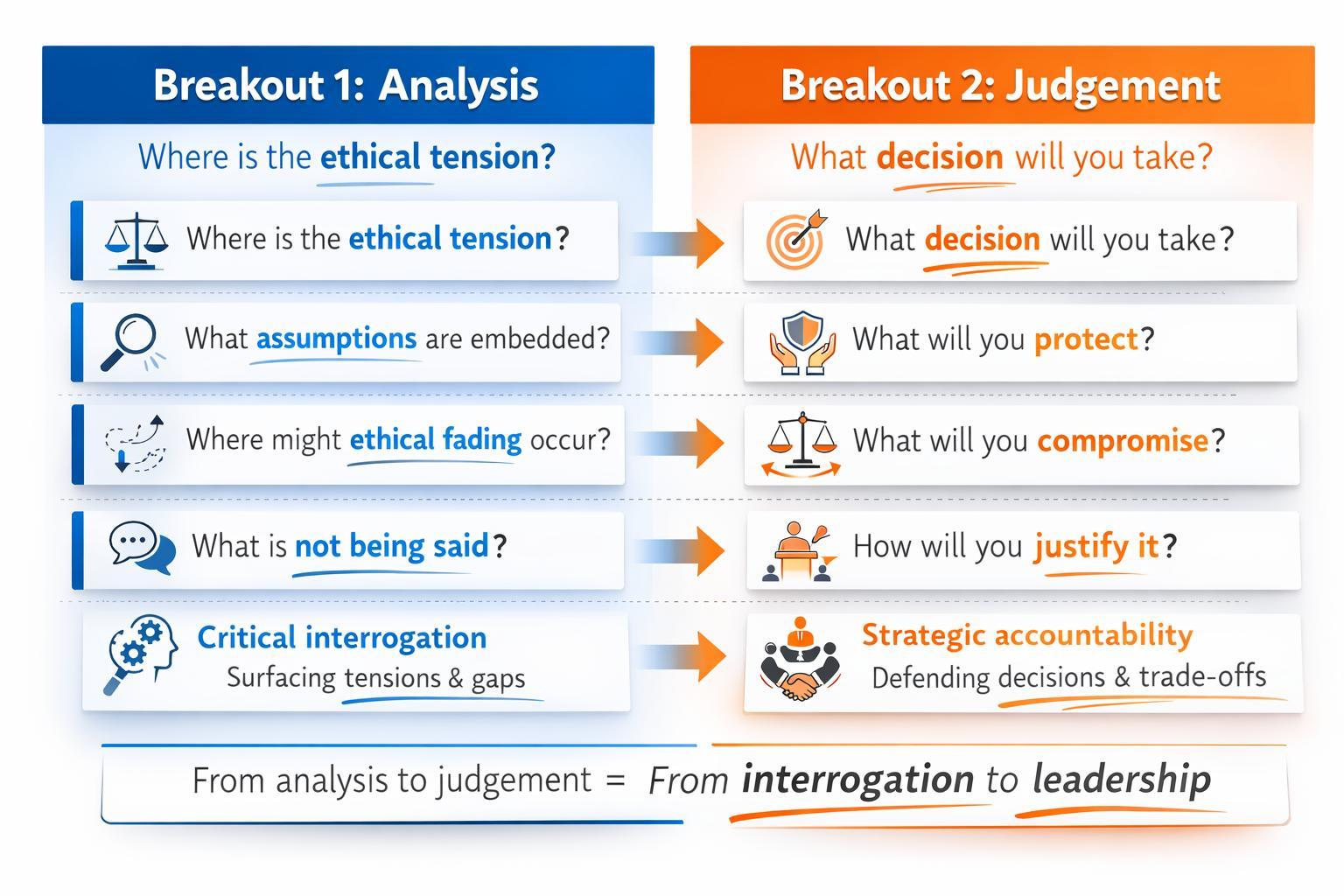

In your group, your task is to:
• Identify the core ethical tension
• Surface embedded assumptions
• Notice where language reframes values
• Identify what might be missing
Suggested timings:
7 minutes: reading/reflecting
11 minutes: interrogate assumptions
7 minutes: identify gaps & uncertainties
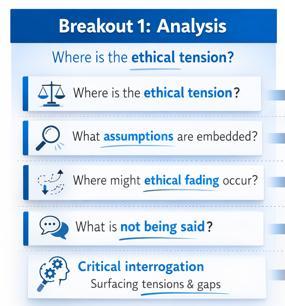
You are not being asked to solve the issue or recommend an option, yet

Your task is to prepare a 5-minute presentation that:
• Is a maximum of 5 slides (or verbal equivalent).
• Each person in your team delivers one slide. (combine slides, if fewer than 5 in your team)
• Layout/format as you see fit (you must tell us who ‘we are’ i.e. your audience)
NB You are not defending ‘perfection’.
You are demonstrating ethical judgement under constraint.
As the MLT Board of Trustees, your task is to prepare a 5-minute presentation that includes: Your decision
Communication approach and next steps
NB You are not defending ‘perfection’.
You are demonstrating ethical judgement under constraint.
As the MLT Board of Trustees, your task is to prepare a 5-minute presentation that includes: Your decision
Ethical justification
Strategic rationale
Key risks and trade-offs
Communication approach and next steps
How will you manage your team to be ready to present with the 25-minute limit?

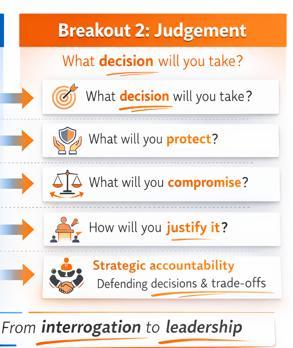
NB You are not defending ‘perfection’. You are demonstrating ethical judgement under constraint.

Where did time pressure shape thinking?
•Your strategic business proposal must demonstrate judgement, not just analysis
•You must justify trade-offs under questioning
•Evidence must be integrated, not simply described
•You must defend your position under scrutiny
• Where do you default to relying solely on analysis and not being prepared to make a judgement call?
• Where you jump to conclusions without robust, evidence-informed interrogation? • What will you now do differently?
How?
Aim
To strengthen your ability to exercise ethical judgement under strategic and regulatory pressure, ensuring that values, financial sustainability and governance responsibilities are critically aligned rather than treated as competing priorities.
Objectives
•Interpret ethics and values-based leadership principles in order to challenge strategic and financial proposals under conditions of ambiguity (K6, S7)
•Critically evaluate financial and operational strategies by identifying assumptions, trade-offs and sustainability implications (S7, S10, K8)
•Analyse the external regulatory and stakeholder environment when shaping and justifying board-level decisions (K13, S21)
•Justify strategic judgements in a way that demonstrates personal accountability aligned to clear organisational values (B2)