
![]()


This welcome—introduction we always have in FRONT is often the place where we share what’s in this edition of the magazine. We’ll ask you to defer to our Table of Contents this time. The lineup awaits you. Because there is something else to talk about. A topic often brought up when you enter a room full of people and aren’t sure what to say.
How ‘bout this weather?
Just kidding. We’re not going to chat about the icy frigid January-February we’ve experienced or even the hope that Old Man Winter might start shuffling off as March dismisses those sub-freezing temperatures. But is HAS been a cold one, yes? And what can you do about it? You could snuggle up in a warm place and read your Valley Business FRONT. Stories of interesting businesses and organizations and the people behind them. It’s all there.
Listed in the Table of Contents.
Tom Field
Gene Marrano Publisher Editor

By Tom Field


P.O. Box 1041
Salem, VA 24153 (540) 389-9945 www.vbFRONT.com
Publisher / Tom Field
Creative Director tfield@vbFRONT.com (540) 389-9945
Editor Gene Marrano news@vbFRONT.com
Advertising Dan Dowdy (540) 797-7943 ddowdy@vbFRONT.com
ads@vbFRONT.com (540) 389-9945
Graphic Design Nicholas Vaassen
Office Administration Emily Field info@vbFRONT.com
Production Berryfield, Inc. PO Box 1041 Salem, VA 24153 (540) 389-9945
Advertising ads@vbFRONT.com
Subscriptions info@vbFRONT.com
News / Releases news@vbFRONT.com
Admin / Ops info@vbFRONT.com (540) 389-9945 vbFRONT.com morefront.blogspot.com
© Copyright 2026; Valley Business FRONT, LLC. All rights reserved. Reproduction or use of this publication in whole or in part without written permission is prohibited. Information within Valley Business FRONT is obtained from sources considered reliable, but cannot be guaranteed. Opinions expressed are not necessarily those of the ownership. Valley Business FRONT is primarily distributed to subscribers by mail, digitally and select locations throughout the Roanoke Valley, New River Valley, and western Virginia.


Valley Business FRONT has organized an Advisory Board comprised of a selective group of diverse business professionals who support our mission and have an interest in how our business journal best serves our local communities and region. As a sounding board throughout their term, board members have been given the task of helping FRONT understand the issues and develop coverage. You will note that the Board is comprised of experts in many different business / industry “fronts.” This is intentional, as we are reporting on all the areas that affect our regional economy and are important to you. Although the members are encouraged to keep FRONT updated on their own industries and the key players, they aren’t limited to their area of specialty, as all commercial enterprises ultimately collaborate to impact our quality of life here in this part of Virginia. An additional contribution by the Advisory Board involves direct input on the various FRONTLists we present throughout the year. In keeping with our policy of being “the voice of business in the valleys” we ask each reader to join us as an editorial partner by contacting us with your ideas. You know more than we know about your business—or you certainly should—and that inside knowledge shared with our readers will make us all better at what we do.


By Tom Field
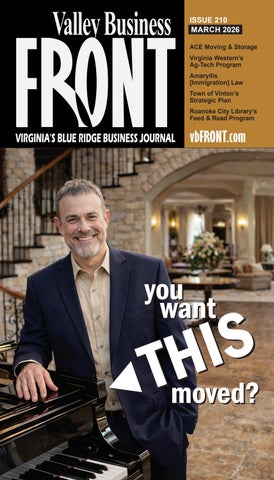
ACE Moving and Storage in Roanoke started with expensive, hard-to-move items; the business carries that same approach today.
Glen Childs may be CEO of Choice Relocation Group, but he’s also a musician. Why does that matter? Who better to move your items than someone who gained expertise in
moving musical instruments—namely, pianos?
Indeed, that’s how ACE Moving and Storage got started.

“I worked at a music store in Roanoke years ago,” Childs begins, “and we specialized in moving pianos. One of the things we did was take pianos to other markets and shopping malls that didn’t have piano outlets, for example; set 20 or so of them up, so that people could check them out.”
Pianos, as you can imagine, require a lot of care when moving. On top of the sensitivities in how they are constructed, you have difficult cabinetry and tremendous weight.
Tremendous weight.

“” We'll move anything.
“Many people don’t realize that big plate you see inside a piano—often colored to look like brass or other metal—is cast iron—like an engine block. That ‘harp’ as they’re called, is what makes the extraordinary weight that surprises people,” Childs says. And it’s not just the large grand pianos. Even smaller console pianos are near impossible to move with care unless you have professionals or experienced movers.
ACE began in 1997. Its familiarity and identity as a moving company that could manage pianos helped to establish its services in a most competitive market.
“We’ll move anything,” Childs continues. “But yeah, we sort of specialized in pianos and hard-to-move, expensive, and fragile items. We take that same approach [required for moving treasured musical instruments] when moving anything.” The result is the customer gets that same level of care and attention when moving more ordinary and common items—like furniture and appliances.
Another distinction with ACE is the “vaulted” storage
system; a practice that is typically adopted by larger moving companies; not so much smaller, family-owned enterprises, like ACE.
“Think of a large wooden crate,” Childs says. “We place a customer’s items in a vault, or pod, or several pods, which then can be placed in climate-controlled storage.”
Vaults are better for a number of reasons. They provide super-efficient storage; you have everything together; there’s less chance of damage and fewer ways to misplace items; they can be moved with a forklift and inventory managed between locations; and all of that property gets far fewer touches.
ACE Moving and Storage is part of a larger organization run by Childs: Choice Relocation Group, which also includes A2B Moving and Delivery, Beltway Movers, Fairfax Transfer and Storage, and APMC Inc. Many of these subsidiaries operate from northern Virginia; but the greater Roanoke Region remains the principal market for ACE.


The company employs over 100 and manages logistics with over 50 power units and trucks. Typically, five to eight trucks are running in Roanoke.
“” The moving business is volatile and cyclical.
Folks in the moving business—as you might imagine— have all kinds of stories. Interesting moves, challenging environments, eccentric customers, strange requests.
Childs and Roanoke scheduler Josh Jager (also a musician who’s worked alongside Childs throughout the three-decade operation) frequently return to that one product they moved—and continue to move: the piano. Perhaps pianos just naturally accompany the more colorful stories.
“Bruce Hornsby,” Childs says, when asked about one of those stories. When the immensely popular pianist and American singer-songwriter was booked to perform in Roanoke many years ago, “he didn’t like the piano that was provided for his concert. We were called and rushed to his home in Williamsburg to pick up his nine-foot concert piano and bring it back to Roanoke for the show.”
Childs didn’t say it, but the implication is rather clear: if you can move Bruce Hornsby’s piano, you can move my couch.
The origin of ACE as the first-call, reputable piano movers for the Roanoke market has evolved to much more today. While the scope of services has expanded considerably, the challenges are no less formidable.
Childs says the moving business is volatile and cyclical. Always.
“During COVID, we were at an all-time high,” he says. “There was a big boost from telemarketing and people working from home.” Other factors that affect the moving business include mortgage rates (he’s optimistic for another upturn with the interest rates lowering); and local economics—like all the moves from people at Carilion and Virginia Tech.
Currently, the mix of ACE moving is about 80-percent residential (with 70-percent of that local; 30-percent long distance) and 20-percent commercial.
Whether it’s high volume or low volume times, people moving or staying put, Childs says ACE is always adjusting to meet the market—while still performing services in a most attentive way.
Bruce Hornsby said it best: “That’s just the way it is.”

“” If you can move Bruce Hornsby's piano, you can move my couch.


By Carrie Cousins, LeadPoint Digital
Executive Summary:
Creating a successful marketing campaign can feel about as difficult as North Carolina State’s improbable run to an NCAA championship in the 1980’s.
You can picture the moment: Lorenzo Charles goes for the dunk as time runs out to lift N.C. State to a national title in men’s college basketball. Head coach Jim Valvano runs across the court, hair and tie flying, searching for someone to embrace.
That Wolfpack team wasn’t supposed to be there. Through a mentality of survive and advance, they overcame obstacles to win it all.
That’s the spirit of victory.
We replay the dunk. We remember the celebration. But the final frame hides the full story.
Before the breakthrough came doubt. Before the highlight came near-elimination. Before the magic came adjustments, missed shots, hard conversations, and relentless belief.
Creative work is no different.
We love the finished campaign. The viral post. The brand refresh that feels obvious in hindsight. We talk about the “big idea” as if it appeared fully formed.
It didn’t.
Creative success is also survive and advance.
It’s the rough draft that falls flat. The headline that misses. The strategy that raises more questions than answers.
And the choice to keep going. Your team must iterate and adjust, iterate and adjust, ITERATE and ADJUST until it feels almost impossible.
Great work isn’t born — it’s built.
You iterate. You refine the message. You adjust the audience. You rework the visual. You test, learn, and tweak again.

It can be messy, uncertain … and feel like madness.
But it doesn’t have to feel that way. Think of the creative process like filling out a bracket. Try an idea, then try something else. Which one wins? Advance and iterate. Take the small victories along the way with a few mindset changes.
• You can’t iterate if you don’t try. Just the momentum that comes with creative thinking can help spur more creative thought.
• Think of every iteration as an A/B test. From copy changes to new graphics, look at both versions, pick the one that’s better and continue working to improve it.
• Consistency compounds. Think about the big picture in a series of steps and stay focused.
From basketball games to creative processes, few stories end in a buzzer-beater.
For those with true grit, it’s survive and advance.

“” Your team must iterate and adjust.


By Lindsey Hull
The future of a more tech-heavy farming sector is being studied at Virginia Western Community College.
Professors David Berry and Mallory White ate fresh salad all winter, harvesting buttercrunch lettuce as just one slice of the college’s Ag-Tech effort — a practical application of its new Associate of Applied Science in Technical Studies program, which allows students to design a curriculum across mechanical, technical and agricultural fields. The program was funded by a 3-year $343,000 National Science Foundation grant in June 2024 to support advanced technical education.
The lettuce grew indoors, surrounded by LED lights on a hydroponic tower. At the center: 28 hollow, vertical pots and watering tubes, but no soil. Researchers controlled the heat, humidity, amount of water, hours of sunlight… down to the pH level of the water that trickled through the plants’ roots. There were no pests.
At harvest, the lettuce tasted crisp and clean. The professors’ goal is to prepare students for careers in controlled environment agriculture (CEA), a way of producing food using hydroponics, vertical grow rigs or indoor gardening. With ten CEA companies currently located in Virginia, it is the largest growing agriculture sector in the state. Industry experts argue that CEA may be the solution to food insecurity.
The most technologically advanced CEA facilities use automated technology to reduce water consumption, reduce or eliminate the use of certain pesticides and fertilizers, and grow more food on less acreage.
Growing food indoors allows growers to
control weather conditions and enables them to move production sites closer to the consumer, reducing transportation costs. Robots might delicately harvest produce, reducing workforce costs and the risk of some forms of contamination.
Though fewer workers are needed, the open positions require skills that Berry and White are teaching: light repair, sensor maintenance, machinery and integrated pest management, for instance.
“And plant knowledge, too. Because, like any concentrated agriculture, if something goes wrong, it spreads fast,” White said. * * *
A robotic hand stands front and center in the mechatronics lab, located on the first floor of VWCC’s STEM building; several work tables are aligned in rows nearby. Most of the space is taken up by build stations: sensors, gauges, wires, and valves. The room is still at first. Stay long enough, and tall, narrow lights blink on. Gurgling sounds overtake the conversation. Hydroponics systems circle the room.
There are no bees. These plants must be pollinated by hand. Nearby stands an 8-foottall soft-sided hydroponics chamber, which holds a complete system within the space of a linen closet. A place for a plant to grow on the top shelf, buckets to hold clean water and waste water below.
“This is probably the pinnacle,” Berry said of the project, which was designed by Steel Dynamics sponsored apprentices Timothy

Boyd and Daniel Moran, both of whom were enrolled in Berry’s mechatronics program.
Spinning the chamber front to back, Berry opened an industrial control box to reveal columns upon columns of tidy blue, yellow, and red wires, switches, stickers and connections.
Boyd and Moran spent an inordinate number of hours building, coding, wiring, and testing this industrial-controlled automation system, which monitors the light, water quality and nutrient levels inside the hydroponics chamber, allowing the researchers to control the length of the growth cycle. With the touch of a button, the machine provides data related to those variables. From there, the system can be directed to feed, water, and provide light to the plants.
To build and maintain a fully functional, automatic hydroponics system like this requires knowledge in chemistry, plant physiology, agriculture and applied engineering, according to the research team.
A project like this is beyond the scope of what most mechatronics students complete during their time at VWCC, Berry said. It became a passion project for his students. To fulfill their vision, Boyd and Moran turned to Steel Dynamics supervisor, Chase Parker, who set to work —
Steel Dynamics completely funded their project.
The team’s interdisciplinary research resulted in skills growth that they will use in their careers at Steel Dynamics, while their hydroponics system will remain at the college as a learning device for future ag-technicians.
It isn’t just horticulturalists who need to pay attention. Animal husbandry is becoming increasingly automated, too. “Open the fan, close the fan, turn off the heater, turn on the lights, turn off the lights. It’s the same as a greenhouse,” White said of her time working in the Virginia Tech poultry houses while she was a grad student at that university. “There’s just chickens in there instead of plants.”
The poultry houses were technologically advanced, using many of the same systems she and Berry teach the students to use and maintain.
“But, if a sensor went wrong, we didn’t know what to do. My friends didn’t either. We’d have to find a nice, smart engineer,” she said. The success of this project further indicates that workers can transfer learned skills from one industry to another with a little supplemental education.
“The future of farming is going to have to merge some technical skills with farming skills,” Berry said.


By Jamie Wigand, CAE
Executive Summary: In Roanoke and beyond, the last few years have sparked a shared desire for change. If you’ve caught yourself thinking, “This is not what I want for my neighbors,” you’re not alone. That isn’t despair. It’s love. It’s the part of you that still believes community can be better.
Dr. Martin Luther King Jr. called it the Beloved Community: people choosing human decency, shared responsibility, and care for one another, again and again, especially when things feel uncertain.
Roanoke is a place where showing up changes things. If you want a community where people look out for each other, choose one place to show up.
Start with what you can offer
One practical way to think about community support is time, talent, or treasure.
Time can be small and consistent. Volunteer once a month. Bring chairs. Help set up. Make a few calls. Follow through.
Talent can be powerful. Offer what you already know: marketing, bookkeeping, tech help, writing, facilitation. Sometimes an organization doesn’t need another idea. It needs a few hours of skilled support to get the idea over the finish line.
Treasure is not only major gifts. It can be a monthly donation, covering supplies, or sponsoring a ticket so someone else can participate.
And if you’re a small business owner, community support is good business, too. It can look like offering paid volunteer time, hosting a donation bin, providing an in-kind service, or sponsoring a table so others can attend.
Pick one community anchor
The most effective community builders pick a lane, commit to it, and stay long enough to create trust, rhythm, and real results. If you’re not sure where to start, start with a place that already serves people you care about, such as:
• Council of Community Services (councilofcommunityservices.org)
• Feeding Southwest Virginia (feedingswva.org)
• Harrison Museum of African American Culture (facebook.com/HarrisonMuseum)
• Roanoke Diversity Center (roanokediversitycenter.com)
• Virginia Harm Reduction Coalition (VHRC) (carrynaloxone.org)
The point is not which cause you choose. The point is choosing and then staying engaged long enough to matter.
Community building isn’t a solo effort. If the logistics are what’s slowing you down, bring someone with you. Volunteer with a friend, co-worker, or neighbor. Join a group that already has a rhythm, and learn from the people who’ve been doing the work for a long time.
And here’s the hopeful part: action is not just helpful, it’s healing. When you choose one way to care for your neighbors, you give your worry somewhere to go. You turn fear into participation. You turn anger into momentum.
If you do not like what is happening, be part of what happens next. Care for your neighbors. Keep showing up, even in small ways. That is how Beloved Community gets built: one choice, one action, one human at a time.

“” The point is choosing and then staying engaged long enough to matter.


By Aila Boyd
For more than two decades, the legal team now known as Amaryllis Law has been helping immigrants and adoptive families navigate some of life's most challenging transitions. Recent federal immigration policy changes has just made it even more challenging.

What began as Poarch Law in 2003 has evolved into a practice built on honest guidance, specialized expertise, and a deep commitment to treating every case—and every client—with equal importance.
In 2024, the firm rebranded as Amaryllis Law, a change that reflects both continuity and growth. The name pays homage to the amaryllis flower, which blooms in the dead of winter—a symbol of resilience that resonates with the firm's clients.
"Just like our clients, it shows so much
resilience of what beauty can come out of hardship," said Jaime McGuire, managing attorney alongside business partner Mary Sirmans. Despite the new name, the core team remains unchanged. McGuire has been with the firm since 2016, and senior paralegal Dana Clinevell has been there for 20 years.
The longevity speaks volumes. "It's still the same firm," McGuire noted. "Christine and Rachel [Thompson] trained us and taught us everything they knew and then passed the torch to us."

McGuire never planned to become an attorney. "I actually wanted to be a schoolteacher," she said. "I have just always had a passion for children and for helping people."
Everything changed during a college trip to Uganda in 2012, where she worked at an orphanage and witnessed the disconnect between children needing homes and families wanting to adopt them. "I was like, I am going to go to law school and I'm going to become an adoption attorney."
While she joined the firm for its adoption practice, McGuire soon discovered parallels with immigration law. "Immigration ended up stealing my heart through understanding that the way that families are reunified in
adoption is so similar to the way families are united through immigration."
At the heart of Amaryllis Law's practice is transparency. "There is a lot of fear of immigration fraud and immigrants are not sure who they can trust," McGuire said. "We try to have a very honest conversation with every single one of our clients... we really give them the chance to make informed decisions with informed consent."
This approach extends to business immigration. "We definitely specialize in finding and explaining all the options that are available from both a business perspective and the immigrant's perspective so that everyone can make a decision that everyone will be happy with."
Immigration law shifts with each administration, and the complexity has intensified. "Rules and laws didn't use to change so drastically from one month to the next as they have in the past few years," noted Clinevell. "I believe it has made things much harder for clients to try to navigate any kind of filing on their own."
The firm stays current through national organizations and regular consultation with colleagues. Recent policy changes have increased scrutiny on business cases, with more requests for evidence. McGuire recently wrote about shifts in the H-1B lottery system that will weight entries based on wage levels.
For employers, maintaining compliance after visa approval presents unique challenges. "There is a misconception that once the worker has been approved and has valid work approval that the employer can change the foreign worker's position within the company or their work locations," explained Cari Preas, paralegal for business cases. In reality, employmentbased visas are often tied to specific requirements.
"We promote open communication with our clients so that they feel comfortable communicating anticipated changes," Preas said. "We work to provide processes and communication that will minimize anxiety and promote client success."
What distinguishes Amaryllis Law is personal service. "You can contact me
as the managing attorney over our business cases very directly. My email is shared with all of our clients," McGuire said.
The firm prioritizes quality over speed. "We always try to work very quickly, but we also prefer quality over quickness or quantity. With our firm, you really do get a personal attorney feel."
For business clients concerned about compliance, McGuire takes a cautious approach. "I will always give the legal answer and then a cautious answer that will be the least risk for the company and the least risk for the immigrant. That allows my clients and the businesses to make the appropriate legal decision within that guidance."
McGuire is candid about the emotional demands. "There is a lot of emotional connection that I have to my clients. That is something that I personally deal with and I wrestle with, how I can make sure that I'm able to continue and not to burn out."
The firm prioritizes staff well-being. "As a management team, we equip our staff to make sure that we are taking care of ourselves because it is such a heavy line of work."
Nearly a decade into her career, McGuire has found what works: honest assessments, clear communication, and making complex immigration processes understandable for the families and businesses who need help navigating them.


By Daniel Colston
Executive Summary:
In uncertain markets, clarity and discipline create opportunity. Operate intentionally this year, and 2026 can become one of your strongest financial years yet.
As we move into 2026, business owners face a familiar tension: rising costs, competitive pressure, and constant pressure to grow. The companies that win this year will not necessarily be the ones that expand the fastest. They will be the ones that operate the smartest. Strong margins, disciplined expense control, tax efficiency, and intelligent use of technology will separate thriving businesses from struggling ones.
The first priority for any business this year should be lowering unnecessary expenses. The fastest way to improve profitability is not by increasing revenue but by tightening costs. Many companies carry “silent leaks” in the form of unused software subscriptions, bloated service contracts, outdated insurance policies, or merchant fees that have never been renegotiated. A thorough expense audit often reveals thousands of dollars that can be reclaimed immediately. Every dollar saved drops straight to the bottom line without requiring additional effort, labor, or risk.
At the same time, business owners must shift their focus from chasing revenue to protecting margins. Revenue without margin simply creates busyness and stress. Pricing should reflect value and long-term sustainability, not fear of losing customers. Too many owners underprice their services and unintentionally subsidize their clients. Improving job costing accuracy, eliminating low-margin offerings, and strategically increasing prices where appropriate can dramatically strengthen profitability without increasing workload.
Efficiency is another defining theme of 2026. The ability to do more with less will determine who gains leverage. Many companies lose time and money through duplicated tasks, bottlenecks in approval processes, and unclear systems. Streamlining workflows and empowering employees to make decisions without constant oversight creates scalable growth. When systems replace chaos, output increases without adding payroll or complexity.
Daniel Colston, CFP®, CEPA runs a tax and investing firm in Roanoke, Upward Financial Planning, specializing in helping business owners and retirees. He can be reached at daniel@ upwardfp.com.
Tax planning remains one of the most overlooked profit strategies available to business owners. Strategic retirement contributions are especially powerful. Maximizing contributions to a 401(k), Solo 401(k), or SEP-IRA can significantly reduce taxable income while allowing investments to grow tax-deferred. For high-income earners, defined benefit or cash balance plans may provide even larger deferral opportunities. Beyond retirement accounts, tools such as Section 179 expensing, bonus depreciation, cost segregation for real estate owners, and the Qualified Business Income deduction can meaningfully lower tax liability when used properly. Tax planning should happen proactively throughout the year, not reactively in April.
Technology, particularly artificial intelligence, is rapidly
becoming a force multiplier for small and mid-sized businesses. AI tools can assist with marketing content, proposal drafting, financial analysis, bookkeeping tasks, and customer communication. While AI does not replace strong leadership or skilled employee time wasted it significantly increases productivity and reduces wasted time. Businesses that adopt these tools thoughtfully will operate leaner and move faster than competitors who resist change.
Finally, no strategy works without strong cash flow. Cash remains the oxygen of every business. Building reserves equal to several months of operating expenses provides stability and confidence. Improving invoicing speed, tightening receivables processes, and avoiding unnecessary debt strengthen a company’s ability to make strategic decisions rather than emotional ones.
The businesses that thrive in 2026 will not rely on luck or rapid expansion. They will be disciplined, data-driven, tax-efficient, and technologically empowered. Lowering expenses, protecting margins, maximizing tax advantages, embracing AI, and safeguarding cash flow are not flashy strategies - but they are powerful ones.

“” The companies that win this year... will be the ones that operate the smartest.


Quiet, please. This month’s Work Space is a library. The Williamson Road Branch Library in Roanoke. But it’s not just voices we want quiet—it’s your stomach, too. No loud growling, please. Here, in addition to books, you can also check out a meal—with the Feed & Read program. Through

a collaboration with Feeding Southwest Virginia, kids can get snacks and meals after school. Lori Oreskovick’s official position is library security, but she passes out about 45 snacks/meals every Feed & Read day. (Our photographer’s son, Graham serves as model.) The program is available at six Roanoke City Library branches, weekdays and Saturdays, select times.
by

By Zachary A. Collier
Executive Summary: Producing products and services that are perceived as high quality is essential for businesses to succeed in a competitive marketplace.
When consumers make a purchase, they want to feel like they received something of value relative to the money they paid for it. But what does it mean for something to be high or low quality?
Quality does not relate to just one attribute of a product or service. Instead, it is a multidimensional construct. We all evaluate quality along multiple attributes at the same time. According to Professor David Garvin, there are eight dimensions of quality:
Performance: This is related to what the product is intended to do. The performance of a hammer is how well it hammers nails.
Features: Beyond the essential performance attributes of a product, there may be additional features that add extra value to the customer. While the performance of a garden hose is related to how well it waters plants, a nozzle with variable settings (for example, a jet versus a mist) might be an additional feature that customers value having.
Reliability: When a product fails, especially earlier than expected, it is frustrating. Reliability is a dimension of quality related to the lifetime of the product.
Conformance: Certain products need to adhere to user specifications. If a customer orders a pepperoni pizza and gets a cheese pizza instead, that would be an example of non-conformance.
Durability: Related to reliability, durability has to do with the useful lifetime of the product. Durability also involves how much wear and tear a product can take before it stops working.
Serviceability: Some products require periodic maintenance to keep them in working order, and service if they stop working. The serviceability of a car, for example, takes into account how difficult it is to maintain and repair. The helpfulness of tech support for your computer is another aspect of serviceability.
Aesthetics: This is a very subjective dimension of quality related to how appealing it is to the senses. The style and color of a car would be examples of visual aesthetics, but this dimension could involve the other senses as well.
Zachary A. Collier is Assistant Professor of Management at Radford University.
Perceived Quality: Sometimes customers have preconceived notions about a product’s quality based on the reputation
of the product or the company that makes it. Luxury goods often develop marketing to attempt to increase customers’ perceptions of quality.
Not all dimensions of quality are equally relevant for all products. For example, it doesn’t really make sense to talk about the reliability of a pizza or the aesthetics of a dump truck. But typically, at least some of these dimensions are relevant for customers for each product or service. That is why it is important to understand what the customers need and expect out of the products that are being produced and sold.
Starting with customer expectations and understanding how they perceive your products can provide valuable insights into where there may be quality gaps and what actions you need to take to fix them. That way you can meet (and maybe even exceed) their expectations, increasing their likelihood of perceiving your product as high quality – and their probability of repeat purchases.

“” Quality... is a multidimensional construct.


By Gene Marrano
Vinton’s Town Manager unveils the next five year plan for growth.
The Town of Vinton signed off on its 2050 Comprehensive plan last summer, a guide, if not a legally binding document that lays
out a map for growth within the town limits for the Eastern Roanoke County village that’s home to around 8,000 people. In connection


with the Comp plan, which all local governments update at some point, Vinton Town Manager Richard “Pete” Peters – just call him Pete – also presented Town Council last month with a new five year Strategic Plan that further drills down on where Vinton could be headed.
Peters, who took the top job in Vinton five years ago after coming on board as the Economic Development specialist about a decade ago (he still retains that position, with help from part timer Jill Loope, the retired Roanoke County Director of Economic Development), also rolled out for council his “Key Projects,” what he termed
Those include building walkable connections in and to downtown, updating and modernizing the Town Zoning Ordinance (which could lead to more development “by right,” without the need for further Town Council approvals), investing in “quality housing for all phases of life,” promoting strategic economic development and investments in critical infrastructure.
A new 94 room downtown hotel and a remodeled, updated Vinton War Memorial event venue are due to open (or reopen) sometime later this year. The War Memorial,


a very busy event venue, was supposed to be open again by now, but Peters says once they started the process, “we realized [it] needed more substantial renovation. Its 20 years since its last remodel.”
A rebidding process after realizing more needed to be done set the project back about 6 months. Peters says they plan to start booking events soon – and some special offseason ticketed concerts might be on the horizon. That rebuilding

includes new roofing and some structural shoring up. Peters believes having the new downtown hotel should help keep more of those attending a major event or a wedding from out of town at the War Memorial within Vinton proper, should they need to spend the night. “We’d like to retain some of that visitor spending.”
Some new staffing will be needed as well at the War Memorial, says Peters, who grew up in Vinton. The hotel being built by KARA Hospitality, LLC is under construction and is “starting to look like something;” a September time frame for that opening is forecast as well. Rosie’s gaming parlor patrons and youth hockey teams in Vinton to compete in tournaments at the Lancerlot ice rink can book rooms at the new hotel as well. Fall leaf peepers and even those heading to or from the Lake may make a stopover in Vinton, Peters surmises. “We have a great mix of leisure travel.” The Virginia Tech Carilion Riverside campus is only 2.5 miles away, and attracts out of town physicians, researchers and other medical professionals on a regular basis. “We feel like we will fill it.”
Peters says they are eyeing some downtown retail spaces with upstairs apartments that can be renovated and leased, as well as exploring new apartment construction in the downtown corridor centered around Lee Avenue and South Pollard Street. There are infill opportunities as well: “we have to align our zoning so that we can accommodate

some of those alternative types of housing … that fit on what otherwise would be an incompatible piece of property, and maximize that.” More foot traffic on downtown streets with more residents might mean local retailers and eateries stay open later.
Younger demographics like walkable communities, something the Town has taken note of, and it encourages more outdoor recreation says Peters. Everybody likes that. Vinton is busy extending the Glade Creek greenway to the Gish Mill mixed use development and then to Vinyard Park in Roanoke County. Go the other direction on the existing Glade Creek Greenway to connect to the Roanoke River Greenway.
There’s more live music most nights somewhere in Vinton and more nightlife than say five or six years ago Peters says. “No longer are we a sleepy little town. We’ve got offerings and destinations that people can visit. That all plays for a heathy economy and a good environment for folks that want to live [here].”
The strategic plan takes the Comp plan’s 25 year look ahead window and drills down to just 5 years, to let the Town focus on the most immediate needs and wants. “Smaller chunks,” as Peters describes it, “our menu of options.” He says add those smaller time periods and accomplishments over each five years together, and you might come close to achieving many of those goals.


Phil Barbour is proudly rooted in Southwest Virginia, graduating from Patrick Henry High School and James Madison University. With more than 25 years of experience in financial services, he has risen from teller to branch manager—ultimately becoming a leader in Private and Business banking. He gives back through volunteer work with educational and nonprofit organizations. Barbour enjoys his time with his wife, two sons, an energetic Siberian Husky, and tackling endurance challenges, like the Marine Corps Marathon, Ironman 70.3, and Virginia 10-Miler. [ pwbarbour@ freedomfirst.com ]
Aila Boyd serves as the editor of “The Fincastle Herald” and “The Vinton Messenger” and coordinates social media for the Botetourt County Chamber of Commerce. She holds an MFA in writing from Lindenwood University.
Zachary Collier, Ph.D. is Assistant Professor of Management at the Davis College of Business and Economics at Radford University. [ zcollier@ radford.edu ]
Daniel Colston, CFP®, CEPA runs a tax and investing firm in Roanoke, Upward Financial Planning, specializing in helping business owners and retirees. [ daniel@upwardfp.com ]
Carrie Cousins is the Director of Digital Marketing at LeadPoint Digital in Roanoke. For 15+ years, she has helped businesses tell their stories and get better results online with practical
digital marketing strategies. She also an active leader in AAF, serving on the local and district boards, and is an adjunct professor at Virginia Tech.
Dan Dowdy is the business development director for Valley Business FRONT and owner of The Proofing Prof proofreading services (proofingprof.net). His background includes service in the U.S. Air Force and an extensive career in education, including teaching college-level writing competency and business courses, and working for a Fortune 100 company. [ddowdy@vbFRONT.com]
Emily Field is the office administrator for Berryfield, Inc. (publisher of FRONT and a media / marketing firm). She lives in Salem with her husband, Tom, and is the mother of three and grandmother of three. [ efield@berryfield.com ]
Tom Field is a creative director, marketing executive and owner of Berryfield, Inc. in Salem, and owner of Valley Business FRONT magazine. He has written and produced programs and materials for local and international organizations for 40 years. [tfield@berryfield.com]
Micah Fraim is a topreferred Certified Public Accountant and business finance strategist who is well-connected in the regional business community and nationally recognized. Publisher of The Little Big Small Business Book, he also publishes a blog at www.fraim.cpa/blog and is frequently interviewed as a
business financial expert in national media channels. [ micahfraim@fraimcpa.com ]
Frazier Hughes was recruited by the CEO of Keller Williams Realty after being named 2017 salesman of the year at Berglund Luxury of Roanoke. He also hosts The Roanoke Real Estate Podcast, is Dale Carnegie Trained, a former radio personality, and is a Social Media Influencer. [ frazierhughescom@ gmail.com]
Lindsey Hull writes about a little bit of everything. As a poet, she authored "the mountains rumble" in 2024. Reach her at lindsey. [ smith.hull@gmail.com ]
Olivia Marone is a seasonal contemporary portrait photographer with over two decades of experience. While she has worked in a variety of photographic settings, her true passion lies in the studio. With expert facial coaching and a knack for helping clients feel at ease, she ensures you look your absolute best. [ olivia. marone@gmail.com ]
Gene Marrano is FRONT editor and an award-winning anchor and reporter for WFIR Newstalk radio. "Best one on one interview" award from Associated Press of the Virginias for his interview with former Roanoke County Chief of Police Howard Hall. [gmarrano@cox.net]
Mary Ann L. Miller is vice president of business banking and community relations at Bank of Botetourt. A graduate of Bridgewater
College, she has been in the banking industry for more than fifteen years and currently serves on the board and executive committee as past-president with the Botetourt County Chamber of Commerce, a board member with the Daleville Institute, and is vice chair of the board of with the Botetourt Family YMCA. A native of Botetourt County, she resides in Daleville with her husband and two children.
Alicia Smith is vice president of F&S Building Innovations in Roanoke. She grew up in the construction business and has served in multiple capacities, currently managing all sales, design, production and marketing of the residential division. She's also the president of Build Smart Institute and serves on several boards, community and church organizations. Alicia enjoys lake-life living and fun times with her family (husband and two daughters) and friends.
Jamie Wigand is a senior consultant with Building Beloved Communities. She is a Certified Association Executive and works with membership committees, events, med-tech-bio-finance transitions and scaling, succession planning, and recruitment.
Nicholas Vaassen is a graphic design specialist with over a million years of experience. His design projects include logos, magazines, web design, signs, newsletters, postcards, business cards, and any other marketing materials you can think of. [ nicholas vaassen@gmail.com ]
Recently I was approached by a builder in Ashley Plantation. This is not just any builder; he is the son of the first builder to start Ashley Plantation. His name is Joe Overbay.
What makes this builder special is that he's not a briefcase builder, he is hands-on. When I most recently met him at our latest listing at 28 Scarlett Drive, he was inside of the home working and molding the finishing touches on one of the door frames. I thought to myself, oh my gosh I love this and that he is Hands-On with his product. His work is really beautiful—amazing craftsmanship.
Now let's discuss the product of new construction and why it can be so seducing for many people. It truly reminds me of when I sold vehicles at Berglund luxury. Clients would come in and custom order their own Range Rover with the color, motor, they wanted, etc. A couple of months later it would roll in from the factory into the dealership and there it was. Clients loved it.
New construction is similar, yet so much more different of course when it comes to the price point. The fact that you can customize the brick on your home and where you want certain rooms to be in the house is dynamic. It's also special because this is the house that you chose and the house that you want to have. It’s personalized to you.
When I met with Joe to discuss the kitchen at 28 Scarlett, part of it had already been completed. My heart beamed with excitement to see some of the most beautiful granite countertops I have ever seen. The magic about them is that they were shipped in from North Carolina. We discussed the island of the kitchen where there was a sink, and he said it could be moved from the island next to the cabinetry. Whatever the buyer wanted.
The last undeveloped street in Ashley Plantation is about to be transformed. It's called the Jackson of Ashley, with one level living. The last street - pretty rare, huh? He told me, “I can customize these and add a fifth bedroom or room upstairs, anything the buyers want.” I was seduced to know it could be just the way I wanted it. Are you? Many are. Perhaps this is why the first one went under contract in a week. The Seduction of new construction.

Clients loved it.

By Frazier Hughes
Executive Summary:
The lure of new versus older homes for many buyers is the power to realize your vision from the ground up.
Frazier Hughes is an award-winning REALTOR® with Walker Real Estate Solutions .

By Gene Marrano
Executive Summary: Just off the top of my head … as the temperatures tick up so do offerings in the Star City.
Let’s see. How about the St Patrick’s Day parade and the Shamrock Festival the same day later this month? Roanoke Catholic holds its Shamrock 5K run as well. The Roanoke Rail Yard Dawgs are winding down towards the playoffs and the rockin’ Berglund Center crowd hopes to cheer the Dawgs on to a late postseason playoff run.
Pro baseball is back with the Salem RidgeYaks (nee Red Sox) in early April. Yes, it’s a new name and not everyone is thrilled about it – but the merch is a hit. Mid-April bring us the Blue Ridge Marathon, the Half marathon and a 10K race (6.2 miles), and a Slow K the following morning for all comers. That same BRM weekend also brings us the Downtown by Downtown Music Festival, with a big show at Elmwood Park and live music all over Roanoke.
The Local Colors Festival in mid-May features the Parade of Nations, and performances on the Elmwood Park stage representing cultures from around the world – not to mention a wide assortment of international taste treats for sale. (I’m even emceeing part of it on stage). The end of May means Festival in the Park, also at Elmwood. Coming up over the next few months there are also plays, ballets, Roanoke Symphony Orchestra masterworks and pops concerts, music at Jefferson Center, the Berglund Center, 5 Points Music Sanctuary, The Spot on Kirk and any number of brewpubs and bars.
Who says there’s nothing to do in Roanoke? Get out and support local businesses. Even the RidgeYaks.


“What have you done to keep up with all the changes,” the interviewer asked me.
She was talking, of course, about the state of the news media. The decline of the newspaper. The rapid escalation of digital. The evolution of citizen journalism. The plethora of sources.
“Nothin’ much,” I replied, like an elementary school kid responding to his momma’s “what did you do at school today?” query.
I was telling the truth. I don’t mind admitting it.
The business journal has changed very little since its inception in 1988. I was involved in the launch of the newspaper style tabloid back then—and then made our biggest, boldest change in 2008 when I converted the model to a compact magazine. Other than a little extra flair in presentation, the essential publication has remained quite consistent for 37 years running.
I suppose I should be embarrassed about how little I’ve grown.
The thing is, we still have an audience, we still have a market, we still have a positive reaction to our old school model. At least on this business model. At least for now.
It could change.
And, of course, we did and we do add elements that are needed and expected. Like our online magazine (although we’re still unique in that we have no paywall and offer 100% of the publication for free).
I share this story today, because it surprises even me. Even though I’m steering the ship. I come from a marketing background; and I happen to love rebranding. I watch businesses change and reinvent themselves all the time and have designed and managed rebranding campaigns myself. I feel confident in my assessments why Cracker Barrell failed and why I think the Salem Ridge Yaks are going to be fine.
But Valley Business FRONT?
The very characteristic that some would call stagnate could turn out to be the very reason for its success and perseverance. An old school journal is an escape from the clutter and assault of many of our newer mechanisms.
At least for now.


By Tom Field
Executive Summary: An 'old school' model keeps paying off.
“”
The plot and pacing, even the typeface and paragraph formatting... dimmed the light.
A detective story-adventure tale well told. “”

FRONTReviews >
Readers and patrons of the business journal are invited to submit reviews (along with an optional photo) to news@vbFRONT. com. We’ve expanded our reviews to include books, music, art, performances, culinary—with a preference for local productions. Reviews must be original, include the author’s name and location, and should be brief, under 350 words.
What We Can Know (Knopf; 2025) by Ian McEwan presents a difficult review for me. If you’re “high-lit” (my term, meaning an aficionado of abundant literary allusions) you’ll not want to put it down. Also, the book receives glowing praise—again, principally from literary critics. This Ian McEwan can write. However, it’s the plot and pacing, and frankly, even the typeface and paragraph formatting that dimmed the
light for me. The novel is split into two: half one introduces a literary historian in search of a missing poem in current day (2014); half two is set in the future (2119) after a nuclear-climate post-apocalyptic disaster. Compelling concept. Trim the clunky, overwritten, meandering plot—and crammed run-on paragraphs, and I would have enjoyed it more. I did complete it; and do recommend it, still. This Ian McEwan can write.
The Winner (Harper; 2024) by Teddy Wayne lobs the easy serve for the old expected richversus-not rich one-dimensional stereotypes. A Gatsby-like setting but un-Gatsby-like character development, we get a made-forTV iteration of frivolous housewives of highsociety with our protagonist tennis pro who doesn’t quite elicit the empathy intended. All that aside, I still indulged the whole story. (Kind of had to, given the plot was half decent.) The logistics alone, of trying not to get


caught in one’s inter-family love triangle, was pulse-quickening at times. But yeah, when a read feels more like I’ve watched a television soap opera with a little extra R-rating, I can’t give it many stars. Not a loser, but The Winner was at most, a fair effort.
—Tom Field
I seem to be fascinated by people who write about summiting Mount Everest and more recently by intrepid explorers from the 19th century who aspired to find and document one of the last unmapped regions on the globe, the North Pole and the fabled Northwest Passage. Thoughts of an ice-free passage at the top of the world that would allow ships to reach the American west coast and Asia without having to travel all the way around the tip of South America (a route more open now due to warming at the earth’s north pole) to get there was an idea that mesmerized explorers and European governments who considered the commerce and trade possibilities. Often these journeys
were ill-fated. In the Kingdom of Ice by Hampton Sides comes to mind.
Now Into The Ice: The Northwest Passage, The Polar Sun, And A 175-year-old Mystery by Mark Synnott (Dutton, 2024) tells the tale of a modern-day search for the remains of Sir John Franklin and the two wooden ships he sailed into the Northwest Passage – until giant, moving ice floes stopped them in their tracks and caused them to abandon ship. 128 men were lost, after surviving for a time on land in a cold, barren and yet beautiful part of the world most will never know. Synnott, a mountain climber as well whose book The Impossible Climb was a best seller, took up his search for the ill-fated Franklin expedition in an aluminum sailboat as they zigzagged to avoid ice floes that could crush The Polar Sun’s hull like a walnut. A detective story-adventure tale well told.
—Gene Marrano
The reviewers: Tom Field is a creative director, writer, and publisher; Gene Marrano is a news reporter and FRONT editor.


Roanoke Foodshed Network co-hosted the Buyer Grower Expo at the Taubman Art Museum in January. Over 75 farmers, food producers, distributors, chefs, and retailers attended. The event provided connections for stakeholders of the food sourcing and sustainability chain. RFN director Maureen McGonagle said, “we were thrilled with the turnout and energy,” and the networking is “a powerful way to strengthen our regional food system. When a chef shakes hands with the farmer growing their vegetables, it creates a partnership that goes beyond a simple transaction—it builds a resilient community economy.”

Campus Kitchen—redistributed leftovers from restaurants to needy recipients in the New River Valley. The organization’s “VT Engage” program relies on student volunteers to “divert food from dining centers to food pantries across the New River Valley. Three times a week, staff and volunteers load a cargo van with quality, unserved food and deliver it to community food access organizations.” To date, Campus Kitchen has diverted over 263,000 pounds of unserved food to Virginians in need, with 11,000 pounds diverted in the first 12 weeks of the fall 2025 semester alone.
Submitted


Virginia Western Community College is now offering virtual reality technology to immerse students in more than 50 career paths, offering handson exploration that transforms how they discover their futures. The technology is also being used in outreach to middle and high school students. VR headsets are at the Hall Associates Career Center where students can “try out” a range of roles.

The Little Gallery in downtown Roanoke has the photography of Brian Wells (who is also the general manager of The Hotel Roanoke & Conference Center). He is a contributing photographer for the National Park Service Blue Ridge Parkway, and much of his collection features nature scenes and environments, but also subjects as diverse as Roanoke’s railroad heritage, Virginia Tech football frenzy, and exotic animals—as in this 54-year-old “super tusker” elephant in Keyna.

Virginia-Maryland College of Veterinary Medicine welcomed “Ragnar”—a local celebrity golden retriever and therapy dog of Oakey’s Funeral Service of Roanoke—to its Animal Cancer Care and Research Center at Virginia Tech Carilion Health Sciences and Technology Campus in Roanoke. Ragnar was diagnosed with an enlarged spleen and B-cell lymphoma. “Virginia Tech has raised him from the dead,” said Sam Oakey IV (pictured on right). “There were a couple of times when I didn’t know if he would last through the week before we started the treatments at the cancer center.” While Ragnar has improved dramatically, the road ahead is still a difficult one. Jonel Nightingale, DVM ’12 hospitalist (on left) said a reasonable expectation is 12-months of good quality life for Ragnar, dating from the start of cancer treatments in October.
Pulaski County Sports & Entertainment has unveiled the official logo for the Pulaski County Sportsplex, a new indoor sports complex that will serve as a destination for athletic competition while providing a year-round recreational asset for the local community. The Pulaski County Sportsplex is a 165,000-square-foot versatile indoor facility designed to host travel sports tournaments, regional events, and community programming. Once completed, county officials say the Sportsplex will enhance Pulaski County’s ability to attract visitors, support youth and adult athletics, offer access to world-class health and fitness facilities through community membership programs, and create new opportunities for economic growth in the county and throughout the region.

The newly released logo includes elements of design and style from the Pulaski County Sports & Entertainment logo that was introduced last year. Both logos were designed by Roanoke-based marketing firm, 5 Points Creative, which has also designed other logos and brand elements for Pulaski County. Tim Miller, Director of Sports & Entertainment for the county, says, “this logo marks an important milestone in the project and establishes a visual identity that reflects the pride, opportunity, and momentum surrounding this project.” The Sportsplex is designed to accommodate multiple indoor sports, tournaments, expositions and large-scale events.


The Carilion Taubman Cancer Center going up now adjacent to the medical school is a $100 million or more project - and every donation helps. Last month the James M. Cox Foundation and Cox Communications presented a "big check" for $500,000 for the Cancer Center. Mike Abbott is President of the Carilion Medical Center: “as patient needs evolve insuring access to coordinated, high quality care remains an important priority. This project presents an important step in how we continue to evolve to meet that demand and better serve our patients.” The Carilion Taubman Cancer Center is expected to open sometime next year, offering state-of-the-art treatment not available in the region right now.
In 2025, Virginia Credit Union and its Roanoke-based Member One division donated almost $1.5 million to local charities and community organizations, investing more than $1.3 million in financial education initiatives, and contributing more than 2,100 volunteer hours at local nonprofits and community organizations. “Charitable giving and community engagement are central to who we are as an organization, and our efforts are a direct reflection of our caring, compassionate, and community-minded staff and board,” said VACU President/CEO Chris Shockley. “We’re also proud to work alongside dozens of community partner organizations and schools that align with our mission to support and amplify their good work.”
The credit union says it focuses community engagement efforts on financial education, food security, children’s health and wellness, and community well-being. In total, the financial education program (which has a Member One center in Roanoke) reached 131,256 individuals in 2025 through in-person presentations, video-based resources, and customized programs for community partners. The credit union’s charitable giving and community support, totaling almost $1.5 million, reached more than 50 partner organizations, nonprofits, and local schools. Food security initiatives were an important focus in 2025. The credit union donated more than $67,500 to food banks and food pantries from the New River Valley to Fredericksburg, and credit union staff contributed more than 200 volunteer hours at local food banks.
Submitted


The Rescue Mission of Roanoke is taking the lead on a transportation service that debuted in December and has funding in place until June - the Roanoke Interagency Daily Express, or RIDE, now shuttles about 82 people a day who are homeless between the Rescue Mission and the RAM House day shelter. Downtown Roanoke Inc President and CEO Tina Workman says free shuttles for the homeless has worked elsewhere - its gets people out of the cold or extreme heat and off the streets, delivering them to services and shelter they are seeking: “through our Ambassador program, we learned about some of the challenges and barriers of our unhoused community, through our outreach coordinator. We approached other cities who had similar Ambassador programs and found several who offered a free shuttle service that transported unhoused individuals to different service providers daily.”
Roanoke Mayor Joe Cobb was at the official announcement about RIDE last month, following its soft opening in December. “This initiative came about through a transportation committee, to look at how we could create a kind of a ride express for people to get them from one point to another. We were able to partner with RADAR, which has fully accessible vehicles.” Melissa Woodson is executive director of the day shelter, which contributed $10,000 dollars in seed money: “a lot of people that are coming to the RAM House are elderly people [or are] disabled.” It is estimated that RIDE will need about $130,000 to be sustained for a full year.
Rescue Mission CEO Lee Clark says they will take the fundraising lead and is asking the public to help support a service that could take more homeless people off city streets and connect them to services. “I’m grateful to be part of a collaboration where organizations are not just aligned on paper, but actively working together to solve real problems. The question is – will you join us? Continued funding is needed to sustain this project beyond June 1st.” The Roanoke Interagency Daily express, or RIDE, now shuttles about 82 people a day who are homeless between the Rescue Mission (which typically houses more than 200 people a night) and the RAM House Day Shelter via RADAR bus transit.


Star City Golf opened in December, just off Orange Avenue near the Berglund Center in Roanoke. At last month’s official ribbon cutting owner Tim Horne says the response to the indoor simulated golf center has been tremendous: “it’s been overwhelmingly positive, I’m really super humbled and excited at the way the community has reacted to it,” said the Denver native, who chose Roanoke as the place to start his business after moving here from Richmond.
Star City Golf gives patrons access to more than two thousand courses across the country, including Pebble Beach and Augusta National - and local courses like Ballyhack. There's also a full bar. Avid golfer Roanoke Mayor Joe Cobb took a few swings at the ribbon cutting: “we have some great golf courses here in Roanoke. But to have an indoor simulator at a place like this … gives people a chance to play golf year-round, to hang out with friends, to relieve stress, to practice. A wonderful place to enjoy life.” The Mayor is no golf novice - he played in high school and college and can be seen now seeking birdies on local courses that include the Roanoke Country Club.
Valley Business FRONT is FRONT’n About at many events each month. Check the social media links at www.vbFRONT.com for more coverage.

Beth Valentine has been named the director of ADA and Accessibility Services for Virginia Tech’s Office for Civil Rights Compliance and Prevention Education (CRCPE). Valentine is a compliance leader who served as the equity compliance and education manager in the Civil Rights & Title IX Office at the University of North Dakota (UND) prior to joining Virginia Tech.
Ryan McMahan '04, MS. '07, Ph.D. '11 is now director of the Center for Human-Computer Interaction at Virginia Tech, succeeding Doug Bowman after the pair worked together for more than eight years.

McMahan, who has been serving as the center’s deputy director since returning to Virginia Tech in 2024, officially took over as the center’s director in August 2025. Photo by Rodney Kimbangu for Virginia Tech.

James Perkins '92 has been named interim executive director of Auxiliary and Business Services (ABS) at Virginia Tech, as Lynsay Belshe steps down. Perkins has served as chief of staff for Auxiliary and
Business Services since 2021. Prior to returning to Virginia Tech, he served as executive director of university services at Radford University.


The Roanokebased Community Foundation Serving Western Virginia announced two recent additions to the team. Chrissy Hannabass, with two decades of nonprofit experience has been hired as
Program Associate to assist with all aspects of the Foundation’s operations and Samantha Hayes, a Roanoke native with a background in research and information science has been hired as Grants Associate to assist in carrying out the Foundation’s comprehensive grants program as well as coordinating outreach and capacity-building initiatives.
Nathan Kerr has been named President of Scott Insurance. Hutch Mauck will continue to serve as Chief Executive Officer. Both will also serve on the company’s Board of Directors. For many years, Mauck has served in the combined role of President and CEO. As Scott has grown and expanded its services, its leadership structure has evolved to support continued growth. Splitting these roles allows

Mauck to focus exclusively on longterm strategy, vision, and organizational success, while Kerr leads day-to-day performance, sales, and growth initiatives.
Compiled by Gene Marrano and Tom Field.
Have a career announcement?
Send announcements to news@vbFRONT.com. Photos should be color, 300dpi. A contact / source must be provided. Inclusions are not guaranteed and all submissions are subject to editing.
Page 23

An award of 12 Resilient Food Systems Infrastructure (RFSI) grants — totaling more than $4.9 million — has been issues to Virginia farms, businesses, agricultural cooperatives, educational institutions, and nonprofit organizations. These awards are designed to help build resilience across the middle of the Commonwealth’s food supply chain by strengthening local and regional food systems.
The U.S. Department of Agriculture’s (USDA) Agricultural Marketing Service provided the grant funding through a cooperative agreement with the Virginia Department of Agriculture and Consumer Services, which will administer the grants in the Commonwealth.
Locally, Riverstone Produce LLC. in Floyd has received $72,722 for Riverstone Organic Farm, to upgrade existing facilities and equipment, expanding capacity for washing, packaging, and storage, to deliver their products and that of other producers to customers. Riverstone provides specialty produce to retailers, aggregators, and value-added producers in a region where access to local produce by middle-of-the-supply chain stakeholders is challenging.
The U.S. Department of Health and Human Services (HHS) has awarded Virginia Tech, based in Blacksburg, Virginia, a $191,163 grant. The funding
supports research into the transmission and development of the Mayaro virus and its different strains, mosquito-borne illness impacting communities in South America and the Caribbean. According to the Centers for Disease Control and Prevention, there are no vaccines to prevent or medicines to treat Mayaro.
Medical school gets $20M
Jim ’74 and Augustine ’71 Smith have made the largest scholarship gift in Virginia Tech's history, endowing $20 million for in-state scholarships to the Virginia Tech Carilion (VTC) School of Medicine’s ability to serve as a pipeline of talent to numerous communities that need physicians. VTC School of Medicine Dean Lee Learman said the Smiths’ leadership and generosity mark a pivotal moment for the medical school as it looks toward its next phase of growth. “By easing the financial burden of medical education, this gift will help ensure that more talented Virginians can pursue careers in medicine and ultimately serve communities that need doctors the most.”
Working in health care led Jim Smith to recognize a need for senior housing, which he responded to by founding Smith/Packett Med-Com LLC. Over the course of his career, Smith has helped develop over 200 facilities, ranging from independent living to memory care housing.
Augustine Smith founded a CPA practice, which grew from a sole proprietorship to a
partnership. She eventually sold her share of the accounting firm to partners and worked alongside Jim Smith to help build Smith/Packett.
Blue Eagle Credit Union steps up for local educators
A dozen local teachers have been awarded a total of $5,847.92 in teacher grants from Blue Eagle Credit Union. Annually, on average, teachers contribute $500 out of their own pockets for classroom supplies. Each Fall, local teachers can apply for up to $500 to assist with classroom projects that positively impact students. This fully staff funded Blue Eagle Credit Union program has awarded 117 teachers a total of $53,916 since inception in 2016, benefiting more than 20,000 students.
The latest recipients include Kimberly Bolling, Staunton River High School (The Extravagant Meal), Jennifer Hatch, Benjamin Franklin Middle School (Unlocking Curiosity, One Puzzle at a Time). Katie Mooney, Northside Middle School (Exploring Life Skills), Kylee Mycock-Gibb, William Fleming High School (Colonel Coffee), Nisha Patel, Cave Spring Middle School (Bringing Heat & Energy to Life), Whitney Puckett, Lord Botetourt High School (Speech & Debate Team), Jeremiah Riesenbeck, Patrick Henry High School (Classroom Economy), Kimberly Settles, Cave Spring Middle School (Scoop of Innovation), Gina Simpson, Boones Mill Elementary School (Clay & Cocoa), Erin Swortzel, Penn Forest
Elementary School Science (STEM Projects), Audrey Tock, Central Elementary School (CES gets a Sensory Hallway), Kim Wilson, Cave Spring High School (Project Energy).
Science Museum of Western Virginia to leave Center at end of year
Gone from Center in the Square is The History Museum, the Art Museum - which became the Taubman, the Harrison Museum now at Melrose Plaza - and the Science Museum of Western Virginia, which will not have its lease renewed at the end of this year. Center tenants that lease space don't pay rent; Roanoke City provides around $200,000 a year towards that - but Center in the Square executive director Tara Marciniak says it takes $3.4 million dollars a year to run the longtime downtown Roanoke cultural hub: “I of course wish well for the Science Museum of Western Virginia, there’s a reason we’ve been supporting them for the past 42 years and giving them 40,000 square feet of rent free space. We do find value in what they’re doing. But I will say we have had many conversations with their leadership over the last year and a half or so. We just determined that our visions for the future, the experiences and the exhibits we want to offer to the community are indeed significantly different.”
Center in the Square owns the Pinball Museum, the arcade now expanding in the old Harrison Museum space, and Kids Square - and
there the attendance is much higher, says Marciniak, who adds that they're looking for good fits with the interactive attractions already in place. A major water leak that originated at the Science Museum that also shut down the Kids Square interactive space – and led to a major hike in the Center’s insurance rate – didn’t help. Marciniak took a field trip to see the interactive Illusions museum in Charlotte, as she and the Center board considers a replacement for the Science Museum. “We imagine that space as a new interactive environment.” The Science Museum says it will look for an appropriate space elsewhere in Roanoke, for 2027 and beyond.
Berglund Center’s future
Roanoke City Councilman Phazon Nash has put together a resident-heavy focus group scheduled to meet five times by June, to offer their views on the City's Entertainment District - which could
include a casino at Berglund Center. “A large group of voices, a large group of perspectives, and a lot of people … who were telling me ‘I can’t believe you are asking me to be a part of something [like] a dumb idea like this, and some people who were neutral, some had morality concerns and some people that were in favor of it. Really a mixed group.”
Nash has said at Council meetings he could support a casino at the Berglund Center, which would need General Assembly approval and must be put to a public referendum, as the City of Roanoke looks for ways to increase its tax revenue base, to shrink a budget shortfall and find additional funding for development projects.
Tire workers offered job placing services
The news in January that Yokohama Tire would be winding down its manufacturing plant
Send announcements to news@vbFRONT. com. A contact / source must be provided. Inclusions are not guaranteed and all submissions are subject to editing.
in Salem will leave hundreds of employees looking for another job. The local franchise owner for a national job placement company says there is help for those that could get their final paychecks this month. Garry Norris owns the Express Employment Professionals franchise for the Roanoke and New River Valleys. He's offered free transition services to the almost 400 Yokohama employees scheduled to be laid off this month: “resume preparation, cover letters, prep them for interviews, helping them develop imaging skills. Many of them have been [at Yokohama] twentyplus years – they haven’t interviewed in 20 years. They wouldn’t know how to walk into an interview. Career coaching one-
on-one, LinkedIn profile optimization. Job search strategy sessions, skills assessment.”
Another 75 could be let go from Yokohama in July. Norris notes there's around 200 more who will out of a job if the plant closes as advertised in midSeptember, ending a 60-plus year run in Salem as Mohawk and then Yokohama Tire. Express Pros offered a job fair geared towards Yokohama employees in early February and several others were planned for late February - early March.
Banner Fall campaign for VBR
Visit Virginia's Blue Ridge spends plenty of time and money

marketing the Roanoke Valley to out-of-town visitors during the peak outdoor season and Fall leaf-peeping. Now a first-time holiday marketing campaign has also paid big dividends. Visit Virginia’s Blue Ridge says its first-ever regional holiday marketing campaign last Fall drove increased tourism demand. Kathyrn Lucas is Director of Public Relations for VBR, she says the holiday campaign that ran from mid-October to midDecember also targeted markets a little closer to Roanoke. Spring marketing campaigns typically focus on markets in Richmond, northern Virginia and Washington DC, hoping to lure visitors from 3 to 4 hours away here for the warm weather outdoor amenities in the Blue Ridge region. “Those for one have a bigger budget over a longer period of time,” notes Lucas.
The Fall campaign also targeted closer in population centers to Roanoke, and put more focus on arts and culture amenities, and signature holiday events like Dickens of a Christmas. “Places like Staunton,
Charlottesville, WinstonSalem,” were targeted adds Lucas. VBR says a more modest $200,000 investment paid off with solid growth on the number of hotel rooms sold and room revenue. “Winter can be somewhat of a shoulder season for us; part of the strategy behind this was trying to drive visitation during a time that we don’t traditionally see our peak visitors [while] also looking at closer markets.”
Online website and social media engagement numbers were up as well during VBR's first-ever holiday campaign. VBR’s two-month campaign relied heavily on digital marketing, looking to draw visitors here not for hiking, biking, paddling or other outdoor activities, but more on amenities not impacted by the colder winter months. Hotel revenue for the same holiday period was up almost 7 percent versus the same period in 2024; the number of rooms sold as well in that time frame was up almost 5 percent. VBR's digital platforms saw 40 million-plus impressions, 292-thousand unique users and more than 825,000 video views; in
summary a 64 percent year over year increase in website traffic during the two month campaign.
I-81 widening gets a boost
6th District Republican Congressman Ben Cline has secured another $17million in new federal funding for Interstate 81 widening projects. Cline made the announcement last month following his work on the House Appropriations Committee. The project aims to add a third lane along the corridor from Bristol to Winchester. Cline says VDOT will determine which sections of the corridor receive the money. “They’re going to decide which part to widen [first] but every little bit helps … for me to be able to leverage my position on Appropriations to get this additional money to help add a third lane and make it more exiting projects move more quickly is something that I’m proud of.”
The additional funding comes on top of the hundreds of millions of dollars Virginia already
receives annually in federal gas tax revenue for road projects like the I-81 widening, where heavy truck traffic has increased dramatically over the past few decades as a major north-south shipping route.
curve
The Roanoke Higher Education Center has released its first issue of The Learning Curve, a quarterly newsletter focusing on workforce and labor market trends across Virginia’s Region 2. This free newsletter offers insights to educators, employers, and policymakers to align talent pipelines with demand. Learn more at www.education.edu.
Beer re-flows in Bedford
Beale’s—a popular brewery in Bedford that closed its taproom in May 2025—is slated for a reopening under new ownership. Details are forthcoming about the family-friendly venue that is home to Beale’s beer.
Compiled by Gene Marrano and Tom Field.


