
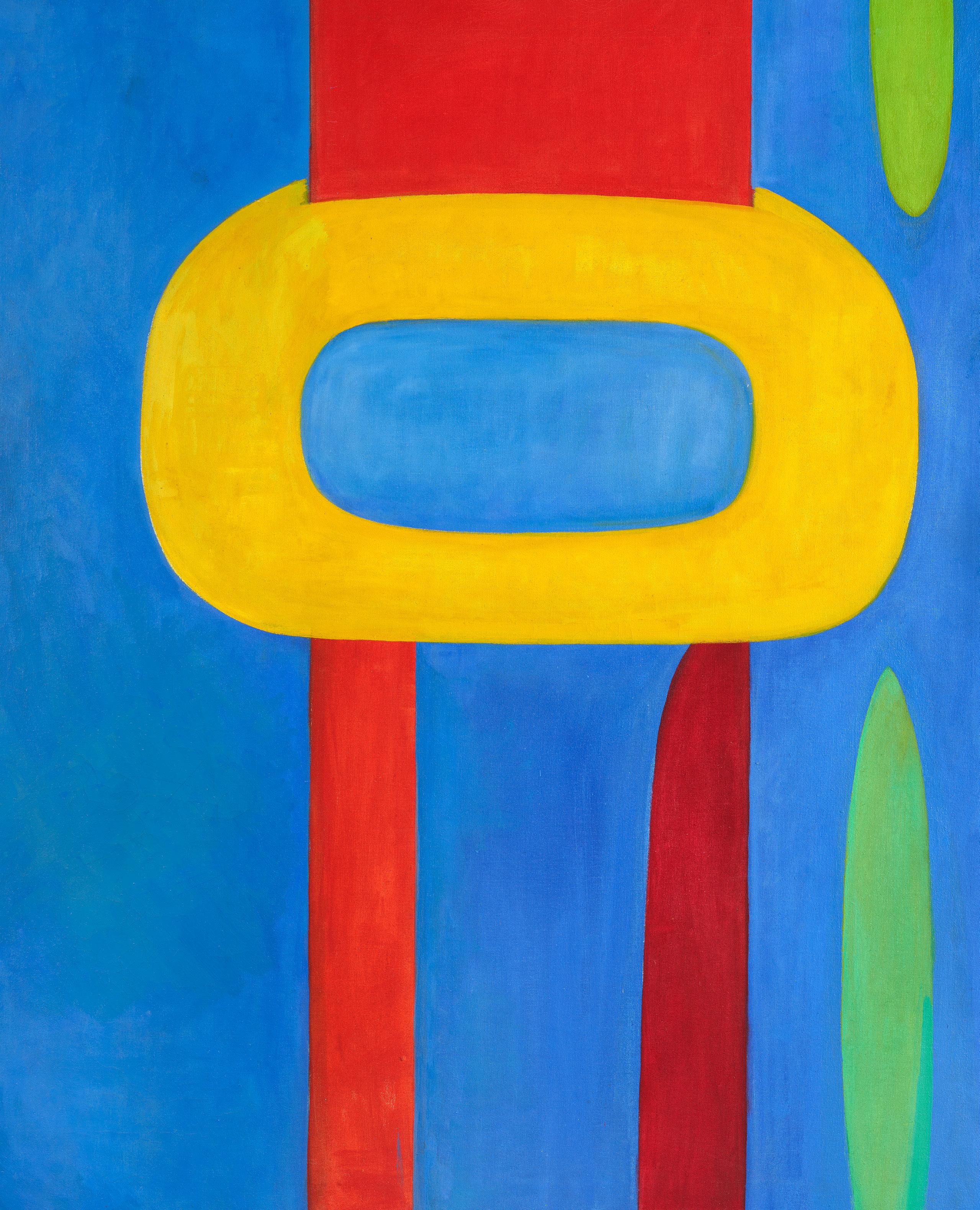
 JEAN COHEN (1927-2013)

JEAN COHEN (1927-2013)

Jean Cohen (1927–2013): Finding “My Way through Structuring”
In a career spanning six decades—from the 1950s through the first decade of the twenty-first century—Jean Cohen was committed to abstract painting, taught and lectured widely, and took an active role in the downtown Manhattan art scene. She was a member of the vibrant early collectives on East Tenth Street—including Tanager and Area—and a founder in 1972 of the historic Landmark Gallery in Soho.
Cohen’s directional outlook was shaped by her student years in the late 1940s, when she developed close and lasting friendships with the painters Lois Dodd, Alex Katz, and the sculptor Bill King, who were her classmates at Cooper Union and with whom she summered in Maine (she and Katz were married from 1950 through 1956). Unlike Dodd and Katz, who remained grounded in specific subject matter, Cohen turned early in her professional life to the freedom she felt existed more readily in a nonrepresentational, metaphysical means of expression. Perceiving her lineage to be a convergence of the Bauhaus—in which she was trained at Cooper Union—and the process methodology of Abstract Expressionism, she was an intellectual and staunchly independent artist. She embraced the spontaneity of action painting but rejected its subjectivity, creating her imagery with preconceived shapes that she developed consciously and deliberately over time. As she stated in 1967, “I sort of find my way through structuring.”1 Her paintings from the late-1950s onward are characterized by monumentality in which radiant geometrically conceived masses achieve unexpected
and self-aware interactions of value, hue, weight, and edge, with both spiritual and human implications.
Cohen stated in 2001, “when my paintings resolve themselves in a more geometric way, they are then more purely abstract . . . . What I feel, what I anticipate, what I remember, who I am, comes to the fore.” Uniting external and internal experience, she sought to “symbolize a world of perception.”2 The art critic Pat Sloane described her as “a painter of meta landscapes painted in meta-colors.” In her view, Cohen was “a transcendentalist. Or maybe even a meta-transcendentalist.”3
In 1967, Cohen was interviewed for the Archives of American Art, Smithsonian Institution, by the art historian and artist Dorothy Gees Seckler.4 The recipient of several awards—from the Adolph and Ester Gottlieb Foundation; the Creative Artists Public Service Program; New York State Council for the Arts; and the National Endowment for the Arts—Cohen is little-known today but is well deserving of rediscovery.
Born in Washington Heights, New York, on July 24, 1927, Jean Cohen was a daughter of Abraham Cohen (born in England), a dress manufacturer and store manager, and Anna Weir Cohen (born in New York). By 1940, the family (Jean had two younger brothers) was living in Hempstead, on Long Island. Cohen studied at Pratt Institute from 1944 to 1945. In 1946, she enrolled in the art school of Cooper Union, which fostered a progressive curriculum grounded in the precepts of the Bauhaus and emphasized the work of French modernists, including Picasso, Braque, and Matisse. At Cooper Union, Cohen became
OUTER SPACE JUMPING JACKS , 1968, OIL ON CANVAS, 22 X 34 IN.
part of a close-knit foursome including Katz, Dodd, and King (Dodd and King were married from 1948 to 1953). In a 2022 letter, Dodd recalled meeting Cohen in a line at Cooper Union. Then, when they were in the same Basic Design class, Cohen rebelled against the teacher’s instructions to mix colors, inserting “a high intensity red shape in her composition.”5 In 1949, Cohen painted a Fauvist-style portrait of Katz. With little money to live on, the artists barely managed to scrape by. Cohen and Katz married in January 1950, and Katz jokingly recalled in 2011 that part of Jean’s appeal had been “the relative comfort of her sunny cold-water flat on East Sixth Street.”6 In a pen-and-ink drawing, now in the collection of the Colby College Museum of Art, Katz depicted Cohen at an easel, probably within that flat, which doubled as a living and working space. On graduating from Cooper Union in 1950, Cohen and Katz both received scholarships with which they attended the intensive nine-week summer session of the Skowhegan School of Painting and Sculpture in Maine. The school emphasized plein-air painting, and the artists were invigorated by the light and color of their surroundings, which Cohen began translating increasingly into abstract form.
In February 1951, Cohen and Katz organized a joint exhibition of their work at the Peter Cooper Gallery, a museum space that was part of Cooper Union. The show drew attention from the New York Times and Artnews—which reported that the work of the two artists,
including still lifes and landscapes, was similar in subject and style.7 They returned to Maine that summer, renting a cottage near that of Dodd and King in Lakewood, home to a summer theater company next to Skowhegan. There Dodd and Cohen turned a space converted from an old garage by Katz and King into the Accent Gallery, where the artists displayed their work.8 In 1954, Cohen, Katz, and Dodd purchased a run-down clapboard farmhouse on Slab City Road in Lincolnville. After Katz and Cohen were divorced in 1956, Cohen acquired a nearby blacksmith’s shack. Subsequently her new partner was the painter John Grillo (until 1962).
By 1954, Cohen had become an artist-member of Tanager Gallery, located at 90 East Tenth Street. Tanager was the first of several artist-run cooperatives on Tenth Street on the Lower East Side that provided avant-garde alternatives to the more conservative dealer-operated galleries on Madison Avenue. It was founded in 1952 by Dodd (the only woman founder), Charles Cajori, Angelo Ippolito, Fred Mitchell, and King. By the time Cohen showed at Tanager in a four-artist show in February–March 1954 (with Philip Pearlstein, Marvin Stein, and Constance Whidden), she had become a fully abstract painter. This was given recognition by Dore Ashton in the New York Times 9 Ashton again took notice of Cohen in Fifteen Paintings, a show at Tanager in 1956, commenting on the “strong personal work” in the exhibition, including “Jean Cohen’s floating abstractions.” An example from this time, Untitled (Winter ‘54), in which gestural movements both coalesce and unform into circles, reveals Cohen’s interest in the disparate relationship of the brush and the mind. She distinguished her approach from Abstract Expressionists of an earlier generation whose imagery lay in their handling: “with them, you can’t separate brushwork from the impact or image of it,” she stated to Seckler.10 Mentioning only seven of the artists in her review—Cohen among them—Ashton commented that, in general, the Tanager show “does not attempt to stress any trend, but only to present the work of fifteen individuals. Accordingly, it has a lively, varied presence.”11
Cohen was given her first solo show in November–December 1958 by invitation from Tanager. It included 10 oils produced over the course of a year in New York and Provincetown, Massachusetts. Ashton reviewed the show, remarking on Cohen’s “bright abstractions, tending toward combinations of clear primary colors.”12 The exhibition

was reviewed in both Artnews and Arts In the former, the review was accompanied by an illustration of Cohen’s Escape. The reviewer described Cohen as a “talented young Action Painter” who “paints in clear high tones, the forms interlocked or emerging from a definite ground” and stated: “shapes, for all their quickness, look affectionately dwelt upon,” while noting that her works ranged “from a compact all-overness to an isolated freeing.” The reviewer concluded: “she sets excellent precedents for herself.”13 Noting that form was Cohen’s “primary preoccupation,” the Arts reviewer wrote that her shapes “are characterized by boldness, vigor—and a total rejection of any image,” while giving “one a strong sense of things seen and felt.” The reviewer observed that in a vertical composition of yellows “that range from cool to warm, the sense of space and outdoors is controlled by the unstudied red, blue, and green forms on the right.” Among the works on view was an image conveying the light and air of dunes, which was described by the reviewer as “a small playful seascape where the familiar oval shapes jostle each other in a background of sea blue and sky yellow.”14 An example from this time is Sultan’s Dance, 1959, in which strokes of color appear improvised but on second glance, it is apparent that they are choreographed. In the painting’s title, Cohen perhaps intended a turnabout (a sultan dancing) on the tradition of harem scenes, such as those of Delacroix.
Cohen’s second solo show was in April 1960 at the artist-collective, Area Gallery, located at 80 East Tenth Street. Artnews and Arts again reviewed the show. In Artnews, Larry Campbell commented that Cohen’s color was “more out-of-the-tube” and brighter than that of Tom Boutis in the previous exhibition. He saw the show as “a happy, rewarding one,” writing: “One finds oneself in the midst of a white space in the company of light footed small shapes intent on dancing” and works in which “still pools of color [are] hermetically stoppered by the surrounding colors.”15 The reviewer for Arts observed that Cohen had “developed perceptively” since her last show, incorporating forms that were “quieter and more contained,” less dependent on “an interlocking device and more freely in space.”16
Cohen was included in the Christmas show at Tanager in 1960 and became a member of Artists Equity in 1962. She participated in exhibitions at the Riverside Museum (1963), the Pennsylvania Academy of the Fine Arts (1964), and Area Gallery until its demise in 1965. In 1966, Cohen joined and showed with the American Abstract Artists, the venerable organization begun in 1936. Perhaps
as result of this affiliation, she began to coalesce her forms into broader geometric masses, producing large-scale imagery, whether her formats were small or large.17 In paintings such as Neti, 1969–70, she no longer differentiated figure and ground and the blue and yellow masses seem to ooze into, stretch, and bend the space. In 1971, she had a solo show at Green Mountain Gallery at 135 Greene Street, featuring large abstract oils. The paintings were described by Artnews as “forceful, often ominous images against light, airy color fields.” The reviewer commented: “the big central images work as silhouettes at first, then seem to acquire a perspective of their own” with “always a suggestion of depth” that “is never fixed, never ‘reliable.’”18 Sentinal, 1970 (Plate 1), an example of such works, catches the viewer by surprise; its signpost-like geometry undercut by spatial incongruities that exemplify Cohen’s brand of metaphysics.
In the following year, Cohen was one of six founding and supporting members of Landmark Gallery, located at 469 Broome Street in Soho (with Charles DuBack, Sideo Fromboluti, Nora Speyer, Boutis, and Daphne Mumford). Landmark was dedicated to putting art back in the hands of artists, in opposition to “commercialism, critical high pressure, and public approval,” which had been setting art trends.19 The gallery remained in business until 1982. In the course of a decade, the gallery presented work by a wide range of leading figures in the downtown art scene. Cohen had three solo exhibitions at Landmark, in 1972, 1974, and 1976. Her works of these years, as noted by her friend and agent Philip Douglas Heilman, were “spiritual remembrances intuitively composed,” distillations of the places she had lived and spent a great deal of time, including New York, Maine, Provincetown, and Philadelphia.20 Cohen’s wry sense of humor is also present in many of the paintings of this period, in which she merged Pop Art’s playfulness with Color Field opticality. In Reclining Nude, 1972 (Fig. 1), a bone-like pink shape seems a humorous play on pictorial traditions of female sensuality. In Butterfly Blue Place, 1975 (Plate 2), which could depict a painter’s palette made into a Matisse-like cutout, sharp

edges form a speaking likeness in profile. In Color of My Love, 1978, Cohen united geometric, anthropomorphic, and cosmic form. Disregarding rules of formalist space, she produced witty visual incongruities that are spiritual in connotation. In the catalogue for the 1981 Landmark Anniversary Invitational, Cohen stated poetically in relation to her work, Sun: “dark landscapes that I know well, yet have never seen, reveal themselves to me. Perhaps the edge of the earth; or the moon. The others—golden suns to warm myself by. The scale surrounds me. Invites you.”21
In 1977, Cohen was the guest curator of The Magic Circle, held at the Bronx Museum of the Arts. In an essay in the catalogue, she acknowledged the circle as the “simplest and most perfect of images” and “a haunting one” that is “related to the divine,” for it “has neither beginning nor end.”22 The works included were wide-ranging in style and subject by artists including Richard Anuszkiewicz, Will Barnet, Ilya Bolotowsky, Dodd, Grillo, Robert Indiana, Katz, Richard Lindner, Fairfield Porter, Richard Pousette-Dart, Leon Polk Smith, and Yvonne Thomas. Also in 1977, Cohen took part in Tenth Street Days: The Co-ops of the 50’s, a traveling exhibition circulated by the Gallery Association of New York State.
At some point in the 1970s, Cohen moved to Shirley, New York, on the south shore of Long Island. In the 1980s, she expanded her work often by reiterating and formalizing earlier imagery, such as in the triptych Bayou, 1987 (Fig. 2). She continued to exhibit her work through the early 2000s. She was featured in solo shows in 1978 (Cape Split Place, Addison, Maine); 1979 (Long Island University, Salena Gallery, Brooklyn; Philadelphia College of Art; and High Street Gallery, Blairstown, New Jersey); 1983 (Montgomery Street Studio Show, Jersey City, New Jersey); 1984 (Peri-Renneth Gallery, West Hampton, Long Island); 1990 (Broome Street Gallery, New York); 1997 (Marcella Geltman Gallery, New Milford, New Jersey); and 2000-3 (Gallery Rood, Eastport, New York). She took part in group exhibitions in museums and galleries through the end of her life, including several shows of the American Abstract Artists (1983, 1986, 1992, 1994, and 1996). In a review of the 1994 show, William Zimmer singled out Cohen in his review, remarking that “the serene angular form” in her Levee, “reads as a winding road.”23 In 2011, she joined Bernard Langlais in a two-artist show at Aucocisco Gallery, Portsmouth, Maine. Cohen died on May 4, 2013 at her home in Shirley, New York. In 2019, her early years in Maine were recalled in the catalogue for Slab City Rendezvous, an exhibition held at the Farnsworth Art Museum, Rockland, Maine, in which her painting, Skowhegan, 1949, was included.
Cohen taught and lectured at Cooper Union (spring and summers, 1951–63); Philadelphia College of Art (1962–69); Queens College (1972–75); Jersey City State College and Philadelphia College of Art (1981–86); the Art Students League (ca. 1985–92); Louisiana State University (1990); and Skowhegan School of Painting (1995).
Her work belongs to a number of public collections, including the Bryn Mawr Memorial Study Collection, Pennsylvania; the Colby College Museum of Art, Waterville, Maine; Hampton Institute Museum, Virginia; the Metropolitan Museum of Art, New York; the Museum of Modern Art, New York; New Jersey State Museum, Trenton; the Phillips Collection, Washington, D.C.; Savannah College of Art and Design, Georgia; Skowhegan School of Painting and Sculpture, Maine; and Wright State University Museum, Dayton, Ohio.
—Lisa N. Peters, Ph.D. © Berry Campbell, New York
1 Jean Cohen in “Jean Cohen and Dorothy Gees Seckler,” Interview with Jean Cohen, August 24, 1967. Dorothy Gees Seckler Collection of Sound Recordings Relating to Art and Artists, 1962–1976. Archives of American Art, Smithsonian Institution.
2 Artist’s statement, press release for Four Artists Show: Herman Cherry, Jean Cohen, Frances Heatherington, Shelley Himmelstein, Studio 18 Gallery, New York, 2001.
3 Pat Sloane, “Jean Cohen,” in Landmark Gallery Anniversary Invitational, exh. cat. (New York: Landmark Gallery, 1981), p. 7.
4 Interview with Jean Cohen
5 Lois Dodd to Philip Heilman, March 1, 2022, Cohen archives.
6 Judith Stein, “Maine as Matrix,” in Slab City Rendezvous, exh. cat. (Rockland, Maine: Farnsworth Art Museum, 2019), p. 21.
7 R. G., “Jean Cohen and Alex Katz,” Artnews 49 (February 1951), pp. 49–50; “Abstract Painting Leads Week in Art,” New York Times, January 29, 1951, p. 17.
8 Stein, p. 21.
9 D[ore] A[shton], “Displays at Other Galleries,” New York Times, February 25, 1954, p. 24.
10 Interview with Jean Cohen, p. 8.
11 D[ore] A[shton], “About Art and Artists,” New York Times, April 26, 1956, p. 30.
12 Dore Ashton, “Art: 9 Galleries Hold Combined Show,” New York Times, December 10, 1958, p. 36.
13 J. S., “Jean Cohen,” Artnews 57 (December 1958), p. 17.
14 H.D.M., “Jean Cohen,” Arts 33 (January 1959), p. 63.
15 L[arry] C[ampbell], “Jean Cohen,” Artnews 59 (April 1960), p. 55.
16 H.D.M, “In the Galleries: Jean Cohen,”Arts (May 1960), pp. 67–68.
17 Interview with Jean Cohen, p. 4.
18 S. N. “Jean Cohen,” Artnews 70 (March 1971), p. 17.
19 Landmark Gallery Anniversary Invitational, p. 3.
20 Philip Heilman, note about “Jean’s paintings of the 1970s,” Cohen archives.
21 Jean Cohen, in Landmark Gallery Anniversary Invitational, p. 7.
22 Jean Cohen, “The Magic Circle,” in The Magic Circle, exh. cat. (New York: Bronx Museum of the Arts, 1977, p. 10.
23 William Zimmer, “Geometric Abstraction’s Varied Moods,” New York Times, August 28, 1994, p.7.
FIG. 2. BAYOU, 1987, OIL ON CANVAS, 20 ¼ X 60 ¾ IN.

INFO@BERRYCAMPBELL.COM
TEL 212.924.2178
VIEW THE ENTIRE EXHIBITION ONLINE AT WWW.BERRYCAMPBELL.COM