Friday,2022-07-2205:08:01PM
Goal&Scope
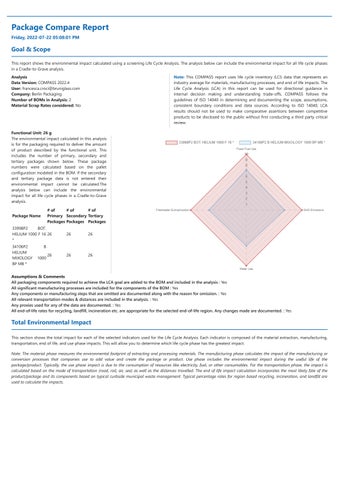
ThisreportshowstheenvironmentalimpactcalculatedusingascreeningLifeCycleAnalysis Theanalysisbelowcanincludetheenvironmentalimpactforalllifecyclephases inaCradle-to-Graveanalysis
Analysis
DataVersion:COMPASS20224

User:francescacroci@bruniglasscom Company:BerlinPackaging NumberofBOMsinAnalysis:2 MaterialScrapRatesconsidered:No
FunctionalUnit:26g
Theenvironmentalimpactcalculatedinthisanalysis isforthepackagingrequiredtodelivertheamount of product described by the functional unit This includes the number of primary, secondary and tertiary packages shown below. These package numbers were calculated based on the pallet configurationmodeledintheBOM Ifthesecondary and tertiary package data is not entered their environmental impact cannot be calculatedThe analysis below can include the environmental impactforalllifecyclephasesinaCradle-to-Grave analysis
Note: This COMPASS report uses life cycle inventory (LCI) data that represents an industryaverageformaterials,manufacturingprocesses,andendoflifeimpacts The Life Cycle Analysis (LCA) in this report can be used for directional guidance in internal decision making and understanding trade-offs COMPASS follows the guidelines of ISO 14040 in determining and documenting the scope, assumptions, consistent boundary conditions and data sources According to ISO 14040, LCA results should not be used to make comparative assertions between competitive productstobedisclosedtothepublicwithoutfirstconductingathirdpartycritical review.
PackageName #of Primary Packages
#of Secondary Packages
26 26 26
#of Tertiary Packages 33998P2 BOT HELIUM1000F16 * 26 26 26 34106P2 B HELIUM MIXOLOGY 1000 BPMB*
Assumptions&Comments
AllpackagingcomponentsrequiredtoachievetheLCAgoalareaddedtotheBOMandincludedintheanalysis:Yes
AllsignificantmanufacturingprocessesareincludedforthecomponentsoftheBOM:Yes
Anycomponentsormanufacturingstepsthatareomittedaredocumentedalongwiththereasonforomission.:Yes
Allrelevanttransportationmodes&distancesareincludedintheanalysis.:Yes
Anyproxiesusedforanyofthedataaredocumented :Yes
Allend-of-liferatesforrecycling,landfill,incinerationetc areappropriatefortheselectedend-of-liferegion.Anychangesmadearedocumented :Yes
TotalEnvironmentalImpact
ThissectionshowsthetotalimpactforeachoftheselectedindicatorsusedfortheLifeCycleAnalysis Eachindicatoriscomposedofthematerialextraction,manufacturing, transportation,endoflife,andusephaseimpacts Thiswillallowyoutodeterminewhichlifecyclephasehasthegreatestimpact
Note: The material phase measures the environmental footprint of extracting and processing materials The manufacturing phase calculates the impact of the manufacturing or conversion processes that companies use to add value and create the package or product Use phase includes the environmental impact during the useful life of the package/product Typically, the use phase impact is due to the consumption of resources like electricity, fuel, or other consumables For the transportation phase, the impact is calculated based on the mode of transportation (road, rail, air, sea) as well as the distances travelled. The end of life impact calculation incorporates the most likely fate of the product/package and its components based on typical curbside municipal waste management Typical percentage rates for region based recycling, incineration, and landfill are usedtocalculatetheimpacts
PackageCompareReport
Totalquantityoffossilfuelconsumedthroughoutthelifecyclereportedingigajoules(GJ)equivalentsdeprived ThisindicatorusestheImpactWorld+methodandassumes fossil resources mainly used for energy purposes Fossil fuels include coal, petroleum, and natural gas Inputs for nuclear fuel such as uranium are accounted for in the MINERALCONSUMPTIONindicator
SIMPLEIndicators
FossilFuelUseDifferencesforEachBOMComparedtotheReference
34106P2BHELIUMMIXOLOGY1000BPMB* 88.27GJdeprived 14.43BarrelsofOil 6.22AverageHomesPoweredYearly GHGEmissions(tonCO2eq.)
Thetotalquantityofgreenhousegases(GHG)emittedthroughoutthelifecyclereportedintonsofCO2equivalents ThiscalculationfollowstheIPCCSixthAssessmentReport (AR6)2021100aw/oCO2Uptakemethodandconsidersclimatefeedbackloops
SIMPLEIndicators
GHG
MIXOLOGY
FossilFuelUse(GJdeprived)
EmissionsDifferencesforEachBOMComparedtotheReference 34106P2BHELIUM
1000BPMB* 7.82tonCO2eq. 4.62PassengerVehiclesDrivenYearly 37,428.1MilesDrivenbyPassengerVehiclesYearly 3,331.98LitersofGasolineConsumed 202.71TreeSeedlingsGrownfor10Years 9.2AcresofForestsYearly FossilFuelUse(GJdeprived)byLifeCyclePhases Material Manufacturing Transportation EndOfLife UsePhase 100 200 300 400 33998P2BOT HELIUM1000F16 * Ref. -27.26% GHGEmissions(tonCO2eq.)byLifeCyclePhases Material Manufacturing Transportation EndOfLife UsePhase 5 10 15 20 25 33998P2BOT HELIUM1000F16 * Ref. -31.43%
Therelativeavailablewaterremainingperareainawatershedafterthedemandofhumans,aquaticecosystems,andmanufacturingprocesshasbeenmet Thisindicatoruses theAWAREmethodandaccountsforwaterscarcity Theresultrepresentstherelativevalueincomparisonwiththeaveragecubicmetersconsumedintheworld Essentially, thetotalwaterconsumedtomakethepackageismultipliedbytheregion'sscarcityfactorwhichwilleitherincreaseordecreasethewaterusagevaluebasedonthescarcityor excessavailabilityofwaterinaspecificregion
WaterUse(m3)byLifeCyclePhases
33998P2BOT HELIUM1000F16 * Ref. -35.76%
1,000 2,000 3,000 4,000 5,000 6,000
Material Manufacturing Transportation EndOfLife UsePhase
SIMPLEIndicators
WaterUseDifferencesforEachBOMComparedtotheReference
34106P2BHELIUMMIXOLOGY1000BPMB* 1,975.09m3 521,819.28GallonsofWater 32,918.1AverageShowers 90.19PeopleShoweringDailyforaYear 0.79OlympicSizedSwimmingPools
FreshwaterEutrophication(kgPO4eq.)
Eutrophicationistheabnormalincreaseinchemicalnutrientsthatresultsinexcessiveplant/algalgrowthanddecayresultinginananoxicconditioninfreshwatersystems,the majorconsequencebeingalgalblooms Typically,theseareemissionsofphosphoruscompoundsreleasedduringtheproductionofmaterials Itisreportedinphosphate (PO4)equivalentsandiscalculatedwithImpactWorld+characterizationfactors
FreshwaterEutrophication(kgPO4eq.)byLifeCyclePhases
33998P2BOT HELIUM1000F16 * Ref. -33.05%
0.1 0.2 0.3 0.4 0.5
Material Manufacturing Transportation EndOfLife UsePhase
FreshwaterEutrophicationDifferencesforEachBOMComparedtotheReference
34106P2BHELIUMMIXOLOGY1000BPMB* 0.1542kgPO4eq.
WaterUse(m3)
This
33998P2BOT.HELIUM1000F16*
BOMClassifications
BOMName Quantity(Pallet) Mfg Region Sales-UseRegion BaseUnit 33998P2BOT HELIUM1000F16* 26 Europe Europe g
Category SKU Brand ProductType Status Channel LaunchDate RetiredDate
NA NA NA NA NA NA NA
Name Material PCR% PIR% Manufacturing Process MassPer Occurrence # Transport Component Type EOLRecycling Potential
PS 1 246km PP(1g) 1
Bottle ContainerGlass 0% 0% Productionof ContainerGlass 500g 1408 76%
SP (1 PPs per) 1
Carton cap Corrugated 40% 0% 900g 16 0%
Plastic bag Low-Density Polyethylene (LDPE) 0% 0% 1,200g 2 40%
TP (1 SPs per) 1
Wooden pallet
Wood-Sawn hardwood, planed,air/kiln dried 0% 0% 20,000g 2 0%
34106P2BHELIUMMIXOLOGY1000BPMB*
BOMClassifications
BOMName Quantity(Pallet) Mfg Region Sales-UseRegion BaseUnit
34106P2BHELIUMMIXOLOGY1000BPMB* 26 Europe Europe g
Category SKU Brand ProductType Status Channel LaunchDate RetiredDate
NA NA NA NA NA NA NA
Name Material PCR% PIR% Manufacturing Process MassPer Occurrence # Transport Component Type EOLRecycling Potential
PS 1 246km PP(1g) 1
Bottle ContainerGlass 60% 0% Productionof ContainerGlass 500g 1408 76%
SP (1 PPs per) 1
Carton layer Corrugated 40% 0%
Adhesive Lamination| PaperCutting| Productionof Corrugated Containers
1,000g 8 0%
Carton cap Corrugated 40% 0% 900g 2 0%
Plastic bag Low-Density Polyethylene (LDPE) 0% 0% 1,200g 2 40%
InputPackageBillofMaterial(BOM)
section outlines the input given for the Life Cycle Analysis in the form of complete BOMs For each component, the material, manufacturing process, number of occurrences,andmassislisted
Wooden pallet
Wood-Sawn hardwood, planed,air/kiln dried 0% 0% 20,000g 2 0%
CompareBOMDetails
Name Unit Of Measure Quantity Total Package Weight/Unit Product Ratio
33998P2BOT. HELIUM 1000 F16*
34106P2 B HELIUM MIXOLOGY 1000BPMB*
Primary Package Cube Efficiency %
Secondary Package Cube Efficiency %
Tertiary Package (Pallet) Cube Efficiency%
Primary Package Recyclable Score
EOL Recycling Potential
EOL Recycling Potential (%)
EOL Waste Potential
EOL Waste Potential (%)
EOL Total Mass
Each 26 7608000g/g 0 0 0 5 1394ton 7045 584ton 2955 1978 ton
Each 26 7562000g/g 0 0 0 5 1394ton 7088 573ton 2912 1966 ton
MaterialUtilizationDetails
ThissectionisusedtodeterminethetotalquantitiesofvariousmaterialswithintheBOM Thetotalmassperpackagingsystemisaddedupaswellasthetotalmassofallof the packaging systems in this comparison The equivalency comparison considers different pallet efficiencies and calculates the total mass of packaging that is being consideredintheanalysis
Material PCR%
33998P2BOT.HELIUM1000F16* 34106P2BHELIUMMIXOLOGY1000BP MB*
ContainerGlass 0% 183ton N/A
Corrugated 40% 3744kg 2548kg
Low-DensityPolyethylene(LDPE) 0% 624kg 624kg
Wood - Sawn hardwood, planed, air/kiln dried 0% 104ton 104ton
ContainerGlass 60% N/A 183ton Total 1978ton 1966ton
TP (1 SPs per)
1
PrimaryPackageMCI(0-1)for34106P2BHELIUMMIXOLOGY1000BPMB*is1000(min00,max 10)

EcoScoreModule
Thissectionprovidesabiggerpicturesustainabilityanalysiscomparingvariousproducts/packagesandwheretheyfallonthechart Thisallowsyoutovisualizehowthese differingproductsarealigningwithyourcompany’ssustainabilitygoals Overview NormalizedvaluesrankeachBOM'sattributetoa0-10scale Alowerscoreisbetter
GHGEmissions(tonCO2eq)
AttributeName 33998P2BOT.HELIUM1000F16* (ReferenceBOM) 34106P2BHELIUMMIXOLOGY1000BPMB* Actual Actual Bio-RenewableContent(%) 715Ref 659-783% CertifiedContent(%) 0Ref 00% DamageRate(%) 0Ref 00% EOLWastePotential(kg) 2248Ref 2202-205% FossilFuelUse(GJdeprived) 32381Ref 23554-2726% FreshwaterEutrophication(kgPO4eq) 04666Ref 03124-3305%
MaterialScrapRate(%)
PackagedProductShelfLife(days)
PackagingRecoveryRate(%)
PackagingToProductWeight(kg/g) 760,800Ref 756,200-06046%
PostConsumerRecycledContent(PCR)(%) 07571Ref 56387,34684%
PostIndustrialRecycledContent(PIR)(%)
PrimaryPackageCubeEfficiency(%)
PrimaryPackageMCI(0-1) 03992Ref 1005241698%
Valueoutofscalerange
PrimaryPackageRecyclableSCORE(0-5) 5Ref 50%
SecondaryPackageCubeEfficiency(%)
SecondaryPackageRecyclableSCORE(0-5) 5Ref 50%
SingleUsePlastic(%) 03155Ref 03174+06022%
TertiaryPackageCubeEfficiency(%)
2488Ref
-3143%
1706
0Ref 00%
0Ref 00%
0Ref 00%
0Ref 00%
0Ref 00%
0Ref 00%
0Ref 00%
Ref 00%
TotalCostofPackaging($) 0
Notes
WaterUse(Kiloliter)
Ref
-3576%
0Ref 00%
PackagedProductShelfLife PackagedProductShelfLifevaluetakenfromPrimaryPackage
5,52291
3,54783
WeightReduction(%)
Bio-RenewableContent
Referstothepercentageofbio-basedcontentcontainedintheMaterial Thispercentagecanvaryfrom0%to100% Notall materialswillhavebio-basedcontent Primarilypaperandplasticswillhavethiscontent
CertifiedContent
ReferstoMaterialsourcesthathavebeencertifiedbythirdpartycertificationprogramsdeemedrelevantbytheCOMPASSuser Thedefinitionof'Certified'variesbyuser Awiderangeofcertificationprogramsexist,andCOMPASSdoesnotprovide guidanceonwhichoftheseprogramsmayberelevanttousers'decision-making Priortodatainput,usersareencouragedto createalistofwhichcertificationprogramstheysupport,andthenusethislistasthebasisfordataentry Forexample,forest productcertificationprogramsthatmaybeofinteresttousersincludetheForestStewardshipCouncil(FSC),PanEuropean ForestCouncil(PEFC)orSustainableForestryInitiative(SFI) Thepercentcertifiedrangeisbetween0%to100% Note: %CERTIFIEDisauserspecifiedattributeanddoesnotimpactthelifecycleimpactassessmentofapackageorpackaging system
DamageRate
EOLWastePotential
FossilFuelUse
Damageratemeasuresthefrequencyacomponentisdamagedduringtransportation,withthegoaloftransportingthe producttoitsdestination Damagerateisenteredoneachcomponentandisrolledupateachpackageandatthepackaging systemlevel
Thisisthepotentialforthepackagetobeeitherlandfilled,incineratedorcompostedatendoflifebasedonthecurrent municipalwasteinfrastructureintheselectedregion
Totalquantityoffossilfuelconsumedthroughoutthelifecyclereportedingigajoules(GJ)equivalentsdeprived Thisindicator usestheImpactWorld+methodandassumesfossilresourcesmainlyusedforenergypurposes Fossilfuelsincludecoal, petroleum,andnaturalgas InputsfornuclearfuelsuchasuraniumareaccountedforintheMINERALCONSUMPTION indicator
FreshwaterEutrophication
GHGEmissions
MaterialScrapRate
PackagedProductShelfLife
Eutrophicationistheabnormalincreaseinchemicalnutrientsthatresultsinexcessiveplant/algalgrowthanddecayresultingin ananoxicconditioninfreshwatersystems,themajorconsequencebeingalgalblooms Typically,theseareemissionsof phosphoruscompoundsreleasedduringtheproductionofmaterials Itisreportedinphosphate(PO4)equivalentsandis calculatedwithImpactWorld+characterizationfactors
Thetotalquantityofgreenhousegases(GHG)emittedthroughoutthelifecyclereportedintonsofCO2equivalents This calculationfollowstheIPCCSixthAssessmentReport(AR6)2021100aw/oCO2Uptakemethodandconsidersclimatefeedback loops
Percentageofmaterialscrapofamanufacturingprocess Defaultpercentagesarepulledfromindustryaverageprocesses This valuecanbeeditedtoreflectimprovedefficiencyoryieldofmanufacturingprocess ChangingthisvalueaffectstheLCAof material,manufacturing,andinboundtransportationimpact Onlyavailableforcomponentswithonemanufacturingprocess permaterial
Theratioofaproductââ¬â¢sshelflifeinpackagingtoaproductââ¬â¢sshelflifewithoutpackaging Measurethelength oftimeaproductinpackagingissuitableforsalecomparedtoaproductnotinpackaging Compareonlysameproducttypes insamepackagingtypes Thismetricdoesnotapplytoproductswhichdonothaveaclearlydefinedshelflife Donottakeand comparemeasuresofdifferenttypesofproductsinthesametypesofpackagingorofsametypesofproductsindifferenttypes ofpackaging
PackagingRecoveryRate
Themassfractionorabsolutemassofpackagingrecoveredfromallsources(commercialandresidential)basedonrelevant wastemanagementstatistics Determineifpackagingconformstothecriteriaforrecoverabilityaspertherelevantstandards above Includedisclosureofmaterialaspectsofthepackagethatwouldprecluderecovery,eg color,materialcombinations,or coatings Ifcriteriaarefulfilled,expresstotalrecoveryrateas%oftotalpackagingweightputonthemarketthatiseffectively recoveredandprovidethebreakdownperpracticedrecoveryoption MaterialRecycling:measureeachtypeofpackaging producedand/orusedforwhichnationalwastemanagementrecyclingratesexist Notethatdependinguponthepackaging (type,shape,size,color)truerecyclingratesmightnotcoincidewithnationalrecyclingratesforspecificmaterialorpackaging category Composting:measureeachtypeofpackagingproducedand/orusedforwhichnationalwastemanagementindustrial compostingratesexist Notethatinmanyregionstherateofcompostedorganicwastemaynotcoincidewiththerateof compostedpackagingwasteduetolackofacceptance EnergyRecovery:Ifpackagingisdeemedtohaveenergyrecoveryvalue andappropriateinfrastructureexists,usenationalwastemanagementstatistics Ifdataisavailable,measurebymaterialtype Packaginggoingtofinaldisposalandnonrecoveredlitteringisimplicitlycalculatedfromtherecoveryrateanddoesnotneedto bemeasuredseparately
AppendixofSustainablePackagingAttributesthatcanbeusedinSCORE
PackagingToProductWeight PackagingtoProductWeightRatio:Theratiooftheweightofallpackagingmaterialusedcomparedtotheweightofthe productorfunctionalunitdelivered ThisisautomaticallycalculatedinEcoImpact PostConsumerRecycledContent (PCR) Thisisthepercentageofpost-consumerrecycledcontentcontainedintheMaterialasdefinedbyISO14021 %PCRfor materialsusuallyrangebetween0%to100% PCRisnotavailableforallmaterials PostIndustrialRecycledContent(PIR) PostIndustrialwasteintheformofscrap,rejectsetcthatiscollectedfromindustriesandusedasrecycledcontentinanew product/package PrimaryPackageCubeEfficiency RatioofProductvolumeandPrimarypackagevolume Thisshowshowmuchemptyorheadspaceisthereintheprimary package Ahigher%denotesmoreefficientuseofthePrimarypackagevolumeandreducedemptyspace PrimaryPackageMCI(0-1) Thisisthematerialcircularityindexcalculatedfortheprimarypackage PrimaryPackageRecyclableSCORE (0-5) 0-Contaminant=Contaminatestherecyclingstream1-NotAccepted2-Verylimitedacceptance,butgrowingtrendtowards acceptance3-LimitedAcceptance4-Inprocessofbeingwidelyaccepted5-WidelyAccepted SecondaryPackageCubeEfficiency RatiooftotalProductVolumeinsecondarypackageandSecondarypackagevolume Thisshowshowmuchofthesecondary packagevolumeisoccupiedbytheproduct Ahigher%denotesmoreefficientuseofSecondarypackageandreducedempty space
SingleUsePlastic
TertiaryPackageCubeEfficiency
TotalCostofPackaging
WaterUse
WeightReduction
0-Contaminant=Contaminatestherecyclingstream1-NotAccepted2-Verylimitedacceptance,butgrowingtrendtowards acceptance3-LimitedAcceptance4-Inprocessofbeingwidelyaccepted5-WidelyAccepted
SingleUsePlastic
RatiooftotalProductVolumeonPalletandPalletVolume Thisshowshowmuchofthetertiarypackagevolumeisoccupiedby theproduct Ahigher%denotesmoreefficientpalletizationandreducedemptyspace
Thetotalcostofallmaterials,energy,equipmentanddirectlaborusedduringthesourcingofraw,recycledandreused materialsandtheproduction,filling,transportand/ordisposalofpackagingmaterials,packagingcomponentsorunitsof packaging
Therelativeavailablewaterremainingperareainawatershedafterthedemandofhumans,aquaticecosystems,and manufacturingprocesshasbeenmet ThisindicatorusestheAWAREmethodandaccountsforwaterscarcity Theresult representstherelativevalueincomparisonwiththeaveragecubicmetersconsumedintheworld Essentially,thetotalwater consumedtomakethepackageismultipliedbytheregion'sscarcityfactorwhichwilleitherincreaseordecreasethewater usagevaluebasedonthescarcityorexcessavailabilityofwaterinaspecificregion
Packagingweightreductioncanbecalculatedasthedifferencebetweentheimmediate,previous,andpresentpackaging design Forenvironmentalrelevance,packagingweightreductionshouldbecommunicatedbymaterialcategory Sometimes whenpackagesarelight-weighted,thiscanrequireotherpartsofthepackagingsystem(eg secondarypackaging)toincrease inweighttoprotectathinner,morefragilepartofthepackage Theseweightincreasesandreductionsshouldbeclearly communicated,considered,andquantified
SecondaryPackageRecyclable
(0-5)
SCORE