Vermont Maturity, published six times per year by Vermont News and Media, LLC, reaches readers through mail and newsstand copies. Distribution covers Chittenden County, including Burlington, South Burlington, Essex, Colchester, Shelburne, Winooski, and Williston. Additionally, Vermont Maturity is available in Southern Vermont, specifically in Bennington and Windham Counties.
The publisher makes no representation concerning any product or service advertised in this publication. Vermont Maturity and VermontMaturity.com serve only as mediums for sellers to reach potential buyers and do not warrant the accuracy of any advertisement. Vermont Maturity makes every effort to eliminate typographical errors but assumes no responsibility for misspelling names from handwritten copy. All editorial items submitted are subject to editing and alteration at the sole discretion of the publisher. The design and format of this magazine are protected by the copyright laws of the United States of America. Reproduction of this publication, in whole or in part, is prohibited without express written consent of the publisher.
POSTMASTER
Please send address changes to Vermont News and Media, 70 Landmark Hill Drive, Brattleboro, VT, 05301
Table of Contents
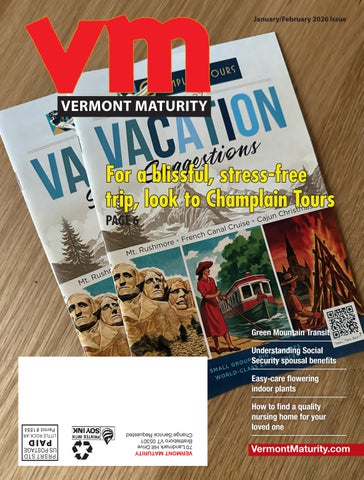
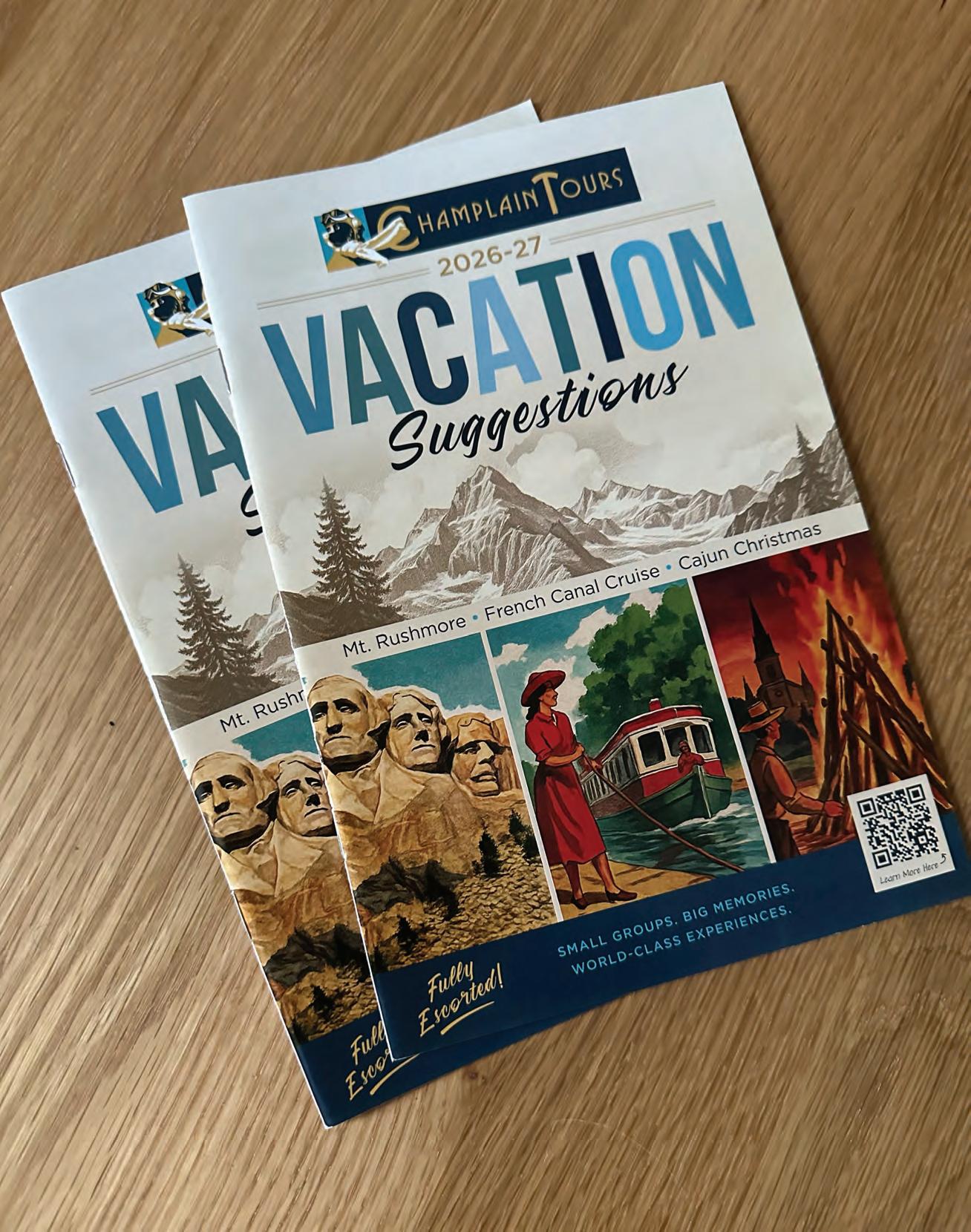
For a blissful, stress-free trip, look to Champlain Tours
By Susan Smallheer, Vermont Maturity
For a blissful, stress-free trip, look to Champlain Tours
By Susan Smallheer, Vermont Maturity
BURLINGTON -- Champlain Tours does it all.
It will arrange tours with larger, established tour companies, (think Viking or Princess Cruises), and at no extra cost.
Or it will design a small personal tour for a family.
And of course, it also does the traditional guided tours for points all over the world, including the United States.
“We just did a personal tour for a family that wanted to travel to Portugal and check off all these issues on their father’s bucket list -- including the beaches of Normandy,” said Keith Sherpa, president and founder of Champlain Tours.
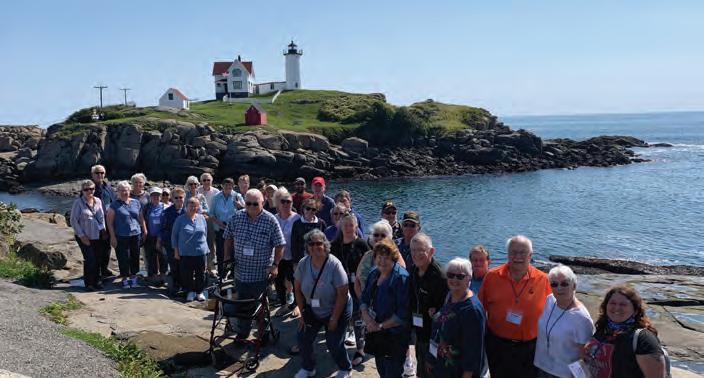
Based in Burlington, Champlain Tours wants to make traveling as stress free as possible, with a very personal touch. “We know these places,” he said. If Champlain Tours has an unofficial motto, it’s “More Adventure, Less Hassle.”
“I like to say all you have to do is show up at the airport in Burlington with your passport and we take care of the rest,” said Sherpa during a recent interview about his business, which he established in 2015.
Sherpa said that roughly 70 percent of his business comes from Vermonters, and a large percentage of it is repeat customers. The average age of his clients is 70, he said.
Sherpa said he takes a lot of pride in the number of repeat customers, which to him means Champlain Tours has satisfied them in every way.
Sherpa and his staff of four experienced agents both design tours for people who will go on a trip on their own, or will accompany people on their established tours. They bring their extensive first-hand experience and knowledge to the job, he said.
In the age of smart phones, Champlain Tours can give you a self-guided itinerary, that tells you where in
the airport to turn as you get off your plane and head for your hotel. “People really like that detail,” he said.
It’s that attention to detail, and anticipating their client’s needs, that Sherpa thinks makes his company so successful.
Sherpa said the company recently returned from a tour to Australia and New Zealand, and he and another
company employee took on the task of arranging the necessary visas for everyone on the tour, which could only be arranged via a cell phone app, for New Zealand while the tour was underway.
“They didn’t have to worry about a thing,” he said.
The COVID years generally hit travel companies hard, but he said that people are again starting to spend on trips.
ABBIATIMONUMENTS
However, people are not jumping back on planes, he said, and he said Champlain Tours’ trips to New York City and Washington, D.C., via bus were some of their most popular offerings.
“They are more affordable, and more local, and they don’t have to fly,” he said. Since COVID, he said, his company has seen more demand for domestic travel, “but that’s starting to change.”
“We do a lot of custom trips,” he said, that are deliberately small to avoid travel complications.
Europe with its excellent rail offerings, makes group transportation easier.
Yes, that means his company will design a trip for three or four or five people. His staff of four have extraordinary experience and personal knowledge, he said. Two are from England, one is German, and another is a former Spanish teacher from South Burlington, he said.
One new big thing for Champlain Tours is its new barge-based tours, which will be available during the summer of 2026 in Provence and Barcelona.
He said the barges are much smaller than the large ships used by Viking, which can host up to 160 passengers. He said Champlain has chartered the entire barge for weeks at the end of July and beginning of August.
“It’s traveling on a much smaller scale,” he said, and as a result, the barges can go further
upstream, to a small village “with no tourists.”
Champlain wants to get its travelers” off the main path.”
Champlain Tours clients are looking for the more intimate experience, he said. “They are people who don’t like pools or casinos.”
Champlain Tours does sell tours to Avalon, Viking (he prefers Avalon over
Pinecrest at Essex Senior Living
One & Two Bedroom Apartments Essex Jct, Vermont
• One & Two Bedroom options w/heat & electricity included
• Independent Living for adults age 55+
• Convenient access to shops, dining, & professional services
• Beauty/barber shop, & community kitchen/dining space
• Elevator access & emergency pull-cord call system
• No smoking & No pets
• 24/7 emergency maintenance response
• Secured entry & on-site property manager
• Garden space & nearby trails with sidewalk access
• Social activities & community events calendar
Contact us today for availability and sign up for new listing alerts leasing@fullcirclevt.com (802) 872–9197 fullcirclevt.com fullcirclevt.com/listing-alerts
Viking) and other large tour operators, he said. “Avalon is better and you’re not paying for $1 million in advertising,” he said, a reference to Viking’s famous advertisements on public television, among other places.
Their new barge trips are less crowded and more intimate -- there are about 20 cabins on the barge.
“We want people to come back and we’re always thinking ‘How can we make it more special?’” he said.
Interest in the Champlain Tour’ 2027 German Christmas Market tour is already strong as people are already sending in deposits. Yes, 2027, as this tour is very popular.
Champlain Tours visits the most popular Christmas markets, but the majority of the itinerary has been intentionally crafted by our German counterparts to experience Christmas in Germany through a local lens. This means balancing iconic markets with smaller towns and traditions that reflect how Germans themselves celebrate the season.
Sherpa emphasized that while the tour includes the famed markets travelers expect, it is carefully
designed to avoid the most congested moments, when dozens of tour buses arrive at once and overwhelm the experience.
“We want to get off the beaten path,” he said, “and into the heart of a German Christmas.”
Sherpa said his company loves to teach people how to travel, and how to navigate on their own on future trips, which could mean that people wouldn’t need a guided tour the next time they head to New York, he pointed out.
Sherpa said while Champlain Tours’ prices at first glance may seem higher than other tours, he said a big difference is that all costs are included. Unlike many tours, which are always adding in extra costs. With other tour operators, “it’s always plus, plus, plus,” he said. “We publish the actual price.”
See the Champlain Tours ad on page 2 VM
Green Mountain Transit
By Phyl Newbeck
When most people think about Green Mountain Transit they envision the bus service which was chartered by the Vermont General Assembly in 1973. The system of public buses serves the communities of Burlington, Essex, South Burlington, Shelburne, Williston, Winooski, Milton, Hinesburg, and a portion of Colchester. In addition, the LINK Express routes serve Montpelier, and St. Albans commuters. GMT is considered a municipality and is the first and only transit authority in the State of Vermont.
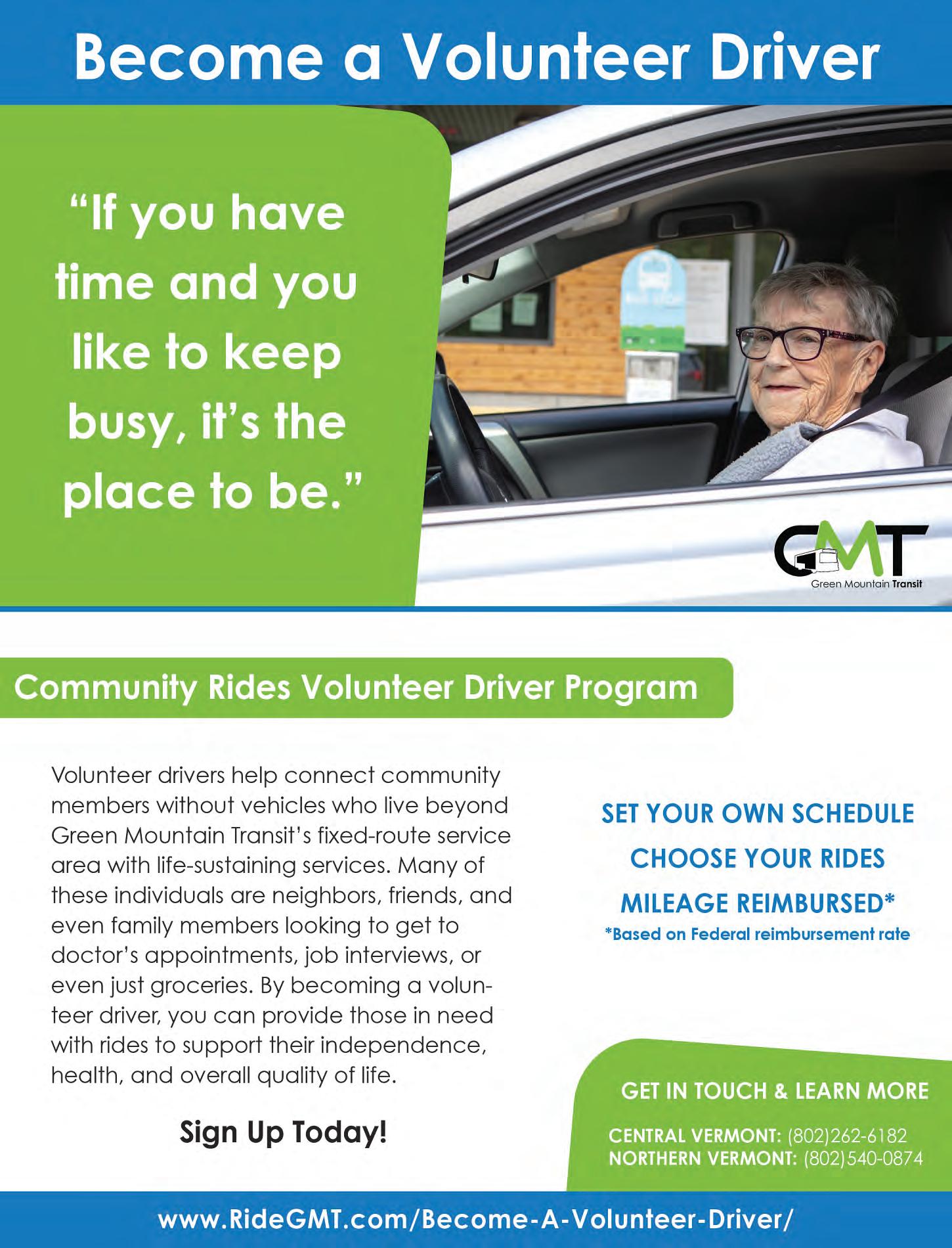
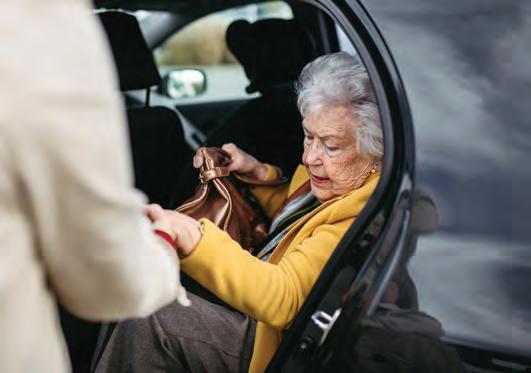
However, in addition to the regular routes, Green Mountain Transit organizes a system of volunteer community drivers who help their neighbors get to doctor’s appointments, purchase groceries, and perform other acts of daily living which require transportation. Volunteers are eligible to be paid or receive other compensation related to their travel. Currently, the amount paid is $.70 per mile which is the rate set by the federal government.
Most of the time, trips are local in nature and are often for regular medical appointments like dialysis, radiation treatment, physical therapy, or counseling. Other rides may be to appointments for human services or visits to senior centers. On occasion, drivers may be asked to travel further if the person in need of help has more complex medical issues that can only be dealt with in Boston or Hanover, NH. Volunteer drivers can decide what kind of routes they are willing to take. Many of the people needing rides are seniors, people with disabilities, or Medicaid clients.
Those interested in volunteering should select the geographic region which is best for them. The state is
divided into ten areas covered by six agencies. Green Mountain Transit covers the St. Albans, Burlington, and Montpelier areas. Volunteers can fill out and submit an online form or email an application to the appropriate address. After the application is processed, the prospective volunteer will be contacted so they can continue the process. Volunteers need a valid driver’s license, auto insurance, and a good driving record. They will also be subject to a background check.
Michelle Lynn Thomas, the Volunteer Coordinator for Washington County noted that most of the volunteers she works with are older Vermonters who have retired. The County currently has a dozen volunteers, five of whom help out three or four days a week. “We’re always looking for new people,” she said. “The work is gratifying for them because they know it’s for a good cause and it’s good for the community.”
Peter, one of Thomas’s volunteer drivers said one of his clients believes the volunteer program has added additional years to his life by making healthcare treatments accessible. For Peter, those sentiments were
gratifying. “This heartfelt vote of thanks compensates for the challenges of driving in all Vermont weather,” he said. “This keeps me going.”
Another passenger told Peter that he would go blind if he wasn’t able to get to his eye care appointments in Burlington, telling Peter that he and GMT were invaluable to him. “There are many ways to prevent health threats to older Vermonters,” Peter said. “Volunteer driving is one of them.” VM
Understanding Social Security spousal benefits
By Jim Miller
Dear Savvy Senior,
How do Social Security spousal benefits work? My wife, who’s approaching age 62, has had a few small-paying jobs over the years, but spent most of her time as a homemaker. What is she entitled to?
Primary Breadwinner
Dear Breadwinner,
Spousal benefit questions are among the most frequently asked and confusing parts of Social Security. The rules that govern qualifying and claiming are knotty, and there are many exceptions. But understanding how these benefits work is crucial for maximizing your family’s retirement income. Here’s what you should know.
What Are Spousal Benefits?
Social Security spousal benefits are designed to provide retirement income to spouses who either didn’t work or worked sporadically/part-time and earned significantly less than their spouses over their working lifetime. A stay-at-home parent is a good example of a spousal benefit recipient.
Who’s Qualifies?
To qualify for spousal benefits, you and your wife must meet three conditions: Your wife must be at least age 62; you must be
married for a year or more; and you must already be collecting your retirement benefits.
Different rules apply for ex-spouses. Exspouses (if you were married for at least 10 years and are not remarried) can receive a spousal benefit based on an ex-spouse’s record even if your ex has not yet filed for their own benefits, but your ex must be age 62 or older.
How Much Are Spousal Benefits?
The amount your wife would get for spousal benefits will depend on your earning’s history and her claiming age.
The maximum spousal benefit is 50 percent of your Primary Insurance Amount (PIA), which is that amount you’re entitled to at full retirement age benefit (FRA). But your wife will only get that much if she waits until her full retirement age to file, which is 67 if she was born in 1960 or later.
Unfortunately, spousal benefits cannot be increased by her waiting beyond FRA, but they are reduced by taking them early. So, for example, if your wife were to start collecting her spousal benefits at age 62 (the earliest possible age), she would collect only 32.5 percent of your PIA.
To calculate exactly how much your wife’s spousal benefits would be reduced by taking them before her FRA see SSA.gov/OACT/ quickcalc/spouse.html.
You also need to know that because spousal benefits are based on your PIA, even if you (the primary earner) retire early, before you reach your FRA, your wife’s spousal benefit will not be reduced. Just as they will not increase if you delay claiming your benefits beyond your FRA.
You should also note that if your wife worked and is entitled to benefits on her own work record, but it’s less than what she’s entitled to as a spouse, Social Security will pay her the higher of the two amounts, but not both.
Survivor Benefits
In addition to spousal benefits Social Security also pays survivor benefits to spouses and ex-spouses starting at age 60 (50 if disabled).
So, if your wife outlives you, she’ll be able to switch from her spousal benefits to survivor benefits and receive a higher payment. Survivor benefits range between 71.5 and 100 percent of the deceased’s benefit, based on your wife’s age when she claims.
There is, however, one exception. Surviving spouses and ex-spouses that are caring for a child (or children) of the deceased worker, and they are under age 16 or disabled, are eligible to receive 75 percent of the worker’s benefit amount at any age.
Online Calculators
There are several online calculators that can help you and your wife figure out the best time to claim your benefits to ensure you get the highest possible lifetime payout. One that’s completely free to use OpenSocialSecurity.com. Or for a more thorough analysis use MaximizeMySocialSecurity.com. This tool, which costs $49 for a year, will run what-if scenarios based on your circumstances to find your best strategy.VM
Send your senior questions to: Savvy Senior, P.O. Box 5443, Norman, OK 73070, or visit SavvySenior.org. Jim Miller is a contributor to the NBC Today show and author of “The Savvy Senior” book.
Brighten your home’s décor and elevate your mood by adding a few flowering plants to your indoor garden. You may be surprised to find a wide array of flowering plants that will bloom when they are grown indoors. Match the plant to the growing conditions and your maintenance style for ease of care and greatest success.
Add a long-blooming moth orchid (Phalaenopsis) to your collection. It thrives in most home environments, making it the easiest of all the orchids to grow. Position your orchid in a brightly lit location that’s free of hot or cold drafts. Water thoroughly with tepid water once a week. Leave the flower stalk intact and wait for a second smaller flush of flowers. Or prune it back to an inch above the foliage, provide proper care and watch for a fresh set of flowers in about a year. Or gift the nonflowering plant to a gardening friend. There’s always one who’s willing to wait for the next set of flowers. In the meantime, you can invest in a new variety for your home.
Treat yourself to an easy-care anthurium. You can now find white, red, pink, lavender and even yellow anthuriums for sale almost year-round. The colorful heart-shaped “flowers” are modified leaves that hold their color for many weeks. Grow this low maintenance, very forgiving plant in bright, indirect light and water thoroughly whenever the soil begins to dry.
Include bromeliads, another long bloomer with unique tropical flowers. Those with pliable leaves are more tolerant of lower light, while the stiff-leafed bromeliads need bright light to thrive. Water the soil often enough to prevent the roots from drying. After weeks and even months of flowering, the plant eventually dies but forms offsets, known as pups, you can grow to maturity.
The tubular, red-burgundy flowers of lipstick plant (Aeschynanthus radicans) reveal the inspiration for its common name. Grow this long-blooming, trailing plant in a warm location with bright, indirect light. Water thoroughly when the top inch of soil begins to dry. Move
Bromeliads are long bloomers with unique tropical flowers. Photo
it to a slightly cooler location and allow the soil to dry a bit more between waterings during the winter.
Have fun by adding a hanging basket of goldfish (Nematanthus) to your collection. This easy-care plant produces long-lasting, orange-red flowers that resemble goldfish. Place it in bright, indirect light and water when the soil begins to dry.
Keep these and your other houseplants healthy and minimize pest problems by providing proper growing conditions and care. Fertilize actively growing plants with a flowering houseplant fertilizer according to label directions. Boost the humidity by grouping plants together. As one plant loses moisture, transpires, its neighbors’ benefit. Place pebbles in the saucer or tray to elevate the pot above any water that collects there. As the water evaporates, it increases the humidity around the plant and eliminates the need for you to empty excess water out of the saucer.
Check all your plants for insects each time you water. It is easier to manage small populations than
larger infestations. Use yellow sticky traps to monitor and trap white flies, fungus gnat adults, thrips and other houseplant pests. Manage fungus gnat larvae residing in the soil with organic Summit® Mosquito Bits®. It contains a naturally occurring soil bacteria, Bacillus thuringiensis israelensis (Bti), that’s safe for people, plants, and pets. Just follow the label directions for the most effective control.
Look for opportunities to include these and other flowering plants in your home. You’ll enjoy the added color and beauty these plants provide. VM
Melinda Myers has written more than 20 gardening books, including the Midwest Gardener’s Handbook, 2nd Edition and Small Space Gardening. She hosts The Great Courses “How to Grow Anything” streaming courses and the nationally syndicated Melinda’s Garden Moment TV & radio program. Myers is a columnist and contributing editor for Birds & Blooms magazine and was commissioned by Summit for her expertise to write this article. Myers’ website is www.MelindaMyers.com.
Savvy SENIOR
How to find a quality nursing home for your loved one
By Jim Miller
Dear Savvy Senior,
Can you give me some tips on picking a good nursing home for my father? Since his stroke, I’ve been taking care of him at home, but he’s gotten to the point where it’s too much for me to handle.
Exhausted Daughter
Dear Exhausted,
Preparing a living will now is a smart decision that gives you say in how you want to be treated at the end of your life. Here’s what you should know, along with some resources to help you write one.
WHAT TO PREPARE
Choosing a nursing home for a loved one that provides quality is a very important decision that requires careful evaluation and some homework. Here are some steps you can take that can help you find a good facility and avoid a bad one.
Make a list: There are several sources you can turn to for referrals to top nursing homes in your area including the Area Agency on Aging (call 800-677-1116 or visit Eldercare.acl.
gov for contact information); your dad’s doctor or nearby hospital discharge planner; friends or neighbors who may have had a loved one in a nursing home; and online at Medicare’s nursing home compare tool at Medicare.gov/ care-compare. This tool will not only help you locate nursing homes in your area, it also provides a 5-star rating system on recent health inspections, staffing, quality of care, and overall rating.
Also, keep in mind that it’s always best to choose a nursing home that’s close to family members and friends who can visit often, because residents with frequent visitors usually get better care.
Call your long-term care ombudsman: This is a government official who investigates nursing home complaints and advocates for residents and their families. This person can tell you which nursing homes have had complaints or problems in the past and can help you locate a good facility. Visit LTCombudsman.org for local contact information.
Contact the nursing homes: Once you’ve narrowed your search, call the nursing homes you’re interested in to verify that they can facilitate your dad’s needs. Also, find out if they have any vacancies, what they charge, and if they accept Medicaid.
Tour your top choices: During your nursing home visit, notice the cleanness and smell of the facility. Is it homey and inviting? Does the staff seem responsive and kind to its
residents? Additionally, be sure to taste the food, and talk to the residents and their family members, if available. It’s also a good idea to visit several times at different times of the day and different days of the week to get a broader perspective.
And be sure to find out about their staff screening and training procedures, staff-to-patient ratio, and the staff turnover rate.
To help you rate your visit, Medicare offers a helpful checklist of questions to ask at Medicare.gov/media/ document/12130nursing-home-checklist508.pdf that you can print and take with you on your visit.
PAYING FOR CARE
With nursing home costs now averaging $324 per day nationally for a semi-private room and nearly $371 for a private room, paying for care is another area you may have questions about or need assistance with. Medicare only helps pay up to 100 days of rehabilitative nursing home care, which must occur after a hospital stay of at least three days.
Most nursing home residents pay for care from either personal savings, a long-term care insurance policy, or through Medicaid once their savings are depleted. Or, if your dad is a veteran, he may be able to get funds through the VA’s Aid and Attendance benefit (see VA.gov/pension/ aid-attendance-housebound).
To learn more about the payment options, ask the nursing home director. You can also get help from your State Health Insurance Assistance Program (SHIP), which provides free counseling on all Medicare and Medicaid issues. To find a local SHIP counselor visit ShipHelp.org or call 877-839-2675.
And for more information, see Medicare’s booklet “Your Guide to Choosing a Nursing Home” (product # 02174). You can view it online at Medicare.gov/ Publications. VM
Send your senior questions to: Savvy Senior, P.O. Box 5443, Norman, OK 73070, or visit SavvySenior.org. Jim Miller is a contributor to the NBC Today show and author of “The Savvy Senior” book.
Take a Hike! To Buttermilk Falls, New York
By Nick Thomas
Gazing up from the base of Buttermilk Falls near the north entrance of the New York State Park, it’s evident why this majestic waterfall is so aptly named. With its turbulent water cascading over 165 feet of rock, the tumbling fluid creates a continuous milky foam of tiny water droplets and air bubbles, making a visit to Ithaca’s Buttermilk Falls State Park truly worthwhile.
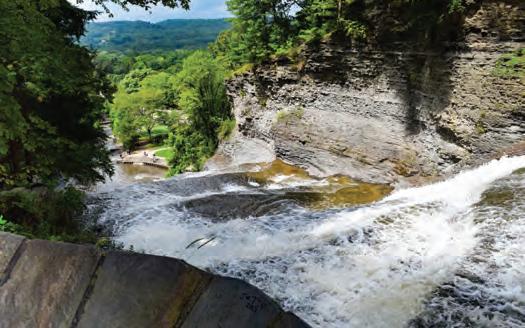
The falls are deceptive, however, concealing a secret visible only after a brief hike along Gorge Trail on the western side of the falls. Within a few minutes, you can reach the top of the falls and admire the powerful surge of water flowing back toward the park entrance. But the true marvel lies beyond that first waterfall – one cascade follows another, revealing around ten in total, with varying heights from 5 to 35 feet.
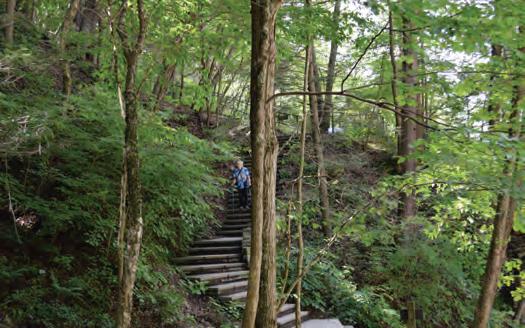
To reach the final one along Gorge Trail only requires a hike of 0.65 miles, but it’s steep with a total elevation gain of around 450 feet. I took it slowly,
pausing periodically to not only catch my breath but to enjoy each of the numerous cascades with all their variety of size and shape.
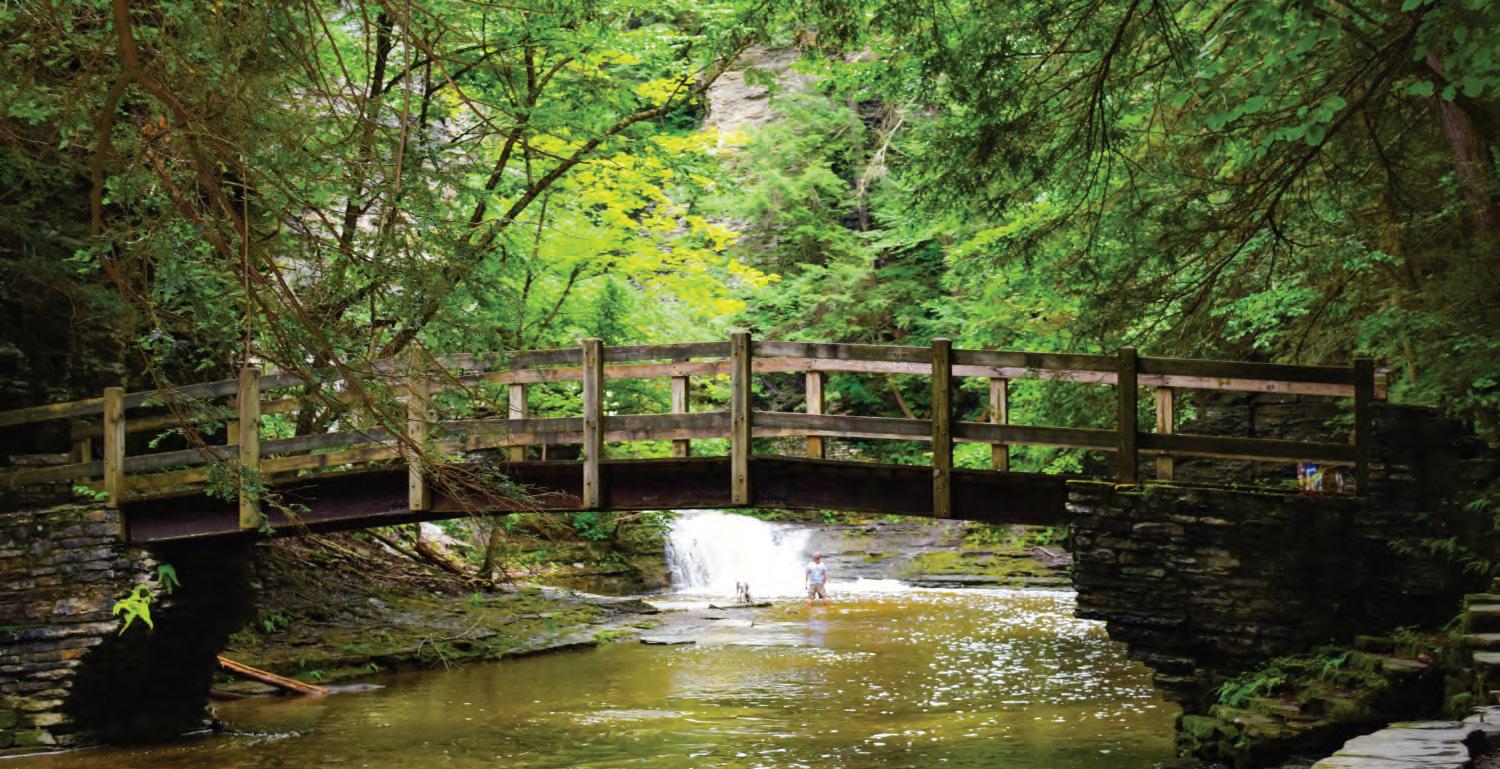
A perfect spot to pause is the quaint wooden pedestrian bridge about three-quarters of the way up. I counted over 400 stairs along the path to reach it, so take your time if needed. If you choose to continue, you’ll discover more waterfalls and pools, along with 40-foot Pinnacle Rock – a striking free-standing rock column sculpted by water erosion through the years.
From there, you have two options to return to the north car park. You can either take Rim Trail on the eastern side, which is slightly longer at 0.82 miles, or retrace your steps along Gorge Trail. Whichever route you choose, it’s advisable to use a hiking pole, as the path can be slippery from water spray in places.
Keep in mind that the water flow is seasonal and may be reduced to a trickle during summer droughts. Trails are also closed during winter months, so this
make a great hike when the spring rains hit. Therefore, it’s a good idea to check the conditions before making plans to visit to avoid disappointment.
One of the best features of Buttermilk Falls is the choice of hiking options. For instance, you may want to merely walk the several hundred yards to the top of the first falls, then return for a relaxing lunch at a picnic table and enjoy the view of the main cascade. You may even consider a summer dip in the pool formed at the base of the falls before it empties into Cayuga Lake.
Or, for the more adventurous, you can hike all or part of the way up Gorge Trail, continuing on to Rim Trail if you wish. The choice is yours, depending on your fitness level. Be prepared, though – each new waterfall might inspire you to keep exploring for more around the next corner. VM
Nick Thomas teaches at Auburn University at Montgomery in Alabama and has written features, columns, and interviews for many newspapers and magazines. His “It’s A Wonderful Hike” column describes short trails, hikes, and walks from around the
What happened to Mrs. Tony Curtis?
By Nick Thomas
It’s been 15 years since 85-year-old screen legend Tony Curtis died at his Nevada home on Sept. 29, 2010. The much-loved actor left behind a body of work that included over 150 television and movie roles in such classics as “The Defiant Ones,” “Some Like it Hot,” and “The Sweet Smell of Success.” Curtis remarried for the last time in 1998 and his new bride, Jill Vandenberg, was some 40 years his junior. The pair became inseparable, traveling the world together. But back in Nevada, the couple founded Shiloh, a horse rescue ranch.
“I was horrified to learn that tens of thousands of unwanted American horses are slaughtered each year for human consumption in Asia and Europe,” Jill told me in 2006 when I met her and Tony on their ranch. “I realized I could do more to help horses.”
“We were driving in the car one evening and Jilly told me she wanted to save some of those horses,” Tony recalled to me. “I told her let’s go do it!”
They did, and the couple soon acquired 40 acres of desert outside Las Vegas, eventually transforming the barren area into a nurturing ranch where hundreds of horses were saved. I still recall Curtis’s joy when I asked him to comment on the success of the Shiloh sanctuary: “It picks up my spirits to see the good work done there,” was his reply.
Today, Jill Curtis is now Jill Curtis-Weber after marrying Todd Weber three years after Tony died. The couple met at a country and western club in Vegas and were married six months later. After selling the Nevada ranch and her Las Vegas home, they moved to Deadwood, South Dakota, often romanticized as the heart of the American West with history steeped in gold rushes, outlaws, and frontier legends such as Wild Bill Hickok and Calamity Jane.
“We both loved the history of the Old West and began traveling around selling our horseshoe art,” said Jill, when I met up with her recently at her shop in the heart of downtown Deadwood. “When we came here we loved it and decided to stay.”
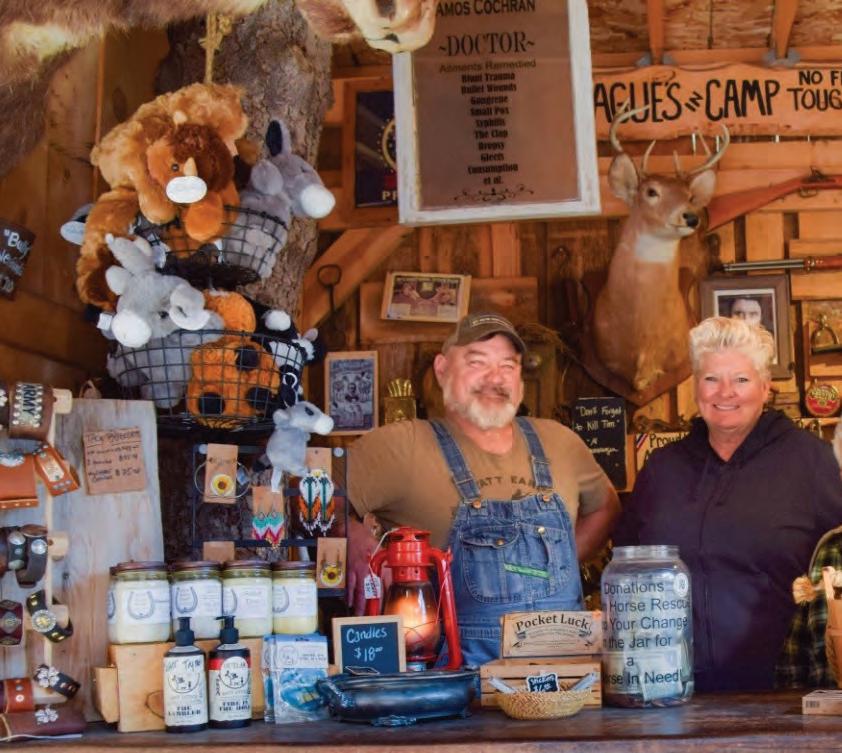
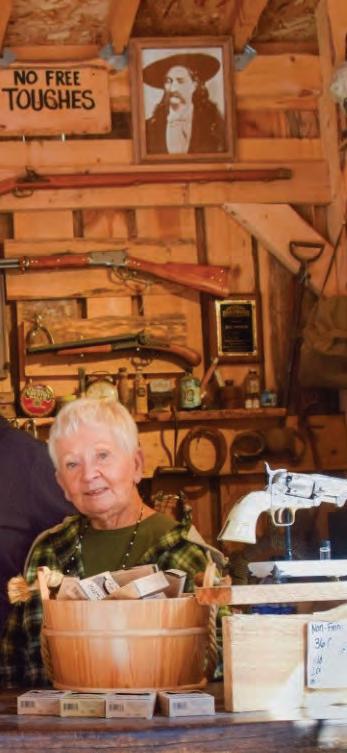
Along with her husband and mother, Sally, the trio run “The Lucky Horse Co.,” a thriving Western-themed business specializing in decorative horseshoes and other gifts (see www.shilohhorserescue.com). Their charming
Photo provided by Nick Thomas- Jill Curtis, center, with husband Todd and mother Sally in their Deadwood shop.
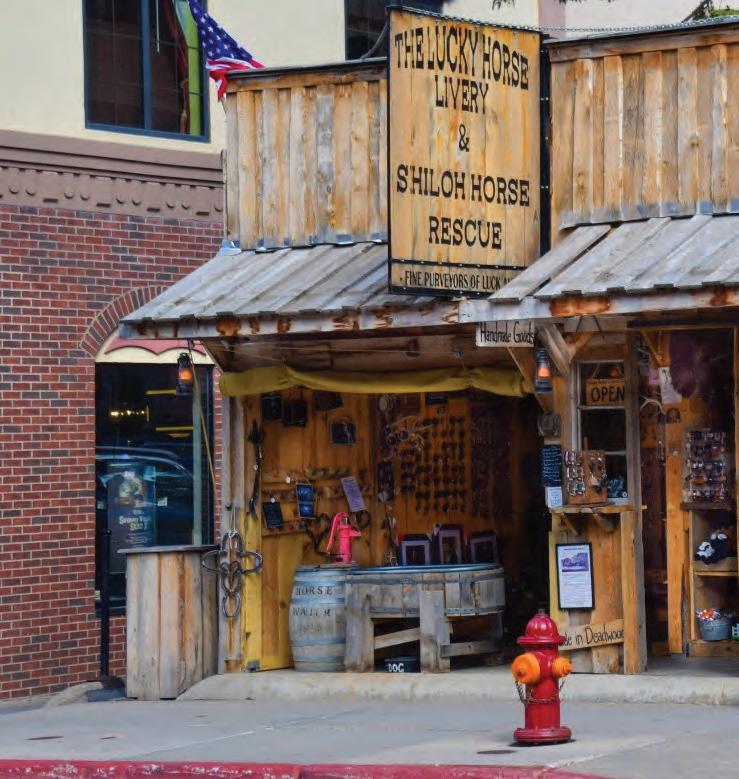
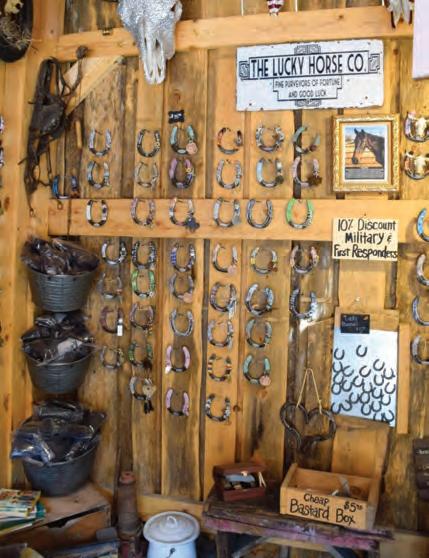
little shop, an open-air wooden structure built around a living tree, is located on the main street of Deadwood. It’s filled with hundreds of Western art pieces, showcased by unique horseshoe art – beautifully painted or decorated horseshoes for wall hangings and intricate pieces welded into artistic shapes.
“We make everything here in Deadwood by hand,” said Jill. “Todd does all the welding for the horseshoes and also teaches gold panning to tourists! He built the shop around the tree and based it on an old livery stable from the late 1800’s. The profits go towards supporting Shiloh.”
With her deep passion for horses, it was a natural progression for Jill to expand into Western art. She relocated Shiloh Ranch from Nevada to Newell, about 30 minutes from Deadwood, where the ranch has rescued and rehabilitated over 700 horses since its founding. She remains grateful to her previous husband for supporting her horse rescue efforts and recognizes some similarities between Tony and Todd.
“Todd has the same sense of humor and wit, and is very intelligent and kind,” she said. “I think Tony would have liked him. Todd is very supportive of my past life and has never felt he had to live up to Tony, who had a larger-than-life personality. We were ready to start a new life, a simpler life, in this beautiful historic Old West town. Tony and I watched and really enjoyed HBO’s ‘Deadwood’
series, so I believe he would absolutely love that I now live in the town.” VM
Nick Thomas teaches at Auburn University at Montgomery, Ala., and has written features, columns, and interviews for many newspapers and magazines. See www.getnickt.org.
Photo provided by Nick Thomas- The Lucky Horse Company, in Deadwood.
Photo provided by Nick Thomas- Horseshoe art in the Curtis Deadwood store.
Colchester, VT — The Vermont Association of Area Agencies on Aging (V4A) directors today announce the dissolution of V4A. Executive Director, Mary Hayden retired at the end of 2025. Much of the work of the V4A will be integrated into the new Vermont Aging Network Consortium (VANC), along with remaining staff. This integration will combine the policy, advocacy, and training goals of V4A with VANC’s mission to leverage economies of scale, combine resources, and reduce duplication within the communityprovider network of home- and community-based services. VANC will also focus on establishing contracts with payers and healthcare systems to further enhance financial sustainability for aging services throughout Vermont. The V4A alignment with VANC as a designated community care hub with grants from USAging and the Administration for Community Living, is a vital opportunity to bring the value of our work into the mainstream of coordinated services to help elders receive quality care
Vermont’s Area Agencies on Aging Announce Strategic Partnership of Two Statewide Organizations Dedicated to Improving and Enhancing Services for Vermont’s Aging Population
throughout the medical and social service systems.
“The Area Agencies on Aging (AAAs) continue to deal with shrinking or flat federal funding while the Vermont aging demographic increases—we have the third oldest population in the nation” said President of V4A’s Board of Directors, Jane Catton.
“This powerful partnership is needed to create greater administrative efficiencies within the AAAs and expand our reach. By combining the resources of V4A and VANC, we eliminate duplication, pool resources, and leverage our combined expertise to support more older and disabled Vermonters who need nutritious meals, coordinated community-based services to remain at home, caregiver supports, Medicare counseling, and more.” VM
For more information: Jane Catton, CEO, Age Well, jcatton@agewellvt. org. About the Vermont Aging Network Consortium (VANC)
THE VERMONT AGING NETWORK CONSORTIUM (VANC)
The Vermont Aging Network Consortium (VANC) provides shared services and operational support to Vermont’s five Area Agencies on Aging (AAAs), helping strengthen the health, wellbeing, and independence of older Vermonters. VANC’s mission is to build long-term financial and operational sustainability for the aging network while expanding its capacity to serve a growing number of clients.
By leveraging economies of scale, combining resources, and reducing duplication across the home- and community-based services network, VANC helps the AAAs operate more efficiently and effectively. This coordinated approach positions the aging network to pursue future contracts with payers and healthcare systems—an important step in ensuring the financial sustainability of aging services as the needs of older adults continue to evolve.
VANC operates as a separate nonprofit entity, while each of the five AAAs remains an active,
independent nonprofit serving its local communities. Through shared infrastructure and collaboration, VANC supports the AAAs in maintaining high-quality programs—including case management, nutrition services, caregiver support, and more—while promoting best practices statewide.
Together, VANC and the AAAs are working to strengthen Vermont’s aging network and ensure that older adults can access the services they need to live safely and independently in the communities they call home.
Southwestern Vermont Council on Aging www.svcoa.org
Joy Mortelliti, Development & Communications Coordinator PH: 802-772-7824 | Email: jmortelliti@svcoa.net
Fraud Watch Change your behavior regarding the phone
By Elliott Greenblott
How comfortable are you answering a phone when it rings or responding to text messages? What about opening email messages? More and more people are receiving fraudulent messages; 5 billion scam calls each month according to numerous public and private sources. According to a recent survey conducted by CNET, a major, reliable digital media publication, the numbers are staggering:
✔ 90 percent of US adults say they receive scam emails on a weekly basis; 37 percent receive more than 10 scam emails each week.
✔ 83 percent of US adults receive scam phone calls each week.
✔ 82 percent of US adults receive at least one scam text per week.
✔ 60 percent of US adults receive at least one social media scam message per week.
Here are some specific suggestions and action steps:
1. Don’t rely on caller ID. These numbers can be spoofs, fake numbers that block the real caller number. Professional criminals can even spoof the number by displaying a familiar number such as a school or medical center.
2. Don’t answer the phone; let the call go to voice mail. It’s difficult! Most of us are “hard-wired” to answer the phone. Blame your parents; they taught you to do that and to be polite. In addition, many react to the ring as a matter of urgency. “I must pick up the phone!” Don’t!
Feb.14-15,2026
Brattleboro,Vermont
Saturday -Pepsi Challenge -Junior World Qualifier
Sunday -FredHarris Memorial Tournament -Junior World Qualifier
5. Robocalls (computer generated phone calls) to cell phones are generally illegal for telemarketing or advertising unless you have given express written permission for the calls. Non-marketing robocalls (medical and health services, school alerts) can be made with either written or verbal permission. 104yearsandcounting!
3. If you pick up the call, listen for a click. It is likely a scam call; hang up! Be cautious if the caller is “live.” We are seeing reports of fraudulent calls with live callers. If you don’t “personally” know the caller, don’t provide any information unless you can verify identity. Explain to the caller that you will call back using a verifiable phone number.
4. Register for Do Not Call (888-382-1222). It actually works if you consider that it was meant to stop legitimate companies from conducting large scale, personal, unsolicited marketing campaigns. It was not created to stop criminals.
6. Robocalls to residential lines require express written consent, period.
7. Robocall restrictions do not apply to when the consumer has an “established business relationship” (business conducted within the last 18 months.
8. Don’t report the fraudulent call to government authorities unless you are an actual scam victim. If that is the case, contact your consumer protection office (Massachusetts – 617-727-8400; New Hampshire – 888-468-4454; Vermont – 800-6492424).
You know the scope of the problem and some of the safety net protecting against scams. There are other protections you can put in place. Call-blocking apps are available on cell phones. There are many blockers available; some are free but some charge fees. If you are unsure of what is best for you, conduct some research. Make a general web search (Google) “call blocker reviews.” A better approach is to go to a reliable web site such as CNET, PCMag, or Consumer Reports and search for call blocker reviews on the sites.
Taft Farm Senior Living
Scam text message scams are also on the increase. Recently, many people across the country received text message notification of failure to pay highway tolls. These are scam messages and should be ignored. Government offices will not text, call, or email with notices. They are sent via USPS. As a side note, I did a little detective work. The originating text message country was 63, the Philippines (the United States is 01). The text message claimed to be from the Vermont Agency of Transportation with a web address that spoofed the agency’s website asking for personal and credit card information.
The major takeaway concerning phone scams: You can protect yourself from the criminals. It’s not easy but doable: change your behavior and control your emotions regarding the phone, slow down, and apply logic. Comments? Questions? Contact me – egreenblott@aarp. org
Be well; Be Safe! VM
Elliott Greenblott is a retired educator and coordinator of the AARP Vermont Fraud Watch Network.
•
•
•
•
•
One & Two Bedroom Apartments
Easy and Affordable Winter Seed Starting
By Melinda Myers
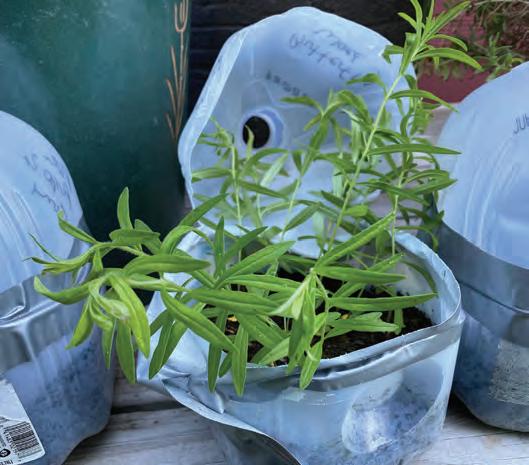
Turn off the grow lights, gather a few milk jugs and potting mix and start planting seeds. Winter sowing is a way to start transplants from seeds outdoors without a greenhouse or cold frame.
You’ll save money on equipment and time tending the seeds and seedlings. Just transform milk jugs, soda bottles and other items into mini grow chambers to start some of your favorite and hard to find transplants from seeds.
Gather flower and vegetable seeds, milk jugs or two-liter soda bottles, duct tape, a quality potting mix and weatherproof marker. Check the seed packet for information on planting details and timing. Winter sowing dates vary with the growing climate, individual gardener, and the seed variety you are planting.
Try starting hardy perennials, hardy and self-seeding annuals, and cold weather vegetables now through late winter. Other flowers and vegetables seeds are typically winter sown at about the same time you would plant them indoors or a month or two before the transplants get moved into the garden. Keep a record of your planting dates and results to help you fine tune your planting schedule and increase future success.
Wash containers and make four to 12 small holes in the bottom of the jug for drainage. A hot skewer, knife, screwdriver or drill work well for this step. Next, partially cut the jug to create a hinged lid. Make your cut about three to four inches above the bottom, leaving the area with the handle attached so it forms a hinge. Use the bottom of the milk jug handle as your guide.
Place a coffee filter or piece of paper towel over the drainage holes to contain the potting mix while still allowing water to drain. Fill the bottom with moist, quality potting mix. Plant seeds at the depth and spacing recommended on the seed packet. Mix smaller seeds with sand to help with proper spacing. Gently water until the excess runs out the bottom of the container.
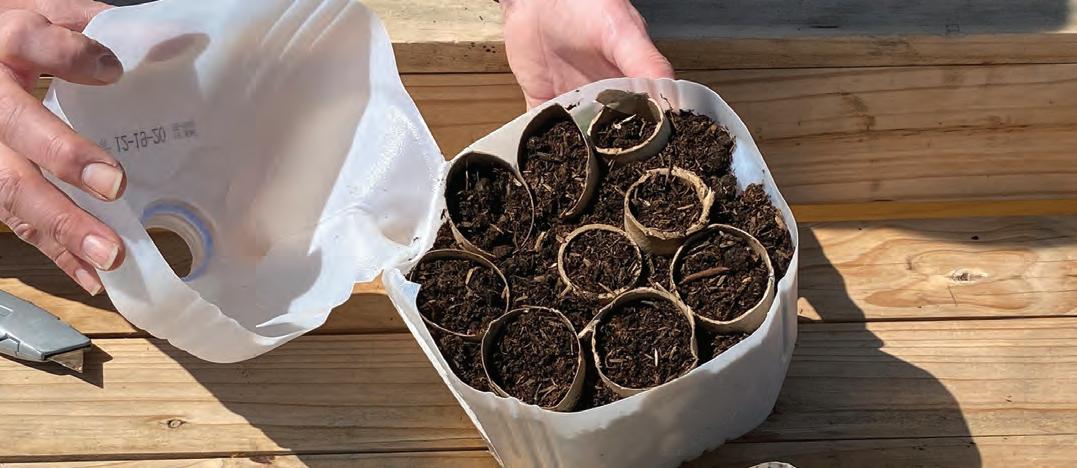
credit: photo courtesy of MelindaMyers.com Cutline: Winter sowing allows gardeners to start transplants from seeds outdoors using recycled items.
Make transplanting easier by using the cardboard tubes from toilet paper to help space winter sown seedlings. Cut the toilet paper cardboard tubes to the right height and set them in the milk jug. Fill the bottom of the milk jug with potting mix and plant the seeds. Otherwise, plan on doing some careful separating of the individual seedlings in each milk jug or soda bottle.
Taft Farm Senior Living
• One & Two Bedroom options w/heat & electricity included
• Independent Living for adults age 55+
• Convenient access to shops, dining, & professional services
• Beauty/barber shop, & community kitchen/dining space
• Elevator access & emergency pull-cord call system
• No smoking & No pets
• 24/7 emergency maintenance response
• Secured entry & on-site property manager
• Garden space & nearby trails with sidewalk access
• Social activities & community events calendar Contact us today for availability and sign up for new listing alerts leasing@fullcirclevt.com (802) 879-3333 fullcirclevt.com fullcirclevt.com/listing-alerts
Label the inside and outside of the jug with a permanent marker. Close the lid and seal it shut with duct tape. Remove the cap before setting your milk jugs in a sunny location outdoors where rain and snow can reach it. Set jugs in a milk crate in windy locations and protect them from curious pets and wildlife if needed.
Water your outdoor seed starting chambers during snow-free and dry weather. This will be much less often than those seedlings growing indoors under artificial lights.
Your plants will be ready to move into the garden at their normal planting time. Just open the lid, harden off the seedlings and move them into the garden. VM
Melinda Myers has written more than 20 gardening books, including the Midwest Gardener’s Handbook, 2nd Edition and Small Space Gardening. She hosts The Great Courses “How to Grow Anything” streaming courses and the nationally syndicated Melinda’s Garden Moment radio program. Myers is a columnist and contributing editor for Birds & Blooms magazine and her website is www.MelindaMyers.com.