Maple syrup makers get to know their sugar bushes intimately ‘Get up!’
Grit, granite and a mossy route lead writer to top of Chapel Pond Slab
Mud season survival stories
False spring and a quest for cheese can get messy and pricey
These trees have personality: Maple syrup makers get to know their sugar bushes intimately By Gena Mangiaratti
Contributors
We’re Vermont Country now By Noah Hoffenberg
Mud season survival stories By Bill LeConey and Noah Hoffenberg
10 films to guide you during the season of rebirth By Dan Tebo 3 4 5 17 28 38
Person of interest: Olympian Ross Powers By Shane Covey Vermont Country Homes A golden moment: Stratton Mountain School alumni shine at 2022 Olympic Games By Michael Mawson
10 things to cure a mean case of Southern Vermont cabin fever By Chris Mays
‘Get up!’: Grit, granite and a mossy route lead writer to top of Chapel Pond Slab, Keene, N.Y. By Cheryth Youngmann
Shane Covey — wanted to be the next Larry Bird or Hulk Hogan while growing up in Brattleboro and now writes about people with similar dreams as the Reformer’s sports editor.
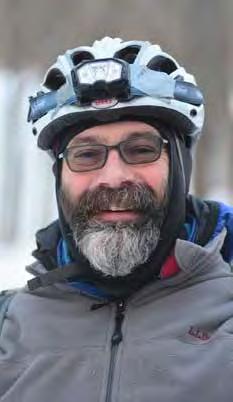
Noah Hoffenberg — established himself as a writer in the second grade and has been working on it since. He leads the news and editorial operations for Vermont News & Media. Hoffenberg follows the three Fs: fishing and fat biking, and more fishing.
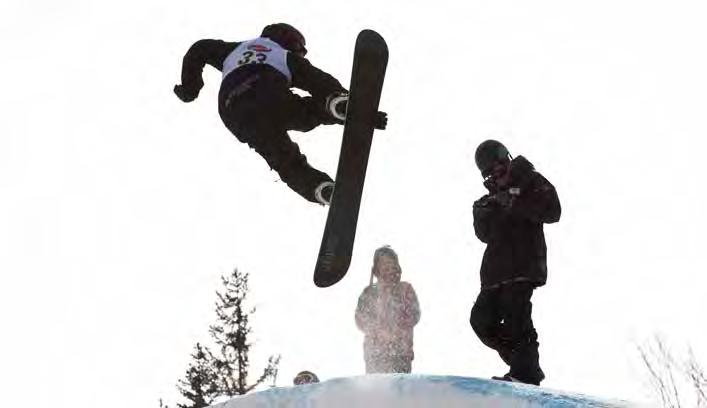
Chris Mays is a local vegan who tries to snowboard as many days as possible each season. He has been a reporter for the Reformer for nearly a decade. He plays guitar in the JGC Trio. He lives in South Newfane with his partner Erin and Yorkie named Lemon.
Bill LeConey is night news editor of the Brattleboro Reformer, Bennington Banner and Manchester Journal. A longtime sports reporter and editor in Atlantic City, N.J., he enjoys good music, good food and good drink. He was also once the frontman for a marginally successful psychedelic punk grunge band.
Dan Tebo — was born and raised in Central Massachusetts and received a degree in creative screenwriting from Emerson College. In addition to not creatively screenwriting, Tebo’s work has appeared on popmatters.com and his very own VHS of the Week blog at vhsoftheweek.com, which boasts a dedicated readership in the low double digits.
Gena Mangiaratti whose first name is pronounced “Jenna” — is arts and entertainment editor for Vermont News & Media. When not newspapering, she can be found running, drawing and writing fiction. She lives in Brattleboro with her cat, Theodora.
President and Publisher
Jordan Brechenser jbrechenser@reformer.com
Executive Editor
Noah Hoffenberg nhoffenberg@reformer.com
Assistant Editor
Gena Mangiaratti gmangiaratti@reformer.com
Designer
Cicely M. Eastman cicelyeastman@yahoo.com
Windham County
Sales Manager
Lylah Wright lwright@reformer.com
Senior Sales Executive
Richard Lolatte rlolatte@reformer.com
Sales Executive
Richard Battista rbattista@reformer.com
Bennington County
Sales Manager
Susan Plaisance splaisance @benningtonbanner.com
Vermont Country magazine is a publication of
Michael Mawson — serves as Vermont News & Media sports editor. He obtained a bachelor’s degree in journalism from the University of New Hampshire in 2019.
Cheryth Youngmann — ascended her first outdoor climb on Oct. 5, 2019. She survived the 5.5 climb, despite the dramatics.
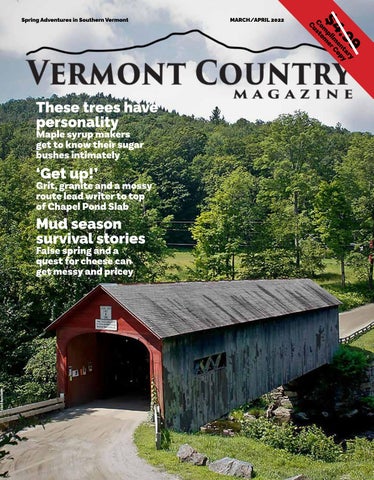
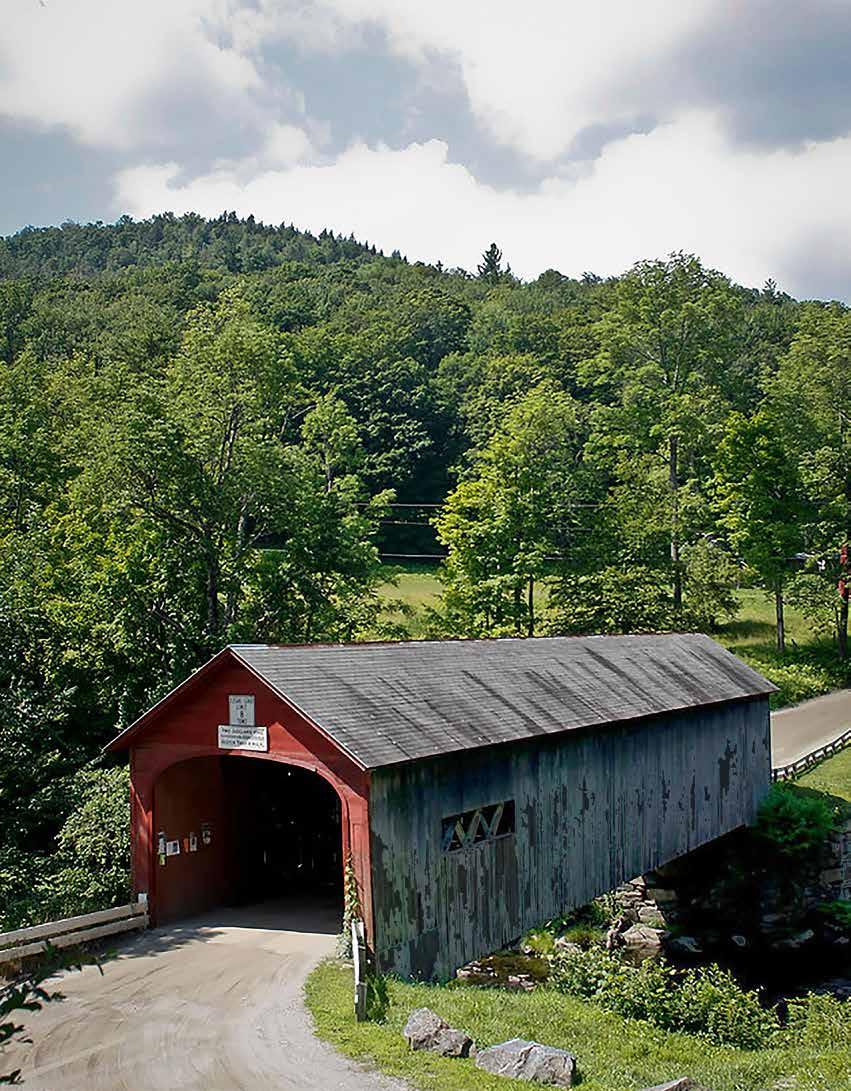
On the cover:
Vermont Country file photo
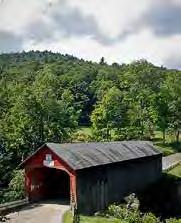
The Green River Bridge in Guilford.
We’re Vermont Country now
Welcome to the new Vermont Country magazine.
If you see some familiar names and faces behind its production, that’s because we’re freshening and localizing the former UpCountry Magazine to give it a more distinct Vermont feel.
Early last year, we were bought from our former sister media outfit in the Berkshires, which gave the newly formed Vermont News & Media a chance to reposition the magazine as something Vermont could call its own.
First off, we’ve changed the name to Vermont Country magazine. This capitalizes and focuses more on Vermont, and better describes its geography of coverage, while still paying homage to our award-winning roots with UpCountry magazine.
You’ve probably noticed that we now come with a cover price tag of $4.99. Vermont Country is moving to a full subscription model, with the magazine included with a subscription to the Bennington Banner, Brattleboro Reformer, or Manchester Journal. An annual mailed subscription is $25 for six issues. To subscribe, email us at info@ vermontmagazine.com
Displays of Vermont Country magazine will be available at preferred partner locations, where residents and visitors can pick up a
complimentary copy, provided by the location as a courtesy to its customers. These preferred sites include restaurants, hotels, B&Bs, ski lodge, golf courses and more. Look for a full list in upcoming issues of Vermont Country magazine, or online at vermontcountry.com under “locations.”
With Vermont Country, we’re putting a more hyperlocal focus on Southern Vermont, the Green Mountain lifestyle, events, attractions and culture.
With Vermont Country, we’re putting a more hyperlocal focus on Southern Vermont, the Green Mountain lifestyle, events, attractions and culture. We’re keeping our personality profiles — Person of Interest — that feature some of our best-known Southern Vermont residents, as well as our movie reviews from the irascible Dan Tebo.
For this edition, we’re giving you a real taste of Vermont from the throes of maple syrup production to epic fails on backroads during mud season. We’ll take you rock climbing, give you a cure for cabin fever, get up close and personal with snowboarding legend Ross Powers and much more.
We hope you enjoy this kick-off of the new Vermont Country magazine, in which we’ll aim to take you deeply into the Vermont way of life and the lives of those who keep the region ticking.
Send your thoughts, tips and letters to the editor to info@ vermontcountrymagazine.com.
Noah Hoffenberg, Vermont Country magazine executive editor
Berkshire Eagle
Noah Hoffenberg, Vermont Country magazine executive editor.
Cruisin’ from the backyard to Salt Lake City Olympics
A Q&A with gold medalist Ross Powers
By Shane Covey Vermont Country
Londonderry’s Ross Powers talked himself all the way to an Olympic gold medal.
The snowboarding pioneer and springboard for professional hopefuls is known for talking to himself during his competitions — with “you better land this run” repeated over and over.
It seems like the self instruction works: Competing in Nagano, Japan, in 1998, the first year that snowboarding was included as an Olympic sport, Powers took bronze. Four
years later, it was gold in Salt Lake City.
Powers, a Stratton Mountain School graduate, also teaches there as director of its snowboarding program since 2010. Recognized for his achievements in the sport, the longtime Southern Vermonter was named an inductee of the U.S. Ski and Snowboard Hall of Fame in 2014 and the 2019 class of the Vermont Sports Hall of Fame.
Having grown up with limited means, Powers started the Ross Powers Foundation to provide financial support to promising world-class
Stratton Mountain School
Ross Powers, a Stratton Mountain School graduate, took gold for the U.S. 20 years ago.
Vermont Country file photo
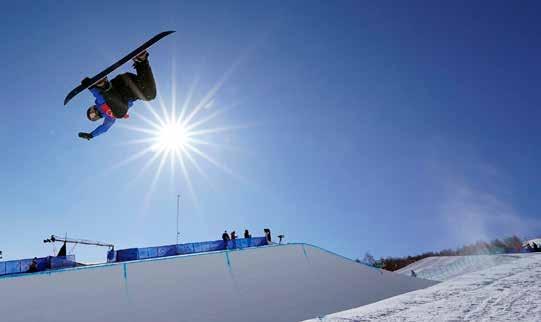
World champion snowboarder Ross Powers competes in the halfpipe at the Vermont Open at Stratton Mountain in 2013.
athletes; he recently melded his efforts with the Level Field Fund Foundation to do more of the same, but teamed up with athletes across multiple sports.
Now, 20 years after he won halfpipe gold, Powers spoke with Vermont Country about the recent Olympic action in China, the sport he loves, and that memorable final attempt in Utah.
Q: Did you check out some of the Winter Olympics this year?
A: Yes, mostly the snowboard and ski events. It was fun watching friends, SMS alumni and Level Field Fund athletes.
Q: What is your take on Russian figure skater Kamila Valieva testing positive and still being able to compete in Beijing?
A: I didn’t follow this story too much. It seems unfair to other athletes that tested positive in the past and were not able to compete.
Q: When were you introduced to snowboarding?
A: I was 7, on a friend’s Burton Performer, in his backyard. Then the next season, my mom got me a Burton Elite 130 for Christmas. She worked at Bromley, so I would go to work with her every chance I got to ride.
Q: What could you tell me about your first snowboarding competition ever?
A: It was a Green Mountain Series, which is now the USASA Southern Vermont Series. I remember it being a slalom race, and I was in fourth grade.
Q: What are a couple of your best memories from Olympic experiences?
A: Winning the bronze medal [in Nagano]. It was the first Olympics that had snowboarding. It was great to see my mom at both Olympics. She didn’t make it to many of my competitions as she was working, but she got to make it to two of my biggest.
Q: You won gold in Salt Lake
“I had a routine before it was my turn to go — pretty much moving my board in different directions. I also liked to go over my run in my head, take three deep breaths and then drop in before I thought about it too much.”
Ross Powers
City with an amazing run that included an 18-foot method grab, a couple of McTwists, a cab 720 indy grab, a frontside 720 indy grab, and a switch frontside air. How many times had you practiced that routine?
A: I’m not sure. I performed the different tricks many times. I remember that halfpipe was longer than many that we competed in, so we were able to add some extra tricks to our runs. I remember talking to
myself during my Olympic and U.S. Open runs, telling myself “you have to land this run.”
Q: Are you superstitious?
A: A little bit. I had a routine before it was my turn to go — pretty much moving my board in different directions. I also liked to go over my run in my head, take three deep breaths and then drop in before I thought about it too much.
Q: Why do you believe you have had so much snowboarding success?
A: I love snowboarding. I put in the time and pushed myself.
Q: You are a two-time Olympic medal winner and the current director of snowboarding at Stratton Mountain School. Does your snowboarding passion get carried on by your kids?
A: Victoria, 18, is a freshman at UVM. She’s in their business school and on their snowboard club team. Meredith, 14, is a freshman at Stratton Mountain School and is on our snowboard team.
Photo provided by Bruce Bosley Ross Powers, bottom left, was inducted into the Vermont Sports Hall of Fame in 2019.
These trees have personality
Maple syrup makers get to know their sugar bushes intimately
By Gena Mangiaratti Vermont Country
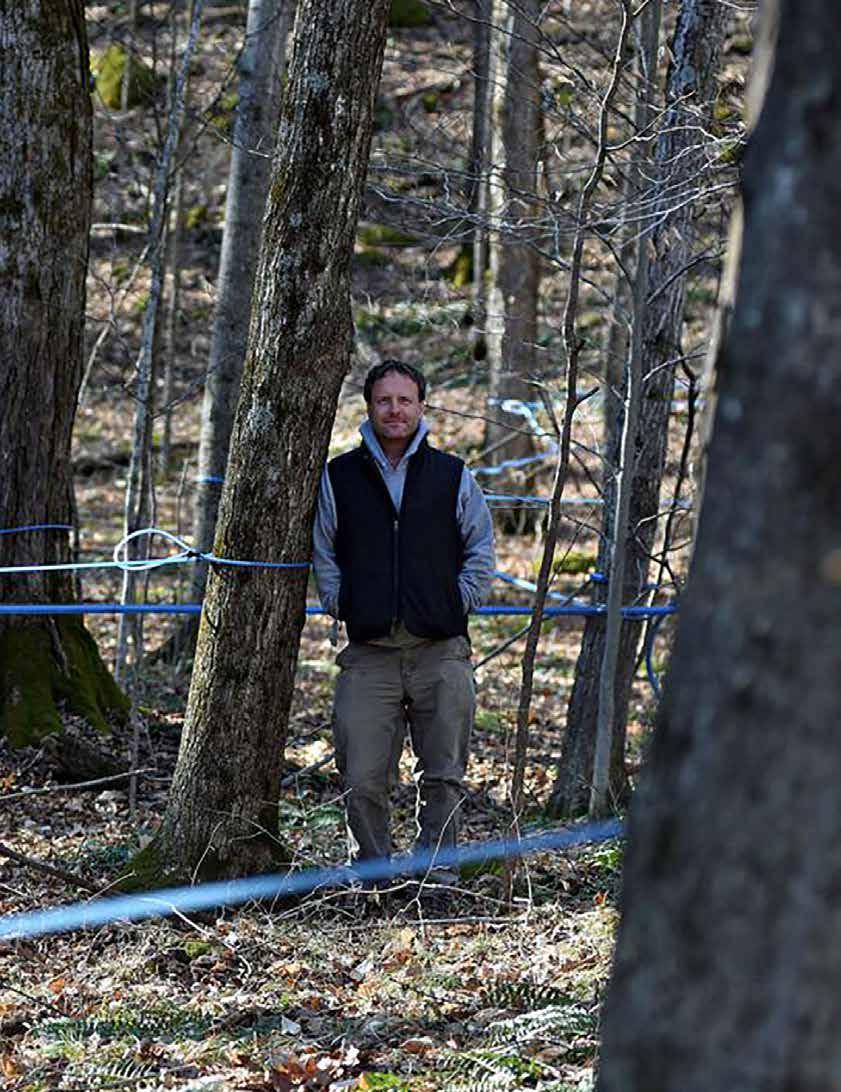
It’s unlikely that Dave Mance III will ever find himself lost in the woods. To a novice hiker, the trees might all start looking the same, but Mance knows them all for their individual characteristics — and personalities.
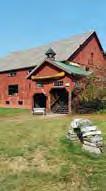
Navigating icy terrain on a recent day, Mance, of Mance Maple in Shaftsbury, pointed out which trees of his sugar bush were the most prolific sap producers, which were “officially retired” (though could live another 40 years) and which produced sap that was less sweet. While some trees are rugged, others are fickle, like Goldie Locks, needing conditions to be not too hot, not too cold, but just right to produce enough sap.
If someone were to photograph any single tree, Mance said he might be able to identify which of the 3,000 it was.
“You get to know them all very
“I grew up doing it, and it just became something I did.”
Dave Mance III
well. I know them all intimately,” said Mance, 46.
Mance got into maple sugaring through family tradition. His father, Dave Mance Jr., 72, has been sugaring since 1964.
“I grew up doing it, and it just became something I did,” the younger Mance said.
Simple rhythm of the woods
Not to get overly philosophical, he cautions, but he finds the tasks of sugaring to offer simple rhythms in an insane world, recalling listening to the news of Russia and Ukraine
on his truck radio. Mance is also one of the creators of the publication Vermont Almanac.
“Like so many things in life, it’s kind of that simple. It’s just what we do,” he said.
Mance Maple has about 3,500 taps in its sugar bush. Depending on factors, such as the personalities of the trees and the efficiency of the equipment, sugar makers see a gallon of syrup for every 43 to 55 gallons of sap. Mance said he typically aims to produce 1,000 to 1,200 gallons of syrup in a season, which starts with tap preparations as early as January and rarely runs past the second week of April.
Freeze and thaw kicks it off
Freezing temperatures by night and thawing temperatures by day build up pressure within the trees, causing sap to flow, according to the Vermont Maple Sugar Makers’ Association.
Sugar makers drill about 2 inches
Provided by Dave Mance III
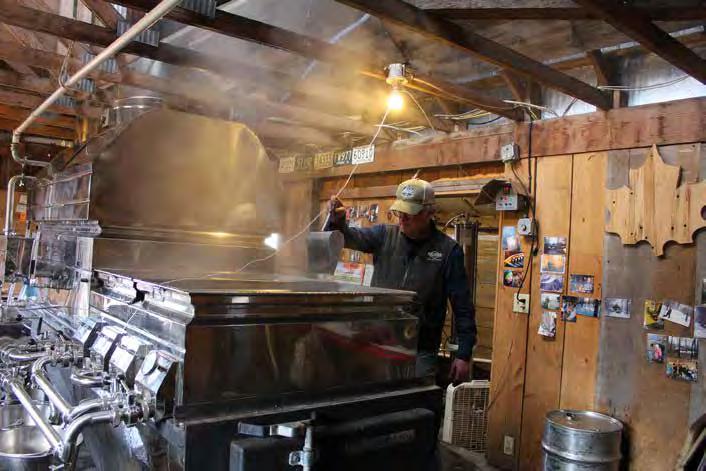
Dave Mance Jr., the father of Dave Mance III, works in the sugarhouse for Mance Maple. Mance Jr., 72,
Vermont Country
Left: David Mance III knows his sugar bush well, so much so that he recognizes his trees’ “personalities.”
has been sugaring since 1964.
into a tree, with between one to three taps per tree. Most large sugaring operations use tubes that carry the sap to a pump house, then to the sugarhouse, where the sap is boiled and filtered.
While Mance enjoys the product, his favorite part of the process is when he’s in the woods. He has done extensive research and writing about Col. Henry Fairfax Ayres, an officer of both World Wars who sugared these woods before the Mance family. Going back even further, Mance can identify — even with snow on the ground — where the oxen path used to be in the 1800s.
“You have a lot of time in your head when you’re out here, so you’re always seeing old ghosts and imagining the way things used to be,” he said.
‘Seeing the sap flowing’
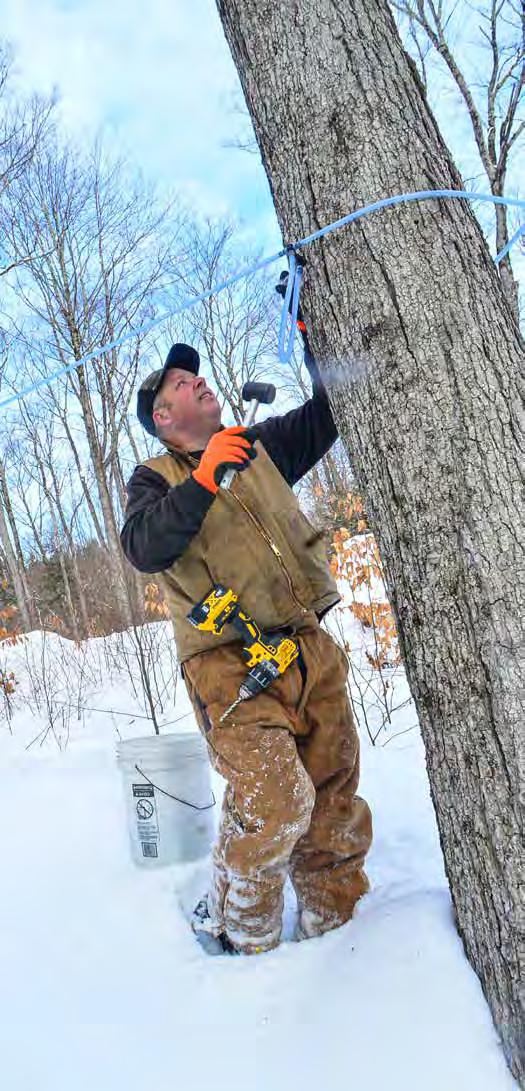
Over the Green Mountains in Brattleboro, Charlie Robb Jr., of Robb Family Farm, also names the time spent in the woods as his favorite part of sugaring.
“I don’t know what it is about it. I just like being [and] working out there, which is quiet, nice,” said Robb, 56. “It’s also fun seeing the sap come in from everything you’ve put into it. It’s nice seeing the sap flowing into the tanks, things happening.”
Established in 1907, the Robb farm is now run by Charles Sr. and Helen Robb, and Charles Jr. and his wife, Karen, with help from Taylor Thurber. The family farm has over 5,000 taps, and on a recent day, saw the creation of 85 gallons of syrup.
“So far, it’s all right,” Robb said of how this season is shaping up. “We usually will get a stretch of nice weather we can make some syrup in, then a lot of times it’ll freeze up, and then the real season will get going. Every year is different.”
Can’t control Mother Nature
The biggest challenge of sugaring, Robb said, is what can’t be controlled: the weather.
Mance said the overall productivi-
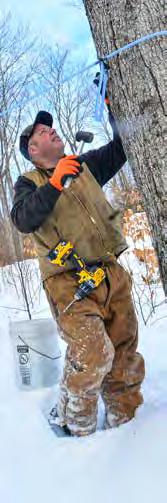
Kristopher Radder — Vermont Country Charlie Robb Jr. from Robb Family Farm, in Brattleboro, taps maple trees in preparation for the start of sugaring season.
ty of this season will depend on what comes in March.
“If we get seasonable temperatures with highs in the 40s and low 50s, and frost at night, and we get three weeks of that, then we’ll have a good season,” he said.
Some like it dark, some light
Sugar makers make syrup in light and dark varieties, and note that consumers’ tastes vary. Robb said he prefers the amber syrup, while his wife likes the darker kind, with a more robust taste.
Mance said, while Vermont lore favors the darker syrup, he prefers the light syrup, which is made early in the season.
“If we get seasonable temperatures with highs in the 40s and low 50s, and frost at night, and we get three weeks of that, then we’ll have a good season.”
Dave Mance III
“As we tell consumers, it’s all good, and it’s all based on your taste,” Mance said. “Some people like lighter. Some people like dark. Some people like in the middle, but it’s all good.”
More information on Mance Maple and opportunities to purchase its maple products can be found online at mancemaple.com.
Robb Family Farm is at 822 Ames Hill Road in Brattleboro, where it sells its product at its shop. It also sells at Vermont Country Deli on Western Avenue in the same town. More information and opportunities to purchase online are at robbfamilyfarm.com.
Kristopher Radder — Vermont Country
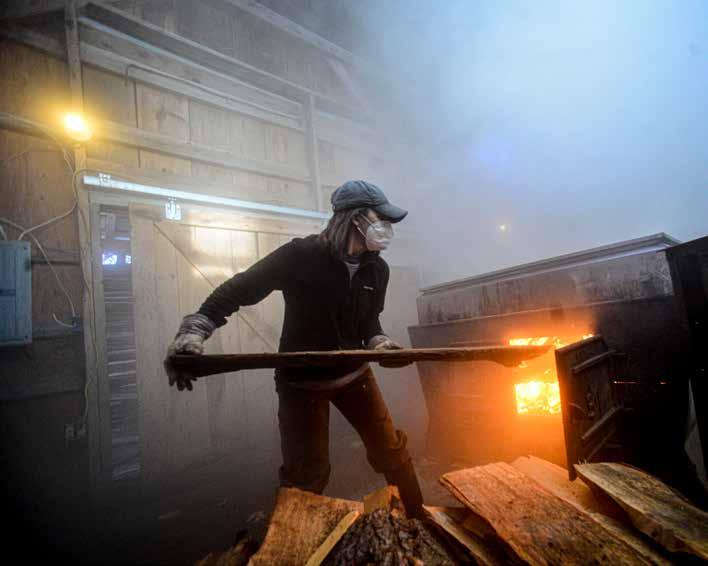
Susan Peters, co-owner of Deer Ridge Farm, puts logs into the fire to keep the boiler hot while sugaring.
Mud season
Beware the ides of false spring … it can get messy and pricey
By Noah Hoffenberg Vermont Country
More pasture than people. That’s Plainfield, Mass., a hilltown between home and work that I have driven through for years.
On Feb. 23, 2018, at 1:08 a.m., I came up with the damn-fool idea to take a shortcut home and took a quick left onto Union Street, heading north from downtown.
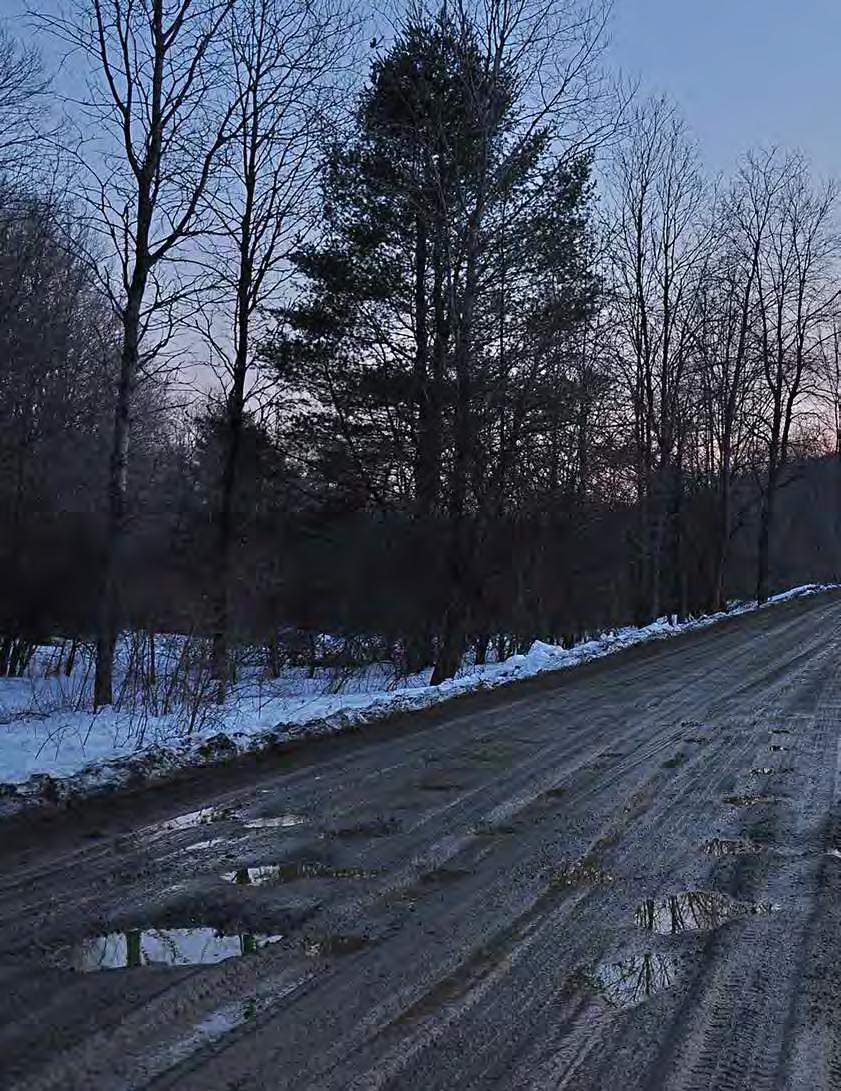
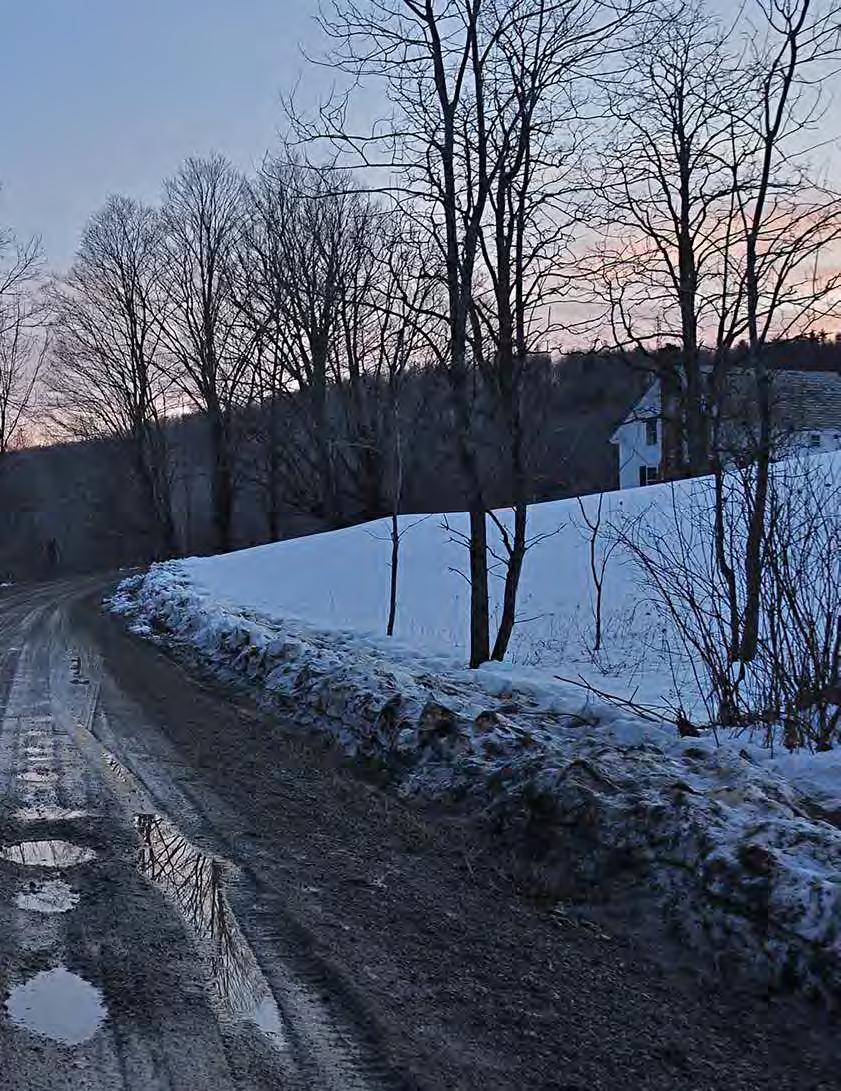
Union is a short dirt road that leads to the backcountry. To clarify, Union is dirt for most of the year. It can be as solid as concrete, in fact. When I was traveling it during mud season, however, it was as mushy as chocolate soft-serve.
Mud season, for the uninitiated, is that brief but expensive time that falls between winter and false spring. A key indicator of mud season: Watch for the rising steam from sap sheds, as this marks when the days are warm and nights are cold, and the maple trees and earth become juicy with life once again. And, a secondary indicator: mufflers, bumpers and hub caps (even whole cars), all ripped clean off and left for dead in the mud.
On dirt roadways, mud season wreaks havoc, forming deep ruts and slippery, soupy puddles and turning the road materials — gravel, mud, dirt, water, snow, ice — into an aggregate that would make a stonemason gush.
I drove into just such a mix on Union, and my late, poor 2012 Kia
Continued on page 14 Flickr.com
Mud season is underway in Vermont.
survival stories Stuck in the muck on a quest for cheese
By Bill LeConey Vermont Country
When I first moved to Vermont in the summer of 2018 — after living in New Jersey for the first five and a half decades of my life — I was struck by three things Vermonters sometimes complain about (if you could call it complaining, more like mild annoyance).
First of all, bugs. I come from a land of greenheads, ticks and sand gnats, a steaming cornucopia of every kind of winged, biting, blood-sucking little marsh monsters you can imagine, so complaints about the occasional black fly or mosquito don’t get my empathy pumping.
Secondly, traffic, especifically the confusing, often constipated flow of Brattleboro’s “malfunction junction” or the absolute horror of the Putney Road roundabout. Compared to what I used to contend with every day on the Garden State Parkway — casino buses and stretch limousines zipping from lane to lane at 90 mph — that’s a slow Sunday drive on Easy Street.
But, mud season — now there’s a Vermont specialty worth complaining about. I never experienced it firsthand until last year, in the middle of a life-sapping pandemic, no less.
We were experiencing a mid-March warmup, when I decided, on a day off, to venture out to one of my favorite cheesemakers, Vermont Shepherd in Westminster West. With its ramshackle farm store off a dirt road nestled in a field of grazing sheep that lend their milk to the delicious final product, Vermont Shepherd is rural Vermont at its most quintessential.
But to get there, you have to travel down a narrow, aptly named Patch Farm Road that, on this unseasonably mild afternoon, had become, in one spot, a thick mud patch.
Continued on page 15
Mud season
BEWARE Continued from page 12
Soul came to a grinding halt. “Grinding” is not metaphorical; it was the sound of gravel scraping the undercarriage. I know, because I got out and looked. My Soul had sunk up to the floorboards.
I had a muck shovel in the trunk from a recent trip to the town sand pile. Like a harpooner at the prow of a fishing boat, I tried to plunge the shovel into the roadway mud under my car. Alas, it wouldn’t penetrate the thick, moist, cold mess. Being a muck shovel, with a square head, it was next-to-useless.
Perfect segue: At about this time, I was beginning to feel pretty useless myself. I had known mud season
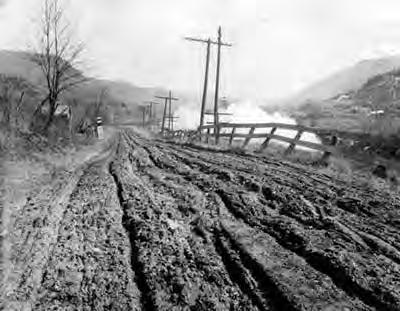
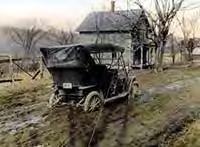
Above: Mud season, from Bolton to Richmond, on March 20, 1925.
Below: Mud season in Vermont during the early 20th century.
was a thing; I’d already dealt with the mud-bogging action on my own street, where dirt/mud extends for a mile in three different directions, all barely passable. Any idea how embarrassing it is to get your car stuck in mud during mud season, in the middle of the night, having to explain to the locals how you took a road you know you shouldn’t have? I can hear the underbreath mutterings of “flatlander” even now.
Another problem: This is Plainfield, population 664. People move to Plainfield to get away from it all: no traffic, no neighbors, no cell service. I feared that I had an 11-mile walk home from there.
Luckily, chance smiled upon me
that dark night, and somehow, 911 worked. I dialed dispatch, and they called me a wrecker. I didn’t know it at the time, but they also sent a trooper to check on me and, fishing for something to do, my perfectly fine blood-alcohol level.
While awaiting help, still slamming my shovel into earth, I saw headlights. A local guy came down Union Street from the other direction, him in an older model truck with a cap. His name was Chad. He said he was known for his pool game.
In a neighborly way that’s both commonplace and legendary in these parts, Chad hooked my car to his
Continued on page 16
Paul Guillotte photo — Bennington
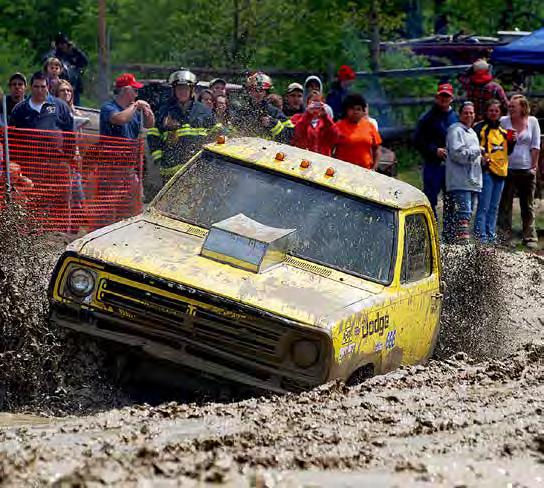
Some even celebrate the mud, such as at the Mudder’s Day Event in North Bennington in May 2009.
Vermont Historical Society
Banner
survival stories
Right: The author would drive through torrential rain, snowdrifts and a metric ton of mud to get to his cheese from the Vermont Shepherd farm store.
I thought about that (but clearly not enough) as the studded tires of my Hyundai Sonata successfully bullied through the mud to the farm store, thanks to some downhill momentum. A thought crossed my mind that the return trip might not be so successful, since it would entail an uphill climb.
Nonetheless, I made it to the store, purchased my cheese and yogurt through the honor system (another thing that probably wouldn’t fly in New Jersey), thanked the nearby sheep for their contributions and made friends with a curious little dog that happened to stop by.
On the drive back up Patch Farm Road, I approached the muddy section with trepidation. Sure enough, I didn’t have enough momentum built up to plow through the mud. Midway through, I tried to gun it, but that just made it worse: My heart sank and so did my car, deep into the mud, about halfway up the tires.
I was totally alone, no other human in sight. There was no way I was getting out of this without help, and I wasn’t about to knock on doors in the middle of a pandemic.
So, for the second time in less than a year, I had to call AAA for assistance (the first time had nothing to do with mud, only the stupidity of a driver trying to do a three-point turn on a narrow dirt road and tumbling sideways into a ditch — but that’s a story for another time).
Remarkably, in cellular-challenged rural Vermont, I was able to call for road assistance and reached a very talkative dispatcher who was working the phones from somewhere in Missouri, I think (“How’s the weather there?” she asked. “Muddy,” I answered). Luckily, I had a good book, a good IPA and that good, friendly dog to keep me company while I waited for the tow truck to arrive.
After about a half hour, the
owner of Vermont Shepherd, David Major, stopped by, alerted to my predicament by one of his workers, and pleasantly asked if I needed to be dragged out of the mud. By that time, the tow truck was on its way, so I thanked him for the offer and kept waiting.
When she arrived, the tow driver took one look at my situation and said, “You’re not from around here, are you?” She successfully pulled me out. There was no damage to the undercarriage or the tires, only to my ego.
“Now, I feel like a real Vermonter,” I told a co-worker a day later.
“No,” she said. “A real Vermonter would never be so stupid to drive on a road like that in the middle of mud season.”
Live and learn, I guess. But it was all worth it for one reason alone: The cheese was sooooooooo good.
William LeConey photos — Vermont Country
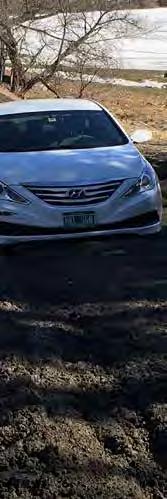
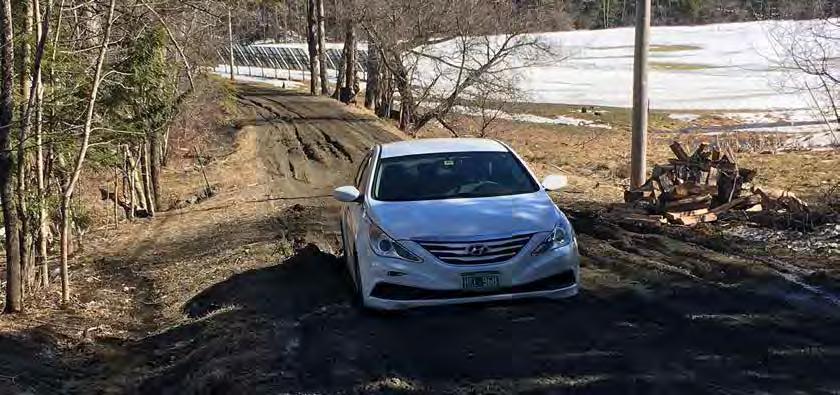
Above: The author’s Hyundai Sonata, stuck in the mud on a quest for cheese.
truck with a chain and began to pull. His engine revved as he applied more and more gas; that was, until a link on his chain gave way and broke. I thanked him for trying, both of us a little dejected, and he motored off just as the flatbed wrecker arrived.
Side note: A week or two later, I bought Chad an adjustable replacement chain link with a load capacity of well over 1,000 pounds. I put it in my work bag, in case I
ran into him, so I could give it to him as thanks. Never did run into him, but I did carry that heavy carabiner for about three years before giving up. It was kind of heavy.
The tow truck driver was from neighboring Cummington, and as far as I could tell, he was sent directly by central casting: a humorless farmer-type with a long scraggly beard. It was the wee hours, and my situation likely woke him, so I took the admonshing-country-judge look on his face in stride.
As he was doing his tow truck driver thing with a winch, the state trooper arrived.
A large and fit fellow, the trooper said he drove up from Holyoke, near his barracks. Traveling at nonpolice speeds, it normally takes about 53 minutes to get there to here; he made it in about a half-hour. I complimented him on his promptness and his lead foot, while he quietly eyeballed me for signs of impairment and noting only the brand of dullness that comes with being mud-stuck. That loosened him up and probably saved me from an unnecessary cuffing.
By this time, Grumpy the tow driver had pulled my Soul out from the muck onto solid ground, only a few feet away from where I’d stopped dead. He took my debit card, plugged it into his phone and rang me up for about $140. He left. The trooper left. And I left, too, still stinging from the embarrassment and the waste of money.
Thankfully, getting stuck in the mud is a one-time burn. I learned my lesson.
To that end, I purchased an all-wheel drive Subaru, with six cylinders instead of the Kia’s alleged four. More power. And I now use snow tires, which are better for mud.
These days, coping with Berkshire and Green Mountain roads is a soft-serve cake walk for me.
And, Chad, if you’re out there and reading this, thank you again for the near-rescue. I still have that badass chain link if you want it.
BEWARE Continued from page 14
Photo by Jim Collins — Vermont Historical Society
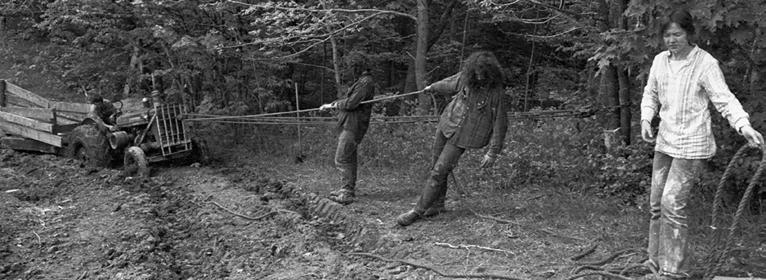
Commune members pull a tractor from the mud at French Hill Commune, St. Albans.
Photo courtesy of Brattleboro Area Realty
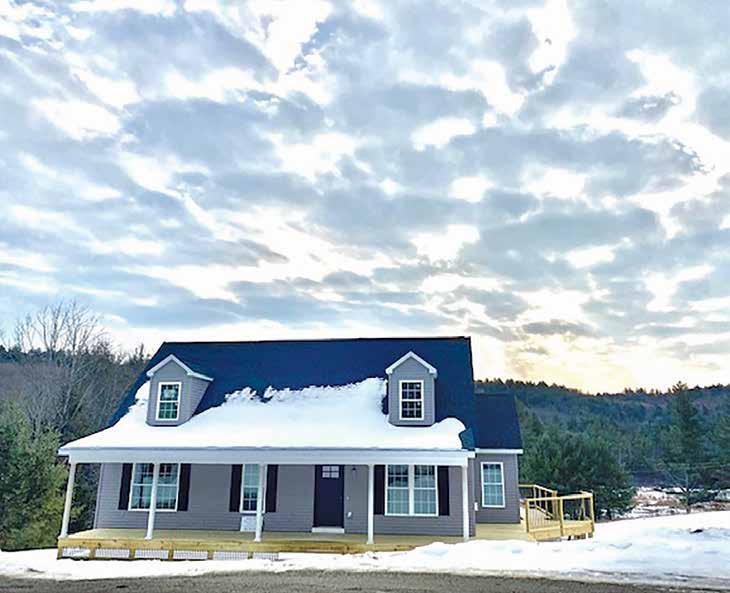
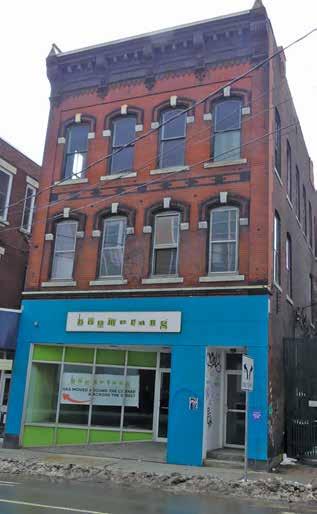
Check out Southern Vermont’s most exclusive homes for sale and the top-notch Realtors and agents who represent them. See our ads on pages 18 and 19
Spotlight-worthy properties in Southern Vermont
Adreamcometr ue!Thishomehassomanywaysto workfor y ou andy ou rlifesty le .Apretty,classicfou rsquaretraditional colonialwithagreataddition!Locatedon ourbest,treelinedentry streets.Workfromhome?Thereare4bedroomsonthesecond floorforagreatoffice,g ue storabigfamily!Theadditionisa mainbedroomandbathonthefirstfloorforanin-law,Tween, Xgeneration,oryour ow ncomfort!Thekitchenanddiningareopen conceptwithwonderfulsouthernandwesternlightandcouldalsobea familyareawithcozychairs sharingtimewiththecook.You canliveon onefloorandhavetheupstairsforfamilyandfriends.Thereissomuch you can do withthesweet,glossyhardwoodfloors,pristinestaircase andwoodwork,thatthisisahometocome,thinkaboutandlove.
MLS#4892647
In v estin y ourhometownandbecome not o nl yy our o wnbossbut a supporting memberofthecommunity!Readyto r oll, thislocatio n hasal l themajorequipment soyoucanmoverightinandstartup! Thecurrent ownershaverenovatedthebuilding includingthewalkinfloorandwalls.Great location with a hightrafficcount.They have 4 dedicatedparkingspaces r ightinfrontof thebuildingwithothersalsoavailableonthe street. A sweetsetupand ver y manageablewith asmallcrew.Adeckwithaviewfor3season munching,awalk-inforbeerandcolddrink pick up, grocer y area forstaples. Sweet! A taste offreedom andthe joy of a ne wadventure! Thenamewillnottransferwiththeproperty.
Fa bulous C om m ercia l Opportunity. Loc a tedjustoff Ma inStree t in downtownBrattleboro. First f loo r offer s stree t levelretailopportunity of2,000squarefeetwithhalfbath.Secondflooris2,000squarefeetof officespacewith2halfbathsorconverttowhateveryourneedsmightbe. Thirdfloorwaslivingspacewhichhasbeenmostlyguttedsonow’sthe timetoturnitintoaintownloftorseparatedinto2smallerunits.Lower levelconsistsofanother1,500squarefeetofspacewitha3/4bath.This classic1900’sdowntownarchitecturewithbrickfaçadeiswaitingforits nextchapter.
Wow,whatalocation!ThishomesitsjustupfromtheupperentrancetoMountSnow&haseasyaccesstotheresortwithout havingtogetbackonthemainroad.Despitebeingsoclose,ithasdirectVASTsnowmobiletrailaccess,incrediblyrareforthis location,as well as a privatelevellot forgreatlawnspace & outdoorenjoyment.Evenmore uniquethanthelotisthehomeitself...It features a beautiful modern designwithnatural woodfeaturesthroughout, & anopenconcept idealforentertaining& large groups There are6 bedrooms &5 baths, well separatedfrom thelivingspace Themainfloorhas a large livingareaw/vaultedceilings,exposed beams,greatnaturallight,afireplace,andlargekitchenw/breakfastbar.Godowntheopencustomstaircasetothespaciousfamily roomonthemainfloorw/pool&pingpongtables,secondfireplace,aswellashottubsunroom,&largemudroomareaforallyour gear.Themastersuiteisonthe3rdfloorandleadsouttothebeautifulbalcony.Inadditionthereisadetachedgarageforstoring yoursnowmobilesortoys,greatparkingspacefornumerouscars.Trulyaremarkableanduniquehomesoclosetothemountain.
Stratton Mountain School alumni shine at 2022 Olympic Games
By Michael Mawson Vermont Country
STRATTON — A total of 91 countries took part in the 2022 Winter Olympic Games. If Stratton Mountain School alumni formed its own nation, the independent boarding school nestled in Windham County would have finished the medal count inside the top 20. Not too bad for a school with less than 1,000 total alumni in its 50-year existence.
Ten athletes with Stratton Mountain School ties competed in Beijing,
highlighted by Lindsey Jacobellis’ two gold-medal performances in snowboard cross. Jacobellis is a 2003 Stratton Mountain School graduate.
Not to be outdone, Stratton Mountain School Elite T2 team member Jessie Diggins made Olympic history herself, becoming the first United States woman to medal in an individual cross-country ski event. Diggins earned bronze on Feb. 8 in the individual sprint before closing out the Games with a silver in the 30-km mass start free on Feb. 20.
Lee Jin-man — The Associated Press
United States’ Lindsey Jacobellis, followed by Italy’s Michela Moioli, compete during the mixed team snowboard cross finals at the 2022 Winter Olympics, on Feb. 12 in Zhangjiakou, China. Jacobellis, a 2003 SMS grad, won gold in the event.
Those four medals would have the school sitting firmly in 17th place in the final standings, sandwiched between Finland and New Zealand.
Known by many around the world as a training ground for Olympians, Stratton had its most impressive showing to date in the 2022 Games. The school entered Beijing with five Winter Olympic medals. It nearly doubled that output in an impressive three-week stretch on the hills of China.
The history of excellence goes as far back as the school itself. Founded in 1972, Stratton Mountain School has had at least one Olympian in every Winter Games
“Ross Powers — he was an Olympic gold medalist — and we just pass him in the hall every day, which is so cool.”
Student Eliza Sullivan
since 1976. It all started with Abbi Fisher, a 1975 graduate who competed in the 1976 Games in Innsbruck, Austria. Fisher was the lone representative that year, but soon many more Stratton alumni would follow her lead.
The school’s first medal came in the 1998 Games, a Ross Powers’ bronze in the halfpipe.
Powers followed that with a gold in the 2002 games, Stratton’s first alumni to achieve that honor. Powers now plays a role in guiding the next generation of Olympians to come out of Stratton, serving as the school’s snowboarding director since 2010.
The students realize how fortunate they are to have that sort of knowledge and leadership,
“All the coaches that we’re surrounded by have achieved so much,” student Eliza Sullivan said in a 2021 interview. “Ross Powers — he was an Olympic gold medalist — and we just pass him in the hall every day, which is so cool.”
Jacobellis earned silver in snowboard cross at the 2006 Games, making her double-gold performance this year that much sweeter.
In 2014, Alex Deibold won bronze in snowboard cross.
The 2018 Games of Pyeongchang served as an insight into what Stratton alumni are capable of, as Diggins made history by winning the first gold medal in Team USA cross-country history, pairing with Kikkan Randall to win the team sprint.
So how does this tiny school develop some of the most talented athletes in the world?
In the fall and spring, Stratton Mountain School operates like any typical independent high school. Students go
STUDENT-ATHLETE
to class and participate in sports such as soccer or lacrosse.
It’s the winter that makes Stratton Mountain School special. The school evolves into a sports academy with a rigorous schedule aimed at maximizing each student’s full potential both on the slopes and in the classroom.
Shortly following sunrise, students hit the mountain to train in either Nordic, alpine, freestyle, freeski or snowboarding. They remain on the mountain until noon, getting a solid four hours of work in before heading to class from 12:30 to 5:30 p.m. Study hall starts at 7 and ends at 8:45 p.m., and the students are in bed by 9:30 p.m.
Head of School Carson Thurber, an alumnus himself, said this sort of schedule forces the students into developing time-management skills.
“We kind of put them in this community where we brainwash them into thinking that it is a normal day for a teenager,” Thurber chuckled.
The school provides unique experiences for students like senior Eva Morin.
“I’ve learned lots of life lessons. When I look at other kids my age, I’ve done a lot more than a lot of them have. I’ve traveled the world and learned a lot about managing my time well and being able to do all this stuff that makes you a stronger person.”
Tom Wisdom came to Stratton as a teenager from Lake Tahoe, California in the late 1990s. The promise of elite skiing and being coached by one of the best in Sverre Caldwell brought him east. Wisdom graduated in 2000 and spent another year as a post-grad. He remains connected with the school more than two decades later.
“SMS is a really special place. It’s special because of the people around you, because of the community that this place provides. Alums take an immense amount of pride in the school and in its success. We all are very committed to ensuring that SMS is a successful institution, not
just athletically, but producing just good people. And I take a very, very deep sense of pride of being part of that.”
That pride was encapsulated when Wisdom turned on his TV to watch Diggins win silver on Feb. 20.
“It was a similar experience to when she won the gold with Kikkan (Randall) four years ago in that it almost brought tears to my eyes.”
The medal-winning performances are doing more than just bringing pride to the alumni of Stratton. They are inspiring the next generation.
“It’s really motivating because seeing these people and knowing that they were sitting where I was in the same classrooms and on the same mountain ... it’s incredible to know that these people started exactly where I did,” Morin said.
Top: Jessie Diggins celebrates as she crosses the finish during the women’s 30-km mass start free cross-country skiing competition at the 2022 Winter Olympics, Feb. 20 in Zhangjiakou, China. Diggins, who trains with Stratton Mountain School’s Elite T2 team, won a silver medal in the event.
Gregory Bull — The Associated Press
Top: Louis Philip Vito III trains on the halfpipe course at the 2022 Winter Olympics.
Alessandra Tarantino — The Associated Press
10 things to cure a mean case of Southern Vermont cabin fever
Vermont Country file photo
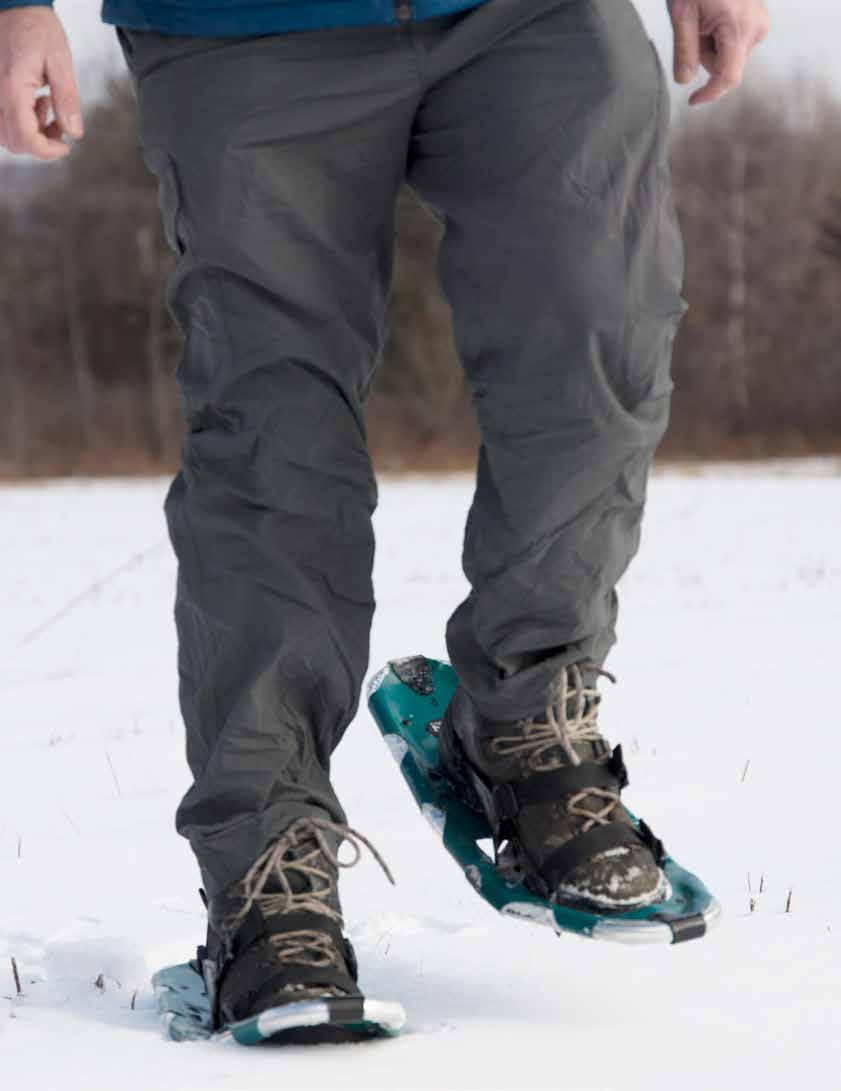
A pair of Dion Snowshoes, which are handcrafted by a small team in Pownal.
Vermont Country file photo
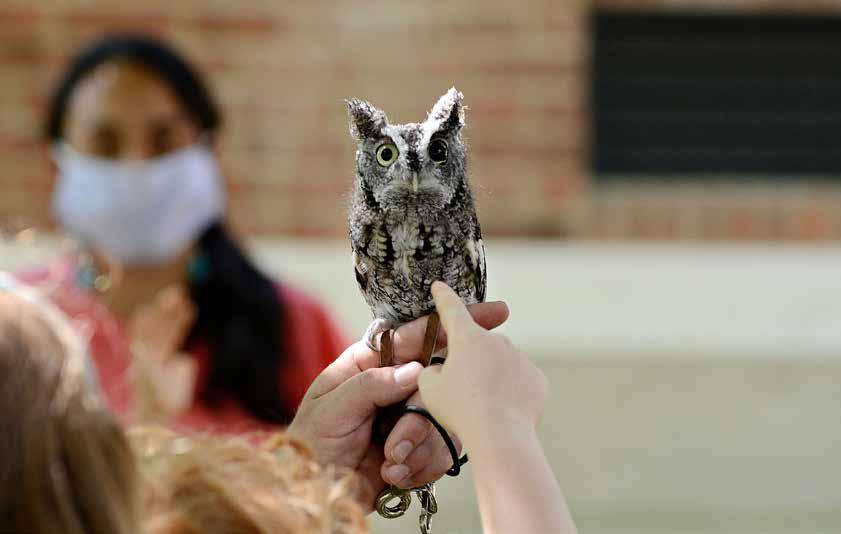
Sitting on the finger of Michael Clough of the Southern Vermont Natural History Museum, a tiny screech owl surveys the crowd during a raptors show in the courtyard of the Bennington Library.
By Chris Mays Vermont Country
Spring technically starts in March. In Vermont, however, we still have some time to go.
That might mean being stuck indoors because of rain, impassable mud roads or a freakishly large snowstorm, all of which can make you feel listless or like you’re bouncing off the walls, depending on your demeanor.
Luckily, there’s an endless list of Southern Vermont outdoor activities that embrace our season of false spring and even some that can be done without leaving your home.
1. Snowblind often? If there’s still snow, get in some turns at your local resort or backcountry spots. Skiing and snowboarding are two ways to stay active during the winter months, and Southern Vermont has plenty to offer in this department. From Mount Snow and Stratton to the hidden backcountry hills, there are miles and miles to explore.
2. Be your own White Walker. With or without “The Game of
Here’s our top 10 …
Thrones” reenactors, snowshoeing is a fun and simple activity that can be done at home alone or out with friends, such as at Winterplace in Wilmington. But you can also kick it up a notch and traverse some big mountains in Southern Vermont, like Mount Equinox in Manchester or Mount Anthony in Bennington. Just be aware that downhill on snowshoes sometimes can be more difficult than uphill.
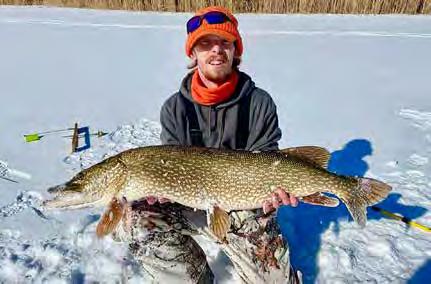
3. Warm up to ice fishing. Not only are you able to chase trophy-sized fish in the winter but you also get to hang out with friends outside, and then warm up in a shanty or tent, enjoying some Vermont scenery and camaraderie at the same time. Pro tip: Make sure the ice is thick enough — minimum of 4 inches — before going out.
4. Soothe your savage beast: Check out live music at venues such
as The Stone Church in Brattleboro and Next Stage Arts in Putney or catch a show at Oldcastle Theatre Company in Bennington. Schedules are filling up with great performers and performances. Bella’s Bartok’s Heaven & Hell Ball at The Stone Church on April 30 looks like a good time.
5. A new take on the classic date night. These days, dinner and a movie can mean visiting Latchis Theatre and River Garden Marketplace in Brattleboro or getting takeout from Elm Street Market in Bennington, and finding the latest Netflix movie everyone is talking about.
6. Get your muse on. Our region has amazing museums such as Bennington Museum, the Clark Institute, Brattleboro Museum & Art Center, Southern Vermont Arts Center and Massachusetts Museum of Contemporary Art. Southern Vermont Natural History Museum in Marlboro offers outdoor programming throughout the year. West River Railroad Museum is a hidden gem in Newfane.
7. It’s better to be a player. Remember the instrument you have neglected after you bought it during the COVID-19 lockdown or even earlier? Dust it off and hit up Contemporary Music in Brattleboro or Faller Music in Bennington for new strings if needed. Our region has no shortage of talented musicians offering lessons.
8. Climb the tower of Babel: Learning a language has never been easier, or at least quite as easy. Online programs available online include Duolingo, Rosetta Stone and Pimsleur. Want to get serious about it? Try the School for International Training in Brattleboro.
9. Enter a vegetative state. Develop more ambience in your home by adding indoor plants to the mix. Tierra Botanics in Brattleboro has lots to offer for everyone from beginner to expert, with classes and build-your-own terrariums.
10. Have you tried the Facebook? If all else fails, scroll through social media. Post something about your cabin fever, or find something fun to do. Almost every local establishment has a Facebook, Instagram or Twitter page these days, so search by keywords like the town in which you want to do an activity or by the activity itself. Local papers also sport robust events listings.
Vermont Country file photo People head to the Latchis Theatre for a world of fantasy.
Patrick Collette
Showing off a sweet catch, a northern pike, is Dale Collette Jr.
Vermont Country file photo
Guitarist Jason Scaggs plays a set at The Stone Church in Brattleboro.
‘Get up!’
Grit, granite and a mossy route lead writer up Chapel Pond Slab in Keene, N.Y.
By Cheryth Youngmann
Vermont Country contributor
I dropped through the air and screamed.
The rope that looped through my harness pulled taut. I rested then, suspended until Ben
let out some rope. We couldn’t see each other — could barely hear each other, either. He was anchored to a ledge above me and a ways to the right. The sun slipped fast toward the west, like the light was water and someone had unplugged the drain.
Photo by Ben Chuchta
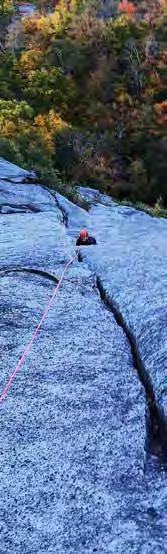
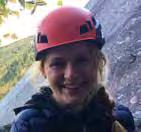
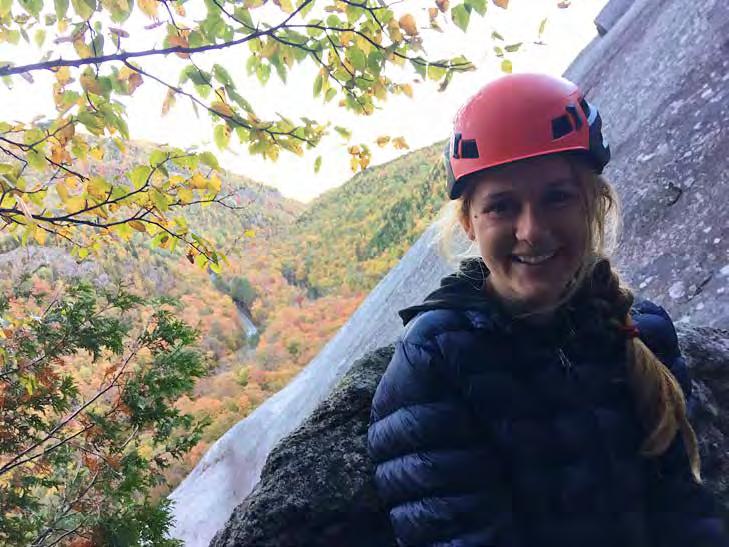
The author looks relieved after ascending Chapel Pond Slab.
The Regular Route on the Chapel Pond Slab in Keene, N.Y., is a classic, traditional climb and is popular with climbers throughout New England and New York. It’s one of the longest ascents in the Eastern U.S.
Photo by Ben Chuchta
Author Cheryth Youngmann, seen as a small dot down at the bottom of the rope, ascends Chapel Pond Slab.
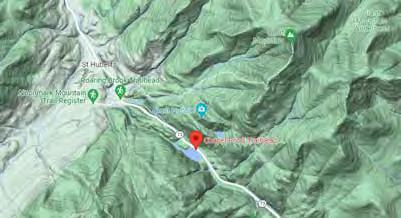
Screenshot from Google
This
topographical map of Chapel Pond shows the sharp rise of the terrain to the northeast.
I pressed my forehead to the granite and let the grain steady me.
Ben had said, over and over, that I was strong enough to do these moves, that my actual body could. But I was exhausted and certain that wasn’t true. The proof was in my shaking arms and repeated failed attempts to climb up and out of this corner in the rock — the crux of Chapel Pond Slab, the six-pitch climb we were ascending. Or, in my case, attempting to ascend.
I breathed through my nose, the kind of breath I use during yoga, and squared my shoulders. The rock was cold under my hands, and I climbed, trying to remember Ben’s movements as he led.
I got to the last sequence I’d successfully completed and reached, with fear splintering in my gut. My fingers came off the rock, again.
In an instant, my fear gave way to anger. I was furious with Ben for having brought me here and for having thought I could do this, furious with my scared, animal body, and furious, too, with the rock that had cooled over years into this exact, impossible formation.
I screamed again, this time with no drop to prompt it. I screamed because I needed to — my body needed to. I looked up from where I hung, where it seemed I’d always hung. There was a wet, mossy crack above me. I didn’t think it was the route. I
Ben pulled the rope tight with each movement I made, and I inched up the wet crack, farther than I’d ever gotten. I’ll be damned if I fall now, I thought.
didn’t think it was even close, but this hadn’t stopped me from trying three times already.
I looked at the crux again. I wedged the fingers of my right hand into the crack I wasn’t supposed to climb and heaved. I scrabbled for purchase with my toe and found it — barely. But I was moving up, and my whole consciousness narrowed to that one purpose: Get up.
Ben pulled the rope tight with each movement I made, and I inched up the wet crack, farther than I’d ever gotten. I’ll be damned if I fall now, I thought.
Then, all at once, I saw the end of the climb above me. I hooked a forearm over the edge of the rock and heaved my upper body onto the ledge. Guttural noises I’d never made before muscled past my teeth and into the air. I sounded like a woman in labor. And maybe the whole thing looked a little like birth from where Ben stood — my body, fluid-covered and spent, emerging from the earth.
My upper body was safe, but the problem of my shaking legs remained. I breathed a moment, feeling the coolness of the rock under my arms. I closed my eyes and called on my rage: I had a boyfriend to kill.
Matching my right knee to my forearm in a move that could have scraped it, badly, I hauled myself onto even rock. And then, impossibly, I stood.
Relief flooded my body. I do not mean this metaphorically. I felt something release from the base of my neck and shoot down the arc of my spine through my entire being. It turned my limbs from ache to something warm, liquid, pleasant. Unfamiliar endorphins drowned out thought.
I was suddenly and acutely aware of the solid mass beneath me.
The earth is under me, I thought, stupid with wonder. I padded across the open ledge to where Ben stood anchored to that same rock. I searched for the rage I’d known moments before. It was like groping for my phone in the dark, just a blind, fruitless scramble. My body could only hold so much at once.
I recognized something familiar in the chaotic mix of sensations coursing through me — gratitude. My body was glad to be alive. It hummed with that gladness.
I reached Ben. My feet touched the earth as I kissed him.
10 films
to guide your self-discovery during the season of rebirth
By Dan Tebo
Vermont Country correspondent
There are few things in this world guaranteed to warm the heart of the hard-bitten New Englander like the first taste of spring. Those who haven’t lived through a Vermont winter will never know the unbridled euphoria that an unexpected 70-degree April afternoon brings. It makes every minute of our seemingly interminable frozen suffering suddenly feel worthwhile (and, my, how we’ve suffered these last few years).
While winter buries us deep inside of ourselves, spring has been known to light the fires of inspiration and drive us out into the world in search
of rebirth and rediscovery. As Tolstoy once said, spring is a time of plans and projects! Since it’s the season of rebirth, this month we’ll take a look at some films that feature characters in search of transformation, be it physical, spiritual or otherwise — the folks who set out on inspiring journeys of self-discovery. We’ll also check in with JC and a golden
retriever who yearns to be a human race car driver.
“Jesus of Nazareth” (1977): We can’t really talk about spring without checking in with The Big Guy! This star-studded four-hour miniseries from the late 1970s is a nice way to scratch your Jesus itch without ever having to think about Mel Gibson.
“Can’t Buy Me Love” (1987): In this questionable 1980s comedy, a high school senior pays a popular classmate a thousand dollars to pretend to be his girlfriend for a month. He man-
Photo by Unsplash
ages to go from totally geek to totally chic after simply removing his eyeglasses and mussing up his hair. It’s literally that easy.
“Vampire’s Kiss” (1988): A gloriously unhinged Nicolas Cage (even by unhinged Nicolas Cage standards!) plays an overworked literary agent who becomes convinced that he’s a vampire and begins to act accordingly despite the profound lack of evidence suggesting that he is, in fact, a vampire.
“Joe Versus the Volcano” (1990): Tom Hanks headlines as a miserable office clerk whose life is upended upon learning he’s suffering from a terminal “brain cloud.”
The film crackles to life when Hanks travels to the South Pacific with Meg Ryan, intent on hurling himself into a
live volcano. The story, by “Moonlighting” scribe John Patrick Shanley, is comedy writing at its most innovative.
“Awakenings” (1990): A true-ish account of Dr. Oliver Sacks’ attempt to reverse the effects of encephalitis lethargica through the administration of a drug called L-DOPA. Sacks succeeds in rousing Robert DeNiro from a 40-year coma, which is awesome. As soon as he starts to reacclimate and gets himself a girlfriend, DeNiro develops Parkinson’s and returns to his vegetative state, which is less awesome.
mysterious time loop. From the mind of the late Harold Ramis, this film is rightfully recognized as one of the greatest comedies of the last half century. The groundhog, however, continues to see his own damn shadow.
“She’s All That” (1999): High school cool kid and garbage human Freddie Prinze Jr. wagers that he can take poor, unlovely Rachael Leigh Cook and make her popular. How does he achieve this? By removing her glasses, of course. So much eyewear shaming in these teen comedies!
“Groundhog Day” (1993): An eternally grouchy weatherman is gifted an infinite amount of chances at personal rehabilitation when he’s caught in a
and decides that he’s no longer interested in living according to society’s playbook and subsequently throws his life, and the lives of those around him, into terminal chaos. A Best Picture winner and genuine cultural phenomenon, the impact of this film has been sullied by the presence of canceled harassment ghoul Kevin Spacey.
“Wild” (2014): Reese Witherspoon plays a biblically troubled divorcee and novice hiker who nevertheless decides to tackle the 1,100-mile Pacific Crest Trail carrying a backpack that weighs more than she does. Witherspoon suffers mightily on her solitary journey toward self discovery, a suffering matched only by those who sat through all 140 minutes of “Eat Pray Love.”
“American Beauty” (1999): A middle-aged suburbanite schlub wakes up one morning
“The Art of Racing in the Rain” (2019): Kevin Costner stars as Enzo, a brain cancer-sniffing golden retriever who longs to be reincarnated as a race car driver. And you know what? He gets his wish! A lot of people claim to have cried rivers of tears during this movie. Of unintentional laughter, I assume.