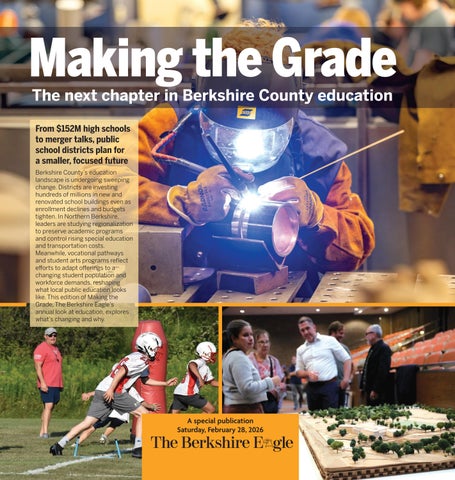
From $152M high schools to merger talks, public school districts plan for a smaller, focused future Berkshire County’s education landscape is undergoing sweeping change. Districts are investing hundreds of millions in new and renovated school buildings even as enrollment declines and budgets tighten. In Northern Berkshire, leaders are studying regionalization to preserve academic programs and control rising special education and transportation costs. Meanwhile, vocational pathways and student arts programs reflect e orts to adapt o erings to a changing student population and workforce demands, reshaping what local public education looks like. This edition of Making the Grade, The Berkshire Eagle’s annual look at education, explores what’s changing and why.
A special publication Saturday, February 28, 2026
Acoedboardingandday school forgrades9-12 & PG. AdvancedMath/ScienceResearch, AdvancedHumanities Research,ProVita WinterSession, arangeofarts o erings,andchampionship athleticson astunning 400-acre campusintheBerkshires.
Sc h edul ea vi sitt od ay! berks h iresc h ool.or g She eld,MA | admission@berkshireschool.org|413.229 1003
A wave of construction is modernizing or replacing Berkshire County’s midcentury schools
Berkshire County communities have spent hundreds of millions of dollars rebuilding aging schools since 2010, with projects in Pittsfield, Dalton, Williamstown and now Great Barrington reshaping the region’s education infrastructure.
BY TALIA LISSAUER
The Berkshire Eagle
GREAT BARRINGTON — A wave of school construction has swept across Berkshire County since 2010, replacing or renovating aging buildings from Cheshire to Pittsfield to Dalton, ushering in a new, expensive era of education.
While aging infrastructure and state funding have driven much of the rebuilding, whether schools ultimately move forward has depended just as much on whether communities are willing to accept higher local taxes.
Projects over the past 15 years include the reconstruction of Hoosac Valley High School in 2011, followed by Taconic High School in Pittsfield and Mount Greylock Regional School, both of which opened new facilities in 2018. Wahconah Regional High School followed in 2022. Now, Monument Mountain Regional High School in Great Barrington and other districts are advancing through the state approval process.
STATE PARTNERSHIP
The ability to complete these projects comes down to support from the Massachusetts School Building Authority, which reimburses districts between 30 and 80 percent of construction costs. But even when state approval comes, that doesn’t guarantee a new school. The MSBA sets a multiyear process that determines eligibility, feasibility and design, while local voters must ultimately approve paying the district’s share, which can be tens of millions of dollars.
Many Berkshire schools, built in the 1960s, are more than 50 years old, with aging roofs, HVAC systems, electrical infrastructure and layouts that no longer match modern educational programming. Districts must demonstrate those needs through a formal
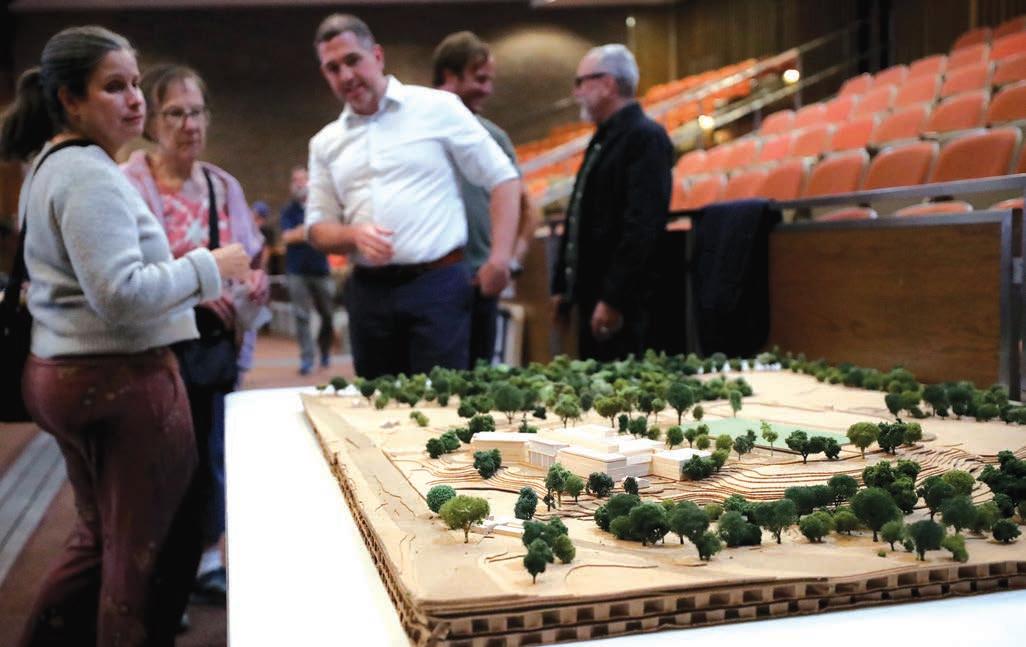
A scale model of the Monument Mountain Regional High School is displayed during a public presentation in Great Barrington. Voters approved the $152 million project after planning and debate.
“statement of interest” to enter the MSBA pipeline.
Over the past 15 years, Berkshire school construction projects have totaled hundreds of millions of dollars.
Taconic High School’s reconstruction cost roughly $120 million, with the state covering a major share. Wahconah’s project exceeded $70 million.
Monument Mountain’s approved project carries a $152 million price tag, with an estimated 48 percent state reimbursement.
Even with state support, local shares often reach tens of millions of dollars
— borrowing that must be approved through town votes or debt exclusions.
For Wahconah’s project, taxpayers in Dalton, the largest town in the seven-town district, were estimated to see taxes rise by more than $560 for the average single-family home.
Taconic’s project was the single largest taxpayer-funded project in Pittsfield’s history, The Eagle reported in 2015. The 46-year-old building at the time had a leaky roof, falling ceiling tiles and an inefficient heating system. The average single-family house assessed at $175,000 would pay
$142 more annually in property taxes under a 20-year bond.
MODERN BENEFITS
District leaders say new buildings offer more than modern classrooms. Updated HVAC systems reduce maintenance costs, layouts allow for flexible programming and accessibility standards are met more fully than in mid-century structures.
Plans for Monument Mountain’s classrooms include new desks, chairs and teaching technology, and science labs with upgraded safety systems,
BERKSHIRE EAGLE FILE PHOTO
fume hoods and flexible layouts. Every classroom would have natural light, flexible layouts and built-in technology for collaborative and hybrid learning — a contrast to the current building, where many rooms have no windows and limited electrical capacity.
At the same time, administrators acknowledge that new schools do not reverse enrollment decline or eliminate broader budget pressures. They are long-term infrastructure investments, not short-term solutions.
LENGTHY PROCESS
The MSBA process can take several years before construction begins. After submitting a statement of interest, districts must be invited into the eligibility phase, complete a feasibility study and secure board approval before voters are asked to authorize borrowing. Projects can remain in the pipeline for years before reaching a ballot question, and some districts are not invited into the program at all during a given cycle.
Even when the need is widely accepted, construction can stall if voters are unwilling to accept higher taxes.
Mount Greylock Regional School in Williamstown completed a major $64.8 million, 22-month renovation and expansion project in 2018. The original structure was built in 1960, with an addition in 1972, when it served 1,200 students in 177,000 square feet.
The new building was designed for 535 students in grades 7-12, based on MSBA projections developed during the design process. Though the county is seeing a general decline in enrollment, the physical expansion focused on modernizing and reorganizing aca-
demic, arts and athletic spaces to meet current educational standards.
For the Berkshire Hills Regional School District, officials first said Monument Mountain Regional High School was in need of a makeover more than a decade ago. The building was built in 1968 and has a host of issues that helped it secure MSBA support in 2014, but voters rejected the proposal twice before approving it last November.
Great Barrington taxpayers faced an additional $92 per $100,000 of assessed property value in the 2014 vote. In the 2025 vote, taxpayers approved $145 per $100,000 of assessed property value.
“This is a very nuanced and longfought battle,” Superintendent Peter Dillon said.
In a rare additional chance, the successful vote followed years of community outreach and a clearer comparison between the price of renovating the existing building and constructing a new one, a failed district consolidation proposal and plans to expand vocational programming, Dillon said.
“Then the decision was pretty clear: It’s better to invest in the new than to invest in the old and not get much for that investment,” Dillon said.
A major point of contention throughout the process was the high taxes the $152 million school would bring, even with the state paying for nearly half. Those concerned struggled to see the need for higher taxes when money is already tight as enrollment declines.
“We recognize that when people voted to approve this, they were doing it at a personal sacrifice,” Dillon said. “But they also see it as an investment
BERKSHIRE EAGLE FILE PHOTO
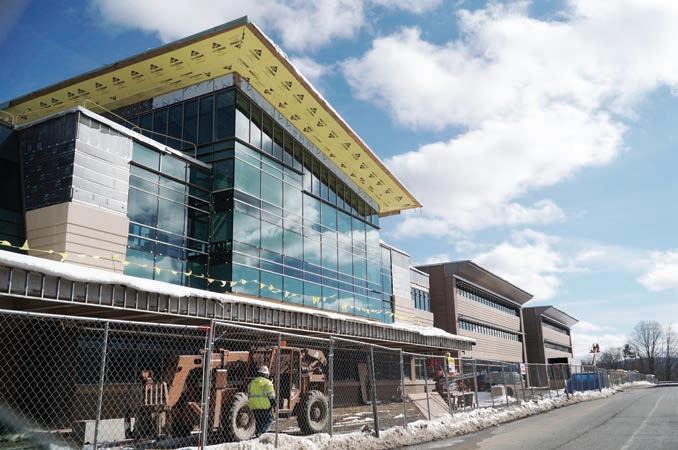
Taconic High School in Pittsfield takes shape during construction in 2017. The $120 million project was the largest taxpayer-funded construction e ort in the city’s history and opened in 2018.
BERKSHIRE EAGLE FILE PHOTO
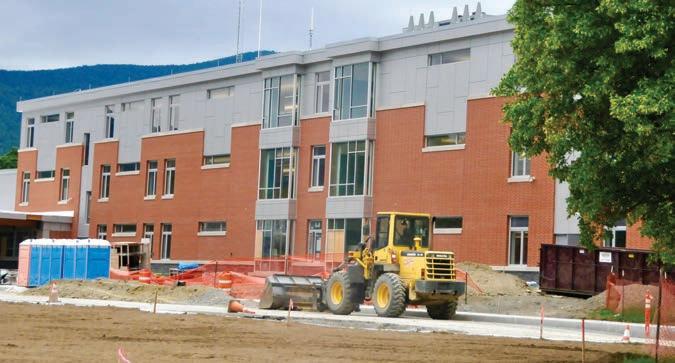
Mount Greylock Regional School in Williamstown underwent renovation and expansion in 2018. The $64.8 million project replaced much of the aging midcentury facility with a modern building designed for fewer students.
in the long-term viability of the community.”
ENROLLMENT REALITY
Enrollment across Berkshire County has declined over the past decade, mirroring statewide trends in rural districts. Several districts that rebuilt schools have opened new facilities serving fewer students than the buildings they replaced. That dynamic complicates building votes, as taxpayers weigh long-term infrastructure needs against shrinking class sizes and demographic uncertainty. Monument’s path is not unique. Wahconah Regional High School in Dalton opened a new facility in 2022 after voters approved borrowing several years earlier. In North Adams,
Greylock Elementary School has advanced through the MSBA process and recently selected a contractor for the $50 million project.
In Pittsfield, district leaders have identified aging elementary schools in need of major upgrades, but the scale of potential projects along with the size of the local share has complicated the path forward. Officials there say enrollment uncertainty and existing debt obligations factor heavily into discussions about when and how to pursue additional construction.
“I think the MSBA is making a bet on a school district that the school is going to work hard and convince their voters and residents to support it,” Dillon said. “They’re a great partner in this.”
BY THE NUMBERS
Since 2010, Berkshire County communities have rebuilt or renovated a series of aging school buildings, investing hundreds of millions of dollars with the help of state construction aid. The projects, spanning from Cheshire to Great Barrington, reflect a countywide push to replace mid20th-century facilities with modern schools designed for today’s students, even as enrollment declines and local taxpayers shoulder significant costs. Here are the big ones:
HOOSAC VALLEY HIGH SCHOOL (CHESHIRE)
Rebuilt: 2011
Cost: $51 million (approx.)
TACONIC HIGH SCHOOL (PITTSFIELD)
Opened: 2018
Cost: $120 million
MOUNT GREYLOCK REGIONAL SCHOOL (WILLIAMSTOWN)
Renovation completed: 2018
Cost: $64.8 million
WAHCONAH REGIONAL HIGH SCHOOL (DALTON)
Opened: 2022
Cost: $70+ million
MONUMENT MOUNTAIN REGIONAL HIGH SCHOOL (GREAT BARRINGTON)
Approved: 2025
Cost: $152 million
If it’s not about ‘one big school,’ where is the sustainability study for northern Berkshire leading?
With enrollment declining and costs rising, three Northern Berkshire high schools are studying whether sharing services or regionalizing could preserve academic programming and control expenses. The effort follows years of stalled collaboration attempts and comes as students already feel the impact of smaller class sizes and canceled courses.
BY JANE KAUFMAN
The Berkshire Eagle
With her sights on studying engineering, Hoosac Valley High School senior Anna Thurston hoped to take Advanced Placement calculus this year.
But with just 65 students in her class, only four were interested. The course was canceled. Thurston chose Advanced Placement statistics instead.
Her experience isn’t unique.
As enrollment trends downward at northern Berkshire County’s three traditional public high schools, so does the number of courses offered.
For a public high school attempting robust programming, there is such a thing as being too small. With rising costs for transportation, and special education and state aid failing to keep pace, every taxpayer dollar spent on local education counts.
Across northern Berkshire County, shrinking class sizes, rising costs and the steady pull of school choice are reshaping the region’s public high schools. The leaders of Mount Greylock Regional School District, North Adams Public Schools, Hoosac Valley Regional School District and North Berkshire School Union are studying whether sharing services or regionalizing could help preserve academic programs while keeping costs under control.
ENROLLMENT DROPS
At Mount Greylock Regional High School in Williamstown, enrollment is declining. In 2010, Mount Greylock’s enrollment for grades seven to
JANE KAUFMAN / THE BERKSHIRE EAGLE
Anna Thurston is a senior at Hoosac Valley High School. She has enjoyed the collaborations she’s taken part in with students from other schools and sees value in establishing closer ties.
12 was 641. Today, it is 543.
In North Adams, enrollment for grades seven to 12 was 616 in 2010. Hoosac Valley’s was 692. Today, both Drury and Hoosac Valley have enrollments of 389 for those grades.
Northern Berkshire schools are mirroring population trends in Berkshire County over recent decades.
Births have declined in Berkshire County, as has the overall population. In 1995, there were more than 1,400 births. By 2021, the number of births fell below 1,000.
The Berkshire Regional Planning Commission’s Public School Enrollment Projections predicted a 21 percent decline in enrollment between 2020 and 2030. Between 2015 and 2020, the county saw the number of students decrease from 15,911 to 14,758. Projections in a 2024 report predict the school population will continue declining to 11,397 by 2035.
INCREASING COSTS
Joe Bergeron, Mount Greylock’s superintendent, said lower enrollment presents a challenge to schools: “Costs are increasing faster than revenues are increasing, and so offering the same or better opportunities to our students is becoming more difficult.”
In February, 15 members of the
Northern Berkshire Regionalization Study Steering Committee — representing nine towns — weighed two proposals from consultants for a sixto 12-month sustainability study on grades six to 12. The studies will culminate with four options to consider.
Mount Greylock School committee member Carrie Greene said state aid just isn’t keeping up.
“We’re all in the same boat in terms of funding and stressing our local communities to be able to meet the needs of our school districts,” she said. “It’s only going to make sense if it makes sense financially.”
Greene said none of the state aid coming to district schools is adequate: Chapter 70 school aid, transportation reimbursement for regional schools, and aid for out-of-district placements for students with special needs.
State aid actually has increased over the past six years. However, student need and inflation have outpaced the increase.
UNDERFUNDED
“The system is broken,” state Rep. John Barrett III said. “The (2018) School Opportunity Act hasn’t panned out to what it should be. There’s a lot of schools that have been left out.”
He estimated that rural school aid is underfunded by about $60 million
annually as well.
Simply put, “More and more is falling back to the local communities, and they can’t afford it,” Barrett said.
House Bill 555 would establish a legislative commission to study and make recommendations for “a more equitable distribution of Chapter 70 school aid to municipal and regional school districts” as well as other entities receiving that aid.
Barrett said that bill appears to have traction.
The commission would review per pupil allocations, could recommend establishment of a reserve fund for extraordinary circumstances, and would look at long-term fiscal trends in school districts experiencing declining enrollment, as well as the impact of regional school districts on municipalities.
Barrett said, if established, the legislative commission also would look at the inflation factor, which is now capped at 4.5 percent annually.
It would be operating under a deadline of Dec. 31 to file its report and recommendations.
NOT A FIRST TRY
This isn’t the first time school districts in northern Berkshire County have tried to cut costs and enhance services by working together.
And it’s not the first time the subject of regionalization has come up.
In 2018, when Barbara Malkas was superintendent of North Adams Public Schools and Rob Putnam was superintendent of Adams-Cheshire Regional School District (now Hoosac Valley), the two discussed sharing an administrative team and superintendent as a cost-saving measure. While the concept had the backing of the North Adams mayor, it didn’t gain traction among the Adams-Cheshire school committee.
At about that time, the three districts also collaborated on special education services. That proved to be a short-lived experiment. The program relied on a state regionalization grant that ended, according to Malkas. Ultimately, it wasn’t able to be sustained, said Tim Callahan, North Adams superintendent.
WHY NOW?
Carol Cushenette served on the Hoosac Valley Regional School Committee and is now on the Adams Finance Committee.
“This is not a new concept,” Cushenette said. “This is something that people have been talking about.”
In April 2024, she initiated discussions with Hoosac Valley Superintendent Aaron Dean and North Berk-
shire School Union Superintendent John Franzoni about regionalization.
“It’s not just about cost,” she said. “It’s about programming.”
The three looped in Jake Eberwein, project manager at Berkshire Educational Resources K12, and appealed to Barrett. Through state legislative earmarks, a total of $125,000 is available for the sustainability study.
Without that money, this process might not be happening.
“Even though the state maybe would appreciate fewer districts and larger districts than dealing with so many small districts, the state at this point does not incentivize regionalization studies or regionalization conversations,” Callahan said. “They’ve actually stopped the funding of grants that would facilitate regionalization studies or regionalization support, so that’s one of the barriers that slows the process down.”
Barrett said he will seek more funding in the next legislative session if additional study is warranted.
ONE BIG SCHOOL?
Lyndon Moors was the band director at Mount Greylock until 2020 and now serves as chairman of the Lanesborough Finance Committee.
Before his first steering committee meeting, someone asked Moors whether the committee would contemplate building “one big school.”
“I don’t think that’s what this is all about,” he said. “This is more organizational, structural, financial, avoiding duplication of boss contracts, of services (and taking advantage) of buying power when you’re associated with a larger group.”
Moors was a leader of the Mount Greylock Teachers Association when his district added Lanesborough and Williamstown elementary schools. He brought up a tricky aspect of that process: teacher salaries.
“We had to somehow synchronize pay scales amongst the faculty and the staff,” he said. “And so you can have various theories there. Do you bring down the top? Do you bring up the middle to meet it somewhere in between? Do you freeze the top and incrementally raise the lower salaries?”
If one of the recommendations does end up being full consolidation — or simply to share student services — there is a 3,491-foot obstacle to get around.
Transportation time and cost also come into play — particularly if students are moving among schools.
“Having Mount Greylock right in between all of us does make it more difficult to figure out,” said Bergeron, the Mount Greylock superintendent. “What does it mean for the logistical
KAUFMAN / THE BERKSHIRE EAGLE
Anna Thurston, a senior at Hoosac Valley High School, hoped to take advanced placement calculus this year. Because of low interest stemming from low enrollment, instead, she’s taking advanced placement statistics.
side of things?”
It’s an example of the level of detail required when considering all aspects of consolidation of programs and sharing resources. Mount Greylock sits squarely in the middle.
Drury and Hoosac Valley are on the east side of it; Mount Greylock Regional on its west. Traveling between Mount Greylock and Hoosac Valley, a distance of 16.8 miles, takes 33 minutes, according to Google Maps. Traveling between Drury and Hoosac
Valley, a distance of 6.4 miles, takes 12 minutes. Traveling between Drury and Mount Greylock Regional, a distance of 11.8 miles, takes 24 minutes.
INCENTIVES TO REGIONALIZE
North Berkshire School Union and North Adams Public Schools don’t get state aid for transportation because they aren’t part of regional school districts. Neither do towns in the North Berkshire School Union. Mount Greylock and Hoosac Valley do.
Even though the earlier experiment failed, the biggest driver to collaboration might be special education because it represents one of the largest uncontrollable costs for districts.
“It’s just exponentially gone up,” Dean said at Hoosac Valley. ”Post pandemic, we’ve just seen an unbelievable increase in the numbers of students we have to serve, but also the cost of those services.
“We’re dealing with a society in crisis, so we have to have programming to
NORTH COUNTY HIGH SCHOOLS BY THE NUMBERS
Overall trend: All three schools, which include students in grades 7 through 12, show enrollment declines since 2010. The numbers represent total school enrollment. School 2010
Drury 616459
Greylock
Hoosac Valley 692
JANE
meet the needs,” he said. “And it’s very difficult to balance that with costs.”
If there were students that were behind going into the pandemic, their growth may have stalled or declined, Dean said. As they move into higher grade levels, those students are further behind. The pandemic also created a high level of anxiety among some families, leaving some students traumatized and requiring mental health support.
As of now, the Hoosac Valley district has 274 special education students. He estimates that’s about a 5 percent increase prior to the pandemic.
The total cost to place 10 students out-of-district is $1.3 million this year.
Prior to the pandemic, out-of-district placement cost Hoosac Valley about $300,000.
The criteria for special education hasn’t changed but more students are meeting the threshold for eligibility.
Collaborating on special education might not help the districts reclaim many students who are now placed out of district in programs costing as much as $200,000 annually, but it might help in other ways.
“Instead of having a program for three or four kids in a particular district, if you’re combining districts or services, now that program will serve 12 students, and it won’t be replicated in two to three other places,” Dean said. “That’s where you’re going to get the efficiency that makes sense.”
In terms of state aid for special education, Callahan summed up the problem: “The funding is not keeping up with the requirements.”
COMPETITION AND REPLICATION
At Hoosac Valley, Dean has to contract for speech and language pathology services, a more costly solution than direct hiring. He said certified behavioral analysts and school psychologists can be hard to find as well.
With housing at a premium in Berkshire County and an associated labor shortage, the three districts are competing for labor and paying more for bus drivers.
After Hoosac Valley initiated its first innovation pathway to the medical field, Drury decided to implement a similar program.
“It’s a situation where, if we were together, it wouldn’t water down resources,” Dean said, adding that students from the two schools may well be competing for a limited number of slots with the Berkshire Workforce Board, which supports teens and adults entering the workforce. “But you’re also having to work with schedules for two different schools. The county has only so many resources.”
COOPERATION ON THE FIELD
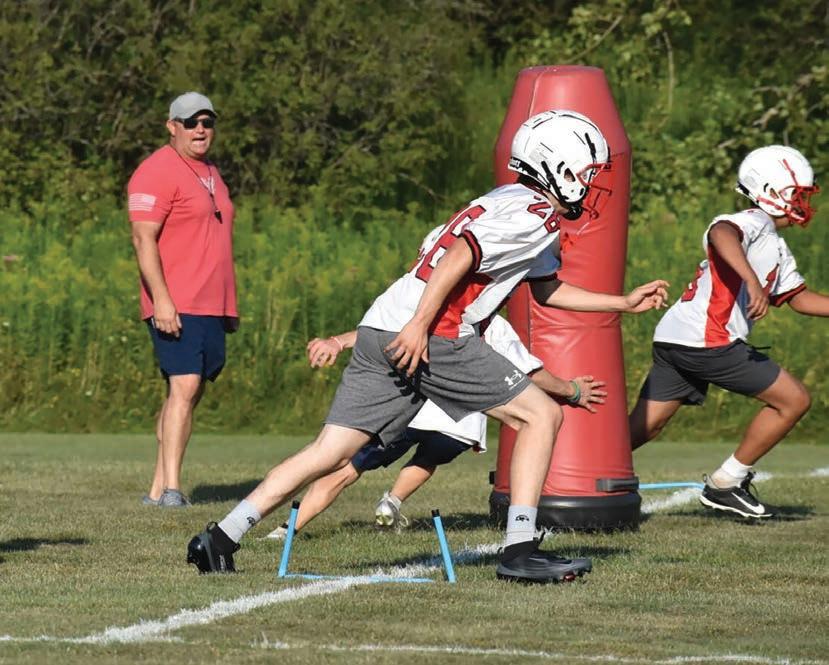
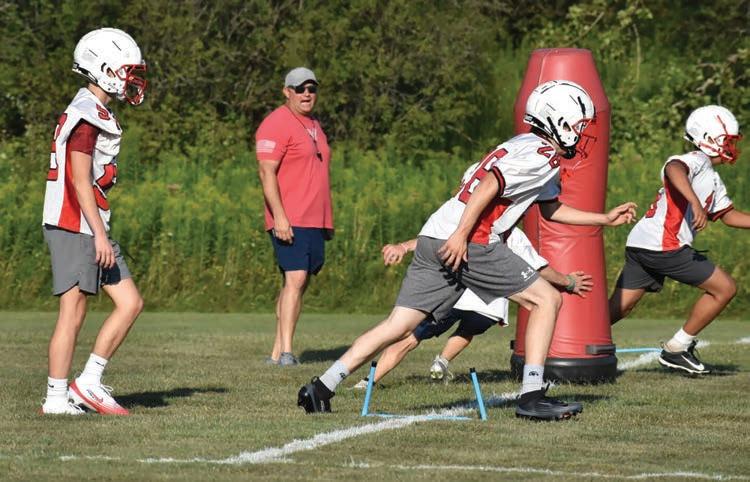
Students from multiple schools already play on the same teams for lacrosse, hockey, football, golf and volleyball.
“The identity around athletics and around the athletic mascot and around the high school has certainly been more minimized over the last few years, because we’ve had to coop,” Callahan said.
That’s the case even though the demographics of students in North Adams and Hoosac Valley are more similar to each other than to those of far wealthier Mount Greylock.
“Mount Greylock was extremely proud of their football team,” Callahan said. “Their football team won a state championship, and then a few years later, they couldn’t sustain a football team, so all of their football players ended up wearing Drury blue and becoming part of the Drury Blue Devils.”
Now students from all three schools are wearing red and playing as Hoosac Valley Hurricanes.
“The kids want to play sports,” Callahan said. “And most of the sports that they play are with friends from other schools anyway, because they play in AAU basketball or they play in other leagues across the county. So they’re not as stuck on this idea of the identity of the mascot or of the high school being their identity as an athlete. That’s more of a community identity. But it is a real challenge, and it’s something that is definitely part of the conversation.”
Callahan said that’s one reason why community engagement will be an important piece of the sustainability study.
Sharing athletics has worked partly because practices take place after school, but programs like band and theater, which also rely on a critical mass of students for success, are more difficult to combine across schools. They take place during the school day.
In her time at Hoosac Valley, Anna Thurston has enjoyed meeting people on the volleyball court, when she played with the Drury team, and has enjoyed meeting students from other schools as part of her work with the Portrait of a Graduate, which aims to give students soft skills prior to graduation.
She sees benefits to closer connections among schools in northern Berkshire.
“If things were more closely knitted to each other, there would be more relationships built with students,” she said. “Probably schools would kind of operate the same and just (be) one big community.”
A Taconic High School television production student practices on the set in the school’s media studio, where students learn broadcasting, editing and on-air presentation skills as part of the career technical education program.
Why are more students turning to vocational education in Berkshire County?
College isn’t the only path: Skilled trades surge as students seek options
Berkshire County vocational schools are expanding trade programs as demand for skilled workers rises statewide. Enrollment in career technical education continues to grow much faster than high school enrollment, o ering students industry credentials, multiple post-graduation pathways, and an idea of how their skills apply in life a er high school.
BY IZZY BRYARS The Berkshire Eagle
During a visit to Charles McCann Technical High School in North Adams, Darin Almeida asked students to imagine a chilling scenario. “It’s Saturday morning, Jan. 3. It’s 6 degrees out. You wake up in your house and your heat isn’t working,” he said. “It’s 48 degrees.”
er, because we’re already overburdened,” said Almeida, noting that the problem is not unique to his company. “Nobody’s coming to your house … that’s where we are right now in our state and in Berkshire County.”
GROWING DEMAND
But finding a technician isn’t as easy as calling them, Almeida said.
“As much as it pains us to tell you this, we’re not going to take you on because you’re not an existing custom-
Almeida asked students what they would do. He offered they would likely search for an HVAC contractor like Laureyns United, where he is vice president.
To meet demand, the major vocational high schools in the county, McCann Technical and Taconic High School, have significantly expanded programs to prepare more students to enter skilled trades.
The number of high school students in Massachusetts remains stagnant, but interest in vocational education has surged. A study by the Boston-based Pioneer Institute found vocational and technical education enrollment increased by 24 percent since 2011. Waitlists can be long, especially in populated areas.
The nonprofit’s study found vocational students accounted for about one-fifth of the state’s public high school enrollment.
Massachusetts vocational schools operate under state law Chapter 74, which requires students to meet academic standards while they complete at least 900 hours in a state-approved trade such as carpentry, metal fabrication or cosmetology.
EXPANDING PROGRAMS
In Pittsfield, Taconic transitioned to a full vocational school in 2018, opening its new building with eight programs. Since, the school has added a program, or shop, every year, with community input and approval of an advisory board. They offer 15 shops
and have applied for a state grant to create a plumbing program.
Administrators at McCann and Taconic said vocational school provides students with the most options after graduation.
A graduate of Taconic’s horticulture program, Principal Matt Bishop said, can enter the workforce immediately with industry credentials, pursue additional training or college with an advantage, or choose an entirely different path.
McCann and Taconic vocational programs are full but don’t have long waitlists.
McCann offers nine programs, including computer-assisted drafting, automotive technology, electricity, culinary arts and multiple growing postsecondary training programs for adults. In 2024, McCann opened the county’s first HVAC and refrigeration program to freshmen; this spring, the now-juniors will be eligible for a coop.
Almeida served on an advisory board that determined the need for the program, and the state awarded
McCann a $3.1 million Skills Capital grant that allowed the school to build the new HVAC/R building and purchase equipment.
Executives and companies, like Almedia at Laureyns, are asking when co-op students will be ready for work.
“I’ve had April 2026 marked on my calendar for almost three years now, waiting for these students,” said Almeida.
Laureyns employs about 15 technicians, and Almeida said he could easily hire 10 more for the work available. “And I’m not alone.”
INSIDE THE SHOP
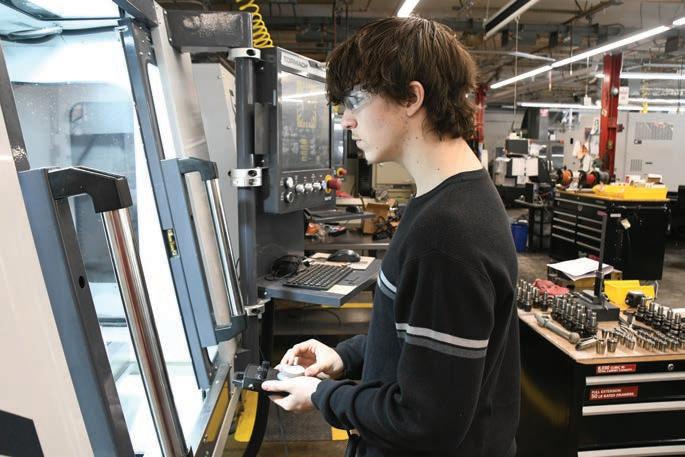
Inside the advanced manufacturing technology classroom recently, freshmen designed parts for their first project — an aluminum bottle launcher they will have to successfully launch on school grounds with the help of 27-year AMT instructor, Scott Botto.
The assignment requires students to learn how to use lathe and mill machines. For one small trigger mechanism, they spent an entire class writ-
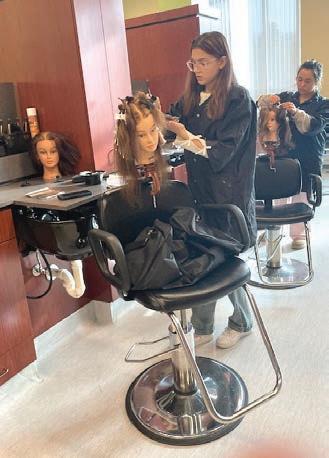
Students in the cosmetology program at Taconic High School practice styling techniques on mannequin heads, gaining hands-on experience that prepares them for state licensure and careers in the beauty industry.
TACONIC HIGH SCHOOL
A Taconic High School welding student works on a metal joint in the school’s shop, where students learn fabrication, safety and industry-standard techniques as part of the career technical education program.
TACONIC HIGH SCHOOL
ing the program, programming the machine and cutting out the part.
“Sophomores could have this done in under an hour,” said Botto, noting the kind of progress he sees each year.
Schools need to update technology and machines to keep up with industry standards, so students learn more advanced technology at a younger grade each year. “What used to be taught to seniors, we are teaching to freshmen,” Botto said.
STUDENT CHOICES
Sophomores Alivia Ostrowski and Hayden Poirot chose McCann for different reasons.
Poirot dreams of making prosthetics. He chose McCann because he thinks it will set him up to be ahead of the curve for biomedical studies.
“I’ve already planned ahead to go into some sort of engineering, and I’ve always wanted to make something helpful for people,” said Poirot. Ostrowski’s dad and aunt attended the school. She was intrigued by the idea of having a certified skill when she graduates, though as of now, she plans to go to college for something other than her trade.
“I will always have something to fall back on,” she said.
Both students said the hardest part has been building confidence to operate expensive machinery.
“These are things you’re going to actually use,” Kratz said. “So, I love the fact that we throw 15-year-olds on $250,000 pieces of equipment.”
CHANGING PERCEPTIONS
Almeida said when he attended Pittsfield High School, vocational students were called “voc-ies.”
Administrators say that perception is changing.
“College is a good option,” said Kratz. “It is a legitimate option. But it’s not the only option.”
Last year, the state’s Department of Higher Education released earnings data of public postsecondary programs that say postsecondary degrees are associated with $20,000 to $30,000 higher compared to a high school diploma. But the field of study mattered.
Five years out of school, health, STEM and trades fields are associated with the highest earnings. In some cases, students with associate degrees in high demand fields like health and trades out-earn those with bachelor’s degrees in lower-paying fields such as humanities and education.
The median earnings of someone with a bachelor’s degree five years out of school were higher in trades professions than humanities, education, and social and behavioral sciences.
Kratz and Bishop said about half of students go on to college, although they are encouraged to start thinking about potential career paths long before senior year.
In a recent poll of 600 Massachusetts residents, conducted by Bostonbased market research and polling company, Opinion Diagnostics, 95.6 percent said they supported expanding access, or adding more seats, to vocational-technical schools.
Officials and local tradespeople said the stigma of the schools still exists, which can prevent students from knowing vocational education is an option.
Running a vocational school is expensive. Equipment must match
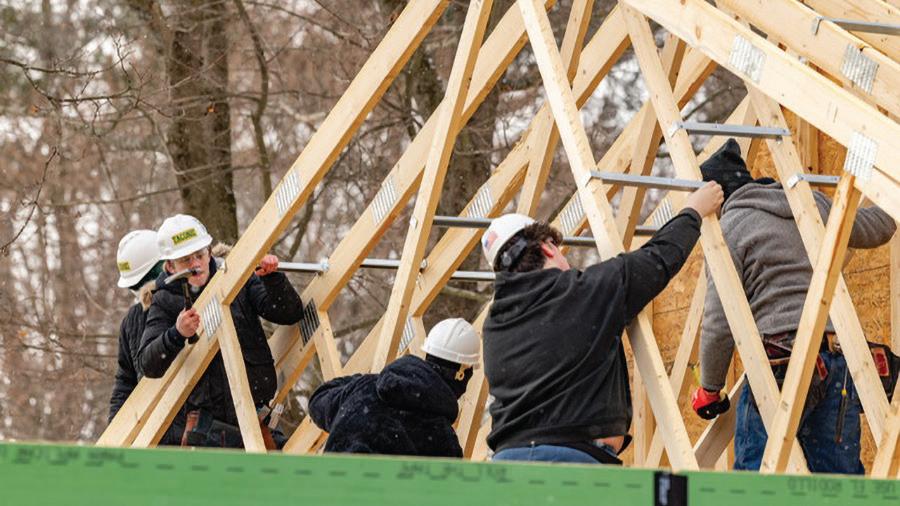
Taconic High School carpentry students assemble
construction for Habitat for Humanity, gaining hands-on
helping build an a ordable home for a local family.
industry standards and requires constant maintenance, culinary programs face rising food costs, and new programs often depend on competitive state grants. Instructors must maintain professional credentials outside the school day — a requirement traditional academic teachers don’t face.
At Taconic, Bishop said “culinary folks put on a restaurant for real guests, cosmetology has real clients, and our automotive program works on real customer cars.”
“If I break my leg, my orthopedic surgeon is my No. 1 person,” Brosnan said. “If the lights go out, it becomes my electrician. If the toilet doesn’t work, it’s my plumber. If my car doesn’t work, there’s nobody on earth today that can fix cars other than trained technicians.”
TACONIC HIGH SCHOOL
roof trusses for a house under
experience while
GILLIAN JONES — THE BERKSHIRE EAGLE Justin Kratz, principal of McCann Technical High School in North Adams, says vocational education gives students multiple options after graduation, from entering the workforce with industry credentials to pursuing college or advanced training.
GILLIAN JONES — THE BERKSHIRE EAGLE
Advanced manufacturing technology students Alivia Ostrowski and Hayden Poirot, both 15, are sophomores at McCann Technical High School in North Adams, where they are learning to operate industry-grade machinery and prepare for careers in engineering, manufacturing and other skilled trades.
in student mental health needs. Money, trained psychologists in short supply
Public
schools need far more psychologists to serve student caseloads, as districts across Massachusetts grapple with rising youth mental health needs and persistent hiring challenges.
BY TARA MONASTESSE
The Berkshire Eagle
Schools nationwide are still struggling to meet students’ mental health needs after the pandemic, and a shortage of qualified professionals isn’t helping — even in states like Massachusetts, which are faring better than most.
In Pittsfield, just four full-time school psychologists serve 4,680 students across 14 schools, far short of the national recommendation of one for every 500 students. The shortage reflects a broader statewide and national trend, leaving districts scrambling for hires and patching together outside services to fill the gap.
NATIONWIDE SHORTAGE
But it’s not a problem unique to the district or even to Berkshire County. Across Massachusetts, the National Association of School Psychologists reported an average of one school psychologist per 663 students for the
2024-25 academic year.
“This is not a Pittsfield issue. It’s a nationwide issue,” said Christine Macros-Guerrero, interim director of social emotional learning and student support at Pittsfield Public Schools. But Pittsfield, she noted, is an especially difficult district to hire for because it carries a large caseload. Pittsfield Public Schools has been trying to increase its school psychologist staff, but finding candidates has been a struggle. Four additional school psychologist positions remain vacant, despite Macros-Guerrero estimating they’ve been open for over a year.
While the district has a comparatively robust staff of school adjustment counselors — 22 across the entire district — who assist students during moments of crisis and provide short-term counseling, school psychologists are still needed to provide assessments for individual education programs, or IEPs, and special education eligibility. Those assessments
can play a key role in addressing mental health issues by connecting a student with the proper channels of support, setting them up for longterm success.
PANDEMIC IMPACT
The pandemic shutdown in 2020, which brought distance learning with it, deprived many students of valuable socialization during key developmental years and exacerbated an existing rise in mental health issues. That increase in need, paired with a nationwide shortage of qualified school psychologists, social workers and mental health professionals, has placed more pressure on existing staff members and made care more difficult for students and families to access.
PATCHWORK SOLUTIONS
Over the past few years, districts across Berkshire County have found creative ways to fill in the gaps. Pittsfield Public Schools receives addi-
tional support from a patchwork of outside agencies, including telehealth services from Cartwheel Care and mental health assessments from contracted psychologists and practices located throughout the state and beyond.
Some districts are also using grant funding to bolster their offerings, though amounts aren’t always reliable. In January, North Adams Public Schools received $44,910 in state grant funding to support school partnerships with local mental health agencies and providers — less than half the amount they received for the same purpose in early 2025.
Despite those workarounds, hiring full-time staff is still a vital way to support students experiencing an unprecedented level of need. But it remains a challenge as Berkshire County school districts struggle to attract candidates with the necessary qualifications.
By working to close gaps in care, administrators hope schools can more
NADIA BORMOTOVA — GETTY IMAGES
Districts across Berkshire County, the state and nation are struggling to hire enough school psychologists to meet rising needs among students.
effectively educate their students while simultaneously destigmatizing mental health care.
“When we’re talking about students, it’s around how can we situate them for learning,” said Latifah Phillips, interim superintendent for Pittsfield Public Schools. “If there are mental health barriers, behavioral barriers, whatever they are, to learning, that’s where we have the vested interest in removing those barriers.”
RISING NEED
Those barriers have become more prevalent in recent years as mental health struggles among youth, already steadily on the rise, continue to increase in the wake of the pandemic. The Massachusetts Youth Health Survey, released every two years, reported in 2023 that about 34 percent of high schoolers said they felt so “sad or hopeless” that they stopped doing usual activities, compared with 27 percent in 2017.
Last spring, the National Alliance on Mental Illness reported that 93,000 adolescents in Massachusetts experience a major depressive episode each year. About 59,000 adolescents in the state experience serious thoughts of suicide each year.
“There’s definitely a high demand for care,” said Morgan Langlois, division director for child and adolescent services at the Brien Center.
Langlois cited anxiety, depression and school avoidance as issues that have become increasingly prevalent among student populations following the pandemic.
“Some of these kids were in their prime development years when the world shut down,” Langlois said. “They didn’t get the opportunity to be in social situations in the schools.”
HIRING CHALLENGES
But in the face of that need, hiring psychologists trained to work in educational settings is more challenging than ever.
The starting salary for a school psychologist at Pittsfield Public Schools is $85,659, according to Phillips. That’s below the annual median wage for a school psychologist — $90,940 as of 2023, according to the U.S. Bureau of Labor Statistics — though there is the potential for a salary increase to $94,575 later, which exceeds that average.
Yet attracting candidates remains a challenge for districts in Berkshire County, which are impeded by their geographic distance from schools that provide the advanced degrees aspiring school psychologists need. The closure of the College of St. Rose in Albany, New York, in 2024 meant the loss of its educational psychology
graduate program, cutting off a key source of new psychologists looking to begin their careers in the surrounding region.
Ashley Benson, a psychotherapist, is the owner of Optimal Healing, a mental health practice based in North Adams that partners with local school districts to provide care. She said certain aspects of the job itself can also serve as a deterrent for would-be candidates.
“I think a lot of people tend to veer away from mental health fields because of insurance complexities,” she said, noting that work with children is often not covered. “It can get very complex in terms of billing and reimbursement.”
Those who do pursue the field, Benson said, can find themselves overwhelmed, especially in districts with large student caseloads and less staff.
“That person is required to do so much,” she said. “They are required to be there for the staff and the teachers. There’s a tremendous amount of pressure on that individual that occasionally goes unrecognized.”
A BETTER RATIO
Courtney Bopp, a school psychologist for Hoosac Valley Regional School District, knows her district is lucky. She’s one of two school psychologists serving 992 students across the district, placing them within the recommended ratio.
“I think having that ratio helps our counselors and psychologists build our relationships not only with our kids, so productive work can be done in our schools, but also with our families,” she said.
Still, she said, external support from programs like Optimal Healing can be valuable even for districts with enough school psychologists. “Because of the number of levels we’re completing, we don’t always have the time to meet with students to build mental health skills,” she said.
TWOFOLD IMPACT
In overextended districts without that support, the damage is twofold: School psychologists facing high caseloads are unable to fulfill their roles effectively, and students struggle to receive adequate care.
“The ability to provide nuanced and attentive support becomes difficult,” said John Crocker, director of the Massachusetts School Mental Health Consortium. “The reality is that it has an impact on staff. It has an impact on the quality and breadth of services you can provide to a population.”
“What results,” he said, “is a lack of services, a lack of care, a lack of student-facing things.”
Why longtime rivals are becoming teammates across Berkshire County
Shrinking school populations and expanding athletic o erings have forced Berkshire County schools to form co-ops in football, hockey and other sports to maintain viable rosters. The shi re ects demographic changes, rising participation in new sports and mounting logistical challenges that are reshaping the local high school sports landscape.
BY JESSE KOLODKIN
The Berkshire Eagle
It was late August 2023, at two separate preseason football practices, when coaches for two longtime rivals,
Drury and Hoosac Valley, both mentioned — offhandedly and independently of one another — that it would not be long before both programs would most likely become one.
Two seasons later, it was an-
nounced that Drury, which already hosted Mount Greylock in a football co-op, would be joining Hoosac in a new, three-team co-op. The result: One team, with enough players from three different high schools.
It was not a surprise to those around high school sports in Berkshire County for the simple reason that every school’s student population has declined over the last 25 years. As a result, shrinking enrollments — along with other factors like school choice and students with other athletic or no athletic interests — have thinned the ranks of studentathletes, and schools have combined some athletic programs in what
is called a team co-op.
BEN GARVER — THE BERKSHIRE EAGLE
Judge Martin, center, was a defensive lineman for Drury in 2022, pictured here in a game against McCann Tech. Martin attended Mount Greylock, but played for Drury’s football co-op.
On Jan. 20, news came that Pittsfield and Taconic — the two largest schools in the county — would form a football co-op for the 2026 season.
JV SQUEEZE
Fewer players hurt junior varsity teams first, as JV squads are often sacrificed to fully roster the varsity team. In turn, when seniors matriculate out, the underclassmen don’t have as much game experience because they were on the bench most of the season, as opposed to playing in JV games.
Many coaches have also said that not having a JV team discourages potential student-athletes from going out, since they know they might not get playing time. Instead, they choose a different sport or don’t play at all.
Pittsfield High is the reigning Western Massachusetts Class B champion in girls basketball, but has not been able to field a JV team for the last two years. Neither Taconic nor Lenox has a JV program for girls basketball, and Mount Everett Regional no longer has a girls basketball team at all.
Hoosac Valley becoming a football co-op in 2025 allowed it to have a JV program for the first time in two seasons. In 2024, the team had 25 players and did not have the bodies to spare for a separate JV roster.
VANISHING TEAMS
Hockey is another sport that has seen a rapid decline. In the 202223 season, Mount Everett fielded a four-team co-op, hosting Monument Mountain, Lenox and Lee.
The next year, the hockey program never came back.
Outside Berkshire County, sports programs are also suffering. After the 2022-23 season, South Hadley’s hockey team went to the Western Massachusetts semifinals but did not return
the following year. The 2023-24 season was the last for Belchertown’s hockey program, and 2024-25 was the last for Southwick’s.
With hockey in particular, a lack of players is only part of the issue. The logistics require an ice rink. Rent-
MIKE WALSH — THE BERKSHIRE EAGLE Pittsfield’s Reese Albano races through a slalom run at Bousquet Mountain, where the Generals now host a co-op alpine ski team with Taconic.
ing enough ice time for practices and games can be difficult. Mount Everett played at a rink at Berkshire School, a private school, and when the Berkshire School underwent renovations, Mount Everett lost rink access. Students from Sheffield to Lenox who want to play hockey now play for Taconic’s co-op.
SHRINKING SCHOOLS
According to data from the Massachusetts Department of Elementary and Secondary Education, the Pittsfield Public Schools district has declined by an average of 81.4 students a year since 2000 — from a districtwide population of 6,908 in 2000 to 4,873 in 2024-25.
With 2,000 fewer students roaming the halls of Pittsfield High and Taconic, the sports teams have far fewer potential athletes to take the court on East Street or the fields on Valentine Road.
In the 2025-26 school year, the Central Berkshire Regional School District has an enrollment of 1,530 students, and Wahconah Regional High School has 446, according to DESE. Ten years ago, in 2015-16, the numbers were not radically different: CBRSD had a population of 1,625 and Wahconah had 552 students. But even a decrease of 100 students can make a difference for a sports team.
Case in point: In the 2015-16 winter season, Wahconah and Taconic had their own ice hockey teams. Taconic also hosted Pittsfield High. By 2018, Wahconah hosted all three, and in 2022, the co-op moved to Taconic because most of the players were from Taconic.
Going back even further, to the early 2000s, Wahconah had more than 700 students and was the premier gymnastics program in Berkshire County.
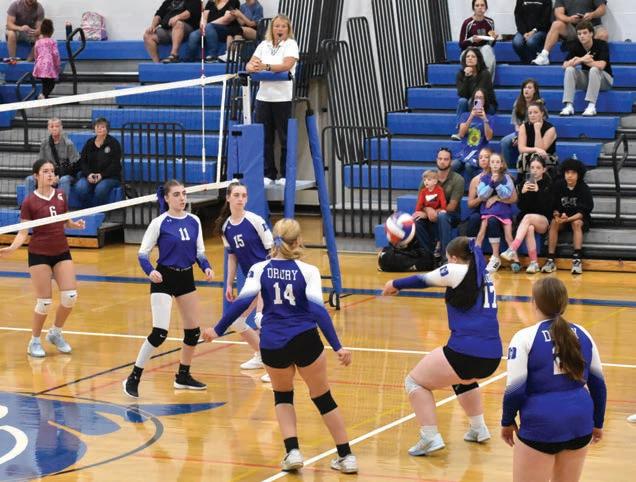
Izzy Tart digs a ball for Drury’s volleyball team. Tart attends Hoosac Valley, but was a member of the Drury volleyball team as a co-op between the two schools.
On Nov. 15, 2003, Wahconah swept a season-ending meet over South Hadley and Hampshire and was preparing for the Western Massachusetts Sectionals.
A week later, Pittsfield High’s Katie Flynn won the all-around title at the Western Mass. sectional, while Wahconah took fourth as a team. The next season, Wahconah no longer had gymnastics.
Berkshire County had a population of 129,028 in 2020, according to the U.S. Census Bureau. In 2010, it was 131,219, and in 2000 it was 134,953. Losing between 2,000 and 3,000 people each decade is a slowdown from the 1970s, when the population dropped 4,000 from 1970 to 1980 (149,402 to 145,110) and almost 6,000 from 1980 to 1990 (145,110 to 139,352).
ZERO-SUM SPORTS
As the county has gotten smaller,
high schools have gained new sports. Varsity athletics are a zero-sum game: The MIAA mandates that a student-athlete can participate in just one varsity sport per season. Every soccer player is someone who cannot play volleyball. Every basketball player is someone who can’t skate for hockey.
As lacrosse has grown in the county in the last 15 years, tennis, baseball and softball numbers have taken a hit as students have more activities to choose from. In 2013, then-newly retired Taconic tennis coach Tom Voisin told The Eagle that tennis was losing popularity to lacrosse.
Lacrosse “is growing by leaps and bounds,” Voisin said. “It’s been marketed really well. You get to carry a stick and hit somebody. What could be better? It’s a great sport.”
That was on May 26, 2013. A few months later, Taconic no longer field-
JESSE KOLODKIN — THE BERKSHIRE EAGLE
Hoosac Valley head coach Marshall Maxwell, a former standout for the Hurricanes, has guided the football program through shrinking rosters and a new football co-op with Drury and Mount Greylock. After a state quarterfinal loss last season, Maxwell acknowledged the challenge facing Western Massachusetts programs: “Trying to find kids is always a challenge.”
JESSE KOLODKIN — THE BERKSHIRE EAGLE
ed its own tennis team. Around the same time, Drury dropped tennis, too. Today, Mount Greylock is the only school in North County that offers tennis. Pittsfield High is the only school in Central County that has it.
NEW CONTENDERS
Lacrosse has continued to grow in popularity, with Mount Greylock, Wahconah and McCann Tech all offering boys and girls teams. Pittsfield hosts Taconic in boys and girls coops, while Lenox hosts South County in boys lacrosse and Lee hosts South County in girls lacrosse. Lenox won back-to-back Western Mass. Class C titles in 2022 and 2023. Hoosac hosts Drury for girls and boys lacrosse, and the Hoosac Valley boys team won back-to-back Western Mass. Class C titles in 2024 and 2025. That co-op also used to include Mount Greylock, before Greylock brought back its program in 2025.
Volleyball has also been rising in popularity, albeit over a longer stretch. Wahconah replaced gymnastics with volleyball in 2004, the same year Mount Greylock had its first varsity volleyball season. Over time, Berkshire County volleyball has grown into a state-level force. Mount Greylock won the MIAA Division V state championship in 2023 and was runner-up in 2022. Lenox went to the
state semifinals last fall and won a Western Mass. title.
Drury had its first volleyball season in fall 2025, hosting Hoosac Valley in a co-op.
CO-OP CALCULUS
Co-ops help keep teams competitive by widening the potential pool of athletes. At the same time, co-ops prevent a single school from having to fill every roster spot.
Pittsfield and Taconic both fielded their own alpine ski teams, and while each had quality skiers, neither had enough depth to win a meet or compete in tournaments.
This year, Pittsfield hosts both schools, and the Generals won the Berkshire League title on the girls side and finished runner-up on the boys side.
Hoosac Valley football went to the MIAA Division VIII state quarterfinals last year and had to trek east to play Randolph. The Hurricanes — a team that included players from Drury and Mount Greylock — lost to Randolph, which went on to win the state title.
After the game, then-Hoosac head coach Marshall Maxwell — a standout Hoosac player in his day — said, “It’s Western Mass., we need to get some kids. Trying to find kids is always a challenge.”
MARC J. WRZESINSKI — EAGLE CORRESPONDENT
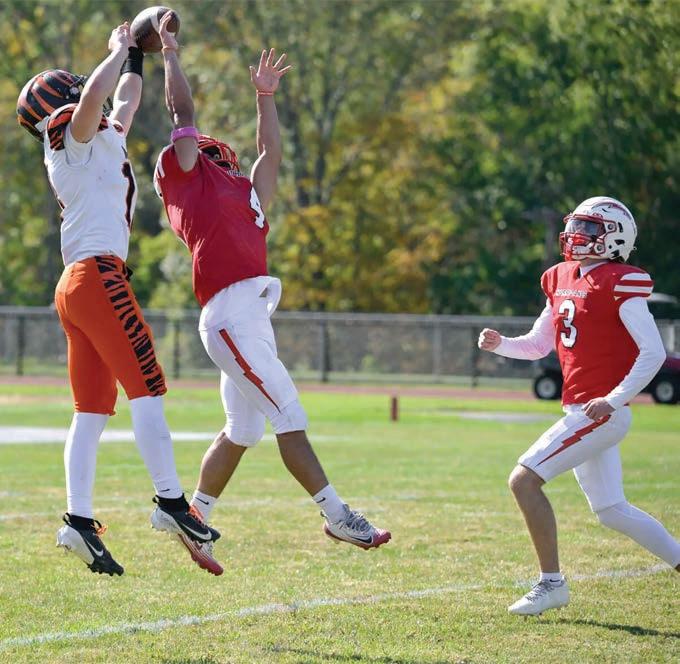
Hoosac Valley’s Julian Feliciano leaps to break up a pass. Feliciano attends Drury, but played for Hoosac in the first year of a three-team co-op comprised of players from Hoosac, Drury and Mount Greylock.
JESSE KOLODKIN — THE BERKSHIRE EAGLE
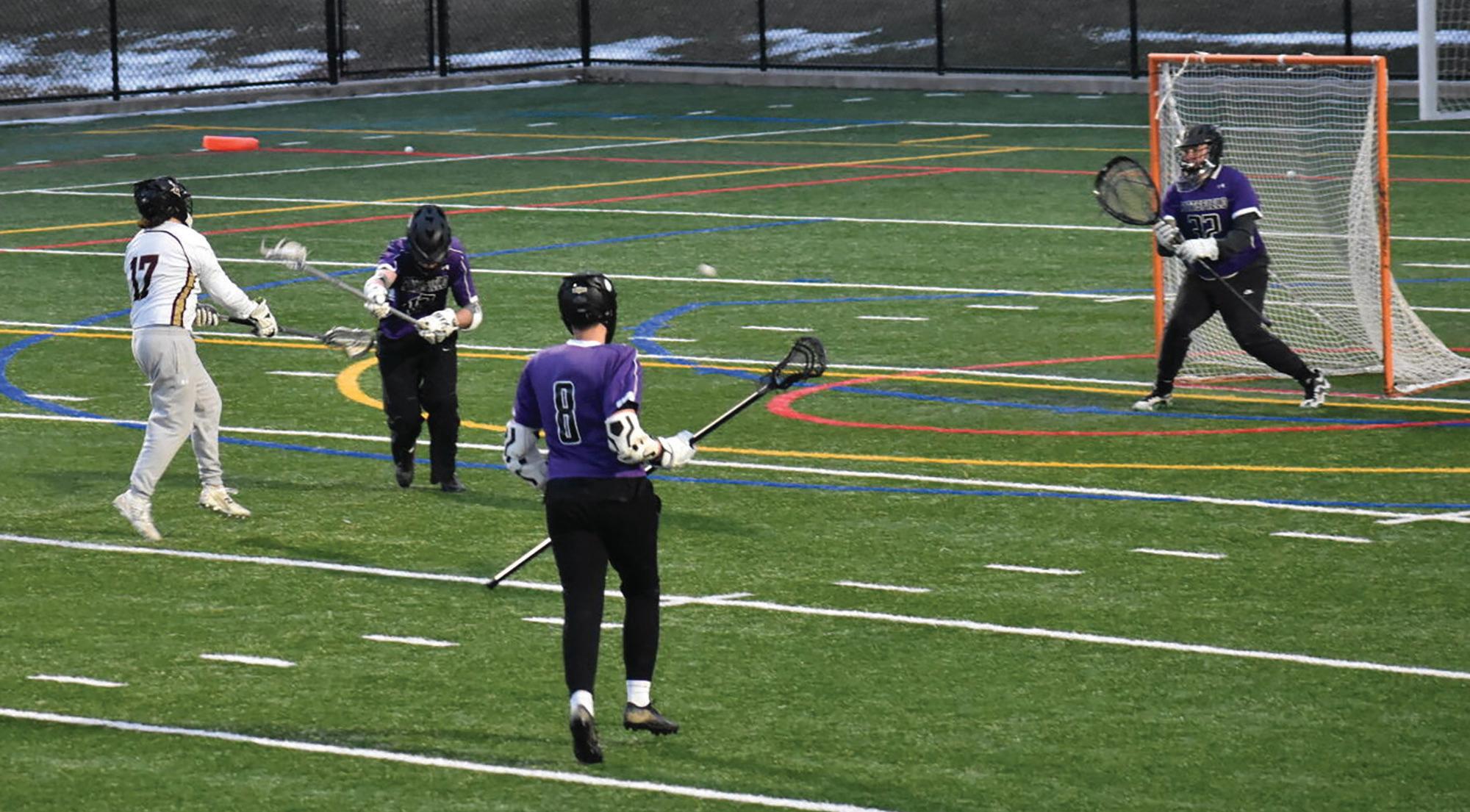
In high school lacrosse, Lenox’s Kitson Stover fires a shot from the slot o a pass from Bronly Boyd in transition. The Lenox boys lacrosse team consists of players from Lenox, Lee, Monument Mountain and Mount Everett. The team faced a Pittsfield team that has players from Taconic as well.
At Lenox’s Du n Theater, students find a stage — and a safe space
A er sta turnover and the pandemic le its future uncertain, the drama program at Lenox Memorial Middle and High School is regaining momentum under theater manager Ryan Bannen, drawing strong student interest and packed audiences at the Du n Theater.
BY CLARENCE FANTO
The Berkshire Eagle
LENOX — For 28 years, the professionally equipped, 500-seat Duffin Theater at Lenox Memorial Middle and High School has been a mecca for concerts, benefits, film festivals, ballet performances and community events such as the annual town meeting.
In 2014, actor and director Ralph Petillo revived what had been a dormant drama program. Students passionate about musical theater then performed in a host of high school musicals over the years ranging from “Pippin” to “Mamma Mia!” and from “Little Shop of Horrors” to “Into the Woods,” along with “Seussical,” “Beauty and the Beast,” “How to Succeed in Business Without Really Trying” and “Shrek.”
But Petillo retired, the pandemic
took place, and staff turnover left the theater program’s future uncertain.
Now, with the Duffin Theater manager Ryan Bannen in charge of the school’s drama course, the slate of annual productions includes not only high school and middle school musicals and Shakespeare plays but also the school Drama Club’s first interactive dinner theater — “Murder on the Menu” — in January.
The event resulted in a packed house.
So, more cafeteria-based productions are very likely, using student’s improvisatory skills interacting with the audience, said Bannen.
When Lenox Schools Superintendent William Collins began his tenure in July 2023, one of his priorities was stabilizing and revitalizing the drama program, part of the school’s arts department, by hiring Bannen for a full-
time role as manager of the theater and drama director.
“It’s been a fantastic move,” Collins said, crediting Bannen’s passion for theater and his rapport with students.
“Most important, it’s a safe space for kids to find out who they are,” said Bannen, “by not being ridiculed for standing out and trying something new to them. It’s important to me to make sure that environment stays.”
Bannen, a native of Saugerties, N.Y, who lives in Clarksburg, has several film and TV acting credits. He began working at Lenox Memorial in the summer of 2023, dividing his work week between managing the theater space and reviving the school drama program.
Bannen majored in theater and English at Le Moyne College in Syracuse, N.Y., graduating in 2014. Then, moving close to New York City for au-
ditions, he performed in films, commercials and music videos — “anything to pay the bills,” he said.
“The two positions at the school work hand in hand,” Bannen said.
Bannen said students are interested in performing as well as learning the technical aspects of a professional theater.
In addition to producing a musical each spring, students participate in two annual middle school Shakespeare productions overseen by Shakespeare & Company professionals. This month, it was “A Midsummer Night’s Dream” and this spring, for the first time, students will work on a set of five, 10-minute plays with guest directors.
“Lenox students are very busy and they like to get involved in a lot of things,” Bannen said. “I think it’s great, personally, so I tell the students that as long as you’re honest with me about your commitments and conflicts, I’ll work around your schedule. It’s doable.”
As he pointed out, “the kids we attract to theater want to see everyone succeed and that is my mission as well. It’s such a valuable thing for students to experience this and be part of
Ryan Bannen, manager of the Du n Theater and director of the revitalized drama program at Lenox Memorial Middle and High School, emphasizes that “the kids we attract to theater want to see everyone succeed and that is my mission as well. It’s such a valuable thing for students to experience this and be part of an ensemble, because it does create a community.”
PHOTO CONTRIBUTED BY COURTNEY GILARDI
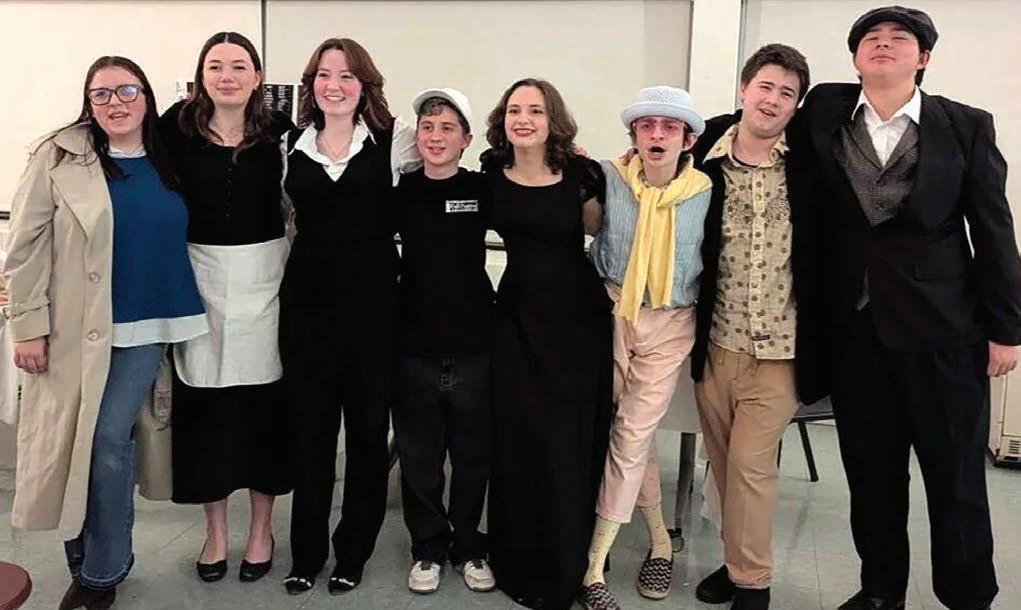
For the Lenox Memorial Middle and High School’s drama program, a new attraction this winter was the first dinner theater production, “Murder on the Menu.” Among the cast members for the sold-out show on Jan. 31 were Kaitlin Mott, Emma Lane, Emily Rosen, Connie Gordon, Amelia Coco Gilardi, Rhys Claburn, Grayson Moore and Matthew Bazinet.
CLARENCE FANTO — THE BERKSHIRE EAGLE
an ensemble, because it does create a community.”
The upcoming production at LMMHS, on March 21, 22, 28 and 29, will be “Disney’s The Little Mermaid.” Ironically, several student actors are on the high school swim team, requiring the schedule adjustments Bannen is dealing with. “I just stay organized, and we make it work,” he said.
While the show was among students’ suggestions, Bannen emphasized that he examines “the message of the show itself.”
“I look at the target audience and what they’re going to walk away with — following your dreams, even if you don’t fit in, it’s OK to go against the norm,” Bannen said.
Last spring, the high school show was “Disney’s Freaky Friday,” which includes themes such as parental and student relationships.
Bannen acknowledged that the highly competitive auditions for the musicals “can be cruel, it’s definitely tricky. But it’s important to show students what auditions are like. I try to take away focusing on becoming the lead, because the ensemble is just as important as the leading roles.”
When disappointed students reach out, he said, “I try to be honest with them about why I thought they were
fit for this role instead of that role. If you have the conversation and try to explain it, for the most part I’ve had positive feedback. But it does get competitive.”
Bannen acknowledged that “it’s uncomfortable to put yourself out there the first time you do it, but if you’re with their friends and your peers and they’re encouraging you, you’re more likely to grow.”
Superintendent Collins suggested that for students, “it’s a time of exploration, learning and finding out who they are and interacting with others. Building critical skills don’t just happen within the four walls of classroom instruction. Whether it’s sports, theater or one of the umpteen clubs we offer, it’s about having a wellrounded experience and being able to do things in a safe space.”
He also pointed out that the goal is to use the Duffin Theater to its fullest benefit for students and the community.
“I can’t imagine LMMHS without the theater,” said Collins.
Collins praised Bannen for exceeding his expectations and for revitalizing the Duffin Theater and the drama program.
“There’s excitement among the kids that they have somebody to champion and he does a really nice job advocating for the program,” Collins said.
EISNERDAYCAMP
SESSION
From setbacks to gains, Berkshire schools chart uneven comeback after the pandemic
BY GREG SUKIENNIK
The Berkshire Eagle
Six years after COVID-19 turned education on its ear, recovering from the impacts of the pandemic — especially social and emotional learning deficits brought on or worsened by isolation and pandemic-related trauma — remains a work in progress.
An Eagle review of Department of Elementary and Secondary Education data for grades 3-8 at districts with enrollment large enough for statistical comparisons shows schools countywide still are working to regain lost ground. The data also shows districts with significant economic challenges and difficulties overcoming chronic absenteeism have found that recovery more difficult.
The Southern Berkshire Regional and Central Berkshire Regional school districts were among those honored in December as among 63 districts whose MCAS scores had met or exceeded pre-pandemic levels.
That said, even Lenox, which has the county’s lowest percentage of economically disadvantaged students in Berkshire County, has yet to see its elementary and middle school students equal MCAS results from 2019. Its 2025 English language arts results came close — 62 percent meeting or exceeding standards, compared to 68 percent in 2019.
For Southern Berkshire, it was a sharp improvement for middle school students at Mount Everett Regional School: an initial fall from 28 percent meets or exceeds in math in 2019 to 10 percent a year later, and then steady improvement to 41 percent in 2025.
Mount Everett still is working its way back in English language arts, where meets and exceeds scores are up to 42 percent in 2025, but not yet back to the 53 percent charted in 2019.
“It wasn’t an overnight process. We’re super proud of our students and our educators,” Sarah Tetreault, the district’s director of curriculum, instruction and professional development, told The Eagle in December.
Tetreault said the district shifted its math curriculum to one more closely aligned to state standards and designed to support grade-level learning and engage students while addressing learning gaps, particularly those that widened during the pandemic.
Nessacus Regional Middle School,
While several Berkshire districts have restored elementary and middle school MCAS scores to 2019 levels, disparities tied to poverty and absenteeism continue to shape the region’s long path back from pandemic learning loss.
which serves grades 6-8 for the seventown Central Berkshire district, went from 40 percent meets or exceeds in English in 2019 to 53 percent in 2025, and recovered from 41 percent on math in 2019 to 42 percent in 2025.
Nessacus Principal John Vosburgh said the school made curriculum changes allowing for more targeted intervention for students needing help with educational concepts and skills. The school also doubled down on improving chronic absenteeism, working closely with families to understand the reasons kids are missing school and finding solutions. The state offers practice tests for all grades at mcas.onlinehelp.cognia. org/practice.
HANDS-ON LEARNING
Meeting state standards on a test doesn’t come solely from rote memorization. It also depends on bringing the material alive for children. At Ergement, a grant allows fifth-grade teacher Judy Callahan to welcome Mass Audubon to classrooms for hands-on instruction on water quality standards, in which the students make their own water filters.
Later this spring, she’ll reinforce the lesson with a visit to Pleasant Valley Wildlife Sanctuary in Lenox. “They will actually test the water quality, collect samples, again, do everything they did in the classroom, but now in a real-life situation, to prove that the water in Pleasant Valley is of good quality,” she said. “So that’s getting out of the classroom, and there’s kind of a fun element that goes with that.”
Said principal Vosburgh: “We have some kids who struggle, and we’re able to utilize the resources that we have, mainly people, to do interventions at the right time with the right kids in a meaningful way. And I credit those folks who are where the rubber hits the road for having the biggest impact on all of this.”
Nessacus and Mount Everett were among 63 districts recognized for their performance and a dozen districts selected to present their instructional strategy during a Department of Elementary and Secondary Education conference Dec. 2 in Marlborough.
Hoosac Valley, with 52.4 percent of students characterized as disadvantaged and 65.5 percent deemed “high needs,” has yet to return to its 2019 MCAS performance. In 2019, 25 percent of students in grades 3-8 met or exceeded standards in math, and 33 percent in English language arts. In 2025, the percentages were lower: 13 percent in math, and 20 percent in English language arts.
But there were gains at Hoosac, too: In science, 28 percent of students grades 3-8 met or exceeded the state standard in 2019. After a three-year drop, the district reported 31 percent meeting or exceeding standards in 2024, and 26 percent in 2025.
In 2023, based on factors including test scores and attendance, Hoosac’s middle school program was designated for targeted support and improvement by the state. Dean is proud of how the school moved from the 8th percentile to the 16th percentile by 2025, shedding its designation in two school years.
“Considering all we’ve had to do it is a tremendous achievement,” Dean said. ”We’ve built a lot with our science programming and we’re seeing the results of that.”
ATTENDANCE TURNAROUND
Reducing chronic absenteeism at Hoosac from 45.3 percent in 2023 to 23.3 percent in 2024 — and retaining that progress the next year — also played a significant role. The improvement was even more dramatic at the high school, where chronic absenteeism — missing 10 percent or more of the school year — dropped from 54.8 percent in 2023 to 33 percent the next year.
Because chronic absenteeism is caused by any number of factors, improving attendance starts with “building relationships and trust with families,” Dean said, echoing what school leaders have said about strategies. Sometimes that extends beyond home and into the school – for example, scheduling advisory periods first thing in the morning, so students with anxieties can acclimate and get off to “a calm and consistent start.”
“It’s a lot of work to build connections with families. But really it’s the only way to make progress with attendance,” Dean said.
The COVID comeback in Pittsfield is more complex, given that the district — the largest and most diverse in the county by any number of measures — operates schools with very different levels of student need.
Overall, Pittsfield’s 2025 grade 3-8 math scores — 25 percent meets or exceeds — came close to the 28 percent the district reported in 2019.
Pittsfield has a national blue ribbon school in Williams Elementary School, and a state school of recognition in Egremont Elementary School — both on the city’s suburban southeast side. But it also has multiple schools in the bottom 10 percent of DESE’s accountability ratings. And the schools struggling the most are those served by federal programs intended to bridge the gap for students from economically disadvantaged backgrounds.
MIDDLE SCHOOL OVERHAUL
A significant effort to address this is underway: a thorough reinvention of the city’s middle school program, intended to address inequity, improve academic outcomes and reverse its outflow of school choice students. Starting next fall, the district will send all fifth and sixth graders to Herberg Middle School and all seventh and eighth graders to Reid Middle School. Those schools, built during the postwar boom, have always been tied to the city’s geography, right down to their original names — North (Reid) and South (Herberg) Junior High.
It’s hoped the change will provide more support for students who need assistance, accelerated opportunities for students seeking additional challenges, and additional electives and enrichment in music and arts. It’s also hoped that leads to im-
The academic benefits of a music education
A classroom can be a formative space for children. In a healthy classroom environment, children can discover passions for a wide range of interests, including music.
Music education is a vital component of a well-rounded academic experience. Unfortunately, music education programs in public schools are often among the first cuts to be made when funding issues arise. For example, a 2018 report from the American Federation of Teachers indicated that 42 percent of schools in Georgia eliminated art and music programs in the aftermath of the recession that struck in 2008-09. Budgetary constraints pose significant problems for educators and administrators. However, an examination of the many benefits of music education may compel more parents, teachers and education professionals to advocate for the continued inclusion of music education in school curricula.
• Music can contribute to improved academic performance in other subjects. Some may feel that music education takes time away from other subjects that students will need to master to fulfill their academic potential. However, a 2019 study published in the Journal of Educational Psychology found that high school students who take music courses score significantly higher on exams in certain subjects, including math and science, than their peers whose
Uneven Comeback
FROM PAGE 22
provements that help reverse the exodus of families pursuing school choice, charter schools and parochial schools over concerns about academic performance and problem student behaviors.
The proposal goes back to former Superintendent Joseph Curtis and an appointed Middle School Restructuring Committee. Interim Superintendent Latifah Phillips has embraced the ambitious proposal.
“This is a risk for us,” Phillips told
curriculum does not include music education.
• Music education can facilitate language development. A recent study from researchers in Beijing found that piano lessons improved kindergartners’ ability to distinguish different pitches, which in turn led to improvement in the youngsters’ abil-
the Pittsfield School Committee in December. “We’re taking a risk as well to put something on the table better for our students, many students who don’t have advocates for their circumstances.”
Moving forward now, she said, helps the schools gain the means to tailor interventions for students falling behind, balance classrooms with social and economic diversity in mind, and curate teaching staffs with a more balanced mix of experienced and new teachers.
Data from grade 10 MCAS tests now comes with a caveat: After the state’s voters decided to remove a minimum MCAS score as a graduation require-
ity to discriminate between spoken words. That’s perhaps not too surprising to researchers, as Play Matters Australia reports that music and language share various structural similarities, including rhythm, pitch and tone. Children who engage in music play and education strengthen the same neural connections neces-
ment in 2024, the 2025 grade 10 test scores dropped. Many believe that students, aware a minimum score no longer separated them from a diploma, didn’t take the test as seriously. Across the county, the results bear that out.
In math, Lee, Berkshire Arts and Technology (BART), Wahconah and Mount Greylock posted 10th grade scores in 2023 and/or 2024 that met or exceeded pre-pandemic performance, but saw scores fall in 2025. The same was true of English test results at Lee, Lenox, Pittsfield High, Taconic, BART, Monument, Mount Greylock and McCann Tech.
sary to process language.
• Music education provides a workout for the brain. Dr. Eric Rasmussen, who chairs the Early Childhood Music Department at Johns Hopkins University, notes that children who engage in music and music education have larger growth of neural activity than those who do not participate in music training. That’s because playing music requires musicians to use more of their brain than they otherwise might. That workout pays notable dividends, and one study led by researchers at Boston College found that children who underwent 15 weeks of music instruction and practice experienced improved sound discrimination and fine motor tasks. Music education programs are often first on the chopping block when school budget decisions are being made. However, the multifaceted benefits of music education suggest children have much to gain from the continued inclusion of music programs in school curricula.