to the many people, businesses and organizations whose contributions make this event possible:
Volunteers - in the hundreds
Sponsors - the backbone
Donors & Friends of Harris Hill – true blue
In-kind supporters - people, time, equipment, expertise
The Organizing Committee - all-volunteer Spectators - who bring the event to life
Competitors – who provide the thrills
Harris Hill Notoriety
2020 One of Vermont’s Top 10 Winter Events (Vermont Chamber of Commerce)
2019 One of New England’s Top Winter Events (Yankee Magazine)
2018 One of the Top 100 Winter Events in the U.S. (Outside Magazine online)
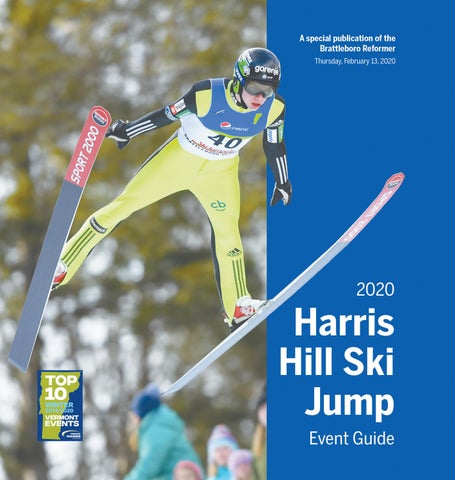
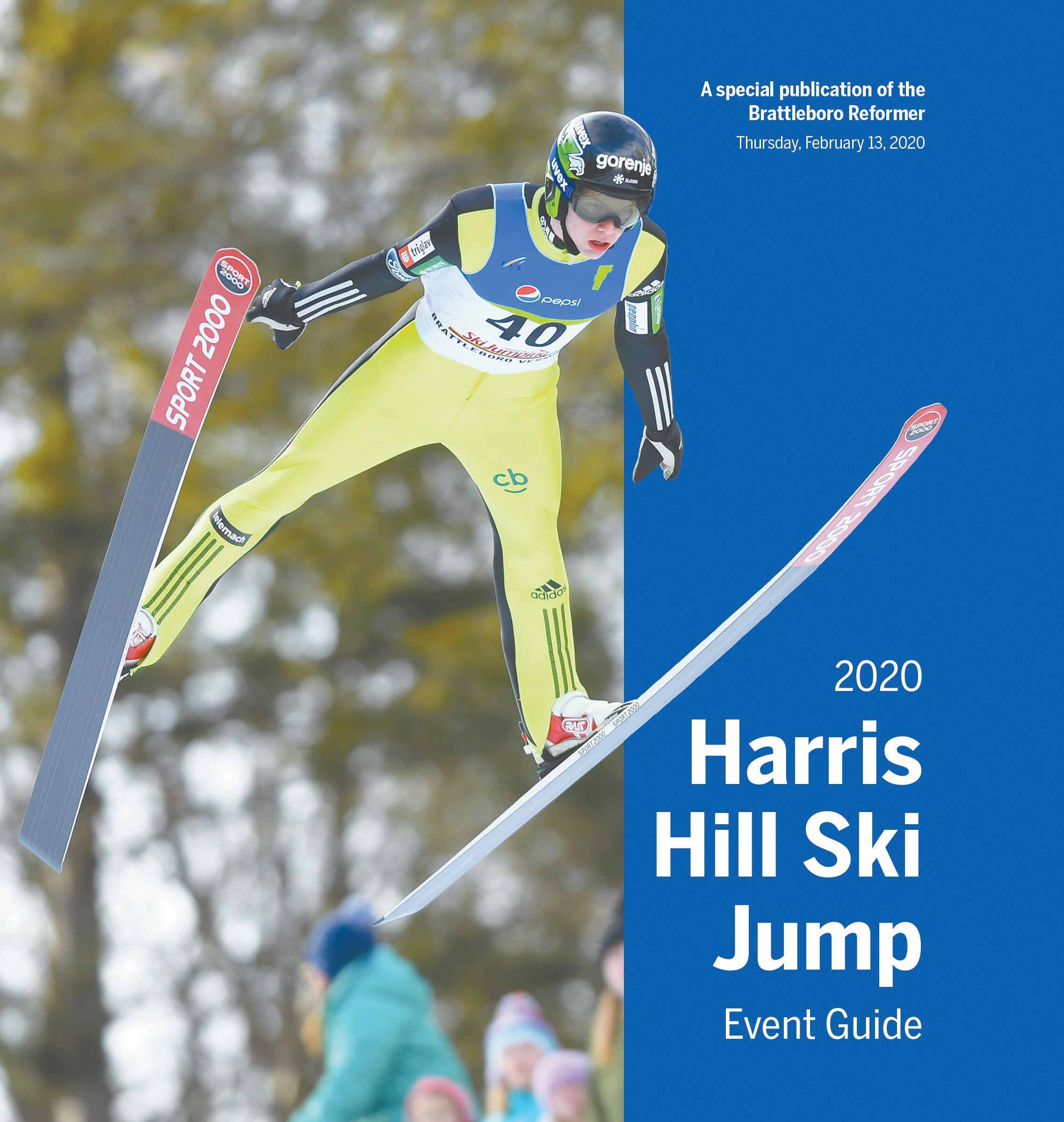
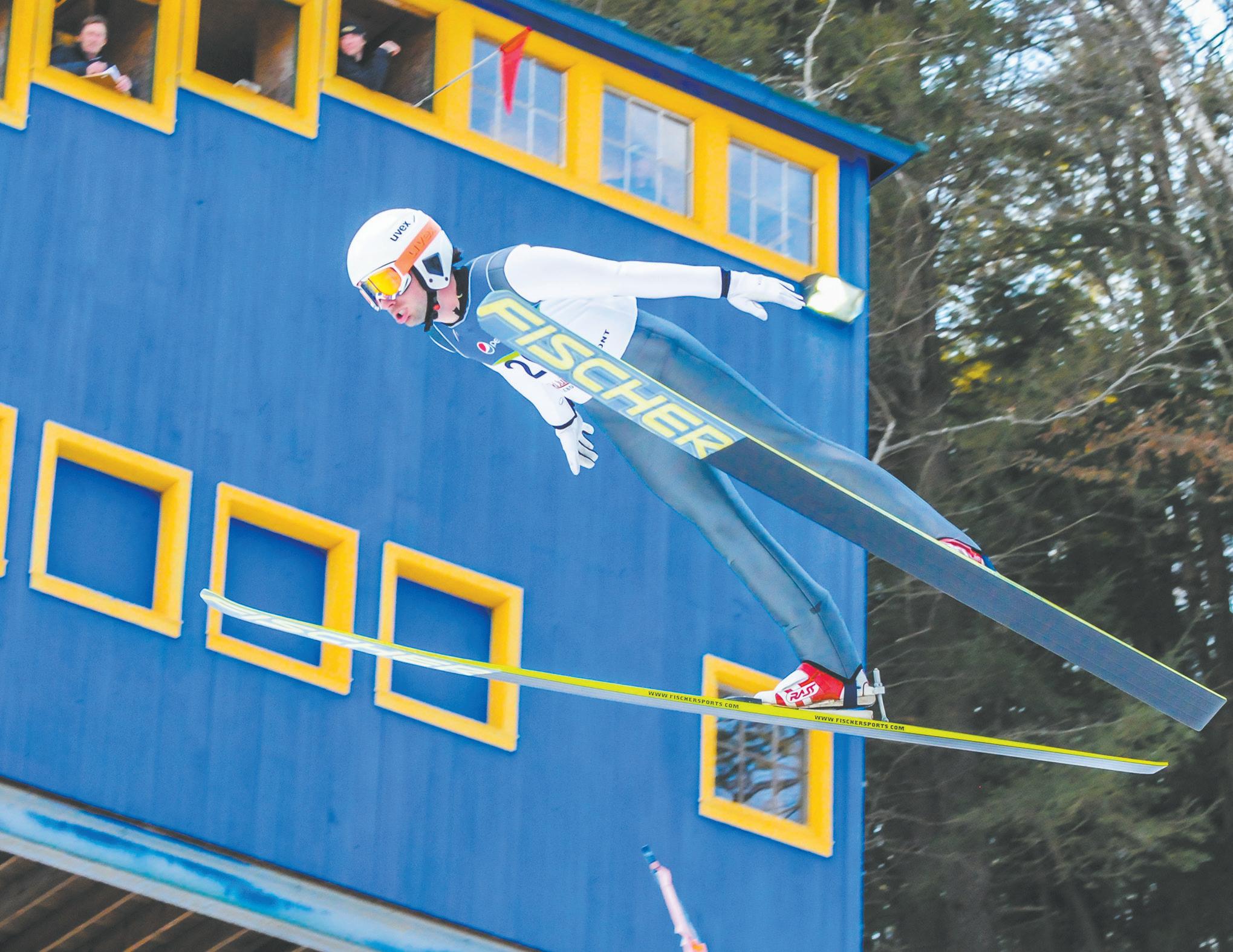
On the cover: Slovenian Blaz Pavlic is the current hill record holder and winner of the 2019 Fred Harris Memorial Tournament. Photo by Steve McLaughlin
Dear Friends,
This weekend Harris Hill Ski Jump comes alive once again as spectators from near and far delight in two days of breath-taking ski jumping. It’s a familiar, fun, iconic weekend that’s been a competitor and spectator favorite for nearly 100 years. Music, food, bonfire, beer tent and the ring of cow bells set a festive tone as we watch jumpers soar at speeds up to 60 miles per hour.
But wait! There’s more!
The excitement mounts this year as two, two-time Harris Hill Ski Jump winners each vie for a third victory and the right to retire the coveted Harris Hill Winged Ski Trophy. The trophy has been retired only 5 times in the event’s near 100year history, most recently in 2000. Brattleboro’s own Chris Lamb, who set a hill record of 102 meters (335 feet) returns to go head to head with the current record holder, Blaz Pavlic of Slovenia who holds the current hill record with a jump of 104 meters (341 feet).
We will be holding our breaths. We think you will be too!
Kate
McGinn & Liz Richards Co-Directors
PHOTO BY STEVE MCLAUGHLIN
Harris Hill Ski Jump Competitors: 2020
United States
Tess Arnone
Sam Arquit
Alexa Brabec
Cooper Dodds
Cameron Forbush
Tate Frantz
Jacob Fuller
Seth Gardner
Gunnar Gilbertson
Mason Gorski
Zak Grzesik
Logan Gundry
Stewart Gundry
Rachael Haerter
Caroline Harrison
Henry Johnstone
Spencer Knickerbocker
Stewart Kocher
Chris Lamb
Cara Larson
Jack Lawrence
Beckett Ledger
Landon Lee
Elise Loescher
Niklas Malacinski
Evan Nichols
Max Nye
Macey Olden
Aidan Ripp
Zachary Selzman
Cameron Summerton
Adeline Swanson
Canden Wilkinson
Mason Winter
Caleb Zuckerman
2020 Schedule and Information
Competition Schedule
Saturday, February 15, 2020: Pepsi Challenge & US Cup
10:00 a.m. Gates open Jump Training
11:30 a.m. Opening Ceremonies
12:15 p.m. Trial Round
1:00 p.m. Round 1
1:45 p.m. Round 2
2:30 p.m. Target Jump (Top 10)
Award ceremonies following event at the base of Harris Hill
Sunday, February 16, 2020: Fred Harris Memorial Tournament
10:00 a.m. Gates open Jump Training
11:30 a.m. Opening Ceremonies
12:15 p.m. Trial Round
1:00 p.m. Round 1
1:45 p.m. Round 2
2:30 p.m. Target Jump (Top 10)
Award ceremonies following event at the base of Harris Hill
For general information call: 802-254-4565
LOCATION
Harris Hill Ski Jump is located on Cedar Street in Brattleboro, VT. Take VT Exit 2 off I-91 and turn left (east) at the end of the ramp. Drive 1 mile and turn left onto Cedar Street.
If you are coming from the north on Route 30, Cedar Street will be ONE-WAY during the event and not accessible for entry off of Route 30. Follow signs into town (Main Street to High Street to Western Ave) to enter from the south.
PARKING
Austria
Tobias Kerschhaggl
Simon Viehhauser
Slovenia
Zak Lubej
Blaz Pavlik
Urh Rosar
Zak Silih
Free parking is on-site at the hill in the field. NOTE: the field may be muddy and/or very bumpy. If you have a small or a “low to the ground” vehicle, please keep this in mind. There is additional parking at the Brattleboro Retreat and Retreat Farm on Linden Street (Route 30) with a free shuttle bus to the venue.
WEATHER
It’s Vermont in February! For those who aren’t used to New England winters, it can be unpredictable, so it’s always best to dress in layers. Snow gear is highly recommended: waterproof boots, hat, gloves, long johns, etc. If it’s warmer, you can always peel off the layers! Our beer tent is heated so you can warm up, but please prepare for the elements.
Board of Trustees
Patricia Howell, President
Liz Richards, Vice President/ Co-Director
Sandy Harris, Secretary
Gail Bourque, Treasurer
Tom Durkin
Todd Einig, Chief of Competition
Kate McGinn, Co-Director
Andrew Rome
Sally Seymour, Competition Secretary
The Organizing Committee
This all-volunteer group works year-round to put on this twoday winter sporting event. The committee is comprised of people who have a passion for ensuring that this extraordinary tradition continues. The group includes former jumpers, coaches, specialists in hill maintenance and grooming, people skilled in professional sports announcing, marketing, communications, and operations management.
Vermont’s Harris Hill boasts a high-flying history
SOUTHERN VERMONT
The Brattleboro landmark is the only Olympic-size ski jump in New England and one of just six of its height in the nation.
By K evin O’COnnOr
When Blaz Pavlic broke the long-distance record of Brattleboro’s Harris Hill in 2017 with a 104-meter jump, he gave thanks to a higher power.
“The headwind helped me,” said the two-time-winning Slovenian, who’s set to return this February in hopes of reaping a trophy-retiring third victory. “It lifted me up, and then I just said, ‘Go for it.’”
Pavlic also had a little assist from history.
A nearly a century ago, Vermonter Fred Harris was a young contemporary of the Wright brothers — inventors of the airplane in those dizzyingly heady days of the early 1900s — when the college student first strapped wooden slats to his feet and catapulted off a snow-covered ramp.
“Broke my skis all to pieces,” Harris penned in his diary.
But two more boards brought two more tries.
“Fell twice,” he wrote.
But again, persistence.
“Tried jump several times, and at last made it,” Harris finally proclaimed. “Hurrah! twice Oh! ye! Gods!”
If only Harris could foresee what it all would snowball into.
When the Brattleboro native built the Harris Hill ski jump in his hometown in 1922, he needed only a few boards for a launchpad
and two more to lash to his boots to leap off a peak 30 stories high at speeds of up to 60 mph.
But to attract a current-day crowd of world-class athletes and several thousand spectators, a nonprofit group of volunteers had to raise nearly $600,000 to rebuild the venue — now the only Olympic-size ski jump in New England and one of a mere six of its height in the nation.
That’s just the latest wrinkle in a continuing story of rising above seemingly insurmountable odds.
Neither “skiing” nor “ski jumping” were household words in the United States when Frederick Henry Harris — a sportsman turned stockbroker who lived from 1887 to 1961 — “early saw the light and, gathering disciples to himself, began to preach a gospel,” the late historian Frederick Van de Water once wrote.
A pioneering “extreme skier,” Harris is credited with making the earliest slalom descents of Mount Washington in New Hampshire and Whiteface in New York. Harris founded the Dartmouth Outing Club — the first such organization of its kind in the country — in 1909, then created the Brattleboro Outing Club in 1922, the same year he built the ski jump with $2,200 of his own money.
“The inaugural Brattleboro Ski Jump, held on Feb. 4, 1922, served as the first Vermont State Cham-
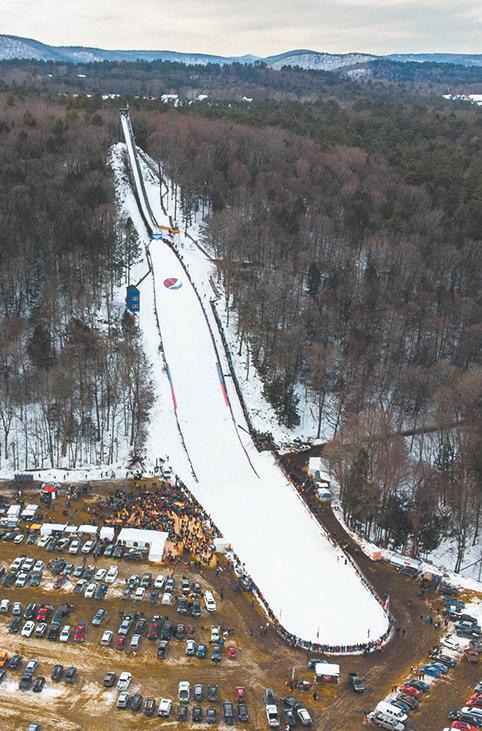
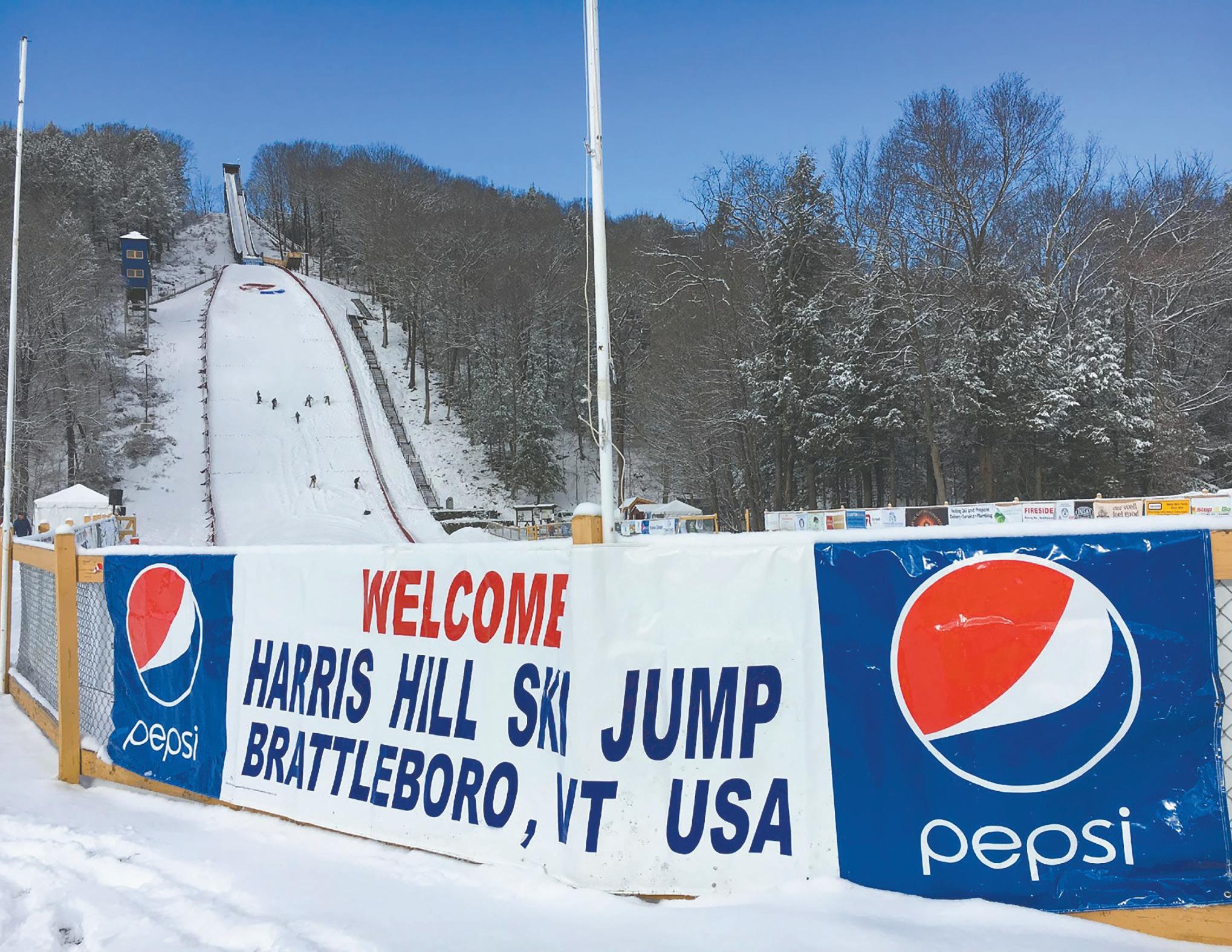
The Harris Hill Ski Jump in 2019, as seen from above. PHOTO BY JUSTIN ALTMAN
pionship and drew over 2,500 spectators,” reads a hillside tribute sign headlined “The Genius, Genesis and Enduring Legacy of Fred Harris.”
In his 1941 book “Winter in Vermont,” author Charles Crane cited only one credential for his sports chapter: “I knew Fred Harris, and Fred knew all. Harris was more than a prophet and exhorter; he was a practical and doggedly determined leader, and he made his dream come true.”
Since its opening, Harris Hill has hosted nine national championships, starting in 1924 with the first finals held in the East and continuing up — “aside from a few hardscrabble years when winter was barren and when World War II raged,” the tribute sign says — to the U.S. qualifiers for the 1992 Winter Olympics in Albertville, France. At its zenith in 1951, the jump set athlete and attendance records with 168 sportsmen and 10,000 spectators — fittingly, on the day the facility was officially named “Harris Hill.”
Back before liability insurance and high school hockey, local teenagers considered the sport as common as football, basketball or baseball. Dana Sprague knows the jump both as a past athlete up on the launch and as its present historian and photographer down on the landing.
Sprague can tell you the hill’s Winged Ski Trophy has been retired by five jumpers who each won at least three times — Torger Tokle of Norway in 1942, his brother Arthur Tokle in 1951, Art Devlin of Lake Placid, N.Y., in 1957, Hugh Barber of Brattleboro in 1974 and Vladimir Glyvka of Ukraine in 2000.
(Another one of Sprague’s don’t-try-this-at-home tidbits: “In
1927,” his timeline reports, “Reginald and Carol Kendall of Norwich take a toboggan off Harris Hill and through a flaming hoop.”)
But natural tree-lined hills like the one Harris cleared by hand eventually gave way to metal towers with slick plastic ramps that don’t need help from Mother Nature. The local jump’s survival is due less to its storied past than to the ongoing support of its present caretakers.
Volunteers added a snowmaking system in 1985 (thanks to the Mount Snow ski area in West Dover) and a new $20,000 judging stand in 2003 (courtesy of the Brattleboro Rotary Club).
In 2005, as the late Harris was inducted into the Vermont Ski and Snowboard Museum’s Hall of Fame, a 16-year-old Slovenian borrowed another jumper’s skis (an airline had lost and then broken his) to continue the founder’s tradition and fly off with that year’s annual tournament.
Soon after, the U.S. Ski and Snowboard Association, concerned less with the hill’s history than its seemingly antique wooden takeoff, ruled the jump unsafe and refused to sanction any more competitions.
The venue sat unused for three winters as volunteers sought designs and dollars not only to replace the tower but also to add a steel launch ramp, peak-to-parking lot staircase, required safety features and water and electrical fixtures for snowmaking.
Volunteers feared that funding 50 tons of steel and 160,000 pounds of cement was too big a leap, even with generous community giving. Miraculously, they received an unsolicited $130,000 from a foundation that asked to remain anonymous.
“How many times have rookies
like us, who are doing this completely pro bono with little fundraising background, wished for one angel donor who would just rescue them?” volunteer Patricia Howell said upon receiving the gift in 2008.
Supporters would reap a total of nearly $600,000 to reopen the hill in 2009. Spencer Knickerbocker was a 16-year-old Brattleboro Union High School sophomore when he made history of sorts by being the first athlete to test out the 90-meter jump before its grand reopening.
“I think it was important to have a local do it,” Knickerbocker said after his successful flight, “because the whole community came together for the fundraising support.”
(For a moment, Knickerbocker’s inaugural leap was record-setting, too: Because the renovated steel takeoff ramp is higher than its wooden predecessor, officials re-
HARRIS HILL ARCHIVE
Ski Jump founder and extreme skiing pioneer Fred Harris on skis, above, and with daughter Sandy Harris.
Proud to be a VHEAT Dealer!
VSECU
tired their old record book and opened a new one.)
Harris Hill, being a real slope rather than a ramp atop scaffolding, is one of the few venues in the country that allows spectators to climb it to eye athletes up close.
“We think it’s a great thing for people to get an appreciation of the speed and skill that’s required,” says Rex Bell, a former coach of
the U.S. Olympic ski jumping team who helps lead hill competitions. Visitors also can see how snowmaking guns funnel and freeze gallon upon gallon of water before grooming machines smooth the result.
“If we get a foot of natural snow and compact that, it’s 2 inches,” says Jason Evans, a Dummerston contractor in charge of hill prepa-
daughter, Sandy, presents the contest’s Winged Ski Trophy, just as her father and mother, Helen, did.
“I want to do this because of how much this community has honored my father,” she says. “It means a lot to me to think Brattleboro has carried on his vision, his passion, his legacy.”
And a history that continues to spark interest. In 2012, the hill celebrated its 90th anniversary with a new coaching tower and the first International Ski Federation cup competition ever held in the United States.
“When most ski jumpers climb to the summit of Harris Hill, they can see all the way to New Hampshire,” Pulitzer Prize-winning journalist Stan Grossfeld wrote in the Boston Globe that year. “But Karin Friberg, 22, who routinely trains with the U.S. women’s ski jumping team, can see Sochi, Russia.”
That’s because Brattleboro welcomed female athletes long before they competed in the Olympics — which began with male ski jumpers at the first Winter Games in 1924 but didn’t allow women until 2014.
As for the future? The hill is reaching out to new generations on its website, harrishillskijump. com. But it’s still grounded just above a cornfield as one of the few natural jumps on the continent.
ration. “And natural snow melts a lot quicker than manmade snow. No matter how much snow falls, we still make it.”
Because the jump is managed and maintained by volunteers, it opens only one weekend a year — traditionally for a two-day February competition capped by the annual Fred Harris Memorial Ski Jumping Tournament. Harris’
A few facts...
• Harris Hill Ski Jump cost $2,200 to build upon its opening in 1922.
• The neighboring Brattleboro Outing Club began the same year as the ski jump.
• The annual Fred Harris Memorial competition has been won by jumpers from 10 different countries.
• The event’s Winged Ski Trophy can be retired if won by the same
“Everyone who has contributed to preserve the tradition of ski jumping in Brattleboro can be proud,” volunteer Liz Richards said upon the hill’s recent restoration. “Proud that we did not let this amazing piece of local history become history.”
Brattleboro writer Kevin O’Connor can be contacted at kevinoconnorvt@gmail.com.
athlete three times. Only five jumpers have done so: Torger Tokle of Norway in 1942, his brother Arthur Tokle in 1951, Art Devlin of Lake Placid, N.Y., in 1957, Hugh Barber of Brattleboro in 1974 and Vladimir Glyvka of Ukraine in 2000.
• Bing Anderson of Berlin, N.H., who set the hill record in 1922 and 1925, was convicted of murder and hung in Nova Scotia in 1930.
PHOTO BY DOUG LEARNED
Spencer Knickerbocker, the first skier to brave the renovated slope before its reopening in 2009, takes to the air.
PHOTO BY DOUG LEARNED
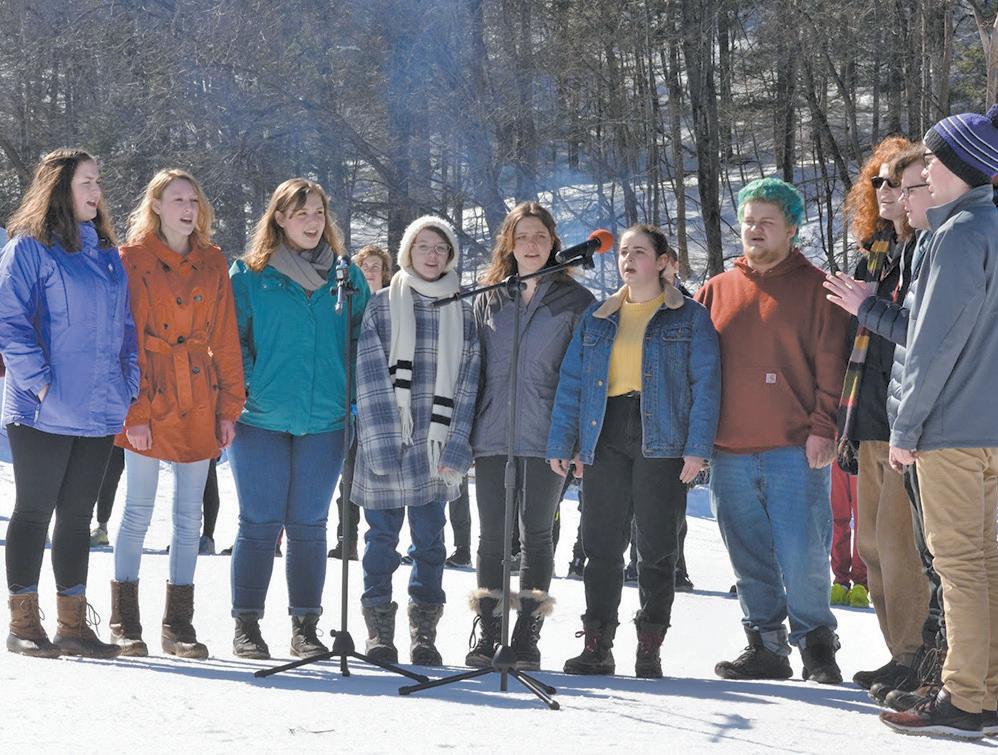
BUHS Madrigals to sing at opening ceremonies
The BUHS singing group Madrigals will return for their second year to sing at opening ceremonies on Sunday, February 16. Ceremonies will also include the introduction of competitors and the Harris Hill Nordic Junior Jumpers. It will start at 11:30 am each day at the base of the jump.
The BUHS Madrigals is an auditioned vocal chamber ensemble directed by Elyse Wadsworth. The Madrigals perform a wide range of a cappella music both at BUHS and in the Brattleboro community. Recent performances have included Norman Luboff’s African Mass, the Vermont premiere of Rich Campbell’s ‘In Those Years of No One Slept’, and performed in collaboration with Northern Harmony. Madrigals is a graded class, focusing on vocal technique, musicianship, and ensemble skills. The group is comprised of Ella Aquadro, Jenna Barry-Stoughton, Sarah Gordon-Macey, Jonah Johnson, Hannah Kowalski, Alexandra Miskovich, Virgil Neddenriep, Sophia Renaud, Jordan Roach, and Amar Vargas.
• In 1935, Harris Hill began announcing results over a loudspeaker.
• In 1950, 10-year old Roger Dion of Lebanon, N.H., became the youngest athlete to jump Harris Hill.
• In 1955, Martin Ingel of New York suspended a cable and boatswain chair above the landing hill to photograph athletes jumping straight at him. His work appeared in the 1956 winter
Harris Hill Ski Jump could see trophy retiring in 2020
A pair of two-time Harris Hill Ski Jump winners are vying for a trophy-retiring third victory at New England’s only Olympic-size venue Feb. 15-16.
Only five jumpers in the venue’s nearly centuryold history have retired its Winged Ski Trophy by winning it three times — Torger Tokle of Norway in 1942, his brother Arthur Tokle in 1951, Art Devlin of Lake Placid, N.Y., in 1957, Hugh Barber of Brattleboro in 1974 and Vladimir Glyvka of Ukraine in 2000.
Marlboro College graduate Chris Lamb won the Fred Harris Memorial Tournaments in 2010 and 2013. In 2010 he set a new hill record of 102 meters, or 335 feet. He will be returning this weekend to go head to head with the current record holder.
Blaz Pavlic of Slovenia set the current hill record in 2017 with a jump of 104 meters, or 341 feet. He was 18-years old. “The headwind helped me,” he said of the historic leap. “It lifted me up, and then I just said, “Go for it.” Pavlic won the tournament that year and returned in 2019 to see his name engraved on the coveted Winged Ski Trophy for a second time.
issue of Vermont Life magazine.
• The Harris Hill Ski Jump is one of six Olympic-size (90-meter) ski jumps in the country.
• There are 187 spectator steps that lead from the bottom to the top of the landing hill.
• The event has been named one of the Top 10 Winter Events by the Vermont Chamber of Commerce.
PHOTO BY DANA SPRAGUE
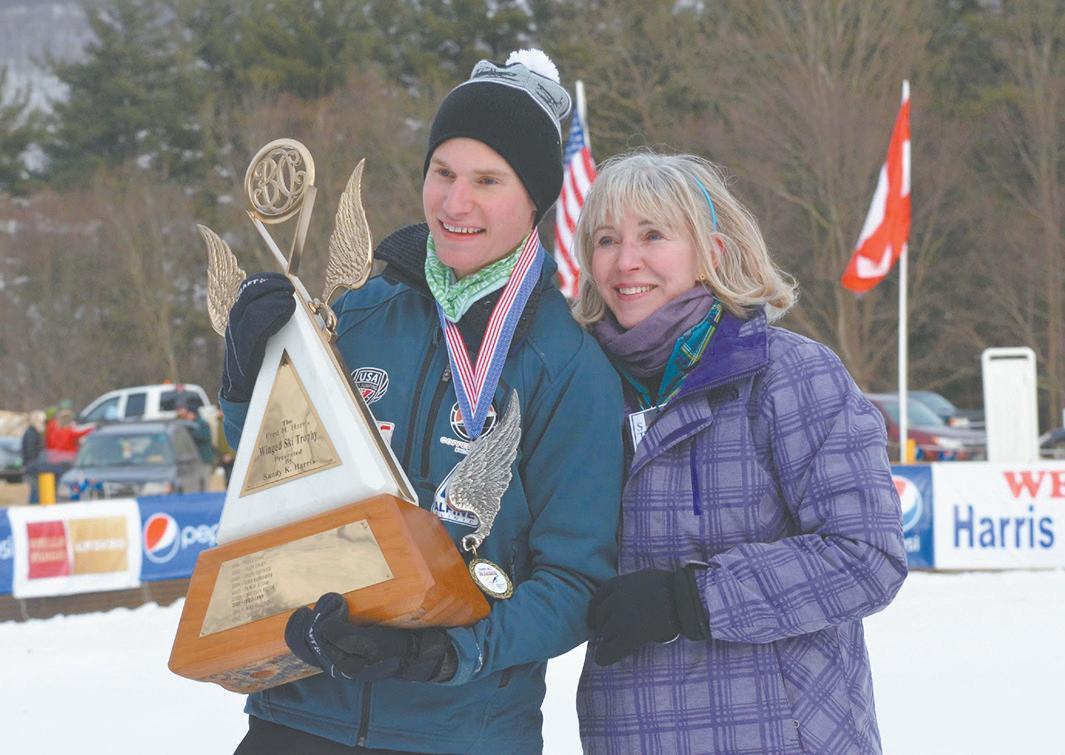
Chris Lamb celebrates his second Fred Harris Memorial Tournament win in 2013 with Harris’ daughter, Sandy Harris.
PHOTO BY DANA SPRAGUE
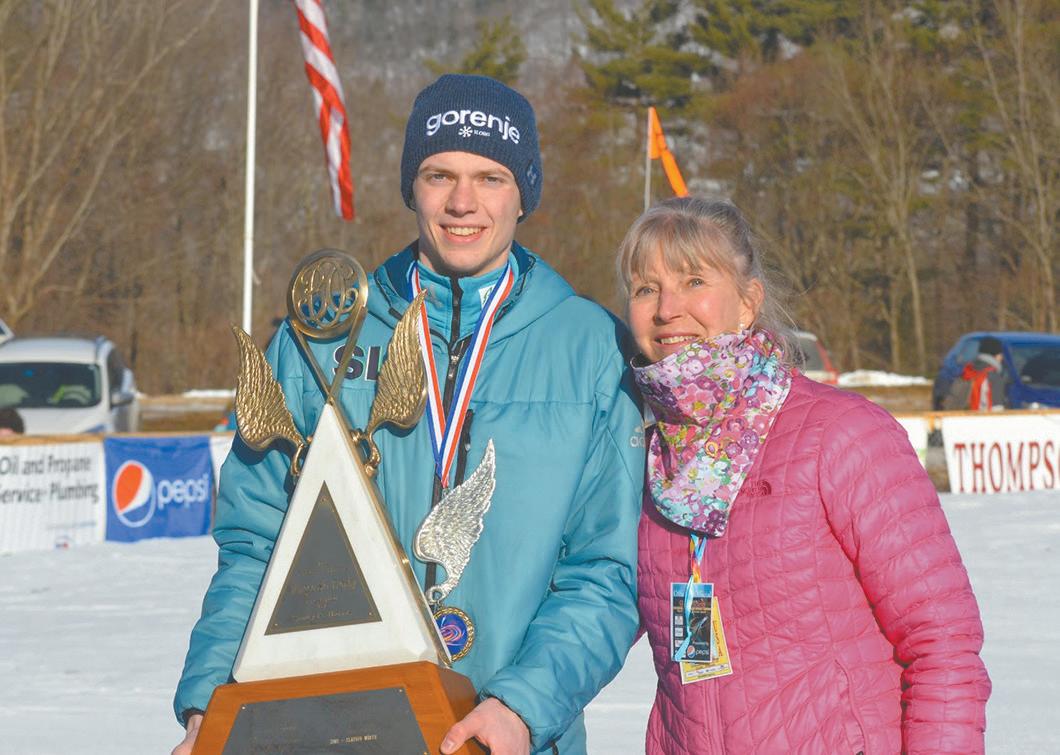
Blaz Pavlik, pictured with Sandy Harris, shows off the Winged Ski Trophy with his second win of the Fred Harris Memorial Tournament in 2019.
PHOTO BY DANA SPRAGUE
PHOTO BY STEVE MCLAUGHLIN
All about ski jumping
The first known ski jumper was Norwegian Olaf Rye, who jumped 9.5 meters in 1809 before an audience of other soldiers. By 1862, ski jumpers like Sondre Norheim were tackling much larger jumps, and competing in official ski jumping contests.
Ski jumping saw radical new development in 1985 with the innovative V-style, where a ski jumper holds his skis in a V-shaped position (instead of parallel) while in the air. Swedish ski jumper Jan Boklöv was the first athlete to employ this technique, after suffering an in-air seizure, using the technique to save himself from a crash landing. Other competitors quickly realized that V-style produced additional lift - was later verified to create 28 per cent more lift - and universally adopted the style.
Men’s ski jumping has been part of the Olympic Winter Games since the first Games in Chamonix, in 1924. The large hill competition was added for the 1964 Winter Games in Innsbruck.
Ski jumping for women has been recognized by the FIS and as an Olympic Sport.
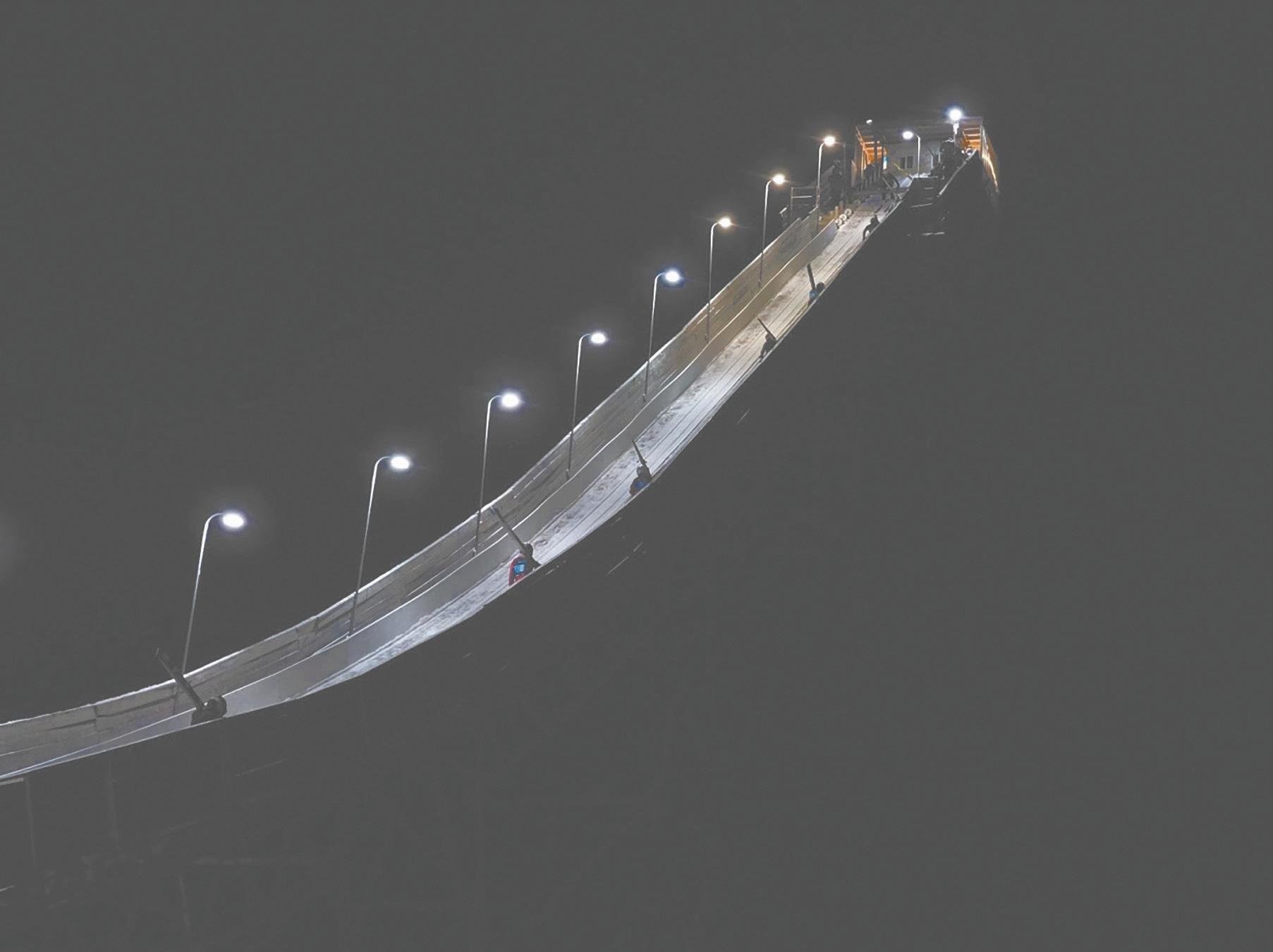
In ski jumping, an athlete skis down a long ramp, referred to as the inrun and launches into the air at speeds of up to 95 km/h. Technique is integral to ski jumping as athletes must perform a very precise and well-timed takeoff. Once in the air, athletes assume the V-style airfoil and adjust their position to maximize lift and minimize drag. Competitors are evaluated on distance and style. While there is a very close relationship
between distance and style, and the skier with the longest jump will often have the highest style points, an exception to this can be found in the landing portion. Long jumps can make landing in a controlled telemark position more difficult. The quality of landing can therefore be a determining factor in deciding on finishing place if the distances are similar.
Two jumps are used in Olympic competition: normal hill and large hill, with the normal hill being the smaller of the two. The jump’s actual height is of little importance; it’s the length of jump that the hill is designed to accommodate that’s key. Athletes can travel 105 meters on a normal hill and 140 meters on a large hill. The only American to win an Olympic medal in ski jumping is Anders Haugen, who placed 4th in 1932, but due to the discovery of a calculation error more than 50 years after the competition, he was awarded a bronze medal.
“Ski flying” in a radical new feature of ski jumping. Although not contested in Olympic competition, ski flying is regularly featured in the World Cup, and has a World Championship every second year. The current world record is 239 meters, and it required a full nine seconds of flight time to cover that distance!
The distance ski jumpers travel in competition is closely regulated by a jury. At the start of the competitive round, the jury selects a start gate that allows the best athletes to fly close to the maximum safe distance. All athletes start from the same gate and, as a
PHOTO BY STEVE MCLAUGHLIN
result, less proficient jumpers fly a shorter distance. Ski jumps are designed with many start benches allowing the jury to select the appropriate start gate based on conditions as wind, temperature, humidity, snow type and other factors which can impact the distance a jumper flies.
Normal Hill Individual
The normal hill individual event is usually the first ski jumping event in the Olympic schedule beginning with a qualification event on the day prior to the competition. The 15 top-ranked ski jumpers on the World Cup circuit are pre-selected and do not necessarily have to participate in the qualification event. The remaining athletes must rank in the top 35 to receive a start.
In the official competition, there are two rounds of jumps. The first round sees 50 starters (15 pre-qualified and 35 qualified) and only the top 35 skiers from this round move on to the final round. The starting order for the second round of competition is in reverse from the first round, leaving the best jumps
for the end of the competition.
Large Hill Individual
The large hill individual event follows the same format as the normal hill individual competition except that it is held on the large hill. Most World Cup events occur on the large hill with only one or two normal hill competitions occurring throughout the season.
Large Hill Team
In this event, each team is comprised of four athletes and there are two competition rounds. In the first round, one skier from each team jumps. Then, the second skier from each team jumps. Then the third, followed by the fourth skier, until all the skiers have jumped one round.
In the second round, only the top eight teams from the first round compete. Similar to the individual events, the starting order for the second round sees the less proficient jumpers go first and the best jumpers go last. The team with the highest total score over all eight jumps wins.
This information provided by USSA.
Midwest Monuments
[The following is reprinted with permission from USA Nordic. It relates a ski jumping event in another part of the country where the sport claims its roots in North America. But the story could be told for any region on our continent where ski jumps exist.]
By Ben Berend
Ski jumping has evolved over the years. The equipment has improved at a rapid pace allowing for further jumps and safer flights. Jumps are updated regularly, looking like modern works of art cut into hillsides. There is one place in the world though, where ski jumping seems to have maintained its roots – the American Midwest.
Ski jumps are scattered across the Midwest in Wisconsin, Minnesota, Michigan, and Illinois. The towers groan with famed wind gusts.
These scaffold towers have lived through our country’s greatest triumphs and tragedies –monuments of sorts. In fact, these towers will probably outlive us. Every year these monuments are honored with a ski jumping tournament. Some of these tournaments date back to the 1800’s making them among America’s oldest sporting events.
Young ski jumpers shake with nerves while gazing up at the hill, unsure if they are worthy for the gusty conditions. The hill crew rakes the landing hill and sweeps the track, many proudly donning Green Bay Packers or Minnesota Vikings hats. Ads have been playing on the local radio station and thousands of pins have been pre-purchased at local retailers around town, it’s Tournament night.
For some of these Midwest ski jumps, one night a year is all they will get. The entire town will flock into the arena, proudly wearing their
buttons on the outside of warm jackets. Some gather around huge funeral pier bonfires, others sit in their running trucks- honking horns after a long ride. The concession stands serve local cuisine: bratwurst, pasties, and of courseice cold beer.
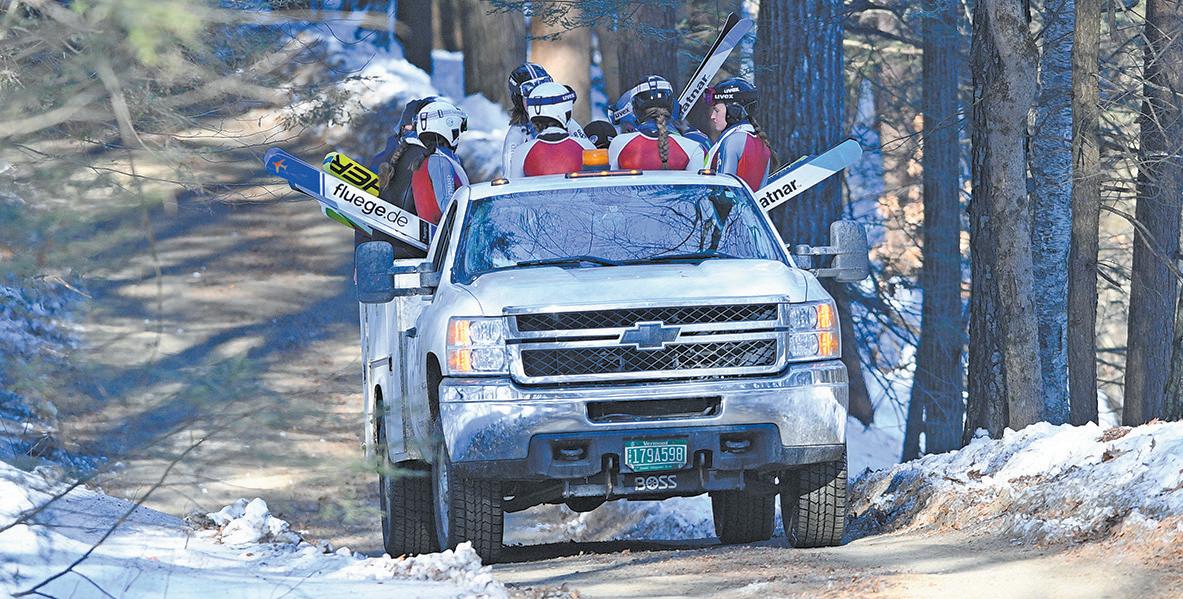
Ski lifts aren’t prevalent in these part. Instead, the athletes stick their skis in pickup trucks and are driven to the takeoff – an economical mode of transportation. For the takeoff, the athletes hoist long skis onto shoulders and scale the scaffolding on icy wooden steps. Then, they soar.
Every competition ends with one round of longest standing – a self-explanatory game. Whoever jumps the farthest without crashing, wins. To many, this seems reckless or maybe not worth the risk. Especially in a society today that seems to obsess over safety. The athletes who take part though, they savor every moment of flight and every applause, because at the end of the day – it’s all about putting on a show. A hat passes through the crowd, green bills of all sizes get tossed in to reward the champion; the true definition of an invested crowd.
A champion is celebrated and the handsome purse is awarded. Fans cheer and horns are honked. Then just as quickly as the thousands of people appeared, they disappear into the night.
The dirt parking lot empties, minus a few cars. Lingering are the people behind the scenes - the coaches, event coordinators, judges, hill markers, and hill crew. These are just fancy names for what these people really are, ski jumpers. Most don’t jump anymore as it isn’t an old man’s game- but they did once, and that’s all that matters. In this sense, maybe ski jumping is a lifetime sport.
As the equipment on the hill is disassembled, there is chatter of what went well and what to improve upon next year. At some point, the discussion shifts and past stories are told. The ski jump, still awake and sparkling under the lights, listens to these stories and smiles. For a second the lights seem to brighten upon this monument. Then the breaker gets pulled and a dark cloth falls over the hillside. This monument goes to sleep – until next year.
PHOTO PROVIDED BY USA NORDIC
Harris Hill Ski Jump winners
Compiled by Dana Sprague
1922 John Carleton, Dartmouth, Mass., U.S.
1922 Bing Anderson, Berlin, N.H., U.S.
1923 Alf Jansen, Chicago, Ill., U.S.
1924 Lars Haugen, Canton, S.D., U.S.
1925 Norman Berger, Montreal
1926 Ole Jansen, Brooklyn, N.Y., U.S.
1927 Everett Davidson, Berlin, N.H., U.S.
1928 Harlvor Bjorngaard, Reduing, Minn., U.S.
1929 Strand Mikkelsen, Greenfield, Mass., U.S.
1930 No Jump - No Snow
1931 Harold Sorensen, Brooklyn, N.Y., U.S.
1932 No Jump - No Snow
1933 Harold Sorensen, Brooklyn, N.Y., U.S.
1934 Rolf Munson, Lake Placid, N.Y., U.S.
1935 Sigurd Jorgensen, Norway
1936 Aurele LeGere, Rumford, Maine, U.S.
1937 No Jump - No Snow
1938 Birger Rudd, Norway
1939 Merrill Barber, Brattleboro, Vt., U.S.
1940 Torger Tokle, Norway
1941 Torger Tokle, Norway
1942 Torger Tokle, Norway
1943 No Jump - War
1944 No Jump - War
1945 No Jump - War
1946 Art Devlin, Lake Placid, N.Y., U.S.
1947 Merrill Barber, Brattleboro, Vt., U.S.
1948 Arthur Tokle, Norway
1949 Arthur Tokle, Norway
1950 Art Devlin, Lake Placid, N.Y., U.S.
1951 Arthur Tokle, Norway
1952 Sigurd Sorensen, Norway
1953 Jon Riisnaes, Norway
1954 Art Devlin, Lake Placid, N.Y., U.S.
1955 Art Devlin, Lake Placid, N.Y., U.S.
1956 Roy Sherwood, Salisbury, Conn., U.S.
1957 Art Devlin, Lake Placid, N.Y., U.S.
1958 Art Devlin, Lake Placid, N.Y., U.S.
1959 Bernie Dion, Lebanon, N.H., U.S.
1960 Roy Sherwood, Salisbury, Conn., U.S.
1961 Ansten Samuelstuen, Steamboat Springs, Col., U.S.
1962 Art Tokle, Brooklyn, N.Y. - Norway
1963 Kjell Sjoberg, Sweden
1964 Jacques Charland, Threerivers, Quebec
1965 Sepp Lichtenegger, Austria
1966 Eric Merrill, Brattleboro, Vt., U.S.
1967 John Bower, Auburn, Maine, U.S.
1968 Peter Robes, Etna, N.H., U.S.
1969 Adrian Watt, Duluth, Minn., U.S.
1970 Peter Robes, Etna, N.H., U.S.
1971 Scott Berry, Deadwood, S.D., U.S.
1972 Hugh Barber, Brattleboro, Vt., U.S.
1973 Hugh Barber, Brattleboro, Vt., U.S.
1974 Hugh Barber, Brattleboro, Vt., U.S.
1975 Jerry Martin, Minneapolis, Minn., U.S.
1976 Walter Malmquist, Post Mills, Vt., U.S.
1977 Scott Sobezak, Cloquet, Minn., U.S.
1978 Chris Bergrav, Norway
1979 Walter Malmquist, Post Mills, Vt., U.S.
1980 No Jump - No Snow
1981 No Jump - No Snow
1982 Jeff Volmrich, Lake Placid, N.Y., U.S.
1983 Chris Hastings, Norwich, Vt., U.S.
1984 Hans Johnston, Carlisle, Mass., U.S.
1985 Jan Henrick, Troen, Norway
1986 Jeff Volmrich, Lake Placid, N.Y., U.S.
1987 Risto Laakkone, Finland
1988 Stefan Horngahar, Austria
1989 Steiner Bratten, Norway
1990 Mike Holland, Norwich, Vt., U.S.
1991 Andraz Kopal, Yugoslavia
1992 Dimitri Zucz, Russia
1993 Andreas Aschauer, Austria
1994 Harold Deiss, Austria
1995 Jim Holland, Norwich, Vt., U.S.
1996 Vladimir Glyvka, Ukraine
1997 Randy Weber, Steamboat Springs, Col., U.S.
1998 No Jump - No Snow
1999 Vladimir Glyvka, Ukraine
2000 Vladimir Glyvka, Ukraine
2001 Tadej Lenic, Slovenia
2002 Casey Colby, Lake Placid, N.Y., U.S.
2003 Jakob Seifried, Austria
2004 Luka Bardorfer, Slovenia
2005 Primoz Kozar, Slovenia
2006 No Jump - Construction
2007 No Jump - Construction
2008 No Jump - Construction
2009 Christian Reiter, Austria
2010 Chris Lamb, Andover, N.H., U.S.
2011 Mike Glasder, Cary, Ill., U.S.
2012 Anders Johnson, Utah, U.S.
2013 Chris Lamb, Andover N.H., U.S.
2014 Miran Zupancic, Slovenia
2015 Samet Karta, Turkey
2016 Gasper Bartol, Slovenia
2017 Blaz Pavlik, Slovenia
2018 Claudio Mörth, Austria
2019 Blaz Pavlic, Slovenia
Harris Hill Ski Jump Record Breakers by year
HARRIS HILL ARCHIVES
PHOTO BY STEVE MCLAUGHLIN
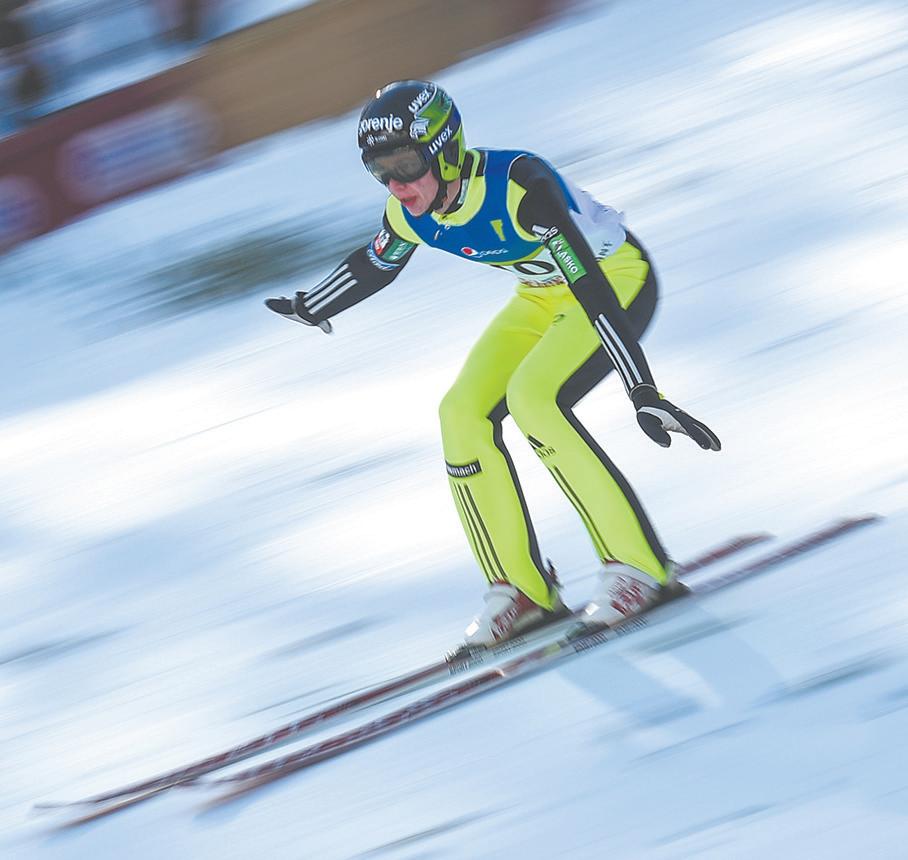
Slovenian Blaz Pavlic, winner of the 2017 Fred Harris Memorial Tournament and new hill record holder.