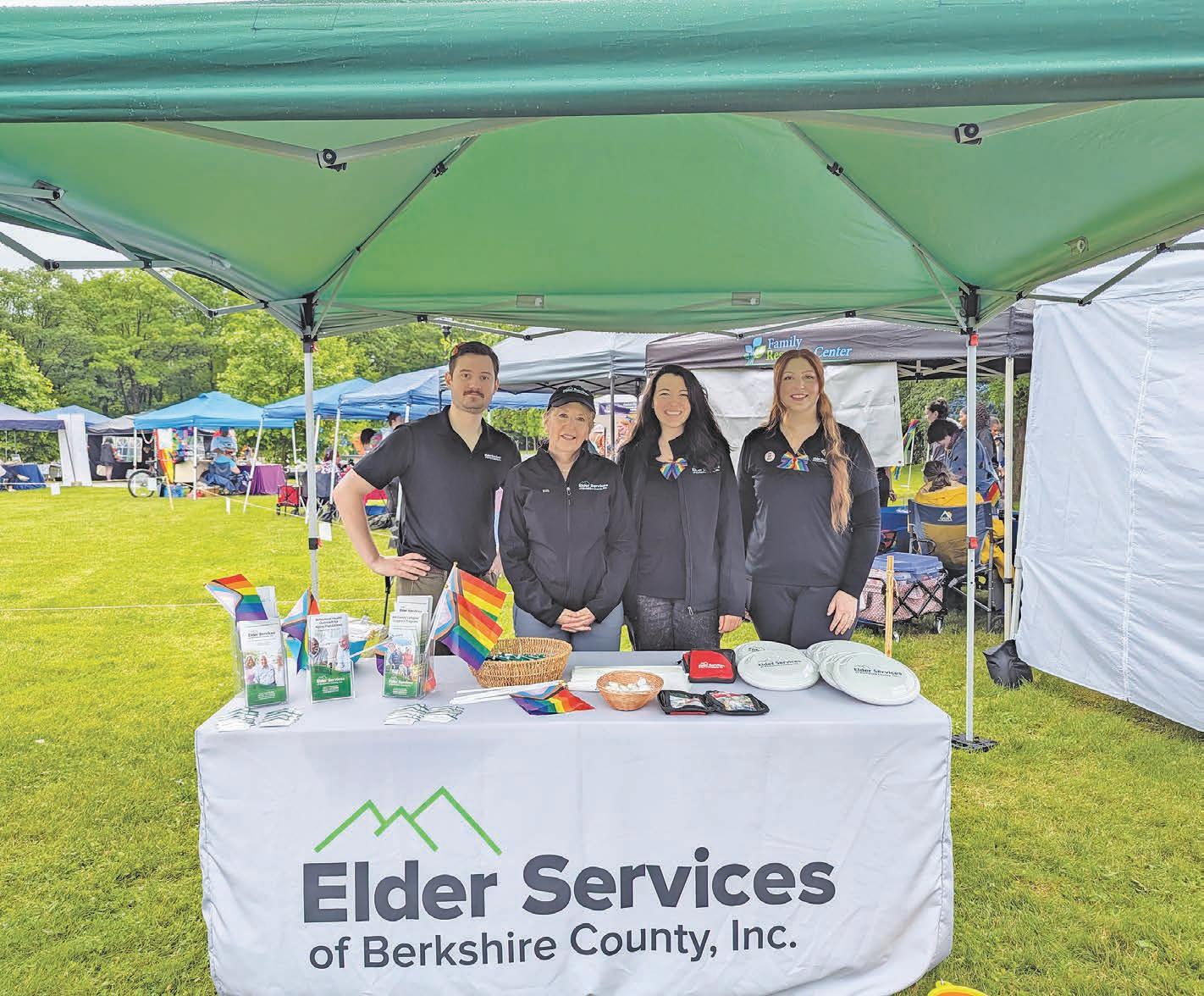
The mission of Elder Services of Berkshire County, Inc. is to provide Berkshire elders, caregivers, and individuals with disabilities the opportunity to live with dignity, independence, and self-determination, and to achieve the highest possible quality of life.
Statement of Inclusivity
Elder Services practices non-discrimination in employment practices and service delivery. Embracing diversity, our in-home and community-based services are available to all without regard to race, ethnicity, language, religion, gender, sexual orientation, or lifestyle.
Are you willing to spread a little sunshine? Volunteering is a win/win
by Christopher McLaughlin, Executive Director of Elder Services
Senior
Instagram: berkshiresenior
LinkedIn: Elder Services of Berkshire County
Berkshire Senior
Editorial Board: Deb Aldrich-Jegtvig, Perry Burdick, Christopher McLaughlin, Kathleen Phillips, Susan Guerrero, Kara Graziola, Peter Olsen and Lisa Jamros.
Advertising: To place an advertisement in Berkshire Senior, please contact Amy Filiault at (413) 496-6322 or e-mail advertising@berkshireeagle.com.
Berkshire Senior is published bi-monthly by Elder Services of Berkshire County, Inc., 73 South Church Street, Pitts eld, MA 01201, (413) 499-0524 or (800) 5445242, e-mail: esbc@esbci.org or on the internet at www.esbci.org.
NOTICE
Berkshire Senior advertising helps to the defray the costs of producing the newspaper. Inclusion of advertisers in no way implies that Elder Services endorses any product or service.
Signed columns are the opinion of the writers and not necessarily the opinion of Elder Services. For medical, nancial or other advice, seek a quali ed professional in the appropriate eld.
Elder Services and its programs are funded, in part, by the Executive O ce of Aging & Independence (AGE).
State and federal funds provided to Elder Services are limited. Elder Services welcomes charitable donations to help meet the growing needs of Berkshire seniors, and gratefully acknowledges all donations.
As I am writing this in mid-July, I am happy to report that as of today, Elder Services has been (mostly) spared from funding cuts and program eliminations other social service agencies face as a result of the recent passage of President Trump’s Big Beautiful Bill. This is fortunate for us as demand for our services has grown exponentially since the start of COVID and that demand will accelerate as other providers start reducing services.
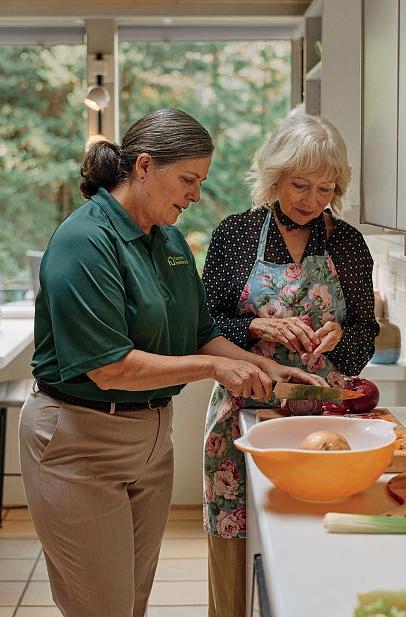
In Berkshire County we have a disproportionate number of seniors who need support, a lot of geography to cover, and a small workforce. To put it simply, Elder Services cannot do what we do without our volunteers, who selflessly share their time, talents, and life experiences to help make the lives of their neighbors more fulfilling. Are you willing to make a senior’s life a little easier by spreading some “sunshine” to someone who needs some assistance?
Most people genuinely love our community and genuinely want to help. However, the thought of volunteering can be intimidating. Some believe that volunteering means having to commit to long hours, several times a week. While there are opportunities for those who choose to work several hours a day, our volunteers commit to the number of hours and days that best suits them.
Volunteering is a tremendous opportunity to expand your horizons and introduce new light and life into the world of others in our community. Volunteers serve our programs in the following roles:
Meals on Wheels Drivers, Kitchen Volunteers and Meal Site Volunteers – Drivers deliver meals Monday through Friday and conduct invaluable well-being checks on seniors. Kitchen volunteers help prepare meals in our Lanesborough kitchen. Meal site volunteers serve meals to seniors at one of Berkshire County’s many senior communitydining sites.
Long Term Care Ombudsman – This program trains volunteers to advocate for residents of Berkshire County’s nursing homes. Ombudsmen serve as intermediaries between a resident and their nursing home, so the resident receives the support and services they need to maintain the best quality of life.
Money Management – This program trains volunteers to help seniors manage their checkbooks and monthly expenses. These are not
continued on page 4
Dementia: Does Your Spouse Exhibit Signs?
by Peter Olsen
“Peter, it’s your father. Your mother is driving me crazy. You have to do something about her.” (This was an actual phone conversation.)
“I don’t know what you want me to do, Dad. Can you be more specific?”
“You know how she is. She has dementia, and I can’t take it anymore.”
My father was becoming unhinged; he was totally unprepared for Mom’s dementia. He was frustrated, feeling guilty, and scared.
Dementia can be a relationship killer, particularly among elderly spouses who have lived a life together for decades. Suddenly, it feels as if one morning the spouse wakes up as a different person. The two don’t know each other. Over time, dementia has crept in like a “fog on little cat’s feet.” It creeps along so slowly that you hardly notice it until it becomes unmanageable. “I can’t take it anymore.”
Discovering dementia in a spouse
Perhaps the best way to live with a spouse’s growing dementia is to plan strategies, practical strategies. I know of no one who admits that taking care of a person with dementia is easy; it’s not. But I know a lot of folks who are doing just that – caring for a spouse with dementia. If you are presented with this task, I applaud you for your perseverance. Hang in there, and plan.
If you notice memory loss, changes in thinking, or altered behavior in a spouse, it’s normal not to know what to do or how to react. First, consider the following possibilities to assess your situation specifically, before taking action.
1. What changes in thought or behavior do you see?
2. Learn about the signs of dementia and the importance of early interventions.
3. Have a conversation with family about what changes you observe.
4. Check with others. Do they
recognize the same changes as you do?
5. Offer to accompany your spouse to a doctor, counselor, or medical provider. Support them.
6. Discuss the various factors that would cause the changes. Consider the changes that have occurred in a spouse’s life that may contribute to the development of dementia.
Supporting dementia of a spouse:
Once you have witnessed the first signs of dementia, and are convinced, do not abandon your spouse. Outside care may or may not be necessary. Take the time to consider all options available for dementia care. Caring for your spouse yourself often causes resentment because of the burdens placed upon you by the constant routine of difficult care. Admitting them to a care facility might free you to rebuild a good relationship without the stress or antipathy.
A few tips to help spouses move forward smoothly when dementia is recognized. Consider the following:
1. People with dementia, like all people, have the right to be respected.
2. Try to maintain a routine, such as bathing, dressing, and eating at the same times.
3. Plan activities the person enjoys and do them at the same time.
4. Encourage the person to do as much as they are able to do on their own.
5. Serve meals in a consistent, familiar place and allow enough time for the person to eat.
6. Use safe equipment, such as shower chairs and walkers, and remove scatter rugs.
The above changes can be done easily. More difficult but equally important are the following, related to mental health:
1. Reassure the person, speak calmly, and listen to them.
2. Respect the person’s personal space.
3. Encourage two-way conversations as long as possible.
4. Keep familiar objects around the house – photographs, favorite blankets and pillows, and family books. Reminisce with the person as often as possible.
5. Remind the person who they are. But don’t say “don’t you remember?”
6. Consider music that is calming. Exercise with them appropriately.
Dealing with dementia is difficult. It’s even more challenging when it’s the person you’ve loved for so many years. Please don’t despair. If your own wits and temperament present a problem, there are many resources to help.
Spread a Little Sunshine
continued from page 3
complicated financial transactions…basic budgeting and bill paying to help seniors remain independent in their homes for as long as possible.
SHINE Counselors – SHINE (Serving the Health Insurance Needs of Everyone) counselors work with seniors to ensure they maximize their Medicare and other public benefits, saving them money by finding them the plan that best meets their needs. The Executive Office of Aging & Independence believes seniors who receive SHINE counseling save on average $3,300 on health insurance premiums and healthcare costs.
Drivers, Shoppers, Companions – These individuals drive seniors to appointments or grocery shopping, shop for them or spend time getting to know someone living alone.
These are just a few of the many opportunities for you to brighten the life of someone in need. Please see our ad on page 5 to learn more about opportunities to volunteer.
In closing, I ask that you please consider becoming a volunteer and enrich the lives of Berkshire seniors.
To learn more about how volunteering could be a win/win for you and Berkshire seniors, please call our volunteer coordinator Peggy Zamierowski at (413) 499-0524.
Until next time be good, be kind and be careful.
Volunteer Opportunities
Food Service
Prepare and package meals at Elder Services’ Lanesborough kitchen. Morning food prep for up to a 3 hour commitment. One day or more per week.
Meals on Wheels Driver Deliver hot meals to homebound older adults on a set route. Substitute drivers are welcome.
Grocery Shopping Assistant
Companionship
Shop with a list and deliver groceries to an older adult’s home. Transport an older adult to the grocery store for independent shopping.
Provide conversation and connection to an older adult in Berkshire County. A weekly 1-2 hour visit in-person or by telephone.
Senior Dining Assist with dining prep and clean up at a local Council on Aging site. Arrive late morning for dining set up and to serve hot lunch.
Long Term Care Ombudsman Visit residents in a nursing facility to listen and advocate for them. Training is required for this position.
SHINE—Serving the Health Insurance Needs of Everyone
Money Management Program
Meet with older adults via phone or in-person to help them navigate the Medicare system during Open Enrollment and throughout the year. Training and certification is required for this position.
Assist an older adult with paying monthly bills and tracking finances, training is required for this position.
If you are interested in any of the above volunteer positions with Elder Services of Berkshire County, contact our Volunteer Coordinator: Peggy Zamierowski • (413) 499-0524 ext. 109 • mzamierowski@esbci.org
BERKSHIRE COUNTY LEGISLATORS
UNITED STATES CONGRESS
Congressman Richard Neal
372 Cannon House O ce Building Washington, D.C. 20515 (202) 225-5601
300 State Street, Suite 200 Springfield, MA 01105-1711 (413) 785-0325
Over 7 million. That’s the number of people over 65 living with Alzheimer’s disease in the United States, according to the Alzheimer’s Association. An estimated 150,000 Massachusetts residents are living with Alzheimer’s, and worldwide, 55 million people are living with the disease and other forms of dementia.
Alzheimer’s disease is a type of brain disease caused by damage to nerve cells (neurons) in the brain. Alzheimer’s is a slowly progressive brain disease that begins many years before symptoms begin. Early signs of Alzheimer’s can include memory loss that disrupts daily life such as asking the same question over and over and needing to use memory aides such as reminder notes. Other symptoms include difficulty remembering a familiar recipe or
Berkshire County’s Walk will be held Oct. 18, at the Adams Visitor Center
organizing a grocery list, trouble with vocabulary, poor judgement, withdrawal from social activities and changes in mood and behavior.
Dementia is a general term for a decline in mental ability severe enough to interfere with daily life, while Alzheimer’s is a specific disease. Alzheimer’s is the most common cause of dementia.
There is no cure for Alzheimer’s disease. Research shows that that not only is Alzheimer’s disease responsible for the deaths of more and more Americans, but also that the disease is contributing to more cases of poor health and disability in the United States.
Each year the Alzheimer’s Association holds the Walk to
End Alzheimer’s as a fundraiser for Alzheimer’s care, support, and research. Participants in the walk are asked to raise funds that assist the Alzheimer’s Association in working towards prevention, treatment and ultimately a cure for Alzheimer’s. Funds raised have allowed for more enhanced research, provided support groups, and created a 24/7 Helpline offering information and referrals. The Alzheimer’s Association funds independent researchers worldwide through an International Research Grant Program.
The Alzheimer’s Association’s grants have funded some of the most active research in Alzheimer’s and dementia science. Projects include
advancing our understanding of Alzheimer’s disease and dementia, identifying new treatments, improving support for families and caregivers and furthering knowledge of brain health and disease prevention. The walk is held in over 600 communities nationwide, including a walk in Berkshire County.
Berkshire County’s Walk will be held on Saturday, October 18, 2025, at the Adams Visitor Center in Adams, MA. The Walk begins at 10 a.m. Please consider joining the walk as an individual, joining a team, or creating your own team. You can also donate to a team or make a general donation to the Berkshire County Walk. Visit www.alz.org for more information about Alzheimer’s disease and the Walk to End Alzheimer’s.
The following donations were received between May 1, 2025 and June 30, 2025. Donations received on or after June 30, 2025 will appear in the next issue of Berkshire Senior.
Elder Independence Donations
Margaret Darcy
Janice Uliasz
Kathleen Speth
Louise Gai
Dr. Robert Josell
Mark and Osnedya Miller
Katt Lissard
George & Kathleen Desmarais
John and Jane Allen
John and Debra Brower
Nadell Hill
John Dziegiel
Richard Daub
John and Ada Masiero
Nancy Kingsley
Nan Bernstein
Jane Perras
Pamela Hugabone
Northern Berkshire United Way
Bright Funds
Daniel Peterson
Pledgeling Foundation
Susan Vigeant
SHINE Donations
Cynthia Armstrong
Meals on Wheels Donations
Tamar Schrager
Alice Rose
John and Judith Ladd
Stop & Shop Bloomin’ 4 Good Program
Margaret Christiansen
Tamar Schrager
Alice Rose
In Memory of: Ray Costello
William & Jane Mahon
Jo-Ann Resendes
At Home with Berkshire Place
Mark Brennan
B. & G. Scapin
Barbara Conway
James Armstrong
Nancy Nolan
Daniel Donovan
Phillip & Kathie Johns
Robert Maloney
Paul & Rita Laviolette
Andrea Gran eld
In Memory of: James Barrett
Ann Comer
Kathleen Comer
John & Janet Sadlo
In Memory of: Clyde Decorie
Italian American War Veterans Post 75 Memorial Donations
In Memory of: Annie, Oz, Jack and Elvis
Nancy Stuart
In Memory of: James A. Barrett
Lisa Trumble
In Memory of: William Broderick
Katherine Broderick
In Memory of: Patricia Smith
Allen & Linda Seney
William & Donna Prendergast
Margaret Rotti
Marianne & Paul Sniezek
R&S Nichols
In Memory of: Toni Fontana
William R & Linda P O’Connell
Foundation
In Memory of: Judith Corbett
Francis & Jean Perotti
In Memory of: Lawrence H. Kirchner, Jr.
Amanda Elliot
Linda & Michael Cobb
Savino EmpireMonuments,Inc.
Est.1931 CompleteServiceof Monuments&Markers
100WahconahSt. Pitts eld,MA01201 (413)442-4149
DonnaBrewer,Owner StevenJBrewer,Director
Dear Friend of Elder Services:
73 South Church St., Pitts eld, MA 01201
Telephone (413) 499-0524 or 1-800-544-5242
Fax (413) 442-6443
Email esbci@esbci.org
2025 is a year unlike any other. Long before President Trump took office in January, Elder Services of Berkshire County (Elder Services) and our sister organizations across the Commonwealth asked our state legislators to address the $55 million funding deficit in the fiscal year 2025 (July 1, 2024 - June 30, 2025) state budget for the state home care services Elder Services provides. In formulating the fiscal year 2025 budget, the Executive Office of Aging & Independence (AGE) did not fully account for the growth in demand for state home care services across the Commonwealth, resulting in a situation that, if not addressed, would have resulted in the state running out of money to fund state home care services. While this situation was addressed with a supplemental budget, we are concerned about both state and federal funding for fiscal year 2026, which began on July 1.
Like the fiscal year 2025 state budget, Governor Healey’s fiscal year 2026 state budget resulted in a funding deficit for state home care services, though considerably less than for fiscal year 2025. In addition, you are no doubt familiar with President Trump’s Big, Beautiful Bill, a goal of which is to reduce Medicaid funding by $880 billion over the next ten years. On top of that, there has been a lot of speculation about whether funding for our federal programs (Meals on Wheels, SHINE, Long Term Care Ombudsman, Family Caregiver Support, and others) would be cut or eliminated. We are thankful that as of today, we are not aware of any funding cuts to our federal programs. However, this is an unprecedented time in our history. It is impossible to say how extensive the Medicaid cuts will be or how changes in federal or state funding may impact our ability to provide services that support the quality of life for Berkshire County seniors.
It has been years since we have faced these kinds of funding threats and, in the intervening years, demand for our services has grown exponentially as more people in the Berkshires turn 60 every year. A recent letter we received from one of the clients who wanted to leave his nursing home to return to the community illustrates the impact Elder Services has on people every day: I met Sue shortly after arriving at Hillcrest Commons. I thank God for putting Sue in my life. Words cannot begin to describe how grateful I am to be blessed with such a caring, dedicated, and loving person as Sue. Thanks to Sue I am no longer in the nursing home. With her diligence and hard work, I now have a fully furnished handicap accessible apartment. Sue has helped me above and beyond, from helping me to get my social security card, birth certificate and real ID, to helping me with my social security disability and opening a bank account. I am so grateful for Elder Services having a truly genuine, caring, and loving employee in Sue.
Your financial support is crucial to our mission to support seniors in Berkshire County to continue living independently in the home of their choice.
We would appreciate your donation in any amount which will enable us to ensure that Berkshire seniors will be able to rely on Elder Services to continue providing local support.
Thank you in advance for your gift in support of the many valuable programs offered by Elder Services.
Here are the ways you can help:
1.Send your check in the enclosed envelope.
2.Call Elder Services’ Fiscal Department at (413) 499-0524.
3.Visit www.esbci.org for an online donation form.
4.Call Elder Services at (413) 499-0524 to learn about volunteering. There are many opportunities for you to volunteer in a way that works for you and helps enrich the lives of Berkshire seniors!
Thank you again.
Sincerely,
Jeffrey Menkes President, Board of Directors
Christopher McLaughlin Executive Director
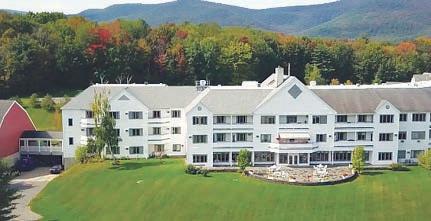
YoudeserveaLifeCarecommunitywithareputationforstimulatingsocial experiences, exceptionalservice,strongsta ngand a welcoming, comfortable environment.Nomatterwhatyourcareneedsare,thebestwillbeavailable. KimballFarmso ersallthisandmore:
• Financialsecurityandlong-term predictability
• Estatepreservation
• Qualitycarenomatterwhatyour healthcareneedsare
• Guaranteedaccesstohealthcare accommodations
• Greatpersonalpeaceofmind
• Thegiftof a lifetime foryourchildren
Nancy McNabb, the Dynamic Force Behind the Friends of the Berkshire Athenaeum Book Sales
by Susan Guerrero
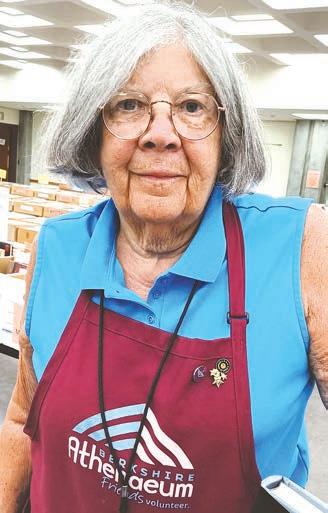
Some retired people spend lots of time on golf courses or give their televisions a real workout. Nancy McNabb is nowhere to be found among them. She would be more likely to be found at the Berkshire Athenaeum, at One Wendell Avenue in Pittsfield. She started volunteering at the Athenaeum in 2009 and became the Friends of the Athenaeum book sale chair in the summer of 2013. The Friends hold three wildly popular book sales a year to raise money for the library. They are held in July, November, and March. Nancy started keeping track of how much money the sales have raised and said the grand total through the years comes to $705,000. Thanks to a huge effort on her part, assisted by a large group of dedicated volunteers, Nancy can be proud that she has spearheaded the successful sales.
“Being involved with the sales is a labor of love,” the book sale chair said. “I delegate more and more chores as I age,” she said. “Since I was not able to have children and being an only child, myself, I enjoy interacting with others and being around people.” She said she is not good at teaching or doing medical things, but she is “pretty good at selling used stuff so I really enjoy what I do. I am giving back to the community in the best way I know.” It is also a way for her to “thank the library for their help.”
Nancy said she did a lot of genealogy research at the Athenaeum and at the Archives while on vacation here in the Berkshires from where she once lived, in North Carolina. Lots of projects have been possible because of the book sales’ funding.
“The library gives the Friends’ board a wish list,” she said. “We fund things that the budget from the city and state don’t pay for.”
These may include extras such as free programs for children
and adults, Nancy explained. She added “a new sound system in the auditorium, library of things, the fish tank for the children’s area and books or courses.” A dynamic group of volunteers has worked endlessly before, during, and after the book sales. “We have about 35 regular book sorters who come in every Monday and/or Wednesday from 9 a.m. to noon, year-round to sort, price, and organize our donations,” the book sale chair said. “We have an additional 12 or so helpers during the sales.”
Nancy’s easygoing personality and genuine love of all things books may have contributed to retaining the large group of volunteers who are faithful to every single sale as it comes up. “Most of the volunteers have their own areas to organize, price, etcetera,” Nancy said. “It gives them a sense of ownership and pride. I do my best to communicate with everyone when things change at the library, such as the new flooring project.” The volunteers have decision-making opportunities concerning the books offered for sale. “We try to have volunteer recognition luncheons every so often,” she added.
As a child born in Schenectady, NY, Nancy loved the Nancy Drew series of books about a girl detective of sorts. She said she always remembers there were books around her childhood home as well. “I remember always having books around the house,” she said. “My great, great, grandfather was the first paid librarian of the Lake Placid, New York library,” Nancy said. Her grandmother was on the library board. Both of her grandfathers completed only the eighth grade but remained avid readers.
Prior to retirement, Nancy was involved with the General Electric Company. “I am third generation GE,” she said, “having also lived in Bloomington, Illinois, Rome, Georgia, Danvers, Massachusetts
and Durham, North Carolina, due to corporate moves.” She graduated from Hartwick College in New York, with a B.S. in economics. She also graduated from GE’s Financial Management Program. She was transferred by the company to Pittsfield in 1975 and married the following year. She and her husband left Pittsfield in 1982, always hoping to come back, she said. That dream came true in 2008.
Despite the popularity of online books, the print book sales remain immensely popular. Buyers come in droves to the local book sales for many reasons. “We try to treat everyone equally, whether it is a book dealer spending $1,000 or a mentally challenged customer with $2 to spend.” Nancy said. “We help our customers find books and help them to their cars. We have a book minder table, so they don’t have to lug their books around.”
If someone has never come to one of the book sales, Nancy has this to say to them: “Come be surprised. We sell mostly donations from the public. We don’t have old library discards. We try to have something for everyone and be super organized so favorites are easy to find. Hard cover and trade paperback fiction are alphabetized by author.” She noted that the sale has 50-cent paperbacks as well as rare books. The non-fiction is organized by category. There is also a special children’s and young adult area. “We offer books in gift giving condition,” Nancy noted. “My personal favorites are the miniature books. We try to make sure every book is in good condition. We also sell DVDs, music CDs, vinyl, books on CD, puzzles, games, and stationery.”
Naturally, having been involved with books since childhood, Nancy has certain kinds of books she likes to read. “History.” she said, “Especially history I know nothing about. It can read like a mystery. I like well
documented books using primary sources by authors such as David Hackett Fisher, Russell Shorto and David McCullough.”
Now that the July Friends book sale is over, it’s time to mark calendars for the November sale. Anyone who loves books will not want to miss it. Thursday, Nov. 6, the sale is for members only. Nonmembers can join at the door. It runs from 3 to 7 p.m.
On Friday, Nov. 7, the sale is open to all and runs from 10 a.m. to 4 p.m.
The final day of the three-day sale will be Saturday, Nov. 8 from 10 a.m. to 3 p.m.
Besides hundreds of books for people of all ages, the sales also have audio books, CDs, DVDs, vinyl records, puzzles, and games. The November book sale is a great place to pick up holiday gifts at rock bottom prices. Anyone who would like to donate books throughout the year can bring small book donations to the circulation desks. Large donations of books can be brought to the garage, on the side of the building in which the library is located, on Mondays and Wednesday from 9 a.m. to noon.
Medicare Open Enrollment Labor Day
Labor Day, or as some claim the “unofficial end of summer,” is observed on the first Monday in September. Labor Day is celebrated to honor the social and economic accomplishments of American workers. The holiday first came to light in the late 19th century, as a way for labor supporters to rally for a federal holiday to recognize and honor American workers who contributed to America’s strength and success.
Working conditions in the country’s mills, mines and factories were harsh and many were working long hours and made minimal pay. Following the Civil War, workers began to fight for better working conditions and shorter workdays, resulting in strikes and protests.
Prior to it becoming a federal holiday, Labor Day was recognized by individual states. Oregon was the first state to pass a law recognizing Labor Day, on February 21, 1887. By 1894 23 U.S. States recognized the holiday and in 1894 President Grover Cleveland secured an act establishing the first Monday in September each year as a legal holiday.
It is thought that Peter J. McGuire, cofounder of the American Federation of Labor, was the first to propose the holiday, but others believe it to be Matthew Maguire, Secretary of the Central Labor Union.
The very first Labor Day was celebrated on Tuesday, September 5, 1882, in New York City. Thousands of union members took unpaid time off
and marched. At the end of the day many had picnics, which included fireworks and dancing. Many Americans commemorate the holiday with parades and parties (hot dog anyone?). The first proposal for the holiday mentioned that it be celebrated with a parade to show “the strength and esprit de corps of the trade and labor organizations,” which led many to then enjoy a day of fun activities with family and friends. You will also notice many retail stores offering deals and sales around the holiday.
Did you know that in 1968, the Uniform Monday Holiday Act changed several holidays to Monday, so that federal employees could have more threeday weekends? Presidents’ Day, Memorial Day and Indigenous Peoples’ Day are now designated as Monday holidays.
This year Labor Day will be celebrated on September 1st. Please take time to reflect and appreciate those who fought for labor rights. Enjoy the Holiday!
Medicare Open Enrollment is a few short months away. If you are thinking about reviewing your choices or making a change to your coverage, mark your calendars for the Annual Medicare Open Enrollment dates of October 15th through December 7th . This annual enrollment period gives beneficiaries an opportunity to re-evaluate their Part C (Medicare Advantage Plan) and Part D (Prescription Drug Plan) and add, drop, or switch to another plan that better suits their needs and budget and ensures appropriate coverage for the upcoming year.
Open Enrollment is important for the following reasons:
• A person’s health needs can change from year to year.
• Health or drug plans can change their costs, benefits, and drug coverage they offer each year.
• Providers can change contracts.
In preparing for Open Enrollment, Medicare bene ciaries should:
• Review the Annual Notice of Change letter from their current plan in September and note any changes that are going to be made for the upcoming year.
• Reflect on their health and medical needs over the past year and try to anticipate their needs for the upcoming year.
• Research TOTAL costs involved
when comparing plans. This should include the premiums, copays, and deductibles. For example, a plan with a lowcost premium may have large deductibles for certain services.
• Contact their providers and confirm they are in-network before making changes to their coverage.
The SHINE program is available year-round to assist Medicare beneficiaries with enrolling in Medicare, evaluating coverage for existing beneficiaries, making changes and screening for insurancerelated public benefits. There is no cost or eligibility criteria to make an appointment with a SHINE counselor. Please call the Berkshire County SHINE program at (413) 499-0524.
TECHNOLOGY CORNER
Arti cial Intelligence: Our Best Friend, Worst Enemy, or Both?
by Perry Burdick
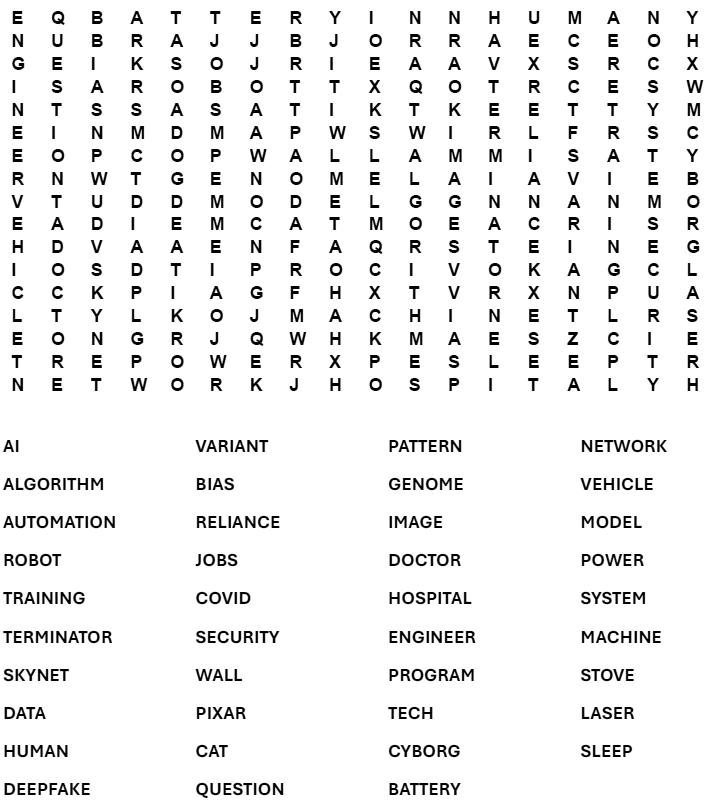
Artificial Intelligence, or AI, has been all over the news lately. AI was originally a sci-fi dream and is now a daily reality. In this article, I hope to provide you with a basic understanding of what AI is – and isn’t.
What is AI? Essentially, AI is an algorithm. A lot of complex algorithms all working together. But, unless you’re a computer science major, you may not know what an algorithm is. An algorithm is a series of steps that are taken to arrive at a specific outcome. Let me give you an example: You have a list of random numbers, and you want to know what the largest number in the list is. The algorithm would work like this:
1. If this is the first number in the list, let’s make that the biggest_number_so_far.
2. Go to the next number in the list. Is it bigger than biggest_ number_so_far? If it is, make it the new biggest_number_so_ far.
3. If that was the last number in the list, then congratulations, biggest_number_so_far contains the biggest number; otherwise, repeat steps 2 and 3.
That is a great example of an algorithm but falls far, far short of the complexity behind AI. For AI to be useful, it must be trained. More about that later.
Let’s get this out of the way first, it’s not The Terminator. In the 1984 movie, The Terminator, a sunglasses clad Arnold states his trademark catchphrase, “I’ll be back.” And then he drives his car through the front of the police station. If that T-800 cyborg was powered by the AI of today, it would require 160 car batteries to power it for one day. One battery would power it for nine minutes. The thought of Arnold towing
a wagon with 160 car batteries makes me chuckle. Ironically, I used AI to get those numbers.
Let’s talk about the bad stuff first. It is human nature to talk about bad stuff first and remember the bad stuff longer, so if I leave you with good thoughts last, maybe it will balance out. It takes a lot of power to run AI.
A small business hosting their own AI would consume 1 to 4 kilowatts continuously. Get this: A large cluster of computers like OpenAI or Google can draw megawatts (that’s millions of watts) continuously. Comparatively speaking, you would have to turn
on all of the burners and ovens of 1,300 stoves to use as much power as ChatGPT does.
It requires a HUGE amount of data (and power) to train AI. Training AI requires billions of images, words, and sounds. Training AI is like playing ‘20 Questions” on turbo mode. The AI keeps guessing the answer and asking, “Was I right?” Each time it’s wrong, it learns a tiny lesson. After enough guesses, it’s great at answering the same kinds of questions in the future. A child can see a cat once and recognize other cats easily because they draw on rich prior
knowledge and intuition. An AI, by contrast, has no builtin understanding – it needs thousands or millions of labeled examples before it can reliably tell what a cat is. Training AI is extremely expensive, requiring huge amounts of computing power and energy. On top of that, many companies train their models using vast amounts of data gleaned from the internet – often including copyrighted material, sometimes without clear permission, which raises legal and ethical questions.
AI systems can inherit biases from the data they’re trained on, leading to unfair or discriminatory outcomes – and there’s no simple solution to this problem. For example, if you trained an LLM (Large Language Model – a term for massive AI networks) on enough images of cows fixing cars, it might incorrectly conclude that cows are master mechanics. Because training AI requires huge amounts of data that often comes from social media and other online sources, it can embed the same biases that exist in the real world. This remains a major hurdle in the development of AI. The misuse of AI is a real threat – and that’s also true. A deepfake is a video or audio clip that so closely resembles reality that it’s nearly impossible to tell the difference. These deepfakes could be used to sway public opinion or influence the outcome of an election. The military applications of AI are equally frightening. “My computer glitches enough times a day that the idea of giving an AI soldier a laser gun is horrifying. I mean, what could go wrong, right?”
Heavy reliance on AI could lead to important human skills being lost or make critical systems dangerously vulnerable
if the AI fails or malfunctions. Using AI to help you with your work is exactly what it’s designed for – as long as you’re still able to do the job without it if needed. Becoming overly dependent on AI for essential tasks like security, decision-making, or infrastructure management could create serious risks if the technology breaks down, is hacked, or behaves in unexpected ways.
One of the biggest concerns – saving the most troubling for last – is that automation will replace certain jobs, especially those that are repetitive or routine. A clear sign that this is already happening is the growing number of self-checkout stations compared to traditional staffed checkout lanes in most discount stores. This trend has been steadily increasing since the advent of automated phone systems – you know, the ones that say, “Press one or say ‘one’ to reach the sales department....” Most notably, all major auto manufacturers now use robots to build cars. Grocery stores are being restocked by robots. Amazon uses automated forklifts and conveyors to “man” (no pun intended) its warehouses. Japan even has robot receptionists. Yes, we really are at risk of becoming like the human society in Pixar’s WALL·E. The argument is that new jobs are also being created for engineers, programmers, and technicians – but often, retraining displaced workers is not a realistic option.
This all sounds very bleak, but the good news is that the good use for AI is very good and could, potentially, far outweigh the bad uses. What are these uses, you ask?
This is the flipside to the fear of AI taking away jobs: AI can take over repetitive tasks that often cause overuse injuries, like carpal tunnel syndrome, or handle dangerous work that puts human safety at risk. For example, robots can lift heavy items in warehouses, operate machinery in hazardous environments, or perform repetitive assembly tasks in factories – all while reducing the risk of strain injuries or workplace accidents. By automating these kinds of jobs, AI has the potential to make work safer and protect workers’ health.
AI systems can process huge amounts of data and complete tasks much faster than humans. This proved crucial during the pandemic, when AI was used to analyze mutations of the COVID 19 virus, track emerging variants, and predict which ones would become variants of concern. For example, one model processed millions of genomes from thirty countries and successfully predicted 80% of new variants that later caused infection waves.
AI can also be far more accurate than humans in certain tasks. In fields like medical imaging, for example, AI systems can detect subtle patterns or anomalies that a human eye might miss – whether in X-rays, MRIs, or CT scans. This can lead to earlier and more accurate diagnoses for conditions such as cancers, heart disease, or rare illnesses. By spotting early signs faster than traditional methods, AI can help doctors make better treatment decisions and improve patient outcomes. In some cases, AI tools even act as a second pair of eyes for radiologists, flagging possible issues for closer review. Combined with human expertise, this kind of AI support has the potential to save lives and reduce the burden on overstretched healthcare systems.
Unlike humans, AI doesn’t need sleep, so fraud detection or manufacturing robots can work around the clock. It enables things that weren’t possible before: realtime language translation, autonomous vehicles, or home automation. For businesses, automation and AI can reduce long-term labor costs, ultimately keeping prices down for the consumer.
AI, when used safely and properly, is useful and timesaving. You must be wary of AI hallucinations. Not everything AI produces is accurate. We have a long way to go before AI comes close to Skynet and becomes aware of its own existence and decides to eliminate the pesky humans. I will let you decide the answer to the question in my title, “Artificial Intelligence: Our Best Friend, Worst Enemy, or Both?” In the meantime, I asked ChatGPT to draw a picture of itself, which you can see on the previous page. Enjoy!
Berkshire Senior Television
Currently airing on PCTV, Channel 1301 Access Pitts eld
Currently airing on PCTV Channel 1301 Access Pitts eld
Broadcast schedule: PCTV channel 1301
Broadcast schedule:
Mondays at 5:00 p.m. ▪ Wednesday at 8:30 a.m. Thursdays at 11:30 a.m. ▪ Saturdays at Noon
Mondays at 5 p.m., Tuesdays at 3 p.m., Thursdays at 11 a.m. & Saturday 11:30 a.m. Or watch online, ON DEMAND on pitts eldtv.org.
Thank you to our friends at PCTV for all their help in making Berkshire Senior TV accessible to our community.
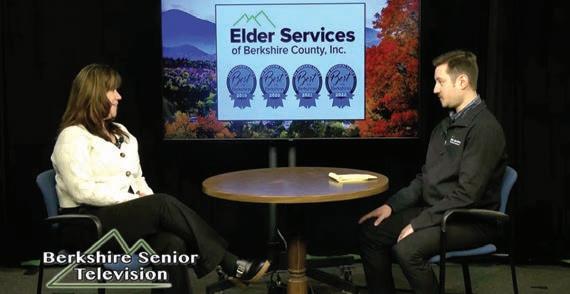
Isaac Share, ESBCI Supervisor of Home & Community Based Programs discusses volunteering with the Director of RSVP, Lisa Torrey.
BERKSHIRE COUNTY
Elder Services of Berkshire County, Inc. NUTRITION PROGRAM
SENIOR
COMMUNITY DINING CENTERS
The status and o erings of the Senior Community Dining Centers are likely to evolve. Please call for the latest update.
Eligible seniors 60 years or older are welcome to attend any Senior Meal Site. Reservations are requested 24 hours in advance. The suggested donation is $3.00 per meal. All contributions are returned to the community toward the cost of the Senior Nutrition Program. Those 59 or under are welcome at the required fee of $8.00 per meal.
MEDICALLY TAILORED MEALS
Elder Services now provides medically tailored meals (MTMs). MTMs help meet the nutritional needs of seniors with health conditions that require speci c diets such as diabetes and heart or kidney disease.
MTMs can be delivered to individuals at their home ve days a week. Menus are developed by our registered dietician and trained sta .
Call Elder Services at (413) 499-0524 to request a special meal such as pureed, cardiac, diabetic, renal or vegetarian.