









Berkshire residents are learning new job skills so employers can recruit and retain them to build a viable 21 st centur y workforce.
BY TONY DOBROWOLSKI The Berkshire Eagle
learning new job skills, others are using what they already know in some unusual professions
11 When older no longer means ancient
A willingness to keep working in an area with a large elderly population is turning older workers into a hot commodity
12 Interning means learning Internships, apprenticeships provide entry to jobs
14 The journey to
PITTSFIELD Having the right job skills are essential to landing a job in any profession, but it's even more important for those seeking employment in the 21st century economy
Due to the rapid increases in technolog y, jobs skills seemingly change overnight, and employees have to be prepared in order to land or retain jobs in their chosen fields.
That's why getting ahead in the Berkshires may be more important now than ever
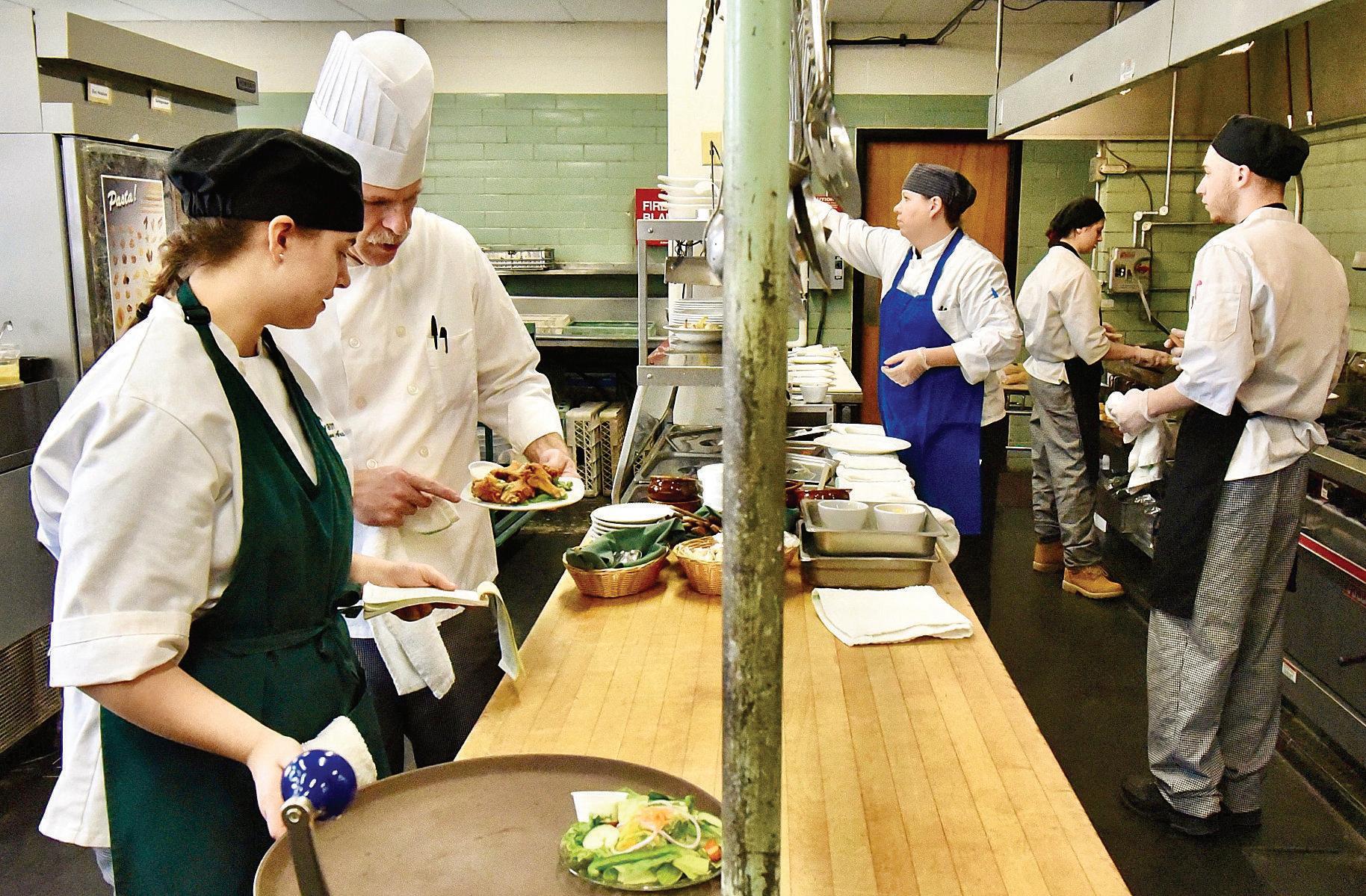
In this year's Berkshire Business Outlook, The Eagle examines workforce development and job skill training from several dif ferent angles.We examine how workers can advance their careers here and why a summer internship can pay of f in a full-time job We profile a high school culinary prog ram that provides qualified candidates with the requisite professional skills to work in Berkshire restaurants.
We also look at the Berkshire's fast g rowing cannabis industry through the eyes of two employees; and examine why older workers are still considered to be a valuable commodity in an area with a significantly elderly population
Finally, we've provided profiles on people who do some the county's more unusual jobs; a tree climbing arborist; a tinkerer who buys and fixes all types of clocks; and the
driver of an ice resurfacing machine at one of the Berkshire's four skating rinks that is located in an unusual location.
So how do Berkshires residents get involved in these professions and work on "getting ahead"? One route is through job training prog rams Sensing the need for these kind of training prog rams, state of ficials three years ago formed the Massachusetts Workforce Skills Cabinet, which has branches in seven areas of the state, including Berkshire County.
The Berkshire Workforce Skills Cabinet, overseen by the MassHire Berkshire Workforce Board, formerly the Berkshire County Re gional Employment Board, has spent the past three years developing prog rams and strate gies in three local priority employment sectors, health care and social assistance; hospitality and management; and advanced manufacturing
With help from a recent $218,000 state g rant, the Berkshire Workforce Skills Cabinet announced in November that it planned to set up a training prog ram to address the county's chronic shortage of certified nursing assistants, or CNAs. The prog ram, which is free of charge to qualified applicants, seeks to train 70 new CNAs in Berkshire County over the next two years. CNA is an entry level position in the nursing field.
"It starts a career ladder going on nursing," said Shannon Zayac,
the industry relations manager for the MassHire Berkshire Workforce Board.
Heather Boulger, the workforce board's executive director, said the board develops its training prog rams based on feedback from its partner employers
"Our role as a broader organization is to hear from our partners what their workforce needs are," she said. "Then with our education training partners to try and develop the curriculum to get unemployed and under employed residents the skills they need to get jobs in those industries."
Finding qualified local employees to fill cur rent job vacancies is both a national and local issue with unemployment rates so low.
"The labor shortage remains one of the big obstacles to a more robust small business economy," said Bill Dunkelberg, the chief economist for the National Federation of Independent Businesses, in a recent report from that organization's small business research center. According to the NFIB, 25 percent of the respondents in a recent survey listed finding qualified workers as their number one problem.
In Massachusetts, where the unemployment rate has been below 3 percent since June, the employment section of the Associated Industries of Massachusetts Business
Confidence Index has increased 2.9 points over the last 12 months But it continues to trail AIM's overall business confidence assessment due to a persistent shortage of workers that employers believe may become g reater as baby boomers be gin to retire

In Berkshire County, the unemployment rate is 3 1 percent as of press time, but 1,437 job vacancies, ranging from entry-level to high level professional positions, were listed on the state's jobquest website, as of March 9. Of those vacancies, 52 percent were listed as either entry-level or part-time jobs.
To fill those gaps locally, the MassHire Berkshire Workforce Board has met with some 180 local companies the past two years to learn about their recruitment and retention ef forts, Boulger said,
"About 50 percent of the companies we speak with say there aren't enough physical bodies for the skills they're looking for," she said.
The board's training prog rams in advanced manufacturing job skills have a 68 percent job placement rate, according to Boulger. The CNA training prog ram is just getting underway, but the board's most recent
STEPHANIE ZOLLSHAN
THE BERKSHIRE EAGLE
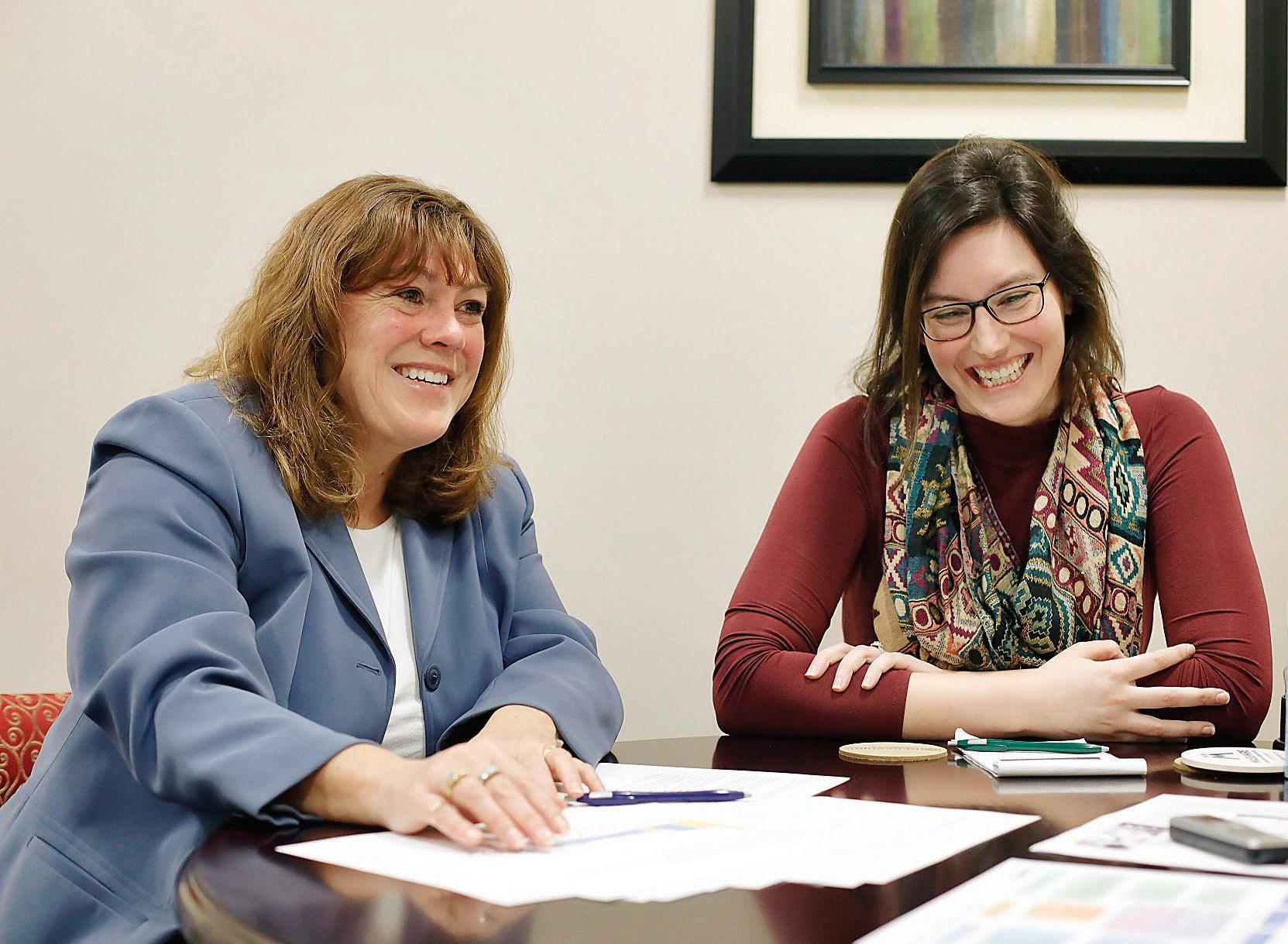
MassHire Berkshire Workforce Board Executive Director Heather Boulger, left, discusses workforce training programs with industry relations manager Shannon Zayac.
statistics on its health care training prog rams show a 70 percent job placement rate
"Employers wouldn t be coming back to the table if they weren't getting results," Boulger said.
Interprint Inc of Pittsfield, which prices precision printing on paper and firm for the decorative services industry, produces precision printing on paper and film for products that are designed to be used in the decorative services industry, also has its own in-house employee training prog rams. But Melissa O'Brien, Interprint's senior human resources generalist, said the firm works "quite a bit" with the Berkshire Workforce Board and is "happy to have them as our business partner.
"We actually approached the Berkshire Workforce Board with trying to figure out how to build awareness that there are good paying jobs in the printing industry," O'Brien said.
The $13.8 million Berkshire Innovation Center, which held its g rand opening ceremony Feb. 28, is expected to enhance local job training ef forts. The two-story, 23,000 square foot structure in the William Stanley Business Park of the Berkshires, has facilities and prog rams geared towards learning more advanced job skills.
"They're pretty much the second tier of our training prog rams," Boulger said. "Our training prog rams are more entry level Their prog ram is looking to have more technolog y, kind of that lever two tier of manufacturing to help our health care companies and out manufacturers continue to get the workforce that they need "
Ben Sosne, the BIC's executive director, said the innovation center's job training initiatives are intended to complement the prog rams that are cur rently in existence.
"The idea is to try and work with these g roups and try and connect," Sosne said. "There's still some disconnect, I think."
Tony Dobrowolski can be reached at tdobrowolski@berkshireeagle com or 413-496-6224
BY HEATHER BELLOW
The Berkshire Eagle
LEE Twenty years ago, Pittsfield native Sean Curley headed to the Boston area for colle ge
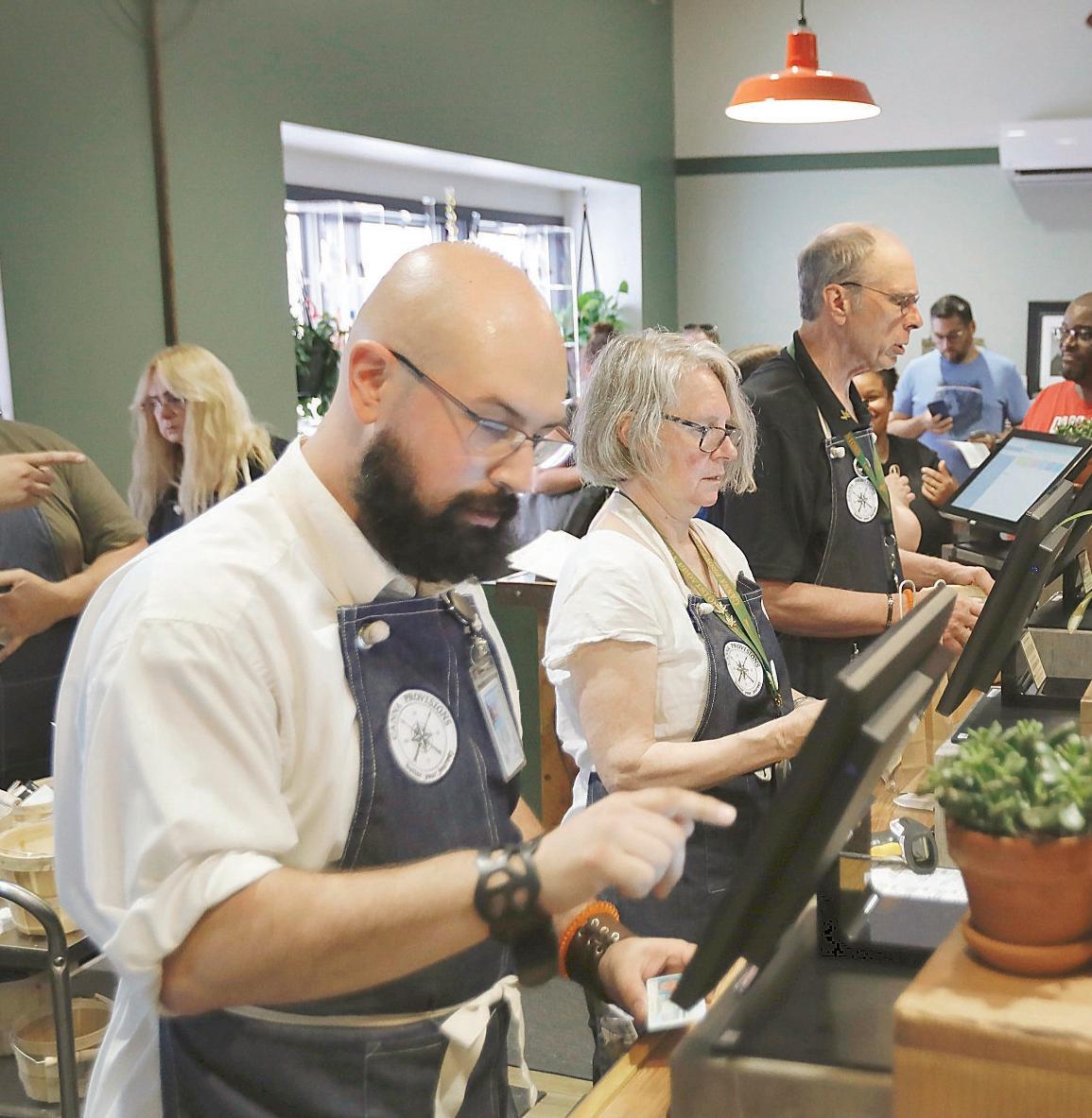
Now he’s back in the Berkshires, where “it’s a little quieter,” drawn west by a le gal marijuana boom that some say feels like the first new cash crop in the U.S. since tobacco and cotton.
In October, Lee-based Canna Provisions hired Curley, 39, to be its director of marketing Previously, he worked in Boston for a cannabis lifestyle magazine He also co-founded Eat Sacrilicious, a small company that throws cannabis dinner parties
“I thought, ‘Wow, I can actually get a job outside the Boston area that actually pays enough for a similar lifestyle,” said the Pittsfield High and Bentley University g raduate.
The budding cannabis industry could be a way to reclaim some young people who have left the Berkshires for jobs elsewhere.
Curley is just one of hundreds in the county filling a range of jobs in this somewhat uncharted le gal pot market. In Massachusetts, the industry employed 13,255 in 2019, according to Leafly, the cannabis information clearinghouse Nationwide, the industry employed 243,700.
Industry leaders say there's a place for everyone, from the entrylevel budtender, to the security guard, to the scientist or COO with successful startups in the rear view mir ror. Like his bosses and colleagues, Curley is cutting a path forward in a world that is still trying to understand itself.
The excitement of this shared learning curve from the top to the bottom of the cor porate ladder, is one reason that local entrepreneurs say they are swimming in resumes from job applicants
“It’s not like a real estate of fice,” said Canna CEO and co-founder Erik Williams. “No one has a breadth of experience in this industry ” Green light go
Massachusetts, along with neighboring Vermont and Maine, are the
only states in the northeast that have le galized the sale of recreational marijuana. Michigan is the next closest state where the sale of recreational marijuana is le gally allowed.
The Bay State’s decision in 2018 to give the g reen light to recreational pot sales is what lit this beacon of opportunity. People like Curley found they could use their skills while developing new ones that include adherence to tight state re gulations. Others knew nothing about cannabis They looked for a job and found a really good one.
“It’s nothing that I ever thought that I would end up doing,” said Audrey Procopio, a 29-year-old Pittsfield native who serves as Canna's marketing manager She had previously worked at Qualprint and Interprint in Pittsfield after g raduating from colle ge.
She says she has a lot of creative freedom at Canna, which is about to open new stores in Holyoke and Easthampton.
The jobs come in all shapes and sizes, and be gin long before a store starts operations, says Michael Cohen, president and co-founder of The Pass, which is based in Shef field.
The Pass received its state license on March 5 to g row, manufacture and sell cannabis both retail and wholesale. But the company, which will likely open this summer, had to start filling positions for the planning phase long before Now it will be gin hiring to prepare for opening. The Pass also needed hiring help it works with THC Staf fing Group, a specialty hiring firm based in Oakland, Calif Ag riculture is at the heart of it all. The company s director of cultivation, for instance, previously worked
for a company associated with DuPont, and for an operation the g rew medical marijuana in Maine. Now, he’ll also be hiring g rowers
“What’s so exciting from an employment standpoint, is that we’ll have people who will just be folding packaging, to senior level, mid-level and manufacturing,” said Cohen, a Columbia University Business School g raduate who moved from New York to the Berkshires a decade ago, after founding a digital marketing firm in the mid-1990s
Jobs at The Pass range from $14 per hour, to salaries of $100,000, Cohen said.
The Pass is also hiring Berkshire natives. One is from Dalton, and she will g raduate this spring with a deg ree in marketing, Cohen said.
“If I could bottle the look on her face and her response when she was of fered the job,” he said
More established companies, like Theory Wellness, have hired through internal refer rals. Online postings can make for a rush, says CEO and co-founder Brandon Pollock.
“There [can be] hundreds of applicants for a single position,” he said, noting that Theory’s employee numbers at its Great Bar rington dispensary and store have jumped to more than 50 after hiring 20 upon opening in January 2019
Leaders like Pollock all say that enthusiasm for the industry is key
So do outdoor cannabis farmers like Ted Dobson, who subcontracts for Theory at his 90,000-square-foot Sheffield farm Dobson and Theory have four full-time staf f at the farm, and expect that will g row to eight to 10 during several harvest seasons per year.
Dobson says romanticizing cultivation isn’t enough: you have to love to work with your hands and be around plants.
But a little romance never hurts
“America was founded on cash crops,” he said “How often does an opportunity come along like this where a new cash crop hits the scene and creates new jobs?”
Heather Bellow can be reached at hbellow@berkshireeagle com or on Twitter @BE hbellow and 413-329-6871

BY SCOTT STAFFORD
The Berkshire Eagle
NORTH ADAMS —When Zach Brassard needed to find a prep cook who could handle the pressure working at Williamstown's Berkshire Palate Restaurant, he called the culinary arts prog ram at McCann Technical School.
McCann connected Brassard with 18-year-old culinary arts student Jared Blondin He started as a prep cook, quickly took his place as a line cook and soon became a valued member of the eatery's kitchen crew By virtue of obtaining that position, Blondin was placed in McCann's co-op prog ram, which means he can earn school credit for the culinary arts course while he works
“We needed to find a line cook who knew what they were doing,” said Brassard, Berkshire Palate's



chead chef “Right from the start he was one of our better line cooks."
McCann has plenty of students like Blondin who are learning the ins and out of commercial cooking and food services in the school's culinary arts prog ram, said prog ram co-chair and instructor Patrick Cariddi. It's the only culinary arts prog ram in the Berkshires, and one of only 10 in the state, that is accredited by the American Culinary Federation, the largest professional chefs’ organization in North America.
This bodes well for the local economy because spring is when county restaurants be gin looking for dependable, skilled food service workers for the summer tourist season
Line cooks are especially in demand.
“Ít’s a very challenging time to find restaurant help,” Cariddi said.
“The phone rings of f the hook, but there are only so many students to go around.”

Established in 1961, McCann's culinary arts prog rams cur rently has 36 students. The students who choose to spend all four years in culinary arts learn basic skills first. Freshmen are taught knife safety, sanitation requirements, food safety, equipment operations and fire safety. They can be certified in Serve Safe, the food service safety training required by the state.
Prog ram participants alternate culinary instruction with academic subjects every other week Those that stay with the prog ram move on to more advanced tasks, learning kitchen cleanliness techniques and prep cooking, along with baking, how to make soups and sauces and how to sautee food by using the prog ram's char broiler.
Third and fourth year students be gin sharing the skills they've al-

ready learned and help mentor the younger students, Cariddi said.
Students pick up real world experience by working with adult staf f to prepare and serve lunch in the school cafeteria where 250 meals are prepared every day
On Tuesday and Thursday, students prepare between 30 and 50 meals per day by serving lunch of f menus in The Tea Room, McCann's public cafe. Some students wait tables in The Tea Room while others work with instructors in the kitchen preparing meals like in a commercial restaurant. Culinary arts students also help cater food when McCann holds special events.
The students experience the same frustrations and triumphs as their real world professional counterparts. The only way for students to learn how to function, even flourish, in these tasks is by working under
intense pressure, sad prog ram cochair/instructor Melissa King.
“When they’re busy, they are working hands-on and afterwards, they feel like they’ve accomplished something,” she said. “It’s not easy, because the job changes three times a day, depending on how things are going. But when they’re done here, they can wind up in any kitchen job and be successful.”
“I want to increase my skills, and I’ve learned a lot since freshman year,” said Bryson Rose, 17, a junior at McCann “I use my skills at home to cook the family meals whenever I can. It’s definitely a possible career path for me.”
Sophomore Sarinna Zaleski also loves the prog ram.
“I love cooking and baking,” said Zaleski, who is considering the restaurant business as a possible profession. “There’s nothing about it I don’t like — it comes easy to me ”
C.J. Garner, who g raduated from McCann's Culinary Arts prog ram in 2011, g raduated two years later from the Culinary Institute of America in Hyde Park., N.Y. , one of the country's top post-secondary culinary schools. Today, Garner manages two of Berkshire County's busier
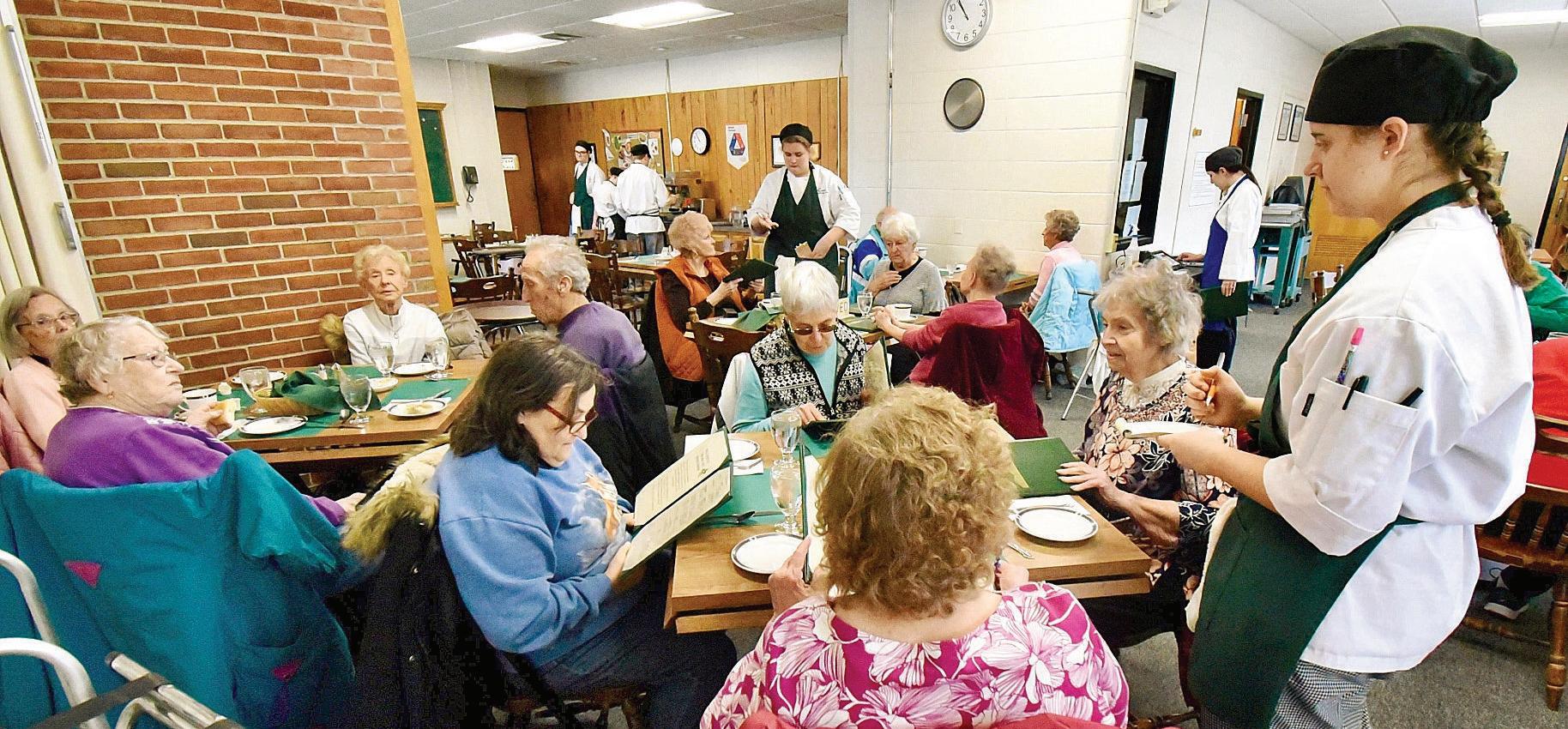
A student in McCann Technical School’s culinary arts program takes lunch orders from customers in The Tea Room, the school’s public cafe
restaurants Public Eat + Drink in North Adams and District in Pittsfield. He has also worked at Jacob's Pillow Dance Festival in Becket and Canyon Ranch in Lenox.
“I have always loved cooking – it has always been my passion,” Garner said. “And ever since I was a
little kid I knew I wanted to go to school at CIA ”
McCann's culinary arts prog ram provided the foundation for his success, Garner said.
“They do a really good job laying the g roundwork to get you to the point where you can take the next
step,” Garner said. “On busy nights, it can be easy to get caught up in things and lose your cool. They do a good job teaching you how to not do that.”
Scott Stafford can be reached at sstafford@berkshireeagle.com or 413-629-4517.

BHS offersindividualstheopportunity to work in an environmentwheretheywill be challenged,supported,andrespected. As the region’sleading provider of comprehensivehealthcareservices,ouremployees are af liatedwith an awardwinningteachinghospital,dedicatedcolleagues,andworldclasstechnology.TheBHSfamily is proud to deliverthekind of advancedhealthcaremostcommonlyfound in large metropolitancenters.
Full,parttime,andnon-scheduledopportunities arecurrentlyavailable at thePitts eld,NorthAdams, andFairviewcampuses in avariety of areas,including:
Registered Nurses,IncludingLaborandDelivery CommunityHealthNurses
LicensedPracticalNurses NursingAssistant Certi edMedicalAssistants
PharmacyTechnicians Dietitians X-RayTechnicians MedicalTechnologists PhysicalTherapists andmore! BerkshireHealthSystemssupportsdiversity in ourworkforce. Visitwww.berkshirehealthsystems.organdclick on Employment to applytoday!
By Tony Dobrowolski
The Berkshire Eagle
While some Berkshire residents are learning new job skills, others are taking what they already know and using them in some unusual professions The following are profiles of three such workers: a tree climbing arborist; a tinkerer who fixes clocks; and a man who resurfaces the ice on a skating rink that is located three floors o the ground
Arborist Chirs Carnevale climbs straight up the trees that he trims
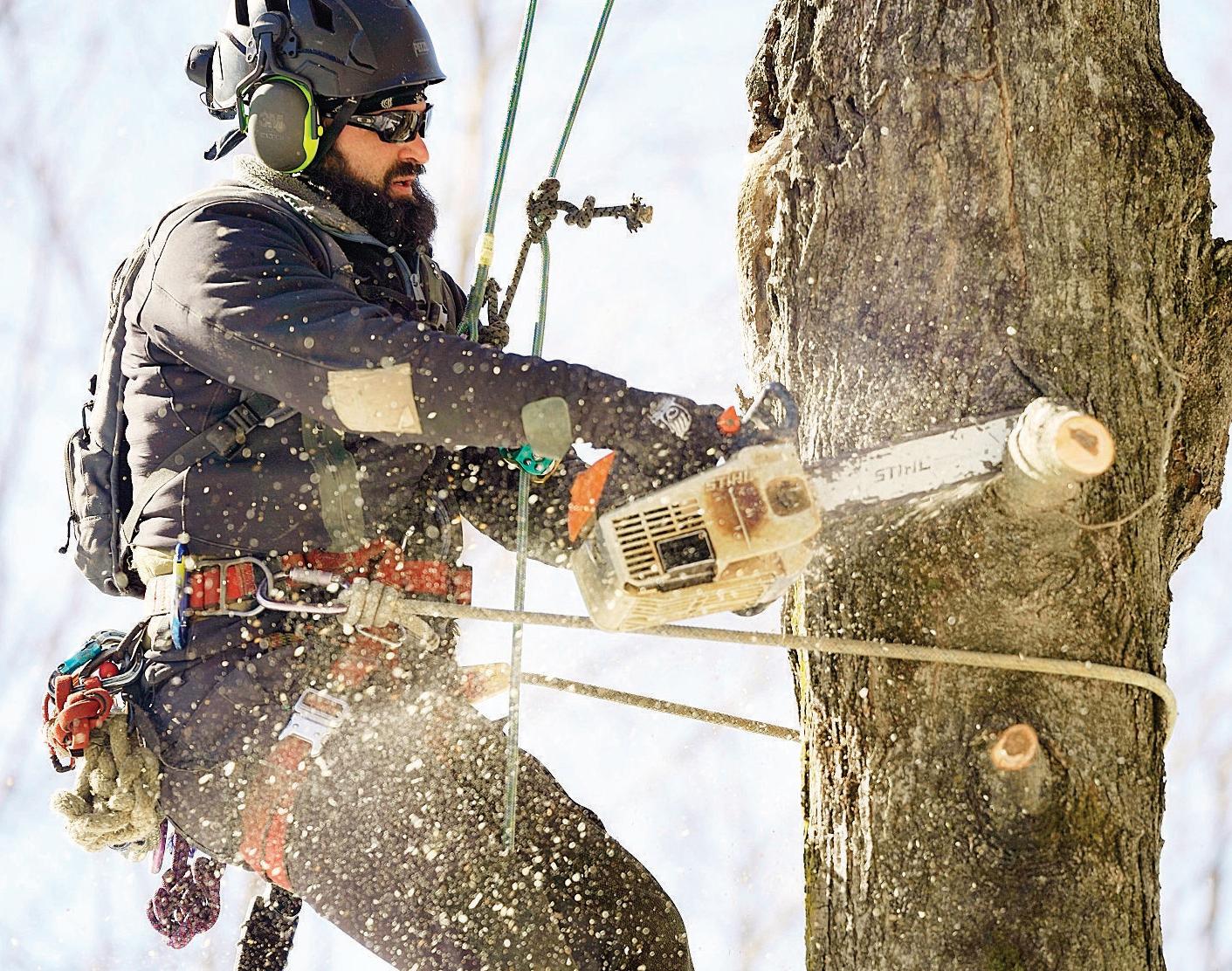
STOCKBRIDGE Wearing spurs and a harness, a small chainsaw strapped to his belt, Chris Car nevale uses rigging to inch his way up an old sugar maple tree in Stockbridge, lopping of f dead branches as he climbs.
The branches fall to the g round below him, which on this bright, cold winter morning is covered with snow. One large branch falls heavily onto nearby Quiet Knoll Road It shatters loudly when it hits the pavement, scattering pieces of wood in all directions.
Carnevale is an arborist, but one that performs his job in a unique way Instead of trimming trees while sitting in a bucket attached to a truck, as many members of his profession do, Carnevale gets to the branches by shimmying straight up the tree trunk.
"I've never been as comfortable in a bucket as I am climbing," Carnevale said shortly before be ginning his day's task.
Carnevale, who is 40, be gan trimming trees 14 years ago and has spent the last four years working on his own. He got involved in the business in his mid 20s after answering a classified ad placed by a tree company in Shef field that has since gone out of business.
"I just wanted to find something that I could do for work for a long
time," said Carnevale, who up to that point had traveled and worked in youth hostels following high school
"It was either stone work or tree work
I just wanted something that was somewhat frenetic to get all those endorphins going. I like the adrenaline "
He trimmed trees from a bucket during his first job, which lasted two years
"It was super mechanized," Carnevale said "They had a crane, buckets and what not ... It was good. I learned all the fundamentals "
Carnevale then spent eight years working for Native American Arborists in Stockbridge, where he said company owner Ben Handy taught him how to climb.
"It was all old school tree work," Carnevale said. "He's taught a lot of guys in this area it was climbing every day."
Handy also showed him how to set up his rigging, the series of ropes that Carnevale uses to both hoist himself up the tree and sometimes lower down to cut branches He sets the lines up from the g round.
"You have to put a lot of thought into this stuff," Car nevale said. "I like the physics of it, the problem solving. If you're rigging out a piece or lowering certain pieces you have to know where to put the block, which is a pulley system that you put up in the tree.
"And when you're lowering giant pieces you have to know what's going to work, where the rigging is going to be, where to set up stuf f. And you're working with another guy on the g round who's doing the lowering "
Carnevale said he's never fallen while doing this work "I've never had anything happen to me," he said. But the harness that's wrapped around his waist and the metal spurs attached to his feet help him maintain his balance while up in the tree lopping of f limbs
"You don't want to be of f-center or anything when you re making a cut," he said. "A lot of that is posi-
tioning and balance You've got to get that down.
"When I first started I thought it wouldn't be too dif ficult because I was in pretty good shape I thought it was just climbing the tree and cutting of f branches But once you get up there and have a saw with you it's a dif ferent thing It took some time to get comfortable."
The best way to lear n how to do what Car nevale does is work with someone else who knows how to do it.
"I wouldn't suggest looking at YouTube videos," he said. "You have to be around someone who knows what they're doing and can do it cor rectly You need to work with somebody I would say for four or five years "
How long does Carnevale plan to continue shimmying up trees?
"Man, I don't know," he said. "Hopefully, awhile At some point your body is going to break down. But I still feel good, so I'm still doing it."
“I’ve
Aldo Bat taini likes to fix things, and he’s found the per fect item to work on: clocks
PITTSFIELD An old German-made clock sits on a shelf beside another one that comes from The Netherlands. A banjo-shaped clock hangs on a nearby wall There’s a clock with a picture of clipper ships on the bottom, and one that plays music when the hour strikes.
“Tons and tons of stuf f,” said Aldo Battaini, as he turns to a visitor and smiles. “I’ve got the disease ”
What Battaini likes to do is collect clocks, which he does by attending tag sales and auctions, then fixing them
He became interested in the repair side of the business at age 12, which is when he be gan apprenticing with his uncle, a clock repairer named Rosario Forte Uncle Rosario, an
auto mechanic by trade, fixed clocks out of his house on Dewey Avenue.
“When I was a kid it looked interesting,” Battaini said. “I just like fixing things ”
Rosario Forte, who was originally taught how to fix clocks by his brother, Attilio, eventually turned his side job into a business, opening West Side Clock Shop on North Street in 1980. Aldo and his wife, Nancy, took over the business in 2001. Nancy runs the sales side of the business. Aldo concentrates on buying and fixing clocks The business, which is located in two small storefronts, is jam packed with all types of time pieces. Aldo believes “a couple of hundred” of those clocks are for sale.
“If you ask me how many I have out in the back and down in the basement, I can’t count that high,” Battaini said, refer ring to the clocks he’s cur rently fixing “I keep buying ”
“He’s always on the hunt, auctions, everywhere,” Nancy said
“Before the internet he and his uncle traveled on the weekends. They were always buying parts here and there.”
When fixing a clock, Battaini begins by assessing the condition of the movement, or motor, the device that makes a clock run.
“You kind of diagnose it,” he said “You look for worn parts, to see if the springs are OK, all the little stuf f I don’t follow a routine, I just do it.”
After finding the problem, Battaini said he removes the motor from the clock, then cleans it by placing the movement in an ultrasonic cleaner A solution that is placed in the cleaner removes the dirt. “You don’t want to work with a dirty movement,” Battaini said.
Fixing antique clocks can be challenging because the companies that manufactured them all used dif ferent movements, Battaini said.
“Every single clock is dif ferent,”
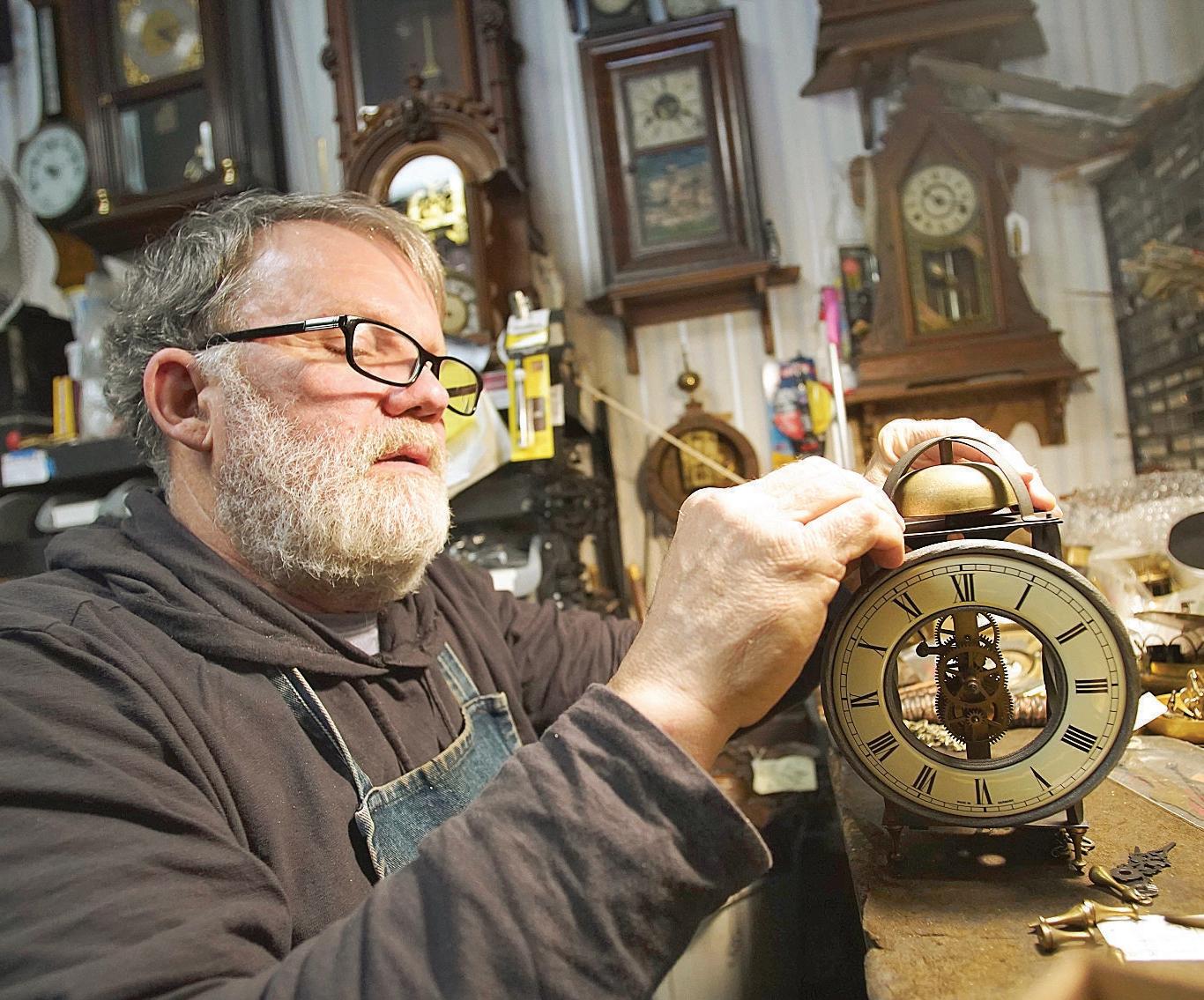
he said. “It’s the overall layout of the gear. You couldn’t take the gear from one manufacturer and put it in another clock manufacturers because it couldn’t work There was no standard as far as that was concerned. Nothing was interchangeable from one manufacturer to the next. Now it’s a black box You pop it out, pop it back in and it’s done.”
Knowing the history of the manufacturers who built these clocks helps to fix them
“Sometimes the history will give you repair tips as well,” Battaini said. “Sometimes it’s the way they cut the gears Other manufacturers cut spokes in the wheels.”
Clocks that have balance wheels or balance platforms in place of a pendulum, like a ship’s bell clock, are the ones that Battaini finds hardest to repair Those clocks were mostly used on trains and ships, where motion can disrupt a pendulum’s timing.
“You can’t have a pendulum on a boat,” Battaini said. “They needed the [cor rect] time to coordinate longitude and latitude.”
“You’ve
got to be a detective. If every movement is di erent with antique clocks, you have to know how to figure it out.”
Aldo Battaini, owner, West Side Clock Shop
Battaini attributes his clock repair training to “my uncle’s school of hard knocks,’’ but said the best way to learn the craft is to work with someone else.
“You have to apprentice,” he said. “You have to do it for years like [my uncle] did ... You’ve got to be a detective If every movement is dif ferent with antique clocks, you have to know how to figure it out ”
There’s also the National Association of Watch and Clock Collectors, a worldwide nonprofit organization based in Columbia, Pa , where “like-minded people go to talk about clocks” Battaini said
His uncle Rosario used to belong to the g roup, and Aldo is a former head of the organization’s Berkshire County chapter
“I don’t go to it any more because she can never get me,” he said, referring to his wife.
“There’s an awful lot of clock nerds,” Nancy said.
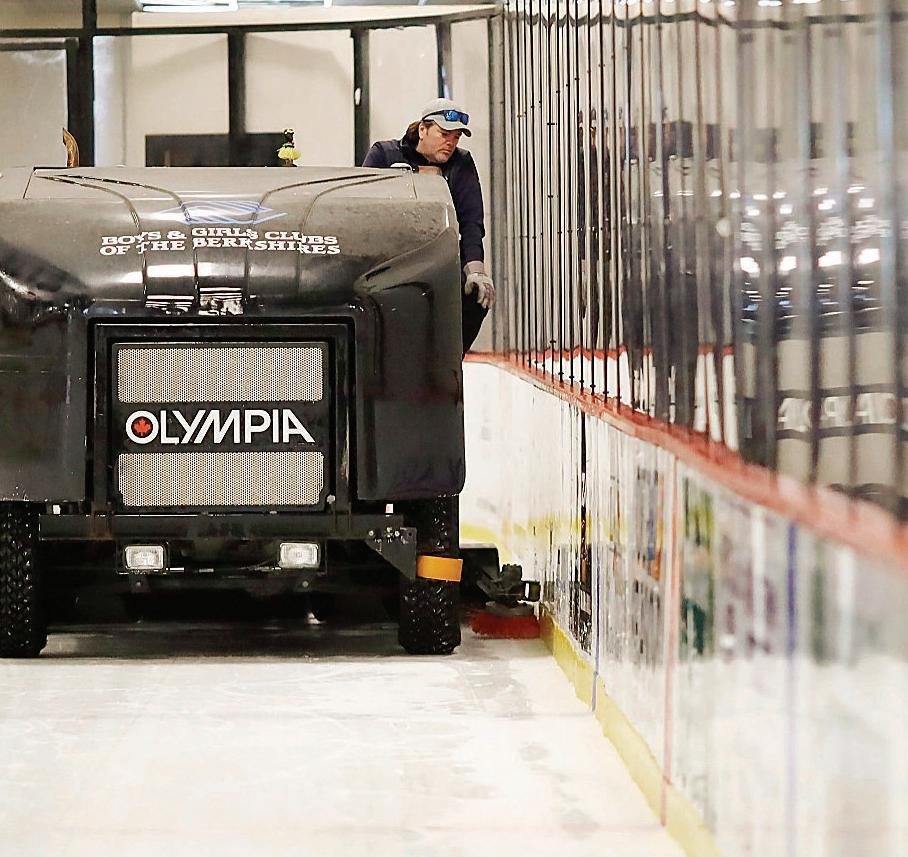
Dan Kearns resur faces the ice on a skating rink that is situated in an unusual location
PITTSFIELD Dan Kear ns perfor ms an unusual task in a venue located in an equally unusual place.
Kear ns is the rink manager at the Boys & Girls Club of the Berkshires. One of his jobs is driving a large tractor-like vehicle, known commonly as a Zamboni after the man who originally invented it, to resurface the ice sheet at the club’s skating rink.
Perfor ming this task at Berkshire County’s three other skating rinks in North Adams, Shef field and Williamstown isn’t any dif ferent But at those rinks, the ice surface is located at g round level At the Boys & Girls Club, the rink is located on the third floor of a building that is located smack in the middle of downtown Pittsfield
The rink was built that high because the club added an extra floor when it decided to expand straight upwards following a significant fund drive in the early 1960s. Not only is it a quirky place to put a hockey rink, but the location also makes it dif ficult to maintain a sheet of ice.
“We’re definitely in a dif ferent situation being on the third floor above the basketball courts,” said Kear ns, who is completing his third year as rink manager. “We have the heat from the building rising up against our refrigeration unit which isn’t favorable for good ice, that’s for sure. We have to kee p the ice a little thicker than nor mal rinks because of that situation.”
So what’s it like driving the ice resurfacing machine up there?
“It’s actually pretty easy,” Kear ns said. “The hard part is lear ning the de pth of the blade to put down, how dee p you should cut it, and how much water to put down That took a little bit of time.”
The vehicle that Kear ns operates resurfaces ice by removing the snow that is left on top by skaters The blade, which is located under the back of the machine, cuts into the ice surface to remove the snow, which is then de posited in a catch basis by a horizontal auger located behind the seat in the rear of the vehicle As it picks up the snow, the vehicle drops hot and cold water onto the cleaned sheet of ice. The cold water fills in

“We’re definitely in a di erent situation being on the third floor above the basketball courts. We have the heat from the building rising up against our refrigeration unit which isn’t favorable for good ice, that’s for sure. We have to keep the ice a little thicker than normal rinks because of that situation.”
—
Dan Kearns, rink manager, Boys & Girls Club of the Berkshires
the ruts left by skate blades, and the hot water smooths them out.
“It takes me about an hour every morning to get the ice back into good shape for the figure skaters,” Kear ns said. “They’re usually the first on the ice exce pt on the weekends when we start with hockey.”
What makes driving the ice resurfacer at the club a little trickier than at other rinks is when the driver has to dump the snow that has been collected from the machine. At the Boys & Girls Club, the front end of the vehicle comes up like the back end of a dump truck and de posits the snow in a small chute located at the back of the rink From there, the material cascades three stories down the back of the building before landing on the nearby CSX Railroad tracks. In order to perfor m this task, Kear ns has to carefully maneuver the machine close enough to the chute so the snow falls in it cor rectly. When finished, Kear ns then has to put his Zamboni in reverse, then back out on to the ice surface.”It’s not easy,” Kear ns said. “You also have to back
the Zamboni of f the ice where we kee p it ... In most rinks you drive it right out and drive it right of f so you don’t have to wor ry about dumping.”
Just getting a Zamboni up to the third floor of the Boys & Girls Club presented its own set of challenges The club purchased its cur rent Zamboni from the Westminster School in Simsbury, Conn. four years ago, but had to use a crane to lift it high enough to get it in the rink. Problems occur red when the new Zamboni was too big to fit through the outside opening to the rink. So part of an outside wall had to be knocked down so the machine could finally be brought in.
“That was crazy,” Kear ns said Frank J. Zamboni invented the moder n ice resurfacer in 1949 while looking for a more ef ficient way to clean the ice at the skating rink that he had built with his brother in Paramount, Calif Before the Zamboni was invented, ice was cleaned by a tractor pulling a scraper, and the process took more than an hour to complete One trip around the ice at the Boys & Girls Club now takes about 15 minutes, Kear ns said Zamboni, who tested three proto-
STEPHANIE ZOLLSHAN THE BERKSHIRE EAGLE
Driving an ice resurfacer, more commonly known as a Zamboni, on a skating rink takes dexterity and patience when cleaning along the boards.
types before finding one that worked, originally experimented with a tractor, and the moder n ice resurfacer retains many aspects of that traditional far m machine According to Kear ns, the Boys & Girls Club’s vehicle is built on a chassis made for a Chevrolet Tahoe. It moves on studded snow tires and is powered by two large propane gas tanks that are situated near the driver’s seat
“It’s just like driving a big tractor,” Kearns said.
Driving it slow across the ice produces the best results.
“I kee p it at 18 to 20 r pms, which is probably 7 to 10 mph,” Kear ns said “It’s a better cut. You get going too fast and it kind of skips of f the ice When you drive it too fast the ice is choppy ”
Has anyone ever driven the vehicle through the wooden boards that sur round the rink?
Kear ns won’t say He tells a visitor to speak with a for mer rink manager who held the job when he was 18.
“We’ll leave it at that,” he said.
Tony Dobrowolski can be reached at tdobrowolski@berkshireeagle com or 413-496-6224
A willingness to keep working in an area with a large elderly population is turning older workers into a hot commodit y
BY CLARENCE FANTO Eagle correspondent
In an economy where employment is considered to be almost full, it's not unusual to see "help wanted" or "we're hiring" signs sprout up in the community. Mature workers, those ages 50 and over, have become the beneficiaries of this trend.
At the MassHire Berkshire Career Center in Pittsfield, 45 percent of the job seekers during the eight months that ended in February were age 46 or older, according to recent data from the county's go-to resource that connects employers to workers MassHire, a partnership between the nonprofit Berkshire Training & Employment, Inc., and the Massachusetts Department of Career Services, also oversees the Berkshire Workforce Board
“This data shows there is a large population of individuals actively seeking full- or part-time work,” said MassHire business services representative Melanie Herzig. “Mature workers are staying in the workforce longer or reentering later in life.”
Employers value the knowledge and experience that older workers can bring to a business, and can help employers fill both full- and parttime positions, Herzig said via email
“Mature workers are dedicated, reliable and conscientious employees and can of fer more flexible hours," she said.
“People are working longer than they used to because they are living longer and want to maintain being engaged," said Marybeth Mitts, a consultant to the MassHire Berkshire Workforce Board "Those who have pur pose or find value in paid work or volunteer work and are engaged with others daily tend to be happier and find g reater fulfillment in their lives.”
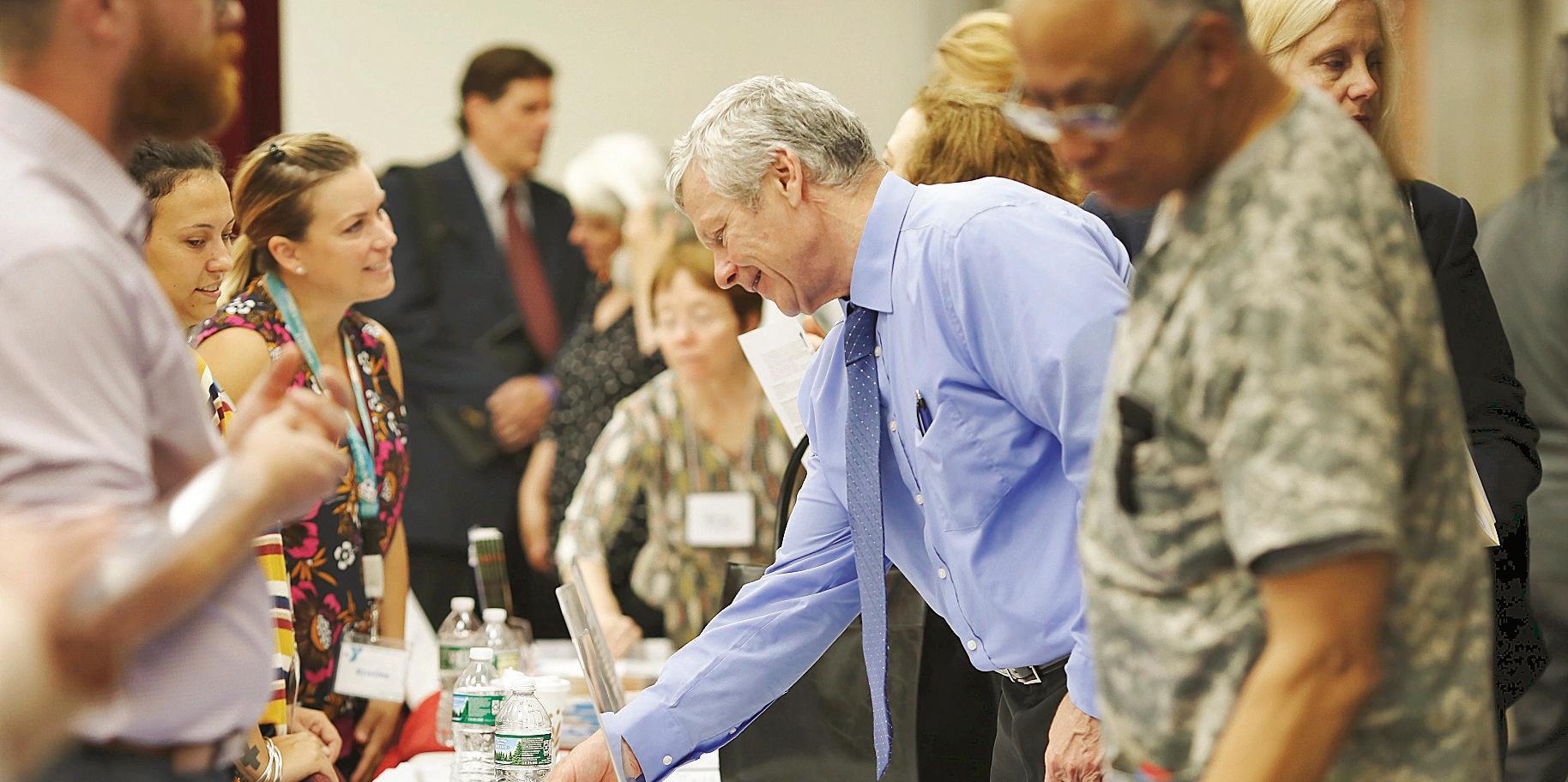
STEPHANIE ZOLLSHAN THE BERKSHIRE EAGLE
Older job seekers recently flocked to the Berkshire Athenaeum in Pittsfield to attend a job fair held specifically for workers that are age 50 and over. The MassHire Berkshire Career Center began holding these age specific events in 2018.
Many older residents also need to continue working to satisfy ongoing financial commitments like house payments or assisting their children with colle ge tuition and fees, said Mitts, who is also a member of the Lenox Select Board and the town’s Af fordable Housing Trust and Committee.
The Berkshire Workforce Board is the supervisory agency and policymaking g roup for federally and state funded employment and training services for the county's 32 municipalities.
While the county's unemployment rate has remained statistically low it's 3.1 percent as of press time Mitts stressed "there are also many people who are underemployed, working multiple jobs to make ends meet. Many older workers whose jobs are eliminated due to corporate restructuring need to find employment to stay in their homes, support families, and maintain a measure of health benefits and retirement benefits.”
Some companies still see mature workers as "overqualified," she said. But old workers still need employment. They also manage their expectations, frequently taking salaried positions carrying financial compensation that's 10 percent to 35 percent less than they had previ-
ously been paid.
Some employers hesitate providing job of fers to mature workers who may expect to earn more than their less costly younger counterparts, Mitts said.
But as Mitts emphasized, “Older workers have the benefit of years of experience; many are open to learning new skills on new platforms, they are eager to be given a chance for new challenges.
"It’s important that the lines of communication are open and that professional development is available for workers at every level of a firm," Mitts said "That’s what builds and expands productivity.”
The career center in conjunction with other local organizations that serve the elderly be gan holding job fairs in the Berkshires specifically for workers age 50 and over in 2018 At the most recent event, 139 mature workers were connected with 37 businesses that were seeking a multigenerational workforce, Herzig said. Data on how many of those participants landed jobs as a result of that event was unavailable.
Services for mature workers at the career center include weekly job club support g roup meetings along with networking opportunities. The center also of fers free seminars on basic computer skills and online
strate gies Retraining prog rams are of fered to help older workers develop new skill sets.
“As businesses move to online applications these skills are becoming more and more important,” Herzig said.
Mature workers are also known for their reliability, having a strong work ethic and being committed to ar riving at work daily and on time, Mitts said.
“Many employers are happy to hire seasoned workers,” she said.
“Many of them have developed solid social skills, listening well to team members and problem solving together, seeing challenges from multiple perspectives and of fering a range of solutions, as well as sensitivity to customer service needs of clients ”
Key job sectors for mature workers in Berkshire County include health care, advanced manufacturing and hospitality Health care is the county's largest job sector.
“There’s a lot of opportunity in hospitality,” Mitts said. "These places like the fact that they can get seasoned workers who know the area.”
For more information, visit masshireberkshirecc.com.
Clarence Fanto can be reached at cfanto@yahoo com, on Twitter @ BE cfanto or 413-637-2551.

BY JENN SMITH
The Berkshire Eagle
Internships can be excellent pathways into local jobs and careers
Just ask Jade Schnauber, 22, a senior at Massachusetts Colle ge of Liberal Arts.
Two years ago, Schnauber's mother sent her a link to Berkshire Business Interns, an internship prog ram run by Lever Inc., a small business incubator in North Adams.
"I told her, I'm not a business student," Schnauber said Her majors are early childhood education and sociolog y "But she encouraged me to apply anyway.
"Then I got an email back "
Following a successful interview, Schnauber received an internship with Lever. She was invited back to the prog ram, since renamed Berkshire Interns, and now runs the entire initiative herself by serving as Lever's workforce prog rams manager.
She attributes her success to communicating clearly and often with her employer about how the internship would best support her desire to
gain practical workforce experience
"I’ve felt supported as an intern. My supervisor and I would have a lot of meetings, sit and talk about what I was working on, and he would give me feedback," she said.
Schnauber also appreciated that her knowledge was recognized and valued while working as an intern
"They would take my ideas and use them," she said. "I designed a whole cur riculum, and the fact that my supervisors said "yes, we can use this thing", gives me a lot of confidence in the prog ram I now run "
Prospective interns should look for opportunities that will make the best use of their time and ef fort, Schnauber said Berkshire Interns does not provide internships where participants are more likely to provide coffee for their co-workers than work as contributing team members
"Unfortunately, those internships can exist," she said. "But we don't accept them in our work."
The internships that are of fered in Lever's 10-week Berkshire Interns prog ram are full-time paid positions The prog ram aims to match 50 in-
terns with area businesses this summer. Lever worked with 45 last summer.
To find the internship opportunity that's best suited for you, Schnauber and other workforce experts recommend looking at what a prospective company can of fer you as well as taking a personal, internal audit of what you seek to gain from the experience. "Find a company that resonates with you, that does work you're familiar with or can of fer something you want to learn," she said.
Businesses and communities have other ways of helping people become skilled workers and productive employees, local workforce and youth empowerment experts say, Railroad Street Youth Project in Great Bar rington gives teenagers and young adults opportunities to explore their interests through apprenticeship and mentoring prog rams that allow them to work side-by-side with professionals who
are passionate about their work and the community. Railroad Street cur rently of fers apprenticeship prog rams in cosmetolog y, childcare and culinary arts
"Beyond skills, youth empowerment is as much about adults connecting with young people and exploring a career path with someone in the community who is excited about what they do," said Railroad Street Executive Director Ananda Timpane "Our youth get to build a network in South County of peers and mentors that will support their career paths."
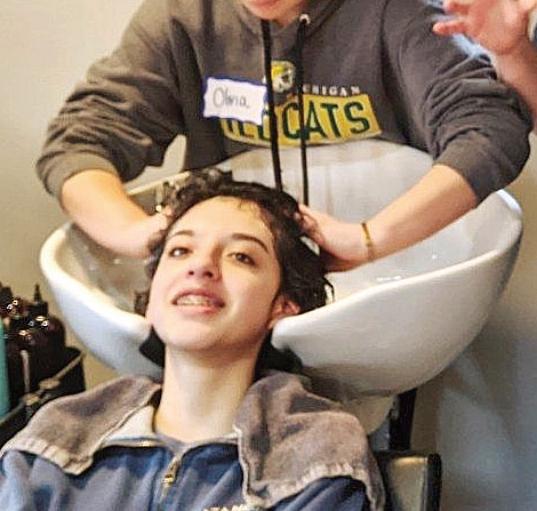
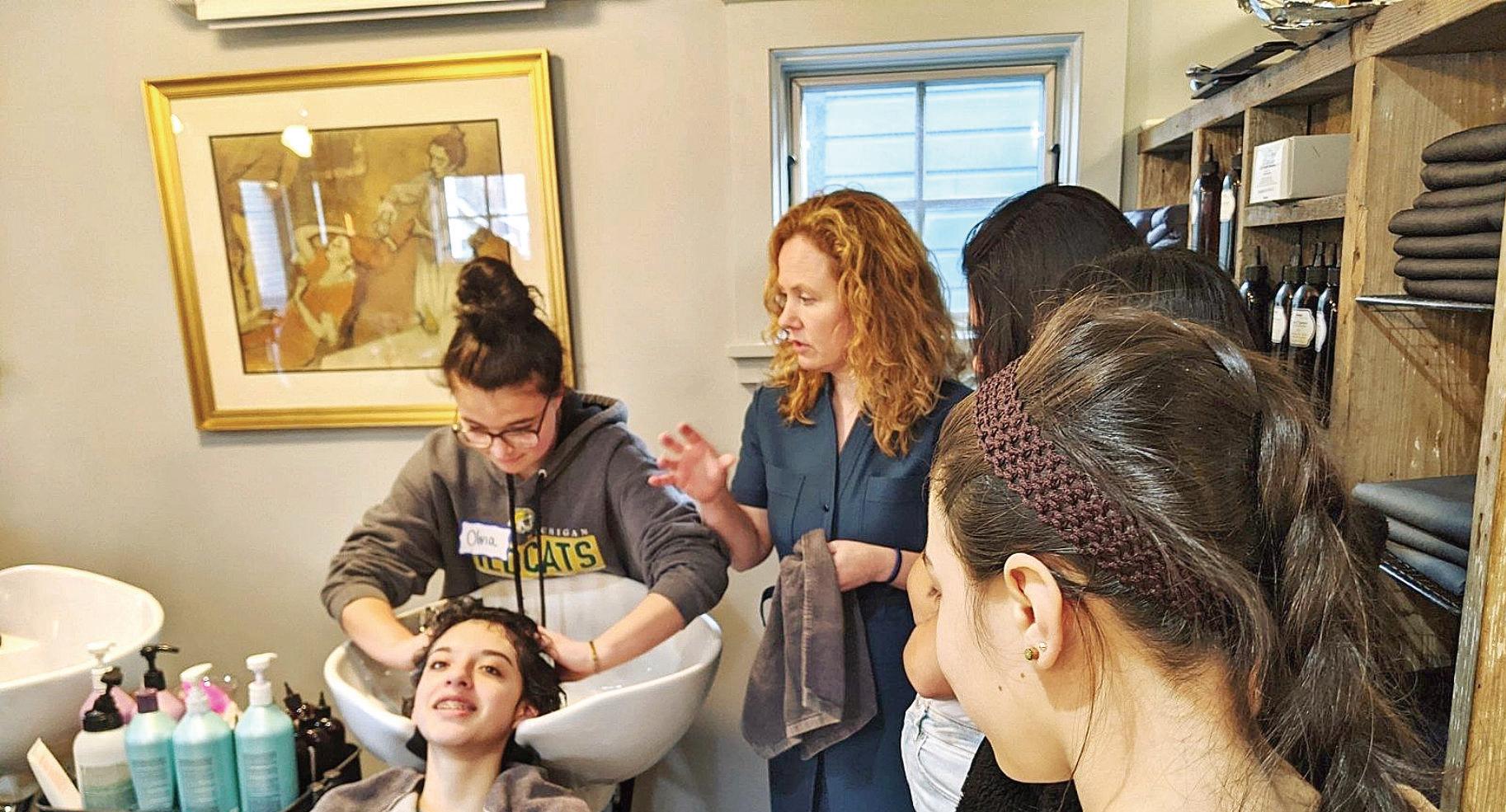
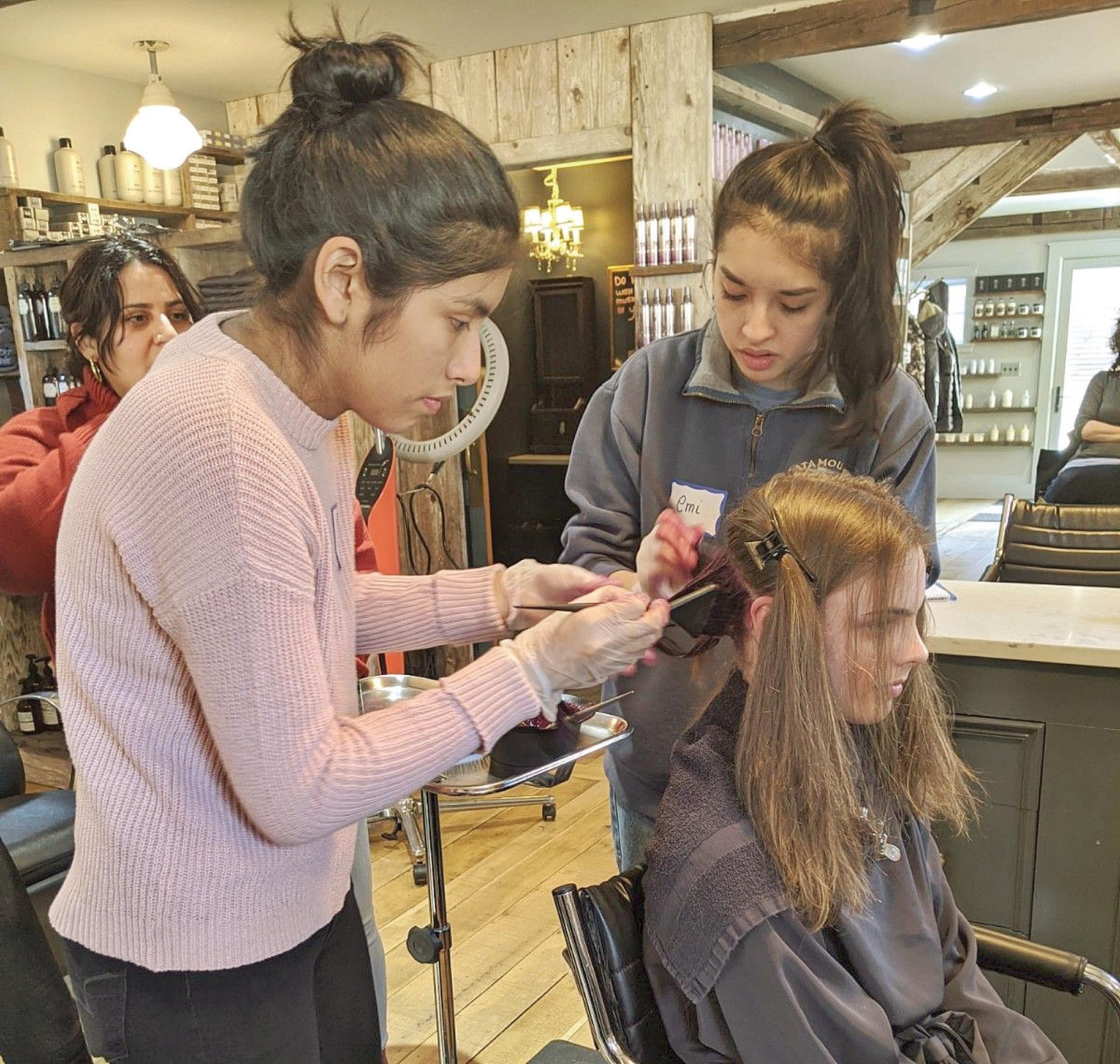
On a recent Monday afternoon, seven young women stood clustered around Mulber ry Hair Company owner and stylist Caroline Crehan Becker, who had just situated student Angeli Faggioni in her salon chair They were charged with coloring Faggioni's ash brown hair by saturating it with a pudding-thick custom blend of cabernet-colored dye. From the sidelines, Crehan Becker coached the teens on their application techniques and precision
To a demure girl lightly brushing
Faggioni's strands with the hair color, Crehan Becker cracks, "C'mon! Don't be afraid. You have to really work it in with your fingers to really get that color!"
Another girl combs gobs of dye from Faggioni's hair.
"You don't want to oversaturate," the stylist reminds her. "You don't want to waste color "
The dye has to be spread equally throughout Faggioni's hair, a balanced approach that is similar to Crehan Becker's style of mentoring
"I like how she's not afraid to tell you if you're doing something wrong," said Emi Sarmiento, a sophomore at Monument Mountain Regional High School. "But she's also really funny and she really cares "
Sarmiento has been participating in cosmetolog y and culinary apprenticeships since she was in the seventh g rade, a process that has helped her become more confident in her abilities. She cuts her parents' hair at home.
"I like working with my hands," she said.
Sarmiento's hair dyeing partner, Mount Everett Re gional School freshman Deisy Escobar, said the apprenticeship prog ram, "helps you know what you want to do and don't want to do "
The MassHire Berkshire Workforce Board in Pittsfield supports high school and colle ge interning
opportunities But executive director Heather Boulger and youth director Heather Shog ry-Williams also assist local schools in implementing a variety of career "awareness and exploration activities." They range from career fairs to job shadow days and guest classroom speakers for students in the kindergarten through 12th g rade.
During fiscal 2019, Boulger and Shog ry-Williams said the board assisted local high schools place 385 student interns in 211 re gional businesses; helped 2,234 students in g rades K-12 participate in 29 career awareness activities, and provided 26 teachers with career-readiness professional development opportunities to help them better under-
stand the careers that are available and developing within the 21st-century economy
The board receives $200,000 each year to implement the re gion’s Connecting Activities prog ramming, which helps provide stipends to the schools to place students in internships, ar range career readiness activities, provide company tours, establish career support teams, among other functions.
High school internship opportunities are cur rently being developed within what Shog ry-Williams call "the re gion’s most critical industry sectors: health care and social assistance; hospitality and tourism; advanced manufacturing and the skilled trades.
"In re gards to high school internships, we have been working overtime with all of the re gion’s public school districts to continue to expand upon their internship opportunities for students," Shog ry-Williams said.
"These internship opportunities (paid by the employer or unpaid) are highly re garded by the Berkshire business community in serving as a viable solution in meeting their cur rent and future workforce needs to keep their businesses thriving here," she said
Jenn Smith can be reached at jsmith@berkshireeagle.com, at @JennSmith Ink on Twitter and 413-496-6239
BY MITCHELL CHAPMAN
The Berkshire Eagle
LEE It's a familiar story for many Berkshire residents Employees can't always advance in their chosen professions because they reach a dead end.
James Zigmand knows this tale well. The 53-year Great Bar rington resident hit that wall four years ago when he found himself at a Berkshire County unemployment of fice searching for a new job opportunity.
Zigmand was a manager at Dave's Pet Store in Northampton, and had worked in the retail industry since g raduating from Mount Everett Re gional School in 1984 But Great Bar rington is a long way from Northampton and Zigmand wanted to find a job that was a little closer to home He quickly found that those kinds of opportunities weren't available locally
But then Zigmand heard of a free job training prog ram of fered by the MassHire Berkshire Career Center in Pittsfield So he decided to enroll in two courses: introductions to both advanced manufacturing and the local paper and pulp industry
One day, a representative from Onyx Specialty Papers in Lee visited his manufacturing class, and Zigmand became interest in the opportunities available in the paper and pulp industry. When the classes ended, Onyx encouraged all the g raduates to apply for entry-level positions, and Zigmand did He soon found himself working as a shift worker at Onyx serving as a third helper, a job that requires driving a forklift and loading paper pulp into a pulper machine, a process that occurs at the very be ginning of the paper-making process
A little over two years later, in March 2019, Zigmand moved up the employment ladder again He current serves as a quality control specialist, a job that takes place at the end of the paper-making process.
Starting wages for manufacturing jobs in the paper-making industry start at about $19 an hour, according to Zigmand, a figure that originally astonished him.
"What got me was the amount of money you could earn," he said "Manufacturing is huge, and it's expanding. A lot of companies are looking for people with just some
PHOTO COURTESY OF ONYX SPECIALTY PAPERS
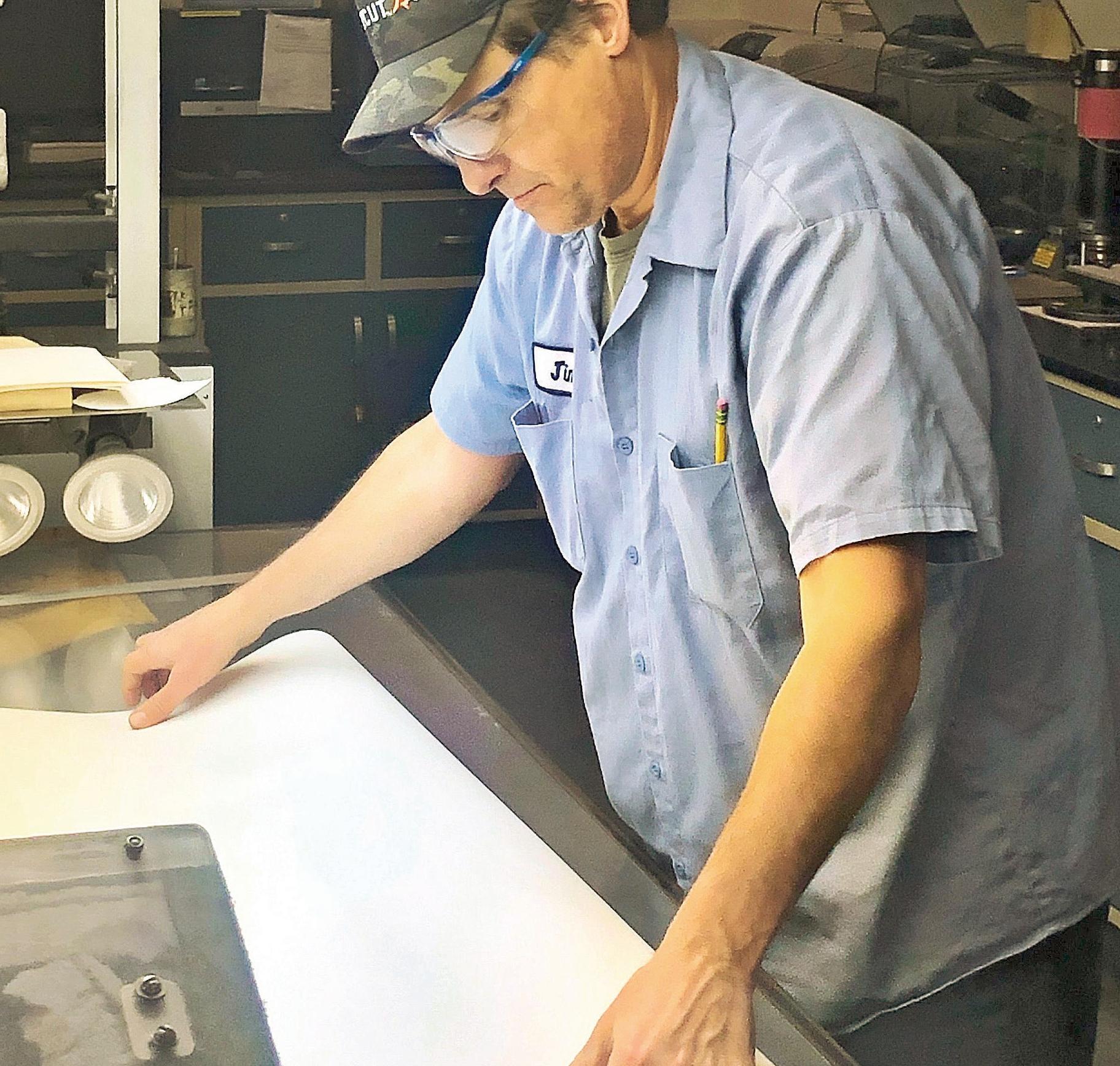
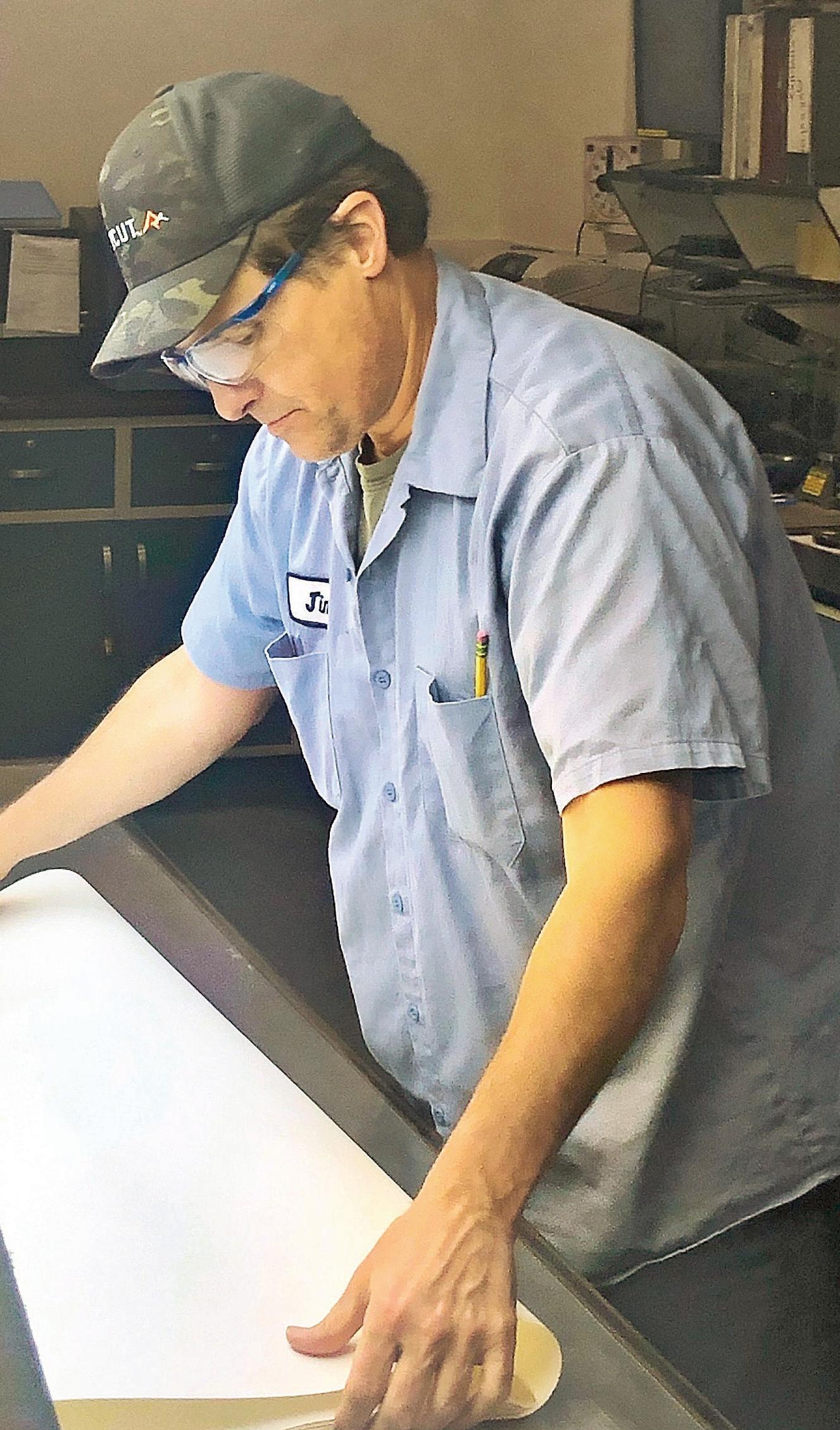
James Zigmand, a quality control inspector at Onyx Specialty Papers inspects a finished sheet of paper to see if it matches the specifications outlined by the customer

• Be reliable
• Be punctual
• Work hard
• Be persistent
• Look for opportunity
training and experience "
Zigmand had gone from working as a manager in a pet store to a shift worker at a manufacturing plant, so it took some time for him to get used to his new schedule. At Onyx, shift workers cycle through a three-week schedule. They work from 6 a.m. to 2 p m the first week; from 10 p m to 6 a.m. the second week; and from 2 p m to 10 p m in week three before the cycle is reset in week four.
But Zigmand was eager to prove himself in his new industry, and when the opportunity arose for him to serve as a quality control specialist on a temporary basis, he jumped at it He interviewed five times for that position before receiving a permanent job
For those interested in achieving what he accomplished, Zigmand recommends, "be punctual, be reliable, work hard, look for opportunity " Persistence helps, "and you'll also
need some luck," he said.
"I was lucky that opportunity opened up for me "
For information on prog rams available at the MassHire Berkshire Career Center, go to masshireberkshirecc.com, call 413-499-2200, or visit the career center at 160 North St. in Pittsfield
Mitchell Chapman can be reached at 413-496-6217, or mchapman@berkshireeagle.com.
Training programs available for professional cer tifications
BY BOB DUNN
PITTSFIELD Relatively low unemployment numbers and a g rowing need for certified workers in health care and service industry professions have created opportunities for those in need of a job or looking to make a career change
But, what skills are in demand and how does one go about learning them?
Melanie Gelaznik, Executive Director of the MassHire Berkshire Career Center and Michael Gutierre z, President of the Mildred Elley school's Pittsfield campus, have identified a few trends in the types of in-demand jobs for which training is available locally.
Health care is the county's largest job sector, and both Gelaznik and Gutier re z ag ree there is a g rowing need in the Berkshires for certified nursing assistants (CNAs), licensed practical nurses (LPNs) and medical assistants.
Other g rowing professions in the Berkshires that require certification include addiction recovery counseling, and commercial drivers, she added. Gutier re z said service-related jobs that require certification such as massage therapist and cosmetologist are also in high demand In the past, it was much easier to find employment without some type of certification being required, but that's no longer the case, Gelaznik said. Concerns about the cost of training for these certifications can be mitigated, they both said.
The career center provides prog rams for people who have been laid of f and are collecting jobless benefits, along with low-income adults and young people who are considered to be "at-risk."
Clients who fall into those cate gories don't have the two-to-four years needed to invest in a de g ree prog ram. They need to find work relatively quickly, because they are on a limited budget or in poverty, she said. The career center's goal is to get clients into a prog ram that takes a year or less to complete.
Career center clients who are collecting unemployment or whose income falls below poverty guidelines automatically qualify for federal assistance funds, she said. So do people who are receiving either food assistance or receive monthly supplements to purchase nutritious food through SNAP benefits (the Special Nutrition Assistance Prog ram)
At Mildred Elley, students who qualify can receive financial aid in the form of loans, g rants and scholarships The school will also work with individual students to finance their training.
Job seekers are also concerned that they are too old to either learn a new skill, re-enter the job market or change careers But age isn't a bar rier to obtaining work in the Berkshires, where the average population is older than in many other areas of the state The career center recognized this trend when it be gan holding job fairs targeted specifically for those ages 50 and over two years ago About 40 employers participated in those events.
“I don’t think in this job market, age is really a factor right now," Gelaznik said.
Some fields, like massage therapy, are actually seeking older applicants. Gutier re z said.
"Workers in their 30s, 40s or beyond should feel comfortable pursuing a new career path," he said.
With the economy doing well, those who obtain certifications tend to be hired relatively quickly, Guiter re z added
A cosmetolog y student at Mildred Elley who was three months shy of g raduation was of fered a job on the spot by a representative of Miraval resorts during a recent campus visit. Many people have also found work quickly as certified nursing assistants or licensed practical nurses.
“The job market is really wanting them,” Guiter re z said.
Bob Dunn can be reached at bdunn@ berkshireeagle com, at @BobDunn413 on Twitter and 413-496-6249



AuthorAllenHarris-founderandowner of BerkshireMoneyManagement-guidesyou towardamorepro table,smoothtransfer of yourbusinesswithactionable,soundadvice. Getacomplimentarycopy or beginacon dentialconversationaboutretiring by emailing himatAHarris@BerkshireMM.com.