LACKLUSTER PERFORMANCE: The county’s performing arts venues struggled to return to pre-pandemic attendance levels, but Tanglewood fared somewhat better. 3
AIRPORT IN SIGHT: We spent some time at the Pittsfield Municipal Airport to get a sense of what happens in plain view, behind the scenes and in the surrounding area. 14-15
Berkshire Business Journal
OCTOBER 2022 | VOL. 1, NO. 5
Spirituality and sustainability
BY TONY DOBROWOLSKI
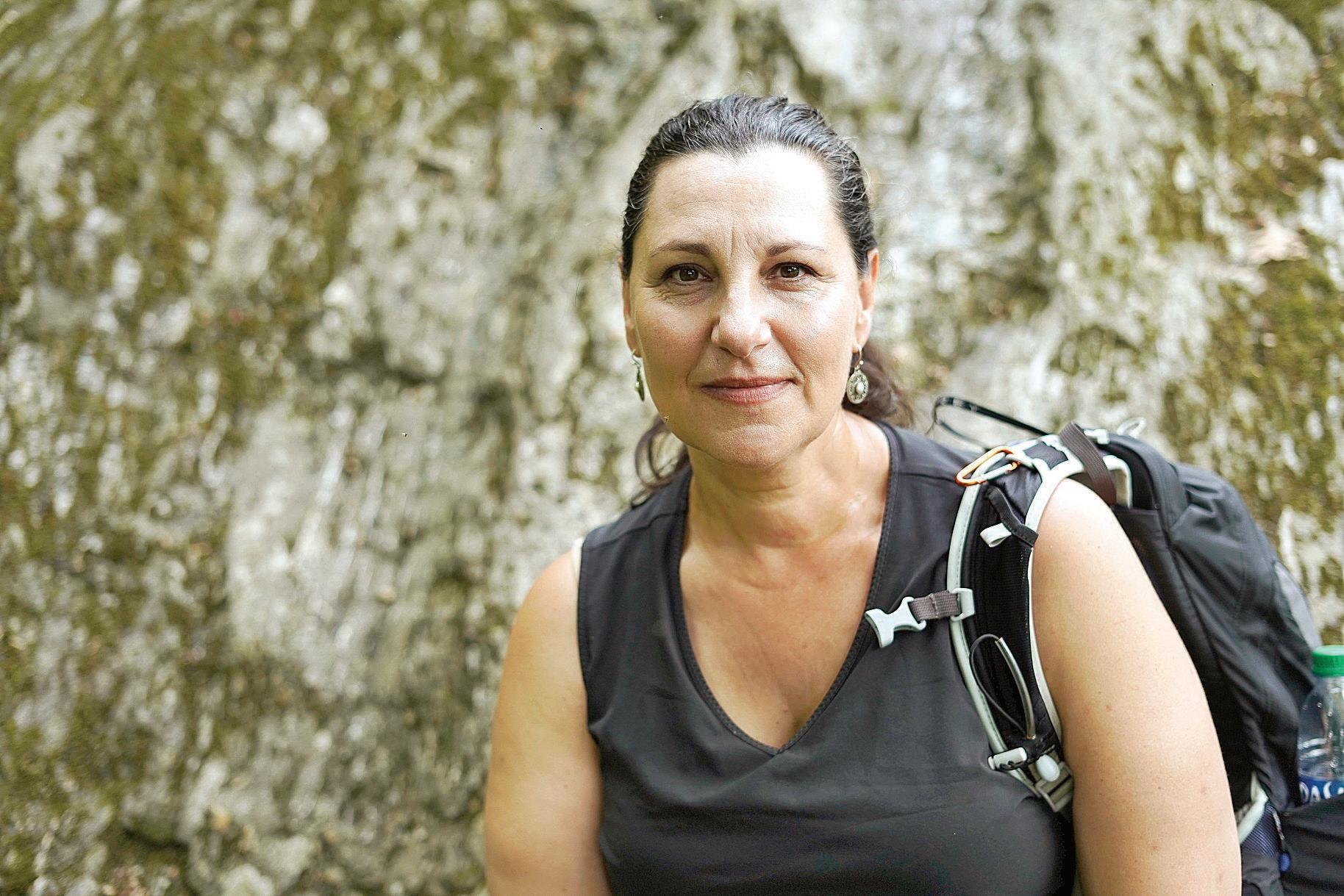
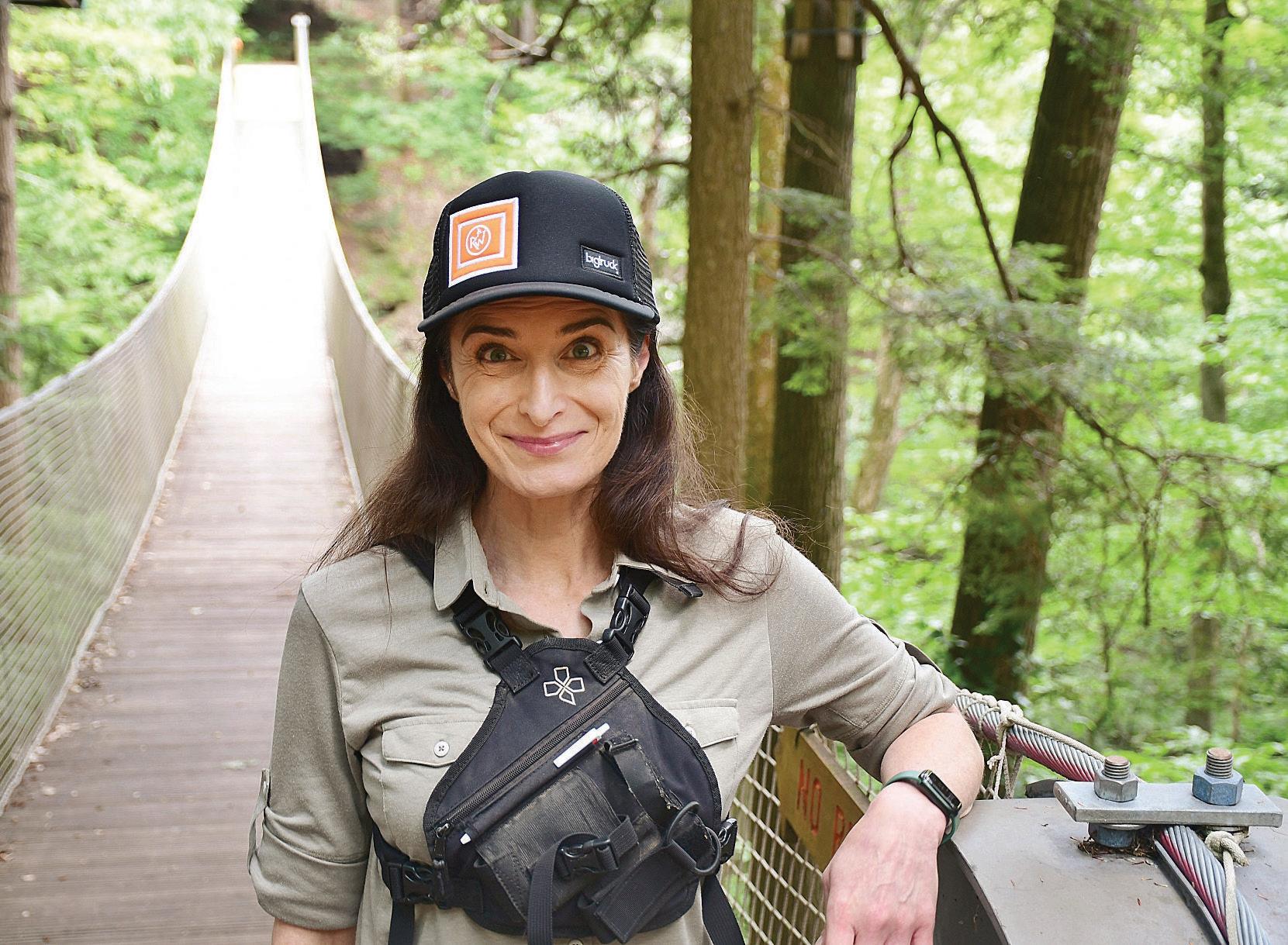
Above: Mindy Miraglia owns Berkshire Camino, a company that provides guided hikes around the Berkshires. “The focus is to create a mindfulness retreat on foot,” she said.
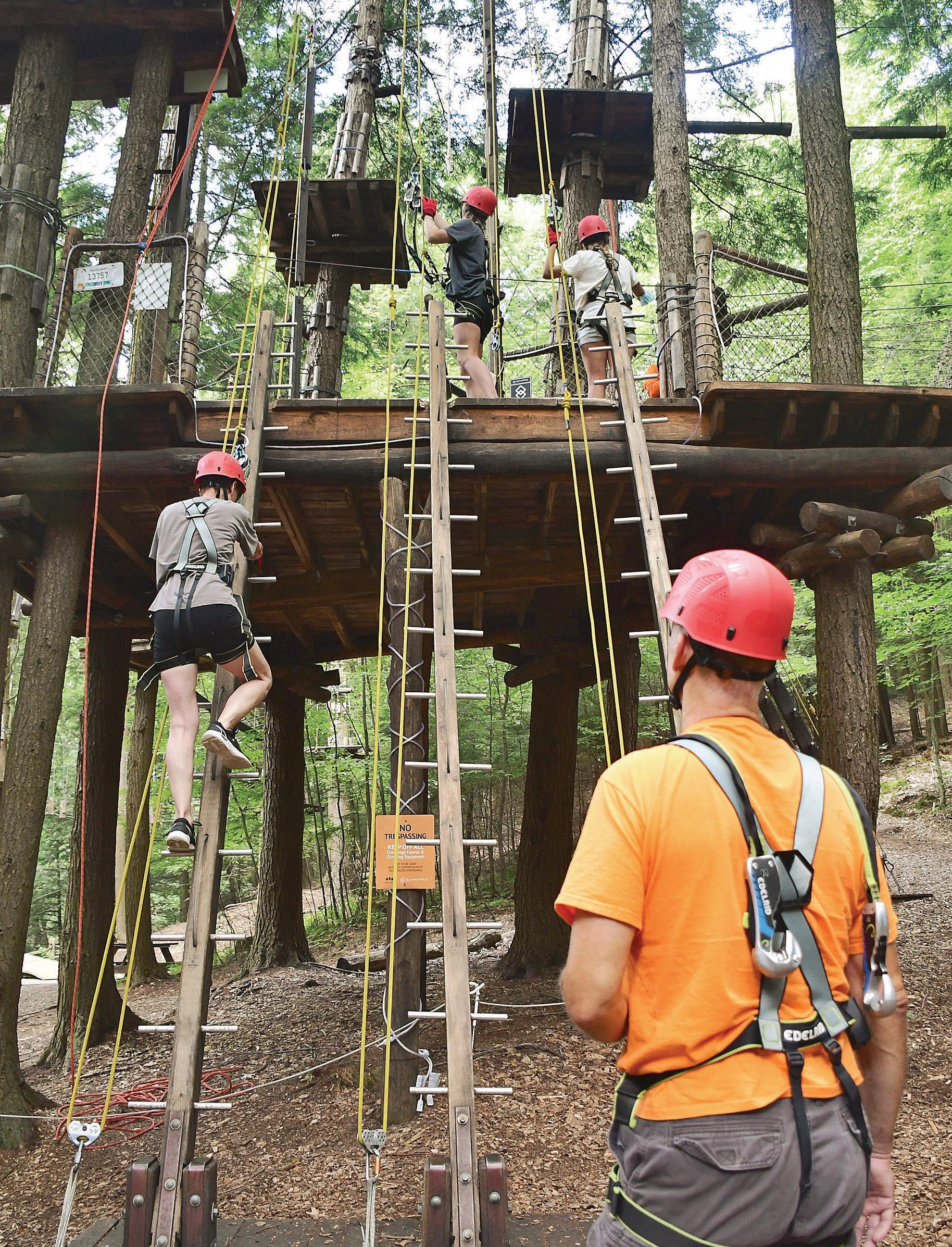
Right: Ramblewild’s main trail consists of 13 elements, including a zipline, with platforms ranging from 4 to 16 feet o the ground.
ABOVE: BEN GARVER RIGHT: GILLIAN JONES
Two ideas served as the inspiration for two venues that have expanded outdoor recreation in the Berkshires
PITTSFIELD — Mindy Miraglia wanted to create a local business based on a spiritual awakening she experienced while visiting Spain.
Valentina Cugnasca was interested in adding value to a wooded property she owned in Lanesborough by enhancing the sustainability of the forest.
Spirituality and sustainability. Those two concepts provided the impetus for the creation of two venues that have expanded the meaning of outdoor recreation in the Berkshires.
One is Ramblewild in Lanesborough, the county’s only aerial adventure park, which has been open since 2014. The other is Berkshire Camino of Lee, a tour operation in its second year, which offers a series of guided walking tours throughout the county.
their
“The focus is to create a mindfulness retreat on foot,” said Miraglia, Berkshire Camino’s founder and CEO.
One of these venues was created through experiences associated with its founder’s spiritual journey. The other by the owners by a timber investment company with an interest in environmental sustainability who saw an aerial adventure park as a way to enhance the value of their property and achieve their new goals.
Pushing toward a digital future
By John Townes
PITTSFIELD — Berkshire County is beginning to move further into the realm of digital technology.
The Tech Impact Collaborative, an initiative that started two years ago to allow the Berkshires to keep up and capitalize on this trend that has permeated business and society, is moving into a new phase.
Originally known as the Tech Impact Forum, the project’s initial focus was sponsoring educational programs at the Osher Lifelong Learning Institute to provide opportunities to develop the county’s technology sector.
But after sponsoring 12 webinars in the fall of 2020 that some 1,300 people attended, the project’s organizers decided to shift to a more proactive stance. They changed the program’s name and began using it to lay the groundwork to strategically support the digital economy and create jobs and entrepreneurial opportunities.
“We wanted to spark a conversation about what it takes to become a rural center for the tech economy, and how the region can move in that direction,” said Benjamin Lamb, 1Berkshire’s director of economic development, referring to the program’s original focus.
“We decided that we wanted to do more tactical work and take action to advance the concepts we had talked about during the forums,” he said.
The Tech Impact Collaborative is a joint effort between 1Berkshire, the Berkshire Innovation and Center and OLLI, which is located at Berkshire Community College.
The change in focus followed an indepth assessment and analysis of digital technology in the Berkshires by the project’s organizers, and a look at the opportunities and challenges associated with that strategy. The group has stepped up outreach to the wider community.
The collaborative is also preparing applications for federal grants, one through the Build to Scale program of the U.S. Economic Development Administration and the other from the National Science Foundation. Additional funding sources are also being sought.
Lamb said the new work is part of the collaborative’s goal of establishing a broadly based network of organizations.
“We want to support the stakeholders we work with,” he said. “That includes providing funding for activities they would undertake in conjunction with this.”
The TIC’s underlying mission is to support the ability of existing businesses in all sectors to adapt to changes in technology, and to foster the development of new, scalable technology enterprises here in the Berkshires.
“We need to prepare now to be ready for what will be happening over the next 10 years,” Lamb said. “In addition to current digital technologies, emerging ones such as AI, blockchain, automation, and Web 3 are going to become vital to all businesses. Those are the types of jobs that will become sustainable in the future.
“Ventures can be spun off from these services and scaled to serve markets beyond the Berkshires,” he said.
The Berkshire are well-positioned for the transition into digital technology, Lamb said.
“Obviously, there’s a lot of work to be done,” he said. “But we’re in a great place to launch forward, both geographically and in terms of the mindset of people here.”
There are two corridors of creativity and technology ventures that intersect in Berkshire County.
“There’s an emerging north-south corridor extending from Burlington (Vermont) to New York City, and a more mature east-west one from Boston to Buffalo,” he said. “That puts us in a position
GILLIAN JONES
Ben Lamb, a 1Berkshire economic specialist, is part of a program to help Berkshire business owners keep up with the latest technology. “We need to prepare now to be ready for what will be happening over the next 10 years,” he said.
to transform Berkshire County from being a pass-through to becoming a hub.”
An important resource for the TIC has been the Center On Rural Innovation (CORI), which is based in Hartland, Vt. CORI is a nonprofit organization that partners with rural communities across the country to build digital economies and related businesses and jobs.
The center works with individual regions using a structured process of workshops, focus groups and other input to assess their current situation and to map out core strategic areas to support and develop their “digital economy ecosystem.”
After CORI’s founder and executive director Matt Dunne participated in the TIC’s original forums, the nonprofit selected Berkshire County as one of the regions it wanted to work with. CORI conducted an assessment process in the Berkshires from September to November 2021, which produced a digital economy assessment report.
The TIC followed up the report by developing a seven-point strategic plan that was completed in January.
While significant challenges remain, Berkshire County has already made substantial progress in digital technology due to previous and current collaborative initiatives, according to CORI’s assessment.
“Together, regional partners have created spaces and opportunities for entrepreneurs, makers, and creatives to gather, share ideas, receive support, explore business opportunities, and launch new ventures,” The report states. “Scalable entrepreneurship support and incubation is one of the strongest parts of Berkshire County’s digital economy ecosystem, with organizations such as Lever, EforAll (Entrepreneurship for All Berkshire County), and the Berkshire
Innovation Center providing programming to support and inspire local entrepreneurs.”
CORI’s assessment process involves participation from several other regions, which allows information and input to be shared, said BIC Executive Director Ben Sosne.
“One of the more encouraging things I observed was the reaction of people in other regions to what we have in Berkshire County,” Sosne said. “They were really surprised and impressed at how many key assets we have, and how well these organizations and initiatives are tied together. They frequently said: ‘The Berkshires are well ahead of us.’”
The CORI assessment also highlighted the challenges and hurdles that exist for the digital economy in the Berkshires.
“Pieces of a digital economy pipeline exist, but they need to be intentionally woven together to create a clear pathway all the way through,” the report states.
In a broad sense, that procedure will require increasing the number of tech jobs and enterprises available and ensuring there is a skilled workforce available. CORI’s report also noted that the available resources for training, financing and investment to launch and scale technology-related ventures in the Berkshires need to be increased.
The report cited a fundamental hurdle that affects all aspects of life here: “There is a critical shortage of affordable housing options in the region, limiting employers’ ability to recruit and retain staff.”
Ongoing efforts to improve the
Berkshire’s physical infrastructure, like access to broadband, have been largely successful, but issues still need to be resolved, the CORI report found.
“Although broadband availability in the region is well over 90 percent, usage rates lag most peer counties at just under 40 percent,” according to the report. CORI’s assessment doesn’t provide exact reasons why, but it stated that lags in broadband usage rates frequently occur due price, customer service quality, and service reliability. A key word that appears throughout the CORI’s recommendations is “awareness.”
The report adds that that members of the public, including potential entrepreneurs and tech employees, are not aware of the availability of resources in the region like financing, training, mentoring and networking. Publicizing and communicating that to the wider public, including those not already oriented to technology, is vital.
TIC subsequently developed its seven-point strategy based on these findings. CORI’s assessment and TIC’s strategies can be found online at 1Berkshire.com/ tech-impact-collaborative.
One of the TIC’s priorities is to rectify a “notable ‘missing middle’” gap for tech entrepreneurs who are not yet ready for large-scale angel investment and who may not be ready to scale.
Helping young people make the connection to tech opportunities is also a goal, according to Sosne.
“There’s an awareness gap among young people about possible technology careers available here,” he said. “They may be avid video gamers, for example, and we need to help them translate their skills in that to things like computer programming.”
Another goal is to connect digital technology opportunities with minority populations and provide them with pathways to jobs and entrepreneurial opportunities. This includes establishing career-targeted trainings and certifications to specifically address the needs of underserved communities.
As part of this community outreach, the TIC is sponsoring, “Innovation in the Berkshires,” a series of classes open to the public that will take place on Wednesdays between Oct. 12 and Nov. 16. The sessions will include presentations and discussions about the history and current status of innovation and technology in the Berkshires, and related job and entrepreneurial opportunities.
Online classes are also being offered along with a hybrid event at the BIC. More information about the Innovation in the Berkshires series will be posted on the BIC’s website at berkshireinnovationcenter.com and on OLLI’s website at berkshireolli.org.
FILE PHOTO
Ben Sosne, executive director of the Berkshire Innovation Center, said a Vermont organization’s assessment found that the region has already made substantial progress in digital technology.
Staging comeback: It’s a tough sell
For Berkshire performing arts venues, filling seats proved a bigger challenge than expected
By Emma Ryan
Berkshire County’s performing arts
seem to be suffering from long COVID.
Despite attempts to adapt to the post-pandemic era — reduced budgets, discounts, or streaming performances — internal data from the county’s biggest performing arts venues show a 30-percent decline, on average, in ticket sales and attendance from 2019.
Even when ticket sales were high, last-minute cancellations or no-shows this summer left venues like the Williamstown Theatre Festival, Jacob’s Pillow and Barrington Stage Company with smaller audiences than hoped for.
“The arts are [unfortunately] a luxury, not a necessity,” said Chelsea Gaia, director of marketing and communications at Barrington Stage Company. “And we are not in a luxury economy.”
Past summers have been hard on the performing arts. The pandemic shutdown hit in March 2020, right as venues typically announce their summer lineups and sell season tickets. Concerts were canceled, refunds issued and new pandemic protocols had to be created for when audiences would return.
Even once COVID-19 vaccines became available, new strains and variants made the summer of 2021 as unpredictable as the one before.
This was supposed to be the first normal year for arts venues this decade, the first that could be measured against pre-pandemic years. Over 70 percent of Americans older than 5 are fully vaccinated and pandemic restrictions are all but gone. The job market is recovering and travel seemed more accessible than ever with the advent of the Berkshire Flyer. A pandemic rebound was in sight.
That rebound didn’t materialize, not fully at least. Ticket sales and attendances are still down from 2019. Tanglewood is selling an average 6,900 tickets per performance this year. While that is 10 percent better than the 2019 season, it is only filling, on average, 4,800 seats, 16-percent lower than pre-pandemic years and barely a third of its total capacity, according to its data.
Both Jacob’s Pillow and Shakespeare & Company say the omicron variant hit right as they were planning their seasons, forcing them to reevaluate expectations for this year.
RISING COSTS
Potential tourists have been slammed with rising costs of hotels, flights, rental cars and gas, leaving less in their wallets to spend at the box office. Meanwhile, inflation has driven up the cost of doing business across all sectors of the economy, making the already tight margins of performing arts venues even slimmer.
The Theater Barn in New Lebanon, N.Y., ended its 38th season early, then shutdown for good. “Sadly, the combined effects of COVID and wage and price inflation have rendered the continued operation ... unsustainable,” the theater said on its website. Representatives of The Theater Barn could not be reached for comment.
Music events also proved vulnerable.
The Bousquet Folk Festival on Aug. 11, part of Mill Town Capital’s Bousquet Summer Concert Series, sold almost 400 tickets but was only attended by around 150 people. Of that crowd, a quarter were children under 12, who got in for free.
Gaia, marketing director at Barrington Stage Company, said even a rave review from The New York Times for its ”Ain’t Misbehavin” didn’t get the production to its sales goal, adding, “If that kind of press couldn’t get people to come, nothing will.”
According to 1Berkshire, 52 percent of visitors to the county in 2021 attended performing arts events, compared to 90 percent who engaged in some kind of outdoor activity. The trend toward the outdoors is not new. The number of performing arts patrons is down 12 percent from 2013, compared to a 143-percent rise in tourists coming for the great outdoors.
Transportation gaps didn’t help. Rental cars proved scarce and expensive this summer, limiting options for tourists. Even with the Berkshire Flyer getting people into the county from New York City, there were limited public transportation options available to take people 20 miles north to Williamstown or 20 miles south to Great Barrington.
That’s a problem, said Antonello Di Benedetto, director of audience engagement at the Williamstown Theatre Festival. “The Berkshire Flyer lets off at Pittsfield, but there is another third of the county that exists in the north and a third of the county in the south,” he said. Some hotels provided shuttle services to and from the train station in Pittsfield, according to Di Benedetto, but that didn’t solve the problem of getting from hotels or rentals to the arts venues.
Di Benedetto also mentioned that the Flyer’s late arrival on Friday and early departure on Sunday makes it hard for people to visit all the cultural events in the county, a sentiment echoed by others. If travel remains expensive and difficult to access, so will the performing arts.
THE SHOW GOES ON
Given the challenges, performing arts organizations are learning to adapt. Jacob’s Pillow, for example, is working to provide shows that will sell best in this age of streaming and lockdowns.
“Audience habits are changing,” said Jared Fine, chief marketing officer of Jacob’s Pillow. “Both in response to the pandemic, as well as to the ease of access to digital streaming offerings and platforms .... As we look to strategize for the future, I would say the Pillow is continuing to explore and expand our online offerings, as well as the data that we’re gathering this year to inform next summer’s
“It’s something that we’d love to look into, translating some of our materials, or having a bilingual or different language presentation of Shakespeare in some way,” Stevenson said. “That’s all preliminary ideas, because there’s so much that goes into it.”
Di Benedetto said that a seminar run by Southern Methodist University’s DataArts center suggested the Williamstown Theatre Festival budget 25 percent less its 2019 season. The festival cut the number of productions from seven to three, with a few limited-run shows in between. To address transportation gaps, Di Benedetto is in talks with local hotels to expand shuttle service to include bringing guests to and from North County venues.
Thanks in part to more aggressive marketing, Barrington Stage Company’s production of “A Little Night Music” met its sales goal only halfway through its run, which ended Aug. 28. That success helped make up for missed ticket-sale goals of earlier productions and the use of free and reduced-price ticket programs, Gaia said.
Mary Testa performs in July during “Most Happy in Concert” at the Williamstown Theatre Festival. The festival cut the number of productions from seven to three, with a few limitedrun shows in between.
PHOTO PROVIDED BY EMILIO MADRID
in-person programming.”
Jacob’s Pillow offered four livestreamed performances this summer. Other digital offerings included behind the scenes looks at productions.
Rather than trying to predict what audiences will do, Shakespeare & Company has been looking to reach out to new demographics.
Jaclyn Stevenson, the theater’s director of marketing and communications, says the nonprofit targeted digital advertising outside of the county, even as far as Sarasota, Fla. The company collaborated with the Berkshire Immigrant Center and Berkshire Cultural Asset Network to bring Shakespeare’s works to the county’s growing immigrant population.
One of those offers gave six free child tickets with the purchase of one adult ticket to “The Supadupa Kid,” which ran from July 29 to Aug. 12. Originally offering only two free tickets, the theater expanded the offer. The company saw a 68-percent increase in attendance within three days.
Tanglewood appears to have had, far and away, the best recovery of the performing arts venues this season. Through a two-pronged approach of drumming up excitement early and drawing attention to specific acts, it stands to finish the season strong.
The Boston Symphony Orchestra announced recently that 289,810 listeners attended 204 performances this past season, Tanglewood’s first full slate of events since the pre-COVID season of 2019.
The season total represented a decline of 7 percent compared to 2019, when 311,596 patrons attended 248 performances. Because there were 44 fewer events this past summer than three years ago, individual concert attendance increased 12 percent from the summer of 2019, according to the BSO’s tally.
The best-attended Tanglewood event in 2022 was the gala BSO celebration of composer/conductor John Williams’s 90th birthday year, drawing 16,887 listeners.. Since April, staff at Tanglewood, Mass MoCA, Jacob’s Pillow and other performing arts organizations have met monthly to compare numbers and discuss strategies.
The idea behind these meetings: The success of one venue in the Berkshire performing arts scene helps all the others.
“I like to think of it as putting community over competition,” said Gaia. “If only one theater remains open in the Berkshires, that doesn’t help anyone. We need to have as big a draw as possible.”
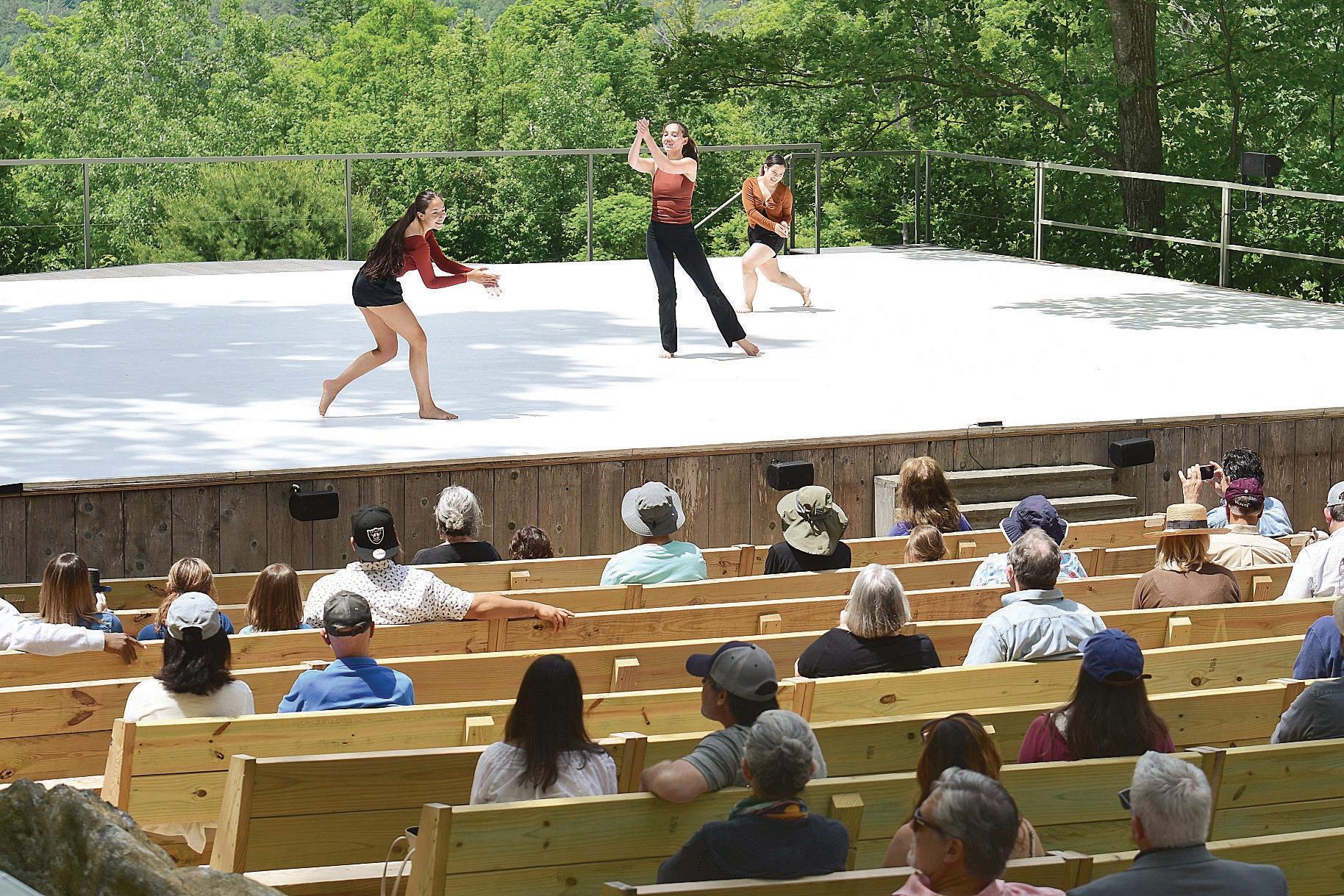
GILLIAN JONES
People take in an outdoor performance in June at Jacob’s Pillow in Becket during the arts organization’s community day. Despite attempts to adapt to the post-pandemic era – reduced budgets, discounts, or streaming performances – internal data from the county’s biggest performing arts venues show a 30-percent decline, on average, in ticket sales and attendance from 2019.
Season booms in county’s tourism center
By C l A renCe FA nto
LENOX — If the town described as the epicenter of Berkshires summer tourism seemed especially busy this season, it was. Business leaders and hospitality industry owners back that up.
“It was a fantastic summer, the best we’ve ever had!” said Jason Macioge, owner since 1999 of the downtown Bistro Zinc restaurant and Betty’s Pizza Shack.
Despite the continuing pandemic in 2021, business was good during that summer a year back, Macioge said. “But this past summer was even better.”
Both of his businesses stayed open fulltime through the pandemic, with Zinc focusing on indoor dining seven days a week without takeout options.
Tanglewood’s return to a full-throttle schedule brought customers back, big time.
“Numbers-wise, we have been doing well,” said Molly Lyon-Joseph, owner of Frankie’s Ristorante Italiano on Main Street and its sister eatery, Pizzeria Boema.
“I can feel the growth of the Berkshires in terms of people who have made the Berkshires a year-round home,” she said. “September numbers don’t die off like they did pre-pandemic.”
Whitney Asher, owner of Brava since 2012, said the restaurant’s relocation in November 2020 to more spacious quarters on Church Street more than tripled capacity, now at least 90 seats including the outdoor patio. “Our business has certainly grown massively, following record sales in 2019,” he said.
Brava restored its six-night a week schedule this summer, serving food until midnight, with the bar open until 1 a.m.
The newest heavy hitter on Restaurant Row, Ryan Salame, has pumped at least $6 million into the downtown economy by acquiring half a dozen current or former eateries in the downtown district since July 2020, branding his multiple
3 challenges that remain for restaurants
Molly Lyon-Joseph, owner of Frankie’s Ristorante Italiano on Main Street in Lenox, says that amid a busy summer season, restaurants like hers face challenges: They’re “slammed” with local concertgoers, who are welcomed but cluster their reservations at the same time in order to attend their chosen events. “That’s tough on our staff and the kitchen,” she said.
Inflation in restaurant supplies is a leading challenge. “Negotiating costs while trying to keep our mission of being approachable for our customer base was very hard this season. How do we keep food costs in their appropriate percentage when our costs have jumped so high?” she asked. Some items were removed from the menu since they could not be offered at a reasonable price. Staff shortages continue. “We have been lucky with a good solid crew this summer, but we are losing some true gems to school and moving on in other areas of their life,” she said, with bartenders in especially short supply, along with kitchen help.
businesses as the Lenox Eats Collective. It now has Lunch Pail, a food truck, and it includes the recently added Lenox Catering Co. as well as Sweet Dreams, the ice cream, candy shop and bakery, formerly The Scoop.
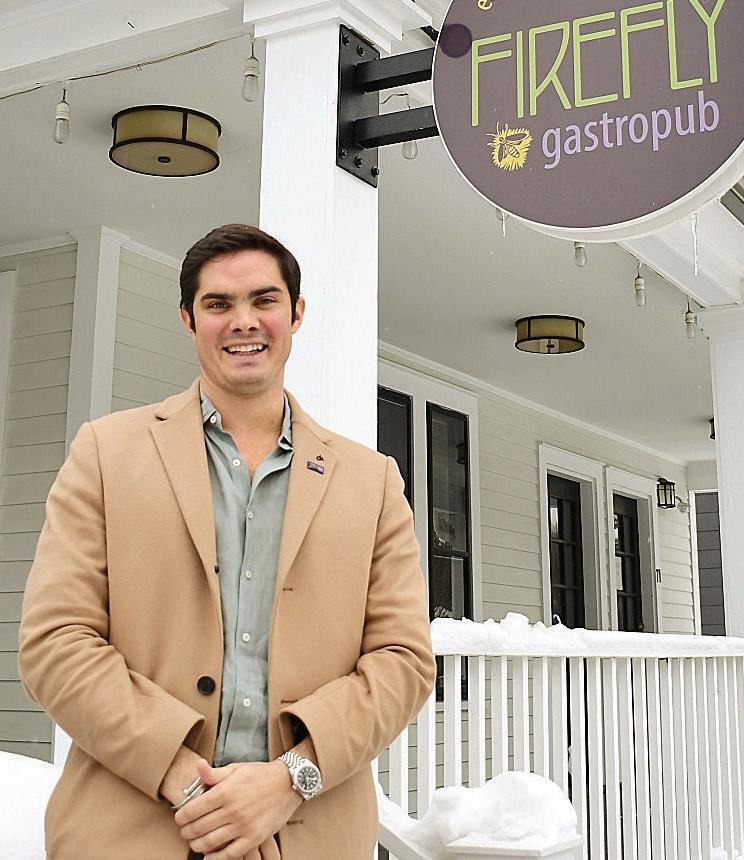
“The town is back to pre-pandemic levels of business and with the improvements we’ve made at Firefly Gastropub and the Olde Heritage Tavern, both
Nudel closing its doors after 13 years in Lenox
By A m A ndA Burke
LENOX — It’s an ending of sorts for a local eatery, but not necessarily a sad one for its proprietor.
After well over a decade, Nudel is bringing its restaurant operations to a close in Lenox, said owner Bjorn Somlo. Somlo, an industry veteran, said the establishment will cap its 13-year run on Church Street on Labor Day weekend.
“We’re wrapping it up,” Somlo told The Eagle on Thursday. “I’m effectively retiring.”
“A lot of people hear about a restaurant closing and assume it has to do with a sad story,” he continued. “And this isn’t a sad story. With that being said, my involvement from the get-go was always because I was going to put as much as I could into what we did, and now I’m turning my attentions elsewhere.”
Somlo declined to detail any next steps he may have in the works.
But he said that he’s been in the culinary field since he was a teenager. He learned the ropes at restaurants in New York, New Orleans and at the Stagecoach Tavern in Sheffield, and ultimately opened Nudel in 2009 when he was 29.
Given the nature of the fast-paced, highly competitive industry, Somlo said he had “almost no breaks or vacations” since.
After the pandemic throttled the industry in 2020, Nudel reemerged as a “pop up, to-go” venture, and later evolved into Nudel Bar: Comfort & Craft.
He says he’s focused on making memories during his last week or so helming the restaurant. He thanked the people who helped him build up the establishment including chef Ryan McIntyre, and
Ryan Salame stands last fall outside Firefly Gastropub, one of the restaurants he has purchased in Lenox. His various restaurant businesses in the town did well this summer, as did others in the same trade, their owners report.
venues have had a tremendous summer,” he said by email. “Food costs continue to be high, but we’re able to stay competitive. We’ve been fortunate that staff are finding a home and excitement working within Lenox Eats, so we have not had staffing issues this summer.”
On Church Street, Campfire — formerly Cafe Lucia — plans to open in late spring following interior and exterior improvements and menu development, Salame said.
Meanwhile, the site continues to host the weekly Lenox Farmers Market on Fridays from 11 a.m. to 3 p.m. through Sept. 30. Plans are yet to come for the former Lenox Pizza House on Franklin Street, one of Salame’s recent acquisitions, although the kitchen already is being used as food prep space for Lunch Pail.
At Loeb’s Foodtown, owned by Bernie
and Isabel Fallon since May 2019, each summer has seen business increase as inventory expanded, with more shelf space for natural food products. Interior renovations were completed along with a repaving of the parking lot.
During the pandemic, more people were purchasing groceries for at-home meals, said Bernie Fallon. The deli has been the most lucrative segment of the business, he said, thanks to increased efficiency handling the lunch-hour crunch.
Although summer is the key profit center, “the off-season is really good, especially October and November,” he said. “January and February are not slow, the way they used to be. I’d like to think it’s the items in the store that bring people back, not just that there are more people around here. I think it’s both.”
He has tried to keep prices stable, especially in the deli, despite the pressures of inflation. “I look at the numbers and we’re OK for a while, but I also look at the volume we do with sandwiches, that’s really where the profit is,” Fallon said.
Summing up the season, Chamber of Commerce Executive Director Jennifer Nacht cited “a lot of foot traffic in town, including to the Chamber’s Visitors Center.”
But she acknowledged hearing from shopkeepers and gallery owners that people were not spending money, compared to 2021 as well as pre-pandemic summers. “The economics this summer were in a precarious place,” Nacht said. “People were not using their disposal income as much, being a little more discretionary. But restaurants were slammed. They’ve upped their game.”
Inns and hotels have been booked solid Thursdays through Sundays, she noted, fueled in part by a surge in area weddings. Bottom line: A bonanza for the town’s lodging and meals tax revenue.
“We have a quiet five months,” Nacht said, “but we do gangbusters for seven months, May through November, at least.”
Bjorn Somlo is closing Nudel in Lenox.
“Now I’m turning my attentions elsewhere,” he said.
a litany of other names.
“We’re just excited to write our last chapter on Nudel, and celebrating the great years,” he said.
Ultimately, he hopes that the mantel of the intimate restaurant space will pass on to someone who is passionate about and hospitality.
It’s the same goal he has for The Lantern Bar & Grill on North Street in Pittsfield, the historic establishment that Somlo revived after the owners shuttered it in 2017.
Somlo closed the restaurant doors again earlier this year, and said he is working with the landlords, Mill Town, to try to find a new owner/operator for the space.
FILE PHOTO
FILE PHOTO
Change coming to Mahaiwe Block
Sale of historic Great Barrington property means rents will be rising
By H eat H er Bellow
GREAT BARRINGTON — A developer poised to buy the historic Mahaiwe Block is pledging to help tenants who face dislocation and higher rents.
“We’re going to help anyone there who needs it,” Ian Rasch, of Alander Construction, said of tenants who have relied on the low rents in the building and do not have alternatives.
Alander will likely close this month on the sale of the property, with its 12 apartments — seven of which are occupied — multiple offices and street-level retail store-fronts, Rasch said.
The company will add 22 new apartments to the building and leave seven existing retail spaces as they are. The project is slated for completion in late fall of 2024.
Across the street, at the former Berkshire Community College satellite building bought by Alander last year, the company has just started reworking the property into 13 apartments and two retail spaces — a change from its initial plans. Rasch says he expects a summer of 2024 completion.
In all, Alander is poised to renovate two deteriorating downtown buildings, creating 35 rental apartments.
Work to the Mahaiwe building, whose systems have long been failing, is set to begin in November.
The projects come amid a housing
A free monthly publication by The Berkshire Eagle 75 South Church Street, Pittsfield, MA 01201
Visit berkshirebusinessjournal.com for advertising information and to subscribe.
NEWS DEPARTMENT
TONY DOBROWOLSKI, Editor
413-496-6224
tdobrowolski@berkshireeagle.com
ADVERTISING DEPARTMENT
KATE TEUTSCH, Director of Ad Services 413-496-6324 kteutsch@berkshireeagle.com
CHERYL GAJEWSKI, Director of Ad Sales 413-841-6789, 413-496-6330 cmcclusky@berkshireeagle.com
Share your news with the Berkshire Business Journal. If you have a company promotion, a new business or a new venture, let the Berkshires know about it. Remember the 5 W’s and that briefer is better. Email text and photos to BBJ@newenglandnewspapers.com. Provide your expertise in the Berkshire Business Journal. Do you have the answer to a persistent question about business and the Berkshires? Do you have ideas and suggestions on how our business community can grow?
If you have a comment to make about doing business in the Berkshires or if you’re looking to raise an issue with the business community, this is the venue for that. We welcome letters up to 300 words and commentary up to 600 words. Send these to Tony Dobrowolski at tdobrowolski@berkshireeagle.com.
Berkshire Business Journal is published monthly by New England Newspapers Inc., 75 S. Church St., Pittsfield, MA 01201. Periodicals postage paid at Pittsfield, MA 01201. Berkshire Business Journal is delivered free to businesses in Berkshire County via third class mail. Additional distribution is made via dropoff at select area newsstands. The publisher reserves the right to edit, reject or cancel any advertisement at any time. Only publication of an advertisement shall constitute final acceptance of an advertiser’s order. All contents are copyrighted by New England Newspapers Inc.
crunch and high prices — a problem that has gripped the town, Berkshire County and many areas of the country. It’s unlikely that tenants who have long paid month-to-month low rents — between around $350 and $700 per month at Mahaiwe — will be able to find something comparable.
“I panicked,” said Laura Didyk, an artist and writer who has lived in the same apartment there for 12 years. “It’s been a rent controlled environment, which I’m really grateful for.”
Didyk said what she’s seen on the rental market is triple what she pays now.
Rasch says he plans to help some of the Mahaiwe tenants find alternate housing and may offer temporary rent assistance.
Office tenants also will have to move. They are on the second floor in spaces that Alander will convert to apartments.
‘OLD AND DATED’
Tenants say the current landlord of the Mahaiwe building hasn’t communicated what’s happening. Rasch can’t give official notice because he doesn’t yet own the building. He has written some tenants informally about the pending sale, and expressed his offer to help them find new housing. Tenants say they are hoping for more concrete information about this assistance.
Current owner Madeleine “Mandy” Victor-Pieczarka declined to comment. She told The Berkshire Edge last month that without an overhaul that would necessitate a rent hike, any owner of the property would be heading into “slum lord” territory.
Tenants have praised her kindness and generosity over the years, particularly during the pandemic — and for keeping rents down.
The property, built in 1905 and listed on the National Register of Historic Places, needs serious work. Problems include the lack of an elevator and no handicap accessibility. There is no sprinkler system.
Victor-Pieczarka this summer cleaned up a benzene spill from an old oil tank. There have been major roof leaks and the old steam boiler is failing, Rasch said.
The main security door doesn’t close properly in warmer months and there are a slew of other “day-to-day” problems, said Pedro Pachano, an office tenant who is an architect.
“It needs a massive investment,” Rasch said of the building. “We’re putting a couple million plus into that.”
The building’s manager says the property “needs someone with deep pockets.”
“The building is very old and dated to the point where I couldn’t get a plumber out of Great Barrington to come to the building,” said Christopher Lipa, of Berkshire Property Managers. “It has such old systems that they didn’t know how [to fix them].”
Edmund Milligan Marcus, a freelance filmmaker who has lived there since 2017, moved temporarily to his parents’ house in Egremont when he learned of
the pending sale. He wasn’t sure he could stay given the water damage in his apartment — a roof leak in 2018 repeated last year, and never was fixed.
“There was a huge influx of water through the windows and through the wood and window frames,” he said. “I was at one point worried that something might fall in. There were holes opening up in the plaster.”
TENANTS IN LIMBO
Pachano said he and other tenants feel they are in limbo. He said he will be disappointed to lose his office, but understands the building needs work — and the town needs more and better apartments.
As a member of the Planning Board that is working to create housing solutions, Pachano has proposed zoning changes to give developers incentives to build affordable housing along Stockbridge Road/Route 7. He thinks it’s ideal to build more housing along the Route 7 corridor through the downtown and south, given the existing infrastructure and transportation system, as well as the ability to walk places.
“The Mahaiwe Block is the perfect place [for housing],” he said.
Rasch, who redeveloped the top of Railroad Street in 2017 and added apartments, says he shares concerns about the lack of affordable housing in town. He doesn’t like the prevailing practice of building housing that segregates people by income.
He says Alander is committed to “mixed income” housing, and hopes to find public and private money to include “income restricted” apartments in both buildings that workers can afford.
The majority of units at the Mahaiwe will range from $1,200 to $1,850 per month; at the BCC complex, units will be much larger, Rasch said, and range from $2,300 to $2,800.
Both buildings will be sustainably built, also reducing living expenses for tenants, he added.
Founder of Brodie Mountain Ski Resort dies at 87
James “Jim” W. Kelly, 87, former owner-operator of Brodie Mountain Ski Resort and of Donnybrook Golf Course, died Sept. 4, according to Brian Fairbank, a former competitor and longtime friend.
Born on March 4, 1935, in Washington, he and his five siblings were raised there and in Dalton. He worked with his father, John J. Kelly, at the Kelly Lumber operations in Pittsfield. The company also operated Berkshire Pallet, which manufactured wooden pallets for shipping goods.
At 17, Kelly left school to enlist in the Seabees branch of the U.S. Navy during the Korean War. He opened Brodie Mountain in 1964, and soon after installed one of the first snow-making systems to make up for a periodic lack of snow. Then he installed a lighting system to allow for night skiing.
The resort became known as “Kelly’s Irish Alps.” Between the skiing, live entertainment and the legendary lodge containing “The Blarney Room,” the resort is still a talking point for many locals. At one point, it was the largest ski area in New England.
Aside from operating Brodie Mountain Resort, Kelly also operated Brodie RV Campground, The Blarney Room Restaurant and Lounge, Kelly’s Irish Pub, The Brodie Racquet Club, The Dublin House Motel, The Kerry House Motel, The Carriage House Motel, The Brodie XC Ski Touring Center, Kelly’s Diner, The Paddy Advertising Agency, and Kelly Realty Co.
In 1981, Kelly installed a wind turbine at the Brodie summit to offset energy use — the first known ski resort to have power generated by a wind turbine.
All of Kelly’s sons, and also his daughter, worked at his various operations.
Brodie Mountain was a destination for members of the Kennedy family, who enjoyed many skiing and camping outings there.
In 1984, Kelly took over management of the Kelly Hardwood Lumber operations in Pittsfield and built the J.W. Kelly Steam & Electric Plant in Pittsfield, generating 3.5 megawatts of electricity from the wood waste scraps from the sawmill operations.
In 1999, JW sold the Brodie operations to Brian Fairbank, operator of Jiminy Peak Ski resort.
“All my time at Jiminy, he was a fierce competitor,” Fairbank told The Eagle. “And we grew to respect each other over time.”
Eventually, he said, the two became close friends.
“Hats off to him,” Fairbank said. “He was amazing beyond belief. He did everything his way. I am very sorry to hear of his passing.”
FILE PHOTO
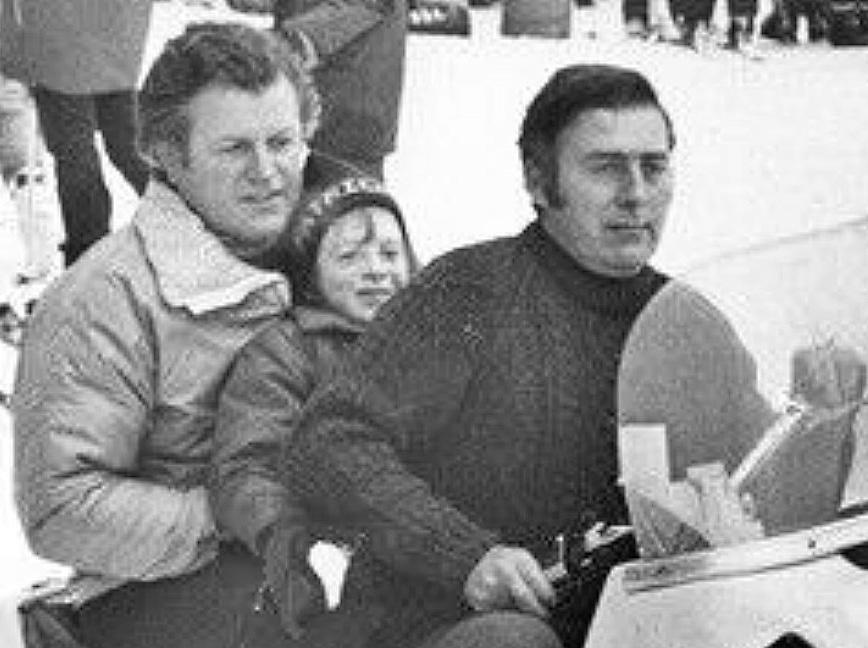
Jim Kelly drives a snowmobile with Sen. Edward M. Kennedy and his son in 1975.
HEATHER BELLOW
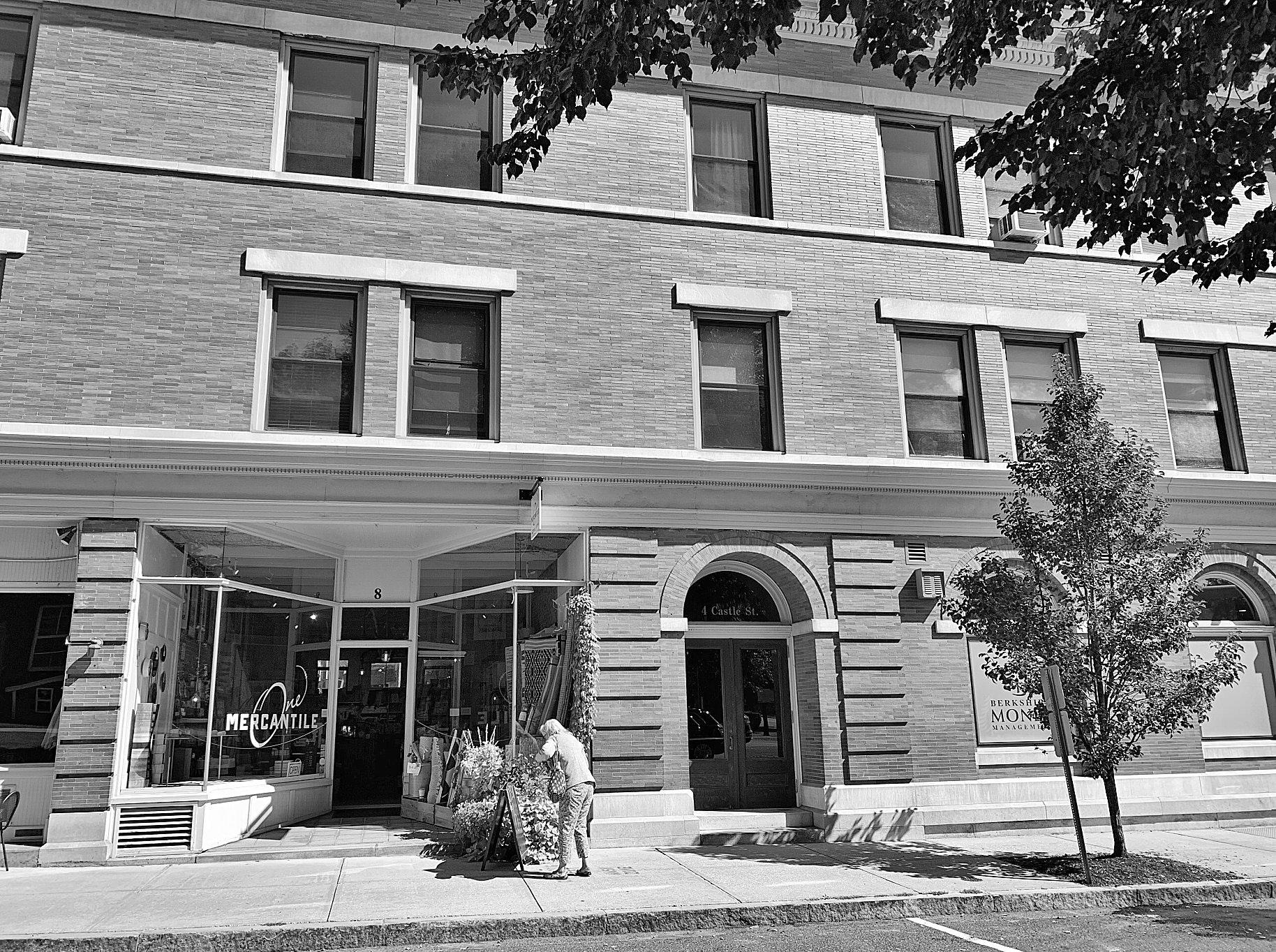
The Mahaiwe Block entrance, right, as seen from Castle Street. Seven storefronts that span the front and side of the building will remain as is.
PHOTO PROVIDEDBY TOWN OF GREAT BARRINGTON Alander Group developer Ian Rasch.
Business updates
Roots Rising and the Berkshire Black Economic Council are partnering to launch the BIPOC Vendor Fund at the Pittsfield Farmers Market. The fund will support Black, Indigenous, and people of color farmers and entrepreneurs.
For some, the cost of getting a business off the ground plus the cost of vending at markets is too large of a burden. The BIPOC Vendor Fund aims to reduce the barrier to participation at the Pittsfield Farmers Market, by waiving the vendor booth fee and providing additional financial support for business startup costs, such as supplies, permits, and business development. In that way, the Pittsfield Farmers Market will be more accessible, more equitable, and better reflective of our community.
As a pilot this season, the award will provide a $300 half-season booth fee as well as a maximum fee of $500 toward supplies, permits or business development. A limited number of awards available, and the maximum grant award is $800.
Pathlight, which has offices in Pittsfield, Springfield, Northampton and Greenfield, has received a three-year accreditation for its adult family care program.
It is the second consecutive three-year accreditation that this program has received from the Commission on Accreditation of Rehabilitation Facilities. Pathlight has supported people with intellectual and developmental disabilities in Western Massachusetts since 1952.
The adult family care program, also known as adult foster care, allows teens and adults with disabilities who need assistance with personal care tasks to stay in their home and in the community with a qualified and approved caregiver.
The Berkshire Economic Recovery Program has announced its third slate of technical assistance offerings, which will take place in the fall.
The new offerings include, “It’s Time to Stop Running Your Business by the Seat of Your Pants”; “Jumpstarting Your Crowdfunding Campaign”; and “Beginning Your Woman and Minority Owned Business Certification Process.” Two cohorts will be also offered fully in Spanish, “Branding Para Emprendedores” and “Estrategia De Marca Vs Logo.”
The program is a partnership between 1Berkshire and the Berkshire Regional Planning Commission with support from the United States Economic Development Administration.
The technical assistance series is free, and offered to any business in the Berkshires. Each cohort has a capacity of nine participating businesses, so space is limited and registration is required.
For a list of fall 2022 technical assistance offerings and to register, visit tinyurl.com/4djdwa5h. Questions/information: EconomicDev@1berkshire.com.
The Clark Art Institute in Williamstown and Norman Rockwell Museum in Stockbridge have each received reaccreditation from the American Alliance of Museums, the only organization that represents the entire scope of the museum community.
Accreditation signifies a museum’s quality and credibility to the entire museum community, to governments and outside agencies, and to the museum-going public.
Alliance peer reviewers gave the Rockwell Museum particular commendations for demonstrating extraordinary leadership in service to its community and as a model for other museums in diversity, equity, accessibility, and inclusion work, noting that the Rockwell is “locally engaged, globally significant.”
Of the nation’s estimated 33,000 museums, only 1,096 are currently accredited by the alliance, with only 67 of those located in Massachusetts. Besides The Clark and Rockwell Museums, the other Berkshire sites with alliance accreditation include the Williams College Museum of Art and Hancock Shaker Village
Thousands of milk producers across the country will receive surveys from the U.S. Department of Agriculture’s National Agricultural Statistics Service as the agency collects information for the 2022 milk production reports.
The agency will mail the questionnaires to all producers selected for the survey in late September. To ensure all survey participants have an opportunity to respond, agency interviewers will contact producers who do not respond by mail or online to conduct interviews.
The agency’s Northeastern Regional Field Office conducts the milk production survey in the region every January, April, July and October. The survey asks milk producers to provide the number of milk cows in the herd, number of cows milked, and total milk production for the first day of the month.
Survey results will be published in the milk production report to be released on Oct. 20. Information: NASS Northeastern Regional Field Office at (800) 498-1518.
The U.S. Department of Agriculture will be mailing the 2022 census of agriculture to millions of agriculture producers across all 50 states and Puerto Rico this fall.
The census will be mailed in phases, starting with an invitation to respond online in November followed by paper questionnaires in December.
Farm operations of all sizes, urban and rural, which produced and sold, or normally would have sold, $1,000 or more of agricultural product in 2022 are included in the agriculture census, which is taken every five years.
Berkshire Roots has formed a partnership with Yellow Labs Inc. to manufacture and distribute Yellow Labs THC Mist sublingual mouth spray in Massachusetts.
Yellow Labs THC Mist is a fast onset oral spray that delivers cannabinoids through the lining of the mouth directly into the bloodstream at a high level of absorption. It uses delivri, a new microdose technology
The first several varieties Berkshire Roots will produce are “Relax,” “Energy,” “Focus” and “Recover,” with additional varieties and flavors to be introduced over time.
The companies expect the first products to be available for purchase at multiple dispensaries throughout the state, including Berkshire Roots’ stores in Pittsfield and East Boston.
Pittsfield Cooperative Bank has been named to the Fast 50, a list of the 50 fastest growing commercial lenders in Massachusetts that is compiled through data collected by The Warren Group, which publishes Banker & Tradesman Magazine.
The bank was also ranked first on that list among all financial institutions headquartered in Berkshire County.
The Fast 50 lists the state’s 50 fastest growing lenders for the first six months of 2022 compared to the same period last year.
“It’s an honor to be recognized among the state’s premier commercial lenders by an organization as respected within the industry as Banker & Tradesman,” said bank President and CEO J. Jay Anderson.
Pittsfield Co-op is ranked sixth on that list in number of commercial loans and ninth in commercial loan volume.
Berkshire Agricultural Ventures has awarded a $2,000 grant to the Williamstown Farmers Market
The award is one of 10 “Market Match” grants totaling more than $100,000 that the organization has made to regional farmers markets.
Grants from the Market Match Fund allow these markets to match Supplemental Nutrition Assistance Program, or SNAP, benefits up to $30, giving recipients up to $60 to purchase fresh, local produce, meat, dairy, breads and baked goods, seeds and edible plants at each visit
Other farmers markets that have received grants, which are based on the needs and capacity of each market, include those in Great Barrington, Lee, North Adams, Pittsfield, Sheffield and West Stockbridge in Massachusetts, and Copake-Hillsdale, Millerton, and New Lebanon in New York.
Applications are being accepted for the Western Massachusetts Health Technology Challenge.
The project is run by Lever Inc. and the Massachusetts Life Sciences Center.
The challenge, open to health technology startups in the four counties of Western Massachusetts, will award $50,000 to the firm that presents the most “scalable and investable” health care products.
The runner-up will receive $25,000. The challenge’s final event will take place at the Institute for Applied Life Sciences at the University of Massachusetts Amherst.
The challenge is a three-year partnership with Lever and the life sciences center that will provide funding in 2023 and 2024.
The center also funded Lever’s Health Technology Challenges in 2019, 2020, and 2021. Since then, the 22 companies that participated have raised $17 million in funding and created at least 40 jobs in Western Massachusetts.
In collaboration, the UMass institute and Berkshire Innovation Center have offered additional resources.
More information about the challenge can be found on the application page at tinyurl.com/5au2xncm.
Massachusetts College of Liberal Arts has received more than $250,000 from the Massachusetts Life Sciences Center to purchase essential equipment for its biology, chemistry and health science programs. The funding was obtained under the MLSC’s workforce development capital program.
MCLA will use the total amount of $253,542 over the next two fiscal years. The equipment will allow MCLA to continue to pursue a robust, interdisciplinary approach to a life sciences curriculum that prepares students for a variety of careers in research, biomanufacturing, teaching, diagnosis, lifesaving treatment, and other biotechnology fields, according to the college.
Berkshire Art Center, formerly IS183 Art School in Stockbridge, is opening a second location in Pittsfield in the Brothership Building at 141 North St. An opening celebration took place on Sept. 30 that was open to the public.
Through this expansion, Berkshire Art Center will offer a variety of new classes and workshops in Pittsfield for adults and young artists of all ages. Classes will explore mediums including watercolor painting, photography, jewelry, printmaking, and more. Information : berkshireartcenter.org.
The Nonprofit Center of the Berkshires is teaming up with Berkshire Regional Planning Commission to offer a series of free workshops to small and mid-sized nonprofits looking to increase their capacity and resilience.
The “Level Up Series for Nonprofits” will take place this fall, with over two dozen webinars and in-person workshops scheduled between September and December. To accommodate all-volunteer organizations, some evening trainings will be offered. The workshops are open to all Berkshire nonprofits. Small, all-volunteer, new and grassroots organizations are especially encouraged to take advantage of this free series aimed at strengthening organizations in areas such as grants and fundraising, marketing, and board development.
Local and regional faculty will teach workshops in grant preparedness and grant writing program evaluation, logic models and theory of change, the Berkshire funding landscape, donor cultivation, board development, fundraising, social media, video, storytelling, PR, and more.
These professional development opportunities are made possible by a CARES Act grant from the U.S. Economic Development Administration to Berkshire Regional Planning Commission. Classes are limited to 20 participants,
and free, limited, one-on-one coaching is available for most topics. Registration for workshops is available on a first-come, first-served basis. For additional details about the “Level Up Series for Nonprofits,” or to register, visit www.npcberkshires.org.
The Boston Business Journal has named Berkshire Bank an honoree in its annual 2022 Corporate Citizenship Awards, which recognize the region’s top corporate charitable contributors.
The journal annually publishes this list to showcase companies that promote and prioritize giving back to their communities, which is even more important in the challenging times collectively experienced throughout 2021.
Berkshire Bank was honored recently at the publication’s 17th Annual Corporate Citizenship Awards at the Revere Hotel Boston Common.
Ocean State Job Lot, which has a store in North Adams, has been honored with a 2022 Sustainability Leadership Award from the Business Intelligence Group.
The awards honor those people, teams and organizations who have made sustainability an integral part of their business practice or overall mission.
In 2018, in an effort to lower their carbon footprint, the company made a $2 million investment to revamp its distribution center and a $12 million investment to replace the lighting in all of its store locations.
As a direct result of energy modernization and a complete LED rollout, the company reduced its overall energy consumption by 17.4 million kilowatt hours in just one year. It also instituted a successful recycling program across all offices, facilities, and stores, which generated $1.14 million in revenue in 2021 and made it a net zero waste company.
Berkshire Medical Center has received 2022-23 Star Performer recognition from The American Orthopaedic Association’s Own the Bone program for the seventh consecutive year.
Star Performer designation is reserved only for institutions that have achieved a 75 percent compliance rate with at least 5 of the 10 Own the Bone prevention measures. Berkshire Orthopaedic Associates has achieved between 98 and 100 percent compliance on all 10 measures, based on data from July 1, 2021, to June 30, 2022.
Berkshire Medical Center is one of over 275 health care institutions nationwide that has taken initiative to ensure its osteoporotic fracture patients receive the highest quality care by implementing the associations Own the Bone program. Berkshire Medical Center has participated in the program for over a decade. Together with Berkshire Orthopaedic Associates, over 1,385 patients over 50 with hip fractures have received important information on how to prevent future fractures since 2009.
Salisbury Bank is offering a free seminar on buying a first home and credit scores during at six locations in the tri-state area during October.
Locally, the seminar will take place at the Community Health Programs administration building in Great Barrington on Oct. 19, and at the Douglas Library in North Canaan, Conn. on Oct. 26. Both seminars will take place from 5 p.m. to 6 p.m.
Salisbury Bank Mortgage Advisors
Andrea MacArthur, Jennifer Musci, and Maria Seeley will discuss the basics every first-time homebuyer needs to know about securing a mortgage.
Registration: SalisburyBank.com/ SBYOU
The U.S. Department of Agriculture’s National Agricultural Statistics Service will conduct its biannual Agricultural Labor Survey in October. The survey will collect information about hired labor from more than 2,000 farmers and ranchers in the 11-state Northeastern Region.
The data will be published Nov. 23 in the farm labor report that is available on NASS’ website.
Survey recipients who do not respond by Oct. 19 may be contacted by NASS to arrange an interview or will be sent a
UPDATES, Page 7
Locksmith uncovers statewide scam
By Tony DoBrowolski
GREAT BARRINGTON — Norbert Ruthel was doing research on the internet recently when he came across a group of locksmiths who claimed to serve customers in Great Barrington.
Ruthel, who runs Norbert’s Locksmiths in Great Barrington, was surprised to see that all of these businesses had toll-free numbers. One had even listed Ruthel’s home address on its business site.
Intrigued, Ruthel dug deeper. What he uncovered was an apparent scam involving fake locksmiths who masquerade as local businesses and hit customers with unexpected fees.
A subsequent investigation by the Better Business Bureau of Central New England found the same scam was being conducted in other parts of the state, particularly around Worcester.
“He came up with a pretty extensive list,” said Nancy Cahalen, president/ CEO of the BBB of Central New England, located in Worcester. The BBB conducted its own investigation after Ruthel contacted them with his findings.
“We went over the list and talked about it,” she said. “Something didn’t seem right.”
As of Friday, Great Barrington Police had received no reports of the locksmith scam.
“Nothing’s come across the desk yet,” said Police Chief Paul Storti.
The BBB has used the information that it received from Ruthel, along with its own findings, to send an alert to its members warning them of the scam. The BBB of Central New England covers 225 municipalities from Worcester County to the New York state line, along with parts of Middlesex County and seven towns in Connecticut.
Ruthel declined to be interviewed for this article. But in a media release sent out by the BBB, Ruthel said this: “People are definitely getting ripped off.”
He’s also angry that his home address turned up in the scammer’s listings. “I don’t have an office and I don’t work 24 hours a day and weekends,” he said. “I’m concerned that someone could show up in the middle of the night and start banging on my door.”
This scam is not new, Cahalen said.
“I don’t know when they started appearing in the Western Massachusetts region, but this is a common scam and it’s very broadly used,” Cahalen said. “We’ve seen this before, but there’s always a new wrinkle and the new wrinkle here is that they’re using paid advertising and searches in order to promote their businesses. It’s really important that people do their research.”
Ruthel uncovered the scam when he found that all of the toll-free numbers listed by the fake locksmiths contained the same web address. The fake locksmiths operating in Worcester and other parts of the state use the same web address as the ones in Great Barrington, the BBB found.
“They all go to the same place,” Cahalen said. “The concern is that this is really a call center and that they’re trying to catch people in their moment of need — when they need someone right away because they’ve been locked out. They may not do the research when they’re in trouble.”
“They took total advantage of the urgency of my situation,” a person stated in a comment left on the BBB’s ScamTracker site.
How to avoid locksmith scams
Look closely at the advertising: Is the business’ name clearly identified? Does the ad look similar to other ads but have a different name? Does it appear the dealer operates under several names?
Double check listings: Look up the business on BBB.org. Accredited locksmiths meet BBB’s standards of trust.
Ask questions: Ask about the cost of a service call. Get an estimate before the work begins, including charges for emergency services.
Request identification: Most legitimate locksmiths will arrive in a clearly marked vehicle and provide identification when asked.
Don’t use cash: Always try to pay by credit card. Credit cards offer a level of protection that cash or paying by an app don’t provide.
Get an invoice: Insist on an itemized invoice. The invoice should also include the business’ name and address.
SOURCE: BETTER BUSINESS BUREAU OF CENTRAL NEW ENGLAND
|
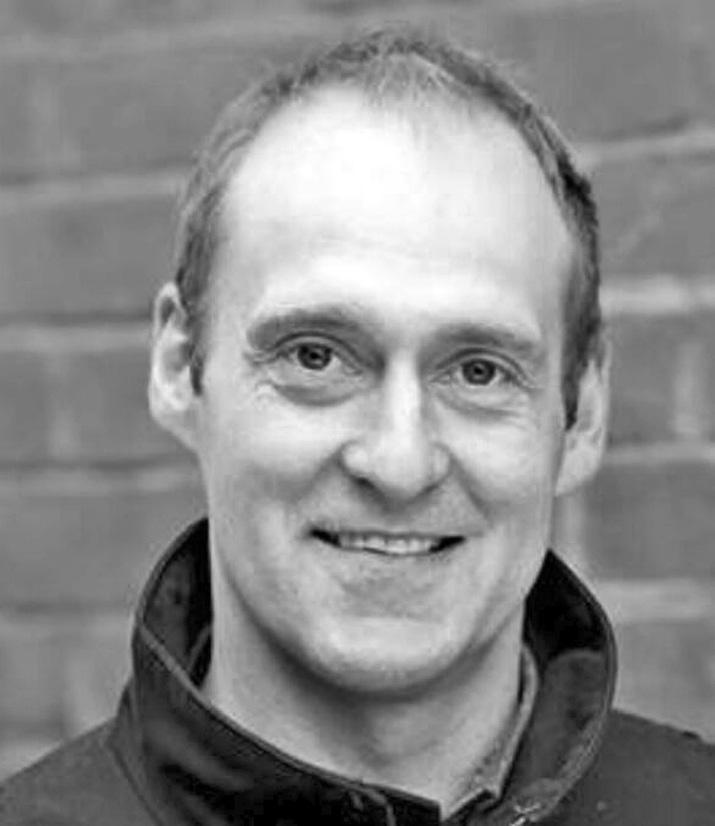
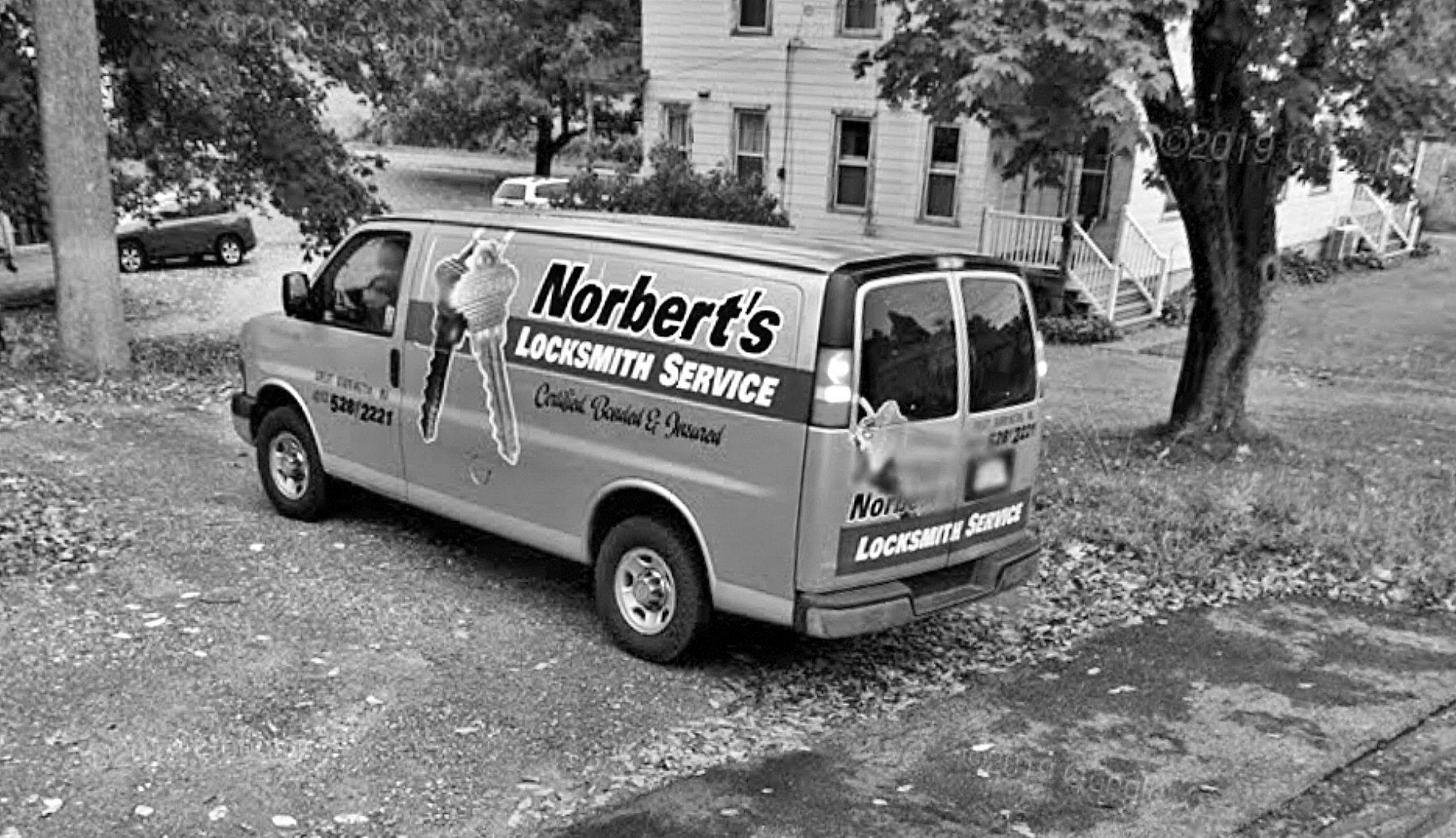
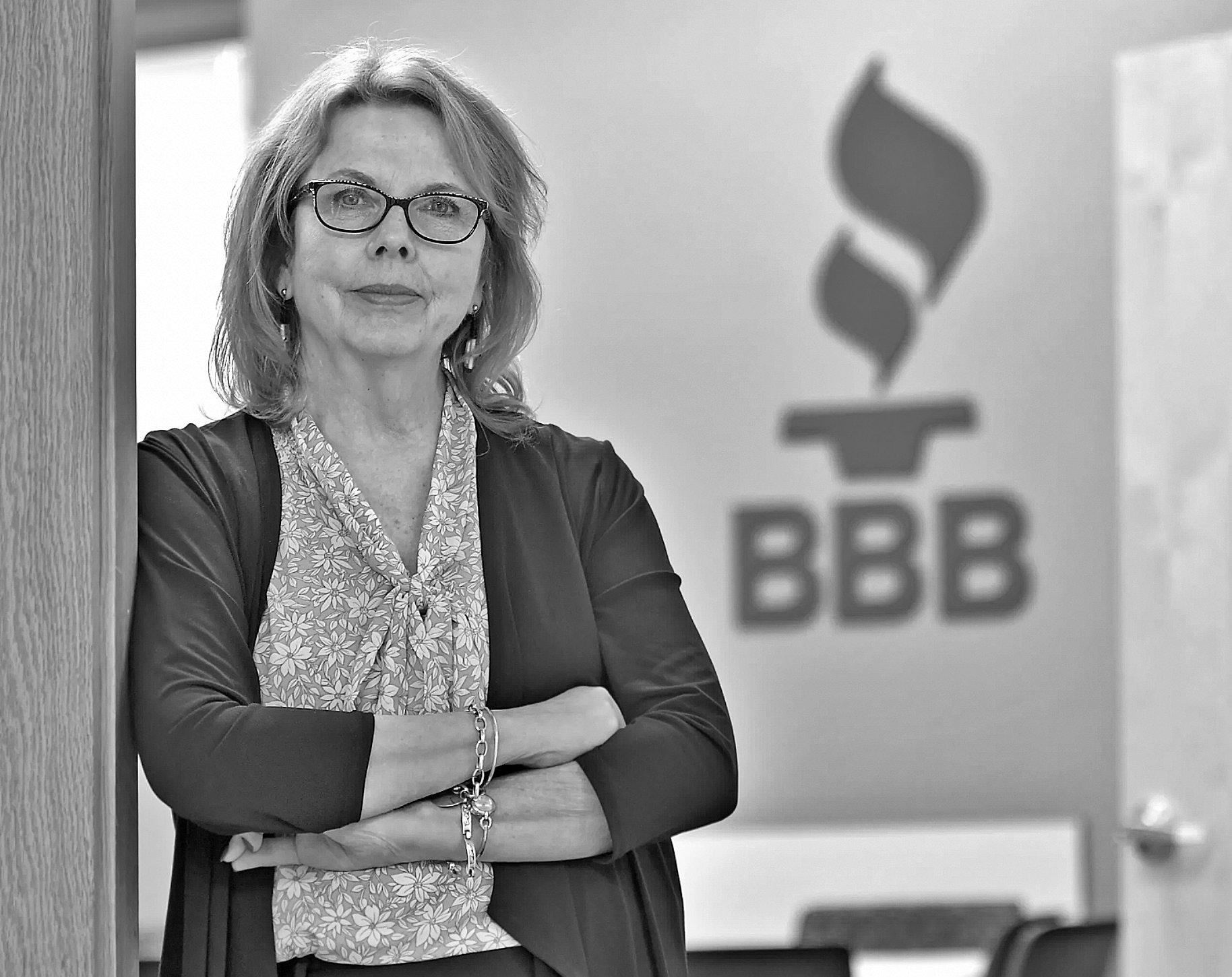
Top: Norbert Ruthel, who runs a locksmith business in Great Barrington, is credited by the Better Business Bureau of Central New England with uncovering the operation of a scam being conducted around the state. Above: Nancy Cahalen, president/CEO of the Better Business Bureau of Central New England, credits a Great Barrington man with identifying an apparent scam involving locksmiths. The BBB conducted its own investigation after Ruthel contacted them with his findings. “He came up with a pretty extensive list,” she said.
“A capable locksmith should be able to open any lock. Drilling is a scam.”
nancy cahalen, Better Business Bureau of Central New England
According to the BBB, many of these scammers use the name or logo of a reputable locksmith to advertise their business. When contacted, they frequently respond by saying, ‘Thank you for calling the locksmith company,” or “Hi, and thank you for calling our company.”
The fake locksmiths also do not provide a specific name. When pressed, the BBB found they say things like, “we changed
reminder email.
Participants are encouraged to visit youtu.be/6oWSOjGTQzU for further information and assistance with completing this survey. Information: Northeastern Regional Field Office, 800- 498-1518.
The U.S. Small Business Administration has awarded the state of Massachusetts $375,000 to support small business export growth.
The Massachusetts Office of International Trade and Investment plans to use that funding to help provide small businesses with the information and tools they need to succeed in export-related activities.
Exporting activities include: participating in foreign trade missions, market sales trips, designing international marketing campaigns, participating in export trade show exhibits, and attending training workshops, as well as other important means of engagement. Information: www.SBA.gov/STEP.
our name four months ago,” or they just hang up.
Later, the people who respond to a call for locksmith work often arrive in unmarked vans or trucks, or in a vehicle that contains a different name than the business listed on the web. Most legitimate locksmiths arrive in a clearly marked vehicle and will provide identification when asked, according to the BBB.
“A real locksmith will definitely have a
Massachusetts College of Liberal Arts is ranked seventh on U.S. News and World Report’s 2022-23 listing of the country’s top public liberal arts colleges for the seventh year in a row.
The college is also ranked 33rd on the publication’s list of schools that are top performers in social mobility and first among all Massachusetts liberal arts schools.
MCLA has appeared on U.S. News’ list of Top Public Colleges for 10 of the past 12 years. The college has also been acknowledged in its list of National Liberal Arts Colleges for Social Mobility since
lot of advertising on his vehicle,” Ruthel told the BBB.
The scammers will give a reasonable price over the phone, but often find ways to increase the price once they arrive.
The BBB has received ScamTracker reports of locksmiths charging $600 to make faulty keys or as much as $345 to duplicate a key, or providing customers with invoices from different companies.
“In some cases they’ll say they can’t open the lock and that they’ll need to drill it out,” Cahalen said. “This should be a big red flag because once they drill a lock, they’re going to have to replace a lock and that will cost several thousand dollars. A capable locksmith should be able to open any lock. Drilling is a scam.”
the organization adopted this ranking in 2019. This list measures how well institutions graduate students who receive federal Pell Grants, typically awarded to students whose families make less than $50,000, though most Pell Grant money goes to families with income below $20,000.
U.S. News ranks colleges based on indicators that reflect a school’s student body, its faculty, and its financial resources, along with outcome measures that signal how well the institution achieves its mission of educating students.
TOP: GOOGLE STREETVIEW
ABOVE: LINKEDIN
Chasing the ghosts out of town
Once-vacant complex brims with new life, local shops
By Scott Stafford
LANESBOROUGH — With the pandemic raging in the summer of 2020, Joe Prince was looking for a space from which he could operate his antiques business when he came across the run-down former Vacation Village sales center, which had been vacant for 12 years or so.
Vegetation was overgrown, some of the wooden sidewalks were warped and buckled, there was water damage from minor flooding in some of the buildings, and there was a partially collapsed shed in the center of the property.
“It was perfect,” Prince said. “My thought was that my dream came true.”
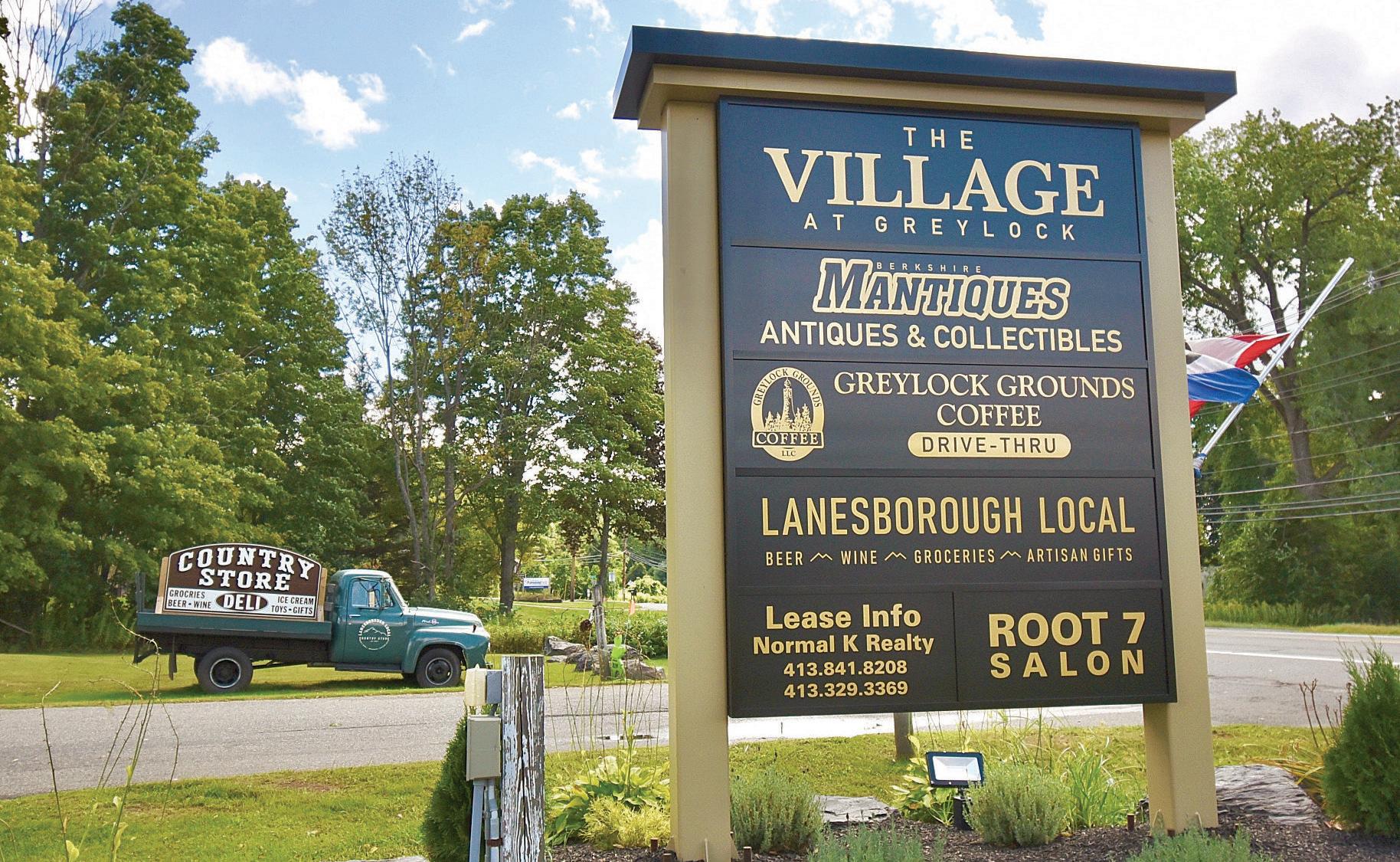
Flash forward two years, and we find Prince owning and operating three businesses in three leased buildings at the site, now called The Village at Greylock, and two other owners opened new businesses in the remaining structure. The buildings are surrounded by well-tended lawns and gardens, the buildings look up to date with a quaint New England feel, and bright colors and other creative touches give it a fun and comforting ambiance.
His first step was to open his antique shop, which he named Berkshire Mantiques. Having been a collector for years, he especially liked collecting old signs from long-gone businesses. His shop now has thousands of items for sale. He said the landlord, Normal K Realty, was proactive in cleaning up the property and repairing the structures.
“The landlord stepped up and took care of it,” Prince said.
He opened on Oct. 1, 2020. Then he started thinking again. His thought was to use a building in the rear of the property to establish a wholesale coffee pod assembly operation.
Working with grounds produced at No. Six Depot in West Stockbridge, he did some experimenting with different combinations of coffee grounds. Prince found the “perfect” mix of coffee grounds to fill the pods, which fit into Keurig-type coffee machines. He chose to use biodegradable, compostable pods, and set up an assembly line for packaging, which includes boxing and labeling. He named the product Greylock Grounds.
Prince launched the operation about three months after opening Mantiques.
Since then, he has lined up a number of businesses to purchase and sell his product, including Guido’s Fresh Marketplace, Whole Foods, Wild Oats Market, Big Y and other retail stores.
Once that was set, Prince’s mind kept going back to the old broken-down shed adjacent to the antique shop. After some ruminating, he figured that would be a great spot for a drive-through coffee and snack shack.
Working with the landlord, they put up a new structure, about the same size as the shed, complete with food prep and cooking equipment, and launched the Greylock Grounds Coffee Drive-Through, which opened a little over two months ago.
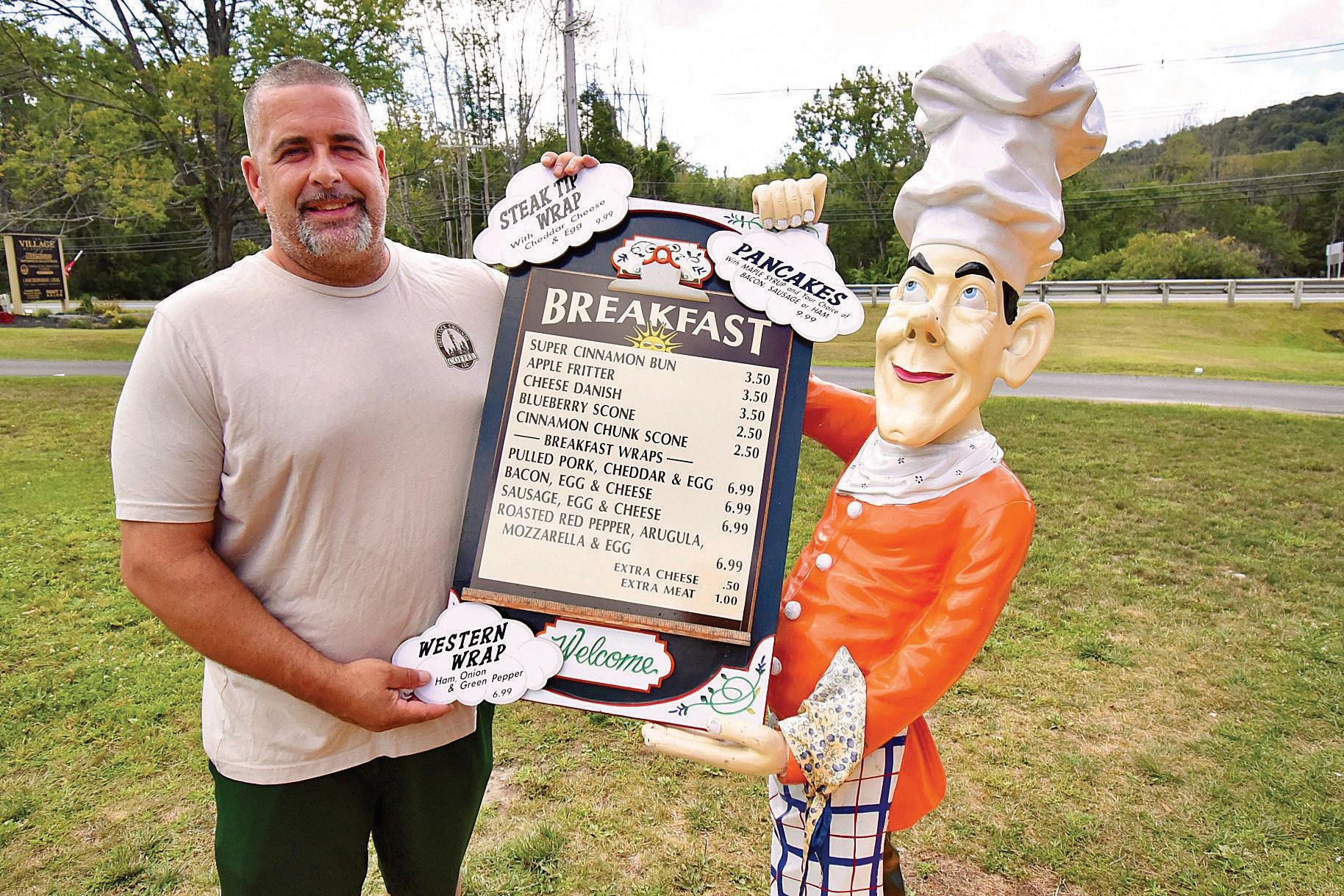
Since then, he’s added a bright yellow walkway for customers who want to stop in and eat outside on the picnic tables. The menu is varied and inventive. A plastic clown chef displays part of the menu, and drive-thru customers place their order where the miniature Statue of Liberty stands.
“We knew we needed this for the synergy here,” Prince said. He said he employs eight to 10 local young adults part time, depending on the season.
The colorful drive-thru, along with several antique cars and truck dotting the parking lot, adds to the intriguing feel of the new retail enclave. To enhance the center’s appeal even more, Prince said,
he hosts a family-friendly party every Friday and Saturday with live music outdoors, and a car show every other Friday.
After the snack shack opened, there was still space to be occupied on the compound, but Prince’s hands were full.
But Anna Bradbury’s weren’t, and she was in the market for a retail opportunity. After looking at the open space at what is now known as The Village at Greylock, she liked it, although there was a good bit of water mediation and
renovation needed.
She opened Lanesborough Local in October 2021, and the store will celebrate its one-year anniversary on Columbus Day weekend. The store features grocery staples, which locals find to be very helpful since the former local grocery store closed down several years earlier. There is also a deli and a florist, and there is a gift shop featuring locally handcrafted items.
“We have had a lot of local support,”
Joe Prince, local entrepreneur and owner of three Lanesborough businesses, poses for a
with the menu
Grounds
through.
the
and
Anna Bradbury, owner of the Lanesborough Local market, opened the store nearly a year ago. Below left: Since 2020, The Village at Greylock has been the site of five business openings.
Bradbury said. “It’s always nice to hear people say, ‘We’re so glad you’re here now.’ And we’re trying to offer a lot more grocery items.”
She said the operation fits right into her vision of what she was hoping for.
“I always wanted to have a little country store, and I felt there was a need in the area,” Bradbury said. “We’ve been very fortunate that people like it. It makes it all worthwhile.”
So with the general store added to the mix, about six months later a beauty salon moved into the remaining space next to Lanesboro Local.
Root 7 Salon opened on March 9. Owner Trista Nowak rented five of the six chairs to other local beauticians, and it’s been full speed ahead ever since.
Nowak had been working at other salons in the Pittsfield area for 20 years, and finally decided to go out on her own.
“Never in my wildest dreams did I ever think it would become a reality,” she said.
While all members of the team brought many of their longtime clients with them, they started seeing plenty of walk-in, first-time customers from all around the central Berkshire region, Nowak said. She says the retail center she wound up in is perfect.
“It was a real ghost town for so many years, and now it’s just beautiful,” she said. “I love it.”
Above:
photo
at
Greylock
Cafe
Drive-
Left:
SCOTT STAFFORD
Yuri’s Kitchen serves up a taste of home
By A inA de L A ppA rent A LvA rez
GREAT BARRINGTON — When Yuridiana Zaragoza first started selling her homemade dishes in the Berkshires, she would look for potential customers by knocking on doors and walking up to fellow Latinx people outside of supermarkets.
“I’d tell them, ‘I’m from Mexico, make a different dish every day. Here’s my phone number, you can order and come pick up at my house in Great Barrington,’” said Zaragoza.
What started as small operation — with Zaragoza preparing dishes one or two days a week to help make money to support her 3-year-old child — has grown into a daily business. She now prepares up to 50 dishes each day and sells them through her Facebook and Instagram pages called Yuri’s Kitchen.
Zaragoza, 27, who moved to Great Barrington in 2019 from Oaxaca (pronounced wa-ha-ka), Mexico, said her food is more traditional because she doesn’t try to only cook dishes that Americans would recognize.
“Sometimes I feel like here people don’t know much about Mexican food beyond soft tacos and flautas,” she said. “Mexican food is a lot more diverse than these two recipes.”
Zaragoza likes to vary her dishes. For example on a recent Wednesday, she cooked huarache, a fried dough named after a Mexican salad, topped with marinated pork cutlets, nopales and guacamole.
Two weeks ago she cooked molotes, a corn-based pastry filled with potatoes and chorizo, wrapped like a cigar, resting on lettuce and topped with bean sauce and cheese.
About 80 percent of Zaragoza’s customers are from the Latinx community, and some come from as far away as Lee or Pittsfield. The dishes are a way for some customers to alleviate their homesickness.
“Especially kids, they are far away, they want something that’s theirs and they ask me for very special things,” she said.
At the start of every week, Zaragoza posts her weekly menu on social media. She starts prepping food around 6 a.m. and finishes by 11:30 a.m. After cleanup, usually around noon, she begins selling food. Zaragoza is sometimes open until 6 p.m. to accommodate people’s work schedules.
The last six months have been especially difficult with the rise in inflation. Besides meat prices, a lot of takeout items — like boxes, bags or cutlery — have also gone up. She has raised her meat dishes by a dollar but has tried to keep her other prices down.
On her off days, she drives to Poughkeepsie, N.Y., to buy the ingredients at a cheaper price. Some food items like dry chili or the Mexican husk tomato are not available locally.
Zaragoza is originally from in Oaxaca. Growing up, she and her mother Juana Agustín sold tamales and tacos.
A year ago, her mother opened a restaurant in Mexico. It’s a dream that Zaragoza is working on as well. Three times a week, she takes entrepreneurship classes on Zoom.
“A lot of my clients say they’d like to have a space to come eat my food, but we know it’s hard and there’s so much to learn before,” she said. “But I didn’t think I’d be so successful before. It has shown me that if you want and you keep at it, you’ll succeed.”
101 Restaurant to stay at Pittsfield Holiday Inn
By tony doBrowoLski
PITTSFIELD — The 101 Restaurant & Bar is remaining at its current location at the Holiday Inn & Suites on West Street.
The McNinch Restaurant Group of Lenox, which operates the eatery, has resolved its differences with the hotel about the restaurant’s future operations. John McNinch, who runs the restaurant with his son, Tucker, said that the two sides had agreed to a new lease that will allow the 101 Restaurant & Bar to remain at the hotel for at least another year.
“It’s basically a year-long lease but it goes through until they put the (new) parking garage up,” McNinch said. The hotel’s dilapidated parking garage has been closed for several years.
“It’s open-ended,” McNinch said referring to the new lease, “with renewals built right into it.
“Both parties are happy,” he said.
“We’re very pleased to continue working with John,” said Susan Coyne, the Holiday’s Inn’s sales and marketing manager.
The McNinch Restaurant Group, which also operates nearby Patrick’s Pub in Bank Row, opened the 101 Restaurant & Bar in the hotel last year. But after the two sides differed on how to operate the restaurant going forward, hotel owner Berkshire Hospitality Group placed an advertisement in The Eagle this summer seeking a new operator to run the restaurant in its current state.
In late July, McNinch said his group intended to opt out of its one-year lease to operate the restaurant unless those differences could be resolved. The lease expired on Aug. 31, according to
Coyne. But McNinch also indicated that he would like to stay at the hotel if the two sides could work out their differences.
“It was just a matter of two different philosophies,” McNinch said. “In my opinion, the hotel was really pushing room sales and not pushing event sales — and being in a space this large without events it’s nearly impossible to be successful.
“So I said either start doing something with events or we’ll have to find another location. They worked with us the whole time. They didn’t want us to leave and we didn’t want to leave so we had a good conversation.”
On Friday, McNinch said the hotel has agreed to add an events coordinator to its staff to book parties and functions at 101 Restaurant & Bar.
“Our biggest issue was that the function space wasn’t being used,” McNinch said. “They lost one of their people and she had been here for years. Losing her left a hole, so now they’re going to hire somebody to fill that spot.”
“We’re searching for somebody now,” said Coyne, adding that having that person on board will help the hotel.
“Anytime you have somebody who can focus exclusively on one task typically it’s beneficial,” she said.
Berkshire Hospitality Group is headed by Anil Sachdev, who lives in New York City. The group purchased what was then the Crowne Plaza Hotel for $1.1 million at a foreclosure auction in April 2017, then spent over $2.5 million converting the structure into a Holiday Inn & Suites in 2018. The restaurant contains 2,000 square feet and can seat 120 patrons.
WILLIAMSTOWN — Steve and Monica Lawrence marked the 20th anniversary of their well-known Williamstown restaurant, the Spice Root on Spring Street, by purchasing another.
The couple now run the Chef’s Hat, at 905 Simonds Road, and promise to leave it largely unchanged, to the relief of staff and regular customers.
Upon the closing of the sale last summer, the Lawrences say they knew the staff at the Chef’s Hat would wonder whether they would keep their jobs. The new owners made a point to let them know that the menu would remain, as would all the staff.
“We are local people, we have many friends here. And we are happy to accommodate all kinds of people. Everyone should feel like this is their place.”
Monica lawrence, Chef’s Hat co-owner
Mind you, with upgrades made to the building and appliances, and other items replaced, such as plates and flatware.
“We are not just owners, we are part of the team,” said Steve Lawrence. “You have to support each other — we’re not here just to make money, we’re here to create community.”
Fans of the Chef’s Hat needn’t worry about major changes, says Monica Lawrence. “We don’t want to change it because there are so many people with memories of this place, and some of them have been coming here since they were young,” she said.
Steve Lawrence’s father is a chef in India. Monica’s father is a food inspector in India. They feel they were meant to be in the restaurant business.
And they welcome the idea of running two restaurants with widely different cuisines: Spice Root features Indian dishes, while the Chef’s Hat is mainly a diner featuring traditional American meals.
“As a chef,” said Steve Lawrence, “I like to work with different palates, different spice groups.”
The couple says they enjoy the restaurant business mostly because they get to meet people and make friends.
“This is my passion, my whole life,” Steve Lawrence said.
“He really is a people person,” said Monica Lawrence. “We both are.”
The couple bought the Chef’s Hat for $165,000 from previous owner Dave Rock. They plan on investing more than $100,000 in the building and equipment over several phases.
The building has housed food service businesses for years, including an ice cream shop and the Star Diner. It has been the Chef’s Hat for about 14 years.
“We are local people, we have many friends here,” Monica Lawrence said. “And we are happy to accommodate all kinds of people. Everyone should feel like this is their place.”
The Lawrences held an opening party in early August that featured free hot dogs and burgers and ice cream.
“We’re doing this to say thank you to the community,” said Steve Lawrence. “This isn’t our restaurant. It is the community’s restaurant.”
VidMob raises $110 million in venture capital
A creative technology firm with offices in Pittsfield recently raised an additional $110 million in venture capital that it plans to use to accelerate its growth.
VidMob, a member company of the Berkshire Innovation Center, raised the money through a round of funding led by Los Angeles-based investment firm Shamrock Capital, and includes Drive by DraftKings, Adobe and Shutterstock.
According to a company statement,
VidMob intends to use the new investment for sales and marketing to accelerate the development of its platform, and to expand its global footprint.
Revenue at VidMob, which creates video ad content for social media platforms, has rapidly grown the last four years. As of 2021, VidMob had raised almost $100 million through three rounds of funding and was valued at $290 million, according to the Wall Street Journal.
Originally founded in 2015 as a hightech startup building a marketplace
of video editors, VidMob’s growth accelerated after the company pivoted to creating video ad content for social media platforms, a move that caused the company’s revenue to grow more than 35 times between 2019 and 2021, according to PRNewswire.
The company’s corporate offices are in New York City, but its engineering department is located in Pittsfield. It occupies the top floor of the Crawford Square building on the corner of Depot and North streets.
VidMob serves as the “creative partner” for all the major social
media platforms including Google, Meta (Facebook), Amazon Ads, TikTok, LinkedIn, Pinterest, Hulu and Reddit.
“Under increased pressure to maximize every marketing dollar, improving creative effectiveness and efficiency has become a marketing imperative,” said VidMob board member Antonio Lucio in a news release. “By building strategic partnerships and game-changing integrations with the world’s leading media platforms, VidMob is giving its clients the fastest path to creative that works.”
Wayfair cuts jobs, but Pittsfield impact unclear
By Larry Parnass
Wayfair said in August that it would cut about 870 employees, 5 percent of its global workforce, to reduce costs as it works to come through the COVID-19 pandemic.
The announcement from Niraj Shah, a Pittsfield native, did not break out all locations affected by the job cuts. In Boston, the company’s headquarters, 400 jobs were be lost.
Wayfair operates a customer call center in the Clock Tower complex off South Church Street in Pittsfield. The center opened in 2019 and by the following year had about 130 employees, according to coverage in The Eagle.
In 2019, Shah pledged that the Pittsfield center would eventually grow to 300 jobs.
In a message to all employees, Shah said the cuts are part of an effort by managers to guide Wayfair “in a financially responsible manner.” Wayfair has 18,000 employees around the world.
“We are actively navigating Wayfair towards a level of profitability that will allow us to control our own destiny, while still investing aggressively in the future,” Shah said. “The macro environment doesn’t change our belief in the size of the opportunity, and we are moving purposely to seize that opportunity.”
Jobs cuts by Wayfair in February 2020, just before the start of the pandemic, spared positions in Pittsfield.
Susan Frechette, a spokeswoman for Wayfair, said that the company is not providing details on the number of jobs by location, including the move’s effect on its
operations in Pittsfield.
But she suggested that jobs at the Pittsfield call center may not have been a target.
“I can say the reduction impacts primarily corporate roles in North America and Europe,” she said in an email, in response to questions from The Eagle.
In late 2018, Wayfair secured a $31.3 million tax break from Massachusetts related to its planned job growth in Boston and Pittsfield. An Eagle story at the time reported that the deal awarded Wayfair a $9,500 tax break for every job created.
Wayfair Inc. expects costs related to the cuts to run between $30 million and $40 million in the third quarter, mostly related to employee severance and benefits. Shah’s message to employees said workers would be eligible for “a minimum” of 10 weeks of severance pay.
The company said it’s in the process of making substantial cuts to third party labor costs as well.
In his message to employees, Shah thanked those affected by the cuts. “For those leaving today, I want to say again how much we appreciate your contributions to Wayfair. Your work will have a lasting impact on the business and each of us. For those staying, I appreciate everything you’re doing to support one another,” he wrote.
Shah was born at the Berkshire Medical Center in Pittsfield and attended Herberg Middle and Williams Elementary schools. He graduated from Pittsfield High School in 1991.
Information from an Associated Press story was included in this report.
Deal keeps General Dynamics unit busy
6-year contract will focus on submarine missile control system
By L arry Parnass
PITTSFIELD — For more than six decades, General Dynamics has helped to arm submarines for warfare. A new quarter-billion-dollar contract ensures that work will continue, largely in Pittsfield, solidifying the company’s local employment.
The U.S. Department of Defense this summer awarded a $272.9 million contract to General Dynamics Mission Systems.
The six-year agreement, with the U.S. Navy’s Strategic Systems Programs office, will be used to develop, produce and install firing systems in the new Columbia and Dreadnought classes of submarines.
The major defense contract is the second for the Pittsfield division, the company says.
Carlo Zaffanella, vice president and general manager of General Dynamics Mission Systems, said the new contract, which runs through 2028, will provide support for submarines that are “of strategic importance to our nation and our allies.”
“General Dynamics has been supporting previous submarine programs for more than 65 years,” he said in a statement.
In 2017, General Dynamics landed a $5.1 billion design contract for the new Columbia submarines, according to the publication Defense News.
The submarines are being designed
by the company’s Electric Boat division in Connecticut and Rhode Island.
In addition to supporting the development of the submarines, the new contract will pay for work to upgrade strategic ballistic missile systems already in use on deployed submarines both in the U.S. and in the United Kingdom.
Nearly 80 percent of the work will be performed in Pittsfield, the defense department said.
The money awarded this month, according to the Pittsfield division, relates to work on behalf of the U.S. Navy’s second and third Columbia-class submarine and the third Dreadnought class submarine in the U.K.
The defense department said that 79 percent of the work will be done in Pittsfield, followed by this breakdown of work elsewhere: Groton, Conn., 7 percent; Kings Bay, Ga., 4 percent; Bangor, Wash., 4 percent; in the U.K., 4 percent; and in Quonset Point, R.I., 2 percent.
The Columbia class of submarines is costing the U.S. government roughly $110 billion for an initial order of vessels that are expected to be in service for 50 years.
According to trade publications, the new class of submarine will be longer and heavier than the Ohio class it replaces, but carry fewer nuclear missiles.
General Dynamics Mission Systems, based in Fairfax, Va., has about 13,000 employees around the world.
General Dynamics as a whole has more than 100,000 works worldwide. It reported revenues of $38.5 billion in 2021.
Cover story
Recreation
Miraglia started Berkshire Camino based on experiences she gathered when she twice hiked the Camino de Santiago, a 500-mile series of walking trails located in northern Spain, by herself.
The first trip came in 2018 when Miraglia describes her life as being at “a crossroads.” Divorced, and facing career and financial insecurity after walking away from a long career in the corporate world, Miraglia decided to hike the Camino de Santiago to find meaning and purpose in her life. On Berkshire Camino’s website, Miraglia refers to her trip as a “solo pilgrimage.” Her second trip took place in 2019.
“The experience of being able to take a break from daily life and just sort things out was so beneficial to me mentally, physically and spiritually,” she said.
After returning from Spain, Miraglia began thinking about creating something that resembled the Camino de Santiago in the Berkshires.
“I was aware that the Berkshires has a landscape that allows you to walk from town-to-town, the way you can do it in Europe,” she said. “Not in all of the Berkshires, it’s more aligned in Southern Berkshire County. When I started thinking about a business concept, I was looking at the infrastructure in Spain that allows the Camino de Santiago to be what is. There’s a whole backdrop of industry around it. There’s lodging places, cafes, outfitter shops. I was thinking about how I might concentrate that in the Berkshires.”
Miraglia developed her original concept with the help of Entrepreneurship for All Berkshire County, but after the COVID-19 pandemic struck she pivoted from creating infrastructure to arranging guided walking tours.
“I decided to pursue the tour operator option,” she said. “That was going to be a side gig to the hostel strategy, but now that I’m building this business I see a lot of potential for it.”
Berkshire Camino currently offers
“I
guided single and multiday hiking trips in the Berkshires. Excursions range from short walks around town centers to hikes of up to 8 miles that last from four to five hours.
“I have multiple routes that I’ve created using a variety of terrain,” she said. “They include woodland trails, country roads, sometimes walking on sidewalks through town. There are no set routes.
“All of our guides (there are 10) are locals so we share stories about the history and culture and the spirit of the Berkshires,” Miraglia said. “People are often coming on these walks wanting learn more than what they could learn just walking around (on their own).
For multiple day hikes, Miraglia pre-arranges lodging and meal options for participants at local inns and restaurants.
“The focus is becoming a multiday journey that’s a destination experience,” she said. “It’s an alternative to the Appalachian Trail. It’s for people who are not
capable of or interested in the rigors of an Appalachian Trail through hike. They don’t want to camp and eat their own food. It’s too vigorous for them.
“We arrange all of the lodging, all of the meals, there’s a start and end date for each of their events, so it doesn’t happen when someone chooses, at least not right now.”
Berkshire Camino has booked four tours for its second season this year including a multiday excursion in November and December.
“Next year I’m aiming for eight,” she said. “We’ll continue to expand as demand allows.”
Outdoor recreation has continued to expand in the Berkshires, especially since the COVID-19 pandemic forced the county’s more popular cultural attractions to hold truncated seasons in 2020 and 2021.
In June, 1Berkshire President and CEO Jonathan Butler told the Berkshire Business Journal that outdoor recreation was
the fastest growing segment of the Berkshire tourism economy.
“We have a much higher percentage of people taking part in recreational activities — hiking, biking, things like that,” Butler said then. “Recreational activities are very affordable. Some of them are even free.’
In a follow-up interview, Butler said his comments are based on anecdotal information obtained from the operators of Berkshire outdoor venues, because 1Berkshire, which serves as the county’s official tourism agency doesn’t track those numbers. But there are national statistics that back Butler’s hypothesis.
According to a study done by the Wilderness Society, the U.S. outdoor recreation economy supports about 5.2 million jobs, generates nearly $788 billion in consumer spending and accounts for 2.1 percent of the country’s Gross Domestic Product. The study also found that slightly more than half of Americans (153.6 million people) participated in outdoor recreation at least once in 2019, which totaled 10.9 billion outings. A 2020 National Recreation and Park Association survey found that about 82 percent of people in the U.S. consider parks and recreation “essential.”
“I’ve definitely seen an overall increase in outdoor recreation use and people turning to it for different reasons,” said Valentina Cugnasca, who with her father, Paolo, an Italian-born businessman, founded Ramblewild eight years ago. “It’s a great way to heal after the last couple of years.”
Cugnasca, whose background is in investment finance, ran a hedge fund for many years, before she and her father started Ramblewild. The idea for an aerial park surfaced when they began looking to enhance the value of the property they had purchased for a new company they formed.
“One of the products we developed was a timber investment company for our clients,” Cugnasca said. “We bought three properties. Two in the Berkshires and one in the Adirondacks for long-term sustainable timber.
PHOTOS BY GILLIAN JONES
A person does one of the high ropes courses at Ramblewild Adventure Park in Lanesborough.
wanted to find a way to activate our sustainable full forest strategy using some kind of recreation activity that would reconnect people to the forest and each other,” said Valentina Cugnesca, co-founder of Ramblewild Adventure Park.
“Walking around those properties I realized we were only valuing them for the real estate and the timber,” she said. “I felt there was whole other set of values that we weren’t taking into account, recreational, renewable energy, all the different ecosystems of the forest.”
Cugnasca said she went back to school and obtained a degree in sustainable management. Her thesis was titled, “Tree Hugging Capitalism.”
“That eventually became more palatable to investors through something we call sustainable full forestry,” she said. “Instead of just valuing a piece of property for the land, the real estate and the timber you add these ecosystems on top.”
She received further inspiration came from reading “Last Child in the Woods,” a book by Richard Lowe, which discusses “nature deficit disorder” — the idea that technology has made humans more disconnected from nature,
“It really scared me,” she said. “I wanted to find a way to activate our sustainable full forest strategy using some kind of recreation activity that would reconnect people to the forest and each other. I heard about aerial parks in Europe and thought we had the property for it. Let’s find a good site where we can build a custom built aerial park. We found about 11 acres of property here in Lanesborough and Hancock off Brodie Mountain Road.
Aerial adventure parks come in different styles. They’re basically obstacle courses. Those obstacles are usually connected by things like telephone poles, posts placed in fields or platforms. “In our case, it’s in the trees,” Cugnasca said.
Ramblewild has eight aerial trails that contain varying degrees of difficulty, beginning, intermediate, advanced and expert. The park’s main trial, Basecamp, consists of 13 elements with platforms ranging from 4 to 16 feet off the ground. One ends in a zip line.
Participants are given a full-body harness that connects to device known as a smart belay, a system that included interconnected carabiners, or coupling links, that communicate with one another. In smart belay technology, if one of the coupling links becomes unlocked or disconnected from the main safety line, the other remains locked until its counterpart is securely linked to the cable. Using this system, participants advance from tree to tree.
Basecamp is built on a continuous belay system, so participants do not need to manipulate the equipment as they navigate the elements. A single continuous lifeline goes throughout the entire trail.
“You clip it and unclip it to navigate through the tree elements,” she said. “You navigate through these different elements that you’ll find between the trees.
Visitors understand the concept behind Ramblewild better than they used to.
“One thing that’s changed since we opened to now is at the beginning we spent a lot of time educating people about what an aerial adventure park was,” Cugnasca said. “There were only a handful in the United States at the time. But now there are many, many more. There’s a whole group of people — you know how
cross a suspension bridge over a gorge at Ramblewild Adventure Park in Lanesborough.
People climb the hub as they start one of the high ropes courses.
PHOTOS BY GILLIAN JONES
people go to different amusement parks to try different roller coasters — who will come here and say I’ve been to this place in North Carolina or in Hawaii or in California. There’s less explaining what it is and more explaining about what makes us different.
“I think that’s great,” she said. “It means that people are comfortable with the concept.”
Ramblewild is one of three enterprises that belong to an umbrella company, Feronia Forests, that Cugnasca and her father own. The others are Mission Maple, which makes maple syrup, and Feronia Forward, a nonprofit dedicated to to help people love, appreciate, and understand the forest.
“Basically, we wanted to generate social, environmental and financial impact,” she said. “Things that are typically not done together, sort of reimagining this model so that we could consider them equally. We consider the environment and soical impact of everything we do just as much as the financial impact. So a lot of the things that are typically taken on by a nonprofit we took on in a for-profit mindset. The more successful we can be financially, the more successful we can be on the environmental front and the social front.
“We put these properties to work in a way that enhances those three different functions,” Cugnasca said. “The aerial park was one of those ways.”
Above: People
Left:
No winging it at Pittsfield’s airport
As traffic continues to rise, a look behind the scenes of municipal aviation
By M att M artinez
PITTSFIELD
— At the Pittsfield Municipal Airport, long-term parking draws people going nowhere. That is, nowhere but this high ground southwest of downtown.
From a small hill, with its lone tree and picnic table, they come simply to watch planes land and take off. The lot is equal parts observation deck and community gathering space, along with a place to park.
This is no ordinary lot — or airport, for that matter. While it has no scheduled commercial passenger service, the Pittsfield airport cranks up in summer, accommodating up to three dozen private aviation flights a day, including, in August, the landing of a 737-700 owned by a billionaire named Len Blavatnik.
Day by day, around the year, the airport receives visitors who might otherwise overlook Pittsfield. It keeps a steady flow of money coming into the area.
But that’s just the flyover view. What does it look like day to day, here on the ground? The Eagle spent time at the airport late this summer to get a sense of what happens out in plain view, behind the scenes and in the surrounding neighborhoods.
THE MANAGER
Traffic at the airport has been going up steadily in recent years, says Dan Shearer, its manager. Last year, despite the pandemic, traffic hit a three-year high. The availability of private jets has increased due in part to part-ownership companies like NetJets, which allow people to purchase a membership and charter a plane without owning it outright.
Summer is peak season. When things are busy, the airport handles from 25 to
35 flights a day, serving some of the biggest aircraft that touch down in Western Massachusetts because of the size of its runway.
While the runways cater mainly to small aircraft, the airport sees a significant portion of the small-to-midsize jet traffic in Western Massachusetts, Shearer said. Most commonly, the airport is used by planes that hold six to 10 passengers.
Takeoffs and landings are only part of the story: The airfield generates an estimated $40 million in economic impact, according to a 2019 study. This includes capital improvements, visitor spending and money generated on the airfield by flight
schools and plane repairs. The Walter J. Kolodza Airport in Great Barrington generates about $5 million and Harriman-and-West Airport in North Adams generates about $18 million, according to the same study.
Shearer joined the airport in 2020. That means he has had to contend with demands served up by the COVID-19 pandemic.
Fears about using public transportation led people to consider chartering private jets, including travelers who had never done that before. If you split the cost among enough passengers, the cost isn’t much more than a first-class airline ticket, Shearer said. The pandemic
groundbreaking
brought an influx of New Yorkers to the area.
A review of a week’s travel logs at the airport shows traffic to other parts of New England and across the state line into New York, due in part to people who live in the Berkshires but work in New York. Some planes came from as far west as Van Nuys, Calif., and as far south as Florida.
The airport manager’s job is to keep the place running smoothly and looking good. Shearer and his team manage the 575 acres the airport sits on while overseeing and directing day-to-day operations there: mowing grass, plowing snow
Patrick Kalinowsky and Blake Srzepa inspect a Falcon jet in the Lyon Aviation hangar at the Pittsfield airport.
BEN GARVER AIRPORT, Page 15
and clearing ice, as well as maintaining buildings and structures around the airport.
Shearer had about $284,000 to work with from the city’s budget in the last fiscal year, allocating money to salaries for his staff and to utilities, maintenance, snow removal, membership dues and other expenses.
The manager has more than maintenance in mind. Shearer has ambitions to grow the airport and “get it in the black” financially. He’s working to secure a Federal Aviation Administration grant that would allow the city to renovate the terminal, which hasn’t seen major updates in years. The FAA and state paid for recent runway improvements.
Meanwhile, Shearer and the city’s Airport Commission are pursuing a proposal to lease out some of the airport’s land for solar panels that could generate over $1 million in revenue for the city annually, he said.
While the city is in charge of managing the grounds, another entity is in charge of the aircraft.
THE MECHANICS
More traffic means more work for the mechanics at Lyon Aviation, the airport’s fixed-base operator. The Pittsfield outfit is managed by Mark Rogers. His team of mechanics has increased from four to 11 since the pandemic began.
The increase in mechanics kept pace with a rise in demand. Lyon is booking maintenance appointments about three months in advance for planes coming to the airport. For work on some aircraft electrical systems, the wait extends into early next year. In the busy months, the increase is readily apparent to the workers in the hangar. The team can see over 10 “operations” a day.
“It’s hectic,” said Justin Codwise, director of maintenance for Lyon Aviation.
Codwise explained that his mechanics handle two main functions: mechanics and avionics. Mechanics take care of the “nuts and bolts” and make sure that the planes are fit to fly. The avionics team, on the other hand, are referred to as “spark-chasers.” They manage electrical systems on planes to ensure their systems are functioning properly.
Planes that come into the airport can get inspections and needed maintenance, depending on the Lyon crew’s schedule.
Codwise said how long the aircraft stay in Pittsfield depends on the level of the inspection needed. Some planes can be in for two weeks, others for six and still others for a few months. If a plane comes in and just needs a “turn and burn” to get back in the air, they can get it done in about four hours, he said. That’s for a cursory inspection to check air pressure in the tires and get the plane refueled.
It also depends on the kind of plane that comes in. As Codwise puts it, you can be working on a “152 one day and a G5 the next.” That’s shorthand for the difference between a two-seat, single-engine Cessna and a 16-passenger luxury Gulfstream jet. With all these factors, the maintenance crew sought out new certifications to work on different types of planes and continuing to grow their numbers.
“If you can land it on this runway, we can work on it,” Codwise said.
THE SPECTATORS
Shearer is well aware that the airport attracts people who aren’t traveling, particularly during the pandemic, when the grounds provided a wide, open-air space to hang out.
It’s become a gathering place — and he hopes to expand that role. During the summer, he said he runs into kids “hooting and hollering” for the planes. Events like cruise nights bring people together, with their classic cars, near the runway.
For Jessica Dimario and her daughters, Addisyn and Wyaitt, the airport makes for a good field trip. The other day, Dimario and the girls sat and watched planes coming in and out, occasionally Googling the finer points of aviation for some lessons.
Addisyn, 10, and Wyaitt, 7, attend school virtually. They have since before the pandemic, because of Addisyn’s schedule as an up-and-coming go-kart racer. Places
like this give them an opportunity to get out and see the world around them.
“With this, they’re learning from real-life experiences,” Dimario said. “It’s better to learn like this than through a screen.”
Others visitors, like Jennifer Denovellis and Carol Borgo, come hoping to see celebrities. Rumors circulate steadily about visits from the Wahlbergs and other celebrities who drop by the Berkshires.
When the sightings don’t pan out, Denovellis says it’s still nice to come plane-watching on a quiet afternoon, especially with a coffee from Bartlett’s Orchard up the road.
Observers come by truck, car and motorcycle. On hotter days, onlookers end up seeking shade beneath trees. Others go for a higher vantage point, parking their trucks on a nearby bluff that offers a breathtaking view of the Berkshire hills that surround the airfield on practically every side.
One Pittsfield resident brings a tin of graham crackers to feed a nearby nest of crows. When the planes sit silent, she said the place gives her peace of mind.
Christina Lyford says she visits the airport five to six times a month. Her cellphone gallery is filled with photos of picturesque sunsets and the runway through the seasons, including a photo in midwinter when it transformed into a sheet of ice.
She was eating lunch with her son, Haydn, at her favorite spot: a picnic table that offers an elevated view of the airfield and the surroundings.
THE NEIGHBORS
Some neighbors to the bustling airfield aren’t as positive about all the coming and going. Tonya Halley operates a farmstand at Bittersweet Farm just down Barker Road from one of the airport’s runways. While airport operations haven’t affected her business, the racket can be overwhelming at times, she says, especially since the aircraft have gotten bigger and more frequent.
“They are really big and loud, but you get used to it,” Halley said. “Even our horses got accustomed — but at first, they were really freaking out.”
Halley said that lately, it appears to her that more planes have been coming in early in the morning or late at night — making it “frustrating” when trying to coordinate her 10-year-old’s sleep schedule.
Even during the busy season, Shearer said the airport hasn’t received too many complaints about noise from aircraft. “A lot of the flights I get called about are not actually associated with the airport,” Shearer said. “Often, people call because they know the airport’s here.”
Shearer said that roughly half the calls he gets concern military aircraft passing overhead. Occasionally, helicopters will
spur complaints due to their low-altitude flights and the noise they make. Shearer said that he’s working with local first responders to conduct training and simulations at the airfield too, but the airport doesn’t see a significant amount of training there now.
As a policy, the airport asks its customers to limit the times they take off from 7 a.m. to 10 p.m. to avoid too much noise in the early hours of the morning. While only a guideline, Shearer said most people using the airport abide by it, with the occasional odd flight landing later than 10 p.m. By and large, flights are before noon, he said.
Another neighbor wouldn’t trade places with anyone.
Velma Pires lives off Barker Road, near the end of one of the airport’s runways. She doesn’t have to visit the airfield to watch the planes. “It’s like a 3-D movie coming at you!” Pires said of the view from her property.
Pires has lived near the airport for nearly a decade and doesn’t mind the commotion. She said watching planes come and go with her grandchildren is exciting for them … but admits she likes it too.
“It doesn’t really matter how old you are, you’re going to be fascinated by the jets,” Pires said.
BEN GARVER
Bobby Perry Jr. puts the finishing touches on the maintenance and inspection of a Falcon jet at Lyons Aviation.
Berkshire voices
A new kind of professional learning institute
PITTSFIELD — I found the Berkshires by mistake over a decade ago. This region became a place of exploration for my young family. The Berkshires sparked a different energy for each of us and it felt strikingly like home.
At the time, I was the president of a corporate university and served as a professor at a university supporting mostly nontraditional students and adult learners who wanted to enhance their work lives. l always enjoyed being a part of educational environments and especially teaching in the fringe between formal education and practical learning.
Dennis Rebelo Notes from the BIC
I also had the opportunity to co-found The Sports Mind Institute, which curated leadership lessons with remarkable individuals, including Major League Baseball and National Football League CEO’s and even one NFL Hall of Fame coach through video-based online courses. Lately, I have been reflecting upon the work I have been able to do over the years.
More recently I authored the book, “Story Like You Mean It.” It is a book designed “for others,” instead of “about me.” I think that’s why it became a bestseller.
All through the years leading up to today, the Berkshires was there for me serving as a constant touch point. One of my very first acquaintances was Deb Raber, the women’s soccer coach at Massachusetts College of Liberal Arts, who immediately thought I should meet Dr. Josh Mendel.
Josh and I connected automatically on matters of education and the importance of helping students gain career exploration at early stages in their educational journeys. In fact, it was Josh who introduced me to BIC Executive Director Ben Sosne, who told me the BIC’s story.
Ben’s enthusiasm and depth of understanding the ways government, community, industry and education partners could collaborate synergistically to spark and sustain systems for economic development was also striking to me.
I was able to hear firsthand from Ben how the strategy was set to bolster economic growth in a region ready for it. I also learned that the landscape of the Berkshires is not just populated with views of nature, but also the presence of advanced manufacturers and other technology-focused firms.
Some are multigenerational like Boyd Technologies, and others just birthed out of an industry needing tech advances, like United Aircraft Technologies. Knowing what I know now, makes it difficult for me to limit myself from listing all of the great businesses I have met already through the BIC. (Of course a quick visit to the Berkshire Innovation Center’s website will provide that list.)
By hearing from organizational leaders in the workshop I facilitated about “talent strategies for tech-organizations,” I learned what local organizations needed. I heard from high school students in the BIC’s BETA program and area college students through other workshops I hosted. I even learned more about CEO-Founders through my work supporting their CEO pitches in support of the Western Massachusetts Founders Network.
I saw what is possible here and I opted to make a change. The BIC, the organizations and institutions illustrated a real concern for one another and desire to create, innovate and skill-up to do work of the future. I felt that energy. So I committed to this place.
I recently bought a house in the Berkshires and said “yes” to helping the BIC build out the BIC Manufacturing Academy, which will be launching its first programming this fall. I also said “yes” to building more than that.
I said “yes” to becoming the Berkshire Innovation Center’s chief learning officer. In this role, I will focus on developing key programming events and initiatives to
support skill development of employees, members and partners, and advance the BIC’s organizational effectiveness as a whole.
I am honored to play my part at the intersectionality of education and training to ensure sustainable economic development for community members and BIC member organizations.
When I think of my first teacher, friend and mentor, I think about my father. My dad was an engineer and was a helper. He was an active part of my community in Rhode Island. During my younger years, he ran a business that was an essential part of the supply chain.
As a young man, I also worked at that steel and metals provider firm that he oversaw. As I matured, the experiences I had with workers, customers, innovators, fabricators and community helped inform me about the inter-connectedness of people and their essential role in building and sustaining a business.
As I was contemplating my future and possible role at the BIC, I shared much of my thinking with my dad during his treatment days. He had been diagnosed with both lymphoma and lung cancer a little more than a year ago. Before he left us, I also shared with him how I wanted to connect students and business leaders, community members and educational partners through innovation-driven classes, workshops, events and programming that brought five distinct generations together. He was thrilled to see my excitement and understood the ways the BIC aims to make a difference, help and serve the community.
I needed experiences to understand myself better as a young person and to know what work could be like for me.
I explored innovation through science fair projects to better design approaches to devices. Eventually that led me to the University of Rochester.
The lasers and optics lab in my basement was co-built by my dad during my high school years. He was a bit of my innovation center guy back then. Without him I could not have built a 2,000 pound sandbox seated on inner tubes to absorb vibrations to build holograms. I just could not have done that experience alone. We can always do more together.
Today, I see the need for the BIC as a similar guiding resource for students, leaders, team members of area businesses, and even people who have yet to discover the Berkshires.
From Boston to Buffalo, change is happening. Today, Boston has become one of the top innovation cities for life sciences in the country with 18 of the 20 top life sciences firms in the U.S. having a presence there, according to Kenn Turner, the president and CEO of the Massachusetts Life Sciences Center.
The Berkshires has much to offer too — from mountain hikes and adventures to culture and live music events — and, now one more something creating some added “pull,” the Berkshires Innovation Center.
Ben Armstrong, executive director at the Massachusetts Institute of Technology’s Industrial Performance Center where he co-leads the Work of the Future Initiative reported that, “MIT’s research has identified several promising examples of organizations and partnerships that have begun to address these challenges (of manufacturing organizations).”
He added: “We see these examples as models on which future programs can be built.”
I am energized to arrive at the BIC to collaborate and help guide the programming and development of the models that MIT’s research notes are not only promising, but possible, right here in the Berkshires.
BIC names Rebelo chief learning officer
PITTSFIELD — Dennis Rebelo has joined the Berkshire Innovation Center in the newly created position of chief learning officer.
In this role, Rebelo will integrate educational programming into the BIC’s member offerings and community learning opportunities, working collaboratively with the executive leadership team. Educational experiences will take the form of in-person events, daylong workshops, pop-up training programs as well as distance-based and hybrid learning offerings.
“I am energized and honored to join the BIC in this new role which will connect member organizations, academic and research institutions, and community partners to innovation-driven learning opportunities,” he said in a news release.
Rebelo will be instrumental in the launch of the BIC Manufacturing Academy. Made possible through a $914,000 grant from the U.S. Department of Commerce, the academy is designed to address persistent challenges facing the manufacturing economy in the Berkshire region. He will play a key role as the BIC builds the academy with the Massachusetts Institute ot Technology MIT, the Mass Tech Collaborative, and local industry and academic partners.
The BIC will host an event on Nov. 2 to mark Rebelo’s arrival. He will conduct a special presentation in-service to BIC member organizations titled, “High Stakes Public Speaking for Technologists & Innovation-Driven Organizations.”
Rebelo has served as executive coach to presidents of health systems, leaders at life science firms, manufacturing organizations and community-based organizations. He has also worked in higher education as a professor of technology, leadership and management at Roger Williams University in Providence, R.I., where he received the Thomas J. Carroll Teacher-of-the-Year Award in 2020.
He was a co-founder of The Sports Mind Institute, the former president of Alex and Ani University and the creator of the digital tool StoryPathing for Career Development. He is also the author of the best-selling book, “Story Like You Mean It” how to build and use your personal narrative to illustrate who you really are.
‘’We’re thrilled to have Dr. Rebelo join our team,” says Ben Sosne, cxecutive director at the BIC, “and I look forward to working with him to develop key programming initiatives to support skill development of employees, members and partners.”
Rebelo lives in Rhode Island with his wife and three Australian Sheppards but recently purchased a home in the Berkshires. In his free time he enjoys antique automobiles, art, live music events and hiking.
rom one season to the next, this is more than a destination. It’s a set of experiences, qualities and values that fulfill.
Your financial advisors should embody these same attributes.
It’s why we’re here.
We’re here with you. And for you. Come learn more. Let’s star t a conversation.
Energy costs burden power-intensive industries
LEE — My company, Onyx Specialty Paper in South Lee, uses about 1.6 million kilowatt-hours per month of electricity to operate our business. That is the equivalent of operating about 1,700 homes.
We also purchase natural gas to burn in our boilers to generate steam. While some of that steam is used to heat our buildings, about 70 percent is used directly in our papermaking process, primarily to dry the paper we make.
Early in our history as Onyx, we used fuel oil in our boilers to generate steam, but made a million-dollar investment about 10 years ago to convert the boilers to natural gas, allowing us to reduce our greenhouse gas emissions by about 35 percent.
It is easy to see why government energy policy matters to Onyx and to other employers throughout Massachusetts. The importance of policies governing the cost and generation of energy took center stage this summer as both state and federal lawmakers passed sweeping measures that will fundamentally change the way we power our businesses, our homes and our vehicles.
The new laws make significant and welcome investments in the development of clean energy as both Massachusetts and the nation seek to meet ambitious goals for reducing greenhouse gasses. But those laws also raise a fundamental question of fairness and economics. At what point does the pursuit of laudable environmental objectives create an existential threat to existing businesses and the livelihoods of the people who work for them?
Of particular concern is a provision in the state law — An Act Driving Clean Energy and Offshore Wind — that authorizes up to 10 towns and cities to ban the use of fossil fuels in new construction or in substantial remodeling projects. New manufacturing plants would be unable to use natural gas or oil for production in those communities and new homes would not be permitted to install oil or
propane tanks or use natural gas for heating or cooking.
Restrictions on fossil fuel are nothing new to those of us in Western Massachusetts. Berkshire Gas Co., facing supply and transportation constraints, invoked a moratorium on new natural gas hookups throughout eight Pioneer Valley communities in 2014 and made that moratorium indefinite in 2019.
Berkshire Gas has explored alternatives, but none has been found to be financially feasible. Meanwhile, the stand-down has inhibited economic growth in Greenfield, Deerfield, Montague, Whately, Sunderland, Hatfield, Hadley and Amherst.
The cost of energy is already a significant challenge to Massachusetts companies.
Onyx is currently experiencing the highest electricity and natural gas prices we have seen since the company
was founded 13 years ago. We are currently paying 55 percent more for a kilowatt-hour of electricity than we were paying a year ago, and 52 percent more for a dekatherm of natural gas. And there appears to be no relief in sight. Government regulation is not helping these trends. In 2018 and 2019, fees imposed by the state Legislature accounted for almost 25 percent of the price paid for electricity. Another 23 percent was related to transmission costs, which are expected to continue to climb.
Put it all together and electricity pricing in Massachusetts is the third highest in the country based on June 2022 data — behind only Hawaii and Alaska. I routinely receive calls from state economic development offices in states like Virginia, South Carolina and North Carolina — where the cost of electricity is more than 50 percent less per kilowatt-hour than Massachusetts — trying to persuade me
to relocate or expand our business down south.
Relocation is not in the cards for our business — even though we could save more than $1 million per year in energy costs. But the cost of energy in Massachusetts is certainly a barrier to expansion for manufacturing businesses that are heavy energy users.
The prospect of expanding fossil fuel bans throughout the commonwealth sends an unnecessary and ominous signal to Berkshire County companies that employ thousands of our friends and neighbors. We welcome the opportunity to work toward a new energy future, but must be sure there is a viable economy left once we get there.
Patricia Begrowicz, the president and co-owner of Onyx Specialty Paper in Lee, is chair of the board of directors of Associated Industries of Massachusetts.
New methods of economic empowerment
GREAT BARRINGTON — The Nonprofit Center of the Berkshires often works behind the scenes providing advice, coaching, and resources to grassroots organizations.
This month, we are excited to hand this column over to Roots and Dreams and Mustard Seeds to share updates on their robust community work and mission of empowerment through economic participation and ownership.
Liana
Roots and Dreams and Mustard Seeds seeks to decrease the impact of multiple levels of poverty by increasing working class ownership. When workers have a share in the economy and government, participatory governance and shared equity become the norm. By “working class” we mean all of the people who are not in the ownership class including the unemployed, disabled, incarcerated, or otherwise not working.
Worker-owned cooperative business development, one of our main focuses, is different from a traditional business in that all of the workers are owners or owners-in-training. In a co-op, questions of day-to-day management can be handled in any way the workers themselves have decided. This can mean each worker is individually empowered to make management decisions in a flat hierarchy (called a collective); or it can mean the workers have agreed on clearly defined areas of responsibility; or it could mean that management positions are hired from outside, subject
to approval and review by the workers.
It is important that the workers themselves choose the type of management systems that best fits their individual natures and work, that they have a clear understanding of the different organizational possibilities, and that they understand their own bylaws/articles of incorporation well enough so that they can make changes to their structure if necessary.
This is an intense process requiring investment of time and resources. Even when dealing with well-educated, affluent, financially stable legal citizens with no criminal backgrounds who speak English and who have no physical or mental disabilities, the negotiation and education required by this model can be a daunting barrier to entry.
So often, our members do not possess those advantages that make it more likely they can successfully negotiate the challenges of traditional employment or more easily access the resources to own their own business. Additionally, aspects of identity, such as race, gender, and sexual orientation increase the chance that workers will be marginalized or denied opportunity.
While those markers create many obstacles for socially disadvantaged groups, the main principles of co-ops, which provide shared equity/profit-sharing and participatory governance, are why cooperative ownership is often a very attractive and
empowering model. Every worker owns a share and a non-transferable vote in their company.
We have several co-ops in various stages of development including La Cocineras Latinas, which is a Puerto Rican/Dominican catering co-op; Rose and Cole Transport Co-op, a rideshare and transportation service; and The Maggie Sadoway Immigrant Co-op, which was formerly known as Berkshire Seamstresses. This company is a 24-member group of primarily undocumented immigrants who supported themselves during the pandemic by sewing masks and are transitioning themselves to accept other sewing contracts.
All money donated to Roots and Dreams for worker cooperative development pays us to either provide or outsource training in cooperative business principles, offer stipends to vulnerable workers so they can commit to these trainings, and technical assistance.
Most of our other programs — co-op housing, community programming, and community-owned real-estate — are centered around the same educational and cooperative principles, although not-for-profit endeavors do not include profit sharing as seen in worker co-ops. Some examples of collaborative projects with Manos Unidas include Corazonidos Community School, a summer community education and activities program, which now partnering with the Pittsfield Public Schools to provide alternative programming within the schools; and Mercado De Vida, a program that provides 600 pounds of fruit and
vegetables weekly to over 200 food-insecure families, many of them newly arrived immigrants.
There is also our urban garden, Madre Jardín, where we grow food together, and our new community fridge which allows residents to access food daily. Our interim space, RE-Define, at 5 Melville St. in Pittsfield, is home to daily programming from Latin dance to art workshops to men and youth peer groups.
One of our most exciting projects is a new, donated, permanent community space at 129 Fenn St. at the former Lach’s Lounge in Pittsfield, which will be used for lectures, classes, dancing, art, general gatherings, and a community kitchen that will support two of our co-ops. We’ve hired an architect to help create a plan to rehab the building.
This space will be a cooperative model for community engagement where the people themselves have an equal say in choosing the types of programming and activities offered. As with all cooperative endeavors, it can sometimes be a complicated operation that involves balancing the desires of the community, the staff, and various member organizations, and all of their different programming visions. We are up for the task and currently seeking donations for architectural fees and restoration costs. We would love to speak more with anyone interested in collaborations that create a nourishing eco-system for our members. Contact us by email at rootsandmustardseeds@gmail.com or call us at 413-345-2794.
FILE PHOTO
Paul Bianco widens the mold of a paper-making machine at Onyx Specialty Papers in Lee. By converting its fuel oil boilers to natural gas, the company has reduced greenhouse gas emissions by about 35 percent.
Patricia Begrowicz The View from AIM
The man who defied technology
PITTSFIELD — Given the amount of technology that we access on a daily basis, it’s hard to imagine someone working effectively and efficiently without it.
Could you do your job without a computer? I’m guessing the answer is no.
What if I told you I knew someone who did the same job for almost 70 years and finished his career doing the same tasks in basically the same manner as when he started.
Tony Dobrowolski Commentary
Sounds impossible? It’s not. That person was my dad.
My father was 98 when he died at the end of August, two months shy of his 99th birthday. He was a lawyer who joined the Connecticut Bar in 1953 and worked right up until his death. His goal was to work to 100. I didn’t get it then and I still don’t. But he came awfully close to accomplishing that feat.
And he did it while basically scoffing at technology for his entire work life. The world’s changed a lot since 1953 but he didn’t. He not only didn’t use a computer, he liked to brag that he didn’t know how to turn one on. Of course, his secretary
used a computer — given the way our society is today, it would be next to impossible to run a law practice without some sort of technological help.
My dad wasn’t dumb. He also had an email address, but any information that was sent to him went to his secretary, who would then have tell him what was there. It was kind of complicated, but I think he preferred it that way.
If you knew my father, his decision to almost completely ignore the computer age wasn’t surprising. He never learned to drive either. This did seem odd when I was younger because back then everybody’s father drove except mine. So if we went anywhere as father and son, like to ballgames or the race track. one of this friends or someone else’s dad would have to take us. If no one else was going, we’d take the bus or a train.
We lived only a block from the city bus line, so my dad didn’t need to go far if he needed transportation to get to work. But he never really utilized that advantage until he was in his late 80s. He preferred to walk to and from his office, which was
roughly 5 miles from our house. My dad even walked to work when the weather was bad. His colleagues still talk about the times he walked to work after blizzards had shut the city bus line down.
Cellphones were another bit of technology that my dad ignored. He never had one and as far as I know never expressed an interest in them. Today’s cellular technology makes it easy for people in his profession to be reachable anytime and anywhere.
The law is so fast-paced now that instant access is almost a requirement. But not for my dad. You could only reach him at the office or when he was home. He did seem intrigued by cellphones. He’d often marvel at the way I could access information, like baseball scores, on my phone instantaneously, but he never went any farther than that.
He also couldn’t be bothered with social media. I’m sure my dad knew what Meta and Twitter are because he followed the stock market. And he was aware that his email account required the internet to work. But sites like Instagram, Tik Tok, Pinterest and YouTube were like foreign languages to him. He liked to watch television, but I never saw
him access a video.
You may have figured out by now that my dad was a character, a true original. I often thought that his refusal to embrace modern technology, or wanting to work until he was 100 were things that he did to live up to his image. But there was more to it than that. He was a true independent who went his own way. His lack of interest in technology never affected his work ethic. He continued to do his job and do it well.
He did it the same way for almost 70 years. I thought he was crazy keeping paper files in the same big clunky folders that he used when I was a kid. I tried to nudge him towards electronic record keeping a couple of times, mostly because I often helped him move large boxes of those files from his office to his storage place in the house (they were incredibly heavy). But I never had any success. The old way was the right way as far as he was concerned.
I hope there are no computers in heaven. If there are, he’s not using them.
Tony Dobrowolski is the editor of the Berkshire Business Journal.
What’s in a name? When it comes to ‘Realtor,’ a lot
PITTSFIELD — What does the term Realtor actually signify? More than you might think.
Many do not know that the term Realtor is a registered trademark that refers to a special group of real estate licensed agents that have agreed to a higher code of ethics established by the National Association of Realtors and an extensive set of rules that locally require them to access the Berkshire County Multiple Listing Service, a database of properties for sale.
Sanda J. Carroll Real estate
Much like Kleenex is a trusted brand of tissue, Realtor is a trusted brand of licensed real estate agent. Not all licensed agents are Realtors in the sense that this registered trademark signifies. Of the approximately 65,000 license holders in Massachusetts, only 28,000 are Realtors.
This differentiation matters to consumers and other business professionals because membership in the Realtor association and MLS indicates access to the incredibly extensive current and historical market information that is available and that not all licensed agents can access. With membership in both the Board of Realtors and MLS, these licensed agents have access to additional legal, regulatory and environmental information as well.
The members of the Berkshire County Board of Realtors have access to the contracts and forms maintained with local legal and lending input to ensure a smooth transition. Armed with this industry information, resources and market data along with unparalleled knowledge of actual Berkshire market conditions, local Realtors can leverage that expertise to help their clients reach their real estate goals.
The current real estate market is changing day by day, and access to instant town specific market data and trends is critical. Exposure of a home for sale to this wide audience of engaged practitioners and their clients is important for the best sale price and terms. Access to new homes the minute they come on the market is an advantage for buyers. Realtors and their clients know what’s on the market before the big, online sites display it, and clients can receive automatic emails of changing market data such as new listings, price changes, pending sales, actual sales and more, automatically when affiliated with a Realtor. This puts the buyer and seller of a local agent in the driver’s seat.
Local Realtors also know not just the data, but the stories behind the statistics.
Real estate transactions
Real estate transactions from Aug. 1 through Sept. 2.
ADAMS
Sling LLC sold property at 25 Orchard Ave., Adams, to Matthew David Hamilton, $200,000.
David L. and Ann Marie Zaleski sold property at 20 Prospect St., Adams, to Jose Rosario, $150,000.
Michael P. Cannava sold property at 8 Bieniek Ave., Adams, to David R. and Nathan G. Jette, $189,900.
Chris Bonnivier sold property at 8 Valley St., Adams, to Patriot Associates LLC, $20,000.
Thomas Abate sold property at 17 Spring St., Adams, to Lahcen Bamadi and Saleh Salhi, $26,000.
Paul M. and Vicki L. Richardson sold property at 82-84 Friend St.,
Adams, to Mandy Lee Shephard, $145,000.
Guy R. Cariddi sold property at 40 Commercial St., Adams, to 97 Commercial Street LLC, $25,000.
Bryan Phillips sold property at 10 Crandall St., Adams, to Janice L. Bordelon, $193,000.
Stephen C. Conlon sold property at 192 North Summer St., Adams, to Michael J. Rossi and Austin R. Alibozek, co-trustees of Mr. Double A NT, $285,000.
Katie L. Van, Kathleen A. and Kurt K. Singer sold property at 58 Willow St., Adams, to Robert L. Gallagher, $311,000.
Wayne Arnold sold property at 11-13 Temple St., Adams, to Wenninger Family LP, $190,000.
Scott D. Lee sold property at 77-85 Commercial St., Adams, to
Commercial Street Properties LLC, $369,900.
Aimee L. Kupiec and Erica J. Viens sold property at 3 Apremont St., Adams, to Nicole M. Jannicelli, $135,000.
NAMV Investments LLC sold property at 87 East Road, Adams, to Stefan S. Massari and Catherine E. Nowlan, $290,000.
Joshua G. and Carrie S. Wolfzahn sold property at 41 East Jordan St., Adams, to Walter Rogowski, $199,900.
Jared Leslie Porter sold property at 2 Summit Ave., Adams, to Gregory Baker and Angela M. Bleau, $170,000.
Gregory S. and Deborah A. Nowicki sold property at 40 North Summer St., Adams, to Aimee L. Kupiec and Erica J. Viens, $249,000.
When working extensively in a market, they can see and learn about the conditions of homes and neighborhood features. They don’t make an arbitrary online guess of value, but rather compare and contrast actual local sales data with thoughtful market knowledge.
While many are out there are trying to capture business, if you are interested in buying or selling a home or investment property, you should make sure to ask about experience in the local market.
Two homes with similar features but in different towns could have significantly different values based on the levels of municipal services, different tax rates, different water and sewer systems and different school options. You can benefit from detailed knowledge about our community features and the real estate market within that community for a significant advantage.
A few terrific interview questions with a Realtor can lead to a discussion about local experience: What areas do you specialize in? What is your experience in my community of interest? What types of services do you offer to your clients?
You will discover in the interview process that every real estate firm and agent have a different method of helping their clients achieve their real estate goals. It’s important that you choose to hire the professional that most aligns with your
ALFORD
Suzanne F. Rosenberg, now known as Suzanne Auriel Beth Fischbein Merritt, sold property at 16 Whites Hill Road, Alford, to Neal S. Simon and Joyce M. Kleinberg, $1,150,000.
Colin S. Nissan and Emily B. Nissan sold property at 15 West Road, Alford, to Artur Sapek and Mollie Conlee, $1,750,000.
BECKET
NewRez LLC dba Shellpoint Mortgage Servicing and John Joseph Kattler Jr. sold property at 98 Werden Road, Becket, to NewRez LLC dba Shellpoint Mortgage Servicing, $297,165.60.
John R. and Robin A. Amato sold property at 311 Woodmere Road, Becket, to Vacation Properties VT I LLC, $640,000.
Arlo D. Guthrie sold property at 3071 Main St., Becket, to Susana M. Ruiz, $168,500.
Richard W. Krantz sold property
needs, not a random, computer suggestion.
Today’s home sales involve dozens of steps to complete the transaction. Realtors work through the real estate transaction process daily from positioning a home for sale, to negotiating contract terms, managing inspections and ensuring a smooth settlement. All of these skills require a connection to the local market, access to local regulations and data, a network of other local professionals to help get the job done and a track record of success in our county. Today, there are many online services that will also try to connect you with a Realtor, but buyers and sellers are encouraged to take that job into their own hands. Hire your own agent based on your own needs.
Interview agents, ask friends and relatives for their suggestions, and look at their company website. When taking a thoughtful approach to hiring the perfect agent for you, nearly nine out of 10 buyers and sellers said they would use the same again or recommend that agent to others.
As you can see, that registered trademark means a lot.
Sandra J. Carroll is the chief executive officer of the Berkshire County Board of Realtors and the Berkshire County Multiple Listing Service.
at 132 Sir Walter Court, Becket, to Kyle G. and Katie C. Litscher, $1,000.
Libia Holohan sold property at Friar Tuck Drive, Becket, to Shane L. and Gabrielle Johnson, $12,000.
Michael J. and Laurie A. Kisselbrock, formerly known as Laurie A. Beckwith, sold property at 3186 Main St., Becket, to Timothy M. Lansing, $190,000.
Albert Charles Vreeland, Dale Ellen Vreeland, Lisa Marie Arguedas, and Stacie Lyn Fitch sold property at 1398 Fred Snow Road, Becket, to Abraham Lateiner, $350,000.
David Neelon, trustee of the David Neelon Trust, sold property at Long Bow Lane West, Becket, to Michael Rubino, $7,500.
Ted M. and Julie F. Glass sold property at 87 Sir Edwards Way, Becket, to Chandra Lorena Rodrigues, $158,000.
Bryan M. and Devon Treharne sold property at Long Bow Lane,
Becket, to Benjamin C. Cochran, $20,000.
Carl F. Goodman and Beatrice D. Goodman, trustees of the Carl F. Goodman RVT, sold property at 32 Algerie Road, Becket, to Kerry J. Denvir and Susan M. Meagher, $655,000.
Jon Widel and Jacqueline Widel sold property at Deer Trail Circle, Becket, to Monica Bonett, $13,000. Brian McCarty sold property at 684 Leonhardt Road, Becket, to William J. McAvoy and Amy L. DeVeuve, $315,000.
Alfred L. Knapp sold property at Gentian Hollow Road, Becket, to Hope Cole Mabry, $29,000.
CHESHIRE
Claire E. Wood sold property at 175-177 Church St., Cheshire, to Stephen and Cynthia Richardson, $147,250.
Rita Clarke sold property at Windsor Road, Cheshire, to Shawn P. and REAL ESTATE, Page 19
Real estate
Lora L. McGrath, $36,000.
John J. and Xiao Rong Kelly sold property at 192 Willow Cove Road, Cheshire, to Worbert Development LLC, $280,000.
Elise L. Starr, trustee of Elise L. Starr RVT, sold property at 1008 West Mountain Road, Cheshire, to Doug and Lisa Lister, $525,000.
NGM Realty Inc. sold property at 266 North St., Cheshire, to All Purpose Storage Cheshire LLC, $1,000,000.
Wallace and Rebecca Crouse sold property at 90 Yorkshire Drive, Cheshire, to Austin T. Nash, $240,000.
CLARKSBURG
Allen M. and Tracie L. Arnold sold property at 37 Wheeler Ave., Clarksburg, to James W. Recknagel, $177,000.
HLP Realty Holdings LLC sold property at 24 Wheeler Ave., Clarksburg, to Marlene Champagne, $209,000.
Lisa A. Mendel and Teresa A. Prezioso sold property at 400 North Houghton St., Clarksburg, to Sofija Belobrkovic and Marin Ivankovic, $161,900.
Alicia L. Schneider sold property at 31-33 Wheeler Ave., Clarksburg, to HLP Realty Holdings LLC, $57,000.
RMSG LLC sold property at 166-168 River Road, Clarksburg, to Jordan R. Rennell, $161,000.
DALTON
Cynthia M. Cantwell sold property at 17-19 Second St., Dalton, to Wendy Appleton, $270,000.
Edward B. and Barbara A. Eurbin sold property at 67-69 Carson Ave., Dalton, to First Fruits Property Management LLC, $256,000.
James P. and Laurel W. Carsell sold property at 498 Main St., Dalton, to RJ Estates LLC, $560,000.
John J. and Jean A. Thibodeau, formerly known as Jean A. Soucy, sold property at 180 Pleasant St., Dalton, to Shana Spratt and Jerimiah Lusa, $432,500.
Deborah J. Baker, trustee of the William A. Cullett Jr. Testamentary Trust, sold property at 18 Pine St., Dalton, to Michael R. Welch and Sarah Kenney, $248,000.
Joseph A. Gaudette and Donald P. Perreault sold property at 45 Grange Hall Road, Dalton, to James and Ashley Schmidt, $379,900. Crane & Co. Inc. sold property at Crane Avenue, Dalton, to Dalip Singh, $25,000.
Linda J. Hodlin, personal rep. of the Estate of Louis Walter Doyle, sold property at 44 Florence St., Dalton, to Michael J. and Laurie A. Kisselbrock, $264,900.
Paula D. Bernard, formerly known as Paula D. Conrow, sold property at 22 Riverview Drive, Dalton, to Penny Wing and Jery L. Helms Jr., $260,000.
A.J. Schnopp Jr. Construction Inc. sold property at Pinecrest Drive, Dalton, to Erin J. McAdoo and Jeffrey S. McAdoo, trustees of the Erin J. McAdoo Living Trust, $75,000.
Jiang Liang sold property at 6 Diamond Terrace, Dalton, to Mary A. George, $251,500.
Marcie-Jo Gingras, personal rep. of the Estate of Virginia F. Chapman, sold property at 69 East Housatonic St., Dalton, to Robert C. Chapman III, $75,000.
EGREMONT
Helen Elizabeth Branch sold property at 16 Shun Toll Road, Egremont, to SMLN LLC, $1,150,000.
Carissa Marie Mann sold property at 9 Westerhook Road, Egremont, to Christina M.
Reynolds, $479,000.
Thomas Tyler Clapp sold property at 8 Brookvale Road, Egremont, to Mary Kathleen Fenton & Thomas Jude Menner, $990,000.
Jeffrey A. Frank and Liberty E. Frank sold property at 26 Sheffield Road, Egremont, to Timothy B. Angle and Melinda Page Angle, $875,000.
Jeffrey Silveira and Beth Logan sold property at 92 & 96 Baldwin Hill Road, Egremont, to Patrick Rayball and Barbara Rayball, $795,000.
FLORIDA
John E. and Tamara R. Lewis sold property at 85 Tilda Hill Road, Florida, to Conner J. Tworig and Kasha M. Wissman, $280,000.
Robert F. Green Jr. sold property at Monroe Road, Florida, to Hussain A. Hamdan, trustee of the Scenic Monroe Road RT, $10,000.
GREAT BARRINGTON
Susan Bell Mower sold property at 80 Maple Ave., Unit B, Great Barrington, Barrington Square Condominium, to Andrew William Beckwith and Beth Rachel Beckwith, $206,000.
Robert M. Sleboda and Cheryl M. Sleboda sold property at 3 Crimson Lane, Great Barrington, to David M. Markowitz, $550,000.
Kendal McTeigue sold property at 5-7 Benton Ave., Unit A, 5-7 Benton Ave. Condominium, Great Barrington, to Jessie Duff-McLaurin, $480,000.
Richard Kelly, personal rep. of Estate of Olindo J. Zerbato, sold property at 1096 Main St., Great Barrington, to Liza Gennari, $285,000.
Kathleen Triem sold property at 12 Pothul Drive, Great Barrington, to Michael E. Lacombe and Annalynn Lacombe, $235,000.
Charles E. Race, Philip T. Race and Patricia C. Race, trustees of Sixteen Quarry Street Realty Trust, sold property at 16 Quarry St., Great Barrington, to Patricia C. Race and Dawn M. Tesorero, $240,000.
Asher Goldman-Israelow sold property at 34 Castle Hill Road, Great Barrington, to Seth Grosshandler and Kim B. Wainwright, $1,300,000.
Sarah A. Stiner aka Sara A. Stiner sold property at 231 East St., Great Barrington, to Timothy James Butterworth, $375,000.
Bear Mountain 148 Properties LLC sold property at 148 Maple Ave., Great Barrington, to 148 Maple Avenue LLC, $1,450,000.
Laura M. Donald, trustee of Matthew G. Donald Revocable Trust, sold property at 113 West Ave., Units 4101 & 4102, Stonegate Condominium, Great Barrington, to Denise Dufault, $218,000.
Lisa Jayne Taikowski and Francis Scot Taikowski Sr. sold property at 915 Main St., Great Barrington, to Jhon Ferlain Torresmarin and Claudia V. Villamil Gutierrez, $330,000.
Gregory Ward, trustee of Ward Family Realty Nominee Trust, sold property at 118 Hollenbeck Ave., Great Barrington, to Alexandra T. Cosgrove and Blake K. Williams, $725,000.
Bank of America N.A., successor by merger, Countrywide Bank N.A., formerly known as Countrywide Bank FSB, holder of a mortgage from Gail M. Murray, sold property at 75 Alford Road, Great Barrington, to Alliance Properties LLC, $335,000.
Colin R. Mathews, trustee of Susan M. Mathews 1995 Trust, sold property at 77 Castle St., Great Barrington, to Matthew Cronin and Kelly McAleer, $480,000.
James J. Toth sold property at 114 Christian Hill Road, Great Barrington, to Judd Holdings LLC, $365,000.
Dagan Diaz-Krier sold property at 20 Kirk St., Great Barrington & West Stockbridge, to Walter McTeigue IV, $270,000.
Eleanor Y. Lord & Ronda G. Parish, trustees of Margaret Wheeler Special Family Trust, sold property at 65 Monument Valley Road, Great Barrington, to David Menis & Jessica Menis, $700,000.
Norman S. Douglas sold property at 6 Lake Ave., Great Barrington, to Henry Fulford and Marc Owen Tinnes, $435,000.
Philip Morrison and Julia Suor sold property at 2-4 Giddings St., Great Barrington, to Giddings LLC, $400,000.
Gregg O. Wellenkamp and Eric H. Wellenkamp sold property at 105 North Plain Road, Great Barrington, to Jacob Scott, $50,000.
Mimi Y. Cho-Kunz and Werner Georg Kunz-Cho sold property at 15 Cottage St., Great Barrington, to Ed Rogers, $465,000.
HANCOCK
Peter and Kim Delucia sold property at 51 Whitman Road, Hancock, to Thomas Clark and Rebecca Dillard, $80,000.
Andrew S. Wells and Lauren Preston-Wells sold property at 295 Hancock Road, Hancock, to Howard Lipton, trustee of Hancock NT, $1,295,000.
Judith E. Neidenberg sold property at Corey Road, Hancock, to Jerome and Carol B. Packard, $360,000.
Joel S. and Hillary A. Estrin sold property at 69 Main St., Hancock, to Martin J. and Renee M. Hanson, $425,000.
HINSDALE
Clayton P. Fancher Jr. sold property at 126 Robinson Road, Hinsdale, to David and Jennifer Lemay, $380,000.
Kimberley A. Wendling, formerly known as Kimberley Brennan, sold property at Watson Road, Hinsdale, to Steven Richard and Rachel Holder Fleischmann, $65,000.
Howard Lipset and Sandra R. Lipset, trustees of the Sandra R. Lipset Living Trust, sold property at 271 Pine Cone Lane, Hinsdale, to Craig and Shani Lipset, $472,500.
Brad Felix sold property at 349 Ashmere Road, Hinsdale, to Paul G. McMahon Jr. and Deborah McMahon, $235,000.
Richard W. Wilbur Jr. sold property at New Windsor Road, Hinsdale, to Carman Gustavis and Dennis Courgeois, $58,000.
Glen L. Rufo sold property at 153 White Birch Lane, Hinsdale, to Gaston R. Robert Jr. and Susanne M. Robert, trustees of the Susanne M. Robert 2014 Trust, $400,000.
LANESBOROUGH
Randolph H. and Barbara R. Stein sold property at 105 Brodie Mountain Road, Lanesborough, to Robert R. and Susan M. Benner, $699,000.
Gary Allen Monette sold property at Cheshire Road, Lanesborough, to Sky Vault Investment LLC, $15,450.35.
Sky Vault Investment LLC sold property at Cheshire Road, Lanesborough, to Z and G LLC, $20,000.
Patrice A. Dermody sold property at 39 Potter Mountain Road, Lanesborough, to Stephanie L. Wade, $220,000.
Edward J. and Bella Ann Aherne sold property at 79 Balance Rock Road, Lanesborough, to David S. Rolle, $387,000.
Patricia A. and Ralph W. Bush sold property at 43 Victoria Lane, Lanesborough, to Daniel W. and Cheryl A. Pigott, $600,000.
William N. and Janice M. Shirley sold property at 49 Scott Road, Lanesborough, to Anthony J. and Alicia A. Cormier, $315,000.
Alan and Diane M. Chamberland sold property at 214 Bailey Road, Lanesborough, to Lia Ngan and Shan Hua, $850,000.
LEE
865 Fairview LLC sold property at 865 Fairview St., Lee, to Robert J. Piccolo Jr. and Sheena Marie Piccolo, $82,000.
Carolyn M. Hitchcock sold property at 81 East Center St., Lee, to Samantha Udakande Kankanamalage, $285,000.
Stephanie W. Copeland sold property at 360 & 388 Spring St., Lee, to Erickson & Pozzi Homes LLC, $598,000.
Frederik W. and Carolyn A. Eliason sold property at 880 East St., Unit 100B, Lee, to David and Rowena Geisler, $229,000.
Elijah Daniel Southard sold property at 70 Summer St., Lee, to Bacilio Hernandez Aguilar and Maria Mercedes Heras, $290,000.
Jake David Newton sold property at 745 Cape St., Lee, to Paul James Mechare Sr., $155,000.
Christopher and Thuy L. Cataldo sold property at 110 Elk Drive, Lee, to Patricia E. Salkin and Howard Gross, $26,000.
Frances Branson sold property at 15 Antelope Drive, Lee, to Yvette Branson and Rena Branson, $250,000.
Federal Home Loan Mortgage Corp. sold property at 640 Chapel St., Lee, to Thomas C. and Mary C. Dugan, $54,900.
Charles Solarz III and Sarah Jean Cinquemani sold property at 60 Margerie St., Lee, to Mark J. Vlachos, $355,000.
Todd A. Siegel and Lynda Edwards, trustee of the Sandra Siegel RVT, sold property at 880 East St., Unit B, Lee, to Mark and Francine Kaufman, $282,500.
LENOX
Toole Properties 2006 Inc. sold property at 25 Mollie Way, Lenox, to MHH Lenox 445 Holdings LLC, $13,000,000.
Marybeth Mitts, Kathleen McNulty Vaughan, Olga Weiss, Frederick Keator, Julie DiGrigoli, and Chris Fenton, trustees of the Town of Lenox Affordable Housing Trust, sold property at 8 Hynes St., Lenox, to Megan McIntyre, $230,000. Brushwood LLC sold property at 70 Pittsfield Road, Lenox, to MMH Lenox 70 Holdings LLC, $25,000,000.
Lawrence J. Carroll sold property at 260 Pittsfield Road, Unit B13, Lenox, to Judith A. Gerratt, $127,000.
Thomas A. and Judith A. Hynes sold property at 155 Crystal St., Lenox, to Topspin 155 Sports LLC, $50,000.
Richard J. and Jean E. Capello sold property at 55 Old Stockbridge Road, Lenox, to Timothy D. Peterson, trustee of the 55 Old Stockbridge Road NT, $559,000.
Melissa A. Salinetti sold property at 23 Crystal St., Lenox, to Benjamin C. MacDonald, $165,000.
Susanne Fant Freeman and Todd Beckett McGinley, trustee of the Susanne Fant Freeman RVT, sold property at Morgan Manor, Unit 1, Lenox, to Estella O. Bodnar, $205,000.
Joseph Roux and Michael Dobson, personal rep. of the Estate of Marcel J. Roux, sold property at 151 Housatonic St., Lenox, to Arun K. Pandey and Sara B. Goodberlet, $319,000.
George and Sandra Taub sold property at 260 Pittsfield Road, Unit D15, Lenox, to Elliot Bruce and Caryn Jackson Koffman, trustees of the Elliot Bruce Koffman and Caryn Jackson Koffman RVT, $135,000.
Holly Lynn Heck sold property at 32 Lawton St., Lenox, to Ian and Karina
Gaft-Azcue, $375,000.
Ira R. and Hilkka E. Adler sold property at 101 Holmes Road, Lenox, to Eric R. Cooper and Catherine D. Anderson, $960,000.
Sandra L. Soule sold property at 129 East St., Lenox, to Lauren C. Young, $339,460.
Wendy C. Philbrick sold property at 14 Cliffwood St., Lenox, to William J. Pelosky and Mary Caroline R. Carmichael, $2,350,000.
Eric E. and Gary A. Williams, personal reps. of the Estate of Percival Lawrence Williams Jr., sold property at 27 Martha Lane, Lenox, to Lesia and Lyndsey Wasio, $385,000.
John Andrew Yeats Geater and Jean Stearns Geater sold property at 20 Meadow Lane, Unit 1, Lenox, to William John and Melinda Ann Blake, $277,000.
Lenox Landings Barrington Brook Holdings LLC sold property at 3 Golf View Drive, Lenox, to Stanley D. Cohen and Susan D. Cohen, trustees of the Stanley M. Axelrod and Susan D. Cohen RVT, $850,000.
Virginia Guenette sold property at 16 Maple St., Lenox, to Rodrigo A. Pizarro and Susan E. Beren, $450,000.
Eric W. and Kim W. Jakobowicz sold property at 57 Housatonic St., Lenox, to Manuela Esther Jiminez and Adrianne Hee, $565,000.
MONTEREY
Timothy Douglas Oberg and Rachel Anna Oberg sold property at 19 Fox Hill Road, Monterey, to Timothy Carson and Myrna Carson, $481,000.
Mary Gail Biebel, personal rep. of the Estate of Roy Hudson Carwile, sold property at 464 Main Road, Monterey, to Donald G. Pierce and Kyle L. Pierce, $450,000.
Barbara M. Bell Lachaud-Richard, Suzanne E. Bell Long, Rebecca L. Bell McGrath, John M. Bell, and Robert M. Bell sold property at 93 Brett Road, Monterey, to Vern M. Kennedy and Lisa M. Melnyk, $850,000.
Doreen Campbell sold property at 5 Harbour Lane, Monterey, to Gerard Casserly, Michael Casserly and Sean Dugan, $270,000.
MTA Planning LLC sold property at 220 Hupi Road, Monterey, to Derek B. Scammahorn and Kaitlyn M. Barry, $960,000.
Howard Sontag & Gary Topche, trustees of Leonard Weisman Revocable Trust, sold property at 89 Fairview Road, Monterey, to Vicki Weisman, $475,000.
Edward M. Schlegel sold property at 30 Dowd Road, Monterey, to Stacy Carry, $300,000.
Eleanor Bounous Rochman sold property at 34 Main Road and Rockwell Road, Monterey, to Marlene Bartos and Roman Greller, $659,000.
MOUNT WASHINGTON
Adam C. Greenberger sold property at 379 West St., Mount Washington, to Ashwin Vasan and Johanna Von Braun, $2,600,000.
NEW ASHFORD
Donnamarie and Thomas R. Morton Jr. sold property at 75 Roys Road, New Ashford, to Andre Wallace, $335,000.
NEW MARLBOROUGH
Debra Regan and Paul Wasinger sold property at 172 Cross to Canaan Valley Road, New Marlborough, to Holly North and Sarah Reynolds North, $995,000.
NORTH ADAMS
Dovy Fuchs sold property at 73 North Holden St., North Adams, to Enasin LLC, $100,000.
Se Eun Oh sold property at 139 Ashland St., North Adams, to Sy
Kitchen LLC, $400,000.
Tyler A. Filiault, personal rep. for Mary-Jeanne Filiault, sold property at 442 Notch Road, North Adams, to Tyler Carroll, $377,500.
Claudia Pasternak and Christopher Crews sold property at 196 Veazie St., North Adams, to Jason Nocher, $129,900.
Waldemar and Wieslaw Demusz sold property at Whitcomb Hill Road, North Adams, to Tim Foldy-Porto, $20,000.
Henry and Jacqueline Lindard Gates sold property at 10 Miner St., North Adams, to JP Parent Company LLC, $154,900.
Bruce K. Carlow sold property at 71-73 Furnace St., North Adams, to LETO Commercial Group, $275,000.
Kateryna Latypova, personal rep. of Anna Zhilinskaya, sold property at 18 Chase Ave., North Adams, to LETO Commercial Group LLC, $159,000.
Adelia C., Gail and Robert Foote sold property at 435 Walnut St., North Adams, to Jeffrey W. White and Meaghan K. Desilets, $304,000.
Craig D. and Nellie A. Gifford sold property at 94 Prospect St., North Adams, to Amalio M. Jusino, $154,900.
William and Simone Anderson sold property at 9-11 Meadow St., North Adams, to Zusammen LLC, $181,000.
Patricia M. Dubis, trustee of the Russell A. and Theresa A. Briggs NT, sold property at 93 North St., North Adams, to Sidney A. Rothstein and Luzia Geraldi Folegatti, 182,500.
Jessica Marie Dubie sold property at 34 Foucher Ave., North Adams, to Shorey L. Lamb, $277,000. Joan Zablosky sold property at 64 College Ave., North Adams, to Gulam and Najma Ghouse, $275,000. Corrina M. Cancro, personal rep. of Francis Roger Cancro sold property at 21-23 Veazie St., North Adams, to Berkshire Hills Development Co. LLC, $250,000.
Susan M. Rahilly, personal rep. of Stephen J. Battory Jr., sold property at 15 Murray Ave., North Adams, to Abishour Equities LLC, $59,900.
John Duquette Jr. sold property at Ashland Street, North Adams, to Ashland Storage LLC, $40,000. Union Jack Development LLC sold property at 49 Arnold Place, Unit B, North Adams, to Richard J. Farley, $175,000.
Angelo Ciavarella sold property at 59 George Ave., North Adams, to Bryan J. and Jamie N. Waryjasz, $237,500.
Chad M. and Stefanie M. Tatro sold property at 171 Kemp Ave., North Adams, to Timothy Ryan Allard and Darylle Lorraine Sheehan, $259,900.
Wells Fargo Bank N.A. sold property at 3 Gregory Ave., North Adams, to Moshe Holender, $58,000.
Jerome P., James, Jacques, Rafael R. and Judson A. Bergeron, Joanna M. Louf, Wesley O. Chandler III, and Jeanne Bergeron Robertson, for the Estate of John S. Bergeron, sold property at 24-26 and 38 Franklin St., North Adams, to Shaun Burns, $5,000.
Jude B. Collins and Haylie R. Morehouse sold property at 20 Clark St., North Adams, to Ryan and Andrea Krysiak, $273,500.
OTIS
Ernest G. and Elizabeth A. Lowell sold property at 707 Dimmock Road, Otis, to David A. Plonsky, $475,000.
Gary Thresher sold property at 4 North Lake Ave., Otis, to Chad M. and Darcy N. Andre, $316,000.
Real estate
Kimberly Ann and Craig D. Kilian sold property at Route 8, Otis, to Lorene Phillips, $66,000.
Barbara A. Foster, trustee of the 28 North Street Realty Trust, sold property at 28 North St., Otis, to Justin and Amanda Whitfield, $277,500.
Lee Tavernia sold property at 48 West Shore Road & West Shore Road, Otis, to Jesse Brady Hiller, $99,000.
Joel and Gail Appelbaum sold property at 4 Sequena Drive, Otis and Sandisfield, to Jonathan E. and Lissa Milton Treasure, $575,000.
Zachary and Lukas Haynes, trustees of the Charles S. Haynes RVT, sold property at 284 Monterey Road, Otis, to Janice Lynne Vaughn and Jessica Lynne Poirier, $195,000.
PERU
Marshall E. and James A. Gaston and Liana L. Summers sold property at Curtin Road, Peru, to Caitlin M. Stunich and Amanda Carroll, $240,000.
Cathy J. Murnane sold property at David Drive, Peru, to Nathanel S. and Stephanie L. Murphy, $10,000.
Ellies Holdings LLC sold property at 220 East Windsor Road, Peru, to Joseph A. Gaudette and Donald P. Perreault, $387,500.
David D. Price and Deborah L. Shapiro sold property at 24 Andes Road, Peru, to Brandon Michael MacDonald and Cassandra Lyn Redd, $355,000.
Marc DelGrande and Nancy M. Klose sold property at Lakeview Road, Peru, to Craig V. Brooks, $4,000.
Lindsay M. Petkus sold property at East Main and West Main Road, Peru, to Fred and Jaclyn M. Orlando, $25,000.
Jeremy S. and Lindsay M. Petkus sold property at 14 East Windsor Road, Peru, to Fred and Jaclyn M. Orlando, $480,000.
PITTSFIELD
Angela Lynn Elzner sold property at 76 Lexington Parkway, Pittsfield, to Ramzy D. and Meghan R. Sookey, $475,000.
Edward and Tamara Eshleman sold property at 33 Eleanor Road, Pittsfield, to Jacob and Bridget Sweener, $389,000.
Durga Property Holdings Inc. sold property at 655 Cheshire Road, Pittsfield & Lanesborough, to Mehran Namiri-Kalantari, $8,000,000.
Jean E. Kirsch and James B. Asmussen sold property at 13-15 Hall Place, Pittsfield, to Aisha Baptiste-Gilmore and Stephanie Semper, $242,000.
Laurie A. Chivers sold property at 81 Dartmouth St., Unit 308, Pittsfield, to Darian K. Weldon, $161,000.
Rosa Velasquez sold property at 43-45 Clinton Ave., Pittsfield, to Alejandra Del Sol Lebeau, $200,000.
Truman R. Keys and Kevin Batista sold property at 159 Wendell Ave., Pittsfield, to Lawrence F. Reilly, $450,000.
Marie B. Metivier sold property at 45 Harding St., Pittsfield, to Gordon H. and Alison M. Cassone, $235,000.
Dale E. Carlson, formerly known as Dale E. Twining, sold property at 77 Chickering St., Pittsfield, to Stephen J. Carlson, $175,000.
Sukha Singh, personal rep. of the Estate of Gurmeet K. Pratt, sold property at 28 Pomeroy Ave., Pittsfield, to Jorge R. Aguilar Sangurima, $230,000.
IBH Silverberg LLC sold property at 210-212 South St. and 18 Henry
Ave., Pittsfield, to Wind Chime Properties LLC, $640,000.
Keith Ireland, personal rep. of the Estate of Shirley B. Hallett, sold property at 108 East Housatonic St., Unit 10, Pittsfield, to Carlo F. Petrucci Jr., $145,000.
Daryl J. Scorpa sold property at 43 Deborah Ave., Pittsfield, to Rosemary Polidoro, trustee of the Polidoro NT, $289,462.50.
Anthony J. DiNicola, trustee of the Antoinette M. DiNicola Realty Nominee Trust, sold property at 164-166 Elm St., Pittsfield, to Alexis M. Vega, $249,500.
Desire M. Lane sold property at 561 South St., Pittsfield, to Arthur James Fletcher, $317,000.
Longbridge Financial LLC sold property at 124 Danforth Ave., Pittsfield, to Alexander Escalon Maldonado and Blanca Yaneth Rodriguez Rodriguez, $111,000.
Dean E. and Patricia S. Eksuzian sold property at 28-30 Hollister St., Pittsfield, to Adrian Bennett, $256,700.
Kai Ming Chi and Zhu Chi sold property at 94 Crane Ave., Pittsfield, to Jordan M. Smith, $227,500.
Joey Santos sold property at 52 Bishop Parkway, Pittsfield, to Monika F. Giacoppe and Robert V. Stone, $359,900.
Amanda Nardini sold property at 345 Hancock Road, Pittsfield, to Barbara Orville, $280,000.
Jane F. Reusche, trustee of the Jane F. Reusche NT, sold property at 2 Alcott Lane, Pittsfield, to Lance G. Hopkins and Kathleen M. Hopkins, $440,000.
Alan S. Gold sold property at 515 South St., Pittsfield, to Govinda Estates LLC, $160,000.
Meryl Joseph sold property at 15 Bartlett Ave., Pittsfield, to Patricia Tung and Josef Simon, $400,000.
James R. Gallager, James F. Gallagher, Cheryl G. Cucino, Colleen G. Gallagher-Harmon, and Pamela A. Groves sold property at 173 Brighton Ave., Pittsfield, to Franklin A. Payano Herrera and Yolanda Isabel Delacruz, $250,700.
Dawn M. Desnoyers, William J. Desnoyers II and David M. Desnoyers sold property at 93 Doreen St., Pittsfield, to Austin William Wise, $230,000.
Carin Rhodes sold property at 62 Dickinson Ave., Pittsfield, to Rafael J. Lluberes and Lorena I. Rodriquez-Lluberes, $242,500.
John J.C. and Ellen M. Kelly sold property at 79 Backman Ave., Pittsfield, to Blake A. and Bridget J. Poore, $246,200.
Pinnacle Property Operations LLC sold property at 424 Partridge Ave., Pittsfield, to Matthew A. and Michele Auriemma, $125,000.
Bishow Aryal and Kripa Gautam sold property at 17 Juliana Drive, Pittsfield, to Yagya A. Prasad Tiwari and Jyoti Pandey, $449,000.
SC Home Offer LLC sold property at 2 Weller Ave., Pittsfield, to William T. and Elizabeth R. Stuhr, $91,134.03.
Michelle A. McGuire sold property at 240 Barker Road, Pittsfield, to Joan Vincent-Hanlon, $350,000.
James B. and Regina M. Kelley sold property at 37 Meadow Ridge Drive, Pittsfield, to Charles J. and Diane S. Pero, $699,000.
DNC Real Estate LLC sold property at 278-280 Onota St., Pittsfield, to Shelle Realty LLC, $235,000.
Andre and Audrey C. Wallace sold property at 148 Allengate Ave., Pittsfield, to James Njenga Kinyanjui and Katerina Njenga, $271,000.
DNC Real Estate LLC sold property at 57 Curtis Terrace, Pittsfield, to LND Investments LLC, $58,000.
Candice M. Forrest sold property at 68 Oak Hill Road, Pittsfield, to Steven N. McDermott, trustee of the Nina T. McDermott
Trust, $358,000.
Robert F. and Pamela D. Malnati sold property at 27 Pacific St., Pittsfield, to Steve C. Wright, $110,000.
Michael J. Henderek Jr. and Christine J. Henderek sold property at 25-27 Chickering St., Pittsfield, to Robert and Samantha Henderek, $185,000.
William T. and Elizabeth R. Stuhr sold property at 2 Weller Ave., Pittsfield, to DUTA Real Estate LLC, $95,000.
Melissa Delollo, formerly known as Melissa A. Gardner-Kim, sold property at 27-29 Courtland Place, Pittsfield, to Caitlan B. Connelly and Rolando Patrel, $218,700.
Ramzy Sookey and Meghan Sookey, formerly known as Meghan Nelson, sold property at 19 Marcella Ave., Pittsfield, to Alex R. Chautin and Jennifer L. McKeon, $300,000.
Stephen M. and Robert T. Sykes sold property at 43 Taylor St., Pittsfield, to Jacquelyn Sykes, $100,000.
Adam Parker sold property at 135 Madison Ave., Pittsfield, to Milsa Maria Attanasio, $147,000.
Brien Center for Mental Health & Substance Abuse Services Inc. sold property at 34 Pomeroy Ave., Pittsfield, to LND Investments LLC, $25,000.
Daniel F. and James S. Wojtkowski sold property at 92 Dalton Ave., Pittsfield, to 92 Dalton Ave. LLC, $240,000.
John A. and Toni Marie Massery sold property at 40 Vista St., Pittsfield, to Alexander Starr Nader, $430,000.
James K. Arienti sold property at 53 Pinehurst Ave., Pittsfield, to Robert Fredrickson, $106,000.
Fannie Mae sold property at 147 Burbank St., Pittsfield, to Andrew P. Maguire Jr., Viktoria J. McCormack and Ronald Clemens, $190,000.
Michael P. Wendling Jr. sold property at 24 Cliff Ave., Pittsfield, to Miguel Portillo Zelaya, $120,000.
Jeffrey N. Allen sold property at 144 Alpine Trail, Pittsfield, to William R. and Karen K. Sigel, $617,900.
Toryl P. Hanna sold property at 48 Pomeroy Ave., Pittsfield, to Claudia Morales Badui, $339,000.
Therese Michaud, trustee of the Gaetan M. Michaud RVT of 2010, sold property at 523 Tyler St., Pittsfield, to Alva Devon Dillon and Nancy Ruth Chaney, $1,177,600.
James K. Arienti sold property at 53 Pinehurst Ave., Pittsfield, to Robert Fredrickson, $106,000.
TD Bank N.A. and Keith F. and Darlene N. Book sold property at 134 Doreen St., Pittsfield, to TD Bank N.A., $196,677.
Lakeview Loan Servicing LLC and Cynthia Mills sold property at 27-29 Daniels Ave., Pittsfield, to Lakeview Loan Servicing LLC, $94,860.
Donald T. Pero, Matthew R. Pero and Mary E. Manghue sold property at 74 Fort Hill Ave., Pittsfield, to Kailey A. Pero, $235,000.
Michael J. Rossi sold property at 81 Dartmouth Ave., Unit 203, Pittsfield, to Darlene Berryman, $159,000.
Jean M. Ryan aka Jean L. Ryan sold property at 7 Applewood Lane, Pittsfield, to Evelyn Cobbold, $295,000.
Richard J. Howe sold property at 346 Wahconah St., Pittsfield, to Eric A. Damasca, $45,000.
Donna C. Arnold, trustee of the Karen C. Border RVT and personal rep. of the Estate of Karen C. Border, sold property at 63 Delancy Ave., Pittsfield, to Mark R. Fiore, $250,000.
Bryan J. Waryjasz sold property at 48 Franklin St., Pittsfield, to Ray and Melissa Crowley, $255,000.
Patricia S. Geller, trustee of the
Susan J. Hospod NT, sold property at 114 Harryel St., Pittsfield, to Judith LeBlanc, Steven Bush, Nancy Brooks, and Catherine Bush McCormack, $300,500.
Glen L. Rufo sold property at 111 Fourth St., Pittsfield, to Wilfrido Mendez Vanegas and Gladis M. Bravo Saico, $275,000.
CPI PITT II LLC and CPI PITT III LLC sold property at 999 Dalton Ave., Pittsfield, to CPIMF1 MEDPITSMA LLC, $1,657,514.20.
Nadine M. Whiting, formerly known as Nadine M. Schweitzer, sold property at 75 Pine Grove Drive, Pittsfield, to Roberta P. Nardi, $297,000.
Paul M. and Carolyn M. Sheldon sold property at 894 Williams St., Pittsfield, to Mayson J. Morse, $304,150.
Casey C. Burr sold property at 133 High St., Pittsfield, to Luis E. Calderon Bermeo, $149,900.
Peter and Anne Shomphe sold property at 33 Kittredge Road, Pittsfield, to Gregory and Sharon Stewart, $425,000.
Michael T. Tyler and Patricia A. Tyler sold property at 10 Fair Way Ave., Pittsfield, to Noah J. Tarjick, $150,000.
James Bowman and Andrew J. Bowman sold property at 70 Putnam Ave., Pittsfield, to Rachael D. Fenn, $210,000.
Anthony G. Rud Jr. and Flavia Mastellone sold property at 210 Harryel St., Pittsfield, to Alexander B. and Mary L. Gillman, $220,000.
Stephen J.C. Williams sold property at 49½ Draper St., Pittsfield, to Theresa L. Bordeau, $230,000.
Linda C. Ackerman, formerly known as Linda C. McManmon, sold property at 112-114 Union St., Pittsfield, to Romildo Faria, $180,000.
In S. White sold property at 44 Worthen St., Pittsfield, to Scott C. Smith Sr., $240,000.
Jan Blaszak, trustee of the H.D. RT, sold property at 36 Division St., Pittsfield, to LND Investments LLC, $35,000.
Cristina G. Gonzalez sold property at 69 Birch Grove Drive, Pittsfield, to Mia Gabriella Mazzeo, $315,000. Fuster Enterprises LLC sold property at 17 East Housatonic St., Pittsfield, to Bayview Beach LLC, $375,000.
Rosemary L. Croze, formerly known as Rosemary L. Hendricks, and William A. Croze and Edward S. Hendricks sold property at 135 Hancock Road, Pittsfield, to Kayla Tarjick, $195,000.
Kathleen Kelly, formerly known as Kathleen Daury, sold property at 37 Bishop Parkway, Pittsfield, to Robert and Mary Black, $430,000.
Thomas W. and Debbie J. Granelli sold property at 6 Kathy Way, Pittsfield, to Andre J. and Judith A. Leblanc, $494,000.
Rebecca L. Miller and Lori L. Donnelly sold property at 216 Fort Hill Ave., Pittsfield, to Jared Decoteau, $550,000.
Bernard A. McDonnell sold property at 700 West Housatonic St., Pittsfield, to Ricardo J. Lozado and Julia Kalinowsky, $207,000.
Ann Quigley sold property at 216 California Ave., Pittsfield, to Coty Pratt, $160,000.
Bubs Realty Corp. sold property at 343 Peck’s Road, Pittsfield, to BK Pecks Road LLC, $720,000.
Berta Realty LLC sold property at 998 Valentine Road, Pittsfield, to BK Peck’s Road LLC, $250,000.
Carl K. Zartman and Deanna L. Ruffer sold property at 1450 North St., Unit 304, Pittsfield, to Donald J. LaFerriere, $185,900.
William J. and Barbara L. Garfield sold property at 25 Morin St., Pittsfield, to Francis Lopez-Urquizo and Adriana Evangelina
Urquizo, $290,000.
Fred Orlando sold property at 251 Mountain Drive, Pittsfield, to Racha Karia and Jigar Sinroza, $825,000.
Merlene B. Martin sold property at 15 Michael Drive, Pittsfield, to Edward D. Martin II, $200,000.
Bryan P. Jones sold property at 6 Greenings Ave., Pittsfield, to Richard Kovacs and Christie Higuera, $365,700.
John H. and Dana G. Dawson sold property at 65 Marcella Ave., Pittsfield, to Kimloan Thi Ly, $175,000.
Bruce Lee and Clara Ann Marchbanks sold property at 31 Virginia Ave., Pittsfield, to Natalie A. Stracuzzi, $240,000.
Brian J. Beauregard sold property at 54 Churchill Crest, Unit 54, Pittsfield, to David and Pamela Diederich, $184,000.
Rosemary A. Polidoro, trustee of the Polidoro NT, and Rosemary A. Polidoro sold property at 58 Birch Grove Drive, Pittsfield, to Tyler Shedd and Jessica David, $285,000.
David B. Robillard sold property at 16 South Atlantic Ave., Pittsfield, to Andrew M. Quigley, $241,500.
Kathleen Forrest, personal rep. of the Estate of Dorothy Elaine Forrest, sold property at 10 Emerson Ave., Pittsfield, to Heather Noel Penney, $288,000.
Robert Lincourt sold property at 21 Whitehead Place, Pittsfield, to Michael F. and Sara B. Hohn, $420,000.
Gloria A. Rochelo sold property at 50 Lathers Ave., Pittsfield, to Victor Fred, $234,000.
Cindy D’Agostino, formerly known as Cindy Newton, sold property at 174 Doreen St., Pittsfield, to Richard P. and Megan F. Delphia, $268,000.
Richard Hopkins, personal rep. of the Estate of Rosemary Mazzeo, sold property at 61 Lakeway Drive, Pittsfield, to Kenneth P. and Susan L. Sayers, $150,000.
Jennifer L. McBurney, formerly known as Jennifer L. Styles, sold property at 7-9 Noble Ave., Pittsfield, to Lydia L. Styles, $143,750.
Bradley S. and Gina M. Hines sold property at 60 King St., Pittsfield, to Holly A. Rogers, $193,000.
William L. Glander Jr. and Jennifer M. Glander sold property at 16 Sherrill Ave., Pittsfield, to Coral A. Marine and Tabita Ferrer, $199,000.
Henry and Hieu T. Chung sold property at 24 Delaware Ave., Pittsfield, to Leah W. Reed and John E. Casey IV, $260,000.
Albert A. and Elizabeth D. Dinicola sold property at 8-10 Hazelwood Terrace, Pittsfield, to Kaleb Todd Hould, $155,000.
Allison N. Melle, Eric M. Mahoney, Sarah P. Lampro, and Shaun P. Mahoney sold property at 1842 East St., Pittsfield, to Destiny P. Crews and Lavante L. Wiggins, $300,000.
Brian Boudreau sold property at 45 Ventura Ave., Pittsfield, to Nancy A. Pleiter-Sadowy, $198,000.
RICHMOND
Robert W. Dahlen, trustee of the Leslie Teicholz Revocable Trust 2011, sold property at 2190 Dublin Road, Richmond, to Berkshires Vallman LLC, $1,950,000.
David R. Potter, trustee of the Potter NT, sold property at 263 Shore Road, Richmond, to Stephen A. Marceau and Marcia Arooth, $250,000.
Elizabeth M. Bruzzi sold property at 407 Summit Road, Richmond, to Anthony J. and Kristin M. Brogan, $470,000.
Patricia H. O’Brien and John C. O’Brien LP sold property at 220 Branch Farm Road, Richmond, to Christopher J. and Bridget M. King, $275,000.
SANDISFIELD
Carol Anne Wolf and Ana Maria Garcia sold property at 307 Shadow Lane, Sandisfield, to Kristina Wadman Oswald, trustee of Kristina Wadman Oswald Realty Nominee Trust, $419,000.
Eugene Bernier Jr., Thomas Bernier and Lizabeth Bernier sold property at 4 Clark Road, Sandisfield, to Willard R. Platt III, Shirley Beauchaine, Robert Platt, Lois Platt, Sara Platt, and Daniel Platt, $7,500.
William A. Riiska sold property at 101 New Hartford Road, Sandisfield, to 101 New Hartford Road LLC, $1,344,000.
Ralph Morrison sold property at Route 8, South Main Street, Sandisfield, to Abbey Road Land LLC, $175,000.
Mary Kate Bykowski sold property at 11 River Road, Sandisfield, to Joanna K. Gulik, $194,000.
Michael G. Carr, Jamie Carr, Mary Cohutt, Norman Carr, Brian Carr, Kathleen Dyer, Shannon Bates, Theresa Carr, James Easton, Connie Walker, Jamie Pierre Carr, Colin Carr, and Jason Carr sold property at 45 Sandisfield Road, Sandisfield, to Josephine N. Halvorson, $321,000.
SAVOY
Eline K. Forward sold property at 74 Old Main Road, Savoy, to Brian W. and Stephanie B. Sayers, $250,000.
SHEFFIELD
Mary Lynne Grismer sold property at 1615 Home Road, Sheffield, to Goose Hollow LLC, $200,000.
Yaroslav Shukel sold property at 467 Berkshire School Road, 0 Berkshire School Road, Sheffield, to Marley E. Freeman, $489,000.
Kevin W. Hyams and Celeste W. Hyams sold property at 928 Sheffield Egremont Road, Sheffield, to Tyler Hils and Haley Hils, $379,000.
STOCKBRIDGE
Michael and Marilyn Dee sold property at Dugway Road, Stockbridge, to Philip E. Rosenberg and Meredith H. Savitt, $222,500.
Sarah Tyler, trustee of the Sarah Tyler Revocable Living Trust, sold property at 22 Goodrich St., Stockbridge, to Wesley E. and Karen E. Beadle, $535,000.
Jessica Simon Prince sold property at 5 Lake Drive, Stockbridge, to Jeffrey and Debra Meyers, $421,000. Stanley Z. Shapiro and Roberta S. Shapiro, trustees of the Shapiro Family Nominee RT, sold property at 2 Lake Drive, Stockbridge, to James Killinger and Elga Jefferis Killinger, $800,000.
Carol M. Dan, trustee of the Carol M. Dan Revocable Trust Agreement, sold property at 19 Hawthorne Road, Stockbridge, to Richard C. Schulhof and Sandra H. Goodenough, $1,553,000.
Jeffrey D. and Rosemarie S. Waterhouse, Candace L. De Loureiro aka Candace L. De Louriero, and Suzanne Waterhouse, personal rep. of the Estate of John J. Waterhouse, sold property at 11 Beachwood Drive, Stockbridge, to William and Sara Kovel, $425,000.
John S. and Michelle J. Cassella sold property at 5 Main St., Stockbridge, to Lisa M. Capozzi, $993,000.
Elizabeth M. Dionne sold property at 64 Glendale Road, Stockbridge, to Walter S. Roberts, $275,000.
TYRINGHAM
Basil Alsop Eisenman, personal rep. of the Estate of Adele Lebourgeois Alsop, sold property at Main Road, Tyringham, to Bradford Morse and Arin Willey, $340,000.
William and Trysta DeSantis sold property at 73 Goose Pond
People in the Berkshires
Terry Ziemba, Stephanie Carlson, Gloria Beraldi, Joe Maffuccio II and Jean Noel have all been promoted from manager to vice president in Greylock Federal Credit Union’s branch services network.
Ziemba has been promoted to vice president, retail services/ cash management and will continue to oversee teller line operations, security, safety and compliance throughout the branch network. She has been with Greylock since 1995. Ziemba, who lives in Adams, holds an associate degree in applied science from Vermont Technical College and is a distinguished holder of Greylock’s Bees Prendergast Memorial Service Award for service above self. She sits on the board of directors for the Berkshire County Chapter of the Cooperative Credit Union Association Carlson has accepted the newly created role of vice president, retail member services supporting branch
Real estate
Tyringham, to Zachary W. DeSantis, $185,000.
Caitlin M. Bartholomew sold property at 14 Stonebridge Way, Tyringham, to Michael R. Nock and Chelsea M. Beatty, $525,000.
WASHINGTON
Kenneth T. and Nancy E. Walls sold property at 136 North Washington State Road, Washington, to Gary L. and Kathleen M. Hamel, $390,000.
WEST STOCKBRIDGE
Edward A. Denham and Marsha A. Denham sold property at 48 Maple Hill Road, West Stockbridge, to Martin Kreitman & Joy Bergelson, $1,475,000.
Peter McCormick and Patricia Hickey sold property at 25 Cross Road, West Stockbridge, to Peter Finn Wittrock, $1,100,000.
Barry P. Nielsen and Florence M. Nielsen sold property at 5 Main St., West Stockbridge, to Almena Morwenna Moore Boyd, $455,000.
David B. Potter sold property at Lenox Road, Lot 2, West Stockbridge, to Mark Louis Weinberg and Elizabeth Jean Hansen Weinberg, $150,000.
Silver Mine LLC sold property at Silver Mine Lane, Lot 7, West Stockbridge, to Joanne Weingold & Jack Weingold, $202,500.
Joel A. Sutherland and Shoshannah M. Sutherland sold property at 4 Glendale Road, West Stockbridge, to Francisco J. Miranda Jr. and Molly E. Miranda, $1,250,000.
Zina G. Greene, individually and as trustee of Gefter Realty Trust, sold property at 47 Albany Road, West Stockbridge, to Jose Supacela and Angel Supacela-Heras, $275,000.
member service teams and functions. She joined Greylock as a teller in 2003 and most recently serves as vice president market manager. Carlson, who lives in Housatonic, holds a bachelor’s degree from Skidmore College and is a current member and the immediate past president of the Great Barrington Rotary Club.
Beraldi, Maffuccio and Noel have each been promoted to vice president, market manager. In these roles, they will continue to oversee a portfolio of branches in their territory.
Beraldi joined the team in 1994 as a quality time club representative providing financial and member services exclusively to Greylock’s older membership. She has risen through branch services to attain her new role overseeing Greylock’s branches in Berkshire Medical Center, General Dynamics, and on Elm Street and West Street in Pittsfield, where she also serves as branch manager. She also served on the board of directors of Downtown Pittsfield, Inc.
Maffuccio started in 2007 as a teller and now oversees three branches; in Lanesborough and in the Allendale Shopping Center and Kellogg Street in Pittsfield, where he also serves as branch manager. A Pittsfield resident, he holds a bachelor’s degree in business and economics and is the recent past president of the Tyler Street Business Group.
Noel joined Greylock in 2001 and oversees North County branches in Williamstown, Adams and North Adams, where she also serves as branch manager. Noel, who lives in Pownal, Vt., holds an associate degree from
WILLIAMSTOWN
Deborah Ann Donovan sold property at 24 Water St., Unit 1, Williamstown, to the President and Trustees of Williams College, $485,000.
Jacqueline A. Duguay sold property at 1250 Simonds Road, Williamstown, to Christopher S. Horn and Paulina K. Smolinski, $77,750.
Alleson H. White sold property at 405 North Hemlock Lane, Williamstown, to David and Ellen Moskowitz, trustees of the Moskowitz RT, $400,000.
Nancy Sheridan Kojima, trustee of the Nancy Sheridan Kojima RVT LVT, sold property at 2167 Green River Road, Williamstown, to Katherine Hand and Matthew Brogan, $705,000.
Matthew M. and Stephanie A. McMahon sold property at 31 White Oaks Road, Williamstown, to Kelly Shaw, $395,000.
Marianne Nelson sold property at 2189 Green River Road, Williamstown, to 2189 Green River Road Eat LLC, $677,000.
Cynthia Helena Way sold property at 20 Lindley Terrace, Williamstown, to Sarah P. Voisin, $580,000.
Mark H. and Nancy D. Bass, trustees of the Bass FT, sold property at 430 Henderson Road, Williamstown, to Christopher J. and Stacey L. Gilfillan, $710,000.
Bruce and Julie Macdonald sold property at 255 Hancock Road, Williamstown, to Ross S. and Janice H. Goodman, $2,500,000.
David and Ellen Moskowitz, trustees of The Moskowitz RT, sold property at 136 South Hemlock Lane, Williamstown, to Mario and Teresa Alcaro, $260,000.
Martha Westerdahl sold property at 229 Cole Ave., Williamstown,
Berkshire Community College and has been in banking for over 40 years.
Tina Packer, the founding artistic director of Shakespeare & Company. has been awarded the 2022 Ellen Stewart Career Achievement Award in Professional Theatre from The Association for Theatre in Higher Education.
The award is named for the late American theater director and producer Ellen Stewart and is awarded annually to an individual primarily based in professional theater, honoring a career of distinguished service to the field. Packer founded Shakespeare & Company in 1978.
Ellen Stewart Career Achievement awardees are recognized for superlative contributions to the field over the span of a career and exhibit significant selfless service; serve as authentic role models to peers and students; are original thinkers whose work has established new frames of reference; are instrumental in nurturing careers of others; are proven, effective advocates for the field; and known for supporting multiculturalism and diversity in theater and education, according to the ATHE.
Based in Santa Cruz, Calif., the Association for Theatre in Higher Education is a comprehensive nonprofit professional membership organization that strives to promote and advance the practice of theater and performance in higher education that was founded in 1986.
to Matthew A. Gold and Kashia M. Pieprzak, $740,000.
M. Alison and John W. Chandler Jr., trustees of the John W. Chandler Trust, sold property at 416 North Hemlock Lane, Williamstown, to David M. Gorson, $352,000.
Steinerfilm Inc. sold property at 17 Holly Lane, Williamstown, to Dennis Michael Kostyk and Caroline Alexander, $300,000.
Kashia M. Pieprzak and Matthew A. Gold sold property at 21 Berkshire Drive, Williamstown, to Jonathan W. Anderson and Vida B. Johnson, $501,000.
Katherine Kalker sold property at 116 South Hemlock Lane, Williamstown, to Nancy B. and Stanley G. Adamczyk, $273,000.
Valerie A. Foster and Jennifer L. Hodges sold property at 37 Jamieson Heights, Williamstown, to Matthew S. Martin and Christina E. Simko, $525,000.
WINDSOR
Steven A., James D., and Joseph A. Duda sold property at 163 Savoy Hollow Road, Windsor, to Nicholas C. Staffin, $250,000.
Mark E. and Cynthia J. Efinger sold property at 2065 River Road, Windsor, to Richard Leitner, $775,750.
William A. Tatro Jr. and Robin Wadsworth sold property at 43 Access Road 4, Windsor, to Caitlyn M. Dinan, $70,000.
and Kristen Wampler to VP Community Services following a reorganization of key staff at Berkshire Family and Individual Resources. Altiery joined BFAIR in 2000. Due to her vast knowledge and experience and contribution to the field of human services, she has steadily been promoted from her initial position as director of residential services.
Denette joined BFAIR in 2001 as assistant director of day habilitation services and most recently served as SVP day services.
Wampler began her career at BFAIR in 2003 as assistant director residential services. She later served as director of individual and family supports, and VP individual and family supports while overseeing BFAIR’s Pittsfield office.
Ethel Altiery has been promoted to chief operating officer, Theresa Denette to senior vice president operations
Jared Reinstein, a financial planner with Berkshire Money Management since May 2021, has received the designation of certified college funding specialist.
As the company’s first planner with this designation, Reinstein will lead the team’s efforts to guide clients through the college planning process.
The designation is issued by the Association of Certified College Funding Specialists to professionals with existing financial licenses, certifications or designations who complete the
Ziemba
Carlson
Beraldi
Maffuccio
Noel
Packer
Altiery
Denette
Wampler
Reinstein
requisite self-study courses and pass the necessary exams.
Reinstein, who lives in Saratoga County, N.Y., is also a certified financial planner and retirement income certified professional, with more than a decade of experience in financial planning.
Lucille Germain, a graduate of Massachusetts College of Liberal Arts, has been awarded a fellowship for the Transformative Leaders of Massachusetts program.
Germain, of Springfield, is the humanities dean of curriculum and instruction at Veritas Prep Charter School in Springfield.
Germain and the school’s assistant principal, Candice Person, were chosen for the inaugural cohort of the program by The Barr Foundation. They will each receive a $20,000 award and spend two years building their leadership skills and instructional expertise, so they can expand their capabilities as innovative leaders and change agents in their schools and communities.
Esther Bell, who currently serves as the Robert and Martha Berman Lipp Chief Curator of the Clark Art Institute, has been promoted to deputy director of the museum.
Bell will retain her curatorial role and will take on added responsibilities in overseeing the work of the Clark library, supervising visitor services activities, and supporting director’s office initiatives.
Bell joined the Clark staff in 2017 and has since been deeply immersed in the Clark’s special exhibition program as well as managing all aspects of the care, growth, and development of the Clark’s permanent collection. She also supervises the Clark’s departments of education and public programs. In 2020, Bell completed a fellowship at the Center for Curatorial Leadership in New York.
Bell holds a doctorate in the history of art from the Institute of Fine Arts, New York University with a specialization in 17th and 18th century European art. She earned a master’s degree from the Williams College/Clark Graduate Program in the history of art, and a bachelor’s degree in the history of art from the University of Virginia. She completed a Fulbright Fellowship at the Musée du Louvre in 2003 and has held numerous fellowships.
Catherine Grady, the career and internship coordinator at Wahconah Regional High School, was one of 15 people from across the state selected to participate in the Associated General Contractors of Massachusetts’ second annual Building Advancement Externship Program for STEAM educators and academic leaders. The event took place the third week in August. The program aims to provide lasting relationships with participating externs to help them advocate for commercial construction as a highly rewarding career choice for their students. This year’s program attracted 80 applicants. The externship program is structured to correct long-standing misconceptions about construction.
The weeklong immersive program included a study of the business of commercial construction, an overview of field training and safety programs, and in-depth information on project management and industry innovations.
Harry “Chip” Moore has been promoted to executive vice president/chief financial officer at Pittsfield Cooperative Bank.
In this role, Moore will lead the bank’s finance organization and financial activities; including accounting and controllership, financial planning and treasury. He will be located at the bank’s headquarters at 70 South St. Moore joined the Pittsfield Cooperative Bank as vice president/controller in 2012. During his tenure, he’s helped the bank in driving strategic and structural change amidst significant market disruption, including executing a substantial restructure plan and reshaping the bank’s portfolio. Prior to joining The Co-op, Moore served in various senior capacities with several financial institutions including Greylock Federal Credit Union and Adams Community Bank.
A Pittsfield, resident, Moore is a member of the Berkshire Community College’s board of trustees.
Nina Benvenuto has been promoted to assistant director of employment services at Berkshire Family & Individual Resources. In her new position, Benvenuto will provide oversight to the employment services department and supervision to two managers and several direct care staff. She joined BFAIR last November as an employment and training coordinator overseeing the pre-employment transition services program, which prepares high school students with disabilities for the workforce.
Benvenuto holds a bachelor’s degree in social welfare from SUNY Albany, and will be embarking on a master’s degree in public administration at Southern New Hampshire University this fall.
Bethany Prince-Malloy, the associate coordinator of the Family Center of Northern Berkshire County, has been selected to receive the Faces of Prevention Award from The Children’s Trust in Boston.
The Family Center is overseen by Child Care of the Berkshires.
The award honors and recognizes family support professionals across Massachusetts who go above and beyond to support families and prevent child abuse. Prince-Malloy, of North Adams, started at Child Care of the Berkshires as a family support worker a decade ago.
The Family Center of Northern Berkshire County, funded by the Children’s Trust, supports 11 Northern Berkshire communities: Adams, Cheshire, Clarksburg, Florida, Hancock, Lanesborugh, Monroe, New Ashford, North Adams, Savoy and Williamstown.
Prince-Malloy holds a bachelor’s degree in social work from Plymouth State University.
Andrea Puccio has been promoted to director of the Clark Art Institute’s library as successor to Susan Roeper, who is retiring after serving 40 years at the Clark.
Puccio, who joined the Clark’s staff in 2016, previously served as the library’s collections management librarian. She has been responsible for managing all operational aspects of the collection, including cataloging, digital collections, preservation and conservation, and web archiving.
In her new role, Puccio leads a
full-time staff of 10 librarians and archivists in overseeing the library’s collection of some 300,000 volumes
Puccio holds a master of science degree in information and library science from the Pratt Institute in New York, and a bachelor of fine arts degree from the Massachusetts College of Art and Design in Boston.
Prior to joining the Clark, Puccio served for 10 years on the staff of the Metropolitan Museum of Art’s Thomas J. Watson Library as assistant museum librarian, and spent a year on the staff of the Morgan Museum and Library.
Dr. Disha Geriani has joined Southwestern Vermont Medical Center as a pulmonologist and as the hospital’s medical director of critical care.
With the appointment, Geriani will see patients with problems related to lung function, perform bronchoscopy procedures, and provide critical care in SVMC’s intensive care unit.
Geriani received her medical degree from Kasturba Medical College in Mangalore, India. She completed her residency in internal medicine at Lincoln Medical and Mental Health Center in New York and a fellowship in pulmonary and critical care medicine with Spectrum Health and Michigan State University.
She is board certified in internal medicine and pulmonology by the American Board of Internal Medicine.
Kathie Mahoney has been appointed president/CEO of the Massachusetts Manufacturing Extension Partnership. Mahoney joined MassMEP in 1999 and held several positions there, culminating in her being named center director in 2017. She then transferred to the Rhode Island MEP Center — Polaris MEP — to serve as its center director.
She now returns to MassMEP to guide the organization as it delivers economic impact by transforming manufacturing enterprises and the manufacturing ecosystem in Massachusetts.
Mahoney is recognized as a next-generation leader among her peers throughout the National MEP Network, for which she serves on the National Institutes of Standards and Technology MEP Center Leadership Team, the advisers to the federal administrators.
Caroline Prew has been promoted to director of family and individual services at Berkshire Family & Individual Resources.
Prew joined BFAIR as a receptionist in the agency’s Pittsfield office in February 2017, before becoming outreach coordinator during the height of the COVID-19 pandemic. She earned a bachelor’s degree in psychology from Bay Path College in 2017.
“Since joining our team almost six years ago, Caroline has eagerly assumed more responsibilities, and she brings a unique skillset to the job, specifically in the areas of critical thinking and teamwork,” said Kristin Wampler, BFAIR’s vice president of community services. “Her endless positivity, enthusiasm, and strong advocacy will aid her in handling the everyday operation of our family and individual supports program.”
Karen Tassey and Jess Fardella have been appointed to the board of trustees of Columbia Memorial Health in Hudson, N.Y., which is part of the Albany Med Health System.
Tassey, who has more than 30 years of experience in health care delivery leadership, retired as chief operating
officer of Columbia Memorial Health in 2019. She began her career in nursing and advanced into numerous nurse executive leadership positions in hospitals and health systems in both the Hudson Valley and New York’s Capital Region.
Fardella served for more than a decade as United States attorney for the Southern District of New York, where he prosecuted white collar and narcotics crime. He also served as auditor general for the New York City Education Department, spent many years as a lawyer in private practice, and served as law clerk to Massachusetts Appeals Court Judge Edmund V. Keefe after graduating from Harvard Law School.
Emma Lenski, Lisa Herland, Lori Murphy, Anne Pecor, Pamela Morehouse, Shawn Mille and the Rev. David Poole have been appointed to the board of trustees of the Berkshire Coalition for Suicide Prevention.
Bertha Connelly, a recently retired human resource professional with more than 30 years of administrative experience, has been named the coalition’s administrative coordinator. She has served as vice president of the coalition for the past five years.
Lenski is the LGBTQIA+ services coordinator at 18 Degrees; Herland is an interventionist for social, emotional and behavioral health for Central Berkshire Regional School District; Murphy is a retired advanced placement psychology teacher at Pittsfield High School; and Pecor is director of Northern Berkshire Adult Education at North Adams Public Schools.
Morehouse is an adjustment counselor at Monument Mountain Regional High School; Mille is the communications and advancement coordinator at Austen Riggs Center; and Poole is spiritual care counselor at HospiceCare of the Berkshires.
Connelley is a suicide loss survivor, an active suicide prevention education trainer, a Healing Conversations volunteer, a five-time co-chair of the Walk Out of Darkness community walk, and the facilitator of the local peer support group for survivors of a suicide loss.
Earlier this year, the coalition established an administrative home on the sixth floor of the Clock Tower Business Center in Pittsfield.
Devyn Renzi has joined the Community Health Programs’ nutrition team. She sees patients at CHP practices in Pittsfield, Lee and Great Barrington, and is also available via telehealth.
A certified nutrition specialist and licensed dietician, Renzi earned her master’s degree in human nutrition from the University of Bridgeport in Connecticut, and completed a bachelor’s degree in health science at Massachusetts College of Liberal Arts. She received her associate degree in health science from Berkshire Community College.
As a candidate for certification, Renzi worked with MCLA students and private clients, offering nutrition assessments and nutrition education. She is also a spa coordinator/receptionist at Elle Day Spa.
Renzi also previously worked as a nutrition intern at CHP, where she developed print materials and helped develop the CHP Nutrition Newsletter. At MCLA, she also served as a mentor to other students pursuing nutrition education.
She is a certified yoga instructor who resides in Pittsfield.