
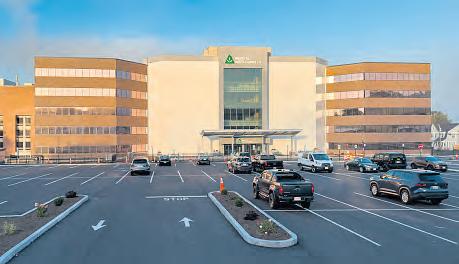
Governor delivers help for housing Gov. Maura Healey pledges state tax credits to support a plan to develop rental units in the Berkshire County Savings Bank building in Pittsfield. Page 3
Governor delivers help for housing Gov. Maura Healey pledges state tax credits to support a plan to develop rental units in the Berkshire County Savings Bank building in Pittsfield. Page 3

By D ylan T hompson
RICHMOND
— As a kid growing up in New York City, Hayley Sumner was first introduced to horses at a farm camp in Cape Cod, where her parents sent her from age 6 to 11.
It was a formative experience, she said.
“You couldn’t do any sports until you did your animal duty,” Sumner said, adding that it taught her a lot about responsibility.
When she was 10, she wrote a business plan for a ranch to help at-risk kids.
Now, Sumner is living out that dream as the founder of Berkshire HorseWorks, a nonprofit that provides equine-assisted therapeutic and educational programs on a roughly 8-acre property. The ranch currently has four part-time staff members and roughly 15 volunteers.
Since its founding in 2013, the nonprofit has served more than 4,200 people by providing them with access to therapy animals in a controlled, safe environment.
And despite challenging times with cuts to federal and state programs, Sumner is adapting by finding support from local community organizations.
Berkshire HorseWorks has reeled in more than $56,000 through a cluster of recently announced grants and donations that will help the ranch navigate the rest of the year, Sumner said. And they will bolster the ranch’s ability to provide mental health services by enhancing program capacity and ensuring long-term sustainability.
“In this incredibly difficult environment, we are forever grateful to the organizations for believing in us and the work that we do,” she said.
Among those organizations is the Berkshire Taconic Community Foundation, which has provided five grants totaling $18,500. Another $28,000 came from Berkshire United Way, Berkshire Life Foundation, Jewish Women’s Foundation of the Berkshires and the Bianchi-Barbarotta Foundation.
The grants obtained through the Berkshire Taconic Community Foundation will help provide equine-assisted learning and team building, equine-assisted speech language therapy and full scholarships for low-income children to the RanchLife 101
Since its founding in 2013, the nonprofit has served more than 4,200 people by providing them with access to therapy animals in a controlled, safe environment.
summer life skills program, according to a press release. The RanchLife 101 program will be returning for its fifth season this summer, starting July 6, running for six consecutive weeks for children ages 5-12. The program focuses on life skills development, horsemanship, team building and nature-centric craft.
“Being able to be around something that is so calming where you don’t have to use your words… but they can understand and be a good companion or support for you is
BERKSHIRE HORSEWORKS, Page
By Nate H arri NgtoN
PITTSFIELD — Allegrone Cos.’
plan to convert an iconic downtown Pittsfield building into housing is getting more than $1 million in assistance from a new state tax credit program.
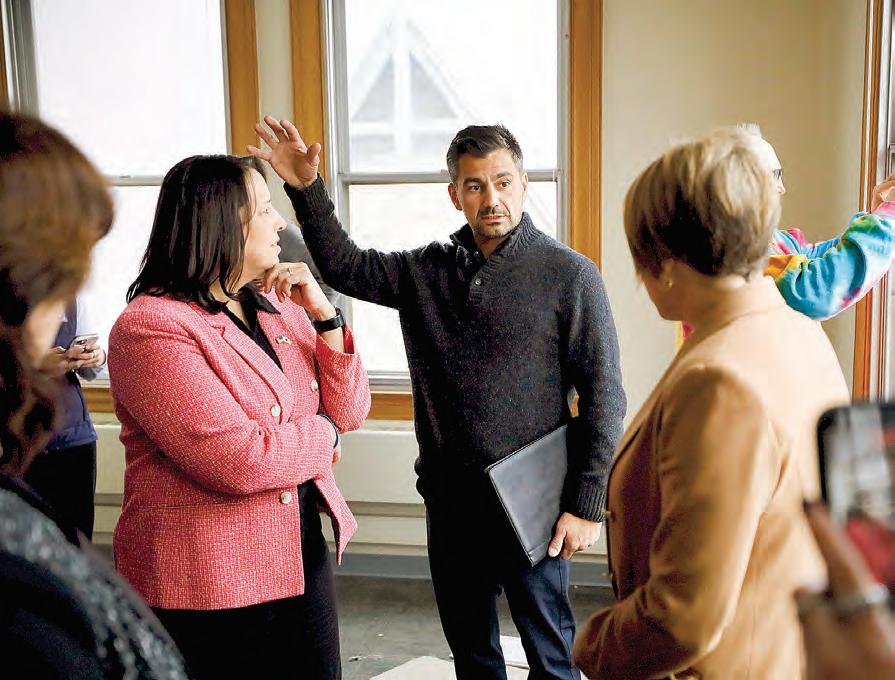
Standing in the former Berkshire County Savings Bank building at 24 North St. on Tuesday, Gov. Maura Healey announced Allegrone is receiving $1.39 million in tax credits. That award is part of $8.4 million in tax credits through the Commercial Conversion Tax Credit Initiative, a program funded by the 2024 Affordable Homes Act.
“I’m looking out and I see people who live in this city who work hard to protect and save lives every day in the city to educate our kids in this city,” Healey said during a news conference. “They need to be able to afford to live here.”
Berkshire County has a shortage of units at every price point, making awards like the one Allegrone received vital to combatting the housing shortage.
The initiative is intended to help developers turn underutilized properties into
market-rate apartments, as part of a housing overhaul Healey spearheaded to tackle Massachusetts housing crisis. The initiative selects projects planning to turn underutilized commercial buildings into market rate apartments, with each project getting an award around 10 percent of the construction cost.
Healey also announced $135.9 million in funding across 15 projects through the Affordable Housing Development program, two of which are in Berkshire County. The program leverages several types of affordable housing tax credits to support housing developments that are bringing income-restricted units to market.
The Commercial Conversion Tax Credit Initiative is one of the few geared toward market-rate apartments, with the initiative requiring at least 80 percent of the units to be market rate. Mixed-use spaces are allowed, but the program wants the conversion to be primarily residential.
The initiative was designed for larger projects, with the state’s website saying preference would
HOUSING, Page 4
By Nate H arri NgtoN
PITTSFIELD — Six new three-bedroom, two-bathroom homes — with top-of-theline appliances and a chic interior — will hit the market in Pittsfield, and the cheapest one costs $189,900.
Teton Management, which owns and operates mobile and manufactured parks in Massachusetts and New York, is bringing the manufactured homes to Allendale Pines at 395 Cheshire Road.
The homes are built off-site, then assembled once delivered, but they don’t have a set foundation.
They are a few weeks away from completion. The developers are looking for potential buyers to move in this spring.
While the homes are part of the Allendale Pines development, they will have a separate entrance and will be named Allendale Pines North.
This first batch of homes is the initial
phase of the development, with Teton Management expecting to bring a total of 22 homes to market.
Allendale Pines North is set back a few hundred feet from Cheshire Road and is cloaked by trees.
The ranch-style homes have drywall, kitchen backsplashes and new energy-efficient appliances. Even the trim hiding where the home is set getting an upgrade: a faux stone treatment instead of vinyl siding.
Teton Management decided to use manufactured homes because it lowers the eventual price for homeowners, said Val Whaling, the director of sales for the company.
“This is a very affordable option for a young professional [who] can easily potentially sell this house [when] they’re moving on,” she said.
The homes come in three different styles: full-porch, half-porch and no-porch.

Every home is 1,280 square feet, but each style has a unique feel. Some kitchens have an island, while others have plenty of open space. The homes also contain an array of siding colors.
Depending on the model, the homes will sell for between $189,900 and $204,900, Whaling said. Assuming a buyer will put 10 percent down, the monthly mortgage payments will be around $1,665 a month, including homeowners insurance.
Buyers will also have to pay $550 a month to rent the land, Whaling said. This will go toward real estate tax, water, sewer and community upkeep. Residents will be responsible for their own fuel, electricity and internet.
In Pittsfield, a three-bedroom, two-bathroom apartment rents for at least $2,000, and homes with the same criteria sell for anywhere from $130,000 to over $1 million dollars, although most cost at least $250,000, according to Zillow.

A buyer will likely use a chattel loan to finance the purchase of the manufactured home. This type of loan is used when a person is buying just a structure and not the land, and these loans use the home as collateral until the debt is paid off.
Teton has relationships with lenders who deal with these loans, Whaling said. “We hold their [the buyers’] hand through the whole process.”
So far, the company has received 18 strong applications, she said.
Although the homes are not on a fixed foundation, moving one would cost $15,000, she said. Teton Management has only seen a handful of homes moved across its sites.
The project cost is $1.7 million, Whaling said, but that does not include the construction and costs of the homes.
Teton Management will host an open house and ribbon cutting on March 18, where people will get a look at all three models.
incredibly powerful,” said Lindsay Chastain, a volunteer.
Through the powerful interaction with horses in both ground-based and mounted activities, participants learn how to develop relationships with the herd of horses and donkeys. Registration opened in February, and the daily rate is $395 while the weekly rate is $1,085.
The activities that the ranch does are tailored toward people’s mental health and personal development goals. Sumner said they use the Equine Assisted Growth and Learning Association (EAGALA) model, which is facilitated by a licensed mental health professional and equine specialist.
“In the model, you have the freedom to create your sessions based on what someone’s goal is,” Sumner said, adding that they help people stand their ground, develop self-concepts and self-esteem.
Working with the horses provides a therapeutic environment for the kids, and it’s what the ranch strives to create. Recently, Berkshire HorseWorks held its fourth annual Romance at the Ranch on Valentine’s Day, providing locals a chance to take photos with the horses.
A $25 donation was suggested for the event, with proceeds going towards medical care and food for the herd. The event was an example of the ranch’s need to be creative during the winter months to get donations and engage the community for its regular programming, Sumner said.
Sumner said it’s been medically proven that horses lower your stress levels and because of the cortisol, your heart rate goes down in the presence of horses. She added that if you meet a horse and you breathe in their nose, they will know it’s you 10 years from now, and that it’s known to be the only animal that can mirror your emotions.
“They will build trust with you if you have this congruity between your verbal and non-verbal [communication],” she said.
Janet Douglas, who helps take care of the horses, said that the horses have personalities and are like “big, giant dogs.”
The popular horse at the Romance at the Ranch event was Zephyr, a 20-year-old Dutch warmblood, which has become a favorite among residents and is great with kids. At the event, one resident got a kiss from Zephyr and said it was “the best I’ve had in years.”
Chastain said that Zephyr, despite being the biggest of the herd, is very gentle and is the one she’d trust the most around her four-year-old nephew. Chastain added that Zephyr is fun to be around and likes to be painted in the summer by the kids.
“He feeds off of people’s energy and can just tell what people are feeling just from their presence,” she said.
Chastain moved with her boyfriend to the Berkshires during the pandemic, and her first time at the ranch was the Romance at the Ranch event. She met Sumner at the ranch and decided to start riding horses again and volunteer.
Chastain and her boyfriend now volunteer regularly at
BERKSHIRE HORSEWORKS, Page 4

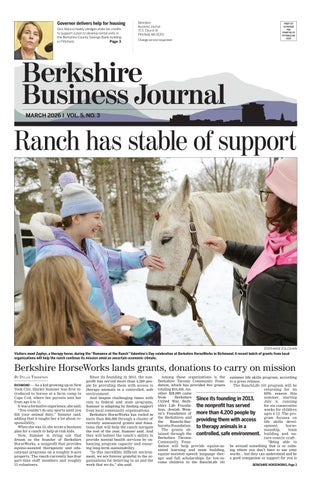
Berkshire HorseWorks Executive Director Hayley Sumner helps kids feel more comfortable coming up to therapy horse Zephyr during the “Romance at the Ranch” Valentine’s Day celebration at Berkshire HorseWorks in Richmond. “They will build trust with you if you have this congruity between your verbal and nonverbal [communication],” Sumner said.








the ranch, and she helps run the social media accounts. On Valentine’s Day, Chastain, who was celebrating her third anniversary of volunteering, said that working with the horses has helped her be calmer and more present.
“As soon as we park, I feel like my heart rate just [lowers] and I just become chill and zen,” she said, adding that they force you to test your boundaries.
The ranch also recently received a $10,000 grant from the TMT Charitable Foundation, which will help the ranch purchase hay and medicine this winter for its herd of 11 rescued therapy horses and donkeys. It will also support scholarships as needed for equine-assisted programs.
“I was like, ‘Oh my God,’” Sumner said. “This has been the most challenging year … That [grant] wasn’t anticipated at all, so we are incredibly grateful.”
The cost of an individual equine’s annual care can run anywhere from $4,500 to $8,500, depending on medical needs, Sumner said. A few of the animals additionally require cancer treatments or insulin shots.
Douglas said that the grants will be helpful, as caring for the horses is a lot of work. Douglas said that they have to be brushed daily, checked for cuts, and they have to be fed and cleaned up after.
The challenge with the grants is that although they seem like a lump sum, often they are not, Sumner said, adding that they can be given in increments throughout the year, and they often have a timeframe when they can be used.
In December 2025, Sumner told The Eagle that cuts to federal and state grant programs led to about $26,000 in lost funding for the ranch as the Trump administration pared back grants intended for programs centered around education, mental health support and diversity, equity and inclusion.
Sumner said that local media coverage created an “incredible groundswell of support that we had never seen before,” which included 76 new donors. The ranch received donations from numerous states, and Sumner said it’s the first winter that they’ve gone into where they weren’t in the negative.
This year, the ranch is looking to launch an initiative toward meeting with human resources professionals to secure staff development funds and to recruit more local business professionals to its board. Concentrating on their strategic plan is also a key focus, Sumner said.
“[It’s] so we can be responsible with costs and provide the key programming that is most needed,” she said. “It’s narrowing down the programming and how not to be financially vulnerable to the weather.”
FROM PAGE 2
be given to developments bringing more than 50 units. But the first round of funding only saw two projects eclipse that number.
Projects are funded up 10 percent of the eligible development costs, which do not include the acquisition cost.
“Today is just an example of the results that we’re getting from that investment,” said Ed Augustus, the secretary of the Executive Office of Housing and Livable Communities.
“You’re going to take a building that has been been empty for a number of years, you’re going to turn it into units of housing and some commercial space,” he said. “People who live here are going to go across the street to the Beacon Cinema and see a movie and then they’re going to have some to eat or grab a coffee.”
Allegrone’s conversion of the former bank building will have 23 apartments — 19 market rate and four affordable — and convert the first floor into street level retail and contain a commercial kitchen.
A subsidiary company of Allegrone’s
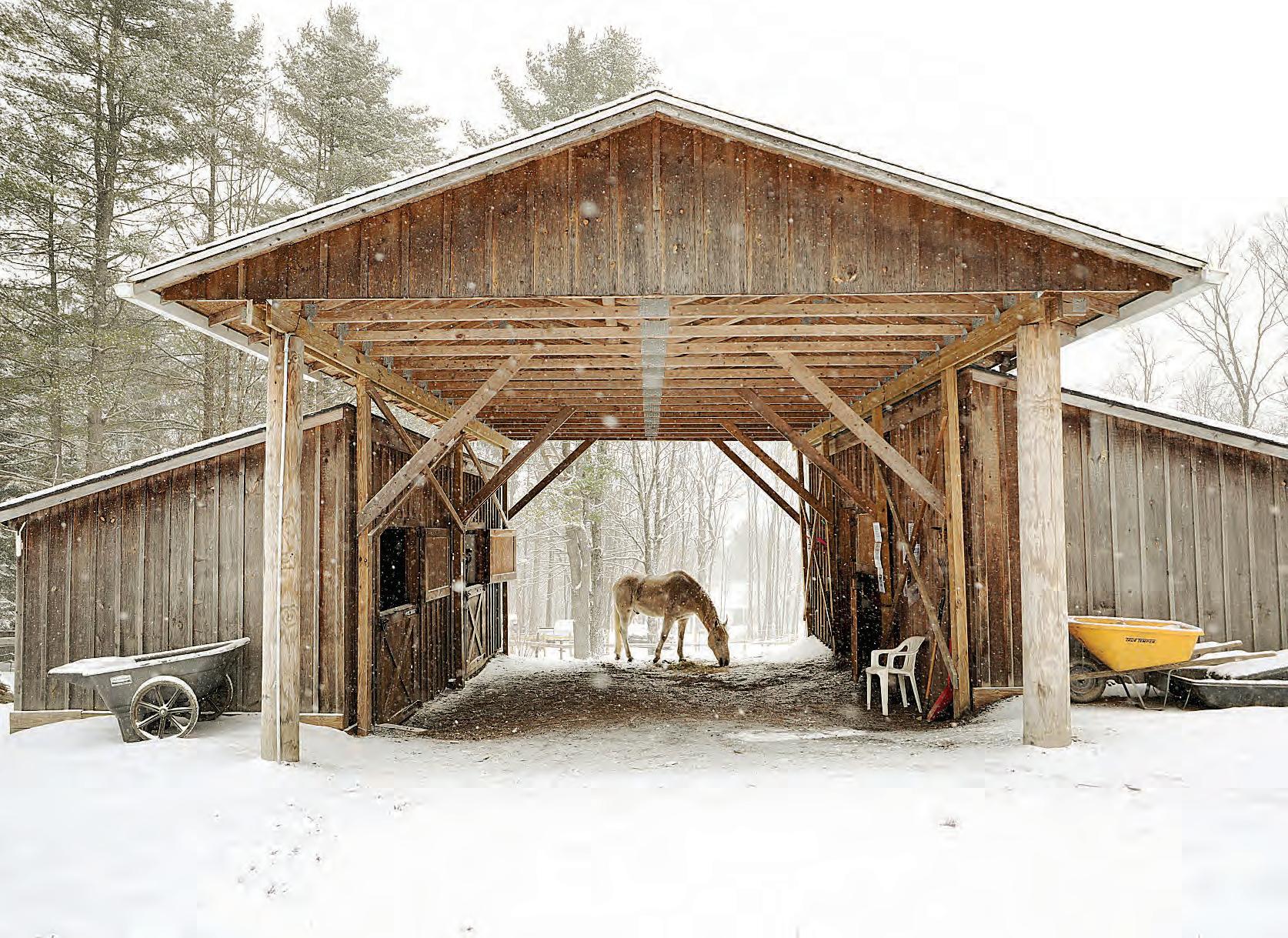
Zephyr, a 20-year-old Dutch warmblood, munches on hay under the cover of the barn in December at Berkshire HorseWorks in Richmond.

bought the bank in 2023 for $880,000. The company is also leveraging other tax credits and the Underutilized Property Program to fund the project.
The market rate units will rent for between $1,500 and $2,500 depending on the specifics of the apartment, and the affordable units will likely cost 30 percent of the renters gross income.
“[The Commercial Conversion Tax Credit Initiative] fills a critical void in project sources,” said Louis Allegrone, president of Allegrone Cos. “It is not remotely feasible without accommodation of state and local initiatives like these to balance the immense costs required to create just a unit of housing.”
The company is going to continue to do pre-construction work for four months and then start construction that should take a year, Allegrone said.
Two projects in Berkshire County also will be getting tax credits to support the development of 115 new units to market.
Pennrose is receiving funding for their development at 238 Pittsfield Road in Lenox. The new project is across from The Forge, another affordable housing complex that Pennrose recently completed.
The new development will bring 10 affordable units income restricted at 30 percent of the area median income (AMI), 40 more income restricted at 50 percent of the AMI and another 18 workforce and market-rate units.
The Linden Street Apartment project, being developed by Hearthway in partnership with Causeway Development, also is receiving state help. The development, at 55 Linden St., was formerly the Polish Community Club, being acquired by Hearthway after years of blight.
The project will renovate the existing Polish Community Club to hold a few apartments and build three additional buildings. There will be eight units income restricted to 30 percent of the AMI, with the other 39 units being restricted to 60 percent of the AMI.
All the units with an income restriction on them will rent for 30 percent of the tenant’s gross income. Pennrose has yet to disclose how much its market-rate and workforce units will rent for.
“We’ve got projects going on around the state,” Healey said. “These places are going to change lives and which is really exciting and make our state a more affordable state to live in.”
need to be creative during the winter months to get donations and engage the community for its regular programming, said Hayley Sumner, founder and executive director.
PITTSFIELD
18 degrees earns grant to renovate child care
18 Degrees has received $500,000 in state capital funding toward its $1.3 million project to renovate its child care facilities at 480 West St.
The project will replace the 30-yearold HVAC system and roof, improve traffic flow and accessibility, and convert underused space into an enrollment office. It also will replace deteriorated sidewalks and upgrade interior spaces to meet current accessibility codes, ensuring the facility serves all families equitably.
Additional support has come from the Jane and Jack Fitzpatrick Trust, and a Gilson Family Foundation bridge loan. Greylock Federal Credit Union will finance remaining project costs while fundraising efforts continue.
18 Degrees is one of 28 Massachusetts organizations selected for this competitive funding for child care facility renovations.
For information, contact Sarah Frederick at info@18degreesma.org.
GREAT BARRINGTON
Nonprofit Center accepting annual award nominations
The Nonprofit Center of the Berkshires is accepting nominations for the annual Berkshire Nonprofit Awards recognizing people who work tirelessly in the nonprofit sector to serve the community.
The center, in partnership with The Berkshire Eagle, will present the ninth annual awards breakfast from 8:30 to 10:30 a.m. May 19, at the Country Club of Pittsfield.
Nominations are being solicited from across the Berkshires in seven categories: Executive Leadership, Board Leadership, Unsung Hero, Volunteer, Rock Star, Lifetime Achievement, and the Samya Rose Stumo Youth Leadership Award.
Honorees — one in each category — will be selected by a committee of business and nonprofit leaders. Nomination forms are available at npcberkshires. org/nominate. The deadline for submissions is March 13. For information about sponsorship opportunities, contact McCaela Donovan at mccaela@npcberkshires.org.
PORTSMOUTH, N.H.
Group opens nominations for nursing scholarships
FedPoint, a federal benefits administrator and marketplace operator, is accepting applications for its annual nursing scholarships. The company will award four $5,000 scholarships, with recipients to be announced in May during National Nurses Week, May 6-12.
Eligible applicants for the merit-based scholarships include graduating high school seniors, adult learners, and individuals pursuing a career change.
Candidates must be U.S. citizens residing in New Hampshire, Maine or Massachusetts who are entering their first year of an accredited nursing program in fall 2026. The deadline to apply is Friday, March 20.
More details about the scholarship, eligibility requirements, decision criteria, and important dates are available at fedpointusa.com/scholarships.
PITTSFIELD
BMC earns Gold Seal for joint replacement
Berkshire Medical Center has earned The Joint Commission’s Gold Seal of Approval for advanced total hip and knee replacement certification by demonstrating continuous compliance with its performance standards.
The Gold Seal is a symbol of quality that reflects a health care organization’s commitment to providing safe and quality patient care.
The certification, offered in collabo-
ration with the American Academy of Orthopaedic Surgeons, focuses on the presurgical orthopedic consultation to the intraoperative, hospitalization or ambulatory surgical center admission, rehabilitation activities, and follow-up visit with the orthopedic surgeon.
BMC underwent a rigorous, unannounced onsite review earlier this year. During the visit, the Joint Commission reviewer evaluated compliance with related certification standards including program management, supporting self-management, and delivering clinical care.
PITTSFIELD
Microelectronics project at BCC nets $202K grant
Berkshire Community College is a recipient of a $202,200 Supporting Chip Advancement from Lab to Enterprise (SCALE) Capital Program grant, awarded by the Healey administration and Northeast Microelectronics Coalition.
The award is part of $10.2 million in grant funds that support 10 microelectronics projects throughout the commonwealth.
At BCC, the grant will fund the purchase of a scanning electron microscope and sample preparation equipment for the Workforce Microelectronics Training Program, supporting hands-on learning in microelectronics and related scientific applications across the college.
NORTH ADAMS
Integritus, N. Berkshire adult ed offer CNA course
Northern Berkshire Adult Education and Integritus Healthcare are offering a free, Massachusetts Department of Public Health–approved certified nursing assistant course through the Integritus Healthcare Nursing Assistant Program.
The 10-week program begins March 2 and includes remote and in-person sessions and clinical training. Job placement support and academic advancement resources, including GED/HiSET assistance, are included. The course is part of the MassSTEP program, which combines adult education and workforce training.
To enroll, contact Kate Merrigan, program director at 413-412-1118. Priority placement is given to students seeking a high school credential but other applicants will be considered. Participants must be at least 16 years of age, and not currently enrolled in a high school educational program.
HOLYOKE
Two nonprofit community mental health providers in Western Massachusetts have strengthened their partnership as ServiceNet’s outpatient clinics by joining River Valley Counseling Center.
RVCC has operated under the ServiceNet umbrella since July 1, 2025.
According to Elaine Campbell, ServiceNet’s senior vice president of clinical services and former assistant executive director of RVCC, combining the organizations’ outpatient operations will allow them to expand services, share resources, and build on each other’s clinical strengths while supporting staff with greater flexibility and opportunities for professional growth.
RVCC’s outpatient clinics serve people across western Massachusetts, with a commitment to community-based care and access to bilingual services. With the addition of ServiceNet’s clinics to the mix, they now have a unified system of offices in Greenfield, Northampton, Amherst and Pittsfield, as well as Springfield, Chicopee, Holyoke, Westfield, and Easthampton.
The affiliation reflects a shared re-
sponse to growing mental health care needs across the region, said ServiceNet President and CEO Bruno Calouro, who also serves as CEO of RVCC. Bringing the clinics together, he said, will help assure greater stability and continued access to vital services.
To learn more about River Valley Counseling Center’s outpatient clinics, visit rvccinc.org. To schedule an appointment, call 413-540-1234.
SCHENECTADY, N.Y.
Market 32 and Price Chopper, which operates three markets in Berkshire County, raised $53,817 to benefit Disabled American Veterans during its November fundraising campaign.
Shoppers across all 129 stores contributed $43,817 by rounding up their totals at checkout. Market 32 and Price Chopper added a $10,000 corporate match.
These funds will help DAV to provide no-cost, lifetime assistance to veterans, their families, caregivers, and survivors.
Market 32/Price Chopper has stores in Great Barrington, Pittsfield and Lenox.
PITTSFIELD
2nd Street Second Chances has received an $89,000 Re-Entry Workforce Development Demonstration grant from the Healey-Driscoll administration to train formerly incarcerated people.
The grant program supports individuals returning to their communities after incarceration by strengthening workforce outcomes through on-the-job training. Participants are trained by local organizations in fields such as clean energy, hospitality, manufacturing, construction, culinary arts and health care. Eleven organizations, including 2nd Street, received funding to train 389 formerly incarcerated individuals for these employment opportunities as part of a total of $2.2 million funded by the commonwealth’s Executive Office of Labor and Workforce Development and administered by Commonwealth Corp. 2nd Street will partner with the Berkshire County Sheriff’s Office to offer a training program with a focus on the advanced manufacturing and engineering industry. Successful program graduates will be placed in machinist roles at Onyx Specialty Papers and Unistress Corp.
RICHMOND
Berkshire HorseWorks has been named a BusinessRate Best of 2025 Western Massachusetts Award winner in the equestrian category, based on verified Google Reviews.
The award recognizes local leaders in customer satisfaction, brand reputation and service excellence.
Founded and led by Executive Director Hayley Sumner, Berkshire HorseWork is a mission-driven nonprofit that has provided equine-assisted therapeutic and educational programs for 11 years.
For information, call 413-698-3700 or email info@berkshirehorseworks.com.
PITTSFIELD
Pam Tworig, a Realtor with Bishop West Real Estate’s Berkshire County offices, has earned the prestigious Graduate, Realtor Institute designation through the Massachusetts Association of Realtors.
The GRI designation represents 90 hours of advanced, in-class real estate education, covering topics such as professional standards, contracts, finance, marketing, technology, and risk reduc-
tion. Realtors who achieve the GRI designation are recognized nationwide as having attained one of the highest levels of professional training in residential real estate.
The GRI program meets rigorous standards established by the National Association of Realtors and is designed to help real estate professionals better serve buyers, sellers and investors through enhanced knowledge, improved skills, and a deeper understanding of the industry.
PITTSFIELD
Central Berkshire Habitat names board leadership
Central Berkshire Habitat for Humanity has announced its 2025–26 board of directors and newly appointed officers who will help guide the organization’s mission to build strength, stability and self-reliance through shelter.
Officers include President Christopher Moon, retired, Greylock Federal Credit Union; Vice President Brandy McKie of Lee Bank; Treasurer Lou Coelho, retired, General Dynamics; and Clerk Maggie Steele of Berkshire Head Start.
Directors include Stacey Carver of Berkshire Money Management; Clifford Harewood of Berkshire Health Systems; Jon Kellogg of Hillcrest Educational Centers; Vicky May of The Brien Center; Kaci Nowicki of Greylock Federal Credit Union; Brenda Petell of MountainOne; Cate Tower, retired, Berkshire Meadow; and Peter Samsel, retired, General Dynamics, who is also serving as Building Committee chair.

Afreemonthlypublicationby TheBerkshireEagle 75SouthChurchStreet, Pittsfield,MA01201
Visitberkshirebusinessjournal.comfor advertisinginformationandtosubscribe.
NEWSDEPARTMENT 413-447-7311 news@berkshireeagle.com
ADVERTISINGDEPARTMENT
AMYFILIAULT,AdvertisingManager 413-496-6322 afiliault@berkshireeagle.com
CHERYLGAJEWSKI,Directorof AdvertisingSales 413-841-6789,413-496-6330 cmcclusky@berkshireeagle.com
ShareyournewswiththeBerkshire BusinessJournal. Ifyouhaveacompany promotion,anewbusinessoranewventure,let theBerkshiresknowaboutit.Rememberthe 5Wsandthatbrieferisbetter.Emailtextand photostoBBJ@newenglandnewspapers.com. ProvideyourexpertiseintheBerkshire BusinessJournal. Doyouhavetheanswer toapersistentquestionaboutbusiness andtheBerkshires?Doyouhaveideasand suggestionsonhowourbusinesscommunity cangrow?Ifyouhaveacommenttomake aboutdoingbusinessintheBerkshiresor ifyou’relookingtoraiseanissuewiththe businesscommunity,thisisthevenuefor that.Wewelcomelettersupto300wordsand commentaryupto600words.Sendtheseto BBJ@newenglandnewspapers.com
BerkshireBusinessJournalispublished monthlybyNewEnglandNewspapersInc., 75S.ChurchSt.,Pittsfield,MA01201. PeriodicalspostagepaidatPittsfield,MA01201. BerkshireBusinessJournalisdeliveredfree tobusinessesinBerkshireCountyviathird classmail.Additionaldistributionismade viadrop-offatselectareanewsstands.The publisherreservestherighttoedit,rejector cancelanyadvertisementatanytime.Only publicationofanadvertisementshallconstitute finalacceptanceofanadvertiser’sorder.All contentsarecopyrightedbyNewEngland NewspapersInc.
By C larenCe Fanto
LENOX — The historic 1884 building housing the downtown gathering place “where everybody knows your name” is under new but familiar ownership.
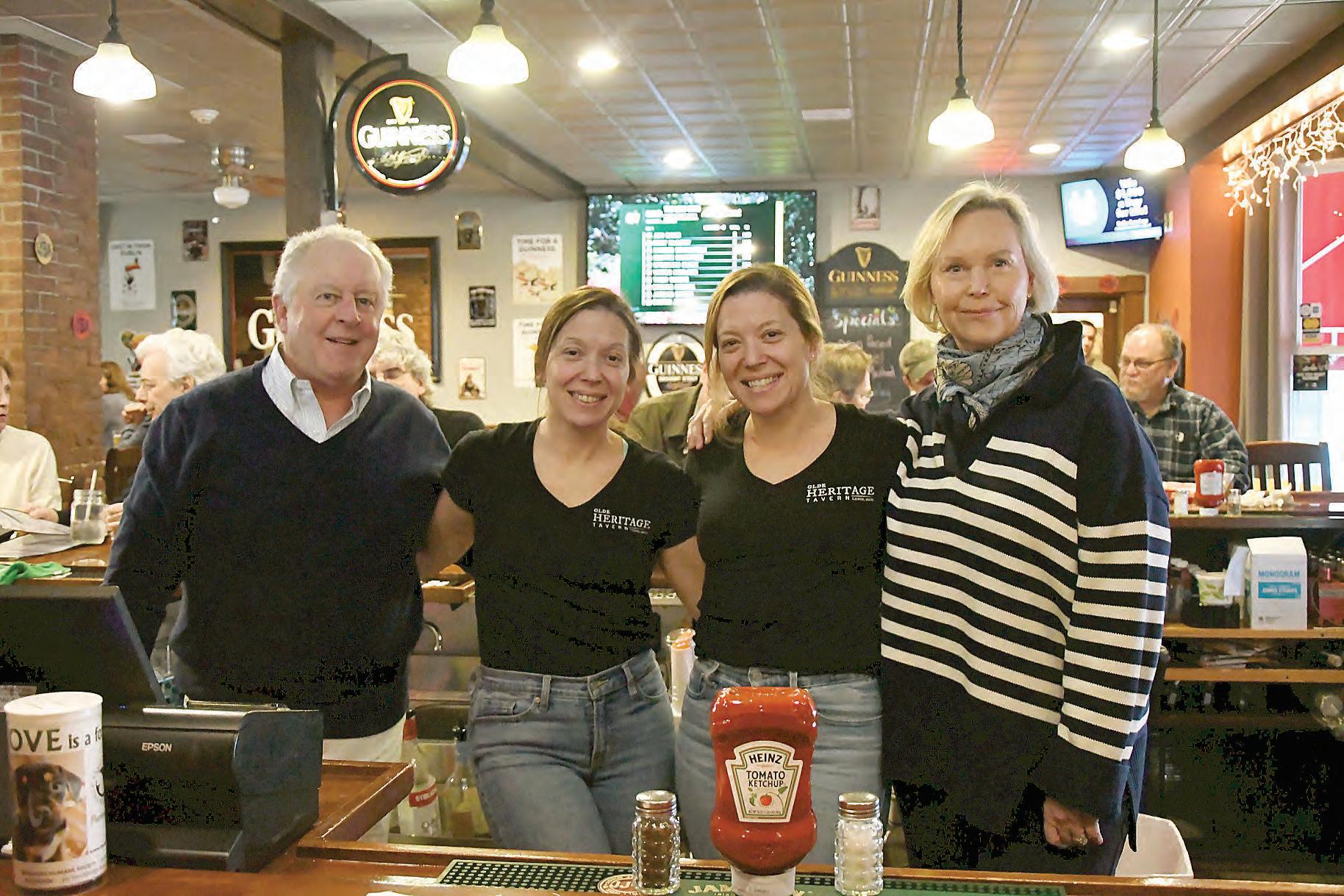
The Olde Heritage Tavern, popularly known as “The Taje” is in the hands of the workplace team headed by owners Rebecca and Rachel Piccolo, who’ve spent the past 26 years working their way up from part-time bartenders and servers to co-managers and proprietors.
Piccolo & Co LLC was formed by Becky Piccolo last month to purchase the real estate housing the business she and her twin sister have owned since April 2024 through their Lady Taje Inc. Now, instead of leasing the space, they are building equity in the property.
Home decor entrepreneur Annie Selke, working with her husband, retired attorney and current legal counsel Jim Crane, purchased the building for $1.5 million 22 months ago, plus the undisclosed value of the business, from the U.S. government.
Selke’s company Girl Power LLC quickly turned the business over to the Piccolos for a nominal price — “substantially below market value,” Selke told The Eagle on Saturday.
On Jan. 30, Becky Piccolo’s company paid $1,550,000 for the 12 Housatonic St. property, according to the transaction filed at Berkshire Middle Registry of Deeds. Pittsfield Cooperative Bank holds a 20-year, $1,240,000 mortgage on the real estate.
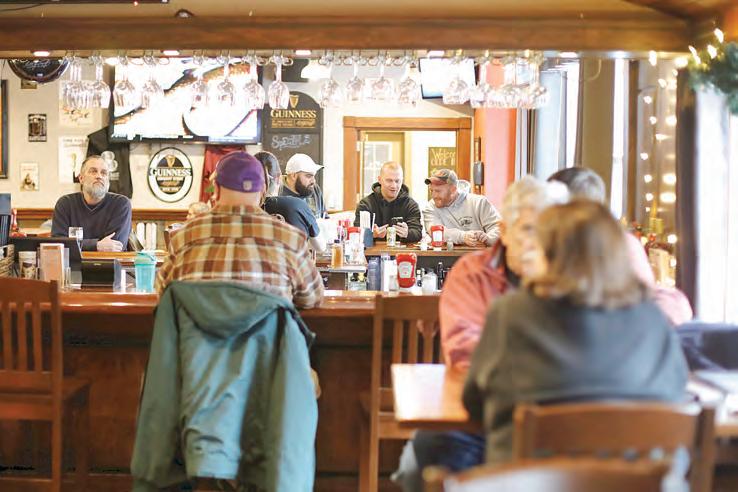
The building’s second floor has four long-term rental apartments, contributing to the substantial revenue generated by the tavern, a destination usually just as packed in the dead of winter as it is in the summer season.
As Selke pointed out, the monthly mortgage payment costs the Piccolos less than they paid leasing the building. “I feel good about it because I have good
people behind me,” said Becky Piccolo.
“It makes me feel more confident. I didn’t do it alone.”
She also emphasized that she and her sister “come as a package, always.”
“From a financial standpoint, it makes a huge amount of sense,” Selke said.
“It was my plan from the get-go to help Becky become an entrepreneur and sole owner of the entire thing. The sooner she could be in the driver’s seat completely is an example of empowering women. She knows this place better than anyone.”
The deal was completed after Piccolo, 45, demonstrated a year of substantial financial performance for Mark McKenna, senior vice president of commercial lending at the Co-Op bank. He was formerly with Lee Bank.
Taking a brief break during a busy pre-Super Bowl Saturday at the tavern packed with roughly 50-50 locals and visitors, Becky, a Lee High School class of 1998 graduate, recalled her first job as a server and wedding planner at the Eastover Resort. There, she met John and Jackie McNinch. His family members were longtime owners of the 500acre resort off East Street.
After McNinch bought the Heritage in 2000, the sisters began working there part-time, with Becky tending bar two nights a week — while continuing at Eastover — and Rachel working in the back office.
When Eastover Resort closed in November 2009, the Piccolos became full-time at the Heritage, which now
employs 40 staffers on average yearround, five of them full-time — more in summer, fewer in winter.
The tavern’s revenue has grown upward of 15 percent in the past year, Selke noted, thanks in part to special programming such as karaoke, family feud, trivia, pasta and pizza nights.
As Piccolo pointed out, a customer bought her a “Cheers” sign, commemorating the classic NBC sitcom starring Ted Danson that ran from 1982 to 1993. opening with its theme song, “Where Everybody Knows Your Name.” The sign hangs above the Heritage bar.
For many regulars, it’s like a second home. “It’s the atmosphere here,” Piccolo said. “The staff makes it feel that way from the moment you walk in the door. Out-of-towners come back and say there’s no place like this.”
“It’s magical, really distinctive these days, there’s no pretense, it’s a lovely local spot,” Selke added, noting the food is reliably a few cuts above the norm for a pub.
In April 2024, the Heritage building was seized by the U.S. Marshals Service from Ryan Salame of Sandisfield, who had owned multiple properties in downtown Lenox as the former FTX Digital Markets co-CEO.
Salame pleaded guilty to conspiracy to make unlawful political contributions and defraud the Federal Election Commission, and conspiracy to operate an unlicensed money transmitting business following the collapse in November 2022 of the FTX crypto exchange founded and run by Sam Bankman-Fried.
Bankman-Fried is serving a 25-year sentence at a federal prison in Los Angeles. His conviction is under appeal at the U.S. Court of Appeals in New York City. Salame is scheduled to be released from a federal prison in Maryland
March 2031.
By C larenCe Fanto
LENOX — Eighteen months after opening their second doughnut shop, Shire Donuts co-owners Jeff and Heather King have decided to close their seasonal Church Street location.
Instead, they’ll focus instead on their popular, year-round Dalton location and expanding their work as agents at Alton & Westall Real Estate, based in Williamstown.
What Jeff King described as “a hard decision” resulted from “a great deal of thought and reflection.”
“We will miss our Lenox and South County donut-loving customers but we hope they’ll come see us at our Dalton shop,” he wrote in a brief Facebook post earlier this week.
King emphasized that the Dalton shop “is a great location for us and we have a great customer base there.” A menu expansion to include more breakfast-type items is being considered.
“We’re 100 percent committed to that,” he said. “We enjoy our customers there and we want to keep doing that as long as we can.”
The store, established three years ago, is open year-round at 813 Dalton Division Road from 7 to 11 a.m. Fridays and 8 a.m. to noon Saturdays and Sundays.
The seasonal nature of customer traffic in downtown Lenox played a part in the closure, King told The Eagle.
“We could have hired more help but then it makes it tougher as a small business to make the
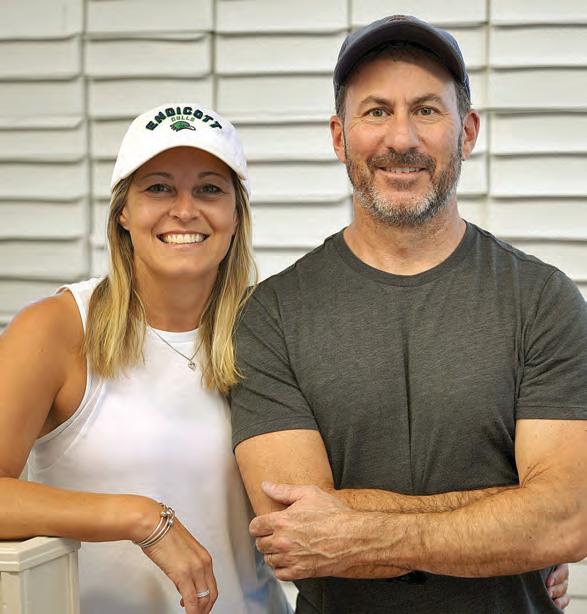
Co-owners Heather and Jeff King have decided not to reopen their seasonal Shire Donuts shop in Lenox. “We don’t have any regrets, we’re glad we tried it,” Jeff King said.
numbers work,” he said. “Lenox is definitely seasonal, summer and fall is when you do most of your business. Then you have to carry that expense through the winter and spring.”
Several year-round business owners told The Eagle on Wednesday that despite a tough winter weather season, they’re holding their own, with customer traffic off only slightly, if at all.
“A challenge in Lenox was
having two shops,” King said. “Sometimes you have to cut back on some other things in order to operate both.”
Shire closed its original Adams location on Dec. 31, 2023, four years after opening it, and more recently halted distribution of doughnuts to shops in North Adams, Williamstown and Lanesborough.
He also cited the seasonal uptick in real estate activity every summer, coinciding with
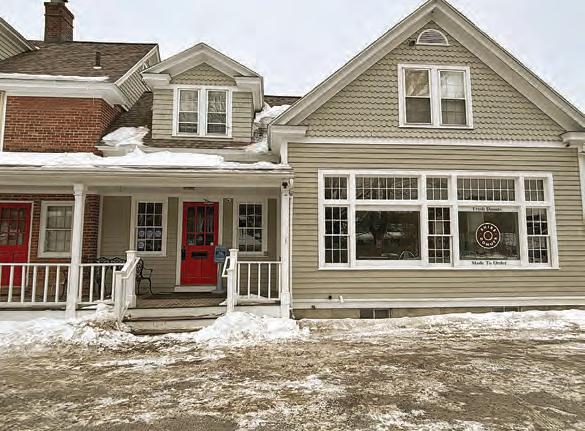
The retail space at 51 Church St. in downtown Lenox is vacant now that Shire Donuts co-owners Heather and Jeff King have decided not to reopen the store after their second winter season shutdown.
the busy season at the doughnut shops. “We were always getting pulled in two different directions,” he said.
“We don’t have any regrets, we’re glad we tried it,” King added. “We just feel like time is better spent and there’s more opportunity for us at the Dalton shop and in real estate.”
He noted that after their first summer and fall in 2024, they stayed open through January 2025, but “it was pretty quiet” so the shop shut down from February to April.
The original plan was to remain open year-round, but then winter reality hit. “Everyone said it drops off, but wow, it really, really does,” King said. “We were going to stick it out
through January, but then we said this is kind of crazy.”
Shire Donuts is known for its creative menu. Customers choose from 11 customized toppings and nine varieties of drizzles.
The Lenox location at 51 Church St. has been leased from building owner Drew Davis. King hopes for a potential business owner to sublease the space or leasing it outright themselves.
A sign on the closed shop’s door invites anyone interested in leasing to contact King via email at smile@shiredonuts.com. Clarence Fanto can be reached at cfanto@yahoo.com.





BY GREG SUKIENNIK
PITTSFIELD — It’s a campaign that has stood outdoor advertising on its head in Berkshire County.
If you’ve driven through Coltsville, along Elm Street, up North Street or on Route 8 near the Adams-Cheshire line, you’ve likely seen the billboards for Nocher Realty and realized something seems not quite right: The billboard copy and accompanying logo are upside down.
There’s no obvious clue that this was done on purpose, leading one to believe that a memorable mistake was made. Four times.
Certainly, the public at large thought so: They picked up the phone and called the agency’s Pittsfield and Adams offices to deliver what they thought was bad news.
“Our phone was off the hook for the first [billboard],” broker/owner Jason Nocher said Thursday.
But what seemed like a very expensive, very public goof was very much on purpose — a brainstorm that Nocher had two months ago and brought to billboard owner Lamar Advertising.
Just days into its run, the campaign has already generated considerable word-of-mouth for the firm, and for Lamar, according to Nocher and Kellie Witherell, Lamar’s senior sales account executive for Berkshire County and greater Albany, N.Y.
“It definitely exceeded expectations,” Nocher said. “I thought it would get a bit of buzz. I didn’t think it would get such an extra boost.”
Nocher says his firm, with 11 sales associates and assistant brokers and $75 million in sales last year, regularly uses outdoor advertising as part of its marketing strategy. But he acknowledged that it’s not always easy to know with certainty how billboards translate to business and brand awareness.
But Nocher said the investment — four billboards at $1,800 per location — is paying off in name recognition and free media attention. “Slater and Marjo [on WUPE-FM] talked about it two days in a row,” he said. “Seeing the buzz on these has definitely helped us move forward with future billboards.”
Witherell also received phone calls, even from her own family. “They’re like ‘Oh my God, your


billboard’s upside down.’ And I’m laughing,” she said.
While the campaign includes four billboards, only one went up the first day due to the weather, Witherell said. ”Just that one [billboard] got so many people talking about it. The chatter was just crazy,” she said.
Witherell, who has more than 30 years of experience in out-
door advertising, said this isn’t the first time a customer specifically requested an upside-down message. Years ago, an insurance firm sought that treatment at a Coltsville billboard location. And even though it read “Everyone makes mistakes,” folks didn’t quite get it.
“They said ‘Your installers — what were they thinking?”
she recalled. “[One said] I was at Kelly’s Diner and thinking, ‘Are they really going to leave it like that?’”
But Witherell says a creative and memorable billboard is an effective billboard — and she loves it when customers come to her with big ideas.
“Outdoor [advertising] is absolutely 100 percent thinking outside of the box,” she said. “This just absolutely delivered.” Witherell isn’t sure she will get more upside-down requests. But she’s confident the buzz created by Nocher’s upside-down gambit will spark other ideas,.
“Sometimes this works. Customers say ‘I don’t want to do that, but what else can we do?’ I say bring it on,” she said.
For his part, Nocher is very happy with the attention, and the knowledge that the brainstorm paid off.
“We wanted to be different. We always scream to the general public that we’re a different kind of real estate agency,” Nocher said. “Typically this is the slowest time of year for real estate, hands down — we wanted to get Nocher Realty’s name talked about and it clearly worked.”
BY TALIA L ISSAUER
PITTSFIELD — The Pittsfield Marketplace Cafe has closed, the cafe announced on Facebook recently.
“From our heart to yours — it truly has been a pleasure to get to know each and every single person that has come through those doors,” the post reads.
The Pittsfi eld cafe’s post did not specify why it closed or what will happen to its staff.
Co-owner David Renner reiterated his gratitude toward everyone who supported the business the last 15 years and said the support has been “overwhelming.”
“The closure is part of a strategic business decision to focus resources and operations on the company’s other business
units and Marketplace locations,” Renner said. “We will continue to operate and invest in our remaining locations.”
Featuring a variety of sandwiches, salads and wraps, the North Street location of Marketplace had been serving breakfast and lunch in downtown Pittsfield since 2010. Owners Kevin Schmitz and David Renner opened the first Marketplace in Sheffield in 1993 after working at restaurants in New York City.
“Their idea was simple: provide high quality, prepared food for people to bring back to their own homes,” the business’ website describes. “We are the original farm-to-table food business in the Berkshires.”
Chef Douglas Luf joined Marketplace in 2004 after serving eight years
as executive chef of the Red Lion Inn in Stockbridge, and Chef Christopher Brooks, originally from England, joined the team in 2021.
Now managed by the four chefs and their families, Marketplace’s other locations include the Sheffield Cafe, along with a restaurant, specialty prepared foods, and Miller’s Pub, all in Great Barrington.
The post said they are grateful for the “loyal support” from customers and the broader Pittsfield community.
“We are honored to have had such an amazing group of people around us to help make this place what it was,” the post reads. “Every staff member through the years, and every person that has worked on North Street. The theatre com-
munity and those just stopping for a bite on a drive through.”
Next door to the cafe is the Beacon Cinema. Cory Jacobson, owner of the Kinnell Kresge building and Beacon Cinema, said a “new, exciting use” for the space will be announced shortly as part of continued development efforts in downtown Pittsfield.
“We want to thank Marketplace for the many years they spent here in downtown Pittsfield. We wish them all the best in their future endeavors and appreciate the partnership along the way,” Jacobson said in the Beacon’s Facebook post.
Any gift certificates from the Pittsfield cafe will remain valid at other Marketplace locations.
By Jane K aufman
ADAMS — Two T’s Thrifting is offering gently used clothing for men, women and children at affordable prices — and even some items for free.
Open three days a week, the small shop at 64 Summer St. saw a steady stream of shoppers on a recent morning, browsing and buying.
One woman stopped in with a bag full of donated clothing, which is what this second-hand clothing store relies on.
The store is in space that was last occupied by the Pig Floyd record store.
Hannah Lord, a 17-year-old senior at Hoosac Valley High School, was stuffing drawstring bags, each filled with a children’s T-shirt, long-sleeve shirt or sweater, and a pair of pants. These will go to children in foster care.
Lord is volunteering for the business to fulfill hours she needs for the National Honor Society.
“I’ve learned a lot, like how a person can benefit from giving back to their community,” Lord said. “At the end of the day, knowing I volunteered, I helped out — I put together packs to go out to people — just makes me have a good feeling knowing I helped someone else.”
Lord said she also appreciates being able to help out owner Trish Carlo, whom she first met as a childhood basketball and soccer coach.
A small color portrait of Carlo and Tom Bradley hangs behind the checkout counter just above a $1 bill with the word “First” written in black magic marker.
After the two had been together for just six months, Bradley, a U.S. Army veteran, died on April 17, 2022.
Carlo, 43, wanted to do something to honor him. Since the two had spent time thrifting together, opening a thrift store seemed a fitting gesture.
The name Two T’s Thrifting, stands for
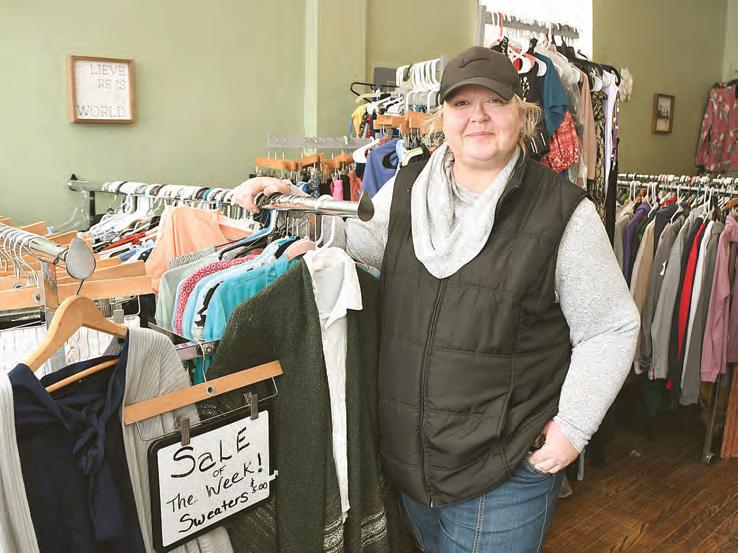
the initials of their first names.
But Carlo’s empathy for children on the move comes from her own experience as a child.
Carlo was born in Pittsfield to a mother who suffered from addiction. When she was 5, two police officers showed up to place her with her maternal uncle, Chuck Carlo, and his wife, Carol Ann Carlo, in Cheshire.
That was her first taste of a stable childhood.
“They’re Mom and Dad,” she said, adding that the Carlos legally adopted her when she was in fourth grade. “They stepped up for every aspect of my life.”
She played basketball and soccer at

Hoosac Valley High School. Her first job was at Ames at the Berkshire Mall.
Carlo was inspired by those two police officers to study criminal justice at Berkshire Community College, then became a police officer working for 14 years in Cheshire and as police chief of Savoy from 2015 to 2018.
For more than 20 years, she has also been an emergency medical technician working at County Ambulance in Pittsfield. And she coaches junior varsity girls basketball and soccer at Hoosac Valley High School.
She left law enforcement in 2020 only because of the Massachusetts Police Reform Act. It would have required her
What: Two T’s Thrifting
Where: 64 Summer St., Adams
Hours: Wednesday and Friday, 8 a.m. to 2 p.m.; Saturday, 9 a.m. to 6 p.m. Thursday hours will be added from 8 a.m. to 8 p.m.
Donations: Accepted on Wednesdays and Fridays
to undergo further training to stay in the field.
“They wanted us to go to a Bridge Academy, and I just wasn’t willing at that time to go, especially at my age, being a single mom,” Carlo said. “And I believe that Massachusetts is probably one of the highest-trained law enforcement states in the country, even without the reform.”
With her connections from law enforcement and emergency services, she offers clothes to people who have been victims of fires — including this month’s fires on Pines Street in Pittsfield and in East Nassau, N.Y.
Any items she feels she won’t be able to sell go to veterans, people who are unhoused, churches and shelters.
Carlo’s daughter, Bella Klose, who is 16 and a basketball player at Hoosac Valley, helps out at the store when she has time, and Carlo is open to offering volunteer opportunities to teens and adults who need the hours.
Carlo decided to open in Adams partly to strengthen her connections in her community.
What is she most looking forward to about owning her first business?
“Giving back. Everything I do in the community is personal,” she said. “It’s been nice. I’ve met so many people and being able to network already has been really cool.”







By D ylan T hompson
PITTSFIELD — The Pittsfield Municipal Airport Commission voted to remove the interim tag on Anita Akor, appointing her as airport manager — but not without debate.
Airport Commission member Debra Miersma raised concerns over the lack of a finalized job description and the lack of accountability from the commission on training and personnel development. Despite Miersma’s concerns, member Thomas Hardy moved last month to appoint Akor as airport manager.
“I think that there’s enough history here and this commission has enough familiarity with the performance of this person that even if we don’t have all the I’s dotted and all the T’s crossed, that we can proceed, and I think we should proceed,” Hardy said.
After a discussion that lasted more than 30 minutes, the commission voted 4-1 to appoint Akor as airport manager, with Miersma voting against and members Christina Wynn and Michael Preihs not present. Akor, who had been serving as the interim airport manager since September, will now be serving in the position on a permanent basis.
“It is a lot,” Akor said of the position. “The airport in general is a lot for two people ... but I’ve been with the city for seven years. I know the projects. I know the operations. I know the finances.”
Akor has replaced former airport manager Daniel Shearer, who left the position in August to take a new position as manager of Westfield-Barnes Regional Airport. Shearer, who held the position for more than five years, was the longest-serving airport manager in Pittsfield since former manager Mark Germanowski left in 2015.
The Pittsfield Airport serves locally based small aircraft, flight training, char-

JANE KAUFMAN
The Pittsfield Municipal Airport Commission last month voted to remove the interim tag on Anita Akor, appointing her as airport manager. “It is a lot,” Akor said of the position. “The airport in general is a lot for two people… but I’ve been with the city for seven years. I know the projects. I know the operations. I know the finances.”
ters, medical and organ transportation and utility work. It’s a resource for disaster relief, and supports many local and regional businesses, Shearer said.
Akor said that with the interim tag lifted, she’s most excited to continue improving herself and show “my commissioners that I can do the job because I’ve been doing it, and also for the safety of the airport.”
Currently, Colin DeZess is serving as the interim assistant airport manager, and handling the duties of airport


maintenance technician, Akor said. DeZess previously held that position before Shearer left.
The annual budget for the airport is about $377,493, and Akor is salaried at $82,000.
During the airport manager discussion, Miersma said that it’s important that the commission do its due diligence and update the job description. Hardy disagreed with delaying an appointment, highlighting that Akor has been involved in the airport’s management for five
years under Shearer and several years before that.
“I’m satisfied with the work she’s doing,” Hardy said.
Miersma also raised concerns about training and how the commission previously did not hold Shearer accountable for certain trainings.
“My point here isn’t to say bad things about the previous airport manager,” Miersma said. “My point here is that we as a commission are not geared to holding people accountable, checking on training, doing things for personnel development.”
Miersma ultimately voted against the appointment because she felt that the commission did not have agreement on “what the job is and where the goals are.”
Following the vote, the commission said it will continue to work on updating the job descriptions for the airport manager and assistant airport manager. The commission also said that Akor will handle hiring an assistant airport manager and an airport maintenance technician.
As the airport’s manager, Akor, 30, now oversees everything from budgets to blizzards — a responsibility that grew out of her early interest in aviation and her years working at the facility.
A native of Ghana, Akor’s first flight was at the age of 12. She flew on a Delta jet from Accra, Ghana, to John F. Kennedy International Airport in New York. The experience sparked her interest in becoming a pilot. She later reconsidered based on the expense, but was still strongly interested in the field of aviation.
After graduating from Taconic High School in 2014, she received a bachelor of science degree in aviation management with a minor in accounting from Bridgewater State University.
She was hired in December 2018 as the assistant airport manager. In 2023, she became a certified member of the American Association of Airport Executives.






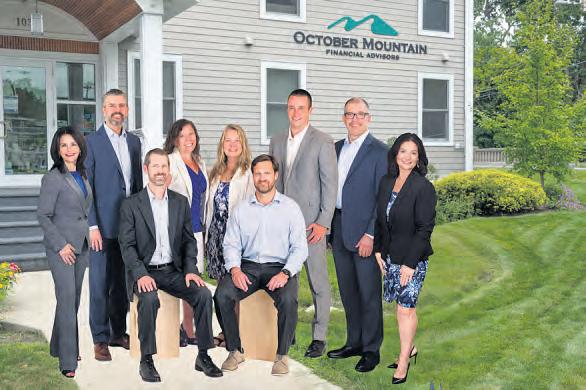
There’sa lotbeingsaidaboutAI.It’s different, excitingbutfraughtwithmanyquestions. We hopeyou’llfindconfidenceinourexperienceand integrityinthewayweworkwithyou. Togetherwe’ll craft a plandesignedtomeetyourgoals,yourneeds andyourlifestage.
We’dliketohearyourstory, andthatstartswith a conversation.
To learnmore,pleasecallusat413-243-4331. We answerthephonesM-F, 8:30amto4:30pm.Asyou cansee,there’s nothingartificialaboutwhoweare.

103WestParkStreet Lee,MA01238 (413)243-4331 octobermountainfa.com
By Jane K aufman
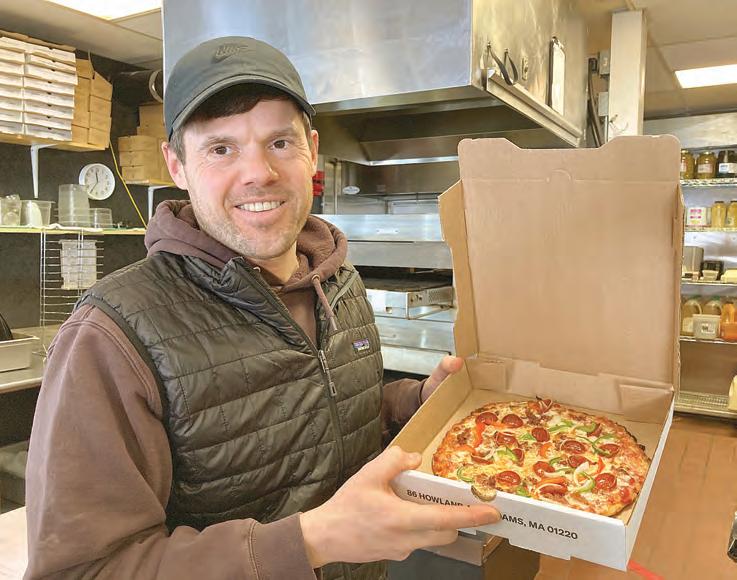
ADAMS — Matt Tatro wants to make you pizza.
Tatro, who also owns Grazie in North Adams, opened Dough Boys Pizza on Feb. 12 at 86 Howland Ave. He’s counting on his recipes and experience at Grazie to make Dough Boys a successful venture.
The building was already set up as a bakery and had a giant Hobart mixer used to mix dough, walk-in refrigerators and some other culinary features. Tatro bought used equipment — including three pizza ovens and a sheeter, also known as a dough stretcher — to complete the kitchen setup he needed to make his pies from scratch.
He considers his pizza, with sauce and cheese out to the edge, a cross between New Haven and Neapolitan style. He’s going with a thin crust and a slight char at the outer edge on the pies.
The menu might look familiar to Grazie customers.
The top-selling pizza is the Vermonter, a white pizza featuring fresh mozzarella, pepperoni, caramelized apples and onions, maple garlic aioli, parsley and Parmesan. It’s one he created at Grazie.
The Carne pizza actually includes Grazie meatballs, along with homemade red sauce, pepperoni, bacon, hot sausage, prosciutto and Parmesan.
Tatro, 41, is a North Adams native. His first job, when he was 13, was washing dishes at La Veranda, now the site of the Trail House.
“I wanted a new baseball bat,” he said. “And my mother said, ‘OK, you can, but you’re gonna work for it.’ And she brought me down to the restaurant, and I walked in, and she said, ‘This is my son. He wants a job here.’”
After graduating from Drury High School in 2003, he briefly studied civil engineering. He then transferred to Rog-
er Williams University in Bristol, R.I., where he studied business management and marketing.
“I cooked my way through high school and through college,” he said. “I really looked at it like I was getting myself two educations; the formal business and marketing education, and then the culinary.”
After graduating, he stayed in Rhode Island and the Boston area working in restaurants.
Tatro and his fiancee, Gabrielle Gauthier, moved back to North Adams after their second child was born.
At first, he worked at the Adams Ale
House as kitchen manager and general
manager. He formed a partnership with David Moresi and opened Grazie on Marshall Street in 2016 and Tres Ninos in 2018.
Moresi and Tatro later parted ways, and Tatro sold Tres Ninos to Duncan Russell. And last April, Grazie moved to a new location on State Street, which Tatro also has purchased.
He credited his staff at Grazie with affording him the time to strike out on his newest venture.
“They do such a tremendous job down there that I’m able to kind of step out and and start a new venture down here,” he said. “I certainly wouldn’t be able to do
What: Dough Boys Pizza
Where: 86 Howland Ave., Adams
Hours: 4 to 10 p.m. Monday and Thursday, noon to midnight Friday and Saturday, noon to 8 p.m. Sunday. Closed Tuesday and Wednesday.
Cost: Pizzas start at $12 for 10-inch cheese, $18 for 16-inch cheese. Cauliflower crust is available.
Specialty pizzas run from $14 to $16 for 10-inch and from $22 to $24 for 16-inch. Salads are $11 to $15
Desserts include cannoli, Ultimate Chocolate Cake and Turtle Cheesecake.
that without without them.”
On Aug. 23, 2024, he bought the building at 86 Howland Ave. for $237,000. Greylock Federal Credit Union holds a mortgage of just over $200,000 on that property.
Tatro has six full-time staff and 11 part-timers on his payroll at Dough Boys.
“I started working at a very young age, and that teaches you so much — time management, multitasking, the social skills that are needed in life,” he said. “You need to get around other people and out of your comfort zone. So I’m a huge advocate for employing the youth.”
Tatro said he’s had several employees start at age 15 and then return during summers when they go to college.
“I love watching and being involved in their families,” he said. “The employees are like family to me.”
Tatro said he hopes to be an integral part of the Adams community in whatever ways he can, including through fundraisers and concessions, and that Dough Boys sustains its staff and the building.
“I’m not looking to get rich from this place,” he said.

By Mccaela Donovan
Time is the one resource no one has enough of. For nonprofit leaders and small-business owners alike, capacity — not intent — often is the biggest barrier to partnership.
As an “elder millennial” balancing family and full-time work, I’m acutely aware of how finite time feels. That same pressure exists organizationally. Nonprofits operate in a constant state of unmet need: more clients to serve, more funds to raise, more visibility to build.
Small businesses in the Berkshires face parallel constraints — lean staffing, rising costs, seasonal swings and the administrative demands of simply staying afloat. The desire to collaborate is real. The time to do it well is harder to find.
“For many business owners right now, the biggest challenge is simply capacity,” says Mary Daire, who with her husband, Ben, co-owns Dare Bottleshop & Provisions in Lenox, a wine shop centered on thoughtfully sourced wines and specialty provisions
“Running a small business requires wearing many hats, and between staffing, rising costs, and day-to-day operations, time and bandwidth can be limited,” she said. “There’s often a genuine desire to give back, but it can be hard to know where involvement will have the most impact or how to engage in a way that’s sustainable long-term.”
Sustainability is the key word. The most effective nonprofit-business partnerships in the Berkshires aren’t one-off sponsorships or last-minute donation requests. They are structured collaborations that recognize constraints on both sides.
Collaboration is part of what distinguishes the Berkshires. Arts and culture draw tourism. Restaurants and retailers animate downtowns. Social service nonprofits stabilize families and the workforce. Each sector feeds the others. Thoughtful partnerships strengthen both missions and markets.
“For Ben and me, giving back means being an active, generous part of the community that supports our shop,” Daire says. “Impact is about strengthening the cultural, educational, and community institutions that enrich daily life here — and helping ensure they continue to thrive.”
Entrepreneur Andy Huh, founder of HUHT, a mobile thermal wellness company offering contrast therapy (sauna and cold plunge) experiences, underscores the same tension between will and operational resources.
“It comes down to time and bandwidth, full stop. Most small-business owners I know aren’t sitting on their hands and idle. They’re running lean operations, wearing every hat, and barely keeping up with the demands of the business itself,” he said. “The will to show up for the community is there. The capacity often isn’t.”
His comment reflects a broader truth: many Berkshire businesses are founder-led and growth-stage. Strategic philanthropy may be aspirational — but operational survival comes first. Successful partnerships, Huh notes, must be mutually activating.
HUHT’s collaboration with PS21 offers one model.
“We’re currently partnered with PS21, a performing arts center in Chatham, N.Y., where they’re operating a HUHT sauna for the local community. The partnership helps activate their space during the winter months — a time when arts venues typically go quiet — while giving the community a place to gather, reset and experience thermal wellness during the coldest part of the year,” Huh explains. “It’s a natural fit: we help draw foot traffic and awareness to PS21 when they need it most, and they provide a

beautiful, trusted venue that brings new people into the HUHT experience.”
This is ecosystem strategy. PS21 animates its campus in the off-season. HUHT gains visibility and venue credibility. The community gains an experience.
Kelly Binder, co-founder and creative director of Doctor Sax House, a design-forward hospitality property (boutique hotel, restaurant, bar, and event space) in Lenox, emphasizes alignment and long-term thinking.
“In a place like the Berkshires, these ecosystems are deeply interconnected,” he said. “When you support one, you strengthen the entire region.”
We are busy in the winter. Want to do a summer collab? I’d be a lot more open to that.”
Timing is strategy. The wrong moment can turn a potential yes into an automatic no.
2. Be clear and concise.
Propose a defined, manageable collaboration.
Long-term partnership reduces repeated negotiation, builds shared language, and increases measurable return.
Also a working parent, Binder has partnered with WAM Theatre, Berkshire International Film Festival (BIFF), Love of T and others. She echoes the capacity challenge and adds: “For us, the greatest impact comes from being brought in as a long-term partner. It allows us to truly understand your goals, your audience, and where we can add value, so we can contribute in a thoughtful, aligned, and effective way.”
Long-term partnership reduces repeated negotiation, builds shared language, and increases measurable return.
For nonprofits seeking stronger business partnerships, several themes emerge:
1. Do your homework.
Understand a company’s values, audience and seasonal cycles.
“New entrants into the market, like me, are trying to figure it out,” Huh says. “Every business has their seasons.
As Daire advises: “Be clear, be concise, and lead with alignment. Show that you understand a business’s time and capacity, propose a specific and mutually beneficial way to collaborate, and make it easy to say yes without adding unnecessary complexity.”
Specificity creates confidence.
3. Make it easy — and repeatable.
Clarity reduces hesitation.
“A business owner might want to get involved but doesn’t know who to call, what the ask actually is, or whether it’s going to turn into a bigger commitment than they can handle,” Huh said. “The best thing a nonprofit can do is make it easy — be specific about what you need, be realistic about the time commitment, and understand that for a small business owner, showing up with their product or service is often more valuable than showing up with a check.”
Building an annual or seasonal initiative creates predictability for businesses and reliable support for nonprofits.
4. Lead with marketing value.
Exposure matters. Huh suggests nonprofits quantify their reach.
“We can drive promotion through our 20K email list, 4K social media, and direct comms with our 800 members,”
he said. “Our audience is predominantly female 40+, etc.”
Integrated marketing is essential — newsletter features, social media collaborations, sponsorship placements, and event visibility — should be part of the pitch.
“A shout out in a newsletter would go a long way,” says Huh. “If a business can’t be profitable collaborating with a nonprofit — but we can leverage their audience to bring in interest, it would be a worthwhile collaboration.”
5. Align values and mission.
Strategic alignment increases authenticity and impact.
“Any cause that combats disconnection, loneliness, or addiction is a natural fit, as this kind of service can be an antidote for these kinds of issues,” Huh explains.
Daire’s “Sip to Support” initiative reflects this approach: “Through these campaigns, we partner with local nonprofit organizations and donate a portion of proceeds from select wine and beer sales directly to their missions. It’s a simple, community-driven way to turn everyday purchases into real impact.”
Despite limited time, many Berkshire business owners are embedding community impact directly into their operating models. As Daire notes, “There’s a real sense of collaboration in the Berkshires that makes it easier to find meaningful ways to engage.”
Capacity may be constrained. Commitment is not. The opportunity for nonprofits is to meet businesses where they are — with clarity, alignment and partnerships designed to deliver measurable value on both sides. When profit meets purpose thoughtfully, everyone gains.
Last week, Sharp Sterile Manufacturing opened its doors to a room full of local and regional community leaders. It wasn’t a ribbon cutting. It wasn’t a press event. It was a conversation.

Company leaders walked us through their facility in Lee, explained the precision behind sterile fill-finish manufacturing, and — most notably — asked for input. They wanted feedback. They wanted to understand how they could better engage local suppliers, restaurants, service firms and educators. They talked about workforce. They talked about students. They talked about long-term partnership.
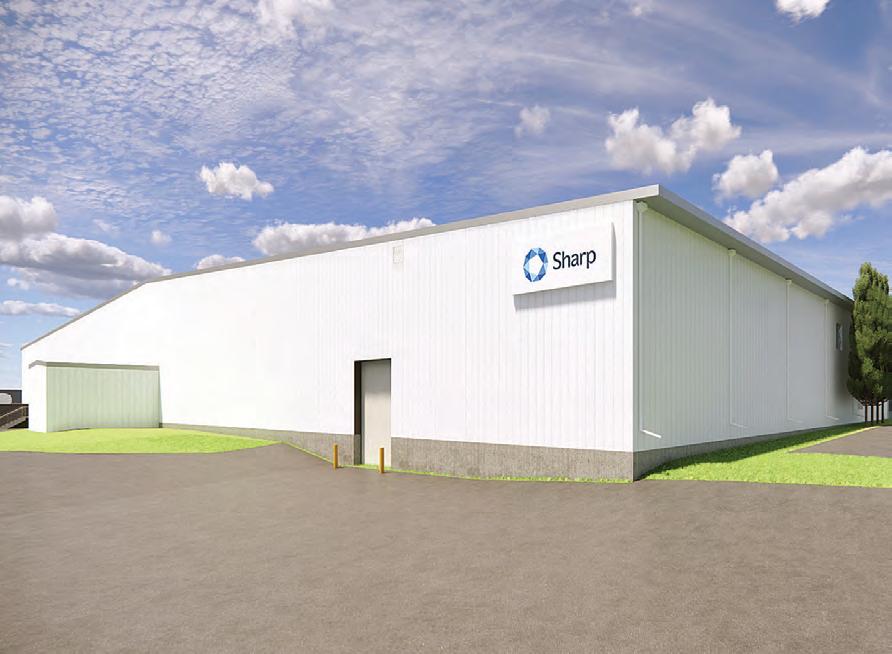
That meeting came just days after the company announced a $28 million expansion of its Lee facility — a significant investment that will expand capacity, add cutting-edge sterile filling lines, and strengthen its role in global pharmaceutical manufacturing. For many, $28 million is simply a headline. For the Berkshires, it is a signal.
FROM STARTUP VISION TO REGIONAL ANCHOR
This story began in 2014, when Berkshire Sterile Manufacturing was founded in Lee with a focused vision: build a specialized sterile fill-finish operation capable of supporting complex injectable drug
RENDERING PROVIDED BY SHARP STERILE MANUFACTURING
Sharp Sterile Manufacturing recently announced a $28 million expansion of its Lee facility, as depicted in this illustration provided by the company. The project will allow the company to expand capacity, add cutting-edge sterile filling lines, and strengthen its role in global pharmaceutical manufacturing.
products for biotech and pharmaceutical companies. At the time, it was a startup with just a few employees and a highly technical strategy — isolator-based filling, lyophilization, formulation development. This is sophisticated, highly regulated work often tied to clinical-stage and commercial drug production.
Over the next decade, that startup grew deliberately. Local financing partners — including Berkshire Bank (now Beacon Bank), Lee Bank, and MassDevelopment — supported facility upgrades and expansion. A $16.5 million financing package in 2020 enabled continued growth. A $20 million expansion followed in 2021.

Employment climbed steadily from a handful of employees to more than 150 — and today, more than 230. In 2023, the company was acquired by Sharp Services and rebranded as Sharp Sterile Manufacturing, integrating the Lee operation into a global pharmaceutical services network.
What followed is what matters
most. Rather than consolidating operations elsewhere, Sharp doubled down on Lee. The newly announced $28 million investment expands capacity here. It adds advanced equipment here. It reinforces the Berkshires as a viable location for advanced sterile manufacturing. Everything I have seen reflects a clear commitment to growing this operation in the Berkshires and serving as a responsible steward of the community.
What Sharp offers is not just jobs. They are well-paying career opportunities in one of the fastest-growing and most impactful industries in the world — life sciences and advanced pharmaceutical manufacturing. Inside the Lee facility, employees operate stateof-the-art sterile filling lines and isolator technology. They work in engineering, quality assurance, validation, and regulatory compliance at global standards. They help produce and support life-saving treatments.
This is precision work. It demands technical skill, discipline and continuous training.
Just as important, the vast majority of hires are local. These are Berkshire residents building careers without leaving the region. These are young professionals entering a global industry while remaining rooted in their community. These are pathways into engineering, operations and leadership roles




It’s March in the Berkshires.
And for cannabis retail, that means it is the starting gun for the biggest cultural holiday we have: April 20. If you’re thinking about 4/20 on April 1, you’re already late. And if your entire plan is “more deals,” you’re missing the point (and potentially training your customers to treat your brand like a clearance aisle where they just have to wait till the last second to engage).
April 20 is both a cultural touchstone in the cannabis community, and a major retail moment for local businesses in the industry. In the Berkshires, where small retailers live and die on trust, repetition, and reputation, 4/20 should function like a seasonal tentpole the way restaurants handle Valentine’s Day, or the way Main Street shops in New England in late September handle foliage season. It’s a chance to welcome new faces, re-earn locals, and remind the community you’re a serious business bringing real value to the landscape.
Which is why the first thing cannabis retailers should be focusing on in March is less promo calendar and more spring cleaning. Literally. Actually cleaning the “body” of your business head, shoulders, feet and toes. Spraying cologne is what you do when you want to cover up without doing the work. Spring cleaning is what you do when you respect the people you’re serving in your business.
So make a difference every customer can feel the moment they walk in. Start outside. (It sounds basic, but basics are where trust is won.) Are your windows clean from the harsh winter we’ve had this year? Is your signage lit, clean and legible? Does the entrance look cared for? Are there dead planters, broken

In the Berkshires, 4/20 should function like a seasonal tentpole the way restaurants handle Valentine’s Day, or the way Main Street shops in New England in late September handle foliage season, notes columnist Meg Sanders.
lights, and visual external markers that say “we stopped paying attention”? How’s your parking flow, your walkway. What is the experience of a customer on the first 10 steps heading into the store?
You just need to give people a reason to remember you, and experience is what people talk about.
Then go inside and do the same honest inventory. Is the space clean in a way that feels intentional? Is it warm yet organized, versus cold and disheveled? Are your displays curated or chaotic? Can a customer quickly understand what you offer and know where to start? Is your menu readable and your offerings flow logical? Is there consistency to your intentionality at every stage of the sale in the store? Are your staff greeting people with enthusiasm or like bored gatekeepers? Call it retail discipline, the kind that makes a customer feel safe, welcomed,

and confident they’re in the right place. And in a regulated industry, trust is the backbone of your business. In a small county like the Berkshires where word travels fast, it’s everything.
It’s worth noting the temptation that shows up every April like clockwork: the deal war. Every year, retailers convince themselves that the way to win 4/20 is to out-discount each other. Bigger markdowns. Escalating discounts for the hope that volume makes up for margin. But that strategy comes with a cost: you’re teaching customers to wait for a discount instead of choosing you for who you are. You’re flattening your brand into a price tag waiting to be slashed. Deals can still be part of 4/20. Our company has won accolades and year
over year “best dispensary” awards by customers for our selection and customer service, but also the value they get for their dollar.
We put a lot of stock into communicating that, because in a tight economy, value matters. People are watching their spending, and they should. But deals shouldn’t be your identity, and they shouldn’t be the only reason someone walks through your door on 4/20. The retailers who make a real impact here in the Berkshires are the ones who treat 4/20 like a celebration and an invitation. That means leaning into what makes this county special: a local business ecosystem that people actually want to support, and then think about what you can build around the retail moment.
Things that have worked for us in the past continue to work. Bring in a local coffee partner for a pop-up in the weeks leading up to 4/20.
Showcase Berkshire artisans and makers. Partner with a food truck and create a community-forward, weekend feel. Host a loyalty appreciation moment that feels like gratitude, not a gimmick. Highlight local small businesses inside your store in ways that surprise customers— rotating spotlights, featured vendors, limited collaborations, and so on.
As a woman-led employee-owned independent business, we love showing love to similar local businesses, and our customers often tell us they appreciate those kinds of intentional decisions. You just need to give people a reason to remember you, and experience is what people talk about.
A discount is forgotten by dinner. A great interaction, a welcoming environment, a staff member who actually listens, seeing your brand out in the community sponsoring local events in a thoughtful way makes the store feel alive, and that’s what gets repeated to others.






Last year’s tax bill created a new savings vehicle — the so-called “Trump account.” While these accounts resemble IRAs in some respects, they offer distinct contribution rules, investment limits, and distribution provisions.
Like other tax-advantaged accounts — IRAs, Roth IRAs, and 529 plans — Trump accounts come with important nuances. What follows is a concise overview of how they work and what families should consider.

Money Talk
THE GROWTH PERIOD
Trump accounts are expected to become available at qualified banks beginning in July 2026. An account may be opened only for the exclusive benefit of a designated child, and an election must be made using IRS Form 4547 (or online at trumpaccounts. gov). To qualify, the child must have a valid Social Security number and be under age 18 before the end of the calendar year in which the election is made.
Only one Trump account may exist per beneficiary at any time. If parents, grandparents, or others wish to contribute for a newborn, all contributions must be directed into the same account.
A defining feature of the Trump account is the “growth period,” which begins at birth and ends on Dec. 31 of the year before the child turns 18. During this period, contributions are allowed (subject to limits), investments are restricted, and distributions are generally prohibited. During the growth period, investments are tightly constrained. Assets must be held in mutual funds or ETFs that track an index of primarily U.S. companies (such as the S&P 500), do not use leverage, and have expense ratios below 0.10 percent.
These rules limit fees and speculative strategies but also restrict broad diversification. In practice, the structure steers families toward low-cost, passive U.S. equity investing during childhood.
CONTRIBUTIONS
Beginning no earlier than July 4, 2026, contributions can be made from employers (which may be deductible to the employer up to certain limits), from a qualified rollover, a state or nonprofit, or anyone else including parents, grandparents, or the beneficiary. A general annual contribution limit is $5,000 for individuals. The annual limit for employers is $2,500,

Families with children who qualify for a Trump account are eligible for a
$1,000, government-funded seed contribution.
which counts toward the $5,000 limit. And contributions from charitable organizations and governments are not subject to the $5,000 annual limit.
Perhaps the most notable contribution for parents of newborns is the pilot contribution, a one-time $1,000 contribution (if elected) for eligible children born from 2025 through 2028. For families with qualifying children, this government-funded seed contribution is hard to ignore.
IRA SIMILARITIES AND DIFFERENCES
Trump accounts differ from IRAs in several important ways. First, there is no earned income requirement. Unlike IRAs or Roth IRAs for minors, a child does not need earned wages to receive account contributions. In addition, contributions from employers or family members do not count as taxable income to the child. Second, contributions are not deductible. Standard contributions are made on an after-tax basis, which affects how withdrawals are taxed later.
Third, timing rules differ. Contributions must be made within the calendar year. There is no grace period through the following April, as there is with IRAs. Importantly, Trump account contributions do not affect a child’s ability to make IRA contributions. A working teenager could potentially contribute to both a Trump account and an IRA, subject to each account’s rules.
From a policy perspective, the absence of an earned income requirement makes Trump accounts resemble child devel-
opment accounts more than traditional retirement plans.
DISTRIBUTIONS AND TAXATION
Distributions are generally prohibited during the growth period, with limited exceptions. Regular withdrawals may begin on Jan. 1 of the year the beneficiary turns 18.
At that point, distributions are taxed like those from a traditional IRA. As long as the account contains after-tax contributions, the pro rata rule applies: each withdrawal is treated as part taxable earnings and part tax-free return of basis. For early withdrawals (before age 59 ½), there will be a 10-percent penalty on the taxable portion unless an exception applies.
If the beneficiary dies after the growth period, the account becomes an inherited IRA and follows standard required minimum distribution (RMD) rules. If the account beneficiary dies during the growth period, the account shall cease to be a Trump account as of the date of death, and the fair market value of the account (reduced by basis) shall be includible in the gross income of the person who acquires the account beneficiary’s interest in the account (or, if that person is the account beneficiary’s estate, then the account beneficiary).
Once the growth period ends, Trump accounts are generally governed by standard IRA rules for contributions, distributions, rollovers, Roth conversions,
and RMDs. However, two distinctions remain. One, Trump accounts cannot accept contributions from SEP or Simple IRAs. Second, basis in Trump accounts cannot be aggregated with other IRAs for pro rata calculations.
IRS guidance clarifies that after the growth period, a Trump account may be transferred to an IRA or another eligible retirement plan. Some may choose to roll the account into a traditional or Roth IRA at age 18, eliminating the need to track a separate account type.
This transition may present a planning opportunity. If the young adult has little taxable income, converting the account to a Roth IRA could generate a modest tax bill while locking in decades of tax-free growth.
Trump accounts may be used for a variety of purposes, including education or retirement. But 529 plans continue to offer advantages for college savings, including potential state income tax deductions, broader investment menus, and 100-percent tax-free withdrawals for qualified education expenses.
Trump accounts are less targeted to education saving but have greater longterm retirement flexibility than 529 plans accounts — particularly if ultimately converted to a Roth IRA.
For families with children born between 2025 and 2028, electing the $1,000 pilot contribution appears straightforward. Additional philanthropic initiatives aimed at seeding accounts could further increase early balances.
More broadly, Trump accounts represent an effort to institutionalize asset building from birth. A child receiving $5,000 annually for 18 years and later rolling the funds into a Roth IRA could accumulate substantial retirement wealth over a 60-plus-year horizon.
As with any new account type, participation rates and behavioral responses will determine this account’s ultimate impact. For families and financial planners, the relevant question is not whether Trump accounts are inherently good or bad but how they fit within a broader savings strategy.
Used thoughtfully alongside 529 plans and IRAs, they may offer a meaningful head start on long-term financial security.
Luke Delorme is director of financial planning at Tableaux Wealth in Stockbridge. Reach him at (413) 264-2404 or Luke@TableauxWealth.com.
Your personal credit is more than just a number — it’s one of the most important financial tools you have. A strong credit history can open doors to better interest rates, higher borrowing limits, and more financial flexibility. Whether you’re buying a home, financing a vehicle, applying for a credit card, or even renting an apartment, your credit score can influence the outcome. At its core, your credit reflects how responsibly you manage borrowed money. Lenders, landlords and even some employers view credit as an indicator of reliability. A higher credit score typically means you are considered a lower risk, which can save you thousands of dollars over time through lower loan rates and better financial opportunities.
WHY CREDIT MATTERS
A good credit score can directly impact the cost of
major life purchases. For example, someone with strong credit may qualify for a mortgage with a lower interest rate, resulting in significantly lower monthly payments. Credit can also affect your ability to access emergency funds, consolidate debt, or take advantage of promotional financing. In short, good credit gives you options. On the other hand, poor credit can limit your choices and increase your costs. Higher interest rates, denied loan applications, and larger security deposits are all common consequences. That’s why maintaining good credit is essential for long-term financial wellness.
One of the most important steps in maintaining good credit is paying your bills on time. Payment history is typically the largest factor in your credit score. Even one late payment can have a negative impact, so setting up automatic payments or reminders can help you stay on track. Another key factor is credit
utilization — how much of your available credit you’re using. A good rule of thumb is to keep your credit card balances below 30 percent of your total credit limit. For example, if your card has a $10,000 limit, try to keep the balance below $3,000. Lower utilization shows lenders that you’re not overly dependent on credit.
It’s also important to regularly review your credit report. You can request free credit reports from major credit bureaus each year and check for errors, fraud, or accounts you don’t recognize. Catching mistakes early can protect your credit and prevent long-term damage.
If your credit needs improvement, start by paying down outstanding balances and avoiding new debt whenever possible. If you have missed payments, focus on building a positive track record going forward — consistent on-time payments can help your score recover over time.
Another helpful strategy is keeping older accounts open,

Whether you’re buying a home, financing a vehicle, applying for a credit card, or even renting an apartment, your credit score can influence the outcome.
even if you don’t use them frequently. The length of your credit history matters, and closing old accounts can reduce your overall available credit.
Finally, avoid applying for too much credit at once. Multiple credit inquiries in a short period can temporarily lower your score.
A LONG-TERM FINANCIAL ASSET
Good credit isn’t built overnight, but with smart habits
and consistent attention, it can become one of your greatest financial assets. By staying organized, borrowing responsibly, and monitoring your credit regularly, you can protect your financial future and create opportunities for years to come.
Ray E. Smith is the senior vice president, marketing and communications at Pittsfield Cooperative Bank.
All Massachusetts voters are likely to see a statewide rent control ballot question this November. While the debate is currently happening at the Statehouse in Boston, a real impact could be felt locally. The Berkshire County housing market, municipal budgets, and development realities look very different here from larger cities.
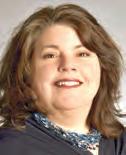
A growing coalition led by “Housing for Massachusetts” has raised concerns about the proposal, which would create the most restrictive statewide rent control policy in the country.
Under the plan, annual rent increases would be capped at the rate of inflation, which has averaged just 2.58 percent over the past two decades, with a hard ceiling of 5 percent. The rent used to calculate those limits would be whatever was charged for the unit on Jan. 31 of this year — more than 10 months before the election and regardless of what has changed since then. What the proposal does not account for are the very real costs property owners face every year: rising insurance premiums, higher property taxes, increased utility costs, or the expense of maintaining and upgrading older buildings. Unlike rent control programs in other states, this proposal would also apply when a unit turns over, meaning owners would never be able to reset rents to market levels, even after longterm tenants move out.
That matters in Berkshire County, where most rental housing is provided not by large corporations, but by small, local property owners. Many own duplexes, three- and four-family homes, or converted single-fam-
that can span decades.

ily houses.
These owners are often operating on thin margins, trying to keep rent reasonable while covering increasing expenses. When rent growth is capped below the actual cost of ownership, reinvestment in the property becomes much harder.
This is especially concerning in a region like ours, where much of the housing stock is older. Deferred maintenance is already an issue in many communities. Policies that limit an owner’s ability to plan for major capital improvements like roof replacements, heating system upgrades, and accessibility modifications all run the risk of accelerating deterioration, rather than preserving long-term affordability.
For students in our high schools and colleges, this matters. Companies like Sharp Sterile Manufacturing make it possible to imagine a future here — one that is technologically sophisticated, economically stable, and connected to something larger than ourselves.
THE ECOSYSTEM BEHIND THE GROWTH
The company’s founding in 2014 coincided with sustained statewide investment in life sciences.
The Massachusetts Life Sciences Center (MLSC), established in 2008, has invested more than $1 billion across the commonwealth to strengthen the life sciences ecosystem. That strategy has included tax incentives, workforce programs, and infrastructure funding designed to expand advanced manufacturing beyond the urban core.
In the Berkshires, those policies aligned with entrepreneurial initiative and local capital.
An experienced founder launched a specialized company in Lee. Local banks provided early financing. State-level life sciences strategy supported sector growth. Skilled workers stepped into highly technical roles. And over time, the company built enough credibility and capacity to attract global investment. This is what long-term ecosystem building looks like. Not overnight success, but disciplined expansion sustained over a decade.
There are also real implications for municipal budgets. Under the proposed ballot question, nearly all nonowner-occupied rental properties would fall under rent control. Historically, this has been associated with declining property values, which can ripple through local tax bases.
For Berkshire towns already juggling tight budgets, that could mean higher taxes on homeowners, reduced services, or delayed infrastructure projects.
Rent control is often framed as a tenant protection tool, but history suggests it does not consistently benefit the people it is meant to help. Recent examples from other states reinforce this concern.
GROWTH THAT ENGAGES THE COMMUNITY
What stood out most during last week’s visit was not the machinery — impressive as it is — but the mindset.
Company leaders spoke about supporting local businesses. They recently sponsored the Berkshire Robotics Challenge and expressed eagerness to engage regional students and educators. They asked how they could strengthen ties across the community. That posture matters. When growth is embedded locally — when it invests in students, supports small businesses, and invites collaboration — it strengthens the entire region.
A CLEAR SIGNAL
A $28 million investment in Lee is more than square footage and equipment. It is a vote of confidence in our workforce, in our community, and in our region.
In St. Paul, Minn., new apartment construction dropped by nearly 80 percent after rent control was adopted. In Montgomery County, Maryland, new multifamily permits fell from more than 2,000 to 54 a single year. Massachusetts is already facing a severe housing shortage, with high construction costs. Adding any new barriers is risky.
Massachusetts is currently working to increase housing supply through zoning reforms, by-right accessory dwelling units, and incentives for multifamily development near town centers. We are hopeful that as these initiatives move forward, they will create more housing stock and more opportunities for growth.
firms will invest where performance and potential align. For the Berkshires — and for the next generation considering where to build their future — that is a powerful message.
As James Hamilton, president of Sharp Sterile told me, “This is a great entrepreneurial success story. At Sharp, we feel a tremendous responsibility to continue the journey that began over 10 years ago for our employees, the community, and most importantly, the patients that depend on our services.”
Companies like Sharp Sterile Manufacturing make it possible to imagine a future here — one that is technologically sophisticated, economically stable, and connected to something larger than ourselves.
Sharp Sterile’s expansion is a reminder of what is possible. We should be proud of this growth — and intentional about creating the conditions that allow the next generation of entrepreneurs to launch, scale and create the careers of the future right here in the Berkshires.
A decade ago, Berkshire Sterile Manufacturing was a startup with a clear technical idea and a small team. Today, Sharp Sterile Manufacturing employs more than 250 people and is expanding again. That arc tells an important story. Entrepreneurs can start here, local institutions can support them, state policy can reinforce their growth, and global
At the Berkshire Innovation Center, we are committed to doing our part to help build those conditions — supporting talent, strengthening industry connections, and ensuring that the next success story has the opportunity to begin here.
Center.
Housing affordability in Berkshire County is a real issue, and there are no easy answers. Moving forward will require a balanced approach of increasing supply, preserving existing housing, protecting tenants, and recognizing the realities of small-scale property ownership in a rural region.
As voters consider this ballot question, the issue isn’t whether affordability matters. It does! The real question is whether a statewide rent control mandate will actually help or whether it will make an already difficult situation worse in the long run.
FROM PAGE 14
At Canna Provisions, we’re thinking about this the same way we think about any real retail season: prepare early, freshen up the space, and show customers we’re paying attention. We’re doing that work in Lee right now, and we’re excited to bring that same Berkshire-first approach to our soon-to-open Pittsfield location. Because the goal isn’t just to sell products. The goal is to earn trust, year after year, town by town, and customer by customer.
And if you’re a consumer reading this, here’s what I’d tell you to look for as 4/20 approaches: don’t just chase the loudest discount. Look for the retailers who are investing in the experience, who are collaborating locally, who are welcoming you in, who are building something sustainable.
If you want a head’s up on what’s coming, sign up for store email lists and loyalty programs. The best offers are often built for the customers who actually show up consistently not just once a year for a headline deal).
So March is the month to decide what kind of business you’re going to be. If you’re a cannabis operator in Berkshire County, treat this spring like an opportunity to grow up as a retailer. Make your store worth visiting even when there isn’t a sale banner on the front door. 4/20 comes every year; March is the month to decide if you’re going to win it.
Meg Sanders is CEO and co-founder of Canna Provisions.
ADAMS
David A. and Patricia L. St. Pierre sold property at 82 Columbia St., Adams, to Colt James and Brittany L. Hazell, $310,000.
Mary L. Kondel, personal rep. of Franklin P. Mclaren, sold property at 27 Columbia St., Adams, to 27 Columbia LLC, $20,000.
Rosemary F. and David M. Ziarnik, Teresa A. Daignault and Gail L. Sookey sold property at 126 Alger St., Adams, to Leonard F. and Sara R. Ziarnik, $250,000.
Leanne Beshaw sold property at 16 Pine St., Adams, to Christie Amlaw, Myles and Scott Phillips, $252,000.
John J. Martin Jr., trustee of the JLB RVT, sold property at 30 Summer St., Adams, to Tyrone B. Moore and Steven G. Skutka, $480,000.
Edward C., Daniel F., Stephen G., Richard A., Judy, James J. and John J. Marko, Michael E., Jean O. Dolle and Cynthia L. Mclain sold property at East Mountain Road, Adams, to Stephen G. and Susan Marko, $150,000.
Amadeu Almeida sold property at 89 Columbia St., Adams, to Rebekah Dawson, $116,000.
Justin Fitzpatrick sold property at 10 Enterprise St., Adams, to Javius Johnson, $165,000.
Joseph L. and Jeanene A. Testa sold property at 27 Second St., Adams, to John Jefferson Tiu, $247,000.
Nicholas H. Wood and J. Christi Raferty Wood, trustees of Nicholas H. Wood Lifetime Trust, sold property at 62 East Road, Alford, to Emmet J. Wood and Kara P. Wood, $750,000.
Bradford S. Morse sold property at 78 Carter Road, Becket, to David S. Muenzer and Rebecca A. B. Lieb, $682,000.
Fred P. Bruni Jr. sold property at Friar Tuck Drive, Becket, to Sean Cahill, $4,000. Adeline Smith sold property at 364 Otis Road, Becket, to Lucio and Aliz A. Hernandez, $150,000.
Donna M. Schmidt sold property at 841 Moberg Road and Moberg Road, Becket, to Jessica Elizabeth Matthews, $389,800.
Timothy and Eva-Maria McCarthy sold property at Gentian Hollow Road, Becket, to Renoage LLC, $25,000.
Joseph Muse sold property at Sir Edwards Way, Becket, to Sabrina Vargas Ortiz, $12,000.
Russell E. and Naomi P. Torrisi sold property at 337 Captain Whitney Road, Becket, to Timothy M. Lansing and Renee V. Isaacs, $550,000.
Thomas and Alice Ryan sold property at Bancroft Road, Becket, to Larry D. Miclette Jr., trustee of the Larry D. Miclette Jr. Living Trust, $65,000.
Arnold V. and Marilyn R. Fish sold property at 345 Big Bass Lane, Becket, to Dennis L. Kalma and Merry A. McDonnell, $479,000. Christopher M. and Bethany J. Bzduch sold property at 106 Stoney Brook Road, Becket, to Paul D. Adler and Heidi M. Miller, $610,000.
Marjorie Hershberg Perry sold property at Bonny Rigg Hill Road, Becket, to Susan A. and Mark A. DesMarais, $85,000.
CHESHIRE
Pamela F. Piekos sold property at 1416 Windsor Road, Cheshire, to Gerard D. Bergeron, $175,000.
CLARKSBURG
Gayle A. Batchelder sold property at 39 Fieldwood Drive, Clarksburg, to Nathan A. and Bethany A. Sartori, $199,000.
Leon C. and Caitlyn Henry sold property at 774 Main St., Dalton, to Alejandro Belalcazar, $173,000.
Thomas E. Whitestone sold property at 239 Main St., Dalton, to Kenneth S. Whitestone, $25,000.
Robert B. Whitestone sold property at 239 Main St., Dalton, to Kenneth S. Whitestone, $50,000.
Grace E. McMahon and Patricia M., Brian F., and Daniel P. O’Handley Jr. sold property at 56 Tower Road, Dalton, to Melissa and Jesse Vanek, $239,000.
Nicholas D. and Shannon M. Lovallo sold property at 17 Sunnyside Drive, Dalton, to William Turner, $360,000.
Robert P. Christman II and Jill E. Sayers sold property at 135-137 High St., Dalton, to Jill E. Sayers, $20,000.
Kenneth Allen French sold property at 1106 South St., Dalton, to Ryan J. and Jordan Hebert, $339,000.
Aaron T. Harrington sold property at 321 High St., Dalton, to Peter H. Marks and Jill A. Johnson, $479,000.
Michael and Luanne Forgea sold property at 82-84 Grange Hall Road, Dalton, to Jill and Eric Payson, $315,000.
EGREMONT
Eric J. Aulicino and Kari Harendorf sold property at 213 Egremont Plain Road, Egremont, to Steven Mark Wolock and Miriam Beth Wolock, $1,150,000.
Estate of Janet C. Hutchinson sold property at 58 Sheffield Road, Egremont, to Zachary Elliston, $325,000.
Courtney Cross sold property at 53 Tilda Hill Road, Florida, to Robert Brown, $335,000.
Beverly Perry, trustee of Beverly Perry Revocable Trust, sold property at 311 North Plain Road Great Barrington, to Benjamin L. Foote and Alexandra C. Zink, $849,000.
Berkshire Pleasure LLC sold property at 281 Main St., Unit 2C, Great Barrington, to Michael G. Rothenberg and Diana N. Rothenberg, $845,000.
Maria L. Vitrano, trustee of Maria L Vitrano 2020 Revocable Trust, sold property at 353 State Road, Great Barrington, to Katherine M. Sheehan and Robert J. Sheehan, $1,445,000.
Granite Ledge LLC sold property at 6 Lake Buel Road, Great Barrington, to Christopher D. Egbert and Alison H. Neveu, $810,000.
Paul A. and Susan D. Diesu sold property at 37 Corey Road, Unit 866, Hancock, to JPeak Management LLC, $487,500.
Thyme Investments LLC sold property at Corey Road, Unit 831, Hancock, to Kevin D. and Nancy L. Foote, trustees of the Kevin D. Foote RVT, $450,000.
Randall Hatch sold property at Birch Grove Road and Cranberry Circle, Hancock, to Andrew E. Sandstrom and Tanya L. Saunders, $15,000.
Robert C. Jordan sold property at 37 Corey Road, Hancock, to Steven and Sunshine Mendez, $135,000.
James A. and Jordan H. Boska sold property at 139 Longview Ave., Hinsdale, to Keith and Alicia Schindler, $290,000.
Edward F. Munch Jr. sold property at 780 Peru Road, Hinsdale, to CG Cran Holdings LLC, $690,000.
Jayne DeAngelis sold property at Forest Hill Drive, Hinsdale, to Javier Columbie and Johanna Santiago, $150,000.
James B. and Rita Vereen sold property at 558 North Main St., Lanesborough, to Giovanni Pena and Ashley A. Poirier, $539,000.
Shaun R. and Christa M. Gariepy sold property at 580 South Main St., Building 2, Unit 4, Lanesborough, to Robert A. Banister, $152,000.
Michael Mcormack aka Michael Mcormick sold property at 33 Iroquois St., Lanesborough, to Scott Graves, $124,093.61.
Jaime L. and James R. Cassavant sold property at 18 Glassworks Road, Lanesborough, to Michael and Shannon O’Bryan, $400,000.
Engelbertha Zwaan sold property at 580 South Main St., Building 2, Unit 10, Lanesborough, to David A. Wick, $165,000. LEE
George P. Fraser and John A. Fraser Jr., trustees of the Spring Lot NT, sold property at Devon Road, Lee, to Susan Fraser, $243,000.
Christopher Spratt sold property at 331 Washington Mountain Road, Lee, to William D. and Paula D. Hall, $355,908.78.
Glenn J. Collins sold property at 175-177 Center St., Lee, to Hurricane Properties LLC, $240,000.
William I. Stewart Jr. and Barbara J. Teggi, trustees of the William I. Stewart Jr RVT, sold property at 106 East Center St., Lee, to Joshua R. Stewart, $170,000.
William J. Bartini sold property at George Street, Lee, to Matthew and Terri Digrigoli Osak, $4,000.
Lenox Commons Holdings LLC sold property at 55 Pittsfield Road, Lenox, to Berkshire Medical Center Inc., $3,600,000.
Spring Lawn Partners LLC sold property at 10 Kemble St., Lenox, to Spring Lawn Investors LLC, $3,000,000.
Schulze Lenox Properties LLC sold property at 41 Housatonic St., Lenox, to Streetscape LLC, $475,000.
Justin T. Taylor and Shaan Elise Battersby sold property at 8 Catherine St., Lenox, to Patricia Evanko, $465,000.
Steven E. Cabral sold property at Sargent Brook Road, Lenox, to Bernd Schoner and Mary Farbood, $30,000.
Alex J. and Lynsey Kastrinakis sold property at 46 Galway Court, Lenox, to Timothy P. and Heather Gallagher, $735,000.
Lenox Collection LLC sold property at 7 Hubbard St., Lenox, to Rachel Alisa Goldstein Jubas and David DeBenedictis, trustees of the Jay Michael Jubas FT, $1,800,000.
Schulze Lenox Properties LLC sold property at 51 Housatonic St., Lenox, to
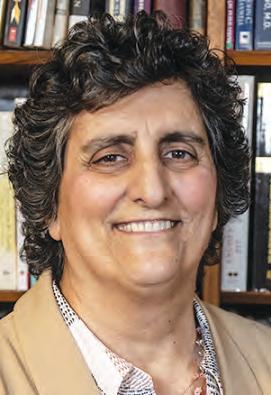
Streetscape LLC, $700,000.
Lance Haver, trustee of the Trust for Bram Scott Haver, sold property at 15 Golden Hill Road, Lenox, to Julio Rodolfo Garcia Samol and Kimberly B. Gomez Ramos, $350,000.
Colleen Doyle, personal rep. of the Estate of Sharon Hughes, sold property at 75 Pine Knoll Road, Lenox, to H2 Asset Solutions Inc., $280,250.
Adrienne Hartzell Knudsen sold property at 48 Sargent Brook Road, Lenox, to Diana L. Scott, trustee of the Scott FT and Adrienne Hartzell Knudsen, $300,000.
Maude C. Palen sold property at 71 King William Road, Lenox, to Cody and Nora Considine Leydet, $725,000.
Sheila Sholes-Ross sold property at 2-5 Rolling Hills, Lenox, to Mark L. Smith and Erin Hebert, $240,000.
Girl Power LLC sold property at 12 Housatonic St., Lenox, to Piccolo & Co. LLC, $1,550,000.
E. Robert Levy sold property at 16 Heberts Cove Road, Monterey, to Paul A. Katzenstein, trustee of Paul A. Katzenstein Revocable Trust, and Ann B. Katzenstein, trustee of Ann B. Katzenstein Revocable Trust, $1,463,000.
Ivan Espinoza sold property at 14 Norwalk Acres Road, Monterey, to Michael Heal & Tara Heal, $440,000.
MOUNT WASHINGTON
Gail E. Garrett, trustee of Plantain Pond Road Nominee Trust, sold property at 477 East St., Mount Washington, to Thomas C. Furcht, Lesliann Furcht, Alexanter M. Furcht, and Carl W. Furcht, $90,000.
Estate of Peter Goodman sold property at 978 Clayton Mill River Road, New Marlborough, to Margaret Garland, trustee of Margaret Garland 2015 Revocable Trust, $1,630,000.
Mary R. White, individually, and Mary R. White, trustee of Mary R. White Revocable Trust, sold property at 270 County Road, New Marlborough, to Mark Ferrer and Elyse Watkins, trustees of Ferrer/Watkins Revocable Trust, $1,525,000.
James S. Whitney, personal rep. of Anne Young Whitney, sold property at 5 Whitman St., North Adams, to Alex West and Beau Anthony Barela, $185,000.
Richard Millis, personal rep. of Joan Carrigan, sold property at 209 Corinth St., North Adams, to Hollin Vicedomini and John Allen Shaw, $250,000.
Loophole RE Holdings LLC sold property at 921 Mohawk Trail, North Adams, to Dawn L. Nelson, $270,000.
REAL ESTATE, Page 18
Moresi Commercial Investments LLC sold property at 1000 Massachusetts Ave., North Adams, to Berkshire Family and Individual Resources Inc., $345,000.
Richard M. Wood Jr., trustee of the Theresa G. Wood 2011 IRVT, sold property at 11 Foucher Ave., North Adams, to Declan M. Cook and Paul A. Tremblay, $237,000.
Steven Borns and Stephanie Farrington-Borns, trustees of the Furnace Street Flats RT, sold property at 152 Furnace St., North Adams, to Leto Commercial Group LLC, $325,000.
Angela M. and Leonard M. Giroux Jr. sold property at 25 College Ave., North Adams, to Roger Calvrin and Deborah Elizabeth Ann Tatro, $296,000.
James S. Whitney, personal rep. of Anne Young Whitney, sold property at 5 Whitman St., North Adams, to Alex Gordon Mason and Alexandra DiAddezio, $35,000.
E & D Landscaping & Construction Inc. sold property at 227 Protection Ave., North Adams, to Kevin Curry, $278,000.
Jessica A. and Robert G. Burdick Jr. sold property at 67 Cherry St., North Adams, to Leona Wilber and Miguel Gomez, $410,000.
VGG North Adams LLC sold property at 1499 South State St., North Adams, to Timothy Rougeau, $150,000.
Daniel M. and Colleen A. Johnson sold property at 48-50 Gallup St., North Adams, to Esther M. Baker, $244,900.
City of North Adams sold property at 159 Eagle St., North Adams, to Alan Aubin and Margaret Neville, $15,000.
Lawrence J. Michon sold property at 84 West Main St., North Adams, to Louis D. Schroeter III, $197,000.
OTIS
Paul and Justine Phoenix sold property at 171 Lake Shore Drive, Otis, to Daniel and Emily Kaufman, $845,000.
Phyllis Ettinger, trustee of the Phyllis Ettinger Living Trust, sold property at Deer Run, Otis, to Alan English and Janice Rowley, $14,000.
Matthew V. Gamelli sold property at 49 Bryant Road, Otis, to Linda Hood-Glidden, $342,500.
Beverlyjean P. and Antonio J. Scapin Jr., trustees of the Scapin Trust, sold property at 113-125 Kibbe Road, Otis, to Anthony J. Scapin, $275,200.
PERU
Howard Waxman and JJDR Acquisitions LLC sold property at 15 Haskell Road, Peru, to Johnny East LLC, $158,550.
Kimberely Windoloski sold property at 74 East Windsor Road, Peru, to Mel English, $292,500.
Matthew B. and Tiaona Winot sold property at 18 Andes Road, Peru, to Alfred F. Salvatore and Cherie Pasquarelli, $332,000. Lucy M. Cawthron sold property at 9 Greylock Circle, Peru, to Cameron Murray, $233,450.
Christina Smith, personal rep. of the Estate of Mark S. Lawson, sold property at 10 Brookside Road and Brookside Road, Peru, to Jorge Ramiro Aguilar Sangurima and Juana Reyes Lopez, $50,000.
Leydet Properties LLC sold property at 263 Linden St., Pittsfield, to Toledo Vargas LLC, $125,000.
Jesse R. and Sarah B. Polo, trustees of the Jesse R. Polo and Sarah B. Polo RVT, sold property at 193 South Mountain Road, Pittsfield, to Domenico Pizzonia, $365,000.
Richard C. and Margaret M. Ward sold property at 26 Leona Drive, Pittsfield, to Guidewire Inc., $400,000.
Sandra L. Ketcham sold property at 1012 West St., Pittsfield, to Margaret Connor, $354,000.
Michael A. Colwell and Deborah M. Kelly sold property at 92 Marian Ave., Pittsfield, to Ellen LeRose, $290,000.
Michael P. and Carol A. Daly, trustees of the Michael and Carol Daly 2024 Living Trust, sold property at 1136 Barker Road, Pittsfield, to Werner Peter Metz III and Sherry L. Sweet, $750,000.
Circular Av LLC sold property at 101-103 Daniels Ave., Pittsfield, to Raquel Nunes Da Silva, $236,000.
Wicked Deals LLC sold property at 114-116 Danforth Ave., Pittsfield, to Lauren Lewis, $289,900.
Circular Av LLC sold property at 39 Circular Ave., Pittsfield, to Hande Can and Jong Hwa Shin, $209,900.
Steven E. and Jane C. Carver sold property at 26 Walden Lane, Pittsfield, to Roberta Wilson, $387,900.
Robertine M., Henry R., David P., and Daniel E. Morris, and Charlotte M. Cote sold property at 67 Scammell Ave., Pittsfield, to Lance Haver, trustee of the Trust for Bram Scott Haver, $285,000.
James M. and Cheryl A. Galvin sold property at 565 Williams St., Pittsfield, to Edward Flynn, $330,000.
Edward M. Flynn sold property at 63 Reuter Ave., Pittsfield, to Presley Hutchins and Sara Shea Lester, $240,000.
Lauren D. Bence sold property at 1113 North St., Pittsfield, to Crystal Garneau, $236,000.
Jennie M. and James E. Keefner Jr. sold property at 64 Brooks Ave., Pittsfield, to Antoinette M. Spezzaferro, trustee of the Toni Spez Trust, $274,900.
Walter N. and James E. Creer, trustees of the Creer Family NT, sold property at 22 Auburn St., Pittsfield, to Kelly Peterson, $238,400.
Katie Wirth sold property at 46 Churchill Crest, Pittsfield, to Elizabeth M. Shepard, $260,000.
Gladis Magnolia Bravo Saico sold property at 481-483 Tyler St., Pittsfield, to Steven A. Mendez Bravo, $350,000.
Caitlyn V. Kline, Anthony Venturini and Michael A. Janchuk Jr. sold property at 25 Robert St., Pittsfield, to Kaitlyn Paradee and Mark Challet Jr., $249,900.
Marilyn J. Coussoule and James P. McCauley sold property at 575 Tyler St., Pittsfield, to 555 East Street Realty LLC, $155,000.
James P. McCauley sold property at 15-17 Maple St., Pittsfield, to 555 East Street Realty LLC, $155,000.
Efrain Diego sold property at 153 Elberon Ave., Pittsfield, to Shaun Ketchen and Joya Hennessy, $349,900.
Bertina L. Fisk sold property at 11 Merriam St., Pittsfield, to Ellies Holdings LLC, $100,000.
Sharon Toporowski sold property at 15 Atlantic Ave., Pittsfield, to Silvana Vargas, $257,000.
Glenn D. Barnum Jr. sold property at 125 Hancock Road, Pittsfield, to Mikolaj N. Galazka, $271,000.
Thomas M. and Tammy Cooney sold property at 14 Alpine Trail, Pittsfield, to John and Jane E. Buxton, $550,000.
Christopher L. Moore sold property at 14 Donovan St., Pittsfield, to LND Investments LLC, $210,000.
Marwan and Patricia A. Rusan sold property at 44 Churchill Crest, Pittsfield, to Richard C. and Lisa A. Powers, $249,900.
Hurricane Properties LLC sold property at 500 Fenn St., Pittsfield, to Andre Sediyama, $285,000.
Louis A. and Joy C. Costi sold property at 566-568 Fenn St., Pittsfield, to Brites Removal and Services LLC, $65,000.
Leydet Properties LLC sold property at 87 Maryland Ave., Pittsfield, to Trey A. and Katheryn B. Sondrini, $242,500.
Timothy W. Adams sold property at 139 Gamwell Ave., Pittsfield, to Thomas Gene Mesquita and Valerie Conte-Mesquita, $319,000.
Richard C. and Lisa A. Powers sold property at 932 Williams St., Pittsfield, to Conor Raftery and Lily Nejaime, $339,900.
BLMH LLC sold property at 105-107 Onota St., Pittsfield, to 120 Onota Street LLC, $360,000.
McGowan Pomeroy Properties LLC sold property at 55 Pomeroy Ave., Pittsfield, to Gail A. Kelley, trustee of the Living Trust Agreement of Gail A. Kelley, $204,000.
Thomas G. Mesquita and Valerie J. Conte-Mesquita sold property at 93 Roselyn Drive, Pittsfield, to Hansung Kim and Judy Chaeyonne Lee, $471,000.
Matthew J. Connor, trustee of the Matthew J. Connor RVT, sold property at 69 Gravesleigh Terrace, Pittsfield, to Robert Lettteney and Michiko Shima, trustees of the Letteney-Shima FT, $870,000.
Wells Fargo Bank NA, trustee, Christine Valle and Rhea Williams sold property at 258 Linden St., Pittsfield, to Wells Fargo Bank NA, trustee, $60,029.46.
Herald Properties LLC sold property at 4547 Reed St., Pittsfield, to NIKJOE Properties LLC, $260,000.
Joan C. Barry sold property at 144 Kittredge Road, Pittsfield, to Raymond and Stephen Wollitz, $394,900.
Bradley J. and Sharon S. Fedderly sold property at 559 Onota St., Pittsfield, to Edmund Reed Jr., $256,000.
Lori M. Stanton and Judith A. Polucci sold property at 122 Allengate Ave., Pittsfield, to Nadine Sharron, $275,000.
Leydet Properties LLC sold property at 106 Sampson Parkway, Pittsfield, to Frank N. Velez, $360,000.
Hurricane Properties LLC sold property at 471-473 West St., Pittsfield, to Arsene P. Nguessan, $395,000.
Sharon M. Stubbs sold property at 469 Fenn St., Pittsfield, to Eric and Heather Martin, $164,800.
John C. George sold property at 553 Tyler St. and 84 Brown St., Pittsfield, to 553 Tyler LLC, $390,000.
Renee M. Matrigali sold property at 101 Bay State Road, Pittsfield, to Charles Walbert, $100,000.
Lazare Adjama Tayi sold property at 41 Brown St., Pittsfield, to Iserr Properties LLC, $250,000.
SANDISFIELD
Paul Phoenix and Justine Phoenix sold property at 171 Lake Shore Drive, Sandisfield, to Daniel Kaufman and Emily Kaufman, $845,000.
Lucy E. Morris sold property at 25 Sandisfield Road, Sandisfield, to Alec Blume, $104,700.
Daniel Pinskey sold property at Silverbrook Road, Sandisfield, to Daniel Ferron and Victoria LaValla-Ferron, $55,000.
Phyllis Ettinger, trustee of Phyllis Ettinger Living Trust, sold property at Deer Run, Sandisfield, to Alan English and Janice Rowley, $14,000.
Marlene Burke sold property at 119 Sandy Brook Turnpike, Sandisfield, to Alexandra Harle, $389,000.
SAVOY
Kelly A. Reagan, personal rep. of Bruce A. Kupiec, sold property at 26A Blackbrook Road, Savoy, to Edward Adriance, $165,000.
SHEFFIELD
Richard M. Bachetti, trustee of Max Nominee Realty Trust, sold property at 1114 County Road, Sheffield, to Henry S. Mateo and Hilda De Maria Garza Y Garza, $276,500.
Pam A. Mercer sold property at 16 Lilac Lane and 0 Oak St., Sheffield, to John Florio and Ernest Mams, $75,000.
Hadders LTD sold property at 1373 Boardman St., Sheffield, to Shelley Elaine Babicka, $2,450,000.
Giberson Road LLC sold property at 232 Giberson Road, Sheffield, to David Castellani, $2,690,000.
Jeffrey Heaton and Melonie Heaton sold property at 414 South Undermountain Road, Sheffield, to Clare Pomerantz, $1,250,000.
STOCKBRIDGE
Diana M. Hellman sold property at 19 Hawthorne Road, Stockbridge, to Joseph Laurence Costin Jr., trustee of the Joseph Laurence Costin Jr. Declaration of Trust, $775,000.
WEST STOCKBRIDGE
Silver Mine LLC sold property at 4 Pond View Drive, West Stockbridge, to Marcia M. Miner, $808,200.
Twenty Cobb LLC sold property at 20 Cobb Road, West Stockbridge, to Berkshire 20 LLC, $3,800,000.
Ronald P. Hanft sold property at 36 West Center Road, West Stockbridge, to Jerome O’Neil, $499,000.
Jennifer Capala sold property at Great Barrington Road, West Stockbridge, to Stephen Murphy and Mary Murphy, $193,000.
Linda Glick Conway, trustee of the Linda Glick Conway RVT, sold property at 23 Observatory Lane, Williamstown, to Daniel Ernest Conway, $1,025,000.
160 Water LLC sold property at 160 Water St., Unit 11, Williamstown, to Randolph C. Roger, trustee of the White Hart Lane RT, $765,000.
Stefanie Solum and Peter Starenko sold property at 30 John St., Williamstown, to Sidney Rothstein and Luiza Geraldi Folegatti, $530,000.
Catherine A. Moore and Todd R. Fernandez sold property at 600 Bee Hill Road, Williamstown, to Benjamin Svenson, trustee of the Hopper View Farm RT, $1,700,000.
Peter A. Meyers, trustee of the 12 Arnold Street NT, sold property at 12-16 Arnold St., Williamstown, to Cole Ave Properties LLC, $335,262.
Peter A. Meyers, trustee of the 290 Cole Avenue NT, sold property at 290-294 Cole Ave., Williamstown, to Cole Ave Properties LLC, $670,620.
Peter A. Meyers, trustee of the 291 Cole Avenue NT, sold property at 291-293 Cole Ave., Williamstown, to Cole Ave Properties LLC, $335,263.
Peter A. Meyers, trustee of the 295 Cole Avenue NT, sold property at 295-301 Cole Ave., Williamstown, to Cole Ave Properties LLC, $558,855.
Reinland Property Management LLC sold property at 824 Simonds Road, Williamstown, to 824 Simonds LLC, $225,000. William F. Frado Jr. sold property at 1438 Oblong Road, Williamstown, to Richard A. and Kathryn B. Wiseman, $1,400,000. Kevin J. Stant sold property at 115 Luce Road, Williamstown, to Lindsey Andersen, $359,900.
Jacqueline Demarsico and Susan Agosto sold property at 672-676 North Hoosac Road, Williamstown, to Steven L. Wenninger, $250,000.
WINDSOR
Ellen Lerose sold property at 1689 East Windsor Road, Windsor, to Christopher Sheridan and Christianna Vasquez, $385,000.
Patricia Zito sold property at Route 9, Windsor, to Paul Greenleaf, $59,900.
FT — Family Trust
LLC — Limited Partnership
LT — Life Trust
NT — Nominee Trust
RET — Real Estate Trust
RT — Realty Trust
RVT — Revocable Trust
The real estate transactions are provided by the Middle Berkshire, North Berkshire and South Berkshire Registry of Deeds offices.
Community Health Programs has appointed Dr. John-Paul Bettencourt as its new chief medical officer.

Most recently, Bettencourt served as chief medical officer at the McGregor Clinic in Fort Myers, Fla. His previous experience as a lead physician and academic instructor in the New England region will provide insight into the medical needs of the Berkshires, according to a prepared release. Bettencourt, who has more than 13 years of clinical practice and 12 years of experience in medical and disaster management, will guide CHP into the future of health care.
He holds a doctor of osteopathic medicine, a master of public health and an MBA. He is an HIV specialist, certified by the American Academy of HIV Medicine, and a certified physician executive.
CHP is a federally qualified health center offering medical, dental, behavioral health, nutrition, and family services throughout Berkshire County. For more information, visit chpberkshires.org.
Hunter Harpin, a North Adams native and communications professional, has joined Montagne Powers, a full-service public relations and strategic communications firm based in Manchester, N.H., as an assistant account executive.

In this role, Harpin supports the development and execution of strategic communications campaigns for a range of clients, spanning the real estate development, government contracting and gaming industries.
Prior to joining Montagne Powers, Harpin worked for a communications firm that specializes in helping international clients break into the United States media market. He also was employed by a New Jersey communications firm focused on talent relations and promotion.
Harpin earned a master’s degree in public relations from S.I. Newhouse School of Public Relations at Syracuse University, and a bachelor’s degree in communications from Westfield State University. Prior to attending Syracuse University, he was employed as a program manager by ROOTS Teen Center in North Adams. He is a 2017 graduate of Drury High School.
Montagne Powers develops customized strategic communications campaigns, enabling clients to reach and influence audiences in their backyard, around the country and in some cases across the globe.
Some of Montagne Powers’ clients include the New Hampshire Liquor Commission, Dartmouth Health, NBT Bank, Plymouth State University, Granite VNA, Friendly Toast, Torrington Properties, FedPoint, New Hampshire Lottery, and The Nash Casino.
Berkshire Scenic Railway Museum has appointed Melanie Seiden as its first executive director, marking a significant milestone in the organization’s history.
Established in 1984, Berkshire Scenic Railroad Museum is dedicated to preserving and interpreting the railroad history of Western Massachusetts. Seiden’s appointment also represents the first paid staff position for the organization, reflecting its growth and long-term vision.
As part of this leadership transition, the museum undertook a strategic assessment guided by an experienced nonprofit consulting firm to evaluate organizational strengths, clarify priori-
ties and identify opportunities for longterm sustainability and impact. The assessment helped inform the decision to establish an executive leadership role and position the organization for its next phase of development.
The assessment also identified the museum’s potential to emerge as a significant cultural attraction in the Berkshires, while also serving as a meaningful economic multiplier for the region. The museum’s Hoosac Valley Train Ride already brings more than 10,000 visitors to northern Berkshire County each year, demonstrating its ability to attract audiences, support tourism, and contribute to local economic activity.
Central to the organization’s mission is its educational focus on making the history of railroads in Western Massachusetts relevant to contemporary audiences. The Berkshires as we know it today — its towns, industry, communities, and tourism — was shaped in large part by the arrival of the railroads. Through interpretation, programming and hands-on experiences, the museum connects this railroad heritage to the region’s modern identity, showing how railroads helped build the Berkshires’ economy, culture and sense of place.
Seiden brings strong leadership experience and a deep commitment to community engagement. Most recently, she served as associate director for membership at the New York State Council of School Superintendents, where she led membership strategy, relationship building and outreach across a broad network of education leaders. Her work in that role strengthened her skills in stakeholder engagement, strategic planning, and organizational growth — experience that will be essential as BSRM expands its programs, partnerships and impact.
Seiden impressed the selection committee with her energy, collaborative spirit and ability to bring people together around a shared vision, making her well suited to lead the organization through this next chapter.
As executive director, Seiden will work closely with the board of directors, volunteers and community partners to implement strategic priorities, strengthen organizational capacity, and advance the organization’s role as both a cultural destination and an educational resource.
“This is a pivotal moment for Berkshire Scenic Railway Museum,” said Tom Delasco, Museum president.
“Our strategic assessment made clear that Berkshire Scenic Railway Museum needed to evolve to remain viable. We faced a choice: reinvent ourselves for the future or develop an exit strategy to close. Melanie’s energy, collaborative approach, and vision make her the ideal leader to guide us into this next chapter.”
Berkshire United Way welcomes Jennifer Baril its new director of development.

Baril has over 25 years of fundraising experience designing and implementing results-driven programs for community service, education and health care organizations. She currently serves as president of the board of directors of Homework House, Holyoke’s only free after-school program, and previously served with Volunteers in Service to America in Los Angeles, Calif.
Previous positions include director of fund development for Health Equity Solutions, senior director of fundraising for the Center for Human Development, senior major gift officer at Western New England University, philanthropy officer at Baystate Health, director of development for Girls Inc. of Holyoke, and at Smith College as assistant director of the alum-
nae fund followed by major gifts officer. She earned her bachelor’s degree in psychology from the University of Massachusetts Amherst and her master’s degree from UMass Amherst’s Isenberg School of Management.
To connect with Baril, email jbaril@ berkshireunitedway.org or call 413-4426948, ext. 18.
The Clark Art Institute has appointed longtime staff member Alexis Goodin as curator of decorative arts.
“Alexis is an integral part of the Clark’s curatorial team, and she has brought extraordinary rigor, insight, and care to the study and presentation of our decorative arts collections,” said Esther Bell, deputy director and Robert and Martha Berman Lipp chief curator of the Clark.

“Her deep institutional knowledge and scholarly excellence make her uniquely suited to steward this area of our collection.”
Having served for over more than two decades at the Clark, Goodin has played a vital role in shaping the interpretation, presentation and scholarship of the Clark’s decorative arts collections. Her work in this field began in 2000, when she served as co-curator of “A Fresh and Large Assortment: American Silver from the Burrows Collection.”
Since that time, she worked closely with Kathleen Morris, the Clark’s former Sylvia and Leonard Marx director of collections and exhibitions, curator of decorative arts, on expansive reviews of the Clark’s porcelain, glass and silver holdings, contributing to both scholarly research and public-facing interpretation, including the 2017 openings of the Lauzon Glass Study Gallery and the Henry Morris and Elizabeth H. Burrows Gallery of American Decorative Arts. The Burrows Gallery houses the Clark’s collection of early American paintings and furniture in addition to its Burrows collection of American silver.
Goodin was the co-curator of “Orchestrating Elegance: Alma-Tadema and Design” (2017), an exhibition that explored the intersections of fine and decorative arts in the late 19th century. She was also a key member of the team that reinterpreted objects and developed new interpretive labels for the Burrows Gallery of American Decorative Arts, installed in fall 2022, intended to deepen visitor engagement with the collection.
In addition to her work with decorative arts, Goodin’s curatorial practice reflects a sustained interest in women artists and social history. She curated the Clark’s summer 2025 exhibition, “A Room of Her Own: Women Artist-Activists in Britain, 1875–1945,” which examined the artistic production and cultural impact of women working across media during a period of profound social and political change.
Goodin holds a master’s degree from the Williams College/Clark Graduate Program in the History of Art and a Ph.D. in art history from Brown University, writing her dissertation on the representation of ancient Egypt at the Sydenham Crystal Palace in South London.
As curator of decorative arts, Goodin will continue to advance research, steward the collections, and develop exhibitions centered on the Clark’s collection of decorative arts.
Berkshire County Arc has named Sonja Haecker as its chief operating officer. Haecker has been serving as the agency’s executive vice president, overseeing a wide range of programs for BCArc.
“Sonja continues to show incredible leadership,” said Maryann Hyatt, president and CEO. “She is a great motivator, demands high standards, and has great energy for advancing this agency
forward. The staff and families are well-served with her as the new chief operating officer.”

Haecker’s responsibilities, in collaboration with the chief executive officer, cover the agency’s program operations and strategic planning, along with specific areas such as clinical services — nursing and behavioral supports — and community services programs, including adult family care program, family support and advocacy, employment and vocational services, day habilitation programs, and community-based day services.
Previously, Haecker was the vice president of community services and the director of family support and advocacy, where she expanded the adult family care program, strengthened family support Services, and successfully spearheaded several new agency initiatives.
Haecker has presented at conferences statewide and nationally and has been recognized by the Arc of Massachusetts for her leadership in family and individual supports. She is a Massachusetts Ambassador for the national initiative “Charting the LifeCourse,” and serves on the Clark Art Institute Accessibility Advisory Council.
She holds a doctorate in educational leadership from the University of New England, a master’s degree in education from the Massachusetts College of Liberal Arts, where she is a distinguished alumna, and a bachelor’s degree in social work from the College of Saint Rose. She is also an adjunct professor in the social work program at Berkshire Community College.
MountainOne Bank has promoted Kyle Shepard to assistant vice president of loan operations and business analyst manager.

In his role as assistant VP of loan operations, Shepard oversees the daily functions of the loan servicing department, including payment processing, escrow management and collections. As business analyst manager, he supervises a team responsible for developing and implementing strategies and procedures that strengthen operational efficiency, enhance customer service and mitigate risk.
Shepard joined MountainOne in March 2014 as a personal banker. Over his nearly 12 years with the organization, he has advanced through a series of roles including electronic banking specialist, customer care liaison and operations analyst. Most recently, he served as assistant vice president operations manager prior to his promotion. Shepard is a graduate of Massachusetts College of Liberal Arts with a degree in business administration and management, as well as an accredited ACH professional. He resides in North Adams with his wife, two children and their two dogs.
“We’re proud to recognize Kyle’s continued growth at MountainOne,” said Mike MacArevey, senior vice president, senior operations officer at MountainOne. “His strong analytical skills, operational acumen, and dedication to the customers and communities we serve are highly valued. We look forward to all that Kyle will bring to his new role.”
MountainOne Bank, headquartered in North Adams, has full-service offices in North Adams, Pittsfield, Williamstown, and Boston’s South Shore.