
Building solutions for housing crisis
An Adams company is manufacturing small, modular homes that are affordable, Page 2
An Adams company is manufacturing small, modular homes that are affordable, Page 2
JULY 2026 | VOL. 5, NO. 7
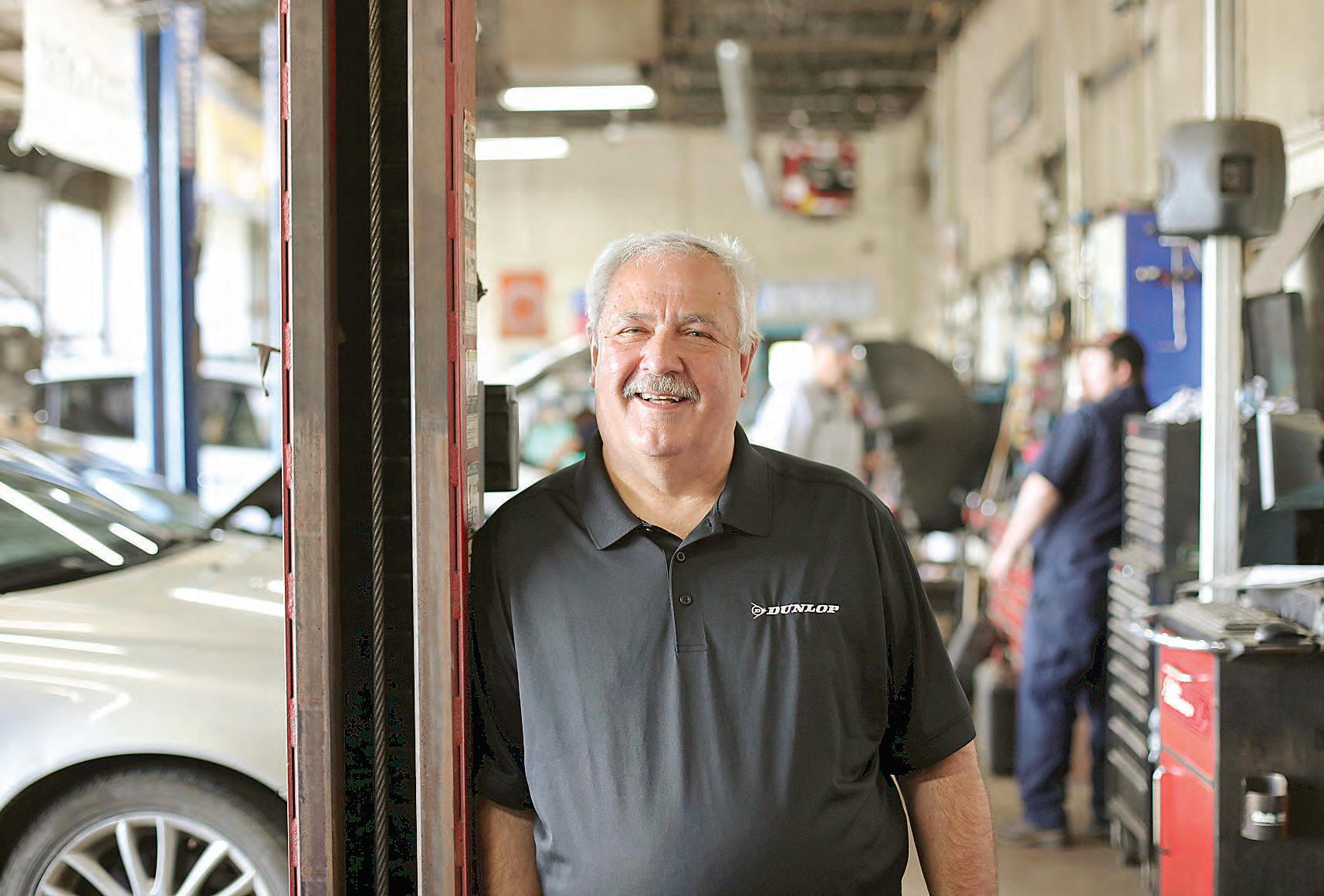
Lou Kuch took over as manager of Pittsfield Tire and Auto Service Center in
family-oriented place,” he said. “I consider my crew family.”
By Jane K aufman
PITTSFIELD — Lou Kuch remembers the ramp up of the radial tire.
“They all made a terrible one,” chuckled the owner of Pittsfield Tire and Auto Service Center.
He recalls the radial’s botches and recalls, as well as the customer complaints. Eventually, the glitches got fixed and the radial overtook the bias or diagonal ply tire.
Now it’s the king of the industry with a nearly monolithic hold, and the bias ply tire is relegated to roll under lawn equipment and the occasional trailer.
Kuch, 67, has owned Pittsfield Tire for 25 years, and has managed the business since 1986. That means he’s been behind the counter for 40 years.
He counts 2026 as the 100th anni-
versary of the business — dating to its incorporation in 1926, though it was actually founded by John B. Guy in 1920 at the corner of Center and West streets, across the street from its present location at 203 West St.
“Back in 1926, 100 years ago, the transportation industry was taking off like a rocket,” said Kuch, who’s a history buff. “When we went from horses to horseless carriages, it was a high demand for transportation to get from one point to another.
“Before then, most people didn’t travel more than 50 miles from their home in their entire life,” he said.
“But once the car came out, they were able to go farther and farther out, so roads were a big deal. They were building roads in 1926. Route 66
PITSFIELD TIRE, Page 3




BY NATE H ARRINGTON
ADAMS — Despite its name, B&B Micro Manufacturing has a huge impact on the Berkshires, including its new pilot program building homes at an attainable price.
The cost for a 1,300-square-foot home? “$350,000 turn key,” said Mitch Bresett, one of the co-founders of the company.
B&B Micro Manufacturing was established by Bresett and his two co-founders — Chris St. Cyr and Jason Koperniak — in 2016, primarily building tiny homes on wheels. But the company is beginning a foray into modular homes, and it is set to begin building 10 of them in the coming months. The result? Homes being sold for below the average price in the county.
“The goal is to create jobs here as well as provide a product that people can use,” Bresett said. “I’m not looking at it what I think I can charge.”
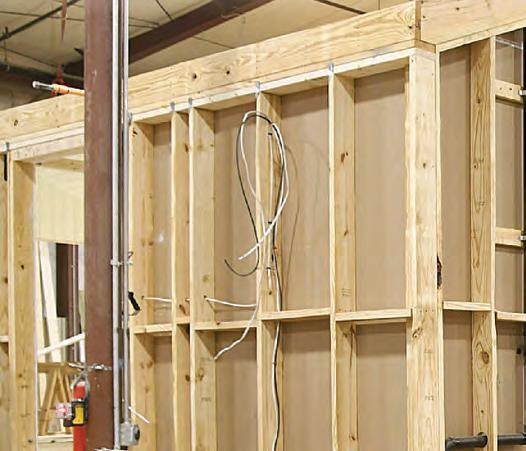
The manufacturing company got its start by building tiny homes for hospitality companies, but Bresett had a vision for a modular home program to create attainable housing in the county while expanding what his company provides. Modular homes are built offsite then assembled once delivered, and local developers see them as a tool for building affordable housing.
The pilot program the company is planning to start will build 10 modular homes ranging from 1,300 to 1,600 square feet, with costs coming in under $350,000. each home will have three bedrooms and two bathrooms. The median home price in the county so far in 2026 is $391,804, according to Zillow.
“We’re very nimble,” Bresett said. “And our overhead’s extremely low relative for the field that we’re in.”
B&B’s advantage is efficiency, which helps lower the cost per square foot to around $230, Bresett said. Friends of his got quotes for around $500 per square foot for similarly sized projects.
The homes are built much faster than traditional, stick-built homes, Bresett said. “The goal that we’re ramping up to
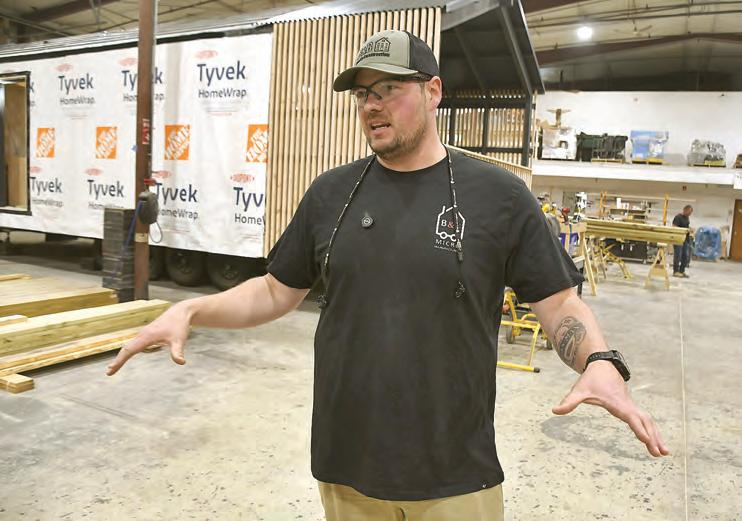
Mitchell Bresett started B&B Micro Manufacturing in 2016 with two other cofounders. The B&B is an homage to the construction company owned by his father, who died in 2009.
is [building] one a week.”
That efficiency will extend to the eventual site work that needs to happen, Bresett said. The company will partner with B&B Quality Construction to more or less create an on-site assembly line of foundation and septic work that needs to be done.
The partnership further reduces the costs as it limits the number of entities involved in the process, not that Bresett hasn’t been offered.
“I’ve seen interest from people that want to partner,” Bresett said. “I think by handing that off to somebody that’s just looking to make money, they’re going to jack up the price, and I don’t want that to happen.”
The per-unit cost, before pricing in land and site work, is $200,000. It’s too early to tell what the on-site costs will amount to, but Bresett is confident that the company will “maintain a healthy business margin.”
The completed homes will be one-story, but, if a home is pre-ordered, buyers could add a second floor or basement. Bresett said the base model being one-story reflects who he sees eventually purchasing the home: families looking for their first home or residents looking to downsize.
However, the program is bigger than just adding attainable homes to the housing stock, Bresett said; it is sustaining and growing a manufacturing company in the Berkshires.
The company already employs 25, but it is “looking to onboard probably five to 10 more,” he said.
Currently, Bresett is undergoing site selection for the pilot program. It’s a lot of work, but for him it’s worth it.
“I love what I do, like I really do,” he said. “I think that’s what is really the motivation here.”
opened, which went from East Coast to West Coast cross-country.”
Pittsfield Tire and Battery, as the original incarnation was called, “did very well,” Kuch said. “They did so well Goodyear would send out executives from Akron, Ohio, to give them awards for being one of the top dealers in the country.”
He has photos to prove it.
At some point, the business sold to Don Halsey.
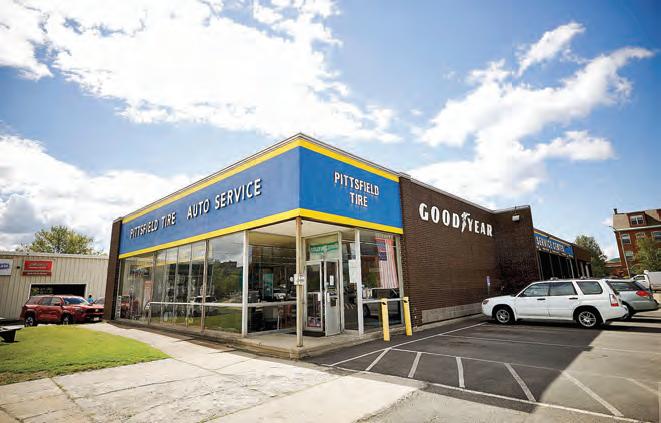
Around the 1960s, the original building was a victim of the wrecking ball of urban renewal. Goodyear then established a company store in the present location in 1969.
“They wanted to maintain their market share in the county,” Kuch said.
Then, in 1982, George Illingworth and Chuck Morrone, who worked for Goodyear in Boston, learned that their company planned to close the Pittsfield store.
They decided to leave the company, partner to buy the Pittsfield location and changed the name to Pittsfield Tire and Auto.
Four years later, they recruited Kuch, then a manager for Goodyear in Connecticut, to manage their independent business. Then, in 2001, they offered to sell Kuch the business and he said yes.
Kuch has noticed many innovations over the years, including the computerization of cars, with sensors to measure gas consumption at many points, from the engine to the tailpipe to the gas cap.
“That means new hardware, new software,” he said. “If you get new hardware, you got to do software updates, and it’s very expensive.”
He said labor rates have had to increase to keep up with the cost of technology.
“A lot of it has to do with who’s in the White House,” he said, recalling the 2009 Cash for Clunkers program, which was done to prop up the ailing auto industry.

“That was devastating to me, because we usually work on older cars,” he said. “They need tires, they need brakes, they need more maintenance than a brand new vehicle.”
A much more recent trend — the push for electric cars — has had a different sort of impact on tire sales.
“They were wearing out tires very quickly,” he said. “That was from the all the weight, because those batteries are very heavy.”
Eventually, car manufacturers engineered tires specifically for electric vehicles — wider tires that are designed to withstand that pressure with a low profile, which is vulnerable to pothole damage.
PITTSFIELD TIRE, Page 4


































Kuch isn’t making any predictions about the future of the self-driving car, but he has noticed this: “Some of the older people don’t like that,” he said. “They like to be in control.”
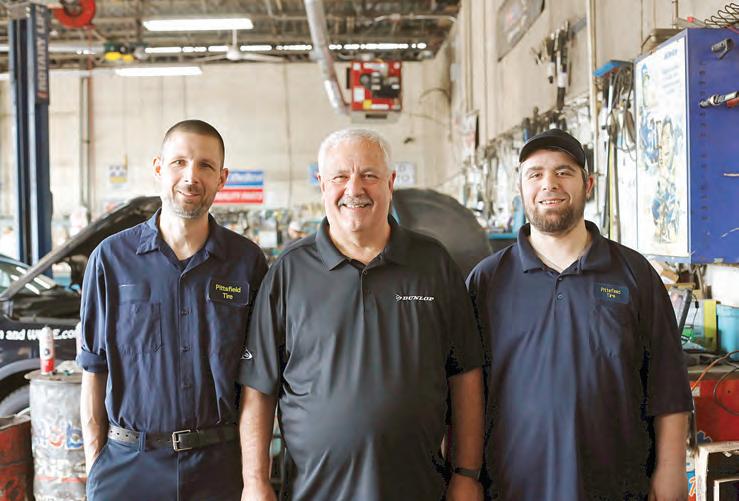
Kuch knows why his 11 employees have stayed at his shop for decades.
“We’re a family-oriented place,” he said. “I consider my crew family.”
Each of the employees has a key to the shop and they’re welcome to use the lift on Sundays to maintain their own vehicles. Kuch sells them parts at cost.
“Everybody gets a birthday card,” he said. “We have get togethers. We have store meetings where everybody’s opinion is welcome, any criticism is welcome.”
And those meetings grease the wheels of communication at the shop.
“There’s a lot of stuff that maybe I’m insulated to — there’s stuff going on I don’t know about, that’s the time it comes out,” he said.
Kuch estimates his customer base at 8,000 to 10,000 people. He turned $2.5 million in 2025.
“Nobody’s perfect,” he said. And if the shop makes a mistake, “We do whatever it takes to make it right.”
He said he enjoys his customers.
“Every now and then, you get somebody, but that’s normal in the course of business.”
Kuch was born in Waterbury, Conn. He grew up doing backyard mechanic work with his father, who was a U.S. Navy veteran of the 1930s and had been an aircraft mechanic on the biplanes of that day. His father later worked as a mechanic in a garage.
His first summer job was at the age of 14. He was a janitor at Long River Middle School in Prospect, Conn.
He saved $500 to buy a 1967 Ford Mustang, to this day his favorite car.
After graduating from Sacred Heart High School in Waterbury, he earned his associate’s degree from Mattatuck Community College and got a job in the Waterbury Goodyear.
He was promoted to retail sales management trainee and went to a Goodyear school for training in New Jersey.
“I had to go out and buy some clothes,” he said.
He was eventually promoted to store manager.
“Every time there was a store that wasn’t doing well, they would transfer me to that store,” he said. He did stints at Waterbury’s Goodyear, as well as in New Britain, Bridgeport and New London.
When Illingworth and Morrone reached out to him about managing their Pittsfield store, he gave notice.
Now 67, Kuch has a clear succession plan: his two sons, Jonathan on the business side and Steven in the shop. But he can’t seem to nail down a retirement date.
“Every two years, I keep saying I got two more years,” he said. “But I’ve been saying that for a long time.”

BOSTON
Beacon Bank branches
assist visually impaired
Beacon Bank is offering free access at all branches to Aira Explorer, an on-demand service that connects visually impaired users with live, real-time guides who provide assistance through a smartphone app using the device’s camera and microphone.
Available at the bank’s 145 branches and through its online and mobile banking platforms, the service helps users navigate branches, read statements, use ATMs, complete transactions, and access digital banking tools.
Calls are answered by trained professional visual interpreters who sign confidentiality agreements and follow strict privacy and security protocols. While Aira Explorer offers subscription plans, the service is available at no cost for anyone with a free or paid account while visiting any Beacon Bank branch or using the bank’s online or mobile banking services.
The app can be downloaded in the Apple App Store or Google Play Store and is also available through a desktop app and Meta glasses.
MountainOne delivers storybooks to teachers
In celebration of Teacher Appreciation Week, MountainOne recognized 75 first grade teachers across the Berkshires and South Shore with storybookthemed deliveries tied to its literacy and financial education Storybook Program featuring Mo the Spokesgoat.
Each package included copies of MountainOne’s original storybooks, “How To Climb A Mountain” and “Something To Save,” along with a new companion activity workbook with games, coloring pages and financial literacy activities. Teachers also received a tote bag, thankyou card and Mo the Spokesgoat plush for the classroom.
The Storybook Program brings MountainOne staff into schools for interactive readings, with students receiving books and activity materials along with a visit from Mo the Spokesgoat.
Deliveries were made to teachers in Pittsfield, North Adams, Williamstown, Quincy, Scituate, and Rockland.
PITTSFIELD
Hillcrest centers earn state AIM recognition
Hillcrest Educational Centers has received the 2026 John Gould Education and Workforce Development Award from Associated Industries of Massachusetts.
The private, nonprofit organization, which provides clinical, behavioral health and special education services for children and families in Berkshire County and across the Northeast, was honored during the AIM annual meeting May 7.
Founded in 1985, Hillcrest operates residential programs, the Hillcrest Academy therapeutic day school, Hillcrest Dental Care, and Berkshire County Kids’ Place and Violence Prevention Center. It serves children with complex psychiatric, behavioral and developmental needs, including autism spectrum disorders and employs about 550 people in Berkshire County.
The John Gould Education and Workforce Training Award, established in 1998, recognizes contributions to public education and workforce development in the commonwealth.
PITTSFIELD
Greylock credit union gives nonprofits $100K
Greylock Federal Credit Union has awarded special gifts totaling $100,000 to 10 nonprofits as part of its ongoing commitment and support of community partners. Each organization received $10,000.
The recipients include Elder Services of Berkshire County, Louison House, Childcare of the Berkshires, Volunteers
in Medicine Berkshires, Arts in Recovery for Youth, Soldier On, Greater Hudson Promise Neighborhood, Our Community Table, UCP of Western Massachusetts and Berkshire Pride.
Greylock’s leadership recognized the importance of awarding funds to organizations dedicated to providing human services amid current challenges.
Greylock Federal gives charitable contributions to more than 300 501©3 nonprofits that apply for grants and sponsorships annually.
PITTSFIELD
Berkshire Health Systems has announced that its three hospitals have been awarded Geriatric Emergency Department Accreditation by the American College of Emergency Physicians.
Fairview Hospital has held accreditation since 2022 and recently renewed its status. Berkshire Medical Center has been accredited since 2023, and North Adams Regional Hospital, which reopened in 2024 as a critical access hospital, was accredited in late 2025. All three hospitals were awarded Bronze Level Accreditation for three years.
BHS President and CEO Darlene Rodowicz said emergency departments are often the front line of care for older adults, and the accreditation reflects the BHS’ commitment to high-quality geriatric care. She noted the region’s above-average senior population and the team-based approach used in emergency departments.
The voluntary accreditation program recognizes emergency departments that meet best practices in geriatric care, including specialized training, screening for conditions such as delirium, dementia and fall risk, and access to geriatric-appropriate equipment and protocols.
PITTSFIELD
Co-op bank marks growth, key milestones at meeting
Pittsfield Cooperative Bank celebrated a year of growth and key milestones during its annual meeting May 19, where depositors also unanimously approved the bank’s planned merger with Adams Community Bank.
Board Chairman John Martin reported that the bank surpassed $400 million in total assets for the first time in its history. Over the past year, deposits increased by $15.2 million, loans grew by $48.4 million and total assets rose by $37.2 million.
The bank also was recognized by The Warren Group as Berkshire County’s No. 1 mortgage lender, up from No. 6 earlier in the year, and was named a top commercial lender in the Berkshires.
Officials said the bank’s growth was supported by investments in staff and technology, including the hiring of President Gregg Levante, senior leaders in both commercial and retail lending, and the addition of a chief accounting officer. The bank also upgraded systems to improve financial planning, credit risk oversight, operational efficiency and collaboration across the organization.
The meeting also marked the retirement of board Vice Chairman Edward Chagnon after 23 years of service. Chagnon, who chaired the bank’s Security Committee before becoming vice chairman in 2020, was recognized for his leadership and commitment to the institution.
PITTSFIELD PCTV, WTBR-FM win
Four programs broadcast in 2025 on Pittsfield Community Television and WTBR-FM won 2026 Hometown Media Awards from the Alliance for Community Media Foundation.
“Pittsfield Proud: Coaching Life with Jerome Edgerton,” produced by PCTV
staffer Tom Ciaburri, won the award for Educational Profile: Access Center Professional. The short video highlights the coaching style and personal history of Edgerton, Pittsfield High School’s basketball coach.
WTBR won the Sports Coverage, Live Competition: Community Radio award for its March 10, 2025, broadcast of the MIAA Final Four girls basketball semifinal. The award recognized Bob Heck’s live play-by-play call from Worcester State University.
PCTV’s production services group, ParkSquare Productions, won the Fundraising: Access Center Professional award for “NPC: Building Better Nonprofits,” produced by Tom Ciaburri and McCaela Donovan, associate director of NPC. The video highlights NPC’s support of local nonprofits.
Taconic High School’s Multimedia Production & Broadcast program won the Educational Activities: Community Radio award for an episode of “Taconic High School’s School of Rock” broadcast on WTBR-FM. Produced by students under the supervision of CTE teacher Jamie Choquette, the April 14, 2025, episode featured music centered on the themes of vacation, abandonment, love, and motion.
PITTSFIELD
The Berkshire Visiting Nurse Association has been named a Best Home Health agency for 2026 by U.S. News & World Report in its first-ever national evaluation of home health providers.
The Berkshire VNA earned the “high performing” designation, the highest level of recognition, for exceeding expectations in care quality and patient experience.
The rankings assessed more than 12,000 agencies nationwide, with just 17 percent receiving the Best Home Health designation.
U.S. News based its ratings on Centers for Medicare & Medicaid Services data, including care quality measures and patient experience surveys.
As part of Berkshire Health Systems’ continuum of care, the VNA coordinates with a patient’s providers to ensure that they are receiving the right care for their individualized needs, according to the BHS website. From infants to elders, it cares for patients of all ages.
PITTSFIELD
Credit union’s Shred Day raises $3K for United Way
Greylock Federal Credit Union’s annual Shred Day event May 16 resulted in the shredding of 47 bins of paper totaling five tons.
The event raised $3,028 for Berkshire United Way’s local initiatives and saved an estimated 35 mature trees.
Residents brought boxes of personal documents to United Way’s parking lot in Pittsfield, where VitalShred securely disposed of the materials.
Partnerships such as Shred Day are integral to the credit union’s mission and commitment to supporting the community.
DALTON
BMM makes USA Today list of top advisory firms
Berkshire Money Management, with offices in Dalton, Great Barrington and Williamstown, has been named to USA Today’s list of the Best Financial Advisory Firms 2026.
The award, presented by USA Today and Statista Inc., recognizes top registered investment advisory (RIA) firms in the U.S. based on peer and client recommendations and assets under management growth over 12 months and five years.
Eligible firms must be SEC- and/or state-registered RIAs with at least one year in operation, maintain a U.S. principal office, have a clean disciplinary record, provide financial planning or portfolio management services to individuals or small businesses, and manage more than $500,000 in assets under management.
NORTH ADAMS
NBCC marks 40th year with $40K for programs
The Northern Berkshire Community Coalition is marking its 40th anniversary with a “$40K for 40 Years” initiative, investing $40,000 in summer camp scholarships and end-of-year school celebrations across Northern Berkshire.
Funded through the Massachusetts Department of Children and Families’ Family Resource Center program, the initiative supports youth attending programs at the Berkshire Family YMCA, Williamstown Youth Center and Youth Center, helping ensure access to summer enrichment opportunities regardless of financial circumstances.
Funding was provided to several schools to enhance year-end celebrations and student recognition events. Information: 413-663-7588 or nbccoalition.org.
PITTSFIELD
Berkshire Place leader earns top Rotary honor
Edward Forfa has received the Paul Harris Award, the Pittsfield Rotary Club’s most prestigious honor.
The award recognizes club members for significant achievement and contribution. Forfa joined Rotary in 2000 and has served as club president, vice president and board member, as well as holding multiple committee leadership roles. He has also been active in several community organizations, including the Pittsfield Anti-Tuberculosis Association, Berkshire County Estate Planning Council and Elder Services of Berkshire County, and has volunteered in youth sports in Lee.
A licensed nursing home administrator, Forfa is executive director of Berkshire Place, offering short-term rehabilitation and long-term care; At Home with Berkshire Place, offering in-home care; and The Residences at 89 South, offering senior independent living.

Afreemonthlypublicationby TheBerkshireEagle 75SouthChurchStreet, Pittsfield,MA01201
Visitberkshirebusinessjournal.comfor advertisinginformationandtosubscribe.
NEWSDEPARTMENT 413-447-7311 news@berkshireeagle.com
ADVERTISINGDEPARTMENT
AMYFILIAULT,AdvertisingManager 413-496-6322 afiliault@berkshireeagle.com
CHERYLGAJEWSKI,Directorof AdvertisingSales 413-841-6789,413-496-6330 cmcclusky@berkshireeagle.com
ShareyournewswiththeBerkshire BusinessJournal. Ifyouhaveacompany promotion,anewbusinessoranewventure,let theBerkshiresknowaboutit.Rememberthe 5Wsandthatbrieferisbetter.Emailtextand photostoBBJ@newenglandnewspapers.com. ProvideyourexpertiseintheBerkshire BusinessJournal. Doyouhavetheanswer toapersistentquestionaboutbusiness andtheBerkshires?Doyouhaveideasand suggestionsonhowourbusinesscommunity cangrow?Ifyouhaveacommenttomake aboutdoingbusinessintheBerkshiresor ifyou’relookingtoraiseanissuewiththe businesscommunity,thisisthevenuefor that.Wewelcomelettersupto300wordsand commentaryupto600words.Sendtheseto BBJ@newenglandnewspapers.com
BerkshireBusinessJournalispublished monthlybyNewEnglandNewspapersInc., 75S.ChurchSt.,Pittsfield,MA01201. PeriodicalspostagepaidatPittsfield,MA01201. BerkshireBusinessJournalisdeliveredfree tobusinessesinBerkshireCountyviathird classmail.Additionaldistributionismade viadrop-offatselectareanewsstands.The publisherreservestherighttoedit,rejector cancelanyadvertisementatanytime.Only publicationofanadvertisementshallconstitute finalacceptanceofanadvertiser’sorder.All contentsarecopyrightedbyNewEngland NewspapersInc.



BY DYLAN T HOMPSON
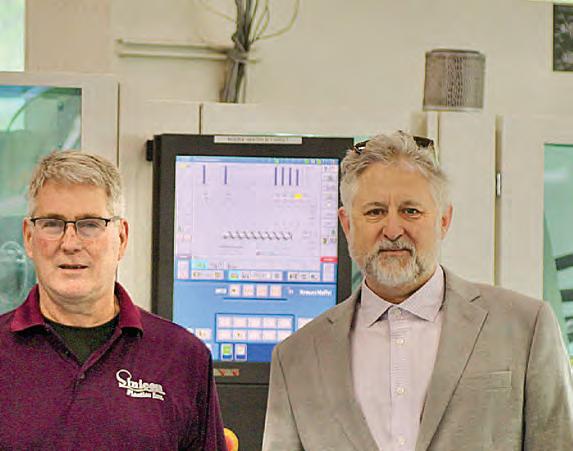
DALTON — For Sinicon Plastics President David Allen, saving a job is as good as creating one. With a new Tax Increment Financing Agreement in place with the town of Dalton, Allen will do both.
The expansion project will relocate 20 jobs from the company’s Lenox and Pittsfield shops to Dalton, and the company plans to create an additional five full-time jobs.
“If those companies had just closed, those jobs would’ve likely gone away,” Allen told The Eagle recently. “I’ve always felt that if we can go and save a job like that and keep that work in Berkshire County, that’s a big plus.”
The town of Dalton has entered into a Tax Increment Financing Agreement (TIF) related to an expansion project with DKA Realty and Sinicon Plastics. Sinicon intends to expand its business operations at the Dalton property, located at 455 West Housatonic St.
Sinicon

town meeting in May. David said it’s the third TIF agreement they’ve done with the town.
will relocate 20 jobs from its machine shops in Pittsfield and Lenox.
“It will be glorious,” said company Vice President Robert Allen, David’s son. “It will make everything a lot smoother and more efficient.”
The agreement was executed after town voters approved it at the annual
“When we first moved here, we got a TIF agreement with the town,” he said. “The town has been very supportive. They’ve always been good to work with.”
David bought the Dalton property in 2008, and the company moved from Pittsfield in 2010.
A TIF is a property tax incentive to encourage business investment and

development. It offers a phased tax exemption on the added value of a property, typically with a sliding scale that decreases over time.
The TIF agreement between Dalton and Sinicon will be in effect for five fiscal years, this month, and expiring on June 30, 2031. The exemption will be applied in decreasing amounts starting at 100 percent in the first year and ending with 20 percent in the final year.
Sinicon will also invest $5 million in renovations and improvements to the property in new construction and renovations. That is expected to be completed by June 30, 2027.
BY DYLAN T HOMPSON
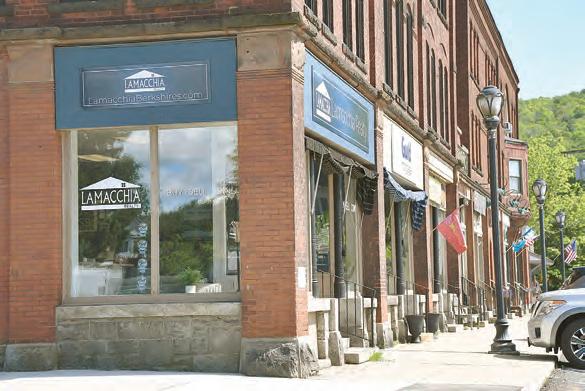
DALTON — Lamacchia Realty is expanding in the Berkshires with the acquisition of Steepleview Realty.
Lamacchia Realty announced the news in a release on its website last week. The acquisition expands the company’s presence in Berkshire County and enters it into the Vermont market.
“We’re very excited about it,” said Anthony Lamacchia, owner of Lamacchia Cos., in a phone call with The Eagle on Monday. “I love the Berkshires. It’s worked out extremely well for us. So many great people out there, and by acquiring this company, we’re just adding to that.”
Lamacchia Realty will expand its market presence in the Berkshires with Steepleview offices on Park Street in Adams and on Main Street in North Adams, as well as the current Lamacchia Regional Marketing Center on Depot Street in Dalton, according to the release.
“The Steepleview team is comprised of strong women who have worked tirelessly for almost 3 decades selling real estate in the Berkshires and southern Vermont,” said Jennifer Segala, broker and owner of Steeplev-
iew Realty, in the release. “This partnership was a perfect opportunity to add new energy, fresh technology and cutting-edge services for our customers.”
Steepleview Realty will bring 15 agents in the acquisition, along with Segala and Broker Associate Deb Trzcinski. Lamacchia confirmed that no jobs are lost with the merger.
“The more Realtors we have, the more business we do,” he said, “so we’re thrilled to have this additional influx of Realtors.”
Adding two “very legitimate” long-term offices in North County is exciting, Lamacchia said. He said he was unable to comment on the total cost of the acquisition, but said that it was “good for all parties.”
It’s also Lamacchia Realty’s 15th acquisition in New England in the past two and a half years, according to the release. The company, established over 20 years ago, entered the Berkshire County market with the acquisitions of Berkshire Dream Home and Home Sweet Home Realty in 2024.
Lamacchia Realty is a full-service, value-based real estate brokerage in Massachusetts, New Hampshire, Rhode Island,
Connecticut, Maine and Florida, according to its website.
It was also recognized as the top real estate company in the Berkshires by transaction in 2024, Lamacchia said. “This [merger] will take us to even higher heights, which is exciting.”
Steepleview Realty delivers real estate services to clients and communities throughout the
Berkshires and beyond. Founded by Segala in 1998, the company began with its flagship office on Park Street in Adams and has since expanded with a satellite office location in North Adams.
The company is recognized as one of the region’s leading real estate agencies, serving clients throughout the Berkshires, Vermont and Florida,
and it has achieved more than $600 million in closed sales, according to the release.
In a phone call with The Eagle on Monday, Segala said that she thought it was time for a merger and she wanted to see her company “being brought forward” into the future. She added that Anthony Lamacchia is the perfect partner and that both companies weave together well with their methodologies.
“I knew it was a good fit, but it’s even better,” she said.
Lamacchia, who is based in Waltham, said that the Berkshires is a “highly desirable place to be.” He added that it’s much more cost-effective than the rest of the state from an “affordability perspective for everyday buyers.”
He also confirmed that it is business as usual at Steepleview and that the merger will not impact all current listings and pending sales.
“With the energy and resources that Anthony and his entire company bring to the table,” Segala said, “I have no doubt that our legacy will carry on for many more decades to come.”


Mosttraditionalplaygroundsaredesignedforchildrenunderage12.Asaresult,manyyouthlose accesstoengagingrecreationopportunitiesduringtheyearswhenphysicalactivity,confidence, connection,andmentorshipmattermost.Onlyabout1in4childrenages6–17gettherecommended 60minutesofdailyphysicalactivity,andmanyteensareincreasinglyfacingchallengeswithphysical inactivity,limitedrecreationalopportunities,lackofconfidence,andsocialisolation.
NeighborhoodNinjasbelievesmovementcanbepartofthesolution.FoundedbyNinjaWarrior athletes,educators,socialworkers,coaches,andhealthprofessionals,NeighborhoodNinjasuses obstacle-basedprogrammingtohelpyouthandfamiliesbuildconfidence,resilience,connection, andhealthycopingskillsthroughmovementandmentorship.
Since2018,thenonprofithasbeenprovidingobstacle-basedscholarshipandmentorshipprograms, alongwithfree,trauma-informedandstrengths-basedprogrammingtohelpyouth,families,and adults-particularlythosefacingsocial,emotional,oreconomicbarriers-tobuildconfidence, connection,growthmindset,andresilience.

Creatingconfidence,resilience, connection,andopportunityfor BerkshireCountyyouthand families-oneobstacleatatime

In2024,theybuilttheirfirstNinjaFitPlaygroundinWilmington,DEandtheimpactontheregion hasbeenincredible.Morethanjustaplayground,NinjaFithasbecomeavibrantcommunityhubfor communityconnectionandrecreation.
InspiredbythesuccessofNinjaFitWilmington,theTownofLeeandLeeYouthCommissioninvited the organizationtobringtheconcepttoBerkshireCounty.Theplaygroundwillbelocatedatthe Lee AthleticField,andprovideafree,year-rounddestinationwhereyouth,teens,youngadults,and familiescanchallengethemselves,stayactive,andbuildmeaningfulconnectionsastheyovercome obstaclestogether.
Freeopportunitiessuchasdiversionprogrammingforyouthinvolvedinfostercareandjuvenile justiceprograms,classesformomsandseniors,familyfundays,communitycompetitions,and afterschoolprogramswillcontinuetosupportyouthdevelopment.
By creatingopportunitiesformovement,mentorship,connection,confidence-building,and positivepeerrelationships,theplaygroundwillserveasapreventativeinvestmentinthelong-term healthandwellbeingofBerkshireCountyyouthandfamilies.
ACommunityBuildDayisplannedforAugust8 anda GrandOpeningCelebrationwillbe 9amonAugust22,2026- Afamilyfriendlyevent,featuringcoachingandautographsfrom NinjaWarriorathletes,speakers,familyactivities,communitypartners&vendors,media coverageandmore-connectingthecommunitywiththespacefromdayone!


ThankstolocalbusinessesandorganizationssuchasTheTownofLee,TheLeeYouth Commission,BeaconBank,SweetwoodofWilliamstown,TableauxWealth,LeeBank,Berkshire UnitedWay,LeeKiwanis,andmanymore
Wehavealreadyraised$260,000ofthe$290,000tobringthisprojecttolife!
Only$30,000LEFT tomakeBerkshireCounty'sfirstNinjaFitPlaygroundarealitythissummer!
Businessesandcommunityleadershaveanopportunitytoleavealastingimpactby supportingfreecommunityprogramming,orhelpingfundthefinalphaseofconstruction.
Fora$5,000sponsorship,yourbusinesswillbe permanentlyrecognized atBerkshireCounty'sfirstNinjaFit Playgroundthroughdedicatedobstaclesignage featuringyourcompanylogoandwebsiteQRcode.creating permanentrecognitionatacommunitydestinationthatwillserveyouth,families,andvisitorsforyearstocome. Additionally,sponsorsreceiverecognition,marketingandpromotionalboothopportunitiesattheCommunity BuildDay,GrandOpeningandallmajorcommunityevents.
ScantheQRcodetoSPONSORANOBSTACLEandhelpbringBerkshireCounty'sfirstNinjaFitPlaygroundtolife. Forquestionsoropportunitiestocustomizesponsorshipopportunities,ortosendadonationbycheck,please contactNeighborhoodNinjasExecutiveDirector,AlexKatz:alex@neighborhoodninjas.org

SPONSOR AN OBSTACLE!


By C larenCe Fanto
LENOX — The new Sugar Magnolia candy emporium on Church Street isn’t your ordinary sweet spot.
The owners, Dan and Amanda Weil, aim for a feel-good haven not only for kids but also for the young of heart.
“I’m an 8-yearold stuck inside a 50-year old man’s body,” Dan Weil confessed. “We wanted to make this a magical place.”
The store is open seven days, 10 a.m. to 10 p.m. except until 6 p.m. on Sundays and Mondays.
“We’re learning every day what people like, how they shop and how to interact with customers,” Weil said. “It’s important that the locals buy into us and feel good about this.”
“We wanted to make this a magical place.”
Dan Weil, Sugar Magnolia co-owner
Sugar Magnolia — named for a 1970 Grateful Dead song — puts candy bins at eye-level for youngsters so “they imagine they’re running through a forest of candy. They see at least 320 bins, the biggest bin selection, I think, in the Northeast,” Weil said.
It’s all priced by weight: $6.28 per quarter-pound, $25.12 for a pound.
The couple has a long-term lease on the 51 Church St. site set back but with roadside signage. The location has hosted an ice cream parlor (Scoop), a candy shop (Sweet Dreams) and most recently, Shire Donuts, still open in Dalton.
Weil emphasized that he’s in it for the long haul after developing a 150-page business plan in January and securing financing from the global Morgan Stanley financial firm. He did not disclose start-up costs.
He’s putting in 12 to 15 hours days while running his international company shipping U.S.-produced gas to Asia.
There are free video games on the porch, with no purchase required.
“We want to create a space where kids feel comfortable hanging out in a place that’s welcoming and happy,” Weil said.
He detailed his early-career background as a venture capitalist and as “a serious entrepreneur who started seven businesses. We really prepared and did a ton of research before we put a penny into the ground here.”
“We’ve always been candy-holics and the idea dawned on us to do this, since there’s nothing quite like it around,” Weil said. “We’re all in. It’s a happy business, a good one if it’s done right. People walk in, they’re happy and I get to spend my day around people who are smiling.”
The couple, originally from northern New Jersey, lived in Hong Kong for more than 10 years while Dan was a banker in and out of China before starting the gas shipping company. They relocated to Stockbridge in 2013 and then to Lenox four years ago. Amanda Weil’s parents, Joel and Patricia Ellis, are longtime Stockbridge residents.

Co-owners Dan and Amanda Weil recently opened the Sugar Magnolia candy emporium, selling bulk candy by weight from over 320 unique bins. “We wanted to make this a magical place,” said Dan Weil, who began his career as an investment banker and still runs an international gas shipping company.
“I’m a shipper investment banker,” Weil said. “I’ve got the gumption for my first retail venture, whether I’ve got the smarts for it remains to be seen. Approach life with humility or humility will be taught to you. We’re brand new to all of this.”
Weil is the president, but “I work for and report to the CEO, my wife who handles marketing,” he noted.
The only other “staff” at the store is Teddy, “the chief happiness officer.” He’s the couple’s Goldendoodle, “the official greeter and purveyor of joy,” Weil explained.
That’s the vibe the Weils seek
to create, even though their shop is remarkably high-tech, especially for a candy store.
In order to track inventory and what customers prefer in the bins, Weil explained that he has cameras set up, not for surveillance but to connect to an artificial intelligence program he wrote recently.
Each bin is monitored to provide a daily report on what’s been sold. The AI program connects the inventory system and soon, sensors will be installed on each bin soon for precise measurements by weight.
“I want my candy to be perfect,” Weil said. So, with the
aid of humidifiers, climate control monitors ensure 40 percent humidity and temperatures between 64 and 67 degrees at all times.
“So the candy is not stale, it’s got the right chew,” he pointed out. “AI is the greatest productivity enhancer I’ve ever encountered, it’s amazing.”
His bottom line: “I want people to smile when they walk in, and smile more when they walk out. I want them to feel totally comfortable in the shop. We’re trying to create something as an oasis since the world is so crazy right now.”
By Dylan T hompson
PITTSFIELD — Have you noticed people running laps around the Berkshire Carousel and Big Y?
That’s because CrossFit Pittsfield, a CrossFit-affiliated gym, has moved from its former East Street location to West Street.
The fitness center, now located at 113 West St., has grown its client base and co-owner Jamie Law says the new space is a better fit for fitness classes. It was previously located at 505 East St.
“Now we have this amazing community, and we’re trying to give as good or a better experience than the other space,” Law told The Eagle.
CrossFit Pittsfield, which opened in 2013, is now the only CrossFit-based gym in the Berkshires, co-owner Erica Law said.
The gym is co-owned by the Laws and Susan Rathbun, Erica’s mother. They currently have a client base of roughly 90 to 105 members, and Erica said that about 60 to 70 people work out with them consistently every day.
CrossFit workouts combine functional movements, strength training, and cardio in dynamic, high-intensity group sessions, according to the CrossFit website.
Community is a big draw for CrossFit, Erica said. Jamie added that the results show that it “works better than any fitness.”
The gym currently offers group fitness classes and private training with a staff of six trainers.
Erica said they are looking to expand their class offerings, as

Members of CrossFit Pittsfield do a workout with Erica Law at the new location 113 West St. The gym, which opened in 2013, has strived to help the community meet its fitness goals.
they currently offer only CrossFit classes. There are six adult classes a day, and the gym is open seven days a week.
Although some think CrossFit is intimidating, Erica said that it couldn’t be farther from the truth. “We’re all so close because of this,” she said.
Erica said they made the decision to look for a new location about a year ago when their lease was up on East Street. The West Street building purchase became official on Jan. 1, and
LEARN MORE
Email CrossFit Pittsfield at info@ cfpittsfield.com or stop by the location at 113 West St.
renovations began in March. It was a complete renovation to create the gym setup, and Erica said that there “hadn’t been anybody in here for over 10 years.” The building was previously an auto parts store. They had to build a new

foundation, showers and toilets among other renovations. Jamie said it was a “total gut.”
The new location, roughly 5,100 square feet, has been open for a little over two weeks, and Jamie said they’re still in the process of moving stuff around.
Erica said the location is the complete opposite of the previous spot, which was a basement.
“We have so much light,” she said. “We have all these doors, so it’s different for us, but it’s wonderful.”
The new location, next to Pittsfield Tire & Auto Service, also provides “crazy visibility” for the gym, Erica said.
The Laws and Rathbun all began CrossFit training roughly 20 years ago at Berkshire County’s first studio, CrossFit Great Barrington. The Laws, who have been married 15 years, have also been trainers in various capacities for over a decade.
Jamie is also a Pittsfield firefighter, a role that provides immediate action for him. He describes the training role as more for the “long-term game.”
The Eagle recently shadowed a workout led by Erica, which featured rows, box jumps and squats among other exercises.
Music was playing, and Erica was high energy, giving out instructions and pushing her clients in the hourlong workout. The workout was a safe space as she and the attendees talked about their lives, made jokes and pushed one another.
Erica has an equal balance of showing her sense of humor before quickly shifting into serious mode to make sure the attendees feel the workout burn.
The gym offers an unlimited membership for $199 a month, $160 for first responders and an option of 10 classes for $199.
Despite the new location, the goal remains the same at the gym.
“We have a fair amount of people and just keeping those people moving and happy and healthy,” Erica said. “That’s what we’ve done this whole time now; just kind of keeping everybody going.”






By C larenC e Fanto
LENOX — For longtime local restaurateur
Molly Lyon-Joseph, her third venture is her most personal.
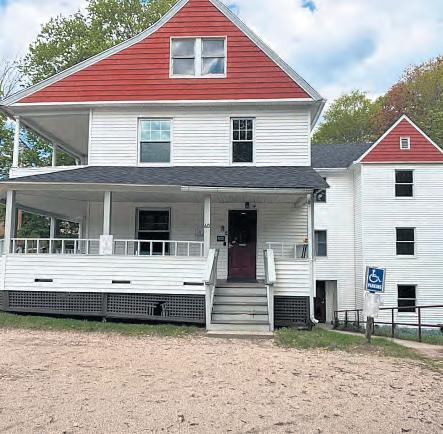
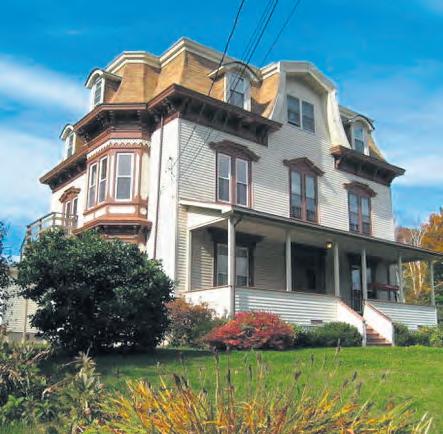
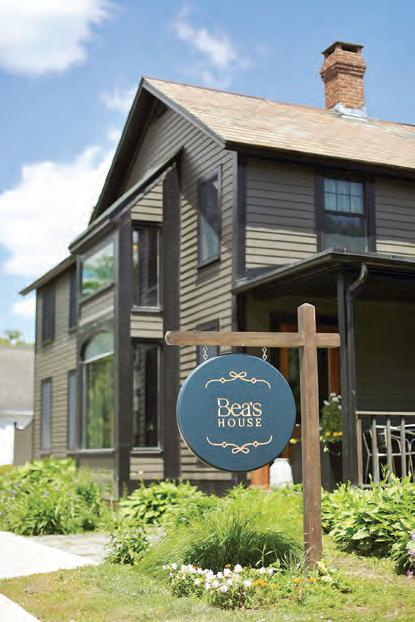
Bea’s House — her middle name and a reflection of the reimagined restaurant’s down-home vibe and atmosphere — is in a modernized 1853 building, originally the James Stanley House, on Church Street.
It became an antiques shop in 1975, followed a few years later by Honey Sharp’s Art Gallery and the Ganesh Cafe, then Jim Lucie’s and Nadine Atalla’s popular Cafe Lucia from 1983 to 2021.
Lyon-Joseph and her partners purchased the site from former crypto executive Ryan Salame in February 2024 for $625,000.
“Atmosphere is key to how I like my restaurants and approach them,” said Lyon-Joseph, a proprietor in Lenox for nearly 19 years. “The feel you get as you walk in is really important such as the lighting. I really wanted a timeless, classic, homelike feel like a Paris bistro — you can feel the history.”
Describing the cuisine as “contemporary New American,” Lyon-Joseph notes “a seasonally changing, classic timeless menu” with a grilled shrimp cocktail, homemade pasta, lamb kofta, Arctic char fish, an old-fashioned sundae — “recognizable favorites that have been elevated with a modern twist, mostly made in-house.”
With the chef Jorge Rivadeneyra, her goal was to create a distinctive dining experience, something unique in Lenox.
Work by her father’s company — William Lyon & Son Carpentry — reflected Molly’s desire for a “deep dive” to re-create some of the 1853-style, Victorian age window trim and a Parisian influence in the bar.
“I was really explicit about the details I wanted,” she said.
“Now that it’s come to life, each room really has its own feel, almost like a home would,” Lyon-Joseph said, referring to the bar, the traditional main floor dining room and the cozy, intimate upstairs space. “People are loving the vibe up there.”
“It’s been a long project, almost two years to get to the finish line,” she said. “My dad did such an amazing job with the fine details. I’ve been decorating with old storybooks, photos and paintings I found in my grandparents’ house. Everything else has been collected from my travels. I love vintage shopping.”
Including those three areas and the outdoor awning-covered porch, Bea’s House can seat 110 patrons.
“I’m really proud of the way the design came out,” Lyon-Joseph said. “It was truly my creation, very personal, and to see people enjoying it and loving the atmosphere feels really great, like my goal is accomplished.”
Owning three restaurants — including Frankie’s Ristorante and Pizzeria Boema nearby on Main Street — could be a heavy lift. But Lyon-Joseph credits her “rock-star management team” and the ability to promote leaders like Jane Burns, who is not only the mixologist at Bea’s House but is now creative director and beverage direc-
Additionally, the company is planning an estimated $1 million in new capital equipment, expected to be in place by the end of fiscal 2028.
Sinicon will relocate 20 jobs from its machine shops in Pittsfield and Lenox. The company purchased the Pittsfield shop in 2019 and the Lenox location in 2021. It currently has roughly 65 employees between its three locations.
Robert said the company will be expanding its current location by an additional 30,000 square feet, at the front end of the building. The expansion will consolidate operations under one roof, and Robert said the property will grow to roughly 72,000 square feet.
David said that the bulk of the project is the construction of the building, but it will also purchase CNC machines and other machines that cut metal. The

of the building’s 1853-style, Victorian age window trim and a Parisian influence in the bar.
tor for all three establishments, and Kathryn Whitney, general manager at Bea’s.
Total employment at Bea’s is 35 to 40 in the summer. Dinner will be offered six nights a week in the off-season.
Inflation has created more challenges for restaurant owners, Lyon-Joseph acknowledged, along with the “extended election year” with diners “more intentional” and less likely to order a second drink.
“I’m not worried in the long run,” she said. “Everyone needs a red-sauce Italian place, a pizza joint, and to be able to go and find community, getting something to eat where they feel comfortable and taken care of.”
At Bea’s House, “we want our hospitality to shine through where you feel truly welcome.”
For the cost, she said, “we want to make sure you’re getting the full experience and not just being served food.”
company has invested roughly $4 million in additional machining capabilities since 2020.
On the creation of five additional jobs, David said that it will “probably be more, but you got to be conservative on that.” The company has also been hosting co-ops and recently had two students from McCann Technical School in North Adams.
Robert said that one of thsoe students is going off to college and the other is remaining with the company full-time.
“That’s how we’re hoping to fill the pipeline, just partnering up with places like McCann or Taconic and trying to get kids started in this industry young,” he said.
Sinicon was founded in 1968 by Tony Sinico, and David purchased the company in 1989. When David bought the company, there were seven employees and eight machines located in an old, 5,000-square-foot textile mill.
The company has evolved into a lead-
ing manufacturer and has a customer base of roughly 100 that includes General Dynamics, Siemens Healthineers and Lenco.
“It’s very satisfying to grow something like that and know that you’re contributing to the community and helping give jobs to people,” David said.
Sinicon provides custom molded parts made from specialty engineering resins for medical, military, aerospace and industrial applications. It also ships over 20 million parts per year with a 0.15 percent return rate.
Robert said that most of the company’s plastics work is for medical uses, with the bulk of that going to lab diagnostics machines. David added that some of the equipment it builds parts for is used at Berkshire Medical Center.
David said that everything the company makes is a component part, and it makes them for diagnostic laboratory equipment and night vision applications, among other products.
What: Bea’s House, serving “New American Cuisine” in a reimagined, home-like atmosphere.
Where: 80 Church St., Lenox, formerly Cafe Lucia. Parking in adjoining lot.
When: Closed on Wednesdays, the restaurant is open Thursdays, Sundays and Tuesdays from 4:30 to 9, Fridays and Saturdays from 4:30 to 9:30, and lunch on Saturdays and Sundays from 11:30 to 2:30.
Menu: Shareable snacks, appetizers and salads, $8-$20; mains $26 to $45; desserts $11 to $16.
Reservations: beashouse.com or 413-551-7114. Bar seating first-come, first-served. Some tables held for walk-ins.
Events: Available for small gatherings and special occasions. Details: beahouse.com/events/
When asked about the family relationship, Robert said he and his father mesh well and both have laid-back personalities. He added that most of the time, David is at the Dalton location, and he is at the Pittsfield shop.
Robert started full-time at Sinicon in 2012 after graduating from college, but said that he had worked there in the summer his whole life. The generation link continues as Robert’s son, Parker, has also taken an interest in the business. Robert joked that Parker is the “construction manager.”
David said that Robert will eventually take over the company and that it’s “good to keep it in the family.”
The Allens enjoy the work they do.
“It shows you how much goes into everything in a day-to-day life that you don’t get to experience without being in manufacturing,” Robert said. “It kind of helps you appreciate it.” Dylan Thompson can be reached at dthompson@ berkshireeagle.com or 413-496-6105.





One participant recently described the purpose of TechAMP better than any brochure or curriculum guide ever could. He said the program helped him learn to “speak both languages” — the language of the shop floor and the language of management.

As the Berkshire Innovation Center prepares to celebrate the graduation of the first cohort of the Technologist Advanced Manufacturing Program (TechAMP) on July 29, that simple observation captures much of what the past year has been about.
When we launched TechAMP in partnership with MIT, our goal was ambitious: create a pathway for experienced technicians and operators to develop the technical, analytical, and leadership skills needed to become technologists — professionals who can bridge the gap between engineering, operations and continuous improvement. Today, as the inaugural cohort completes its capstone projects and prepares for graduation, we are beginning to see what that transformation looks like in practice.
Over the past year, 13 participants representing 10 regional employers have worked through MIT-developed curriculum focused on systems thinking, process improvement, leadership, communication and advanced manufacturing technologies. Participants from organizations including General Dynamics Mission Systems, Boyd Biomedical, Sinicon Plastics, Interprint, Hi-Tech Mold & Tool, Instrument Technology, Unistress, Noble Carbon, NE-XT Technologies, and Tourists have spent the year not only learning new concepts but applying them to real-world challenges within their own organizations.
That work will culminate on July 29, when participants

During the first TechAmp cohort at the
instructors created a “lab of doing” — a hands-on environment where participants didn’t simply absorb concepts but practiced and
present their capstone projects before colleagues, supervisors, family members and friends. The presentations will highlight how they have applied the tools and perspectives gained through the program to improve processes, strengthen communication, solve problems, and create value within their workplaces.
As we spoke with members of the cohort about their experiences, several themes emerged. Many talked about gaining new technical skills, whether through data collection and analysis, process mapping, statistical process control, or emerging technologies. Just as often, however, participants spoke
about confidence —confidence to ask better questions, confidence to engage with engineers and managers, and confidence to contribute ideas that can drive meaningful improvements.
One participant described learning how to support observations with data rather than instinct alone. Another spoke about becoming a more effective supervisor by better understanding the motivations and communication styles of employees. Others reflected on learning how to approach problems more systematically, identify root causes, and resist the temptation to jump directly to solutions.
What stood out most was how
frequently participants discussed communication. Several spoke about gaining a better understanding of the challenges faced by departments outside their own. Others described learning to translate ideas across functional boundaries, helping engineers, operators, maintenance personnel and managers work more effectively together. That ability to connect perspectives and understand systems is at the heart of what MIT envisioned when it designed TechAMP.
Much of that experience, according to Dennis Rebelo, our chief learning officer, was shaped by the way the sessions
themselves were designed and delivered. Rebelo points to key instructors Rich Peters and Jarod Lebos, who he says helped ensure that the curriculum created a “lab of doing” in our sessions — a hands-on environment where participants didn’t simply absorb concepts but practiced and applied them in real time, which is what made the learning stick.
The program was never intended to turn technicians into engineers or replace the expertise that participants already bring to their organizations. Rather, it was designed to help experienced professionals broaden their understanding of

If you’ve ever carried your job home with you, you already understand a version of this story: An executive director finishes a late-night board meeting, glances at a budget that still doesn’t balance, and opens an email from a funder cutting next year’s grant. She falls asleep thinking about payroll, vacancies and the people who rely on their programs, and then wakes before dawn with the same worries. The human cost of this treadmill is real.
Samantha Anderson
I’ve spent decades working in the nonprofit and philanthropic sectors, and I am also a board-certified health and wellness coach. Burnout is not a theoretical topic for me; it’s a daily reality I encounter in conversations with executive directors, program staff and board members alike.
Recent data from the Center for Effective Philanthropy’s State of Nonprofits
2026: What Funders Need to Know backs up what many of us have felt for a long time: nonprofit burnout is not only real, it’s accelerating. According to the survey, 46 percent of nonprofit CEOs now say their own burnout is “very much” a concern, up from just under 30 percent in 2025. Nearly nine in 10 express at least some concern about burnout, and about one in four say it is significantly affecting their staff.
BEHIND THE NUMBERS:
A SECTOR UNDER STRAIN
CEP’s findings reveal just how challenging the landscape has become for nonprofit leaders. In addition to growing worry about their own burnout, CEOs report rising concern about staff well-being and safety, with roughly 25 percent saying burnout is significantly affecting their teams, up from 17 percent a year earlier.
All of this is unfolding in what CEP calls the “current context”: a mix of policy changes, budget decisions, and political signals since 2025 that have made the operating environment more uncertain.
Nearly two-thirds of CEOs now say they are concerned about their organization’s financial stability, and the share of nonprofits running budget deficits has climbed from 22 percent to 39 percent over the past four years.
At the same time, demand for services keeps rising. Close to three-quarters of nonprofits report increased demand since early 2025, even as their revenue has become more unpredictable, and many leaders note cuts or delays in both foundation and government funding.
According to the a survey by the Center for Effective Philanthropy, 46 percent of nonprofit CEOs now say their own burnout is “very much” a concern, up from just under 30 percent in 2025.
In short, leaders are being asked to do more, for more people, with less predictability and fewer resources. Under those conditions, it is no surprise that burnout is rising.
BURNOUT IS A SYSTEM DESIGN PROBLEM Too often, burnout is framed as a personal problem. The assumption is that if nonprofit leaders simply managed their time better, practiced mindfulness, or learned to say no, they could solve their own burnout. In our sector, that narrative is not only inaccurate; it is harmful. Nonprofit burnout is often the predictable result of chronic financial instability, underinvestment in people and infrastructure, and impossible-to-meet demands. Organizations are expected to produce transformational outcomes while operating on razor-thin margins, short-term grant cycles, and

I recently met with a 71-year-old retiree who relies on Social Security for a sizable share of her retirement spending. She’s concerned about recent news that the Social Security trust fund will run out in 2032 — just six years from now. Having read the headlines, she is now worried she’ll lose much of her retirement benefits. In truth, payroll taxes will be enough to pay 78 percent of scheduled Social Security benefits. That means the worst case is that she’ll face a 22 percent reduction in benefits, something we could accommodate in her financial plan. But it shows how common misconceptions can cause us unnecessary stress and lead us to such fear-based decisions as living well below our means. In my years as a financial planner, I’ve found that concerns tend to cluster around a handful of notions that are partially wrong at best. They include:
1. SOCIAL SECURITY WON’T BE THERE FOR ME.
While Social Security faces a funding shortfall, the program also collects payroll taxes every year and has enormous political support. Even under the most pessimistic projections it will pay roughly 80 percent of promised benefits (per above) without any changes to current law. Congress has adjusted Social Security before and will almost certainly do so again. Plan for it as part of your retirement income — don’t assume it won’t be there for you.
2. I DON’T NEED A LONG-TERM CARE PLAN BECAUSE I’LL STAY IN MY HOME.
According to the Center for Retirement Research, about 80 percent of retirees will require some form of long-term care. Staying home may be a reasonable goal for some, but home health aides cost a median of $75,500 per year, and not everyone can remain at home as their care needs intensify. Only about 4 percent of long-term care in the U.S. is covered by insurance. Without a plan, many households are forced to draw down their savings and ultimately fall back on Medicaid. Don’t confuse a preference with a plan.
3. MEDICAID WILL COVER MY LONG-TERM CARE COSTS.
Related to No. 2, many people come to me with the belief that they can protect their assets even if they end

up needing expensive long-term care.
Medicaid does cover long-term care, but only once your assets are nearly gone. In many states a single applicant owning more than just $2,000 in eligible assets will not qualify for Medicaid. While you could give assets to family or place them an irrevocable trust, that leaves you in a precarious financial position. And not all nursing homes accept Medicaid, which severely limits your options.
Bottom line, I generally advise people against getting rid of all their money in order to qualify for Medicaid.
4. NOW THAT I’M RETIRED, LONG-TERM INVESTMENT RETURNS NO LONGER APPLY TO ME.
When I describe stocks as a “long-term” investment, retired clients often tell me that they “don’t have a longterm.” While I can’t predict how long anyone will, I often disagree.
If you retire at 65, your planning horizon is potentially 25 or 30 years. A dollar you won’t spend until age 85 has two decades to lose its value to inflation if left in cash, or to grow if invested in stocks. Abandoning stocks in favor of cash or low-yielding bonds may feel safe but it introduces the real risk of outliving your money. Not only that, you may have other objectives for your investment portfolio beyond providing annual spending in retirement. You may be saving for long-term care or for your


heirs, which in either case it may make sense to maintain a moderate or even aggressive allocation.
A well-diversified portfolio that includes stocks remains appropriate for most retirees, even as the allocation shifts slightly more conservative with age.
5. I SHOULDN’T SPEND FROM PRINCIPAL.
Many retirees live unnecessarily frugally because they’re committed to spending only the interest their portfolio generates. The dividend rate of the U.S. stock market has collapsed in the 21st century, and most people can’t count on dividends and income to cover expenses. Your retirement portfolio is not a savings account or an endowment whose principal can’t be touched. Its purpose is to fund your retirement. A sustainable withdrawal rate of 3.5 to 5+ percent allows you to spend thoughtfully without running out of money.
6. MY TAXES WILL BE LOWER IN RETIREMENT.
Many people assume their tax burden drops when they stop working. That’s often not the case.
If you’ve spent decades saving in a traditional 401(k) or IRA, every dollar you withdraw in retirement is fully taxable as ordinary income. Add Social Security income and required minimum distributions, and some retirees find themselves in a higher bracket than expected. This is one reason Roth conversions — paying taxes now to avoid them later, while earning tax-free growth — deserve serious consideration in the years before or early in retirement, especially while you’re still in a lower bracket.
7. I NEED TO HIT A SPECIFIC NUMBER, LIKE $1 MILLION, TO RETIRE.
Target savings amounts feel concrete, but they can mislead as often as they help. Whether $1 million is too much or not nearly enough depends almost entirely on how much you spend. A retiree spending $40,000 per year with Social Security covering half that amount needs a very different nest egg from someone spending $120,000 with no pension. Focus on your spending needs and income sources first. The right number follows from that. The common thread running through all seven of these misconceptions is fear. Fear of running out, losing benefits, or making the wrong move. These fears often nudge people toward overly cautious choices. Getting the fundamentals right matters more than getting everything perfect.

For many consumers, the Fourth of July means barbecues, parades and fireworks. It also marks one of the biggest sales events of the year for car buyers.’

Dealerships often use the holiday weekend to offer special financing, cash rebates and manufacturer incentives designed to move inventory before new model years arrive. And those deals typically extend well beyond the holiday itself.
While the advertisements can be tempting, the best deal isn’t always the one with the biggest discount. Before heading to the dealership, take time to determine how much vehicle you can comfortably afford. A good rule of thumb is to keep your total transportation costs — including your car payment, insurance, fuel, and maintenance — within your monthly budget without sacrificing savings or other financial goals.
One of the smartest steps you can take is securing financing before you shop. Getting pre-approved through your local bank gives you a clear understanding of your budget and often strengthens your negotiating position. It also allows you to compare dealer financing offers against rates you have already secured. Before shopping, check your credit score and review your credit report. Knowing where you stand can help you understand what financing options may be available and allow you to correct any errors that could impact your loan terms.
If you plan to trade in your current vehicle, research its value beforehand using resources such as Kelley Blue Book or Edmunds. Knowing what your vehicle is worth can help you negotiate more confidently and ensure

you’re receiving a fair offer.
When evaluating promotions, pay attention to the details.
Dealers may advertise either low-interest financing or cash rebates, but in many cases you must choose one or the other. A larger rebate isn’t always the better value if you end up paying a significantly higher interest rate over the life of the loan. Taking a few minutes to compare the total cost
One of the smartest steps you can take is securing financiwng before you shop.
As you compare vehicles, remember to consider the total cost of ownership. Insurance premiums, fuel costs, maintenance expenses, registration fees and repairs can vary significantly between models. A vehicle with a slightly lower purchase price may end up costing more over the long run.
Be cautious when reviewing optional add-ons such as extended warranties, service contracts, paint protection packages, GAP coverage, and other dealership products. Some may provide value depending on your situation, but others can significantly increase the cost of your purchase. Ask questions and understand what you’re buying before agreeing to additional products or services.
Before signing any paperwork, review the financing agreement carefully. Make sure the interest rate, loan term, vehicle price, and any fees match what was discussed. Don’t be afraid to ask for clarification if something doesn’t look right.

of each option can save hundreds — or even thousands — of dollars.
It’s also important to focus on the overall purchase price rather than just the monthly payment. Dealers can often lower monthly payments by extending the loan term, but longer loans typically mean paying more interest over time and can leave you owing more than the vehicle is worth for an extended period.
Finally, don’t feel pressured to make a decision on the spot. A vehicle is one of the largest purchases many families make. Take time to compare offers, review financing terms, and ensure the purchase fits comfortably within your financial plan. Just because you qualify for a larger loan doesn’t mean you should take it. Choosing a payment that leaves room for savings, emergencies and other financial goals can help set you up for long-term success.
This July, enjoy the excitement of holiday sales — but remember that the best automotive deal is one that fits both your transportation needs and your long-term financial goals. A little preparation before you shop can help ensure your next vehicle purchase is something worth celebrating long after the fireworks fade. Ray E. Smith is the senior vice president, marketing and communications at Pittsfield Cooperative Bank.









There is a particular kind of satisfaction that comes from opening a store and watching the neighborhood walk in like they have been waiting. That has been the experience during the first month of business for our new store that just opened on South Street in Pittsfield across from Guido’s Fresh Marketplace. Customers from Dalton, Adams, Lanesborough, even communities stretching north toward North County, have been showing up on their side of the county instead of making the drive down Route 7 to Lee to our flagship store. Many have shared that they had been hoping for this, and that’s due to having built a customer base you build person by person, in a community that was ready.
But in Massachusetts cannabis, expansion looks considerably cleaner from the outside than it does from the inside. And I think the cannabis business community in the Berkshires, be they operators, advocates, or anyone watching this market, deserves a more honest picture of what it actually takes in order to appreciate and understand it.
Pittsfield has been on our map for years. This is not a move we made impulsively. Our customers in Lee had been telling us something simply by their loyalty and making the trip from the city to our north (and the areas beyond it). When people drive a half hour or more to your store, week after week, that is not loyalty born from convenience but rather a signal worth acting on. This would extend to any retail organization but it’s especially true for cannabis in the Berkshires.
The decision to open a third location is also a statement about what we believe this community deserves. Pittsfield is a city, not a weekend destination or a collection of seasonal attractions. Real residents, real budgets, year-round traffic that comes to South Street every day.
We wanted to bring the full Canna Provisions experience to
FROM PAGE 12

the most populated city in the county; the curated selection, the trained staff, the hospitality model, the pricing philosophy that respects both vendors and consumers. All made available closer to a market that has several options locally already.
The South Street store is small, designed with intention, with its own personality distinct from Lee. It fits the neighborhood it is in, which is exactly what we wanted. Which also sounds like a pitch until you peel back the shimmering opening news and look at the part that does not make the press release.
When you open a new cannabis location in Massachusetts, you operate inside a regulatory process that does not come with a timeline. You sign your lease when you find the right space, because the space is not going to wait for you.
The clock starts. Rent is due. Buildout, security systems, compliance infrastructure, all of it accumulates before a single sale. And then you submit your application to the Cannabis Control Commission and wait, not knowing whether that wait is going to be two months or six.
There is nothing in the process that posts a schedule
manufacturing systems, strengthen their leadership capabilities, and become more effective contributors within increasingly complex organizations.
One of the most exciting developments to emerge from the program is the educational pathway created through our partnership with Berkshire Community College. Through a formal articulation agreement between MIT, the Berkshire Innovation Center, and Berkshire Community College, TechAMP graduates can earn 28 college credits toward BCC’s Mechatronics program — nearly a full year of college coursework earned while continuing to work full-time.
For participants who wish to continue their educational journey, that pathway creates a meaningful opportunity to build on the skills and knowledge developed through TechAMP without starting from scratch. It also reflects a broader commitment among MIT, BCC and the BIC to create accessible pathways for lifelong learning and professional growth.
or gives an operator a reliable window. You are in the queue. The queue does not publish its calendar. For our South Street storefront, that regulatory limbo stretched the better part of four months, and that’s considerably faster than any of our previous stores.
But in order to get through our relatively speedy fourmonth process with the CCC, we still had six total months of carrying costs against a lease that began the day the lease started. Six months of planning around a variable you cannot solve for, or building a team structure and a training program without knowing when the training would lead somewhere.
multistate companies with institutional capital behind them.
When you open a new cannabis location in Massachusetts, you operate inside a regulatory process that does not come with a timeline.
The hiring piece is the one that catches expansion teams off guard most consistently. Building a good retail staff in cannabis takes time and real intention. The people who work at Canna Provisions, which is now employee-owned, meaning those jobs carry genuine stakes for the people who hold them, are not interchangeable.
quality you spent years building holds up on day one.
This is not unique to us. Every cannabis operator in this region who has tried to add a location has navigated some version of it. I am raising it because the public conversation about cannabis regulation tends to focus either on the billions of dollars in sales statewide (where the state and federal governments make most of that money) or on the policy level.
Things like major rule changes, new license categories, and the headline numbers. The operational cost of uncertainty for an operator trying to grow responsibly is a quieter story, but it deserves to be part of the conversation.
The CCC has shown genuine willingness to evolve, and the work reflected in this spring’s regulatory updates which addressed real friction points. We said so in this column earlier this year and meant it. Timeline transparency for operators in the licensing queue is a practical extension of that same impulse.
Not a reduction in oversight, not a shortcut, just a window. A status update. Enough information to plan staffing and manage lease exposure with something resembling real data. The process this time was better, more communicative and helpful.
Our South Street store is now open, and the long road to getting a third location for an independent operator has been traveled and fought hard for. The team is good, because we built it carefully even when we did not know exactly when the doors would open. And Pittsfield has already showed up for us (as have those seasonal tourists the region’s economy benefits from).
If you have ever run a business where a critical dependency is outside your control with no visibility into its timeline, you understand the particular weight of that. If you have not, I will tell you: the costs are real, and they accumulate in ways that hit independent operators differently than they hit large
More than once this year, those of us on the BIC team have stepped back and marveled at how naturally everyone has come together around this work. Regional employers, our partners at Berkshire Community College, MIT, and the BIC team have found themselves remarkably — almost perfectly — coordinated, united by a shared motivation to support the adult learners at the heart of this program. There is a real warmth in that coordination. Much of it comes from watching these professionals, the talent that already powers our region, balance full-time jobs with demanding coursework and show such deep devotion not only to learning, but to carrying what they learn straight back to their teams, their workbenches, and
their shop floors.
Instead, they become the experience. They are why someone from Pittsfield (or even Savoy for that matter) used to make the drive down to Lee for work. To recruit thoughtfully, you need to be able to answer a basic question: when do you start? Without an open date, you cannot.
The best candidates find employers who can give them one. You either carry speculative payroll before the doors open, or you scramble at the last minute and gamble that the hospitality
Over the past year, 13 participants representing 10 regional employers have worked through MITdeveloped curriculum focused on systems thinking, process improvement, leadership, communication and advanced manufacturing technologies.
For Berkshire County manufacturers, the impact is immediate: access to employees trained not just to operate equipment, but to lead process improvement, manage technological change, and drive innovation from within. For workers, the value proposition is equally clear — career advancement, college credit, and nationally recognized training without leaving the region or pausing employment. As this first cohort prepares to graduate, we are already looking ahead to the next. A new TechAMP cohort will begin on Sept. 14, and we are actively encouraging employers, managers, coworkers, friends and family members to nominate individuals who may benefit from the opportunity.
The workers up and down the auto quarter-mile along the Lenox/Pittsfield line are shopping up. Even our customers from North County are showing up. The neighborhood is already doing what good neighborhoods do when a business earns its place in them. They support the businesses that support them, either by community involvement, or by remembering someone’s name and preferences that shop with them regularly.
And we are glad to be here. Meg Sanders is CEO and co-founder of Canna Provisions.
Thanks to grant funding, the program is currently offered at no cost to qualified participants. Students gain access to MIT-developed curriculum, instruction from experienced industry professionals, a pathway to college credit through Berkshire Community College, and a network of peers from across the region’s manufacturing ecosystem.
The participants in this first cohort did not arrive as blank slates. They arrived with years of experience, valuable technical knowledge, and a commitment to their organizations. Over the course of the year, they added new tools, new perspectives and new ways of approaching challenges. As they prepare to present their capstone projects and celebrate their accomplishments, they are demonstrating the value of investing in the people who are already helping to power our regional economy.
To learn more about TechAMP or to nominate a colleague, employee, friend or family member for the September cohort, visit berkshireinnovationcenter.com.
Last week, Berkshire Realtors joined thousands of real estate professionals in Washington, D.C. for the 2026 Realtors Legislative Meetings.
While much of the dis‑ cussion focused on national housing policy, the economic discussions were equally im‑ portant. Housing is one of the foundational components of a healthy local economy.
Beyond home sales, housing activity supports construc tion, lending, insurance, legal services, local govern ment revenues, property main tenance, and countless small businesses.
State housing officials contin ue to identify housing supply and affordabil ity as among the region’s most significant economic challenges.
During the Residential Eco nomic Issues and Trends Forum, National Association of Realtors Chief Economist Lawrence Yun shared an updated outlook for the housing market. His mes sage was not that the market is suddenly booming. Rather, conditions appear to be grad ually improving as inventory continues to expand.
Mirroring national trends, we are seeing an increase in Berk shire homes on the market this spring. However, that does not mean every market is balanced, nor does it mean affordability concerns have disappeared. It does suggest that more home owners are beginning to reenter the market, creating opportuni ties for buyers and sellers who have spent the last several years navigating limited choices and elevated borrowing costs.
Yun projects modest growth in existing home sales this year along with continued home price appreciation. Mortgage rates remain stable but are not dropping, and the expectation is that market activity will improve during the second half of 2026 if inventory growth continues and there are no major shifts that in fluence the overall U.S. economy.
Market rebound: Yun predicts a 4 percent increase in home sales for the remainder of the year. He noted a decisive psy

chological shift as a late spring buyer rush occurred despite mortgage rates not dropping.
Mortgage rates: Mortgage rates are expected to stay relatively stable, as any modest declines from falling oil prices will likely be offset by federal borrowing and tech investments.
Homeowner wealth: Yun anticipates typical homeown‑ ers will gain roughly $16,000 in housing wealth this year, continuing the long term trend of wealth accumulation.
Economic outlook: He does not expect a U.S. economic recession in 2026 and projects a solid overall gain of 400,000 jobs for the year, despite massive layoffs by the federal government. This outlook is in part due to substantial busi‑ ness investment in artificial intelligence and data centers.
While economic forecasts always attract attention, one of the most thought provok‑ ing presentations came from NAR Deputy Chief Economist Jessica Lautz.
When we talk about the future of housing, it is easy to focus on mortgage rates, inventory levels, or economic forecasts. Lautz’s research serves as a reminder that demographics may be just as important.
Many of tomorrow’s buyers and sellers are already here.
an ever‑shifting policy landscape. From a wellness perspective, burn out happens when there is a long‑term mismatch between what is being asked of us and the resources we have to meet those demands. In nonprofits, that mismatch shows up as rising caseloads without corresponding staff or funding, grant requirements that add reporting burdens without covering full costs, and “do more with less” expectations that normalize overwork.
Burnout is not about one individual’s failure to practice self‑care. It is a de sign flaw in how we finance and govern mission‑driven work. We should begin treating nonprofit employees’ well‑being as infrastructure, not as a perk. It is as es sential to mission delivery as is financial management or technology.
THE TIMES ARE URGENT; IT’S TIME TO SLOW DOWN
When I sit in rooms of nonprofit lead ers, I often say: “The times are urgent, and that means it’s time to slow down.” It can sound counterintuitive. How can we
Their housing decisions will influence the next chapter of the housing market, both nationally and locally. Her research focused on groups of Americans whose housing needs are changing, often without them realizing they may become future buyers or sellers.
For example, the nation al length of ownership of a primary home is now 11 years on average. While a change of job is still the driving factor in the cause of a move, new life style changes drive the rest — upsizing, downsizing, new oppor tunities for different home or community features.
the traditional image of home features and reasons to move.
Seventy one percent of house holds have pets and spent $158 billion dollars on them in 2025. It’s interesting to note that her research shows 16 percent of home buyers factored their pets in neighborhood choice.
Mirroring national trends, we are seeing an increase in Berkshire homes on the market this spring.
It was interesting to note that her research shows:
• First time buyers are still finding ways into the market despite affordability challenges. The median down payment for first time buyers is now 10 per cent, while repeat buyers, often benefiting from accumulated equity in their existing home, put down 23 percent.
• Pets continue to influence housing decisions more than children for many households. That’s a notable shift from
slow down when needs are growing and funding is uncertain?
Yet speeding up is not working. Burnout is rising, staff well‑being is at risk, and financial instability is pushing organizations into deficit. In this context, slowing down does not mean doing less for communities. It means being more intentional about how we structure, fund and pace the work so that it is sustainable over time.
Some funders are beginning to respond. CEP’s report highlights efforts such as multi‑year general operating grants, lead er well‑being grants, and retreats where leaders can step away from crisis mode and reconnect to their purpose. When we treat well‑being as infrastructure, we budget for it, ask grantees how they sup port their workers — not just how they measure outcomes — and evaluate lead ership by how well people are supported, not only by how much they raise or how many clients they serve.
At the Nonprofit Center of the Berk shires (NPC), where I serve as executive director, we are working to create spaces where nonprofit staff and leaders can
• Downsizing doesn’t always mean dramatically smaller homes. Lautz highlighted that many homeowners who “downsize” are only modest ly reducing square footage, often seeking low er mainte nance, differ ent locations, or lifestyle changes rather than drastically less space.
• Multigenerational living remains elevated compared to historical norms, reflecting affordability pressures, care giving needs, and changing family dynamics.
• When comparing the first time home buyer today compared to 1985, the largest increasing demographic is single women — 14 percent more first time homeowners.
Throughout the week, we met with lawmakers to discuss issues
truly exhale. Making room to breathe and rest seems so simple, but it runs counter to the norms of a sector built on constant urgency and self‑sacrifice.
Part of that vision is developing wellness programs designed specifically for nonprofit staff and leaders. These programs will recognize that well‑being is essential to the vitality of our region. That can look like regular spaces for reflection and peer connection, coaching and retreats that address the unique moral strain of mission‑driven work, and policies that normalize rest and realistic workloads instead of glorifying overwork.
Our goal is to be a place where non‑ profit leaders can exhale and access the support and tools they need to sustain this vital work.
The burnout crisis in the nonprofit sector is not inevitable. It is the result of choices we have collectively made about how we fund, govern and value this work. That means we can make different choices.
For business leaders and employ‑ ers: nonprofit well‑being is directly tied to regional economic health and talent retention. When partnering with
affecting housing affordability, homeownership opportunities, financing options, and property rights. While the details of each proposal vary, the underlying goal remains the same: reducing barriers that prevent individu als and families from achieving their housing goals.
With an estimated shortage of 4.7 million homes nation wide, we must unlock supply, ease market constraints that limit new construction, and make it easier for Americans to find homes they can afford.
Realtors talked about the capital gains exclusions that haven’t been updated since 1997 and strongly supported full fair housing initiative funding for critical HUD programs that advance housing opportunities for all.
For communities like Berk‑ shire County, those discus‑ sions matter. Housing policy is not just a national issue. It affects local inventory, housing affordability, workforce attrac‑ tion, economic development, and the ability of residents to remain in the communities they call home.
However, it was discussed that federal policy is only one step in solving housing supply issues, because local zoning decisions often have a greater impact on housing production than federal policy. It will take action and initiative on all three levels of government to meet the housing challenges of today and tomorrow.
As we returned home from Washington, one theme stood out above all others. The future of housing will not be shaped by any single economic indica tor, policy proposal, or technol ogy platform.
It will be shaped by people.
The young adult preparing to purchase a first home. The family looking for more space. The homeowner considering a long postponed move. The excitement of a new job and new beginning. The retiree deciding to downsize. The local profes sionals helping guide those decisions, and the community leaders working to create oppor tunities for them all.
nonprofits, employ full‑cost contracts, pay on time, and avoid asking them to “donate” staff time to joint initia‑ tives. If you own or operate a wellness business, consider offering discounts to nonprofits, and get in touch with NPC so we can extend your reach into this community.
For funders: consider making multi‑ year, flexible general operating support and explicitly fund staff well‑being, leadership development, and organiza‑ tional culture as core infrastructure.
For nonprofit boards: staff well‑being is a strategic issue. Boards can model healthy boundaries, support restor‑ ative time for leaders, and insist that budgets reflect the true cost of sustain‑ able operations.
For nonprofit staff and leaders: con‑ sider this permission to admit burnout and seek support — peer circles, coach‑ ing, and advocacy for full‑cost funding. It’s not a distraction from your mis‑ sion; it’s essential to fulfill that mission over the long haul.
Samantha Anderson is the executive director of the Nonprofit Center of the Berkshires. Reach her at samantha@npcberkshires.org | npcberkshires.org.
BERKSHIRE REAL ESTATE TRANSACTIONS FROM MAY 4-29.
ADAMS
Coralee B. and Alfred H. Kleiner Jr., trustees of the Benz-Kleiner RVT, sold property at 105 Friend St., Adams, to Matthew and Alexandra L. Wright, co-trustees of Outwright Properties Revocable Joint Trust, $310,000.
Cathy D. Schofield-Powell sold property at 12-14 Spring St., Adams, to 12 Spring St Adams LLC, $80,000.
Katherine A. Livsey sold property at 2 Hayer St., Adams, to Emily and Dale E. Messinger, $230,000.
Kristen M. Catelotti sold property at 140 Bellevue Ave., Adams, to Jennifer A. Russell, $136,000.
Kelly L. Russell sold property at 12 Second St., Adams, to Stephanie Shelsy, $282,000.
Town of Adams sold property at 6 Pleasant St., Adams, to Lisa Ann Mendel, $60,000.
Andrew S. Brown sold property at 2 Horn Place, Adams, to Travis Fetridge, $250,000.
Town of Adams sold property at 17-19 Miller St., Adams, to D&B Real Estate Ventures LLC, $180,000.
Town of Adams sold property at 58 Summer St., Adams, to Edward Stuart, $4,000.
Town of Adams sold property at 54 Summer St., Adams, to Andres Velez, $8,000.
Alfred G. and Amy R. Gelinas, trustees of the Alfred and Amy Gelinas LVT, sold property at 31-33 Apremont St., Adams, to Paul Akroman, $281,900.
Palmer Brook Corporation sold property at Plumb Road and Tyne Road, Becket, to Massachusetts Audubon Society Inc., $5,000,000.
Lawrence J. Goetz sold property at Algerie Road, Becket, to Stephen D. Bushee and Kaitlyn M. Weaver, $550,000.
Catherine Phillips sold property at Captain Whitney Road, Becket, to Anthony Ferrecchia, $7,500. Ruth Fennell sold property at 35 Dragon Way, Becket, to Pierre Cabrila, $1,500.
Construct Inc. sold property at 50 Dawn Drive, Becket, to Tarcisio Ramos Dos Santos, $230,000.
Richard H. and Sandra C. Kelly sold property at Captain Whitney Road, Becket, to Kelly A. Hill, trustee of the Kelly A. Hill RVT, $65,000.
Patricia McCarthy sold property at 455 King Richard Drive, Becket, to William Giardelli, $170,000.
Wilmington Savings Fund Society, FSB, as trustee, sold property at 3650 Jacobs Ladder Road, Becket, to Michael J. Wilson, $42,500.
Michael S. and Virginia J. Lavery sold property at 223 Silver Leaf Drive, Becket, to Philip M. Ruggirello, $580,000.
CHESHIRE
Michael P. Taber sold property at 19 Fisk St., Cheshire, to Matthew J. and Tiara J. Toomey, $290,000.
Matthew Joseph Dellaghelfa and Jacquelyn Rose Schneider sold property at 1020 Sand Mill Road, Cheshire, to Sonia M. Disanti, $320,000.
Jennifer F. McGrath sold property at 106 Ingalls Road, Cheshire, to Lawrence Palmer Jr., $335,000.
DALTON
O’Connell Oil Associates Inc. sold property at 21-25 Daly Ave., Dalton, to D. Santos Property Management LLC, $315,000.
Robert R. Esposito sold property at 77 Elaine Ave., Dalton, to Antionette N. and Kyle D. Marquis, $447,900.
Jacob D. Marby, trustee of the Marby Main Street Nominee RT, sold property at 1030 Main St., Dalton, to Timothy D. Dillard, $229,900.
Andrew G. and Sarah G. Perenick sold property at 165 High St., Dalton, to Dylan M. and Kelsey A. Jordan, $500,000.
John P. Battaglia and Ingrid E. Battaglia sold property at 55 Prospect Lake Road, Egremont, to Catahoula LLC, $812,500.
Kevin J. Balestro and Lisa J. Balestro, trustees of Hils for Sarah Nominee Trust, sold property at Miller View Road, Egremont, to Michael C. Kammeyer and Elisa Garza Kammeyer, $135,000. Michael A. Kiriakedes, Theresa J. Marsh, James H. Tenney, and Elaine E. Tenney sold property at 9 Partridge Drive, Egremont, to Kenneth Landau and Stephanie Landau, $440,000.
Duanduan Ma sold property at 70 Mohawk Trail, Florida, to Daniel C. Dobbert II and Christine M. Perras, $210,000.
Robert David Sumner sold property at 37 South County Road, Florida, to Christopher Hilley, $159,000.
Estate of Nicole Hagen Siomos sold property at 6 Blue Hill Road, Great Barrington, to Avery White and Corinne White, $550,000.
Beech Tree Residences LLC sold property at 24 Silver St., Great Barrington, to 24 Silver St. LLC, $10,650,000.
Lori A. Robbins, trustee of LL Industries Nominee Trust, sold property at 324 Park St., Great Barrington, to Sean Christopher Fitzpatrick, $755,000.
2 Walnut Street LLC sold property at 2 Walnut St., Great Barrington, to Nigesh Pugazhendi, $362,500.
H & H Capital Enterprises LLC sold property at 137 Bridge St., Great Barrington, to Bellamemes LLC, $375,000.
Jennifer Wade sold property at 80 Taconic Ave., Unit 13, Great Barrington, to Shirley Anne Waterhouse, $795,000.
Stacy Allegrone-Lewis and Joseph Lewis sold property at Blue Hill Road, Great Barrington, to Richard P. Giles, trustee of Richard Portlock Giles Revocable Trust of 2002, and Pamela Z. Giles, trustee of Pamela Zay Livingston Giles Revocable Trust of 2002, $15,000.
Estates Transitions Holdings LLC sold property at Thrushwood Lane, Great Barrington, to Hybrid Built Homes LLC, $640,000.
Segalla Properties LLC sold property at 215 Prospect St., Great Barrington, to Casey Ogren and Lily Michaels, $560,000.
Gloria F. Reinhardt, Mara Reinhardt and Elizabeth Noe, trustees of the Residuary Trust of Ralph S. Reinhardt, and Gloria F. Reinhardt, individually, sold property at Corey Road, Hancock, to Derek Correa and Meredith Mullane, $287,500.
Moose Creek Holdings Inc. sold property at 271 Brodie Mountain Road, Hancock, to John E. and Cherry Thurlow, $325,000.
Robert and Michelle Boebert sold property at 37 Corey Road, Unit 73, Hancock, to Howard Greenspan, $235,000.
Michael G. and Molly L. Dopsovic sold property at Corey Road, Unit 803, Hancock, to 803 Crane LLC, $407,000.
HINSDALE
Stephen and Kelly Payseur sold property at 185 Pine Cone Lane, Hinsdale, to Jerry and Wendy Vanhooris Long, $565,900.
Christine M. and Gerard R. Natale sold property at 43 Church St., Hinsdale, to Stephanie and Gregory Scott, $499,900.
Lanesborough
David R. Jurczak, Judith L. Jurczak and Daniel Jurczak sold property at Old Cheshire Road, Lanesborough & Cheshire, to Double Indian LLC, $450,000.
Donna M. Kristensen sold property at 16 Opechee St., Lanesborough, to Paul and Kellynn Harder, $488,000.
Patricia A. Jolin sold property at 99 Old State Road, Lanesborough, to Jonathan L. Meczywor, $160,000.
Cynthia K. Shuff sold property at 31 Baker St., Lanesborough, to PM Roman Real Estate LLC, $72,500.
John and Linda Papadopoulos sold property at 5 Williamstown Road, Lanesborough, to Lakefront Condominium Complex LLC, $1,050,000.
LEE
William I. and Heather T. Ketchen sold property at 1435 Cape St., Lee, to Ronald J. Fortune, $275,000.
Lawrence S. and Jacelaine F. Horn sold property at 770 Summer St., Lee, to Lynn Neidorf, trustee of the Lynn Neidorf Living Trust, $575,000.
Samantha L. Rochelo sold property at 184 Washington Mountain Road, Lee, to Nicole L. Choquette, $435,000.
Nicole L. Choquette sold property at 121 West
Road, Lee, to She Family RE LLC, $625,000.
Kyle Matthew and Corrine Helen Bean sold property at 303 Housatonic St., Lenox, to John Dovydenas, $775,000.
Donald G. Cornuet and Stephen M. Weiner sold property at 15 Wexford Court, Lenox, to Kenneth and Amy Arlein, $580,000.
250 West Street LLC sold property at 250 West St. Lenox, to David Stanley and Lindsay E. Cobden, $2,500,000.
Andy McMeekin and Robert Roy Jr. sold property at 6 Meadow Lane, Lenox, to Janine Pesce and Jessica Kelly, $345,000.
Jesse W. and Christopher M. Tyler sold property at 31 Pinecrest Drive, Lenox, to Raphael Gimbert and Diana Chihai, $750,000.
Albert H. Gorman, trustee of the Albert H. Gorman Living Trust, sold property at 54 Dunmore Court, Lenox, to Peter and Jaime Foster, $1,272,500.
MONTEREY
Sandra P. Tinker sold property at 14 Blue Hill Road, Monterey, to Michael R. Bertelli and Stacey L Bertelli, $185,000.
Gail Padalino, trustee of Bodin Phelps Road Revocable Trust, sold property at 10 Phelps Road, Monterey, to Christopher Asmis and Stephanie Asmis, $874,163.
NEW MARLBOROUGH
Roger B. Tilles, trustee of Roger B. Tilles Revocable Trust, sold property at 662 Brewer Hill Road, 612 Brewer Hill Road, 0 Brewer Hill Road, 0 Hayes Hill Road, New Marlborough, to Blue Tortoise LLC, $4,600,000.
Fritz Lindner Jr. sold property at 0 Clayton Mill River Road, New Marlborough, to Neil J. Blackwell and Klea Simakis, $62,500.
John E. Hotaling, John Edward Hotaling, June Bartlett and the Estate of Joan E. Hotaling, sold property at 1698 Clayton-Mill River Road, New Marlborough, to Heather Tilley, $275,000.
Estate of Pasquale Mark Aquino sold property at 33 Pine Road, New Marlborough, to Michael Reed and Kelsey Taylor, $210,000.
Dolores Beatriz Ellis, successor trustee of Lord Cope FNT, sold property at 286-288 Walnut St., North Adams, to NAMV Holdings LLC, $165,000.
Christopher J. Mowe sold property at 457 West Main St., North Adams, to Donald Kevin Drawec Jr., $207,500.
Arthur E. Ellison, administrator of Brooks Foster Ellison, sold property at 0 Daniels Road, North Adams, to Mountain Stream LLC, $200,000.
Karl P. Belouin, personal rep. of Friderika M. Vogt, sold property at 90 Washington Ave., North Adams, to Thomas M. Willams, $210,000.
Michael P. Meaney sold property at 11 Hathaway St., North Adams, to Kurt B. Collins, $232,000.
Agron Bicaj sold property at 48-50 Ashland St., North Adams, to Dennis Wong and Gregory Hayward, $260,000.
Sanjana Kumar sold property at 8 Duggan St., North Adams, to Tyrone Stewart, $204,000.
John A. Boschetti sold property at 191 Phelps Ave., North Adams, to Jonathan Rivard, $50,000.
Ellies Holdings LLC sold property at 19 Fairgrounds Ave., North Adams, to Rebekah Wheeler, $330,000.
Stephen G. and Kristy A. Sherman sold property at 33 Gattuso Drive, North Adams, to Ian R. Fecteau, $290,000.
Sonia M. Disanti sold property at 284 Franklin St., North Adams, to Nathaniel Conway, $372,000. Amir Zeidani sold property at 77 Front St., North Adams, to Upfront Properties LLC, $102,500.
Robert P., Matthew J. and Kathleen F. Gaffey and Christine V. Lafontaine sold property at 138 Richview Ave., North Adams, to Cole Aktar, $200,000. Bulent Gurcan sold property at 335 State St., North Adams, to Hurricane Properties LLC, $100,000.
Stephanie D. Shelburne sold property at 19 Church St., North Adams, to Janice Kingsbury, $115,000. Charles R. Ransford Jr., trustee of the 69 Blackinton Street NT, sold property at 139-141 Church St. and 6-14 Summer St., North Adams, to FP Lend Fund II LLC, $755,000.
Steven and Sandra Schneider, trustees of the Schneider RVT, sold property at 95 Sugar House Road, Otis, to Stephen Padovano and Jennifer Schacher, $508,000.
Melva Milstein Eidelberg, trustee of the Melva Milstein Eidelberg RVT, sold property at 308 Hidden Lane, Otis, to Park Avenue Apartments LLC, $530,000.
John Michael Crowson sold property at 1110 East Otis Road, Otis, to Connor and Rene Marie Vosburgh, $248,500.
Deborah Evans, personal rep. of the Estate of Robert Mottershead, sold property at 121 Kittredge Road, Pittsfield, to Elizabeth Anne Dister, $400,000.
Tasha M. Jones sold property at 461 Elm St., Pittsfield, to Gayle Kittle and Ian Whitten, $195,000.
David W. Brunk sold property at 167 East Park Terrace, Pittsfield, to House Hack Helpers LLC, $140,000.
Matthew A. Baker sold property at 11 Crane Ave., Pittsfield, to Shannon M. Lovallo, $283,000.
Michael E. Lane and Arwen Lowbridge sold property at 153 Sherwood Drive, Pittsfield, to Alex and Jennifer Libby, $449,000.
H2 Asset Solutions Inc. sold property at 514 South St., Pittsfield, to Black Dog Family Properties LLC, $325,000.
Malila Siv, trustee of the Malila Siv 2025 FT, sold property at 81 Dartmouth St., Pittsfield, to Dina Gregory, $156,000.
Faina Vendeland sold property at 35 Tamarack Road, Pittsfield, to Erin and Brandon LaFavor, $380,000.
Christopher B. and Janet F. Barrett sold property at 11 Concord Parkway, Pittsfield, to Nicholas and Samantha Guercio, $418,000.
Richard D. Sands sold property at 29 Longview Terrace, Pittsfield, to Michael and Jana Pfeiffer, and Kevin Healy, $290,000.
Dustin and Ericka Blache sold property at 10 Huron St., Pittsfield, to Ashley Evans, $315,000. Ernest Kirk sold property at 36 Churchill Crest, REAL ESTATE, Page 18

Pittsfield, to Gary A. Clarkson and Donna J. Cahill, $270,000.
Lynn Murphy-Skoog, personal rep. of the Estate of Ann J. Murphy, sold property at 1070 Holmes Road, Pittsfield, to Letitia Kimball, $329,900.
E J T Properties LLC sold property at 92-94 Lenox Ave., Pittsfield, to Aaron J. Pierce, $200,000.
Marie L. Simmons, personal rep. of the Estate of Nicoletta Duvall, sold property at 67 Strong Ave., Pittsfield, to Quincy Fernandez and Bryan Fenwick, $241,000.
Amanda L. Saunders sold property at 19 Commonwealth Ave., Pittsfield, to Amina Wilson, $360,000.
Kristie Nelson Pease, trustee of the Joan C. Nelson RVT Agreement, sold property at 103 Gravesleigh Terrace, Pittsfield, to Fred P. Garner Jr. and Lisa A. Ostellino, $630,000.
Alfred and Jenny C. Soohoo sold property at 41 Imperial Ave., Pittsfield, to Joshua A. Serre, $340,000.
Mary and Harold D. Boland III sold property at 55 Crystal St., Pittsfield, to Friedolen G. Hasenkopf, $343,000. NewRez LLC dba Shellpoint Mortgage Servicing sold property at 60 Foote Ave., Pittsfield, to TMR Realty LLC, $140,000.
House Hack Helpers LLC sold property at 40 Roland St., Pittsfield, to Odalis Vladimir Gonzalez Castillo and Elianny Mariel Alcantara Brito, $275,000.
Daniel D. Kelly sold property at 395-397 Pecks Road, Pittsfield, to Ohana Realty LLC, $40,000.
Christopher and Brittany Robillard sold property at 53 Meadowview Drive, Pittsfield, to Reginald Allen and Crystal Leigh Davis, $389,900.
Mark A. Jamross, personal rep. of the Estate of Clara E. Jamross, sold property at 18 Morningview Drive, Pittsfield, to Nicholas Powers, $285,900.
David R. Middlebrook, personal rep. of the Estate of Stella W. Coolbroth, sold property at 11 Allengate Ave., Pittsfield, to Joseph M. Massaro, trustee of the MEM FT, $87,600.
Chris Post, trustee of the Roundhouse Ventures NT, sold property at 11 Gifford St., Pittsfield, to Three Pillars Properties LLC, $325,000.
Jacqueline A. and Richard C. Cobb Jr. sold property at 12 Sherrill Ave., Pittsfield, to Anita Carla Francolino and Robert J. Navarino Jr., $342,000.
Lucille E. Eberwein sold property at 110 Blythewood Drive, Pittsfield, to Eric W. and Joanne Sutherland Spence, trustees of the Joanne Sutherland Spence Living Trust, $600,000.
Bonnie Santora Brown sold property at 190 Lebanon Ave., Pittsfield, to Fred W. Santora, $150,000.
Jeremy and Margaret B. Musche sold property at 8 Alba Ave., Pittsfield, to Tylir Andrews and Michelle Vidal, $325,000.
71 Center St LLC sold property at 71 Center St., Pittsfield, to DB Investments LLC, $80,000.
Bachtiar and Melody J. Effendi sold property at 8 Samson Ave., Pittsfield, to Matthew Albert, $312,625.
Robert M., James M. and Carol S. Allessio sold property at 170 Longview Terrace, Pittsfield, to Marco Allessio, $320,000.
Joseph Akpanyi Amoakah sold property at 76 Lincoln St., Pittsfield, to Prestige Realty Group LLC, $144,000.
Daryl Brooke and Susanne East-Brooke sold property at 92 Northumberland Road, Pittsfield, to Maryphena I. Peabody, $480,000.
2 Bot LLC sold property at 1020 Cascade St., Pittsfield, to Brendan M. and Mary C. Toole, $780,000.
Daniel S. Dobson, personal rep. of the Estate of David William Ward Sr., sold property at 269 Second St., Pittsfield, to Robert Howard, $214,525.
David R. Middlebrook, personal rep. of

the Estate of Stella W. Coolbroth, sold property at 22 Wealthy Ave., Pittsfield, to Joseph M. Massaro, trustee of the MEM FT, $150,000.
Brian K. and Amber L. Higgins sold property at 55 Newton Ave., Pittsfield, to Angel Ipina and Sabrina Dawson, $288,500.
Roman Catholic Bishop of Springfield sold property at 22 Maplewood Ave., Pittsfield, to CT Equities 200 LLC, $175,000.
Cavalier Holdings LLC sold property at 1093-1097 Tyler St. Extension, Pittsfield, to Wilfrido Euclides Mendez Vanegas, $296,000.
Michael J. and Dawn E. Maddalena sold property at 38 Rockland Drive, Pittsfield, to Constance Ann and Donsil Harris, $497,900.
Sandra L. Stagner, personal rep. of the Estate of Susan M. Burbank, sold property at 30 Lenox Ave., Pittsfield, to Manuel Naula, $125,000.
Pamela Kettles sold property at 44 Winship Ave., Pittsfield, to Sherry Lynn Coffey, $265,000.
Alan David Crosier Jr. sold property at 474-476 Tyler St., Pittsfield, to Jose S. Hernandez Montilla, $345,000.
Daniel C. Pytko sold property at 145 Cromwell Ave., Pittsfield, to Elie and Melissa Hassoun, $185,000.
Lavante L. Wiggins and Destiny P. Crews sold property at 1842 East St., Pittsfield, to Brian K. and Amber L. Higgins, $349,999.
Daniel and Elvira McGonagle sold property at 27-31 Pleasant St., Pittsfield, to Berkshire Multi Holdings LLC, $300,000.
DFM Capital Holdings LLC sold property at 40-42 Henry Ave., Pittsfield, to Berkshire Multi Holdings LLC, $315,000.
Rohan B. Nair and Ruthann Eagen sold property at 83 Alfred Drive, Pittsfield, to Gregory Thomas and Bridget Lane Vogt, $527,000.
James E. Tooley, trustee of the Tooley Family 2023 Trust, sold property at 279 East New Lenox Road, Pittsfield, to Shaun and Tammy L. Tooley, $150,000.
Dawn Ball sold property at 1286 North St., Pittsfield, to Reyna Elizabeth Chanchavac Larios, $205,000.
Elizabeth Flatley sold property at 145 Jason St., Pittsfield, to Laura C. Verastegui Sanchez, $258,500.
Glenna J. and Jeffrey B. Gerard sold property at 33 Walden Lane, Pittsfield, to David G. and Catherine E. Mallette, $410,000.
Diane J. Faucher, Suzanne M. Gardella, Kevin D. Marchetto, and Joseph J. Mar-
chetto Jr. sold property at 99 Dodge Ave., Pittsfield, to Anne and James Erickson, $350,000.
PennyMac Loan Services LLC sold property at 14 Calumet St., Pittsfield, to Calumet Pittsfield LLC, $236,000.
Karen J. Lancto sold property at 53-55 Newell St., Pittsfield, to Carlos Jose Calderon Jerez and Katherine Luzmila Olazabal, $335,000.
Lawrence P. and Katrina A. Kratka sold property at 33 Maplewood Ave., Pittsfield, to William Cosgriff Pittsfield LLC, $172,500.
Ozias C. and Michele A. Vincelette sold property at 82 Quirico Drive, Pittsfield, to Jennifer L. Caffrey, $370,000.
Wells Fargo Bank National Association, as trustee, sold property at 258 Linden St., Pittsfield, to Joel Rodriguez, $63,000.
Frank Richmond Dawedeit sold property at 28 Adell St., Pittsfield, to Karen J. Lancto, $280,000.
James P. Baker, trustee of the James P. Baker RVT, sold property at State Road, Richmond, to Deval L. and Diane B. Patrick, $230,000.
Louis G. Thomas Jr., trustee of the Thomas Family Trust, sold property at 2200 Swamp Road, Richmond, to Pamela MacDonald, $365,000.
Lisa Hammond, conservator for Irma D. Godlin, sold property at 1310 Lenox Road, Richmond, to Bespoke Homes LLC, $525,000.
Edit Mello sold property at 15 Reservoir Road, Richmond, to Joseph Palamara, $622,000.
SANDISFIELD
Melva Milstein Eidelberg, trustee of Melva Milstein Eidelberg Revocable Trust, sold property at 308 Hidden Lane, Sandisfield, to Park Avenue Apartments LLC, $530,000.
Nina P. Hyrckvich sold property at 7 Silverbrook Road, Sandisfield, to Peter A. Schneyer Jr., $250,000.
Peter A. Schneyer Jr. sold property at 7 Silverbrook Road, Sandisfield, to Thomas A. Shanklin, $460,000.
SAVOY
Russell B. Clarke sold property at 500 Loop Road, Savoy, to Janel Marie Carrier, $225,000.
William J. Doucett sold property at 475 Center Road, Savoy, to Nathan Black, $55,000.
SHEFFIELD
Louis James Jannace sold property at 0
Terrace, Stockbridge, to Blake Allen and Nicole Beno Barnes, trustees of the Barnes Living Trust, $2,575,000.
Roy Hayes sold property at 40 Ryan Road, Washington, to Devan White, $470,000.
Marshall E. Gaston, James A. Gaston and Liana L. Jensen sold property at 0 Smith Road, West Stockbridge, to Sean Timmons, $12,000.
Casa Sacra MA LLC sold property at 7 Stockbridge Road, West Stockbridge, to Anne Mourier DeFalco, $660,000.
Jeanne A. Bill sold property at 16 Swamp Road, West Stockbridge, to Mary E. Costa, $500,000.
Michael J. Thiemann and Carol A. McKenna sold property at 139 West Center Road, West Stockbridge, to Ujjwal Bista and Stephanie Sestito Bista, $669,000. Jon Piasecki sold property at 276 Great Barrington Road, West Stockbridge, to Hara Dracon Charlier and Russell Edward Charlier, $875,000.
Mark Backiel, Matthew Backiel and Martha Kane sold property at 92 Hancock Road, Williamstown, to David W. and Darlene H. Boyce, $662,500.
South St., Sheffield, to Birdie B. Joseph and William N. Joseph, $10,500.
David Tomlinson, trustee of Henry Hamlin Chapman 2002 Irrevocable Discretionary Trust, sold property at 551 Alum Hill Road, Sheffield, to Samoset Group LLC, $245,000.
Berkhill 73 Sheffield LLC sold property at 73-89 Main St., Sheffield, to Main Sheffield LLC, $900,000.
Leonard M. Campanale sold property at 95 Water Farm Road, Sheffield, to Benjamin Smith and Constance Smith, $500,000.
STOCKBRIDGE
Donald E. Morrice sold property at 9 Wheatley Drive, Stockbridge, to Kenneth Lawrence and Francine Jill Fabricant, $350,000.
Judith Smith, trustee of the Martin Stransky RVT of 2009, sold property at 40 Prospect Hill Road, Stockbridge, to Christine Fisher and Scott James Vail, trustees of the Christine Fisher Vail Living Trust and the Scott James Vail Living Trust, $555,000.
Michael C. and Elisa Garza Kammeyer sold property at 4 South Hill Road, Stockbridge, to 32-34 Dunmoreland St LLC, $367,450.
Michael C. and Elisa Garza Kammeyer sold property at 1 South Hill Road, Stockbridge, to James C. and Ashli L. Miranda, $1,250,100.
Michael A. Orthofer, personal rep. of the Estate of Helga S. Kaiser, and Michael Orthofer and Nancy Hahn, trustees of the Helga S. Kaiser RVT of 2010, sold property at 17 East St., Stockbridge, to Patricia Ellen Davenport and Caleb Christopher Halter, $1,510,000.
Christopher P. Lane, trustee of the Joan Lane RVT, sold property at 86 East Main St., Stockbridge, to Julian and Jane Craker, $513,000.
Paula A. Gimblette sold property at 18 Goodrich St., Stockbridge, to Deborah Gamble and John Marcy Scott III, trustees of the Olivia Scott 2025 Irrevocable Trust, $1,150,000.
Lisa Orenstein sold property at 26 East St., Stockbridge, to Dorothy Lane Brooke Fahy, $270,000.
Mary Louise Lange and Jean C. Lange sold property at 8 Shamrock St., Stockbridge, to 8 Shamrock LLC, $250,000.
Kelly A. and Ricci M. Allessio sold property at 15 West Stockbridge Road, Stockbridge, to Jennifer Mae and Amanda Lauren Foster-Drake, $490,000.
Lynn Neidorf, individually, as trustee of the Lynn Neidorf Living Trust, and as personal rep. of the Estate of Drew E. Neidorf, sold property at 11 Mahkeenac
Jeffrey E. Sher, trustee of the Jeffrey E. Sher 2023 Trust, and Robin T. Sher, trustee of the Robin T. Sher 2023 Trust, sold property at 121 Berkshire Drive, Williamstown, to Bobby Earle O’Brien and Carol Cohen, $565,000.
Mark T. McDonough sold property at 25 Elliot Drive, Williamstown, to Mark T. and Kathleen M. McDonough, $125,000.
Sarah E. Rowe sold property at 480 North St., Williamstown, to Demond Simmons, $283,500.
Jennifer D. Bayliss sold property at 781 Simonds Road, Williamstown, to Jose L. Rodriquez, $199,000.
Angelina M. England sold property at 100 Water St., Williamstown, to Black Sheep Goods LLC, $299,000.
President and Trustees of Williams College sold property at 735 Pine Cobble Road, Williamstown, to Caitlyn E. Bowman-Cornelius and Nathaniel B. Cornelius, $500,000.
Andrew G. and Elaine R. Hoar, trustees of the Andrew G. and Elaine R. Hoar FRVT, sold property at 193 Cold Spring Road, Williamstown, to Amandine and Victor Bandelier, $495,000. Connor, George D. and Joseph K. Sylvester and Jean S. Rheingold sold property at 64 Lee Terrace, Williamstown, to Robert Cleary, $437,500.
Michael Bump and Diana L. Dobbert-Bump sold property at 363 Henderson Road, Williamstown, to Murad Khan Mumtaz, $313,500.
Ira S. Lapidus sold property at 182 Adams Road, Unit 2, Williamstown, to Seals 10 LLC, $145,000.
Tyler M. Moulton and Emma L. Bissonette sold property at High Street Hill Road, Windsor, to Joseph and Leslie Vitolo, $25,000.
Janet H. Jolivet, trustee of the Janet H. Jolivet Windsor RET, sold property at 49 Access Road, #3B, Windsor, to David Thomas Prime, $75,000.
Margaret J. Birchfield, trustee of the Birchfield Shaw Road FT, sold property at 1044 Shaw Road, Windsor, to LND Investments LLC, $235,000.
FT — Family Trust
LLC — Limited Partnership
LT — Life Trust
NT — Nominee Trust
RET — Real Estate Trust
RT — Realty Trust
RVT — Revocable Trust
The real estate transactions are provided by the Middle Berkshire, North Berkshire and South Berkshire Registry of Deeds offices.
The WilliNet board of directors has hired Theresa “Teri” Yuan as the next executive director of WilliNet, Community TV for Williamstown. She will begin her new role on Monday.

A Northern Berkshire resident, Yuan brings 15 years of executive and operations leadership experience building mission-driven organizations and public-facing programs.
As chief operating officer of Equality Labs, Yuan led operations for a rapidly scaling civil rights, education and advocacy organization. Yuan also produced and co-hosted the “en(gender)ed” podcast.
She describes herself as a storyteller but says her greatest strengths lie in “roles where the work requires both vision and follow-through: building partnerships, running day-to-day operations, supporting creators, and steadily improving systems so the organization can do more of what it exists to do.”
After a competitive job search this spring, WilliNet board Chair Mary Strout said the board was “elated to find someone with Teri’s background in media storytelling and community programming to further WilliNet’s mission as an avenue of free speech for the people of Williamstown to engage, connect and create.”
Yuan will work alongside outgoing Executive Director Deb Dane, who is retiring on June 30 after 20 years at the helm. Dane’s leadership was recognized in 2021 when WilliNet received the Scarborough Salomon Flynt Community Service Award in recognition of “extraordinary dedication, excellence and integrity in service to Williamstown.”
Integritus Healthcare has promoted William Kittler to the position of executive director at Kimball Farms Life Care Community in Lenox.
For over 12 years, Kittler has served as the administrator for Kimball Farms Nursing Care Center within Integritus Healthcare, previously Berkshire Healthcare Systems.

In his new role, Kittler is responsible for the oversight of the dayto-day operations for 150 independent living units, 48 assisted living units, 26 memory care units and the 74-bed Kimball Farms Nursing Care Center.
Kittler is known throughout the Berkshires for his role as a founding member of the Harvest Run in collaboration with Berkshire Community College. The proceeds from this annual fundraising event support the nursing scholarship program at Berkshire Community College.
“Mr. Kittler’s leadership style strongly aligns with the values of our mission driven organization,” said Bill Jones, president and CEO of Integritus Healthcare, in a prepared statement. “We look forward supporting Bill’s professional journey and continued success in providing the best possible senior living solutions in the Berkshires.”
Kittler holds a bachelor’s degree in finance from Siena University and an MBA from Western New England University. He is currently pursuing a doctor of philosophy and general psychology with an emphasis in industrial and organizational psychology at Grand Canyon University.
Berkshire Community College has hired Mohammad Alkawaldeh as dean of the college’s nursing, health and wellness division. He begins his new position on Aug. 17. Alkawaldeh holds a doctorate in nursing, primary care nursing and

nursing informatics/ geriatric nursing from University of Massachusetts Amherst, a master’s degree in nursing from Stevens-Henager College in Salt Lake City, and a bachelor’s degree in nursing from Philadelphia University in Amman, Jordan. He also held a postdoctoral Fellowship in the School of Nursing and Public Health at Johns Hopkins University in Baltimore.
Most recently, Alkawaldeh was assistant professor at the College of Nursing at Quatar University in Doha and was previously the director of clinical research at UMass Medical School in the OBGYN department. He was also director of clinical research at Boston Children’s Hospital in its spina bifida center and has held a range of other research and teaching positions.
NBT Bank has promoted Amanda Goewey to business banking officer and Michael Hogan to commercial banking relationship manager.

In addition, James Truden has joined the company as branch manager for the company’s Lee office and Marzena Jarosinska-Doherty has joined as branch manager for the Great Barrington South Branch. In her new role, Goewey helps business banking customers clearly define their goals and connects them with the financial tools that best support their business needs. Goewey joined NBT in August 2023 through the merger with Salisbury Bank. Most recently, she served as Massachusetts market manager with responsibility for overseeing NBT’s eight branches in Berkshire County.
She has more than 15 years of experience in banking, including positions in branch management, wealth management and home lending. Active in her community, Goewey is involved with youth coaching and the Great Barrington Rotary Club.

In his new role, Hogan is responsible for new business development and management of a loan portfolio, along with maintaining and building customer relationships in Berkshire County and Northwest Connecticut.
Hogan joined NBT Bank in August 2023 through the merger with Salisbury Bank, and most recently served as business banking officer.
Hogan has nearly 10 years of experience in finance, commercial lending and portfolio management, including prior roles where he gained relevant experience in construction loan portfolio management and commercial lending support.
Hogan is active in his community, serving as treasurer and coach with the Great Barrington Little League, and is on the board of directors for the Southern Berkshire Chamber of Commerce. He is also a member of the current class of the Northwest CT Chamber of Commerce’s Leadership Northwest program.
Prior to joining NBT, Truden served as store manager at TD Bank in Great Barrington for more than 15 years. He earned a degree in electrical engineering from Berkshire Community College and served as a sergeant and squad leader in the U.S. Army.
Jarosinska-Doherty previously held leadership positions at JP Morgan Chase and Berkshire Bank. She attended the University of Cambridge in the United Kingdom.
Greylock Federal Credit Union has
hired John Rose as vice president of consumer lending and promoted Kaci Nowicki to vice president of asset quality and real estate.


Rose will provide strategic leadership and management of all consumer loan products and lending operations at Greylock, including direct and indirect auto lending, credit cards and personal loans.
Rose brings almost 20 years of consumer lending experience to Greylock, including nearly 10 years at Rhinebeck Bank in New York, where he served as senior vice president of consumer lending, leading a multi-channel division that included auto, home equity and personal loans, mortgages and credit cards.
Nowicki, who joined Greylock in 2013, will oversee underwriting and asset quality across Greylock, set risk standards and align teams to support growth, new lending programs and secondary market expansion. She will work closely with senior leadership to build scalable credit systems, improve risk governance and position Greylock for future opportunities while leading teams.
She serves on the board of directors for Central Berkshire Habitat for Humanity, Berkshire Coalition for Suicide Prevention and the newly established Footprints Family Foundation.
Samuel J. Crocker has joined Donovan O’Connor & Dodig LLP as an associate attorney.

Crocker is admitted to practice law in Massachusetts and focuses on trusts and estates, including estate planning and probate administration, as well as real estate matters, including residential and commercial real estate transactions and land use.
A native of Upton, Crocker graduated from Wheaton College in 2020 and earned his law degree from Vermont Law School in May 2025. While in law school, he conducted research on federalism and preemption issues and concentrated his coursework on environmental and regulatory issues.
Crocker lives in North Adams with his partner, Grace Peck, and their puppy, Maggie. Outside of work, Crocker enjoys disc golf, drawing, painting and rock climbing.
Donovan O’Connor & Dodig LLP has offices in North Adams, Pittsfield, Springfield and Bennington, Vt.
The Northern Berkshire United Way welcomes Deborah Foss and Annie Pecor to its board of directors.
Foss, a professor emerita of psychology at Massachusetts College of Liberal Arts, taught at the college from 1987 to 2021 and was the founding associate dean of the Center for Student Success and Engagement.
She was honored twice with the Senior Class Faculty Appreciation Award and received both the Faculty Association’s Junior and Senior Faculty Awards.
A longtime supporter of Northern Berkshire United Way, she has served on and chaired allocation panels for the organization.
Pecor, assistant superintendent of North Adams Public Schools, brings more than 15 years of experience in education and community service. She began her career as a middle school English Language Arts teacher and transitioned into school administration as principal of Craneville Elementary School in Dalton.
She joined North Adams Public Schools in 2021 as director of Northern Berkshire Adult Education and 21st Century programming. Pecor also serves as vice chair of the Berkshire Leadership Program and as a board member of The Berkshire Food Project.
The Literacy Network welcomes retired educators Jeanne Lemlin and Marcy Mann to its board of directors. Both are volunteer tutors with LitNet and have served on the organization’s Education Committee since 2024.
Lemlin is the James Beard award-winning author of five cookbooks, a former cooking instructor at the New School Cooking Center in Manhattan, and has written articles for multiple magazines. After becoming a high school English teacher, she taught locally at Mount Everett Regional School in Sheffield and was awarded Teacher of the Year in her school’s district. She has been an active LitNet tutor since 2022, serves as a mentor tutor and leads tutor training workshops. Mann was previously a Spanish teacher in Los Angeles and New York City before earning her master’s degree in developmental psychology at Teachers College, Columbia University, with a concentration in adolescent development.
She went on to hold senior administrative roles over the course of a long career at various New York City independent schools and most recently served as associate director for professional learning at the New York State Association of Independent Schools (NYSAIS) where she developed and led professional development programs for teachers and administrators. Mann also co-founded and directed the Emerging Leaders Institute at NYSAIS, a two-year program for aspiring school leaders. Mann has been a LitNet tutor since 2023, has taught several group classes for LitNet learners, and has participated in planning and leading tutor training workshops.
LitNet provides free individualized reading, writing and English language instruction to adult learners, both U.S. and foreign-born, in Berkshire County.
The MassHire Berkshire Workforce Board has appointed Maureen McLaughlin, vice president of operations and strategy and chief of staff at Mill Town Capital, as its newest board member.
In her dual executive role, McLaughlin leads operational and strategic initiatives across Mill Town Capital’s recreation and hospitality portfolio, with full profit and loss responsibility.
She also serves as an adviser to CEO Tim Burke, supporting capital planning, organizational strategy, human resources, and community impact efforts. Her work emphasizes connecting business growth to the needs of local communities across the Berkshires.
Prior to joining Mill Town Capital, McLaughlin served as director of strategic initiatives at Berkshire Community College, where she led the institution’s five-year strategic plan and served as interim executive director of workforce development.
McLaughlin holds a doctor of education in leadership in education from Endicott College, an MBA from University of Rochester, and a bachelor of science in computer information systems from Bentley University. She is also a published author on human-centered design in higher education and a strong advocate for equity, community access, and economic opportunity in the Berkshires.
Board members are appointed for two-year terms by Mayor Peter Marchetti, serving as the chief elected official for the Berkshire Workforce Area.