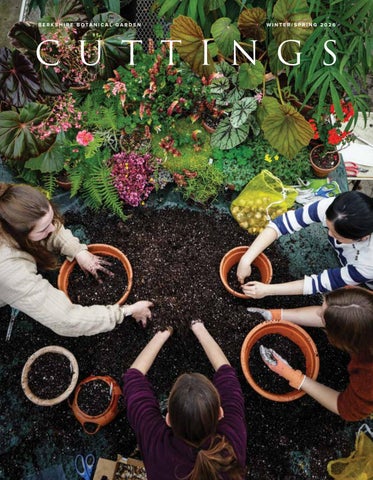
B E R K S H I R E B OTA N I C A L G A R D E N
WINTER/SPRING 2026
Winter/Spring 2026 MISSION TRUSTEES
Matthew Larkin, Chair
Jenna O’Brien
Madeline Hooper, Vice Chair
Linda O’Connell
John Spellman, Treasurer
Ramelle Pulitzer
Janet Laudenslager, Secretary
Mark Walker
Adegboyega Adefope
K. K. Zutter
Nicholas Arienti Joanne Leonhardt Cassullo
Trustees Emeriti
Brett DeRocker
Jeannene Booher
Adaline Frelinghuysen
Cathy Clark
Lauretta Harris
Mary Copeland
Nancy Hickey
Craig Okerstrom-Lang
Ian Hooper
Jo Dare Mitchell
Tom Ingersoll
Judie Owens
Jane Iredale
Martha Piper
Daniel Kasper
Jean Rousseau
Scott Lambert
Gail Shaw
Joanna Miller
Rob Williams
We provide information, education and inspiration concerning the science, art and joy of gardening and its role in preserving the environment. Established in 1934 as the “Berkshire Garden Center” and revered as one of the older public display gardens in the Northeast, Berkshire Botanical Garden is a not-for-profit, membership-supported educational organization encompassing 24 acres of land at the intersection of Routes 102 and 183 in Stockbridge, Mass. The Garden is open year-round for classes, lectures, workshops, and exhibits, and the display gardens can be visited daily through Oct. 31, 9 a.m. to 5 p.m.
BECOME A MEMBER
S TA F F
Executive Director Mike Beck Camp Director Margaret Leahy Director of Buildings & Grounds Chris Kupernik
Horticulturists Kessa McEwen Shannon Welch Manager of Membership & Development Allie Woodard
Director of Education Jennifer Patton
Manager of Operations & Volunteers River Begas
Director of Horticulture Eric Ruquist
Manager of School Programs Arielle Coon
Director of Marketing Communications Felix Carroll
Marketing and Communications Assistant Ruth Hanavan
Director of Operations Ryan Richardson
Office Manager Laura Bristol
Director of Special Events Danielle Pellerin
Seasonal Gardener Kevin Johnson
Garden Educator Qunli Fan
Visitor Center Manager Kristine Romano
Grounds Manager Sean McKenney
Felix Carroll, Editor Ruth Hanavan, Assistant Editor Julie Hammill, Designer
BBG Horticulturist Kessa McEwen, camp counselor Alyssa Roberts and a Farm in the Garden camper can’t believe the size of the bullfrog they spotted in our Pond Garden last summer. Explore what our Education team has been up to lately (pages 14-17) and get to know more about our fantastic frogs (pages 26-27).
DIRECTOR’S CORNER | MIKE BECK
Do Tread on Me! By now, we are probably all familiar with the Japanese concept of forest bathing (shinrin-yoku) as a way to improve our well-being. But have you heard of grounding (sometimes referred to as earthing)? Apparently, by walking barefoot in the woods, your body directly benefits from the electromagnetic energy (or is it ionic flow?) emanating upwards from the ground. I’ve never tried this myself, though I do know that it feels great to have your bare hands elbow-deep in a raised bed, rummaging for potatoes. And it’s not just the soil under our feet or between our fingers that has restorative properties. Listening to K Greene, a presenter at our most recent Rooted in Place Ecological Gardening Symposium, speak about the cultural power (and memory) inherent in a humble seed made me realize why it is so satisfying to engage in the act of sowing. Whenever I feel overwhelmed by the constant drip of unsettling news headlines, the uncertainty we face in our everyday lives, and the precarious state of our natural world, returning to “the land” in my own backyard feels wonderfully restorative. It may even be a bit … revolutionary? In Eleanor Catton’s novel “Birnam Wood” (Farrar, Straus and Giroux), a group of young New Zealanders form a guerrilla gardening collective, squatting on abandoned plots of land to seed vegetable gardens under the cover of night, as an act of protest. While things don’t turn out too well for the group in the book, in real life, we see the many benefits of getting our hands dirty, and we intuitively “get” that gardening can be an act of resistance as much as resilience. Right now, with snow blanketing my garden, I know that I won’t be engaging in much restorative, let alone guerrilla gardening, for a few months at
least. All the more time to curl up in front of my fire with a new garden book or three. Doug Tallamy’s “How Can I Help?” (Timber Press) might fit the bill. Tallamy resonates with so many of us because he doesn’t dwell on doom and gloom, but rather offers concrete advice on small things we can all do to help nature recover and thrive. I already ran and planted a double row of oak trees after hearing him speak a few years ago, as oaks are at the pinnacle of species that are beneficial for insect biodiversity. I can’t wait to see what Tallamy tells us to do next in his new tome. The other book on my reading list is Kevin West’s “The Cook’s Garden” (Knopf). West’s mantra is to plant more of what you actually like to eat. Seems simple enough! For me, that means more escarole and less kale, more hot peppers and fewer squash. But I do like to experiment with new veg: Who knew, but purple kohlrabi salad is actually delicious! I should mention that both of these new books (and many more!) are available in the BBG Gift Shop, so come by to shop sometime! With my reading list taken care of, I will also plan to do some in-person learning at BBG! I am especially interested in learning more about the Japanese art of Kokedama from instructor Brian Mikesell. These small living moss balls are sometimes referred to as a “poor man’s bonsai.” And this year, I swore I would take BBG board member and teacher extraordinaire Jenna O’Brien’s class on planting containers. Perhaps the common thread with both of these classes is that gardening, on a small and contained scale, can be rewarding in its own right. If we cannot change the big stuff, let’s start with something little. What a revolutionary thought!
BERKSHIRE BOTANICAL GARDEN
1
2
CUTTINGS
WINTER/SPRING 2026
Of Course Gardening is Good for You (But Here Are Four Reasons Why That Matters)
YO U AL R EADY K N OW IT. You don’t need anyone telling you that
“getting your hands dirty” is therapeutic. You don’t need anyone preaching that before wellness apps there were watering cans. You’re the ones posting hydrangea updates like baby announcements and celebrating that first squash blossom like a personal victory. You know time in the garden keeps you saner, healthier and more hopeful. But here’s the thing: Science may finally be catching up to your dirt-streaked wisdom. Let’s dig into four good reasons why gardening makes you feel more alive, and what your brain, body and microbiome have to say about it.
Volunteer Stephanie Bradford helps tend the gardens.
BERKSHIRE BOTANICAL GARDEN
3
1
Gardening Is Like a Spa Day for Your Brain (and a Nap for Your Nervous System). Gardening is a gift to your brain’s overworked frontal lobe. All that screen time and multitasking cause what researchers call “directed attention fatigue.” You know the feeling, that glazed, frazzled mental fog. Enter: fascination attention. This is the effortless focus that comes from simply enjoying nature: noticing colors, textures, birdsong. It’s the opposite of the concentration you use for, say, emails or planning projects, explains Micah Mortali, author and mindful outdoor guide who leads classes at Berkshire Botanical Garden. “When you’re gardening, you’re focused, you’re grounded in the task, but you’re not tunnel-visioned,”
Mindful outdoor guide Micah Mortali explains that the restorative effects of gardening come from “simple enjoyment of the beauty and wonder of nature,” known as “fascination attention,” which counterbalances the draining “directed attention” we use for tasks like computer work and meetings.
4
CUTTINGS
WINTER/SPRING 2026
he explains. “You’re also able to let your attention naturally wander. … That kind of attention doesn’t drain your brain; it restores it.” This is the heart of Attention Restoration Theory: Nature quietly recharges your mental batteries. Research from the University of Michigan has found that the “soft fascination” of nature can boost working memory and focus by up to 20 percent. So yes, your brain might literally be healing while you whisper encouragement to your basil. Then there’s your parasympathetic nervous system, the body’s natural “rest and digest” mode. Modern life traps many of us in constant low-level stress.
But nature flips the switch, according to studies in the National Library of Medicine. The smell of soil, the rustle of leaves, sunlight on your skin — these cues have been shown to activate the parasympathetic system, lowering stress and calming your body. “It just happens naturally, without effort, without having to meditate or do yoga,” says Mortali, director of the Kripalu School of Mindful Outdoor Leadership. Studies show a 45-minute forest walk can lower cortisol (a key stress hormone) by up to 14 percent, reduce blood pressure and improve sleep. Gardening delivers those same benefits, plus beautiful plants and/or tasty food.
2
Soil Is Basically Microbial Happiness. Dirt isn’t just metaphorically grounding. It’s biologically therapeutic. Multiple peer-reviewed studies, including from the Journal of the American Society for Horticultural Science, directly link exposure to soil microbes like Mycobacterium vaccae to calming physiological and psychological effects in humans. Brian Mikesell, a therapeutic horticulturist who grew up mostly barefoot (in the warmer months) on an Indiana farm, says his mom always told him that working in the soil was good for you, long before studies confirmed it. “There’s always been this folk knowledge,” he says. “Now the science is validating what people have just known.” “We know trees release phytoncides that are beneficial to humans when we breathe them in,” Mikesell adds, “but also soil contains microbes that positively impact your immune system and mood.” Translation: When you get dirt under your nails, you might be microdosing joy.
Therapeutic horticulturist Brian Mikesell, raised with what he calls “non-scientific wisdom,” says, “There’s always been this folk knowledge. Now the science is validating what people have just known.” He teaches BBG classes this spring.
BERKSHIRE BOTANICAL GARDEN
5
3
“Our bodies belong to nature. … There is no separation. We are nature,” says Sandrine Harris, founder of Emergent Nature, who leads BBG classes and workshops.
Gardening Reconnects You to the Pulse of the Living World. Humans evolved outdoors, but now many of us spend over 90 percent of our lives indoors. “We’re mammals living in boxes,” says Mortali, author of “Rewilding: Meditations, Practices, and Skills for Awakening in Nature” (Sounds True Books).“Our brains and bodies were designed for something else.” Sandrine Harris, founder of Emergent Nature, reminds us: “Our bodies belong to nature. … There is no separation. We are nature.” Even a windowsill herb garden can signal to your nervous system: You belong here. “Relating with and sensing the natural world, as an innate part of healing, has a myriad of evidence-based mind-body benefits,” says Harris, who offers guided meditation walks through the seasons at BBG and elsewhere. As psychiatrist and gardener Sue Stuart-Smith explores in her book “The Well-Gardened Mind: The
6
CUTTINGS
WINTER/SPRING 2026
Restorative Power of Nature” (Scribner), tending plants restores mental health and purpose by reconnecting us to life’s natural rhythms. When we nurture seedlings, we practice patience, humility and hope, and we rediscover reverence for life itself. Passive time in nature is good. Active engagement is even better. “You get a bigger benefit when you’re actively engaged,” says Mikesell. “And even more so when you bring intention and attention to the work.” Studies published by the National Institutes of Health show that mindful engagement in gardening amplifies its mental health effects. And practices like Ikebana — the Japanese art of flower arranging, which Mikesell teaches — elevate gardening from a pastime to a form of meditation. The key is presence. You’re not just tending plants, you’re hacking your own happiness.
4
Gardening Is the Workout You Actually Want to Do. Gardening is a full-body workout disguised as a hobby. A 2022 meta-analysis in the British Journal of Sports Medicine found that regular gardeners have a 19 percent lower risk of early death and a 12 percent lower risk of cardiovascular disease. It’s real exercise: digging, squatting, hauling soil. It boosts vitamin D, strengthens bones, improves coordination, and promotes better sleep. Thirty minutes in the garden can burn as many calories as a brisk walk, and maybe leave you with dinner ingredients to boot.
BBG volunteer Judy Dougherty gets a workout in the Procter Garden
BONUS ROUND: A Quick History Flex Dr. Benjamin Rush, often called the father of American psychiatry, wrote in the early 1800s that patients who gardened recovered faster from mental illness. By 1817, Friends Hospital in Philadelphia had built a greenhouse specifically for therapeutic horticulture. And our friends at nearby Gould Farm in Monterey, Mass. — the nation’s first residential therapeutic community dedicated to helping adults with mental health and related challenges — have offered gardening as a cornerstone of health care since 1913.
The notion of gardening being good for you isn’t a trend. It’s a tradition.
BERKSHIRE BOTANICAL GARDEN
7
FINDING THE ‘WOW’ IN EVERY GARDEN A Conversation with Karl Gercens III
T
his February, winter will give way to color, at least for an afternoon, when celebrated horticulturist Karl Gercens III takes the stage at the 29th annual Winter Lecture on Saturday, Feb. 21, at 2 p.m., at Berkshire Waldorf High School, in Stockbridge. His talk, titled “How’s the Wow,” promises to be as vivid and dynamic as the gardens he designs at Longwood Gardens in Kennett Square, Pa., where he serves as section gardener of the Historic Main Conservatory. Renowned for his fearless use of color and his eye for the extraordinary, Gercens has spent his career transforming the ordinary into the astonishing. Raised on a 10,000-acre cotton plantation in Mississippi, he grew up surrounded by endless sky and growing things, a childhood that shaped
8
CUTTINGS
WINTER/SPRING 2026
his fascination with nature’s palette and the power of horticultural imagination. Now, at Longwood, where more than a million visitors flock each year, Gercens curates vibrant seasonal displays that turn the conservatory’s four acres under glass into a kaleidoscope of horticultural wonder. For Gercens, gardening isn’t just about beauty; it’s about that elusive moment of surprise and delight he calls the “wow.”
DEFINING THE “WOW” FACTOR
“‘Wow’ is the most popular word that we get at Longwood,” Gercens says. “What is that wow factor in the garden? I think that’s going to be size, quantity and the uniqueness.” He doesn’t mean that metaphorically. “Currently we have this giant chrysanthemum, 12 feet tall, 13 feet wide,” he explains. “You would typically have to go to Japan to see that. In March, we’re going to have blue poppies. You have to go to Vermont, if not even further north, to see something like that. So every single month we have something that will wow you.” Even the “ordinary” moments at Longwood come with a dose of spectacle. “When it comes to tulips, 300,000 of them outdoors,” he says. “When it comes to spring bulbs, millions of them.” And while many visitors dream of recreating what they see, Gercens admits he’s not interested in the attainable. “I’ve spoken to many people who want to go to gardens they can relate to or duplicate,” he says. “I’m the complete opposite. I literally want to see something that is unachievable, something beyond my comprehension.”
COLOR AS EMOTION
That sense of awe is fueled by color, vivid, unapologetic, emotional color. “I am a red, yellow, orange, purple kind of guy,” Gercens says. “I am definitely not
a blue and green. I feel that gardens are exciting, that plant choices are exciting. Therefore, when I’m creating a color combination, I want it to be exciting.”
I FEEL THAT GARDENS ARE EXCITING, THAT PLANT CHOICES ARE EXCITING. THEREFORE, WHEN I’M CREATING A COLOR COMBINATION, I WANT IT TO BE EXCITING.” He laughs at the idea of calm or minimalist gardens. “When I speak to other people and they talk about, ‘Oh, how relaxing this garden is and how calm,’ I’m like, ‘Where are you coming from?’ Because that is not what I’m doing. So I’ve sometimes been called the horticultural hummingbird: attracted to red and constantly going from one thing to the next, never sitting still.” For those intimidated by color’s complexity, Gercens has simple advice: Let go of the fear. “One of my favorite lines is, nothing is wrong until you get caught,” he says with a laugh. “So I say run and do what you want. Color is temporary. It’s not permanent, so I don’t have any fear of color whatsoever.” That boldness, he says, might run in the family. “My grandmother painted her kitchen cabinets canary yellow. Each room in my house is a different color: red living room, yellow bedroom, green kitchen, blue bathroom, teal laundry room. I just have color all around me. I don’t think there are too many choices or any rules.”
As for white? “Someone years ago said that white punches a hole in the garden,” he says. “I like that. You’ll use white if you don’t know what else to do. It’s literally the safest. It’s not even color. It’s just boring. It’s a waste of space, a waste of time,” he says, laughing at his own audacity. “I’m being far too opinionated.”
MAKING IT WORK
Of course, even at Longwood, perfection is an illusion. “The truth is, we’re real people dealing with real plants with real problems,” he says. “We come up with incredible designs that are near perfect, and then they are subjected to life. Life could be a budgetary concern, a plant failure, a labor shortage, or someone above me just doesn’t like that color.” Flexibility, he says, is as essential as inspiration. “Every time you see what we’ve got at Longwood, it may only be 70 percent of what we wanted, yet it’s turned out incredible. I have a T-shirt that says, ‘Make it work.’ That’s what I live by.”
THE LIVING CONSERVATORY
Managing Longwood’s Historic Main Conservatory is both an honor and a challenge. “Fortunately, we have multiple different gardens under glass,” Gercens explains. “We can have warm orchids, or a cool Mediterranean climate, or a temperate spring garden. It can be very chilly if we have bulbs.” That variability brings its own set of horticultural puzzles. Such as? “We have an expectation that it’s going to be always in flower,” he says. But Gercens is challenging that expectation. “Beauty is not really just a flower,” he says, “but perhaps beauty is color. And color, of course, comes to us through foliage as well, and foliage is not always green. And in fact, in my life, foliage is never green. Foliage is always red, gold, silver, variegated. And if the foliage has to be green, it better BERKSHIRE BOTANICAL GARDEN
9
Since then, I’ve just been the most curious person I can be. That was 30 years ago, and I’ve not slowed down.”
THE FUTURE IN LIVING COLOR
Karl Gercens at Longwood Gardens, the man with the hard hat and the green thumb.
be fastigiate, or it better be weeping. It better be crinkled or rotund. I want, when I look at a plant, to be like, ‘I know why you’re here.’ I don’t want to glance over and be like, ‘How did you get here?’ While I didn’t create this line, I absolutely believe it that ‘flowers are fleeting, but foliage is forever.’ I’m trying to change the world, one foliage plant at a time.”
ROOTS AND DISCOVERY
His passion for experimentation began early. “I didn’t have any mentors growing up,” he recalls. “My grandparents grew vegetables and collected roses and daylilies and irises. I just played. I ordered plants online, tried them, failed, tried something different. I grew 10
CUTTINGS
WINTER/SPRING 2026
what liked me; it wasn’t ‘I grew what I liked.’ Find the plant that works for your conditions. So much easier that way.” His curiosity took him far beyond Mississippi. Internships at Walt Disney World and the Filoli Estate in California exposed him to a world of horticultural diversity. “I’ll tell people Disney World is my favorite garden,” he says. “Why? There’s architecture galore, incredible plants, everything is well maintained, and it invites conversation. Each theme park feels different. It’s a world of discovery.” And that’s where Gercens learned perhaps his most lasting lesson. “Working at Disney blew the doors off my world,” he recalls. “I met people from other countries, other backgrounds. It made me realize I had so much to learn.
Looking ahead, Gercens sees color — and access — as the future of horticulture. “If I’m going to use my land, it’s going to be for a plant that’s truly exciting: visual, tactile, maybe fragrant, but mostly visual. These days, especially with social media, if you can’t Instagram it, then why are you doing it?” He laughs, but the point is serious: Beauty is how people connect to plants. Education can then follow. “People have called me out as a person with a variegated foliage addiction,” he says. “I’ve been a fierce proponent of colored foliage my entire career. Twentyfive years ago, you had to go to a specialty nursery to find these plants. Now you can go to a big box store. I’ll drive down the street and think, ‘That was a rare plant 20 years ago, and now it’s everywhere.’ And I love it. I’m not a plant snob. I just appreciate seeing a beautiful plant, no matter where I go.”
FEB
21 The 29th Winter Lecture: “How’s the Wow” with Karl Gercens III Saturday, Feb. 21, 2 p.m. Berkshire Waldorf High School Register to attend at BerkshireBotanical.org Or scan this code:
A DOUBLE BLOOM
Two Traditions, One Joyful Weekend BERKSHIRE BOTANICAL GARDEN
11
From twirling ribbons and cuddly lambs at SpringFest to tables full of green dreams at the annual Plant Sale, we’ll have full blooms ahead in May.
This Mother’s Day weekend, Berkshire Botanical Garden will burst into spring with something entirely new: two beloved events happening side-by-side for the very first time. From May 8–10, the Garden invites visitors to a weekend-long celebration of plants, play and community as the 49th Annual Plants-andAnswers Plant Sale overlaps with the second annual SpringFest on Saturday, May 9. Together, they promise a vibrant, familyfriendly welcome to the growing season. For nearly half a century, the Plantsand-Answers Plant Sale has served as the Berkshires’ unofficial signal that spring has finally arrived. Established in 1977, the sale has become a cherished Mother’s Day weekend tradition for gardeners across the region. This year’s edition, curated by BBG’s horticulture staff, offers hundreds of perennials, annuals, herbs, and vegetables — each selected with a thoughtful emphasis on diversity and nature-based landscaping. The goal is to help gardeners embrace plantings that are exuberant rather than uniform, and full of movement, color 12
CUTTINGS
WINTER/SPRING 2026
and life. Pollinator-friendly choices abound, with varieties that welcome bees, butterflies, hummingbirds, and even nighttime moths. Shoppers can browse robust landscape-ready plants, container garden favorites, and a broad collection of organic vegetable and herb starts. Knowledgeable “Ask Me” staff and volunteers will be stationed throughout the sale, ready to offer guidance, solve plant puzzles and recommend selections for every garden size and skill level. Proceeds support the Garden’s horticulture and education
programs, ensuring the sale’s impact grows well beyond the weekend. Garden members enjoy early buying hours on Friday, May 8, from 9 to 11 a.m., with the sale opening to the general public from 11 to 4 p.m. Weekend hours continue Saturday and Sunday, May 9 and 10 (from 9 to 4 p.m. both days). Free parking will be available to all. While the plant sale fills the grounds with gardening excitement, SpringFest brings an added layer of festivity on Saturday, May 9 — a full day of family fun with free admission from 10 a.m. to 4 p.m. Designed as a celebration of
February 20 • 7:30PM
March 27 • 7:30PM
DISNEY SING ALONG THE ULTIMATE DISNEY TRIBUTE BAND
KRISTIN KEY THE CAMP KRISTIN TOUR
at The Colonial Theatre
April 10 • 7:30PM
the season and of community, SpringFest features food trucks and enough children’s activities to keep the youngest visitors happily busy for hours. Little ones can enjoy a petting zoo, pony rides, face painting, classic lawn games, and more. A traditional Maypole dance adds a whimsical, oldworld flourish to the day’s lineup. Guests can wander the Garden’s 24-acre campus, taking in the brilliant display of spring bulbs and flowering trees. The Visitor Center Gift Shop will be open for browsing, offering garden-inspired gifts perfect for Mother’s Day. SpringFest also serves as a moment of accomplishment and transition, as BBG hosts the graduation of the Horticulture Certificate Program. The ceremony is followed by a reception hosted by the Herb Associates, a dedicated volunteer group that has been crafting herbal goods from the Garden’s historic 1937 herb garden for more than six decades. Attendees can savor their celebrated herb-infused cookies and sip Mai Bowle, a traditional May wine punch, fragrant, refreshing and a perfect toast to spring. By bringing both events together for the first time, Berkshire Botanical Garden is creating an immersive weekend experience: part plant-lover’s paradise, part joyful spring fair. Whether you come to stock your garden, entertain the kids, toast a graduate, or simply stroll among spring blooms, the Garden will be buzzing with beauty, community and the promise of the season ahead.
at The Colonial Theatre
May 9 • 7:30PM
at The Colonial Theatre
at The Colonial Theatre
A TRIBUTE TO
THE LOVIN’ SPOONFUL
FLEETWOOD MAC
(413) 997-4444 BerkshireTheatreGroup.org 111 South Street • Pittsfield, MA 6 East Street • Stockbridge, MA
FEBRUARY AND APRIL VACATION CAMPS: FEB. 17-20 & APRIL 21-24 SUMMER WEEKLY SESSIONS: JUNE 22-AUG. 21
We nurture the seeds of stewardship by connecting children to the Garden, our food system, the environment, and one another. CONTACT CAMP DIRECTOR MARGARET LEAHY AT MLEAHY@BERKSHIREBOTANICAL.ORG BERKSHIRE BOTANICAL GARDEN
13
Here’s What’s Happening in Education:
A Season of Growing, Learning and Community
From garden to kitchen: Southern Berkshire students harvest kale and make their own healthy kale chips.
14
CUTTINGS
This past fall, Berkshire Botanical Garden’s Education staff deepened their commitment to hands-on, nature-based education across the region. Our youth educators spent the season bringing outdoor learning into classrooms, after-school programs and school gardens, always with the goal of empowering students to take ownership of their work, explore the natural world and build community through shared experiences.
WINTER/SPRING 2026
Learning from the Landscape BBG partnered with three school districts this fall, tailoring lessons to the season and embracing outdoor learning whenever possible. At Southern Berkshire Regional School District, after-school groups at Undermountain Elementary and New Marlborough Central School harvested the last tomatoes of the year, put the garden to bed and explored nearby woods with binoculars in search of
Students investigate pond-dwelling macroinvertebrates during an outdoor science session at BBG.
birds, mushrooms, dens, and other signs of wildlife. Students dissected fruits and vegetables to investigate seeds, made apple cider and kale chips, churned butter, and even created scarecrows for school decorations. Older students imagined a garden redesign, mapping out their ideal learning landscape. In-school lessons for kindergarteners, third and fourth graders culminated in a field trip to BBG, where more than 160 students explored Berkshire wildlife, pollinators and seed dispersal, and they gathered native seeds to take back to their classrooms. At Pittsfield’s Reid Middle School, students pressed apple cider, planted garlic, sampled it in several forms, created terrariums to study decomposition, and prepared to craft wreaths from natural materials gathered on school grounds. Richmond Consolidated School welcomed BBG educators twice weekly in September, working with grades K–4 to harvest and close down their garden beds for winter. Field trips remained a cornerstone of BBG’s educational outreach. More than 800 students visited our gardens over the spring and summer to meet our honeybees, sample fresh vegetables
and explore the macroinvertebrates of our Pond Garden — supported by an incredible team of volunteers. BBG also hosted a full-day teacher workshop in November for 15 Berkshire educators, offering demonstrations, garden tours, native plant discussions, and practical, outdoor-ready lesson ideas. Winter 2026: Observing, Experimenting and Exploring Careers This year, BBG is collaborating with Reid Middle School through a Cooler Communities grant. Students will track weather and daylight patterns, study how increasing temperatures shape plant life and work with BBG educators on hands-on projects: • building a cold frame and growing hardy vegetables; • creating “milk jug greenhouses” to observe winter seed germination; and • constructing solar ovens to cook simple treats using sunlight alone. BBG will also join Reid’s February Career Day to introduce students to horticulture careers. Additional winter efforts include mailing our school brochure to educators within a twohour radius and planning updates to partner school gardens for the coming growing season.
Spring 2026: Growing Forward This spring, BBG hopes to return to Sheffield and Richmond for expanded in-school and after-school programs, while continuing partnerships with Reid, Herberg, Muddy Brook Elementary, and Morningside schools. Students will begin seed-starting projects for school gardens, BBG’s camp garden and the Pittsfield Community Food Pantry. This time of year also marks the ramp-up to our February, April and summertime Farm in the Garden Camp, where children care for plants and animals, explore nature, harvest food, and create botanical crafts as part of a supportive and joyful garden community. Across every season, BBG remains dedicated to inspiring curiosity, nurturing stewardship and giving young learners the chance to grow, both in the garden and beyond.
Where Science Meets the Garden: BBG Programs for Students Berkshire Botanical Garden offers engaging, age-appropriate programs for schools, homeschoolers, youth organizations, preschools, and daycare centers. Through handson, inquiry-based learning, students explore scientific concepts, build on prior knowledge and discover new ideas in memorable ways. Our Farm and Garden program empowers students through active gardening experiences while nurturing teamwork, responsibility and socialemotional growth. To schedule a field trip or explore a school partnership, please contact: Arielle Coon at acoon@berkshirebotanical.org or call 413-298-3926.
BERKSHIRE BOTANICAL GARDEN
15
Planting Pride at Morningside into something special: a place that would bring pride to the school and the neighborhood, and create a welcoming, beautiful start and finish to every student’s day. With support from the Mill Town Foundation, BBG launched a full restoration of the school’s front garden this fall, transforming four separate planting areas into what King calls “a little bit of a symphony of interest throughout the year.”
The Four Gardens
Carolyn King plants daffodil bulbs at Morningside’s Oval Entrance Garden this past fall. And that’s just the beginning.
With support from the Mill Town Foundation, BBG launched a full restoration of the school’s front garden this fall, transforming four separate planting areas into what King calls “a little bit of a symphony of interest throughout the year.”
16
CUTTINGS
WINTER/SPRING 2026
On a wind-whipped November afternoon, Carolyn King knelt in the scrappy front yard of Morningside Community School in Pittsfield, her trowel cutting through stubborn soil as she tucked daffodil bulbs — one after another — into the earth. The wind tugged at her jacket and sent leaves tumbling down Burbank Street. But King, a Master Gardener and graduate of Berkshire Botanical Garden’s Horticulture Certificate Program, barely looked up. There was work to do, and this was only the beginning. For years, the school’s front landscape had been little more than a patchwork of invasive bittersweet, chicory, switchgrass, and wintercreeper. Due to budget constraints, the city school doesn’t have much money to tend to the outdoor space beyond mowing. But Berkshire Botanical Garden, already a partner through its summer education programs, saw a chance to turn the front of the building
The Oval Entrance Garden: This sweeping oval, once choked by invasives, will become the anchor of the new landscape, a low-maintenance seating and gathering space filled with droughttolerant native plants. King and BBG staff rescued a young box elder and a beautiful red maple from the tangle of bittersweet, giving the garden its living canopy. Surrounding them will be broad swaths of little bluestem (Schizachyrium scoparium), Kodiak orange (Diervilla lonicera), Eastern ninebark (Physocarpus opulifolius ‘Jefam’), black-eyed Susans, and hundreds of daffodils. “The kids all line up and sit right in the circle at the end of the day,” King said. “If it’s beautiful for them, it’s just a great way to start your day and end your day.” The Flagpole Garden: At the center of the school’s front courtyard sits the flagpole, surrounded by a seven-foot circumference of compacted earth. King is clearing this into a clean, mulched circle planted with little bluestem and black-eyed Susans, a simple, striking ring that will keep its shape through wind, sun and winter.
BBG’s Director of Education Jennifer Patton helps remove invasives at Morningside’s Oval Entrance Garden.
The Entrance Strip: This long, narrow bed will become a semi-shade garden layered with oakleaf hydrangeas, more Kodiak orange, little bluestem, and a selection of hardy hostas. It will frame the entry with four-season texture and color, a quiet, welcoming corridor for the 400 students who pass through each day. The Bench Garden: Beside a set of outdoor benches, BBG plans to plant more Kodiak orange shrubs, giving families and staff a vibrant, lowmaintenance space to gather.
A Community Effort BBG educators, already familiar faces at Morningside through their summer Farm and Garden program behind the school, are excited to extend their presence to the front. Last summer’s program, also funded by Mill Town Foundation, was memorable for reasons both inspiring and humbling. Children tended a vegetable garden twice a week — until groundhogs, a fox and skunks discovered it. East Lee Animal Control had to be called in. “Then we could garden again,” BBG educator Arielle Coon said. The
experience led to students making groundhog hats, lessons on resilience and deeper learning about the trials and triumphs of gardening. Andy Wrba, program director for Mill Town Foundation, said the partnership is exactly the kind of hopeful, neighborhoodcentered work they aim to support. “Our work with Morningside Community School — both through the engaging summer programming and their
Morningside students transform last summer’s garden troublemakers into creative inspiration, designing hats modeled after the neighborhood groundhogs.
thoughtful approach to how students and families interact with the front courtyard — is creating a vibrant, welcoming environment that’s part of daily life for the community,” Wrba said. “With nearly 400 students passing through this area each day, it’s become more than an entryway. It sets a positive tone for each day.” The garden restoration aligns with revitalization happening directly across the street: the new “Harvest of Hope” mural, a 1,500-square-foot artwork unveiled this fall on a site once occupied by a blighted gas station. Designed by artist Jahna Rae, the mural shows two pairs of hands sharing fruit, honoring the neighborhood’s earliest fruit market and symbolizing abundance, care and community. The project, a collaboration between Mill Town Foundation and Let It Shine, mirrors the spirit of the garden: renewal, color and pride. Back at the school on that blustery Nov. 4, King paused for a moment. The wind shoved a stray piece of litter across the walkway and it skittered to her feet. She picked it up, crumpled it into her pocket and returned to her bulbs. One small act of tending the land among many.
BERKSHIRE BOTANICAL GARDEN
17
The Bulb Show: Into the First Light of Spring Our annual Bulb Show, a tribute to beauty, renewal and the quiet rhythm of the seasons, is free and open to everyone. From Feb. 20 through about March 20, we open the Fitzpatrick Conservatory daily from 9 a.m. to 4 p.m. Step inside and you’ll find an early spring in full bloom: a bright, fragrant retreat from winter’s chill. Hundreds of bulbs fill the space, from beloved tulips, daffodils and grape hyacinths to more unusual varieties that surprise and delight. Eric Ruquist, BBG’s director of horticulture, calls the Bulb Show the Garden’s annual “gift to the community,” a blend of artistry and horticultural craft. Visitors feel the same sense of generosity. “Thank you for this gift in the dead of winter,” wrote one visitor, Barbara McMahon of Poughkeepsie, N.Y., last year in the Bulb Show guest book. Creating this burst of color begins quietly in late summer, when our horticulture staff selects and orders the season’s bulbs. Planting begins in the fall in the Lexan Greenhouse — tulips first, then daffodils and finally the smaller bulbs that round out the collection.
18
CUTTINGS
WINTER/SPRING 2026
From there, the bulbs spend weeks in cool rooms beneath the Center House, where temperatures remain close to 42°F to simulate winter. Tulips need about 15 weeks of chilling, daffodils 12, and grape hyacinths 10. Staggered planting ensures a steady succession of blooms throughout the month-long show. As their chilling period ends, the bulbs move back to the Lexan Greenhouse to “wake up.” Over several weeks they send up shoots, leaf out and eventually burst into color. Before they’re displayed in the Fitzpatrick Conservatory, each pot is topped with moss, pine needles or nut shells, and the display team adds finishing touches, including succulents, branches, even small stumps, to create depth and contrast. When the show opens, the conservatory becomes a bright, fragrant haven. Its intimate scale invites visitors to lean in close for a fully immersive, “face-inflowers” moment. We hope you’ll join us and experience it for yourself.
FEB
20 A Gift of Spring in Winter From Feb. 20 to about March 20, our free annual Bulb Show fills the Fitzpatrick Conservatory with color and fragrance. Hundreds of tulips, daffodils, grape hyacinths and unexpected varieties bloom together, offering a bright, early taste of spring and a welcome retreat from winter’s chill.
AROUND THE GARDEN
What’s Growing on You Lately?
We asked some of our plant expert friends, “What plant has recently captured your imagination most?” Here’s what they responded: ERIC RUQUIST BBG DIRECTOR OF HORTICULTURE I’m just really thrilled with the fact that I got to grow Mirabilis viscosa, a species of the Four o’clock, last year. A couple of years ago, I found seven seeds. I think I got three seeds to germinate, and then I propagated all of them from seed I collected from one pot grown in the greenhouse. It worked. It’s not the most practical plant for a public garden because its bright pinkish flowers don’t open until the middle of the night when no one is here [laughs] and finish flowering around 11 a.m. But it has these really cool papery bracts that hold one seed each. So it’s a very prolific seed producer. I had tried planting it in 2024, but the rabbits ate it. I tried it again in 2025, and it took off and went crazy in our Tatkon Garden.
KESSA MCEWEN BBG HORTICULTURIST Chocolate Cosmos (Cosmos atrosanguineus). This was one of the first plants I used in a container planting design on Main Street in Great Barrington. I remember being amazed at how when you pinched the flowers, they released a sweet chocolaty smell to match the velvety deep brown color of the petals. I remember wishing I had known about this plant sooner, back when I was teaching in school gardens. As a horticulturist, this plant strikes me for additional reasons now. It blooms prolifically basically all summer, right up to the first frost. They’re tender perennials to Zone 9, and they enjoy hot, direct sun, making them a good choice for our Fitzpatrick Greenhouse border. A lot of people don’t know that they actually form a tuber you can dig out and store over winter in colder zones, very similar to a dahlia. I like to pair them with French marigolds, amaranth and Verbena bonariensis for pops of oranges, purples and pinks to complement their deep color. They have a wildflower look while feeling delicate and elegant at the same time.
SHANNON WELCH BBG HORTICULTURIST I’m going to have to go with the “Thai Constellation,” a variety of the Monstera deliciosa. It has aerial roots that allow it to grow up trees, or crawl along the ground, and holes in the newer leaves to let light through to its older leaves. Its fruits eventually get really big and, when fully ripe, they’re really, really, really good — super sweet, like a mix of mango, pineapple and banana, hence the species name deliciosa. This plant does not often bloom and produce fruit in this climate, as it is a tropical plant, so it is really neat that our greenhouse allows us to keep it at its optimal temperature all year. The Monstera deliciosa that first drew my attention lives outside BBG’s Education Center in the warmer months, and then we bring it inside the greenhouse before the first frost. It’s a popular wish list “cool houseplant to have,” and I hope to one day have one as big as this one and try the fruit!
BERKSHIRE BOTANICAL GARDEN
19
AROUND THE GARDEN
KATHERINE ZAPERT INTERN AT THE MASTER GARDENER HOTLINE If I had to pick one, it’s Pussytoes (Antennaria plantaginifolia). I saw it in a Friends of Forbes Library garden tour in Northampton, Mass., and it’s just the cutest little fuzzy plant that has these really neat looking flowers. But what I like about it most is that it’s the host plant for the American Painted Lady butterfly. If you like butterflies, it’s a good one for that reason. The flowers are really these weird looking bulb things. It’s a very unique looking plant that I had never heard of before. I saw it when it was actually hosting the larva for the butterfly. The leaves sort of curl up and make this little cave for it. I ended up seeing one at a nursery. I bought one, and then got to see them bloom, which was cool. Now I can watch the whole cycle in my own yard.
ALEX CROWTHERS INTERN AT THE MASTER GARDENER HOTLINE I’d go with pineappleweed (Matricaria discoidea). It gets its name from the shape and smell of its flower heads. The plant has small, dome-shaped greenish-yellow flowers and soft, feathery leaves. The first time I came across it was when I was a wee lass, probably around like 7 or 8, and I was with my grandfather. He would pick it out in the grass and crumble it between his fingers, and it smelled so good, like pineapple. I haven’t really seen it much around, but there is a house on the street across from my apartment that has a whole bunch of it in its front yard. And I love going on walks and just smelling it. The smell is very, very strong and just reminds me of my grandfather, which is a joy-bringer.
FRANK WALTON BBG VOLUNTEER TOUR GUIDE Sweet emotion (Abelia mosanensis). It is a shrub which I was predestined not to like. I don’t like pink, and I don’t like little flowers, but I love this shrub. It’s spring flowering, tons of flowers. The actual petals are white, but the sepals are red, so it kind of looks pink from a distance. It’s actually a mixture of white and red, and it has really nice autumn color. I came across this right at the Center House at BBG. When it’s in flower, it has a really strong fragrance. It’s like walking by a lilac. I got two of them. I planted them in my backyard. Photo by Proven Winners
20
CUTTINGS
WINTER/SPRING 2026
AROUND THE GARDEN
Reflections of a Tour Guide Time to Appreciate the Lowly Lichens by Chris Ferrero
See how the lacy lichens have found purchase in the channels, sharing space in the hollows. Tree and lichen belong to one another. Margaret Renkl, “The Comfort of Crows”
A different landscape emerges once the last of our visitors have toured the gardens in the fall. After a typically spectacular fall finale, when Mother Nature strips away the last of the colorful leaves from trees, a more nuanced beauty is revealed. This is the time of the year when new visual highlights take center stage, unfettered by the distractions of foliage, flowers, buds, and berries. The architecture of bare trunks and stem angles and woody burls reward the eye, as do contrasting bark textures and colors. Rising to visual prominence is the complex mosaic of lichens on tree trunks, one of the most colorful and artistic features of the landscape of woody plants. Even on our mid-summer BBG tours, when tree canopies are fully leafed out, visitors will comment on the lacy tapestries of lichens on trunks and lowslung branches of some of our prettiest specimens. We are sometimes asked what these decorative features are. And even if visitors have seen them before, they often voice a concern for the tree’s health. They frequently wonder if lichens in their own home landscape is a sign of disease or decline. Everyone seems so relieved to hear that the gray-green, paisley-like growth is, in fact, the sign of a healthy
environment. There’s a reason you don’t see lichens on urban trees: They’re very sensitive to air pollutants. There’s also a simple reason you don’t see lichens on young, healthy trees and shrubs. They can’t establish on plant tissue that’s still growing at a quick pace. Once a tree matures and its growth slows, lichens can grab hold. Lichens aren’t single organisms, but composite structures made up of algae and fungi. Of the three main types of lichens, those seen on trees in general and BBG trees in particular are foliose lichens, which produce a flattened, leaflike, lobed growth. Colors vary between lichens species because of different combinations of fungal and algal components. And colors
Beside the Education Center, a shagbark hickory (Carya ovata) hosts an intricate community of lichens, microbial partnerships etched into every fold of its remarkable bark.
change through the season due to varying moisture levels. Unlike other plants, they don’t have vascular tissue to move nutrients and water. Instead, they simply absorb what they need from surrounding air and rain. During dry times, they often go dormant and appear gray, whereas moisture brings out the bluer or greener color of underlying algae. Recent studies have found that lichens around the world, and specifically the algae that fuel them, are endangered by the predicted rate of climate change, which vastly outstrips the rate at which these algae have evolved in the past. It is estimated that lichens are the dominant vegetation on 7 percent of the Earth’s surface, where they are a source of sustenance for many species, so this has no small impact. Keep watch this winter and early spring, whether you are shoveling snow or hiking your favorite trails, so you can pay special attention to your local lichens before the emerging foliage, buds and blooms take back their starring role. Lichens showcase their subtle beauty on a Korean evodia (Tetradium daniellii) beside our Visitor’s Center.
BERKSHIRE BOTANICAL GARDEN
21
AROUND THE GARDEN
Join the Fun — Volunteer! I’ve been a volunteer at BBG for going on 16 years now, and from my (considerable!) perspective, it just keeps getting better. Every year brings some new opportunity, some new addition to the plantings, or some new programming from our terrific Education Department that makes the Garden more exciting than ever. Which makes it such wonderful place to volunteer. As BBG keeps expanding its potential, so do our volunteers. We are a vital and fun-loving community with so many friendly and long-term members that it really does feel like family. And just as our volunteer corps is increasingly diverse, so are our “job” opportunities. If you have time to get involved with BBG, on a regular or occasional basis, we have many ways for you to share your talents. Whether you want to do hands-on gardening, assist with admissions and sales, be a tour guide, a docent in our galleries, or an occasional helper at special events, there are many ways you can pitch in and participate in the joy of being a BBG volunteer. I welcome you to deepen your connection to this wonderful Garden and cultural center of the Berkshires. You can go online at BerkshireBotanical.org/volunteer or reach out directly to our Volunteer manager. To learn about volunteer opportunities at BBG, contact River Begas at rbegas@berkshirebotanical.org or 413305-1714, ext. 28.
Lauretta Harris President, BBG Volunteer Association
22
CUTTINGS
WINTER/SPRING 2026
Meet Winnie: The Self-Appointed BBG Mascot Early in the morning, as BBG wakes up, the grounds are quiet. Visitors have not yet arrived for the day, and there is stillness in the air. However, even though the gardens seem empty, one special visitor may be lurking around, if he feels like it: Winnie, BBG’s garden cat. Winnie has long white fur with black markings on his head and back. He has fluffy fur around his face that resembles a lion’s mane and an intensity about him that masks his otherwise friendly demeanor. Winnie doesn’t technically belong to the Garden; he is the beloved pet of one of our neighbors. But we’re pretty sure the Garden belongs to him. “When Winnie visits, it’s typically early in the day, usually around 7 a.m.,” reports Shannon Welch, who is currently Winnie’s favorite staff member. “Not every day, but when he is here, he meows and walks around the greenhouse looking for attention.” Winnie can not only be found in the greenhouse. He likes to sunbathe on the roof of the toolshed, inspect new growth in the vegetable garden, rub his back on the garden benches, and prowl the woods behind the lodge. Winnie has been spotted at all times of year, and in all kinds of weather, but he seems to like the warmer months best. Like most cats, he is ungovernable. “I never know when we are going to see Winnie, and have gone weeks without a visit,” Shannon laments. “Or I’ll see him, and he will completely ignore me. He has his own agenda.”
THE SCULPTOR WHO INSPIRED A NATION Discover the historic home, studio, and gardens of Daniel Chester French www.chesterwood.org
Open from May 15 through October 31
STOCK BR IDGE , M A
BERKSHIRE BOTANICAL GARDEN
23
AROUND THE GARDE N
Beyond the Pines, a New Chapter in (Mostly) Native Beauty The process began several years As part of Berkshire ago with earlier native plantings of Botanical Garden’s redbud (Cercis canadensis), various ongoing Master Plan, the viburnums and strawberry bush Horticulture Department (Euonymus americana), the native has embarked on a major alternative to burning bush. More addition to its living recent additions include species collection: a new border of of serviceberry (Amelanchier), (mostly) native trees and witch hazel (Hamamelis virginiana) shrubs stretching along and the fragrant ‘Spring Fleecing’ Routes 102 and 183, on the White Fringetree (Chionanthus Garden’s north side. The virginicus ‘Spring Fleecing’). project, completed in stages A grove of dawn redwoods throughout the spring and (Metasequoia glyptostroboides) adds fall of last year, marks a fresh historical and scientific intrigue: Eric Ruquist, BBG’s director of horticulture, in one of two sections chapter for the Garden’s Once thought extinct, the species of newly planted trees and shrubs that will fill out and create “more evolving landscape. of a sense of enclosure.” was rediscovered in China in “We’re putting in a tree the 1940s and reintroduced to and shrub border of natives (Itea virginica ‘Henry’s Garnet’), and cultivation by the Arnold Arboretum. alongside the road to enclose the Garden Thomas Pool Cranberry Bush (Viburnum “This is an interesting plant,” Ruquist a little bit,” said Director of Horticulture trilobum ‘Thomas Pool’). noted. “We’re expanding our grove with Eric Ruquist. “It helps buffer the Garden Other selections include a mix of new cultivars, including ‘Feather Duster’ from the road and creates more of a sense arborvitae cultivars — ‘Yellow Ribbon,’ and ‘Spring Cream,’ which have lighter of enclosure.” ‘Linesville,’ and dwarf ‘Piccolo’ — along foliage and spring variegation.” The new planting replenishes parts with Twisted White Pine (Pinus strobus Beyond aesthetics, the project reflects of the Garden’s aging Arboretum and ‘Torulosa’), variegated dogwood (Cornus the Garden’s larger commitment to Pinetum, areas rich with mature trees alba ‘Elegantissima’), and masses of sustainability and education. “The that, over time, have lost vigor and visual Hardy Creeping Juniper (Juniperus mandate was for a native tree and shrub interest. “It’s not very exciting,” Ruquist communis ‘Nova Scotia’). The design border,” said Ruquist. “It is mostly native. admitted. “Mostly white pine. So, I favors simplicity: “We planted large Some of the cultivars are ones we didn’t started adding some new cultivars, some groups of the same species to create have, so we’ve expanded the collection with golden variegation, others bluer in simple masses of shrubs,” Ruquist a bit. And honestly,” he added, “I chose tone or lower-growing, just to bring in explained. “For instance, when these them because I love them.” more diversity.” junipers grow together, it’ll read as one.” Once the weed-smothering layers of The project, made possible through The border also includes “nativars” cardboard and mulch break down, the a grant from the Stanley Smith — cultivars of native plants bred for horticulture team plans to underplant Horticultural Trust, features roughly 75 desirable traits like color or form. A with ferns and native sedges, creating a trees and shrubs, chosen for ornamental standout among them is winterberry naturalistic groundcover that ties the whole appeal, lush texture and seasonal drama, (Ilex verticillata ‘Sunsplash’). “Now we’ll composition together, a living, evolving said Ruquist. Among the highlights are be able to cut winterberry from our own border that celebrates both ecological Densa Inkberry (Ilex glabra ‘Densa’), garden for our annual Gallery of Wreaths integrity and horticultural artistry. Bottlebrush Buckeye (Aesculus and Holiday Marketplace,” Ruquist said. parviflora), Henry’s Garnet Sweetspire
24
CUTTINGS
WINTER/SPRING 2026
Children play in the newly restored Rain Garden following our first snowfall of the season.
Beauty in the Basin and Breathing Room for a Quiet Garden Hero After years of quiet service, the Rain Garden at Berkshire Botanical Garden has received a much-needed rejuvenation. The quarter-acre site — designed over a decade ago to manage stormwater runoff from the nearby main parking lot — was recently excavated, pruned and cleared of invasive species to restore both its function and natural beauty. The garden, a gently sloped basin planted with native shrubs and wetfield species like dogwood and buttonbush, is set alongside the south side of Route 102 adjacent to the Fitzpatrick Conservatory. It had gradually filled with silt and sand washed down from the lot during storms. “That’s where the water ends up, one way or another,” said Eric Ruquist, BBG’s director of horticulture. The recent excavation reestablished flow and filtration pathways by clearing years of sediment buildup. While the garden continues to work well — slowing runoff, filtering pollutants and protecting nearby waterways — regular maintenance is essential. Staff removed invasive plants including buckthorn and loosestrife (there weren’t many), pruned back overgrowth and uncovered hardy native species like Ilex and fragrant sumac (Rhus aromatica), a surprise find now poised to thrive. “This was an opportunity to open things up and let the plants breathe again,” said BBG gardener Kevin Johnson. “Some of what we found was a pleasant surprise.” The Rain Garden does more than manage water. It demonstrates how beauty and ecology can coexist. The carefully selected plants not only tolerate wet soil and filter toxins like nitrogen and phosphorus, but also provide year-round interest and habitat for birds. Plans are already underway to enhance the garden with leftover native plantings from recent projects, giving it a fresh boost.
1815 N. Main St., Rte. 7, Sheffield, MA 413-528-2717 Shop and garden open daily Follow us on Instagram for events and updates @shopcampo campodefiori.com
For advertising opportunities, please call 413-298-3926. BERKSHIRE BOTANICAL GARDEN
25
AROUND THE GARDEN
FROM THE FROG FILES 14-Year-Old Quinn Warren Hops into Herpetology
It’s a cool morning in late summer, and Quinn Warren’s hands are already muddy. So are his feet. Less than 10 minutes after arriving at his favorite frog-spotting pond — Berkshire Botanical Garden’s Pond Garden — the 14-year-old from Stamford, Vt., has caught three frogs, and he’s got his eyes on a fourth, a particularly feisty one just beneath a clump of reeds. “I have a lot of experience catching frogs,” Quinn says with a grin, crouched low, his green eyes scanning the pond’s edge. “They’re funny, cute and really interesting. And there’s a lot of neat science behind them.” With BBG’s permission, Quinn has been given free reign to do what all other visitors are encouraged not to do: catch frogs. Quinn and his mother, Amy, made the hour-long drive about five times last year, part of a shared herpetology elective they designed together. Their goal? To measure local frog populations, study their growth patterns and learn more about their role in the ecosystem. And maybe, just maybe, for Quinn to complete his personal quest: to catch and release every frog species in New England. Measuring “Friends” Wearing a shirt that reads, “Introverted, but willing to discuss frogs,” Quinn moves slowly around the pond’s edge, listening 26
CUTTINGS
WINTER/SPRING 2026
“They’re funny, cute and really interesting. And there’s a lot of neat science behind them.” for the signature plop plop plop of frogs diving for cover. The frogs here are used to people; the trail warps closely to the brushy edge, giving them ample opportunity to flee. Still, that doesn’t stop Quinn. His method is simple, practiced. “I move slowly and quietly, then gently push the brush aside. Once I spot one, I try to get my hand in front of it so it can’t jump into the water. Then I grab around the legs, firmly, but gently.” Today, he and Amy are measuring the frogs “snout to vent” — basically, from nose to butt — in an effort to estimate their ages. One recent prize catch was a hefty 12-centimeter bullfrog. “I’m pretty sure that frog had perfected the art of staying just out of reach,” Quinn laughs. “He was hard to catch.” “This one’s 7.7 centimeters,” he announces proudly after measuring a green frog. “That’s our third biggest.” The data will eventually go into Quinn’s final report, which covers species diversity, population health and
water level impact. Last summer, low rainfall had made frogs harder to find, pushing them deeper into the muck. More Than Slimy Most people, Quinn says, don’t understand frogs. “A lot of people think they’re slimy and gross, but really, they’re just wet.” He’s also quick to offer a warning: “Their primary defense mechanism is not to get caught. But if you do catch them, they may projectile pee on you. It’s what they do.” Quinn insists frogs are deeply important. “They’re great indicators of environmental health,” he explains. “They act as both predators and prey, and they’re a big part of the food web. A lot of frogs, a lot of snails, a lot of plant biodiversity — it usually means the pond is healthy.” He’s even spotted snapping turtles here and listens closely to what the ecosystem is telling him. Frogs, he notes, also have some incredible adaptations: “Green frogs
AROUND THE GARDEN
and bullfrogs burrow into the muck in winter. Wood frogs? They actually freeze solid, and then thaw out in spring and just keep going. That’s wild.” A Statewide Quest Quinn’s love for frogs started young. He caught his first green frog at just 2 years old, and got serious about herpetology at age 8. Now, at 14, he’s nearly achieved his ambitious goal of catching every frog species in New England. Only two remain: the elusive mink frog and the northern leopard frog. “We’ve gone looking for mink frogs in Vermont,” he says. “We heard them, but we couldn’t find them. It was awful. Just slogging through the marsh.” His last unvisited New England state? Maine. “We’ll get there,” he says confidently. He sometimes uses headlamps at night, sometimes follows tips from naturalists. No matter the method, Quinn’s approach is always respectful: He keeps his hands wet to avoid transferring harmful oils to the frogs’ skin, and he and his mom gently reassure their catches. “We’re not going to hurt you,” Amy says to one frog. “Hey buddy.” A Future in Frogs? With his growing knowledge, gentle handling and deep enthusiasm, Quinn may just have a future in herpetology. “I’ve definitely thought about it,” he says. “I know more about frogs than I do about almost anything else. Few people are as into frogs as I am.” Asked why frogs hold such a strong grip on his imagination, his answer is simple: “I just really like them. Always have. They’re important, and they will pee on you. Don’t bully the frogs.” Then, spotting another ripple in the reeds, he grins and whispers: “Hi, buddy.” And just like that, he’s off, muddy hands, muddy feet.
FROGGY FINDINGS Following their latest field study of Berkshire Botanical Garden’s Pond Garden on Aug. 25, Quinn Warren and his mother, Amy, headed home to prepare their findings. The following is a summary: The frogs here are used to people, making them easier to grab by hand. Quinn did the catching; Amy did the measuring with a five-inch caliper. They looped the pond three times, avoiding repeats by recognizing individual frogs and comparing lengths. The weather was mild, and the pond was lower than usual due to dry conditions. The Results: • 12 green frogs measured, plus 1 bullfrog • Green frogs averaged 7.25 cm in length • The bullfrog was 12.7 cm long (and a standout) • No frogs measured between 6 and 6.99 cm, creating a gap in the data What’s Up with the Gap? Possible explanations: • Frog School’s Out: Little frogs are 2025s newest; big frogs were born the previous year. Maybe all the medium “teen” frogs were off somewhere else. • Ninja Frogs: Mid-sized frogs could be harder to see and catch. • Random Luck: Could’ve just been a fluke that none showed up. To Solve the Frog Mystery: Future plans include: • Going at different times of year (hello, spring frogs!) • Trying nets or photos for more frog diversity • Returning multiple days to rule out randomness Final Verdict: Science is fun when frogs are involved.
BERKSHIRE BOTANICAL GARDEN
27
AROUND THE GARDE N
MEET A BBG MEMBER
Trauma and Tranquility Marianne Zimberg’s Journey from Psychiatric Nurse to Garden Guide Rooted in service, science and a deeply felt connection to both people and the planet, Marianne Zimberg walks through Berkshire Botanical Garden and sees more than paths and plants, more than color and form. She sees systems, resilient and fragile. She sees stories: pollinators and parasites, shade-tolerant survivors, struggling bird populations. And she sees connections, between healthy ecosystems and human health, between past traumas and present peace. Marianne is one of the Garden’s dedicated volunteer tour guides, known for her deep knowledge of ecological gardening, native plants and her gentle way of helping visitors see the hidden life thriving in nearly every garden bed. But before she was “Queen of the Hydrangeas” in her Lenox garden — where she grows 121 species of trees and perennials (yes, she has counted them), over half of them native — Marianne was 28
CUTTINGS
WINTER/SPRING 2026
a psychiatric nurse, a clinical educator and a mental health advocate on the front lines of a system she describes bluntly as “broken.” Born in Miami, she was the eldest of five children, raised mostly in Europe, thanks to her father’s post-World War II work supporting NATO defense systems. Her earliest memories aren’t of classmates or classrooms, but of outdoor places, like the family garden in Morocco that she recalls as “a safe space, a magical space.” She was of the generation told to “go outside and don’t come back until dinner,” and she did, exploring forests and swamps, planting flowers by an Alabama creek, making forts with tall grasses in Germany and marveling at the grand chateaux gardens of France. Those places made a deep impression on her, though she didn’t know it then. Indeed, she didn’t imagine a life in gardening. Loss and life circumstances led her to nursing.
She earned a full scholarship to New York University and later received a federal grant to pursue a master’s in nursing education. Her career spanned oncology and psychiatric nursing, clinical research and higher education. She taught in Nevada and New York, ran a psychiatric unit in Brooklyn and worked at Memorial Sloan Kettering as a psych clinical nurse specialist. She even wrote a book on psychosocial treatment planning for nurses. “I loved connecting with patients, especially the ones who felt like no one saw them,” she says. “Psychiatry is often a living death for many without the right care. It’s the most underserved population in the country. I was always focused on the person in front of me. Totally giving, totally tuned in.” Gardening had simply been a quiet thread running through her life — until, in 1986, she tore out the front lawn of her New Jersey home and replaced it with a meadow-like palette of pinks, yellows and magentas. Inspired by Monet’s paintings and the European landscapes of her childhood, she was years ahead of the curve in questioning the value of a traditional lawn. “I didn’t know what I was doing,” she says, “but I read everything I could get my hands on. I’m a voracious reader.” While still working as a nurse, she earned her Master Gardener Certificate in 2007 and volunteered on their hotline. Her first call was from a desperate gardener with a groundhog problem. “I helped the caller figure out how to build a fence and protect their plants,” she recalls. “They were so thankful and so nice and so happy, and I was so happy after I hung up the phone. My colleagues were looking at me like, ‘What do you normally do?’” They didn’t know about Marianne’s nursing career. “I think that was the point at which I realized, ‘Oh, it’s true: I really
swam in a very different pond from the rest of the world.’” She studied at the New York Botanical Garden, earning a certificate in horticulture and garden design in 2011, and continued her education with further studies in landscape design. After retiring from nursing, she and her husband, Howard, moved to the Berkshires in 2016. They brought with them beloved plants from her former garden, determined to cultivate something new, a vibrant ornamental perennial haven, rich in both beauty and biodiversity. Before long, she found a sense of kinship among the staff, volunteers and visitors at BBG. At BBG, Marianne is not just a guide but an educator, advocate and deeply curious observer. “People come here because they’re genuinely interested in nature,” she says. “And they ask great questions. Sometimes I don’t know the answer, but that’s OK, we can look it up together.” She, herself, comes here because she believes in BBG’s mission. For instance, she lights up describing BBG’s Vista Garden in late summer, full of purples and golds, the birds gathering on seed heads. She uses these living examples to show visitors that native plants can be just as beautiful, and more meaningful, than imported ornamentals. What connects Marianne’s two worlds — nursing and gardening — is focus. In both, she says, you’re always solving problems, always responding to what’s in front of you, always adapting. “But what gardening has given me,” she adds, “is patience. And peace.” Meanwhile, she’s not done learning, not done teaching and not done planting. Gardening, for Marianne, remains political, ecological, spiritual, and deeply personal. “I believe the universe runs through me when I’m gardening,” she says. “And I think maybe the plants know I love them.”
Great Houses and Gardens of South Africa November 7-14, 2026 | Tour arrangements by Classical Excursions Join Berkshire Botanical Garden on an exceptional journey to South Africa’s Cape of Good Hope, where one of the world’s great centers of biodiversity has inspired centuries of garden design. South Africa is recognized as a global hotspot for plant diversity, with a rich garden history shaped by indigenous flora, colonial influence and evolving horticultural traditions spanning more than 300 years. This carefully curated tour explores how that legacy unfolded — from early Dutch East India Company gardens to today’s celebrated estates. Highlights include the world-renowned Kirstenbosch National Botanical Garden, internationally admired for its focus on indigenous plants, as well as extraordinary private and historic gardens at Babylonstoren, Vergelegen, Morgenster, Rustenberg, Stellenberg, and the celebrated rose garden at Fresh Woods. Art and architecture enrich the journey with visits to the Michaelis Collection, Koopmans-de Wet House, Groote Schuur, the Irma Stern Museum, and Groot Constantia, South Africa’s oldest wine estate. Guests enjoy four nights at the iconic Mount Nelson Hotel beneath Table Mountain, followed by three nights in the heart of Stellenbosch’s wine country on a garden-surrounded estate. Visits to private wine estates, Table Mountain National Park and the famous Penguin Beach complete a journey shaped by history, horticulture and extraordinary landscapes.
Discover a living landscape where history, horticulture and beauty meet.
For details and registration: Olivia@ClassicalExcursions.com 413-446-8728 BERKSHIRE BOTANICAL GARDEN
29
AROUND THE GARDE N
A Gathering of Primroses: Spring’s Most Charming Flowers Take Center Stage
Carol Williams, enjoying time with her grandchildren.
Carol Lees Williams (1946-2025)
Our dear friend Carol Lees Williams, 79, of New Lebanon, N.Y., died unexpectedly on the morning of Nov. 17, due to the effects of a fall the previous day. Carol Williams shaped the Berkshire Botanical Garden in ways both visible and quietly influential. As BBG Chair Matt Larkin noted, “Carol was omnipresent at the Garden. Whenever there was an event, you could count on Carol with her warm smile and conspiratorial giggle.” Anyone who spent time at BBG knew exactly what he meant; Carol simply showed up, reliably, generously and wholeheartedly. Her commitment extended beyond volunteering. In 2023, she and her husband, Robert, funded the Williams Family Amphitheater, created in honor of their sons and five grandchildren. “We will be forever grateful for Rob and Carol’s generosity over the years,” Larkin said. “The Williams Family Amphitheatre will host programming for generations, and I know that made Carol very happy.” The space stands as a practical, lasting reflection of her belief in community and education. While Carol’s professional life ranged from Citibank’s Economics Department to decades of teaching parenting, her center of gravity was always her family. “She was ‘Nana’ to her perfect grandchildren,” Rob said. She brought that same steady, thoughtful presence to BBG. 30
CUTTINGS
WINTER/SPRING 2026
Berkshire Botanical Garden is pleased to host the New England Chapter of the American Primrose Society and the Berkshire Chapter of the North American Rock Garden Society for their joint meeting and judged primrose show on May 2. BBG values its long-standing relationship with both groups and is honored to provide a home for this annual spring event. The New England Chapter’s Primula Show will take place in BBG’s Leonhardt Jodie Mitchell will be the featured speaker on May 2. Galleries. The program includes two free presentations by Jodie Mitchell, owner of the world-renowned Barnhaven Primroses, in France. Since taking over the nursery from her parents in 2019, Jodie has continued
Meet “Walton Square,” a striking Primula auricula celebrated for its bold central eye, sculpted floret form and delicate dusting of farina. Just one look and it’s easy to see why primroses can steal our hearts.
AROUND THE GARDE N
Barnhaven’s 90-year, six-generation history. Her talks — “Auriculas and Other Rock Garden Primulas: How to Grow, Propagate and Create Your Own Varieties” and “Barnhaven Primroses: Ninety Years of Passion and Survival” — will offer both practical information and background on the nursery’s development. Although primroses have been viewed historically as symbols of protection and healing (Druids, Celts and Norse celebrated the primrose as a sacred and mystical flower), this gathering focuses on the practical side of gardening. Attendees will view judged displays, exchange plants, purchase new varieties, and learn more about growing primula. The event also includes a guided tour of BBG’s grounds, highlighting the primrose area of the Woodland Garden and the Foster Rock Garden. Plant vendors will offer a wide range of primulas, alpines and woodland species. Overall, the day reflects BBG’s ongoing partnership with the two societies and its commitment to supporting the regional gardening community.
Jazz Age Illustration
On view through April 6, 2026
Shine a Light: The Art and Life of Deb Koffman On view through June 8, 2026
Sign Up For Our Weekly E-News
Visions of a Nation: 250 years from Revolution to Rockwell Opens June 6, 2026
NRM.org | Stockbridge, MA | 413.298.4100 | Kids + teens FREE! Joseph Bolegard, Springtime, 1922. | Deb Koffman, Tulips (I honor...),[detail], n.d. | Norman Rockwell, Audubon Observing the Passenger Pigeon, [detail], 1971.
BERKSHIRE BOTANICAL GARDEN
31
AROUND THE GARDE N
Coming to the Leonhardt Galleries and BBG Gardens Berkshire Botanical Garden’s 2026 Art/Garden exhibitions will feature talented local and national artists who share one goal: connecting people with nature through art. “Flora/Fauna/Form” Guild of Berkshire Artists Juried Member Show February 13-29 In this juried exhibition, artists explore the myriad ways flora and fauna take shape and inspire creativity. From delicate textures to bold palettes, from nature’s subtle elegance to its raw power, each piece reflects a unique perspective on the natural world. Is it the fragility of life or the complexity of ecosystems that captivates the artist? Through drawing, painting, sculpture, mixed media, photography, textiles, glass, and ceramics, these works celebrate both the beauty and the mystery of the living world. The result is a vibrant, diverse collection that invites viewers to see nature anew. Opening Reception is Friday, Feb. 13, 4 to 6 p.m.
Jenine Shereos’ “Primrose,” archival digital print.
“Ephemeral Garden” April 24 through May 31
A scene from last year’s exhibition featuring the Guild of Berkshire Artists.
This exhibition showcases Jenine Shereos’ ongoing dialogue with plants and the natural world. Visitors will encounter her dreamlike photographs of floral installations created in France, alongside textiles woven from yarn she hand-dyed using local plants and lichens. Also featured are her intricately crafted leaves stitched entirely with human hair. Shereos, who lives in the Berkshires, is Assistant Professor of Fibers at Massachusetts College of Art and Design in Boston. Opening reception is Friday, April 24, 5 to 7 p.m.
Community Access to the Arts (CATA) Exhibition March 6-29 Community Access to the Arts (CATA) presents an exhibit of paintings and drawings by artists with disabilities. Each work was created through CATA’s year-round workshops serving teens, adults and elders. Some of the works were created at Berkshire Botanical Garden as part of an ongoing partnership between CATA and BBG, while others were created by CATA artists at day programs and residences serving people with disabilities, as well as in CATA’s studios in Great Barrington, Mass. In their vibrant paintings and drawings, CATA artists share their perspectives on nature and our beautiful Berkshires landscape. All works in the exhibit are available for sale, with proceeds supporting commissions for the individual artists. Opening reception is Friday, March 6, 3 to 5 p.m. Marshall Russell’s “One Flower” (2024).
32
CUTTINGS
WINTER/SPRING 2026
AROUND THE GARDEN
‘Groundbreaking — Art From the Roots Up’ April 3-19 Come see the Garden through the eyes of our talented students. This exhibition showcases artwork inspired by BBG art classes, celebrating the colors, forms and spirit of the natural world. From striking landscapes to playful, imaginative pieces, each work celebrates the joy of exploring nature through art. Opening reception is Friday, April 3, 5 to 7 p.m.
Cindy Packard’s “Birch Trees,” painted at BBG during a watercolor class led by Pat Hogan.
A collection of Stephen Procter’s stoneware pots flank a stone staircase at a private home.
“Grounded in Nature: Paintings by Adam Van Doren” June 5 through Aug. 23 Donna Hassler, Guest Curator Experience the intersection of architecture, history and landscape in the evocative paintings of awardwinning artist and author Adam Van Doren. Trained as an architect at Columbia University, Van Doren brings a profound understanding of form and design to his impressionistic oil and watercolor paintings, capturing the poetic beauty of historic buildings situated within their natural surroundings from New York to Rome. Van Doren’s work celebrates the dialogue between the built environment and the landscape, translating his love of old buildings into detailed compositions of a particular place, illuminated by strokes of color. Opening reception is Friday, June 5, 5 to 7 p.m.
“Grand Gesture: Monumental Vessels in the Garden” May 15 through October Step into a world where clay becomes living form. This exhibition features the striking terracotta sculptures of Vermont-based ceramicist Stephen Procter, thoughtfully placed among the blooms of the Garden. Procter’s work transforms simple materials into expressions of grace and presence. His large vessels, at once monumental and intimate, invite both contemplation and emotional resonance. As physical objects, they command attention and shape the spaces they inhabit; as sculptural beings, they radiate a quiet, beneficent energy. Opening reception is Friday, May 15, 5 to 7 p.m. Adam Van Doren’s “Luxembourg Gardens in Paris.” BERKSHIRE BOTANICAL GARDEN
33
MONEY DOESN’T GROW IN ZONE 5B. But a perennial retirement income can.
Our Paycheck Replacement Plan is designed to help professionals retire with the confidence of a predictable lifelong income. Learn more at berkshiremm.com/grow Great Barrington • Dalton • Williamstown MONEY MANAGEMENT (413) 997–2006 Client outcomes will vary based on individual circumstances. No plan or strategy should be construed as a guarantee of any level of performance or income. Investments in securities are not insured, protected, or guaranteed and may result in loss of income and/or principal.
DECEMBER 1, 2025
PASSES ON SALE! APRIL 23, 2026
ANNOUNCEMENT PARTY IN LENOX! 20
MAY 28-31, 2026
TH
ANNIVERSARY FESTIVAL!
SEPTEMBER 6, 2026
BIFF'S 20TH ANNIVERSARY GALA! SCAN HERE FOR MORE BIFF INFO
biffma.org 34
CUTTINGS
WINTER/SPRING 2026
Education JANUARY THROUGH MAY 2026
Step into a season of creativity, craftsmanship and garden-driven discovery. From watercolor workshops to expert-led horticulture intensives, immersive botanical field trips, artisan crafts, wellness traditions, and design-forward garden education, this Winter/Spring lineup invites you to grow your skills, spark your imagination and connect more deeply with the natural world.
Scan now to explore our program listings online and to register or visit BerkshireBotanical.org.
BERKSHIRE BOTANICAL GARDEN
35
EDUCATION
Classes, Lectures and Workshops January landcare professional. Over four weeks, you’ll explore how and why certain plants and insects become invasive and learn about the governmental agencies and working groups that assess invasive status and guide regulations for controlling their spread. Take a closer look at several newly introduced invasive species in our region, including how to identify them, their preferred hosts and effective strategies for control or mitigation. You’ll also learn practical methods for monitoring new introductions and choosing the most appropriate techniques to avoid, prevent or manage invasives on your own property. The course will also cover key concepts such as pest life cycles, general pest-control principles and helpful clues for determining pest types. Ideal for gardeners, land managers and anyone working to protect local ecosystems.
Beginner Winter Watercolor Painting IN-PERSON at BBG Wednesdays, Jan. 7 through Jan. 28, 10 a.m. to 1 p.m. Members: $200/Non-Members: $220
Native vs. Non-Natives: Choosing Plants for a Healthy Gardens
Discover the joy of watercolor in a serene garden setting. Pat Hogan’s popular watercolor series has been thoughtfully redesigned for true beginners; no experience needed. Join Pat each week starting Jan. 7, for a four-week, hands-on class where you’ll learn foundational techniques, explore color and create your own beautiful winter-inspired artwork. Relax, learn and let your creativity bloom this winter.
Invasive Species Mastery: Identification, Management and Prevention IN-PERSON at BBG Saturdays, Jan. 10 through 31, 9:30 a.m. to 12:30 p.m. Members: $215/Non-Members: $240 Gain the knowledge and confidence to recognize, manage and stay ahead of invasive species in this in-depth course led by Jen Werner, a Northeast Organic Farming Association certified organic
ONLINE Our online classes are offered over Zoom. Students receive class log-in information and materials lists, when applicable, once they’ve registered. IN-PERSON The location of onsite classes is subject to change. Students will be notified as soon as possible if classes require a change in location. HYBRID These classes are held both online and in person. They feature the lecture portion of class online and a hands-on component in-person and outdoors. OFF-SITE These classes are held off-site.
36
CUTTINGS
WINTER/SPRING 2026
ONLINE Thursdays, Jan. 15 through Feb. 19, 5:30 to 7:30 p.m. Members: $215/Non-Members: $240 Join garden educators Duncan Himmelman and Jen Werner for an engaging introduction to native and non-native plants and the important relationships between them. In this informative session, you’ll learn how to transform your garden with regionally appropriate native species while avoiding plants considered invasive in the Berkshires. Discover why native plants are vital to healthy gardens and local ecosystems. Get to know a curated selection of hardy herbaceous and woody perennials ideal for our climate. You’ll also learn to identify ecologically harmful non-native invasive species and explore effective strategies for managing them in your landscape. The class will cover how and why certain plants become invasive, as well as trusted resources for tracking new introductions to the region and staying current with the Prohibited Plant List. Perfect for gardeners of all levels looking to create a more resilient, sustainable landscape.
HORTICULTURE CERTIFICATE PROGRAM
This symbol denotes Horticulture Certificate Program classes, workshops and lectures open both to students seeking credit towards one of BBG’s horticulture certificates as well as the general public. Please visit BerkshireBotanical.org or call 413-357-4657 for additional information. ADVANCED HORTICULTURE CERTIFICATE PROGRAM
This symbol denotes Advanced Horticulture Certificate Program classes, workshops and lectures open both to students seeking credit towards one of BBG’s horticulture certificates as well as the general public. Please visit BerkshireBotanical.org or call 413-357-4657 for additional information. Kitchen classes are sponsored by Guido’s Fresh Marketplace with stores located in Great Barrington and Pittsfield.
TO R EGISTER , VISIT BER KSHIR EBOTA N I CA L .OR G
EDUCATION
Sustainable Garden Care: Designing Resilient and Beautiful Landscapes ONLINE Saturdays, Jan. 24 to Feb. 28, 11 a.m. to 1 p.m. BBG Members: $215/Non-Members: $240 Create gardens that thrive beautifully and sustainably. In this online course, garden designer and author Daryl Beyers will guide you through the essential maintenance practices that should shape every well-designed landscape. Expand your horticultural knowledge as you learn to balance sustainable care with costeffective plant selection. The course covers best practices for perennials, woody plants and lawns, including transplanting, staking, fertilizing, winterizing, and mulching, along with practical insights into plant pathology and environmentally responsible pest management, with special attention to deer control. Whether you’re a home gardener or a landscape professional, this course will help you design and maintain gardens that are resilient, ecologically sound and easier to care for year after year.
February The Business of Gardening
and uses of fire cider and elderberry syrup;follow guided, step-bystep demonstrations to make both remedies from scratch;enjoy a collaborative, creative atmosphere as you mix, chop, blend, and bottle; and take home one bottle of each remedy, plus the knowledge to make them again. Perfect for anyone curious about herbal wellness, this class invites you to roll up your sleeves, get a little messy and experience the magic of crafting your own plantpowered medicine.
Watercolor: Winter Palette IN-PERSON at BBG Wednesdays, Feb. 11 through March 18, 10 a.m. to 1 p.m. Members: $285/Non-Members: $310 Join Pat Hogan for a serene winter watercolor series that captures the quiet magic of the season. Celebrate the crystalline beauty of the Garden in winter — what James McNeill Whistler described as painting “breath on glass.” Inspired by frozen ponds, snow-capped buildings and softly blanketed fields, this class will guide you through exploring the subtle, atmospheric palette of the Berkshire winter. Build your skills while learning to translate stillness, light and delicacy into luminous watercolor compositions. Perfect for artists of all levels who want to deepen their practice and find inspiration in winter’s quiet charm.
IN-PERSON at BBG Friday, Feb. 6, 9:30 a.m. to 4:30 p.m. BBG Members: $130/Non-Members: $150 Pricing your work can be one of the most challenging and stressful aspects of running a garden design or gardening business. In this practical, confidencebuilding class, Tom Smith of Springfield Technical Community College will guide you through the essentials of valuing your time, estimating materials and crafting accurate, professional proposals that help you avoid both undercharging and overcharging clients. You’ll also explore best practices for staffing and management, including how to build and support a diverse, inclusive and equitable workplace. Ideal for garden designers, professional gardeners and anyone looking to strengthen the business side of their horticultural work.
Tree Care for Gardeners
Crafting Wellness from Nature: Fire Cider and Elderberry Syrup Make-and-Take Workshop
IN-PERSON at BBG Fridays, Feb. 13, 20, 27, and March 6, 1 to 5 p.m. Members: $240/Non-Members: $280
IN-PERSON at BBG Saturday, Feb. 7, 1 to 3 p.m. Members: $50/Non-Members: $70 Join herbalist, artist and ritualist Nicole Irene for a hands-on workshop celebrating the art of traditional herbal medicine. In this lively and creative session, you’ll learn to craft two cherished immune-supporting remedies — fire cider and elderberry syrup — while exploring the history and healing properties behind each. In this make-and-take workshop, you will: learn the origins, benefits TO R EG IST E R, V IS IT BE R KS H IRE B OTANICAL.O RG
Whether you are an amateur or professional horticulturist, you are a steward of the landscape and probably spend more time than anyone among the flowers, shrubs and trees. This course, taught by arborist Tom Ingersoll of Ingersoll Landcare, is designed for those who might not necessarily be first to climb 100 feet up a northern red oak or wrangle the chainsaw to fell a 36-foot dead American elm. The goal of this class is to empower horticulturalists to better understand the largest plants in the landscape. Participants will learn the basics of tree biology and identification, the tree’s role in the ecosystem, proper selection, siting, planting considerations, pruning of young trees, fertilization, pest identification, and when to call in the certified arborist.
BERKSHIRE BOTANICAL GARDEN
37
2026 Winter Lecture: Karl Gercens III IN-PERSON, Berkshire Waldorf High School Saturday, Feb. 21, at 2 p.m. Members: $40/Non-Members: $55
les ballets trockadero de monte carlo
sat feb 7 at 3pm & 8pm
selected shorts lovers & strangers
Curtin, Ambrose, Manzano & more
fri feb 13 at 7pm
black violin
sat feb 27 at 8pm
new venue now open
Berkshire Botanical Garden is thrilled to welcome Karl Gercens III, renowned section gardener at Longwood Gardens, as our 29th annual Winter Lecture speaker. Known for his vibrant and artistic use of color, Karl will share his unique approach to designing with foliage and flowers, using color as a powerful organizing principle. His lecture, titled “How’s the Wow,” will provide instructive insight on the many magical floral installations found in the Conservatory District at Longwood. In addition, as the section gardener in the Longwood Historic Main Conservatory, Karl will share his expertise on conservatory gardening as BBG prepares to build our own conservatory. Don’t miss this dynamic and visually inspiring talk, perfect for garden enthusiasts of all levels. Stay afterward for a sweet tradition: our beloved BBG Cookie Reception, featuring homemade cookies, coffee and tea.
mahaiwe.org/indigo-room
14 & 20 Castle Street, Great Barrington Ω mahaiwe.org
CREATING BEAUTIFUL LANDSCAPES design • installation • maintenance 413 448 2215 churchillgardens.com
est
1998
Season-Long Container Gardens: From Design to Care IN-PERSON at BBG Thursdays, Feb. 26 through March 19, 5:30 p.m. to 8:30 p.m. Members: $215/Non-Members: $240 Create showstopping container gardens that thrive from spring through fall. In this four-week, hands-on course, Jenna O’Brien, owner/founder of Viridissima Horticulture & Design, will guide you through the essential skills for designing, planting and maintaining beautiful, high-performing containers. Learn which plants excel in pots, how to choose the right containers and the keys to siting, planting and caring for moveable gardens throughout the New England season. From practical techniques to creative design strategies, you’ll gain the confidence to craft containers that are both stylish and sustainable. Perfect for home gardeners, designers and anyone looking to elevate their container gardening game.
Garden Design Perspective Drawing: From Concept to Sketch IN-PERSON at BBG Saturday, Feb. 28, 9:30 a.m. to 3:30 p.m. BBG Members: $130/Non-Members: $150 Learn to bring your design ideas to life through clear, compelling perspective sketches. Taught by Tom Smith of Springfield Technical Community College, this course introduces the fundamentals of freehand one-point and two-point perspective drawing, essential skills for communicating spatial concepts
38
CUTTINGS
WINTER/SPRING 2026
TO R EGISTER , VISIT BER KSHIR EBOTA N I CA L .OR G
EDUCATION in garden and landscape design. Begin by sketching simple objects and small garden scenes, then build your skills toward illustrating larger, more complex spaces such as front yards, patios and planting designs. Emphasis will be placed on accurate proportion, depth and clarity, ensuring your drawings effectively convey your vision in ways that flat plan or bird’s-eye views cannot. Perfect for designers, students and gardeners looking to strengthen their visual communication and present ideas with confidence.
March Landscape Design I IN-PERSON at BBG Tuesdays, March 3 through April 14, 5:30 to 8:30 p.m. Members: $320/Non-Members: $360 This design course, taught by Tyler Horsley, will introduce students to the design process — the systematic way designers approach a site and client. The course will include a series of simple projects that will end with a garden designed by the students. Learn design principles such as form, balance, repetition, line, texture, color, and spatial relationships. Additionally, students will be introduced to landscape history and how it helps the designer resolve and inspire garden design.
Community Read, “Wild Dark Shore” OFF-SITE at Stockbridge Library Tuesday, March 3, 6 to 7:30 p.m. FREE Join us for a community read and discussion of “Wild Dark Shore” (Flatiron Books), a haunting and hopeful novel by Charlotte McConaghy. Set on a remote island at the edge of the world, the story follows a family who serve as the last guardians of a vital seed vault. Come ready for thoughtful conversation about climate, survival and human connection, facilitated collaboratively by library and Garden staff.
GLENDALE botanicals design
install
estate gardens
growers
From Willow to Basket: Crafting Functional Art IN-PERSON at BBG Saturday, March 7, 9:30 a.m. to 4:30 p.m. Members: $125/Non-Members: $150 (plus a $25 materials fee)
glendalebotanicals@gmail.com
Create a beautiful, functional willow basket while learning the foundational techniques of stake-and-strand weaving. Perfect for holding bread rolls, chips or everyday odds and ends, your finished basket will measure approximately 8 inches in diameter and 5 inches tall. Designed for beginner and intermediate weavers, this hands-on class is taught by Heleny Cook, a Williamstown-based basketmaker who grows her own willow and forages wild materials for her work. Alongside guided instruction, Heleny will share insights into the joys and challenges of cultivating willow and working with natural materials. A wonderful introduction to the art of traditional basketry and a chance to create something beautiful and useful. All materials will be provided for an additional fee of $25 per person. Bring lunch to have during a break in the day. TO R EG IST E R, V IS IT BE R KS H IRE B OTANICAL.O RG
BERKSHIRE BOTANICAL GARDEN
39
Native Habitat Restoration Returning Balance to Nature
Wetlands Woodlands Meadows Fields Invasive Plant Control
Field Clearing Forestry Mowing Wetland Restoration
(413) 358-7400 NativeHabitatRestoration.weebly.com Licensed in MA . CT . NY . VT
Introduction to Kokedama IN-PERSON at BBG Saturday, March 7, 1 to 4 p.m. Members: $110/Non-Members: $140 Discover the art of kokedama, a centuries-old Japanese practice that blends horticulture and design. Unlike bonsai, which focuses on outdoor trees, or ikebana, which features cut flowers, kokedama are living plants, such as anthurium, orchid, peperomia, or zantedeschia, displayed in moss-andsoil spheres that can hang or sit in a dish indoors. Led by artist and horticultural therapist Brian Mikesell, this hands-on workshop will teach you to create kokedama using only natural materials (soil, moss and string). No pots, expensive ceramics or specialized tools required. Learn the techniques for crafting, displaying and caring for your kokedama, while connecting with the calming, mindful experience of nurturing plants. All materials are included, and you’ll leave with your own kokedama to enjoy at home or give as a thoughtful, handmade gift.
Ready, Set, Grow: Starting Seeds for Plants IN-PERSON at BBG Saturday, March 14, 10 a.m. to Noon Members: $50/Non-Members: $70 Learn vegetable and flower seed-starting and plant-growing techniques from organic grower Maureen Sullivan of Left Field Farm in Middlefield, Mass. This lecture and hands-on workshop will focus on indoor sowing and growing practices, including preparation of an effective seed-sowing schedule, techniques for successful germination of challenging seeds and management of plants at various stages of growth. Workshop participants will practice seed sowing and will transplant a variety of plants to take home for the spring and summer growing seasons. All supplies are included in the class cost.
Go Big or Go Home: A Beginner’s Guide to Growing World-Class Giant Pumpkins IN-PERSON at BBG Saturday, March 21, 10 a.m. to noon Members: $30/Non-Members: $45
BLACK BARN FARM topiary • hedgework • follies • pergolas
413-698-3505 grantlarkin.com
40
CUTTINGS
WINTER/SPRING 2026
Step into the fascinating world of competitive giant pumpkin growing and learn what it takes to cultivate pumpkins that tip the scales at 1,000 pounds and beyond. Led by Adam Wheeler of Broken Arrow Nursery, this lecture breaks down the art and science behind producing worldclass giants, from seed selection to harvest. Participants will explore proven techniques used by top growers, including soil preparation, nutrient management, vine training, pollination strategies, pest and disease control, and effective season-long care. We’ll also discuss the genetics behind winning pumpkin lines, how to track plant growth and ways to troubleshoot common issues. Free seeds for all those who attend. TO R EGISTER , VISIT BER KSHIR EBOTA N I CA L .OR G
EDUCATION
Soup from Scratch with Tracy Hayhurst
Spring Pruning of Woody Ornamental Plants
IN-PERSON at BBG Saturday, March 21, 11 a.m. to 1:30 p.m. Members: $100/Non-Members: $120
IN-PERSON at BBG Saturday, March 28, 9 a.m. to 1 p.m. Members: $60/Non-Members: $80
Warm up your kitchen and your appetite in this hands-on cooking class with farmer, chef and educator Tracy Hayhurst as you learn to make hearty, flavorful, seasonal soups from scratch. Starting with rich, high-quality stock, Tracy will guide you through techniques that turn simple pantry staples and fresh seasonal produce into satisfying, restaurant-quality soups at home. On the menu, you’ll explore classic and international flavors, including French Onion Soup, Thai Sweet Potato Soup and Chicken, White Bean, and Escarole Soup. This class combines practical cooking tips, flavor-boosting techniques and hands-on experience, so you leave confident to recreate these soups in your own kitchen. Perfect for home cooks of all levels who love cozy, nourishing meals and want to elevate their soup game.
Spring is a great time to assess woody shrubs for shape, structure and winter damage. Arborist Kieran Yaple will demonstrate how to renovate, rejuvenate and shape shrubs and small ornamental trees for structure, health and optimal growth. The class will cover viburnums, lilacs, witch hazel, deciduous azaleas, sweetshrubs, crabapples, and ornamental cherries. Participants should dress for the weather and bring pruners, work gloves and lunch. Some pruners, provided by BBG, will be available for use.
30 Favorite Trees and Shrubs for the Spring Garden IN-PERSON at BBG Saturday, March 21, 1 to 3 p.m. Members: $30/Non-Members: $45 Kick off the gardening season with inspiration and expert guidance from Adam Wheeler of Broken Arrow Nursery, in this lively program for Northeast gardeners. Discover 30 standout trees and shrubs that bring color, fragrance and year-round interest to your landscape. Explore a curated mix of resilient favorites, exciting new introductions and underused gems that deserve a place in your garden. Along the way, Adam will share practical design tips, seasonal care advice and key cultural considerations to help your plantings thrive. Perfect for both new and experienced gardeners looking to make their spring landscapes shine.
Landscape Design II IN-PERSON at BBG Thursdays, March 26 through April 30, 5:30 to 8:30 p.m. Members: $300/Non-Members: $340 Learn essential skills for creating gardens that are both beautiful and practical, guided by renowned landscape designers Chuck Schnell and Walter Cudnohufsky. This course emphasizes understanding the client and site as the foundation for successful residential garden design. Explore key design principles, site assessment techniques and strategies for making sustainable, well-considered choices in plants, materials and garden elements. Through a hands-on, project-based approach, you’ll take an instructor-provided assignment from initial concept to a completed design plan, including site diagrams, conceptual sketches and schematic drawings. Classes include instruction, project feedback, group exercises, and discussions to reinforce theory in practice. The course culminates in a final presentation where students communicate a coherent design narrative and proposed solutions. Perfect for aspiring garden designers seeking practical, real-world skills. TO R EG IST E R, V IS IT BE R KS H IRE B OTANICAL.O RG
April Beginner Spring Watercolor Painting IN-PERSON at BBG Wednesdays, April 8 to 29, 10 a.m. to 1 p.m. Members: $200/Non-Members: $220 (plus $60 supplies fee) Join Pat Hogan for a four-week, hands-on introduction to watercolor painting, perfect for beginners with no prior experience needed. This lively and supportive class will guide you through the fundamentals of watercolor, including design principles, essential tools, color mixing, and value. Through guided exercises, you’ll learn how to translate your ideas from palette to paper. By the end of the series, you’ll have your own completed compositions and a solid foundation to continue exploring watercolor on your own.
Ikebana: A Four-Session Series IN-PERSON at BBG Fridays, April 3, 10, 17 and 24, 1 to 3 p.m. Members: $285/Non-Members: $310 (includes cost of supplies and tools) Explore the timeless art of Japanese flower arranging with artist and horticultural therapist Brian Mikesell. Rooted in a 500-year-old tradition and originally part of Buddhist altar practices, ikebana blends historical techniques with modern styles, offering rich opportunities for creative expression. Across four Friday sessions you’ll learn about kado, “the way of flowers,” which emphasizes the arranger’s mindset, intention and connection to nature. Participants will create their own compositions, gaining skills in both traditional and contemporary approaches while enjoying the mindfulness, creativity and wellness benefits ikebana provides. We welcome both beginners and those with prior experience, with instruction tailored to individual skill levels. The registration fee includes a beginner supply set (kenzan and vase) and fresh flowers for each class, allowing you to take your creations home to enjoy or share.
BERKSHIRE BOTANICAL GARDEN
41
Houseplants, Herbs, & Seed Starting Supplies SAVE with your BBG membership & EARN rewards! learn more In-store or Online.
Food as Medicine: The KitchenQi Experience IN-PERSON at BBG Saturday, April 4, 9 a.m. to noon Members: $100/Non-Members: $120 Experience the healing synergy of movement, food and intention in KitchenQi, an immersive workshop developed by Carole Murko, healer, culinary instructor and founder of Love.Eat.Heal. This spring session focuses on the wood element, supporting the liver and gallbladder organ systems and inviting growth, creativity and emotional flow. The workshop begins with a guided Qigong practice to awaken energy and connect with the season’s rhythm. Participants then move into the kitchen to cook and share a meal, exploring how conscious food preparation can nourish body, mind and spirit. Using vibrant greens, sprouts and sour flavors, you’ll learn seasonal techniques to energize the body, support detoxification and promote emotional renewal. Through this experiential class, you’ll leave nourished and grounded, with recipes, seasonal practices and a deeper understanding of how to use food as energy medicine. KitchenQi blends neuroscience, energy medicine and ancestral wisdom to cultivate wellness from within, making it perfect for anyone looking to align with nature’s seasonal flow while activating their own inner healer.
Ward’s Nursery & Garden Center 600 Main St. Great Barrington MA
413-528-0166
Open Daily 9-5
WardsNursery.com
An Introduction to Stone Masonry IN-PERSON at BBG Saturday, April 11, 9 a.m. to 3 p.m. Members: $150/Non-Members: $175 Learn the fundamentals of stone masonry in this hands-on class led by Sam Mercier of Mercier Stone. The course begins with a classroom demonstration and Q&A, covering the essential planning and preparation steps for starting new projects or repairing existing stonework. Participants will then explore BBG’s grounds, examining masonry in practice and learning techniques for addressing stone that has settled or worn over time. Instruction moves from planning to hands-on skills with masonry tools, finishes and fabrication methods, including traditional stone splitting, chiseling and other essential techniques. Ideal for anyone interested in stone construction, restoration or landscaping, this class provides both practical knowledge and a deep appreciation for the craftsmanship behind lasting stone projects.
Connect with us! Follow us on Facebook and Instagram!
42
CUTTINGS
WINTER/SPRING 2026
TO R EGISTER , VISIT BER KSHIR EBOTA N I CA L .OR G
EDUCATION
Sourdough Essentials: Techniques for Beginners and Beyond IN-PERSON at BBG Saturday, April 11, 11 a.m. to 1:30 p.m. Members: $100/Non-Members: $120 Join farmer, chef and educator Tracy Hayhurst for a hands-on introduction to the art of sourdough baking. In this class, you’ll learn how to create your own fresh, flavorful loaves at home, starting with starter maintenance and moving through every step of the process: building your dough, bulk fermentation, shaping, and baking. Tracy will also share tips and simple recipes for using your starter discard, turning what might otherwise go to waste into delicious baked goods. Perfect for beginners or anyone looking to refine their sourdough skills, this class will give you the knowledge and confidence to nurture your starter and enjoy homemade bread with ease.
Discover Cold Wax and Oils Hands-On Workshop IN-PERSON at BBG Saturday, April 25, 10 a.m to 1 p.m. Members: $100/Non-Members: $120 Explore the possibilities of oils and cold wax medium in this hands-on workshop with mixed-media artist Carolyn M. Abrams. Cold wax, a blend of beeswax and resin, allows you to manipulate paint with unique tools, creating rich textures and intuitive, expressive effects. The class begins with a demonstration to introduce you to the materials and techniques, followed by ample time to experiment and explore your own creative ideas. All materials are provided, giving you the opportunity to experience this versatile medium and decide if it’s a fit for your artistic practice before investing in supplies.
The Art of the Cocktail and Mocktail: Hands-On Mixology IN-PERSON at BBG Thursdays, April 16, May 7 and June 14, 5 to 7 p.m. Members: $90/Non-Members: $110 (per session) Join mixologist Billy Jack Paul for a hands-on series exploring the art of seasonal and classic craft cocktails. Discover how to harness the flavors of fresh botanicals to create inspired, delicious drinks, and learn techniques you can easily recreate at home for yourself or your guests. Each of the three sessions will feature unique cocktails guided by Billy Jack’s expert instruction. This is a unique opportunity to learn from one of the Berkshires’ most creative cocktail artists, Billy Jack, who specializes in preProhibition and Prohibition-era cocktails and is the owner and mixologist of Mooncloud in Great Barrington, Mass. Enjoy an evening of flavor, technique and inspiration for your home bar.
A How-To in Shade Gardening Success IN-PERSON at BBG Saturday, April 25, 10 a.m. to 12 p.m. Members: $30/Non-Members: $45 Wondering what plants to grow in the shaded parts of your yard? Fear not. Learn how to transform the shaded into beautiful, thriving gardens with guidance from Duncan Himmelman, recently retired education manager at Mt. Cuba Center in Delaware. This class will help you identify the different levels of shade in your garden and select the best native plants for each condition. Discover strategies for creating an attractive, ecologically focused garden. With practical advice and expert insights, you’ll gain the confidence to make the most of your shady spaces and turn them into vibrant, flourishing parts of your landscape.
Planning Your Kitchen Garden IN-PERSON at BBG Saturday, April 18, 10 a.m. to noon Members: $30/Non-Members: $45 Learn how to create a thriving, productive kitchen garden. Tracy Hayhurst, owner of Undermountain Pantry, leads this hands-on class where you’ll learn how to design a garden that fits your space, climate and culinary goals. Tracy will guide you through choosing the best site, selecting seeds and seedlings, preparing and enriching your beds, and establishing a maintenance routine that keeps your garden flourishing. You’ll also explore strategies for succession planting to ensure a steady harvest all season long. Whether you’re a beginner or looking to refine your garden skills, this class gives you the practical knowledge and confidence to grow fresh, delicious produce right outside your door.
TO R EG IST E R, V IS IT BE R KS H IRE B OTANICAL.O RG
Native Vines for Every Garden IN-PERSON at BBG Saturday, April 25, 1 to 3 p.m. Members: $30/Non-Members: $45 Add height, structure, and visual interest to your garden while supporting local ecosystems in this class led by Duncan Himmelman, recently retired education manager at Mt. Cuba Center in Delaware. Explore the use and cultivation of native woody and herbaceous vines, from those that scramble over fences to those that cascade from arbors. Learn which species offer colorful flowers, varied textures and multi-season appeal, and gain practical tips for incorporating them successfully into your landscape. Whether you’re looking to enhance a small garden or create a dynamic, layered planting, this class will inspire you to use native vines for beauty and ecological value. BERKSHIRE BOTANICAL GARDEN
43
EDUCATION
May Weekly Bird Walks with Ben Nickley IN-PERSON at BBG Fridays, May, 1, 8, 15, 22, 29, 4 p.m. Members of BBG or BBO: FREE/Non-Members: $5
Serving the Berkshires since 1981
Welcome spring with weekly bird walks at Berkshire Botanical Garden led by Ben Nickley, director of Berkshire Bird Observatory. As the birds return to the Berkshires, Ben will guide you through the garden, helping you spot, identify and understand the birds that make this region their home. Whether you’re a seasoned birder or just beginning, these walks offer a chance to deepen your connection with the natural world, sharpen your observation skills and enjoy the sights and sounds of spring in full bloom. Join us for an engaging, hands-on experience that brings the magic of birding to life.
Spring Watercolor Painting Workshop IN-PERSON at BBG Wednesdays, May 6 to June 10, 10 a.m. to 1 p.m. Members: $285/Non-Members: $310 Celebrate the season of renewal with a hands-on watercolor painting workshop led by Pat Hogan. Inspired by the blooms, fountains and vibrant life of Berkshire Botanical Garden, this class invites you to capture the essence of spring — apple and cherry blossoms, daffodils, tulips, crocuses, and more. While the workshop is held in our classroom, you are encouraged to explore the Garden, take photos and make sketches to inspire your paintings. Let your imagination bloom as you learn techniques to bring color, light and the spirit of spring to life on paper in this creative and uplifting session.
Studio Visit: Artist Stephen Procter OFF-SITE, Bus Trip Thursday, May 14, 8:30 a.m. to 3:30 p.m. Members: $50/Non-Members: $70 Join us for a bus trip to Brattleboro, Vt., to visit the studio of renowned ceramic artist Stephen Procter (whose work will be featured this season at BBG). Housed in an early 20th-century mill complex, the studio is where Procter creates his monumental vessels and fires them in a 180-cubic-foot gas kiln of his own design. During the visit, the artist will demonstrate his process and lead a walking tour of a nearby garden, where his striking pieces surround a Japanese maple tree said to be the largest in North America. On the way home, we’ll stop at the Book Mill for a springtime picnic table lunch (on your own) before returning to Berkshire Botanical Garden. Experience the beauty of art, craft and nature in one unforgettable day.
44
CUTTINGS
WINTER/SPRING 2026
TO R EGISTER , VISIT BER KSHIR EBOTA N I CA L .OR G
Cultivating Mushrooms: Connecting to the Hidden Fungal Network IN-PERSON at BBG Saturday, May 16, 10 a.m. to noon Members: $50/Non-Members: $70 Join Willie Crosby of Fungi Ally for a dynamic, hands-on introduction to mushroom cultivation. This two-hour workshop blends practical learning with ecological insight, teaching participants how fungi can be cultivated for nutrition, medicine, and environmental restoration. Together, we’ll explore three versatile mushrooms — wine cap, shiitake and oyster — and practice key techniques like building a wood-chip bed and inoculating hardwood logs. Participants will gain the knowledge and confidence to grow mushrooms at home and deepen their connection to the hidden fungal networks that sustain life.
Strategies for Establishing and Maintaining Native Meadows IN-PERSON at BBG Saturday, May 23, 10 a.m. to 1 p.m. Members: $110/Non-Members $130 Learn how to create and sustain vibrant native meadows and grasslands in this hands-on class led by Chris Erickson, founder of Untamed Gardens, and Mathieu Boudreau, a Berkshire–born farmer, potter and arborist. Moving beyond traditional gardening approaches, this course covers site assessment, plant establishment and techniques for using targeted disturbance to support and strengthen native plant communities. The class combines an indoor session with a field visit, where participants will see real-world examples and explore practical tools, methods, and equipment for maintaining healthy, resilient meadows. Gain the knowledge and confidence to bring the beauty and ecological benefits of native meadows to your own landscape. TO R EG IST E R, V IS IT BE R KS H IRE B OTANICAL.O RG
BERKSHIRE BOTANICAL GARDEN
45
WE’RE FOR EVERY TREE. EXPERT TREE CARE FOR 118 YEARS — AND GROWING. Picea pungens. Pseudotsuga menziesii. Better known as Blue Spruce and Douglas Fir, these are two of the thousands of species we specialize in. Discover how our passion is inspiring one beautiful property after another.
Call 413-229-8565 or visit bartlett.com/sheffield-ma PRUNING | FERTILIZATION | CABLING & BRACING INSECT & DISEASE MANAGEMENT | TREE INSPECTIONS STORM DAMAGE | LIGHTNING PROTECTION | REMOVALS
The F.A. Bartlett Tree Expert Company
February 20 • 7:30PM
March 27 • 7:30PM
DISNEY SING ALONG THE ULTIMATE DISNEY TRIBUTE BAND
KRISTIN KEY THE CAMP KRISTIN TOUR
at The Colonial Theatre
April 10 • 7:30PM
at The Colonial Theatre
at The Colonial Theatre
May 9 • 7:30PM
at The Colonial Theatre
Day Trip to New York Botanical Garden OFF-SITE, Bus Trip Tuesday, May 26, 8:30 a.m. to 4:30 p.m. Members: $100/Non-Members: $120 Step into a world of color, fragrance and natural beauty at the New York Botanical Garden. From cheerful daffodils to majestic flowering trees, immerse yourself in the splendor of spring across 250 acres of stunning landscapes. This special outing includes a guided tour of the new exhibit, “Flower Power,” which celebrates the iconic spirit of the 1960s through vibrant floral installations, symbolic art and the enduring magic of flowers. Experience the peace, love and psychedelic energy of the era brought to life amid breathtaking blooms. Trip Details: Departure: 8:30 a.m. from BBG; Return: 5:30 p.m. Lunch: On your own. Transportation: Comfortable BBG van. Let’s celebrate spring in full bloom while exploring one of New York’s most beloved gardens.
From Plant to Print: Creative Exploration with Gelli Plates IN-PERSON at BBG Saturday, May 30, 10 a.m. to 1 p.m. Members: $110/Non-Members: $130 Discover the hidden textures and forms of plant life in this hands-on studio session that blends botanical foraging, collage and gelli plate printing. Over three hours, you’ll experiment with leaves, grasses and other natural elements as printing tools. No prior printmaking experience required. Led by photographer and writer Shelley Kirkwood, this class is perfect for artists, gardeners, nature lovers, and curious makers alike. The workshop begins with a brief guided walk through BBG to collect and observe botanicals, focusing on structure, pattern, transparency, and shape. Back in the studio, you’ll learn to use a gelli plate, applying inks, layering compositions and manipulating negative space with your botanical finds. By the end of the session, you’ll take home a small suite of original prints reflecting your direct engagement with plant forms and creative exploration. Beyond the finished pieces, this process offers a chance to slow down, notice nature’s intricate patterns and engage in a tactile, meditative dialogue with the natural world.
America and Europe: A Virtuous Wine Story
A TRIBUTE TO
FLEETWOOD MAC
THE LOVIN’ SPOONFUL (413) 997-4444 BerkshireTheatreGroup.org 111 South Street • Pittsfield, MA 6 East Street • Stockbridge, MA
46
CUTTINGS
WINTER/SPRING 2026
IN-PERSON at BBG Thursday, June 11, 6 to 7:30 p.m. Members: $80/Non-Members: $100 Join Philippe Jeanjean, a WSET Level 3–certified sommelier from Paris, for an enlightening tasting experience that spans two continents. Since the 18th century, classic European grape varieties have found new homes in American soils. Today, regions TO R EGISTER , VISIT BER KSHIR EBOTA N I CA L .OR G
EDUCATION
like California, Oregon, Washington, and the Finger Lakes of New York craft wines that rival Europe’s finest, yet with their own distinct personality. In this class, you’ll taste and compare wines made from the same grape varieties in both Europe and America, discovering how climate, soil and winemaking traditions shape each bottle. Experience the story of wine across the Atlantic. Sip, compare and explore the virtues of both worlds.
Drawing on the Land OFF-SITE, Rockland Farm Saturday, June 13, 1 to 4 p.m. Members: $120/Non-Members: $140 Experience our second annual Drawing on the Land design symposium at the breathtaking Rockland Farm, in Canaan, N.Y. Spend an afternoon immersed in landscape creativity as two distinguished designers share their perspectives, followed by an insightful panel discussion. The day concludes with a guided tour of the gardens at the height of their June beauty. Whether you’re a professional designer or an inspired enthusiast, this program will spark new ideas and deepen your connection to design in the natural world.
TO R EG IST E R, V IS IT BE R KS H IRE B OTANICAL.O RG
New Garden Designer Workshop and Walk About IN-PERSON at BBG Thursday, June 11, 1 to 3 p.m. Members: $100/Non-Members: $120 Join garden designer and author Daryl Beyers, Gardening Certificate Program coordinator at the New York Botanical Garden, for an immersive workshop on garden design inspired by his latest book, “The New Garden Designer’s Handbook: How to Design Useful, Beautiful Gardens from Start to Finish” (Timber Press). The workshop is followed by a walk in the Garden to show participants how certain design principles, concepts and visual keys can be translated into their own home gardens. (This program includes the book plus book talk and signing that begins at 4 p.m.)
New Garden Designer Book Talk and Signing IN-PERSON at BBG Thursday, June 11, 4 to 5:30 p.m. Members: $30/Non-Members: $45 Garden designer Daryl Beyers will discuss his new book, “The New Garden Designer’s Handbook: How to Design Useful, Beautiful Gardens from Start to Finish” (Timber Press). As Gardening Certificate Program coordinator at the New York Botanical Garden, he helps guide the program’s curriculum, teaches the popular Fundamentals of Gardening course and courses on container gardening and garden design. He has more than 25 years of professional landscaping experience, specializing in residential garden design and development. As a staff writer, photographer, and editor for Fine Gardening magazine, he authored two special issues on garden design, and he served as a contributing garden editor for Martha Stewart Living. His articles on gardening and garden design have also appeared in Horticulture and HGTV Magazine.
BERKSHIRE BOTANICAL GARDEN
47
Rare Finds. Beautiful Gardens. Meaningful Impact.
Your appreciation for rare plants, exceptional craftsmanship, and inspired garden design helps provide safety, support, and a pathway forward for survivors of domestic violence throughout Northwest Connecticut. By being part of this extraordinary weekend, you help meaningful change take root.
48
CUTTINGS
WINTER/SPRING 2026
A one-of-a-kind weekend where gardners and design lovers discover rare plants and exceptional pieces they won’t find anywhere else — all in support of Project SAGE.
Trade Secrets 2026 benefitting Project SAGE MAY 16TH GARDEN TOURS MAY 17TH RARE PLANT + GARDEN ANTIQUE SALE
tradesecretsct.com
Host your next wedding or event at Berkshire Botanical Garden. Now booking for 2026 and 2027.
Please contact our director of special events: 413-652-4321 or events@berkshirebotanical.org | BerkshireBotanical.org/private-events
Be a part of the Garden, from the Ground Up All Berkshire Botanical Garden member levels include: n Discounts on merchandise from BBG’s gift shop and plant sale and at participating garden centers n Unlimited free admission into the Garden n Entrance into the American Horticulture Society: free admission into 300+ botanical gardens n Member rates for adult and youth programming and select events n Free subscription to BBG’s magazine, Cuttings, and a digital subscription to Better Homes & Gardens
Become a Member Today!
413-298-4532 membership@berkshirebotanical.org BERKSHIRE BOTANICAL GARDEN
49
Nonprofit Org. U.S. Postage Paid Qualprint
Visit our gift shop! 5 West Stockbridge Road Stockbridge, MA 01262 413-298-3926 • berkshirebotanical.org
SHOP ALL YEAR ROUND AT OUR ONLINE STORE!
Find gifts, garden-related items and tools, souvenirs, Herb Associates oils, vinegars and jellies, plus snacks and cold beverages in our gift shop located in the BBG Visitor Center. The Gift Shop is open daily, 9 a.m. to 5 p.m., May through October.
PLANTS & ANSWERS
Plant Sale
Friday, Saturday and Sunday, May 8-10 (MOTHER’S DAY WEEKEND)
AND AN
E
ANNUAL
LA
TH
ERS
49
P
HOURS FOR THE GENERAL PUBLIC, FRIDAY 11 A.M. TO 4 P.M., SATURDAY, 9 A.M. TO 4 P.M., AND SUNDAY, 9 A.M. TO 4 P.M. SPRINGFEST, SATURDAY, 10 A.M. TO 4 P.M. FREE ADMISSION & PARKING • SEE MORE INFORMATION AT BERKSHIREBOTANICAL.ORG
S
SW
EARLY BUYING FOR BBG MEMBERS: FRIDAY, MAY 8, 9 TO 11 A.M.
PLANT
Curated by BBG’s horticulture staff, this year’s Plant Sale features hundreds of perennials, annuals and vegetables along with “Ask Me” volunteers to provide expert advice.
NT SA
L