On behalf of Frimley Health NHS Foundation Trust, we wish to extend our heartfelt condolences for your recent loss.
We understand that this is a deeply difficult time, and that it can feel overwhelming to have to think about practical arrangements amidst your grief.
Please know that we are here to offer guidance, support and any advice you may need to navigate the steps ahead as gently and smoothly as possible.
Medical Examiner’s Office Check List
Contact the team on 0300 613 4193 after 10am following your bereavement.
Arrange for collection of personal belongings with a Medical Examiner’s Officer (if applicable).
What do I do next?
Contact the Medical Examiner’s Office 0300 613 4193 the next working day following your bereavement.
How do I get a Death Certificate?
A Medical Cause of Death Certificate (MCCD) will be written up by a doctor who was involved in the care of your loved one. We aim to have these prepared within 3-5 working days. However, in certain circumstances, such as a referral to the Coroners’ Office, this may take longer. A Medical Examiner will also be involved in the process.
The role of the Medical Examiner
The Medical Examiner is a senior doctor who works independently and has not been involved in any care. Their role is to ensure that the information contained on the Medical Cause of Death Certificate is correct. They will also make sure that referrals to the Coroner are done in a timely and appropriate manner to avoid any delays.
The Medical Examiner will contact a designated family member by telephone to inform you of the cause of death and answer any questions you may have about the death certificate. You will also be asked if you have any concerns regarding your loved one’s care during their final illness.
Although he or she may not be able to answer all your questions immediately, the Medical Examiner will advise you of sources of additional support or information.
Following a discussion with the Medical Examiner, the MCCD will be sent electronically to Surrey County Council Registration Service.
We ask families to either phone the registry office or go on line to make an appointment to register. You may request as many death certificates as you require at a cost of £12.50 each.
The Registrar will also ask for the name of your designated Funeral Director, as they will need to send a certificate for burial or cremation (known as the ‘green form’).
Referral to Coroner’s office
Occasionally, when the cause of death is uncertain, or there is an unnatural element, deaths may be reported to the Coroner. They may request a post-mortem and occasionally an inquest may take place. In such instances the Coroner’s Office, not the Medical Examiner’s Office, will issue the Medical Cause of Death Certificate (MCCD). If a post-mortem is to be carried out, there will be a delay before a Medical Cause of Death Certificate is issued. The Medical Examiner’s Officer will inform you of the referral by phone and explain the process. A Coroner’s Officer will then contact the designated next of kin directly to explain what will happen next.
Is it possible to see the person who has died to pay my last respects?
We understand how important it can be to have the chance to say a final goodbye. While we usually suggest visiting your loved one at the Funeral Directors’ Chapel of Rest, we do appreciate that everyone’s wishes are different. If you would prefer, it is possible to spend time with your loved one in our Mortuary Viewing Room. Viewing outside normal working hours may only take place in exceptional circumstances and the ward/ department should liaise with the Mortuary Technician on-call.
If you wish, a Chaplain can be available during normal working hours to offer comfort and accompany relatives or staff during a viewing.
The Mortuary is a secure area and as such, no access is permitted if the deceased is a Coroner’s case. Permission is required from the Coroner before any viewing(s) can take place.
How do I collect personal belongings?
Any personal belongings that have not yet been collected will be safely stored away in the Medical Examiner’s Office. Please contact us when you are ready and we will arrange a suitable time for you to collect them.
Please be aware that due to infection control policies and limited space, we can only keep personal property for up to one month.
What information does the Registrar require?
• The Medical Certificate of Cause of Death (which is scanned to them).
• Date and place of death and usual address.
• Full name and surname (and maiden name if applicable).
• Date and place of birth.
• Occupation.
• Whether he or she was receiving a pension/allowance from public funds.
• If the deceased was married or in a civil partnership the date of birth of the surviving spouse or civil partner.
• If the deceased person was under 16 years of age, the full names and occupations of both father and mother will be required.
• Ethnicity of the deceased.
What the Registrar will give to you
• A death certificate (as many certificates as required).
• A certificate for burial or cremation (called the ‘green form’), giving permission for the body to be buried or to apply for the body to be cremated, which they send to the funeral director.
• A certificate of registration of death (form BD8), issued for social security purposes if the person was on a state pension or benefits (read the information on the back, complete and return it, if it applies).
Medical Examiner’s Office hours
The Medical Examiner’s Office hours are 9:00am-3:30pm Monday to Friday, excluding Bank Holidays.
Tell Us Once Service - Advisory Service
Surrey County Council Registration Service provides a free advisory service known as Tell Us Once when you register the death.
The Tell Us Once service notifies several different organisations, including central and local government, on your behalf (see list of examples on the next page), assisting with accessing additional benefits to which you may be entitled and providing information and advice about a range of services.
The service is offered at the local Register Office.
For more information, please visit www.gov.uk/after-a-death/organisations-you-need-to-contactand-tell-us-once
Who it notifies
The list below shows the type of organisations that are notified so you don’t have to contact them individually.
Local Authority
• Council Housing
• Housing Benefit
• Council Tax
• Council Tax Benefit
• Library Services
• Electoral Services
Identity and Passport Service
• UK Passport
DVLA
• Driving Licence
DWP
• Bereavement Benefit
• State Pension
• Pension Credit
• Attendance Allowance
• Disability Living Allowance
• Carer’s Allowance
• Adult Services
• Children’s Services
• Authority owned equipment
• Blue Badges
• Concessionary travel
• Employment and Support Allowance
• Incapacity Benefit
• Income Support
• Jobseeker’s Allowance
• Working Tax Credit
• Child Tax Credit
• Child Benefit
Items that may need to be returned:
• Pension/Benefit books
• Driving licence
• NHS Equipment on loan
• Passport
• National Insurance card
• Library Cards/Season tickets
• Blue badge
You can also contact the Stop Mail Service - see directory. This is free and will arrange for the person named to be taken off mailing lists in the UK. This will not stop official mailing - you will need to contact these services yourself.
Registrar of Births, Deaths and Marriages Offices are located at the following locations. All are by appointment only Hours of opening: Monday to Friday 9:00am to 4:30pm
The Trust cannot recommend a specific Funeral Director.
The deceased may have left written instructions in their Will or among their personal papers to guide their loved ones on the kind of funeral they would have wished for. In some cases, they may also have shared their wishes directly with the Funeral Director in the weeks or months beforehand.
Before any arrangements can be made, the Funeral Director will require the official certificate for burial or cremation – often referred to as the ‘green form’ – which the Registrar provides. Once this has been issued, the Funeral Director will liaise with the hospital and make the necessary arrangements to bring the deceased into their care, where they will be received into the Funeral Director’s Chapel of Rest.
Details of local Funeral Directors can be found in local phone directories or on the internet.
Is financial help available?
You may be eligible for financial assistance with funeral costs if you are in receipt of certain benefits. To find out more, you can contact the Department for Work and Pensions Social Fund on 0800 151 2012, or visit their website at www.gov.uk for detailed guidance. Support may also be available from charitable organisations, details of which can be found online.
Body donation
If the deceased wished and consented to donating their body, the death must still be registered and the ‘green form’ must be provided to the relevant authority, such as the medical/anatomy school. They will then arrange for the body to be respectfully collected.
When someone close to you dies
How you might be feeling
Grief is very painful and affects people in different ways at different times. Individual experience is very personal and all feelings are valid.
You may experience many emotions: sadness, helplessness, anger, relief, shame, fear, guilt, numbness or find yourself reliving events. These are all normal emotions and your way of coming to terms with the circumstances of the death of someone close.
Sometimes these feelings can be overwhelming. Your GP will understand and may be able to put you in touch with a local support group.
Try to talk about what has happened with your family or close friends.
• Do not be afraid to accept offers of help making funeral arrangements, if that is what you want
• Do not be hurried into making decisions until you are ready – especially arranging the funeral
• Take care with any financial arrangements; if you do not understand something, get someone you trust to help you
• The Funeral Director will help and advise you if you have a limited amount of money to spend on a funeral. Do not be afraid to let them know
• Take care of yourself – eat properly and try to rest
• Your family doctor (GP) is there to help – do not be afraid to contact them
• Your local religious or faith community may be of help even if you are not a practising member
• Take your time adjusting to life before making any major changes
• Remember – everyone grieves differently and for different lengths of time. All sorts of mixed feelings and emotions are normal when they have been bereaved
• Remember that children also experience similar feelings and may need to share in the grief process.
Whether you have a religious faith or prefer your own views and values the hospital’s Chaplaincy team are available to listen to you and to be of service. To contact our Chaplains, ask a member of staff or telephone 0300 613 4184. If you would like to speak to a Minister of a particular religion, but do not know how to arrange it, please contact our Chaplains who are happy to help. Memorial services are held by the Chaplaincy Team twice a year to bring together the families and friends of those who have died in the hospital. More information about them can be found on the Chaplaincy page of the Frimley Health NHS Foundation Trust website.
Who can I speak to if I have questions about the care or treatment in hospital of the person who died?
If you have questions, the first people to speak with are the doctor most involved in the day-to-day care of your loved one, or the nurse in charge of the ward. They will do their best to answer your concerns. Every patient is under the care of a Consultant. If you would like to discuss things further, a meeting with the Consultant can sometimes be arranged. If this would be helpful, please let the ward staff, PALS, or the Bereavement Office know, and they will support you in setting this up.
PALS (Patient Advice and Liaison Service) is an impartial, confidential and friendly service that can guide you through different services at the Trust. PALS can help you with advice, support and practical information at a time when you are feeling confused or anxious. PALS can be contacted on 0300 613 6530 or by emailing fhft.palsfrimleypark@nhs.net.
Map to the Bereavement / Medical Examiner’s Office
Ground Floor
Who to Inform:
If a parent, sibling or relative has died, you may wish to inform the child’s teacher.
The family doctor, if they are not aware.
Any hospital the deceased person was attending.
The local Social Services Department, if the person who has died was receiving any services.
The car insurance company (if you are insured to drive the car under the deceased person’s insurance, you will cease to be legally insured).
The utility companies (gas, electricity, water) and any other companies if the deceased person’s name appears on the bill.
The Social Security Office if money was being paid (i.e. pension).
Any employer and/or Trade Union.
The Inland Revenue, if you were receiving any tax allowance for the deceased person.
Any bank, building society or credit card company where the deceased held an account.
Any former employer from which the deceased was receiving a pension or other payments.
Life insurance company (if applicable).
Documents and Other Items to be Returned:
Passport
Driving licence
National Insurance Papers
Library Books
Any NHS equipment on loan.
Ref: Frimley Park Hospital Bereavement Book
Publication Date: October 2025 Review Date: October 2027
The hospital is situated in a diverse area and so we recognise the needs of different faiths in relation to organising funerals.
As a team we ensure that all relevant paperwork is completed in a timely manner to enable burials and cremations to take place.
Notes
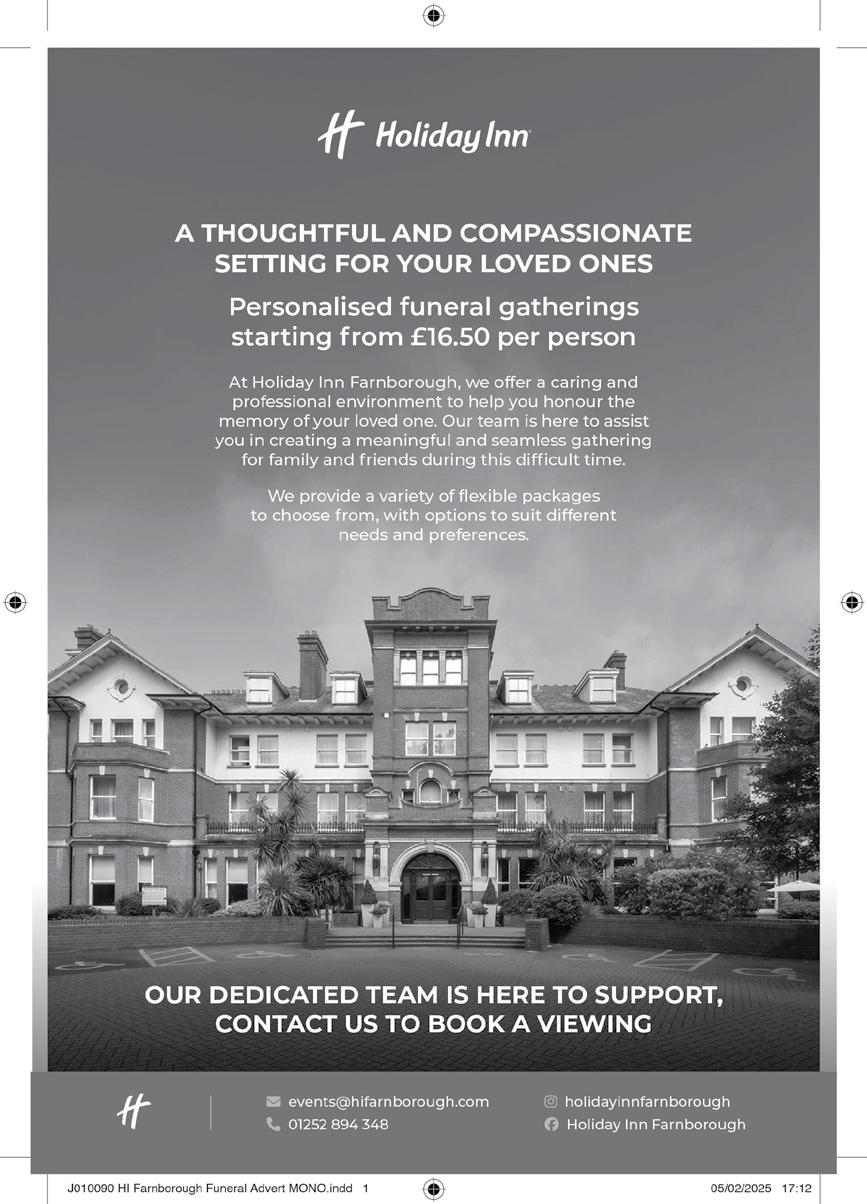
The Hospital would like to thank RNS Publications for publishing this information and the following pages contain some features from services o ering their help at this time.
Whilst the Hospital is grateful of their support it does not endorse or recommend any of the services that they provide.
Please note, whilst information is correct at the time of publication, this may be subject to future change.
STOPPING JUNK MAIL
This publication has been jointly developed between ourselves and the hospital. We hope that it has been or will be of help at this time and we welcome any comments or suggestions that you may have.
Please contact us either by phone, email or by post.