DISRU UPTORS
FRACTURED IMAGES AND MIGRANT WORDL
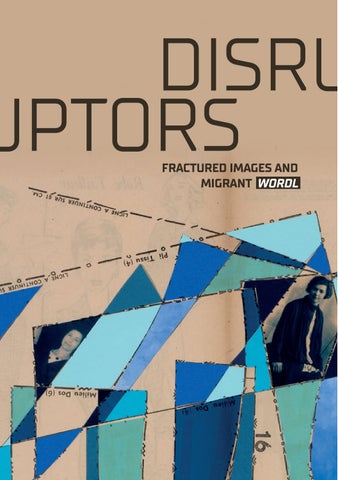
14 May–4 September 2026
Editor: Ana-Maria Milčić
Ben Uri Research Institute records and shares the wider immigrant contribution to British visual culture since 1900
This free publication is for educational, non-commercial research, private study and critique purposes only. It must not be reproduced in any format, and is not for resale nor is it to be used for commercial purposes.
This exhibition would not have been possible without the engagement of a number of people. We would like to thank David Glasser, Chair of the Board of Trustees of Ben Uri Gallery and Museum, and Director Cathy Pütz for their support in making it possible. Special thanks go to the Ben Uri research and collections team: Rachel Dickson, Irene Iacono, Sarah MacDougall, Michal Mel, Joy Onyejiako, and Masoom Pincha. Stephen Bann, Bernard Moxham, Jasia Reichardt, Nicola Simpson, and Andrew Wilson have provided valuable insights and Chelsea College of Art Library and Moxham have loaned materials. Thanks are also due to the catalogue designer Ian Robson and the photographers Justin Piperger and Ariel Finch. We are grateful to the artists in this exhibition for their generosity and collaboration: Astrid Furnival, Hansjörg Mayer, Astra Papachristodoulou, Verdi Yahooda, and Osman Yousefzada. We would also like to thank the author Greg Thomas for his original contribution. Special thanks are due to William Allen’s archivists Taylor Beidler and Finch and to Ben Uri’s Alexander Knight. A very special thanks goes to Ben Uri’s Nandika Bali for overseeing the logistics and organisation from start to finish.
Ana-Maria Milčić and William Allen
May 2026
Ben Uri Research Unit, London
ISBN 978-0-900157-20-2
The Disruptors exhibition finds a highly suitable home at the Ben Uri Gallery, founded in 1915, and today celebrating the wider contribution of migrant artists and creatives to British society. In its early years it was an Arts Society characterised by its energy and by diverse and precocious talent across a multitude of disciplines. Its artists and writers were as passionate about relevance as they were about the primacy of invention and the imagination. It opened in the heyday of Modernism, recording heritage, sparking cultural renewal across a complex matrix of skills and expressive disciplines, from typography to illustration and design.
Credit is warmly due to Dr. AnaMaria Milčić for the whole conception and realisation of the superb Disruptors project. We are extremely grateful to William Allen for his generosity in making available such a stellar array of work to challenge and surprise us. The sheer breadth of these works brings a refreshing openness to what might be possible if we, as viewers and makers each in our own way, might allow ourselves the space to question received art practice and creative expression. We are offered ways of celebrating ephemeral experience, of taking ruptured non-linear reality and finding new forms to make our own meanings.
It is especially the new approach to language as matter, as Dr. Greg Thomas writes here, which is liberating. Whatever our heritage or received languages and forms of expression, we can treat words as the potter’s clay, remake them, or think of them as soundscapes in the way Henri Chopin did. This freedom
means we too can create poetry and can celebrate the primacy of our senses and of our complex lived experience.
The relevance of this is how future focused it becomes. The many artists whose lives we glimpse in this exhibition reinforce the value of self-determination and designing a dynamic identity from a mass of disparate parts. They might be uprooted from their homeland, moving through multiple migrations, but they repeatedly prove their ingenuity and resilience. We have a part to play in this in our own differing responses to the work here. William Allen describes his own process of collecting records and archives as empowering, these ‘can prove inspirational and show a world (re)shaped by migration, movement, and complex cross-border networks’.
I encourage you to accept the invitation of this exhibition to respond individually, blending in your own insights, to take perhaps a new creative journey. The cross-cultural ferment of forms and practice that we encounter offers a privileged view of the freedoms artists have forged for themselves, faced as Greg Thomas says with ‘pressures on selfhood’ that are current and pressing. It is a joy to see individual identity celebrated and remade here, recalibrated to connect us with our innate creativity and with older, deeply embedded forms of selfexpression and value.
Dr. Catherine Pütz FRSA Director
Ben
Uri Gallery & Museum
This exhibition brings together works from the Ben Uri and William Allen Collections, tracing more than a century of experiment in word-image relations. For the artists shown here, the word is not only read but seen. Spanning early twentieth-century avant-garde practice to later postwar developments in concrete poetry and conceptual art, the exhibition places artworks alongside archival material to show how these ideas emerged and evolved. What connects them is a shared impulse to disrupt the border between reading and viewing, producing effects that range from cryptic symbols to clear antiestablishment statements, while probing questions of movement, migration, exile, nostalgia, belonging, conflict, identity, origin and meaningmaking.
Disruption here is twofold. It begins as a creative force within the historical avant-gardes and the paths that followed, as artists move words across the surface and unsettle the rules of syntax and image creation. Disruption also speaks to lives shaped by movement: from the forced journeys of refugees fleeing Nazism to post-war migration, to second-generation artists navigating between cultures, and to the tangled question of belonging and resettling. Wordl, coined in the spirit of the avant-garde’s restless reshaping of language, fuses ‘word’ and ‘world’ and evokes arrival in the UK via different routes, the acquisition of a new language, and the making of new bonds between word and image while reshaping the British art world.
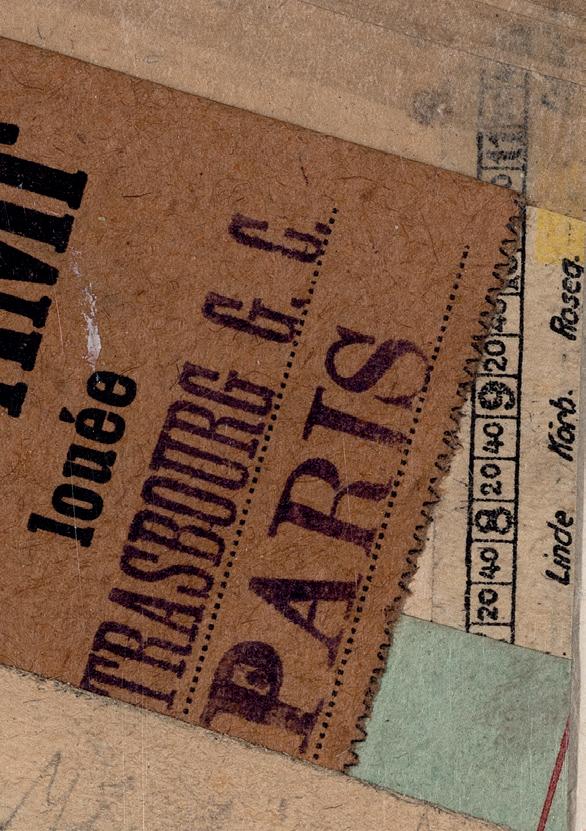
The older generation of avantgarde artists in this exhibition, Kurt Schwitters, Alfred Lomnitz, Hugo Dachinger, Gustav Metzger and Shmuel Dresner, all came to the UK as refugees from Nazism. Schwitters, a household name in Dada, offers an early example of how the avant-garde disrupted the logic of canvas and grammar. His collage für Frau Fränkel (cat. 1, 1927) is an intimate gesture made for his friend, the artist Elsa Fraenkel. Both would soon become refugees from Nazism. The small piece layers tickets and fragments of typography to recall their journeys to Paris in the 1920s by loosening language into image and creating a sense of travel. Such textual-visual arrangements belong to a wider tradition that runs from Guillaume Apollinaire’s calligrams (poetry arranged into visual form) through the experiments of the Cubists, Futurists, Vorticists, Dadaists and Surrealists, and into the neo-avant-gardes of the twentieth century, as discussed by Greg Thomas in the following chapter.
The experimental work that made the Hanover-born Schwitters a key figure in German avant-garde circles also made him a target of the Nazis. In the 1930s, his contract with Hanover City Council was terminated and his work appeared in the infamous Degenerate Art exhibition. In 1937, he fled Germany for Norway to escape interrogation by the Gestapo. Three years later, as the German army pushed north, Schwitters escaped once more arriving in Edinburgh aboard a Norwegian icebreaker.
Within days of landing in 1940 he was detained and sent to an internment camp. Although his work had appeared in two prominent London exhibitions during the 1930s and several admirers wrote to the authorities on his behalf, he possessed few useful contacts, spoke little English, and did not neatly fit the category of a recognised anti-fascist exile resulting in a prolonged stay on the Isle of Man.1 Painted in quick, restless strokes of muted grey, green and ochre, Douglas from the Internment Camp (cat. 2, 1940) looks out from Hutchinson Camp across the town, offering a fleeting glimpse of life in internment.
Lomnitz and Dachinger were also interned. Lomnitz, born in Eschwege, Germany, left for the UK in 1933 after Nazi antisemitic laws came into force. His Woman Seated at a Table (cat. 3, c. 1934), made shortly after his arrival, shows a vivid interplay between printed material, the page of the Evening Standard, paint and collage, continuing the avant-garde practices in which everyday fragments like newspapers are drawn into the picture. However, despite his new life in the UK, Lomnitz was interned in 1940 as an ‘enemy alien’ at Huyton Camp in Liverpool when Churchill’s policy of mass internment swept him up. In his illustrated memoir, “Never Mind, Mr. Lom!” or The Uses of Adversity (1941), Lomnitz recounts these experiences and the camp’s unexpected creative life as many artists found themselves suddenly living together.2
Among his fellow internees was Dachinger. Born in Gmunden in Austria-Hungary, he ended up in the camp soon after fleeing to England via Denmark in 1938. Though rarely mentioned in avant-garde histories, he used the same experimental textual rearrangements and worked with
everyday materials, from toothpaste to gravy browning and newspapers.3
His Portrait of a Man (cat. 4, 1940), painted in the camp, follows a logic akin to Lomnitz’s: a page of The Times lies beneath the face of the Austrian Jewish émigré engineer Wilhelm Hollitscher, binding text and image to link a displaced life to a new country. This pairing of newsprint and paint draws on the familiar avant-garde gesture of reusing newspaper scraps while also showing ingenuity under the camp’s constraints. In both works, newspaper text cuts through the painted form, tying British public events to a private face and the intimate interior to the wider political world.
The youngest of the émigré group, Gustav Metzger, was born in Germany to Polish parents and arrived in the UK in 1939 via the Kindertransport, later becoming stateless after losing his Polish citizenship. This condition shaped both his art and activism, and underpinned what he became known for: Auto-destructive art. Continuing the legacy of Dada as a response to the absurdity of the First World War, Auto-destructive art responded to the brutality of the industrial-military complex and weapons manufacturing by casting the artist as destructor rather than creator.
As Metzger wrote in his 1961 manifesto (cat. 20), ‘Auto-destructive art is an attack on capitalist values and the drive to nuclear annihilation’.4
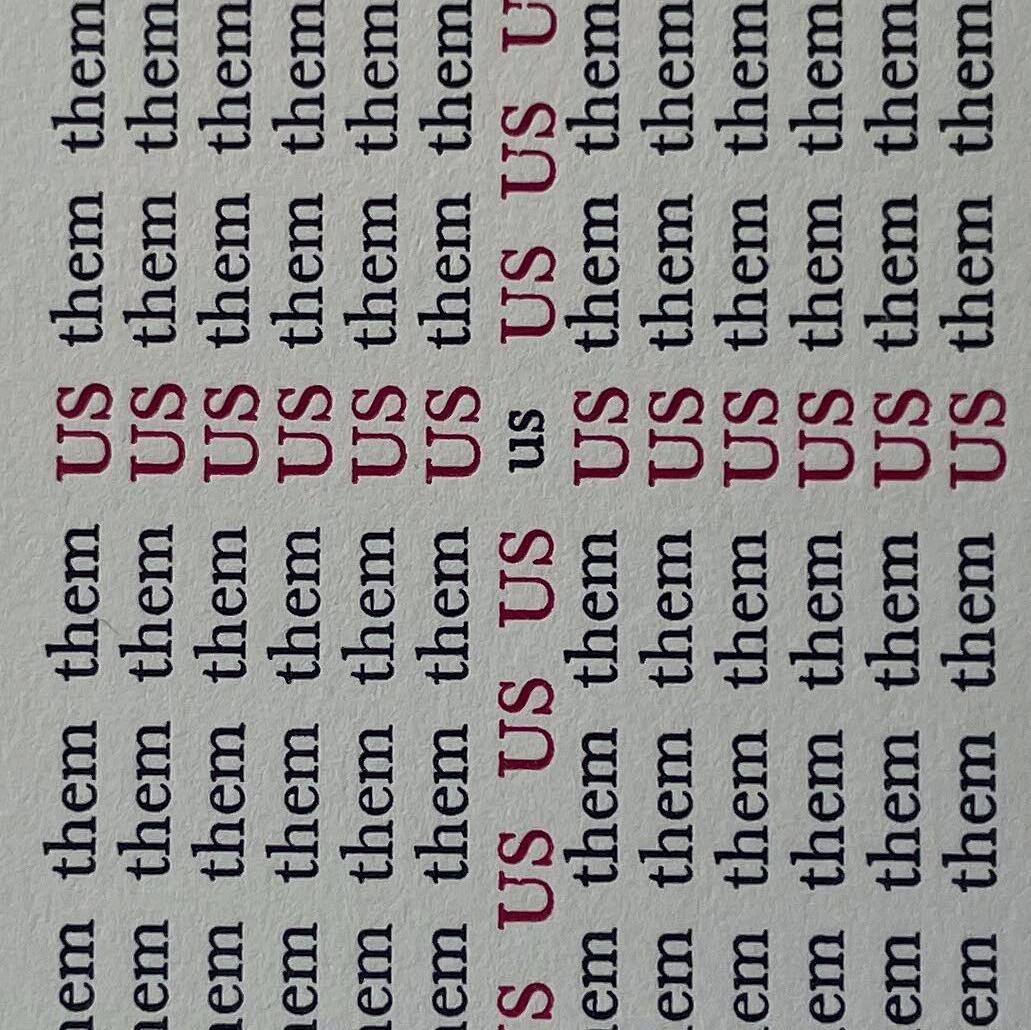
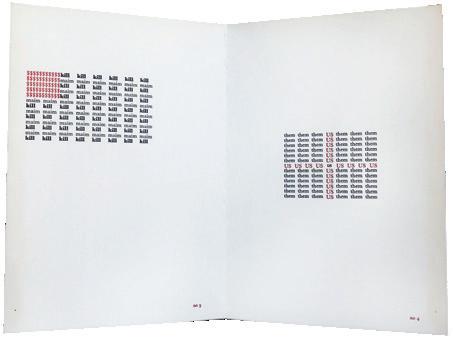
For neo-avant-garde movements such as Auto-destructive art, the textual manifesto became a core and instantly recognisable visual form. An anti-American critique that fuses this anti-weapons, anti-capitalist stance with the strategies of concrete poetry appears in John Sharkey’s 1969 anthology of British concrete poetry, specifically, his poem US-A (here, a version from Pentacle, cat. 31-left,
1969): the US flag is formed from dollar signs and the verbs ‘kill’ and ‘maim’.
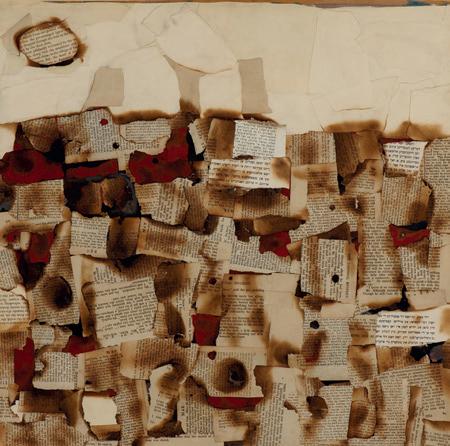
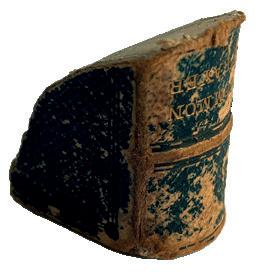
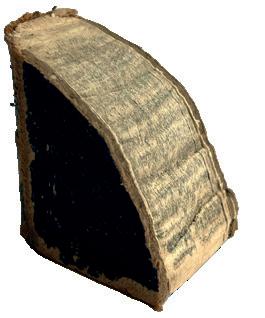
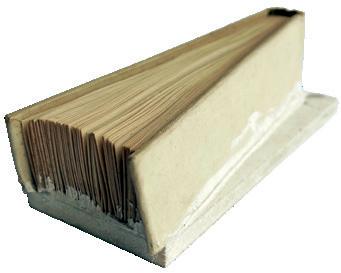
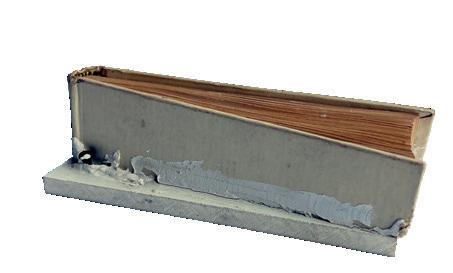
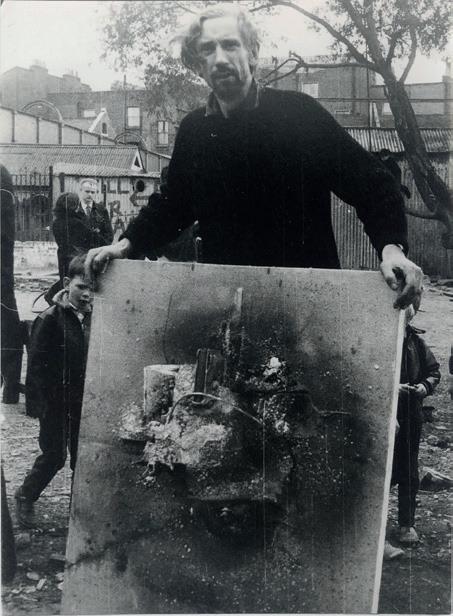
In 1966, Metzger and the Irishman Sharkey organised the Destruction in Art Symposium (DIAS), now remembered as a key gathering of international anti-establishment and countercultural artists of the period. One of its most radical events was by John Latham, born in Northern Rhodesia (now Zambia) to a colonial administrator and later based in the UK. His ‘skoob’ event (books spelt backwards; cat. 36, 1966) used burning books as a means to produce an abstract canvas with a similar approach continued in Book of Common Prayer and Untitled (cat. 34 and 35, c. 1982–83), where books are reduced to fragments. Such acts were not censorship or anti-intellectualism, but, as Latham put it, an attempt ‘to put the proposition into mind that perhaps the cultural base was burnt out’.6
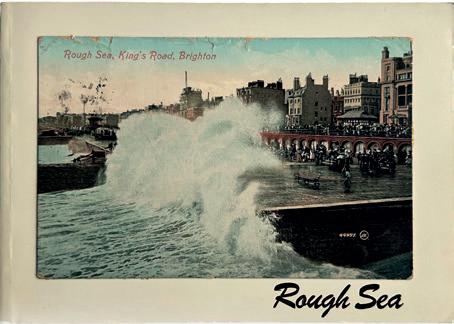
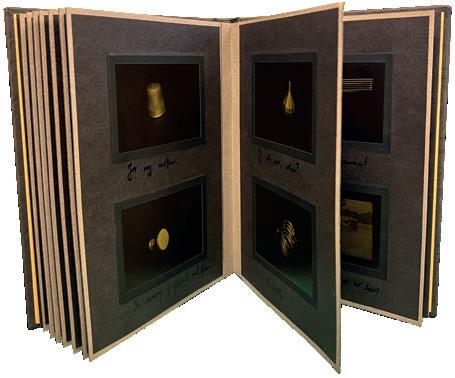
The (un)making of books appears throughout the exhibition. In The Ghost Town collage (cat. 33, 1982) the Polish émigré artist Dresner also uses burning but this time of pages from English and Yiddish books to form an abstracted landscape in which browned edges suggest a barren earth beneath a sky of white pages.7 The American artist Susan Hiller and Verdi Yahooda, born in what is now Yemen, both came to the UK after the Second World War and work with the book form, pushing it towards an almost purely visual mode. Hiller’s Rough Sea (cat. 30, 1976) is a collection of postcards of waves crashing against British seaside towns with brief captions straining against the force of the sea. Yahooda’s The Dancer
(cat. 32, 1984) goes even further in displacing text. Inspired by Victorian photo albums, the book sets out a quiet sequence of golden images of her late mother’s belongings with faint black-on-black text: memory flickers between vivid details and fading away.8
Henri Chopin from France, Astrid Furnival and Hansjörg Mayer from Germany, and Li Yuan-chia from China also belong to a later generation who arrived in the UK after the Second World War and were linked to concrete poetry, though Chopin also shares the historical moment of the earlier avant-garde group. Born in inter-war Paris, he fled the city in 1940 after the German invasion but was soon deported to forced labour camps and prisons in Central Europe. He returned to France in 1945, followed by military service in Austria and Indochina, and settled in England in the 1960s after marrying the television and radio producer Jean Ratcliffe. Best known as an experimental sound poet, Chopin explored the body’s own soundscape and mixed this with concrete poetry.9 The works shown here are silent on the surface but still hum, reflecting his view of poetry as an art that unites and reorders the senses.
In Flic Flac Floc (cat. 6, 1965) scattered words assemble into a stylised human figure. The onomatopoeic bursts mimic splashing footsteps through puddles, each flic, flac, and floc landing with playful insistence while also hinting at a more ominous history. The red, white, and blue fields bring to mind the French and Czechoslovak flags, linking the image to Chopin’s wartime detention in labour camps in Olomouc and the forced westward marches of prisoners of war through the cold and wet winter of 1944–45.
In The Times Today (cat. 7, 1972) a small triangular head is formed from a lexicon of madness and disarray, while repeated sounds run along the edge like a manic chant. Below, the composition bursts into bold exclamations alongside an image that merges the upper ridge of a mouth with an eye, disrupting the relation between looking, reading, speaking, and hearing. The auditory dimension in The Cage (cat. 8, 1973) emerges through the word ‘caw’ (the harsh cry of birds), while a composition of numbers opens into the form of a beak, with ‘taxes’ at its base. In Spaghetti Decorated Ltd. (cat. 9, 1974), the typographic marks are no longer semantic signs but graphic units woven together to suggest spaghettilike strands about to plop onto the figure below.
Chopin also started the audiovisual magazine OU, to which Astrid Furnival’s husband, John Furnival, contributed. Astrid Furnival left East Germany at a young age with her grandmother and eventually settled in England in the 1950s. A self-taught artist, she entered the circle of concrete poets through her husband.10 In Furnival’s work, the conceptual clarity of concrete poetry meets the hand-crafted practicality of the Arts and Crafts movement. Flags, quilts, sweaters, and dresses become carriers of wordplay, poetry, and symbols. In The Age of Shrivellry Is Not Yet Over (cat. 5, 1988), a pun on chivalry and shrivelling, a French sentence about arriving in the world very young is knitted across the front, with the English word ‘age’ picked out. On the back, Marshall McLuhan’s famous phrase ‘the medium is the message’ breaks into fragments such as ‘mess’ and ‘at my age’, linking front and back in a playful meditation on ageing and material change.
Among the German-speaking
immigrant concrete poets is also Mayer, who would become a central figure in British avant-garde publishing and typographic art. His family ran a printing shop situated on his daily route home from school, where the young Mayer spent his afternoons. Time passed around the presses and trays of type sparked an early curiosity about print and how words and images work together.11 He moved to the UK in 1966 to take up a lecturing post at the Bath Academy of Art and soon befriended Jasia Reichardt, the Polish-born critic and curator, and the niece of the Polish avant-garde refugee artist Franciszka Themerson (who, with her husband Stefan Themerson, developed the concept of Semantic Poetry).
In Continuations (cat. 12, 1966), Mayer takes a text on concrete poetry, leaving the names of Reichardt, Sharkey, and Bob Cobbing legible, and folds it into a restless composition which brings writing about art and visual practice into the same frame. This quietly undoes their usual order, as the artwork turns to study a piece of art writing. However, it is an earlier piece, the 1965 sau aus usa (cat. 13), that shows concrete poetry at its sharpest. Structured as a complex palindrome, the grid can be read both horizontally and vertically to form aus (‘out’ in German), sau (‘pig’ in German and a common insult), and usa (United States of America). Produced during the years of the Vietnam War, the work compresses biting political critique into a tight typographic grid.
Two other concrete poets, often seen as pioneering British exponents of a movement first developed in Brazil and elsewhere, Ian Hamilton Finlay and Dom Sylvester Houédard (dsh), unsettle fixed ideas of foreignness
and belonging within British identity, a point developed further in the Ben Uri Research Unit section. Finlay was born in Nassau, The Bahamas, to a Scottish family whose wealth derived from orange farming in Florida and alcohol smuggling during Prohibition.
Sent to school in Scotland as a child, he felt ‘exiled from his island home’.12
Early memories of boats on the Caribbean Sea, shaped by this move, became a lasting imaginative spur, with boats, coasts, and sea voyages recurring throughout his work. Born into a family of French heritage on Guernsey, a self-governing British Crown dependency in the Channel Islands, dsh was evacuated to England in his teenage years in 1940. In 1949, he joined the Benedictine Prinknash Abbey in Gloucestershire, where he spent the rest of his life.
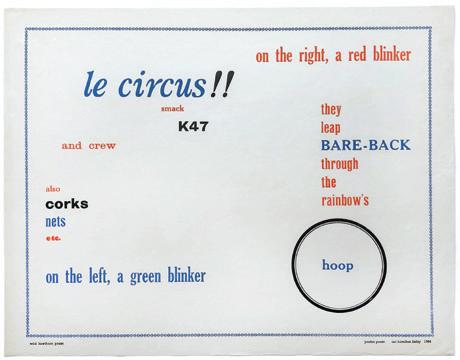
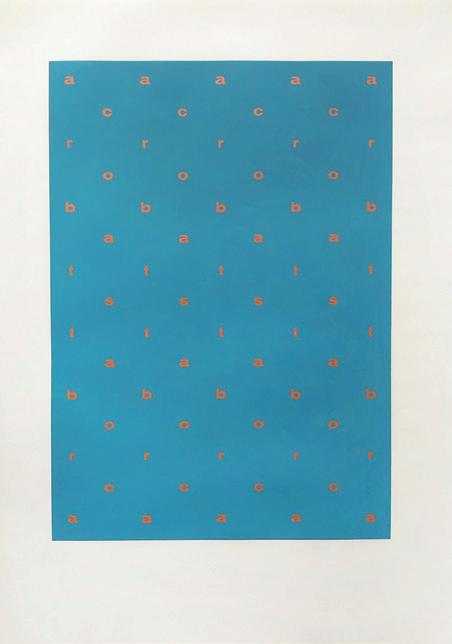
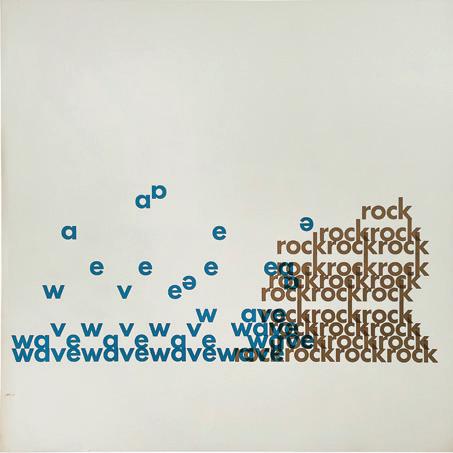
In Finlay’s first poem-print, Le Circus (cat. 23, 1964), words are arranged to evoke a circus. This logic is sharpened in Acrobats (cat. 24, 1966–68), where letters perform like bodies in motion and diagonally spell out ‘acrobats’. Such simple yet evocative arrangements of letters continue in his maritime work. In Wave Rock (cat. 25, 1966), often regarded as a Finlay print but in fact designed by Bernadette Shrimpton as part of a project at the Bath School of Art, ‘wave’ breaks into ‘rock’ as the letters swash across the page to mimic the motion of water turning against the shore.13
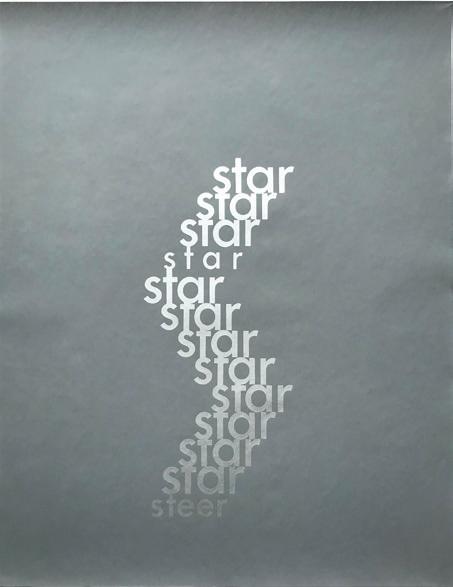
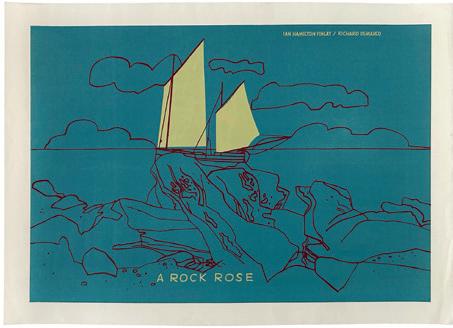
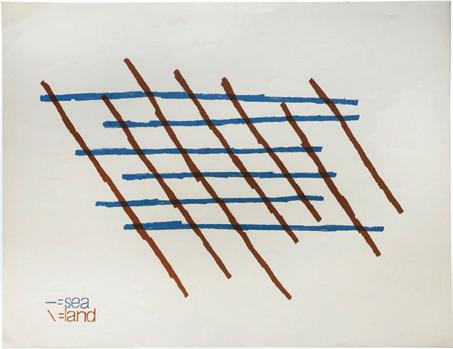
A related but simplified logic appears in Finlay’s Star/Steer (cat. 26, 1966–68), where the arrangement of the words does exactly what the title says. In his collaborative print Land/Sea (cat. 28, 1967), blue horizontal lines and the word ‘sea’ meet brown diagonal strokes and the word ‘land’ to align colour, line, and meaning. It is in A Rock Rose, (cat. 27, 1971) however, that Finlay and Richard Demarco let language and nostalgia catch the
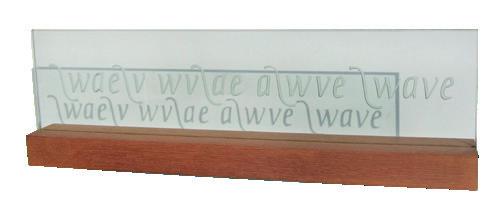
tide: through an interplay of line, colour, image and grammar, ‘rose’ wavers between noun (the rock-rose flower) and verb (a rock rising), while the boat evokes voyage yet remains entangled in the continuous red line that connects the rock to sky, boat and clouds. Finally, in the glass sculpture Wave (cat. 29, 1992), the S-shaped proofreading mark for transposition doubles as a wave while signalling the reordering of letters spelling the same.
It is no surprise that dsh’s ‘typestract’ (typewriter + abstract) poems, made on the priest’s Olivetti Lettera 22, are underpinned by a sense of spirituality even when he is more focused on exploring how abstract art can be made with a typewriter, as in cat. 14 (1963) and cat. 18 (1972). It is worth stressing his multifaith interests, too: alongside Christian mysticism, he was drawn to Tibetan Buddhism, worked with the Muhyiddin Ibn ‘Arabi Society, and found resonance in the chant and language of shamanic practices across the Americas (see cat. 16, 1967), as well as in the fractured speech of schizophrenia.14 In la recréation de l’homme à l’image de dieu (cat. 17, 1969), the creation of man is imagined as a typographic process in which language breaks into fragmented particles of data that float as a mystical entity before they are reassembled into new forms.
Such Benedictine calm contemplation meets a Freudian sense of dissolution in his bilingual (English-French) poem on 4 stages of contemplative t/writing (cat. 15, 1963), as ‘moi’ (‘me’ or ‘ego’ in French) and ‘je’ (‘I’ in French) split and disappear. In a small handwritten work, 1974–75 (cat. 19), dsh is more playful and mischievous: the text reads ‘blond danes long to’ but the idiosyncratic font spells out ‘of proud gayes love’ when the translucent paper is reversed.
Moving from contemplative Benedictine abbeys and remote Scottish coastlines to the centre of London, the exhibition explores a buzzing cultural scene internationalised by the early 1960s through mass migration from former colonies and beyond. However, this new vibrancy unfolded within a racialised two-tier citizenship system shaped by the Commonwealth Immigrants Act of 1968 and the Immigration Act of 1971. The Filipinoborn David Medalla, who arrived in 1960 and became a vital presence in British avant-garde counterculture, resisted such marginalisation by seeing himself not as a migrant but as a cosmopolitan citizen of the world who never sought the bureaucratic approval of British citizenship.
In 1964 he joined Metzger, the Italian-born Marcello Salvadori, and others in founding Signals Gallery in central London. It quickly became an avant-garde art space, drawing in many migrant artists with its active internationalist policy and promoting experimental forms, especially kinetic art but also brought into its space the concrete poets. From 1964 to 1966 Medalla edited Signals Newsbulletin, where he set out a global vision of art. His poem ‘MMMMMMM…Manifesto (a fragment)’ of 1965 imagines sculpture as mobile and migrating en masse to the North Pole.15 After Signals closed, Medalla launched a new venture.
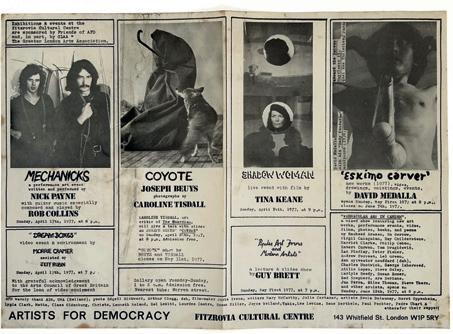
In 1967, he founded the Exploding Galaxy, based in a private house but continuing the same spirit of gathering countercultural figures. In 1974, he joined the Chilean-born Cecilia Vicuña, who had fled to London after the 1973 coup, and others to found Artists for Democracy (cat. 22),
a collective shaped by international solidarity and struggles for liberation.
The Chinese conceptual artist Li and the Spanish-born Venezuelan artist and archaeologist José Maria Cruxent were both part of Medalla’s galaxy and exhibition spaces. Li arrived in London in 1966 before settling in rural Cumbria, while Cruxent spent a brief period in the city, moving in avant-garde circles before leaving for Jamaica. Li’s Untitled collages (cat. 10 and 11, 1963) push both language and visual perception to their limits. By impressing and marking the paper with small circular forms, he draws together East Asian calligraphic practice and Western sculptural thought, guided by what he termed the ‘cosmic point’. The work feels both spiritual and cryptic. Devoid of ink, its impressions, including impressed signature and date, stress absence and nothingness as much as presence.16 As Li noted, such works offer ‘an even greater freedom of movement’.17
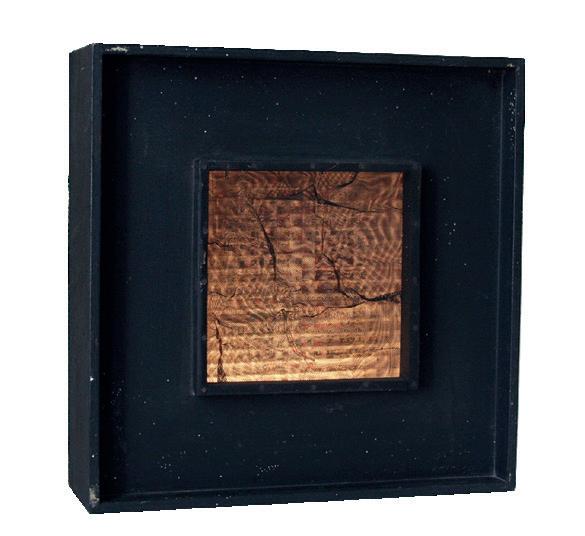
Cruxent is known for abstract expressionist paintings that draw on cave art and return to a preliterate past, seeking a ‘spirit of the matter’ that resonates with Li’s cosmic metaphysics.18 His Métromane (meaning a mania for writing verse, cat. 21, 1964) differs in form but shares a concern with the limits of writing. A dark metal mesh laid over a text-based collage creates a moiré effect in which letters shift with the viewer’s position. Although the eye strains to make sense of what the mesh conceals, the text beneath is in fact nonsensical, thus unsettling the idea of script as a bearer of semantic meaning.
To the Spanish-speaking Americas, and in loose orbit around Medalla in London, belong Felipe Ehrenberg and Martha Hellion, the couple who fled Mexico in the 1960s, as William Allen
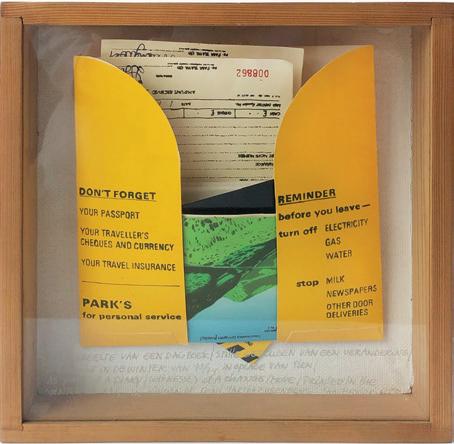
explains separately. Later, with her new Dutch partner Jan Hendrix, who settled in Mexico, Hellion built a work (cat. 41, 1974) from travel documents, which takes on a more playful, touristy tone. The bilingual (Dutch–English) phrase ‘witness of a change’ points to worlds and lives remade.
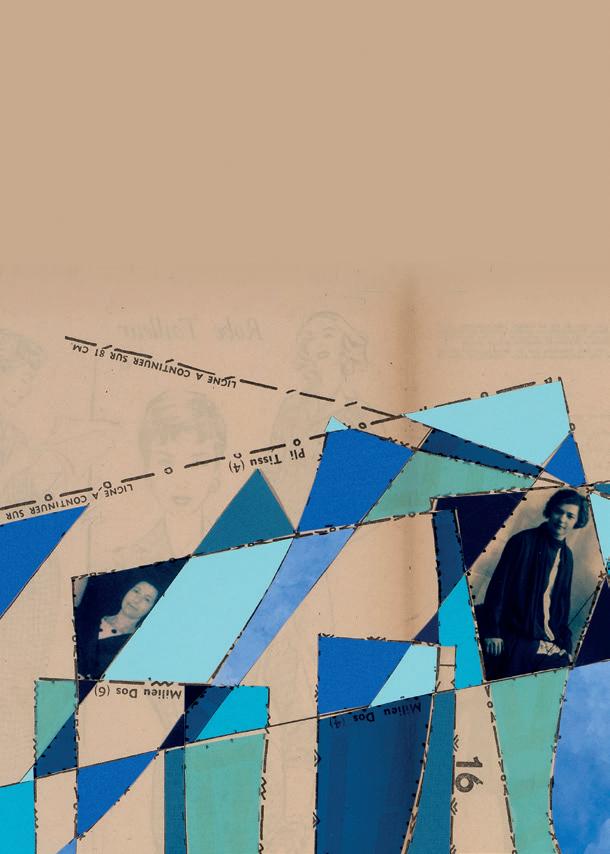
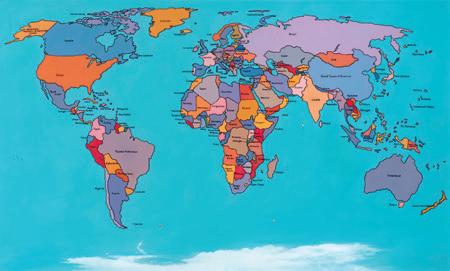
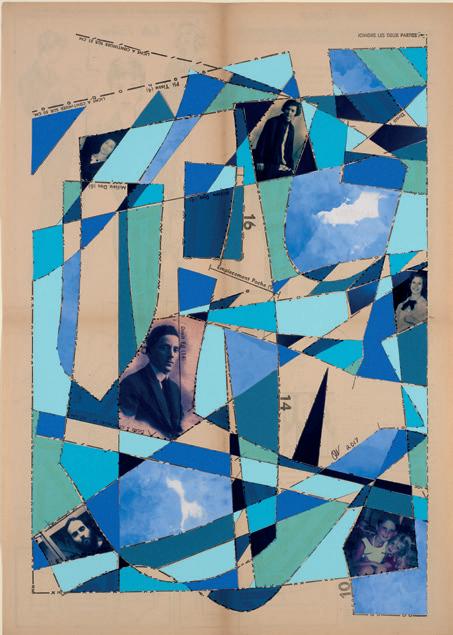
Contemporary artists pick up the fault line between word and image and press on into concerns of identity, borders, and geopolitical strain. In Tam Joseph’s The Hand that Made the World (cat. 40, 2013), the Dominicaborn British artist reassigns country names within a familiar political map in a way that unsettles reading and seeing by creating a slippage in political order.19 Hormazd Narielwalla, born in India and based in the UK since 2003, reworks vintage French tailoring instructions (cat. 42, 2017) into fractured collages that place old Jewish family photographs alongside blue patches. This at once recalls the thirteenth and fifteenth century expulsions of Jews from England and Spain and the blue-washed houses in their new home in Chefchaouen, Morocco. The result is a world cut and restitched across centuries.
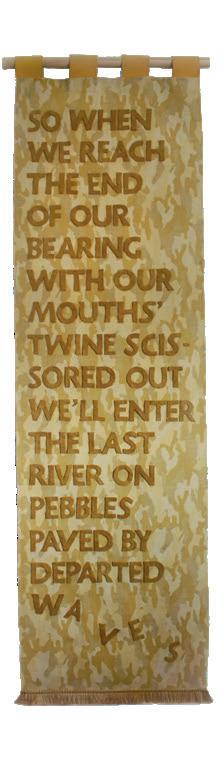
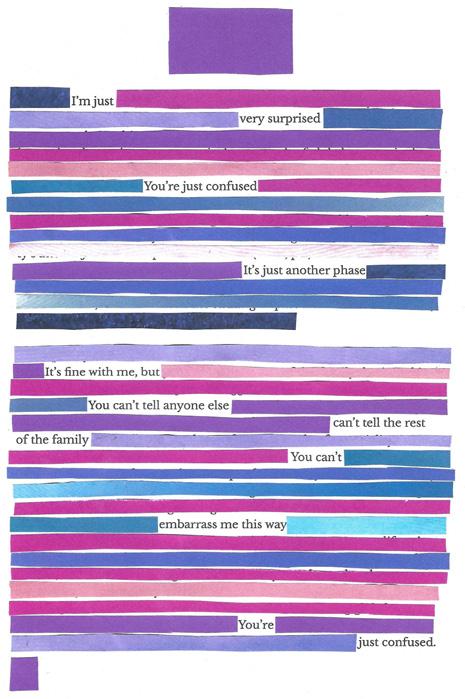
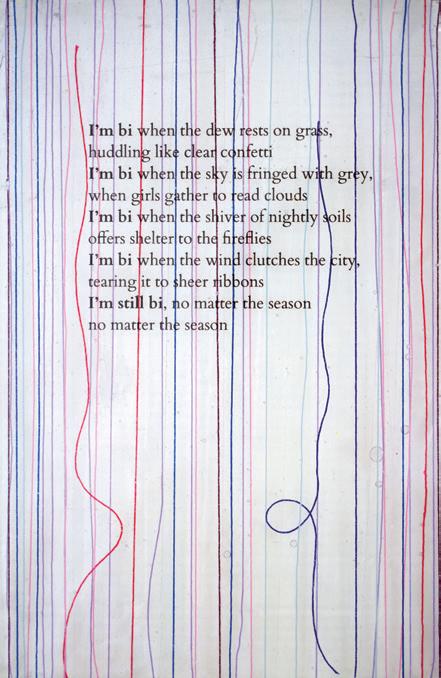
Identity and voyages are again made and unmade via language in the works of Astra Papachristodoulou, born in Greece, and Osman Yousefzada, born in the UK to a Pakistani-Afghan family. Papachristodoulou works with blocks of colour against invisibility: in her bi-erasure poem (cat. 38, 2022), colour both conceals and declares, as strips obscure a text on bisexuality while forming the bisexual pride flag, an identity then reaffirmed in Unwavering (cat. 39, 2023). A camouflage pattern in Departed Waves (cat. 37, 2023) carries text whose gradual
disintegration mirrors a loss of direction in an increasingly militarised world.
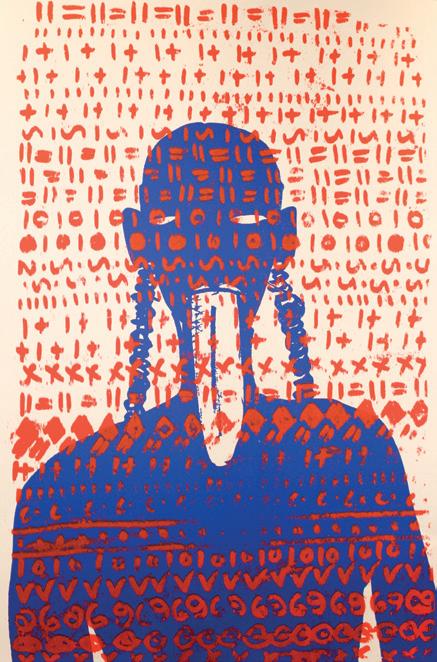
Yousefzada’s Incantation I (cat. 43, 2021) presents a talisman-like figure to accompany a migrant journey. Set behind a timeless wall of spells or prayers, the text feels both like ancient script and like digital sequence, while its insistently cryptic surface invites decoding between guest and host across time and across different systems of knowledge.20
This exhibition brings together works that test the limits of language and image, negotiated across histories of movement and belonging in the UK, while drawing out the force of unexpected juxtapositions and provocations. As debates around immigration intensify setting groups against one another, it is worth ending with Sharkey’s poem from Pentacle (cat. 31-right, 1969), where the St George’s flag is formed from the words ‘them’ in black and ‘us’ in red. What would be lost if the only words used were ‘us’? It is this story of migration and artists – not as a separate ‘them’ but as part of shared British and world history – that this exhibition sets out to trace.
Ana-Maria Milčić
1 Rachel Dickson and Sarah MacDougall, ‘Artists in Exile in Britain, c. 1933–45’, in Rachel Dickson and Sarah MacDougall, eds., Forced Journeys: Artists in Exile in Britain, c. 1933-45 (London: Ben Uri Gallery/London Jewish Museum of Art, 2009), p. 32.
2 Alfred Lomnitz, “Never mind, Mr. Lom!” or, The Uses of Adversity (London: Macmillan, 1941).
3 For more details on Lomnitz, Dachinger and interned artists see: Dickson and MacDougall, Forced Journeys and Ines Newman with Charmian Brinson and Rachel Dickson, Internment in Britain in 1940: Life and Art Behind the Wire (London; Chicago IL: Vallentine-Mitchell, 2021), pp. 1-16 (p. 5).
4 Gustav Metzger, Auto-destructive Art, manifesto (London: St. Martins’ Printers, 1961). Originally published in 1960. On Metzger see also: Nicola Baird, ed., Becoming Gustav Metzger: Uncovering the Early Years, 1945-59 (London: Ben Uri Gallery and Museum, 2021).
5 Reproduced in John J. Sharkey, ed., Mindplay: An Anthology of British Concrete Poetry (London: Lorrimer Publishing, 1971), p. 86.
6 John Latham quoted in an essay by Marion Keiner in John Latham: Art after Physics, the Museum of Modern Art, Oxford, 1991, p. 41.
7 Rachel Dickson and Sarah MacDougall, eds., Out of Chaos: Ben Uri: 100 Years in London (London: Ben Uri Gallery, 2015) pp. 124-125.
8 See: Susan Hiller, Rough Sea (Sussex: Gardner Centre Gallery, 1976) and Verdi Yahooda, The Dancer (London: Coracle Press, 1984).
9 On Chopin see, for example: Cédric Jamet, ‘Limitless Voice(s), Intensive Bodies: Henri Chopin’s Poetics of Expansion’, Mosaic: An Interdisciplinary Critical Journal, Vol. 42, No. 2, a special issue: Sound, Part II, June 2009, pp. 135-151.
10 There is very little writing on Astrid Furnival but see, for example: Bernard J. Moxham, Ariadne’s Thread the Fabric Artworks of Astrid Furnival (Nailsworth: Openings-Closings Press, 2014).
11 On Mayer see, for example: Bronac Ferran, ‘Autopoetics: Hansjörg Mayer’s titles of the nineteen-sixties’ (PhD thesis: Birkbeck, University of London, 2023).
12 Alec Finlay, ed., Ian Hamilton Finlay: Selections (Berkerley: University of California Press, 2012), p. 7.
13 The history of Wave Rock is as follows: it was originally conceived by Ian Hamilton Finlay as a book project. In 1966, he developed the idea into a glass poem produced in a small edition. Around this time, a project at the Bath Academy of Art invited students to make their own versions of ideas that came from poets. In one such project, Bernadette Shrimpton produced this design.
14 On dsh see: Nicola Simpson, Notes from the Cosmic Typewriter: The Life and Work of Dom Sylvester Houédard (London: Occasional Papers, 2012).
15 David Medalla, ‘MMMMMMM…Manifesto (a fragment)’, Signals, Vol. 1, No. 8, June–July 1965, p. 16. On Medalla see also, for example: Chanon Kenji Praepipatmongkol, ‘David Medalla: Dreams of Sculpture’, Oxford Art Journal, Vol. 43, No. 3, 2020, pp. 339-359.
16 Interpretation based on Dr. Nicola Simpson’s study on Li Yuan-chia (work in preparation, 2025), shared with the author.
17 Mei-ching Fang and Ya-chi Tsai, ViewPoint: A Retrospective of Li Yuan-chia (Taipei: Taipei Fine Art Museum, 2012), p. 20. On Li’s arrival to the UK and the Chinese diaspora see: Diana Yeh, ‘Contested Belongings: The Politics and Poetics of Making a Home in Britain’, A. Robert Lee, ed., China Fictions/English Language Literary Essays in Diaspora, Memory, Story (Amsterdam; New York: Rodopi, 2008), pp. 299-325.
18 For a discussion on Cruxent’s painting see: Alessandra Caputo Jaffe, ‘José María Cruxent: el arqueólogo como artista’, Revista de Arte Goya, Vol. 383, 2023, pp. 172-186.
19 On Jospeh see: Eddie Chambers, ed., Tam Joseph: This is History (Bristol: Eddie Chambers, 1998). On African diasporic art with a discussion on Joseph see also: Eddie Chambers, World is Africa: Writings on Diaspora Art (London: Bloomsbury, 2021).
20 See also Yousefzada’s novel on diaspora and living between two worlds: Osman Yousefzada, GO-BETWEEN: a portrait of growing up between different worlds (Edinburgh: Canongate Books, 2021).
Kurt Schwitters’s 1940 landscape painting Douglas from the Internment Camp (cat. 2) was created during his detention as a foreign alien in the United Kingdom, at the Isle of Man’s Hutchison Camp. A forlorn, rain-soaked scene, in which the slant of chimney smoke, slate rooftops, and shallow hills beyond somehow combine to suggest the presence of diagonal drizzle, it gives, as Ana-Maria Milčić notes in the previous chapter, ‘a fleeting glimpse of life in internment’. Executed in a post-impressionist style which was hardly revolutionary by the 1940s, it does not hint at the genres and media which made Schwitters famous. These include his rambunctious Dadaist sound poetry and his text-and-image-led collage, from intimate two-dimensional compositions to huge architectural assemblages of junk, his ‘Merzbarns’. A glimpse of his achievements in the latter field can be found in the 1927 collage für Frau Fränkel (cat. 1), created for the artist Elsa Fraenkel, using fragmented tickets and typography to recall their youthful trips to Paris, far happier excursions than the one which brought Schwitters to Britain.
By the time Schwitters made that journey – first to Norway in 1937 to escape Gestapo interrogation as a ‘degenerate artist’, then to Britain in 1940, after the Nazi invasion of the
Scandinavian peninsula – he was already a towering figure in Dada, a movement at the forefront of all subsequent experiments in visible language and legible image.1 Born in Hanover in 1887, Schwitters started experimenting with Cubist art in 1917, around the same time that he began penning the proto-surrealist poetry included in his 1919 volume Anna Blume. 2
In 1918, Schwitters was denied entry to the Berlin Dada group because some disliked what they perceived as his old-fashioned romantic sensibilities. Unabashed, he effectively forged his own movement in his home city of Hanover under the moniker of ‘Merz’, a term which, according to his friend Stefan Themerson, he coined by extracting a stray syllable from a newspaper advert reading ‘Kommerz und Privat Bank’, and which he used to describe his collages.3
Dada had been forged not in Berlin but in neutral Switzerland, at the brutal apex of the First World War, part of the wave of experimentation in visual and sonic poetics which had swept across Europe during the early 1910s. Willard Bohn describes the French poet Guillaume Apollinaire, author of pictorial ‘calligrammes’, and the Italian Futurists – such as F.T. Marinetti and Carlo Carrà –as ‘the source of all subsequent experiments’ at this time.4 Bohn draws particular attention to Apollinaire’s groundbreaking 1912 poem ‘Zone’, where he ‘began to imitate the Cubist
painters who decomposed an object into its parts, seen from different angles’, and to Marinetti’s concept of ‘parole in libertà’ (‘words in freedom’), by which adventurous typography often expressed the noise and excitement of military combat.5
Recalling the early days of the Dada movement, centred on Zurich’s Cabaret Voltaire, the artist Hans Richter admitted that, ‘[l]ike all newborn movements, we were convinced that the world began anew in us; but in fact we had swallowed Futurism – bones, feathers and all’.6
The first ‘Dada’ artworks included a raucous ‘poème simultané’ (‘simultaneous poem’), a performance piece in which Richard Huelsenbeck, Marcel Janco, and Tristan Tzara recited lines of text simultaneously, interspersed with para-linguistic vocal sounds, what Richter would later call: ‘a contrapuntal recitative in which three or more voices speak, sing, whistle, etc, simultaneously, in such a way that the resulting combinations account for the total effect of the work, elegiac, funny or bizarre’.7 Like the Futurists, the Dadaists relied on experimental typography to bring wild sound effects to the page. In this way, the concept of visual poetry became a foundational one in Dada, evident in the unusual typographic arrangement of poems such as Hugo Ball’s ‘Karawane’ (1916).
By the time poetry had found its way onto the visual plane, of course, painting had found its way onto the linguistic, notably through the Cubist adventures of Pablo Picasso and Georges Braque. In works such as Braque’s The Portuguese (1911), stencilled text had been incorporated to emphasise the flatness of the canvas, while Picasso’s Still Life with Chair Caning (1912) had combined this effect with the incorporation of found materials into the picture
surface. Such activities cleared the path, stylistically, for Schwitters’s development of his Merz collages, and the wider incorporation of text into modernist painting, from Paul Klee to Cy Twombly and beyond.
Words at War, Words in Exile, Words Transformed: Some Working Definitions
What does this have to do with the image of Kurt Schwitters looking out over the little Manx city of Douglas from a British internment camp on a drab day in 1940? What does it have to do with the other artists featured in this show who fled to the UK from the expanding Nazi empire: Alfred Lomnitz, Hugo Dachinger, Gustav Metzger, Shmuel Dresner? What about the neo-avant-gardes of visual poetry and text art during the 1950–70s, typified by figures such as Henri Chopin, Astrid Furnival, and Hansjörg Mayer? Or contemporary works of migrant text-art by Osman Yousefzada, Astra Papachristodoulou, and others?
Dada was a movement forged in a moment of life-threatening chaos like the one that would force Schwitters into exile a quarter of a century later. Like the period of mass flight from Nazism of which Schwitters’s emigration was part, it precipitated in many artists and writers a profound sense of alienation from language. This found expression in the presentation of language as matter: not as a spotless vessel of meaning or truth, but a visual or material substance from which those qualities had been, to varying degrees, extracted, but which yielded strange new aesthetic potential as a result.
In her 1994 text The Visible Word, Johanna Drucker gave a more panoramic assessment of the contexts
which compelled early twentiethcentury adventures in visual poetry and experimental typography. In particular, she notes the common belief ‘that the transformation of symbolic systems was a politically significant act, and [...] that a new aesthetic form would bring about, construct, envision, a new utopian vision of the world’.8 This was particularly relevant to the Berlin Dadaist milieu which had rejected Schwitters, for whom the German communist revolution of 1918–19 promised a literal transformation of political reality: one for which, say, John Heartfield and Hannah Höch’s visceral, polemical collages might provide the mise-en-scène.
Drawing various strands together, then, the manifestation of language as a visible entity has been, for many modern and contemporary artists, both a response to a moment of profound social and political rupture and also an expression of hope in a new world, one where inherited symbolic systems might be reconstituted or imbued with new possibilities. One or both of these qualities tie together a huge swath of the work in this show, whether responding to the global conflagrations of 1914–18 or 1939–45, the revolutionary energies of the sixties counterculture, or the varied experiences of contemporary migrant artists in Britain.
Indeed, given that the Ben Uri Gallery is a repository for work by migrant artists, we can also posit a third, and crucial, paradigm. This is the effect of being uprooted from one’s homeland and native language on one’s relationship with the spoken and written word. In many cases, this seems to have precipitated a modernist-adjacent quality of ‘ostranenie’, a feeling of defamiliarisation from language
prompting its use in new ways: be it the old, familiar, maternal language, or the new one foisted on incomers as evidence of a right to remain.9
The Hutchinson Camp on the Isle of Man, where Kurt Schwitters was held, consisted of a row of terraced houses. It became known as ‘the artist’s camp’ for its lively creative life. Indeed, in the Manx camps, as Charmian Brinson notes, ‘the internees were provided with rather less spartan accommodation’ than in the transit camps they had come from.10
The same civility could not be ascribed to Liverpool’s Huyton Camp, located on an unfinished council estate. Here, ‘there was initially no furniture, no soap or toilet paper, no hot water, no proper medical facilities and insufficient food. Straw-filled palliasses functioned as beds. The unfinished houses provided basic accommodation, with twelve or more internees per house’.11 It was in this relatively punishing situation that the Jewish artists Hugo Dachinger and Alfred Lomnitz found themselves in 1940.
Born in Gmunden, Austria, in 1908, Dachinger studied graphic design in Leipzig before returning to his home country to work, developing a subsidiary practice as a painter before fleeing to England in 1938 after the Anschluss. Lomnitz, born in 1892 in Eschwege, Germany, had trained at the Weimar School of Applied Arts and exhibited with the pioneering Novembergruppe and Free Secession group, but left Germany in 1934 shortly after Hitler’s ascent. Both men were steeped in an emotionally intense, Germanic expressionist style not fashionable in Britain in the
1930s–40s, while Dachinger’s attempts to set up an advertising business were scuppered by strict anti-migrant laws.
All this became academic, however, when they were rounded up and sent to Huyton (Dachinger was later transferred to Mooragh Camp on the Isle of Man). Here they partook in the intriguing processes of make-do-andmend by which artists grubbed up materials: ‘[t]wigs were burnt to create sticks of charcoal; short beard hairs were plucked to use for brushes, and paints were made from brick dust or vegetable juice ground with linseed oil or olive oil from sardine cans’.12
Most notably, ‘any shortage of drawing paper was easily overcome, with the artists becoming avid re-purposers of old newspapers’, which were ‘primed with gelatine from boiled-down bones mixed with flour’.13 Many of Dachinger’s portraits on newsprint often foreground sections of adverts, photographs, and cartoons, as well as lines reflecting the economic hardship faced by many wartime refugees, such as ‘Domestic Situations Wanted’.14 The Times cover used for Portrait of a Man: Wilhelm Hollitscher (Huyton Internment Camp Liverpool) (cat. 4, 1940) is less visually arresting. Nonetheless, it hints at the wartime context of its creation, both with the sitter’s military-seeming overcoat and the small headline to the upper right, ‘Air Fights in Many Spheres’.
If Dachinger’s choice of materials suggests expediency more than aesthetic design, it is notable that Lomnitz’s Women Seated at a Table (cat. 3, c. 1934) is a pre-internment work. Thus, the addition of a louche, seated female figure, cocktail in hand, to a newspaper front page – from the quintessential London paper The Evening Standard – largely indicates a conscious artistic ploy, bringing elements of that background into the
thematic space of the composition. In her other hand, for example, the Blaue Reiter-style, expressionist figure holds a Vidor battery, a detail from an advert whose surrounding text is whited out. Her head, meanwhile, is filled with part of an illustration of an eighteenth-century John Palmer stagecoach, from a ‘To-day in History’ feature.
Both pieces are mischievously responsive to the cultural atmosphere of a new and unfamiliar home. At the same time, the use of newsprint as visual ground is imbued with a sense of isolation or distance from the social and psychological world that the text evokes, and from the native readership for whom it would serve, merely, as functional information or propaganda.
By the 1960s, the tides of avant-garde activity in Europe had receded and then risen again, with the post-war poverty and thrift of the 1950s making way, in Britain and elsewhere, for the more labile, optimistic atmosphere of the new decade. Economies were exiting recession. Consumer goods and lifestyle perks were becoming more widely available, reflected in a mass rise in TV ownership, flashing visual-linguistic symbols across retinas around the country on a nightly basis. Most crucially, a tangible counterculture was emerging, which provided the backdrop for new formations and experiments at the fringes of the visible and legible.15
The activities in question ranged from concrete poetry to pop art, book arts and interventions, Fluxusinformed events and happenings, and performances of non-semantic sound poetry – a descendant of those
early Cabaret Voltaire inventions –and graphic scores in the tradition of John Cage. Often, they were brought together under the label ‘neo-dada’, which, while vague, correctly identified a sense of affinity with Schwitters’s generation and its underlying impetus.
That impetus was to bring systems of visual and linguistic symbols under scrutiny during a period of social turmoil – in this case, the counterculture ferment which peaked with the student-led protests of Summer 1968 – and to use strange new amalgamations of language and image to envision, materialise, or invoke a new world. The French sound and concrete poet Henri Chopin, who moved to England in 1968 in the fallout from the Paris riots – in which he had participated – is a useful figure to mention briefly here. His aesthetics explicitly connected the breakdown of linguistic meaning with an assault on unjust and sclerotic social and political hierarchies.
Astrid Furnival (née Billing), born in Stendal, later part of East Germany, in 1940, and Hansjörg Mayer, born in Singen, in what would become West Germany, in 1943, are amongst a younger generation of German emigrants to Britain than those considered so far. Billing left in 1945 with her grandmother, Mayer in 1966, having already become an accomplished typographer and printer, to take up a teaching post at Bath Academy of Art in Corsham. Amongst his new colleagues in Corsham was the text-artist John Furnival, who had married Billing in 1960. Mayer and the Furnivals, along with figures such as Kenelm Cox, Charles Verey, John Sharkey, and Dom Sylvester Houédard, a Benedictine monk resident at Prinknash Abbey near Gloucester, subsequently helped to transform the west of England
into the nerve centre of the newly emergent British concrete poetry movement.
Concrete poetry was a style of poetry which had emerged in northern Europe – including in Stuttgart, where Mayer studied philosophy – and Latin America in the 1950s. It sought to transpose the visual and sculptural minimalism of concrete art into the linguistic domain, compelled by a belief that the presentation of language as an elementary graphic form, with grammatical structures reduced to a bare minimum, was a means of enhancing its semantic clarity. In this sense, concrete poetry was very far in spirit from the exercises in semantic disintegration and semisensical jouissance of the Dadaists and Futurists. Indeed, it was partly forged in contradistinction to such movements, at a time when clarity of communication across national and cultural barriers seemed crucial to post-war reconstruction.
However, by the time concrete poetry arrived in Britain in the early 1960s – first printed in the UK in 1962 by the Edinburgh-based poet and artist Ian Hamilton Finlay, in his magazine Poor.Old.Tired.Horse – it had already taken on many contrasting shades and hues. For the Brazilian concrete poets Haroldo and Augusto de Campos, for example, as for the Czech partnership of Bohumila Grögerová and Josef Hiršal, the presentation of language as visual matter was often the gateway to polemical and satirical word-play, a side effect, as it were, of the act of visual defamiliarisation.
Such poems might play on contrasts between national languages in a way which represented a sense of threatened or unravelling national identity, such as Portuguese and English in the Brazilians’ work – which
was often excoriating in its attitude to US economic expansion into South America – and German and Czech for Grögerová and Hiršal, reflecting their country’s recent liberation from fascist imperium. In John Furnival’s architectonic text-construction The Tower of Babel (1963), the lower lines of the structure are created from repeated iterations of the phrase ‘Peace for the World’ in English and Cyrillic, an ironic allusion to the Cold War in which Furnival had played a part as a Russian translator in the UK War Office during the 1950s.
In comparable spirit, Mayer’s 1965 poem-print sau aus usa (cat. 13), as Milčić notes in this text, incorporates the German words for ‘out’ (‘aus’) and ‘pig’ (‘sau’) with the acronym ‘USA’. The poem is an oblique, biting reference to the Vietnam War, and perhaps also hints at the emergence of American English as the lingua franca of a new, consumer-capitalist world. Poems of similar scabrous intent such as US-A (cat. 31, 1969; first published 1967) were created by the Irish concrete poet John Sharkey, who, alongside Gustav Metzger, another German migrant artist in the UK, organised the iconic Destruction in Art Symposium in London in 1966.
For Astrid Furnival, similar forms of bilingual wordplay are combined with time-worn and traditionally feminine craft techniques to suggest subversive re-interpretations of both text-art and domestic artisanship. Her jumperpoems, hand-coloured with plant dyes, are amongst the most beautiful and least studied products of the British concrete poetry movement. Often, they combine visual and linguistic allusions to iconic figures of proto-modernist art and music, such as Stéphane Mallarmé and Erik Satie –the latter a mainstay of the Furnivals’ creative universe – with punning poetic content. The Age of Shrivelry Is
Not Yet Over (cat. 5, 1988) finds scraps of English text buried in French, while also picking apart a phrase from Marshall McLuhan, a key theorist of visual-linguistic communication in the concrete poetry era, to make sardonic references to ageing and female beauty standards.
Words Abroad, Words at Home: The Contemporary Moment
In a situation eerily prefiguring the animus of anti-immigration protests in 2025, many Second World War internees on the Isle of Man were housed in hotels. The link is sufficient to remind us that we are once again living through an era of emboldened anti-migrant rhetoric in Britain. In this sense, it seems important to close by naming and celebrating the contemporary artists featured in this show, many of whom deal with the pressures on selfhood and language brought to bear by the migrant experience. These include the Dominica-born British artist Tam Joseph, Birmingham-born artist of Pakistani-Afghan heritage Osman Yousefzada, Hormazd Narielwalla from India, and, from Greece, Astra Papachristodoulou. To conclude on a more optimistic note, I want briefly to mention Yousefzada’s work (cat. 43, 2021), consisting of a blue, silhouetted human form, of abstract but evidently non-white-western provenance, standing behind a wall of red asemic script (lines and symbols that look like writing but have no semantic meaning). The vertical columns of marks at once suggest neolithic cave graffiti, Mesopotamian cuneiform – the world’s most ancient writing system – and the coding languages of the digital age, amongst its newest. If much of the artwork featured
in Disruptors is concerned with breakdowns in the symbolic systems governing the modern world, here is a work which transports us to a different emotional space, both older and more immediate, as if proposing some underlying, shared human identity in written and figurative form: an ur-text and an ur-figure. The word, and the world, transformed.
Greg Thomas
1 The Nazis’ Degenerate Art (Entartete Kunst) exhibition was held in Munich from 19 to 30 November 1937.
2 The best-known poem in the collection, ‘An Anna Blume’ (‘Anna Blossom Has Wheels’) is a paean to a phantasmic lover, featuring lines – in Schwitters’s English translation – such as ‘Blue is the colour of thy yellow hair./ Red is the whirl of thy green wheels’. See Jeffrey Cane Robinson, Jerome Rothenberg, and Pierre Joris, eds., Poems for the Millennium: Volume One (California: California University Press, 1995), pp. 328-29 (p. 329).
3 See Stefan Themerson, Kurt Schwitters in England 1940-1948 (London: Gabberbochus, 1958), p. 20.
4 Willard Bohn, The Aesthetics of Visual Poetry, 19141928 (Cambridge: Cambridge University Press, 1986), p. 9.
5 Bohn, The Aesthetics of Visual Poetry, pp. 17-18.
6 Hans Richter, Dada: Art and Anti-Art (New York: Thames and Hudson, 1997 [1965]), p. 33.
7 Richter, Dada, p. 30.
8 Johanna Drucker, The Visible Word: Experimental Typography and Modern Art, 1909-1923 (Chicago: University of Chicago Press, 1994), p. 11.
9 See the elucidation of this concept in: Viktor Shklovsky, ‘Iskusstvo kak priem’ [1917], in Poetika: Sborniki po teorii poètičeskogo jazyka [Poetics: Studies in the Theory of Poetic Language], (Petrograd: 18-aya gosudarstvennaya tipografiya, 1919). Translated by Alexandra Berlina as ‘Art, As Device’, in Poetics Today, Vol. 36, No. 3 (2015), pp. 151-74.
10 Charmian Brinson, ‘The Internment of Aliens in Britain during the Second World War’, in Ines Newman with Charmian Brinson and Rachel Dickson, Internment in Britain in 1940: Life and Art Behind the Wire (London; Chicago IL: VallentineMitchell, 2021), pp. 1-16 (p. 5).
11 Brinson, ‘The Internment of Aliens’, pp. 5-6.
12 Brinson, ‘The Internment of Aliens’, pp. 25-26.
13 Brinson, ‘The Internment of Aliens’, p. 26.
14 Brinson, ‘The Internment of Aliens’, p. 26.
15 On this and many of the other themes in this section see Greg Thomas, Border Blurs: Concrete Poetry in England and Scotland (Liverpool: Liverpool University Press, 2019).
The exhibition Disruptors and my text on collecting grew out of a visit in 2023, when curator Ana-Maria Milčić brought her Courtauld students to see my collection as part of their avant-garde art module. What began as a teaching visit later opened into a series of lively conversations about how collections take shape and about the networks of people and cross-cultural exchanges that shape the backgrounds of exhibitions we encounter.
My earliest interest in art came from my parents and their interest in artists and poets. We used to visit my aunt’s parents, who lived near Dulwich Picture Gallery; her father, the émigré art historian Fritz Grossmann, was the world expert on Pieter Bruegel. He was a quiet and studious man, while his wife Annie was a strong and forthright character. My mother once told me about a time when Fritz was visiting a stately home to assess its collection. At one point, the family proudly presented him with an old master drawing they kept in a safe. Fritz knew it was not by the artist they thought it was, but kept quiet so as not to spoil their pride. Hearing this story, I was impressed by Fritz’s diplomacy, and I thought it must be fascinating to be an authority in an area of art. I was also struck by his extensive library of art books – something I later replicated to a degree in my own home.
After Fritz died, Annie gave me some works by his friend Theodore Fried who, like the Grossmanns, fled Vienna
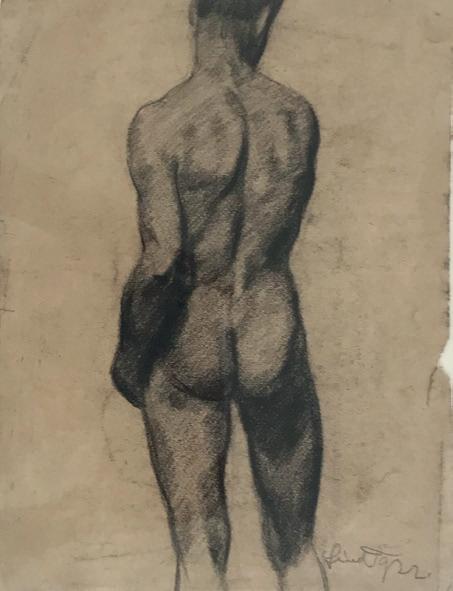
during the Nazi occupation.1 The Grossmanns came to London, while the Frieds settled in New York. I have in my bedroom a refined early academy male nude by Fried (Fig. 1) from 1922. While I was at university, I put on my wall a print by Fried depicting a church service, in which all the priests are presented as wolves. Annie pointed out to me that Theodore obviously did not like the church! It made for a good talking point when friends were at my place.
My father and I would go to the Royal Academy’s Summer Exhibition, and he would quite often buy work. Both my parents were advertising copywriters, constantly refining ideas of text combined with image. After I finished my degree in art history at the University of Kent, my father gifted each of his children some money. He specifically encouraged me to buy a work of art with the funds. Deciding what to acquire was difficult, until I saw some Alfred Wallis paintings in the Mercury Gallery on London’s Cork Street. There were two compositions I particularly liked, and I asked my friend Andrew Wilson, who was then writing for Art Monthly, which one he thought was the best. Luckily, we both favoured the same work.
The next fortuitous addition to my collection was a very small but exquisite Patrick Heron gouache entitled Mini Mini 5 (1971). My stepgrandmother, Pamela Wisdom, left this to me in her will, which was a complete surprise to me. Pamela was a painter and often discussed her favourite painters with me, most of whom were those associated with the St Ives School. The Wallis and Heron are both dynamic compositions. From then on, however, I focused my interests on
text-based and conceptual work. While at the University of Kent, the two tutors who made the greatest impression on me were Roger Cardinal and Stephen Bann. Roger ran a course on ‘primitive and outsider art’. Stephen, meanwhile, was one of the curators of the First International Exhibition of Concrete, Phonetic, and Kinetic Poetry at St Catherine’s College, Cambridge, in 1964, alongside Phil Steadman, Mike Weaver, and Reg Gadney. Three years later, at the age of 25, Stephen curated the Brighton Arts Festival, which involved installations of concrete poetry throughout the town. From an early age, Stephen made his own concrete poetry works. Coincidentally, I liked to apply what I was learning in art theory by making collages of my own.
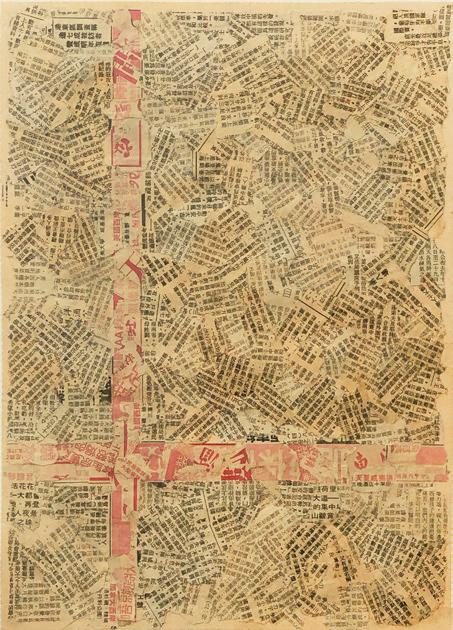
After I graduated, Stephen and I became good friends. I asked him if he might like to choose a collage of mine for his collection. He chose a work that incorporated torn-up Chinese text from newspapers, rearranged to make an orthogonal red cross, suggestive of Mondrian (Fig. 2, 1988). It was surrounded by a black-and-white background text, also in an orthogonal design. I enjoyed the visually dynamic fragments of this language I could not read, creating an asemic composition. Perhaps unsurprisingly, I would later specialise in concrete poetry, whose seminal originators would also rearrange words to create an essential concrete meaning. I was always inspired by Walter Pater’s theory of Anders-streben, which proposes that all art aspires towards the condition of music, in which form and content become indivisible. 2 That there is a collage in this Ben Uri exhibition by Kurt Schwitters, often cited as the medium’s greatest practitioner, is thrilling to me.
I moved to New York for internships at the Brooklyn Museum and the Whitney Museum in 1989, keen on becoming a curator or art critic. I was fortunate to work with two wonderful curators: Charlotta Kotik at the Brooklyn Museum and Richard Armstrong at the Whitney (Richard later went on to become the Director of the Guggenheim in New York).
Charlotta said we would make a good team; she specialised in sculpture, whereas at that time I was more into painting. Stephen introduced me to the art critic Irving Sandler, who lived in New York and had documented the work of abstract expressionist painters. He, alongside Stephen, was one of my referees for the Brooklyn Museum internship, and he kept an active interest in my progress. Irving eventually bequeathed his collection of paintings to the Brooklyn Museum. His passion for the abstract expressionists, and the stories he told about them, was mesmerising.
One story of note involved Irving and his close friend, Ad Reinhardt. Irving expressed on more than a few occasions to Ad that he would love to buy one of his works for his own collection, but Ad remained uninterested. Eventually, Ad asked Irving if he had his chequebook with him, which on that day he did. Perhaps this was the moment? Of course, Irving would never have been able to afford the going rate for a Reinhardt painting.
Ad, however, gave him a pen and said that if he wanted to buy a painting, he had to think of a figure – one which sat at the exact point where it really hurts! Irving appealed at length: this was too painful and totally unfair. Ad was adamant that
this was Irving’s only chance. After some difficult deliberation as to what that figure would be, Irving made the cheque out for $100 and handed it to Ad, who, without looking, folded it and put it in his pocket. Reinhardt then pulled out a 20-foot canvas and asked, ‘How about this one?’ Irving insisted it was far too large for his Bleecker Street apartment, and instead asked for the artist’s smallest black painting.3 Ad obliged with a relatively small black-on-black composition of squares. In Irving’s memoirs, he writes, ‘Lucy and I hung it over our bed over a de Kooning lithograph we bought. That wall became our shrine’.4
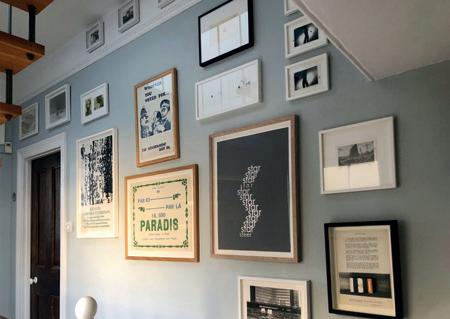
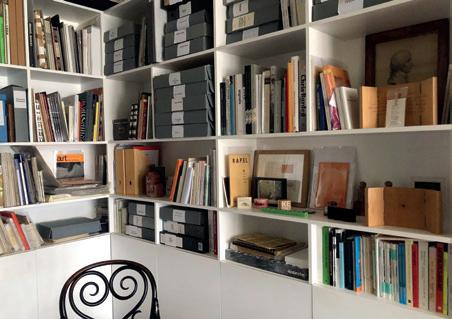
It makes me wonder: which works hold special significance in my more modest collection at my South London home (Fig. 3)? Above the main fireplace is a Noel Foster painting, and the fireplace in the library holds a large Miguel Angel Cardenas drawing. In the main bedroom there is a Ken Cox carved brass Suncycle (1968) hanging from the ceiling. When the sun is in place and there is a draught, the sculpture reflects the text, rotating it around the room. There is also a Hansjörg Mayer work, and a small constructivist relief work in coloured Perspex, which was very kindly gifted to me by Peter Lowe. A large Ian Hamilton Finlay stone work, Cor/Day/ Lux (1995), is on a wall at the head of the dining table. An early Steve Willats painting (1964) is at the top of the stairs. I tend to hang typestracts by Dom Sylvester Houédard (affectionately known simply by his initials, ‘dsh’) slightly higher on walls to encourage looking up at them, as if at a religious painting. Indeed, in
dsh’s works, there are often Buddhist theories at play.
Art documents are also framed throughout the house: postcards by mail artists such as Ulises Carrión are put in conversation with various concrete poetry prints, posters for performance events, and other documents. In the spare room is Finlay’s first concrete poetry print, Le Circus (cat. 23, 1964), which used to be in the kitchen of 8 Duck End in 1964/5. Stephen lived in that house with Phil Steadman, one of his co-curators on the 1964 concrete poetry exhibition at Cambridge. Added to the dynamism of the text, there are food splatters that function as a reminder of this print’s history: once on the wall in these student digs where Stephen would serve his great cooking. Elsewhere in my home lies the occasional old Quaker family portrait (including cut-out silhouettes) – a personal contrast to the avant-garde works by Eva Partum, Mieko Shiomi, George Maciunas, Li Yuan-chia, José Maria Cruxent, Vasarely, Roger Acking, Bob Cobbing, Ruth Wolf-Rehfeldt, Athena Tacha, Michael Druks, Raúl Marroquin, Géza Perneczky, Stephen Bann, Simon Cutts, Tony Cragg, and others. It is my hope that there is a discourse created between the various works, one that defines the different zones of the building and its architecture.
The largest work, which dominates the sitting room, is Ken Cox’s Shadow Box (1965). Cox was a Lisson Gallery artist in its formative years alongside dsh, Derek Jarman, Mira Schendel, and Li, among others. Cox sadly died in a car accident in 1968. On behalf of the Cox estate, I curated an exhibition of his work at Chelsea Space in 2015. I loved telling the story of his Shadow Box work to visiting student groups. It was one of the two largest sculptures in the Second International Exhibition of Experimental Poetry at Oxford
University in 1965 (Oxpo, ’65). A group of Oxford students went around the exhibition criticising its existence and validity, before proceeding to throw the two largest sculptural works, John Furnival’s Devil Trap and Cox’s Shadow Box, into the River Isis.5 They were later rescued, but the Shadow Box’s complex interior mechanism never worked again.
When I returned to London from New York, I began writing on art and coediting Interpreting Contemporary Art (Reaktion Books, 1991) with Stephen Bann. During this time, Simon Cutts of Coracle Press asked if I could assist with an Ian Hamilton Finlay archive. I had already met Finlay at his home and garden, Stonypath, Little Sparta, with Stephen, who introduced me to his work. Stonypath is a masterful piece of landscape design with textbased sculptural works throughout.
The gallerist and archivist Richard Demarco once described Stonypath to me as ‘Scotland’s greatest work of art’. Working through the archive of all of Finlay’s cards and books helped me become a specialist in his work; in fact, I have more artworks and works on paper by Finlay than by any other artist. His thematic content – ranging from classics and landscape theory to war and the French Revolution – is an inspiration and education in itself. Finlay’s ideas for artworks in his garden and elsewhere were nearly always primarily realised first of all in printed form. He then worked with skilled collaborators, such as stonemasons and carvers, to realise these ideas in three-dimensional form.
Coracle Press, founded by Simon Cutts and Kay Roberts, had a gallery
in Camberwell in the late 1970s and early 1980s. When I joined Coracle in the 1990s, I worked with many artists and poets; it was a privilege to engage with and learn from Roger Ackling, Tom and Laurie Clark, Noel Forster, Hamish Fulton, Ian Gardner, Erica Van Horn, Gustav Metzger, Stuart Mills, and Yoko Terauchi, to name a few. One of my main tasks was selling artists’ books to libraries around the world. This nurtured my interest in artists’ books and printed matter. It was then that I decided to begin book dealing for myself, expanding what I offered to include printed matter: artists’ documents, exhibition catalogues, and serial publications, among other offerings.
I was also influenced by Form magazine, which saw early avantgarde artists’ magazines as a microcosm of art movements’ activities and beliefs. I became interested in collecting and collating material that might be seen as an archive of information. Now, for instance, I collect material relating to the émigré artist Gustav Metzger and the Destruction in Art Symposium held in London in 1965. I also collect work surrounding dsh, the Benedictine monk, networker, and religious theorist who has been celebrated for his typewriter works (or ‘typestracts’, a moniker given to them by the poet Edwin Morgan). These archives – containing catalogues, correspondence, manifestos, and photographs, alongside works – hold, in my opinion, more than simple research value. They contain ideas and create a discourse that can prove inspirational and show a world (re)shaped by migration, movement and complex cross-border networks and global changes. In the 1960s, Metzger was obsessed with the idea that the world was on a path to self-destruction through nuclear
armament. Later, in the 1990s, he made proposals for sculptures that would involve cars and their exhaust pipes all feeding into a chamber; the work would demonstrate man-made effects on the climate and other ecological concerns. dsh was also a key figure at the DIAS events, but was interested in auto-creative art as much as Auto-destructive art. One of the first artists to utilise Buddhist ideas from Tibetan Tantric Art, he was interested in the power of the mind not just to destroy, but to co-create future imaginaries. His work, like Metzger’s, embodies the practice of peace.
Artists’ networks – especially artists’ communication despite censorship and displacement – fascinate me. I have a particular interest in Samizdat books: underground publications by artists, publishers, and writers who were censored by the Russian occupation in their respective countries, such as Poland, Hungary, and Czechoslovakia. That interest overlaps with mail art of the 1970s: South American artists such as Clemente Padin, Jorge Cabebello, Paulo Bruscky, and Antonio Vigo were also adversely affected, even imprisoned, by authoritarian regimes. Ulises Carrión and Felipe Ehrenberg fled Mexico due to the ‘repression unleashed by the government after the [1968] Olympic games’.6 Ehrenberg left with his two young children and their young mother, Martha Hellion, and was 25 when he arrived at London’s Victoria station. This group of Mexican artists eventually settled in the Netherlands in the 1970s, where they became involved with Agora Studios.7 Carrión’s legendary bookshop in Amsterdam,
Other Books & So, was an important hub for artists’ books. Along with Carrión, Hellion and Ehrenberg were also involved with Beau Geste Press in Devon, giving that press and its publications a uniquely rebellious voice.
Much of the material in my collection has an affinity with the concept of the ‘long sixties’: ideas of cultural revolution, enlightenment, counterculture, protest and liberation that we identify with the 1960s, but have their roots in the late 1950s and continue on into the 1970s. At the same time, working with artists’ documents and books often takes me in refreshing new directions. For example, I recently formed a friendship with the contemporary artist Osman Yousefzada after seeing his beautiful works at Charleston, which touch on displacement and migration. We made a small show about radical magazines for his students at Birmingham University, and it’s wonderful to have an example of his work in this Ben Uri show.
Hansjörg Mayer’s sau aus usa (cat. 13, 1965) print also features. The different combinations of the same three letters may seem at first like simple wordplay, but it creates a wider political message: the English translation of these German words would read ‘pig/out/usa’. I recall meeting Hansjörg at his Paddington studio several years ago to buy some of his beautiful books. While chatting, I looked at some unusual fixings on the ceiling. I could tell they were not just old light fixtures, and I asked him what they were. He said that for years he didn’t know himself. Then one day somebody knocked on his door and explained that he had trained as a Spitfire pilot in that space during the Second World War. Those fixtures mocked up the apparatus of the cockpit, and with them trainee pilots
learned to identify the placement of all the controls, even in the dark. Mayer decided to keep the fixings, as they were a part of the history of the building (ironically, his father’s studio in Stuttgart was bombed by British pilots during the war).
Through these years of collecting and collating material, what has come to the fore is the importance of artists’ networks. Through text and image, alternate narratives and languages emerge. I feel fortunate to be surrounded by this discourse throughout my home. Something as small as a postcard can carry significant resonance, and of course that resonance is particularly
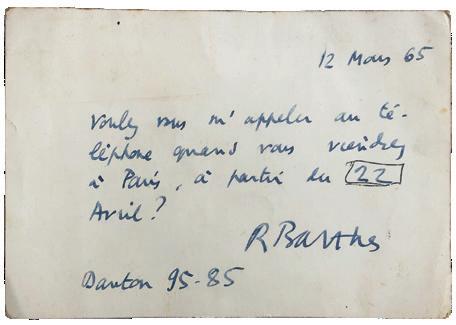
profound when a work has been produced within an authoritarian state. But there are lighter notes, too: I once bought at auction a card (Fig. 4) handwritten in 1965 by the father of semiotic theory, Roland Barthes. He was agreeing to meet a certain figure in Paris on a particular date. The placement of the card beside my desk might be a semiotic act in itself, to guide me or bring me luck in finding new, stimulating material.
William Allen
1 Fried had been put on the Nazi Degenerate Art list.
2 See: Walter Pater, ‘The School of Giorgione’, The Fortnightly Review, 22 n.s., No. 130, (1877), pp. 526-38.
3 The 20-foot canvas piece is now in the Hirshorn Museum, Washington DC.
4 Irving Sandler, A Sweeper-Up After Artists – A Memoir (London: Thames & Hudson, 2003), p. 77.
5 Furnival mentioned to me that the main antagonist was a physically imposing and inebriated man who intimidated the artists present.
6 Ulises Carrion, Guy Schraenen, Heriberto Yepez, Felipe Ehrenberg, Maike Aden et. al, Ulisses Carrión - Dear Reader, Don’t Read (Madrid: Museum Reina Sofia, 2016), p. 27.
7 As were Michel Angel Cardena and Raul Marroquin from Colombia. Agora Studios is particularly celebrated for publishing the artist periodical Fandangos: The Most Important European Art Scandalpaper, which involved many artists including those listed above.
This exhibition forms part of the Ben Uri Research Unit’s study of Jewish, refugee and wider firstand second-generation immigrant contributions to British visual culture since 1900, while exploring questions of belonging and what it means to be born outside the UK. In 2023, we reached an agreement with Professor Eddie Chambers to incorporate his extensive research on Black and Asian contributions to British art, Diaspora-Artists.net, into the Ben Uri Research Unit. The Unit now holds an unparalleled database of over 3,000 profiles from more than 100 countries of birth, centralising research in this field. While its current focus is on the visual arts, its aim is to expand across disciplines and to serve as an open, inclusive platform for immigrant voices.
Migration is nothing new for the UK, nor for the world at large. In the 20th century, the UK was continually (re)made through movement, enriched by free passage later formalised through the EU and only recently unsettled by Brexit; before that, the Windrush generation arrived from the Caribbean from 1948 onwards, followed by migrants from South Asia and Africa in the 1950s and 1960s, alongside Jewish émigrés who sought refuge from Nazism before, during and after the Second World War, as well as people from the Middle East, including many Muslims, arriving in response to war, displacement and political upheaval. These are just some of the many waves of twentieth-century migration that shape our research.
Why, though, is Ian Hamilton Finlay in this exhibition? Does it feel more fitting to include the Birminghamborn Osman Yousefzada than the Nassau-born Finlay? Why should that be? Is it because one is more readily marked as ‘other’ and their place held up for scrutiny through heritage or skin colour?
The exhibition offers no neat answer. Instead, it asks us to consider how such distinctions are made, and why some lives are folded more easily into an imagined, or quintessential, Britishness while others are held at a distance from it. This is not to flatten the destabilising and exclusionary force of imposed otherness on those more readily cast as ‘immigrants’, nor to overlook the weight of marginalisation. Rather, the inclusion of an artist such as Finlay prompts a shift in view. What appears ‘native’ often rests on longer histories of movement and change. Britishness is exposed in this exhibition, and in our research, not as a fixed category but as a complex accumulation of crossings.
Ana-Maria Milčić
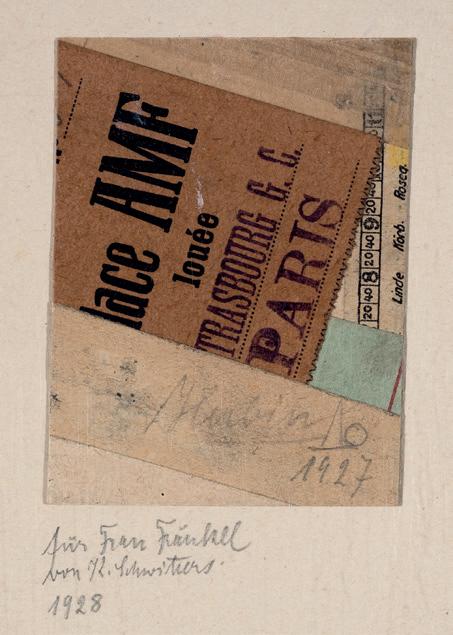
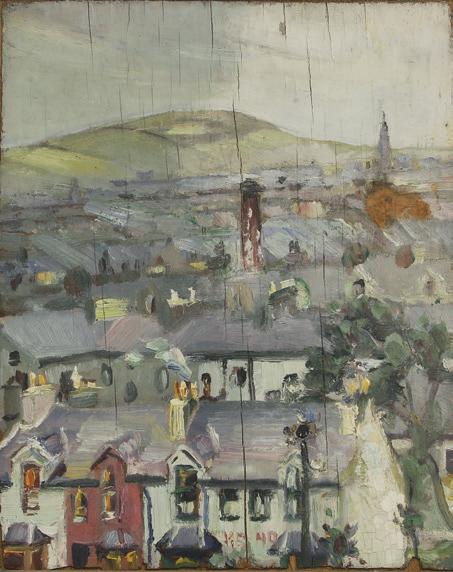
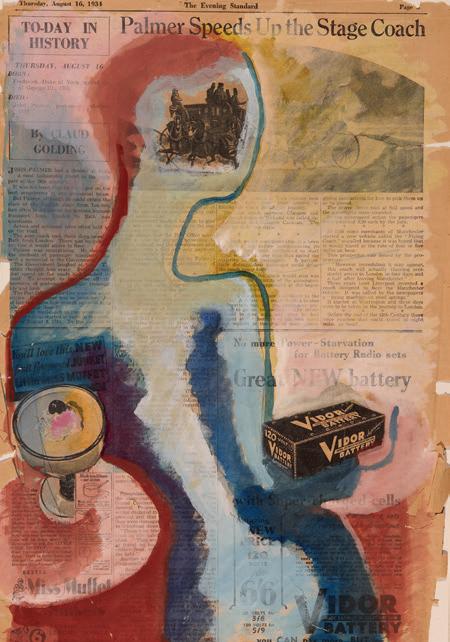
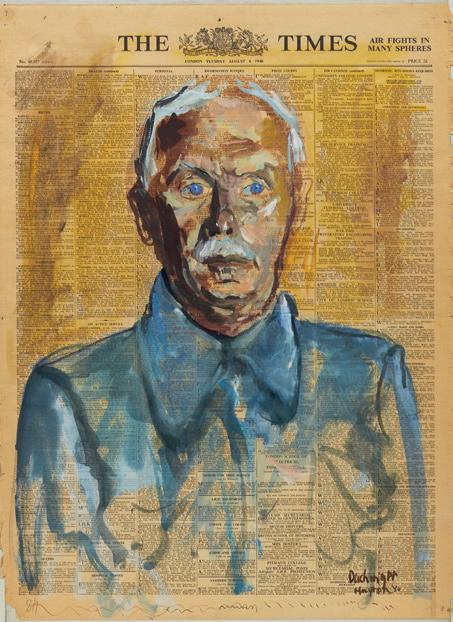
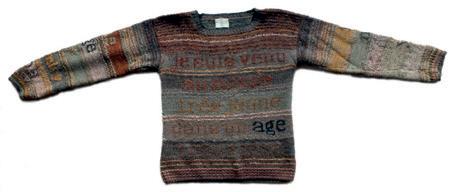
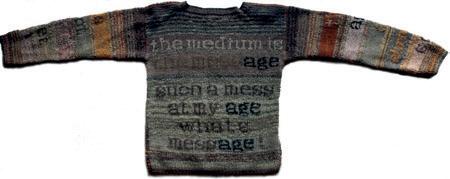
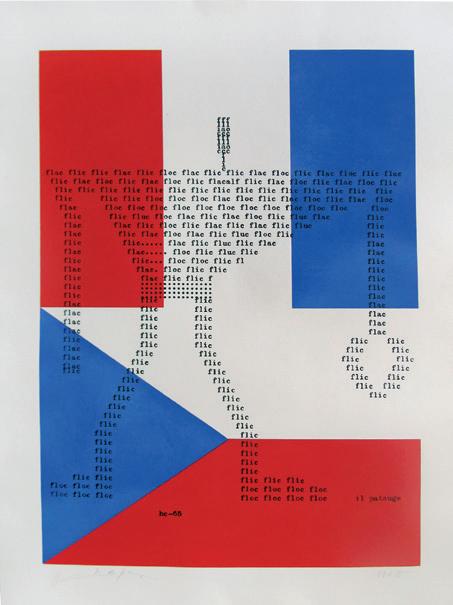
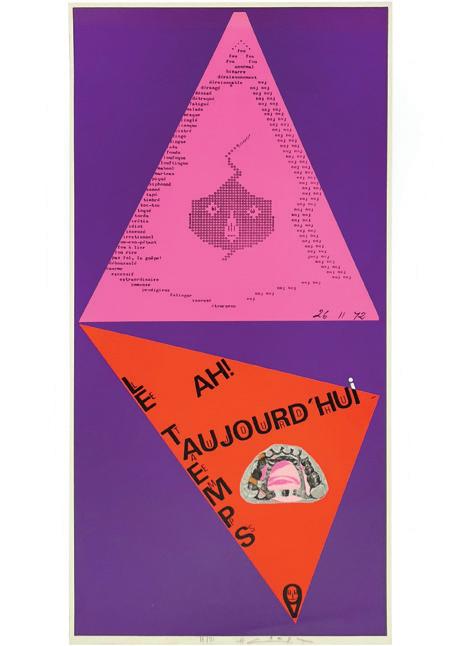
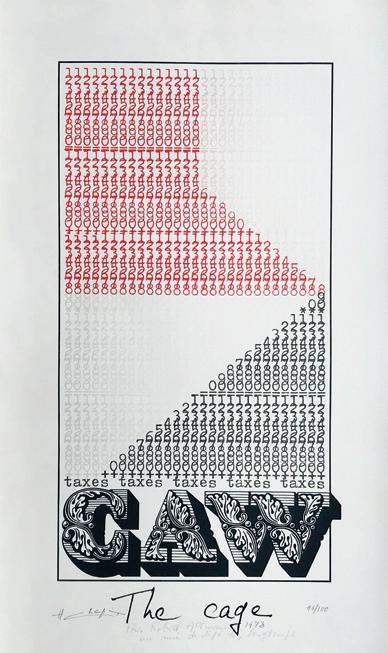
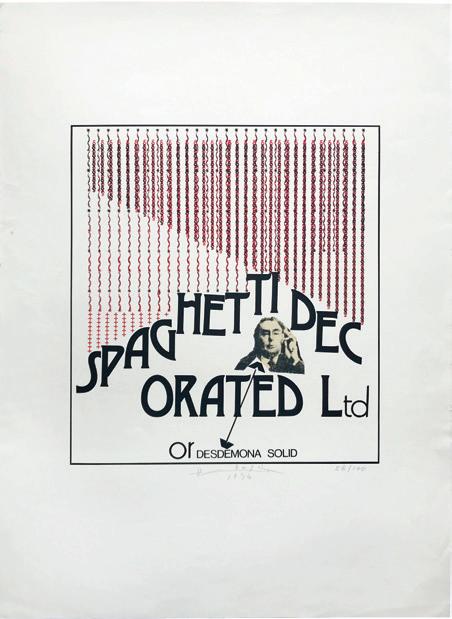
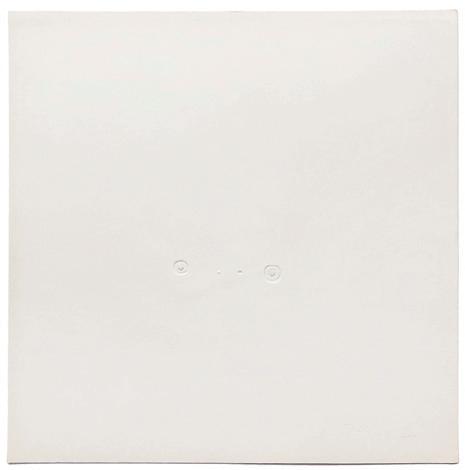

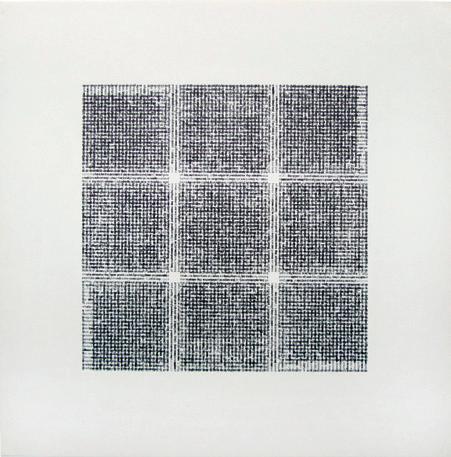
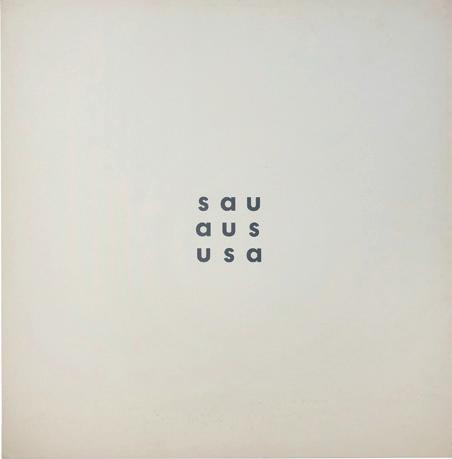
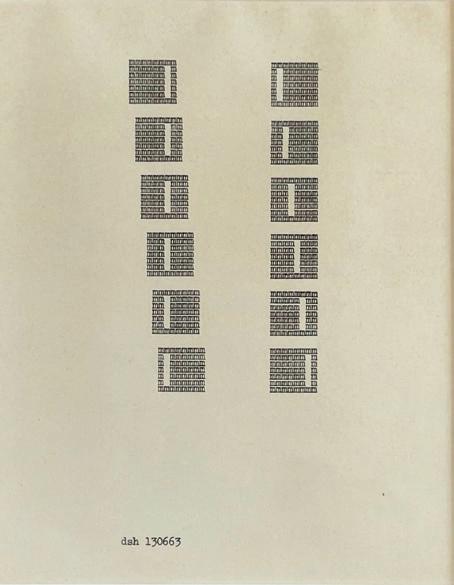
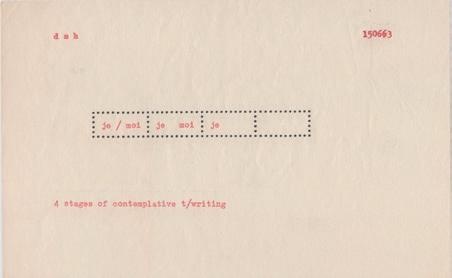
Plate 15: Dom Sylvester Houédard, 4 stages of contemplative t/writing, 1963
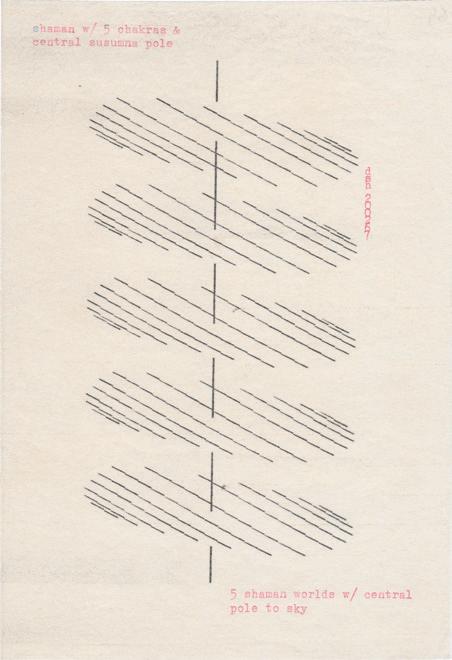
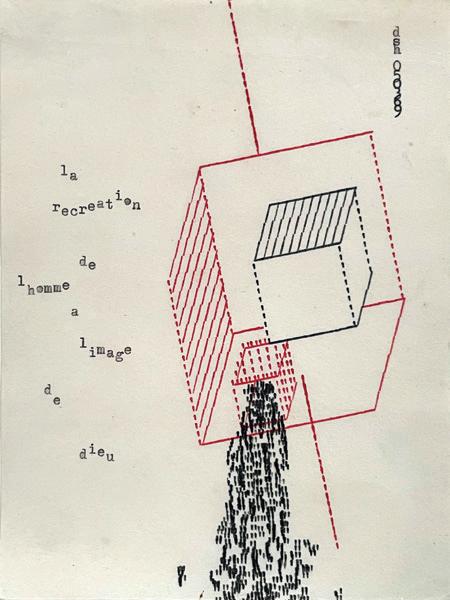
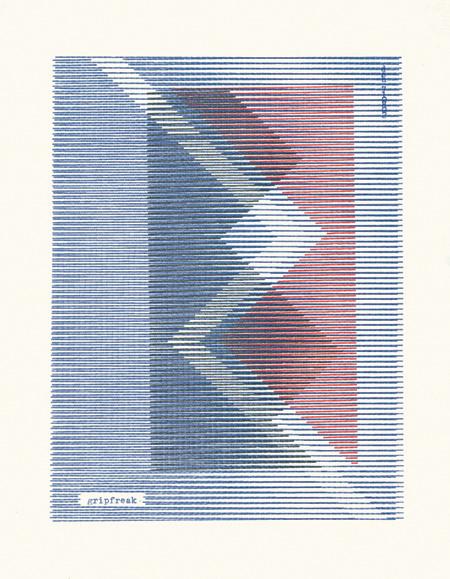
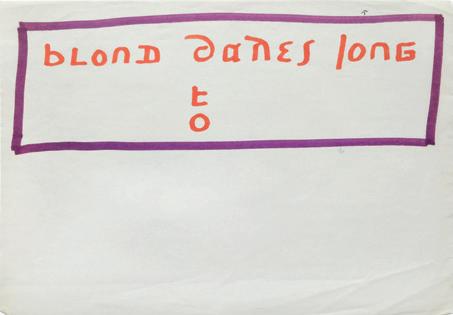
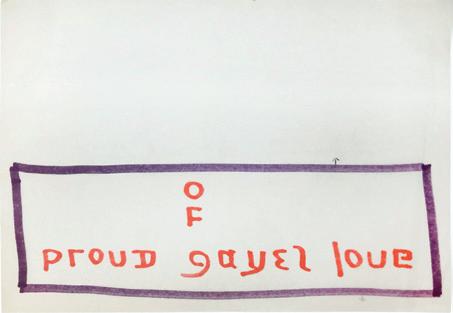
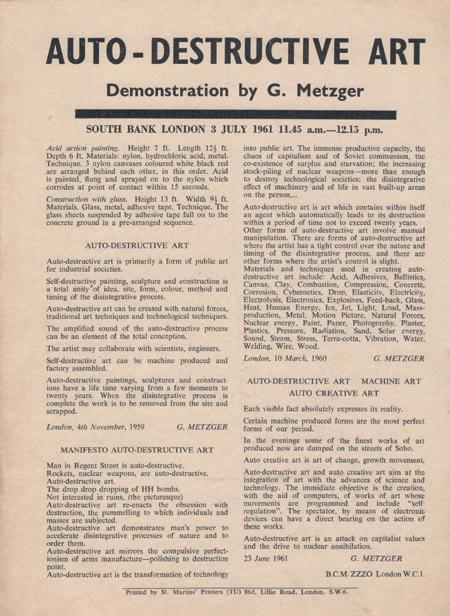
Plate 20: Gustav Metzger, Auto-destructive Art: Demonstration, 1961
HENRI CHOPIN
1922, Paris, France–2008, Dereham, England; immigrated to the UK in 1968
(Plate 6)
Flic Flac Floc
Screenprint on white card stock
104 x 70.7 cm
1965
William Allen Collection
(Plate 7)
Le Temps Aujourd’hui (The Times Today)
Screenprint on white card stock
76.5 x 38 cm
1972
William Allen Collection
(Plate 8)
The Cage Edition 11 of 100
Lithograph in colour on wove
76.5 x 40 cm
1973
William Allen Collection
(Plate 9)
Spaghetti Decorated Ltd.
Black screenprint on off-white card stock
76.4 x 56 cm
1974
William Allen Collection
1911, Barcelona, Spain–2005, Coro, Venezuela; spent time in London during the 1960s
(Plate 21)
Métromane
Painted wood, wire mesh metal (shaped for moiré effect), plastic, Letraset, light bulb, electrical fitting
42 x 42 x 12 cm
1964
On loan to William Allen Collection
HUGO DACHINGER
1908, Gmunden, Austria-Hungary (now Austria)–1995, London, England; fled to the UK in 1938
(Plate 4)
Portrait of a Man: Wilhelm Hollitscher (Huyton Internment Camp, Liverpool) Gouache on paper
61.5 x 46 cm
1940
Ben Uri Collection
SHMUEL DRESNER
1928, Warsaw, Poland–2019, London, England; came to the UK as a refugee in 1945
(Plate 33)
The Ghost Town Collage on paper
53 x 53 cm
1982
Ben Uri Collection
1925, Nassau, The Bahamas–2006, Edinburgh, Scotland; sent to the UK in 1931
(Plate 23)
Le Circus
Screenprint on paper
44.7 x 57.7 cm
1964
William Allen Collection
(Plate 24)
Acrobats
Silkscreen print in two colours on paper
53.5 x 38 cm
1966–68
William Allen Collection
(Plate 25)
Printed and designed by Bernadette Shrimpton
Wave Rock
Letterpress print on paper
48 x 48 cm
1966
William Allen Collection
(Plate 26)
In collaboration with Edward Wright
Star/Steer
Screenprint on paper
57 x 44.5 cm
1966–68
William Allen Collection
(Plate 27)
In collaboration with Richard Demarco
A Rock Rose
Screenprint on paper
38.1 x 56.2 cm
1971
William Allen Collection
(Plate 28)
In collaboration with Herbert Rosenthal Land/Sea
Screenprint on paper
43.1 x 56.2 cm
1967
William Allen Collection
(Plate 29)
Wave
Etched glass with wooden base
17.6 x 57.5 x 6 cm
1992
William Allen Collection
ASTRID FURNIVAL
1940, Standal, Germany–; immigrated to the UK in 1957
(Plate 5)
The Age of Shrivellry is Not Yet Over Textiles
c. 60 x 145 x 1 cm
1988
Bernard Moxham Collection
MARTHA HELLION
1937, Mexico City, Mexico–; immigrated to the UK in 1968
JAN HENDRIX
1949, Maabree, Netherlands–
(Plate 41)
As Part of a Diary/Witnesses of a Change/Move
Mixed media
30.1 x 29.7 x 5.6 cm
1974
William Allen Collection
1940, Florida, USA–2019, London, England; immigrated to the UK in the 1960s
(Plate 30)
Rough Sea Book
11.6 x 16.6 cm
1976
William Allen Collection
1924, Guernsey, Crown Dependency–1992 Gloucester, England; evacuated to England in 1940
(Plate 14)
Untitled typestract dated 130663
From the first anthology of dsh’s
concrete poetry
Typestract
20 x 16 cm
1963
William Allen Collection
(Plate 15)
4 stages of contemplative t/writing
Typestract
11.5 x 19 cm
1963
William Allen Collection
(Plate 16)
shaman w/ 5 chakras & central susumna pole/ 5 shaman worlds w/ central pole to sky
Typestract
20.3 x 14.5 cm
1967
William Allen Collection
(Plate 17)
la recréation de l’homme à l’image de dieu
Typestract
14.8 x 11.3 cm
1969
William Allen Collection
(Plate 18)
Gripfreak
Typestract
21.8 x 17.0 cm
1972
William Allen Collection
(Plate 19)
blond danes long to: of proud gayes
love
Purple and orange felt pen on translucent paper
20.9 x 29.7 cm
c. 1974–75
William Allen Collection
1947, Roseau, Dominica–; immigrated to the UK in 1955
(Plate 40)
The Hand Made Map of the World Acrylic on board
72.5 x 121.2 cm
2013
Ben Uri Collection
1921, Livingstone, Northern Rhodesia (now Zambia)–2006, London, England; came to the UK in the mid-1930s
(Plate 34)
Book of Common Prayer Machine cut corner of a common prayer book
5 x 4 x 2.8 cm
c. 1982
William Allen Collection
(Plate 35)
Untitled Book on MDF with polyvinyl finish sample plate, plaster, painter and metal screw
4.8 x 16.3 x 6 cm
1983
William Allen Collection
(Plate 36)
Hanns Sohm
John Latham: Skoob with Powder, 12.9.1966
London Free School Playground, DIAS event
Photograph reprinted from original negative
23 x 17 cm
1993
William Allen Collection
YUAN-CHIA LI
1929, Guangxi, China–1994, Carlisle, England; immigrated to the UK in 1968
(Plate 10)
Untitled I
Collage with signature and date made with impression on recto
31.5 x 36.2 cm
1963
William Allen Collection
(Plate 11)
Untitled II
Collage with signature and date made with impression on recto
31.5 x 36.2 cm
1963
William Allen Collection
ALFRED LOMNITZ
1892, Eschwege, Germany–1953, London, England; immigrated to the UK in 1933
(Plate 3)
Woman Seated at a Table Collage and watercolour on newspaper 44 x 31 cm c. 1934
Ben Uri Collection
1943, Stuttgart, Germany–; immigrated to the UK in 1965
(Plate 12)
Continuations
Letterpress print, numbered edition of 13 from the Fortführungen series with signature and date in pencil on verso
47.5 x 47.5 cm
1966
William Allen Collection
(Plate 13)
sau aus usa
Letterpress print on paper with signature and date in pencil on verso 48 x 48 cm
1965
William Allen Collection
DAVID MEDALLA
1942, Manila, Philippines–2020, Manila, Philippines; immigrated to the UK in 1960
(Plate 22)
Artists for Democracy
Poster/Programme
29.5 x 42 cm
1977
William Allen Collection
GUSTAV METZGER
1926, Nuremberg, Germany–2017, London, England; arrived to the UK on the Kindertransport in 1939
(Plate 20)
Auto-destructive Art: Demonstration
Printed black on cream card stock
28 x 20.5 cm
1961
William Allen Collection
HORMAZD NARIELWALLA
1979, Mumbai, India–; immigrated to the UK in 2003
(Plate 42)
Bands of Pride
Mixed Media
53.5 x 37.5 m
2017
Ben Uri Collection
ASTRA PAPACHRISTODOULOU
1991, Rhodes, Greece–; immigrated to the UK in 2009
(Plate 37)
Departed Waves
Found fabric, wood and wooden felt
158 x 46 cm
2023
Courtesy of the artist
(Plate 38)
Bi-erasure poem
Print on paper
29.7 x 21.0 cm
2023
William Allen Collection
(Plate 39)
Unwavering
Bio-resin, cotton thread and cellulose acetate
23.5 x 16 cm
2023
Courtesy of the artist
KURT SCHWITTERS
1887, Hanover, Germany–1948, Kendal, England; fled to the UK in 1940
(Plate 1)
Untitled: für Frau Fränkel
Collage
7.6 x 5 cm
1927
Ben Uri Collection
(Plate 2)
Douglas from the Internment Camp Oil on board
29.5 x 24 cm
1940
Ben Uri Collection
JOHN SHARKEY
1936, Dublin, Ireland–2014, England; immigrated to the UK in the late 1950s or early 1960s
(Plate 31)
Pentacle
Sherborne: South Street Publications
Letterpress red and black on white card construction
25.5 x 18.1 cm
1969
William Allen Collection
VERDI YAHOODA
1950, Aden, British-controlled Aden Protectorate (now Yemen) –; immigrated to the UK in the early 1960s
(Plate 32)
The Dancer
20 x 15 cm
Hardbound book, hand printed photographs on gold photographic paper, black China ink
1984
Chelsea College of Arts Library
OSMAN YOUSEFZADA
1974, Birmingham, England–
(Plate 43)
Incantation I
Screenprint on paper
100 x 71 cm
2021
Courtesy of the artist
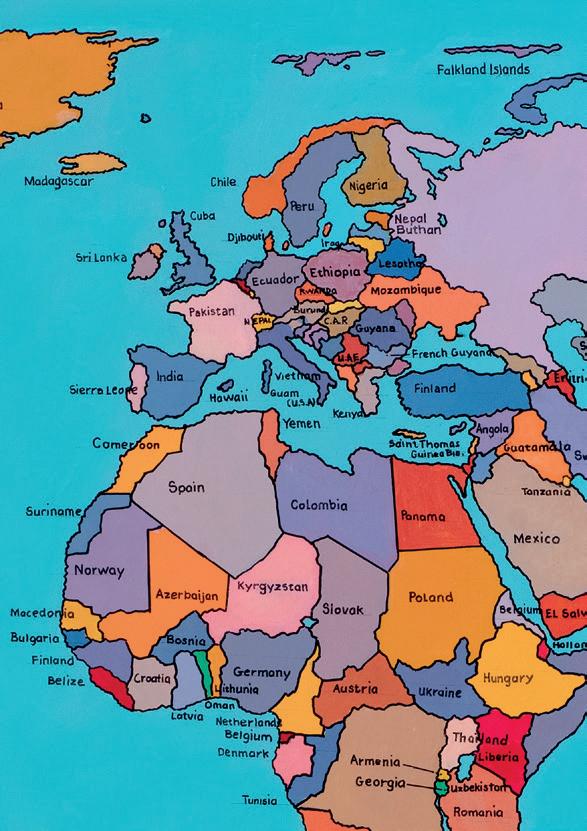
Dr. Ana-Maria Milčić
Ana-Maria Milčić is an art historian and curator from Croatia who lives between Vienna and London. She is a specialist in European historical avant-gardes and holds a PhD from The Courtauld Institute of Art. She is currently a postdoctoral researcher at the Austrian Academy of Sciences, where she is finishing her book From Habsburg Corpus Separatum to Imperial Afterlives: Visual Politics and Avant-Garde Art in Fiume, 1914–1939, while also serving as Ben Uri’s Senior Research Officer. She has curated exhibitions such as First World War and Avant-Garde Art: Deconstruction–Construction at the Museum of Contemporary Art, Zagreb, and her writing appears in International Yearbook of Futurism Studies, European Avant-Garde and Modernism Studies, Immediations, Peristil, and others.
Dr. Greg Thomas
Greg Thomas is a writer, critic, poet and artist based in Glasgow, Scotland. He is the author of Border Blurs: Concrete Poetry in England and Scotland (Liverpool University Press, 2019) and the co-editor, with Julie Johnstone, of a new volume of Edwin Morgan’s experimental poetry and text art, A Home in Space: Selected Concrete, Visual, and Sound Poetry (Reaktion, forthcoming June 2026). Greg has written extensively on visual and concrete poetries, text art and multimedia art, including for Art Monthly, Burlington Contemporary, and many other titles. He holds a PhD in English Literature from the University of Edinburgh and runs the micro micro-press Oo for publishing his own and others’ concrete and object-based poetry.
Mr. William Allen
William Allen is a collector, curator, and book dealer based in South East London. A specialist in concrete and visual poetry, artists’ books, and periodicals, he has worked with institutions and private collectors for over 30 years. In 2015, he curated the exhibition Ken Cox: Poetry Machines at Chelsea Space Gallery, London, as well as Linguaviagem: A Poesia Concreta Dialogue at Actual Size, Los Angeles, in 2016. Parts of his collection have also been shown at South London Gallery (UK), Espacio El Dorado in Bogotá (Colombia), Broumov Monastery (Czechia), and Ikon Gallery (UK). He is the co-author of Interpreting Contemporary Art (Reaktion Books, 1988) with Stephen Bann.
Picture Credits
Ben Uri Collection
William Allen Collection
Bernard Moxham
Chelsea College of Art Library
Photography of Ben Uri Collection
© Justin Piperger
Photography of William Allen Collection
© Ariel Finch except plates 5, 32, 37, 39
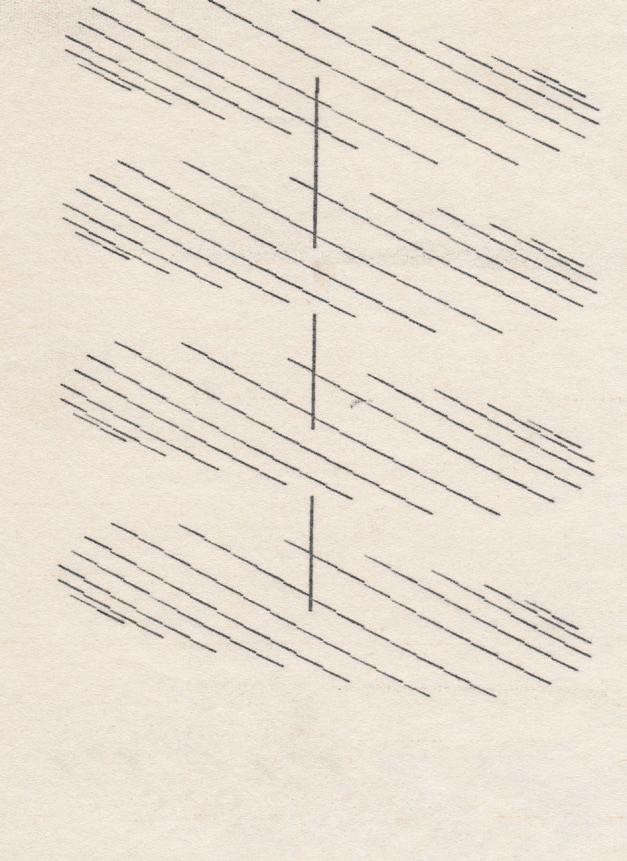
This free publication is for educational, non-commercial research, private study and critique purposes only. It must not be reproduced in any format, and is not for resale nor is it to be used for commercial purposes.