AMERICAN JEWISH MUSEUMS: TRENDS AND ISSUES
RUTH R. SELDIN
RUTH R. SELDIN
by RUTH R. SELDIN
IVlusEUMS DEVOTED TO JEWISH content have been multiplying rapidly in the United States, becoming a significant feature of the cultural landscape. While the spotlight of publicity has been focused on the national Holocaust museum rising on the Mall in Washington, D.C., and on similar institutions in New York, Los Angeles, and points in between, these museums are in fact part of a larger phenomenon of Jewish museum growth that has been taking place, largely unheralded, since the end of World War II.
In 1950 there were only two major Jewish museums in the United States and several small synagogue-linked galleries of Judaica. At the beginning of 1991, the Council of American Jewish Museums (CAJM; itself established in 1977) numbered 35 members and associates.' There were, in addition, an estimated dozen or more museums or galleries not affiliated with CAJM, among them the Seattle Jewish Museum and the Regional Museum of the Southern Jewish Experience in Jackson, Mississippi. There were also at least 19 self-described Holocaust museums, including the Simon Wiesenthal Center's Museum of Tolerance in Los Angeles and the national Holocaust Memorial Museum in Washington, D.C.
These museums vary widely in the size and nature of their collections, in their housing and exhibition space, in financial resources and staffing. They also vary in their program emphases, some being "general," i.e., featuring art, history, and culture, while others are more specialized, including the historical-society museums and the Holocaust museums. All Jewish museums are alike, however, in their basic function of collecting, preserving, and exhibiting the material culture of the Jewish people, "in order to further public knowledge and appreciation of Jewish culture."2
Note: In addition to the published sources cited in footnotes, the information in this article is based on annual reports, newsletters, and other publications furnished by museums. The author is grateful to the following individuals who agreed to be interviewed or otherwise provided assistance: David Altshuler, Margo Bloom, Phyllis Cook, David Eden, Morris Fred, Seymour Fromer, Marian Gribetz, Sylvia Herskowitz, Joanne Marks Kauvar, Reva Kirschberg, Norman Kleeblatt, Sara Lee, Joy Ungerleider Mayerson, Joan Rosenbaum, Anne Scher, Judith Siegel, Richard Siegel, Linda Steinberg, Jay Weinstein, Marjorie Wyler.
'See full listing of council members and associates at the end of this article.
2Yeshiva University Museum brochure.
Summarizing developments of the past quarter century, Tom Freudenheim, assistant secretary of the Smithsonian Institution, told the 1990 annual conference of the Council of American Jewish Museums that, in the 1960s, when he was a young art historian starting off on his career, employed as assistant curator of Judaica at the Jewish Museum in New York, there was no Jewish museum "field," no cadre of American-trained professionals in Judaica, no grants from the National Endowments (which were created in the mid-'60s), no accreditation by the American Association of Museums—in short, no sense that Jewish museums could compete in the larger museum world, or even a sense that ethnic pride was a valid basis for operating a museum. By the end of the 1980s, all this had changed, and Jewish museums had become respected members of the general museum world.3
Along with the increase in their numbers and their rise in professional standing, Jewish museums have been changing their image. Once regarded primarily as repositories for ritual objects and antiquities, with a sprinkling of art on biblical and other explicit Jewish themes, today's Jewish museums are aslikely to display a Hanukkah menorah fashioned from industrial parts as a brass or silver antique model, an abstract sculpture or videotape as a portrait of a bearded rabbi. Exhibits cover a seemingly limitless range of subjects relating to Jews, Judaism, and the Jewish experience, worldwide and throughout history. In addition, where programs for the public once consisted of the occasional gallery talk, today's Jewish museums offer lecture series and symposia, films, puppet shows, concerts, and parent-child "interactive" workshops, as well as extensive programs for schools that reach thousands of children, a high proportion of them non-Jewish.
Behind this transformation in image lies a growing assertiveness on the part of museums about their role—or as they term it, their "mission." In an age marked simultaneously by curiosity about things Jewish and great ignorance of them, the museum is uniquely positioned to make Jewish culture available to the widest possible audience. A recognizably Jewish institution, it is neither religious nor secular and thus transcends the ideologies, sects, and dogmas that otherwise divide and segregate Jews into factional ghettos. At the same time, as a general cultural institution, the Jewish museum offers a socially sanctioned place where nonidentifying Jews as well as non-Jews can safely sample Jewish culture.
Growth and change have inevitably given rise to new problems and challenges. The area of funding is one. Paradoxically, while Jewish museums have won increasing recognition and financing from the National Endowments for the Arts and Humanities, state and municipal arts agen-
'Remarks delivered at annual meeting of the Council of American Jewish Museums, Philadelphia, Jan. 1990.
cies, and private foundations, Jewish communal bodies accord them low funding priority. Another problem is that of heightened competition particularly with the mushrooming of Holocaust institutions—for acquisition of objects, funding, and audience. At the same time, Jewish museums compete notonly with each other but with a host of general cultural institutions, which places them under pressure to mount the kinds of crowddrawing exhibitions and programs that will, it is hoped, attract new interest and support.
As Jewish museums have become more visible, reaching ever wider audiences, they have also come in for criticism. They have been accused, on the one hand, of being boring, of failing to touch viewers emotionally,4 and, on the other, of paying too much attention to popular taste and not enough to strictly Jewish educational purposes. 5 Part of the problem may be that the museums tend to be scattershot in their activity, failing to articulate a clear definition of their identity and purpose, and being less effective as a result.
This article begins by exploring the factors contributing to the current flourishing of Jewish museums, followed by adiscussion of the concept of a Jewish museum and the ongoing debate over its character and direction. It then presents an overview of the museums and their activities, examining the major issues they face and their prospects for the future.
The proliferation of Jewish museums over the last few decades represents a remarkable confluence of a number of trends—in society atlarge, in the broader museum world, and in American Jewish life.
There is, first, the emergence of the visual arts as an integral part of the middle-class life-style, thanks to increased wealth, leisure, and education, both formal and informal, the latter often by way of the television screen. This is expressed in ownership of art, visits to museums and galleries, participation in artclasses, and the like. The spectacular growth of the auction art market in the 1980s, which was eagerly covered by the media, served to further heighten interest in the arts
The rising attendance figures at museums are one indicator of public interest: from 200 million in 1965 to 391 million in 1984 to 500 million in 1987.6 The proliferation of new museums is another. The 1965 directory of
*Wendy Leibowitz, "Why Are Jewish Museums SoBoring?" Moment, Oct. 1989,pp. 10-13.
'Byron Sherwin, "Temples of Muses, Temples of Moses, or Galleries of Learning? Critical Problems of Jewish Museum Education," lecture delivered at 1989 annual meeting of the Council of American Jewish Museums, Chicago, Jan. 1989.
'American Association of Museums, cited in John Naisbitt and Patricia Aburdene, Megatrends 2000 (New York, 1990), p. 69.
the Association of American Museums contained 4,956 entries (a thousand more than in 1950); by 1990, the number had climbed to more than 6,700. (The directory includes all types of museums, of widely varying sizes and content—art, history, scientific, natural history, etc., as well as historic sites, monuments, zoos, and botanical gardens.) One feature of the museum boom is its spread and decentralization across the country, with new museums opening and existing ones adding substantial new wings. Nor is the phenomenon limited to the United States. Europe has experienced a museum-building boom, particularly West Germany. Since 1980, eight new museums have opened in Frankfurt alone (including the Museum of Jewish History in 1989).7
Museum popularity has been boosted by, among other causes, new approaches in the presentation and marketing of works of art. "Beginning with the astonishing success of'Treasures of Tutankhamen' in 1978, museums have been gripped by the 'blockbuster syndrome'—organizing exhibitions of opulent treasures or beloved masterpieces that attract stadiumsize crowds."8 The process of attracting new audiences to the museum has served to transform the nature of the institution from one inspiring awe and associated with high, largely European, culture, to a more open, informal, social gathering place. This trend has been expressed in the attention given to the public and commercial spaces: expansion of selling areas into large gift and book stores, the transformation of cafeterias into chic restaurants, and the building of auditoriums for public events. Perennially hard-pressed museums have even taken to renting out galleries, at exorbitant fees, for social events. While some critics deplore turning a museum into a "social gathering place and cultural department store," the same critics acknowledge that "the growing alliance between art museums and commerce . . . can also help to make their existence possible."9
Yet another trend of recent years has been the spread of children's museums offering imaginative exhibits that provide for various forms of "interaction" between the viewer and the objects or technology on display. The success of these museums has not only helped to stimulate interest in museums generally but has raised audience expectations of what a museum experience should be.
The Jewish world has not been immune to any of these developments Jews have played "a central role" in the American art world. Neither art history nor art criticism "would have much to show without its Jews." The commerce of art also "revolves heavily around Jews ... and the role of Jews supporting cultural institutions in this country (including museums) has
'Ibid., pp. 62, 70-71.
'William Wilson, "Museum Mania Grips the Globe," Los Angeles Times, May 23, 1986. 'Ellen Posner, "The Museum Bazaar," Atlantic, Aug. 1988, pp. 67, 68.
been a phenomenon almost as remarkable as the generosity of Jews to Jewish philanthropic causes."10 Although Jewish museum advocates claim that Jewish support of the general arts has not been accompanied by equivalent support for the Jewish arts, Jewish artists and Jewish museums have found benefactors, among them private collectors whose collections of Judaica or fine art form the basis of more than one of the new museums. The two oldest Jewish museums embarked on programs of expansion in the '70s and '80s—vastly increasing their collections, budgets, staffs, and audiences and undertaking major renovation or building plans with the aim of moving to greatly enlarged quarters in the early 1990s. Since the late 1950s, as will be described below, new museums and galleries have been sprouting at a steady pace.
While the impetus to create new Jewish museums, or to expand existing ones, has clearly been influenced by the popularity of museums of all sorts in American culture, it has been especially affected by the new respectability accorded specifically ethnic institutions, as evidenced by the spread of African-American, Hispanic-American, and similar museums in recent years. Neither factor alone, however, would be enough to explain the Jewish museum phenomenon Critical to the process was the coincidental but simultaneous surge of interest among Jews in their own heritage and culture.
This development is part of what Charles Silberman has called "a major renewal of Jewish religious and cultural life" in the United States, reflecting a general openness to Jewish literature, music, and other forms of cultural expression on the part of third- and fourth-generation American Jews who are not in flight from their Jewish past—as were their second-generation parents—but who, on the contrary, are trying to recapture it." Included in the younger cohorts are growing numbers of third-generation Jews with yeshivah or day-school education who not only have embraced Judaism but have the financial means to acquire art and support Jewish cultural activity
While Silberman may be overstating the extent of participation in the renewal, there is ample evidence of a Jewish cultural flowering in the '70s and '80s, one that produced a stream of Jewish books and periodicals, the proliferation of Jewish-studies courses in universities acccompanied by an expanding Jewish scholarship, and the creation of Jewish theater and musical groups, as well as the spread of Jewish museums and galleries. Silberman and other students of Jewish life point to the establishment of Israel, which increased Jewish pride and identification, as one of the streams feeding this development. Another was interest in the Holocaust, which was slow to
"Tom Freudenheim, "The (Jewish) Jewish Museum," Moment, Nov. 1976, p. 52.
"Charles E. Silberman, A Certain People: American Jews and Their Lives Today (New York, 1985), p 226
start but by the 1960s had become intense. The awareness of the Holocaust coupled with the shock and exhilaration of the 1967 Six Day War made American Jews painfully aware of Israel's—and perhaps their own—vulnerability and sharpened the focus on issues of Jewish survival. For many, this was translated into a new curiosity about their Jewish heritage.
David Altshuler, director of A Living Memorial to the Holocaust Jewish Heritage Museum, sees the 1980s surge in Holocaust memorializing as growing out of a potent combination of factors: the imminent demise of the last Holocaust survivors and with them their firsthand memories; the spread of revisionist history, which denies or distorts the record of the destruction of the Jews; the awakening of the children of the survivors, with a compelling need to transmit their personal histories to the world.
Several other developments relating specifically to art have contributed to the upsurge of interest in museums. In the last two decades, American Jewish artists, partaking in the new interest in Jewish heritage and identity, began to create works on Jewish themes. Growing familiarity with Israel exposed American Jews not only to the handicrafts—of varying quality brought home by tourists but also to serious Israeli art and artists, a number of whom, like Agam and Arikha, by the 1970s had achieved international reputations and were displayed in general art museums and galleries. On the home front, a body of Jewish synagogue and ceremonial art was developing, the result of the postwar surge of suburban synagogue building that created a demand for modern ritual objects and decorations—Torah appurtenances, wall hangings, menorahs, ark doors—which induced a small number of Jewishly inclined architects and artists to begin to work in this area. Yet another current was the birth of a Jewish crafts movement in the 1960s, the child of the counterculture movement's stress on handicrafts and do-it-yourself ideology. Professional artists as well as amateurs began to develop skills in calligraphy, ceramics, needlework, weaving, woodcarving, and metalsmithing—using them to create ceremonial objects for home and public worship as well as decorative objects with Jewish motifs.
Another factor was the growing awareness of the losses and destruction of Jewish ceremonial art that had occurred during World War II and a resulting sense of urgency about rescuing and preserving what remained. The related growth of a market in ceremonial and other forms of Jewish art led to the opening of a Judaica department at Sotheby's in 1980, followed by the entry of other major auction houses into the field, their activities in turn stimulating further attention.
The director of the Jewish Museum in New York, Joan Rosenbaum, believes that interest in Jewish museums is growing because "people want to learn about their history and background." She sees Jews today as "less self-conscious" about being Jewish and regarding their Jewishness as "an option" to be explored in various contexts.
That leaves open the question of what the particular context of a museum has to offer for an exploration of Jewish identity. Sara Lee, dean of Hebrew Union College's School of Education in Los Angeles, considers museums special because they are "neutral territory," places where people can satisfy their curiosity about Jewishness without having to make any kind of organizational or ideological or even psychological commitment.
Other commentators emphasize the uniqueness of the museum as a purveyor of Jewish culture because of its focus on "the object." One Jewish educator with extensive museum experience explains that Jewish objects and works of art are "powerful communicators of values and ideas" whose "appeal is direct and concrete" and "forges a connection between the creator and the viewer, and between viewers in this era and those in previous eras. Although this connection is difficult to articulate in words, itis one which everyone has experienced atsome time or another."12
To scholar Jacob Neusner, "the museum, with its tactile display, with its amazing capacity to teach not didactically, to inform in an interesting way" has "extraordinary power." In his view, "Museums allover the world find themselves overwhelmed by crowds, because people in the age of television seek direct encounter, and because in museums they find it. The single most powerful instrument ofmass education, beyond television, is the museum. . . ."13
All these factors, then—the growth of a body of Jewish art, the existence of a pool of wealthy collectors willing to purchase and donate such works, education, artistic sophistication, emotions aroused by the Holocaust and events in Israel, curiosity about Jewishness and Jewish identity—combined with the general popularity of museums in American culture and the special qualities of the museum experience—have contributed to the growing prominence of Jewish museums. To these one could add the emergence of a cadre of professionals—art historians and curators aswell as Jewish educators—eager to use the museum as a vehicle for educating as wide an audience as possible about Jewish culture.
The basic concept of a Jewish museum as an institution devoted to the collection, preservation, and presentation of art and objects associated with the Jewish people and heritage has been essentially unchanged since thefirst Jewish museums came into existence a century ago. However, this broad definition leaves considerable room for interpretation and differing ap-
l2Isa Aron, "The Burgeoning World of Jewish Art," Pedagogic Reporter, Jan 1985, p 5 "Jacob Neusner, American Jewry and the Arts: We Are Jews by Reason of Imagination, National Foundation for Jewish Culture, 1987, p 10
proaches. What qualifies something to be labeled "Jewish," particularly in the realm offineart? Should a Jewish museum be limited to showing Jewish art, however that is defined, or should it be universal in its approach? What aspects of Jewishness should the museum emphasize—the religious, the secular, ancient Israel, modern Israel, the Holocaust, or American Jewish life? Finally, and underlying the previous questions, what is the museum's purpose, what "message" does it wish to impart and to whom? To the extent that there is a debate over the nature and direction of Jewish museums, it centers on these questions
It was apparently easier to answer these questions in the 1890s and the first decades of this century, when the first Jewish museums came into being in Vienna, Prague, Warsaw, Frankfurt, and other cities That was during the age of imperialism, a period in which palatial museums were built to house precious objects amassed throughout the world.l4 A small number of Jews—scholars, art dealers, well-to-do connoisseurs—were inspired to collect the art and artifacts of their own people and to ensure their preservation for future generations. Lending support to this activity were two contemporary developments One was the movement known as Wissenschaft des Judentums, which legitimated the application of scientific methods to the study of Judaism in all its aspects. The second was the growing recognition that, contrary to the common perception that Judaism was hostile to art, the Jews in fact possessed a rich legacy of artistic treasures in the form of ceremonial objects, synagogue architecture and appurtenances, illuminated manuscripts, and the antiquities being excavated in Palestine. The showing of the J. Strauss collection, including magnificent silverwork from Italian synagogues, at the 1878 World Exhibition in Paris, helped to disseminate this new awareness and appreciation. That collection was acquired by Baron de Rothschild for the French state Cluny Museum in Paris.
Even as the existence of this body of Jewish art works gained recognition, it was also implicitly understood that a Jewish museum would be something other than an art museum, that because, through much of its history, Judaism had emphasized the written word over the visual image (among other reasons), there simply was no body of painting and sculpture and other "fine art" such as Christians had produced. It was understood, therefore, that, as an early advocate of Jewish museums, a non-Jewish art historian, Heinrich Frauberger, put it, a Jewish museum would have to "combine the points of view of the historical museum, the art museum, and a museum of ethnography." Frauberger also articulated the goals and program followed by the early Jewish museums: "To collect in photographs,
l4For a fairly detailed history of the Jewish museums in the United States and Europe, see Alice M. Greenwald, "Jewish Museums—In the United States," Encyclopedia Judaica Yearbook 1988/89, pp. 167-81.
drawings, or originals the artistic remnants of the past and the works of the present created by Jews or for Jewish rituals. To utilize the collection correctly for artistic and scientific purposes."15
The first two important Jewish museums in this country—the Jewish Museum in New York, founded in 1904 at the Jewish Theological Seminary, and the museum of the Hebrew Union College in Cincinnati (now the Skirball Museum in Los Angeles), officially founded in 1913—essentially followed this model for many decades, even to being staffed by European emigres. Their emphasis was on collection, cataloging, and scholarly research, and their collections consisted largely of synagogue and ceremonial art.
So long as the art and artifacts being exhibited in Jewish museums were explicitly Jewish in content or association, there was no question of suitability. Questions began to arise chiefly in relation to "modern art"—the art of the last century—a field in which Jews were becoming increasingly active, but producing works that could only rarely be defined as Jewish. Was Marc Chagall's "Calvary," for example, to be considered Jewish art, along with the same artist's bearded "Praying Jew"? In other words, was subject matter the chief criterion—in which case art on Jewish themes by non-Jews would be admissible—or was the accident of an artist's birth sufficient to make his creations Jewish? Jews took pride in the contributions to general culture made by the growing list of prominent Jewish artists—in Europe, Chagall, Soutine, Mane-Katz, Lipchitz, Modigliani; in America, the Soyers, Shahn, Levine, Newman, Rothko; in Israel, Rubin, Ticho, Ardon, Agam. Regardless of what they painted, should these artists not display their work in Jewish museums?
A full or even adequate treatment of the subject of Jewish art is beyond the scope of the present article. However, since Jewish museums must establish criteria for determining what to acquire for their collections and what to exhibit, a few observations are in order.16
There is in fact no agreement among those concerned with the subject on what constitutes "Jewish art," or even that such an entity exists. According to one leading authority, "The style and, frequently, even the subject matter of the art of the Jews have always been rooted in and adapted from
"Cited in Avram Kampf, "The Jewish Museum: An Institution Adrift," Judaism, Summer 1968, p. 283.
"A highly regarded survey of Jews and modern art is provided in Avram Kampf, Jewish Experience in the Art of the Twentieth Century (S Hadley, Mass., 1984) See also Cecil Roth, Jewish Art, rev ed (Greenwich, Conn., 1971), p 19
the dominant contemporary non-Jewish society."17 Still, until the 19th century, this art was intrinsic to the Jewish community that produced it, reflecting "the collective Jewish thought, feeling, and symbolism of that community." In the process of Emancipation, however, the Jewish artist severed his ties to the community and its "collective beliefs and symbols" and "employed his art to reflect his national—or international—or personal outlook."18
Even as it is generally agreed, in the words of art critic Harold Rosenberg, that there is "no Jewish art in the sense of a Jewish style in painting and sculpture," and that Jewish art is "an ambiguous situation," it is also understood that certain categories of works can legitimately be labeled "Jewish." These include: any art by Jewish artists, regardless of subject matter; art depicting Jews or containing Jewish subject matter (including the Bible); synagogue and ceremonial art; folk art and handicrafts using Jewish iconography; and "metaphysical" Jewish art, such as works incorporating Hebrew letters and mystical references or motifs.19
The first category, that of works by Jewish artists, is legitimated on the ground that even if Jewish artists insist that they create as artists and not as Jews, it is understood that "they have not been working as non-Jews either." Says Rosenberg: "Their art has been the closest expression of themselves as they are, including the fact that they are Jews, each in his individual degree."20 Another writer puts it even more strongly: "In a century where Jews have been subjected to the threat of extermination, it is hard to imagine that any Jew, no matter how politically radical or opposed to religious dogma, does not bear within him the memory of Jewish religion and tradition."21
A few writers have gone beyond this personal or ethnic definition to suggest that modern art itself is peculiarly Jewish, that because it takes radical liberties with realistic images, it can be seen as respecting the biblical interdiction against making human images. "[A]lmost all 20th-century art made by Jewish artists of the first rank suggests that there are risks involved in making figurative imagery. The more original the art, the more the power of the Second Commandment can be felt. As a result, avant-garde art made by Jews suggests a striking paradox. The more fearless and iconoclastic the art seems, the more it can be seen to respect Jewish law."22
"Joseph Gutmann, "Jewish Art: Fact or Fiction?" CCAR Journal, Apr. 1964, p. 51. l!Ibid
"Harold Rosenberg, "Is There a Jewish Art?" Commentary, July 1966, pp 57-59 20Ibid., p 60
2lMichael Brenson, "Jewish Artists Wrestle with Tradition," a review of the Jewish Museum show "The Circle of Montparnasse: Jewish Artists in Paris 1905-1945," New York Times Nov. 17, 1985.
"Ibid.
Other writers assert a natural connection between Jews and modern art because both grapple with the issue of identity Rosenberg suggests that the Jewish artist feels the modern problem of identity "in an especially deep and immediate way." The work "inspired by the will to identity," he concluded, "has constituted a new art by Jews which, though not a Jewish art, is a profound Jewish expression, at the same time that it is loaded with meaning for all people of this era.""
A similar thought was expressed by critic Heinz Politzer: "The modern Jewish artist finds himself utterly alone with himself and his work. Thus he has become the prototype of the modern artist, or one might say, the modern artist has become a Jew. For modern man, if he has been awake in this period, has suffered the fate of the Jew in foreboding and anxiety, if not in reality. . . ,"24
Based on these varying interpretations and understandings of what constitutes Jewish art, Jewish museums have considerable latitude in their activities. They are undoubtedly helped by the fact that abstract and avantgarde art in general have gained wide acceptance, and that there is much greater public sophistication about art. In the end, of course, it is the individual curators and those they work with who define what is suitable for showing in their particular institutions. One might generalize and say that for Jewish museums esthetic merit is a necessary criterion for selecting a work of art, but it is not the sole one. Some Jewish component—however that is defined—is required.
In the 1960s, the most protracted and vocal debate ever to take place in the Jewish museum world erupted over the question of the place of art in a Jewish museum. The battleground was the Jewish Museum in New York, regarded as the flagship of Jewish museums by virtue of its size, age, and professional standing. By virtue of these same qualities it has also served as a testing ground and bellwether for trends in the field. (The perhaps disproportionate focus of this article on the Jewish Museum reflects its legitimate prominence and also the fact that it has been most written about, having received considerable attention from writers and critics, in the general and the Jewish press.)
The decade of the '50s saw a critical change take place in the art world, the rise to dominance of avant-garde, abstract, "imageless" art Dr Stephen Kayser, the German-born and -educated curator of the Jewish Museum
"Rosenberg, "Is There a Jewish Art?" p. 60.
"Heinz Politzer, "The Opportunity of the Jewish Museum: How Best to Encourage Art,' Commentary, June 1949, p. 592.
from 1947 to 1961, who combined a serious interest in Jewish matters with training as an art historian, was not uninterested in these developments. With the help of art critic and Columbia professor Meyer Schapiro, in 1957 he mounted a show titled "New York School: Second Generation" that included such young—non-Jewish—artists as Jasper Johns and Robert Rauschenberg. When Kayser left the museum in the early sixties, along with the existing board, his successors and the museum's new board, which included a number of wealthy collectors, saw an opportunity to put the Jewish museum on the art world map. At the time, the more established museums were not able to react quickly to the frenetic developments then taking place in the studios of young artists downtown, and "the Jewish," as it came to be known, moved to fill this gap. With the board now led by wealthy art patrons Albert and Vera List (who donated an annex to the museum that opened in 1963), and with the administration of the Jewish Theological Seminary—the museum's sponsor—largely paralyzed by an attitude of ambivalence toward the museum, there followed close to a decade in which the Jewish aspect of the museum was downgraded and the museum made a name for itself with shows of pop and op art, Dada, and hard-edged abstractions
The director appointed to succeed Kayser in 1962, Alan Solomon, a talented professional but a man who apparently lacked a knowledge of and interest in Jewish art, advanced the argument that Jewish sponsorship of avant-garde art was in line with the general support by Jews of progressive causes and of significant cultural activities, and that by such support, Jews demonstrated their universalism.25 Sam Hunter, another highly regarded museum professional who succeeded Solomon in the mid-'60s, not only saw no conflict in the Jewish Museum featuring modern art, he saw it as an extension of the Jewish drive since the Enlightenment of seeking "full intellectual participation in Western culture."26
While these developments sent museum attendance soaring, they aroused fury and debate in the Jewish world. Leading the attack against the modernart shows was Trude Weiss-Rosmarin, who believed the museum had "an obligation to the Jewish community," which looked "to the Jewish Museum for guidance and instruction in 'Jewish art,' that isto say, Jewish ritual art." She attributed the museum's new path to indifference on the part of Seminary faculty, who "are not overly happy" but who "know well that Jewish art is not sufficiently important to fuss over," and who were therefore willing to appease "contributors who are arty and would want to be ac-
"Kampf, "The Jewish Museum," pp 291-92
"Sam Hunter, "The Jewish Museum: What Is It, Why Is It, and What Next," New York Times, Aug 8, 1965
27
cepted by the Beautiful People of the Museum of Modern Art but can't quite make it."
Supporting the museum's stance were Jewish art historians and critics like Alfred Werner who did not "believe that our Jewish Museum must be 'all Jewish,' any more than that Commentary need stick only to 'Jewish' topics." Still, even the broad-minded Werner noted that "a Jewish Museum without discernible Jewish content and Jewish identification is a misnomer."28
Arthur A. Cohen, a scholar-writer who was equally at home with professors of Jewish studies and avant-garde artists, and who curated an exhibition on "The Hebrew Bible in Christian, Jewish and Muslim Art" for the museum in 1963, had no problem with modern art in a Jewish museum, seeing "the obligation of the humanist focus of Jewish tradition to endorse and support, without prejudice, the plastic articulation of the human spirit."29 When, a few years later, the Seminary announced that, due to "exigent financial need," the museum would discontinue its program of exhibiting contemporary art, Cohen took the museum to task in a lengthy article in the New York Times.30 After praising the museum for its "pioneering" involvement in the art of the '60s, he condemned it for abandoning its "active support of the creative arts whatever their unrelatedness to Jewish interests, narrowly defined." He also pointed out that if the museum "wants to be effectively Jewish, or effectively anything, it still has to spend considerable money" if it is to "make its program of Jewish exhibitions meaningful and dramatic."
Art historian Avram Kampf, who in the mid-1970s would curate a major exhibition of modern art at the Jewish Museum, "The Jewish Experience in the Art of the 20th Century," subscribed to Cohen's view. He maintained that for the museum "to have followed its own specialized interests [in various aspects of Judaica] would not necessarily have meant abandoning the mainstream of contemporary art and life. On the contrary, a wellplanned, carefully balanced program would have required keeping it open to the contemporary art world and at the same time broadening its own specialized field of interest."31
Jewish content was hardly lacking, it must be noted, even in this period of skewed priorities Two shows that garnered large audiences and considerable press attention (though agreed to with much hesitation on the part of
"Trude Weiss-Rosmarin, editorial, Jewish Spectator, Oct. 1966, pp. 31-32.
"Alfred Werner, letter, Congress Bi-Weekly, Dec. 18, 1967, pp. 21-22.
"Congress Bi-Weekly, Nov. 20, 1967, pp. 7-8.
wFeb 7, 1971
J1Kampf, "The Jewish Museum," pp 289-90
the board) were "The Lower East Side" (1966), a pioneering multimedia exhibition, and "Masada," a dramatic presentation of archaeological finds, in 1967. In addition, the museum had maintained, since 1956, the Tobe Pascher Workshop, the only one of its kind, devoted exclusively to the creation and production of modern Jewish ceremonial art.
The debate over the place of modern art in the Jewish Museum was resolved programatically, if not in substance, in the early 1970s. By that time the New York art scene had changed, the new art was being shown everywhere, and "the Jewish" no longer had a special role to play. Also, in the early '70s a self-study committee appointed by the JTS to determine the museum's future concluded that, especially in light of its budget difficulties, it should henceforth emphasize its commitment to the Jewish community Addressing that committee, Prof Abraham Joshua Heschel (generally regarded as one of the Seminary faculty's more knowledgeable and sympathetic advocates of the museum) saw a great future for the museum as "an inspiration to people all over America. It could be an instrument for saving our youth. It could show the beauty and meaning of Jewish life. People would come to understand that the Jewish Museum makes a real contribution to their existence."32
The decade of the 1970s, specifically from 1973 on, under director Joy Ungerleider, saw the museum return to an emphasis on "programs which explore the richness and diversity of Jewish life, culture, and history."33 This approach was continued in the 1980s, under director Joan Rosenbaum, though there was apparent both a widening of subject matter and a subtle shift in emphasis. In a 1989 interview with the New York Times, director Rosenbaum indicated that she did not feel the museum should, on the one hand, "duplicate the Whitney or the Modern," nor, on the other, should it limit itself to showing just Jewish artists—"they should exhibit everywhere." Contemporary shows would continue to be important, she said, but her chief interest was in the context of art, the culture in which it is produced. "Because we're a museum about culture, not just history or art," she said, "we have the possibility of taking a very broad view. We can consider the political, art historical and societal aspects all at once. By looking at everything, you make Jewish culture more interesting to a wide audience."34
Several exhibitions mounted in the '80s reflected this line of thought (see "Exhibitions," below). That such an approach is not without risks, however, was noted in at least one critical response to an exhibition shown early in 1990 at the Jewish Museum, "War, Resistance and Politics: Dusseldorf
"Minutes of Museum Study Committee, Apr 19, 1971, mimeo "Jewish Museum press release.
"Grace Glueck, "The Jewish Museum Reaches Out," New York Times, Apr 4, 1989
Artists 1910-1945" (organized by the Stadtmuseum Dusseldorf). New York Times critic Michael Brenson found it "problematic," not because the majority of the artists represented were not Jews, but because the show had "no clear sense of whether this is cultural history, an art exhibition or a show about German artists and Jews. ... At the end of the show, there is a sense that the Dusseldorf avant-garde, which is promoted as the subject of the show, was only interesting to the museum insofar as it produced artists whose progressive politics helped them appreciate the nightmare of the Jews. . . . The exhibition underlines a fundamental conflict within the museum. Can it be both a far-ranging cultural and historical institution of real artistic scope and an institution in which only a special culture and history are served?35
In fairness to the Jewish Museum, it should be noted that even as it has been willing to take risks in putting on controversial or difficult shows, it has also not neglected its basic mandate. In the same spring 1990 season, the museum opened an ethnographic exhibition—one brought over from the Israel Museum in Jerusalem—that was unequivocally "Jewish." "In the Court of the Sultan: Sephardi Jews of the Ottoman Empire" displayed several hundred artifacts in appropriate settings to depict the life of Jews in a particular period and part of the world. Not surprisingly, the show evoked no controversy and only positive notices.
It seems likely that the issue of universalism vs. particularism will continue to be problematic for Jewish museums, precisely because it reflects the tensions and confusion inherent in modern Jewish life. The continuing challenge will be to strikejust the right balance, to dojustice to both aspects.
Behind the debates over what type of art to show and how to balance Jewish and general content lies the more fundamental question of the museum's basic goal or mission. Should it seek to appeal to as wide an audience as possible, with as broad a range of subject matter as possible, or should it focus its efforts more narrowly? In the 1960s, Avram Kampf criticized the Jewish Museum and its sponsor, the Jewish Theological Seminary, for failure to exert leadership within its own justifiable domain: by providing guidance on synagogue art and architecture, by carrying out a serious program of research and publications on its own collection, by encouraging students to engage in scholarship on Jewish art, by encouraging artists who wanted to draw on Jewish sources for their work.36 In the 1970s, Tom Freudenheim deplored the continuing failure of the Seminary
"Michael Brenson, New York Times, Mar 23, 1990 "Kampf, "The Jewish Museum," pp 289-90
and the museum to encourage scholarly study and publication on its collections."
At the time of the modern-art crisis, A.J. Heschel proposed an openly didactic role for the museum, urging it to seek "ways of teaching Jewish values in a visual manner."38 A similar position was articulated more recently by Byron Sherwin, vice-president for academic affairs of Chicago's Spertus College. In an impassioned address to the 1989 annual meeting of the Conference of American Jewish Museums, Sherwin rejected the view that the museum isfor entertainment, or passive "voyeuristic" pleasure, and proposed that its aim should be the "transmission of the constitutive values of the Jewish people The notion of art for art's sake, the separation of aesthetics from ethics, is outside the pale of the Jewish vocabulary."
Sherwin also criticized efforts to emulate the major art museums and called for resisting pressures from boards to do so. In the belief that Jewish museums have "a crucial role to play as learning resource centers," particularly for the unaffiliated, he said that the challenge for museums is to translate Jewish value-concepts into a visual medium ... to translate "our auditory, literary tradition into a didactic, visual, participatory means of presentation." As for the museum's potential audience, Sherwin contended that "our subject matter and the manner in which we present it must define who our audiences are, rather than the converse...." A museum can appeal to diverse constituencies by mounting exhibits with "multileveled and multivalent appeal. . . interpreted differently to a variety of different audiences . . . with the learning tools needed to interpret it. . . .""
Not all museum professionals subscribe to Sherwin's view, and those who are sympathetic to it point to difficulties of implementation—the fact that it is simply easier to teach about history and culture than "values" in the museum setting, using art and objects. In examining museum activity, it becomes clear that decisions about emphasis and focus are as much a reflection of real-world constraints as of ideology: the availability of works of art or objects relevant to a particular subject; the means to purchase art or objects or even to foot the bills of a loan exhibition—shipping, insurance, installation, and the like. In the nature of things, a museum's character also reflects the influence of its major supporters and the pressure to attract donors in a highly competitive situation.
It is the case, too, that Jewish museum professionals tend not to be Jewish scholars or rabbis or teachers but art historians or anthropologists, who may or may not be religiously observant or Jewishly knowledgeable and who have a strong commitment to the museums as general cultural institu-
"Freudenheim, "The Jewish (Jewish) Museum," p. 51.
3>"A Future for the Jewish Museum," Apr 19, 1971, mimeo "Byron L. Sherwin, "Temples of Muses," pp. 18-19, 22-23, 27-28, 29-30.
tions as well as Jewish ones. In general, the people associated with Jewish museums (lay as well as professional) do not see themselves as parochial, but as serving the broader community, making a contribution to the cultural life of the community as a whole and, at the same time, serving a public-relations function for Jews and Judaism Not insignificantly, it is on the basis of its broad cultural role that the museum can attract essential funding from non-Jewish sources.
On some level, Jewish museums in 1990 were still grappling with the questions raised in the 1960s. After the Jewish Museum decided to concentrate on its Jewish program, Tom Freudenheim, at the time director of the Baltimore Museum of Art, could claim that "the recent shift in the Museum's position is still not all that clear, because there remains a very evident inability to decide what wants emphasis in its presentation: art, Judaica, history, ethnology, archaeology (not that these are mutually exclusive)."40 Some 25 years later, writing in response to an article in Moment magazine provocatively titled "Why Are Jewish Museums So Boring?"41 Freudenheim maintained that "a major problem facing the Jewish museums is that they are probably not certain what kind of museum they are trying to be."42
Perhaps Freudenheim is chasing an illusory goal. Jewish museums mirror the conceptions of their times about the nature of Jewishness—conceptions that are far more complex in the late 20th century than they were a century earlier. Sociologist Samuel Heilman has noted that "the meaning of being Jewish continues to undergo transformations—a fact that will undoubtedly make nearly impossible any sort of static and universally agreed upon definition."43 This means that museums will vary in their goals, programs, and emphases. Freudenheim himself noted that "one generally agreed-upon mission would [not] serve all Jewish museums. Each has an array of different factors to consider, and each would presumably have a different series of goals."44
In reality, this is precisely what has been happening. New York's Jewish Museum, for a variety of cogent reasons, feels that it must compete on a high artistic level in order merely to be visible. The Skirball Museum in Los Angeles and the National Museum of American Jewish History in Philadelphia are emphasizing American Jewish history and life. Uri Herscher, Hebrew Union College executive vice-president, explained that the Skirball shares with other museums a basic premise, "that we have a very rich
"Freudenheim, "The (Jewish) Jewish Museum," p 29
"By Wendy Leibowitz, Oct 1989, pp 10-13
"Tom Freudenheim, "Thank You, Wendy Leibowitz," Moment. Oct. 1989, p. 15. ""Being a Jew: The Problem of Definition," Congress Monthly, Mar./Apr. 1990, p. 10.
"Freudenheim, "Thank You, Wendy Leibowitz," p. 15.
heritage that needs to be transmitted to the total community—the people in the street beyond the Jewish community," but his point of departure—his shaping conception—differs: "In the last 50 years, Jews have had emphasized in their lives two vivid events: the Holocaust and the birth of the State of Israel. The glorious story of American Jewish life has essentially been left untold. I think it's time toemphasize a story which has been essentially positive andjoyful."45 Contrast this with the position of museums "devoted to celebrating the vitality and creativity of 20th-century European Jewish civilization . . . and the crucial lessons of the Holocaust which strove to consume it."46
Clearly there are different impetuses at work: to "convert" Jews—particularly the most distant—to their heritage; to educate non-Jews about Jews; to inspire the already committed; to preserve the past, but not for its own sake. The early Jewish museum was bent on preserving the Jewish material heritage. Today's museum has added to this mission the task of preserving Jews, of bringing them face to face with multiple facets of Jewish life that will somehow arouse feelings of identification. Thus, while the contemporary Jewish museum has not, at least officially, abandoned any of the traditional museum activities, there has been a definite shift in emphasis and a resulting fluidity andflexibilityinthe way it approaches its task.
In 1950, as noted earlier, only two major Jewish museums were in existence in the United States—the Jewish Museum in New York and the Hebrew Union College Museum in Cincinnati (reorganized in 1972 as the Skirball Museum in Los Angeles). The first new institution of the postwar years was the B'nai B'rith Klutznick Museum, established in Washington, D.C., in 1957, first as an Exhibit Hall and renamed a museum in 1976. The decade of the 1960s saw the founding of the Judah L. Magnes Museum in Oakland (later Berkeley), California, and the Spertus Museum of Judaica in Chicago, Illinois; the decade of the '70s, the opening of Yeshiva University Museum in New York and the National Museum of American Jewish History in Philadelphia; the decade of the '80s, the creation of the San Francisco Jewish Community Museum and the Regional Museum of the Southern Jewish Experience in Jackson, Miss. The decade ofthe '90s is slated to witness the opening of A Living Memorial to the HolocaustJewish Heritage Museum in New York, the Holocaust Museum in Wash-
45Amy Stevens, "Cultural Center to Tell Story of Jews in America," Los Angeles Times June 23, 1988.
"A Living Memorial to the Holocaust-Museum of Jewish Heritage, pamphlet, p. 2.
ington, D.C., and undoubtedly others as yet unidentified at the time of this writing.
Smaller museums or galleries, usually associated with synagogues, are scattered all over the country. Three of the oldest and most highly regarded are in New York City: Temple Emanu-El, Central Synagogue, and Park Avenue Synagogue. Others of note are in Richmond, Philadelphia, Buffalo, Denver, and Lawrence, Long Island, to cite but a few. There is a respected museum on the premises of the Hebrew Home for the Aged in Riverdale, N.Y., and several art galleries in Jewish community centers. The first museum devoted specifically to the Holocaust opened in 1963 (the Martyrs Memorial and Museum of the Holocaust in Los Angeles) and was virtually alone until the mid-1970s, when there began aneruption of Holocaust commemoration projects, many of them presenting visual exhibits as part of their activities.47
Although no exact count is possible, at the beginning of 1990, there were in the United States at least 60institutions under Jewish auspices presenting exhibitions of Jewish materials. In addition, one could mention the general and university museums that have collections of Judaica or Bible-related archaeology—such as those at Harvard or the University of Pennsylvania or whose subject matter relates to Jews. An example of the latter is the Lower East Side Tenement Museum in New York, which opened in 1988 as a project of the nonprofit Lower East Side Historical Conservancy. In its exhibits, Jews figure prominently but not exclusively. While all these institutions are deserving of inclusion, the present study is limited primarily to the members of the Council of American Jewish Museums (CAJM).
It is, of course, somewhat misleading to lump all the museums together as a group. The differences between them are considerable. The genre includes, atone end of the spectrum, the Jewish Museum of New York, which occupies its own six-story building, has a staff of over 40 full-time employees (plus part-timers), and abudget of over $4 million ayear, and whose true peers, in many respects, are the general art or history museums of similar size. At the other end of the spectrum are galleries whose facilities consist of no more than a few display cases in a synagogue lobby, one or two part-time staffers, and budgets of a few thousand dollars.
Still, all the museums meet established criteria, have common purposes, engage in similar activities, and confront the same types of problems. It was
•"The subject of Holocaust-linked institutions warrants a separate study. The 1988 Directory of Holocaust Institutions, published by the U.S. Holocaust Memorial Council (Washington, D.C., 1988), lists 98 such bodies, among them 19 museums, 48 resource centers, 34 archival facilities, 12 memorials, 26 research institutes, and 5 libraries, noting that many institutions fit into more than one category and not all are exclusively Holocaust-related. For a description of some of the leading Holocaust projects and a discussion of various controversies surrounding them, see Judith Miller, One, by One, by One: Facing the Holocaust (New York, 1990)
for this reason that CAJM was organized, in 1977, with these stated goals: "to facilitate communication between institutions through bi-annual meetings and occasional publications . . . ; maintain professional standards and a code of ethics for Jewish museum programs, operations, and personnel; strengthen advocacy for Jewish museums by promoting their work as major Jewish cultural resources; and coordinate cooperative projects."48 CAJM is administered by the National Foundation for Jewish Culture, whose headquarters are in New York City. The foundation itself was created by the Council of Jewish Federations and is supported by federations and by independent fund raising.
Apart from differences in age, size, sponsorship, and physical facilities, the museums all have distinct institutional personalities. These reflect their origins and history, their physical and social settings, the emphases they place on different activities, and perhaps most significantly, the influence of the personalities who have shaped them.49
Some museums began their existence with a collection; some with an idea around which relevant objects were acquired. In both instances, the origins are themselves chapters of social history that shed light on the interests, mores, and concerns of American Jews in different periods.
The Jewish Museum and the Skirball were "unplanned" museums, that is, their parent institutions found themselves recipients of valuable objects donated by important supporters. These collections, which were placed in the libraries of the respective schools, in the care of the library directors, attracted additional gifts over the years. As the collections became larger, separate museum facilities were established. The Spertus Museum originated with the collection of Maurice Spertus, and became part of Chicago's College of Jewish Studies, subsequently renamed the Spertus College of Judaica.
At its founding, the B'nai B'rith Klutznick Museum (originally Exhibit Hall) sought to reflect "the philosophy and program of its parent organization," and was "devoted to telling the story of American Jewry's contribution to society." For its inaugural exhibition, it borrowed such items as the original correspondence between the president of Newport, Rhode Island's Touro Synagogue and George Washington and the first Hebrew book published in North America, in 1735. Eventually it acquired its own fine collection. The Magnes Museum in Berkeley grew out of the mission of one man—its director, Seymour Fromer—and a group of dedicated supporters, to preserve the heritage and history of the Jews of the West. Both museums eventually acquired or built up collections of their own and branched out into other areas of interest besides their original ones.
•"National Foundation for Jewish Culture, CAJM Directory, preface
•"See Greenwald, "Jewish Museums—United States," for individual museum profiles
Yeshiva University Museum was instituted as part of a master plan for university expansion, under the leadership of then president Samuel Belkin. With the backing of art patrons Ludwig and Erica Jesselson and under the guidance of art historians Karl Katz and Rachel Wischnitzer, the museum originally consisted of a permanent exhibition of specially commissioned synagogue models with accompanying slide and film presentations on the synagogue and Jewish history. Beginning with director Sylvia Herskowitz in 1975-76, the museum's concept changed to one of loan exhibitions arranged by guest curators. Soon the museum began to build up its own collection, based on earlier gifts to the university and augmented by new ones, and to offer a varied program of changing exhibitions. The National Museum of American Jewish History, which opened in the year of the Bicentennial, identifies itself as a history, not an art, museum, though art works are included in its collections and exhibitions. The museum was initiated by members of Philadelphia's historic Mikveh Israel Congregation, which erected a building on Independence Mall to house both the museum and the synagogue.
The Mizel Museum in Denver, the Plotkin Museum in Phoenix, and the Fenster Museum in Tulsa were the creations of determined individuals who saw a need in their communities and had the drive and persistence to bring their dreams to fruition.
Among the factors that help to shape an institution's character and success, some are purely matters of geography or environment. The Jewish museums in Los Angeles, Chicago, and New York have potentially large audiences, but must work hard to draw them in: local Jews are widely spread out and may have to travel a considerable distance; tourists have limited time and a wide range of attractions to choose from. By contrast, in smaller cities, Jewish museums may be among the chief cultural draws listed for tourists.
Within a city itself, location is a significant factor. In New York, the Jewish Museum occupies its own free-standing edifice, a handsome and distinctive structure in an affluent neighborhood, the portion of upper Fifth Avenue known as "museum mile." As a result, the museum is viewed as one of many cultural attractions in New York, one that can be included easily in a tourist's itinerary. The planned Living Memorial to the Holocaust-Museum of Jewish Heritage will be in one of New York's prime tourist areas, Battery Park, overlooking New York harbor and the Statue of Liberty. The National Museum of American Jewish History, too, is situated in a high-traffic tourist area in Philadelphia, near the Liberty Bell Yeshiva University Museum, by contrast, has had to overcome the handicap of its physical location in the racially mixed and relatively inaccessible upper Manhattan neighborhood of Washington Heights. Because the loca-
tion undoubtedly discourages casual, drop-in visitors, the museum staff has concentrated efforts on attracting organized group visits, by adults and children alike, most of whom reach the campus in chartered buses.
Similarly, the Skirball Museum had been located in an "undesirable" neighborhood of Los Angeles; this was scheduled to change, however, with the move, in the early 1990s, to a new home in the Hebrew Union College Skirball Cultural Center, a $40-million complex on a 15-acre site, designed by noted architect Moshe Safdie, located midway between the Westside and San Fernando Valley—and adjacent to the new J. Paul Getty museum. Here the Skirball would be closer to the centers of Jewish population in Los Angeles as well as in a more desirable and accessible location for attracting visitors at large.
Of the seven charter, or founding, members of CAJM, the Magnes Museum in Berkeley and the National Museum of American Jewish History in Philadelphia are organized as independent, nonprofit institutions. One, B'nai B'rith Klutznick, is sponsored by a national organization, and four are under the auspices of institutions of higher Jewish learning: the Jewish Museum, New York (Jewish Theological Seminary); Yeshiva University Museum, New York (Yeshiva University); Skirball Museum, Los Angeles, with branches in Cincinnati and New York (Hebrew Union College); and Spertus Museum, Chicago (Spertus College of Judaica). Two museums recently elevated to general membership status in the council are synagoguesponsored: the Fenster Museum of Jewish Art, Tulsa; and the Temple Museum of Religious Art, Cleveland. Among the associate members of the council, 2 are branches of the Skirball; 2 are historical-society galleries; 1 is a Holocaust memorial and museum combined; 2 are galleries situated in Jewish community centers; 1 is a gallery located in a home for senior citizens; and 15 are connected with synagogues (some are community museums simply located on synagogue premises).
The collections in Jewish museums consist primarily of works of art and Judaica. The latter has been defined as creations that "serve a purpose connected with Judaism as a way of life,"50 or as "anything used by Jews for a religious purpose or having definite Jewish associations."51 Generally, Judaica is understood to be art and objects created for ritual and ceremonial
'"Stephen S Kayser, ed., Jewish Ceremonial Art (Philadelphia, 1955), introd., pp 9-18 This definition "excludes creations by Jewish artists which are detached from Jewish objectives, but includes works which serve a Jewish purpose even though their makers were not Jewish: a situation quite common in western Europe before the Emancipation." Ibid "Jay Weinstein, A Collector's Guide to Judaica (London, 1985), p 7
purposes, in the synagogue and the home, but it includes ethnographic materials as well. The body of works includes objects made of silver and other metals, wood, textiles, glass, and ceramics. Objects range from Torah ornaments to arks and ark curtains to Sabbath tableware to circumcision and burial implements, clothing, amulets, and furniture.
Of the major collections that began to be assembled in the 1850s in Europe, a number remained on that continent; others eventually found their way to Palestine (later Israel) and America.52 That of German businessman Salli Kirschstein was purchased for the Hebrew Union College in 1925. The collection of a Turkish antiquities and rug dealer, Ephraim Benguiat (according to Roth "uneven," but including "some fine pieces"),53 was exhibited at the World Columbia Exposition in Chicago in 1892-93, was subsequently placed with the Smithsonian Institute in Washington, D.C., and was acquired in 1925 for the Jewish Theological Seminary by its then president, Cyrus Adler. That formed the nucleus of the Jewish Museum's collection until it was vastly augmented by another collector, Harry G. Friedman, whose donations, beginning in 1941, ultimately totaled more than 5,000 objects, amounting to about 50 percent of the museum's holdings The medal collection of Samuel Friedenberg was another important addition to the museum's holdings.
Smaller museums, too, have been created on the basis of significant gifts of Judaica. The collection of Judge Irving L. Lehman (called "small but exquisite" by Roth) was given to Congregation Emanu-El in New York City;54 and Cecil Roth's own collection, particularly notable for illuminated ketubot, was donated to Beth Tzedec Congregation in Toronto and forms the basis of a substantial museum there.
The Klutznick Museum received the Joseph B. and Olyn Horwitz collection of antique ceremonial art and the Kanof collection of contemporary ritual objects created by noted silversmiths Ludwig Wolpert and Moshe Zabari. The museum at the Hebrew Home for the Aged in Riverdale, New York, was initiated with the gift of Ralph and Leuba Baum of a collection of over 800 ceremonial objects and rare textiles.
Over the centuries, much Judaica of value was lost or destroyed as a result of pogroms, expulsions, and migrations. In the last century, experts believe that, through lack of suitable outlets, or through lack of interest or ignorance of the value of objects, much Judaica was melted down or simply discarded (Friedman's collection for the Jewish Museum, for example, was
"See Cecil Roth, "Ceremonial Objects," Encyclopedia Judaica, vol 5, p 288ff.; specifically on collectors, pp 310-11
"Roth, ibid., p. 311.
"Partially cataloged in Cissy Grossman, A Temple Treasury: The Judaica Collection of Congregation Emanu-El of the City of New York (New York, 1989).
acquired primarily by combing through secondhand stores in search of cast-off objects). In recent decades, people have become more aware of the significance of family possessions and have come to appreciate them for both their historical and possible monetary worth.
The collections in American Jewish museums are also linked to the fate of the Jews of Europe in the 1930s and 1940s. In 1939, for example, the Jewish community of Danzig sent its collection of Jewish folk art to the Jewish Museum for temporary safekeeping, not knowing that the "loan" would turn out to be permanent. Although considerable Judaica was destroyed during the Holocaust, more than originally thought survived. There was, for example, the Jewish Museum of Prague, where the Nazis stockpiled the confiscated treasures of Czech Jewry, unknowingly creating what is now one of the world's largest and finest Judaica collections in the world.55 In 1947, world Jewish organizations formed the Jewish Cultural Reconstruction (JCR), to allocate property confiscated by the Nazis and recovered by the U.S. military government in Germany. Where possible, property was restored to original owners. Unidentifiable or unclaimed items were distributed to appropriate homes. Some 4,000 ritual objects were given to the Bezalel Museum (now the Israel Museum) in Jerusalem and smaller assemblages to Yeshiva University, Hebrew Union College, and other institutions in the United States.
The market in Judaica is an active one, with dealers, private collectors, and museum curators always on the lookout for undiscovered treasures. The entry of the major auction houses into the Judaica field in the early '80s served to raise interest and the level of knowledge about the value of the items. At the same time, growing affluence and the trend to viewing art objects as good financial investments have stimulated activity. The supply of Judaica from the 19th and 20th centuries is regarded as plentiful, while objects from the 18th and 17th centuries are rare and from earlier periods rarer still, a fact that has inspired a small industry in fakes and forgeries. All museums are interested in augmenting their collections of older Judaica; at the same time, they have also begun to collect contemporary Judaica of high quality, which they believe will become the "precious legacy" for future generations (See "Exhibitions," below.)
Next in importance to ceremonial objects in Jewish museum collections isfineart—paintings, sculpture, and graphics—with the emphasis on works by Jewish artists, certainly including those from Israel. As discussed in the section "What Is a Jewish Museum?" the determination of what is suitable for a Jewish museum is always problematic and very much subject to
"An exhibition of several hundred items from the museum was organized by the Smithsonian Institution Traveling Exhibition Service in 1983 SeeDavid Altshuler, ed., The Precious Legacy: Judaic Treasures from the Czechoslovak State Collections (New York, 1983)
individual curatorial taste. Archaeological artifacts from the Middle East are another interest of Jewish museums, though only the Skirball and the Jewish Museum have significant collections in this area. Because the subject of "life in Bible times" is a popular one in museum education programs (see "Education and Public Programs," below), even smaller museums seek to acquire or borrow small collections of biblical antiquities Art and memorabilia relating to the Holocaust are also sought after by the general Jewish museums, with a number offering educational programs on the Holocaust. Other collecting interests are folk art; photographs; coins and medals; manuscripts and rare books; historical documents; and, increasingly in recent years, items of ethnographic interest, such as clothing and jewelry, household objects, letters, posters and programs, stamps and coins, newspapers and magazines—anything illustrative of the material culture of Jews in a particular time and place.
The newest area of collecting interest is objects relating to the experience of Jews in America. Traditionally, this has been the purview of historical societies, though their focus has been on documents and archives. Museums have come to recognize the need to preserve a much broader variety of memorabilia and artifacts and even speak of adding to their staffs professional ethnographers and anthropologists who are trained in the collection and use of such material.
The HUC Skirball Museum launched "Project Americana" in the mid'80s, "an intensive collecting effort, .. . to acquire . . . objects of Jewish history and celebration, memorabilia from everyday life, folk art and fine art. Included are items made and used in America and those few cherished things new immigrants were able to bring to the United States." With the help of "a nation-wide network of volunteers," the project had, by early 1990, netted some 1,000 objects, ranging from "Russian samovars to wedding gowns, tools and advertising signs of artisans and tradesmen, mementos of a variety of communal organizations, architectural elements from former synagogues, folk art, paintings and sculpture."56
Two other museums that have mounted nationwide campaigns for collectible objects relating to American Jewish life are A Living Memorial to the Holocaust-Jewish Heritage Museum in New York and the National Museum of American Jewish History in Philadelphia. This has led to complaints from local historical societies and other museums that may have been less aggressive in their efforts and fear losing out on objects of local significance David Altshuler, director of the Jewish Heritage Museum, maintains that while competition undoubtedly exists, there are more than enough objects to go around and that the mere act of "beating the bushes"
""Skirball Museum Description," mimeo, n.d.
elicits new material. Relying almost entirely on donations and long-term loans, that museum managed to collect some 5,000 artifacts in the space of two years.
Altshuler's reassurances notwithstanding, most experts agree that the proliferation of museums has inevitably increased competition for desirable art and objects in all subject areas. Moreover, Jewish museums are not alone in their desire for Jewish collectibles. They face competition as well from general art museums, local history societies, and private collectors.
Museum professionals are divided over possible solutions to the problem of competition. Some believe museums should specialize rather than attempt to be encyclopedic and thus avoid overlapping with sister institutions; others are inclined to accept the judgment of "free market" forces; still others urge cooperation and collaboration, with museumsjoining forces, for example, to purchase expensive works of art which can then be shared. Yet another proposal envisions museums compiling and sharing inventories of their collections for increased loan exhibition purposes, thereby reducing the pressure to collect, itself made more costly because of storage and preservation requirements. One consequence of present trends may well be the creation of more museums like the San Francisco Jewish Community Museum, which focuses on exhibitions and does not seek to build up its own permanent collections.
All this comes in a period when acquisition of art has become more difficult for economic reasons. As art critic Robert Hughes explained it, "American museums have in fact been hit with a double whammy: art inflation and a punitive rewriting, in 1986, of the U.S. tax laws, which destroyed most incentives for the rich to give art away. Tax exemption through donations was the basis on which American museums grew, and now it is all gone, with predictably catastrophic results for the future."57 To deal with this new situation, curators have to put enormous time into wooing potential donors, often settling for long-term loans rather than outright gifts. Another strategy is "deaccessioning," a controversial process in which works regarded as less valuable or not in line with a museum's areas of specialization are sold and the proceeds used to acquire more desirable items.
Other issues for museums in relation to collections are improving the preservation of collections and the development of a standardized, computerized catalog of Judaica. Committees of the Council of American Jewish Museums are at work on both areas.
"Time, Nov. 27, 1989, pp. 60-61.
Exhibitions are the heart of museum activity—the way in which works of art, ceremonial objects, artifacts from daily life, printed materials, and media are arranged and presented so as to convey a meaningful story or message, however concrete or abstract that may be.
Typically, museums offer between two and six changing exhibitions in the course of a year. A museum may create an exhibition from scratch, utilizing materials in its own collection and/or borrowed items, or it may show a loan exhibition originating with other museums or free-lance exhibition arrangers. The cost of originating an exhibit can be at least partially recouped through lending it to other museums. Conversely, the borrower museum can offer its audience changing exhibitions at less cost and effort by bringing in shows created elsewhere, and can "personalize" them through adding relevant objects from its own collection and through the related public programs it offers. The sources for traveling exhibitions include not only the American Jewish museums but the major museums in Israel as well as general museums, the Smithsonian Institution, and private exhibition organizers. With all this, museum professionals see a need for the development of more traveling exhibitions on Jewish themes, particularly those suitable for smaller exhibition spaces.
The choice of subjects itself reflects a museum's particular interests and what it perceives will appeal to a substantial audience. The calendar for just one year's schedule in one museum illustrates the remarkable range of subject matter that can be found. The Spertus Museum, Chicago, offered the following in the period September 1989 to September 1990: "Vaults of Memory: Jewish and Christian Imagery in the Catacombs of Rome" (198 color photographs provided by the International Catacomb Society augmented by artifacts from the museum's collection and loaned objects); "The Role and Activities of Jewish Immigrant Self-Help Societies in Chicago" (organized by the Chicago Jewish Historical Society, utilizing photographs, documents, and artifacts); "Agam in Chicago: The First 25 Years, 19531978" (49 works by Israeli artist Yaacov Agam from local collections); "Heritage and Mission: Jewish Vienna 1295-1935" (photopanels; cosponsored by the City of Vienna and Vienna's Jewish Welcome Service); "The Legacy of Bezalel" and "Recent Bezalel Graduates" (works by early and contemporary students of Jerusalem's famed art school; many from the collection of the Mizel Museum); "Unknown Secrets: Art and the Rosenberg Era" (60 works of art, historical and contemporary, relating to the Rosenberg espionage trial; organized by the Rosenberg Era Art Project); "Jew," a video installation by Pier Marton featuring taped interviews with young Jews born in Europe and now living in America; "Witness to History: The Jewish Poster 1770-1985" (50 posters created in Europe, the United States, and Israel, organized by the Magnes Museum).
In light of the broad and flexible way in which Jewish museums have come to define themselves, it is not surprising that the subjects of exhibitions are so varied. At the same time, certain themes and even the same exhibitions appear in the calendars of more than one institution. This reflects the timeliness of certain topics (the anniversary of the French Revolution, or the anniversary of the expulsion of the Jews from Spain are examples) but also certain practical exigencies, such as availability of desired materials and costs. Generally, in planning a schedule of exhibitions, an attempt is made to achieve a balance of Judaica, fine arts, ethnography, and cultural or historical subjects, as well as to include material appealing to various segments of its audience (Israel and Holocaust, for example).
Categories frequently overlap, however, particularly as the subjects selected are of a broad cultural nature. Shows like "Ashkenaz: The German Jewish Heritage" (Yeshiva University Museum, 1986-87) and "Gardens and Ghettos: The Art of Jewish Life in Italy" (Jewish Museum, 1989-90) incorporated fine art, ceremonial objects, manuscripts and books, folk art, photographs, furnishings, and artifacts from daily life—as well as music and videos—to depict the history and lives of those communities.58 Both exhibitions were considered ground-breaking and drew high critical praise as well as large audiences.
Joan Rosenbaum, director of the Jewish Museum in New York, sees this eclectic approach—the combining of art and cultural artifacts in what she calls "contextual exhibitions"—as the hallmark of the Jewish museum. The focus of an exhibition has to be "the objects," she maintains, since that is what distinguishes museums from other cultural enterprises, but the objects must be presented in such a way as to engage the viewer's interest and emotions, which means providing a broader context for the objects.59
An examination of the exhibition schedules ofJewish museums in the late 1980s reveals a high interest in ethnographic/cultural exhibits, i.e., the life of particular Jewish communities, though most are more modest in scope than the two already mentioned. Some smaller exhibitions that traveled to cities other than where they originated were "Memories of Alsace: Folk Art and Jewish Tradition" (organized by the Jewish Museum, 1989); "The Jews of Kaifeng: Chinese Jews on the Banks of the Yellow River" (organized by Beth Hatefutsoth, Israel, 1989, and circulated by the National Foundation for Jewish Culture); and "Embellished Lives: Customs and Costumes of the Jewish Communities of Turkey" (organized by the Magnes Museum, 1989).
"A highly acclaimed exhibition of this sort, which was organized by the Smithsonian Institution Traveling Exhibition Service in 1983,was "The Precious Legacy: Judaic Treasures from the Czechoslovak State Collections." Largely because of space considerations, the Jewish Museum in New York was the only Jewish museum able to present the exhibition It was shown in a number of other cities in general museums.
"Glueck, "The Jewish Museum Reaches Out."
"My Beloved Is Mine: Jewish Sephardic and Oriental Wedding Traditions" was shown at the Mizel Museum in Denver in early 1990—using artifacts on loan from the Magnes Museum in Berkeley. In the same period, the Jewish Museum opened "The Jews of the Ottoman Empire," which originated with the Israel Museum in Jerusalem.
Cultural/historical exhibitions based on photographs—often with accompanying artifacts—are frequently shown, often originated by organizations or independent exhibition arrangers. They are especially sought by smaller museums because they usually require less exhibition space and smaller costs for transportation, insurance, and security arrangements than exhibits of art and artifacts. One recent and much praised example in this category was "A Century of Ambivalence: The Jews of Russia and the Soviet Union, 1881 to the Present" (Jewish Museum, 1988), which took three years to prepare and included among its more than 400 photographs many brought over by recent emigres from the USSR.
Cultural themes are also popular. The Klutznick Museum's "Hooray for Yiddish Theater in America!" (1985), which included over 250 artifacts (posters, photographs, costumes, and similar memorabilia), was enormously successful and still being circulated in 1989. "A People in Print: Jewish Journalism in America" (1988-1989), a joint venture of the Jewish Museum-New York and the National Museum of American Jewish History, Philadelphia, included over 300 drawings, periodicals, and related artifacts and two video presentations. The Jewish Museum's "Golem: Danger, Deliverance and Art" (1988) utilized paintings, prints, drawings, sculpture, video, and film to document the history of the Golem concept and legend and its use in theater, opera, and dance.
In keeping with its special interest in history and issue-oriented topics, the Jewish Museum mounted an extremely ambitious, nontraditional exhibition in "The Dreyfus Affair: Art, Truth and Justice" (1987), which went beyond merely documenting the story of Alfred Dreyfus's trial for treason and the public turmoil surrounding it but sought to explore the deeper issues raised by the affair, especially the debate among leading intellectuals and artists of the day. The exhibition drew on the voluminous materials produced during that period, using some 500 drawings, photographs, engravings, cartoons, posters, newspapers, illustrated magazines, and films. An indication of the serious attention paid to the exhibition was the publication in the New York Times of three separate articles on it: a "pre-story" by Elie Wiesel and two lengthy and laudatory reviews by art critics John Gross and John Russell.60
On a much smaller scale, but similar in seeking to depict a historic event
MElie Wiesel, "When Hatred Seized a Nation," Sept. 6, 1987; John Gross, "In France's Dreyfus Affair, The Artists, Too, Asked 'Which Side Are You On?'" Sept. 20, 1987; John Russell, "Art: 'Dreyfus Affair' at the Jewish Museum," Sept. 25, 1987.
in its broader cultural context, was Yeshiva University Museum's "Medieval Justice: The Trial of the Jews of Trent" (1989). The exhibition was built around a 15th-century manuscript describing a famous ritual-libel case in the Tirol region, and used an array of medieval art works to illuminate the historical, political, economic, and social forces of the period.
American Jewish history is of perennial interest. Some recent exhibitions were: "Jewish Life in Northern California: Pacific Pioneers" (Magnes, Berkeley, 1988); "Pioneering Jews of Colorado" (Mizel, Denver, 1988); "Mordecai Manual Noah: The First American Jew" (Yeshiva, New York, 1988); and "Solomon Nunes Carvalho: Painter, Photographer and Prophet in 19th-century America" (Jewish Historical Society of Maryland, in collaboration with the National Museum of American Jewish History and the Magnes Museum, 1989).
While the larger museums, with their greater resources and bigger professional staffs, have the edge in conceiving and implementing large-scale or complex exhibitions, they have no monopoly on imagination or resourcefulness. There was, for example, the exhibition mounted by Congregation Beth Ahabah Museum and Archives Trust in Richmond, Virginia, "Let Them Build Me a Sanctuary" (1989), to commemorate the bicentennial of the two founding, later merged, congregations that support the museum Models were commissioned of the various buildings occupied over the years by the congregations; these were displayed with ritual objects and prayer books used in different periods, with explanations of changes in philosophy and practice that had taken place over the years. The Mizel Museum in Denver created "It Shall Be a Crown Upon Your Head: Headwear Symbolism in Judaism, Christianity, and Islam" (1986-87), using loan items from other Jewish museums, the Smithsonian, and local Christian and Muslim clergy. Cleveland's Temple Museum of Religious Art presented "The Loom and the Cloth" (1988 ), bringing together 200 antique works of fabric—ceremonial and costume—from more than 25 museums and private collections around the world—considered a remarkable feat for a museum of its size.
A significant general trend in Jewish museums is the development of the permanent "core" exhibition, one that provides visitors with abasic orientation to Judaism and Jewish history, alongside the temporary changing exhibits on various topics. The new emphasis on such exhibits stems from the recognition that visitors to many Jewish museums may well emerge from the experience as unenlightened about basic Jewish matters as when they entered. It may also reflect the makeup of today's museum audience: fewer Jewishly knowledgeable Jews and more non-Jews
The National Museum of American Jewish History in Philadelphia opened its core exhibition, which covers the period from the arrival of the first Jews in North America to the present, early in 1990. The plans for the
Jewish Museum-New York's expanded quarters, to open in 1992, call for devoting half the gallery space to the permanent exhibit, which will incorporate many more items from the museum's holdings than were ever previously displayed, as well as radio and TV materials and access by means of computers to additional information. The exhibit will create "a total environment rather than just be a show of art and artifacts," museum director Rosenbaum told an interviewer.61 In Los Angeles, the new Skirball Museum, too, will devote half its space to the core exhibit, which will emphasize three areas: the beliefs and practices of Judaism; American Jewish life; and the creative spirit—Jewish contributions to the arts and other areas. The museum is to feature interactive, interpretive exhibits, that is, "the objects will be presented in environments that provide a context for understanding the lives of the people who made or used them."62
In the area of Jewish ceremonial art, two trends are discernible. One is a growing emphasis on the contemporary, with museums seeking to contribute to the esthetic enhancement of Jewish life by encouraging artists to create, and the public to acquire, new ceremonial art. There is some tension here, however, because works that are salable do not necessarily meet museum standards of artistic quality. Therefore, to avoid serving merely as venues for "crafts shows"—or even to give that impression—museums may stagejuried or invitational exhibitions, in which the exhibited items are not for sale until the exhibition closes; at the same time, a wider assortment of more "commercial" objects may be offered for sale in the museum gift shop. In their role of catalyst, museum curators may seek out gifted metalsmiths, ceramicists, and other artists (non-Jewish as well as Jewish) and commission specific works, when necessary providing guidance on ritual requirements. The B'nai B'rith Klutznick Museum in Washington, the National Museum of American Jewish History in Philadelphia, the Magnes Museum in Berkeley, and the Fred Wolf Gallery of the Philadelphia JCC Klein Branch have been particularly active in this area. A few museums have experimented with artist-in-residence programs, but have ultimately been forced to give them up for lack of space. The most extensive and long-lasting such effort was the Tobe Pascher Workshop at the Jewish Museum-New York, established for the leading Jewish metalsmith Ludwig Wolpert, which functioned from 1956 until the late 1980s.
The second trend is that of participatory exhibitions. The Skirball Museum pioneered the Purim mask exhibition—inviting both prominent artists and local Jewish schoolchildren to create masks of the chief characters in
"Joan Shepard, "Jewish Museum Plans Historic Exhibit," New York Daily News, June 20, 1985
"Grace Cohen Grossman, "The Great American Judaica Treasure Hunt," Reform Judaism, Spring 1987, p 13
the Purim story, which were exhibited in the galleries. The San Francisco Jewish Community Museum, which had earlier sponsored a sukkah design contest for artists, undertook a similar Purim mask project In addition, it originated "Hanukkah: Family Celebrations in Art," in which six families created distinctive Hanukkah settings, ranging from the whimsical ( a giant dreidel) to the traditional (a replica of a shtetl room).
In the area of fine art, exhibits often focus on one artist or a group of artists, but there has also been an effort to organize shows around a theme. The Jewish Museum's "The Circle of Montparnasse: Jewish Artists in Paris 1905-1945" (1985) explored the experience of emigre Jewish artists—"the first generation of Jews to become professional visual artists in the West."63 "Tradition and Revolution: The Jewish Renaissance in Russian AvantGarde Art, 1912-1928," which originated with the Israel Museum and traveled to several American Jewish museums, documented a short-lived movement in which Jewish artists sought to blend traditional folk imagery with avant-garde trends afoot in Russia at the time of the revolution. The exhibition featured more than 140 original works by Marc Chagall, El Lissitzky, Issachar Ryback, Nathan Altman, and other artists, many of whom became leading figures in 20th-century art. The Klutznick Museum's "Continuing Witness: Contemporary Images by Sons and Daughters of Holocaust Survivors" (1989) featured paintings, sculpture, photographs, and prints by a dozen artists. And the Jewish Museum organized "In the Shadow of Conflict: Israeli Art, 1980-1989" (1989), the varied responses of 18 Israeli artists to the political and social situation in Israel.
Contemporary art remains problematic but is a central interest of most museum professionals and many museum supporters. Since the audience for Jewish museums includes people interested in more conventional, less challenging art as well as admirers of modern art, curators and directors are hard-pressed to satisfy all tastes and must engage in a delicate balancing act. They see their first obligation as assuring high quality in the art they exhibit, regardless of content. At the same time, they are equally obligated to demonstrate a Jewish justification for what they show
It would obviously be impossible within the scope of this article to detail the artists whose works have been exhibited in Jewish museums, but here, too, a few examples offer an indication of the range and variety. In the spring of 1989, the Skirball Museum exhibited some recent gifts of 20thcentury art: "The Scroll," by Los Angeles artist Ruth Weisberg, a 94-foot drawing with color wash, wrapped around the gallery, in which the artist depicted significant life-cycle events from her own experience as an American Jewish woman, incorporating scriptural and rabbinic motifs; works by
"Kenneth E. Silver, curator, in his introduction to the exhibition catalog.
six Israeli artists who work in various styles; 15 paintings by Max Band, a "School of Paris" artist who fled Nazi Europe and settled in Southern California; and "Black Forest VII," by Los Angeles artist Susan Moss, painted in memory of her grandparents who died in the Holocaust. In an exhibit considered groundbreaking, "Lights/Orot," at Yeshiva University Museum (1988), artists from MIT's Center for Advanced Visual Studies used electronic media to explore the Jewish concept of light in ritual; in 1989-90, the same museum's calendar included a show of paintings by Janet Shafner, "Modern Interpretations of Biblical Themes"; "Paintings for the Book of Psalms," by Raphael Abecassis; "A Graphic Midrash," by Alice Zlotnick; "Photographic Constructions" by Alan Rutberg; and "Photographs of the Jewish Cemetery in Venice," by Driscoll Devins and Arrigo Mamone. In an effort to make contemporary art more accessible, Spertus Museum—which has a permanent gallery for changing exhibitions of contemporary art—tries to present an accompanying videotape of the artist discussing his work generally and its Jewish significance.
Smaller institutions, too, are interested in contemporary art. Two examples are the Starr Gallery of the Jewish Community Center in Newton, Mass., which commissions works related to Hanukkah for an annual show, and the Philadelphia Museum of Judaica at Congregation Rodeph Shalom, which, in a gallery 14 by 45 feet in size, offers three exhibitions a year and prides itself on seeking out and showing promising new artists.
What lies ahead in the exhibition field is undoubtedly more emphasis on the cultures of recent Jewish immigrants to the United States, those from the USSR, Iran, South Africa, Israel, and Eastern Europe, as well as the folklore and anthropology of contemporary American Jewish life. Curators will be seeking out neglected Jewish artists of the past and will continue to encourage contemporary art on Jewish themes.64
In the way it exhibits art, objects, and artifacts, the museum tells its story—and there are many ways to do it. The traditional static displays of objects in glass cases, with short accompanying explanatory labels, may be judged boring by all but the avid enthusiast. By contrast, the use of multimedia—recorded sound, audiovisuals, computer displays, and the like may be regarded as distracting and inauthentic by the purist.
The approach to exhibition in museums generally has been changing dramatically, in an effort to make museums more interesting, to reach a wider public, and to communicate their subject more effectively. This devel-
"Nancy Berman, director, HUC Skirball Museum, in remarks to 1990 conference, Council of American Jewish Museums, Jan 1990
opment has given new prominence to exhibition designers and to museum educators, who are taking a greater role in creating and shaping exhibitions.65 "Multi-experiential" activities, in imitation of such popular public attractions as Walt Disney World—are one element, one that is not necessarily favored by more traditional museum professionals. Another element is simply displaying fewer objects but presenting them in a contextual setting and with more explanations, perhaps using computers or videotapes. In a way, the American Jewish museums have come relatively late to this approach. The Museum of the Diaspora-Beth Hatefutsoth, in Tel Aviv, which opened in 1978, showed how captivating Jewish history and culture could be when depicted in imaginative displays (though strictly speaking, Beth Hatefutsoth is not a museum, because it displays replicas, not real objects). And the Frankfurt (West Germany) Jewish Museum, which opened in 1988, "uses interactive 'theater-like installations' in its presentation of [Judaica]. Four exhibits present life-size tableaus corresponding to four 'stations in the life of the individual Jew,' namely, brit milah (circumcision), bar mitzvah, wedding ceremony and chevra kadisha (burial society)."66
Quite clearly, it is easier for museums just starting to follow the new methods The new Skirball Museum plans to present objects "in environments that provide a context for understanding the lives of the people who made or used them,"67 presumably not unlike what is described for Frankfurt. New York's Living Memorial to the Holocaust-Jewish Heritage Museum will offer a sophisticated interactive computer encyclopedia and a variety of multimedia displays.
The growing emphasis by museums on their role as educational and cultural centers has led to increased emphasis on public programs of all sorts—programs that appeal to the general public and thus are often funded by local and state arts and cultural commissions. Programs geared specifically to schoolchildren are the largest component in this sphere but others are gaining in prominence—tailored for adult audiences, for children (not in school groups), and for families. The latter category includes programs for preschool children accompanied by one or more adults as well as activities for family groups with younger and older children. The rationale for such programs, as expressed by Jewish Museum education director Judith
"See William H. Honan, "Say Goodbye to the Stuffed Elephants," New York Times Magazine, Jan. 14, 1990, pp. 35-38.
""Is Germany's New Jewish Museum Boring?" Moment, Oct. 1989, p. 15.
"Grossman, "Great American Judaica Treasure Hunt," p 13
Siegel, is that with "fewer and fewer 'Jewish neighborhoods' with visible, tangible Jewish culture," with large numbers of Jews unschooled or with only minimal Jewish education, the Jewish museums can help to fill the "experiential gap," using, not texts and literature, but the arts and related activities.68
One sign of the seriousness being accorded to the education function is the growing willingness to include education professionals on the museum exhibition committee, helping to decide what will be exhibited, the exhibition design, scheduling, and so on—no longer brought in after the fact, but viewed as an integral part of the process.
Museum educators start off with the art and artifacts in the museum whether in the permanent collection or a temporary exhibition—and use them as catalysts or springboards for exploring the wider historical and cultural contexts from which they come. The "Golem" exhibition at the Jewish Museum, for example, was accompanied by ten public programs, offered over the course of several months: a dramatic reading of an Israeli play in which an enactment of the Golem legend takes place in a concentration camp; a panel of noted writers discussing "Golems in Contemporary Literature"; a lecture on "Jewish Mysticism and the Golem"; a concert featuring two world premieres of works on the theme of the Golem; showings of two films based on the Golem legend; and a series of talks by artists whose works were featured in the exhibition.
When the Skirball Museum presented "Memories of Alsace," it arranged three related programs: a lecture on the history of the Jews of Alsace; an "Alsace Family Festival," including music, folk dancing, crafts, gallery games, and food; and a slide-illustrated symposium exploring the merger of French folk traditions with Jewish ritual. Mizel Museum offered three programs in conjunction with the exhibit "My Beloved Is Mine: Jewish Sephardic and Oriental Wedding Traditions": one, personal reminiscences by Sephardic and Oriental members of Denver's Jewish community; a lecture by a Yeshiva University professor on "Ashkenazic and Sephardic Jewry: One People, Diverse Traditions"; and a lecture on "Women's Traditions in the Sephardic and Oriental Worlds: Greece, Turkey & Morocco."
To provide the necessary interpretive functions, museums have built up staffs of professional educators and cadres of volunteer docents. To illustrate the growth that has taken place: the education staff of New York's
"Judith C. Siegel, "Education: Its New Place in American Museums. The Jewish Museum: A Case Study," lecture delivered at the annual meeting of the Council of American Jewish Museums, Jan. 16-17, 1989.
Jewish Museum increased from three full-timers in 1979 to seven or eight a decade later, plus part-time teachers. In 1989-90, with over 25,000 children a year attending its programs, the museum had pretty much reached the limits of the numbers it could accommodate Jewish museums have been remarkably successful in creating programs that are responsive to state curriculum needs and selling them to local schools—public, private, and parochial schools—ironically, somewhat more successfully than to Jewish schools. In many instances, the number of non-Jewish students visiting the museums far exceeds that of Jewish students. (At New York's Jewish Museum, the proportions are 70 percent and 30 percent; at Chicago's Spertus Museum, over half are non-Jews; at Los Angeles's Skirball Museum, the numbers are evenly divided.) Several factors are responsible for this situation. One is the museum's view of itself as a general cultural institution that makes Jewish life and culture accessible to a wide public. Another is the fact that there simply are, in a given city, more non-Jewish schoolchildren available. Another factor is logistical: Jewish schools may be at too great a distance; the crammed schedule of the day school and the short (and inconvenient) hours of the supplementary school, as well as the costs involved, make trips of any kind difficult. Against this, public schools seek out enrichment programs, respond eagerly to programs that supplement the curriculum and are effective with students, and are willing to make the trip and pay the necessary fees. There is, too, the very practical consideration that general funding sources, such as city and state arts commissions, look favorably on ethnic institutions that offer programs to the general public.
Yet another contributing factor is the often poor or nonexistent relationship that exists between the museum staff and the Jewish education establishment in a given locale, the latter often failing to recognize the educational potential of the museum. As a result, Jewish museum staffs have expended far more effort in working with state and local education authorities to develop "curriculum-based" programs of interest to the public schools than in cultivating the Jewish schools. This anomalous situation is frustrating to Jewish museum professionals themselves, who have begun to address the problem, at least in their professional meetings and in some practical steps.
Typically, classes are held in the mornings, weekdays and Sundays, before the museum opens to the general public. The programs utilize creative writing, art workshops, games and puzzles, and other activities in addition to viewing objects in the galleries.
Archaeology is the subject with the widest appeal, particularly for public schools, because it meshes easily with the curriculum, especially in social studies, e.g., life in ancient times, desert life, ancient Greece and Rome, the history of the alphabet, and so on. School programs can be built around
/ 107
permanent or temporary exhibits, varying the objects that are studied. Two examples from the 1989-90 school program guide of New York's Jewish Museum are "The Currency Connection" (grades 3-4), in which coins are used to learn about the social, economic, and political aspects of ancient societies, and "Through the City Gates" (grades 5-6), in which students learn about urban design, occupations, and consumer goods in ancient times by examining artifacts.
Skirball Museum's M.U.S.E. (Museum Utilization for Student Education) program offers, for grades 5-7, one or two classroom sessions and a two-hour museum visit in which students take part in "a simulated 'dig' for replicas of ancient artifacts and a museum hunt for the real artifacts they resemble."
The Spertus Museum's Artifact Center, which opened in 1989, is a complete facility devoted to archaeology and the ancient Middle East. The center includes a 30-foot "tell," or archaeological mound, where "artifacts" are discovered; a marketplace, with stalls of artisans and merchants; an Israelite house equipped with suitable props, where preschoolers and kindergarteners can engage in imaginative play; and a workshop where visitors take part in crafts, dramatics, and other creative activities.
The Holocaust is another popular topic for programs. The Jewish Museum offers, for grades 7-12, "Learning About the Holocaust Through Art," which uses works on current display supplemented by video and slide presentations. In 1989-90, students could view "Gardens and Ghettos: The Art of Jewish Life in Italy" to "witness the devastating destruction of Italian Jewry, and come to an understanding of the possible consequences of stereotyping, racial prejudice and hatred."
"Cultural Diversity and Pluralism" is another broad rubric for educational programs of interest to the public schools These center on Jewish holidays—Hanukkah being especially popular, on Jewish ethnography, or on a general cultural topic with universal application or implications. The Skirball Museum M.U.S.E. program offers two "interactive classroom kits and museum experiences" in this area: (1) "Multi-Cultural Celebrations" for grades 4-6 provides a "classroom session, in which students explore hatboxes containing objects from and information on five celebrations in five different cultures," followed by "a 2^-hour Museum visit in which students learn about some Jewish celebrations and the objects which make them special. This visit also includes "a crafts project and a Museum hunt," followed by "an optional follow-up in the classroom: creating your own cultural museum." For grades 6-9, a program of 5-8 sessions on "Immigration and Family History" provides materials for students to learn about a German-Jewish family and a Polish-Jewish family and to research their own family histories.
American Jewish history also offers material for intercultural learning
At the Mizel Museum, Denver, students visiting the exhibit on "Pioneering Jews of Colorado" were shown around by guides in period costume portraying prominent historical figures. Children were later given an opportunity to dress up in costume and act out the characters.
The area of Judaica is also covered in education programs. In conjunction with its exhibit "Serendipity—Treasures from the Yeshiva University Museum Collection," children visiting that museum carried out a variety of "gallery searches": name the animals used as symbols on Jewish ceremonial objects; find all the objects in the exhibition that include columns as a decorative motif; draw objects in the exhibition that have crowns; find "what's missing" in drawings of various objects. At Mizel Museum, Denver, in connection with an exhibit on Torah ornaments, children took part in a "Scribe's Workshop," where they learned hand lettering and made Torah breastplates and wimples.
Publications are an important aspect of public education. Recent years have seen a proliferation of exhibition catalogs, often containing scholarly essays and extensive illustration. Well-produced catalogs add considerably to the understanding of the background and context of an exhibition, as well as being available long after the exhibition itself has been dismantled."
From the Jewish communal perspective, it would certainly seem desirable to determine how much money is actually being spent on Jewish museums and where the funds come from. However, as of the beginning of 1991, no systematic data were available on the financing of these institutions. In the absence of official documentation, some data were obtained informally for the seven "charter" members of the Council of American Jewish Museums, generally regarded as the major Jewish museums in the country.
It is well known—as well as the subject of some controversy—that vast sums of money are being invested in the creation of Holocaust museums: close to $150 million for the Washington Holocaust Memorial Museum; $50 million for the Museum of Tolerance of the Simon Wiesenthal Center in Los Angeles, and $100 million for A Living Memorial to the HolocaustJewish Heritage Museum in New York, not to mention the numerous smaller institutions in this category.
Among the general Jewish museums, both Hebrew Union College's Skirball Museum, in Los Angeles, and New York's Jewish Museum were in the midst of $50-million capital campaigns. The former was for a new building
Tor a discussion of this subject and an extensive bibliography, see Tom L. Freudenheim, "Books on Art and the Jewish Tradition: 1980-1990," in Jewish Book Annual 48, 1990-1991 (New York, 1990).
in a new location; the latter, for renovation of the existing structure and an addition that would double the museum's available exhibition space, as well as to establish an endowment fund. (For the two-year duration of construction, the museum set up temporary shop in the building of the New-York Historical Society, where it would continue to offer exhibitions and programs.) All these capital programs were being funded by intensive fundraising campaigns carried out among both Jews and non-Jews, with many notable gifts from the latter category.
Capital campaigns are dramatic in scope but they are time-limited. An attempt was made to determine the amount of money expended on a continuing basis from the recent operating budgets of the seven major museums. While all seven museums willingly provided recent budget figures, it became clear that any direct comparison is not valid and may even be misleading One reason is the use of different accounting methods; another is the extremely complicated relationships that exist between the sponsored museums and their parent bodies. Nevertheless, having offered these qualifications, the figures supplied by the museums provide a crude but legitimate barometer of the sums of money involved: Jewish Museum, New York (1988-89), $4 million; National Museum of American Jewish History (1989-90), $1.4 million; Yeshiva University Museum, New York (198990), $1,065 million; Skirball Museum, Los Angeles (1989-90), $786,000; Spertus Museum, Chicago (1989-90), $780,000; Magnes Museum, Berkeley (1989-90), $579,000; B'nai B'rith Klutznick Museum, Washington (199091), $400,000. According to Morris Fred, director of the Spertus Museum and chairman of the Council of American Jewish Museums, these figures can be expected to rise in the early '90s, not only due to normal increases but because a number of museums have undertaken costly installations of permanent core exhibitions.
To meet their annual budgets, Jewish museums put together a basket of funds from a variety of sources. Two generalizations can be made about this: one, the "mix" of funding sources is different for each institution; and two, for a given institution, the funding mix varies from year to year For example, the proportion of government grants may be higher in a particular year, in consequence of a generous NEH grant, but lower the next year when smaller, or no, grants are received—and so on in each category of funding.
The more fortunate museums are those under institutional auspices, since at least a portion of their budgets is guaranteed Among the sponsored institutions, four receive a substantial proportion of their support (40-50 percent) from their parent agencies: Yeshiva (Yeshiva University); Skirball (Hebrew Union College); Spertus (Spertus College of Judaica); and Klutznick (B'nai B'rith). (This support is in addition to actual housing, which is not included in the budget, though general maintenance costs are included.)
The Jewish Museum receives what amounts to token monetary support less than 3percent—from its sponsor, the Jewish Theological Seminary, but is housed "free" in the Seminary-owned museum edifice and is provided with certain administrative and consultative services.70
Some museums have major individual benefactors or foundations that provide endowments or continuing support. The Spertus Museum, Magnes Museum, Klutznick Museum, and Yeshiva University Museum have endowment funds that cover somewhere between 15 and 20 percent of their budgets.
All museums, even those with sponsors and/or endowments, must look to outside sources for some portion of their support. These include: individual donors (gifts, memberships, fund-raising events); corporations; foundations; government agencies; and Jewish federations. Program and admission fees and sales from museum shops also provide income, the latter, in some instances, a not insignificant amount
Overall, Jewish communal funds in the form of allocations from federations account for only a small portion of museum funding. Among the major institutions, the Magnes Museum receives the most in direct federation support—over 11 percent of its budget, from the San Francisco and Bay Area federations and smaller area federations. The new museum in that area, the San Francisco Jewish Community Museum (1984), is unique in having been founded by a local federation; it began with an endowment of $1.75 million that the federation helped to raise and is housed in the federation building. (Among smaller museums, the Mizel Museum in Denver receives a federation allocation amounting to roughly 15 percent of its $100-120,000 budget.) Direct allocations are only one form of federation support. The Spertus Museum is an indirect recipient of federation funding, through the Chicago federation's support of the Spertus College of Judaica. Similarly, indirect support is given when a gallery of Jewish art is housed in a federation-supported Jewish community center. Federations also make special project grants (e.g., for a particular exhibit), and they make allocations to the National Foundation for Jewish Culture, which administers the Council of American Jewish Museums (annual budget of approximately $30,000 in direct costs).71
70Unlike the other institutional museums, the Jewish Museum is not located at the site of the parent institution, nor has it ever been an integral part of its teaching or research programs. Although JTS representatives sit on the museum board and faculty members serve as advisors, the museum carries out its own fund raising and in recent years has gained increasing autonomy in its management
"In 1988, some 112 out of 179 Jewish community federations made allocations to the National Foundation for Jewish Culture, which in tum allocated funds to other cultural agencies, including: American Jewish Historical Society, YIVO Institute for Jewish Research, Histadruth Ivrith of America, Jewish Publication Society, and Leo Baeck Institute
One reason for limited federation funding is the reluctance to support institutions that are under denominational auspices. Another is the perception that most museums have parent bodies caring for them and thus need less support. Primarily, though, it is widely accepted that in the competition for "the Jewish dollar," human-service needs should be given priority over art and culture. At a conference on "Art and Identity in the American Jewish Community,"72 Phyllis Cook, executive director of the Jewish Community Endowment Fund of the San Francisco Jewish Community Federation, suggested that the community must be educated "to see the humanservice aspect of arts and culture" and that "funding culture becomes a matter, not of altruism, but of self-interest."
In seeking support from individuals, Jewish museums confront an otherwise positive phenomenon, namely, the growing number of Jews serving on boards of art museums and other "high culture" institutions. An illustration of the change in this area is New York's most prestigious WASP bastion, the Metropolitan Museum of Art, which had a few Jews on its board since early in the century (e.g., Solomon Guggenheim, Benjamin Altman, Robert Lehman), but they reportedly felt "isolated and vulnerable." In the 1970s and 1980s, less out of "any devotion to ethnic egalitarianism than of a cold-eyed obeisance to economic realities," the number of Jews increased dramatically, so that by the mid-1980s, "roughly one-fifth of the Met's board was Jewish."73
What effect the gravitation of wealthy Jewish patrons of the arts toward the most prestigious institutions has on Jewish museums is not entirely clear. Some maintain that it has reduced the pool of prospective supporters; others that the supply of well-to-do Jews who have an interest in the arts is probably greater at present than at any previous period and that there is enough to go around. Some museum advocates believe that the new situation is actually more promising for the development of a truly committed leadership, of donors who want—in the words of Jewish Museum benefactor Albert A. List—"to link their interest in art and their bond with Judaism." He and his wife, List said, at the dedication of the Jewish Museum's List Wing in 1963, believed that their involvement with the museum "might in some way help us to articulate our understanding of art as essentially spiritual."74
The swelling number of foundations, in particular Jewish family founda-
72Jan 18-19, 1987, cosponsored by the National Foundation for Jewish Culture, the Council of Jewish Federations, the Council of American Jewish Museums, Jewish Federation Council of Greater Los Angeles (Commission on the Arts, Council on Jewish Life), and the Hebrew Union College Skirball Museum.
"Robert C. Christopher, Crashing the Gates: The De-Wasping of America's Power Elite (New York, 1989), pp. 216-17.
"Feb. 17, 1963; typescript, JTS files.
tions, and the rise in support for the arts by corporations have made these bodies important targets of fund raising. Government, too, has assumed increasing importance in museum financing, with funds coming from arts agencies at all levels. The Institute of Museum Services, a federal agency, offers general operating and program support, with a special interest in such areas as preservation of collections. The National Endowment for the Humanities and the National Endowment for the Arts are considered major patrons, funding exhibitions and a variety of museum activities. State and local arts agencies underwrite specific projects, such as after-school art classes, lectures, and film series.
The burgeoning of Jewish museums is one of the success stories of American Jewish life. The museums testify to the integration of American Jews into the fabric of American culture, even as they assert a separate and proud Jewish identity. Within the variegated mosaic that is the American Jewish community, the exhibition galleries of a Jewish museum are probably the only place where one can see Hassidic and Orthodox Jews, Conservative, Reform, Reconstructionist, and "just Jews," Ashkenazim and Sephardim, liberals and conservatives, recent arrivals and longtime Americans mingling freely, viewing and appreciating art and objects that transcend differences in belief and life-style. At the same time, as many Jews become more distant from their roots and heritage—growing numbers of them becoming, through intermarriage, part of extensive family networks of non-Jews museums serve as a neutral, socially acceptable meetingplace in which people of all backgrounds can be exposed to the richness and variety of the Jewish heritage. At their best, museums offer the means to discover or rediscover aspects of the Jewish experience that "create that interaction between visitor and object that sparks a sense of connectedness and understanding."75
Not that everyone is satisfied with the way Jewish museums are functioning. As noted above, they have been criticized for not taking their Jewish mission seriously enough, for failing to develop scholarship in Jewish art, for not teaching Jewish values, for failing to define their purpose adequately. At the same time, they have been faulted for being boring, or for presenting only the gloomy side of the Jewish experience. Responding to the latter charges, Tom Freudenheim—who is widely respected for his professional attainments in the broader museum world and for his devotion to the cause
"Siegel, "Education: Its New Place in American Museums."
ofJewish museums—says that "most museums are boring," notjust Jewish ones, and that he has seen "exceptionally engaging material in [Jewish] museums, and lots of boring things elsewhere." He agrees, though, that "there is a great deal more creative work to be done in Jewish museums," if they are to attract more visitors and make their message more engaging. What is needed, he maintains, is "far greater levels of financial support from the American Jewish community . . . and encouragement for museum personnel and for people wanting to enter the field as their life's work .. . for creative ideas . . . and experimentation."76
One step aimed at correcting some of the existing shortcomings was the establishment in 1988 of a joint program of the Jewish Theological Seminary and the Jewish Museum, the Mannekin Institute, which offers graduate courses in Jewish art and internships at the Jewish Museum and JTS Library. Although the institute does not confer degrees, the decision to offer specialized training for graduate students enrolled in other institutions clearly underscores both the growing interest in the field and the need to upgrade professional preparation.
The problems of self-definition and constant need to attract an audience are serious but not daunting. The people working in Jewish museums are capable, committed individuals who will struggle through to solutions. The one dark cloud hanging over the future of Jewish museums is the financial one—especially in a period of economic uncertainty—for only with adequate support can they ensure their survival and fulfill their promise.
"Freudenheim, "Thank You, Wendy Leibowitz," p 19
of March 1991)
B'nai B'rith Klutznick Museum 1640 Rhode Island Avenue NW Washington, DC 20036 (202) 857-6583
Mr Michael Neiditch, Acting Director
Hebrew Union CollegeSkirball Museum 3077 University Mall Los Angeles, CA 90007 (213) 749-3424
Ms. Nancy Berman, Director
The Jewish Museum 1865 Broadway New York, NY 10023 (212) 399-3344
Ms. Joan Rosenbaum, Director
Judah L. Magnes Museum 2911 Russell Street Berkeley, CA 94705 (415) 849-2710
Mr. Seymour Fromer, Director
National Museum of American Jewish History 55 North Fifth Street Philadelphia, PA 19106 (215)923-3811
Ms. Margo Bloom, Director
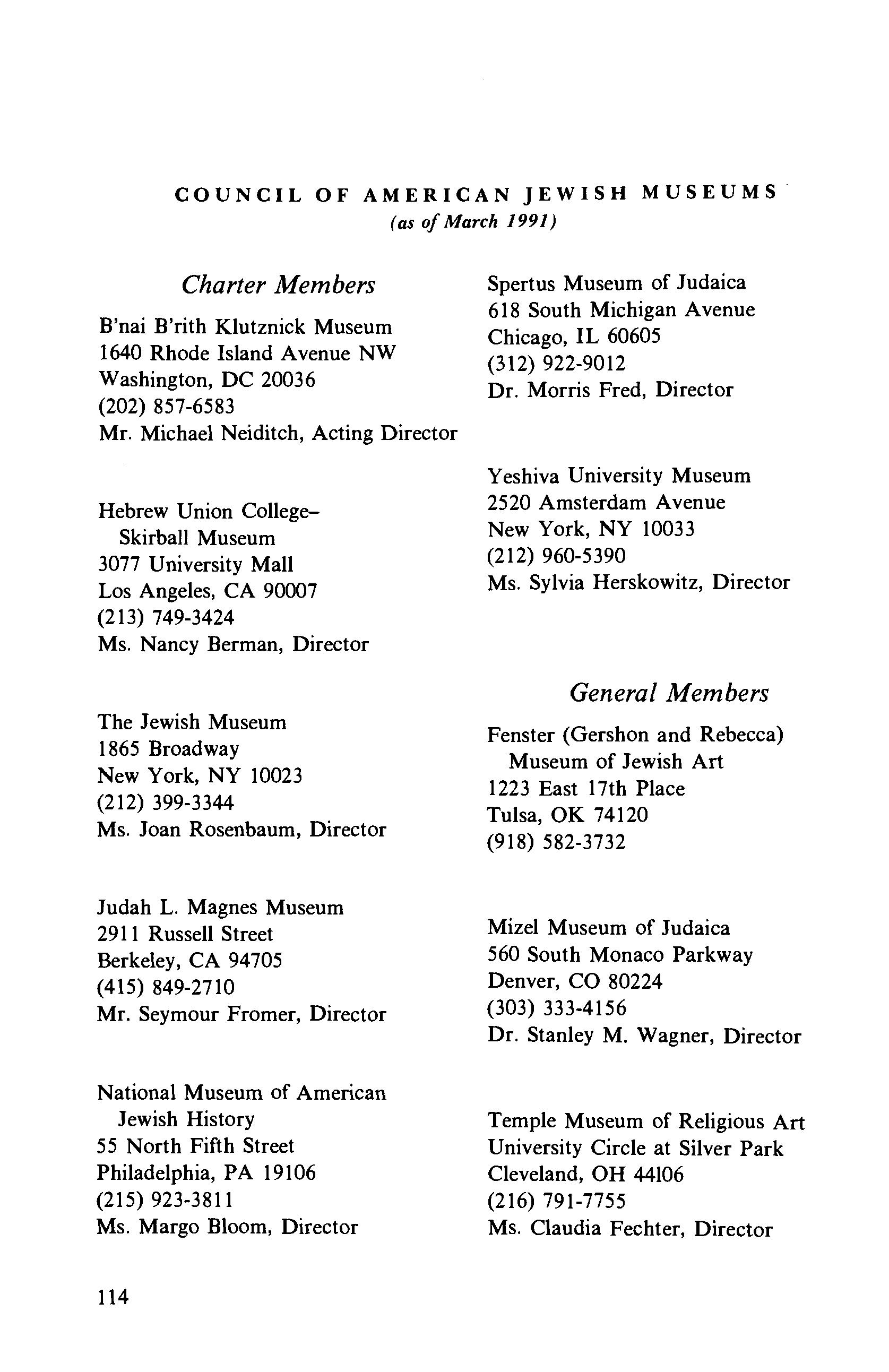
Spertus Museum of Judaica 618 South Michigan Avenue Chicago, IL 60605 (312) 922-9012
Dr. Morris Fred, Director
Yeshiva University Museum 2520 Amsterdam Avenue New York, NY 10033 (212) 960-5390
Ms. Sylvia Herskowitz, Director
Fenster (Gershon and Rebecca) Museum of Jewish Art 1223 East 17th Place Tulsa, OK 74120 (918) 582-3732
Mizel Museum of Judaica 560 South Monaco Parkway Denver, CO 80224 (303) 333-4156
Dr Stanley M Wagner, Director
Temple Museum of Religious Art University Circle at Silver Park Cleveland, OH 44106 (216) 791-7755
Ms. Claudia Fechter, Director
A Living Memorial to the HolocaustMuseum of Jewish Heritage
342 Madison Avenue, Suite 706
New York, NY 10173 (212) 687-9141
Dr David Altshuler, Director
American Jewish Historical Society 2 Thornton Road Waltham, MA 02154 (617) 891-8110
Mr Bernard Wax, Director
Benjamin & Dr. Edgar R. Cofeld
Judaic Museum of Temple Beth Zion 805 Delaware Avenue Buffalo, NY 14209-2095 (716) 886-7150
Mr. Mortimer Spiller, Director
Beth Tzedec Museum 1700 Bathurst Street
Toronto, Ontario M5P 3K3 Canada (416)781-3511
Ms Judith Cardozo, Curator
Central Synagogue 123 East 55th Street New York, NY 10022 (212) 838-5122
Ms. Cissy Grossman, Curator
Cleveland College of Jewish Studies 26500 Shaker Boulevard Beachwood, OH 44122-7197 (216) 464-4050
Ms. Leah Kaplan-Samuels, Program Director
Congregation Beth Ahabah Museum & Archives Trust 109 West Franklin Street Richmond, VA 23233 (804) 353-2668
Ms Cynthia Krumbein, Director
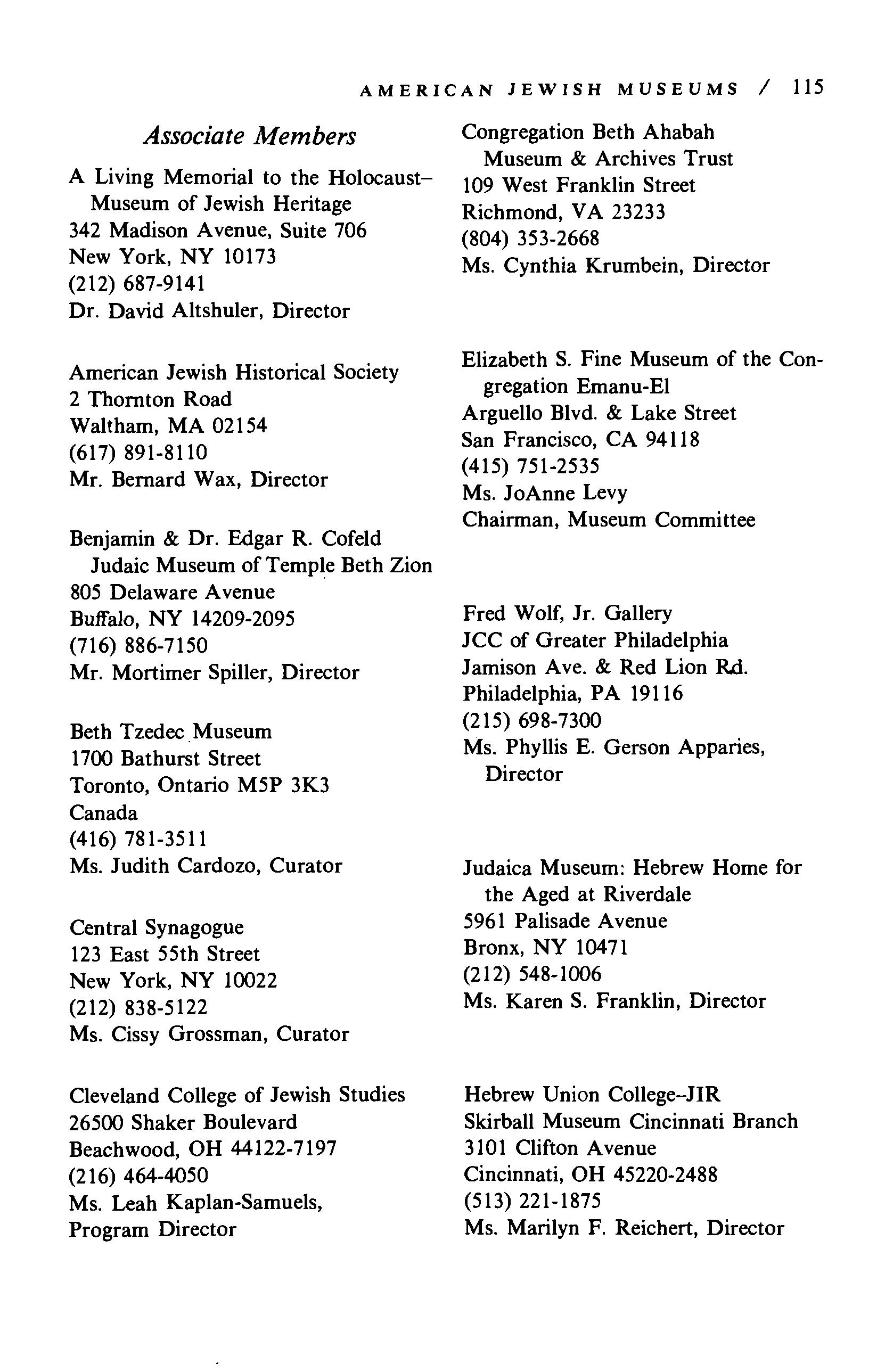
Elizabeth S. Fine Museum of the Congregation Emanu-El Arguello Blvd. & Lake Street San Francisco, CA 94118 (415) 751-2535
Ms. JoAnne Levy Chairman, Museum Committee Fred Wolf, Jr Gallery JCC of Greater Philadelphia Jamison Ave. & Red Lion Rd. Philadelphia, PA 19116 (215) 698-7300
Ms. Phyllis E. Gerson Apparies, Director
Judaica Museum: Hebrew Home for the Aged at Riverdale 5961 Palisade Avenue Bronx, NY 10471 (212) 548-1006
Ms. Karen S. Franklin, Director
Hebrew Union College-JIR
Skirball Museum Cincinnati Branch 3101 Clifton Avenue Cincinnati, OH 45220-2488 (513) 221-1875
Ms. Marilyn F. Reichert, Director
Hebrew Union College-JIR
Joseph Gallery
One West 4th Street
New York, NY 10012-1186 (212) 674-5300
Ms. Linda Robinson, Director of College & Community Relations
Kanner Heritage Museum 3560 Bathurst Street North York, Ontario M6A 2E1 (416) 789-5131
Ms. Pat Dickinson, Coordinator
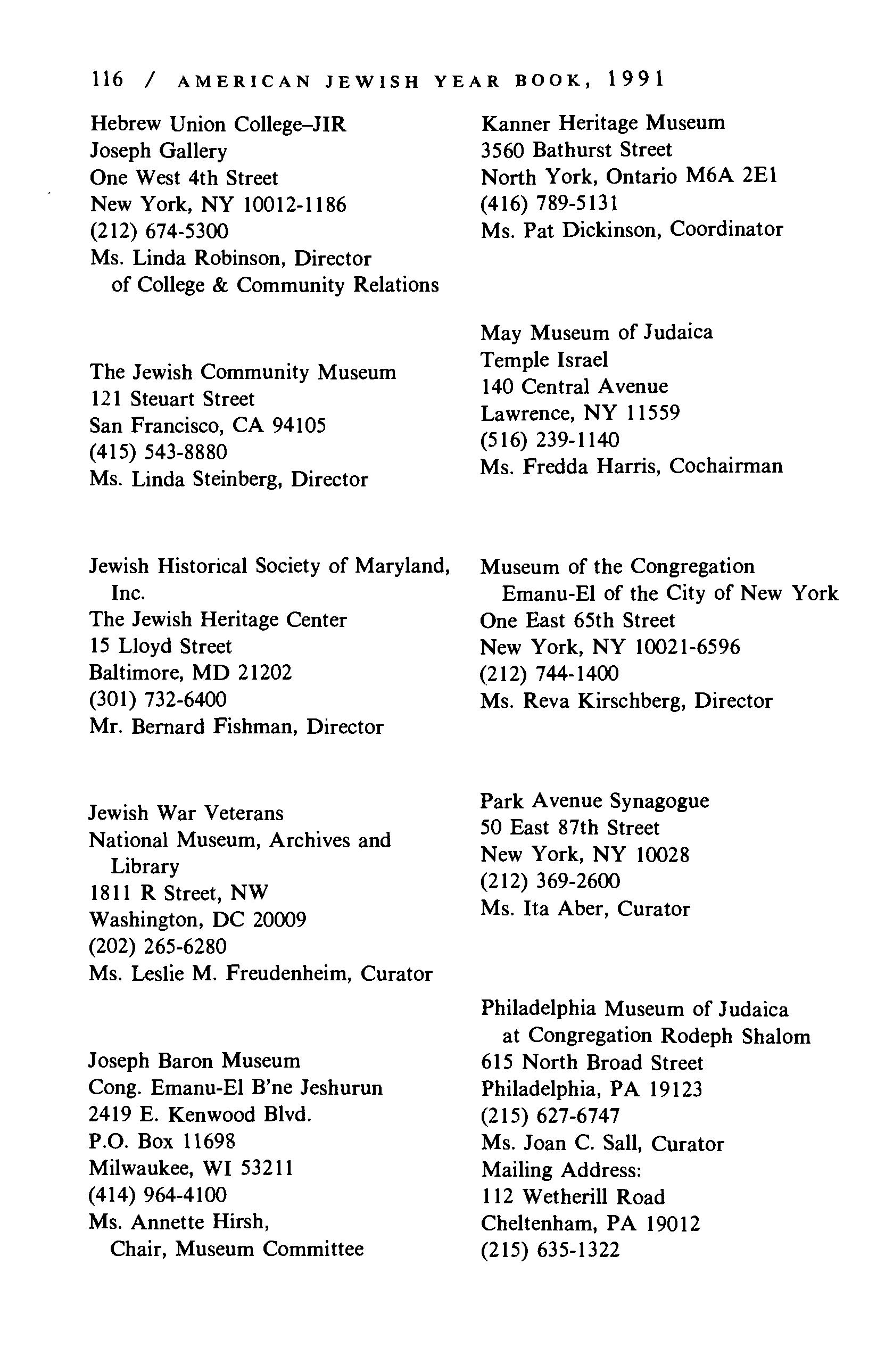
The Jewish Community Museum 121 Steuart Street San Francisco, CA 94105 (415) 543-8880
Ms. Linda Steinberg, Director
May Museum of Judaica
Temple Israel
140 Central Avenue Lawrence, NY 11559 (516) 239-1140
Ms. Fredda Harris, Cochairman
Jewish Historical Society of Maryland, Museum of the Congregation Inc.
The Jewish Heritage Center 15 Lloyd Street Baltimore, MD 21202 (301) 732-6400
Mr. Bernard Fishman, Director
Jewish War Veterans
National Museum, Archives and Library 1811 R Street, NW Washington, DC 20009 (202) 265-6280
Ms. Leslie M. Freudenheim, Curator
Emanu-El of the City of New York One East 65th Street New York, NY 10021-6596 (212) 744-1400
Ms. Reva Kirschberg, Director
Park Avenue Synagogue 50 East 87th Street New York, NY 10028 (212) 369-2600
Ms. Ita Aber, Curator
Joseph Baron Museum
Cong Emanu-El B'ne Jeshurun 2419 E. Kenwood Blvd. P.O. Box 11698 Milwaukee, WI 53211 (414) 964-4100
Ms. Annette Hirsh, Chair, Museum Committee
Philadelphia Museum of Judaica at Congregation Rodeph Shalom 615 North Broad Street
Philadelphia, PA 19123 (215) 627-6747
Ms Joan C Sail, Curator Mailing Address: 112 Wetherill Road
Cheltenham, PA 19012 (215) 635-1322
Plotkin Judaica Museum of Greater Phoenix 3310 N Tenth Avenue Phoenix, AZ 85013
Mrs. Sylvia Plotkin, Director
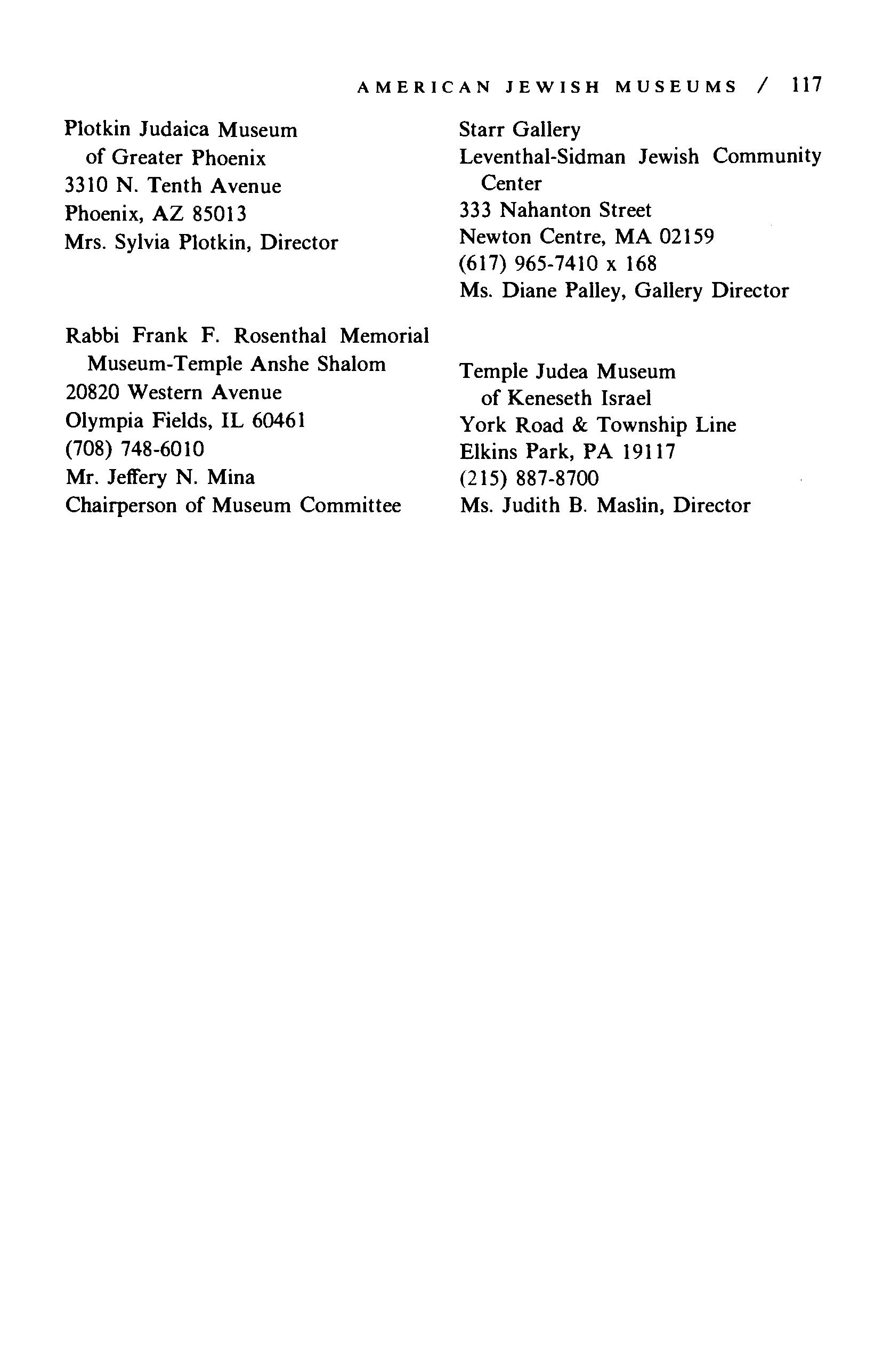
Rabbi Frank F. Rosenthal Memorial Museum-Temple Anshe Shalom 20820 Western Avenue Olympia Fields, IL 60461 (708) 748-6010
Mr. Jeffery N. Mina
Chairperson of Museum Committee
Starr Gallery Leventhal-Sidman Jewish Community Center
333 Nahanton Street Newton Centre, MA 02159 (617) 965-7410 x 168
Ms. Diane Palley, Gallery Director
Temple Judea Museum of Keneseth Israel York Road & Township Line ElkinsPark, PA 19117 (215) 887-8700
Ms. Judith B. Maslin, Director
Europe’s leading museum and research centre on the Jewish, Refugee and wide Immigrant contribution to British Art since 1900 seamlessly engaging with our collections, exhibitions and research library.
80+ Online and 3D Exhibitions
100+ School and Family programmes
100+ Arts and Mental Health interventions
125+ Podcasts & interviews
250+ Films and artist insights
400+ Collection artist biographies
400+ Research papers, essays, catalogues and PhD theses
600+ Archive exhibitions records
900+ Collection artworks on benuricollection.org.uk
3300+ Reseach Unit profiles on buru.org.uk / diaspora-artists.net
10,000 Pages of archives from 1915
Benuri.org & Buru.org.uk open 24/7 to suit you Gallery exhibitions open every Wednesday to Friday at Boundary Road, London NW8
Recording the Refugee and Immigrant contribution to British visual culture since 1900