Official Magazine for Liverpool Chamber

![]()
Official Magazine for Liverpool Chamber

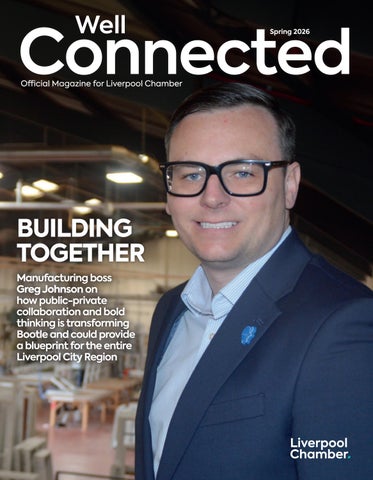
Manufacturing boss Greg Johnson on how public-private collaboration and bold thinking is transforming Bootle and could provide a blueprint for the entire Liverpool City Region
Celebrate, connect and impress in our museums and galleries. With outstanding food in extraordinary settings, be prepared for an unforgettable experience.
Start planning your event with us 0151 478 4437 @hostedbynml venuehire@liverpoolmuseums.org.uk


Suite G08 – G10, Cotton Exchange Building, Bixteth Street, Liverpool, L3 9LQ
t: 0151 227 1234
e: membership@liverpoolchamber.org.uk
w: www.liverpoolchamber.org.uk
Publisher Benham Publishing Limited, Aintree Building, Aintree Way, Aintree Business Park, Liverpool L9 5AQ
t: 0151 236 4141
e: admin@benhampublishing.com
w: www.benhampublishing.com

Published April 2026 © Benham Publishing Media No. 2182
Editorial Content Manager
Jessica Sturgeon
e: Jessica.Sturgeon@liverpoolchamber.org.uk
Advertising and Features
Karen Hall
t: 0151 236 4141
e: karen@benhampublishing.com
Advertising Sales
Catherine McCarthy
e: catherine@benhampublishing.com
Studio
David Wright
e: dave@benhampublishing.com

Disclaimer
Well Connected is mailed without charge to all Chamber members and distributed at all Chamber events. All correspondence should be addressed to the Editor at Liverpool Chamber. Views expressed in publication are not necessarily those of Liverpool Chamber. Reprinting in whole or part is forbidden except by permission of the Editor. © 2026. Whilst every effort is made to ensure the accuracy and reliability of material published in this journal, Benham Publishing and its agents can accept no responsibility for the veracity of claims made by contributions in advertising or editorial content. Benham Publishing cannot be held responsible for any inaccuracies in web or email links supplied to us.

Welcome to the latest edition of Liverpool Chamber’s Well Connected magazine.
While the wider world appears to be in a state of permanent flux, there remain clear reasons for Chamber members to feel optimistic about what 2026 has in store.
One consistent theme of feedback from business leaders so far this year has been around AI and other digital technology. Many recognise the opportunities that these rapidly-emerging technologies might potentially bring to their business, but they are seeking guidance on how best to make it bespoke to their business, and where to begin.
AI adoption is a key policy area for Liverpool Chamber and British Chambers of Commerce, which has partnered with AI training specialist Pair to create the AI Academy, which offers tailored content adapted to the needs of each business. Speaking at our latest AGM, BCC director-general Shevaun Haviland urged delegates to embrace
the productivity power of AI, describing it as the “juggernaut reshaping our economy”.
The coming months will be an opportunity to showcase our work with Navigate, a new membership community bringing together our strategic partners with creative and tech businesses, which will run alongside existing services and support, reinforcing our commitment to invest in a shared future with our members.
Commercial development plans and investment opportunities offer further room for optimism. Many of those were showcased at this year’s MIPIM, where the Liverpool City Region took one of its strongest public-private sector delegations to date in an effort to attract global investors.
Plans such as those at King Edward Triangle, North Docks or Knowledge Quarter will not only change our logical landscape but provide a key catalyst for future economic growth, complemented by Homes England investment in creating new housing and communities to support that growth. You can read more about those within this edition.
AI adoption is a key policy area for Liverpool Chamber and British Chambers of Commerce, which has partnered with AI training specialist Pair to create the AI Academy, which offers tailored content adapted to the needs of each business.
Our work with the Local Skills Improvement Plan also continues to gather pace, providing an important conduit for dialogue between employers and educators and a platform to work together to boost our future skills pipeline.
If you would like to engage with us on any of these initiatives, please do get in touch with me or a member of the team.
Paul
The Making Sense of AI: Adoption Readiness Programme is helping business leaders in the Liverpool City Region cut through the hype and focus on the real issues shaping AI adoption in organisations.
Across three sessions - Digital Data Literacy, Business Model Innovation, and Leadership - the programme highlights a consistent challenge: businesses see the potential of AI, but many are not yet equipped to realise it. While organisations anticipate productivity gains - particularly in service delivery and strategic planning - gaps in knowledge, data, and systems remain key barriers.
A central theme discussed is that AI starts with data. Many organisations rely on fragmented systems and inconsistent data, limiting their ability to adopt AI effectively. However, the opportunity available by addressing this is clear, through automation, forecasting, and real-time decision-making. Examples explored show organisations achieving up to 80% productivity improvements in data processes.
The programme then explores how AI can reshape business and service models, not just improve efficiency. Discussions focus on using AI to drive competitive advantage, aligning adoption with business strategy, and balancing automation with trust, transparency, and client expectations. A variety of realworld case studies bring these themes

to life, with examples showing firms who have achieved up to 40% reductions in cost of sales and 10% increases in sales conversion rates.
Finally, the programme highlights that AI adoption is not just a technology challenge, it requires new skills, cultural change, and confident leadership. By the end of the programme, participants report significantly increased understanding and confidence in identifying opportunities and leading change.
The key takeaway is that successful AI adoption is not about tools, it’s about building the right foundations and turning insight into action.
Making Sense of AI is delivered by Edge Hill University Business School’s Productivity & Innovation Centre. The latest cohort has been delivered in collaboration with the Liverpool Chamber of Commerce, generating insights which assist the development of the Local Skills Improvement Plan (LSIP).
businesses see the potential of AI, but many are not yet equipped to realise it. While organisations anticipate productivity gainsparticularly in service delivery and strategic planning - gaps in knowledge, data, and systems remain key barriers.
Business confidence remains fragile at the start of 2026. The BCC’s Quarterly Economic Survey (QES) for Q1 2026 - the UK’s largest independent survey of business sentiment, made up of 4,560 respondents - shows that confidence among firms remained fragile, heading into the Iran conflict, with labour and energy costs weighing on investment.
Labour costs remain the top cost pressure, cited by 73% of respondents
The percentage of responding businesses reporting increased domestic sales rose slightly to 32% (29% in Q4)
42% reported no change, and just over a quarter (26%) said they had seen a decrease in sales. Sectoral breakdowns show increased sales were at their lowest among transport (25%) and manufacturers (26%)
49% of firms expect to raise prices over the next three months
Confidence and investment levels remain low

A quarter (24%) of businesses say they have cut back on investment plans, while 56% say they have remained unchanged, and just 21% of firms increased their plans.
The issue is more marked in certain sectors. A third of hospitality firms (33%) and retail businesses (32%) reported they’d scaled back investment plans.


Even before the likely inflationary impact of the Iran conflict, 49% of responding firms said they were likely to raise prices over the coming quarter (down from 52% in Q1).
As measured as a percentage balance, the services sector stands at +45% while the manufacturing sector stands at +49%.

Tax remains the biggest concern for business, cited by 54% of firms (down from 63% in Q4). Half of firms (50%) remain concerned about inflation.
Levels of concern about business rates rose in the first few months of the year, ahead of revaluation. 41% of responding firms cited business rates as a concern, up from 34% in Q4.

“The instability in the Middle East is a cause for concern, the potential ripple effects from this are our reasons for being concerned about where interest rates, exchange rates, and inflation could go over the coming months.” Medium sized manufacturing firm in Northern Ireland
“Ongoing impact from food costs remains a challenge, with continued balancing of additional costs for workforce and now planning for impact of future costs from current war in Iran - fuel costs increasing, impacting delivery costs, utilities and general costs” Medium construction firm in Greater Manchester

“The uncertainty of the business rates increase is the biggest concern and impacting our decision to move to larger offices to support more staff.” Micro professional services firm in Surrey
“Labour costs are constantly increasing, SSP as well as NMW increases continue to push up our costs well above inflation.” Large professional services in the Black Country


In a city region defined by reinvention, resilience and ambition, Liverpool Chamber stands alongside the business community as it continues to find ways to thrive.
Our role is to help members by providing connections, trusted insights, shared learning, a collective voice and practical tools needed to navigate an unpredictable economic climate shaped by inflationary pressures and shifting trading conditions. We want to ensure that all members understand the ways in which their Chamber membership can help to ease some of those pressures and unlock new opportunities.
Fill up your calendar
Liverpool’s business community is nothing if not sociable, and our events calendar features a wide range of events, organised either by ourselves or by our members and partners. There is always something going on, from sector-specific discussions to highimpact networking sessions, to put you at the heart of a growing network of valued contacts, analysis and recommendations.
Our wider relationship with British Chambers of Commerce means you are connected to a national and global network, with inperson and online sessions to meet every business need.
Well Connected is our monthly networking event series taking place on the first Friday of each month, designed to foster meaningful, long-lasting business relationships, each in a relaxed atmosphere where ideas and conversation can flow naturally.
Many of our members understand that regular attendance at Well Connected builds greater visibility and stronger relationships, which in turn can bring more referrals or collaborations.
Attendance is free for members and invariably each event is fully-subscribed. Tickets are released approximately six weeks in advance, so be sure to keep an eye on the Chamber newsletter or social media channels and get yourself booked in early!

Our advocacy work relies upon your experiences and evidence. At the centre of that is the Quarterly Economic Survey (QES) - the UK’s largest independent business survey - which offers local businesses an opportunity to share real-world insights on topics such as recruitment, cashflow, investment and business confidence. This data is then fed directly into national decision-making by the Treasury, Bank of England and government policymakers.
If your business relies on global trade as a key part of its operation, or you are considering expanding into international markets, contact our export team on export@liverpoolchamber.org.uk
Members can receive discounted export documentation services, advice and accredited training on export requirements and trade regulations, plus a range of vital commercial services. We also provide tailored training and consultancy sessions to help you address your international trade challenges, whether its support with customs, documentation, Incoterms, VAT, or market access.
Liverpool’s business community is nothing if not sociable, and our events calendar features a wide range of events, organised either by ourselves or by our members and partners.


Our partnership with Quest gives members access to four essential services - HR, legal, health & safety and tax. This can be especially helpful for SMEs where internal specialists and compliance resources are limited, and can potentially save them thousands of pounds as well as provide reassurance in moments of uncertainty.
AI is becoming part of everyday work and presents a major productivity opportunity for organisations, but we know many are unsure of where to begin.
Liverpool Chamber members can gain discounted access to the BCC AI Academy, a hands-on, role-based and bespoke platform which can help your team to embed AI into their day-to-day tasks, tools and decisions.
Liverpool Chamber oversees the Local Skills Improvement Plan (LSIP) and we are working with employers in the Liverpool City Region to understand their labour needs and translate those into meaningful recommendations for further education providers and policymakers at a regional and national level.
We invite all members to take part in the process and lend their voices to developing the future LCR talent pipeline.
If your business operates in the creative, digital or tech sectors and would benefit from a greater understanding of topics such as finance, HR, law or tax, then get involved in our Navigate programme.
Equally, if you lead a professional services business which would like to create stronger ties within those sectors, please get in touch with the membership team.
Alongside its core services, Liverpool Chamber offers a growing suite of partnerled benefits that deliver tangible cost savings and operational support.
These offers span the broad range of sectors represented by Chamber members and include fleet hire and flexible car leasing, discounts on meeting room hire, complimentary business insurance reviews and travel discounts.
Jon Davies Accountants:
We are Liverpool-based profit experts working with six- and sevenfigure businesses to dramatically increase profitability by providing clarity on the numbers, confidence in the plan, and cash in the bank. Working alongside clients yearround, we use our structured P.R.O.F.I.T.S. Pathway and detailed business diagnostics to grow businesses while keeping tax bills as low as possible.
“We’ve been members of the chamber since the company was formed, but we realised that, as the company has grown, that many of our clients are now nationwide. Becoming a Strategic Partner is about cementing and promoting our Liverpool roots.”
Jon Davies, Jon Davies Accountants www.jondaviesaccountants.co.uk
The Davies Partnership:
For over 30 years, Davies Partnership has been driving lasting impact delivering smart, client-focused mechanical, electrical, and sustainability solutions across the UK. Through innovation, forward-thinking design, and a deep commitment to sustainability, we’re shaping the future of our industry and creating real, measurable value for every client we work with. www.daviespartnership.co.uk
Ziliant Tax Ltd:
Supporting UK innovation since 2018, we provide expert, ethical R&D tax advice to ensure innovation funding reaches the businesses it’s meant to support. Our endtoend services help companies of all sizes maximise R&D tax reliefs, allowances, Patent Box benefits, and creative industry incentives, with full support through HMRC enquiries. www.ziliant.uk
Richmond Training www.richmondtraining.org
Mercure Haydock
www.all.accor.com/hotel/A0H4/index.en.shtml
Qair Renewables www.qair.energy.co.uk
Big Egg Films www.bigeggfilms.com
BoldB2B www.boldawards.co.uk
Love2Shop www.business.love2shop.co.uk
Discount Building Supplies www.discountbuildingsupplies.co.uk
LovedbyAlly www.lovedbyally.com
Insight6 www.insight6.com
Xbody www.xbodyliverpool.co.uk
The Opportunity Provider www.top.training.co.uk
Bradbury Fields www.bradburyfields.org.uk
Peoples Automotive Group www.peoplescars.co.uk
Ready Set Consultancy www.readysetconsultancy.com
DT Equipment www.dtequipment.co.uk
Changeworks www.changeworks.org.uk
Dishoom – The Permit Room www.dishoom.com
Inquiro Intelligence www.inquirointelligence.com
John Carrington Advisory www.jcadvisory.uk
John Whalley Brand Works www.johnwhalley.co.uk
Neurasec www.neurasec.co.uk
SGD Fire Protection www.sgdpfp.co.uk
The Comedy Trust www.thecomedytrust.com
Wild Truffle Catering www.wildtruffle.co.uk

Join today and get access to a range of events including networking coffee mornings, high level networking, business briefings and much more.
Email membership@liverpoolchamber.org.uk or call 0151 227 1234
Adults of all ages should consider setting up a Lasting Power of Attorney (LPA) to avoid a “nightmare” financial crisis for relatives, says a leading Liverpool lawyer.
Ian Sturgess, head of private client at Gregory Abrams Davidson (GAD) is backing a recent call by TV personal finance guru Martin Lewis who claimed an LPA is more crucial than a will.
Costing just £92 in England and Wales, LPA allows trusted people to manage your finances, or critical medical decisions, if you were to suddenly lose mental capacity following an accident or a severe stroke. There are two types of LPA… Property and Financial Affairs where you appoint people you trust to look after your finances, and Health and Welfare which allows nominated people to look after your medical and welfare requirements.
Without an LPA in place, warned Martin Lewis, families may not be able to immediately access bank accounts to pay the mortgage or other essential bills. Getting access can involve a long and complex legal process.

“If you don’t have a Power of Attorney in place, and you were to have an accident tomorrow so you couldn’t look after yourself with your faculties gone, or a severe stroke, then it is frankly a nightmare to go through the process of someone else trying to take over your finances,” said Martin.

People can apply for an LPA themselves through the UK Government website although there are specialist lawyers, such as Ian and his team at GAD, who can help with the process and make sure it is done
“No one wants to think about themselves or one of their loved ones in a situation where they are incapacitated and unable to manage their own affairs,” Ian told LBN. “But sadly these are everyday occurrences and the cost of an LPA is low compared to the chaos that could ensue if there isn’t one
“Without an LPA, your bank accounts can be frozen, and assets locked away if you lose capacity, leaving loved ones to face a much more costly and slow Court of Protection process.
“It is a pretty straightforward process and once it is done it can offer some peace of mind in case the unthinkable were to happen. It’s a very sensible piece of advice from Martin and we hope lots of people take heed.”
As well as handling Lasting Power of Attorney, GAD’s private client team also handles trusts, Court of Protection and Deputyship and probate and estate administration.
If you would like to discuss any of the matters raised in the article please contact Ian Sturgess by email isturgess@gadlegal.co.uk
“It is a pretty straightforward process and once it is done it can offer some peace of mind in case the unthinkable were to happen. It’s a very sensible piece of advice from Martin and we hope lots of people take heed.”
Ian Sturgess, head of private client at Gregory Abrams Davidson (GAD)


Recent insights from the Local Skills Improvement Plan work led by Liverpool Chamber of Commerce highlight a decisive shift across the city’s business community.
Demand for artificial intelligence is rising rapidly. At the same time, many organisations acknowledge they lack the structured understanding needed to apply it confidently and responsibly. The message from employers is clear: AI is no longer optional, but navigating it without guidance carries risk.
Businesses are under pressure to improve productivity, reduce operational friction, and remain competitive. AI offers significant opportunity, but only when it is implemented with clarity and purpose. That is why the Liverpool Chamber AI Academy was created.
Delivered in association with Pair, the Academy provides practical, role-specific AI training tailored to real business environments. Rather than offering generic theory, it adapts to the responsibilities of each participant. Marketing professionals explore AI-driven audience insight and

campaign development. Administrators focus on workflow efficiency and document management. Senior leaders examine strategy, governance, risk, and ethical deployment.
This structured approach ensures AI becomes embedded within everyday operations, not treated as an isolated experiment.
A central principle of the Academy is simple: the quality of AI outputs depends on the quality of your inputs. Organisations must understand their data, improve its structure, and establish clear processes. Strong data
foundations lead to reliable insights, better decisions, and measurable results.
The AI Academy equips businesses to move from curiosity to capability. It builds confidence, strengthens operational performance, and prepares organisations for sustainable digital progression.
Liverpool’s businesses are adapting. The question is whether you will lead that change or respond to it later. Now is the time to build the knowledge that will shape your competitive advantage. Find out more at: www.liverpoolchamber.org.uk/bcc-ai-academy or

At a recent roundtable hosted at the RSM Liverpool office overlooking the River Mersey, Navigate brought together founders, social impact leaders, advisers and educators to examine how the city’s creative tech businesses are operating in today’s climate.
The message was clear: Liverpool has the ambition to scale, but growth requires structured support.
Delivered through the Liverpool Chamber of Commerce, the Navigate programme
exists to connect high-growth firms with the expertise they need to expand sustainably. Strategic Partners including River Capital, DSG and Ziliant Tax joined RSM in offering practical insight on funding, tax efficiency, governance and long-term planning. For many businesses in the room, access to this level of professional services input is critical at the scaling stage.
A defining theme of the discussion was collaboration. Liverpool’s creative, digital and professional services communities are increasingly intersecting, creating opportunities for joint ventures, shared bids and cross-sector innovation. Rather than operating in silos, firms are recognising the strength of a connected ecosystem.
Talent was another key focus.
Representatives from Liverpool Hope University and Hugh Baird College outlined how internships and employer engagement can strengthen the pipeline into emerging creative tech businesses. Keeping skilled graduates within the city region is essential to sustained growth.
The roundtable demonstrated more than conversation. It reflected a shared vision and a strong appetite to grow. Through Navigate, Liverpool is building the infrastructure, partnerships and confidence required to convert entrepreneurial energy into long-term economic impact.
Learn more about the Navigate mission via: www.wenavigate.co.uk
by Steve Rotheram

In March I led one of the largest delegations ever taken from the Liverpool City Region to MIPIM, the world’s largest gathering of investors, developers and city leaders.
Despite the glamorous setting of Cannes, events like this matter deeply to ordinary people.
The projects we promote create good jobs, build new homes and support the next phase of growth in our communities. MIPIM is where opportunity meets ambition—and we arrived with both. Our message was crystal clear: now is the time to invest in the Liverpool City Region.
We brought forward more than £11bn of genuine investment opportunities across our six boroughs—from major regeneration schemes and innovation campuses to new commercial developments.
These are not aspirational ideas or distant ambitions; they are deliverable pipelines: real sites, real plans and real partners ready to go.
Just as important as the scale of these opportunities is that we now have the tools to make them happen.
Devolution has given us the ability to shape our own future—whether through investing in a publicly owned train fleet, bringing buses back under public control, rolling out the country’s fastest broadband network or backing the industries that will power our economy for decades to come.
We’ve marked another major step forward with the launch of a £2bn Investment Fund. In simple terms, this gives us the financial firepower to unlock sites that have long stalled, accelerating development and creating opportunities across the region.
The fund will support new commercial space, modern industrial facilities and research hubs in sectors where we already excel—from advanced manufacturing and life sciences to digital and AI.

Crucially, it will help accelerate housebuilding, strengthen infrastructure and enable the delivery of tens of thousands of new homes, ensuring communities have the services and connectivity they need. Growth only truly matters when people feel its benefits in everyday life. This fund is about making that a reality – and since MIPIM the Government has backed us with a further £95m for Liverpool City Region projects and £51m to develop the cryogenic facility at Daresbury, as part of their Northern Growth Strategy.
We’ve also confirmed the next steps toward establishing a Mayoral Development Corporation for Liverpool’s North Docks— one of the most exciting regeneration prospects anywhere in the UK.
Stretching from the city centre to Everton’s new Hill-Dickinson stadium at BramleyMoore Dock, this historic stretch of waterfront has shaped Liverpool’s story for centuries.
By bringing planning powers, land assembly, investment and development partners together, we can unlock its huge potential, creating new homes, jobs and public spaces along the Mersey—expanding the heart of the city and enhancing its iconic skyline.
We’ve also unveiled plans for a pioneering Industrial Strategy Zone, aligning our Freeport, Innovation Zone and other
strategic initiatives to create the optimal conditions for businesses to invest and grow. While such strategies rarely win votes on the doorstep, they are essential to securing the major funding required to turn our long-term vision into reality.
A key conversation centred on boosting construction skills.
If we want to deliver thousands of new homes, commercial spaces and regeneration schemes, we must ensure our residents have the skills to build them and that businesses can access the workforce they need.
It’s a vital part of our plan for inclusive, sustainable growth and I’m delighted the city region has been chosen to host the first pilot as part of the Industrialising and Digitalising Construction Challenge.
As industry partners, Onward Homes and Torus Developments will test and refine to help finalise a standard delivery model for adoption. The approach is expected to transform social housing delivery nationally. And that’s where our City Region belongs. At the cutting edge. Innovating. And attracting investment that will change the lives of our residents and the future of our economy.
It’s a story we’ll be taking to UK REiiF in Leeds, this May.
And I can’t wait for the next chapter.

Liverpool has always been a city defined by ambition, resilience and reinvention. Few projects illustrate that spirit more clearly than the transformation taking place along the city’s North Docks, where significant investment and regeneration are reshaping how the Liverpool City Region lives, works and welcomes visitors.
Everton Football Club’s development of Hill Dickinson Stadium at Bramley-Moore Dock is a defining project within that transformation. Built within a historic dock setting, the scheme has combined the restoration of heritage dock infrastructure with the creation of a new landmark on Liverpool’s waterfront.
During its three-and-a-half-year construction, the stadium was recognised as the largest single-site private sector development in the UK. It’s also estimated to contribute £1.3bn to the UK economy, the creation of tens of thousands of jobs, and around 1.4 million visitors expected to be drawn to Liverpool each year.
The project has also helped accelerate wider regeneration across north Liverpool. More than £650m of development across the nearby Ten Streets district has been brought forward, while the stadium sits alongside the
wider £5bn Liverpool Waters programme, which will deliver significant new office, hospitality, leisure and residential space along the city’s northern waterfront.
Environmental considerations have also been embedded within the stadium’s design itself, including water harvesting, solar energy generation and the sensitive reintroduction of heritage dock assets.
Recognition has followed, with the stadium named ‘Project of the Year’ at the Stadium Business Design and Development Awards and ‘Outstanding Development of the Year’ at the Liverpool City Region Property Awards. With UEFA EURO 2028 fixtures confirmed and the venue proposed as part of the UK’s bid to host the 2035 FIFA Women’s World Cup, the stadium will play an important role in Liverpool’s international profile, and in the continued evolution of its waterfront.
During its three-and-ahalf-year construction, the stadium was recognised as the largest single-site private sector development in the UK. It’s also estimated to contribute £1.3bn to the UK economy, the creation of tens of thousands of jobs, and around 1.4 million visitors expected to be drawn to Liverpool each year.
Liverpool City Region is no stranger to ambition. From major regeneration schemes and transport infrastructure investment to the continued growth of innovation districts, the region continues to invest in the foundations that support how it lives and works.
But the next phase of growth will be about more than just buildings, it will be shaped by how well we connect the people, businesses and ideas within them.
Across the region, there is no shortage of innovation, capability or intent. Yet too often, these strengths exist in silos. Businesses are developing new ideas, products and services but struggle to find clear routes into supply chains. SMEs have the skills to support major sector growth but face barriers in accessing opportunities, while large-scale projects risk overlooking local capability simply because connections aren’t visible or established.
This is where progress can stall, and opportunities, growth and collaboration are left untapped.

To unlock the full potential of The Liverpool City Region, we need to shift our thinking from individual projects to connected ecosystems. Collaboration should not be seen as a by-product of growth, but as a necessity to facilitate it.
Collaboration does not often happen by accident, it needs to be actively built up by all of us. For companies across the region, that starts with engaging in the right networks and spaces where
opportunities are shared and relationships are formed. Sector clusters, innovation hubs, and targeted events, often facilitated by organisations working across industry, academia and the public sector, provide valuable entry points.
Equally, businesses should look beyond their immediate sector, where some of the most valuable opportunities come from applying existing capabilities in new contexts, whether that’s a manufacturer entering defence, or a digital company supporting infrastructure projects.
When businesses, academia and the public sector work together effectively, the impact goes far beyond what any one organisation could achieve alone. We see stronger and more diverse supply chains, faster innovation, and more inclusive economic growth.
As a B Corp organisation, RTC North sees collaboration as a critical driver of sustainable and inclusive growth, helping ensure that opportunity is accessible and the benefits of investment are felt across the whole region.
The Liverpool City Region has the ambition, talent and opportunity to lead. The next step is ensuring those assets are aligned.
Following an extraordinary event last April, where the civil and structural engineering firm Sutcliffe raised £89,000 for three Liverpool NHS charities, the annual Spring Ball returns on April 24th. The evening will once more unite clients, partners, and friends from across Liverpool’s business community for a night that balances celebration with genuine purpose.
For the second consecutive year, funds will be shared between three outstanding organisations: Clatterbridge Cancer Charity, Liverpool Women’s Hospital Charity, and University Hospitals of Liverpool Charity. These charities perform vital work that reaches far beyond what NHS funding alone can provide, supporting patients and families through some of the most difficult moments of their lives.
CEO Sean Keyes remarked, “These charities are at the heart of our city. The NHS does extraordinary things for ordinary people every single day. The least we can do is give something back. If one evening together as a business community can make a meaningful difference to patients and families across Liverpool, then that is exactly what we should be doing”.
Funds raised this year will support three distinct and pressing causes:
• Clatterbridge Cancer Charity: Focus is on understanding and addressing
the practical barriers—such as the cost of a taxi or childcare—that cause patients to miss chemotherapy and radiotherapy appointments.
• Liverpool Women’s Hospital Charity: Investment is dedicated to pioneering research into foetal health, examining how conditions first develop in the womb and how early intervention can improve outcomes for babies and their families.
• University Hospitals of Liverpool Charity: The goal is to provide accessible, practical, in-the-moment wellbeing support for staff at hospital groups like Aintree and the Royal Liverpool. These hospitals experience high volumes of trauma admissions, and the funds will help staff decompress from the relentless emotional pressure and everyday traumas they face.
The evening is made possible by the generosity of headline sponsor Austin Wilkinson and supporting sponsors: Layer Surveys, Butterworth Spengler, John McCall,

Seddon Housing Partnerships, Authentic People, and Fox IT.
Sutcliffe’s commitment to Liverpool’s healthcare infrastructure is long-standing, encompassing project work across the North West. Supporting these charities is an extension of that commitment to the communities that depend on them. With the spirit of last year behind this year’s Ball, Sutcliffe is confident that Liverpool’s business community will once again rise to the occasion.


Some businesses are built from opportunity. Others are built from something far deeper — from experience, from belonging, from a sense of purpose that took years to find.
Xbody Liverpool Ltd is one of the latter.
Since 2016, Bruno and Alina Fernandes have been quietly building something special in the heart of Liverpool city centre: a studio where people come to feel stronger, move better and live with a little more energy in their days. But the story behind it stretches back further than the business itself — and it begins, fittingly, at Anfield.
Bruno Fernandes is a Portuguese-born former professional footballer whose career took him across Europe before landing him, briefly, on one of football’s most storied stages. In February 2010, he came to Anfield as part of the Romanian side Unirea Urziceni, during Liverpool’s UEFA Europa League campaign — a round-of-32 tie confirmed in UEFA’s official records. Alina was in the stands that night, a supporter of the Romanian club, watching from the away end.
Neither of them could have known then that the city on the other side of the pitch would one day become home. Years later, after meeting in Romania and building a life together, Bruno and Alina made a decision that surprised some and made perfect sense to those who knew them: they chose Liverpool. Not just as a place to work, but as a place to belong. Over the past decade, they have embraced the city with the kind of pride that isn’t given — it’s earned.
That pride runs through everything at Xbody Liverpool. What They’ve Built
The studio sits at the intersection of two things Bruno and Alina understand deeply: the demands the body faces across a lifetime, and the difference the right support can make.
Through tailored EMS (Electrical Muscle Stimulation) sessions, Xbody Liverpool serves a genuinely wide range of people — busy professionals, parents, athletes, those returning from injury, and those who simply want to feel more like themselves again. What they share isn’t an aesthetic goal. It’s a desire to feel capable, energised and in control of how they move through the world.
Three core offerings shape the experience:
High Performance Training — built for those who want measurable results: increased strength, improved conditioning, and more effective body composition, all within a focused and time-efficient session.
EMS Recovery Room — a structured pathway back to better movement and function, designed for those working through restriction, tension or the lingering effects of injury. It’s about rebuilding trust in the body, one session at a time.
Relax EMS — for the moments when rest is the work. Whether that means starting the day feeling recharged or ending it with a genuine sense of release, this is recovery as it should be: intentional, restorative and deeply effective.
A Different Idea of Health
At Xbody Liverpool, health has never been reduced to appearance. It is understood as something far more meaningful — energy, resilience, confidence, ease of movement, and the quiet satisfaction of feeling well enough to show up fully in your own life.
Bruno and Alina have worked hard to ensure that every client who walks through the door feels that understanding from the first session. The studio is not clinical. It is not intimidating. It is a space where people feel welcomed, listened to and genuinely looked after — where expert guidance is delivered with warmth, and where sessions are shaped around the individual, not the other way around.
Nearly a decade in, the mission has not shifted: to help the people of Liverpool feel better, move better and live better — one session at a time.
For many, trying EMS for the first time is a revelation. The realisation that taking care of your body and mind can be this effective, this accessible and this enjoyable tends to change the conversation people have with themselves about what’s possible.
Xbody Liverpool began as a personal journey. Today, it helps others write their own
EXCLUSIVE READER OFFER · FIRST MONTH
Your first month at Xbody Liverpool — at our best price, just for you
8 SESSIONS
Mention this offer or use code LIVERPOOL25
Valid for new clients only. Offer available for a limited time — we recommend booking ahead as sessions fill quickly.
Each session is approximately 20 minutes — the equivalent of a far longer conventional workout. No prior EMS experience needed. Bruno and Alina’s team will guide you through everything from your first visit.
Book your first month xbodyliverpool.co.uk
Curious about what else is available? Come into the studio and we’ll walk you through everything — there’s more to discover than any article can fit. Bruno and Alina’s team will be happy to sit with you, understand what you’re looking for, and show you what’s possible. Some things are better explained in person.
Laura Evans CEO Glass Ceilings Change Management

Although AI has been around for many years, few can have missed its rapid growth in the past year or so which is transforming how and where people do business. Glass Ceilings Change Management is certainly seeing this through our client work.
We advise organisations to streamline operations and manage business risks effectively whilst creating a workplace people want to join, stay, grow, and thrive. We do this through pragmatic systems thinking, which includes identifying commercial and growth opportunities including inclusive, ethical use of AI to save

time and resources alongside enabling employees to develop skills needed to embed new approaches.
Whilst we have seen the many benefits of increasing AI use to save money and create opportunities for people previously left out of the jobs market, we have also seen disadvantages to deploying AI tools without organisations fully considering wider privacy, security, and commercial implications alongside people impacts.
We are therefore proud to have developed the Glass Ceilings SAFE AI Model™ to help mitigate these risks. ‘SAFE’ is an acronym for: Secure, Accessible, Fair, and Empowering. Our SAFE Model considers social and economic issues in the round with rapid deployment of AI in a largely unregulated environment, taking into account the impact of issues like digital poverty, education, and social mobility on employment and career progression.
We first launched the Model publicly when delivering a session on ethics and inclusion in AI at a LCR Combined Authority Fair Employment Charter event in March. As well as applying the SAFE Model principles through our client work, we are also providing expert advice through advisory board roles and support the Chamber’s Navigate programme.
We believe deploying our SAFE AI Model through change programmes will help to transform the spaces where people live, work, and connect whilst leaving nobody behind. Please visit www.glassceilings.co.uk
Brett Tonkyn, Director of Premium Experiences at The R&A, shares how hospitality at The Open is being reimagined to meet modern expectations, offering more flexible, personalised experiences for today’s global audience.
The Open, the original major golf Championship, will be played at Royal Birkdale for the 10th time this summer. The cherished history and prestige of The Open ensures that the world’s best players want to compete to hold the iconic Claret Jug trophy aloft every year.
The global reach and fandom of golf and The Open is growing annually, meaning new markets and international guests are engaging with the Championship every year. With tens of thousands of attendees every day, we will be building the equivalent of a large village on the Southport coastline, taking one of the world’s major sporting events to Merseyside, where the local community is always ready to embrace The Open.
The Open’s heritage stretches back to 1860, and the opportunity for players and audiences to experience the Championship changes every year. With growing international audiences, it has to evolve and grow with new fans of the
game. Once upon a time, corporate hospitality was seen as something transactional when all parties knew that an agreement was almost ready to be struck. Organisations using events such as The Open to entertain clients is nothing new, but the way they’re doing it in 2026 is very different. Perceptions and intentions have shifted from transactional to more strategic and long-term. Clients are choosing to host their customers at The Open because of the unique environment and atmosphere, offering guests over 10 hours of world-class golf within an exceptional setting for relationship-building. Post-event surveys show 95 per cent said hospitality strengthened relationships, and 83% said it helped build relationships with prospective clients. Rather than hospitality being the finishing touch, it has become more foundational. Experiences have adapted to reflect changing preferences, delivering experiences that are relevant,

engaging, and tailored to modern expectations. Guests increasingly value unique, immersive moments. For the first time, hospitality guests will enjoy seamless access to exclusive venues and curated outposts across the course, moving freely between premium viewing points, culinary experiences, and social spaces.
The introduction of this enhanced and more flexible hospitality model has generated great interest, with demand already tracking at record levels, surpassing figures seen in 2023. By investing in curated, purpose-driven hospitality, The Open has positioned itself as one of the best places to make memories and forge a lasting bond.

By Sarah Hart, Operations Director, RTC North
Re ecting on B Corp Month, I wanted to take the opportunity to pause and re ect on what being a B Corp truly means for me, and for RTC North.
For us at RTC North, becoming a B Corp wasn’t a badge chasing exercise. It was a way of asking ourselves whether the way we operate truly re ects the impact we strive to deliver.
RTC North exists to make a positive di erence to society, the economy, and the environment. That’s not a slogan, it’s the reason people here get out of bed in the morning.
But intention on its own isn’t enough. B Corp gave us a rigorous, independent framework to test whether our governance, culture, and day-to-day decisions genuinely live up to our values. It challenged us to look at how we treat our people, how we work with our clients and partners, how we steward resources, and how we serve in the places and communities we serve.
One of the things I’m most proud of is our people. RTC North is full of individuals who could be doing easier jobs in easier markets, but they choose not to. They choose complexity, ambiguity, and longterm impact over quick wins, because they genuinely care.
The desire to make a di erence runs deep. It shows up in the way we support small businesses to grow responsibly, in how we design programmes that create opportunity rather than dependency, and in how we measure success, not just by outputs, but by outcomes and legacy. We design for impact, not gimmick or to serve the tick box.
Our latest Annual Report brings this to life. In 2024/25, RTC North supported more than 3,200 businesses across the
North of England, providing an average of 2.16 interventions per business, re ecting depth as well as reach. Businesses supported increased investment in their organisations by an average of £25,500 per business, demonstrating con dence, resilience and forward momentum.
1,650 founders and businesses were supported through innovation programmes such as Innovative Entrepreneurs, Regional Talent Engines and Innovate UK Business Growth, helping turn ideas into commercially viable products and services.
931 businesses were supported to compete, including over 130 manufacturers adopting digital technologies through Made Smarter to increase productivity, reduce waste and improve sustainability.
684 businesses were supported to grow, through scale-up, leadership and supply-chain programmes focused on long-term capability rather than shortterm xes.
Together, this work directly supports productivity at rm level, whether through innovation, digital adoption, leadership capability or market access, aligning strongly with the B Corp commitment to sustainable economic value creation
We’re living through a period of profound geopolitical and economic change. The headlines can make it feel like everything is broken, polarised, or driven by selfinterest.
But that’s not the whole story. Every day, I see businesses, especially small and medium-sized ones, acting as a force for good. Creating livelihoods., investing in people, innovating responsibly and caring about the places they’re rooted in.
The growing B Corp movement is a powerful reminder that most people want to do the right thing, and that business can be a vehicle for positive change when it’s designed with intention.
Being part of that movement matters to us as it connects RTC North to something bigger than ourselves. On a personal level, B Corp resonates because it legitimises a belief I’ve carried throughout my career, that how you achieve results matters just as much as the results themselves.
It matters to our employees too. People want to work for organisations whose values they can stand behind, especially in uncertain times. B Corp gives our team con dence that RTC North is walking the talk and the permission to keep pushing us to do better.
As we mark B Corp Month, I don’t see this as a moment of self-congratulation. I see it as an invitation, to our partners, the businesses we support, and our wider network, to ask questions about their impact, purpose, and responsibility.
If business is one of the most powerful forces shaping our future, then we all have a role in shaping what kind of future that is.
At RTC North, we’re proud to stand with the B Corp community and even prouder of the people who make our purpose real, every single day.


“Getting back into work gave me routine, connection, and purpose”
Could your business be the next step in someone’s recovery journey?


If you’re interested in supporting people to reach their potential, improve their health and wellbeing, and find fantastic talent for your business, scan the QR code to reach out to our IPS Employment Service


In February we were absolutely delighted to host Chris Lo, Regional Director of HKTDC, and Rachel Fung, Marketing Manager at HKTDC, for a roundtable in collaboration with Matt Biagetti and his team at Liverpool City Region Combined Authority tailored to MedTech innovators, R&D leaders, and international expansion specialists exploring opportunities across one of Asia’s fastestgrowing healthcare innovation ecosystems.
Back in February Liverpool Chamber of Commerce supported Carlow County Council delegation visit to Liverpool City Region.
Gavin Sherratt and Elena Enciso represented the Chamber, sharing insight into our Navigate Together programme and how we connect ambitious businesses with the networks and opportunities they need to grow.
The delegation explored key innovation assets including Baltic Ventures, LYVA Labs and Central Tech by Sciontec Developments Limited, highlighting the strength of our tech, creative and science ecosystem.
Coordinated by Paul Radcliffe and Rob March from Liverpool City Region Combined Authority, the visit reinforced the value of cross-region collaboration.


The audience made the session truly exceptional — interactive, curious, and highly engaged, turning the conversation into a rich exchange of insights and opportunities.
We also heard an exciting overview of the upcoming AsiaSummit on Global Health (11–12 May 2026) and the range of support available for UK delegates looking to connect with partners, investors, and innovation networks across the region.
A special highlight was Gavin Sherratt’s introduction to our Navigate Together initiative, supporting the growing community of creative and digital entrepreneurs across the Liverpool City Region.
If you’re working in MedTech, digital health, or innovation more broadly and would like further information, please feel free to contact export@liverpoolchamber.org.uk
Hundreds of businesses have gained unique geopolitical insight into the Middle East crisis, thanks to a joint initiative by the British Chambers of Commerce (BCC) and the Foreign, Commonwealth and Development Office (FCDO).
The first event organised by the new Diplomatic Advisory Hub, saw senior FCDO officials host a webinar giving updates on the unfolding situation, and its implications for costs, energy, logistics and risk. Firms were also given crucial advice on stresstesting planning for trade with the Middle East.
The Hub was announced by the Foreign Office in March last year at the BCC’s Driving International Trade Conference. It is now fully operational, with businesses
We also hosted Chris Wren, former CEO of BritCham Indonesia for 17 years, who met businesses in our area looking to understand market access.
Why Indonesia? Indonesia is the world’s fourth-most populous country, home to 280 million people and the largest economy in Southeast Asia, contributing around 40% of ASEAN’s GDP. As a rapidly growing manufacturing and regional distribution hub, it provides access to an ASEAN market of over 800 million
able to receive personalised geopolitical advice via the BCC website and a series of planned events across the Chamber network. The Hub represents the first time diplomats have been seconded into the British Chambers of Commerce network to work directly with businesses. It aims to act both as a gateway for companies seeking geopolitical advice and as a feedback channel so that insights from businesses can inform wider policy discussions. Further briefings and events on key geopolitical developments are expected to take place across the Chamber network in the coming months.
Businesses interested in accessing support or learning more about the initiative can find further information via the Diplomatic Advisory Hub website.
consumers. With a young, tech-savvy middle class expanding by 3.5–4 million people annually, demand for high-quality products, services, and British expertise continues to grow— often commanding a premium.
Opportunities span nearly every sector, from construction and F&B to telecommunications, advanced engineering, and professional services— making Indonesia a market too significant to ignore.
Liverpool Chamber’s latest Trade Club event, held on 18 March at the Malmaison Hotel, brought together businesses, trade specialists and policy experts for an energising session focused on two powerhouse markets: South Korea and India.
The room was alive with conversation as members explored the real dynamics shaping modern global trade — from evolving trade agreements and regulatory reforms to the pressures and opportunities exporters navigate every day. The strength of Trade Club lies in its participants, and this session once again demonstrated why businesses across the region choose to join:
• To stay ahead of trade policy shifts, including tariff reductions and new market access provisions.
• To identify high-growth sectors — with this session spotlighting automotive, whisky, pharmaceuticals ,technology and service providers.
• To understand how tax and customs developments can unlock new commercial opportunities, particularly in line with the UK’s Industrial Trade Strategy.

• To connect with peers and experts who can support and accelerate export ambitions.
We were privileged to welcome two exceptional speakers whose insight grounded the session in both local relevance and global perspective:
Widely recognised for his deep involvement in UK trade policy, William brought clarity to the latest developments in the India and South Korea trade agreements. His briefing offered members a forward look at how these evolving relationships may shape export pathways for businesses across our region.
Representing one of the most significant economic initiatives in the North West, Giles provided a compelling update on Liverpool Freeport’s progress and its expanding potential for business growth, innovation and investment. His insights reinforced the scale of opportunity emerging as the Freeport continues to develop.
A warm thank you goes to all members and guests who joined us. Your questions, contributions and energy are what make Trade Club such a valuable and forward-thinking forum. We are already looking forward to welcoming you to the next session.
Small and medium-sized exporters should be aware of significant changes proposed by HM Treasury (HMT) to the way the UK treats low-value imports, following the planned abolition of the current de minimis threshold by March 2029 at the latest. These changes are currently under public consultation and will shape future customs and cost structures for goods entering the UK.
Background: What is the De Minimis Threshold?
At present, goods imported into the UK with a value of £135 or less benefit from full customs duty relief. This means importers do not pay customs duty on these low-value parcels, although VAT is still due.
According to the Government’s consultation, this relief will be removed by 2029 as part of wider customs reforms. HMT states that the current system needs
updating due to the significant growth in low-value imports and concerns about the fairness of the regime for UK businesses
HM Treasury’s consultation outlines that the UK will:
• Remove the £135 customs duty relief on low-value imports by March 2029 at the latest.
• Introduce a new customs framework for these goods, covering:
The type of data importers must provide
• How tariffs will be applied
• Whether an additional administrative fee should be charged per item
• Updates to VAT processes to reflect the new system
These proposed reforms were announced at the Autumn Budget 2025 and are part of the UK’s efforts to modernise border procedures and ensure a level playing field as other major markets—the EU and US— remove similar exemptions. The Government is currently analysing consultation feedback and designing the new system.
The British Chambers of Commerce (BCC) submitted its formal response to the
HMT consultation on 6 March 2026. The organisation welcomes the UK’s intention to align with international approaches but expresses concern that proposed per-item or per-consignment charges could:
• Increase prices for consumers
• Disproportionately affect small businesses
• Distort trading behaviour
What this means for SMEs exporting or importing
SMEs involved in global supply chains— whether importing components or exporting products likely to be re-imported—should begin preparing for:
• Possible increases in import costs once the relief ends
• New customs data requirements
• Potential new administrative fees on low-value parcels
• A more complex compliance landscape requiring higher accuracy in declarations Businesses are encouraged to monitor policy developments and contribute views to Government consultations to ensure their practical needs are reflected in the final framework.
Outsourced IT has become a core dependency in modern business. Many organisations now rely on third parties for critical infrastructure, including cyber security, cloud platforms, and operational systems.
It is a model that makes commercial sense, improving scalability and access to specialist capability. However, it introduces a governance challenge that is often underestimated at board level.
Outsourcing the service does not outsource the accountability.
For regulated organisations, this is increasingly reflected in regulatory expectations. For professional services firms, including legal, accountancy and wealth management, the same applies: where third parties support critical operations or handle client data, responsibility for oversight, resilience and control remains with the business. This is where gaps often appear. In many organisations, the provider is reputable, the contract is in place, and the service is of good quality. Yet boards can still struggle to answer fundamental questions about risk and continuity.
Third-party providers are not embedded within the business. They are not present in board discussions, do not shape strategy, and are not responsible for how operational or regulatory risk is managed. They deliver a service. They do not carry accountability. The responsibility for understanding, challenging and evidencing those arrangements sits firmly within the business itself.
Four questions are worth asking internally: What happens if a key provider fails? Where is data actually stored and processed? Who owns oversight of each outsourced service? Could the business evidence control if challenged by a regulator, auditor or client? These questions sit squarely within board-level governance, oversight and accountability.
Where businesses become exposed Most organisations do have controls in place. The challenge is that they are often fragmented and not structured in a way that can be clearly evidenced when required.
Outsourced IT and SaaS services tend to accumulate over time without a clear

overall picture. Different teams procure different tools, historic suppliers remain in place, and responsibility becomes unclear. Oversight can become assumed rather than demonstrated.
The result is a set of common gaps: no complete register of outsourced IT and SaaS services, no clear assessment of which services are material, and unclear internal ownership for supplier oversight. Alongside this, organisations often have limited visibility of data location and cross-border processing, contracts that have not been reviewed against current dependency, and no tested exit, continuity or recovery arrangements.In some cases, organisations rely on supplier assurances without testing whether they could continue operating if that supplier failed. This is the point at which outsourced IT becomes a board risk rather than an operational convenience.
The board-level responsibility
For regulated and professional services firms, board-level expectations centre on governance clarity.
Boards are expected to understand what they depend on, where their exposure sits, how resilience is maintained, and whether oversight can be demonstrated when required.
This includes being able to evidence decisions, not assume controls exist within third-party providers.
The question is not whether suppliers are competent. It is whether the business can demonstrate control over its dependencies
A practical way to assess exposure
To support boards and leadership teams, there are ten questions worth asking:
1. Do we have a complete register of outsourced IT, cyber, and SaaS services?
2. Have we assessed which services are material to the business?
3. Do we know which arrangements may require regulatory attention before change or renewal?
4. Is there a clearly accountable senior owner for each service?
5. Have we carried out proper due diligence on providers?
6. Do we understand where our data sits, who can access it and how it moves across borders?
7. Do our contracts give us sufficient control and protection?
8. Could we continue operating if a key provider failed?
9. Are we testing resilience and exit arrangements, not just assuming they work?
10. Could we evidence oversight quickly if challenged by a regulator or auditor?
The good news is that most organisations do not require a complete overhaul. In many cases, the issue is visibility rather than capability and can be addressed through clearer structure, ownership and oversight. Boards do not need to become technical experts. They do need structured oversight, clear accountability, and evidence that the right questions have been asked and answered.
Taylored Solutions is an independent IT consultancy offering Fractional CTO Services, download your board-level checklist from our website www.tayloredsolutionsltd.co.uk

by Greg Johnson CEO of Warwick
Liverpool city region is making great progress on multiple fronts but I believe if we are truly to achieve our potential then we need to inject some real business know-how into our economic growth strategy.
In mid-March our city region Mayor Steve Rotheram led the biggest-ever local delegation to the global MIPIM property expo in Cannes. That mission has been hailed a major success and there were undoubtedly highlights from the trip. Global investors from dozens of countries saw our representatives showcase investment opportunities worth £11bn. It demonstrated the power of bringing together the public and private sectors to deliver a clear coherent narrative.
We also saw major announcements such as the £2bn investment fund, updates on the Mayoral Development Corporation, a new industrial strategy and plans for a 70-storey skyscraper in the city centre.
However, I still can’t help feeling there is a disconnect between our public and private sectors. We come together in France but once back home we retreat back into our respective silos.
Liverpool is the attack brand, we all understand that. The city has true global recognition. But we also need to have regular reminders that that city region is six boroughs. As well as Liverpool there is Sefton, Wirral, Knowsley, St Helens and Halton.
There is a mutually beneficial and symbiotic relationship between all six and each one has distinct characteristics, separate dynamisms that contribute positively to the success of the collective entity.
My own personal attachment is to Sefton, in particular to Bootle and the surrounding areas. In the heart of what I like to call the Bootle corridor is my family’s window and door manufacturing business, Warwick North West.
We employ more than 120 people from the local area making top quality products that, through high levels of thermal efficiency, are also contributing to the fight against fuel poverty.
It is fair to say Bootle has faced significant challenges in recent years but there are now multiple signs of a real economic and social renaissance driven by both private investment and the efforts of both Sefton Council and the Combined Authority.
Just this month we have seen several examples of this resurgence. Sefton has reached a significant milestone in its Bootle Strand transformation project. Demolition work is now complete paving the way for a new town square and the expansion of the Salt and Tar entertainment venue.
Cycling and walking around the Port of Liverpool will now be easier and safer following the completion of phase one of the Maritime Corridor scheme. This area has lower car ownership than average, and making travel more accessible to people who walk and cycle can only help widen opportunities.
And former Everton striker Victor Anichebe is looking to bring forward a £20m leisure development next to Bootle golf course in partnership with Sefton Council.
On a bigger scale plans are progressing for a 10,000-home New Town stretching from north Liverpool to Bootle and perhaps the most exciting development is the £78m Atlantic Park industrial and logistics development on the site of the former Rolls Royce factory.
Phase one is complete and comprises four buildings offering floor plates ranging from

43,000 sq ft to 134,000 sq ft. Phase two is three purpose-built units, ranging in size from 53,750 sq ft to 216,000 sq ft.
Atlantic Park sits within the Liverpool City Region Freeport zone, which offers tax incentives to occupiers. There is the potential there to see the creation of more than 1,000 new jobs.
This is a fantastic start, but we must work hard to build on that. Existing local businesses need to be pro-active and seize the opportunities coming their way. And it is crucial the public sector, whether that be the council or the Combined Authority, bring more business acumen on board.

I talked earlier about silos. I just get a sense there is some mistrust in the public sector, a caution about getting too close to business. But the private sector is the real engine of growth. There is huge expertise in business and it should be driving public policy much more than it does currently.
Growing an economy requires vision and commitment from the public sector and also the expertise of those in the private sector who make, buy, sell, make deals and invest on a daily basis. Businesses must have a seat at the table because their support and buy-in is critical to our future prosperity.
Existing local businesses need to be pro-active and seize the opportunities coming their way. And it is crucial the public sector, whether that be the council or the Combined Authority, bring more business acumen on board.
by Professor Ola Uduku Head of the School of Architecture, University of Liverpool
With a constant eye on how to best prepare the architects of the future, the University of Liverpool recently opened its new School of Architecture extension building.

The establishment of the Liverpool School of Architecture (LSA), under Frederick Moore Simpson (1894-1904), was an important event for the city of Liverpool and its artistic and architectural community. LSA was the first university to offer RIBA validated degrees in 1902 and it has continued to innovate and grow for more than a century. The new building signifies a strategic investment and now accommodates a large student population, from undergraduates to PhD researchers. Based centrally on campus, and designed by O’Donnell and Tuomey, the building includes new areas, such as a large display space plaza, as well as large workshops and ‘making’ areas. It links to the 1930s building and other areas of Abercromby Square’s architecture spaces, ensuring that students can study and work in well-designed integrated spaces with great views across campus.
Sustainably designed with stakeholder input and a truly collaborate model, the building offers flexibility for students and staff in a bright, light space. The associated
landscape plans for the school further demonstrate the power of design in creating outstanding community-focused spaces. We are pleased that we have a building of international design excellence providing the range of facilities expected of a world leading Architecture School.
At a time when there is much uncertainty and disruption and when organisations are carefully considering risk and investment, especially on large infrastructure projects such as this, the new building aligns with the University of Liverpool’s commitment to investing in its facilities and demonstrating its optimism for the future. If we are to support the next generation of architects we must provide the spaces, the learning, the connections, the confidence and the opportunities for them to succeed.
As the Liverpool City Region grows we will need talented young people to help shape the building landscape and build for the future. The new spaces they create will be people-focussed, sustainable and healthy, allowing us to live, work and connect for the benefit of all.
As the Liverpool City Region doubles down on becoming a northern powerhouse for skills and AI, its growth plans hinge on keeping talent in the region and strengthening links between universities and business networks.
This commitment to innovation is already taking shape through two key initiatives, the Graduate Growth Scheme and the AI Activator programme, which demonstrate how forward-thinking partnerships are reshaping the city’s talent pipeline and strengthening its capability for future growth.
GoodShip’s AI Activator, developed in partnership with the LJMU Student Futures team, was launched last Summer and represents a bold reimagining of internships. The programme equips students with hands-on experience in AI-enabled problem-solving, business strategy, and rapid prototyping. Through real briefs and cross-disciplinary teamwork, students build practical tools, test ideas at speed, and gain the confidence to innovate with purpose. One of the earliest participants was Abubakr Abdulraheem, who completed the AI Activator in 2025 and credits the experience with giving him the confidence and practical grounding to progress into
his current graduate role through LJMU’s Graduate Growth Scheme. His journey highlights the programme’s power to develop industry-ready innovators rooted in the region.
Following his involvement in designing and delivering the Activator, Gavin Sherratt, founder of GoodShip*, became the first employer to engage with LJMU’s Pilot Graduate Growth Scheme, a natural continuation of the collaboration forged through the AI Activator. The Graduate Growth Scheme helps SMEs access high-value graduate talent while reducing the risks and costs associated with early-career recruitment. The scheme serves as a vital bridge between university learning and business productivity, enabling employers like GoodShip* to invest deeply in local talent.
Together, these initiatives reflect LJMUs commitment to people-powered innovation. By integrating education, business needs and technology, the region

is nurturing a workforce prepared for the future and creating a business community ready to harness emerging opportunities. As the City Region continues to prioritise creative collaboration and skills-led growth, these programmes illustrate what LJMU and the LCR can achieve, an economy where new ideas flourish, talent thrives, and innovation becomes a shared engine for long-term prosperity.
If you’re ready to find out how you can Work with LJMU contact employerengagement@ljmu.ac.uk
As Oriel Studios celebrates its 50th anniversary, we are delighted to announce a major step forward in our print capabilities with the arrival of the Fujifilm Revoria Press EC2100S — a game-changing addition to our production floor. This latest investment reflects our commitment to giving clients more impact, more creativity, and more value without increasing costs. The Revoria Press allows us to print speciality colours including spot gold, silver, pink, and white, delivering a premium finish that was previously only
achievable through more expensive, traditional methods.

What makes this technology truly revolutionary is its ability to elevate everyday print. Business cards, brochures, packaging, and promotional materials can now feature eye-catching metallics and vibrant highlights — all produced efficiently and cost-effectively. In a competitive marketplace, standing out visually is more important than ever, and this new capability gives our clients a distinct edge. For designers and brands, this opens up exciting new creative opportunities. Subtle metallic accents, bold neon tones, and high-impact finishes can now be
If you’d like to see how we can level up your
processes or large minimum quantities. At Oriel Studios, we’ve always focused on combining quality with practicality. This investment strengthens that approach — delivering high-spec print that doesn’t come with a premium price tag.
As we continue to grow, our focus remains the same: helping businesses communicate better through innovative, effective print solutions. With the Revoria Press now in place, we’re excited to see how our clients push the boundaries of what print can do.
As we continue to celebrate our past, we are keen to build for the future!
From April, the Employment Rights Act 2025 will bring significant changes for businesses across the UK. These include ending exploitative zero-hour contracts, introducing Statutory Sick Pay from day one, and requiring organisations with 250+ employees to implement a Menopause Action Plan.
by Andy Abernethy, Head of Marketing at Medicash
While these changes apply nationwide, businesses in the Liverpool City Region are well placed to respond. By prioritising employee health and wellbeing, organisations can strengthen their teams and set a positive example.
Medicash, the UK’s largest corporate health cash plan provider, has supported workplaces for more than 155 years. With roots in the voluntary hospitals of Victorian Liverpool, the organisation continues its commitment to making health and wellbeing accessible through services that support both employees and employers.
The move to Statutory Sick Pay from day one will bring new considerations for employers. With the cost of absence starting from day one, there is a clear need to take a more proactive approach
to workforce health. Research from the Chartered Institute of Personnel and Development (CIPD) shows UK employees take an average of 9.4 sick days per year, with stress and mental ill health among the leading causes.
Corporate health plans offer a simple, low-cost way for businesses to support their workforce, helping to reduce the number of sick days taken and support quicker recovery. Through these plans, employees access preventative care, routine treatments, and support that can reduce the risk of long-term sickness. Digital tools provide access to virtual GPs, health assessments and lifestyle guidance, making it easier for staff to manage their wellbeing proactively.
Training courses and employee assistance programmes complement these measures, offering practical support for mental health, stress, and life-stage challenges such as menopause. Delivered in partnership with

Medicash’s sister organisation, Health@ Work, these training courses can help strengthen and reinforce existing workplace wellbeing strategies.
Taking a proactive approach to health helps organisations reduce absenteeism, boost productivity, and create a workplace where employees feel supported and valued. Is your organisation ready for these new employment standards?
For more information on supporting the health and wellbeing of your workforce, visit www.medicash.org


BOLD Networking has unveiled the first BOLD Awards, a new platform celebrating the people and businesses reshaping the North West’s property and construction sector. The ceremony will take place on 28 May 2026 at Box Park Liverpool, backed by sponsors MK Consult Ltd, Mann Roberts Solicitors, Indie Sport, Arca Construction and The Syndicate.
The launch comes as BOLD approaches its fourth anniversary, marking rapid growth from a start up community to one of the region’s most active business networks. Founded by Kerri McKenna, BOLD now brings together developers, contractors, consultants, architects, engineers, legal specialists and professional services around collaboration and commercial opportunity.
event details or sponsorship enquiries, contact:

Changeworks can support your employees to take more control of their energy use and live more sustainably. Our free Low Carbon Living Sessions offer:
• Convenient sessions from our energy experts on saving energy at home, reducing energy costs and managing energy debt
• Personalised guidance on sustainable technologies like heat pumps, solar panels, and electric vehicles
• Support with finding funding and grants to help make sustainable living more affordable
• Free, convenient, and anonymous follow up support that can be accessed via a call back request
The Awards will spotlight excellence across leadership, innovation, sustainability, collaboration, skills and community impact, with 11 categories including Sustainability & Social Impact, Tech & Innovation, Rising Star and the headline BOLD Award.
“We see outstanding work happening every day across this sector, work that rarely receives the recognition it deserves,” said Kerri. “These awards are about shining a light on the people and organisations who are genuinely moving the North West forward.”
Nominations span established firms and emerging talent, reflecting the depth of expertise across the region.

Earlier this year we delivered Low Carbon Living sessions for Crisis, they said ‘The sessions helped staff be able to have more informed conversations with those we support around types of heating and reducing energy costs. Staff were also able to take information away to help with energy saving in their own homes.
The fact the sessions are only 30 minutes were really appealing to staff – whilst we only had a short time together, a lot was packed into the session! The sessions were very easy to arrange, I would definitely recommend these sessions to others!’
Recent months have offered renewed focus around plans to reshape the built environment across Liverpool over the coming years.
At our latest Property & Construction Network (PropCon) event, held at the Maldron Hotel, delegates received updates from Nuala Gallagher, corporate director of city development at Liverpool City Council, and Bryan Burt, head of development finance at Homes England.
Providing an upbeat summary of the various regeneration and development schemes moving forward across the city, Nuala said:
“The establishment of the North Docks Mayoral Development Corporation presents a significant opportunity for positive change, catalysed by Everton’s Hill Dickinson Stadium, one of the greatest regeneration opportunities for decades, connected into plans for the Kings project, and we are looking at different ways to expedite delivery.
“Construction projects at Pall Mall and HEMISPHERE will bring forward muchneeded Grade A commercial space, and hopefully have a consequential impact on prime rental values, while plans to renew Central and Moorfields stations highlight our wider focus on enhancing infrastructure and connectivity.”
Plans by Beetham Davos for a 70-storey tower have also been unveiled which would see it become Liverpool’s tallest building. The proposed skyscraper would become the centrepiece of the £1bn Kings project and include a 5-star hotel and luxury residences on the city’s waterfront. If approved by planners, it will also house bars, restaurants, gymnasiums, banqueting facilities and a rooftop terrace.
These wider commercial development plans are complemented by and connected to a substantial programme of investment by Homes England which is delivering four separate projects in Liverpool with the aim to deliver the homes that people need, now and in the future.
Bryan Burt said: “As an organisation, we try to work patiently and supportively with SME construction partners, often within complex circumstances, to give them a financial umbrella, helping to unlock funding and find ways to deliver crucial new housing stock.
“We are taking a place-based approach, with strong social infrastructure to ensure new, cohesive communities are created with

the necessary provision for health, education and other needs.”
Liverpool was recently named the UK’s fastest growing property destination, bucking a sluggish national trend with an 8.5% rise in house prices driven by affordability and strong rental demand. Supported by huge strengths in culture, heritage, sport and world-leading innovation fuelled by its world-class universities, the city region also has one of the UK’s highest student retention rates at just over 76%, adding to its growing talent pool.
The optimism about the future shape of our built environment provided the ideal context as a large public-private sector delegation headed out to MIPIM this week in a bid to capitalise on a renewed sense of interest in our city region and deliver a clear message to global investors and partners that now is a good time to invest.
Speaking ahead of MIPIM, Liverpool City Region Mayor Steve Rotheram said: “If we’re serious about creating good jobs, transforming the face of our area and

building the homes our residents need, then we have to be in the room with investors.
“We’re heading to MIPIM armed with £11 billion worth of genuine, investible opportunities – from the transformation of Liverpool’s North Docks through a new Mayoral Development Corporation, to major regeneration around Central Station, Health Innovation Liverpool and the continued growth of our life sciences and innovation campuses. We believe growth should mean something to everyone – whether that’s better-paid jobs, thriving neighbourhoods or more opportunity for local people.
“We’re looking for long-term partners who share that ambition. Investors who want to grow with us, create lasting value and be co-authors of the next chapter in our region’s story.”
Liverpool Chamber supports this position, with chief executive Paul Cherpeau saying: “To attract significant investment, create sustainable jobs and develop the commercial and residential spaces we need to support that growth, we must use platforms such as MIPIM or UKREiiF to showcase why we are such a good proposition for investors and new businesses.”
“The relationship between the public and private sector is a crucial ingredient to any ongoing success and it’s great to see so many Liverpool Chamber members once again joining the delegation at MIPIM and other high-profile events such as UKREiiF.
“This spirit can also be found in the everyday actions and engagements that we have with local policymakers, sharing a mutual commitment to maintaining a regular and open dialogue to and ensuring that the voices of business are sought and heard in the development of policy decisions.”


by Tom Sewell Director at Stepnell

As Stepnell expands its presence in the North West, frameworks and partnerships will be fundamental to delivering meaningful outcomes from construction projects across the region.
While we are new to this market, we bring decades of experience delivering public sector projects across the Midlands and the South, where collaborative delivery models have consistently added value across every stage of the project lifecycle. These experiences have shown that when clients, contractors, supply chains and stakeholders work together with a shared purpose, the outcomes are more efficient, resilient and impactful.
From our perspective, frameworks are about far more than procurement. They provide a platform for long-term relationships between clients, contractors, supply chains and impacted stakeholders, enabling

everyone involved to work with greater trust, transparency and shared purpose. Frameworks also allow organisations like ours to demonstrate capability and commitment, particularly when competing for high-profile projects.
Our recent appointment to the four-year, £428 million Rise public sector framework demonstrates the importance of creating opportunities for regional contractors to compete on a level playing field. It gives us the chance to begin building relationships with partners and clients while contributing our experience of delivering public sector projects through collaborative frameworks. With an industry-wide focus on sourcing products and services from supply chain
partners within 30 miles of a project, we anticipate that projects secured in this way will not only support the regeneration of Liverpool but also strengthen the local construction industry, creating opportunities for small and medium-sized businesses across the region.
Early contractor involvement is particularly powerful. When partners are engaged at an earlier stage, we can work alongside clients and design teams to improve buildability, manage risk and identify efficiencies that benefit both programme and cost certainty. Just as importantly, this collaborative approach often results in more sustainable solutions that support long-term asset performance.
Liverpool is experiencing a wave of significant regeneration that will create exciting opportunities across the built environment, with a particular emphasis on Liverpool North. Strong partnerships sit at the heart of successful construction delivery and frameworks provide the structure that enables these partnerships with clients, partners and local communities to flourish, supporting continued growth and building resilience.
by David Lowe Investment Director at Quilter Cheviot

This well-known maxim encapsulates arguably the most important piece of investment advice — to stay invested — and is particularly timely given the current environment. Evidence shows that remaining invested for the long term can be one of the best things you can do for your overall wealth.
2026 has seen market volatility increase, first with concerns around the disruptive impact of AI and more recently the conflict in the Middle East. While acknowledging the profound humanitarian tragedy that any war represents, it is our job as investment managers to examine the effects of any geopolitical events on global financial markets.
Markets trend up over time, despite several bear markets
Overall, the picture is encouraging with investors enjoying positive returns, despite several significant declines along the way - the market experienced several bear
markets, defined as a market decline of 20% or more. Downturns are not rare events and typical investors, in all markets, will experience many bear markets during their lifetime.

Source: LSEG Datastream 5/3/2026. Past performance is not a reliable indicator of future results. The value of investments and the income from them can go down as well as up. You may not get back what you invest.
Missing the best days in the market

Source: LSEG Datastream 5/3/2026. Past performance is not a reliable indicator of future results. The value of investments and the income from them can go down as well as up. You may not get back what you invest.
While it might seem preferable to avoid bear markets, many of the largest daily gains occur during these periods. Missing these days by divesting into cash could have a clear and significant detrimental impact on your overall returns. The first bar shows how much a £1m portfolio invested in global shares at the start of the year 2000 would be worth now. The bars to the right show the value if you missed the best 10, 20 and 40 days in the market.
There have been clear benefits to remaining invested over the past 40 years. Historical results should not be seen as a guarantee of future performance, but the rationale behind this approach is sound. Looking through short-term volatility and maintaining a long-term focus has proven to be a winning strategy, largely due to not missing the best days in the market. This is a marketing communication. Investments and the income from them can go down as well as up, you may not get back what you invest. Past performance is not a reliable indicator of future results. Quilter Cheviot and Quilter Cheviot Investment Management are trading names of Quilter Cheviot Limited. Quilter Cheviot Limited is registered in England and Wales with number 01923571, registered office at Senator House, 85 Queen Victoria Street, London, EC4V 4AB. Quilter Cheviot Limited is a member of the London Stock Exchange and authorised and regulated by the UK Financial Conduct Authority and as an approved Financial Services Provider by the Financial Sector Conduct Authority in South Africa.

To mark KQ Liverpool’s tenth anniversary, CEO Colin Sinclair is undertaking a 100mile endurance fundraising challenge as part of the “Ten for Ten” programme. The effort will raise money for three local charities - Clatterbridge Cancer Charity, The Brain Charity, and Alfie’s Squad, reflecting KQ Liverpool’s commitment to inclusive innovation, community wellbeing, and supporting young people across the region.


Read full article: https://www.liverpoolchamber.org.uk/ news/2026/03/kq-liverpool-ceo-toundertake-100-mile-tour-de-ten-run-forcharity/

Liverpool John Lennon Airport has officially launched its new £3m solar farm, switched on by the Minister for Aviation, Maritime and Decarbonisation.
The installation will generate up to 3MW of clean energy, meeting around 25% of the airport’s electricity needs and supporting its ambition to reach net zero by 2040.

Read full article here: https://www.liverpoolchamber.org.uk/ news/2026/03/aviation-minister-switches-onljla-solar-farm/


The BID Company has secured a resounding renewal victory, achieving 88% ‘yes’ votes by hereditaments and 90% by rateable value.
This result guarantees another five years of Culture & Commerce investment, supporting business growth and citycentre vibrancy. A big moment of confidence from levy payers and a strong mandate for the BID’s future direction.

Award-winning branding firm Wild Thang celebrated 30 years in business by hosting a landmark ESG, Product & Tech Revolution Expo.
The event brought together clients, industry leaders and sustainability experts to explore how branding, technology and ethical production can drive responsible growth. As a certified B Corp, Wild Thang showcases thousands of innovative, sustainable products while championing future focused industry change.

Liverpool City Region Mayor Steve Rotheram has unveiled greatvalue £2 return tickets for adults (£1 for children) on Merseyrail services to major Southport events throughout 2026.
Designed to support local tourism and make days out more accessible, the fares offer savings of up to 70% and form part of wider regeneration and cultural investment in the coastal town.

Find out more:

https://www.liverpoolchamber.org.uk/ news/2026/03/mayor-unveils-greatvalue-tickets-on-merseyrail-services-tosupercharge-southport-tourism/

A major public consultation has launched for Paddington Village South, a 9-acre expansion of the Knowledge Quarter. Plans include new materials chemistry R&D facilities, a £111m AI Materials Hub, improved green spaces, enhanced biodiversity, and upgraded walking and cycling routes. Residents are invited to help shape this once-in-a-generation innovation-led development.


When people talk about regeneration, the conversation often focuses on cranes, investment figures and architectural vision. But behind every new development are the skilled tradespeople who turn plans into reality. Where is the next generation of those people coming from?
by Rachael Hennigan OBE Principal and Chief Executive at Hugh Baird College

At Hugh Baird College, we believe the answer starts in Further Education.
Ofsted recently rated Hugh Baird College as Outstanding, noting that the College makes a strong contribution to meeting skills needs and that employers are consistently involved in shaping what and how students are taught. That recognition matters to us, but what matters more is what it represents in practice; real jobs for real people. So how do we achieve this?
We have focused on working hard to connect with other organisations across the city region to maximise every opportunity for the good of students and for the good of our community. This has been achieved
by engaging with employers to not only understand their future skills needs but to co-design and co-deliver high quality training.
A great example of this way of working is our new highway maintenance apprenticeship with Huyton Asphalt and HA Civils, the first of its kind in the Liverpool City Region, which is already attracting interest from further regional employers. This partnership was built on relationships and a collective want to address key skills and course gaps with the city region, so that our people secure roles within this sector. This is a prime example of how people can come together to find a solution to the challenge of addressing skills gaps.
Other examples of the impact of joint working include the College’s work with key partners such as The Home Builders Federation and Sterling Plastering. Through these projects we are shaping our

curriculum around their needs to ensure that they have the workforce for the future.
The Liverpool City Region has enormous momentum and is fortunate to have great Further Education Colleges on its doorstep who are integral to achieving the ambitions set out in the LCR growth plan. The most powerful way to achieve this is through partnerships with employers.
This approach to collaboration is a model we’re proud of and believe can only strengthen as more partners come to the table. As the region’s ambitions grow and its skills needs evolve, so too will our commitment to meeting them alongside the employers who share that vision.
The continued success of the Liverpool City Region will depend not only on investment, infrastructure and innovation, but also on something equally important, creating meaningful opportunities for the next generation of talented professionals who will shape its future.
Across the region, businesses are increasingly recognising that long-term growth relies on supporting young people who are ambitious, career-minded and eager to contribute to the industries that power the local economy. For sectors such as events, hospitality and creative technology, this is particularly important. These industries thrive on fresh thinking, technical curiosity and a willingness to learn through real experience.
The events and audio-visual sector is a great example of how these opportunities can develop. Behind every successful conference, awards ceremony or major gathering is a wide range of skilled professionals — technicians, designers, producers and project managers, all working together to deliver experiences that connect people and organisations.
Liverpool’s strong network of venues, suppliers and industry partners creates an environment where these careers can flourish. Long-standing partnerships


between event venues and technical specialists help ensure that events delivered in the region continue to meet the highest standards, attracting organisations back to the city time and again. In turn, this strengthens the wider visitor economy and supports local businesses across hospitality, accommodation and services.
Just as important is investing in people. As the industry continues to evolve, there is growing demand in the city for skilled professionals who understand both technology and the power of live communication. MSP is committed to supporting individuals who are passionate about audio-visual technology by investing
in hands-on training and real-world experience, helping develop the next generation of AV specialists within the region.
Looking to the future, continued collaboration between businesses, venues and organisations will be essential. By working together to create clear pathways into rewarding careers, the LCR can ensure continued growth as a place where innovation, talent and opportunity thrive.


Technology should do more than just work - it should drive your business forward. Our approach goes beyond fixing issues With IT365 you gain a managed IT partner who ensures your technology empowers your people, protects your reputation, and supports your mission.
We guide your IT strategy, streamline decisions, and give you full visibility to move forward with certainty An extended part of your team
We are continuously strengthening our tools, talent, and capabilities to ensure your business benefits from the latest innovation.
Innovating for you
Skilled evolving teams
When traditional lenders reach their limits, ambition doesn’t stop. River Capital exists precisely for this gap — providing loans £25,000 and from £1m where mainstream funders may be constrained. However the best investments aren’t transactions, they’re partnerships. That’s why we approach every business we back as the beginning of a long-term relationship.
The funding gap that holds back regional growth
High street banks have become more risk averse, defaulting to standardised criteria that favour established businesses with conventional assets. For growing SMEs investing in people, technology, or sustainability, this creates a real barrier. Strong cashflow, a compelling growth strategy, clear market opportunity — none of it matters if your balance sheet doesn’t fit the template.
This is where complementary finance plays a critical role. River Capital’s funds aren’t competing with mainstream lenders — they’re completing the capital stack. Whether you’re pursuing an acquisition, investing in equipment, or navigating succession planning, you’ll find a partner
who understands your journey.
Impact and commercial returns aren’t contradictory
The businesses driving real economic growth across the region are often those creating jobs, investing in people, and strengthening communities. Traditional credit scoring struggles to quantify these outcomes — but they’re precisely what we value.

Relationships that outlast the loan term
A manufacturer creating 15 skilled jobs in an underserved area. A service business building genuine career pathways. These aren’t costs to be minimised — they’re strategic differentiators that compound value over time.
Our portfolio companies consistently tell us that our value isn’t just the funding — it’s staying engaged through subsequent rounds, strategic pivots, and market challenges. That’s what distinguishes a trusted partner from a distant financier. The Liverpool City Regions competitive advantage isn’t just in what we produce. It’s in how we grow together.
In an ever-evolving world shaped by AI and emerging technologies, it’s natural to question what the future of work might look like. However, innovation is not about replacing people, it’s about empowering them. AI, when understood and used effectively, becomes a tool to enhance productivity, streamline processes, and unlock creativity. It enables individuals to work smarter, not harder, acting as a support system rather than a substitute.
This shift is particularly significant when we look at large-scale developments reshaping our cities. Liverpool’s emerging Mayoral Development Corporation, building on the momentum generated by Everton FC’s

new Hill Dickinson Stadium at Liverpool Waters, is a prime example. With plans to transform 174 hectares of brownfield land into a vibrant extension of the city centre, including 5 million square feet of commercial space and 17,700 new homes, the project represents more than physical regeneration, it signals economic and social opportunity.
Developments like this will create thousands of new roles across construction, design, technology, and project management. But to make the most of these opportunities,
businesses need teams with the right skills to keep pace with change.
Construction and design teams are increasingly relying on advanced tools such as Revit, AutoCAD, and Adobe software to bring ideas to life with precision and efficiency. Meanwhile, project management professionals are leveraging platforms like Microsoft Project and AI-powered tools such as Copilot to plan, collaborate, and deliver at scale.
For businesses operating at the forefront of these developments, investing in people is no longer optional, it is essential. Providing teams with access to the right training and digital skills will ensure they are not only prepared for change, but able to lead it. Innovation, therefore, is not just about new technologies or ambitious developments, it is about creating an environment where people, skills, and ideas can thrive together. When businesses embrace this mindset, they don’t just adapt to the future, they help build it.
We marked International Women’s Day with a highlyinsightful Well Connected event showcasing the level of female talent and impact across our city region.
The event, hosted at Liverpool Women’s Hospital, reflected the wider theme of Give to Gain - highlighting the power of collaboration, knowledge-sharing, and collective support in driving progress for women - and a wider context which shows women receive just 1% of global health research funding and spend an average of nine more years in poor health than men. Liverpool Women’s Hospital is working hard to close this gap by delivering specialist care, leading research and influencing national conversations. Head of fundraising, Kate Davis, underlined the huge impact of charitable giving in helping to drive meaningful change, and we were then joined by two keynote speakers to discuss their research projects.
Abi Merriel, senior clinical lecturer in obstetrics and honorary consultant obstetrician at the University of Liverpool, spoke about her work in global maternal health and research, which focusses on reducing the impact of maternal sepsis and other infections.
She said: “Every year, 17,000 women die from maternal sepsis and around 19 million are affected, with the majority of cases occurring in low- or middle-income countries. Key challenges include poor hand hygiene and infection prevention compliance, misuse or overuse of antibiotics, and delays in recognising and treating sepsis, exacerbated by wider pressures like staff shortages, overcrowding or limited resources.
“Early detection and rapid treatment (the FAST-M approach) can have a marked positive effect. Our study showed it delivered a 32% reduction in maternal infection-related mortality or severe


morbidity and this has been successfully rolled out across multiple sites following a trial.”
Abi also touched upon the challenges facing UK maternity care, including the fact that 45% of births in England are by Caesarean and 56% of those are emergencies, which are sometimes avoidable and typically more traumatic for women and require more complex surgery.
Nicola Tempest, senior lecturer, subspecialist in reproductive medicine and consultant gynaecologist, Faculty of Health and Life Sciences, University of Liverpool, discussed her project around the dangers of misinformation in women’s health and the historical scale of inequality in research funding.
Those inequalities are reflected in statistics which show depression is 1.5 times more common in women, women are more likely to die after a heart attack, and 80% of autoimmune disease patients are women.
Nicola said: “Misinformation and confusion around women’s health have compounded those problems. These include misunderstanding of cervical screening processes, links being drawn between
paracetamol and autism, a lack of clear understanding around contraception side-effects and confusion about fertility tracking.
“Education is critical - accurate, accessible information can help to increase empowerment and understanding among women. We have undertaken a number of public engagement activities, including podcasts and social media. These include public voices and also well-known advocates and lived experiences, with a focus on encouraging women to say “your body, your knowledge.”
Then followed a panel session, where Dr Penny Haughan, deputy vice-chancellor and provost, Liverpool Hope University, Chelsea Slater, CEO of InnovateHer, Mel Cheung-Turner, founder, My Creative Thoughts, and Alex Pilkington, senior innovation specialist, RTC North, shared their insights on collaboration.
The event was a fascinating way to mark International Women’s Day, highlighting the need to close the health inequality gap and the work of Liverpool Women’s Hospital in shaping a healthier future for women and families.


At Wild Truffle Catering, we understand what’s at stake.
Whether you’re hosting a client event, team gathering, product launch or corporate celebration — the food, presentation and timing all reflect on you. That’s why businesses across Liverpool rely on us to deliver catering that’s consistent, well-presented and handled professionally from start to finish. We don’t overcomplicate things. We make it easy.
• Clear communication from the first enquiry • Flexible menus to suit your event and guests
• Reliable delivery and seamless setup • Food that looks the part and gets enjoyed
From working lunches to large-scale events, our team delivers the same level of care every time. Because when everything runs smoothly, you don’t have to think about the catering at all.

We are proud to be one of Liverpool’s top-rated catering companies. We’ve been ranked among the city’s top three caterers for several years and reached the number one spot in 2025. Our focus on providing outstanding service has been key to our success, as recognised on the awards website, Three Best Rated.

Planning an event? Speak directly with Chantelle for a quick, no-obligation quote.

When we talk about placemaking, we often picture cranes on the skyline or regeneration schemes reshaping our commercial districts. Yet some of the most powerful places in any city are not retail or office developments — they are the environments where life begins, where families find hope, and where the most difficult moments are navigated with care.
At Liverpool Women’s University Hospital, we see first-hand how physical space shapes emotional experience. Thoughtful, well-designed environments reduce anxiety, protect dignity and improve outcomes for women, babies and families.
Collaboration across our city region’s healthcare system is important and this is a key focus for NHS University Hospital of Liverpool Group, which Liverpool Women’s is a part of. Integration brings shared expertise and resilience. Alongside this, charitable investment continues to play a vital role in transforming the spaces where care is delivered.
Through Liverpool Women’s Hospital Charity, we work with clinicians, partners and supporters to enhance the hospital environment in ways that core funding alone cannot. A recent example is our Bereavement Suite Appeal, which created a dedicated, compassionate space for families experiencing the heartbreak of baby loss — a project
shaped by lived experience and community generosity.
Looking ahead to 2026/27, we are launching two transformational appeals. Our Rainbow Clinic Appeal will create a dedicated space for families navigating pregnancy after loss, providing a calmer, more sensitive environment away from busy maternity areas. At the same time, we are developing an Induction of Labour Garden — a restorative outdoor space designed to support women in early labour, recognising the growing evidence linking nature, wellbeing and birth outcomes.
The future of Liverpool City Region will not be defined solely by commercial growth, but by how intentionally we design spaces that nurture health, dignity and opportunity. True placemaking is people-centred and collaborative. It recognises that the strength of a city is measured in the wellbeing of its communities.
If you’d like to discuss a corporate partnership with Liverpool Women’s Hospital Charity please contact – Loren.Slade@LWH.nhs.uk
4Wings Northwest CIC www.4wings.co.uk
Alfie’s Squad www.alfiessquad.org
An Inclusive Future CIC www.aninclusivefuture.co.uk
Be Free Campaign www.befreecampaign.org
Big Condo Training Academy CIC www.bigcondoacademycic.co.uk
Bluecoat Limited www.thebluecoat.org.uk
Bradbury Fields www.bradburyfields.org.uk
Caring Connections www.caringconnections.org.uk
Changeworks www.changeworks.org.uk
Charities Trust www.charitiestrust.org
Claire House Children’s Hospice www.clairehouse.org.uk
Clatterbridge Cancer Charity www.clatterbridgecharity.org
The Comedy Trust www.thecomedytrust.com
Crisis UK www.crisis.org.uk
Elevate www.elevate-ebp.co.uk
Everton in the Community www.evertonfc.com/community
Farm Urban www.farmurban.co.uk
Freshfields Animal Rescue www.freshfields.org.uk
Future Yard CIC www.futureyard.org
International Cotton Association Ltd (ICA) www.ica-ltd.org
Jacob Billington Trust www.jacobbillingtontrust.com
Liverpool Biennial of Contemporary Art www.biennial.com
Liverpool Heart and Chest
Hospital Charity www.lhchcharity.org.uk
Liverpool Law Society www.liverpoollawsociety.org.uk
Liverpool Women’s Hospital Charity www.liverpoolwomens.nhs.uk/ fundraising
Liverpool Zoe’s Place www.zoes-place.org.uk/locations/ liverpool-hospice
Local Solutions www.localsolutions.org.uk
LTSB www.ltsb.charity
Maggie’s Wirral www.maggies.org/our-centres/ maggies-wirral
Mary’s Meals www.marysmeals.org.uk
Merseyside Expanding Horizons www.expandinghorizons.co.uk
Merseyside Youth Association Ltd www.mya.org.uk
National Oceanography Centre www.noc.ac.uk
National Museums Liverpool www.liverpoolmuseums.org.uk
Natural Breaks Ltd www.naturalbreaks.co.uk
NDNA Liverpool Network www.ndna.org.uk
Nugent www.wearenugent.org
RASA Merseyside www.rasamerseyside.org
Refugee Women Connect www.refugeewomenconnect.org.uk
River Drug & Alcohol Support Services
www.changegrowlive.org
Rotary City of Liverpool www.cityofliverpool.org
Royal College of Physicians www.rcplondon.ac.uk
Safety Wellbeing and Challenging Abuse www.swaca.com
Sahir House www.sahir.org.uk
Sean’s Place www.seansplace.org.uk
Shakespeare North www.shakespearenorth playhouse.co.uk
Shelter Merseyside www.shelter.org.uk
Social Value Housing Ltd www.svhousing.co.uk
South Liverpool Homes www.southliverpoolhomes.co.uk
Southport Flower Show and Victoria Park Events www.southportflowershow.co.uk
Street League www.streetleague.co.uk
Team Oasis www.teamoasis.co.uk
The Black-E www.theblack-e.org
The Brain Charity www.thebraincharity.org.uk
The Greenbank Project www.greenbankcollege.org.uk
The Liverpool Institute for Performing Arts www.lipa.ac.uk
The Talent Foundry www.talentfoundry.org.uk
University Hospitals of Liverpool Charity www.facebook.com/ LpoolUniHospsCharity Vibe UK www.vibeuk.org
Wataalam Ltd www.wataalam.com
Wirral Hospice St John’s www.wirralhospice.org
The Whitechapel Centre www.whitechapelcentre.co.uk
Woodlands Hospice www.woodlandshospice.org
YKids www.ykids.co.uk
Young Persons Advisory Service www.ypas.org.uk


Across the Liverpool City Region there’s a real sense of momentum. New investment is being promoted internationally, regeneration schemes are progressing, and areas like the Knowledge Quarter and Paddington Village continue to grow as places for innovation, research, and business.
When we talk about regeneration, we usually focus on what we can see. New buildings, public spaces, and developments that change the skyline. All of those matter, but the long-term success of those places often depends on something much less visible. It depends on the digital infrastructure behind them.
In our work across the region, we see the practical impact of this every day. Organisations move into new premises that look modern and forward-thinking, only to discover their connectivity, systems, or security were treated as an afterthought. Hybrid teams struggle to connect properly,
data sharing becomes difficult, and growth plans slow down because the foundations were never designed to support how people actually work.
That gap between physical investment and digital readiness is where projects either succeed or struggle.
Places like the Knowledge Quarter show what can happen when organisations are able to work together effectively. Physical proximity helps, but real collaboration only happens when systems allow information to move securely and people can operate without friction.
As new commercial and mixed-use developments come forward across the city region, their success will depend on more than occupancy or design. It will depend on whether the organisations inside them have the capability to operate confidently from day one and to grow without their infrastructure holding them back.
If Liverpool wants to compete for investment, talent, and innovation, digital capability needs to be treated as part of our core infrastructure. It should sit

alongside transport, housing, and public space as something fundamental to how places function.
Liverpool has always been a city built on connection. As we continue to grow, the places that truly succeed will not just be the ones that look impressive, but the ones that work in practice. That comes down to systems, connectivity, and the ability for organisations to collaborate effectively from the start. If we want the Liverpool City Region’s next phase of growth to succeed, these are conversations we should be having together now.
Amanda Martins - www.mictgold.com
After another fantastic Randox Grand National Festival, we’re already looking ahead to 2027. This year’s event made a lasting impression on everyone, from race fans to the local business community, proving once again why Aintree is such a special place.
The festival isn’t just about the racing, it’s a highlight of the business and hospitality calendar, where great conversations, brilliant food, and unforgettable experiences come together.
Two standout restaurants made their debut this year, each bringing something unique to Aintree. Longma offered a Pan-Asian experience full of bold flavours and creative flair. Guests selected their starter and main while chefs orchestrated the rest, turning dining into a theatrical and memorable part of the day.
Numbersixvalverde marked 20 years since its iconic Randox Grand National victory with an exclusive hospitality experience. Overlooking the famous racecourse, guests enjoyed exquisite
dishes from top chefs, combining fine dining with the thrill of world-class racing.
These additions complement Aintree’s already impressive hospitality portfolio, showing the festival is always pushing the envelope. For businesses, it’s a brilliant chance to entertain clients, reward teams, or simply enjoy a day out that everyone will remember.
Looking ahead to 2027, availability is already limited. To make sure you get the best tables and experiences, it’s worth booking early.
The Randox Grand National Festival is still about world-class racing, but it’s also about the hospitality, atmosphere, and memories you make along the way. Don’t miss out, visit the Aintree Racecourse website today, or contact the team and secure your place for 2027 on Thursday 8, Friday 9 and Saturday 11 April.
thejockeyclub.co.uk/the-grand-national/dining-hospitality/


These aren’t just any networking events, they’re one of the most attended events in the Liverpool City Region- but attendance isn’t the point. It’s about helping businesses make real connections, have meaningful conversations, and leave with contacts that could genuinely make a difference. When you come along, you’re not wandering around hoping to meet the right people; our Chamber team is there to help guide introductions, make connections happen, and ensure everyone gets value from their time.
Our Well Connected events also give you the chance to experience some of Liverpool’s best venues, adding character and energy to every meeting. And now, with tools like Generative Connections (read more below!) networking has become even smarter.
Whether you’re looking to expand your network, discover new opportunities, or simply be part of a community that actively supports each other, Well Connected is

Not every networking event yields the leads you’re looking for, and that’s exactly what our Well Connected events at Liverpool Chamber are designed to change.

built to make sure you don’t just attendyou stand out, you connect, and you leave with something that counts. At Liverpool Chamber, we’ve been helping businesses across the city region grow for 176 years,
and our Well Connected events are one of the most effective ways to see that in action. Why settle for another crowd when you can make your networking count?
Networking has always been central to our mission at Liverpool Chamber of Commerce, connecting businesses across the city region and helping them grow through meaningful relationships. With a long track record of meaningful events, connections, and peer-to-peer support, the Chamber consistently brings business leaders together to collaborate, learn, and expand their impact.
Now, networking opportunities are even better with Generative Connections- an app-based matchmaking tool that helps attendees at Chamber events identify the most relevant people to connect with. Conversations become faster, more purposeful, and more valuable, enhancing the Chamber’s commitment to facilitating meaningful connections.
This tech-forward approach sits alongside a strong tradition of celebrating innovation and leadership. At the 2025 Innovation in Business Awards, Alex Keyter, founder of Generative Minds, and from it, Generative Connections, received our One To Watch
award, celebrating his potential and impact as an emerging business leader.
By combining our established networking events with smart tools and a culture of recognising tomorrow’s leaders, Liverpool Chamber ensures its community isn’t just meeting more people, it’s meeting the right people, fostering connections that lead to real business growth.
Generative Connections is in the process of being rolled out across the Chamber events portfolio. Details will be available to applicable events upon guest registration. If you have any questions, please contact events@liverpoolchamber.org.uk.
Conversations become faster, more purposeful, and more valuable, enhancing the Chamber’s commitment to facilitating meaningful connections.

Alex

On Thursday 9th April, more than 400 guests came together for the 2026 Chamber Day at the Races, the flagship event of the Chamber calendar and the largest corporate gathering of the Grand National Festival. The highly anticipated event once again brought Liverpool’s business community together for a day of networking, celebration and world-class racing.
Held during the world-famous Grand National Festival, Chamber Day at the Races continues to be one of the standout moments in the regional business calendar. The event provides a unique opportunity for leaders and professionals from across the Liverpool City Region to connect, strengthen relationships and celebrate the success of the local business community in an iconic setting.
This year’s event was proudly supported by headline sponsor Gardner Systems, whose partnership helped deliver another outstanding occasion for the Chamber network and its guests.
From the moment attendees arrived, the venue was filled with energy as businesses from across a wide range of sectors gathered to enjoy a day that combined high-quality hospitality with valuable networking opportunities. The event once again demonstrated the strength, collaboration and ambition that Liverpool Chamber brings to the business community.
Alongside the opportunity for businesses to connect and celebrate, the event also supported the Chamber’s 2025–2026 charity partner, Liverpool Women’s Hospital Charity. Guests showed fantastic generosity throughout the day, taking part in a fundraising raffle and the popular ‘Spot the Jockey’ game.
The lucky winners can look forward to an exciting prize: a full table at the 2027 Chamber Day at the Races, meaning they are already set to return for next year’s event. The prize was generously sponsored by MJ Quinn as part of their corporate fundraising support for Liverpool Women’s Hospital Charity.
Funds raised during the event will contribute to raising awareness and supporting the hospital’s vital work caring for women, babies, and families across the region. Thanks to the generosity of attendees and supporters, the event helped bring the Chamber’s fundraising total for the year to over £24,000.
With more than 400 guests in attendance, the 2026 Chamber Day at the Races was one of the biggest and most successful editions of the event to date. The Chamber would like to thank our headline sponsor, Gardner Systems, our event partners as well as our chamber members and guests, who helped make the day such a memorable occasion.
Following another fantastic event, Chamber Day at the Races continues to cement its reputation as one of the most important and enjoyable corporate gatherings of the Grand National Festival — and a highlight of the Liverpool business calendar.


Are your teams or clients working across the North West? Bring them together at Shakespeare North Playhouse.

For meetings,conferences and team away days

Scan here for full package info


The Chamber team are here to provide dedicated support for business members of the Liverpool Chamber. The below directory provides a list of contacts for all the Chamber team.

Paul Cherpeau
Chief Executive
Paul.Cherpeau@liverpoolchamber.org.uk

Helen Gibbons Accounts Manager Helen.Gibbons@liverpoolchamber.org.uk

Lisa Noon
Export Documentation Specialist Lisa.Noon@liverpoolchamber.org.uk

Luke Gibbons
Export Documentation Assistant Luke.Gibbons@liverpoolchamber.org.uk

Jon Cranston Director of Finance & Operations Jon.Cranston@liverpoolchamber.org.uk


Elena Enciso Head of International Trade Elena.Enciso@liverpoolchamber.org.uk
Aoibheann McCormack Events Manager Aoibheann.McCormack@liverpoolchamber.org.uk

Sarah Woolley Export Documentation Specialist Sarah.Woolley@liverpoolchamber.org.uk

Courtney Williams
Export Documentation Specialist Courtney.Williams@liverpoolchamber.org.uk

Debbie Elliott-Brown Membership Engagement Manager Debbie.ElliottBrown@liverpoolchamber.org.uk

Ben Kelliher
Export Documentation Assistant Ben.Kelliher@liverpoolchamber.org.uk

Jessica Sturgeon
Marketing Assistant Jessica.Sturgeon@liverpoolchamber.org.uk
Tel: 0151 227 1234 E: membership@liverpoolchamber.org.uk export@liverpoolchamber.org.uk www.liverpoolchamber.org.uk
@LpoolChamber @Liverpool Chamber @LiverpoolChamber

Melissa Healy Office Manager
Melissa.Healy@liverpoolchamber.org.uk

Jane Clappison LSIP Employer Engagement & Project Coordinator Jane.Clappison@liverpoolchamber.org.uk

Emily Reardon Events Coordinator Emily.Reardon@liverpoolchamber.

Guy Evans
Business Engagement Officer Guy.Evans@liverpoolchamber.org.uk
by Carl Gavin Professor of Project Management and Director of Executive Education at the University of Liverpool Management School
In the article ‘Leading Innovation Projects’ in the Autumn/Winter 2025 edition of Well Connected we presented a simple but powerful model for effective project leadership. In this follow-up article, we will build on that model to define the most important –but often misunderstood – project leadership role, that of the project sponsor.
Academic research and regular surveys and reports by project management professional bodies conclude that active and supportive sponsorship is a critical factor in delivering successful projects – with the project sponsor providing the executive leadership and political influence and support to ensure that the project delivers on its promises. However, there is currently little professional guidance for project sponsors, with typical problems including:
• The role is not clearly defined, with sponsors not knowing what is expected of them and project teams not knowing what to expect of their sponsor
• Sometimes sponsors are not very involved in their assigned projects and do not know much about them -often due to the sponsor role being in addition to their day-to-day leadership responsibilities, and they simply lack the time to be an active and engaged sponsor
• Sometimes the sponsor is too involved in the project and acts more like a ‘superproject-manager’, interfering too much in the day-to-day project management
• Poor behaviours from sponsors, such as receiving news about poor project performance badly
• People nominated to be sponsors without their knowledge, or reluctantly accepting the role, and in some cases rejecting the role and its accompanying responsibilities
• No formal on-boarding and training of sponsors, and a reluctance in organisations to measure and address the performance and impact of their sponsors – with the sponsor being a senior leadership role, there is often an unwillingness by those less senior in the organisation to inform and educate their own bosses on how sponsors should act.


To help define the role of the project sponsor, we need to outline the four groups involved in projects that a project sponsor will liaise with:
• The project owner(s): typically a single organisation or a coalition of organisations, providing the financial investment for the project, shaping the project mission, and typically utilising the outputs delivered by the project to realise the intended outcomes – the project sponsor originates from this group
• The supplier(s): typically multiple organisations, supplying the resources –human and material – that will deliver the project outputs
• The project itself: the temporary organisation drawing on the financial resources from the owner group and the human and material resources from the supplier group, to deliver the outputs to the owner
• The external environment: the project will typically generate benefits into a wider external environment – impacting individuals, groups and organisations affected by the project and its outputs and outcomes – be it new infrastructure, a new product, or a new service.
We can summarise the role of the project sponsor into four primary responsibilities and interfaces:
• Owning and governing: the project sponsor represents the project owner, and on behalf of the owner is accountable for ensuring the project – through effective governance – successfully delivers the intended outputs to meet the owner’s
project mission and to realise the anticipated benefits from the owner’s investment
• Directing and supporting: the project sponsor provides leadership, direction and guidance to the project, creating and sustaining the conditions for the project manager and the project team to succeed in their delivery of the project outputs to the owner
• Internal engaging and advocating: the project sponsor communicates and negotiates with the internal stakeholders within the owner group(s) – including other related projects – developing relationships, collecting information on what is happening in and around their project, but also acting as an advocate for the project, championing it within the owner organisation(s)
• External engaging and advocating: the project sponsor communicates and negotiates with the external stakeholder groups within both supplier organisations and external communities, similarly developing trusted relationships, collecting information on what is happening in and around the project, and acting as an advocate for the project, championing it to the external stakeholders
The project sponsor holds a unique and critical leadership role: owning the vision and outcomes; inspiring, motivating and supporting the project team; and fostering collaboration and commitment with stakeholders – creating the environment where projects succeed and deliver on their outcomes and benefits.
The University of Liverpool Management School offers tailored leadership and management training, including on project leadership and sponsorship – for more information, please visit www.liverpool.ac.uk/management/cpd


is back for 2026 — with spectacular events in Liverpool and Manchester.

people living with lung cancer while enjoying an unforgettable night of music, movement, and glamour.
Step into the spotlight with 10 hours of professional dance training alongside an experienced partnerthen take to the floor on event night.
Experience the glitz and glamour live. Enjoy a drinks reception, a delicious two-course meal, and a dazzling evening of dance performances.
Showcase your brand while making a meaningful impact. Sponsorship packages include: Logo placement across event materials
Tickets to the event, including drinks reception and meal
Exclusive opportunity for headline sponsors to join the judges’ table and present a glitterball trophy.

event or any of these FAB-U-LOUS opportunities, contact Jackie Tebbs on jackie.tebbs@roycastle.org or call 0333 323 7200.


