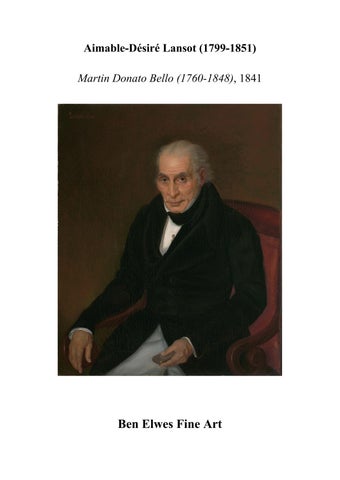
Aimable-Désiré Lansot (1799-1851)
Martin Donato Bello (1760-1848), 1841
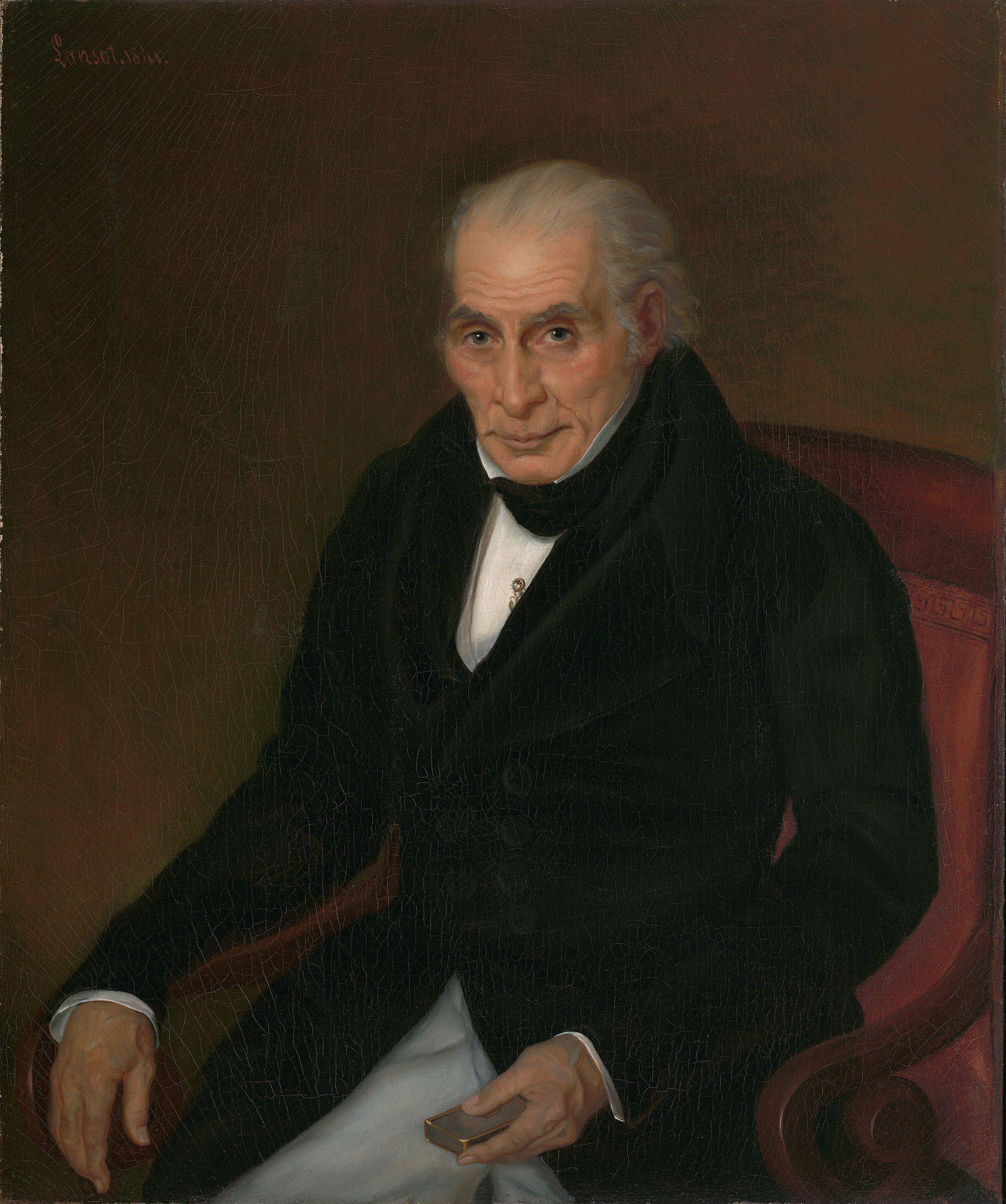
Aimable-Désiré Lansot (Orval, France, 1799-New Orleans, Louisiana, 1851)
Martin Donato Bello (1760-1848), 1841
Oil on canvas
90.1 x 73.6 cm (35 ½ x 29 in)
Framed: 116.84 x 101.6 cm (46 x 40 in)
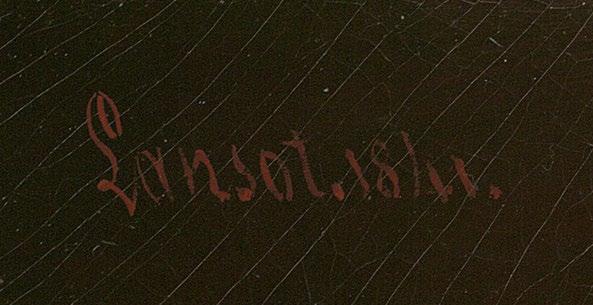
Signed on recto: Lansot. 1841
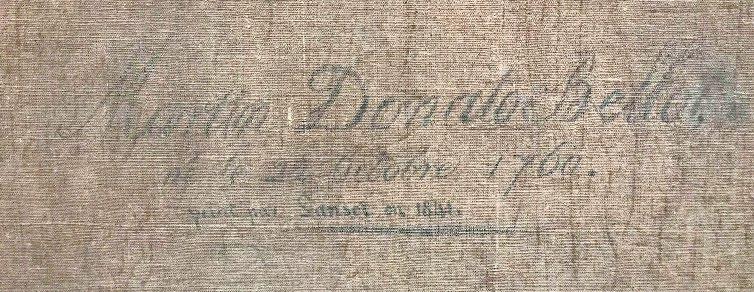
Inscription on verso: Martin Donato Bello, né le 22 Octobre, 1760. Peint par Lansot en 1841 (Martin Donato Bello, born 22 October, 1760. Painted by Lansot in 1841)
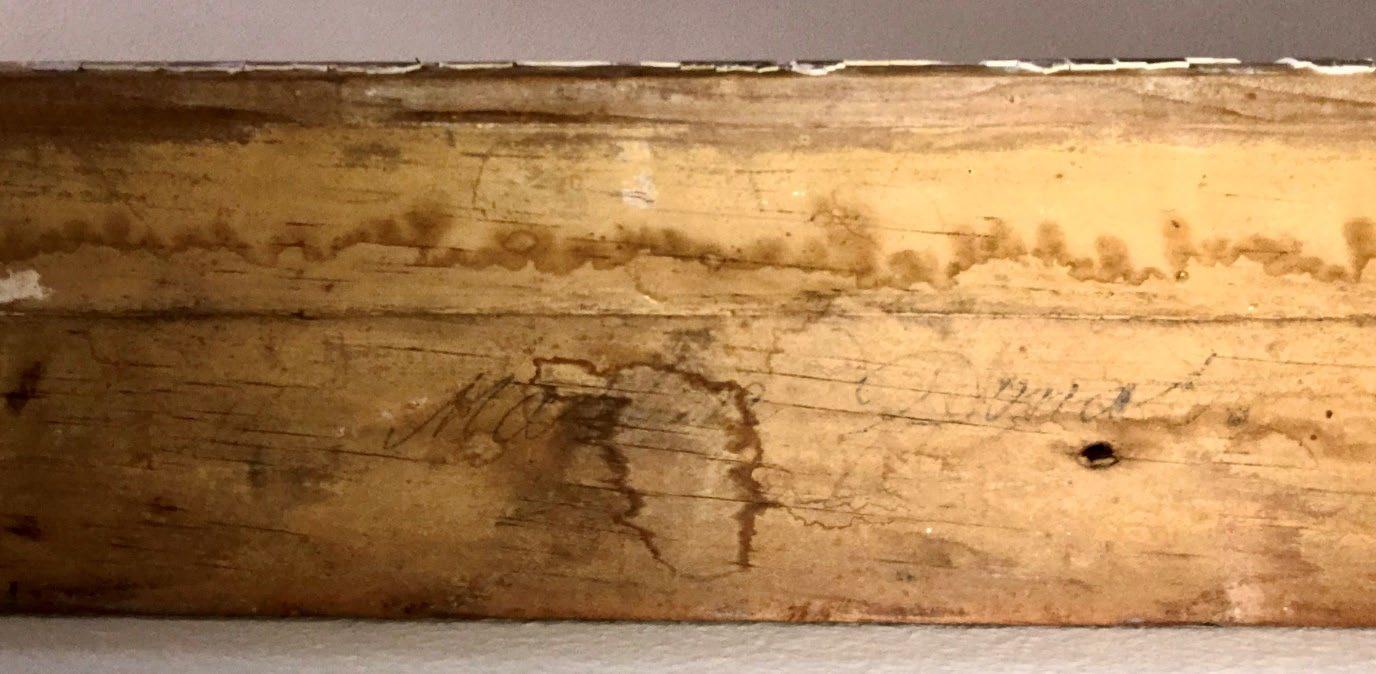
Painted in 1841 by the French-born, Louisiana-based artist Aimable-Désiré (A.D.) Lansot, this seemingly straightforward portrait of an aged gentleman encodes the complex history of the American South through an entanglement of race, enslavement, wealth, and status (fig. 1, above). The sitter is Martin Donato Bello, the son of a mixed-race, once-enslaved mother and a white, Italian-born father, Maj Donato Bello, a Patriot who fought in the American Revolution. 1 At the time of the picture’s completion, the approximately eighty-one-year old Donato - who inscribed the painting frame Martin Donato, dropping the ‘Bello’, as he was sometimes known (see Appendix A and B) - was a wealthy proprietor of at least two plantations in St. Landry Parish, the patriarch of a large family, and the owner of almost ninety enslaved people (see Appendix C, D, E and F). 2 Calling upon the long traditions of European portraiture, Lansot’s depiction of Donato reinforces the latter’s status as a Creole gentleman of wealth and influence in Antebellum Louisiana.
Despite his venerable age, the elderly Martin Donato regards the viewer with a lively gaze, his eyes bright beneath arched grey eyebrows. Seated in a classic three-quarters pose, he is dressed in elegantly understated finery. His double-breasted frock coat, quintessential daywear for the well-to-do 1840’s man, is cut from rich black fabric, probably woven in high-quality wool. 3 A contemporaneous British example preserved in the collections of the National Museum of Scotland (fig. 1) is a close match to Donato’s outerwear and serves as evidence of the style’s international favour in the mid-nineteenth century.
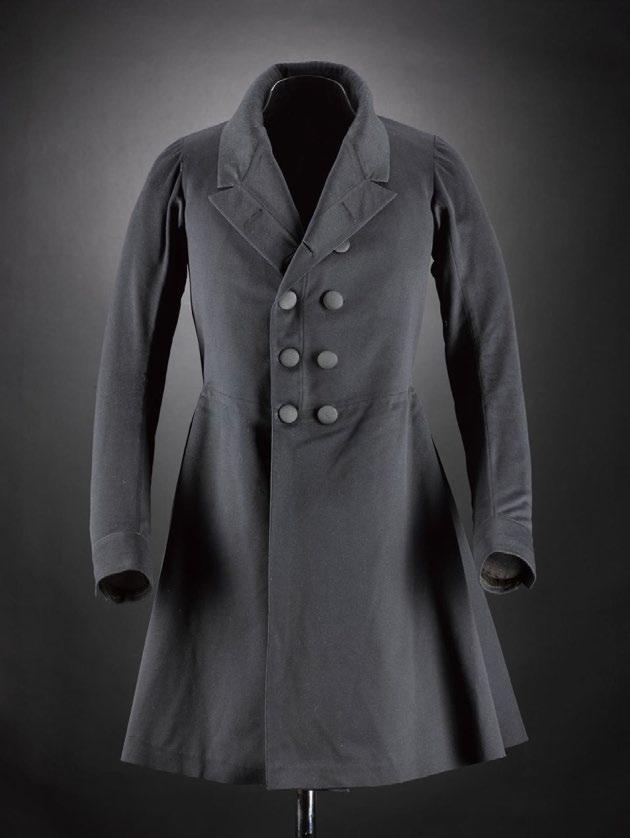
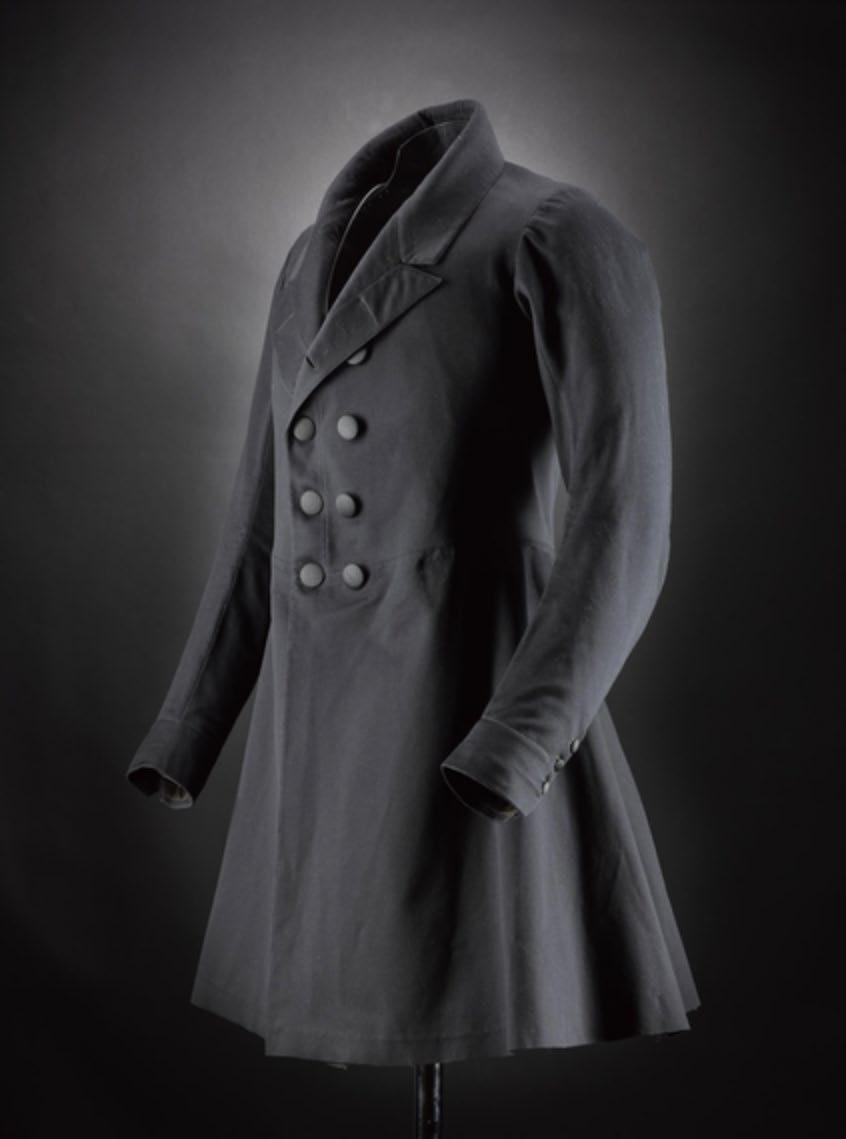
Fig. 1: Front and threequarter views, men’s doublebreasted frock coat, ca. 18301850’s. British. Wool, partly lined with cotton. National Museums Scotland, H.TI 5.
1 Alex Lee, “Martin Donato Bello (1760 – 1848) Free Man of Color” (Ogden Museum of Southern Art, 2023), https://ogdenmuseum.org/event/rediscovering-the-creoles-of-color-in-the-prairie-regions/. 2Junius P. Rodriguez, ed., Slavery in the United States: A Social, Political, and Historical Encyclopaedia (Santa Barbara: ABC-CLIO, 2007), 194. See also Lee, “Martin Donato Bello (1760 – 1848) Free Man of Color.” For Martin Donato Bello’s name change, see Carl A. Brasseaux, Keith P. Fontenot, and Claude F. Oubre, Creoles of Color in the Bayou Country (Jackson: University Press of Mississippi, 1994), 21. His name change is also attested in “Martin Donato House, St. Landry Parish, LA” (National Register of Historic Places, United States National Park Service, 2005), https://npgallery.nps.gov/NRHP/AssetDetail/4222a31f-bc50-4638-8bcb775401d2a4b6.
3 Harper Franklin, “1840-1849,” in Fashion History Timeline (NYC: Fashion Institute of Technology, 2020), https://fashionhistory.fitnyc.edu/1840-1849/. Franklin helpfully provides the example from National Museums Scotland in her article.
Double waistcoats were also popular at this time, although Donato’s black and dove-grey layers are not as showy as they might have been. As fashion historian Harper Franklin specifies:
By far, the most visually exciting, decorative element of menswear was the waistcoat or vest. Vests usually featured a deep-V and were made in a variety of rich and colourful patterned silks. Shirts were almost always white and worn with starched, turned-up collars. The dominant neckwear was a dark silk tie or cravat tied into a flat bow… 4
Donato’s remaining vestments accord well with Franklin’s description. By closely - but not ostentatiously - following such standards of fashionable European dress, Donato chose to present himself as a man of wealth and taste. Only his tie pin, partially hidden by his outer, black vest, brings a hint of sparkling colour to his clothing’s otherwise reserved palate. This bejewelled adornment gleams with pinpricks of reflected light, as does the small, silver and gold snuffbox that Donato grasps in his left hand.
His accoutrements, though subtle, offer a straightforward statement of refinement. Donato’s clothing might have been in keeping with European ideals, but his snuffbox could have reminded nineteenth-century viewers of the United States’ influence upon Europe as well. Tobacco, indigenous to the Americas, was first imported to Europe in the sixteenth century by returning Spanish colonizers. 5 Its production would go on to become one of the major sources of wealth - and enslavement - for the European colonies that became the United States.
Martin Donato Bello
According to the artist’s inscription on the verso of the canvas, Martin Donato Bello was born on October 22, 1760. 6 As a Louisiana Creole of African and European descent, he likely spoke several languages, including English and French. Spanish may also have been among these, as records indicate that Donato had relatives in Mexico and valued multilingualism, petitioning for funds to send his grandson to these Spanish-speaking relations so that the young man might learn the language. 7 Donato’s mother was Marie Jeanne Tailliefert (with various alternate spellings, including Taillefert and Talliaferro), a Creole woman who was once enslaved by his father, Donato Bello. The elder Bello, an infantry soldier originally from Naples, Italy, had
4 Harper Franklin, “1840-1849,” in Fashion History Timeline (NYC: Fashion Institute of Technology, 2020), https://fashionhistory.fitnyc.edu/1840-1849/. Franklin helpfully provides the example from National Museums Scotland in her article.
5 Mattoon Monroe Curtis, The Book of Snuff and Snuff Boxes (New York: Bramhall House, 1935), 30-31.
6 Genealogist Alex Lee also cites this date. Lee, “Martin Donato Bello (1760 – 1848) Free Man of Color.”
7 Sidney J. Lemelle, “The ‘Circum-Caribbean’ and the Continuity of Cultures: The Donato Colony in Mexico, 1830-1860,” The Journal of Pan African Studies 6, no. 1 (July 2013), 63.
relocated to Louisiana via New Orleans and then Opelousas. 8 A marriage certificate between Donato Bello and Suzanne Moreau places him in New Orleans by 1765 (fig. 2).
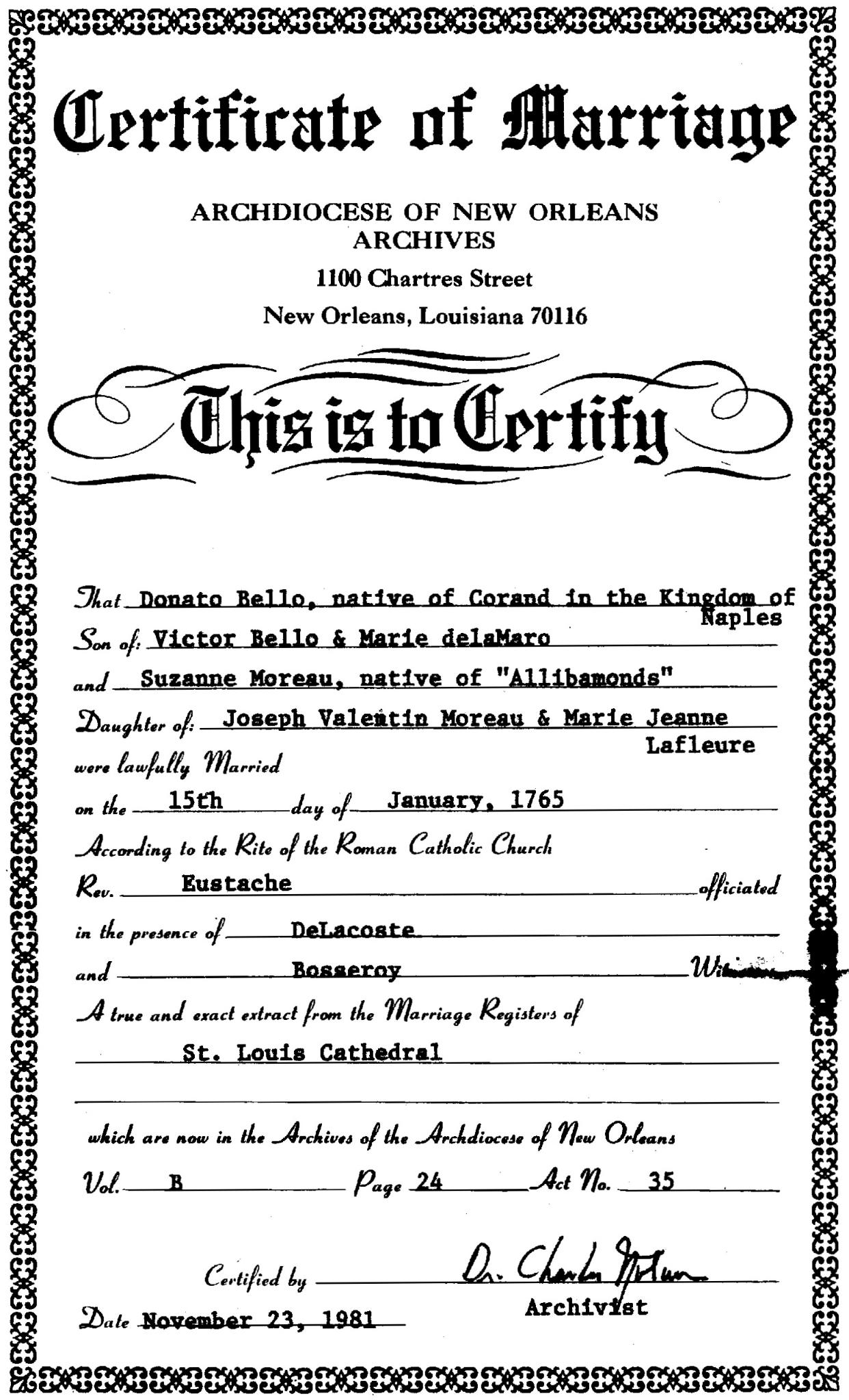
Fig. 2: modern certified copy of Donato Bello and Suzanne Moreau’s 1765 marriage certificate. (See also Appendix G)
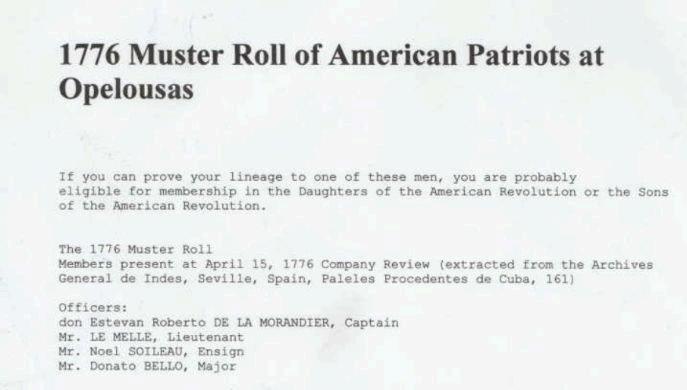
In 1776, a muster roll for the Opelousas militia lists Bello as an officer, alongside François Lemelle, whose family would join with Bello’s through several marriages between future generations (see Appendix H) 9 In addition to fathering six children with his wife, Suzanne Moreau, Donato Bello had three children with Tailliefert, including Martin and two girls, Marie Céleste and Catherine Victoire. 10 Yet the precise circumstances of Martin Donato’s birth are not known. Indeed, it is uncertain whether his mother was a free woman at the time of her son’s birth. 11 By 1770, however, a marriage certificate (fig. 3) witnessed by Donato Bello on behalf of Marie Jeanne and Jacob Boulais lists Marie as a free woman of colour while also specifying that she was once owned by Bello:
8 See Brasseaux, Fontenot, and Oubre, Creoles of Color, 15-16. Helpful documentation of primary sources. Also Lee, “Martin Donato Bello (1760 – 1848) Free Man of Color.”
9 “Opelousas Militia 1776 Muster Roll, St. Landry Parish, Louisiana” (Louisiana USGenWeb Archives, Military Resources, 1776), http://files.usgwarchives.net/la/state/military/amerrev/1776must.txt
10 Brasseaux, Fontenot, and Oubre, Creoles of Color, 15.
11 See Rodney Sam, “Exploring the Past of the Donatos,” Medium (blog), May 30, 2020, https://rsam1979.medium.com/exploring-the-past-of-the-donatos-90d6ec967828
…Marie Jeanne, mulâtresse libre, ci-devant esclave au [mon]sieur Donato Bello, native de la Nouvelle Orleans… (Marie Jeanna, free mixed-race woman, former slave of Mister Donato Bellow, native of New Orleans). 12
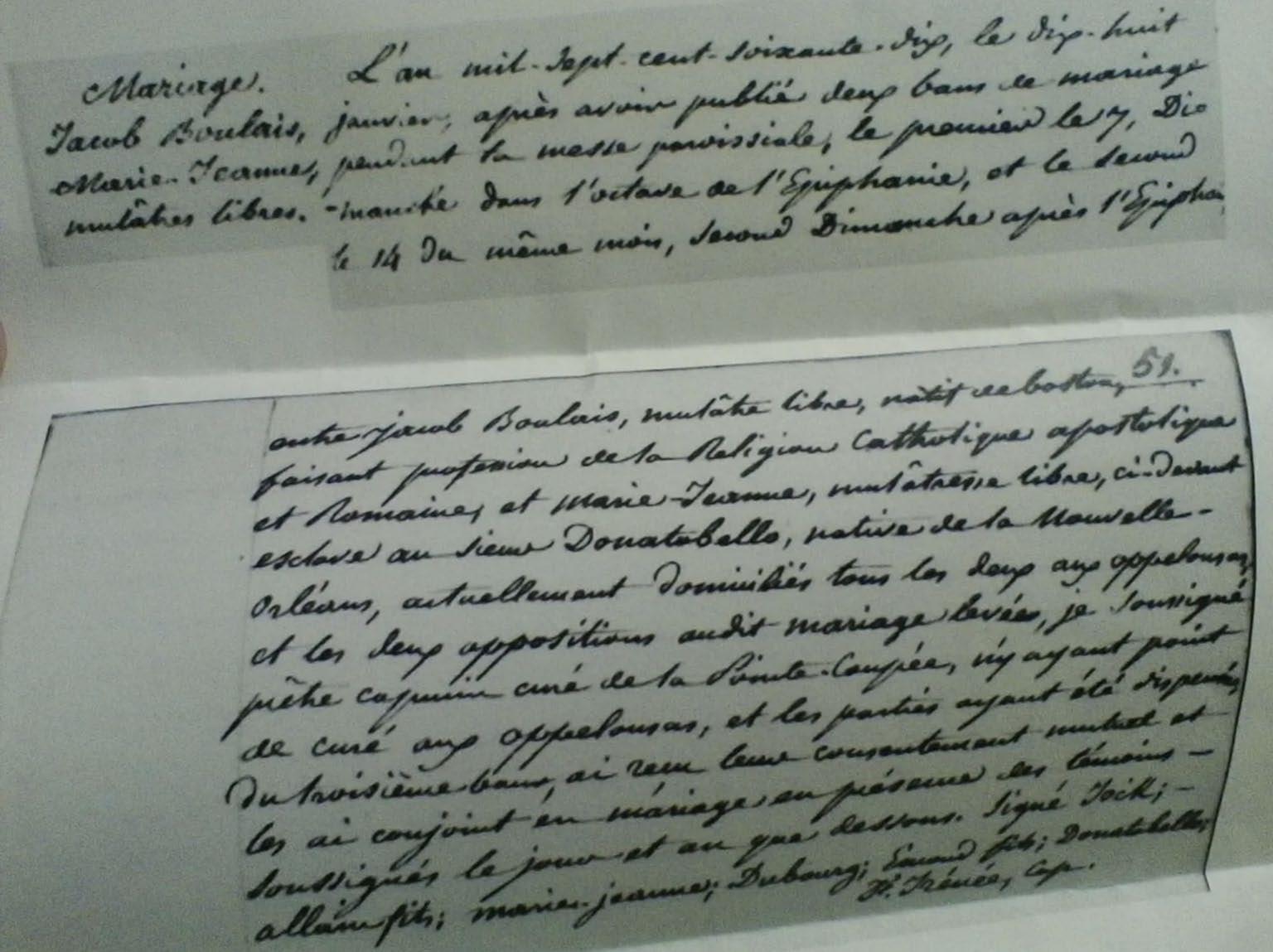
Fig. 3: Photocopy of the 1770 marriage certificate for Marie Jeanne [Tailliefert] and Jacob Boulais, witnessed by Donato Bello.
According to Louisiana’s 1724 Code Noir, the children of an enslaved woman were also automatically considered to be enslaved. 13 Thus, if Tailliefert was still enslaved by Donato’s father when her son was born, Martin Donato would have been legally regarded as enslaved. But whether or not he was born as a free man, Martin Donato died as one, after establishing himself as a plantation owner and an adept personal banker.
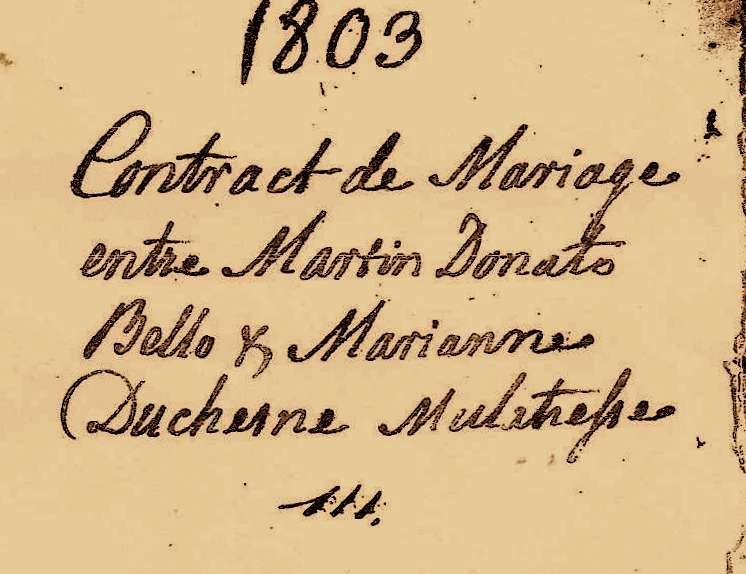
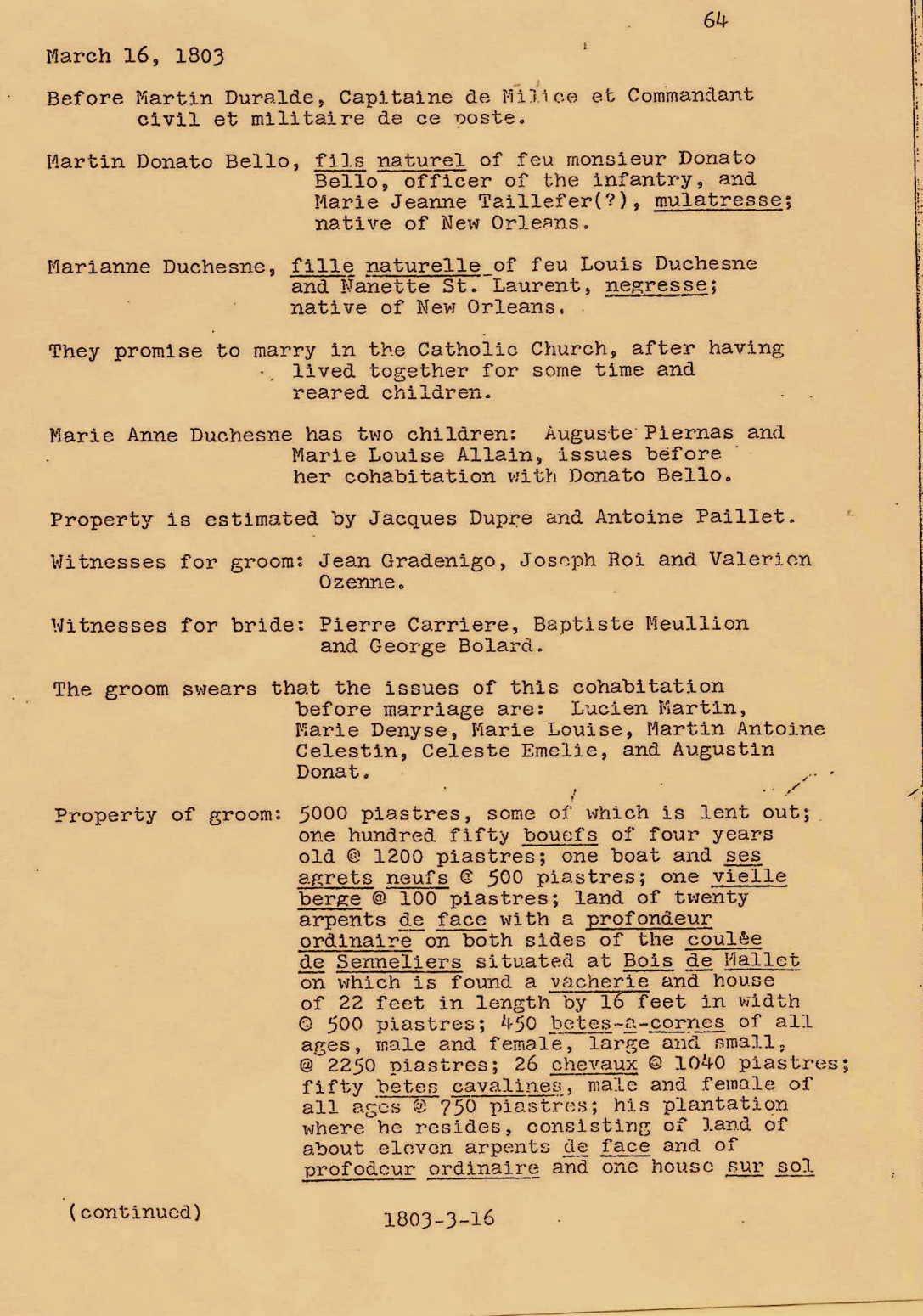
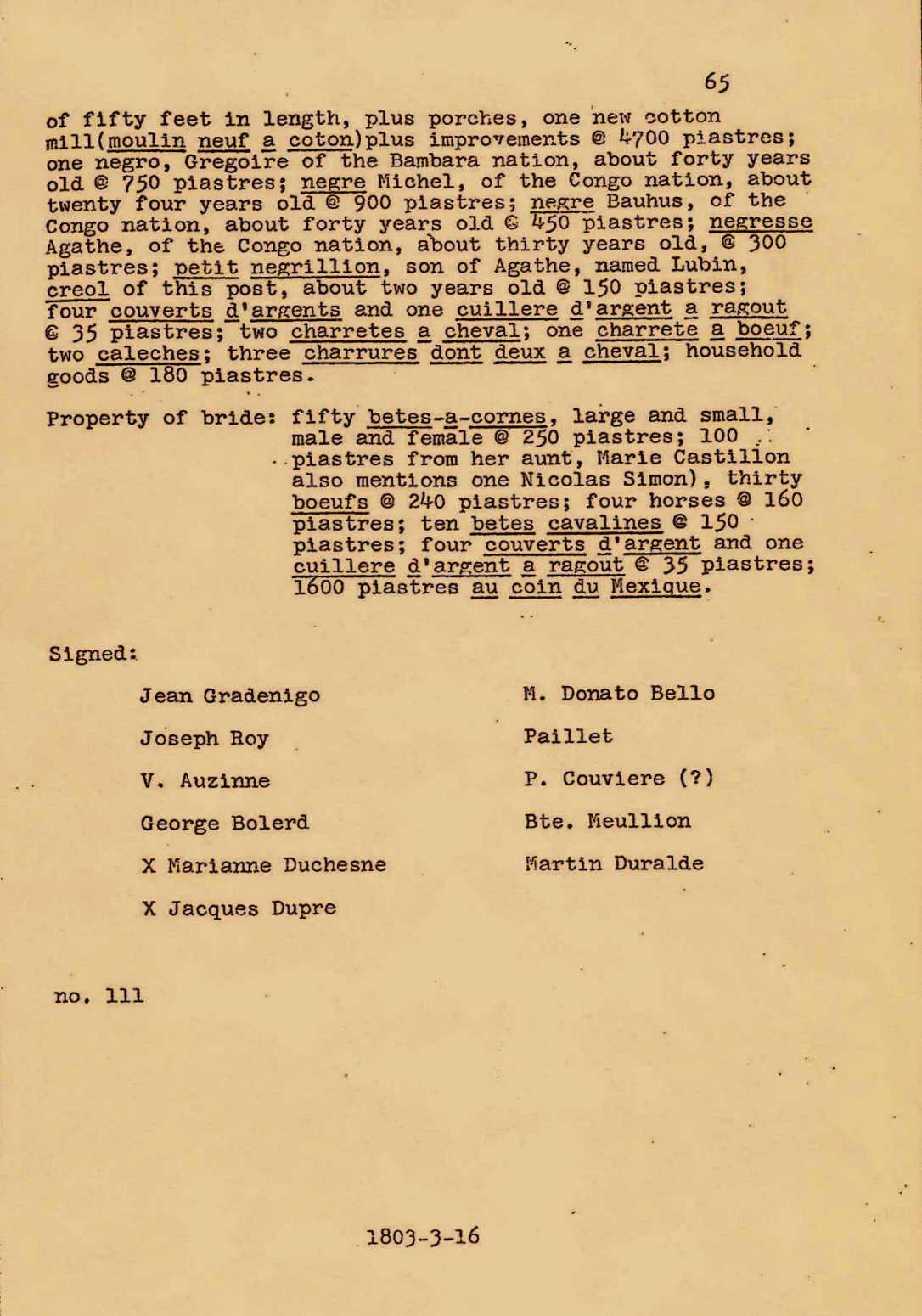
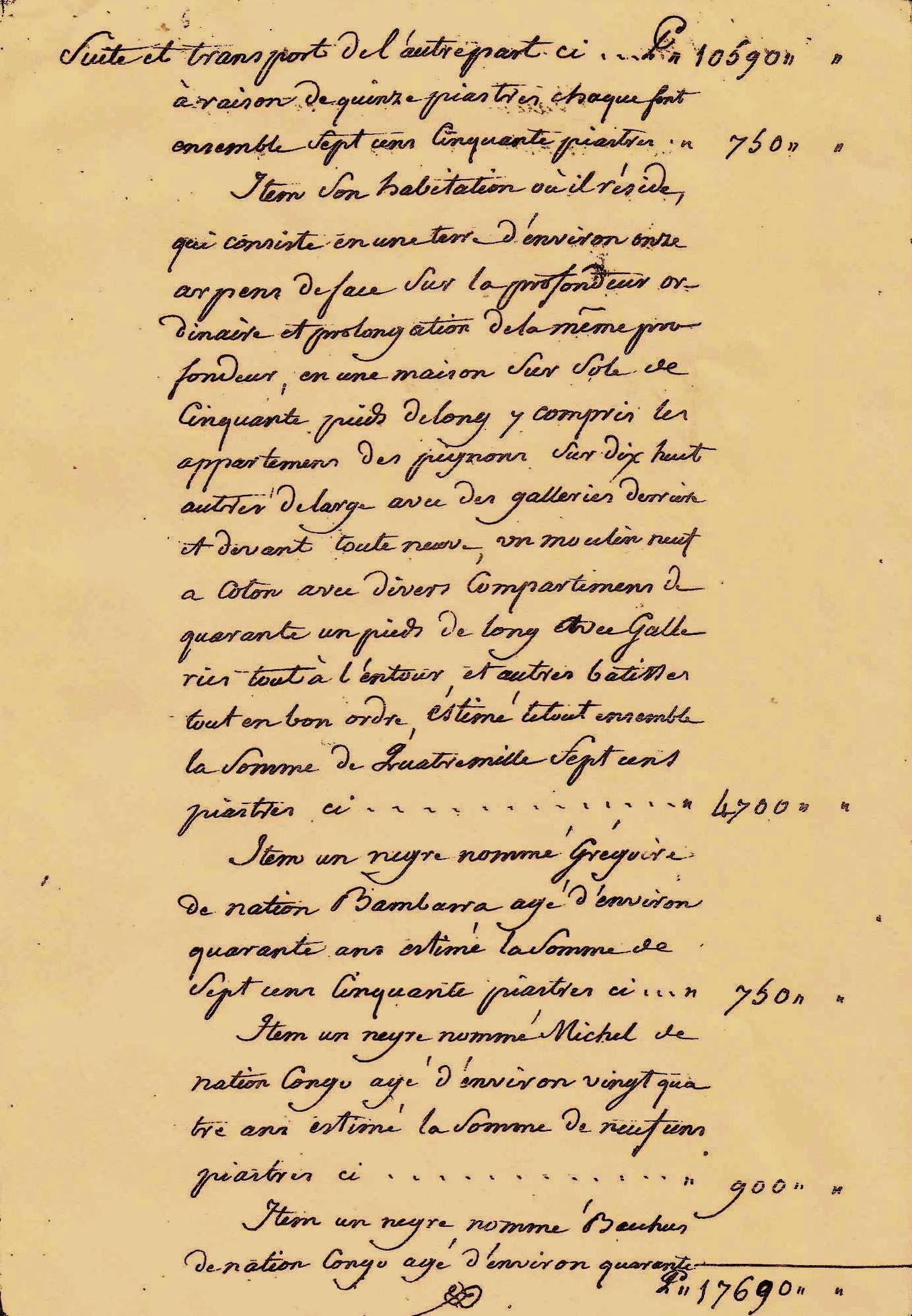
Martin Donato may have come from humble beginnings, but he became a man of sizable wealth and influence. A marriage certificate from 1803 between Donato and Marianne Duchesnewhen the former was in his early-to-mid-forties - records sizable holdings. These included
12 Certificate copy from Rodney Sam, “Exploring the Past of the Donatos.”
13 “X. If the husband be a slave, and the wife a free woman, it is our will that their children, of whatever sex they may be, shall share the condition of their mother, and be as free as she, notwithstanding the servitude of their father; and if the father be free and the mother a slave, the children shall all be slaves.” From “Louisiana’s Code Noir (Translation),” 64 Parishes, accessed July 11, 2025, https://64parishes.org/entrydocument/louisianas-code-noir-translation
approximately 1,820 acres of land with a cattle ranch, six-hundred head of cattle, a plantation with a new cotton mill and a large plantation house where he and his family - his now wife and former common-law spouse, Duchesne, and their six children - resided (fig. 4). 14
According to the research of Carl A. Brasseaux, Keith P. Fontenot, and Claude F. Oubre, records also revealed:
…that his cash assets were $5,000 piastres, some of which were loaned out. [Donato] evidently had already begun a practice he would continue throughout his life, that of serving as a private banker to his neighbors, both whites and Creoles of Color. 15
They conclude that Donato and Duchesne were one of the wealthiest families in the Opelousas area, with a far-reaching legacy. For example, intermarriages between the Donato clan and the Lemelles, another mixed-race Creole family local to Louisiana, lead to a family line that includes the current Pope Leo XIV (Robert Francis Prevost, born September 14, 1955). 16 As the years went on, Martin Donato acquired more land and property, including enslaved women and men. The St. Landry Parish tax roll of 1818 attests that Donato owned sixty enslaved people. By the time of his death in 1847, that number had grown to eighty-eight. 17 That a person of colour, who may have formerly been enslaved, would in turn adopt the practice of enslaving others might seem shocking to contemporary audiences but it was not an uncommon practice in the early American South. As historian Junius Rodriguez elaborates:
In 1830 approximately thirty-seven hundred free African Americans, mostly in the Lower South, owned nearly twelve thousand slaves. According to the 1830 census, slightly more than 2 percent of the free black population in the southern and border
14 Brasseaux, Fontenot, and Oubre, Creoles of Color, 18-20.
15 Brasseaux, Fontenot, and Oubre, Creoles of Color, 19.
16 For the connection between the Donato and Lemelle families, see Brasseaux, Fontenot, and Oubre, Creoles of Color, 19 and the series of charts at the end of chapter 2, 28-39. For the geology of Pope Leo XIV, see Henry Louis Gates Jr et al., “We Traced Pope Leo XIV’s Ancestry Back 500 Years. Here’s What We Found.,” The New York Times, June 11, 2025, sec. Magazine, https://www.nytimes.com/interactive/2025/06/11/magazine/pope-leo-xiv-ancestry-family-tree.html.This research is summarized in a helpful chart here: https://static01.nyt.com/newsgraphics/documenttools/c80c8763aab113e3/ece21976-full.pdf
17 Brasseaux, Fontenot, and Oubre, Creoles of Color, 21; 26-27.
states owned slaves. In Louisiana and Virginia, black slave-owners numbered more than nine hundred. 18
Rodriguez goes on to note that the motivations behind Black ownership of enslaved Blacks as ranging from the benevolent - purchasing someone, often a family member, to protect themto the purely economic. 19 Family ties certainly came into play with some of Donato’s decisions regarding enslaved individuals. In his will of 1847, Donato freed seven children, who it seems likely he fathered, as well as their mother, a mixed-race woman named Julie. 20 While Donato’s day-to-day treatment of his enslaved workers is unknown, his use of enslaved labour to better his own fortunes was in keeping with the established practices of Antebellum Louisiana. Donato’s commissioning of a portrait - particularly one with the aforementioned stylistic elements of European dress - is further evidence of his acceptance and even embrace of the norms of the social and financial milieux in which he lived.
Aimable-Désiré (A.D) Lansot
Aimable-Désiré (A.D) Lansot was one of many nineteenth-century European artists who found the American South to be a ready place to ply their trade. Born in Northwestern France, in the Normandy commune of Orval (now Orval-sur-Sienne) in 1799, Lansot came to Louisiana and established himself as a “peintre de portraits” - a painter of portraits - as well as a restorer of paintings. 21 An advertisement for his services in the New Orleans Bee from May 17, 1834 (fig. 5), provides the first textual documentation of Lansot’s presence in America. Translated from the original French, it reads:
PORTRAITS. A.D. Lansot, painter of portraits, occupies the premises of M. Vaudechamp, rue Royale, No. 147, between St. Louie and Toulouse. He [also] restores damaged paintings and portraits. 17 May [1834].
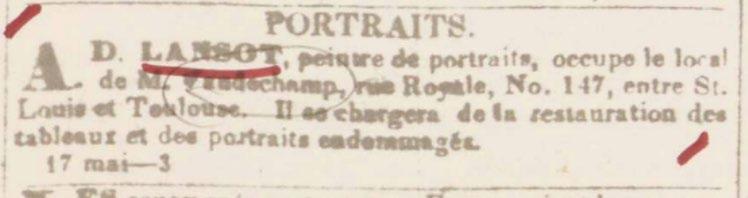
Fig. 5: A.D. Lansot’s advertisement from The New Orleans Bee, May 17, 1834, page 3, column 4.
18 Rodriguez, Slavery in the United States, 193.
19 Rodriguez, Slavery in the United States, 194.
20 Brasseaux, Fontenot, and Oubre, Creoles of Color, 79.
21 “Aimable Lansot,” in The Johnson Collection (Spartanburg, South Carolina). Accessed July 8, 2025, https://thejohnsoncollection.org/aimable-lansot/
By the following year, the artist had expanded his services to offer drawing instruction “for the study of the human head and of landscapes,” as recorded by another advertisement in the December 3, 1835 edition of the Bee (Fig. 6).
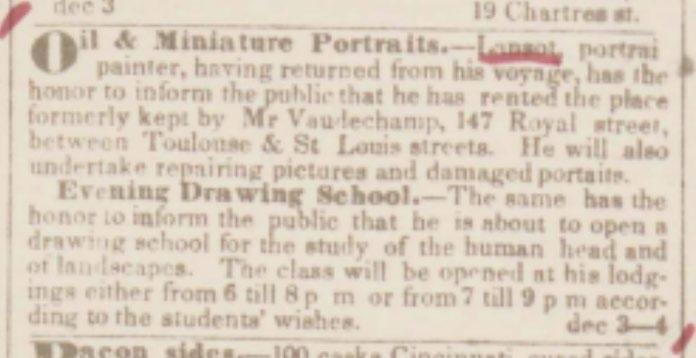
Fig. 6: A.D. Lansot’s advertisement from The New Orleans Bee, December 3, 1835, page 2, column 5.
While he summered in France, Lansot seems to have permanently settled in Louisiana. 22 He is regularly mentioned in archival documents, especially newspaper advertisements, until his death from yellow fever in 1851. 23 As a working artist and proficient portraitist, he likely had little trouble in securing plentiful commissions. As art historian Virgil Barker remarks:
Although it was possible in the mid-[nineteenth]century for painters to make their living in other branches, the portrait remained the major business by which they secured patronage from Americans. An increasing population and a rising level of prosperity (subject to recessions) brought about a corresponding increase in the number of portraitists….[P]erhaps the most significant economic fact affecting the painting profession as a whole is that so many of its members found it possible to make their living as residents of smaller places. 24
Lansot’s announcements also reveal his association with the well-known French portraitist Jean Joseph Vaudechamp (1790-1866), whose New Orleans premises Lansot shared. Perhaps, in working in close proximity to Vaudechamp, Lansot incorporated aspects of the elder artist’s approach into his own practice. As a writer for the Johnson Collection observes, “Both [Vaudechamp and Lansot] were among a number of portrait artists who depicted members of the Creole caste as strikingly handsome men and beautiful women living in the twilight years of their ascendancy in New Orleans’ French Quarter.” 25
22 “Aimable Lansot,” The Johnson Collection (webpage).
23 “Aimable Lansot,” The Johnson Collection (webpage).
24 Virgil Barker, American Painting: History and Interpretation (New York: The Macmillan Company, 1950), 397–398.
25 “Aimable Lansot,” The Johnson Collection (webpage).
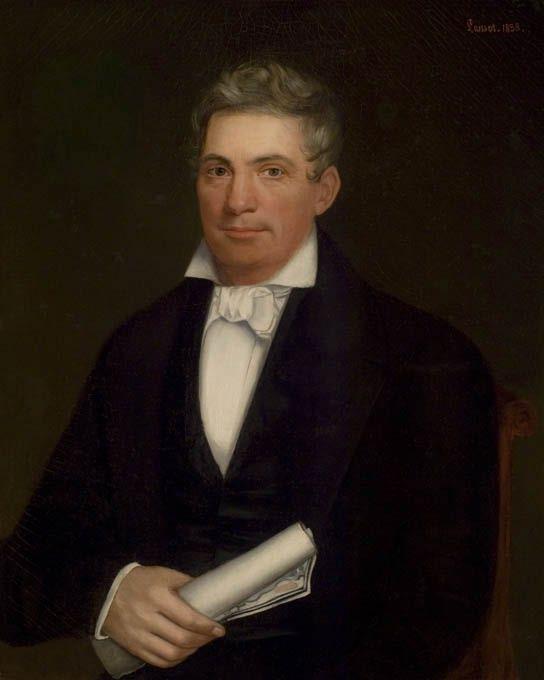
Fig. 7: Aimable-Désiré Lansot, Portrait of a Man with a Document, 1838, oil on canvas (31 ¾ x 25 ½ in). The Johnson Collection, South Carolina.
There are likely a number of undocumented canvases that are by Lansot’s hand, but few that are well-known. However, a published example provides a fuller sense of the artist’s style. In his portrait of an unnamed man from 1838 (fig. 7), Lansot seems to have already established a similar formula to that seen in his portrait of Martin Bello. In the earlier picture, the sitter is also posed in a three-quarter turn, seated against a dark background and supported by a chair. Careful attention is paid to capturing the sitter’s facial features and hair, as well as conveying some sense of his spirit. Like Donato, this subject also holds a small object - here, what looks to be a map, rolled up so that it only reveals its upper left corner. The relative lack of other details or accoutrement in the composition, however, places emphasis on the object the clasped in the sitter’s hand.
Concluding Remarks
Considering the nature of portraiture as collaborative product between artist and commissioner, it seems likely that Lansot urged his sitters to select token items of personal value or importance with which to be pictured. Moreover, Martin Donato’s decision to be painted holding a snuff box - the contents of which were responsible for American power, wealth, and the enslavement of millions - has provocative possibilities. Questions of identity creation and projection emerge, prompting future researchers to consider Donato’s own motivations as well as the reception of his portrait by ensuing generations of viewers. Decoding the meanings behind such questions will be fertile ground for continuing scholarship. As an under-studied example of nineteenth century portraiture and the multi-racial subject in American art, this painting has the potential
to be “...both an act of recovery and a recognition of loss” of the complex history and experiences of Blackness in the American South. 26
26 To borrow Katie A. Pfohl’s declamation for her exhibition Inventing Acadia: Painting and Place in Louisiana Inventing Acadia was on view from 16 November, 2019 to 26 January, 2020 at the New Orleans Museum of Art, where Pfohl was Curator of Modern and Contemporary Art from 2015 to 2022. Katie A. Pfohl, ed., Inventing Acadia: Painting and Place in Louisiana (New Haven: Yale University Press, 2019), 13.
Bibliography
64 Parishes. “Louisiana’s Code Noir (Translation).” Accessed July 11, 2025. https://64parishes.org/entry-document/louisianas-code-noir-translation “Aimable Lansot.” The Johnson Collection (Website). Spartanburg, South Carolina, July 11, 2025. https://thejohnsoncollection.org/aimable-lansot/
Barker, Virgil. American Painting: History and Interpretation. New York: The Macmillan Company, 1950.
Brasseaux, Carl A., Keith P. Fontenot, and Claude F. Oubre. Creoles of Color in the Bayou Country. Jackson: University Press of Mississippi, 1994.
Curtis, Mattoon Monroe. The Book of Snuff and Snuff Boxes. New York: Bramhall House, 1935.
Franklin, Harper. “1840-1849.” In Fashion History Timeline. NYC: Fashion Institute of Technology, 2020. https://fashionhistory.fitnyc.edu/1840-1849/
Gates Jr, Henry Louis, American Ancestors, and The Cuban Genealogy Club of Miami. “We Traced Pope Leo XIV’s Ancestry Back 500 Years. Here’s What We Found.”
The New York Times, June 11, 2025, sec. Magazine. https://www.nytimes.com/interactive/2025/06/11/magazine/pope-leo-xiv-ancestryfamily-tree.html
Lee, Alex. “Martin Donato Bello (1760 – 1848) Free Man of Color.” Ogden Museum of Southern Art, 2023. https://ogdenmuseum.org/event/rediscovering-the-creoles-ofcolor-in-the-prairie-regions/
Lemelle, Sidney J. “The ‘Circum-Caribbean’ and the Continuity of Cultures: The Donato Colony in Mexico, 1830-1860.” The Journal of Pan African Studies 6, no. 1 (July 2013): 57–75.
“Martin Donato House, St. Landry Parish, LA.” National Register of Historic Places, United States National Park Service, 2005.
https://npgallery.nps.gov/NRHP/AssetDetail/4222a31f-bc50-4638-8bcb775401d2a4b6
“Opelousas Militia 1776 Muster Roll, St. Landry Parish, Louisiana.” Louisiana USGenWeb Archives, Military Resources, 1776.
http://files.usgwarchives.net/la/state/military/amerrev/1776must.txt.
Rodriguez, Junius P., ed. Slavery in the United States: A Social, Political, and Historical Encyclopaedia. Santa Barbara: ABC-CLIO, 2007.
Sam, Rodney. “Exploring the Past of the Donatos.” Medium (blog), May 30, 2020. https://rsam1979.medium.com/exploring-the-past-of-the-donatos-90d6ec967828
Appendix
Contents
A. Further images and details
B. History of Martin Donato Bello’s Signature
C. Martin Bello’s Succession cover page
D. Extracts from Martin Bello’s inventory
E. Martin Donato Bello purchasing Zaire of Congo
F. Martin Donato Bello freeing Alexander
G. Additional documents regarding Martin Donato Bello’s marriage
H. 1776 Muster Roll of American Patriots at Opelousas and related article
Additional original documents and literature available including:
- The Donato Family extracted from Conrad A Auzenne, Auzenne, Donato, Frilot, Lemelle, Meullion: a genealogical study of five families and other allied families of Southern Louisiana (1995)-
- Compiled scans, Martin Donato Bello Succession
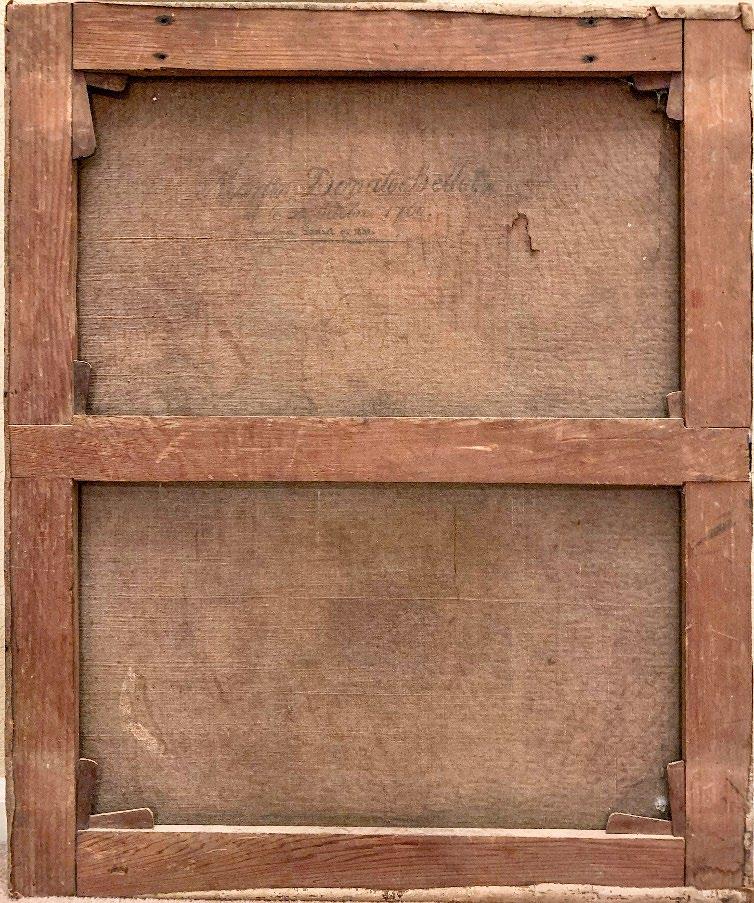
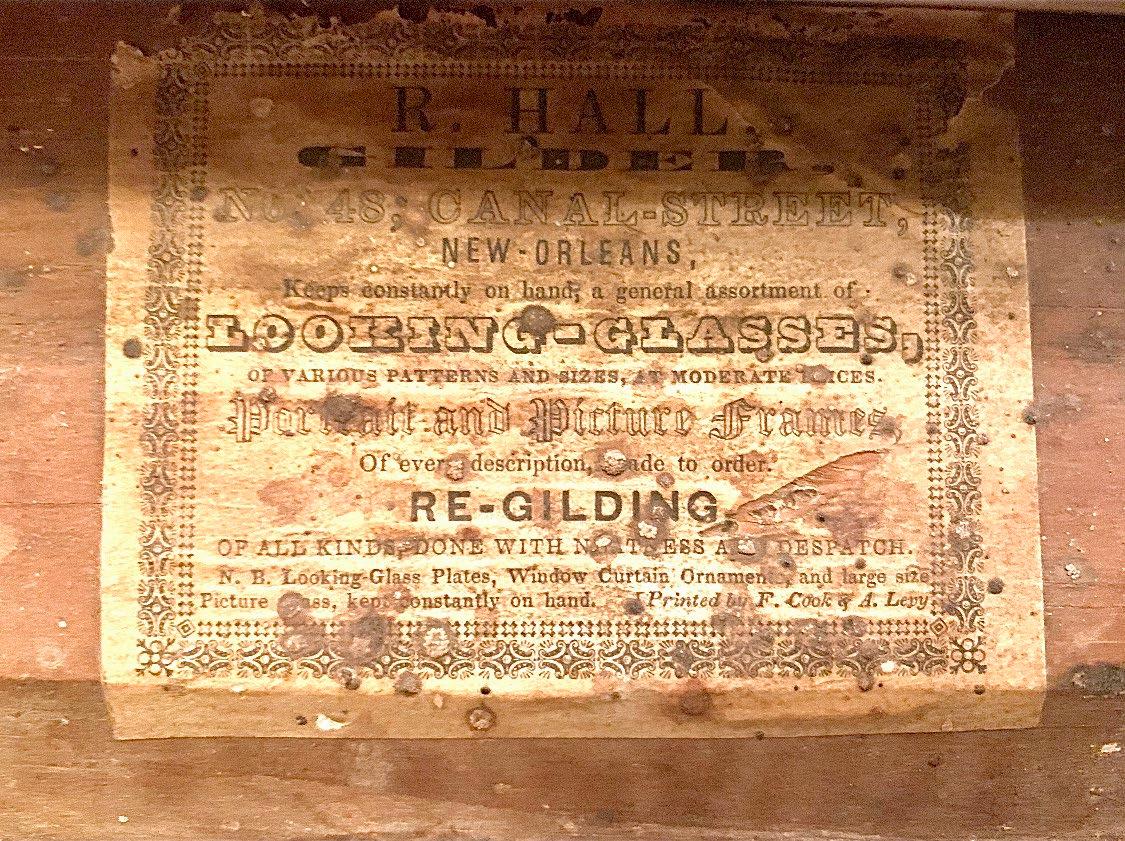
Overall verso - a board has recently been applied to the verso for preventative conservation.
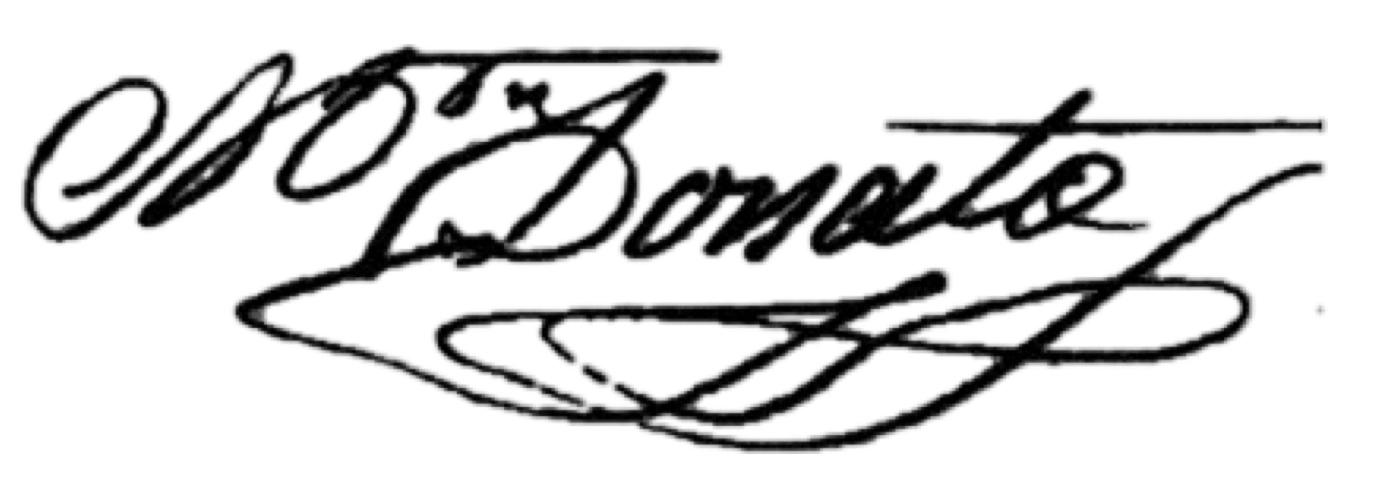
Martin Donato Signature, 1799 - M Donato. This signature is inscribed for Bello’s witness for an act of sale.
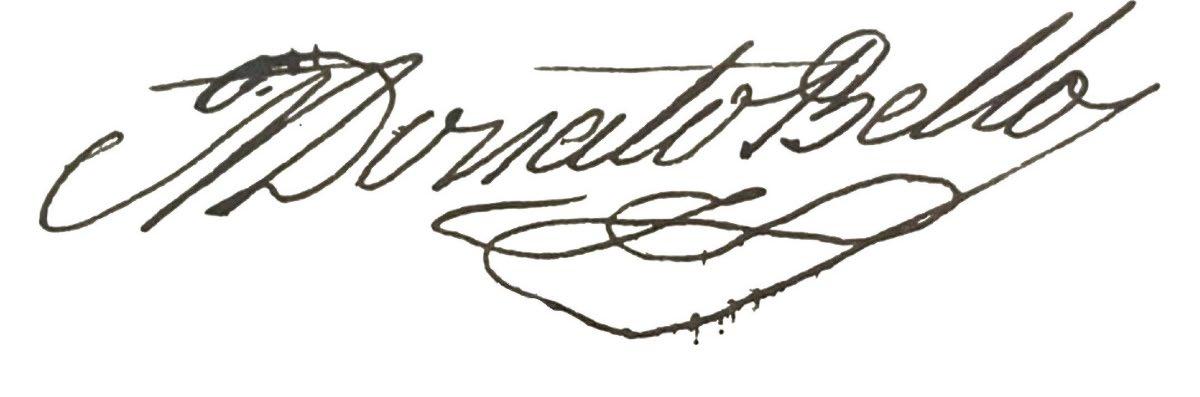
Martin Donato Bello Signature, 1803 – M Donato Bello
Creole culture is an amalgamation of various ethnicities and cultural practices. The patronymic naming tradition in Louisiana found among formerly enslaved family is a unique cultural practice which accounts for the proliferation of families bearing names which each offer clues with regard parentage and ownership. 27 Often this accounts for the variations in naming across a family. For example, a formerly enslaved person might their father’s surname, forename or a derivation of their father’s most use forename.
27 Jari Honora, “What’s in a name? – Patronymic tradition in Louisiana”, Creolegen (25 December 2016) [last accessed 5.08.2025: https://www.creolegen.org/2016/12/25/whats-name-patronymic-tradition-louisiana/]
Cover page for Martin Bello’s Succession
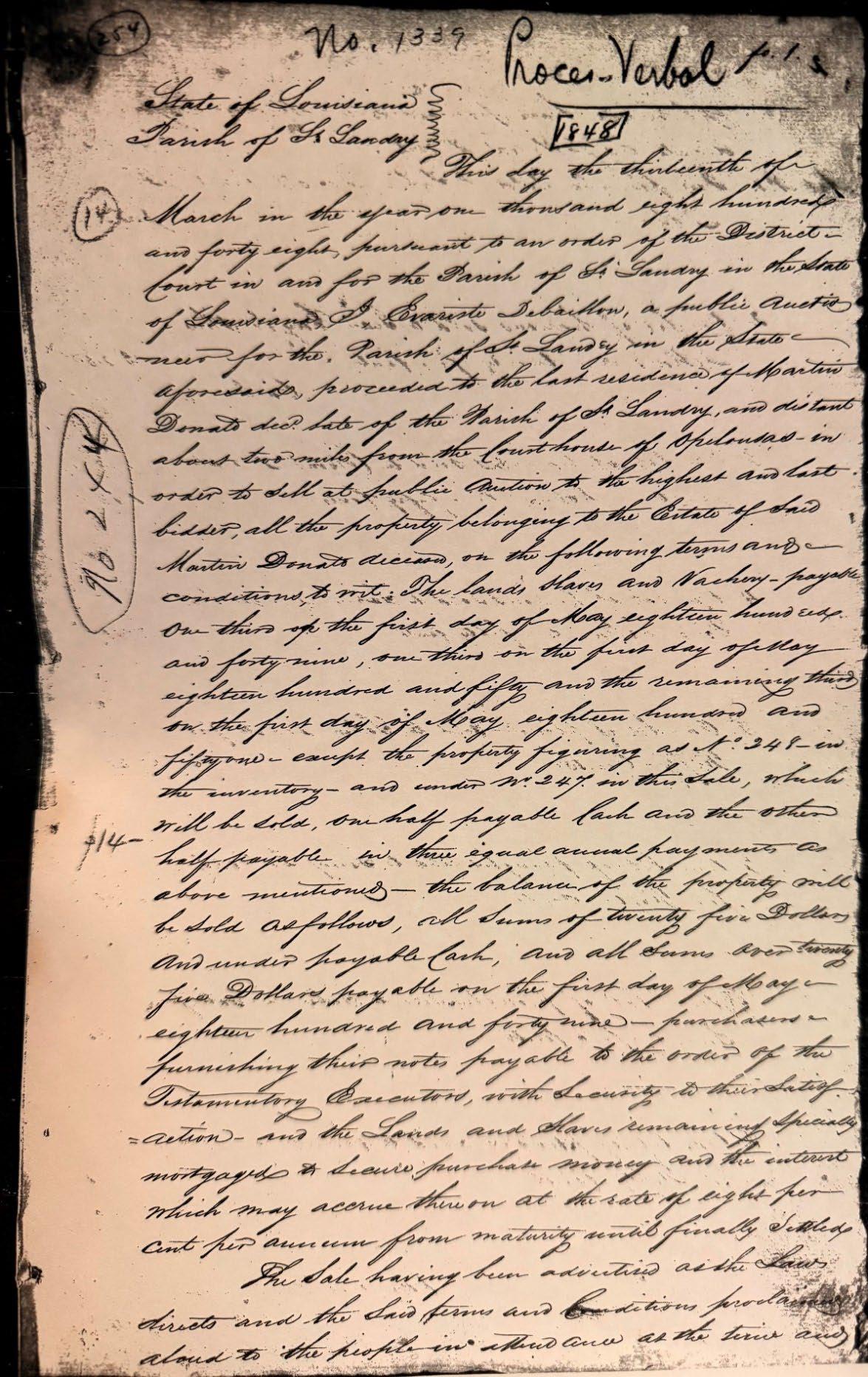
Key items included in Martin Donato Bello’s Succession inventory include: a bookcase, seven framed pictures, snuff box, jewellery (possibly including a stick pin), 300 bottles of wine, tall case clock, and additional household effects.
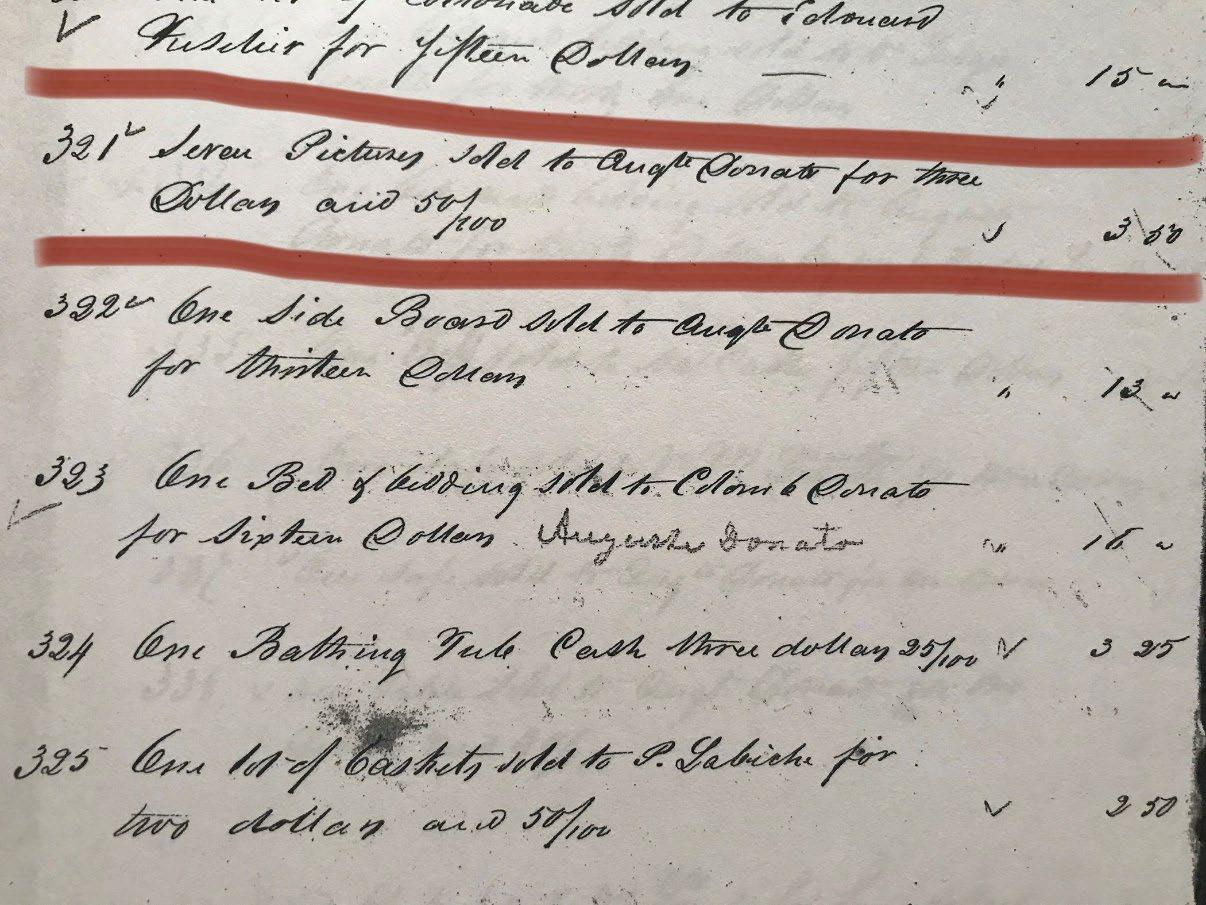
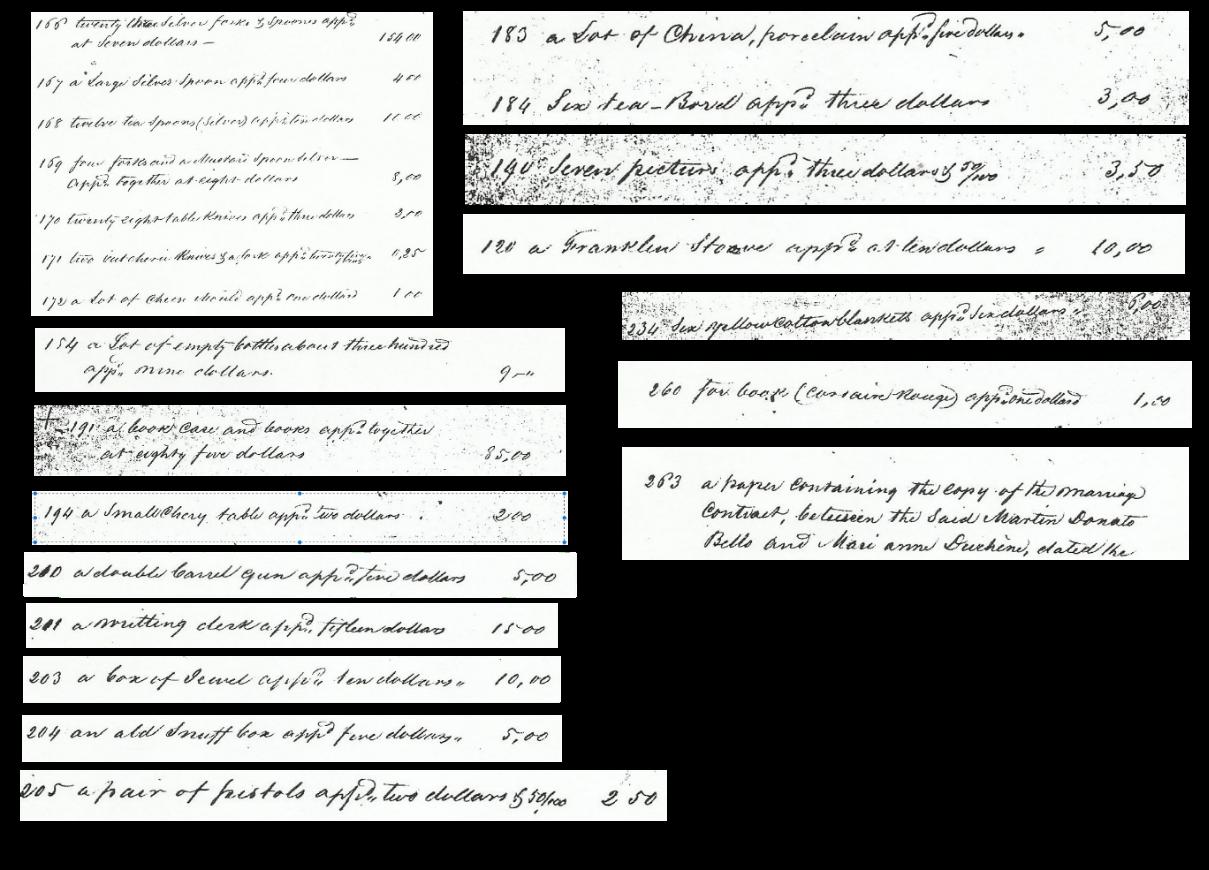
Item 260 – a book, Le Corsaire Rouge. English: The Red Dover. The novel follows the activities of the sailor Dick Fid, free black sailor Scipio Africanus and Royal Navy officer James Wilder as they encounter the famous pirate, "The Red Rover".
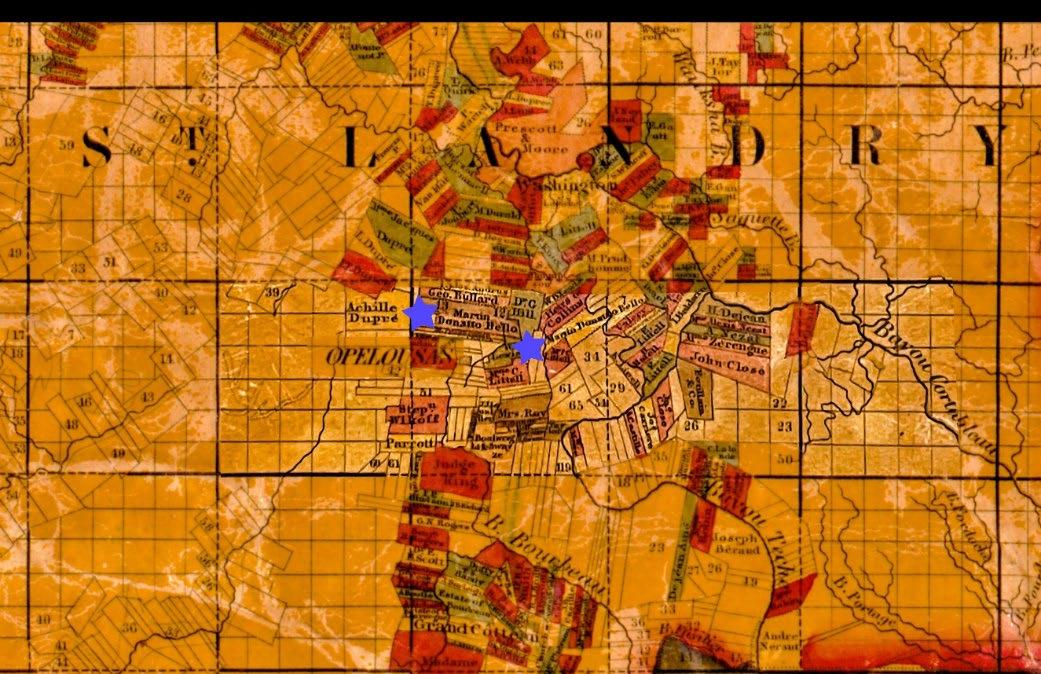
La Tourrette's reference map of the state of Louisiana – the map shows significant land holdings. This was on a planter’s map; it shows plantations and large property holders.
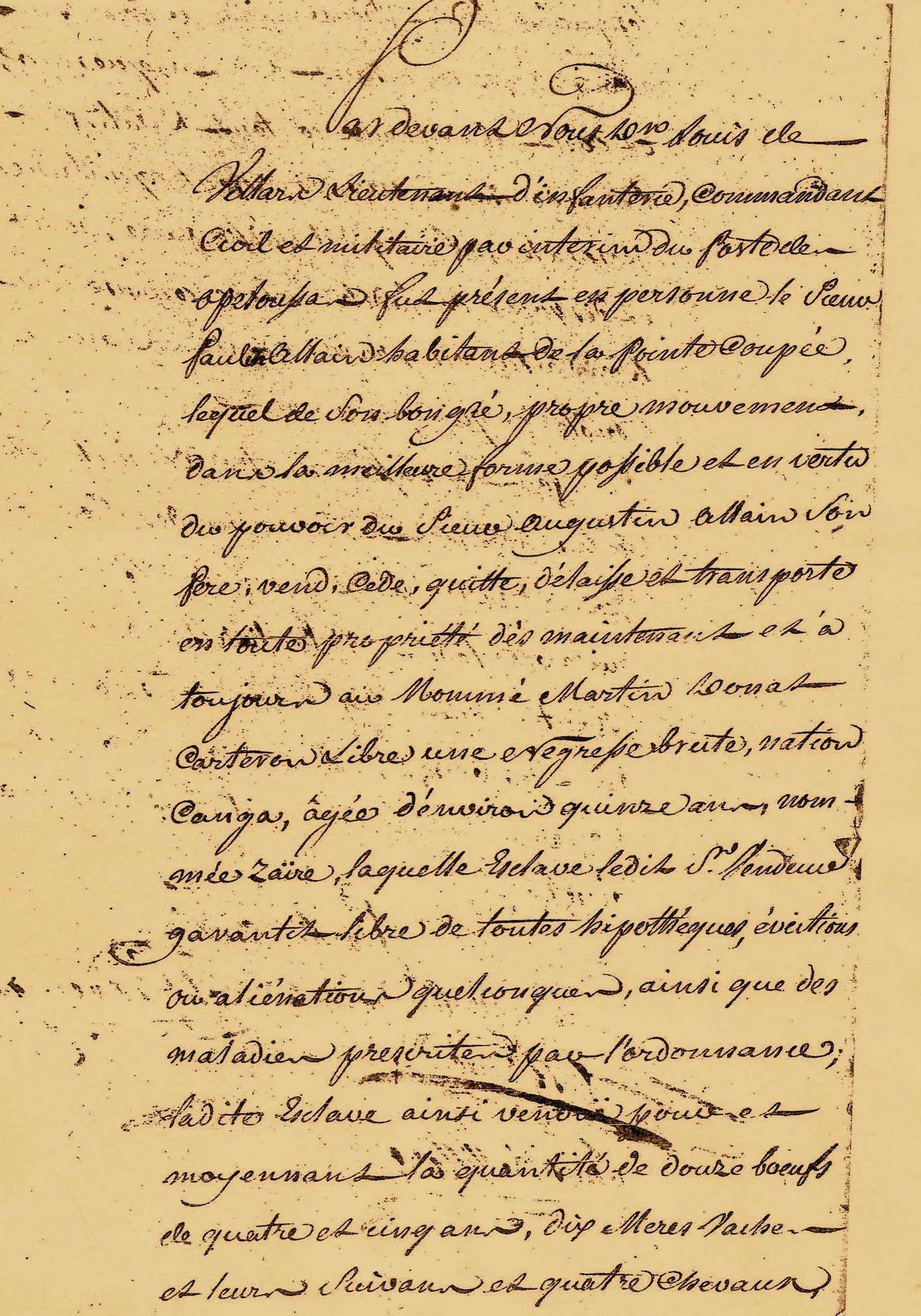
This original document describes Martin’s purchase of a man named Zaire of Congo, courtesy of the St. Landry Parish Clerk of Courts.
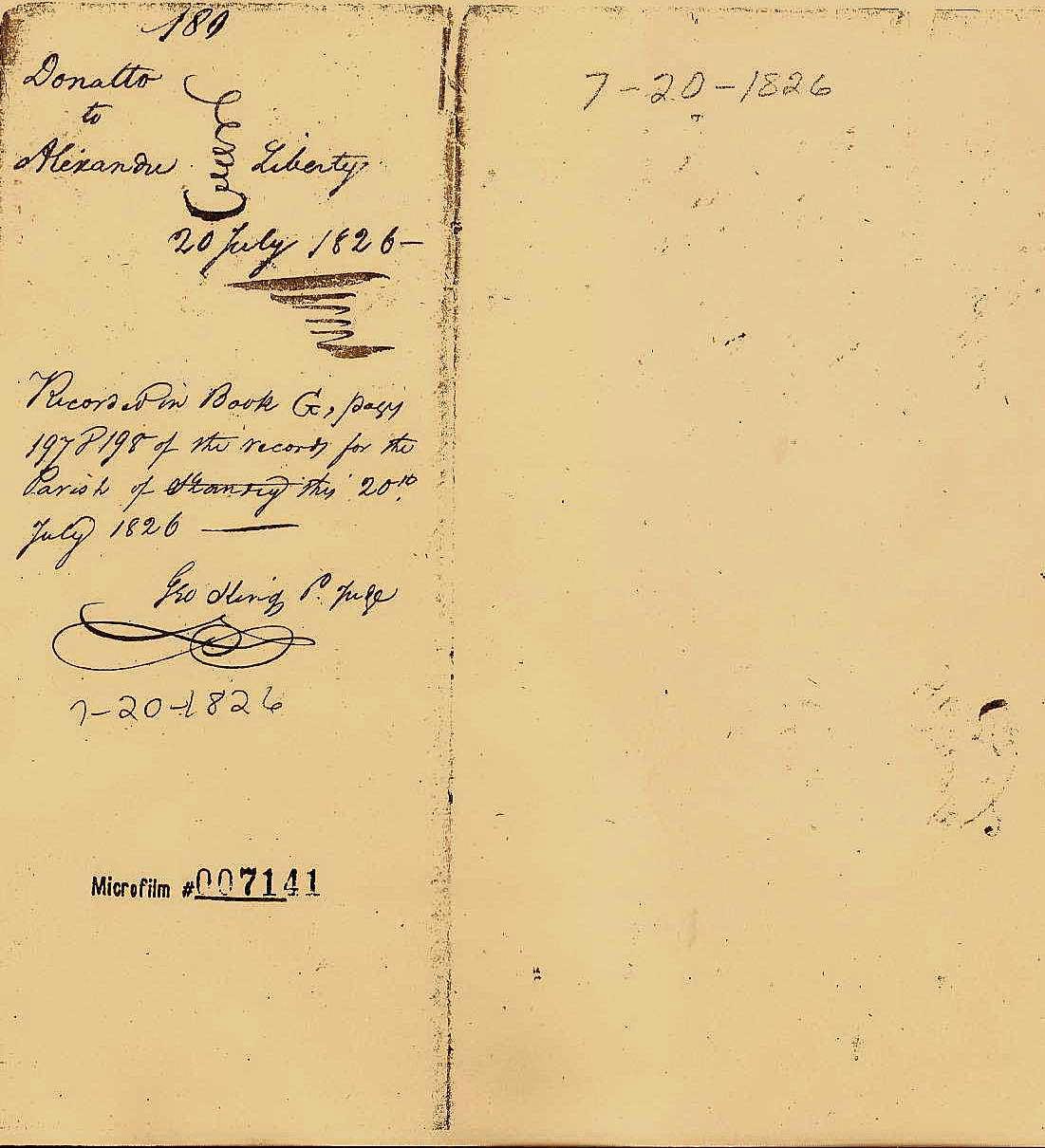
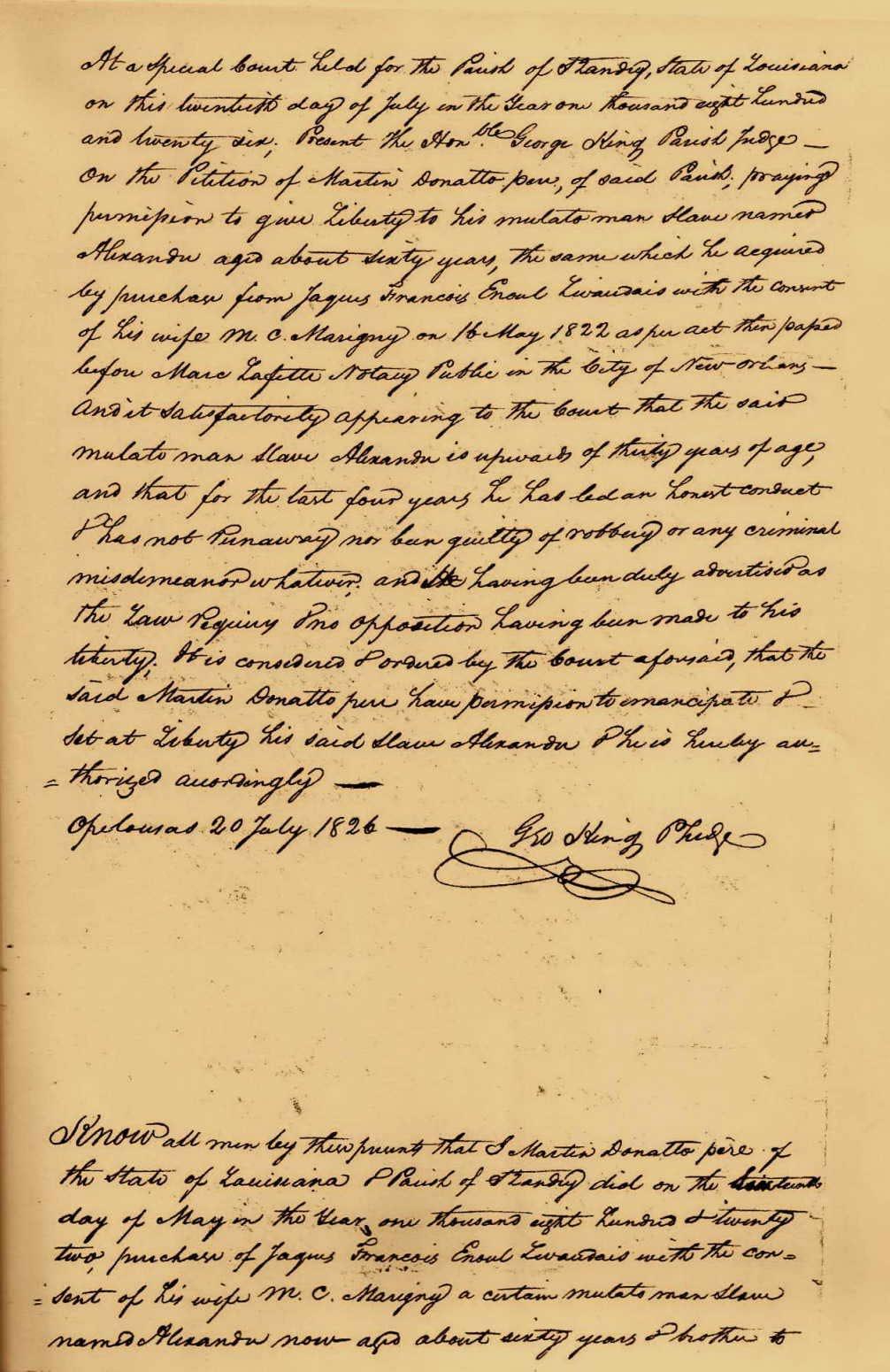
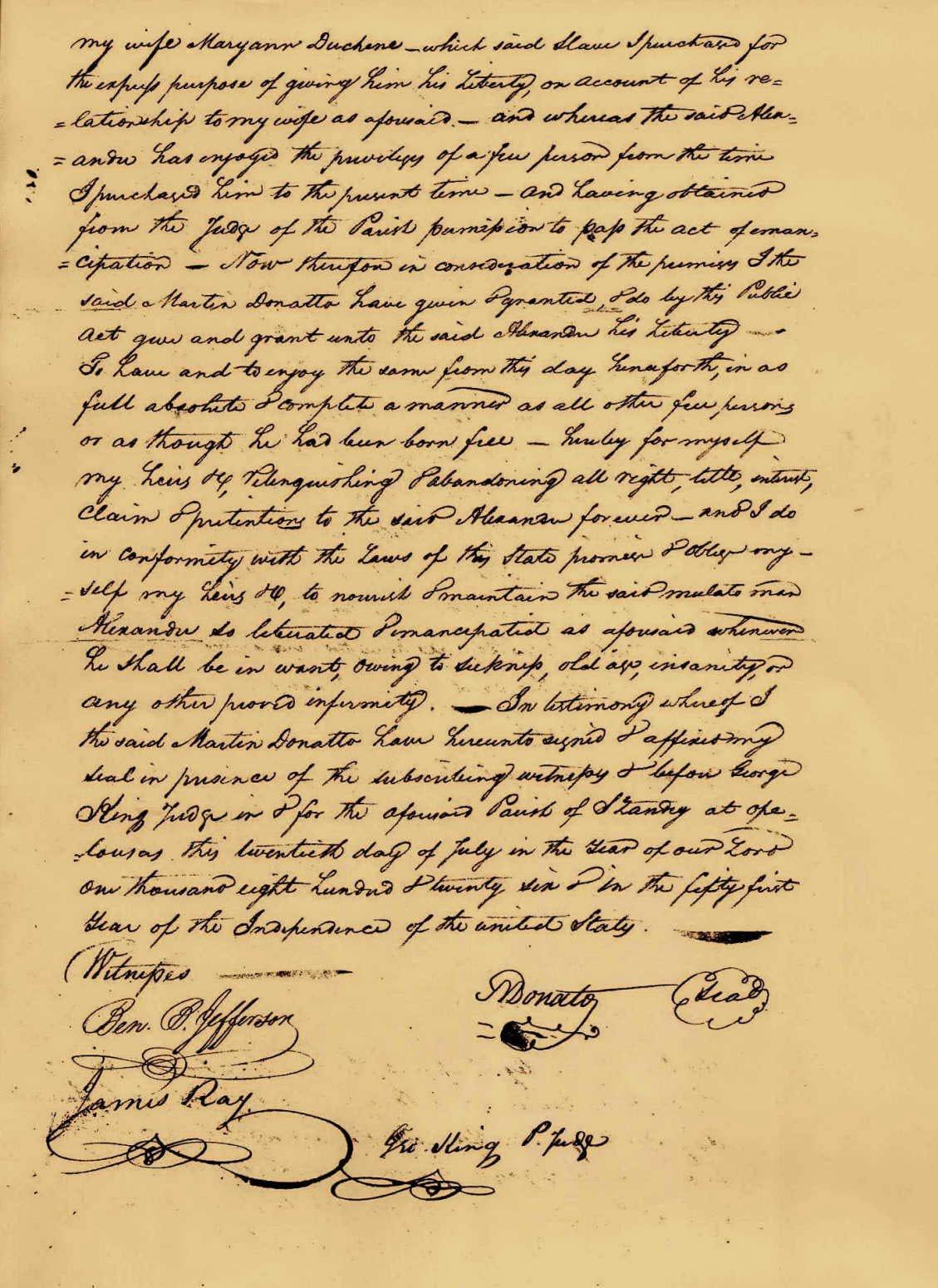
Original document dated 20 July 1826 describing Martin Donato Bello freeing a man named Alexander, courtesy of the St. Landry Parish Clerk of Courts. Further records indicate that Martin was responsible for liberating at least 20 enslaved individuals
Document dated 16 March 1803 transcribing the details of Martin Donato Bello’s marriage to Marianne Ducheane, courtesy of the St. Landry Parish Clerk of Courts.
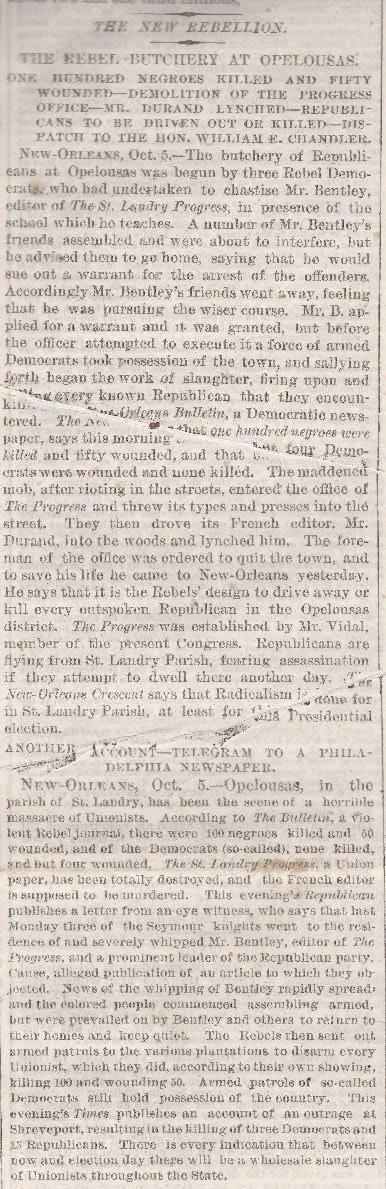
Opelousas 1868, NY Tribune 7 October, 1868