Frédéric Auguste Bartholdi (1834-1904)
Maquette for La Liberté, Liberty Enlightening the World, c. 1869-1871
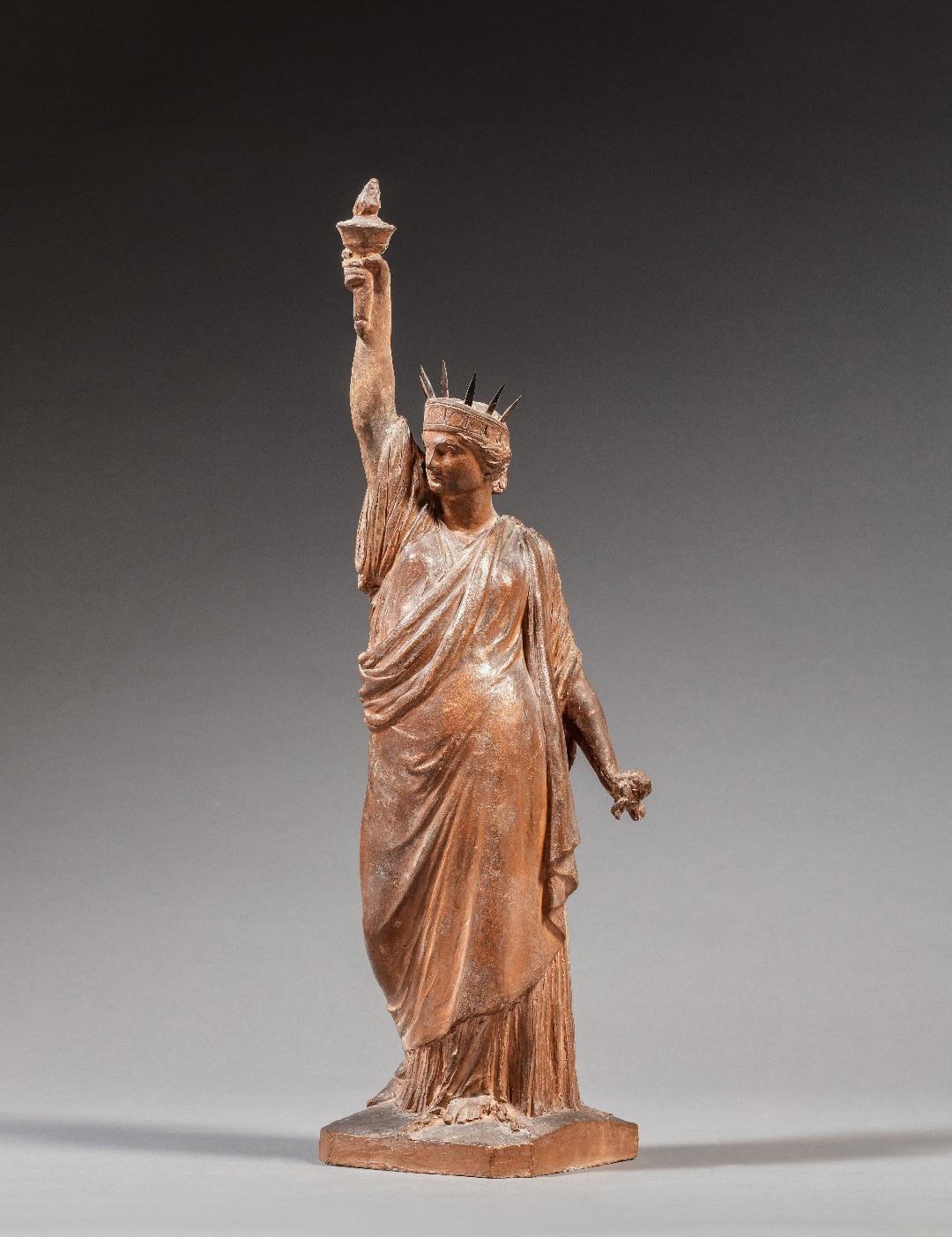
Frédéric Auguste Bartholdi (1834-1904)
Maquette for La Liberté, Liberty Enlightening the World
Terracotta
49 cm (19 ¼ in)
Signed: Bartholdi
Provenance:
Private collection, France
With Galerie Martin du Louvre, Paris
From whom acquired by the present owner in 2009
Exhibited: Paris, Cité de l’architecture, Art déco France/Amérique du Nord, 2022-2023
Literature:
E. Bréon, ‘Les Fondements d’une relation ou l’émulation réciproque’, in Art déco, France/Amérique du Nord, exh. cat., Cité de l’Architecture, Paris, 2022, pp. 14-18
Bibliography:
"Master Sculpture from Four Millenia". Sotheby's, London 2025. https://www.sothebys.com/en/docs/pdf/l25264-low-res.pdf. Accessed 16 June 2026.
This beautifully cast and hand finished terracotta is a rare original maquette for one of the preliminary versions of Frédéric Auguste Bartholdi's La Liberté éclairant le monde, more famously known as The Statue of Liberty.
The New Colossus
A sonnet entitled The New Colossus by the American poet Emma Lazarus (1849-1887) was immortalised in bronze in 1903 and mounted at the foot of the Statue of Liberty. Its first stanza reads:
Not like the brazen giant of Greek fame With conquering limbs astride from land to land; Here at our sea-washed, sunset gates Shall stand A mighty woman with a torch, whose flame Is the imprisoned lightening, and her Name Mother of Exiles. From her beacon-hand Glows world-wide welcome; her mild eyes command The air-bridged harbour that twin cities fame.
Lazarus' poem had been written in 1883 as part of the drive to raise funds from the American public for the construction of Richard Morris Hunt's pedestal for Bartholdi's monumental personification of Liberty, which had first been conceived by the artist in 1870 and finally completed in 1886. The poem encapsulates a number of the themes and references which motivated both Bartholdi and the man who had first conceived of the idea of a monument to celebrate the 1876 centennial of the Declaration of Independence, Édouard de Laboulaye. The opening lines of Lazarus' sonnet obliquely reference the Colossus of Rhodes, one of the Seven Wonders of the Ancient World, which served as the prototype for Bartholdi's Liberty. Just as the Rhodes figure, which represented the Greek god Helios, would have worn a crown of light, Bartholdi's Liberty wears a diadem from which emanates six rays of light, a form seen in allegorical coin portraits of Ptolemaic rulers. In contrast to the Colossus of Rhodes - a monument to victory following a devastating siege - Bartholdi's 'Mother of Exiles' represents a higher ideal: she is a symbol of hope for the 'huddled masses yearning to breathe free.'
A Beacon of Liberty
Whilst Édouard de Laboulaye first conceived of the Statue of Liberty as a commemoration of the Declaration of Independence, the statue was intended to convey several broader political meanings of equal significance. The first was the concept of the United States as an enlightened society in which every man was born free, in contrast to Laboulaye's native France, which had recently emerged from the tyranny of autocratic monarchy under Napoleon III, the subsequent humiliation of the Franco-Prussian War, and the chaos of the Paris Commune. For both Laboulaye and Bartholdi (a native of war ravaged Alsace), the Statue of Liberty, was intended to represent the enduring bonds shared by the United States and France, whilst equally acting as a beacon of liberty and human decency, and embodying a hope that their own country might follow the American example of liberal democracy.
The cause of emancipation was of central importance to Laboulaye, who was a committed abolitionist, a member of the Philadelphia branch of the Union League Club, and the President of the French Emancipation Committee. It is significant that, in Bartholdi's few
surviving maquettes for the early versions of the Liberty - of which the present terracotta is a rare example - the woman is shown holding a broken chain in her outstretched left hand, whilst trampling upon a further chain underfoot. This early conception of the Liberty is likewise seen in Bartholdi's large scale presentation drawing, which was used as part of the statue's fundraising campaign and is now preserved in the Metropolitan Museum of Art, New York (inv. no. 2014.486). In this first conception of the Liberty, Bartholdi therefore makes explicit the statue's significance as a monument to the abolition of slavery and to the Union's victory in the American Civil War. In the final version, probably at Laboulaye's direction, the broken chain is replaced a tablet on which is inscribed the date of the Declaration of Independence: JULY IV MDCCLXXVI. However, the statue's significance as a monument to abolition is preserved by the discarded shackle and chain upon which the figure proudly tramples.
The Genesis of Liberty
Bartholdi's La Liberté éclairant le monde has its roots in an earlier proposed monument intended for the entrance of the newly constructed Suez Canal. Entitled L'Egypt apportant la lumière à l'Asie, the Suez monument was conceived circa 1869 and was designed to appeal to the modernising sensibilities of Khedive Ismail Pasha (1830-1895). This first project, a Pharos or lighthouse, took the form of a woman in Egyptian dress, who stands contrapposto, and holds an enormous lantern aloft. Unfortunately for Bartholdi, he failed to gain the Khedive's support for his expensive concept, a disappointment which fuelled his ambition to succeed in the United States. Despite the obvious compositional similarities between the Suez project and the final Statue of Liberty, Bartholdi denied any connection between the two. Faced with criticisms that he had merely recycled the Suez design and thus short-changed the American public, he insisted that any shared characteristics were explained by function.
Bartholdi produced relatively few maquettes or models during the process of creating the Liberty. The first terracotta sketch dates to 1870 and is held in the collections of the musée Bartholdi in Colmar. Despite the sculptor's denials, it is near-identical to one of his last maquette's for Suez, modelled in 1869, and also in the museum in Colmar. As Provoyeur has outlined: 'A new severity has crept into and hardened the face… The almost-Berber dress of the Suez figure has given place to the chiton and peplum of classical antiquity'; Bartholdi's inspiration for the costume appears to have been a cast of a Tanagra figure representing a goddess which was discovered in his studio.
The present terracotta is one of only three known maquettes of the second version of the Liberty, of which one is in the Museum of the City of New York (inv. no. 33.386A-B) and, according to Provoyeur, was probably brought by the sculptor on his first visit to the United States in 1871. According to Provoyeur, 'it was certainly modelled in Paris before the artist left for America on June 1871. Like its immediate predecessor it must have been conceived after the return from Egypt and the collapse of the Suez project in the fall of 1869, but before Bartholdi's [military] posting… in the spring of 1870' (Provoyeur, op. cit., p. 94). The other known terracotta model of this version was in the collection of the descendants of Laboulaye and was recently acquired through private sale for the musée Bartholdi in Colmar.
A comparison of the three terracotta maquettes in our view strongly indicates that they were each made at the same time, perhaps cast from the same mould, and hand finished by the Bartholdi himself. Whilst Provoyeur gives the dimensions of the New York terracotta as 56cm, this appears to be a mistake, since, according to the French Sculpture Census (op. cit.), the object measures 19 3/8 in. high (49.2cm). The Laboulaye/ Colmar terracotta measures 48.3cm. Notwithstanding the slight differences in measurements (which could be due to error or condition issues), this places the three maquettes at around 48-49cm respectively. A comparison of the undersides of the present terracotta and the Laboulaye/ Colmar example suggests that that the two were made by the same hand and following the same process: they are both hollow on the interior with a similar surface texture. Any small differences in hair, drapery, diadem and signatures can be explained by the fact that they have both been hand finished.
Interestingly, another terracotta bozzetto of the second version is listed in the Bori sale, Paris, 14 February 1881, lot 60. Like the New York example, this has a small numbered etiquette on the front edge of the integral base, which could indicate that the two may be one and the same, and that Provoyeur was incorrect in his opinion that Bartholdi brought the latter with him on his American trip in 1871.
Further terracotta maquettes of this second version of the Liberty probably existed. However, the fact that only three are known, and the fact that one of them was owned by the 'father of the Statue of Liberty,' Edouard de Laboulaye, suggests that they were conceived by Bartholdi as presentation models for the project's decision makers.
Bartholdi returned from the United States at the end of 1871 and, on 3 December, met with Laboulaye, who had presumably by then inspected the maquette. It appears to have been at this crucial meeting that the two decided to substitute the broken chain in the proper left hand (difficult to interpret for the viewer) with a tablet inscribed: 7 July 1776. This change, along with a more severe, fringed, facial type, a blind diadem and more emphasis on the torch, is seen in a model for a new, third, version of the Liberty, one of which is today housed in Colmar and is illustrated by Provoyeur (op. cit., no. 190). Several further terracotta maquettes of this version are recorded: one in the Statue of Liberty National Monument collection inv. no. STLI 163; 48.2cm); one in a French private collection; and a third which was sold at Christie's New York on 11 April 2007, lot 145 (49cm). Like the present terracotta, each of were probably cast and hand finished and are circa 49cm high, suggesting that they served the same function as the earlier maquettes: perhaps as presentation models.
Around 1875, Bartholdi appears to have toyed with the idea of replacing the diadem of light with one inset with stars, as seen in a bronze model in a private collection (op. cit., no. 196). The last of Bartholdi's preparatory models show the diadem in its final, arcaded, form, hinting a the decision to turn the space behind it into a viewing platform (as opposed to a lantern) in a nod to the fashion of allowing members of the public to ascend great heights at universal fairs by climbing tall structures such as - later, in 1899 - the Eiffel Tower. For these last
preparatory maquettes, one in plaster (Colmar) and one in terracotta (private collection), see Provoyeur (op. cit., nos. 195 and 197).
Bartholdi's final version of the Liberty, a clay model 1.7m tall, was unveiled at a banquet at the Louvre in 1875. This terracotta is today housed in the Statue of Liberty National Monument collection (inv. no. STLI 3513). In his final design, Bartholdi has reconciled the need to create an elegant, naturalistic design, with the technical challenge of enlarging his model to monumental size. The drapery is consequently slimmed down but is also carefully arranged to conceal physiognomic inaccuracies. Bartholdi's finished design or Modèle du Comité was reproduced in a limited edition of 200 terracotta examples by the French Committee in order to fund the project (see Provoyeur op. cit., no. 282).
It would take another decade before the final unveiling of the Statue of Liberty in New York Harbour amid great fanfare on 26 October 1886. The completed monument would be a triumph of art and technology, being composed of repoussé copper sheets laid upon a innovative internal metal structure designed by Gustave Eiffel. The present terracotta is an exceptionally rare autograph record of a key stage in Bartholdi's journey to create an American icon.
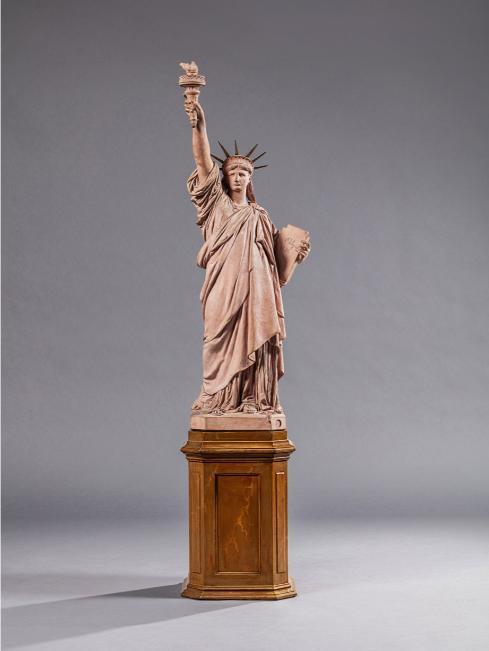
Frédéric Auguste Bartholdi (1834-1904), Liberty Enlightening the World, terracotta, on a wood base (height: 127 cm). Signed: Bartholdi, inscribed: 4 July 1776, numbered: Model of the Committee No. 36, and with the Franco-American Union Stamp.