

ANTHONY RAY HINTON SPEAKS AT BH Bearing Powerful Message of
By Eli Norden ’26 Panel Staff
Anthony Ray Hinton’s story is one of dramatic change, from doom to direction. His reflections are some of the most serious words ever spoken in Hamilton Chapel, and served as both a warning about the perversion of justice and a compelling call to action to current students to fight corruption in all forms.
Wrongfully convicted of a double homicide in 1985, Mr. Hinton’s case revolved solely around his race. Birmingham, a city with a slight black majority at the time of his incarceration, was a center for both the KKK during Jim Crow and the Civil Rights movement in the 1950s and 60s. Unfortunately, the legacy of racism endured beyond his case, as it continued to impact legal frameworks, individual decisions, and attitudes in the community into the late 1900s. He was accused because he was black. Detectives profiled him, saying things along the lines of “One of you [Black people] did it, if not you…one of your ‘brothers’”. His jury of “peers” was entirely white. He was tried before a white judge. The police officers and detectives who accused and arrested him were all white. Mr. Hinton’s speech made clear that
Fighting the Death Penalty in the

this doesn’t make white people inherently evil in any way. However, what his speech did make clear was that there is deep-seated racism in the South that works in ways most Northerners can’t understand. Even twenty years after the passing of the Civil Rights Act, race was the sole factor in Hinton’s arrest.
In Mr. Hinton’s speech, he was never once accusatory. He wasn’t mad about his own past, but rather a system he views as broken. And understandably so. The Alabama state government stole three decades of his life from him. Still, he reflected on his faith in prison and how he always felt connected to his Christian
religious tradition while incarcerated. The first decade of Mr. Hinton’s imprisonment was without help; aid would be on the way in time. “This story was eye-opening,” reflected Andrew Cotter ’26. Bryan Stevenson of the Equal Justice Initiative came to his assistance, working on his side for 16 years and using the reports of forensic experts who made clear that Hinton’s conviction was based on false information. His case was brought before the Supreme Court in 2014, where he was unanimously exonerated in a “constitutionally deficient” trial. The following year, he was released.
Currently, he is an advocate for end -
US
ing the death penalty. Marcus Griffin ’26 was particularly amazed by Mr. Hinton’s words. He said, “It was moving, from the heart…his plea for a new generation to stand up for those who can’t was powerful.” Since his release, Mr. Hinton has devoted his life to traveling and sharing his story. He released his book, The Sun Does Shine , in 2018. Mrs. O’Connor, one of about 20 faculty members who read the book over winter break, commented that “It is the ultimate story of resilience, friendship, hope, forgiveness, humanity, and empathy that everyone in the community can learn from, no matter their background.” Many other faculty members, including Dr. Tift, Mr. George, and Mr. LaLiberte ’14, recommend that Belmont Hill students read Mr. Hinton’s book.
After his presentation to the whole school, Mr. Hinton spoke to a significant group of boys who remained in the Chapel—one of the largest post-speaker groups that Belmont Hill has ever had. Student questions mainly revolved around his religious faith and prison life. The main takeaway of Mr. Hinton’s speech was to remember our position as good citizens of the world and to do everything in our power to learn about inequities in our systems and take action to change them. ☐
A Case for the Return of the BH Panini Press
By Babikir Saeed ’26 Panel Staff
Last week, while at home, on one of the rather dreary nights, my mother (as deserved) needed a break from her motherly duties, and I felt out of options. Two slices of wheat bread remained, and out of desperation, I checked the fridge for spare turkey and Swiss fromage slices; to my disappointment, I took to making a sandwich. Cold, bland, and simply unpalatable, I thought I was out of luck. But that was when I saw a light—rather a glisten—peeking from my base cabinet door: A grilling surface? “It can’t be,” I thought to myself. I laid a light coating of butter on its surface and firmly placed my sandwich upon it. It cracked and sizzled; when the bread's smoky char filled my nostrils, I knew I had more than a sandwich. I had a panini.
The Belmont Hill Panini was banned sometime between the 2022-2023 school year, primarily due to various irresponsible uses and the decision of former school chef Ms. Wu. I decided to ask the current Director of Culinary Excellence,
Tony Maws, what compelled Ms. Wu—as well as himself, to remove the culinary treasure. Chef Maws replied, “It does not quite fit well with what we are trying to do here at Belmont Hill anymore,” but perhaps more importantly, “Someone almost set the building on fire last time.” Chef Maws was direct and seemingly un-budgable during our short exchange. Chances of bringing back the panini machine looked negligible. Hope was distant. Yet, Belmont Hill students are excited by the prospect of the Panini Machines’ return. Out of 81 previous Panini users I surveyed earlier this week, we can assume these are all the remaining Panini fans,
since they cared enough to click on my survey—69% say they would use it 3 or more times a week. However, due to the impressive improvements to the school’s menu, 31% of these students say they would use the panini machine less now than in 2023.
What about the other 69% of students who said they wouldn't eat Paninis less? It shows just how much Belmont Hill students love paninis— that nothing could ever replace their perfect sandwich. When I asked Jack Ramanathan ’26 how he would like the return of the panini, he responded, “Bro, please Babi—I AM BEGGING YOU.” The love of Paninis expressed by Belmont Hill students makes the argument for the re-
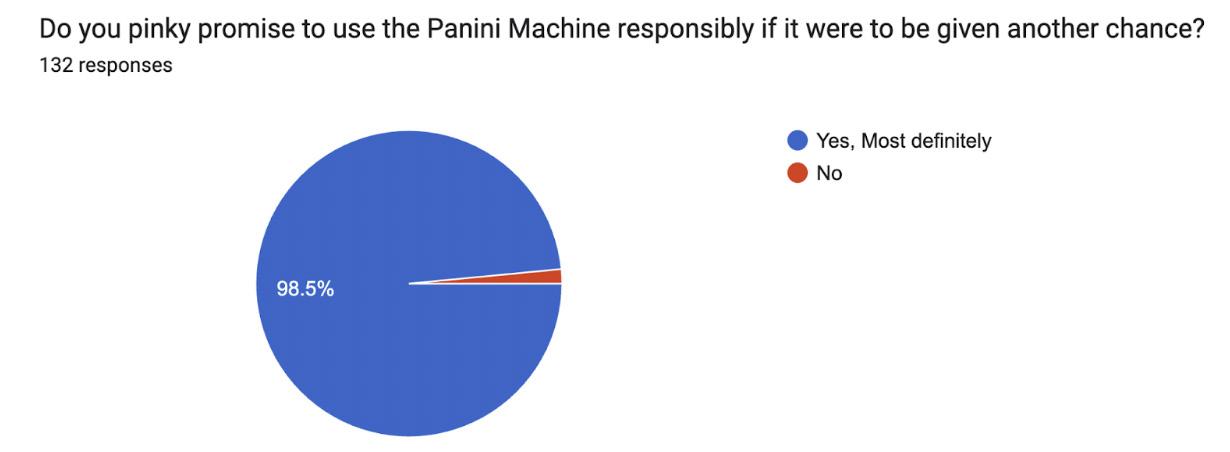
turn of the Panini machine more essential. However, as Chef Maws explained, safety hazards have posed various issues in the past. But students in 2026 seem to feel an increased sense of responsibility. Out of 132 panini lovers’ responses, 98.5% pinky promised to use the Panini Machine responsibly were the powers that be to approve. With this promise not to endanger the livelihood of Belmont Hill Students and Staff, we issue this heartfelt plea. Give us another chance! Overall, bringing back the Belmont Hill panini will not be easy. It will require rigorous negotiations and pleas. Mrs. Glinski gave some food for thought via email, proposing that the kitchen staff provide pre-made grilled cheese sandwiches on certain days—a possible “panini base” where students could add their own sandwich bar toppings. The likelihood of Belmont Hill students settling for such measures is slim. Belmont Hill students fight—that is their nature. They don’t settle—they persevere. Though this year may not be their year, as Michael Jordan says, “ I have never lost a game, I just ran out of time.” ☐
Letter from the Editor: A Look Inside The Panel
Page 2: Dispute Over Greenland
Adrian Chen ’28 and Patrick Snail ’28 provide an analysis of Greenland’s recent rise in relevance in the context of geopolitics with its abundance of valuable minerals and resources.
Page 4: Artist of the Issue
Shea McDonnell ’28, Tiernan Emmert ’28, and Billy Palumbo ’28 write this issue’s AOTI on faculty member Mr. Chittock, detailing his experiences being a professional graphic novel artist.
Page 8: Ethics of AI Image Usage
Joe Burns ’28 and Sean Park ’28 write an opinion piece on the morals of AI generated images and videos as they become more and more prevalent in the era of modern technology.
Page 11: Jake Bobo ’18 in Super Bowl
Tyler Grossman ’27 writes on Belmont Hill alum Jake Bobo after his recent victory in Super Bowl LX, detailing Bobo’s journey throughout high school, college, and the NFL.
Welcome to the final issue of Volume 74!
This month, our news section focuses on broader world events like Iceland’s position in the global order, Iran’s economic collapse, and the historic launching of the Artemis.
Our Arts section features the AOTI being faculty member Mr. Chittock, as well as our traditional Playlist of the Issue and an analysis on Bad Bunny’s halftime show.
Our Ops sections spotlights a piece that ponders the morality of AI-generated images and videos in the modern era, as well an intriguing article debating between salt and pepper.
Our sports section features a Griffin Calhoun ’26 as our Athlete of the Issue, as well as providing various recaps of professional sports like the MLB and Winter Olympic performances, alongside a
collage of photos from this past Winter athletic season. Finally, the centerspread of this issue provides a glimpse into two recent cultural dinners, the Ramadan Dinner and the Lunar New Year Dinner, with insights from students who participated in these events and photos from participants. We would like to give a big thank you to everyone involved in the process of publishing this issue. This issue marks the final of the volume, and we will be beginning a new application process for new leadership positions starting in the spring, so please reach out if you are interested in becoming a part of one of the school’s biggest student-led publications; the email address is thepanel@ belmonthill.org. Thank you, and enjoy this final volume Issue! ☐
Anthony Ray Hinton Speaks at Chapel
BH Communications
Data from Babikir's Research
Babikir Saeed
The Arctic Prize: Disputes Over Greenland’s Strategic Rise
By Adrian Chen ’28 and Patrick Snail ’28 Panel Staff
Despite its Arctic, frozen, and— ironically—not-so-green environment, Greenland has found itself competing for a top spot in global politics. Greenland, although part of Denmark, maintains its own autonomy for domestic affairs, whereas most foreign responsibilities fall upon its mother country. In recent years, discussions of Greenland’s accessibility, advantageous geopolitical location, and rare Earth mineral reserves have shot Greenland’s political stock through the roof. Greenland’s hefty mineral reserves are critical for electronics, renewable technologies, and defense systems, creating rising pressure, especially as Western countries seek alternatives to Chinese-dominated supply chains. Donald Trump initially expressed interest in purchasing Greenland in August 2019, citing its strategic and economic importance. Danish officers firmly rejected the notion at the time, but Trump has repeatedly revived his push for the United States to maintain Greenlandic control in recent months. In early 2026, he even threatened to impose higher tariffs on Denmark and other European allies that opposed U.S. influence, declaring Greenland “our territory,” sparking intense disputes as of late.
Greenland’s mineral reserves for sustainable energy have been at the center of diplomatic debate, a major stimulant of global political interest. The melting ice has made more of these resources accessible for extraction, just as demand for them has increased. Powerful countries, including the United States and European Union/NATO Allies, have attempted to jump on the promising trend, fighting over the supply chain. Even though Greenland’s economy is on the rise, there are doubts about its ability to sustain itself, given its heavy reliance on fishing and yearly grants from Denmark. Many people in Greenland desire greater autonomy, yet they often rely on

Danish subsidies. Additionally, while its rare Earth minerals account for only 2% of total exports, it holds roughly 20% of the global rare Earth reserves, creating rising global geopolitical tension.
The last significant factor is the effects of climate change on Greenland. Since Greenland’s longstanding icy environment is melting more each year, it has become a hotspot for climate change research. The studies possible in Greenland could revolutionize sustainable technologies that combat climate change, making it highly appealing to certain countries, particularly in the United Kingdom, China, and
Historic Artemis Launch
By Cooper Schuldt ’28 Panel Staff
More than 50 years after humans last ventured past low orbit, NASA is preparing to send astronauts back to the Moon. Artemis II is a multibillion-dollar spaceflight attempting to orbit the Moon as early as March. Artemis I, completed in 2022, was a successful mission that orbited the Moon, unmanned, to test safety features and ensure the technology was safe for humans. Artemis II is expected to launch as a crewed test flight to verify that all the systems work for future missions. Due to hydrogen leaks during testing, the mission was delayed but is expected to launch in the next few weeks. The Space Launch System, or SLS, is the most powerful rocket NASA has launched, generating roughly 8.8 million pounds of force, or the output of 160,000 corvette engines. The astronauts will launch from the Kennedy Space Center in Florida and stay in the Orion Capsule for the ten-day mission. Three out of the four crew members are American: Reid Wiseman, Victor Glover, and Christina Koch. The fourth, Jeremy Hansen, is Canadian and will become the first non-American to orbit the Moon.
In the near future, NASA is work -
ing on landing on the Moon and then beyond. NASA aims to launch Artemis III in 2027. Artemis III is a mission to land humans for the first time on the south pole of the Moon. The astronauts will collect data, take samples, and make observations to help us better understand how the Moon formed and developed, as well as the origins of other materials found on its surface. Additionally, NASA wishes to launch Artemis IV no earlier than 2028 to try and work on the first lunar space station. NASA eventually would like to build longer-term infrastructure, including rovers, to further explore and conduct research. The new potential lunar space station will offer many more opportunities for research and future missions to Mars and beyond. ☐

leading many to believe that Trump’s real motives are to expand U.S. territory.
NATO itself has acted to calm the situation. As of February 11th, NATO launched the Arctic Sentry mission to increase its military presence in the Arctic.
While international powers debate, Greenlanders have been outspoken about their future. Across Nuuk, Greenland’s capital, many residents and leaders reject the idea that their island should change hands or become part of a foreign power’s territory.
Polls indicate strong public opposition to U.S. control. Though specific national polling from 2026 is still emerging, past surveys have shown overwhelming resistance to annexation, with the vast majority of Greenlanders saying they do not want to join the United States, citing concerns about autonomy, social protections, and legal governance. In response to talk of acquisition, thousands rallied in Nuuk and Copenhagen, chanting “Greenland is not for sale” and “Hands off Greenland,” demonstrating widespread public unease.
Iran on the Brink: Economic Collapse and Mass Protests
By Ryan Ho ’28 Panel Staff
On December 28, 2025, millions of Iranians took to the streets in one of the largest protest movements in decades. The Human Rights Activists News Agency has confirmed that more than 6,000 protestors may be dead, with upper estimates reaching over 33,000. More than 40,000 civilians have also been detained in the bloodiest crackdown of Supreme Leader Ayatollah Khamenei’s leadership. Iranian officials, however, claim that at least 3,117 security forces or bystanders have been killed, mostly due to the protestors. The fierce crackdown that has occurred signals that Ali Khamenei, the 86-year-old Supreme Leader, and Iranian officials see popular revolt as a severe threat. After the protests, Iran cut off internet access for all 90 million citizens.

its Nordic neighbors. These countries place heavy emphasis on Greenland as a “stable and reliable partner” for securing sustainable development, especially within the European Union, and view Greenland as an essential source of rare Earth elements for wind turbines and electric vehicle batteries. Greenland plays a significant role in U.S. strategic efforts: the country holds a U.S. military base in Greenland that actively serves as a critical 24/7 hub for missile warning and surveillance. Additionally, the U.S. is allowed to establish additional bases under an agreement signed in 1951,
Local leaders have also taken a firm stance: Greenland’s business and mineral resources minister, Naaja Nathanielsen, says that people in Greenland are “very, very worried” over the administration’s desire for control of Greenland. A senior government official said it’s “unfathomable” that the United States is discussing taking over a NATO ally, urging the administration to listen to voices from the Arctic island’s people.
Greenlandic officials have participated in high-level talks with U.S. and Danish officials to define a security partnership that protects its interests and respects its autonomy.
Meanwhile, the opening of new diplomatic posts by Canada and France in Nuuk reflects Greenland’s growing role in Arctic affairs and offers Greenlanders more international connections beyond the U.S.-Denmark axis. As the world watches, Greenlanders are making it increasingly clear that their voices matter in shaping how global powers interact with their homeland. ☐

The dire economic crisis preceding these protests prompted Iranian citizens to initiate the uprising. The Iranian currency, the rial, reached a record low of 1.42 million to the US dollar, meaning that one US dollar was equivalent to 1.42 million rials. At the beginning of 2025, the rial traded at 1 million rials to the US dollar, and by November 2025, it had jumped to 1.25 million rials to the US dollar. This soaring inflation forced food and medicine costs to skyrocket, drastically affecting ordinary Iranian citizens. According to a report on November 17, 2025, the price of milk in
Iran rose by 60% in a 5-month period. In addition, Iran’s GDP growth fell to near zero. In Iran, industry, including the oil and gas sub-sector, accounts for 45% of its GDP. However, sanctions have hit Iran hard. Since the 1979 Iranian Revolution, the US has maintained sanctions on Iran, and the Council on Foreign Relations estimates that these sanctions have reduced Iran’s economic size by 1520%. In more recent sanctions, the UN reimposed nuclear-related sanctions on Iran in September 2025. As the protests took hold, broader intentions began to spread. Calls to end the Islamic Republic and to assassinate Khamenei quickly increased. Iran’s political landscape is
dominated by Supreme Leader Khamenei, who has ruled for over 36 years. Iran does possess an elected president and parliament, though they possess little political power. In 2009, protests broke out across Iran when the incumbent president defeated reformist candidate Mir-Hossein Mousavi in the June 2009 presidential election. In this case, many protestors believed the elections were rigged and demanded greater political freedom and less authoritarian rule, both ideas that are still being pushed by protestors today. In the crackdown following this protest, tens of thousands were arrested, and the protests were eventually suppressed. Similar to today’s protests, the 2017 protests were initiated mainly by economic hardship; however, the protestors argued against the entire political system, including the reformers. After another severe crackdown, in which around 8,000 were arrested, these protests eventually faded as well. Foreign military aid, especially from the US, has divided opinion among Iranian citizens. As the protests began, Trump posted on Truth Social, “Keep protesting. Help is on its way.” However, no help from the US arrived. As a result, in the Times magazine from January 2026, it notes that some Iranians even place some of the blame on Trump, with increasing outrage as Trump thanked Iran’s rulers on January 16 for abandoning planned executions. While foreign intervention seems unclear, some Iranian citizens fear that foreign intervention may just cause more violence, looking at the past US foreign intervention in Afghanistan as an example. However, US intervention appears imminent. In February 2026, the US military near Iran rapidly grew to include two aircraft carrier strike groups, destroyers, cruisers, submarines, and 50 additional fighter jets. As tensions continue to rise, will there be US intervention? Will regional proxy forces come into play? Will Iran’s ballistic missiles threaten US bases? Only time will tell the answers to these questions; however, one thing remains clear: the Middle East is on the brink of a new phase of instability. ☐
Thoughtful Senior Insights into the BH Experience
By Eli Norden ’26 Panel Staff
The Form VI ‘Letter to Your Younger Self’ Chapel has become a core tradition at the beginning of seniors’ final semester. This year, a diverse set of speakers spoke about the joys, struggles, and memorable moments that shaped their Belmont Hill experience. Ultimately, the speeches served as a helpful reminder to appreciate every minute of one’s Belmont Hill journey. Alex Zhang ’26 kicked off the Chapel with an important message about authenticity. He encouraged Form I students to “Let your walls down, and be genuine and open with other people.” He then touched upon an injury that was embarrassing in the moment, but was soon forgotten by every member of the current Senior Class. This story set a nice precedent for younger students on campus. He finished with a joke, in classic Alex frankness: “Enjoy the late-night homework grinds, because, yes, I am currently writing this at 11 pm the night before I have to read it in front of the entire school.”
Second, Sammy Flood ’26, a varsity wrestler known for his exceptional work across the humanities, encouraged us to be our authentic selves in his reflection. In a world filled with increasing selfdoubt and insecurity, Sammy grounded his advice in a simple but freeing reminder: “You have to realize that nobody cares.” With this, there was something liberating: if everyone is caught up in their own lives, we might as well live ours without apology. Discussing the little moments of Belmont Hill life, Sammy recalled some of his lasts: Sitting on the second floor of Hamilton Chapel, BEL-1 bus rides, and 4:00 study halls. Réis Little ’26, a varsity football quarterback, followed up the first two stellar pieces with relatable memories
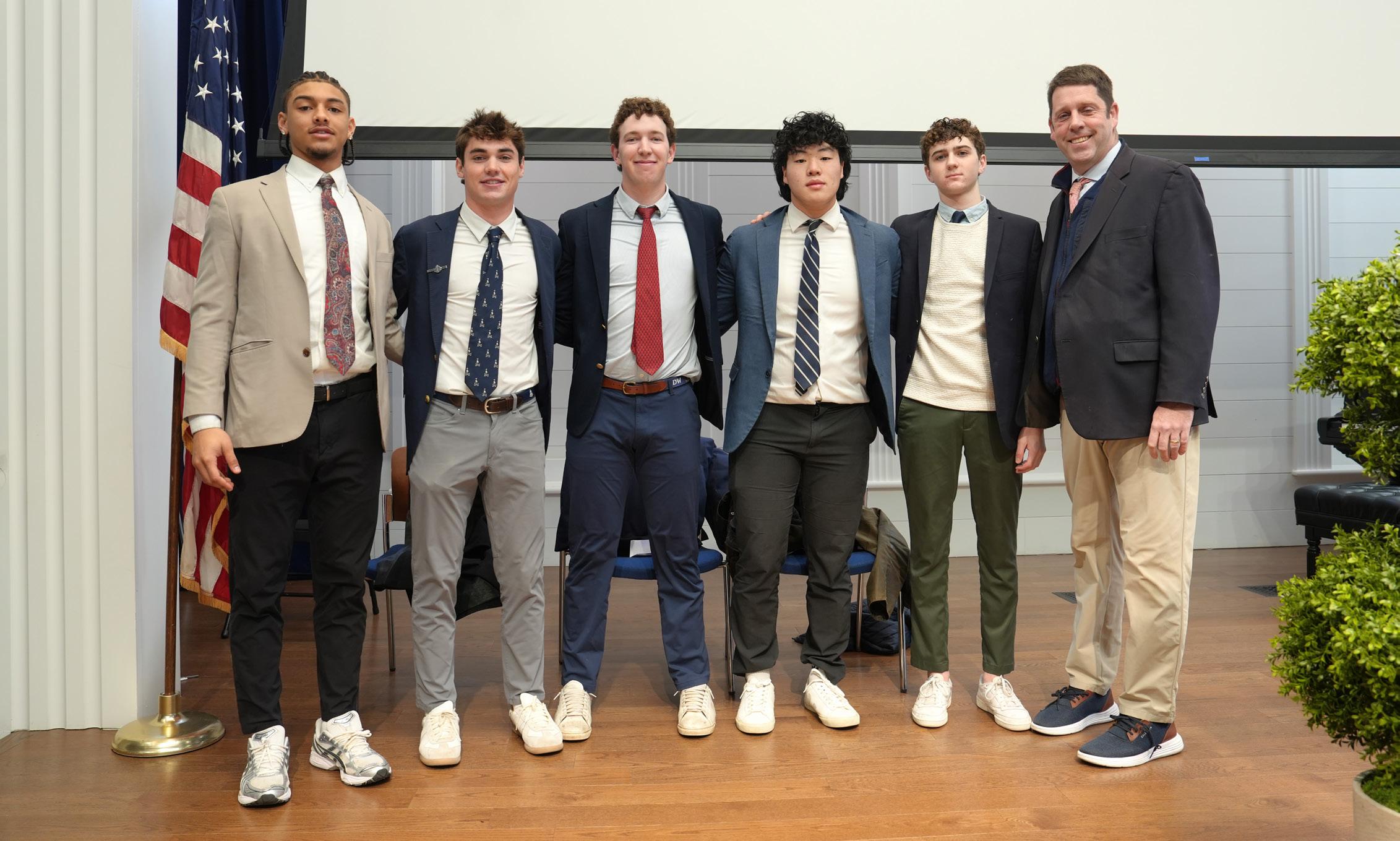
for students who reclassed. Réis then transitioned his letter into a reminder to the current Freshmen: “You will make mistakes, get Saturdays, be late to dinner by a minute even though you’re sure you left on time. But these problems you face now are necessary for you to develop into a man.” Réis’s powerful speech reminded us that everybody errs, and that life is about doing everything to get back up stronger than when you fell down. In a deeply personal speech, Eli Warn ’26 talked of the fleeting nature of many things in life. He reflected, “You have already faced some with dad’s cancer diagnosis and surgery, and life will continue to try and beat you down any way possible, and it is very important that you keep going even in the tough -
est times.” He added two failures: A 38% on Dr. Goldberg’s first AP Biology test and getting cut from varsity baseball that spring. Still, he requested, true to his outgoing ways, “Don’t play the victim and get caught up in life’s unfairness, and instead focus on taking life’s punches with a smile on your face.”
Jack Bartlett ’26 offered some sage wisdom to the boys pushing through the hardest winter of their academic careers. Jak reminded the Juniors to “find comfort in your own humility through celebrating little victories.” He added to “never lose your optimism; it will get you through the year. So will your friends.” This important reminder is relevant for all Belmont Hill students, and provided mature insight!
Last, Mr. Al Murphy ’98 gave his stellar advice to this year’s Class of 2026. He encouraged Seniors to enjoy the moment but also get ready for the big change after graduation: “Life is fun right now, and you should soak up every second of that joy…the transition from high school to college will present challenges you haven’t yet imagined.” He offered Seniors some key points as they finish their Belmont Hill Careers: Be yourself, lead with kindness, be a servant leader, spread joy, and practice gratitude. The Belmont Hill community thanks this year’s speakers for
fering
Protestors in Nuuk, Greenland Associated Press
Artist of the Issue: Mr. Chittock: Novelist and Teacher
By Shea McDonnel ’28, Tiernan Emmert ’28, and James Palumbo ’28 Panel Staff
At Belmont Hill, Mr. Chittock works in the communications office and as a coach for the 8th-grade basketball team. In the communications office, he writes stories for the school website and bulletin. But off campus, he is a talented graphic novel author who has written for major franchises such as Stranger Things, Teenage Mutant Ninja Turtles and Ninjago . Recently, we conducted an interview with him to better understand his artistic journey. He shared his passion for building stories in the comic book world and how collaboration has shaped his career. It’s a common misconception that a graphic novelist both writes and draws.
Mr. Chittock explained that he focuses solely on writing. His role is to create detailed scripts that outline each page panel by panel. These scripts not only include dialogue but also include how the panel should be drawn. Although he does not draw the artwork himself, he works closely with professional artists who bring the visuals to life. Mr. Chittock told us collaboration is one of the most exciting parts of the job. Writing can often be a lonely process, but comics allow him to work with a team of artists and editors. He described the relationship between writer and artist as a partnership. The writer designs the overall structure and direction, and the artist brings the story to life through the panels. In many cases, this collaboration brings new life experiences that influence the graphic novel, yielding better results. According to Mr. Chittock, the

Mr. Chittock’s “Mapmakers and the Enchanted Mountain” Google Images
best partnerships occur when all parties are open to feedback and willing to work together. Mr. Chittock emphasized feedback as being a key component to making a good comic. He believes, “The goal is always, how can we tell the best story together.” He outlined the process of how every script goes through multiple drafts and rounds of edits. He emphasized the importance of receiving feedback and improving as a life skill, not just for graphic novel writing. Before becoming a published writer and working at Belmont Hill, Mr. Chittock actually began his career as an editor in Los Angeles. He started as an intern and worked his way up to editor. This experience taught him how comics are produced from the inside. As an editor, he worked with writers, artists, designers, and printers to make sure books were completed on time and told compelling stories. This experience gave him a strong under-
Landau Gallery Exhibition
By Sean Park ’28 Panel Staff
Only 1 in 5 artists exhibit their work in their lifetime according to a study conducted by the Contemporary Art Issue Organization. However, every Belmont Hill student has an opportunity to get their art seen by others. For the past several weeks, student artwork has been on public exhibition for viewing in the Landau Gallery. The media for these works included photography, drawing and painting, ceramics, and woodworking, all of which were the culmination of all the students’ hard work during the fall semester. Although all the artwork displayed is impressive in its own way, specific pieces and artists have won awards of recognition during the Student Art Show Awards Chapel on February 10, 2026. Out of the award-winning artists, two have even gained recognition from Scholastic, as they won awards
in the Scholastic Art and Writing Organization. Kyle Ayres ’29 and Adrian Chen ’28 both submitted photos they created in their respective photography classes, and both secured Silver Keys, with Adrian also earning an additional Honorable Mention. For the artists who didn’t participate in competitions, the experience was still fulfilling. Tadgh O’Sullivan ’29, the 1st place winner for Ceramics, says that “it’s great to see students’ work represented in a public setting because everyone’s worked so hard on their project and it’s great that people get to see that for themselves.” No matter which medium artists pursue, it is always difficult to show their work to others and involves a lot of vulnerability, so looking through the exhibition is a great way of showing support. Although this semester’s student artwork exhibition has now concluded, students can look forward to the second-semester show, which will take place towards the end of the school year. ☐

tion can come from every experience or other forms of art and literature. However, the ideas require time to develop and refine. Sometimes an idea takes years to develop fully. Instead of giving up on concepts that don’t work right away, he often revisits them later with a new perspective and experience.
standing of how the industry worked. It also gave him the chance learn from professional writers. When he eventually transitioned to writing, the skills he built as an editor proved invaluable. He also talked about how writing for large franchises comes with unique challenges. When working on projects connected to major companies, such as Netflix or Paramount. Mr. Chittock does not have complete creative freedom. Instead, he pitches several story ideas to the companies. It’s up to them to decide which idea they like best. Then Mr. Chittock develops a more detailed script. This process involves tons of opinions and feedback. Still, he explained that he tries to make each story personal by focusing on what he finds meaningful about the characters. When asked where his ideas come from, Mr. Chittock gave a brutally honest answer: “Most ideas are not good at first.” He believes inspira -
At Belmont Hill, Mr. Chittock works in the communications department, helping tell the school’s story. He attended a similar all-boys private school, which was part of Belmont Hill’s appeal to him. While in high school, an English teacher introduced him to the concept of the “hero’s journey,” which sparked his love for storytelling. That experience instilled in him a belief in the massive impact a school can have on its students. Now he enjoys telling and celebrating the stories of Belmont Hill.
For students interested in writing or other creative fields, Mr. Chittock offered practical advice. First, he says students should make time for art in their busy schedules. Second, don’t experience art passively. Consider what you like, and why. Finally, be willing to fail and revise. He believes persistence is more beneficial in the long term than immediate talent. Teachers can be valuable resources, but students must be willing to put their work forward and accept feedback.
Mr. Chittock compared creative work to athletics. While publishing a book is exciting, the meaningful parts are the process, the collaboration, the practice, and the relationships built during his time in the industry. His story shows us that art and creativity is not just about individual talent, but also about a willingness to fail and an ability to collaborate. ☐
Upper School Play Review
By Will Achtmeyer ’26 Panel Staff
Two weekends ago, Belmont Hill and Winsor performed 8 short one-act plays in a compilation entitled 8 Plays!
(But Who’s Counting). Such plays included: But Who’s Counting, Go to the Light, The Bargain, Some Assembly Required, The Job Interview, Meanwhile at the Pentagon, The Last Cookie, and Man Day. Audiences were swung back and forth between funny slapstick, social commentary, and thought-provoking performances that kept viewers on their toes between plays. Mr. Ziff called the play “the best-acted performance I’ve seen at this school so far,” and student Cotter Healey ’26 remarked that he “really enjoyed the variety and dynamic nature of the plays.”
Logistically speaking, this performance was much harder to put on than may initially be assumed. The nature of doing 8 plays in roughly hour-long practices, three days a week, only allows for the students to practice on stage for 15 minutes a week. With just under 2 months of rehearsal, there is much pressure on the actors to practice and rehearse on their own time. As such, the fact that the performance turned out so well, with so little practice time and so many new actors (list new actors), demonstrates the dedication of the entire theater program and the skill of its members.
When asked about the play, Mr. DiResta (director), commented that “It’s incredibly heartening to see this cast and crew create something so meaningful, hilarious and magical out of some words on a piece of paper. They are the true

They are the true storytellers. I’m so proud of the unique worlds and characters they’ve brought to life, and ultimately, my hope is that their performance inspires more of their classmates and friends to try theatre, and become confident, expressive and authentic public speakers themselves!”
Many of the same actors will return in this year’s all-school spring musical, the historical drama Newsies, which just recently held its auditionsbe sure to come by in the spring to see yet another amazing performance! ☐

Bad Bunny Super Bowl LX Halftime Show Review
By Liam MacLean ’27 Panel Staff
On Sunday, February 8, our own New England Patriots faced off against the Seattle Seahawks in Super Bowl LX in Santa Clara, California. Back in September 2025, the NFL announced that Puerto Rican artist Bad Bunny would headline the Apple Music Halftime Show. As the game approached, fans and critics argued about the choice of this artist, mentioning that his music is in Spanish. Americans speculated on what the artist would perform, assuming he would play a mix of his most popular hits.
He opened the show with “Tití Me Preguntó,” emerging from the hedges of his field environment, representing his home of Puerto Rico. Stars Pedro Pascal, Cardi B, Jessica Alba, and Young Miko joined him outside of the set house in the middle of the field. Besides these big names, Lady Gaga joined Bad Bunny to sing her and Bruno Mars’ hit song “Die With a Smile,” adapted from its
originally emotional tone, to fit the energetic and South American nature of the show. Benito paid tribute to fellow Puerto Rican artist Ricky Martin, who sang “LO QUE LE PASÓ A HAWAii” for him.
Continuing his representation of South America and American unity, towards the end of the show, he walked

through the sugarcane crops (people dressed as plants), and yelled out to the crowd most of the countries across North, South, and Central America, with their flags following behind him. Continuing his previous message from the Grammys a week prior, he used this moment to support South American peoples and indirectly, speak out against ICE raids taking place in the US. He closed out the show holding a football, saying “Together we are America” and singing one of his most famous songs, “DtMF.” The performance sparked controversy amid America’s polarized political climate. Some who were critical of the NFL’s choice for Bad Bunny shifted their attention to Turning Point USA’s “All-American Halftime Show,” including rock singer Kid Rock. Inevitably, this show sparked controversy from both Bad Bunny supporters and Turning Points’ opposition, with famous country artist Zach Bryan, calling it “embarrassing as hell.” Bad Bunny’s performance represented a culmination of years of work, from his breakthrough in 2022 and headlining Coachella in 2023. Using this moment, he commented, “I’m taking advantage of this moment in my life when I can do whatever I want and wear what I want, so I get to live life more authentically.” ☐
US Play Jim Campos
First Annual PFD Muslim Family Dinner

By Babikir Saeed ’26 Panel Staff
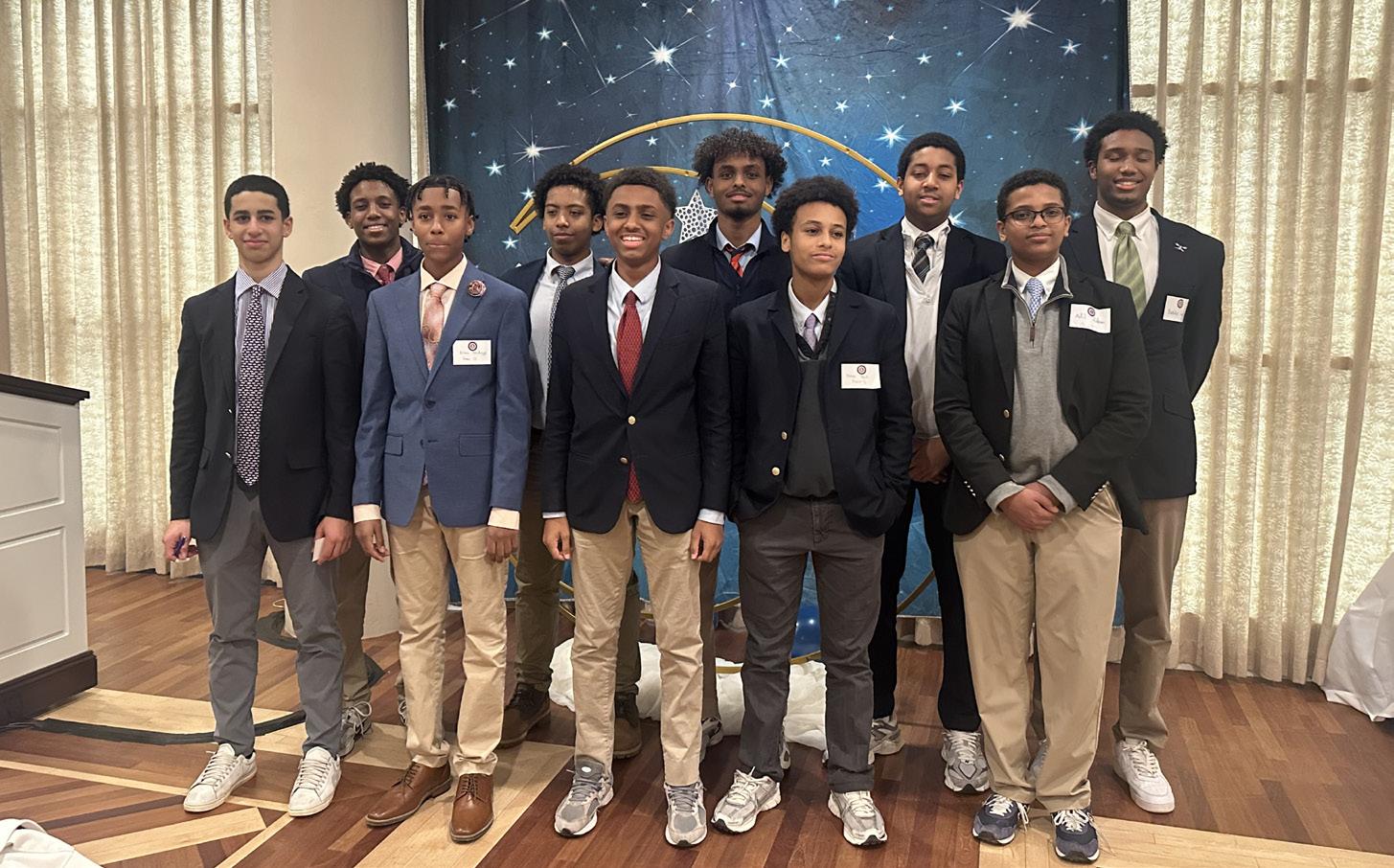
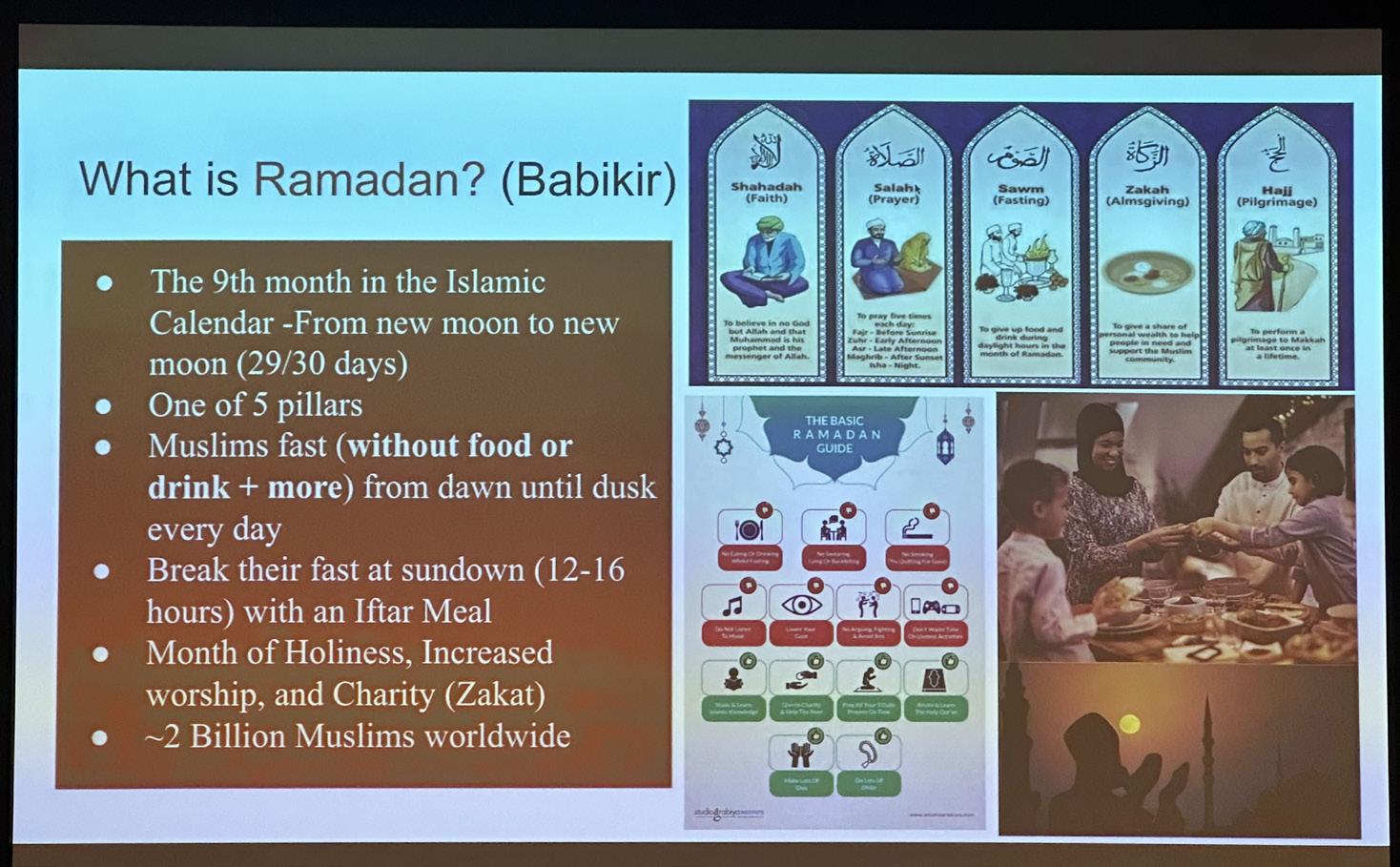
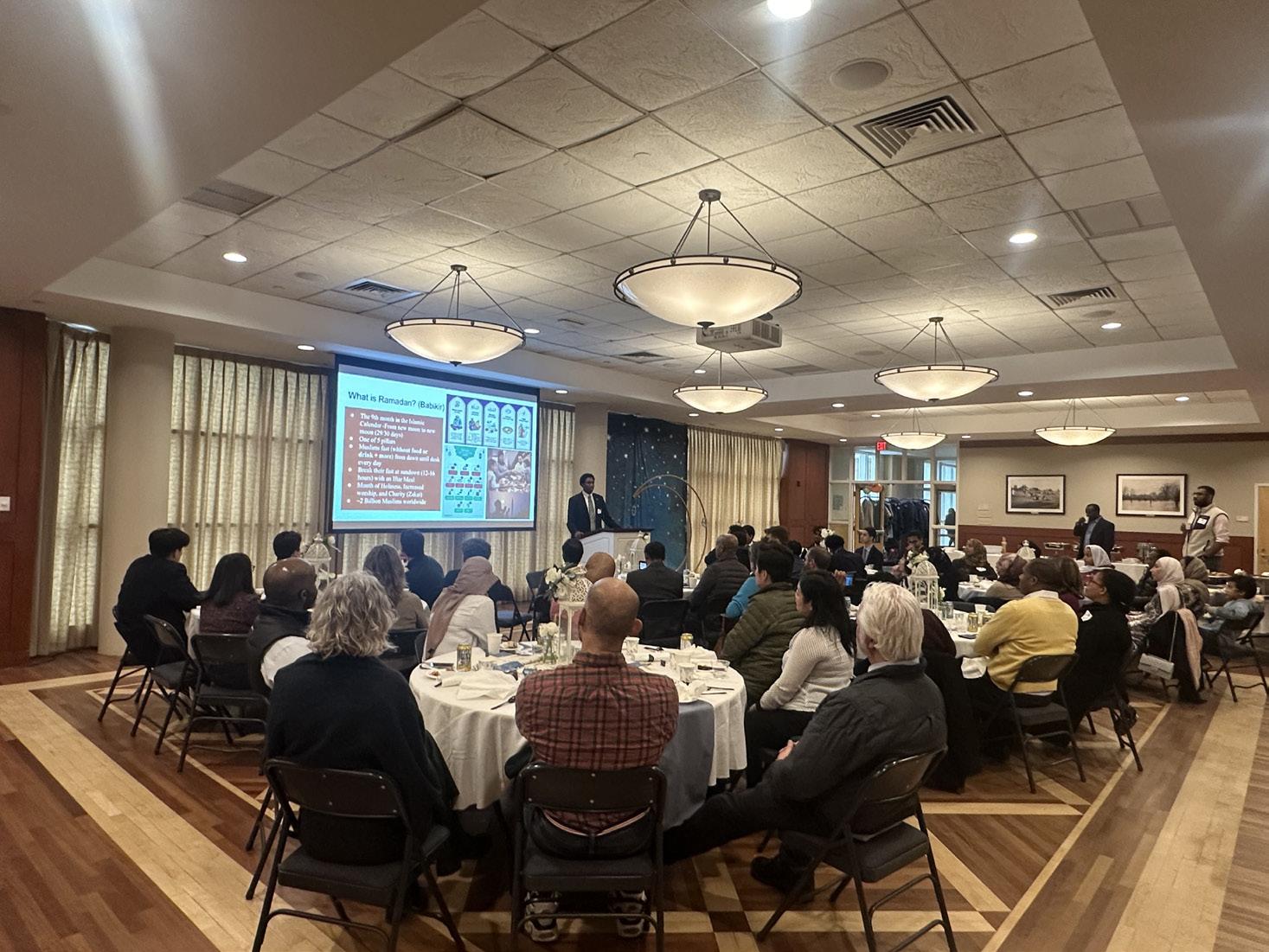
On February 10, the Muslim Students Association (MSA) held its first Ramadan event at Belmont Hill. After several years of working to make the event possible, and thanks to the generous support of the Parents Fostering Diversity, a committe of the Parents’ Council, Mrs. Farkas, and Chef Maws, the evening was a great success. The event began with a phenomenal meal—grilled chicken kebabs, rice, and delicious baklava—though it was not enjoyed until everyone first broke their fast with a traditional date. Although it
was not quite Ramadan, it is considered sunnah (a practice recommended by the Prophet Muhammad, peace be upon him) to break one’s fast with a date, making it an essential part of the evening. Dinner was followed by an engaging and comprehensive presentation delivered by all 10 members of the MSA. I did not expect such strong interest in this first-time event and had not considered promoting it everywhere—but I was pleasantly surprised. I am confident that the MSA will continue to grow this event to even greater heights in the coming years. Thank you to everyone who contributed, and Ramadan Mubarak! ☐
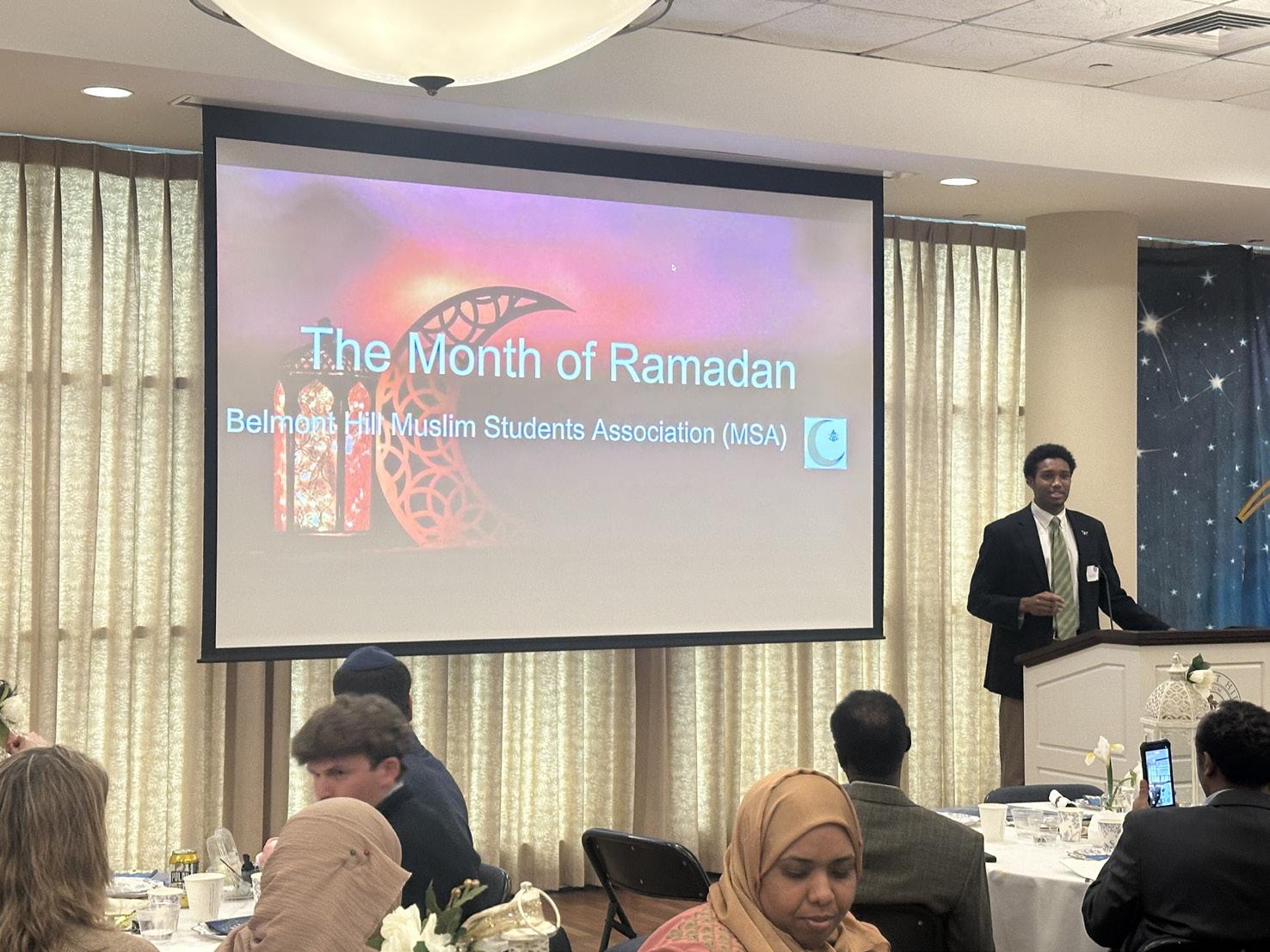

Belmont Hill’s First Annual Parents Fostering Diversity Muslim Family Dinner
BH Communications
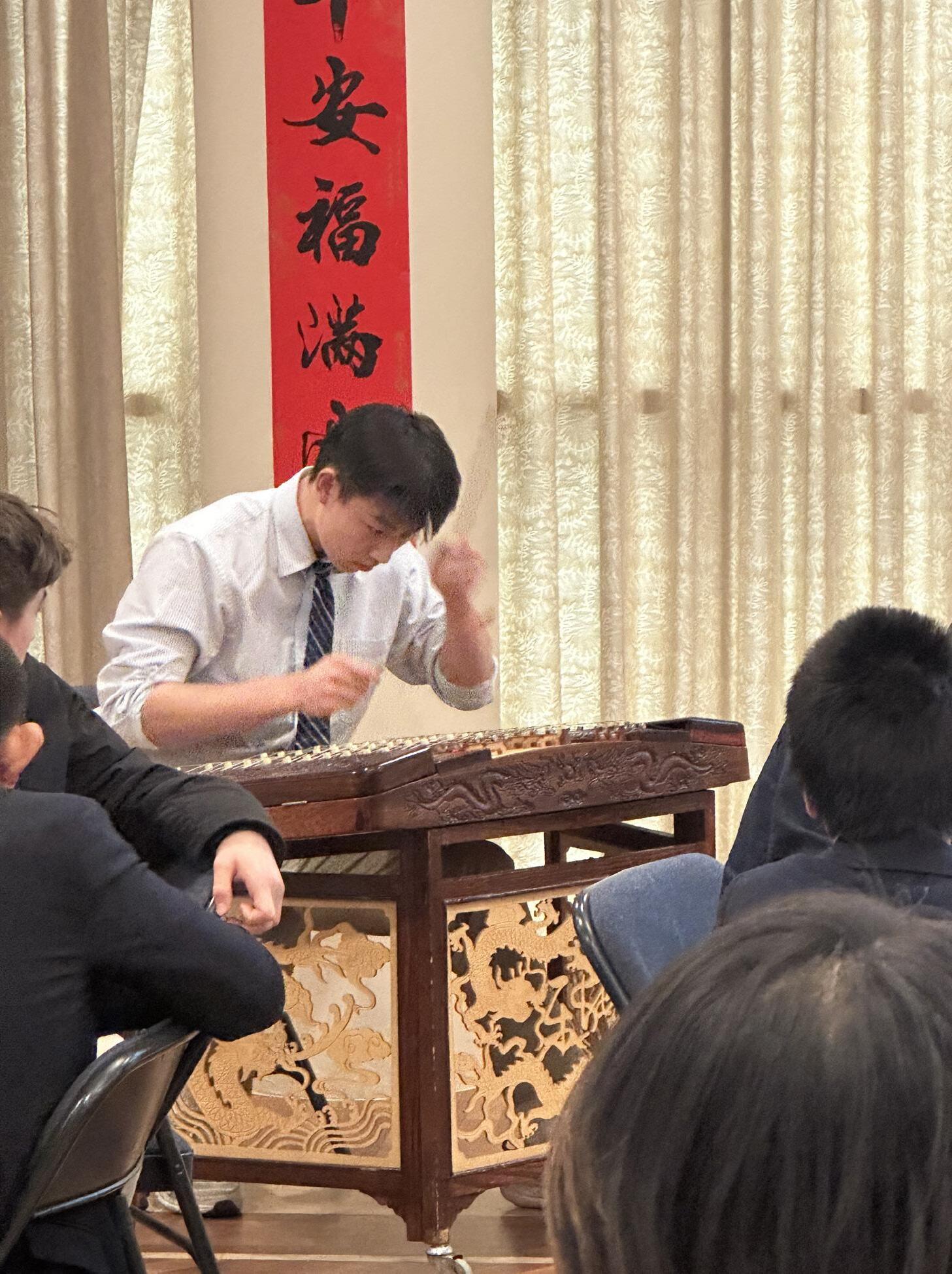
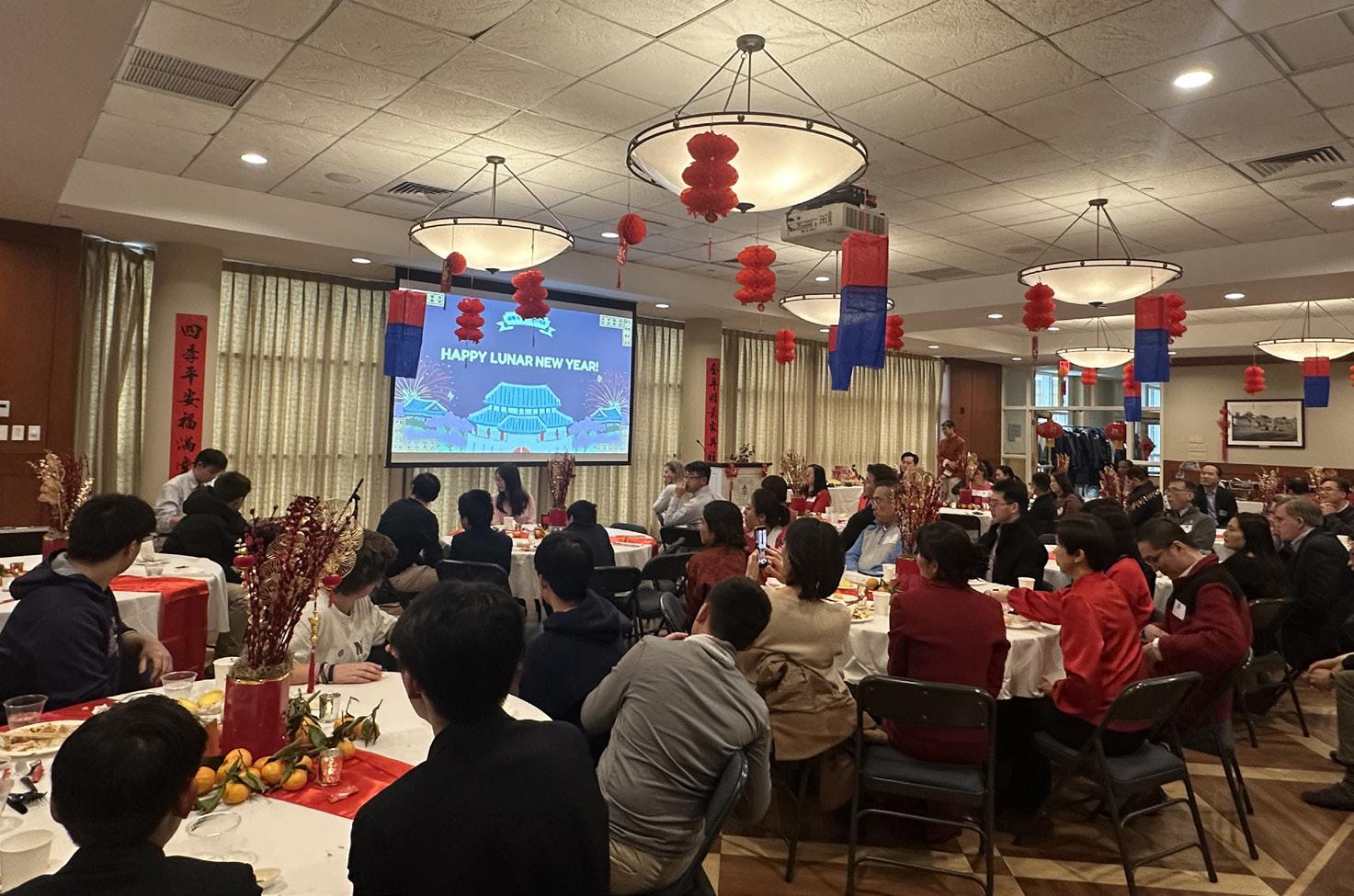
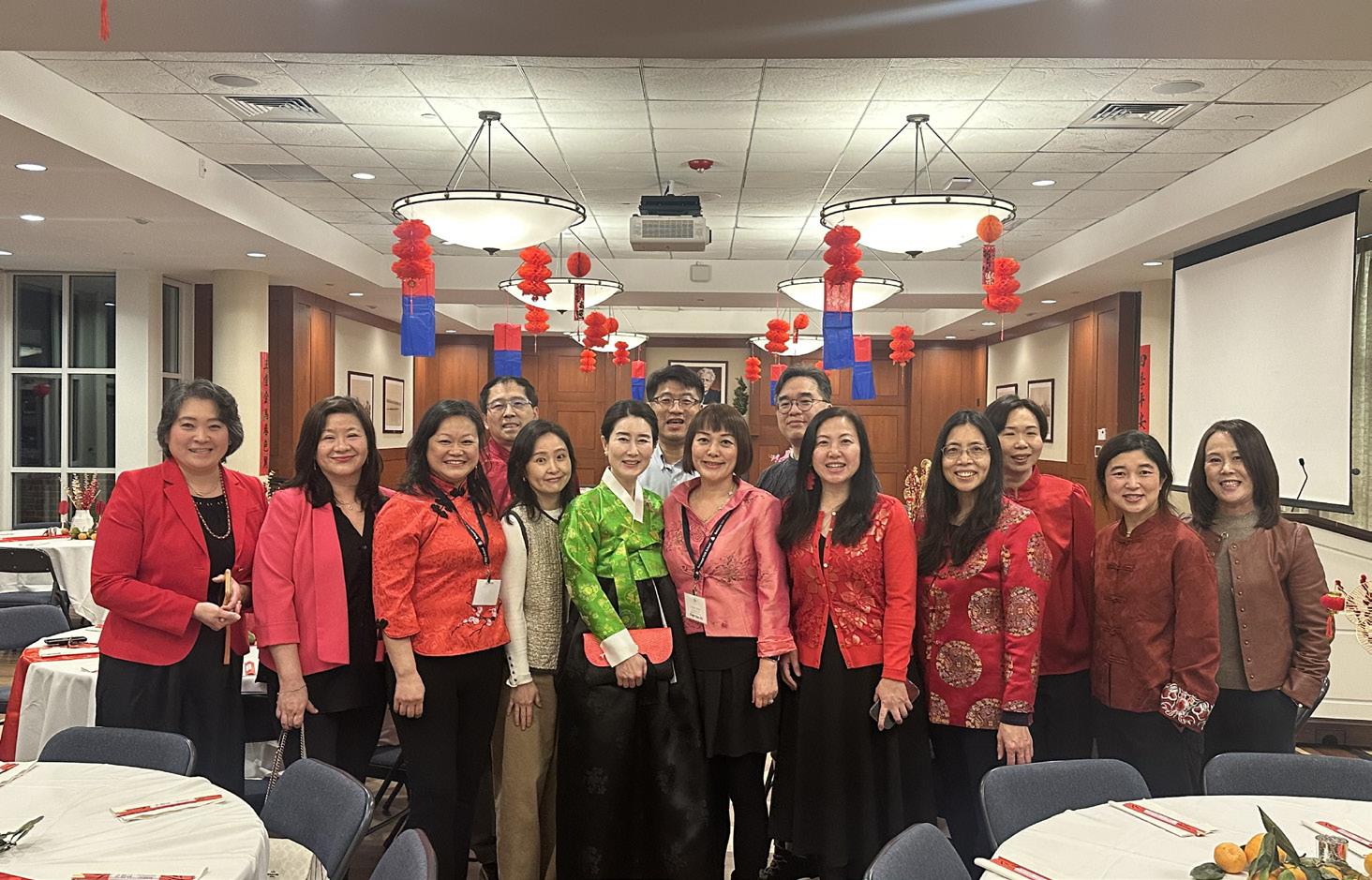
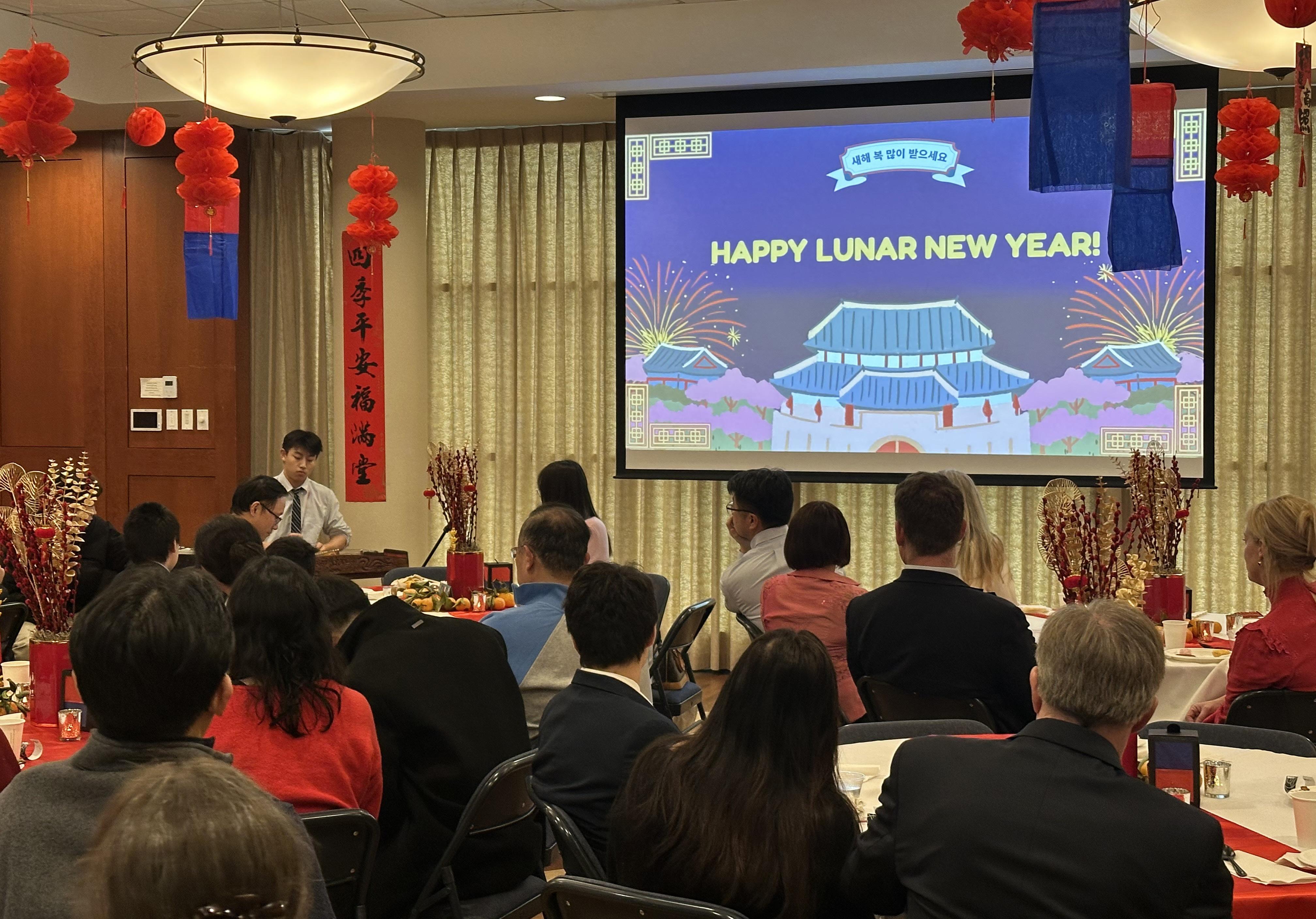
Belmont Hill’s Third Annual Parents Fostering Diversity Lunar New Year Dinner
BH Communications
The Complicated Ethics of Generative AI Usage
By Joe Burns ’28, Sean Park ’28 Panel Staff
How would you feel if you were shown a video of you committing a crime? How much more upset would you be if you knew you didn’t do it, but others still took it at face value, regardless of your pleas? AI has the potential to cause such havoc in the future, and even though it hasn’t yet developed enough to generate ultra-realistic videos, it is already ruining lives. In a recent incident at Crandall High School in Texas, a student was found to own an account with millions of views (TikTok: @crandall.kirkinator), where they posted slanderous content about their teachers using deepfake AI technology.
The application in question was Viggle AI, an AI platform that allows images of people to be inserted into “Viggle bases”, which are templates that can be used to make the subjects do whatever actions the creator desires. The student running the TikTok account initially posted AI-generated content of teachers dancing or acting out memes, but their posts quickly devolved into harassment. Using AI, videos showcased teachers performing TikTok dances with captions like, “Mr. Sherwood, dance if you’re a bum.” Although these captions were only made to poke fun at some of the teachers, the situation quickly escalated. Upon finding the account, TikTok fans doxxed and tormented the teachers by spam calling, emailing, and generally just harassing them. After the creator’s fans sent him DMs showing the things they were saying to the teachers, the Kirkinator account owner posted a statement saying it was never their intention to neg -

atively influence the teachers’ lives in such a way, and that their videos were meant only as harmless jokes. However, the damage had already been done. Countless strangers had the contact information of the teachers involved, and the account seemed to have inspired many others across the country to do the same things, creating an influx of new “Kirkinators” (and victims).
This incident highlights the ethical use of AI image and video generation. The teachers in the TikTok videos didn’t consent to be in them, and the rise of tools like Viggle AI has caused new legal quandaries. In the U.S., laws like the “Take it Down Act” have been created to stop sexually suggestive content. The Take it Down Act criminalizes unauthorized explicit images, including AI deep fakes. It requires social media platforms to take them down within 48 hours, as the National Association of Attorneys General explains. However, in the case of the Crandall Kirkinator, because the AI-generated videos and memes were not sexually explicit, they were not encompassed by this act. And now, the question is: Is AI image and video generation truly a helpful tool
if so many regulations must be placed on it to ensure it is not used for harm?
The Crandall High School incident has shown what could happen if generative AI were used for nefarious purposes, and that the teachers involved were only spared from further harassment because of the account owner’s goodwill. To justify image and video AI, there must be an equally helpful aspect to it. Some argue that generative AI boosts productivity and reduces the extra costs of hiring human artists to create artwork when a business needs visual content. Others in the artistic fields see AI as a way to overcome the skill barrier separating those who are good at drawing from those who are not, and believe it enables them to bring their drawing ideas to life. AI image generators also have healthcare implications in enhancing Computed Tomography (CT) scans. CT scans are used to diagnose internal injuries, diseases, and structural abnormalities by producing 3D images of bones, tissues, and organs. CT scans are usually used in emergency cases or to pinpoint cancer, and the images they produce are critical for saving lives. Recently, AI image models have been creat -
ed to help reconstruct images from limited data and reduce radiation exposure. The AI models allow doctors to more accurately identify where they need to make incisions, operate, and save lives.
Of the aforementioned benefits of generative technology, only the medical applications are actually beneficial to society, such as saving lives, as in the CT example. When companies use AI image generation to cut costs, they rob actual artists of the opportunity to make money and eventually leave them unable to make a living. Additionally, the content produced by generative AI is so easy to generate. It requires so little human intervention that, at that point, it is completely soulless, meaning it is meaningless to use it to lower the skill requirement for art. If a person truly dreams of becoming an artist, they should aim to overcome the difficulties themselves rather than use AI as a cheap alternative. Ultimately, generative AI can certainly be invaluable. Still, because of the ways that certain people and companies may abuse such tools, it should only be accessible to companies in fields that actually use them to improve their products instead of using them as shortcuts, and this only becomes increasingly true as AI evolves and becomes more able to fool those who watch AI-generated content. Regulating this will undoubtedly be challenging, and will have to involve the government in both deciding which companies get the generative AI tools and actually enforcing a law that prevents the tools from spreading. However, such efforts would pave the way for a safer future in which fewer people fall victim to malicious uses of AI. ☐
The Widespread Negative Environmental Impacts of AI
By Danny Ivester ’28 Panel Staff
In the last few years, the usage of artificial intelligence globally has skyrocketed. According to IEEE Spectrum, ChatGPT alone receives over 2.5 billion prompts per day. In contrast, other popular large language models, such as Claude and Gemini, each receive hundreds of millions of queries per day. There’s no doubt that AI has been beneficial in many aspects. Large language models like ChatGPT help hundreds of millions, if not billions, of people learn, be more productive, and be more creative. AI has made knowledge more accessible to people around the world, regardless of their background or location. Education barriers that previously existed due to economic disparities are much less of an issue now. As Artificial Intelligence technology improves, it has the potential
to better people’s lives and bridge the educational gap between communities. Due to the ease of access and vast benefits of AI, it has boomed accordingly. Since 2024, ChatGPT’s daily inquiries have more than doubled, and the increased use of AI is rapidly depleting energy and water while emitting enormous amounts of CO2. By 2030, an estimated 24-44 million metric tons of carbon dioxide are expected to be emitted annually from AI datacenters. More than 200 billion gallons of water are needed each year to operate data centers. Much of this water is supplied by local water sources, affecting communities. To reduce costs, AI companies often build data centers in areas with inexpensive land; however, that land is usually cheap because it is located in arid, desert-like regions with limited water resources. People living in these areas are having their drinking water supplies threatened without any say in what AI giants can and can’t do.
All of these statistics are only growing as companies are racing to build data centers in response to the AI boom.
On top of environmental repercussions, the surge in demand for materials used to build data centers is driving up the cost of computer components. This isn’t just affecting large companies, but also tech consumers. In the last year, the cost of computer memory (RAM), an essential component, has increased fivefold. Large computer hardware manufacturers are only worsening this issue by the day, rapidly selling out their stock to AI datacenters and then allowing those same datacenters to pre-order stock before it’s made. The infrastructure necessary to reverse the ramifications of artificial intelligence can’t grow at a rate nearly as close to that of data centers. That said, AI giants need to be more sustainable in how they build and power data centers. Emissions, energy usage,
and water consumption are going to spiral out of control if nothing is done now. Without strong efficiency standards, renewable energy integration, and more brilliant model design, the long-term costs of AI could outweigh many of its short-term benefits. Legislation concerning AI’s extensive strain on materials is driving measures such as the Minnesota bill on data center water use, which requires data centers to publicly disclose their total water and energy usage. On top of this, data centers have to pay fees that can run into the millions, on top of the energy they buy, based on how much energy they consume. Governments and technology companies must prioritize sustainable infrastructure and responsible scaling now, or risk turning one of the most powerful innovations in history into a significant environmental liability. ☐
Salt or Pepper? The Eternal Condiment Debate
By Sam Leviton ’28
Whether you are sitting down at your dining room table, receiving your plate at a restaurant, or just eating a regular meal, you are faced with the age-old question. The question that our ancestors have battled with for centuries, that can single-handedly alter the capabilities of a meal to engage your taste buds. Salt or pepper? The plate of delicious food faces you, and you are in a deadlock over whether to add a layer of salt, pepper, or a combination of the two. Scrambled

2026 NCAA Basketball March Madness on the Horizon
By Tyler Grossman ’27 Panel Staff
With the final weeks of the regular season upon us, college basketball teams are gearing up for their conference tournaments and are doing all they can to punch their ticket to the big dance. March Madness always promises to have wild upsets and crazy finishes, and this year is sure to be no exception. At the top, there are 10-12 teams that have a shot at cutting down the nets come April. One of these teams, Arizona, came out of the gates flying, jumping out to a 22-0 start; however, they have faltered in recent weeks, dropping back-to-back games to Kansas and Texas Tech, two other championship hopefuls. In just his second season at Michigan, Dusty May has the Wolverines at the top of the AP poll, fueled by their No. 1 KenPom-ranked defense and their plethora of scoring options. If the Maize and Blue can take care of the ball on offense, they will be a hard team to beat in March. Coming off the back of a heartbreak -

ing Final Four defeat, Duke is back in championship contention. With talent up and down the roster and impressive wins over Michigan and Florida, Duke is primed to make another deep tournament run. Is this the year they get over the hump? Only time will tell. Another reason to be excited for March Madness is that this year’s freshman class is among the most talented in years. The best player in all
of college basketball this year is Duke’s freshman phenom Cameron Boozer, who is averaging a double-double thus far. Additionally, he has been incredibly consistent with at least 14 points and 5 rebounds in every game of the season. Another tell-tale sign of this freshman class’s talent and depth is that four players have scored 40+ points in a game this season. This list includes the number one recruit in the class, AJ Dy -
bansta, a Brockton native who is averaging 24.8 pts per game so far for BYU. Finally, after last year’s tournament saw few early-round upsets and an all-one-seed final four for the first time since 2008, fans of the Cinderella story may be in luck this year, with many potential Cinderella candidates. For starters, Miami (OH), out of the MAC, is the final undefeated team in college basketball, and the AP poll has recognized that by ranking them 22nd in the country; however, they are still projected to be an 11 seed according to ESPN’s bracketology. Another sleeper team is Yale. A school typically known for its academics, the Bulldogs rank 23rd in the country in offense and have been rolling through the Ivy League this season. If Yale can get hot in March, they will not be a team anyone wants to play against. Between the number of teams that can win the title, the outstanding freshman talent, and the potential cinderella stories, this March Madness is sure to be one for the ages. And as always in March, expect the unexpected. ☐
Kraft Family’s Lasting Legacy at Belmont Hill
By Will Greenhill ’28 Panel Staff
Although the Seattle Seahawks topped the Patriots 29-13 in Super Bowl LX, it marked the Patriots’ 10th Super Bowl appearance since the turn of the century and their 11th since Robert Kraft purchased the team. When the name Kraft is mentioned, thoughts immediately swing to Gillette Stadium on Sundays. Some students may recognize the name from the Kraft Theater as well. However, few students know the full legacy and history of the Kraft family on Belmont Hill. Robert Kraft’s path to buying the New England Patriots was a long one. A lifelong devoted fan, he purchased his first season ticket in 1971. He pulled off a strategic move by first buying the land around the stadium, then purchasing the stadium after bankruptcy, leveraging his relationship with the previous owner, James Orthwein, to sell him the team in 1994.
Kraft has been the most successful owner in the NFL over the past 30 years,
winning six Super Bowls and developing monumental stars such as head coach Bill Belichick and quarterback Tom
sports field, in the classroom, or in various clubs and activities. Jonathan was the school president in his senior year.
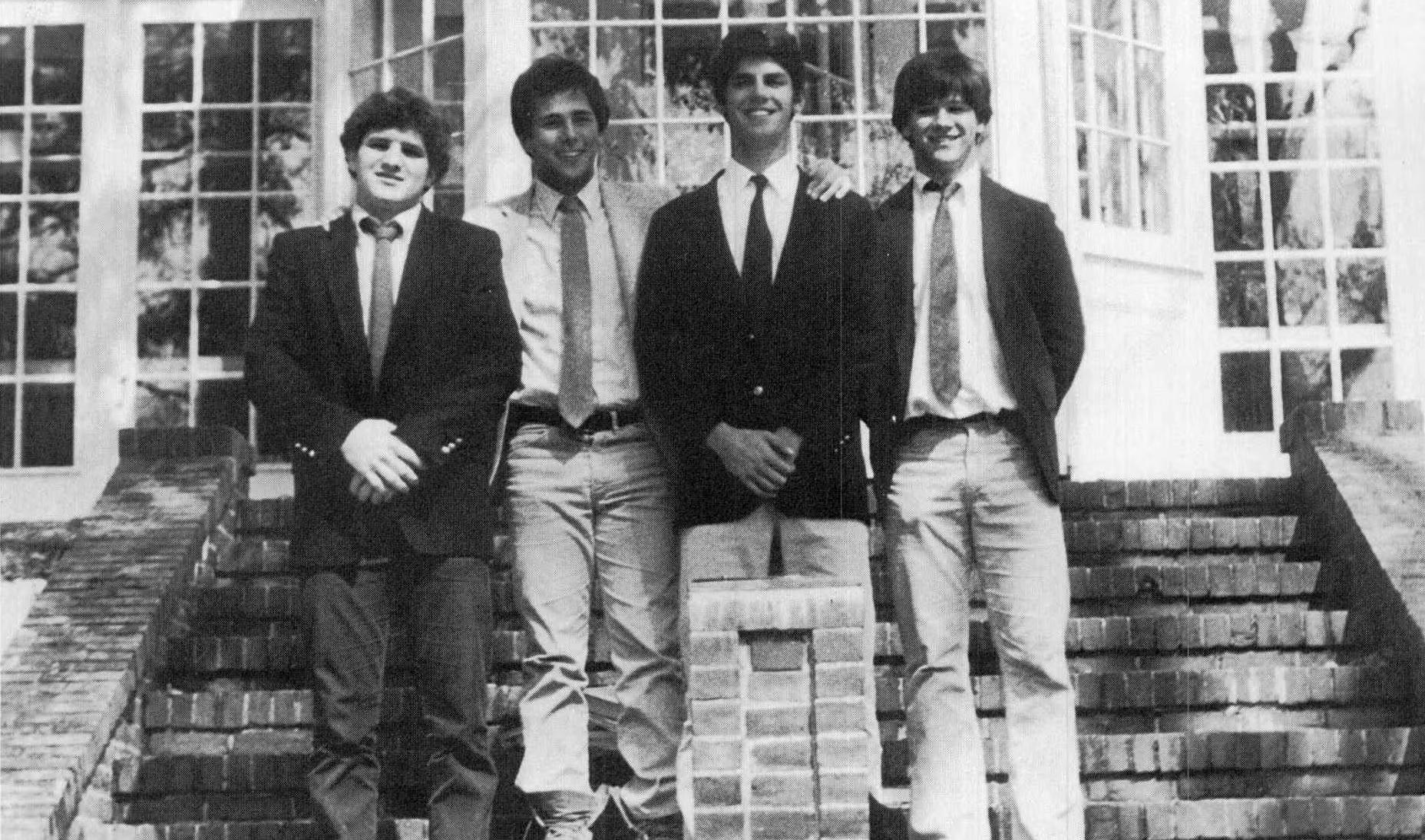
Brady. Robert Kraft has four sons: Jonathan, Daniel, David, and Josh. The first three all attended Belmont Hill. While at Belmont Hill, the Krafts were very active in the community, whether that be on the
One of his classmates, Robert Ricciardelli, in an interview with The Boston Globe, said that Jonathan was “Ten years ahead of everyone else.” Daniel was on the lacrosse team, who was known as the
easy-going brother of the bunch. David was on the wrestling team at Belmont Hill, further underscoring the Kraft family’s multipurpose nature there. After the brothers graduated, the family still stayed involved with the school. The late Myra Kraft, Robert’s wife, served on the school Board of Trustees from 1981-1995. Jonathan then took over in 1995 and is still on the board today. The Kraft family also has a fund at Belmont Hill that supports the creative and performing arts. The family has chosen that avenue as their primary focus for contributing to and helping Belmont Hill grow, as they have also given the Kraft Theater, which serves as a place where seasonal plays are practiced and performed, as well as where drama clubs and electives take place. Harry Kraft, the grandson of Robert and the son of Jonathan, graduated from Belmont Hill in 2014 and then played football for Dartmouth. The Kraft family has an impact over Belmont Hill in many ways, and while walking the campus, just as the Krafts did before, their presence is felt. ☐
Roger Wellington ’28 in Competitive Figure Skating
By Matthew Williams ’28 Panel Staff
detailing the
of an
which seasoning you will grab; salt. The way this rough, white mineral grasps your food and packs a powerful flavour punch is unmatched. A 2023 study by the National Institutes of Health found that 90% of Americans consume more sodium than the recommended amount, underscoring both the popularity and abundance of salt in American diets. One Belmont Hill student stated, “I don’t even know why we have pepper shakers at the tables. I only use salt.” While excessive salt consumption may not promote perfect long-term health, it is far and away the most delicious option on the table. ☐ Salt and Pepper Google Images
eater
that
of these seasonings has as compared to the other. For maximizing flavor-perbite efficiency, one of these seasonings reigns supreme. To get the highest echelon of taste in your bite, we both know
While most Belmont Hill students are asleep, Roger Wellington ’28 practices and trains as a competitive figure skater. On a typical Tuesday morning, after approximately 30 minutes of warm-ups composed of a mix of box jumps and dynamic stretches, Roger is able to take the ice at 5:50 am for sessions mostly comprised of advanced jumps and maneuvers — his days are long, and very demanding: “Every Tuesday, I’ll skate from 5:50 AM to 7:00 AM, then after I’m done I’ll drive to the bus stop, get on the bus, and go to school. After classes, I head to the rink again to skate for 2 or 3 hours, then come home, do homework, and finally go to bed.” Figure skating has always been a hallmark and a defining characteristic of his life; he learned to skate when he was three years old and began training competitively at The Skating Club of Boston in Norwood when he was five.
At age ten, figure skating became Roger’s main sport, and ever since he came to Belmont Hill, he has trained every afternoon, with extra mornings sprinkled in. Within his career, his passion has driven him to keep on going — “I’d say I enjoy the most, just like, a good, a good solid training day that I’m able to land all the jumps perfectly.” Through -
out his career, his coach, Suna Murray, a 1972 Olympian, has been his role model, teaching him to embrace mistakes and learn from them while also seeking personal growth and mastery of technique.

Regional competitions have been a highlight of his career; this past season, he competed in a series of regional qualifying competitions in which he was ranked 8th in the Eastern division going into the national qualifying competition—a culmination of the sectional tournaments with which he hoped to qualify for the illustrious national development camps (a program with the highest placing athletes from the Eastern, Midwestern, and Pacific Coast Regionals). Notably, Roger was ranked 3rd in New England and 15th nationwide, but unfortunately missed the cut for the elusive national camp by one spot this year, however he has been named the first alternate. As the season has ended, Roger looks forward to training hard over the next few months in the off-competition season, as next year he will progress into the age division in which there are the first official national championships. All in all, Roger’s accomplishment as an independent figure skater is certainly one of the best-kept secrets at Belmont Hill, and his story of diligence and athletic achievement is not one to be taken for granted. ☐
Panel Staff
Cameron Boozer Takes it to the Hoop Duke Chronicle
Kraft Brothers Standing on the Sundial Steps Boston Globe Roger Wellington ’28
2026 Major League Baseball Season Preview
By Sam Norden ’28 Panel Staff
With spring training starting this past week, MLB Opening Day is now less than a month and a half away. This year is shaping up to be very competitive, and there is no telling where the World Series trophy will end up at the end of the year. This year, opening day is on March 26, with the Red Sox’s first game in Cincinnati against the Reds on the 27th.
the best, starting rotations in the league. Despite losing a star player in Alex Bregman, the Red Sox have a solid roster this year, despite being in one of the most competitive divisions in the MLB. Additionally, the Blue Jays open with the same odds as the Red Sox to win the World Series. After blow -
ing a three-run lead to the Dodgers in Game 7 of the World Series in November, they are looking to finish what they were not able to last year. Although they lost Shortstop Bo Bichette, they added Dylan Cease and Kazuma Okamoto from Japan, so their roster looks just as strong as it did last year.

The Dodgers open as the favorite to win the World Series, hoping to achieve their third straight, and with a strong lineup highlighted by players like Shohei Ohtani, Mookie Betts, and the newly signed outfielder Kyle Tucker, they are in a great position to make a deep run this season. In the AL East, the Red Sox stand not too far behind the Dodgers, with the sixth-best odds in the league to win it all. After acquiring some infield help this offseason and bringing in a few great starting pitchers in Ranger Suárez and Sonny Gray, the Red Sox will have one of, if not Red
The opening AL MVP favorite is Yankees outfielder Aaron Judge, who is hoping for another dominant season at the plate. He is followed by Royals shortstop Bobby Witt, whose outstanding defense and talent at the plate make him one of the biggest weapons in the league, and Mariners catcher Cal Raleigh, who is following up his 60 home run season in 2025.
In the NL, the early MVP favorite is Dodgers pitcher and designated hitter Shohei Ohtani, who is searching for his third straight and fifth career MVP. He is followed by Mets outfielder Juan Soto, whose powerful bat makes him a weapon in New York, and then third is Ronald Acuña Jr. from the Atlanta Braves, after dealing with injuries last year, making him miss 70 of the team’s 162 games. With numerous teams capable of making a run in October, this season promises six months of drama. Whether it is a repeat champion in Los Angeles or a new team rises to the top, this season has a great chance to be one of the more exciting seasons in recent history. ☐
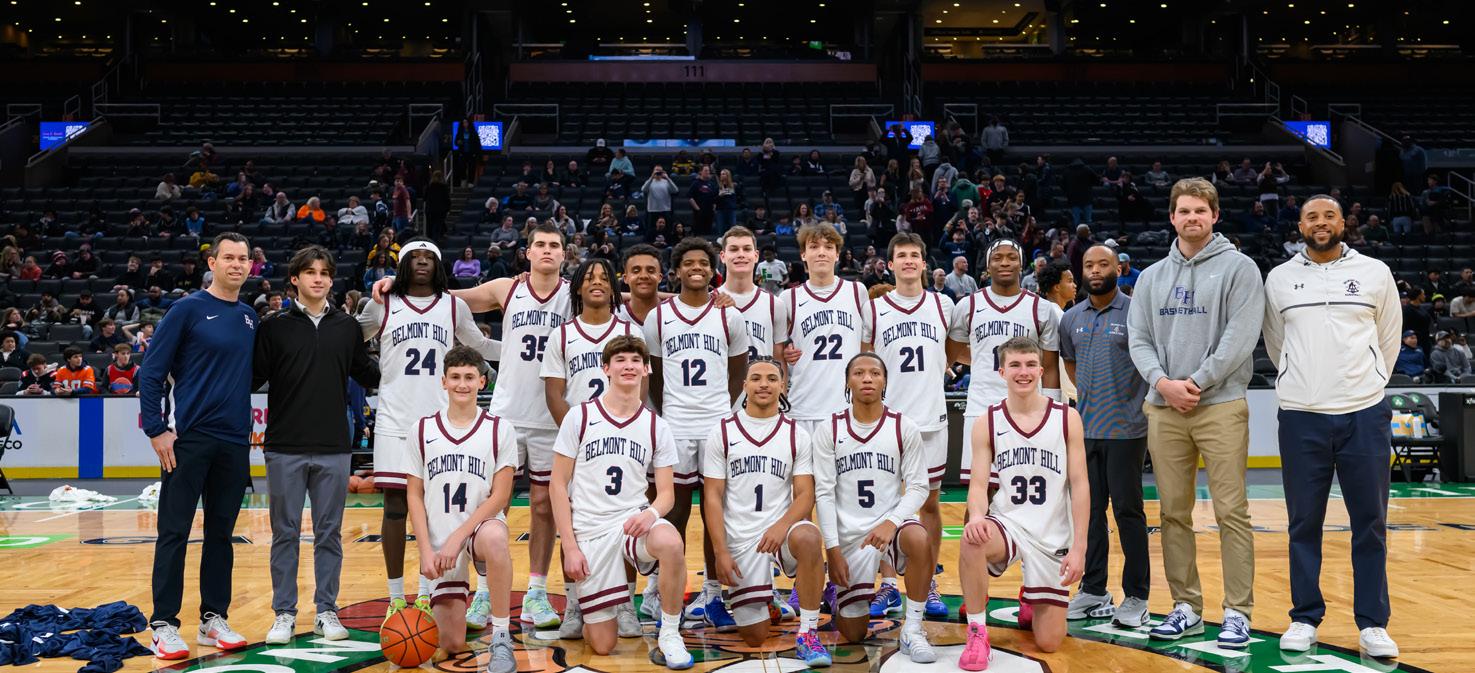
Winter Teams Conclude Another Successful Season!


US Success at Winter Olympics in Milan-Cortina
By Patrick Snail ’28 Panel Staff
Hosted in the beautiful cities of Milan and Cortina, Italy, the 2026 Winter Olympics have exemplified the highs and lows of sports and the universal goal of peace. On February 6th, the opening ceremony set a standard of amazement and world peace. As tradition dictates, over 2,900 athletes from the 93 countries participating in the games took part in the Parade of Nations, bearing their countries’ flags as they were met with applause. For the first time in Olympic history, two cauldrons were lit simultaneously, deviating from the traditional single cauldron. One of the cauldrons was in Milan, whereas the other was in Cortina. The cauldrons’ design was inspired by Leonardo da Vinci’s knot patterns, exemplifying the glory of the Italian Renaissance. Many performances added energy to the night. Mariah Carey performed two songs, including her hit song “Nothing
is Impossible,” and Cecilia Bortoli performed the Olympic anthem, accompanied by pianist Lang Lang. Italian rapper Ghali gave a speech promoting peace and unity while interpretive dancers formed a dove shape around him. To follow, Charlize Theron, UN Peace Ambassador and actress, reinforced this message, quoting Nelson Mandela. As for the games, Norway led in total medals, earning 18 gold, 12 silver,
and 11 bronze, largely due to Johannes Klaebo, a cross-country skier who won six gold medals in all six events, setting a Winter Olympics record for most gold medals in a single Olympics. The USA follows in second, with 12 gold, 12 silver, and 9 bronze, the most amount of gold medals ever won in a single Olympics for the Americans. Some top storylines include Alysa Liu, a figure skater, who won gold in women’s singles after retir-

Athlete of the Issue: Griffin Calhoun ’26
By Shea McDonnell ’28, Tiernan Emmert ’28 & Billy Palumbo ’28 Panel Staff
For Griffin Calhoun ’26, squash was not something he fell in love with overnight. He was originally introduced to the sport through his mom, who played in college, and his brother, Leighton Calhoun ’25, who was heavily invested in the game. Everything changed when Griffin arrived at Belmont Hill. Each year, his commitment and work ethic grew. After being cut from the varsity team in Form II, he didn’t use it as discouragement, but rather as motivation for the following season. Now, as captain of the team, Griffin sees his role as more than just a title. He believes that leading by example and setting a standard for younger players through hard work and focus are key to being an effective captain.
The squash program at Belmont Hill has been extremely successful, winning 21 ISL titles and finishing 11th in the country as a team last year. Griffin credits much of that success to the number of returning players each season, which has allowed the team to develop into a tight-knit, winning group. However, last year the team lost four of its top seven players. This created new challenges not only for Griffin but for the team as

a whole, with many new members stepping into larger roles. When asked how the team could overcome these challenges, Griffin said, “The best way to get better is day by day, putting in effort at ev -
ery practice, and the results will follow.”
Throughout his Belmont Hill squash career, Griffin says the most influential person in his development has been Coach Brownell. “Coach holds ev -
ery player to a higher standard, no matter what,” Griffin said. “Whether you’re the best player on the team or the worst, Coach has high expectations for you, and his tough-love coaching works very well, especially with the younger players.” So far this season, the younger players have played huge roles in the team’s success. Leo Tratz ’31 picked up a decisive win to help beat Nobles 4-3 in the Jackson Tournament, and Adam Ahmed ’29 won a crucial match against Groton in another 4-3 victory. Colton Jacobs ’27, who has been on the team for the past four years, said, “Griffin’s ability to bring composure and seriousness to every game and practice, while still being a fun person to be around, is very impressive.” Leo Tratz ’31 also commented on how Griffin has helped him find success not just on the court, but in adjusting to the rigorous Belmont Hill schedule. As Griffin prepares to continue his squash career at Middlebury College, the legacy he leaves behind at Belmont Hill will be remembered for more than just wins and titles. From being cut in eighth grade to leading one of the top programs in the ISL as captain, Griffin has set the standard through resilience, discipline, and daily commitment to a standard that will continue to shape the program long after he graduates. ☐
Jake Bobo ’18 Wins with Seahawks in Super Bowl LX
By Tyler Grossman ’27 Panel Staff
On Sunday, February 8th, Jake Bobo ’18 helped the Seahawks beat the Patriots 29-13, making him the first Belmont Hill graduate to become a Super Bowl champion. Mr. Butler, who coached him at Belmont Hill, said, “When we had him as a player, he’s the type of athlete you want as a coach, terrific work ethic, ton of talent, and also very intelligent.” In addition to being a standout player on the football field, he was also a vital member of the school’s basketball and track teams. Mr. Butler, who also taught Bobo in chemistry, described him as “an excellent student,” a testament to his well-rounded character.
ing from the sport for three years, 20222025. The US figure skating team also won the team skating event. Mikaela Shiffrin further established her historic Olympic career, winning gold in slalom. Young talent Jordan Stolz won two gold medals in the 500-meter and 1000-meter speedskating events at only 21 years old. In freestyle and snow sports, the US remained dominant, capturing gold in Mixed Team Aerials and posting strong performances across other events. They also had success in sliding sports; the US won gold in monobob and podiumed in bobsled and luge. This included a first ever gold medal for American monobob athlete Elana Meyers Taylor
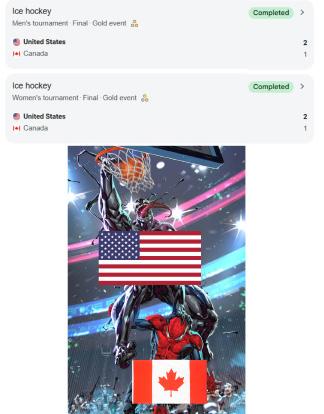
The US women’s hockey team went undefeated to win gold, capped by an overtime thriller, and broke the record for the most consecutive shutout games in Olympic history. The men’s hockey team won the gold medal game defeating arch rival Canda 2-1 in overtime led by an outstanding performance by goalie Connor Hellebuyck. ☐
After graduating from Belmont Hill, Bobo took his talents to Duke, where he spent four years, racking up 1,441 yards as well as becoming third-team All-ACC his senior year. After graduating from Duke, he used his fifth year eligibility to transfer to UCLA, where he caught 57 passes for 817 yards and seven touch-
downs. This put him on the radar of many NFL franchises, including the Seahawks, who picked him up as an undrafted free agent. In his rookie season, Bobo burst onto the scene, racking up 19 catches, 196 yards, and three touchdown passes, including an incredible acrobatic catch against the Cardinals that landed him on SportsCenter Top 10. In the 2025 season, Bobo struggled to stay in the lineup consistently, dealing with a concussion he suffered during preseason before being put back on the injury report again later in the year with a calf injury. However, after only having just two catches during the regular season, Bobo came up clutch in the NFC Championship Game when he caught a 17-yard touchdown pass that helped the team earn its trip to Santa Clara. Despite breaking his hand and getting surgery on it after the NFC Championship Game, just two weeks later, he played in the Super Bowl, where he was on the field for 35 snaps. The Panel congratulates Jake Bobo on becoming a Super Bowl champion. ☐



Jake Bobo ’18
Adam Richins, UCLA Athletics, and Belmont Hill School
Griffin Calhoun ’26
Adam Richins
US Mixed Aerial Skiers Celebrate Gold Medals
Nordic Ski Team with NEPSAC Trophy
Nordic Ski Team
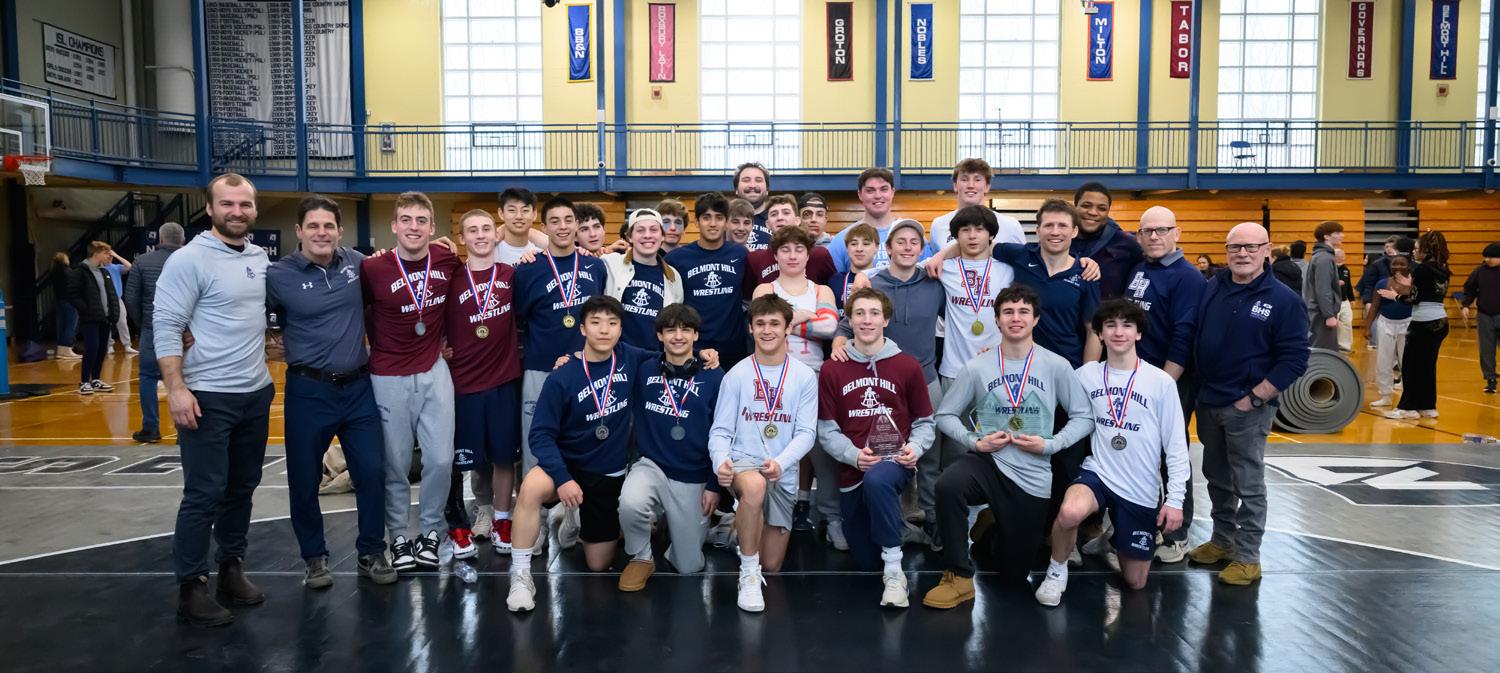
Wrestling Team Celebrates Graves Kelsey Win Jim Campos
Alpine Ski Team
Celebrates ISL Championship Alpine Ski Team
Basketball Team Before Game at TD Garden Jim Campos




In Mr. Bracken’s Room


How it felt watching the speedwalking race in chapel

Featuring Beta Fish Gill Clinton
Figs