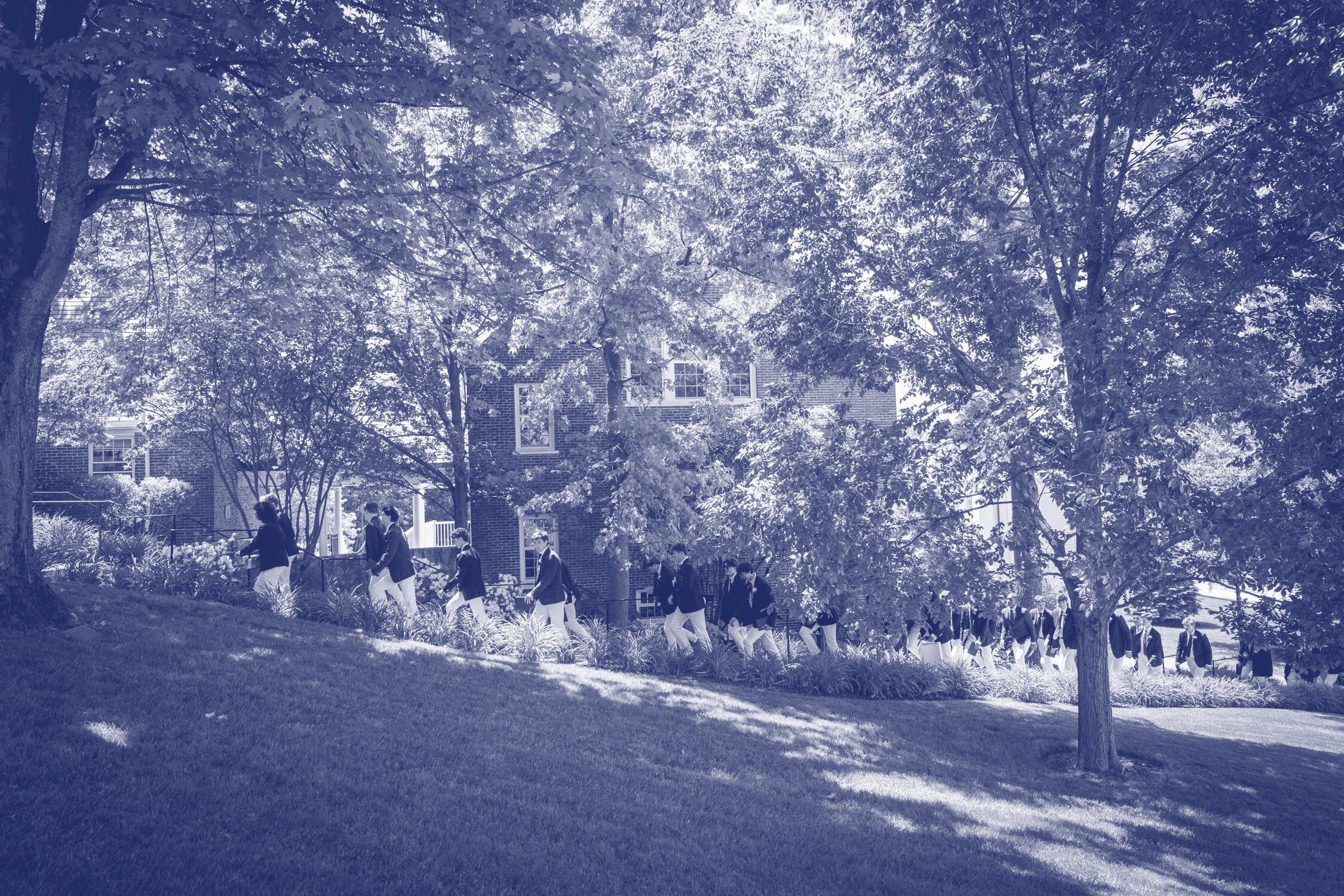
Belmont Hill School was founded as a day school to educate boys in grades 7-12 (Forms I-VI) in mind, body, and spirit, balancing rigorous expectations with consistent encouragement and a strong emphasis on character and honest effort. Through a shared commitment to the classroom, playing fields, studio, and stage, students and teachers work to honor clear thinking and creativity, competition and teamwork, tradition and innovation. The School gathers faculty, staff, and students from diverse cultural, racial, and socioeconomic backgrounds to work together to develop curiosity, courage, and compassion in a community that embraces a spirit of lifelong learning, moral reflection, and service to others.
Belmont Hill At-A-Glance
Founded in 1923
2026-2027 Profile CEEB Code: 220120
GREGORY J. SCHNEIDER
Ronald M. Druker ‘62 Head of School College Counseling
WALKER COPPEDGE Dir. of College Counseling coppedge@belmonthill.org (617) 993-5266
MICHAEL GRANT Associate Head of School Dean of Faculty College Counselor grant@belmonthill org 617-993-5257
JAMIE H PHINNEY Associate Director of College Counseling phinneyj@belmonthill org (617) 993-5265
468 students; grades 7-12 (Form I-VI)
Highly selective: 29% of applicants admitted in 2026
71 cities & towns represented by students
5-day boarding program (27 students)
81 students in the Class of 2027
100% of graduates attend a 4-year college
76 teaching faculty members
6:1 student/faculty ratio
Accreditation & Memberships
Average class size: 10.6
22 AP courses
47 Upper School clubs & activities
4 Upper School publications
16 interscholastic sports
100% of families with demonstrated
need receive financial aid
27% of students receive financial aid
$7.9 million in financial aid awarded in the 2026/2027 school year
SHARON H PATTON Registrar College Counselor patton@belmonthill org (617) 993-5224
BENNETT PITCHER Teacher College Counselor pitcher@belmonthill org (617)993-5343
Belmont Hill is accredited by the New England Association of Schools and Colleges The School and its affiliates hold memberships in the National Association of Independent Schools, the International Boys’ Schools Coalition, the National Association of College Admissions Counselors, and the College Board Belmont Hill School subscribes to the NACAC Statement of Principles of Good Practice
Academic Requirements
The school operates on a two-semester calendar Most students register for 19 5 academic units (18 5 are required) in grades 9 through 12 (Form III through VI).
SUBJECT REQUIREMENTS
ENGLISH
MATHEMATICS
SCIENCE
HISTORY
CLASSICAL or MODERN LANGUAGE
FINE ARTS
4 years, including Senior Spring Inquiry
2 years (Geometry & Algebra 2 Required
2 years laboratory science
2 Years, including 1 year U S History and term paper
3 years of one language other than English
1 year plus carved panel
AP Course Offerings (22)
AP American Studies - English Lit & Comp
AP American Studies - U.S. History
AP US History
AP European History
AP Human Geography
AP Biology
AP Chemistry
AP Physics I
AP Physics C Mechanics
AP Environmental Science
AP Computer Science Principles
AP Computer Science A
AP Calculus AB
AP Calculus BC
AP PreCalculus (exam only)
AP Statistics
AP French Language & Culture
AP Spanish Language & Culture
AP Latin
AP Art History
AP 2D Art and Design
AP 3D Art and Design
Post-AP
Advanced Courses
Multivariable Calculus
Linear Algebra
Advanced Elementary Greek
Advanced Chinese 5
Advanced Spanish 5
MOST ADVANCED COURSES
AP American Studies (English Literature and Composition)
AP Calculus AB, AP Calculus BC, AP Statistics, Multivariable Calculus, Linear Algebra
AP Bio, AP Chem, AP Physics 1, AP Physics C, AP Comp Sci Principles, AP Comp Sci A, AP Environmental Science, Advanced Biomedical Engineering, Advanced Biochemistry and Molecular Biology, Advanced Experimental Neuroscience
AP European History, AP U S History, AP American Studies (U S History), AP Human Geography
AP French, AP Spanish, AP Latin, Advanced Chinese 5, Advanced Spanish 5 Advanced Elementary Greek
AP Art History, AP 2D Art & Design, AP 3D Art & Design
Unique Junior (Form V) Advanced Courses
Advanced Science Research (ASR) I/II (2 Year Course)
ASR offers juniors and seniors the unique opportunity to conduct independent scientific research in a university, hospital, or professional laboratory The course is unique in that it offers professional-level research opportunities, together with the academic support of a faculty member on the school’s campus Students accepted into ASR enroll in a two-year science elective Previous lab assignments include neurological imaging at Brigham and Women’s Hospital, Immunology at MGH, and Epidemiology at the Harvard T H Chan School of Public Health
Advanced Action Research (AAR)
This program emanates from its membership in the School Participatory Action Research Collaborative (SPARC), a consortium of 11 independent schools in partnership with the Graduate School of Education at the University of Pennsylvania. The purpose of this partnership is to provide diverse groups of juniors with college-level socialscience research skills and experience to improve school culture, policy, and practice
UPenn Social Innovators Program
This program is a partnership between the University of Pennsylvania’s Center for Social Impact Strategy, Belmont Hill School, and Schoolyard Ventures Students chosen to participate in the program learn how to launch ventures of their own that create value and a positive impact on society. The program focuses on entrepreneurship, which is much more than learning how to start a business. It’s a mindset - a creative problemsolving framework that can be applied to any number of situations and opportunities and it’s fundamental to students’ long-term success in school, work, and life. It allows them to see opportunities where others don’t, make risk-adjusted decisions, persevere through adversity, and communicate effectively with stakeholders and the public.
Unique Senior (Form VI) Advanced Courses
Senior Thesis
Senior Thesis is a two-part senior elective that prepares students to research and write a senior thesis on a topic of their choice In the fall, students will take this course as a sixth class, meeting weekly in the classroom In the spring, after completing a lit review in their chosen field, students will take a traditional Inquiry course in which they will craft their senior thesis Students will recruit an additional faculty sponsor and create a clear plan of study The course will conclude with a student exhibition of work
Principles of Design Thinking (PDT)
PDT is a two-part senior elective that provides students with the opportunity to solve real-life problems that spark their interest and passion. Using an interdisciplinary approach pioneered by the Stanford d.school and innovative firms such as IDEO, and partnering with alumni who have entrepreneurial experience, students will develop entrepreneurial skills, learn to identify problems, and ideate and test solutions in an iterative fashion In the fall, students will take this course as a sixth class, meeting weekly in the classroom In the spring, the students will take a traditional Inquiry course applying their learning to a specific set of challenges and going through the design process to develop a solution to a problem identified in the first semester
Advanced Biomedical Engineering
Working in teams with upperclassmen at Johns Hopkins University, seniors who take this course have the opportunity to learn about engineering principles to solve design problems that are biological, physiological, and/or medical and have the opportunity to solve a pressing health care inequity challenge and discuss ethical considerations in design and society.
Senior (Form VI) Schedule
Many seniors enroll in 4.5 credit courses. They take five courses in the fall. In the spring term, the senior course load is a minimum of four courses, including the continuation of any full-year courses, as well as the following:
Inquiries: All seniors are required to enroll in an Inquiry, a senior spring English elective course that is designed to prepare students for college-level writing courses While students choose from a variety of real-world and cross-curricular Inquiry topics that often require an interdisciplinary approach, the main focus of Inquiry courses is to hone students’ writing skills to prepare them for college, where style and syntax are a priority
Things You Should Know (TYSK) is a rotating academic and co-curricular requirement for all seniors that incorporates aspects and analysis of young adult life both on and off a college campus. Alumni are asked to speak to seniors about the transition to college, transition to the professional world, and how to anticipate the unexpected. Seniors engage in financial literacy, career panels, and healthy lifestyle conversations.
Wood Panel Carving: Every senior is responsible for carving and finishing a wood panel that is then permanently displayed at the school. This is an additional pass/fail course for every senior that requires meeting multiple times per week throughout the year.
The Transcript
GRADING SYSTEM AND CLASS RANK
Reported grade point averages on transcripts are weighted and include only courses taken at Belmont Hill. Belmont Hill does not report students’ class rank. Cum Laude Society members qualify by achieving a weighted GPA in the top 10% of the class and meeting additional criteria determined by the Cum Laude Committee.
COMMON APPLICATION/STARS COURSE LISTING
While all Belmont Hill classes are taught at a high level and are designed to prepare all students for rigorous college-level work, we offer a range of AP and Advanced courses across disciplines. When students are asked on the STARS or Common Application platform to identify course levels, we encourage all students to identify levels as appropriate, either AP/Advanced or Standard.
Standardized Tests
While some Belmont Hill students across the score spectrum choose not to submit testing at test-optional schools, below is the average testing for the entire Class of 2026.
SAT and ACT scores - Class of 2026 through June 2026
SCHOOLS ENROLLING EIGHT OR MORE BELMONT HILL GRADUATES