Improving Patient Tracking to Reduce False No-Shows and Strengthen Access to LARC Lewis, S., BSN, Morse, E., DNP, MPH, & Phillippi, R.D., PhD Belmont University Doctor of Nursing Practice Program
BACKGROUND • A Step Ahead Foundation (ASAF) partners with clinical providers across Middle Tennessee to expand access to long-acting, reversible contraceptive methods (LARC). • Accurate client tracking from initial contact to service delivery is essential to understanding service utilization, improving care coordination, and sustaining access to LARC.
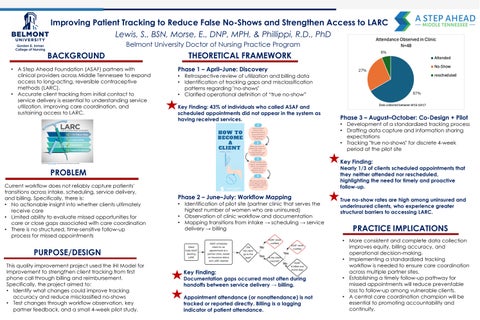
THEORETICAL FRAMEWORK Phase 1 – April–June: Discovery • Retrospective review of utilization and billing data • Identification of tracking gaps and misclassification patterns regarding "no-shows" • Clarified operational definition of “true no-show” Key Finding: 43% of individuals who called ASAF and scheduled appointments did not appear in the system as having received services.
Nearly 1/3 of clients scheduled appointments that they neither attended nor rescheduled, highlighting the need for timely and proactive follow-up.
PROBLEM Phase 2 – June–July: Workflow Mapping • Identification of pilot site (partner clinic that serves the highest number of women who are uninsured) • Observation of clinic workflow and documentation • Mapping transitions from intake → scheduling → service delivery → billing
PURPOSE/DESIGN This quality improvement project used the IHI Model for Improvement to strengthen client tracking from first phone call through billing and reimbursement. Specifically, the project aimed to: • Identify what changes could improve tracking accuracy and reduce misclassified no-shows • Test changes through workflow observation, key partner feedback, and a small 4-week pilot study.
• Development of a standardized tracking process • Drafting data capture and information sharing expectations • Tracking "true no-shows" for discrete 4-week period at the pilot site
Key Finding:
Photo cred it: Kaiser Permanente, Family Centered Family Planning Care, May 2018
Current workflow does not reliably capture patients' transitions across intake, scheduling, service delivery, and billing. Specifically, there is: • No actionable insight into whether clients ultimately receive care • Limited ability to evaluate missed opportunities for care or close gaps associated with care coordination • There is no structured, time-sensitive follow-up process for missed appointments
Phase 3 – August–October: Co-Design + Pilot
Key Finding: Documentation gaps occurred most often during handoffs between service delivery → billing. Appointment attendance (or nonattendance) is not tracked or reported directly. Billing is a lagging indicator of patient attendance.
True no-show rates are high among uninsured and underinsured clients, who experience greater structural barriers to accessing LARC.
PRACTICE IMPLICATIONS • More consistent and complete data collection improves equity, billing accuracy, and operational decision-making. • Implementing a standardized tracking workflow is needed to ensure care coordination across multiple partner sites. • Establishing a timely follow-up pathway for missed appointments will reduce preventable loss to follow-up among vulnerable clients. • A central care coordination champion will be essential to promoting accountability and continuity.